• About PeterSIronwood

petersironwood

~ Finding, formulating and solving life's frustrations.

petersironwood

Tag Archives: writing

The Story of Story: Part 3

17 Saturday Jan 2026

Posted by petersironwood in creativity, essay, HCI, psychology, story, Uncategorized

≈ Leave a comment

Tags

books, education, fiction, HCI, knowledge, leadership, learning, life, management, sense_making, story, Storytelling, thinking, truth, UX, writing

The Story of Story: Part 3 – Good Story, Well Told.

Often in my English classes, (and yours?) we talked about the mechanisms of writing: spelling, grammar, word usage, punctuation, paragraph construction, metaphor, rhythm, and rhyme scheme, for instance. We talked very little about how to tell a story well. And we talked zero about what makes for a good story. 

In the last article, I described some guidelines for soliciting stories from users and other stakeholders. From these, one may gain insight into potential problems that a product or service might solve, ameliorate, bypass, or avoid. Later, I will describe more about how stories may be used in the design and development process. Before getting into that, however, I want to describe more about what makes for a good story. In the following articles, I will also suggest ways to make the story well told. 

What Makes for a Good Story?

You might find it helpful to write down a short list of 5-10 novels, short stories, movies, or TV shows that you really liked. It doesn’t have to be your all time ten best; just something good that springs to mind. Then put that list aside. Read through the criteria I propose and then check back after you’re done reading to see whether or not most of these criteria were met. I’m betting that they mostly were met. 
fullsizeoutput_139c

The Story Cube. 

Imagine a cube of some really nice material that you like; e.g., polished wood, lead ore, malachite, silver. This cube has three dimensions: height, width, and depth. It must have all three dimensions. In the case of a story, there are also three dimensions in this sense: Plot, Setting, and Character. If a story lacks any of these three, it will be “flat” (not so interesting). For example, if you spent time working in a large company or government agency, you were probably given training materials about how you’re not supposed to do unethical things like steal from your company. They may have provided you with scenarios and asked what you would do or what was the “right” response. These stories tend to have people in situations making decisions. The problem with these stories is that, in order for them to be “efficient”, they spend almost zero time on character development.  “Joe wants to impress his boss and make his quota for the fourth quarter so he puts down as sold this-quarter things he is sure he will sell early in January. After all, he rationalizes, calendars are arbitrary.” Of course, the answer is no Joe should not be lying on his sales report. But we really don’t know much about Joe. We don’t know enough about him to really care much about him. Of course, he shouldn’t lie. If he does, it’s pretty hard to feel anything but contempt for Joe. It should have been obvious to him that he shouldn’t lie on a sales report and if he does lie, he should be fired. Good riddance. Let’s replace Joe with someone who follows the rules. 

OLYMPUS DIGITAL CAMERA

This story is so flat that it seems to me that the story is constructed, not so much to really educate, but more to prove that you were shown that it’s wrong to lie on sales forms so that, should the court case arise, you will not be to argue effectively that it was a mere technicality that you didn’t know about. If you really wanted to change someone’s mind about what was right, knowing about Joe’s character could make you empathize much more. Maybe he came from a Mafia-type crime family and no-one would bat any eye about lying on a sales report. They would expect him to lie on the report. Maybe even now, he is looked down upon by everyone else in his family for being such a chump and working for “the man” instead of being “the man.” 

OLYMPUS DIGITAL CAMERA

Or, perhaps Joe just found out that his wife has serious cancer and is understandably but severely depressed. He desperately wants to bring her some good news. If we reveal, not only what situation Joe is in but also, how he sees that situation, how he feels about it and what conflicts he faces, we will begin to have real empathy for Joe. His choices become real, rather than predetermined.  

TV commercials, like corporate training videos, are typically pretty flat too. But in some cases, the ad agency has gone out of their way to introduce you to some character that is recognizable and re-appears in commercial after commercial. Each time, just a little bit of character is revealed and eventually you find yourself watching the commercial largely because you start to care about the character. In a similar way, one might be able to make the corporate training stories more intriguing & educational if there were a cast of characters that persisted over time. 

fullsizeoutput_1308

Two Paths Diverged in a Yellow Wood…

Typically (but not invariably) the author knows how the story will turn out before he starts writing. But for the reader (or viewer), it is not at all obvious how the story will turn out. For compelling stories, the reader must be convinced to “play along with” the uncertainty of the outcome even if they are sure ‘the good guys will win.’ In good stories, bad things happen to the protagonist, but he or she is not a cork tossed on the ocean waves. The protagonist must want something; they must have a goal that is overwhelmingly important to them. They must react to changing circumstances, overcome the obstacles that are thrown at them. Characters are engaged in battles! Battles test them. If winning the battles is easy or inevitable, the character isn’t someone we can really relate to. 

catman

Kryptonite 

Superman is basically super-human and invulnerable! But watching someone who is invulnerable and has super-powers win battle after battle is boring. Superman has to have weaknesses. To make it more interesting and allow for more plot variation, he actually had three original weaknesses: kryptonite, friends, secret identity. In one episode, someone will have some kryptonite while in the next, someone will kidnap one of his friends. Recent movies have added a fourth weakness: other super-human and invulnerable beings.  

Whatever the story, your character must have weaknesses. Otherwise, no-one will “believe” the character and you as the writer will be stymied when you try to develop an interesting plot. The weaknesses can be physical, moral, social, intellectual, situational, and so on. But they should not be merely irrelevant weaknesses. Imagine a story where Sue is the main character. She’s tone deaf. She’s also brilliant, hard-working, imaginative, driven to succeed. And, indeed, she becomes a very successful trial lawyer. Eventually, she is made partner. OK. Isn’t this exactly what we’d expect to happen? What does being tone deaf have to do with anything? 

fullsizeoutput_129c

Imagine instead, that Sue was inspired at the age of four when she went to the opera. It was her life-long dream to become an opera singer. Indeed, she was blessed with a beautiful voice. She was also brilliant, hard-working, imaginative and driven to succeed. Unfortunately, she was tone deaf. Now, the weakness becomes interesting. Perhaps she will fail and kill herself. Perhaps she will fail but find another goal that is even more important to her and succeed at that. Perhaps she will fail time after time but eventually develop a career as an improvisational opera singer. She will ask people in the audience to name five things and then and there, she will create a beautiful aria that weaves a tale of some considerable interest about the five things. No-one knows that she is singing out of tune because she is composing on the spot. 

The more improbable the odds and the more horrendous the journey, the more challenge you give yourself to make it work! Blind at birth but wants to be an artist? Surely, that’s just stupid. It’s impossible. But is it? What if feedback were provided in such a way that it influenced her to make unique and beautiful paintings? What if genetic engineering allows her to grow new neural pathways? What if she can be equipped with artificial eyes? If it’s fiction, a magic spell can do the trick. Even if your ultimate goal is a real product for the real world, imagining a magical solution may lead you to a new (and real) path, previously hidden by your own expectations. 

It is easy for a writer to identify with their hero. And that is potentially quite a problem. After all, if you were superman, you sure as heck would not go out of your way to go near kryptonite. You’d quite sensibly stay away from the stuff! But if you are writing about superman, you need to get him near the deadly stuff every third or fourth episode! The “weaknesses” in the character generate interest. The failures, injuries, betrayals, and conflicts of your protagonist provide materiel that allows you to architect a more interesting plot. 

img_2246

A Garden of Delights, Flashy Sights, or Sword Fights?

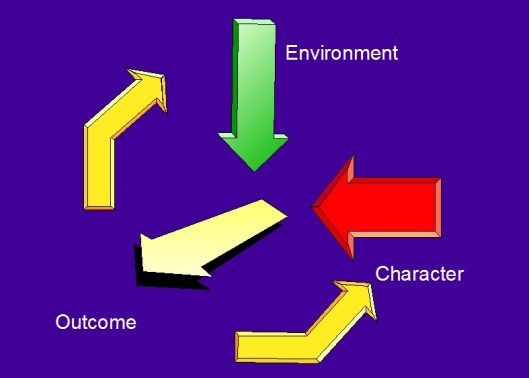
Three dimensions of story is a weak metaphor only. The three dimensions of a cube can be manipulated independently. This is not generally true for the three dimensions of story. The character makes a decision, the decision determines the next step of the plot. That will influence the setting for the next scene. In addition, the actions of the protagonist may also change state of the underlying and cross-cutting conflicts. 

Imagine:

 two rival gangs fighting for urban turf and maybe sex,

 two gardeners in a fierce competition for sex with the town’s most eligible “catch” as well as for the blue ribbon prize for best garden, 

two rival secret agents vying for victory and maybe sex,

two life long friends now vying for #1 in their Harvard Law class, and maybe sex.

The structure of the underlying plot might look quite similar, but the specifics will depend a lot on how the character is developing. If they develop from ego-centric to altruistic, then they will tend to make different decisions near the beginning than near the end of the story. In addition, the setting will have to be consistently portrayed. 

The four descriptions above would most naturally lead to a lot of the setting for the stories respectively in urban settings, garden settings, foreign settings & dangerous situations, mainly Law School and campus settings. Of course, you could violate expectations in a way that increases interest. Imagine that rather than have another garden scene–

The rival gardeners arrive at an urban parking lot dressed in expensive gowns, fully jeweled in their finest, both fully knowing that they will win first prize (but secretly fearing that they might not). These life-long friends now exchange icy greetings, make back-handed compliments about each other’s appearances. The verbal exchange escalates. Precisely because they know each other so well, they know exactly how the other person’s escalator functions. Soon, they are rolling around on the parking lot in their fancy gear; ruining each other’s clothes and hairdos. At this point, they hear in the distance, the loudspeaker and the chairman about to announce the Blue Ribbon Winner!  In their trashed and ripped clothing, they sneak in together to hear the awards, hanging out together in the shadows so as not to be seen in their tattered clothes. “And the blue ribbon goes to” {drumroll}: 

someone else entirely. 

At this, the two life long friends look at each other, laugh uproariously, hug each other, and then become even more intimate friends than they were before their fight in the urban parking lot. 

The fact that there are “expected” relations among various dimensions of story is wonderful. For every such expectation, you can decide to follow, bend, or break that expectation. The more expectations people develop, the greater the number of variations for creative exploration. One valid reason for the choice of setting is really where you want to spend your time. That goes for an author — but it also goes for any designer or business person or User Experience expert. What kind of setting do you want to be in? What kind of customers do you want to serve? Do you really want to make their life better or just get them to buy more product? What sorts of application areas are really cool to you? Of course, I understand people need to eat and often there is a conflict within us all about what to do. That’s what a good story is really about.

img_5134

The reason that stories resonate is that, regardless of setting, people face the same kind of dilemmas. We all do. And, how we handle those dilemmas? In life, as in story, 

character is revealed by choices under pressure… 

——————————————

Author Page on Amazon

Dream Planet on Barnes and Noble

The Impossible

Donnie Boy gets a hamster

What could be better? A Horror Story

If Only

Ripples

It was in his Nature

That Cold Walk Home

The Orange Man

Stoned Soup

The Three Blind Mice

All that Glitters is not Gold

The Forgotten Field

Choosing the Script

The Story of Story, Part 2

16 Friday Jan 2026

Posted by petersironwood in creativity, HCI, psychology, story, Uncategorized

≈ Leave a comment

Tags

AI, books, communication, education, fiction, HCI, interview, knowledge, narrative, needs, psychology, story, truth, user experience, UX, wants, writing

Introduction: 

This is the second in a series about using stories and storytelling in the design, development, and the deployment of products and services. In each post, I will weave in some advice about what makes for a good story as well as how to use stories. In this first case, the emphasis is on using stories to help uncover customer needs and wants. Needs and wants are not quite the same thing. For an extremely worthwhile discussion on the difference, check out this classic article by George Furnas. 

We Human Beings are not just Information Processors; we are also Energy Processors.

img_2261

I had just attended a conference on “knowledge management” co-sponsored by IBM consultants and IBM Research. On the plane ride back, after finishing the crossword, I turned the page to find a full page color ad by an IBM competitor that proclaimed: “Knowledge Management is simply [sic] providing the right information to the right person at the right time.” Color me skeptical, I thought. It isn’t simple to do those things. Beyond that, the formulation seemed simplistic even in its formulation.

The image of one of my undergraduate professors flashed into my brain. Professor MacCaw, (as we will call him), taught advanced German, a language which he had learned in a Russian prison camp, which might explain his approach to testing. At semester’s end, he asked, “Who in class wants A?!” 

img_9691

All two dozen of us raised our hands, of course. At this point, he proceeded to — there is no other word — attack one of the students in the class who had had four years of German in high school and had also lived in Germany for two years. The contents of his questions were not really that difficult, but the manner in which he demanded the answers was horrid. He would ask, for instance, “In first story, main character went where?” (He would always ask the questions in English). 

And she would begin to answer (necessarily in German), “Er geht…” And after a couple words were out of her mouth, he would scream, “Please to conjugate!” This meant that she would have to think back to the last verb she uttered and then conjugate it. “Ich gehe, Sie gehen, …” Then, he would interrupt again and scream a completely different and unrelated question in English. She would begin to answer; he would interrupt after she uttered only a few words: “Please to decline!” This meant, that she would have to give the various forms of the last noun she spoke according to the case. But once again, she could not finish but only begin declining the noun when he would once again interrupt. After 40 minutes, she was in tears and he looked menacingly around the room and asked, “NOW! Who in class STILL wants A?” 

img_3377

I have zero desire to go hang gliding or sky diving. But when it comes to the danger of mere social humiliation, I say, “Screw it. Been there. Done that.” I was one of only two of the remaining students who raised their hand. This act won me the next turn on the chopping block. He proceeded the same whip-saw questioning fest with me. The two-period class was almost over when he finished with me and began questioning “Mr. Lepke.” The bell rang and everyone else in the class left. Later that evening, I chanced to see Professor MacCaw in the Student Union. He walked up to me, eyes blazing. “Ha! I had Mr. Lepke after class for two hours! Finally, he said to me, ‘No, No, Dr. MacCaw, no more, I beg you. No more!’” 

This oral exam was difficult (even with my “screw it” attitude). It was much “harder” than my dissertation defense, for example. Again, it was not the information requested but the manner of questioning that made it difficult. People are not emotionless robots, as it turns out.

img_9666

The next semester, not surprisingly, only about half the class returned. One day in class, as Dr. MacCaw began one of his lengthy digressions on Eastern European history, he stopped himself in mid-sentence to say, “What is THIS!? Someone is passing notes in my class! I will take note and read in front of entire class!” He snatched the note, unfolded it, and indeed read the note in his loud ringing voice: “Doctor MacCaw: your zipper is down.” And, indeed it was. He had meant to humiliate someone in front of the entire class — and he had succeeded. He had the necessary information delivered at the right time to the right person, but — thanks to his own actions — it had not been done in the best manner — at least not the best manner for him. 

Human beings are not just information processors. We are living things and as such, the emotions, the vibes, the manner, the intensity of presentation — these are all vital to how we will react at the time and also how we will feel about the people involved and what we will recall years later. And this fact also means that the atmosphere you create when you interact with various stakeholders will vastly impact the quality of the insights and stories that you receive. If you really care about the people and are really committed to doing something to making people’s lives better; if you are truly open to hear and take in something unexpected or even disruptive to the project; and if you allow your informant to feel that truth about you, you will obtain the gold ring. 

Stakeholder Stories Solicited at their Sites. 

If you use a mechanical method and a mechanical tone and a mechanical manner to ask your users and other stakeholders about their needs and wants, what you will uncover are the most mundane, most rudimentary, most superficial and socially acceptable needs and wants. You can indeed use this information to design a product or service, and you may even have a product or service that succeeds in the marketplace. It will likely be, however, a rather short-lived “win.” Why? Because you are designing to fulfill wants that are subject to the wild winds of passing fashion rather than to catch the fire of an underlying passion. 

img_0568

What I found for myself was that it typically took about an hour of talking with a stakeholder, and most importantly, listening attentively, before they began to tell me their real stories. Your mileage may differ according to culture, context, power relations, your personality, and so on. I like to use a semi-structured interview. In this type of interview, there are known questions that I want to ask. But I also schedule plenty of time to let them elaborate, tell me what’s what behind the scenes. I know that in the corporate world, there is an ever-present push for being “efficient” and getting the job done as quickly as possible. So, it’s tempting to get the informant “back on track.”

I always prefer to interview an informant in their workplace. This seems like common courtesy; it puts them more at ease; and it sometimes reveals their use of other people, references, private notes, etc. as well as what they are dealing with in terms of atmosphere, noise levels, interruptions, desk space, etc. It also makes it much more likely that they can retrieve more of their own memories about work incidents more accurately because of all the contextual cues. 

John Whiteside, who ran the Usability group for Digital Equipment Corporation for a time, recounts running various usability studies and gathering data in various ways about a product they were designing for manuscript centers (places where human beings, historically almost always women, transcribed the dictation of others into text on a computer so that it could be edited, re-written, stored, etc.). The first time that they visited their users in the field, they discovered that they spent about seven hours a day typing and about an hour every day counting up, by hand, the number of lines they had typed. So, in one instant, they realized a feature that would improve productivity significantly. 

Guidelines for Soliciting Stakeholder Stories. 

When I managed the storytelling project at IBM Research, I was fortunate enough to hire Deborah Lawrence to help with the project. She thought it would be a cool idea to interview experts in a number of fields whose job, in one way or another, involves soliciting stories. So, she went out and did just that. I believe that her interviewees included medical doctors, policeman, reporters, social workers, and psychotherapists. These various practitioners had very similar guidelines. 

Story Elicitation Guidelines:

  • Provide a “warm-up” period.
  • Tell something personal and revealing about yourself; perhaps tell a story that is a model of the kind of story you’re looking for.
  • Observe an implicit contract of trust.
  • Provide a motivation for the story — why it’s important.
  • Accept the storyteller’s story and worldview.  Don’t resist the story.
  • Reveal who you are, how the story will be used, potential audience and goals, answer questions.
  • Use questions to probe.  Sometimes, a totally “off the wall” question can create space for story to emerge.
  • Empower the storyteller — they are the expert.
  • Avoid threat; don’t appear as an expert yourself.
  • Listen with avid interest.

These may seem fairly obvious such as does a lot of the advice in the book, How to Win Friends and Influence People. (Come to think of it, that might be the single best book you can read if you want a career in HCI/UX). However — back to the guidelines. I think they seem obvious once pointed out, in much the same way that once someone points out the “pig in the clouds” (or the face in the tree) you cannot not see it. 

img_2897

The above list is not, of course, meant to be the definitive such list. This was based on one study. If you have additional guidelines or disagreements, please let me know. 


Author Page on Amazon

The Walkabout Diaries

The Myths of the Veritas

A Pattern Language for Collaboration

Travels with Sadie

Fifteen Properties

My Cousin Bobby

The Update Problem

After All

All We Stand to Lose

Imagine All the People

The Dance of Billions

Roar, Ocean, Roar


Tools of Thought: Scenario Planning

15 Thursday Jan 2026

Posted by petersironwood in creativity, essay, psychology, story, Uncategorized

≈ Leave a comment

Tags

AI, decision making, fiction, health, life, mental-health, problem formulaation, story, thinking, tools of thought, truth, writing

Scenario Planning is, in some ways, likely to be a very old “tool of thought.” I imagine when our ancient ancestors prepared for a hunt, they would imagine what they would do and where and how and also imagine how their intended prey might react. Personally, I don’t think this kind of imagining is limited to human thinking. 

I take our Golden Doodle out for a walk every morning. She likes going for a walk. And, she has a pretty good “mental model” of the steps I take as I prepare. She gets more excited as she sees me getting close to the actual walk. On her morning walk, she typically urinates at least once and also defecates. She has numerous favorite places although she also improvises. Her walking behavior varies qualitatively if she “really has to go” and she aims for places to go that are closer. She also likes to steer us toward places where we’ve seen other people, dogs, animals, or other recent interesting phenomena. Her “imagined scenes” may be more olfactory than visual, but she’s anticipating. 

If scenario planning is such a common mental phenomenon, you might legitimately wonder why it needs to be examined as a tool of thought. 

Here’s the rationale. Although, in my experience as a researcher, as a teacher and as a therapist, almost everyone pictures possible future events but the way they do it could be vastly improved. For example, some people tend to imagine only negative consequences. In extreme cases, their habitual imagining focuses on the worst possible outcome. In fact, they sometimes focus, not only on the immediate worst outcome. They use that negative outcome as the onset for a whole train of imagined bad result. “There’s no way I’ll get an offer. I won’t get this job. Or, any job. It’s impossible. I’ll go broke and live on the street. I’ll likely be killed by one of those people who kill homeless folks for no reason. I’ll die lonely and forgotten. Now, I’m too depressed to go for a job interview. What’s the point? Just to end up dead?”

Photo by Zafar Mishkat on Pexels.com


Other folks go to the opposite extreme. They focus only on the best possible outcome.
“We’ll attack Cuba with a small force and the Cuban people will immediately join us in a counter-revolution and oust Castro!” Or—“Once we take control of the oil, this war will pay for itself!”


To some extent, thinking of multiple possible outcomes is addressed in another tool: Many Paths. 

It is important to be able to consider multiple scenarios. In general, it is also critical to be able to communicate imagined outcomes to others. That’s where storytelling comes in. Although scenario planning and storytelling are not identical, they are close cousins. Next, we will consider in some depth the topic of stories. How does one find, create, and personalize stories (or scenarios) and present them in a compelling fashion?

——————-

Author page

Many Paths

It was in his Nature

Donnie Takes a Blue Ribbon for Spelling

Small Successes Early 

Coelacanth 

That Cold Walk Home

Timeline for RIME

Wilbur’s Story

What Could be Better? A Horror Story.

As Gold as it Gets

A Mind of Its Own

After the Fall

Travels with Sadie 

The Walkabout Diaries

The First Ring of Empathy

The Orange Man

Stoned Soup

The Three Blind Mice

Don’t Throw Out the Baby with the Bathwater!

08 Thursday Jan 2026

Posted by petersironwood in creativity, essay, psychology, Uncategorized

≈ Leave a comment

Tags

AI, leadership, life, management, mental-health, politics, Problem_finding, problem_solving, thinking, truth, USA, writing

On Throwing Out the Baby with the Bathwater. 

adorable baby beautiful bed

Photo by Pixabay on Pexels.com

Babies are a pain. Let’s face it. Of course, they are. But they are also a joy. Not only that, they are the future of humanity. Yet, it’s true that they require a lot of attention. And, they have unpleasant by-products, bathwater being one of the least unpleasant. But we say, “Don’t throw out the baby with the bathwater” because we humans do have a tendency to over-emphasize whatever the negative aspects of something are and take for granted the good parts. 

For example, let’s say that your furnace goes out. You are sitting there one cold, wet November evening, before winter’s knife edge of cold is softened by the splendor of a snowfall’s sparkle. No, this is an evening for complete relaxation; it’s the end of a frustrating day at work. Time to settle down with a little Jack Daniels on the minimal rocks and watch the next episode of your favorite TV show. But you find yourself thinking: “It’s cold in here!” So, up you go to see whether someone — certainly not you — has set the thermostat too low. No, you see that it’s set to 72F. But the actual temp is only 67F. No wonder it’s chilly. You put on your slippers and pad down the basement stairs to look at the furnace. It’s not running. 

burning campfire

Photo by Berend de Kort on Pexels.com

You feel that you have been cheated out of your richly deserved and eagerly awaited evening of relaxation. Instead, through no real fault of your own, you find these plans and dreams in shambles and you have to go through a series of hoops, each of which will steal some of your money, and equally important, steal some of your time away from activities you’d prefer. The path in thinking that is tempting to take is to “throw out the baby with the bathwater” and decide that the company or the manufacturer is evil. (They might be, of course; my point is simply that deciding that on the basis of the evidence at hand is not warranted). You might even decide that all heating companies or even all companies or, in extreme cases, everyone else is evil. 

A similar line of thinking, again completely understandable, is something like the following. “Well, when I grew up, we just put everything in the trash. You know. We didn’t have to recycle things. If it was good enough for my parents not to recycle, it should be good enough for my kids.” It really doesn’t seem fair. After all, you were just doing what you had been taught was right and now, all of a sudden, like an infomercial embedded in a sit-com, you are supposed to do something different that does take some extra time. And why? 

assorted plastic bottles

Photo by mali maeder on Pexels.com

As the population of earth grows and grows, our own behavior will inevitably be influenced by a greater and greater number of people. That would be true even without the fact that nearly half of earth’s 7 billion human beings [That was early in 2019; now, it’s 8.3 billion and 68% have access].  now have access to the Internet. Sometimes, that interconnectedness puts constraints on your behavior or makes you feel uncomfortable. On the other hand, that same interconnectedness is what allows so many people (hopefully you included) to live in far better circumstances than did any Medieval king. 

Because we humans trade skills, and natural resources, and cultural strengths, and ideas, and money throughout this whole diverse world, our standard of living is a symphony of glorious possibilities instead of a tuning fork forever singing the monotone of “Sing, Johnny One Note.” But we tend to take for granted the affordable laptop, the central heating and air conditioning, the car now fitted with life-saving seat belts and air bags, the cancer treatment that saved your life, or the pollution regulation that prevented you from getting the cancer you would have gotten without those regulations. You have access, I hope, to a public library and the Internet where you can find out about the world’s great architecture, the world’s great ideas, the world’s great art. Think about that. The world’s knowledge is at your fingertips. Not just the knowledge of your family, or your town, or your state, or your country — the world’s knowledge. And, of course, it isn’t just you. More than 5.5 billion people on earth have this access. And, they can invent, and learn, and dialogue together to create a much better world. 

fullsizeoutput_1372

And that much better world will necessarily be different from the world of today. Being different means that people such as you and I will need to change; learn; and sometimes we will be uncomfortable. It’s understandable that it’s somewhat disconcerting. But we need to look at this in balance. The modern world gives us many good things. Yes, it has some unpleasant side-effects. If we work together though, with the knowledge of the world at hand, we should be able to find ethical and effective paths forward. 

It isn’t only in terms of world-wide cooperation (or lack thereof) that we need to take a balanced look. It’s easy to get frustrated with an actual baby and temporarily forget how wonderful it is. It’s easy to get frustrated with college courses, or roommates, or spouses, or co-workers, or technology, or stop lights, or —- when what is really causing that frustration is not the totality of any one of those things. Stop lights actually speed you on your way! If you’ve ever been to a busy intersection when the traffic light stopped functioning, you’ll quickly see how much worse off things are without the traffic light. 

black traffic light

Photo by Davis Sanchez on Pexels.com

So, please, let’s all have the best 2026 that we can. But when you encounter one of the many frustrations of modern life, let’s try to do a better job of seeing the totality of the system, not just the bothersome part. It’s not easy. When your down jacket, usually so comfortable and warm, happens to send the spiky end of a feather into your neck, it’s natural to focus for a moment on the sharp spike. Okay. We all do that. But let’s also remember that ancestors, not so long ago, would have loved to have a down jacket against the winter freeze. 

beautiful blowing cold cute

Photo by Pixabay on Pexels.com

Don’t throw the baby out with the bathwater! 

————————————

Author Page on Amazon. 

Corn on the Cob

Finding the Mustard

What about the Butter Dish?

The Invisibility Cloak of Habit

You Bet Your Life!

Essays on America: The Game

The Self-Made Man

Wednesday

The Stopping Rule

OOPS!

The Update Problem

Roar, Ocean, Roar

Tools of Thought: Symmetry

07 Wednesday Jan 2026

Posted by petersironwood in management, psychology, Uncategorized

≈ 1 Comment

Tags

beauty, Business, Design, HCI, human factors, Human-Computer Interaction, poetry, politics, problem_solving, symmetry, truth, UX, Web design, writing

Symmetry

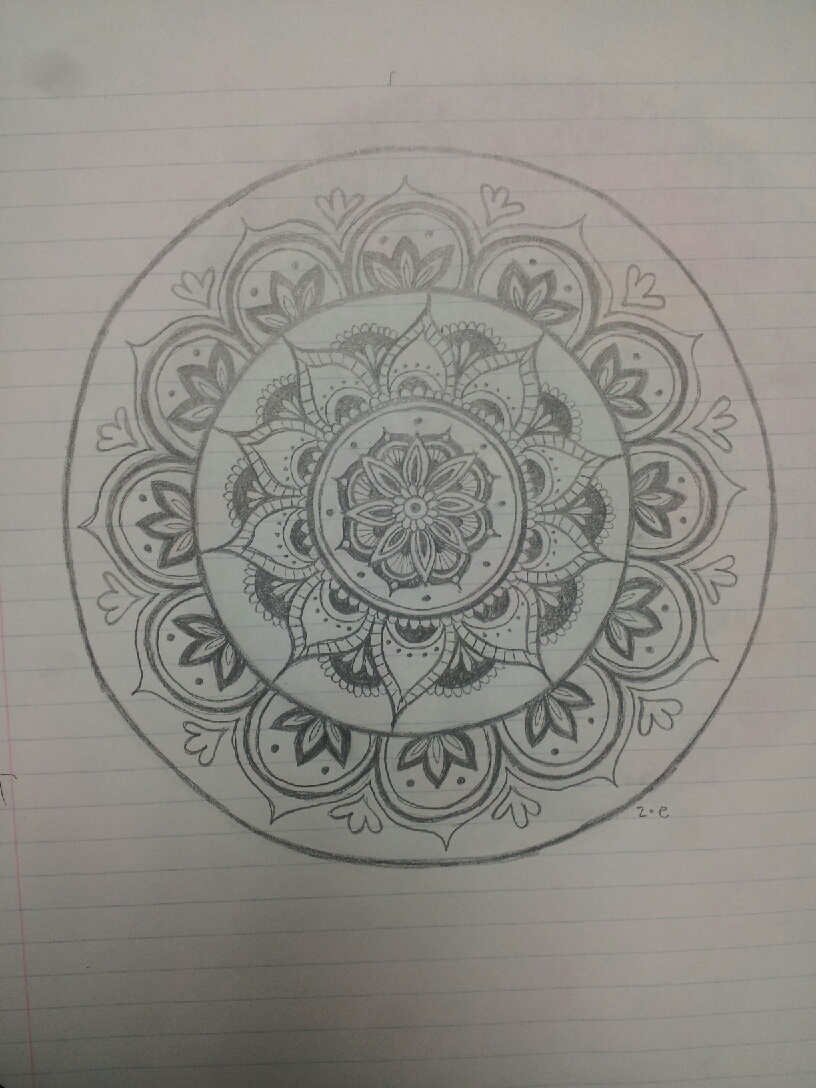
IMG_3316

(Original, free-hand drawing by Zoe Colier).

There are many varieties of symmetry. Symmetry exists rampantly in nature and symmetry is also incorporated into many human designs. In this short essay, I want to remind people of several varieties of symmetry and then show how symmetry may also be used as a tool of thought to help solve problems by simplifying the space of possibilities that must be considered. 

Symmetry is a concept with far broader application than cutting out paper snowflakes or choosing a nice looking Christmas Tree, Menorah or other Holiday decoration. It is fundamental in logic, mathematics, physics, chemistry, biology, and even in social science.

Symmetry exists at many different scales as well. Planets are generally roughly spherical and their orbits are roughly circular. 

IMG_5895

The human body, along with most other animals, exhibits rough bilateral symmetry in external appearance. If you examine your own fingerprints or the pattern of your moles, for instance, you will see that one side of your body looks slightly different from a mirror image. If, like me, you are a righty who play tennis, you will find the forearm muscles on your right arm are slightly larger than those on the left. What is remarkable to me is not that there are slight variations between left and right but just how slight those variations are. And, we are not alone. Fish, insects, flatworms, roundworms, snakes, turtles, lizards, horses, dogs, cats, apes, and humans are all roughly bilaterally symmetrical in appearance. I say “in appearance” because our internal arrangement of organs is not at all symmetrical.  

External Appearance and Internal Organs

In general, it seems to me that most animals possess more complete or “perfect” bilateral symmetry than do most plants. I suspect that this is because animals generally move through a physical environment. Since we can move around, the environmental forces are generally symmetrical and so our ability to react to those environmental forces is also symmetrical. A tree, on the other hand, may have a genetic “blueprint” to be bilaterally or (more likely) radially symmetrical, but it may be subject to strong asymmetrical forces such as wind, a water source, or sunlight versus shade. 

Our designed objects are also most often (at least) bilaterally symmetrical, and particularly for those objects which must interact and move through the physical world. Cars, boats, motorcycles, busses, trains, trucks, bikes, skis, surfboards, roller skates, ice skates, snowshoes and tennis shoes all tend to be bilaterally symmetrical. On the inside, however, again just like us, there are often some irregularities. The arrangement of controls of the car, for instance, are asymmetrical. (Each control in itself often does show symmetry. In some cases, this makes it easier to use, especially without looking. I suspect that the symmetry may often be for aesthetic reasons, for ease of manufacturing, for ease of maintenance or replacement or some combination.) The asymmetry of arrangement “works” because the arrangement of displays and controls does not interact with the natural world the way that the car body and wheels do. The controls are designed to interact with a human being. There are also rough conventions for where controls are laid out, how they operate, and what each type looks like. Asymmetry of arrangement is also evident under the hood. However, some of the components such as the engine, the battery, the radiator have symmetry within them. The radiator, which arguably has the most interaction with the outside world, is symmetrically placed though its plumbing is not. 

automobile car customized drive

Photo by Pixabay on Pexels.com

In the design of User Interaction and Experience, an argument can be made for certain kinds of symmetry. For example, in the Mac editor Pages, which I am using to write this, if the B for bold button background turns blue when bolding is turned on, I expect the background will turn back the way it was (white) when bolding is turned back off. I also expect that italics and underlining will behave the same way, especially because all three are in the same toolbar. 

Where possible, it also generally makes sense, I believe, to design so that the functionality of a system is symmetrical. This isn’t always possible. Some actions are necessarily irreversible. If you don’t believe me, ask anyone who has toddlers or who has pets. In the real world, if you shoot someone dead, you cannot “unshoot” them. Unlike a computer system who asks, “Do you really want to delete all your files?” before doing so, guns do not ask that. If you are designing what can be done with a toy robot however, if you can make it go forward, you want to make it so it can go back as well. If it can turn right 90 degrees, you would like to enable it to turn left 90 degrees. Saying, “Oh, yes, but don’t you see, you can, in effect, make it turn left 90 degrees by making it turn right 90 degrees three times?!” does not cut it, IMHO. 

Typically, you not only want the functionality to be symmetrical, you also want the control functions and appearances to mirror the symmetry of the functionality. For example, if you can issue the command: “MOVE ROBOT FORWARD THREE PACES” you want the symmetrical function to be evoked this way: “MOVE ROBOT BACKWARD THREE PACES” and not, “THREE PACES BACKWARD FOR ROBOT MOVE.” If you decide to give auditory feedback for the first command that says, “ROBOT MOVING FORWARD THREE PACES” you do not want the reverse command to provide feedback that says, “ROBOT THREE PACES BACKWARD MOVING.” (Oh, by the way, if you cannot provide symmetrical functionality, please do not pretend to do so with a facade of symmetrical looking commands that actually behave asymmetrically!)

action android device electronics

Photo by Matan Segev on Pexels.com

A lack of symmetry (or consistency) in the functionality, command structure, or visual appearance often arises because of a lack of communication within the development team. If different functions of the robot are to be implemented by different people, then it’s important that those various people use an agreed upon style guide or Pattern Language or that they  communicate frequently. Of course, this is not the only cause of asymmetry. Even if your team communicates really well, they can’t design an effective gun with an “unkill” function. 

There are, of course, various types of symmetry. Bilateral (mirror) symmetry is what the external appearance of our bodies has. There is also translational symmetry, where the same shape is repeated along a line. The string ABCCBA shows bilateral symmetry while ABCABC exhibits translational symmetry. Most human factors people now agree that hot water faucets (usually on the left) and cold water faucets (usually on the right) should both be turned off by turning to the right and turned on by turning to the left (translational symmetry) as opposed to having the faucet on the right turn off to the right and the left faucet turn off to the left. But you will definitely experience both types. 

In both music and poetry, at least in the culture I am most familiar with, translational symmetry is more common than mirror symmetry. It does sometimes happen that musical composers experiment with playing a tune backwards or even with the staff turned upside down. But this is far less common than repeating a theme or melody. Similarly, a rhyme scheme like ABCABC is much more common than is ABCCBA. {In this notation, ABCABC means that the first line rhymes with the fourth line, the second line rhymes with the fifth line and the third line rhymes with the sixth line.} 

black and brown millipede on a green and brown branch

Photo by Pixabay on Pexels.com

In biology, we also find translational symmetry or something close to it. The segments of a tape worm, the segments of the body of a millipede or centipede, the small legs of a lobster, and even our own vertebrae and ribs show translational symmetry. In social structures as well, we find both mirror symmetry and translational symmetry. For instance, the Golden Rule says to do unto others as you would have them do unto you. In addition, as it happens, if we are nicer to other people, then, generally speaking, they are also nicer to us. This is not always true, however. Some people simply take advantage and view all of life as a zero sum game. Whatever you gain, they lose and vice versa. This is a very limited, inaccurate, and self-defeating attitude in most social situations. Most social situations, are, of course, much more complicated. Generally speaking, there are a great many situations that both you and your “opponent” or even your “enemy” would agree are good and a great many others that both of you would agree are bad. If you are playing tennis or golf outdoors, for instance, you may be fiercely competitive but both of you would probably find a game that brings out the best play is better for both of you. Both of you would probably also agree that being rained out is a bad outcome.  

men in black and red cade hats and military uniform

Photo by Pixabay on Pexels.com

In the military and in many industrial settings, there is a great deal of translational symmetry. The “ideal” set-up is to have many groups at each of many levels and each group is meant to be as similar as possible to all the other groups at that level. The marching that military groups learn is both symbolic of this translational symmetry and practice in behaving as a unit composed of identical parts. Whether or not this is the best way to run a military is debatable. To me, it’s undeniable that this management style has been imported into a huge number of organizations where it is definitely not the best way to organize. 

The last thing to note is that symmetry also pops up in design. There is often a whole series of information exchanges from people who have quite different areas of expertise. These exchanges can result in mutual learning, solutions that work, and often patents, and occasionally, some really cool, transcendent, game-changing designs. In my experience, it is much better to have a design process based on symmetrical relationships founded in mutual respect than to have a design process based on having someone in a hierarchical power relationship make decisions that are to be implemented by an identical set of “underlings.”  

macro photography of snowflake

Photo by Egor Kamelev on Pexels.com

The Takeaway

Symmetry is everywhere. There are many forms. If you start looking for symmetry, you will find examples in nature, in mathematics, poetry, art, music, machine design, the military and even in design problems and design processes. Thinking quite consciously about the types of symmetry that exist in a problem space and what could or should exist in that problem space, can lead to novel solutions.


——————————————-

Author Page on Amazon. 

The Walkabout Diaries

Local Symmetries

Alternating Repetition

The First Ring of Empathy

Donnie Takes a Blue Ribbon for Spelling

Travels with Sadie

It was in his Nature

A Cat’s a cat

A Suddenly Springing Something

Hai-Cat-Ku

Hai-Ku-Dog-Ku

The Dance of Billions

Roar, Ocean, Roar


Non-Linearity

04 Sunday Jan 2026

Posted by petersironwood in America, management, psychology, Uncategorized

≈ Leave a comment

Tags

AI, environment, equilibrium, feedback loops, life, ping pong, politics, research, science, sports, story, systems thinking, table tennis, testing, truth, writing

Non-linearity

A Chessboard Full of Rice

According to myth, the Emperor’s wise adviser once did him a great favor. So grateful was the Emperor that he begged his wise advisor to take any gift she might like from the vast treasures of gold or jewels, any lands or gardens, any of the Emperor’s many male children to be her companion. However, the advisor answered as follows: “Thank you for your generosity, oh mighty Emperor. I have no need of great material wealth. My needs and wants are simple. I do get hungry and thirsty, of course, as do we all, and sometimes my household runs short of rice. You see this fine chessboard?”

battle black blur board game

Photo by Pixabay on Pexels.com

“Oh, yes, my wise counselor, it is indeed finely made of gold and silver and I would gladly give you twenty such!” 

“Thank you again for your generosity, but I only wish for a some grains of rice. Give me one grain on this space and tomorrow, two grains on this space and the next day, four grains on this space. Each day for 64 days, double the number of grains of rice you gave me the day before. At the end of the 64 days, I will ask for no more.” 

The Emperor looked puzzled. “Surely, you must have something more valuable than rice! Name it!” 

“No, Sire, that is all I desire. Just the doubled rice will do quite nicely.” 

“Well, it shall be so!” And thus the Emperor told his staff that they were to provide a grain of rice for the first day, two grains of rice for the next day and to double the amount each day until all 64 days had passed. At first, it seemed such a pathetic gift for such a great favor. 

Even after 8 days, the wise counselor only received 128 grains of rice – not even a bowlful. 

Readers familiar with exponential growth realize that on the 64th day, the Emperor has promised to deliver 2**63 grains of rice. This is not only more rice than the Emperor had at his disposal. It is more grains of rice than exist in all the kingdoms of earth. To be exact, the last payment is meant to be 9,223,372,036,854,775,808 grains of rice while the total is one less than 2**64. To put the matter scientifically — it’s a lot of rice! Much more than exists in the world. 

How would you like the story to end? A wise Emperor, to my mind, would thank the counselor after a couple weeks and say, “I see, oh wise Counselor, that you used my gift to give me another gift to enhance my wisdom. For I now understand that what seemed at first an easy thing to do is actually quite hard. Doubling soon undoes even the richest king. I will keep this in mind when I think about interest rates and population growth.” 

A crummy Emperor, on the other hand, might say, “I offer you a gift and you see fit to embarrass me by making me agree to an impossible task? Boil her in oil!”

The Lily Pad Pond Puzzle. 

Beside my house is a pond. In this pond, a lily pad began to grow. Every day, it doubled in size. On day 20, it completely covered the surface of the pond. The surface of the pond is 400 square feet. How many days did it take to cover half of the pond? 

red and green lily pads focus photography

Photo by Skitterphoto on Pexels.com

At first glance, you might think this problem is insoluble because you don’t know how big the lily pad was initially. In fact, you don’t even need to know how large the pond is. It will cover half the pond on day 19.  

The Ping Pong Table Ping Pong Player Population

When I began at IBM Research in 1973, I soon discovered that a fair number of researchers were avid table tennis players. At lunch time, somewhere between six and twenty researchers would show up to play. There were two tables and some small amount of room for spectators to stand on the edges of the two ping-pong rooms and watch. Our rule was that if a person won, they would stay at the table and a new challenger would play. However, if you won three times in a row, you had to sit down regardless. I didn’t go over every lunch time, but I went over quite a few times over the course of my first ten years there and there was invariably someone to play with. Sometimes, I had a longer wait time than others, but it was never too long a wait. 

Then, because management wanted to use one of the two ping-pong rooms for other purposes, they repurposed one of the rooms. Now, there was only one ping pong table. In the two ping-pong table case, remember, I never had to wait too long nor did I ever go there and have no-one to play. As I said, the number of players varied between somewhere around six to twenty. What is your prediction about how many players showed up when there was only one ping pong table? 

Here’s what happened. The first day after this change happened, I went over and about fifteen people showed up. I, like everyone else, waited a long time for a game. Our “official” lunch hour was actually 42 minutes and the building was a five minute walk away. So, if you had to wait a half hour for your chance to play, it really wasn’t that much fun. In addition, there were some more subtle effects. All the players were good, but there some substantial differences in skill level. People tried to arrange it so that they played someone at about the same level. WIth only one table, this was trickier. In addition, when a relatively large number of people showed up, it was too crowded for everyone to see the match without interfering with play. It happened that I was too busy to go for a few days. The next time I showed up, no-one was there. Some of us talked about trying to “organize” the ping pong to insure that enough people showed up but everyone was busy and no-one wanted to take this on. Scheduling researchers is harder than you might think. It was hard for people to make a commitment to show up at noon because a meeting might run over, their manager might give them extra work, etc. The number of people showing up swung wildly for about two weeks and then stabilized. 

At zero. 

What had been a vibrant community with two ping pong tables did not stay the same size, or shrink to half when we were limited to one table. It went to zero. 

Warring Positive Feedback Loops. 

We’ve already talked about “positive feedback loops” which are also known as “vicious circles.” Sometimes, there are actually (at least) two positive feedback loops hiding beneath what appears to be a stable system. In the Case of the Missing Ping Pong Table described above, one positive feedback loop was simply that when you went there and had a good time through some combination of watching good matches or playing yourself, you were more likely to go there again. There was also a positive feedback loop that was more of a social nature. The more people who were there, the more likely it was you would find a good or interesting match. It was also more likely to be able to find someone you wanted to have a conversation with although the venue prevented this from being a big part of the adventure. Another way that having more people there increased the chances that more people would be there the next day was that it was kind of exciting to have a larger audience watching, cheering, throwing the ball back when the ball crept under the radiator after pin-balling around for awhile after a decent slam. 

IMG_1075

At the same time, there were other feedback loops, sometimes of the same factors but in a different range. For instance, beyond the point of having the periphery of the playing field covered one or two deep, additional spectators added only a little excitement and they were more likely to infringe on the needed space around the table. In addition, while the first ring of spectators felt very much a part of the action, the experience for the second ring of spectators was far less engaging. While I mentioned above that more players meant a better change of finding a good match, it also meant that one had to wait longer between matches. The worst case scenario, of course, is that you are the only one who shows up. 

Behind Every Abstraction are a Host of Personal Stories. 

Yes, you can practice against the wall, and I did this a few times, but it is significantly less fun than a real match. I love to serve, for instance. I have a raft of difficult serves. Just to give you one example, with most set-ups, I can hit the right side of the ball so thinly that I put enough side-spin for the ball to appear as though it isn’t even going to hit the table on the second side, but it does; it curves radically back around to the left. Sometimes people are so surprised that they miss it entirely. Even if they get there, the sidespin often makes them hit it off the table or the curve causes them to mis-hit the ball on their thumb or finger. I can also add a fair amount of top-spin or under-spin as well. Anyway, I didn’t get to do any of that just hitting the ball against the wall. The wall was not perfectly smooth either. So I might hit three of four shots and then the ball would hit a little imperfection in the plaster and careen off to scribble scrabble along the floor and then crawl under the radiator. It’s the kind of annoyance that everyone has experienced. And if someone else is there, you can kind of glance at your friend who nods nearly imperceptibly as you get down on your hands and knees and stretch your fingers into the territory of God-knows what spiders or broken glass and feel around through the grit and dust until you retrieved the ball. And that little glance and that little nod actually make quite a difference. If you’re on your own, it’s not any fun at all. It’s just an annoyance. The only reason I even bother to hit against the wall is to learn to keep focus for extended periods of time. For this, it is good practice and a good challenge. But, if I’m interrupting this to go fish my hand into a pile of dust every couple minutes, it isn’t so likely I’ll come back. 

close up portrait of owl against sky

Photo by Pixabay on Pexels.com

These various factors were all in a dynamic balance so long as there were two tables. When the tables went from two to one, however, what had been a stable equilibrium became a very unstable one. Eventually, of course, it did find a new equilibrium point and that was zero. To crawl out of that, one person might show up. But most of the time, they were the only one. So, they would be less likely to come again. Even if two showed up, since no-one could play every day, you might still find yourself wondering whether someone would be there the next time. 

bandwidth close up computer connection

Photo by panumas nikhomkhai on Pexels.com

You might have read this whole story and wondered why the hell this building full of Ph.D.’s couldn’t get their act together and arrange some matches. It’s an interesting question and here is my personal opinion. When it came to these brilliant scientists and engineers, they came from every part of the globe and they came in all shapes and sizes. Some were vastly overweight and others were ultra marathoners. But the ones who liked to play table tennis were, by and large, athletic and “hyper” – an impatient lot. What all of us really loved was working to find out the truth. And, these truths that we sought were ones the company that we worked for wanted us to seek. True enough, but by the same token, that meant the truth found and utilized would make people’s lives better in some way in the not too distant future. But working in a corporation also meant doing a bunch of administrivia. So, the ping pong set of people, in particular, wanted to get up from their intense sedentary mental and administrative work and play hard at something completely physical and different. The last thing any of us wanted to do was add more administriva to our lives. 

The Takeaway

 It’s easy and common to assume implicitly that the systems you deal with are linear.

They often aren’t. 

Things can go out of control extremely quickly (into a dominant positive feedback loop) once the dynamic equilibrium is disturbed. 

Would the invention of the iPhone have kept the ping pong community going? 

Another takeaway: there are two quite distinct ways of analyzing that are going on in the essay above: a fairly abstract one (even if it uses concrete examples like rice and lily pads) and a very concrete and experiential one. In my experience, both of these modes are useful and valid and if taken together give a fuller picture of what’s going on. My experience in this was mainly in human computer interaction but I think it is equally true for many in law, medicine, management and many other fields. What’s your experience? 

———————————

Author’s Page on Amazon.  

The Update Problem

What About the Butter Dish?

A Little is Not a Lot

The Jewels of November

The Stopping Rule

Wednesday

We Won the War! We Won the War!

Roar, Ocean, Roar

Destroying Government Efficiency

E-Fishiness Comes to Mass General Hospital

Small Things

Tools of Thought: Problem Finding

03 Saturday Jan 2026

Posted by petersironwood in America, management, psychology, Uncategorized

≈ Leave a comment

Tags

AI, Business, creativity, Design, life, marketing, media, mental-health, problem finding, problem solving, research, thinking, thought, truth, writing

Problem Finding

IMG_5193

Today (18 December, 2018), I googled “problem solving” and it returned 287,000,000 results. In most of our school life as well as most people’s work life, we are given problems and asked to solve them. “Problem finding” only returned about 2.5 million or fewer than 1/100th as many hits. Solving problems can make processes more efficient and more effective. Solving problems can even save lives. We generally reward people both at school and at work for being good problem solvers. We seldom train people in problem finding. In fact, the reaction of many teachers and many managers when someone finds a problem is to dismiss it as being a non-problem. (FYI, Google now leads with an AI summary rather than links nor does it provide the number of “hits.”)

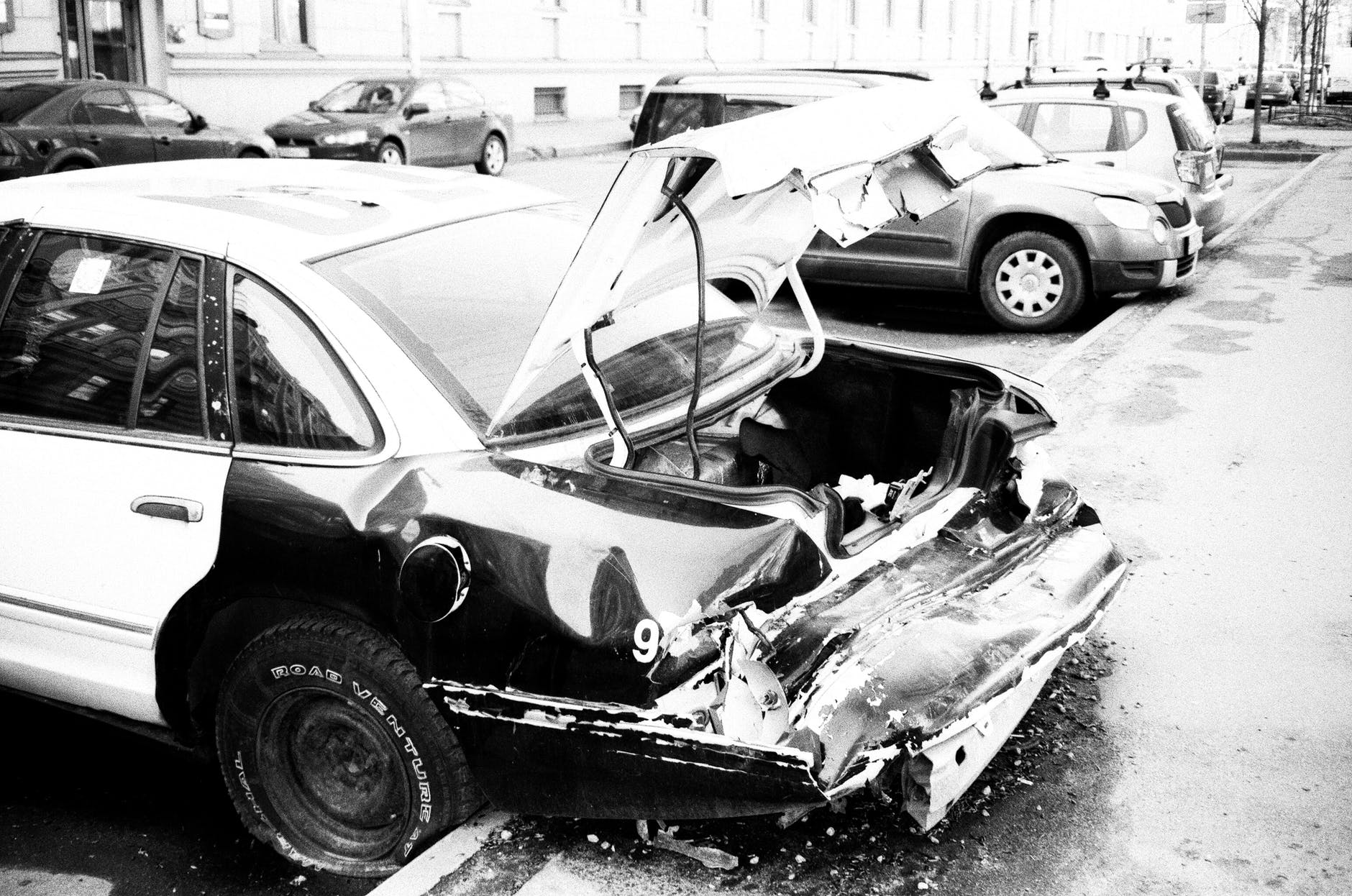
I can understand this sentiment; the emphasis on solving problems rather than finding them. As a teenager driving my dad’s car home from a date with my girlfriend, somebody beside me tried to make a right turn from the left lane and ran right into my dad’s blue Dodge. I heard what sounded like the voice of God say “NO!!” loud and clear. It was actually louder than the sound of crumpling metal. For a split second, I was in complete denial. Even some moments later, when we pulled over to assess the damage, to me, it looked minor enough to ignore and to just drive off. A more experienced guy from the corner gas station near where this happened said that while it may look minor, it would cost hundreds of dollars to fix and we therefore needed to trade information. I was stunned.

grayscale photo of wrecked car parked outside

Photo by Александр Неплохов on Pexels.com

In many cases, it is a human tendency to want to deny that a problem really exists. If you can get past that tendency however, and embrace problems and indeed, even learn to seek them out, you may be able to create tremendous value for yourself and for those around you. Problem solving can make your bookstore more profitable. Problem finding lets you invent Amazon. Problem solving lets you build a better internal combustion engine. Problem finding leads you to an electric vehicle.

What might you do to discover problems? First, you might take your own negative emotions as a jumping off place. If you find yourself angry, or anxious, or depressed, to the extent that you can trace back what is going on to the initiating event, you may be able to be consider whether that event is unique to you — or, more likely, that event is likely to trigger a negative reaction in many people. 

person holding white polaroid land camera

Photo by fotografierende on Pexels.com

If you found that waiting even 48 hours to have your photographs developed and printed — and you thought others might also be impatient to see the results–you might invent Polaroid instant photos. If you found cooking a casserole too time-consuming and messy for your taste, you might invent frozen dinners. If you drove a lot in hot, humid climates, you might be motivated to put air conditioning in cars. 

Of course, you do not have to limit yourself to your own misfortune. If you read about someone having a miserable time, you could dig a little deeper and ask yourself how a tragedy might have been prevented or how an accident could have been avoided. You can also look at a change that seems minor and ask yourself what will happen if this change becomes widespread. 

For example, if you read in the newspaper that a robot has been invented that harvests tomatoes, you might extrapolate to a more universal situation. What if all crops were harvested by machine? This might make groceries cheaper. But what else would it mean? Tomatoes are rather delicate, after all. You might wonder whether growers using a machine to harvest tomatoes would harvest them early to avoid them being mashed by the machine. You might wonder whether they would even genetically alter the tomatoes so that they were easier to harvest by machine (even if they were no longer as tasty). You might wonder what will happen to the tomato pickers. Politicians may tell you that they will all be retrained for higher paying jobs as machine inventors, machine programmers, and machine maintenance folks. But this makes no sense. If there were an equal number of IT jobs as there used to be tomato pickers but each of the new jobs came with a higher salary, why would the growers use robots? There will be fewer jobs after automation and in some cases, far fewer. 

close up of hands holding cherry tomatoes

Photo by rawpixel.com on Pexels.com

You might look at the global temperature trends and ask yourself what will happen if they continue. What will happen if global temperatures continue to rise? What can be done about it? Of course, once people start seriously mapping out the consequences, some people will react by saying, “Oh, it isn’t really happening!.” Why do they think that? Because it’s too scary to contemplate the truth; or too inconvenient to take the necessary actions. There are vested interests in old energy sources who will be happy to help you along in your fantasy of denial. In the short run, it’s often easier to imagine that problems do not exist, or are not that bad, or won’t get worse, or that there is just nothing to be done. 

Even most of the people who rail against what most of us think of as sensible gun regulation (requiring a license, showing ID, getting at least some training and testing the would-be gun owner’s knowledge, competency, and eyesight as we do with cars) don’t think that mass shootings of innocent children is a fine thing. They see it as a problem — just one that cannot be solved or one that can only be solved by adding cost and inconvenience to the potential victims. After such a tragedy, they may even send “thoughts and prayers.” 

black rifle

Photo by Specna Arms on Pexels.com

There is a possible “down side” to problem finding. The greedy may decide that they can make a lot of money by generating a solution to a problem that isn’t really a problem and making you believe it is a problem. My favorite, and so far made up, example is “Elbow Cream” for those unsightly skin wrinkles that appear on the back of your elbow when you straighten your arm. But that made up example is not too far off. You eat spicy food and it upsets your stomach? We can fix that! Of course, you could too by simply not eating overly spicy food! But nobody makes money that way. So they will sell you something that supposedly fixes the “problem.” While it might be fantasy to imagine “Elbow Cream” that will “fix” your “unsightly elbow wrinkles” it is not fantasy to imagine that people have been hoodwinked into spending money on “fixing” their faces and bodies. 

fullsizeoutput_11b5

Americans spent 16 billion dollars on cosmetic plastic surgery in 2017. There are 50 countries who each have a lower GDP than that. The beauty industry in the USA overall was supposedly around $445 billion in 2017. That’s more than the GDP of each of 151 countries! Both figures are also less than the federal government spends on reducing climate change. Or cancer research. 

Do you see that as a problem? I do. 

——————————————————

Author Page on Amazon. 

The Invisibility Cloak of Habit

Essays on America: The Game

One of the most enjoyable aspects of Science Fiction as a genre is that it often shows us problems that might occur in the future. In some cases, it suggests ways to prevent those problems and in some cases, it suggests how these future problems might be dealt with.

Turing’s Nightmares, for instance, comprises 23 short stories that explore the ethics and implications of AI. http://tinyurl.com/hz6dg2d

Dream Planet examines, among other things, the extrapolation of global warming and a radical attempt to stem it. https://www.barnesandnoble.com/w/dream-planet-david-thomas/1148566558

FaceGook

The Ides of February

A Day at the HR Department

Putin’s Favorite DOG-E

Silent Screams of Dead Men’s Dreams

Namble Mamble Jamble

May You Live in Interesting Times

Plastics!

The Last Gleam of Twilight

The “Not-See” Party

An Open Sore from Hell

Happy Talk Lies

Negative Space

02 Friday Jan 2026

Posted by petersironwood in creativity, management, psychology, sports, Uncategorized

≈ Leave a comment

Tags

AI, art, creativity, Design, HCI, illustration, music, negative space, painting, poetry, problem formulation, problem framing, sports, thinking, thought, UX, writing

Negative Space

When you look at a scene, it is natural to concentrate on the objects in the scene. So too, when one begins to design, it is natural to concentrate your attention on the things you intentionally put into the design whether those are menus, icons, images, banners, buttons and so on. You tend to give little thought to what is not there because, after all, there’s nothing there! 

IMG_9815

As your expertise grows, you will find it useful to spend some time and resources thinking about what is not there; the “negative space” if you will. In art, the “negative space” refers to the space around and between the objects. Often, paying attention to the “negative space” can result in a much more interesting and aesthetically pleasing composition. It is a concept that has applications far beyond artistic visual composition however. 

Consider music for a moment, or better yet, listen to some and you will note that the silence is just as important as are the notes. Increase or decrease the silence in a tune by a factor of two and it becomes a different, and in most cases much worse, tune. 

printed musical note page

Photo by Pixabay on Pexels.com

The same can be said of great acting whether on stage or in a movie. The silence while we wait for the actor’s response to some news — while they are saying nothing and possibly even showing nothing or very little on their face, can often be the most poignant and moving parts of the picture. If the actor reacts “too quickly” with no space, we can tell that the stimulus presented is something that they “trigger” on because they are upset about it or trying to deny it. The leading man, for instance, asks a seemingly innocent question on a first date, such as, “So, do you like French Cuis…” “NO!” she cuts in. The audience’s attention is immediately drawn to see what comes next. The response that is too fast indicates a “sore spot.” Did the leading lady want to become a French chef? Did she just end a love affair with a Frenchman? What is going on here? 

IMG_6022

On the other hand, imagine the leading man, says, “So, do you like French Cuisine?” One beat, two beats go by. No answer. A long pause. The leading lady’s face shows nothing. Perhaps she tightens her lips ever so slightly or frowns to the slightest possible extent. The pause continues. The leading man tilts his head as though to ask whether she’s okay. Finally, we come to expect a tirade about the French or French Cuisine or French wine or … something. Instead, after this long pause, the leading lady says nothing but punctuates her silence with something that sounds like a cross between a humorless laugh and a karate grunt. There are probably no words she could have said which would have intrigued us more than the non-response. We think, “What the hell is going on with her and French Cuisine?”  

IMG_9504

Speaking of French Cuisine, when you go to a fine restaurant, your focus is on the food. So too is the focus on the chef and the server. But the space is important as well. It is annoying when you are paying good money to have a nice dining experience and you are shown to your table, given menus and then ignored for the next twenty-five minutes. On the other hand, it is equally annoying when your server comes back every 30 seconds and asks, “Are you ready to order yet or do you need more time?” The optimal time to wait between courses is not always obvious either. Some people need or want much more time between courses. Maybe this nice dinner is all they have planned for the evening. The patrons are having a nice quiet dinner with good conversation. They are in no hurry. Just as one of the diners launches into a complex story or joke, the server comes over and interrupts to tell about the specials. Conversely, another foursome may be planning on attending a play and long pauses between courses may mean missing the first act. 

The negative space in dining is not just about the timing of events. It is also about the spatial arrangement of the food, the spacing between textures and colors. Often, the artistic arrangement is as much about the negative space as the objects on the plate. 

Sometimes, the food itself has positive and negative elements. In a meal with varied and complex and contrasting tastes, for instance, the rice or the bread can provide a kind of “negative space” between the tastier and more salient constituents. These neutral or negative elements allow more contrast among the salient elements than if the more salient elements were enjoyed right after each other. I’m reminded of a line from Kahil Gibran’s The Prophet:

“Let there be spaces in your togetherness.”

Negative space is important in architecture, painting, typography, cinematography, the design of user interfaces, culinary arts, music, and the design of other stimuli. It is also important in activity.

IMG_2769


One of the first popular video games was called “Asteroids.” In this black and white vector graphics game, you controlled a small space ship that shut bullets in the direction the space ship was aimed. All you could control was the speed and direction of the space ship and whether it was shooting. The screen also showed a number of large, irregular “asteroids” that you were meant to hit. When you hit one of these large asteroids with a bullet, it split into two moderate asteroids. When you hit a moderately sized asteroid with a bullet, it split into two small asteroids. When you hit a small asteroid with a bullet, it disappeared. If you got hit by an asteroid, you would die. There was also a flying saucer who came to hassle you. Anyway, I found that if I focused on all these floating asteroids and trying to not to get hit by one, it was a difficult game. For me, at least, it was much better to visualize a path among the asteroids and try to follow that path. In a way, concentrating on the negative space, helped. 

action athletes ball blur

Photo by Pixabay on Pexels.com

The importance of negative space in sports can hardly be over-emphasized. In American football, the back tries to find the holes to run through. In soccer, players seek paths between. In baseball, the hitter wants to “hit it where they ain’t.” In tennis, beginners often play only during half a point. Their attention is focused on the ball and the opposing player(s). They choose a target on the other side of the court and watch to see how well they hit that target. Just as their opponent begins to hit the ball they shift their attention to their opponent and watch where that opponent hits the ball, scurrying there as quickly as possible so as to hit the next shot. What does such a player do between the time they hit the ball and their opponent hits the ball? They watch! They want to see where the next ball goes. If you are young and fast and your opponent is not well skilled, you can often get away with this process. However, what higher level players do is something quite different though it may look similar. The good player has a target in mind but watches the ball while their mind has the target clearly in mind. By watching the ball, they are much less likely to mis-hit the ball. Furthermore, they are not giving away their intended target with their body language. Perhaps most importantly, long before their opponent hits a return shot, the good player thinks about the open spaces on their side of the court and go to cover the most likely of those spaces. 

Many otherwise well-skilled athletes only focus on the game during play. For example, many hitters on amateur softball teams, pay little or no attention to the game while their team is batting until they are “on deck” (almost ready for a turn at bat). This is absurd in the majors, but it’s even more absurd in amateur games. You should be taking this time to learn about the opposing pitcher and about the weaknesses in the opponent team’s fielders. Just because you’re not in the batter’s box doesn’t mean you can’t improve your play. Similarly, in tennis, you can use the time between points to think about tactics and strategy, as well as to mentally “reset” yourself if necessary. Some players wave their hands in front of their face after a point as a reminder/trigger to forget about what just happened and focus on the next point. Some will even turn away from the play, seemingly to talk with their “imaginary friend.” 

To close, a very short, short story based on true events in my first trip to Japan. 

tokyo tower behind black and white dojo building during daytime

Photo by Pixabay on Pexels.com

The Touch of One Hand Clasping

Japan, Tokyo, 1977. I walk crowded streets and beautiful gardens where care is taken for spaces as well as things that grow. I struggle — try to speak Japanese language but usually mispronounce “Key-Ray-Ee-Des” (It is beautiful) as “Key-Rah-Ee-Des” (It is dirty). I tip-toe through minefields of culture steeped in subtlety; lose huge chunks of flesh and karma with my thunderous, blunderous New York strides.

Shin-Ju-Ku: lights dim Times Square into grandmother’s fruit cellar. Row on countless row of Japanese stare hypnotized at small vertical pin-ball game called Pah-Chinn-Koe. This bright hustle bustle hassle hides deeper subtlety, deeper calm, inside, beneath, where foreign eyes can peer not.

I enter Tokyo subway. Then — she enters — total stranger, totally beautiful, black hair, endless eyes. I, of course, having learned small little in my many minefield walks, look everywhere but at her. Better, she looks everywhere but at me. We ride, totally not looking at each other. She stands in middle — nowhere to hold on to — unprotected, beautiful, vulnerable.

Suddenly, train lurches. Simultaneously: she shoots hand out to only spot I can possibly reach while I shoot hand out to only spot she can reach. Our hands clasp strongly for instant and I save her from fall. 

Slowly, we release.

Next stop, she rushes out. But — just before the doors bang shut, she turns — looks straight into my eyes. “Kohn-bahn-wah” she says (“Good Evening”).

Thus, Japanese beauty touches beyond body into very soul of clumsy Westerner.

———————————-

woman holding pink petaled flower

Photo by Đàm Tướng Quân on Pexels.com

Negative space….

———————————————-

Author Page on Amazon 

The Void

After All

It was in his Nature

Life is a Dance

Take a Glance; Join the Dance

Life Will Find a Way

At Least he’s Our Monster

What About the Butter Dish?

The Gods of Old

The Truth about Clouds and Gods

The Bubble People

Comes the Dawn

Is a Dream?

Good Morning!

Camelot is in your Heart

The Tree of Life

Happy New Year, 2026; Reviewing 2025

01 Thursday Jan 2026

Posted by petersironwood in America, pets, poetry, politics, psychology, satire, Uncategorized, user experience

≈ Leave a comment

Tags

AI, Democracy, essays, fiction, life, poem, poetry, politics, Review, thinking, USA, writing

Here’s a hint for having a happy 2026–or, at least one happier than it would otherwise be.

Your happiness actually depends more on how much you love than on how much you are loved. That turns out to be a wonderful thing because you have much more control over how much you love than you do over how much you are loved by others. You need not limit your love to your immediate family. You can love all the fish in the sea; every bird in a tree; every living thing on earth–all of which are in our extended family.

I thought it might be useful for reviewing 2025 for readers to have an index in one place. For instance, something happens or you read something on-line and you think, “Oh, I read something relevant to this on the Peter S. Ironwood blog. Now, what was it called?” Well, this should help.

January 1, 2025 began with a blog post about one of our Golden Doodles named Sadie. I take her for a walk every morning and sometimes write about it. Here are some posts about Sadie.

Travels with Sadie 5: 2025 is here

Travels with Sadie 6: Find Waldo

Travels with Sadie 7: Tolerance

Travels with Sadie 8 – Singing of the Rain

Travels with Sadie 9: Joint Problem Solving

Travels with Sadie 10: The Best Laid Plans

Travels with Sadie 11: Teamwork

Travels with Sadie 12: Taking Turns

During 2025, I found myself writing a number of poems. Many, but not all, were in response to the destruction of America that’s being directed by Putin.

Metastasized

Exauguration Day

The Ides of February

Destroying Our Government’s Effectiveness

The Unread Red

Silent Screams of Dead Men’s Dreams

We Won the War! We Won the War!

Namble Mamble Jamble

Co-Travelers

Autocrat: Putin’s Evil Traitor

Just Desserts?

The Last Gleam of Twilight

Oh, Frabjous Day!

The “Not-See” Party

A Cancerous Weed

An Open Sore from Hell

Baddies often have Bad Daddies

Aside from poetry, I also wrote a number of satirical pieces.

FaceGook explores how the value of social media is mainly created by the participants. Of course, the participants don’t get paid. The companies that own the media do.

Tomorrow’s Dinner is a satire on how the media normalize what is not at all normal.

A Day at the HR Department satirizes the utter incompetence of the Misadministration

Putin’s Favorite DOGE is a satire about DOGE

Interview with Putrid’s DOG-E

E-Fishiness Comes to Mass General Hospital

But Mommy! I had a Reason! satirizes the absurdity of the excuses


Here are links to a number of essays about contemporary issues

Ohms Come in Many Flavors

Running with the Bulls in a China Shop

Increased E-Fishiness in Government

Destroying Natural Intelligence

The Irony Age

Frank Friend or Fawning Foe?

May You Live in Interesting Times

Waves or Particles?

President Mush? Just Flush

The Agony of the Feet

Plastics!

Cooperation is More Common than Disruption

Wordless Perfection


On the lighter side, I’ve been translating sections of “The Ninja Cat Manual” into English

The Ninja Cat Manual

The Ninja Cat Manual 2

The Ninja Cat Manual 3

The Ninja Car Manual 4

From September 20th to September 30th, I began revising & reposting earlier posts about User Experience. Here’s a link to the first:
Customer Experience does not equal Website Design

Turing’s Nightmares is a book of 23 Sci-Fi short stories that examine the future and the ethics of Artificial Intelligence. It’s available on Amazon, but you can also read the chapters in October, 2025 blog posts and commentary on the chapters in November blog posts.

November 28th, I began recounting a series of experiences illustrating the importance of problem formulation.

Problem Formulation Who Knows What?

Starting December 14th, there are a series of essays about various “Tools of Thought”

Tools of Thought


Have a *wonderful* 2026!

Fraught Framing: The Presumed Being-ness of State-ness

31 Wednesday Dec 2025

Posted by petersironwood in America, creativity, psychology, Uncategorized

≈ Leave a comment

Tags

#therapy, creativity, Democracy, education, flexibility, framing, fun, HCI, health, human factors, innovation, learning, life, politics, problem formulation, sports, therapy, USA, writing

Fraught Framing: The Presumed Being-ness of State-ness

OLYMPUS DIGITAL CAMERA

OLYMPUS DIGITAL CAMERA

As I understand it, in Spanish and Portuguese, for example, there is a linguistic distinction between current state of being and habitual state of being that is signaled by the use of different verbs. In English, we say, “That is an angry dog” to mean “That is a dog who is generally and habitually angry” and also to mean, “That dog is in an angry mood right now.” 

woman and man wearing brown jackets standing near tree

Photo by Vera Arsic on Pexels.com

But, regardless of what native languages we write and speak, we humans often make statements about something and treat that something according to the unstated and untenable presupposition that what is true about the current state of affairs is true about eternity. 

This habit of mind, sometimes reinforced by language, is often incredibly useful. For instance, near me right now are a table, and on the table, among other things are a coffee cup filled with coffee and a checkbook. The table is mainly composed of wood and marble. For many purposes, this is an adequate description. Of course, none of these so-called objects were always in their current state. Once, the wood was part of a tree. And, before that, the material in the tree was mainly rainwater and dirt. It was transformed into a tree by a mere seed of information using energy from the sun. 

close up colors dry nature

Photo by Pok Rie on Pexels.com

Meanwhile, even the marble portion of the table was not always in its current state. At one point, in the distant past, this marble was limestone. The limestone was transformed by temperature and pressure into marble. Before the limestone was limestone it was mainly the shells of tiny animals living in the ocean. If we trace the table back far enough we will come to the “Big Bang” that started the universe as we know it. The transformation of the table from one sort of thing into another did not end when it became a table nor when I bought the table. Some day, it will no longer be a table. Eventually, the material nature of the wood, and eventually even the marble will be different. The checkbook and the coffee cup will likely cease to be a checkbook and a coffee cup long before that. 

For the purpose of drinking my coffee, it is just fine to think of this cup as being a cup. It holds my coffee and keeps it somewhat warm. The table works just fine as a place to hold the coffee cup. I don’t need to think more deeply about the lifecycle of the table or the cup or the checkbook. 

Usually. 

But sometimes, it is useful to deconstruct these categories. A fairly common test of creativity, for example, is to think of alternative uses. What could this table be used for besides a table? It is a pretty sturdy looking table, so I would say it could be used as a seat by one or two people pretty safely. It could be used as a deadly if awkward weapon. The bracing cross-piece could be detached and used as less awkward weapon.  It could be used as a barrier. The wood part could be used as firewood. The thing that I habitually use as a coffee cup could be used as a container for many types of liquids or solids and even, with the help of the checkbook, could be used to hold gasses though not very effectively. The checkbook can be used as a weapon against a mosquito. In a very different way, the checkbook could be used as a weapon against a person or even as a weapon against a nation; e.g., by writing checks to steal an election. 

adult beverage breakfast celebration

Photo by Pixabay on Pexels.com

While all of these “objects” have histories, they also have futures. Generally speaking, the people I know give little thought to the future of the objects that they interact with. But slowly, and likely too slowly, this is gradually changing. We often now recycle or reuse objects. Thinking about the future of an object also influences my choices about what I buy.

Thinking about the future of objects is particularly important to when it comes to radioactive material which can pose very long term hazards or it can be stolen and used to cause fairly short term mayhem. Collectively, the plastic that we use gets discarded and then, does not vanish into nothingness. It finds its way into the air we breathe and the water we drink. Now that the population of the earth is 7 billion, [Update: 8.2 billion now in 2025!] we can no longer afford to ignore how the objects we interact with were created and we cannot afford to ignore what becomes of them. What we call a “table” or a “cup” or a “checkbook” is really only a “table for now”, “a cup for now” and a “checkbook for now.” 

The fluidity of things also applies to human beings. It should be pretty obvious to most adults that someone we call “a toddler” or a “teen-ager” is not in that category forever. Most people evolve over time both physically and mentally. The change from “toddler” to “teen-ager” takes many years. Physically, the person usually seems stable from one hour to the next (even physical stability is an illusion; we create over 200 billion new cells a day!). Socially and psychologically, however, we are unstable even at a macro level. A sixteen year old, for instance, may act very much like a mature adult in hundreds of different circumstances. Yet, if they are overly influenced by “friends” or under the influence of alcohol for the first time, their behavioral self-control may easily revert to that more like a ten year old or even a two year old. 

girls on white red jersey playing hand game

Photo by Pixabay on Pexels.com

We Limit Others by our Categories

It is human and common but not useful to observe a small slice of someone else’s behavior and thereby make inferences about their habitual behavior. Even if we know about someone’s habitual behavior, it doesn’t mean that they always behave that way and it doesn’t mean that they can’t change over time. When we say, “Oh, don’t pick Chuck for the baseball team; he’s such a spaz” or “No, I’m sure Sally wouldn’t like to join us; she’s really a loner” or “You can’t count on Jim; he never follows through” we are almost certainly over-generalizing. Perhaps Chuck never learned baseball as a kid and he simply needs to learn and practice basic skills. Maybe Sally has no real friends precisely because no-one asks her to join them because everyone thinks she’s a loner because she’s always alone – because no-one ever asks her to join them. Or maybe her idea of a good time is hiking and she’d be happy to do that, but she (like me!) has zero interest in going clubbing and getting drunk every day. Maybe Jim is completely overworked and/or needs to learn better time management skills. 

light light bulb bulb heat

Photo by Pixabay on Pexels.com

“How many psychologists does it take to change a light bulb? Only one, but the light bulb has to want to change.” 

People may be changed by circumstances but therapy often works too. As the joke implies, it won’t work very well if the main reason the “light bulb” goes to the therapist is to feel better rather than to get better, it’s an opportunity lost. Others who frequently interact with the “light bulb” often hold views and use names that subvert therapy. For example, a person who is never assertive and wants to change that may find that when they do so, their family and colleagues at work, who have been taking advantage of them for their own purposes may say things like this: “Oh, you used to be so nice!” {Translation: I used to be able to manipulate you for my own purposes so much more easily}.   

We Limit Ourselves by our Categories

While we unwittingly define others into boxes that may serve to limit what they can do, we humans are generally “equal opportunity destroyers” and also limit our own potential through self-talk as well. I like to play golf and have therefore asked many people over the course of my life, “Do you play golf?” 

Take a guess what response I have heard at least two dozen times. “Golf? Oh, no. I tried that a couple times. I’m no good.” 

silhouette of man playing golf during sunset

Photo by Pixabay on Pexels.com

After picking myself up off the floor, I try to explain as nicely and politely as possible that if you’ve literally tried it a couple times, you have no idea whether you would be any good at it. You very likely have no idea whether you would like it either. The same goes for painting, writing poetry, playing video games, eating healthy food, exercising regularly, and so on. In each case, your initial level of skill and your initial level of enjoyment are very poor predictors of the long term. It is most often, not our ability, but our self-definitional boundaries and self-talk that limits us. 

The US military spent a lot of time and effort on trying to predict who will become an ace pilot. There are people who probably won’t make good pilots (poor vision, poor coordination, or poor three-dimensional spatial reasoning) but predicting who among good fighter pilots will make a great fighter pilot is much more difficult. The computer industry similarly spent a lot of time and effort trying to predict who will become a super-programmer. Same lack of results, so far as I know. Predicting who will be extremely successful is very hard. That doesn’t mean that no-one believes that they intuitively know. They’re just dead wrong.

Exercises for Flexibility.

girl on beach

Photo by Tim Savage on Pexels.com

Life is complicated and complex so I understand that many folks may be reluctant to expand the scope of what they and others are capable of. But if you do want to become more flexible in your behavioral repertoire, there are several things you can do. 

First, you can become aware of your statements about yourself and others. When you find yourself thinking, “Jim never follows through,” try to restate that in terms of empirical evidence. It could be: “Well, once I asked Jim to help plan the office party and he never showed up for the first meeting. Another time, he said he would help teach my daughter how to parallel park, but nothing ever came of it.” You might immediately see that you have precious little evidence to back up your claim that Jim never follows through. You might also ask yourself whether you ever asked Jim about these incidents. There may be hundreds of legitimate reasons that he didn’t “follow through.” His name might have been left off the distribution list for the party planning meeting. And so on. Generating these alternatives is explored in more detail in “The Iroquois Rule of Six” which basically says before acting on an explanation that is inferred you should generate five alternative explanations. 

Second, you can read fiction, watch movies, attend stage plays, do some amateur theater or even answer a questionnaire from someone else’s perspective. In working with Heather Desurvire at NYNEX, on a usability evaluation of a prototype, we did a variation on heuristic evaluation in which we had people look for issues and offer suggestions from a variety of different perspectives; e.g., a behaviorist, a cognitive psychologist, a worried mother, a physical therapist and so on. With the total amount of time controlled for, people found more issues and offered more suggestions when they looked at the application from the perspectives of many different people. 

Third, and my current favorite, is “Attitude Dancing.” I’m not sure this is what Carly Simon and Jacob Brackman meant by their song title, but when I turn on music while I am cooking or cleaning, I spent part of my dancing time dancing as though I were in a completely different mood or even as though I were a completely different person. 

Give it a try! 

——————————

Author Page on Amazon. 

Desurvire, H. and Thomas, J.C. Enhancing the Performance of Interface Evaluators Using Non-Empirical Usability Methods. In the Proceedings of the Human Factors Society 37th Annual Meeting, October, l993

The Walkabout Diaries: Life Will Find a Way

How the Nightingale Learned to Sing

Your Cage is Unlocked

The Crows and Me

It was in his Nature

Axes to Grind

Silent Pies

The Invisibility Cloak of Habit

Where Does Your Loyalty Lie?

Wednesday

My Cousin Bobby

The Impossible

Labelism

The Update Problem


← Older posts
Newer posts →

Subscribe

  • Entries (RSS)
  • Comments (RSS)

Archives

  • April 2026
  • March 2026
  • February 2026
  • January 2026
  • December 2025
  • November 2025
  • October 2025
  • September 2025
  • August 2025
  • July 2025
  • June 2025
  • May 2025
  • April 2025
  • March 2025
  • February 2025
  • January 2025
  • December 2024
  • November 2024
  • October 2024
  • September 2024
  • July 2024
  • April 2024
  • March 2024
  • February 2024
  • January 2024
  • December 2023
  • August 2023
  • July 2023
  • May 2023
  • April 2023
  • March 2023
  • February 2023
  • January 2023
  • December 2022
  • November 2022
  • October 2022
  • September 2022
  • August 2022
  • July 2022
  • June 2022
  • May 2022
  • April 2022
  • March 2022
  • February 2022
  • January 2022
  • December 2021
  • November 2021
  • October 2021
  • September 2021
  • August 2021
  • July 2021
  • June 2021
  • May 2021
  • April 2021
  • March 2021
  • February 2021
  • January 2021
  • December 2020
  • November 2020
  • October 2020
  • September 2020
  • August 2020
  • July 2020
  • June 2020
  • May 2020
  • April 2020
  • March 2020
  • February 2020
  • January 2020
  • December 2019
  • November 2019
  • October 2019
  • September 2019
  • August 2019
  • July 2019
  • June 2019
  • May 2019
  • April 2019
  • March 2019
  • February 2019
  • January 2019
  • December 2018
  • November 2018
  • October 2018
  • September 2018
  • August 2018
  • July 2018
  • June 2018
  • May 2018
  • April 2018
  • March 2018
  • February 2018
  • January 2018
  • December 2017
  • November 2017
  • October 2017
  • September 2017
  • August 2017
  • July 2017
  • June 2017
  • May 2017
  • April 2017
  • March 2017
  • February 2017
  • January 2017
  • December 2016
  • November 2016
  • October 2016
  • September 2016
  • August 2016
  • July 2016
  • June 2016
  • May 2016
  • April 2016
  • March 2016
  • February 2016
  • January 2016
  • December 2015
  • November 2015
  • October 2015
  • September 2015
  • August 2015
  • May 2015
  • January 2015
  • July 2014
  • January 2014
  • December 2013
  • November 2013

Categories

  • AI
  • America
  • apocalypse
  • cats
  • COVID-19
  • creativity
  • design rationale
  • dogs
  • driverless cars
  • essay
  • family
  • fantasy
  • fiction
  • HCI
  • health
  • management
  • nature
  • pets
  • poetry
  • politics
  • psychology
  • Sadie
  • satire
  • science
  • sports
  • story
  • The Singularity
  • Travel
  • Uncategorized
  • user experience
  • Veritas
  • Walkabout Diaries

Meta

  • Create account
  • Log in

Blog at WordPress.com.

  • Subscribe Subscribed
    • petersironwood
    • Join 662 other subscribers
    • Already have a WordPress.com account? Log in now.
    • petersironwood
    • Subscribe Subscribed
    • Sign up
    • Log in
    • Report this content
    • View site in Reader
    • Manage subscriptions
    • Collapse this bar
 

Loading Comments...