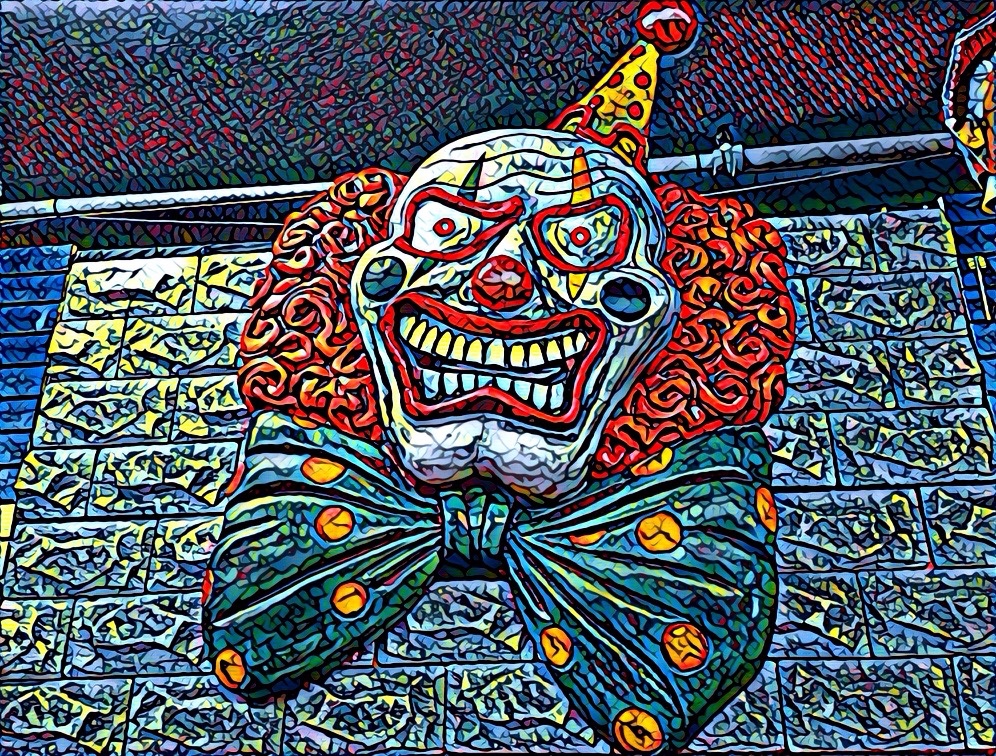
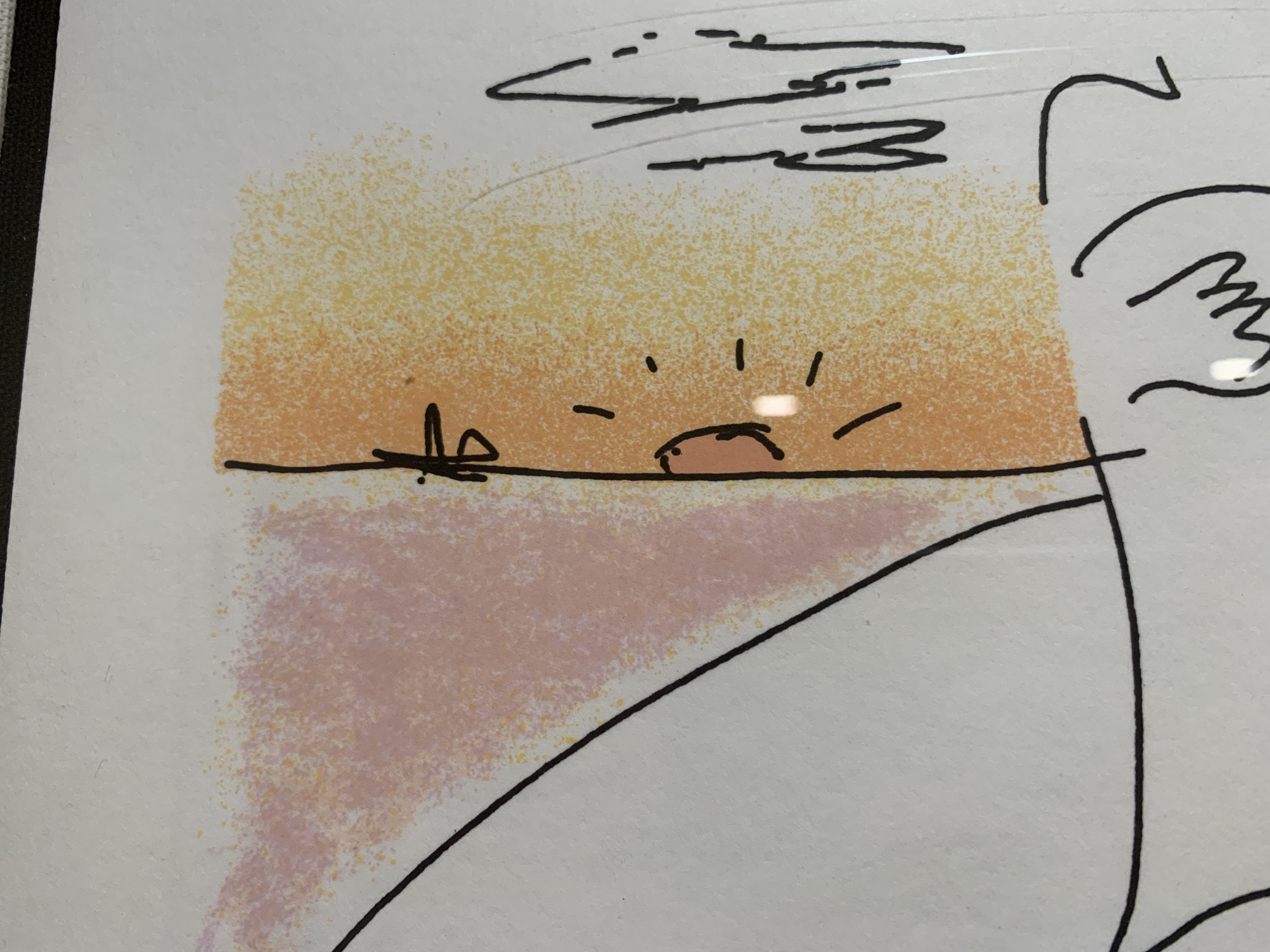
Consider the photograph below. Tell me what you see and think about what you infer based on the combination of your perception of the photo and your general knowledge. You might want to jot it down.
Let’s do a similar exercise based on the photograph below. Again, what is your take-away? I’ll give you a hint. I live in the San Diego area and these photos were taken just a couple days ago (early April, 2026) near where I live.
I took the first photo coming out of the grocery store after doing the shopping. What I “saw” pleased me. I “saw” that my car had an empty parking space on both sides. That makes loading the car from the grocery cart easier. My car is the dark Lexus just beyond the large red pick-up truck. I can recognize my car from almost any small portion of it.
I took the second photo on a Wednesday afternoon. It shows me that it’s still sunny out. It also shows that the gardeners have done with the work and left. The last thing they do is to take out to the curb the lawn trash, the garbage can, and the recycling bin. I can’t see the bins, but I can see the shadows of the bins. When the gardeners come, I open the gate to the garden. Since they are now gone, I plan to take the dogs out in the back. I will first have to re-shut the garden gate so they don’t go bounding out of the garden into the street.
There’s very little chance that you would have any way to figure out what these stimuli mean to me in my context and constraints and goals. And that’s okay. You have hundreds of goals, constraints, and habits that I know nothing about.
It would be absurd for me to try to direct your life and it would be equally absurd for you to try to direct mine. Luckily, we live in a free country. Of course, there are some constraints on that freedom. It’s not legal for me to go steal stuff from my neighbors nor is it legal for them to steal things from me. But in many areas, large and small, each of is free to do as we wish. My neighbors might take their own trash cans out to the street and do it on their own schedule.
Not everyone on the planet is lucky enough to live in a free country.
A dictatorship seeks to control everything about your life. They do not take into account your goals, your context, your habits, your preferences, your constraints. They don’t care. They have neither the knowledge nor the desire to put in place controls that will be right for me. They won’t be right for you either. They won’t be right for anyone.
Except themselves. That’s what dictatorships do. They take power in order to control you, enslave you, and steal from you.
And, if they feel like it, they’re perfectly fine shooting you in the face after you wish them a Good day.
The Story of Story: Part 3 – Good Story, Well Told.
Often in my English classes, (and yours?) we talked about the mechanisms of writing: spelling, grammar, word usage, punctuation, paragraph construction, metaphor, rhythm, and rhyme scheme, for instance. We talked very little about how to tell a story well. And we talked zero about what makes for a good story.
In the last article, I described some guidelines for soliciting stories from users and other stakeholders. From these, one may gain insight into potential problems that a product or service might solve, ameliorate, bypass, or avoid. Later, I will describe more about how stories may be used in the design and development process. Before getting into that, however, I want to describe more about what makes for a good story. In the following articles, I will also suggest ways to make the story well told.
What Makes for a Good Story?
You might find it helpful to write down a short list of 5-10 novels, short stories, movies, or TV shows that you really liked. It doesn’t have to be your all time ten best; just something good that springs to mind. Then put that list aside. Read through the criteria I propose and then check back after you’re done reading to see whether or not most of these criteria were met. I’m betting that they mostly were met.
The Story Cube.
Imagine a cube of some really nice material that you like; e.g., polished wood, lead ore, malachite, silver. This cube has three dimensions: height, width, and depth. It must have all three dimensions. In the case of a story, there are also three dimensions in this sense: Plot, Setting, and Character. If a story lacks any of these three, it will be “flat” (not so interesting). For example, if you spent time working in a large company or government agency, you were probably given training materials about how you’re not supposed to do unethical things like steal from your company. They may have provided you with scenarios and asked what you would do or what was the “right” response. These stories tend to have people in situations making decisions. The problem with these stories is that, in order for them to be “efficient”, they spend almost zero time on character development.“Joe wants to impress his boss and make his quota for the fourth quarter so he puts down as sold this-quarter things he is sure he will sell early in January. After all, he rationalizes, calendars are arbitrary.” Of course, the answer is no Joe should not be lying on his sales report. But we really don’t know much about Joe. We don’t know enough about him to really care much about him. Of course, he shouldn’t lie. If he does, it’s pretty hard to feel anything but contempt for Joe. It should have been obvious to him that he shouldn’t lie on a sales report and if he does lie, he should be fired. Good riddance. Let’s replace Joe with someone who follows the rules.
This story is so flat that it seems to me that the story is constructed, not so much to really educate, but more to prove that you were shown that it’s wrong to lie on sales forms so that, should the court case arise, you will not be to argue effectively that it was a mere technicality that you didn’t know about. If you really wanted to change someone’s mind about what was right, knowing about Joe’s character could make you empathize much more. Maybe he came from a Mafia-type crime family and no-one would bat any eye about lying on a sales report. They would expect him to lie on the report. Maybe even now, he is looked down upon by everyone else in his family for being such a chump and working for “the man” instead of being “the man.”
Or, perhaps Joe just found out that his wife has serious cancer and is understandably but severely depressed. He desperately wants to bring her some good news. If we reveal, not only what situation Joe is in but also, how he sees that situation, how he feels about it and what conflicts he faces, we will begin to have real empathy for Joe. His choices become real, rather than predetermined.
TV commercials, like corporate training videos, are typically pretty flat too. But in some cases, the ad agency has gone out of their way to introduce you to some character that is recognizable and re-appears in commercial after commercial. Each time, just a little bit of character is revealed and eventually you find yourself watching the commercial largely because you start to care about the character. In a similar way, one might be able to make the corporate training stories more intriguing & educational if there were a cast of characters that persisted over time.
Two Paths Diverged in a Yellow Wood…
Typically (but not invariably) the author knows how the story will turn out before he starts writing. But for the reader (or viewer), it is not at all obvious how the story will turn out. For compelling stories, the reader must be convinced to “play along with” the uncertainty of the outcome even if they are sure ‘the good guys will win.’ In good stories, bad things happen to the protagonist, but he or she is not a cork tossed on the ocean waves. The protagonist must want something; they must have a goal that is overwhelmingly important to them. They must react to changing circumstances, overcome the obstacles that are thrown at them. Characters are engaged in battles! Battles test them. If winning the battles is easy or inevitable, the character isn’t someone we can really relate to.
Kryptonite
Superman is basically super-human and invulnerable! But watching someone who is invulnerable and has super-powers win battle after battle is boring. Superman has to have weaknesses. To make it more interesting and allow for more plot variation, he actually had three original weaknesses: kryptonite, friends, secret identity. In one episode, someone will have some kryptonite while in the next, someone will kidnap one of his friends. Recent movies have added a fourth weakness: other super-human and invulnerable beings.
Whatever the story, your character must have weaknesses. Otherwise, no-one will “believe” the character and you as the writer will be stymied when you try to develop an interesting plot. The weaknesses can be physical, moral, social, intellectual, situational, and so on. But they should not be merely irrelevant weaknesses. Imagine a story where Sue is the main character. She’s tone deaf. She’s also brilliant, hard-working, imaginative, driven to succeed. And, indeed, she becomes a very successful trial lawyer. Eventually, she is made partner. OK. Isn’t this exactly what we’d expect to happen? What does being tone deaf have to do with anything?
Imagine instead, that Sue was inspired at the age of four when she went to the opera. It was her life-long dream to become an opera singer. Indeed, she was blessed with a beautiful voice. She was also brilliant, hard-working, imaginative and driven to succeed. Unfortunately, she was tone deaf. Now, the weakness becomes interesting. Perhaps she will fail and kill herself. Perhaps she will fail but find another goal that is even more important to her and succeed at that. Perhaps she will fail time after time but eventually develop a career as an improvisational opera singer. She will ask people in the audience to name five things and then and there, she will create a beautiful aria that weaves a tale of some considerable interest about the five things. No-one knows that she is singing out of tune because she is composing on the spot.
The more improbable the odds and the more horrendous the journey, the more challenge you give yourself to make it work! Blind at birth but wants to be an artist? Surely, that’s just stupid. It’s impossible. But is it? What if feedback were provided in such a way that it influenced her to make unique and beautiful paintings? What if genetic engineering allows her to grow new neural pathways? What if she can be equipped with artificial eyes? If it’s fiction, a magic spell can do the trick. Even if your ultimate goal is a real product for the real world, imagining a magical solution may lead you to a new (and real) path, previously hidden by your own expectations.
It is easy for a writer to identify with their hero. And that is potentially quite a problem. After all, if you were superman, you sure as heck would not go out of your way to go near kryptonite. You’d quite sensibly stay away from the stuff! But if you are writing about superman, you need to get him near the deadly stuff every third or fourth episode! The “weaknesses” in the character generate interest. The failures, injuries, betrayals, and conflicts of your protagonist provide materiel that allows you to architect a more interesting plot.
A Garden of Delights, Flashy Sights, or Sword Fights?
Three dimensions of story is a weak metaphor only. The three dimensions of a cube can be manipulated independently. This is not generally true for the three dimensions of story. The character makes a decision, the decision determines the next step of the plot. That will influence the setting for the next scene. In addition, the actions of the protagonist may also change state of the underlying and cross-cutting conflicts.
Imagine:
two rival gangs fighting for urban turf and maybe sex,
two gardeners in a fierce competition for sex with the town’s most eligible “catch” as well as for the blue ribbon prize for best garden,
two rival secret agents vying for victory and maybe sex,
two life long friends now vying for #1 in their Harvard Law class, and maybe sex.
The structure of the underlying plot might look quite similar, but the specifics will depend a lot on how the character is developing. If they develop from ego-centric to altruistic, then they will tend to make different decisions near the beginning than near the end of the story. In addition, the setting will have to be consistently portrayed.
The four descriptions above would most naturally lead to a lot of the setting for the stories respectively in urban settings, garden settings, foreign settings & dangerous situations, mainly Law School and campus settings. Of course, you could violate expectations in a way that increases interest. Imagine that rather than have another garden scene–
The rival gardeners arrive at an urban parking lot dressed in expensive gowns, fully jeweled in their finest, both fully knowing that they will win first prize (but secretly fearing that they might not). These life-long friends now exchange icy greetings, make back-handed compliments about each other’s appearances. The verbal exchange escalates. Precisely because they know each other so well, they know exactly how the other person’s escalator functions. Soon, they are rolling around on the parking lot in their fancy gear; ruining each other’s clothes and hairdos. At this point, they hear in the distance, the loudspeaker and the chairman about to announce the Blue Ribbon Winner!In their trashed and ripped clothing, they sneak in together to hear the awards, hanging out together in the shadows so as not to be seen in their tattered clothes. “And the blue ribbon goes to” {drumroll}:
someone else entirely.
At this, the two life long friends look at each other, laugh uproariously, hug each other, and then become even more intimate friends than they were before their fight in the urban parking lot.
The fact that there are “expected” relations among various dimensions of story is wonderful. For every such expectation, you can decide to follow, bend, or break that expectation. The more expectations people develop, the greater the number of variations for creative exploration. One valid reason for the choice of setting is really where you want to spend your time. That goes for an author — but it also goes for any designer or business person or User Experience expert. What kind of setting do you want to be in? What kind of customers do you want to serve? Do you really want to make their life better or just get them to buy more product? What sorts of application areas are really cool to you? Of course, I understand people need to eat and often there is a conflict within us all about what to do. That’s what a good story is really about.
The reason that stories resonate is that, regardless of setting, people face the same kind of dilemmas. We all do. And, how we handle those dilemmas? In life, as in story,
Scenario Planning is, in some ways, likely to be a very old “tool of thought.” I imagine when our ancient ancestors prepared for a hunt, they would imagine what they would do and where and how and also imagine how their intended prey might react. Personally, I don’t think this kind of imagining is limited to human thinking.
I take our Golden Doodle out for a walk every morning. She likes going for a walk. And, she has a pretty good “mental model” of the steps I take as I prepare. She gets more excited as she sees me getting close to the actual walk. On her morning walk, she typically urinates at least once and also defecates. She has numerous favorite places although she also improvises. Her walking behavior varies qualitatively if she “really has to go” and she aims for places to go that are closer. She also likes to steer us toward places where we’ve seen other people, dogs, animals, or other recent interesting phenomena. Her “imagined scenes” may be more olfactory than visual, but she’s anticipating.
If scenario planning is such a common mental phenomenon, you might legitimately wonder why it needs to be examined as a tool of thought.
Here’s the rationale. Although, in my experience as a researcher, as a teacher and as a therapist, almost everyone pictures possible future events but the way they do it could be vastly improved. For example, some people tend to imagine only negative consequences. In extreme cases, their habitual imagining focuses on the worst possible outcome. In fact, they sometimes focus, not only on the immediate worst outcome. They use that negative outcome as the onset for a whole train of imagined bad result. “There’s no way I’ll get an offer. I won’t get this job. Or, any job. It’s impossible. I’ll go broke and live on the street. I’ll likely be killed by one of those people who kill homeless folks for no reason. I’ll die lonely and forgotten. Now, I’m too depressed to go for a job interview. What’s the point? Just to end up dead?”
Other folks go to the opposite extreme. They focus only on the best possible outcome. “We’ll attack Cuba with a small force and the Cuban people will immediately join us in a counter-revolution and oust Castro!” Or—“Once we take control of the oil, this war will pay for itself!”
To some extent, thinking of multiple possible outcomes is addressed in another tool: Many Paths.
It is important to be able to consider multiple scenarios. In general, it is also critical to be able to communicate imagined outcomes to others. That’s where storytelling comes in. Although scenario planning and storytelling are not identical, they are close cousins. Next, we will consider in some depth the topic of stories. How does one find, create, and personalize stories (or scenarios) and present them in a compelling fashion?
Babies are a pain. Let’s face it. Of course, they are. But they are also a joy. Not only that, they are the future of humanity. Yet, it’s true that they require a lot of attention. And, they have unpleasant by-products, bathwater being one of the least unpleasant. But we say, “Don’t throw out the baby with the bathwater” because we humans do have a tendency to over-emphasize whatever the negative aspects of something are and take for granted the good parts.
For example, let’s say that your furnace goes out. You are sitting there one cold, wet November evening, before winter’s knife edge of cold is softened by the splendor of a snowfall’s sparkle. No, this is an evening for complete relaxation; it’s the end of a frustrating day at work. Time to settle down with a little Jack Daniels on the minimal rocks and watch the next episode of your favorite TV show. But you find yourself thinking: “It’s cold in here!” So, up you go to see whether someone — certainly not you — has set the thermostat too low. No, you see that it’s set to 72F. But the actual temp is only 67F. No wonder it’s chilly. You put on your slippers and pad down the basement stairs to look at the furnace. It’s not running.
You feel that you have been cheated out of your richly deserved and eagerly awaited evening of relaxation. Instead, through no real fault of your own, you find these plans and dreams in shambles and you have to go through a series of hoops, each of which will steal some of your money, and equally important, steal some of your time away from activities you’d prefer. The path in thinking that is tempting to take is to “throw out the baby with the bathwater” and decide that the company or the manufacturer is evil. (They might be, of course; my point is simply that deciding that on the basis of the evidence at hand is not warranted). You might even decide that all heating companies or even all companies or, in extreme cases, everyone else is evil.
A similar line of thinking, again completely understandable, is something like the following. “Well, when I grew up, we just put everything in the trash. You know. We didn’t have to recycle things. If it was good enough for my parents not to recycle, it should be good enough for my kids.” It really doesn’t seem fair. After all, you were just doing what you had been taught was right and now, all of a sudden, like an infomercial embedded in a sit-com, you are supposed to do something different that does take some extra time. And why?
As the population of earth grows and grows, our own behavior will inevitably be influenced by a greater and greater number of people. That would be true even without the fact that nearly half of earth’s 7 billion human beings [That was early in 2019; now, it’s 8.3 billion and 68% have access]. now have access to the Internet. Sometimes, that interconnectedness puts constraints on your behavior or makes you feel uncomfortable. On the other hand, that same interconnectedness is what allows so many people (hopefully you included) to live in far better circumstances than did any Medieval king.
Because we humans trade skills, and natural resources, and cultural strengths, and ideas, and money throughout this whole diverse world, our standard of living is a symphony of glorious possibilities instead of a tuning fork forever singing the monotone of “Sing, Johnny One Note.” But we tend to take for granted the affordable laptop, the central heating and air conditioning, the car now fitted with life-saving seat belts and air bags, the cancer treatment that saved your life, or the pollution regulation that prevented you from getting the cancer you would have gotten without those regulations. You have access, I hope, to a public library and the Internet where you can find out about the world’s great architecture, the world’s great ideas, the world’s great art. Think about that. The world’s knowledge is at your fingertips. Not just the knowledge of your family, or your town, or your state, or your country — the world’s knowledge. And, of course, it isn’t just you. More than 5.5 billion people on earth have this access. And, they can invent, and learn, and dialogue together to create a much better world.
And that much better world will necessarily be different from the world of today. Being different means that people such as you and I will need to change; learn; and sometimes we will be uncomfortable. It’s understandable that it’s somewhat disconcerting. But we need to look at this in balance. The modern world gives us many good things. Yes, it has some unpleasant side-effects. If we work together though, with the knowledge of the world at hand, we should be able to find ethical and effective paths forward.
It isn’t only in terms of world-wide cooperation (or lack thereof) that we need to take a balanced look. It’s easy to get frustrated with an actual baby and temporarily forget how wonderful it is. It’s easy to get frustrated with college courses, or roommates, or spouses, or co-workers, or technology, or stop lights, or —- when what is really causing that frustration is not the totality of any one of those things. Stop lights actually speed you on your way! If you’ve ever been to a busy intersection when the traffic light stopped functioning, you’ll quickly see how much worse off things are without the traffic light.
So, please, let’s all have the best 2026 that we can. But when you encounter one of the many frustrations of modern life, let’s try to do a better job of seeing the totality of the system, not just the bothersome part. It’s not easy. When your down jacket, usually so comfortable and warm, happens to send the spiky end of a feather into your neck, it’s natural to focus for a moment on the sharp spike. Okay. We all do that. But let’s also remember that ancestors, not so long ago, would have loved to have a down jacket against the winter freeze.
We like to measure things. And, generally, that can be a very good thing. Once we measure and quantify, we can bring to bear the world’s most incredible toolbox of mathematical, engineering, and scientific methods. However…
It often happens that we can’t really measure what we’d like to measure so instead we measure something that we can measure which we imagine to be a close cousin to what we’d really like to measure. That’s still not a bad thing. But it’s risky. And it becomes a lot more risky if we forget that we are measuring a close cousin at best. Sometimes, it’s actually a distant cousin.
Here’s an example. Suppose a company is interested in the efficient handling of customer service calls (who isn’t?). A typical measure is the average time per call. So, a company might be tempted to reward their Customer Service employees based on having a short average time per call. The result would be that the customer would get back to whatever they were doing more quickly. AND — they wouldn’t have to be on hold in the service queue so long because each call would be handled, on average, more quickly. Good for the customer. The customer service reps would be saving money for the company by answering questions quickly. Some of the money saved will (hopefully) mean raises for the customer service reps. It’s a win/win/win!
Or is it?
Imagine this not unlikely scenario:
The managers of the CSR’s (customer service reps) say that there’s a big push from higher management to make calls go more quickly. They may hint that if the average service time goes down enough, everyone will get a raise. Or, they might set much more specific targets to shoot for.
In either case, the CSR’s are motivated to handle calls more quickly. But how? One way might be for them to learn a whole lot more. They might exchange stories among themselves and perhaps they will participate in designing a system to help them find relevant information more quickly. It might really turn out to be a win/win/win.
On the other hand, one can also imagine that the CSR’s instead simply get rid of “pesky” users as quickly as possible.
“Reboot and call back if that doesn’t work.”
“Sounds like an Internet issue. Check your router.”
“That’s an uncovered item.”
“What’s your account number? Don’t have it? Find it & call back.”
With answers like this, the average time to handle a call will certainly go down!
But it won’t result in a win/win/win!
Users will have to call back 2, 3, 4 or even more times to get their issues adequately resolved. This will glut the hold queues more than if they had had their question answered properly in the first place. Endlessly alternating between raspy music and a message re-assuring the customer that their call is important to company XYZ, will not endear XYZ’s customers to XYZ.
Ultimately, the CSR’s themselves will likely suffer a drop in morale if they begin to view their “job” to get off the phone as quickly as possible rather than to be as helpful as possible. Likely too, sales will begin to decline. As word gets around that the XYZ company has lousy customer service and comparative reviews amplify this effect, sales will decline even more precipitously.
There are two approaches executives often take in such a situation.
Some executives (such as Mister Empathy) may be led to believe that quantification should be less emphasized and the important thing is to set the right tone for the CSR’s; to have them really care about their customers. Often, the approach is combined with better training. This can be a good approach.
Some executives (such as Mister Measure) may be led to believe that they need to do more quantification. In addition to average work time, measures will look at the percentage of users whose problem is solved the first time. Ratings of how effective the CSR was will be taken. Some users might even be called for in-depth interviews about their experience. This can also be a good approach.
There is no law against doing both, or trying each approach at different times or different places in order to learn which works better.
There is a third approach however, which never has good results. That is the approach of Mister Misdirect.
Original drawing by Pierce Morgan
Mister Misdirect’s approach is to deny that there is an issue. Mister Misdirect doesn’t improve training. Mister Misdirect doesn’t put people in a better frame of mind. Mister Misdirect does not add additional measures. Mister Misdirect simply demands that CSR’s continue to drive down the average call time of individual calls and that sales go up! In extreme cases, Mister Misdirect may even fudge the numbers and make it appear that things are much better than they really are. Oh, yes. I have seen this with my own eyes.
Unfortunately, this way of handling things often makes Mister Misdirect an addict. Once an executive starts down the path of making things worse and denying that they did so, they are easily ensnared in a trap. Initially, they only had to take responsibility for instituting, say an incomplete measure and failed to anticipate the possible consequences. But now, having lied about it, they would have to not only admit that they caused a problem, but also that they lied about it.
The next day, when executive wakes up, they have a choice:
1. Own up
OR
2. Continue to deny
If they own up, the consequences will be immediately painful. If they continue to deny, they will immediately feel relieved. Of course, if they have surrounded themselves with lackeys, they will feel more than simply relieved; they will feel vindicated or even proud. It’s not a “real pride” of course. But it’s some distant relative, I suppose.
For a developer, UX person — or really any worker in an organization, the lesson from this is to anticipate such situations before they happen. If they happen anyway, try to call attention to the situation as quickly as possible. Yes, it may mean you lose favor with the boss. If that is so, then, you really might want to think about getting a new boss. Mister Misdirect will always ultimately fail and when he does, he will drag down a work team, a group, a division, or even an entire company. Mister Misdirect has one and only one framework for solving problems:
Try whatever pops into consciousness.
If it works, take the credit.
If it fails, blame an underling.
But the real fun begins when he takes credit for something and then it turns out it was really a failure. Then, there is only one choice for Mister Misdirect and that is to claim that the false victory was real. From there on, it is Lose/Lose/Lose.
If you’ve been reading any of these blog posts about my dogs, Sadie and Bailey, you must know by now that both of them are avid “ball players” — given the nature of dogs, especially ones that are half Golden Retrievers—this is probably not a big surprise. To further seal the deal, their “human dad” is also an avid “ball player.”
Many human sports involve balls of one sort or another and I have, at various times, been “into” baseball, football, basketball, golf, tennis, ping-pong, softball, soccer, racquetball, volleyball, and even croquet. Looking back on my life, I realize there are many human sports that do not involve a ball; e.g., varieties of running, jumping, skating, diving, swimming, cycling, skiing, wrestling, boxing, and gymnastics. Although I have done all of these a little bit—mainly for fitness—I have historically been much more interested in sports that involve using a ball. The only one I enjoy as much as a ball-based sports is frisbee which is arguably much like throwing and catching a ball. A ball introduces an entire layer of complexity in tactics, strategy, and experience that I enjoy. For one thing, the ball can move faster and in modes quite different from those a human can perform. A ball can be in anywhere in large two (and often three) dimension-space. Furthermore, how the ball gets from one point in space to another can happen in a variety of ways. The ball generally has spin and spin alters the flight path of the ball as well as the way it reacts to the next thing it touches.
Sadie and Bailey, by the way, do a pretty good job of predicting what a tennis ball (or a squeaky ball) will do when it hits, say, concrete or dirt. They can, for instance, catch balls in the air that are angled rebound shots off the garage door at some fair speed. They also exhibit intelligent metacognition in their leaping and catching behavior. They have a mental model of their capabilities. It’s not perfect and Sadie’s is much better than Bailey’s, but even Bailey doesn’t mistake his own capabilities much. I wonder whether they too enjoy balls partly because they’re complex in their behavior. The only thing better would be a small animal like a lizard, squirrel, rabbit, etc. Of course, it is this hunting behavior that predisposes them to enjoy (and be good at) playing ball or frisbee.
My dogs have both nature and nurture leading them toward ball playing.
Sadie and I have spent many hours playing ball in jointly invented games. As I’ve explained elsewhere, it’s much more to my liking to let our games evolve than to “teach her how” to play ball a certain way that comes entirely from my own human imagination.
Most dogs, for example, learn to go fetch a ball and bring it back to the thrower and drop it at the thrower’s feet so that they may pick it up and throw it again. Sadie instead evolved a somewhat different style which was to incorporate a variant of “snatch the handkerchief” into our ball playing. She would typically bring the ball to me, drop it at my feet, watch me try to pick up the ball and then suddenly snatch it away just before I could pick it up. I quickly adapted to her style by using a “grabber” because I enjoy having all ten fingers.
Since early puppyhood, Sadie has challenged herself by trying to catch or at least stop and touch multiple balls on the same turn.
She typically begins her version of ball playing by dropping a retrieved ball directly beneath her snout. I will try to grab the ball before she can snatch it again but she’s always too fast for me. Then, she will begin dropping the ball farther and farther from her rows of shiny canines until, at some point, I have a fighting chance of snatching the ball away with the grabber before she can grab it. Sadie and I played this game many times in the course of the first two years of her life.
Then, we brought her little brother Bailey into the mix. Bailey learned many things from Sadie, and a few from me. He, like Sadie, loves to play ball. For a variety of reasons that I won’t recount just now, Bailey generally prefers to drop the ball so that I can more quickly throw it to him again. When he did this, however, Sadie would sometimes snatch the ball before I could and run off with it.
Sadie (L) and Bailey (R) illustrating the type of “fighting” they do when Bailey tries to steal a ball from Sadie.
At first, I didn’t think much about this ball stealing, and, if Bailey objected, he did not yet know how to present a formal written complaint about it. Within a few months, however, Bailey was as large as his kid sister and their “play-fights” became pretty intense. Neither one has ever (so far as I know) injured the other, but to this human observer, it looks pretty rough. They take turns running at each other. Our “back yard” is mostly garden, but there was a small patch of grass which has been completely torn into a black dirt field.
When it comes to humans, most of us learn to “take turns” in nursery school or, at the latest, Kindergarten. There are eight billion people on the planet and not everyone has access to their own object of every description that they want. We, as toddlers, teens, and adults, take it for granted that we will “take turns” and share various things. At a public pool, there may only be one diving board so people cue up and “take turns” diving off the board. At a playground, there may be only one sliding board so kids take turns sliding down. In tennis, we “take turns” serving games. In baseball, we “take turns” as individuals batting, and the whole team “takes turns” hitting versus fielding. In playing neighborhood poker, it’s quite common to “take turns” dealing, and, along with that, many people play “dealer’s choice” which means the dealer also chooses the specific game; e.g., five card draw with jokers wild. In chess, the two sides take turns. In Risk and Monopoly and many other board games, players take turns.
Ferris Wheel is just one of thousands of situations where we take turns.
We take turns for positive things, but also for chores. A couple may decide to “take turns” taking out the trash or doing the dishes. Or, if there are five kids in the family, the five may take turns doing the various chores. “Taking turns” is so ubiquitous that it blends into the background in most cases and we don’t even consciously think about it. Life works better in a thousand ways, large and small, when we take turns.
Last night, my wife and I attended a birthday dinner at an Italian restaurant. When it was time to order, we “took turns” giving our orders to the waiter. Imagine how inefficient and contentious it would be instead if we all shouted are orders at the waiter at the same time! Less pleasant for everyone and far more likely to result in mistaken orders. When we drove home, we came to several stop signs where we took turns with other drivers. We took turns merging onto the highway. When we came home, we took turns coming through the door! Then, the dogs took turns going out for a walk with me. I often feed them treats and share by having them take turns.
Nonetheless, I can’t seem to get Bailey to take turns when it comes to her “catching a ball”as her default behavior. I can throw one ball into the deep end of the pool while I say “This is for Bailey” and throw another one in the shallow end saying “This is for Sadie” and the dogs will swim to their respective balls and collect them, but then, Bailey will drop his ball and run over to Sadie and steal hers.
Similarly, I can gather up two balls in the garden and throw them in opposite directions and get them to run in different directions (though not always). Nonetheless, as soon as Bailey scores a catch of “his” ball, he drops it and rushes back to grab the ball out of Sadie’s mouth.
Sadie (L) and Bailey (R) are both Golden Doodles. Here, Sadie is about 3 1/4 and Bailey’s about 1 1/4 years old.
Why is it apparently so hard for Bailey to learn to take turns? Partly, no doubt, there’s some inborn tendency to want things for himself. And partly, there are positive reinforcement structures at play that I haven’t yet figured out how to break or how to shape up incompatible behaviors. Sadie, for her part, sometimes fights to keep the ball. I suspect Bailey finds this positively reinforcing because the “fight” itself is fun. Most of the time, when she sees him approaching in a “ball-stealing” situation, she simply drops the ball and Bailey snatches it. Bailey also likely finds this positively reinforcing too. I try praising other behaviors that are more in the direction of better cooperation, but such opportunities are rare and difficult to read so far.
Initially, when I fed the dogs side by side, Bailey would often try to steal some of Sadie’s food. But Sadie herself growled fairly intensely when this happened and I often intervened as well. Here, Bailey was somewhat positively reinforced by moving her attention back to her own bowl, because, after all there was food there too. Even if he has finished his own dinner, he gets enjoyment from licking the “empty” bowl. So, in contrast to the case of turn-taking with tennis balls, the eating situation itself makes it easier for cooperation to emerge. I don’t ever recall Sadie trying to steal some of Bailey’s food.
I have been hoping that watching the dogs might give me some insight into the ultra-greedy behavior of many (though not all) of the ultra-wealthy billionaires. Just to review the general situation America now finds itself in, the productivity of labor has increased tremendously since the beginning of the industrial revolution. Until the mid-1970’s the increased wealth that came from the increased productivity was split between owners of the means of production and the workers. In other words, the rich got richer, but so did the workers. Since the mid-1970’s however, the rich generally, and especially the extremely wealthy, have taken almost all the increased wealth that has been created by increased productivity.
Part of the answer as to how they have done this is to use their wealth to buy power in the form of bribing politicians who make policy decisions. In some cases, they’ve done this through outright illegal bribes and in other cases, they’ve used slightly more subtle and sometimes legal methods but the result is the same. In addition—actually, I should say “in multiplication” because the impacts have been more than additive, they have largely taken over mass media and social media where they promulgate heroic cartoon versions of themselves and their desires while lying about and denigrating people who are not insanely wealthy.
Much like Bailey’s behavior, there is not a huge mystery in how they have done it. But, there is a mystery in why they have done it. Studies show that once you have your basic necessities taken care of, additional income doesn’t raise your personal happiness. While this result seems true in terms of aggregate happiness, it ignores the little dopamine hit that the animal (human or dog) gets when they immediately grab a fourth yacht or steal another ball from their sister. It doesn’t last long, but apparently long enough to serve as a positive reinforcement.
In the larger scheme of things, it’s not to Bailey’s benefit to keep stealing the ball from his sister. It make the whole ball-playing scene less pleasurable for me and I play less often. I also play with Sadie by herself more often because I want her to have a chance to play too. In the larger scheme of things, it’s not really to the benefit of billionaires to have sick, tired, uneducated workers either, nor ones so desperate to feed their families that they’ll start eating the rich. But somehow, dogs and such are prone to overlook longer term consequences. Some of the extremely wealthy delude themselves into thinking that they can replace their workers with AI and protect themselves & their families with firearms. They’re not thinking things through any more than Bailey is. This human tendency for self-defeating greed has been recognized at least since the time that Aesop told his fables. Maybe the choice of a dog in the following fable was quite intentional.
A dog found a bone and was happily trotting along with the bone in his mouth. He came to a bridge and began happily trotting over the bridge. He happened to look down at his own reflection and saw the image of a dog with a bone. He thought to himself that he wanted both bones so he growled at the dog in the pond, intending that he drop the bone so he could have two. But the dog in the pond just growled back! So, the dog on the bridge barked angrily to bully the other dog into dropping its bone. Of course, what happened was that the dog on the bridge dropped his own bone into the pond.
That’s from 2000 years ago. But now, we’re in a situation that warrants a third round of foolishness. Here’s my addition:
The dog was angry that he had lost both bones so he attacked the dog in the water. He promised himself he’d fight to the death to get both bones. Of course, there was only one bone and he ended up exhausted and drowned in the pond.
Unlike some of today’s ultra-wealthy, Bailey is much too smart for that third round. The ultra-greedy (not the same set as the ultra-wealthy but with lots of overlap) would like you to believe that they are SuperDogs or SuperHeroes or something…that they 100,000 times as much wealth as you because they are 100,000 smarter. They aren’t, of course. And they are willing to prove they aren’t by believing the promises of a cruel, demented, liar-con man. Also, they have a thousand experiences, if they reflect honestly, that having increased wealth over the first 100,000,000 hasn’t made them the least bit happier. There have been some accomplishments or events that were correlated with making more money. But the money itself and what it can buy doesn’t make them feel any happier. And some billionaires accomplish things—such as eradicating a disease—which make them feel happier but that are correlated with investing huge sums of money, not gaining them. Meanwhile, if things continue on their current path, it won’t be long before there are many more people in America who are not just hungry but who are starving to death. At that point, no-one will forget that some billionaires pay zero taxes but have bought politicians who give even more wealth to the few while millions starve or die from lack of medical care.
It is time to feed Bailey and Sadie who will, at least, eat beside each other happily and peacefully. I should mention, by the way, that Bailey’s disposition is very loving. She is not a mean angry dog. She’s not even a particularly stubborn one. She tries to please us and gets along with others. But she does sometimes have trouble taking turns. How about you?
The title of this series of blogs is a play on a nice little book by Alan Lightman called “Einstein’s Dreams” that explores various universes in which time operates in different ways. This first blog lays the foundation for these variations on how “The Singularity” might play out.
For those who have not heard the term, “The Singularity” refers to a hypothetical point in the future of human history where a super-intelligent computer system is developed. This system, it is hypothesized, will quickly develop an even more super-intelligent computer system which will in turn develop an even more super-intelligent computer system. It took a fairly long time for human intelligence to evolve. While there may be some evolutionary pressure toward bigger brains, there is an obvious tradeoff when babies are born in the traditional way. The head can only be so big. In fact, human beings are already born in a state of complete helplessness so that the head and he brain inside can continue to grow. It seems unlikely, for this and a variety of other reasons, that human intelligence is likely to expand much in the next few centuries. Meanwhile, a computer system designing a more intelligence computer system could happen quickly. Each “generation” could be substantially (not just incrementally) “smarter” than the previous generation. Looked at from this perspective, the “singularity” occurs because artificial intelligence will expand exponentially. In turn, this will mean profound changes in the way humans relate to machines and how humans relate to each other. Or, so the story goes. Since we have not yet actually reached this hypothetical point, we have no certainty as to what will happen. But in this series of essays, I will examine some of the possible futures that I see.
Of course, I have substituted “Turing” here for “Einstein.” While Einstein profoundly altered our view of the physical universe, Turing profoundly changed our concepts of computing. Arguably, he also did a lot to win World War II for the allies and prevent possible world domination by Nazis. He did this by designing a code breaking machine. To reward his service, police arrested Turing, subjected him to hormone treatments to “cure” his homosexuality and ultimately hounded him literally to death. Some of these events are illustrated in the recent (though somewhat fictionalized) movie, “The Imitation Game.”
Turing is also famous for the so-called “Turing Test.” Can machines be called “intelligent?” What does this mean? Rather than argue from first principles, Turing suggested operationalizing the question in the following way:
A person communicates with something by teletype. That something could be another human being or it could be a computer. If the person cannot determine whether or not he is communicating with a computer or a human being, then, according to the “Turing Test” we would have to say that machine is intelligent.
Despite great respect for Turing, I have always had numerous issues with this test. First, suppose the human being was able to easily tell that they were communicating with a computer because the computer knew more, answered more accurately and more quickly than any person could possibly do. (Think Watson and Jeopardy). Does this mean the machine is not intelligent? Would it not make more sense to say it was more intelligent?
Second, people are good at many things, but discriminating between “intelligent agents” and randomness is not one of them. Ancient people as well as many modern people ascribe intelligent agency to many things like earthquakes, weather, natural disasters plagues, etc. These are claimed to be signs that God (or the gods) are angry, jealous, warning us, etc. ?? So, personally, I would not put much faith in the general populous being able to make this discrimination accurately.
Third, why the restriction of using a teletype? Presumably, this is so the human cannot “cheat” and actually see whether they are communicating with a human or a machine. But is this really a reasonable restriction? Suppose I were asked to discriminate whether I were communicating with a potato or a four iron via teletype. I probably couldn’t. Does this imply that we would have to conclude that a four iron has achieved “artificial potatoeness”? The restriction to a teletype only makes sense if we prejudge the issue as to what intelligence is. If we define intelligence purely in terms of the ability to manipulate symbols, then this restriction might make some sense. But is that the sum total of intelligence? Much of what human beings do to survive and thrive does not necessarily require symbols, at least not in any way that can be teletyped. People can do amazing things in the arenas of sports, art, music, dance, etc. without using symbols. After the fact, people can describe some aspects of these activities with symbols.But that does not mean that they are primarily symbolic activities. In terms of the number of neurons and the connectivity of neurons, the human cerebellum (which controls the coordination of movement) is more complex that the cerebrum (part of which deals with symbols).
Fourth, adequately modeling or simulating something does not mean that the model and the thing are the same. If one were to model the spread of a plague, that could be a very useful model. But no-one would claim that the model was a plague. Similarly, a model of the formation and movement of a tornado could prove useful. But again, even if the model were extremely good, no-one would claim that the model constituted a tornado! Yet, when it comes to artificial intelligence, people seem to believe that if they have a good model of intelligence, they have achieved intelligence.
When humans “think” things, there is most often an emotional and subjective component. While we are not conscious of every process that our brain engages in, there is nonetheless, consciousness present during our thinking. This consciousness seems to be a critical part of what it means to have human intelligence. Regardless of what one thinks of the “Turing Test”, per se, there can be no doubt that machines are able to act more accurately and in more domains than they could just a few years ago. Progress in the practical use of machines does not seem to have hit any kind of “wall.”
In the following blog posts, we began exploring some possible scenarios around the concept of “The Singularity.” Like most science fiction, the goal is to explore the ethics and the implications and not to “argue” what will or will not happen.
Turing’s Nightmares is available in paperback and ebook on Amazon. Here is my author page.
One issue with human intelligence is that we often use it to rationalize what we find emotionally appealing though we believe we are using our intelligence to decide. I explore this concept in this post.
This post explores how humans use their intelligence to rationalize.
This post shows how one may become addicted to self-destructive lies. A person addicted to heroin, for instance, is also addicted to lies about that addiction.
This post shows how we may become conned into doing things against our own self-interests.
This post questions whether there are more insidious motives behind the current use of AI beyond making things better for humanity.
Soon after I began the Artificial Intelligence Lab at a major telecom company, we heard about an opportunity for an Expert System. The company wanted to improve the estimation of complex, large scale, inside wiring jobs. We sought someone who qualified as an expert. Not only could we not locate an expert; we discovered that the company (and the individual estimators) had no idea how good or bad they were. Estimators would go in, take a look at what would be involved in an inside wiring job, make their estimate, and then proceed to the next estimation job. Later, when the job completed, no mechanism existed to relate the estimate back the actual cost of the job. At the time, I found this astounding. I’m a little more jaded now, but I am still amazed at how many businesses, large and small, have what are essentially no-learning, zero feedback, open loops.
As another example, some years earlier, my wife and I arrived late and exhausted at a fairly nice hotel. Try as we might, we could not get the air-conditioning to do anything but make the room hotter. When we checked out, the cashier asks us how our stay was. We explained that we could not get the air conditioning to work. The cashier’s reaction? “Oh, yes. Everyone has that trouble. The box marked “air conditioning” doesn’t work at all. You have to turn the heater on and then set it to a cold temperature.” “Everyone has that trouble”? Then, why hasn’t this been fixed? Clearly, the cashier has no mechanism or no motivation to report the trouble “upstream” or no-one upstream really cares. Moreover, this exchange reveals that when the cashier asks the obligatory question, “How was your stay?” what he or she really means is this: “We don’t really care what you have to say and we won’t do anything about it, but we want you to think that we actually care. That’s a lot cheaper and doesn’t require management to think.” Open Loop.
Lately, I have been posting a lot in a LinkedIn forum called “project management” because I find the topic fascinating and because I have a lot of experience with various projects in many different venues. According to some measure, I was marked as a “top contributor” to this forum. When I logged on the last time, a message surprised me that my contributions to discussions would no longer appear automatically because something I posted had been flagged as “spam” or a “promotion.” However, there is no feedback as to which post this was or why it was flagged or by whom or by what. So, I have no idea whether some post was flagged by an ineffectual natural language processing program or by someone with a grudge because they didn’t agree with something I said, or by one of the “moderators” of the forum.
LinkedIn itself is singularly unhelpful in this regard. If you try to find out more, they simply (but with far more text) list all the possibilities I have outlined above. Although this particular forum is very popular, it seems to me that it is “moderated” by a group of people who actually are using the forum, at least in many cases, as rather thinly veiled promotions for their own set of seminars, ebooks, etc. So, one guess is that the moderators are reacting to my having simply posted too many legitimate postings that do not point people back to their own wares. Of course, there are many other possibilities. The point here is that I do not have, nor can I easily assess what the real situation is. I have discovered however, that many others are facing this same issue. Open loop rears its head again.
The final example comes from trying to re-order checks today. In my checkbook, I came to that point where there is a little insert warning me that I am about to run out and that I can re-order checks by phone. I called the 800 number and sure enough, a real audio menu system answered. It asked me to enter my routing number and my account number. Fine. Then, it invited me to press “1” if I wanted to re-order checks. I did. Then, it began to play some other message. But soon after the message began, it said, “I’m sorry; I cannot honor that request.” And hung up. Isn’t it bad enough when an actual human being hangs up on you for no reason. This mechanical critter had just wasted five minutes of my time and then hung up. Note that no reason was given; no clue was provided to me as to what went wrong. I called back and the same dialogue ensued. This time, however, it did not hang up after I pressed “1” to reorder checks. Instead, it started to verify my address. It said, “We sent your last checks to an address whose zip code is “97…I’m sorry I’m having trouble. I will transfer you to an agent. Note that you may have to provide your routing number and account number again.” And…then it hung up.
Now, anyone can design a bad system. And, even a well designed system can sometimes mis-behave for all sorts of reasons. Notice however, that designers have provided no feedback mechanism. It could be that 1% of the potential users are having this problem. Or, it could be that 99% or even 100% of the users are having these kinds of issues. But the company lacks a way to find out. Of course, I could call my Credit Union and let them know. However, anyone that I get hold of at the Credit Union, I can guarantee, will have no possible way to fix this. Moreover, I am almost positive that they won’t even have a mechanism to report it. The check printing and ordering are functioned that are outsourced to an entirely different company. Someone in corporate, many years ago, decided to outsource the check printing, ordering, and delivery function. So people in the Credit Union itself are unlikely to even have a friend, uncle or sister-in-law who works in that “department” (as may have been the case 20 years ago). So, not only does the overall system lack a formal feedback mechanism; it also lacks an informal feedback mechanism. Tellingly, the company that provides the automated “cannot order your checks system” provides no menu option for feedback about issues either. So, here we have a financial institution with a critical function malfunctioning and no real process to discover and fix it. Open loop.
Some folks these days wax eloquent about the up-coming “singularity.” This refers to the point in human history where an Artificial Intelligence (AI) system will be significantly smarter than a human being. In particular, such a system will be much smarter than human beings when it comes to designing ever-smarter systems. So, the story goes, before long, the AI will design an even better AI system for designing better AI systems, etc. I will soon have much to say about this, but for now, let me just say, that before we proceed to blow too many trumpets about “artificial intelligence systems,” can we please first at least design a few more systems that fail to exhibit “artificial stupidity”? Ban the Open Loop!
Notice that sometimes, there may be very long loops that are much like open loops due to the nature of the situation. We send out radio signals in the hopes that alien intelligences may send us an answer. But the likely time frame is so long that it seems open loop. That situation contrasts with those above in the following way. There is no reason that feedback cannot be obtained, and rather quickly, in the case of estimating inside wiring, fixing the air conditioning signs, providing feedback on why there is “moderation” or in the faulty voice response system. Sports must provide a wonderful venue that is devoid of open loops. In sports, you see or feel the results of what you do almost immediately. But you underestimate the cleverness with which human beings are able to avoid what could be learned by feedback. Next time, we will explore that in more detail.
As I reconsider the essay above from the perspective of 2025, I see a federal government that has fully embraced “Open Loop” as a modus operandi — in some cases, they simply ignore the impact of their actions. In other cases, they do claim a positive impact but it is simply lies. For instance, it is claimed that tariffs are “working” in that foreign countries are paying money to America. That’s just an out and out lie. So, the entire government is operating with no real feedback. We are told that ICE will target violent gang members and dangerous criminals. The reality of their actions is completely disconnected from that.
The Trumputin Misadministration works with no loop at all that correctly relates stated goals, actions taken supposedly to achieve those goals, and the actual effects of those actions. That can only happen when the government accepts and celebrates corruption. But the destruction will not be limited to government actions and effects. It will tend to spread to private enterprise as well. Just to take one example, if unchecked by courageous and ethical individuals, sports events will become corrupted.
There’s money to be made by “fixing” events and there will be pressure on athletes, managers, referees, to “fix” things so that the very wealthy can steal more money. Outcomes will no longer primarily be determined by training, skill, and heart. Of course, as fans learn over time that everything is fixed, the audience will diminish, but not to zero. Some folks will still find it interesting even if the outcome is fixed like the brutal conflicts in the movie Idiocracy, the lions eating Christians in the Roman circuses, or the so-called “sport” of killing innocent animals with high power guns. It’s not a sport when the outcome is slanted. Not only is it less interesting to normal folks but it doesn’t push people to test their own limits. There’s nothing “heroic” about it. Nothing is learned. Nothing is really ventured. And nothing is really gained.
I really need someone to explain to me the strategy behind the following types of communications. I get things in email and in snail mail and they start out with something like, “In response to your recent enquiry…”, or “Here is the information you requested.” or “Congratulations! Your application was approved!” More recently, I’ve gotten text messages giving my “secret code” (which I shouldn’t share with anyone) which will allow me to access my account with unexplained riches of cryptocurrency.
And…they are all LIES! I understand that sometimes people lie. And I understand that companies are sometimes greedy. But I do not understand how it can possibly be in their interest to start their communications with a potential customer with a complete and easily discovered lie. What is up with that? So far, the only explanation I can gather is that they only want a very small number of very very gullible (perhaps even impaired?) customers that they can soak every penny out of so the initial contact is a kind of screening device. ?? Any other suggestions?
In the eleven years since I first published this post, the level of lying and misdirection has only increased. It has spread like a cancer to every segment of American society. Perhaps that is not surprising given that the we have a convicted felon (for fraud) in the “Whites Only House.” Many politicians of the past have bent the truth (encouraged a certain “spin” on the facts). But typically, this has done in a way that’s hard to trace or hard to prove or is targeted to specific issues. The lie of “trickle down economics” is one that has transcended Republican and even many Democratic administrations for decades.
In essence, trickle down economics is the lie that by giving special breaks to the very wealthiest individuals and corporations in the country, it will increase their wealth but that increased wealth will actually benefit everyone because the very richest people will spend that extra money and stimulate demand and everyone will get richer. In case you’ve been asleep for the last fifty years, that’s a lie.
Increased wealth in America happened largely because of increased productivity. People invented tools and processes that were more efficient. Some of these innovations and improvements were due to inventions. Many of these inventions were driven by breakthroughs in science and technology. Other improvements were simply because workers learned how to do things better from experience and we as a people got better at sharing those improved ways of doing things. Increased productivity led to increased wealth which was shared by owners and workers. Profits went up faster than costs but so did wages. Nice.
Until about the mid 1970’s. Since then, productivity has continued to increase, but nearly all of the increased wealth has gone to the greediest people on the planet. Along with the lie of “trickle-down economics” several ancillary lies have been told over and over. One is the myth of the “Self-Made Man” which suggests that billionaires shouldn’t have to pay taxes because, after all, they earned their money by working 100,000 times harder and smarter than everyone else. Bunk. See link below.
Another ancillary lie is that we must pay CEO’s and people who own stuff lots and lots of money because otherwise they won’t invest their money in America or work for American companies. Again, balderdash. It’s been studied.
Another ancillary lie is that lowering taxes on poor people will only be bad for them because they will waste the extra money on drugs and cigarettes and alcohol and pornography while lowering taxes on rich people is good because they will spend their money on the fine arts and supporting charities and science. Nonsense. Of course, sometimes poor people will spend their money on “vices” and sometimes rich people are very charitable. However, there’s no general such phenomenon that characterizes all of these groups. Generally, rich people actually are less generous in their giving than poor people and the studies of Dan Ariely (Predictably Irrational) show that they typically cheat more than poor people.
Politicians have been “spinning” or downright lying about the impact of their economic policies for quite some time now. Recently, however, the scope of lying has extended to everything. Putin’s Puppet doesn’t just lie about the impact of his economic policies (“foreign countries pay us for the tariffs I’m imposing). The Trumputin Misadministration lies about science, medicine, history, crime, geography, technology and everything else. It is a war on truth itself. Not only does the Misadministration itself lie; it wants to censor anyone who tells the truth.
Make no mistake. This is not simply a difference of opinion about how to govern. Fascism is a philosophy that replaces governing with absolute control. In effect, everyone in a fascist state is a slave. It destroys humanity and life itself.
To ignore the truth and refuse to admit to your mistakes is not just “anti-democratic” — it is anti-life. Life only exists and persists when it is able to sense what is happening in the environment and make adjustments based on that input. Logically, the only possible ultimate outcome of complete fascism is complete death.
But we don’t have to rely on logic alone. We have historical examples. Hitler, Stalin, and Mao sought absolute power and ended up killing millions of their own people. A dictatorship is a liarship and as such, it necessarily destroys everyone. If you think you’re safe because you’re male, or straight, or white, or “conservative” or rich, you’re deluding yourself. Nearly all of Stalin’s closest associates were destroyed by Stalin. The record of the Felon is the same. He’s betrayed his contractors, his business partners, his wives, his own VP, and even his decade-long rape buddy.
In such an ocean of lies as we now find ourselves, it may seem even more tempting for businesses and organizations and individuals to lie as well. “After all, everyone’s doing it!” No. The opposite. It’s more important than ever for individuals, organizations, and businesses to uphold the highest ethical standards; to be honest about and to learn from mistakes; to champion the truth and not to encourage the growth of cancer.
If you and your organization or team cave in to the current trend of lies, you will ruin your organization and your team — as well as your own personal integrity — for the long term. If lying for profit is the spirit you follow, you will hire dishonest people and honest people will quit. Your policies, your allies, your suppliers, your customers will not be conducive to having a productive and thriving organization. Of course, your reputation will suffer, but the disease is much deeper and more lasting than that. Now is the time to be more determined than ever to show honesty and integrity in your hiring, your management, your policies, and your choice of business partners.
Newsflash: Playing really low quality Musak while the customer is on hold for 40 minutes does not improve the customer experience. Nor, does always playing the message that you are experiencing “unusually heavy volumes” right now improve your credibility. Now, I admit that someone in marketing who thought about for about 15 seconds *might* think that playing really bad music would be a good thing. After all, people do pay money to listen to music. Not everyone is a pirate. And, people spend a lot of time listening to music. Here’s the thing that might come to you if you study the rocket science surrounding this situation for about 20 or 30 seconds. People pay to listen to the music they choose. They do not pay to hear the music you choose. Furthermore, people pay to listen to music that is high quality. Granted, sometimes, when nothing else is available some of the people some of the time would prefer low quality music to no music at all. But no-one chooses absurdly bad quality music over silence. One more thing: unless you are a love-struck pre-teen, you do not listen to the same short sequence of music over and over and over and over for an hour at a time. No. You listen to a piece of music. Then, you listen to a different piece of music. Then, you listen to a different piece of music.
Now, I do grant that it is somewhat useful if you are going to put your customers on hold for 40 minutes that you give some sort of signal other than complete silence to show that you are still there and haven’t had the system “hang up” on them (which happens all too often but is another topic). But playing loud, obnoxious, very low fidelity music is not the answer.
Back to credibility. If you are really monitoring the call volume and the customer calls at a time of really unusual high call volume, you may want to tell them that they would have better luck another time. But if you always play this message, what do you think it does to your credibility? I am amazed to find that my credit union, an otherwise fine institution, always plays this message. And every single time, it makes me think twice about whether I can really trust my funds to an organization that clearly lies every single day.
You might think that it’s bad for business to lose credibility. Of course, it is. But it’s far more than that. It’s a betrayal of the very thing that makes us human. We did not succeed in covering so much of the planet by having the sharpest claws or teeth. Nor is it because of our great strength. It’s because our language enables us to learn from each other across time and space and culture. That happens when people trust each other and are trustworthy. Of course, one may gain a short-term advantage by lying. But the long term impact of enough lies is nothing less than the complete breakdown of human civilization.