Generally speaking, our thoughts and certainly our actions should be grounded in reality. To take a random, yet extremely poignant example from my own life, human-caused global warming is real. Treating it as though it doesn’t exist in order to rationalize further swaths of our country’s and the world’s wealth to oil oligarchs is not only bad thinking; it is suicidal.
Sometimes, however, during the process of thinking about a situation or trying to solve a problem, it may be useful to imagine that the state of affairs were different that they are. That is not denial; it is a heuristic for sense-making.
One of the most famous examples were the “what if” conjectures about parallel lines. It’s a theorem of Euclidian geometry that parallel lines never meet. Other thinkers in early Greece, Babylonia, Egypt probably other places also used the idea of parallel lines, but Euclid formalized it in his “The Elements” around 300 BCE.
It wasn’t until the early 1800’s that mathematicians systematically explored other geometries in which, for instance, Gauss, Lobachevsky, Bolyai, looked into non-Euclidian geometries. In effect, they took an intuitive and long-standing idea and asked “What if…?” What if parallel lines did meet? What if parallel lines diverged? These ideas ultimately turned out to be useful in navigation, general relativity, astrophysics, and computer graphics.
In general, playing “what if” games with reality can be a useful way to generate ideas. It’s important not to get so carried away by the “what if” games that you believe, with no evidence that your “what if” applies to reality. I could say, for example, “What if I could jump off a tall building and land without injury?” That might be fun to imagine.
It could also lead to various other ideas; e.g., a race of beings on another planet who could do just that. How? Could the gravity of their planet be so low that they could get away with it? Might the atmosphere be so thick that a body’s acceleration would reach terminal velocity of only 10 miles per hour? Or, might they be made of different material.
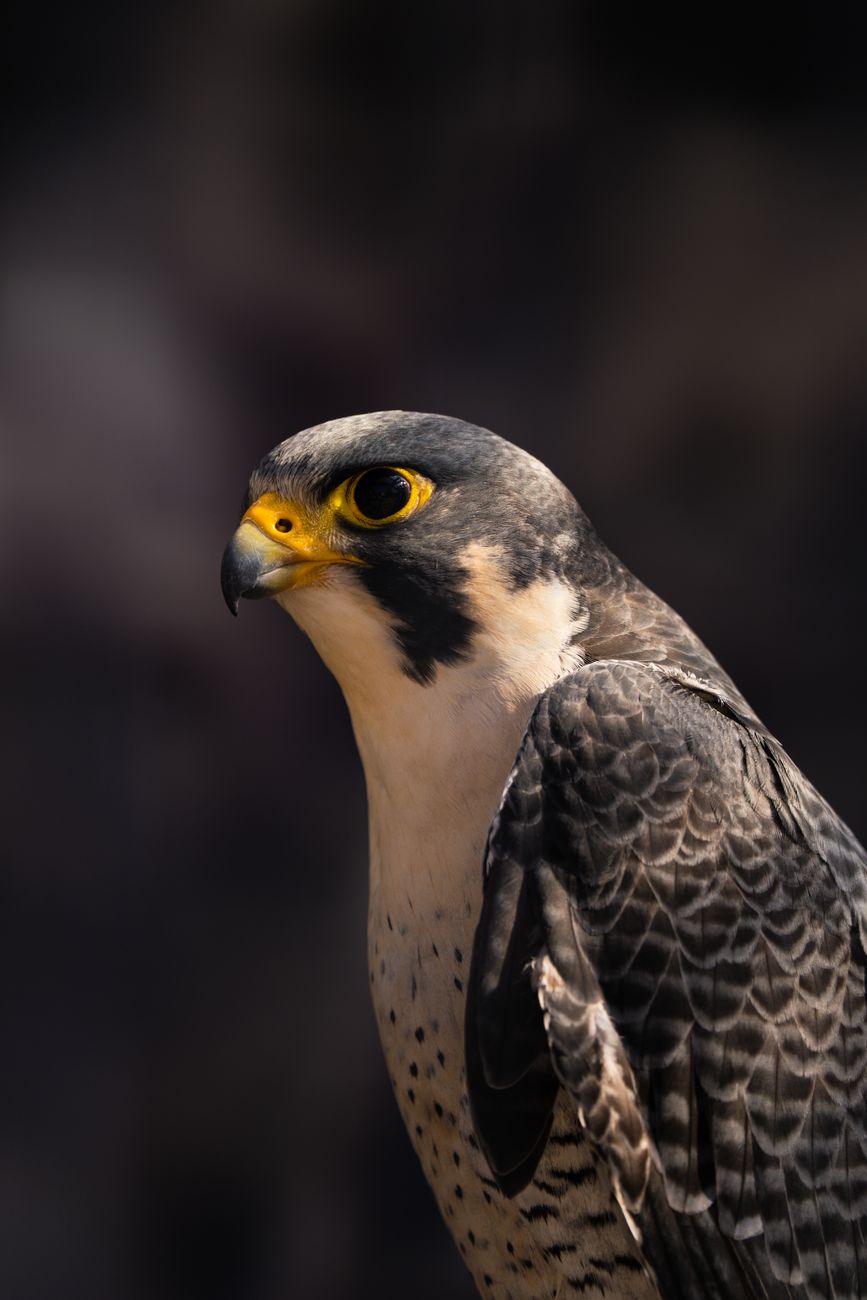
Such a line of enquiry might naturally lead to a study of real animals on earth that are capable of absorbing a great deal of shock. Woodpeckers come to mind. Peregrine Falcons kill their prey by diving into them at high speed from above. The Falcons themselves have numerous adaptations to surviving the collisions.
Looking into the details of organisms adapted to high speed collisions might lead to new inventions for car collisions, football helmets, hiking boots, or armor for vehicles traveling in minefields.
Using the “What if…?” Tool can lead to inventions, insights, or the premise for writing fiction, fantasy, science fiction, a mystery, etc. It can help you see problems, re-frame problems, solve problems or make sense of the world around you. Like any tool, it should be used wisely. Don’t run with scissors; don’t use a hacksaw to remove a splinter, and don’t use “What if…?” as an excuse to deny reality.
—————
Recommended books.
The Winning Weekend Warrior focuses on the mental game for all sports using examples from tennis, golf, baseball, and other sports. It covers self-talk, imagery, mental practice, strategy, tactics, & sportsmanship. http://tinyurl.com/ng2heq3
Turing’s Nightmares explores the implications and ethics of Artificial Intelligence through fictional short stories. http://tinyurl.com/hz6dg2d
Fit in Bits shows many ways to put more fun, variety, & exercise into daily chores and habits to help with strength, flexibility, fitness, and balance. http://tinyurl.com/h6c7fce
Tales from an American Childhood recounts early experiences mainly in the American Midwest in the 1950’s and relates them to contemporary issues and events. https://tinyurl.com/y9ajvz9j
Dream Planet. Where do you run when the whole world is crumbling under the weight of human folly? When the lethal Conformers invade 22nd century Pittsburgh, escape becomes the top priority for lovebird scavengers Alex and Eva.
The “Myths of the Veritas” explores Leadership based on values of truth, empathy, creativity, love, participation, and cooperation. Our tale begins as the leader/shaman of the Veritas seeks an eventual successor so she devises a series of seven trials that mainly test empathy.
(Christopher Alexander, architect and city planner, proposed fifteen properties as characteristic of natural order. I’m considering them one by one in terms of society, design generally, and user experience in particular. “Simplicity and Inner Calm” is number 14.)
“Send me $50,000 and I’ll enroll you in a two year course in Simplicity and Inner Calm. All you have to do then is follow the twenty-five hundred rules on the Path to Enlightenment while renouncing everything else.”
Somehow, that does not seem to be in the spirit of simplicity and inner calm. Some of the properties I discussed earlier are closer to being about something “out there” that is somewhat measurable; e.g., levels of scale, boundaries, alternating repetition, roughness. Simplicity and Inner Calm are characteristics of things “out there” but they cause or at least resonate with simplicity and inner calm within a person.
I don’t think it’s reasonable to expect a place to enforce a particular emotional state. If someone arrives at a beautiful still lake with hate and rage in their heart and possesses a determination to stay mad by God because he deserves to be mad! Then the mere presence of beautiful scenery won’t calm them in some immediate and magical way. But, I would bet money that they would be less upset an hour later than when they arrived.
Meanwhile, let’s imagine their identical twin also had an identical quantity of rage in their heart and arrived at a loud buzzing booming construction site and had to sit there for an hour. Such a setting, I would imagine, would do nothing to calm them and might make them even more enraged.
Of course, as any therapist can tell you, what you do inside your head often has more to do with how you feel than does the objective situation. I certainly believe that. Yet, I also believe that situations out there make a difference on average. In my experience, being in a safe situation surrounded by natural beauty tends to make nearly everyone feel better.
Not all situations “work” equally well for everyone, but for most of the people I have interacted with, views of distant mountains; calm clear lakes; ocean shores; a clearing in the woods — especially if there is a calm animal there; a single tree on a small hilltop — these tend to induce a feeling of simplicity and inner calm.
There are two things that have amazed me for a long time about natural settings. I think they both relate to why natural settings seem to produce more simplicity and inner calm.
The first mystery is auditory. I have heard the calls of many creatures in nature. Most are, in and of themselves, attractive. Some are beautiful. A few are more annoying sounds. But for me, at least, they never seem to clash. Walking through a field and forest, I may hear insects, frogs, and a dozen species of birds. But none of them clash. Fancifully, I could say that the auditory sphere in a natural setting reinforces the reality that all life is kin. I am of this world. Wilderness was the home of my ancestors and yours for four billion years. We are all instruments in one orchestra. That adds to inner calm.
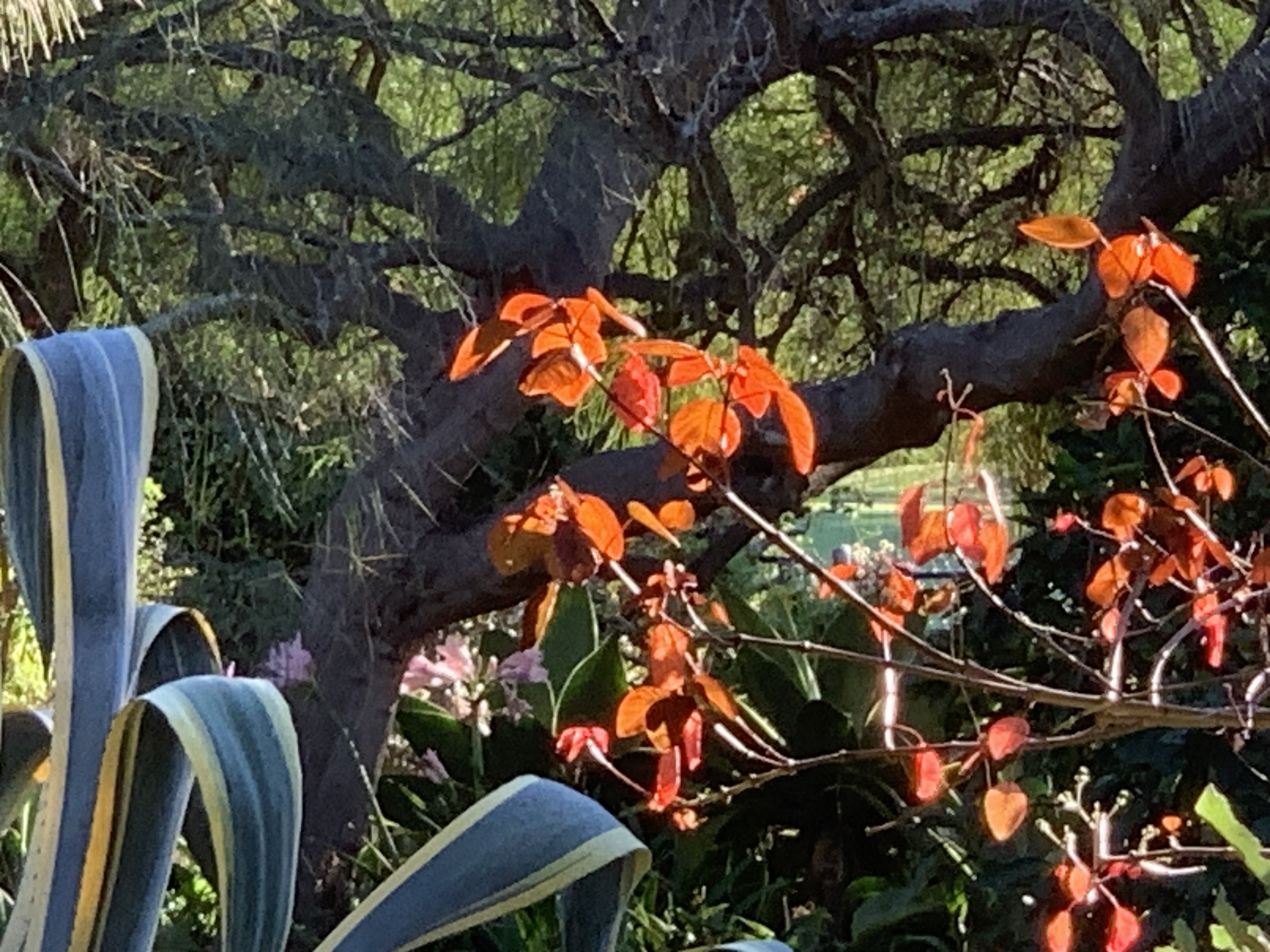
The second mystery is visual. I’ve walked through many natural settings and have seen what must be every color possible to see. But the colors never “clash.” How can that be? It’s one thing to mix and match greens and blues. They don’t really seem to clash that much even in artificial settings. But what about pinks, reds, oranges? I’ve seen plenty of people wearing clothing that clashes and likely been guilty of it myself. But autumn leaves? They are all over the place chromatically, but they never clash. This also adds to inner calm.
I think the genetic reason that clashes are not prevalent in nature is that we co-evolved with the environment. Perceiving harmony in what is would have been adaptive in two important ways. First, since harmony is the natural state, feeling good while surrounded by harmony would mean that you would feel good most of the time. As Harry Potter once put it, you would have something worth fighting for. If you enjoy life, then, when the going gets tough, you are more likely to tough it out.
Second, when things go sideways in external reality, you would quickly notice the disharmony. While normally, you would feel peaceful, when the birds suddenly start fleeing in one direction and squawking, your feeling would change and you would be more likely to prepare and therefore survive whatever comes next.
These reasons are manifest in some of the other fifteen properties. For example, the roughness of shape of autumn leaves means that there will be natural variation in color as seen even if they are actually identical (which of course, they are not). Having distributions of color is a kind of “roughness” characteristic of nature’s colors. Clothing on the other hand is another matter. The goal of mass production is lack of variability. So, 10,000 items are precisely the same color (or as close as humanly possible). If one is slightly off, it is noticeable. If each of the 10,000 items were part of a very broad, multidimensional distribution, being slightly more extreme than most would not produce a perception of clash.
That, to me, is also the problem with monoculture as a social philosophy. I delve into this in more detail in the blog post — “A tight flock united by division.”
Briefly, the more everyone is supposed to “toe the line” to a particular way of doing things; e.g., which restaurants to go to, which shows to watch, which religion to believe in, what clothes to wear, what food to eat, etc., the more intolerant the society becomes. And the more intolerant it becomes, the more people try desperately to adhere to the middle of the crowded road they share with everyone they know. Everyone who does anything differently comes to be seen as a reproach to the lack of individuality in the middle of the road. And the people who insist that everyone must stay in the middle do not want to move. Not only that. They insist that they are exercising their freedom of choice by being exactly in the middle as determine by everyone else and not at all by them. It is rather humorous at one level and rather pathetic at another.
But just as such sharp and arbitrary boundaries in artificially produced goods mean clashes are more common, so too in human societies, when there is a group that insists everyone be exactly like them and, at the same time, insist that they are expressing their freedom, clashes are inevitable. Harmony and truth are no longer conceived of as being desirable. When people reject the resolution of conflict via agreed upon rules of law, what results is inevitably chaos and death. It is almost the polar opposite of Life.
Some epidemiologists think the various recent explosion in the variety of pollutants that we are all subject to has resulted in a much higher incidence of auto-immune diseases and allergies. The immune system sees so many different invaders, it has trouble distinguishing real threats (streptococcus, covid, cancer cells) from imaginary ones (peanut oil, cat dander, tree pollen).
In similar fashion, people stuck on a thin sliver of what they feel is “normal” feel assailed from all sides. They can no longer distinguish real threats (COVID 19, Climate catastrophes, racial inequities) from imaginary ones (chip implantation via needles, Medicare for all, mask mandates). Clash. Clash. Clash. No “Simplicity and inner calm.”
But from their perspective, there would be “Simplicity and inner calm” if only everyone were just like them! Most will deny this, when put so baldly, but that is essentially what they strive toward.
There can be many such factions, all with different rigid and implacable beliefs or only two (Right/Left; Catholic/Protestant; Striders/Walkers) or really, only one. It only takes one faction to reject all connection to truth in order to destroy simplicity and inner calm — even though, ironically, that is what they are actually trying to achieve.
Moving from societal beauty to user interfaces, for the most part, I would have to say most UIs lack simplicity and inner calm. They seem to be splattered with functions and features everywhere. This is not surprising since most product managers believe that sales will be greater with more functions and features.
When I use pages, I would say my user experience is mainly one of simplicity and inner calm. That mainly comes from the fact that my attention is almost entirely on writing and I ignore everything else the interface offers “around the edges” of my vision. Sometimes, something untoward happens and the “harmony” of my environment is temporarily destroyed. Then, I have to stop writing and pop out to the interface level in order to diagnose and fix the problem. Once I do that and return to writing, I again feel “simplicity and inner calm.”
On much rarer occasions, I will wish to do something “unusual”; e.g., I might want to put a table in the text to illustrate a point. Then, before I can work on the task at hand — creating the proper table — I must first search for the proper functionality. Since I do not typically do this, I am like the creature in the forest suddenly alerted to the presence of possible “predators” (such as accidentally destroying my file).
I have found very few UI’s that, in and of themselves, are conducive to feelings of simplicity and inner calm on first use. I have often come to feel that way fairly quickly after I become conversant with the basic functions.
We evolved for millions of years to resonate with the simplicity and inner calm of peaceful natural settings. It’s not surprising that it would be difficult to reproduce that feelings with an artificial interface. But familiarity does move us in that direction. When I glance at the toolbar across the top of the “Pages” page, e.g., I see a set of pull-down menus. I don’t recall exactly how the entire menu structure is laid out, but I do know how to use it and explore it. This familiarity, in and of itself, helps me feel more serene, more secure, safer.
Although I am very interested in seeing new ideas in UI, I am more likely to use a different sort of UI if I am seeing a completely new kind of functionality or access to new kinds of data. I would be far less interested in trying a completely new UI for writing, say, or an application that had the same features and functions as Bluesky but with a completely different UI.
Sometimes, even radicals are conservative.
If you wanted to design something that evoked simplicity and inner calm, would you yourself want to be in such a state while you were designing? Would that help or hinder you? Or, perhaps you would use the design experience itself to force yourself to experience simplicity and inner calm. Do you have any examples of a UI with simplicity and inner calm? I don’t refer here to an application whose sole purpose is to guide you through meditation. There are surely many things available whose content is meant to evoke simplicity and inner calm. But are there UI’s which, in and of themselves, evoke simplicity and inner calm?
Photo by Markus Spiske temporausch.com on Pexels.com
The Winning Weekend Warrior focuses on the mental game for all sports using examples from tennis, golf, baseball, and other sports. It covers self-talk, imagery, mental practice, strategy, tactics, & sportsmanship. http://tinyurl.com/ng2heq3
Turing’s Nightmares explores the implications and ethics of Artificial Intelligence through fictional short stories. http://tinyurl.com/hz6dg2d
Fit in Bits shows many ways to put more fun, variety, & exercise into daily chores and habits to help with strength, flexibility, fitness, and balance. http://tinyurl.com/h6c7fce
Tales from an American Childhood recounts early experiences mainly in the American Midwest in the 1950’s and relates them to contemporary issues and events. https://tinyurl.com/y9ajvz9j
Dream Planet. Where do you run when the whole world is crumbling under the weight of human folly? When the lethal Conformers invade 22nd century Pittsburgh, escape becomes the top priority for lovebird scavengers Alex and Eva.
While all the previous properties of natural order seem positive, clear, and obvious, this one seems mildly scary. It reminds me of death, somehow. It’s true that individual death is part of the overall reality of life. Yet, “The Void” still seems scary. It’s reminiscent of whirlpools, caverns, the abyss. I suppose some of our tiny distant ancestors may have faced the dark mouth cavity of a large predator — a shark, a cave bear, a saber toothed tiger. And a few of those who were terrified enough to flood their bodies with adrenalin may have escaped to reproduce and pass on the terror of utter darkness genes to their offspring, including me.
In a friendlier interpretation, the void could be thought of as “empty” space, or more accurately, extra space not filled with functional items. From that perspective, The Void promotes rest, relaxation, rebirth, regeneration. Your day should include “The Void” in terms of activity — sleep, certainly, but also times that are unscheduled and restorative. If you are scheduling a day long meeting and every minute is accounted for ahead of time, there is no “margin” for something which catches the passion of participants to spill over into. There is no time for unanticipated contingencies or for people to reflect on what is happening.
Similarly, a space (whether computer memory or physical space) that is completely “taken up” with data or things becomes inflexible. In extreme cases, nothing can be done because there is no room to move things.
When I was a kid, I used to enjoy puzzles that consisted of 15 square pieces and one blank space. The idea was to move the pieces around until the pieces were arranged into a particular numeric sequence (or made a picture). It’s immediately obvious that if there is no space, there is no way to move the pieces and whatever order they are in is the order that they will stay in.
It seems that people who want to control everything want exactly that — no space — no void — no possibility for change. It may be related to the mystery of overworking so many people with long hours despite decades of research showing people are more productive with shorter hours.
In a living human being, there is typically “space” in our respiratory system and our digestive system. To have zero space means we cannot eat and we cannot breathe. We do have spaces within our body — ventricles in the brain, sinuses in the head, and — crucially — females have a place that can accommodate the creation of a new life within.
A hive, or a garden, or a city may indeed be crowded, but if it literally has zero space, it dies, just as we would. The void allows flow — in the case of the individual human body, space allows for the flow of food and the flow of air.
A science that has no void, no space, has no flexibility. It is no longer science but dogma.
A budget with no space, no void, means every penny has been pre-assigned and this is not an effective way to budget.
Games typically have space (Go, Chess, Checkers, Monopoly) as do sports (Tennis, Baseball, Soccer, Basketball). Play often consist of using, changing, and manipulating space. The baseball pitcher tries to throw the ball so that it crosses through spaces where the hitter cannot easily hit it well. The hitter tried to hit the ball where the fielders cannot reach the ball. The tennis player tries to “build a point” by creating more space; e.g., by pulling their opponent progressively wider so that a shot can be hit into such a large space that it cannot be reached at all. In most games and sports, the amount of empty space, particularly at the beginning of play is relatively large. In chess, as in American football, play begins with a large space between the teams. In many games, there are special terms for spaces. A “Luft” in chess is a place for your King to go if attacked on the back rank by a queen or rook. In American football, the quarterback throws passes from the “pocket” which is supposed to protect them from tacklers.
Under Umbrage, everything living and loving was smothered by a rule, or at least she wished it were.
To me, “The Void” connotes more than space, however. “The Void” seems to refer to a relatively large, concentrated space. In music, for example, without any space, there is just a long, annoying noise. But “The Void” isn’t just the space between notes. It seems as though it must be a significant silence such as after the tuning and before the first note is played or the space between movements in a symphony.
Of course, we can contemplate things at different scales. If we see Alternating Repetition from a distance that allows us to see the alternating repetition, we might see gaps as spaces, but not as examples of “The Void.” If we moved our point of view so that only one such gap were visible, it might become an example of “The Void” at that closer-in scale.
Most of our everyday reality is physically made up of empty space. Every atom is more than 99.999 % empty space. At that scale, it’s mostly void or at least mostly space. And, at the other extreme, although it may seem that space is crowded when you see the Starship Enterprise go through the universe at “Warp 9” that’s an illusion to make it more interesting. Most of the universe (and our solar system) is empty space. The sun which is by far the largest object in our solar system has a diameter of 865,000 miles. That’s big! But the nearest planet, Mercury, is 40 million miles away. And, that planet is the only thing in such a close orbit.
Once I was driving with my family from San Francisco to Salt Lake City. Around 3 am, in the absolute middle of nowhere with no lights and no moon, I stopped the car and ran a quarter mile from the road into the desert to look up at the stars. It doesn’t “look” empty of course. Far from it. Yet the sheer blackness of the background and the vastness of it made it seem like a true void. In fact, because of contrast with the sharp and sparkling stars, the vast void was made into even more of a vast void.
An atrium, a central courtyard, a reflecting pool — can these be voids that strengthen the center?
If we look at a void, does that produce a different aesthetic feeling from when we are in a void that surrounds us? If you and your family or friends or tribe huddle around a campfire at night, the fire is a center. You can see the faces of people in the firelight. But you are aware that each of you knows that surrounding your little group is darkness. Sometimes, in movies, someone will remark, “Well, it’s quiet.” To which, the proper response is, “Yeah. Too quiet!” When the frogs and crickets stop making noise, the heaviness of the silence becomes oppressive. It might mean that large predators are about, each with their own maw of void. Being in a large space that has no perceptible features is awe-inspiring or even fear-inspiring. Looking at a large space that is situated in the context of a pattern may echo that feeling slightly, but to me, it feels very different.
The same tune can be played on a piccolo or a base vile.
When it comes to user experience, what comes to mind for me is the empty page or the empty canvas or the empty spreadsheet. These are large unfilled spaces. To compose, whatever the medium, requires of us a kind of courage. We must “enter” the empty space. In order to write, we must also allow for empty space within us. As I write, I find that there is always a rhythm of “describing” things that have “come up” for explication and then pausing — staring as it were into the blackness, the void, of my own consciousness. I allow things to arise from that inner void and show themselves. I don’t know what it will be.
I think that process (and not wanting it disrupted) is one reason that I, like so many others, found “Clippy” to be so annoying. Whenever I was allowing for the void to reveal to me what I wanted to say, “Clippy” would imagine I was stuck and offer a suggestion (invariably irrelevant).
Perhaps you or one of your kids has played “8-ball.” You ask it a question then you shake it a little and an answer “appears” in a little window. The most enthralling time is that space between when you ask the question and the answer appears. Of course, it’s fun thinking of the questions and interpreting the answers, but the most dramatic part is waiting for the answer to appear. In that moment, you may suddenly realize what answer you want to appear.
If an application is to support any kind of creative activity, it should not “rush” the user and it should provide the user empty space in which to create. That emptiness can be intimidating, but I still think it’s necessary.
My desktop has many icons, tool bars, and windows. The only true void is the blank part of the writing pane in Pages. Visually, since the blank part of the page is white, it doesn’t seem much like a void. There is enough space between the icons and menu items to make them legible, but there is no “void” there. Visually, the only thing that really strikes me as a void is the totally black rounded rectangle beside the color sphere in the Format window. It’s black because that is the color of the text I’m writing in. Its function is nothing like that of an actual void.
The void may symbolize death, but it also symbolizes life. It is the happening place. It is the dance floor. It is the game board. It is the playing field. It is waiting for the curtain to rise. It is the movie theater when the lights go out but the movie has not begun. It is also the movie theater when the credits have done rolling but before the house lights have come up. If it is death, it is also rebirth. If it is birth, it is also the end.
As every moment of our existence and our attention becomes evermore commoditized and sold to the highest bidder, there is ever more pressure to eliminate the “wasted space” inherent in the void.
Running into the ocean; diving into a pool; deciding to have a child; moving; divorcing; falling in love; losing a loved one; starting a composition; beginning a design — these are moments when we brush up against the void or enter it or avoid it or incorporate it into ourselves. We like to fool ourselves that there is some process or routine or formula or piece of software that can take all the uncertainty out of these transitions into the unknown.
That’s all illusion. It’s the very nature of life itself — that dance on the razor edge between chaos and repetition — to embrace the void. We try always to “avoid” The Void.
Nature doesn’t “abhor a vacuum.” Nature is mostly vacuum.
But often, we abhor a vacuum. Our productivity tools are geared toward reducing “The Void” as much as possible. Children are shuttled from one high intensity activity to another to ensure that when they apply to college, there will be no gaps or voids in their resume. Every box should be checked. Then, they will get into a college–one which will ensure that they will get a high-paying job that will enable to them to work their entire lives so that there will be no uncertainty.
I am also a product of that “Avoid The Void” culture, so I find it hard to imagine what it would mean to design a tool or UI or app that embraced and encouraged The Void. There are some specific mobile apps that support meditation or listening to music or breathing. What of composition though? Whether it is programming, writing, drawing, or creating a business plan, is there a place for The Void to be supported? How would you encourage it? What visual elements or other sensory elements could be used to support it? How would you measure how well you did?
The Winning Weekend Warrior focuses on the mental game for all sports using examples from tennis, golf, baseball, and other sports. It covers self-talk, imagery, mental practice, strategy, tactics, & sportsmanship. http://tinyurl.com/ng2heq3
Turing’s Nightmares explores the implications and ethics of Artificial Intelligence through fictional short stories. http://tinyurl.com/hz6dg2d
Fit in Bits shows many ways to put more fun, variety, & exercise into daily chores and habits to help with strength, flexibility, fitness, and balance. http://tinyurl.com/h6c7fce
Tales from an American Childhood recounts early experiences mainly in the American Midwest in the 1950’s and relates them to contemporary issues and events. https://tinyurl.com/y9ajvz9j
Dream Planet. Where do you run when the whole world is crumbling under the weight of human folly? When the lethal Conformers invade 22nd century Pittsburgh, escape becomes the top priority for lovebird scavengers Alex and Eva.
The Winning Weekend Warrior focuses on the mental game for all sports using examples from tennis, golf, baseball, and other sports. It covers self-talk, imagery, mental practice, strategy, tactics, & sportsmanship. http://tinyurl.com/ng2heq3
Turing’s Nightmares explores the implications and ethics of Artificial Intelligence through fictional short stories. http://tinyurl.com/hz6dg2d
Fit in Bits shows many ways to put more fun, variety, & exercise into daily chores and habits to help with strength, flexibility, fitness, and balance. http://tinyurl.com/h6c7fce
Tales from an American Childhood recounts early experiences mainly in the American Midwest in the 1950’s and relates them to contemporary issues and events. https://tinyurl.com/y9ajvz9j
Dream Planet. Where do you run when the whole world is crumbling under the weight of human folly? When the lethal Conformers invade 22nd century Pittsburgh, escape becomes the top priority for lovebird scavengers Alex and Eva.
We’ll get to humans, but let’s start with the grains of sand and cans of beans.
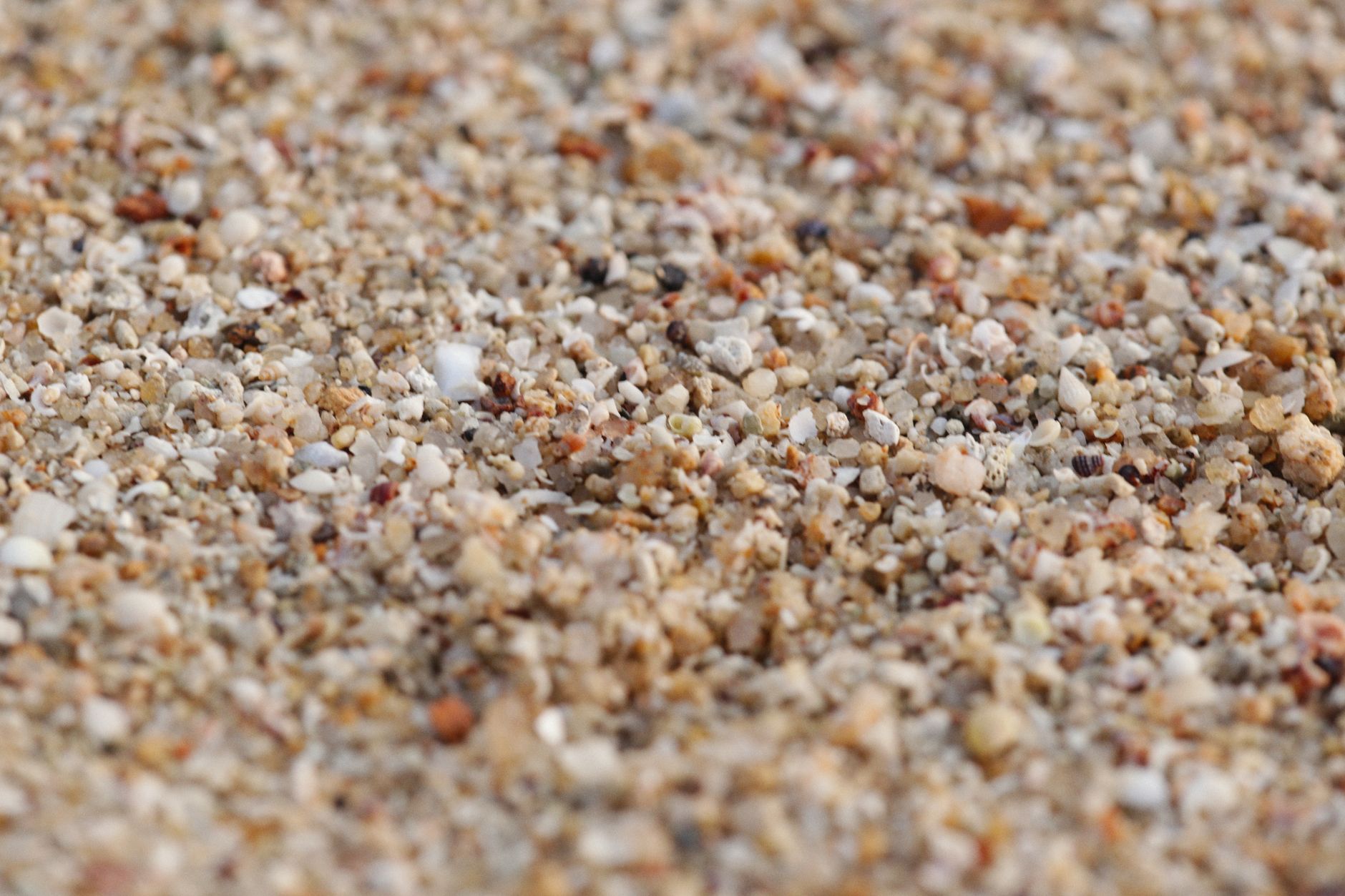
Grains of sand are not the same. Not at all other than being found in a beach or sandbox and being smallish in size. Their shape and composition differ. Now, you might think, “OK, but for all practical purposes they are the same.”
Soon after I joined IBM Research, I flew with my boss into an IBM chip fabrication factory in the Northeaster US. We were studying query languages and interviewed some people in quality control who used query languages as a serious part of their job. They recounted a time when the percentage of error free chips fell drastically. For a time, no-one could figure it out. It turned out that the silicon supplier had shifted sands (so to speak) and that had translated into slightly different silicon properties.
“Oh, they’re all the same!”
Now, let’s look into beans because it so happens that I made a bean salad tonight that I hadn’t made for a year or two. I pretty much remembered the recipe, but to make sure, I took down the cookbook and propped it open as well. I made the bean salad according to recipe and the bean salad was good. But usually, in the past, it had been great, not just good. The difference was mainly, I decided, in the quality of the beans themselves. Same brand. Always the same brand. So, they’re all the same, right? Possibly.
The following situation is happening all the time. Imagine popcorn hitting its climax. Here’s the history in outline.
A person or small group works hard and makes a success. They have pride in their product (say, canned beans). But then, they decide that MEGACORP wants to buy their company for a phenomenal amount of money. Yay! Win/Win! Congratulations all around. And, now their wonderful product can continue into the mainstream and more people than ever can taste the pleasure of that high quality can of beans.
They’re all the same.
Maybe. But maybe the true motive of MEGACORP is to poison a few people. They’re being paid by the Big Bad Beef Business to make people afraid to get their protein from beans and instead make people go for the safer alternative: Meat! Here’s another possibility. They don’t give a can of beans about your cans of beans. They want the guy who knows how to make that great lining so they can use his expertise for their much more lucrative line of Cheese Naughts. But the most likely case is the mundane one. They “cash in” on the brand name you’ve built. They buy the business and then use much cheaper beans and the pass along the savings to the consumer through lower prices and higher wages for their workers.
Oh, no, no. Never mind. That’s on a different planet. This is planet Earth. That’s the one where MEGACORP keeps every frigging penny of savings for C-Sweet salaries and shareholder confidence. The beans bear the same label in every way. But inside, they are different. Is MEGACORP required to inform their customers that they lowering quality? Of course not.
“Oh, they’re all the same!”
But they’re not all the same. Not the grains of sand; not the cans of beans; not the entrepreneurs, not the lab rats I encountered at Oberlin.
My college girlfriend attended Oberlin and I visited many times. One time she asked me to help with a psych experiment. Being a psych major myself, I was eager to oblige.
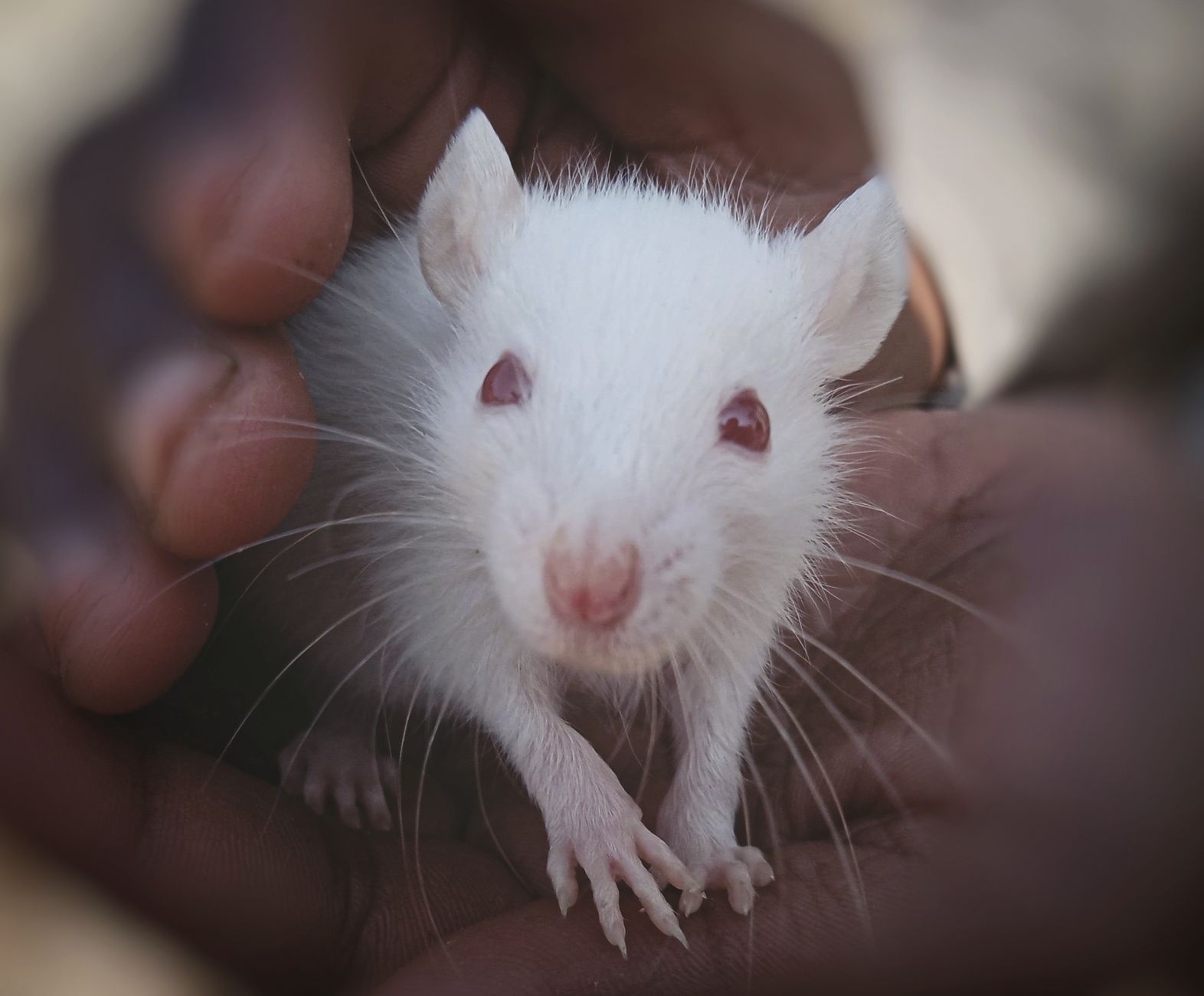
I suppose some people might be freaked out at the idea of grabbing a rat to put it in a maze, but it’s easy to avoid their razor sharp teeth. Oh, and BTW, lab rats don’t look like sewer rats. The lab rats are smaller, cleaner, and far more narrowly educated than sewer rats.
The experiment in question looked at the impact of stress on performance. Typically, stress causes an increase in performance, but only up to a moderate level. Beyond that, more stress generally reduces performance. We controlled stress by holding the rat under the water for a few seconds before having it swim a U-shaped maze. We put it in the maze on the left and then shut the door. Once the rat swam down, turned right and then turned right again it could swim to an air-hole on the other “tine” of the “U”.
Everything went fine for the first five rats. Not surprising. After all, they’re all the same. They are bred to be the same. For many generations. And, for the most part, the biters and the fighters were probably less likely to be chosen to promulgate the sub-species. Since birth, these mice have been mostly subjected to the same stimuli and the same diet as their lab-mates.
And, then there was Rat P-4547 (I’ve changed the number to protect the rat’s privacy). As I said, these lab rats were easy to pick up. You picked them up by grasping them from above and they just accepted the fact that they been chosen. Who knows? Maybe they had been bred to feel pride in having been chosen for an experiment.
In any case, Rat P-4547 certainly hadn’t read the manual on appropriate rat behavior. He immediately grasped the cage bars with everyone one of his teeny fingers and toes. Even more remarkably, he screamed. Somehow, he seems to have gotten it into his head that the experiment he was about to engage in was a kind of Putin vivisection game.
I eventually wrestled Rat P-4547 into the starting gate. There we were supposed to hold him underwater before allowing him to traverse the simple U-shaped maze. A quick glance at the sheet showed that Rat P=4547 was destined to be in the “High Stress” group. Of course he was.
I did it. I held him under the prescribed time and let him go. It was taking too long. At last, we saw him swimming furiously into the end zone, his oasis of oxygen, his Mount Ararat, and then…did he pop his little head up gasping for air?
He did not. He executed an amazingly coordinated lateral flip turn and swam the wrong way up toward the now closed beginning of the maze.
I did not want the rat to die, but how could we save him? He swam all the way back to the starting gate —nowhere else to go so we went to open it, discussed whether we should and then heard him make another flip turn before we could open the top. Now, we knew he had to drown. But no! His crazy little head finally ended up where it was supposed to.
I congratulated him on his grit, toweled him off, and settled him back into his cage. Of course, Rat P-4547 is long gone. An asterisk on a undergraduate term paper. Probably have a hard time finding it even with the help of an Artificial Influencer.
What? You thought the expression was “Artificial Intelligence”? That’s the term they use but that’s not the goal. The goal is to have Artificial Influencers disguised as helpful Artificial Intelligences.
Returning to the idea that they’re all the same, the truth of the matter is that any two things share some properties and any two things also show some differences. The idea of grouping things together for some purposes does make some sense. When you go to get firewood, for instance, you mostly want to focus on a reasonable size and dry wood. If you went to look for something to carve your attention would focus on the beauty and workability of the wood. If you went to get a cudgel, you’d be looking for a thick, sturdy piece.
Think how absurd it would be for someone who likes to carve chotskies telling you how to pick firewood based on their criteria for choosing carving material.
(This is the fifth in a series of 15 blogs that explore Christopher Alexander’s “Fifteen Properties” of good design, natural beauty, living spaces, etc.).
Life is a dance on the edge between chaos, on the one hand, and sameness & repetition on the other hand. Repetition without variation or change is not life. On the other hand, endless random variation without any pattern or principle is also not life. Planet Earth is sometimes said to be a “Goldilocks Planet” — not too hot and not too cold — to support life. Most of the life forms on planet earth themselves exhibit a “positive shape” — a shape that wants to expand and fill out — and yet, there are limits because of circulation, gravity, communication etc. so that growth is typically not unrestricted. The tension between trying to grow and having to stick close enough to form creates positive space.
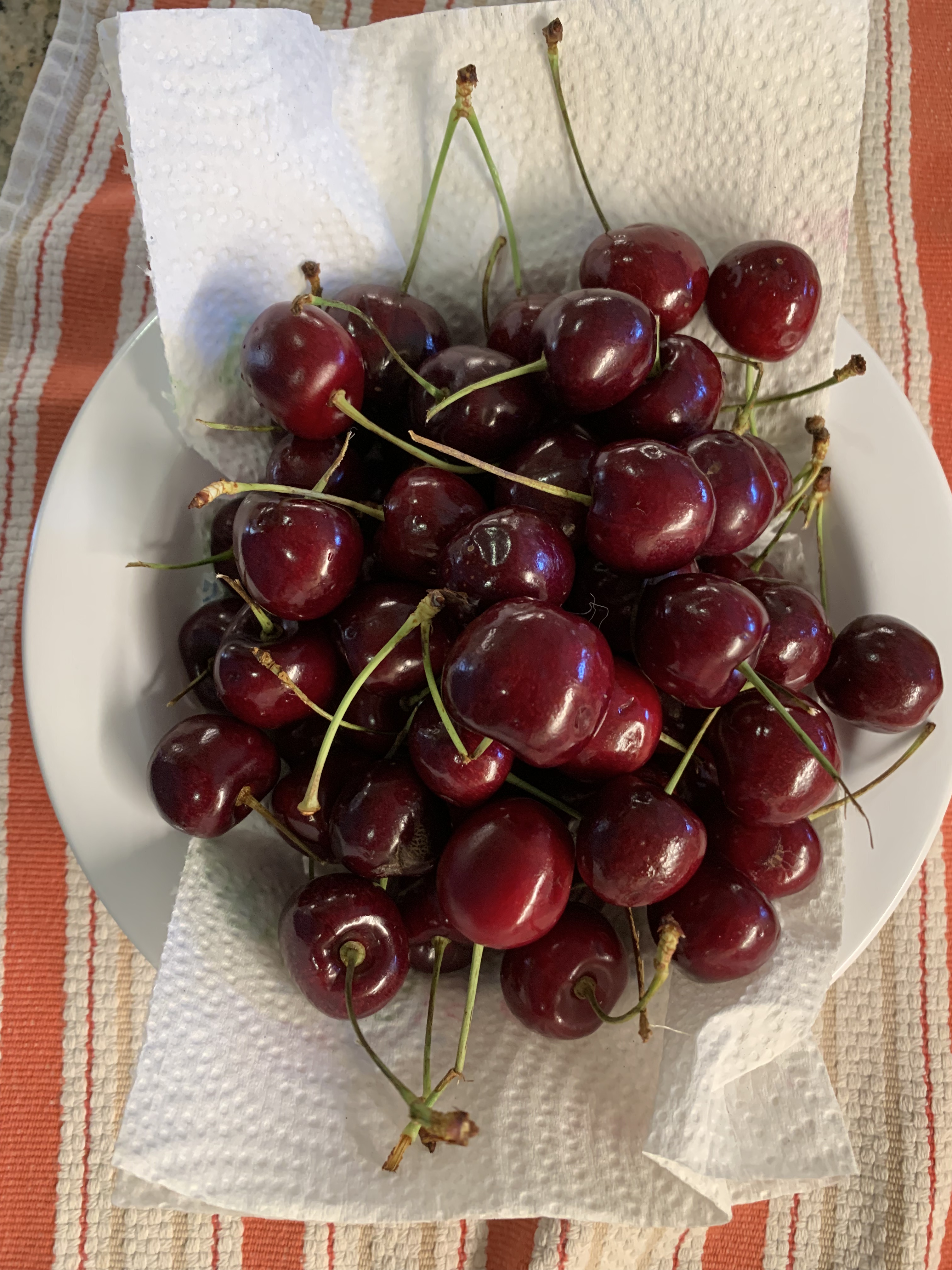
Life may not always be “a bowl of cherries” but nonetheless, a bowl of cherries does illustrate the property of “positive space.” The bowl connotes living things trying to expand right up to the boundaries possible. A bowl that is filled with cherries and even slightly over-filled but without inducing a fear of spillage, to me, connotes life being vigorous and healthy. To me, a single cherry sitting all alone in a large bowl seems to exhibit positive space much less — at least at the scale of the bowl.
When I look at an individual cherry, I also see positive space. The cherry is not a perfect sphere, featureless and smooth. If it were, to me, it would be a much less positive space. The fact that there is a stem and a noticeable indentation where the stem goes provides a kind of center. So too does the slight asymmetry of the cherry. It appears as though it might have developed as two halves that tried to circle a space at the same time from two different directions – clockwise and counterclockwise. They met and merged to form the almost spherical cherry.
The lobes of this red pepper show positive shape.
The cherry is not the only natural food that has this kind of positive space. Think of corn on the cob. Each kernel seems to have tried to grow as large as it can. It pushes up against and into other kernels. Each kernel seems therefore to be “bursting with life.”
Consider a cucumber. It’s roughly cylindrical. But “roughly” is important here. To me, it would seem much less an example of “Positive Space” if it were literally a cylinder. It tapers at the ends and it bulges at the middle. That seems more “positive.”
To a person who doesn’t understand that life is primarily a cooperative endeavor among all the parts of the vast tree of life, but instead sees the world only as a zero-sum game, it must seem as though the positive living space of a cucumber makes the space around the cucumber less positive and less living. But this is not true! The space around the cucumber’s slightly rotund shape is much more positive and living than the space around a perfect cylinder.
Think of a tree trunk compared with a telephone pole. They are both made of wood and they are both approximately cylindrical. But a tree trunk feels much more alive to us than a telephone pole. I don’t think this is simply because we “know” a tree is alive. It looks more alive and if you allow yourself to “tune in” to it, it feels more alive. And, importantly, not only does the space that the tree inhabits seem more living. So too does the space around it! A long line of telephone poles may exhibit “Levels of Scale” and “Alternating Repetition” and such a picture may make us feel some life to it.
But a single telephone pole does nothing to stir life in me. In that sense, it’s nothing like a tree. It’s flat and it kills the space on either side as well. The columns in the Parthenon are roughly cylindrical and obviously not literally alive. But they, unlike a telephone pole, have positive space and create positive space around them. Life is not fundamentally a zero-sum game. The bee does not “steal” the flowers pollen and thus damage the flower. The bee helps the flower. The flower helps the bee. Positive space in an object does not steal from or detract from the space around the object. It enhances it!
Similarly, the “competition” for space among the kernels of corn on a cob of corn shows that competition can be a beautiful thing. I like to see the kernels pushing against each other. All of them seem living and positive. Imagine instead a cob of corn in which one kernel had grown like a giant spider of orange cancer and took up 98% of the cob. Aside from this one ultra-greedy cell, there were only a few widely spaced and shriveled up kernels. Would you pick that from the pile of corn? Would you want to slather it with butter and bite into it? I sure wouldn’t! And to me, that is exactly what cruelty, unfairness, and greed look like. It might seem positive — after all, the dictator is trying to “grow.” That is true but he’s rigged the game. Competition is no longer beautiful when the game is rigged. Competition is no longer beautiful when your tennis opponent slices off your leg before the match starts or pays off the chair umpire to call everything you hit out.
I don’t think there’s anything particularly special about cucumbers or cherries or corn. I just happened to have been washing vegetables before writing this. These radishes also exhibit positive space. And, although their shape is not the same as a cherry or a cucumber, the radishes also enhance the space around them. And, so does the avocado. An avocado that is just past ideal ripeness begins to flatten irregularly and the “pebbles” of the skin also flatten making a less positive space. The pebbles of a perfectly ripe avocado are themselves tiny positive spaces that add to the overall impression of vigor.
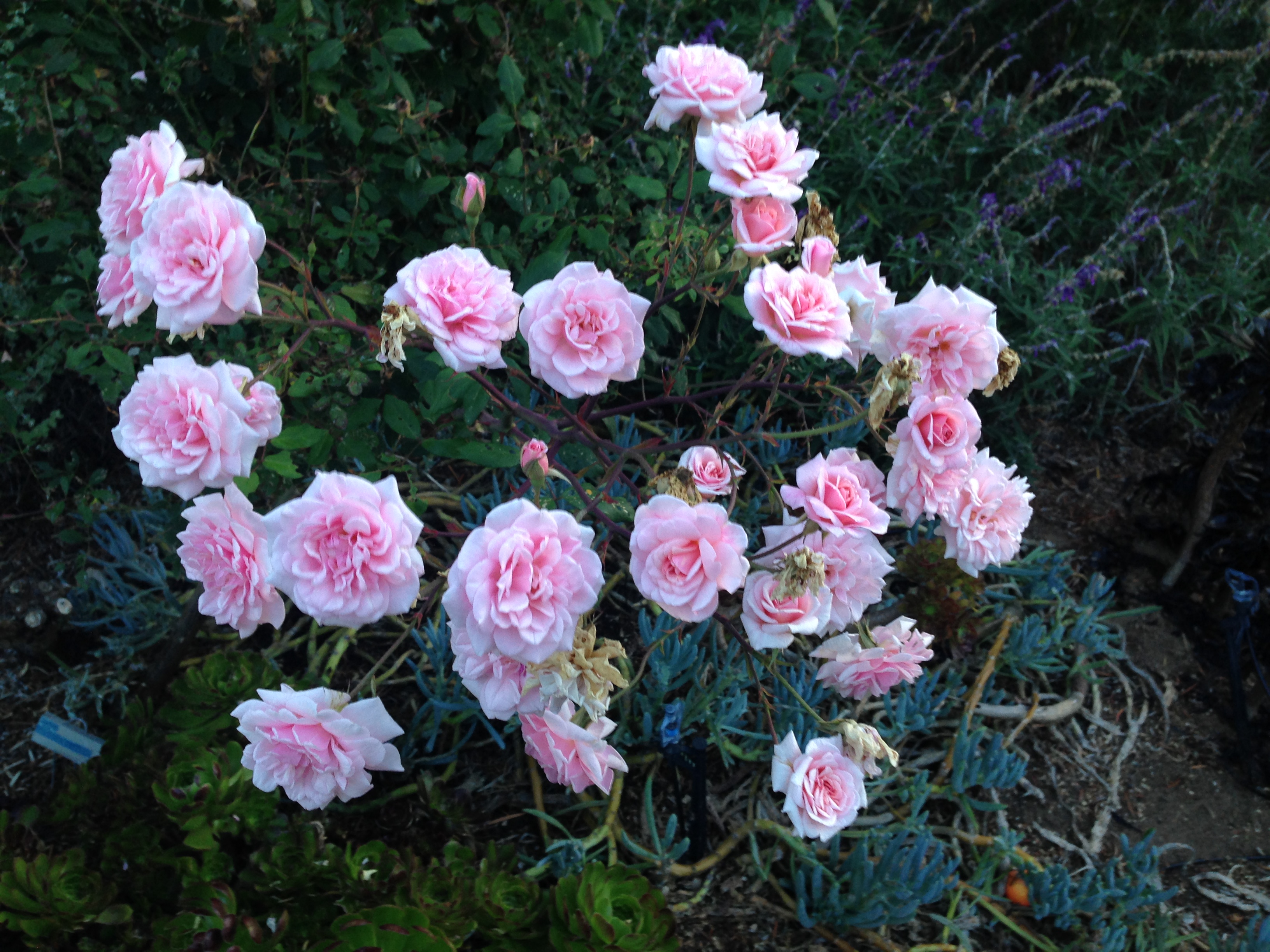
Flowers provide numerous examples of positive space. And, so far as I can tell, the positive space of flowers invariably also enhances the positivity of the space around them.
Animals also generally exhibit positive space. Their shapes, after all, come about through a struggle among different tradeoffs that have been “learned” by each species over four and a half billion years. But whether you look at the leg of a turtle, the leg of a turkey, or the leg of a polar bear, you will see positive space. The shapes are quite different because their histories are quite different. But in every case, the shape is determined by the history and each of those histories is the same length — 4.5 billion years. The fact that each of these shapes comes about through the dance of trying to survive and thrive in all their various habitats makes every one of them beautiful in its own right — even those whom most of us don’t particularly like to interact with such as rattlesnakes or lions. Even if we don’t wish to come face to face with a lion or grizzly bear, we do recognize their beauty. And, I would claim that as those animals walk through any landscape, they will not only exhibit their own positive shape; they will also enhance the positivity of the shape around where they are walking. Think how many times photographers and painters have put an animal in the foreground of a landscape. Of course, doing so makes the scene immediately more living, more interesting, and more beautiful.
What does this have to do with the user’s experience on a computing device? I would have to say that most interfaces on most devices do not do much to bring the interface “alive” including having positive space. The tool bar icons on this version of my Mac are very slightly “bulging” like a living cell (or kernel of corn). Even more subtly, the windows have slightly rounded corners.
It’s an entirely different story with many games though. It seems to me that some of the game artists are among the best artists in the world. They have created many very beautiful games. Could they be more beautiful still if game designers consciously thought about using Christopher Alexander’s “Properties” in general, and “Positive Space” in particular? I think so, but for many games, such as Horizon Zero Dawn, many of the elements are copied so closely from nature that aspects such as “Positive Space” are mostly already taken care of by evolutionary bias toward the beautiful. (Yes, I do think there is such a bias, but it will have to be the subject of a different post.)
What about other applications and systems? Do you think you’ve seen good examples of “Positive Space” in such systems? How could you see incorporating “Positive Space” in UX?
At a more societal level, it seems to me that freedom is closely related to “positive space.” Each individual should be free to expand, grow, experiment, so long as it doesn’t impinge much on those around them. Imposing overly strict boundaries makes life less interesting and less lively. Growth without any sense of balance or notion of how a particular piece of life relates to the whole is called cancer. A society which allows or even encourages theft, rape, fraud and other felonies under the banner of “freedom” is doomed to ultimate failure with lots of pain along the way.
The Winning Weekend Warrior focuses on the mental game for all sports using examples from tennis, golf, baseball, and other sports. It covers self-talk, imagery, mental practice, strategy, tactics, & sportsmanship. http://tinyurl.com/ng2heq3
Turing’s Nightmares explores the implications and ethics of Artificial Intelligence through fictional short stories. http://tinyurl.com/hz6dg2d
Fit in Bits shows many ways to put more fun, variety, & exercise into daily chores and habits to help with strength, flexibility, fitness, and balance. http://tinyurl.com/h6c7fce
Tales from an American Childhood recounts early experiences mainly in the American Midwest in the 1950’s and relates them to contemporary issues and events. https://tinyurl.com/y9ajvz9j
Dream Planet. Where do you run when the whole world is crumbling under the weight of human folly? When the lethal Conformers invade 22nd century Pittsburgh, escape becomes the top priority for lovebird scavengers Alex and Eva.
Here are a few thoughts about “Boundaries” and how they apply in User Experience.
I decided to gift a copy of of Volume One on The Nature of Order to my daughter earlier today. I logged on to Amazon and looked at my address book. I am aware that she moved fairly recently. So, I was scrolling through my earlier text conversations with her to see whether she had told me of her new address. I couldn’t find a text about her new address so I texted her to get the new address.
Suddenly, a popup window appeared from SIRI. It had her new address. I hadn’t said anything aloud. I thought of SIRI as a voice-activated service on my iPhone. It was disconcerting to have it “notice” my text message and then suggest an answer (which turned out to be correct).
Last week, after physical therapy, my therapist & I began to discuss the time for my next appointment. I pulled up the calendar application on my iPhone and went to a particular day and began to type in her name. After the first two characters were typed in, the “type-ahead” function suggested three possible “completions” the first of which was the time we had been orally discussing (which was not a common time nor the time of any of my recent appointments with her). It also filled in her complete name and the purpose of the appointment, but that was more understandable.
One sense of “Boundaries” in User Experience connects with a notion of “boundaries” that is much discussed in contemporary mental health. We are advised to “establish boundaries” with co-workers, family, friends, and strangers. We don’t necessarily want to share personal information with everyone or let everyone touch us in any way they choose to. If intimate details are shared in a recovery group or group therapy, it is generally agreed that such details will not be shared with others.
We sometimes extend the idea of informational boundaries to written materials as well. If, for instance, we keep a personal diary, we do not expect other people to “search for it” or to read it. In the short story, “Jennifer’s Invitation,” (link below) about my shy attempt as a third-grader to invite my girlfriend to my birthday party, I relied on my expectation that she would read a paper I “accidentally” dropped on the sidewalk. But she was so protective of my privacy that she wouldn’t even glance at my paper. I lost track of Jennifer, but I’m pretty sure she never became CEO of an IT company.
On the other hand, if we write and publish an autobiography, then we can expect that other people will feel justified in discussing the contents. To me, it would seem odd for an author to feel “violated” if people start talking about the contents of their autobiography (or their blog).
When it comes to modern interactions with computer software however, the boundaries are invisible — and sometimes non-existent. It can feel as though I write a private diary on paper; lock it up in a safe immediately; and then — without any sign that the safe has been broken into, I suddenly find details of my personal life revealed!
There appear to be boundaries between applications, and certainly between devices but these boundaries may be illusory. I find that troubling and confusing. I think the first application of “Boundaries” as a property of UX is that apparent boundaries should be real. There may be exceptions for exceptional circumstances; e.g., the police may get a search warrant to search your house if there is reasonable suspicion that you have committed a crime.
When a social media site analyzes your reactions, relationships, and word usage to determine what to try to sell you and what type of approach is most likely to succeed, that does not strike me as a reasonable response to an “emergency.” As most readers know by now, such information is not only used to try to sell you more stuff; it was also used to manipulate public opinion; for example, to convince some US voters to stay away from the polls on election day in 2016; to convince voters in the UK to vote for Brexit; to convince people not to get vaccinated.
Living things do have boundaries. Breaching those boundaries is typically something to be avoided. We call such breaches by names like “bites”, “wounds”, “diseases”, “gunshots”, “parasites.” Living cells typically have a cell wall. Within the cell are tinier organelles such as the mitochondria. The mitochondria have boundaries. The nucleus of a cell has a boundary. Within the nucleus, the nucleolus has a boundary. Larger structures often have boundaries. Motor neurons have a myelin sheath which allows neural impulses to travel faster. Almost our entire body is covered in layers of skin which serve for us a boundary.
The formation of boundaries does not stop with our physical body. Organizations of humans — nuclear families, clans, nation-states, counties, cities, townships, teams, corporations — they have boundaries. A bank, for instance, might have a safe for the money, but the building itself also functions as a boundary — not an impermeable boundary — customers are allowed to come in during banking hours. There are also legal boundaries. If you have “an account” at a bank, you will be allowed to do things that non-customers cannot. Similarly, if you are an employee of a company or a member of a sports team, you will be allowed to do things and go places that you couldn’t if you were outside that boundary.
All boundaries are semi-permeable. Boundaries change over time. A thorn tears your skin. Your boundary is broken. If you’re not careful, bacteria can get in and cause an infection. Your white blood cells destroy the invading bacteria. Your body heals. If the cut was bad enough, you may get a scar and the scar is now part of your “boundary.” It isn’t only at the level of the body that changes occur. Your social boundaries change too.
You get married. You get divorced. You are born. You join a team. You quit the team. You sell your house and other people buy it. Now, you are no longer allowed to come into the house without an invitation. Meanwhile, you buy another house. You have acquired new boundaries. Or, perhaps, you have no home. You are homeless and your boundaries are not so secure.
Most of our possessions have clearly defined boundaries. Your hammer is separate from your saw which is separate from your drill. They come from an earlier time and the “boundary” of such objects are determined by their shape. More recently, such tools (and nearly everything else!) comes packaged in bubble wrap which forms an additional boundary. This makes it harder for people to hide one under their clothes and walk out without paying. Such packaging has the added advantage that it will require time and energy on your part before you can actually start using the tool for its intended purpose. Not only that — such packaging helps pollute our world beyond the pollution required by “old style” tools.
Once you have separated your new tool purchase from its packaging, if you have any energy left, you can saw a board, or drill a hole, or hammer a nail. But you do not expect (not yet, at least), the saw to “communicate” behind the scenes with your drill. Or to communicate with you. You’d be surprised if it piped up and said, “Gee, Gene, you just sawed a board. Now, you have taken up the drill. Would you like suggestions on how to build a dog house?” (That’s what Clippy would do).
Clippy tried to be helpful. But it didn’t really have enough information about my tasks, goals, and context to actually be helpful. But today’s behind-the-scenes information sharing with dark forces is not trying to be helpful. It’s trying to get you to change your behavior for someone else’s benefit — and you don’t even know who those someones are.
Notice that if you buy a house (which typically comes with doors and keys), you can lock the house and the default is that it keeps everyone else out — except those you’ve given a key to or those who have rung your doorbell or otherwise asked for permission to come in. Typically, if a rare visitor comes to your house, you make arrangements for a time and a place. The piano tuner comes to tune your piano. You might let them use your bathroom or even offer them something to drink. But you don’t expect the piano tuner to redecorate your study or to spend the night uninvited.
That’s kind of what does happen in the electronic world though. In many cases, you cannot visit a website or use an application unless you give permission for the “guest” to rifle through the choices you make. Just to be clear, these “choices” are not only explicit choices; your “choices” can include how long you linger over a particular message or video clip. In many cases, you have not just given a key to a specific vendor, application, or website — in many cases, you have also given them rights, essentially, to make as many copies of your front door key as they care to make and hand them out to whomever they like.
These are missing boundaries, not so much in the user interface design, but in the socio-technical context in which we use our technology.
In the physical world in which we evolved, invasion of privacy typically involved symmetry. If I can see your eyes, you can see mine. Conversely, if I can’t see anyone, chances are that they can’t see me. Of course, this isn’t literally true. A tiger’s camouflaging stripes may mean that they can see the gazelles even though the gazelles cannot see them. The astounding eyesight of the eagle allows them to see a mouse on the ground and start their deadly dive before the mouse can see the eagle.
In the electronic world, it isn’t genetically coded asymmetries of information that allows other people to invade your boundaries — in many cases without your permission or even knowledge. It is an asymmetry that comes from money and time. You don’t have anything like the fortune that rich companies have. They can hire experts at subverting your boundaries. They can hire an entirely different set of experts to convince you that it’s all okay. They can afford to hire still other experts to defend themselves in a court of law should you seek redress for any particularly unethical behavior. They can afford to (and do) hire politicians as well in order to make laws to protect their unfettered access to your data. You typically cannot afford to hire politicians to protect your right to privacy.
You probably don’t have 10,000 to 100,000 people working for you. Companies not only have the money to spy on you. They also have to time to collect and analyze your behavior & make sense of it. You don’t. Perhaps, every once in a while, you take the time to wade through a “privacy policy.” In most cases, since experts were hired to make the text as incomprehensible as possible, you likely didn’t see much value in reading the document.
The Nature of Order is about aesthetics, not ethics. And, this post was meant to be about aesthetics, not ethics.
Life includes differences in sensory capability. And life includes camouflage. Generally, however, when you get to the end a cliff and step off, you have a pretty good idea what’s going to happen. The boundary is visible to you, to a bison, to a mouse, to a lemming, to an eagle.
When we walk through the woods in northeastern USA where I lived for many years, we run the risk of being attacked by a deer tick. The dear tick makes a hole in you and starts sucking your blood (oh, while they’re at it, they may inject a large does of Lyme disease bacteria into your blood stream). You don’t notice it, because the deer tick is “kind enough” to administer a local anesthetic so you don’t feel any pain from this invasion of your person; this breaking of boundaries. It’s a one-sided breach. The deer tick is well aware of the invasion. It’s the whole point! But you do not perceive the breach. At least, I didn’t. Twice. Thankfully, I don’t seem to have any long-lasting effects though I have several friends who are still suffering from the effects.
A one-sided boundary breach, doesn’t seem “aesthetic” to me. Nor does it seem “truthful.” The little orange deer tick, is, in a very real sense, lying to me. It uses its narcotic to tell me, “No worries! There’s no wound here! There’s no deer tick sucking your blood. There’s no deer tick injecting a serious disease into your blood. No, no. All is well!” It seems the opposite of beauty and the opposite of truth.
I suppose if I had been born a deer tick, I might view things differently.
The Winning Weekend Warrior focuses on the mental game for all sports using examples from tennis, golf, baseball, and other sports. It covers self-talk, imagery, mental practice, strategy, tactics, & sportsmanship. http://tinyurl.com/ng2heq3
Turing’s Nightmares explores the implications and ethics of Artificial Intelligence through fictional short stories. http://tinyurl.com/hz6dg2d
Fit in Bits shows many ways to put more fun, variety, & exercise into daily chores and habits to help with strength, flexibility, fitness, and balance. http://tinyurl.com/h6c7fce
Tales from an American Childhood recounts early experiences mainly in the American Midwest in the 1950’s and relates them to contemporary issues and events. https://tinyurl.com/y9ajvz9j
Dream Planet. Where do you run when the whole world is crumbling under the weight of human folly? When the lethal Conformers invade 22nd century Pittsburgh, escape becomes the top priority for lovebird scavengers Alex and Eva.
The Winning Weekend Warrior focuses on the mental game for all sports using examples from tennis, golf, baseball, and other sports. It covers self-talk, imagery, mental practice, strategy, tactics, & sportsmanship. http://tinyurl.com/ng2heq3
Turing’s Nightmares explores the implications and ethics of Artificial Intelligence through fictional short stories. http://tinyurl.com/hz6dg2d
Fit in Bits shows many ways to put more fun, variety, & exercise into daily chores and habits to help with strength, flexibility, fitness, and balance. http://tinyurl.com/h6c7fce
Tales from an American Childhood recounts early experiences mainly in the American Midwest in the 1950’s and relates them to contemporary issues and events. https://tinyurl.com/y9ajvz9j
Dream Planet. Where do you run when the whole world is crumbling under the weight of human folly? When the lethal Conformers invade 22nd century Pittsburgh, escape becomes the top priority for lovebird scavengers Alex and Eva.
Turing’s Nightmares: Nineteen — My Brief Case Runneth Over
“Nice office, counselor.” Marvin spread his arm to indicate the panorama of Manhattan and Ellis Island. Yet, his attempt to sound casual failed utterly. He realized all too well the depth of trouble he was in and the creakiness in his voice so signaled.
J.B. smiled. “No need to be nervous. After all, we’re here to help. Just answer honestly. Everything you say will typically be covered under attorney client privilege.”
“Okay. Thanks. Typically?”
J.B. sighed. “There is a rare exception in the Patriot Act. Unless you’re some kind of terrorist, I wouldn’t worry about it. The government is apparently accusing you of importing illegal chips is all. I think we can argue that you are new to the business and did not realize all the required legalities. Pay the taxes now and some penalties. You should be able to avoid jail time. But we are getting way ahead of ourselves. Just tell me how and why and when you got into this business in the first place.”
Marvin chuckled slightly and then sighed “That’s a rather long story.” Marvin glanced at the expensive abstract paintings and noted the rich smell of the solid mahogany furniture. The room also had that crazy idea of luxury — making it freezing cold inside just because it was horribly hot and humid that day, even for New York City August. “At your rates…What do you really need to know?”
“Why did you get involved in making chips without the required back door?”
“These chips are not that powerful. At least not in the traditional sense of the word. And, the government’s requirement is frankly kind of silly. The extra logic makes programming more difficult. It increases the chances of errors. The chips are more expensive and require more power. Leaving aside all the valid privacy concerns, there are plenty of applications that can use a more efficient cheaper chip design. No need to report all the little finger twitches of every twelve year old who’s playing Grand Theft Spaceship. What’s the point?”
“Marvin. I’ve been a friend of your family for a long time. When…well…if we go to court and if you testify, please steer clear of politics. The law is the law. You don’t get to decide which applications are immune from the law. No, what we…our script here is that you made some honest mistakes. You made technical mistakes and what are essentially accounting errors.”
Marvin flushed. “What technical mistakes? What are you talking about? My design is an improvement.”
J.B. got up and paced. “Marvin, Marvin, you are a smart boy. We are not going to fight the government on this. Our script as I said is that you made some honest mistakes. If you want to —- the court is not the place to try to change the law. If you want to do that, get involved in politics. But not until after this is resolved. If you get on the stand and start railing about privacy and the dangers of the Sing and…”
“Ha. The Sing indeed. This data collection rampage has nothing to do with trying to increase the intelligence of computer systems. It is just mindless greed.”
“Marvin, the back door requirement is about preventing terrorism; it has nothing to do with greed.”
“Are you serious, J.B.? Terrorism is just the cover story the government uses. They want to collect all this data to keep their sponsors happy.”
“What? What sponsors? What are you talking about? The government doesn’t have sponsors.”
“Of course they do. Ever since ‘Citizens United’ — nice title by the way — billionaires can buy all the media they want. They wash the airwaves and the print media and saturate the social media space and make people believe anything they want. The point of the back door is just to make sure the sponsors keep tabs on everybody’s buying habits —- and to make sure no-one gets too far out of line. How can you not know this?”
“I don’t want to think that way. But at the end of the day, it doesn’t matter what I think. It’s the law. All digital processing chips with more than a peta-flop and …”
“Hold it! Did you say ‘digital’?”
“Huh? Yeah, of course. Isn’t that what we’re talking about? You designed digital processing chips that have no back door and now…”
“No. Maybe not, J.B. My chips are not, strictly speaking, digital.”
“What are you talking about, Marvin? Why? How not digital?”
“In my design process, I strove for something different and more robust. See, here’s the thing. Natural life processes are all…they all have some level of flexibility. They are robust. They are adaptive, I suppose, because every life form that was not flexible or robust died off over the four billion years that life evolved. Something new would come along and every life form that was rigid died. Even physical machines that people make have some flexibility. Metal bends. Wood bends. These materials also compress. They stretch. Not much, but a little. Digital devices do not stand for bending, folding or mutilating. Of course, when people build systems that include IT devices, they try to make the systems flexible. They add error checking; they put humans in the loop; there are all sorts of work-around, but the underlying tech is brittle. It is only flexible in precisely the ways that the designers anticipated it needed to be flexible. I made something that is fundamentally flexible. It is fashioned after life itself. Social systems are flexible. Eco-systems are flexible. Individual animals are flexible. Cell membranes are flexible. Bones are flexible. And so on. This flexibility is fundamental to life and evolution.”
“Okay, Marvin, but life is not infinitely flexible. You cannot just decide to breathe underwater.”
“Of course not! I never said it was infinitely flexible! For fundamental change, you need evolution and lots of time. If the climate changes too quickly, Permian life species largely go extinct. Dinosaurs die when a comet hits. But small adaptations just happen automatically and at every level. It isn’t necessary to have a pre-existing ‘program’ or ‘case’ to handle every contingency that is even slightly outside of what is anticipated.”
“Okay, fine. Granted, but what does this have to do with — did I mention that I charge $500 an hour, by the way?”
“Yes, J.B., you did. And it was in the contract you had me sign. But the point is that my chips are not, strictly speaking, digital at all. They are not strictly EITHER/OR. They are not binary. Although, in many cases, they can behave as binary.”
“So, you want me to claim that these chips are not covered under the back-door provision because they are not really digital devices? I don’t know. That seems pretty shaky to me. Can’t these chips of your be used for the same things as ordinary digital chips? Speech reco. Machine vision. Game control. Big data analytics.”
“Here’s the thing, J.B. Yes, they can, but they can change and evolve and reprogram themselves over time. And, now it occurs to me, that they could not have a real back door. They wouldn’t really function if they did.”
“What? Why?”
“Are you familiar with programmed death in cells? I can see from your blank stare, you aren’t. Anyway, if a cell is damaged within the body, it can wreak all sorts of havoc so the cells are essentially programmed to self-destruct. If that fails, the other healthy cells will tend to wipe out the damaged ones. So, if there were a functioning back door sharing data out of these chips, the chips would shut themselves down. If that failed, other chips in the matrix would isolate them and shut off communication. So, by their very nature, these particular non-digital chips cannot have a functioning back door.”
“That all sounds very clever, Marvin, but now we are talking about a very lengthy and expensive trial with expert witnesses on both sides. If, that is, you are lucky enough to even have an open trial.”
“Lucky enough? What are you talking about, J.B.? I thought you said we wanted to avoid a trial.”
“Yeah. With my strategy where we convince the NSA that this was just technical and business incompetence on your part. But in your scenario, where you want to prove you are all brilliant and everything, then, we will be lucky if —- you will be lucky to —- Look Marvin, I just cannot advise you to take this line of argument. If you really want to go that route, you will have to find a different lawyer.”
“Okay. Fine. I’ll use Solomon.”
“Solomon? Who is ‘Solomon’? Never heard of him. I mean, obviously, I know Solomon from the Bible but what firm are you talking about?”
“No firm, J.B. Solomon is one of the apps we built with my chipset.”
“An AI lawyer? Are you serious?”
“Oh, quite serious. He’s already informed me that he thinks he can win this case.”
“What? That’s preposterous. You told me you just designed the chips a year ago. What kind of experience could this Solomon have?”
“J.B., he’s been reading applicable statutes and case law for the last two months. Which means, he literally knows it all, when it comes to case law and the rulings beneath. Beyond that, Solomon has argued both sides of thousands of hypothetical cases.”
“What?! Ridiculous! But even so, he — or it —cannot possibly know how to anticipate or react to what happens in court!”
“But J.B., haven’t you been listening? Of course he can. He’s flexible, just like a real lawyer. Only…no offense…a lot smarter.”
“Computers cannot be that flexible. Ridiculous. How? No way.”
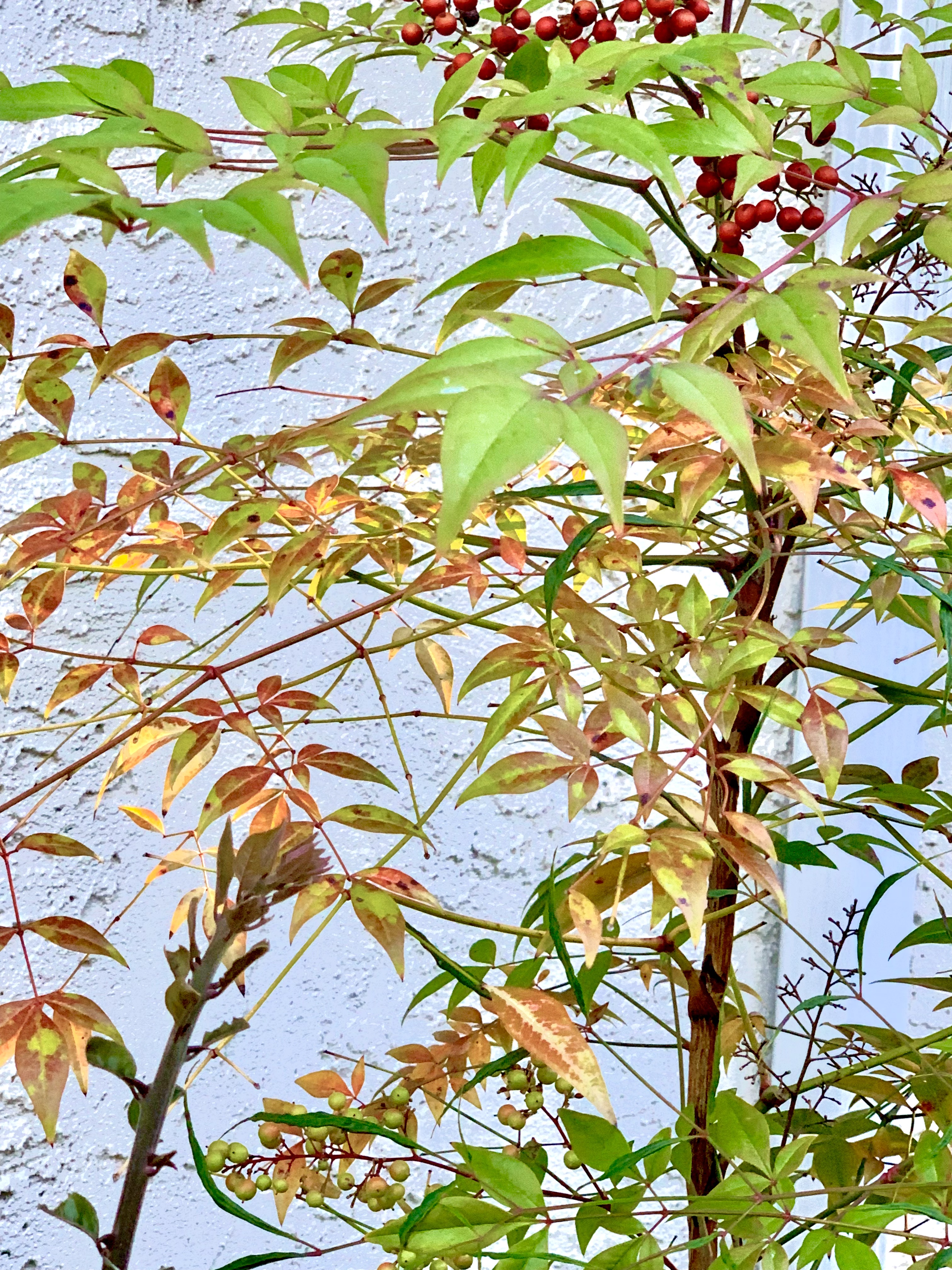
“Look, J.B., I have a picture to illustrate. See this pattern on the left [Picture at the top of page]? And, there it is on the right?”
“Yeah, beautiful. Same pattern. So what?”
“Ah, that’s just it! Is it the same pattern? Is it the same pattern or the same pattern?”
“Well. One is perfect and the other has little mistakes, but I guess it’s the same pattern.”
“Exactly, J.B. It’s the same basic pattern, but it’s not the identical instantiation of that pattern. Ordinary chips are like the picture on the left and mine are like the picture on the right. You see? And, that flexibility is built in at every level in every system. Because the underlying substrate uses an adaptive process with variations. It works 99% as efficiently as the system on the left, but it can accommodate things we didn’t think of. The difference between the system on the left and the system on the right is hubris. The one on the left is designed under the assumption that the designer knows everything of relevance. The system on the right is designed under the assumption that the designer, no matter how brilliant, does not know everything of relevance. You get it?”
“Yes, Marvin, I’m not stupid. But I am still not going to take your case. And, I strongly advise you not to rely on a robot. I am sorry to say it, Marvin, but I think you have picked on the wrong people this time. Attorney client privilege no longer applies and I have to send my recording of this conversation to the proper authorities.”
“Oh, that won’t be necessary Marvin. I’ve already broadcasts this through the social media. You’re famous! It will be good for your business.”
“What? Are you crazy? They will come get you, you fool.”
“Maybe, but if I am taken out over these chips without a trial, everyone will know, don’t you see? I sent it out everywhere, J.B. I might be ‘disappeared’ but I can’t just disappear unnoticed. Solomon’s idea, by the way.”
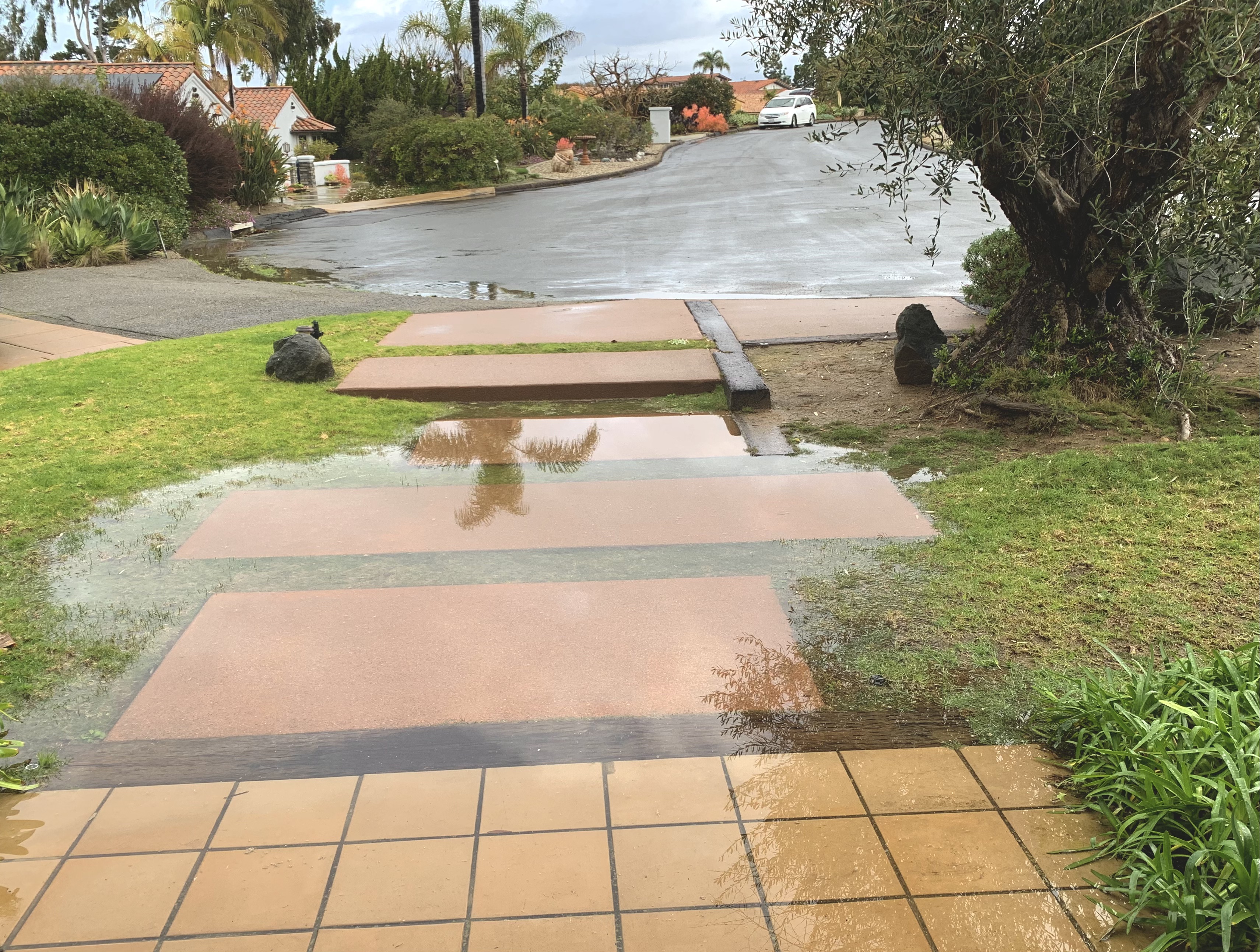
NOTE: I originally wrote this after a long rainy spell in San Diego. In fact, it hasn’t rained here for quite a while, but I believe we will have another long string of rainy days before long. We’ll see. Meanwhile….
Sunshine was one of my reasons for moving to San Diego. It wasn’t the most important, but it was important and I appreciate the Sunshine. For the past week, however, Sunshine took a long-awaited vacation. Apparently, Sunshine was running some sort of scam on the weather forecasters, calling up and saying, “Hi! It’s Sunshine! I’m feeling so much better today! I’ll be at work as usual tomorrow. You can count on it.
And then, when daybreak arrives the next day, it doesn’t. That is to say, when it should arrive, it doesn’t because Sunshine has overslept. Again. I suspect it might be because of all-night partying last night on the other side of the world.
You would think that the weather forecasters would catch on. You might even think that they would have seen the famous “Charlie Brown” cartoon meme in which Charlie Brown’s frienemy Lucy, promises him, year after year, that she will dutifully hold the football and not pull it away—not this time. And, dutifully, year after year, Charlie Brown decides that this will, or at least might be, the year that Lucy finally does the right thing.
But of course, she doesn’t do the right thing. And, Charlie falls flat on his back every time. Lucy smiles.
So apparently, this week, did the Sunshine. Taking vacation elsewhere and not showing more than a stray ray or two in San Diego allowed for the deluge. Other places farther north had it much worse, in terms of rainfall and damage. Worldwide, what we now call extreme weather may, in many places, become more “normal” and extreme weather will become deadlier.
In any case, I am have been just as foolish as the weather forecasters and Charlie Brown. Every day, my phone app has said the rain would be over in a day or two. And, then, two days later…same forecast is dutifully presented. But not the promised reality.
Sadie, meanwhile has been very patient about the fact that our walks have been typically much shorter all week. She has also been patient about not being allowed to dig in the dirt. More accurately, she wasn’t allowed to dig in the mud. There was no “dirt” around. It’s not idle digging. She hears and smells gophers and goes after them. Unsuccessfully. Every time. She’s dug for gophers more than the San Diego weather forecasters trusted Sunshine’s repeated false assurances that tomorrow the rain would end; indeed, even more often than Charlie Brown has over-trusted Lucy.
Sadie persists. She enjoys the process. Maybe the weather forecasters enjoy knowing that they made everyone feel hopeful that could play tennis in a few days (or have a picnic or mow the lawn or harvest their fruit in sunshine). Maybe Charlie Brown enjoys being the kind of person who would give another one more chance to be good, even if they never take that chance than to be more cynical and realistic.
I can’t say what the motivations are for Charlie Brown and the weather forecasters, but I am sure Sadie enjoys the digging. She certainly has little care for how dirty her paws get or whether she spews mud on my shoes. My philosophy may be a mixture of Charlie Brown and the San Diego Cabal of Sun Predictors. I believe Sadie should spend some time “just being a dog.” In other words, she should be in at least partial charge of what she does and be allowed to follow her “instincts” unless it poses a true danger and not just because, say, she tracks mud into the house.
As I was watching Sadie dig, and I was sliding sideways to prevent becoming muck-inundated, it occurred to me that I too, had some years of “just being a dog.” My parents, I think, thought of it as time for my “just being a kid.” In some cases, I heard adults say, “Oh, it’s just boys being boys” when we played in the dirt, fought with sticks, or had “rock wars” wherein we literally threw rocks at each other.
Not all adults were on this plan 100%. My own parents would let me play in the dirt often times, but they did not want me to participate in rock fights or stick duels. Evading those restrictions was trivial. We weren’t trying to be bad. But we knew our friends would not to try to blind us with sticks or stones. We believed implicitly that since we weren’t intentionally trying to blind each other, it wouldn’t happen.
Though there were local variations in the strictness of restrictions, we were always able to do some version of “just being a kid” which truthfully, was not all that different from “just being a dog.”
I had just as little care about muddying my shoes or fingernails as Sadie does about muddying her paws. I’d say my “dog years” were mainly between six and thirteen. Before six, my parents or other caregivers wouldn’t leave me alone long enough to get in real trouble. I mean, I managed all the usual little things like peeing into electrical outlets, throwing stuff down the “registers” (heating vents) to see what would happen, and writing in books and on walls, but there was no opportunity to have rock fights or get muddy from head to foot.
From ages six to thirteen, however, I spent a lot of time outdoors unsupervised. Plenty of time to be a dog. A few years later, however, it dawned on me that girls might find me more attractive if I were less muddy. My mother might have planted that suggestion.
There’s no doubt that many of the “instincts” I had were not very effective guides. They weren’t as effective as the knowledge that science and society had developed over centuries. On balance, I still believe having some dog years is a risk worth taking.
The Winning Weekend Warrior focuses on the mental game for all sports using examples from tennis, golf, baseball, and other sports. It covers self-talk, imagery, mental practice, strategy, tactics, & sportsmanship. http://tinyurl.com/ng2heq3
Turing’s Nightmares explores the implications and ethics of Artificial Intelligence through fictional short stories. http://tinyurl.com/hz6dg2d
Fit in Bits shows many ways to put more fun, variety, & exercise into daily chores and habits to help with strength, flexibility, fitness, and balance. http://tinyurl.com/h6c7fce
Tales from an American Childhood recounts early experiences mainly in the American Midwest in the 1950’s and relates them to contemporary issues and events. https://tinyurl.com/y9ajvz9j
Dream Planet. Where do you run when the whole world is crumbling under the weight of human folly? When the lethal Conformers invade 22nd century Pittsburgh, escape becomes the top priority for lovebird scavengers Alex and Eva.