• About PeterSIronwood

petersironwood

~ Finding, formulating and solving life's frustrations.

petersironwood

Tag Archives: joy

Wartime Playtime

14 Thursday May 2026

Posted by petersironwood in America, apocalypse, politics, psychology, Uncategorized, Veritas

≈ Leave a comment

Tags

books, creativity, empathy, Feedback, fiction, games, innovation, joy, learning, legends, life, myths, politics, short story, truth, Veritas, vicious cycle, war, weapons, writing

 

BDAD5D7D-3543-4705-9A06-7CD7659129E4


Tu-Swift laughed.

He had mastered juggling four sacks, or four rocks and had been working all morning on five, but with little success. Sooz shook her head and chuckled good-naturedly. “Don’t give up, Tu-Swift. You’ll get there.” Then, after a pause, she added, “Though you may be an old man with a long white beard.” 

“What? You’ll pay for that!” He began to chase her around the training space. Being lighter, Sooz could turn more quickly. After a few moments, Cat Eyes appeared. Tu-Swift called out, “Help me catch this fox! I can’t turn fast enough!” 

Cat Eyes laughed as well. With a serious note in her voice, she added, “You shouldn’t be trying to turn fast. Let your knee heal, would you?” 
1A559AF5-59A6-4D1E-929D-B09054B43A89

Tu-Swift’s face darkened for a moment. The ground around them also grew dark as a passing cloud momentarily blocked the sun. He wondered briefly whether he would ever really regain his speed and mobility. Then, just as the ground grew sunny again, so did his face. Time would tell. Meantime…

Just then, he heard the deep voice of Jaccim. He was trying, but largely failing, to speak Veritas. With the help of Cat Eyes, he eventually made himself clear. He had asked why they were playing when there was likely to be a war which they should all be preparing for. They had been “marked” for war. This was no time for juggling nonsense or for laughing. 

Tu-Swift replied, “Hello, Jaccim. I see you brought your own clouds with you.” 

Sooz and Cat Eyes both laughed, though in a friendly way. Tu-Swift continued, “Jaccim, this is the way of the Veritas. Don’t you ever play?” 

Jaccim’s head snapped back and he frowned. He spoke and Cat Eyes translated. “Me? Certainly not! Play is for small children. Not someone your age. And certainly not someone my age. All of you should preparing for war. It is deadly serious.” 

86A389C7-4CD7-42E3-ABFA-A555A5BB24CB

Many Paths who strode into the training area overheard the last part of the translated conversation. She smiled at all of them and supplemented her Veritas with sign language so that Jaccim would directly understand as much as possible. “You are right. It is serious. This is why we play. We need weapons. New weapons. Weapons that no-one will suspect. That is why  we watch and listen to those whose minds are like water flooding over new plains. They will go ways that we cannot foresee. Nor can others. What shall we care who wins a war if life holds no joy? Every moment now is precious. This is what the Veritas always teach. But now that we may be on the brink of destruction, joy is more important than ever.” 

Jaccim frowned and answered with a mixture of sign language and broken Veritas. “What may be gained by juggling bags or rocks? It is foolish.”

Many Paths smiled at Tu-Swift. She put her hand into a fold of her tunic and brought out a knife and casually tossed it to Tu-Swift. She quickly threw him two more. He easily caught all three and began juggling the three knives. 

Jaccim opened his mouth to speak, but before he could formulate his answer in the tongue of the Veritas, he heard three odd sounds a little like a horse’s whinny and a little like a large rock hitting a tree trunk. He frowned and then his mouth dropped open farther as he saw all three knives sticking out of three nearby tree trunks. Tu-Swift had thrown all three underhand and hard into three targets. Jaccim tried to speak but nothing came out. It wasn’t that he did not know the Veritas words for what he wanted to say. There were no words. Even a sensible language like ROI could not help him. Tu-Swift, meanwhile, calmly walked over and wiggled each of the knives out and handed them back to Many Paths. 

6A476221-BDAD-4FC1-97A4-531C91BE04AC

She smiled at Tu-Swift and continued out of the clearing. As she reached the edge she looked back over her shoulder and said, “Keep up the good work.” 

Jaccim understood her words but not her thinking. She was supposed to be the leader. Yet she spoke of joy and play even though they would likely soon be at war. It made no sense, thought Jaccim. It’s what comes, he thought, of having a woman as leader. We would not have a woman as leader. Not the ROI. Nor would the Z-Lotz. It’s all foolishness. As the Veritas will soon discover for themselves. How had these people who play defeated the ROI and destroyed his village? 

Tu-Swift called out, “Many Paths! Have you a moment? I wish to show you something else!” 

Many Paths turned back, “I am on my way to meet up with Shadow Walker but I can see what else you have first.” 

Tu-Swift glanced at Sooz and once he had caught her eye, gestured over toward a contraption they had constructed at the end of the training compound. Two vines were suspended from a strong overhanging branch. The vines looped through a thick wooden plank which lay parallel to the ground. Sooz lifted a leg over the plank coquettishly as she smiled at Tu-Swift. He walked around behind her and pushed. He found pushing her surprisingly pleasurable and his cheeks flushed. 

back view photo of woman swinging

Photo by Ahmad Fauzi on Pexels.com

Sooz swung forward and then arced back toward Tu-Swift. Just as she stopped, he pushed her again. Each time, he pushed at just the right time and she swung higher and higher. After a score of pushes, he changed the timing so that he pushed against her momentum and gradually slowed her to a stop. 

Jaccim shook his head. He could see no reason for such frivolity. 

Tu-Swift walked over to Many Paths. “We had been swinging on a single vine and Sooz thought this would work — and it did. But the thing we really wanted to show you is this. He walked over to a small pile of straps made of softened hide. He put a stone in a small, broad but shallow pit in the strap. He motioned for the others to stand behind a nearby tree and peek out. He put both ends of the strap in his hand and began whirling it around his head. He suddenly let go of one end and the stone went flying. It thunked loudly into one of the small, dead pine trunks that had been partly buried in the ground. Many Paths led the others over to see the result. The stone lay buried in the trunk. She nodded. “Nice,” she said. 

Many Paths nodded again. “Yes. This is good. You have an almost endless supply of stones. Imagine these flying into an army from many directions at once. It will be hard to defend against.” Many Paths smiled again at Tu-Swift and set off to meet up with Shadow Walker. 

As Many Paths left the clearing, she ducked under an overhanging branch of Witch Hazel and spoke aloud, “Thank you for your medicine.” She walked down a sweetly curving path toward a small spring. Three pink flowers, Lady Slippers, poked their heads through the dark greenery. She began thinking about the sedation caused by Lady Slippers and recalled what She Who Saves Many Lives had said. “After the sedation wears off, one may be nervous and high strung for a time.” Many Paths had only tried it twice and she experienced exactly what the elder had described both times. It had felt a lot like the way that the roots of Sweet Flag made her feel. But after the effects of Sweet Flag wore off, it made her feel tired and groggy. Odd, she thought. 

She chuckled at the swinging seat that Tu-Swift and Sooz had created though she couldn’t see how that led to the sling weapon he had shown her. It all had to do with the timings of the pushes, she reminded herself. Suddenly, many paths stopped. 

She thought of the swing, the pushes, the Lady Slippers, and the Sweet Flag. What if… what if I pushed with a little Lady Slipper and then… just when it began to wear off, I pulled with some Sweet Flag…a person might become very nervous and want more Lady Slipper… what would happen if they were pushed and pulled higher and higher? I wouldn’t poison the person exactly. Would it tear the body apart? Tearing the people apart with such pushes seemed to be what was indicated in the strange tales scribed into the sheaf of leaves that had been discovered by Lion Slayer and Eagle Eyes. Could that really happen? Was there a way to tear apart the Z-Lotz? Was there a way to tear apart the Veritas? And, if so, how could it be prevented? 
B723FC76-0CC5-4DDB-8A0B-DFADBB1884FD_4_5005_c

———————————————-

Author Page on Amazon

Start of the First Book of The Myths of the Veritas

Start of the Second Book of the Myths of the Veritas

Table of Contents for the Second Book of the Veritas

Table of Contents for Essays on America 

Index for a Pattern Language for Teamwork and Collaboration  
Where Does Your Loyalty Lie?

Come Back to the Light Side

Life is a Dance

Take a Glance; Join the Dance

The Dance of Billions

Imagine All the People

Roar, Ocean, Roar!

Resonance


Child-Like? Or, Childish?

12 Saturday Dec 2020

Posted by petersironwood in Uncategorized

≈ 5 Comments

Tags

child, childish, childlike, dance, essasy, joy, life, sociopathy

Aren’t they synonyms? Aren’t both these words applied to adults who have some of the characteristics of a child?

No. And … yes.

Both words are typically applied to adults. And both words are typically applied to indicate that the adult in question has some characteristic(s) in common with a child.

But the sense of these words is quite different.

I spent two wonderful summers in my mid-teens working as a counselor at a camp for kids with special needs. Many of these kids had been paralyzed from polio. Some were confined to a wheelchair. But polio was not the only cause of issues. One week was dedicated to kids who were severely hearing impaired. One of the great joys of that particular week was a camp tradition that the cook would “chase” the senior counselor while clanking a cow bell very loudly through the mess hall. Only two of the group of 50-60 kids were totally unable to hear. (Who knows? Maybe even those two have been since able to hear a little with cochlear implants). Anyway, although the rest couldn’t hear well enough to understand spoken speech, they could hear that very loud bell. People differ in all sorts of capabilities; most often the kids at the camp — and adults as well — have some mobility, or some hearing, or some coordination. The so-called “deaf kids” squealed with delighted laughter at the antic.

Photo by Helena Lopes on Pexels.com


Generally speaking, the weeks that the kids came were not organized by their particular special needs but by age range. The first campers to appear were young; perhaps 5-7. The next group were 8-10. There was a huge difference in the way these two groups approached things. The younger kids had a kind of … openness. A light burned behind their eyes. They were fully there. The second group were already wary. Instead of plunging ahead to answer a question based on what they themselves thought and felt, they would look at my face, or the face of another authority figure and try to read what they were supposed to think and feel. They had, it seemed, surrendered some of their soul to schools, and rules, and requirements. They knew how to be cagey. The light behind their eyes had dimmed.

Inside every adult however, that wild well-lit child still lingers and sometimes he or she will come out to play. For some folks, that requires drugs or alcohol. Others save it for special occasions like Mardi Gras or having their team win the World (sic) Series. And some adults are lucky (or unlucky) enough to be in a profession that actually rewards creativity — at least up to a point. Painters, writers, actors, therapists, scientists, dancers — often need to draw on that inner child to see afresh; to play; to dance; to interact with the world while minimizing preconceptions. That is being child-like. And, it is generally thought to be a good thing. Some adults find any hint of play annoying in other adults. Children almost universally like it — although they want the adults to be adult when a real danger is afoot.

Once, when my daughter was about four, she and I and my wife all sat on the floor listening to Leonard Bernstein’s introduction to the orchestra. We “adults” mimicked playing all of the various instruments. After a few minutes of this, my daughter looked back and forth between the two of us and said, “Oh! I get it! You two are really just little kids!” My wife and I burst out laughing. We took it as a great compliment.

Photo by David Trounce on Pexels.com

In graduate school at Michigan, one of my favorite courses was “Complex Adaptive Systems” taught by Professor John Holland. Most of the course consisted of his showing various mathematical models of complex adaptive systems. One modeling effort in particular I found interesting. It explored this question:

“If you are a complex adaptive systems (we humans are one example; so are cows, crayfish, corporations, and clans) how much of your resources should you spend on optimizing based on how much you already know and learning more about the environment (and then you can use that knowledge to optimize even more effectively later).”

Under a wide range of assumptions, it turns out that it is just about 50-50. That is, you should spend roughly half of your resources learning more about the world around you and half using what you already know to get more of what you need to survive and thrive; e.g., in the case of a person, food, water, love, etc.

Half.

How many organizations do this? How many adults do this? And, if an adult does learn, is it really open learning? In my experience, even when most adults do try to learn new skills, they are their own worst enemies. They have a highly evolved network of constraints, rules, assumptions and — yes, they do try to improve their skills — but only so long as it does not require a change in those constraints, rules, and assumptions.


To take a trivial example, people will go on to the tennis court and attempt to improve their game. But they often do it by making the same mistakes over and over. For fundamental improvement at tennis (or almost anything else), you will need to be open to fundamental change. By the way, making a fundamental change means that your performance will get slightly worse before it gets better. For instance, one of the people I sometimes play with exhibits a common error. He doesn’t bring his racquet back soon enough. He runs to hit a shot and only brings the racquet back after the ball bounces. As a result, he often rushes the shot, does not have any power, or mis-hits the ball. He’s trying to improve his skill, but he won’t improve much until he changes his approach.

For fundamental change, we need to dig deep and find that way of being in the world in which we are open to what is happening. Unfortunately, if a player does manage to “remember” to bring the racquet back father, his or her first few attempts will likely be worse than the way he or she usually hits the ball. Why? Because the timing of the shot will be quite different. The positioning and the weight transfer will also be different. A child seems to enjoy the movement itself and they seem to grasp intuitively that bringing the racquet back farther will naturally result in more powerful ground strokes. If you can be or become child-like while you learn, you will free yourself to learn at a deeper level.

To be childish is a quite different thing altogether. Someone who is childish is often not interested in learning or adapting or changing at all. They insist that they are already perfect and if they didn’t win the Monopoly game or the Chess Game or the Tic-Tac-Toe game, it’s not their fault (and therefore, there is no reason to learn to do better).

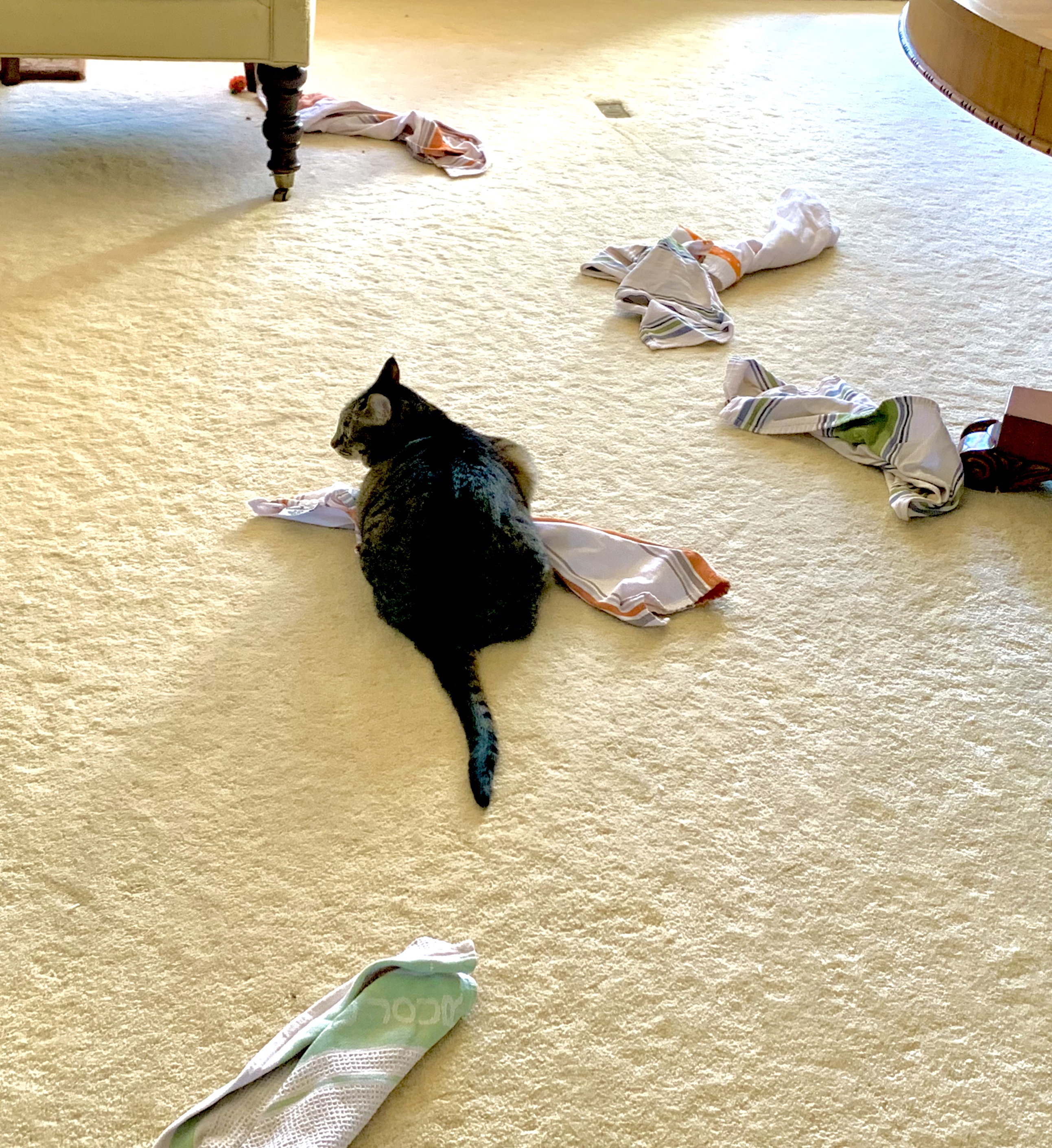
(one of my cats, Shadow, arranging the used dish towels she stole from the kitchen)

While I ran an AI lab at NYNEX, for a time, I had a pretty long commute. I listened to many “Books on Tape” during the commute including the autobiographies of many CEO’s of companies. Many of them were childish rather than child-like. Perhaps because they were rich and powerful, people told them what they wanted to hear all too often. As a result, these CEO’s often blamed their failures on factors beyond their control: the weather, government regulation, foreign competition, bad luck, fickle customers, etc. When they had successes, that was because they were smart enough to hire good people, make excellent decisions, provide superb leadership. That attitude of taking all credit for success and zero responsibility for failure is being childish — not child-like.

Incidentally, other animals can be stubborn (like a mule) and refuse to try something new — or they can be child-like and explore, play, and innovate. Play is not something that humans invented. We’ve all seen dogs play, but so do cats, otters, crows, ravens, horses, foxes, etc. In a very real sense, life itself is play. The replication and reproduction of life always allows for some variance. Life is always exploring the new and well as sticking with the old. Life itself is a balance between work (using what we already know to defend or acquire) and play (exploring new places, new ways of doing things). It is a balance between being an adult and letting that inner child continue to play. That is being child-like.

Photo by Rolandas Augutis on Pexels.com


Being childish is however quite different. That refers to a situation in which an adult (by chronological age) refuses to consider alternatives or the consider consequences; they refuse to think about the impact of their actions on others and even on themselves. Wearing a mask that has a Star Trek emblem or the likeness of a Skull or that’s colored like a rainbow — these are examples of being child-like. Refusing to wear a mask at all because someone doesn’t “feel like it”? That is being childish.

Wearing a condom that has a rocket ship on it is being child-like but not wearing one at all might be childish (unless you know you’re disease free and willing and able to raise a child). Putting on some of your favorite music and dancing while you’re doing the dishes is child-like; smashing the dishes on the floor because you’re fed up with washing them every day — that is childish. Making up a song so your students can learn math better is being child-like while being adult in taking your responsibilities seriously. Telling your students not to bother learning math — that is abdicating your responsibility to be an adult and being childish. Making up a funny protest sign and voting for the candidate whose policies you honestly think are good for the country is being an adult and being child-like. Refusing to learn about both candidates and voting for the one who makes absurd promises is being childish. Stubbornly refusing to learn the truth about your candidates failures and lies is being childish.


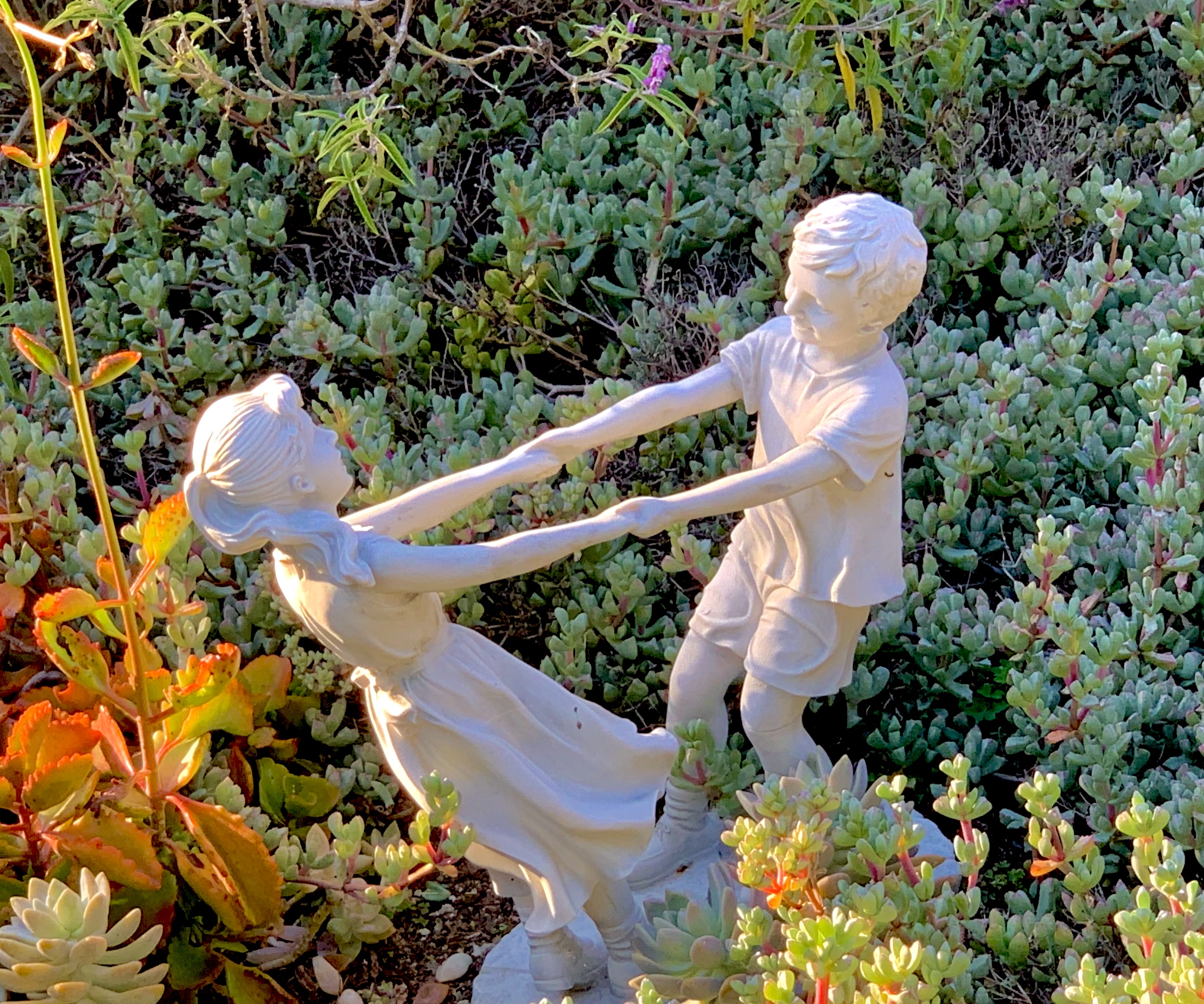
Life is a dance. Joining the dance and being child-like — that’s a really good thing for an adult’s health and well-being. It’s also good for society. Without any adults being child-like, there would be little or no math, science, art, music, or innovation. Of course, not all situations lend themselves to being child-like. You might have a job where the culture is so damned serious that any levity or joy will get you fired. If you have a family to feed, you might have to put on hold your desire to be child-like. If you give in to it and get fired, you’re being childish. First, get yourself a new job — hopefully one where you can be more child-like. Then, dance at the bank. If you are driving your car in bad weather, it’s not the time to “see what this baby can really do!”

Most people exhibit a mix of serious adult behavior, being child-like, and being childish. If a responsible adult “loses it” and smashes all the dishes, they will apologize; clean up the mess; buy new dishes. Rarely, we find a person who acts in a purely childish fashion. They will break the dishes and then, instead of apologizing, cleaning up the mess and buying new dishes, they will deny that they broke the dishes, blame others, and refuse to take any responsibility. Abusive parents and spouses fit into this category. But so do politicians who take a solemn oath of office to uphold the Constitution and then seek to overturn that Constitution that they swore to uphold. That is not being child-like. That is being childish.

And so is supporting such a person. To do so is to reject your own adult responsibilities.

Photo by Marlon Schmeiski on Pexels.com


———————————–

Purely fictional stories about a child sociopath named “Donnie Boy”

Ramming Your Head Into a Brick Wall Does Not Make You a “Hero”

Donnie Boy attends a Veteran’s Day parade

Donnie Boy lets his brother take the blame

Donnie Boy plays Sailor Man

Donnie Boy plays Soldier Man

Donnie Boy visits Granny

Donnie Boy Gets a Hamster

Donnie Boy Takes a Blue Ribbon in Spelling

Donnie Boy Gets his Name on a Tennis Trophy

Donnie Boy plays Bull-Dazzle Man

Poem: Life is a Dance

Poem: Serious Play

Essays on America: Rejecting Adulthood

The Myths of the Veritas: The First Ring of Empathy

Index to Catalog of ‘Best Practices’ in Teamwork and Collaboration

Author Page on Amazon


Living on the Edge

03 Thursday Dec 2020

Posted by petersironwood in Uncategorized

≈ 4 Comments

Tags

COVID19, danger, joy, pandemic, risk, thrill

Photo by Frans Van Heerden on Pexels.com

From where the family had lived at the time, to Sesame Place in Pennsylvania constituted a two hour drive and plenty of traffic. But it was worth it. My kids enjoyed it. I enjoyed that my kids enjoyed it. But I also enjoyed it myself.

In particular, I enjoyed the water rides, particularly on this day because it was a typical 3-H day in the New York Greater Metropolitan Area — Hot, Hazy, and Humid. The water rides offered a nice way to cool off. I do not like getting wet when it’s cold. But when it’s hot and the sun dries me off quickly, I enjoy both the cooling and the warming back up. Beyond that, water slides provide the thrill of speed. And, for me, the thrill of speed is a more pure pleasure without the nagging sharp little chiggers of worry about someone having not sufficiently re-tightening a nut on the Ferris wheel or Roller-Coaster — a someone who has just found out they have terminal cancer, or their spouse just left them, or their favorite TV show has been cancelled. That’s a someone who is understandably quite distracted by all the little “worst case” scenarios that they have been playing out in their heads all day in the sizzling sun, perhaps even complaining to their imaginary pals about it. 

Photo by Amanda Cottrell on Pexels.com

No. When I think of a Water Slide, I think of Water. And water, unlike asphalt, is soft. If you fall, so what? And how can it break? It’s got no moving parts! What could be safer? 

Actually, it does have one moving part. That moving part is the user, the participant, the enjoyer, the thrill-seeker. In a word, me. To be fair, I am not much of an adrenaline junky. I’m happy to have speed thrills, but I want to do that without the risk of real injury. Hence, the Water Slide: my favorite kind of ride. 

Beyond that, I really like Water Slides because there is such elegance and simplicity. I am climbing the steps to the giant Water Slide and what am I wearing? A bathing suit. I have no tennis bag, no picnic bag, no bat, no ball, no safety helmet, no special shoes, no shin guards, no ignition key, no riding gloves, no spurs. I am damned near naked. I do not get into a seat, or a boat, or race car, or mount a horse (though I understand those can be wonderful for various different reasons). But this a particular thrill, though safe, is a naked thrill. I not literally naked of course. But I was as close as I could get in polite society. 

Photo by Aleksey Kuprikov on Pexels.com

The first time I used this particular Water Slide, I was sitting up. I noticed that most people did that, but some people lay flat. I considered that, but it seemed to me I wouldn’t get to see much except the sky. The way I visualized it, I would have a greater impression of speed if I sat up so that I could see the park-world that lay beyond the half-circle of yellow plastic pipe that formed our “race track.” So, off I went: ZOOM! (In the pre-COVID19 sense of the word). 

It was fun! Just as much fun as I had imagined. And more. It really felt good. If you enjoy the jets of a jacuzzi, you might appreciate that, in addition to the thrill of speed, the Water Slide offers a surprising kind of gentle but vigorous water massage while you are speeding through its universe. The turns and twists and falls seem a lot like a bobsled run. But the bobsledders are getting banged and bruised and on rare occasions killed, while I was getting a water massage instead. 

So being a person who likes to study things, I decided I would lay on my back for the second run. This time, I would go for speed and see whether the increased speed would make up for the less panoramic visual experience. 

Photo by Oladimeji Ajegbile on Pexels.com

Whoosh! Into the pool at the end, I went. Unbelievably, it had been even more fun the second time. So, once more, I climbed up the long staircase to the top of the Water Slide. The steps were ingeniously chosen to be of cross-grated metal which kept the stairs tolerably hot and made them less prone to someone slipping and falling, possibly taking out a host of climbers behind them. Of course, the climb lasted far longer than the slide, but I didn’t mind. I used my time planning how I would go even faster this time.

When you reach the top of the Water Slide, there are two workers — one on each side of the yellow half-pipe. They hold you in place until they are sure the person below you has cleared. And then they give you a shove to start you off. This is great because that time allowed me to execute my mental check list. I straightened my legs hard, pointed my toes, and pressed the soles of my feet together as hard as I could. I stretched my arms above me, pushing the inside of my upper arms against my ears and pushing my palms together as hard as I could.

ZOOM! Off I went! And, sure enough! My plan had worked! I was going even faster than my second time down — noticeably faster. This was heaven, all right. A considerable thrill but completely safe. 

Photo by Nikolay Ivanov on Pexels.com

So I thought. 

Apparently, the engineers who designed this water park didn’t design for grown men who had a curious enough streak to see what would happen if they really thought hard about how to minimize friction. 

I sizzled down the half-pipe in my slip-sliding way with no issues until the last and fastest turn. Here, my body quickly went from in the half-pipe to somewhat outside the half-pipe to half outside the half-pipe. I had been worried about the lack of view. But I had plenty of view of what my landing place would be like. Concrete and rocks about five feet below. 

I had exactly zero time to react before my body began to find its way back into the confines of the half pipe. It was a close thing. And, if I had “spun out,” that afternoon would have turned out far differently than it did. It would have certainly meant a trip to the hospital. Maybe I would have been spared broken bones and just gotten a world class case of road rash. That seems unlikely. Who knows? I might have been permanently disabled or, if my head happened to hit something in the wrong way, dead. 

Sometimes, we come up to that edge and we don’t even know it. And sometimes, we come to that edge because we think our way up to it. Every time we push the limit and get away with it, a little voice inside says, next time, we’ll push it a little more. Next time, we’ll push it a little more. And a little more. Sometimes, we get lucky. We get close enough to the edge to see what lies beyond and we modify our behavior. And sometimes, we get unlucky. We go over the edge. And there’s no turning back.

I still enjoy a Water Slide. 

But I don’t clever my way to the edge. 

I would go to the edge, and I would go beyond the edge, for a worthy enough cause. But a thrill or the pleasure of the moment — to me, that is not nearly enough cause.

How close do the edge do you like to come? 

Photo by Darren Lawrence on Pexels.com

————————————————————-

Author’s Page on Amazon. 

Link to a series on “tools of thought” 

Link to an essay about “cognitive dissonance.” 

Link to an essay about my experience getting “conned.”

Link to an index of “best practices” in teamwork and collaboration. 

Photo by u041fu0430u0432u0435u043b u0421u043eu0440u043eu043au0438u043d on Pexels.com

Subscribe

  • Entries (RSS)
  • Comments (RSS)

Archives

  • May 2026
  • April 2026
  • March 2026
  • February 2026
  • January 2026
  • December 2025
  • November 2025
  • October 2025
  • September 2025
  • August 2025
  • July 2025
  • June 2025
  • May 2025
  • April 2025
  • March 2025
  • February 2025
  • January 2025
  • December 2024
  • November 2024
  • October 2024
  • September 2024
  • July 2024
  • April 2024
  • March 2024
  • February 2024
  • January 2024
  • December 2023
  • August 2023
  • July 2023
  • May 2023
  • April 2023
  • March 2023
  • February 2023
  • January 2023
  • December 2022
  • November 2022
  • October 2022
  • September 2022
  • August 2022
  • July 2022
  • June 2022
  • May 2022
  • April 2022
  • March 2022
  • February 2022
  • January 2022
  • December 2021
  • November 2021
  • October 2021
  • September 2021
  • August 2021
  • July 2021
  • June 2021
  • May 2021
  • April 2021
  • March 2021
  • February 2021
  • January 2021
  • December 2020
  • November 2020
  • October 2020
  • September 2020
  • August 2020
  • July 2020
  • June 2020
  • May 2020
  • April 2020
  • March 2020
  • February 2020
  • January 2020
  • December 2019
  • November 2019
  • October 2019
  • September 2019
  • August 2019
  • July 2019
  • June 2019
  • May 2019
  • April 2019
  • March 2019
  • February 2019
  • January 2019
  • December 2018
  • November 2018
  • October 2018
  • September 2018
  • August 2018
  • July 2018
  • June 2018
  • May 2018
  • April 2018
  • March 2018
  • February 2018
  • January 2018
  • December 2017
  • November 2017
  • October 2017
  • September 2017
  • August 2017
  • July 2017
  • June 2017
  • May 2017
  • April 2017
  • March 2017
  • February 2017
  • January 2017
  • December 2016
  • November 2016
  • October 2016
  • September 2016
  • August 2016
  • July 2016
  • June 2016
  • May 2016
  • April 2016
  • March 2016
  • February 2016
  • January 2016
  • December 2015
  • November 2015
  • October 2015
  • September 2015
  • August 2015
  • May 2015
  • January 2015
  • July 2014
  • January 2014
  • December 2013
  • November 2013

Categories

  • AI
  • America
  • apocalypse
  • cats
  • COVID-19
  • creativity
  • design rationale
  • dogs
  • driverless cars
  • essay
  • family
  • fantasy
  • fiction
  • HCI
  • health
  • management
  • nature
  • pets
  • poetry
  • politics
  • psychology
  • Sadie
  • satire
  • science
  • sports
  • story
  • The Singularity
  • Travel
  • Uncategorized
  • user experience
  • Veritas
  • Walkabout Diaries

Meta

  • Create account
  • Log in

Blog at WordPress.com.

  • Subscribe Subscribed
    • petersironwood
    • Join 662 other subscribers
    • Already have a WordPress.com account? Log in now.
    • petersironwood
    • Subscribe Subscribed
    • Sign up
    • Log in
    • Report this content
    • View site in Reader
    • Manage subscriptions
    • Collapse this bar

Loading Comments...