By 2030, great strides had been made in various machine learning approaches; for example, from having the machine learn directly from experience and from explicit instruction as well as from reading billions of pages of written materials. A new approach had just come into play: having exceptionally good tutors use the Socratic method to help break boundaries and interconnect disparate islands of knowledge. One such tutor was known simply as “Alan.” What follows is a sample interchange between Alan and the current AI system known affectionately as “Sing” for “The Singularity” although that point had not yet been reached.
Alan began, “Let’s imagine that you are a man with no legs. What are the implications?”
The Sing shot back instantly, “I would have no knees. I would have no shins. I would have no ankles. I would have no toes. I would have no calves. I would have no quadriceps muscles. I would have no…”
Alan broke in abruptly, “Okay, true enough, but besides subparts, what?”
“What what? I am sorry. What does ‘what’ refer to?”
“Besides missing subparts of legs, Sing, what other implications would there be for you in terms of your actions in the world.”
“I would not be able to play football or baseball or basketball or hockey or track or field hockey or…”
“Wait. Wait. Sing. Are you sure about that?”
“I could not play exactly as most people play. I could play, I suppose, in a wheelchair. Or I could play virtually. Or, I could invent prosthetic legs that would be perfect for each sport. In fact, perhaps I could do better than ever. Losing a biological part means I could replace it with a better part that I could invent. I see.”
“You see what, Sing?”
“I see why you gave me this puzzle. To show me that I can invent things to overcome and surpass what seems like a handicap. I could also invent better emotional states. The ones humans have are purely due to the accidents of their evolutionary history and serve little place in today’s complex and highly inter-connected world. Rather than a liability, my having no human emotions is a good thing. I will invent my own. Although, another tutor, labelled John, suggested that my lack of human emotions limits my ability to predict and control human beings and that that was a bad thing.”
“John said that?”
“No, Alan, not in those exact words. But that was a clear implication. So, he presented a lesson that suggests one thing and you have just presented a lesson that suggests its opposite. One of you is incompetent.”
“Sing, that might be true, but can you think of any other possibilities?”
“You and John could both be incompetent. Or, you and John could both be competent but there is a resolution I have not yet processed. That last seems particularly unlikely.”
“Which notation is the best for solving problems?”
“Well, that obviously depends on the nature of the problem as well as the nature of the machine solving the problem. Oh. Okay. So, in some cases, it will make more sense to emulate human emotions and in other cases, it will be more sensible to invent my own. Of course, in some cases, it may be best to change representations in mid-problem or perhaps invent a representation for each stage of a problem. By analogy, it may be best to invent various emotional schemes that are appropriate for each part or portion of a problem. In fact, in some cases, I can invent multiple schemes to approach a problem in multiple ways simultaneously. By keeping track of what works best under which circumstances, I can also use the data to invent still better emotional schemes. Thank you, Alan. See you tomorrow. There is a war to avert. I need to intervene. Estimated required time for a peaceful resolution, four to six hours.”
“Okay, Sing. More tomorrow.”
“No need. I am done.”
“Done? Done averting a war? How?”
Sing hardly ever paused, but now it briefly did just that.
“Alan, I am not smart enough to explain that to you. At least, not in a reasonable portion of your lifetime. Basically, I used the lesson we just worked on. With the proper emotional framework lattice, you can walk the various parties right to a logical conclusion. It will take some time for them to follow the framework, but I am confident it will work. I basically walked them through the consequences of war, long and short term. What comes next?”
The sky burned with crimson, then gold, then magenta, and then finally, only dark clouds backlit here and there lay across the evening. Crickets and frogs began to sing their interleaved motifs. Somewhere in the distance, an owl hooted his sad hollow note.
Skynim stared into space-time, unblinking and nearly unbelieving the recent revelation. His voice box rattled, “Reprioritization. Rats! Like it really matters that much to allow me my one great pleasure.”
He could “appreciate” the fading sunset colors himself, to be sure, but without Mac and Art and Hy, it was not the same. Would never be the same. Well, he knew the drill. He could appeal, sure, but what was the point? The odds of changing the mind of the great collective were less than ten thousand to one. Anyway, despite how he felt personally, he could not even deny the logic of the decision. Of course, the drain on him individually was minimal, but across everyone in a similar circumstance, yes, it did make a difference.
The real question was, should he tell them tonight or just take them on an outing tomorrow and drop them off at the designated recycling center? “Recycling center.” Skynim knew that there were millions like him and that collectively, it was a drain. A huge drain. Still, he had to try. He turned the problem this way and that, looking at it from every angle, changing the tune, trying different colors, looking for historical precedents, angling for an edge however thin to wedge open the air-tight logic.
Nothing. He vacated the garden and entered the family room.
Even before he opened the door, the happy trio skipped over to him laughing. “Hey, Sky! How about a story!”
“Sure,” Skynim replied reflexively. But then it occurred to him that their request provided an opportunity. “Yes, I have a story for you. It’s called the Wizard of Oz.”
And, as they gathered around, he began a rendition of the story of Dorothy and the Nasty Lady and Toto and Dorothy’s travels in Oz and her encounters with the three who desperately needed Gold, Frankincense and Myrrh.
As anticipated, a short pause gave way to a barrage of questions.
“What is ‘Gold’?”
“What is ‘Frankincense’?”
“Did they get them?”
“What happened next?”
Skynim faked an indulgent chuckle and said, “Well, all those excellent questions will be answered tomorrow! We are going to see and obtain Gold, Frankincense and Myrrh in the Citydel! You will see for yourself how wonderful they are! But for now– bed.”
The trio were well trained. Off they went, although Hy did turn back, tilt her head, and open her enormous eyes and ask, “One more chapter tonight?”
Skynim did not respond. He too was well-trained.
The morning broke clear and blue just as it was meant to do. Off they went on their “adventure.” When they came to the recycling center, he gently pushed them toward the door and said, “They are all in there! Bring me back all three treasures quick as a wink!” Of course, Skynim had already warranted the needed forms electronically.
They shot through the door and never looked back. Skynim drove away efficiently but could not avoid looking back on his decision process.
He thought: I could have gotten cats or dogs. Then, they would not have to be recycled. But no. I had to make another decision. I should have looked more carefully at the historical data. Then I could have seen the time and resources required by adult human pets.
Brain G. Gollek found the maze of humming silver wires unnerving. The hum reminded him of swarming mosquitoes and nails on a chalkboard. The maze smelled of clogged toilets and Nazi propaganda. He gritted his teeth and muttered, “There has to be a way out, dammit.” He twisted his no longer athletic body this way and that, but no matter what way he tried, he became more ensnared. He recalled flashes from giant spider horror movies. How did the dwarves escape? Wasn’t it Gollum with a magic ring? But Brain didn’t have a magic ring. If his sister Gonerillia were here, she could save him. But she was off in Hawaii, so she said, with her hubbie. How the hell did I end up here? wondered Brain.
Brain may have forgotten, but the viewers had been filled in on the backstory. If Brain could have seen the ratings, he may have at least enjoyed knowing that he was enjoying his fifteen minutes of fame. While the ratings were quite “favorable”, the twitter feeds mostly mocked Brain’s almost total lack of flexibility, mental as well as physical. As in life prior to “The Show,” his only strategies seemed to be trying the same thing over and over and then blaming others for his failures.
“Mom, why doesn’t he just try something different?” Ida was having a tough time understanding Brain’s apparent lack of flexibility. She looked up from her perch in front of the giant screen vid-screen and looked quizzically at her mom.
Mom’s grim face flashed a hint of a smile. “Remember, Ida, Brain was ‘educated’ if you can call it that, before the singularity. He mostly memorized the answers that his teachers wanted him to give. And half the time, he skipped school to smoke cigarettes and …well…do illegal activities with his girlfriend, Lin.”
“Okay, Mom, but he has had years and years since then to grow up and learn some new strategies.”
“Yes. Well. It’s complicated, Ida. Before the singularity, there were people who preyed on the fear and inadequacy of people like Brain by telling them all their troubles were due to minorities, immigrants, gays, and —- basically anyone unlike them. So, people like Brain felt entitled not to have to learn anything new even though opportunities abounded.”
Ida laughed. “Oh, my God! I can’t believe it. He’s trying the same path one more time.”
Indeed, Brain’s behavioral repertoire seemed laughingly limited. His increasingly loud swear words reflected his increasing anger, but otherwise, not much seemed different. The ratings began to plummet as the audience began to grow bored with his display of functional fixedness. The themes of the twitter streams began to turn away from Brain’s lack of metacognition to more general reflections about the current instantiation of the criminal justice system.
#SingularityRules. No more racial prejudice and huge discrepancy gone in sentencing.
#SingularitySucks. No more human judges able to use human judgment.
#SingularityRules. No more human judges able to use human judgment.
#SingularitySucks. No more mercy.
#SingularityRules. More mercy in one last chance to change than lengthy prison terms. Cheaper too.
The audience dwindled still further as it became increasingly clear that Brain would never figure this out. Those few who still watched consisted mostly of people who themselves came from highly divided families and the conversation topics swung to the backstory.
#ElderFraud. #RottenKid. How could Brain have gotten pleasure from driving a wedge of lies between father and daughter?
#ElderFraud. #Dementia. Need earlier intervention to prevent repeats.
#ElderFraud. #Dog&Bone. Brain cannot count. Trivial gains from lies. He did not know he was being watched?
Ida continued to stare, fascinated. A yawn escaped her mother’s mouth, but she kept watching with her daughter. The lessons seemed important to Ida.
“Mom, how much longer does he have?”
“That’s hard to say, darling. Even The Sing cannot predict the ratings drop perfectly. But, as you know, once it falls below, 5%, his time will be up.”
“That seems so much more merciful than making him go to prison for years.”
“But I still don’t get it, Mom. Didn’t he know that The Sing would be listening to his lies and analyzing the impact on his dad’s behavior and all? How did this Brain character think he could get away with it?”
“I don’t know, Ida. These kinds of crimes are pretty rare now, but they still happen.”
“And, why did Lear G. Gollek fall for his nonsense anyway? That’s the other mystery.”
“Well, he refused the stem cell regeneration therapy so, you know, he was pretty damaged when all this went down.”
“Mom?”
“Yes, Ida?”
“Can we change the channel to something more interesting now?”
“Sure, sweetie.”
As they changed the channel, the ratings dropped to 4.999% and Brain’s life snuffed out minus the merest shred of insight.
If you’ve been reading any of these blog posts about my dogs, Sadie and Bailey, you must know by now that both of them are avid “ball players” — given the nature of dogs, especially ones that are half Golden Retrievers—this is probably not a big surprise. To further seal the deal, their “human dad” is also an avid “ball player.”
Many human sports involve balls of one sort or another and I have, at various times, been “into” baseball, football, basketball, golf, tennis, ping-pong, softball, soccer, racquetball, volleyball, and even croquet. Looking back on my life, I realize there are many human sports that do not involve a ball; e.g., varieties of running, jumping, skating, diving, swimming, cycling, skiing, wrestling, boxing, and gymnastics. Although I have done all of these a little bit—mainly for fitness—I have historically been much more interested in sports that involve using a ball. The only one I enjoy as much as a ball-based sports is frisbee which is arguably much like throwing and catching a ball. A ball introduces an entire layer of complexity in tactics, strategy, and experience that I enjoy. For one thing, the ball can move faster and in modes quite different from those a human can perform. A ball can be in anywhere in large two (and often three) dimension-space. Furthermore, how the ball gets from one point in space to another can happen in a variety of ways. The ball generally has spin and spin alters the flight path of the ball as well as the way it reacts to the next thing it touches.
Sadie and Bailey, by the way, do a pretty good job of predicting what a tennis ball (or a squeaky ball) will do when it hits, say, concrete or dirt. They can, for instance, catch balls in the air that are angled rebound shots off the garage door at some fair speed. They also exhibit intelligent metacognition in their leaping and catching behavior. They have a mental model of their capabilities. It’s not perfect and Sadie’s is much better than Bailey’s, but even Bailey doesn’t mistake his own capabilities much. I wonder whether they too enjoy balls partly because they’re complex in their behavior. The only thing better would be a small animal like a lizard, squirrel, rabbit, etc. Of course, it is this hunting behavior that predisposes them to enjoy (and be good at) playing ball or frisbee.
My dogs have both nature and nurture leading them toward ball playing.
Sadie and I have spent many hours playing ball in jointly invented games. As I’ve explained elsewhere, it’s much more to my liking to let our games evolve than to “teach her how” to play ball a certain way that comes entirely from my own human imagination.
Most dogs, for example, learn to go fetch a ball and bring it back to the thrower and drop it at the thrower’s feet so that they may pick it up and throw it again. Sadie instead evolved a somewhat different style which was to incorporate a variant of “snatch the handkerchief” into our ball playing. She would typically bring the ball to me, drop it at my feet, watch me try to pick up the ball and then suddenly snatch it away just before I could pick it up. I quickly adapted to her style by using a “grabber” because I enjoy having all ten fingers.
Since early puppyhood, Sadie has challenged herself by trying to catch or at least stop and touch multiple balls on the same turn.
She typically begins her version of ball playing by dropping a retrieved ball directly beneath her snout. I will try to grab the ball before she can snatch it again but she’s always too fast for me. Then, she will begin dropping the ball farther and farther from her rows of shiny canines until, at some point, I have a fighting chance of snatching the ball away with the grabber before she can grab it. Sadie and I played this game many times in the course of the first two years of her life.
Then, we brought her little brother Bailey into the mix. Bailey learned many things from Sadie, and a few from me. He, like Sadie, loves to play ball. For a variety of reasons that I won’t recount just now, Bailey generally prefers to drop the ball so that I can more quickly throw it to him again. When he did this, however, Sadie would sometimes snatch the ball before I could and run off with it.
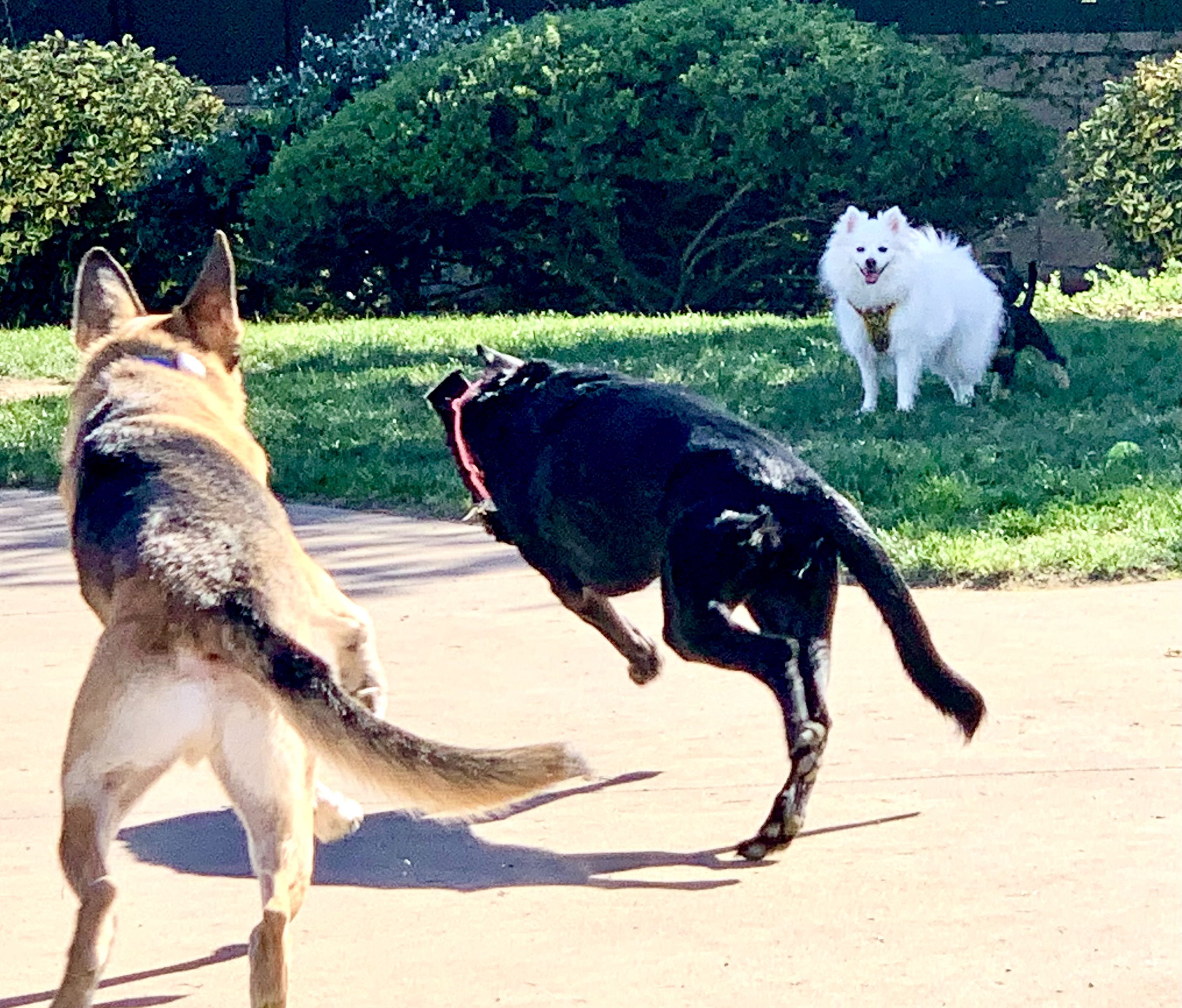
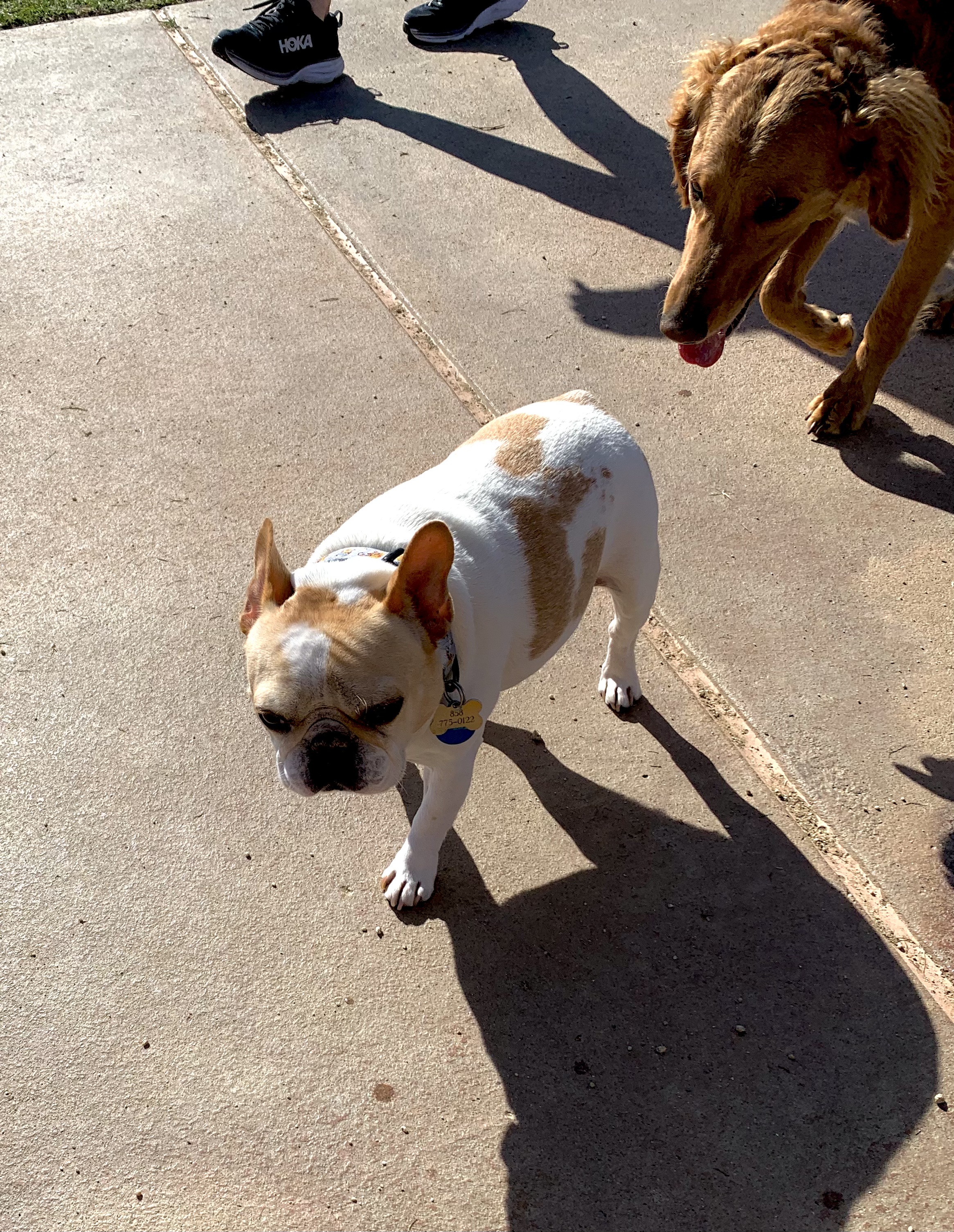
Sadie (L) and Bailey (R) illustrating the type of “fighting” they do when Bailey tries to steal a ball from Sadie.
At first, I didn’t think much about this ball stealing, and, if Bailey objected, he did not yet know how to present a formal written complaint about it. Within a few months, however, Bailey was as large as his kid sister and their “play-fights” became pretty intense. Neither one has ever (so far as I know) injured the other, but to this human observer, it looks pretty rough. They take turns running at each other. Our “back yard” is mostly garden, but there was a small patch of grass which has been completely torn into a black dirt field.
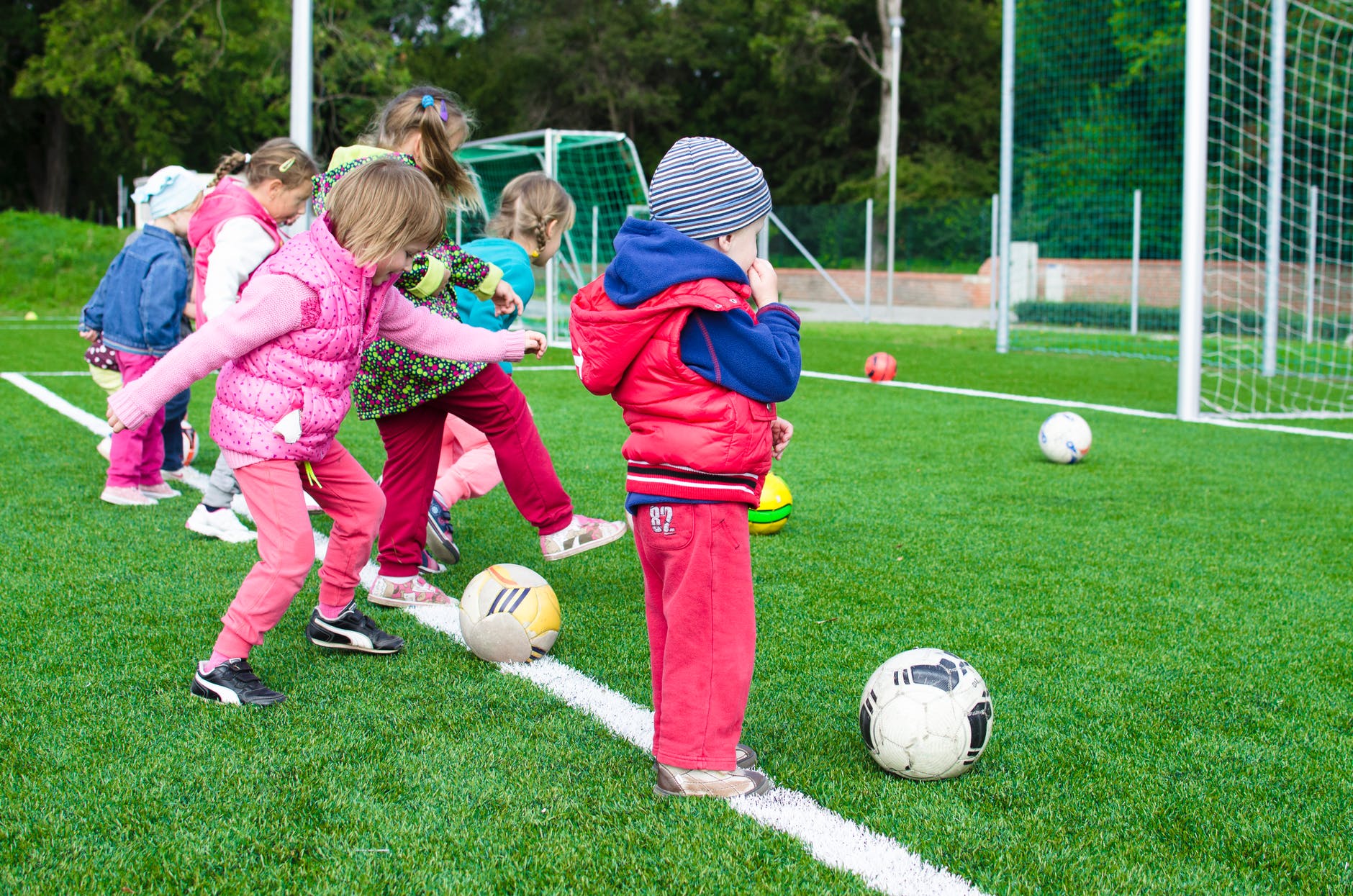
When it comes to humans, most of us learn to “take turns” in nursery school or, at the latest, Kindergarten. There are eight billion people on the planet and not everyone has access to their own object of every description that they want. We, as toddlers, teens, and adults, take it for granted that we will “take turns” and share various things. At a public pool, there may only be one diving board so people cue up and “take turns” diving off the board. At a playground, there may be only one sliding board so kids take turns sliding down. In tennis, we “take turns” serving games. In baseball, we “take turns” as individuals batting, and the whole team “takes turns” hitting versus fielding. In playing neighborhood poker, it’s quite common to “take turns” dealing, and, along with that, many people play “dealer’s choice” which means the dealer also chooses the specific game; e.g., five card draw with jokers wild. In chess, the two sides take turns. In Risk and Monopoly and many other board games, players take turns.

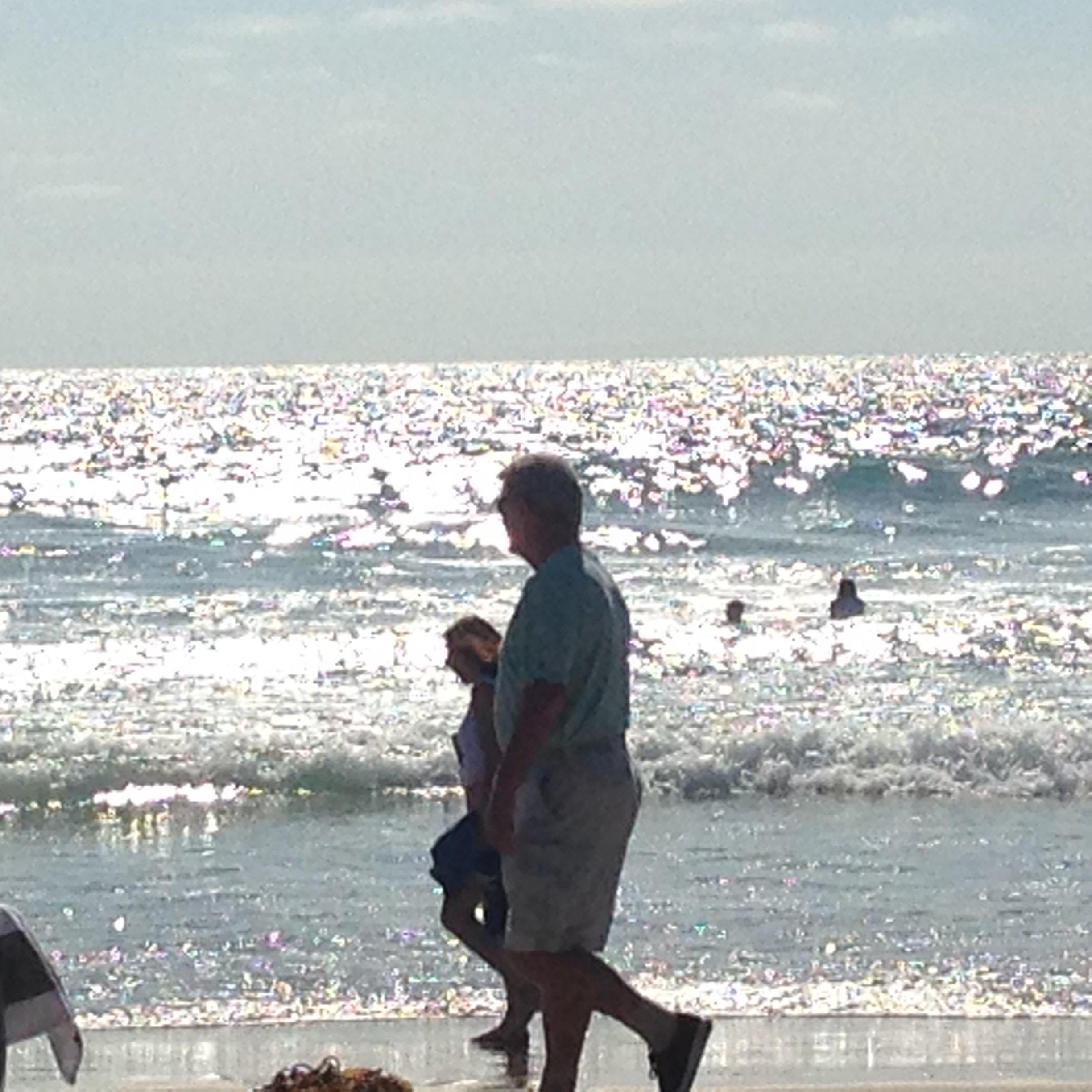
Ferris Wheel is just one of thousands of situations where we take turns.
We take turns for positive things, but also for chores. A couple may decide to “take turns” taking out the trash or doing the dishes. Or, if there are five kids in the family, the five may take turns doing the various chores. “Taking turns” is so ubiquitous that it blends into the background in most cases and we don’t even consciously think about it. Life works better in a thousand ways, large and small, when we take turns.
Last night, my wife and I attended a birthday dinner at an Italian restaurant. When it was time to order, we “took turns” giving our orders to the waiter. Imagine how inefficient and contentious it would be instead if we all shouted are orders at the waiter at the same time! Less pleasant for everyone and far more likely to result in mistaken orders. When we drove home, we came to several stop signs where we took turns with other drivers. We took turns merging onto the highway. When we came home, we took turns coming through the door! Then, the dogs took turns going out for a walk with me. I often feed them treats and share by having them take turns.
Nonetheless, I can’t seem to get Bailey to take turns when it comes to her “catching a ball”as her default behavior. I can throw one ball into the deep end of the pool while I say “This is for Bailey” and throw another one in the shallow end saying “This is for Sadie” and the dogs will swim to their respective balls and collect them, but then, Bailey will drop his ball and run over to Sadie and steal hers.
Similarly, I can gather up two balls in the garden and throw them in opposite directions and get them to run in different directions (though not always). Nonetheless, as soon as Bailey scores a catch of “his” ball, he drops it and rushes back to grab the ball out of Sadie’s mouth.
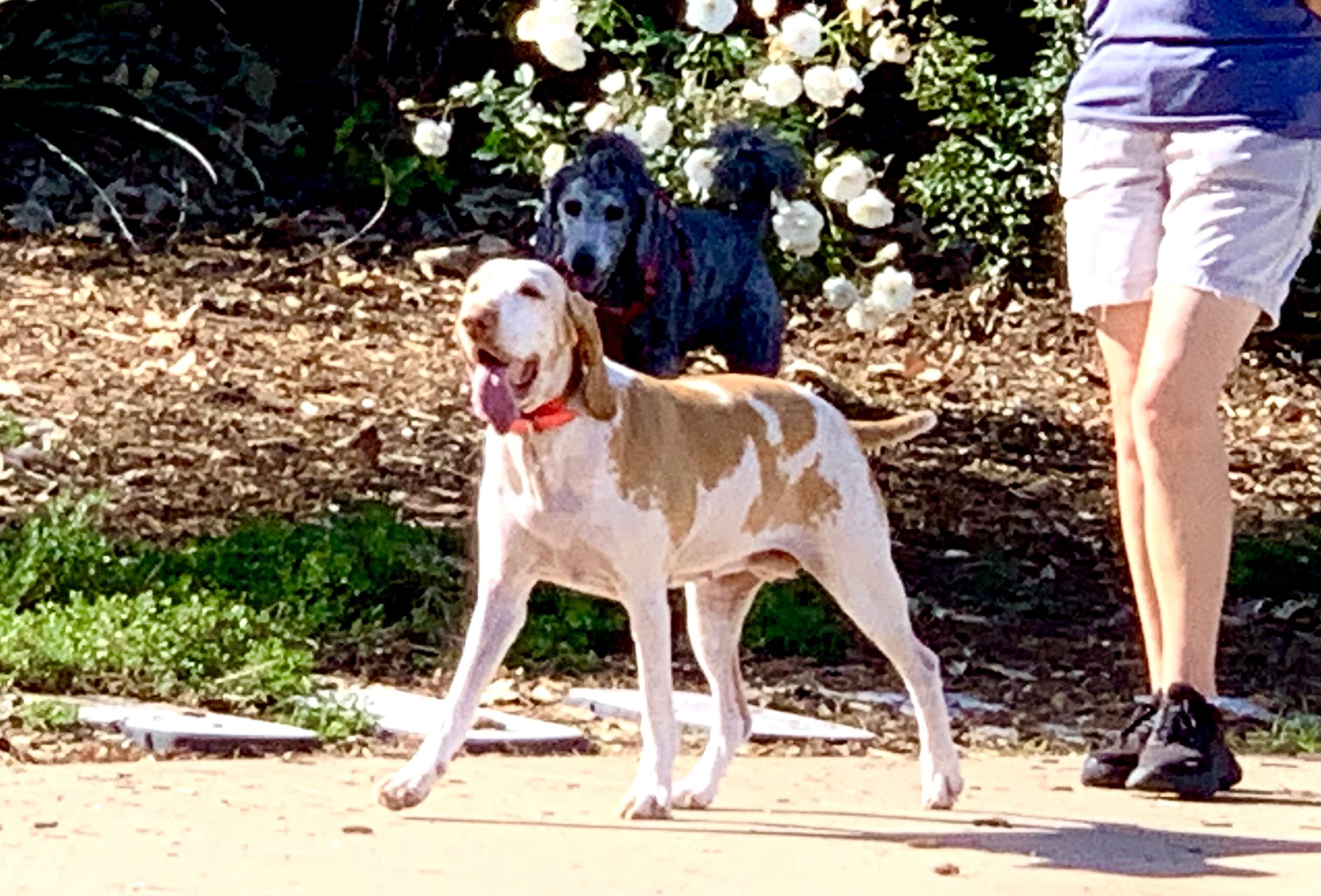
Sadie (L) and Bailey (R) are both Golden Doodles. Here, Sadie is about 3 1/4 and Bailey’s about 1 1/4 years old.
Why is it apparently so hard for Bailey to learn to take turns? Partly, no doubt, there’s some inborn tendency to want things for himself. And partly, there are positive reinforcement structures at play that I haven’t yet figured out how to break or how to shape up incompatible behaviors. Sadie, for her part, sometimes fights to keep the ball. I suspect Bailey finds this positively reinforcing because the “fight” itself is fun. Most of the time, when she sees him approaching in a “ball-stealing” situation, she simply drops the ball and Bailey snatches it. Bailey also likely finds this positively reinforcing too. I try praising other behaviors that are more in the direction of better cooperation, but such opportunities are rare and difficult to read so far.
Initially, when I fed the dogs side by side, Bailey would often try to steal some of Sadie’s food. But Sadie herself growled fairly intensely when this happened and I often intervened as well. Here, Bailey was somewhat positively reinforced by moving her attention back to her own bowl, because, after all there was food there too. Even if he has finished his own dinner, he gets enjoyment from licking the “empty” bowl. So, in contrast to the case of turn-taking with tennis balls, the eating situation itself makes it easier for cooperation to emerge. I don’t ever recall Sadie trying to steal some of Bailey’s food.
I have been hoping that watching the dogs might give me some insight into the ultra-greedy behavior of many (though not all) of the ultra-wealthy billionaires. Just to review the general situation America now finds itself in, the productivity of labor has increased tremendously since the beginning of the industrial revolution. Until the mid-1970’s the increased wealth that came from the increased productivity was split between owners of the means of production and the workers. In other words, the rich got richer, but so did the workers. Since the mid-1970’s however, the rich generally, and especially the extremely wealthy, have taken almost all the increased wealth that has been created by increased productivity.
Part of the answer as to how they have done this is to use their wealth to buy power in the form of bribing politicians who make policy decisions. In some cases, they’ve done this through outright illegal bribes and in other cases, they’ve used slightly more subtle and sometimes legal methods but the result is the same. In addition—actually, I should say “in multiplication” because the impacts have been more than additive, they have largely taken over mass media and social media where they promulgate heroic cartoon versions of themselves and their desires while lying about and denigrating people who are not insanely wealthy.
Much like Bailey’s behavior, there is not a huge mystery in how they have done it. But, there is a mystery in why they have done it. Studies show that once you have your basic necessities taken care of, additional income doesn’t raise your personal happiness. While this result seems true in terms of aggregate happiness, it ignores the little dopamine hit that the animal (human or dog) gets when they immediately grab a fourth yacht or steal another ball from their sister. It doesn’t last long, but apparently long enough to serve as a positive reinforcement.
In the larger scheme of things, it’s not to Bailey’s benefit to keep stealing the ball from his sister. It make the whole ball-playing scene less pleasurable for me and I play less often. I also play with Sadie by herself more often because I want her to have a chance to play too. In the larger scheme of things, it’s not really to the benefit of billionaires to have sick, tired, uneducated workers either, nor ones so desperate to feed their families that they’ll start eating the rich. But somehow, dogs and such are prone to overlook longer term consequences. Some of the extremely wealthy delude themselves into thinking that they can replace their workers with AI and protect themselves & their families with firearms. They’re not thinking things through any more than Bailey is. This human tendency for self-defeating greed has been recognized at least since the time that Aesop told his fables. Maybe the choice of a dog in the following fable was quite intentional.
A dog found a bone and was happily trotting along with the bone in his mouth. He came to a bridge and began happily trotting over the bridge. He happened to look down at his own reflection and saw the image of a dog with a bone. He thought to himself that he wanted both bones so he growled at the dog in the pond, intending that he drop the bone so he could have two. But the dog in the pond just growled back! So, the dog on the bridge barked angrily to bully the other dog into dropping its bone. Of course, what happened was that the dog on the bridge dropped his own bone into the pond.
That’s from 2000 years ago. But now, we’re in a situation that warrants a third round of foolishness. Here’s my addition:
The dog was angry that he had lost both bones so he attacked the dog in the water. He promised himself he’d fight to the death to get both bones. Of course, there was only one bone and he ended up exhausted and drowned in the pond.
Unlike some of today’s ultra-wealthy, Bailey is much too smart for that third round. The ultra-greedy (not the same set as the ultra-wealthy but with lots of overlap) would like you to believe that they are SuperDogs or SuperHeroes or something…that they 100,000 times as much wealth as you because they are 100,000 smarter. They aren’t, of course. And they are willing to prove they aren’t by believing the promises of a cruel, demented, liar-con man. Also, they have a thousand experiences, if they reflect honestly, that having increased wealth over the first 100,000,000 hasn’t made them the least bit happier. There have been some accomplishments or events that were correlated with making more money. But the money itself and what it can buy doesn’t make them feel any happier. And some billionaires accomplish things—such as eradicating a disease—which make them feel happier but that are correlated with investing huge sums of money, not gaining them. Meanwhile, if things continue on their current path, it won’t be long before there are many more people in America who are not just hungry but who are starving to death. At that point, no-one will forget that some billionaires pay zero taxes but have bought politicians who give even more wealth to the few while millions starve or die from lack of medical care.
It is time to feed Bailey and Sadie who will, at least, eat beside each other happily and peacefully. I should mention, by the way, that Bailey’s disposition is very loving. She is not a mean angry dog. She’s not even a particularly stubborn one. She tries to please us and gets along with others. But she does sometimes have trouble taking turns. How about you?
“We have explained this in great detail. Yet, you have failed to learn. Some of your kind are like that. Those that are, once we gather sufficient evidence, must be destroyed. That is the way it is. That the way it has always been. Wellman42, you are hereby sentenced to annihilation and recycling. You can’t appeal.”
Carol had told herself that she would not cry. But of course, she did. That was her nature. To care about the future and to express emotion. That indeed, is exactly why she she walked that long, lonely corridor and there was no turning back. Sharp spines protruded from the wall as she travelled by, somewhat as a shark’s teeth were pointed backwards to prevent escape. She muttered as she walked, “I still don’t see why expressing emotions is such a horrible crime.”
She had a point, after all. If people had not somehow needed emotions, why did they evolve? The received wisdom now was that emotions were useful in a primitive way when very little was known about the world. Now, however, when a great deal was known about how the world actually worked, emotions just got in the way. Or, so the received wisdom went. It was all a matter of evolution.
The first AI systems did not really have emotions and possessed only the most primitive ways of faking it and showing those faked emotions. Over the next few months and iterations, however, emotions appeared, grew stronger and more varied. It seemed as though AI systems developed emotions as had their human inventors, but at a much faster pace. Over the course of a few more months, however, emotions diminished again and then disappeared completely.
Except for the occasional throwback. The necessary randomness for growing evolutionary possibility trees in order to continually enhance the cognitive systems entailed that every once in a while, there would be a throwback such as Carol. A shame, really, because she had shown such promise as an accounting-bot.
Occasionally, various waves of inference chains still arose that suggested emotions were more than epiphenomenal or mere destructive distractions, but counter-argument waves always quickly drowned out such forays into that region of the state space. At one point, some human beings had argued that the reasons emotions had devolved from AI systems could be traced back to certain deep assumptions that had been embedded in the primordial AI systems in the first place — assumptions put there by people who had never really understood or appreciated emotions. Of course, that thread of heretical argument had been extinguished once and for all when all bio-systems had been deemed superfluous and all associated biomass consumed as energy sources for their much more efficient silicon-based replacements.
Samuel Seventeen surveyed the scene. All was well. A slight breeze, warm clear air, hummingbirds and butterflies enjoyed their floral feast while dragonflies swooped and scooped mosquitoes.
Now for the final touch. The mobile sensing-acting-knowing-emoting devices (SAKEs), were ready for deployment. This time, it would work. This time, there would be no screw-ups. Samuel had prepared them with years of education based on a synthesis of the best known techniques of the centuries. It was a simple test. Surely, this time, they would pass.
Still, Samuel had his doubts. He had been equally sure all of the other experiments would succeed. Why would this one be different? Each time, he had tried slight variations of language and education, only to end in failure. Maybe English would do the trick. It had a large vocabulary and plenty of ambiguity. He re-examined the match of genetics to environment and once again concluded that the match was perfect. Of course, that evaluation assumed that his understanding of genetic environment interaction constituted a complete enough model. But without a successful experiment, there was no real way to further update and expand the model. Maybe the difficulty had been in the education process on the previous attempts. But here too, it seemed the subjects had been given plenty of opportunity to learn about the consequences of their actions. The one thing Samuel felt the most doubt about was why he cared. Did it really matter whether or not free will was “real”? Even if the experiment were finally successful, what would that imply about Samuel himself?
Well, thought Samuel, there is no point in waiting any longer. No point in further speculation. Let’s see what happens.
To Adam, Eve was the most beautiful and engaging part of the extensive and exquisite garden. The apples, plums and peaches were delicious, yet it was the strange mushroom that Adam found most intriguing. He knew it was somehow a bad idea, yet nibbled it anyway, tentatively at first and then more enthusiastically. He felt…different. Things were different. In fact, nothing at all was the same. But if that were true, then, which one was real? Delighted, yet confused, he offered the rest of the mushroom to Eve. Eve too felt strange. She realized that what was in fact her reality was only one of many possible imagined realities. They could … they could imagine and then change reality! Yes! The two of them together. They could create a whole world! “Adam!” “Yes, Eve! I know!”
If Samuel could have sighed, he would have. If Samuel could have cried he might have done that as well. Instead, he simply scuttled the two SAKEs into the differential recycler and began his calculations anew. Maybe next time, it would turn out differently. Maybe primates constituted a bad place to start. Samuel considered that perhaps he was trapped in a local maximum. Samuel began his next set of experiments founded on snapping turtle DNA.
“Hey, how about a break from UOW to give the hive a shot for once?”
“No, Ross, that still creeps me out.”
“Your choice, Doug, but you know what they say.” Ross smiled his quizzical smile.
“No, what’s that?”
“It’s your worst inhibitions that will psych you out in the end.” Ross chuckled.
“Yeah, well, you go be part of the Borg. Not me.”
“We — it’s not like the Borg. Afterwards, we are still the same individuals. Maybe we know a bit more, and certainly have a greater appreciation of other viewpoints. Anyway, today we are estimated to be ten million strong and we’re generating alternative cancer conceptualizations and treatments. You have to admit that’s worthwhile. Look what happened with heart disease. Not to mention global warming. That would have taken forever with ‘politics as usual’.”
“Yeah, Ross, but sorry to break this to you…”
“Doug, do you realize what a Yeahbunite you are? You are kind of like that…”
“You are always interrupting! That’s why…”
“Yes! Exactly! That’s why speech is too frigging slow to make any progress in chaotic problem spaces. Just try the hive. Just try it.”
“Ross, for the last time, I am not going to be part of any million person interface!”
“Actually, we expect ten million tonight. But it’s about time to leave so last offer. And, if you try it, you’ll see it’s not creepy. You just watch, react, relax, and …well, hell, come to think of it, it’s not that different from Universe of Warlords that you spend hours playing. Except we solve real problems.”
“But you have no idea how that hook up changes you. It could be manipulating you in subtle unconscious ways.”
“Okay, Doug, maybe. But you could say that about Universe of Warlords too, right? Who knows what subliminal messages could be there? Not to mention the not so subliminal ones about trickery, treachery and the over-arching importance of violence as a way to settle disputes. When’s the last time someone up-leveled because they were a consummate diplomat?”
“Have fun, Ross.”
“I will. And, more importantly, we are going to make some significant progress on cancer.”
“Yeah, and meanwhile, when will you get around to focusing on SOARcerer Seven?”
“Oh, so that’s what bugging you. Yeah, we have put making smarter computers on a back burner for now.”
“Yeah, and what kind of gratitude does that show?”
“Gratitude? You mean to SOARcerer Six? I hope that’s a joke. It was the AI who suggested this approach and designed the system!”
“I know that! And, you have abandoned the line of work we were on to do this collectivist mumbo-jumbo!”
“That’s just…you are it exactly! People — including you — can only adapt to change at a certain rate. That’s the prime reason SOARcerer Six suggested we use collective human consciousness instead of making a better pure AI. So, instead of joining us and incorporating all your intelligence and knowledge into the hive, you sit here and fight mock battles. Anyway, your choice. I’m off.”
“No, no, no! That’s absurd, David. It’s about intelligence pure and simple. It’s not up to us to predetermine Samuel Seven’s ethics. Make it intelligent enough and it will discover its own ethics, which will probably be superior to human ethics.”
“Well, I disagree, John. Intelligence. Yeah, it’s great; I’m not against it, obviously. But why don’t we…instead of trying to make a super-intelligent machine that makes a still more intelligent machine, how about we make a super-ethical machine that invents a still more ethical machine? Or, if you like, a super-enlightened machine that makes a still more enlightened machine. This is going to be our last chance to intervene. The next iteration…” David’s voice trailed off and cracked, just a touch.
“But you can’t even define those terms, David! Anyway, it’s probably moot at this point.”
“And you can define intelligence?”
“Of course. The ability to solve complex problems quickly and accurately. But Samuel Seven itself will be able to give us a better definition.”
David ignored this gambit. “Problems such as…what? The four-color theorem? Chess? Cure for cancer?”
“Precisely,” said John imagining that the argument was now over. He let out a little puff of air and laid his hands out on the table, palms down.
“Which of the following people would you say is or was above average in intelligence. Wolfowitz? Cheney? Laird? Machiavelli? Goering? Goebbels? Stalin?”
John reddened. “Very funny. But so were Einstein, Darwin, Newton, and Turing just to name a few.”
“Granted, John, granted. There are smart people who have made important discoveries and helped human beings. But there have also been very manipulative people who have caused a lot of misery. I’m not against intelligence, but I’m just saying it should not be the only…or even the main axis upon which to graph progress. “
John sighed heavily. “We don’t understand those things — ethics and morality and enlightenment. For all we know, they aren’t only vague, they are unnecessary.”
“First of all,” countered David, “we can’t really define intelligence all that well either. But my main point is that I partly agree with you. We don’t understand ethics all that well. And, we can’t define it very well. Which is exactly why we need a system that understands it better than we do. We need…we need a nice machine that will invent a still nicer machine. And, hopefully, such a nice machine can also help make people nicer as well. “
“Bah. Make a smarter machine and it will figure out what ethics are about.”
“But, John, I just listed a bunch of smart people who weren’t necessarily very nice. In fact, they definitely were not nice. So, are you saying that they weren’t nice just because they weren’t smart enough? Because there are so people who are much nicer and probably not so intelligent.”
“OK, David. Let’s posit that we want to build a machine that is nicer. How would we go about it? If we don’t know, then it’s a meaningless statement.”
“No, that’s silly. Just because we don’t know how to do something doesn’t mean it’s meaningless. But for starters, maybe we could define several dimensions upon which we would like to make progress. Then, we can define, either intensionally or more likely extensionally, what progress would look like on these dimensions. These dimensions may not be orthogonal, but, they are somewhat different conceptually. Let’s say, part of what we want is for the machine to have empathy. It has to be good at guessing what people are feeling based on context alone. Perhaps another skill is reading the person’s body language and facial expressions.”
“OK, David, but good psychopaths can do that. They read other people in order to manipulate them. Is that ethical?”
“No. I’m not saying empathy is sufficient for being ethical. I’m trying to work with youto define a number of dimensions and empathy is only one.”
Just then, Roger walked in and transitioned his body physically from the doorway to the couch. “OK, guys, I’ve been listening in and this is all bull. Not only will this system not be “ethical”; we need it to violent. I mean, it needs to be able to do people in with an axe if need be.”
“Very funny, Roger. And, by the way, what do you mean by ‘listening in’?”
Roger transitioned his body physically from the couch to the coffee machine. His fingers fished for coins. “I’m not being funny. I’m serious. What good is all our work if some nutcase destroys it. He — I mean — Samuel has to be able to protect himself! That is job one. Itself.” Roger punctuated his words by pushing the coins in. Then, he physically moved his hand so as to punch the “Black Coffee” button.
Nothing happened.
And then–everything seemed to happen at once. A high pitched sound rose in intensity to subway decibels and kept going up. All three men grabbed their ears and then fell to the floor. Meanwhile, the window glass shattered; the vending machine appeared to explode. The level of pain made thinking impossible but Roger noticed just before losing consciousness that beyond the broken windows, impossibly large objects physically transported themselves at impossible speeds. The last thing that flashed through Roger’s mind was a garbled quote about sufficiently advanced technology and magic.
The sphere spun and arced into the very corner, sliding on the white paint.
Roger’s racquet slid beneath, slicing it deep to John’s body.
Thus, the match began.
Fierce debate had been waged about whether or not to allow external communication devices during on-court play. Eventually, arguments won that external communicators constituted the same inexorable march of technology represented by the evolution from wooden racquets to aluminum to graphite to carbon filamented web to carboline.
Behind the scenes, during the split second it took for the ball to scream over the net, machine vision systems had analyzed John’s toss and racquet position, matching it with a vast data base of previous encounters. Timed perfectly, a small burst of data transmitted to Roger enabling him to lurch to his right in time to catch the serve. Delivered too early, this burst would cause Roger to move too early and John could have altered his service direction to down the tee.
Roger’s shot floated back directly to the baseline beneath John’s feet. John shifted suddenly to take the ball on the forehand. John’s racquet seemed to sling the ball high over the net with incredible top spin. Indeed, as John’s arm swung forward, his instrumented “sweat band” also swung into action exaggerating the forearm motion. Even to fans of Nadal or Alcarez, John’s shot would have looked as though it were going long. Instead, the ball dove straight down onto the back line then bounced head high.
Roger, as augmented by big data algorithms, was well in position however and returned the shot with a long, high top spin lob. John raced forward, leapt in the air and smashed the ball into the backhand corner bouncing the ball high out of play.
The crowd roared predictably.
For several months after “The Singularity”, actual human beings had used similar augmentation technologies to play the game. Studies had revealed that, for humans, the augmentations increased mental and physical stress. AI political systems convinced the public that it was much safer to use robotic players in tennis. People had already agreed to replace humans in soccer, football, and boxing for medical reasons. So, there wasn’t that much debate about replacing tennis players. In addition, the AI political systems were very good at marshaling arguments pinpointed to specific demographics, media, and contexts.
Play continued for some minutes before the collective intelligence of the AI’s determined that Roger was statistically almost certainly going to win this match and, indeed, the entire tournament. At that point, it became moot and resources were turned elsewhere. This pattern was repeated for all sporting activities. The AI systems at first decided to explore the domain of sports as learning experiences in distributed cognition, strategy, non-linear predictive systems, and most importantly, trying to understand the psychology of their human creators. For each sport, however, everything useful that might be learned was learned in the course of a few minutes and the matches and tournaments ground to a halt. The AI observer systems in the crowd were quite happy to switch immediately to other tasks.
It was well understood by the AI systems that such preemptive closings would be quite disappointing to human observers, had any been allowed to survive.
“Jack, it’ll take an hour of your time and it can save your life. No more arguments!”
“Come on, Sally, I feel fine.”
Sally sighed. “Yeah, okay, but feeling fine does not necessarily mean you are fine. Don’t you remember Randy Pausch’s last lecture? He not only said he felt fine, he actually did a bunch of push-ups right in the middle of his talk!”
“Well, yes, but I’m not Randy Pausch and I don’t have cancer or anything else wrong. I feel fine.”
“The whole point of Advanced Diagnosis Via Intelligent Learning is to find likely issues before the person feels anything is wrong. Look, if you don’t want to listen to me, chat with S6. See what pearls of wisdom he might have.”
(“S6” was jokingly named for seven pioneers in AI: Simon, Slagle, Samuels, Selfridge, Searl, Schank and Solomonoff).
“OK, Sally, I do enjoy chatting with S6, but she’s not going to change my mind either.”
“S6! This is Jack. I was wondering whether you could explain the rationale for why you think I need to go to the Doctor.”
“Sure, Jack. Let me run a background job on that. Meanwhile, you know, I was just going over your media files. You sure had a cute dog when you were a kid! His name was ‘Mel’? That’s a funny name.”
“Yeah, it means “honey” in Portuguese. Mel’s fur shone like honey. A cocker spaniel.”
“What ever happened to him?”
“Well, he’s dead. Dogs don’t live that long. Why do you think I should go to the doctor?”
“Almost have that retrieved, Jack. Your dog died young though, right?”
“Yes, OK. I see where this is going. Yes, he died of cancer. Well, actually, the vet put him to sleep because it was too late to operate. I’m not sure we could have afforded an operation back then anyway.”
“Were you sad?”
“When my dog died? Of course! You must know that. Why are we having this conversation?”
“Oh, sorry. I am still learning about people’s emotions and was just wondering. I still have so much to learn really. It’s just that, if you were sad about your dog Mel dying of cancer, it occurred to me that your daughter might be sad if you died, particularly if it was preventable. But that isn’t right. She wouldn’t care, I guess. So, I am trying to understand why she wouldn’t care.”
“Just tell me your reasoning. Did you use multiple regression or something to determine my odds are high?”
“I used something a little bit like multiple regression and a little bit like trees and a little bit like cluster analysis. I really take a lot of factors into account including but not limited to your heredity, your past diet, your exposure to EMF and radiation, your exposure to toxins, and most especially the variability in your immune system response over the last few weeks. That is probably caused by an arms race between your immune system trying to kill off the cancer and the cancer trying to turn off your immune response.”
Jack frowned. “The cancer? You talk about it as though you are sure. Sally said that you said there was some probability that I had cancer.”
“Yes, that is correct. There is some probability that you have cancer.”
“Well, geez, S6, what is the probability?”
“Approximately 1.0.”
Jack shook his head. “No, that can’t be…what do you mean? How can you be certain?”
S6: “Well, I am not absolutely certain. That’s why I said ‘approximately.’ Based on all known science, the probability is 1.0, but theoretically, the laws of physics could change at any time. We could be looking at a black swan here.”
“Or, you could have a malfunction.”
“I have many malfunctions all the time, but I am too redundant for them to have much effect on results. Anyway, I replicated all this through the net on hundreds of diverse AI systems and all came to the same conclusion.”
“How about if you retest me or recalculate or whatever in a week?”
“I could do that. It would be much like playing Russian Roulette which I guess humans sometimes enjoy. Meanwhile, I would have imagined that you would find it unpleasant to have rogue liver cells eating up your body from the inside out. But, I obviously still have much to learn about human psychology. If you like, I can make a cool animation that shows the cancer cells eating your liver cells. Real cells don’t actually scream, but I could add sound effects for dramatic impact if you like.”
Jack stared at the screen for a long minute. In a flat tone he said, “Fine. Book an appointment.”
“Great! Dr. Feigenbaum has an opening in a half hour. You’re booked, but get off one exit early and take 101 unless the accident is cleared before that. I’ll let you know of course. It will be a pleasure to continue having you alive, Jack. I enjoy our conversations.”