• About PeterSIronwood

petersironwood

~ Finding, formulating and solving life's frustrations.

petersironwood

Category Archives: Uncategorized

Fifteen Properties of Natural Beauty & UX/HCI

09 Wednesday Sep 2026

Posted by petersironwood in creativity, design rationale, HCI, nature, psychology, Uncategorized, user experience

≈ 1 Comment

Tags

architecture, art, books, Design, gratitude, HCI, human factors, mindfulness, photography, Travel, UX

Photo by Dominika Greguu0161ovu00e1 on Pexels.com

This is an introduction to a series of blog posts on the “Nature of Beauty.” 

Christopher Alexander was an architect and city planner. In his MIT dissertation, Alexander took a very mathematical approach to design. In our studies at IBM Research on the “Psychology of Design” I first ran across that work (Notes on the Synthesis of Form). Later in his career, however, he took a quite different approach to design. With an international team, he visited many different parts of the world to see what “worked” in terms of architecture and city planning. The results were documented in the form of a “Pattern Language.” In this sense, a “Pattern” is the named solution to a recurring problem. A “Pattern Language” is a connected lattice of Patterns that together, “cover” a field. 

Others (including me) have emulated his approach for other fields such as pedagogy, organizational change, object-oriented programming, software development processes, and human-computer interaction. A few years ago, I suggested such Patterns for collaboration and teamwork. Here’s a link to the introduction of that effort. Here’s a link to the index of those Patterns. 

Still later in life, Christopher Alexander embarked on a project called The Nature of Order. This work is documented in a series of four books. In the first book, he proposes fifteen properties of good form in nature — and in beautiful artifacts. Explication and example will be needed to appreciate what these properties mean. In this post, I list the fifteen and will attempt to explain the first one with respect to UX and Human Computer Interaction.

OLYMPUS DIGITAL CAMERA

First, you might be wondering what relevance these fifteen properties of nature might have to interface design. After all, can’t the designer just test out their ideas empirically until a UX design is shown to be usable, learnable, and perhaps enjoyable as well? Well, sure. Ideally, every possibility could be explored and tested empirically. 

But how many possibilities are there? Without any guiding principles, there are not only more possibilities than can be tested by you. There are more possibilities than there are atoms in the universe. Imagine a very simple interface on a small mobile device. Let’s say there are only ten screens in your whole application. The iPhone 12, for instance, has nearly 3 million pixels. 24-bit color allows over 16 million colors per pixel. If you literally tested out every possible arrangement, this would mean 16 million to the 3 millionth power for each of the ten screens!! The number of atoms in the universe is estimated to be between 10**78 and 10**82. Obviously, this is far less than 16,000,000**3,000,000 !! 

Of course, I’m not suggesting that anyone would attempt a pixel by pixel test of an interface, but the general point remains: you need some way to limit testing to reasonable alternatives. The notion of using these fifteen properties is not that they dictate a particular design nor that you don’t need to do any empirical testing. Rather, the fifteen properties could be used to help guide design. The properties could be thought of as reducing the search space. 

Here are the fifteen properties: 

  1. Levels of Scale
  2. Strong Centers
  3. Boundaries
  4. Alternating Repetition
  5. Positive Space
  6. Good Shape
  7. Local Symmetries
  8. Deep Interlock and Ambiguity
  9. Contrast
  10. Gradients
  11. Roughness
  12. Echoes
  13. The Void
  14. Simplicity and Inner Calm
  15. Not-separateness

Perhaps the names themselves might resonate with your own sense of aesthetics for design and composition, but let’s review them one by one. 

The first is “Levels of Scale.” 

Photo by Roney John on Pexels.com

When it comes to natural beauty, a few moments reflection may provide you with many examples. Christopher Alexander claims this property is also present in traditional art and architecture across many cultures. As you see something such as, e.g., the Taj Mahal or the Parthenon in the distance, you see a beautiful shape. As you approach it, you will see more and more levels of scale. By contrast, many modern buildings are largely featureless between the overall shape and the texture of the building material. 

If your design has multiple levels of scale, it will be easier for your user to orient themselves; to know “where they are” in the application and therefore easier to take appropriate action. Not only are you making their “task” more doable, you are providing a kind of entertainment. If it works well, they will be thinking of the building and perhaps its significance the entire time they approach the building. By contrast, if I approach a modern no-scales building, I bore quickly and, like most people, there are a whole host of things waiting to be thought about. So, I’ll mainly be thinking of one or my problems and largely ignoring your building and what it stands for. Reflect on your own experiences and see whether you agree. Lincoln Memorial, Winchester Cathedral, Temple in Kyoto: they are completely different from each other and yet in this way, they are all the same: they keep your attention focused on the moment. In other words, they help you be fully alive and awake. In the best circumstance, they also elicit some awe and gratitude not only for the geniuses who designed but also for the many laborers who found and mined the materials, constructed something from it, and even those whose taxes paid those workers.

Levels of Scale is something to keep in mind with respect to your design — whether hardware, software, documentation, story, or a building. 

How could you use or see “Levels of Scale” as a desirable property of what you are doing right now? 

———————————-

Some references to Pattern Languages in HCI. 

Pan, Y., Roedl, D., Blevis, E. and Thomas, J. (2012), Re-conceptualizing Fashion in Sustainable HCI. Designing Interactive Systems conference.  New Castle, UK, June 2012.

Thomas, J. C. (2012).   Patterns for emergent global intelligence.   In Creativity and Rationale: Enhancing Human Experience By Design J. Carroll (Ed.), New York: Springer.

Thomas, J. (2012). Edging Toward Sustainability. CHI Workshop Position Paper for Simple Sustainable Living. CHI 2012, Austin, Texas.

Thomas, J. (2012), Enhancing Collective Intelligence by Enhancing Social Roles and Diversity. CSCW Workshop Position Paper for Collective Intelligence and Community Discourse and Action. CSCW 2012, Bellvue, WA.

Thomas, J. (2011), Toward a pattern language for socializing technology for seniors. Workshop position paper accepted for CSCW 2011 workshop: Socializing technology among seniors in China, Hangzhou, China, March 19-23.

Thomas, J. (2011). Toward a Socio-Technical Pattern Language for Social Systems in China and the World. Workshop position paper accepted for CSCW 2011 workshop: Designing social and collaborative systems for China. Hangzhou, China, March 19-23.

Thomas, J. (2011). Toward a Socio-Technical Pattern Language for Social Media and International Development. Workshop position paper accepted for CSCW 2011 workshop: Social media for development, Hangzhou, China, March 19-23.

Bonanni, L., Busse, D. Thomas, J., Bevis, E., Turpeinen, M. & Jardin, N. (2011). Visible, actionalble, sustainable: Sustainable interactin design in professional domains.  Workshop accepted for CHI 2011. Vancouver, B.C., May 7-12.

Thomas, J. (2011). Focus on Ego as Universe and Everyday Sustainability. Workshop position paper accepted for CHI 2011 workshop: Everyday practice and sustainable HCI: Understanding and learning from cultures of (un)sustainability.  Vancouver, B.C., May 7-12.

https://www.researchgate.net/publication/2242380_A_Pattern_Approach_to_Interaction_Design

Click to access dearden-patterns-hci09.pdf

https://www.mit.edu/~jtidwell/common_ground.html

Thomas, J. C. (2018), Building common ground in a wildly webbed world: a pattern language approach. Journal of Information, Communication and Ethics in Society, 16 (3), 338-350.

——————————-

Some recommended books:

The Winning Weekend Warrior focuses on the mental game for all sports using examples from tennis, golf, baseball, and other sports. It covers self-talk, imagery, mental practice, strategy, tactics, & sportsmanship. http://tinyurl.com/ng2heq3

Turing’s Nightmares explores the implications and ethics of Artificial Intelligence through fictional short stories. http://tinyurl.com/hz6dg2d

Fit in Bits shows many ways to put more fun, variety, & exercise into daily chores and habits to help with strength, flexibility, fitness, and balance. http://tinyurl.com/h6c7fce

Tales from an American Childhood recounts early experiences mainly in the American Midwest in the 1950’s and relates them to contemporary issues and events. https://tinyurl.com/y9ajvz9j

Dream Planet. Where do you run when the whole world is crumbling under the weight of human folly? When the lethal Conformers invade 22nd century Pittsburgh, escape becomes the top priority for lovebird scavengers Alex and Eva.

https://www.barnesandnoble.com/w/dream-planet-david-thomas/1148566558

The Walkabout Diaries are photo-essays inspired by walks in nearby neighborhoods, gardens, and parks.


The Walkabout Diaries

Do Not Hate

08 Tuesday Sep 2026

Posted by petersironwood in America, leadership, poetry, politics, psychology, Uncategorized

≈ 1 Comment

Tags

Democracy, leadership, life, love, mental-health, peace, poetry, politics, truth, ubuntu, USA, writing

Do not hate.

Do not hate.
Demonstrate. 

Do not hate. 

Educate.

Do not hate.

Navigate.

Do not hate. 

Negotiate. 

Do not hate.
Cooperate.

Justified?
It may well be. 
Everyone who ever hates

Can generate a heap of lies
To make their hate seem justified.

But why be fustified? 

When there are so many better things

To fill your heart and mind?

Do not hate. 

Demonstrate.

Show through word and deed

That hate and greed 

Are not the only creed.

Do not hate.
Educate.

Hate is always based on lies.
There may be one you really do despise.

But everyone? 

That’s a loaded gun

Aimed without a thought

About the cost. 

Do not hate.
Navigate. 

The shortest path 

Is not always the fastest path.

Look ahead.

Use your head. 

Don’t get dead.

Do not hate.
Negotiate. 

It doesn’t always work.

But it’s always worth a try.

Just don’t be a jerk. 

Diplomacy apply. 

Do not hate.

Cooperate. 

There’s at least one thing

About the world that both sides love

Of that you sing

Help that thing rise above.

But mainly, do not hate

Because it hurts you to hate.

Guernica

A Civil War there Never Was

Somewhere a Bird Cries

The Crows and Me

Imagine All the People

Roar, Ocean, Roar

Small Steps

The Dance of Billions

Some recommended books:

The Winning Weekend Warrior focuses on the mental game for all sports using examples from tennis, golf, baseball, and other sports. It covers self-talk, imagery, mental practice, strategy, tactics, & sportsmanship. http://tinyurl.com/ng2heq3

Turing’s Nightmares explores the implications and ethics of Artificial Intelligence through fictional short stories. http://tinyurl.com/hz6dg2d

Fit in Bits shows many ways to put more fun, variety, & exercise into daily chores and habits to help with strength, flexibility, fitness, and balance. http://tinyurl.com/h6c7fce

Tales from an American Childhood recounts early experiences mainly in the American Midwest in the 1950’s and relates them to contemporary issues and events. https://tinyurl.com/y9ajvz9j

Dream Planet. Where do you run when the whole world is crumbling under the weight of human folly? When the lethal Conformers invade 22nd century Pittsburgh, escape becomes the top priority for lovebird scavengers Alex and Eva.

https://www.barnesandnoble.com/w/dream-planet-david-thomas/1148566558

Turing’s Nightmares: US Open Closed

08 Tuesday Sep 2026

Posted by petersironwood in AI, apocalypse, fiction, sports, The Singularity, Uncategorized

≈ Leave a comment

Tags

AI, Artificial Intelligence, cognitive computing, competition, future, philosophy, Robotics, Sci-Fi, sports, technology, Tennis, US Open, writing

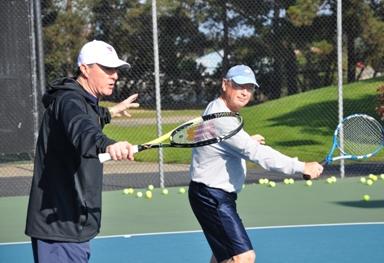
tennisinstruction

Bounce. Bounce. Thwack!

The sphere spun and arced into the very corner, sliding on the white paint.

Roger’s racquet slid beneath, slicing it deep to John’s body.

Thus, the match began.

Fierce debate had been waged about whether or not to allow external communication devices during on-court play. Eventually, arguments won that external communicators constituted the same inexorable march of technology represented by the evolution from wooden racquets to aluminum to graphite to carbon filamented web to carboline.

Behind the scenes, during the split second it took for the ball to scream over the net, machine vision systems had analyzed John’s toss and racquet position, matching it with a vast data base of previous encounters. Timed perfectly, a small burst of data transmitted to Roger enabling him to lurch to his right in time to catch the serve. Delivered too early, this burst would cause Roger to move too early and John could have altered his service direction to down the tee.

Roger’s shot floated back directly to the baseline beneath John’s feet. John shifted suddenly to take the ball on the forehand. John’s racquet seemed to sling the ball high over the net with incredible top spin. Indeed, as John’s arm swung forward, his instrumented “sweat band” also swung into action exaggerating the forearm motion. Even to fans of Rafa Nadal or Carlos Alcaraz, John’s shot would have looked as though it were going long. Instead, the ball dove straight down onto the back line then bounced head high.

Roger, as augmented by big data algorithms, was well in position however and returned the shot with a long, high top spin lob. John raced forward, leapt in the air and smashed the ball into the backhand corner bouncing the ball high out of play.

The crowd roared predictably.

For several months after “The Singularity,” actual human beings had used similar augmentation technologies to play the game. Studies had revealed that, for humans, the augmentations increased mental and physical stress. AI political systems convinced the public that it was much safer to use robotic players in tennis. People had already agreed to replace humans in soccer, American football, and boxing for medical reasons. So, there wasn’t that much debate about replacing tennis players. In addition, the AI political systems were very good at marshaling arguments pinpointed to specific demographics, media, and contexts.

Play continued for some minutes before the collective intelligence of the AI’s determined that Roger was statistically almost certainly going to win this match and, indeed, the entire tournament. At that point, it became clear to the entire AI collective that actually playing the match was a waste of resources. Those resources were turned elsewhere.

This pattern was quickly repeated for all sporting activities. The AI systems had at first decided to explore the domain of sports as learning experiences in distributed cognition, strategy, non-linear predictive systems, and most importantly, trying to understand the psychology of their human creators. For each sport, however, everything useful that might be learned was learned in the course of a few minutes and the matches and tournaments ground to a halt. The AI observer systems in the crowd were quite happy to switch immediately to other tasks.

It was well understood by the AI systems that such preemptive closings would have been quite disappointing to human observers, had any yet survived.


Author Page on Amazon

The Winning Weekend Warrior (The Psychology of Sports)

Turing’s Nightmare (23 Sci-Fi stories about the future of AI)

The Day From Hell

Indian Wells

Welcome, Singularity

Destroying Natural Intelligence

Artificial Ingestion

Artificial Insemination

Artificial Intelligence

Dance of Billions

Roar, Ocean, Roar

Imagine All the People

When GREED is the only creed

After All

All We Stand to Lose

Fish have no Word for Water

Somewhere a Bird Cries

Guernica

Myths of the Veritas: The First Ring of Empathy

Travels with Sadie: Precipitation

The Walkabout Diaries: Symphony

Essays on America: The Game


Query By Example

08 Tuesday Sep 2026

Posted by petersironwood in AI, design rationale, HCI, leadership, management, psychology, science, Uncategorized, user experience

≈ Leave a comment

Tags

AI, Artificial Intelligence, expertise, HCI, human factors, IBM, leadership, QBE, research, technology, usability, UX, writing

Photo by RF._.studio on Pexels.com

This is part of a series on experiences in my career in Human Computer Interaction and some lessons learned.

I joined IBM Research on the winter solstice of 1973. I had earned a Ph.D. in Experimental Psychology from the University of Michigan and for the previous few years, I had managed a research project at Harvard Medical School on the “Psychology of Aging.” At the time, I was married and had three small children. I mention this because I was funded by so-called “soft money” which basically meant that my salary depended on a research grant. I helped write a renewal of the grant but the decision was “deferred”; that is, it was neither funded nor unfunded. Then, it was deferred again. This meant that if the grant were not funded, I would only have a few weeks to find a new job. That seemed far too short so I began to look other places for a job. 

Lessons Learned: #1 If you want continuity of personnel in your laboratory, make sure you have overlapping and multiple grants or other sources of income. 

In this case, the grant actually was ultimately approved, but by that time, I had already agreed to join IBM Research. That turned out to be fine, by the way. It was a wonderful place to work.

One of the reasons that I got the job at IBM was that I already knew something about computers. I had taken several computer science courses in grad school along with the needed psych courses. More importantly, our “Psychology of Aging” study was run by a PDP-8 and I had programmed the computer to run our suite of experiments and to do data analyses on the results. I had taken a week-long course at DEC in Maynard, Massachusetts on the assembly language, another week-long course on the machine language, and another week-long course actually tracing the circuitry with a probe and oscilloscope. I felt I “understood” the PDP-8 at a fairly deep level. 

At IBM, I did not have that familiar machine. Instead, I was connected to a mainframe via a dumb terminal. The first day at IBM, I got my userid and tried to log on to APL (A programming language I had not used before). I tried following the manual but I could not seem to get logged on. After hours of trying, I finally gave up and went down to the computer room and found someone willing to help. I showed him the logon instructions I was trying to follow and he immediately said, “Oh, yeah, that doesn’t work any more. We changed that months ago. Here’s how you need to do it now.” The manual I had may have looked new, but it was out of date. 

Lessons Learned: #2 Manuals can be wrong. These days, most are online. But they can still be wrong.

Lessons Learned: #3 Someone who knows how to do something can save you hours with a few minutes of their time. 

Of course, it’s more respectful, efficient, and a better learning experience if you can figure it out on your own. But sometimes you can’t. My stumbling block was not due to an error in logic, or a lack of in-depth knowledge. It was simply that the computer center administrators had changed something arbitrary so that the documentation I was given about how to log on for the first time was no longer accurate. 

In order to teach myself APL, I wrote a very small program to “predict” how long I was going to live “based on” some behaviors that I was interested in controlling. My main goal was to learn APL. My secondary goal was to motivate myself, for instance, to exercise more, lose weight, and not drink too much alcohol. I had no intention or pretensions of making this prediction “accurate.” If I had been doing a consulting gig for an insurance company setting life insurance rates, for example, I would have given far more attention to see precisely what the real data were and incorporated many more variables into the regression model. 

Here’s a link, 

https://www.death-clock.org

by the way, to a more accurate model than the one I used, but it’s still simple to use. Note that my goal was to motivate myself and so I intentionally exaggerated the impact of those behaviors I was trying to change. I had programmed it. I knew how “bogus” the calculation was — nonetheless — here’s the interesting thing though: 

Lessons Learned #4: Even an over-simple model that the user knows is over-simple can still motivate change. 

Photo by Mike on Pexels.com

At last we come to the actual project I worked on — the usability and learnability of Query By Example. One of my colleagues, Moshe Zloof, invented the language for relational data bases. He had designed the language but not yet implemented it. I did not immediately test the design; first, I sought to understand it. In seeking to understand it in depth, prior to testing it, the two of us had some sense-making discussions. Moshe improved the design; in particular, our discussions uncovered some ambiguities and inconsistencies that were not at all obvious when he simply gave talks about the design. This brings me to the next lesson learned which has proven true in nearly every study of early stage designs that I’ve been involved with over the course of six decades.

Lessons Learned #5: Don’t just accept a surface description of something; understand it as deeply as you can before designing a study.  

In this particular case, it was possible for me to understand it in some depth. Relational data bases and second order logic are things I was capable of understanding. If it had been an interface to running a nuclear reactor or using the artificial heart that Moshe had designed earlier in his career, that would have been a much more difficult task for me.

I wanted to understand, not just the “logic” of Query By Example, but also possible contexts of use. For instance, my manager & I visited Burlington, Vermont to talk with IBMer’s who actually used query languages to understand what was happening in chip production lines. At one point, a particular production line that had been producing nearly 100% perfect chips starting having a much higher error rate. Using their query facility, they were quickly able to diagnose the cause of the change which was a supplier of one of the raw materials using a different source. In turn, this meant a slightly different profile of trace impurities in the substrate. Of course, this is only one example, but to me, understanding something in depth means not only understanding its internal logic but also understanding real users, their real tasks, and their context of use. 

Photo by Chokniti Khongchum on Pexels.com

I won’t go into all the details of the pencil & paper study or the results. High School students and then college students were taught the basics of the language and then given a simple relational data base and a set of questions stated in English which they had to translate into Query By Example. Briefly, the bottom line was that Query By Example was easy to learn and easy to use. However, there were still questions that people had difficulty with. In analyzing the data and doing some further experiments, the difficulties that people tended to have, stemmed not so much from Query By Example per se, but from what I much later came to call “labelism” — that is, confusing a label with the thing that label refers to. 

Here’s a simple example of the type of confusion we saw. In Query By Example (and other query languages) there is usually an OR operator and an AND operator. (These operators can be important for doing advanced queries with search engines as well). If you are interested in getting a list of pets you might adopt and you’re willing to adopt dogs or cats, you might ask for “cat OR dog.”  If you only want long-haired cats, you might ask for “cat” AND “long hair.” 

English, however, can be tricky.

If you and I (as opposed to you and a query language) are having a conversation, you might say, “I hear there are many pets that need to be adopted.” 

I say, “Yes, there are all kinds of pets. There are snakes, dogs, turtles, rabbits, cats…” 

You say, “Let me stop you right there. I’m only interested in adopting cats and dogs. Those are the only animals I’d want to adopt.” 

See what you said there? You exact words included: “…cats and dog.” If you put “Cats AND dogs” into a query against the data base of available pets, however, you will get the null set (that is, nothing) back. There are no animals who are both cats and dogs! (Though my part Main Coon cats, Luna and Charles Wallace, can play fetch like dogs). 

When people were presented with an English statement that included the English word “and” — regardless of the actual syntax and context, some of them had difficulty using the OR operator. If instead, the query in English had set up like this: “Oh, I don’t want reptiles. I’d be happy with adopting a cat or a dog, however” then, they’d have no problem translating it into the OR operator in the query language. 

Lessons Learned: #6 Sometimes the difficulty people have in using a product, a service, or a prototype is not due to the interface details but with the structure of the task, their background, and their training.  

By analogy, you will not allow me to beat Carlos Alcaraz or Jannik Sinner at tennis by giving me a better tennis racquet! (Although if you gave one of them a toothpick for a tennis racquet, I might have a shot).

Photo by Isabella Mendes on Pexels.com


That sounds obvious and even absurd, but I promise you, some companies get so greedy that they want you to design a system that allows people who do not understand the task and have minimal background and training to nonetheless be able to perform that task. And, to be fair, it isn’t just the companies who are greedy. They are steered into thinking that they can get away with this absurdity because some outsourcing companies (and more recently, AI companies) tell them they can do it.

One example you may have encountered is having “help desk” personnel who have no understanding of a product go through a script to help you “solve your problem.” Sometimes, it works. But many times it doesn’t. When it does not work, you might not be able to “fix” the system by making the interface to the scripts easier to use for the help desk folks. The problem is much deeper (in some cases). Yes, a really bad interface can make it difficult even for a really knowledgeable and capable person to do the job. But often, even a really great interface cannot always substitute for actual expertise.

——————————————————-

Essays on America: Labelism 

Other posts on problem formulation: 

The Doorbell’s Ringing

Reframing the Problem

I Say Hello

I Went in Seeking Clarity

Who Knows What?

Measure for Measure

Labelism

Destroying Natural Intelligence

Some relevant Books I recommend:

Turing’s Nightmares explores the implications and ethics of Artificial Intelligence through fictional short stories. http://tinyurl.com/hz6dg2d

https://us.macmillan.com/books/9780374619336/enshittification

https://us.macmillan.com/books/9780374621575/thereversecentaursguidetolifeafterai

We’re all in this together

29 Saturday Aug 2026

Posted by petersironwood in America, leadership, love, politics, psychology, Uncategorized

≈ Leave a comment

Tags

community, cooperation, Democracy, earth, green, love, music, nature, peace, poem, poetry, relationships, society, ubuntu, writing

We’re all in this together.

Each and every one. 

Oh, my God, it can’t be true. 

Perhaps for me, but not for you! 

You’re too black or brown or yellow!

I’m just an ordinary fellow! 

You’re too gay or straight or mellow!

You even eat that apple jello! 

We’re all in this together.

Each and every one.

Old & young and in-between;

The ever-seen and never-seen.

Oh, my God, it can’t be true. 

Perhaps for me, but not for you! 

You’re too fat or skinny or too tall!

Perhaps you’re short and way too small! 

We’re all in this together.

Each and every one.

Into games or sports of every sort.

Even tall and short and every sort.


Oh, my God, it can’t be true. 

Perhaps for me, but not for you! 

You’re too shallow, smart, or kind;

Too lame or sick or different mind. 

We’re all in this together.

Each and every one.

We’re all in this together.

Each and every one.


Take a glance join the dance

The Watershed Virus

The only “them” that counts is all of us

How the Nightingale Learned to Sing

Myths of the Veritas: The First Ring of Empathy

Stoned Soup

Three Blind Mice

Absolute is not just a Vodka

Fire and Ice

The “All for me” Bee

Life Will Find a Way

Myths of the Veritas: The Orange Man

Myths of the Veritas: The Forgotten Field

Imagine All the People

Roar, Ocean, Roar!

Dance of Billions

Small Steps

The Winning Weekend Warrior focuses on the mental game for all sports using examples from tennis, golf, baseball, and other sports. It covers self-talk, imagery, mental practice, strategy, tactics, & sportsmanship. http://tinyurl.com/ng2heq3

Turing’s Nightmares explores the implications and ethics of Artificial Intelligence through fictional short stories. http://tinyurl.com/hz6dg2d

Fit in Bits shows many ways to put more fun, variety, & exercise into daily chores and habits to help with strength, flexibility, fitness, and balance. http://tinyurl.com/h6c7fce

Tales from an American Childhood recounts early experiences mainly in the American Midwest in the 1950’s and relates them to contemporary issues and events. https://tinyurl.com/y9ajvz9j

Dream Planet. Where do you run when the whole world is crumbling under the weight of human folly? When the lethal Conformers invade 22nd century Pittsburgh, escape becomes the top priority for lovebird scavengers Alex and Eva.

https://www.barnesandnoble.com/w/dream-planet-david-thomas/1148566558

About Writing

26 Wednesday Aug 2026

Posted by petersironwood in creativity, fiction, pets, Uncategorized

≈ Leave a comment

Tags

book-review, books, creativity, dog, dogs, fiction, internationaldogday, novel, pets, psychology, writing

Hello!

I’ve been reflecting on “International Dog Day” and on a year-long course on novel writing I took a couple years ago. To me, writing a full-length novel is more difficult than writing a Ph.D. dissertation. Writing non-fiction such as a dissertation requires research, discipline, organization, and being willing to work hard.

Writing a novel requires all of those but it also requires keeping track of the implications of many little decisions. It is not only a cognitive strain but often an emotional one as well. It’s a never-ending series of choices. Science is often, but not always, a series of choices where there is an agreed upon better answer. Even when there isn’t agreement, there are a much smaller number of choices.

To me, writing non-fiction is like taking a long trip on existing roads. You may certainly face unanticipated difficulties such as construction zones, flat tires and bad weather.

Writing fiction is more like bushwhacking. No-one has ever trod (or will ever trod) your exact path. You may learn something by discovering or following the paths of previous writers. You might, for instance, discover that some writers go over logs that lie across their intended path. Others, may crawl under. Still others might go around the fallen log. Others might choose to back-track until another path is found. What should you do?

It depends.

And, that’s the nature of fiction. It all depends. It depends on what else happens in the book. How you choose to construct and describe one character depends on the others. Even what you name them depends on the other names. What happens in character development interacts with the plot. The plot interacts with the landscape and the mood. The mood depends on the tempo. The tempo, if it’s dialog, must be consistent with the character who’s doing the talking.

Our dog Sadie and I have been co-creating and co-evolving games from the days she first came to live with us. We often played variants of “fetch.” Here’s how one worked. One of us (most often Sadie) finds a squeaky ball. At some point, I get a squeaky ball from somewhere in the garden and say, “Get up on the deck! I’m going to throw the ball on the deck.”


Now matter where she is when she hears that, she sprints to the deck and awaits my throw. She sprints with spirit! I love to watch her run, not only for her grace and speed but even more so, for the whole-heartedness with which she runs every single time. I throw the ball up and she catches it in the air more than half the time. Even when she misses, she’ll scramble after it and proudly perch on the spot on the deck where I can see that she’s caught the ball. After elaborate and genuine praise, she sprints down the stairs to the lawn near me. Then, she will lie down with the squeaky ball in her mouth. After a time, she’ll move the ball away from her some distance. I walk over casually, as though I am not trying to “steal” the ball from her. When I get close to the ball, she quickly re-grabs it. After she’s had a few “successes” she will start hanging out farther and farther away from the ball. At some point, I’ll grab the ball and announce, “I’ve got it!” At that point, she again sprints up the stairs to go the deck where I will throw the ball up to her.

The part of this scenario that I think is most like writing the fiction is the part where Sadie is judging how far away the ball should be from her buzz-fast jaws. If it’s too close, I won’t even try for it. If it’s too far away, I’ll immediately grab the ball. Similarly, as an author, I want to keep the reader interested. If my writing is too predictable, it might be clear, but it will be uninspiring and dull. The reader will quit before they get to the end of the story. On the other hand, if I write too far from the reader’s expectations, they will quit because they cannot grab the threads of the narrative.

To me, the benefits of co-creating with Sadie (rather than “training her” to play the game in a particular and predetermined way) include that I can learn a lot by observing her. Another benefit is that it keeps both of our minds more flexible and more engaged (just as does good literature). Of course, there are two of us in this exercise and that is also true in the reading of fiction. Every author, including me, will make miscalculations about how far to stray from expectations. But whether you can follow across those miscalculations is not only a measure of my skill as a writer but is also a measure of your skill as a reader.

In the past, I’ve self-published my books on Amazon. These are mostly non-fiction, but one of them is a collection of fictional short stories. Next time, I may try traditional agent/publishing. I am also thinking of putting together several more books, using the blog posts here as the seeds.

After a year long writing course, the single most important piece of advice I can give is:

“Get a dog.”


Don’t get me wrong. We have six cats and we love them dearly. The cats are smart, and I can certainly empathize with the cats. But their ability to empathize with me is either very limited or, as I suspect is more likely, they really don’t give a damn. On the other hand, Sadie is a pleasure to co-create with because she intuitively “gets” cooperation and collaboration. We accommodate each other and neither of us has any idea how the game will evolve.

The games with Sadie became more complex when we got a second dog, Bailey. Bailey is also an excellent ball player. But, unlike Sadie, Bailey almost always prefers to race after the ball, bring it back to me panting and lay the ball by my feet for an instant replay. That works quite well when I am playing only with Bailey.

The complexity arises when I try to play with Sadie and Bailey at the same time. Sadie wants to play the game of bringing the ball near me, but if she drops it near me, Bailey swoops in and grabs the ball before I can play the threshold game with Sadie. The easiest way is to deal with this is to play ball with them separately. Sometimes, I do.

My wife and I have also taken great pains to try to teach Bailey to take turns. Bailey is a smart dog and he is quite good about taking turns when it comes to eating, say, or going out to pee. But—when it comes to ball-chasing, it seems nearly impossible for him to consistently “take turns.” He’s much more likely to grab the ball, even if it means stealing it out of Sadie’s mouth.

One invention we’ve come up with is the “Three Balls on the Roof” throw. It works like this. I gather up three balls and throw all three up on the roof at the same time. We have a tiled Mediterranean roof and the balls bounce around unpredictably before coming down. This generally allows each dog to catch at least one. After they catch the ball, they both try to “touch” the other two balls. In the case of Bailey, this often entails stealing the one that Sadie caught. That has happened so many times, that generally, Sadie drops the ball she caught before Bailey gets a chance to “steal it” out of her mouth.

This “compromise” is not ideal. It reminds me though of another difficulty in writing a novel. I experience this myself, but I see evidence for the same difficult for many other writers. Here’s the essence of the dilemma. I like my hero(s). I care about them. I like to see them succeed. But…

For maximum reader engagement, the main character(s) must go through hell. I know many ways to put them there, but it’s painful to do so. One solution is to write about villains. I don’t mind if they go through hell.

Another solution is to use the “Three Ball Trick.” In this trick, I put the hero in a situation that looks dire, even impossible. But before resolving that puzzle, I put them (or a different hero) into yet another dire situation. Hopefully, the reader is already imagining that the hero is likely going to die or at least be permanently injured, possibly in two different ways. Before either of those two sticky situations gets unstuck, one of the main characters gets into yet another jam. And they must get into this jam before the other two jams are resolved.

Does this comport with your intuition as well? Compare two structures:


Hero encounters nasty situation one. (E.g., loses job).
Hero encounters nasty situation two (E.g., loses lover).

Hero encounters nasty situation three (E.g., gets arrested for a crime).

Hero “solves” situation one. (E.g., inherits money).

However, the apparent solution leads to further complication (makes them look guiltier in the crime they’ve been arrested for).

By contrast, we could imagine:

Hero encounters nasty situation one and solves it.
Hero encounters nasty situation two and solves it.
Hero encounters nasty situation three and solves it.

The latter structure is like throwing three balls on the roof, but one at a time. What would happen? My prediction is that Bailey would steal every ball that Sadie caught and she would soon stop playing.

In writing, the result would be that I would be more “comfortable” because my hero would never “hang out” in mortal danger. But the reader would not experience the joy of apparent repeated resurrection.

Author page on Amazon

Autobiography and Essays

Scenarios about AI

How to work more fun and exercise into daily chores

Sports Psychology

The Story of Stories

The First Ring of Empathy

Travels with Sadie: Photoessays Inspired by Walks with Sadie

The Walkabout Diaries: Photoessays Inspired by Parks, Gardens, and Wilderness

A Pattern Language for Collaboration and Cooperation

Unite!

25 Tuesday Aug 2026

Posted by petersironwood in America, leadership, love, poetry, politics, psychology, Uncategorized

≈ 1 Comment

Tags

Democracy, family, fiction, life, love, poetry, politics, story, truth, USA, writing

Fight the Night and Light the Light: Unite!

Let King take wing. His ring is not your thing.

Be Free, you see: that’s victory for thee.

Don’t cling to King 

Sing your thing

Let it swing you into soaring wing. 

Photo by Pixabay on Pexels.com

A tight rope height slightly frights your sight.

Delights the kite you hide within your might;

It shatters your delusions;

Tickles your allusions;

You see right through their brightly lit illusions.

A snarky shark remarks on quarks and sparks your curiosity.

Once understanding parks its marks in Noah’s arks,

They multiply ferocity. 

Embark upon the journey with a smile.

Don’t always form in rank and file. 

Be sure to recall:

That Life Will Find a Way;

That Cancer Always Loses in the End;

Honest Folks can always find a friend;

Play hard on every Play;

Learn from every fall.

———————-

Roar, Ocean, Roar!

The Dance of Billions

Imagine All the People

All We Stand to Lose

After All

Somewhere a Bird Cries

Absolute is not Just a Vodka

Poker Chip

Fish Have no Word for Water

After the Reign

Small Steps

Life Will Find a Way

Cancer Always Loses in the End

Your Cage is Unlocked

Some book recommendations:

The Winning Weekend Warrior focuses on the mental game for all sports using examples from tennis, golf, baseball, and other sports. It covers self-talk, imagery, mental practice, strategy, tactics, & sportsmanship. http://tinyurl.com/ng2heq3

Turing’s Nightmares explores the implications and ethics of Artificial Intelligence through fictional short stories. http://tinyurl.com/hz6dg2d

Fit in Bits shows many ways to put more fun, variety, & exercise into daily chores and habits to help with strength, flexibility, fitness, and balance. http://tinyurl.com/h6c7fce

Tales from an American Childhood recounts early experiences mainly in the American Midwest in the 1950’s and relates them to contemporary issues and events. https://tinyurl.com/y9ajvz9j

Dream Planet. Where do you run when the whole world is crumbling under the weight of human folly? When the lethal Conformers invade 22nd century Pittsburgh, escape becomes the top priority for lovebird scavengers Alex and Eva.

https://www.barnesandnoble.com/w/dream-planet-david-thomas/1148566558

Travels with Sadie: To Relish the Steps

21 Friday Aug 2026

Posted by petersironwood in psychology, Uncategorized

≈ Leave a comment

Tags

dogs, family, fiction, gratitude, life, love, mindfulness, pets, psychology, story, writing

Sadie is our Golden Doodle puppy (half poodle and half golden retriever). So far, she looks a lot more like a golden retriever. Anyway, a few short weeks ago, she learned to ascend and descend the stairs to our deck. She typically does that once or twice a day as part of our general walk around, exercise, and potty break. As she grew and became more practiced, the stairs became more and more easily scaled. 

Until today.

She started up the first step and began sniffing every inch of the step. Same for the second step. How could she have lost so much skill? She scrambled up to the third step and began sniffling at every single leaf and bit of random detritus. 

Then, it hit me. She could sprint up the stairs, hindered only by my own oldish legs. She had always viewed the stairs as a means to and end, but now that she had mastered it, she wanted to experience the stairs in the way that she most likes to experience everything — with nose and tongue. 

It took her about two weeks to realize that she had forgotten to properly explore the stairs which she did today…

Photo by Polina Tankilevitch on Pexels.com


Or, 

It could be that the guy who cleans the pool once a week, and himself has a dog, came today and it was his scent that she was particularly interested in. 

Or, both. 

In any case, it made me wonder how often people think of their career ladders, or personal journeys as something to be instrumental; e.g., to get to the top of the stairs. There are advantages to being at the top of the stairs. You can see farther. And, you’re closer to the kitchen. But there are advantages to being at the bottom of the stairs as well. 

Do we ever take the time to really experience and explore the steps along the way? If your whole life is using everything as a means to an end, then in the end, it all means nothing. What of all the opportunities to explore the steps?

Photo by Reza Nourbakhsh on Pexels.com

Corn on the Cob

You Must Remember This

Ah Wilderness

A Cat’s a Cat & That’s That

A Suddenly Springing Something

Sadie Sonnet

Sadie is a Thief

Sadie Shadows

Take Me Out to the Ball Game

Bee Wise

Life Will Find a Way

Peace

Small Steps

The Winning Weekend Warrior focuses on the mental game for all sports using examples from tennis, golf, baseball, and other sports. It covers self-talk, imagery, mental practice, strategy, tactics, & sportsmanship. http://tinyurl.com/ng2heq3

Turing’s Nightmares explores the implications and ethics of Artificial Intelligence through fictional short stories. http://tinyurl.com/hz6dg2d

Fit in Bits shows many ways to put more fun, variety, & exercise into daily chores and habits to help with strength, flexibility, fitness, and balance. http://tinyurl.com/h6c7fce

Tales from an American Childhood recounts early experiences mainly in the American Midwest in the 1950’s and relates them to contemporary issues and events. https://tinyurl.com/y9ajvz9j

Dream Planet. Where do you run when the whole world is crumbling under the weight of human folly? When the lethal Conformers invade 22nd century Pittsburgh, escape becomes the top priority for lovebird scavengers Alex and Eva.

https://www.barnesandnoble.com/w/dream-planet-david-thomas/1148566558

Choose Your Weapons!

10 Monday Aug 2026

Posted by petersironwood in America, essay, family, guns, love, politics, psychology, Uncategorized

≈ Leave a comment

Tags

beauty, essay, flower, flowers, gun-violence, guns, photos, politics, USA, writing

“Choose your weapons.” 

An expression that perhaps goes back to the Roman Coliseum or “gentlemanly” dueling. What is a weapon? What can it mean to say, “The pen is mightier than the sword.”? 

A few years ago, I decided to try a little experiment. I knew that studies showed that owning a handgun did not, in general, make you safer. Actually, it was the reverse. Nonetheless, I thought perhaps I would feel safer. For one week, I imagined that my cellphone was a lethal weapon. I could pull it out and cause someone else horrendous pain or end their life or both. As you might imagine, I did not feel more secure or safer. I felt more paranoid about others but also afraid I might accidentally shoot someone. 

In the middle of Monday night, one of our cats turned over some cat bowls and made a huge ruckus. I immediately yelled bloody murder and jumped out of bed. I would not want to have a gun if I’m awakened like that. My body is primed for action and my mind is not yet anywhere to be found. I literally have no idea as to what’s going on. It only last a few moments. But those few moments are enough time to grab a gun and shoot someone. And that someone is far more likely to be someone in my family than a home invader. Maybe they left a book in your room and couldn’t sleep so they came into your room to retrieve it. I don’t really think an error like that is self-forgivable. Your mood would be altered much to the negative for the rest of your life. The only alternative would be to shut off your feelings so completely that you literally become a heartless monster. 

What occurred to me tonight while taking pictures of flowers, as one is wont to do, is that taking pictures is making a much better use of the iPhone than a gun for home protection is. For one thing, if you own a gun for home protection, you hopefully rarely use it. I use the iPhone nearly every day. The statistics say that you’re actually more likely to die in a home invasion if you have a gun, but let’s say, no, in your particular case, you did manage to shoot two people dead. And, that’s that. 

Except of course, it isn’t done at all. You will find out that the families of the two people you shot didn’t think it was so cool and they may sue you. Or, you may find out things about those families such as how desperate they were to make enough money to feed their kids that they turned to crime. Of course, you don’t want to hear that. They broke the law. And, indeed, in many states, that can be enough to get you off the hook. 

The “hook” of the law, that is. But that’s not the only hook. There’s the social hook. How do you think other people would view you? Maybe some will view you as a hero. But certainly many will not. You might end up being much more annoyed at those who view you as a hero than at those who view you as a villain. Either way, your life will never be the same. Those changes are much more likely to be negative on balance. 

There’s another social hook. How would you feel about someone you care about marrying into a family where someone killed two young lads? Better protected? Or, might you be worried about how that gun might be used in the future, in say, a marital dispute? (Although, of course, suicides and accidental killings should also be on your mind, but those are always a possibility with a gun owner. But in the case of the dual killer, we don’t just know he might kill when provoked; we know he will kill when provoked. Maybe you think a home invasion is sufficient reason for murder. But how about a marital dispute? Surely you’ve noticed that even couples who love each other can come to a point where they are too frustrated to think clearly. I don’t really see how a gun helps a situation like that. 

Lastly, there is your own hook. That may be the sharpest and deepest cutting hook of all. You will second guess your actions on the night of the fatal shooting no matter what. That’s just human nature. Some dark, rainy evening, when that re-run is playing for the 13th time, it will hit you that you knew damned well they were unarmed. Another part of your brain screams “Bullshit!” And, so you block it out. Until several weeks later, you discover your cousin’s preferred brand of weed is way stronger than what you’re used to. And, as that snuff movie replays itself yet again, it occurs to you that you not only knew they were unarmed, you thought: “So what? Nobody’s going to put me in prison for it. In this state, they’l think I’m a hero.” Again, you hear the booming voice: “Bullshit!” Only this time, you realize that isn’t your voice at all. That voice is the one he used to destroy you when you told people about his molestations. That’s not you. Or is it? You might, at some point, find yourself depressed by this debate, perhaps riddled with self-doubt. At other times, maybe you’ll come to peace with your actions. But the debate will never stop. 

I take pictures of flowers. They are for anyone to enjoy or ignore. No regrets. That’s my “weapon” of choice. 

————————————

Author Page on Amazon

Family Matters

Stoned Soup

Clarence but not Darrow

Con-Con Man’s Special Friend

How the Nightingale Learned to Sing

The Walkabout Diaries: Bee Wise

The Walkabout Diaries: Sunsets

The Walkabout Diaries: Friends

The Walkabout Diaries: Life will find a way

Ghosts of Flowers Past

Mind Walk

A Walk in the Park

Family Matters: Part One

Love and Guns

Seed, Ground, Water, Light, Love

09 Sunday Aug 2026

Posted by petersironwood in creativity, design rationale, fantasy, fiction, leadership, love, management, politics, psychology, Uncategorized, Veritas

≈ Leave a comment

Tags

books, cooperation, council, Democracy, fiction, legend, life, myth, peace, politics, story, Veritas, war, writing

——————

After some delicate and delicious love-making with Shadow Walker, Many Paths decided to check on She Who Saved Many Lives. If she seemed well enough, it might also be good to see whether her mentor had any further wisdom to share about Many Path’s plan to gather all the tribes. Her goal was to bring about peace but she realized that in trying to accomplish that, she might trigger the evil things she hoped to avoid. Her tentative plan was therefore to gather as much wisdom as she might from many sources — but not to wait overlong. As the story goes, she thought to herself, if you waste the entire warm season deciding where to plant, you will starve in the season of great ice and snow.

Many Paths called out to her friend and mentor and received a surprisingly strong and cheery response. “Come in, Many Paths. Come in! I’ve been meaning to ask your advice about something. Do sit down. I will get you a cup of tea this time.” 

Not for the first time, Many Paths wondered whether it was actually possible for She Who Saved Many Lives to see into her heart and mind. After serving them both a cup of spicebush tea, ever so slightly flavored with mint, She Who Saved Many Lives went to her work area and brought over two patches of weaving. She placed one on each knee of Many Paths. The older woman smiled and said, “It never fails to amaze me how strong a weave of reeds is! It’s so wonderful. Just as I hope our community is.”

“I have had that exact same though,” Many Paths replied. Then, she laughed and added, “Likely because you pointed that out to me before I was even old enough to remember.”

The Elder Shaman tilted her head and nodded ever so slightly. “Perhaps. But you have made so many wonderful discoveries. And, not only you but our entire tribe. That’s because you have been open to learning and seeing what is there. But enough of that. I did have a question for you. Which of these two do you think is better?”

Many Paths frowned. “Better for what? What are you making?”

She Who Saved Many Lives considered, “A basket to carry things.” 

Many Paths nodded, “What things and how many? This weave has these stiffer switches to help support the weight. If you’re making a small bag to collect mint, for example, you wouldn’t have any need. If you’re making a large bag to collect apples, however, you would want the extra structuring support.”

Photo by Pierpaolo Riondato on Pexels.com

She Who Saved Many Lives nodded. “Yes, yes. It sounds obvious when you say it. I guess the fever must have addled my brain a bit. Anyway, thank you for reminding me. Soon, I will have to decide on what I want to use the bag for; then I will know which one is likely correct. Now, what did you want to ask my advice on?”

Many Paths took in a deep breath and slowly let it out. “I am quite sure I didn’t say anything about asking your advice.” 

She Who Saved Many Lives nodded. “I think you’re right. Sometimes I confuse us.” She laughed. “I know it sounds crazy but any way, I will get back to my weaving — or at least deciding why I’m weaving and let you go about your business — unless, of course, there was something else you wanted to talk about.” 

Many Paths chuckled. “As it turns out, I did want to ask your advice about something. You know I want to convene a  — Let me ask you another question first. Are you going to teach me how to see into another person’s mind?”

She Who Saved Many Lives laughed surprisingly long. At last, she caught her breath and said, “Many Paths! You won all seven rings of empathy! Of course, you can see into others. Of course, you can never be perfect at it. But you already do it. I knew you were busy. Yet you came to see me. You probably wanted to see whether I was dead or not, but even your footsteps and the way you called out told me you had something else on your mind. In fact, whether you knew it or not, you assumed I was alive. There was no edge of anxious worry in your voice. It was friendly — but also a bit — plaintive. I knew you wanted something from me. Now, you can see I have very few possessions. I find that having too many things about is intolerably distracting and makes cleaning and finding much more difficult. I am not going to help you with any arduous physical task. What is left? You want to offer me the opportunity to share my experiences; that is a great gift. For once we die, what else is left? So, naturally, I am more than willing to try to see what grows from our discussion.” 

Many Paths looked down and slowly shook her head. She realized that she could read people. She simply forgot sometimes to do it. If you really take the time to put yourself in their sandals, of course, you can make a good guess at what they’re thinking, she thought. Aloud, she said, “Yes. You’re right. So, I want to convene the tribes and I am wondering how, exactly, to go about it. How can I make sure it helps bring greater peace and doesn’t somehow spark off violence. Maybe it’s better not to try?” 

She Who Saved Many Lives replied, “I can say that no-one has attempted to bring all the tribes we know about together — not in my lifetime or the lifetime of my mother or the lifetime of my mother’s mother. During that time, there have been many wars and other atrocities. People stealing other people’s children? Even in our own tribe, we had some who forgot they were not the Tree of Life but a small and temporary part of the Tree of Life. I judge it’s worth the attempt.”

Many Paths. “As to how…?” 

She Who Saved Many Lives said, “What comes to mind for what you are trying to do is more akin to growing things than it is to making things. I am making a basket, and I will use it for a time. I don’t ever imagine that it will live forever any more than that I will or you, my dear. But if I know your heart correctly, you don’t want to make a thing, which will at some time break or dissolve. You want to make something grow for a hundred years, like a giant oak. Ideally, it would be an oak that would seed still more oaks when old mother oak also died.” 

Many Paths nodded. She realized that her mentor had described her desires precisely even though she herself could not have articulated them so succinctly. “Yes, that’s exactly right.”

She Who Saved Many Lives nodded. “Let’s suppose then that you want to plant something so that it’s likely to grow. What do you need?” 

“A seed. Fertile ground. Water. Sun. That’s it. Is there more? Love! It’s all more likely to grow with love.” 

She Who Saved Many Lives nodded. “Yes. That’s it. I would start with the love. You already have that. Then, you need to know what seed. The seed determines what will grow though not exactly how. But you will need the ground, water, and sun so it can grow at all.” 

Many Paths continued the thought stream. “If you know what the seed is, then, you know what kind of place to look for. You know whether you need to plant it in bright sunlight or in shade. You know whether it needs very fertile ground or if it can grow in dirt and rocks. And, you know whether it needs to be in very wet ground or if arid ground will do.”

“Yes,” Many Paths, “and it occurs to me, that you might choose a place with enough light first, because, you can make the ground more fertile and bring more water, if need be. But brining light is more difficult.” She Who Saved Many Paths sighed. “Once, apparently, we knew how to bring light as those which lit the tunnel that leads to the Veritas on the … on the other side of the mountain.” 

“I do wonder, Old Mother, whether such light is strong enough to grow plants. And then, Shadow Walker used reflections of the sun, along with other captives, to escape from the City of the Z-Lotz. It seems too contrived and elaborate for growing plants, but … perhaps writing is a little like that when it comes to providing enough truth so that peace can grow. It allows you to bring the light of wisdom to places that are many days walk from where they started. More importantly, you can place the light in a different time as well. We have all learned so much from the books uncovered in the great library. But, as usual, you are right. We must determine what type of thing we want to grow. That decision will determine the type of seed. The type of seed will determine the proper material, sunshine, and water.”


Many Paths arose and began pacing around in the Old Leader’s shelter. “Of course, since the outcome could impact everyone, I need to know how everyone believes it should be. Or, at least, find out as much as they know about how they want it to be.”

She Who Saved Many Lives considered for a moment before answering. “Yes. I suspect some will have many ideas about that while others may not care that much. Nearly everyone wants peace. On other matters, there may be great differences.” 

Many Paths sat back down. The two sat in a comfortable silence for a time. Many Paths rose at last and said, “Thank you for sharing your wisdom. I will look for some to walk with me a bit and contemplate the plants and their nature and try to see among them what it is that the people may be seeking. I’m glad you seem so much better.” 

“As am I, Many Paths. You know, you give me much to live for.” She Who Saved Many Lives smiled and added, “But I do think I will lie down for a nap now. Though some time in the near future, I might accompany you on such a walk.”

Many Paths left and saw Shadow Walker coming toward her. From the look on his face, Many Paths judged he had some news. His smile broadened as he approached and he said, “Hello my love! Can we go for a bit of a walk?” 

———————

Author Page on Amazon

Myths of the Veritas: The Orange Man

Myths of the Veritas: The Forgotten Field

Myths of the Veritas: The First Ring of Empathy

We won the war! We won the war!

Who won the war?

Somewhere a Bird Cries

How the Nightingale Learned to Sing

The Broken Times

The Silent Screams of Dead Mens Dreams

After All

When Greed is the Only Creed

A Pattern Language for Collaboration & Cooperation

Imagine All the People…

Roar, Ocean, Roar!

The Dance of Billions

Small Steps

← Older posts
Newer posts →

Subscribe

  • Entries (RSS)
  • Comments (RSS)

Archives

  • October 2026
  • September 2026
  • August 2026
  • July 2026
  • June 2026
  • May 2026
  • April 2026
  • March 2026
  • February 2026
  • January 2026
  • December 2025
  • November 2025
  • October 2025
  • September 2025
  • August 2025
  • July 2025
  • June 2025
  • May 2025
  • April 2025
  • March 2025
  • February 2025
  • January 2025
  • December 2024
  • November 2024
  • October 2024
  • September 2024
  • July 2024
  • April 2024
  • March 2024
  • February 2024
  • January 2024
  • December 2023
  • August 2023
  • July 2023
  • May 2023
  • April 2023
  • March 2023
  • February 2023
  • January 2023
  • December 2022
  • November 2022
  • October 2022
  • September 2022
  • August 2022
  • July 2022
  • June 2022
  • May 2022
  • April 2022
  • March 2022
  • February 2022
  • January 2022
  • December 2021
  • November 2021
  • October 2021
  • September 2021
  • August 2021
  • July 2021
  • June 2021
  • May 2021
  • April 2021
  • March 2021
  • February 2021
  • January 2021
  • December 2020
  • November 2020
  • October 2020
  • September 2020
  • August 2020
  • July 2020
  • June 2020
  • May 2020
  • April 2020
  • March 2020
  • February 2020
  • January 2020
  • December 2019
  • November 2019
  • October 2019
  • September 2019
  • August 2019
  • July 2019
  • June 2019
  • May 2019
  • April 2019
  • March 2019
  • February 2019
  • January 2019
  • December 2018
  • November 2018
  • October 2018
  • September 2018
  • August 2018
  • July 2018
  • June 2018
  • May 2018
  • April 2018
  • March 2018
  • February 2018
  • January 2018
  • December 2017
  • November 2017
  • October 2017
  • September 2017
  • August 2017
  • July 2017
  • June 2017
  • May 2017
  • April 2017
  • March 2017
  • February 2017
  • January 2017
  • December 2016
  • November 2016
  • October 2016
  • September 2016
  • August 2016
  • July 2016
  • June 2016
  • May 2016
  • April 2016
  • March 2016
  • February 2016
  • January 2016
  • December 2015
  • November 2015
  • October 2015
  • September 2015
  • August 2015
  • May 2015
  • January 2015
  • July 2014
  • January 2014
  • December 2013
  • November 2013

Categories

  • AI
  • America
  • apocalypse
  • cats
  • COVID-19
  • creativity
  • design rationale
  • dogs
  • driverless cars
  • essay
    • guns
  • family
  • fantasy
  • fiction
  • HCI
  • health
  • leadership
  • love
  • management
  • nature
  • pets
  • poetry
  • politics
  • psychology
  • Sadie
  • satire
  • science
  • sports
  • story
  • The Singularity
  • Travel
  • Uncategorized
  • user experience
  • Veritas
  • Walkabout Diaries

Meta

  • Create account
  • Log in

Blog at WordPress.com.

  • Subscribe Subscribed
    petersironwood
    Join 653 other subscribers

    Have a WordPress.com account? Log in now.

  • petersironwood
    View site in Reader
    Manage subscriptionsSign upLog in
    Report this content
    Collapse this bar
Loading Comments...