• About PeterSIronwood

petersironwood

~ Finding, formulating and solving life's frustrations.

petersironwood

Category Archives: creativity

Systems Thinking: Positive Feedback Loops

17 Wednesday Dec 2025

Posted by petersironwood in America, creativity, psychology, Uncategorized

≈ Leave a comment

Tags

AI, Artificial Intelligence, books, chatgpt, Design, Feedback, government, innovation, leadership, learning, machine learning, management, politics, POTUS, problem solving, science, sense-making, society, systems thinking, thinking, vicious circle

Systems Thinking: Positive Feedback Loops

brown wooden stairs

Photo by Jimmy Chan on Pexels.com

One of the most important tools of thought that anyone can learn: “Systems Thinking.” I touched on this in yesterday’s post “And Then What.” I pointed out that when you take an action that impacts a system such as a human being, a family, or a country, it often does not react in a mechanical way. 

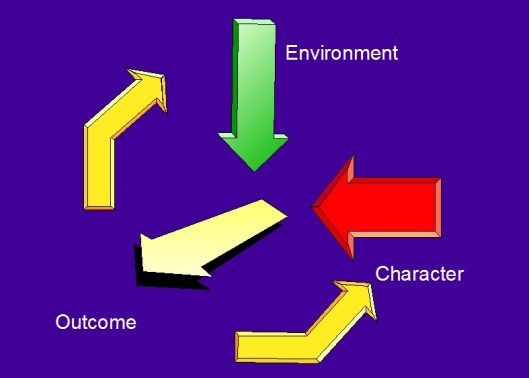
Here are some examples. For many years, the United States and the USSR were involved in a cold war arms race. Every time the USSR added more nuclear missiles to their arsenal, the people in America felt less safe. Since they felt less safe, they increased their armaments. When the USA increased nuclear weapons, this made the Soviet Union feel less safe so they increased their arms again and so on. This is what is known in Systems Thinking as a “Positive Feedback Loop.” It is also popularly known as a “Vicious Circle” or “Vicious Cycle.” 

Let’s say that you are in pretty good shape physically and regularly run, play tennis, or work out. The more you exercise (up to a point), the better you feel. Feeling better makes you feel more like exercise and more exercise makes you feel better. People call this a “Virtuous Cycle” or “Virtuous Circle” because we think the outcome is good. But formally, it is the same kind of cycle. 

active adult athlete body

Photo by Pixabay on Pexels.com

The most important thing to recognize about a Positive Feedback Loop is that it can be run in either direction. At some point, the US reduced their nuclear arsenal and this decreased the perceived threat to folks in the Soviet Union so the soviets felt that they could also reduce their nuclear arsenal which in turn, made people in the US feel safer and led to further reductions and so on. 

grey jet plane

Photo by Pixabay on Pexels.com

Similarly, if you stop exercising for a month, you will tend to feel pretty crappy. Feeling crappy makes you feel less like exercising and this in turn makes you exercise less which in turn makes you even more out of shape, feel worse and be even less likely to exercise. You can break such a “vicious circle” by starting to exercise – even it it’s just a little to start moving the circle in the “virtuous” direction. (Incidentally, that’s why I wrote “Fit in Bits” which describes many easy exercises to get you started). 

woman in white bed holding remote control while eating popcorn

Photo by JESHOOTS.com on Pexels.com

“Vicious circles” also often cause disagreements to escalate into arguments and arguments into fights. Each person feels “obligated” not to “give in” and the nastier their opponent becomes, the nastier they become. 

“Fawlty Towers” (https://en.wikipedia.org/wiki/Fawlty_Towers), a British sit-com uses “Positive Feedback Loops” in the escalating action of the comedy plots. John Cleese plays the co-owner Basil (with his wife, Sybil) of a small hotel. Typically, John Cleese makes some rather trivial but somewhat embarrassing mistake which he wants to hide from his wife. In the course of trying to cover up this rather small mistake, he has to lie, avoid, or obfuscate. This causes an even more egregious mistake which makes him even more embarrassed so he must result to still more outlandish lies and trickery in order to cover up the second mistake which in turn causes an even bigger mistake, and so on. 

That pattern of behavior reminds me of the current POTUS who is famously unable to admit to an error or lie and uses a second and bigger error or lie to try to cover up the first lie and so on. He seems, in fact, completely incapable of “systems thinking.” 

IMG_9150

For example, he may see (and exaggerate) a real, but containable threat such as a trade deficit. He sees the US send more money out of the country than the US takes in from trade. That’s a legitimate issue. But the approach he takes is to ZAP the other parties by slapping on tariffs without any real appreciation of the fact that our trading partners are extremely unlikely to react to tariffs on their products by simply doing nothing. One could use logic, empathy, or a look at history to determine that what is much more likely is that the other countries will put tariffs on our goods (which, of course, is precisely what happened). 

Similarly, he demands absolute loyalty. He repeatedly puts himself and his own interests above the law, the Constitution, the good of the country and the good of his party. He expects everyone loyal to him to do the same. But he betrays these loyal appointees, friends, and wives whenever it suits him. He thinks he is being “smart” by doing what seems to be in his best interest at that moment. But what he fails to see is that by being disloyal to so many people who have been mainly loyal to him, he encourages his so-called “allies” to only be loyal to him while it suits their interests.  

In the Pattern “Reality Check,” I point out that such behavior is an occupational hazard for dictators. Apparently, it can even be such a hazard for would-be dictators as well. By surrounding himself with those who always lie, cover for him, laud him, cater to his insane whims, etc., such a dictator (or would-be dictator) loses touch with what is really going on. He becomes more and more disconnected from sensible action yet those who remain loyal must say and do more and more outrageous things to keep the dictator from finding out just how bad things really are. Eventually, the Emperor with no clothes may die of hypothermia because no-one has the courage to tell him that he’s actually wearing no protection against the elements! 

IMG_2557

Positive feedback loops exist in purely natural systems as well as biological and social systems. For example, increased global mean temperatures mean less arctic ice which means more solar radiation will be absorbed by the earth’s dark oceans rather than reflected back into space by the white ice and snow. This, of course, makes the earth hotter still. In addition, the thawing of tracts of arctic tundra also releases more methane gas into the atmosphere which is even more effective at trapping the earth’s heat than is carbon dioxide. Global climate change also makes forest fires more prevalent which directly spews more carbon dioxide into the air and reduces the number of trees that help mitigate the emissions of carbon dioxide by turning it into oxygen through photosynthesis.

asphalt dark dawn endless

Photo by Pixabay on Pexels.com

A concept closely related to “Vicious Cycles” is that of “Cognitive Dissonance.” Basically, people like to believe that they are honest and competent. Much like John Cleese (Basil) in Falwty Towers, once they do something dishonest or incompetent, their first reaction is not to believe that they did something dishonest or incompetent. They will now try to distort reality by misperceiving, mis-remembering, or distracting. 

For example, at the height of the Vietnam War, I was horrified at the beatings perpetrated by the police on peaceful protestors at the Democratic National Convention. I was also disturbed at the techniques the Democrats used at their convention to silence the voices of dissension within the convention. Candidate Nixon claimed he had a “secret plan” to end the War in Vietnam. I voted for Nixon. As it became clear that Nixon was a crook, I decided that I had made a mistake voting for the man. But I could have taken another path which would be to “double down” on the original mistake by continuing to support Nixon and dismiss all the growing evidence of his misdeeds. As his malfeasance became more and more egregious, it made the egregiousness of my original mistake of voting for him grow as well. So, it would be possible to become ever more invested in not believing the overwhelming evidence of his treachery. (Now, it turns out, it was even worse than we knew at the time. He actively thwarted the peace efforts of Johnson!). Perhaps because I’ve been trained as a scientist and science values the truth very highly, I did not fall prey to that particular instance of “Cognitive Dissonance.” I readily admitted it was a stupid mistake to vote for Nixon. 

Of course, today, we see many people not just backed into a corner to support the current POTUS but backed into a corner of a corner. Instead of believing that a liar is lying, they protect their “integrity” by insisting that everything and everyone else is lying: the newspapers, the reporters, his opposition, people in other countries, his former business partners, his former customers, the CIA, the FBI, the NSA. Ironically, for some people, it would be easier to admit that voting for a slightly inferior candidate was a mistake than to admit that voting for a hugely inferior candidate was a mistake. Voting for a slightly inferior candidate is easily understood but if they voted for a candidate that bad and bad in so many ways it was a huge error. And now, as each new revelation comes to light, it is more and more and more embarrassing to admit what a huge mistake it was.  

Another common example of a “Vicious Circle” is addiction. A small amount of alcohol, nicotine or heroine makes you feel better. But taking the drug increases your tolerance for it. So, next time, to feel better, you need to take a little more. Taking a little more increases your tolerance still further so now you need to take a still higher dosage in order to feel better. When you do, however, your tolerance increases still more. Whether it is drugs, gambling, addictive sex, or unbridled greed, the mechanism is the same. You need more and more and more over time due to the nature of the “Positive Feedback Loop.” 

fullsizeoutput_11fc

A similar mechanism may be at work in the minds of apologists for the NRA (National Rifle Association). As more and more innocent people are killed partly because of easy access to guns, the mistake of supporting the NRA in their refusal to support mandatory vetting, training, and competency demonstrations for gun owners becomes an ever-more obviously egregious error. But, rather than making this more likely for supporters to admit to such an error and therefore change their position, every new slew of innocent children killed for no reason makes them actually less likely to change their position. According to Cognitive Dissonance, every such death makes their earlier decision worse – unless there is some counter-balancing argument. As the number of innocent deaths arises, and indeed, as more and more evidence of the perfidy of the NRA becomes clear, many who previously supported the NRA become ever more entrenched because they “buy into” the great value of unlimited access to guns ever more. Why? They continue their support because not to do so makes them complicit in more and more horrendous crimes.  

black rifle

Photo by Specna Arms on Pexels.com

If you can see such patterns in your own behavior and in others, you can better choose the correct course of action for yourself and be more thoughtful in how you communicate with others about their errors. Hint: Trying to make people feel more guilty for their stupid decisions will likely backfire. 

white and tan english bulldog lying on black rug

Photo by Pixabay on Pexels.com

————————

Author Page on Amazon. 

Love and Guns

D4

Dick-Taters

We won the war! We won the war! 

Guernica

A Civil War there Never Was

The First Ring of Empathy

The Walkabout Diaries: Life Will Find a Way

Travels with Sadie 1: Lampposts

Donnie Gets a Hamster

An Open Sore from Hell

Roar, Ocean, Roar

The Dance of Billions

The Siren Song

Imagine All the People…

You Must Remember This

At Least he’s our Monster

Stoned Soup

The Three Blind Mice

Wednesday

What About the Butter Dish?

And, then what?

16 Tuesday Dec 2025

Posted by petersironwood in creativity, psychology, Uncategorized

≈ Leave a comment

Tags

AI, Business, chatgpt, consciousness, consequences, Democracy, Feedback, innovation, learning, life, science, testing, thinking, USA

And then what? 

IMG_5566

When it comes to increasing the drama in TV crime shows, westerns, and spy thrillers, both the brilliant, evil villain and the smart, brave, good-looking protagonist display one common and remarkable weakness: they rush into action without much thought as to the possible consequences of their actions. 

Here’s a scene that you and I have probably seen a thousand times. The hero has a gun drawn and a bead on “The Evil One” but the Evil One has a knife to the throat of the friend or lover of The Hero. The Evil One, as both we in the audience and The Hero know, cannot be trusted. Most likely, The Evil One has caused the death of many people already, is treacherous, and lies as easily as most people breathe. Nonetheless, The Evil One promises to release the hero’s friend or lover provided only that The Hero put down their gun and slide it over to The Evil One. And The Hero complies! Often, The Hero will elicit a “promise” from The Evil One: “OK, I’ll give you my gun, but you have to let them go!” The Evil One, for whom promises mean nothing, “promises” and then The Hero slides the gun over. At this point, The Evil One is obviously free to kill both The Hero and their friend or lover immediately. Instead, The Evil One will begin chatting them up. This allows time for magic, skill, accident, God, unknown allies, or brilliance to turn the tables on The Evil One.


Here’s another scene that we’ve both witnessed. The Hero suddenly finds out some crucial piece of information that lets them know the whereabouts of The Evil One. Often this is an abandoned warehouse filled to the brim with minions of The Evil One. But, it might be the cave deep beneath the island stronghold of The Evil One; a stronghold filled to the brim with his minions. The Hero rushes in with a woefully inadequate force and without informing anyone concerning his whereabouts. He or she confronts The Evil One who not only confesses to past misdeeds but outlines their future plans to The Hero as well. 

abandoned architecture building concrete

Photo by Rene Asmussen on Pexels.com

In the TV series or the movies, the sequence of events is determined by the writer(s) so even though The Hero faces impossible odds, he or she will almost certainly overcome those impossible odds. That makes for an exciting story!

But in life? 

In real life, you’ll typically do a lot better if you think about the likely consequences of your actions. 

Sometimes, people fail to do this because they have simply never developed the habit of thinking ahead. 

Sometimes, people let their wishes completely color their decisions. For instance, an addicted gambler, despite their actual experience, believes that gambling more will result in a favorable outcome for them rather than the truth which would be that there is an extremely small chance that they will win overall. 

Sometimes, people are too ignorant to realize that there are potential negative consequences. For instance, when I was a youngster, I had a “glow in the dark” watch and cross; each glowed partly because of radium. I enjoyed putting these right up to my eyes in order to observe the flashes of individual photons. I also put together model airplanes with glue. When I applied too much glue, I dissolved it with Carbon Tetra-choloride. I loved the exotic smell of Carbon Tet. Now, it is deemed too dangerous to be used in this way. 

flight flying airplane jet

Photo by Pixabay on Pexels.com

In many cases, it seems to me that people do think about consequences but use an overly simple model of reality on which to base their predictions. In particular, people often treat individuals and social systems as mechanical systems and base their decisions on those mechanical models rather than actuality. For example, your kid does not, in your opinion, eat enough broccoli so you simply force them to eat broccoli. Your “prediction” of the consequences of this may include that the kid will eat more broccoli, be healthier, eventually like broccoli, etc. Depending on the individual child, it may be that none of these will actually occur. In some cases, it may even happen that the exact opposite of your goals will be achieved. The kid may eat less broccoli, be unhealthier, and hate broccoli more than ever. There are many other possible consequences as well. The kid may end up hating meals with the family or hating you or hating the color green. 

When it comes to individuals and social systems, it is hard to know what the net effect might be. Often though, the most significant cognitive problem that people have is that they are so sure of their prediction that they base their actions on what they think should happen rather than what actually does happen or what might happen. 

As recounted in some detail in the Pattern, “Reality Check,” instituting a new social reward or punishment system often does indeed change behavior, but not necessarily in the desired manner. If, for instance, programmers are now rewarded on the basis of lines of code written, they might indeed write more lines of code but many of those lines of code may be unnecessary. You might write 1000 lines of code or you could spend time thinking about the problem and then write two lines of code that accomplish the same result. Will you do so if you are only rewarded 1/500 th of the bonus?  

man wearing brown suit jacket mocking on white telephone

Photo by Moose Photos on Pexels.com

Similarly, you may measure the performance of service technicians by how many calls they “handle” during their shift. But if that is the main or sole measure, you may end up having those service people tend to offer trivial or even useless advice based on insufficient information. In all these cases, if management keeps seeing what really happens, any damage done by having an inaccurate predictive model of what will happen as a result of a change will be mitigated. But in a system, whether private or governmental, where people are mainly motivated to keep management happy by telling them what they want to hear, instead of correcting a poor intervention, the problems caused by inadequate models will tend to multiply, fester, or explode. 

So: 

Think of possible consequences and try to determine which ones are most likely. Then, observe what really does happen. This helps avoid turning an issue into a disaster and, over time, it also helps you develop more realistic models of reality. It will also tend to put you in the habit of taking a flexible and reality-based approach to your decisions rather than one that is based on a rigid and inaccurate model of how things should be. The latter approach to decisions will not only make you individually ineffective; it will also make it almost impossible to work well with others (unless everyone involved shares the same inaccurate model). 

IMG_9333

Author Page on Amazon. 

The Update Problem

Essays on America: Labelism

Essays on America: The Game

The Invisibility Cloak of Habit

Timeline for RIME

Guernica

There Never was a Civil War

The Crows and Me

After All

At Least He’s Our Monster

The Siren Song

Occam’s Chain Saw Massacre

Math Class: Who are you?

The First Ring of Empathy

Sadie and the Lighty Ball

Roar, Ocean, Roar

Life Will Find a Way

Cancer Always Loses in the End

Many Paths

15 Monday Dec 2025

Posted by petersironwood in creativity, psychology, sports

≈ Leave a comment

Tags

AI, Business, competition, creativity, Democracy, Design, divergent thinking, family, innovation, learning, life, mental-health, sports, truth, writing

Many Paths

This is one of a series of posts about various tools of thought that are useful in a wide variety of situations. This particular tool is often called “Alternatives Thinking” or “Divergent Thinking.” I chose the name “Many Paths” because when I first posted this about seven years ago, I was in the middle of writing a trilogy called: “The Myths of the Veritas.” The new leader of the Veritas was known as “Many Paths” because she was particularly good at finding many possible alternatives to consider. Now, let’s see what this tool is and how it may prove useful to us.

IMG_5867

The basic idea is simple. When we are confronted with a situation, we often “Jump to Conclusions” or “Spring into Action” before we have all the facts. Even when we have all the facts (which is rare), we also have a tendency to focus on our first interpretation or our first idea about how to handle the situation. This often leads to thinking of one (and only one) course of action. And, very occasionally; for instance, in some emergencies, that is the correct thing to do.

backlit breathing apparatus danger dangerous

Photo by Pixabay on Pexels.com

Even in emergencies however, our first terrified instinct about what to do can be dead wrong. For example, people see a small fire in their homes and immediately throw water on it. But if it’s a grease fire or an electrical fire, this is not a good course of action. Soon after I first began my dozen years as Executive Director of the NYNEX AI Lab, there was a fire in a nearby Stouffer’s Hotel. The charred bodies of a dozen IBM executives were found huddled in a closet. In the smoke and panic and confusion of the fire, they had apparently grabbed at the first door and gone into a dead end closet and they all perished there. 

In daily life, there are a great many situations where a little extra thinking time would improve the outcome. For example, while working at IBM Research in the 1970’s, I drove about 10 minutes each way to work. At one point, I had a loose fan belt and my battery went dead. In a hurry to attend a meeting, I jump-started my car and drove to the IBM parking lot. Already late to a meeting, I went to turn off the car and just before I did so, I realized that I had not driven far enough to recharge the battery. So, I decided I’d better leave the car engine running for awhile. But as I gathered up my things and began dashing off to the meeting, I realized that it was insane to leave my car unlocked with the engine running! After all, someone could simply open the door and drive off! So, still in a hurry, I locked the car — with the engine running and the keys safely locked inside. 

blue sedan

Photo by neil kelly on Pexels.com

Oops!

Most of us have done similar things. In some early experiments on design problem solving done at IBM, I found that when I asked people to come up with as many solutions as possible, they would generate ideas fairly quickly until they came up with one that they thought would really solve the problem. At that point, their idea productivity fell precipitously. It is hard for us to force ourselves to think of more than one good solution. 

Why is this important? For one thing, conditions change. Something may happen that makes your first solution no longer apt. For another thing, there may be side-effects of your solution that make it unacceptable. Another common issue is that someone may object to your first solution for reasons you could not foresee. (See also, “Who Speaks for Wolf” as a way to help minimize that chance). In the context of invention and product development it is extremely unlikely that the first solution you come upon (and indeed even the first few solutions you think of) are novel. They are instead extremely likely to be the intellectual property of someone else. The most obvious solutions have likely already been patented and may already be in products or services that many customers are already using. 

IMG_2768

I have long been interested in observing people’s strategies and tactics in sporting events (See “The Winning Weekend Warrior”). One tactic that is overwhelmingly popular in tennis, for instance, is that the harder your opponent hits the ball, the harder you try to hit the ball. For example, someone hits a very hard ball while you’re at the net. You take this as an affront and think “I’ll show you!” Trying to hit the volley even harder means you take the racquet back farther. About half the time, the extra time it takes to bring the racquet back means you’ll mis-hit the ball or miss it entirely. On most of the remaining occasions, you’ll hit the volley too hard and it will go long. If someone hits the ball at you hard, what you need to do is simply block it back and guide it to the right spot. Trying to add extra power is unnecessary and too time-consuming. What is remarkable is not that you and I try to hit a hard ball harder. What is remarkable is that we never seem to try a different tactic!  

There are many issues with focusing all your energy on the first solution you come up with. But the worst consequence is that you are overly invested in that first “solution” (which may not even be a real solution). This is bad in trying to solve problems in every domain I can think of and having others involved amplifies the badness. 

For instance, let’s say that after 3 years without a vacation, you and your spouse finally have time for a nice two-week vacation. You want to visit Cuba for two weeks and your spouse wants to visit Vietnam for two weeks. If you each only comes up with one idea, you will almost always find yourself pitching for your idea, trying to convince the other person that Cuba is better while they will spend their energy trying to shoot down your choice and explain (patiently at first and less so as time goes on) why Vietnam is a much better idea. After many frustrating arguments that go nowhere, you may decide to compromise; e.g., you could visit an empty stretch of open sea in the Pacific Ocean half-way between the locations; or, you may decide to flip a coin. All this frustration and bad feeling might be avoidable. It might be that your second choice and your spouse’s second choice are both San Diego! But you’ll never even discover this because when each of you only thinks of one idea, what should be a collaborative problem solving exercise instead becomes a debate – a contest with precisely one winner and one loser. 

man and woman wearing brown leather jackets

Photo by Vera Arsic on Pexels.com

One reason people may be prone to latch onto the first idea that occurs to them is that this is typically what happens in fiction. A TV detective gets a call that they must come alone and not tell the police but instead meet someone in an abandoned warehouse. For the sake of the drama, it puts our hero into obvious danger. They are outgunned and it looks like certain death for them. Then, due to their superior thinking, martial arts, dumb luck, or having a side-kick who followed them, they miraculously survive! Whew! But in real life, it’s almost always better to wait for back up and think through how various alternatives might work out.

Thinking of many alternatives will save you many headaches – at work, in your love life, in your recreational endeavors. When you force yourself to think of many alternatives, you will also be more open to the ideas of others. Over time, thinking of many alternatives whenever you get a chance will also increase your own creative potential. Who knows? You might even be chosen as the next leader. 

For a leader, it is particularly important to consider many possibilities. Insisting that everyone get on board with the first idea that pops into your head will cause resentment and dissension. It will also make you far less willing to change to a different idea when circumstances necessitate it. 

You may start a business and decide that you must be personally involved in every decision and with every customer contact. At first, when your company is small, this might work out wonderfully well. No-one knows the customer and the product quite so well as you do. But you are not God. You cannot be everywhere and know everything. If you never learn to delegate; never grow the capacity of your people; never take expert advice — you will drive yourself and everyone around you crazy. The very success of your business will guarantee its ultimate failure. Learn to consider many paths. You will be glad you did. 

IMG_3229

Author’s Page on Amazon. 

The Invisibility Cloak of Habit

Labelism

Wednesday

You Bet Your Life

How the Nightingale Learned to Sing

Guns and Love

You Must Remember This

The Jewels of November

The Impossible

Guernica

We Won the War! We Won the War!

Peace

The Dance of Billions

The First Ring of Empathy

Travels with Sadie

Dog Trainers

The Iroquois Rule of Six

The Walkabout Diaries: Bee Wise

Tools of Thought

14 Sunday Dec 2025

Posted by petersironwood in AI, creativity, design rationale, management, psychology, science, Uncategorized

≈ Leave a comment

Tags

AI, chatgpt, index, life, problem formulation, problem framing, problem solving, sense-making, summary, technology, thinking, tools of thought, writing

Tools of Thought (Summary and Index)

In December, 2018, I began writing a series of essays on “tools of thought.” I realize that many readers probably read these tools at the time they were first published. However, in times of great division such as those we now face, effective thinking is more important than ever yet every day in the news and in social media, I see many examples that overlook even the most basic tools of thought. I therefore decided that it would be worthwhile to reprint the index of such tools now.

I suppose many readers will already be familiar with many of these tools. Nonetheless, I think it’s worthwhile to have a compilation of tools. After all — plumbers, carpenters, programmers, piano tuners, sales people — they all have tool kits. I see at least three advantages to having them together in some one place.

Without a toolkit you may be prone to try to use the tool that just so happens to be nearest to hand at the time you encounter the problem. You need to tighten a screw and you happen to have a penny in your pocket. You don’t feel like walking all the way down into the garage to get your toolkit. A penny will do. I get it. But for more serious work, you are going to want to consider the whole toolkit and choose the tool that’s most appropriate to the situation at hand.

First, then, the existence of a toolkit serves as a reminder of all the tools at your disposal. This will help you choose appropriately. 

Second, you may only be familiar with one or two ways to use a tool. I may have thought of ways to use a tool that are different from the way you use it. In the same way, you undoubtedly know useful things about these tools of thought that I have never thought of. We can learn from each other. Readers are more than welcome to comment on uses, misuses, and variations.

Third, having all the tools together may stimulate people to invent new tools or see a way to use two or more in sequence and begin to think about the handoff between two tools. 

Here’s an index to the toolkit so far.

Many Paths(December 5, 2018). The temptation is great to jump to a conclusion, snap up the first shiny object that looks like bait and charge ahead! After all, “he who hesitates is lost!” But there is also, “look before you leap.” What works best for me in many circumstances is to think of many possible paths before deciding on one. This is a cousin to the Pattern: Iroquois Rule of Six. This heuristic is a little broader and is sometimes called “Alternatives Thinking.”

Many Paths

And then what?(Dec. 6, 2018). This is sometimes called “Consequential Thinking.” The idea is simple: think not just about how you’ll feel and how a decision will affect you this moment but what will happen next. How will others react? It’s pretty easy to break laws if you set your mind to it. But what are the likely consequences?

And, then what?

Positive Feedback Loops(December 7, 2018). Also known as a virtuous or vicious circle. If you drink too much of a depressant drug (e.g., alcohol or opioids), that can cause increased nervousness and anxiety which leads you to want more of the drug. Unfortunately, it also makes your body more tolerant of the drug so you need more to feel the same relief. So, you take more but this makes you even more irritable when it wears off.

Systems Thinking: Positive Feedback Loops

Meta-Cognition.(December 8, 2018). This is basically thinking about thinking. For example, if you are especially good at math, then you tend to do well in math! Over time, if your meta-cognition is accurate, you will know that you are good in math and you can use that information about your own cognition to make decisions about the education you choose, your job, your methods of representing and solving problems and so on.

Meta-Cognition

Theory of Mind(December 9, 2018). Theory of Mind tasks require us to imagine the state of another mind. It is slightly different from empathy, but a close cousin. Good mystery writers – and good generals – may be particularly skilled at knowing what someone else knows, infers, thinks, feels and therefore, how they are likely to act.

Theory of Mind

Regression to the Mean(December 10, 2018). This refers to a statistical artifact that you sometimes need to watch out for. If you choose to work with the “best” or “worst” or “strongest” or “weakest” and then measure them again later, their extreme scores will be less extreme. The tool is to make sure that you don’t make untoward inferences from that change in the results of the measurement.

Regression to the Mean

Representation(December 11, 2018): The way we represent a problem can make a huge difference in how easy it is to solve it. Of course, we all know this, and yet, it is easy to fall into the potential trap of always using the same representations for the same types of problems. Sometimes, another representation can lead you to completely different – and better – solutions.

 Representation 

Metaphor I (December 12, 2018): Do we make a conscious choice about the metaphors we use? How can metaphors influence behavior?

Metaphors We Live By and Die By

Metaphor II (December 13, 2018): Two worked examples: Disease is an Enemy and Politics is War.

Metaphors We Live and Die By: Part 2

Imagination (December 14, 2018): All children show imagination. Many adults mainly see it as a tool for increasing their misery; viz., by only imagining the worst. Instead of a tool to help them explore, it becomes a “tool” to keep themselves from exploring by making everything outside the habitual path look scary.

Imagination

Fraught Framing (December 16, 2018): Often, how we frame a problem is the most crucial step in solving it. In this essay, several cases are examined in which people presume a zero-sum game when it certainly need not be.

Fraught Framing: The Virulent “Versus” Virus

Fraught Framing II(December 17, 2018). A continuation of thinking about framing. This essay focuses on how easy it sometimes is to confuse the current state of something with its unalterable essence or nature. 

Fraught Framing: The Presumed Being-ness of State-ness

Negative Space(December 17, 2018). Negative space is the space between. Often we separate a situation into foreground and background, or into objects and field, or into assumptions and solution space. What if we reverse these designations?

Negative Space

Problem Finding(December 18, 2018). Most often in our education, we are handed problems and told to solve them. In real life, success is as much about being able to find problems or see problems in order to realize that there is even something to fix.

Problem Finding

More recently, I wrote a series of posts about the importance of Problem Finding, Problem Framing, and Problem Formulation. I haven’t yet put this in the form of “Tools of Thought” — these posts are specific experiences from my own life where I initially mis-formulated a problem or watched my friends do that. 

The Doorbell’s Ringing! Can you get it?
Reframing the Problem: Paperwork & Working Paper
Problem Framing: Good Point!
I Say: Hello! You Say: “What City Please?”
I Went in Seeking Clarity
Problem Formulation: Who Knows What?
Wordless Perfection
How to Frame Your Own Hamster Wheel
Measure for Measure
The Slow-Seeming Snapping Turtle
A Long Day’s Journey into Hangover
Training Your Professor for Fun & Profit
Astronomy Lesson: Invisible Circles
Tag! You’re it!
Ohayōgozaimasu
Career Advice from Polonius

——————————-

Author Page on Amazon

pastedGraphic.png

Photo by Pixabay on Pexels.com

Non-Linearity. (December 20, 2018). We often think that things are linear when they may not be. In some cases, they can be severely non-linear. Increasing the force on a joint may actually make it stronger. But if increased force is added too quickly, rather than strengthening the joint even further, it can destroy it. The same is true of a system like American democracy.

Non-Linearity

Resonance. (December 20, 2018). If you add your effort to something at the right time, you are able to multiply the impact of your effort. This is true in sports, in music, and in social change.

pastedGraphic_1.png

Photo by Kaboompics .com on Pexels.com

Resonance

Symmetry(December 23, 2018). There are many kinds of symmetry and symmetry is found in many places; it is rampant in nature, but humans in all different cultures also use symmetry. It exists at macro scales and micro scales. It exists in physical reality and in social relationships.

Symmetry

Other posts that are related to various mental errors you might want to avoid.

Labelism

Wednesday

The Stopping Rule

Finding the Mustard

What about the Butter Dish?

Where does your Loyalty Lie?

Roar, Ocean, Roar

The Update Problem

The Invisibility Cloak of Habit

The Impossible

Your Cage is Unlocked

We won the war! We won the war!

The self-made man

Wordless Perfection

11 Thursday Dec 2025

Posted by petersironwood in AI, creativity, HCI, psychology, sports, Uncategorized, user experience

≈ Leave a comment

Tags

AI, art, creativity, drawing, education, intuition, life, problem formulation, Representation, Right-brain, sports, thinking, writing

————————————

Sirius Black

I like to write. In fact, I like to write so much that I wrote before I could even read. When my early crayon “writings” in my grandfather’s books were discovered, instead of praise, I was spanked. I’m not even sure they really tried hard to read my learned annotations. Their missing the point didn’t deter me though. I like words! I like writing poetry, essays, stories, plays, and even novels. Words help human beings communicate and collaborate. However…

In this essay, I’d like to mention some instances of wordless success.

Photo by lascot studio on Pexels.com


In the neighborhood where I grew up, we spent most of the summer playing baseball, basketball, and football. I had never played golf nor paid much attention to it as a kid and when it came on TV I walked by with hardly a glance. At that point in my life, I deigned to consider something a sport only if there were a good chance to smash into one of the other players. I had never touched a golf club or a golf ball until one summer day when I was about ten, one of the kids brought one of his uncle’s golf clubs to our baseball field along with a tee and a golf ball. He demonstrated how to hit the ball and showed us how to put our hands on the club. Kids took turns hitting the ball and retrieving it for another go. 

When it came to my turn, I mainly remember just loving the shiny wood of the club. I loved wooden baseball bats back then, but the driver!! Wow! That was in a whole different category of cool. You didn’t need to be an adult or a golfer to know that! It shone opalesquely. I teed up the golf ball, and swung the unfamiliar and impossibly long club.

The resulting sound – exquisite. An explosion. A rifle shot. A cousin of the crack of a home run shot into the upper deck. But more penetrating. More elegant. More poignant.

We all looked up in amazement. My golf shot started low and straight. Then it rose and rose and disappeared far beyond the dirt road that marked the outer limit of our makeshift baseball field. It rose over the hill beyond the road and disappeared into the field beyond. There was no hope of retrieving the golfball. None of us even suggested trying. My shot was wordless perfection. 


Fast forward to graduate school. In the summer afternoons, I got into the habit of playing frisbee with the neighbors. One day, I parked my car and ran into the back yard. One of my neighbors spied me and threw me the frisbee, I noticed that they had placed an empty beer can atop a utility box about a hundred feet away. I caught the frisbee on the run and threw it with the next step. The frisbee sailed with a nice arc and smacked the beer can right off. My neighbors said that they had been trying to knock that beer can off for about a half hour.  My throw was wordless perfection.

Photo by Brixiv on Pexels.com

Meanwhile, at the University of Michigan, several of my friends and classmates liked puzzles as much as I did. One such puzzle consisted of a triangular “board” with a regular pattern of holes. There were pegs in every hole save one. The goal was to “jump” pegs much as one does in checkers and then remove that peg from the board. Eventually, one was supposed to end up with one and only one peg. I worked on it for awhile and thought about various strategies and moves. I couldn’t seem to solve it. My phone rang. I picked it up and conversed with my friend. Meanwhile, I toyed with the puzzle while my “mind” was on the conversation. I toyed with the puzzle and solved it. Wordless perfection.

A few months or weeks later, my officemates and I worked on another puzzle. This one consisted of four cubes (aka “instant insanity”). Each cube had a different arrangement of colors. The goal was to arrange the cubes so that every “row” of faces had four different colors. I fiddled with the puzzle trying out various strategies and noting various symmetries and asymmetries. Once again, someone called and interrupted my musings. Again, I idly fiddled around with the cubes while talking on the phone. And solved it. Wordless perfection strikes again! 

https://en.wikipedia.org/wiki/Instant_Insanity

Fast forward four decades. For best results, borrow Hermione’s time-turner. Otherwise, you’ll have to rely on your imagination. 

Betty Edwards (“Drawing on the Right Side of the Brain”) gave a plenary address at one of the Association of Computing Machinery’s premier conferences: CHI. Among other things, she showed example after example of how much people improved in their drawing skills based on her methods. A few months later, it so happened that my wife and I had an opportunity to go to one of her five day classes. 

I would have to honestly say, that course was one of the best educational experiences of my life. It was an immensely pleasurable experience in and of itself. Beyond that, the results in terms of improved drawing skills were dramatic. And, as if that were not enough, I looked at the world differently. I noticed visual things about the environment that I had never seen before. 

The essence of the method Betty Edwards uses is to get you to observe and draw — while “shutting up” or “turning off” the part of your brain (or mind) that talks and plans and categorizes. In one exercise, for instance, we took a line drawing and turned it upside down. Then, we copied that image onto our pad of paper by carefully observing and drawing what we saw. She also instructed us not to try to “guess” what they were drawing, but just to copy the lines. When every line had been copied, we turned the drawings right side up again. The result jolted me! I had created an excellent likeness of the original. So had everyone else in class. The quality stunned me. Wordless Perfection.

There’s a larger lesson here, too. 

I had within me, the capacity to make a very decent copy of a drawing, but had never achieved that result for 60 years. All it took was five minutes of instruction to enable me to achieve that. 

What else is like that? Imagine that we have, not just one, but a dozen or even a dozen dozen “hidden talents.” Some of them, like drawing, may depend more on Not-Doing than on Doing; on Being rather than Achieving.

There was a longer lasting side-effect of the drawing course. My day to day life, as is typical of most achievement-driven people had been very much “goal-driven” and there was always an ongoing plan and dialogue. After having learned to turn that off in order to draw, I can also turn it off in order to see, whether or not I draw. Seeing (or otherwise sensing or feeling) in the moment also makes me much less judgmental. If you decide to think about the physical appearance of people in terms of how interesting they would be to draw, you end up with an entirely different way of thinking about people’s appearance. 

What are your hidden talents? 

——————————————

The Invisibility Cloak of Habit 

Big Zig-Zag Canyon 

The Great Race to the Finish!

You Fool!

Horizons University

How the Nightingale Learned to Sing

Comes the Dawn

Dog Trainers

Where Does Your Loyalty Lie?

The Dance of Billions

Roar, Ocean, Roar

Imagine All the People

Your Cage is Unlocked

Author Page on Amazon

I Went in Seeking Clarity

10 Wednesday Dec 2025

Posted by petersironwood in Uncategorized, psychology, creativity, user experience, HCI, AI

≈ Leave a comment

Tags

AI, Artificial Intelligence, coding, parallel programming, problem formulation, problem framing, problem solving, programming, technology, thinking, tools, X10

“I stopped by the bar at 3 A.M.
To seek solace in a bottle or possibly a friend
And I woke up with a headache like my head against a board
Twice as cloudy as I’d been the night before
And I went in seeking clarity” — Lyrics from The Indigo Girls: Closer to Fine

If you think programming is cognitively difficult, try parallel programming. It is generally harder to design, to code, and to debug than its sequential cousin. One of the fun projects I worked on at IBM Research was on the X10 language which was designed to enable parallel programmers to be more productive. Among other things, I fostered community among X10 programmers and used analytic techniques to show that X10 “should be” more productive. Although these analytic techniques are very useful, we also wanted to get some empirical data that the language was, in actuality, more productive. 


Photo by Dominika Greguu0161ovu00e1 on Pexels.com


One part of those empirical studies involved comparing people doing a few parallel programming tasks in X10 to those using a popular competitor. But, like many other “chicken and egg” problems, there were no X10 programmers (other than the inventors and their colleagues). I was part of a team who travelled to Rice University in Houston. The design called for one group to spend a chunk of time learning X10 (perhaps half a day) and another chunk of time coding some problems.

Besides the three behavioral scientists like me who were there to make observations, there were also three high-powered Ph.D. computer scientists present who would teach the language. Programmers tend to be very smart. Parallel programmers tend to be very very smart. People who can invent better languages to do parallel programming? You do the math.


Anyway, after the volunteers students had arrived, one of the main designers of the language began to “teach them” X10. 

But — there was a problem. 

The powerpoint presentation designed to teach the students X10 was far too blurry to read!

Immediately, the three computer scientists tried to issue commands to the projector to put the images in focus. Nothing worked. The three of them began a fascinating problem solving conversation. The conversation concerned what communication protocol(s) among the PC, the projector, and the controller was the likely source of the problem. I suppose it might not have been fascinating to everyone, but it was to me. First, it fascinated me because I was learning something about computer science and communication protocols. Second, it fascinated me because I loved to watch these people think. I suppose many of the advanced computer science students who were in this classroom to learn X10 also found it interesting. Third, I found it fascinating because my dissertation was about human problem solving and I’ve been interested in it ever since.

But the study itself had completely stalled. 

After a few minutes of fascinating conversation that did nothing to focus the images, something possessed me to walk over to the projector and turn the lens by hand. The images were immediately clear and the rest of the experiment continued. 

The three computer scientists had “framed” the problem as a computer science problem and I found the discussion that sprang from that framing to be fascinating. But one of the part-time jobs I had had as an undergraduate was as a “projectionist” at Case-Western, and it was that experience that allowed me to try framing the problem differently. All of us have huge reservoirs of experience outside of our professional “training” and those experiences can sometimes be important sources of alternative ways to frame a problem, issue, or situation.

———————————-

Essays on America: Wednesday 

Essays on America: The Update Problem 

Essays on America: The Stopping Rule

The Invisibility Cloak of Habit

Labelism

Tools of Thought

Where Does Your Loyalty Lie?

Stoned Soup

The First Ring of Empathy

Travels with Sadie: Teamwork

Author Page on Amazon


I Say: Hello! You Say: “What City Please?”

09 Tuesday Dec 2025

Posted by petersironwood in AI, creativity, design rationale, HCI, management, psychology, Uncategorized, user experience

≈ 1 Comment

Tags

art, communication, conversation, Design, efficiency, HCI, human factors, photography, primacy, problem framing, problem solving, sensemaking, technology, thinking, UX

Photo by Tetyana Kovyrina on Pexels.com

In the not so distant past, people would often call directory assistance operators. These operators would find a number for you. For an additional charge, they would dial it for you. In fact, this was a very commonly used system. Phone companies would have large rooms filled with such operators who worked very hard and very politely, communicating with what was often a hostile and irrational public. 

Photo by Moose Photos on Pexels.c

Customer: “I have to get the number of that bowling alley right near where the A&P used to be before they moved into that new shopping center.”

Operator: “Sir, you haven’t told me what town you’re in. Anyway…”

Customer: “What town?! Why I’m right here in Woburn where I’ve always been!” 

Photo by Johannes Plenio on Pexels.com

There were so many operators that the phone companies wanted their processes to be efficient. Operators were trained to be friendly and genial but not chatty. The phone companies searched for better keyboards and better screen layouts to shave a second here or there off the average time it took to handle a call. 

There are some interesting stories in that attempt but that we will save for another article, but here I want to tell you what made the largest single impact on the average time per call. Not a keyboard. Not a display. Not an AI system. 

It was simply changing the greeting. 

Photo by eberhard grossgasteiger on Pexels.com

Operators were saying something like: “New England Telephone. How can I help you?” 

After our intervention, operators instead said, “What city please?” It’s shorter and it’s takes less time to say. But the big change was not in how long the operator took to ask the question. The biggest savings was how this change in greeting impacted the customer’s behavior. 

When the operator begins with “How can I help you?” the customer, or at least some fraction of them, are put into a frame of mind of a conversation. They might respond thusly:

“Oh, well, you know my niece is getting married! Yeah! In just a month, and she still hasn’t shopped for a dress! Can you believe it? So, I need the number for that — if it were up to me, I would go traditional, but my niece? She’s — she’s going avant-garde so I need the number of that dress shop on Main Street here in Arlington.” 

Photo by Tuu1ea5n Kiu1ec7t Jr. on Pexels.com

With the “What City Please?” greeting, the customer was apparently put into a more businesslike frame of mind and answers more succinctly. They now understand their role as proving information in a joint problem solving task with the operator. A typical answer would now be:

“Arlington.” 

“In Arlington, what listing?” 

“Dress shop on Main Street.”

The way in which a conversation begins signals what type of conversation it is to be. We know this intuitively. Suppose you walked up to an old friend and they begin with: “Name?” You would be taken aback. On the other hand, suppose you walk up to the line at the DMV and the clerk says, “Hey, have you seen that latest blog post by J. Charles Thomas on problem framing?” You would be equally perplexed! 

Conversation can be thought of partly as a kind of mutual problem solving exercise. And, before that problem solving even begins, one party or the other will tend to “frame” the conversation. That framing can be incredibly important. 

Even the very first words can cause someone to frame what kind of a conversation this is meant to be.

Words matter.

The Primacy Effect and The Destroyer’s Advantage

https://petersironwood.com/2018/02/13/context-setting-entrance/

Essays on America: Wednesday

After the Fall

The Crows and Me

Cancer Always Loses in the End

Come Back to the Light

Imagine All the People…

Roar, Ocean, Roar

The Dance of Billions

How the Nightingale Learned to Sing

Travels with Sadie

The First Ring of Empathy

Donnie Visits Granny!

You Must Remember This

The Walkabout Diaries: Bee Wise

Author Page on Amazon 

Reframing the Problem: Paperwork & Working Paper

04 Thursday Dec 2025

Posted by petersironwood in AI, creativity, design rationale, HCI, management, psychology, Uncategorized, user experience

≈ Leave a comment

Tags

AI, ethics, leadership, life, philosophy, politics, problem finding, problem formulation, problem framing, problem solving, thinking, truth

Photo by Pixabay on Pexels.com

Reframing the Problem: Paperwork & Working Paper


This is the second in a series about the importance of correctly framing a problem. Generally, at least in formal American education, the teacher gives you a problem. Not only that, if you are in Algebra class, you know the answer will be an answer based in Algebra. If you are in art class, you’re expected to paint a picture. If you painted a picture in Algebra class, or wrote down a formula in Art Class, they would send you to the principal for punishment. But in real life, how a problem is presented may actually be far from the most elegant solution to the real problem.

Doing a google search on “problem solving” just now yielded 208 million results. Entering “problem framing” only had 182 thousand. A thousand times as much emphasis on problem solving as there was on problem framing. [Update: I redid the search today, a little over three years later. On 3/6/2024, I got 542M hits on “problem solving” and 218K hits on “problem framing” — increases in both but the ratio is even worse than it was in 2021] [Second update: I did the search today, Dec. 4th, 2025, and the information was not given–but that’s the subject of a different post].

Let’s think about that ratio of 542 million to 218 thousand for a moment. Roughly, that’s 2000 to 1. If you have wrongly framed the problem, you not only will not have solved the real problem; what’s worse, you will have often convinced yourself and others that you have solved the problem. This will make it much more difficult to recognize and solve the real problem even for a solitary thinker. And to make a political change required to redirect hundreds or thousands will be incalculably more difficult. 

All of that brings us to today’s story. For about a decade, I worked as executive director of an AI lab for a company in the computers & communication industry. At one point, in the late 1980’s, all employees were all supposed to sign some new paperwork. An office manager called from a building several miles away asking me to have my admin work with his admin to sign up a schedule for all 45 people in my AI lab to go over to his office and sign this paperwork as soon as possible. That would be a mildly interesting logistics problem, and I might even be tempted to step in and help solve it. More likely, if I tried to solve it, some much brighter & more competent colleague would have done it much faster. 

Photo by Charlie Solorzano on Pexels.com

But why?

Why would I ask each of 45 people to interrupt their work; walk to their cars; drive in traffic; park in a new location; find this guy’s office; walk up there; sign some paper; walk out; find their car; drive back; park again; walk back to their office and try to remember where the heck they were? Instead, I told him that wasn’t happening but he’d be welcome to come over here and have people sign the paperwork. 

You could make an argument that that was 4500% improvement in productivity, but I think that understates the case. The administrator’s work, at least in this regard, was to get this paperwork signed. He didn’t need to do mental calculations to tie these signings together. On the other hand, a lot of the work that the AI folks did was hard mental work. That means that interrupting them would be much more destructive than it would to interrupt the administrator in his watching someone sign their name. Even that understates the case because many of the people in AI worked collaboratively and (perhaps you remember those days) people were working face to face. Software tools to coordinate work were not as sophisticated as they are now. Often, having one team member disappear for a half hour would not only impact their own work, it would impact the work of everyone on the team. 

Quantitatively comparing apples and oranges is always tricky. Of course, I am also biased because my colleagues are people I greatly admire. Nonetheless, it seems obvious that the way the problem was presented was a non-optimal “framing.” It may or may not have been presented that way because of a purely selfish standpoint; that is, wanting to do what’s most convenient for oneself rather than what’s best for the company as a whole. I suspect that it was more likely just the first idea that occurred to him. But in your own life, beware. Sometimes, you will mis-frame a problem because of “natural causes.” But sometimes, people may intentionally hand you a bad framing because they view it as being in their interest to lead you to solve the wrong problem. 

Politics, of course, takes us into another realm entirely. People with political power may pretend to solve one problem while they are really following a completely different agenda. One could imagine, for instance, a head of state claiming to pursue a war for his people when he’s really doing it to keep in power. Or, they could claim they are making cities safe by deploying troops when they are really interested in suppressing the vote in areas that can see through his cons. Or, a would-be dictator could claim they are spending your tax dollars to make government more efficient when that has nothing to do with what they are *actually* doing–which is to collect data on citizens and make the government ineffective in order to have people lose confidence in government and instead invest in private solutions.

Even when people’s motivations are noble or at least clear, it is still quite easy to frame a problem wrongly because of surface features. It may look like a problem that requires calculus, but it is a problem that actually requires psychology or it may look like a problem that requires public relations expertise but what is actually required is ethical leadership.

Photo by Nikolay Ivanov on Pexels.com

——————————————————

Author Page on Amazon

Tools of Thought

A Pattern Language for Collaboration and Cooperation

The Myths of the Veritas: The First Ring of Empathy

Essays on America: Wednesday

Essays on America: The Stopping Rule

Essays on America: The Update Problem

My Cousin Bobby

Facegook

The Ailing King of Agitate

Dog Trainers

The Doorbell’s Ringing! Can you get it?

02 Tuesday Dec 2025

Posted by petersironwood in creativity, design rationale, psychology, story, Uncategorized, user experience

≈ Leave a comment

Tags

books, problem finding, problem formulation, problem framing, problem solving, story, thinking

Photo by Little Visuals on Pexels.com

After a long day’s work, I arrived home to a distraught wife. Not, “Hi, sweetheart” but “This doorbell is driving me crazy!” 

Me: “What doorbell? What are you talking about?” 

People differ in how they perceive the world around them. In my case, for instance, I’m very easily distracted by movement in my visual field. Noise can be annoying, but it rarely rises to that level. For instance, when TV commercials come on, I simply “tune them out” and instead tune in to my own thoughts. My high frequency hearing isn’t too great either. So, at first, I didn’t understand what my wife was referring to. 

Beep. 

Photo by Luisa Fernanda Bayona on Pexels.com

“That! That doorbell beep!” 

Ah, now I understood. And, there it went again. Once I knew what to listen for, I had to agree it was annoying though much more annoying to my wife because she’s more tuned in to sound than I am and her ability to hear high frequencies is also better.

She then upped the ante. “I have to leave. I can’t stand it! You have to make it stop!” 

I looked at the wall between our entryway and the kitchen. That’s where the doorbell ringer was. I unscrewed a couple of screws and removed the housing. Inside was the actual doorbell and three wires. A quick snip should at least stop the noise until we figured out a more permanent fix. I sighed. I suspected we would have to buy a new doorbell. Then, I laughed a bit as the Hollywood scenes from a hundred movies flashed before my eyes:

The Hero finds the bomb, with its conveniently placed timer, but it’s counting down 30 seconds, 29, 28. He has to cut to cut a wire! But which one!?

The consequences of my error would not be so great. Still…So, I cut the black wire.

Photo by Pixabay on Pexels.com


BEEP! BEEP! 

OK. I cut the red wire.

BEEP! BEEP! 

OK. I cut the green wire, the last wire. I was having trouble understanding why it would be necessary to cut all three wires. But whatever. I had now cut all three wires.

BEEP! BEEP!

??

Electrical circuits don’t work by magic. How can the doorbell be beeping when it has no power? 

It can’t. 

Photo by Pixabay on Pexels.com

It wasn’t the doorbell at all.


Months earlier, my wife & I had attended a Dave Pelz “Short School” for putting, chipping, and sand shots. At that course, we received a small electronic metronome — about the size of a credit card. The metronome was to be used to help make sure you had a consistent rhythm on your putting stroke. Since the course, the metronome had sat atop our upright piano. Apparently, one of the cats had turned it on and then slapped it onto the floor behind the piano. The sounding board both amplified the sound and made it harder to localize. Eventually, we tracked it down, fished out the metronome from behind the piano and clicked it off. Problem solved. 

Except for the non-functional doorbell. 

I had initially “solved” the wrong problem. I had solved the problem of the mis-firing doorbell by cutting all the wires. That was not the problem. I had jumped on to my wife’s formulation and framing of the problem. There are plenty of times in my life when I had solved the wrong problem without any help from someone else. This isn’t a story about assigning blame. It’s a story about the importance of correctly solving the right problem. 

Photo by Karolina Grabowska on Pexels.com


It is very easy to get led into solving the “wrong” problem. 

In the days ahead, I will relate a few more examples. 

———————————————

What about the Butter Dish? 

Index to “Thinking tools” 

Author Page on Amazon

Wednesdays

Labelism

The Update Problem

The Invisibility Cloak of Habit

Where does your loyalty lie?

The stopping rule

Business Process Re-engineering

Problem Formulation: Who Knows What?

28 Friday Nov 2025

Posted by petersironwood in AI, creativity, design rationale, psychology, Uncategorized

≈ Leave a comment

Tags

AI, browser, HCI, problem formulation, problem framing, problem solving, query, search, seo, technology, thinking, usability, UX

Photo by Nikolay Ivanov on Pexels.com

This post focuses on the importance of discovering who knows what. It’s easy to assume (without thinking!) that everyone knows what you know. 

At IBM Research, around the turn of the century, I was asked to look at improving customer satisfaction about the search function on IBM’s website. Rather than using someone else’s search engine, IBM used one developed at IBM’s Haifa Research lab. It was a very good search engine. Yet, customers were not happy. By way of background, it’s worth noting that compared with many companies who have websites, IBM’s website was meant for a wide variety of users and contained many kinds of information. It was meant to support people buying their first Personal Computer and IT experts at large banks. It had information about a wide variety of hardware, software, and services. The site was designed to serve as an attractor for investors, business partners, and potential employees. In other words, the site was vast and diverse. This made having a good search function particularly important.  

A little study of the existing data which had been collected showed that the mean number of search terms entered by customers was only 1.2. What?? How can that be? Here’s a website with thousands of products and services and designed for use by a huge diversity of users and they were only entering a mean of 1.2 search terms? What were they thinking?!


Of course, there were a handful of situations when one search term might work; e.g., if you wanted to find out everything about a specific product that had a unique one-word name or acronym (which was rare). For most situations though, a more “reasonable” search might be something like: “Open positions IBM Research Austin” or “PC external hard drives” or “LOTUS NOTES training.” 

We invited a sample of users of IBM products & services to come into the lab and do some tasks that we designed to illuminate this issue. In the task, they would need to find specified information on the IBM website while I observed them. One issue became immediately apparent. The search bar on the landing page was far too small. In actuality, users could enter as many search terms as they liked. Their terms would keep scrolling and scrolling until they hit “ENTER.” The developers knew this, but most of our users did not. They assumed they had to “fit” their query into the very small footprint that presented itself visually. Recommendation one was simply to make that space much larger. Once the search bar was expanded to about three times its original size, the number of search terms increased dramatically, as did user satisfaction. 

In this case, the users framed their search problem in terms of: “How can I make the best query that fits into this tiny box.” (I’m not suggesting they said this to themselves consciously, but the visual affordance led them to that self-imposed constraint). The developers thought the users would frame their search problem in terms of: “What’s the best sequence of terms I can put into this virtually infinite window to get the search results I want.” After all, the developers knew that any number of terms could be entered. 

Although increasing the size of the search bar made a big difference, the supposedly good search engine still returned many amazingly bad results. Why? The people at the Haifa lab who had developed the search engine were world class. At some point, I looked at the HTML of some of the web pages. Many web pages had masses of irrelevant metadata. I found some of the people who developed these web pages and discussed things with them. Can you guess what was going on?


Many of the developers of web pages were the same people who had been developing print media for those same products and services. They had no training and no idea about metadata. So, to put up the webpage about product XYZ, they would go to a nice-looking web page about something else, say, training opportunities for ABC. They would copy that entire page, including the metadata, and then set about changing the text about ABC to text about product XYZ. In many cases, they assumed that the strange stuff in angle brackets was some bizarre coding stuff that was necessary for the page to operate properly. They left it untouched. Furthermore, when they “tested” the pages they had created about XYZ, they looked okay. The information about XYZ was there. Problem solved.

Only of course, the problem wasn’t solved. The search engine considered the metadata that described the contents to be even more important than the contents themselves. So, the user would issue a query about XYZ and receive links about ABC because the XYZ page still had the “invisible” metadata about ABC. In this case, many of the website developers thought their problem was to put in good data when what they really needed to do was put in good data and relevant metadata. 

A third issue also revealed itself from watching users. In attempting to do their tasks, many of them suggested that IBM should provide a way for more than one webpage to appear side by side on the screen so that they could, for instance, compare features and functions of two different product models rather than having to copy the information from the web page about a particular model and then compare their notes to the second page. 

Good suggestion. 

Of course, IBM & Microsoft had provided this function. All one had to do was “Right Click” in order to bring up a new window. Remember, these were not naive users. These were people who actually used IBM products. They “knew” how to use the PC and the main applications. Yet, they were still unfamiliar with the use of Right Click. Indeed, allowing on-screen comparisons is one of the handiest uses of Right-Click for many people. 

This issue is indicative of a very pervasive problem. Ironically, it is an outgrowth of good usability! When I began working with computers, almost nothing was intuitive. No-one would even attempt to start programming in FORTRAN or SNOBOL, let alone Assembly Language or Machine Code without looking at the manual. But LOTUS NOTES? A browser? A modern text editor? You can use these without even looking at the manual. That’s a great thing. But — 

…there’s a downside. The downside is that you may have developed procedures that work, but they may be extremely inefficient. You “muddle through” without ever realizing that there’s a much more efficient way to do things. Generally speaking, many users formulate their problem, say, in terms like: “How do I create and edit a document in this editor?” They do not formulate it in terms of: “How do I efficiently create and edit a document in this editor?” The developers know all the splendid features and functions they’ve put into the hardware and software, but the user doesn’t. 

It’s also worth noting that results in HCI/UX are dependent on the context. I would tend to assume that in 2021 (when I first published this post), most PC users knew about right-clicking in a browser even though in 2000, none of the ones I studied seemed to realize it. But —

I could be wrong. 

————————————

The Invisibility Cloak of Habit

Essays on America: Wednesday

Index to a catalog of “best practices” in teamwork & collaboration. 

Author Page on Amazon

What about the butter dish?

Labelism

The Stopping Rule

The Update Problem

← Older posts

Subscribe

  • Entries (RSS)
  • Comments (RSS)

Archives

  • December 2025
  • November 2025
  • October 2025
  • September 2025
  • August 2025
  • July 2025
  • June 2025
  • May 2025
  • April 2025
  • March 2025
  • February 2025
  • January 2025
  • December 2024
  • November 2024
  • October 2024
  • September 2024
  • July 2024
  • April 2024
  • March 2024
  • February 2024
  • January 2024
  • December 2023
  • August 2023
  • July 2023
  • May 2023
  • April 2023
  • March 2023
  • February 2023
  • January 2023
  • December 2022
  • November 2022
  • October 2022
  • September 2022
  • August 2022
  • July 2022
  • June 2022
  • May 2022
  • April 2022
  • March 2022
  • February 2022
  • January 2022
  • December 2021
  • November 2021
  • October 2021
  • September 2021
  • August 2021
  • July 2021
  • June 2021
  • May 2021
  • April 2021
  • March 2021
  • February 2021
  • January 2021
  • December 2020
  • November 2020
  • October 2020
  • September 2020
  • August 2020
  • July 2020
  • June 2020
  • May 2020
  • April 2020
  • March 2020
  • February 2020
  • January 2020
  • December 2019
  • November 2019
  • October 2019
  • September 2019
  • August 2019
  • July 2019
  • June 2019
  • May 2019
  • April 2019
  • March 2019
  • February 2019
  • January 2019
  • December 2018
  • November 2018
  • October 2018
  • September 2018
  • August 2018
  • July 2018
  • June 2018
  • May 2018
  • April 2018
  • March 2018
  • February 2018
  • January 2018
  • December 2017
  • November 2017
  • October 2017
  • September 2017
  • August 2017
  • July 2017
  • June 2017
  • May 2017
  • April 2017
  • March 2017
  • February 2017
  • January 2017
  • December 2016
  • November 2016
  • October 2016
  • September 2016
  • August 2016
  • July 2016
  • June 2016
  • May 2016
  • April 2016
  • March 2016
  • February 2016
  • January 2016
  • December 2015
  • November 2015
  • October 2015
  • September 2015
  • August 2015
  • May 2015
  • January 2015
  • July 2014
  • January 2014
  • December 2013
  • November 2013

Categories

  • AI
  • America
  • apocalypse
  • cats
  • COVID-19
  • creativity
  • design rationale
  • driverless cars
  • essay
  • family
  • fantasy
  • fiction
  • HCI
  • health
  • management
  • nature
  • pets
  • poetry
  • politics
  • psychology
  • Sadie
  • satire
  • science
  • sports
  • story
  • The Singularity
  • Travel
  • Uncategorized
  • user experience
  • Veritas
  • Walkabout Diaries

Meta

  • Create account
  • Log in

Blog at WordPress.com.

  • Subscribe Subscribed
    • petersironwood
    • Join 664 other subscribers
    • Already have a WordPress.com account? Log in now.
    • petersironwood
    • Subscribe Subscribed
    • Sign up
    • Log in
    • Report this content
    • View site in Reader
    • Manage subscriptions
    • Collapse this bar
 

Loading Comments...