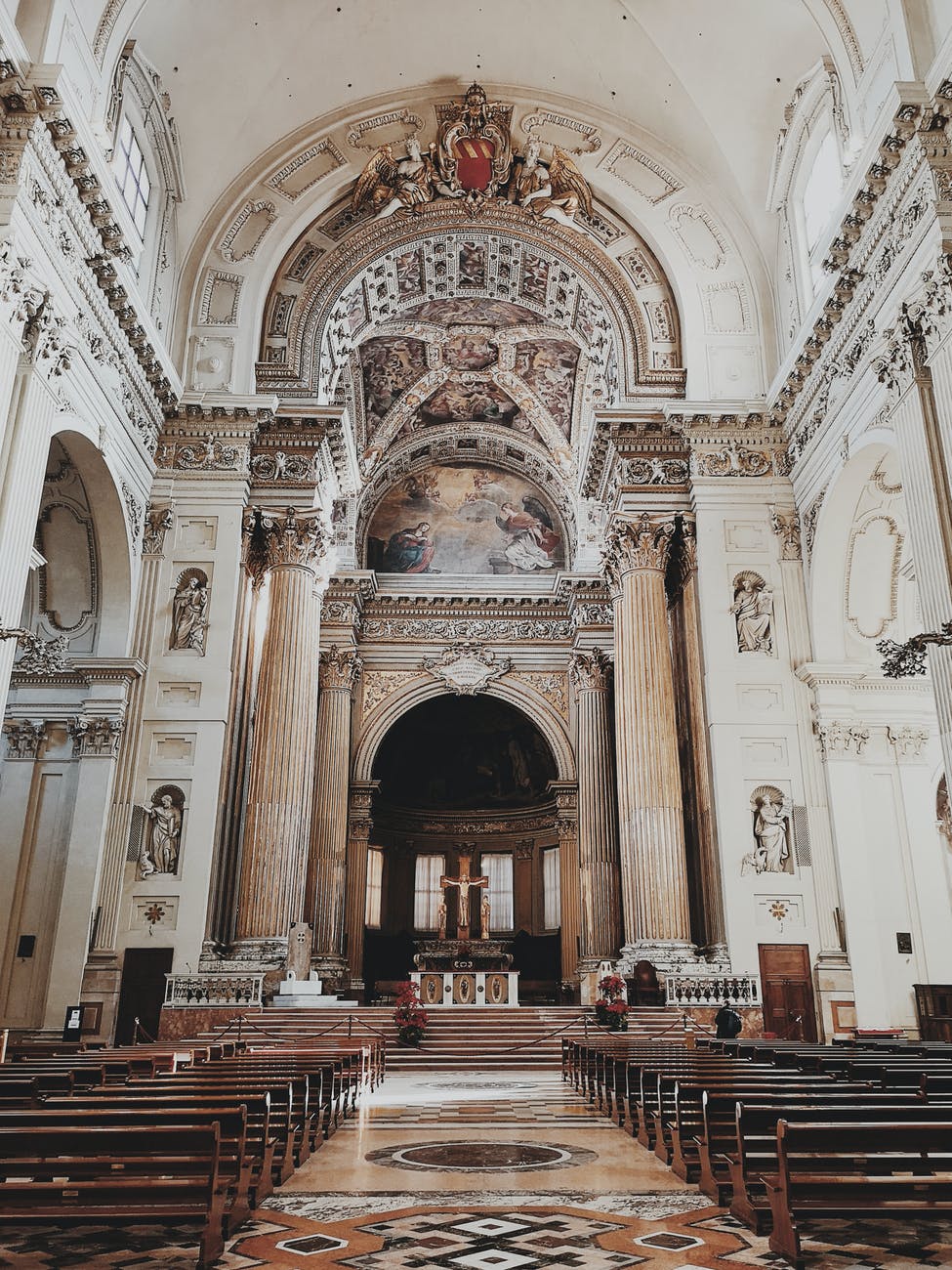
Complex organizations typically have many levels of organizations. In life, there are cells which often have symmetry. The human body has large-scale bilateral symmetry (two eyes, two ears, two arms, two legs, two sides to the brain, etc.). If we look at our hands, we see a thumb and four fingers. Each finger, and the thumb, each have roughly bilateral symmetry. Symmetries such as these are visible.
There are also often functional symmetries in living systems as well. We breathe in. We breath out. Our nervous system has excitatory circuits and inhibitory circuits. Most complex organisms reproduce via two sexes. Many animals have cycles of sleep and wakefulness. Often birds, and other animals have migrations tied to the cycle of the seasons. Trees are able to draw water up and move water down.
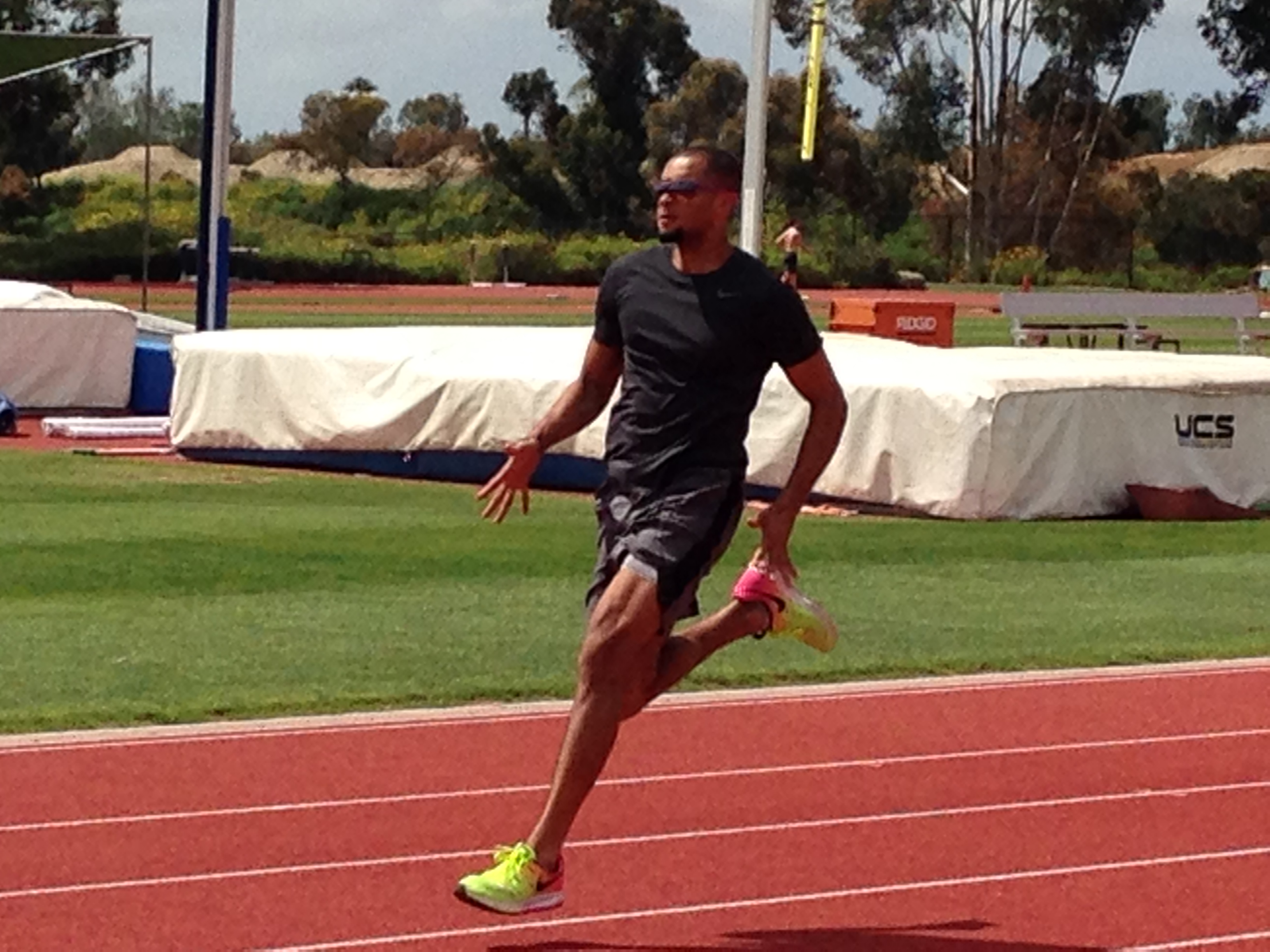
The structural symmetries and the functional symmetries are often connected. When a person runs, for example, they use one leg and then the other. In fact, as your left leg goes forward, typically so does your right arm. As you move your right leg forward, you move you left arm forward. As you breathe in, your rib cage expands on both sides symmetrically. As you breathe out, your rib cage contracts on both sides symmetrically.
Human organizations often have functional symmetries as well as structural symmetries. For example, most organizations have an “onboarding process” as well as a “termination process.” Our physical artifacts often exhibit local symmetries and these are often related to our physical and behavioral symmetries. A long boat, for instance, allows for multiple rowers to row in unison. The boat and oars are symmetrical and so is the rowing of the boat.
Human artifacts of many scales may exhibit local symmetries for two reasons. First, since most natural living things exhibit local symmetries, copying that may strike us a more beautiful. In addition, if one learns the skills necessary to make the left half of a canoe, one already knows a lot about how to make the right half, provided the canoe has bilateral symmetry. The same is true of an oar, a cane, a bowl, etc. It also makes it easier for the user of the artifact.
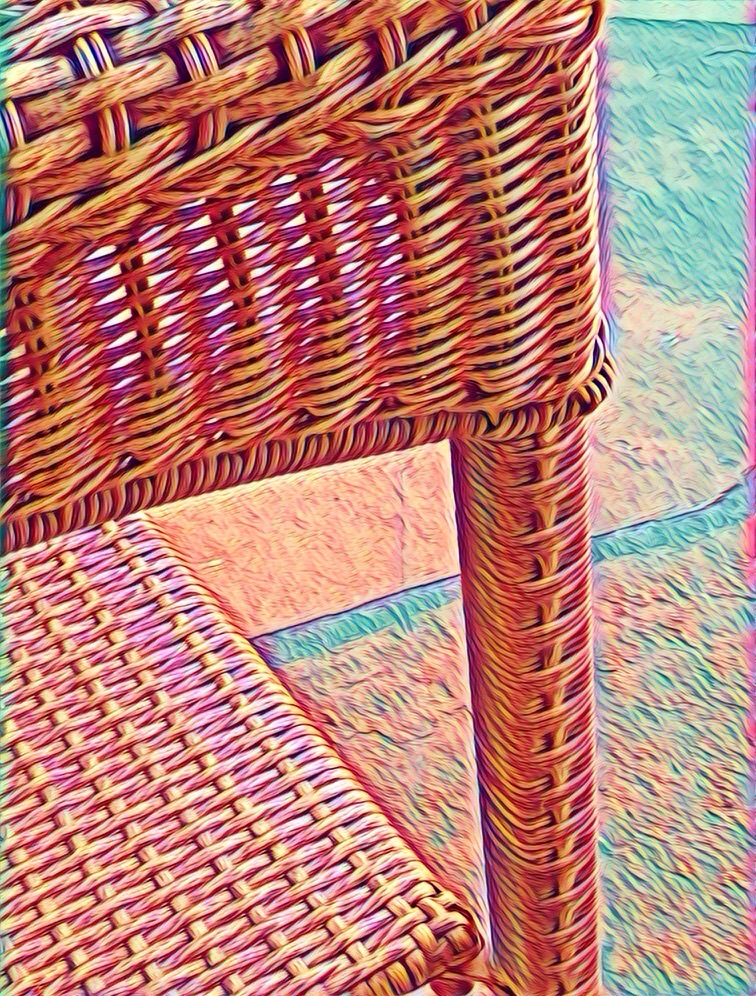
As a user of an artifact such a chair, for example, you come to expect that the right arm rest and the left arm rest will be at the same height and be equally hard. If the arm rests are at different heights, you will, I believe, be more likely to bang your elbow when shifting position or reaching for something.
One could, no doubt, adapt fairly quickly to a chair which had two different kinds of arm rests, but imagine a keyboard for your computer in which every key was a different size and shape. Or, imagine a piano keyboard in which all the keys were at different spacings, and sizes.
Local symmetries also offer another advantage. Systems with local symmetries are easier to repair or maintain. Imagine how much more expensive it would be to maintain a piano, for example, if a repair shop had to keep 88 different sizes of keys! In a similar fashion, imagine a programmer decided it would be fun to program every pull-down menu with completely different algorithms. When the next release of the application required changes or additions, it would make understanding and modifying the code much more difficult.
Why does local symmetry, as opposed to merely, symmetry, make sense? Let’s go back to the chair example. It might make sense for a family to have three chairs for three different sized people; e.g., a papa bear chair, a mama bear chair, and a baby bear chair. Or, think of tee-shirts that come in Small, Medium, Large, and Extra Large. It makes no sense to make every tee-shirt the same size. People differ a lot in their size. But for mass manufacturing, it does make sense that the left and right sleeves match for any particular size. Similarly, it doesn’t matter that the arms on papa bear’s chair are of a different size than the arms on baby bear’s chair. It doesn’t matter if the teeth on my comb are different from the teeth on your comb. It doesn’t matter if the tires on my Saab match the tires on your Range Rover. And, generally, this is true for most artifacts, organizational structures, architectural features, and anatomical features. Local symmetry almost always has four advantages: 1) it adds to beauty. 2) it’s easier to create 3) it’s easier for the user and 4) it’s easier to maintain or repair.
Design always carries messages. Design which solves our problem or beautifies our world or resonates and echoes the properties of natural beauty carries the messages: “I care. I am a bit like you. I am making this for you and others like us. It shows the beauty that I see is a lot like the beauty (and usefulness) that you see. You are not alone. We are in this together. You and I both belong to “Team Humanity.”
What could be more important?
On the other hand, (notice the oblique reference to symmetry) when I look at most of the screens of most of the interfaces I deal with on a daily basis, there is generally a decided lack of local symmetry. Would they look more natural and more beautiful if there were more local symmetry. I think so. What’s less clear is whether they would be more usable. Much of the screen is taken up with words and icons. In drop-down, pop-up, and flyover menus, there are lists which mainly consist of words. Words, by virtue of the nature of written language are of different lengths.
On the other hand, programming languages and functionalities often do exhibit local symmetry. This probably makes learning and using such languages more tractable.
The Winning Weekend Warrior focuses on the mental game for all sports using examples from tennis, golf, baseball, and other sports. It covers self-talk, imagery, mental practice, strategy, tactics, & sportsmanship. http://tinyurl.com/ng2heq3
Turing’s Nightmares explores the implications and ethics of Artificial Intelligence through fictional short stories. http://tinyurl.com/hz6dg2d
Fit in Bits shows many ways to put more fun, variety, & exercise into daily chores and habits to help with strength, flexibility, fitness, and balance. http://tinyurl.com/h6c7fce
Tales from an American Childhood recounts early experiences mainly in the American Midwest in the 1950’s and relates them to contemporary issues and events. https://tinyurl.com/y9ajvz9j
Dream Planet. Where do you run when the whole world is crumbling under the weight of human folly? When the lethal Conformers invade 22nd century Pittsburgh, escape becomes the top priority for lovebird scavengers Alex and Eva.
Good Shape. Positive Space. These seem to be highly related concepts. Most of the pictures I used as illustrations of Positive Space could equally well illustrate Good Shape. A Positive Space is often composed of multiple good shapes arranged in a “balanced way.”
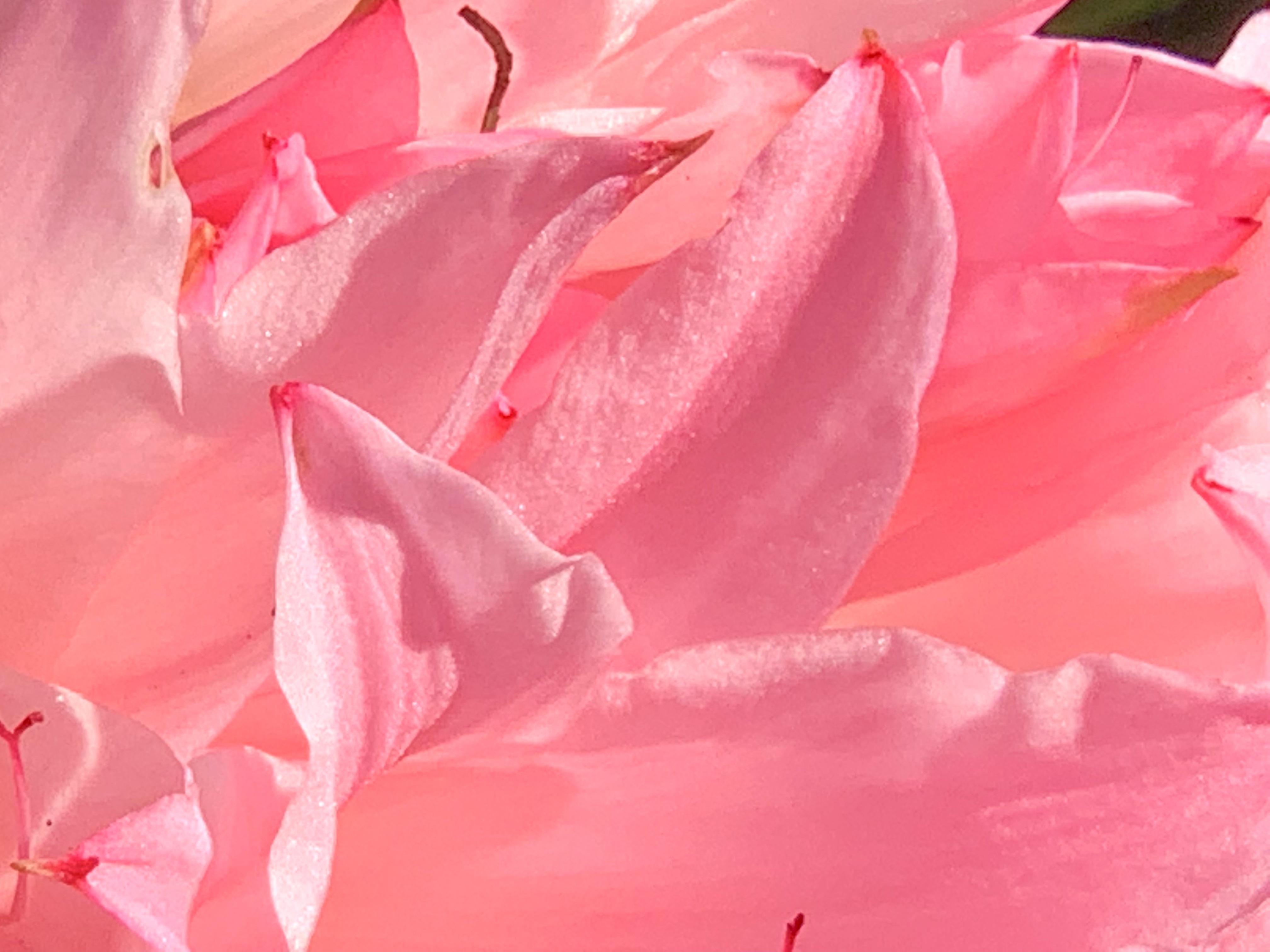
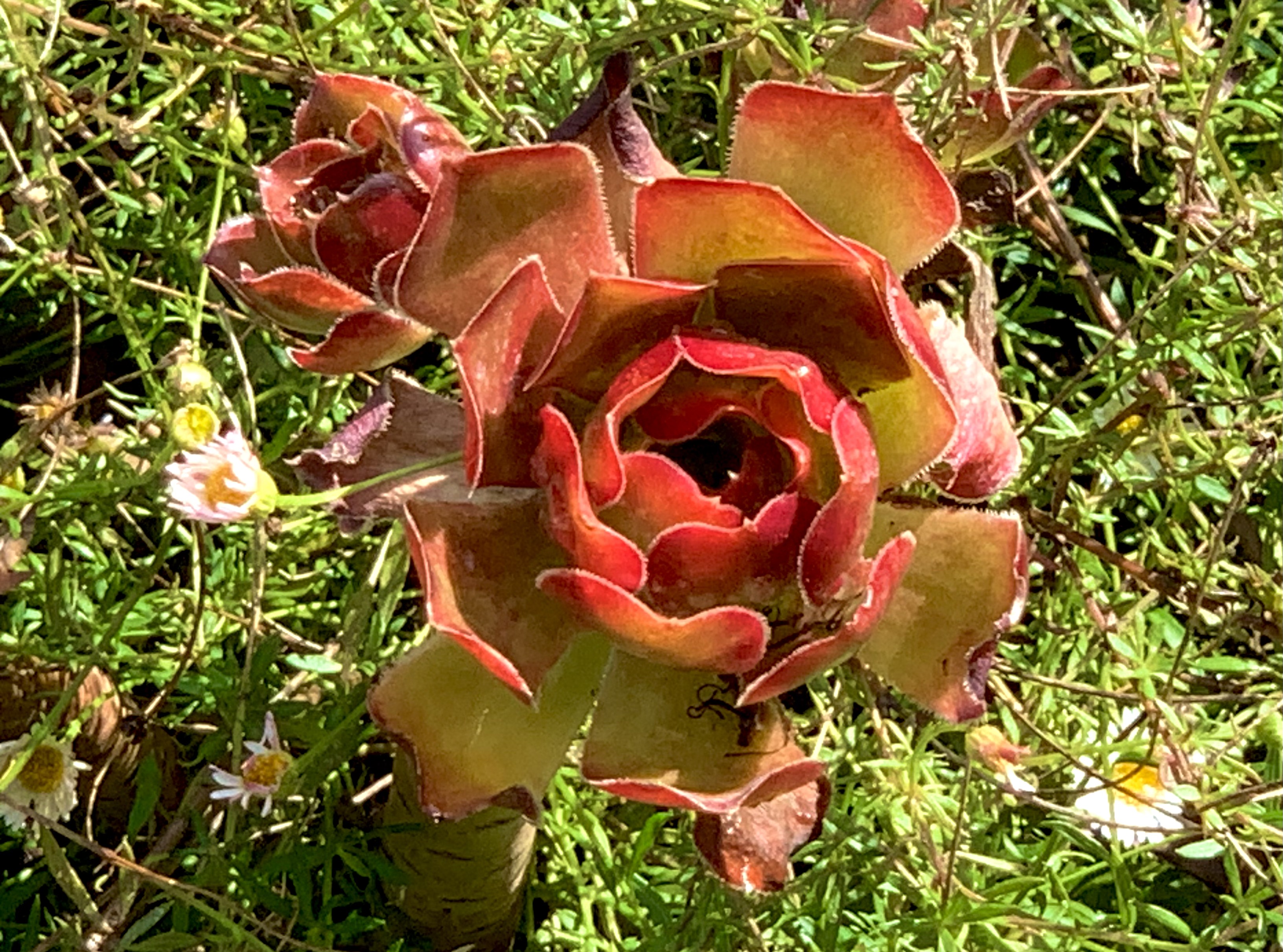
In order to illustrate “Good Shape,” I decided to take some pictures to illustrate “Bad Shape.” Since I have surrounded myself mainly with nature or with artifacts that were intentionally designed to be aesthetically pleasing, it turned out to be more difficult than I imagined at first. The other issue is that when I take photographs, I (like most people) “frame” the picture so that “Good Shape” is clear. I began to intentionally brake that habitual way of framing with pictures of flowers that overlap. The natural beauty of flowers is so rich that, to me, even a quasi-random framing still results in a beautiful picture.
This turns out not to be the case with artifacts however.
Although some of the elements of this seem to have “Good Shape,” the overall composition lacks a coherent center. It seems to me to be an artificial “kludge” of colors, textures, and shapes and there is no overall “Good Shape.”
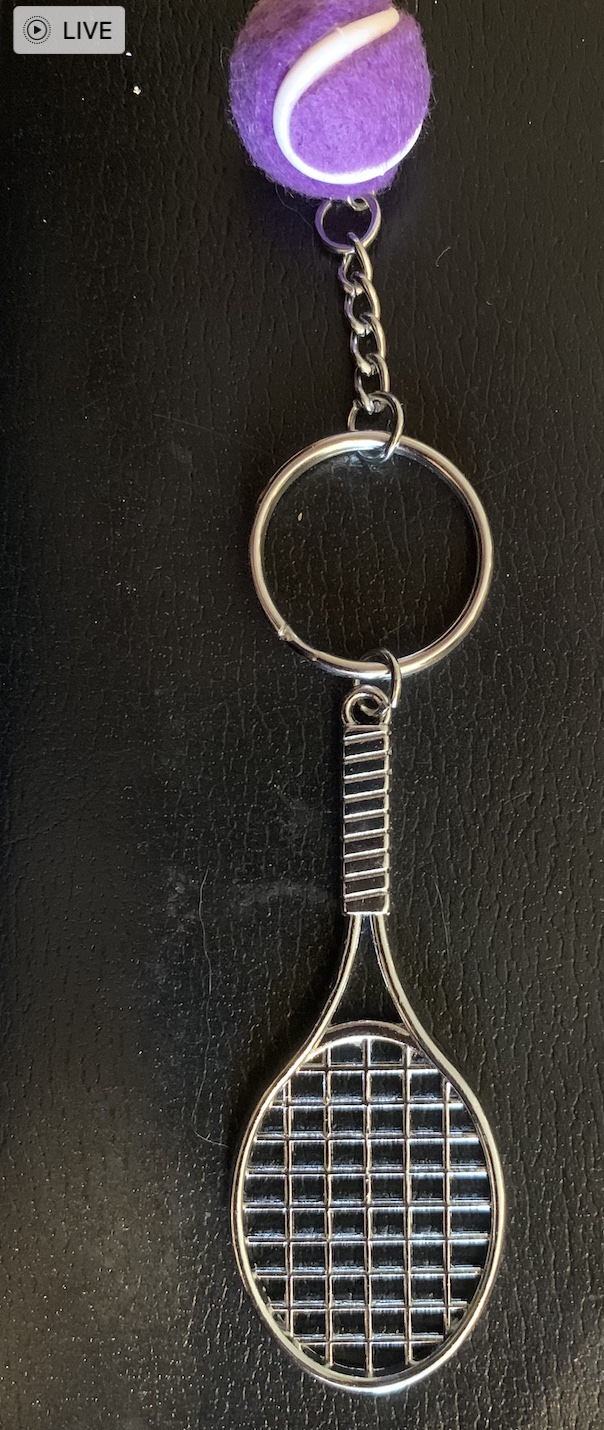
By re-arranging the elements into this form (above), to me, it seems to get closer to “Good Shape” but the purple “tennis ball” seems ill-proportioned and out of place. In “real tennis” there is a physical reason for the ball to be fuzzy but here, the fuzziness of the ball seems added on and arbitrary.
Here too (above), the overall composition lacks “Good Shape.” The large semi-random dark blob in the middle has no real “Center.” The elements around the edges do not cohere or reflect off of each other. None of the elements around the edges are complete enough to have “Good Shape” except possibly the links of the small chain.
Here is another example of quasi-random elements brought together into a single picture. Though to me, both the wood and the stone are in and of themselves beautiful, there is nothing about the composition that integrates into a whole. There is no center, no echoes, no alternating repetition, no levels of scale, and despite the nice texture of the stone and wood, the overall effect, to me, is lacking in “Natural Order” and in beauty.
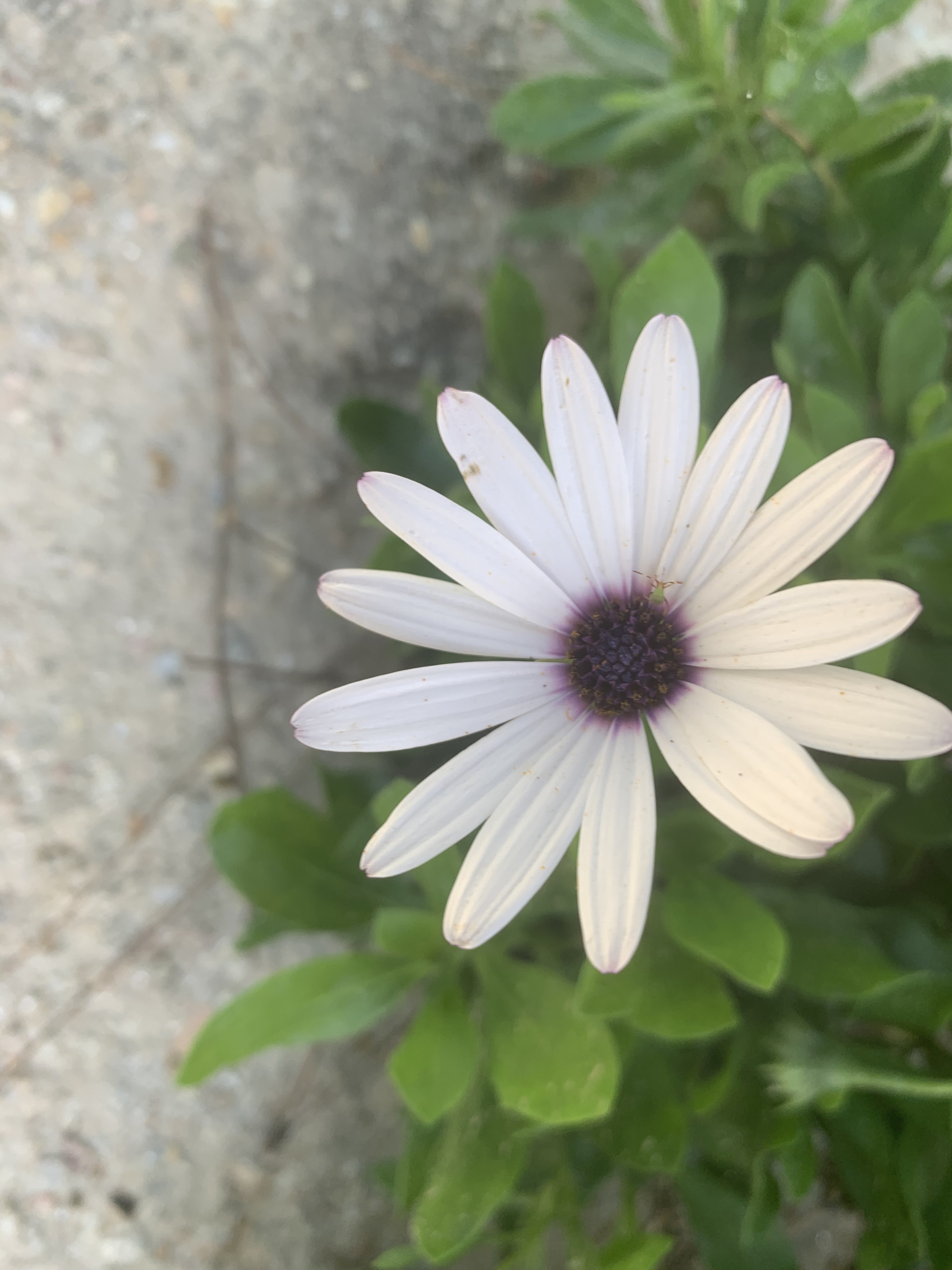
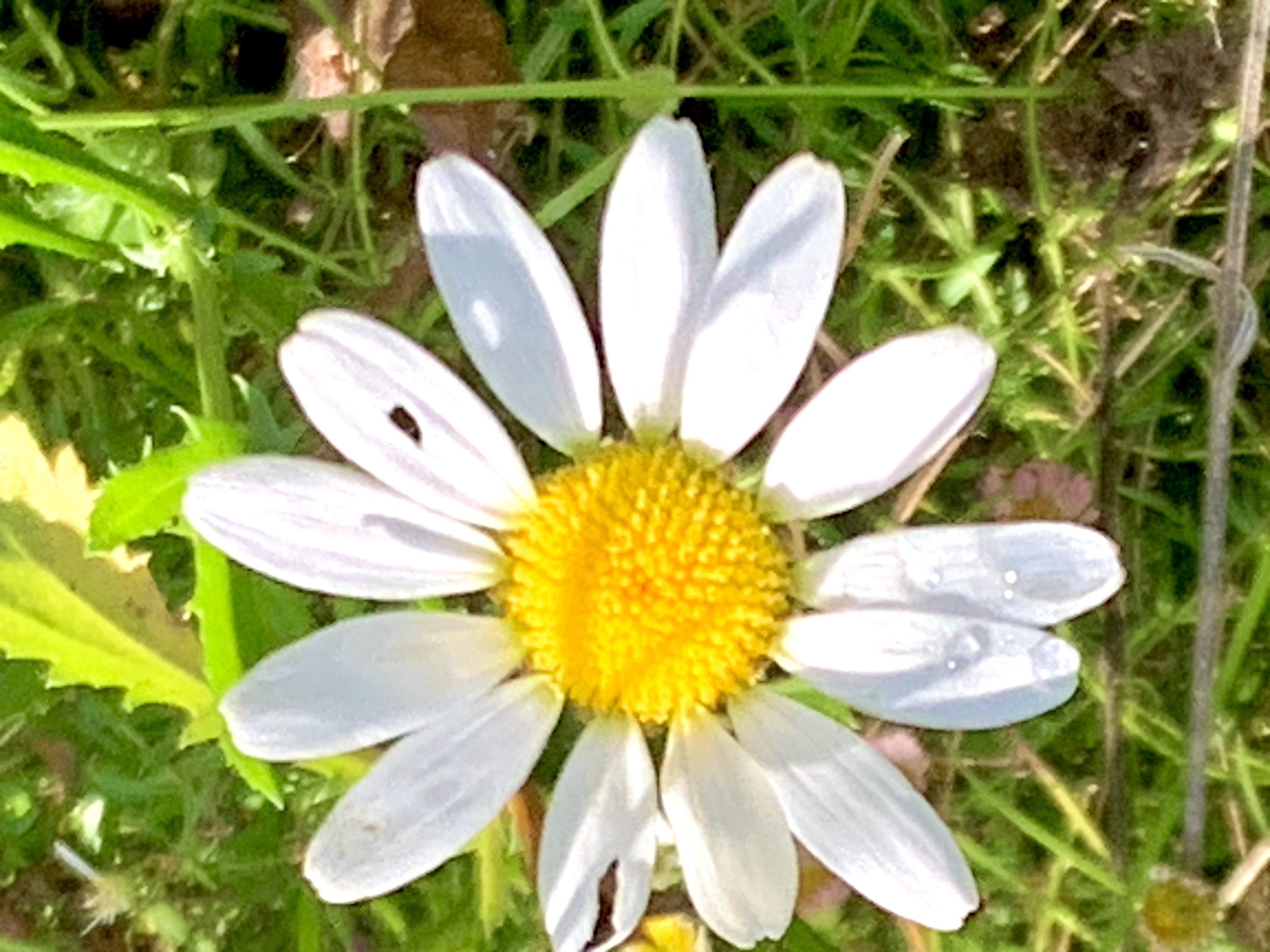
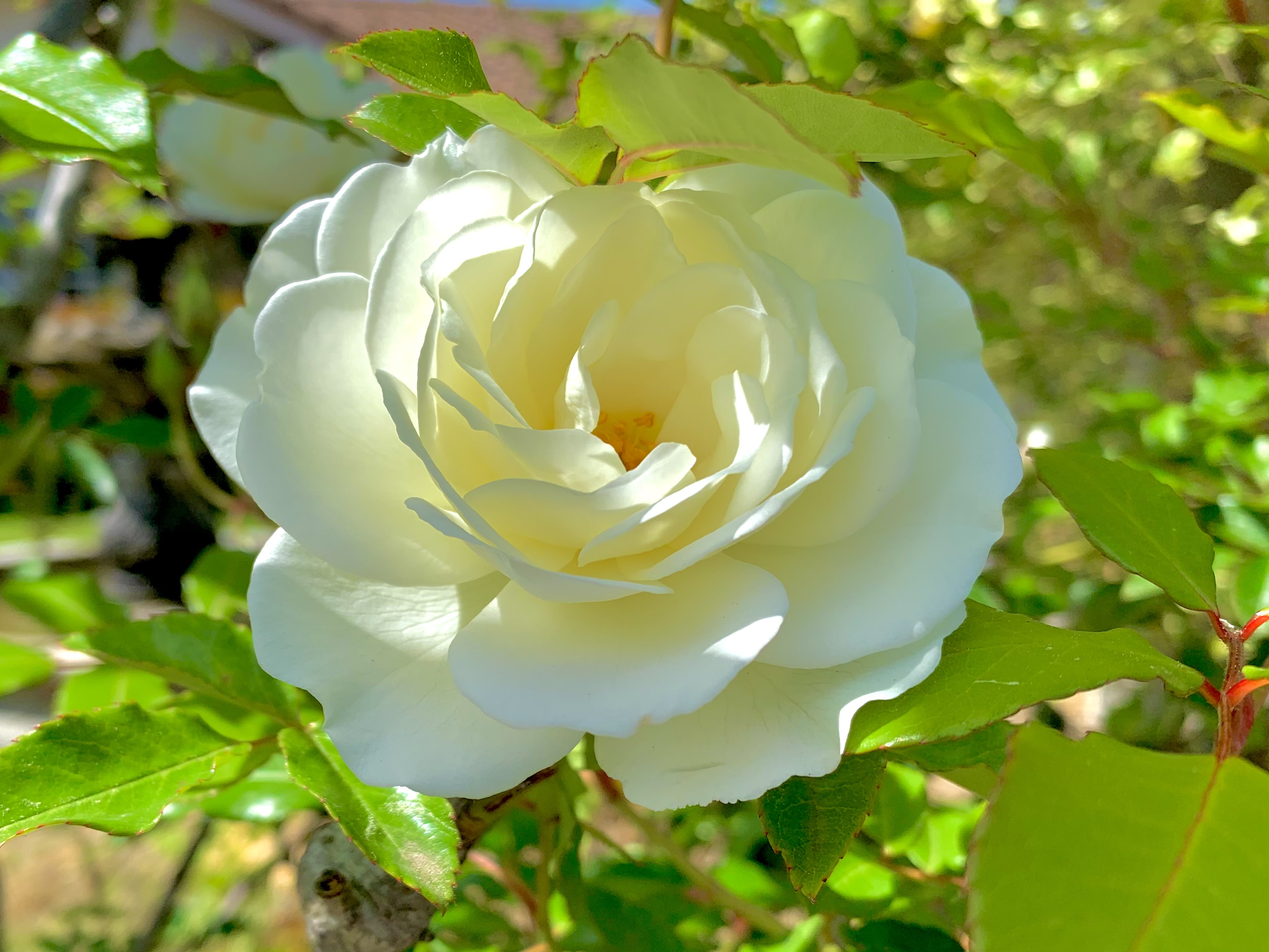
By way of contrast, the flower here seems to have a good overall shape reinforced by a Strong Center, Alternating Repetition, and each of the petals themselves has Good Shape. Around the flower, to me, is a “Positive Space.” Note that one of the petals seems slightly out of place. To me, however, this does not spoil the “Good Shape.”
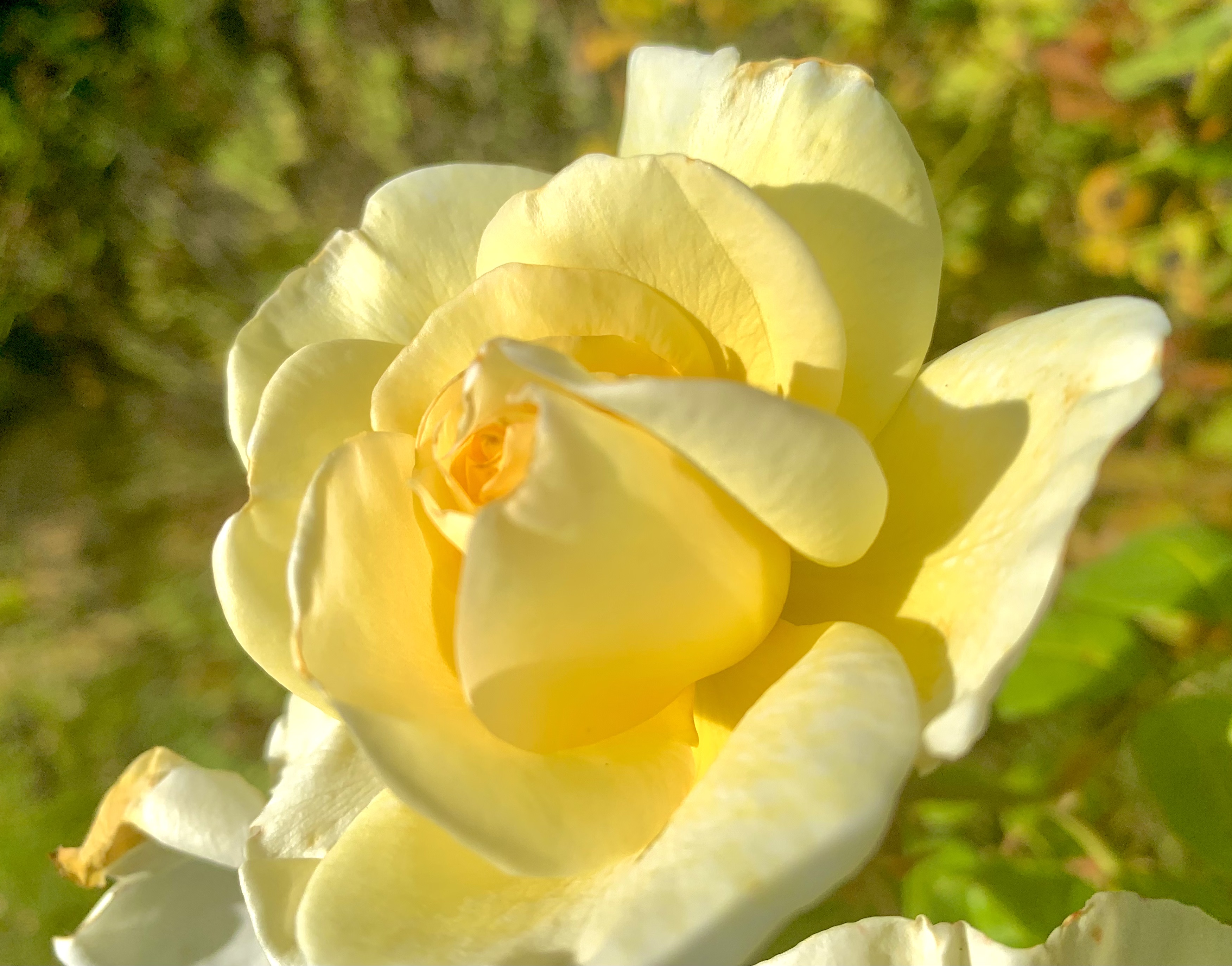
The same can be said of these flowers.
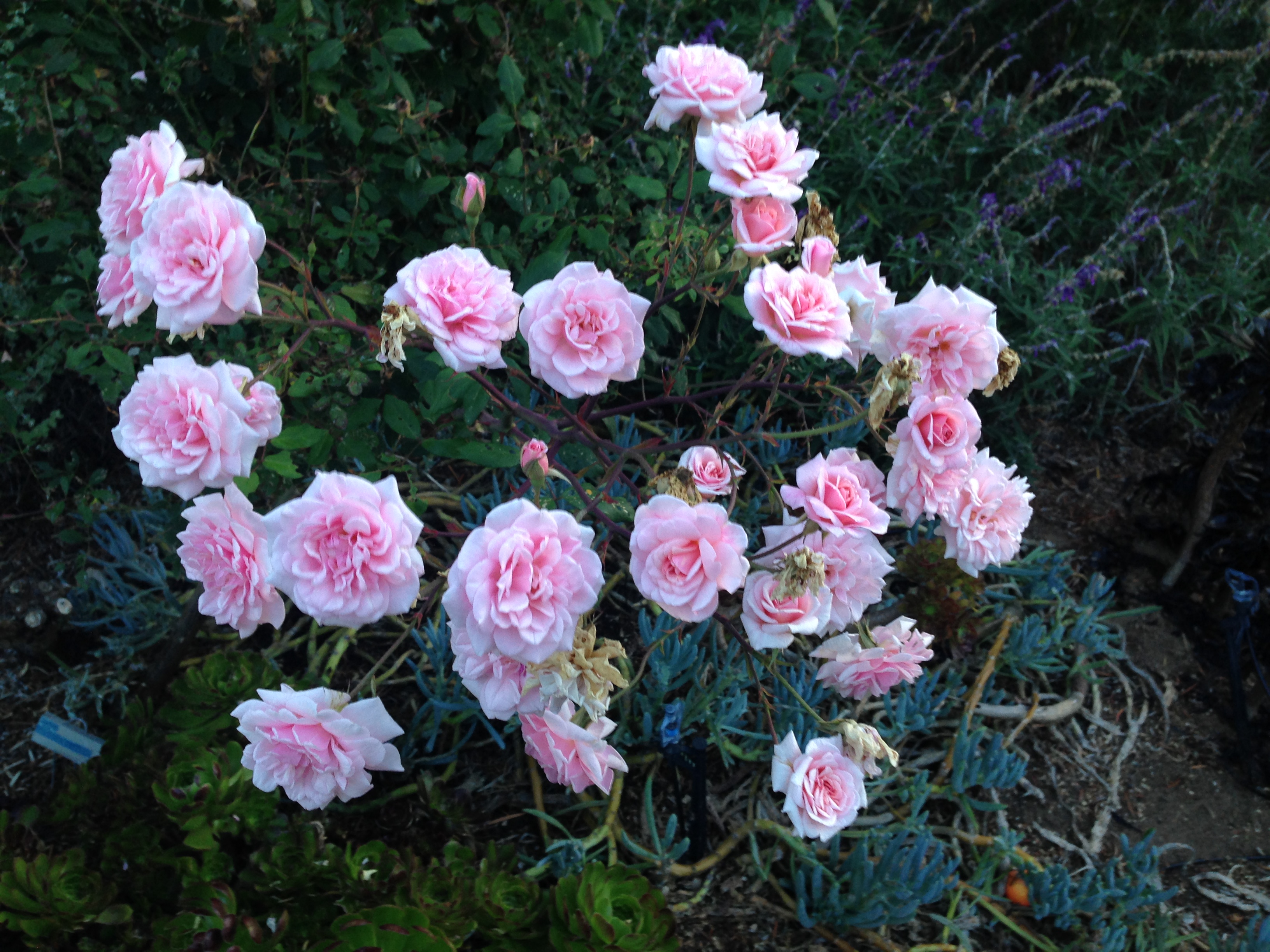
It isn’t necessary to have overall “simplicity” in order to have “Good Shape.” These flowers are not “simple” in shape, but they still have “Good Shape.”
The bird on a branch shown above seems to me to have “Good Shape” even though it is (in outline) lacking symmetry. Though lacking symmetry in profile, the shape strikes me as “balanced.” I don’t perceive the bird as having to exert a lot of energy to keep from “falling off the branch.” The bird’s shape, like the shapes of most animals and plants is the result of 4.5 billion years of evolutionary history.
Many people view some creatures as “enemies” and therefore “creepy” or “yucky” or perhaps even as dangerous. If you can set that aside and simply look though, I think you can see that “Good Shape” characterizes all sorts of animals (as well as plants).
At a more abstract level, it even seems that natural animal behavior often shows beauty. That also seems characteristic of skilled human behavior. The Olympics show plenty of examples. It is hard to imagine an “ugly” baseball swing resulting in a home run. The runners, jumpers, throwers, gymnasts, tennis players, and so on produce “Good Shape” in three spatial dimensions and one temporal dimension.
I play tennis several times a week. I’m not averse to winning a point even if the ball hits my frame, skids off to the net cord and drops over for a winner. But — I never feel as pleased by such outsized luck as when I hit a good shot that results from proper choice, preparation, and execution (and a history of practice and reflection). I never think of a lucky mis-hit as “beautiful.”
The concept of “Good Shape” even applies to more complex human organizations and endeavors. Racism, for instance, to me is truly ugly. It is not based on truth, but on a kludge of lies masquerading as truth. White Supremacy for instance, basically says, “We’re white! That makes us superior! In fact, we’re so superior, that we insist every aspect of our society be tilted so we can be guaranteed a win!”
Huh?
Bad logic is never beautiful.
The “Good Shape” exhibited by most plants and animals reflects both a long evolutionary balance of forces (phylogeny) and the development of a particular organism (ontogeny). When biology goes awry, as in cancer, the result is not beauty. The “logic” of cancer is that billions of years of evolution that allows our bodies to work harmoniously is put aside for short-sighted egotism. A random cell says, in effect, “I’m no longer going to do my part for the body as a whole. Instead, I’m going to grab all I can for myself and grow in an unrestricted way!”
Such a cell, by making that decision, signs its own death warrant. Either the body destroys the cancer and therefore the cancer dies — or, the cancer prevails and in that case it destroys the life of the organism it was supposed to be a part of — and then it dies anyway! It’s an “ugly” decision both because it is disproportionate and because it is illogical. It aims to be self-serving, but it is not even self-serving. It guarantees its own death and kills more life along the way.
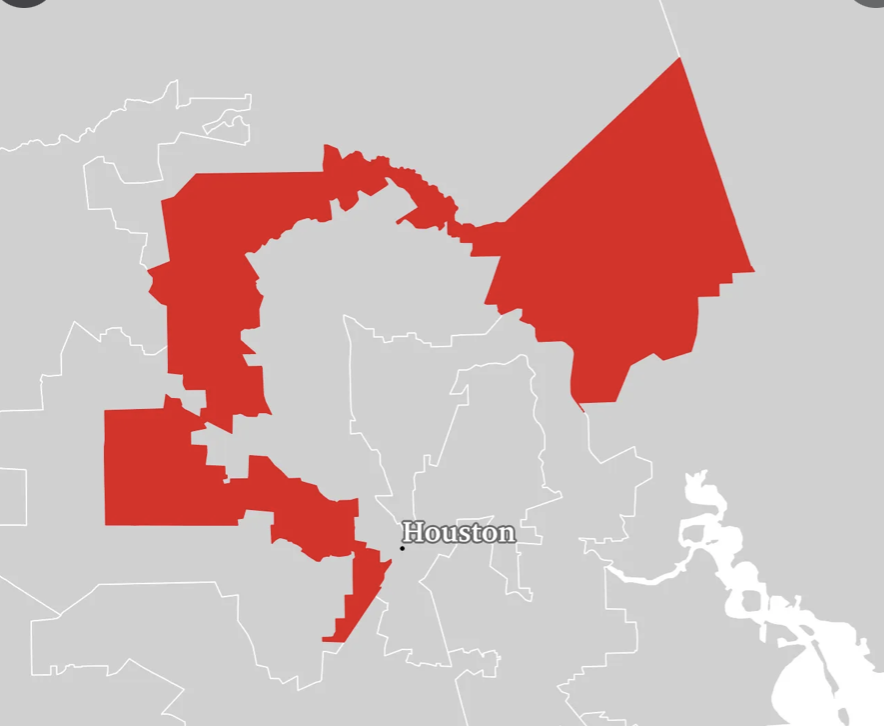
It’s the same, to me, with any dysfunctional human organization. If democracy is perverted by some people demanding that decisions be made so that they can have their way regardless of how it impacts the overall tree of life and the overall health of a city, state, or nation, it lacks “Good Shape” and instead becomes a distorted kludge lacking symmetry, lacking balance, lacking life. It is no accident that “Gerrymandered” districts do not have “Good Shape.”
In extreme cases, not surprisingly, dictatorships have resulted in a war on truth, beauty, and life itself. It’s no “accident” that Hitler, Stalin, and Mao were each responsible for millions of human deaths. Their activities also show utter disregard for the beauty of the natural environment and the plants and animals of the planet.
When it comes to User Experience, the most obvious way to apply “Good Shape” is to the visual elements of the interface — icons, windows, menus, tool bars etc. However, I think it also applies to the design process. Are the needs of all stakeholders taken into consideration?
Do the various disciplines involved in design respect each other? Do people tell the truth and show trust? Does the company treat its users with respect and tell the truth in its various communications?
If a company provides “free games” or “free services” that are purportedly for entertainment or education but the real purpose is to gather data to sell to advertisers or foreign powers trying to use the data to destroy democracy, it would seem to me that business model itself — the raison d’êtrefor the entire project is an “ugly shape” regardless of how pretty the icons are.
What do you think? Do the concepts of natural beauty apply to the design of organizations and even governments?
(This is the fifth in a series of 15 blogs that explore Christopher Alexander’s “Fifteen Properties” of good design, natural beauty, living spaces, etc.).
Life is a dance on the edge between chaos, on the one hand, and sameness & repetition on the other hand. Repetition without variation or change is not life. On the other hand, endless random variation without any pattern or principle is also not life. Planet Earth is sometimes said to be a “Goldilocks Planet” — not too hot and not too cold — to support life. Most of the life forms on planet earth themselves exhibit a “positive shape” — a shape that wants to expand and fill out — and yet, there are limits because of circulation, gravity, communication etc. so that growth is typically not unrestricted. The tension between trying to grow and having to stick close enough to form creates positive space.
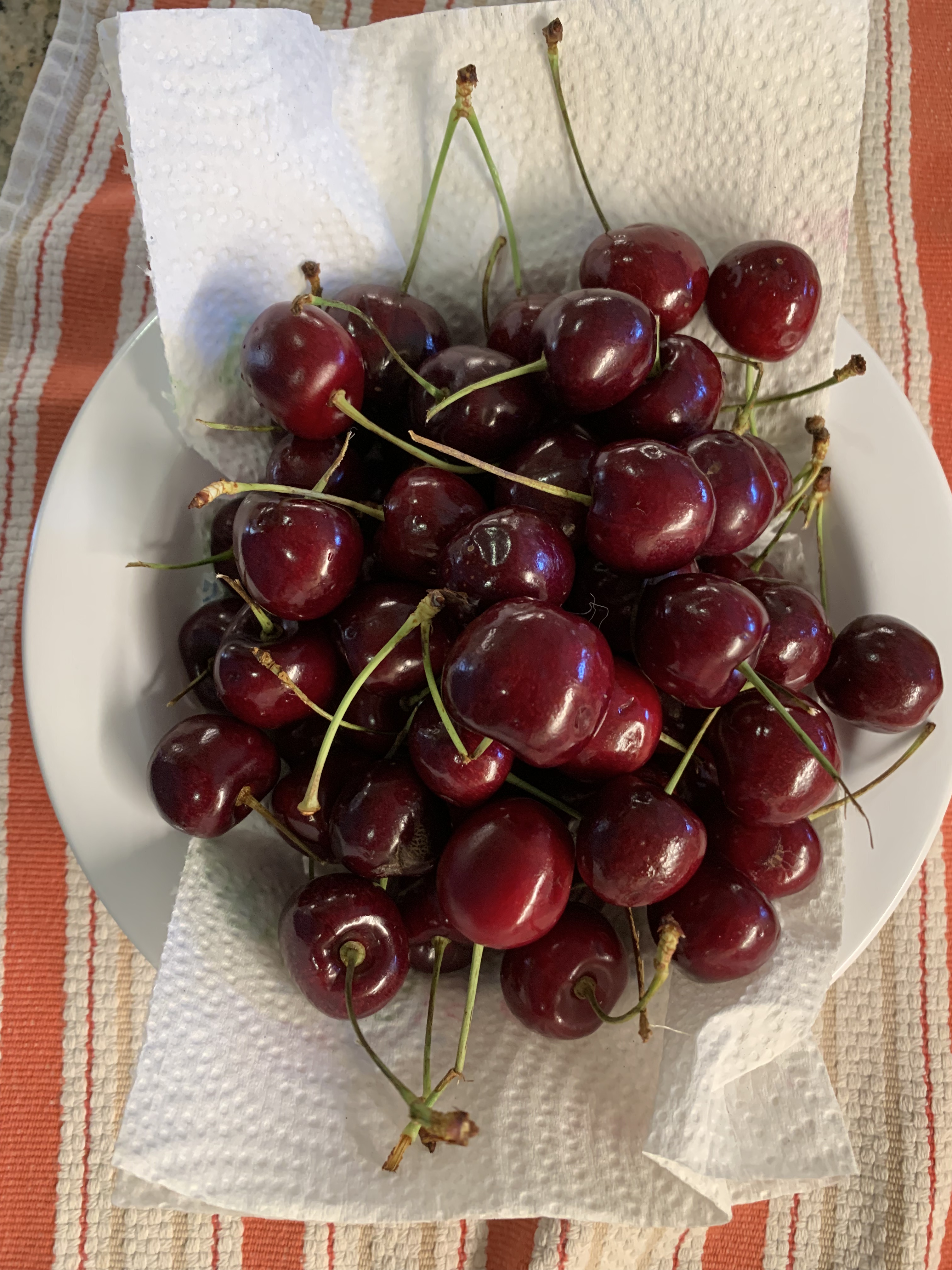
Life may not always be “a bowl of cherries” but nonetheless, a bowl of cherries does illustrate the property of “positive space.” The bowl connotes living things trying to expand right up to the boundaries possible. A bowl that is filled with cherries and even slightly over-filled but without inducing a fear of spillage, to me, connotes life being vigorous and healthy. To me, a single cherry sitting all alone in a large bowl seems to exhibit positive space much less — at least at the scale of the bowl.
When I look at an individual cherry, I also see positive space. The cherry is not a perfect sphere, featureless and smooth. If it were, to me, it would be a much less positive space. The fact that there is a stem and a noticeable indentation where the stem goes provides a kind of center. So too does the slight asymmetry of the cherry. It appears as though it might have developed as two halves that tried to circle a space at the same time from two different directions – clockwise and counterclockwise. They met and merged to form the almost spherical cherry.
The lobes of this red pepper show positive shape.
The cherry is not the only natural food that has this kind of positive space. Think of corn on the cob. Each kernel seems to have tried to grow as large as it can. It pushes up against and into other kernels. Each kernel seems therefore to be “bursting with life.”
Consider a cucumber. It’s roughly cylindrical. But “roughly” is important here. To me, it would seem much less an example of “Positive Space” if it were literally a cylinder. It tapers at the ends and it bulges at the middle. That seems more “positive.”
To a person who doesn’t understand that life is primarily a cooperative endeavor among all the parts of the vast tree of life, but instead sees the world only as a zero-sum game, it must seem as though the positive living space of a cucumber makes the space around the cucumber less positive and less living. But this is not true! The space around the cucumber’s slightly rotund shape is much more positive and living than the space around a perfect cylinder.
Think of a tree trunk compared with a telephone pole. They are both made of wood and they are both approximately cylindrical. But a tree trunk feels much more alive to us than a telephone pole. I don’t think this is simply because we “know” a tree is alive. It looks more alive and if you allow yourself to “tune in” to it, it feels more alive. And, importantly, not only does the space that the tree inhabits seem more living. So too does the space around it! A long line of telephone poles may exhibit “Levels of Scale” and “Alternating Repetition” and such a picture may make us feel some life to it.
But a single telephone pole does nothing to stir life in me. In that sense, it’s nothing like a tree. It’s flat and it kills the space on either side as well. The columns in the Parthenon are roughly cylindrical and obviously not literally alive. But they, unlike a telephone pole, have positive space and create positive space around them. Life is not fundamentally a zero-sum game. The bee does not “steal” the flowers pollen and thus damage the flower. The bee helps the flower. The flower helps the bee. Positive space in an object does not steal from or detract from the space around the object. It enhances it!
Similarly, the “competition” for space among the kernels of corn on a cob of corn shows that competition can be a beautiful thing. I like to see the kernels pushing against each other. All of them seem living and positive. Imagine instead a cob of corn in which one kernel had grown like a giant spider of orange cancer and took up 98% of the cob. Aside from this one ultra-greedy cell, there were only a few widely spaced and shriveled up kernels. Would you pick that from the pile of corn? Would you want to slather it with butter and bite into it? I sure wouldn’t! And to me, that is exactly what cruelty, unfairness, and greed look like. It might seem positive — after all, the dictator is trying to “grow.” That is true but he’s rigged the game. Competition is no longer beautiful when the game is rigged. Competition is no longer beautiful when your tennis opponent slices off your leg before the match starts or pays off the chair umpire to call everything you hit out.
I don’t think there’s anything particularly special about cucumbers or cherries or corn. I just happened to have been washing vegetables before writing this. These radishes also exhibit positive space. And, although their shape is not the same as a cherry or a cucumber, the radishes also enhance the space around them. And, so does the avocado. An avocado that is just past ideal ripeness begins to flatten irregularly and the “pebbles” of the skin also flatten making a less positive space. The pebbles of a perfectly ripe avocado are themselves tiny positive spaces that add to the overall impression of vigor.
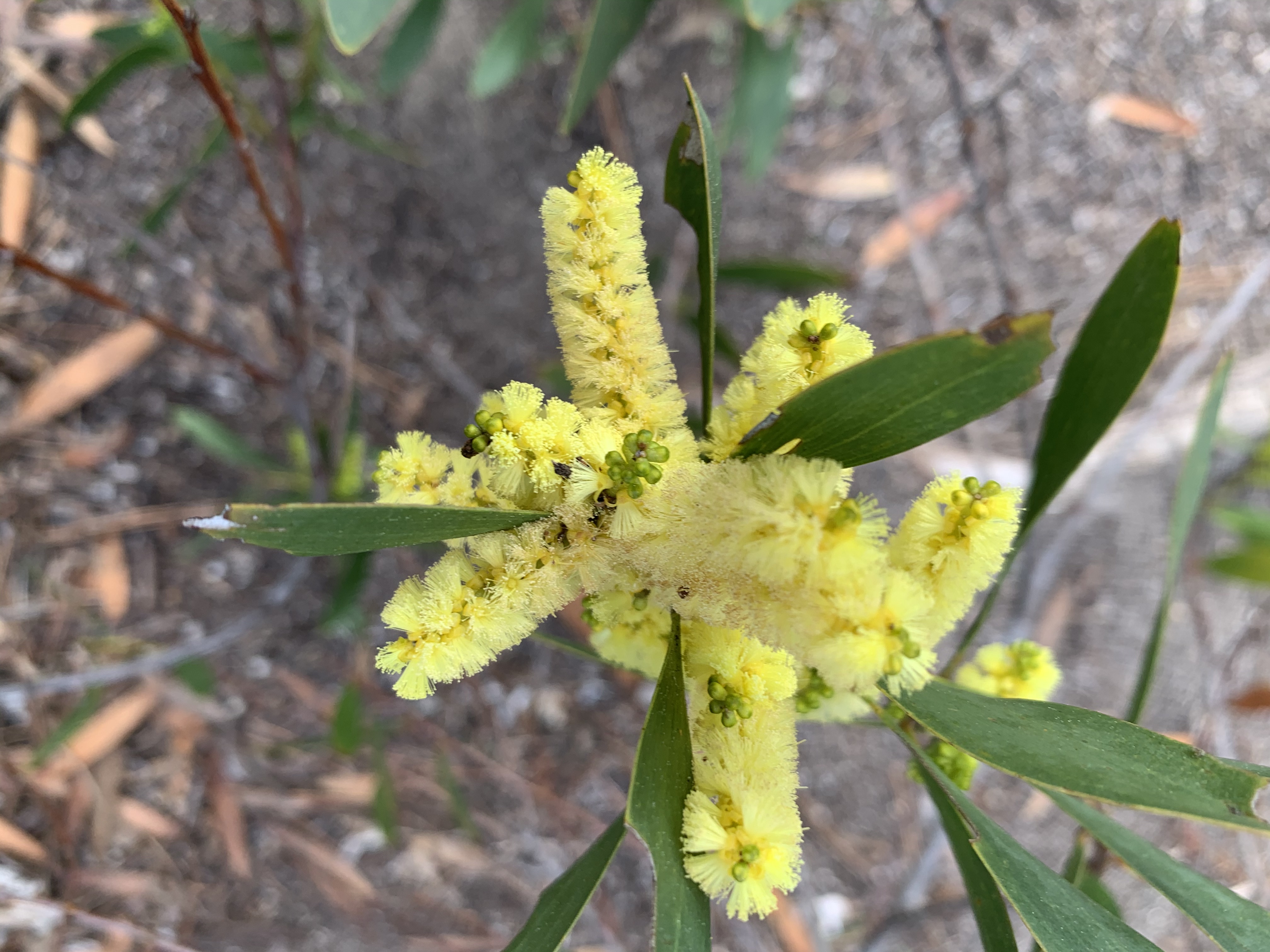
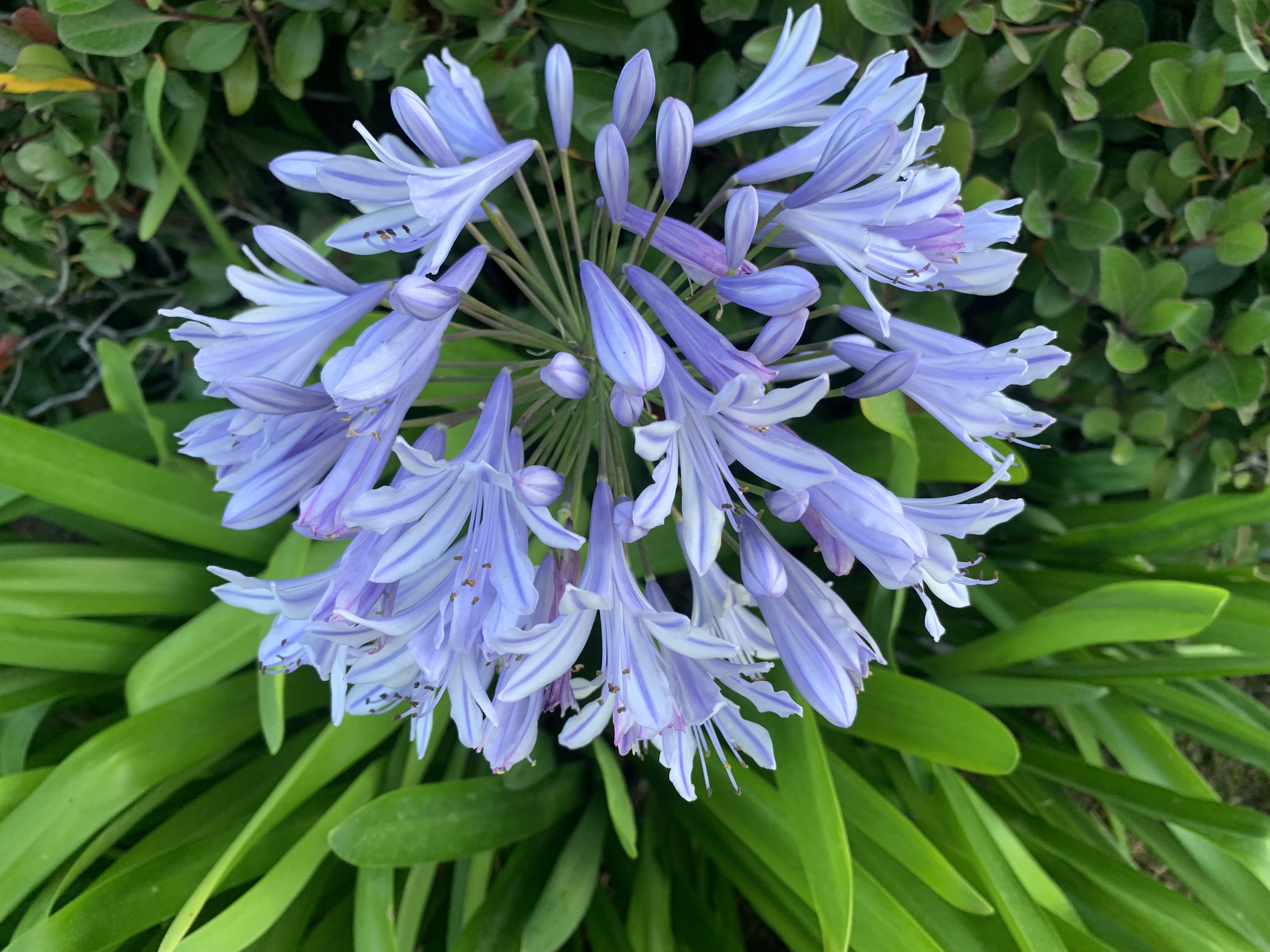
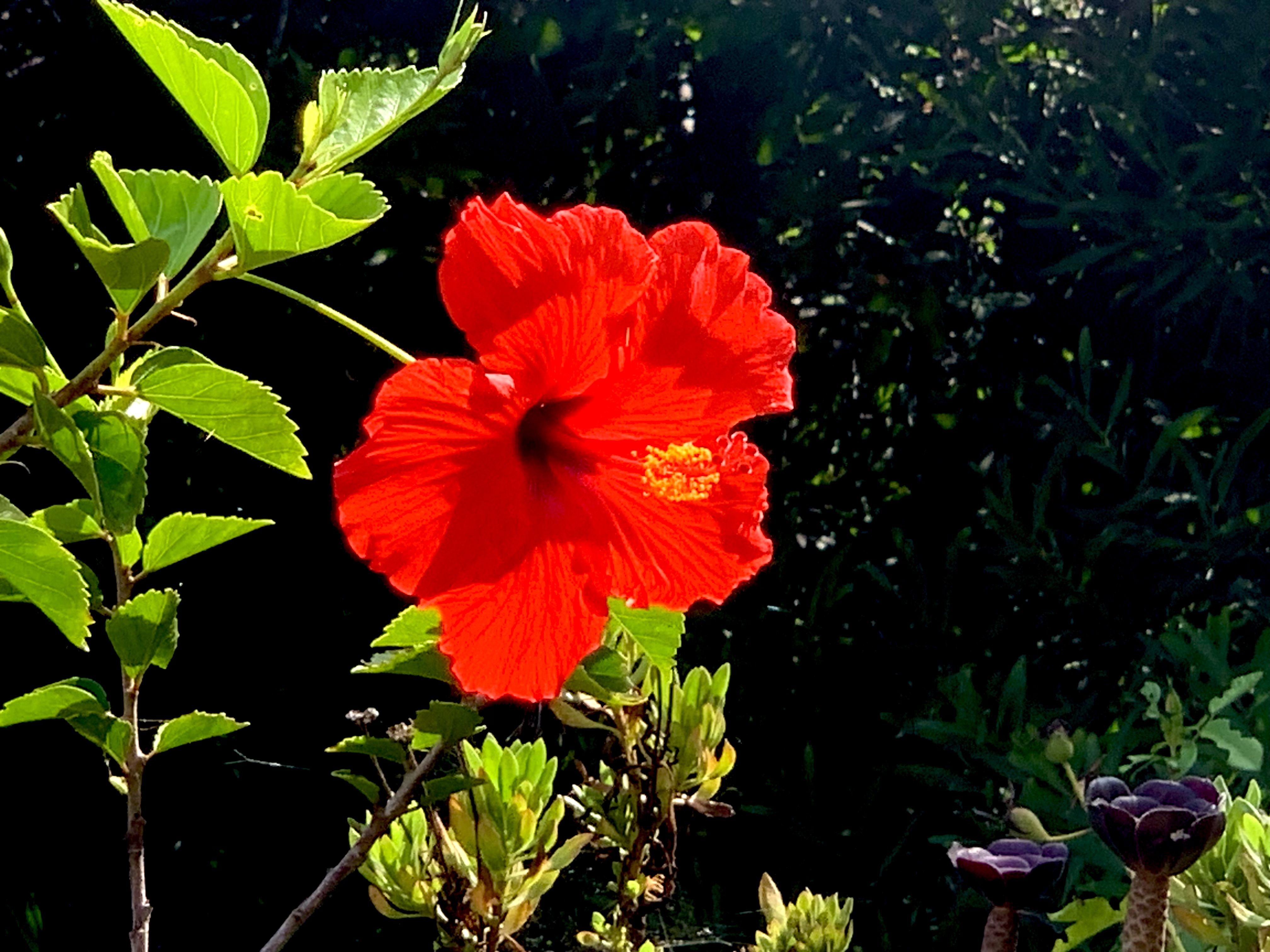
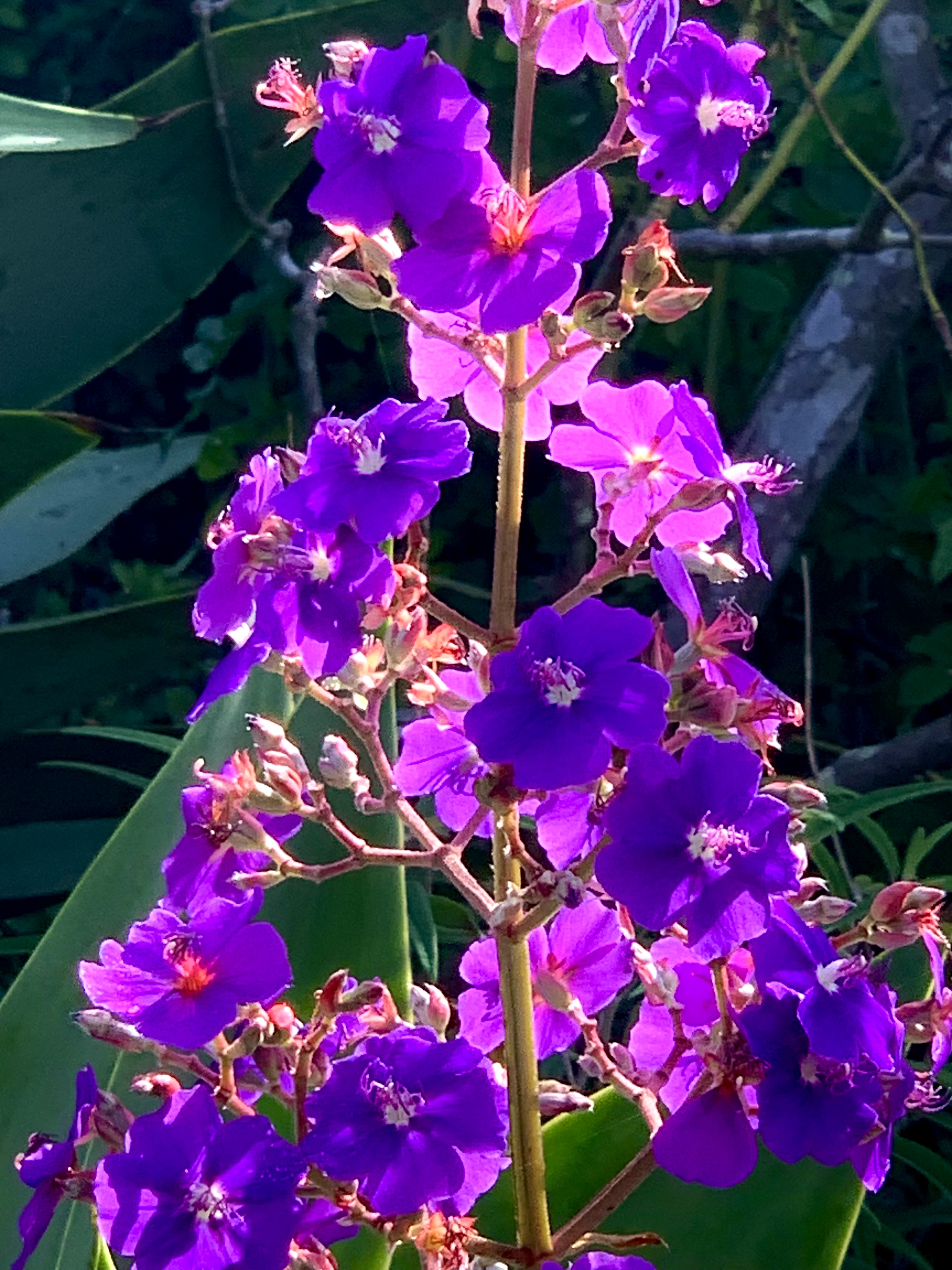
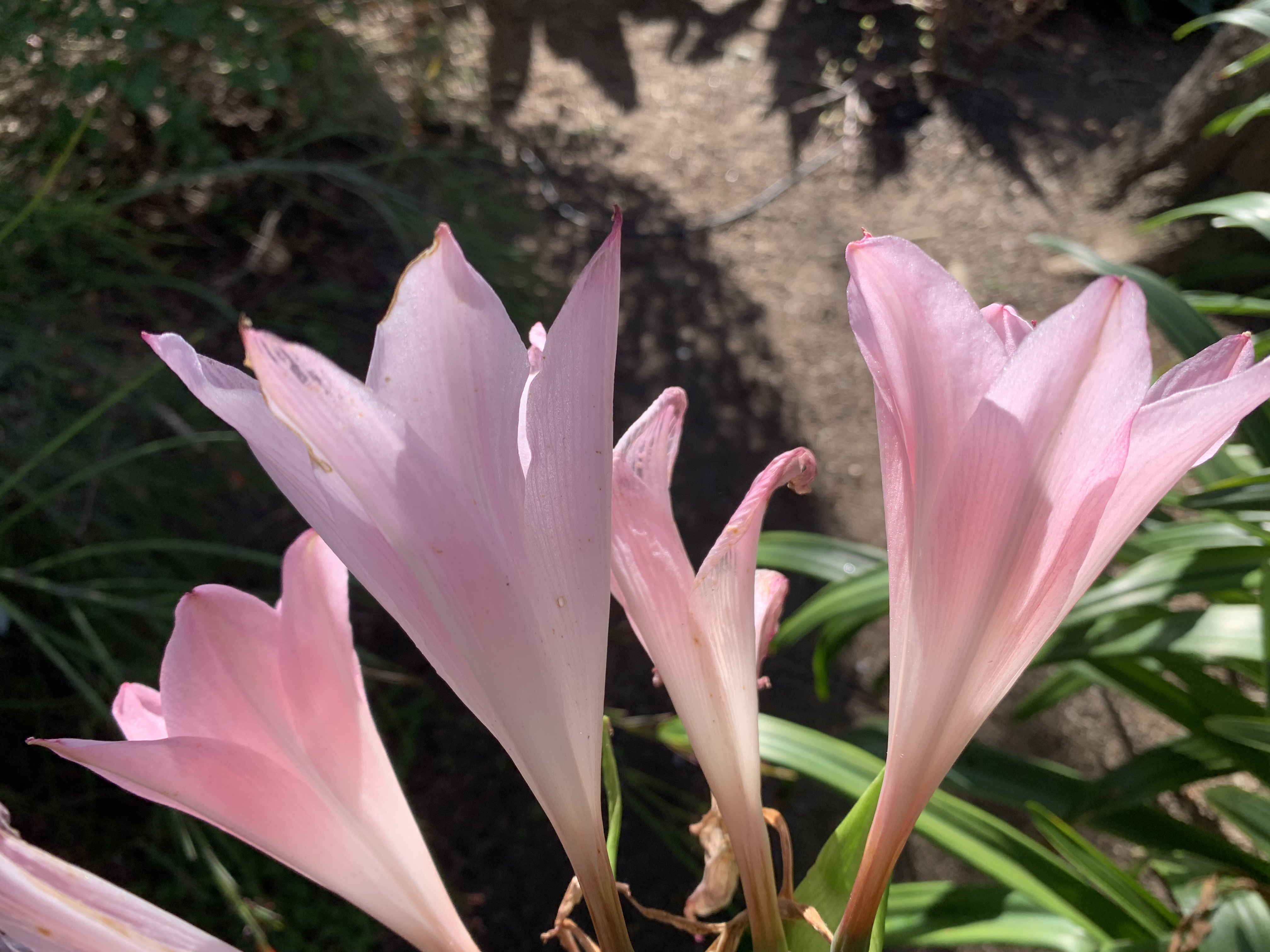
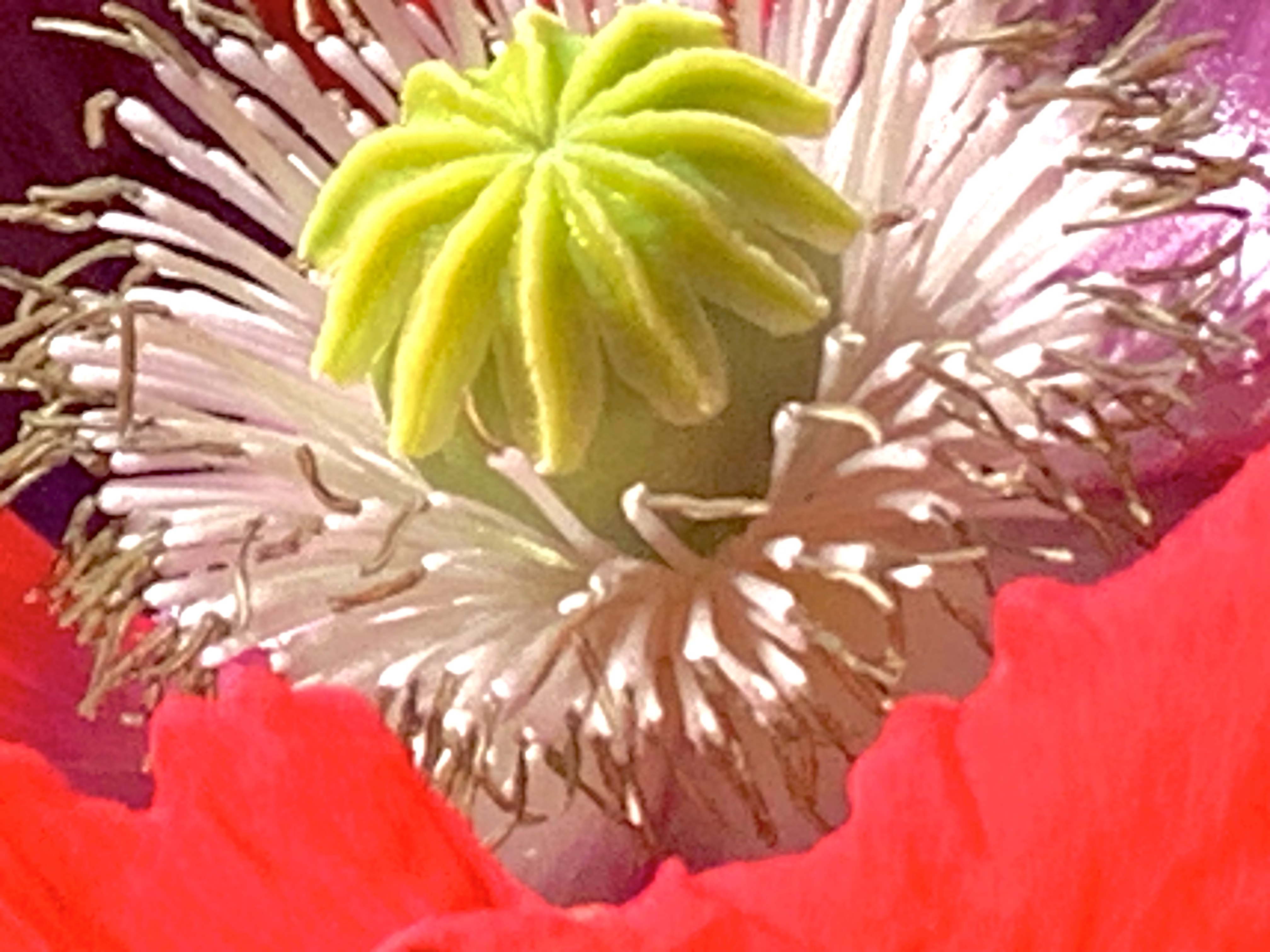
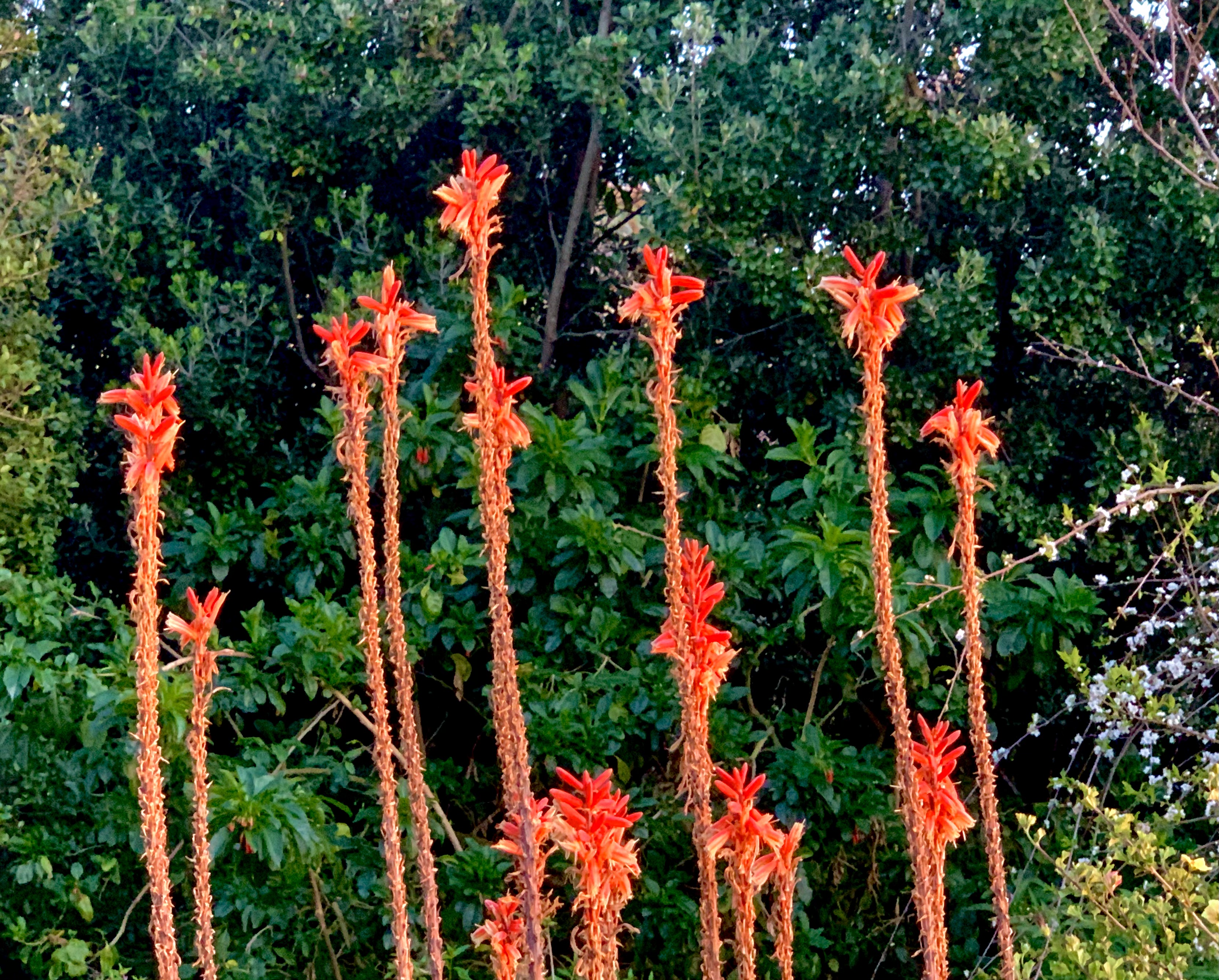
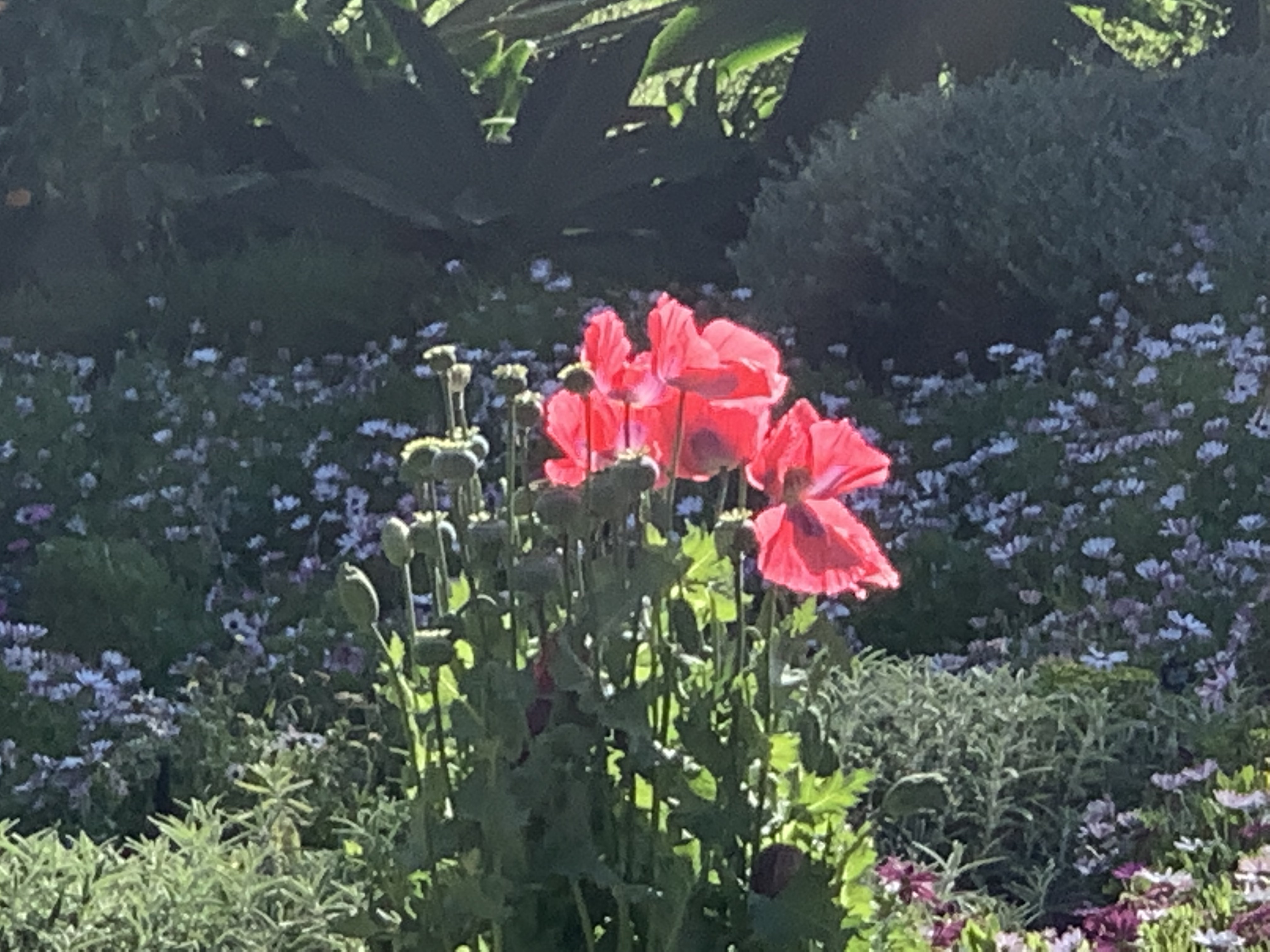
Flowers provide numerous examples of positive space. And, so far as I can tell, the positive space of flowers invariably also enhances the positivity of the space around them.
Animals also generally exhibit positive space. Their shapes, after all, come about through a struggle among different tradeoffs that have been “learned” by each species over four and a half billion years. But whether you look at the leg of a turtle, the leg of a turkey, or the leg of a polar bear, you will see positive space. The shapes are quite different because their histories are quite different. But in every case, the shape is determined by the history and each of those histories is the same length — 4.5 billion years. The fact that each of these shapes comes about through the dance of trying to survive and thrive in all their various habitats makes every one of them beautiful in its own right — even those whom most of us don’t particularly like to interact with such as rattlesnakes or lions. Even if we don’t wish to come face to face with a lion or grizzly bear, we do recognize their beauty. And, I would claim that as those animals walk through any landscape, they will not only exhibit their own positive shape; they will also enhance the positivity of the shape around where they are walking. Think how many times photographers and painters have put an animal in the foreground of a landscape. Of course, doing so makes the scene immediately more living, more interesting, and more beautiful.
What does this have to do with the user’s experience on a computing device? I would have to say that most interfaces on most devices do not do much to bring the interface “alive” including having positive space. The tool bar icons on this version of my Mac are very slightly “bulging” like a living cell (or kernel of corn). Even more subtly, the windows have slightly rounded corners.
It’s an entirely different story with many games though. It seems to me that some of the game artists are among the best artists in the world. They have created many very beautiful games. Could they be more beautiful still if game designers consciously thought about using Christopher Alexander’s “Properties” in general, and “Positive Space” in particular? I think so, but for many games, such as Horizon Zero Dawn, many of the elements are copied so closely from nature that aspects such as “Positive Space” are mostly already taken care of by evolutionary bias toward the beautiful. (Yes, I do think there is such a bias, but it will have to be the subject of a different post.)
What about other applications and systems? Do you think you’ve seen good examples of “Positive Space” in such systems? How could you see incorporating “Positive Space” in UX?
At a more societal level, it seems to me that freedom is closely related to “positive space.” Each individual should be free to expand, grow, experiment, so long as it doesn’t impinge much on those around them. Imposing overly strict boundaries makes life less interesting and less lively. Growth without any sense of balance or notion of how a particular piece of life relates to the whole is called cancer. A society which allows or even encourages theft, rape, fraud and other felonies under the banner of “freedom” is doomed to ultimate failure with lots of pain along the way.
The Winning Weekend Warrior focuses on the mental game for all sports using examples from tennis, golf, baseball, and other sports. It covers self-talk, imagery, mental practice, strategy, tactics, & sportsmanship. http://tinyurl.com/ng2heq3
Turing’s Nightmares explores the implications and ethics of Artificial Intelligence through fictional short stories. http://tinyurl.com/hz6dg2d
Fit in Bits shows many ways to put more fun, variety, & exercise into daily chores and habits to help with strength, flexibility, fitness, and balance. http://tinyurl.com/h6c7fce
Tales from an American Childhood recounts early experiences mainly in the American Midwest in the 1950’s and relates them to contemporary issues and events. https://tinyurl.com/y9ajvz9j
Dream Planet. Where do you run when the whole world is crumbling under the weight of human folly? When the lethal Conformers invade 22nd century Pittsburgh, escape becomes the top priority for lovebird scavengers Alex and Eva.
(This is the fourth post in a series of 15 which aim to examine the fifteen properties of natural order postulated by Christopher Alexander. I wonder whether the property of “Alternating Repetition” could be more frequently incorporated into User Experience and what the pros and cons might be).
4. Alternating Repetition
In nature, whether we look at clouds, waves, mountain ranges, forests, plants, the leaves of plants, or almost any animal, we see alternating repetition. Such natural repetition is almost never a precise and complete replication. Just as every reproductive act of life introduces an element of recombination as well as the possibility of mutation, so too the repetitions we see in life are not mathematical. We indeed see patterns repeated in a line or in a circle, but the instances in living things show variation. Similarly, human artifacts made with the hands; e.g., weaving or poetry or rock walls or tennis strokes show repetition but with slight and subtle variations.
If you look at modern industrial society, you see many examples of exact repetition. It’s true that if you looked at 10,000 examples of the same brand and model pen, or notebook, or scissors, or streak knives under a microscope, you could likely find small differences. To the naked eye, however, they would appear identical. Seeing 10,000 pebbles, leaves, or waves you would always see slight to moderate differences. To me, it makes a difference in terms of beauty. Handmade items and human actions naturally show more variation than things produced by machines.
The various “elements” of a User Interface generally have the feel of something made by machine. The size of all the application icons on the tool bar, for instance, are the same. They are all almost the same exact shape and size. On my tool bar the icons for Finder, Launchpad, Mail, Safari, Chrome, FaceTime, Messenger, Maps, Photos, Contacts, Calendar, Reminders, Notes, System Preferences, Keynote, Pages, Preview, and News are the same. However, the Kindle icon is slightly larger and more square. The Zoom icon is very slightly rounder. [NOTE: This is no longer true in 2026]. The icon for Facebook is still circular, however. In other words, there is some slight variation, but mainly the icons are the same in outline, but different inside. But the set of icons on the tool bar has no sense of “harmony” whatsoever–at least, not to me.
Note that the tool bar is both abnormally homogeneous in terms of positioning and size but completely disconnected in terms of the images which differ in a random disharmony seldom exhibited in nature.
Instead, each icon seems to scream out its individuality without regard to its neighbors. (Which reminds me of things like not masking, getting vaccinations, or telling the truth, for instance, because you don’t feel like it so who cares what the consequences to others are). Anyway, the layout of the toolbar, to me, it’s reminiscent of driving down the highway and seeing a sequence of billboards, each advertising some random product or service in no particular order. Often, each billboard is the same size but they are independent of each other. The one exception I can think of were the “Burma Shave” signs along the highway. Each sign was a small rectangle with several words on it. About a quarter mile down the road, another sign would appear. They were meant to be seen in a specific order and together, they made a kind of “story” which usually rhymed. Typically, the signs touted the joys of the product — “Burma Shave” — or, provided public service announcements about safe driving.
In the early days of computing, putting in “variation” might have been insanely wasteful of space and processing time. This is no longer true. Yet, the “look and feel” of User Interfaces remains, for the most part, quite “mechanical” or “mechanistic” rather than “natural.” Sometimes modern computer games include naturalistic looking variations in how repeated plants, rocks, clouds, etc. are represented. Look at the palm trees and you will see variations among the trees that are reminiscent of the real palm trees I see every day in the San Diego area. In addition, each tree contains a number of fronds that repeat a generic theme; yet, each front is somewhat different. The fronds themselves each contain alternating repetition, just as do real palm tree fronds.
We might consider whether it would make sense to put more natural looking alternating repetition into the more utilitarian aspects of user experience. For example, could it be both more beautiful and more useful to allow more variation in the way files are represented visually? Will Hill, James Hollan, Dave Wrobleski, & Tim McCandless suggested (in a CHI ’92 paper) that physical documents such as manuals naturally show wear in places where they are most used. They suggested that the visual representation of computer documents might be altered slightly to show which documents have been used or edited more and also that such cues within a document might also be useful.
Hill, William; Hollan, James; Wrobleski, Dave; McCandless, Tim; “Edit Wear and Read Wear,” Human factors in computing systems: Striking a balance. Proceedings of the 9th annual conference. SIGCHI ’92 Proceedings (Monterey, CA), Addison-Wesley, 1992, pp. 3-9.
One of the few cookbooks I use with some regularity is entitled, Fat Free and Flavor Full. The recipe I’ve used many times is the black bean salad. If I open the physical book, it naturally falls open to that particular recipe. “Open Recent” I find a very useful features of the Pages application, but I don’t see a way to look at files based on overall frequency of use. It could be the case that there are some applications for which you would want specific files to be easily found depending on the season or the date. The authors of “Edit Wear and Read Wear” were mainly talking about the utility of encoding information about a file into its visual representation. There might well be aesthetic reasons to do so as well.
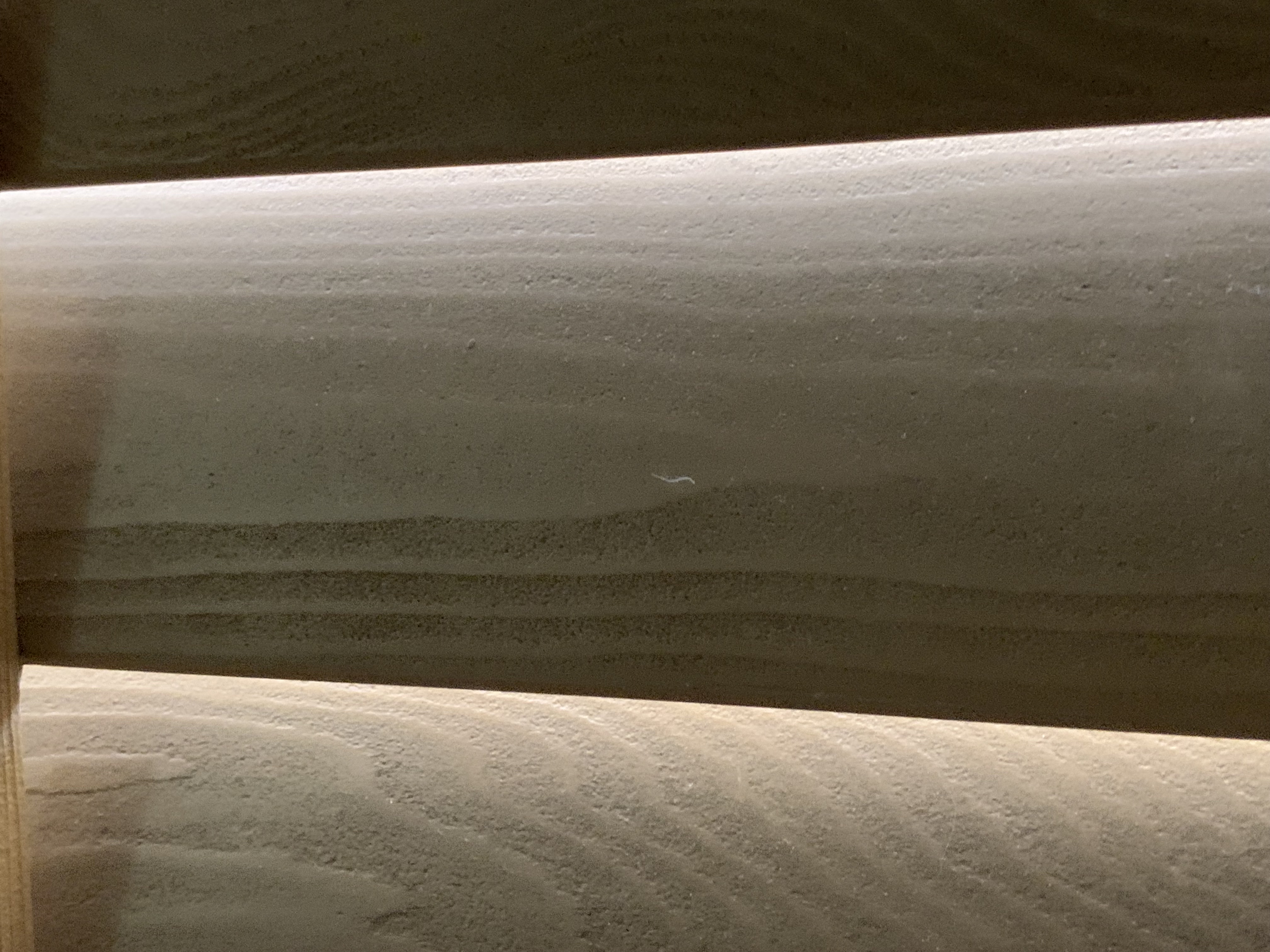
The wooden blinds shown below exhibit alternating repetition in several ways. First, there is the matter of perspective. Some variation almost always presents itself simply by virtue of the fact that I typically view the blinds at an angle and some are closer to me than others. This means that the size, and the retinal shape are slightly different. Second, there is variation caused by slight changes in the angle of the slats relative to vertical. Third, each slat is made of wood. The wood itself shows rings (or more commonly a planar projection of the concentric cylinders.
The wooden blinds, because they are illuminated from the outside by tree-filtered sunlight also show further variation; however I don’t think that is typically “alternating repetition.” Perhaps not coincidentally, although I find it a little interesting, I can’t say I find that source of variation to be beautiful to me. The other three all add to the aesthetics, at least to me.
Is it feasible to introduce alternating repetition with slight variation into User Interfaces? Would it be desirable? What negative side-effects might arise? Do you even agree with Christopher Alexander that Alternating Repetition is an aspect of natural beauty and beautiful design? One thing that occurs to me is that if some element of the UI is more variable in outline etc., it may mean that the actions upon that object must deal with that variability. If designed greenfield, that might not be too difficult. But if, for example, the code for dragging and dropping was written under a presumption of zero variability, that might be problematic. What do you think?
——————-
Discussion of Alternating Repetition with additional visual examples can be found here:
Because Christopher Alexander wrote a book, about the 15 properties, his examples are mainly visual. But alternating repetition as an element of beauty is also clearly present in music and in dance. There is a little of it, it seems to me, in culinary arts as well. I am also reminded of the smelling actions of my dog, Sadie. As she watches an animal without charging it, she waves her nose back and forth quite deliberately in a kind of “sampling” of the surrounding air. A bear will sometimes move sideways with alternating repetition to provide better depth perception of a far away target (like me!). But that’s a story for another time.
The Winning Weekend Warrior focuses on the mental game for all sports using examples from tennis, golf, baseball, and other sports. It covers self-talk, imagery, mental practice, strategy, tactics, & sportsmanship. http://tinyurl.com/ng2heq3
Turing’s Nightmares explores the implications and ethics of Artificial Intelligence through fictional short stories. http://tinyurl.com/hz6dg2d
Fit in Bits shows many ways to put more fun, variety, & exercise into daily chores and habits to help with strength, flexibility, fitness, and balance. http://tinyurl.com/h6c7fce
Tales from an American Childhood recounts early experiences mainly in the American Midwest in the 1950’s and relates them to contemporary issues and events. https://tinyurl.com/y9ajvz9j
Dream Planet. Where do you run when the whole world is crumbling under the weight of human folly? When the lethal Conformers invade 22nd century Pittsburgh, escape becomes the top priority for lovebird scavengers Alex and Eva.
This is the second posting in a series of fifteen which examine Christopher Alexander’s “Fifteen Properties” of natural beauty and suggests how these properties might apply to user experience design.
2. “Strong centers” is probably one of the most overlooked properties of design in UX/HCI. Often, what exists for the user, from their perspective, is a “sprawl” of functions, tool bars, and icons with no obvious overall or subsidiary organization. A better design would allow the user to quickly find a “home base” from which, it would be obvious where to find subsidiary home bases. There is some sense in which hyperbolic trees, fisheye lenses, and home pages partly begin to address this issue.
Instead of “strong centers”, the impression I often get in looking at applications for word processing, organizing photos, searching, or dealing with settings is that the designers are given or generate a long list of functions to be supported. Which ones are related to which though? Which ones are central? In many cases, UX practitioners give users (or, more often, potential users), a set of cards with one function each and ask the users to sort these into piles. I am not against such studies, but they are unlikely to lead to a coherent design with a strong center. The users are not, in most cases, professional designers. In many cases, an application is supposed to support many different specific actions. For example, I use word processors to write essays, poems, and fiction. I also use a word processor to proofread something, to re-organize ideas, to “jot down” a bunch of ideas, or to write an outline. These are very different tasks, at least to me. If asked to sort cards, I would do it differently depending on which type of task and which type of material I’m thinking about.
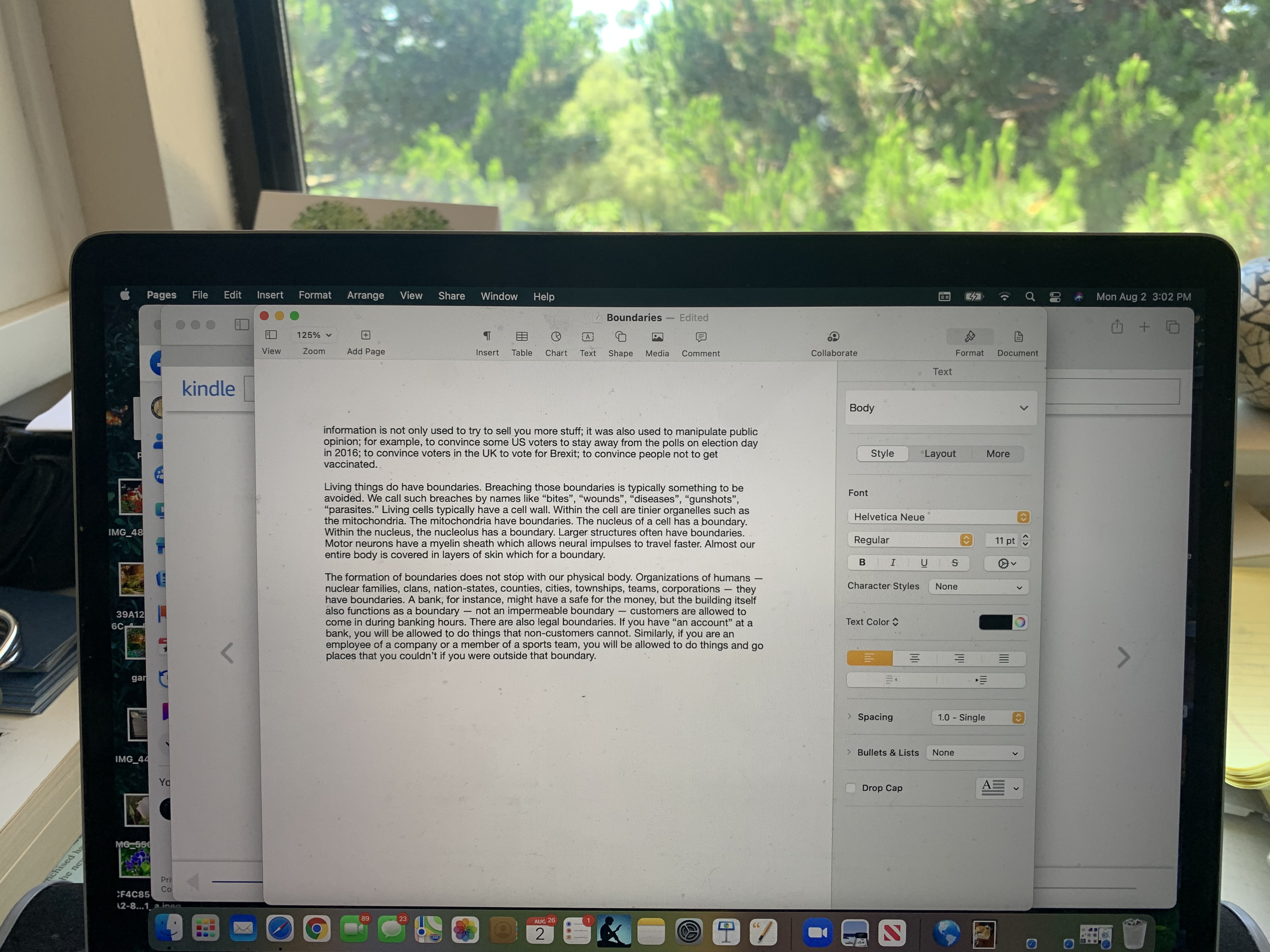
As I type this, I glance at the “Pages” tool bar which includes: Pages, File, Edit, Insert, Format, Arrange, View, Share, Window, and Help. None of these seems like “home” to the task of writing an essay. I know from experience that if I want to write any kind of material, I must go to the “File” menu even though, as best I can recall, my initial impression of this label was that it would be something to do after I was “done” with the tasks of composing and proofreading. The toolbar gives no impression of their being any “center” at all, let alone a “strong center.”
In my native language (English), I read from top to bottom, left to right. In that sense, the Apple Icon is first and the “Pages” item is next and it is in bold print. That could be considered a subtle clue that it’s the “most important.” In a way, the items on the “Pages” menu are “meta-items.” In that sense, I suppose you could argue that they are “important” — though as a writer, none of the items seem that important. In fact, if we get right down to it, nothing in Pages really seems designed to support the actual writing process. And, I’m not trying to single out Pages because it’s the only one or the worst one. Lack of a “strong center” seems true of nearly all applications.
Different people use different processes for writing — and I myself use different processes for different types of writing, so perhaps trying to organize the features and functions so that there is a “strong center”reflective of the “strong center” of the task of writing is just not feasible. I am certainly not advocating for resurrecting “Clippy.”
Ideally, it should be possible for users to “know where the action is” upon entering an application or a web page.
In another interpretation, “strong centers” refers more to underlying architecture and points to the need for a core of functionality that transcends a specific release or even a specific application. A good underlying architecture will communicate this essential center (related to central purpose or style) to the user.
All too often, the processes involved in developing an application or system themselves have no “strong center.” If the development process is itself a hodgepodge political process of accommodating to a portfolio of features and functions that are advocated for by diverse and uncoordinated stakeholders, then, what one has are a long, unorganized list artificially shoved into menus and sub-menus and toolbars. It should not be surprising then, that the user finds it difficult to know where to begin when first encountering an application — even if the user knows exactly what they want to accomplish.
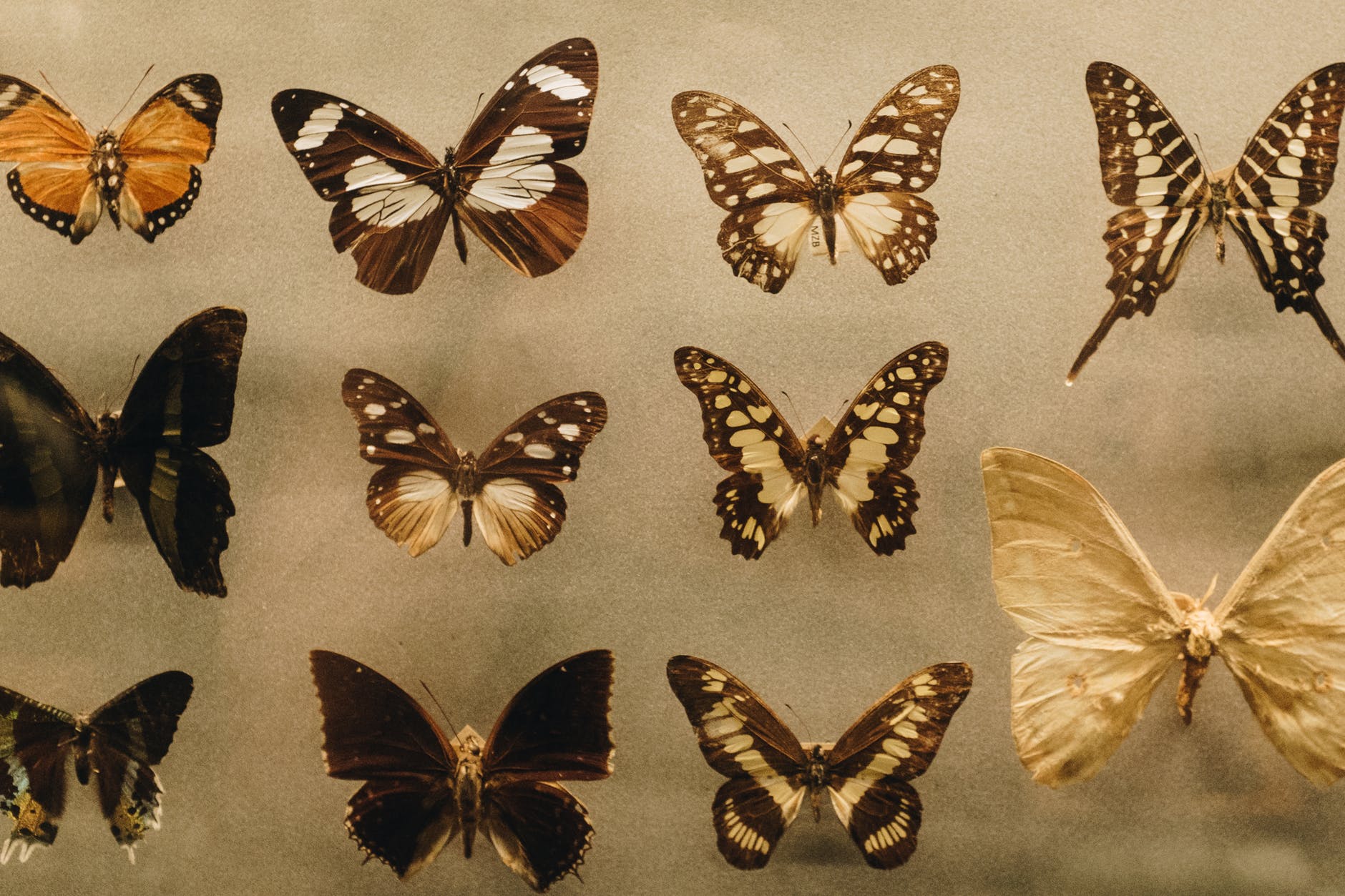
Compare and contrast most menu structures and user interfaces with the “strong centers” that are extremely common in life forms. Here are some examples of butterflies.
The central axis includes the head, the thorax and the abdomen. These are in a line in the strong center. Typically, they are colored differently from the wings. The bilateral symmetry of the wings as well as the overall shape reinforces the strong center. Wing patterns, and even the antennae and legs lead the eye back to the strong center.
Most people think of butterflies as beautiful — and I agree. When asked, however, most people will say they are “brightly colored.” Some are; some are not. But “bright colors” don’t necessarily give rise to beauty!
Strong Centers doesn’t just apply to butterflies. Look at most birds, fish, mammals, insects and you will see how the symmetries and smaller centers reflect and strengthen the major center. Indeed, Strong Centers are not limited to the animal kingdom. The trunk of a tree provides a strong center. Each branch is itself a center and the connection of the branches to the trunk reinforces the strength of the central trunk.
Even single cells often exhibit strong centers (and many of the other 15 properties, by the way).
It would love to be able to provide you with a process or checklist or formula so you could design user experiences with “strong centers.” I cannot really do that. Nor can anyone else. If you keep it in mind, even at the back of your mind, you may see opportunities to help make that happen with regard to whatever you’re working on. I’m curious to hear your thoughts about “Strong Centers.”
One technique that may be of some use was shared at a workshop by someone who worked at a car company. In the design of a specific car, the team decided the car would reflect “a professional soccer player out for a night on the town.” This is obviously not a “formula” or “checklist” but it offers a metaphor that designers of car interiors, exteriors, and the drive train could all relate to. A similar method is sometimes used in film — some specific person is responsible for the artistic integrity of the whole.
There is no one way to produce strong centers. Here are some examples from flowers.
———————
Here we see that each flower has a strong center and the central stem provides a strong center for the entire plant.
Some useful links to more information, discussion, and examples relevant to “strong centers” or to the fifteen properties.
This is an introduction to a series of blog posts on the “Nature of Beauty.”
Christopher Alexander was an architect and city planner. In his MIT dissertation, Alexander took a very mathematical approach to design. In our studies at IBM Research on the “Psychology of Design” I first ran across that work (Notes on the Synthesis of Form). Later in his career, however, he took a quite different approach to design. With an international team, he visited many different parts of the world to see what “worked” in terms of architecture and city planning. The results were documented in the form of a “Pattern Language.” In this sense, a “Pattern” is the named solution to a recurring problem. A “Pattern Language” is a connected lattice of Patterns that together, “cover” a field.
Others (including me) have emulated his approach for other fields such as pedagogy, organizational change, object-oriented programming, software development processes, and human-computer interaction. A few years ago, I suggested such Patterns for collaboration and teamwork. Here’s a link to the introduction of that effort. Here’s a link to the index of those Patterns.
Still later in life, Christopher Alexander embarked on a project called The Nature of Order. This work is documented in a series of four books. In the first book, he proposes fifteen properties of good form in nature — and in beautiful artifacts. Explication and example will be needed to appreciate what these properties mean. In this post, I list the fifteen and will attempt to explain the first one with respect to UX and Human Computer Interaction.
OLYMPUS DIGITAL CAMERA
First, you might be wondering what relevance these fifteen properties of nature might have to interface design. After all, can’t the designer just test out their ideas empirically until a UX design is shown to be usable, learnable, and perhaps enjoyable as well? Well, sure. Ideally, every possibility could be explored and tested empirically.
But how many possibilities are there? Without any guiding principles, there are not only more possibilities than can be tested by you. There are more possibilities than there are atoms in the universe. Imagine a very simple interface on a small mobile device. Let’s say there are only ten screens in your whole application. The iPhone 12, for instance, has nearly 3 million pixels. 24-bit color allows over 16 million colors per pixel. If you literally tested out every possible arrangement, this would mean 16 million to the 3 millionth power for each of the ten screens!! The number of atoms in the universe is estimated to be between 10**78 and 10**82. Obviously, this is far less than 16,000,000**3,000,000 !!
Of course, I’m not suggesting that anyone would attempt a pixel by pixel test of an interface, but the general point remains: you need some way to limit testing to reasonable alternatives. The notion of using these fifteen properties is not that they dictate a particular design nor that you don’t need to do any empirical testing. Rather, the fifteen properties could be used to help guide design. The properties could be thought of as reducing the search space.
Here are the fifteen properties:
Levels of Scale
Strong Centers
Boundaries
Alternating Repetition
Positive Space
Good Shape
Local Symmetries
Deep Interlock and Ambiguity
Contrast
Gradients
Roughness
Echoes
The Void
Simplicity and Inner Calm
Not-separateness
Perhaps the names themselves might resonate with your own sense of aesthetics for design and composition, but let’s review them one by one.
When it comes to natural beauty, a few moments reflection may provide you with many examples. Christopher Alexander claims this property is also present in traditional art and architecture across many cultures. As you see something such as, e.g., the Taj Mahal or the Parthenon in the distance, you see a beautiful shape. As you approach it, you will see more and more levels of scale. By contrast, many modern buildings are largely featureless between the overall shape and the texture of the building material.
If your design has multiple levels of scale, it will be easier for your user to orient themselves; to know “where they are” in the application and therefore easier to take appropriate action. Not only are you making their “task” more doable, you are providing a kind of entertainment. If it works well, they will be thinking of the building and perhaps its significance the entire time they approach the building. By contrast, if I approach a modern no-scales building, I bore quickly and, like most people, there are a whole host of things waiting to be thought about. So, I’ll mainly be thinking of one or my problems and largely ignoring your building and what it stands for. Reflect on your own experiences and see whether you agree. Lincoln Memorial, Winchester Cathedral, Temple in Kyoto: they are completely different from each other and yet in this way, they are all the same: they keep your attention focused on the moment. In other words, they help you be fully alive and awake. In the best circumstance, they also elicit some awe and gratitude not only for the geniuses who designed but also for the many laborers who found and mined the materials, constructed something from it, and even those whose taxes paid those workers.
Levels of Scale is something to keep in mind with respect to your design — whether hardware, software, documentation, story, or a building.
How could you use or see “Levels of Scale” as a desirable property of what you are doing right now?
———————————-
Some references to Pattern Languages in HCI.
Pan, Y., Roedl, D., Blevis, E. and Thomas, J. (2012), Re-conceptualizing Fashion in Sustainable HCI. Designing Interactive Systems conference. New Castle, UK, June 2012.
Thomas, J. C. (2012). Patterns for emergent global intelligence. In Creativity and Rationale: Enhancing Human Experience By Design J. Carroll (Ed.), New York: Springer.
Thomas, J. (2012). Edging Toward Sustainability. CHI Workshop Position Paper for Simple Sustainable Living. CHI 2012, Austin, Texas.
Thomas, J. (2012), Enhancing Collective Intelligence by Enhancing Social Roles and Diversity. CSCW Workshop Position Paper for Collective Intelligence and Community Discourse and Action. CSCW 2012, Bellvue, WA.
Thomas, J. (2011), Toward a pattern language for socializing technology for seniors. Workshop position paper accepted for CSCW 2011 workshop: Socializing technology among seniors in China, Hangzhou, China, March 19-23.
Thomas, J. (2011). Toward a Socio-Technical Pattern Language for Social Systems in China and the World. Workshop position paper accepted for CSCW 2011 workshop: Designing social and collaborative systems for China. Hangzhou, China, March 19-23.
Thomas, J. (2011). Toward a Socio-Technical Pattern Language for Social Media and International Development. Workshop position paper accepted for CSCW 2011 workshop: Social media for development, Hangzhou, China, March 19-23.
Bonanni, L., Busse, D. Thomas, J., Bevis, E., Turpeinen, M. & Jardin, N. (2011). Visible, actionalble, sustainable: Sustainable interactin design in professional domains. Workshop accepted for CHI 2011. Vancouver, B.C., May 7-12.
Thomas, J. (2011). Focus on Ego as Universe and Everyday Sustainability. Workshop position paper accepted for CHI 2011 workshop: Everyday practice and sustainable HCI: Understanding and learning from cultures of (un)sustainability. Vancouver, B.C., May 7-12.
Thomas, J. C. (2018), Building common ground in a wildly webbed world: a pattern language approach. Journal of Information, Communication and Ethics in Society, 16 (3), 338-350.
——————————-
Some recommended books:
The Winning Weekend Warrior focuses on the mental game for all sports using examples from tennis, golf, baseball, and other sports. It covers self-talk, imagery, mental practice, strategy, tactics, & sportsmanship. http://tinyurl.com/ng2heq3
Turing’s Nightmares explores the implications and ethics of Artificial Intelligence through fictional short stories. http://tinyurl.com/hz6dg2d
Fit in Bits shows many ways to put more fun, variety, & exercise into daily chores and habits to help with strength, flexibility, fitness, and balance. http://tinyurl.com/h6c7fce
Tales from an American Childhood recounts early experiences mainly in the American Midwest in the 1950’s and relates them to contemporary issues and events. https://tinyurl.com/y9ajvz9j
Dream Planet. Where do you run when the whole world is crumbling under the weight of human folly? When the lethal Conformers invade 22nd century Pittsburgh, escape becomes the top priority for lovebird scavengers Alex and Eva.
I’ve been reflecting on “International Dog Day” and on a year-long course on novel writing I took a couple years ago. To me, writing a full-length novel is more difficult than writing a Ph.D. dissertation. Writing non-fiction such as a dissertation requires research, discipline, organization, and being willing to work hard.
Writing a novel requires all of those but it also requires keeping track of the implications of many little decisions. It is not only a cognitive strain but often an emotional one as well. It’s a never-ending series of choices. Science is often, but not always, a series of choices where there is an agreed upon better answer. Even when there isn’t agreement, there are a much smaller number of choices.
To me, writing non-fiction is like taking a long trip on existing roads. You may certainly face unanticipated difficulties such as construction zones, flat tires and bad weather.
Writing fiction is more like bushwhacking. No-one has ever trod (or will ever trod) your exact path. You may learn something by discovering or following the paths of previous writers. You might, for instance, discover that some writers go over logs that lie across their intended path. Others, may crawl under. Still others might go around the fallen log. Others might choose to back-track until another path is found. What should you do?
It depends.
And, that’s the nature of fiction. It all depends. It depends on what else happens in the book. How you choose to construct and describe one character depends on the others. Even what you name them depends on the other names. What happens in character development interacts with the plot. The plot interacts with the landscape and the mood. The mood depends on the tempo. The tempo, if it’s dialog, must be consistent with the character who’s doing the talking.
Our dog Sadie and I have been co-creating and co-evolving games from the days she first came to live with us. We often played variants of “fetch.” Here’s how one worked. One of us (most often Sadie) finds a squeaky ball. At some point, I get a squeaky ball from somewhere in the garden and say, “Get up on the deck! I’m going to throw the ball on the deck.”
Now matter where she is when she hears that, she sprints to the deck and awaits my throw. She sprints with spirit! I love to watch her run, not only for her grace and speed but even more so, for the whole-heartedness with which she runs every single time. I throw the ball up and she catches it in the air more than half the time. Even when she misses, she’ll scramble after it and proudly perch on the spot on the deck where I can see that she’s caught the ball. After elaborate and genuine praise, she sprints down the stairs to the lawn near me. Then, she will lie down with the squeaky ball in her mouth. After a time, she’ll move the ball away from her some distance. I walk over casually, as though I am not trying to “steal” the ball from her. When I get close to the ball, she quickly re-grabs it. After she’s had a few “successes” she will start hanging out farther and farther away from the ball. At some point, I’ll grab the ball and announce, “I’ve got it!” At that point, she again sprints up the stairs to go the deck where I will throw the ball up to her.
The part of this scenario that I think is most like writing the fiction is the part where Sadie is judging how far away the ball should be from her buzz-fast jaws. If it’s too close, I won’t even try for it. If it’s too far away, I’ll immediately grab the ball. Similarly, as an author, I want to keep the reader interested. If my writing is too predictable, it might be clear, but it will be uninspiring and dull. The reader will quit before they get to the end of the story. On the other hand, if I write too far from the reader’s expectations, they will quit because they cannot grab the threads of the narrative.
To me, the benefits of co-creating with Sadie (rather than “training her” to play the game in a particular and predetermined way) include that I can learn a lot by observing her. Another benefit is that it keeps both of our minds more flexible and more engaged (just as does good literature). Of course, there are two of us in this exercise and that is also true in the reading of fiction. Every author, including me, will make miscalculations about how far to stray from expectations. But whether you can follow across those miscalculations is not only a measure of my skill as a writer but is also a measure of your skill as a reader.
In the past, I’ve self-published my books on Amazon. These are mostly non-fiction, but one of them is a collection of fictional short stories. Next time, I may try traditional agent/publishing. I am also thinking of putting together several more books, using the blog posts here as the seeds.
After a year long writing course, the single most important piece of advice I can give is:
“Get a dog.”
Don’t get me wrong. We have six cats and we love them dearly. The cats are smart, and I can certainly empathize with the cats. But their ability to empathize with me is either very limited or, as I suspect is more likely, they really don’t give a damn. On the other hand, Sadie is a pleasure to co-create with because she intuitively “gets” cooperation and collaboration. We accommodate each other and neither of us has any idea how the game will evolve.
The games with Sadie became more complex when we got a second dog, Bailey. Bailey is also an excellent ball player. But, unlike Sadie, Bailey almost always prefers to race after the ball, bring it back to me panting and lay the ball by my feet for an instant replay. That works quite well when I am playing only with Bailey.
The complexity arises when I try to play with Sadie and Bailey at the same time. Sadie wants to play the game of bringing the ball near me, but if she drops it near me, Bailey swoops in and grabs the ball before I can play the threshold game with Sadie. The easiest way is to deal with this is to play ball with them separately. Sometimes, I do.
My wife and I have also taken great pains to try to teach Bailey to take turns. Bailey is a smart dog and he is quite good about taking turns when it comes to eating, say, or going out to pee. But—when it comes to ball-chasing, it seems nearly impossible for him to consistently “take turns.” He’s much more likely to grab the ball, even if it means stealing it out of Sadie’s mouth.
One invention we’ve come up with is the “Three Balls on the Roof” throw. It works like this. I gather up three balls and throw all three up on the roof at the same time. We have a tiled Mediterranean roof and the balls bounce around unpredictably before coming down. This generally allows each dog to catch at least one. After they catch the ball, they both try to “touch” the other two balls. In the case of Bailey, this often entails stealing the one that Sadie caught. That has happened so many times, that generally, Sadie drops the ball she caught before Bailey gets a chance to “steal it” out of her mouth.
This “compromise” is not ideal. It reminds me though of another difficulty in writing a novel. I experience this myself, but I see evidence for the same difficult for many other writers. Here’s the essence of the dilemma. I like my hero(s). I care about them. I like to see them succeed. But…
For maximum reader engagement, the main character(s) must go through hell. I know many ways to put them there, but it’s painful to do so. One solution is to write about villains. I don’t mind if they go through hell.
Another solution is to use the “Three Ball Trick.” In this trick, I put the hero in a situation that looks dire, even impossible. But before resolving that puzzle, I put them (or a different hero) into yet another dire situation. Hopefully, the reader is already imagining that the hero is likely going to die or at least be permanently injured, possibly in two different ways. Before either of those two sticky situations gets unstuck, one of the main characters gets into yet another jam. And they must get into this jam before the other two jams are resolved.
Does this comport with your intuition as well? Compare two structures:
However, the apparent solution leads to further complication (makes them look guiltier in the crime they’ve been arrested for).
By contrast, we could imagine:
Hero encounters nasty situation one and solves it. Hero encounters nasty situation two and solves it. Hero encounters nasty situation three and solves it.
The latter structure is like throwing three balls on the roof, but one at a time. What would happen? My prediction is that Bailey would steal every ball that Sadie caught and she would soon stop playing.
In writing, the result would be that I would be more “comfortable” because my hero would never “hang out” in mortal danger. But the reader would not experience the joy of apparent repeated resurrection.
Many Paths muttered to herself, “Perhaps I should rename myself, ‘She Who Walks in Many Circles’.” She glanced down at the ground, still damp from the morning’s rainfall. She chuckled. No, she thought, I’m walking around in the same circle, over and over. I cannot find a way to guarantee that someone won’t betray us. She sighed. Then, her awareness blossomed outwards. She heard voices: the happy voices of Tu-Swift and Cat Eyes. Soon, the couple appeared at the edge of the granite-bouldered clearing atop the small mountain where she had come to meditate. They walked hand in hand, smiling. When they saw Many Paths they both waved, sang her name, and embraced her.
Many Paths smiled wanly. “It’s nice to see you. I was just…thinking.”
Tu-Swift and Cat Eyes glanced at each other. Tu-Swift said, “Yes! I imagine so. After all, you have an important meeting to think about! The last thing you need is to talk with your friends!”
“Indeed,” added Cat Eyes “we had come up here to find some of those low bush blueberries to add to our lunch porridge. But we’ll be on our way. Why spoil a perfectly good dish by adding ingredients to it? Best eat everything on its own, wouldn’t you agree?”
Many Paths narrowed her gaze & pursed her lips. “I’m not sure I know what you mean.”
Tu-Swift said, “Putting different things together just complicates everything. We should eat one thing at a time. As with a song, for instance. Best to stick to one note, sung over and over.”
Many Paths chuckled. “You two are talking nonsense. That wouldn’t be much of a song. And, of course, it makes sense to combine different ingredients for a recipe.”
Many Paths stared at their faces for a moment. “But you know that. You’re … did She Who Saved Many Lives send you by any chance?”
Tu-Swift and Cat Eyes both shook their heads solemnly. “No, she did not,” they said in unison. But beneath their words and expressions, Many Paths sensed a shared joke of some sort.
Many Paths sighed and said, “I suggest you do get some blueberries. There’s a patch, as you well know, right beyond that dead tree. It’s nice to see you both, but I need to … get back to what I was doing.”
Tu-Swift nodded gravely. “Yes! I can see you’ve just about finished making your circular fire pit.” He pointed down to the circle of bare ground Many Paths had clearly been treading. “How about if we help you trample everything for a few minutes and then you can help us pick berries?”
Many Paths shook her head and chuckled. “She Who Saved Many Lives sent you. She did. Did she not? She thinks I need someone or something to shake loose my thinking since I have been literally walking in circles and thinking in circles at the same time. Am I right?”
Cat Eyes bit her lip. “You’re right that you’ve been walking in circles. That we can see easily enough for ourselves. I say again though that you’re wrong if you think the Elder Leader sent us here. Neither of us have spoken with her today. As to whether you’ve been thinking in circles, well, that only you can tell.”
Many Paths nodded. “I have been indeed. All right. You win. I’ll tell you the problem and perhaps you two have come across something to help in your reading. Then you can return to the Tribe Mother and say you’ve helped me.”
Shadow Walker appeared at the edge of the clearing. Many Paths glanced over to see him smiling like the sunshine she so desperately missed. She smiled back and said in a tone of accusation and pleasure, “You!”
Shadow Walker strode over quickly and embraced her. He kissed her fondly and said, “Yes! It was me. I love you dearly. But you’ve been as gray as the weather. It’s time for a rainbow instead! The four of us are going to share your problem and see whether we can make some headway. I knew only that you said you were going around in circles with the problem. I didn’t know that you were — literally — going around in circles!”
Many Paths laughed. “I should have known you would be behind this scheme. Well, all right. You know the problem well enough. How do I ensure trust among the people who come from other tribes? Wait. What do you mean by the four of you?”
A strong voice came from behind Many Paths. “My legs needed some exercise so I came up to join you.”
Many Paths smiled at the Elder Leader. “Ah, you are always welcome. If you’re here…. You always seem to show up where you are needed most.”
She Who Saved Many Lives smiled. “I wish that were true. But I did bring a considerable number of hickory nuts to add to the porridge. That’s my contribution. If only we had some honey.”
Shadow Walker held up a wooden bowl filled with honeycomb. He smiled at Tu-Swift who said, “I say that five of us pick some berries and we will have a fine lunch indeed. Then, we can talk of more serious matters.”
“Yes,” said She Who Saved Many Lives. “Serious indeed. But serious need not be grim. I think a pleasurable meal, jointly prepared, and joyfully shared is always a good prelude to serious thinking.”
Cat Eyes added. “Indeed. If we share a meal and everyone brings something which everyone eats, that in itself would build some trust. Would it not?”
Many Paths nodded slowly. “You’re right. Of course. We should begin with a shared meal. I can see much wisdom in that.”
Tu-Swift nodded. “Me too. Speaking of which, I’m hungry! And the Tribe Mother is right. Serious doesn’t mean grim. Recall some of the weapons that we came up with by playing around? Make the meeting festive and joyous, not grim. In the books we’ve been studying lately, there are some suggestions for some rituals that might help as well. I’ll describe some. After lunch. Now, let’s get those blueberries.”
Many Paths smiled at her “little” brother. He no longer struck her as little at all. She began to look forward to lunch. She took the Hand of Shadow Walker in one hand and that of the Elder Shaman in the other and began walking toward the blueberry patch.
The sun peeked out from the clouds and sparkled on the wet leaves.
The Winning Weekend Warrior focuses on the mental game for all sports using examples from tennis, golf, baseball, and other sports. It covers self-talk, imagery, mental practice, strategy, tactics, & sportsmanship. http://tinyurl.com/ng2heq3
Turing’s Nightmares explores the implications and ethics of Artificial Intelligence through fictional short stories. http://tinyurl.com/hz6dg2d
Fit in Bits shows many ways to put more fun, variety, & exercise into daily chores and habits to help with strength, flexibility, fitness, and balance. http://tinyurl.com/h6c7fce
Tales from an American Childhood recounts early experiences mainly in the American Midwest in the 1950’s and relates them to contemporary issues and events. https://tinyurl.com/y9ajvz9j
Dream Planet. Where do you run when the whole world is crumbling under the weight of human folly? When the lethal Conformers invade 22nd century Pittsburgh, escape becomes the top priority for lovebird scavengers Alex and Eva.
Cancer has not only “forgotten the face of its fathers” (as Stephen King’s gunslinger says).
Cancer has forgotten the fact that it even had fathers and mothers.
Cancer has forgotten the fact that its life is made easier, every day because of those who went before.
Cancer has forgotten that every little victory it feels today comes about because of millions of choices and struggles of other lives that went before.
Cancer doesn’t care.
Cancer acts as though it is the only life form in the universe that really “counts.”
Throughout history, there have been many individuals who act as cancer.
A few of them have gotten into positions of power and used that power to blackmail, strong-arm, and manipulate others into joining the cancer. Their “relationships” are based on lies and power.
Now, we live in an atomic era when cancerous people in power use that power to restrict the ability of their own people to know the truth.
We live in an atomic era when cancerous people in power threaten to use atomic weapons unless they get their way.
Cancerous leadership has never been a good thing in the same way that having a cancerous tumor in your body has never been a good thing.
Perhaps you think: well, I don’t really care much about politics.
Okay, then what do you care about?
Sports? Guess what. Sports are ruined by dick-taters. Outcomes can be predetermined or overturned by the dick-tater. Cheating becomes common. If you don’t “toe the line” politically, you won’t be able to play or you’ll be imprisoned or poisoned.
Business? Maybe you just care about business. Guess what. Business success is determined by how much “protection” money you pay to the dick-tater. Whoever pays the most will succeed. And, even then you aren’t safe. When business people become too successful under a dick-tater, the dick-tater destroys them and takes their assets. Just like Putrid.
Your family? Maybe you focus your attention on your family so you don’t really care about whether you live in a dick-tater$hit. You should care. Under dick-taters, the children are taught to spy on and inform the authorities if the parents do something “bad.” Of course, since it’s a dick-tater$hit, what counts as “bad” can change from day to day to the last syllable of recorded time. And your children might or might not understand what you actually said. No matter. Turning in the parents will be a “feather in their cap.” How do you think that will change your family? Husbands and wives are also encouraged to turn on one another. Romantic love and family love — these are antithetical to a totalitarian state. Everyone should love the dick-tater more than anyone in their own family. And, they’ll be asked to prove it. Tell your teen-ager they can’t date a drunkard. Yeah, that might make sense. But understand: if they get upset with your parental guidance, they may turn you in. They’ll make up crap. There’s no burden of proof in the courts that are run by a dick-tater. The dick-tater doesn’t really even care whether you’re guilty or not. Having an innocent person jailed for crimes against the state, especially if they’re turned in by their spouse or kid — that sends a nice strong message to everyone else in the Teliot.
You may have thought I was going to end that paragraph with the word “country.” I considered that. But it no longer a real country. It is more akin to a toilet. In an ordinary toilet, the waste is flushed. But in a dick-tater$hit, the waste is kept. Whatever is decent, honest, truthful, creative, loving — that is what is flushed away. Instead of a country, you have a reverse toilet — a Teliot.
Not caring whether or not you and your family and friends live in a dick-tater$hit — that makes exactly as much sense as not caring whether or not you and your family and friends have cancer.
“I don’t care if I have cancer, because I’m really into sports!”
Huh?
If you die, you can’t play or even watch sports.
“I don’t care if I have cancer, because I really care about my business!”
Huh?
If you die, you can’t run a business.
“I don’t care if I have cancer, because I care about my family!”
Huh?
Maybe ask your family whether cancer affects them.
“Well,” you might say, “Democracies are far from perfect too!”
That’s true. Democracies are not perfect. Sometimes, people are unfair, even in democracies. Sometimes people are cruel. Sometimes people are corrupt.
Similarly, even if you are cancer free, you might stub your toe, or cut your finger shaving or slicing vegetables. You might sprain your ankle. And a few people will die in auto accidents. Does that mean it doesn’t matter whether or not you have cancer? Cancer, if left untreated, will necessarily be bad. It is the very nature of cancer to be bad.
Imagine a world in which you don’t just suddenly “get cancer.” You don’t have some weird symptom, go to the doctor, have some tests and find out you “have cancer.” No. Imagine that the only way you get cancer is if you choose to have cancer. You go to the doctor and he offers you a choice: “Would you like cancer? I can give you some, really cheap.”
Imagine a society who decides, “People stub their toes and get sick anyway so let’s all get cancer!”
Imagine a society who decides: “People aren’t perfect under a democracy so let’s have a dick-tater run the country!”
Maybe all you really care about is food. Guess what? Food will be worse under a dick-tater$hit. Regulations about food safety will be rolled back. Your food will be more tainted.
Maybe all you really care about is art. Guess what? Art will be regulated under a dick-tater. In the Teliot State, the good stuff will all be flushed away, along with the artists who produced those works. The dick-tater will decide which are gets presented and most will be commissioned to glorify the dick-tater.
In the Teliot State, everything good is tainted. Everything good dies. Everyone decent is suppressed. Even the military is tainted, as the ineptitude of the massive Putrid war effort reveals. The police. The courts. The politicians. The shopkeepers. The business tycoons. The teachers. The parents. The kids. Everyone must allow the cancer of totalitarianism to invade and corrupt their body, their mind, their soul.
Democracy is hard. I grant that. And often it is messy. But it is a path to life. The Teliot State is a path to death. Don’t believe me. Ask the Russian journalists who have been disappeared. If you can find them. Ask their families. Ask the mothers of the thousands of Russian soldiers who were sent off to die — supposedly to “liberate” Russian speaking Ukrainians. A big fat lie, of course. Everything is based on lies in a Teliot State.
Don’t believe me. Ask the Russian athletes who are banned from international competitions.
Don’t believe me. Ask the families of the Russian oligarchs who were murdered in the last few days. Oh, wait you can’t, because they were killed too.
Don’t believe me. Ask the Ukrainians how much they’re enjoying their “liberation” so far. Ask the raped women. Ask the mutilated children. Ask the dead. Ask the tortured.
I’ve known many people who have had cancer. The treatments are painful and dangerous. But they’re still generally better than letting cancer take over. Because once cancer starts, it wants to take over everything. Cancer finds it distracting from its past failures so it keeps wanting to try to conquer new parts of the body. Same with Putrid.
Like all dick-taters, Putrid delivers far less than he promises. Of course he does. The Teliot State squelches incentives, creativity, innovation, truth, science, medicine, and life itself. To some degree Putrid and his ilk, tell lies about how well they’re doing, but the truth cannot be totally hidden from the people. So, Putrid, like all dick-taters is terrified of having the people find out just what a horrendously bad job he’s doing. That’s why he lies to the public and makes sure everyone else tells the same lies. If people don’t realize what a horrible job he’s doing, maybe an angry mob won’t tear him to shreds.
What better way to distract from your own failures than blame someone else?
So Putrid blames the west, NATO, the EU, the UN, Ukrainians, oligarchs who don’t spent enough time kissing his a$$, military commanders — in short, everyone but himself.
Remember the Berlin Wall? That was not erected by the West Germans to prevent poor people from East Berlin coming in and taking stuff. That was put in place by the Russian dick-taters to keep East Berliners from finding out just how bad off they were under the communist totalitarianism than were their brothers and sisters and cousins living in a democracy right next door! People were killed trying to get into West Berlin.
Every day, all around the world, people are trying to escape the cancer of the Teliot State. They risk their lives to do that. Why do you suppose they would do that? Because they have seen first hand what a stench-filled place a Teliot State becomes. The criminals run the Teliot State.
There may be honor among some thieves, but not among the sort of thieves who aspire to being dick-taters. They literally kill other members of their own families just so they can feel more assured none of them will try to replace them.That happened fairly recently in Saudi Arabia and in N. Korea. Putrid is now killing his oligarch supporters to strike even more fear into his fellow Russians. “See? You think I won’t kill you if you don’t support me? This long-time ally and friend had the nerve to ask me whether I should stop this war. The nerve! So, I killed him and his family.”
Maybe Putrid felt a teeny surge of heroism when the gave the order to kill his allies for gently questioning his wisdom, but mainly he did it to make sure every Russian understood the message: “I’ll kill anyone for anything so you do what I say or you’ll be next.”
As the Wicked Witch of the West once famously observed, “These things must be done delicately. “ So, Putrid made these murders look a little bit like suicide, but they were carried off with the same MO at almost the same time so that everyone in the country would get the message that these were killings ordered by the Teliot Tyrant but that everyone was supposed to act as though they were suicides.
The Russian people are in a tough spot. Ideally, they would rise up as one and get rid of the maniac; rid themselves of cancer. Ideally. But it’s a lot to ask. It’s one thing to go to a surgeon to put you under anesthetic and have them remove a cancerous growth. It’s quite another to perform the surgery yourself on your own body! Tom Hanks, in Castaway damn near killed himself taking out a bad tooth. It took a lot of nerve. And it will take more to take out a cancerous growth. But what choice is there? If you don’t kill the cancer, the cancer will kill you.
Meanwhile, we still have a choice. Do we want to put a monstrous cancer in charge of our country? And, that will not just mean that they are put in charge of government. Please understand, once in charge of government, they work to be in charge of everything up to and including your sex life. Before you decide that’s a good idea because everybody should have sex just the way you like it, you’d better understand that a dick-tater could just as easily decide and implement a policy that everyone should be trans or that everyone should be gay. At first, of course, a dick-tater$hip will implement policies that are supported by either a majority or at least supported by a violent minority. They need some support to gain absolute power. But not to keep it. Once they control the police, the courts, the army, they don’t need to institute policies that are popular any longer. They can institute any policy that benefits them. Any. Policy. Including your worst nightmare. It doesn’t matter what they say now. It doesn’t matter what they “really” believe. It doesn’t matter how many people agree with a position. Once they have absolute power, they will make it stick. They will accompany an unpopular policy with a host of lies to make it more palatable. These lies will not be debunked by the “free press” because there won’t be any. And if you yourself do not repeat these lies, you are subject to arrest — or worse.
Given any absurdity, given any cruel and stupid policy, I can write a paragraph of lies “explaining” why we’re doing this. Of course, it will typically be pretty transparent, but so what? It doesn’t have to stand up to debate. It doesn’t have to stand up to an election. It doesn’t have to stand up to the scrutiny of a free press. Everyone will be required to recite said paragraph. Everyone in such a society knows in their hearts that the policy is bad. And everyone knows in their hearts that they themselves are being evil by perpetrating it.
Can you image how that feels inside? To know that you are doing what you yourself know to be wrong, and yet, you feel compelled to do that evil every single day. On top of that, you’re required to encourage others to do that evil and to lie about it. It’s a whole evil and elaborate charade and every participant dies inside. But it makes the dick-tater feel good. The dick-tater is the only beneficiary.
In Russia right now, there are about 150,000,000 losers and one “winner.” Ultimately, the only person who benefits is Putrid. I have to qualify “ultimately” because of course, in the short run, some see a short term benefit of some kind (not be put in prison, receive bribe, steal neighbor’s wife, get his son a better grade) but at the same time, no matter how much people try to rationalize it, they know they are doing wrong.
In the USA, right now, we still have a democracy. But it’s hanging by a thread. There is nothing “conservative” about destroying democracy & instituting a dick-tater$hit. This is not a question of conservative versus liberal or left versus right. We can have those debates in a democracy because they are meaningful. Debates are shows in a dick-tater$hit. They are not meaningful. It doesn’t really matter to the dick-tater what philosophy he purports to adopt. One dick-tater might call themselves a “Communist” and the next one might call themselves a “Nazi” and the next might call themselves “Bicameral” and the next “Hufflepuff” — The dick-tater doesn’t believe any of those philosophies. Their “philosophy” is that the only thing that matters is them and whatever they feel like should determine what everyone does. And, if he goes absolutely insane and insists everyone in the country should all go eat poison ivy three times a day, most will pretend they did it and some will actually go do it. And on TV, there will be testimonials from people who ate poison ivy and it cured their gout or their heart disease or their “Ravenclaw” tendencies. People who die from eating poison ivy will not be counted in the official total as having died from poison ivy. It will be listed perhaps as “political putrefaction” but the world will find out fairly quickly.
Eventually, so will the Russian people. But by that time, something else cancerous happens first. People who survived the purges of Stalin, by definition, are more pro-Stalin and acted to please him more than the millions who were put to a fast or slow death. And the pro-Stalin survivors acted evilly for decades under him. One way to assuage your guilt about doing evil for a long time is to convince yourself that it isn’t really evil. The dick-taters like Stalin will give you a reason that you can tell yourself. The dick-tater knows it’s a lie; you know it’s a lie; everyone outside of Russia who thinks about it knows it’s a lie. But it makes you feel a little better. You start by habitually doing evil. Then you begin to habitually feel bad. Then, you find that believing the lies of the dick-tater makes you feel a little better. And now you have told yourself the lie so long that you actually come to believe it. That, in turn, means there is a lot of truth that you cannot listen to. You not only repeat Russian propaganda, you also self-censor because you don’t want to hear the voices of Western journalists, etc.; they will only make you question that which you do not want to question.
Question yourself now. Before it’s too late. Too late for you. Too late for the world.
After some delicate and delicious love-making with Shadow Walker, Many Paths decided to check on She Who Saved Many Lives. If she seemed well enough, it might also be good to see whether her mentor had any further wisdom to share about Many Path’s plan to gather all the tribes. Her goal was to bring about peace but she realized that in trying to accomplish that, she might trigger the evil things she hoped to avoid. Her tentative plan was therefore to gather as much wisdom as she might from many sources — but not to wait overlong. As the story goes, she thought to herself, if you waste the entire warm season deciding where to plant, you will starve in the season of great ice and snow.
Many Paths called out to her friend and mentor and received a surprisingly strong and cheery response. “Come in, Many Paths. Come in! I’ve been meaning to ask your advice about something. Do sit down. I will get you a cup of tea this time.”
Not for the first time, Many Paths wondered whether it was actually possible for She Who Saved Many Lives to see into her heart and mind. After serving them both a cup of spicebush tea, ever so slightly flavored with mint, She Who Saved Many Lives went to her work area and brought over two patches of weaving. She placed one on each knee of Many Paths. The older woman smiled and said, “It never fails to amaze me how strong a weave of reeds is! It’s so wonderful. Just as I hope our community is.”
“I have had that exact same though,” Many Paths replied. Then, she laughed and added, “Likely because you pointed that out to me before I was even old enough to remember.”
The Elder Shaman tilted her head and nodded ever so slightly. “Perhaps. But you have made so many wonderful discoveries. And, not only you but our entire tribe. That’s because you have been open to learning and seeing what is there. But enough of that. I did have a question for you. Which of these two do you think is better?”
Many Paths frowned. “Better for what? What are you making?”
She Who Saved Many Lives considered, “A basket to carry things.”
Many Paths nodded, “What things and how many? This weave has these stiffer switches to help support the weight. If you’re making a small bag to collect mint, for example, you wouldn’t have any need. If you’re making a large bag to collect apples, however, you would want the extra structuring support.”
She Who Saved Many Lives nodded. “Yes, yes. It sounds obvious when you say it. I guess the fever must have addled my brain a bit. Anyway, thank you for reminding me. Soon, I will have to decide on what I want to use the bag for; then I will know which one is likely correct. Now, what did you want to ask my advice on?”
Many Paths took in a deep breath and slowly let it out. “I am quite sure I didn’t say anything about asking your advice.”
She Who Saved Many Lives nodded. “I think you’re right. Sometimes I confuse us.” She laughed. “I know it sounds crazy but any way, I will get back to my weaving — or at least deciding why I’m weaving and let you go about your business — unless, of course, there was something else you wanted to talk about.”
Many Paths chuckled. “As it turns out, I did want to ask your advice about something. You know I want to convene a — Let me ask you another question first. Are you going to teach me how to see into another person’s mind?”
She Who Saved Many Lives laughed surprisingly long. At last, she caught her breath and said, “Many Paths! You won all seven rings of empathy! Of course, you can see into others. Of course, you can never be perfect at it. But you already do it. I knew you were busy. Yet you came to see me. You probably wanted to see whether I was dead or not, but even your footsteps and the way you called out told me you had something else on your mind. In fact, whether you knew it or not, you assumed I was alive. There was no edge of anxious worry in your voice. It was friendly — but also a bit — plaintive. I knew you wanted something from me. Now, you can see I have very few possessions. I find that having too many things about is intolerably distracting and makes cleaning and finding much more difficult. I am not going to help you with any arduous physical task. What is left? You want to offer me the opportunity to share my experiences; that is a great gift. For once we die, what else is left? So, naturally, I am more than willing to try to see what grows from our discussion.”
Many Paths looked down and slowly shook her head. She realized that she could read people. She simply forgot sometimes to do it. If you really take the time to put yourself in their sandals, of course, you can make a good guess at what they’re thinking, she thought. Aloud, she said, “Yes. You’re right. So, I want to convene the tribes and I am wondering how, exactly, to go about it. How can I make sure it helps bring greater peace and doesn’t somehow spark off violence. Maybe it’s better not to try?”
She Who Saved Many Lives replied, “I can say that no-one has attempted to bring all the tribes we know about together — not in my lifetime or the lifetime of my mother or the lifetime of my mother’s mother. During that time, there have been many wars and other atrocities. People stealing other people’s children? Even in our own tribe, we had some who forgot they were not the Tree of Life but a small and temporary part of the Tree of Life. I judge it’s worth the attempt.”
Many Paths. “As to how…?”
She Who Saved Many Lives said, “What comes to mind for what you are trying to do is more akin to growing things than it is to making things. I am making a basket, and I will use it for a time. I don’t ever imagine that it will live forever any more than that I will or you, my dear. But if I know your heart correctly, you don’t want to make a thing, which will at some time break or dissolve. You want to make something grow for a hundred years, like a giant oak. Ideally, it would be an oak that would seed still more oaks when old mother oak also died.”
Many Paths nodded. She realized that her mentor had described her desires precisely even though she herself could not have articulated them so succinctly. “Yes, that’s exactly right.”
She Who Saved Many Lives nodded. “Let’s suppose then that you want to plant something so that it’s likely to grow. What do you need?”
“A seed. Fertile ground. Water. Sun. That’s it. Is there more? Love! It’s all more likely to grow with love.”
She Who Saved Many Lives nodded. “Yes. That’s it. I would start with the love. You already have that. Then, you need to know what seed. The seed determines what will grow though not exactly how. But you will need the ground, water, and sun so it can grow at all.”
Many Paths continued the thought stream. “If you know what the seed is, then, you know what kind of place to look for. You know whether you need to plant it in bright sunlight or in shade. You know whether it needs very fertile ground or if it can grow in dirt and rocks. And, you know whether it needs to be in very wet ground or if arid ground will do.”
“Yes,” Many Paths, “and it occurs to me, that you might choose a place with enough light first, because, you can make the ground more fertile and bring more water, if need be. But brining light is more difficult.” She Who Saved Many Paths sighed. “Once, apparently, we knew how to bring light as those which lit the tunnel that leads to the Veritas on the … on the other side of the mountain.”
“I do wonder, Old Mother, whether such light is strong enough to grow plants. And then, Shadow Walker used reflections of the sun, along with other captives, to escape from the City of the Z-Lotz. It seems too contrived and elaborate for growing plants, but … perhaps writing is a little like that when it comes to providing enough truth so that peace can grow. It allows you to bring the light of wisdom to places that are many days walk from where they started. More importantly, you can place the light in a different time as well. We have all learned so much from the books uncovered in the great library. But, as usual, you are right. We must determine what type of thing we want to grow. That decision will determine the type of seed. The type of seed will determine the proper material, sunshine, and water.”
Many Paths arose and began pacing around in the Old Leader’s shelter. “Of course, since the outcome could impact everyone, I need to know how everyone believes it should be. Or, at least, find out as much as they know about how they want it to be.”
She Who Saved Many Lives considered for a moment before answering. “Yes. I suspect some will have many ideas about that while others may not care that much. Nearly everyone wants peace. On other matters, there may be great differences.”
Many Paths sat back down. The two sat in a comfortable silence for a time. Many Paths rose at last and said, “Thank you for sharing your wisdom. I will look for some to walk with me a bit and contemplate the plants and their nature and try to see among them what it is that the people may be seeking. I’m glad you seem so much better.”
“As am I, Many Paths. You know, you give me much to live for.” She Who Saved Many Lives smiled and added, “But I do think I will lie down for a nap now. Though some time in the near future, I might accompany you on such a walk.”
Many Paths left and saw Shadow Walker coming toward her. From the look on his face, Many Paths judged he had some news. His smile broadened as he approached and he said, “Hello my love! Can we go for a bit of a walk?”