• About PeterSIronwood

petersironwood

~ Finding, formulating and solving life's frustrations.

petersironwood

Tag Archives: art

6. Good Shape

16 Wednesday Sep 2026

Posted by petersironwood in creativity, design rationale, HCI, leadership, management, nature, politics, psychology, Uncategorized, user experience

≈ Leave a comment

Tags

art, beauty, creativity, Design, flowers, Good shape, HCI, painting, photography, UX, writing

6. Good Shape.

Good Shape. Positive Space. These seem to be highly related concepts. Most of the pictures I used as illustrations of Positive Space could equally well illustrate Good Shape. A Positive Space is often composed of multiple good shapes arranged in a “balanced way.” 

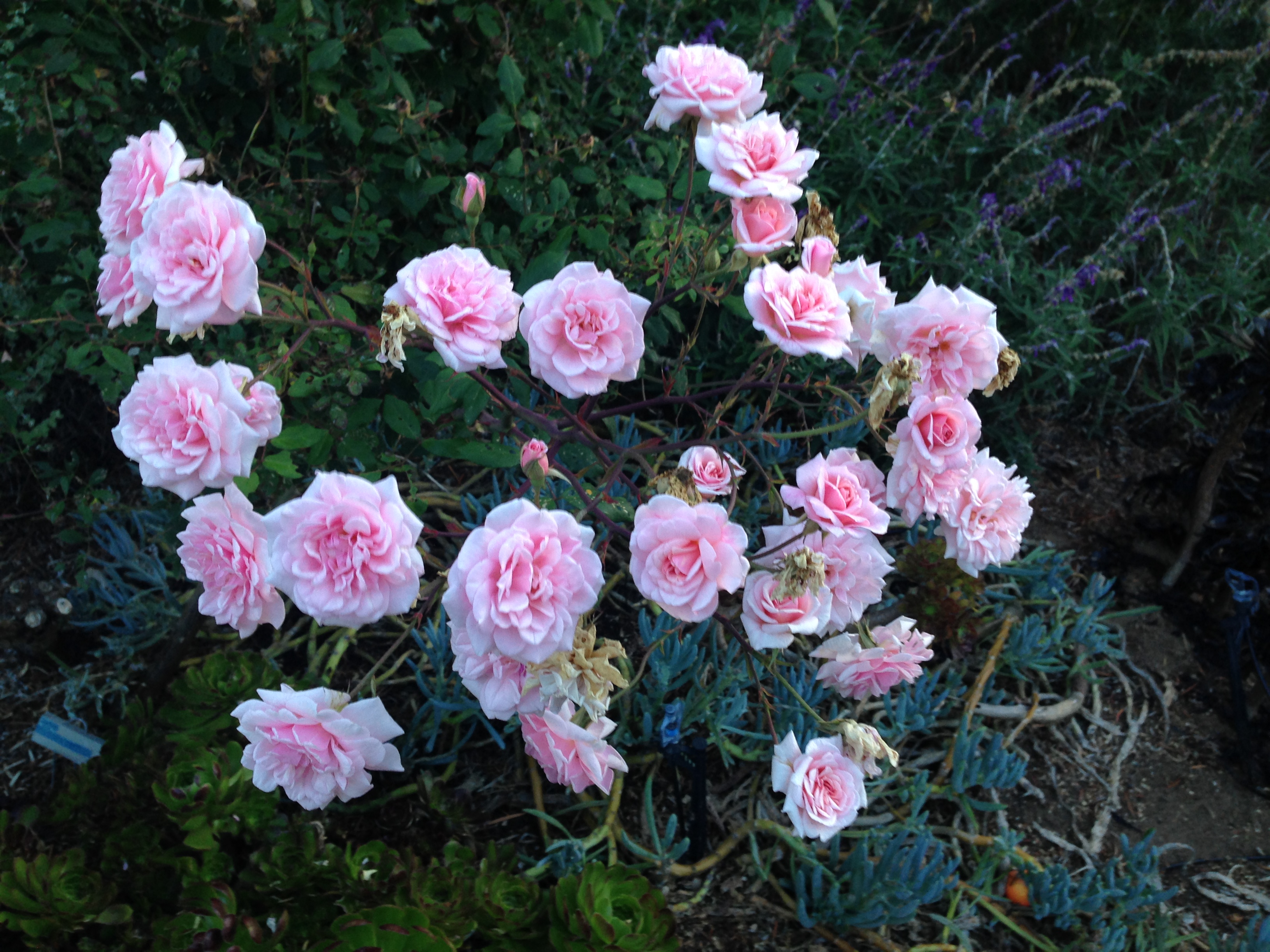
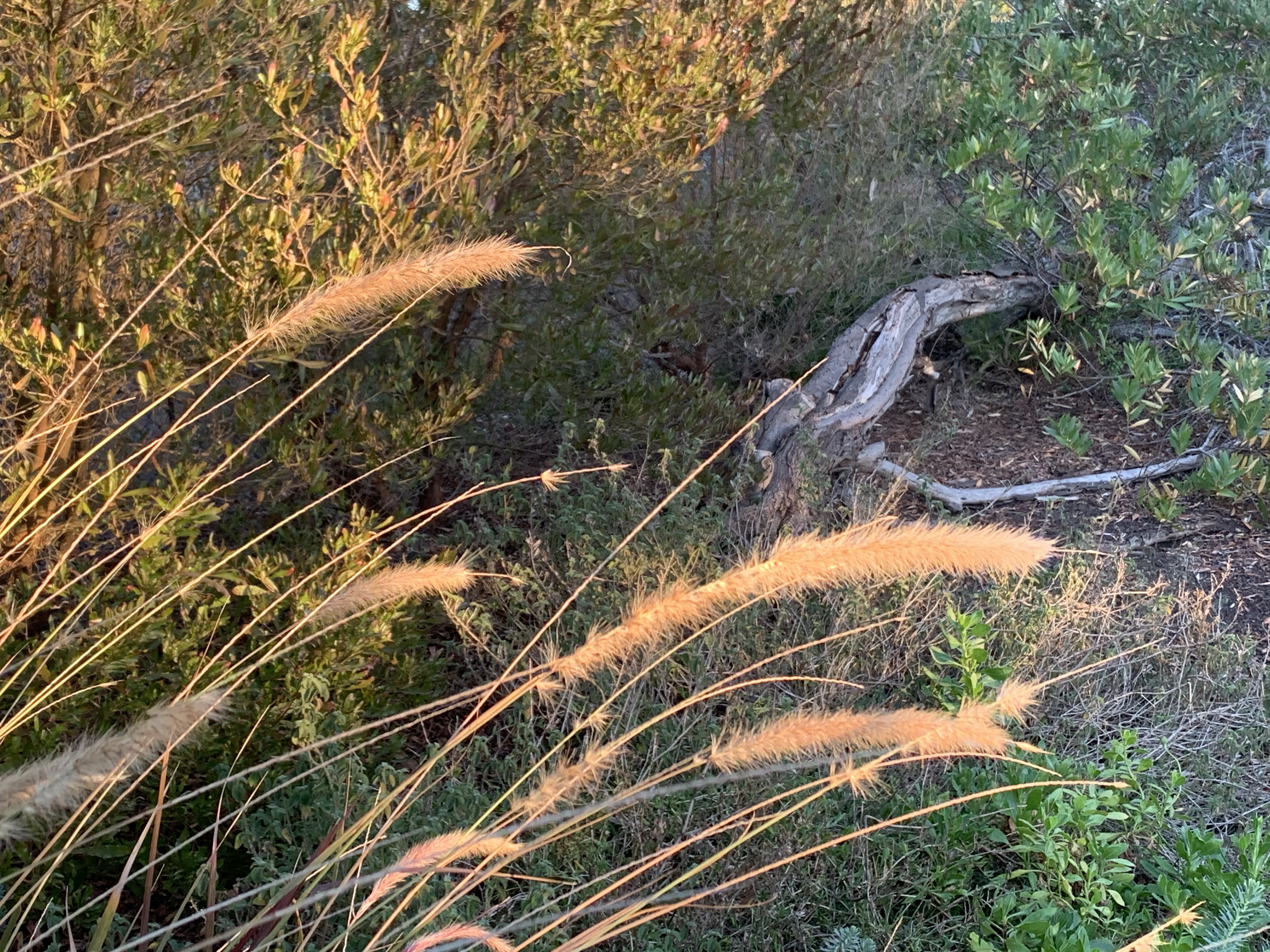
In order to illustrate “Good Shape,” I decided to take some pictures to illustrate “Bad Shape.” Since I have surrounded myself mainly with nature or with artifacts that were intentionally designed to be aesthetically pleasing, it turned out to be more difficult than I imagined at first. The other issue is that when I take photographs, I (like most people) “frame” the picture so that “Good Shape” is clear. I began to intentionally brake that habitual way of framing with pictures of flowers that overlap. The natural beauty of flowers is so rich that, to me, even a quasi-random framing still results in a beautiful picture. 

This turns out not to be the case with artifacts however. 

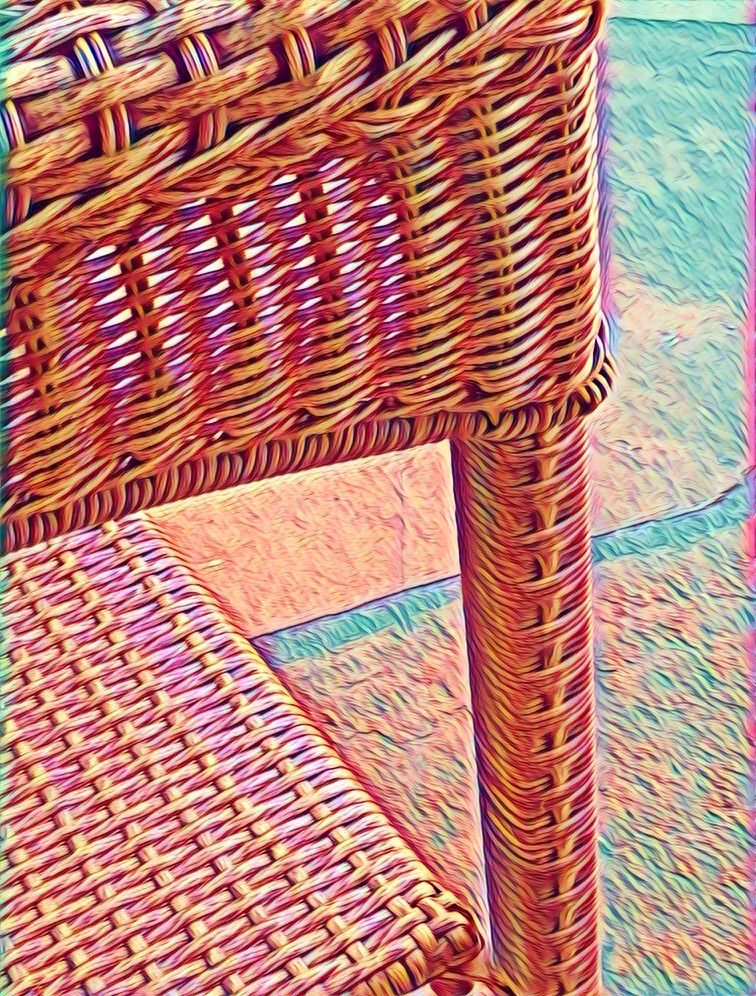
Although some of the elements of this seem to have “Good Shape,” the overall composition lacks a coherent center. It seems to me to be an artificial “kludge” of colors, textures, and shapes and there is no overall “Good Shape.” 

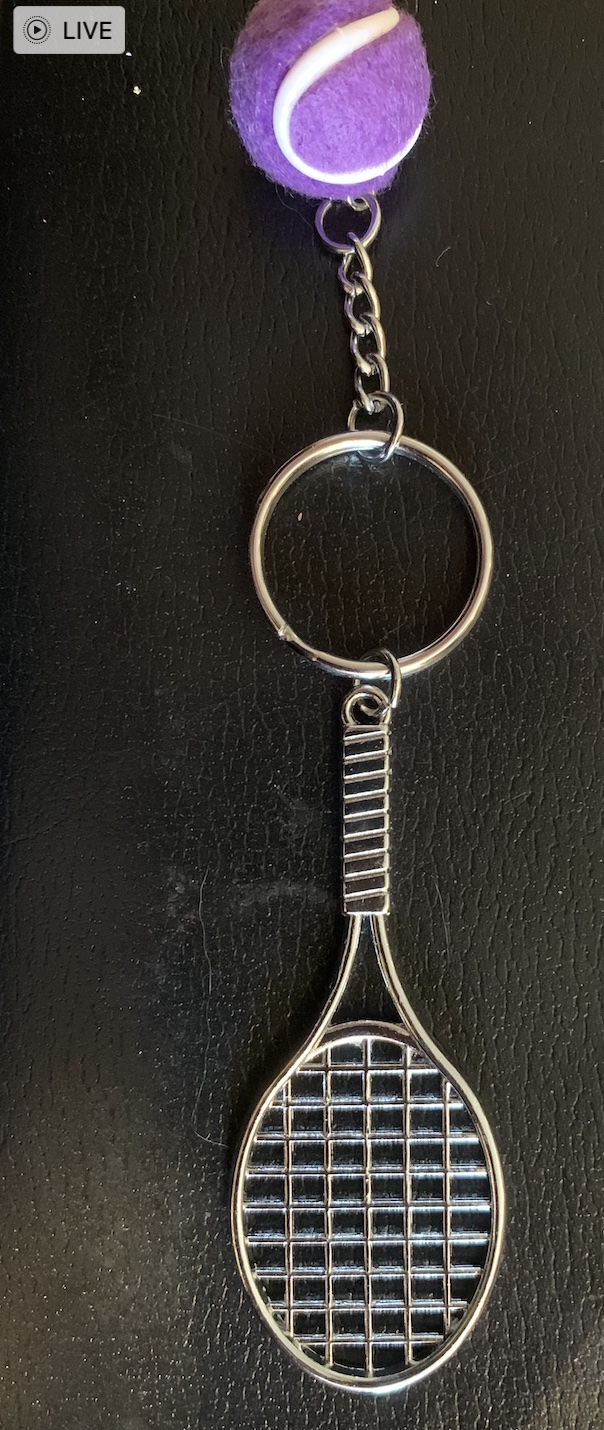
By re-arranging the elements into this form (above), to me, it seems to get closer to “Good Shape” but the purple “tennis ball” seems ill-proportioned and out of place. In “real tennis” there is a physical reason for the ball to be fuzzy but here, the fuzziness of the ball seems added on and arbitrary. 

Here too (above), the overall composition lacks “Good Shape.” The large semi-random dark blob in the middle has no real “Center.” The elements around the edges do not cohere or reflect off of each other. None of the elements around the edges are complete enough to have “Good Shape” except possibly the links of the small chain. 

Here is another example of quasi-random elements brought together into a single picture. Though to me, both the wood and the stone are in and of themselves beautiful, there is nothing about the composition that integrates into a whole. There is no center, no echoes, no alternating repetition, no levels of scale, and despite the nice texture of the stone and wood, the overall effect, to me, is lacking in “Natural Order” and in beauty. 

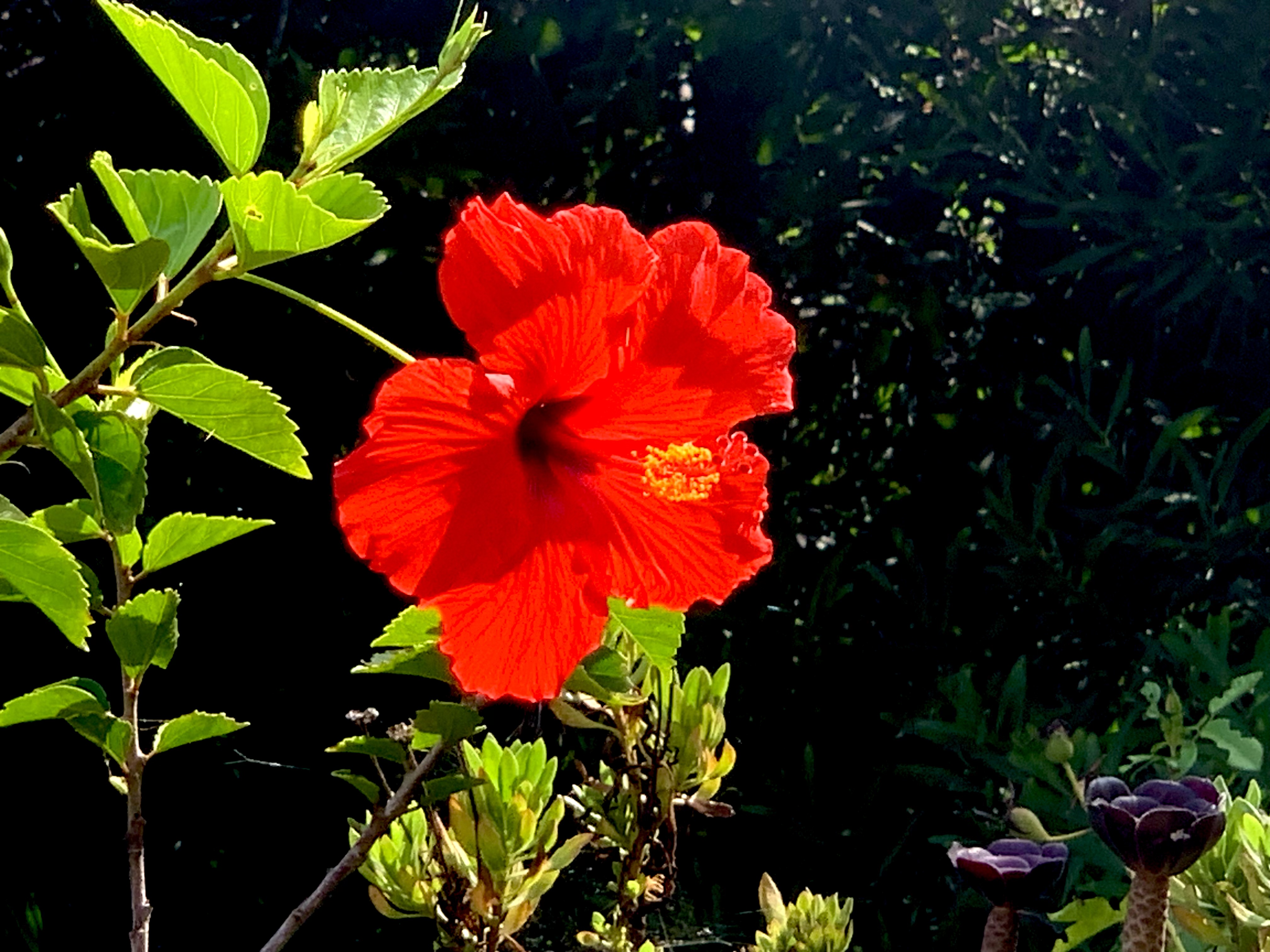
By way of contrast, the flower here seems to have a good overall shape reinforced by a Strong Center, Alternating Repetition, and each of the petals themselves has Good Shape. Around the flower, to me, is a “Positive Space.” Note that one of the petals seems slightly out of place. To me, however, this does not spoil the “Good Shape.”

The same can be said of these flowers. 

It isn’t necessary to have overall “simplicity” in order to have “Good Shape.” These flowers are not “simple” in shape, but they still have “Good Shape.” 

The bird on a branch shown above seems to me to have “Good Shape” even though it is (in outline) lacking symmetry. Though lacking symmetry in profile, the shape strikes me as “balanced.” I don’t perceive the bird as having to exert a lot of energy to keep from “falling off the branch.” The bird’s shape, like the shapes of most animals and plants is the result of 4.5 billion years of evolutionary history. 

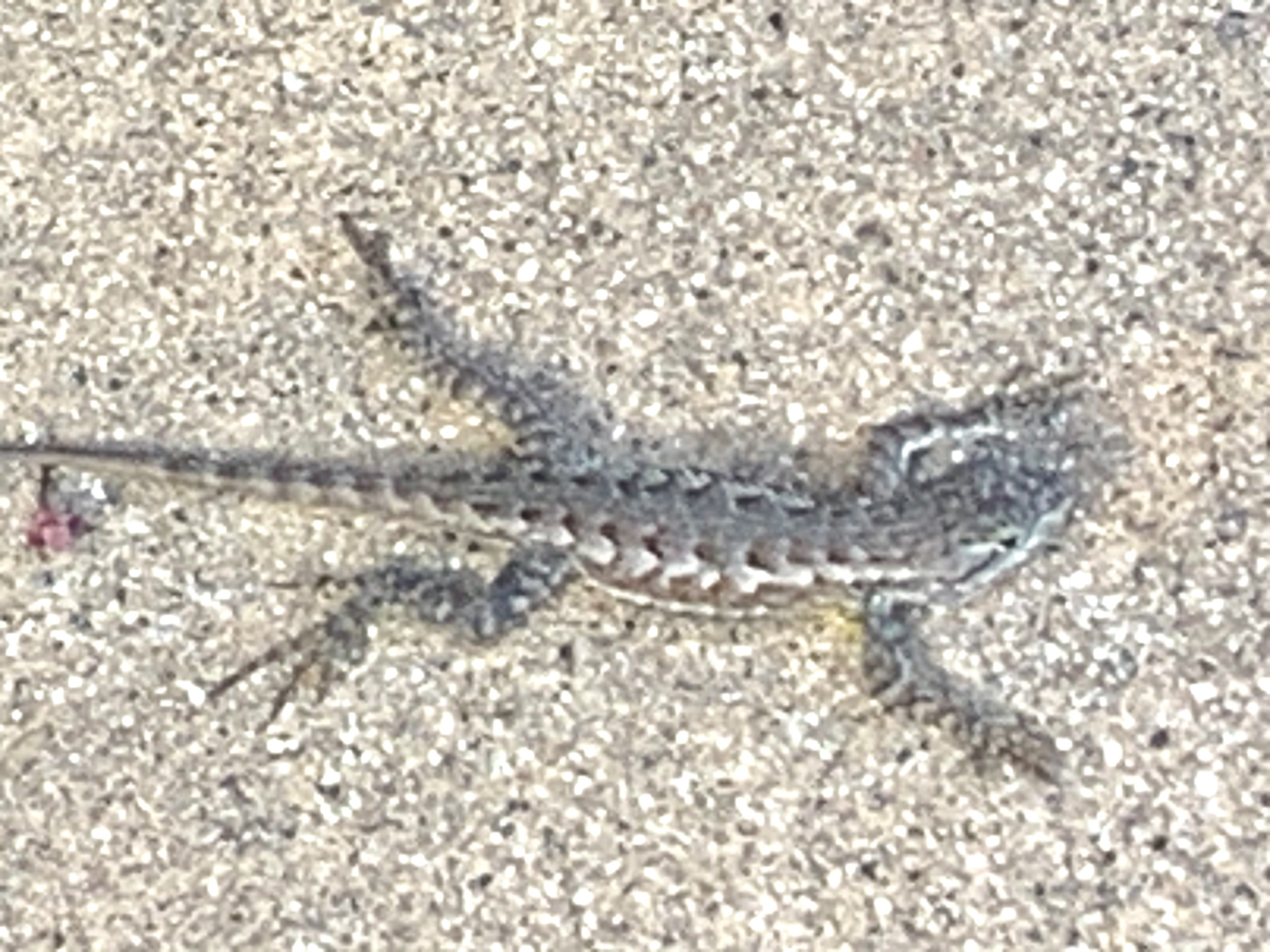
Many people view some creatures as “enemies” and therefore “creepy” or “yucky” or perhaps even as dangerous. If you can set that aside and simply look though, I think you can see that “Good Shape” characterizes all sorts of animals (as well as plants). 

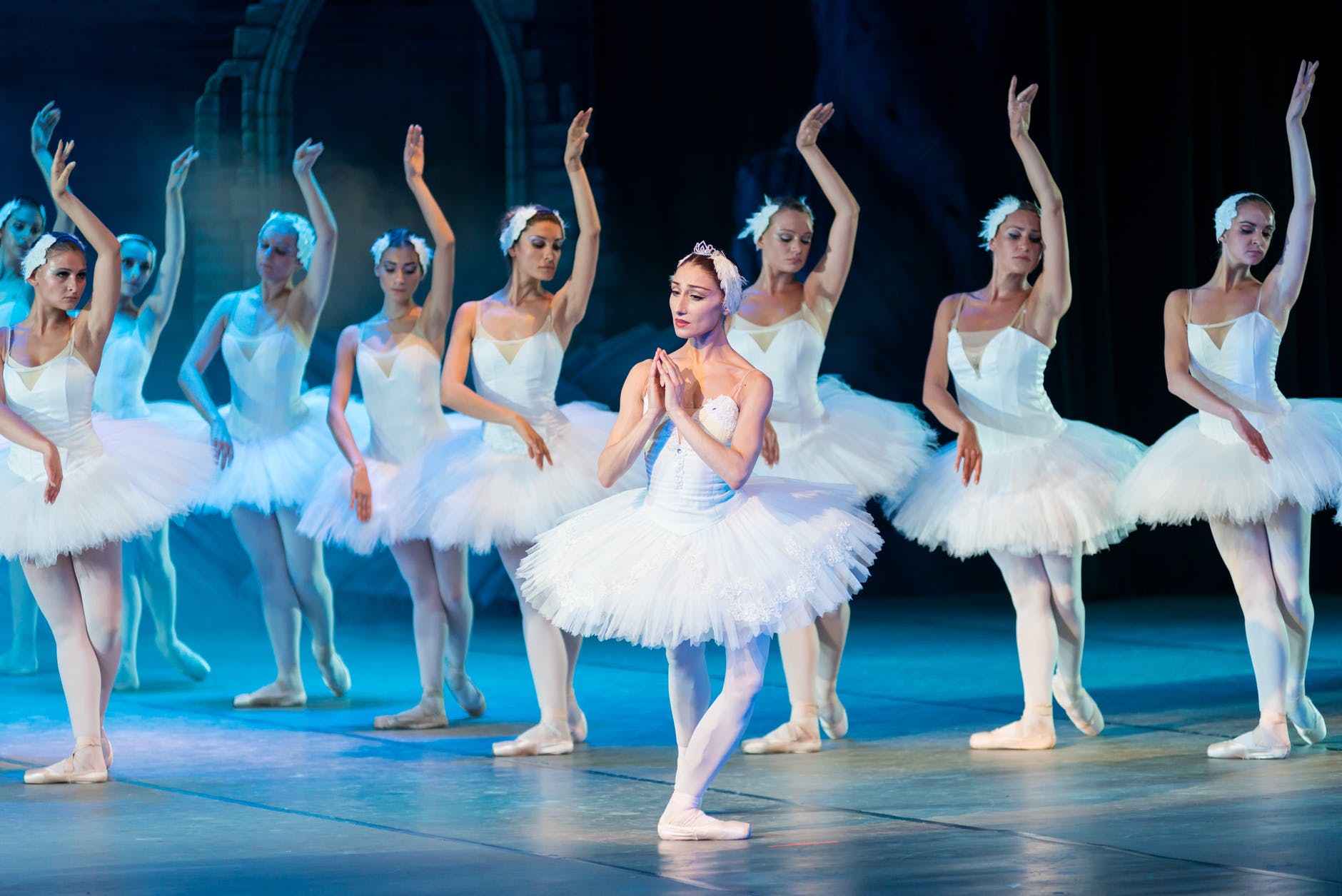
At a more abstract level, it even seems that natural animal behavior often shows beauty. That also seems characteristic of skilled human behavior. The Olympics show plenty of examples. It is hard to imagine an “ugly” baseball swing resulting in a home run. The runners, jumpers, throwers, gymnasts, tennis players, and so on produce “Good Shape” in three spatial dimensions and one temporal dimension. 

I play tennis several times a week. I’m not averse to winning a point even if the ball hits my frame, skids off to the net cord and drops over for a winner. But — I never feel as pleased by such outsized luck as when I hit a good shot that results from proper choice, preparation, and execution (and a history of practice and reflection). I never think of a lucky mis-hit as “beautiful.” 

The concept of “Good Shape” even applies to more complex human organizations and endeavors. Racism, for instance, to me is truly ugly. It is not based on truth, but on a kludge of lies masquerading as truth. White Supremacy for instance, basically says, “We’re white! That makes us superior! In fact, we’re so superior, that we insist every aspect of our society be tilted so we can be guaranteed a win!” 

Huh? 

Bad logic is never beautiful. 

The “Good Shape” exhibited by most plants and animals reflects both a long evolutionary balance of forces (phylogeny) and the development of a particular organism (ontogeny). When biology goes awry, as in cancer, the result is not beauty. The “logic” of cancer is that billions of years of evolution that allows our bodies to work harmoniously is put aside for short-sighted egotism. A random cell says, in effect, “I’m no longer going to do my part for the body as a whole. Instead, I’m going to grab all I can for myself and grow in an unrestricted way!” 

Such a cell, by making that decision, signs its own death warrant. Either the body destroys the cancer and therefore the cancer dies — or, the cancer prevails and in that case it destroys the life of the organism it was supposed to be a part of — and then it dies anyway! It’s an “ugly” decision both because it is disproportionate and because it is illogical. It aims to be self-serving, but it is not even self-serving. It guarantees its own death and kills more life along the way. 

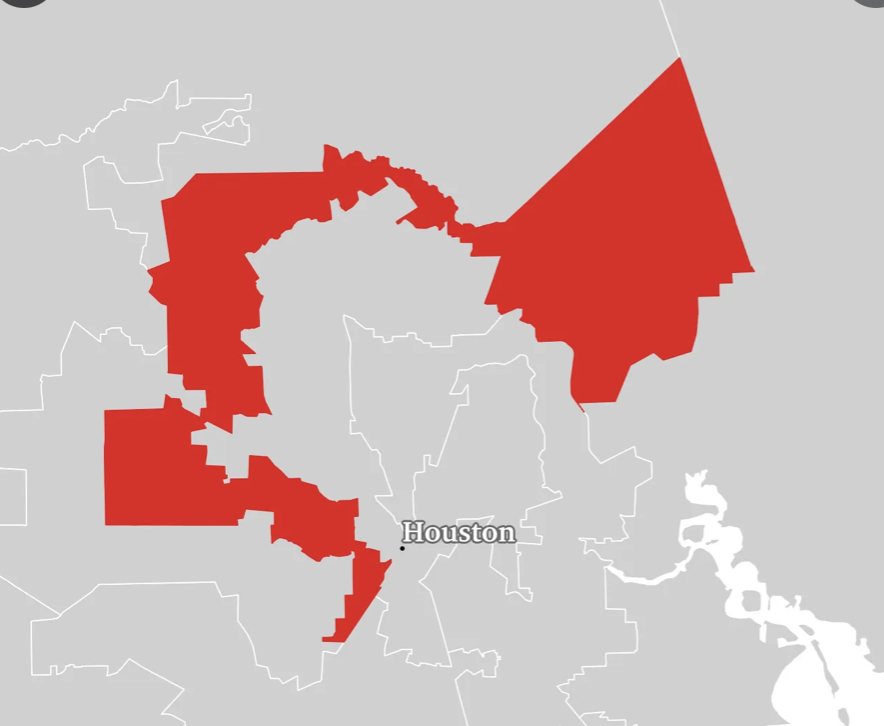
It’s the same, to me, with any dysfunctional human organization. If democracy is perverted by some people demanding that decisions be made so that they can have their way regardless of how it impacts the overall tree of life and the overall health of a city, state, or nation, it lacks “Good Shape” and instead becomes a distorted kludge lacking symmetry, lacking balance, lacking life. It is no accident that “Gerrymandered” districts do not have “Good Shape.” 

In extreme cases, not surprisingly, dictatorships have resulted in a war on truth, beauty, and life itself. It’s no “accident” that Hitler, Stalin, and Mao were each responsible for millions of human deaths. Their activities also show utter disregard for the beauty of the natural environment and the plants and animals of the planet. 

When it comes to User Experience, the most obvious way to apply “Good Shape” is to the visual elements of the interface — icons, windows, menus, tool bars etc. However, I think it also applies to the design process. Are the needs of all stakeholders taken into consideration? 

Do the various disciplines involved in design respect each other? Do people tell the truth and show trust? Does the company treat its users with respect and tell the truth in its various communications? 

If a company provides “free games” or “free services” that are purportedly for entertainment or education but the real purpose is to gather data to sell to advertisers or foreign powers trying to use the data to destroy democracy, it would seem to me that business model itself — the raison d’êtrefor the entire project is an “ugly shape” regardless of how pretty the icons are. 

What do you think? Do the concepts of natural beauty apply to the design of organizations and even governments?

—————————————

Christopher Alexander – Fundamental Property 6: Good Shape

Cancer always loses in the end

Fascism Leads to Chaos

Who Speaks for Wolf? 

Voter Suppression is Life Suppression

The Orange Man

Stoned Soup

The Broken Times

All We Stand to Lose

After All

Imagine All the People

Roar, Ocean, Roar!

The Dance of Billions

Photo by Pixabay on Pexels.com

5. Positive Space

15 Tuesday Sep 2026

Posted by petersironwood in creativity, design rationale, love, nature, psychology, Uncategorized, user experience

≈ Leave a comment

Tags

aesthetics, art, beauty, books, Christopher Alexander., Design, freedom, greed, growth, HCI, life, nature, pattern language, Patterns, politics, psychology, responsibility, usability, user_experience, UX

5. Positive Space

(This is the fifth in a series of 15 blogs that explore Christopher Alexander’s “Fifteen Properties” of good design, natural beauty, living spaces, etc.). 

Life is a dance on the edge between chaos, on the one hand, and sameness & repetition on the other hand. Repetition without variation or change is not life. On the other hand, endless random variation without any pattern or principle is also not life. Planet Earth is sometimes said to be a “Goldilocks Planet” — not too hot and not too cold — to support life. Most of the life forms on planet earth themselves exhibit a “positive shape” — a shape that wants to expand and fill out — and yet, there are limits because of circulation, gravity, communication etc. so that growth is typically not unrestricted. The tension between trying to grow and having to stick close enough to form creates positive space. 

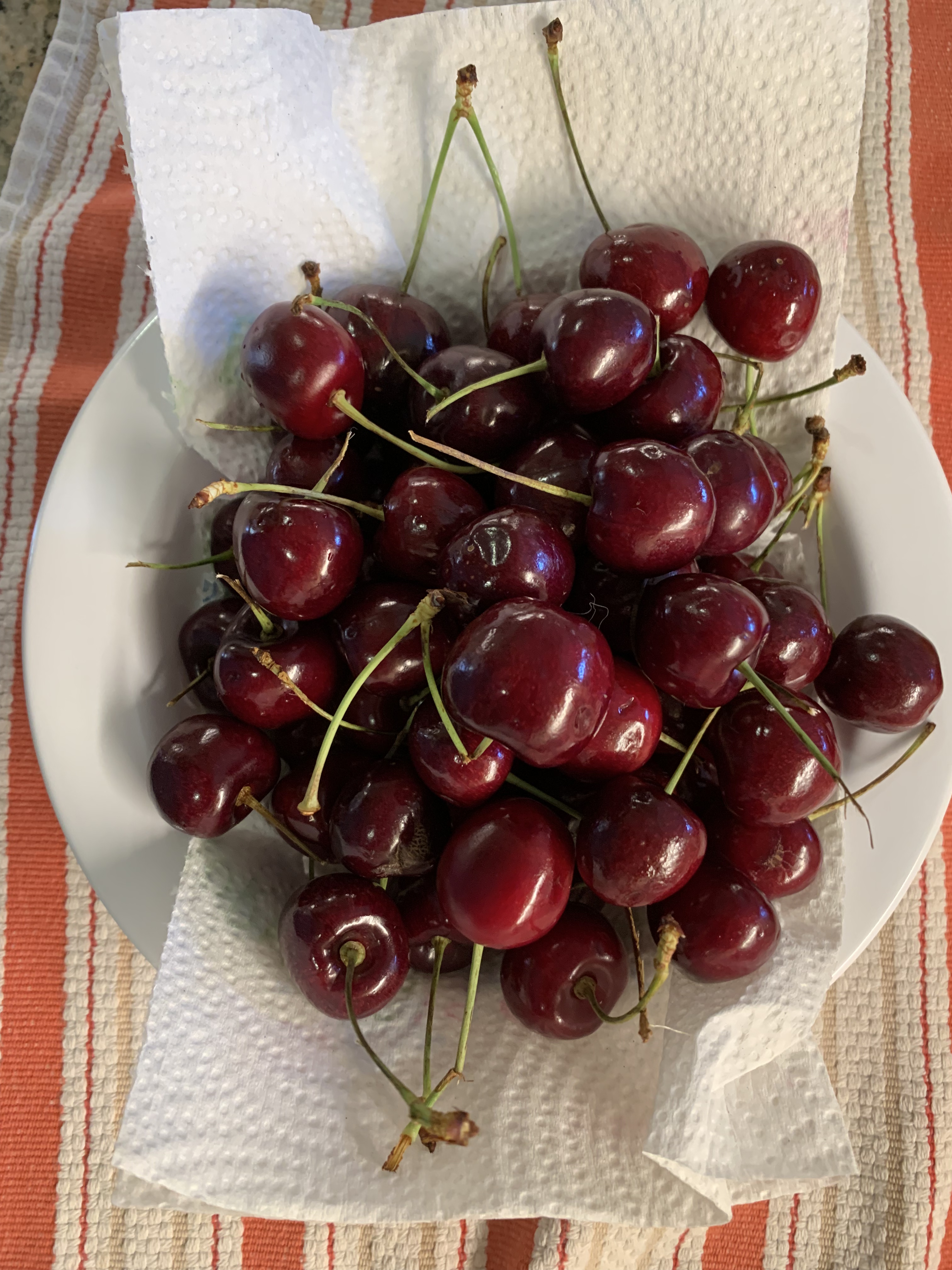
Life may not always be “a bowl of cherries” but nonetheless, a bowl of cherries does illustrate the property of “positive space.” The bowl connotes living things trying to expand right up to the boundaries possible. A bowl that is filled with cherries and even slightly over-filled but without inducing a fear of spillage, to me, connotes life being vigorous and healthy. To me, a single cherry sitting all alone in a large bowl seems to exhibit positive space much less — at least at the scale of the bowl. 

When I look at an individual cherry, I also see positive space. The cherry is not a perfect sphere, featureless and smooth. If it were, to me, it would be a much less positive space. The fact that there is a stem and a noticeable indentation where the stem goes provides a kind of center. So too does the slight asymmetry of the cherry. It appears as though it might have developed as two halves that tried to circle a space at the same time from two different directions – clockwise and counterclockwise. They met and merged to form the almost spherical cherry. 

The lobes of this red pepper show positive shape.

The cherry is not the only natural food that has this kind of positive space. Think of corn on the cob. Each kernel seems to have tried to grow as large as it can. It pushes up against and into other kernels. Each kernel seems therefore to be “bursting with life.” 

Consider a cucumber. It’s roughly cylindrical. But “roughly” is important here. To me, it would seem much less an example of “Positive Space” if it were literally a cylinder. It tapers at the ends and it bulges at the middle. That seems more “positive.” 

To a person who doesn’t understand that life is primarily a cooperative endeavor among all the parts of the vast tree of life, but instead sees the world only as a zero-sum game, it must seem as though the positive living space of a cucumber makes the space around the cucumber less positive and less living. But this is not true! The space around the cucumber’s slightly rotund shape is much more positive and living than the space around a perfect cylinder. 

Think of a tree trunk compared with a telephone pole. They are both made of wood and they are both approximately cylindrical. But a tree trunk feels much more alive to us than a telephone pole. I don’t think this is simply because we “know” a tree is alive. It looks more alive and if you allow yourself to “tune in” to it, it feels more alive. And, importantly, not only does the space that the tree inhabits seem more living. So too does the space around it! A long line of telephone poles may exhibit “Levels of Scale” and “Alternating Repetition” and such a picture may make us feel some life to it. 

Photo by Lerkrat Tangsri on Pexels.com

But a single telephone pole does nothing to stir life in me. In that sense, it’s nothing like a tree. It’s flat and it kills the space on either side as well. The columns in the Parthenon are roughly cylindrical and obviously not literally alive. But they, unlike a telephone pole, have positive space and create positive space around them. Life is not fundamentally a zero-sum game. The bee does not “steal” the flowers pollen and thus damage the flower. The bee helps the flower. The flower helps the bee. Positive space in an object does not steal from or detract from the space around the object. It enhances it! 

Similarly, the “competition” for space among the kernels of corn on a cob of corn shows that competition can be a beautiful thing. I like to see the kernels pushing against each other. All of them seem living and positive. Imagine instead a cob of corn in which one kernel had grown like a giant spider of orange cancer and took up 98% of the cob. Aside from this one ultra-greedy cell, there were only a few widely spaced and shriveled up kernels. Would you pick that from the pile of corn? Would you want to slather it with butter and bite into it? I sure wouldn’t! And to me, that is exactly what cruelty, unfairness, and greed look like. It might seem positive — after all, the dictator is trying to “grow.” That is true but he’s rigged the game. Competition is no longer beautiful when the game is rigged. Competition is no longer beautiful when your tennis opponent slices off your leg before the match starts or pays off the chair umpire to call everything you hit out. 

I don’t think there’s anything particularly special about cucumbers or cherries or corn. I just happened to have been washing vegetables before writing this. These radishes also exhibit positive space. And, although their shape is not the same as a cherry or a cucumber, the radishes also enhance the space around them. And, so does the avocado. An avocado that is just past ideal ripeness begins to flatten irregularly and the “pebbles” of the skin also flatten making a less positive space. The pebbles of a perfectly ripe avocado are themselves tiny positive spaces that add to the overall impression of vigor. 

Flowers provide numerous examples of positive space. And, so far as I can tell, the positive space of flowers invariably also enhances the positivity of the space around them. 

Animals also generally exhibit positive space. Their shapes, after all, come about through a struggle among different tradeoffs that have been “learned” by each species over four and a half billion years. But whether you look at the leg of a turtle, the leg of a turkey, or the leg of a polar bear, you will see positive space. The shapes are quite different because their histories are quite different. But in every case, the shape is determined by the history and each of those histories is the same length — 4.5 billion years. The fact that each of these shapes comes about through the dance of trying to survive and thrive in all their various habitats makes every one of them beautiful in its own right — even those whom most of us don’t particularly like to interact with such as rattlesnakes or lions. Even if we don’t wish to come face to face with a lion or grizzly bear, we do recognize their beauty. And, I would claim that as those animals walk through any landscape, they will not only exhibit their own positive shape; they will also enhance the positivity of the shape around where they are walking. Think how many times photographers and painters have put an animal in the foreground of a landscape. Of course, doing so makes the scene immediately more living, more interesting, and more beautiful. 

Photo by Anastasia Shuraeva on Pexels.com

What does this have to do with the user’s experience on a computing device? I would have to say that most interfaces on most devices do not do much to bring the interface “alive” including having positive space. The tool bar icons on this version of my Mac are very slightly “bulging” like a living cell (or kernel of corn). Even more subtly, the windows have slightly rounded corners. 

It’s an entirely different story with many games though. It seems to me that some of the game artists are among the best artists in the world. They have created many very beautiful games. Could they be more beautiful still if game designers consciously thought about using Christopher Alexander’s “Properties” in general, and “Positive Space” in particular? I think so, but for many games, such as Horizon Zero Dawn, many of the elements are copied so closely from nature that aspects such as “Positive Space” are mostly already taken care of by evolutionary bias toward the beautiful. (Yes, I do think there is such a bias, but it will have to be the subject of a different post.)

What about other applications and systems? Do you think you’ve seen good examples of “Positive Space” in such systems? How could you see incorporating “Positive Space” in UX? 

At a more societal level, it seems to me that freedom is closely related to “positive space.” Each individual should be free to expand, grow, experiment, so long as it doesn’t impinge much on those around them. Imposing overly strict boundaries makes life less interesting and less lively. Growth without any sense of balance or notion of how a particular piece of life relates to the whole is called cancer. A society which allows or even encourages theft, rape, fraud and other felonies under the banner of “freedom” is doomed to ultimate failure with lots of pain along the way.

————————————

Winning by Cheating is Losing

Life Will Find a Way

Math Class: Who are you?

Life is a dance

Myths of the Veritas: The Forgotten Field

Cancer Always Loses in the End

When GREED is the only creed

The After Times

After All

Somewhere a Bird Cries

The Dance of Billions

Some recommended books —

The Winning Weekend Warrior focuses on the mental game for all sports using examples from tennis, golf, baseball, and other sports. It covers self-talk, imagery, mental practice, strategy, tactics, & sportsmanship. http://tinyurl.com/ng2heq3

Turing’s Nightmares explores the implications and ethics of Artificial Intelligence through fictional short stories. http://tinyurl.com/hz6dg2d

Fit in Bits shows many ways to put more fun, variety, & exercise into daily chores and habits to help with strength, flexibility, fitness, and balance. http://tinyurl.com/h6c7fce

Tales from an American Childhood recounts early experiences mainly in the American Midwest in the 1950’s and relates them to contemporary issues and events. https://tinyurl.com/y9ajvz9j

Dream Planet. Where do you run when the whole world is crumbling under the weight of human folly? When the lethal Conformers invade 22nd century Pittsburgh, escape becomes the top priority for lovebird scavengers Alex and Eva.

https://www.barnesandnoble.com/w/dream-planet-david-thomas/1148566558

4. Alternating Repetition

14 Monday Sep 2026

Posted by petersironwood in creativity, design rationale, HCI, leadership, management, nature, psychology, Uncategorized, user experience

≈ Leave a comment

Tags

aesthetics, architecture, art, beauty, Design, diversity, HCI, human factors, leadership, order, repetition, UX, writing

(This is the fourth post in a series of 15 which aim to examine the fifteen properties of natural order postulated by Christopher Alexander. I wonder whether the property of “Alternating Repetition” could be more frequently incorporated into User Experience and what the pros and cons might be).

4. Alternating Repetition

In nature, whether we look at clouds, waves, mountain ranges, forests, plants, the leaves of plants, or almost any animal, we see alternating repetition. Such natural repetition is almost never a precise and complete replication. Just as every reproductive act of life introduces an element of recombination as well as the possibility of mutation, so too the repetitions we see in life are not mathematical. We indeed see patterns repeated in a line or in a circle, but the instances in living things show variation. Similarly, human artifacts made with the hands; e.g., weaving or poetry or rock walls or tennis strokes show repetition but with slight and subtle variations. 

If you look at modern industrial society, you see many examples of exact repetition. It’s true that if you looked at 10,000 examples of the same brand and model pen, or notebook, or scissors, or streak knives under a microscope, you could likely find small differences. To the naked eye, however, they would appear identical. Seeing 10,000 pebbles, leaves, or waves you would always see slight to moderate differences. To me, it makes a difference in terms of beauty. Handmade items and human actions naturally show more variation than things produced by machines. 

Photo by Pixabay on Pexels.com

The various “elements” of a User Interface generally have the feel of something made by machine. The size of all the application icons on the tool bar, for instance, are the same. They are all almost the same exact shape and size. On my tool bar the icons for Finder, Launchpad, Mail, Safari, Chrome, FaceTime, Messenger, Maps, Photos, Contacts, Calendar, Reminders, Notes, System Preferences, Keynote, Pages, Preview, and News are the same. However, the Kindle icon is slightly larger and more square. The Zoom icon is very slightly rounder. [NOTE: This is no longer true in 2026]. The icon for Facebook is still circular, however. In other words, there is some slight variation, but mainly the icons are the same in outline, but different inside. But the set of icons on the tool bar has no sense of “harmony” whatsoever–at least, not to me.

Note that the tool bar is both abnormally homogeneous in terms of positioning and size but completely disconnected in terms of the images which differ in a random disharmony seldom exhibited in nature.

Instead, each icon seems to scream out its individuality without regard to its neighbors. (Which reminds me of things like not masking, getting vaccinations, or telling the truth, for instance, because you don’t feel like it so who cares what the consequences to others are). Anyway, the layout of the toolbar, to me, it’s reminiscent of driving down the highway and seeing a sequence of billboards, each advertising some random product or service in no particular order. Often, each billboard is the same size but they are independent of each other. The one exception I can think of were the “Burma Shave” signs along the highway. Each sign was a small rectangle with several words on it. About a quarter mile down the road, another sign would appear. They were meant to be seen in a specific order and together, they made a kind of “story” which usually rhymed. Typically, the signs touted the joys of the product — “Burma Shave” — or, provided public service announcements about safe driving. 

In the early days of computing, putting in “variation” might have been insanely wasteful of space and processing time. This is no longer true. Yet, the “look and feel” of User Interfaces remains, for the most part, quite “mechanical” or “mechanistic” rather than “natural.” Sometimes modern computer games include naturalistic looking variations in how repeated plants, rocks, clouds, etc. are represented. Look at the palm trees and you will see variations among the trees that are reminiscent of the real palm trees I see every day in the San Diego area. In addition, each tree contains a number of fronds that repeat a generic theme; yet, each front is somewhat different. The fronds themselves each contain alternating repetition, just as do real palm tree fronds. 

We might consider whether it would make sense to put more natural looking alternating repetition into the more utilitarian aspects of user experience. For example, could it be both more beautiful and more useful to allow more variation in the way files are represented visually?  Will Hill, James Hollan, Dave Wrobleski, & Tim McCandless suggested (in a CHI ’92 paper) that physical documents such as manuals naturally show wear in places where they are most used. They suggested that the visual representation of computer documents might be altered slightly to show which documents have been used or edited more and also that such cues within a document might also be useful. 

Hill, William; Hollan, James; Wrobleski, Dave; McCandless, Tim; “Edit Wear and Read Wear,” Human factors in computing systems: Striking a balance. Proceedings of the 9th annual conference. SIGCHI ’92 Proceedings (Monterey, CA), Addison-Wesley, 1992, pp. 3-9.

One of the few cookbooks I use with some regularity is entitled, Fat Free and Flavor Full. The recipe I’ve used many times is the black bean salad. If I open the physical book, it naturally falls open to that particular recipe. “Open Recent” I find a very useful features of the Pages application, but I don’t see a way to look at files based on overall frequency of use. It could be the case that there are some applications for which you would want specific files to be easily found depending on the season or the date. The authors of “Edit Wear and Read Wear” were mainly talking about the utility of encoding information about a file into its visual representation. There might well be aesthetic reasons to do so as well. 

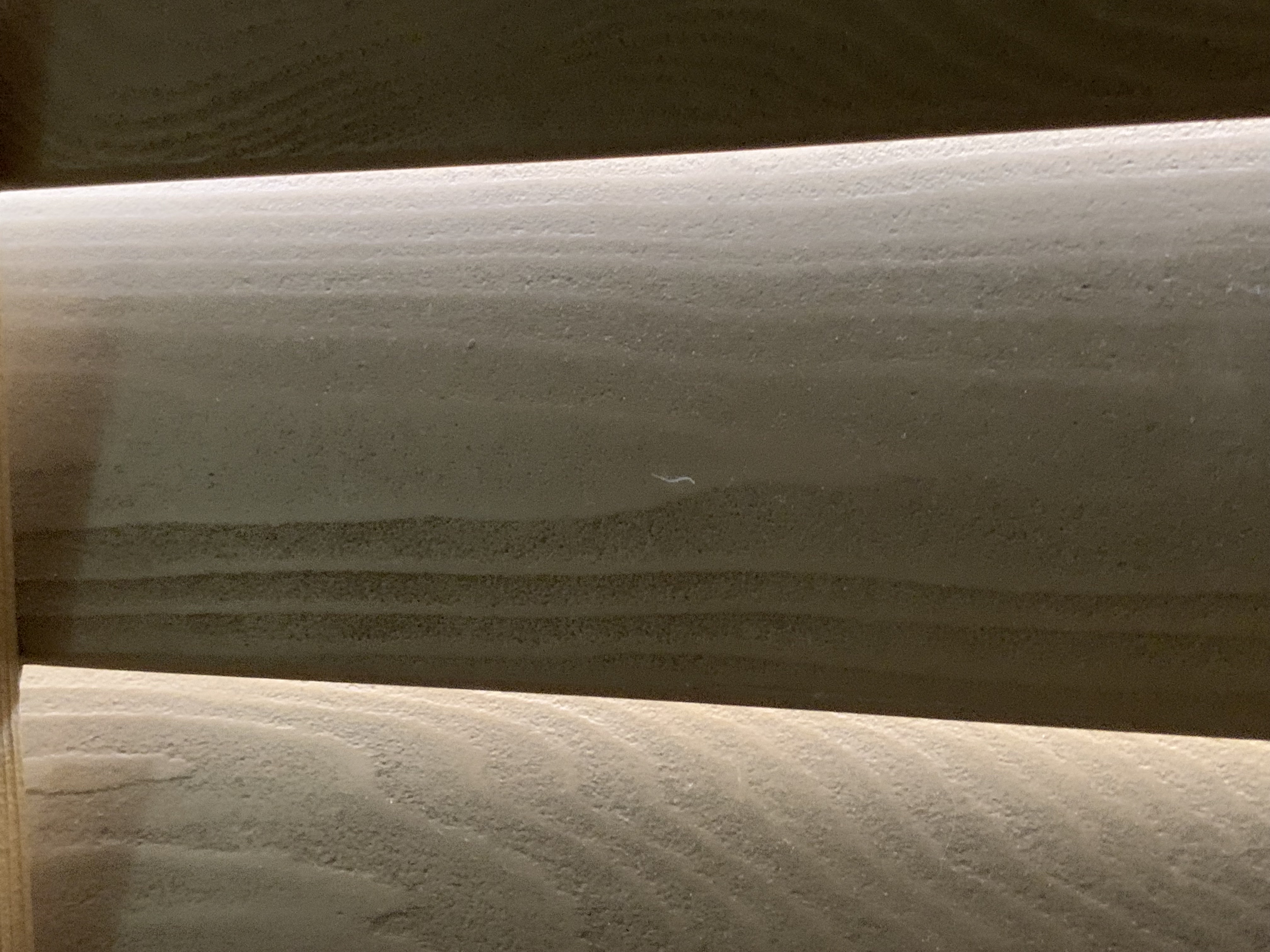
The wooden blinds shown below exhibit alternating repetition in several ways. First, there is the matter of perspective. Some variation almost always presents itself simply by virtue of the fact that I typically view the blinds at an angle and some are closer to me than others. This means that the size, and the retinal shape are slightly different. Second, there is variation caused by slight changes in the angle of the slats relative to vertical. Third, each slat is made of wood. The wood itself shows rings (or more commonly a planar projection of the concentric cylinders. 

The wooden blinds, because they are illuminated from the outside by tree-filtered sunlight also show further variation; however I don’t think that is typically “alternating repetition.” Perhaps not coincidentally, although I find it a little interesting, I can’t say I find that source of variation to be beautiful to me. The other three all add to the aesthetics, at least to me. 

Is it feasible to introduce alternating repetition with slight variation into User Interfaces? Would it be desirable? What negative side-effects might arise? Do you even agree with Christopher Alexander that Alternating Repetition is an aspect of natural beauty and beautiful design? One thing that occurs to me is that if some element of the UI is more variable in outline etc., it may mean that the actions upon that object must deal with that variability. If designed greenfield, that might not be too difficult. But if, for example, the code for dragging and dropping was written under a presumption of zero variability, that might be problematic. What do you think?

——————-

Discussion of Alternating Repetition with additional visual examples can be found here: 

The Fifteen Fundamental Properties of Living Structure. 4. Alternating Repetition

Because Christopher Alexander wrote a book, about the 15 properties, his examples are mainly visual. But alternating repetition as an element of beauty is also clearly present in music and in dance. There is a little of it, it seems to me, in culinary arts as well. I am also reminded of the smelling actions of my dog, Sadie. As she watches an animal without charging it, she waves her nose back and forth quite deliberately in a kind of “sampling” of the surrounding air. A bear will sometimes move sideways with alternating repetition to provide better depth perception of a far away target (like me!). But that’s a story for another time.

Use Diversity as a Resource

The Tree of Life

Life is a Dance

Take a Glance; Join the Dance

Piano

The Winning Weekend Warrior focuses on the mental game for all sports using examples from tennis, golf, baseball, and other sports. It covers self-talk, imagery, mental practice, strategy, tactics, & sportsmanship. http://tinyurl.com/ng2heq3

Turing’s Nightmares explores the implications and ethics of Artificial Intelligence through fictional short stories. http://tinyurl.com/hz6dg2d

Fit in Bits shows many ways to put more fun, variety, & exercise into daily chores and habits to help with strength, flexibility, fitness, and balance. http://tinyurl.com/h6c7fce

Tales from an American Childhood recounts early experiences mainly in the American Midwest in the 1950’s and relates them to contemporary issues and events. https://tinyurl.com/y9ajvz9j

Dream Planet. Where do you run when the whole world is crumbling under the weight of human folly? When the lethal Conformers invade 22nd century Pittsburgh, escape becomes the top priority for lovebird scavengers Alex and Eva.

https://www.barnesandnoble.com/w/dream-planet-david-thomas/1148566558

Strong Centers

12 Saturday Sep 2026

Posted by petersironwood in creativity, design rationale, HCI, nature, psychology, Uncategorized, user experience

≈ Leave a comment

Tags

aesthetics, architecture, art, beauty, Christopher Alexander., Design, HCI, human factors, usability, UX

This is the second posting in a series of fifteen which examine Christopher Alexander’s “Fifteen Properties” of natural beauty and suggests how these properties might apply to user experience design. 

Photo by Dominika Greguu0161ovu00e1 on Pexels.com

2. “Strong centers” is probably one of the most overlooked properties of design in UX/HCI. Often, what exists for the user, from their perspective, is a “sprawl” of functions, tool bars, and icons with no obvious overall or subsidiary organization. A better design would allow the user to quickly find a “home base” from which, it would be obvious where to find subsidiary home bases. There is some sense in which hyperbolic trees, fisheye lenses, and home pages partly begin to address this issue. 

Instead of “strong centers”, the impression I often get in looking at applications for word processing, organizing photos, searching, or dealing with settings is that the designers are given or generate a long list of functions to be supported. Which ones are related to which though? Which ones are central? In many cases, UX practitioners give users (or, more often, potential users), a set of cards with one function each and ask the users to sort these into piles. I am not against such studies, but they are unlikely to lead to a coherent design with a strong center. The users are not, in most cases, professional designers. In many cases, an application is supposed to support many different specific actions. For example, I use word processors to write essays, poems, and fiction. I also use a word processor to proofread something, to re-organize ideas, to “jot down” a bunch of ideas, or to write an outline. These are very different tasks, at least to me. If asked to sort cards, I would do it differently depending on which type of task and which type of material I’m thinking about. 

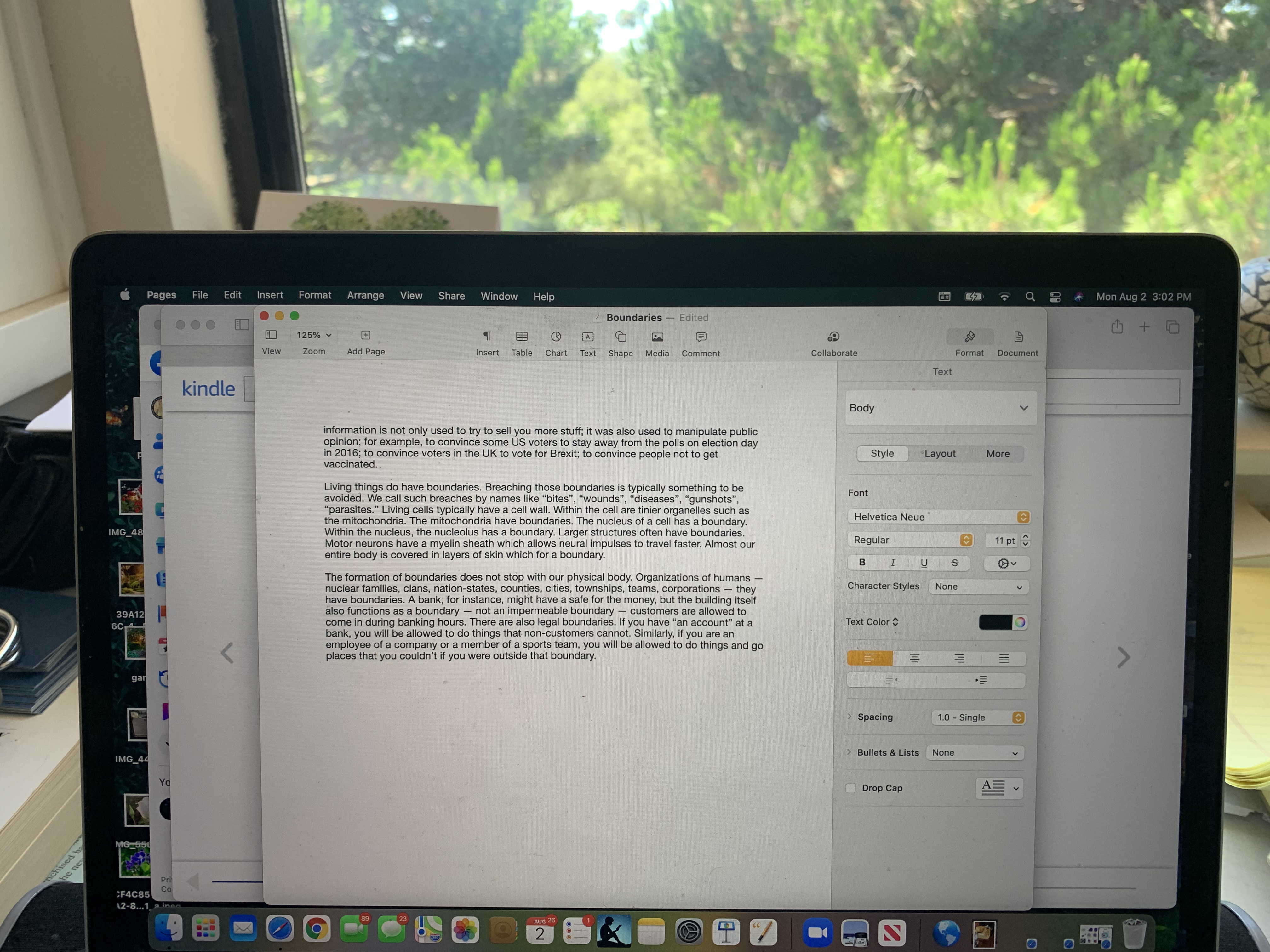
As I type this, I glance at the “Pages” tool bar which includes: Pages, File, Edit, Insert, Format, Arrange, View, Share, Window, and Help. None of these seems like “home” to the task of writing an essay. I know from experience that if I want to write any kind of material, I must go to the “File” menu even though, as best I can recall, my initial impression of this label was that it would be something to do after I was “done” with the tasks of composing and proofreading. The toolbar gives no impression of their being any “center” at all, let alone a “strong center.” 

In my native language (English), I read from top to bottom, left to right. In that sense, the Apple Icon is first and the “Pages” item is next and it is in bold print. That could be considered a subtle clue that it’s the “most important.” In a way, the items on the “Pages” menu are “meta-items.” In that sense, I suppose you could argue that they are “important” — though as a writer, none of the items seem that important. In fact, if we get right down to it, nothing in Pages really seems designed to support the actual writing process. And, I’m not trying to single out Pages because it’s the only one or the worst one. Lack of a “strong center” seems true of nearly all applications. 

Different people use different processes for writing — and I myself use different processes for different types of writing, so perhaps trying to organize the features and functions so that there is a “strong center”reflective of the “strong center” of the task of writing is just not feasible. I am certainly not advocating for resurrecting “Clippy.” 

Ideally, it should be possible for users to “know where the action is” upon entering an application or a web page.

In another interpretation, “strong centers” refers more to underlying architecture and points to the need for a core of functionality that transcends a specific release or even a specific application. A good underlying architecture will communicate this essential center (related to central purpose or style) to the user.

All too often, the processes involved in developing an application or system themselves have no “strong center.” If the development process is itself a hodgepodge political process of accommodating to a portfolio of features and functions that are advocated for by diverse and uncoordinated stakeholders, then, what one has are a long, unorganized list artificially shoved into menus and sub-menus and toolbars. It should not be surprising then, that the user finds it difficult to know where to begin when first encountering an application — even if the user knows exactly what they want to accomplish. 

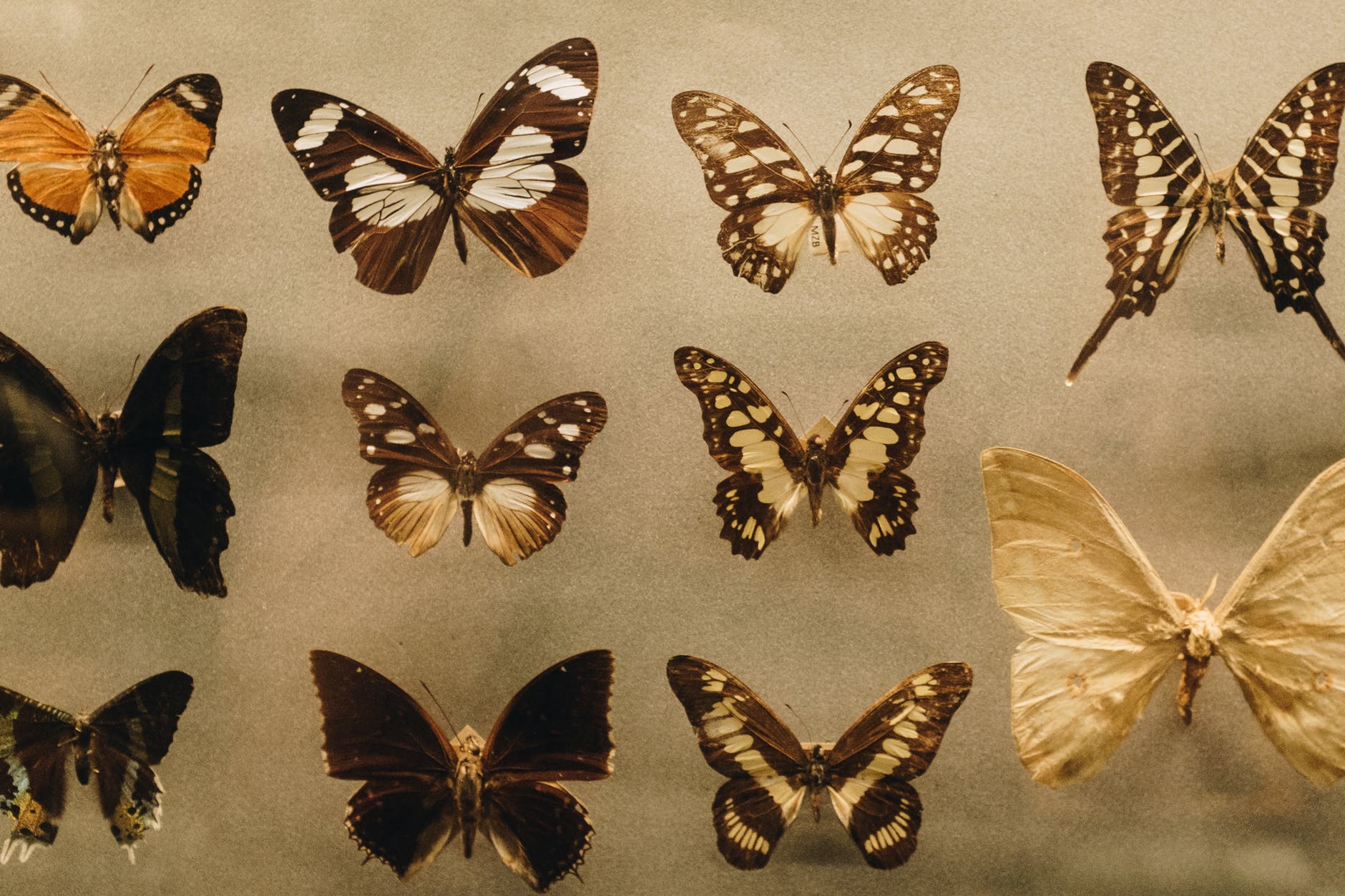
Compare and contrast most menu structures and user interfaces with the “strong centers” that are extremely common in life forms. Here are some examples of butterflies. 

Photo by Cu00e1tia Matos on Pexels.com

The central axis includes the head, the thorax and the abdomen. These are in a line in the strong center. Typically, they are colored differently from the wings. The bilateral symmetry of the wings as well as the overall shape reinforces the strong center. Wing patterns, and even the antennae and legs lead the eye back to the strong center. 

Most people think of butterflies as beautiful — and I agree. When asked, however, most people will say they are “brightly colored.” Some are; some are not. But “bright colors” don’t necessarily give rise to beauty!

Strong Centers doesn’t just apply to butterflies. Look at most birds, fish, mammals, insects and you will see how the symmetries and smaller centers reflect and strengthen the major center. Indeed, Strong Centers are not limited to the animal kingdom. The trunk of a tree provides a strong center. Each branch is itself a center and the connection of the branches to the trunk reinforces the strength of the central trunk. 

Photo by Snapwire on Pexels.com

Even single cells often exhibit strong centers (and many of the other 15 properties, by the way). 

It would love to be able to provide you with a process or checklist or formula so you could design user experiences with “strong centers.” I cannot really do that. Nor can anyone else. If you keep it in mind, even at the back of your mind, you may see opportunities to help make that happen with regard to whatever you’re working on. I’m curious to hear your thoughts about “Strong Centers.” 

One technique that may be of some use was shared at a workshop by someone who worked at a car company. In the design of a specific car, the team decided the car would reflect “a professional soccer player out for a night on the town.” This is obviously not a “formula” or “checklist” but it offers a metaphor that designers of car interiors, exteriors, and the drive train could all relate to. A similar method is sometimes used in film — some specific person is responsible for the artistic integrity of the whole.

There is no one way to produce strong centers. Here are some examples from flowers.

———————

Here we see that each flower has a strong center and the central stem provides a strong center for the entire plant.

Some useful links to more information, discussion, and examples relevant to “strong centers” or to the fifteen properties.

Christopher Alexander – Fundamental Property 2: Strong Centers

https://www.archdaily.com/626429/unified-architectural-theory-chapter-11

Roar, Ocean, Roar!

Imagine All the People

The Dance of Billions

Somewhere a Bird Cries

How the Nightingale Learned to Sing

Piano!

Unite!

Fifteen Properties of Natural Beauty & UX/HCI

09 Wednesday Sep 2026

Posted by petersironwood in creativity, design rationale, HCI, nature, psychology, Uncategorized, user experience

≈ 1 Comment

Tags

architecture, art, books, Design, gratitude, HCI, human factors, mindfulness, photography, Travel, UX

Photo by Dominika Greguu0161ovu00e1 on Pexels.com

This is an introduction to a series of blog posts on the “Nature of Beauty.” 

Christopher Alexander was an architect and city planner. In his MIT dissertation, Alexander took a very mathematical approach to design. In our studies at IBM Research on the “Psychology of Design” I first ran across that work (Notes on the Synthesis of Form). Later in his career, however, he took a quite different approach to design. With an international team, he visited many different parts of the world to see what “worked” in terms of architecture and city planning. The results were documented in the form of a “Pattern Language.” In this sense, a “Pattern” is the named solution to a recurring problem. A “Pattern Language” is a connected lattice of Patterns that together, “cover” a field. 

Others (including me) have emulated his approach for other fields such as pedagogy, organizational change, object-oriented programming, software development processes, and human-computer interaction. A few years ago, I suggested such Patterns for collaboration and teamwork. Here’s a link to the introduction of that effort. Here’s a link to the index of those Patterns. 

Still later in life, Christopher Alexander embarked on a project called The Nature of Order. This work is documented in a series of four books. In the first book, he proposes fifteen properties of good form in nature — and in beautiful artifacts. Explication and example will be needed to appreciate what these properties mean. In this post, I list the fifteen and will attempt to explain the first one with respect to UX and Human Computer Interaction.

OLYMPUS DIGITAL CAMERA

First, you might be wondering what relevance these fifteen properties of nature might have to interface design. After all, can’t the designer just test out their ideas empirically until a UX design is shown to be usable, learnable, and perhaps enjoyable as well? Well, sure. Ideally, every possibility could be explored and tested empirically. 

But how many possibilities are there? Without any guiding principles, there are not only more possibilities than can be tested by you. There are more possibilities than there are atoms in the universe. Imagine a very simple interface on a small mobile device. Let’s say there are only ten screens in your whole application. The iPhone 12, for instance, has nearly 3 million pixels. 24-bit color allows over 16 million colors per pixel. If you literally tested out every possible arrangement, this would mean 16 million to the 3 millionth power for each of the ten screens!! The number of atoms in the universe is estimated to be between 10**78 and 10**82. Obviously, this is far less than 16,000,000**3,000,000 !! 

Of course, I’m not suggesting that anyone would attempt a pixel by pixel test of an interface, but the general point remains: you need some way to limit testing to reasonable alternatives. The notion of using these fifteen properties is not that they dictate a particular design nor that you don’t need to do any empirical testing. Rather, the fifteen properties could be used to help guide design. The properties could be thought of as reducing the search space. 

Here are the fifteen properties: 

  1. Levels of Scale
  2. Strong Centers
  3. Boundaries
  4. Alternating Repetition
  5. Positive Space
  6. Good Shape
  7. Local Symmetries
  8. Deep Interlock and Ambiguity
  9. Contrast
  10. Gradients
  11. Roughness
  12. Echoes
  13. The Void
  14. Simplicity and Inner Calm
  15. Not-separateness

Perhaps the names themselves might resonate with your own sense of aesthetics for design and composition, but let’s review them one by one. 

The first is “Levels of Scale.” 

Photo by Roney John on Pexels.com

When it comes to natural beauty, a few moments reflection may provide you with many examples. Christopher Alexander claims this property is also present in traditional art and architecture across many cultures. As you see something such as, e.g., the Taj Mahal or the Parthenon in the distance, you see a beautiful shape. As you approach it, you will see more and more levels of scale. By contrast, many modern buildings are largely featureless between the overall shape and the texture of the building material. 

If your design has multiple levels of scale, it will be easier for your user to orient themselves; to know “where they are” in the application and therefore easier to take appropriate action. Not only are you making their “task” more doable, you are providing a kind of entertainment. If it works well, they will be thinking of the building and perhaps its significance the entire time they approach the building. By contrast, if I approach a modern no-scales building, I bore quickly and, like most people, there are a whole host of things waiting to be thought about. So, I’ll mainly be thinking of one or my problems and largely ignoring your building and what it stands for. Reflect on your own experiences and see whether you agree. Lincoln Memorial, Winchester Cathedral, Temple in Kyoto: they are completely different from each other and yet in this way, they are all the same: they keep your attention focused on the moment. In other words, they help you be fully alive and awake. In the best circumstance, they also elicit some awe and gratitude not only for the geniuses who designed but also for the many laborers who found and mined the materials, constructed something from it, and even those whose taxes paid those workers.

Levels of Scale is something to keep in mind with respect to your design — whether hardware, software, documentation, story, or a building. 

How could you use or see “Levels of Scale” as a desirable property of what you are doing right now? 

———————————-

Some references to Pattern Languages in HCI. 

Pan, Y., Roedl, D., Blevis, E. and Thomas, J. (2012), Re-conceptualizing Fashion in Sustainable HCI. Designing Interactive Systems conference.  New Castle, UK, June 2012.

Thomas, J. C. (2012).   Patterns for emergent global intelligence.   In Creativity and Rationale: Enhancing Human Experience By Design J. Carroll (Ed.), New York: Springer.

Thomas, J. (2012). Edging Toward Sustainability. CHI Workshop Position Paper for Simple Sustainable Living. CHI 2012, Austin, Texas.

Thomas, J. (2012), Enhancing Collective Intelligence by Enhancing Social Roles and Diversity. CSCW Workshop Position Paper for Collective Intelligence and Community Discourse and Action. CSCW 2012, Bellvue, WA.

Thomas, J. (2011), Toward a pattern language for socializing technology for seniors. Workshop position paper accepted for CSCW 2011 workshop: Socializing technology among seniors in China, Hangzhou, China, March 19-23.

Thomas, J. (2011). Toward a Socio-Technical Pattern Language for Social Systems in China and the World. Workshop position paper accepted for CSCW 2011 workshop: Designing social and collaborative systems for China. Hangzhou, China, March 19-23.

Thomas, J. (2011). Toward a Socio-Technical Pattern Language for Social Media and International Development. Workshop position paper accepted for CSCW 2011 workshop: Social media for development, Hangzhou, China, March 19-23.

Bonanni, L., Busse, D. Thomas, J., Bevis, E., Turpeinen, M. & Jardin, N. (2011). Visible, actionalble, sustainable: Sustainable interactin design in professional domains.  Workshop accepted for CHI 2011. Vancouver, B.C., May 7-12.

Thomas, J. (2011). Focus on Ego as Universe and Everyday Sustainability. Workshop position paper accepted for CHI 2011 workshop: Everyday practice and sustainable HCI: Understanding and learning from cultures of (un)sustainability.  Vancouver, B.C., May 7-12.

https://www.researchgate.net/publication/2242380_A_Pattern_Approach_to_Interaction_Design

Click to access dearden-patterns-hci09.pdf

https://www.mit.edu/~jtidwell/common_ground.html

Thomas, J. C. (2018), Building common ground in a wildly webbed world: a pattern language approach. Journal of Information, Communication and Ethics in Society, 16 (3), 338-350.

——————————-

Some recommended books:

The Winning Weekend Warrior focuses on the mental game for all sports using examples from tennis, golf, baseball, and other sports. It covers self-talk, imagery, mental practice, strategy, tactics, & sportsmanship. http://tinyurl.com/ng2heq3

Turing’s Nightmares explores the implications and ethics of Artificial Intelligence through fictional short stories. http://tinyurl.com/hz6dg2d

Fit in Bits shows many ways to put more fun, variety, & exercise into daily chores and habits to help with strength, flexibility, fitness, and balance. http://tinyurl.com/h6c7fce

Tales from an American Childhood recounts early experiences mainly in the American Midwest in the 1950’s and relates them to contemporary issues and events. https://tinyurl.com/y9ajvz9j

Dream Planet. Where do you run when the whole world is crumbling under the weight of human folly? When the lethal Conformers invade 22nd century Pittsburgh, escape becomes the top priority for lovebird scavengers Alex and Eva.

https://www.barnesandnoble.com/w/dream-planet-david-thomas/1148566558

The Walkabout Diaries are photo-essays inspired by walks in nearby neighborhoods, gardens, and parks.

The Walkabout Diaries

Walston & Felix Multiple Regression Study

17 Friday Jul 2026

Posted by petersironwood in creativity, design rationale, leadership, management, psychology, Uncategorized

≈ 1 Comment

Tags

art, books, development, HCI, IT, productivity, programming, regression, software, technology, UX, writing

As I mentioned recently, when I first arrived at IBM Research in the early 1970’s I began to work on Query By Example and other schemes to make it easier for non-programmers to interact productively but flexibly with computers. Some of the lessons learned have to do, not with my own work, but with the work of others. 

At that time, some researchers labelled their work as “The Psychology of Programming.” There were many debates — and some studies — about structures, syntax, which language was better than others, etc. There were also lengthy discussions about the process that one should use for software development. Doing any kind of “controlled” experiment on large scale code development is prohibitively expensive. It is rare that a company is willing to have two independent teams build the same piece of software in order to learn which of two methods is “better.” 

Of course, one such comparison would likely not prove much. It may be that one of the two teams had a “super-programmer” or an extremely good manager. Perhaps, flu broke out in one of the two teams. You would really need to study many more than two teams to properly and empirically study the impact of language, or syntax, or process. Doing reasonable-sized experiments would be far too costly and impractical. Our lab and others did do laboratory tasks in order to test one syntax variant against another and so on. The problems were generally quite small in order for the study to be practical. So, the applicability to real-world development projects was questionable.

Photo by Christina Morillo on Pexels.com

Walston & Felix (See below), on the other hand, were able to find data on a fair number of real-world projects and rather than try to control for languages, processes, etc., they did a multiple regression analysis based on what languages, methods, etc. real projects used and what the important predictors were of actual productivity. 

Personally, I learned two lessons from their study. 

Lessons Learned: #1 — Sometimes, when it comes to what matters in the real world, controlled laboratory experiments have to give way to other methods such as studying “natural experiments.” Despite the many issues with trying to interpret such findings, no-one will pay for massive controlled experiments that parametrically vary programming methods, programming languages, etc. while controlling for quality of management, experience, complexity of task, etc. Multiple regression studies and in-depth case studies; ethnographic studies; interviews: all of these can provide useful input. 

OLYMPUS DIGITAL CAMERA

Lessons Learned: #2 — The impact of the variables that our community of people were looking at in terms of syntax, structure, etc. were dwarfed by the impact of organizational variables. For example, Walston & Felix found that the complexity of the interface between the developers and the customers was extremely important.

DeMarco & Lister (See below) claim that, based on their decades of experience as consultants to the software development process, projects almost never fail for technical reasons; when they do fail, it’s almost always for organizational and management reasons.  

That conclusion dovetails with my own experience. Many decades later, working for IBM in “knowledge management,” it was amazing how many companies wanted us to “solve” their knowledge management issues by building them a “system” for knowledge sharing.

But…

Management at the company would not provide:

Incentives to share knowledge

Space to share knowledge

Time to share knowledge 

Or, commit any personnel to gathering, vetting, organizing, and promoting the knowledge repository. 

So — knowledge sharing was something their workers were simply supposed to “do” knowledge sharing on top of everything else they were doing. 

They did not want a computer system, IMHO; they wanted a magic system. 

Photo by David Cassolato on Pexels.com

These experiences were part of my motivation for attempting to catalog “best practices” in collaboration and teamwork in the form of a Pattern Language. Christopher Alexander and his colleagues looked at “what worked” in various parts of the world when it came to architecture and city planning. What they did for architecture and city planning, I want to do for collaboration. 

Naturally, merely creating a catalog is not sufficient. I need to have people who will read it, understand it, modify and improve it, and then promulgate it via actual use. For now, it’s free. Comments and critiques are always welcome.

—————-

C. E. Walston and C. P. Felix, “A method of Programming Measurement and Estimation,” IBM Systems Journal, vol. 16, no. 1, pp. 54–73, 1977.

https://en.wikipedia.org/wiki/Peopleware:_Productive_Projects_and_Teams

Thomas, J.(2008).  Fun at work: Managing HCI from a Peopleware perspective. HCI Remixed. D. McDonald & T. Erickson (Eds.), Cambridge, MA: MIT Press.

——————-

Introduction to a Pattern Language for Collaboration and Teamwork 

Index to a Pattern Language for Collaboration and Teamwork

Chain Saws Make the Best Hair Clippers 

Author Page on Amazon

Many Shiny Things

13 Wednesday May 2026

Posted by petersironwood in America, apocalypse, family, management, politics, Uncategorized

≈ Leave a comment

Tags

art, books, fiction, leadership, legends, life, myths, peace, photography, politics, stories, story, tales, Travel, truth, Veritas, war, weapons, writing

IMG_3484

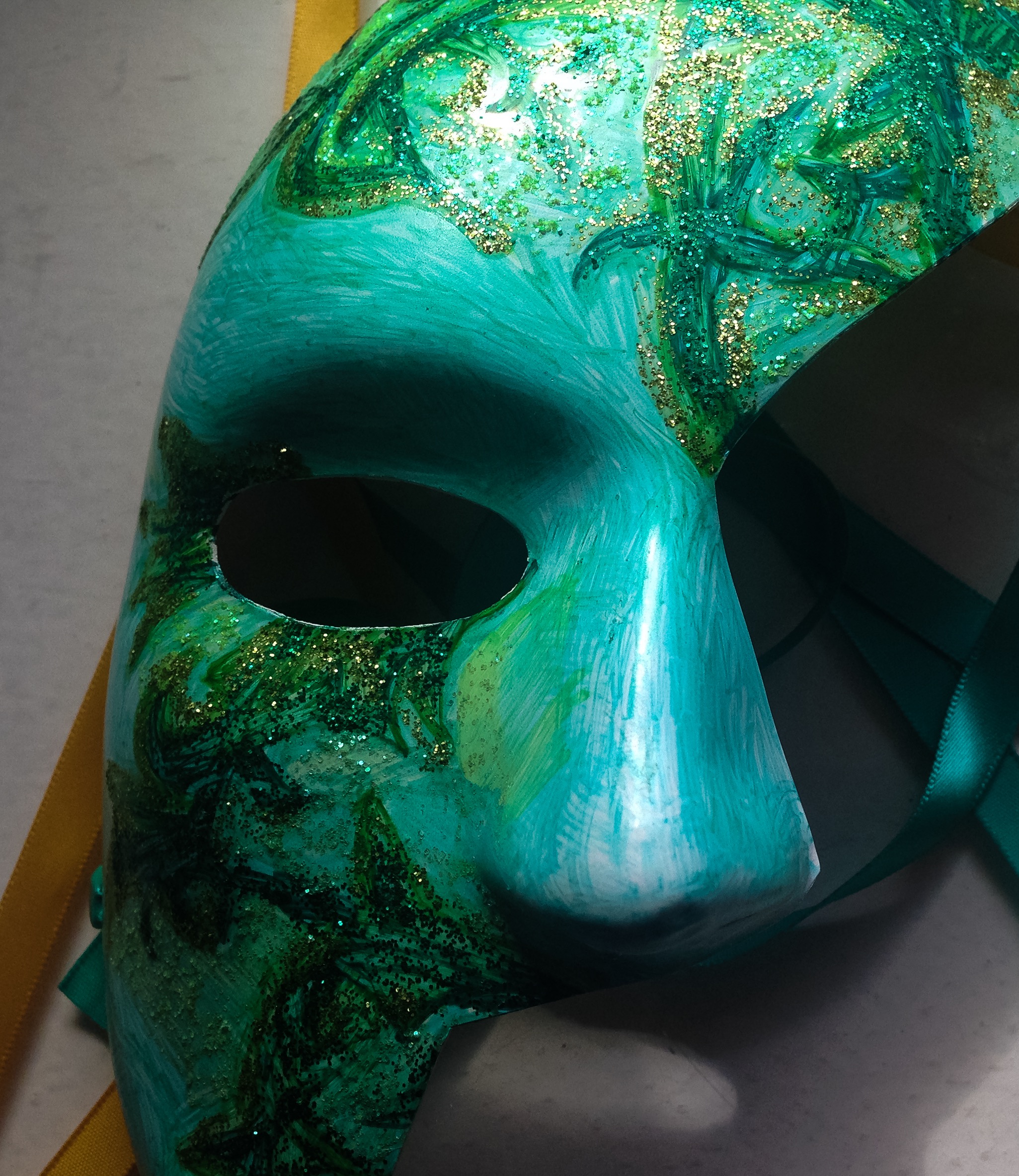
The days continued to lengthen. The herbs and dyes had been collected and prepared. Masks had been constructed for everyone in the tribe old enough to talk and walk. After considerable dialog, the tribe concluded that all of the Veritas, and not just the young adults needed to be initiated into the ways of the warrior. Although kids had often spontaneously imitated the actions of their older brothers and sisters and engaged in mock combat, now the Veritas faced an enemy who stole children. If such children were snatched, it was important that they be able to fight, in order to delay capture, and to maim or injure the attackers. They must also be able to lie in wait patiently and be able to strike after capture; to see when the opportunity arose; and then to strike in such a way that they had little chance of being blamed. 

Jaccim had confirmed that the Z-Lotz greatly preferred to steal children. Kids could be trained early to be docile slaves. Occasionally, attractive full-grown women would be stolen as well but they tended to be less docile and therefore less desirable to the Z-Lotz. Many Paths had already performed the molting ritual on Tu-Swift and he had worked with Sooz and Cat Eyes to teach the youngsters of the tribe to fight. This training had been mostly about perception and reaction. Now, the training would turn more serious and young children were about to be taught about weapons, hand combat, and about poisons and imagination. 

OLYMPUS DIGITAL CAMERA

OLYMPUS DIGITAL CAMERA

Many Paths wanted the children to be initiated and wear make up and masks so that when and if the Veritas found themselves once more at peace, they could remove these masks and make up and that removal of the outward trappings of war would hopefully help also remove the killing mindset that she meant to help inculcate into everyone in the tribe. 

A great feast of wild boar, honeyed grain-cakes, roasted nuts, and boiled cattail had been laid out in the late afternoon. After the feast, the Veritas came to Many Paths one by one, oldest to youngest and stood before her. She handed each one a mask and anointed each with two dark marks of charcoal on their cheeks. The masks resembled various animals and were worn on the back of the head or, more rarely, on the side of the head. They were not meant to disguise the person’s face. Instead, the masks were intended to confuse the enemy about the orientation of the Veritas warrior so that killing blows would tend to arise from unsuspected places. 

The Veritas came to her in order from oldest to youngest. Though Many Paths followed tradition in this, she could see the wisdom of that tradition. The youngest would have seen many examples of how to behave from the elders and then the adults and then their older brothers and sisters. She felt and displayed a fittingly somber mood for the business at hand weighed heavily upon her. And though she intoned the ritual words with feeling, at the same time, half of her mind began to mull on the situation that required turning the people to killing. She heartily wished that the world had not turned so ugly and warlike. Yet, those wishes had no impact on reality. Many Paths did promise herself that she would continue to remind people of the lessons learned from The Battle of the Three Paths. 

77A3526C-DBFC-4FC8-8767-E9D9E95ACF98

In that battle, NUT-PI had arranged three armies to fight against the Veritas. Two of those armies had instead become friends. Peace proved to be a very strong weapon. Many Paths would come to caution the Veritas not to become so enamored of weapons that they overlooked the possible paths to peace. Though she believed this, Many Paths also recognized that the alliances between the Cupiditas and the Nomads of the South and between the Cupiditas and the Fierce and Formidable Warriors of the North were both tenuous and temporary. They did not have a preponderance of true common interests.

This shallowness had made rational dialogue possible between Many Paths and those tribes.  Their “loyalty” to NUT-PI was nothing more than a temporary convenience, fairly easily overcome by showing them the lies of NUT-PI and a path to a more permanent self-interest. Also, no blood had yet been spilled. Once blood had been spilled on both sides, talk of peace could easily be shouted out by the drums of war that banged in the heart of every warrior amplified by sorrow, fear, and anger. Many Paths reminded herself that she needed to have a frank talk with Lion Slayer about whether any from among the Nomads of the South would choose to fight with the Veritas. 

She decided to wait a few more days for such a conversation and to include his mate, Hudah Salah, as well. When they had first arrived to spend a year with the Veritas, Hudah had seemed unwilling to say much and agreed with her husband on every point. Something had changed however. Many Paths thought there were three reasons. First, she had become much more familiar with the Veritas language. Second, she now had many actual friends now among the Veritas including Fleet of Foot and Eagle Eyes. Although those were still her closest friends, she knew everyone in the tribe and everyone knew her. Third, the great fire had separated her for a time from her husband and she had had to survive without him, without knowing whether he was alive or dead. Many Paths judged that his deepened their love but also grew her independence. Many Paths also thought that Lion Slayer would be more likely to imagine everyone among the Nomads of the South would feel however he felt. Hudah Salah, would be more in tune with the heart of the entire tribe. She would not unthinkingly imagine that all of them would be as eager or reluctant to join in a lethal fight as she herself was. 

people in a culture event

Photo by Chait Goli on Pexels.com

The “coming to war” ritual ended with a long, energetic dance. This served to burn off some of the nervous energy that naturally arose from everyone in the tribe preparing for war. It also served to remind each person among the Veritas that they were part of a larger whole. Everyone participated including Many Paths and She Who Saves Many Lives. Though the latter was not so quick as she had once been, she moved with a grace and beauty that caused many in the tribe to smile. Long energetic dances also served as a training for long marches or fierce battles. Everyone took note of everyone else so they came to expect the tempo and style of everyone else in the tribe. This, Many Paths realized, could be quite helpful in coordinated group action. Everyone could see, for example, that Shadow Walker’s ankle was completely healed while Tu-Swift had still not recovered his former speed. A lot of information was exchanged about individuals at the same time and that caused each individual to feel more integrated into the whole. It occurred to Many Paths that some such a dance should be repeated with whomever joined in the Veritas endeavor, whether the Veritas who lived beyond the Twin Mountains or the Nomads of the South. The dance also tended to physically exhaust everyone and, as a steady wind bends the long grass, it would bend everyone toward much needed sleep rather than useless worry. 

The next day began bright and clear. Many Paths met early with Tu-Swift, Eagle Eyes, Cat Eyes, Sooz, and Shadow Walker. She began by describing her experiment with reflections that had caused a twig to burst into flames. Using the Rings of Empathy and many pieces of mica, she arranged the reflections so that they all focused on a small dried twig. Again, it seemed as though nothing was happening when suddenly the twig burst into flames. Salah Hudah had been weaving nearby, not participating in the conversation. But when she saw the twig burst into flames, she exclaimed something aloud in her native tongue. She walked over to the group and spoke in Veritas nearly as well as those who were born Veritas might. 

“These things,” she gestured around at the rings and mica, “are all shiny. Very shiny. We have in our land some shiny things as well. There is a shiny black stone which can be polished so much that you can see yourself as if looking in a clear, calm, lake. We call it ‘OB-ESS-DIAN.” And, there is another thing on the edge of the deep desert lands where no-one goes. It is also shiny. Very shiny. We polish it. We shape it. But it is evil. We call it GLAZ. Those who touch it get burned. We only discovered a few winters ago. We thought to make jewelry or … a kind of pond to look at yourself. I think it could be useful weapon this way too. But dangerous. It burns the hands as though you were too long in the sun. But it is not hot.”  

close up photography of burning woods

Photo by Tim Erben on Pexels.com

Many Paths thanked Salah Hudah and contemplated once again how much better it was to have made friends with the Nomads of the South rather than fighting them. She vowed to try to find such a way even with the People Who Steal Children. But such people killed with no honor. With Killing Sticks. How could peace come about? It was a puzzle: an important one, but seemingly unsolvable. 

Tu-Swift brought out his sword and moved it about. “This is very shiny too. As is Shadow Walker’s. I think…here’s let’s try making both of them shine onto a twig.” Shadow Walker worked with Tu-Swift and they reflected the sunbeams from their sword onto another dry twig. It did not burst into flames. They waited. At last, Cat Eyes stretched forth her hand and gingerly touched the twig.

“It’s warmer than just the sun would do, but not warm enough to burst into flame. But something else might work very well. In the village of the Z-Lotz, many of the richest families have such a portable pond looker as Salah Hudah described. But no-one I heard of got burned from it. So, perhaps it is made of something different. I don’t know.” 

“Thank you, Cat Eyes. How many of these portable lookers are there in the whole of the  Z-Lotz village?” 

Cat Eyes sighed. “I was there as a slave. So, I was unable to go wherever I liked. There are many people. Sometimes, I visited other houses. All of them had such things. But I seldom went to small houses. I would say, these many. But I really don’t know.” Cat Eyes held up both hands ten times; each time, all fingers were splayed out. “One hundred.” 

Many Paths nodded. “One hundred. Yet, so few as ten pieces of mica, and seven shiny stones can make a dry piece of wood burst into flame. Imagine what one hundred shiny things might do if all the many paths of light come together at one time and place.” 

Shadow Walker said, “That, I think, would be very hot indeed. However, we don’t own those possible weapons. I don’t see how we can get them. But what of the shiny things of the Nomads of the South? How many of those are there, Salah?” 

“Of the black OB-ESS-DIAN, there are many. Ten times ten. Of the clear ones… there may be one or two, but to my knowledge, once people realized they caused burns, no-one wanted them. People gave them back to the deep desert.”

The group thought about that for a time. Presently, Tu-Swift said, “I don’t understand. Why don’t they just use a long handle or many layers of cloth to protect their hands? Surely, you tried this, Salah?” 

“Tu-Swift, you speak true. People did try this. We sometimes make even stones by hardening mud in fire. They become quite hard. But when they are first made by such hot fire, the stones themselves are too hot to touch. However, we take them out of the oven with large mittens made of many layers. People’s hands do not get burned. But there is something different about GLAZ. Many layers of cloth do not prevent burns though the GLAZ is not itself hot. It seems magic but evil. That’s why we returned it to the deep desert where no-one goes.”  

Cat Eyes began to speak. “Fire ants feel like burning when they bite you. But they are not themselves hot. Their tiny side teeth pierce your skin. Perhaps such ants are made of the same stuff as the GLAZ at the edge of the desert.”

close up photo of ant

Photo by Egor Kamelev on Pexels.com

Salah Hudah nodded. “Perhaps. We know also of these fire ants. They sting. They feel hot. But people recover. The burns of GLAZ do not get better. More moons, more pain. They are something from a world of evil. I think the people, my people,…maybe they lend you or trade you for OB-ESS-DIAN. But all this to set a fire? Isn’t it easier to use fire arrows?” 

Shadow Walker spoke next. “We should not forget what happened to the ROI. They used fire arrows against us twice. The first time, they surprised us. It helped them steal Tu-Swift. But the second time, they tried to destroy us, and they succeeded in destroying their own village and many of their people. According to Jaccim, the ROI were led by a cruel lying leader, and then, so far as we can tell, he was killed himself. I don’t much like fire arrows. But it’s better to use them than to become enslaved.” 

Tu-swift added thoughtfully, “Perhaps we can get the Z-Lotz themselves to destroy their leader. He seems very cruel.” 

Cat Eyes scrunched her face up and chewed her lips. “Perhaps. The people I stayed with, the richest among the Z-Lotz privately scoffed at NUT-PI — just as they did about their beliefs — but, because they are rich, they like having NUT-PI as a leader, if you can call him that. No doubt, there are many people in the village of the Z-Lotz who would like to have NUT-PI gone, but I’m not sure they are prosperous enough to have — I think they are called ‘looking glasses.’ Does that make sense? I think only the rich people like them.”

Many Paths nodded. “I’m not sure. If it is as you say, then the rich would have to have very good reason to use this weapon of many looking glasses against NUT-PI. But there could be other ways to bring many weapons to bear through many paths. For instance, arrows, even if not fire arrows, could be fired from many directions at once. Rocks could be thrown from many directions. Small amounts of many poisons might be given. And, maybe we could use mica and jewels to make many reflections to heat up … to heat up a Killing Stick until it catches fire. Or, perhaps, we could even use the killing GLAZ. If NUT-PI thought it was very rare, and very precious, he might desire much of it. If he surrounds himself with such GLAZ, he might get quite sick and not know why.” 

Eagle Eyes had been fairly silent and now began to draw a map of sorts in the dirt. “All of these weapons we are discussing converge from many paths on to one place; for example, NUT-PI. But if we were to kill the Z-Lotz leader, wouldn’t they simply pick a new leader?”

Many Paths said, “It might take them some time. As I best understand it, if one of the Cupiditas kills the leader, then that person becomes the new leader. I don’t know about the Z-Lotz though. If they do the same, it might be confusing if many people at once killed the old leader. Who would get to be the new leader?” 

Cat Eyes said, “I am not sure, but I think the Z-Lotz might do something similar. It might be confusing for them if many people together killed their leader. He is a very loud screamer, but I don’t think he’s very brave. I’m not sure why I think that. Anyway, he’s not very athletic. He looks nothing like Shadow Walker or Trunk of Tree, for instance.” She smiled at Tu-Swift. “Honestly, Tu-Swift, in a fair fight, I think you could take him. But I don’t think a fair fight is of any interest to him.” 

Tu-Swift blushed. “I would love to do that if he’s behind the stealing of children.” 

toddler with red adidas sweat shirt

Photo by mohamed Abdelgaffar on Pexels.com

Many Paths spoke again. “We have many ideas. Which path proves most fruitful though will remain a mystery until we find out more. I think that the construction of a good weapon that will be effective depends on knowing more. We need to find out more. How are their walls constructed? Can we tunnel under them to sneak in? Can we dig under them to cause collapse? Are the walls too high to fire arrows over? Rocks? Should we attack with many? Or, should we sneak in a few? Can we steal enough of these looking glasses to make a weapon? Can we steal their killing sticks? More swords? Can we sabotage their bows and arrows as Tu-Swift did to the ROI? And, how can we use our horses? Will they join us in this fight?” 

Shadow Walker took a deep breath, “Many, I think I should go visit these Z-Lotz. Maybe I could trade with them and get some Killing Sticks in this way. We have many fine and beautiful baskets. And, Salah Hudah, do you think these shiny things that cause burns can be recovered or — ?”

Salah Hudah shook her head violently. “I don’t think you should touch them. I don’t think you’ll find them — at least not easily. Our people just wanted to get rid of them. They are covered up now with shifting of many sands. But they burn without warning. And worse. One woman who especially liked these. She was very beautiful. She had many suitors who brought her such as treasures. She paid much. She became something else. Her body began to grow like mushrooms. No longer beautiful. And, she was sick in every way. And died. That is what triggered everyone to throw them out.” 

“I should go with you,” volunteered Eagle Eyes. I can see danger before danger sees us. And I have been there before. “What of you, Cat Eyes? You know this place better than anyone else? Will you come too?” 

Cat Eyes nodded. “I will go. I like this place much better. Much better. But perhaps it would be well for me to go first to my people. Some may recognize me. I may recognize them. I can be…I can be like a pair of logs over the brook and allow others to cross. Perhaps the Veritas over the Twin Mountains will have other weapons or other knowledge. Then, we can decide what to do about the Z-Lotz. It is also possible they might leave us alone?” 

“I hope that,” said Many Paths. “Why must people steal children? But I don’t think they will leave us alone. I do not think they will leave the Nomads of the South alone either. Nor, the Fierce and Formidable Warriors of the North. Nor anyone who simply wants to live in peace. If I thought otherwise, we would not have all sworn to the way of the warrior. But that does not mean we must attack at once. More knowledge would be good. Let us first try to reach the Veritas beyond the Twin Peaks. Jaccim knows how to find a path there, so he thinks. 

mountain covered with snow

Photo by eberhard grossgasteiger on Pexels.com

“Meanwhile, we will grow stronger and faster and learn the skills of killing in case we need such skills. We will continue to train even the smallest among us so that if any such are captured, they will be weapons; unsuspected weapons like Cat Eyes.” 

Now, Eagle Eyes spoke, “You are wise, Many Paths. I have a thought though about yet another weapon.” 

“We have trained a few from among the Wolf Pups. And, we have trained few from among the Eagles. What if … you know that I can draw a likeness of any of you and that you will know who that likeness is. Eagles have eyes even better than ours. I am wondering whether it is not possible … perhaps if I can see the Z-Lotz leader, I can teach my eagles, and more eagles besides, to attack this hateful man and pluck his eyes out. Could it be possible? I don’t know. And for Wolves the same. Except they do not see as well as do we ourselves. But each person smells different. If someone can steal some of his clothing, perhaps such pups could be trained to attack and kill something that smells of him.”

white and yellow bird shallow focus photography

Photo by Pixabay on Pexels.com

Many Paths smiled at her friend. For the first time since she found out about the Killing Sticks, she felt confident that there was a way to prevail against such a weapon and that they would find it. And use it. “Those are excellent ideas, Eagle Eyes.” 

Everyone in the group nodded. 

Many Paths spoke again, and her voice sounded clear and confident, “I promise you, we will not rest until we find a lasting and believable peace with these Z-Lotz. Or, we will destroy their leader. If that doesn’t stop them from stealing children, we will destroy the next leader. And the next. At last, everyone shall also be destroyed and all of their Killing Sticks — until they stop stealing children.” 

brown bird flying near mountain

Photo by eberhard grossgasteiger on Pexels.com

———————————————-

Author Page on Amazon

Start of the First Book of The Myths of the Veritas

Start of the Second Book of the Myths of the Veritas

Table of Contents for the Second Book of the Veritas

Table of Contents for Essays on America 

Index for a Pattern Language for Teamwork and Collaboration  

Travels with Sadie Teamwork

The Walkabout Diaries Lest We Forget

We Won the War! We Won the War!

Love and Guns


The Doors of Mystery

21 Saturday Mar 2026

Posted by petersironwood in America, apocalypse, management, politics, Veritas

≈ Leave a comment

Tags

art, creativity, fantasy, fiction, innovation, leadership, legends, myths, politics, stories, truth, Veritas, writing

“What an amazing sunset,” Fleet-of-Foot said to no-one in particular. His companions, Hudah Salah, Easy Tears, and Day Nah sat close by. 

70E2D770-2B7A-4D5D-B322-D499FD6785AC

Easy Tears noticed that Hudah Salah, who had previously said very little had become much more talkative since their escape from the fire — and her separation from Lion Slayer. Here she was again: “Perhaps the fire in some way joins up with the fire of the sunset. Then, he shines more brilliantly than ever.” 

Easy Tears listened carefully to Hudah Salah, just as she did to everyone in her own tribe. “That’s an interesting possibility, Hudah. Let us think on that.” 

{Translator’s Note}: And, unlike our more “civilized” society, where everyone is judged on being able to respond immediately with arguments carefully crafted to push people into one of two predefined camps, what Easy Tears actually did was the following: She allowed herself to think. She did not try to dissect the idea, nor prove it, nor disprove it. She let the idea loose in the archives of her mind. Easy Tears, in particular, did not like to put up walls either between herself and others or within her own memory archives. There was no “Restricted” area. The idea could play around in there as long as it liked. What was the hurry? Their bodies all needed restitution and traveling by night is not always a good way to make things quicker. And, now they were all enjoying the sunset. 

Of course, unlike the Veritas, your translator was brought up in a world where speed is all and if you can’t get your next version of software out the door yesterday, you can go out the exit door for good. So, when I describe things, I tend to phrase things in a much more simplistic fashion than what actually went on in the minds of the Veritas, as best we can tell from the burgeoning field of statistically inferential macro-psycholinguistics. It would be helpful then for you, the reader, to remember that my translations will tend to reflect my own modernistic blinders – and yours. But let’s get back to finding out whether these folks are going to get back to the center place of the Veritas alive and tell Many Paths, their leader, what they have learned about The People Who Steal Children. 

As Easy Tears allowed the idea to roam freely, she did not have to “watch” the idea or “be careful” where it might lead. So, she could just sit back and watch the sunset. The idea conjured a trumpet that sang a song about fire. Most of the various artifacts, people, ideas, places, in the mind of Easy Tears paid little attention to this particular tune. A few however, had their say. Easy Tears recalled how hard it had been to see when they were running through fire. Even when the flames were not an issue, the smoke made it hard to see. So smoke interacted with sight. 

Another memory heard the tune and danced to it. Easy Eyes had been a small child, but one who had already revealed her eye for beauty and design. Everyone who wished to, was encouraged by the Veritas to share designs for patterns on both the autumnal and vernal equinoxes. She had created several ideas in her head and one in particular had caught her eye. That would be the one! She worked in secret on her full scale project and as it neared completion, she became more and more disconcerted. The design no longer seemed a thing of real beauty. She recreated the small scale version and it still held exquisite beauty and balance. What, she wondered, was going on? She had gone back to her larger design and it appeared empty and bland. So, the size of something could even change its nature. She had added additional elements to the large scale design and had, in fact, received much praise for her design. This was sincere praise, not just pat-the-sweet-little-girl-on-the-top-of-the-head praise. And, she knew it. So, smoke rises and spreads and becomes more sparse. 

6515873C-D2E3-4282-9C68-0B89AE860B8A

Easy Tears related these awakened memories to the group and Hudah Salah translated for Day-Nah. 

Fleet-of-Foot, though not quite so open as Easy Tears, also allowed these words and memories free access to his own experience. “For some reason that I cannot explain, it reminds me of skipping stones on a creek or a pond. You want stones that are as round and flat as possible. But, the size of the stones proves crucial too. If a stone is too small, even if it’s flat, it will curve in the air and slice right into the water too steeply. If the stone is too large, even if well made, you cannot throw it fast enough and it will only skip a few times. So, here too, the behavior depends on the shape, or design, but also on the size. 

AEEE88B5-FAA7-4DAB-911F-6101A7C68609

“Yes,” added Hudah Salah, “in my experience size matters. And also speed. In our lands, much sand there is and one grain or two — this is nothing. But we have — you and Eagle Eyes — you saw such a storm, during your visit. Much sand coming fast – it can kill you. The nature of much is different from the nature of one or a few.” 

sand storm and rock formation

Photo by Noelle Otto on Pexels.com

After a long pause, and when the sunset had faded from crimson all the way to gray ash, Easy Tears said, “We think it may be the case that something about the nature of much smoke together on the ground to be different than much smoke not together high in the air. But sunsets vary so much. We must ask to join with the wisdom of others to decide. Let us sleep. I will keep first watch.” 

The dawn also proved visually stupendous. The foursome broke camp and continued their journey even before the color reached its peak. They saw no sign of their friends nor, thankfully, of the People Who Steal Children. They did see horse hoof marks and that kept them on the alert. 

Occasionally, they returned to the topic of the beautiful sunsets and sunrises and whether it was related to the fire. 

Hudah Salah remarked, “In the heat of the summer, it seems as though the sun actually pushes you down, as though the light is heavy.” 

Fleet-of-Foot turned back to look at Hudah. He smiled at her. An image of them together flickered through his mind. Then, the same idea stole into his mind in words. After all, he thought, life must go on. If Eagle Eyes and Lion Slayer are both dead…. Or, perhaps, they just decided to go off together? How could they have just disappeared? We were all running together. Maybe they’re sick of all this fighting. That’s ridiculous. I know she’s okay and I know we will be together. Feed the good wolf; feed the good wolf he reminded himself. 

Easy Tears spoke. “I have a feeling it has something to do with light that reflects or the light that isn’t there.”

Now, Fleet-of-Foot was amazed at Easy Tears. “Light that isn’t there?” 

Easy Tears, motioned to Fleet-of-Foot to come closer. “Look at the bare ground over there. What do you see?”

“Many things. You mean, your shadow?” 

“Yes, Fleet-of-Foot, my shadow. It is lack of light. What color does it appear?” 

Fleet-of-Foot frowned. “Color? No color. Well, I suppose it looks a little bit blue compared with what is around it.”

IMG_0057

Hudah Salah broke in, “Oh, yes, it is blue. It can be quite obvious in the desert. The sun is yellow but the not-sun is blue.” 

Fleet-of-Foot considered. “I see what you mean. But, I’m not sure…”

Easy Tears pointed to the other side of her, “Now, look over there. What do you see?” 

Fleet-of-Foot shrugged his shoulders. “Not shadow?”

Easy Tears laughed. “Don’t guess! Look! And keep moving. My shadows will come with me!” 

Fleet-of-Foot shook his head, frowned, and took another look as he strode alongside. At last he said, “Well, to tell you the truth, you have another shadow on that side but it’s vague and a bit greenish.” 

Easy Tears continued. “Yes. You see those bright red sunrise clouds high in the sky? There is shadow from the light of them as well. 

They strode on silently for a time. 

Fleet-of-Foot said, “You are truly amazing to have ever noticed that!” 

Easy Tears laughed. “Oh, I didn’t see it. I lived for years and never noticed it. Eagle Eyes pointed it out to me. She truly is amazing! Haven’t you noticed?” 

Fleet-of-Foot blushed and hoped the others attributed it to the high red clouds. He cleared his throat and mumbled, “Yes, of course.” 

They continued all day with few breaks. At last they found themselves on the path they had taken on the way out. A few hours later, they were at the same odd door that stymied them for a time on the way in. They had intentionally left it closed in the hope of thwarting what they assumed would be a large group of the People Who Steal Children riding on horseback. Now, their way was blocked by a large heavy door that six of them had had difficulty with. How could they open it with only three adults and a small child. The alternative was to try to find another route but nothing obvious had presented itself. 

The three of them pushed and pulled to no avail. After some minutes, they managed to move it perhaps half an inch. Then it stopped and further effort proved fruitless. The three sat down heavily and looked at each other, trying to catch their breath. They looked around and realized that none of them knew where Day-Nah had gone. 

fullsizeoutput_1375

Fleet-of-Foot called out, “Day-Nah!” 

“Day-Nah. Here. Help me.” 

Fleet-of-Foot cautiously approached the voice and soon saw Day-Nah pulling at something. Fleet-of-Foot soon saw that it was a thick rod of the same stuff that the door itself was made of. 

Fleet-of-Foot was amazed and wanted to learn more. “Where? Where did this come from? What place?” 

Day-Nah stared at him uncomprehendingly. Fleet-of-Foot thought back to his time among the Nomads of the South. Suddenly, the word sprang to mind. 

As soon as he said it, Day-Nah’s face brightened and he ran over to a nearby hollow log. Fleet-of-Foot thought it an odd place to hide a club, but it seemed to be a good club despite its odd shape and long length. It was made of this hard, heavy material and he was happy to have it. But he could not use it to break down the door. It was made of the same stuff and way too thick to be destroyed with a club. 

PicturesfromiPhone2 070

Fleet-of-Foot returned to Easy Tears and Hudah Salam and showed them the club. Waving it slightly, he said, “This may prove useful should we encounter the People Who Steal Children.” 

Hudah Salam looked at him and smiled. She walked directly toward him and for a moment, he thought she might kiss him! 

But it was not to be. She merely, took the “club” from him and walked over to the door. She put one end into the small slit and put both hands on the other end. Then, she braced her feet and pulled backwards. The door moved! 

Fleet-of-Foot laughed and shook his head. “Oh! How not fleet-of-thought I am!” 

His friends laughed too. Easy Tears glanced at him and smiled. “I didn’t see it either. But I suspect Eagle Eyes would have. She’s good at that kind of thing.” 

Fleet-of-Foot smiled. He knew exactly what Easy Tears had meant by ‘that kind of thing’ though there was really no word for it. But there should be, he thought and they pitched in and quickly moved the door. 

On toward the Center Place of the Veritas they strode. After a few moments, Fleet-of-Foot waved the lever and said, “Well, it also makes a good club.” All of them laughed for it seemed to them at the time that the worst was over. 

IMG_5294

——————————————————————-

Author’s Page on Amazon

The Pros and Cons of AI

Introduction to a Pattern Language for Collaboration and Teamwork

The Creation Myth of the Veritas

The Orange Man

The Beginning of the Tales of the Veritas 

The Beginning of Book Two

Bohm Dialogue

The Forgotten Field

The Dance of Billions

Roar, Ocean, Roar

We Won the War! We Won the War!

Who Won the War?

Guernica

The Walkabout Diaries: Sunsets

Peace

The Alliance of the ROI & the Z-Lotz

26 Thursday Feb 2026

Posted by petersironwood in America, psychology, Uncategorized, Veritas

≈ Leave a comment

Tags

art, books, Business, leadership, legend, life, myths, photography, politics, religion, search, story, strategy, tactics, truth, Veritas

Eagle Eyes chatted quietly with Easy Tears, and their conversation drifted as a dancing summer breeze among many topics. Suddenly Eagle Eyes stopped in her tracks. Her eyes spun to something sparkling among the rocks. She thought that perhaps it was merely a piece of shiny rock but as she drew nearer, she realized it was not a rock, or at least nothing like any rock she had seen before. Soon, the others drew near and stared down with her. Even the pups busied themselves sniffing its edges.

white wolf

Photo by Flickr on Pexels.com

A hand-sized ornament had drawn the attention of Eagle Eyes. It consisted of a perfect full-moon shape within which were inscribed three smaller circles. Every member of the search party found the ornamented piece intriguing. Apart from the pups, Shadow Walker touched it first. “It is of the same — or at least very much like — the circles of cold rock at the bottom of the wall door we moved.”

In turn, the others touched the cool circle of rock. 

IMG_5866

Easy Tears said, “Whatever this is, it gives me chills. It feels like touching…death, actually.” Lion Slayer picked up and turned it in his hands. “I see one. Long ago. My father’s father called it, ‘Tree Quarto’ or something like that.”

Hudah Salah whispered something into the ear of Lion Slayer. He nodded and said to the group, “Yes, Hudah remind me that this is a symbol used by the Z-Lotz. Grandfather showed us one when he tell us the Legend of the Unholy Alliance. I dream about it night before dawn, but then forgot when I … when I awoke.” He glanced at Shadow Walker. 

Shadow Walker smiled, “When I woke you up. Sorry. What can you tell us of that legend?” 

IMG_2439

Lion Slayer frowned as he began. “The Legend of the Unholy Alliance” has been told in our tribes for at least six generations. I am not storyteller, but this symbol is supposed to represent the world – the larger full moon shape; and the three smaller full moon shapes represent body, mind, and spirit.” 

Shadow Walker waited while Lion Slayer gathered his thoughts. Easy Tears broke in. “So, this is a symbol that the ROI like?” 

“No, Easy Tears. It is a symbol of the Z-Lotz. That is where the unholy alliance comes. Far beyond our lands, the Z-Lotz ruled but they often fought with the ROI. At last, so the legend goes, the greatest leader of the Z-Lotz and the leader of the ROI had a parley. They agreed to stop fighting. The ROI care nothing for the spirit world, nor really for much of anything except to get more and more as fast as possible. They make deal. Z-Lotz agree to leave the ROI alone and not try to make them believe all the impossible things that the Z-Lotz believed. 

IMG_2466

“But in return, the ROI, promise to pretend to believe and wear the symbols of the Z-Lotz. In return, the Z-Lotz would not only leave the ROI alone; they would pretend that anything that the ROI did was commanded by Giant Sky Bear himself, which the Z-Lotz pretended to be able to talk to. In this way, the ROI were able to conquer many people’s by force and then teach these conquered people that it was their lot in life to be slaves because it was commanded by Giant Sky Bear. The ROI never believed it, of course, for they cared nothing for such things, but these lies proved helpful in convincing the slaves that there was no point in resisting because they would be struck down by the powerful claws of the Giant Sky Bear. The ROI gave the Z-Lotz many material gifts as well. Though the Z-Lotz pretended not to care about material gifts, they never refused any such gifts.”

Fleet of Foot thought perhaps Lion Slayer was finished so asked a question. “And, did the Z-Lotz actually believe this Great Bear in the Sky would really do that? Or, did the ROI? I am confused.” 

nature animal bear teddy bear

Photo by Pixabay on Pexels.com

“Fleet of Foot, you ask good question, but we do not know. We do not know what they truly believe. I have never even met ROI or Z-Lotz. But when our legends are tested, they are generally accurate. I suppose that beliefs actually vary quite a bit among the ROI and among the Z-Lotz, but they all steadfastly pretend to believe such things and this allows them to manipulate people. At least that is what legend says. So, if our supposition is correct that ROI were stealers of children, and they are wearing this symbol of Z-Lotz, that would tend to be in alignment with legend. It does not prove it, of course. But it seems consistent.” 

Eagle Eyes asked, “But do your legends say that the ROI make or use these cold, smooth, hard rocks?” 

Lion Slayer glanced at his wife, and she shook her head. “Not that we recall. No. I am sure I would have remembered such a tale. Such a soul-sucking object, I would have recalled. Neither of us has heard of such before.” 

Shadow Walker dropped the ornament into his knapsack and the six continued swiftly on their journey. 

———————————————————-

Author Page on Amazon

The Myths of the Z-Lotz

The Myths the ROI

The Creation Myth of the Veritas

Essays on America: Labelism

Essays on America: The Game

A True Believer

After All

Somewhere a Bird Cries

Life Will Find a Way

You Must Remember This

Math Class: Who are you?


Negative Space

02 Friday Jan 2026

Posted by petersironwood in creativity, management, psychology, sports, Uncategorized

≈ Leave a comment

Tags

AI, art, creativity, Design, HCI, illustration, music, negative space, painting, poetry, problem formulation, problem framing, sports, thinking, thought, UX, writing

Negative Space

When you look at a scene, it is natural to concentrate on the objects in the scene. So too, when one begins to design, it is natural to concentrate your attention on the things you intentionally put into the design whether those are menus, icons, images, banners, buttons and so on. You tend to give little thought to what is not there because, after all, there’s nothing there! 

IMG_9815

As your expertise grows, you will find it useful to spend some time and resources thinking about what is not there; the “negative space” if you will. In art, the “negative space” refers to the space around and between the objects. Often, paying attention to the “negative space” can result in a much more interesting and aesthetically pleasing composition. It is a concept that has applications far beyond artistic visual composition however. 

Consider music for a moment, or better yet, listen to some and you will note that the silence is just as important as are the notes. Increase or decrease the silence in a tune by a factor of two and it becomes a different, and in most cases much worse, tune. 

printed musical note page

Photo by Pixabay on Pexels.com

The same can be said of great acting whether on stage or in a movie. The silence while we wait for the actor’s response to some news — while they are saying nothing and possibly even showing nothing or very little on their face, can often be the most poignant and moving parts of the picture. If the actor reacts “too quickly” with no space, we can tell that the stimulus presented is something that they “trigger” on because they are upset about it or trying to deny it. The leading man, for instance, asks a seemingly innocent question on a first date, such as, “So, do you like French Cuis…” “NO!” she cuts in. The audience’s attention is immediately drawn to see what comes next. The response that is too fast indicates a “sore spot.” Did the leading lady want to become a French chef? Did she just end a love affair with a Frenchman? What is going on here? 

IMG_6022

On the other hand, imagine the leading man, says, “So, do you like French Cuisine?” One beat, two beats go by. No answer. A long pause. The leading lady’s face shows nothing. Perhaps she tightens her lips ever so slightly or frowns to the slightest possible extent. The pause continues. The leading man tilts his head as though to ask whether she’s okay. Finally, we come to expect a tirade about the French or French Cuisine or French wine or … something. Instead, after this long pause, the leading lady says nothing but punctuates her silence with something that sounds like a cross between a humorless laugh and a karate grunt. There are probably no words she could have said which would have intrigued us more than the non-response. We think, “What the hell is going on with her and French Cuisine?”  

IMG_9504

Speaking of French Cuisine, when you go to a fine restaurant, your focus is on the food. So too is the focus on the chef and the server. But the space is important as well. It is annoying when you are paying good money to have a nice dining experience and you are shown to your table, given menus and then ignored for the next twenty-five minutes. On the other hand, it is equally annoying when your server comes back every 30 seconds and asks, “Are you ready to order yet or do you need more time?” The optimal time to wait between courses is not always obvious either. Some people need or want much more time between courses. Maybe this nice dinner is all they have planned for the evening. The patrons are having a nice quiet dinner with good conversation. They are in no hurry. Just as one of the diners launches into a complex story or joke, the server comes over and interrupts to tell about the specials. Conversely, another foursome may be planning on attending a play and long pauses between courses may mean missing the first act. 

The negative space in dining is not just about the timing of events. It is also about the spatial arrangement of the food, the spacing between textures and colors. Often, the artistic arrangement is as much about the negative space as the objects on the plate. 

Sometimes, the food itself has positive and negative elements. In a meal with varied and complex and contrasting tastes, for instance, the rice or the bread can provide a kind of “negative space” between the tastier and more salient constituents. These neutral or negative elements allow more contrast among the salient elements than if the more salient elements were enjoyed right after each other. I’m reminded of a line from Kahil Gibran’s The Prophet:

“Let there be spaces in your togetherness.”

Negative space is important in architecture, painting, typography, cinematography, the design of user interfaces, culinary arts, music, and the design of other stimuli. It is also important in activity.

IMG_2769


One of the first popular video games was called “Asteroids.” In this black and white vector graphics game, you controlled a small space ship that shut bullets in the direction the space ship was aimed. All you could control was the speed and direction of the space ship and whether it was shooting. The screen also showed a number of large, irregular “asteroids” that you were meant to hit. When you hit one of these large asteroids with a bullet, it split into two moderate asteroids. When you hit a moderately sized asteroid with a bullet, it split into two small asteroids. When you hit a small asteroid with a bullet, it disappeared. If you got hit by an asteroid, you would die. There was also a flying saucer who came to hassle you. Anyway, I found that if I focused on all these floating asteroids and trying to not to get hit by one, it was a difficult game. For me, at least, it was much better to visualize a path among the asteroids and try to follow that path. In a way, concentrating on the negative space, helped. 

action athletes ball blur

Photo by Pixabay on Pexels.com

The importance of negative space in sports can hardly be over-emphasized. In American football, the back tries to find the holes to run through. In soccer, players seek paths between. In baseball, the hitter wants to “hit it where they ain’t.” In tennis, beginners often play only during half a point. Their attention is focused on the ball and the opposing player(s). They choose a target on the other side of the court and watch to see how well they hit that target. Just as their opponent begins to hit the ball they shift their attention to their opponent and watch where that opponent hits the ball, scurrying there as quickly as possible so as to hit the next shot. What does such a player do between the time they hit the ball and their opponent hits the ball? They watch! They want to see where the next ball goes. If you are young and fast and your opponent is not well skilled, you can often get away with this process. However, what higher level players do is something quite different though it may look similar. The good player has a target in mind but watches the ball while their mind has the target clearly in mind. By watching the ball, they are much less likely to mis-hit the ball. Furthermore, they are not giving away their intended target with their body language. Perhaps most importantly, long before their opponent hits a return shot, the good player thinks about the open spaces on their side of the court and go to cover the most likely of those spaces. 

Many otherwise well-skilled athletes only focus on the game during play. For example, many hitters on amateur softball teams, pay little or no attention to the game while their team is batting until they are “on deck” (almost ready for a turn at bat). This is absurd in the majors, but it’s even more absurd in amateur games. You should be taking this time to learn about the opposing pitcher and about the weaknesses in the opponent team’s fielders. Just because you’re not in the batter’s box doesn’t mean you can’t improve your play. Similarly, in tennis, you can use the time between points to think about tactics and strategy, as well as to mentally “reset” yourself if necessary. Some players wave their hands in front of their face after a point as a reminder/trigger to forget about what just happened and focus on the next point. Some will even turn away from the play, seemingly to talk with their “imaginary friend.” 

To close, a very short, short story based on true events in my first trip to Japan. 

tokyo tower behind black and white dojo building during daytime

Photo by Pixabay on Pexels.com

The Touch of One Hand Clasping

Japan, Tokyo, 1977. I walk crowded streets and beautiful gardens where care is taken for spaces as well as things that grow. I struggle — try to speak Japanese language but usually mispronounce “Key-Ray-Ee-Des” (It is beautiful) as “Key-Rah-Ee-Des” (It is dirty). I tip-toe through minefields of culture steeped in subtlety; lose huge chunks of flesh and karma with my thunderous, blunderous New York strides.

Shin-Ju-Ku: lights dim Times Square into grandmother’s fruit cellar. Row on countless row of Japanese stare hypnotized at small vertical pin-ball game called Pah-Chinn-Koe. This bright hustle bustle hassle hides deeper subtlety, deeper calm, inside, beneath, where foreign eyes can peer not.

I enter Tokyo subway. Then — she enters — total stranger, totally beautiful, black hair, endless eyes. I, of course, having learned small little in my many minefield walks, look everywhere but at her. Better, she looks everywhere but at me. We ride, totally not looking at each other. She stands in middle — nowhere to hold on to — unprotected, beautiful, vulnerable.

Suddenly, train lurches. Simultaneously: she shoots hand out to only spot I can possibly reach while I shoot hand out to only spot she can reach. Our hands clasp strongly for instant and I save her from fall. 

Slowly, we release.

Next stop, she rushes out. But — just before the doors bang shut, she turns — looks straight into my eyes. “Kohn-bahn-wah” she says (“Good Evening”).

Thus, Japanese beauty touches beyond body into very soul of clumsy Westerner.

———————————-

woman holding pink petaled flower

Photo by Đàm Tướng Quân on Pexels.com

Negative space….

———————————————-

Author Page on Amazon 

The Void

After All

It was in his Nature

Life is a Dance

Take a Glance; Join the Dance

Life Will Find a Way

At Least he’s Our Monster

What About the Butter Dish?

The Gods of Old

The Truth about Clouds and Gods

The Bubble People

Comes the Dawn

Is a Dream?

Good Morning!

Camelot is in your Heart

The Tree of Life

← Older posts
Newer posts →

Subscribe

  • Entries (RSS)
  • Comments (RSS)

Archives

  • November 2026
  • October 2026
  • September 2026
  • August 2026
  • July 2026
  • June 2026
  • May 2026
  • April 2026
  • March 2026
  • February 2026
  • January 2026
  • December 2025
  • November 2025
  • October 2025
  • September 2025
  • August 2025
  • July 2025
  • June 2025
  • May 2025
  • April 2025
  • March 2025
  • February 2025
  • January 2025
  • December 2024
  • November 2024
  • October 2024
  • September 2024
  • July 2024
  • April 2024
  • March 2024
  • February 2024
  • January 2024
  • December 2023
  • August 2023
  • July 2023
  • May 2023
  • April 2023
  • March 2023
  • February 2023
  • January 2023
  • December 2022
  • November 2022
  • October 2022
  • September 2022
  • August 2022
  • July 2022
  • June 2022
  • May 2022
  • April 2022
  • March 2022
  • February 2022
  • January 2022
  • December 2021
  • November 2021
  • October 2021
  • September 2021
  • August 2021
  • July 2021
  • June 2021
  • May 2021
  • April 2021
  • March 2021
  • February 2021
  • January 2021
  • December 2020
  • November 2020
  • October 2020
  • September 2020
  • August 2020
  • July 2020
  • June 2020
  • May 2020
  • April 2020
  • March 2020
  • February 2020
  • January 2020
  • December 2019
  • November 2019
  • October 2019
  • September 2019
  • August 2019
  • July 2019
  • June 2019
  • May 2019
  • April 2019
  • March 2019
  • February 2019
  • January 2019
  • December 2018
  • November 2018
  • October 2018
  • September 2018
  • August 2018
  • July 2018
  • June 2018
  • May 2018
  • April 2018
  • March 2018
  • February 2018
  • January 2018
  • December 2017
  • November 2017
  • October 2017
  • September 2017
  • August 2017
  • July 2017
  • June 2017
  • May 2017
  • April 2017
  • March 2017
  • February 2017
  • January 2017
  • December 2016
  • November 2016
  • October 2016
  • September 2016
  • August 2016
  • July 2016
  • June 2016
  • May 2016
  • April 2016
  • March 2016
  • February 2016
  • January 2016
  • December 2015
  • November 2015
  • October 2015
  • September 2015
  • August 2015
  • May 2015
  • January 2015
  • July 2014
  • January 2014
  • December 2013
  • November 2013

Categories

  • AI
  • America
  • apocalypse
  • cats
  • COVID-19
  • creativity
  • design rationale
  • dogs
  • driverless cars
  • essay
    • guns
  • family
  • fantasy
  • fiction
  • HCI
  • health
  • leadership
  • love
  • management
  • nature
  • pets

  • poetry
  • politics
  • psychology
  • Sadie
  • satire
  • science
  • sports
  • story
  • The Singularity
  • Travel
  • Uncategorized
  • user experience
  • Veritas
  • Walkabout Diaries

Meta

  • Create account
  • Log in

Blog at WordPress.com.

  • Subscribe Subscribed
    petersironwood
    Join 644 other subscribers

    Have a WordPress.com account? Log in now.

  • petersironwood
    View site in Reader
    Manage subscriptionsSign upLog in
    Report this content
    Collapse this bar
Loading Comments...