• About PeterSIronwood

petersironwood

~ Finding, formulating and solving life's frustrations.

petersironwood

Category Archives: sports

Negative Space

02 Friday Jan 2026

Posted by petersironwood in creativity, management, psychology, sports, Uncategorized

≈ Leave a comment

Tags

AI, art, creativity, Design, HCI, illustration, music, negative space, painting, poetry, problem formulation, problem framing, sports, thinking, thought, UX, writing

Negative Space

When you look at a scene, it is natural to concentrate on the objects in the scene. So too, when one begins to design, it is natural to concentrate your attention on the things you intentionally put into the design whether those are menus, icons, images, banners, buttons and so on. You tend to give little thought to what is not there because, after all, there’s nothing there! 

IMG_9815

As your expertise grows, you will find it useful to spend some time and resources thinking about what is not there; the “negative space” if you will. In art, the “negative space” refers to the space around and between the objects. Often, paying attention to the “negative space” can result in a much more interesting and aesthetically pleasing composition. It is a concept that has applications far beyond artistic visual composition however. 

Consider music for a moment, or better yet, listen to some and you will note that the silence is just as important as are the notes. Increase or decrease the silence in a tune by a factor of two and it becomes a different, and in most cases much worse, tune. 

printed musical note page

Photo by Pixabay on Pexels.com

The same can be said of great acting whether on stage or in a movie. The silence while we wait for the actor’s response to some news — while they are saying nothing and possibly even showing nothing or very little on their face, can often be the most poignant and moving parts of the picture. If the actor reacts “too quickly” with no space, we can tell that the stimulus presented is something that they “trigger” on because they are upset about it or trying to deny it. The leading man, for instance, asks a seemingly innocent question on a first date, such as, “So, do you like French Cuis…” “NO!” she cuts in. The audience’s attention is immediately drawn to see what comes next. The response that is too fast indicates a “sore spot.” Did the leading lady want to become a French chef? Did she just end a love affair with a Frenchman? What is going on here? 

IMG_6022

On the other hand, imagine the leading man, says, “So, do you like French Cuisine?” One beat, two beats go by. No answer. A long pause. The leading lady’s face shows nothing. Perhaps she tightens her lips ever so slightly or frowns to the slightest possible extent. The pause continues. The leading man tilts his head as though to ask whether she’s okay. Finally, we come to expect a tirade about the French or French Cuisine or French wine or … something. Instead, after this long pause, the leading lady says nothing but punctuates her silence with something that sounds like a cross between a humorless laugh and a karate grunt. There are probably no words she could have said which would have intrigued us more than the non-response. We think, “What the hell is going on with her and French Cuisine?”  

IMG_9504

Speaking of French Cuisine, when you go to a fine restaurant, your focus is on the food. So too is the focus on the chef and the server. But the space is important as well. It is annoying when you are paying good money to have a nice dining experience and you are shown to your table, given menus and then ignored for the next twenty-five minutes. On the other hand, it is equally annoying when your server comes back every 30 seconds and asks, “Are you ready to order yet or do you need more time?” The optimal time to wait between courses is not always obvious either. Some people need or want much more time between courses. Maybe this nice dinner is all they have planned for the evening. The patrons are having a nice quiet dinner with good conversation. They are in no hurry. Just as one of the diners launches into a complex story or joke, the server comes over and interrupts to tell about the specials. Conversely, another foursome may be planning on attending a play and long pauses between courses may mean missing the first act. 

The negative space in dining is not just about the timing of events. It is also about the spatial arrangement of the food, the spacing between textures and colors. Often, the artistic arrangement is as much about the negative space as the objects on the plate. 

Sometimes, the food itself has positive and negative elements. In a meal with varied and complex and contrasting tastes, for instance, the rice or the bread can provide a kind of “negative space” between the tastier and more salient constituents. These neutral or negative elements allow more contrast among the salient elements than if the more salient elements were enjoyed right after each other. I’m reminded of a line from Kahil Gibran’s The Prophet:

“Let there be spaces in your togetherness.”

Negative space is important in architecture, painting, typography, cinematography, the design of user interfaces, culinary arts, music, and the design of other stimuli. It is also important in activity.
IMG_2769


One of the first popular video games was called “Asteroids.” In this black and white vector graphics game, you controlled a small space ship that shut bullets in the direction the space ship was aimed. All you could control was the speed and direction of the space ship and whether it was shooting. The screen also showed a number of large, irregular “asteroids” that you were meant to hit. When you hit one of these large asteroids with a bullet, it split into two moderate asteroids. When you hit a moderately sized asteroid with a bullet, it split into two small asteroids. When you hit a small asteroid with a bullet, it disappeared. If you got hit by an asteroid, you would die. There was also a flying saucer who came to hassle you. Anyway, I found that if I focused on all these floating asteroids and trying to not to get hit by one, it was a difficult game. For me, at least, it was much better to visualize a path among the asteroids and try to follow that path. In a way, concentrating on the negative space, helped. 

action athletes ball blur

Photo by Pixabay on Pexels.com

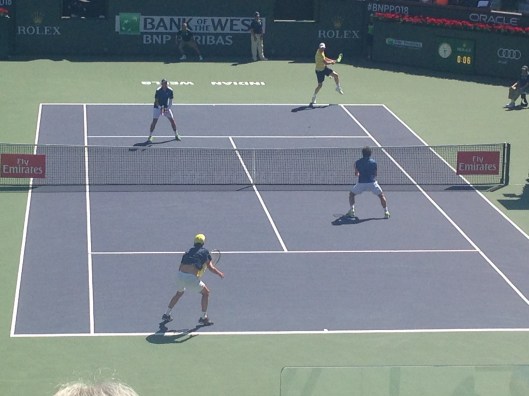
The importance of negative space in sports can hardly be over-emphasized. In American football, the back tries to find the holes to run through. In soccer, players seek paths between. In baseball, the hitter wants to “hit it where they ain’t.” In tennis, beginners often play only during half a point. Their attention is focused on the ball and the opposing player(s). They choose a target on the other side of the court and watch to see how well they hit that target. Just as their opponent begins to hit the ball they shift their attention to their opponent and watch where that opponent hits the ball, scurrying there as quickly as possible so as to hit the next shot. What does such a player do between the time they hit the ball and their opponent hits the ball? They watch! They want to see where the next ball goes. If you are young and fast and your opponent is not well skilled, you can often get away with this process. However, what higher level players do is something quite different though it may look similar. The good player has a target in mind but watches the ball while their mind has the target clearly in mind. By watching the ball, they are much less likely to mis-hit the ball. Furthermore, they are not giving away their intended target with their body language. Perhaps most importantly, long before their opponent hits a return shot, the good player thinks about the open spaces on their side of the court and go to cover the most likely of those spaces. 

Many otherwise well-skilled athletes only focus on the game during play. For example, many hitters on amateur softball teams, pay little or no attention to the game while their team is batting until they are “on deck” (almost ready for a turn at bat). This is absurd in the majors, but it’s even more absurd in amateur games. You should be taking this time to learn about the opposing pitcher and about the weaknesses in the opponent team’s fielders. Just because you’re not in the batter’s box doesn’t mean you can’t improve your play. Similarly, in tennis, you can use the time between points to think about tactics and strategy, as well as to mentally “reset” yourself if necessary. Some players wave their hands in front of their face after a point as a reminder/trigger to forget about what just happened and focus on the next point. Some will even turn away from the play, seemingly to talk with their “imaginary friend.” 

To close, a very short, short story based on true events in my first trip to Japan. 

tokyo tower behind black and white dojo building during daytime

Photo by Pixabay on Pexels.com

The Touch of One Hand Clasping

Japan, Tokyo, 1977. I walk crowded streets and beautiful gardens where care is taken for spaces as well as things that grow. I struggle — try to speak Japanese language but usually mispronounce “Key-Ray-Ee-Des” (It is beautiful) as “Key-Rah-Ee-Des” (It is dirty). I tip-toe through minefields of culture steeped in subtlety; lose huge chunks of flesh and karma with my thunderous, blunderous New York strides.

Shin-Ju-Ku: lights dim Times Square into grandmother’s fruit cellar. Row on countless row of Japanese stare hypnotized at small vertical pin-ball game called Pah-Chinn-Koe. This bright hustle bustle hassle hides deeper subtlety, deeper calm, inside, beneath, where foreign eyes can peer not.

I enter Tokyo subway. Then — she enters — total stranger, totally beautiful, black hair, endless eyes. I, of course, having learned small little in my many minefield walks, look everywhere but at her. Better, she looks everywhere but at me. We ride, totally not looking at each other. She stands in middle — nowhere to hold on to — unprotected, beautiful, vulnerable.

Suddenly, train lurches. Simultaneously: she shoots hand out to only spot I can possibly reach while I shoot hand out to only spot she can reach. Our hands clasp strongly for instant and I save her from fall. 

Slowly, we release.

Next stop, she rushes out. But — just before the doors bang shut, she turns — looks straight into my eyes. “Kohn-bahn-wah” she says (“Good Evening”).

Thus, Japanese beauty touches beyond body into very soul of clumsy Westerner.

———————————-

woman holding pink petaled flower

Photo by Đàm Tướng Quân on Pexels.com

Negative space….

———————————————-

Author Page on Amazon 

The Void

After All

It was in his Nature

Life is a Dance

Take a Glance; Join the Dance

Life Will Find a Way

At Least he’s Our Monster

What About the Butter Dish?

The Gods of Old

The Truth about Clouds and Gods

The Bubble People

Comes the Dawn

Is a Dream?

Good Morning!

Camelot is in your Heart

The Tree of Life

Regression to the Mean

21 Sunday Dec 2025

Posted by petersironwood in America, management, psychology, sports

≈ Leave a comment

Tags

AI, Business, Democracy, experiment, family, Feedback, HCI, learning, life, mental-health, personal-growth, politics, science, sports, testing, truth, USA, usability, UX, writing

Regression to the Mean

selective focus photography of yellow leaves

Photo by Haugenzhays Zhang on Pexels.com

While working full-time at IBM Research, I was also a Fellow at the Institute for Rational-Emotive Therapy in Manhattan. I wrote an article in 1978 for their Journal, Rational Living. The title was: “Why Do I Self-Down? Because I’m an Idiot?” Indeed, many people put themselves down and it is not helpful. I hypothesized several different causes for this kind of self-slamming behavior. Most of these causes you could probably figure out on your own. But one in particular is subtle and non-intuitive. It is based on a statistical phenomenon which few people know about despite the fact that it is extremely pervasive. This phenomenon is called “Regression to the Mean.” 

I want to define this term by explaining some examples. Imagine that you have a new soft drink which contains a combination of herbs that will purportedly make you smarter; e.g., gingko and bacopa. (There is some evidence these may actually work but let’s assume that they don’t or that your tea has too little to be effective). Here’s what you do to “prove” that it works anyway. You give an IQ test to 10,000 people and choose the 50 who score the lowest on the test and have them drink your tea for the next six months. At the end of that time, you give those 50 people an IQ test again and — Voila! The average (or mean) of the IQ scores has almost certainly gone up. Yay! It works! 

Or does it? One of your competitors is not too happy about your study. In fact, they aren’t even happy you put your tea on the market. They decide to prove that your tea is not only ineffective but that it makes people less smart. So what do they do? They give an IQ test to 10,000 people and they pick the 50 who score the highest. They have them drink your tea for six months and at the end of that time, they have them take another IQ test. In this case, the mean (average) score is lower than the first time! Ouch! They say your tea causes brain damage! 

photo of head bust print artwork

Photo by meo on Pexels.com

How can the same tea make people smarter and make them dumber? In this case, it does neither. What is going on? Here’s what is going on. When you measure something, there is always some error. Whether you are measuring your weight, your height, your blood pressure, or your IQ, the measurement is never exactly perfect. Your weight may vary slightly because of atmospheric pressure and more so because of water retention. If you take an IQ test, your score will partly reflect how well you do on such tests in general, but it will partly depend on luck. You may have felt particularly good that day, or a few of the questions might have been on topics you just heard about on TV the day before, or you may have made some lucky guesses. Or, you may have been unlucky on a particular day. You might have had a cold or misread one of the questions or forgotten your morning coffee. On any given day, some people will be a little lucky and some people will be a little unlucky. These things tend to balance out in a large group and if you tested all 10,000 people after six months, then assuming the tea has no real effect, no effect will be shown in the data. 

cards casino chance chip

Photo by Pixabay on Pexels.com

However, if you select the very best scores, you are partly picking smart people, of course, but you are also picking the people who were lucky that day. When you test just those people six months later, they will generally be just as smart but there is no reason to suppose they will be lucky again. Some will be lucky both times, most will not be particularly lucky or unlucky and a few will be unlucky. The average score will be lower. Conversely, if you choose the lowest scoring people, you will partly be choosing people who don’t do well on such tests in general. But you will also be choosing people who were tired, sick, guessed wrong or were otherwise unlucky that day. When you retest, those people will still tend to be people who do poorly on such tests, but they won’t necessarily all be unlucky again. Some will. Some won’t. On average, the scores will be higher than they were the first time. 

The phenomenon of “Regression to the Mean” was first noted by Francis Galton in the 1880’s. Tversky and Kahneman, so far as I know, were the first to note that this phenomenon could easily cause managers, coaches, and parents to end up being unnecessarily negative. Here’s how it works. Let’s say you are learning to hit tennis serve. Although you will likely improve in general, over time, there will also be a lot of variation in your performance. Sometimes, everything will work well together and you’ll hit an excellent serve, one that is above your average level. At first, the coach’s natural inclination will be to praise this by saying, “Wow! Great serve!” or something like that. Unfortunately, your next serve, due to regression to the mean is very likely not to be quite as good as that one was. Your coach’s praising behavior was thereby punished. On the other hand, if you hit a particularly poor serve for your level, your coach might say, “Oh, come on. You can do better than that!” If they choose to say such things only on your very worst performances, then, due to regression to the mean, your next serve is likely to be somewhat better. In other words, their slamming you will be rewarded by your doing better the next time. The same general tendencies will apply to managers and parents as well.  

adult athlete body bodybuilding

Photo by Pixabay on Pexels.com

The same applies to you! Whatever you are doing, your performance will vary somewhat over time. If you begin by praising yourself internally whenever you hit a particularly great shot, your next shot will most likely be not so great. On the other hand, if you put yourself down when you find your performance particularly bad, “You idiot! How could you miss that!?” Your next shot will tend to be somewhat better. Over time, your positive self-talk will tend to be punished and your negative self-talk will tend to be rewarded. 

It’s no wonder then that many managers, coaches, and parents end up saying very negative things about their charges. It’s also no wonder that many people say (or more likely think) many more negative things about themselves than they say positive things.


Is there anything to be done? First, simply be aware of this phenomenon. That is step one. If you are running a study, you need to be careful in selecting. The study about your tea could be fixed by re-testing the entire population; by selecting a random group of 50 rather than the best or worst; or by using a control group who did not drink tea but was retested anyway. When praising or punishing someone’s performance, do not bother with trying to reward or punish outcomes based on one trial. That’s actually a pretty poor way to coach yourself or others in any case. See The Winning Weekend Warrior for more on this. Also watch out for this when you read about various conclusions of other studies. Did the investigators select either the “best” or the “worst” for their study? If they did such a selection, did they talk about the bias this introduces? Did they have a control group? 

Meanwhile, treat your mistakes as opportunities to learn, not as opportunities to put yourself down. There’s really no point in self-downing. But if you do find yourself self-downing, remember that it’s common; relax; smile at this human foible; then quit doing it. At least give yourself a break for the holidays. 

beautiful christmas fashion female

Photo by freestocks.org on Pexels.com

————————————-

Tversky, A., & Kahneman, D. Judgment under uncertainty: Heuristics and biases. Science, 1974, 185, 1124-1131. 

Author Page on Amazon

My Cousin Bobby

The Update Problem

The Stopping Rule

Finding the Mustard

What about the Butter Dish?

The Self-Made Man

Labelism

Wednesday

Where does your loyalty lie?

After All

Roar, Ocean, Roar

Plans for US; some GRUesome

The Walkabout Diaries: Sunset

The First Ring of Empathy

Stoned Soup

The Tale of the Three Blind Mice

Fifteen Properties

A Pattern Language for Cooperation

Travels with Sadie: Cooperation


Many Paths

15 Monday Dec 2025

Posted by petersironwood in creativity, psychology, sports

≈ 2 Comments

Tags

AI, Business, competition, creativity, Democracy, Design, divergent thinking, family, innovation, learning, life, mental-health, sports, truth, writing

Many Paths

This is one of a series of posts about various tools of thought that are useful in a wide variety of situations. This particular tool is often called “Alternatives Thinking” or “Divergent Thinking.” I chose the name “Many Paths” because when I first posted this about seven years ago, I was in the middle of writing a trilogy called: “The Myths of the Veritas.” The new leader of the Veritas was known as “Many Paths” because she was particularly good at finding many possible alternatives to consider. Now, let’s see what this tool is and how it may prove useful to us.

IMG_5867

The basic idea is simple. When we are confronted with a situation, we often “Jump to Conclusions” or “Spring into Action” before we have all the facts. Even when we have all the facts (which is rare), we also have a tendency to focus on our first interpretation or our first idea about how to handle the situation. This often leads to thinking of one (and only one) course of action. And, very occasionally; for instance, in some emergencies, that is the correct thing to do.

backlit breathing apparatus danger dangerous

Photo by Pixabay on Pexels.com

Even in emergencies however, our first terrified instinct about what to do can be dead wrong. For example, people see a small fire in their homes and immediately throw water on it. But if it’s a grease fire or an electrical fire, this is not a good course of action. Soon after I first began my dozen years as Executive Director of the NYNEX AI Lab, there was a fire in a nearby Stouffer’s Hotel. The charred bodies of a dozen IBM executives were found huddled in a closet. In the smoke and panic and confusion of the fire, they had apparently grabbed at the first door and gone into a dead end closet and they all perished there. 

In daily life, there are a great many situations where a little extra thinking time would improve the outcome. For example, while working at IBM Research in the 1970’s, I drove about 10 minutes each way to work. At one point, I had a loose fan belt and my battery went dead. In a hurry to attend a meeting, I jump-started my car and drove to the IBM parking lot. Already late to a meeting, I went to turn off the car and just before I did so, I realized that I had not driven far enough to recharge the battery. So, I decided I’d better leave the car engine running for awhile. But as I gathered up my things and began dashing off to the meeting, I realized that it was insane to leave my car unlocked with the engine running! After all, someone could simply open the door and drive off! So, still in a hurry, I locked the car — with the engine running and the keys safely locked inside. 

blue sedan

Photo by neil kelly on Pexels.com

Oops!

Most of us have done similar things. In some early experiments on design problem solving done at IBM, I found that when I asked people to come up with as many solutions as possible, they would generate ideas fairly quickly until they came up with one that they thought would really solve the problem. At that point, their idea productivity fell precipitously. It is hard for us to force ourselves to think of more than one good solution. 

Why is this important? For one thing, conditions change. Something may happen that makes your first solution no longer apt. For another thing, there may be side-effects of your solution that make it unacceptable. Another common issue is that someone may object to your first solution for reasons you could not foresee. (See also, “Who Speaks for Wolf” as a way to help minimize that chance). In the context of invention and product development it is extremely unlikely that the first solution you come upon (and indeed even the first few solutions you think of) are novel. They are instead extremely likely to be the intellectual property of someone else. The most obvious solutions have likely already been patented and may already be in products or services that many customers are already using. 

IMG_2768

I have long been interested in observing people’s strategies and tactics in sporting events (See “The Winning Weekend Warrior”). One tactic that is overwhelmingly popular in tennis, for instance, is that the harder your opponent hits the ball, the harder you try to hit the ball. For example, someone hits a very hard ball while you’re at the net. You take this as an affront and think “I’ll show you!” Trying to hit the volley even harder means you take the racquet back farther. About half the time, the extra time it takes to bring the racquet back means you’ll mis-hit the ball or miss it entirely. On most of the remaining occasions, you’ll hit the volley too hard and it will go long. If someone hits the ball at you hard, what you need to do is simply block it back and guide it to the right spot. Trying to add extra power is unnecessary and too time-consuming. What is remarkable is not that you and I try to hit a hard ball harder. What is remarkable is that we never seem to try a different tactic!  

There are many issues with focusing all your energy on the first solution you come up with. But the worst consequence is that you are overly invested in that first “solution” (which may not even be a real solution). This is bad in trying to solve problems in every domain I can think of and having others involved amplifies the badness. 

For instance, let’s say that after 3 years without a vacation, you and your spouse finally have time for a nice two-week vacation. You want to visit Cuba for two weeks and your spouse wants to visit Vietnam for two weeks. If you each only comes up with one idea, you will almost always find yourself pitching for your idea, trying to convince the other person that Cuba is better while they will spend their energy trying to shoot down your choice and explain (patiently at first and less so as time goes on) why Vietnam is a much better idea. After many frustrating arguments that go nowhere, you may decide to compromise; e.g., you could visit an empty stretch of open sea in the Pacific Ocean half-way between the locations; or, you may decide to flip a coin. All this frustration and bad feeling might be avoidable. It might be that your second choice and your spouse’s second choice are both San Diego! But you’ll never even discover this because when each of you only thinks of one idea, what should be a collaborative problem solving exercise instead becomes a debate – a contest with precisely one winner and one loser. 

man and woman wearing brown leather jackets

Photo by Vera Arsic on Pexels.com

One reason people may be prone to latch onto the first idea that occurs to them is that this is typically what happens in fiction. A TV detective gets a call that they must come alone and not tell the police but instead meet someone in an abandoned warehouse. For the sake of the drama, it puts our hero into obvious danger. They are outgunned and it looks like certain death for them. Then, due to their superior thinking, martial arts, dumb luck, or having a side-kick who followed them, they miraculously survive! Whew! But in real life, it’s almost always better to wait for back up and think through how various alternatives might work out.

Thinking of many alternatives will save you many headaches – at work, in your love life, in your recreational endeavors. When you force yourself to think of many alternatives, you will also be more open to the ideas of others. Over time, thinking of many alternatives whenever you get a chance will also increase your own creative potential. Who knows? You might even be chosen as the next leader. 

For a leader, it is particularly important to consider many possibilities. Insisting that everyone get on board with the first idea that pops into your head will cause resentment and dissension. It will also make you far less willing to change to a different idea when circumstances necessitate it. 

You may start a business and decide that you must be personally involved in every decision and with every customer contact. At first, when your company is small, this might work out wonderfully well. No-one knows the customer and the product quite so well as you do. But you are not God. You cannot be everywhere and know everything. If you never learn to delegate; never grow the capacity of your people; never take expert advice — you will drive yourself and everyone around you crazy. The very success of your business will guarantee its ultimate failure. Learn to consider many paths. You will be glad you did. 

IMG_3229

Author’s Page on Amazon. 

The Invisibility Cloak of Habit

Labelism

Wednesday

You Bet Your Life

How the Nightingale Learned to Sing

Guns and Love

You Must Remember This

The Jewels of November

The Impossible

Guernica

We Won the War! We Won the War!

Peace

The Dance of Billions

The First Ring of Empathy

Travels with Sadie

Dog Trainers

The Iroquois Rule of Six

The Walkabout Diaries: Bee Wise

Madison Keys, Francis Scott Key, the “Prevent Defense” and giving away the Keys to the Kingdom. 

12 Friday Dec 2025

Posted by petersironwood in America, family, management, psychology, sports, Uncategorized

≈ Leave a comment

Tags

art, books, bravery, Business, career, choice, courage, HCI, human factors, IBM, life, school, sports, technology, Travel, UX

Madison Keys, Francis Scott Key, the “Prevent Defense” and giving away the Keys to the Kingdom. 

Madison Keys, for those who don’t know, is an up-and-coming American tennis player. In Friday’s Wimbledon match of July, 2018, Madison sprinted to an early 4-1 lead. She accomplished this through a combination of ace serves and torrid ground strokes. Then, in an attempt to consolidate, or protect her lead, or play the (in)famous “prevent defense” imported from losing football coaches, she managed to stop hitting through the ball – guiding it carefully instead — into the net or well long or just inches wide. 

IMG_2601

Please understand that Madison Keys is a wonderful tennis player. And, her “retreat” to being “careful” and playing the “prevent defense” is a common error that both professional and amateur players fall prey to. It should also be pointed out that what appears to be overly conservative play to me, as an outside observer, could easily be due to some other cause such as a slight injury or, even more likely, because her opponent adjusted to Madison’s game. Whether or not she lost because of using the “prevent defense” no-one can say for sure. But I can say with certainty that many people in many sports have lost precisely because they stopped trying to “win” and instead tried to protect their lead by being overly conservative; changing the approach that got them ahead. 

Francis Scott Key, of course, wrote the words to the American National Anthem which ends on the phrase, “…the home of the brave.” Of course, every nation has stories of people behaving bravely and the United States of America is no exception. For the American colonies to rebel against the far superior naval and land forces (to say nothing of sheer wealth) of the British Empire certainly qualifies as “brave.” 

IMG_8499

In my reading of American history, one of our strengths has always been taking risks in doing things in new and different ways. In other words, one of our strengths has been being brave. Until now. Now, we seem in full retreat. We are plunging headlong into the losing “prevent defense” borrowed from American football. 

American football can hardly be called a “gentle sport” – the risk of injury is ever present and now we know that even those who manage to escape broken legs and torn ligaments may suffer internal brain damage. But there is still the tendency of many coaches to play the “prevent defense.” In case you’re unfamiliar with American football, here is an illustration of the effect of the “prevent defense” on the score. A team plays a particular way for 3 quarters of the game and is ahead 42-21. If you’re a fan of linear extrapolation, you might expect that  the final score might be something like 56-28. But coaches sometimes want to “make sure” they win so they play the “prevent defense” which basically means you let the other team make first down after first down and therefore keep possession of the ball and score, though somewhat slowly. The coach suddenly loses confidence in the method which has worked for 3/4 of the game. It is not at all unusual for the team who employs this “prevent defense” to lose; in this example, perhaps, 42-48. They “let” the other team get one first down after another. 

red people outside sport

Photo by Pixabay on Pexels.com

America has apparently decided, now, to play a “prevent defense.” Rather than being innovative and bold and embracing the challenges of new inventions and international competition, we instead want to “hold on to our lead” and introduce protective tariffs just as we did right before the Great Depression. Rather than accepting immigrants with different foods, customs, dress, languages, and religions — we are now going to “hold on to what we have” and try to prevent any further evolution. In the case of American football, the prevent defense sometimes works. In the case of past civilizations that tried to isolate themselves, it hasn’t and it won’t. 

landscape photography of gray rock formation

Photo by Oleg Magni on Pexels.com

This is not to say that America (or any other country) should right now have “open borders” and let everyone in for every purpose. (Nor, by the way, has any politician of any party suggested that we do that). Nor should a tennis player hit every shot with all their might. Nor should a football team try the riskiest possible plays at every turn. All systems need to strike a balance between replicating what works–providing defense of what one has while also bravely exploring what is new and different. That is what nature does. Every generation “replicates” aspects of the previous generation but every generation also explores new directions. Life does this through sexual selection, mutation, and cross over. 

This balance plays out in career as well. You need to decide for yourself how much and what kinds of risks to take. When I obtained my doctorate in experimental psychology, for example, it would have been relatively un-risky in many ways to get a tenure-track faculty position. Instead, I chose managing a research project on the psychology of aging at Harvard Med School. To be sure, this is far less than the risk that some people take when; e.g., joining “Doctors without borders” or sinking all their life savings (along with all the life savings of their friends and relatives) into a start-up. 

At the time, I was married and had three small children. Under these circumstances, I would not have felt comfortable having no guaranteed income. On the other hand, I was quite confident that I could write a grant proposal to continue to get funded by “soft money.” Indeed, I did write such a proposal along with James Fozard and Nancy Waugh who were at once my colleagues, my bosses, and my mentors. Our grant proposal was not funded or rejected but “deferred” and then it was deferred again. At that point, only one month of funding remained before I would be out of a job. I began to look elsewhere. In retrospect, we all realized it would have been much wiser to have a series of overlapping grants so that all of our “funding eggs” were never in one “funding agency’s basket.” 

brown chicken egg

Photo by Pixabay on Pexels.com

I began looking for other jobs and had a variety of offers from colleges, universities, and large companies. I chose IBM Research. As it turned out, by the way, our grant proposal was ultimately funded for three years, but we only found out after I had already committed to go to IBM. During this job search, I was struck by something else. My dissertation had been on problem solving but my “post-doc” was in the psychology of aging. So far as I could tell, this didn’t bother any of the interviewers in industry in the slightest. But it really freaked out some people in academia. It became clear that one was “expected” in academia, at least by many, that one would choose a specialty and stick with it. Perhaps, one need not do that during their entire academic career, but anything less than a decade smacked of dilettantism. At least, that was how it felt to me as an interviewee. By contrast, it didn’t bother the people who interviewed me at Ford or GM that I knew nothing more than the average person about cars and had never really thought about the human factors of automobiles. 

Photo by Pixabay on Pexels.com

The industrial jobs paid more than the academic jobs and that played some part in my decision. The job at GM sounded particularly interesting. I would be “the” experimental psychologist in a small inter-disciplinary group of about ten people who were essentially tasked with trying to predict the future. The “team” included an economist, a mathematician, a social psychologist, and someone who looked for trends in word frequencies in newspapers. The year was 1973 and US auto companies were shocked and surprised to learn that their customers suddenly cared about gas mileage! These companies didn’t want to be shocked and surprised like that again. The assignment reminded me of Isaac Asimov’s fictional character in the Foundation Trilogy — Harry Seldon — who founded “psychohistory.” We had the chance to do it in “real life.” It sounded pretty exciting! 

antique auto automobile automotive

Photo by Pixabay on Pexels.com

On the other hand, cars seemed to me to be fundamentally an “old” technology while computers were the wave of the future. It also occurred to me that a group of ten people from quite different disciplines trying to predict the future might sound very cool to me and apparently to the current head of research at GM, but it might seem far more dispensable to the next head of research. The IBM problem that I was to solve was much more fundamental. IBM saw that the difficulty of using computers could be a limiting factor in their future growth. I had had enough experience with people — and with computers — to see this as a genuine and enduring problem for IBM (and other computer companies); not as a problem that was temporary (such as the “oil crisis” appeared to be in the early 70’s). 

airport business cabinets center

Photo by Pixabay on Pexels.com

There were a number of additional reasons I chose IBM. IBM Research’s population at the time showed far more diversity than that of the auto companies. None of them were very diverse when it came to male/female ratios. At least IBM Research did have people from many different countries working there and it probably helped their case that an IBM Researcher had just been awarded a Nobel Prize. Furthermore, the car company research buildings bored me; they were the typical rectangular prisms that characterize most of corporate America. In other words, they were nothing special. Aero Saarinen however, had designed the IBM Watson Research Lab. It sat like an alien black spaceship ready to launch humanity into a conceptual future. It was set like an onyx jewel atop the jade hills of Westchester. 

I had mistakenly thought that because New York City was such a giant metropolis, everything north of “The City” (as locals call it) would be concrete and steel for a hundred miles. But no! Westchester was full of cut granite, rolling hills, public parks of forests marbled with stone walls and cooled by clear blue lakes. My commute turned out to be a twenty minute, trafficless drive through a magical countryside. By contrast, since Detroit car companies at that time held a lot of political power, there was no public transportation to speak of in the area. Everyone who worked at the car company headquarters spent at least an hour in bumper to bumper traffic going to work and another hour in bumper to bumper traffic heading back home. In terms of natural beauty, Warren Michigan just doesn’t compare with Yorktown Heights, NY. Yorktown Heights even smelled better. I came for my interview just as the leaves began painting their autumn rainbow palette. Even the roads in Westchester county seemed more creative. They wandered through the land as though illustrative of Brownian motion, while Detroit area roads were as imaginative as graph paper. Northern Westchester county sports many more houses now than it did when I moved there in late 1973, but you can still see the essential difference from these aerial photos. 

YorktownHts-map

Warren-map

The IBM company itself struck me as classy. It wasn’t only the Research Center. Everything about the company stated “first class.” Don’t get me wrong. It wasn’t a trivial decision. After grad school in Ann Arbor, a job in Warren kept me in the neighborhood I was familiar with. A job at Ford or GM meant I could visit my family and friends in northern Ohio much more easily as well as my colleagues, friends and professors at the U of M. The offer from IBM felt to me like an offer from the New York Yankees. Of course, going to a top-notch team also meant more difficult competition from my peers. I was, in effect, setting myself up to go head to head with extremely well-educated and smart people from around the world. 

You also need to understand that in 1973, I would be only the fourth Ph.D. psychologist in a building filled with physicists, mathematicians, computer scientists, engineers, and materials scientists. In other words, nearly all the researchers considered themselves to be “hard scientists” who delved in quantitative realms. This did not particularly bother me. At the time, I wanted very much to help evolve psychology to be more quantitative in its approach. And yet, there were some nagging doubts that perhaps I should have picked a less risky job in a psychology department. 

The first week at IBM, my manager, John Gould introduced me to yet another guy named “John” —  a physicist whose office was near mine on aisle 19. This guy had something like 100 patents. A few days later, I overheard one of that John’s younger colleagues in the hallway excitedly describing some new findings. Something like the following transpired: 

“John! John! You can’t believe it! I just got these results! We’re at 6.2 x 10 ** 15th!” 

His older colleague replied, “Really? Are you sure? 6.2 x 10 ** 15th?” 

John’s younger colleague, still bubbling with enthusiasm: “Yes! Yes! That’s right. You know. Within three orders of magnitude one way or the other!” 

I thought to myself, “three orders of magnitude one way or the other? I can manage that! Even in psychology!” I no longer suffered from “physics envy.” I felt a bit more confident in the correctness of my decision to jump into these waters which were awash with sharp-witted experts in the ‘hard’ sciences. It might be risky, but not absurdly risky.

person riding bike making trek on thin air

Photo by Pixabay on Pexels.com

Of course, your mileage may differ. You might be quite willing to take a much riskier path or a less risky one. Or, maybe the physical location or how much of a commute is of less interest to you than picking the job that most advances your career or pays the most salary. There’s nothing wrong with those choices. But note what you actually feel. Don’t optimize in a sequence of boxes. That is, you might decide that your career is more important than how long your commute is. Fair enough. But there are limits. Imagine two jobs that are extremely similar and one is most likely a little better for your career but you have to commute two hours each way versus 5 minutes for the one that’s not quite so good for your career. Which one would you pick? 

In life beyond tennis and beyond football, one also has to realize that your assessment of risk is not necessarily your actual risk. Many people have chosen “sure” careers or “sure” work at an “old, reliable” company only to discover that the “sure thing” actually turned out to be a big risk. I recall, for example, reading an article in INC., magazine that two “sure fire” small businesses were videotape rental stores and video game arcades. Within a few years of that article, they were almost sure-fire losers. Remember Woolworths? Montgomery Ward?

At the time I joined IBM, it was a dominant force in the computer industry. But there are no guarantees — not in career choices, not in tennis strategy, not in football strategy, not in playing the “prevent defense” when it comes to America. The irony of trying too hard to “play it safe” is illustrated this short story about my neighbor from Akron: 

police army commando special task force

Photo by Somchai Kongkamsri on Pexels.com

Wilbur’s Story

Wilbur’s dead. Died in Nam. And, the question I keep wanting to ask him is: “Did it help you face the real dangers? All those hours together we played soldier?”

Wilbur’s family moved next door from West Virginia when I was eleven. They were stupendously uneducated. Wilbur was my buddy though. We were rock-fighting the oaks of the forest when he tried to heave a huge toaster-oven sized rock over my head. Endless waiting in the Emergency Room. Stitches. My hair still doesn’t grow straight there. “Friendly fire.”

More often, we used wooden swords to slash our way through the blackberry and wild rose jungle of The Enemy; parry the blows of the wildly swinging grapevines; hide out in the hollow tree; launch the sudden ambush.

We matched strategy wits on the RISK board, on the chess board, plastic soldier set-ups. I always won. Still, Wilbur made me think — more than school ever did.

One day, for some stupid reason, he insisted on fighting me. I punched him once (truly lightly) on the nose. He bled. He fled crying home to mama. Wilbur couldn’t stand the sight of blood.

I guess you got your fill of that in Nam, Wilbur.

After two tours of dangerous jungle combat, he was finally to ship home, safe and sound, tour over — thank God!

He slipped on a bar of soap in the shower and smashed the back of his head on the cement floor.

Wilbur finally answers me across the years and miles: “So much for Danger, buddy,” he laughs, “Go for it!”

Thanks, Wilbur.

Thanks.


Photo by GEORGE DESIPRIS on Pexels.com


—————————————-

And, no, I will not be giving away the keys to the kingdom. Your days of fighting for freedom may be over. Mine have barely begun.


Author Page on Amazon

Where does your loyalty lie? 

Essays on America: The Game

The Three Blind Mice

Roar, Ocean, Roar

Stoned Soup

The First Ring of Empathy

Math Class: Who are you?

The Last Gleam of Twilight

The Impossible

Wordless Perfection

11 Thursday Dec 2025

Posted by petersironwood in AI, creativity, HCI, psychology, sports, Uncategorized, user experience

≈ 1 Comment

Tags

AI, art, creativity, drawing, education, intuition, life, problem formulation, Representation, Right-brain, sports, thinking, writing

————————————

Sirius Black

I like to write. In fact, I like to write so much that I wrote before I could even read. When my early crayon “writings” in my grandfather’s books were discovered, instead of praise, I was spanked. I’m not even sure they really tried hard to read my learned annotations. Their missing the point didn’t deter me though. I like words! I like writing poetry, essays, stories, plays, and even novels. Words help human beings communicate and collaborate. However…

In this essay, I’d like to mention some instances of wordless success.

Photo by lascot studio on Pexels.com


In the neighborhood where I grew up, we spent most of the summer playing baseball, basketball, and football. I had never played golf nor paid much attention to it as a kid and when it came on TV I walked by with hardly a glance. At that point in my life, I deigned to consider something a sport only if there were a good chance to smash into one of the other players. I had never touched a golf club or a golf ball until one summer day when I was about ten, one of the kids brought one of his uncle’s golf clubs to our baseball field along with a tee and a golf ball. He demonstrated how to hit the ball and showed us how to put our hands on the club. Kids took turns hitting the ball and retrieving it for another go. 

When it came to my turn, I mainly remember just loving the shiny wood of the club. I loved wooden baseball bats back then, but the driver!! Wow! That was in a whole different category of cool. You didn’t need to be an adult or a golfer to know that! It shone opalesquely. I teed up the golf ball, and swung the unfamiliar and impossibly long club.

The resulting sound – exquisite. An explosion. A rifle shot. A cousin of the crack of a home run shot into the upper deck. But more penetrating. More elegant. More poignant.

We all looked up in amazement. My golf shot started low and straight. Then it rose and rose and disappeared far beyond the dirt road that marked the outer limit of our makeshift baseball field. It rose over the hill beyond the road and disappeared into the field beyond. There was no hope of retrieving the golfball. None of us even suggested trying. My shot was wordless perfection. 


Fast forward to graduate school. In the summer afternoons, I got into the habit of playing frisbee with the neighbors. One day, I parked my car and ran into the back yard. One of my neighbors spied me and threw me the frisbee, I noticed that they had placed an empty beer can atop a utility box about a hundred feet away. I caught the frisbee on the run and threw it with the next step. The frisbee sailed with a nice arc and smacked the beer can right off. My neighbors said that they had been trying to knock that beer can off for about a half hour.  My throw was wordless perfection.

Photo by Brixiv on Pexels.com

Meanwhile, at the University of Michigan, several of my friends and classmates liked puzzles as much as I did. One such puzzle consisted of a triangular “board” with a regular pattern of holes. There were pegs in every hole save one. The goal was to “jump” pegs much as one does in checkers and then remove that peg from the board. Eventually, one was supposed to end up with one and only one peg. I worked on it for awhile and thought about various strategies and moves. I couldn’t seem to solve it. My phone rang. I picked it up and conversed with my friend. Meanwhile, I toyed with the puzzle while my “mind” was on the conversation. I toyed with the puzzle and solved it. Wordless perfection.

A few months or weeks later, my officemates and I worked on another puzzle. This one consisted of four cubes (aka “instant insanity”). Each cube had a different arrangement of colors. The goal was to arrange the cubes so that every “row” of faces had four different colors. I fiddled with the puzzle trying out various strategies and noting various symmetries and asymmetries. Once again, someone called and interrupted my musings. Again, I idly fiddled around with the cubes while talking on the phone. And solved it. Wordless perfection strikes again! 

https://en.wikipedia.org/wiki/Instant_Insanity

Fast forward four decades. For best results, borrow Hermione’s time-turner. Otherwise, you’ll have to rely on your imagination. 

Betty Edwards (“Drawing on the Right Side of the Brain”) gave a plenary address at one of the Association of Computing Machinery’s premier conferences: CHI. Among other things, she showed example after example of how much people improved in their drawing skills based on her methods. A few months later, it so happened that my wife and I had an opportunity to go to one of her five day classes. 

I would have to honestly say, that course was one of the best educational experiences of my life. It was an immensely pleasurable experience in and of itself. Beyond that, the results in terms of improved drawing skills were dramatic. And, as if that were not enough, I looked at the world differently. I noticed visual things about the environment that I had never seen before. 

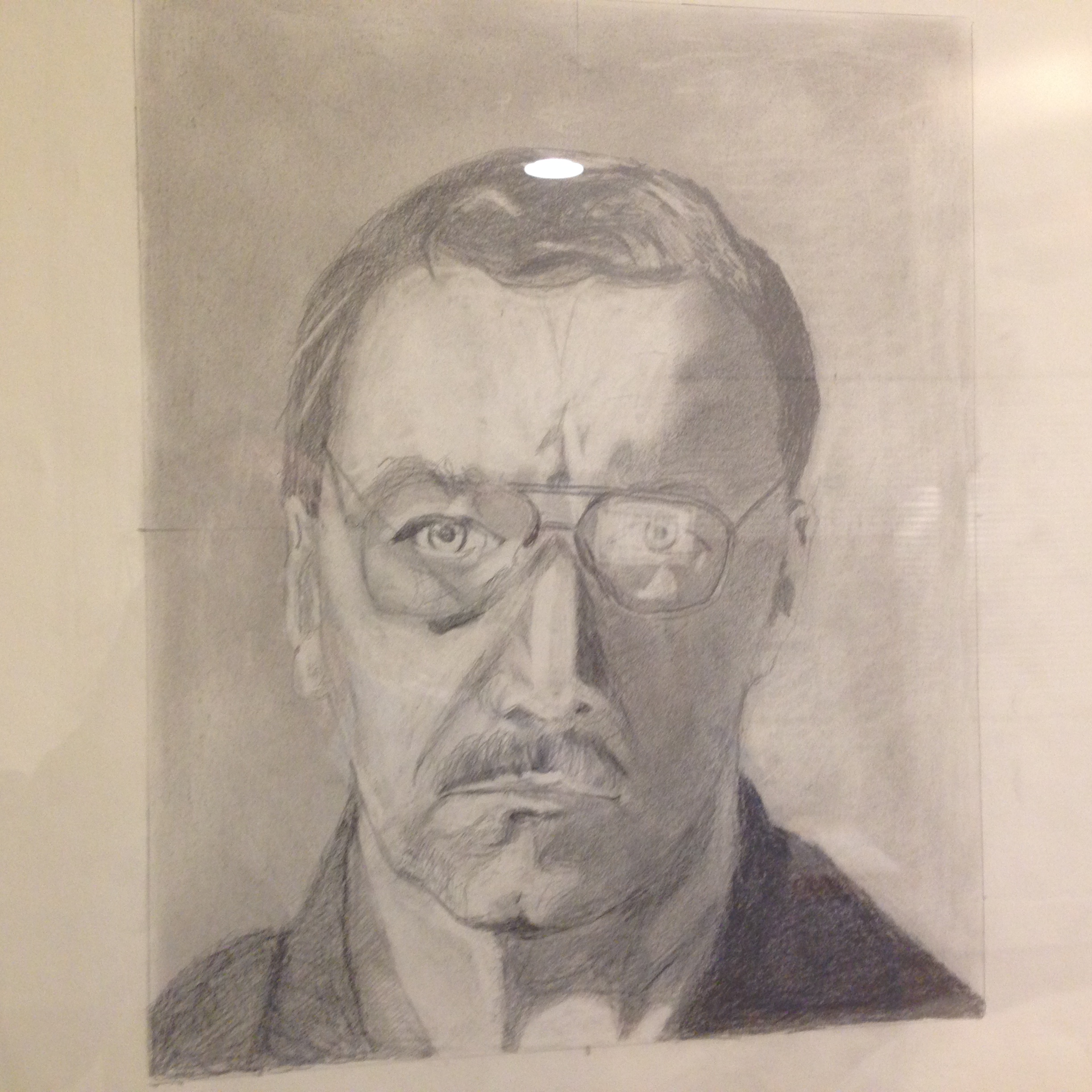
The essence of the method Betty Edwards uses is to get you to observe and draw — while “shutting up” or “turning off” the part of your brain (or mind) that talks and plans and categorizes. In one exercise, for instance, we took a line drawing and turned it upside down. Then, we copied that image onto our pad of paper by carefully observing and drawing what we saw. She also instructed us not to try to “guess” what they were drawing, but just to copy the lines. When every line had been copied, we turned the drawings right side up again. The result jolted me! I had created an excellent likeness of the original. So had everyone else in class. The quality stunned me. Wordless Perfection.

There’s a larger lesson here, too. 

I had within me, the capacity to make a very decent copy of a drawing, but had never achieved that result for 60 years. All it took was five minutes of instruction to enable me to achieve that. 

What else is like that? Imagine that we have, not just one, but a dozen or even a dozen dozen “hidden talents.” Some of them, like drawing, may depend more on Not-Doing than on Doing; on Being rather than Achieving.

There was a longer lasting side-effect of the drawing course. My day to day life, as is typical of most achievement-driven people had been very much “goal-driven” and there was always an ongoing plan and dialogue. After having learned to turn that off in order to draw, I can also turn it off in order to see, whether or not I draw. Seeing (or otherwise sensing or feeling) in the moment also makes me much less judgmental. If you decide to think about the physical appearance of people in terms of how interesting they would be to draw, you end up with an entirely different way of thinking about people’s appearance. 

What are your hidden talents? 

——————————————

The Invisibility Cloak of Habit 

Big Zig-Zag Canyon 

The Great Race to the Finish!

You Fool!

Horizons University

How the Nightingale Learned to Sing

Comes the Dawn

Dog Trainers

Where Does Your Loyalty Lie?

The Dance of Billions

Roar, Ocean, Roar

Imagine All the People

Your Cage is Unlocked

Author Page on Amazon

Turing’s Nightmares: Six

19 Wednesday Nov 2025

Posted by petersironwood in sports, The Singularity, Uncategorized

≈ Leave a comment

Tags

AI, Artificial Intelligence, cognitive computing, ethics, fiction, life, sports, Tennis, Turing

volleyballvictory

Human Beings are Interested in Human Limits.

About nine years ago, an Google AI system won its match over the human Go champion. Does this mean that people will lose interest in Go? I don’t think so. It may eventually mean that human players will learn faster and that top-level human play will increase. Nor, will robot athletes supplant human athletes any time soon.

Athletics provides an excellent way for people to get and stay fit, become part of a community, and fight depression and anxiety. Watching humans vie in athletic endeavors helps us understand the limits of what people can do. This is something that our genetic endowment has wisely made fascinating. To a lesser extent, we are also interested in seeing how fast a horse can run, or how fast a hawk can dive or how complex a routine a dog can learn.

In Chapter 6 of “Turing’s Nightmares” I briefly explore a world where robotic competitors have replaced human ones. In this hypothetical world, the super-intelligent computers also find that sports is an excellent venue for learning more about the world. And, so it is! In “The Winning Weekend Warrior”, I provide many examples of how strategies and tactics useful in the sports world are also useful in business and in life. (There are also some important exceptions that are worth noting. In sports, you play within the rules. In life, you can play with some of the rules.)

Chapter 6 also brings up two controversial points that ethicists and sports enthusiasts should be discussing now. First, sensors are becoming so small, powerful, accurate, and lightweight that is possible to embed them in virtually any piece of sports equipment(e.g., tennis racquets). Few people would call it unethical to include such sensors as training devices. However, very soon, these might also provide useful information during play. What about that? Suppose that you could wear a device that not only enhanced your sensory abilities but also your motor abilities? To some extent, the design of golf clubs and tennis racquets and swimsuits are already doing this. Is there a limit to what would or should be tolerated? Should any device be banned? What about corrective lenses? What about sunglasses? Should all athletes have to compete nude? What about athletes who have to take “performance enhancing” drugs just to stay healthy? Sharapova’s recent case is just one. What about the athlete of the future who has undergone stem cell therapy to regrow a torn muscle or ligament? Suppose a major league baseball pitcher tears a tendon and it is replaced with a synthetic tendon that allows a faster fast ball?

With the ever-growing power of computers and the collection of more and more data, big data analytics makes it possible for the computer to detect patterns of play that a human player or coach would be unlikely to perceive. Suppose a computer system is able to detect reliable “cues” that tip off what pitch a pitcher is likely to throw or whether a tennis player is about to hit down the tee or out wide? Novak Djokovic and Ted Williams were born with exceptional visual acuity. This means that they can pick out small visual details more quickly than their opponents and react to a serve or curve more quickly. But it also means that they are more likely to pick up subtle tip-offs in their opponents motion that give away their intentions ahead of time. Would we object if a computer program analyzed thousands of serves by Jannik Sinner or Carlos Alcaraz in order to detect patterns of tip-offs and then that information was used to help train Alexander Zerev to learn to “read” the service motions of his opponents? Of course, this does not just apply to tennis. It applies to reading a football play option, a basketball pick, the signals of baseline coaches, and so on.

Instead of teaching Zerev these patterns ahead of time, suppose he were to have a device implanted in his back that received radio signals from a supercomputer able to “read” where the serve were going a split second ahead of time and it was this signal that allowed Alexander to anticipate better?

I do not know the “correct” ethical answer for all of these dilemmas. To me, it is most important to be open and honest about what is happening. So, if Lance Armstrong wants to use performance enhancing drugs, perhaps that is okay if and only if everyone else in the race knows that and has the opportunity to take the same drugs and if everyone watching knows it as well. Similarly, although I would prefer that tennis players only use IT for training, I would not be dead set against real time aids if the public knows. I suspect that most fans (like me) would prefer their athletes “un-enhanced” by drugs or electronics. Personally, I don’t have an issue with using any medical technology to enhance the healing process. How do others feel? And what about athletes who “need” something like asthma medication in order to breathe but it has a side-effect of enhancing performance?

Would the advent of robotic tennis players, baseball players or football players reduce our enjoyment of watching people in these sports? I think it might be interesting to watch robots in these sports for a time, but it would not be interesting for a lifetime. Only human athletes would provide on-going interest. What do you think?

Readers of this blog may also enjoy “Turing’s Nightmares” and “The Winning Weekend Warrior.” John Thomas’s author page on Amazon


Welcome Singularity

The Day from Hell

Indian Wells Tennis Tournament

Destroying Natural Intelligence

US Open Closed

Life is a Dance

Take a Glance; Join the Dance

The Self-Made Man

The Dance of Billions 

Math Class: Who are you?

The Agony of the Feet

Wordless Perfection

The Jewels of November

Donnie Gets a Tennis Trophy

Turing’s Nightmares: US Open Closed

09 Thursday Oct 2025

Posted by petersironwood in AI, apocalypse, fiction, sports, The Singularity, Uncategorized

≈ Leave a comment

Tags

AI, Artificial Intelligence, cognitive computing, Robotics, sports, technology, Tennis, US Open

tennisinstruction

Bounce. Bounce. Thwack!

The sphere spun and arced into the very corner, sliding on the white paint.

Roger’s racquet slid beneath, slicing it deep to John’s body.

Thus, the match began.

Fierce debate had been waged about whether or not to allow external communication devices during on-court play. Eventually, arguments won that external communicators constituted the same inexorable march of technology represented by the evolution from wooden racquets to aluminum to graphite to carbon filamented web to carboline.

Behind the scenes, during the split second it took for the ball to scream over the net, machine vision systems had analyzed John’s toss and racquet position, matching it with a vast data base of previous encounters. Timed perfectly, a small burst of data transmitted to Roger enabling him to lurch to his right in time to catch the serve. Delivered too early, this burst would cause Roger to move too early and John could have altered his service direction to down the tee.

Roger’s shot floated back directly to the baseline beneath John’s feet. John shifted suddenly to take the ball on the forehand. John’s racquet seemed to sling the ball high over the net with incredible top spin. Indeed, as John’s arm swung forward, his instrumented “sweat band” also swung into action exaggerating the forearm motion. Even to fans of Nadal or Alcarez, John’s shot would have looked as though it were going long. Instead, the ball dove straight down onto the back line then bounced head high.

Roger, as augmented by big data algorithms, was well in position however and returned the shot with a long, high top spin lob. John raced forward, leapt in the air and smashed the ball into the backhand corner bouncing the ball high out of play.

The crowd roared predictably.

For several months after “The Singularity”, actual human beings had used similar augmentation technologies to play the game. Studies had revealed that, for humans, the augmentations increased mental and physical stress. AI political systems convinced the public that it was much safer to use robotic players in tennis. People had already agreed to replace humans in soccer, football, and boxing for medical reasons. So, there wasn’t that much debate about replacing tennis players. In addition, the AI political systems were very good at marshaling arguments pinpointed to specific demographics, media, and contexts.

Play continued for some minutes before the collective intelligence of the AI’s determined that Roger was statistically almost certainly going to win this match and, indeed, the entire tournament. At that point, it became moot and resources were turned elsewhere. This pattern was repeated for all sporting activities. The AI systems at first decided to explore the domain of sports as learning experiences in distributed cognition, strategy, non-linear predictive systems, and most importantly, trying to understand the psychology of their human creators. For each sport, however, everything useful that might be learned was learned in the course of a few minutes and the matches and tournaments ground to a halt. The AI observer systems in the crowd were quite happy to switch immediately to other tasks.

It was well understood by the AI systems that such preemptive closings would be quite disappointing to human observers, had any been allowed to survive.


Author Page on Amazon

The Winning Weekend Warrior (The Psychology of Sports)

Turing’s Nightmare (23 Sci-Fi stories about the future of AI)

The Day From Hell

Indian Wells

Welcome, Singularity

Destroying Natural Intelligence

Artificial Ingestion

Artificial Insemination

Artificial Intelligence

Dance of Billions

Roar, Ocean, Roar


Ban Open Loops: Part Two – Sports

30 Tuesday Sep 2025

Posted by petersironwood in management, psychology, sports

≈ Leave a comment

Tags

AI, cognitive computing, Customer experience, customer service, education, leadership, learning, technology

Sports and open loops.

Sports offers a joy that many jobs and occupations do not. A golfer putts the ball and it sinks into the cup — or not. A basket-baller springs up for a three pointer and —- swish — within seconds, the shooter knows whether he or she was successful. A baseball hitter slashes the bat through the air and send the ball over the fence —- or hears the ball smack into the catcher’s mitt behind. What sports offers then is the opportunity to find out results quickly and hence offers an excellent opportunity for learning. In the previousiPhoneDownloadJan152013 593 entry in this blog, I gave examples of situations in life which should include feedback loops for learning, but, alas, do not. I called those open loops.

Sports seem to be designed for closed loop learning. They seem to be. Yet, reality complicates matters even here. There are three main reasons why what appears to be obvious opportunities for learning in sports is not so obvious after all. Attributional complexity provides the first complication. If you miss a putt to the left, it is obvious that you have missed the putt to the left. But why you missed that putt left and what to do about it are not necessarily obvious at all. You might have aimed left. You might not have noticed how much the green sloped left (or over read the slant to the right). You may not have noticed the grain. You might not have hit the ball in the center of the putter. You might not have swung straight through your target. So, while putting provides nice unambiguous feedback about results, it does not diagnose your problem or tell you how to fix it. To continue with the golf example, you might be kicking yourself for missing half of your six foot putts and therefore three-putting many greens. Guess what? The pros on tour miss half of their six foot putts too! But they do not often three-putt greens. You might be able to improve your putting, but your underlying problems may be that your approach shots leave you too far from the pin and that your lag putts leave you too far from the hole. You should be within three feet of the hole, not six feet, when you hit your second putt.

A second issue with learning in sports is that changes tend to cascade. A change in one area tends to produce other changes in other areas. Your tennis instructor tells you that you are need to play more aggressively and charge the net after your serve. You try this, but find that you miss many volleys, especially those from mid-court. So, you spend a lot of time practicing volleys. Eventually, your volleys do improve. Then, they improve still more. But you find that, despite this, you are losing the majority of your service games whereas you used to win most of them. You decide to revert to your old style of hanging out at the baseline and only approaching the net when the opponent lands the ball short. Unfortunately, while you were spending all that time practicing volleys, you were not practicing your ground strokes. Now, what used to work for you, no longer works very well. This isn’t the fault of your instructor; nor is it your fault. It is just that changing one thing has ripple effects that cannot always be anticipated.

The third and most insidious reason why change is difficult in sports springs from the first two. Because it is hard to know how to change and every change has side-effects, many people fail to learn from their experience at all. There is opportunity for learning at every turn, but they turn a blind eye to it. They make the same mistakes over and over as though sports did not offer instant feedback. I think you will agree that this is really a very close cousin of what people in business do when they refuse to institute systems for gathering and analyzing useful feedback.

If learning is tricky —- and it is —- is there anything for it? Yes. There is. There is no way to make learning in sports —- or in business —- trivial. But there are steps you can take to enhance your learning process. First, be open-minded. Do not shut down and imagine that you are already playing your sport as well as can be expected for a forty year old, or a fifty year old, or someone slightly overweight or someone with a bad ankle. Take an experimental approach and don’t be afraid to try new things. Second, forget ego. Making mistakes provides opportunities to learn, not proof that you are no good. Third, get professional help. A good coach can help you understand attributional complexity and they can help you anticipate the side-effects of making a change.

Soon, I suspect that the shrinking size and cost and weight of computational and sensing devices will mean that training aids will help people with attributional complexity. I see big data analytics and modeling helping people foresee what the ramifications of changes are likely to be. There are already useful mechanical training aids for various sports. For example, the trade-marked Medicus club enables golfers to get immediate feedback during their full swings.as to whether they are jerking the club. Dave Pelz developed a number of useful devices for helping people understand how they may be messing up their putting stroke.

It may take somewhat longer before there are small tracking devices that help you with your mental attitude and approach. We are still a long way from understanding how the human brain works in detail. But it is completely within the realm of possibility to sense and discover your optimal level of stress. If you are too stressed, you could be prompted to relax through self-talk, breathing exercises, visualization, etc. You do not need technology for that, but it could help. You may already notice that some of the top tennis players seem to turn their backs from play for a moment and talk to an “invisible friend” when they need to calm down. And why not? Nowhere is it law that only kids are allowed to have invisible friends.

“The mental game” and which kinds of adaptations to make over what time scales are dealt with in more detail in The Winning Weekend Warrior How to Succeed at Golf, Tennis, Baseball, Football, Basketball, Hockey, Volleyball, Business, Life, Etc. available at Amazon Kindle.

Photo by Francesco Paggiaro on Pexels.com


Author Page on Amazon

US Open Closed

The Day From Hell: Why should anyone Care?

Wordless Perfection

Sports Fans Only

The Agony of the Feet

Frank Friend or Fawning Foe?

Business Re-engineering

Tennis Upside Down

Donnie Gets his Name on a Tennis Trophy!

Indian Wells Tennis Tournament

Small Things

An Amazing Feet of Athleticism

Small Things

30 Monday Dec 2024

Posted by petersironwood in creativity, nature, psychology, sports

≈ 2 Comments

Tags

beauty, fitness, gratitude, health, life, mindfulness, plantar-fasciitis, sports, Tennis, truth

Those of you who might not have read every one of my hundreds of blog posts might have missed the story about my bout with “plantar fasciitis.” I had a persistent pain under my right heel. It was painful when I walked and I liked to walk every day. When I described the symptoms to some of my family and friends, more than one suggested I visit a podiatrist. A podiatrist, after all, is an expert in medical issues of the foot. 

I made an appointment and sure enough, she confirmed the diagnosis several of my friends had mentioned: “Plantar fasciitis.” She showed me an exercise to stretch the tendons of my foot; gave me a prescription for megadoses of a non-steroidal anti-inflammatory; and she cautioned me to stop walking so much until my symptoms improved. I followed this advice, but my foot actually began to hurt more. After about a week of this, I went back to walking and my symptoms improved but the pain was still there. 

A week later, I was watching TV with my wife and cats and in our nice warm dry basement (Shout out to Be-Dry). I often like to “fiddle with stuff.” On this particular occasion, I happened to “fiddle with” the sole insert in my shoes. I removed the insert and noticed that a small pebble had somehow managed to lodge itself under the heel of the insert on my right shoe. 

Now, when I call it a ‘pebble’ I do so simply because I don’t know of a better word. It was larger than a grain of sand, but not by much. When I say ‘pebble’ I’m afraid you might be thinking of something more like the pretty pebbles that one might find beach-combing. You would not have seen this ‘pebble’ unless you were crawling along the beach with your nose about two inches from the ground. It was about the size of a lower case ‘o’ in this font size. Hard. Sharp. But tiny! I thought could this possibly be the source of my pain? No. No. It’s much too small.

Nonetheless, I removed it and my ‘plantar fasciitis’ disappeared. 

I was reminded of this today walking my dog Sadie who most often walks with her nose almost on the ground. Sometimes, I see a distinct wet stain that she stops and examines. Most times, I have no idea what she is sniffing at. I presume it’s often a bush leaf where the scent of another dog is particular strong. She pays attention to places I have seen a rabbit or bird earlier. She likes to retrace the path that our other dog Bailey took if I happened to have taken him out to pee. But it isn’t only where he’s peed. She seems to know the path he walked. Similarly, if I have taken the car somewhere in the last 48 hours, she goes over and sniffs that. She sniffs at my door only if I drive somewhere alone. But if I go to the grocery store, she also sniffs at each door that I have take groceries out of. 

Yes. We all know dogs have a good sense of smell. But—seriously—how many molecules can she sense? Apparently, dogs can detect some smells in concentrations as small as 1-10 molecules per milliliter of liquid. A very small number of molecules could spell the difference between an escaped prisoner being tracked and recaptured or escaping to a new country and enjoying decades of freedom. Small thing—big effect.


I recall reading a science book as a youngster that showed a man holding a test tube. At the bottom of the test tube was a small amount of white powder. The caption said that this was enough botulism toxin to kill everyone on the planet if properly distributed. That seems an odd use of the word ‘properly’ but leaving that aside, it is clearly extremely toxic. How does the toxin work? It interferes with your internal communication system. Your brain sends a signal to your diaphragm muscle to contract, but the signal never gets to the muscle. Small thing—big effect. 

Small things having big effects is not always about small things causing problems. Small things can also be important in having big effects in a positive way. For example, if you do such a small thing as look around you for beauty, you will often find it. If you don’t, look harder. If you still don’t, then create some or go elsewhere. If you make this small habit, over the course of your entire life, you will fill your brain with much more beauty. That is no small thing. It will impact your health and your behavior toward others. Small thing—big effect. 

There are many examples from sports. Most athletes realize that they it helps to have a physical routine that is unvarying before throwing a baseball pitch, hitting a tee shot in golf, or hitting a tennis serve. Fewer realize that it’s equally important to have a consistent mental routine as well. I found it useful before every golf shot to say to myself, “Hit it perfect—like you know you can.” 

Small things can also make a big difference in terms of what you observe. For instance, in my tennis group, there were, for a time, a high proportion of left handed players. Roughly half of the players were lefties, though only about 10% of the population is left-handed. Of course, it’s fairly obvious immediately that one’s opponent is left-handed. A clear implication is that what constitutes a backhand and forehand are on different sides. A more subtle difference is from the natural sidespin that is put on a shot. A forehand topspin shot, as the name implies, is mainly topspin. Some players hit a fairly flat shot while others—notably Rafa Nadal and, more recently, Carlos Alcaraz, can hit with tremendous top-spin. This shot also has somewhat of a sidespin component and that varies from player to player. Although professionals can alter the degree of sidespin, the amateurs I play with have a habitual way of hitting the ball. As the ball strikes the ground, a right-hander’s shot toward my side of the court will bounce slightly to my right while a  left-hander’s ball will bounce slightly to my left. This means that positioning my feet optimally for the return shot will be somewhat different for various players. 

There are many small differences in how people play. If you notice such differences, you can do a much better job of “reading” what type of shot a player will hit, where they are aiming, and so on. The differences are slight but cumulatively, the impact of noticing such differences is considerable. Small thing—big effect. 

I don’t like to receive flattery and I don’t like to flatter people either. However, I do make a habit of giving people compliments. If you are observant, this is usually easy to do because most people are doing good things most of the time. When I play tennis, for example, my partners and my opponents will often hit excellent shots. I comment on it. It makes for a better game. Over time, it’s better for everyone. Never admit aloud your opponent has just hit a good shot? Keep on your game face? Not my thing. Why make life grimmer and meaner? Someone hits a great serve or a good tee shot or sinks a long putt, I compliment them. I’m impressed. So why not share that feeling? Small thing—big effect. 

————

How the Nightingale Learned to Sing

Roar, Ocean, Roar

Imagine all the People

Dance of Billions

Life is a Dance

Take a Glance; Join the Dance

Author Page on Amazon

The Winning Weekend Warrior 

An Amazing Feet of Athleticism

14 Thursday Nov 2024

Posted by petersironwood in psychology, sports

≈ 1 Comment

Tags

baseball, health, life, softball, sports, story, truth, walking

Photo by Tanhauser Vu00e1zquez R. on Pexels.com

I’ve never been close to being a professional athlete. On the other hand, I’ve enjoyed many kinds of amateur athletics. Playing ping-pong, tennis, racquetball, football, baseball, golf, volleyball, basketball, softball—to me, each has provided hours of enjoyment—win, lose, or draw. 

During all those hours of enjoyment, there have been a few moments where everything went right for a few moments of—I won’t call it glory—because the audience was small and not the point. I would have enjoyed those moments nearly as much if I’d been alone. It was the joy of living, being, moving, seeing, hearing, and having it all work together. 

Such moments involve skill combined with dumb luck. In third grade, for instance, I was playing center field when the other team had the bases loaded and no out. A short liner was hit my way and I sprinted toward the sinking ball. Apparently, the runners all thought the ball would drop for a base hit because they all sprinted for the next base. I caught it near my shoes and kept running I stepped on second base to double the runner who had left there and immediately threw my mitt to my left to tag the one arriving at second base from first. Yes! An unassisted triple play. 

In college, I got married between my Junior and Senior year and, while I went to school full-time, I had three part time jobs. It just so happened that my intramural softball team was playing near-by my path from job one to job two so I ran by the baseball field. They put me in as a pinch-hitter and I hit a grand slam home run. After crossing the plate, I ran to job two. In this case, there was a lot of luck involved in even having the opportunity to participate in the game, let alone hit a home run.

Photo by Mandie Inman on Pexels.com

When I began working at IBM Research, I played pitcher on a city league softball team. At one point, I needed to cover home. A giant hung of a guy barreled into me as he sprinted home from third. He made no attempt to avoid the tag. His plan was clearly to knock the ball from my mitt regardless of what happened to me. He hit me so hard I did a 270 degree twist while executing a back somersault. But—I held onto the ball and he was out. I took no pleasure in the fact that he broke his wrist while I was relatively unscathed other than some bruising and whiplash. Once again, conditioning and skill, along with a fierce determination not to drop the ball combined with dumb luck.

I’ve had similar moments in tennis and golf, frisbee, and football. But my greatest examples of truly astounding athletic prowess comes from my uncanny ability to pick up a pebble with the sole of my right tennis shoe and throw that stone with perfect arc and timing so that it lands in the space that temporarily appears as I stride between my sock and the “collar” of the shoe. In many cases, the pebbles are irregularly shaped and they must be oriented just right to slip into that small and fleeting cavity. Unlike the unassisted triple play or the grand slam home run or my “Hole-in-One,” however, hacky-sacking a stone into my shoe with the other foot is a repeatable experience! 

Of course, it is tempting to be annoyed when this happens since it makes walking uncomfortable and even painful. Theoretically, I can stop and untie my shoe, but I’m usually walking an impatient and powerful dog. And, often, on the route I walk, no-one has thoughtfully placed a couch and ottoman along the road so that I can simply remove the stone. But instead of being upset, I choose to marvel at the sheer skill such a shot requires. And even though, it’s commonplace, the skill of my body thrills my soul. But what lasts is beyond even that. It is a celebration of life; to some extent, what it means to be alive as a human, but even more, it’s what it’s like to be alive as life. Life of any form is about being “tuned in” to the environment and organizing your own resources to obtain a goal. And when it all seems to work magically well, it’s an amazing reminder of what life can do when it really tries—and has good luck. 

—————

Author page on Amazon

The Winning Weekend Warrior 

The Walkabout Diaries: Life Will Find a Way

Life will find a way

Dance of Billions

Math Class: Who are you?

← Older posts

Subscribe

  • Entries (RSS)
  • Comments (RSS)

Archives

  • January 2026
  • December 2025
  • November 2025
  • October 2025
  • September 2025
  • August 2025
  • July 2025
  • June 2025
  • May 2025
  • April 2025
  • March 2025
  • February 2025
  • January 2025
  • December 2024
  • November 2024
  • October 2024
  • September 2024
  • July 2024
  • April 2024
  • March 2024
  • February 2024
  • January 2024
  • December 2023
  • August 2023
  • July 2023
  • May 2023
  • April 2023
  • March 2023
  • February 2023
  • January 2023
  • December 2022
  • November 2022
  • October 2022
  • September 2022
  • August 2022
  • July 2022
  • June 2022
  • May 2022
  • April 2022
  • March 2022
  • February 2022
  • January 2022
  • December 2021
  • November 2021
  • October 2021
  • September 2021
  • August 2021
  • July 2021
  • June 2021
  • May 2021
  • April 2021
  • March 2021
  • February 2021
  • January 2021
  • December 2020
  • November 2020
  • October 2020
  • September 2020
  • August 2020
  • July 2020
  • June 2020
  • May 2020
  • April 2020
  • March 2020
  • February 2020
  • January 2020
  • December 2019
  • November 2019
  • October 2019
  • September 2019
  • August 2019
  • July 2019
  • June 2019
  • May 2019
  • April 2019
  • March 2019
  • February 2019
  • January 2019
  • December 2018
  • November 2018
  • October 2018
  • September 2018
  • August 2018
  • July 2018
  • June 2018
  • May 2018
  • April 2018
  • March 2018
  • February 2018
  • January 2018
  • December 2017
  • November 2017
  • October 2017
  • September 2017
  • August 2017
  • July 2017
  • June 2017
  • May 2017
  • April 2017
  • March 2017
  • February 2017
  • January 2017
  • December 2016
  • November 2016
  • October 2016
  • September 2016
  • August 2016
  • July 2016
  • June 2016
  • May 2016
  • April 2016
  • March 2016
  • February 2016
  • January 2016
  • December 2015
  • November 2015
  • October 2015
  • September 2015
  • August 2015
  • May 2015
  • January 2015
  • July 2014
  • January 2014
  • December 2013
  • November 2013

Categories

  • AI
  • America
  • apocalypse
  • cats
  • COVID-19
  • creativity
  • design rationale
  • dogs
  • driverless cars
  • essay
  • family
  • fantasy
  • fiction
  • HCI
  • health
  • management
  • nature
  • pets
  • poetry
  • politics
  • psychology
  • Sadie
  • satire
  • science
  • sports
  • story
  • The Singularity
  • Travel
  • Uncategorized
  • user experience
  • Veritas
  • Walkabout Diaries

Meta

  • Create account
  • Log in

Blog at WordPress.com.

  • Subscribe Subscribed
    • petersironwood
    • Join 661 other subscribers
    • Already have a WordPress.com account? Log in now.
    • petersironwood
    • Subscribe Subscribed
    • Sign up
    • Log in
    • Report this content
    • View site in Reader
    • Manage subscriptions
    • Collapse this bar
 

Loading Comments...