• About PeterSIronwood

petersironwood

~ Finding, formulating and solving life's frustrations.

petersironwood

Tag Archives: education

The Story of Story: Part 3

17 Saturday Jan 2026

Posted by petersironwood in creativity, essay, HCI, psychology, story, Uncategorized

≈ Leave a comment

Tags

books, education, fiction, HCI, knowledge, leadership, learning, life, management, sense_making, story, Storytelling, thinking, truth, UX, writing

The Story of Story: Part 3 – Good Story, Well Told.

Often in my English classes, (and yours?) we talked about the mechanisms of writing: spelling, grammar, word usage, punctuation, paragraph construction, metaphor, rhythm, and rhyme scheme, for instance. We talked very little about how to tell a story well. And we talked zero about what makes for a good story. 

In the last article, I described some guidelines for soliciting stories from users and other stakeholders. From these, one may gain insight into potential problems that a product or service might solve, ameliorate, bypass, or avoid. Later, I will describe more about how stories may be used in the design and development process. Before getting into that, however, I want to describe more about what makes for a good story. In the following articles, I will also suggest ways to make the story well told. 

What Makes for a Good Story?

You might find it helpful to write down a short list of 5-10 novels, short stories, movies, or TV shows that you really liked. It doesn’t have to be your all time ten best; just something good that springs to mind. Then put that list aside. Read through the criteria I propose and then check back after you’re done reading to see whether or not most of these criteria were met. I’m betting that they mostly were met. 
fullsizeoutput_139c

The Story Cube. 

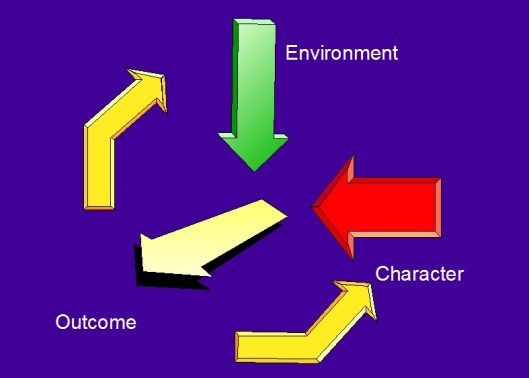
Imagine a cube of some really nice material that you like; e.g., polished wood, lead ore, malachite, silver. This cube has three dimensions: height, width, and depth. It must have all three dimensions. In the case of a story, there are also three dimensions in this sense: Plot, Setting, and Character. If a story lacks any of these three, it will be “flat” (not so interesting). For example, if you spent time working in a large company or government agency, you were probably given training materials about how you’re not supposed to do unethical things like steal from your company. They may have provided you with scenarios and asked what you would do or what was the “right” response. These stories tend to have people in situations making decisions. The problem with these stories is that, in order for them to be “efficient”, they spend almost zero time on character development.  “Joe wants to impress his boss and make his quota for the fourth quarter so he puts down as sold this-quarter things he is sure he will sell early in January. After all, he rationalizes, calendars are arbitrary.” Of course, the answer is no Joe should not be lying on his sales report. But we really don’t know much about Joe. We don’t know enough about him to really care much about him. Of course, he shouldn’t lie. If he does, it’s pretty hard to feel anything but contempt for Joe. It should have been obvious to him that he shouldn’t lie on a sales report and if he does lie, he should be fired. Good riddance. Let’s replace Joe with someone who follows the rules. 

OLYMPUS DIGITAL CAMERA

This story is so flat that it seems to me that the story is constructed, not so much to really educate, but more to prove that you were shown that it’s wrong to lie on sales forms so that, should the court case arise, you will not be to argue effectively that it was a mere technicality that you didn’t know about. If you really wanted to change someone’s mind about what was right, knowing about Joe’s character could make you empathize much more. Maybe he came from a Mafia-type crime family and no-one would bat any eye about lying on a sales report. They would expect him to lie on the report. Maybe even now, he is looked down upon by everyone else in his family for being such a chump and working for “the man” instead of being “the man.” 

OLYMPUS DIGITAL CAMERA

Or, perhaps Joe just found out that his wife has serious cancer and is understandably but severely depressed. He desperately wants to bring her some good news. If we reveal, not only what situation Joe is in but also, how he sees that situation, how he feels about it and what conflicts he faces, we will begin to have real empathy for Joe. His choices become real, rather than predetermined.  

TV commercials, like corporate training videos, are typically pretty flat too. But in some cases, the ad agency has gone out of their way to introduce you to some character that is recognizable and re-appears in commercial after commercial. Each time, just a little bit of character is revealed and eventually you find yourself watching the commercial largely because you start to care about the character. In a similar way, one might be able to make the corporate training stories more intriguing & educational if there were a cast of characters that persisted over time. 

fullsizeoutput_1308

Two Paths Diverged in a Yellow Wood…

Typically (but not invariably) the author knows how the story will turn out before he starts writing. But for the reader (or viewer), it is not at all obvious how the story will turn out. For compelling stories, the reader must be convinced to “play along with” the uncertainty of the outcome even if they are sure ‘the good guys will win.’ In good stories, bad things happen to the protagonist, but he or she is not a cork tossed on the ocean waves. The protagonist must want something; they must have a goal that is overwhelmingly important to them. They must react to changing circumstances, overcome the obstacles that are thrown at them. Characters are engaged in battles! Battles test them. If winning the battles is easy or inevitable, the character isn’t someone we can really relate to. 

catman

Kryptonite 

Superman is basically super-human and invulnerable! But watching someone who is invulnerable and has super-powers win battle after battle is boring. Superman has to have weaknesses. To make it more interesting and allow for more plot variation, he actually had three original weaknesses: kryptonite, friends, secret identity. In one episode, someone will have some kryptonite while in the next, someone will kidnap one of his friends. Recent movies have added a fourth weakness: other super-human and invulnerable beings.  

Whatever the story, your character must have weaknesses. Otherwise, no-one will “believe” the character and you as the writer will be stymied when you try to develop an interesting plot. The weaknesses can be physical, moral, social, intellectual, situational, and so on. But they should not be merely irrelevant weaknesses. Imagine a story where Sue is the main character. She’s tone deaf. She’s also brilliant, hard-working, imaginative, driven to succeed. And, indeed, she becomes a very successful trial lawyer. Eventually, she is made partner. OK. Isn’t this exactly what we’d expect to happen? What does being tone deaf have to do with anything? 

fullsizeoutput_129c

Imagine instead, that Sue was inspired at the age of four when she went to the opera. It was her life-long dream to become an opera singer. Indeed, she was blessed with a beautiful voice. She was also brilliant, hard-working, imaginative and driven to succeed. Unfortunately, she was tone deaf. Now, the weakness becomes interesting. Perhaps she will fail and kill herself. Perhaps she will fail but find another goal that is even more important to her and succeed at that. Perhaps she will fail time after time but eventually develop a career as an improvisational opera singer. She will ask people in the audience to name five things and then and there, she will create a beautiful aria that weaves a tale of some considerable interest about the five things. No-one knows that she is singing out of tune because she is composing on the spot. 

The more improbable the odds and the more horrendous the journey, the more challenge you give yourself to make it work! Blind at birth but wants to be an artist? Surely, that’s just stupid. It’s impossible. But is it? What if feedback were provided in such a way that it influenced her to make unique and beautiful paintings? What if genetic engineering allows her to grow new neural pathways? What if she can be equipped with artificial eyes? If it’s fiction, a magic spell can do the trick. Even if your ultimate goal is a real product for the real world, imagining a magical solution may lead you to a new (and real) path, previously hidden by your own expectations. 

It is easy for a writer to identify with their hero. And that is potentially quite a problem. After all, if you were superman, you sure as heck would not go out of your way to go near kryptonite. You’d quite sensibly stay away from the stuff! But if you are writing about superman, you need to get him near the deadly stuff every third or fourth episode! The “weaknesses” in the character generate interest. The failures, injuries, betrayals, and conflicts of your protagonist provide materiel that allows you to architect a more interesting plot. 

img_2246

A Garden of Delights, Flashy Sights, or Sword Fights?

Three dimensions of story is a weak metaphor only. The three dimensions of a cube can be manipulated independently. This is not generally true for the three dimensions of story. The character makes a decision, the decision determines the next step of the plot. That will influence the setting for the next scene. In addition, the actions of the protagonist may also change state of the underlying and cross-cutting conflicts. 

Imagine:

 two rival gangs fighting for urban turf and maybe sex,

 two gardeners in a fierce competition for sex with the town’s most eligible “catch” as well as for the blue ribbon prize for best garden, 

two rival secret agents vying for victory and maybe sex,

two life long friends now vying for #1 in their Harvard Law class, and maybe sex.

The structure of the underlying plot might look quite similar, but the specifics will depend a lot on how the character is developing. If they develop from ego-centric to altruistic, then they will tend to make different decisions near the beginning than near the end of the story. In addition, the setting will have to be consistently portrayed. 

The four descriptions above would most naturally lead to a lot of the setting for the stories respectively in urban settings, garden settings, foreign settings & dangerous situations, mainly Law School and campus settings. Of course, you could violate expectations in a way that increases interest. Imagine that rather than have another garden scene–

The rival gardeners arrive at an urban parking lot dressed in expensive gowns, fully jeweled in their finest, both fully knowing that they will win first prize (but secretly fearing that they might not). These life-long friends now exchange icy greetings, make back-handed compliments about each other’s appearances. The verbal exchange escalates. Precisely because they know each other so well, they know exactly how the other person’s escalator functions. Soon, they are rolling around on the parking lot in their fancy gear; ruining each other’s clothes and hairdos. At this point, they hear in the distance, the loudspeaker and the chairman about to announce the Blue Ribbon Winner!  In their trashed and ripped clothing, they sneak in together to hear the awards, hanging out together in the shadows so as not to be seen in their tattered clothes. “And the blue ribbon goes to” {drumroll}: 

someone else entirely. 

At this, the two life long friends look at each other, laugh uproariously, hug each other, and then become even more intimate friends than they were before their fight in the urban parking lot. 

The fact that there are “expected” relations among various dimensions of story is wonderful. For every such expectation, you can decide to follow, bend, or break that expectation. The more expectations people develop, the greater the number of variations for creative exploration. One valid reason for the choice of setting is really where you want to spend your time. That goes for an author — but it also goes for any designer or business person or User Experience expert. What kind of setting do you want to be in? What kind of customers do you want to serve? Do you really want to make their life better or just get them to buy more product? What sorts of application areas are really cool to you? Of course, I understand people need to eat and often there is a conflict within us all about what to do. That’s what a good story is really about.

img_5134

The reason that stories resonate is that, regardless of setting, people face the same kind of dilemmas. We all do. And, how we handle those dilemmas? In life, as in story, 

character is revealed by choices under pressure… 

——————————————

Author Page on Amazon

Dream Planet on Barnes and Noble

The Impossible

Donnie Boy gets a hamster

What could be better? A Horror Story

If Only

Ripples

It was in his Nature

That Cold Walk Home

The Orange Man

Stoned Soup

The Three Blind Mice

All that Glitters is not Gold

The Forgotten Field

Choosing the Script

The Story of Story, Part 2

16 Friday Jan 2026

Posted by petersironwood in creativity, HCI, psychology, story, Uncategorized

≈ Leave a comment

Tags

AI, books, communication, education, fiction, HCI, interview, knowledge, narrative, needs, psychology, story, truth, user experience, UX, wants, writing

Introduction: 

This is the second in a series about using stories and storytelling in the design, development, and the deployment of products and services. In each post, I will weave in some advice about what makes for a good story as well as how to use stories. In this first case, the emphasis is on using stories to help uncover customer needs and wants. Needs and wants are not quite the same thing. For an extremely worthwhile discussion on the difference, check out this classic article by George Furnas. 

We Human Beings are not just Information Processors; we are also Energy Processors.

img_2261

I had just attended a conference on “knowledge management” co-sponsored by IBM consultants and IBM Research. On the plane ride back, after finishing the crossword, I turned the page to find a full page color ad by an IBM competitor that proclaimed: “Knowledge Management is simply [sic] providing the right information to the right person at the right time.” Color me skeptical, I thought. It isn’t simple to do those things. Beyond that, the formulation seemed simplistic even in its formulation.

The image of one of my undergraduate professors flashed into my brain. Professor MacCaw, (as we will call him), taught advanced German, a language which he had learned in a Russian prison camp, which might explain his approach to testing. At semester’s end, he asked, “Who in class wants A?!” 

img_9691

All two dozen of us raised our hands, of course. At this point, he proceeded to — there is no other word — attack one of the students in the class who had had four years of German in high school and had also lived in Germany for two years. The contents of his questions were not really that difficult, but the manner in which he demanded the answers was horrid. He would ask, for instance, “In first story, main character went where?” (He would always ask the questions in English). 

And she would begin to answer (necessarily in German), “Er geht…” And after a couple words were out of her mouth, he would scream, “Please to conjugate!” This meant that she would have to think back to the last verb she uttered and then conjugate it. “Ich gehe, Sie gehen, …” Then, he would interrupt again and scream a completely different and unrelated question in English. She would begin to answer; he would interrupt after she uttered only a few words: “Please to decline!” This meant, that she would have to give the various forms of the last noun she spoke according to the case. But once again, she could not finish but only begin declining the noun when he would once again interrupt. After 40 minutes, she was in tears and he looked menacingly around the room and asked, “NOW! Who in class STILL wants A?” 

img_3377

I have zero desire to go hang gliding or sky diving. But when it comes to the danger of mere social humiliation, I say, “Screw it. Been there. Done that.” I was one of only two of the remaining students who raised their hand. This act won me the next turn on the chopping block. He proceeded the same whip-saw questioning fest with me. The two-period class was almost over when he finished with me and began questioning “Mr. Lepke.” The bell rang and everyone else in the class left. Later that evening, I chanced to see Professor MacCaw in the Student Union. He walked up to me, eyes blazing. “Ha! I had Mr. Lepke after class for two hours! Finally, he said to me, ‘No, No, Dr. MacCaw, no more, I beg you. No more!’” 

This oral exam was difficult (even with my “screw it” attitude). It was much “harder” than my dissertation defense, for example. Again, it was not the information requested but the manner of questioning that made it difficult. People are not emotionless robots, as it turns out.

img_9666

The next semester, not surprisingly, only about half the class returned. One day in class, as Dr. MacCaw began one of his lengthy digressions on Eastern European history, he stopped himself in mid-sentence to say, “What is THIS!? Someone is passing notes in my class! I will take note and read in front of entire class!” He snatched the note, unfolded it, and indeed read the note in his loud ringing voice: “Doctor MacCaw: your zipper is down.” And, indeed it was. He had meant to humiliate someone in front of the entire class — and he had succeeded. He had the necessary information delivered at the right time to the right person, but — thanks to his own actions — it had not been done in the best manner — at least not the best manner for him. 

Human beings are not just information processors. We are living things and as such, the emotions, the vibes, the manner, the intensity of presentation — these are all vital to how we will react at the time and also how we will feel about the people involved and what we will recall years later. And this fact also means that the atmosphere you create when you interact with various stakeholders will vastly impact the quality of the insights and stories that you receive. If you really care about the people and are really committed to doing something to making people’s lives better; if you are truly open to hear and take in something unexpected or even disruptive to the project; and if you allow your informant to feel that truth about you, you will obtain the gold ring. 

Stakeholder Stories Solicited at their Sites. 

If you use a mechanical method and a mechanical tone and a mechanical manner to ask your users and other stakeholders about their needs and wants, what you will uncover are the most mundane, most rudimentary, most superficial and socially acceptable needs and wants. You can indeed use this information to design a product or service, and you may even have a product or service that succeeds in the marketplace. It will likely be, however, a rather short-lived “win.” Why? Because you are designing to fulfill wants that are subject to the wild winds of passing fashion rather than to catch the fire of an underlying passion. 

img_0568

What I found for myself was that it typically took about an hour of talking with a stakeholder, and most importantly, listening attentively, before they began to tell me their real stories. Your mileage may differ according to culture, context, power relations, your personality, and so on. I like to use a semi-structured interview. In this type of interview, there are known questions that I want to ask. But I also schedule plenty of time to let them elaborate, tell me what’s what behind the scenes. I know that in the corporate world, there is an ever-present push for being “efficient” and getting the job done as quickly as possible. So, it’s tempting to get the informant “back on track.”

I always prefer to interview an informant in their workplace. This seems like common courtesy; it puts them more at ease; and it sometimes reveals their use of other people, references, private notes, etc. as well as what they are dealing with in terms of atmosphere, noise levels, interruptions, desk space, etc. It also makes it much more likely that they can retrieve more of their own memories about work incidents more accurately because of all the contextual cues. 

John Whiteside, who ran the Usability group for Digital Equipment Corporation for a time, recounts running various usability studies and gathering data in various ways about a product they were designing for manuscript centers (places where human beings, historically almost always women, transcribed the dictation of others into text on a computer so that it could be edited, re-written, stored, etc.). The first time that they visited their users in the field, they discovered that they spent about seven hours a day typing and about an hour every day counting up, by hand, the number of lines they had typed. So, in one instant, they realized a feature that would improve productivity significantly. 

Guidelines for Soliciting Stakeholder Stories. 

When I managed the storytelling project at IBM Research, I was fortunate enough to hire Deborah Lawrence to help with the project. She thought it would be a cool idea to interview experts in a number of fields whose job, in one way or another, involves soliciting stories. So, she went out and did just that. I believe that her interviewees included medical doctors, policeman, reporters, social workers, and psychotherapists. These various practitioners had very similar guidelines. 

Story Elicitation Guidelines:

  • Provide a “warm-up” period.
  • Tell something personal and revealing about yourself; perhaps tell a story that is a model of the kind of story you’re looking for.
  • Observe an implicit contract of trust.
  • Provide a motivation for the story — why it’s important.
  • Accept the storyteller’s story and worldview.  Don’t resist the story.
  • Reveal who you are, how the story will be used, potential audience and goals, answer questions.
  • Use questions to probe.  Sometimes, a totally “off the wall” question can create space for story to emerge.
  • Empower the storyteller — they are the expert.
  • Avoid threat; don’t appear as an expert yourself.
  • Listen with avid interest.

These may seem fairly obvious such as does a lot of the advice in the book, How to Win Friends and Influence People. (Come to think of it, that might be the single best book you can read if you want a career in HCI/UX). However — back to the guidelines. I think they seem obvious once pointed out, in much the same way that once someone points out the “pig in the clouds” (or the face in the tree) you cannot not see it. 

img_2897

The above list is not, of course, meant to be the definitive such list. This was based on one study. If you have additional guidelines or disagreements, please let me know. 


Author Page on Amazon

The Walkabout Diaries

The Myths of the Veritas

A Pattern Language for Collaboration

Travels with Sadie

Fifteen Properties

My Cousin Bobby

The Update Problem

After All

All We Stand to Lose

Imagine All the People

The Dance of Billions

Roar, Ocean, Roar


Fraught Framing: The Presumed Being-ness of State-ness

31 Wednesday Dec 2025

Posted by petersironwood in America, creativity, psychology, Uncategorized

≈ Leave a comment

Tags

#therapy, creativity, Democracy, education, flexibility, framing, fun, HCI, health, human factors, innovation, learning, life, politics, problem formulation, sports, therapy, USA, writing

Fraught Framing: The Presumed Being-ness of State-ness

OLYMPUS DIGITAL CAMERA

OLYMPUS DIGITAL CAMERA

As I understand it, in Spanish and Portuguese, for example, there is a linguistic distinction between current state of being and habitual state of being that is signaled by the use of different verbs. In English, we say, “That is an angry dog” to mean “That is a dog who is generally and habitually angry” and also to mean, “That dog is in an angry mood right now.” 

woman and man wearing brown jackets standing near tree

Photo by Vera Arsic on Pexels.com

But, regardless of what native languages we write and speak, we humans often make statements about something and treat that something according to the unstated and untenable presupposition that what is true about the current state of affairs is true about eternity. 

This habit of mind, sometimes reinforced by language, is often incredibly useful. For instance, near me right now are a table, and on the table, among other things are a coffee cup filled with coffee and a checkbook. The table is mainly composed of wood and marble. For many purposes, this is an adequate description. Of course, none of these so-called objects were always in their current state. Once, the wood was part of a tree. And, before that, the material in the tree was mainly rainwater and dirt. It was transformed into a tree by a mere seed of information using energy from the sun. 

close up colors dry nature

Photo by Pok Rie on Pexels.com

Meanwhile, even the marble portion of the table was not always in its current state. At one point, in the distant past, this marble was limestone. The limestone was transformed by temperature and pressure into marble. Before the limestone was limestone it was mainly the shells of tiny animals living in the ocean. If we trace the table back far enough we will come to the “Big Bang” that started the universe as we know it. The transformation of the table from one sort of thing into another did not end when it became a table nor when I bought the table. Some day, it will no longer be a table. Eventually, the material nature of the wood, and eventually even the marble will be different. The checkbook and the coffee cup will likely cease to be a checkbook and a coffee cup long before that. 

For the purpose of drinking my coffee, it is just fine to think of this cup as being a cup. It holds my coffee and keeps it somewhat warm. The table works just fine as a place to hold the coffee cup. I don’t need to think more deeply about the lifecycle of the table or the cup or the checkbook. 

Usually. 

But sometimes, it is useful to deconstruct these categories. A fairly common test of creativity, for example, is to think of alternative uses. What could this table be used for besides a table? It is a pretty sturdy looking table, so I would say it could be used as a seat by one or two people pretty safely. It could be used as a deadly if awkward weapon. The bracing cross-piece could be detached and used as less awkward weapon.  It could be used as a barrier. The wood part could be used as firewood. The thing that I habitually use as a coffee cup could be used as a container for many types of liquids or solids and even, with the help of the checkbook, could be used to hold gasses though not very effectively. The checkbook can be used as a weapon against a mosquito. In a very different way, the checkbook could be used as a weapon against a person or even as a weapon against a nation; e.g., by writing checks to steal an election. 

adult beverage breakfast celebration

Photo by Pixabay on Pexels.com

While all of these “objects” have histories, they also have futures. Generally speaking, the people I know give little thought to the future of the objects that they interact with. But slowly, and likely too slowly, this is gradually changing. We often now recycle or reuse objects. Thinking about the future of an object also influences my choices about what I buy.

Thinking about the future of objects is particularly important to when it comes to radioactive material which can pose very long term hazards or it can be stolen and used to cause fairly short term mayhem. Collectively, the plastic that we use gets discarded and then, does not vanish into nothingness. It finds its way into the air we breathe and the water we drink. Now that the population of the earth is 7 billion, [Update: 8.2 billion now in 2025!] we can no longer afford to ignore how the objects we interact with were created and we cannot afford to ignore what becomes of them. What we call a “table” or a “cup” or a “checkbook” is really only a “table for now”, “a cup for now” and a “checkbook for now.” 

The fluidity of things also applies to human beings. It should be pretty obvious to most adults that someone we call “a toddler” or a “teen-ager” is not in that category forever. Most people evolve over time both physically and mentally. The change from “toddler” to “teen-ager” takes many years. Physically, the person usually seems stable from one hour to the next (even physical stability is an illusion; we create over 200 billion new cells a day!). Socially and psychologically, however, we are unstable even at a macro level. A sixteen year old, for instance, may act very much like a mature adult in hundreds of different circumstances. Yet, if they are overly influenced by “friends” or under the influence of alcohol for the first time, their behavioral self-control may easily revert to that more like a ten year old or even a two year old. 

girls on white red jersey playing hand game

Photo by Pixabay on Pexels.com

We Limit Others by our Categories

It is human and common but not useful to observe a small slice of someone else’s behavior and thereby make inferences about their habitual behavior. Even if we know about someone’s habitual behavior, it doesn’t mean that they always behave that way and it doesn’t mean that they can’t change over time. When we say, “Oh, don’t pick Chuck for the baseball team; he’s such a spaz” or “No, I’m sure Sally wouldn’t like to join us; she’s really a loner” or “You can’t count on Jim; he never follows through” we are almost certainly over-generalizing. Perhaps Chuck never learned baseball as a kid and he simply needs to learn and practice basic skills. Maybe Sally has no real friends precisely because no-one asks her to join them because everyone thinks she’s a loner because she’s always alone – because no-one ever asks her to join them. Or maybe her idea of a good time is hiking and she’d be happy to do that, but she (like me!) has zero interest in going clubbing and getting drunk every day. Maybe Jim is completely overworked and/or needs to learn better time management skills. 

light light bulb bulb heat

Photo by Pixabay on Pexels.com

“How many psychologists does it take to change a light bulb? Only one, but the light bulb has to want to change.” 

People may be changed by circumstances but therapy often works too. As the joke implies, it won’t work very well if the main reason the “light bulb” goes to the therapist is to feel better rather than to get better, it’s an opportunity lost. Others who frequently interact with the “light bulb” often hold views and use names that subvert therapy. For example, a person who is never assertive and wants to change that may find that when they do so, their family and colleagues at work, who have been taking advantage of them for their own purposes may say things like this: “Oh, you used to be so nice!” {Translation: I used to be able to manipulate you for my own purposes so much more easily}.   

We Limit Ourselves by our Categories

While we unwittingly define others into boxes that may serve to limit what they can do, we humans are generally “equal opportunity destroyers” and also limit our own potential through self-talk as well. I like to play golf and have therefore asked many people over the course of my life, “Do you play golf?” 

Take a guess what response I have heard at least two dozen times. “Golf? Oh, no. I tried that a couple times. I’m no good.” 

silhouette of man playing golf during sunset

Photo by Pixabay on Pexels.com

After picking myself up off the floor, I try to explain as nicely and politely as possible that if you’ve literally tried it a couple times, you have no idea whether you would be any good at it. You very likely have no idea whether you would like it either. The same goes for painting, writing poetry, playing video games, eating healthy food, exercising regularly, and so on. In each case, your initial level of skill and your initial level of enjoyment are very poor predictors of the long term. It is most often, not our ability, but our self-definitional boundaries and self-talk that limits us. 

The US military spent a lot of time and effort on trying to predict who will become an ace pilot. There are people who probably won’t make good pilots (poor vision, poor coordination, or poor three-dimensional spatial reasoning) but predicting who among good fighter pilots will make a great fighter pilot is much more difficult. The computer industry similarly spent a lot of time and effort trying to predict who will become a super-programmer. Same lack of results, so far as I know. Predicting who will be extremely successful is very hard. That doesn’t mean that no-one believes that they intuitively know. They’re just dead wrong.

Exercises for Flexibility.

girl on beach

Photo by Tim Savage on Pexels.com

Life is complicated and complex so I understand that many folks may be reluctant to expand the scope of what they and others are capable of. But if you do want to become more flexible in your behavioral repertoire, there are several things you can do. 

First, you can become aware of your statements about yourself and others. When you find yourself thinking, “Jim never follows through,” try to restate that in terms of empirical evidence. It could be: “Well, once I asked Jim to help plan the office party and he never showed up for the first meeting. Another time, he said he would help teach my daughter how to parallel park, but nothing ever came of it.” You might immediately see that you have precious little evidence to back up your claim that Jim never follows through. You might also ask yourself whether you ever asked Jim about these incidents. There may be hundreds of legitimate reasons that he didn’t “follow through.” His name might have been left off the distribution list for the party planning meeting. And so on. Generating these alternatives is explored in more detail in “The Iroquois Rule of Six” which basically says before acting on an explanation that is inferred you should generate five alternative explanations. 

Second, you can read fiction, watch movies, attend stage plays, do some amateur theater or even answer a questionnaire from someone else’s perspective. In working with Heather Desurvire at NYNEX, on a usability evaluation of a prototype, we did a variation on heuristic evaluation in which we had people look for issues and offer suggestions from a variety of different perspectives; e.g., a behaviorist, a cognitive psychologist, a worried mother, a physical therapist and so on. With the total amount of time controlled for, people found more issues and offered more suggestions when they looked at the application from the perspectives of many different people. 

Third, and my current favorite, is “Attitude Dancing.” I’m not sure this is what Carly Simon and Jacob Brackman meant by their song title, but when I turn on music while I am cooking or cleaning, I spent part of my dancing time dancing as though I were in a completely different mood or even as though I were a completely different person. 

Give it a try! 

——————————

Author Page on Amazon. 

Desurvire, H. and Thomas, J.C. Enhancing the Performance of Interface Evaluators Using Non-Empirical Usability Methods. In the Proceedings of the Human Factors Society 37th Annual Meeting, October, l993

The Walkabout Diaries: Life Will Find a Way

How the Nightingale Learned to Sing

Your Cage is Unlocked

The Crows and Me

It was in his Nature

Axes to Grind

Silent Pies

The Invisibility Cloak of Habit

Where Does Your Loyalty Lie?

Wednesday

My Cousin Bobby

The Impossible

Labelism

The Update Problem


Tools of Thought: Theory of Mind

19 Friday Dec 2025

Posted by petersironwood in America, management, psychology, Uncategorized

≈ Leave a comment

Tags

"Theory of Mind", AI, cooperation, Design, education, empathy, life, mental-health, poetry, politics, psychology, religion, sports, teamwork, truth, writing

Theory of Mind. 

“Theory of Mind” refers to the ability of most humans to imagine, at least to a degree, what another person is likely to do based on their knowledge of what the other person knows. Here is a simple test used to determine whether someone has this ability. 

You are the “subject” being tested and you are in a room with me (the “experimenter”). Your friend Vlad is in the room too. In full view of you and Vlad, I hide a giant luscious chocolate chip cookie (such as you might purchase from Panera, but won’t because you realize that if you buy it there is no way you aren’t going to eat it!). I “hide” this cookie in the top drawer of my desk. Now, Vlad walks out of the room. He’s well out of sight. Now, I take the cookie out of my drawer, and using great self-control, do not eat the cookie myself but instead put it in my pocket. 

two cookies beside white metal mug

Photo by rawpixel.com on Pexels.com

Now, I turn to you and ask, “When Vlad comes back, where will he look for the cookie?” If you are 2, 3, or 4 years old, you would say, “In your pocket!” I rephrase this a few times to make sure you understand that I am not asking you where the cookie actually is but where Vlad will search. You again insist that Vlad will look in my pocket. At such a young age, kids do not distinguish their state of knowledge from someone else’s. Most adults will have no problem with this task. They have a “theory of mind” that allows them to know that their state of knowledge is not the same as Vlad’s. Some adults diagnosed with autism will have trouble with this task however.

An interesting question arises as to whether other animals have a “theory of mind.” It is not a settled question. My purpose here however, is to explain what the term means and show how it’s useful for humans. Despite the fact that most adult humans have the capacity to do “theory of mind” tasks and that it is useful, they nonetheless often fail to evoke their capacity.

animal beautiful blonde daylight

Photo by Pixabay on Pexels.com

A closely related concept is “empathy.” Empathy generally refers to being able to feel what another person feels emotionally. I see the distinction as one of perspective or emphasis rather than two different entities. These two concepts (empathy and Theory of Mind) are explored in much greater detail in the “Myths of the Veritas” series in this blog. For now, suffice it to say that you might empathize with another person by relating to their facial expressions, posture, or regarding what they say and how they say it. You might see a picture of a small, terrified four-year old alone in a cage and know that they are terrified without having any verified knowledge or detailed knowledge of what they “know” or “don’t know.” They might or might not know any English. And you might or might not know their language or even what their language is. But you can tell that they are in great distress just by looking at them. If you actually feel what it is like to be a small child separated from your parents and being trapped in a cage in a strange place, that is generally called “empathy.” 

IMG_4410

If I were to ask you what kind of pleading this four year old is likely to make in court, if you have  the capacity for a “Theory of Mind,” you might well ask, “Well…I don’t know. What do they know about courts or proceedings? What could they know? They are only four years old.”  You’d be correct, of course, to question whether it was meaningful to have a four year old acting for themselves in court. This would be particularly true if they had to plead in a court where they were unfamiliar with the culture, the venue, and the language. But even a really smart four year old who had been brought up in America and spoke excellent English would not be capable of really understanding the consequences. This kind of understanding demonstrates a deeper theory of mind than simply knowing that because a specific piece of information is in your own head doesn’t mean it’s in someone else’s head. 

In The Myths of the Veritas, people are given a range of tasks that involve what is called empathy. To me, although one can draw a conceptual distinction between understanding another person’s knowledge and feeling an echo of another person’s feelings, when it comes to many practical situations, it’s more important to put oneself in another person’s shoes, than to correctly label the process. 

Writers must often deal with multi-level theories of mind. There is what the writer knows about the events that are being written about in a story. There are the spheres of knowledge that various characters have. Most often, different characters have critically different states of knowledge. What the reader knows is yet again different. And all of these spheres of knowledge change throughout the course of the narrative. 

In The Myths of the Veritas, for example, the author knows throughout that ALT-R is making POND MUD put his face in the mud purely to humiliate him and keep power over him. ALT-R knows it as well. Over time, most readers will come to the same conclusion but not necessarily at exactly the same place in the narrative. Most of the Veritas tribe initially know nothing about this incident, but She-Of-Many-Paths intuits it and eventually many of the Veritas come to understand it. At first POND MUD is fairly certain ALT-R saved his life by making him do it. But as he observes and interacts with ALT-R and others, he begins to doubt that and then goes about actively seeking information from others that would help clarify ALT-R’s true motives. 

mudface

In Othello, the writer knows from the beginning that Iago is an evil sociopath. The audience knows quite early that Iago is an evil sociopath and learns more about his schemes through speeches that Iago delivers directly to the audience. Othello himself, on the other hand, has his state of “knowledge” manipulated by Iago. The audience knows that Othello is being duped by Iago but Othello himself does not know of it or of Desdemona’s innocence when he murders her though at that point, the writer, the audience, Desdemona, Iago, Cassio and other characters all know that Desdemona is innocent. We have some sympathy for Othello because we realize that he is operating on false information. 

Let’s turn to a happier piece of fiction, The Gift of the Magi by O’Henry (William Sydney Porter). In this story, a couple with financial struggles each gives up their most prized possession to buy a gift for the other. The functional value of the gifts is destroyed by what they gave up. Della knows that Jim’s most prized possession is his gold watch so she sells her beautiful hair to get money to buy him a watch chain. Jim knows that Della’s most prized possession is her beautiful hair so he sells his watch in order to buy her some jeweled combs for her hair. Of course, the real gifts they give are not diminished by their being no longer functional. The real gift is the gift of love. The author obviously knows all this from the beginning. Readers “catch on” to what is happening at various points in the narrative, but Jim and Della are the last to learn of the full irony. 

woman wearing white long sleeved shirt

Photo by Element5 Digital on Pexels.com

Sadly, many people seem not to bother trying to understand the situation and capabilities of others. In one of the simplest cases, people are apparently unable to understand how very basic physical properties of the universe result in various people having various states of knowledge. On the tennis court, in a “friendly game,” the players themselves make the calls and keep track of the score. The server is supposed to announce the score before every serve. Some people actually “announce” the score by saying it so softly that only they can hear it! 

In other cases, novice drivers will follow a semi truck so closely that the truck drive cannot see the car behind them. Another trick of drivers is to turn their blinkers on – but only as they begin making the turn. In another post, I explain how one person’s driving behavior in “stop and go traffic” can influence many other people’s. In particular, if you leave a large space between your car and the one in front of you, it makes it easier for many people around you to drive more smoothly because they have a much more complete view of what is happening in front of them. 

buildings cars city cross harbour tunnel

Photo by Pixabay on Pexels.com

A more subtle failure in “Theory of Mind” occurs when a person assumes that everyone is motivated in the same way that they are. For example, a person may be so partisan that they will always defend and promote people in their own political party no matter how heinous the crimes of that person. This is an error, but a concomitant error is that such people assume everyone who doesn’t defend the criminal, and certainly anyone who actively resists such a crooked politician is doing so from a purely partisan perspective because that’s what they would do. Sociopaths who cheat may assume that everyone would cheat and the only reason they don’t cheat is because those non-cheaters are not smart enough to get away with it. 

When teamwork is operating at a high level, whether it’s hockey, soccer, tennis doubles, basketball, families, or design teams, people exhibit excellent “Theory of Mind” skills. How are yours? Have you experienced such high functioning teams? How can you improve your skills at “Theory of Mind”? 

One way to improve your “Theory of Mind” skills is to become aware of the kinds of perceptual, memory, and problem solving errors that people are generally prone to. Many of the posts linked to below explore some aspect of human psychology.

group of woman playing on green field during daytime

Photo by Pixabay on Pexels.com


Author Page on Amazon

The Primacy Effect

Labelism

Wednesday

The Update Problem

The Stopping Rule

My Cousin Bobby

Where does your Loyalty Lie?

The Invisibility Cloak of Habit

How the Nightingale Learned to Sing

Roar, Ocean, Roar

The Iroquois Rule of Six

Happy Talk Lies

The Loud Defense of Untenable Positions

Cancer Always Loses in the End

Who Won the War?

After All

The Last Gleam of Twilight

E-Fishiness Mass General Hospital

Me Too


Wordless Perfection

11 Thursday Dec 2025

Posted by petersironwood in AI, creativity, HCI, psychology, sports, Uncategorized, user experience

≈ 1 Comment

Tags

AI, art, creativity, drawing, education, intuition, life, problem formulation, Representation, Right-brain, sports, thinking, writing

————————————

Sirius Black

I like to write. In fact, I like to write so much that I wrote before I could even read. When my early crayon “writings” in my grandfather’s books were discovered, instead of praise, I was spanked. I’m not even sure they really tried hard to read my learned annotations. Their missing the point didn’t deter me though. I like words! I like writing poetry, essays, stories, plays, and even novels. Words help human beings communicate and collaborate. However…

In this essay, I’d like to mention some instances of wordless success.

Photo by lascot studio on Pexels.com


In the neighborhood where I grew up, we spent most of the summer playing baseball, basketball, and football. I had never played golf nor paid much attention to it as a kid and when it came on TV I walked by with hardly a glance. At that point in my life, I deigned to consider something a sport only if there were a good chance to smash into one of the other players. I had never touched a golf club or a golf ball until one summer day when I was about ten, one of the kids brought one of his uncle’s golf clubs to our baseball field along with a tee and a golf ball. He demonstrated how to hit the ball and showed us how to put our hands on the club. Kids took turns hitting the ball and retrieving it for another go. 

When it came to my turn, I mainly remember just loving the shiny wood of the club. I loved wooden baseball bats back then, but the driver!! Wow! That was in a whole different category of cool. You didn’t need to be an adult or a golfer to know that! It shone opalesquely. I teed up the golf ball, and swung the unfamiliar and impossibly long club.

The resulting sound – exquisite. An explosion. A rifle shot. A cousin of the crack of a home run shot into the upper deck. But more penetrating. More elegant. More poignant.

We all looked up in amazement. My golf shot started low and straight. Then it rose and rose and disappeared far beyond the dirt road that marked the outer limit of our makeshift baseball field. It rose over the hill beyond the road and disappeared into the field beyond. There was no hope of retrieving the golfball. None of us even suggested trying. My shot was wordless perfection. 


Fast forward to graduate school. In the summer afternoons, I got into the habit of playing frisbee with the neighbors. One day, I parked my car and ran into the back yard. One of my neighbors spied me and threw me the frisbee, I noticed that they had placed an empty beer can atop a utility box about a hundred feet away. I caught the frisbee on the run and threw it with the next step. The frisbee sailed with a nice arc and smacked the beer can right off. My neighbors said that they had been trying to knock that beer can off for about a half hour.  My throw was wordless perfection.

Photo by Brixiv on Pexels.com

Meanwhile, at the University of Michigan, several of my friends and classmates liked puzzles as much as I did. One such puzzle consisted of a triangular “board” with a regular pattern of holes. There were pegs in every hole save one. The goal was to “jump” pegs much as one does in checkers and then remove that peg from the board. Eventually, one was supposed to end up with one and only one peg. I worked on it for awhile and thought about various strategies and moves. I couldn’t seem to solve it. My phone rang. I picked it up and conversed with my friend. Meanwhile, I toyed with the puzzle while my “mind” was on the conversation. I toyed with the puzzle and solved it. Wordless perfection.

A few months or weeks later, my officemates and I worked on another puzzle. This one consisted of four cubes (aka “instant insanity”). Each cube had a different arrangement of colors. The goal was to arrange the cubes so that every “row” of faces had four different colors. I fiddled with the puzzle trying out various strategies and noting various symmetries and asymmetries. Once again, someone called and interrupted my musings. Again, I idly fiddled around with the cubes while talking on the phone. And solved it. Wordless perfection strikes again! 

https://en.wikipedia.org/wiki/Instant_Insanity

Fast forward four decades. For best results, borrow Hermione’s time-turner. Otherwise, you’ll have to rely on your imagination. 

Betty Edwards (“Drawing on the Right Side of the Brain”) gave a plenary address at one of the Association of Computing Machinery’s premier conferences: CHI. Among other things, she showed example after example of how much people improved in their drawing skills based on her methods. A few months later, it so happened that my wife and I had an opportunity to go to one of her five day classes. 

I would have to honestly say, that course was one of the best educational experiences of my life. It was an immensely pleasurable experience in and of itself. Beyond that, the results in terms of improved drawing skills were dramatic. And, as if that were not enough, I looked at the world differently. I noticed visual things about the environment that I had never seen before. 

The essence of the method Betty Edwards uses is to get you to observe and draw — while “shutting up” or “turning off” the part of your brain (or mind) that talks and plans and categorizes. In one exercise, for instance, we took a line drawing and turned it upside down. Then, we copied that image onto our pad of paper by carefully observing and drawing what we saw. She also instructed us not to try to “guess” what they were drawing, but just to copy the lines. When every line had been copied, we turned the drawings right side up again. The result jolted me! I had created an excellent likeness of the original. So had everyone else in class. The quality stunned me. Wordless Perfection.

There’s a larger lesson here, too. 

I had within me, the capacity to make a very decent copy of a drawing, but had never achieved that result for 60 years. All it took was five minutes of instruction to enable me to achieve that. 

What else is like that? Imagine that we have, not just one, but a dozen or even a dozen dozen “hidden talents.” Some of them, like drawing, may depend more on Not-Doing than on Doing; on Being rather than Achieving.

There was a longer lasting side-effect of the drawing course. My day to day life, as is typical of most achievement-driven people had been very much “goal-driven” and there was always an ongoing plan and dialogue. After having learned to turn that off in order to draw, I can also turn it off in order to see, whether or not I draw. Seeing (or otherwise sensing or feeling) in the moment also makes me much less judgmental. If you decide to think about the physical appearance of people in terms of how interesting they would be to draw, you end up with an entirely different way of thinking about people’s appearance. 

What are your hidden talents? 

——————————————

The Invisibility Cloak of Habit 

Big Zig-Zag Canyon 

The Great Race to the Finish!

You Fool!

Horizons University

How the Nightingale Learned to Sing

Comes the Dawn

Dog Trainers

Where Does Your Loyalty Lie?

The Dance of Billions

Roar, Ocean, Roar

Imagine All the People

Your Cage is Unlocked

Author Page on Amazon

Ban Open Loops: Part Two – Sports

30 Tuesday Sep 2025

Posted by petersironwood in management, psychology, sports

≈ Leave a comment

Tags

AI, cognitive computing, Customer experience, customer service, education, leadership, learning, technology

Sports and open loops.

Sports offers a joy that many jobs and occupations do not. A golfer putts the ball and it sinks into the cup — or not. A basket-baller springs up for a three pointer and —- swish — within seconds, the shooter knows whether he or she was successful. A baseball hitter slashes the bat through the air and send the ball over the fence —- or hears the ball smack into the catcher’s mitt behind. What sports offers then is the opportunity to find out results quickly and hence offers an excellent opportunity for learning. In the previousiPhoneDownloadJan152013 593 entry in this blog, I gave examples of situations in life which should include feedback loops for learning, but, alas, do not. I called those open loops.

Sports seem to be designed for closed loop learning. They seem to be. Yet, reality complicates matters even here. There are three main reasons why what appears to be obvious opportunities for learning in sports is not so obvious after all. Attributional complexity provides the first complication. If you miss a putt to the left, it is obvious that you have missed the putt to the left. But why you missed that putt left and what to do about it are not necessarily obvious at all. You might have aimed left. You might not have noticed how much the green sloped left (or over read the slant to the right). You may not have noticed the grain. You might not have hit the ball in the center of the putter. You might not have swung straight through your target. So, while putting provides nice unambiguous feedback about results, it does not diagnose your problem or tell you how to fix it. To continue with the golf example, you might be kicking yourself for missing half of your six foot putts and therefore three-putting many greens. Guess what? The pros on tour miss half of their six foot putts too! But they do not often three-putt greens. You might be able to improve your putting, but your underlying problems may be that your approach shots leave you too far from the pin and that your lag putts leave you too far from the hole. You should be within three feet of the hole, not six feet, when you hit your second putt.

A second issue with learning in sports is that changes tend to cascade. A change in one area tends to produce other changes in other areas. Your tennis instructor tells you that you are need to play more aggressively and charge the net after your serve. You try this, but find that you miss many volleys, especially those from mid-court. So, you spend a lot of time practicing volleys. Eventually, your volleys do improve. Then, they improve still more. But you find that, despite this, you are losing the majority of your service games whereas you used to win most of them. You decide to revert to your old style of hanging out at the baseline and only approaching the net when the opponent lands the ball short. Unfortunately, while you were spending all that time practicing volleys, you were not practicing your ground strokes. Now, what used to work for you, no longer works very well. This isn’t the fault of your instructor; nor is it your fault. It is just that changing one thing has ripple effects that cannot always be anticipated.

The third and most insidious reason why change is difficult in sports springs from the first two. Because it is hard to know how to change and every change has side-effects, many people fail to learn from their experience at all. There is opportunity for learning at every turn, but they turn a blind eye to it. They make the same mistakes over and over as though sports did not offer instant feedback. I think you will agree that this is really a very close cousin of what people in business do when they refuse to institute systems for gathering and analyzing useful feedback.

If learning is tricky —- and it is —- is there anything for it? Yes. There is. There is no way to make learning in sports —- or in business —- trivial. But there are steps you can take to enhance your learning process. First, be open-minded. Do not shut down and imagine that you are already playing your sport as well as can be expected for a forty year old, or a fifty year old, or someone slightly overweight or someone with a bad ankle. Take an experimental approach and don’t be afraid to try new things. Second, forget ego. Making mistakes provides opportunities to learn, not proof that you are no good. Third, get professional help. A good coach can help you understand attributional complexity and they can help you anticipate the side-effects of making a change.

Soon, I suspect that the shrinking size and cost and weight of computational and sensing devices will mean that training aids will help people with attributional complexity. I see big data analytics and modeling helping people foresee what the ramifications of changes are likely to be. There are already useful mechanical training aids for various sports. For example, the trade-marked Medicus club enables golfers to get immediate feedback during their full swings.as to whether they are jerking the club. Dave Pelz developed a number of useful devices for helping people understand how they may be messing up their putting stroke.

It may take somewhat longer before there are small tracking devices that help you with your mental attitude and approach. We are still a long way from understanding how the human brain works in detail. But it is completely within the realm of possibility to sense and discover your optimal level of stress. If you are too stressed, you could be prompted to relax through self-talk, breathing exercises, visualization, etc. You do not need technology for that, but it could help. You may already notice that some of the top tennis players seem to turn their backs from play for a moment and talk to an “invisible friend” when they need to calm down. And why not? Nowhere is it law that only kids are allowed to have invisible friends.

“The mental game” and which kinds of adaptations to make over what time scales are dealt with in more detail in The Winning Weekend Warrior How to Succeed at Golf, Tennis, Baseball, Football, Basketball, Hockey, Volleyball, Business, Life, Etc. available at Amazon Kindle.

Photo by Francesco Paggiaro on Pexels.com


Author Page on Amazon

US Open Closed

The Day From Hell: Why should anyone Care?

Wordless Perfection

Sports Fans Only

The Agony of the Feet

Frank Friend or Fawning Foe?

Business Re-engineering

Tennis Upside Down

Donnie Gets his Name on a Tennis Trophy!

Indian Wells Tennis Tournament

Small Things

An Amazing Feet of Athleticism

Dog Trainers

15 Saturday Apr 2023

Posted by petersironwood in pets, poetry, psychology

≈ 8 Comments

Tags

dogs, education, learning, pets, poem, poetry, teaching

I thought I’d try to teach my dog to count

Instead, she tried to teach me not to count.

I  thought I’d teach my dog to think ahead.

She taught me not to think ahead, instead.

I tried to show avoiding mud is cool.

She schooled me on the joys of dripping drool. 

She’ll gobble down her own food  greedily. 

But also pepper, kale readily.

Her nose of course is quite beyond compare. 

Yet, she’s taught me some skill in sniffing air.

The barbecue of neighbors far away

That drifts into my zone is quite okay.

It seems to me important as we teach

To recognize that every species—each

Survived four billion years of trying time

Preferring human ways is not a crime.

For much of which we learned we should feel pride;

Recall we aren’t the only ones who ride

This wild spiral through our galaxy.

And when it comes to pure ecstasy?

Our doggie teachers show us how to play;

To dwell with happy every single day; 

To love with love that’s larger than our life.

They teach us how to fly above the strife.

For who can tell the teacher from the taught?

And who can count those moments quite unsought

When doggies reconnect our brains to hearts

It is the finest of the teaching arts. 

Sadie is a Thief

Sadie the Sifter

Doggerel

Natural Language for Doggies

The Puppy’s Snapping Jaws

Hai-Ku-Dog-Ku

Wordless Perfection

20 Wednesday Jan 2021

Posted by petersironwood in Uncategorized

≈ 6 Comments

Tags

art, drawing, education, intuition, problem formulation, Representation, Right-brain, thinking

————————————

Sirius Black

I like to write. In fact, I like to write so much that I wrote before I could even read. When my early crayon “writings” in my grandfather’s books were discovered, instead of praise, I was spanked. I’m not even sure they really tried hard to read my learned annotations. Their missing the point didn’t deter me though. I like words! I like writing poetry, essays, stories, plays, and even novels. Words help human beings communicate and collaborate. However…

In this essay, I’d like to mention some instances of wordless success.

Photo by lascot studio on Pexels.com


In the neighborhood where I grew up, we spent most of the summer playing baseball, basketball, and football. I had never played golf nor paid much attention to it as a kid and when it came on TV I walked by with hardly a glance. At that point in my life, it was really only a sport if there was a good chance to smash into one of the other players. I had never touched a golf club or a golf ball until one summer day when I was about ten, one of the kids brought one of his uncle’s golf clubs to our baseball field along with a tee and a golf ball. He demonstrated how to hit the ball and showed us how to put our hands on the club. Kids took turns hitting the ball and retrieving it for another go. 

When it came to my turn, I mainly remember just loving the shiny wood of the club. I loved wooden baseball bats back then, but the driver!! Wow! That was in a whole different category of cool. You didn’t need to be an adult or a golfer to know that! It shone opalesquely. I teed up the golf ball, and swung the unfamiliar and impossibly long club.

The resulting sound – exquisite! An explosion! A rifle shot. A cousin of the crack of a home run shot into the upper deck. But more penetrating. More elegant. More poignant.

We all looked up in amazement. My golf shot started low and straight. Then it rose and rose and disappeared far beyond the dirt road that marked the outer limit of our makeshift baseball field. It rose over the hill beyond the road and disappeared into the field beyond. There was no hope of retrieving the golfball. None of us even suggested trying. My shot was wordless perfection. 


Fast forward to graduate school. In the summer afternoons, I got into the habit of playing frisbee with the neighbors. One day, I parked my car and ran into the back yard. My neighbor saw me and threw me the frisbee, I noticed that they had placed an empty beer can atop a utility box about a hundred feet away. I caught the frisbee on the run and threw it with the next step. The frisbee sailed with a nice arc and smacked the beer can right off. My neighbors said that they had been trying to knock that beer can off for about a half hour.  My throw was wordless perfection.

Photo by Brixiv on Pexels.com

Meanwhile, at the University of Michigan, several of my friends and classmates like puzzles as much as I did. One such puzzle consisted of a set of triangular “board” with a regular pattern of holes. There were pegs in every hole save one. The goal was to “jump” pegs much as one does in checkers and then remove that peg from the board. Eventually, one was supposed to end up with one and only one peg. I worked on it for awhile and thought about various strategies and moves. I couldn’t seem to solve it. My phone rang. I picked it up and conversed with my friend. Meanwhile, I toyed with the puzzle while my “mind” was on the conversation. I toyed with the puzzle and solved it. Wordless perfection.

A few months or weeks later, we worked on another puzzle. This one consisted of four cubes (aka
“instant insanity”). Each cube had a different arrangement of colors. The goal was to arrange the cubes so that every “row” of faces had four different colors. I fiddled with the puzzle trying out various strategies and noting various symmetries and asymmetries. Once again, someone called and interrupted my musings. Again, I idly fiddled around with the cubes while talking on the phone. And solved it. Wordless perfection strikes again! 

https://en.wikipedia.org/wiki/Instant_Insanity

Fast forward four decades. For best results, borrow Hermione’s time-turner. Otherwise, you’ll have to rely on your imagination. 

Betty Edwards (“Drawing on the Right Side of the Brain”) gave a plenary address at one of the Association of Computing Machinery’s premier conferences: CHI. Among other things, she showed example after example of how much people improved in their drawing skills based on her methods. A few months later, it so happened that my wife and I had an opportunity to go to one of her five day classes. 

I would have to honestly say, that course was one of the best educational experiences of my life! It was an immensely pleasurable experience in and of itself. Beyond that, the results in terms of improved drawing skills were dramatic. And, as if that were not enough, I looked at the world differently. I noticed visual things about the environment that I had not seen before. 

The essence of the method Betty Edwards uses is to get you to observe and draw — while “shutting up” or “turning off” the part of your brain (or mind) that talks and plans and categorizes. In one exercise, for instance, we took a line drawing and turned it upside down. Then, we copied that image onto our pad of paper by carefully observing and drawing what we saw. She also instructed us not to try to “guess” what they were drawing, but just to copy the line. When every line had been copied, we turned the drawings right side up again. The result jolted me! I had created an excellent likeness of the original! The quality stunned me. Wordless Perfection.

There’s a larger lesson here, too. 

I had within me, the capacity to make a very decent copy of a drawing, but had never achieved that result for 60 years! All it took was five minutes of instruction to enable me to achieve that. 

What else is like that? Imagine that we have, not just one, but a dozen or even a dozen dozen “hidden talents.” Some of them, like drawing, may depend more on Not-Doing than on Doing; on Being rather than Achieving.

There was a longer lasting side-effect of the drawing course. My day to day life, as is typical of most achievement-driven people had been very much “goal-driven” and there was always an ongoing plan and dialogue. After having learned to turn that off in order to draw, I can also turn it off in order to see, whether or not I draw. Seeing (or otherwise sensing or feeling) in the moment also makes me much less judgmental. If you decide to think about the physical appearance of people in terms of how interesting they would be to draw, you end up with an entirely different way of thinking about people’s appearance. 

What are your hidden talents? 

——————————————

The Invisibility Cloak of Habit 

Big Zig-Zag Canyon 

The Great Race to the Finish!

You Fool!

Horizons University

How the Nightingale Learned to Sing

Comes the Dawn

Author Page on Amazon

The Lost Child Who Brings Light

07 Tuesday Apr 2020

Posted by petersironwood in America, apocalypse, politics, psychology, Uncategorized, Veritas

≈ Leave a comment

Tags

acceptance, dark, education, fiction, ignorance, leadership, light, psychology, story, Veritas

29F8267B-8CC2-4FD4-85EA-B9E842DF9CD8

“Who goes there?!” Two well-armed guards stood on either side of a broad path. Several of the villagers were cautiously walking up the path toward the guards, curious about the strangers. 

Trunk of Tree cleared his throat, but he hadn’t thought about what to say. 

Fleet of Foot began to answer, “We are Veritas. From the Center Place of the Veritas. Near the once-forgotten Field of Flowers. I am called “Fleet of Foot” and this man is called “Trunk of Tree” — you can probably see why. This woman is named Cat Eyes. She was born here, but stolen at a young age. Now, she returns to see her family.”

The guards both frowned. It was a lot to take in. Behind the guards, the crowd began murmuring and passing along the information. 

One of the guards began, “We are Veritas. I am Throws Far and this is Tree Climber. Our ancestors lived near the once-forgotten Field of Flowers. We have tried many times to send a party back to the Center Place but no-one has ever gotten through. Come and meet our leader.  Follow me. Wait. Why do you have horses?” 

Trunk of Tree began to answer, “We — I don’t really like horses anyway. They are too big.” 

462C8C26-5000-4E05-8687-CF39C8A0D3CA_1_201_a

Fleet of Foot added, “We have very little experience with horses. They just came into our possession recently. It is a long tale, but we will tell all your people. Cat Eyes wishes…”

Cat Eyes put her hand on her chest. “I am Cat Eyes. I smell spicebush tea.” Tears ran down her cheeks though she reined in her breathing so that she could continue speaking. “I thought I would never find my way back here. Do you know my parents, Gathers Acorns and Of the Night?”

The guards exchanged looks. Throws Far said, “Your parents? I know them. I knew them. They left to find you. We have not heard from them. We assume…we think…it’s likely that the fell into the hidden holes in the Ice Mountain. But how did you get here without going over Ice Mountain?”

A beautiful lanky youth with long ebony hair pushed her way through the growing crowd. “Cat Eyes? Is that really you?” She walked right up and looked into the teary eyes. “Oh! Cat Eyes! It is you! I am your cousin, Blackberry Patch!” Blackberry Patch gently took the hand of Cat Eyes into her own and led her along the path to the Fire Circle. Cat Eyes stared around. The Fire Circle looked familiar though vastly smaller than she remembered. There was a cliff of brown stone which she remembered but there were many … rooms … in the cliff which she did not remember at all. “It’s nice to meet you, Blackberry. I don’t. But I’m sorry I don’t remember you.” 

 “I remember you! You were quite a … you were always…do you remember playing ‘Hide and Find’ with me?” 

Cat Eyes kept casting her eyes about to try to find things that looked familiar. She looked back at Blackberry and then over to the brown cliff. She pointed, “I think we played there … in the …  tunnels. But it looks all different.” 

Blackberry Patch nodded. “Oh, yes! We have been excavating. We’ve found out —- there used to be — we’ve found many things of the ancients! But never mind that. Let me introduce you to the others. We never thought you would be found. After your parents … we’ve never made it out of these mountains. The mountain of ice is now very unsafe. Much of it is mud and where there is ice, there are hidden cliffs. We stopped trying. But some people think that there might be a tunnel in the ancient places in the cliff. Here.” 

IMG_5416

Although Blackberry Patch spoke directly to Cat Eyes, everyone who could get close enough was listening. The rumor had now spread throughout the village that strange visitors had come and that one of their own had returned. Nearly everyone in the village had heard the story of Cat Eyes and most of the adults in the village remembered her specifically because of her oddly shaped pupils. They all had to wriggle themselves close enough so that they could verify that this was indeed the one who had disappeared. The people stopped their normal activities and crowded around. Many questions were asked but confusion reigned until the man who was obviously their leader came solemnly among them. His voice boomed low and loud, cutting through the din. 

“WELCOME! WELCOME! Oh, long lost of the Veritas! And Welcome, Oh, Welcome to the daughter of Gathers Acorns and Of the Night, whom we all well regard and remember. Oh, daughter of our tribe, Welcome, She with the Eyes of the Cat! Please, take this seat of honor and introduce us to your friends!” Gentle Talons, their leader, gestured grandly toward a beautifully made blanket. Cat Eyes nodded and began to walk over to her place. 

Trunk of Tree, who had remained silent during their walk into the village now seemed to find his voice. “I am Trunk of Tree and the leader of our small group.” He began to walk toward the place where Cat Eyes was about to sit. Fleet of Foot, put a strong hand on the shoulder of Trunk of Tree and said, “Not now. It will be more powerful if she introduces you.” After noting the hesitation in Trunk of Tree, he added, “Just as their leader was not the first but the last to arrive. See?”

Trunk of Tree relented. Cat Eyes, sat down gracefully and gestured to her companions. How on earth should she — could she — tell this tale? Everyone was looking at her and I don’t know what to say. The image of Many Paths flashed into her mind and she decided she would pretend to be Many Paths — or her own version of Many Paths. “Come friends, and sit near me. We have many tales to tell each other. But I will begin with the basics. First, I am overwhelmed with happiness to be here and I am overwhelmed with grief to hear that Mom and Dad disappeared. I remember much about this place, but the brown cliffs have changed much, I see. Let me introduce my friends and traveling companions. I have not known any of them very long, but we have become good friends and I can vouch for them all. 

“This strong man has been the leader of our expedition. You may easily guess why he has that name.” She smiled. She looked at the people. Everyone could see that she spoke the truth from her own heart. “This man on the other side is known as ‘Fleet of Foot’ and, as you might expect, he is a very fast runner. But he is also a fast thinker, and quite diplomatic. She smiled at him and then at the crowd. “That man Jaccim is our expert on horses. The Veritas have adopted him. He saved my life at least twice and possibly more. He is still learning our language. He knows of, and led us here via, a tunnel passage that does not require crossing the treacherous ice mountain. 

close up photo of lion

Photo by Gareth Davies on Pexels.com

“The man next to him is visiting the Veritas. They call him Lion Slayer because, indeed, he actually did slay a lion single-handedly. He, and his wife, Salah Hudah, are from the Great Tribe of Southern Nomads. They aided us in a great war which, I have no doubt, you will be interested to learn more about at another time. Lastly, there is me. I was born here. And, I lived here for a time. I was stolen away and taken somewhere that I now know to be a village of the Z-Lotz. And, my name is Cat Eyes.” She paused, winked and added, “Though I have no idea why I bear that odd name.” 

The crowd chuckled appreciatively. When that died down, Cat Eyes continued. 

“There are many fine stories to share and we hope to do just that. We brought, Trunk of Tree, tell to our brothers beyond the twin peaks what we have brought.”

Trunk of Tree shook his head. He frowned for a moment and then remembered that they had brought gifts. “Yes. Yes! We have brought you some … gifts. They are …” In a panic, he suddenly realized that he didn’t know, but Fleet of Foot had been carrying the bag of gifts and handed the cinnamon to Trunk of Tree. “Cinnamon. This smells very nice in cooking. And, we brought … “ Trunk of Tree took the next gift. He studied it for a moment and then stared at Fleet of Foot. “Fleet of Foot, can you tell what these pretty stones are?”

Fleet of Foot took one of the slices of mica and turned it this way and that so that people in the crowd could judge its shininess. “This is mica and we are still learning about it. But if you take a very thin slice you can see right through this rock and yet it is still rock. It keeps out the wind and the bugs from one side to the other. It is sharp but not much use for a weapon. Although…” Fleet of Foot paused for just a split second, unsure whether to let people in on the unique weapons they were preparing. “Who knows? It might be useful to make a bridge that looks strong but would break when stepped on, for instance.” 

Someone asked, “How did you discover mica?” 

woman standing inside cave

Photo by Josh Hild on Pexels.com

Trunk of Tree looked panicked for a moment. He had no idea. But Cat Eyes, spoke up instead. “That is an excellent question. And, when everyone tells our story, you will find that answered. We must hear the story from end to end. And there are more gifts, but I must tell you some critical things first.” 

“The first one, and perhaps obvious is that there is another path. You are no longer confined to these mountainsides. It might be that a few of you would venture back to meet your cousins near the forgotten field of flowers.” She paused, waiting for the murmuring to subside. 

“Second, the Z-Lotz have things that we never dreamed of. They have devised a ‘Killing Stick’ which kills a person without touching them. They point the ‘Killing Stick” at their victim and there is a loud noise and a bright flash and the victim begins to bleed profusely.”

This time the murmuring did not die down until Gentle Talon’s booming voice echoed off the walls. “Let her finish!” 

Cat Eyes sighed. She took a deep breath. “And last, perhaps most importantly of all, the Z-Lotz have a way to … they think something and say it. But when they say it, or perhaps only think it, they make a mark on a piece of thin beech bark. Then, later, someone else can come and look at that mark and imagine what was said. They can hear it softly whispered even though no mouth is nearby.” 

This time, the crowd did not react with murmuring. There was dead silence. She reached into the bag of gifts and pulled out the small bit of bark with odd marks and thrust it in the air. “This is what it looks like. The marks are from sign language. But they are only the first sound of that word. I know it’s difficult to understand, but … “

Another voice rang out. “I told you! I told you! “ 

Now, the murmuring began and swelled as people who understood this concept of the written word and began to successfully explain it to their friends. 

The voice of Gentle Talons boomed out again. “As foretold! She is the one! She brings light to the tunnel of ignorance! Welcome home, O lost child!” 

6D58577A-D98C-4100-8325-EA90BE444CE0_1_201_a

Cat Eyes shook her head. What are they talking about, she wondered. There was a children’s story about a lost child who came back to lead her … people … through a long tunnel into the light. Great Bear in the Sky!! That’s just a legend. Do they think I am a prophesy? A leader? A Goddess?

Cat Eyes tried to make her voice heard above the din. “Wait! Wait! I am not a leader or a prophesy. I am just me. I am just … one of you who was stolen but was lucky enough to return.” 

Gentle Talons bellowed, “Did you not come through a tunnel of darkness into the light to arrive here?” 

Cat Eyes said, “Yes. But so did they.” She gestured to remind people of her companions. 

Gentle Talons continued, “But you are the only one who left and then returned!”

Cat Eyes nodded. “True. But I have no idea what ignorance you are talking about.” 

Gentle Talons looked lovingly at Cat Eyes and said gently, yet loud enough for everyone to hear, “Is it not obvious, my child? You have brought us the light of knowledge! Once we began excavating the cliffs, we found many tunnels of darkness lined with row after row of strange boxes filled with such leaves as you’ve shown us. All are marked with these same strange markings. But until now, we have never had the light to enable us to understand a single mark. And now we do. You have brought us that light of understanding! Welcome, oh, child of light! Welcome home!” 

84700569-5EEE-4028-A4C8-AD1D62D20320

Cat Eyes took a deep breath to try to calm herself. She felt so many conflicting emotions that she felt for a moment that she would be overwhelmed, not knowing which was her true feeling. And, suddenly, it occurred to her that her feelings were all real. It was not a contest or a race. It was a rainbow to embrace. Her grief about her parents not being here in no way meant she couldn’t feel nervous about what was expected of her or her pride of having spoken well. Nor did the red of the rainbow mean that the green did not exist. In fact, each color made the other colors that much more beautiful. Sometimes I glance at the red and sometimes I glance at the blue or the green. Sometimes the earth sleeps beneath a blanket of snow. And, sometimes it bakes in the hot summer sun. My own feelings change, more slowly than my eyes can dart from color to color, but much more quickly than the seasons turn. And, that is just natural; that is just nature. 

Of course, Cat Eyes saw all this in a more visual way; images superimposing themselves upon each other until a balance was reached — an acceptance of a balance between being in control of and responsible for one’s actions — while at the same time feeling the ever-changing flow of one’s heart and just accepting that all of it is nature. All of it is just natural. It was okay for her to feel that she wanted nothing so much as to go back to the Veritas she knew and spend the rest of her days there and also to feel that she never wanted to leave this place ever again. It was even more beautiful than she had remembered it. And, she did know enough about decoding the marks that she could lead them to understand what those many boxes of marks meant. It is okay to feel these things. But in the end, my body can only be in one place at a time. It had better be where I want the heart of my hearts to be.

8F508A66-D0F0-41B6-99F8-6BD6AC70B483

Cat Eyes smiled and asked gently, “Do you suppose I could share some of your spicebush tea? You might like to try it with some cinnamon.” Cat Eyes felt something shift inside her. She was home and being home and knowing it was all real somehow healed something deep inside her. She was alive. She had survived so much. She realized that she would now be — and always had been — home no matter where her body stood. Someone thrust a warm mug of spicebush tea into her hands. She inhaled both the fragrant spicebush from her childhood and the exotic and novel cinnamon as well. She was home. Home. And — better — she realized that she always would be.

———————————————————

Author Page on Amazon

Start of the First Book of The Myths of the Veritas

Start of the Second Book of the Myths of the Veritas

Table of Contents for the Second Book of the Veritas

Table of Contents for Essays on America 

Index for a Pattern Language for Teamwork and Collaboration  


Horizons University

25 Monday Sep 2017

Posted by petersironwood in America, family, management, psychology, Uncategorized

≈ 2 Comments

Tags

creativity, education, problem finding, problem formulation, problem solving


IMG_1245

Different people’s brains seem to me to be predisposed to pay attention to different kinds of stimulation. My musically inclined wife, for instance, is much more attuned to sounds of all types than I am. This makes it easier for her to identify music from just a few bars, but also makes her much more annoyed by stray sounds that I typically ignore. For example, when commercials come on the TV, she is very keen to “mute” the TV whereas I simply mute them in my mind (or at least I think I do). So, when she told me that I “had to” fix our doorbell right away, at first I had no idea what she was talking about.

“That beep!” she insisted. “Can’t you hear it? That doorbell is driving me crazy!”

After calling my attention to it, I also heard the beep. The doorbell was not something that we had installed. It came with our condo and up till now had been working just fine. Now, it appeared to be hell-bent on incessantly going “Beep! Beep!” Admittedly, it was annoying. Not so annoying as a failing smoke alarm. At least this was going off in the middle of the day whereas failing smoke alarms are not only much louder but scientifically designed to go off at around 3-4 am in the morning. I suppose on rare occasions, they do go off at other times, but I’ve never experienced that personally. Best of all, smoke alarms have directions printed right on the alarm in tiny white on white font. Seriously? You couldn’t afford to pay for .0001 cents of paint to make it legible? But enough of badly designed smoke alarms.

Let’s return to my wife’s request to fix our doorbell. I got out the toolbox and easily removed the screws over the housing. Inside were minor electronics connected with three wires to the house electricity. There did not seem to be a dying battery at fault. I had no idea, and could not decipher which wire would turn off the alarm. So, careful to touch only the insulated rubber guards on the wire snippers, I cut one of the wires. In response, I heard, “BEEP! BEEP!” Well, that didn’t do the trick. I cut another wire. “BEEP! BEEP!” Damn. Okay. I will have to cut the third wire. No battery. No electrical current from the house. Goodbye annoying beep. I cut the third wire. “BEEP! BEEP!”

What? Unlike my Dad, I was never trained as an electrical engineer, but I do know that a completely open circuit without power can’t keep “working.” At least not for long. A capacitor can hold a charge. In old time TV’s you had to be very careful. You couldn’t simply unplug the TV and start working on it right away. The large TV “picture tube” for instance, held a considerable charge until you grounded it against the chassis with a screwdriver. But there’s no way the doorbell could still be making noise.

Eventually, we discovered that there was nothing at all wrong with our doorbell. Well, to be more accurate, there had been nothing wrong until I cut every single wire. The noise source was something else entirely. Years earlier, we had attended a Dave Pelz golf academy focused on “the short game” and had been given a very cheap electronic metronome to help us learn a smooth rhythm on the putting stroke. We hadn’t ever used it for that purpose and had forgotten we even owned it.

But that’s what our lovely, lively cats are for! The cats had managed to turn on the metronome and then carefully and meticulously slide it down into the small slice of space between our piano sounding board and the wall that separated the kitchen from the dining room. Voila! A nice loud “BEEP! BEEP!” sound.

Looking back on the incident, I can’t quite reconstruct why we thought this was a doorbell. It didn’t actually sound like our doorbell. Well, nothing actually sounded like our doorbell because now it didn’t make any sound at all. I had cut all the wires that would enable it to work. But it didn’t even sound like our doorbell used to sound. Somehow, we had gotten sucked into a particular framing and formation of the problem. That specific way of approaching the problem led us down a “garden path” that not only had no possible chance of solving the real problem; it also had negative (and unnecessary) side-effects such as ruining our doorbell. Sadly, even two supposedly “well-educated” people found it all too easy to go down that “garden path.” This brings me to “Horizon University.”

IMG_6347

Articles that claim to calculate the “best” University for you to attend have grown up like ragweed in the last few years. What irks me about such articles is not that they rank order university programs according to the average “Return on Investment” of graduates, but that they don’t even seem to acknowledge that this is only one of many criteria by which such programs could be ranked. They too, have gone down a very particular garden path when it comes to defining the “goodness” of education.

Instead of an undergraduate program that is essentially a high level trade school aimed exclusively at getting you the highest paying job, let’s imagine a University with a different focus.

Consider a University where students focus on seeing things in different time perspectives.

Maybe it doesn’t need to be an entire university; perhaps a department or a course. But somewhere along the line, it seems absolutely critical to me that people receive more training in taking a flexible view, a broad view, a long or short view, a loving view, a defensive view. In my experience, people often have one particular way of approaching a particular type of problem. In extreme cases, people approach every problem the same way. Sometimes that one way works extremely well. More often, it works pretty well. Sometimes, it is more of a hindrance than a help. And then, every once in awhile, it results in an unmitigated disaster. And, that’s true for everyone on the planet so long as you stick to one approach for every single problem.

At “Horizon University” you would not take a calculus class or a psychology class or a creative writing class. Why? Because it is all too tempting — indeed probably necessary in order to pass any such course — to use your knowledge of that particular course, using the methods of that particular course. You do not answer a calculus question with an insightful essay on the probable family dynamics of Pascal’s family; not if you want to pass.

In real life, a particular problem might require only calculus, or only creative writing or only psychology. More likely it will require some combination of these and many other skills. It will most likely be solved, not by you alone, but by you in combination with a team diverse in almost every dimension imaginable.

At Horizon University, people would be guided in every aspect of problem solving which includes the extremely important and seldom taught skills of problem finding and problem formulation. These are the hardest parts; they are the least taught parts; indeed, they are the least understood parts of the overall problem solving process.

Let’s take an example puzzle: “There are 435 people in the US House of Representatives. What is the probability that at least two Representatives share a birthday?” I have given this problem to a number of people. After a few moments thought, most smart 10 year olds can solve it. Adults have more trouble. Adults who have taken a college course in statistics however, typically have the most trouble of all. When such an adult hears this problem, they are immediately reminded of the so-called “Birthday Problem.” Counter-intuitively, it turns out that even a small group of 30 people is more likely to have at least one shared birthday than not. A ten year old is unlikely to have heard of this problem, so they think about the 435 people in the House of Representatives for awhile and come up with the correct answer. A statistics-trained adult however, is likely to say something along the following lines, repeated more or less verbatim from someone attending at a party organized by my office mate at the University of Michigan.

“Ahem! Well, this is the famous ‘Birthday Problem’ and, having just received my Ph.D. in statistics, it would be fairly trivial for me to answer this if only I had access to some logarithm tables. (This was long before hand-held internet access). I had happened to notice that my office mate had log tables so I escorted this guy to them and said, “There you go! Knock yourself out!” I went off to enjoy the party while he spent the next few hours muttering in a corner trying to make good on his boast. I checked up on him later, but he still insisted he had almost solved it.

iPhoneDownloadJan152013 955

His insistence that he knew enough to solve the problem and his persistence in tackling it with the same method over and over is one of the things that scares me about the coming ubiquity in “Artificial Intelligence” especially as it intersects with the “Internet of Things”, “Driverless Cars”, and “Intelligent Agents.” It isn’t so much that people won’t make perfect AI systems for a long time. It’s that people will make imperfect AI systems and insist that they are perfect. In other words, hubris is one of the human failings that can be greatly amplified by Artificial Intelligence.

We see this kind of hubris is all sorts of software systems; indeed, it isn’t even limited to software systems although the absurdly short development cycles of software tend to make it more evident there. For example, Microsoft’s Windows 7 had over 2000 bugs.

http://www.dailytech.com/Microsoft+Says+It+Has+Fixes+for+2000+Windows+7+Bugs+Thanks+to+Testers/article14426.htm

Bugs, of course, are not limited to Microsoft products. Here’s a list of recent bugs in the MAC OS.

https://eclecticlight.co/2017/07/21/known-bugs-in-macos-sierra-10-12-6-an-incomplete-summary/

“Bug” is a general term, of course, and there are many varieties. One of the “minor” kinds of bugs are usability bugs. For instance, I recently signed up for an alumni site. They asked users like me to enter the name of the University of my advanced degree. Instead of allowing me to type in the University, however, I had to use a pull-down list. This alphabetical list had over 2000 entries. But where is “The University of Michigan” to be found in an alphabetical list? Looking at the names of other universities showed no consistency whatever. It might be under “T” for “The University of Michigan.” It might be under “U” for “University of Michigan” which might be abbreviated as “U” or “Univ.” and it might be listed under “M” for “Michigan.” It wasn’t under any of these. So far as I could tell, The University of Michigan, one of the top-ranked universities in America with a current enrollment over 44 thousand wasn’t listed at all. You could call the omission of this particular university a “bug” but the more fundamental bug is why they are using a pull-down list to have users select among thousands of items. No-one thought through the fact that new universities arise; they merge; they fold. In addition, there is no obvious single way for them to be listed. But all of these errors in design thinking pale in comparison to the one that prevents the user from simply typing in the name of their university. Not only have the designers and coders of this software omitted an important option; not only have they chosen an inefficient way to enter the data; beyond that, they are so cock-sure of themselves that they have not even provided an alternative input method.

You might argue that subsequent data analysis will be easier if everyone chooses from among a fixed and finite list than it would be if people could type in whatever they wanted. True, but if that’s really the argument, then you are saying that your time and convenience are more important than those of your users. That’s too gigantic an error to be labeled a “bug.” It’s much more fundamental.

If you think I’m exaggerating the scope of software bugs, you might want to check on the Wikipedia entry of known and severe bugs in a number of different fields of human endeavor.

https://en.wikipedia.org/wiki/List_of_software_bugs 

If Horizon University does a good job, its graduates will likely produce fewer bugs, but more importantly, they will be willing to admit the possibility that their code is buggy. Of course, bad design is not limited to software. Shelves of every store abound with poorly packaged items encased in nearly impenetrable plastic. Many roads are equipped with road signs that cannot be read at night. Processes are designed without feedback on whether they work. The crucial point here is not that humans make mistakes; obviously, they do. The problem is thinking that because you’ve learned a particular method or way of thinking that method is also capable of solving all problems; that your way of thinking is the only way there is.

Let’s return to the poor guy who spent the entire party at the University of Michigan pouring over my office mate’s log tables. He was not so much unable to apply the methods he had learned; it is just that the methods he was attempting to apply were not applicable in this case. There are only 365 days in a year (or 366 if you count leap years). But there are 435 people in the House of Representatives. So, even if the first 366 people you looked at happened to have different birthdays, the 367th would have to match someone.

At Horizon University, students would be taught a variety of methods for each part of the problem solving process. These methods would not be taught in a series of lectures. Rather, from the beginning, students would begin working on individual and group projects of their own defining. They would have access to a variety of experts including many generalists on site as well as remote experts available at varying time scales. They would hear from and see in action a wide variety of ways of attacking each problem. They would learn to respect other ways of looking at problems, not just the one or few that they themselves chose to focus on.

Everything in life is not about solving problems however. It is also important to discover and learn about the things that give you the most joy. For some people all of those things will be closely related to problem solving. But for others, many or even all of those joy-inducing activities will not really be about problem solving. They may want to hone their skills in writing, painting, music, choreography, and so on. Perhaps they will earn enough money to get by without another job and maybe they won’t. A few will find a way to use those skills as part of a collaborative problem solving endeavor. Others may find teaching their skills to others is a good way to keep their own skills sharp for their creative work.

At Horizon University, various activities and architectural features would encourage people to communicate and interact with people across the entire variety of interests. In the short term, this would be beneficial to the individual because all their project work would require a broad range of talents. Of course, in the longer term, the benefit would be understanding the value of all kinds of knowledge and skill rather than just the one that they happened to choose to study.

The idea of project-based learning is not a new one. Indeed, it is far older and more ubiquitous than the invention of subject matter based courses or classes. In the USA, we often have historically tried to balance a public education that makes for “well-rounded citizens” with an education that helps ready people to “earn a living.” More recently, we seem to be focused only on the latter goal. In addition, we now seem to believe it is okay for people to go into great debt in order to secure an education. Putting resources into educating the next generation however, is not something meant to benefit only that next generation, but all generations to come.

Rest assured, it is not only Ph.D.’s in statistics that have challenges addressing problems in multiple ways. As Norton Juster in The Phantom Tollbooth suggests, many of us are prone to “jumping to conclusions.”

Precisely because we humans have such an exciting and completely new set of opportunities, challenges and dangers facing us now, it is more vital than ever to be flexible in our approach to problems. Under pressure, people are prone to fixate on the first approach even more than they usually are. How can we possibly believe this is a good time to cut back on public education? We need a citizenry who are not only knowledgeable but versed in a variety of ways to problem solve. It certainly won’t be enough to know what answers others have given to problems in the past. Why? Because they will be facing literally unheard of conditions. We need to let them at least jump to a different set of conclusions than the previous generation. Hopefully, they’ll do even better than that and not jump to conclusions at all. Rather they will work in cooperative groups to solve complex novel problems using the skills and confidence that were built at Horizons U.


Author Page on Amazon


← Older posts

Subscribe

  • Entries (RSS)
  • Comments (RSS)

Archives

  • January 2026
  • December 2025
  • November 2025
  • October 2025
  • September 2025
  • August 2025
  • July 2025
  • June 2025
  • May 2025
  • April 2025
  • March 2025
  • February 2025
  • January 2025
  • December 2024
  • November 2024
  • October 2024
  • September 2024
  • July 2024
  • April 2024
  • March 2024
  • February 2024
  • January 2024
  • December 2023
  • August 2023
  • July 2023
  • May 2023
  • April 2023
  • March 2023
  • February 2023
  • January 2023
  • December 2022
  • November 2022
  • October 2022
  • September 2022
  • August 2022
  • July 2022
  • June 2022
  • May 2022
  • April 2022
  • March 2022
  • February 2022
  • January 2022
  • December 2021
  • November 2021
  • October 2021
  • September 2021
  • August 2021
  • July 2021
  • June 2021
  • May 2021
  • April 2021
  • March 2021
  • February 2021
  • January 2021
  • December 2020
  • November 2020
  • October 2020
  • September 2020
  • August 2020
  • July 2020
  • June 2020
  • May 2020
  • April 2020
  • March 2020
  • February 2020
  • January 2020
  • December 2019
  • November 2019
  • October 2019
  • September 2019
  • August 2019
  • July 2019
  • June 2019
  • May 2019
  • April 2019
  • March 2019
  • February 2019
  • January 2019
  • December 2018
  • November 2018
  • October 2018
  • September 2018
  • August 2018
  • July 2018
  • June 2018
  • May 2018
  • April 2018
  • March 2018
  • February 2018
  • January 2018
  • December 2017
  • November 2017
  • October 2017
  • September 2017
  • August 2017
  • July 2017
  • June 2017
  • May 2017
  • April 2017
  • March 2017
  • February 2017
  • January 2017
  • December 2016
  • November 2016
  • October 2016
  • September 2016
  • August 2016
  • July 2016
  • June 2016
  • May 2016
  • April 2016
  • March 2016
  • February 2016
  • January 2016
  • December 2015
  • November 2015
  • October 2015
  • September 2015
  • August 2015
  • May 2015
  • January 2015
  • July 2014
  • January 2014
  • December 2013
  • November 2013

Categories

  • AI
  • America
  • apocalypse
  • cats
  • COVID-19
  • creativity
  • design rationale
  • dogs
  • driverless cars
  • essay
  • family
  • fantasy
  • fiction
  • HCI
  • health
  • management
  • nature
  • pets
  • poetry
  • politics
  • psychology
  • Sadie
  • satire
  • science
  • sports
  • story
  • The Singularity
  • Travel
  • Uncategorized
  • user experience
  • Veritas
  • Walkabout Diaries

Meta

  • Create account
  • Log in

Blog at WordPress.com.

  • Subscribe Subscribed
    • petersironwood
    • Join 661 other subscribers
    • Already have a WordPress.com account? Log in now.
    • petersironwood
    • Subscribe Subscribed
    • Sign up
    • Log in
    • Report this content
    • View site in Reader
    • Manage subscriptions
    • Collapse this bar
 

Loading Comments...