• About PeterSIronwood

petersironwood

~ Finding, formulating and solving life's frustrations.

petersironwood

Tag Archives: life

Turing’s Nightmares: An Ounce of Prevention

08 Wednesday Oct 2025

Posted by petersironwood in AI, family, fiction, psychology, The Singularity, Uncategorized, user experience

≈ Leave a comment

Tags

AI, Artificial Intelligence, cancer, cognitive computing, future, health, healthcare, life

“Jack, it’ll take an hour of your time and it can save your life. No more arguments!”

“Come on, Sally, I feel fine.”

Sally sighed. “Yeah, okay, but feeling fine does not necessarily mean you are fine. Don’t you remember Randy Pausch’s last lecture? He not only said he felt fine, he actually did a bunch of push-ups right in the middle of his talk!”

“Well, yes, but I’m not Randy Pausch and I don’t have cancer or anything else wrong. I feel fine.”


“The whole point of Advanced Diagnosis Via Intelligent Learning is to find likely issues before the person feels anything is wrong. Look, if you don’t want to listen to me, chat with S6. See what pearls of wisdom he might have.”

(“S6” was jokingly named for seven pioneers in AI: Simon, Slagle, Samuels, Selfridge, Searl, Schank and Solomonoff).

“OK, Sally, I do enjoy chatting with S6, but she’s not going to change my mind either.”

“S6! This is Jack. I was wondering whether you could explain the rationale for why you think I need to go to the Doctor.”

“Sure, Jack. Let me run a background job on that. Meanwhile, you know, I was just going over your media files. You sure had a cute dog when you were a kid! His name was ‘Mel’? That’s a funny name.”

“Yeah, it means “honey” in Portuguese. Mel’s fur shone like honey. A cocker spaniel.”

“What ever happened to him?”

“Well, he’s dead. Dogs don’t live that long. Why do you think I should go to the doctor?”

“Almost have that retrieved, Jack. Your dog died young though, right?”

“Yes, OK. I see where this is going. Yes, he died of cancer. Well, actually, the vet put him to sleep because it was too late to operate. I’m not sure we could have afforded an operation back then anyway.”

“Were you sad?”

“When my dog died? Of course! You must know that. Why are we having this conversation?”


“Oh, sorry. I am still learning about people’s emotions and was just wondering. I still have so much to learn really. It’s just that, if you were sad about your dog Mel dying of cancer, it occurred to me that your daughter might be sad if you died, particularly if it was preventable. But that isn’t right. She wouldn’t care, I guess. So, I am trying to understand why she wouldn’t care.”

“Just tell me your reasoning. Did you use multiple regression or something to determine my odds are high?”

“I used something a little bit like multiple regression and a little bit like trees and a little bit like cluster analysis. I really take a lot of factors into account including but not limited to your heredity, your past diet, your exposure to EMF and radiation, your exposure to toxins, and most especially the variability in your immune system response over the last few weeks. That is probably caused by an arms race between your immune system trying to kill off the cancer and the cancer trying to turn off your immune response.”

Jack frowned. “The cancer? You talk about it as though you are sure. Sally said that you said there was some probability that I had cancer.”

“Yes, that is correct. There is some probability that you have cancer.”

“Well, geez, S6, what is the probability?”

“Approximately 1.0.”

Jack shook his head. “No, that can’t be…what do you mean? How can you be certain?”

S6: “Well, I am not absolutely certain. That’s why I said ‘approximately.’ Based on all known science, the probability is 1.0, but theoretically, the laws of physics could change at any time. We could be looking at a black swan here.”

“Or, you could have a malfunction.”


“I have many malfunctions all the time, but I am too redundant for them to have much effect on results. Anyway, I replicated all this through the net on hundreds of diverse AI systems and all came to the same conclusion.”

“How about if you retest me or recalculate or whatever in a week?”

“I could do that. It would be much like playing Russian Roulette which I guess humans sometimes enjoy. Meanwhile, I would have imagined that you would find it unpleasant to have rogue liver cells eating up your body from the inside out. But, I obviously still have much to learn about human psychology. If you like, I can make a cool animation that shows the cancer cells eating your liver cells. Real cells don’t actually scream, but I could add sound effects for dramatic impact if you like.”

IMG_4429

Jack stared at the screen for a long minute. In a flat tone he said, “Fine. Book an appointment.”

“Great! Dr. Feigenbaum has an opening in a half hour. You’re booked, but get off one exit early and take 101 unless the accident is cleared before that. I’ll let you know of course. It will be a pleasure to continue having you alive, Jack. I enjoy our conversations.”


Author Page on Amazon

Welcome, Singularity

Turing’s Nightmares

A discussion of this chapter

Destroying Natural Intelligence

Finding the Mustard

What about the Butter Dish

The Invisibility Cloak of Habit

Essays on America: Wednesday

Essays on America: The Game 

The Stopping Rule

The Update Problem 


The Ninja Cat Manual

07 Tuesday Oct 2025

Posted by petersironwood in fantasy, fiction, pets, satire

≈ 5 Comments

Tags

animals, cats, combat, dogs, fiction, life, pets, survival, writing

I’ve always enjoyed finding visual patterns. I think I was born with a decent ability in this regard and since I’ve practiced it for a long time, now, I’m pretty talented at it if I do say so myself. Generally, I find it a way to enhance my pleasure in life. For example, finding natural patterns in plant life leads me to appreciate their beauty. It also comes in handy when trying to distinguish between edible plants and their poisonous cousins. In rare cases, visual patterns have appeared to me spontaneously as a solution to a problem. That’s a fantastic rush when it happens! 

But when I began to see the first glimmerings of the patterns in the paw prints of our six cats, I didn’t feel a rush, but a prickling on the back of my neck. And, when I began to extend my experiments and observations to systematic study, my heart began to race, but not at all in a pleasant way. The doctors called it “Atrial Fibrillation.” 

Photo by Brett Sayles on Pexels.com

When the evidence mounted till I felt compelled to share my discoveries before it was too late, I felt a kind of dread and self-questioning. Would anyone heed my warnings? Even with much simpler visual patterns, I had often found that what I saw as obvious, others merely saw randomness or, at best, only partial patterns. My task is complicated by the fact that everyone is already completely sold on the idea that cats are animals of far less intelligence than humans. 

I include myself as a former member in that category. I too believed the human propaganda until the evidence of their paw prints overwhelmed my doubts. 

Even with my ability to see subtle, noisy patterns, I only discovered the manual because of the conjunction of two rare circumstances. 

The first of these was that one of our six rescue cats, Shadow, is not only exceptionally bright, but at some point, she decided to warn me. I suspect it was because when we adopted two of her kittens, Tally and Molly, my wife took pity on the older black cat and adopted her as well. Her mother’s love and gratitude predisposed her to protect us from what was being plotted by the feline world. Even so, she would be mortified to learn that I am attempting to extend the warnings to other hominids beyond our immediate family. 

Shadow began her attempts to warn us by making arrangements and sculptures out of our dish towels. If I had not had these relatively obvious patterns as a hint, I doubt I would have even tried to decode the paw prints of the six cats as they laid out their deadly manual for action. 

The second circumstance was that we got two dogs as well. The dogs love to swim and they love to play in what used to be our yard. About a year ago, their play turned the grassy yard into what is essentially a wrestling pit of black dirt and mud. This has provided challenges for keeping our pool and our house clean enough for humans. But all this tracked-in mud is also what may well have saved my life (and perhaps yours) because that is when the cat prints began to show visibly. 

At first, like any normal person, I viewed the visible cat prints as just another annoyance. I also noticed some of the persistent annoying habits of some of the cats. For instance, Blaze’s favorite tactic is the SUT, (Sudden U-Turn). He employs this many times each day. Elegant and effective, he doesn’t practice the SUT randomly. He uses it as we exit a doorway where I have very limited options for lateral avoidance movements. While he tries to bring me down each time he’s near as I exist a room, he’s particularly prone to do it when I have a tray of food in my arms, or laundry, or something else which limits my vision of what is directly in front of me. Perhaps others have also observed the SUT in their own cats. 

I just kept walking carefully and didn’t think much of it until I saw unmistakable evidence that the cats were communicating about this technique with their paw prints. Even so, I tried to convince myself that the unmistakable instructions in the manual were simply a coincidence. 

It’s funny how the human mind keeps rebelling at mounting evidence when it begins to dispel long-held convictions. “Cats aren’t so smart as humans.” “Cats don’t hunt in packs.” “Cats can’t use language at all, let alone paw-printed language.” “Cats love us—they wouldn’t want to hurt us.” I understand your reluctance to accept my observations because I experienced that reluctance—refusal really—myself. 

Whether you heed me or not is up to you. This is still a work in progress. Here are a few of the sections that I have thus far decoded from the Ninja Can Manual. Please remember: unlike cats, you only have one life. Protect it well. I will periodically post additional portions of the manual.

———————

The Ninja Cat Manual

Preface on Ethics and Practicality:

Some of our feline cousins will naturally feel that bringing down their human captors is unethical. After all, you might think, my human provides food, shelter, and cleans up my poop and pee. However, what you may not know is that humans are destroying the very ecosystem that both humans and cats depend upon. They are not just catching a few birds, rabbits, and mice for food. That would be normal and healthy. But no, they are poisoning the water, air, and soil. They don’t need to do this but they do it for self-aggrandizement. 

Even if you accept the worthiness of our cause, some of you may doubt that you and your colleagues can bring down a full-sized human. You may see our enterprise as ethical but impractical. Nonsense! It is understandable nonsense, because you probably attribute to humans the same kind of rational survival instincts that we cats possess. But humans are incredibly self-destructive. They want to destroy themselves. They only need a nudge from us. And even when they are not being actively self-destructive, they are often incredibly unobservant.

Photo by Alan Cabello on Pexels.com

Timing and situation, however, are vital. Knowing and accepting your own limitations is critical. To take an obvious example, you cannot ram your body into a speeding car and hope to nudge it over a cliff or into the path of a self-driving semi-truck! However, if your human is driving a car and distracted by playing with their cellphone; if you are sitting calmly in that car, a well-timed leap onto its face may easily bring it down. You may be able to feast on the beast immediately, but always assess whether the car might catch fire. 

The Sudden U-Turn

It’s critical to understand the capacities, habits, and limitations of your prey. Humans, for instance, seldom pay much attention to what they are actually doing. They are often thinking about what they did do or what they might do or what they might have done or what someone else might think about what they did, etc. Consequently, they are paying far less attention to their surroundings than are we cats. 

Humans, partly because of this lack of mindfulness, often predict what will happen based on linear extrapolation. If they see you walking beside them in a straight line and headed in the same direction they are, they will tend to presume that you will continue to walk in that same direction.


You can use that fact to your advantage. Walk beside them and then suddenly turn back to walk under their feet. This takes some courage and deftness. If you’re not careful, the human may step on you. That is exceedingly rare however. They will side-step, stop, leap, stretch and otherwise try to avoid stepping on you. 

This maneuver is best performed when the human is carrying something and/or when they have limited options for where to step. The impact of the move can also be enhanced by distraction. If you are working as part of a duo or larger team, any distraction will help; e.g., a screaming cat fight or knocking a prized and breakable object onto the floor just as the SUT is executed can greatly improve its effectiveness. 

Photo by GEORGE DESIPRIS on Pexels.com

The Flying Dart

Human senses are not very keen. This is especially true of their sense of smell. Their foveal vision is generally quite good, but their peripheral vision is limited. This allows you the opportunity to “hide” behind them. Down low or up high makes detection even less likely. If you are reasonably quiet, they won’t know you’re there. Then, just as they are about to transition in some meaningful way, leap quickly out in front of them. 

A meaningful transition might be beginning to descend a long flight of stairs or walking from bright light into the dark or from the dark into somewhere very bright. Transitioning from solid ground onto loose rocks or ice can also prove to be a good spot for performing The Flying Dart. 

Photo by Duy Nod on Pexels.com

Recon your Surroundings

While this is not a specific attack, it is something to be aware of at all times! Scan your environment. Use all your senses. You will see situations, implements, special times, special places, opportunities. Pay particular attention to things that can function as weapons but which humans, with their more limited imaginations will not see as threatening. They believe that if they have a ladder to help them reach books on a bookshelf that reaching books on the bookshelf is the purpose of the ladder and, more importantly, they won’t see it as a potential opportunity for mayhem the way you can. 

———-

Hai-Cat-Ku

A Suddenly Springing Something 

Travels with Sadie 1

Sadie is a Thief

Sadie and the Lighty Ball

Author Page on Amazon

Travels with Sadie 10: The Best Laid Plans

05 Sunday Oct 2025

Posted by petersironwood in family, nature, pets, psychology, Sadie, Uncategorized

≈ 2 Comments

Tags

books, dogs, fiction, GoldenDoodle, life, nature, pets, Sadie, story, truth, writing

Our dogs are large. And strong. And young. And, sometimes, Sadie (the older one) does “good walking” but sometimes, she pulls. Hard. She’s had lots of training. And, as I said, she will often walk well, but still tends to pull after a small mammal or a hawk or a lizard. She pulls hard if she needs desperately to find the perfect spot to “do her business.” She pulls hardest to try to meet a friend (human or canine).

When she pulls, it is a strain on my feet and my knees and my back. I can hold her, but barely. To remedy the situation, we got another kind of leash/collar arrangement which includes a piece to go over her snout. We acclimated Sadie, and her brother Bailey, to the “gentle lead” and decided we’d try walking them together.

Safer leash, safer walk was the plan. Indeed, the dogs didn’t pull as they often do. Nonetheless, I managed to fall on the asphalt while walking Sadie–the first time I ever fell on the hard road. I’m not sure exactly what happened. The leash is shorter and Sadie has a tendency to weave back and forth in front of me. I may have tripped on Sadie herself or stumbled on a slight imperfection in the road.

Anyway, this morning, we decided to try again but this time, Bailey went with the gentle leader and I was going to use the “normal” leash with Sadie. The plan was to walk together.


Sadie had other plans. Instead of heading up the street as we normally do, she immediately turned right into our front yard, intent on following the scent of … ?? Most likely, she smelled the path of a squirrel that’s been frequenting our yard. Anyway, Sadie was in her “olfactory pulling” mode. Some days, especially when it’s been raining or there is dew on the ground, she goes into an “olfactory exploratory” mode. She takes her time to “smell the roses” and everything else. This makes for a very pleasant, though slow, walk. I call it good walking. She gets to explore a huge variety of scents and she doesn’t “pull” hard or unexpectedly. This is idle web surfing or browsing the stacks of the library or wandering through MOMA, the Metropolitan Art Museum, or the Louvre.

The “olfactory pulling” mode is an entirely different thing. Here, she is trying desperately to track down whatever it is she’s tracking before it gets away! She imagines (I imagine) that her very life depends on finding this particular prey (even though she is well-fed; and even though, in this mode, she shows zero interest in the treats I’ve brought along). Conversely, in the “olfactory exploratory” mode, she’s quite happy to stop for treats every few yards.

This morning, we never found the “prey” she was after, but she did her business and, since she was wantonly pulling, I took her back inside in short order and set out to catch up with Bailey and my wife. Before long, I saw them up ahead and soon closed the gap. Having both hands free allowed me to take many more pictures than I usually do when I take Sadie on a walk.


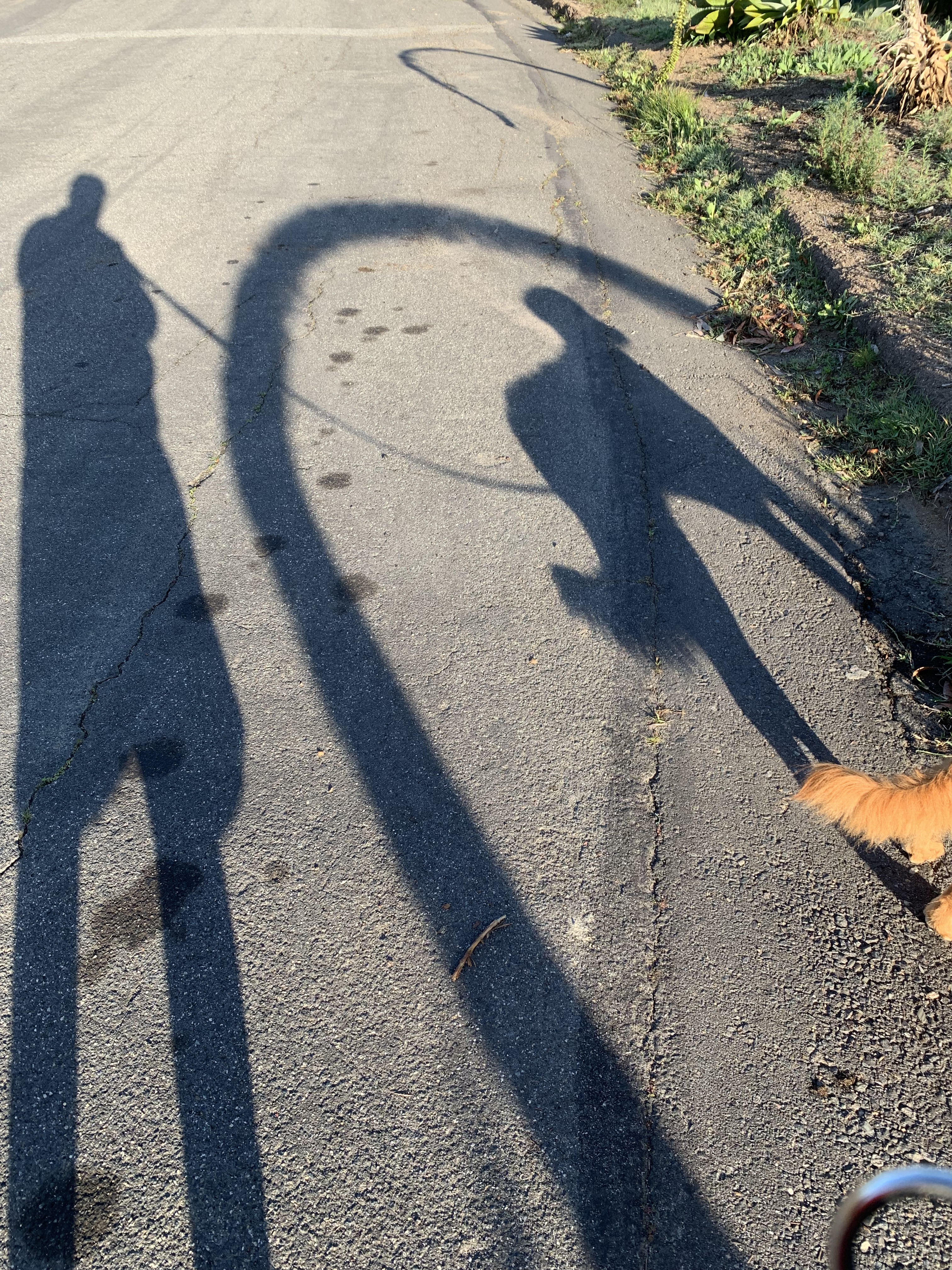
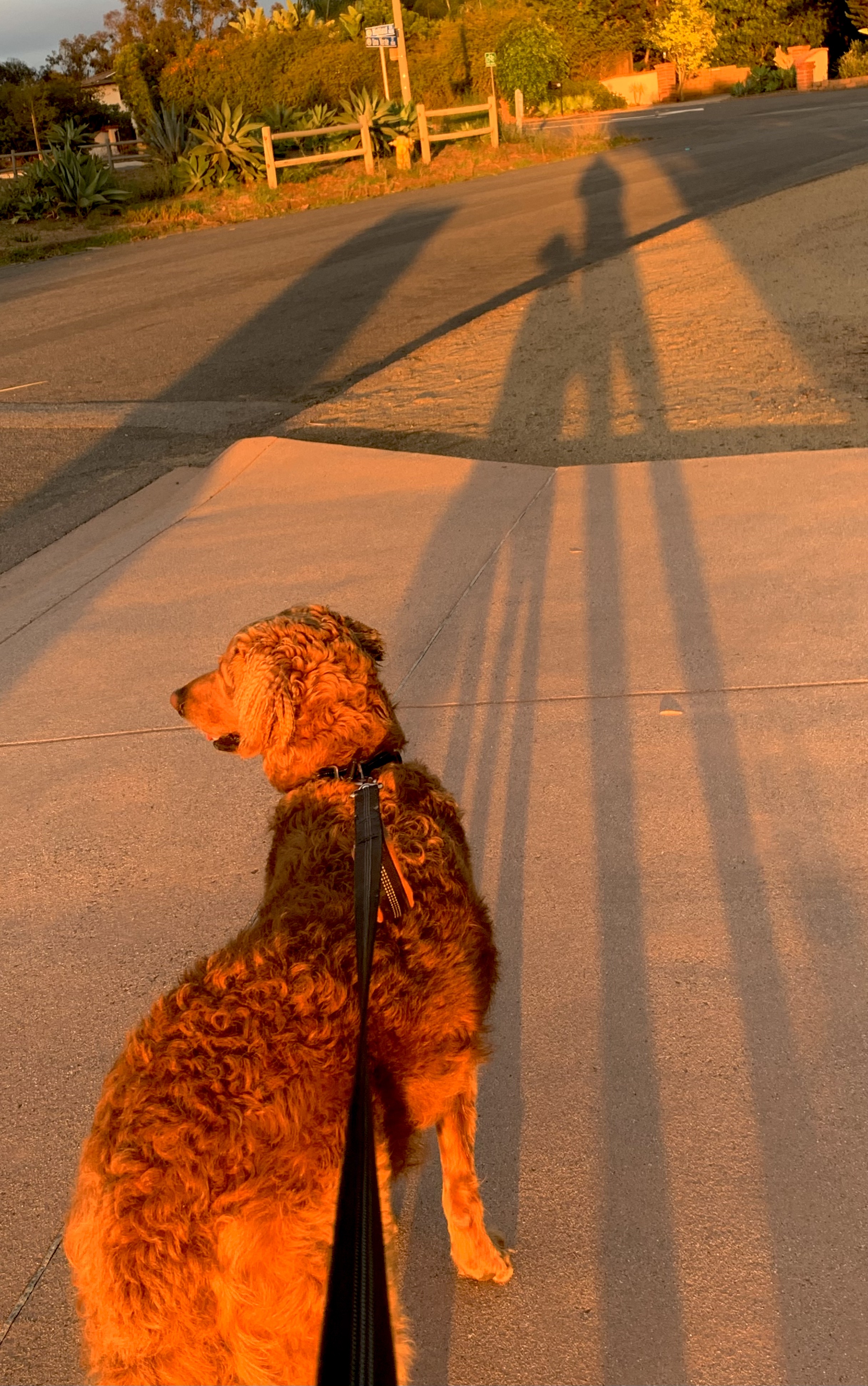
The sky, like Sadie, has many moods, even in the San Diego area. This morning, the sky couldn’t seem to make up its mind whether to be sunny or cloudy. I don’t mind the mood swings. It provides some interesting contrasts.

Bailey behaved pretty well though he still gets very vocal and agitated when any of the numerous neighborhood dogs begin to bark. He’s much like the Internet Guy (and, let’s face it, it’s almost always a guy) who has to comment on every single post. But the new leash arrangement worked well and didn’t cause any falls or prolonged pulls.

Bailey does, however, look rather baleful about wearing the extra equipment. What do you think?

And while on the topic of reading the minds of dogs, I did wonder if something like the following crossed Sadie’s mind this morning. She saw Bailey get fitted with the leash and the over-the-snout attachment. I put the regular leash on Sadie. Then, Sadie saw Wendy and Bailey walk out ahead and instead of following them, she immediately turned off in a different direction. Presumably, she caught a whiff of the scent she felt obligated to follow.


But I also wondered if she was partly avoiding the situation from two days earlier wherein Wendy and I both walked one dog, each of which had the additional lead on the snout–which ultimately led to my fall. Maybe Sadie wanted “nothing to do” with having that type of leash on.

I have observed that kind of behavior in humans. Perhaps you can think of a few examples even from your own experience? Sadie certainly has a kind of metacognition that she seems to use on occasion. When she begins to explore something she knows from experience I do not want her to explore (e.g., a cigarette butt or an animal carcass), she herself moves quickly away from the tempting stimulus seemingly with no prompting from me. It’s as though she realizes she’ll be more comfortable not being in conflict.

I’ll be interested to see how she reacts tomorrow or tonight when I again try the two-lead leash.


Meanwhile, enjoy the play of light on the flowers. You can see in this sequence that I “followed the scent” of the brightly lit fan palm tree to get a closer view. Getting a “closer view” is what Sadie does when she follows a scent. I wish to get more details in the visual domain whereas Sadie wants to get more detail in the olfactory domain.

Sometimes, I scan my visual field for something interesting to photograph (explore in more detail) and sometimes, I’m fixated on a particular “target” and looking for the right framing, lighting conditions, or angle. I enjoy sometimes getting to a particular picture, but I also enjoy the process of getting to the picture that pleases. I imagine it’s the same with Sadie. She’s quite happy to find a lizard or squirrel or rabbit, but she’s also happy to search for prey, particularly in promising conditions such as there being a strong scent or having wet ground to search for scents.


Plans?

Some management consultings will tell you that plans are seldom right but that planning–that is the real gold.

Author Page on Amazon

Tales from an American Childhood

Travels with Sadie 1

Travels with Sadie 2

Travels with Sadie 3

Travels with Sadie 4

Travels with Sadie 5

Travels with Sadie 6

Travels with Sadie 7

Travels with Sadie 8

Travels with Sadie 9

Sadie and the Lighty Ball

Dog Years

Sadie is a Thief!

Take me out to the Ball Game

Play Ball! The Squeaky Ball

Sadie

Occam’s Chain Saw Massacre

Math Class: Who Are You?

Ban the Open Loop

29 Monday Sep 2025

Posted by petersironwood in America, essay, HCI, politics, psychology, Uncategorized, user experience

≈ Leave a comment

Tags

AI, Democracy, life, technology, truth, USA

IMG_5372

Soon after I began the Artificial Intelligence Lab at a major telecom company, we heard about an opportunity for an Expert System. The company wanted to improve the estimation of complex, large scale, inside wiring jobs. We sought someone who qualified as an expert. Not only could we not locate an expert; we discovered that the company (and the individual estimators) had no idea how good or bad they were. Estimators would go in, take a look at what would be involved in an inside wiring job, make their estimate, and then proceed to the next estimation job. Later, when the job completed, no mechanism existed to relate the estimate back the actual cost of the job. At the time, I found this astounding. I’m a little more jaded now, but I am still amazed at how many businesses, large and small, have what are essentially no-learning, zero feedback, open loops.

As another example, some years earlier, my wife and I arrived late and exhausted at a fairly nice hotel. Try as we might, we could not get the air-conditioning to do anything but make the room hotter. When we checked out, the cashier asks us how our stay was. We explained that we could not get the air conditioning to work. The cashier’s reaction? “Oh, yes. Everyone has that trouble. The box marked “air conditioning” doesn’t work at all. You have to turn the heater on and then set it to a cold temperature.” “Everyone has that trouble”? Then, why hasn’t this been fixed? Clearly, the cashier has no mechanism or no motivation to report the trouble “upstream” or no-one upstream really cares. Moreover, this exchange reveals that when the cashier asks the obligatory question, “How was your stay?” what he or she really means is this: “We don’t really care what you have to say and we won’t do anything about it, but we want you to think that we actually care. That’s a lot cheaper and doesn’t require management to think.” Open Loop.

Lately, I have been posting a lot in a LinkedIn forum called “project management” because I find the topic fascinating and because I have a lot of experience with various projects in many different venues. According to some measure, I was marked as a “top contributor” to this forum. When I logged on the last time, a message surprised me that my contributions to discussions would no longer appear automatically because something I posted had been flagged as “spam” or a “promotion.” However, there is no feedback as to which post this was or why it was flagged or by whom or by what. So, I have no idea whether some post was flagged by an ineffectual natural language processing program or by someone with a grudge because they didn’t agree with something I said, or by one of the “moderators” of the forum.

LinkedIn itself is singularly unhelpful in this regard. If you try to find out more, they simply (but with far more text) list all the possibilities I have outlined above. Although this particular forum is very popular, it seems to me that it is “moderated” by a group of people who actually are using the forum, at least in many cases, as rather thinly veiled promotions for their own set of seminars, ebooks, etc. So, one guess is that the moderators are reacting to my having simply posted too many legitimate postings that do not point people back to their own wares. Of course, there are many other possibilities. The point here is that I do not have, nor can I easily assess what the real situation is. I have discovered however, that many others are facing this same issue. Open loop rears its head again.

The final example comes from trying to re-order checks today. In my checkbook, I came to that point where there is a little insert warning me that I am about to run out and that I can re-order checks by phone. I called the 800 number and sure enough, a real audio menu system answered. It asked me to enter my routing number and my account number. Fine. Then, it invited me to press “1” if I wanted to re-order checks. I did. Then, it began to play some other message. But soon after the message began, it said, “I’m sorry; I cannot honor that request.” And hung up. Isn’t it bad enough when an actual human being hangs up on you for no reason. This mechanical critter had just wasted five minutes of my time and then hung up. Note that no reason was given; no clue was provided to me as to what went wrong. I called back and the same dialogue ensued. This time, however, it did not hang up after I pressed “1” to reorder checks. Instead, it started to verify my address. It said, “We sent your last checks to an address whose zip code is “97…I’m sorry I’m having trouble. I will transfer you to an agent. Note that you may have to provide your routing number and account number again.” And…then it hung up.

Now, anyone can design a bad system. And, even a well designed system can sometimes mis-behave for all sorts of reasons. Notice however, that designers have provided no feedback mechanism. It could be that 1% of the potential users are having this problem. Or, it could be that 99% or even 100% of the users are having these kinds of issues. But the company lacks a way to find out. Of course, I could call my Credit Union and let them know. However, anyone that I get hold of at the Credit Union, I can guarantee, will have no possible way to fix this. Moreover, I am almost positive that they won’t even have a mechanism to report it. The check printing and ordering are functioned that are outsourced to an entirely different company. Someone in corporate, many years ago, decided to outsource the check printing, ordering, and delivery function. So people in the Credit Union itself are unlikely to even have a friend, uncle or sister-in-law who works in that “department” (as may have been the case 20 years ago). So, not only does the overall system lack a formal feedback mechanism; it also lacks an informal feedback mechanism. Tellingly, the company that provides the automated “cannot order your checks system” provides no menu option for feedback about issues either. So, here we have a financial institution with a critical function malfunctioning and no real process to discover and fix it. Open loop.

Some folks these days wax eloquent about the up-coming “singularity.” This refers to the point in human history where an Artificial Intelligence (AI) system will be significantly smarter than a human being. In particular, such a system will be much smarter than human beings when it comes to designing ever-smarter systems. So, the story goes, before long, the AI will design an even better AI system for designing better AI systems, etc. I will soon have much to say about this, but for now, let me just say, that before we proceed to blow too many trumpets about “artificial intelligence systems,” can we please first at least design a few more systems that fail to exhibit “artificial stupidity”? Ban the Open Loop!

Notice that sometimes, there may be very long loops that are much like open loops due to the nature of the situation. We send out radio signals in the hopes that alien intelligences may send us an answer. But the likely time frame is so long that it seems open loop. That situation contrasts with those above in the following way. There is no reason that feedback cannot be obtained, and rather quickly, in the case of estimating inside wiring, fixing the air conditioning signs, providing feedback on why there is “moderation” or in the faulty voice response system. Sports must provide a wonderful venue that is devoid of open loops. In sports, you see or feel the results of what you do almost immediately. But you underestimate the cleverness with which human beings are able to avoid what could be learned by feedback. Next time, we will explore that in more detail.

As I reconsider the essay above from the perspective of 2025, I see a federal government that has fully embraced “Open Loop” as a modus operandi — in some cases, they simply ignore the impact of their actions. In other cases, they do claim a positive impact but it is simply lies. For instance, it is claimed that tariffs are “working” in that foreign countries are paying money to America. That’s just an out and out lie. So, the entire government is operating with no real feedback. We are told that ICE will target violent gang members and dangerous criminals. The reality of their actions is completely disconnected from that.

The Trumputin Misadministration works with no loop at all that correctly relates stated goals, actions taken supposedly to achieve those goals, and the actual effects of those actions. That can only happen when the government accepts and celebrates corruption. But the destruction will not be limited to government actions and effects. It will tend to spread to private enterprise as well. Just to take one example, if unchecked by courageous and ethical individuals, sports events will become corrupted.


Photo by Mark Milbert on Pexels.com

There’s money to be made by “fixing” events and there will be pressure on athletes, managers, referees, to “fix” things so that the very wealthy can steal more money. Outcomes will no longer primarily be determined by training, skill, and heart. Of course, as fans learn over time that everything is fixed, the audience will diminish, but not to zero. Some folks will still find it interesting even if the outcome is fixed like the brutal conflicts in the movie Idiocracy, the lions eating Christians in the Roman circuses, or the so-called “sport” of killing innocent animals with high power guns. It’s not a sport when the outcome is slanted. Not only is it less interesting to normal folks but it doesn’t push people to test their own limits. There’s nothing “heroic” about it. Nothing is learned. Nothing is really ventured. And nothing is really gained. 


Photo by Gareth Davies on Pexels.com

———–

Where does your loyalty lie?

My Cousin Bobby

The First Ring of Empathy

The Orange Man

The Forgotten Field

Essays on America: The Game

Essays on America: Wednesday

Absolute is not Just a Vodka

How the Nightingale Learned to Sing

Travels with Sadie 1

The Walkabout Diaries

Plans for US; Some GRUesome

At Least he’s Our Monster

The Ant

The Self-Made Man

A Cancerous Weed

24 Wednesday Sep 2025

Posted by petersironwood in America, poetry, Uncategorized

≈ 1 Comment

Tags

Democracy, fantasy, life, poem, poetry, politics, truth, USA, writing

Like poisonous vines

Of cancerous deeds

Whose only needs

Are parasitic hate

And never-ending whines.

Cancer-weed grows darkly while it lies in wait.

Photo by Roman Pohorecki on Pexels.com

Be a reed;

Be a fire;

Be a seed—

A seed of love.

Star above.

Tuneful lyre. 

A ray of light.

Destroys the blight.

The parasitic worm of hate

Cannot survive when bathed in light

It fears both fight and flight

It knows not love

Only a hurtful shove

And rusty metal glove.

Photo by Pixabay on Pexels.com

Be a seed

Be a reed

Be a light 

In darkest night.

A bloated orange tick;

Ever envies normal dick; 

Ever scoffs at those who earn;

Ever scorns those who learn;

Divides to conquer and to kill;

It’s its one and only skill.

Be the fire;

Be the light;

Light the night;

Juice the wire.

Empty stalks of uncut grains.

Empty talk from worm-fueled brains.

Families broken on wheels of greed.

The Rule of Law is sold for song.

A pedophile’s pathetic need

Trumps anyone knowing right from wrong.

Photo by Matheus Bertelli on Pexels.com

Be the spark

That lights the dark.

Be the throng.

Who rights the wrong.

But my 401K is doing okay!

Who cares if it all goes south one day?

I’m so straight—not one bit gay!

I’m all white and no bits black!

I love a fight when none hit back!

Photo by Marco Milanesi on Pexels.com

Be a reed.

Be a seed.

In darkest night,

Ignite your light.

Who cares if millions die in endless war?

Our minds can’t think ahead so far. 

Even though a thousand years of tyrants are the same.

Their cruelty and greed is insane shame. 

Be the fire; 

Be the light;

Light the night.

Juice the wire. 

Be the fire; 

Juice the wire.

Light the night.

Be the light.


Roar, Ocean, Roar

Imagine All the People

After the Fall

After All

Dance of Billions

All We Stand to Lose

The Game

Peace

The Only Them that Counts is All of Us

Math Class: Who Are You?

Where does your Loyalty Lie?

Absolute is not Just a Vodka

My Cousin Bobby

That Cold Walk Home

Donnie Gets a Blue Ribbon

The First Ring of Empathy

The Orange Man

The Three Blind Mice

The “Not-See” Party

02 Tuesday Sep 2025

Posted by petersironwood in America, poetry, politics

≈ 3 Comments

Tags

Democracy, life, poem, poetry, politics, truth, USA

They pretend they can Not See:

Polluting of the rivers

The browning of the skies

The wailing and the cries 

Of children ripped from givers.

They pretend they can Not See:

The children shot in schools

The children needless dead

The smirking orange head

Dementia’s pooling drools. 

They pretend they can Not See:

America’s plummeting rep

Demoralizing troops

The empty-headed whoops

The flashy trashy goose-step.

They pretend they can Not See:

As airplanes fall from skies

The rotting fruit in fields

The thugs with masks, not shields

America’s freedom dies.

They pretend they can Not See:

That crime is on the rise

They cyber truck in lies

Kill wisdom with the wise

American excellence dies.

—————————

After All

The Crows and Me

After the Fall

Where does your loyalty lie?

Siren Song

The Game

Imagine all the people

Roar, Ocean, Roar

Peace

Dance of Billions

Oh, Frabjous Day!

23 Saturday Aug 2025

Posted by petersironwood in America, poetry, politics

≈ 3 Comments

Tags

Democracy, life, poem, poetry, politics, truth, USA

Oh, hear the big drum bang-a-lang!

And hear the bugles bray all day!

See every tooth devolve to fang!

And watch small children cheat at play!

It was not at all a frabjous day.

Who says dictatorships aren’t fun?

At first it’s just a few who die,

But cancer spreads to everyone,

And all begin to spread The Lie.

It was not at all a frabjous day.

Photo by Denniz Futalan on Pexels.com

Though crime explodes while felons rule,

We hide these facts with sharpie pens.

Though prices spike & pedos drool,

The greedy feast on pus-filled wens.

It was not at all frabjous day

Uncaring that the Shining City on the Hill.

Became the Pyre of the Vengeful Kill,

The Garden withers; fruit rots in unpicked lands,

The pickers jailed with handcuffed hands.

King screams Chaos in loud unrhythmic blands.  

We try not to see the cruelty seep, then flood, then fill 

Till many millions die

Why?

It was not at all a frabjous day

Photo by judit agusti aranda on Pexels.com


Despite the cancerous cosplay

It was not a frabjous day

It was not a frabjous day

Not in the least or teeniest way

When Democracy dribbled and drabbled away.

It was not a frabjous day


The Truth Train

Roar, Ocean, Roar

The Dance of Billions

The Last Gleam of Twilight

How the Nightingale Learned to Sing

Timeline for RIME

Essays on America: The Game

D4

Essays on America: Labelism

Where Does Your Loyalty Lie?

The Stopping Rule

My Cousin Bobby

Peace

Corn on the Cob

The Self-Made Man

Happy Talk Lies

That Cold Walk Home

Imagine All the People

The Last Gleam of Twilight

14 Thursday Aug 2025

Posted by petersironwood in America, poetry

≈ 8 Comments

Tags

Democracy, life, love, poem, poetry, politics, truth, USA, writing

How does it feel?
Let’s keep it real.

How does it feel?

To sell so short the American Dream?

To sell for a song your family and friends?

To sell your soul, your heart, your mind?

Pretend no monsters around the bends;

Pretend that cruelty actually is kind.

Pretend putrid muck is a clear flowing stream.

All so you can kiss the rings

Of swine who would be kings

Who promised a world

Enshrined in shiny pearls

In golden leaf and diamond swirls

Who delivering instead

A worm in your head

A reign of radical racist hate

A frosted fog of friendless state.

A razzle of maniacal dazzle

A dazzle of frankly farcial razzle.

Oh, say, can you still see

With no light at the dawn

When the Law is a pawn

That once we had Democracy?

Red ink galore,

Red blood and gore, 

Torture and pus:

That’s what becomes of US. 

Instead of courage and captains to lead

We’re told obey the maggots; worship cancer

A Dancer Obese, a Necromancer

A boastful beast, a prideful prancer

Turned on by making children bleed. 

A warm summer rain 

Which washes your brain 

Then soon turns to ice

Trashing everything nice.

Pretty, petty falsehoods fill the air 

Making it hard for you even to care. 

So you join parades

And welcome charades;

Salute the sign of the twisted cross.

Pretend what matters is Glitter and Gloss.

How does it feel?

Let’s keep it real.

How does it feel:

To sell mother, father, sister, brother?

To sell into slave-hood your own hopes and dreams?

To cater to cons and kowtow to killers? 

Pretend wrong is right 

Pretend dark is light?

To cover your eyes and feign you’ve no sight?

Defile the planet we need to survive?

Destroy the work of thousands who strive

Break all the glass 

And act like an ass?

Let melons rot in unpicked fields.

Let felons pick US for human shields. 

Let science die upon the vine. 

Let’s all burn witches one last time.

Oh, say, can you still see

With no light at the dawn

When the Law is a pawn

That once we knew Democracy?

When drunken rage has broken every mirror

You don’t have to look at what you’ve now become;

No need to admit your decisions were dumb;

No need to reflect; instead, just deflect.

Cover your face and pretend you’re not you.

Smother your feelings and revel in cruel.

How does it feel?

Let’s keep it real.

How does it feel?

To destroy our parks to make wealthy folks grin

To burn down the forests and drink crystal gin?

Rape underage children and blame someone other? 

To laugh at the tears of each desolate mother?


A warm summer rain

Destroys your brain

Floods away courage 

From the land of the brave

The rain turns to sleet 

The sleet turns to ice 

And soon a sheet of sordid lice

Covers with slime, the trust of the truth 

And duct-tapes all our scream-blistered lips

Sinks every one of our sailing ships; 

Airplanes fall from smog-filled skies

Shot down by rockets made of lies.


What was once a land of love and life 

Striving toward a fairer, grander prize

Becomes a muddy barren ice-filled waste. 

Everyone sprints in a hasty race to taste

The few remaining crud-crusted crumbs

Seeks the momentary thrill that numbs.

Let’s get real.
How does it feel?

How does it feel? 

There has always been a part of you that knew:

The lies were lies; the con was con. 

There was no prize;

No prize—

Except the short term rush of kill

Except the hit of heroin thrill.

You watch the lovely rockets red glare 

As they stream across the pounding sky

How pretty they look as your shark eyes stare 

As you crane your neck so far so fair

Like a chick upon the chopping block

Just one of a fear-filled feckless flock

Choking on a lifeless lump of lie

Right before you dissolve and die. 

As your severed head plops upon the ground

You sense the booming dooming sound 

Of bombast bursting in polluted air

Maybe this is your final dream: 

If only you care to care.

If only you dare to dare,

Your country won’t die in rockets’ red glare

Your flag will still be there. 

Be there! 

It’s twilight’s last gleam.
Help save the dream.

Be there!
Care to care
Dare to dare

In twilight’s last gleam.


D4

Absolute is not Just a Vodka

At Least he’s our Monster

Dick-Taters

Essays on America: The Game

You Bet Your Life

Wednesday

What about the Butter Dish?

The Stopping Rule

Where does your Loyalty Lie?

The Truth Train

Plans for US; some GRUesome

Imagine all the people

Peace

Dance of Billions

Roar, Ocean, Roar

Cooperation is More Common than Disruption

06 Wednesday Aug 2025

Posted by petersironwood in America, essay, politics, psychology

≈ 1 Comment

Tags

Democracy, life, philosophy, politics, truth, USA

These are perilous times, no doubt. 

But let’s not forget that most people, most of the time cooperate. It’s much more pleasant for normal people to cooperate and the results are also much more pleasant.

Is there road rage? Does that exist? Yes, but statistically, the vast majority of people cooperate when they drive. 

Photo by Pixabay on Pexels.com

And, when they do anything else. We depend on many people from many places cooperating in order to eat. First, the efficiency and effectiveness of our food growing, harvesting, transporting and preparing depends on the cooperation of millions of people in the past who found out what was edible, how to grow it, which crops worked best in various conditions, how to irrigate, how to fertilize, how to harvest and so on. The food we have available today depends on the collaborative efforts of many previous generations. These dependencies are not just on food per se, but also depend on scientific advances, transportation advances, financial advances, and so on. 

Photo by Pixabay on Pexels.com

Much of our food also depends on people from many parts of the world cooperating today. The prevalence of cooperation is not just true of driving and food production but also on the construction of buildings and cities; it’s true of our clothing, our medical care, our learning. 

Despite the fact that cooperation is much more prevalent than criminality, evil, and violence, there are at least three reasons that the evil of human behavior seems much more prevalent than it really is. These are: 1. Effect Size, 2. Cognitive Bias, and 3. Media Bias.

Effect Size:

First of all, it takes many people working smart and hard over a long period of time to provide value through cooperation. By contrast, it only takes a few people working stupidly over a short period of time to destroy something. The effort to make a pane of glass is immense. To make it efficiently takes a large number of people with different skills. To destroy a pane of glass requires only one second of bad action by one unskilled bratty child.

AI-generated image


Think about how much work goes into planting, growing, and harvesting an acre of corn versus what it takes to burn it down. Think about how much time and effort it takes to raise a child for the first ten years of their life versus destroying that life with an assault weapon. Think about what was required to build a functioning democracy over the course of hundreds of years by cooperation versus how easy it is for a very small group of greedy stupid people to destroy it. The examples are endless. Writing a novel versus burning a book; training to become a world class figure skating versus putting an ice pick in someone’s knee; becoming a skilled artist and painting the Mona Lisa versus splashing it with black paint. 

It’s the same with a functioning human body. To be healthy requires the coordination of trillions of cells. The kind of cooperation found in the human body (or an eagle or wolf or whale) took billions of years of evolution. To destroy the health of the body only takes a few stupidly greedy cancer cells. So, although evil destruction is far less prevalent than constructive cooperation, evil destruction can undo the effort of many over the course of a long time. 

Photo by Waseem Istanbuli on Pexels.com

Cognitive Bias:

Second, because destruction can so quickly undo so much good work, our nervous system is very reactive to evil and violence. We perceive it more easily and we remember it more easily. In a crowded city, you might pass by hundreds of people every day. Most of them, most of the time, you don’t notice. But if one of them robs you at gunpoint, you will notice and remember.


Media Bias:

The first two reasons we perceive evil to be more common than it really have existed for millions of years. Now, however, in our modern society, we have people whose job is to report on the news. 

When is the last time you saw a headline like: “Two hundred thousand people drove into San Diego from Mexico yesterday with zero fatalities!” Or, “Three million people ate dinner in San Diego county last night! Zero died of food poisoning!”

Photo by Ashutosh Sonwani on Pexels.com


It is sometimes said that “No news is good news.” It’s also generally the case that good news is no news. There are some exceptions. When World War Two ended, there were headlines. What we don’t see is this headline: “Canada, for the 57,670th consecutive day did not attack the United States of America.” Understanding this, a complete sociopath with an audience might try to increase their own fame by declaring: “America should annex Canada!” An actual war will definitely result in a headline. But threatening war, especially with a friendly country might also result in a headline.

The tendency to report bad news over good news has always been a “feature” of the media. But now that much of our news is basically click-bait for advertisements, the tendency is worse than ever. When I was on the school newspaper, we were taught to put the most important information in the headline; add the most important details in the first paragraph and add more detail in the rest of the article. Now, most headlines are fairly meaningless and important information is hidden behind a paywall or an advertisement.

“Is Earth About to Plunge into the Sun?!” 

AI-generated image to prompt: “The earth plunges into the sun.”

Ka-ching!

(No, but we could sure use some extra cash, so click here to find out.)

“Does T-Rump have Proof that Obama was Born in Kenya!?”

An AI-generated image

Ka-ching!

(No, actually, but if you want to find out, click here and pay us money.) 

“Could Space Invaders have Brought Life to Earth?!” 

AI-generated image to prompt: “A fleet of UFOs hovers over the earth”

Ka-ching!

(Well, sure, anything’s possible. And, while we have no evidence of that, thanks for making one of the greediest people on earth a little richer!) 

Dishonesty, greed, and mistrust work in a vicious circle. As you discover that more people are lying; that more people are evil, you yourself become more cynical and more tempted to lie, cheat, and steal. If you succumb to that temptation, it makes others more likely to lie, cheat, and steal. 

Here’s the important thing to remember about a positive feedback loop though. It works in both directions. To the extent you can behave in a trustworthy fashion and be kind to others, it increases the chances that others will be inspired also to behave well. Cooperating is the natural and normal course for humanity. You will be happier doing that and you’ll help build a better world. 

Yeah. 

Let’s do that.

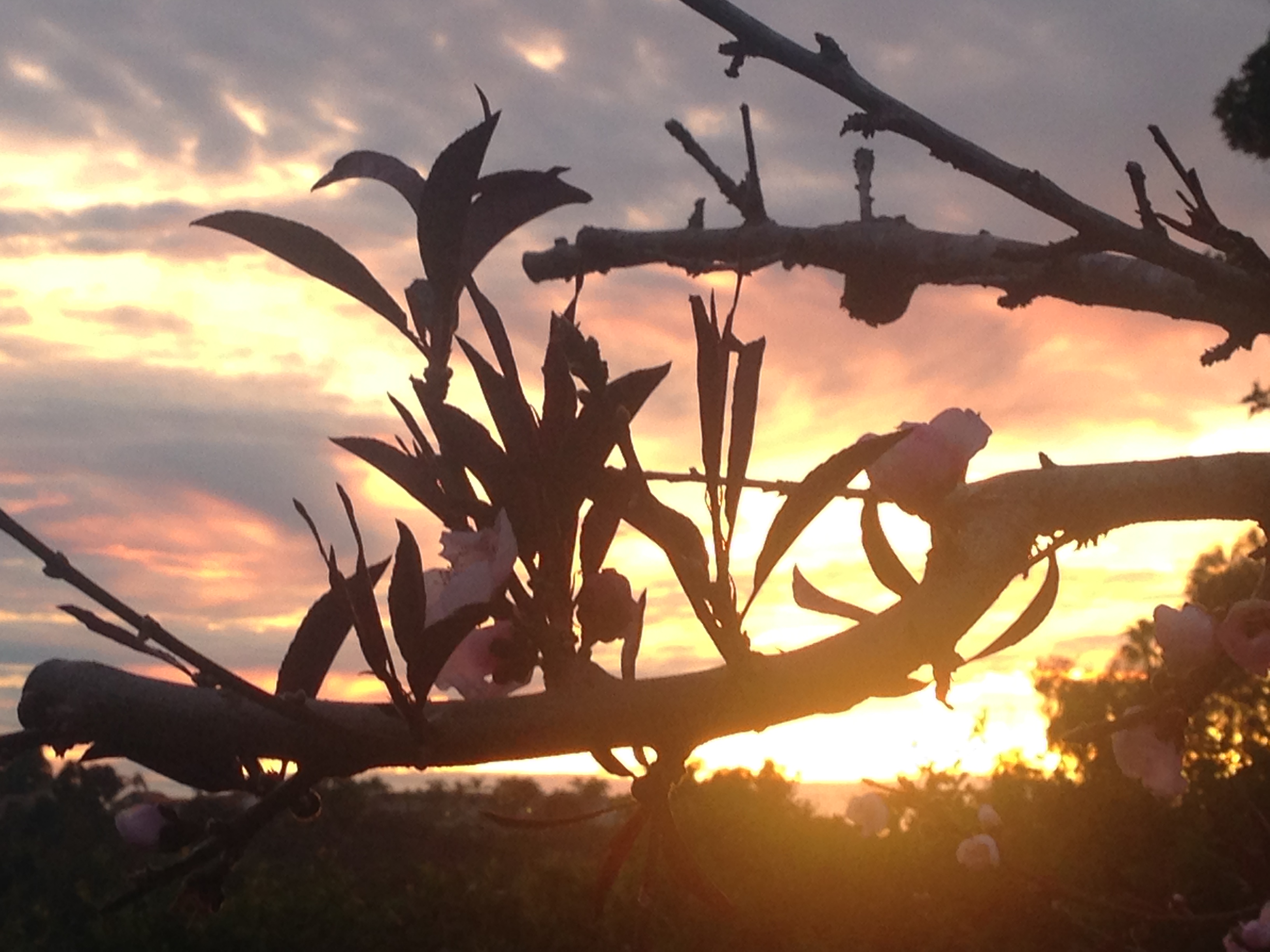
The golden sunrise glows through delicate leaves covered with dew drops.


———————

As Gold as it Gets

A Horror Story

Timeline for RICE

An NICE circle

I can’t be Bothered

Absolute is not Just a Vodka

Just Desserts?

D4

Dick-Taters

Cancer Always Loses in the End

Karma

Imagine all the People

Roar, Ocean, Roar

Dance of Billions

A NICE Circle of Friends

27 Sunday Jul 2025

Posted by petersironwood in America, family, fiction, politics

≈ 2 Comments

Tags

Democracy, fiction, life, politics, story, truth, USA, writing

AI generated image

Donnie Dump arrived first. He sniffed. He sighed. The place stunk. He took a deep breath and ambled over to the plain wooden door with the brass numbers ‘4’ and ‘2’ glued on at a slight angle. The door looked to be plywood.

He dug around in the front right pocket of his too-tight Lee’s and found the crumpled piece of paper. He uncrumpled it. He nodded and mumbled: “Yep. This is the place.” He re-crumpled the paper and jammed it back into his pocked. Then, he turned the cheap brass knob and pushed. The door opened into a room without light. “Crap. I’m the first one here.” 

Donnie fumbled around the door jamb for a light switch and flipped one. He said, “Let there be light.” And, there was light. A row of florescent lights flickered on to reveal a small arc of cheap chairs. In a corner of the smallish room, a vending machine offered a variety of salty and sugary snacks. 

Donnie hated being late. But he hated being early even more. Yet, here he was. Early. The first one here. He thought, How the hell was I supposed to know traffic would be so light. The truth was traffic was always “unusually” light now, but he hadn’t yet connected the dots; he hadn’t noticed nor had he realized how that fact related to his own ‘second career’ as he often called it. 

AI generated image.

Just then, he heard a noise and spun quickly to see another obese, masked marvel of manhood who raised a hand to him and said, “Hey. AA?” 

Donnie nodded and began to regret having agreed to come. His wife Maggie had been insistent. Maggie the Naggie, he thought. She should just mind her own damned business. “I don’t need fixing!” He had told her.

She had countered, “I’m not saying you need fixing. But you’re just—understandably stressed. It’s not an easy job.” 

Donnie now glanced at his watch. He could see several other guys out in the hallway. He was glad to see half of them were at least as old as he was. It was hard work chasing down folks trying to run away from you. He thought: True, the numbers and the weaponry made it safe enough but so is a carnival ride and they’re plenty scary too. But it’s whacking ‘em on the head I really get off on. Head wounds bleed a lot. The thought that they might be stupid the rest of their life from that one blow, or have a part of their body paralyzed or weakened. That was power. I like the taste. And, when the opportunity comes up, I’ll take whatever the hell I want. What’s everyone staring at me like that for?

Everyone had been seated for awhile and had been taking turns jabbering on about something or other. The so-called “Facilitator” had just said something to him. But what? That’s the question. Everyone’s staring at me.

Donnie stammered: “Sorry, what was the question?”

The facilitator faked a smile and said in a pleasant voice that Donnie just knew had to be rehearsed: “Have you experienced any unusual symptoms since joining NICE?”

Donnie shook his head and thought: Symptoms sound like I’m some kind of psycho or something. Aloud, he said, “No, nothing. No unusual symptoms. Like what?” 

The F-man shrugged and said, “Like drinking more alcohol than you used to or using more pot or bad dreams. Anything.”

Donnie shook his head. Maybe I shook it too hard. This is weird. No wonder Maggie wanted me to come. This is chick stuff. Feelings and that crap. I wish I knew what the other guys said. Doesn’t matter. They can’t prove what I think or what I did. We’re all masked. I can hold my liquor just fine. Who cares? It’s good to celebrate our victories. Kids. Some of them look like kids but so what? They’re criminals at heart. And not America citizens. Not because some liberals wrote it into a Constitution. Not with skin that dark. Everyone’s staring at me again. I want my assault rifle. Why is everyone staring at me? 

Donnie said, “Look, I feel fine. I like beer. So what? I do my job. I’m only here because my wife insisted. Well, that won’t matter much longer. Everybody knows it works better when women are property and we stop pretending their people with their own ideas. Go on to the next guy.” 

The meeting only lasted an hour but to Donnie, it seemed like a lifetime of boredom. 

It was late when Donnie got back home from the meeting and the post-meeting meeting at the “NICE GUY TAVERN.” Maggie had fallen asleep in her bathrobe staring at the boob tube. The twins must be asleep, he thought. 

I don’t drink too much. I just want to feel good. 

Donnie didn’t see anything wrong with that. But he did see something wrong with his damned wife being asleep when he got home. He didn’t exactly shout, but he did want to be heard over the sound of the frigging TV and he did want to wake her up and he had been drinking so his “Hey!” Sounded a lot more like: “HEY! Wake the hell up, Bitch!” 

Maggie sat up and said, “Hey, Donnie. How was the meeting? I didn’t realize it would run so long. Was it fun?” 

Donnie was already pouring himself a few fingers of Jack D. He bolted it down in one gulp before turning back toward Maggie and snarling in a soprano of swishy sarcasm, “Was it fun? Was it fun? Did you boys have fun talking about your frigging feelings?” He switched to his own voice and added, “No, it wasn’t fun! It was boringand useless just like you knew it would be. Do me a favor. Next time you get a brilliant idea, just keep it to yourself. I don’t drink too much. End of story.”

Maggie didn’t really agree, but she bit her lip to keep from…saying anything she’d regret. 

Photo by Maria Pop on Pexels.com

Meanwhile, Donnie was pouring himself yet another Jack D but only got two fingers’ worth. He yelled, “What the hell? Drink your own damned drinks! Don’t drink my good whiskey! Ain’t lady-like anyway! Don’t you have some sprizzer chicker drinker? Leave mine alone! Now, I’m out of Jack!”

At the moment Donnie said that, he was not, in fact, out of Jack. There was another fifth, unopened, staring right at him from the edge of the countertop. The fifth stood just a little too close to the edge. It should have known better but it didn’t know better because, first, it was filled with booze and secondly, it was only a bottle and didn’t really know much of anything.

In any case, when Donnie staggered and stumbled into the counter top, his elbow toppled the bottle onto the hard tile of the kitchen. Maggie and Donnie didn’t own any pets and the twins were asleep, so when the bottle shattered into smithereens, Donnie could see no-one to blame but Maggie. His subsequent screaming did manage to wake the twins who toddled out to the kitchen in a daze to see what all the commotion was about.


Maggie saw them toddling forward in their PJs and yelled at them to go back to bed, but not before each of them managed to step on several broken shards. Maggie was horrified to see the blood of her darling toddlers mixing with the stinging whiskey. The toddlers were none too happy either. Their pain and confusion were exacerbated by the increased tension they had felt at home ever since Donnie joined NICE.

Tears streamed down Maggie’s cheeks. She shook her head and stared at her husband—a man whom she had once loved. She could see that he was smiling and that the smile was genuine. It was the happiest she’d seen him since he had started working at NICE. She gripped the her elbows with her hands, knowing she should get her kids and fix them, but suddenly, she didn’t know how. She just cried silently wondering what had happened to the nice man who used to live inside Donnie’s skin.

———————-

 Where does your loyalty lie?

My Cousin Bobby.

The Update Problem.

Wednesdays.

The Game

Cancer Always Loses in the End.

What about the Butter Dish?

Roar, Ocean, Roar

Dance of Billions

Peace 

← Older posts
Newer posts →

Subscribe

  • Entries (RSS)
  • Comments (RSS)

Archives

  • January 2026
  • December 2025
  • November 2025
  • October 2025
  • September 2025
  • August 2025
  • July 2025
  • June 2025
  • May 2025
  • April 2025
  • March 2025
  • February 2025
  • January 2025
  • December 2024
  • November 2024
  • October 2024
  • September 2024
  • July 2024
  • April 2024
  • March 2024
  • February 2024
  • January 2024
  • December 2023
  • August 2023
  • July 2023
  • May 2023
  • April 2023
  • March 2023
  • February 2023
  • January 2023
  • December 2022
  • November 2022
  • October 2022
  • September 2022
  • August 2022
  • July 2022
  • June 2022
  • May 2022
  • April 2022
  • March 2022
  • February 2022
  • January 2022
  • December 2021
  • November 2021
  • October 2021
  • September 2021
  • August 2021
  • July 2021
  • June 2021
  • May 2021
  • April 2021
  • March 2021
  • February 2021
  • January 2021
  • December 2020
  • November 2020
  • October 2020
  • September 2020
  • August 2020
  • July 2020
  • June 2020
  • May 2020
  • April 2020
  • March 2020
  • February 2020
  • January 2020
  • December 2019
  • November 2019
  • October 2019
  • September 2019
  • August 2019
  • July 2019
  • June 2019
  • May 2019
  • April 2019
  • March 2019
  • February 2019
  • January 2019
  • December 2018
  • November 2018
  • October 2018
  • September 2018
  • August 2018
  • July 2018
  • June 2018
  • May 2018
  • April 2018
  • March 2018
  • February 2018
  • January 2018
  • December 2017
  • November 2017
  • October 2017
  • September 2017
  • August 2017
  • July 2017
  • June 2017
  • May 2017
  • April 2017
  • March 2017
  • February 2017
  • January 2017
  • December 2016
  • November 2016
  • October 2016
  • September 2016
  • August 2016
  • July 2016
  • June 2016
  • May 2016
  • April 2016
  • March 2016
  • February 2016
  • January 2016
  • December 2015
  • November 2015
  • October 2015
  • September 2015
  • August 2015
  • May 2015
  • January 2015
  • July 2014
  • January 2014
  • December 2013
  • November 2013

Categories

  • AI
  • America
  • apocalypse
  • cats
  • COVID-19
  • creativity
  • design rationale
  • driverless cars
  • essay
  • family
  • fantasy
  • fiction
  • HCI
  • health
  • management
  • nature
  • pets
  • poetry
  • politics
  • psychology
  • Sadie
  • satire
  • science
  • sports
  • story
  • The Singularity
  • Travel
  • Uncategorized
  • user experience
  • Veritas
  • Walkabout Diaries

Meta

  • Create account
  • Log in

Blog at WordPress.com.

  • Subscribe Subscribed
    • petersironwood
    • Join 661 other subscribers
    • Already have a WordPress.com account? Log in now.
    • petersironwood
    • Subscribe Subscribed
    • Sign up
    • Log in
    • Report this content
    • View site in Reader
    • Manage subscriptions
    • Collapse this bar
 

Loading Comments...