• About PeterSIronwood

petersironwood

~ Finding, formulating and solving life's frustrations.

petersironwood

Tag Archives: beauty

Tools of Thought: Symmetry

07 Wednesday Jan 2026

Posted by petersironwood in management, psychology, Uncategorized

≈ Leave a comment

Tags

beauty, Business, Design, HCI, human factors, Human-Computer Interaction, poetry, politics, problem_solving, symmetry, truth, UX, Web design, writing

Symmetry

IMG_3316

(Original, free-hand drawing by Zoe Colier).

There are many varieties of symmetry. Symmetry exists rampantly in nature and symmetry is also incorporated into many human designs. In this short essay, I want to remind people of several varieties of symmetry and then show how symmetry may also be used as a tool of thought to help solve problems by simplifying the space of possibilities that must be considered. 

Symmetry is a concept with far broader application than cutting out paper snowflakes or choosing a nice looking Christmas Tree, Menorah or other Holiday decoration. It is fundamental in logic, mathematics, physics, chemistry, biology, and even in social science.

Symmetry exists at many different scales as well. Planets are generally roughly spherical and their orbits are roughly circular. 

IMG_5895

The human body, along with most other animals, exhibits rough bilateral symmetry in external appearance. If you examine your own fingerprints or the pattern of your moles, for instance, you will see that one side of your body looks slightly different from a mirror image. If, like me, you are a righty who play tennis, you will find the forearm muscles on your right arm are slightly larger than those on the left. What is remarkable to me is not that there are slight variations between left and right but just how slight those variations are. And, we are not alone. Fish, insects, flatworms, roundworms, snakes, turtles, lizards, horses, dogs, cats, apes, and humans are all roughly bilaterally symmetrical in appearance. I say “in appearance” because our internal arrangement of organs is not at all symmetrical.  

External Appearance and Internal Organs

In general, it seems to me that most animals possess more complete or “perfect” bilateral symmetry than do most plants. I suspect that this is because animals generally move through a physical environment. Since we can move around, the environmental forces are generally symmetrical and so our ability to react to those environmental forces is also symmetrical. A tree, on the other hand, may have a genetic “blueprint” to be bilaterally or (more likely) radially symmetrical, but it may be subject to strong asymmetrical forces such as wind, a water source, or sunlight versus shade. 

Our designed objects are also most often (at least) bilaterally symmetrical, and particularly for those objects which must interact and move through the physical world. Cars, boats, motorcycles, busses, trains, trucks, bikes, skis, surfboards, roller skates, ice skates, snowshoes and tennis shoes all tend to be bilaterally symmetrical. On the inside, however, again just like us, there are often some irregularities. The arrangement of controls of the car, for instance, are asymmetrical. (Each control in itself often does show symmetry. In some cases, this makes it easier to use, especially without looking. I suspect that the symmetry may often be for aesthetic reasons, for ease of manufacturing, for ease of maintenance or replacement or some combination.) The asymmetry of arrangement “works” because the arrangement of displays and controls does not interact with the natural world the way that the car body and wheels do. The controls are designed to interact with a human being. There are also rough conventions for where controls are laid out, how they operate, and what each type looks like. Asymmetry of arrangement is also evident under the hood. However, some of the components such as the engine, the battery, the radiator have symmetry within them. The radiator, which arguably has the most interaction with the outside world, is symmetrically placed though its plumbing is not. 

automobile car customized drive

Photo by Pixabay on Pexels.com

In the design of User Interaction and Experience, an argument can be made for certain kinds of symmetry. For example, in the Mac editor Pages, which I am using to write this, if the B for bold button background turns blue when bolding is turned on, I expect the background will turn back the way it was (white) when bolding is turned back off. I also expect that italics and underlining will behave the same way, especially because all three are in the same toolbar. 

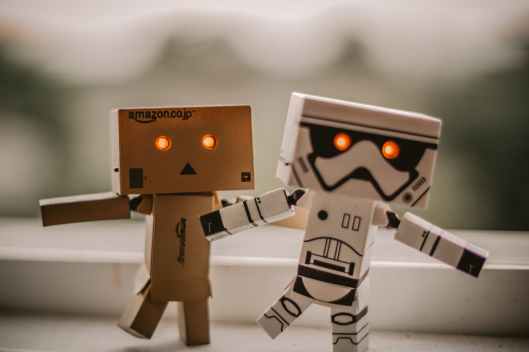
Where possible, it also generally makes sense, I believe, to design so that the functionality of a system is symmetrical. This isn’t always possible. Some actions are necessarily irreversible. If you don’t believe me, ask anyone who has toddlers or who has pets. In the real world, if you shoot someone dead, you cannot “unshoot” them. Unlike a computer system who asks, “Do you really want to delete all your files?” before doing so, guns do not ask that. If you are designing what can be done with a toy robot however, if you can make it go forward, you want to make it so it can go back as well. If it can turn right 90 degrees, you would like to enable it to turn left 90 degrees. Saying, “Oh, yes, but don’t you see, you can, in effect, make it turn left 90 degrees by making it turn right 90 degrees three times?!” does not cut it, IMHO. 

Typically, you not only want the functionality to be symmetrical, you also want the control functions and appearances to mirror the symmetry of the functionality. For example, if you can issue the command: “MOVE ROBOT FORWARD THREE PACES” you want the symmetrical function to be evoked this way: “MOVE ROBOT BACKWARD THREE PACES” and not, “THREE PACES BACKWARD FOR ROBOT MOVE.” If you decide to give auditory feedback for the first command that says, “ROBOT MOVING FORWARD THREE PACES” you do not want the reverse command to provide feedback that says, “ROBOT THREE PACES BACKWARD MOVING.” (Oh, by the way, if you cannot provide symmetrical functionality, please do not pretend to do so with a facade of symmetrical looking commands that actually behave asymmetrically!)

action android device electronics

Photo by Matan Segev on Pexels.com

A lack of symmetry (or consistency) in the functionality, command structure, or visual appearance often arises because of a lack of communication within the development team. If different functions of the robot are to be implemented by different people, then it’s important that those various people use an agreed upon style guide or Pattern Language or that they  communicate frequently. Of course, this is not the only cause of asymmetry. Even if your team communicates really well, they can’t design an effective gun with an “unkill” function. 

There are, of course, various types of symmetry. Bilateral (mirror) symmetry is what the external appearance of our bodies has. There is also translational symmetry, where the same shape is repeated along a line. The string ABCCBA shows bilateral symmetry while ABCABC exhibits translational symmetry. Most human factors people now agree that hot water faucets (usually on the left) and cold water faucets (usually on the right) should both be turned off by turning to the right and turned on by turning to the left (translational symmetry) as opposed to having the faucet on the right turn off to the right and the left faucet turn off to the left. But you will definitely experience both types. 

In both music and poetry, at least in the culture I am most familiar with, translational symmetry is more common than mirror symmetry. It does sometimes happen that musical composers experiment with playing a tune backwards or even with the staff turned upside down. But this is far less common than repeating a theme or melody. Similarly, a rhyme scheme like ABCABC is much more common than is ABCCBA. {In this notation, ABCABC means that the first line rhymes with the fourth line, the second line rhymes with the fifth line and the third line rhymes with the sixth line.} 

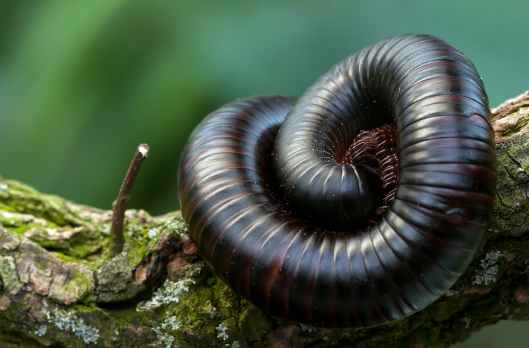
black and brown millipede on a green and brown branch

Photo by Pixabay on Pexels.com

In biology, we also find translational symmetry or something close to it. The segments of a tape worm, the segments of the body of a millipede or centipede, the small legs of a lobster, and even our own vertebrae and ribs show translational symmetry. In social structures as well, we find both mirror symmetry and translational symmetry. For instance, the Golden Rule says to do unto others as you would have them do unto you. In addition, as it happens, if we are nicer to other people, then, generally speaking, they are also nicer to us. This is not always true, however. Some people simply take advantage and view all of life as a zero sum game. Whatever you gain, they lose and vice versa. This is a very limited, inaccurate, and self-defeating attitude in most social situations. Most social situations, are, of course, much more complicated. Generally speaking, there are a great many situations that both you and your “opponent” or even your “enemy” would agree are good and a great many others that both of you would agree are bad. If you are playing tennis or golf outdoors, for instance, you may be fiercely competitive but both of you would probably find a game that brings out the best play is better for both of you. Both of you would probably also agree that being rained out is a bad outcome.  

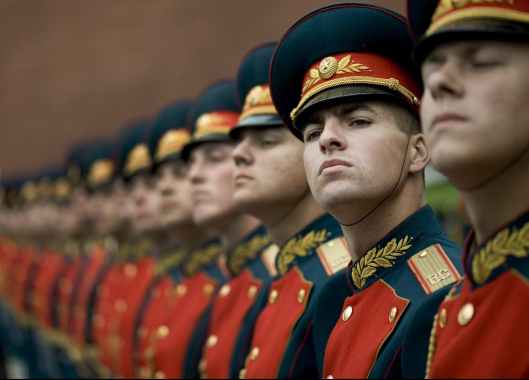
men in black and red cade hats and military uniform

Photo by Pixabay on Pexels.com

In the military and in many industrial settings, there is a great deal of translational symmetry. The “ideal” set-up is to have many groups at each of many levels and each group is meant to be as similar as possible to all the other groups at that level. The marching that military groups learn is both symbolic of this translational symmetry and practice in behaving as a unit composed of identical parts. Whether or not this is the best way to run a military is debatable. To me, it’s undeniable that this management style has been imported into a huge number of organizations where it is definitely not the best way to organize. 

The last thing to note is that symmetry also pops up in design. There is often a whole series of information exchanges from people who have quite different areas of expertise. These exchanges can result in mutual learning, solutions that work, and often patents, and occasionally, some really cool, transcendent, game-changing designs. In my experience, it is much better to have a design process based on symmetrical relationships founded in mutual respect than to have a design process based on having someone in a hierarchical power relationship make decisions that are to be implemented by an identical set of “underlings.”  

macro photography of snowflake

Photo by Egor Kamelev on Pexels.com

The Takeaway

Symmetry is everywhere. There are many forms. If you start looking for symmetry, you will find examples in nature, in mathematics, poetry, art, music, machine design, the military and even in design problems and design processes. Thinking quite consciously about the types of symmetry that exist in a problem space and what could or should exist in that problem space, can lead to novel solutions.


——————————————-

Author Page on Amazon. 

The Walkabout Diaries

Local Symmetries

Alternating Repetition

The First Ring of Empathy

Donnie Takes a Blue Ribbon for Spelling

Travels with Sadie

It was in his Nature

A Cat’s a cat

A Suddenly Springing Something

Hai-Cat-Ku

Hai-Ku-Dog-Ku

The Dance of Billions

Roar, Ocean, Roar


Travels with Sadie 6: Find Waldo

02 Thursday Jan 2025

Posted by petersironwood in creativity, nature, pets, psychology

≈ 5 Comments

Tags

art, beauty, life, mindfulness, photography, truth

It’s kind of a fun game. “Find Waldo.”  Or, “Find the Pig in the Clouds.” And—once you find it, you typically find it immediately the next time. 

Here’s a variant that I like: “Find the Beauty.” 

The idea is simple. You go to an art gallery or a museum and it’s fairly easy to find the beauty. No big surprise there. 

Go into a natural setting and you’re often absolutely surrounded by beauty at many different levels of scale. 

Go to see a world-famous architectural achievement, and you will see beauty. 

But—you know what? There’s also beauty to be found in many ordinary and every day places and circumstances. Since you can’t always control where you are, it’s a good skill to find that beauty wherever you are. 

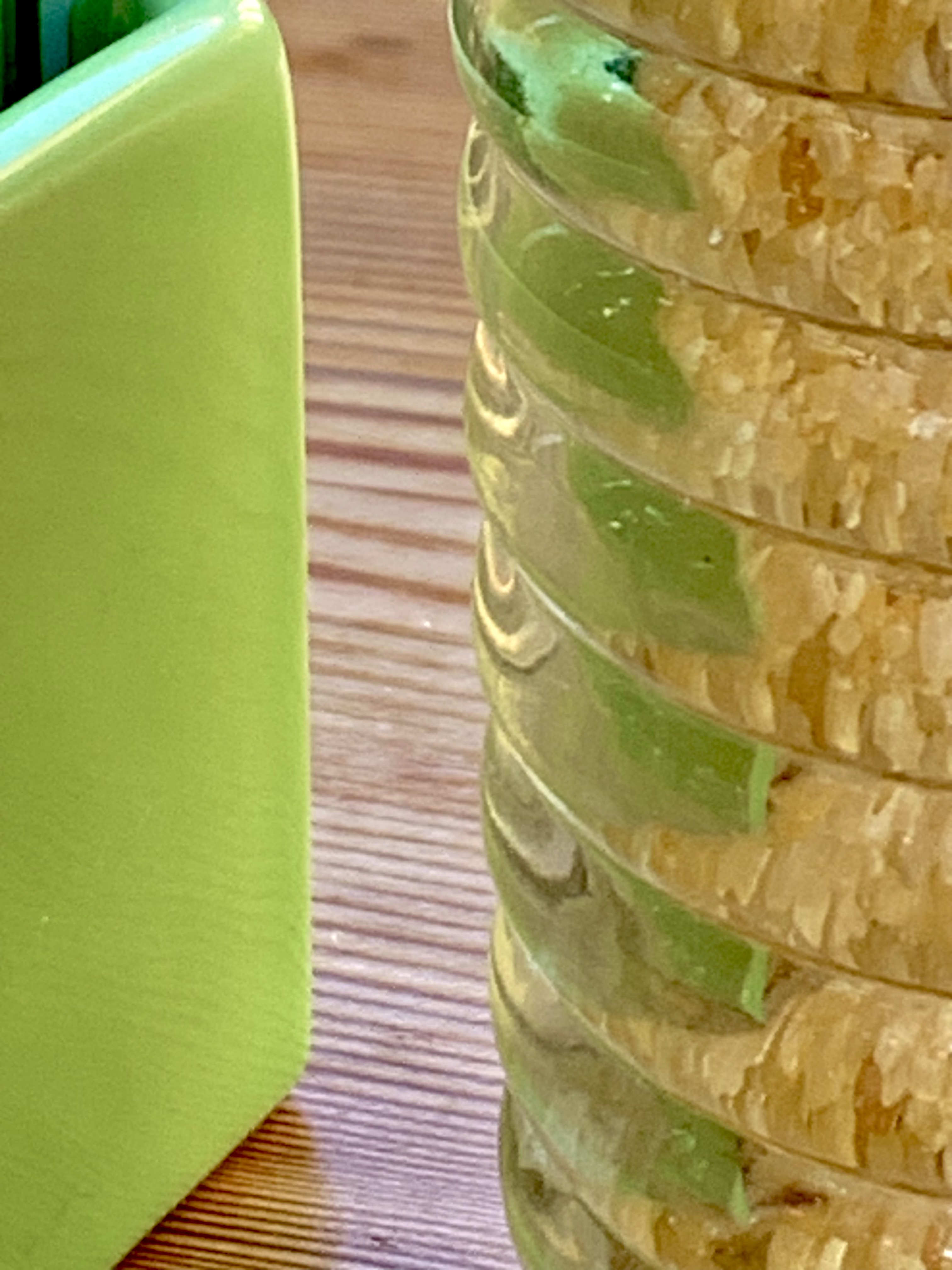
Today, Wendy and I took Sadie and Bailey out to one of our favorite dog-friendly restaurants. We had a very long wait. None of the four of us is high on the scale of patience. When we finally sat down, however, the dogs were very well-behaved. 

While we waited for our food to arrive, I looked around for Waldo.

He wasn’t there. In fact, no-one even had a checkered shirt on. 

So, instead, I looked around for beauty. 

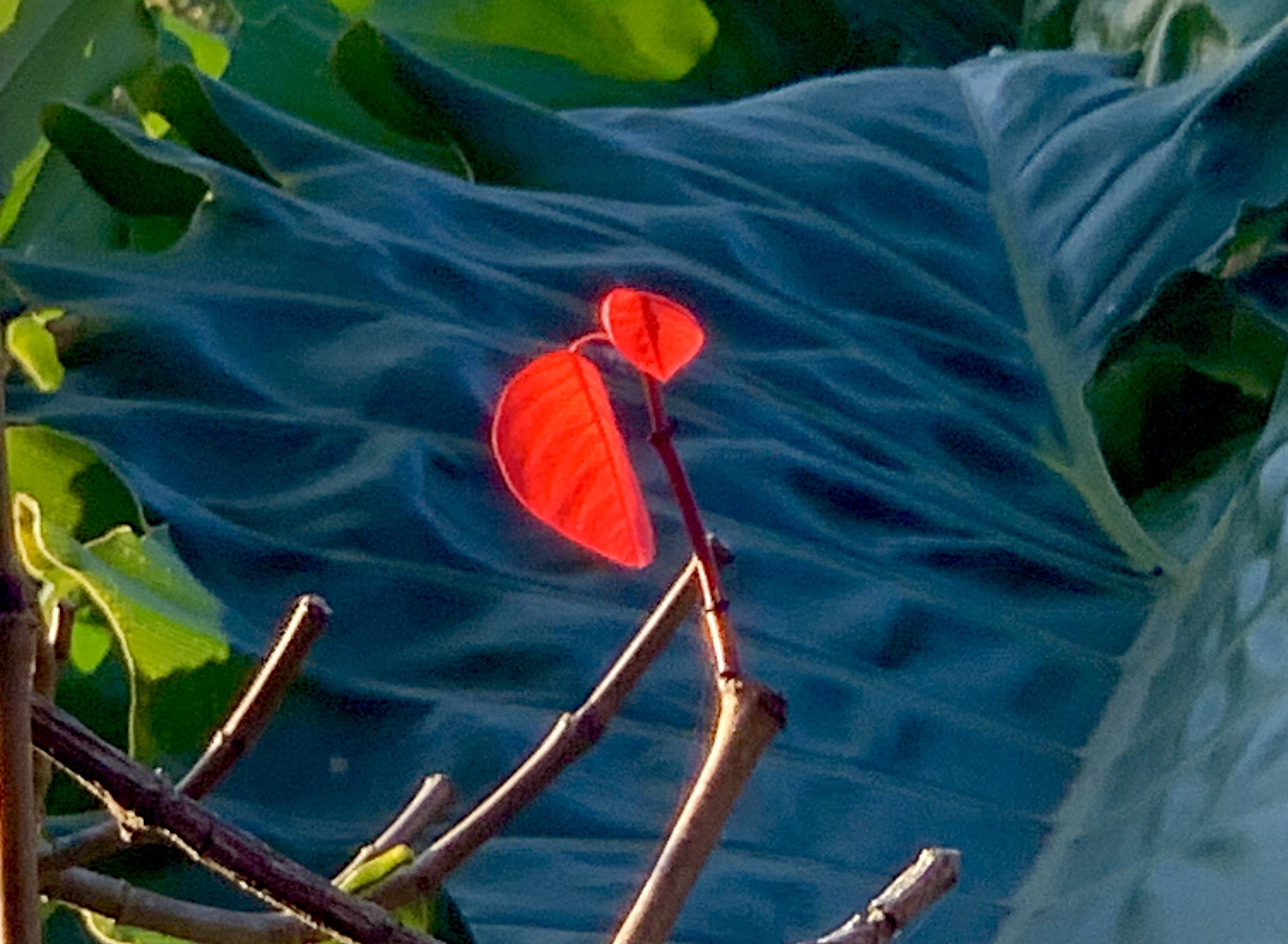
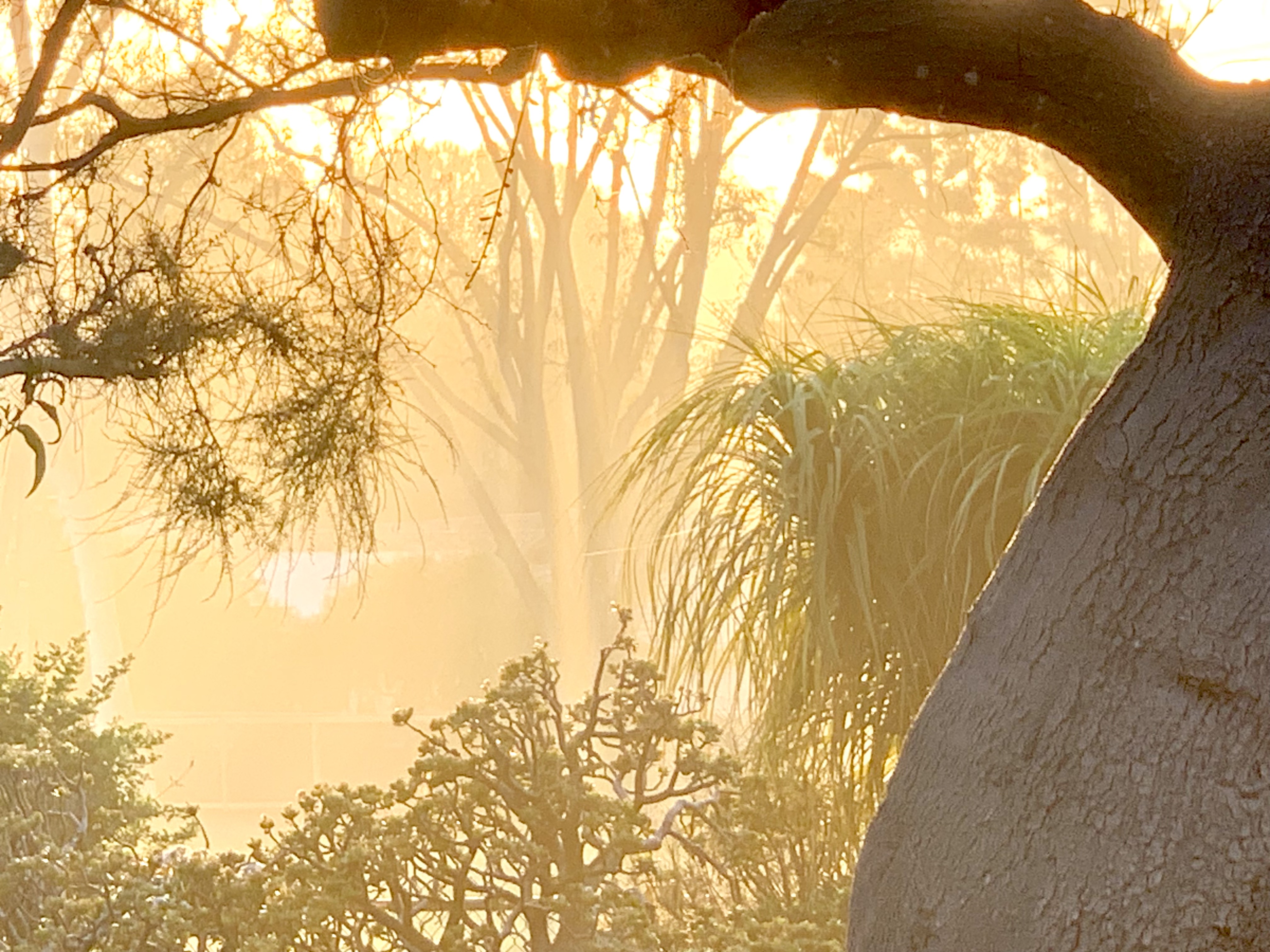
As usual, I found it, at least to my eye. 

Give it a shot. You’d be surprised where you can find beauty. 

—

——————-

Author Page on Amazon

Fit in Bits suggests many ways to work more fun, variety, and exercise into daily chores. 

Corn on the Cob is an essay on mindfulness and gratitude for simple things.

Fifteen Properties begins a series of posts about the fifteen properties that architect Christopher Alexander said characterized both natural beauty and good design. 

Maybe it Needs a New Starter is a poem about the beauty that might be found even in malfunction.

Levels of Beauty is a short picture essay about how you may find beauty at different levels.

Not Long the Daze is a short poem about finding beauty.

The Jewels of November is a longer poem about how sometimes simple beauty can be obscured by flash and dazzle.

Galactic Best is a short poem about the most wonderful planet we know of.

Kinda Crazy is a short poem about how one might perceive the world.

The Puppy’s Snapping Jaws is a short poem about a beautiful sound.

First Things First is a short poem about priorities.

What Line? Is a short poem about an important decision.

Small Things

30 Monday Dec 2024

Posted by petersironwood in creativity, nature, psychology, sports

≈ 2 Comments

Tags

beauty, fitness, gratitude, health, life, mindfulness, plantar-fasciitis, sports, Tennis, truth

Those of you who might not have read every one of my hundreds of blog posts might have missed the story about my bout with “plantar fasciitis.” I had a persistent pain under my right heel. It was painful when I walked and I liked to walk every day. When I described the symptoms to some of my family and friends, more than one suggested I visit a podiatrist. A podiatrist, after all, is an expert in medical issues of the foot. 

I made an appointment and sure enough, she confirmed the diagnosis several of my friends had mentioned: “Plantar fasciitis.” She showed me an exercise to stretch the tendons of my foot; gave me a prescription for megadoses of a non-steroidal anti-inflammatory; and she cautioned me to stop walking so much until my symptoms improved. I followed this advice, but my foot actually began to hurt more. After about a week of this, I went back to walking and my symptoms improved but the pain was still there. 

A week later, I was watching TV with my wife and cats and in our nice warm dry basement (Shout out to Be-Dry). I often like to “fiddle with stuff.” On this particular occasion, I happened to “fiddle with” the sole insert in my shoes. I removed the insert and noticed that a small pebble had somehow managed to lodge itself under the heel of the insert on my right shoe. 

Now, when I call it a ‘pebble’ I do so simply because I don’t know of a better word. It was larger than a grain of sand, but not by much. When I say ‘pebble’ I’m afraid you might be thinking of something more like the pretty pebbles that one might find beach-combing. You would not have seen this ‘pebble’ unless you were crawling along the beach with your nose about two inches from the ground. It was about the size of a lower case ‘o’ in this font size. Hard. Sharp. But tiny! I thought could this possibly be the source of my pain? No. No. It’s much too small.

Nonetheless, I removed it and my ‘plantar fasciitis’ disappeared. 

I was reminded of this today walking my dog Sadie who most often walks with her nose almost on the ground. Sometimes, I see a distinct wet stain that she stops and examines. Most times, I have no idea what she is sniffing at. I presume it’s often a bush leaf where the scent of another dog is particular strong. She pays attention to places I have seen a rabbit or bird earlier. She likes to retrace the path that our other dog Bailey took if I happened to have taken him out to pee. But it isn’t only where he’s peed. She seems to know the path he walked. Similarly, if I have taken the car somewhere in the last 48 hours, she goes over and sniffs that. She sniffs at my door only if I drive somewhere alone. But if I go to the grocery store, she also sniffs at each door that I have take groceries out of. 

Yes. We all know dogs have a good sense of smell. But—seriously—how many molecules can she sense? Apparently, dogs can detect some smells in concentrations as small as 1-10 molecules per milliliter of liquid. A very small number of molecules could spell the difference between an escaped prisoner being tracked and recaptured or escaping to a new country and enjoying decades of freedom. Small thing—big effect.


I recall reading a science book as a youngster that showed a man holding a test tube. At the bottom of the test tube was a small amount of white powder. The caption said that this was enough botulism toxin to kill everyone on the planet if properly distributed. That seems an odd use of the word ‘properly’ but leaving that aside, it is clearly extremely toxic. How does the toxin work? It interferes with your internal communication system. Your brain sends a signal to your diaphragm muscle to contract, but the signal never gets to the muscle. Small thing—big effect. 

Small things having big effects is not always about small things causing problems. Small things can also be important in having big effects in a positive way. For example, if you do such a small thing as look around you for beauty, you will often find it. If you don’t, look harder. If you still don’t, then create some or go elsewhere. If you make this small habit, over the course of your entire life, you will fill your brain with much more beauty. That is no small thing. It will impact your health and your behavior toward others. Small thing—big effect. 

There are many examples from sports. Most athletes realize that they it helps to have a physical routine that is unvarying before throwing a baseball pitch, hitting a tee shot in golf, or hitting a tennis serve. Fewer realize that it’s equally important to have a consistent mental routine as well. I found it useful before every golf shot to say to myself, “Hit it perfect—like you know you can.” 

Small things can also make a big difference in terms of what you observe. For instance, in my tennis group, there were, for a time, a high proportion of left handed players. Roughly half of the players were lefties, though only about 10% of the population is left-handed. Of course, it’s fairly obvious immediately that one’s opponent is left-handed. A clear implication is that what constitutes a backhand and forehand are on different sides. A more subtle difference is from the natural sidespin that is put on a shot. A forehand topspin shot, as the name implies, is mainly topspin. Some players hit a fairly flat shot while others—notably Rafa Nadal and, more recently, Carlos Alcaraz, can hit with tremendous top-spin. This shot also has somewhat of a sidespin component and that varies from player to player. Although professionals can alter the degree of sidespin, the amateurs I play with have a habitual way of hitting the ball. As the ball strikes the ground, a right-hander’s shot toward my side of the court will bounce slightly to my right while a  left-hander’s ball will bounce slightly to my left. This means that positioning my feet optimally for the return shot will be somewhat different for various players. 

There are many small differences in how people play. If you notice such differences, you can do a much better job of “reading” what type of shot a player will hit, where they are aiming, and so on. The differences are slight but cumulatively, the impact of noticing such differences is considerable. Small thing—big effect. 

I don’t like to receive flattery and I don’t like to flatter people either. However, I do make a habit of giving people compliments. If you are observant, this is usually easy to do because most people are doing good things most of the time. When I play tennis, for example, my partners and my opponents will often hit excellent shots. I comment on it. It makes for a better game. Over time, it’s better for everyone. Never admit aloud your opponent has just hit a good shot? Keep on your game face? Not my thing. Why make life grimmer and meaner? Someone hits a great serve or a good tee shot or sinks a long putt, I compliment them. I’m impressed. So why not share that feeling? Small thing—big effect. 

————

How the Nightingale Learned to Sing

Roar, Ocean, Roar

Imagine all the People

Dance of Billions

Life is a Dance

Take a Glance; Join the Dance

Author Page on Amazon

The Winning Weekend Warrior 

The Walkabout Diaries: Levels of Beauty

14 Sunday Jan 2024

Posted by petersironwood in Walkabout Diaries

≈ 9 Comments

Tags

beauty, flowers, life, nature, peace, poetry, rose, roses, truth

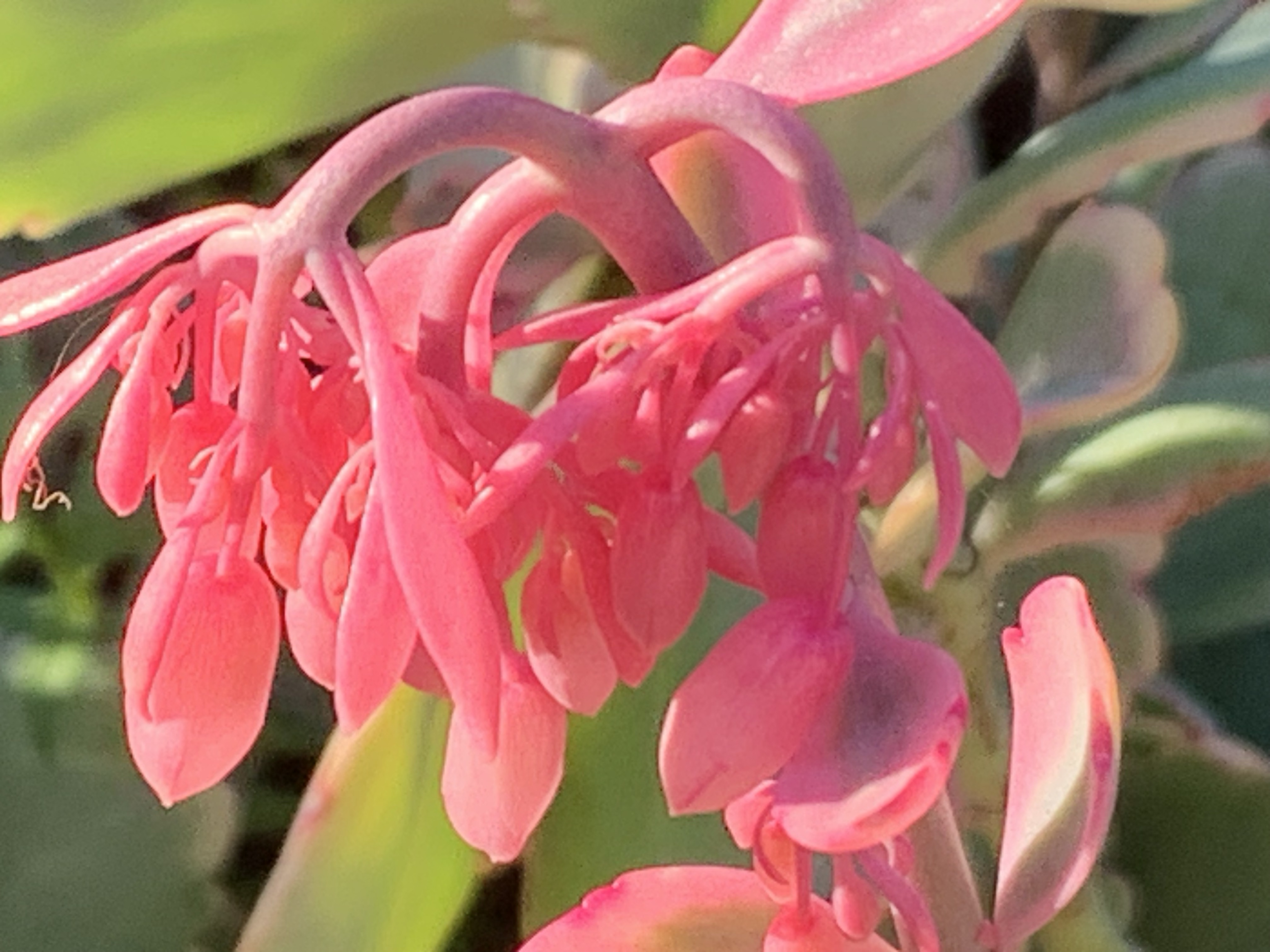
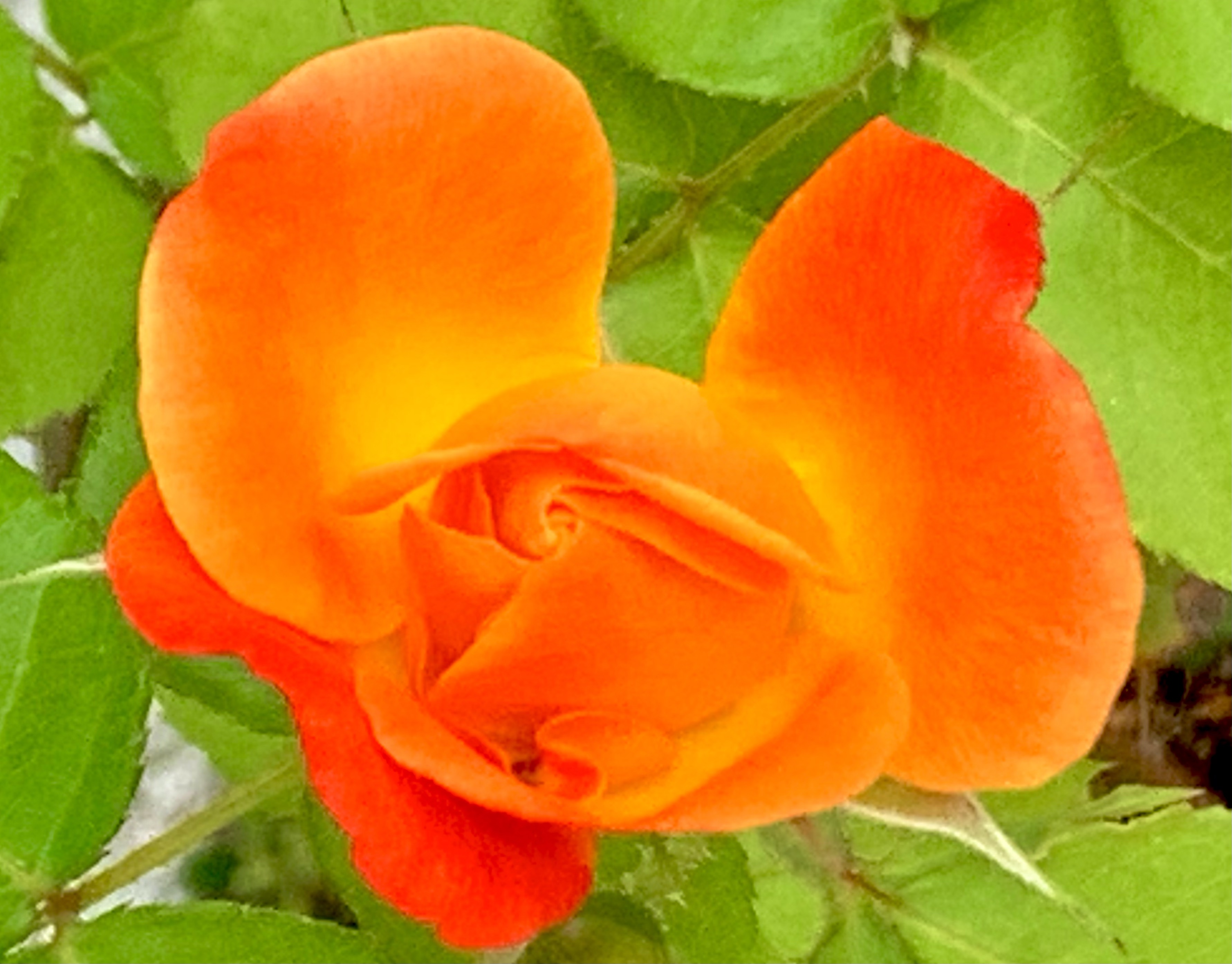
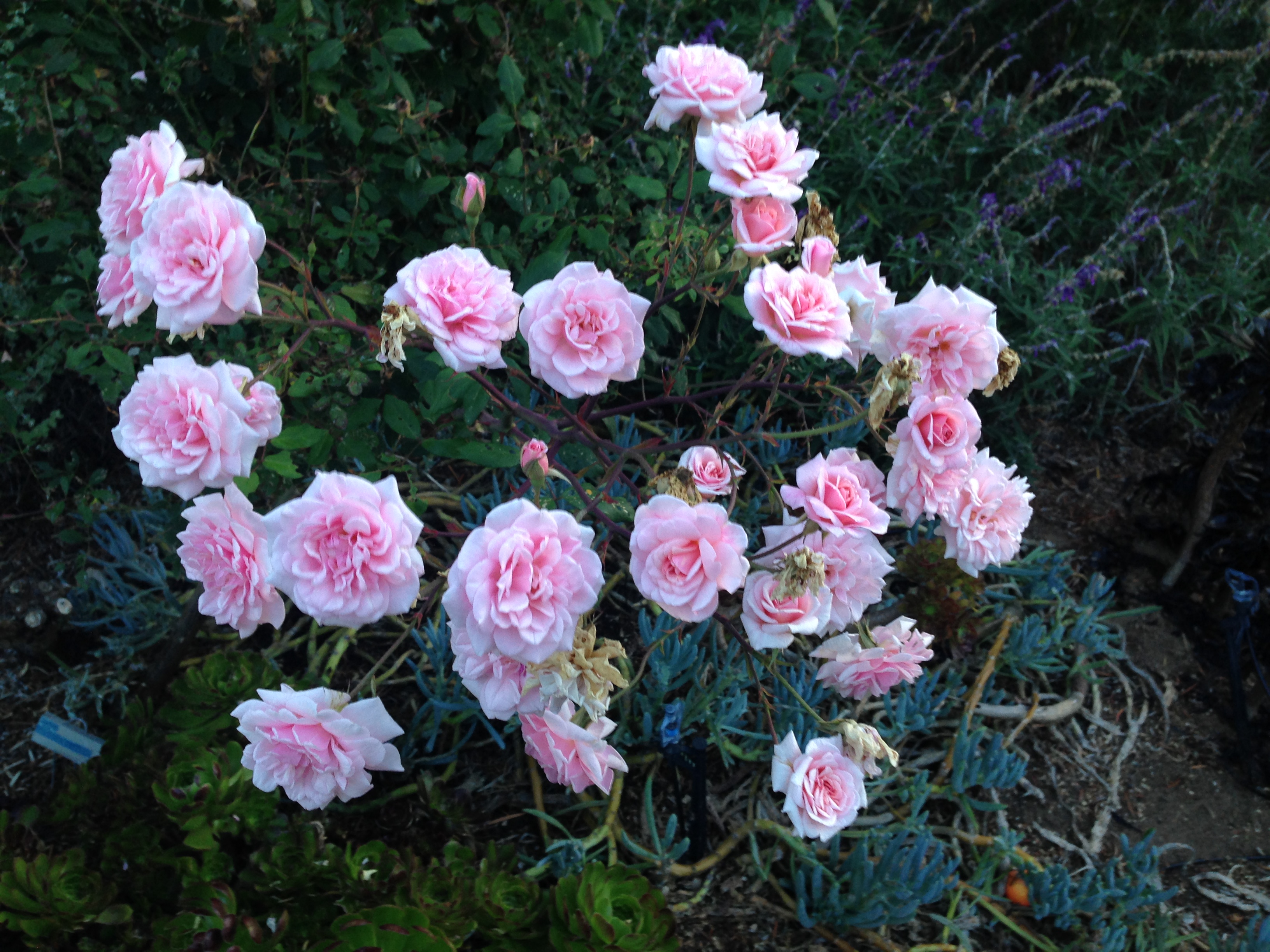
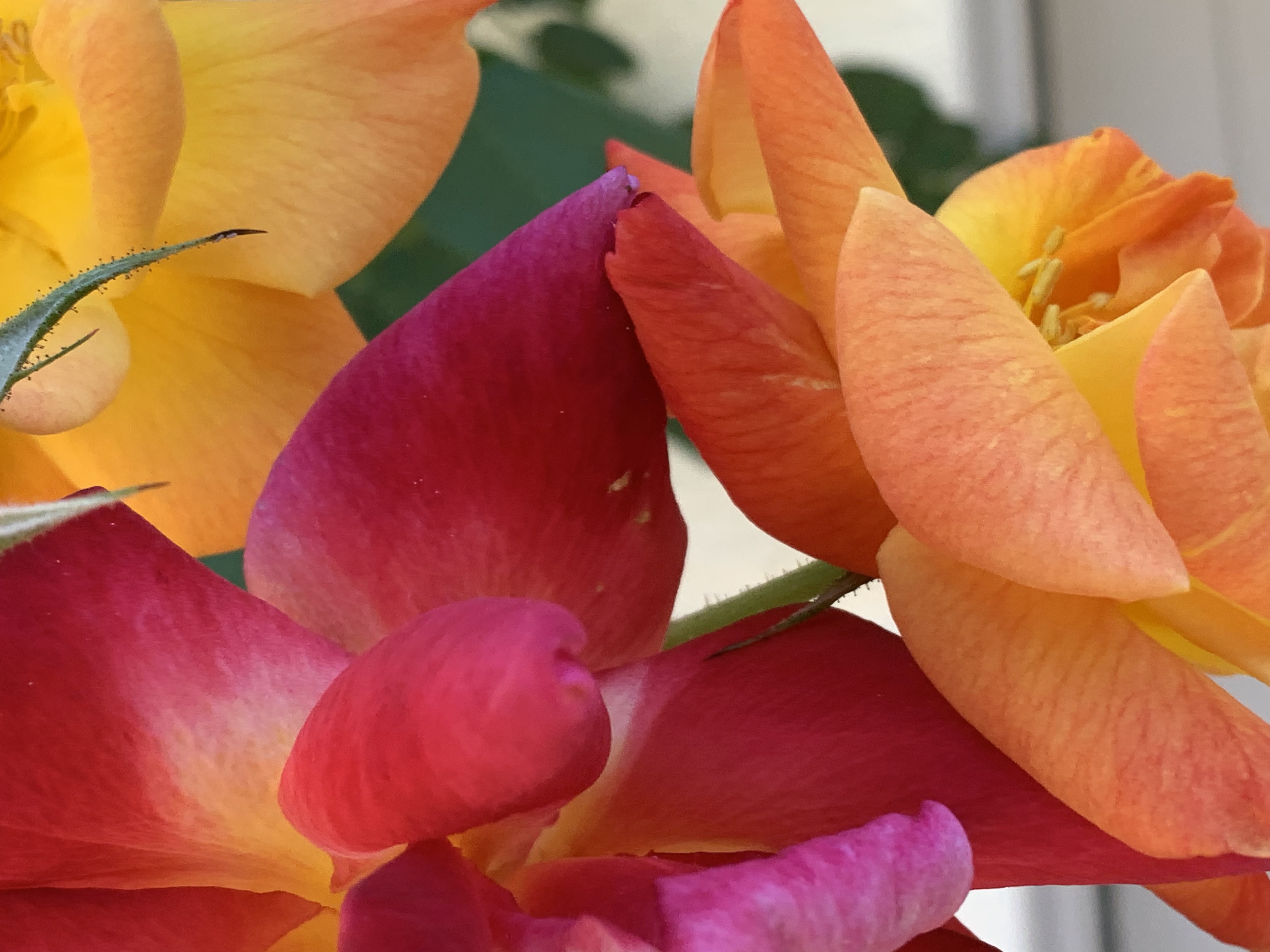
Christopher Alexander was an architect who wrote much about architecture, including the well-known book, A Pattern Language. Later, he also wrote about “The Nature of Order.” He posits 15 properties of natural beauty and good design, the first of which is “Levels of Scale.” I was thinking about that today as I admired our Jacob’s Coat Rose bush which blooms about 3-4 times a year here in San Diego.

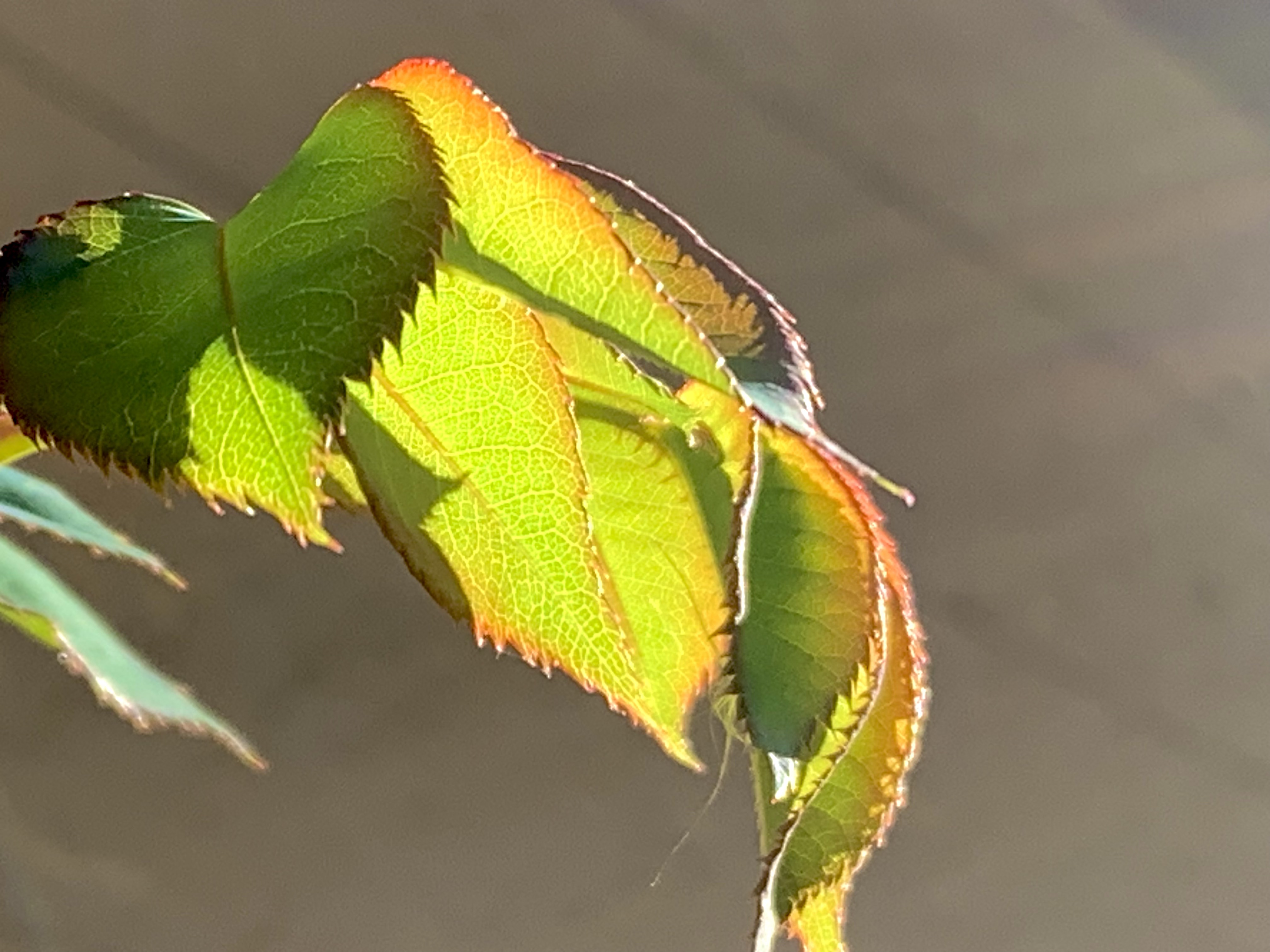
Most of us see the flowers of the rose as beautiful. And indeed they are. They are beautiful from afar. They are beautiful up close. But so too are the other parts of the rose plant. At least, sometimes, the leaves are also quite beautiful.

Even the thorns are beautiful.

Beyond this surface level, the rose, like all living things, is beautiful inside. Like all living things, it’s survived four billion years of evolutionary time. The way cells are arranged and the way they work–this is beautiful as well. Moreover, the relationship that roses have to humans and bees are also beautiful. Imagine having the faith and hope to depend on a completely different species to reproduce. Imagine being so beautiful that human being across the globe spend their time and money to keep you thriving.

Did I mention that, like other green plants, roses remove carbon dioxide from the atmosphere and provide oxygen for animals like us?

Roses are so famous that they play a part in history and pageantry. The War of the Roses. The White House Rose garden. Destroying part of the Rose Garden is also symbolic. The Rose Parade. Individuals give each other roses. They are variously symbols of love, friendship, and peace. Roses appear in poetry, songs, paintings, and both first and last names.

“A Rose is a rose is a rose.”


Fifteen Properties

The Walkabout Diaries

The Walkabout Diaries

The Walkabout Diaries

The Walkabout Diaries

Author Page on Amazon

Thirsty Thursday

13 Thursday Oct 2022

Posted by petersironwood in nature

≈ Leave a comment

Tags

beauty, life, nature, rain, truth

Water is life.

At least, most forms of life need water. Indeed, most forms of life are mostly made of water.

Water is some amazing stuff. It’s one of the few things that ordinary people in ordinary circumstances see in solid, liquid, and gaseous phases. One thing that’s unusual about water is that when it freezes, it expands. It also has a high “heat capacity.” This means that water takes a lot of heat energy, relative to most materials, to increase its temperature. It also means that, once heated, it takes a long time for the water to cool to the ambient temperature. It’s why land areas that are near the oceans tend to be more moderate in temperature than similar places inland.

A hundred miles inland from where I live is a place called “Palm Desert.” The average night temp in the coldest month is 41 degrees Fahrenheit while the average daytime temperature in the warmest month is 107 degrees Fahrenheit. That’s a difference of 66 degrees! I live near San Diego, a few miles from the ocean. For San Diego, the average coldest temperature is 51 degrees and the average for the high is 77. That’s a difference of 26 degrees. Quite a difference. That difference is due to the high heat capacity of water.

Water is beautiful in many forms: rivers, springs, waterfalls, clouds, rainbows, dew, rainstorms, ocean waves are just a few of the many ways that water strikes us as beautiful.

A well-fed adult human can last weeks without food but only a few days without water. I wonder whether we also need the beauty of water. It shows that the region we’re in may be survivable. It also indicates there is other life as well nearby. Perhaps as a corollary to these, water may remind us as well that what is “out there” and beautiful to look at is also “in here” — inside us.

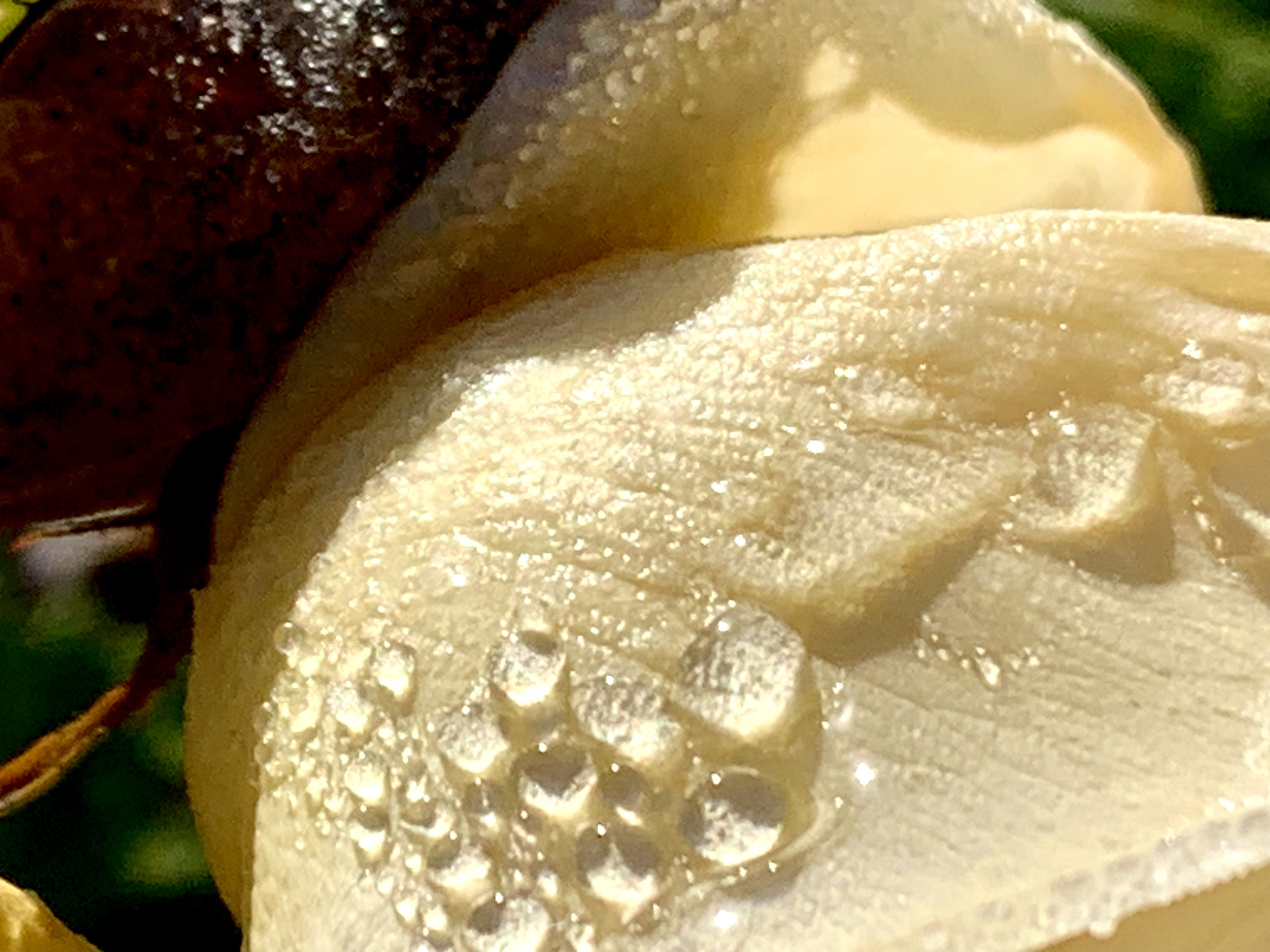
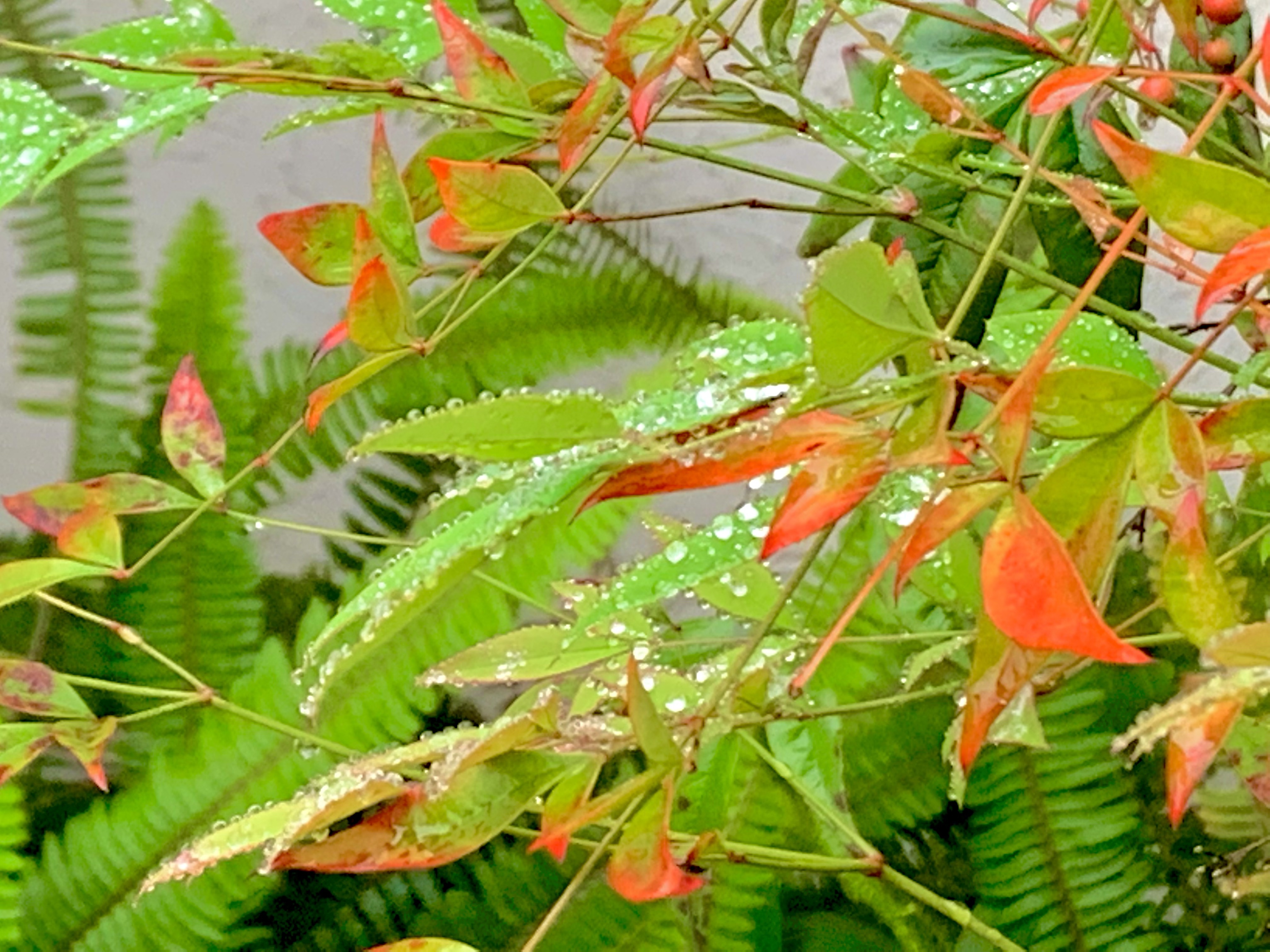
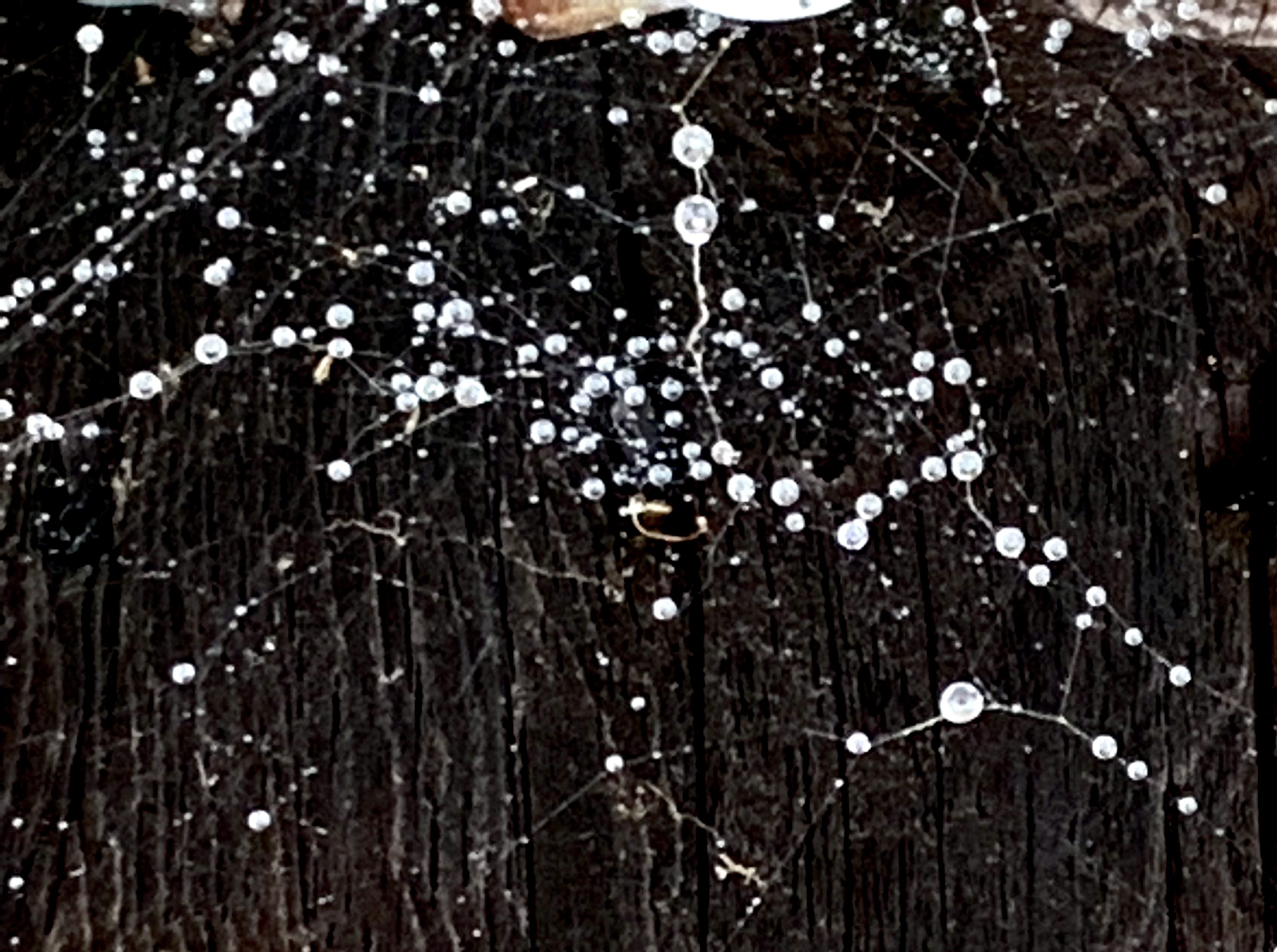
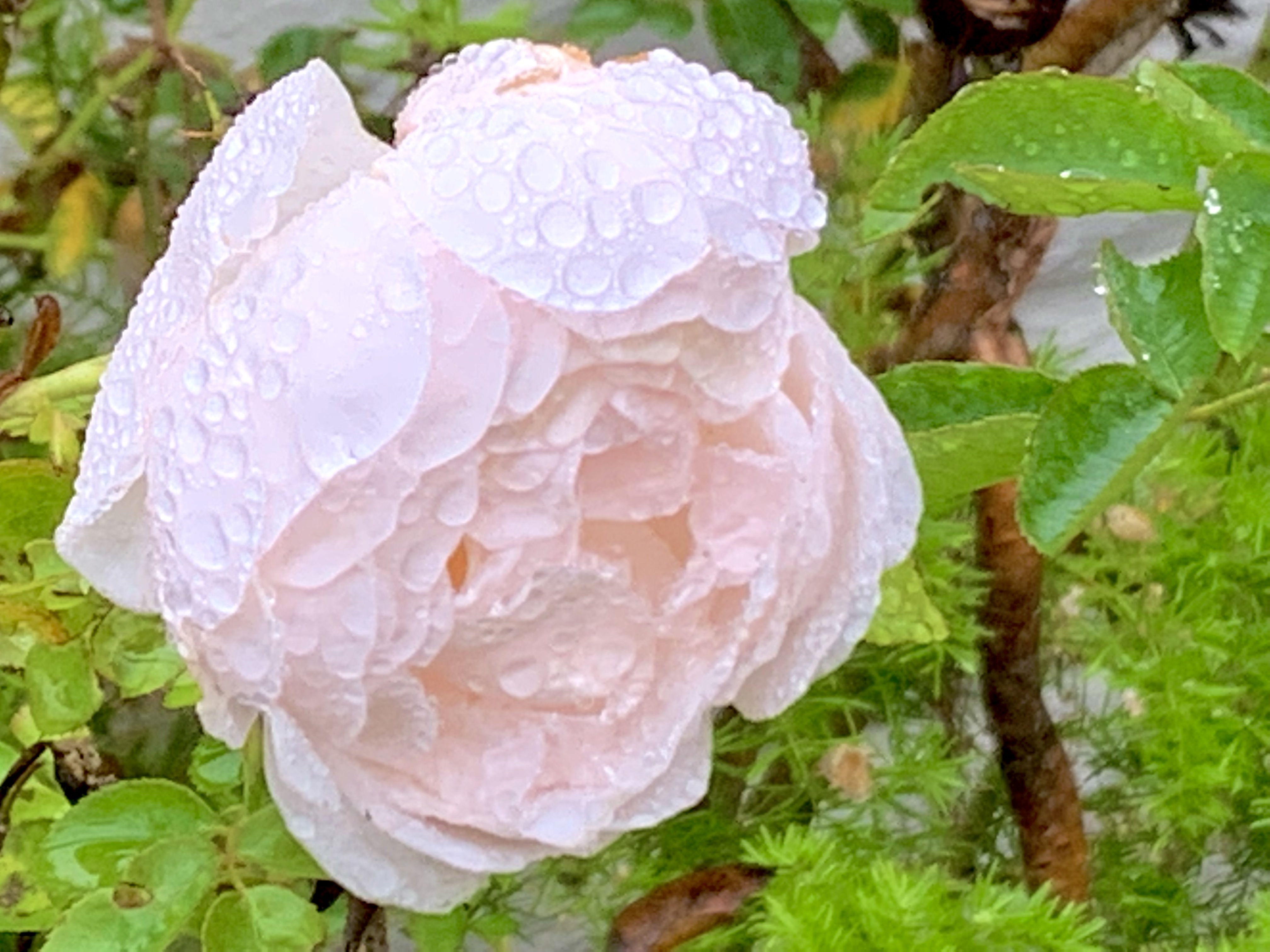
Water also plays with and transforms light. When water shows itself as droplets, as shown in the pictures here, it demonstrates two aspects of its nature: it adheres to other surfaces and it coheres to itself. A drop of water on a flower or leaf demonstrates its dual nature. This is also our own dual nature. We must play our part for a time as a separate droplet, but such a droplet does not keep that form forever. Each one of these water droplets has been part of a cloud, part of a river, part of an ocean. We too change. We too need to be coherent. But we also need to interact with and adhere, at least for a time, to aspects of our environment.

A drop of water does not obscure the form of the leaf or petal it finds itself on. Rather, the droplet enhances the form of the leaf or petal upon which it rests.

What about you?

The Walkabout Diaries: The life of the party

The Walkabout Diaries Mind Walk

The Walkabout Diaries Sunsets

The Walkabout Diaries Bee Wise

The Walkabout Diaries Friends

The Walkabout Diaries Life Will Find a Way

The Walkabout Diaries: Walk in the Park

The Walkabout Diaries A New Rose is a New Rose

The Walkabout Diaries: Racism is Absurd

The Walkabout Diaries Lest we Forget

Ice

Dance of Billions

Roar, Ocean, Roar

Choose Your Weapons!

06 Wednesday Apr 2022

Posted by petersironwood in Uncategorized

≈ 8 Comments

Tags

beauty, essay, flower, flowers, guns, photos, USA

“Choose your weapons.” 

An expression that perhaps goes back to the Roman Coliseum or “gentlemanly” dueling. What is a weapon? What can it mean to say, “The pen is mightier than the sword.”? 

A few years ago, I decided to try a little experiment. I knew that studies showed that owning a handgun did not, in general, make you safer. Actually, it was the reverse. Nonetheless, I thought perhaps I would feel safer. For one week, I imagined that my cellphone was a lethal weapon. I could pull it out and cause someone else horrendous pain or to end their life or both. As you might imagine, I did not feel more secure or safer. I felt more paranoid about others but also afraid I might accidentally shoot someone. 

In the middle of Monday night, one of our cats turned over some cat bowls and made a huge ruckus. I immediately yelled bloody murder and jumped out of bed. I would not want to have a gun if I’m awakened like that. My body is primed for action and my mind is not yet anywhere to be found. I literally have no idea as to what’s going on. It only last a few moments. But those few moments are enough time to grab a gun and shoot someone. And that someone is far more likely to be someone in your family than a home invader. Maybe they left a book in your room and couldn’t sleep so they came into your room to retrieve it. I don’t really think an error like that is self-forgivable. Your mood would be altered much to the negative for the rest of your life. The only alternative would be to shut off your feelings so completely that you literally became a heartless monster. 

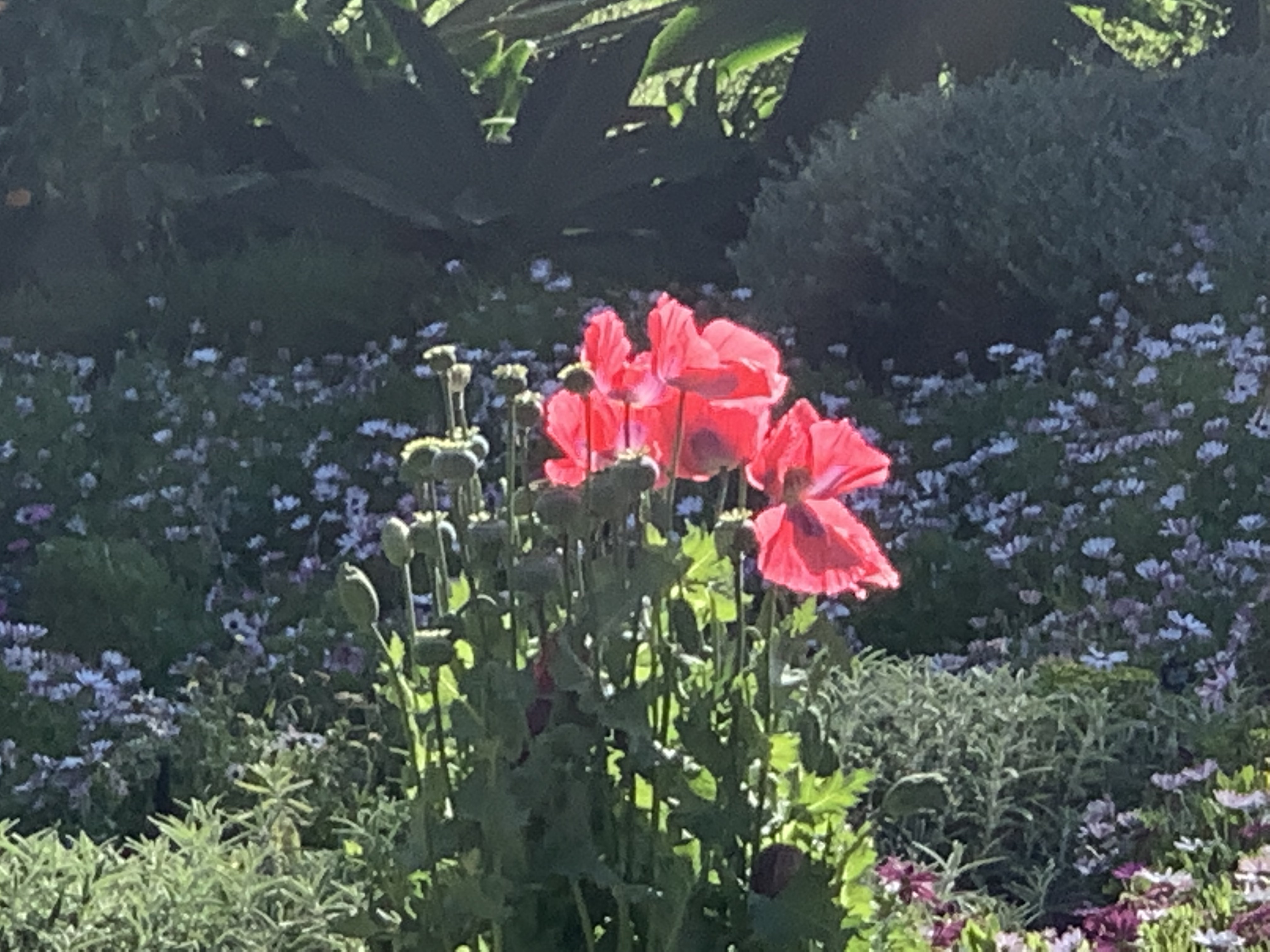
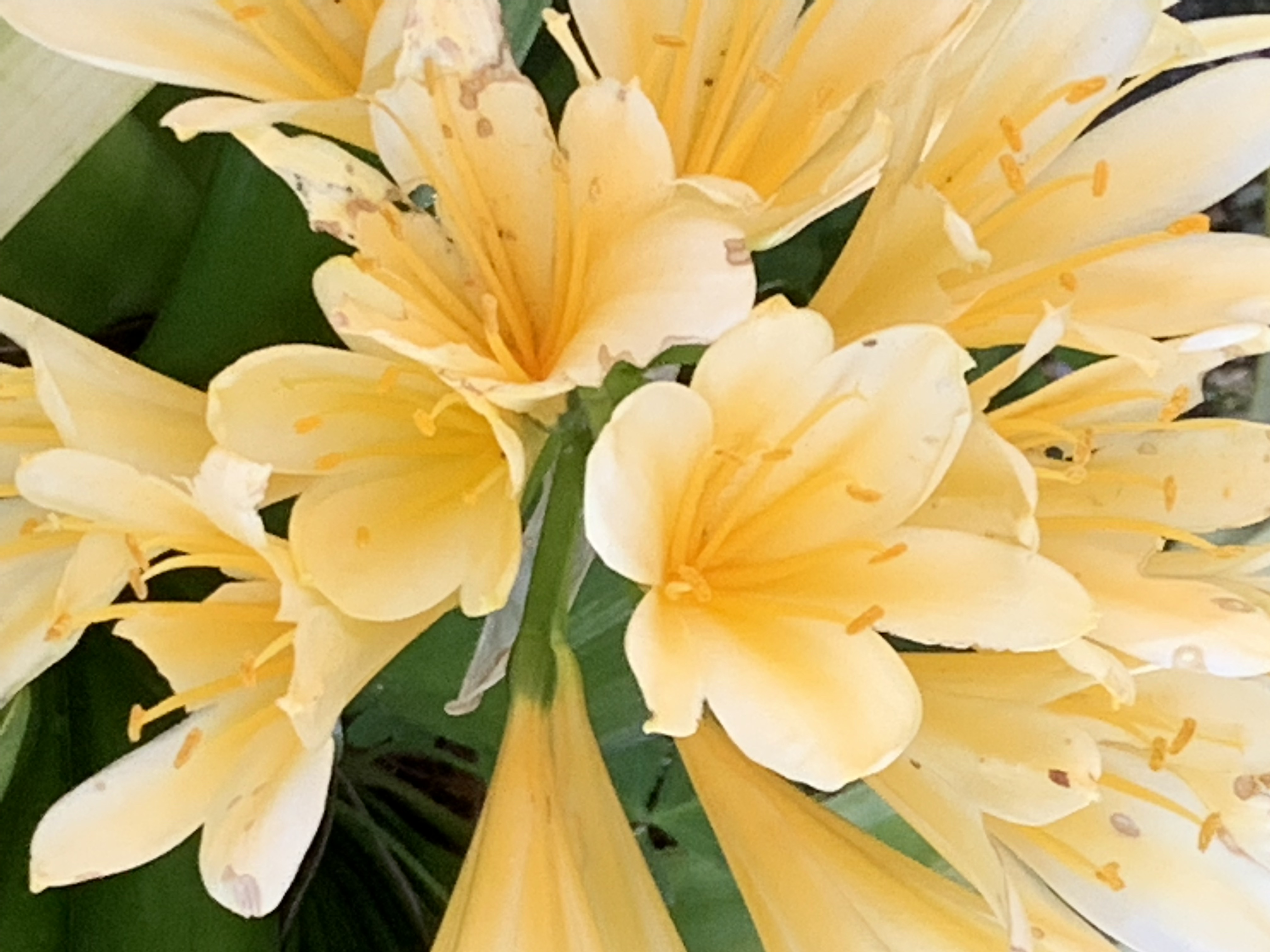
What occurred to me tonight taking pictures of flowers, as one is wont to do, is making a much better use of the iPhone than a gun for home protection is. For one thing, if you own a gun for home protection, you hopefully rarely use it. I use the iPhone nearly every day. The statistics say that you’re actually more likely to die in a home invasion if you have a gun, but let’s say, no, in your particular case, you did manage to shoot two people dead. And, that’s that. 

Except of course, it isn’t done at all. You will find out that those two people you shot didn’t think it was so cool and they may sue you. Or, you may find out things about those families such as how desperate they were to make enough money to feed their kids that they turned to crime. Of course, you don’t want to hear that. They broke the law. And, indeed, in many states, that can be enough to get you off the hook. 

The “hook” of the law, that is. But that’s not the only hooks there are. There’s the social hook. How do you think other people would view you? Maybe some will view you as a hero. But certainly many will not. You might end up being much more annoyed at those who view you as a hero that at those who view you as a villain. Either way, your life will never be the same. Those changes are much more likely to be negative on balance. 

There’s another social hook. How would you feel about someone you care about marrying into a family where someone killed two young lads? Better protected? Or, might you be worried about how that gun might be used in the future, in say, a marital dispute? (Although, of course, suicides and accidental killings should also be on your mind, but those are always a possibility with a gun owner. But in the case of the dual killer, we don’t just know he might kill when provoked; we know he will kill when provoked. Maybe you think a home invasion is sufficient reason for murder. But how about a marital dispute? Surely you’ve noticed that even couples who love each other can come to a point where they are too frustrated to think clearly. I don’t really see how a gun helps a situation like that. 

Lastly, there is your own hook. That may be the sharpest and deepest cutting hook of all. You will second guess your actions on the night of no matter what. That’s just human nature. Some dark, rainy evening, when that re-run is playing for the 13th time, it will hit you that you knew damned well they were unarmed. Another part of your brain screams “Bullshit!” And, so you block it out. Until several weeks later, you discover your cousin’s preferred brand of weed is way stronger than what you’re used to. And, as that snuff movie replays itself yet again, it occurs to you that you not only knew they were unarmed, you thought: “So what? Nobody’s going to put me in prison for it. In this state, they’l think I’m a hero.” Again, you hear the booming voice: “Bullshit!” Only this time, you realize that isn’t your voice at all. That voice is the one he used to destroy you when you told people about his molestations. That’s not you. Or is it? You might, at some point, find yourself depressed by this debate, perhaps riddled with self-doubt. At other times, maybe you’ll come to peace with your actions. But the debate will never stop. 

I take pictures of flowers. They are for anyone to enjoy or ignore. No regrets. That’s my “weapon” of choice. 

————————————

Author Page on Amazon

Family Matters

Stoned Soup

Clarence but not Darrow

Con-Con Man’s Special Friend

How the Nightingale Learned to Sing
The Walkabout Diaries: Bee Wise

The Walkabout Diaries: Sunsets

The Walkabout Diaries: Friends

The Walkabout Diaries: Life will find a way

Ghosts of Flowers Past

Mind Walk

A Walk in the Park

A Rose is a Rose is a Thinking Rose?

08 Tuesday Mar 2022

Posted by petersironwood in Uncategorized

≈ 2 Comments

Tags

beauty, decision making, Design, essay, flower, flowers, life, rose

Rose bushes lack neurons. 

But that doesn’t mean that they, as a species, and they, as individual plants, don’t make decisions and embody strategies and tactics.

Today, a local crow and I were playing the counting game. I think that’s the most parsimonious explanation, even though I can’t “prove” it. Here’s what actually transpired. I went out into the garden to take pictures of flowers before it gets too chilly. Soon a crow said, “CAW!” So I said, “CAW!” 

Then, the crow crowed “CAW! CAW!” So I repeated that message. Any way, we got up to three and the crow started over at one and we went through the whole sequence three times. 

Photo by Pixabay on Pexels.com

They cawed three times and I said: “That’s what we call ‘Three’ and I “cawed” the first three digits followed by cawing three times. He cawed back.

Then, once again, I said, “One, Two, Three” and “CAW! CAW! CAW!”They next did something I don’t recall hearing before. They did a distinct two-tone CAW: I think it was low-hi. I went out to photograph roses, not take notes on crows. I repeated his two-tone CAW as best I good and he flew off while cawing about ten times. I fantasize that they flew off to tell their friends that they discovered a human who almost seems smart enough to CAW! Indeed, they are having quite a conversation out back right now. I am not yet sophisticated enough to know what they are talking about but cross-species communication is pretty cool. 

The rose bush speaks to me too, of course. 

I cannot hear it with my auditory apparatus. At least, not yet, I can’t. I have to “listen” with my eyes, and my mind, and my heart. I “know” something of what the rose wants and needs. I know it needs water and sunshine, for instance. It needs minerals. But those things are true of green plants in general. What does the rose tell me about its strategy and tactics for survival and thrival? 

No, the rose bush cannot answer my spoken questions, but that often happens when it comes to communicating with other humans. I have read some poorly documented code (perhaps my own) and tried to figure out what the heck this code is doing. Probably, the single most important thing is to understand what the programmer was trying to do. What was their intention. I don’t actually have to know what precisely was in their mind in order to understand it at a useful level. This particular human programmer might have been thinking primarily about getting a raise, or impressing their supervisor, or outdoing their friend. Who cares? I need to understand an imputed design rationale.

Photo by RF._.studio on Pexels.com


In that same sense, I strive to understand the imputed design rationale of the rose plant. It doesn’t require that the rose talks to me in English. For example, why are a rose’s blooms so beautiful? Certain, the original “motivation” was mainly to attract pollinators like bees. But guess what? Some of the same patterns, colors, and odors that attract insect pollinators also attract human caregivers. In fact, the human caregivers have, through selective breeding, put additional design constraints on roses. As a result, there are more varieties of roses than there would have been without human intervention.


The roses have, one way and another, evolved genes that encourage them to grow beautifully. In a way, this can be said to be their “intention” — Their “design rationale” is that if they grow more beautiful, they will thrive more. But is their “intention” to be beautiful so recent? Suppose that other mammals also find the blossoms beautiful? Attracting mammals to the rose plant may encourage them to breathe carbon dioxide on the roses; to defecate nearby and provide minerals; perhaps even to bleed some because of the thorns. It’s even possible that there is also an innate design rationale of all life to be beautiful. Life is beautiful in terms of being itself. Perhaps, other things being equal, surfacing the fact of your being part of life by being beautiful is itself a survival strategy. It increases the chances that other life forms will cooperate with you. They will perceive that you are kindred and may have something valuable to trade. 

Is it the natural state of affairs that all life reaches out for all life in the hopes of reaching some mutual understanding? 

What do you feel?

Life Will Find a Way

The Walkabout Diaries: Life Will Find a Way

Ghosts of Flowers Past

Happy Darwin Day

The Walkabout Diaries

The Walkabout Diaries: Friends

Math Class: Who Are You?

Author Page on Amazon

Happy Darwin Day!

12 Saturday Feb 2022

Posted by petersironwood in Uncategorized

≈ 5 Comments

Tags

beauty, Darwin, Darwin's Day, evolution, life

Photo by Pixabay on Pexels.com

Charles Darwin: 

Born: February 12, 1809

November 24, 1859, The Origin of Species was published. 

So, which date do we use to mark the beginning of evolution? 

LOL. Neither! 

Life has been evolving on earth for 4.5 billion years! You and I and everyone else on earth and every Redwood, Monarch Butterfly, Rose Bush, Siberian tiger, and Honeybee; every Porpoise, Sailfish, Snail, Hummingbird and Eagle evolved in an unbroken line from our common ancestors. 

Every single one of your direct ancestors stayed alive long enough to procreate. 

The study of life has always fascinated me. I found it astounding as a kid. I find it astounding today after 3/4 of a century. In honor of Charles Darwin Day — February 12th — I thought I’d point to some earlier essays and poems that have touched on life, evolution, or genetics.  

Photo by u041eu043bu0435u0433 u042fu043au043eu0432u043bu0435u0432 on Pexels.com

Math Class: Who are you? 

Many people act in their “self-interest.” Others act altruistically. What might a balance between self-interest and altruism look like?

It seems to me at least worth considering that the genes that make you be the being that you are are not only within the boundaries of your own skin. Those genes are all over the place! Some are in trees. Some are in bees. Many are in a porcupine. And the vast majority are in all humankind. There’s way more of “you” out there than just what is in your own skin. 

https://petersironwood.wordpress.com/2017/03/09/math-class-who-are-you/

The Great Race to the Finish

Ever notice how much many people rush about? I am too. Or, at least, I used to be. As I write this, none of our six cats is rushing about. Not even close. Charles Wallace is curled up in a cat bed on the window sill. Luna is curled up on the bed next to my wife. The other four are all in the living room lying in the sun. If I approached any one of them, they would know it instantly. They are not in deep sleep. They are just taking a … well … a cat nap

https://petersironwood.wordpress.com/2017/03/24/the-great-race-to-the-finish/

And speaking of cats, no doubt part of the reason I love them is that they are constant reminders of how to enjoy life and not only by napping! 

A Suddenly Springing Something

A Cat’s a Cat & That’s That

Hai-Cat-Ku for You

Cats are also quite willing to be demonstrative when it comes to reminding you that they have their own agency; that their life is every bit as precious to it as yours is to you. 

Ripples

Actions have consequences.

We generally think of evolution in terms of a species, over time, adapting to whatever circumstances it finds itself in. But consider this: the choices we make determine what kind of environment we will live in and ultimately, how an organism (including humanity) will evolve.  

Ripples

Life is a dance between endless repetition on the one hand and chaos on the other hand. Life is not a printing press. Each copy is a little different. Because of that, it can change, and bend, and learn, and change. 

Life is a Dance

All Life is a Dance

The natural world is overflowing with beauty. 

It’s diverse; it’s abundant; it’s everywhere. When humans come in and change the landscape? Sometimes, we make it marginally better or add something that is as beautiful as nature but very different. But that’s rare. If we’re honest about it, most of the things humans make are not nearly so beautiful as the natural things they replace. The manufactured items are often more convenient. For instance, it’s easier and more affordable and more convenient for most people to own a car rather than a horse. But beauty? Despite hiring really good designers and putting in lots of time & energy into making a good design and then selling that design, I’ve never seen a car that approaches a horse in terms of beauty. And, aside from the “nice tries” but you didn’t get there category and the “well at least it works and is blah” category, let’s not forget the many occasions when humans replace natural beauty with unabashed and stunning ugliness. These poems, I suppose, were partly written in the hopes that humanity would see natural beauty and work together to leave the world more beautiful than we found it — and not just more “efficient.” 

You Must Remember This

Ah Wilderness!

The Tree of Life

Take a Glance; Join the Dance

The Forest

It was his nature

It isn’t only a matter of how things look, of course. I wish that our actions and interactions could be more beautiful as well.

Let the Rainbows In

Happy Diwali

Oh, Tannenbaum!

P is for Politics

https://petersironwood.com/2021/08/31/let-the-rainbows-in/

When I was trained as an experimental psychologists, thinking about the experience of other species was not encouraged. It was actively discouraged. I have a very different view of the world now. I think it is much more parsimonious to presume that other organisms do have some sort of experience and in many cases, similar. 

Occam’s Chain Saw Massacre

In addition to poems, I also like to celebrate the nature of nature by sharing thoughts and pictures, many in a series I call “The Walkabout Diaries.” Why? Because I literally walk about, generally the garden, and observe things there. 

The Walkabout Diaries

The Walkabout Diaries: Life Will Find a Way
The Walkabout Diaries: Lest We Forget…
The Walkabout Diaries: Racism is Absurd.
Life Will Find a Way
Joseph’s Coat of Many Colors
The Walkabout Diaries: Sunsets
Ghosts of Flowers Past

Dictatorship is fundamentally anti-life

Dictatorship is the opposite of life. It hates freedom, truth, cooperation, and love. It isn’s satisfied with “motivating” people to do things with cogent rationale. It wants to force people to do things under threat of death or pain. It wants what is good for one person to substitute for the messy processes of negotiating what’s good enough for everyone. It wants to replace the thinking of millions of people to decide what to do with the thinking of one person and when mistakes are made hide those mistakes so well that no-one will learn from them. It’s the opposite of life. Or, at least, it is the opposite of healthy life. It’s cancer run amok. Like all cancers, it’s doomed. But that doesn’t mean there can’t be a lot of pain before it runs its course. 

Cancer Always Loses in the End
Drumbeat: Spoiled Feet Fill the Street
Myths of the Veritas: The Tale of Three Blind Mice
The Cancelled Flight to Crazytown
Fish Have No Word for “Water”
The “All for me!” Bee
Siren Song


Life is a precious gift. Don’t throw it away. 

Get the Important Message

Author Page on Amazon

Joseph’s Coat of Many Colors

08 Saturday Jan 2022

Posted by petersironwood in Uncategorized

≈ 2 Comments

Tags

beauty, diversity, flower, flowers, garden, life, nature, roses, walkabout

The Walkabout Diaries: Joseph’s Coat

Something wasn’t right. 

But what?

Rose had no idea. 

She sensed that she was surrounded by others — some very like her and many very unlike her. Yet — she couldn’t shake the feeling that something was not right. 

She felt — bound up. She wasn’t free to grow in the way she really wanted to. And now she was moving in a most peculiar way. Her ancestors had seldom moved in such a way as this except in times of great catastrophe such as an earthquake. Suddenly, she found herself completely disconnected from the nourishing earth. Beneath her was nothing but cold hard metal and a whirring vibration. 

Now the warming sun disappeared, not as a gentle sunset. No. This was a sudden and violent transition from warm noon sun to complete and utter darkness. She sensed that she was not alone in this sunless prison. All of her fellow prisoners were also in a panic. Again, she sensed the cold hard metal beneath her and a deeper rumble of whirring vibration.


Then, and completely without warning, the sunlight again began to beat upon her with its full force. 

Soon, she felt herself unbound. She struggled to understand. She tried to stretch her roots out, tentatively at first, as you might begin to wiggle your toes after waking from a deep coma. She felt an unslakable thirst, Then, she sensed moisture nearby and minerals. 

She still felt as though she were in a very strange place. Had she formed her thoughts into words, she might have thought: “I have no idea why they would place me here of all places.” If rose had been human, that would have bothered her a great deal. But among her many distant aunts, uncles, and cousins, those who spent their energy decrying their placement, few survived. Her strategy, like those of her successful ancestors, was rather to spend her energy being as beautiful and varied as possible. 

Her faith was strong. Had she had a verbal creed, it might have been something like this: 


“I believe in the bees and the breeze. 

I believe in my own heritage. 

Like all other living things on earth today, my ancestry is 4.5 billion years old. 

I believe in the power of my roots to seek out and find the nourishment I need; to keep in mind my goals of water and minerals. I push and push, and when I reach the impenetrable, I seek a way around. I dance the dance of life. I don’t avoid the strife. I relish it.”

In the next few days, visiting bees told her that there was plenty of sunshine around even though Rose herself was mainly in shade. That bee-speak was enough to give Rose all the hope she needed to grow tall and wide. She explored in every direction.

The bees that buzzed near Rose told her, in their own way, of the vibrant and varied colors of her many other neighbors. She found their descriptions exotic and evocative. From time to time, she attempted to emulate those neighbors. The buzzing bees would pause in their busyness on occasion to give her feedback on how well she matched the colors of her unseen neighbors. 

Over time, she sensed the vibrations of other beings besides the bees. Feathering beings and furry beings, some large and some small. Mainly, they were friendly beings who admired her artwork. But there were also those who cared little for her artwork and instead simply came to feast upon her. Rose’s body became sustenance for mites and snails and aphids. Sometimes, other creatures came to protect her. She liked that. Sometimes, they failed to protect her and the pain became unbearable. But bear it she did. 

Rose resolved to use the pain to make her creations more beautiful still. 

——————-

Author Page on Amazon

The Winning Weekend Warrior — Sports psychology: strategy, tactics, self-talk for all sports including golf, tennis, softball, etc.

Turing’s Nightmares — 23 Sci-Fi scenarios about the future of Artificial Intelligence 

Fit in Bits — how to put more fun, variety, and exercise into your daily activities to help keep you fit, particularly during a pandemic

Tales from an American Childhood — a recounting of what it was like to grow up in the 1950’s in the US Midwest.

Myths of the Veritas — explores leadership, ethics, and empathy. 

Not-Separateness

24 Tuesday Aug 2021

Posted by petersironwood in Uncategorized

≈ 1 Comment

Tags

beauty, Design, ecology, GreenNewDeal, HCI, IBM, peace, TNOO, UI, usability, UX

Not-Separateness

It seems odd to specify a property of natural order in terms of what it is not. On the other hand, I cannot come up with a positive alternative that doesn’t bring other connotations with it. I think it’s related to “unified” or “integral” or “belonging” or “inter-related” but none of those seem quite so on the mark as does “Not-Separateness.” 

Christopher Alexander’s degree from MIT was in architecture. Part of the reason he may have chosen this particular term is in reaction to some examples of architecture in which the architect seems to be in the business of constructing a building whose primary purpose is to make them famous regardless of what that building does to the neighborhood or the occupants. 

Photo by BROTE studio on Pexels.com

Imagine Mr. Bigg designs a house that is a perfect black cube set on on vertex. In effect, this design says to me: “I am BIG. I am Mr. Bigg! I am a genius! You would have never been brilliant enough to design a house that is a cube on its vertex! You would have wasted your time and done something mundane like placed the cube on the ground on one of its faces. Anyone could think of that! But I put it on a vertex!” Indeed, we may easily imagine that he says words to this effect when his interview is reported on in the (mythical) architectural journal, Things that look different! 

“Mr. Bigg, you made the Bigg House out of black steel and black glass. Some critics have argued that this doesn’t fit with the existing neighborhood of stone cottages with thatched roofs.”

“Of course, little minds will always criticize Bigg ideas.” 

“Yes, yes. It also means that the construction costs of the house were quite high. And, the estimated costs of heating and cooling are much higher as well.”

“Nothing that a worthwhile (i.e., wealthy) client can’t afford.” 

“Some have also argued that it is inconvenient for the occupants who have to walk up and down at a steep angle and that furniture such as dressers, tables, chairs, and beds do not accommodate well to the tilted walls.” 

“Let me ask you aquestion. Would you have ever thought of putting a cube on its corner? No. I didn’t think so!” 

Of course, this is exaggeration. But not much. 

We would hope that User Experience designers take into account the users, their tasks, their contexts, and the way in which their designs interact with other related artifacts, people and processes. We would hope that applications and artifacts and services are all designed with the property of “Not-Separateness.” 

In the early 1980’s, I worked in the IBM Office of the Chief Scientist. My main assignment was to get IBM to pay more attention to the usability of its products. As part of that process, I visited quite a few IBM development labs around the world and spoke to many development teams. On many of these visits, I was accompanied by the Chief Scientist, a brilliant physicist, who “got” usability. 

On one occasion, we watched a new printing technology. Instead of printing out black printing on a white sheet of paper sized 8.5” x 11” or A4, this printout was of no standard size. The printing was black on a shiny silver sheet that curled severely. The Chief Scientist asked the head of the development team how they envisioned this being used. 

Chief Scientist: “Once someone printed this out, what would they do with it?”

Answer: “Oh, anything they liked.” 

Chief Scientist: “I mean, would people tape this into a notebook or paste it? Or would you imagine notebooks that would bind such paper?” 

Answer: “It’s not up to me to decide how people would use it. Doesn’t it look cool?” 

Another type of answer we heard more than once to the question, “How would this be used?” 

— “Oh, it’s a (replacement/upgrade) for this other IBM product.” 


“But who would use it and for what?” 


“It has three main components. Would you like a description of the components?” 

Photo by Andru00e9 Ulyssesdesalis on Pexels.com

Of course, there is a place for “playing around” with technology and thereby discovering things which someone else may find a use for. But in design and development of a product or service, having a clear notion of context of use and the users and tasks is fundamental. Of course, other users may appropriate a product or service for purposes beyond those envisioned by the original designers. That’s cool. 

What’s not cool is designing a device that is to be used in the bright outdoor sunlight and then testing the display in a typical office environment. Have you ever run across something like that? I have.

A more subtle lack of contextualization in design occurs when the design team fails to realize how many interruptions happen to the user while they are trying to accomplish a single task with the new application. If you “test” the application while the user is in a quiet “usability lab” and can give your tasks their undivided attention, then necessitating them to remember the invisible internal state of “Insert” versus “Edit” mode may not be a big deal at all. They will simply remember. But in their office environment, they may be interrupted by a phone call, a message, or their boss entering their office and asking a series of detailed questions. If they now go back to the task at hand, there is about a 50-50 chance that they will correctly guess whether they are in “Edit” mode or “Insert” mode. 

A design which shows the property of Not-Separateness is the natural result of a process which shows not-separateness. Here are a few common ways to help ensure the design process grows organically from the users and their goals & contexts. 

* Put people on the design team who are familiar with the users, and/or their tasks, and/or their contexts. 


* People on the design team observe people engaging in the relevant processes, whenever possible, not — or not only — in a “Usability Lab” but in the actual work environment. 

  • Jointly develop a product or service with the group who will use the product or service. 
  • Observe people actually using product P (or service S), version N so that version N+1 will be better attuned to the needs of the users. 
  • Gather and understand feedback from service calls and help desks and customer complaints in order to improve over time. 

There will be benefits to a company who takes such approaches beyond initial sales. If you’ve done any gardening, you will appreciate that the quality of the tomatoes you enjoy eating is related to the quality of the soil and the quality of the care you give the tomatoes. Similarly, a product or service that has the quality of Not-Separateness will not only be useful — users will fight to keep your product or service. It becomes integrated with the environment. To change the brand means that they will have to change the way they work; possibly even with whom they work. Not-Separateness is likely a path to what business people like to call a “Cash Cow.” 

If you’ve ever walked through a neighborhood after a hurricane, you’ve likely seen many uprooted trees. When you look at the roots of an uprooted tree, what do you see? Of course, you see roots. But what else? You see rocks and soil all around and embedded into the roots. They are Not-Separate. In a hurricane, there are typically not only high winds. There is also a lot of rain. The trees are hit with a double whammy. The wind pushes the tree but the rain weakens the solid soil in which the tree is embedded. It is the combination that makes it very difficult for the tree to “hold on” and keep from falling over. 

Living things, just like us, have a 4.5 billion year history of living. The living things adapt over time to their environment and they mold the environment to their needs. They are not separate. Flowers appeal to the insects who pollinate them. The insects who pollinate them are adapted to the characteristics of the flower. A horse adapts to their rider and the rider adapts to their horse. A product or service must have a design that serves the needs of its stakeholders. For a product or service to have maximum beauty, utility, and longevity, it must also have a way to adapt to the changing needs of the users and other stakeholders. At the same time, if the users and their organizations adapt to the product or service, then true Not-Separateness is achieved. 

If you want to skimp on designing your product or service, you can make it more separate, more divorced from its context, its users, and its tasks. Of course, if you do that, you also make much easier for your users to abandon your product and switch to a new one. 

Another way to think about this in terms of systems theory is where you draw the boundary. If you draw a sharp boundary around your product, you may find that, over time, your product becomes ever more peripheral to the community you’re trying to support and your product is ever more fungible with others in its class. On the other hand, if you draw the boundary around the product or service and the people and organizations who provide the product or service then, you are on the path of ever tighter interconnect. 

Not-Separateness is not only a quality of good design in terms of not overly separating the context and users from the product or service. It is also a good quality for the organization that produces products & services. Of course, some people today must manage a giant amorphous “organization” of tens of thousands of people so they set up divisions, and departments, and groups, and teams, and positions etc. There may indeed be a “UX Department” and a “Software Department” and a “Hardware Department.” That’s all fine. But it is counter-productive if the UX Department sees itself as separate from the rest of the company. To a great extent the success of the UX Department depends on the success of the Hardware and Software Departments. The Sales Department’s success will, of course, depend partly on the skills of the Sales Department. But it will also depend on the success of the UX Department, HW, SW and Services. 

Have you ever had a paper cut? It isn’t just the skin on a quarter inch of the inside of your ring finger that’s cut. You’re cut! It isn’t just that the finger feels pain. You feel pain! That causes you to take steps to ameliorate the pain and to try to make sure it doesn’t happen again. That’s why empathy in leadership is important. A leader must feel empathy for all, or the organization will disintegrate from lack of Not-Separateness. At some point, a raccoon may chew off its own arm in order to escape a trap. 

But it isn’t the first thing that occurs to them every time they experience a thorn in the paw! 

The raccoon doesn’t say to itself:  — “that paw is giving me pain! I’m going to chew it off! Then, it won’t hurt any more.”

Photo by anne sch on Pexels.com

Evolution did not evolve a raccoon that acts that way. Self-mutilation exists but it is typically a last resort.

But not for corporations. It is the first thing they think of:

“Our (you name it) Department is not performing well. Let’s lay them off and outsource it.”

What does that say to every thinking employee in the entire corporation? It says:

“You know what? All this talk about teamwork and pulling together is a total bunch of bull$hit. You cannot trust management to do what’s best for everyone. You can only trust them to do what’s best for them.” 

Living forms in nature are living forms. Their parts have severe Not-Separateness with the other parts of that form. Often, as in well-functioning families or teams, that extends to all members of the group. 

Not-Separateness is essentially deep cooperation. I give to the larger community by becoming a part of it and doing my part in it. I lend strength to the community. In return, I gain strength from that community. It is not a zero sum game, of course. The community, if it is functional, is much stronger than the sum of the individuals in that community. 

This is so deeply embedded in 4.5 billion years of evolution that it does not surprise me that we recognize beauty as being even more beautiful if it is not separate. Not-Separate enhances beauty because, like all the other properties, it is essential to life. 

Eventually, if humanity is to survive, we will realize that Not-Separateness applies to all of us. We are not there yet. But that doesn’t mean we cannot appreciate and design Not Separateness in our products, in our services, and our lives. 

Photo by Pixabay on Pexels.com

—————-

The Declaration of Interdependence

How the Nightingale Learned to Sing
Roar, Ocean, Roar

Imagine all the people

Ripples

Author Page on Amazon

Thomas, J.C. and Kellogg, W.A. (1989). Minimizing ecological gaps in interface design, IEEE Software, January 1989.

Thomas, J. C. (2012).   Patterns for emergent global intelligence.   In Creativity and Rationale: Enhancing Human Experience By Design J. Carroll (Ed.), New York: Springer.
Thomas, J. C. (2001). An HCI Agenda for the Next Millennium: Emergent Global Intelligence. In R. Earnshaw, R. Guedj, A. van Dam, and J. Vince (Eds.), Frontiers of human-centered computing, online communities, and virtual environments. London: Springer-Verlag.

Thomas, J.C. (1985). Human factors in IBM. IBM Research Report. RC-11267.  Yorktown Heights, NY: IBM Corporation.

← Older posts

Subscribe

  • Entries (RSS)
  • Comments (RSS)

Archives

  • January 2026
  • December 2025
  • November 2025
  • October 2025
  • September 2025
  • August 2025
  • July 2025
  • June 2025
  • May 2025
  • April 2025
  • March 2025
  • February 2025
  • January 2025
  • December 2024
  • November 2024
  • October 2024
  • September 2024
  • July 2024
  • April 2024
  • March 2024
  • February 2024
  • January 2024
  • December 2023
  • August 2023
  • July 2023
  • May 2023
  • April 2023
  • March 2023
  • February 2023
  • January 2023
  • December 2022
  • November 2022
  • October 2022
  • September 2022
  • August 2022
  • July 2022
  • June 2022
  • May 2022
  • April 2022
  • March 2022
  • February 2022
  • January 2022
  • December 2021
  • November 2021
  • October 2021
  • September 2021
  • August 2021
  • July 2021
  • June 2021
  • May 2021
  • April 2021
  • March 2021
  • February 2021
  • January 2021
  • December 2020
  • November 2020
  • October 2020
  • September 2020
  • August 2020
  • July 2020
  • June 2020
  • May 2020
  • April 2020
  • March 2020
  • February 2020
  • January 2020
  • December 2019
  • November 2019
  • October 2019
  • September 2019
  • August 2019
  • July 2019
  • June 2019
  • May 2019
  • April 2019
  • March 2019
  • February 2019
  • January 2019
  • December 2018
  • November 2018
  • October 2018
  • September 2018
  • August 2018
  • July 2018
  • June 2018
  • May 2018
  • April 2018
  • March 2018
  • February 2018
  • January 2018
  • December 2017
  • November 2017
  • October 2017
  • September 2017
  • August 2017
  • July 2017
  • June 2017
  • May 2017
  • April 2017
  • March 2017
  • February 2017
  • January 2017
  • December 2016
  • November 2016
  • October 2016
  • September 2016
  • August 2016
  • July 2016
  • June 2016
  • May 2016
  • April 2016
  • March 2016
  • February 2016
  • January 2016
  • December 2015
  • November 2015
  • October 2015
  • September 2015
  • August 2015
  • May 2015
  • January 2015
  • July 2014
  • January 2014
  • December 2013
  • November 2013

Categories

  • AI
  • America
  • apocalypse
  • cats
  • COVID-19
  • creativity
  • design rationale
  • driverless cars
  • essay
  • family
  • fantasy
  • fiction
  • HCI
  • health
  • management
  • nature
  • pets
  • poetry
  • politics
  • psychology
  • Sadie
  • satire
  • science
  • sports
  • story
  • The Singularity
  • Travel
  • Uncategorized
  • user experience
  • Veritas
  • Walkabout Diaries

Meta

  • Create account
  • Log in

Blog at WordPress.com.

  • Subscribe Subscribed
    • petersironwood
    • Join 661 other subscribers
    • Already have a WordPress.com account? Log in now.
    • petersironwood
    • Subscribe Subscribed
    • Sign up
    • Log in
    • Report this content
    • View site in Reader
    • Manage subscriptions
    • Collapse this bar
 

Loading Comments...