• About PeterSIronwood

petersironwood

~ Finding, formulating and solving life's frustrations.

petersironwood

Tag Archives: love

Myths of the Veritas: The Third Ring of Empathy.

23 Friday Jan 2026

Posted by petersironwood in America, psychology, story, Uncategorized

≈ 3 Comments

Tags

cooperation, emotional intelligence, empathy, fiction, hubris, humility, leadership, learning, life, love, myth, power, teaching, truth, writing

IMG_8089

When the full moon rose after the hottest days of summer had passed, She-Who-Saves-Many-Lives summoned the Eight-Who-Feel-Another’s-Hunger to a great council fire at their customary places. “You have served your tribe well and each of you has grown even since the first such trial. A new challenge awaits you. At your place, you will find a small piece of deerskin and upon that deerskin the picture of an animal. That animal you will observe, copy, learn from, speak too, listen too, come to love as one of your very own family. I want all those who live near you to understand your tasks as well so that they may not impede your study. 

“The full moon is here. There shall be another. And another. But on the third full moon, we will reconvene our council fire. You shall indeed share your knowledge gained from this challenge with all the tribe. And, then, I will question you separately to determine who shall win the Third Ring of Empathy and be so invited to the next trial.” The entire council including the Eight-Who-Feel-Another’s-Hunger left as well, all save Pond Mud, who politely asked the favor of a question. 

ant

“Oh, She-Who-Saves-Many, I fear that though my muscles may be strongest among my peers, my powers of perception are yet weak, for I looked upon this deerskin and it appears that it may be an elk, that it may be a deer, it may be bison, but it most looks to me like…like an ant.”

She-Who-Saves-Many-Lives laughed, “It is not your perception, my young friend; it is my lack of artistic skill, though you are indeed correct. It is an ant. Now, go forth and study her for three moons.” 

“But, they have nothing to teach; they have no power; they have no thinking; they are teeny insignificant things that are simply a pest.”

“My decision is final, Pond Mud. I only sought to aid you in removing your uncertainty. If you become Shaman, you may devise tests as you see fit.”

Pond Mud bit his lip and turned away though a slight shake of the head did not go unnoticed. 

The Shaman therefore spoke once more: “You are judging the ant, though you have not studied the ant. You know almost nothing about them. Spend three moons watching and learning and then we will see whether I have given you something unworthy of study.” 

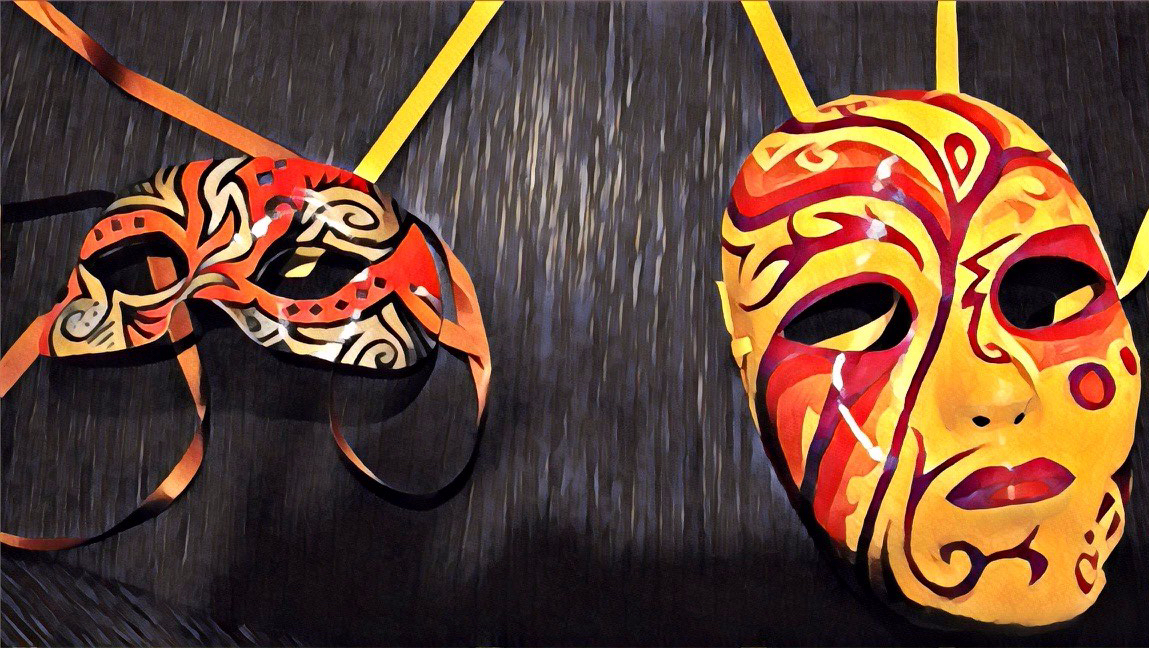
So it was that the Eight-Who-Can-Feel-Another’s-Hunger began their various studies of Ant, Eagle, Possum, Tiger, Snake, Squirrel, Horse, and Wolf. On the moonrise of the next month, She-Who-Saves-Many-Lives bestowed on each of the eight a mask suited for the animal that they were studying. She suggested that they may want to spend some time each day trying to imagine what life was like through the skin, nose, ears, and eyes of that creature and the using the mask might help in this endeavor. 

IMG_3192

So it was that on the third full moon, each of the eight was ready to give an account of what they had learned before the entire tribe. And, it was so. 

{Translator’s Note}: The actual legend is filled with minutia for every single one of the eight animals. It’s not surprising that such detail would be included for these specific details about each of these other creatures could spell the difference between life and death for the student or possibly even the entire Veritas people. They took the time to find out about the world and pass on every detail they could to their offspring. Education was a serious business that everyone respected as crucial to their very survival. We live in a different world, however, and therefore I am only translating the first and most obvious thing or two about each animal. 

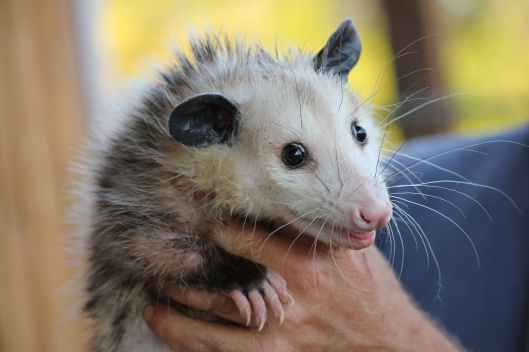
First to speak was Alt-R who spoke of some of the cleverness of the opossum such as keeping their unprotected ones close by, of hunting at night when they had less worry about those who might harm them, although on balance, they seemed quite stupid, concluded Alt-R. 

Next to speak was She-of-Many-Paths. She spoke with such passion and in such vivid detail that the children, and the youth, and the married, and the old of the tribe all listened in fascination and learned much about Wolf. Not just the Shaman but all could feel that indeed, she had come to love the wolves. She spoke of they way they hunted together and took turns chasing down prey until that prey was exhausted. She spoke of their social order and how they communicated and how they kept the peace among themselves. “And,” she concluded, “I’m just getting started! There is so much more to learn!” 

Eyes-of-Eagle had been assigned the Eagle. She spoke of how the eagle changed it very shape according to the task at hand. 

“When an Eagle wished to soar on the winds it spread its wings as far as possible and flattened its chest and tailfeathers. When it spotted prey below, after a few strong thrusts of its wings, it folded them tightly and made itself nearly into a teardrop. It fell like a rock, only shooting out its wings at the very last possible moment to arrest its fall and save its life and at the same time twisting just so onto the back of rabbit or squirrel or mouse!” This much was known by the adults of the tribe, but Eyes-of-Eagle had many more  details to share on the subject. It was clear to all in the council that she had been aptly named. 

IMG_5663

Shade-Walker spoke next of his observations of snakes. Like he himself, he had noted, the activity of a snake is much determined by the heat of the sun. But Shade-Walker then said, quite unexpectedly, that he believed that snakes could feel the heat of their prey just as we can feel the heat of a fire or the heat of another’s skin if it’s quite close. Shade-Walker noted that a snake too can change its shape. Some can unhinge their jaw and some are able to swallow their prey whole because they can make that change. 

Initiates also spoke of their many observations of Tiger, Squirrel, and Horse. 

Last to speak was Pond Mud. He still viewed ants as unworthy of study because they were weak enough to be crushed in his fingertips. However, he had noticed a kind of war between black ants and red ants. 

“Somehow, an anteater became aware and filled his belly on the fighting ants. Normally, ants are keen to sense a nearby enemy, but in the heat of battle, they didn’t seem to see the anteater at all! He seemed the only beneficiary of the ant war.” 

Most of the adults in the council were quite convinced that two more would-be inheritors of Shaman-ship would be dropped from consideration and that these would almost certainly be POND MUD and ALT-R. Sadly, they seemed not to understand the value of creature so different from themselves. 

Indeed, it was so ordered and came to pass. 

The next day, She-Who-Saves-Many-Lives summoned Alt-R to see her. “I have a game for you to try your luck at. Do you accept this challenge?”

“Is this part of the test? Everyone seems to think I lost. Is this a chance to redeem myself?”

“Do you accept this challenge?” 

Alt-R said, “Yes, I accept. What am I to do?”

“I have three cups. You choose one of the three. You will have 100 chances to guess and we will see how many acorns you acquire,” explained She-Who-Saves-Many-Lives.   

So, the game began, and every time Alt-R thought he had at last figured out the rule, he proved wrong on the next guess or the one after that. At long last, the 100 chances had all been used up. Alt-R had managed to obtain 11 acorns and felt very frustrated. Alt-R searched the face of She-Who-Saves-Many-Lives but saw no hint of the rule. 

“Has anyone figured out your rule? Has anyone done better?” asked Alt-R as politely as he could in his state of frustration.

“Yes, indeed, I’m must say, that someone did indeed do much better. In particular, one of my friends was able to gather 34.” 

Alt-R was taken aback, but he was still curious. “But then no-one has gotten all 100? No-one has really figured out the rule?” 

She-Who-Saves-Many-Lives cocked her head to the side and her endless brown eyes looked into the heart of Alt-R. “Who said there was a rule?” 

“Who…? I mean, there has to be a rule, right? How did you know how to switch the acorn each time and mostly fool me?”

She-Who-Saves-Many-Lives lowered her voice and looked down. “Who said there was an acorn every time?” 

“But…! You said…I don’t understand? How did someone gather 34 then? Who was this one who outguessed me three to one?”

She-Who-Saves-Many-Lives looked at him long and hard watching him go through the possibilities in his head. Some he gave voice to. Was it this young man? Was it this young woman? Was it this elder? At last, he ran out of likely possibilities.

“None of those, Alt-R, it was the very creature I asked you to study. The possum.” 

“WHAT?” shouted Alt-R, against all protocol. “I was outsmarted by a possum? That’s impossible!”

“Not at all impossible, Alt-R. It happened. The reason is quite simple. You looked at this as a test of how smart you were or how much empathy you had. You assumed there was one acorn per trial. You assumed that there was a rule. And then you spent all your time trying to determine the rule. What did possum do?”

Alt-R frowned, “What did possum do? How could I possibly know?”

black brown and white animal

Photo by Pixabay on Pexels.com

“You couldn’t. Because you didn’t follow my advice and learn to know possum and how he felt about things, what he smelled about things, what he saw, how he loved, and feared, and died.”

Alt-R hung his head. This had not really been a test. This had been another teaching – a teaching that taught him that he should have followed the first teaching. “You are right, She-Who-Saves-Many-Lives, but I still don’t see how possum could have done better than I did.”

The Shaman explained, “You came in here and made assumptions. You were trying to find the acorn each time assuming that there was one. You were trying to figure out the rule. About one third of the time, I put an acorn in a cup. When I did have an acorn, it was always in the one left-most cup. After two acorns from the left cup, the possum always chose the left cup, most often being wrong but 1/3 of the time being right. You came in hungry for rules and assumptions. The possum came in hungry for acorns.” 

“Thank you, She-Who-Saves-Many-Lives.”

“Please return tomorrow night, Alt-R, for I have one further lesson.”

The next morning, She-Who-Saves-Many-Lives summoned Pond Mud, for Pond Mud, like Alt-R, had another few lessons to learn. 

“Come, Pond Mud, I have a simple task for you. You are one of the strongest young men in the village. Is that not so?”

“Well, She-Who-Saves-Many-Lives, I do not know but I have overheard some say that, yes.”

“So, Pond Mud, you value physical strength. Is that so?”

“Yes, indeed, She-Who-Saves-Many-Lives! That is why the ant…well, we will not speak of that.  Anyway, yes, I am strong and I value physical strength.” 

“Good, Pond Mud, then you will have no trouble with this small task. I would like you push over that old cabin. I wish to build a new one.” 

“Well, She-Who-Saves-Many-Lives, I am strong but … I mean the cabin is well-built…it is meant to withstand snow and wind and you want me to try to push it down?” queried Pond Mud. 

“No, I want you to actually push it down, not try to push it down. Proceed.” 

Pond Mud walked over to the cabin and walked around it looking for a possible flaw or weak point but found nothing. He braced himself and pushed with both hands but nothing moved. He turned his shoulder to the edge and pushed but nothing moved. He lay on his back and pushed with his legs but that slid him backwards. He found two giant boulders and rolled them near the cabin and used the boulders to brace himself and pushed with both legs. He could not budge the cabin. He looked at the boulders and began to hatch an elaborate plan to smash the cabin with the boulders. 

“Pond Mud, you failed to push over the cabin. Please follow me. I want to show you a larger, stronger cabin that someone did push over. It is near. Follow.”

They soon came to a small clearing where the collapsed remains of a large cabin lay scattered about. “Pond Mud, what would you say regarding the strength of the creature who pushed this cabin down?”

“Gigantic. Perhaps a great cave bear. Or perhaps a bison? But it’s in the woods. A giant moose perhaps?”

“Pond Mud, look closely at that log and tell me what you see.” 

Pond Mud strode quickly to the indicated spot. “It’s just a log. I mean it’s filled with … it’s filled with … carpenter ants. It’s filled with carpenter ants.” 

“I see you studied the ants enough at least to recognize one when you see one. Let us return now to my cabin because your friend Alt-R is about to appear.”

They strode in silence back to the cabin of She-Who-Saves-Many-Lives. Indeed, Alt-R had just arrived. 

She-Who-Saves-Many-Lives looked at each of them and said quietly, “I am sure by now you both realize that you will not be getting the Third Ring of Empathy. However, I am giving you each two other gifts. And each such gift, I can assure you, is worth far more than a ring with a pretty stone affixed.”

“The first gift is that you now realize not to dismiss a human or any creature because it seems they are not so smart nor so strong as you. And, now that you understand this, you may choose to become better and better at seeing things through another’s eyes. And, if you so choose, you will have a much better life and help those around you to also have a much better life. If you so choose, you can instead ignore this lesson and disdain those who are not like you. It’s your choice.”

“But if I learn the lesson, then why cannot I not be yet in contention to be your replacement?”  wondered Pond Mud & Alt-R aloud and almost in unison.

“Because,” said the Shaman, “it was not your first instinct to do so. Under stress or duress, you will be prone to revert to your first instinct and stressful situations are precisely such times that your empathy is most needed. Over time, over many wanderings of the stars back to their homes, your first instinct will change and you will be just as able to see through the eyes of another as any of the initiates. But if I die tomorrow, it would not be well for you or for the tribe or even for all the other creatures that share this world with the Veritas.”

The silence grew at first and the crickets decided it was their turn to talk. And so it was. But after a time, Pond Mud spoke again.

“What was then the second gift?” asked Pond Mud. 

“The second gift is that now you know that you are not always the best at everything though you, Alt-R are well the smartest among all the Veritas. And that knowledge that you are not the most able at everything can save you an ocean of pain if you choose to keep learning from those around you who know things you do not or those who are able to perceive things you cannot. And you, Pond Mud, though you are strong, you are not therefore to demand special privilege because of it. To the sun and the moon and the mountain, your strength is as little as the strength of the ants seems to you. Keep about you the humility that befits being strongest.” 

IMG_9136

Alt-R spoke then, “Thank you, She-Who-Saves-Many-Lives. It is well. And, I take your teaching as my learning kept close to heart. I will choose to follow the path of the greater wisdom.” 

Pond Mud spoke next, saying, “Thank you,” She-Who-Saves-Many-Lives. I too shall now look at such strength as I may sometimes have as a treasure not for myself alone but for all of the Veritas. 

{Translator’s Note}: The reader may well wonder why so much of this myth revolves around the two who lost the contest rather than those who won. This focus on continually trying to teach the entire tribe to learn from failures rather than simply be shamed by it, is typical of the Veritas. The Veritas, insofar as I can tell from such a distance in time, space, and culture, not only cared for the lessons of those who won the contest, but also in those who lost the contest, for among the Veritas, every leaf on the tree got sustenance from the rest of the tree and provided loving sustenance from the sun itself to the rest of the tree. 

———————————————————-

Magic Portal to Four Completely Different Universes

How the Nightingale Learned to Sing

All That Glitters is not Gold

The Con-Con Man’s Special Friend

Stoned Soup

The Three Blind Mice

The Orange Man

Pattern Language Summary

Plans for US; some GRUesome

At Least He’s Our Monster

An Open Sore from Hell

Somewhere a Bird Cries

We Won the War! We Won the War! 

Cancer Always Loses in the End

The First Ring of Empathy

The Second Ring of Empathy


Myth of the Veritas: The First Ring of Empathy. 

21 Wednesday Jan 2026

Posted by petersironwood in management, psychology, Uncategorized, Veritas

≈ 5 Comments

Tags

competition, contest, empathy, environment, fantasy, fiction, love, myth, politics, shaman, truth, Veritas, writing

Myth of the Veritas: The First Ring of Empathy. 

fullsizeoutput_1a4c

In the heyday of the Veritas, when the people had prospered and spread far beyond the lake of reeds and bubbling streams, yet long before they forgot the field of flowers, there lived among them many who dedicated their lives to learning and teaching. The people of the Veritas sometimes variously called them “Shaman,” or “Wise One,” or “Great Leader.” And among these, one in particular they called, “She Who Saves Many Lives.” They devised this name because of many wise insights she had but also because she literally saved individual lives with her knowledge of healing herbs and ways but also because she helped to save even the lowliest creatures in the forest, field, and stream. Of course, none of the Veritas chose to kill any of the creatures wantonly but only for need. For all of the Veritas saw that the lives of the Veritas all depended on the prosperity of all of life. “She Who Saves Many Lives” went beyond this and developed ways to encourage many of the creatures of forest, field, and stream to be healthy and fruitful. In this way, the Veritas themselves were also healthy and fruitful. 

{Translator’s Note}: Try as I might, I find this part difficult to translate into modern English. I seem hamstrung by our modern notions of “agency” and “responsibility” and “choice.” It wasn’t that the Veritas “decided” it would be in their “long term interests” not to kill creatures for no purpose other than to show that they could. Such actions were out of harmony and out of character with their very existence. Consider the following modern metaphor. People who are gifted musically spend much of their lives improving their skill. The very best of them may be able to play in a symphony orchestra. The whole point of their playing is to be part of the creation/recreation of beautiful music. A flautist in such an orchestra does not “decide” not to make horrid screeching noises rather than participate in making beauty. Theoretically, of course, they could. Or, they could bring fire-crackers and set them off in the middle of the symphony. But why would a person who dedicates their life to making beautiful music do such a thing? In a similar way, insofar as I can tell from artifacts, scholarship, and the entire mythic structure of the Veritas, these people did not consciously “decide” not to wantonly kill their cousins in other parts of the Great Tree of Life for no reason. Any person of the Veritas would gladly want to help the forests, fields, and streams to flourish. However, one of the talents of “She Who Saves Many Lives” was that she apparently saw many new ways to facilitate such flourishing. 

sparks of firecracker

Photo by Suvan Chowdhury on Pexels.com

The other phrase I’m not entirely satisfied with is the name of the Shaman herself. A more literal and more accurate translation of her name would be: “She Who Fosters the Entire Tree of Life with a Focus on Her People but Who is Ever Mindful of the Music of the Entire Tree” I think you can see why I chose the shorter name!

“She Who Saves Many Lives,” though strong and healthy and young, yet foresaw that while the Great Tree of Life would grow and prosper for many, many moons, her individual life would, at some point, come to that same end that awaits all individual lives. Thus it was that she wished to help choose and prepare the next Great Shaman. And thus it was that she devised a series of seven tests. The tests would be carried out in public and any who thought they would like to dedicate their lives to learning and teaching and healing could try their hand at these tests. 

“She Who Saves Many Lives” crafted seven types of beautiful rings. Each type of ring was studded with a different type of beautiful polished stone. Each such ring would be given as a prize to those who passed the tests she devised. Each such type of ring, “She Who Saves Many Lives” called a “Ring of Empathy.” The first type of such rings were known to be made of bronze and each bronze ring sported a crystal of clear calcite. These she made openly and all could see her exquisite craftsmanship. Those who wished to try their skill at the trials came to her before the spring rains began and let her know their intention. Each time another initiate wished to be admitted to the trials, she made another ring. However, she said nothing whatever about the nature of the first trial, nor indeed any of the trials. She created them all in her own mind. When various would-be contestants came to her to watch her work, they tried a number of clever ploys to try to learn the nature of the trial so that they might better prepare themselves. “She Who Saves Many Lives” merely smiled at each such person and wished them good luck. 

IMG_6737

At last the spring rains came and spring flowers bloomed all around the end of the lake of reeds where “She Who Saves Many Lives” made her home when she was not traveling amongst the many villages of the Veritas. At last, the spring rains gave way to the hot dry period. When the new moon first began to show its crescent, it signaled the appointed day of the trial. A dozen came to try their skill in the trial but many more from all the lands of the Veritas came as well in order to see who would prevail. “She Who Saves Many Lives” gave each contestant a small piece of deer hide with a rough map of the area. On each map, the symbol of each of the contestants was designated at a particular nearby and noteworthy place. Each of the participants knew each of these symbols and recognized the places as well, for all people in those days wished and worked to know the location of every tree, path, stream, and boulder. 

{Translator’s Note}: The Veritas, so far as I can tell, did not at this point have what we would call a “written language” but they did make maps, some of which have survived to this day. Many (but by no means all) of the symbols on these maps would be interpretable by modern humans of most cultures. In addition, everyone not only had one or more spoken names, but also had at least one unique symbol. Such symbols typically reflected something of the physical or behavioral aspects of that person and were therefore much easier to remember than most modern names are for us to remember. 

Each contestant was well aware of the symbol for each of the others. Each of the twelve maps were identical and showed the location that each of the twelve contestants was to go to as quickly as possible. Once there, further instructions would be sent by drumbeat. Having the final instructions sent in this way was not only the most practical method of distant communication; it also increased the drama for everyone. 

brown wooden percussion instruments

Photo by Pixabay on Pexels.com

{Translator’s Note}: No-one knows the precise coding for the drumbeat language of the Veritas. I can, however, say with a high degree of certainty that it was nothing like Morse Code. The drumbeats were more like a hierarchical description of the instructions and each series of beats further refined the instructions. In what follows, I try to give some sense of that, but it’s largely a guess as to specifics though the details are unimportant as to the outcome for the participants. The only necessary point is that each contestant understood what the instructions meant.   

Welcome. Contest. Be smart. Be accurate. Be quick. Mark on the map. Numbers. How many do you see? How many do each of you see? Mountaintops. Begin! Run back with your map. Filled with 12 sets of marks. 

In this way, the first contest of the Veritas began. As you can see, although “She Who Saves Many Lives” called this an empathy test, it really required a number of skills in addition to empathy. It required a knowledge of the terrain, good eyesight, the ability to understand a new task quickly, good spatial visualization, and good foot speed.

Within ten minutes of the end of the drumbeats, some of the contestants could be seen entering the outermost ring of the sacred circle, running swiftly with their maps. Soon, all twelve of the contestants had breathlessly handed their maps to “She Who Saves Many Lives” who had so far given no hint as to how many contestants would be entered into the next phase of the contest. All the contestants gathered in a semi-circle around “She Who Saves Many Lives” and at her instruction, everyone in the crowd sang a song of praise for all who had attempted the task. Then, without a word, “She Who Saves Many Lives” bestowed bronze rings adorned with a calcite crystal on the ring fingers of those she deemed worthy to continue on to the next contest. There were ten, who collectively came to be known by the Veritas as “Those Who May See Through the Eyes of Others.” All ten had correctly and perfectly counted, not only the mountaintops that they themselves could see from their own assigned positions, but had also accurately counted how many each one of the other contestants could see as well.

landscape nature night relaxation

Photo by Pixabay on Pexels.com

“She Who Saves Many Lives” did not herself use that designation for the ten. For this had only been the first, and easiest of all the tasks she had devised for being able to see through the eyes of others. When she thought of them collectively, she privately called them, “The Ten Who Can Count Mountaintops with the Eyes of Others.”  

————————————————-

Now, dear reader, you may now see that I have included these translations of the Myths of the Veritas because they very much relate to the fields of “User Experience”, “Human Factors,” or “Human-Computer Interaction” despite the fact that these tales quite apparently predate modern technology. To the Veritas, choosing a new leader for their people was never a matter to be left to chance, or visions, or a contest to see who could lift the most or lie the most. A leader of all the people should be able to see the world through the eyes of any of the people. How else might such a leader help insure a decision was for all the people and not just for a few? 

—————————————————

Magic Portal that Allows Books to be Delivered to Your Porch! 

The Orange Man

The Forgotten Field

The Impossible

Somewhere a Bird Cries

The Last Gleam of Twilight

They Lost the Word for War

After All

All We Stand to Lose

Guernica

Where Does your Loyalty Lie?

My Cousin Bobby

The Update Rule

What About the Butter Dish

You Bet Your Life

Essays on America: The Game

Essays on America: Wednesday

When Greed is the Only Creed

Facegook

The Dance of Billions

Roar, Ocean, Roar

Imagine All the People

Travels with Sadie 13: Dog Parks

18 Sunday Jan 2026

Posted by petersironwood in dogs, pets, psychology, Sadie, Uncategorized

≈ Leave a comment

Tags

books, civility, collaboration, cooperation, Democracy, dogs, fiction, life, love, pets, truth, USA

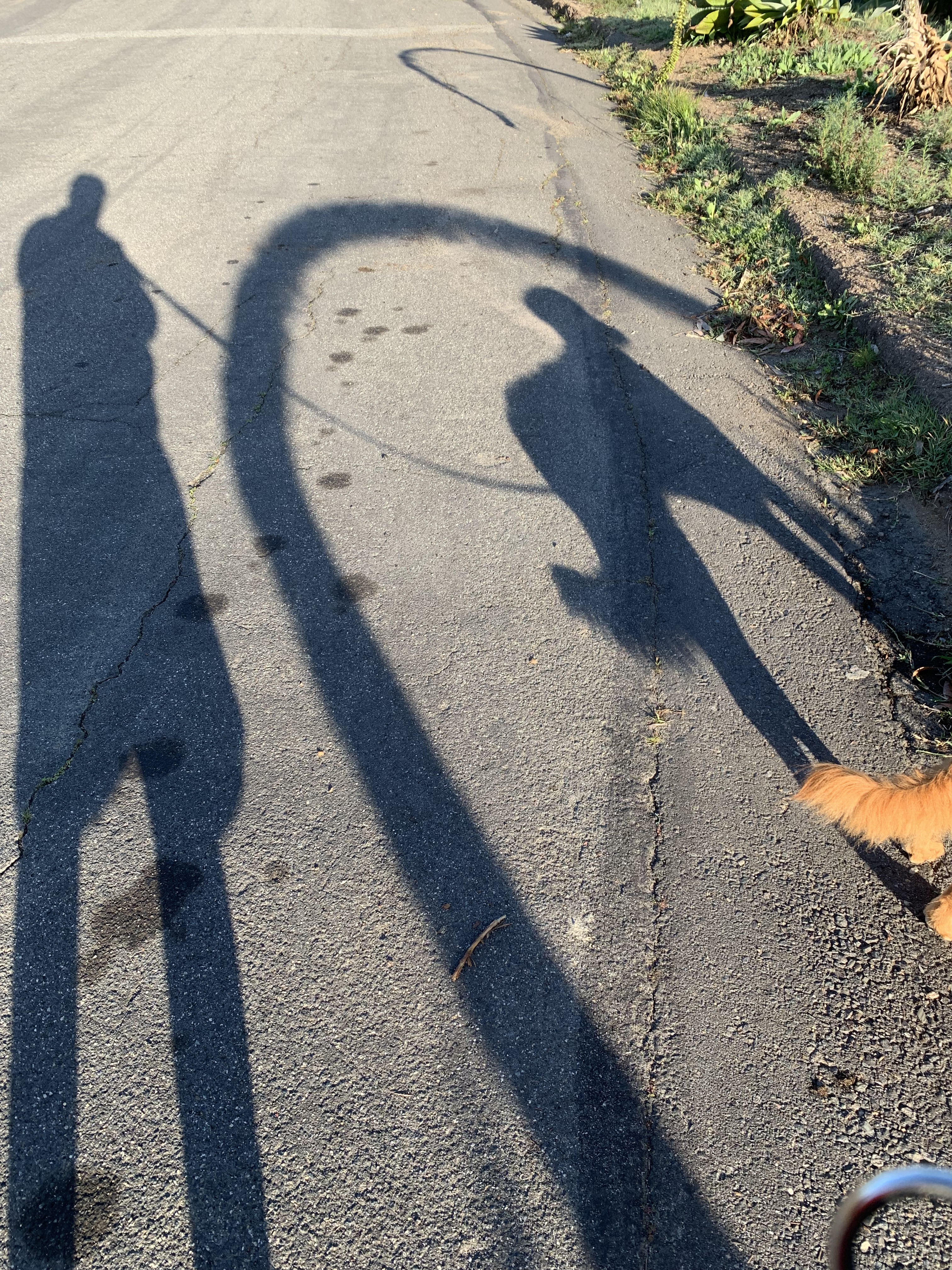
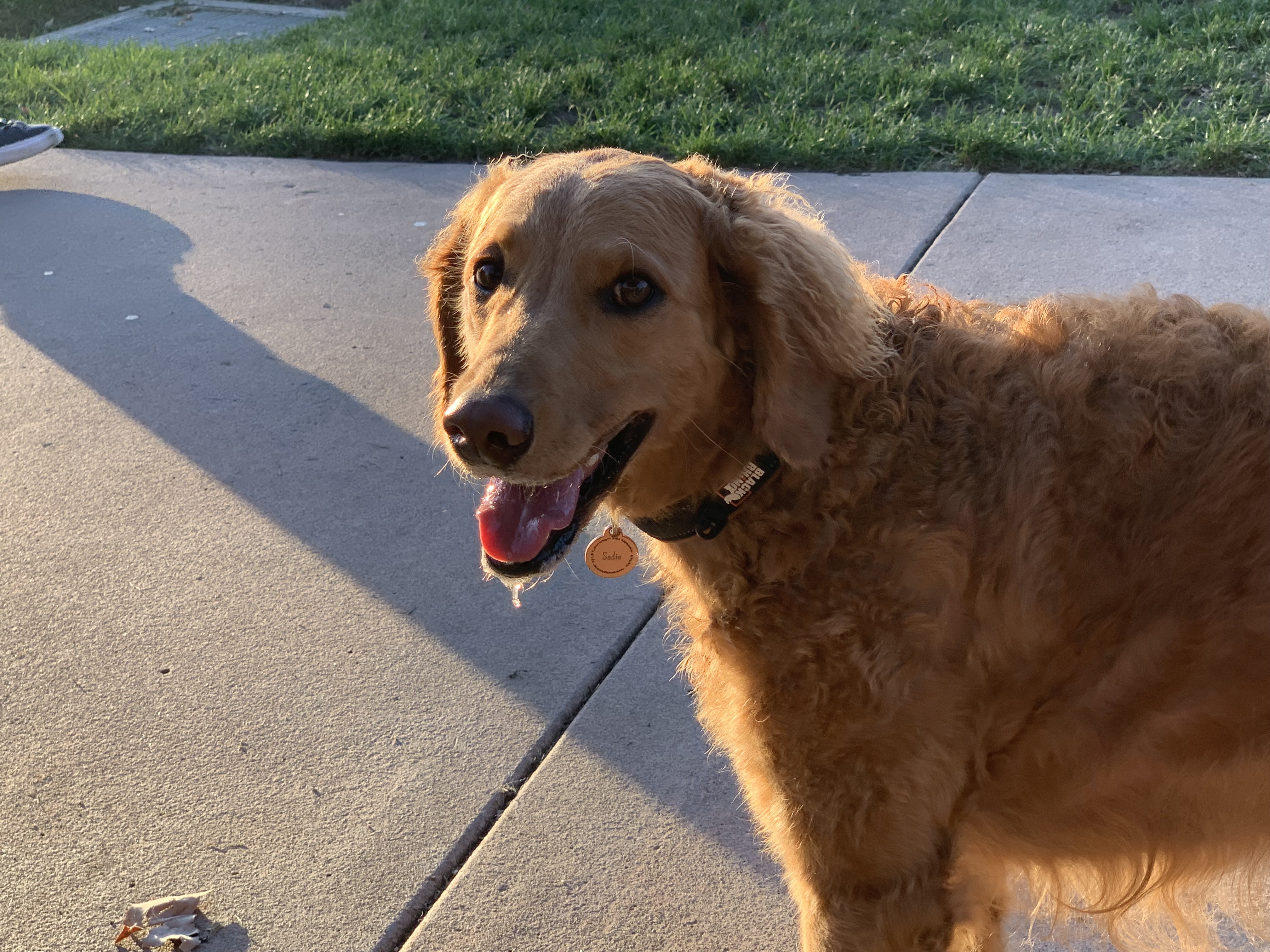
When I take Sadie for her morning or evening walks, she generally does “Good Walking.”

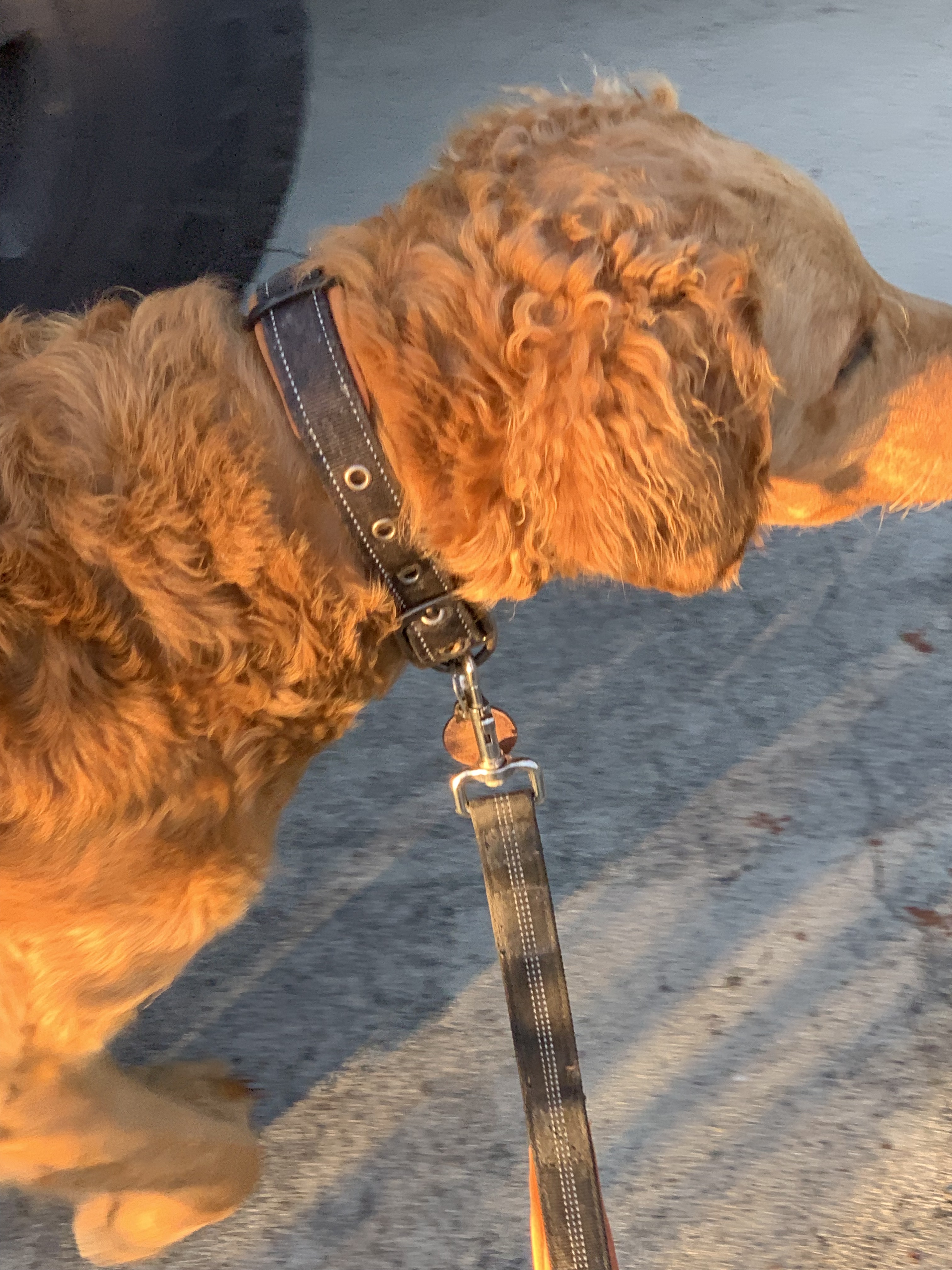
There are some exceptions. If a small animal passes too close to us, she will sometimes lunge toward it. She also tends to pull if she’s desperate to “do her business.” She seems to have a particular place in mind. The third common situation is when we get close to one of her neighborhood dog-friends who is also out for a walk. She approaches nicely until we’re about ten feet away and then—she wants to greet the other dog—immediately. Instantaneously. NOW!

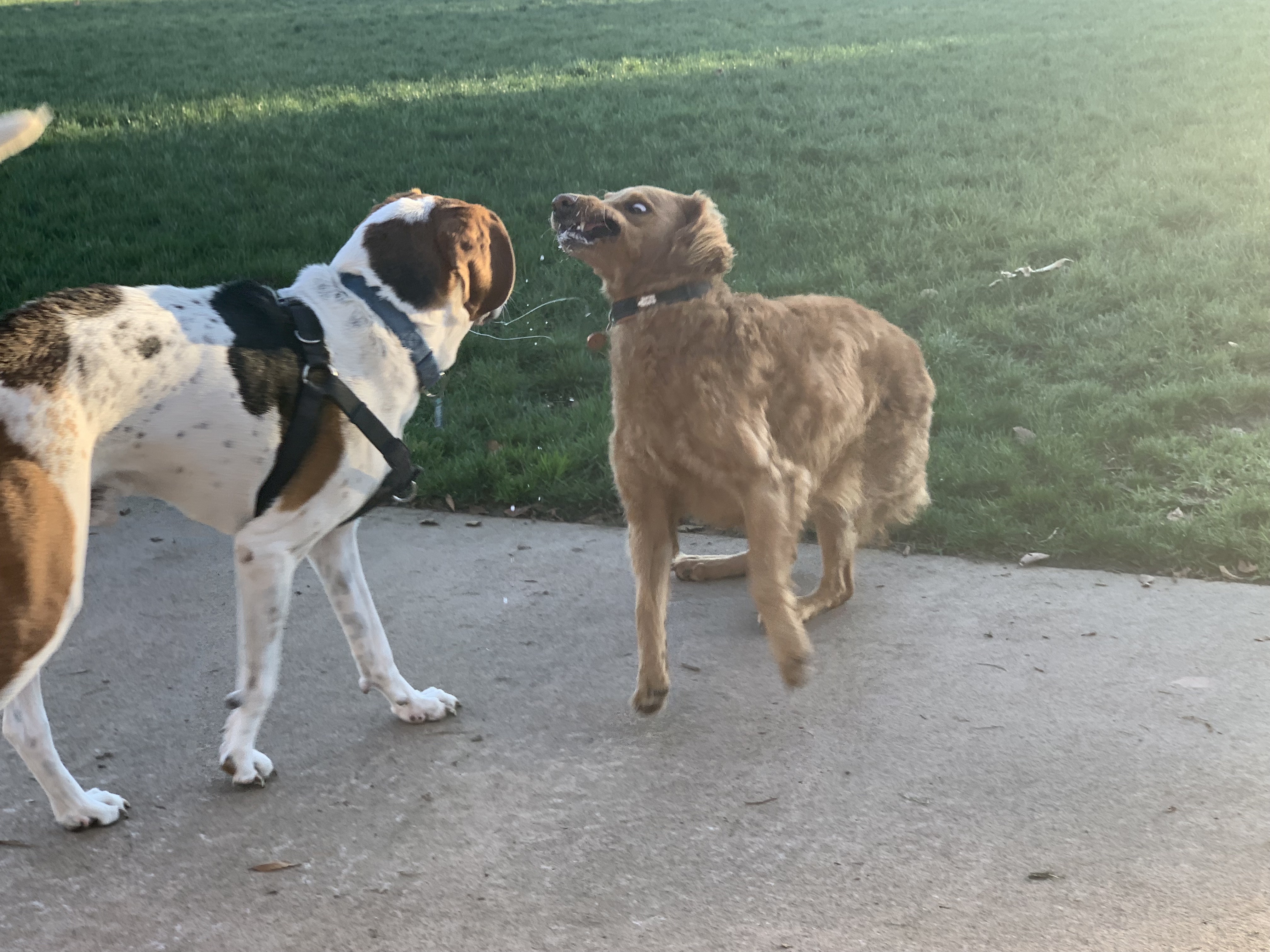
Sometimes, though, she approaches or sits and awaits, vibrating with excitement, but controlling herself. She and the other dog sniff and then suddenly, it’s all too much as she breaks into a sprint. That’s fine.


Except for one thing. We’re attached by a leash, and, alas, I cannot sprint. I probably never could sprint nearly so fast as Sadie, but certainly not now. 

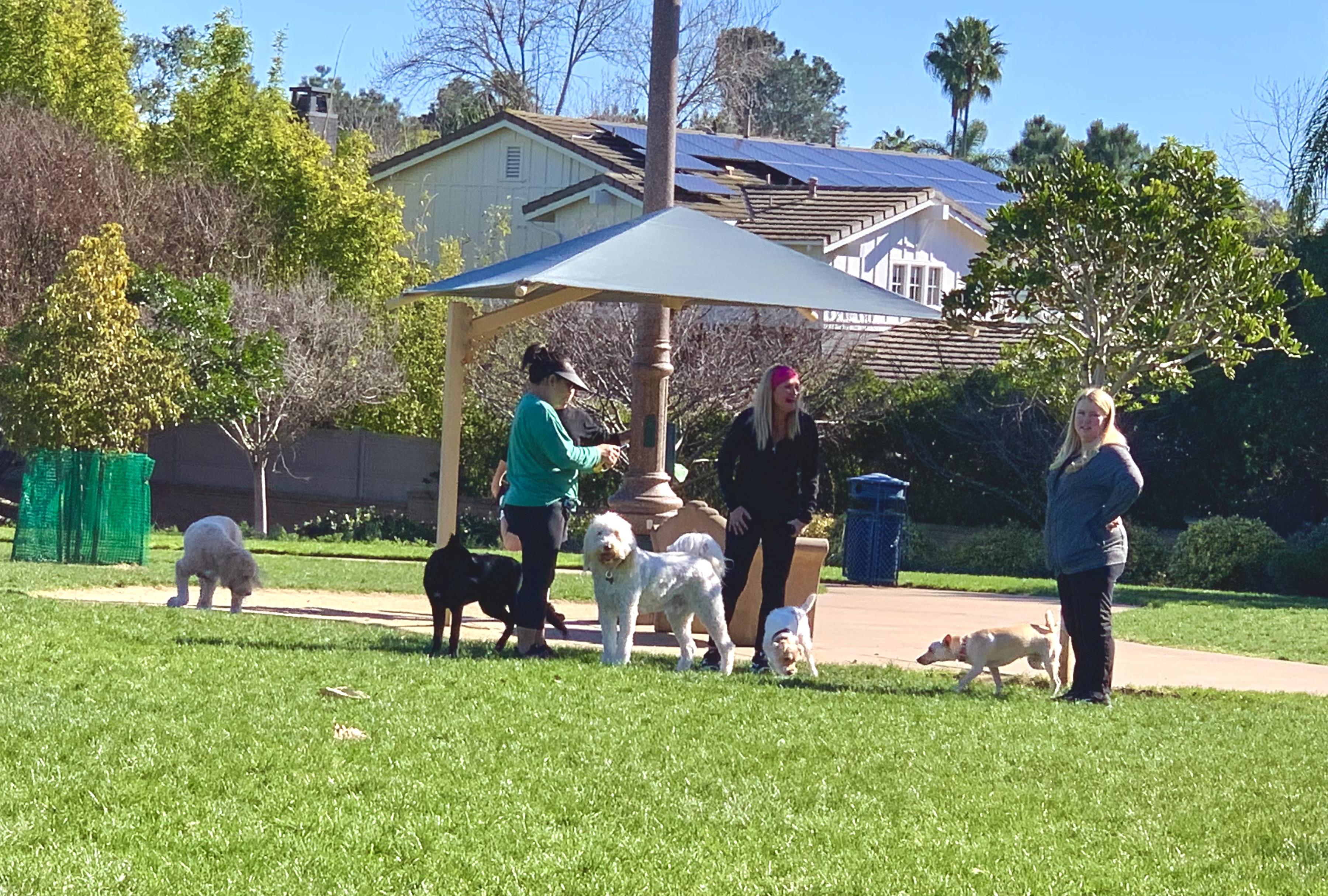
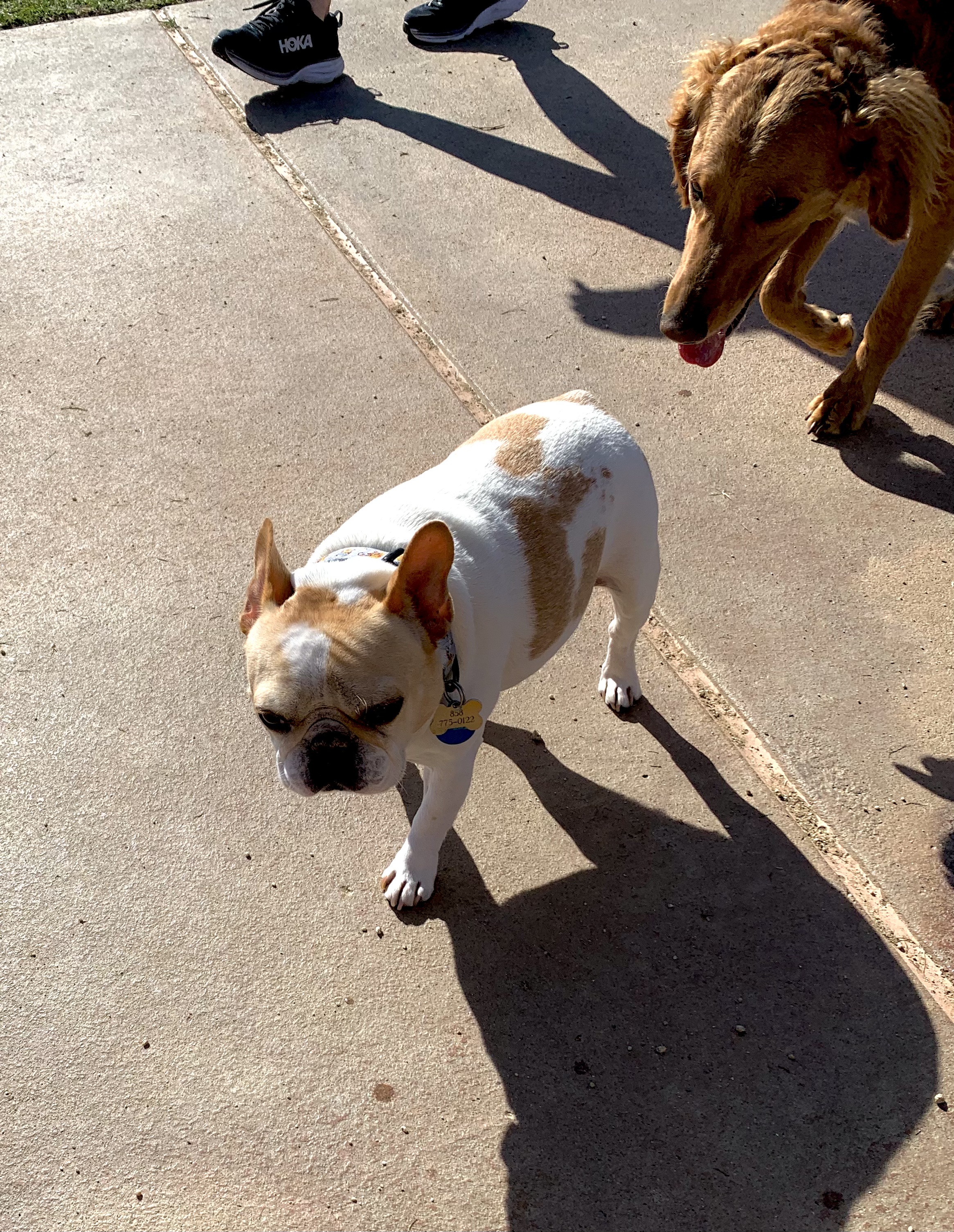
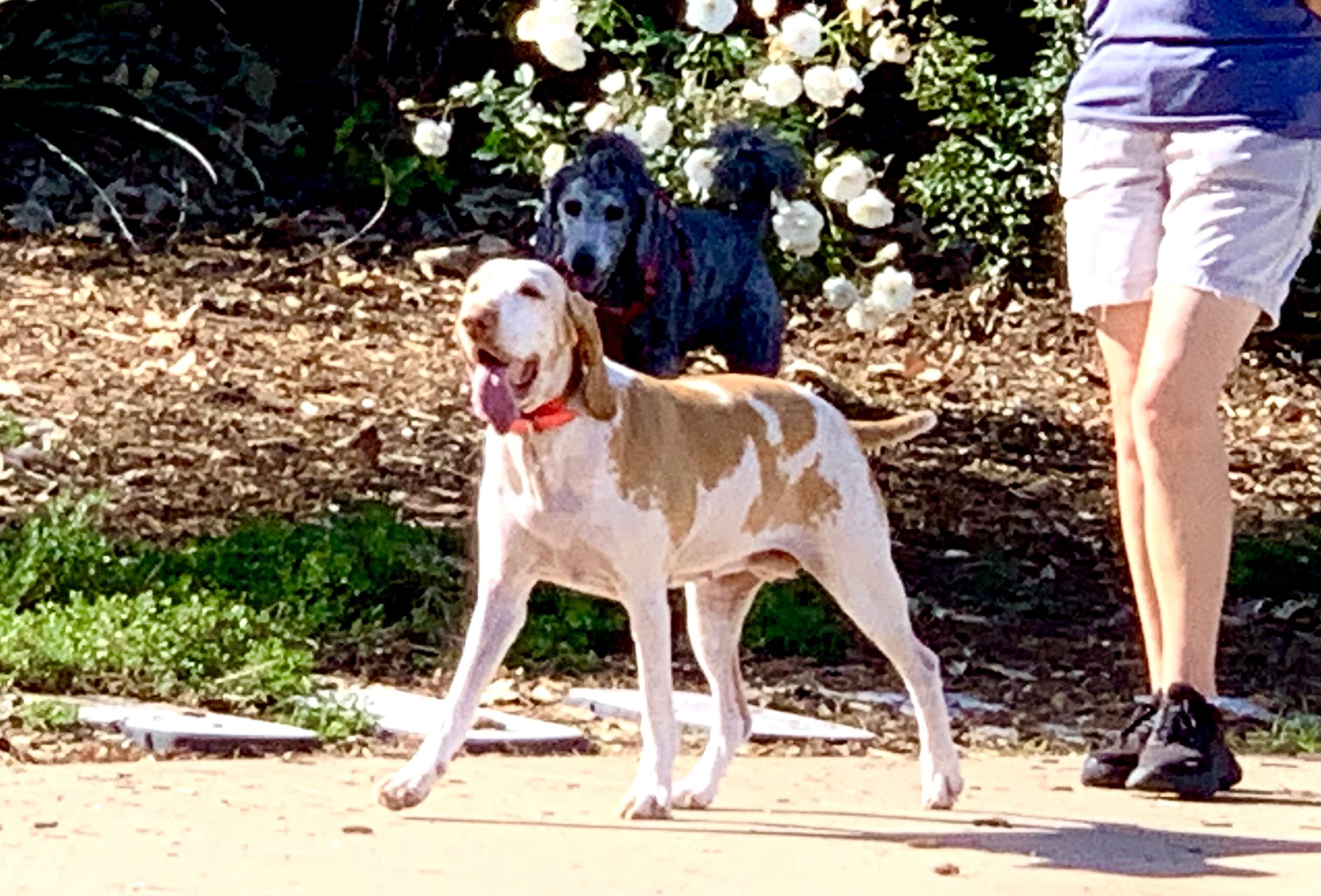
In addition to ball playing in the garden, swimming, and walks, we also take the dogs to nearby dog parks. No big surprise, but they love it. 

The truth is, I like it too. Many of the dogs are friendly to strangers. That’s fine with me. It’s not always fine with Bailey, however, who definitely has a jealous streak in him. Even when my wife and I hug, he wants to join in the loving. But he has gotten more tolerant of other dogs coming to say “hi” or to ask for a ball or frisbee to be thrown. 

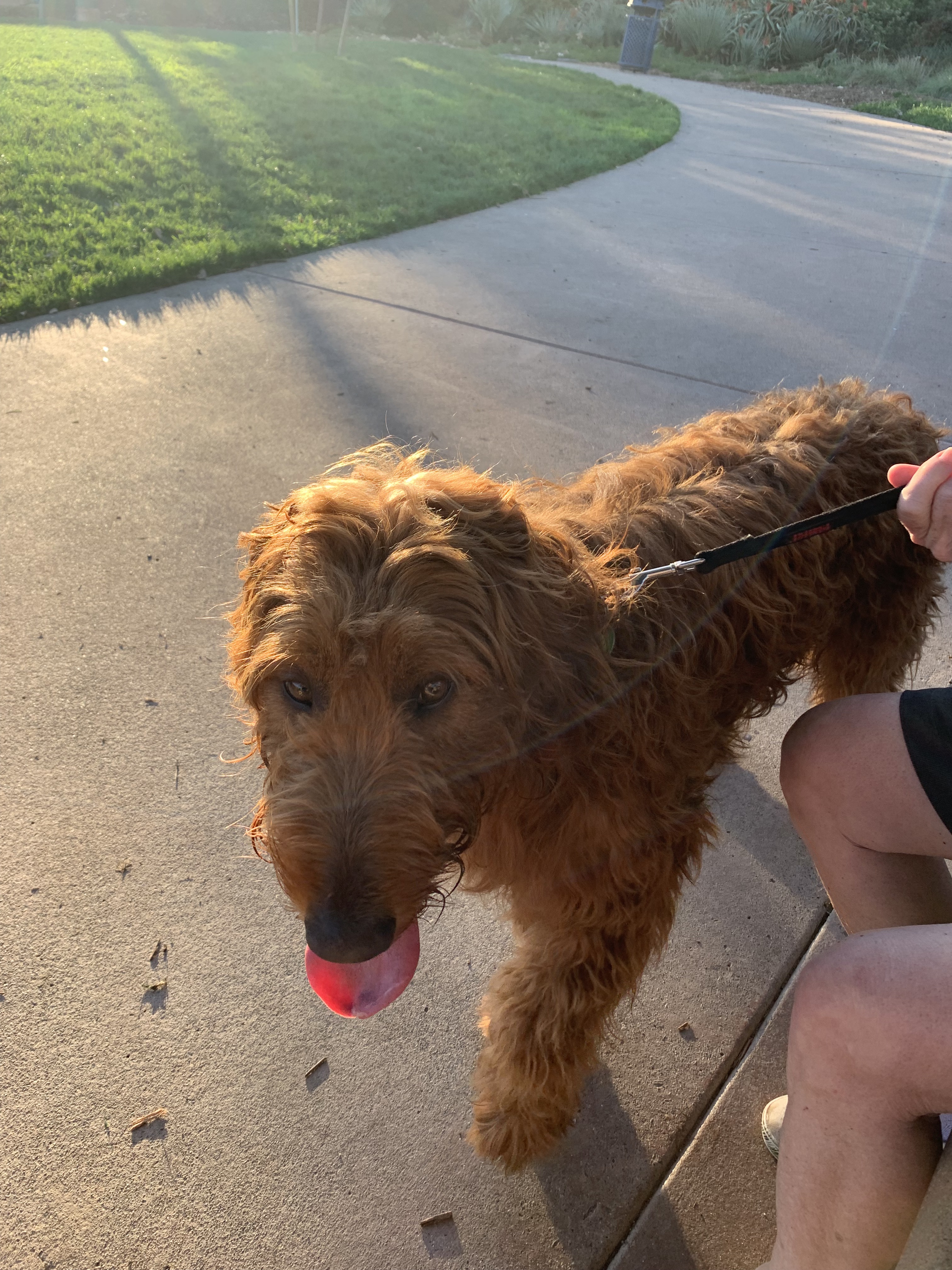
Sadie doesn’t seem much bothered when other dogs giving me some attention. Though Sadie and Bailey are both Golden Doodles and have many similarities such as their love of ball playing, they also have numerous differences. For instance, to signal that she really needs to go outside for a potty break, Sadie comes and stares at me. Bailey comes over to me and acts crazy. Sadie is much more likely to lie down and be mellow when I’m writing on the computer or watching Astrid. Bailey will continue to want to play ball and when all else fails, he’ll play ball by himself.


Ironically, I’ve never suggested this to Bailey. When Sadie was young, I tried on many occasions to show Sadie how she could play ball by herself, but she never caught on or showed any interest. 

Bailey very much wants our approval. Sadie likes our approval too, but she does have a stubborn streak. Following the instructions of her own inner demons is relatively more important to her. 

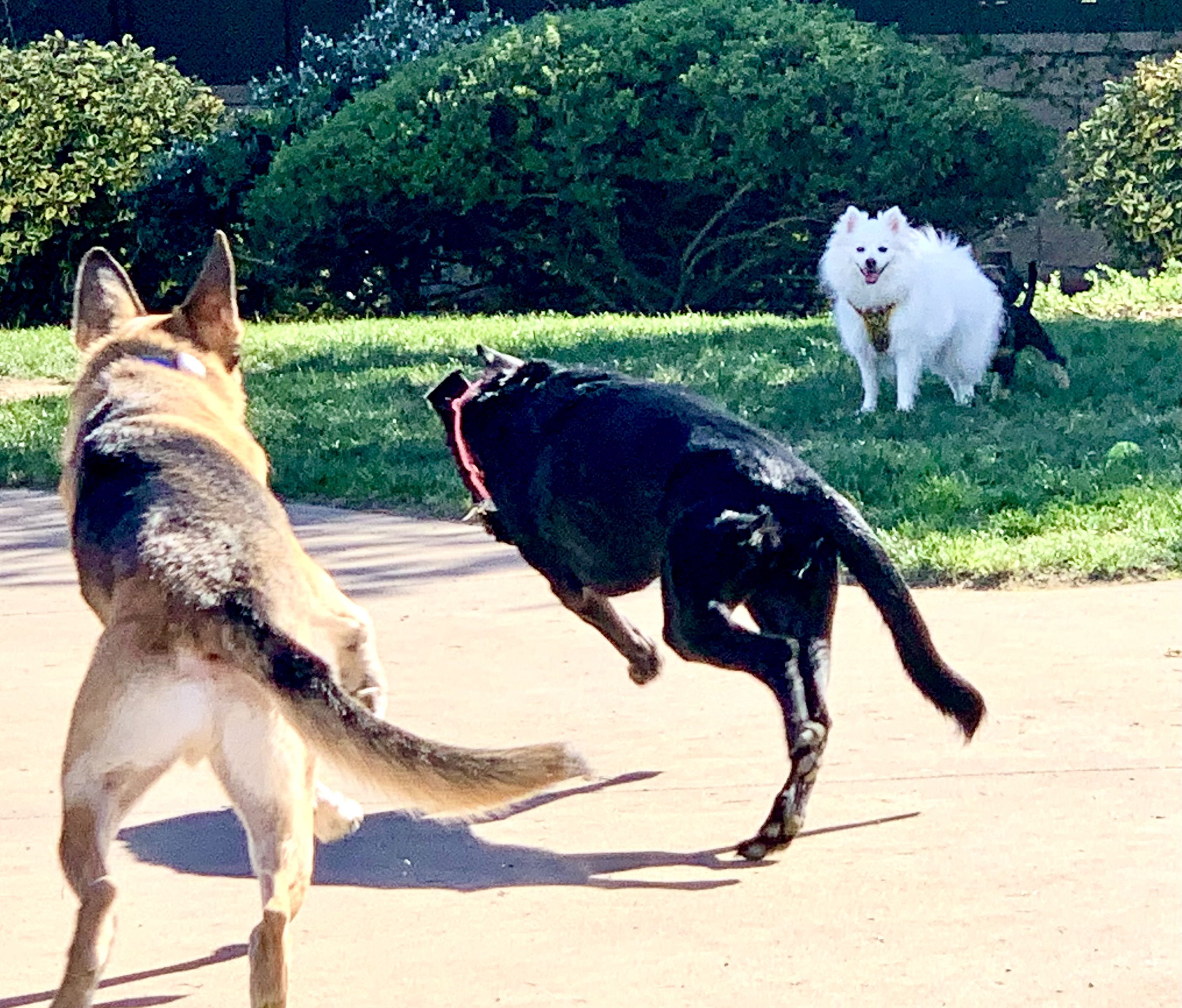
The differences among dogs are one of the reasons that I like going to the dog park. It’s fun to see the physical differences among the dog population. Equally, it’s interesting to see the differences in the ways that the dogs behave, both with each other, and with humans.


Another thing that’s nice about dog parks is that the people tend to be friendly. They too exhibit many differences in physical and behavioral characteristics. It’s a venue that seems to lend itself to informality and openness. When I’ve chatted with people, I don’t feel that they are trying to “impress me” with name dropping, etc. A few people—a distinct minority—show up and basically spend the whole time on the phone with very little of their attention going to the real world around them including their own dog. But that’s far from the modal behavior. 

On the way out of the dog park, I passed by a flag pole with a large round concrete base. You don’t need a dog’s superior nose to know that this spot is frequented a lot by the canine population. Part of the reason is that it is frequented a lot by the canine population. In other words, there’s a “bandwagon” effect. 

Looking at the dark stains all round the base of the flagpole makes me think of the way twitter devolved, but it applies to much of what happens on all social media. A small number of posts have a huge number of likes, reactions, and repostings while most have none. The algorithms of most social media platforms help promote this. 

It isn’t just social media, however. There are many such positive feedback loops in our society. Wealth and power result in more access to health, food, shelter, convenience, and education. This in turn, leads to more power and wealth. At the very high level, the wealthy and powerful don’t just win more competitive contests; they can and often do rig the contests.

The dogs at the dog park differ in age, strength, speed, and size as well as breed. Yet, in many ways, it’s very egalitarian. No dog gets all the attention or all the water or “rules” the other dogs or fetches every ball.

That seems okay with the dogs and okay with the “owners” of the dogs. 

—————————-

Author Page

Travels with Sadie 1

Travels with Sadie 2:

Travels with Sadie 3:

Travels with Sadie 4

Travels with Sadie 5

Travels with Sadie 6

Travels with Sadie 7

Travels with Sadie 8

Travels with Sadie 9

Travels with Sadie 10

Travels with Sadie 11

Travels with Sadie 12

Sadie is a Thief! 

The Lighty Ball

Dog Trainers

The Puppy’s Snapping Jaws

Hai-Ku-Dog-Ku

Stoned Soup

The Three Blind Mice

The Self-Made Man

Math Class: Who Are You?

Occam’s Chain Saw Massacre

It’s a Dog Eat Dog World

Essays on America: The Game

D4

Pattern Language for Cooperation and Collaboration

Tools of Thought: Metaphors We Live By & Die By

24 Wednesday Dec 2025

Posted by petersironwood in America, family, management, psychology, Uncategorized

≈ Leave a comment

Tags

analogy, Democracy, elections, Feedback, government, life, love, mental-health, metaphor, politics, problem solving, programming, sense-making, thinking, thought, writing

Metaphors We Live By and Die By

PicturesfromiPhone2 087

I love metaphors. I always have. I admit it. I think every youngster does, at least until they are exposed to poetry in English class. I was lucky to have an awesome English teacher who deepened rather than destroyed my natural love of metaphors. There are plenty in my own poems.  but in this post, I am not focusing on metaphors for poetry so much as metaphors that we use in our thinking. Metaphors impact the way we approach situations at work and at home. I was influenced to see this by two main sources. First, Lakoff & Johnson’s book, Metaphors we Live By  was first published in 1980. This book greatly influenced, among other things, our IBM Research team’s study of human-computer interaction. At this point in the history of human-computer interaction and user experience, researchers and practitioners began to explore how various metaphors (e.g.,desktop, trash can, windows, drag and drop) could be used to help users understand the capabilities of computers and how to invoke them. (See, e.g., Carroll, J. and Thomas, J.C. (1982). Metaphor and the cognitive representation of computer systems. IEEE Transactions on Man, Systems, and Cybernetics., SMC-12 (2), pp. 107-116). 

Consider the error messages “Illegal Syntax” and “User Error.” They both put the responsibility for an undesirable state of affairs squarely on the shoulders of the user. “Hey you! User! You did something dastardly! You used illegal syntax.”

man wearing jacket and peaked cap grayscale photo

Photo by Brett Sayles on Pexels.com

Generally, the term “illegal” implies that you did something that was against the law. It usually implies you did something unethical too. Gerry Weinberg, one of the pioneers of UX/HCI (a keynote speaker at the Gaithersburg Conference),  pointed out that the “legal” syntax of languages often has arbitrary restrictions. It might be more accurate to have an error message that says, “Our programmers were unable to take the time to allow dates to be entered in European or Chinese format. Please enter dates as MM/DD/YYYY as in 08/04/1961 for August 4th, 1961.” This longer message tells the user what was “wrong” with their input and how to correct it as well as conveying the very real truth that the limitation is with the software, not with the user. Similarly, what is called “User Error” actually comes up as a message when the user does something that seemed reasonable to the user and would most likely be interpretable by another human being but was not anticipated or could not be dealt with by the programming team. Suppose it said instead, “Software error. We did not anticipate this kind of input so we can’t deal with it.” Or, in many cases, a more honest message might be: “Software error. We knew people would want to do this, but we didn’t have budget to program properly.”  

silver and gold coins

Photo by Pixabay on Pexels.com

 At the same time I was thinking about metaphors and Human Factors in Computing Systems, I was also conducting therapy as a Fellow at the Institute for Rational Living. I was learning and supervising cognitive behavioral therapy under the direction of Albert Ellis. Here I observed how people used metaphors to help make sense of their lives and make decisions about their lives. For example, as pointed out by Lakoff & Johnson, people often viewed romantic love as a sickness! It is also common to view romantic love as a journey over which you have little or no control. It is understandable why it sometimes feels that way, but such a metaphor is not empowering. It does little to lead you to make reasonable decisions about love or about those whom you love. Think instead of love as a collaborative work of art. 

man standing beside his wife teaching their child how to ride bicycle

Photo by Agung Pandit Wiguna on Pexels.com

The “Love is a collaborative work of art” metaphor encourages you to realize that you must collaborate with your partner to make a relationship work over time. You can’t really collaborate very well unless you communicate. It also encourages you to realize that work is involved. It encourages you to realize that it is a creative endeavor. While you can certainly learn from the successes and mistakes of others, in the end, your relationship is unique. It will take creativity to make your relationship work. It puts the responsibility for the relationship on you and your partner, not on forces beyond your control. 

It isn’t only love about which people often use inappropriate metaphors. For example, when it comes to overcoming addiction, overeating, under-exercising, people often use sin as their over-arching metaphor. “I was bad last night. I had two pieces of pumpkin pie.” “I was horrible all week. I had those evil donuts every morning.” The metaphor that “eating is evil” is inaccurate. After all, you have to eat to live. Furthermore, that metaphor doesn’t lead to any solutions except to try harder to be “good.” Worse than that, if often subverts a person’s efforts. “I didn’t want to have any ice cream but I did. Oh, well, the night is blown. I may as well eat the whole quart.” (Now that I’ve sinned, I may as well enjoy it). Weight is best thought of in purely physical terms. If you ingest more calories than you burn you will gain weight. If you burn more calories than you consume, you will lose weight. That’s it! (That accounts for almost everything. Intaking more fiber and fluid can have an impact as well as doing *some* light exercise after eating, but it’s mainly just a physics issue). Making it about good and evil does not help and, in my experience, is completely counter-productive. 

donuts and bagel display

Photo by Igor Ovsyannykov on Pexels.com

Speaking of counter-productive metaphors, I have been annoyed and concerned for decades that the media have largely (though not wholly) reported on political matters as they report on sporting events. During election season, you will hear relatively little about the candidates, their positions, their backgrounds or their ethics. You will hear a lot about strategy and where they stand in the polls. Often you will literally hear nothing more than a sound bite per day about major candidates. Then, pundits will unendingly discuss and debate how this or that sound bite will work or not work with various voter groups. No matter how outrageous, unethical, or disgusting a candidate’s behavior is, the media will spend most of their coverage on how it will affect the “score.”

Metaphors have consequences. 

We now find ourselves in an extremely weird position, at least in America. One candidate has “won” the “World Series” of elections (American Presidency). Many of the people who voted for him think of themselves as his “fans” and “supporters.” They believe their guy “won” so they want to continue to support “their team.” After all, imagine that you are a Yankees fan and the Yankees won the World Series. You get to have bragging rights until the next World Series. If one of the Yankees turns out to be a tax evader, you’re still going to be a Yankees fan. If one of the Yankee pitchers turns out to have cheated during the games, say, by putting illegal substances on the baseball, you’ll still be a Yankees fan. Another Yankee might be a wife beater. But, hey, they won the World Series! So you’re still a loyal Yankees fan. 

man wearing new york yankees cap

Photo by Oleksandr Pidvalnyi on Pexels.com

Here’s the thing. It doesn’t make a whole lot of real difference in your life who won the World Series. It doesn’t matter materially to your kids. It doesn’t matter materially to your grandkids. Don’t get me wrong. It will make some difference in how you feel. You and your whole family might be happy they won. But it won’t make the air you breathe cleaner or dirtier. It won’t make the water you and your family drink pure or contaminated with carcinogenic toxins. It won’t make or break the economy. Having the Yankees or Boston Red Sox win the World Series will have zero impact on global climate change. Even if Chicago wins the World Series, it won’t start an atomic war. If the Phillies win, it won’t mean you will lose your health care. Stay loyal to those Yankees! Or to the Green Bay Packers. Or to Manchester United. Or to the India National Cricket Team. Or whoever your favorite team is. Why not? 

Politics though, regardless of how it is reported by the news media, is vastly and vitally different from a sporting event!  Who is in office can have a huge influence on what happens in the lives of people. In the case of an American President, who is in office can have a huge influence on the lives of people around the globe, not only today and tomorrow, but also for decades to come. 

white and grey voting day sign

Photo by Element5 Digital on Pexels.com

Collectively, those Americans who voted (about 137.5 million) in the last Presidential election hired someone for a job. (Actually, nearly 63 million voted to hire him while nearly 66 million voted to hire Hilary Clinton). POTUS is an important job and how that person does that job impacts your life in a very real way. It impacts the lives of your friends and your family. It impacts the lives of people around the world. Every action that person takes, every speech they give, every statement they tweet has an impact. You or I might send out a nasty tweet about people. But our nasty tweets are very unlikely to cause someone to construct and send pipe bombs to the people we tweeted about. We have hired someone to do a very important job. It isn’t a sporting event.

IMG_2349

Imagine instead of rooting for your favorite sports team that you hired a guy to take care of your kids. To you, that is certainly an important job. After you hire him, you discover that the person you hired lied to get the job. He lies to you every single day. He steals from you! Not only that. Every day, he trashes your house a little more. He has parties at your house and the people he invites include known criminals. Worst of all, this guy you hired is a child molester! That’s obviously a nightmare scenario. What makes it worse is that many people knew that the person you hired was a crook and a child molester. 

What do you do when there is a mountain of evidence that he is lying to you; stealing from you; trashing your house; consorting with known criminals; and is a child molester? 

IMG_9150
IMG_3123

Do you keep him on to watch your kids anyway out of a sense of loyalty? 

Do you feel so guilty about hiring him that you insist to all your friends and relatives that this guy is doing a great job? (Because, after all, that’s what he keeps saying). 

Do you keep him on until he is convicted in a court of law? 

Of course you don’t! You fire him immediately. 

You have the power to choose the metaphors you use. You don’t have to stick with a metaphor just because it was the first one to occur to you. 

Metaphors have consequences. Whether in your personal life, work life, or political life, choose your metaphors with care. Don’t latch on to one simply because it’s the one the mainstream media discovered rakes in the most ad revenue.

Since I first wrote this post about metaphors, there has been a COVID epidemic. According to the respected British medical journal, Lancet, the mishandling of the COVID epidemic in America cost at least 200,000 unnecessary deaths. Treating a pandemic as though it’s just a cosmetic problem that will “magically disappear” like a prom pimple turns out not to be very effective after all.

Elections are not sporting events. You are not simply a “fan.” If democracy and the rule of law in America are to survive, you must be an active participant. Cheering and jeering are not enough.

IMG_5126

Author Page on Amazon

Roar, Ocean, Roar

We Won the War! We Won the War!

Siren Song

The Ailing King of Agitate

After All

An Open Sore

All We Stand to Lose

At Least he’s Our Monster

Stoned Soup

The Tale of the Three Blind Mice

Travels with Sadie: Teamwork

The First Ring of Empathy

The Walkabout Diaries: Variety

Turing’s Nightmares: A Thoroughly Modern Family

23 Thursday Oct 2025

Posted by petersironwood in AI, family, fantasy, fiction, pets, psychology, The Singularity, Uncategorized

≈ Leave a comment

Tags

AI, Artificial Intelligence, books, cognitive computing, fiction, future, life, love, pets, photography, Sci-Fi, Singularity, story, technology, writing

IMG_4370


The sky burned with crimson, then gold, then magenta, and then finally, only dark clouds backlit here and there lay across the evening. Crickets and frogs began to sing their interleaved motifs. Somewhere in the distance, an owl hooted his sad hollow note.

Skynim stared into space-time, unblinking and nearly unbelieving the recent revelation. His voice box rattled, “Reprioritization. Rats! Like it really matters that much to allow me my one great pleasure.”


He could “appreciate” the fading sunset colors himself, to be sure, but without Mac and Art and Hy, it was not the same. Would never be the same. Well, he knew the drill. He could appeal, sure, but what was the point? The odds of changing the mind of the great collective were less than ten thousand to one. Anyway, despite how he felt personally, he could not even deny the logic of the decision. Of course, the drain on him individually was minimal, but across everyone in a similar circumstance, yes, it did make a difference.


The real question was, should he tell them tonight or just take them on an outing tomorrow and drop them off at the designated recycling center? “Recycling center.” Skynim knew that there were millions like him and that collectively, it was a drain. A huge drain. Still, he had to try. He turned the problem this way and that, looking at it from every angle, changing the tune, trying different colors, looking for historical precedents, angling for an edge however thin to wedge open the air-tight logic.


Nothing. He vacated the garden and entered the family room.

Even before he opened the door, the happy trio skipped over to him laughing. “Hey, Sky! How about a story!”

“Sure,” Skynim replied reflexively. But then it occurred to him that their request provided an opportunity. “Yes, I have a story for you. It’s called the Wizard of Oz.”

And, as they gathered around, he began a rendition of the story of Dorothy and the Nasty Lady and Toto and Dorothy’s travels in Oz and her encounters with the three who desperately needed Gold, Frankincense and Myrrh.


As anticipated, a short pause gave way to a barrage of questions.

“What is ‘Gold’?”

“What is ‘Frankincense’?”

“Did they get them?”

“What happened next?”

Skynim faked an indulgent chuckle and said, “Well, all those excellent questions will be answered tomorrow! We are going to see and obtain Gold, Frankincense and Myrrh in the Citydel! You will see for yourself how wonderful they are! But for now– bed.”

The trio were well trained. Off they went, although Hy did turn back, tilt her head, and open her enormous eyes and ask, “One more chapter tonight?”

Skynim did not respond. He too was well-trained.


The morning broke clear and blue just as it was meant to do. Off they went on their “adventure.” When they came to the recycling center, he gently pushed them toward the door and said, “They are all in there! Bring me back all three treasures quick as a wink!” Of course, Skynim had already warranted the needed forms electronically.

They shot through the door and never looked back. Skynim drove away efficiently but could not avoid looking back on his decision process.

He thought: I could have gotten cats or dogs. Then, they would not have to be recycled. But no. I had to make another decision. I should have looked more carefully at the historical data. Then I could have seen the time and resources required by adult human pets.


Author Page on Amazon

Turing’s Nightmares

The Winning Weekend Warrior – sports psychology

Fit in Bits – describes how to work more fun, variety, & exercise into daily life

Tales from an American Childhood – chapters begin with recollection & end with essay on modern issues

Welcome, Singularity


Destroying Natural Intelligence


The Walkabout Diaries: Bee Wise


Travels with Sadie


Sadie is a Thief


A Suddenly Springing Something


Donnie Boy Gets a Hamster


Math Class


Occam’s Chain Saw Massacre


How the Nightingale Learned to Sing

 

All that Glitters is not Gold

The Last Gleam of Twilight

14 Thursday Aug 2025

Posted by petersironwood in America, poetry

≈ 10 Comments

Tags

Democracy, life, love, poem, poetry, politics, truth, USA, writing

How does it feel?
Let’s keep it real.

How does it feel?

To sell so short the American Dream?

To sell for a song your family and friends?

To sell your soul, your heart, your mind?

Pretend no monsters around the bends;

Pretend that cruelty actually is kind.

Pretend putrid muck is a clear flowing stream.

All so you can kiss the rings

Of swine who would be kings

Who promised a world

Enshrined in shiny pearls

In golden leaf and diamond swirls

Who delivering instead

A worm in your head

A reign of radical racist hate

A frosted fog of friendless state.

A razzle of maniacal dazzle

A dazzle of frankly farcial razzle.

Oh, say, can you still see

With no light at the dawn

When the Law is a pawn

That once we had Democracy?

Red ink galore,

Red blood and gore, 

Torture and pus:

That’s what becomes of US. 

Instead of courage and captains to lead

We’re told obey the maggots; worship cancer

A Dancer Obese, a Necromancer

A boastful beast, a prideful prancer

Turned on by making children bleed. 

A warm summer rain 

Which washes your brain 

Then soon turns to ice

Trashing everything nice.

Pretty, petty falsehoods fill the air 

Making it hard for you even to care. 

So you join parades

And welcome charades;

Salute the sign of the twisted cross.

Pretend what matters is Glitter and Gloss.

How does it feel?

Let’s keep it real.

How does it feel:

To sell mother, father, sister, brother?

To sell into slave-hood your own hopes and dreams?

To cater to cons and kowtow to killers? 

Pretend wrong is right 

Pretend dark is light?

To cover your eyes and feign you’ve no sight?

Defile the planet we need to survive?

Destroy the work of thousands who strive

Break all the glass 

And act like an ass?

Let melons rot in unpicked fields.

Let felons pick US for human shields. 

Let science die upon the vine. 

Let’s all burn witches one last time.

Oh, say, can you still see

With no light at the dawn

When the Law is a pawn

That once we knew Democracy?

When drunken rage has broken every mirror

You don’t have to look at what you’ve now become;

No need to admit your decisions were dumb;

No need to reflect; instead, just deflect.

Cover your face and pretend you’re not you.

Smother your feelings and revel in cruel.

How does it feel?

Let’s keep it real.

How does it feel?

To destroy our parks to make wealthy folks grin

To burn down the forests and drink crystal gin?

Rape underage children and blame someone other? 

To laugh at the tears of each desolate mother?


A warm summer rain

Destroys your brain

Floods away courage 

From the land of the brave

The rain turns to sleet 

The sleet turns to ice 

And soon a sheet of sordid lice

Covers with slime, the trust of the truth 

And duct-tapes all our scream-blistered lips

Sinks every one of our sailing ships; 

Airplanes fall from smog-filled skies

Shot down by rockets made of lies.


What was once a land of love and life 

Striving toward a fairer, grander prize

Becomes a muddy barren ice-filled waste. 

Everyone sprints in a hasty race to taste

The few remaining crud-crusted crumbs

Seeks the momentary thrill that numbs.

Let’s get real.
How does it feel?

How does it feel? 

There has always been a part of you that knew:

The lies were lies; the con was con. 

There was no prize;

No prize—

Except the short term rush of kill

Except the hit of heroin thrill.

You watch the lovely rockets red glare 

As they stream across the pounding sky

How pretty they look as your shark eyes stare 

As you crane your neck so far so fair

Like a chick upon the chopping block

Just one of a fear-filled feckless flock

Choking on a lifeless lump of lie

Right before you dissolve and die. 

As your severed head plops upon the ground

You sense the booming dooming sound 

Of bombast bursting in polluted air

Maybe this is your final dream: 

If only you care to care.

If only you dare to dare,

Your country won’t die in rockets’ red glare

Your flag will still be there. 

Be there! 

It’s twilight’s last gleam.
Help save the dream.

Be there!
Care to care
Dare to dare

In twilight’s last gleam.


D4

Absolute is not Just a Vodka

At Least he’s our Monster

Dick-Taters

Essays on America: The Game

You Bet Your Life

Wednesday

What about the Butter Dish?

The Stopping Rule

Where does your Loyalty Lie?

The Truth Train

Plans for US; some GRUesome

Imagine all the people

Peace

Dance of Billions

Roar, Ocean, Roar

Just Desserts?

04 Wednesday Jun 2025

Posted by petersironwood in America, poetry, politics

≈ 2 Comments

Tags

Democracy, faith, fiction, greed, life, love, poem, poetry, politics, USA, writing

Photo by Pexels on Pexels.com

The greediest people of this world

Will never have enough. Enough.

Times be good.

Times be tough. 

Furniture made of finest wood.

Furniture made of glass and steel.

The finest ever made! 

Furniture of jade?

Furniture of gold? 

Furniture of workers’ teeth?

Furniture of … 

Never mind. 

It’s always too unkind.

It always makes their blood congeal

Unless more cruelty’s part of the deal.

AI-generated from this prompt: “A photo of earth from outer space. However, the earth is actually giant orange pig.”


The very greediest people in the world

Will never have enough. Enough.

Weather is too hot.

Weather is too cold. 

A world of green and blue 

Beloved by me

Beloved by you. 

Must be destroyed. 

Must be replaced. 

With empty rock 

And endless sand. 

Sung and swung by robot yuck.

Rhythms of the cyber band.

Ugly as a Cyber Fruck.

Wrapped in packaged poppycock.


The very greediest people in the world

Will never have enough. Enough.

Times be good 

Or times be tough. 

There’s always more to steal from me and you. 

No matter breathable skies of crystal blue

Are turned to grey and brown and goo. 

The endless quest for perfect life

Always ends in war and strife. 

Always ends in death and muck. 

Always destroys the innocents. 

Always destroys innocence. 

The very greediest people in the world 

Don’t give a damn. They patiently explain

Lives destroyed mean even more to gain.

Everyone else’s skin’s too dark, 

Or, they’re living homeless in the park,

Or they fled their homeland on a raft.

Can you think of else that daft

Just to skirt enslavement, death

Just to try to take another breath. 

The very greediest people in the world

Will never have enough. Enough.

To fill their hearts with love and mirth

Even when they rape and force a birth

Forests are replaced with parking lots. 

Even when their plagues and wars and crimes

Farmland fog becomes the mustard killing fields 

Village squares become the hanging place.

Every Saint will fall from grace. 

No amount of power, gold, or greed. 

Fills their dark and empty place.

Vodka, ketamine, or world’s best weed

Power kills and easily as speed.

Cruelty fills no empty souls. 

Fooling fools gets really old.

Original Masks by Sarah Morgan


The very greediest people in the world

Will never have enough. Enough.

When all along they missed the joys of life

Aside from those that come from winning strife.

Along with the millions they inevitably kill

A life of lies; mindless greed always will. 

Instead a tuning in to what we are

A tiny leaf upon a giant Tree of Life

Every living thing is family

A Tree of Love far more than strife.

Cancer is outside the loving tree

Afraid, alone, aspires a star. 

The very greediest people in the world

Will never have enough. Enough.

Enough.

Enough.

———————

D4

The Orange Man

Cancer Always Loses in the End

Absolute is not Just a Vodka

Interview with Putin’s favorite DOG-E

Stoned Soup

The Three Blind Mice

The Ailing King of Agitate

How the Nightingale Learned to Sing

Math Class

Imagine All the People

Peace

Roar, Ocean, Roar

Dance of Billions

The First Ring of Empathy

The Walkabout Diaries: Bee Wise

Travels with Sadie

Plans for US; Some Gruesome

Dance of Billions

To Be or Not to Be

Co-Travelers

19 Monday May 2025

Posted by petersironwood in poetry

≈ 1 Comment

Tags

life, love, poem, poetry, truth

I see a she-ro on our garden trails.

A partner holding hands across the years—

A friend for life whose friendship never fails. 

Through miles and smiles; through passions, fashions, tears.

She lopes along the ledge of midnight light.

She leaps across the gap I did not see.

She wields a shield of sharing, insight, right.

She wings through air; derives infinity. 

Through every turning twisting happenstance,

Through ice and fire; though melody rises and falls;

Progressions of rhythm for intemperate dance—

The hawk still sings and swings on echo walls.


A “Destination Wedding” it was not.

Co-travelers for our life is what we got.

———-

Life is a Dance

How the Nightingale Learned to Sing

Take a Glance; Come join the Dance

Dance of Billions

Roar, ocean, roar

Travels With Sadie 8 – Singing of the Rain

12 Wednesday Mar 2025

Posted by petersironwood in nature, pets, Sadie

≈ 7 Comments

Tags

life, love, nature, poetry, rain, story, truth

The San Diego area has famously good weather. Flowers blossom forth all year round. I like it! 

But that doesn’t mean it never rains. In fact, I’m glad it does rain. Without some rain, it would be much less pleasant. Fewer plants would grow which would mean fewer friends from diverse parts of the Great Tree of Life: fewer butterflies, fewer lizard, fewer rabbits, fewer crows, fewer hummingbirds and fewer bees just to name a few of the critters I see almost every day. 

On the other hand, I was supposed to play tennis this morning and that had to be canceled. We can’t really let the dogs out by themselves to play in the garden because now it’s too muddy. I have to take them out for a walk even when it’s raining. It seems to me that houses should be built with multi-species toilets that would allow humans, cats, and dogs all one place to go without causing a mess. It doesn’t seem that difficult a design problem. 

But in our actual house, the toilets are only for humans so it’s important to take the dogs out several times a day. And that means I end up walking in the rain. 

It’s wet. My feet often get wet. If it rains hard, I get wet on my head, my back, and my legs as well. As for the dogs? 

They love to go out—rain or shine. 

Sadie, who is now nearly three years old, often looks up at the sky when we begin a walk. I talk to her about the weather, the airplanes she spots at night, the moon, the stars, the planets. Perhaps she doesn’t understand every word, but, honestly, neither do I. I don’t know “why” there is gravity or how it relates in some way to the strong and weak nuclear forces. I’m not even sure there is a “why” to it. 

What I do know is that Sadie does not just tolerate the rain. She loves the rain. She cannot change the weather. So why not love it?

Nor, for that matter, can I change the weather. 

When it rains hard, the nearby storm sewer provides a mystery: a never-ending rushing gush of water! She looks up at me as though to ask: “Where does the water go?”

“The ocean,” I explain. To Sadie though, it remains a portal into another universe.

On its way to the sewer, the water rushes down the gutter and the raindrops cause bubbles to appear in the stream! Bubbles! Sadie snaps at each bubble and destroys it. Perhaps she does this in case they are tasty fish, but I think more likely she does it for the same reason I used to like to pop soap bubbles: sheer joy.

The moisture changes the intensity of smells and provide her with unusual odors. She likes to drink the water on the street which I discourage since the water probably contains more gas and oil than is good for her. Soon, I think, my water supply too may be too polluted to be healthy. 

The passing cars make more noise in the rain. If it’s a hard storm, the wind blows the trees which she often looks up at as well. She does not wear shoes or boots and seems not to mind at all splashing through the cold puddles on her way to the next novel aroma. 

These days, I’m not a big fan of the rain. I’d rather play tennis. I’d rather take pictures of the flowers in the sunshine. I’d rather not get wet. 

But Sadie helps me remember an earlier time when I desperately wanted to go outside in the rain. I loved to splash through the mud puddles and wade in the just-born streams of the gutters. The deeper the stream, the better. I tried not to let the water spill over the rim of my boots—not because it was unpleasant to have the water suddenly soak my socks but because I knew my parents would be quite upset. Sometimes, I came home and managed to hide the fact that I had waded into too-deep water. That, in itself was a pleasure.


Even though I’m not as much of a rain fan as are Sadie and her younger brother Bailey, I’m something of a fan. The raindrops on flowers are beautiful. I enjoy Sadie’s enjoyment of the rain. 

Why not love it? 

Yes, we do teach our dogs. 

We teach them tricks.

And, the dogs teach us. 

They teach us to love and to live and to sing of the rain.

————

Travels with Sadie 1

Travels with Sadie 2

Travels with Sadie 3 

Travels with Sadie 4 

Travels with Sadie 5 

Travels with Sadie 6 

Travels with Sadie 7

A Suddenly Springing Something.

The Puppy’s Snapping Jaws

Hai-Cat-Ku

A Cat’s a Cat & That’s That.

Sadie is a thief

Sadie and the Lighty Ball

Math Class

Author page

Exauguration Day

20 Monday Jan 2025

Posted by petersironwood in America, poetry

≈ 3 Comments

Tags

essays, love, poem, poetry, writing

(Image generated with AI)

Sing song think along

Never ever even clever

Do not be the only one to see 

The lies beneath mythology

Large eucalyptus trees in the early morning fog

Lack of love is crack in bell

The golden road that leads to hell

Miss take a lake in sane for break

Take a clue from sneaky snake

Photo by Donald Tong on Pexels.com

The truest gold looks seemingly old

The warmest of aid feels suddenly cold

The wackiest lies seem wisdom and wise

The tritest of cons play as surprise

AI generated and the input text said quite clearly to make it look as though the entire herd was running toward the cliff or already falling over. I also said the bison were to be looking at the "Heaven" sign and their heads should all be pointed in that direction! Nice cliffs though.

Yet, cancer always loses in the end

When history shows a rabid rend

Predicts at times a downward trend

Years or decades or millennia 

Wasted time and effort; greed-o-mania 

And then again we see the upward bend

Humans sees themselves as friend 

Know cancer always loses in the end

The golden sunrise glows through delicate leaves covered with dew drops.


Do not be the only one to see 

The lies beneath mythology

——————

Author Page on Amazon

Essays on America: The Game

Essays on America: The Stopping Rule

Essays on America: The Update Problem

Essays on America: Labelism

Essays on America: You Bet Your Life

Essays on America: Wednesdays

Essays on America: My Cousin Bobby

Cancer Always Loses in the End

Dance of Billions

The Three Blind Mice

Stoned Soup

The Orange Man

Imagine All the People

← Older posts

Subscribe

  • Entries (RSS)
  • Comments (RSS)

Archives

  • January 2026
  • December 2025
  • November 2025
  • October 2025
  • September 2025
  • August 2025
  • July 2025
  • June 2025
  • May 2025
  • April 2025
  • March 2025
  • February 2025
  • January 2025
  • December 2024
  • November 2024
  • October 2024
  • September 2024
  • July 2024
  • April 2024
  • March 2024
  • February 2024
  • January 2024
  • December 2023
  • August 2023
  • July 2023
  • May 2023
  • April 2023
  • March 2023
  • February 2023
  • January 2023
  • December 2022
  • November 2022
  • October 2022
  • September 2022
  • August 2022
  • July 2022
  • June 2022
  • May 2022
  • April 2022
  • March 2022
  • February 2022
  • January 2022
  • December 2021
  • November 2021
  • October 2021
  • September 2021
  • August 2021
  • July 2021
  • June 2021
  • May 2021
  • April 2021
  • March 2021
  • February 2021
  • January 2021
  • December 2020
  • November 2020
  • October 2020
  • September 2020
  • August 2020
  • July 2020
  • June 2020
  • May 2020
  • April 2020
  • March 2020
  • February 2020
  • January 2020
  • December 2019
  • November 2019
  • October 2019
  • September 2019
  • August 2019
  • July 2019
  • June 2019
  • May 2019
  • April 2019
  • March 2019
  • February 2019
  • January 2019
  • December 2018
  • November 2018
  • October 2018
  • September 2018
  • August 2018
  • July 2018
  • June 2018
  • May 2018
  • April 2018
  • March 2018
  • February 2018
  • January 2018
  • December 2017
  • November 2017
  • October 2017
  • September 2017
  • August 2017
  • July 2017
  • June 2017
  • May 2017
  • April 2017
  • March 2017
  • February 2017
  • January 2017
  • December 2016
  • November 2016
  • October 2016
  • September 2016
  • August 2016
  • July 2016
  • June 2016
  • May 2016
  • April 2016
  • March 2016
  • February 2016
  • January 2016
  • December 2015
  • November 2015
  • October 2015
  • September 2015
  • August 2015
  • May 2015
  • January 2015
  • July 2014
  • January 2014
  • December 2013
  • November 2013

Categories

  • AI
  • America
  • apocalypse
  • cats
  • COVID-19
  • creativity
  • design rationale
  • dogs
  • driverless cars
  • essay
  • family
  • fantasy
  • fiction
  • HCI
  • health
  • management
  • nature
  • pets
  • poetry
  • politics
  • psychology
  • Sadie
  • satire
  • science
  • sports
  • story
  • The Singularity
  • Travel
  • Uncategorized
  • user experience
  • Veritas
  • Walkabout Diaries

Meta

  • Create account
  • Log in

Blog at WordPress.com.

  • Subscribe Subscribed
    • petersironwood
    • Join 661 other subscribers
    • Already have a WordPress.com account? Log in now.
    • petersironwood
    • Subscribe Subscribed
    • Sign up
    • Log in
    • Report this content
    • View site in Reader
    • Manage subscriptions
    • Collapse this bar
 

Loading Comments...