• About PeterSIronwood

petersironwood

~ Finding, formulating and solving life's frustrations.

petersironwood

Tag Archives: learning

Ban Open Loops: Part Two – Sports

30 Tuesday Sep 2025

Posted by petersironwood in management, psychology, sports

≈ Leave a comment

Tags

AI, cognitive computing, Customer experience, customer service, education, leadership, learning, technology

Sports and open loops.

Sports offers a joy that many jobs and occupations do not. A golfer putts the ball and it sinks into the cup — or not. A basket-baller springs up for a three pointer and —- swish — within seconds, the shooter knows whether he or she was successful. A baseball hitter slashes the bat through the air and send the ball over the fence —- or hears the ball smack into the catcher’s mitt behind. What sports offers then is the opportunity to find out results quickly and hence offers an excellent opportunity for learning. In the previousiPhoneDownloadJan152013 593 entry in this blog, I gave examples of situations in life which should include feedback loops for learning, but, alas, do not. I called those open loops.

Sports seem to be designed for closed loop learning. They seem to be. Yet, reality complicates matters even here. There are three main reasons why what appears to be obvious opportunities for learning in sports is not so obvious after all. Attributional complexity provides the first complication. If you miss a putt to the left, it is obvious that you have missed the putt to the left. But why you missed that putt left and what to do about it are not necessarily obvious at all. You might have aimed left. You might not have noticed how much the green sloped left (or over read the slant to the right). You may not have noticed the grain. You might not have hit the ball in the center of the putter. You might not have swung straight through your target. So, while putting provides nice unambiguous feedback about results, it does not diagnose your problem or tell you how to fix it. To continue with the golf example, you might be kicking yourself for missing half of your six foot putts and therefore three-putting many greens. Guess what? The pros on tour miss half of their six foot putts too! But they do not often three-putt greens. You might be able to improve your putting, but your underlying problems may be that your approach shots leave you too far from the pin and that your lag putts leave you too far from the hole. You should be within three feet of the hole, not six feet, when you hit your second putt.

A second issue with learning in sports is that changes tend to cascade. A change in one area tends to produce other changes in other areas. Your tennis instructor tells you that you are need to play more aggressively and charge the net after your serve. You try this, but find that you miss many volleys, especially those from mid-court. So, you spend a lot of time practicing volleys. Eventually, your volleys do improve. Then, they improve still more. But you find that, despite this, you are losing the majority of your service games whereas you used to win most of them. You decide to revert to your old style of hanging out at the baseline and only approaching the net when the opponent lands the ball short. Unfortunately, while you were spending all that time practicing volleys, you were not practicing your ground strokes. Now, what used to work for you, no longer works very well. This isn’t the fault of your instructor; nor is it your fault. It is just that changing one thing has ripple effects that cannot always be anticipated.

The third and most insidious reason why change is difficult in sports springs from the first two. Because it is hard to know how to change and every change has side-effects, many people fail to learn from their experience at all. There is opportunity for learning at every turn, but they turn a blind eye to it. They make the same mistakes over and over as though sports did not offer instant feedback. I think you will agree that this is really a very close cousin of what people in business do when they refuse to institute systems for gathering and analyzing useful feedback.

If learning is tricky —- and it is —- is there anything for it? Yes. There is. There is no way to make learning in sports —- or in business —- trivial. But there are steps you can take to enhance your learning process. First, be open-minded. Do not shut down and imagine that you are already playing your sport as well as can be expected for a forty year old, or a fifty year old, or someone slightly overweight or someone with a bad ankle. Take an experimental approach and don’t be afraid to try new things. Second, forget ego. Making mistakes provides opportunities to learn, not proof that you are no good. Third, get professional help. A good coach can help you understand attributional complexity and they can help you anticipate the side-effects of making a change.

Soon, I suspect that the shrinking size and cost and weight of computational and sensing devices will mean that training aids will help people with attributional complexity. I see big data analytics and modeling helping people foresee what the ramifications of changes are likely to be. There are already useful mechanical training aids for various sports. For example, the trade-marked Medicus club enables golfers to get immediate feedback during their full swings.as to whether they are jerking the club. Dave Pelz developed a number of useful devices for helping people understand how they may be messing up their putting stroke.

It may take somewhat longer before there are small tracking devices that help you with your mental attitude and approach. We are still a long way from understanding how the human brain works in detail. But it is completely within the realm of possibility to sense and discover your optimal level of stress. If you are too stressed, you could be prompted to relax through self-talk, breathing exercises, visualization, etc. You do not need technology for that, but it could help. You may already notice that some of the top tennis players seem to turn their backs from play for a moment and talk to an “invisible friend” when they need to calm down. And why not? Nowhere is it law that only kids are allowed to have invisible friends.

“The mental game” and which kinds of adaptations to make over what time scales are dealt with in more detail in The Winning Weekend Warrior How to Succeed at Golf, Tennis, Baseball, Football, Basketball, Hockey, Volleyball, Business, Life, Etc. available at Amazon Kindle.

Photo by Francesco Paggiaro on Pexels.com


Author Page on Amazon

US Open Closed

The Day From Hell: Why should anyone Care?

Wordless Perfection

Sports Fans Only

The Agony of the Feet

Frank Friend or Fawning Foe?

Business Re-engineering

Tennis Upside Down

Donnie Gets his Name on a Tennis Trophy!

Indian Wells Tennis Tournament

Small Things

An Amazing Feet of Athleticism

Dog Trainers

15 Saturday Apr 2023

Posted by petersironwood in pets, poetry, psychology

≈ 11 Comments

Tags

dogs, education, learning, pets, poem, poetry, teaching

I thought I’d try to teach my dog to count

Instead, she tried to teach me not to count.

I  thought I’d teach my dog to think ahead.

She taught me not to think ahead, instead.

I tried to show avoiding mud is cool.

She schooled me on the joys of dripping drool. 

She’ll gobble down her own food  greedily. 

But also pepper, kale readily.

Her nose of course is quite beyond compare. 

Yet, she’s taught me some skill in sniffing air.

The barbecue of neighbors far away

That drifts into my zone is quite okay.

It seems to me important as we teach

To recognize that every species—each

Survived four billion years of trying time

Preferring human ways is not a crime.

For much of which we learned we should feel pride;

Recall we aren’t the only ones who ride

This wild spiral through our galaxy.

And when it comes to pure ecstasy?

Our doggie teachers show us how to play;

To dwell with happy every single day; 

To love with love that’s larger than our life.

They teach us how to fly above the strife.

For who can tell the teacher from the taught?

And who can count those moments quite unsought

When doggies reconnect our brains to hearts

It is the finest of the teaching arts. 

Sadie is a Thief

Sadie the Sifter

Doggerel

Natural Language for Doggies

The Puppy’s Snapping Jaws

Hai-Ku-Dog-Ku

Take Me Out to the Ball Game

21 Wednesday Sep 2022

Posted by petersironwood in psychology

≈ 3 Comments

Tags

dogs, games, instinct, learning, life, pets, psychology, Puppy, sports, story, truth

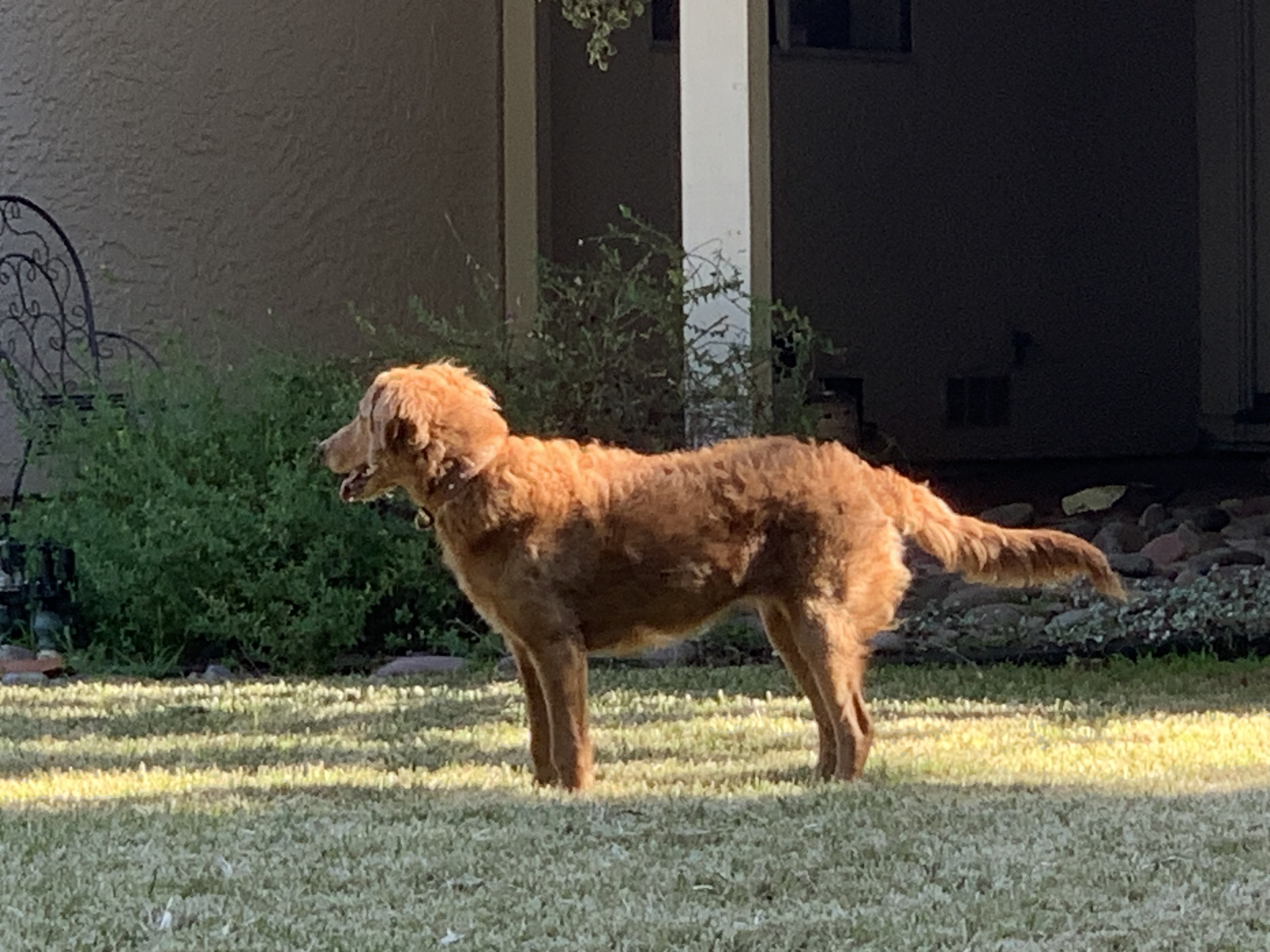
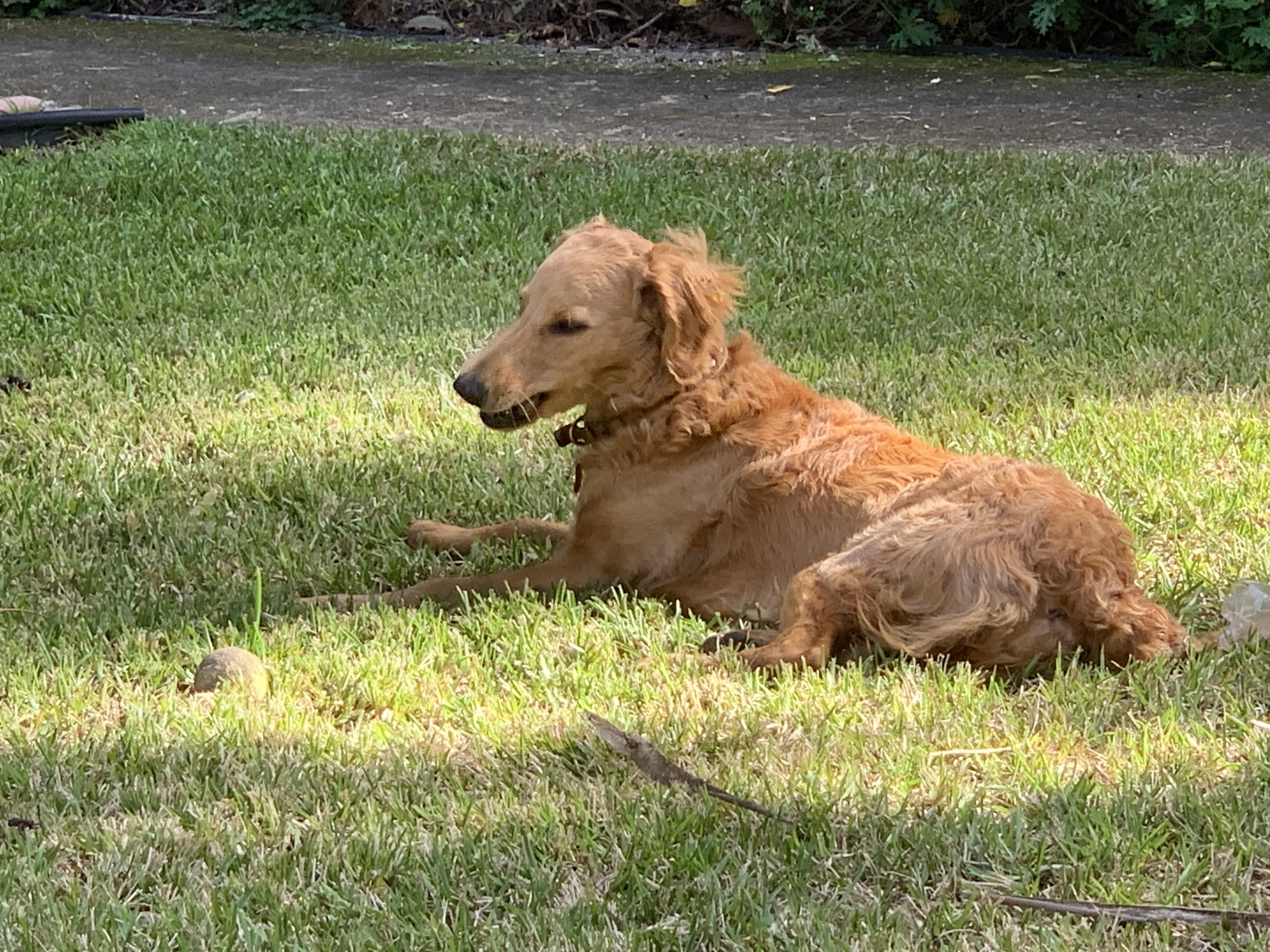
I’ve been playing a sort of “ball chase” +  soccer with our new puppy, Sadie. She’s extremely good at it, IMHO. She instinctively chases a ball & brings it back. I’ve reinforced it but it would be a stretch to say “I trained her to do that.” I sort of expect most dogs to view this as a game not completely unlike chasing a bird or rabbit & bringing it back. 

The more interesting part came when I combined it with soccer. She learned (?) to judge carom shots off the baseboard and half closed doors. She tries to stop a ball before it hits the wall but judges that if she can’t stop it directly, she can stop the rebound. That she even tries to stop it is interesting. That also seemed “natural.” I probably reinforced her differentially, but again, it would be giving me far too much credit to say I trained her to “defend” against having the ball go past her. 

I begin a few weeks ago to play with two balls at once. This makes it more challenging for me not to break my neck as well as Sadie. What I find interesting is that she immediately tries to hoard or herd; i.e., control, both balls. She has tried picking up two in her mouth at once, but she can’t manage it. So, she holds one ball in her mouth and “corrals” the other between her front paws. When she gets bored, she relents and lets me throw or roll or kick the balls. 

I now sometimes use three balls at once. (I’ll let you know which hospital for flowers). Actually, I’m careful, but Sadie is sudden in her movements. Anyway, once I put a ball “in play”, I usually control or kick it with my foot. Sadie imitates (!?) me in this. She “controls” a ball by putting one of her front paws on it and she also pushes the ball with her paw, though she did try “nosing it” once but I think she found it uncomfortable since she shook her head and reverted to using her front paws. 

On some occasions, I “grab” a ball with the bottom of my foot and move it slowly back and forth and feign kicking one way and then kick another way which routinely makes Sadie growl as she scampers after the ball. There’s something else. The slow movement followed by quick movement energizers her more in her quest for the ball than if I simply & directly hit it. 

These types of patterns are found in human sports around the globe. Did they co-evolve with dog play? I’ve seen videos of many species of mammal playing “soccer.” From the video alone though, I have no idea how spontaneous the play is. If I had to guess, I’d say it’s pretty spontaneous. 

Photo by Pixabay on Pexels.com

Soccer, American Football, hockey, rugby, field hockey, and basketball share this notion of trying to “make a goal” by getting past the defenders. In every one of these games, there is also the notion of “fake” or “feint.” It feels as though Sadie and I, if not reading from the same script exactly, both of us have the same “playbook” of things that are fun in sports. 

On a not completely unrelated topic, I am wondering whether any other new dog “owners” have noticed that their own sense of smell has been enhanced since sharing lives with a puppy. Perhaps it is not so much enhanced as that I pay more attention to it than I did a few short months ago. She goes sniffing and I go wondering for the most part, what it is she’s sniffing on about. 

To some extent, it’s the same with sounds. I’m typically a pretty visual person and when I walk alone outdoors, I mainly noticed what I see. When walking with Sadie, however, she reacts to many sounds that I would ignore. I know what it is and give it a name and then reassure her that it’s okay; that trucks and cars and airplanes and helicopters are okay, at least in the distance.


I sure hope I’m right.

The Walkabout Diaries 

The Walkabout Diaries

The Walkabout Diaries

The Walkabout Diaries

The Walkabout Diaries

The Walkabout Diaries

Sonnet for Sadie

Shadows Sadie

Sadie is a Thief!

A Cat’s a Cat That’s that

A suddenly springing something 

Math Class: Who are you?

Life is a Dance

How the Nightingale Learned to Sing

Dance of Billions 

Cedars Sighing in the Wind

14 Wednesday Jul 2021

Posted by petersironwood in Uncategorized

≈ Leave a comment

Tags

cooperation, ethics, fiction, leadership, learning, legend, myth, parable, Veritas

Cedars Sighing in the Wind

Photo by Tomas Balogh on Pexels.com

When Cat Eyes had finished reading aloud the story of The Wobby Man, she put aside what the ancients called a “book” and looked expectantly at Tu-Swift. He seemed lost in thought — tortured thoughts filled with thorns — by his visage. Cat Eyes stood and grabbed a nearby water pouch. Reading made her thirsty. She sat back down across from him. She smiled. She was  happy to see him again; happy to be reunited with her parents; happy at all the things that the tribe had learned from their discovery; happy that it had taken both of them working together, with their mutual friend Suze, in order to discover how to read. The joy of Cat Eyes felt a sharp edge though because Tu-Swift seemed anything but happy. 

“But, I don’t — .” Tu-Swift didn’t finish what he said to Cat Eyes because he didn’t know what he himself meant to say. Instead, he shook his head from side to side. “Why?” 

Cat Eyes took his hands into her own and looked at him with love in her eyes, a love that he did not see because his head bowed down and his eyes were only upon the ground. After a few moments she put one of her hands under his chin and lifted it up. They looked into each other’s eyes and she could see that his eyes were tearing up. “It’s okay. It’s to learn from, like all the stories here.” 

Tu-Swift shook his head from side to side and bit his lips. “But why?” His voice was plaintive as though he had a thorn stuck painfully under his fingernail and pled for her to remove it.

Cat Eyes sighed and asked gently, “Why what? What are you struggling with? Maybe we can work it out together. Often, life is a fight, but it doesn’t mean you have to be alone in every fight.”

Tu-Swift nodded. After a pause he said, “Why did The Wobbly Man do all that evil? And why did they let him?! Why couldn’t they see what he was up to?” 

Cat Eyes nodded. “There are people who do things — evil things — such as steal children. Perhaps there always will be. But I don’t think they think of it as evil. To them, it’s their way of … living … or of having fun. They like destroying life and love in others … I guess because they cannot experience it themselves. I don’t know.” 

Tu-Swift sighed. “You are right of course. Within the Veritas where I grew up, there was one such. The Wobbly Man sounds much like him. He manipulated others. He was cruel. Yet, he was such a good liar that he almost fooled our leader, the wise She Who Saves Many Lives. He actually betrayed the tribe to NUT-PI. And here’s the worst part. He got several other braves to go along with his schemes. Without ALT-R, I don’t think POND MUD or KAVANUT would have even been evil.”

“Yes.” After a pause, Cat Eyes added, “It’s much like that Red Spotted Death. It can spread from person to person. And, just as there are evil people even in societies based on truth and trust and love, so too there are people who act in good ways even among the Z-LOTZ and the ROI. It’s much like the story about the two wolves inside someone and which one you feed. The customs of the tribe can make it easy to feed the good wolf — or easy to feed the bad wolf.” 

Tu-Swift let out a long sigh. He stood up and held out his hand. Cat Eyes took it and, for a time, they walked in silence. Without intending to do so, they ended up at the entrance to the now dysfunctional tunnel. They stood for a time, holding hands in silence staring at the tunnel. At last, Tu-Swift voiced what both were thinking. 

“How could a people know so much as to build a tunnel through a mountain — and yet be so ignorant as to let a liar destroy their village?” 

Another long silence ensued until Cat Eyes sighed and spoke again. “We still have many books to read and understand. Many books are filled with words whose meanings we have yet to understand. It appears that it wasn’t just a village here and there. The plague of evil lies destroyed everything. I know you have struggled with whether to use the fire sticks….” 

Tu-Swift wondered why Cat Eyes stopped speaking. He looked at her and saw that silent tears were streaming down her cheeks. He squeezed her hand and asked gently, “What is it, Cat Eyes? Why are you so sad?” 

“Actually, I was just thinking a little while ago how happy I am about so many things. Yet … we had so much. We knew so much. But we destroyed it. If the books are true, and if our understanding is correct, weapons were developed that … weapons were created that were far worse than fire sticks. Far worse. Yet, there were also treatments for every disease. But the people forgot that they were part of the Tree of Life. People forgot that they were all one. People — not everyone — but enough — just began to grab everything they could for themselves. Lying became commonplace. Once the truth meant nothing, decisions were made by power alone. That is bad enough in the Z-Lotz or, from what you told me, among the Cupiditas. But imagine that they had — not just fire sticks — but horrible weapons that could destroy many villages and all the people in them. Of course, in doing so, these weapons killed birds and butterflies and trees and no-one even seems to have noticed! Maybe … perhaps, we are not really understanding. Maybe they are just stories to prevent people from becoming what the books say that they became. Maybe.” 

Tu-Swift bent down and plucked up a small flower that had grown in the cranny of the wall that held the now defunct controls for the tunnel door. He gently braided the stem into the silky hair of Cat Eyes. When he was done, he said, “Well, the tunnel is real. Yet, no-one really knows how it works. How could that be? I mean, unless there was some great loss of learning. I don’t know. Perhaps, we can learn from these stories, whether real or not, how to … how to ensure that we do not fall so far again. From what you said, it sounds…it sounds as though the people became sightless and witless. How can the people not see that they are a part of the Great Tree of Life? How can they not hear the song of the bird or the murmur of the stream? How can they not see the beauty of the trees and flowers all around them? How can they not taste the sweetness of honey?” 

Cat Eyes nodded. “That is one of the main question that we — those of us who are studying the books — keep asking ourselves. But when this question is asked, none of us answers. Not yet. Each of us is hoping someone else will explain. But what comes to our ears is only the silence and the cedars sighing in the wind.”  

—————————————

Roar, Ocean, Roar (A poem about the power of cooperation) 

The Only Them that Counts is All of Us

The Myths of the Veritas: The Forgotten Field 

The Myths of the Veritas: The Orange Man

The Myths of the Veritas: The First Ring of Empathy (Here begins the continuous trilogy of the Mythical Veritas who value truth, love, and cooperation).

Author Page on Amazon

An index to a proposed Pattern Language for Collaboration & Cooperation 

Who’s Got a Loose Wire?

12 Wednesday May 2021

Posted by petersironwood in Uncategorized

≈ Leave a comment

Tags

fiction, insight, learning, psychology, story, stubbornness

Photo by RF._.studio on Pexels.com

I was trained as a scientist. I believe in science. I believe that doing laboratory experiments about how we perceive, learn, decide, and solve problems has merit and applicability to the real world. One of the things I studied in the laboratory was perceptual adaptation. So, I had first-hand experience conducting experiments on perceptual adaptation. Please keep that in mind as you read this short story. 

Photo by Mike on Pexels.com

Many years ago, I drove to IBM Research five days of the week. It was a beautiful drive among Westchester reservoirs and at one point, my journey took me through an “erector set bridge” — you know the kind — they literally look to be made from a giant erector set. At the time, I was driving a sky blue Chevy with only an AM radio for entertainment. I typically listened to Imus in the morning on the way into work each day. AM radio being what it is, and steel erector set bridges being what they are, each time I drove through the metal bridge, the sound volume went down quite noticeably until I emerged on the other side. I did this for years. 

At some point, I decided I would treat myself to an entertainment upgrade. I had never bought anything like that and I was somewhat nervous that I might be “taken” or that the installation would be shoddy. 

I had a tape deck and AM/FM radio installed as well as stereo speakers. To me, it seemed marginally too luxurious, but I was really looking forward to some higher quality music and listening to books on tape. (I didn’t even know about NPR or WBAI at that point). I felt quite happy and contented as I drove to work that first day with my new tape deck. I had it playing some of my favorite and most spirited music. A perfect way to begin the workweek! 

Photo by Gabriel Santos Fotografia on Pexels.com

All at once, the sound volume went way up! And, then, a few moments later, it went back down again. My first thought was along these lines: “Damn! There must be a loose wire in the thing. Crap, now I’ve got to spend hours trying to straighten this out and argue about the bill. Yech. 

Then, I thought: Wait a minute! That was the bridge! I just perceived the sound to be louder because I so strongly expected it to be softer!

OK. But why the delay? Why didn’t it immediately occur to me as my first explanation? I knew that I was using my ear brain system to perceive the sound. I knew that expectation impacts perceptual experience. I knew I had spent years driving through the bridge and having the sound level go down. I believe in science; I had myself participated in studying the visual analogue of such a phenomenon myself. 

One explanation is age of learning. I first learned about how people think and solve problems from watching my own family interact and listening to radio. Later, that was supplemented by watching television, and to a lesser extent movies and reading books. I had at least a decade of indoctrination in “Finding who is at fault” and “If I perceive it, it must be true!” before I ever began to study the “scientific method.” 

Photo by Sharefaith on Pexels.com

Is it possible that those thought-patterns still influenced my initial takes on how to solve a problem? Is it feasible that they do not? In the instance related above, my “scientific and professional training” did come into play and overcome my initial impression. Indeed, the second hypothesis leap-frogged way ahead of the “loose wire” theory as the most plausible explanation.

Note too that not only did the “loose wire” theory initially come to the fore; it was embellished with a guilty party! Even if there were a loose wire, it wouldn’t necessarily mean that the person who installed it had done a bad job. 

I had a job for awhile as a projectionist, and I did make a few mistakes. But it also happened more than once that I was “blamed” for a film breaking when the real reason was not bad threading but the fact that the film had been spliced a hundred times! Or, I would be given a  rotary slide tray by the lecturer and one of the slides would be out of order. That’s my fault? Was I supposed to get an advanced copy of the presentation and critique it? No-one mentioned that as part of the job description. But there it is: the tendency to blame someone who may or may not be actually to blame. I have been on the receiving end. I suspect everyone has. Yet, my mind jumped to the same nonsense. 

Photo by Anna Tarazevich on Pexels.com

Even if you’ve never been trained in science, you’ve almost undoubtedly had many experiences that show that your perceptions of reality are not necessarily reality. You’ve likely jumped to conclusions and later found out you were wrong. A good way to remind us all of this is based on Native American wisdom called “The Iroquois Rule of Six.” 

In the case of the little vignette I shared above, I was driving to work. It took place before the invention of “smart phones” so even if I had been tempted to pull over and give that stereo installer a “piece of my mind” I had no feasible way to do it. 

Thank goodness. 

————————————————

The Iroquois Rule of Six

The Invisibility Cloak of Habit

To Be or Not to Be

I Can’t be Bothered

Essays on America: Wednesday

Essays on America: What about the butter dish?

Essays on America: The Update Problem

————————————————

The Psychology of Change: Distraction

25 Sunday Apr 2021

Posted by petersironwood in Uncategorized

≈ Leave a comment

Tags

change, distraction, learning, psychology

Photo by David Vives on Pexels.com

Distraction has many impacts, but one, at least in my experience, is that it greatly slows down learning to adapt. 

Here is an example from much earlier in my life, (so you’ll know it’s not primarily an age effect). 

One of my college part-time jobs was as an A/V assistant. It was actually a very cool job, because I got to travel all over the University and show movies or slides in classes in architecture, collagen, aging, genetics, sociology, Shakespeare, etc. I would typically arrive at work and get a “kit” which was basically a small suitcase with whatever A/V equipment was required for a particular gig. On the outside, the supervisor had used a magic marker to write on a piece of masking tape a building number, a room number, and the time I was to be there. Depending on the location, it could take anywhere from 5 to 25 minutes for me to get to a particular location, if I was already familiar with the room. There were maps on campus to show where all the buildings were, but once inside, signage varied tremendously from building to building. Some buildings were laid out logically and some had lots of signage. Some had both. Some had neither. 

When I went to a new location, there were many times I came to T-shaped intersection and had to make a “blind” choice as to which hall led to my assigned room. If, say, I turned right, I might look at the numbers on various classrooms and determine that I had gone the wrong way so I’d turn around and get to the assigned room. What’s interesting is what happened the second time I went to that same room. You might think I would turn left because, after all, a week earlier, I had discovered that I needed a left turn to efficiently reach my goal. If someone had asked me where the room was, I would have known without a doubt. But in the actual moment, that’s not what I did.

Photo by Javon Swaby on Pexels.com


What I actually did when I reached the choice point was turn right, just as I had initially done. I would take a few steps down the wrong hallway and wake up to the fact that I was going the wrong way. And what do you suppose happened the third time I reached that decision point? Would I turn to the left in a nice smooth way? No. I would still turn right. I would begin to take a step to the right and then stop dead in my tracks and turn to the left.

Why had it taken me three tries to learn instead of just once? You may think, “Oh, that’s just the way people are.” I think it would be closer to the truth to say, “Oh, that’s just the way we people are.” That is to say, the culture of hyper-competitiveness keeps most of us, certainly including me, pre-occupied most of our waking hours. Walking on the reasonably well-lit regular corridors of a university campus did not require my full attention. So, my mind was always churning on about something else when I came to the decision point. 

Photo by Markus Spiske on Pexels.com

Of course, that’s just one example. There are many others. I learned at an early age to multi-task. Sometimes, that may be useful to me just as your multi-tasking is sometimes useful to you. But there is at least one important downside. 

You’re being in a constant state of busy-ness makes it harder for you to notice that you need to learn something new and it makes it harder to do something even if you do see the need. If you come to a choice point and make the wrong choice, in many cases, you can figure that out fairly easily — if you’re paying attention. If you cut yourself off from what is really happening, learning, change, adaptation — it all becomes much harder. You can cut yourself off in many ways: alcohol, drugs, being a workaholic — but my favorite is distraction. 

While distraction has it’s pros and cons for me, and likely for you, the constant busy-ness is wonderful for business. They will sell you anything and everything to distract you. But here’s a fun thing to do. 

Take a break.

Concentrate on one thing at a time.

Try it for an hour.

Try it for a day.

Do you really get less done? Do you have more pleasure or less? Do you learn more quickly or more slowly? 

————————————-

Thoughts on gratitude and mindfulness: Corn on the Cob

The Invisibility Cloak of Habit

Essays on America: Wednesday 

Essays on America: Happy Talk Lies

Essays on America: The Update Problem 

How your choices can even influence evolution: Ripples

On Seeing Beyond the Headlines: The Jewels of November 

Psychology of Change: Growth, Decay, and Chrysalis.

31 Wednesday Mar 2021

Posted by petersironwood in Uncategorized

≈ Leave a comment

Tags

awarenewss, change, GreenNewDeal, learning, metamorphosis, psychology

Perhaps the “Psychology of Change” is a label that hides too much variation in types to reveal any common patterns. Let me explain. 

First of all, what “works” or what “predicts” change in such diverse situations as: 

  1. One imposed from without by force (as prison inmates, say;) 
  2. Acquired as a child through acceptance of the cultural norms (as is normal);
  3. Enlightenment in an elderly adult through contact with a child (as in Silas Marner, Finding Forrester or Ana).

Photo by Pragyan Bezbaruah on Pexels.com

May well have nothing to do with one another. In addition, the speed of change, and even the acceleration of change, and, yes, possibly even the jerk might have an impact on what happens. Again, consider a few examples.

You are the major breadwinner (by being a bread maker) in your family of four. You are moderately “well off” financially but your business has been going steadily down for the last five years. You could relocate but you all love the private school your kids go to. Finally, your youngest is a senior, so next year, you will relocate to a part of your nation that is growing. 

Photo by Vital1na on Pexels.com

This is no doubt a fairly large change. But, it is also moderately slow. And, not only is it slow; there is only moderate if any acceleration. You will naturally see more details that need to be attended to as the date creeps closer. And, there will be some surprises. But for the most part, the speed and predictability of the change is within your capacity. If you didn’t perceive it to be so, you wouldn’t have decided on the move. 

Now, let’s change things just a bit. Same family of four. Same worsening of conditions. Only now, before your youngest even starts her senior year, COVID 19 strikes. Your business is no longer slowly shrinking. It plummets to the ground. Some people were predicting this might happen months ago, but you chose to listen to the people who said it would all go away. But now is now. You are experiencing much faster and less predictable change. Not only that; the potential magnitude of the change is much greater. Before, you realized it would take time to build your business back up in a new location. But now? You might not even have the wherewithal to survive the next six months, let alone move. And when? And to where? You had a spot all picked out in one of the more trendy and affluent suburbs in Silicon Valley. But now? It’s a hotbed of COVID!

Photo by Uriel Mont on Pexels.com


Are the same things that are important in situation one above the same things that are important in situation two? 

Now, let’s add just a little more to the scenario, but without the COVID19.

As before, you are the major breadwinner (by being a bread maker) in your family of four. You are moderately “well off” financially but your business has been going steadily down for the last five years. You could relocate but you all love the private school your kids go to. Finally, your youngest is a senior, so next year, you will relocate to a part of your nation that is growing. You are on your way to your bakery and the sky grows dark. You worry that it will be pouring down rain just as you make the 50 yard dash to the front door of your bakery.

You need not have worried because the Class Five tornado delivered the front door to a spot only two feet from your normal parking spot. That front door was the largest remaining piece of what had been your grocery store. Your house was also destroyed. And, so was the private school. Luckily, your youngest was unharmed. Not so luckily, your other child and your spouse were killed in the storm along with 73 others in the area. 

We all have the intuition that this person will make the most profound changes, but in what way? Of course, nearly anyone would be in complete shock for a time and not know what to do. But then what? It seems equally likely that the person would:

A. Decide that life is absurd and it’s out to destroy you and the only way to protect yourself is drink like a fish. And, the child’s better off somewhere else.

B. Decide that life is absurd and it’s out to destroy you and the only way to protect yourself is to never love again.  And, the child’s better off somewhere else.

Of course, A and B are not mutually exclusive. They often go together.

C. You decide that life may end at any time and that the most important thing in life is to enjoy every moment. And, that means, among other things, spending a lot of time with your remaining family & friends. 

D. You decide that service to others is the most important thing in life and you and your child both eventually become involved in a UN project to show people how to bake more nutritious bread.


There are endless possibilities of course. And, they are not fixed outcomes. The person may decide that life may end at any time and that the most important thing in life is to enjoy every moment — and to spend time with friends and then — three years later —- take path A or D instead. 

As someone trained in “Experimental Psychology,” my disciplinary reflex is to try to identify parameters and try to relate conditions of change to results in terms of outcome as a function of those parameters. 

Perhaps, however, a better approach is more like the Periodic Table. Rather than an “infinite variety”, it might be true that most cases fall into one of several dozen categories. Each category is basically a theme or premise for a story which we relate to precisely because they are common “types” of change. 

Examples might include:

 “Situation slowly deteriorates and protagonist makes adjustment.” 


“A natural disaster destroys much (or all) of what the protagonist loves and they must create a whole new life.” 

“Situation slowly deteriorates, and in turn, the protagonist engages in ever more self-destructive behavior, making the situation worse and eventually resulting in disaster.”

“Situation slowly deteriorates, and in turn, the protagonist engages in ever more self-destructive behavior, making the situation worse and eventually resulting in — enlightenment followed by a complete turn-around.” 

And so on. 

—————————————————-

Essays on America: Wednesday 

The Invisibility Cloak of Habit

The Update Problem 

How the Nightingale Learned to Sing

Take a Glance; Join the Dance

A Wildly Webbed World

11 Saturday Apr 2020

Posted by petersironwood in America, apocalypse, COVID-19, creativity, poetry, psychology, Uncategorized

≈ 2 Comments

Tags

activity, computer, fun, Internet, knowledge, learning, poem, poetry, recreation, surfing, web

black cat holding persons arm

Photo by Ruca Souza on Pexels.com

I type —
Hey! Clatter-clatter keyboard of ascii: 
Chatter chatter; chat me up and down the great grey scales of my
Wide webbed world!
Hey clatter, clatter keyboard of ask me: 
Look at me and truly see I’m rainbow-swirled.
Share my image morphed; visualize my visage;
Stay and portray me; play me; slay me.
Vibrate my thought through the slick copper wire
Send my second self through the tiny fibers of fine desire
Do deadly dragons and flagons and flames and fire!

10F4B83C-DD20-4A6F-A6D4-B36DE04871FF

I think —
Hey! Let me find and remind our larger mind
Of who we may yet — build to become:
A race of not so numb and not so dumb,
Plumbing instead to the very depths of distant stars,
And no less, the innermost realms of mirth and Mars,
Till the mystic magic oneness of math and rhyme
Manifests so patently, so patiently, so perfectly in mime.
Find the micro-time to sweep my musical spheres and spears
The tears and cares of play and work no longer clash;
Till micro-cash flows like water through all the all-time
Help-hungry waiting wings of the world-wide watersplash;
Till ripples trip tugboats of data, mined from far fields,
Crash breaker-wave upon analyses and syntheses and shields.

B371D710-826A-4E82-A9D3-369A53649234

I see —
Strangely dreaming wrecks of old preconceptions shatter,
Clatter to the floor, rearrange, derange themselves re-making,
Tattered by the shreds of cyberworlds waking, shaking
Our millenial group-sleep of not seeing all the wide over-tried
Over-tired, over-mired, over in the four-leaf field of clover spied
World around surround of miracle of sight and sound
From air to ground, and sea to land, and rainbow band and bound.

FDC90856-D493-4828-80DE-853D923627CF_1_105_c

I hear —
Instruments that sing as they soar, tinkle, roar and storm;
Slap each other silly, go dancing willy-nilly; form and reform
Glancing blows and prancing foes and smiling awhile,
Rising for a virtual ever-upward sky-high mile,
Suspended, then — falling for eternity below the lowest low,
Dropping stone-like into so slow, slow, no-go flow.

C8A2A9CB-5065-4347-AE76-A43A0FC721E4

Reloaded and rebooted, I readily roam —
Freely through city and pity and pious and pi,
Splash through wavelets and warrants and warriors and why,
Surf terrier and harrier and hairless and house
Matrices of miracles, at the merest touch of my magic mouse!

22FAC19F-5ABE-4C2B-8102-313BC7FAE5EA_1_105_c


Author Page on Amazon

Essays on America: The Temperature Gauge 

Essays on America: A Once-Baked Potato

Essays on America: Wednesday

Essays on America: Rejecting Adulthood

Essays on America: The Game

Essays on America: Ice

Myths of the Veritas: The Forgotten Fields

Wartime Playtime

21 Friday Feb 2020

Posted by petersironwood in America, apocalypse, politics, psychology, Uncategorized, Veritas

≈ 1 Comment

Tags

Feedback, games, innovation, learning, legends, myths, truth, vicious cycle, war, weapons

Tu-Swift laughed. 

BDAD5D7D-3543-4705-9A06-7CD7659129E4

He had mastered juggling four sacks, or four rocks and had been working all morning on five, but with little success. Sooz shook her head and chuckled good-naturedly. “Don’t give up, Tu-Swift. You’ll get there.” Then, after a pause, she added, “Though you may be an old man with a long white beard.” 

“What? You’ll pay for that!” He began to chase her around the training space. Being lighter, Sooz could turn more quickly. After a few moments, Cat Eyes appeared. Tu-Swift called out, “Help me catch this fox! I can’t turn fast enough!” 

Cat Eyes laughed as well. With a serious note in her voice, she added, “You shouldn’t be trying to turn fast. Let your knee heal, would you?” 

1A559AF5-59A6-4D1E-929D-B09054B43A89

Tu-Swift’s face darkened for a moment. The ground around them also grew dark as a passing cloud momentarily blocked the sun. He wondered briefly whether he would ever really regain his speed and mobility. Then, just as the ground grew sunny again, so did his face. Time would tell. Meantime…

Just then, he heard the deep voice of Jaccim. He was trying, but largely failing, to speak Veritas. With the help of Cat Eyes, he eventually made himself clear. He had asked why they were playing when there was likely to be a war which they should all be preparing for. They had been “marked” for war. This was no time for juggling nonsense or for laughing. 

Tu-Swift replied, “Hello, Jaccim. I see you brought your own clouds with you.” 

Sooz and Cat Eyes both laughed, though in a friendly way. Tu-Swift continued, “Jaccim, this is the way of the Veritas. Don’t you ever play?” 

Jaccim’s head snapped back and he frowned. He spoke and Cat Eyes translated. “Me? Certainly not! Play is for small children. Not someone your age. All of you should be preparing for war. It is serious.” 

86A389C7-4CD7-42E3-ABFA-A555A5BB24CB

Many Paths who strode into the training area overheard the last part of the translated conversation. She smiled at all of them and supplemented her Veritas with sign language so that Jaccim would directly understand as much as possible. “You are right. It is serious. This is why we play. We need weapons. New weapons. Weapons that no-one will suspect. That is why  we watch and listen to those whose minds are like water flooding over new plains. They will go ways that we cannot foresee. Nor can others. What shall we care who wins a war if life holds no joy? Every moment now is precious. This is what the Veritas always teach. But now that we may be on the brink of destruction, joy is more important than ever.” 

Jaccim frowned and answered with a mixture of sign language and broken Veritas. “What may be gained by juggling bags or rocks? It is foolish.”

Many Paths smiled at Tu-Swift. She put her hand into a fold of her tunic and brought out a knife and casually tossed it to Tu-Swift. She quickly threw him two more. He easily caught all three and began juggling the three knives. 

Jaccim opened his mouth to speak, but before he could formulate his answer in the tongue of the Veritas, he heard three odd sounds a little like a horse’s whinny and a little like a large rock hitting a tree trunk. He frowned and then his mouth dropped open farther as he saw all three knives sticking out of three nearby tree trunks. Tu-Swift had thrown all three underhand and hard into three targets. Jaccim tried to speak but nothing came out. It wasn’t that he did not know the Veritas words for what he wanted to say. There were no words. Even a sensible language like ROI could not help him. Tu-Swift, meanwhile, calmly walked over and wiggled each of the knives out and handed them back to Many Paths. 

6A476221-BDAD-4FC1-97A4-531C91BE04AC

She smiled at Tu-Swift and continued out of the clearing. As she reached the edge she looked back over her shoulder and said, “Keep up the good work.” 

Jaccim understood her words but not her thinking. She was supposed to be the leader. Yet she spoke of joy and play even though they would likely soon be at war. It made no sense, thought Jaccim. It’s what comes, he thought, of having a woman as leader. We would not have a woman as leader. Not the ROI. Nor would the Z-Lotz. It’s all foolishness. As the Veritas will soon discover for themselves. How had these people defeated the ROI and destroyed his village? 

Tu-Swift called out, “Many Paths! Have you a moment? I wish to show you something else!” 

Many Paths turned back, “I am on my way to meet up with Shadow Walker but I can see what else you have first.” 

Tu-Swift glanced at Sooz and once he had caught her eye, gestured over toward a contraption they had constructed at the end of the training compound. Two vines were suspended from a strong overhanging branch. The vines looped through a thick wooden plank which lay parallel to the ground. Sooz lifted a leg over the plank coquettishly as she smiled at Tu-Swift. He walked around behind her and pushed. He found pushing her surprisingly pleasurable and his cheeks flushed. 

back view photo of woman swinging

Photo by Ahmad Fauzi on Pexels.com

Sooz swung forward and then arced back toward Tu-Swift. Just as she stopped, he pushed her again. Each time, he pushed at just the right time and she swung higher and higher. After a score of pushes, he changed the timing so that he pushed against her momentum and gradually slowed her to a stop. 

Jaccim shook his head. He could see no reason for such frivolity. 

Tu-Swift walked over to Many Paths. “We had been swinging on a single vine and Sooz thought this would work — and it did. But the thing we really wanted to show you is this. He walked over to a small pile of straps made of softened hide. He put a stone in a small, broad but shallow pit in the strap. He motioned for the others to stand behind a nearby tree and peek out. He put both ends of the strap in his hand and began whirling it around his head. He suddenly let go of one end and the stone went flying. It thunked loudly into one of the small, dead pine trunks that had been partly buried in the ground. Many Paths led the others over to see the result. The stone lay buried in the trunk. She nodded. “Nice,” she said. 

Many Paths nodded again. “Yes. This is good. You have an almost endless supply of stones. Imagine these flying into an army from many directions at once. It will be hard to defend against.” Many Paths smiled again at Tu-Swift and set off to meet up with Shadow Walker. 

As Many Paths left the clearing, she ducked under an overhanging branch of Witch Hazel and spoke aloud, “Thank you for your medicine.” She walked down a sweetly curving path toward a small spring. Three pink flowers, Lady Slippers, poked their heads through the dark greenery. She began thinking about the sedation caused by Lady Slippers and recalled what She Who Saves Many Lives had said. “After the sedation wears off, one may be nervous and high strung for a time.” Many Paths had only tried it twice and she experienced exactly what the elder had described both times. It had felt a lot like the way that the roots of Sweet Flag made her feel. But after the effects of Sweet Flag wore off, it made her feel tired and groggy. Odd, she thought. 

She chuckled at the swinging seat that Tu-Swift and Sooz had created though she couldn’t see how that led to the sling weapon he had shown her. It all had to do with the timings of the pushes, she reminded herself. Suddenly, many paths stopped. 

She thought of the swing, the pushes, the Lady Slippers, and the Sweet Flag. What if… what if I pushed with a little Lady Slipper and then… just when it began to wear off, I pulled with some Sweet Flag…a person might become very nervous and want more Lady Slipper… what would happen if they were pushed and pulled higher and higher? I wouldn’t poison the person exactly. Would it tear the body apart? Tearing the people apart with such pushes seemed to be what was indicated in the strange tales scribed into the sheaf of leaves that had been discovered by Lion Slayer and Eagle Eyes. Could that really happen? Was there a way to tear apart the Z-Lotz? Was there a way to tear apart the Veritas? And, if so, how could it be prevented? 

B723FC76-0CC5-4DDB-8A0B-DFADBB1884FD_4_5005_c

———————————————-

Author Page on Amazon

Start of the First Book of The Myths of the Veritas

Start of the Second Book of the Myths of the Veritas

Table of Contents for the Second Book of the Veritas

Table of Contents for Essays on America 

Index for a Pattern Language for Teamwork and Collaboration  


Cancer Always Loses in the End

12 Wednesday Feb 2020

Posted by petersironwood in America, apocalypse, health, politics, psychology, Uncategorized

≈ 47 Comments

Tags

cancer, Corruption, Dictatorship, environment, fascism, Hitler, learning, Mussolini, pollution, Rule of Law

I would have to suppose that 45’s supporters are very happy tonight. The President tweeted that his friend Roger Stone had been treated unfairly and should get a lighter sentence. Roger Stone has been at “dirty tricks” his entire career. (This man was convicted in court. He not only lied under oath and failed to keep his promise not to comment on the case but even sought to intimidate other witnesses). 

But #45 tweets to let him off easy and Bill Barr demands it. Four long-time competent prosecutors quit the case. Yay! A win for #45! 

That’s a win for #45 in precisely the same way that it’s a “win for a cancer cell” who manages to hide from surgery or recover from chemotherapy. Make no mistake. Whatever lies you have chosen to believe about #45, he is not on your payroll. Just as cancer cells are capable of misleading and misdirecting the body’s immune system from destroying them, so too #45 has used, among other things, Fox News, pep rallies, lies, and Russian bot accounts and fake news propagation through social media to convince the immune system of the country to treat him as a legitimate member of society. A cancer cell is not a legitimate member of your body. #45 is not a legitimate politician. He doesn’t do a brilliant job of competing; he does a brilliant job of cheating. 

86A389C7-4CD7-42E3-ABFA-A555A5BB24CB

Cancer though? Cancer is stupid. Sometimes, the immune system is not fooled or the surgery works or the radiation works or the chemo works and the rogue liver cell dies along with all its neighbors. Or, cancer succeeds and produces more and more cancer cells. Cancer will eventually kill its host body. And, then it dies anyway. If had kept being a decently functioning liver cell, it would have been a part of the tree of life that extends and grows. 

Instead, that liver cell’s overblown sense of self-importance led it to stop functioning as a liver cell and instead simply spend its time sucking all the resources possible to itself and grow without bound. 

As you know, if you have cancer in any part of your body, there’s a chance that it will spread to other parts and, if unchecked, it will spread to every part. 

photo of landfill

Photo by Leonid Danilov on Pexels.com

It isn’t just government that grows corrupt when the government is corrupt. It’s every organ of the society. You like watching the Academy Awards? Will it be more fun when you know that the “Best Picture Award” (and all the others) will be determined by Putin? Will it be more fun when the “Best Pictures” aren’t even made because they don’t win the favor of the “National Cultural Purity Board.” 

Will you enjoy the Super Bowl, or the World Series or the Kentucky Derby when the outcome is determined ahead of time by politicians? Don’t you think that the managers will work as hard? Will the officials care as much about the accuracy of their calls? Will the athletes train as hard or try as hard? 

Will technologists and industrialists work hard and think hard to improve products and customer service? Why? What’s the point? The brands that will succeed are the ones that are favored by the most powerful. 

094B8A3E-B81C-4362-B83E-89FA50F9646B

Corruption, like cancer, spreads everywhere. At some point, the dysfunction grows so large that the body politic dies. The society devolves into Civil War, anarchy, or it falls like a ripe plum into the waiting hand of the man who got #45 Putin office.

Will you even remember what it was like to taste an organic, vine-ripened tomato, or have a free & fair election, or a fair athletic contest, or a fair trial, or trust in the police to help you when you’re in trouble? 

Cancer doesn’t care. It feels good. For awhile. It gets a richer blood supply than it used to! It can grow faster! Whoopee! But — of course — it only lasts for awhile. The tumor can’t go hunting and gathering. The tumor can’t prepare a meal or even digest the meal. Cancer needs the body for its survival — but it imagines it doesn’t and thereby kills itself. 

Some people treat everything as a zero sum game. In life, however, many situations are win/win scenarios. Cancer, however, is not a “win/win” or a zero sum game. It’s a lose/lose situation. The cancer always dies and sometimes so does its victim. But even if the body recovers, the body is harmed, often irreparably. 

So, too, corruption is a lose/lose scenario. Rigged horse races lead to hurting horses, jockeys, and fans. Those who “control” the outcome lose too. They become greedy and rig more and more until no-one has any interest any more. 

IMG_3191

Original drawing by Pierce Morgan

Cancer is stupid. 


Author Page on Amazon

Cancer and Air Pollution

Cancer and Water Pollution

Cancer and Food Additives

Pollution and Autoimmune Disease

Click to access CAPH1_Parallel_sessions_III.3_3_AP_major_risk_factor_for_cancer_Weiderpass.pdf

← Older posts
Newer posts →

Subscribe

  • Entries (RSS)
  • Comments (RSS)

Archives

  • August 2026
  • July 2026
  • June 2026
  • May 2026
  • April 2026
  • March 2026
  • February 2026
  • January 2026
  • December 2025
  • November 2025
  • October 2025
  • September 2025
  • August 2025
  • July 2025
  • June 2025
  • May 2025
  • April 2025
  • March 2025
  • February 2025
  • January 2025
  • December 2024
  • November 2024
  • October 2024
  • September 2024
  • July 2024
  • April 2024
  • March 2024
  • February 2024
  • January 2024
  • December 2023
  • August 2023
  • July 2023
  • May 2023
  • April 2023
  • March 2023
  • February 2023
  • January 2023
  • December 2022
  • November 2022
  • October 2022
  • September 2022
  • August 2022
  • July 2022
  • June 2022
  • May 2022
  • April 2022
  • March 2022
  • February 2022
  • January 2022
  • December 2021
  • November 2021
  • October 2021
  • September 2021
  • August 2021
  • July 2021
  • June 2021
  • May 2021
  • April 2021
  • March 2021
  • February 2021
  • January 2021
  • December 2020
  • November 2020
  • October 2020
  • September 2020
  • August 2020
  • July 2020
  • June 2020
  • May 2020
  • April 2020
  • March 2020
  • February 2020
  • January 2020
  • December 2019
  • November 2019
  • October 2019
  • September 2019
  • August 2019
  • July 2019
  • June 2019
  • May 2019
  • April 2019
  • March 2019
  • February 2019
  • January 2019
  • December 2018
  • November 2018
  • October 2018
  • September 2018
  • August 2018
  • July 2018
  • June 2018
  • May 2018
  • April 2018
  • March 2018
  • February 2018
  • January 2018
  • December 2017
  • November 2017
  • October 2017
  • September 2017
  • August 2017
  • July 2017
  • June 2017
  • May 2017
  • April 2017
  • March 2017
  • February 2017
  • January 2017
  • December 2016
  • November 2016
  • October 2016
  • September 2016
  • August 2016
  • July 2016
  • June 2016
  • May 2016
  • April 2016
  • March 2016
  • February 2016
  • January 2016
  • December 2015
  • November 2015
  • October 2015
  • September 2015
  • August 2015
  • May 2015
  • January 2015
  • July 2014
  • January 2014
  • December 2013
  • November 2013

Categories

  • AI
  • America
  • apocalypse
  • cats
  • COVID-19
  • creativity
  • design rationale
  • dogs
  • driverless cars
  • essay
    • guns
  • family
  • fantasy
  • fiction
  • HCI
  • health
  • leadership
  • love
  • management
  • nature
  • pets
  • poetry
  • politics
  • psychology
  • Sadie
  • satire
  • science
  • sports
  • story
  • The Singularity
  • Travel
  • Uncategorized
  • user experience
  • Veritas
  • Walkabout Diaries

Meta

  • Create account
  • Log in

Blog at WordPress.com.

  • Subscribe Subscribed
    • petersironwood
    • Join 646 other subscribers
    • Already have a WordPress.com account? Log in now.
    • petersironwood
    • Subscribe Subscribed
    • Sign up
    • Log in
    • Report this content
    • View site in Reader
    • Manage subscriptions
    • Collapse this bar
Loading Comments...