• About PeterSIronwood

petersironwood

~ Finding, formulating and solving life's frustrations.

petersironwood

Tag Archives: human factors

Madison Keys, Francis Scott Key, the “Prevent Defense” and giving away the Keys to the Kingdom. 

12 Friday Dec 2025

Posted by petersironwood in America, family, management, psychology, sports, Uncategorized

≈ Leave a comment

Tags

art, books, bravery, Business, career, choice, courage, HCI, human factors, IBM, life, school, sports, technology, Travel, UX

Madison Keys, Francis Scott Key, the “Prevent Defense” and giving away the Keys to the Kingdom. 

Madison Keys, for those who don’t know, is an up-and-coming American tennis player. In Friday’s Wimbledon match of July, 2018, Madison sprinted to an early 4-1 lead. She accomplished this through a combination of ace serves and torrid ground strokes. Then, in an attempt to consolidate, or protect her lead, or play the (in)famous “prevent defense” imported from losing football coaches, she managed to stop hitting through the ball – guiding it carefully instead — into the net or well long or just inches wide. 

IMG_2601

Please understand that Madison Keys is a wonderful tennis player. And, her “retreat” to being “careful” and playing the “prevent defense” is a common error that both professional and amateur players fall prey to. It should also be pointed out that what appears to be overly conservative play to me, as an outside observer, could easily be due to some other cause such as a slight injury or, even more likely, because her opponent adjusted to Madison’s game. Whether or not she lost because of using the “prevent defense” no-one can say for sure. But I can say with certainty that many people in many sports have lost precisely because they stopped trying to “win” and instead tried to protect their lead by being overly conservative; changing the approach that got them ahead. 

Francis Scott Key, of course, wrote the words to the American National Anthem which ends on the phrase, “…the home of the brave.” Of course, every nation has stories of people behaving bravely and the United States of America is no exception. For the American colonies to rebel against the far superior naval and land forces (to say nothing of sheer wealth) of the British Empire certainly qualifies as “brave.” 

IMG_8499

In my reading of American history, one of our strengths has always been taking risks in doing things in new and different ways. In other words, one of our strengths has been being brave. Until now. Now, we seem in full retreat. We are plunging headlong into the losing “prevent defense” borrowed from American football. 

American football can hardly be called a “gentle sport” – the risk of injury is ever present and now we know that even those who manage to escape broken legs and torn ligaments may suffer internal brain damage. But there is still the tendency of many coaches to play the “prevent defense.” In case you’re unfamiliar with American football, here is an illustration of the effect of the “prevent defense” on the score. A team plays a particular way for 3 quarters of the game and is ahead 42-21. If you’re a fan of linear extrapolation, you might expect that  the final score might be something like 56-28. But coaches sometimes want to “make sure” they win so they play the “prevent defense” which basically means you let the other team make first down after first down and therefore keep possession of the ball and score, though somewhat slowly. The coach suddenly loses confidence in the method which has worked for 3/4 of the game. It is not at all unusual for the team who employs this “prevent defense” to lose; in this example, perhaps, 42-48. They “let” the other team get one first down after another. 

red people outside sport

Photo by Pixabay on Pexels.com

America has apparently decided, now, to play a “prevent defense.” Rather than being innovative and bold and embracing the challenges of new inventions and international competition, we instead want to “hold on to our lead” and introduce protective tariffs just as we did right before the Great Depression. Rather than accepting immigrants with different foods, customs, dress, languages, and religions — we are now going to “hold on to what we have” and try to prevent any further evolution. In the case of American football, the prevent defense sometimes works. In the case of past civilizations that tried to isolate themselves, it hasn’t and it won’t. 

landscape photography of gray rock formation

Photo by Oleg Magni on Pexels.com

This is not to say that America (or any other country) should right now have “open borders” and let everyone in for every purpose. (Nor, by the way, has any politician of any party suggested that we do that). Nor should a tennis player hit every shot with all their might. Nor should a football team try the riskiest possible plays at every turn. All systems need to strike a balance between replicating what works–providing defense of what one has while also bravely exploring what is new and different. That is what nature does. Every generation “replicates” aspects of the previous generation but every generation also explores new directions. Life does this through sexual selection, mutation, and cross over. 

This balance plays out in career as well. You need to decide for yourself how much and what kinds of risks to take. When I obtained my doctorate in experimental psychology, for example, it would have been relatively un-risky in many ways to get a tenure-track faculty position. Instead, I chose managing a research project on the psychology of aging at Harvard Med School. To be sure, this is far less than the risk that some people take when; e.g., joining “Doctors without borders” or sinking all their life savings (along with all the life savings of their friends and relatives) into a start-up. 

At the time, I was married and had three small children. Under these circumstances, I would not have felt comfortable having no guaranteed income. On the other hand, I was quite confident that I could write a grant proposal to continue to get funded by “soft money.” Indeed, I did write such a proposal along with James Fozard and Nancy Waugh who were at once my colleagues, my bosses, and my mentors. Our grant proposal was not funded or rejected but “deferred” and then it was deferred again. At that point, only one month of funding remained before I would be out of a job. I began to look elsewhere. In retrospect, we all realized it would have been much wiser to have a series of overlapping grants so that all of our “funding eggs” were never in one “funding agency’s basket.” 

brown chicken egg

Photo by Pixabay on Pexels.com

I began looking for other jobs and had a variety of offers from colleges, universities, and large companies. I chose IBM Research. As it turned out, by the way, our grant proposal was ultimately funded for three years, but we only found out after I had already committed to go to IBM. During this job search, I was struck by something else. My dissertation had been on problem solving but my “post-doc” was in the psychology of aging. So far as I could tell, this didn’t bother any of the interviewers in industry in the slightest. But it really freaked out some people in academia. It became clear that one was “expected” in academia, at least by many, that one would choose a specialty and stick with it. Perhaps, one need not do that during their entire academic career, but anything less than a decade smacked of dilettantism. At least, that was how it felt to me as an interviewee. By contrast, it didn’t bother the people who interviewed me at Ford or GM that I knew nothing more than the average person about cars and had never really thought about the human factors of automobiles. 

Photo by Pixabay on Pexels.com

The industrial jobs paid more than the academic jobs and that played some part in my decision. The job at GM sounded particularly interesting. I would be “the” experimental psychologist in a small inter-disciplinary group of about ten people who were essentially tasked with trying to predict the future. The “team” included an economist, a mathematician, a social psychologist, and someone who looked for trends in word frequencies in newspapers. The year was 1973 and US auto companies were shocked and surprised to learn that their customers suddenly cared about gas mileage! These companies didn’t want to be shocked and surprised like that again. The assignment reminded me of Isaac Asimov’s fictional character in the Foundation Trilogy — Harry Seldon — who founded “psychohistory.” We had the chance to do it in “real life.” It sounded pretty exciting! 

antique auto automobile automotive

Photo by Pixabay on Pexels.com

On the other hand, cars seemed to me to be fundamentally an “old” technology while computers were the wave of the future. It also occurred to me that a group of ten people from quite different disciplines trying to predict the future might sound very cool to me and apparently to the current head of research at GM, but it might seem far more dispensable to the next head of research. The IBM problem that I was to solve was much more fundamental. IBM saw that the difficulty of using computers could be a limiting factor in their future growth. I had had enough experience with people — and with computers — to see this as a genuine and enduring problem for IBM (and other computer companies); not as a problem that was temporary (such as the “oil crisis” appeared to be in the early 70’s). 

airport business cabinets center

Photo by Pixabay on Pexels.com

There were a number of additional reasons I chose IBM. IBM Research’s population at the time showed far more diversity than that of the auto companies. None of them were very diverse when it came to male/female ratios. At least IBM Research did have people from many different countries working there and it probably helped their case that an IBM Researcher had just been awarded a Nobel Prize. Furthermore, the car company research buildings bored me; they were the typical rectangular prisms that characterize most of corporate America. In other words, they were nothing special. Aero Saarinen however, had designed the IBM Watson Research Lab. It sat like an alien black spaceship ready to launch humanity into a conceptual future. It was set like an onyx jewel atop the jade hills of Westchester. 

I had mistakenly thought that because New York City was such a giant metropolis, everything north of “The City” (as locals call it) would be concrete and steel for a hundred miles. But no! Westchester was full of cut granite, rolling hills, public parks of forests marbled with stone walls and cooled by clear blue lakes. My commute turned out to be a twenty minute, trafficless drive through a magical countryside. By contrast, since Detroit car companies at that time held a lot of political power, there was no public transportation to speak of in the area. Everyone who worked at the car company headquarters spent at least an hour in bumper to bumper traffic going to work and another hour in bumper to bumper traffic heading back home. In terms of natural beauty, Warren Michigan just doesn’t compare with Yorktown Heights, NY. Yorktown Heights even smelled better. I came for my interview just as the leaves began painting their autumn rainbow palette. Even the roads in Westchester county seemed more creative. They wandered through the land as though illustrative of Brownian motion, while Detroit area roads were as imaginative as graph paper. Northern Westchester county sports many more houses now than it did when I moved there in late 1973, but you can still see the essential difference from these aerial photos. 

YorktownHts-map

Warren-map

The IBM company itself struck me as classy. It wasn’t only the Research Center. Everything about the company stated “first class.” Don’t get me wrong. It wasn’t a trivial decision. After grad school in Ann Arbor, a job in Warren kept me in the neighborhood I was familiar with. A job at Ford or GM meant I could visit my family and friends in northern Ohio much more easily as well as my colleagues, friends and professors at the U of M. The offer from IBM felt to me like an offer from the New York Yankees. Of course, going to a top-notch team also meant more difficult competition from my peers. I was, in effect, setting myself up to go head to head with extremely well-educated and smart people from around the world. 

You also need to understand that in 1973, I would be only the fourth Ph.D. psychologist in a building filled with physicists, mathematicians, computer scientists, engineers, and materials scientists. In other words, nearly all the researchers considered themselves to be “hard scientists” who delved in quantitative realms. This did not particularly bother me. At the time, I wanted very much to help evolve psychology to be more quantitative in its approach. And yet, there were some nagging doubts that perhaps I should have picked a less risky job in a psychology department. 

The first week at IBM, my manager, John Gould introduced me to yet another guy named “John” —  a physicist whose office was near mine on aisle 19. This guy had something like 100 patents. A few days later, I overheard one of that John’s younger colleagues in the hallway excitedly describing some new findings. Something like the following transpired: 

“John! John! You can’t believe it! I just got these results! We’re at 6.2 x 10 ** 15th!” 

His older colleague replied, “Really? Are you sure? 6.2 x 10 ** 15th?” 

John’s younger colleague, still bubbling with enthusiasm: “Yes! Yes! That’s right. You know. Within three orders of magnitude one way or the other!” 

I thought to myself, “three orders of magnitude one way or the other? I can manage that! Even in psychology!” I no longer suffered from “physics envy.” I felt a bit more confident in the correctness of my decision to jump into these waters which were awash with sharp-witted experts in the ‘hard’ sciences. It might be risky, but not absurdly risky.

person riding bike making trek on thin air

Photo by Pixabay on Pexels.com

Of course, your mileage may differ. You might be quite willing to take a much riskier path or a less risky one. Or, maybe the physical location or how much of a commute is of less interest to you than picking the job that most advances your career or pays the most salary. There’s nothing wrong with those choices. But note what you actually feel. Don’t optimize in a sequence of boxes. That is, you might decide that your career is more important than how long your commute is. Fair enough. But there are limits. Imagine two jobs that are extremely similar and one is most likely a little better for your career but you have to commute two hours each way versus 5 minutes for the one that’s not quite so good for your career. Which one would you pick? 

In life beyond tennis and beyond football, one also has to realize that your assessment of risk is not necessarily your actual risk. Many people have chosen “sure” careers or “sure” work at an “old, reliable” company only to discover that the “sure thing” actually turned out to be a big risk. I recall, for example, reading an article in INC., magazine that two “sure fire” small businesses were videotape rental stores and video game arcades. Within a few years of that article, they were almost sure-fire losers. Remember Woolworths? Montgomery Ward?

At the time I joined IBM, it was a dominant force in the computer industry. But there are no guarantees — not in career choices, not in tennis strategy, not in football strategy, not in playing the “prevent defense” when it comes to America. The irony of trying too hard to “play it safe” is illustrated this short story about my neighbor from Akron: 

police army commando special task force

Photo by Somchai Kongkamsri on Pexels.com

Wilbur’s Story

Wilbur’s dead. Died in Nam. And, the question I keep wanting to ask him is: “Did it help you face the real dangers? All those hours together we played soldier?”

Wilbur’s family moved next door from West Virginia when I was eleven. They were stupendously uneducated. Wilbur was my buddy though. We were rock-fighting the oaks of the forest when he tried to heave a huge toaster-oven sized rock over my head. Endless waiting in the Emergency Room. Stitches. My hair still doesn’t grow straight there. “Friendly fire.”

More often, we used wooden swords to slash our way through the blackberry and wild rose jungle of The Enemy; parry the blows of the wildly swinging grapevines; hide out in the hollow tree; launch the sudden ambush.

We matched strategy wits on the RISK board, on the chess board, plastic soldier set-ups. I always won. Still, Wilbur made me think — more than school ever did.

One day, for some stupid reason, he insisted on fighting me. I punched him once (truly lightly) on the nose. He bled. He fled crying home to mama. Wilbur couldn’t stand the sight of blood.

I guess you got your fill of that in Nam, Wilbur.

After two tours of dangerous jungle combat, he was finally to ship home, safe and sound, tour over — thank God!

He slipped on a bar of soap in the shower and smashed the back of his head on the cement floor.

Wilbur finally answers me across the years and miles: “So much for Danger, buddy,” he laughs, “Go for it!”

Thanks, Wilbur.

Thanks.


Photo by GEORGE DESIPRIS on Pexels.com


—————————————-

And, no, I will not be giving away the keys to the kingdom. Your days of fighting for freedom may be over. Mine have barely begun.


Author Page on Amazon

Where does your loyalty lie? 

Essays on America: The Game

The Three Blind Mice

Roar, Ocean, Roar

Stoned Soup

The First Ring of Empathy

Math Class: Who are you?

The Last Gleam of Twilight

The Impossible

I Say: Hello! You Say: “What City Please?”

09 Tuesday Dec 2025

Posted by petersironwood in AI, creativity, design rationale, HCI, management, psychology, Uncategorized, user experience

≈ 1 Comment

Tags

art, communication, conversation, Design, efficiency, HCI, human factors, photography, primacy, problem framing, problem solving, sensemaking, technology, thinking, UX

Photo by Tetyana Kovyrina on Pexels.com

In the not so distant past, people would often call directory assistance operators. These operators would find a number for you. For an additional charge, they would dial it for you. In fact, this was a very commonly used system. Phone companies would have large rooms filled with such operators who worked very hard and very politely, communicating with what was often a hostile and irrational public. 

Photo by Moose Photos on Pexels.c

Customer: “I have to get the number of that bowling alley right near where the A&P used to be before they moved into that new shopping center.”

Operator: “Sir, you haven’t told me what town you’re in. Anyway…”

Customer: “What town?! Why I’m right here in Woburn where I’ve always been!” 

Photo by Johannes Plenio on Pexels.com

There were so many operators that the phone companies wanted their processes to be efficient. Operators were trained to be friendly and genial but not chatty. The phone companies searched for better keyboards and better screen layouts to shave a second here or there off the average time it took to handle a call. 

There are some interesting stories in that attempt but that we will save for another article, but here I want to tell you what made the largest single impact on the average time per call. Not a keyboard. Not a display. Not an AI system. 

It was simply changing the greeting. 

Photo by eberhard grossgasteiger on Pexels.com

Operators were saying something like: “New England Telephone. How can I help you?” 

After our intervention, operators instead said, “What city please?” It’s shorter and it’s takes less time to say. But the big change was not in how long the operator took to ask the question. The biggest savings was how this change in greeting impacted the customer’s behavior. 

When the operator begins with “How can I help you?” the customer, or at least some fraction of them, are put into a frame of mind of a conversation. They might respond thusly:

“Oh, well, you know my niece is getting married! Yeah! In just a month, and she still hasn’t shopped for a dress! Can you believe it? So, I need the number for that — if it were up to me, I would go traditional, but my niece? She’s — she’s going avant-garde so I need the number of that dress shop on Main Street here in Arlington.” 

Photo by Tuu1ea5n Kiu1ec7t Jr. on Pexels.com

With the “What City Please?” greeting, the customer was apparently put into a more businesslike frame of mind and answers more succinctly. They now understand their role as proving information in a joint problem solving task with the operator. A typical answer would now be:

“Arlington.” 

“In Arlington, what listing?” 

“Dress shop on Main Street.”

The way in which a conversation begins signals what type of conversation it is to be. We know this intuitively. Suppose you walked up to an old friend and they begin with: “Name?” You would be taken aback. On the other hand, suppose you walk up to the line at the DMV and the clerk says, “Hey, have you seen that latest blog post by J. Charles Thomas on problem framing?” You would be equally perplexed! 

Conversation can be thought of partly as a kind of mutual problem solving exercise. And, before that problem solving even begins, one party or the other will tend to “frame” the conversation. That framing can be incredibly important. 

Even the very first words can cause someone to frame what kind of a conversation this is meant to be.

Words matter.

The Primacy Effect and The Destroyer’s Advantage

https://petersironwood.com/2018/02/13/context-setting-entrance/

Essays on America: Wednesday

After the Fall

The Crows and Me

Cancer Always Loses in the End

Come Back to the Light

Imagine All the People…

Roar, Ocean, Roar

The Dance of Billions

How the Nightingale Learned to Sing

Travels with Sadie

The First Ring of Empathy

Donnie Visits Granny!

You Must Remember This

The Walkabout Diaries: Bee Wise

Author Page on Amazon 

4. Alternating Repetition

03 Tuesday Aug 2021

Posted by petersironwood in Uncategorized

≈ 1 Comment

Tags

beauty, Design, diversity, HCI, human factors, order, repetition, UX

(This is the fourth post in a series of 15 which aim to examine the fifteen properties of natural order postulated by Christopher Alexander. I wonder whether the property of “Alternating Repetition” could be more frequently incorporated into User Experience and what the pros and cons might be).

4. Alternating Repetition

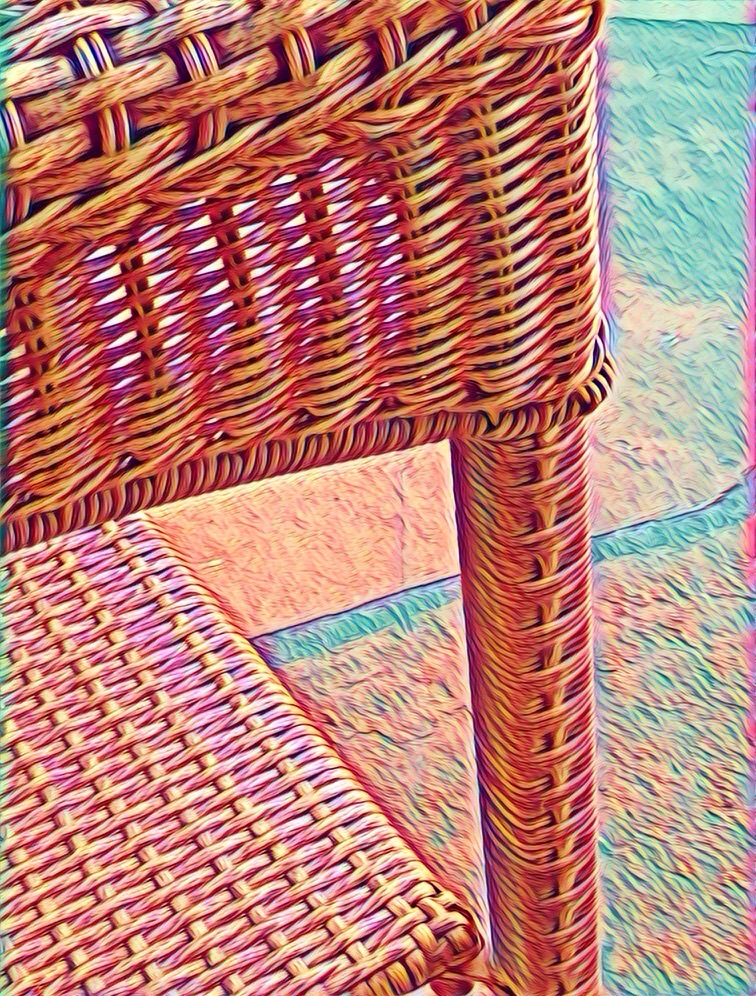
In nature, whether we look at clouds, waves, mountain ranges, forests, plants, the leaves of plants, or almost any animal, we see alternating repetition. Such natural repetition is almost never precise and complete replication. Just as every reproductive act of life introduces an element of recombination as well as the possibility of mutation, so too the repetitions we see in life are not mathematical. We indeed see patterns repeated in a line or in a circle, but the instances in living things show variation. Similarly, human artifacts made with the hands; e.g., weaving or poetry or rock walls or tennis strokes show repetition but with slight and subtle variations. 

If you look at modern industrial society, you see many examples of exact repetition. It’s true that if you looked at 10,000 examples of the same brand and model pen, or notebook, or scissors, or streak knives under a microscope, you could likely find small differences. To the naked eye, however, they would appear identical. Seeing 10,000 pebbles, leaves, or waves you would always see slight to moderate differences. To me, it makes a difference in terms of beauty. Handmade items and human actions naturally show more variation than things produced by machines. 

Photo by Pixabay on Pexels.com

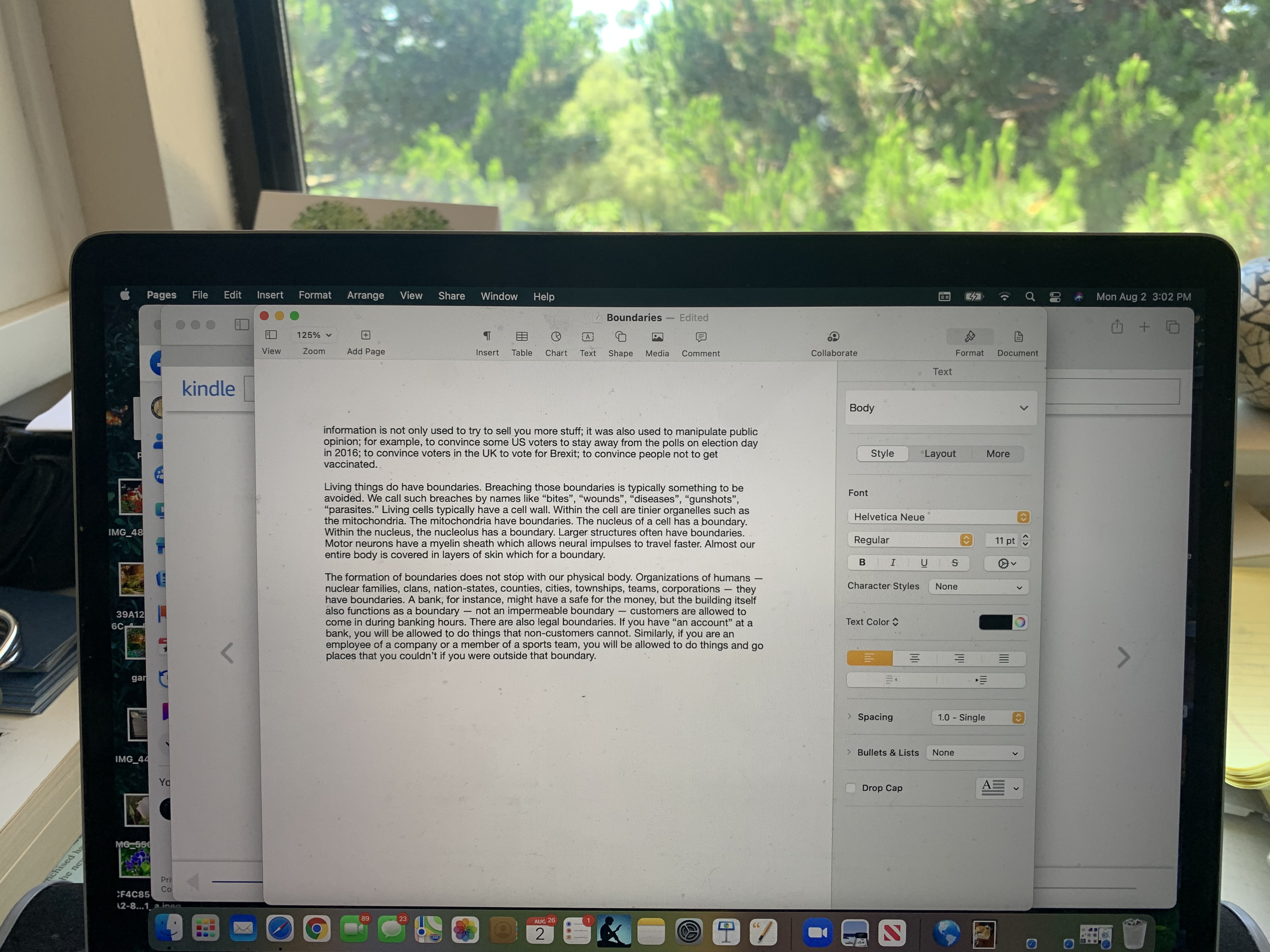
The various “elements” of a User Interface generally have the feel of something made by machine. The size of all the application icons on the tool bar for instance are the same. They are all almost the same exact shape and size. On my tool bar the icons for Finder, Launchpad, Mail, Safari, Chrome, FaceTime, Messenger, Maps, Photos, Contacts, Calendar, Reminders, Notes, System Preferences, Keynote, Pages, Preview, and News are the same. However, the Kindle icon is slightly larger and more square. The Zoom icon is very slightly rounder and the icon for Facebook is circular. In other words, there is some slight variation, but mainly the icons are the same in outline, but different inside. But the set of icons on the tool bar has no sense of “harmony.” 

Note that the tool bar is both abnormally homogeneous in terms of positioning and size but completely disconnected in terms of the images which differ in a random disharmony seldom exhibited in nature.

Instead, each icon seems to scream out its individuality without regard to its neighbors. (Which reminds me of things like masking, vaccinations, telling the truth, etc.). Anyway, the layout of the toolbar, to me, it’s reminiscent of driving down the highway and seeing a sequence of billboards, each advertising some random product or service in no particular order. Often, each billboard is the same size but they are independent of each other. The one exception I can think of were the “Burma Shave” signs along the highway. Each sign was a small rectangle with several words on it. About a quarter mile down the road, another sign would appear. They were meant to be seen in a specific order and together, they made a kind of “story” which usually rhymed. Typically, the signs touted the joys of the product — “Burma Shave” — or, provided public service announcements about safe driving. 

In the early days of computing, putting in “variation” would have been insanely wasteful of space and processing time. This is no longer true. Yet, the “look and feel” of User Interfaces remains, for the most part, quite “mechanical” or “mechanistic” rather than “natural.” Sometimes modern computer games include naturalistic looking variations in how repeated plants, rocks, clouds, etc. are represented. Look at the palm trees and you will see variations among the trees that are reminiscent of the real palm trees I see every day. In addition, each tree contains a number of fronds that repeat a generic theme; yet, each front is somewhat different. The fronds themselves each contain alternating repetition, just as do real palm tree fronds. 

We might consider whether it would make sense to put more natural looking alternating repetition into the more utilitarian aspects of user experience. For example, could it be both more beautiful and more useful to allow more variation in the way files are represented visually?  Will Hill, James Hollan, Dave Wrobleski, & Tim McCandless suggested (in a CHI ’92 paper) that physical documents such as manuals naturally show wear in places where they are most used. They suggested that the visual representation of computer documents might be altered slightly to show which documents have been used or edited more and also that such cues within a document might also be useful. 

Hill, William; Hollan, James; Wrobleski, Dave; McCandless, Tim; “Edit Wear and Read Wear,” Human factors in computing systems: Striking a balance. Proceedings of the 9th annual conference. SIGCHI ’92 Proceedings (Monterey, CA), Addison-Wesley, 1992, pp. 3-9.

One of the few cookbooks I use with some regularity is entitled, Fat Free and Flavor Full. The recipe I’ve used many times is the black bean salad. If I open the physical book, it naturally falls open to that particular recipe. “Open Recent” I find a very useful features of the Pages application, but I don’t see a way to look at files based on overall frequency of use. It could be the case that there are some applications for which you would want specific files to be easily found depending on the season or the date. The authors of “Edit Wear and Read Wear” were mainly talking about the utility of encoding information about a file into its visual representation. There might well be aesthetic reasons to do so as well. 

The wooden blinds shown below exhibit alternating repetition in several ways. First, there is the matter of perspective. Some variation almost always presents itself simply by virtue of the fact that I typically view the blinds at an angle and some are closer to me than others. This means that the size, and the retinal shape are slightly different. Second, there is variation caused by slight changes in the angle of the slats relative to vertical. Third, each slat is made of wood. The wood itself shows rings (or more commonly a planar projection of the concentric cylinders. 

The wooden blinds, because they are illuminated from the outside by tree-filtered sunlight also show further variation; however I don’t think that is typically “alternating repetition.” Perhaps not coincidentally, although I find it a little interesting, I can’t say I find that source of variation to be beautiful to me. The other three all add to the aesthetics, at least to me. 

Is it feasible to introduce alternating repetition with slight variation into User Interfaces? Would it be desirable? What negative side-effects might arise? Do you even agree with Christopher Alexander that Alternating Repetition is an aspect of natural beauty and beautiful design? One thing that occurs to me is that if some element of the UI is more variable in outline etc., it may mean that the actions upon that object must deal with that variability. If designed greenfield, that might not be too difficult. But if, for example, the code for dragging and dropping was written under a presumption of zero variability, that might be problematic. What do you think?

——————-

Discussion of Alternating Repetition with additional visual examples can be found here: 

The Fifteen Fundamental Properties of Living Structure. 4. Alternating Repetition

Use Diversity as a Resource

The Tree of Life

Life is a Dance

Take a Glance; Join the Dance

Fifteen Properties of Natural Beauty & UX/HCI

22 Thursday Jul 2021

Posted by petersironwood in Uncategorized

≈ 7 Comments

Tags

Design, HCI, human factors, UX

Photo by Dominika Greguu0161ovu00e1 on Pexels.com

This is an introduction to a series of blog posts on the “Nature of Beauty.” 

Christopher Alexander was an architect and city planner. In his MIT dissertation, Alexander took a very mathematical approach to design. In our studies at IBM Research on the “Psychology of Design” I first ran across that work (Notes on the Synthesis of Form). Later in his career, however, he took a quite different approach to design. With an international team, he visited many different parts of the world to see what “worked” in terms of architecture and city planning. The results were documented in the form of a “Pattern Language.” In this sense, a “Pattern” is the named solution to a recurring problem. A “Pattern Language” is a connected lattice of Patterns that together, “cover” a field. 

Others (including me) have emulated his approach for other fields such as pedagogy, organizational change, object-oriented programming, software development processes, and human-computer interaction. A few years ago, I suggested such Patterns for collaboration and teamwork. Here’s a link to the introduction of that effort. Here’s a link to the index of those Patterns. 

Still later in life, Christopher Alexander embarked on a project called The Nature of Order. This work is documented in a series of four books. In the first book, he proposes fifteen properties of good form in nature — and in beautiful artifacts. Explication and example will be needed to appreciate what these properties mean. In this post, I list the fifteen and will attempt to explain the first one with respect to UX and Human Computer Interaction.

OLYMPUS DIGITAL CAMERA

First, you might be wondering what relevance these fifteen properties of nature might have to interface design. After all, can’t the designer just test out their ideas empirically until a UX design is shown to be usable, learnable, and perhaps enjoyable as well? Well, sure. Ideally, every possibility could be explored and tested empirically. 

But how many possibilities are there? Without any guiding principles, there are not only more possibilities than can be tested by you. There are more possibilities than there are atoms in the universe. Imagine a very simple interface on a small mobile device. Let’s say there are only ten screens in your whole application. The iPhone 12, for instance, has nearly 3 million pixels. 24-bit color allows over 16 million colors per pixel. If you literally tested out every possible arrangement, this would mean 16 million to the 3 millionth power for each of the ten screens!! The number of atoms in the universe is estimated to be between 10**78 and 10**82. Obviously, this is far less than 16,000,000**3,000,000 !! 

Of course, I’m not suggesting that anyone would attempt a pixel by pixel test of an interface, but the general point remains: you need some way to limit testing to reasonable alternatives. The notion of using these fifteen properties is not that they dictate a particular design nor that you don’t need to do any empirical testing. Rather, the fifteen properties could be used to help guide design. The properties could be thought of as reducing the search space. 

Here are the fifteen properties: 

  1. Levels of Scale
  2. Strong Centers
  3. Boundaries
  4. Alternating Repetition
  5. Positive Space
  6. Good Shape
  7. Local Symmetries
  8. Deep Interlock and Ambiguity
  9. Contrast
  10. Gradients
  11. Roughness
  12. Echoes
  13. The Void
  14. Simplicity and Inner Calm
  15. Not-separateness

Perhaps the names themselves might resonate with your own sense of aesthetics for design and composition, but let’s review them one by one. 

The first is “Levels of Scale.” 

Photo by Roney John on Pexels.com

When it comes to natural beauty, a few moments reflection may provide you with many examples. Christopher Alexander claims this property is also present in traditional art and architecture across many cultures. As you see something such as, e.g., the Taj Mahal or the Parthenon in the distance, you see a beautiful shape. As you approach it, you will see more and more levels of scale. By contrast, many modern buildings are largely featureless between the overall shape and the texture of the building material. 

If your design has multiple levels of scale, it will be easier for your user to orient themselves; to know “where they are” in the application and therefore easier to take appropriate action. It’s something to keep in mind with respect to your design — whether hardware, software, documentation, or a building. 

How could you use or see “Levels of Scale” as a desirable property of what you are doing right now? 

———————————-

Some references to Pattern Languages in HCI. 

Pan, Y., Roedl, D., Blevis, E. and Thomas, J. (2012), Re-conceptualizing Fashion in Sustainable HCI. Designing Interactive Systems conference.  New Castle, UK, June 2012.

Thomas, J. C. (2012).   Patterns for emergent global intelligence.   In Creativity and Rationale: Enhancing Human Experience By Design J. Carroll (Ed.), New York: Springer.

Thomas, J. (2012). Edging Toward Sustainability. CHI Workshop Position Paper for Simple Sustainable Living. CHI 2012, Austin, Texas.

Thomas, J. (2012), Enhancing Collective Intelligence by Enhancing Social Roles and Diversity. CSCW Workshop Position Paper for Collective Intelligence and Community Discourse and Action. CSCW 2012, Bellvue, WA.

Thomas, J. (2011), Toward a pattern language for socializing technology for seniors. Workshop position paper accepted for CSCW 2011 workshop: Socializing technology among seniors in China, Hangzhou, China, March 19-23.

Thomas, J. (2011). Toward a Socio-Technical Pattern Language for Social Systems in China and the World. Workshop position paper accepted for CSCW 2011 workshop: Designing social and collaborative systems for China. Hangzhou, China, March 19-23.

Thomas, J. (2011). Toward a Socio-Technical Pattern Language for Social Media and International Development. Workshop position paper accepted for CSCW 2011 workshop: Social media for development, Hangzhou, China, March 19-23.

Bonanni, L., Busse, D. Thomas, J., Bevis, E., Turpeinen, M. & Jardin, N. (2011). Visible, actionalble, sustainable: Sustainable interactin design in professional domains.  Workshop accepted for CHI 2011. Vancouver, B.C., May 7-12.

Thomas, J. (2011). Focus on Ego as Universe and Everyday Sustainability. Workshop position paper accepted for CHI 2011 workshop: Everyday practice and sustainable HCI: Understanding and learning from cultures of (un)sustainability.  Vancouver, B.C., May 7-12.

https://www.researchgate.net/publication/2242380_A_Pattern_Approach_to_Interaction_Design

Click to access dearden-patterns-hci09.pdf

https://www.mit.edu/~jtidwell/common_ground.html

Thomas, J. C. (2018), Building common ground in a wildly webbed world: a pattern language approach. Journal of Information, Communication and Ethics in Society, 16 (3), 338-350.

——————————-

“The Psychology of Design”

08 Thursday Jul 2021

Posted by petersironwood in Uncategorized

≈ Leave a comment

Tags

creativity, Design, HCI, human factors, IBM, leadership, research, UX

“The Psychology of Design” 

I worked at IBM, all told, about 28 years. During that time, management put more and more pressure on us to make our work “relevant” to the business. In fact, the pressure was always there, even from the beginning. Over the years, however, we were “encouraged” to shorten evermore the time gap between doing the research and having the results of that research impact the bottom line. This was not an IBM-only phenomenon. 

I was a researcher, not a politician, but it seemed to me that at the same time researchers in industrial labs were put under pressure to produce results that could be seen in terms of share price (and therefore payouts to executives in terms of stock options), academia was also experiencing more and more pressure to publish more studies more quickly — and to make sure “intellectual property” was protected to make sure the university could monetize your work. This was about the same time that, at least in America, increasing productivity and the wealth that sprung from that increased productivity stopped being shared with the workers.

Photo by Dmitry Demidov on Pexels.com

In the late 1970’s, the “Behavioral Sciences” group began to study the “psychology of design.” For the first few months, this was an extremely pleasurable & productive group, due mainly to  my colleagues. Over the next few blogs, I’ll focus on some specific techniques and methods that you may find useful in your own work. 

In this short story though, I want to focus instead on some broader issues relevant to “technology transfer”, “leadership” and “management.” Even if you are or aspire to be an expert in UX or HCI or design, I assure you that these broader issues will impact you, your work and your career. I wouldn’t suggest becoming obsessed with them, but being aware of their potential impact could help you in your own work and career. 

It is telling that, almost invariably, whenever I told someone inside IBM (or, for that matter, outside IBM) that I was studying the “psychology of design,” people responded by asking, “the design of what?” So, I would explain that we were interested in the generic processes of design and how to improve them. I would explain that we were interested in understanding, predicting, and controlling these processes to enable them to be more effective. I would explain that we could apply these findings to any kind of design: software design, hardware design, organizational design, and (see last post about IBM) communication design. I would explain that design was a quintessentially human activity. I would also explain that design was an incredibly leveraged activity to improve. 

Looking back on it, I still think all these things are true. I also see that I missed the “signal” people were giving me that, while I thought of design as something that could be studied as a process, that most people did not think of it that way. To them, it was never the “psychology of design,” but only the design of something. 

Don’t get me wrong. I agree that somewhat different skills are involved in designing a great advertising campaign, a great building, and a great application. I agree that different communities of practice treat various common issues differently. I still think it’s worth studying commonalities across domains. For one thing, we may find an excellent way of generating ideas, say, that the advertising community of practice uses that neither architects nor applications developers had ever tried. Or, vice versa.

My own academic background was in “Experimental Psychology.” We were forever doing experiments that we believed were about psychological processes that were thought to be invariant regardless of the domain. It was an axiom of our whole enterprise that studying memory for any one thing shed light on how we remember every other thing. Similar studies looked at decision making or problem solving or multi-tasking. We came to understand that there were some interesting exceptions to being able to separate content from process. For instance, it is much easier to multi-task a spatial task and a verbal task than it is to multi-task two independent spatial tasks or two independent verbal tasks. 

We used a spectrum of techniques to study “design” from laboratory studies of toy problems, to observing people doing real-world design problems while thinking aloud. After about 3-4 months of very productive work, we were told that we had to make our work relevant to software development. That should be the focus of our work. We were told that this command came from higher-ups in IBM. That might have been true, or perhaps partly true. 

It might also be relevant that someone in our management chain might have been the recipient of a grant from ONR which was specifically focused on software development. So far as I can tell, nothing had been done on that grant. So, our past, present, and future work could have been co-opted to be “results” done under the auspices of the ONR grant. 

In any case, regardless of the “reasons,” the group began to focus specifically on software design. In one study, we used IBM software experts as subjects. Each person was given information that was geared toward a specific transformation that occurred in software development. One person was presented with the description of a “situation” that included a number of “issues” and they were asked to write a requirements document. In real life, I would hope that this would be done in a dialogue (and, indeed, in other studies, we recorded such dialogues). Absent such dialogues, what we found was that different software experts — all from IBM research — and all given the same documentation about a set of problems generated vastly different problem statements and overall approaches. 

Photo by ELEVATE on Pexels.com

In other parts of the study, other experts were variously given requirements documents and asked to do an overall, high level system design, or given a high level design and asked to design an algorithm, or given an algorithm and asked to code a section. There was always diversity but the initial showed the greatest diversity. The initial stage is also the one that can cause the most expensive errors. If you begin with a faulty set of requirements — a misreading about how to even go about the problem — then, the overall project is almost certain to incur schedule slip, cost overruns, or outright failure. 

While the vital importance of the initial stages of design is true in software development, I would argue that it is likely also true for advertising campaigns, building designs — and even true for the design of research programs. We designed our research agenda under the assumption that we had a long time; that we were studying design processes independently of specific communities of practice or the nature of the problems people were attempting to address. We assumed that there was no “hidden agenda.” Although we believed we would eventually need to show some relevance to IBM business, we had no idea, when we began, that only relevance to software design would be “counted.”


—————-

Some of our studies on the “Psychology of Design.” 

Carroll, J. and Thomas, J.C. (1982). Metaphor and the cognitive representation of computer systems. IEEE Transactions on Man, Systems, and Cybernetics., SMC-12 (2), pp. 107-116.

Thomas, J.C. and Carroll, J. (1981). Human factors in communication. IBM Systems Journal, 20 (2), pp. 237-263.

Thomas, J.C. (1980). The computer as an active communication medium. Invited paper, Association for Computational Linguistics, Philadelphia, June 1980. Proceedings of the 18th Annual Meeting of the Association for Computational Linguistics., pp. 83-86.

Malhotra, A., Thomas, J.C. and Miller, L. (1980). Cognitive processes in design. International Journal of Man-Machine Studies, 12, pp. 119-140.

Carroll, J., Thomas, J.C. and Malhotra, A. (1980). Presentation and representation in design problem solving. British Journal of Psychology/,71 (1), pp. 143-155.

Carroll, J., Thomas, J.C. and Malhotra, A. (1979). A clinical-experimental analysis of design problem solving. Design Studies, 1 (2), pp. 84-92.

Thomas, J.C. (1978). A design-interpretation analysis of natural English. International Journal of Man-Machine Studies, 10, pp. 651-668.

Thomas, J.C. and Carroll, J. (1978). The psychological study of design. Design Studies, 1 (1), pp. 5-11.

Miller, L.A. and Thomas, J.C. (1977). Behavioral issues in the use of interactive systems: Part I. General issues. International Journal of Man-Machine Studies, 9 (5), pp. 509-536.

——————————

Blog posts about the importance of solving the “right” problem. 

The Doorbell’s Ringing. Can you get it?

https://petersironwood.com/2021/01/13/reframing-the-problem-paperwork-working-paper/

Problem Framing. Good Point. 

https://petersironwood.com/2021/01/16/i-say-hello-you-say-what-city-please/

Problem formulation: Who knows what. 

How to frame your own hamster wheel.

The slow seeming snapping turtle. 

Author Page on Amazon. 

I’d Like Sauerkraut on the Ice Cream

14 Friday May 2021

Posted by petersironwood in Uncategorized

≈ 2 Comments

Tags

A/B testing, experiments, HCI, human factors, psychology, Study, UX

Which is Better? A or B?

Nearly everyone in the field of Human-Computer Interaction (related fields are known as Human Factors, and User Experience) has heard of A/B testing. How should we lay out our web pages? Should we have a tool bar? Should it be always visible or only visible on rollover? What type fonts and color schemes should we use? 

Clearly A/B testing is useful. However — there are at least two fundamental limitations to A/B testing. 

Photo by Darius Krause on Pexels.com

First, for almost any real application, there are way too many choices for each of them to be tested. This is where the experience of the practitioner and/or the knowledge of the field and of human psychology can be very helpful. Your experience and theory can help you make an educated guess about how to prioritize the questions to be studied. Some questions may have an obvious answer. Others might not make much difference. Some questions are more fundamental than others. For instance, if you decided not to use any text at all on your site, it wouldn’t matter which “font” your users prefer. 

Second, some decisions interact with others. For instance, you may test a font size in the laboratory with your friends. Just as you suspected, it’s perfectly legible. Then, it turns out that your users are mainly elderly people who use your app while going on cruises or bus tours. In general, the elderly have less acute vision that the friends you studied in the lab. Not only that, you were showing the font on a stable display under steady conditions of illumination. The bus riders are subject to vibration (which also makes reading more difficult) and frequent changes in illumination due to the sun or artificial light being intermittently filtered by trees, buildings, etc. Age, Vibration, and Illumination changes are variables that interact by being positively correlated. In other cases, variables interact in other and more complex ways. For example, increasing stress/motivation at first increases performance. But beyond a certain point, increasing stress or motivation actually decreases performance. This is sometimes known as the Yerkes-Dodson Law (https://en.wikipedia.org/wiki/Yerkes–Dodson_law)

The story doesn’t stop there though. How much stress is optimal partly depends on the novelty and complexity of the task. If it’s a simple or extremely practiced task, quite a bit of stress is the optimal point. Imagine how long you might hang on to a bar for one dollar, for a thousand dollars, or to save yourself from falling to the bottom of a 1000 foot ravine. For a moderately complex task, a moderate level of motivation is optimal. For something completely novel and creative, however, a low level of stress is often optimal. 

The real point isn’t about these particular interactions. The more general point is that testing many variables independently will not necessarily result in an optimal overall solution. Experience — your own — and the experiences of others — can help dissect a design problem into those decisions that are likely to be relatively independent of each other and those that must be considered together. 

Life itself has apparently “figured out” an interesting way to deal with the issue of the interaction of variables. Genes that work well together end up close together on the chromosome. That means that they are more likely to stay together and not end up on different chromosomes because of cross-over. By contrast, genes that are independent or even have a negative impact, when taken together, tend to end up far apart so that they are likely to be put on different chromosomes. 

Photo by Nigam Machchhar on Pexels.com

So, for example, one might expect that a gene for more “feather-like skin” and more “wing-like front legs” might be close to each other while a gene for thicker, heavier bones would be far away. 

Clearly, the tricky way variables interact isn’t limited to “User Experience Design” of course. Think of learning a sport such as tennis or golf. You can’t really learn and practice each component of a stroke separately. That’s not the way the body works. If you are turning your hips, for example, as you swing, your arm and hand will feel differently than if you tried to keep them still while you swung. 

Do you have any good tips for dealing with interactions of variables? In User Experience or any other domain? 

————————————

Some experiences in UX/HCI

Chain Saws Make the Best Hair Trimmers

In the Brain of the Beholder

Study Slain by Swamp Monster!

Buggy Whips to Finger Tips

Chain Saws Make the Best Hair Trimmers
In the Brain of the Beholder
Study Slain by Swamp Monster!
Buggy Whips to Fingertips

Career Advice from Polonius

20 Saturday Mar 2021

Posted by petersironwood in Uncategorized

≈ 1 Comment

Tags

career, HCI, human factors, usability, UX

Photo by Ott Maidre on Pexels.com

Career Advice from Polonius: To Thine Own Self be True

“To thine own self be true.” This advice comes from Polonius who is giving advice to his son in Act I, scene 3 of Shakespeare’s Hamlet. 

Polonius says: “This above all: to thine own self be true. And it must follow, as the night the day, Thou canst not then be false to any man.”

Let’s focus on the first part. 

One of the dreams of education is to customize teaching to the specific learning style(s) of individual students. This was a hot topic when I was in graduate school.

Photo by Suliman Sallehi on Pexels.com


Around 50 years ago. 

Some day, your grandchildren or your great-grandchildren may be the beneficiaries of learning experiences that are individualized to their specific styles. I wouldn’t hold my breath, but it could happen. It isn’t only a question of research on what various styles are and how to present material that resonates with these various styles. There is also the question of priorities and dollars and personnel. 

But meanwhile, here’s the good news. You don’t have to wait for another 50 years of research and a reshuffling of priorities so folx spend more money on education and less on, let’s say, cosmetics and professional sports. As I say, don’t hold your breath.

But let’s get back to the good news. The good news is that you can discover for yourself how to maximize your own learning as well as what your particular talents are. 

One cautionary note: Don’t be a jerk about it. If you’re in a group dealing with grief, don’t say, “Well, I learn best if a subject is reduced to a few hundred polynomial formulae. So, let’s start right there. Let’s reduce grief to three dimensions. Later, of course, we can do a proper multidimensional scaling exercise to determine the optimal number of dimensions.”

Photo by Andrea Piacquadio on Pexels.com


No. Don’t say that. Of course, you’re free to suggest that approach, but chances are, in this situation, and in most realistic group situations, you will be treated to information in the same manner as many others who have different styles from yours.

However, in many situations, you are, far and away the main important stakeholder. You can use your knowledge of how things work for you in order to strategize and plan how you will learn about things. You can organize and arrange your work so you’ll be more productive. 

Here’s a trivial example. I have learned that my eyes have a wisdom of their own. If, for instance, I’m going out for a walk around the garden to take some pictures of the sunset on the flowers, I grab my stuff and find myself turning and staring at the hat-rack on the way out the door. When I was younger, I would ignore this. But what I have learned is that my eyes are really good at knowing what to look at. So, even if I’m in a hurry, I take a moment to reflect on why my eyes are looking there. And, then, it comes to me. I’ll do better if I wear a brimmed hat to keep the sun out of my eyes while I look at my iPhone.


By paying attention to this little quirk, I’ve saved myself a lot of grief over the years; e.g., not left the house without my wallet, etc.

Here’s another example. I’m very good at seeing “patterns” emerge from a small number of examples or when there is considerable noise involved. This serves me well as my hearing diminishes because I can use top-down processing. Generally, but not always, I understand what people are saying. If I try to listen to a foreign language tape that is only isolated audio words, I have no hope of knowing what they are saying. “Key” “Tee”, “Pea”, sound exactly the same.

Seeing patterns easily is generally a nice capacity. However, I’m horrible at finding my own typos immediately after I write something. I actually “see” what I meant to type. A week later, I’m pretty good at catching the errors. If I had more patience, I would wait a week to proofread for every blog post, but being patient isn’t a strength either. I do go back over old posts occasionally and fix the typos (which I never saw at the time). 

Photo by Frank Cone on Pexels.com

When I go to the movies — remember when we used to go to movies? — anyway, if I went to a comedy, I was very likely to laugh too soon. I “hear” the punchline two lines earlier than it actually occurs. There’s no benefit to my laughing early! But that’s when the punchline hits me. I do keep it soft so as not to disturb the others in the audience. On the other hand, I’m pretty good at “discovering” the playing patterns of my tennis opponents and anticipating what they are going to do. Naturally, I don’t always guess right, but I do way better than chance.

I bring up these examples to illustrate a generality; that most of these individual differences have an upside and a downside. Mainly, learning about my own styles and capacities is something I learned well after leaving high school. That makes sense. In school — or at least, the schools I went to — everybody got the same instruction in the same way almost all the time. But as an adult, you often have a lot of control over your own timing, flow of information, etc. I think it’s worth your while to look back at your experience and discover what you have difficulty with, what you’re OK at and what you are exceptionally good at. When you have a choice, use the approach you’re really good at. 

—————————————-

More background on “knowing yourself” 

https://en.wikipedia.org/wiki/Know_thyself

History of Know Thyself

I Say: Hello! You Say: “What City Please?”

16 Saturday Jan 2021

Posted by petersironwood in Uncategorized

≈ 8 Comments

Tags

efficiency, HCI, human factors, problem framing, problem solving, UX

Photo by Tetyana Kovyrina on Pexels.com

In the not so distant past, people would often call directory assistance operators. These operators would find a number for you. For an additional charge, they would dial it for you. In fact, this was a very commonly used system. Phone companies would have large rooms filled with such operators who worked very hard and very politely, communicating with a hostile and irrational public. 

Photo by Moose Photos on Pexels.c

Customer: “I have to get the number of that bowling alley right near where the A&P used to be before they moved into that new shopping center.”

Operator: “Sir, you haven’t told me what town you’re in. Anyway…”

Customer: “What town?! Why I’m right here in Woburn where I’ve always been!” 

Photo by Johannes Plenio on Pexels.com

There were so many operators that the phone companies wanted their processes to be efficient. Operators were trained to be friendly and genial but not chatty. The phone companies searched for better keyboards and better screen layouts to shave a second here or there off the average time it took to handle a call. 

There are some interesting stories in that attempt but that we will save for another article, but here I want to tell you what made the largest impact on the average time per call. Not a keyboard. Not a display. Not an AI system. 

It was simply changing the greeting. 

Photo by eberhard grossgasteiger on Pexels.com

Operators were saying something like: “New England Telephone. How can I help you?” 

After our intervention, operators instead said, “What city please?” It’s shorter and it’s takes less time to say. But the big change was not in how long the operator took to ask the question. The biggest savings was how this change in greeting impacted the customer’s behavior. 

When the operator begins with “How can I help you?” the customer, or at least some fraction of them, are put into a frame of mind of a conversation. They might respond thusly:

“Oh, well, you know my niece is getting married! Yeah! In just a month, and she still hasn’t shopped for a dress! Can you believe it? So, I need the number for that — if it were up to me, I would go traditional, but my niece? She’s — she’s going avant-garde so I need the number of that dress shop on Main Street here in Arlington.” 

Photo by Tuu1ea5n Kiu1ec7t Jr. on Pexels.com

With the “What City Please?” greeting, the customer is put into a more businesslike frame of mind and answers more succinctly. They now understand their role as proving information in a joint problem solving task with the operator. A typical answer would now be:

“Arlington.” 

“In Arlington, what listing?” 

“Dress shop on Main Street.”

The way in which a conversation begins signals what type of conversation it is to be. We know this intuitively. Suppose you walked up to an old friend and they begin with: “Name?” You would be taken aback. On the other hand, suppose you walk up to the line at the DMV and the clerk says, “Hey, have you seen that latest blog post by John Thomas on problem framing?” You would be equally perplexed! 

Conversation can be thought of partly as a kind of mutual problem solving exercise. And, before that problem solving even begins, one party or the other will tend to “frame” the conversation. That framing can be incredibly important. 

Even the very first words can cause someone to frame what kind of a conversation this is meant to be.

Words matter.

The Primacy Effect and The Destroyer’s Advantage

https://petersironwood.com/2018/02/13/context-setting-entrance/

Essays on America: Wednesday

Author Page on Amazon 

Getting Into (the “right”) Shape

07 Monday Sep 2020

Posted by petersironwood in Uncategorized

≈ 1 Comment

Tags

cats, consumer products, Design, form, function, HCI, human factors, kittens, usability, UX


A truism we have all heard is that “form should follow function.”  I tend to agree with this as a good general principle, but only if the designer has given more than 30 milliseconds of thought about what the actual function is. Even better is to observe function being used in practice.  Below, I give examples of how form may look like function but not actually follow (actual) function.

The first comes from the complex and technical domain of nail clippers.  My nails are tough and I actually need to use toenail clippers to cut my fingernails.  But the same principle applies to both fingernail clippers and toenail clippers.  I see many many examples where the designer has attempted to curve the surface of the nail clipper to “match” the curve of nails.  This is a brilliant idea, but only if every nail on every human being on the planet has the same curvature.  A priori, I would tent to think this is not the case, but being empirically oriented I decided to test it out by actually looking at real nails.  I looked at my thumbnail and the fingernail on my little finger.  Sure enough, my hypothesis was borne out.  They are NOT the same.  What this means is that a nail clipper that is curved so that it fits my pinkie will wreak havoc when applied to my thumbnail.  I am probably going out on a limb here, but I suspect that if one were to include fingernails from other people in this sample, one might find an even wider variation in curvature.  What are people thinking when they make curved nail clippers? I can only speculate that they have never looked at the fingernails of more than one person and that, indeed, they never looked at more than one fingernail on that one person.

Image

Image

If only there were a solution.  Sigh.  Oh, wait!  There is a solution. Make the cutting surface of the nail clippers flat.  This enables the person to clip nails of any curvature.  It does, of course, require multiple cuts.  It has the added advantage, that if you so wish, you can sharpen your nails so they resemble cat claws.

Image

Cats bring me to my second example.  When we moved to California amid a large garden, we wanted to let our cats to spend most of their time outdoors, partly so litter box cleaning would be at a minimum.  Unfortunately, we soon discovered that while the outdoors here offers many opportunities for cats to be hunters of lizards and mice, it also offers even more opportunities for them to be prey for bobcats, cougars, eagles, and especially coyotes.

Now, here is a beautifully shaped litter box (a gift).  It even has a place for the cats to clean their paws before they track litter back into the living room.  Nice.  Unfortunately, this is a beautiful shape by someone who has never cleaned a litter box, at least not by litter box shovel.  Perhaps they clean litter boxes with their bare hands?  Anyway, this curved shape does not jibe well with the typical litter box shovel.  Of course, the cats could choose to do their business along the gently curving side of the litter box.  And, of course, they never do.  They choose instead the places along the edge of the litter box where there is maximum curvature.

Image

Image

The idea that there is a place for the cats to clean their feet before venturing back out into the living room or pouncing up on the kitchen counter is a sweet idea.  It is an idea that would never occur to the owner of an actual cat, however.  Here are two cats we obtained from a shelter (Tally on the left, Molly on the right).

Image

They are cute, but defective in that they do not speak English, nor so far as I have been able to discover, any other language.  So, despite my explanations that they are supposed to wipe their feet on the way out of the litter box, they do not.  Instead, they do their business on the foot-wiping section of the litter box.  So, apart from the annoying high curvature, if you are unlucky enough to get a cat who either does not understand complex sentences or just doesn’t care, this is probably not the litter box for them either.  It might work for cats who: 1) speak your language fluently and 2) are cooperative. (Recent estimates indicate the total number of such cats is zero).

The third example comes from health care and is a bit more abstract.  On my insurance ID card is a field which is labeled: “Identification number.”  In order to use this, I have to go to their website and “register.”  In order to register, the website says I need to enter my “identification number.” But in actuality, that does not work!  No.  Instead, I am supposed to leave off the first three characters in what is labeled my identification number.  The website doesn’t say this.  But the help desk is quite familiar with the issue and will happily explain it to you after you listen to musak for three or four hours.  This is not so much shape not matching real function, but label not matching function.

The fourth example comes from some of our “bookcases.”  Why, I hear you ask, are there scare quotes around bookcases.  I will tell you why.  I put scare quotes because although the shelves are flat and just the right size for books, and although this piece of “furniture” is sold as a bookcase, in fact, it is a nick-knack shelf.  My wife and I foolishly tried filling it with books and it collapsed.  So, in this case, the label and the shape lead one to believe it serves a particular function but the underlying functionality is insufficient to fulfill that dream of ours (that the “bookshelf” would actually hold books).


grey metal hammer

Photo by Pixabay on Pexels.com


The fifth example comes from my experience with companies who want to simplify things for their customers.  That sounds worthwhile.  So, they launch major efforts to make their products “consistent.” But they soon learn that making products behave consistently years after they were independently developed is way too expensive.  So instead, they focus on making them look the same and using consistent terms across products, while leaving the underlying functionality behave quite differently.  To me, this is quite akin to the bookshelf case. Making things look the same while continuing to have them act differently is actually worse for the user than having things that act differently also look different! 


Photo by Pixabay on Pexels.com


The moral of the story? It’s fine to have form follow (and signal) function, but you need to understand how users actually behave. They won’t necessarily behave as you imagine they are supposed to any more than a cat will read your mind in order to please you. Of course, if you see yourself, not as a partner of your users, but rather out to deceive them into thinking they are buying and using something different from what they really are… 

—————————————

Introduction to Pattern Language for Collaboration and Cooperation.

Index for Collaboration Patterns  

Author Page on Amazon

Using Stories and Storytelling 

What do you do when the client insists you solve the “wrong” problem? 

Cars that Lock too Much

20 Friday Mar 2020

Posted by petersironwood in America, driverless cars, psychology, story, Travel

≈ 2 Comments

Tags

AI, anecdote, computer, HCI, human factors, humor, IntelligentAgent, IT, Robotics, story, UI, UX

{Now, for something completely different, a chapter about “Intelligent Agents” and attempts to do “too much” for the user. If you’ve had similar experiences, please comment! Thanks.}

1B87A4CC-F9EC-456F-B610-276A660E6E4A

At last, we arrive in Kauai, the Garden Island. The rental car we’ve chosen is a bit on the luxurious side (Mercury Marquis), but it’s one of the few with a trunk large enough to hold our golf club traveling bags.  W. has been waiting curbside with our bags while I got the rental car and now I pull up beside her to load up. The policeman motioning for me to keep moving can’t be serious, not like a New York police officer. After all, this is Hawaii, the Aloha State.  I get out of the car and explain, we will just be a second loading up. He looks at me and then at my rental car and then back to me with a skeptical scowl.  He shrugs ever so slightly which I take to mean an assent. “Thanks.” W. wants to throw her purse in the back seat before the heavy lifting starts. She jerks on the handle. The door is locked.  

“Why didn’t you unlock the door” she asks, with just a hint of annoyance in her voice.  After all, it has been a very long day since we arose before the crack of dawn and drove to JFK in order to spend the day flying here.  

“I did unlock the door,” I counter.  

“Well, it’s locked now.” She counters my counter. 

I can’t deny that, so I walk back around to the driver’s side, and unlock the door with my key and then push the UNLOCK button which so nicely unlocks all the doors.  

The police officer steps over, “I thought you said, you’d just be a second.”

“Sorry, officer”, I reply.  “We just need to get these bags in.  We’ll be on our way.” 

Click.

W. tries the door handle.  The door is locked again.  “I thought you went to unlock the door,” she sighs.

“I did unlock the door.  Again.  Look, I’ll unlock the door and right away, open it.”  I go back to the driver’s side and use my key to unlock the door.  Then I push the UNLOCK button, but W’s just a tad too early with her handle action and the door doesn’t unlock. So, I tell her to wait a second.  

man riding on motorcycle

Photo by Brett Sayles on Pexels.com

“What?”  This luxury car is scientifically engineered not to let any outside sounds disturb the driver or passenger.  Unfortunately, this same sophisticated acoustic engineering also prevents any sounds that the driver might be making from escaping into the warm Hawaiian air. I push the UNLOCK button again.  Wendy looks at me puzzled.

I see dead people in my future if we don’t get the car loaded soon. For a moment, the police officer is busy elsewhere, but begins to stroll back toward us. I rush around the car and grab at the rear door handle on the passenger side. 

But just a little too late.  

“Okay,” I say in an even, controlled voice.  “Let’s just put the bags in the trunk.  Then we’ll deal with the rest of our stuff.” 

The police officer is beginning to change color now, chameleon like, into something like a hibiscus flower. “Look,” he growls. “Get this car out of here.”

“Right.” I have no idea how we are going to coordinate this. Am I going to have to park and drag all our stuff or what? Anyway, I go to the driver’s side and see that someone has left the keys in the ignition but locked the car door; actually, all the car doors. A terrifying thought flashes into my mind. Could this car have been named after the “Marquis de Sade?” That hadn’t occurred to me before. 

auto automobile automotive car

Photo by Dom J on Pexels.com

Now, I have to say right off the bat that my father was an engineer and some of my best friends are engineers. And, I know that the engineer who designed the safety locking features of this car had our welfare in mind. I know, without a doubt, that our best interests were uppermost. He or she was thinking of the following kind of scenario. 

“Suppose this teenage couple is out parking and they get attacked by the Creature from the Black Lagoon. Wouldn’t it be cool if the doors locked just a split second after they got in. Those saved milliseconds could be crucial.”

Well, it’s a nice thought, I grant you, but first of all, teenage couples don’t bother to “park” any more. And, second, the Creature from the Black Lagoon is equally dated, not to mention dead. In the course of our two weeks in Hawaii, our car locked itself on 48 separate, unnecessary and totally annoying occasions.  

And, I wouldn’t mind so much our $100 ticket and the inconvenience at the airport if it were only misguided car locks. But, you and I both know that it isn’t just misguided car locks. No, we are beginning to be bombarded with “smart technology” that is typically really stupid. 

man in black suit sitting on chair beside buildings

Photo by Andrea Piacquadio on Pexels.com

As another case in point, as I type this manuscript, the editor or sadistitor or whatever it is tries to help me by scrolling the page up and down in a seemingly random fashion so that I am looking at the words I’m typing just HERE when quite unexpectedly and suddenly they appear HERE. (Well, I know this is hard to explain without hand gestures; you’ll have to trust me that it’s highly annoying.) This is the same “editor” or “assistant” or whatever that allowed me to center the title and author’s names. Fine. On to the second page. Well, I don’t want the rest of the document centered so I choose the icon for left justified. That seems plausible enough. So far, so good. Then, I happen to look back up to the author’s names. They are also left-justified. Why?  

Somehow, this intelligent software must have figured, “Well, hey, if the writer wants this text he’s about to type to be left-justified, I’ll just bet that he or she meant to left-justify what was just typed as well.” Thanks, but no thanks. I went back and centered the author’s names. And then inserted a page break and went to write the text of this book.  But, guess what? It’s centered. No, I don’t want the whole book centered, so I click on the icon for left-justification again. And, again, my brilliant little friend behind the scenes left-justifies the author’s names. I’m starting to wonder whether this program is named (using a hash code) for the Marquis de Sade.  

On the other hand, in places where you’d think the software might eventually “get a clue” about my intentions, it never does. For example, whenever I open up a “certain program,” it always begins as a default about 4 levels up in the hierarchy of the directory chain. It never seems to notice that I never do anything but dive 4 levels down and open up files there. Ah, well. This situation came about in the first place because somehow this machine figures that “My Computer” and “My hard-drive” are SUB-sets of “My Documents.” What?  

680174EA-5910-4F9B-8C75-C15B3136FB06_1_105_c

Did I mention another “Intelligent Agent?”…Let us just call him “Staple.” At first, “Staple” did not seem so annoying. Just a few absurd and totally out of context suggestions down in the corner of the page. But then, I guess because he felt ignored, he began to become grumpier. And, more obnoxious. Now, he’s gotten into the following habit. Whenever I begin to prepare a presentation….you have to understand the context. 

In case you haven’t noticed, American “productivity” is way up. What does that really mean? It means that fewer and fewer people are left doing the jobs that more and more people used to do. In other words, it means that whenever I am working on a presentation, I have no time for jokes. I’m not in the mood. Generally, I get e-mail insisting that I summarize a lifetime of work in 2-3 foils for an unspecified audience and an unspecified purpose but with the undertone that if I don’t do a great job, I’ll be on the bread line. A typical e-mail request might be like this:

“Classification: URGENT.

“Date: June 4th, 2002.

“Subject: Bible

“Please summarize the Bible in two foils. We need this as soon as possible but no later than June 3rd, 2002. Include business proposition, headcount, overall costs, anticipated benefits and all major technical issues. By the way, travel expenses have been limited to reimbursement for hitchhiking gear.”

Okay, I am beginning to get an inkling that the word “Urgent” has begun to get over-applied. If someone is choking to death, that is “urgent.” If a plane is about to smash into a highly populated area, that is “urgent.” If a pandemic is about to sweep the country, that is “urgent.” If some executive is trying to get a raise by showing his boss how smart he is, I’m sorry, but that might be “important” or perhaps “useful” but it is sure as heck not “urgent.”  

All right. Now, you understand that inane suggestions, in this context, are not really all that appreciated. In a different era, with a different economic climate, in an English Pub after a couple of pints of McKewan’s or McSorely’s, or Guinness, after a couple of dart games, I might be in the mood for idiotic interruptions. But not here, not now, not in this actual and extremely material world.

So, imagine my reaction to the following scenario. I’m attempting to summarize the Bible in two foils and up pops Mr. “Staple” with a question. “Do you want me to show you how to install the driver for an external projector?” Uh, no thanks. I have to admit that the first time this little annoyance appeared, I had zero temptation to drive my fist through the flat panel display. I just clicked NO and the DON’T SHOW ME THIS HINT AGAIN. And, soon I was back to the urgent job of summarizing the Bible in two foils. 

About 1.414 days later, I got another “urgent” request.

“You must fill out form AZ-78666 on-line and prepare a justification presentation (no more than 2 foils). Please do not respond to this e-mail as it was sent from a disconnected service machine. If you have any questions, please call the following [uninstalled] number: 222-111-9999.”  

Sure, I’m used to this by now. But when I open up the application, what do I see? You guessed it. A happy smiley little “Staple” with a question: 

“Do you want me to show you how to install the driver for an external projector?” 

“No,” I mutter to myself, “and I’m pretty sure we already had this conversation. I click on NO THANKS. And I DON’T WANT TO SEE THIS HINT AGAIN. (But of course, the “intelligent agent,” in its infinite wisdom, knows that secretly, it’s my life’s ambition to see this hint again and again and again).  

A friend of mine did something to my word processing program. I don’t know what. Nor does she. But now, whenever I begin a file, rather than having a large space in which to type and a small space off to the left for outlining, I have a large space for outlining and a teeny space to type. No-one has been able to figure this out. But, I’m sure that in some curious way, the software has intuited (as has the reader) that I need much more time spent on organization and less time (and space) devoted to what I actually say. (Chalk a “correct” up for the IA. As they say, “Even a blind tiger sometimes eats a poacher.” or whatever the expression is.)

Well, I shrunk the region for outlining and expanded the region for typing and guess what? You guessed it! Another intelligent agent decided to “change my font.” So, now, instead of the font I’m used to … which is still listed in the toolbar the same way, 12 point, Times New Roman … I have a font which actually looks more like 16 point. And at long last, the Intelligent Agent pops up with a question I can relate to! “Would you like me to install someone competent in the Putin misadminstration?”

What do you know? “Even a blind tiger sometimes eats a poacher.”

7B292613-361F-4989-B9AC-762AB956DECD


Author Page on Amazon

Start of the First Book of The Myths of the Veritas

Start of the Second Book of the Myths of the Veritas

Table of Contents for the Second Book of the Veritas

Table of Contents for Essays on America 

Index for a Pattern Language for Teamwork and Collaboration  

← Older posts

Subscribe

  • Entries (RSS)
  • Comments (RSS)

Archives

  • December 2025
  • November 2025
  • October 2025
  • September 2025
  • August 2025
  • July 2025
  • June 2025
  • May 2025
  • April 2025
  • March 2025
  • February 2025
  • January 2025
  • December 2024
  • November 2024
  • October 2024
  • September 2024
  • July 2024
  • April 2024
  • March 2024
  • February 2024
  • January 2024
  • December 2023
  • August 2023
  • July 2023
  • May 2023
  • April 2023
  • March 2023
  • February 2023
  • January 2023
  • December 2022
  • November 2022
  • October 2022
  • September 2022
  • August 2022
  • July 2022
  • June 2022
  • May 2022
  • April 2022
  • March 2022
  • February 2022
  • January 2022
  • December 2021
  • November 2021
  • October 2021
  • September 2021
  • August 2021
  • July 2021
  • June 2021
  • May 2021
  • April 2021
  • March 2021
  • February 2021
  • January 2021
  • December 2020
  • November 2020
  • October 2020
  • September 2020
  • August 2020
  • July 2020
  • June 2020
  • May 2020
  • April 2020
  • March 2020
  • February 2020
  • January 2020
  • December 2019
  • November 2019
  • October 2019
  • September 2019
  • August 2019
  • July 2019
  • June 2019
  • May 2019
  • April 2019
  • March 2019
  • February 2019
  • January 2019
  • December 2018
  • November 2018
  • October 2018
  • September 2018
  • August 2018
  • July 2018
  • June 2018
  • May 2018
  • April 2018
  • March 2018
  • February 2018
  • January 2018
  • December 2017
  • November 2017
  • October 2017
  • September 2017
  • August 2017
  • July 2017
  • June 2017
  • May 2017
  • April 2017
  • March 2017
  • February 2017
  • January 2017
  • December 2016
  • November 2016
  • October 2016
  • September 2016
  • August 2016
  • July 2016
  • June 2016
  • May 2016
  • April 2016
  • March 2016
  • February 2016
  • January 2016
  • December 2015
  • November 2015
  • October 2015
  • September 2015
  • August 2015
  • May 2015
  • January 2015
  • July 2014
  • January 2014
  • December 2013
  • November 2013

Categories

  • AI
  • America
  • apocalypse
  • cats
  • COVID-19
  • creativity
  • design rationale
  • driverless cars
  • essay
  • family
  • fantasy
  • fiction
  • HCI
  • health
  • management
  • nature
  • pets
  • poetry
  • politics
  • psychology
  • Sadie
  • satire
  • science
  • sports
  • story
  • The Singularity
  • Travel
  • Uncategorized
  • user experience
  • Veritas
  • Walkabout Diaries

Meta

  • Create account
  • Log in

Blog at WordPress.com.

  • Subscribe Subscribed
    • petersironwood
    • Join 664 other subscribers
    • Already have a WordPress.com account? Log in now.
    • petersironwood
    • Subscribe Subscribed
    • Sign up
    • Log in
    • Report this content
    • View site in Reader
    • Manage subscriptions
    • Collapse this bar
 

Loading Comments...