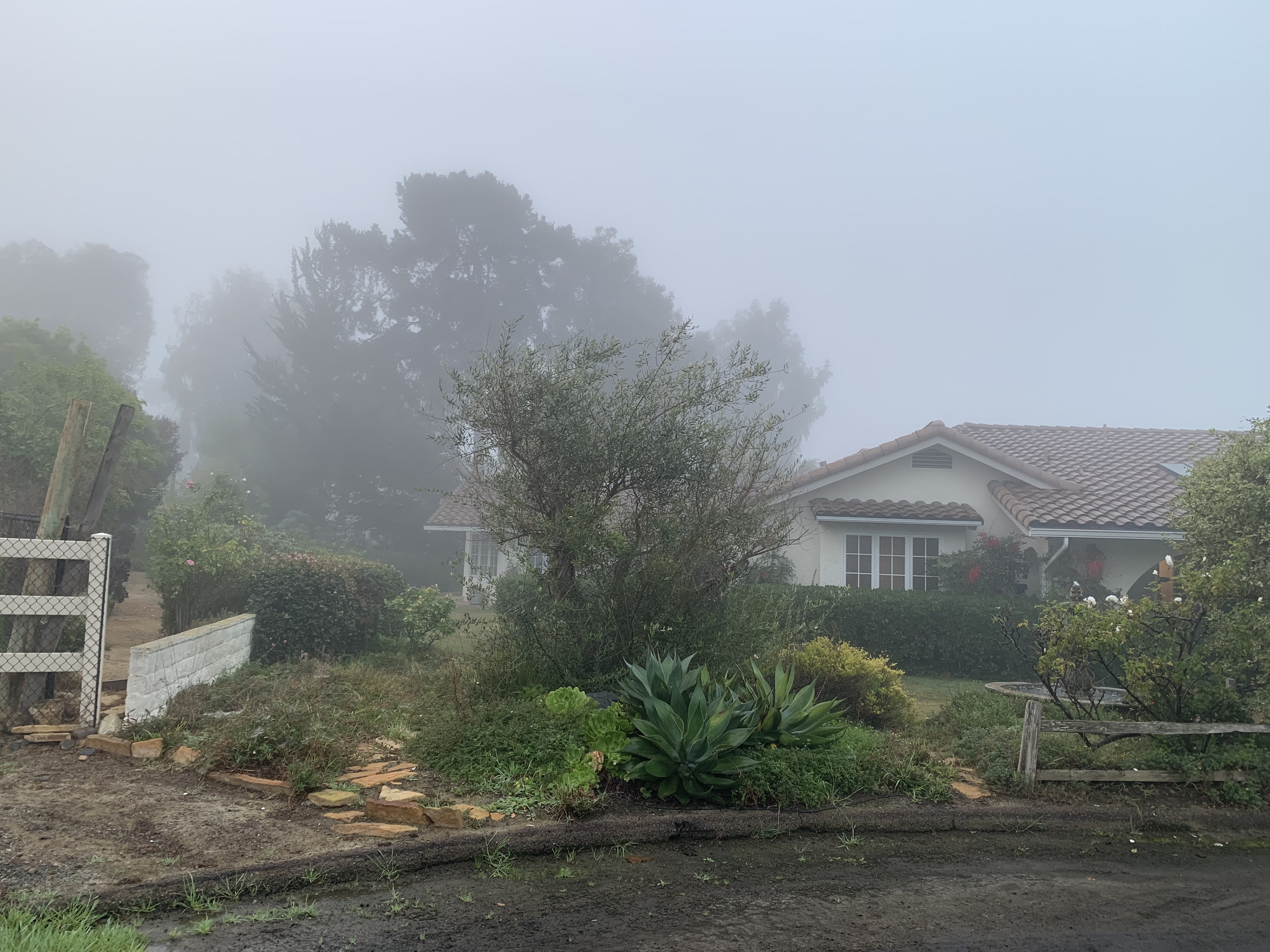
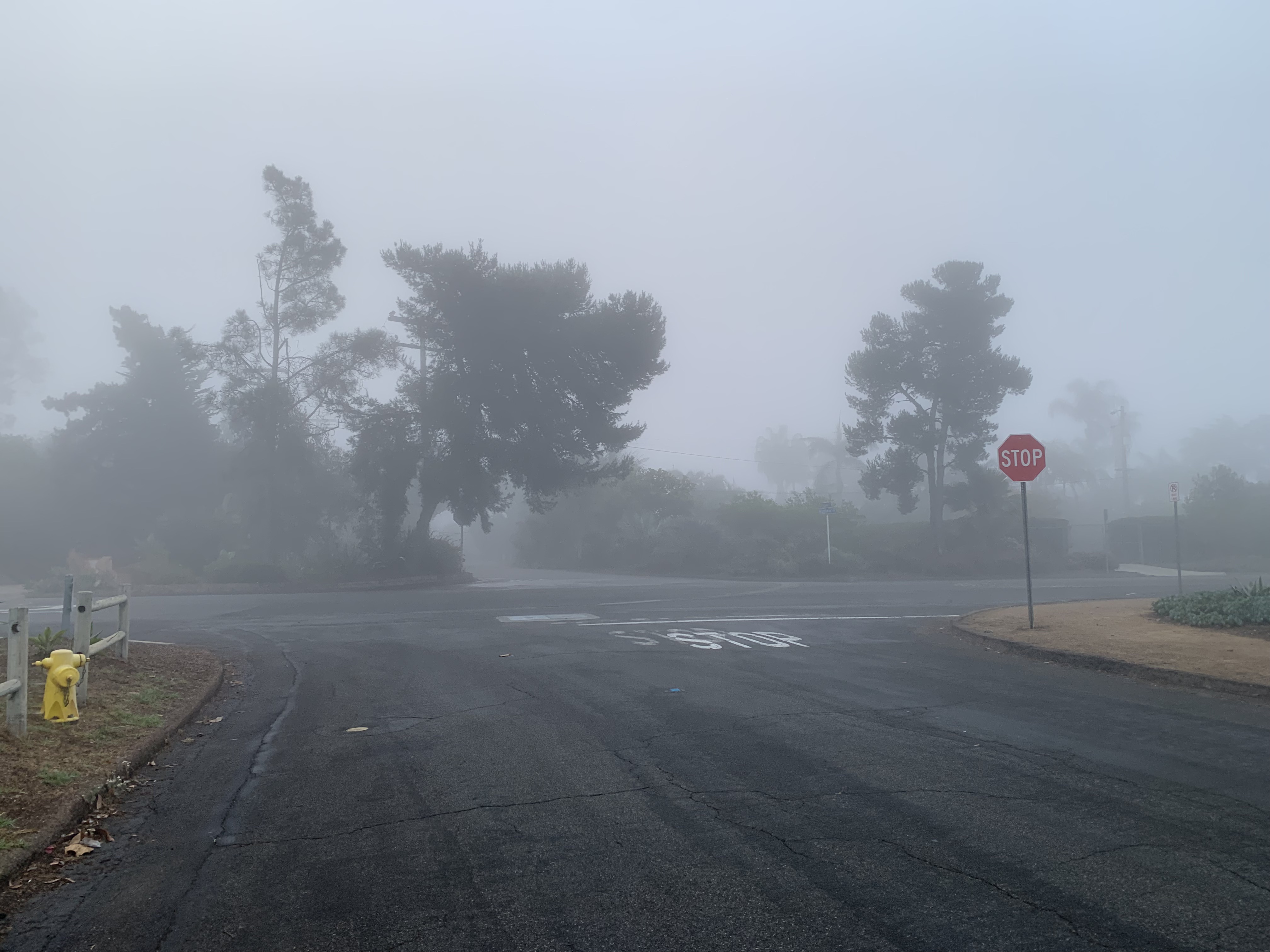
Our morning walk began, appropriately enough, in heavy fog. No sun. Cold. Damp. A slight but persistent icy wind.
How appropriate, I thought. No sign of a sunrise. Not near here.
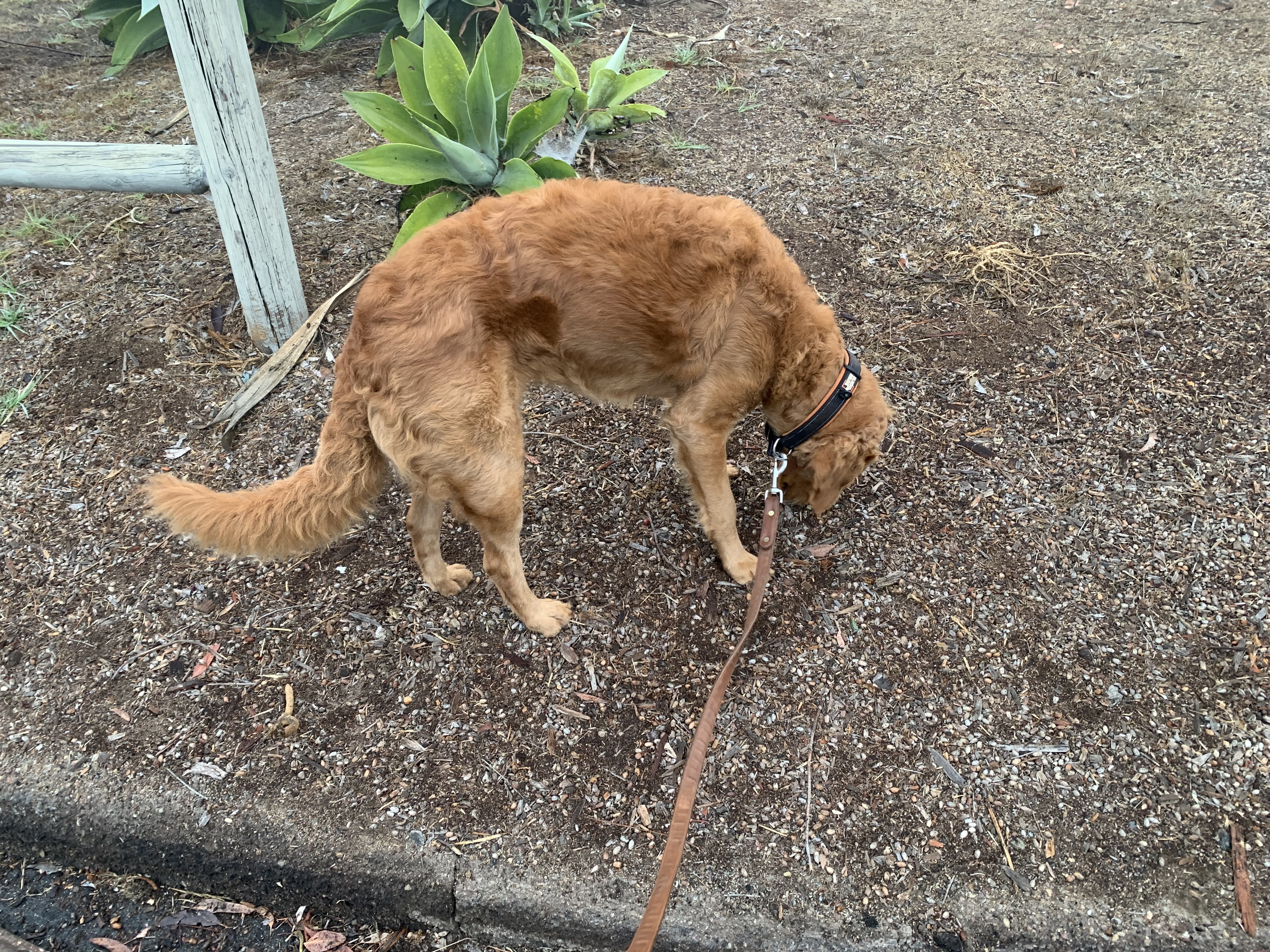
Sadie, however, seemed oblivious to the fog, the damp, the cold, the politics. Before our walk began, I told her we’d try walking without the shoulder harness but she’d have to do “Good Walking” with no Pulling. She’s strong and pulling hurts my back and knees but especially my ankles and arches. The harness helps prevent her from pulling, but doesn’t really eliminate it.
She did good walking.
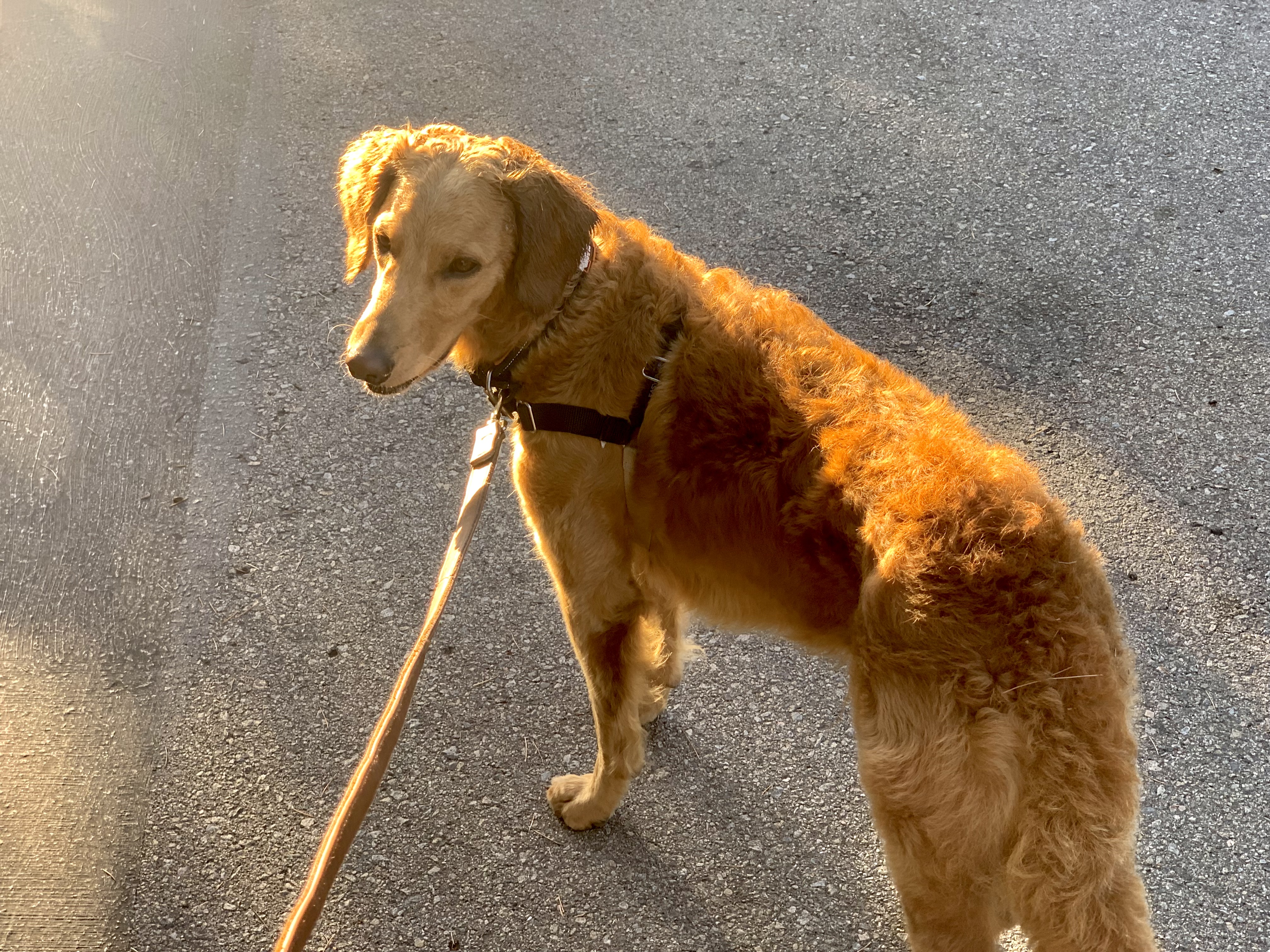
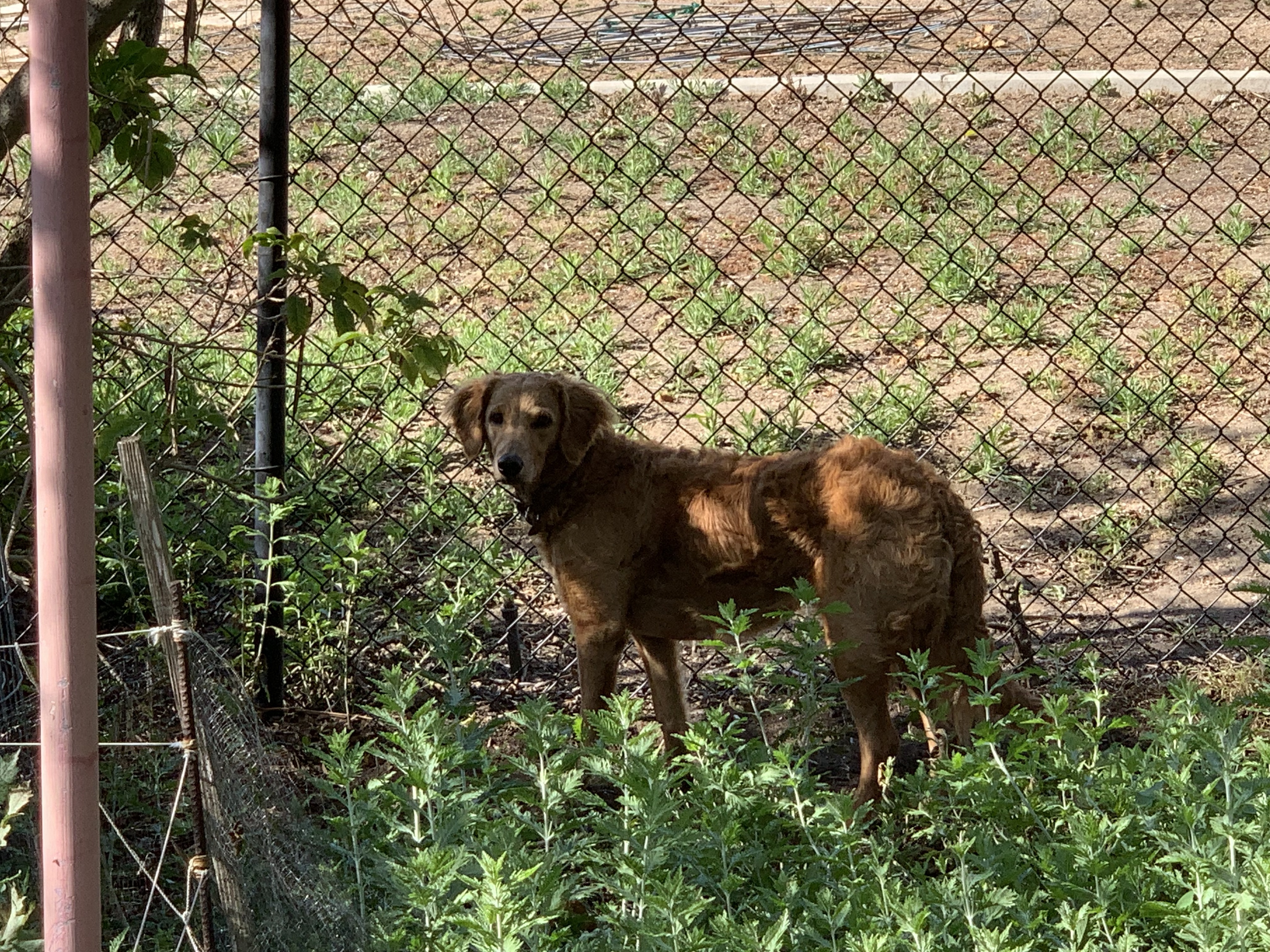
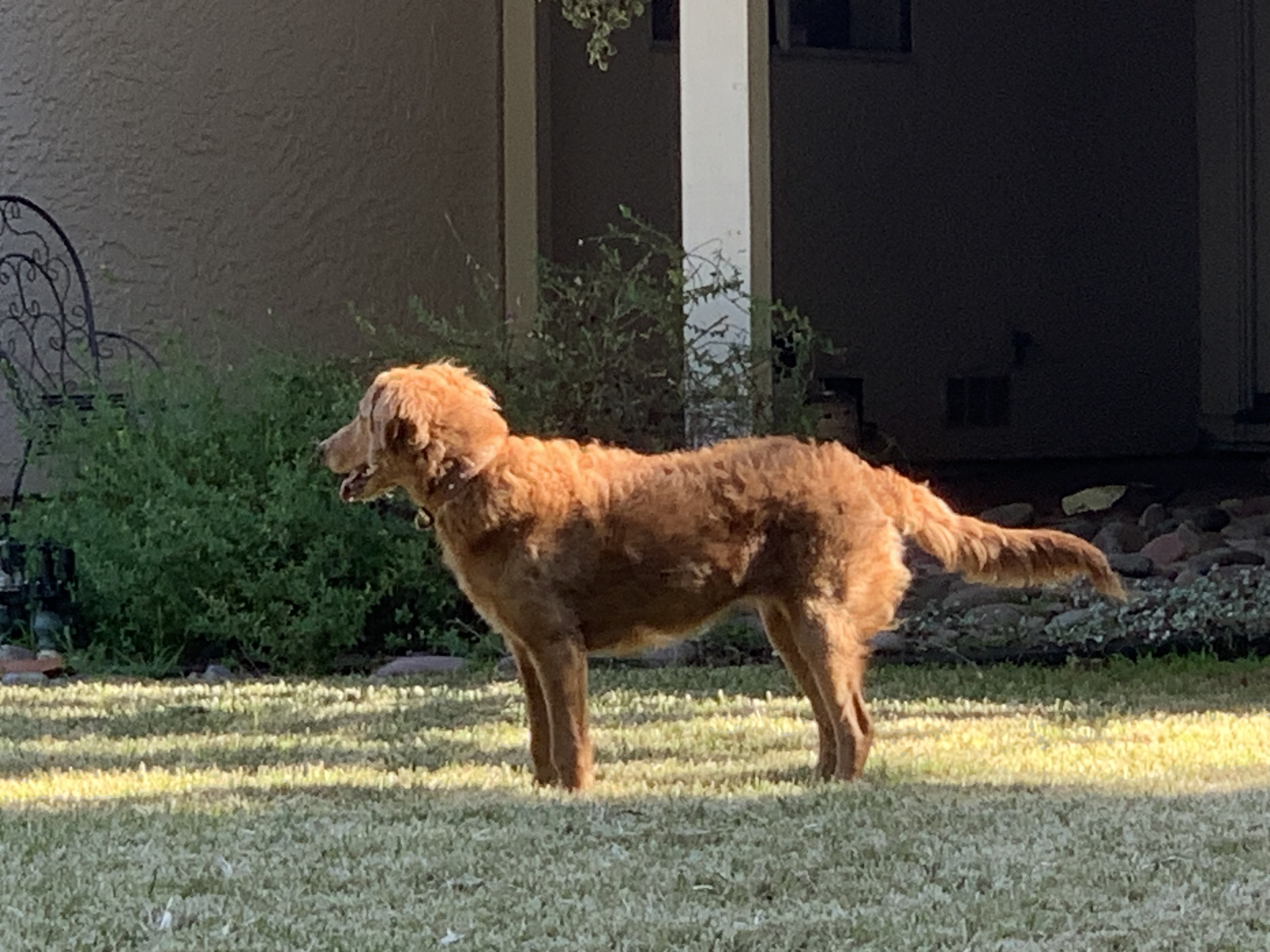
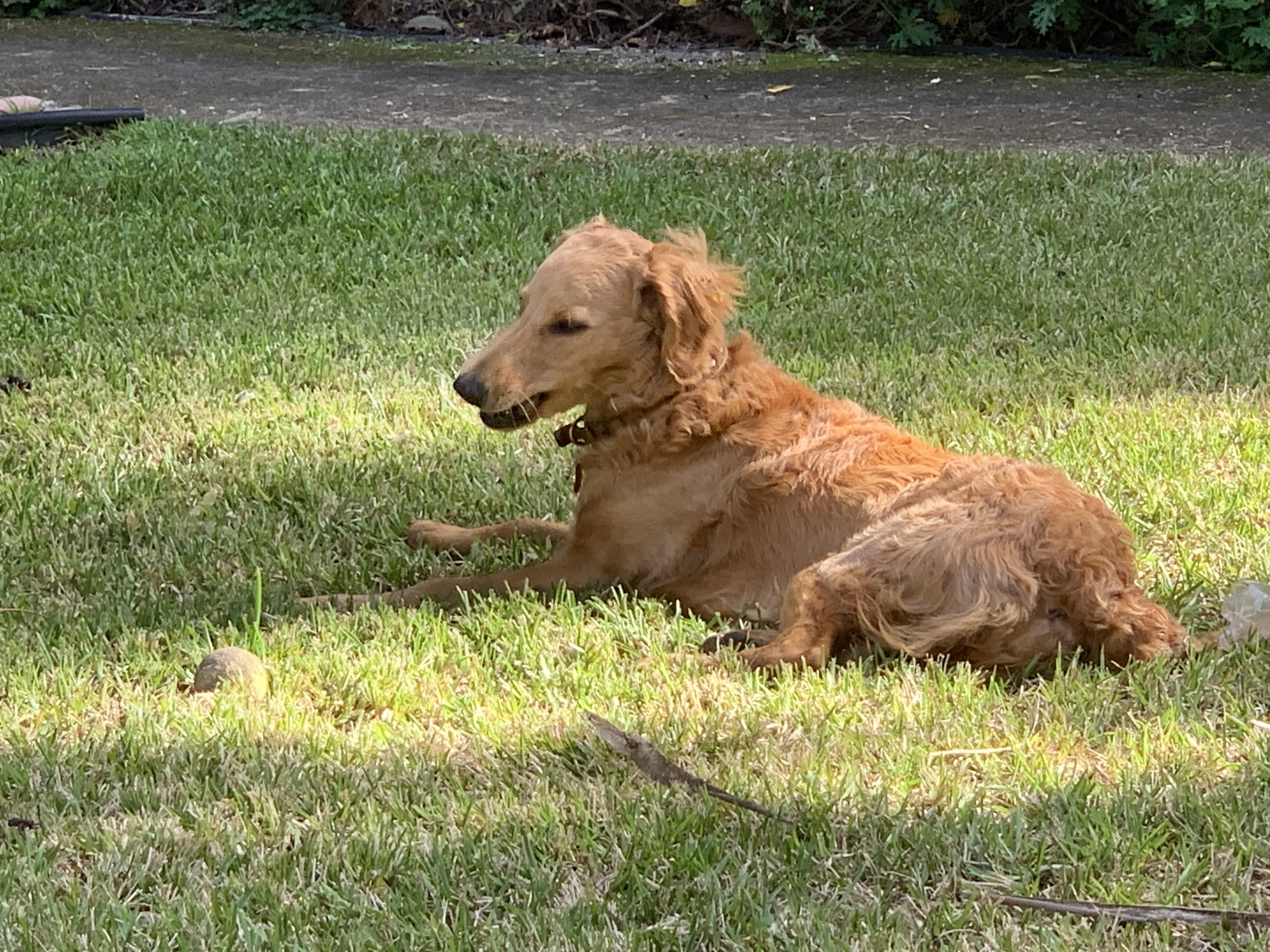
And I noticed that, up close, she is still as beautiful as ever. No gold or red from the rising sun, but still beautiful.
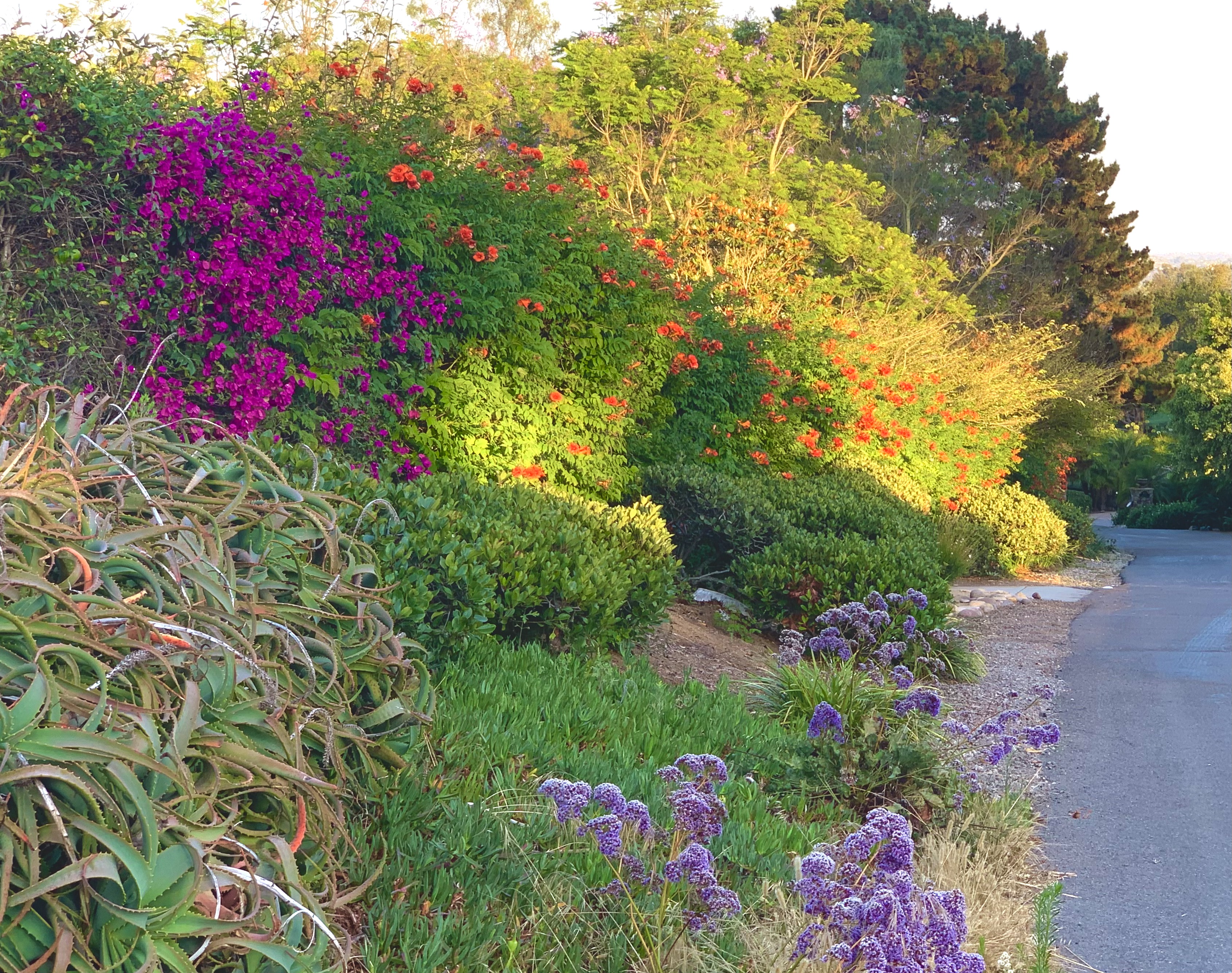
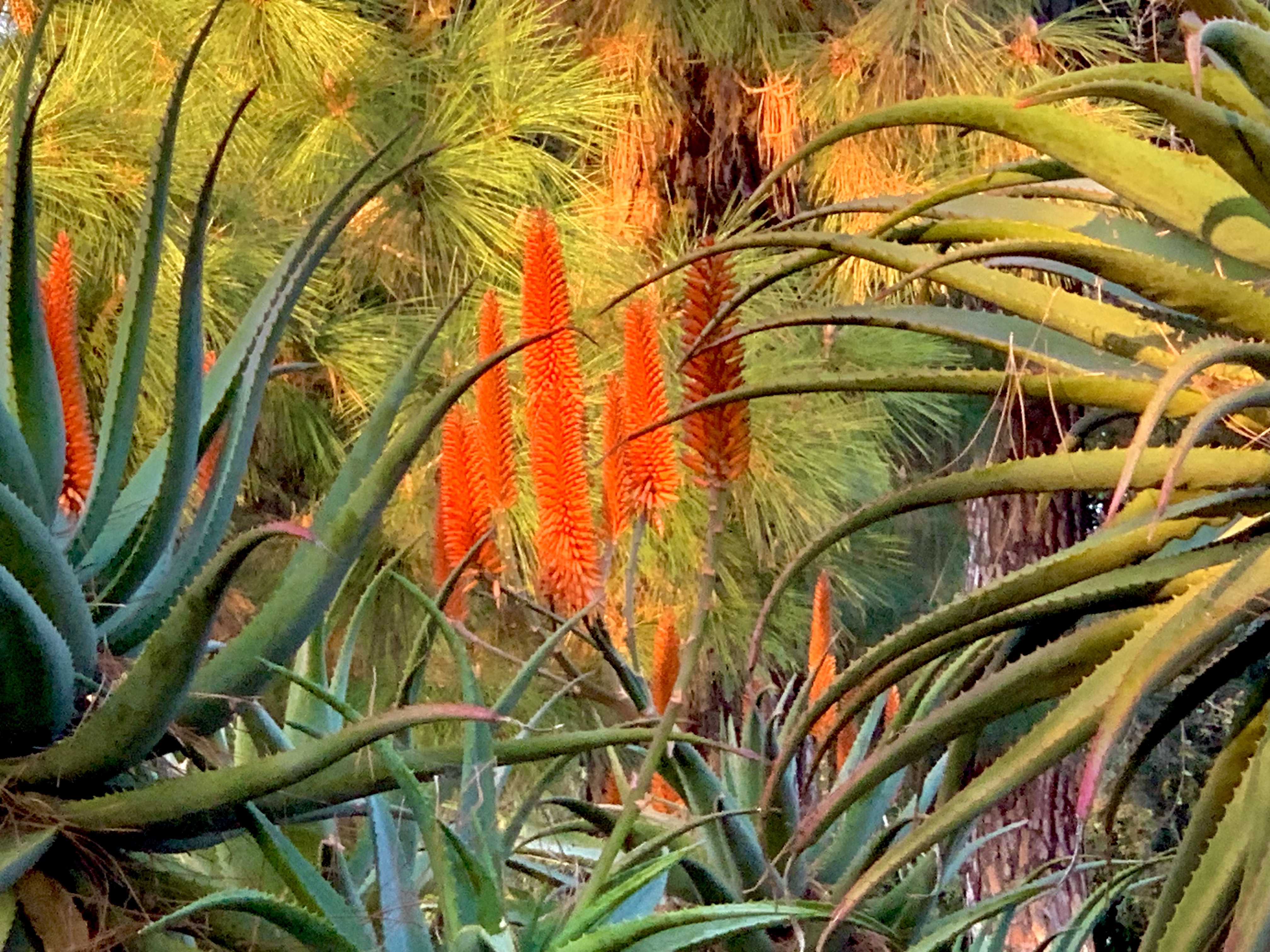
Indeed, the fog shrouds what is distant, but up close? Bright signs of beauty still beckon. If we bother to look.
Looking more distantly–ominous, if not downright evil.
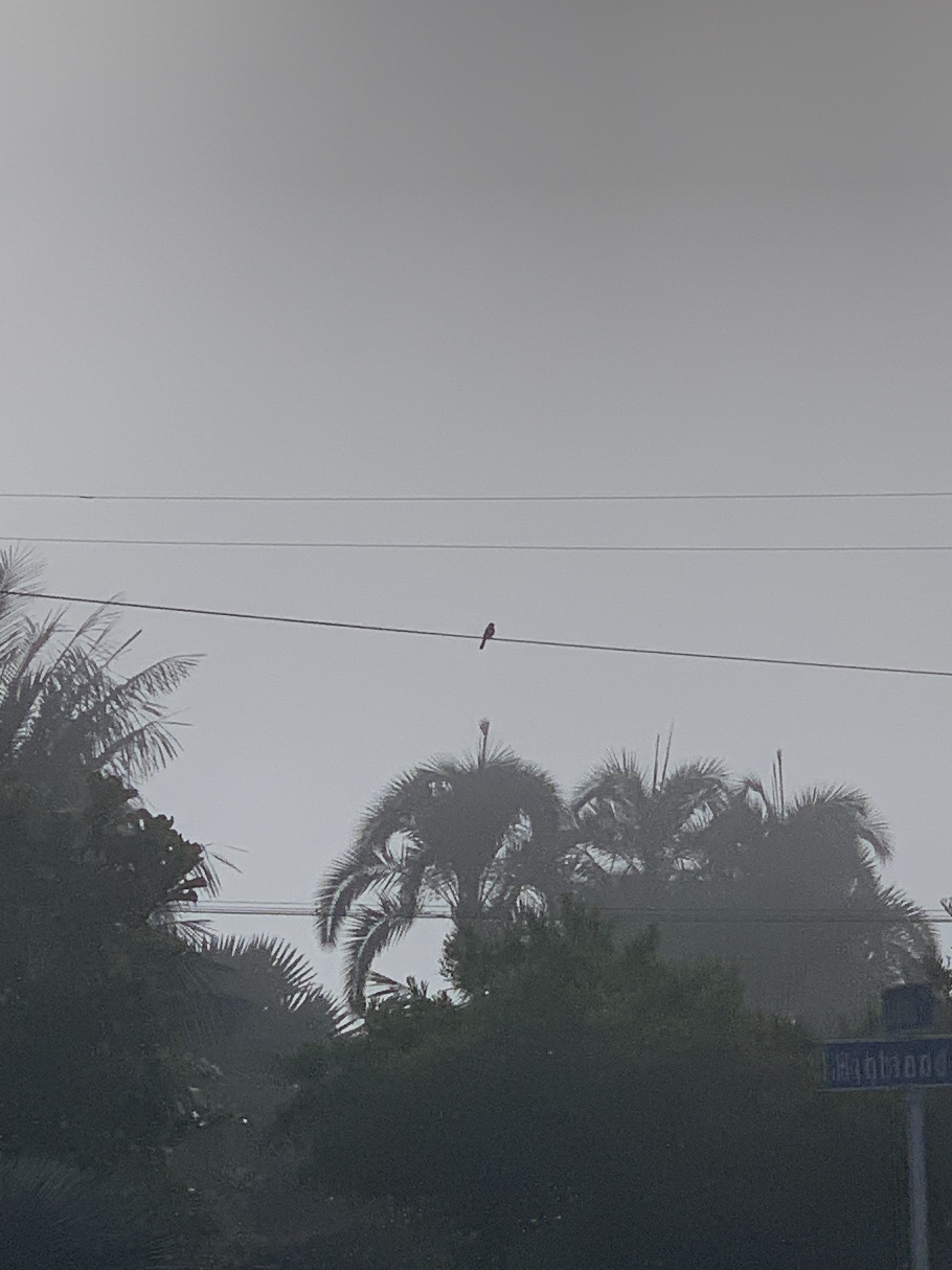
Even so, the lonely mourning dove coos on her thin wire perch.
Soon, the sun does begin to shine. Darkness, like cancer and greed, always eventually loses.
Our dog Sadie barks in many circumstances. She barks if someone comes to the door. Or—until recently—she also barks if someone comes to a door on the TV. She barks if we bring up the topic of a “N-E-W—D-O-G-G-I-E” (Hence, the spelling). She likes to sniff nearby trucks. If there’s a person inside, she ignores them. Unless, they open the door, that is. If that happens, she barks and lunges, though her tail is wagging the whole time. I don’t think she’d “attack” someone unless Wendy or I were put at risk.
Sometimes, she has barked to be let out to go potty, though now, she simply comes and stares at me while sending the thought that she has to go *big* potty! On our walks, for instance, she barked at someone’s (heretofore unseen and unsniffed) Halloween decoration. She barked because a traffic cone had fallen over.
Nonetheless, she is far less of a barker than many dogs I’ve observed.
Her barks, like my words, can be uttered with varying degrees of insistence and urgency. In fact, I hear a rumor that practiced orators can even lie with sincerity and passion. The closest Sadie has come to “lying” is that she barks insistently—hard to distinguish from a “I have to go potty” bark. What she often wants is attention. She’s okay with playing tug, or hide the dragon, or ball in the hallway. Of course, she’s always game for a walk. She doesn’t want to be ignored while we watch news or a series on TV. Even when the movie features a dog, she doesn’t think that counts as “paying her some attention.” (Though she does usually watch those segments).
Today, however, came the most insistent bark ever. I thought I had seen the top of the Bark Scale, but no. What I had heard before was a “6” on the newly discovered ten point scale.
Here is how it happened. We were in the back garden playing ball (off leash). I was picking up the six squeaky balls for another round when suddenly, the air was split with Sadie’s previously undisclosed 10-bark. At the same time, she stood at attention. And then she charged up the stairs toward the house. (“Flew up the stairs” actually, but I didn’t think anyone would believe me.)
As I tried to catch up with Sadie, several possibilities ran through my mind. Was there an actual intruder? Did a coyote or even a puma come on to the property? Or, was it just my wife coming out onto the deck?
I turned the corner and saw the trigger. Our cat Shadow was outside on the deck. Sadie insistently “herded” her back inside. The door to the back deck had been left ajar. By me. Not a puny little jam jar, understand; a dill pickle jar. I came up the stairs but Sadie had already solved the problem and ran inside to follow up with Shadow on the scope of her transgressions. I thanked her.
This is not something that we “trained Sadie to do.” Maybe she found that Shadow’s being somewhere new offended her sensibility in the same way that she objected to our neighbors putting up Halloween decorations without checking with her first. But no. Her bark and physical attitude were much more severe, insistent, and loud!
I had the impression that she sensed that the cats were not to go outside. She had certainly heard us say that in various ways. She had also observed me nudging Shadow back inside when she wanted to follow Sadie and me out on a neighborhood stroll. And, I often give Shadow a rationale as well. That rationale features coyotes quite prominently. Sadie may know what a coyote is. I’ve pointed one out to her once. But even Shadow knows it’s not a good thing.
(AI generated)
To fully contextualize this, I should mention that generally speaking, despite the fact that Sadie outweighs Shadow by a factor of five, Sadie seems more afraid of Shadow than vice versa. When Sadie was a puppy, she tried playing with each cat based on the way two puppies might play together. None of the cats took kindly to these approaches and on at least a few occasions, swiped her with claws engaged. She stands up for herself if one of the cats starts to eat her food, but she isn’t nearly so aggressive as she could be. Of course, I’ve only ever observed this behavior when I’ve—er—um—-observed it. When I’m around, there is a quality to Sadie’s bark of asking for my help and I usually provide it, telling the cats not to eat Sadie’s food.
This made it all the more remarkable that Sadie would be capable of dominating Shadow completely and herding her back into the house.
I do put a fair amount of stock in Sadie’s evaluation of things. It depends on what the domain is. She’s notoriously bad at valuing the plants in our garden. She leaves them alone for the most part but if a ball falls into one, rather than being satisfied with simply removing the ball, she “punishes” the offending plants viciously. She’s not much good at picking stocks either. Nonetheless, today’s episode made me trust her judgement (and reactions) more.
I certainly don’t want to play the tritest role in that most famous of all tropes for Westerns: “Hush, Paint! There’s nobody out there in the dark woods. There’s nothing to worry about!” Want to survive? Pay attention.
Consider me barking quite loudly. Neighing quite insistently.
Did you ever read “Travels with Charley” by Steinbeck? “Charley” is the name of Steinbeck’s dog who travels with him on a car trip across America, or at least the first 48 states thereof. My wife and I—and our dog Sadie— recently met up with my cousin-in-law (is that a word? I guess it is now). Cousin-in-law Timm loves dogs too and suggested I should do a similar journal called “Travels with Sadie” and this is, indeed, the first chapter of “Travels with Charley.”
I chose this topic while reflecting, as I often do, on what the world is like for Sadie and her kin. Sadie, like most, is thrilled to meet other dogs. If she can’t meet them in person, the next best thing is to sniff the spots where they peed. Although she hasn’t yet reached estrous, in the last few months, she’s been behaving differently with respect to the pee residue of female dogs on the ground and male dogs, which are on bushes, trees, lampposts, sign poles, and fire hydrants.
It seems that the males inordinately prefer lampposts, sign poles, and fire hydrants over trees. That, to me, at first seemed curious. After all, trees have been in the picture for dogs and their ancestors for millions of years. These manufactured artifacts are brand new.
Here’s my hypothesis. In the long-ago days of dogs, some dogs took it upon themselves to signal their presence by peeing on manufactured posts while others preferred trees. A post has fewer distractions—visual, aural, and most importantly, the olfactory sense. Thus, the post-preferring peers had a more impressive social presence resulting in more mating and more envy—higher ranking in the pack. Over time, the post-preferring peers proliferated and prospered.
Over time, and perhaps even initially, the individual dog itself could “learn” that it had left a more salient and more lasting impression. How? Because they go back to the spot they themselves peed in, often repeatedly. Thus, they would learn that make a splash in the dog world, you’re better off with a human artifact. The fact that it smells like a human when it is first put into place may well “seed” the site as a place to exchange messages—perhaps a kind of canine Facebook—only not really the face.
It also turns out that lampposts, sign poles, and fire hydrants signify three essential functions of a society. Lampposts are to shine light on reality. Medical research, science research, education, public service announcements, and books. To some extent, our laws are also a kind of lamppost. “Look people, we’ve learned the hard way, that it’s not good to steal. Don’t do it.”
Well, if that’s not clear enough, fine, we’ll write 100,000 pages of clarification.
Sign posts include, to me, norms and customs, as well as directions of various sorts. There’s often a tension between lampposts and sign poles. The sign poles take work to design, manufacture, transport, and erect. That stop sign down the street didn’t just fall off the coconut tree. Similarly, customs, for instance, separating the work of men and women so that all nurses were women and all men were doctors, take work to implement and to enforce. People will not always stop at a stop sign and especially if they are never ticketed. Similarly, there will be individual women who desire to become a doctor and men who want to be nurses. There will always be tension in such customs between the norm and the individual desires.
Imagine after a lot of work has gone into putting up the stop sign, the lamppost function of government sponsors a study that shows it would be much better to put in a traffic circle (roundabout) rather than the four stop signs. More traffic gets through faster and there are fewer accidents. You can easily imagine some resistance. The people who profit from making the stop signs, for instance, and the police officers who ticket those who only come to a “rolling stop.” The drivers may also object. Many of them aren’t used to traffic circles. Some initial awkwardness is predictable.
To me, the fire hydrant represents the protective aspects of government. There are many! There are agencies, like the FDA, that ensure the cleanliness of our food and water. (Believe it or not, there are some providers who are so greedy, that they would actually sell you tainted food or drink if it would make them richer.) There are the Armed Forces, the Fire Departments, the Police Forces. In a way, Social Security and Medicare also fall into this region. It is a protective function of government.
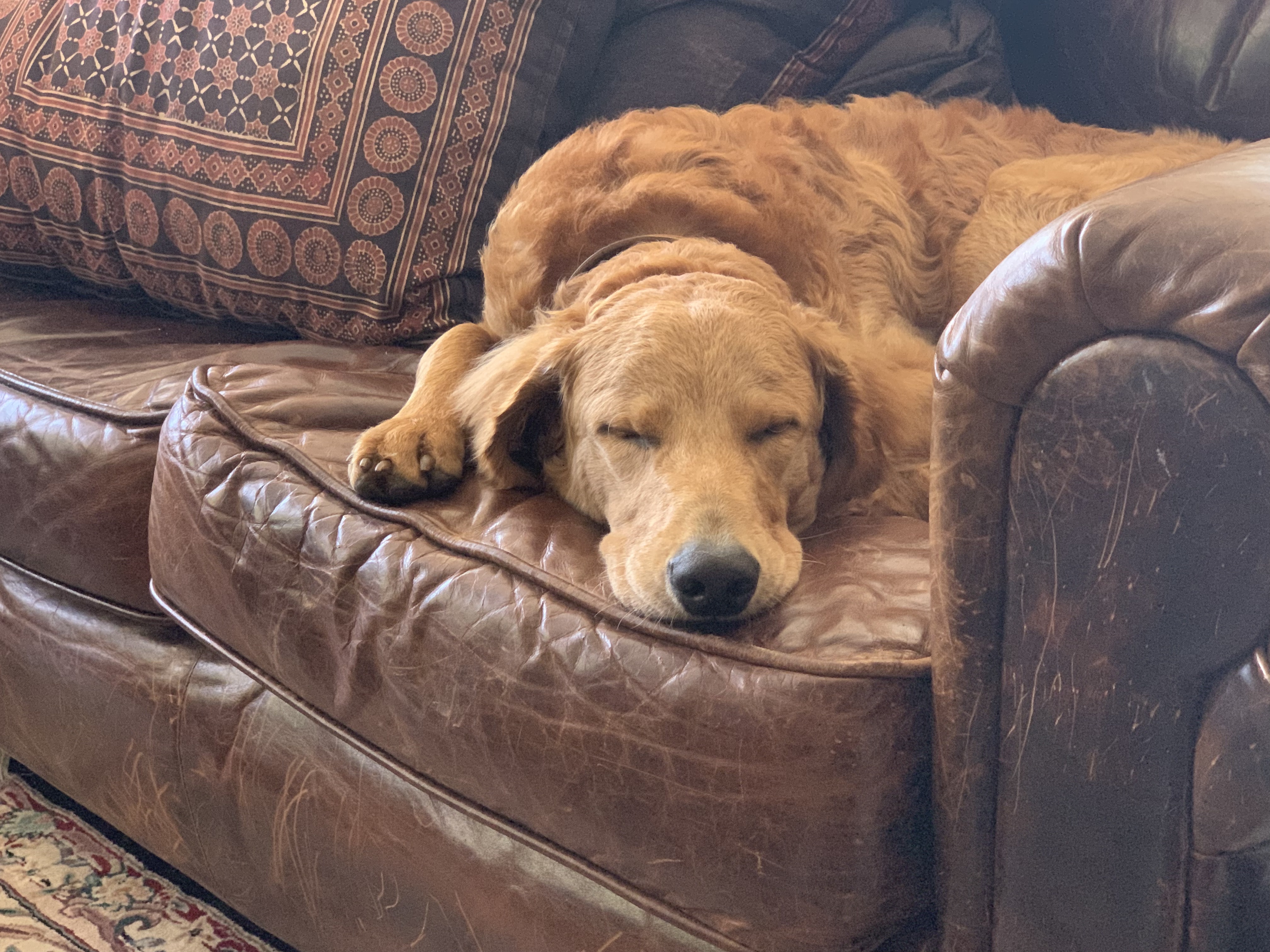
Sadie, meanwhile, is sacked out on the couch across from me. She’s had an active day; two long walks, zoomies, swimming, and ball playing. Our dog, like many, is very loving. She’s wary of anything new. But soon, she’ll be head over heels in love with another person.
The very greedy people who would have you kowtow to them while they steal the fruits of your labor love to use the rationalization that it’s a “Dog eat dog world out there.” It isn’t actually. Neither humans (for the most part) nor dogs (for the most part) are out there eating others of their own species. We are both pack animals. We both love and protect our families. Is there competition? Sure. But it’s all done in the scope of a cooperative society.
The natural tension between conservatives and liberals has a lot to do with how quickly one wants to see lamppost findings supplant existing psychic and physical infrastructure. And it is a very legitimate debate to have. Most do not want the extreme that every new finding in, say, medical research should instantaneously turn traditions and practices on their heads. Also, most do not want to ignore all new science and discovery and keep everything static forever.
What is not a legitimate debate is for one side, like a spoiled toddler, to insist that if they don’t get their way, they’ll burn our civilization to the ground. Sadie wouldn’t do that. Nor would I. Nor would most Americans.
Sunshine was one of my reasons for moving to San Diego. It wasn’t the most important, but it was important and I appreciate the Sunshine. For the past week, however, Sunshine took a long-awaited vacation. Apparently, Sunshine was running some sort of scam on the weather forecasters, calling up and saying, “Hi! It’s Sunshine! I’m feeling so much better today! I’ll be at work as usual tomorrow. You can count on it.
And then, when daybreak arrives the next day, it doesn’t. That is to say, when it should arrive, it doesn’t because Sunshine has overslept. Again. I suspect it might be because of all-night partying last night on the other side of the world.
You would think that the weather forecasters would catch on. You might even think that they would have seen the famous “Charlie Brown” cartoon meme in which Charlie Brown’s frienemy Lucy, promises him, year after year, that she will dutifully hold the football and not pull it away—not this time. And, dutifully, year after year, Charlie Brown decides that this will, or at least might be, the year that Lucy finally does the right thing.
But of course, she doesn’t do the right thing. And, Charlie falls flat on his back every time. Lucy smiles.
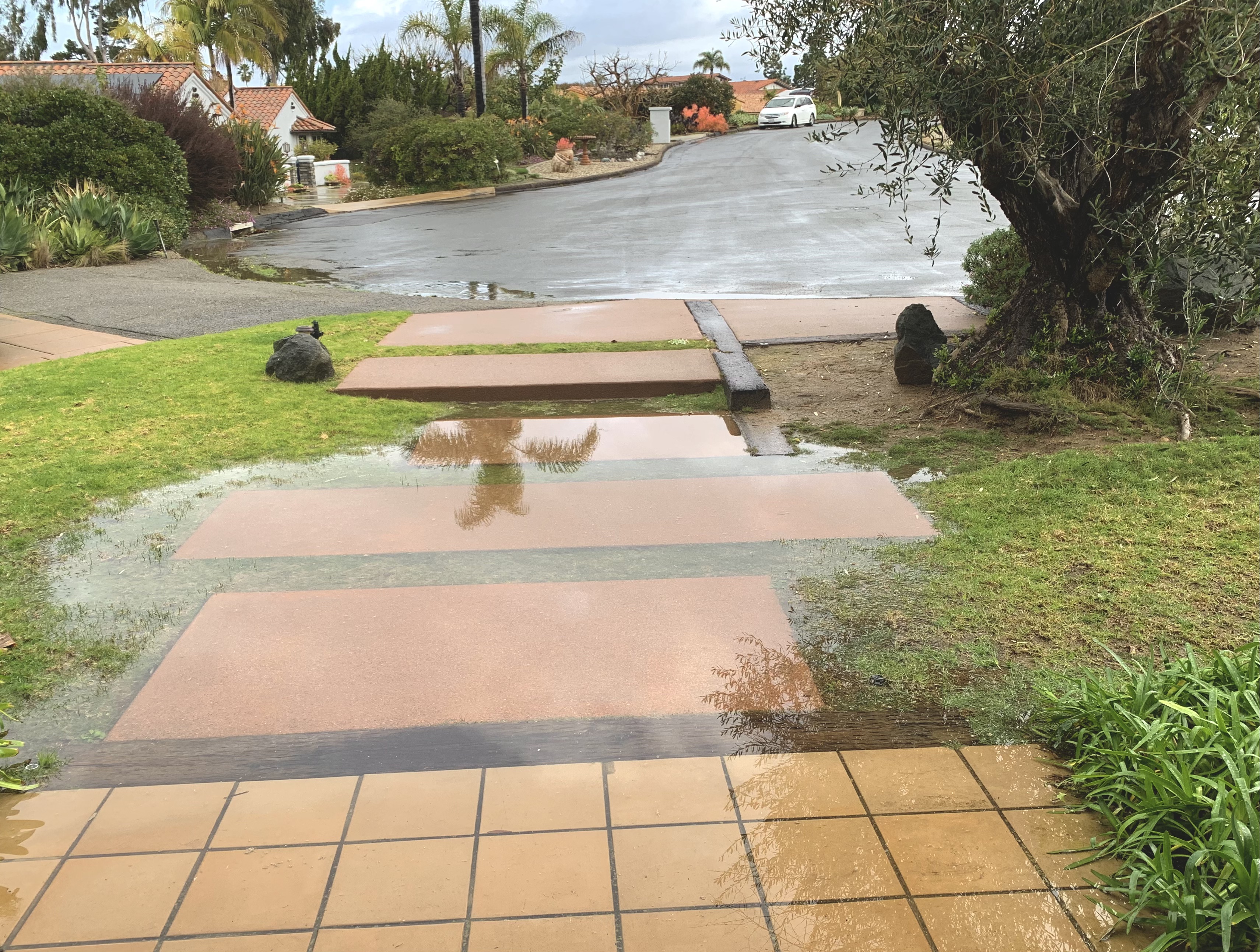
So apparently, this week, did the Sunshine. Taking vacation elsewhere and not showing more than a stray ray or two in San Diego allowed for the deluge. Other places farther north had it much worse, in terms of rainfall and damage. Worldwide, what we now call extreme weather may, in many places, become more “normal” and extreme weather will become deadlier.
In any case, I am have been just as foolish as the weather forecasters and Charlie Brown. Every day, my phone app has said the rain would be over in a day or two. And, then, two days later…same forecast is dutifully presented. But not the promised reality.
Sadie, meanwhile has been very patient about the fact that our walks have been typically much shorter all week. She has also been patient about not being allowed to dig in the dirt. More accurately, she wasn’t allowed to dig in the mud. There was no “dirt” around. It’s not idle digging. She hears and smells gophers and goes after them. Unsuccessfully. Every time. She’s dug for gophers more than the San Diego weather forecasters trusted Sunshine’s repeated false assurances that tomorrow the rain would end; indeed, even more often than Charlie Brown has over-trusted Lucy.
She persists. She enjoys the process. Maybe the weather forecasters enjoy knowing that they made everyone feel hopeful that could play tennis in a few days (or have a picnic or mow the lawn or harvest their fruit in sunshine). Maybe Charlie Brown enjoys being the kind of person who would give another one more chance to be good, even if they never take that chance than to be more cynical and realistic.
I can’t say what the motivations are for Charlie Brown and the weather forecasters, but I am sure Sadie enjoys the digging. She certainly has little care for how dirty her paws get or whether she spews mud on my shoes. My philosophy may be a mixture of Charlie Brown and the San Diego Cabal of Sun Predictors. I believe Sadie should spend some time “just being a dog.” In other words, she should be in at least partial charge of what she does and be allowed to follow her “instincts” unless it poses a true danger and not just because, say, she tracks mud into the house.
As I was watching Sadie dig, and I was sliding sideways to prevent becoming inundated with wet dirt, it occurred to me that I too, had some years of “just being a dog.” My parents, I think, thought of it as time for my “just being a kid.” In some cases, I heard adults say, “Oh, it’s just boys being boys” when we played in the dirt, fought with sticks, or had “rock wars” wherein we literally threw rocks at each other.
Not all adults were on this plan 100%. My own parents would let me play in the dirt often times, but they did not want me to participate in rock fights or stick duels. Evading those restrictions was trivial. We weren’t trying to be bad. But we knew our friends would not to try to blind us with sticks or stones. We believed implicitly that since we weren’t intentionally trying to blind each other, it wouldn’t happen.
Though there were local variations in the strictness of restrictions, we were always able to do some version of “just being a kid” which truthfully, was not all that different from “just being a dog.”
I had just as little care about muddying my shoes or fingernails as Sadie does about muddying her paws. I’d say my “dog years” were mainly between six and thirteen. Before six, my parents or other caregivers wouldn’t leave me alone long enough to get in real trouble. I mean, I managed all the usual little things like peeing into electrical outlets, throwing stuff down the “registers” (heating vents) to see what would happen, and writing in books and on walls, but there was no opportunity to have rock fights or get muddy from head to foot.
From ages six to thirteen, however, I spent a lot of time outdoors unsupervised. Plenty of time to be a dog. A few years later, however, it dawned on me that girls might find me more attractive if I were less muddy. My mother might have planted that suggestion.
There’s no doubt that many of the “instincts” I had were not very effective guides. They weren’t as effective as the knowledge that science and society had developed over centuries. On balance, I still believe having some dog years is a risk worth taking.
Sadie and I have been playing various games indoors with tennis balls since we were fortunate enough to have her adopt us. Anyway, my philosophy is not to “teach her” games that I make up in my head but to have as close to a truly collaborative process as possible.
Don’t get me wrong. It is fun to train a dog or any other animal. In some cases, it’s life saving; in others, it’s just a major convenience to train them. I’m not against it. And, we certainly continue to try to train her.
But when it comes to playing games, why not enter into a partnership of equals in collaborative invention. I try to be sensitive to her hints about what comes next. And she tries to be sensitive to mine. We’ve come to develop certain conventions around the playing of games. For example, if the ball rolls somewhere inconvenient, I let her try to retrieve it. She objects if I try to retrieve it first. That’s her job. But if she can’t reach it, it’s fine for me to reach it, first with my foot, or if necessary by getting “a tool” as I explain it to her. This is generally a crutch or a back-scratcher.
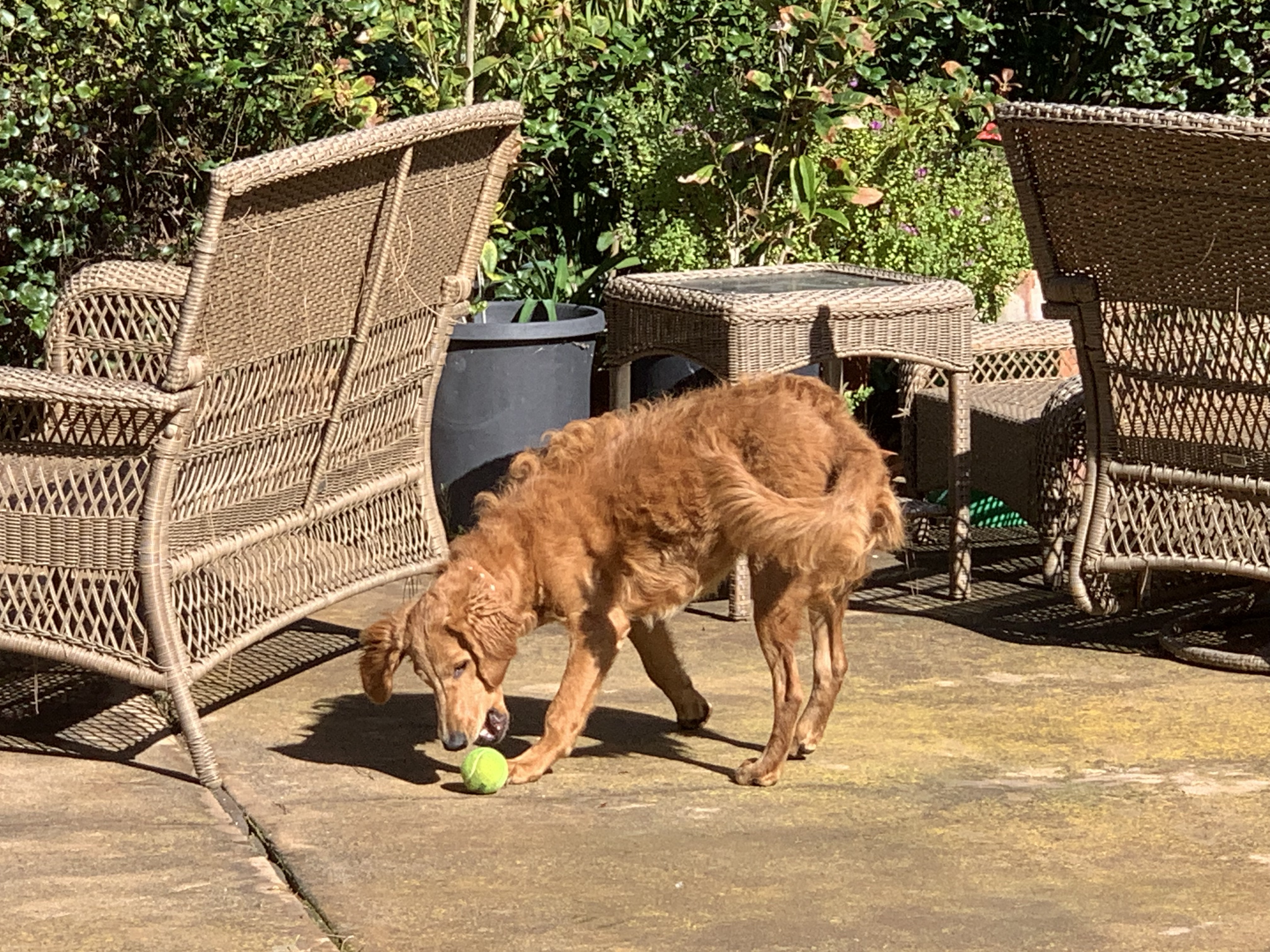
It turns out that Sadie has a pretty clear preference about the type of ball to play with. The clear winner is the tennis ball. They are all better than any of five other types of ball. The biggest loser ball was the pickle ball which Sadie completely ignores and beneath even the dignity of an eye roll. Anyway, one that she sometimes interacts with is what she named—or possibly, it was me—“The Lighty Ball” because it lights up when it bangs into anything hard enough or anything bangs into it. Generally, I realize that when I kick or throw a “mixed bag” of balls, she pretty much ignores all but the tennis balls.
So, tonight, I was playing with five tennis balls and the lighty ball. She was ignoring the lighty ball but I was kind of ignoring the fact that she was ignoring the lighty ball. I kept re-introducing it into the mix. She kept ignoring it. Fine. This is what it means to have a partnership. Sometimes.
She just wasn’t getting her message across. And, I’m not blaming her. Not at all. But how else can she get her message across?
To understand what she did, we need to take a short detour to the “holding pen.” As you read about someone in the their 70’s playing tennis ball games in the hallways, it might have occurred to you that this is asking for a broken whatchamacallit. But I take the view that “constant vigilance” should be practiced to minimize your overall chances of falling catastrophically or, in this case, dogistropically. Anyway, I do some things to minimize the risk. One is to shuttle the balls into a space between the wall and the bookcase. No-one will trip on them there. I call it the “holding pen.”
So tonight, I was playing this mixed ball game with her and I had to go feed the cats and then I came right back. Guess what? Sadie had put “The Lighty Ball” into the holding pen.
I think the moral of the story is, if a dog is smart enough to find more than one way to communicate, why should so many humans stick to one?
We recently acquired a dog. Sadie. Brilliant and willful. Half poodle. Half golden retriever. She’s an amazing ball player. And not just in terms of her physical prowess. She naturally exhibits most of the advice in The Winning Weekend Warrior. She doesn’t worry. She doesn’t berate herself for past performance. She is confident she can catch any ball, and if she misses on the first bounce, she goes after the second bounce as though, not only her life—but the life of the entire pack—depended on it. And if she misses it on the second bounce and accidentally nuzzles fifty feet away, she still goes after the ball!
Before I wrote this essay, Sadie stood before me, staring those sad eyes into mine begging for another hour of ball-playing but I explained I wanted to write on the computer for awhile so she got up on the bed where she’s quietly chewing on a bone.
She and I communicate fairly well. Yet, it’s amazing how little they understand about human communication. Often, I wish I could communicate more fully. That led me to think about how to explain how humans use natural language in terms Sadie could understand. Thus:
———————
“OK, Sadie, humans (I point to my chest) like me use language in two major ways. One of those ways is to collaborate better by communicating meaning.”
Sadie barked.
“I know, Sadie, I know. I haven’t explained those words yet; we’ll get to it.”
Sadie barked.
Rather than try to clarify my previous statement, I thought it better to advance in the spirit of “appreciative enquiry” and so I said, “That’s right, Sadie! The second way that humans use language is exactly the way you use it, to bark at other doggies! Or, sometimes, just to hear themselves bark.”
Sadie barked.
“OK, I’ll give you an example. You know how the doggies next door bark incessantly whenever they’re out at the same time we are? You know how they spend their entire time jamming their teeth up against the fence to show how tough they are and bark as loud as they can meanwhile ignoring ten thousand things in their environment that are actually more interesting—or would be, if they gave it a chance? Well, that’s exactly how humans sometimes respond. And, it’s how they respond without any adaptation or learning.”
Sadie barked.
“Oh, yes, you’re right. Those doggies (I point in the direction of the better doggies) barked a lot when they first met you and they bark again when they don’t see you for awhile, but they wag their tails and come to greet you. Many people bark like that too. When they first meet someone different, they bark to keep them away and claim their property and their stuff. But when they realize that the threat is minimal, they become friendly and stop screaming.”
Sadie barked.
“Right again, Sadie. Sometimes doggies bark just because something is new or novel or different from what they’re used to. You yourself do this. The mail truck swings by. The gardeners leave a tool. It’s different and you bark. And lots of people are the same way. They bark when something’s different. It doesn’t even have to be a person. It can be a thing, a tool, a book, or even a thought. The difference is that you get used to the new situation and stop barking after awhile.”
Sadie barked.
“You know, I have given you lots of different tastes of things: kale, lettuce, squash, carrots, tomatoes, cooked potatoes, cooked broccoli, cucumber, raspberries, blueberries, strawberries, and lots of other things. And I tell you you can take it or leave it. You liked or tolerated everything on that list. But some people—to tell you the truth—the cats are much like this, but don’t tell them I said that—some people who have never tried, say, raspberries will bark at the raspberries and at me for offering them. ‘What?! Raspberries?! I’ve never tried one; never will! They look like a hive of deadly ladybugs to me!”
Sadie barked.
“Well, those are two of the most frequent categories, but there’s another that’s also quite common. They bark to upset themselves and others. It’s as though it isn’t enough to bark at the raspberries. That doesn’t really upset them very much. So they bark and bark and bark until other doggies in the neighborhood are thinking something like: ‘Invasion! Invasion! Set off the alarm.’ Others, of course, are more like: ‘Something’s out there we can hunt down and tear the guts out of! Come on! Let’s go do it!’ And that’s pretty much word for word what the human pack does as well.”
Sadie barked.
It’s amazing how much they understand about human communication.






















 petersironwood