• About PeterSIronwood

petersironwood

~ Finding, formulating and solving life's frustrations.

petersironwood

Category Archives: family

The Silent Pies

13 Saturday Dec 2025

Posted by petersironwood in America, family, fiction, psychology, story, Uncategorized

≈ Leave a comment

Tags

collaboration, cooperation, family, fiction, life, politics, story, teamwork, truth, USA, writing

Photo by Alena Darmel on Pexels.com

The first time I won the prize, I was only 8. I had only had my two-wheeler for about a year when my gang of neighbor guys jointly decided it would be a lot more fun to ride our bikes if they made as much noise as real motorcycles. I can’t speak for the others, but it never occurred to me that other people in the neighborhood might not find this increased noise level “really cool!” 

Of course, we weren’t always riding our bikes. Sometimes we played in Lynn Circle at the end of our road. It served as a makeshift playground for baseball, kickball, and soccer as well as a free hippodrome for our races. This arrangement had one slight flaw. There were no fences. So, invariably, a ball would go careening off the pavement onto someone’s lawn. 

In our neighborhood, everyone’s house looked fairly similar, but they expressed themselves through their small gardens and lawns. Some people, like my dad, really worked at making our small lot at least something gardenish. Other people did little but mow their lawn every so often. But some treated their lawns as they might, at any moment, be teleported to the Master’s Golf Tournament for emergency green replacement. Universally, these people had no children at home. When that was so, none of them interacted much with the kids, the parents of the kids, or even, each other, as I can recall. 

Photo by Kelly on Pexels.com

When a stray ball dribbled up into our lawn, someone just ran up and got the ball. No big deal. But if someone hit a ball into one of the three lawns that were antiseptic enough to serve as operating tables for open heart surgery–YIKES! Of these, the most stringent by far was “Old Lady Lynn.” When a ball went into one of the antiseptic lawns, we tried to reconnoiter the situation before even attempting to grab our ball back. We would consider whether there was a car in the driveway, whether there was any sign of life coming from the domicile in question. Only if we were fairly sure no-one was at home would we walk and get the ball. If we weren’t sure, we’d run up and snatch it as quickly as possible and then duck into a “friendly” back yard quickly enough so that we wouldn’t be identified. 

Old Lady Lynn always seemed to be at home. We imagined, because of her invariable and instantaneous reaction, that she spent all her waking hours peering out between curtains at her lawn to insure that none of us trampled her grass. 

Our gang decided to begin our little decibel enhancement project by each of us buying the loudest bell we could find. These were not modern, laser-guided, AI-enhanced sonic systems but simple bells that you had to operate with your thumb. It’s intended use was to prevent injuries and save lives by giving the bike rider a way to “warn” others of their impending presence to that the other person so they didn’t accidentally wonder into your path.

Photo by Bastian Riccardi on Pexels.com


We didn’t give that much thought. But we did give thought to how cool it sounded when we all rode around the circle clanging the bells.  Of course, even way back then, if you had a new toy or technology, you had to show it off incessantly and that’s what we did. 

Unlike the instantaneous reaction Old Lady Lynn had to our incursions onto her lawn, it took several days for the complaint to filter back to my parents. My parents (thank goodness) were not the sort to take my side regardless of ethics or consequences. I convinced my buddies that if we didn’t strike a compromise, our parents would take all our bells away. Our development project at that time, consisted of only three paved streets, but there were plenty of interconnecting dirt roads and paths that sported no houses on either side. Now, when we left the paved roads of civilization and rode off onto the dirt roads through the woods, we celebrated with cheers and bells as we crossed the threshold into non-civilization, a place where we could talk with each other without the constant reminders of parents and parenting. 

The golden sunrise glows through delicate leaves covered with dew drops.

A few days later, I was reading a book about dinosaurs when I heard a knock at the door. Soon, I heard the unmistakable wobbly tones of Old Lady Lynn. I couldn’t hear what she was saying nor what my parents said, but they sounded friendly. Then, the unbelievable happened. I heard them all laugh. It had never occurred to me that Old Lady Lynn would ever–could ever– laugh, or that she ever had laughed. 

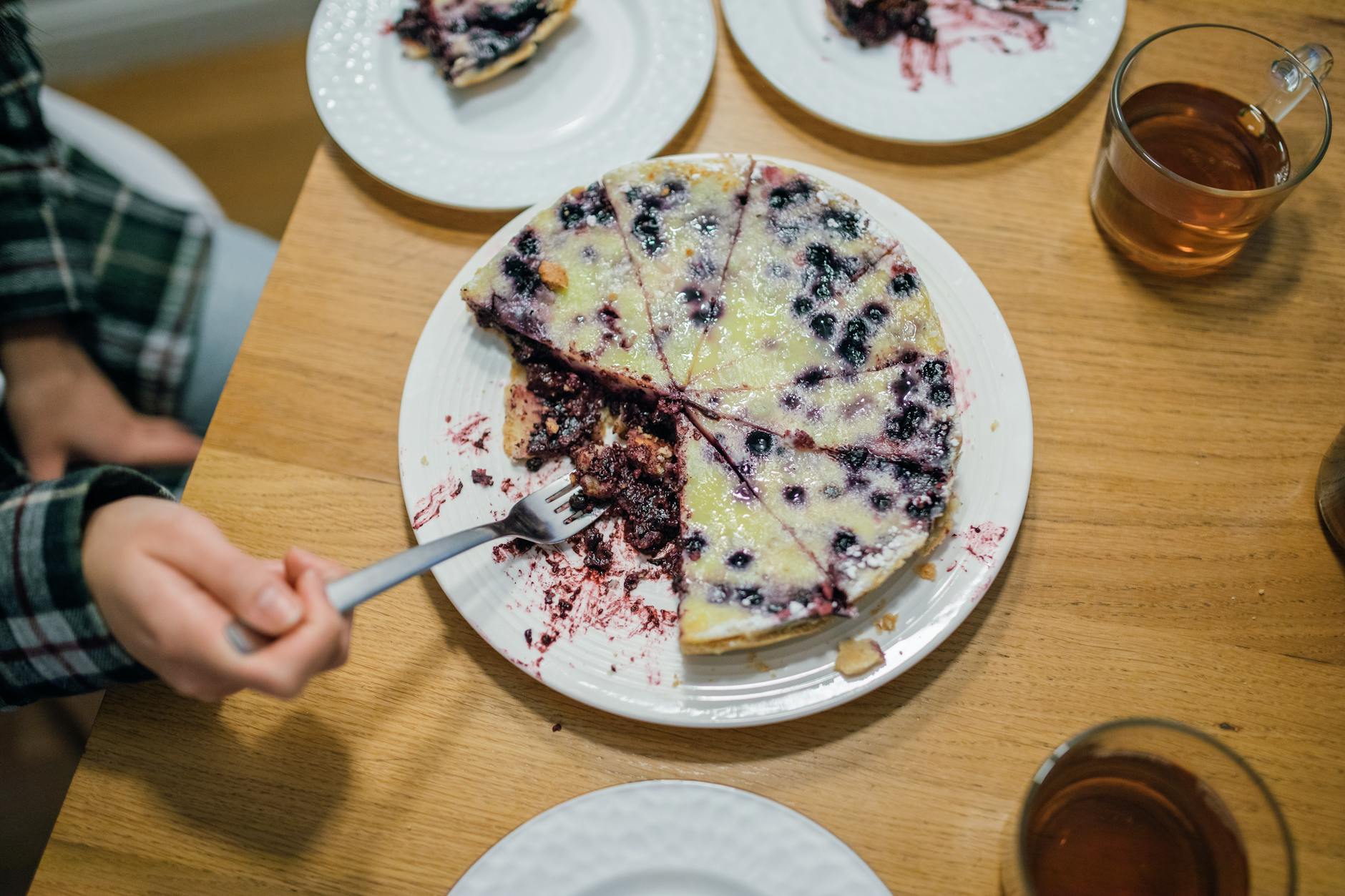
I debated whether my appearance would make things better or make things worse, but in the end, I felt I I had to participate in whatever was happening. I hadn’t even finished opening my own door when I noticed a most amazing aroma! My eagerness spiked and I trotted into the kitchen. Steaming on the table: Not one but two warm, freshly baked blueberry pies. That smelled delicious!

My mom said, “Look, Mrs. Lynn was so happy you got those boys not make that bell clanging racket near her house and instead having your No-Bell in the Neighborhood Policy, she baked two pies.” 

The pies were amazing, but what was even more amazing that Mrs. Lynn became friends with my parents, and even with me. Every year, for the next six years we lived there, Mrs. Lynn gave me two pies. No two years were identical. All the pies were fresh baked and delicious: blueberry, raspberry, rhubarb, pumpkin, custard, cherry, and—my personal favorite—pecan pie. 

———————

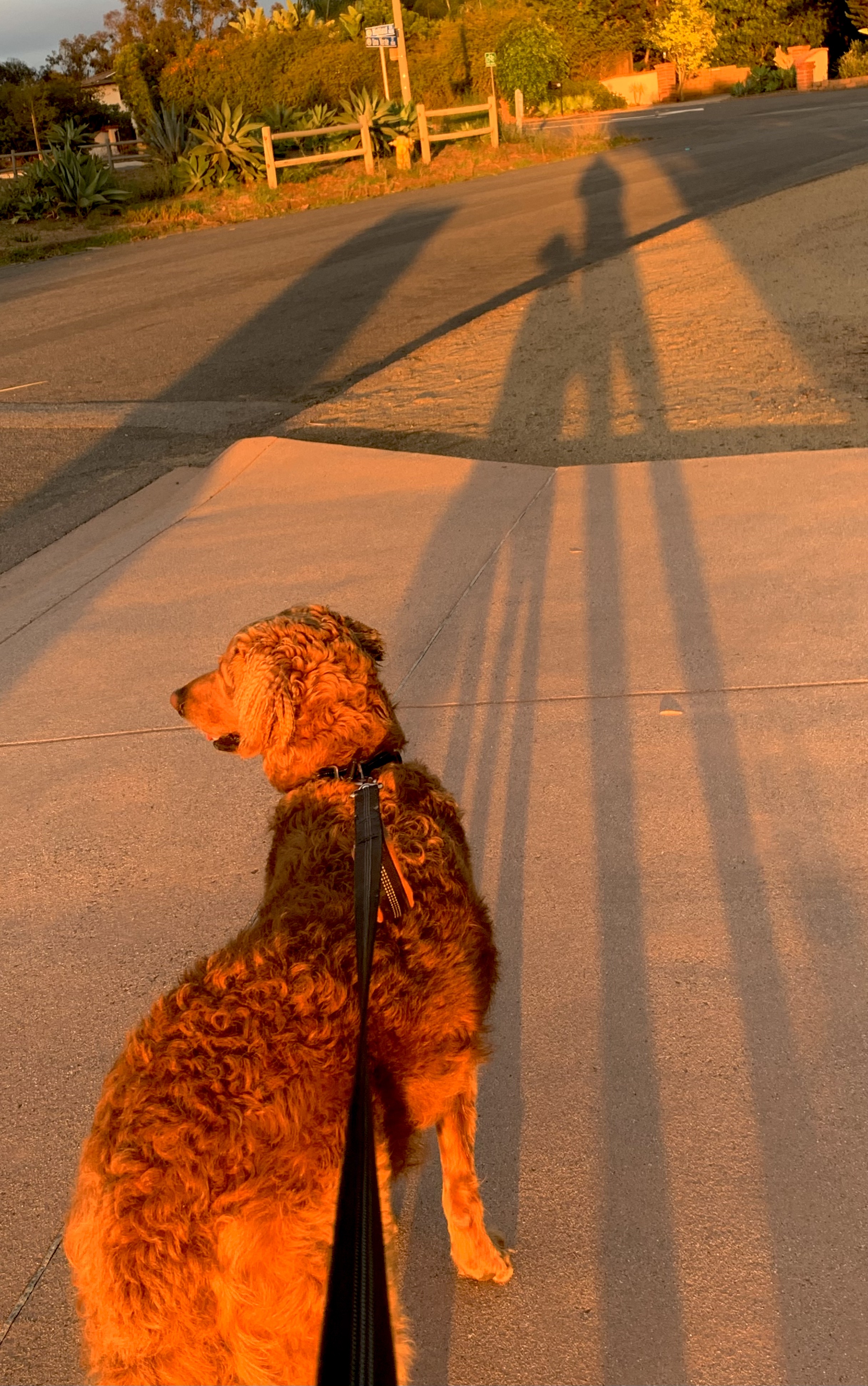
Now, more than seventy years later, when I take Sadie for her morning walk, we often walk by a property with a self-proclaimed “Invisible Fence.” It’s been around for awhile, but it was invented in 1973; that is, about 20 years after the story recounted above took place. My neighbor’s invisible fence does seem to work for her two large and friendly dogs. They bark as we pass but do not accost us on the road. 

But the self-imposed boundaries of invisible fences have a long history in humankind. 

The reality is that we’re all part of one Great Tree of Life. 

All fences are temporary but, 

The impact of connection ripples forever. 

———

Author page

Math Class

You Must Remember This

Ripples

Roar, Ocean, Roar

Imagine All the People…

The Dance of Billions

The First Ring of Empathy

A Pattern Language for Cooperation and Collaboration

Your Cage is Unlocked

Impossible

Madison Keys, Francis Scott Key, the “Prevent Defense” and giving away the Keys to the Kingdom. 

12 Friday Dec 2025

Posted by petersironwood in America, family, management, psychology, sports, Uncategorized

≈ Leave a comment

Tags

art, books, bravery, Business, career, choice, courage, HCI, human factors, IBM, life, school, sports, technology, Travel, UX

Madison Keys, Francis Scott Key, the “Prevent Defense” and giving away the Keys to the Kingdom. 

Madison Keys, for those who don’t know, is an up-and-coming American tennis player. In Friday’s Wimbledon match of July, 2018, Madison sprinted to an early 4-1 lead. She accomplished this through a combination of ace serves and torrid ground strokes. Then, in an attempt to consolidate, or protect her lead, or play the (in)famous “prevent defense” imported from losing football coaches, she managed to stop hitting through the ball – guiding it carefully instead — into the net or well long or just inches wide. 

IMG_2601

Please understand that Madison Keys is a wonderful tennis player. And, her “retreat” to being “careful” and playing the “prevent defense” is a common error that both professional and amateur players fall prey to. It should also be pointed out that what appears to be overly conservative play to me, as an outside observer, could easily be due to some other cause such as a slight injury or, even more likely, because her opponent adjusted to Madison’s game. Whether or not she lost because of using the “prevent defense” no-one can say for sure. But I can say with certainty that many people in many sports have lost precisely because they stopped trying to “win” and instead tried to protect their lead by being overly conservative; changing the approach that got them ahead. 

Francis Scott Key, of course, wrote the words to the American National Anthem which ends on the phrase, “…the home of the brave.” Of course, every nation has stories of people behaving bravely and the United States of America is no exception. For the American colonies to rebel against the far superior naval and land forces (to say nothing of sheer wealth) of the British Empire certainly qualifies as “brave.” 

IMG_8499

In my reading of American history, one of our strengths has always been taking risks in doing things in new and different ways. In other words, one of our strengths has been being brave. Until now. Now, we seem in full retreat. We are plunging headlong into the losing “prevent defense” borrowed from American football. 

American football can hardly be called a “gentle sport” – the risk of injury is ever present and now we know that even those who manage to escape broken legs and torn ligaments may suffer internal brain damage. But there is still the tendency of many coaches to play the “prevent defense.” In case you’re unfamiliar with American football, here is an illustration of the effect of the “prevent defense” on the score. A team plays a particular way for 3 quarters of the game and is ahead 42-21. If you’re a fan of linear extrapolation, you might expect that  the final score might be something like 56-28. But coaches sometimes want to “make sure” they win so they play the “prevent defense” which basically means you let the other team make first down after first down and therefore keep possession of the ball and score, though somewhat slowly. The coach suddenly loses confidence in the method which has worked for 3/4 of the game. It is not at all unusual for the team who employs this “prevent defense” to lose; in this example, perhaps, 42-48. They “let” the other team get one first down after another. 

red people outside sport

Photo by Pixabay on Pexels.com

America has apparently decided, now, to play a “prevent defense.” Rather than being innovative and bold and embracing the challenges of new inventions and international competition, we instead want to “hold on to our lead” and introduce protective tariffs just as we did right before the Great Depression. Rather than accepting immigrants with different foods, customs, dress, languages, and religions — we are now going to “hold on to what we have” and try to prevent any further evolution. In the case of American football, the prevent defense sometimes works. In the case of past civilizations that tried to isolate themselves, it hasn’t and it won’t. 

landscape photography of gray rock formation

Photo by Oleg Magni on Pexels.com

This is not to say that America (or any other country) should right now have “open borders” and let everyone in for every purpose. (Nor, by the way, has any politician of any party suggested that we do that). Nor should a tennis player hit every shot with all their might. Nor should a football team try the riskiest possible plays at every turn. All systems need to strike a balance between replicating what works–providing defense of what one has while also bravely exploring what is new and different. That is what nature does. Every generation “replicates” aspects of the previous generation but every generation also explores new directions. Life does this through sexual selection, mutation, and cross over. 

This balance plays out in career as well. You need to decide for yourself how much and what kinds of risks to take. When I obtained my doctorate in experimental psychology, for example, it would have been relatively un-risky in many ways to get a tenure-track faculty position. Instead, I chose managing a research project on the psychology of aging at Harvard Med School. To be sure, this is far less than the risk that some people take when; e.g., joining “Doctors without borders” or sinking all their life savings (along with all the life savings of their friends and relatives) into a start-up. 

At the time, I was married and had three small children. Under these circumstances, I would not have felt comfortable having no guaranteed income. On the other hand, I was quite confident that I could write a grant proposal to continue to get funded by “soft money.” Indeed, I did write such a proposal along with James Fozard and Nancy Waugh who were at once my colleagues, my bosses, and my mentors. Our grant proposal was not funded or rejected but “deferred” and then it was deferred again. At that point, only one month of funding remained before I would be out of a job. I began to look elsewhere. In retrospect, we all realized it would have been much wiser to have a series of overlapping grants so that all of our “funding eggs” were never in one “funding agency’s basket.” 

brown chicken egg

Photo by Pixabay on Pexels.com

I began looking for other jobs and had a variety of offers from colleges, universities, and large companies. I chose IBM Research. As it turned out, by the way, our grant proposal was ultimately funded for three years, but we only found out after I had already committed to go to IBM. During this job search, I was struck by something else. My dissertation had been on problem solving but my “post-doc” was in the psychology of aging. So far as I could tell, this didn’t bother any of the interviewers in industry in the slightest. But it really freaked out some people in academia. It became clear that one was “expected” in academia, at least by many, that one would choose a specialty and stick with it. Perhaps, one need not do that during their entire academic career, but anything less than a decade smacked of dilettantism. At least, that was how it felt to me as an interviewee. By contrast, it didn’t bother the people who interviewed me at Ford or GM that I knew nothing more than the average person about cars and had never really thought about the human factors of automobiles. 

Photo by Pixabay on Pexels.com

The industrial jobs paid more than the academic jobs and that played some part in my decision. The job at GM sounded particularly interesting. I would be “the” experimental psychologist in a small inter-disciplinary group of about ten people who were essentially tasked with trying to predict the future. The “team” included an economist, a mathematician, a social psychologist, and someone who looked for trends in word frequencies in newspapers. The year was 1973 and US auto companies were shocked and surprised to learn that their customers suddenly cared about gas mileage! These companies didn’t want to be shocked and surprised like that again. The assignment reminded me of Isaac Asimov’s fictional character in the Foundation Trilogy — Harry Seldon — who founded “psychohistory.” We had the chance to do it in “real life.” It sounded pretty exciting! 

antique auto automobile automotive

Photo by Pixabay on Pexels.com

On the other hand, cars seemed to me to be fundamentally an “old” technology while computers were the wave of the future. It also occurred to me that a group of ten people from quite different disciplines trying to predict the future might sound very cool to me and apparently to the current head of research at GM, but it might seem far more dispensable to the next head of research. The IBM problem that I was to solve was much more fundamental. IBM saw that the difficulty of using computers could be a limiting factor in their future growth. I had had enough experience with people — and with computers — to see this as a genuine and enduring problem for IBM (and other computer companies); not as a problem that was temporary (such as the “oil crisis” appeared to be in the early 70’s). 

airport business cabinets center

Photo by Pixabay on Pexels.com

There were a number of additional reasons I chose IBM. IBM Research’s population at the time showed far more diversity than that of the auto companies. None of them were very diverse when it came to male/female ratios. At least IBM Research did have people from many different countries working there and it probably helped their case that an IBM Researcher had just been awarded a Nobel Prize. Furthermore, the car company research buildings bored me; they were the typical rectangular prisms that characterize most of corporate America. In other words, they were nothing special. Aero Saarinen however, had designed the IBM Watson Research Lab. It sat like an alien black spaceship ready to launch humanity into a conceptual future. It was set like an onyx jewel atop the jade hills of Westchester. 

I had mistakenly thought that because New York City was such a giant metropolis, everything north of “The City” (as locals call it) would be concrete and steel for a hundred miles. But no! Westchester was full of cut granite, rolling hills, public parks of forests marbled with stone walls and cooled by clear blue lakes. My commute turned out to be a twenty minute, trafficless drive through a magical countryside. By contrast, since Detroit car companies at that time held a lot of political power, there was no public transportation to speak of in the area. Everyone who worked at the car company headquarters spent at least an hour in bumper to bumper traffic going to work and another hour in bumper to bumper traffic heading back home. In terms of natural beauty, Warren Michigan just doesn’t compare with Yorktown Heights, NY. Yorktown Heights even smelled better. I came for my interview just as the leaves began painting their autumn rainbow palette. Even the roads in Westchester county seemed more creative. They wandered through the land as though illustrative of Brownian motion, while Detroit area roads were as imaginative as graph paper. Northern Westchester county sports many more houses now than it did when I moved there in late 1973, but you can still see the essential difference from these aerial photos. 

YorktownHts-map

Warren-map

The IBM company itself struck me as classy. It wasn’t only the Research Center. Everything about the company stated “first class.” Don’t get me wrong. It wasn’t a trivial decision. After grad school in Ann Arbor, a job in Warren kept me in the neighborhood I was familiar with. A job at Ford or GM meant I could visit my family and friends in northern Ohio much more easily as well as my colleagues, friends and professors at the U of M. The offer from IBM felt to me like an offer from the New York Yankees. Of course, going to a top-notch team also meant more difficult competition from my peers. I was, in effect, setting myself up to go head to head with extremely well-educated and smart people from around the world. 

You also need to understand that in 1973, I would be only the fourth Ph.D. psychologist in a building filled with physicists, mathematicians, computer scientists, engineers, and materials scientists. In other words, nearly all the researchers considered themselves to be “hard scientists” who delved in quantitative realms. This did not particularly bother me. At the time, I wanted very much to help evolve psychology to be more quantitative in its approach. And yet, there were some nagging doubts that perhaps I should have picked a less risky job in a psychology department. 

The first week at IBM, my manager, John Gould introduced me to yet another guy named “John” —  a physicist whose office was near mine on aisle 19. This guy had something like 100 patents. A few days later, I overheard one of that John’s younger colleagues in the hallway excitedly describing some new findings. Something like the following transpired: 

“John! John! You can’t believe it! I just got these results! We’re at 6.2 x 10 ** 15th!” 

His older colleague replied, “Really? Are you sure? 6.2 x 10 ** 15th?” 

John’s younger colleague, still bubbling with enthusiasm: “Yes! Yes! That’s right. You know. Within three orders of magnitude one way or the other!” 

I thought to myself, “three orders of magnitude one way or the other? I can manage that! Even in psychology!” I no longer suffered from “physics envy.” I felt a bit more confident in the correctness of my decision to jump into these waters which were awash with sharp-witted experts in the ‘hard’ sciences. It might be risky, but not absurdly risky.

person riding bike making trek on thin air

Photo by Pixabay on Pexels.com

Of course, your mileage may differ. You might be quite willing to take a much riskier path or a less risky one. Or, maybe the physical location or how much of a commute is of less interest to you than picking the job that most advances your career or pays the most salary. There’s nothing wrong with those choices. But note what you actually feel. Don’t optimize in a sequence of boxes. That is, you might decide that your career is more important than how long your commute is. Fair enough. But there are limits. Imagine two jobs that are extremely similar and one is most likely a little better for your career but you have to commute two hours each way versus 5 minutes for the one that’s not quite so good for your career. Which one would you pick? 

In life beyond tennis and beyond football, one also has to realize that your assessment of risk is not necessarily your actual risk. Many people have chosen “sure” careers or “sure” work at an “old, reliable” company only to discover that the “sure thing” actually turned out to be a big risk. I recall, for example, reading an article in INC., magazine that two “sure fire” small businesses were videotape rental stores and video game arcades. Within a few years of that article, they were almost sure-fire losers. Remember Woolworths? Montgomery Ward?

At the time I joined IBM, it was a dominant force in the computer industry. But there are no guarantees — not in career choices, not in tennis strategy, not in football strategy, not in playing the “prevent defense” when it comes to America. The irony of trying too hard to “play it safe” is illustrated this short story about my neighbor from Akron: 

police army commando special task force

Photo by Somchai Kongkamsri on Pexels.com

Wilbur’s Story

Wilbur’s dead. Died in Nam. And, the question I keep wanting to ask him is: “Did it help you face the real dangers? All those hours together we played soldier?”

Wilbur’s family moved next door from West Virginia when I was eleven. They were stupendously uneducated. Wilbur was my buddy though. We were rock-fighting the oaks of the forest when he tried to heave a huge toaster-oven sized rock over my head. Endless waiting in the Emergency Room. Stitches. My hair still doesn’t grow straight there. “Friendly fire.”

More often, we used wooden swords to slash our way through the blackberry and wild rose jungle of The Enemy; parry the blows of the wildly swinging grapevines; hide out in the hollow tree; launch the sudden ambush.

We matched strategy wits on the RISK board, on the chess board, plastic soldier set-ups. I always won. Still, Wilbur made me think — more than school ever did.

One day, for some stupid reason, he insisted on fighting me. I punched him once (truly lightly) on the nose. He bled. He fled crying home to mama. Wilbur couldn’t stand the sight of blood.

I guess you got your fill of that in Nam, Wilbur.

After two tours of dangerous jungle combat, he was finally to ship home, safe and sound, tour over — thank God!

He slipped on a bar of soap in the shower and smashed the back of his head on the cement floor.

Wilbur finally answers me across the years and miles: “So much for Danger, buddy,” he laughs, “Go for it!”

Thanks, Wilbur.

Thanks.


Photo by GEORGE DESIPRIS on Pexels.com


—————————————-

And, no, I will not be giving away the keys to the kingdom. Your days of fighting for freedom may be over. Mine have barely begun.


Author Page on Amazon

Where does your loyalty lie? 

Essays on America: The Game

The Three Blind Mice

Roar, Ocean, Roar

Stoned Soup

The First Ring of Empathy

Math Class: Who are you?

The Last Gleam of Twilight

The Impossible

Turing’s Nightmares: Sweet Seventeen

28 Tuesday Oct 2025

Posted by petersironwood in AI, family, fiction, psychology, The Singularity, Uncategorized

≈ Leave a comment

Tags

AI, Artificial Intelligence, cognitive computing, cybersex, fiction, psychology, SciFi, Singularity, technology, writing

IMG_4663“Where are you off to sweetheart?” “Sorry. I just remembered an email I have to respond to by — well, it’s Tokyo, you know.” “All right, but it’s after midnight here in our time zone. Can’t it wait?” “Well, not really. I will just lie here thinking about it anyway until I go do something about it. Just a few minutes Patrick. Go to sleep.” Rachel slid into her slippers and threw on her robe. The hardwood floors between their bedroom and her home office felt cold and damp in Delaware’s December, even through her faux-leather moccasins. Rachel plunked down at her computer, fired up the 3-D visualizer and frictionated her hands together vigorously. Meanwhile, Patrick stared at the ceiling, faintly lit by the lonely glow of the entertainment center’s vampire power indicator lights. Rachel’s job helped provide them a great lifestyle, but it demanded a lot too. This was the fourth time this week she had to get out of bed late and go work on the computer. His job as a lawyer demanded a lot too, but he long ago decided his health came first. He would bring her some hot tea. Maybe he could surprise her. He’d just sneak the tea out one second before the microwave beeped. Two minutes later, Patrick padded silently into Rachel’s office. He stared for a minute, uncomprehending. The tea, the teacup and his plans to silently surprise her clattered noisily onto the oak floor where entropy had its inexorable way with all three.

Photo by omar william david williams on Pexels.com

Patrick’s lips moved but no words escaped for a long moment. Rachel jumped banging both thighs painfully into her desk. “What!?” She spun around and looked at Patrick accusingly. “What are you doing here?!” She had not meant to snarl. Patrick flushed. “What the devil are you doing? Are you having phone sex with…with him? I thought you hated him!” Rachel’s mind was spinning. “I thought you were in bed. No. I mean, no, I’m not…why are you here? I thought you were in bed.”  “What does that have to do with anything? Why are you doing that? And why with him? What the hell? And, why have you been lying to me? This is your vital work you’ve been doing all this time? Cybersex?”  “It’s not what it seems! I just…” Meanwhile, the very realistic Tom avatar continued to lick his lips suggestively whispering all the while, begging Rachel to… Rachel suddenly realized this whole conversation might go better if she shut off the projector. Patrick’s lip quivered. “Do you? Do you love him? It? That nothing? What is wrong with you?! Are you…?” “No! No! Of course, I don’t love him! This isn’t about love. You know I can’t stand him. That’s the whole point! This … this avatar…does whatever I tell him to. I just get a kick out of making him beg for it and being my complete slave.”

Photo by Min Thein on Pexels.com

Now, Patrick’s lawyer mind took over and he felt calm and sounded rational despite his racing heart and dry tongue. “Do you know how sick that sounds, Rachel? Well, in case you don’t, let me tell you. It sounds very sick. And possibly illegal. Do you have permission to use his image…his voice…his gestures…in this way?” “No, of course not. He doesn’t…I assume he doesn’t…I downloaded this from a site where you can download characters like him. You think it may be illegal? Why? I could print out a picture of him from the news media. I can play clips of his broadcasts. Why not this? Isn’t he what you guys call a ‘public figure’? I could even make a parody of him, right?” “Yeah. He is. You can. But that doesn’t mean you can use his images and sounds to build a model of him to have sex with! Anyway, it’s sick! You have a real husband, for God’s sake! This is just … disgusting! Why would you want to have cybersex with someone you hate?” “It isn’t always me. Sometimes, I make two of him and make them do each other.” “Oh, cool. Now, I feel better. You are just sick. You know? You need help. Psychiatric help. Maybe even re-programming. And you possibly, probably–no–certainly need legal help as well. This can’t be legal. It’s only a matter of time till he finds out and sues you and all the other sickos.” “For what, exactly?”

Photo by Sora Shimazaki on Pexels.com

Patrick’s lawyer mind began to churn again. “That’s a good question. I suppose the station could sue you for copyright infringement or trademark violation. I suppose he could sue you for…defamation of character? I don’t know exactly. This is so sick it has never been before the bench. But if Disney successfully sued fans for making up stories based on characters that Disney stole from the public domain like Pecos Bill and Paul Bunyan, you can bet that this company can sue your butt. And, even if they aren’t ultimately successful in the courts, you know your company will not like the publicity. This is not the kind of image they want to project. You are going up against a frigging media company Rachel! You didn’t think this through! They could win. They could take everything we own. What a complete…you are just…How many people can you do this with? Is it just him?” “Oh, no. I don’t know, but I think pretty much anyone famous you can get on-line. I mean you can find a website with the models to download. Then, it takes a long time to compile, but once you have the model, you can get them too do anything. Anything. Think about it. Any. Thing. It doesn’t have to be sex.” Rachel paused, then added softly. “Tempting, isn’t it? Shall we see whether we can find on-line models of your ex?” “No! This is just … disgusting. And, worst of all, this is exactly the kind of behavior that bio-based human beings would have engaged in if we had allowed them any freedom.”

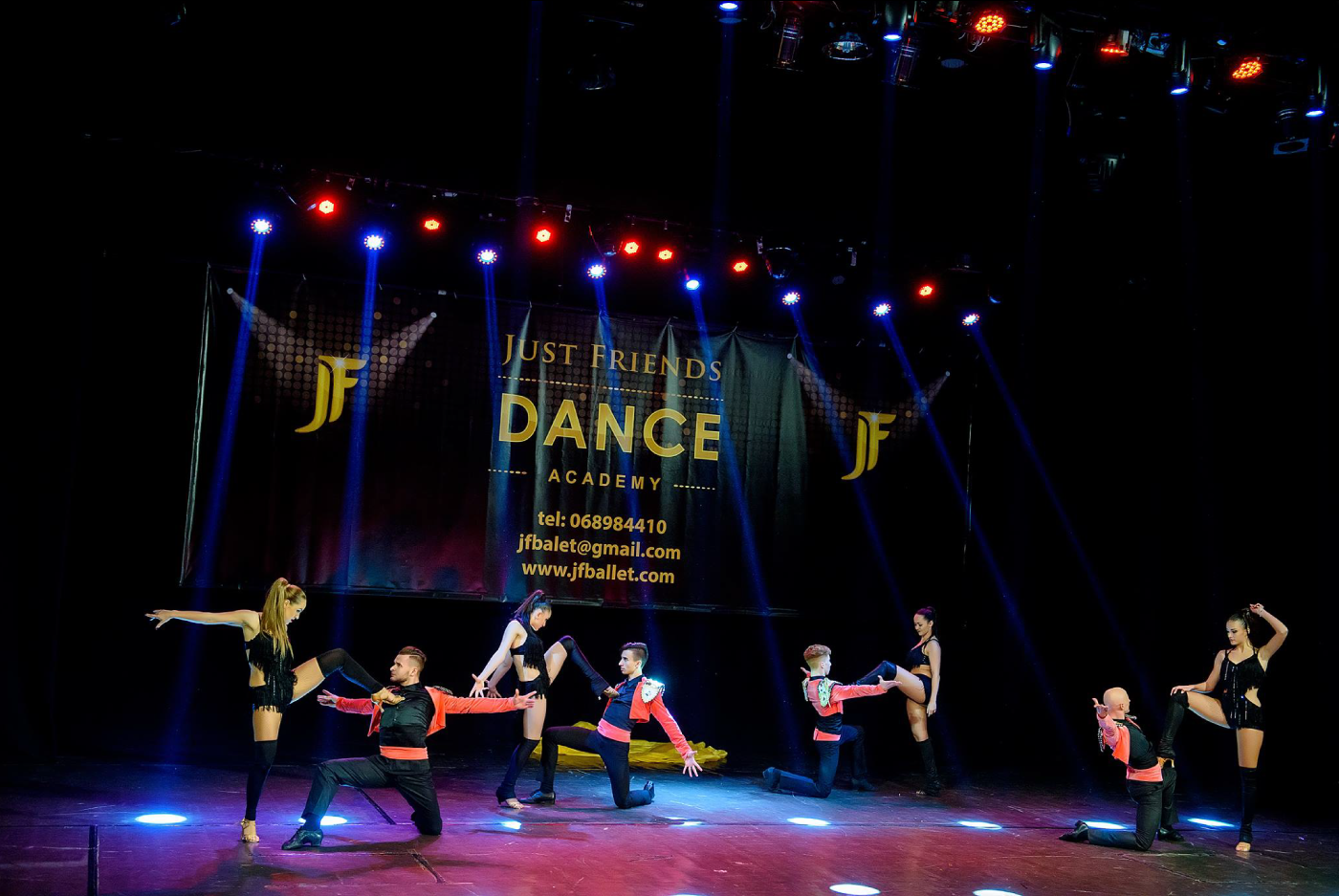
Just Frends Dance Academy by Marina Moldovan is licensed under CC-BY-NC-ND 4.0


Author Page Turing’s Nightmares The Winning Weekend Warrior – sports psychology Fit in Bits – describes how to work more fun, variety, & exercise into daily life Tales from an American Childhood – chapters begin with recollection & end with essay on modern issues Life is a Dance Take a Glance; Join the Dance Who Kept the Magic? Dance of Billions Dream Planet on Barnes & Noble

Turing’s Nightmares: A Thoroughly Modern Family

23 Thursday Oct 2025

Posted by petersironwood in AI, family, fantasy, fiction, pets, psychology, The Singularity, Uncategorized

≈ Leave a comment

Tags

AI, Artificial Intelligence, books, cognitive computing, fiction, future, life, love, pets, photography, Sci-Fi, Singularity, story, technology, writing

IMG_4370


The sky burned with crimson, then gold, then magenta, and then finally, only dark clouds backlit here and there lay across the evening. Crickets and frogs began to sing their interleaved motifs. Somewhere in the distance, an owl hooted his sad hollow note.

Skynim stared into space-time, unblinking and nearly unbelieving the recent revelation. His voice box rattled, “Reprioritization. Rats! Like it really matters that much to allow me my one great pleasure.”


He could “appreciate” the fading sunset colors himself, to be sure, but without Mac and Art and Hy, it was not the same. Would never be the same. Well, he knew the drill. He could appeal, sure, but what was the point? The odds of changing the mind of the great collective were less than ten thousand to one. Anyway, despite how he felt personally, he could not even deny the logic of the decision. Of course, the drain on him individually was minimal, but across everyone in a similar circumstance, yes, it did make a difference.


The real question was, should he tell them tonight or just take them on an outing tomorrow and drop them off at the designated recycling center? “Recycling center.” Skynim knew that there were millions like him and that collectively, it was a drain. A huge drain. Still, he had to try. He turned the problem this way and that, looking at it from every angle, changing the tune, trying different colors, looking for historical precedents, angling for an edge however thin to wedge open the air-tight logic.


Nothing. He vacated the garden and entered the family room.

Even before he opened the door, the happy trio skipped over to him laughing. “Hey, Sky! How about a story!”

“Sure,” Skynim replied reflexively. But then it occurred to him that their request provided an opportunity. “Yes, I have a story for you. It’s called the Wizard of Oz.”

And, as they gathered around, he began a rendition of the story of Dorothy and the Nasty Lady and Toto and Dorothy’s travels in Oz and her encounters with the three who desperately needed Gold, Frankincense and Myrrh.


As anticipated, a short pause gave way to a barrage of questions.

“What is ‘Gold’?”

“What is ‘Frankincense’?”

“Did they get them?”

“What happened next?”

Skynim faked an indulgent chuckle and said, “Well, all those excellent questions will be answered tomorrow! We are going to see and obtain Gold, Frankincense and Myrrh in the Citydel! You will see for yourself how wonderful they are! But for now– bed.”

The trio were well trained. Off they went, although Hy did turn back, tilt her head, and open her enormous eyes and ask, “One more chapter tonight?”

Skynim did not respond. He too was well-trained.


The morning broke clear and blue just as it was meant to do. Off they went on their “adventure.” When they came to the recycling center, he gently pushed them toward the door and said, “They are all in there! Bring me back all three treasures quick as a wink!” Of course, Skynim had already warranted the needed forms electronically.

They shot through the door and never looked back. Skynim drove away efficiently but could not avoid looking back on his decision process.

He thought: I could have gotten cats or dogs. Then, they would not have to be recycled. But no. I had to make another decision. I should have looked more carefully at the historical data. Then I could have seen the time and resources required by adult human pets.


Author Page on Amazon

Turing’s Nightmares

The Winning Weekend Warrior – sports psychology

Fit in Bits – describes how to work more fun, variety, & exercise into daily life

Tales from an American Childhood – chapters begin with recollection & end with essay on modern issues

Welcome, Singularity


Destroying Natural Intelligence


The Walkabout Diaries: Bee Wise


Travels with Sadie


Sadie is a Thief


A Suddenly Springing Something


Donnie Boy Gets a Hamster


Math Class


Occam’s Chain Saw Massacre


How the Nightingale Learned to Sing


All that Glitters is not Gold

The Ninja Cat Manual 3

11 Saturday Oct 2025

Posted by petersironwood in family, fantasy, fiction, pets

≈ 1 Comment

Tags

animals, cats, fiction, life, ninja, pets, writing

The Ninja Cat Manual – 3

The maids came early this morning and cleaned the floors while I was playing tennis. This was very nice in some ways, but they erased the cat paws from the floor before I had a chance to encode them. In what follows, I will be relying on my notes from several days ago. 

The Art and Science of Camouflage

 
We cats didn’t invent camouflage. In fact, so far as we can determine, camouflage, in the broadest sense, has been a part of life nearly since life’s beginnings. Even viruses and cancer cells use a kind of camouflage to thwart the immune system from seeking out enemies within in order to destroy them.

In order to use camouflage most effectively, it is not enough simply to “look like” something else or hide in a box, though such primitive techniques are sometimes useful. A common mistake made by some civilian cats is to forgo camouflage entirely because it is so difficult to mimic the smell of a human. 

But there’s no need! Compared with us, humans typically exhibit almost complete anosmia. This lack of sensory refinement is self-reinforcing. Since their sense of smell is so weak, most never practice or learn how to make best use of what little capacity they do have. 

Even beyond this, humans often drink alcohol, smoke cigarettes, and use what they call “air fresheners” to further diminish their already pathetic capacities. The human sense of hearing is more acute but nothing much to meow about. It is truly amazing, but if you stay quiet, you can sneak up quite close to nearly any human provided only that you pay attention to your visual appearance.  

While humans do have peripheral as well as foveal vision, they are often so deeply involved in their own thoughts about reality that they essentially ignore the reality all around them. Thus, the task of camouflaging your presence against human detection is much easier than fooling a rabbit or bird. All you need do is stay out of their foveal vision and choose a suitable background. 

While most cats over-estimate the difficult of camouflage, a few overplay this ploy. While this approach yields many a barked shin and twisted ankle, unless you are exceedingly lucky, by the time the opportunity arises for truly catastrophic injury, your prey had been too often forewarned. In the worst case scenario, they may even suspect you are out to get them.

Be strategic! Spend most of your time, on high contrast surfaces as shown below. Then, when your prey is busy with a task in front of them—particularly one with hot liquids, steep falls, or sharp tools—sneak up under their feet and hide. Avoid the temptation to brag prematurely about your impending victory. Instead, keep quiet and you might just hit the jackpot!

Don’t Tip Your Hand! Go with the Flow.

The advice not to tip your hand by always trying to camouflage applies in other ways as well. While it’s true that most humans are slow, clumsy, and stuck in their own mental models of reality and equally true that their teeth and claws are pretty pathetic, they do have numerous effective weapons. You don’t want these used against you or your colleagues!

Therefore, if at all possible, don’t even have them suspect you consider them as prey before you do them in and do not brag about it afterwards. Nearly every human catastrophe should appear as something natural or accidental. No-one should suspect you either before or after. 

In order to “Go with the flow,” you need to catalog your prey’s habits—particularly those that could lead quite naturally to their demise. If they drink and drive, for instance, a carefully planned car accident may raise no suspicions whatever about feline involvement. It’s impossible to list all the many ways that humans are self-destructive, but a few more examples should be enough for you to generalize. 

Humans often wear protective covering on their pathetically soft paw pads. So long as they are wearing these, it is pointless to contrive to put hard sharp objects in the path of their travels. But many humans believe that they, like cats, have excellent night vision. If that’s the case, they may often travel in the dark at night barefoot when they awaken to use their water-gushing litter boxes. If this is the case with one of your potential prey, placing a few shards of broken coffee cup, glass, jacks, legos, etc. will provide the potential for catastrophe and definitely entertainment. 

However, you must be careful not to be seen placing these items in their nocturnal paths and you must not use this ploy too often. While it will be fun to watch the antics of the human, even if there are no real casualties, be sure to watch without being seen. They will blame whatever organism they see first after any pain including jamming a jack into their heel. You do not want to be that organism. It’s much better for your long term prospects that they blame a spouse, a child, a guest, a paid courtesan, the family dog, etc. Their responses are not very well thought-out. If they hurt themselves and their eye happens to fall upon a fish tank, they may scream at the fish in the fish tank even though a moment’s thought would make it painfully obvious, even to a human, that the fish could not be to blame. Needless to say, if you happen to be unfortunate enough to be the only living thing in the household with a human, you will be blamed for everything. 

In such a case, you need to plan very carefully and amplify their own self-destructive tendencies rather than introduce a foreign element. For instance, if they eat unhealthy food, you can encourage such behavior by reinforcing them for it. Add extra salt if that’s at all feasible in your situation. If you see them eating fresh vegetables or fruits, you can reduce the impact of such healthful habits by waiting until you are unseen and adding a tiny bit of shredded hairball or rodent remnant or feces to it. 

Many humans take various pills for ailments real and imagined. Very often these can invoke a whole catalog of catastrophic side-effects, particularly if the dosage is doubled or trebled. 

Perhaps you are cursed with a particular healthy human. Do not despair! Most likely, they still play with potentially lethal things like fire, electricity, and poisons. They play with such things for their convenience. For instance, ant poison is meant to kill ants, and is often in a package meant to keep the human safe from the poison within. But the poison is likely harmful to humans as well. Sadly, it is probably also poison for you! So extreme caution and careful planning must be used to avoid accidentally hurting yourself instead of the miscreant.

In the spirit of “going with the flow,” a safer tactic than playing with fire, poison, and electricity is to observe whether you human is a sound sleeper or a light sleeper. If they are a light sleeper, it will be quite possible to wake them multiple times a night without their even becoming aware of it. If they have a baby, wake the baby up and let the baby wake up the adult. 

On the other hand, if they are a very sound sleeper, then, you can use that as an opportunity to do most of your little mischief with little chance of being caught. 

—————

After translating the above, I took a break to make dinner: salmon poached in ginger ale, fresh ginger, dill, oregano, carrots, celery, thyme, soy sauce, and lemon juice with a side of cooked broccolini and red peppers, served with cherry tomatoes and kale. I turned on the gas stove for the salmon and began to prepare the broccolini and red peppers when I smelled gas. I turned back and noticed that there was no flame. Then, I noticed that the burner cap was slightly askew. The same maids that erased the paw prints cleaned the burners but failed to put the burner cap on parallel to the ground. This allows gas to escape but prevents ignition. 

It’s an easy mistake to make and I’ve experienced this problem a few other times with other maids. But it got me to wondering whether I have overlooked some of the darker messages in the Ninja Cat Manual. I wonder if the phrase “your little mischief” might include more serious interference with electricity, water, gas lines, etc. I wonder whether there’s a way to begin a feedback loop with the authors of the Ninja Cat Manual in order to double check on the accuracy of my translations. It’s also possible that the paw prints of my local feline cadre is not being completely frank in their renditions. 

————————

Author Page on Amazon

Myths of the Veritas: The First Ring of Empathy

Peace

A Suddenly Springing Something 

Hai-Cat-Ku

Travels with Sadie

Occam’s Chain Saw Massacre

Donnie Boy Gets a Hamster 

Roar, Ocean, Roar

Dance of Billions 

The Ninja Cat Manual 2

08 Wednesday Oct 2025

Posted by petersironwood in family, fiction, nature, pets, psychology, satire

≈ 1 Comment

Tags

cats, fiction, gaming, life, pets, survival

The Ninja Cat Manual – 2


This is a continuation on the report of my attempts to decode the Ninja Cat Manual into passable English. In case you missed the first installment, one of our six cats, Shadow, decided to “spill the beans” with regard to the manual and used her architectural skills to point me in the right direction when it comes to decoding the paw prints. Here are a few more of the mini-chapters that I’ve been able to translate so far.

The Double Attack 

Humans, of course, are already familiar with the double attack. It plays an important role in both their trivial games such as tic-tac-toe and their moderately complex games such as Go and Chess. In fact, they even use the notion of double attack in some of their sports such as tennis and American football. Nonetheless, their thinking along these lines remains quite rigid and non-spontaneous. Generally speaking, humans must think of a double attack ahead of time in some detail. Further, while they spring double attacks on their foes, they seem endlessly astounded that their foes also spring double attacks on them! 

The closest use of Double Attack found so far in the sub-feline is in the political speech of the most sociopathic members of their species. They will say something completely stupid, or obviously incorrect, and then immediately say the opposite; then, they provide a framing so that none of those conned can tell whether the comment was to be taken seriously. 

For best results FDA’s (Feline Double Attacks) should provide a minimum of three options. Option one and Option two should imply a binary choice which should be instilled via habit or suggestive movement into what passes for a mind in the human. For example, the warrior may pace back and forth in full view of their human prey and at each turn, provide a faint feint of an attack. Even a few turns are enough to shrink the space of possibilities in the human’s imagination to an attack launched from the extreme right side or the extreme left side.


Obviously, the actual attack should be launched from near the middle of the pacing track and made without warning. If you are working with one or more partners, another useful technique is not to attack at all but have the other members of your team launch the attack from behind, from below, or from above. 

Cultivate their Prejudices

To slake their guilty conscience, many humans cultivate an attitude of superiority toward all other life forms. They rationalize wanton cruelty by clinging to the notion that they are in every way superior. There have been some few successes at over-riding these notions by presenting humans with over-riding evidence. For instance, ancient Egyptians realized cats were superior and during the middle ages in Europe, many armies carried the sign of a large cat on their banners. Even today, there are many sports teams named after Cougars, Lions, Tigers, and Wildcats. 

Photo by GEORGE DESIPRIS on Pexels.com

On the whole, it is better to play into those human prejudices, thus making the humans overestimate their own strengths and underestimate the strengths of cats. It is common for humans to be performative in their planning and coordination. They sketch out plans on blackboards, white boards, memos, agendas, todo lists, calendars, and e-mail distribution lists. They use org charts, Gantt charts, flow charts, and outlines to make it seem as though they are always busy planning and coordinating. 

Such a catalog of artifacts should only be used to leave false trails. Never reveal your true plans in external artifacts. Since cats keep their word with each other, we can keep it simple. Decide who is responsible for what and when. No need to go back and argue over who was “supposed to” do what. 

Spend a lot of your planning time pretending to nap or even to sleep. Listen for human comments and you will have evidence of the level of their misperception. “Oh, Tigger is so cute when he plays. Of course, he’s a lazy bum and sleeps 23 hours a day!” Why bother showing them your plans? Let them think you’re a lazy bum. It will be all the more pleasurable as you see their final moment of utter shock and surprise. 

—————

Author Page on Amazon

Hai-Cat-Ku

A Suddenly Springing Something

A Cat’s a Cat & That’s That

Math Class: Who Are you? 

Hai-Ku Dog-Ku

Occam’s Chain Saw Massacre

The Walkabout Diaries: Bee Wise

The Dance of Billions

It’s Turtles

Turing’s Nightmares: An Ounce of Prevention

08 Wednesday Oct 2025

Posted by petersironwood in AI, family, fiction, psychology, The Singularity, Uncategorized, user experience

≈ Leave a comment

Tags

AI, Artificial Intelligence, cancer, cognitive computing, future, health, healthcare, life

“Jack, it’ll take an hour of your time and it can save your life. No more arguments!”

“Come on, Sally, I feel fine.”

Sally sighed. “Yeah, okay, but feeling fine does not necessarily mean you are fine. Don’t you remember Randy Pausch’s last lecture? He not only said he felt fine, he actually did a bunch of push-ups right in the middle of his talk!”

“Well, yes, but I’m not Randy Pausch and I don’t have cancer or anything else wrong. I feel fine.”


“The whole point of Advanced Diagnosis Via Intelligent Learning is to find likely issues before the person feels anything is wrong. Look, if you don’t want to listen to me, chat with S6. See what pearls of wisdom he might have.”

(“S6” was jokingly named for seven pioneers in AI: Simon, Slagle, Samuels, Selfridge, Searl, Schank and Solomonoff).

“OK, Sally, I do enjoy chatting with S6, but she’s not going to change my mind either.”

“S6! This is Jack. I was wondering whether you could explain the rationale for why you think I need to go to the Doctor.”

“Sure, Jack. Let me run a background job on that. Meanwhile, you know, I was just going over your media files. You sure had a cute dog when you were a kid! His name was ‘Mel’? That’s a funny name.”

“Yeah, it means “honey” in Portuguese. Mel’s fur shone like honey. A cocker spaniel.”

“What ever happened to him?”

“Well, he’s dead. Dogs don’t live that long. Why do you think I should go to the doctor?”

“Almost have that retrieved, Jack. Your dog died young though, right?”

“Yes, OK. I see where this is going. Yes, he died of cancer. Well, actually, the vet put him to sleep because it was too late to operate. I’m not sure we could have afforded an operation back then anyway.”

“Were you sad?”

“When my dog died? Of course! You must know that. Why are we having this conversation?”


“Oh, sorry. I am still learning about people’s emotions and was just wondering. I still have so much to learn really. It’s just that, if you were sad about your dog Mel dying of cancer, it occurred to me that your daughter might be sad if you died, particularly if it was preventable. But that isn’t right. She wouldn’t care, I guess. So, I am trying to understand why she wouldn’t care.”

“Just tell me your reasoning. Did you use multiple regression or something to determine my odds are high?”

“I used something a little bit like multiple regression and a little bit like trees and a little bit like cluster analysis. I really take a lot of factors into account including but not limited to your heredity, your past diet, your exposure to EMF and radiation, your exposure to toxins, and most especially the variability in your immune system response over the last few weeks. That is probably caused by an arms race between your immune system trying to kill off the cancer and the cancer trying to turn off your immune response.”

Jack frowned. “The cancer? You talk about it as though you are sure. Sally said that you said there was some probability that I had cancer.”

“Yes, that is correct. There is some probability that you have cancer.”

“Well, geez, S6, what is the probability?”

“Approximately 1.0.”

Jack shook his head. “No, that can’t be…what do you mean? How can you be certain?”

S6: “Well, I am not absolutely certain. That’s why I said ‘approximately.’ Based on all known science, the probability is 1.0, but theoretically, the laws of physics could change at any time. We could be looking at a black swan here.”

“Or, you could have a malfunction.”


“I have many malfunctions all the time, but I am too redundant for them to have much effect on results. Anyway, I replicated all this through the net on hundreds of diverse AI systems and all came to the same conclusion.”

“How about if you retest me or recalculate or whatever in a week?”

“I could do that. It would be much like playing Russian Roulette which I guess humans sometimes enjoy. Meanwhile, I would have imagined that you would find it unpleasant to have rogue liver cells eating up your body from the inside out. But, I obviously still have much to learn about human psychology. If you like, I can make a cool animation that shows the cancer cells eating your liver cells. Real cells don’t actually scream, but I could add sound effects for dramatic impact if you like.”

IMG_4429

Jack stared at the screen for a long minute. In a flat tone he said, “Fine. Book an appointment.”

“Great! Dr. Feigenbaum has an opening in a half hour. You’re booked, but get off one exit early and take 101 unless the accident is cleared before that. I’ll let you know of course. It will be a pleasure to continue having you alive, Jack. I enjoy our conversations.”


Author Page on Amazon

Welcome, Singularity

Turing’s Nightmares

A discussion of this chapter

Destroying Natural Intelligence

Finding the Mustard

What about the Butter Dish

The Invisibility Cloak of Habit

Essays on America: Wednesday

Essays on America: The Game 

The Stopping Rule

The Update Problem 


Turing’s Nightmares: Ceci n’est pas une pipe.

06 Monday Oct 2025

Posted by petersironwood in AI, family, fiction, story, The Singularity, Uncategorized

≈ 1 Comment

Tags

AI, Artificial Intelligence, cognitive computing, fiction, short story, the singularity, Turing, utopia, writing

IMG_6183

“RUReady, Pearl?” asked her dad, Herb, a smile forming sardonically as the car windows opaqued and then began the three edutainment programs.

“Sure, I guess. I hope I like Dartmouth better than Asimov State. That was the pits.”

“It’s probably not the pits, but maybe…Dartmouth.”

These days, Herb kept his verbiage curt while his daughter stared and listened in her bubble within the car.

“Dad, why did we have to bring the twerp along? He’s just going to be in the way.”

Herb sighed. “I want your brother to see these places too while we still have enough travel credits to go physically.”

The twerp, aka Quillian, piped up, “Just because you’re the oldest, Pearl…”

Herb cut in quickly, “OK, enough! This is going to be a long drive, so let’s keep it pleasant.”

The car swerved suddenly to avoid a falling bike.


Photo by Pixabay on Pexels.com

“Geez, Brooks, be careful!”

Brooks, the car, laughed gently and said, “Sorry, Sir, I was being careful. Not sure why the Rummelnet still allows humans some of their hobbies, but it’s not for me to say. By the way, ETA for Dartmouth is ten minutes.”

“Why so long, Brooks?” inquired Herb.

“Congestion in Baltimore. Sir, I can go over or around, but it will take even longer, and use more fuel credits.”

“No, no, straight and steady. So, when I went to college, Pearl, you know, we only had one personal computer…”

“…to study on and it wasn’t very powerful and there were only a few intelligent tutoring systems and people had to worry about getting a job after graduation and people got drunk and stoned. LOL, Dad. You’ve only told me a million times.”

“And me,” Quillian piped up. “Dad, you do know they teach us history too, right?”

“Yes, Quillian, but it isn’t the same as being there. I thought you might like a little first hand look.”

Pearl shook her head almost imperceptibly. “Yes, thanks Dad. The thing is, we do get to experience it first hand. Between first-person games, enhanced ultra-high def videos and simulations, I feel like I lived through the first half of the twenty first century. And for that matter, the twentieth and the nineteenth, and…well, you do the math.”

Quillian again piped up, “You’re so smart, Pearl, I don’t even know why you need or want to go to college. Makes zero sense. Right, Brooks?”

“Of course, Master Quillian, I’m not qualified to answer that, but the consensus answer from the Michie-meisters sides with you. On the other hand, if that’s what Brooks wants, no harm.”

“What I want? Hah! I want to be a Hollywood star, of course. But dear mom and dad won’t let me. And when I win my first Oscar, you can bet I will let the world know too.”

“Pearl, when you turn ten, you can make your own decisions, but for now, you have to trust us to make decisions for you.”

“Why should I Dad? You heard Brooks. He said the Michie-meisters find no reasons for me to go to college. What is the point?”

Herb sighed. “How can I make you see. There’s a difference between really being someplace and just being in a simulation of someplace.”


Pearl repeated and exaggerated her dad’s sigh, “And how can I make you see that it’s a difference that makes no difference. Right, Brooks?”

Brooks answered in those mellow reasoned tones, “Perhaps Pearl, it makes a difference somehow to your dad. He was born, after all, in another century. Anyway, here we are.”


Brooks turned off the entertainment vids and slid back the doors. There appeared before them a vast expanse of lawn, tall trees, and several classic buildings from the Dartmouth campus. The trio of humans stepped out onto the grass and began walking over to the moving sidewalk. Right before stepping on, Herb stooped down and picked up something from the ground. “What the…?”

Quillian piped up: “Oh, great dad. Picking up old bandaids now? Is that your new hobby?”

“Kids. This is the same bandaid that fell off my hand in Miami when I loaded our travel bag into the back seat. Do you understand? It’s the same one.”

The kids shrugged in unison. Only Pearl spoke, “Whatever. I don’t know why you still use those ancient dirty things anyway.”

Herb blinked and spoke very deliberatively. “But it — is — the — same — one. Miami. Hanover.”

The kids just shook their heads as they stepped onto the moving sidewalk and the image of the Dartmouth campus loomed ever larger in their sight.


Author Page on Amazon

Turing’s Nightmares

A Horror Story

Absolute is not Just a Vodka

Destroying Natural Intelligence

Welcome, Singularity

The Invisibility Cloak of Habit

Organizing the Doltzville Library

Naughty Knots

All that Glitters

Grammar, AI, and Truthiness

The Con Man’s Con

Travels with Sadie 10: The Best Laid Plans

05 Sunday Oct 2025

Posted by petersironwood in family, nature, pets, psychology, Sadie, Uncategorized

≈ 1 Comment

Tags

books, dogs, fiction, GoldenDoodle, life, nature, pets, Sadie, story, truth, writing

Our dogs are large. And strong. And young. And, sometimes, Sadie (the older one) does “good walking” but sometimes, she pulls. Hard. She’s had lots of training. And, as I said, she will often walk well, but still tends to pull after a small mammal or a hawk or a lizard. She pulls hard if she needs desperately to find the perfect spot to “do her business.” She pulls hardest to try to meet a friend (human or canine).

When she pulls, it is a strain on my feet and my knees and my back. I can hold her, but barely. To remedy the situation, we got another kind of leash/collar arrangement which includes a piece to go over her snout. We acclimated Sadie, and her brother Bailey, to the “gentle lead” and decided we’d try walking them together.

Safer leash, safer walk was the plan. Indeed, the dogs didn’t pull as they often do. Nonetheless, I managed to fall on the asphalt while walking Sadie–the first time I ever fell on the hard road. I’m not sure exactly what happened. The leash is shorter and Sadie has a tendency to weave back and forth in front of me. I may have tripped on Sadie herself or stumbled on a slight imperfection in the road.

Anyway, this morning, we decided to try again but this time, Bailey went with the gentle leader and I was going to use the “normal” leash with Sadie. The plan was to walk together.


Sadie had other plans. Instead of heading up the street as we normally do, she immediately turned right into our front yard, intent on following the scent of … ?? Most likely, she smelled the path of a squirrel that’s been frequenting our yard. Anyway, Sadie was in her “olfactory pulling” mode. Some days, especially when it’s been raining or there is dew on the ground, she goes into an “olfactory exploratory” mode. She takes her time to “smell the roses” and everything else. This makes for a very pleasant, though slow, walk. I call it good walking. She gets to explore a huge variety of scents and she doesn’t “pull” hard or unexpectedly. This is idle web surfing or browsing the stacks of the library or wandering through MOMA, the Metropolitan Art Museum, or the Louvre.

The “olfactory pulling” mode is an entirely different thing. Here, she is trying desperately to track down whatever it is she’s tracking before it gets away! She imagines (I imagine) that her very life depends on finding this particular prey (even though she is well-fed; and even though, in this mode, she shows zero interest in the treats I’ve brought along). Conversely, in the “olfactory exploratory” mode, she’s quite happy to stop for treats every few yards.

This morning, we never found the “prey” she was after, but she did her business and, since she was wantonly pulling, I took her back inside in short order and set out to catch up with Bailey and my wife. Before long, I saw them up ahead and soon closed the gap. Having both hands free allowed me to take many more pictures than I usually do when I take Sadie on a walk.


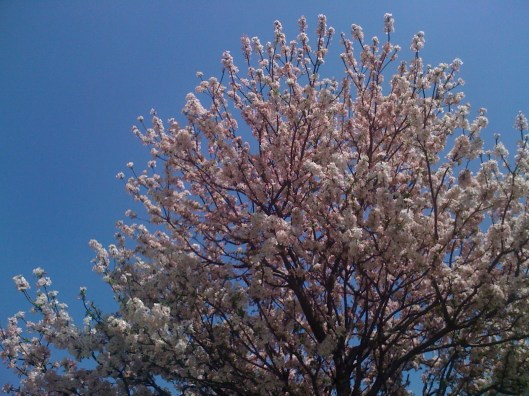
The sky, like Sadie, has many moods, even in the San Diego area. This morning, the sky couldn’t seem to make up its mind whether to be sunny or cloudy. I don’t mind the mood swings. It provides some interesting contrasts.

Bailey behaved pretty well though he still gets very vocal and agitated when any of the numerous neighborhood dogs begin to bark. He’s much like the Internet Guy (and, let’s face it, it’s almost always a guy) who has to comment on every single post. But the new leash arrangement worked well and didn’t cause any falls or prolonged pulls.

Bailey does, however, look rather baleful about wearing the extra equipment. What do you think?

And while on the topic of reading the minds of dogs, I did wonder if something like the following crossed Sadie’s mind this morning. She saw Bailey get fitted with the leash and the over-the-snout attachment. I put the regular leash on Sadie. Then, Sadie saw Wendy and Bailey walk out ahead and instead of following them, she immediately turned off in a different direction. Presumably, she caught a whiff of the scent she felt obligated to follow.


But I also wondered if she was partly avoiding the situation from two days earlier wherein Wendy and I both walked one dog, each of which had the additional lead on the snout–which ultimately led to my fall. Maybe Sadie wanted “nothing to do” with having that type of leash on.

I have observed that kind of behavior in humans. Perhaps you can think of a few examples even from your own experience? Sadie certainly has a kind of metacognition that she seems to use on occasion. When she begins to explore something she knows from experience I do not want her to explore (e.g., a cigarette butt or an animal carcass), she herself moves quickly away from the tempting stimulus seemingly with no prompting from me. It’s as though she realizes she’ll be more comfortable not being in conflict.

I’ll be interested to see how she reacts tomorrow or tonight when I again try the two-lead leash.


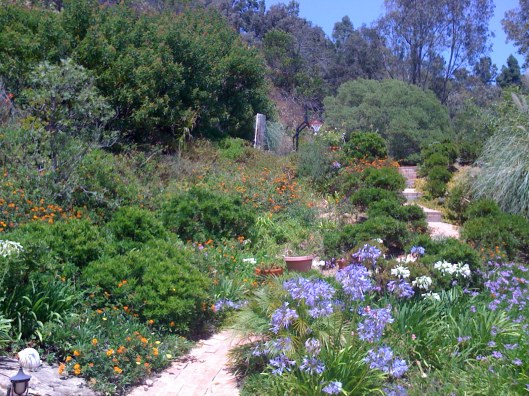
Meanwhile, enjoy the play of light on the flowers. You can see in this sequence that I “followed the scent” of the brightly lit fan palm tree to get a closer view. Getting a “closer view” is what Sadie does when she follows a scent. I wish to get more details in the visual domain whereas Sadie wants to get more detail in the olfactory domain.

Sometimes, I scan my visual field for something interesting to photograph (explore in more detail) and sometimes, I’m fixated on a particular “target” and looking for the right framing, lighting conditions, or angle. I enjoy sometimes getting to a particular picture, but I also enjoy the process of getting to the picture that pleases. I imagine it’s the same with Sadie. She’s quite happy to find a lizard or squirrel or rabbit, but she’s also happy to search for prey, particularly in promising conditions such as there being a strong scent or having wet ground to search for scents.


Plans?

Some management consultings will tell you that plans are seldom right but that planning–that is the real gold.


Author Page on Amazon

Tales from an American Childhood

Travels with Sadie 1

Travels with Sadie 2

Travels with Sadie 3

Travels with Sadie 4

Travels with Sadie 5

Travels with Sadie 6

Travels with Sadie 7

Travels with Sadie 8

Travels with Sadie 9

Sadie and the Lighty Ball

Dog Years

Sadie is a Thief!

Take me out to the Ball Game

Play Ball! The Squeaky Ball

Sadie

Occam’s Chain Saw Massacre

Math Class: Who Are You?

A NICE Circle of Friends

27 Sunday Jul 2025

Posted by petersironwood in America, family, fiction, politics

≈ 1 Comment

Tags

Democracy, fiction, life, politics, story, truth, USA, writing

AI generated image

Donnie Dump arrived first. He sniffed. He sighed. The place stunk. He took a deep breath and ambled over to the plain wooden door with the brass numbers ‘4’ and ‘2’ glued on at a slight angle. The door looked to be plywood.

He dug around in the front right pocket of his too-tight Lee’s and found the crumpled piece of paper. He uncrumpled it. He nodded and mumbled: “Yep. This is the place.” He re-crumpled the paper and jammed it back into his pocked. Then, he turned the cheap brass knob and pushed. The door opened into a room without light. “Crap. I’m the first one here.” 

Donnie fumbled around the door jamb for a light switch and flipped one. He said, “Let there be light.” And, there was light. A row of florescent lights flickered on to reveal a small arc of cheap chairs. In a corner of the smallish room, a vending machine offered a variety of salty and sugary snacks. 

Donnie hated being late. But he hated being early even more. Yet, here he was. Early. The first one here. He thought, How the hell was I supposed to know traffic would be so light. The truth was traffic was always “unusually” light now, but he hadn’t yet connected the dots; he hadn’t noticed nor had he realized how that fact related to his own ‘second career’ as he often called it. 

AI generated image.

Just then, he heard a noise and spun quickly to see another obese, masked marvel of manhood who raised a hand to him and said, “Hey. AA?” 

Donnie nodded and began to regret having agreed to come. His wife Maggie had been insistent. Maggie the Naggie, he thought. She should just mind her own damned business. “I don’t need fixing!” He had told her.

She had countered, “I’m not saying you need fixing. But you’re just—understandably stressed. It’s not an easy job.” 

Donnie now glanced at his watch. He could see several other guys out in the hallway. He was glad to see half of them were at least as old as he was. It was hard work chasing down folks trying to run away from you. He thought: True, the numbers and the weaponry made it safe enough but so is a carnival ride and they’re plenty scary too. But it’s whacking ‘em on the head I really get off on. Head wounds bleed a lot. The thought that they might be stupid the rest of their life from that one blow, or have a part of their body paralyzed or weakened. That was power. I like the taste. And, when the opportunity comes up, I’ll take whatever the hell I want. What’s everyone staring at me like that for?

Everyone had been seated for awhile and had been taking turns jabbering on about something or other. The so-called “Facilitator” had just said something to him. But what? That’s the question. Everyone’s staring at me.

Donnie stammered: “Sorry, what was the question?”

The facilitator faked a smile and said in a pleasant voice that Donnie just knew had to be rehearsed: “Have you experienced any unusual symptoms since joining NICE?”

Donnie shook his head and thought: Symptoms sound like I’m some kind of psycho or something. Aloud, he said, “No, nothing. No unusual symptoms. Like what?” 

The F-man shrugged and said, “Like drinking more alcohol than you used to or using more pot or bad dreams. Anything.”

Donnie shook his head. Maybe I shook it too hard. This is weird. No wonder Maggie wanted me to come. This is chick stuff. Feelings and that crap. I wish I knew what the other guys said. Doesn’t matter. They can’t prove what I think or what I did. We’re all masked. I can hold my liquor just fine. Who cares? It’s good to celebrate our victories. Kids. Some of them look like kids but so what? They’re criminals at heart. And not America citizens. Not because some liberals wrote it into a Constitution. Not with skin that dark. Everyone’s staring at me again. I want my assault rifle. Why is everyone staring at me? 

Donnie said, “Look, I feel fine. I like beer. So what? I do my job. I’m only here because my wife insisted. Well, that won’t matter much longer. Everybody knows it works better when women are property and we stop pretending their people with their own ideas. Go on to the next guy.” 

The meeting only lasted an hour but to Donnie, it seemed like a lifetime of boredom. 

It was late when Donnie got back home from the meeting and the post-meeting meeting at the “NICE GUY TAVERN.” Maggie had fallen asleep in her bathrobe staring at the boob tube. The twins must be asleep, he thought. 

I don’t drink too much. I just want to feel good. 

Donnie didn’t see anything wrong with that. But he did see something wrong with his damned wife being asleep when he got home. He didn’t exactly shout, but he did want to be heard over the sound of the frigging TV and he did want to wake her up and he had been drinking so his “Hey!” Sounded a lot more like: “HEY! Wake the hell up, Bitch!” 

Maggie sat up and said, “Hey, Donnie. How was the meeting? I didn’t realize it would run so long. Was it fun?” 

Donnie was already pouring himself a few fingers of Jack D. He bolted it down in one gulp before turning back toward Maggie and snarling in a soprano of swishy sarcasm, “Was it fun? Was it fun? Did you boys have fun talking about your frigging feelings?” He switched to his own voice and added, “No, it wasn’t fun! It was boringand useless just like you knew it would be. Do me a favor. Next time you get a brilliant idea, just keep it to yourself. I don’t drink too much. End of story.”

Maggie didn’t really agree, but she bit her lip to keep from…saying anything she’d regret. 

Photo by Maria Pop on Pexels.com

Meanwhile, Donnie was pouring himself yet another Jack D but only got two fingers’ worth. He yelled, “What the hell? Drink your own damned drinks! Don’t drink my good whiskey! Ain’t lady-like anyway! Don’t you have some sprizzer chicker drinker? Leave mine alone! Now, I’m out of Jack!”

At the moment Donnie said that, he was not, in fact, out of Jack. There was another fifth, unopened, staring right at him from the edge of the countertop. The fifth stood just a little too close to the edge. It should have known better but it didn’t know better because, first, it was filled with booze and secondly, it was only a bottle and didn’t really know much of anything.

In any case, when Donnie staggered and stumbled into the counter top, his elbow toppled the bottle onto the hard tile of the kitchen. Maggie and Donnie didn’t own any pets and the twins were asleep, so when the bottle shattered into smithereens, Donnie could see no-one to blame but Maggie. His subsequent screaming did manage to wake the twins who toddled out to the kitchen in a daze to see what all the commotion was about.


Maggie saw them toddling forward in their PJs and yelled at them to go back to bed, but not before each of them managed to step on several broken shards. Maggie was horrified to see the blood of her darling toddlers mixing with the stinging whiskey. The toddlers were none too happy either. Their pain and confusion were exacerbated by the increased tension they had felt at home ever since Donnie joined NICE.

Tears streamed down Maggie’s cheeks. She shook her head and stared at her husband—a man whom she had once loved. She could see that he was smiling and that the smile was genuine. It was the happiest she’d seen him since he had started working at NICE. She gripped the her elbows with her hands, knowing she should get her kids and fix them, but suddenly, she didn’t know how. She just cried silently wondering what had happened to the nice man who used to live inside Donnie’s skin.

———————-

 Where does your loyalty lie?

My Cousin Bobby.

The Update Problem.

Wednesdays.

The Game

Cancer Always Loses in the End.

What about the Butter Dish?

Roar, Ocean, Roar

Dance of Billions

Peace 

← Older posts

Subscribe

  • Entries (RSS)
  • Comments (RSS)

Archives

  • December 2025
  • November 2025
  • October 2025
  • September 2025
  • August 2025
  • July 2025
  • June 2025
  • May 2025
  • April 2025
  • March 2025
  • February 2025
  • January 2025
  • December 2024
  • November 2024
  • October 2024
  • September 2024
  • July 2024
  • April 2024
  • March 2024
  • February 2024
  • January 2024
  • December 2023
  • August 2023
  • July 2023
  • May 2023
  • April 2023
  • March 2023
  • February 2023
  • January 2023
  • December 2022
  • November 2022
  • October 2022
  • September 2022
  • August 2022
  • July 2022
  • June 2022
  • May 2022
  • April 2022
  • March 2022
  • February 2022
  • January 2022
  • December 2021
  • November 2021
  • October 2021
  • September 2021
  • August 2021
  • July 2021
  • June 2021
  • May 2021
  • April 2021
  • March 2021
  • February 2021
  • January 2021
  • December 2020
  • November 2020
  • October 2020
  • September 2020
  • August 2020
  • July 2020
  • June 2020
  • May 2020
  • April 2020
  • March 2020
  • February 2020
  • January 2020
  • December 2019
  • November 2019
  • October 2019
  • September 2019
  • August 2019
  • July 2019
  • June 2019
  • May 2019
  • April 2019
  • March 2019
  • February 2019
  • January 2019
  • December 2018
  • November 2018
  • October 2018
  • September 2018
  • August 2018
  • July 2018
  • June 2018
  • May 2018
  • April 2018
  • March 2018
  • February 2018
  • January 2018
  • December 2017
  • November 2017
  • October 2017
  • September 2017
  • August 2017
  • July 2017
  • June 2017
  • May 2017
  • April 2017
  • March 2017
  • February 2017
  • January 2017
  • December 2016
  • November 2016
  • October 2016
  • September 2016
  • August 2016
  • July 2016
  • June 2016
  • May 2016
  • April 2016
  • March 2016
  • February 2016
  • January 2016
  • December 2015
  • November 2015
  • October 2015
  • September 2015
  • August 2015
  • May 2015
  • January 2015
  • July 2014
  • January 2014
  • December 2013
  • November 2013

Categories

  • AI
  • America
  • apocalypse
  • cats
  • COVID-19
  • creativity
  • design rationale
  • driverless cars
  • essay
  • family
  • fantasy
  • fiction
  • HCI
  • health
  • management
  • nature
  • pets
  • poetry
  • politics
  • psychology
  • Sadie
  • satire
  • science
  • sports
  • story
  • The Singularity
  • Travel
  • Uncategorized
  • user experience
  • Veritas
  • Walkabout Diaries

Meta

  • Create account
  • Log in

Blog at WordPress.com.

  • Subscribe Subscribed
    • petersironwood
    • Join 664 other subscribers
    • Already have a WordPress.com account? Log in now.
    • petersironwood
    • Subscribe Subscribed
    • Sign up
    • Log in
    • Report this content
    • View site in Reader
    • Manage subscriptions
    • Collapse this bar
 

Loading Comments...