• About PeterSIronwood

petersironwood

~ Finding, formulating and solving life's frustrations.

petersironwood

Tag Archives: teamwork

Tools of Thought: Theory of Mind

19 Friday Dec 2025

Posted by petersironwood in America, management, psychology, Uncategorized

≈ Leave a comment

Tags

"Theory of Mind", AI, cooperation, Design, education, empathy, life, mental-health, poetry, politics, psychology, religion, sports, teamwork, truth, writing

Theory of Mind. 

“Theory of Mind” refers to the ability of most humans to imagine, at least to a degree, what another person is likely to do based on their knowledge of what the other person knows. Here is a simple test used to determine whether someone has this ability. 

You are the “subject” being tested and you are in a room with me (the “experimenter”). Your friend Vlad is in the room too. In full view of you and Vlad, I hide a giant luscious chocolate chip cookie (such as you might purchase from Panera, but won’t because you realize that if you buy it there is no way you aren’t going to eat it!). I “hide” this cookie in the top drawer of my desk. Now, Vlad walks out of the room. He’s well out of sight. Now, I take the cookie out of my drawer, and using great self-control, do not eat the cookie myself but instead put it in my pocket. 

two cookies beside white metal mug

Photo by rawpixel.com on Pexels.com

Now, I turn to you and ask, “When Vlad comes back, where will he look for the cookie?” If you are 2, 3, or 4 years old, you would say, “In your pocket!” I rephrase this a few times to make sure you understand that I am not asking you where the cookie actually is but where Vlad will search. You again insist that Vlad will look in my pocket. At such a young age, kids do not distinguish their state of knowledge from someone else’s. Most adults will have no problem with this task. They have a “theory of mind” that allows them to know that their state of knowledge is not the same as Vlad’s. Some adults diagnosed with autism will have trouble with this task however.

An interesting question arises as to whether other animals have a “theory of mind.” It is not a settled question. My purpose here however, is to explain what the term means and show how it’s useful for humans. Despite the fact that most adult humans have the capacity to do “theory of mind” tasks and that it is useful, they nonetheless often fail to evoke their capacity.

animal beautiful blonde daylight

Photo by Pixabay on Pexels.com

A closely related concept is “empathy.” Empathy generally refers to being able to feel what another person feels emotionally. I see the distinction as one of perspective or emphasis rather than two different entities. These two concepts (empathy and Theory of Mind) are explored in much greater detail in the “Myths of the Veritas” series in this blog. For now, suffice it to say that you might empathize with another person by relating to their facial expressions, posture, or regarding what they say and how they say it. You might see a picture of a small, terrified four-year old alone in a cage and know that they are terrified without having any verified knowledge or detailed knowledge of what they “know” or “don’t know.” They might or might not know any English. And you might or might not know their language or even what their language is. But you can tell that they are in great distress just by looking at them. If you actually feel what it is like to be a small child separated from your parents and being trapped in a cage in a strange place, that is generally called “empathy.” 

IMG_4410

If I were to ask you what kind of pleading this four year old is likely to make in court, if you have  the capacity for a “Theory of Mind,” you might well ask, “Well…I don’t know. What do they know about courts or proceedings? What could they know? They are only four years old.”  You’d be correct, of course, to question whether it was meaningful to have a four year old acting for themselves in court. This would be particularly true if they had to plead in a court where they were unfamiliar with the culture, the venue, and the language. But even a really smart four year old who had been brought up in America and spoke excellent English would not be capable of really understanding the consequences. This kind of understanding demonstrates a deeper theory of mind than simply knowing that because a specific piece of information is in your own head doesn’t mean it’s in someone else’s head. 

In The Myths of the Veritas, people are given a range of tasks that involve what is called empathy. To me, although one can draw a conceptual distinction between understanding another person’s knowledge and feeling an echo of another person’s feelings, when it comes to many practical situations, it’s more important to put oneself in another person’s shoes, than to correctly label the process. 

Writers must often deal with multi-level theories of mind. There is what the writer knows about the events that are being written about in a story. There are the spheres of knowledge that various characters have. Most often, different characters have critically different states of knowledge. What the reader knows is yet again different. And all of these spheres of knowledge change throughout the course of the narrative. 

In The Myths of the Veritas, for example, the author knows throughout that ALT-R is making POND MUD put his face in the mud purely to humiliate him and keep power over him. ALT-R knows it as well. Over time, most readers will come to the same conclusion but not necessarily at exactly the same place in the narrative. Most of the Veritas tribe initially know nothing about this incident, but She-Of-Many-Paths intuits it and eventually many of the Veritas come to understand it. At first POND MUD is fairly certain ALT-R saved his life by making him do it. But as he observes and interacts with ALT-R and others, he begins to doubt that and then goes about actively seeking information from others that would help clarify ALT-R’s true motives. 

mudface

In Othello, the writer knows from the beginning that Iago is an evil sociopath. The audience knows quite early that Iago is an evil sociopath and learns more about his schemes through speeches that Iago delivers directly to the audience. Othello himself, on the other hand, has his state of “knowledge” manipulated by Iago. The audience knows that Othello is being duped by Iago but Othello himself does not know of it or of Desdemona’s innocence when he murders her though at that point, the writer, the audience, Desdemona, Iago, Cassio and other characters all know that Desdemona is innocent. We have some sympathy for Othello because we realize that he is operating on false information. 

Let’s turn to a happier piece of fiction, The Gift of the Magi by O’Henry (William Sydney Porter). In this story, a couple with financial struggles each gives up their most prized possession to buy a gift for the other. The functional value of the gifts is destroyed by what they gave up. Della knows that Jim’s most prized possession is his gold watch so she sells her beautiful hair to get money to buy him a watch chain. Jim knows that Della’s most prized possession is her beautiful hair so he sells his watch in order to buy her some jeweled combs for her hair. Of course, the real gifts they give are not diminished by their being no longer functional. The real gift is the gift of love. The author obviously knows all this from the beginning. Readers “catch on” to what is happening at various points in the narrative, but Jim and Della are the last to learn of the full irony. 

woman wearing white long sleeved shirt

Photo by Element5 Digital on Pexels.com

Sadly, many people seem not to bother trying to understand the situation and capabilities of others. In one of the simplest cases, people are apparently unable to understand how very basic physical properties of the universe result in various people having various states of knowledge. On the tennis court, in a “friendly game,” the players themselves make the calls and keep track of the score. The server is supposed to announce the score before every serve. Some people actually “announce” the score by saying it so softly that only they can hear it! 

In other cases, novice drivers will follow a semi truck so closely that the truck drive cannot see the car behind them. Another trick of drivers is to turn their blinkers on – but only as they begin making the turn. In another post, I explain how one person’s driving behavior in “stop and go traffic” can influence many other people’s. In particular, if you leave a large space between your car and the one in front of you, it makes it easier for many people around you to drive more smoothly because they have a much more complete view of what is happening in front of them. 

buildings cars city cross harbour tunnel

Photo by Pixabay on Pexels.com

A more subtle failure in “Theory of Mind” occurs when a person assumes that everyone is motivated in the same way that they are. For example, a person may be so partisan that they will always defend and promote people in their own political party no matter how heinous the crimes of that person. This is an error, but a concomitant error is that such people assume everyone who doesn’t defend the criminal, and certainly anyone who actively resists such a crooked politician is doing so from a purely partisan perspective because that’s what they would do. Sociopaths who cheat may assume that everyone would cheat and the only reason they don’t cheat is because those non-cheaters are not smart enough to get away with it. 

When teamwork is operating at a high level, whether it’s hockey, soccer, tennis doubles, basketball, families, or design teams, people exhibit excellent “Theory of Mind” skills. How are yours? Have you experienced such high functioning teams? How can you improve your skills at “Theory of Mind”? 

One way to improve your “Theory of Mind” skills is to become aware of the kinds of perceptual, memory, and problem solving errors that people are generally prone to. Many of the posts linked to below explore some aspect of human psychology.

group of woman playing on green field during daytime

Photo by Pixabay on Pexels.com


Author Page on Amazon

The Primacy Effect

Labelism

Wednesday

The Update Problem

The Stopping Rule

My Cousin Bobby

Where does your Loyalty Lie?

The Invisibility Cloak of Habit

How the Nightingale Learned to Sing

Roar, Ocean, Roar

The Iroquois Rule of Six

Happy Talk Lies

The Loud Defense of Untenable Positions

Cancer Always Loses in the End

Who Won the War?

After All

The Last Gleam of Twilight

E-Fishiness Mass General Hospital

Me Too


The Silent Pies

13 Saturday Dec 2025

Posted by petersironwood in America, family, fiction, psychology, story, Uncategorized

≈ 1 Comment

Tags

collaboration, cooperation, family, fiction, life, politics, story, teamwork, truth, USA, writing

Photo by Alena Darmel on Pexels.com

The first time I won the prize, I was only 8. I had only had my two-wheeler for about a year when my gang of neighbor guys jointly decided it would be a lot more fun to ride our bikes if they made as much noise as real motorcycles. I can’t speak for the others, but it never occurred to me that other people in the neighborhood might not find this increased noise level “really cool!” 

Of course, we weren’t always riding our bikes. Sometimes we played in Lynn Circle at the end of our road. It served as a makeshift playground for baseball, kickball, and soccer as well as a free hippodrome for our races. This arrangement had one slight flaw. There were no fences. So, invariably, a ball would go careening off the pavement onto someone’s lawn. 

In our neighborhood, everyone’s house looked fairly similar, but they expressed themselves through their small gardens and lawns. Some people, like my dad, really worked at making our small lot at least something gardenish. Other people did little but mow their lawn every so often. But some treated their lawns as they might, at any moment, be teleported to the Master’s Golf Tournament for emergency green replacement. Universally, these people had no children at home. When that was so, none of them interacted much with the kids, the parents of the kids, or even, each other, as I can recall. 

Photo by Kelly on Pexels.com

When a stray ball dribbled up into our lawn, someone just ran up and got the ball. No big deal. But if someone hit a ball into one of the three lawns that were antiseptic enough to serve as operating tables for open heart surgery–YIKES! Of these, the most stringent by far was “Old Lady Lynn.” When a ball went into one of the antiseptic lawns, we tried to reconnoiter the situation before even attempting to grab our ball back. We would consider whether there was a car in the driveway, whether there was any sign of life coming from the domicile in question. Only if we were fairly sure no-one was at home would we walk and get the ball. If we weren’t sure, we’d run up and snatch it as quickly as possible and then duck into a “friendly” back yard quickly enough so that we wouldn’t be identified. 

Old Lady Lynn always seemed to be at home. We imagined, because of her invariable and instantaneous reaction, that she spent all her waking hours peering out between curtains at her lawn to insure that none of us trampled her grass. 

Our gang decided to begin our little decibel enhancement project by each of us buying the loudest bell we could find. These were not modern, laser-guided, AI-enhanced sonic systems but simple bells that you had to operate with your thumb. It’s intended use was to prevent injuries and save lives by giving the bike rider a way to “warn” others of their impending presence to that the other person so they didn’t accidentally wonder into your path.

Photo by Bastian Riccardi on Pexels.com


We didn’t give that much thought. But we did give thought to how cool it sounded when we all rode around the circle clanging the bells.  Of course, even way back then, if you had a new toy or technology, you had to show it off incessantly and that’s what we did. 

Unlike the instantaneous reaction Old Lady Lynn had to our incursions onto her lawn, it took several days for the complaint to filter back to my parents. My parents (thank goodness) were not the sort to take my side regardless of ethics or consequences. I convinced my buddies that if we didn’t strike a compromise, our parents would take all our bells away. Our development project at that time, consisted of only three paved streets, but there were plenty of interconnecting dirt roads and paths that sported no houses on either side. Now, when we left the paved roads of civilization and rode off onto the dirt roads through the woods, we celebrated with cheers and bells as we crossed the threshold into non-civilization, a place where we could talk with each other without the constant reminders of parents and parenting. 

The golden sunrise glows through delicate leaves covered with dew drops.

A few days later, I was reading a book about dinosaurs when I heard a knock at the door. Soon, I heard the unmistakable wobbly tones of Old Lady Lynn. I couldn’t hear what she was saying nor what my parents said, but they sounded friendly. Then, the unbelievable happened. I heard them all laugh. It had never occurred to me that Old Lady Lynn would ever–could ever– laugh, or that she ever had laughed. 

I debated whether my appearance would make things better or make things worse, but in the end, I felt I I had to participate in whatever was happening. I hadn’t even finished opening my own door when I noticed a most amazing aroma! My eagerness spiked and I trotted into the kitchen. Steaming on the table: Not one but two warm, freshly baked blueberry pies. That smelled delicious!

My mom said, “Look, Mrs. Lynn was so happy you got those boys not make that bell clanging racket near her house and instead having your No-Bell in the Neighborhood Policy, she baked two pies.” 

The pies were amazing, but what was even more amazing that Mrs. Lynn became friends with my parents, and even with me. Every year, for the next six years we lived there, Mrs. Lynn gave me two pies. No two years were identical. All the pies were fresh baked and delicious: blueberry, raspberry, rhubarb, pumpkin, custard, cherry, and—my personal favorite—pecan pie. 

———————

Now, more than seventy years later, when I take Sadie for her morning walk, we often walk by a property with a self-proclaimed “Invisible Fence.” It’s been around for awhile, but it was invented in 1973; that is, about 20 years after the story recounted above took place. My neighbor’s invisible fence does seem to work for her two large and friendly dogs. They bark as we pass but do not accost us on the road. 

But the self-imposed boundaries of invisible fences have a long history in humankind. 

The reality is that we’re all part of one Great Tree of Life. 

All fences are temporary but, 

The impact of connection ripples forever. 

———

Author page

Math Class

You Must Remember This

Ripples

Roar, Ocean, Roar

Imagine All the People…

The Dance of Billions

The First Ring of Empathy

A Pattern Language for Cooperation and Collaboration

Your Cage is Unlocked

Impossible

Turing’s Nightmares: Eight

21 Friday Nov 2025

Posted by petersironwood in psychology, The Singularity, Uncategorized

≈ Leave a comment

Tags

AI, Artificial Intelligence, cognitive computing, collaboration, cooperation, openai, peace, philosophy, seva, teamwork, technology, the singularity, Turing, ubuntu, United Peoples Ecosystem

OLYMPUS DIGITAL CAMERA

Workshop on Human Computer Interaction for International Development

In chapter 8 of Turing’s Nightmares, I portray a quite different path to ultra-intelligence. In this scenario, people have begun to concentrate their energy, not on building a purely artificial intelligence; rather they have explored the science of large scale collaboration. In this way, referred to by Doug Engelbart among others as Intelligence Augmentation, the “super-intelligence” comes from people connecting.

Photo by RF._.studio on Pexels.com

It could be argued, that, in real life, we have already achieved the singularity. The human race has been pursuing “The Singularity” ever since we began to communicate with language. Once our common genetic heritage reached a certain point, our cultural evolution has far out-stripped our genetic evolution. The cleverest, most brilliant person ever born would still not be able to learn much in their own lifetime compared with what they can learn from parents, siblings, family, school, society, reading and so on.

Photo by AfroRomanzo on Pexels.com

One problem with our historical approach to communication is that it evolved for many years among a small group of people who shared goals and experiences. Each small group constituted an “in-group” but relations with other groups posed more problems. The genetic evidence, however, has become clear that even very long ago, humans not only met but mated with other varieties of humans proving that some communication is possible even among very different tribes and cultures.

Photo by Min An on Pexels.com

More recently, we humans started traveling long distances and trading goods, services, and ideas with other cultures. For example, the brilliance of Archimedes notwithstanding, the idea of “zero” was imported into European culture from Arab culture. The Rosetta Stone illustrates that even thousands of years ago, people began to see the advantages of being able to translate among languages. In fact, modern English contains phrases even today that illustrate that the Norman conquerers found it useful to communicate with the conquered. For example, the phrase, “last will and testament” was traditionally used in law because it contains both the word “will” with Germanic/Saxon origins and the word “testament” which has origins in Latin. Many other traditional legal terms in English have similar bilingual origins.

Automatic translation across languages has made great strides. Although not so accurate as human translation, it has reached the point where the essence of many straightforward communications can be usefully carried out by machine. The advent of the Internet, the web, and, more recently google has certainly enhanced human-human communication. It is worth noting that the tremendous value of google arises only a little through having an excellent search engine but much more though the billions of transactions of other human beings. People are exploring and using MOOCs, on-line gaming, e-mail and many other important electronically mediated tools.

Photo by Rebecca Zaal on Pexels.com

Equally importantly, we are learning more and more about how to collaborate effectively both remotely and face to face, both synchronously and asynchronously. Others continue to improve existing interfaces to computing resources and inventing others. Current research topics include how to communicate more effectively across cultural divides; how to have more coherent conversations when there are important differences in viewpoint or political orientation. All of these suggest that as an alternative or at least an adjunct to making purely separate AI systems smarter, we can also use AI to help people communicate more effectively with each other and at scale. Some of the many investigators in these areas include Wendy Kellogg, Loren Terveen, Joe Konstan, Travis Kriplean, Sherry Turkle, Kate Starbird, Scott Robertson, Eunice Sari, Amy Bruckman, Judy Olson, and Gary Olson. There are several important conferences in the area including European Conference on Computer Supported Cooperative Work, and Conference on Computer Supported Cooperative Work, and Communities and Technology. It does not seem at all far-fetched that we can collectively learn, in the next few decades how to take international collaboration to the next level and from there, we may well have reached “The Singularity.”

Photo by Patrick Case on Pexels.com

————————————-

For further reading, see: Thomas, J. (2015). Chaos, Culture, Conflict and Creativity: Toward a Maturity Model for HCI4D. Invited keynote @ASEAN Symposium, Seoul, South Korea, April 19, 2015.

Thomas, J. C. (2012). Patterns for emergent global intelligence. In Creativity and Rationale: Enhancing Human Experience By Design J. Carroll (Ed.), New York: Springer.

Thomas, J. C., Kellogg, W.A., and Erickson, T. (2001). The Knowledge Management puzzle: Human and social factors in knowledge management. IBM Systems Journal, 40(4), 863-884.

Thomas, J. C. (2001). An HCI Agenda for the Next Millennium: Emergent Global Intelligence. In R. Earnshaw, R. Guedj, A. van Dam, and J. Vince (Eds.), Frontiers of human-centered computing, online communities, and virtual environments. London: Springer-Verlag.

Thomas, J.C. (2016). Turing’s Nightmares. Available on Amazon. http://tinyurl.com/hz6dg2

An Inside View of IBMs Innovation Jam

————-

Author Page on Amazon

Turing’s Nightmares: The Road Not Taken

Pattern Language for Collaboration and Cooperation

The First Ring of Empathy

The Dance of Billions

Imagine All the People…

Roar, Ocean, Roar

Corn on the Cob

Take a Glance; Join the Dance

The Self-Made Man

Indian Wells

Travels with Sadie: 12 Taking Turns

20 Monday Oct 2025

Posted by petersironwood in essay, pets, Sadie, Uncategorized

≈ 2 Comments

Tags

books, cooperation, dogs, fairness, fiction, life, pets, Sadie, sharing, story, teamwork, trust, truth

Travels with Sadie 12: Taking Turns

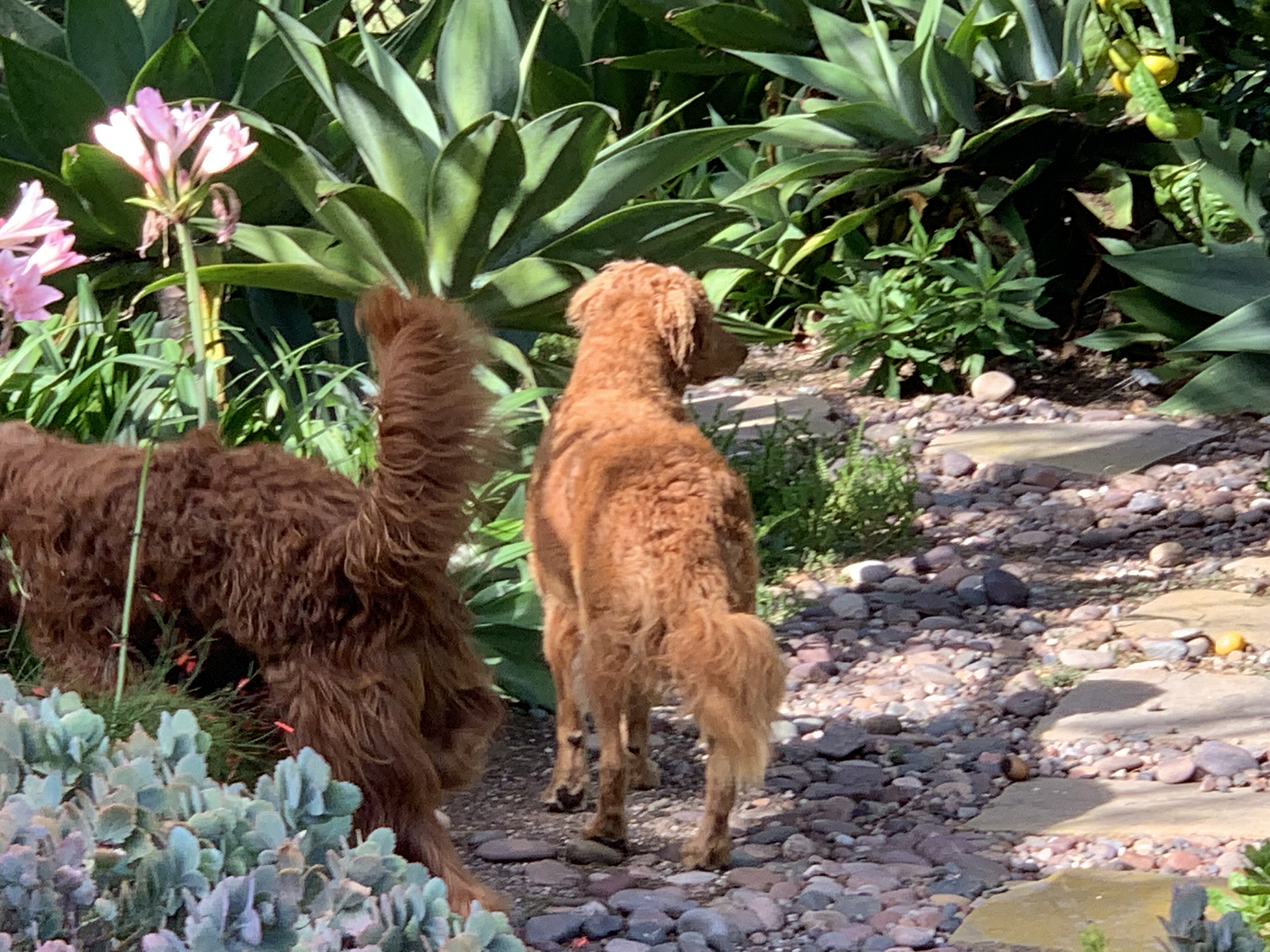
Bailey (L) and Sadie (R) in the garden.


If you’ve been reading any of these blog posts about my dogs, Sadie and Bailey, you must know by now that both of them are avid “ball players” — given the nature of dogs, especially ones that are half Golden Retrievers—this is probably not a big surprise. To further seal the deal, their “human dad” is also an avid “ball player.” 

Many human sports involve balls of one sort or another and I have, at various times, been “into” baseball, football, basketball, golf, tennis, ping-pong, softball, soccer, racquetball, volleyball, and even croquet. Looking back on my life, I realize there are many human sports that do not involve a ball; e.g., varieties of running, jumping, skating, diving, swimming, cycling, skiing, wrestling, boxing, and gymnastics. Although I have done all of these a little bit—mainly for fitness—I have historically been much more interested in sports that involve using a ball. The only one I enjoy as much as a ball-based sports is frisbee which is arguably much like throwing and catching a ball. A ball introduces an entire layer of complexity in tactics, strategy, and experience that I enjoy. For one thing, the ball can move faster and in modes quite different from those a human can perform. A ball can be in anywhere in large two (and often three) dimension-space. Furthermore, how the ball gets from one point in space to another can happen in a variety of ways. The ball generally has spin and spin alters the flight path of the ball as well as the way it reacts to the next thing it touches.

Sadie and Bailey, by the way, do a pretty good job of predicting what a tennis ball (or a squeaky ball) will do when it hits, say, concrete or dirt. They can, for instance, catch balls in the air that are angled rebound shots off the garage door at some fair speed. They also exhibit intelligent metacognition in their leaping and catching behavior. They have a mental model of their capabilities. It’s not perfect and Sadie’s is much better than Bailey’s, but even Bailey doesn’t mistake his own capabilities much. I wonder whether they too enjoy balls partly because they’re complex in their behavior. The only thing better would be a small animal like a lizard, squirrel, rabbit, etc. Of course, it is this hunting behavior that predisposes them to enjoy (and be good at) playing ball or frisbee.

My dogs have both nature and nurture leading them toward ball playing.

Sadie and I have spent many hours playing ball in jointly invented games. As I’ve explained elsewhere, it’s much more to my liking to let our games evolve than to “teach her how” to play ball a certain way that comes entirely from my own human imagination.

Most dogs, for example, learn to go fetch a ball and bring it back to the thrower and drop it at the thrower’s feet so that they may pick it up and throw it again. Sadie instead evolved a somewhat different style which was to incorporate a variant of “snatch the handkerchief” into our ball playing. She would typically bring the ball to me, drop it at my feet, watch me try to pick up the ball and then suddenly snatch it away just before I could pick it up. I quickly adapted to her style by using a “grabber” because I enjoy having all ten fingers. 

Since early puppyhood, Sadie has challenged herself by trying to catch or at least stop and touch multiple balls on the same turn.

She typically begins her version of ball playing by dropping a retrieved ball directly beneath her snout. I will try to grab the ball before she can snatch it again but she’s always too fast for me. Then, she will begin dropping the ball farther and farther from her rows of shiny canines until, at some point, I have a fighting chance of snatching the ball away with the grabber before she can grab it. Sadie and I played this game many times in the course of the first two years of her life. 

Then, we brought her little brother Bailey into the mix. Bailey learned many things from Sadie, and a few from me. He, like Sadie, loves to play ball. For a variety of reasons that I won’t recount just now, Bailey generally prefers to drop the ball so that I can more quickly throw it to him again. When he did this, however, Sadie would sometimes snatch the ball before I could and run off with it. 

Sadie (L) and Bailey (R) illustrating the type of “fighting” they do when Bailey tries to steal a ball from Sadie.

At first, I didn’t think much about this ball stealing, and, if Bailey objected, he did not yet know how to present a formal written complaint about it. Within a few months, however, Bailey was as large as his kid sister and their “play-fights” became pretty intense. Neither one has ever (so far as I know) injured the other, but to this human observer, it looks pretty rough. They take turns running at each other. Our “back yard” is mostly garden, but there was a small patch of grass which has been completely torn into a black dirt field. 

When it comes to humans, most of us learn to “take turns” in nursery school or, at the latest, Kindergarten. There are eight billion people on the planet and not everyone has access to their own object of every description that they want. We, as toddlers, teens, and adults, take it for granted that we will “take turns” and share various things. At a public pool, there may only be one diving board so people cue up and “take turns” diving off the board. At a playground, there may be only one sliding board so kids take turns sliding down. In tennis, we “take turns” serving games. In baseball, we “take turns” as individuals batting, and the whole team “takes turns” hitting versus fielding. In playing neighborhood poker, it’s quite common to “take turns” dealing, and, along with that, many people play “dealer’s choice” which means the dealer also chooses the specific game; e.g., five card draw with jokers wild. In chess, the two sides take turns. In Risk and Monopoly and many other board games, players take turns.

Ferris Wheel is just one of thousands of situations where we take turns.


We take turns for positive things, but also for chores. A couple may decide to “take turns” taking out the trash or doing the dishes. Or, if there are five kids in the family, the five may take turns doing the various chores. “Taking turns” is so ubiquitous that it blends into the background in most cases and we don’t even consciously think about it. Life works better in a thousand ways, large and small, when we take turns. 

Last night, my wife and I attended a birthday dinner at an Italian restaurant. When it was time to order, we “took turns” giving our orders to the waiter. Imagine how inefficient and contentious it would be instead if we all shouted are orders at the waiter at the same time! Less pleasant for everyone and far more likely to result in mistaken orders. When we drove home, we came to several stop signs where we took turns with other drivers. We took turns merging onto the highway. When we came home, we took turns coming through the door! Then, the dogs took turns going out for a walk with me. I often feed them treats and share by having them take turns. 

Nonetheless, I can’t seem to get Bailey to take turns when it comes to her “catching a ball”as her default behavior. I can throw one ball into the deep end of the pool while I say “This is for Bailey” and throw another one in the shallow end saying “This is for Sadie” and the dogs will swim to their respective balls and collect them, but then, Bailey will drop his ball and run over to Sadie and steal hers.

Similarly, I can gather up two balls in the garden and throw them in opposite directions and get them to run in different directions (though not always). Nonetheless, as soon as Bailey scores a catch of “his” ball, he drops it and rushes back to grab the ball out of Sadie’s mouth. 

Sadie (L) and Bailey (R) are both Golden Doodles. Here, Sadie is about 3 1/4 and Bailey’s about 1 1/4 years old.

Why is it apparently so hard for Bailey to learn to take turns? Partly, no doubt, there’s some inborn tendency to want things for himself. And partly, there are positive reinforcement structures at play that I haven’t yet figured out how to break or how to shape up incompatible behaviors. Sadie, for her part, sometimes fights to keep the ball. I suspect Bailey finds this positively reinforcing because the “fight” itself is fun. Most of the time, when she sees him approaching in a “ball-stealing” situation, she simply drops the ball and Bailey snatches it. Bailey also likely finds this positively reinforcing too. I try praising other behaviors that are more in the direction of better cooperation, but such opportunities are rare and difficult to read so far. 

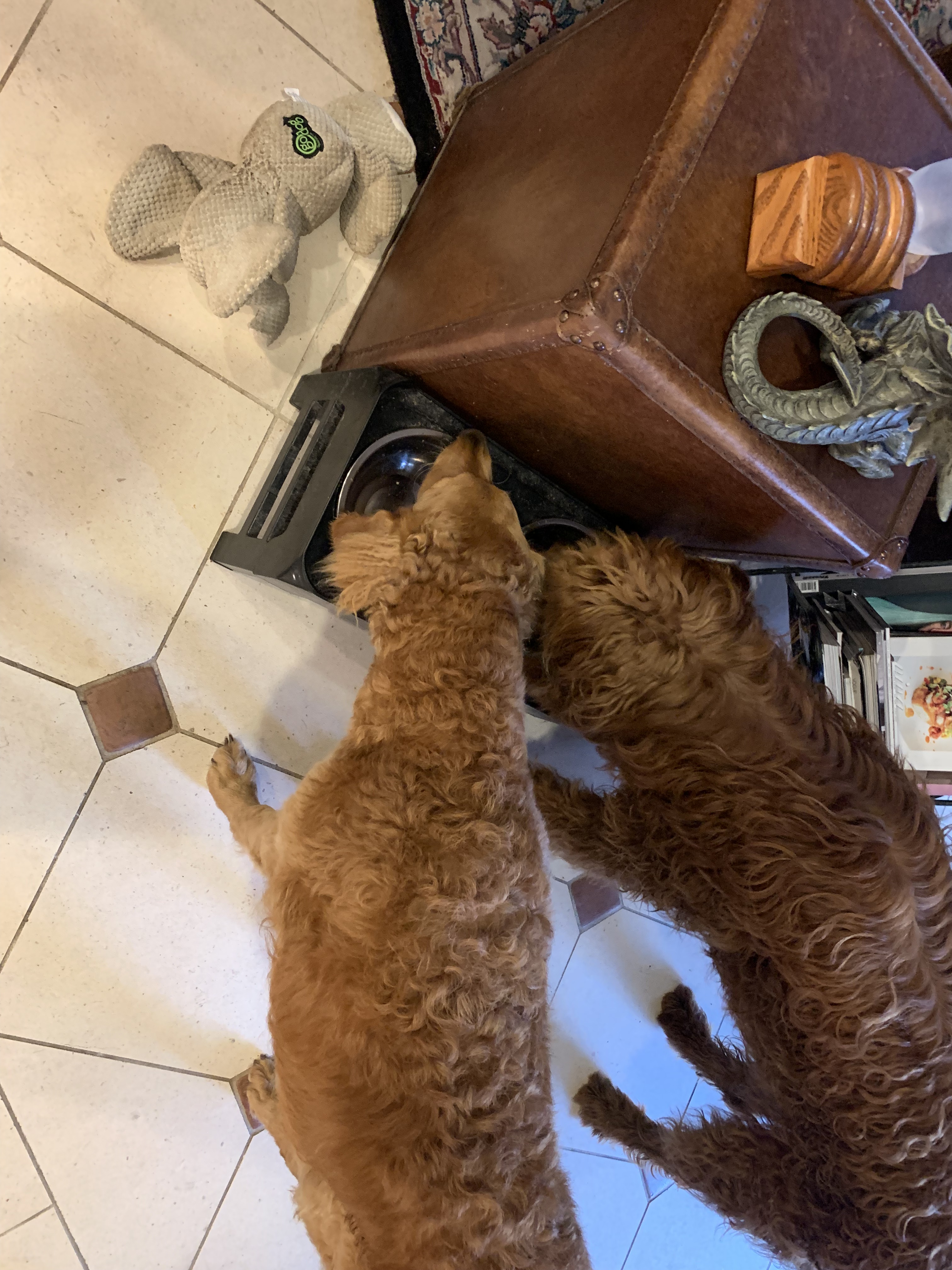
Initially, when I fed the dogs side by side, Bailey would often try to steal some of Sadie’s food. But Sadie herself growled fairly intensely when this happened and I often intervened as well. Here, Bailey was somewhat positively reinforced by moving her attention back to her own bowl, because, after all there was food there too. Even if he has finished his own dinner, he gets enjoyment from licking the “empty” bowl. So, in contrast to the case of turn-taking with tennis balls, the eating situation itself makes it easier for cooperation to emerge. I don’t ever recall Sadie trying to steal some of Bailey’s food. 

I have been hoping that watching the dogs might give me some insight into the ultra-greedy behavior of many (though not all) of the ultra-wealthy billionaires. Just to review the general situation America now finds itself in, the productivity of labor has increased tremendously since the beginning of the industrial revolution. Until the mid-1970’s the increased wealth that came from the increased productivity was split between owners of the means of production and the workers. In other words, the rich got richer, but so did the workers. Since the mid-1970’s however, the rich generally, and especially the extremely wealthy, have taken almost all the increased wealth that has been created by increased productivity.

Part of the answer as to how they have done this is to use their wealth to buy power in the form of bribing politicians who make policy decisions. In some cases, they’ve done this through outright illegal bribes and in other cases, they’ve used slightly more subtle and sometimes legal methods but the result is the same. In addition—actually, I should say “in multiplication” because the impacts have been more than additive, they have largely taken over mass media and social media where they promulgate heroic cartoon versions of themselves and their desires while lying about and denigrating people who are not insanely wealthy. 

Much like Bailey’s behavior, there is not a huge mystery in how they have done it. But, there is a mystery in why they have done it. Studies show that once you have your basic necessities taken care of, additional income doesn’t raise your personal happiness. While this result seems true in terms of aggregate happiness, it ignores the little dopamine hit that the animal (human or dog) gets when they immediately grab a fourth yacht or steal another ball from their sister. It doesn’t last long, but apparently long enough to serve as a positive reinforcement.

In the larger scheme of things, it’s not to Bailey’s benefit to keep stealing the ball from his sister. It make the whole ball-playing scene less pleasurable for me and I play less often. I also play with Sadie by herself more often because I want her to have a chance to play too. In the larger scheme of things, it’s not really to the benefit of billionaires to have sick, tired, uneducated workers either, nor ones so desperate to feed their families that they’ll start eating the rich. But somehow, dogs and such are prone to overlook longer term consequences. Some of the extremely wealthy delude themselves into thinking that they can replace their workers with AI and protect themselves & their families with firearms. They’re not thinking things through any more than Bailey is. This human tendency for self-defeating greed has been recognized at least since the time that Aesop told his fables. Maybe the choice of a dog in the following fable was quite intentional. 

A dog found a bone and was happily trotting along with the bone in his mouth. He came to a bridge and began happily trotting over the bridge. He happened to look down at his own reflection and saw the image of a dog with a bone. He thought to himself that he wanted both bones so he growled at the dog in the pond, intending that he drop the bone so he could have two. But the dog in the pond just growled back! So, the dog on the bridge barked angrily to bully the other dog into dropping its bone. Of course, what happened was that the dog on the bridge dropped his own bone into the pond.

That’s from 2000 years ago. But now, we’re in a situation that warrants a third round of foolishness. Here’s my addition:

The dog was angry that he had lost both bones so he attacked the dog in the water. He promised himself he’d fight to the death to get both bones. Of course, there was only one bone and he ended up exhausted and drowned in the pond.


Unlike some of today’s ultra-wealthy, Bailey is much too smart for that third round. The ultra-greedy (not the same set as the ultra-wealthy but with lots of overlap) would like you to believe that they are SuperDogs or SuperHeroes or something…that they 100,000 times as much wealth as you because they are 100,000 smarter. They aren’t, of course. And they are willing to prove they aren’t by believing the promises of a cruel, demented, liar-con man. Also, they have a thousand experiences, if they reflect honestly, that having increased wealth over the first 100,000,000 hasn’t made them the least bit happier. There have been some accomplishments or events that were correlated with making more money. But the money itself and what it can buy doesn’t make them feel any happier. And some billionaires accomplish things—such as eradicating a disease—which make them feel happier but that are correlated with investing huge sums of money, not gaining them. Meanwhile, if things continue on their current path, it won’t be long before there are many more people in America who are not just hungry but who are starving to death. At that point, no-one will forget that some billionaires pay zero taxes but have bought politicians who give even more wealth to the few while millions starve or die from lack of medical care.

It is time to feed Bailey and Sadie who will, at least, eat beside each other happily and peacefully. I should mention, by the way, that Bailey’s disposition is very loving. She is not a mean angry dog. She’s not even a particularly stubborn one. She tries to please us and gets along with others. But she does sometimes have trouble taking turns. How about you?

https://www.amazon.com/author/truthtable

Turing’s Nightmares (Sci-Fi about the singularity)

Fit in Bits (Describes how to work more exercise into a busy schedule)

The Winning Weekend Warrior (the psychology of winning and enjoying sports)

Tales from an American Childhood (recounts early experiences from Ohio in the 1950’s and relates them to current events)

Travels with Sadie 1 Lampposts

Sadie is a Thief!

Hai-Ku-Dog-Ku

Sadie and the Lighty Ball (Describes game and play pattern co-development)

Math Class: Who are You? (Shows how related all life is)

Roar, Ocean, Roar (a poem about the power of the people)

Essays on America: The Game (hypothesis essay about why some are so greedy)

The Self-Made Man


Essays on America: I Made Myself Breakfast

20 Monday Feb 2023

Posted by petersironwood in America, psychology

≈ Leave a comment

Tags

breakfast, collaboration, cooperation, life, peace, teamwork, truth, USA

Photo by Julian Jagtenberg on Pexels.com

I made myself breakfast.

Have you ever said to yourself, “I made myself breakfast.” 

This morning, I made myself breakfast, and the picture below is what was left. A few shreds of sauerkraut and one moldy blueberry. 

The complete breakfast included an English Muffin, Peanut Butter, blueberries, kale, sauerkraut, two garlic-stuffed olives, and a cup of coffee with cream and sugar. 

I made myself breakfast. 

But did I? 

In this picture you see a plate, a fork, and a napkin. Not only did some person initially come up with idea, but hundreds of people vastly improved the making of pottery and silverware and napkins. These particular items probably travelled many miles and were touched by many people’s work before they ended up in my possession. I can afford them because we live in a peaceful, mainly cooperative society. I certainly couldn’t make them on my own. And if they were made the way that they were a thousand years ago, only royalty could afford them. 

The wooden tray? That too shows obvious signs of change over the years from the time one of our ancestors decided to eat off a half-log. You might see some lettering. The tray says, “LET IT SNOW!” None of the other things mentioned above would have been possible without the invention and improvement to language. 

So far, my “self-made breakfast” involves thousands of ancestors who made any of this possible.

My “self-made breakfast” also involves thousands of contemporaries from around the world who cooperated to bring these particular items to the San Diego area. 

Photo by Cup of Couple on Pexels.com

We haven’t even gotten to the food. 

Let’s take the English Muffin, just as an example. Some of our ancestors might well have procreated and then “tried out” something as a possible food but guessed wrong and died. They figured out which grains could be eaten, how to grow them, how to harvest them more effectively than to shell one seed at a time; how to make flour; how to bake bread. In my case, there’s another whole line of inquiry related to the discovery of electricity and its taming and distribution so that I can toast my English muffins. There are similar hundreds of our fellow human beings (and their supportive communities) who were involved in today’s peanut butter, today’s sauerkraut, garlic stuffed olives and so on. 

Photo by Tom Fisk on Pexels.com

Once again, there are not only countless people from all over the world who were involved in the development of these food items. There are thousands of people from all over the world who helped get these particular items to our kitchen. 

It’s also true that if I’d been brought up by wolves, I wouldn’t know how to access or use any of these items. Not only that, my life has been saved numerous times by modern medicine. But “modern medicine” didn’t just drop out of the sky one day. None of these modern luxuries popped up like a mushroom. People worked hard and thought hard in order to all me to have a nice breakfast. However, it would be more accurate to say: 

Humanity made breakfast for me.

Photo by Gabriel Santos Fotografia on Pexels.com

How the Nightingale Learned to Sing

Roar Ocean Roar

The Only Them that Counts is All of Us

Dance of Billions

Corn on the Cob

Patterns for Collaboration: Rituals

25 Tuesday May 2021

Posted by petersironwood in Uncategorized

≈ Leave a comment

Tags

collaboration, cooperation, Pattern, pattern language, ritual, teamwork

OLYMPUS DIGITAL CAMERA

Author, reviewers, revision history: 

John C. Thomas, Draft – May 22, 2021 (Draft)

Synonyms: 

Rites. Observances. Routines. Habits. Sacrements. Ceremonies. Protocols. Programs. Practices.

Abstract: 

Many groups, and not only religious groups, perform various rituals. Some are done periodically like daily prayers. Some are done on special occasions such as baptism, graduation ceremonies, marriage ceremonies, last rites, funerals, etc. Rituals appear to address many issues simultaneously. 

Problem: 

Rituals, so far as we can tell, are quite old. They seem to serve several purposes. It isn’t clear to me which of several purposes they were originally “designed” to solve.


Here are the problems they seem to touch on and offer partial solutions to:

  1. In many cases, it is necessary for groups of people to work in a coordinated fashion. If each person separately develops their habits for dealing with things, conflict and confusion can arise. How can the group behave without interfering with each other?
  2. Some rituals deal with major life changes. When Complex Adaptive Systems are faced with major changes, a whole host of individual changes and adaptations may be necessary to deal with the new circumstances. Too much change can induce exogenous depression. The person simply does not know what to do. Exogenous depression may be a coping mechanism to avoid making a catastrophically wrong decision before the person has had a chance to adapt to the new circumstances. However, in some cases, action must be taken before people have had a chance to let the implications of the new circumstances “sink in.” For instance, a death in the family has many implications. No-one knows quite what to do. Yet, something must be done. How can one behave when one is too depressed to think straight?
  3. In very small groups, such as the tribes we evolved in, everyone knew everyone personally. As groups grew larger and larger; in order to accomplish more ambitious tasks, for instance, it became difficult for people to recognize who was in their “in-group.” How can one recognize who is in one’s group when there are too many people to know personally? 
  4. People grow aware of their own mortality. How can one gain a sense of belonging to something that transcends the boundaries of their own bodies when their own bodies are limited in space and time?
  5. As groups grow larger and larger, there will be more and more diversity of abilities, capacities, styles, and so on. How can we keep track of what people are like?
  6. Human life is complex and so is the human behavior that attempts to deal with that complexity. Our behavior at time t is influenced by what happens before hand and especially what happens directly before a given activity. If it is important to perform something at time t precisely, it helps to preface the action with a series of actions right before the critical time t. This also “loads” working memory with the same material. 

Context:

Forces:

  • Individuals naturally have somewhat different ways of doing things.
  • Having individuals do things in different ways means that some individuals will discover, invent, or happen upon ways of doing things that are superior. 
  • Group behaviors, to be most effective, require some degree of coordination. 

*  Some situations are so stressful and/or novel that people cannot make reasonable decisions.

*  Some situations require action in a timely fashion. 

Solution

Communities develop rituals over time. A community ritual may address any subset of at least five problems at once: 

  1. It provides a set of roles and procedures so that people may act together without interfering with each other.
  2. It provides people with a “plan of action” that they can follow in times of change without having to try to think it through individually. 
  3. A ritual provides a kind of behavioral “test” that shows whether someone is in our “tribe.” 
  4. A ritual, since it has many common elements over time and space, reminds us that we are part of a larger effort. 
  5. Precisely because rituals are to be done in a common way, they partial out those aspects of behavior which are due to circumstances and motivations from those that are due to abilities and inherent styles. 
  6. When someone seeks optimal performance of a complex behavior, it can help to preface the complex behavior with a series of preparatory behaviors that are performed in exactly the same way over and over. 

Examples:  

First, I present below some “porto-rituals” from my own life that I don’t claim are examples of what people generally think of as rituals, but which are behavioral “in that direction” which solve each of these subproblems.

  1. I do most of the food preparation for my wife and I. We mostly like the same things, which is handy. But sometimes, there are slight differences in preferences. For instance, I never add salt to my portions. In some things, my wife likes additional salt. Therefore, I alway prepare her drink or dish on the left and put mine on the right. This just avoids confusion. One might imagine however, that over generations such a heuristic could evolve into an actual ritual; e.g., women’s portions are on the left; men’s are on the right. 

  1. As I learned more and more psychology, it became more and more feasible to use what I learned in order to teach others or help others. But when? How much is enough? When do (or should) people “trust me” enough to take my advice? The ceremony, credentials, and rituals around getting a degree provide a handy shorthand that is generally though not universally accepted as showing that the point had been reached where my advice was “valuable enough” to receive credence (and reimbursement). This was much better, in my opinion, than having to decide every single day, “Should I stop learning and get a job today? No? How about tomorrow? How about the day after?” 
  2. One of the things that people in many academic communities do is review papers and grant proposals. In my experience, the reviewing process is partly influenced by reading signals about whether someone is in or not in the appropriate “tribe.” In a study of a new computer interaction technique, for instance, in my “tribe” it is not enough to simply claim that a new technique is superior. One is expected to show empirical evidence to that effect. If one does not do that, it detracts from the credibility of the claims. More than that, however, it signals to the reviewer that the author is not yet a full-fledged member of the community. 
  3. My mother was one of those people who always returned shopping carts to the store rather than leaving them in the parking lot. I do the same. I want to model good behavior for others, and avoid unneeded wreckage of carts and unneeded scrapes on the paint jobs on cars. But another motivation is that it reminds me of my mother. Since I am carrying on her tradition, it gives me a small feeling of continuity across generations.

    In a similar fashion, my grandmother told me stories that she made up herself. I create stories for my grandkids (as I did for my kids as well). Apart from other benefits, this gives me a feeling of being part of a tradition which I think is beneficial for me, for my descendants and for society. 

  1. I organize some tennis games for some of the local tennis players who are about my age and ability. In order to do this, I book courts and then send out email asking everyone on the distribution list whether they can play. Anyone who wants to play replies. Around 7 pm the evening before the upcoming tennis game, I let everyone know whether they are “in.” I’m not claiming it’s exactly a “ritual” but only that it’s a kind of “proto-ritual.” It has ritualistic elements. One of the people I play with — actually one of the very best players — cannot consistently perform this ritual. Sometimes, he shows up without informing me. Sometimes, he send three emails telling me he wants to play. Sometimes, he responds to an email from weeks prior. The fact that he is unable to perform the ritual shows a fair degree of impairment in working memory. If you simply observed him playing tennis, you might never know this. 
  2. In tennis serves, golf putts, baseball pitching, and many other athletic and non-athletic behaviors that require top performance, many people find it helpful to engage in a consistent series of overt behaviors and thoughts before the critical activity. Engaging in a preliminary ritual is not only a performance enhancer; it is also a learning enhancer. It essentially means that if you are trying some new “tweak” in your tennis serve, the way you putt (or trying a new putter) or trying a slightly different way to throw a knuckle ball, you are keeping every other variable as constant as possible. 

Resulting Context:

Rationales: 

Metaphor: 

The earth revolves around the sun. If the the gravitational attraction between earth and sun were much less, the earth would fly off into space and soon all water would freeze and life would soon cease. If the gravitational attraction were much greater, the earth would soon spiral down into the sun and the planet would be incinerated. 

A society, group, team, or partnership must similarly have a balance between centripetal forces that tend to make it collapse into a singularity and centrifugal forces that tend to make it fly apart. Ritual can be seen as one of the centripetal forces that keep groups together. 

As an individual lives their life, they will typically do some things in a fairly creative and ever-changing manner and other things will become habitual and routinized. For example, there are several ways to tie shoes but most adults only use one way. Unless, as once happened to me, you break your arm, you need pay little conscious attention to shoe typing. Anything that gets the job done is sufficient.  

Related Patterns: 

Context-setting entrance. 

Meaningful initiation

Build from Common Ground

Known Uses:

Singing “Happy Birthday.” Playing the National Anthem before sporting events. Taking exactly two practice swings before a golf swing. Saying grace before a meal. Going out for a beer at a particular pub after every game. Reading the mission statement at the beginning of each “All-Hands meeting.” Reading the minutes of the previous business meeting at this business meeting. 

References:

https://en.wikipedia.org/wiki/Ritual

https://en.wikipedia.org/wiki/Systems_of_Survival

Pan, Y., Roedl, D., Blevis, E., & Thomas, J. (2015). Fashion Thinking: Fashion Practices and Sustainable Interaction Design. International Journal of Design, 9(1), 53-66.

Schuler, D. (2008).  Liberating Voices: A Pattern Language for Social Change. Cambridge MA: MIT Press.

Thomas, J. C. (2017). Building Common Ground in a Wildly Webbed World: A Pattern Language Approach. PPDD Workshop, 5/25/2017, San Diego, CA.

Thomas, J. C. (2012). Patterns for emergent global intelligence. In Creativity and Rationale: Enhancing Human Experience By Design J. Carroll (Ed.), New York: Springer.

Discussion: 

What new rituals could be designed to remind people of their relationship to all life on earth and the impact of today’s actions on future generations? Could such rituals help remind people to “do the right thing”?

Are there existing rituals which could be used as is, or modified, for ecological purposes? 

An introduction to Pattern Language

Pattern Language Overview

An index of Patterns

BOUNCE!!

17 Thursday Dec 2020

Posted by petersironwood in Uncategorized

≈ 8 Comments

Tags

America, collaboration, cooperation, Democracy, Georgia, leadership, pandemic, politics, teamwork, USA

BOUNCE! 

The white line under the jumping man’s shadow is the “baseline”

I love to play tennis. Before I learned tennis or even knew it existed, I learned badminton. I love badminton as well as table tennis and racquetball. Now, living in San Diego, the weather gods are kind enough to shine sun and blue and warm so that tennis is often possible seven days a week. Unfortunately, my 75 year old body has issues with playing every day.

Before COVID, I went to the gym every other day and lifted. I still exercise my muscles but I can’t quite make it as effective as using real weights. Lack of strength and having flat feet combine to put a lot of stress on my feet and knees. Before COVID (will we call this “BC” at some point?) my strength was good. I was nearly as strong as when I was 16. 

As it turns out though, lifting strength is not the only factor that determines how well you can run and jump. The body has, in effect, a number of “springs.” When someone runs (at least when a young person runs), fully half of the power for a running stride comes from the rebound of internal springs which provide power from the previous stride. Our human running springs are primarily the arch, the Achilles tendon and the quad muscles. 

Photo by Pixabay on Pexels.com

My own arches, sadly, have never worked properly. When I step down forcefully, rather than compressing and expanding, my foot slips inward and does not rebound. But the muscles and tendons have also become less resilient with time. Wearing orthotics helps align my body and lessens pain in the arches. But orthotics do not provide the “bounce” of the natural bone arch as it rebounds from the previous step. Nonetheless, I enjoy playing tennis. It’s good for the body, the soul, and the mind. 

I enjoy playing singles but I mainly play doubles. And doubles also provides a variety of lessons (and challenges) in teamwork. 

Here’s one. 

Photo by Nafis Abman on Pexels.com

Consider that you are positioned near the baseline of the court (far away from the net) and someone hits a ball right at you. As it turns out, it is much much easier for your partner to tell whether this shot is going to be long or not than it is for you yourself to tell. Just today, for instance, I was standing just inside the baseline when a deep shot was hit right at me, about waist high. My partner yelled, “BOUNCE!” I let it go. I might mention that my partner’s eyesight is not so good as mine is. I’m not putting him down. That’s just a fact. Nonetheless, I prepared to hit the ball out of the air until I heard my partner yell “BOUNCE!” When that happened I pivoted and let it fly by me, turning so I’d have a good at where it landed. Two inches out.

It turns out that a similar kind of teamwork is important in the outfield of a baseball game. If you are playing in the outfield and a long fly ball is hit toward you, it is devilishly difficult to tell whether the ball is going to land near you, in front of you, or behind you. When a well-coached team plays, the outfielders will call out to one another and give guidance about whether a ball hit directly to another outfielder is going to land in front of them, roughly where they are or far behind them. In a poorly coached team, they do not help each other in this way. 

In a well-coached team, the fielder who is not going to catch a high fly ball does not simply “zone out” and think, “not my play.” Instead, they are still cognizant of their ability and responsibility to help out their teammate who is going to catch the ball, even though they are nowhere near that teammate. Competition for fame, fortune, recruiting, salary, etc. all push toward not helping each other out. But normal people on normal teams actually have a normal reaction to want to help the others on their team. Good coaching enhances a feeling of teamwork. It also involves explaining, at least to the younger players, the ways in which they can help each other. Calling “Forward” or “Back” to a fellow fielder is only one of the many ways teammates in baseball can help each other. 

Photo by Pixabay on Pexels.com

The man behind the mask (the Catcher) and the outfielder trying to throw a player out who is trying to score — that is a delicate sort of dance so that the outfielder throws the ball the spot where the Catcher can most likely tag the runner (advancing player) out. 

For a team to function at the highest level, there has to be both the skill to know how to coordinate and mutual trust. Mutual trust means everyone looks out for each other and wants everyone  to succeed. Some teams lack one or both of these qualities. If they lack both, it will be nothing more than a set of individuals doing assigned tasks. That is both less effective and a whole lot less joyous way to play Baseball or Tennis. (Or, Life, for that matter). 

Photo by Jopwell on Pexels.com

Perhaps you’re not a fan of tennis or baseball but you like golf. Watch one of the most prestigious tournaments of all, the Masters, played at the remarkably beautiful Augusta National. The winners of the Green Jacket show their excitement with a riotous palette of smiles, tears, cheers, and beaming. Regardless of how the excitement is exhibited, the winner shows a lot of excitement. That level of excitement does not, however, even begin to compare to the degree of excitement that the victors exhibit in the Solheim Cup competition nor the Ryder Cup where teams are competing against each other. 

There’s no comparison, to my eyes; or, in my own experience. Don’t get me wrong. I love to win an individual match. I am very competitive, likely too competitive. But I still experience a team victory as — not only more joyous. It’s a different level of joy. A private victory is much like a bite of my favorite food; perhaps a handful of cashews. I love cashews. 

But a team victory? That is more like going out to dinner (if you can still remember BC times) at a wonderful and unique restaurant. I think this feeling is nearly universal. The intensity and even quality of that feeling depends on the quality of the teamwork. If the team really knows how to work together and has the empathy and motivation to do so, and if that teamwork is largely the source of the victory, it is all the sweeter. 

The best teams have the skill and the motivation to cooperate well. Mediocre teams will lack one or the other of those qualities. Poor teams will have neither the desire to cooperate nor the skill to do so. But there is a fifth type of “team”: one composed of people who are actively working against each other. This is like a cancer in an organization.

If Susan sees Charlie fail to help Barbara as promised, Barbara will be less likely to help Charlie. She may even help him fail. But Susan does not remain unaffected either. She may also try to avenge Barbara. Or, she may say to herself, “Well, hell, if Charlie can get away with blaming someone else for his mistakes, why can’t I?” Mistrust, disloyalty, inefficiency, high turnover rates, actual violence in the workplace, absenteeism, theft  — just as you would expect, higher costs are associated with all of these things and all of these things are more common in a toxic environment — one where people cannot trust each other. 

In tennis, the on-court team is only two players. You might think the cooperation is simple. It’s more complicated than that. Believe me — or don’t — but it would be another whole essay to explain. One factor that’s important in all types of teamwork is mutual trust. If my partner says “BOUNCE!” and I let it go repeatedly only to watch it drop well in bounds, I’m eventually not going to trust those judgements of my partner any more.

Notice that trust broken is difficult to bounce back from. And, like arches, muscles, and tendons, when a society gets older, it may well have less “bounce” when it comes to forgiving betrayals. Perhaps the same is true for individuals. 

I don’t know. But it seems to me (as a liberal) as though Trumpists believe liberals are betraying Trump. But why should a liberal have any loyalty whatsoever to Trump. Initially, I felt some loyalty to the Office of the Presidency, and was willing to watch him with an open mind, but he has shredded trust like a pet hamster named Liberty that fell in the document shredder. Only, in the case of Trump, the pet hamster didn’t just fall in the shredder. Poor Liberty was thrown into the shredder. And, when the legless and hapless hamster tried to squirm its way out, he grabbed a handy Barr to push it back in. 

Photo by Element5 Digital on Pexels.com

There’s something even worse, from my perspective. My “teammates” on the “other side of the aisle” are being conned. From my perspective, over here, on the side, it is painfully obvious. To them, it is not obvious. The cons are coming right at them like a high line drive and they cannot see how deep these shots are or how close they take us to the brink of a fascist dictatorship or utter anarchy. 

I try to tell them, “BACK! BACK!” But instead of going back, or asking someone else, they continually insist they are not being conned. And then, they ask me why I hate America and hate Baseball. (Neither of those are true, by the way). 

The ball falls over their head; the other team is scoring runs; and they deny that anything ever happened! They don’t only deny they were not back far enough. They deny there was a ball even hit to them. Or, they insist that they are free and as such, they don’t have to back up just because I say so. 

They don’t even run back and get the ball that landed behind them! Someone else has to do that. I look at the scoreboard, and what I see is this:

Photo by Mike on Pexels.com


COVID19 — 300,000 dead
America – 12,000,000 unemployed

They apparently look at the scoreboard and see:

Liberal Hoax — 300,000 supposedly dead

DOW —————30,000

Donald Trump worked from day one of his Presidency to put our American “team” in the fifth and last category: a divided team without mutual trust. 

We have the skills of teamwork. We have the motivation to act as a team. What is missing is trust. Americans do have the skills to cooperate across every kind of divide. Most Americans do have the desire to work together on some serious problems such as immigration reform, sensible gun control, addressing climate change, increasing employment, decreasing crime, improving our standing in the world, stopping systemic racism. I don’t say all Americans share these goals, but most do. At a more fundamental level, we all want a shot at a decent life and a chance that our kids will do even better. That’s what most people want. We can get all of that and more with teamwork. 

The hardest part of that will be recovering and rebuilding mutual trust. There has been colossal betrayal that goes way beyond policy differences between liberals and conservatives or between Democrats and Republicans. Until the Trump administration, there was an expectation of truth; there was an expectation of hiring excellence for the government; there was an expectation that we would face a common enemy like Russia together; there was an expectation that we would all take an oath of office seriously; there was an expectation that people in high places would not, with absolute impunity, line their own pockets from the public treasury. There was an expectation that a President of the United States of America would tell the truth about a deadly pandemic and not spread lies about it and model lethal behavior. There was an expectation that both Republicans and Democrats would put our Democracy and the legitimacy of our elections ahead of conning followers out of millions of dollars just to line the pockets of Donald J. Trump. 

All those expectations were broken. Trust was broken. Now, we have to try to see that we’re on the same team and work together.

Photo by RF._.studio on Pexels.com


We can do it. But it won’t be easy. 

The most important thing that liberals, Democrats, Republicans, conservatives, and independents can focus on is that our election worked. I don’t just mean that the technology worked or the process worked. What’s most important is that the vast majority of both Republicans and Democrats worked together to make that election happen and be counted and be reported. Yes, there were some high-ranking high-profile Republicans who seemed to be joining the Trump “Let’s Destroy America!” Train; the Trump “If you don’t want me, fine! I’ll burn your silly little democracy down on the way out!” Train. But thousands and thousands of people of all political stripes and all across this country came together to make it work. People in the Great Plains worked together; people in small towns worked together; people in large cities worked together — Republicans and Democrats.

Those who supported Trump need to understand that we were not trying to rain on their parade or hate on them. We were trying to tell them that the damned ball was going over their head! They were being conned! (And many still are). Being conned can happen to anyone. And it’s pretty much always the case that it’s easier to see from the side as shown in the following dialogue.

Photo by Nikolay Ivanov on Pexels.com


Grandpa: “Oh, Grandson! You’ll never guess what happened today. I got a letter in the mail from this really nice man in Kremblinia and he’s giving me…us, really… a million dollars! Isn’t that amazing!” 

Grandson: “Grandpa. No-one gives away a million dollars!”

Grandpa: “No, no. You don’t understand. It’s not exactly a give away. He can’t get to his money because of political problems in Kremblinia. You know. It’s in Africa. I guess they have corruption there.” 

[Au: There!!??]

Grandson: “It’s still a scam.”

Grandpa: “No, it’s real. He just needs my bank routing number so he can wire me the money into my account.” 

Grandson: “You didn’t give it to him, did you?” 

Grandpa: “Of course I did! You think I’ll turn down the opportunity of a lifetime? Why are you being so negative?” 

Grandson: “Call the bank. Quick. He’s going to rob your account!”

Grandpa: “Let me just show you the letter. You can just tell he’s sincere. He’s very religious actually. He was taken from his mother when he just a little kid. Horrible. They do that there. Anyway, he became a Prince in this whole region, but then the Muslims came in. I forget all the details. I’ll show you next time you come over. You’ll see.” 

[Au: There??!!]

Grandson: “CALL THE BANK! Before it’s too late!”

“BOUNCE!!” 

———————————

My Cousin Bobby

Essays on America: The Stopping Rule

Essays on America: The Update Problem

Essays on America: Wednesday

Ramming Your Head into a Brick Wall Doesn’t Make you a Hero

Index of Best Practices in Collaboration and Teamwork

Author Page on Amazon

The Winning Weekend Warrior — book on sports psychology 

How the Nightingale Learned to Sing

14 Monday Dec 2020

Posted by petersironwood in Uncategorized

≈ 98 Comments

Tags

collaboration, cooperation, harmony, leadership, poem, poetry, singing, teamwork

There’s a teeny little bird

And he’s sittin’ in a tree

And he thinks that he’s the cutest thing

That ever there could be

But he’s really quite absurd.

He’s never learned to truly sing.


His feathers all awry,

He isn’t very spry;

He cackles like a jackal.

Like a wounded pterodactyl, 

He whizzes on his wing.

And fails and flails at everything.


There’s a teeny tiny bird

Who sits atop my fountain. 

He screams he’s on a mountain

But he’s really quite absurd.

He cannot speak one loving word. 

He keeps on countin’ countin’ countin.’


He gawks and stalks the birdie girls

Who are hardly more than chicks. 

He squawks and talks and hurls

Hate and fear and bloated ticks.

He overlooks the very thing

That could have let his melodies ring.

This most have known for ages past:

It isn’t screaming hate or flying fast.

It’s loving all of every hue;

Whether black or white or red or blue.

Then the song itself turns true. 

And all return the love to you.


The song of sweet with every beat

Now ripples with fountain’s bleat,

Echoes from the mountain peak.

Tickling back upon the beak 

The world wide, the answer’s known.

No-one wins from a louder groan. 

There’s a teeny little bird

And he’s sittin’ in a tree.

At last, he sings eternally. 

It seems at last, he knows the Word. 

Some say “Life” and some say “Love.” 

Some say both — when sung in harmony. 

Let’s sing each to each in harmony. 

Let’s make this earth a better place.

Not only for the human race. 

Let’s remake Eden where we each can be.

Let’s sing “Love!”; Let’s sing “Life!” Let’s sing “Grace!”

Let’s sing in perfect harmony!


Introduction to a “Pattern Language” for Cooperation

Index to Pattern Language for Cooperation

Myths of the Veritas: The First Ring of Empathy

Life is a Dance

Piano

Take a Glance; Join the Dance

Roar, Ocean, Roar!

Author Page on Amazon

The Itsy Bitsy Spider & the Waterspout

08 Tuesday Dec 2020

Posted by petersironwood in Uncategorized

≈ 4 Comments

Tags

America, arachnid, collaboration, COVID, politics, spider, teamwork, USA, web

Photo by Candid Shots on Pexels.com

I do admit that spiders kind of creep me out.

However…

They are also a rather amazing family of creatures. Much like humans, they have managed to reach most of the lands on our planet. Spiders produce silk which, by weight, is five times as strong as steel.

https://www.sciencemag.org/news/2018/11/spider-silk-five-times-stronger-steel-now-scientists-know-why

Some make beautiful webs. And some are themselves beautiful. In any case, like every other advanced life form, their internal structure is an incredible design fitted to their environment.

Photo by Pixabay on Pexels.com


Their behavior is part of that beauty as well. I had an opportunity to observe a fairly large one for a few days. She had built a web, larger than a bicycle tire, all across the entry way of our back deck. My wife and I liked to go out on the back deck, but both of us were reluctant to destroy the beautiful symmetry of the web. I spent some time watching and she always returned to the center of his web after every “search and destroy” mission that she carried out. As soon as something hit the web, she rushed out unerringly to the spot where the unlucky mosquito, fly, or small moth struggled to set itself free. I only saw one insect succeed before the spider wrapped his prey and bit it to immobilize it. After wrapping up the unlucky prey, the spider would go back to the center. The center is a wise place for her to hang out. It gives the minimum maximum distance to “get to” the prey. And, it allows maximum discrimination for which direction to go. It also allows the spider to “run” the same “algorithm” to get to her prey.

Once, it happened by chance, that two little flying insects hit the web simultaneously and quite far apart. The spider rushed off to one of the two and wrapped it immediately in its silky tomb. Then she returned to the center. She seemed to recall that somewhere out there was another meal, but she didn’t know where. And the insect caught was no longer struggling. So — the spider began systematically “plucking” the radial strings of her web one by one. At last she came to the strand which led to the position of the fly who was attempting to play possum. But once that strand vibrated, the fly, out of what might be something like fear, began to struggle again. That was a fatal mistake. In a flash, the spider’s hypothesis confirmed, she ran up that strand and wrapped up that prey as well.

In The Hobbit, as well as The Lord of the Rings, large spiders are willful villains. It’s much the same in Harry Potter. It’s rare for a spider to be one of the “good guys” but it does happen; e.g., in Charlotte’s Web. Spiders can hurt and even kill people. But it is very rare in the United States; on average about 6 per year. About 30 are killed from stinging insects; about the same number as dogs. About 130 are killed from collisions with deer. The biggest killer worldwide, in terms of complex animals is the mosquito. Those critters have partners of course. They transmit malaria, dengue fever, Zika, encephalitis and other diseases. Spiders trap and kill a lot of mosquitos. Does that make them our friends? Is the enemy of my enemy necessarily my friend?

Photo by Pixabay on Pexels.com

The truth is that the web of life has many players and is a constant dance. We try to make sense of it, but we are not really in a position to really understand how the estimated 8 million species interact. In a few cases, like the novel coronavirus, it seems pretty clear that the virus is not friendly to humans. In this case, the “vector” that transmits the virus is not a mosquito. It’s other human beings — especially those who don’t wear masks or socially distance — who are acting as vectors, spreading disease, and killing their fellow Americans. Is the friend of my enemy my enemy?

A house divided against itself cannot stand.

Which is exactly why Putin is working so hard to divide Americans against each other and to break up the EU and NATO.

Have you heard the story about the tailor who killed giants by hiding in a tree and throwing stones at the giants? Each giant assumed another giant had thrown the stone and they ended up killing each other while the tailor sat hidden in the tree. Except in our case, we know there’s a tailor in the tree throwing stones and it makes no difference. Weird.

Meanwhile, the spider spins a web. Watch her grace. Watch her unity. It isn’t simply the left hand knowing what the right is doing. It’s every one of her eight hands knowing what each of the other seven is doing. When they don’t fight with each other, much can be accomplished.


Author page on Amazon

The Isle of Right

Opponent does not mean enemy

The Declaration of Interdependence


Two Boxes: Each Contains the Other Box’s Key

18 Wednesday Nov 2020

Posted by petersironwood in Uncategorized

≈ 2 Comments

Tags

fiction, leadership, legend, myth, peace, psychology, puzzles, story, tale, teamwork

“Breathe.” Many Paths gave herself this advice today. She had given it to so many others and had heard it all during her childhood from the elder Shaman, She Who Saves Many Lives. She intentionally calmed herself. She looked over to her mentor who seemed to be getting better yet again. Many Paths no longer trusted these improvements. Three times now, the Old Mother had seemed to have finally fought off the Red Death of Tiny Spiders, only to later slip back into a fitful and feverish sleep. Now, once again, She Who Saves Many Lives sat up in bed and beckoned for more of the healing tea. 

Many Paths turned toward the entrance to her cabin and said, “Tu-…” but then, she broke off. She chuckled at herself and shook her head. Just yesterday, she had decided to send her younger brother, Tu-Swift, off to the Veritas on the other side of the mountain. Many Paths thought he was the best person for it and not only because he would find the most pleasure in it, though that weighed heavily in her decision. Tu-Swift — so easy to get along with! Perhaps that was because she was his younger brother. No, she reflected that she got along very well with She Who Saves Many Lives, and with Eagle Eyes and with — well — most of the tribe. But things had gone horribly wrong with POND MUD and ALT-R. And yesterday — she sighed at the memory — things had not gone well with Trunk of Tree either. 

She handed the healing tea to She Who Saves Many Lives whose hands seemed steady; her gaze, quite alert. Many Paths judged it would be quite all right to let the Old Shaman sip the tea herself.  Nonetheless, she was startled when She Who Saves Many Lives spoke up so strongly and clearly.

“Lost in thought, Many Paths?” 

“Oh, well, yes, but I need not burden you with it. Drink your tea and rest. That’s what you need, Old Mother.” 

She Who Saves Many Lives laughed — and laughed without coughing — another good sign, thought Many Paths. 

“I suspect I have a great deal more experience deciding what I need, dear Daughter.” 

Many Paths reddened. “Oh. I didn’t mean … I’m glad you’re feeling better. I just don’t want to see you slip back into illness,” said Many Paths. 

“I know, dear. I appreciate that. Don’t worry. I’m not going to jump out of bed and run down to the river. But I think it would do my mind well to focus on something. If it’s private, of course, you don’t have to tell me. But you do seem troubled.”

Many Paths looked carefully at She Who Saves Many Lives. “I — I cannot seem to get along with Trunk of Tree. I worry. He gets angry so easily. He tells himself a story that makes him angry — and then, he doesn’t bother to find out whether the story is even true! It makes me so — “

Photo by Johannes Plenio on Pexels.com

The Old Shaman’s eyes twinkled. “Angry?” 

Many Paths shook her head and laughed. “Yes. You got me. I get angry too. But — I don’t stomp off somewhere. Honestly. He’s strong. We could use him. We’ve lost so many people, and there are so many things to do — all at the same time — and — instead of helping…. I want to see Shadow Walker every bit as much as he wants to see Eagle Eyes. Surely, he must know that!” 

She Who Saves Many Lives tilted her head and as Many Paths looked at her, she realized that the Old Mother had the hint of a smile at the corner of her mouth and more than a hint hiding behind those deep and ancient eyes. Many Paths pursed her lips together and shook her head. Then, she chuckled. “All right. All right. He does not really know. That’s the essence of the problem. He grabs hold of the first picture that comes to mind…and now I am doing the same. Despite my name.” Many Paths shook her head again, and sighed deeply. “All right, Old Mother. But what can I do about it. You are such a good teacher. But how do I teach someone who refuses to even consider another opinion?”

“Ah, the answer to that would be quite useful indeed! If I had the answer to that puzzle, Alt-R and POND MUD would still be with us. My dear, I am sorry, but I had some fever and I’m afraid my memory is not quite…remind me again why Shadow Walker and Eagle Eyes are not here yet.”

Photo by Mau00ebl BALLAND on Pexels.com

“Of course. Sorry. We got a message tied to the leg of one of the eagles that were trained. Shadow Walker and Eagle Eyes, as you may recall, went on a reconnaissance trip to the Great Stone Village of the Z-Lotz. There, they were captured. No, no, don’t frown yet! Here’s the amazing part. They are ruling there!”

Many Paths smiled to see that she had quite surprised She Who Saves Many Lives, whose eyes had widened considerably, as she said, “Hah! How? How?” 

“We don’t know. There was only room to write a little. They found the parents of Cat Eyes. They should arrive soon at our village. That’s all I know. I suppose I don’t even know that for sure. I feel it is true, but the message might have been sent by the Z-LOTZ as part of a trick to lure us into a false sense of security. But if that were the case, why would they say that our two scouts had been imprisoned? Anyway, even if they are “rulers”, I do worry. But, unlike Trunk of Tree, I’m not worried about them mating, which seems to be what Trunk of Tree is convinced has happened. I really wanted him to take a small party there to make sure everything is fine. At some point, I expect to see Shadow Walker again, but he — they — cannot just leave right away. At least, I can’t think of how they can. Anyway, Tu-Swift went to see the Veritas on the other side of the mountain. He’s being helpful, at least. But Trunk of Tree stormed off saying he didn’t care what they did with each other. So, now, I have to find a few others to journey there. I want….I want there to be peace, Old Mother, peace among all the tribes and among all the people. But I am having trouble even getting one man I’ve know my whole life to do as I say. How can I bring peace among all the tribes?” 

“Surely you have noticed, My Daughter, that at night, if you want to see a dim star, you cannot stare directly at it. You need to look a bit off to the side. And sometimes, that works with difficult problems. Instead of charging into it, sometimes it helps to put your mind to something seemingly unrelated for a time.”

Many Paths sighed. “All right. I’ll try it. I’m only going in circles now, anyway. What should we discuss?”

She Who Saves Many Lives nodded. “When you told me this little story, an old puzzle came to mind. I don’t think I’ve ever told it to you, but I may have. Anyway, there are two locked boxes. Each contains the other box’s one and only key. The only way to open the boxes is with the keys. You can’t use a knife or termites, for instance. Here’s the thing. I am able to open both boxes. How is that possible, Many Paths? How can I do it?”

{Translator’s Note:} So far as the records show, the Veritas at this time had a unique way of making “keys.” Keys and locks were made at the same time by precisely breaking crystals. Apparently, because of this method, every lock had exactly one and only one key that would open it and every key fit exactly one lock.

———————————————————

Author Page on Amazon

The Creation Myth of the Veritas

The Myths of the Veritas: The Forgotten Field

The Myths of the Veritas: The Orange Man

The Myths of the Veritas: The First Ring of Empathy

← Older posts

Subscribe

  • Entries (RSS)
  • Comments (RSS)

Archives

  • January 2026
  • December 2025
  • November 2025
  • October 2025
  • September 2025
  • August 2025
  • July 2025
  • June 2025
  • May 2025
  • April 2025
  • March 2025
  • February 2025
  • January 2025
  • December 2024
  • November 2024
  • October 2024
  • September 2024
  • July 2024
  • April 2024
  • March 2024
  • February 2024
  • January 2024
  • December 2023
  • August 2023
  • July 2023
  • May 2023
  • April 2023
  • March 2023
  • February 2023
  • January 2023
  • December 2022
  • November 2022
  • October 2022
  • September 2022
  • August 2022
  • July 2022
  • June 2022
  • May 2022
  • April 2022
  • March 2022
  • February 2022
  • January 2022
  • December 2021
  • November 2021
  • October 2021
  • September 2021
  • August 2021
  • July 2021
  • June 2021
  • May 2021
  • April 2021
  • March 2021
  • February 2021
  • January 2021
  • December 2020
  • November 2020
  • October 2020
  • September 2020
  • August 2020
  • July 2020
  • June 2020
  • May 2020
  • April 2020
  • March 2020
  • February 2020
  • January 2020
  • December 2019
  • November 2019
  • October 2019
  • September 2019
  • August 2019
  • July 2019
  • June 2019
  • May 2019
  • April 2019
  • March 2019
  • February 2019
  • January 2019
  • December 2018
  • November 2018
  • October 2018
  • September 2018
  • August 2018
  • July 2018
  • June 2018
  • May 2018
  • April 2018
  • March 2018
  • February 2018
  • January 2018
  • December 2017
  • November 2017
  • October 2017
  • September 2017
  • August 2017
  • July 2017
  • June 2017
  • May 2017
  • April 2017
  • March 2017
  • February 2017
  • January 2017
  • December 2016
  • November 2016
  • October 2016
  • September 2016
  • August 2016
  • July 2016
  • June 2016
  • May 2016
  • April 2016
  • March 2016
  • February 2016
  • January 2016
  • December 2015
  • November 2015
  • October 2015
  • September 2015
  • August 2015
  • May 2015
  • January 2015
  • July 2014
  • January 2014
  • December 2013
  • November 2013

Categories

  • AI
  • America
  • apocalypse
  • cats
  • COVID-19
  • creativity
  • design rationale
  • driverless cars
  • essay
  • family
  • fantasy
  • fiction
  • HCI
  • health
  • management
  • nature
  • pets
  • poetry
  • politics
  • psychology
  • Sadie
  • satire
  • science
  • sports
  • story
  • The Singularity
  • Travel
  • Uncategorized
  • user experience
  • Veritas
  • Walkabout Diaries

Meta

  • Create account
  • Log in

Blog at WordPress.com.

  • Subscribe Subscribed
    • petersironwood
    • Join 661 other subscribers
    • Already have a WordPress.com account? Log in now.
    • petersironwood
    • Subscribe Subscribed
    • Sign up
    • Log in
    • Report this content
    • View site in Reader
    • Manage subscriptions
    • Collapse this bar
 

Loading Comments...