The Mayor of FaceGook, Dark Suckaberg, has announced that the City of FaceGook will no longer be wasting money on such trivialities as sewage treatment plants or proving clean drinking water to the netizens of FaceGook. In his press briefing today, Suckaberg said, “After all, who is to say whether urine and feces are bad or good for people? I heard somewhere that urine has antiseptic properties and that sometimes, autoimmune diseases of the intestines can be treated with feces. And, hasn’t excrement been used as fertilizer for centuries? The last thing we need is for so-called “experts” or “moderators” to decide what’s good or bad for people. Why waste tax dollars on such authoritarian excesses?”
(Image generated with AI)
Asked whether these changes would result in lower taxes, Suckaberg replied, “Of course! We’ll save tons of money so we will lower taxes on the rich, which, as everyone knows, makes everyone more successful. The money that has up to now been wasted on clean drinking water will instead be channeled toward more productive water sports. My tech bros and I will be launching an exciting program to design and build an undersea luxury submarine designed to cross under the South Pole.”
A reporter from Huffing&Puffing Post asked a follow up query. “How will you take a sub under the South Pole? The North Pole was water covered with ice. There was water underneath. But the South Pole…”
Suckaberg waved his hands to dispel the bad vibes. “On August 3rd, 1958, an atomic sub first completed an underwater transit of the North Pole. Our goal is to do the same for the South Pole on August 3rd, 2028 to mark the 150th anniversary of the event.”
(AI generated image)
Another reporter, this time from the Washington Postage Rubber Stamp seemed fixated on the same irrelevant issue. “It’s solid rock down below the South Pole. You can’t just take a sub through it.”
Suckaberg arranged his facial muscles in a well-trained imitation of a smile. “Debbie downer! That’s why no-one pays attention any more to the main scream press. So negative! Why would someone make a North Pole of water and a South Pole of land. That makes no sense whatsoever. They are literally polar opposites. So, obviously, they are the same. Geez. But even if that were true, we could simply add one of EM’s Big Bad Drill Baby Drills to the front and drill our own damned hole if the designers were too stupid to put one there—which I seriously doubt, by the way. Anyway, let’s not get off track. This is only one way we’ll improve the lives of every netizen of FaceGook. We’ll also be saving money by privatizing police and fire services for FaceGook. Instead of the notoriously inefficient public police and fire departments, we’ll let each netizen provide their own individualized police and fire services. Much more profitable. After all, if one of your mansions is being robbed, wouldn’t you pay a pretty penny to stop the burglar cold? Or, if it were being burned to the ground, wouldn’t you pay an even prettier penny to prevent that?”
(Imagine above mis-generated by AI)
Suckaberg could see there were still frowns upon the faces of some of the reporters. One seemed to be checking a calculator. And, many were impolitely waving their hands and shouting questions. He thought, What the hell do these people think a press briefing is anyway?” But, being the good sport he was, Suckaberg said, “I’ll answer one more question.” He glanced at his wrist pretending there was an Apple Watch there. “I don’t want to be late for a rocket launch. Now, how about you there?”
He pointed to a random dude in the crowd who happened to be from the New York Chimes In. The man asked the stupidest question yet; viz., “Do you think the netizens of FaceGook will appreciate these changes? Do they have any say?”
Suckaberg guffawed so hard he nearly wet himself. “I own the whole damned thing. I get to do whatever the hell I want. But that doesn’t mean I don’t care about the netizens of FaceGook. I think about what’s best for them. I am giving them freedom to test their own drinking water and the freedom to put whatever they want in the reservoir. They don’t have to put toxic wastes or human waste in the reservoir if they don’t want to. But, as the saying goes, ‘What’s a gander that gooses two in the bush?’ That’s it for now.” With that, Suckaberg, turned on his heel and slid behind a grey curtain leaving some of the audience to wonder how these changes would impact the value of the real estate in FaceGook.
One woman mumbled to the reporter next to her, “He may own it, but how much would it really be worth without any netizens contributing their time and effort?”
Today: A beautiful day in San Diego. Yes, it’s true. There are many such—even in January.
Our first discovery was a hawk which I heard the moment we stepped out the door. I tried to mimic the sound and told Sadie it was a hawk. We walked to the end of our street where the hawk was perched on the lamp post. Sadie looked up at it as I greeted the hawk. So far as I can recall, she’s never barked at one.
Even before we reached the hawk, Sadie made another discovery. I have no idea what it was but I know from her level of excitement that it was a *huge* discovery. Rather than drag her along to some predetermined goal of my own, I indulge her explorations even when I can’t tell what it is that she’s so enthralled with.
For her part, she tolerates me stopping to take pictures. I don’t think she understands why I do it. For that matter, I’m not sure I fully understand why I do it. But I enjoy it. I like sharing them.
At one of the many “choice point” corners, the sun was just beginning to rise enough to light up the bougainvillea bush. It’s quite prevalent in the San Diego area so I assume it tolerates the climate quite well.
Next we saw the sun rising. Contrails are also visible. Contrails are mostly composed of the potentially lethal substance: “Hydrogen Hydroxide” aka HOH or, more commonly H2O; i.e., water. Yes, you can drown. OTOH, you are more H2O than anything else and you can’t live without it. We tolerate the presence of water and even encourage it even though approximately ten people a day drown in America.
The pineapple palm shown below has its flowers lit by the early morning sun which tends to exaggerate their orange color. Palm trees flourish in California and Florida. But apparently, it isn’t so much that the relish the sun and the heat as that they don’t tolerate freezing temperatures very well. I saw some, for instance, in Limerick, Ireland, not known for a balmy climate.
I next spied these sunlit Christmas decorations. Of course, I could tell they were Christmas decorations and not Kwanza or Hanukkah decorations because, as everyone knows, the wise men found their way to Bethlehem on Reindeer. Or camels. Whatever. Jesus is often portrayed as blond and blue-eyed, so… Anyway, speaking of tolerance, some folks believe all Christmas decorations should be removed no later than January 1.
Why?
Are they confused? Do they look at these reindeer and think, Oh, my God! I thought we just had Christmas, but no! Here it is again already! I’ve got to buy more presents! Or…? It bothers me not the slightest if people want to keep their decorations up all year, be they Christmas, Easter, Halloween, or whatever. After all, some extremely wealthy people celebrate “Wealth Day” 365 days a year with their displays so why not?
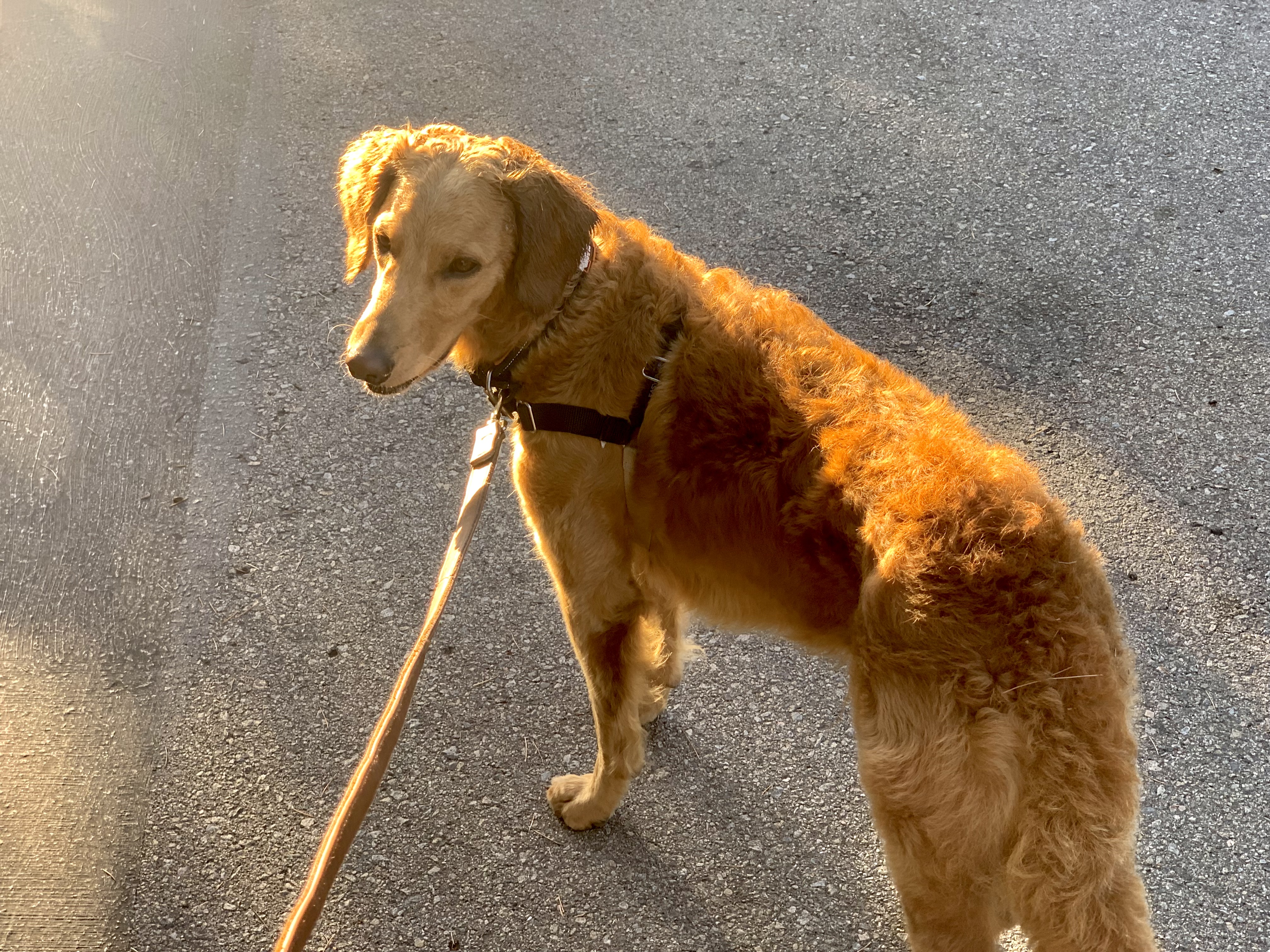
As we continued our walk, the golden sun lit up Sadie’s fur so I snapped the picture below.
And then we came to the golf course. This is the tenth green. If you want to play golf, you will need to become tolerant of your own errors.
So, as we began the long climb back up the street to our home, I began to wonder why tolerance seems so difficult for so many people. Intolerance of other races. Intolerance of other religions. Intolerance of other cuisines, clothing styles, color schemes, music, book genres, traffic merges, waiting in line, sexual preferences, and so much more.
On the one hand, I don’t want to “be” anyone else or any other organism. I admire the hawk but I don’t want to be a hawk. I’m happy being a human. I admire many of Sadie’s abilities. But I don’t want to be a dog. There are many choices that other humans make which are different from the choices I make.
It’s kind of a fun game. “Find Waldo.” Or, “Find the Pig in the Clouds.” And—once you find it, you typically find it immediately the next time.
Here’s a variant that I like: “Find the Beauty.”
The idea is simple. You go to an art gallery or a museum and it’s fairly easy to find the beauty. No big surprise there.
Go into a natural setting and you’re often absolutely surrounded by beauty at many different levels of scale.
Go to see a world-famous architectural achievement, and you will see beauty.
But—you know what? There’s also beauty to be found in many ordinary and every day places and circumstances. Since you can’t always control where you are, it’s a good skill to find that beauty wherever you are.
Today, Wendy and I took Sadie and Bailey out to one of our favorite dog-friendly restaurants. We had a very long wait. None of the four of us is high on the scale of patience. When we finally sat down, however, the dogs were very well-behaved.
While we waited for our food to arrive, I looked around for Waldo.
He wasn’t there. In fact, no-one even had a checkered shirt on.
So, instead, I looked around for beauty.
As usual, I found it, at least to my eye.
Give it a shot. You’d be surprised where you can find beauty.
Fit in Bits suggests many ways to work more fun, variety, and exercise into daily chores.
Corn on the Cob is an essay on mindfulness and gratitude for simple things.
Fifteen Properties begins a series of posts about the fifteen properties that architect Christopher Alexander said characterized both natural beauty and good design.
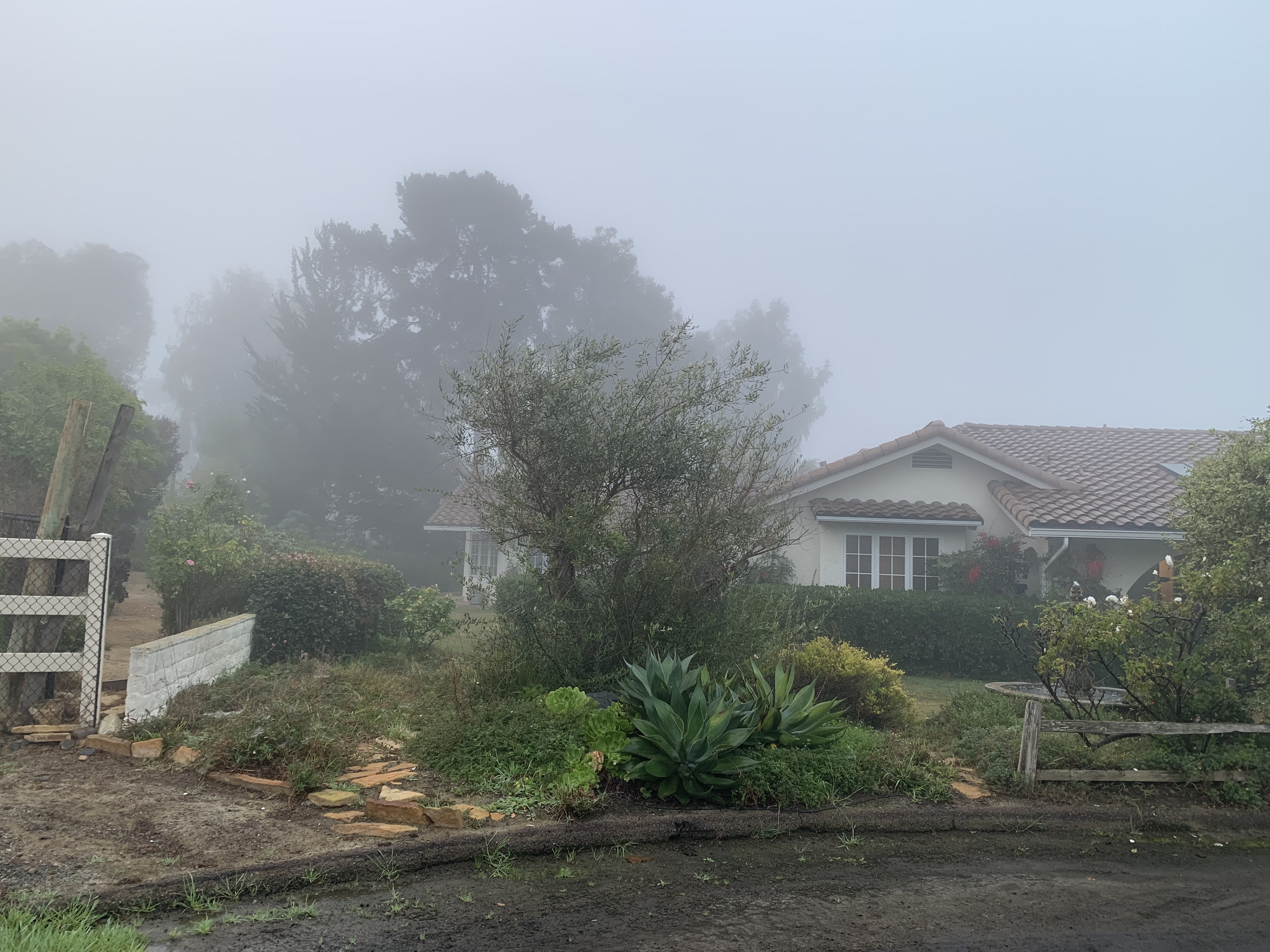
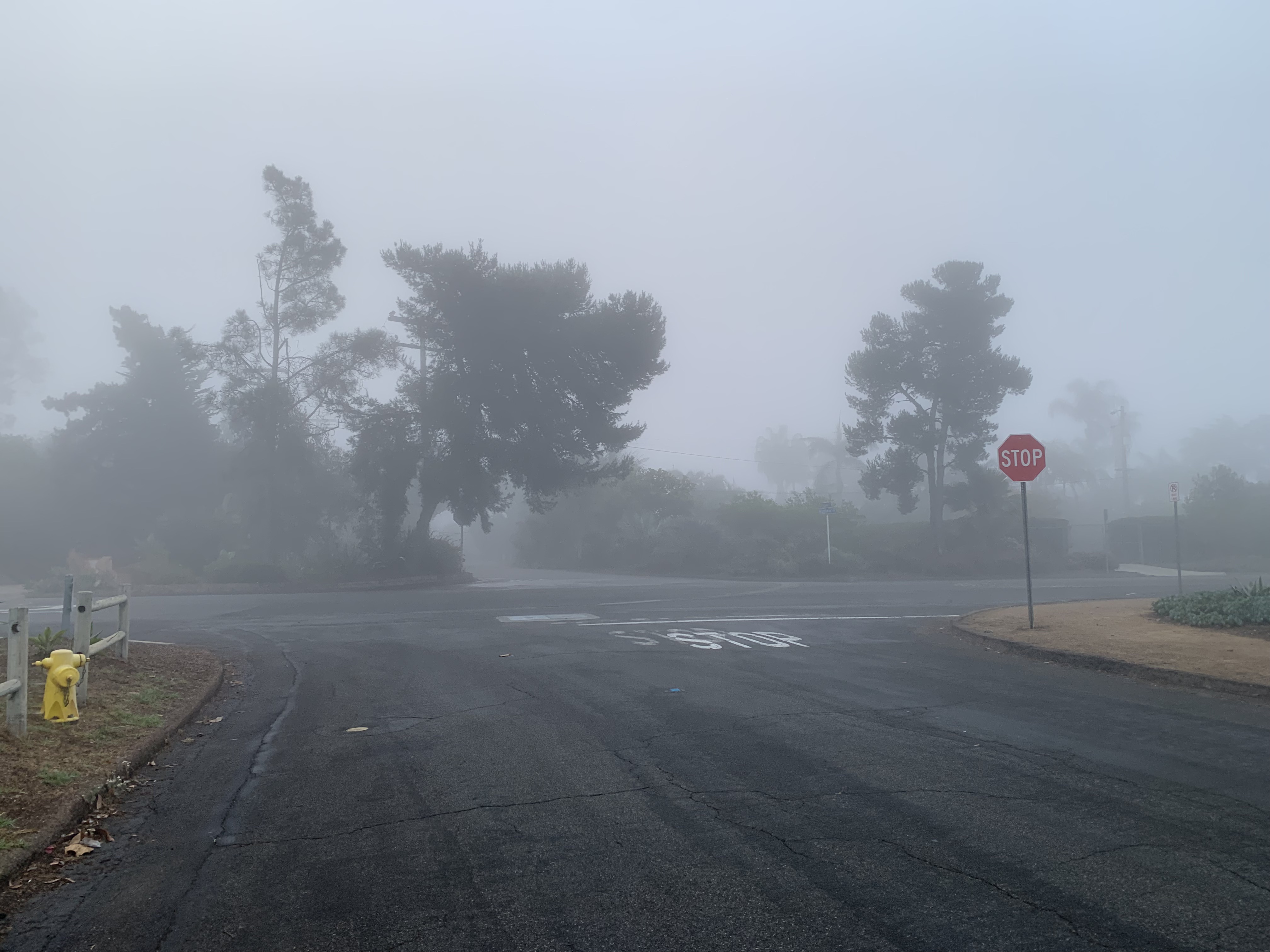
Our morning walk began, appropriately enough, in heavy fog. No sun. Cold. Damp. A slight but persistent icy wind.
How appropriate, I thought. No sign of a sunrise. Not near here.
Sadie, however, seemed oblivious to the fog, the damp, the cold, the politics. Before our walk began, I told her we’d try walking without the shoulder harness but she’d have to do “Good Walking” with no Pulling. She’s strong and pulling hurts my back and knees but especially my ankles and arches. The harness helps prevent her from pulling, but doesn’t really eliminate it.
She did good walking.
And I noticed that, up close, she is still as beautiful as ever. No gold or red from the rising sun, but still beautiful.
Indeed, the fog shrouds what is distant, but up close? Bright signs of beauty still beckon. If we bother to look.
Looking more distantly–ominous, if not downright evil.
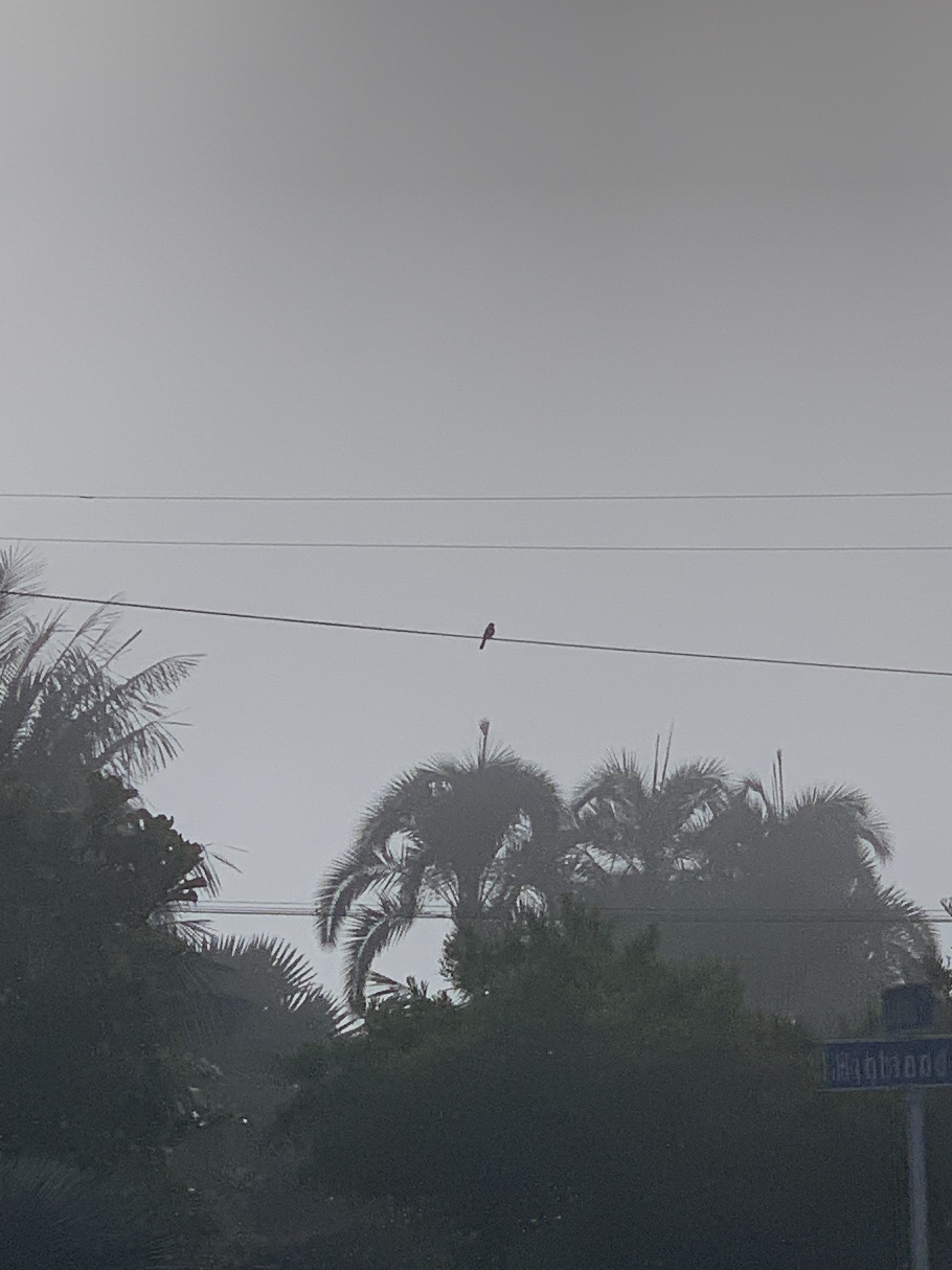
Even so, the lonely mourning dove coos on her thin wire perch.
Soon, the sun does begin to shine. Darkness, like cancer and greed, always eventually loses.
Those of you who might not have read every one of my hundreds of blog posts might have missed the story about my bout with “plantar fasciitis.” I had a persistent pain under my right heel. It was painful when I walked and I liked to walk every day. When I described the symptoms to some of my family and friends, more than one suggested I visit a podiatrist. A podiatrist, after all, is an expert in medical issues of the foot.
I made an appointment and sure enough, she confirmed the diagnosis several of my friends had mentioned: “Plantar fasciitis.” She showed me an exercise to stretch the tendons of my foot; gave me a prescription for megadoses of a non-steroidal anti-inflammatory; and she cautioned me to stop walking so much until my symptoms improved. I followed this advice, but my foot actually began to hurt more. After about a week of this, I went back to walking and my symptoms improved but the pain was still there.
A week later, I was watching TV with my wife and cats and in our nice warm dry basement (Shout out to Be-Dry). I often like to “fiddle with stuff.” On this particular occasion, I happened to “fiddle with” the sole insert in my shoes. I removed the insert and noticed that a small pebble had somehow managed to lodge itself under the heel of the insert on my right shoe.
Now, when I call it a ‘pebble’ I do so simply because I don’t know of a better word. It was larger than a grain of sand, but not by much. When I say ‘pebble’ I’m afraid you might be thinking of something more like the pretty pebbles that one might find beach-combing. You would not have seen this ‘pebble’ unless you were crawling along the beach with your nose about two inches from the ground. It was about the size of a lower case ‘o’ in this font size. Hard. Sharp. But tiny! I thought could this possibly be the source of my pain? No. No. It’s much too small.
Nonetheless, I removed it and my ‘plantar fasciitis’ disappeared.
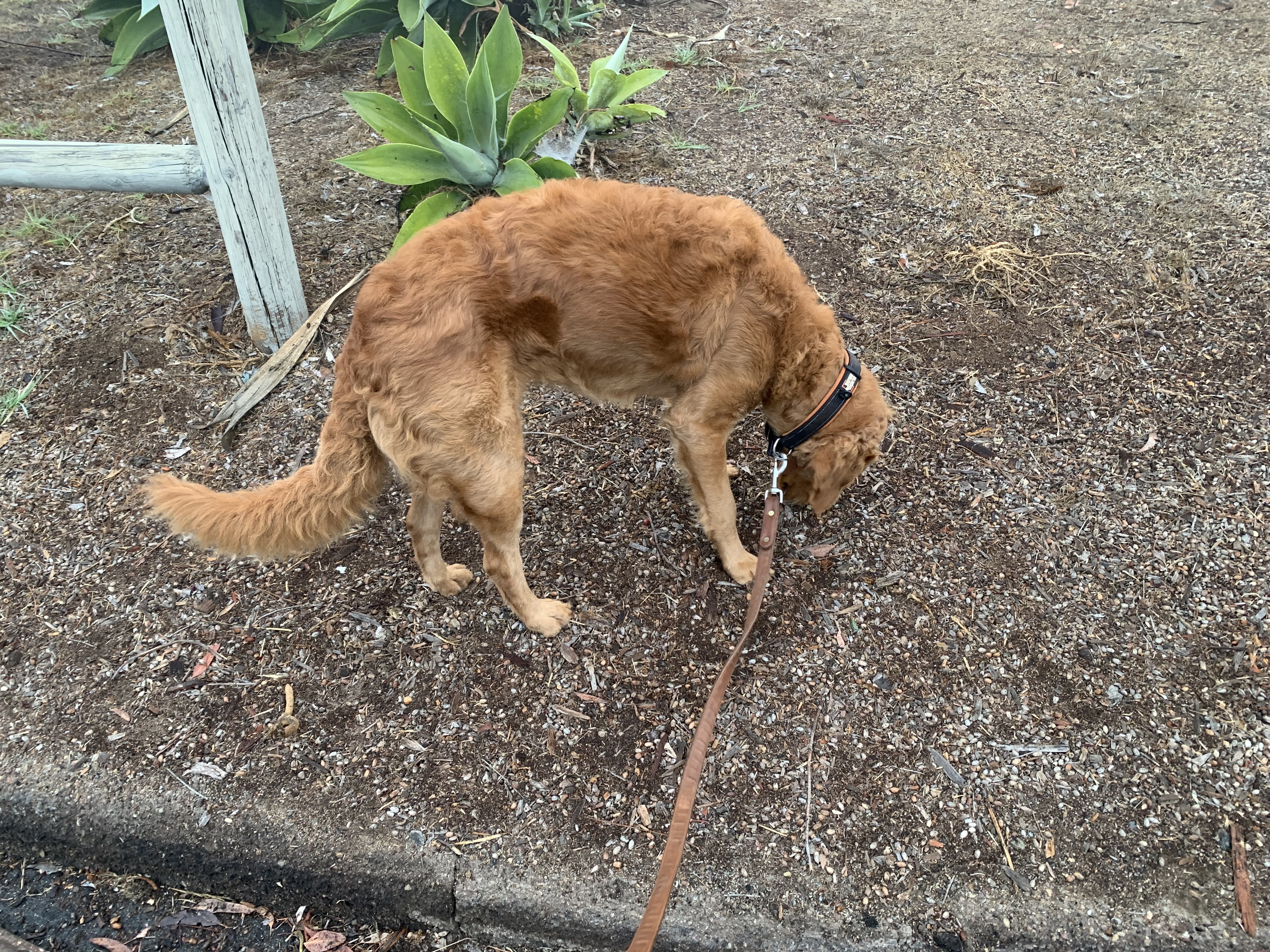
I was reminded of this today walking my dog Sadie who most often walks with her nose almost on the ground. Sometimes, I see a distinct wet stain that she stops and examines. Most times, I have no idea what she is sniffing at. I presume it’s often a bush leaf where the scent of another dog is particular strong. She pays attention to places I have seen a rabbit or bird earlier. She likes to retrace the path that our other dog Bailey took if I happened to have taken him out to pee. But it isn’t only where he’s peed. She seems to know the path he walked. Similarly, if I have taken the car somewhere in the last 48 hours, she goes over and sniffs that. She sniffs at my door only if I drive somewhere alone. But if I go to the grocery store, she also sniffs at each door that I have take groceries out of.
Yes. We all know dogs have a good sense of smell. But—seriously—how many molecules can she sense? Apparently, dogs can detect some smells in concentrations as small as 1-10 molecules per milliliter of liquid. A very small number of molecules could spell the difference between an escaped prisoner being tracked and recaptured or escaping to a new country and enjoying decades of freedom. Small thing—big effect.
I recall reading a science book as a youngster that showed a man holding a test tube. At the bottom of the test tube was a small amount of white powder. The caption said that this was enough botulism toxin to kill everyone on the planet if properly distributed. That seems an odd use of the word ‘properly’ but leaving that aside, it is clearly extremely toxic. How does the toxin work? It interferes with your internal communication system. Your brain sends a signal to your diaphragm muscle to contract, but the signal never gets to the muscle. Small thing—big effect.
Small things having big effects is not always about small things causing problems. Small things can also be important in having big effects in a positive way. For example, if you do such a small thing as look around you for beauty, you will often find it. If you don’t, look harder. If you still don’t, then create some or go elsewhere. If you make this small habit, over the course of your entire life, you will fill your brain with much more beauty. That is no small thing. It will impact your health and your behavior toward others. Small thing—big effect.
There are many examples from sports. Most athletes realize that they it helps to have a physical routine that is unvarying before throwing a baseball pitch, hitting a tee shot in golf, or hitting a tennis serve. Fewer realize that it’s equally important to have a consistent mental routine as well. I found it useful before every golf shot to say to myself, “Hit it perfect—like you know you can.”
Small things can also make a big difference in terms of what you observe. For instance, in my tennis group, there were, for a time, a high proportion of left handed players. Roughly half of the players were lefties, though only about 10% of the population is left-handed. Of course, it’s fairly obvious immediately that one’s opponent is left-handed. A clear implication is that what constitutes a backhand and forehand are on different sides. A more subtle difference is from the natural sidespin that is put on a shot. A forehand topspin shot, as the name implies, is mainly topspin. Some players hit a fairly flat shot while others—notably Rafa Nadal and, more recently, Carlos Alcaraz, can hit with tremendous top-spin. This shot also has somewhat of a sidespin component and that varies from player to player. Although professionals can alter the degree of sidespin, the amateurs I play with have a habitual way of hitting the ball. As the ball strikes the ground, a right-hander’s shot toward my side of the court will bounce slightly to my right while a left-hander’s ball will bounce slightly to my left. This means that positioning my feet optimally for the return shot will be somewhat different for various players.
There are many small differences in how people play. If you notice such differences, you can do a much better job of “reading” what type of shot a player will hit, where they are aiming, and so on. The differences are slight but cumulatively, the impact of noticing such differences is considerable. Small thing—big effect.
I don’t like to receive flattery and I don’t like to flatter people either. However, I do make a habit of giving people compliments. If you are observant, this is usually easy to do because most people are doing good things most of the time. When I play tennis, for example, my partners and my opponents will often hit excellent shots. I comment on it. It makes for a better game. Over time, it’s better for everyone. Never admit aloud your opponent has just hit a good shot? Keep on your game face? Not my thing. Why make life grimmer and meaner? Someone hits a great serve or a good tee shot or sinks a long putt, I compliment them. I’m impressed. So why not share that feeling? Small thing—big effect.
I’ve never been close to being a professional athlete. On the other hand, I’ve enjoyed many kinds of amateur athletics. Playing ping-pong, tennis, racquetball, football, baseball, golf, volleyball, basketball, softball—to me, each has provided hours of enjoyment—win, lose, or draw.
During all those hours of enjoyment, there have been a few moments where everything went right for a few moments of—I won’t call it glory—because the audience was small and not the point. I would have enjoyed those moments nearly as much if I’d been alone. It was the joy of living, being, moving, seeing, hearing, and having it all work together.
Such moments involve skill combined with dumb luck. In third grade, for instance, I was playing center field when the other team had the bases loaded and no out. A short liner was hit my way and I sprinted toward the sinking ball. Apparently, the runners all thought the ball would drop for a base hit because they all sprinted for the next base. I caught it near my shoes and kept running I stepped on second base to double the runner who had left there and immediately threw my mitt to my left to tag the one arriving at second base from first. Yes! An unassisted triple play.
In college, I got married between my Junior and Senior year and, while I went to school full-time, I had three part time jobs. It just so happened that my intramural softball team was playing near-by my path from job one to job two so I ran by the baseball field. They put me in as a pinch-hitter and I hit a grand slam home run. After crossing the plate, I ran to job two. In this case, there was a lot of luck involved in even having the opportunity to participate in the game, let alone hit a home run.
When I began working at IBM Research, I played pitcher on a city league softball team. At one point, I needed to cover home. A giant hung of a guy barreled into me as he sprinted home from third. He made no attempt to avoid the tag. His plan was clearly to knock the ball from my mitt regardless of what happened to me. He hit me so hard I did a 270 degree twist while executing a back somersault. But—I held onto the ball and he was out. I took no pleasure in the fact that he broke his wrist while I was relatively unscathed other than some bruising and whiplash. Once again, conditioning and skill, along with a fierce determination not to drop the ball combined with dumb luck.
I’ve had similar moments in tennis and golf, frisbee, and football. But my greatest examples of truly astounding athletic prowess comes from my uncanny ability to pick up a pebble with the sole of my right tennis shoe and throw that stone with perfect arc and timing so that it lands in the space that temporarily appears as I stride between my sock and the “collar” of the shoe. In many cases, the pebbles are irregularly shaped and they must be oriented just right to slip into that small and fleeting cavity. Unlike the unassisted triple play or the grand slam home run or my “Hole-in-One,” however, hacky-sacking a stone into my shoe with the other foot is a repeatable experience!
Of course, it is tempting to be annoyed when this happens since it makes walking uncomfortable and even painful. Theoretically, I can stop and untie my shoe, but I’m usually walking an impatient and powerful dog. And, often, on the route I walk, no-one has thoughtfully placed a couch and ottoman along the road so that I can simply remove the stone. But instead of being upset, I choose to marvel at the sheer skill such a shot requires. And even though, it’s commonplace, the skill of my body thrills my soul. But what lasts is beyond even that. It is a celebration of life; to some extent, what it means to be alive as a human, but even more, it’s what it’s like to be alive as life. Life of any form is about being “tuned in” to the environment and organizing your own resources to obtain a goal. And when it all seems to work magically well, it’s an amazing reminder of what life can do when it really tries—and has good luck.
One of the most pleasurable “chores” I’ve ever had is walking our goldendoodle Sadie twice a day. It’s exercise. It’s a chance to see nature’s beauty. It’s a chance to interact with Sadie and informally explore her mind. She likes to vary her route. She likes to return to “known” spots and also to explore new places. She knows when we are “headed home.” And, once we begin heading home, she typically begins to engage in a variety of “procrastination” behaviors. She stops and licks herself. She stops and looks back to see whether any of her neighborhood friends—human and dog—are headed our way. She suddenly finds an incredibly interesting scent to track down.
Her procrastination is something I completely understand. I did the same thing as a kid. And my kids did the same thing. And their kids did the same thing. While I sympathize, it also gives me a chance to think. What does it mean to be heading home? Can one ever go back home?
Undo and Home Base
Early in my career as a researcher in Human-Computer Interaction, I had an opportunity to contribute to a set of “Guidelines.” Although the New York Times once erroneously ascribed the “invention” of UNDO to me, I did not invent it. It seems to me that the concept is actually quite old. I did, however, mention in the guidelines that UNDO should be provided as well as providing a “Home Base”—that is, a way to go to a state where you could begin again.
To Sadie, and to me, our home is our home base. Like other home bases, we conceptualize them as being a return to an unchanging safe space. Relatively speaking, and roughly speaking, that’s a good characterization. It’s relative because no place on earth is absolutely safe. Disasters can come in many forms: extreme weather, wars, crime, and disease to name four. Also, even if disaster doesn’t strike, we can be sure that home will never be exactly the same as when we left it. Everything is constantly in motion and in flux. It can be comforting to imagine that home stays the same, but it doesn’t. Nor does Sadie. Nor do I.
Sometimes, a moderate amount of change is nice. I like to take photos in our beautiful garden. I end up sometimes taking pictures of “the same” plant or flower several days in a row. I also tend to take flowers when they bloom, year after year. Sometimes, these pictures look very similar on successive days or on successive years. But in actuality, they are never exactly the same. The plant itself changes day to day (as do I; as does Sadie; as do you). In addition, the light changes from day to day. The surrounding plants in the garden also change from day to day and year to year. In addition, when I take a picture, I’m not in the exact same position. The software on the iPhone changes over time as well. The lenses on the iPhone change over time. Even if by some industrial strength replicability dream (nightmare?) I could take exactly the same photo, you wouldn’t perceive it as the same because your eye/brain system is always changing, both organically and by virtue of your other visual experiences.
Another Sunset
There are characteristics of sunsets that we see as similar over time. Here are three sunset shots years apart.
Another “Another”
Are there any replications? In my mind, sure. In reality, no.
A rose is a rose is a rose, but not only are two different roses ever identical. Even one rose is not the same day after day, hour after hour, or even second by second.
Another Trip Around the Sun
What is more steady than the movement of the earth around the sun…or the sun around the earth. In the Medieval times, the Europeans wanted to describe in perfect circles and put themselves at the center of the universe.
Now, we are more sophisticated and know that the earth actually orbits the sun. Our seasons depend on the relative position of the earth and the sun. But while we are aware of our trip around the sun, earth does not return to the same spot. Today is November 1. Next November first? The sun will have traveled through our galaxy 6,942,672,000 kilometers. That’s a far piece. I’ve run a number of 10K races. The galaxy travels a lot faster.
Another Homecoming? Is it possible? Can we use time machines?
Can we go back to the 1950s?
Can women simply forget that they were once treated as human beings?
In order to work effectively, today’s technology presumes a whole set of other technologies, skills, infrastructure, attitudes, processes, laws, rules, regulations. If we actually tried to go back to 1950, we would miss.
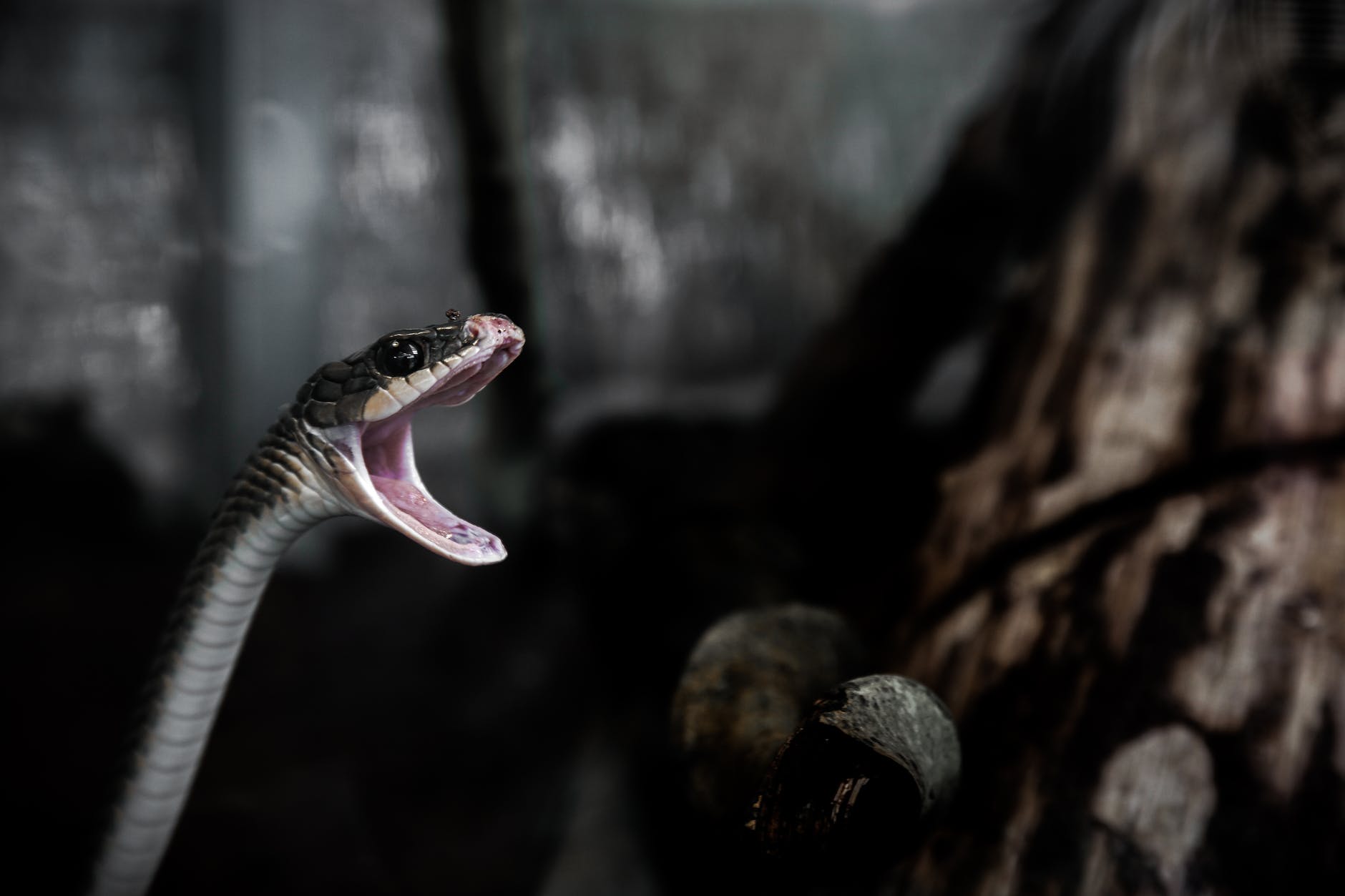
By about 500,000 years. Every so-called primitive tribe ever studied has customs, rules, practices, and rituals. Going back to the 1950’s by destroying the rule of law won’t work no matter how loudly people scream for it. You can’t scream your way to the moon. You can’t scream your way to Mars. You can’t scream your way to happiness. You cannot make two plus two equal five, no matter how loud you scream. Sadie can’t bark them into equivalence. A snake cannot hiss them into equivalence.
You can typically get yourself home. But no matter how hard you “insist,” home will not be in precisely what it was when you left. And, it definitely won’t be in the same place in the universe. Not even close. Going back is a mental exercise and never a physical reality.
Dan Johnson’s family had been dairy farmers for as long as any of the folks in or around Oshkosh could remember. Like his pa and grandpa, Dan dressed the part. Going to the general store, fiddling a jig at the barn dances, or tending to his herd, Dan could be seen in his checkered shirt and blue jeans held up by red suspenders. Like many (but not all) of the Johnson clan, Dan sported curly red hair and freckles. His once-handsome face now bore a strong resemblance to corrugated cardboard from his many years in the sun.
Now that Cindy was gone, he didn’t much care. And he didn’t even care that he didn’t care. Life went on, and he did have flashes of pleasure, but they grew ever dimmer and rarer as the lonely years passed. Dan still enjoyed his herd. He enjoyed feeding them, milking them—hell, he had even come to love the putrid smell of cow patties. He also enjoyed the occasional visits from some of the other old codgers in Winnebago County.
Though winter seemed to come later each year, he hadn’t yet thoroughly prepared for this one. He stayed strong from handling the chores on his own. He still felt pangs of regret that he hadn’t had more kids. Now he had no surviving sons or even cousins to help, and, more importantly to take over once he…”passed on.”
Dan took a breather from wood-chopping and made himself a cup of black coffee. He had always considered cream and sugar a “sissy way” to enjoy coffee. He loved the unadulterated bitter taste. He set down his cup to cool a bit. His fingers idly pulled the stack of papers toward him across the slick formica. He squeaked and squinched his chair around so the dim light of late October fell onto the contract. He shook his head.
In his younger days, he’d never imagined ever selling his farm. If he had imagined it, it sure as hell would have been to a neighbor, not some dark-suit, white-shirt, red-tie from New York, of all places. Of course, back then, he’d had no idea that he’d lose both sons, one to war and one to COVID. Every year, it got just a little harder. He’d had no idea how difficult it would become to compete with the huge agro-business factories.
“Factories.” Dan couldn’t bring himself to think of the “Golden Opportunity Pastures” as actual farms. The way that smooth-talking New York fellah—Steve Banshee—talked about the cows—well, come to think of it— the way he talked about everything—yeah, Mr. Banshee talked about everything like he was doing some kind of math problem. But the math never seemed to add up. Banshee’s way was to scream and coo and wave his hands and then go back to screaming again.
Dan looked over to where Cindy had sat for four decades. He imagined her and smiled. “Well, Cindy, what do you think? Should I sell this old place? This city fellah, you heard him, I guess, he says they don’t have any use for this old house and I can stay here as long as I’m above ground and then he’ll arrange for me to be buried right beside you. He promised you and I could sleep under the old black walnut tree forever. And, he promised to let Old Blue stay on too, though she can’t give milk any more.”
The light began to fade. Dan sighed. It was some good money, all right. “Cin—I’ll tell you what—I can buy a real nice headstone for you. I know. You’re happy with the little cross I make for you every spring. I don’t want those city folks forgetting where you are. Sure, I admit, I’ll buy a few thing for myself as well. But I’ll send along a check to your friend Sue in Milwaukee too. It would be from both of us. Appears, I’ve made my mind up.”
Dan stared at the contract. He began to read it and it made no more sense than it had the first few times. But, after all, this Mr. Banshee from New York said he was an expert about these things. And, he had made it very clear how much the money was and about the provision for Dan to keep the house and burial plot. Dan signed the papers. For a moment, he hesitated because he couldn’t see Cin’s signature. Then, he realized that was just habit. He didn’t feel sad. But a single teardrop fell onto the spot where Cin’s name had been.
Now that he and Cin had finally made up their mind, he felt lighter, younger. He slept very well that night. He mailed back the signed contract and his week went on as it usually did and he talked to the cows as he milked them and he told them about selling the place and tried his best to paint the buyer, Mister Banshee as a nice person, but the cows weren’t buying it. They pretended as though they didn’t really understand what Dan was saying.
It wasn’t until the following Monday that Mr. Banshee showed up along with two young linebackers or professional wrestlers.
Dan hated to scream, but once Banshee had told him “how it’s going to be” that didn’t stop him, “Mister Banshee! You agreed! We shook hands! Right here in this kitchen! Shook hands.”
Banshee held up his hands like a crossing guard, “Hold it right there, Dan, you know as well as anybody that people say all sorts of things when they’re negotiating, but what matters is the signed document. Why? Different people have different memories of conversations, but the written document is in black and white. It is what it is. And a good thing because I don’t even recall talking about having you stay here, let alone anything about a burial plot or a sacred cow. Good Lord, man. Think! We have standard contracts. The only thing that changes are the amounts and dates of payouts.”
Dan pursed his lips tight. He clenched his jaw. He stared at Mr. Banshee without speaking. He glanced at the two thugs who stood behind Banshee. For a moment, his mind fled to the two cords of wood he’d stacked up for the winter. Then, he thought of “Paul Bunyan”—not the legendary giant woodsman—but the axe he used to chop firewood. It was a name Cin came up with many years ago.
Dan, shirtless, had been splitting logs on a warm summer’s day. She’d come out to him with a jam jar filled with lemonade. She’d smiled as she handed it to him and said, “Well, now, if you don’t just look like Paul Bunyan himself!” Dan had blushed as he took the glass, beaded with condensation, and lightly stroked her fingers.
He liked the name Paul Bunyan, but applying it to himself? No. He had smiled at her though and tapped the oaken axe handle. “This is the real Paul Bunyan.” From then on, they’d both referred to the axe as “Paul Bunyan.”
From somewhere far off, he heard someone talking. It was that Banshee fellow. He was still jabbering on about how the time for negotiating was over. They had a signed contract and Banshee had placed a check right before him. Dan stared at the check. It was a lot of money. It was the largest single check amount made out to him that he’d ever seen. It was also about one quarter of what they had “agreed to.”
Mr. Banshee reminded him once again that he needed to move out by Friday. At the latest. After that, anything remaining on the property would belong to “Golden Opportunity Pastures.” Dan nodded and followed them out to their car. The trio of “city folk” leaned on their car and Mr. Banshee said one last thing, “That money should last you awhile, Mr. Johnson, if you’re wise with it. I hope you learned a valuable lesson. Watch what you sign. Oh, and remember city folks are just plain smarter than the folks hereabouts.”
Dan nodded and said softly, “Hold on, Mr. Banshee, I’ve got some maps & schedules in the barn that you’ll find useful. I’ll be right back. Just take a minute. You folks stay there. I’ll get everything you need.”
The thugs that Mr. Banshee brought with him were strong, but they were no match for a herd of cows driven by a cattle prod that Dan had very seldom used until today. One of the thugmen had reached into a holster and taken out a pistol. Paul Bunyan took care of that arm. The man screamed and tried to stop the bleeding. Uselessly.
Dan saw the wounded men and took pity on them. Lots of broken bones. Lots of pain. Paul Bunyan fixed all that in a few moments. Dan sighed.
“Well, Cin, we got us a lot of work to do. Can’t bury them here. Ground’s too near frozen. Gonna have to drag them one by one to the marsh. Old Blue can help though.”
Two weeks later, after a light brushing of snow, the local sheriff, Bill Baxter drove up in his “Oreo” which is how the locals referred to the police cars. Dan offered Bill a cup of coffee. Bill took his black, just like Dan. “What’s up?”
“Well, Dan. Here’s the thing. There’s a real estate guy missing by the name of Banshee. That name mean anything to you?”
“Yeah. That’s the name of a fellah who came all the way from New York City. He wanted to buy my farm. Came up a couple times. He didn’t want to take “no” for an answer. I guess he finally got the hint. Haven’t seen him for awhile.”
“Okay. Well, he seems to be missing. Any idea about that?”
Dan bit his lip and tilted his head. “No, he didn’t say where he was headed next. Last time I saw him, he handed me a contract. I signed it, ‘Suck my Johnson’ and mailed it to him. I figured that might help him get the message. Anyway, he hasn’t been back since. So I guess it worked.”
Bill stared for awhile at Dan. “Maybe. Thing is, the people at his office apparently didn’t notice that you hadn’t signed your actual name and cut a check. And that check was cashed. It was a good deal of money. They seem to think you sold the farm.”
“No idea, but I am sure I’m not rich. Look around. Same as always. If there’s a check, I haven’t seen it. And, I sure as hell will never sell this farm. Especially not to a New York City guy in a suit.
Dan smiled at Bill and thought, Guess the trip to Minneapolis was worth it. Dressed in a suit and tie, with his beard trimmed short and wearing a white cowboy hat, Dan had looked quite different standing in line at Sunrise Bank. Not that anyone bothered to look for him on security footage, but if they had, not even officer Baxter wouldn’t have recognized farmer Dan.
Bill finished his coffee and stood. “Well, Dan, if you hear from this guy Banshee again, let me know. Or, if you remember anything he said about where he might be headed next. Okay?”
“Sure will. Have a great day now.”
Dan looked out the window and saw Bill do a Y-turn in his gravel driveway. He nearly backed into the chopping block into which Paul Bunyan sank his single sharp tooth.







































 petersironwood