• About PeterSIronwood

petersironwood

~ Finding, formulating and solving life's frustrations.

petersironwood

Tag Archives: environment

Myth of the Veritas: The First Ring of Empathy. 

21 Wednesday Jan 2026

Posted by petersironwood in management, psychology, Uncategorized, Veritas

≈ 3 Comments

Tags

competition, contest, empathy, environment, fantasy, fiction, love, myth, politics, shaman, truth, Veritas, writing

Myth of the Veritas: The First Ring of Empathy. 

fullsizeoutput_1a4c

In the heyday of the Veritas, when the people had prospered and spread far beyond the lake of reeds and bubbling streams, yet long before they forgot the field of flowers, there lived among them many who dedicated their lives to learning and teaching. The people of the Veritas sometimes variously called them “Shaman,” or “Wise One,” or “Great Leader.” And among these, one in particular they called, “She Who Saves Many Lives.” They devised this name because of many wise insights she had but also because she literally saved individual lives with her knowledge of healing herbs and ways but also because she helped to save even the lowliest creatures in the forest, field, and stream. Of course, none of the Veritas chose to kill any of the creatures wantonly but only for need. For all of the Veritas saw that the lives of the Veritas all depended on the prosperity of all of life. “She Who Saves Many Lives” went beyond this and developed ways to encourage many of the creatures of forest, field, and stream to be healthy and fruitful. In this way, the Veritas themselves were also healthy and fruitful. 

{Translator’s Note}: Try as I might, I find this part difficult to translate into modern English. I seem hamstrung by our modern notions of “agency” and “responsibility” and “choice.” It wasn’t that the Veritas “decided” it would be in their “long term interests” not to kill creatures for no purpose other than to show that they could. Such actions were out of harmony and out of character with their very existence. Consider the following modern metaphor. People who are gifted musically spend much of their lives improving their skill. The very best of them may be able to play in a symphony orchestra. The whole point of their playing is to be part of the creation/recreation of beautiful music. A flautist in such an orchestra does not “decide” not to make horrid screeching noises rather than participate in making beauty. Theoretically, of course, they could. Or, they could bring fire-crackers and set them off in the middle of the symphony. But why would a person who dedicates their life to making beautiful music do such a thing? In a similar way, insofar as I can tell from artifacts, scholarship, and the entire mythic structure of the Veritas, these people did not consciously “decide” not to wantonly kill their cousins in other parts of the Great Tree of Life for no reason. Any person of the Veritas would gladly want to help the forests, fields, and streams to flourish. However, one of the talents of “She Who Saves Many Lives” was that she apparently saw many new ways to facilitate such flourishing. 

sparks of firecracker

Photo by Suvan Chowdhury on Pexels.com

The other phrase I’m not entirely satisfied with is the name of the Shaman herself. A more literal and more accurate translation of her name would be: “She Who Fosters the Entire Tree of Life with a Focus on Her People but Who is Ever Mindful of the Music of the Entire Tree” I think you can see why I chose the shorter name!

“She Who Saves Many Lives,” though strong and healthy and young, yet foresaw that while the Great Tree of Life would grow and prosper for many, many moons, her individual life would, at some point, come to that same end that awaits all individual lives. Thus it was that she wished to help choose and prepare the next Great Shaman. And thus it was that she devised a series of seven tests. The tests would be carried out in public and any who thought they would like to dedicate their lives to learning and teaching and healing could try their hand at these tests. 

“She Who Saves Many Lives” crafted seven types of beautiful rings. Each type of ring was studded with a different type of beautiful polished stone. Each such ring would be given as a prize to those who passed the tests she devised. Each such type of ring, “She Who Saves Many Lives” called a “Ring of Empathy.” The first type of such rings were known to be made of bronze and each bronze ring sported a crystal of clear calcite. These she made openly and all could see her exquisite craftsmanship. Those who wished to try their skill at the trials came to her before the spring rains began and let her know their intention. Each time another initiate wished to be admitted to the trials, she made another ring. However, she said nothing whatever about the nature of the first trial, nor indeed any of the trials. She created them all in her own mind. When various would-be contestants came to her to watch her work, they tried a number of clever ploys to try to learn the nature of the trial so that they might better prepare themselves. “She Who Saves Many Lives” merely smiled at each such person and wished them good luck. 

IMG_6737

At last the spring rains came and spring flowers bloomed all around the end of the lake of reeds where “She Who Saves Many Lives” made her home when she was not traveling amongst the many villages of the Veritas. At last, the spring rains gave way to the hot dry period. When the new moon first began to show its crescent, it signaled the appointed day of the trial. A dozen came to try their skill in the trial but many more from all the lands of the Veritas came as well in order to see who would prevail. “She Who Saves Many Lives” gave each contestant a small piece of deer hide with a rough map of the area. On each map, the symbol of each of the contestants was designated at a particular nearby and noteworthy place. Each of the participants knew each of these symbols and recognized the places as well, for all people in those days wished and worked to know the location of every tree, path, stream, and boulder. 

{Translator’s Note}: The Veritas, so far as I can tell, did not at this point have what we would call a “written language” but they did make maps, some of which have survived to this day. Many (but by no means all) of the symbols on these maps would be interpretable by modern humans of most cultures. In addition, everyone not only had one or more spoken names, but also had at least one unique symbol. Such symbols typically reflected something of the physical or behavioral aspects of that person and were therefore much easier to remember than most modern names are for us to remember. 

Each contestant was well aware of the symbol for each of the others. Each of the twelve maps were identical and showed the location that each of the twelve contestants was to go to as quickly as possible. Once there, further instructions would be sent by drumbeat. Having the final instructions sent in this way was not only the most practical method of distant communication; it also increased the drama for everyone. 

brown wooden percussion instruments

Photo by Pixabay on Pexels.com

{Translator’s Note}: No-one knows the precise coding for the drumbeat language of the Veritas. I can, however, say with a high degree of certainty that it was nothing like Morse Code. The drumbeats were more like a hierarchical description of the instructions and each series of beats further refined the instructions. In what follows, I try to give some sense of that, but it’s largely a guess as to specifics though the details are unimportant as to the outcome for the participants. The only necessary point is that each contestant understood what the instructions meant.   

Welcome. Contest. Be smart. Be accurate. Be quick. Mark on the map. Numbers. How many do you see? How many do each of you see? Mountaintops. Begin! Run back with your map. Filled with 12 sets of marks. 

In this way, the first contest of the Veritas began. As you can see, although “She Who Saves Many Lives” called this an empathy test, it really required a number of skills in addition to empathy. It required a knowledge of the terrain, good eyesight, the ability to understand a new task quickly, good spatial visualization, and good foot speed.

Within ten minutes of the end of the drumbeats, some of the contestants could be seen entering the outermost ring of the sacred circle, running swiftly with their maps. Soon, all twelve of the contestants had breathlessly handed their maps to “She Who Saves Many Lives” who had so far given no hint as to how many contestants would be entered into the next phase of the contest. All the contestants gathered in a semi-circle around “She Who Saves Many Lives” and at her instruction, everyone in the crowd sang a song of praise for all who had attempted the task. Then, without a word, “She Who Saves Many Lives” bestowed bronze rings adorned with a calcite crystal on the ring fingers of those she deemed worthy to continue on to the next contest. There were ten, who collectively came to be known by the Veritas as “Those Who May See Through the Eyes of Others.” All ten had correctly and perfectly counted, not only the mountaintops that they themselves could see from their own assigned positions, but had also accurately counted how many each one of the other contestants could see as well.

landscape nature night relaxation

Photo by Pixabay on Pexels.com

“She Who Saves Many Lives” did not herself use that designation for the ten. For this had only been the first, and easiest of all the tasks she had devised for being able to see through the eyes of others. When she thought of them collectively, she privately called them, “The Ten Who Can Count Mountaintops with the Eyes of Others.”  

————————————————-

Now, dear reader, you may now see that I have included these translations of the Myths of the Veritas because they very much relate to the fields of “User Experience”, “Human Factors,” or “Human-Computer Interaction” despite the fact that these tales quite apparently predate modern technology. To the Veritas, choosing a new leader for their people was never a matter to be left to chance, or visions, or a contest to see who could lift the most or lie the most. A leader of all the people should be able to see the world through the eyes of any of the people. How else might such a leader help insure a decision was for all the people and not just for a few? 

—————————————————

Magic Portal that Allows Books to be Delivered to Your Porch! 

The Orange Man

The Forgotten Field

The Impossible

Somewhere a Bird Cries

The Last Gleam of Twilight

They Lost the Word for War

After All

All We Stand to Lose

Guernica

Where Does your Loyalty Lie?

My Cousin Bobby

The Update Rule

What About the Butter Dish

You Bet Your Life

Essays on America: The Game

Essays on America: Wednesday

When Greed is the Only Creed

Facegook

The Dance of Billions

Roar, Ocean, Roar

Imagine All the People

Non-Linearity

04 Sunday Jan 2026

Posted by petersironwood in America, management, psychology, Uncategorized

≈ Leave a comment

Tags

AI, environment, equilibrium, feedback loops, life, ping pong, politics, research, science, sports, story, systems thinking, table tennis, testing, truth, writing

Non-linearity

A Chessboard Full of Rice

According to myth, the Emperor’s wise adviser once did him a great favor. So grateful was the Emperor that he begged his wise advisor to take any gift she might like from the vast treasures of gold or jewels, any lands or gardens, any of the Emperor’s many male children to be her companion. However, the advisor answered as follows: “Thank you for your generosity, oh mighty Emperor. I have no need of great material wealth. My needs and wants are simple. I do get hungry and thirsty, of course, as do we all, and sometimes my household runs short of rice. You see this fine chessboard?”

battle black blur board game

Photo by Pixabay on Pexels.com

“Oh, yes, my wise counselor, it is indeed finely made of gold and silver and I would gladly give you twenty such!” 

“Thank you again for your generosity, but I only wish for a some grains of rice. Give me one grain on this space and tomorrow, two grains on this space and the next day, four grains on this space. Each day for 64 days, double the number of grains of rice you gave me the day before. At the end of the 64 days, I will ask for no more.” 

The Emperor looked puzzled. “Surely, you must have something more valuable than rice! Name it!” 

“No, Sire, that is all I desire. Just the doubled rice will do quite nicely.” 

“Well, it shall be so!” And thus the Emperor told his staff that they were to provide a grain of rice for the first day, two grains of rice for the next day and to double the amount each day until all 64 days had passed. At first, it seemed such a pathetic gift for such a great favor. 

Even after 8 days, the wise counselor only received 128 grains of rice – not even a bowlful. 

Readers familiar with exponential growth realize that on the 64th day, the Emperor has promised to deliver 2**63 grains of rice. This is not only more rice than the Emperor had at his disposal. It is more grains of rice than exist in all the kingdoms of earth. To be exact, the last payment is meant to be 9,223,372,036,854,775,808 grains of rice while the total is one less than 2**64. To put the matter scientifically — it’s a lot of rice! Much more than exists in the world. 

How would you like the story to end? A wise Emperor, to my mind, would thank the counselor after a couple weeks and say, “I see, oh wise Counselor, that you used my gift to give me another gift to enhance my wisdom. For I now understand that what seemed at first an easy thing to do is actually quite hard. Doubling soon undoes even the richest king. I will keep this in mind when I think about interest rates and population growth.” 

A crummy Emperor, on the other hand, might say, “I offer you a gift and you see fit to embarrass me by making me agree to an impossible task? Boil her in oil!”

The Lily Pad Pond Puzzle. 

Beside my house is a pond. In this pond, a lily pad began to grow. Every day, it doubled in size. On day 20, it completely covered the surface of the pond. The surface of the pond is 400 square feet. How many days did it take to cover half of the pond? 

red and green lily pads focus photography

Photo by Skitterphoto on Pexels.com

At first glance, you might think this problem is insoluble because you don’t know how big the lily pad was initially. In fact, you don’t even need to know how large the pond is. It will cover half the pond on day 19.  

The Ping Pong Table Ping Pong Player Population

When I began at IBM Research in 1973, I soon discovered that a fair number of researchers were avid table tennis players. At lunch time, somewhere between six and twenty researchers would show up to play. There were two tables and some small amount of room for spectators to stand on the edges of the two ping-pong rooms and watch. Our rule was that if a person won, they would stay at the table and a new challenger would play. However, if you won three times in a row, you had to sit down regardless. I didn’t go over every lunch time, but I went over quite a few times over the course of my first ten years there and there was invariably someone to play with. Sometimes, I had a longer wait time than others, but it was never too long a wait. 

Then, because management wanted to use one of the two ping-pong rooms for other purposes, they repurposed one of the rooms. Now, there was only one ping pong table. In the two ping-pong table case, remember, I never had to wait too long nor did I ever go there and have no-one to play. As I said, the number of players varied between somewhere around six to twenty. What is your prediction about how many players showed up when there was only one ping pong table? 

Here’s what happened. The first day after this change happened, I went over and about fifteen people showed up. I, like everyone else, waited a long time for a game. Our “official” lunch hour was actually 42 minutes and the building was a five minute walk away. So, if you had to wait a half hour for your chance to play, it really wasn’t that much fun. In addition, there were some more subtle effects. All the players were good, but there some substantial differences in skill level. People tried to arrange it so that they played someone at about the same level. WIth only one table, this was trickier. In addition, when a relatively large number of people showed up, it was too crowded for everyone to see the match without interfering with play. It happened that I was too busy to go for a few days. The next time I showed up, no-one was there. Some of us talked about trying to “organize” the ping pong to insure that enough people showed up but everyone was busy and no-one wanted to take this on. Scheduling researchers is harder than you might think. It was hard for people to make a commitment to show up at noon because a meeting might run over, their manager might give them extra work, etc. The number of people showing up swung wildly for about two weeks and then stabilized. 

At zero. 

What had been a vibrant community with two ping pong tables did not stay the same size, or shrink to half when we were limited to one table. It went to zero. 

Warring Positive Feedback Loops. 

We’ve already talked about “positive feedback loops” which are also known as “vicious circles.” Sometimes, there are actually (at least) two positive feedback loops hiding beneath what appears to be a stable system. In the Case of the Missing Ping Pong Table described above, one positive feedback loop was simply that when you went there and had a good time through some combination of watching good matches or playing yourself, you were more likely to go there again. There was also a positive feedback loop that was more of a social nature. The more people who were there, the more likely it was you would find a good or interesting match. It was also more likely to be able to find someone you wanted to have a conversation with although the venue prevented this from being a big part of the adventure. Another way that having more people there increased the chances that more people would be there the next day was that it was kind of exciting to have a larger audience watching, cheering, throwing the ball back when the ball crept under the radiator after pin-balling around for awhile after a decent slam. 

IMG_1075

At the same time, there were other feedback loops, sometimes of the same factors but in a different range. For instance, beyond the point of having the periphery of the playing field covered one or two deep, additional spectators added only a little excitement and they were more likely to infringe on the needed space around the table. In addition, while the first ring of spectators felt very much a part of the action, the experience for the second ring of spectators was far less engaging. While I mentioned above that more players meant a better change of finding a good match, it also meant that one had to wait longer between matches. The worst case scenario, of course, is that you are the only one who shows up. 

Behind Every Abstraction are a Host of Personal Stories. 

Yes, you can practice against the wall, and I did this a few times, but it is significantly less fun than a real match. I love to serve, for instance. I have a raft of difficult serves. Just to give you one example, with most set-ups, I can hit the right side of the ball so thinly that I put enough side-spin for the ball to appear as though it isn’t even going to hit the table on the second side, but it does; it curves radically back around to the left. Sometimes people are so surprised that they miss it entirely. Even if they get there, the sidespin often makes them hit it off the table or the curve causes them to mis-hit the ball on their thumb or finger. I can also add a fair amount of top-spin or under-spin as well. Anyway, I didn’t get to do any of that just hitting the ball against the wall. The wall was not perfectly smooth either. So I might hit three of four shots and then the ball would hit a little imperfection in the plaster and careen off to scribble scrabble along the floor and then crawl under the radiator. It’s the kind of annoyance that everyone has experienced. And if someone else is there, you can kind of glance at your friend who nods nearly imperceptibly as you get down on your hands and knees and stretch your fingers into the territory of God-knows what spiders or broken glass and feel around through the grit and dust until you retrieved the ball. And that little glance and that little nod actually make quite a difference. If you’re on your own, it’s not any fun at all. It’s just an annoyance. The only reason I even bother to hit against the wall is to learn to keep focus for extended periods of time. For this, it is good practice and a good challenge. But, if I’m interrupting this to go fish my hand into a pile of dust every couple minutes, it isn’t so likely I’ll come back. 

close up portrait of owl against sky

Photo by Pixabay on Pexels.com

These various factors were all in a dynamic balance so long as there were two tables. When the tables went from two to one, however, what had been a stable equilibrium became a very unstable one. Eventually, of course, it did find a new equilibrium point and that was zero. To crawl out of that, one person might show up. But most of the time, they were the only one. So, they would be less likely to come again. Even if two showed up, since no-one could play every day, you might still find yourself wondering whether someone would be there the next time. 

bandwidth close up computer connection

Photo by panumas nikhomkhai on Pexels.com

You might have read this whole story and wondered why the hell this building full of Ph.D.’s couldn’t get their act together and arrange some matches. It’s an interesting question and here is my personal opinion. When it came to these brilliant scientists and engineers, they came from every part of the globe and they came in all shapes and sizes. Some were vastly overweight and others were ultra marathoners. But the ones who liked to play table tennis were, by and large, athletic and “hyper” – an impatient lot. What all of us really loved was working to find out the truth. And, these truths that we sought were ones the company that we worked for wanted us to seek. True enough, but by the same token, that meant the truth found and utilized would make people’s lives better in some way in the not too distant future. But working in a corporation also meant doing a bunch of administrivia. So, the ping pong set of people, in particular, wanted to get up from their intense sedentary mental and administrative work and play hard at something completely physical and different. The last thing any of us wanted to do was add more administriva to our lives. 

The Takeaway

 It’s easy and common to assume implicitly that the systems you deal with are linear.

They often aren’t. 

Things can go out of control extremely quickly (into a dominant positive feedback loop) once the dynamic equilibrium is disturbed. 

Would the invention of the iPhone have kept the ping pong community going? 

Another takeaway: there are two quite distinct ways of analyzing that are going on in the essay above: a fairly abstract one (even if it uses concrete examples like rice and lily pads) and a very concrete and experiential one. In my experience, both of these modes are useful and valid and if taken together give a fuller picture of what’s going on. My experience in this was mainly in human computer interaction but I think it is equally true for many in law, medicine, management and many other fields. What’s your experience? 

———————————

Author’s Page on Amazon.  

The Update Problem

What About the Butter Dish?

A Little is Not a Lot

The Jewels of November

The Stopping Rule

Wednesday

We Won the War! We Won the War!
Roar, Ocean, Roar

Destroying Government Efficiency

E-Fishiness Comes to Mass General Hospital

Small Things

Fraught Framing: The Virulent “Versus” Virus

29 Monday Dec 2025

Posted by petersironwood in America, apocalypse, creativity, driverless cars, management, psychology

≈ Leave a comment

Tags

Climate change, creativity, Democracy, Design, environment, framing, history, innovation, IQ, life, peace, politics, problem formulation, problem solving, school, technology, testing, thinking, TRIZ, truth, USA, war

Fraught Framing: The Virulent “Versus” Virus

IMG_2349

Like most of us, I spent a lot of time in grades K through 12 solving problems that others set for me. These problems were to be solved by applying prescribed methods. In math class, for example, we were given long division problems and we solved them by doing — you guessed it — long division. We were given history questions and asked who discovered [sic] America and we had to answer “Christopher Columbus” because that’s what the book said and that’s what the teacher had said. 

Even today, as of this writing, when I google “problem solving” I get 332,000,000 results. When I google “problem formulation” I only get 1,430,000 results — less than 1%. (“Problem Framing,” which is a synonym, only returned 127,000). [2025 Update: Google no longer provides this information. Indeed, the only non-commercial link I see is one to Wikipedia. The first entry to any search is typically their AI answer.]

And yet, in real life, at least in my experience, far greater leverage, understanding, and practical benefit comes from attention to problem formulation or problem framing. You still need to do competent problem solving, but unless you have properly framed the problem, you will most often find yourself doing much extra work; finding a sub-optimal solution; being stymied and finding no solution; or solving completely the wrong problem. In the worst case scenario, which happens surprisingly often, you not only solve the “wrong problem.” You don’t even know that you’ve solved the wrong problem. 

IMG_0687

There are many ways to go wrong when you frame the problem. Here, I want to focus on one particularly common error in problem framing which is to cast a problem as a dichotomy, a contest, or a tradeoff between two seemingly incompatible values. We’ve all heard examples such as “Military Defense Spending versus  Foreign Aid” or “Dollars for Police versus After School Programs” or “Privacy versus Convenience” or “A Woman’s Right to Choose versus the Rights of the Unborn Fetus” or “Heredity versus Environment” or “Addressing Climate Change versus Growing the Economy.” 

One disadvantage of framing things as a dichotomy is that it tends to cause people to polarize in opinion. This, in turn, tends to close the minds on both sides of an issue. A person who defines themselves as a “staunch defender” of the Second Amendment “Gun Rights”, for instance, will tend not to process information or arguments of any kind. If they hear someone say something about training or safety requirements, rather than consider whether this is a good idea, they will instead immediately look for counter-arguments, or rare scenarios, or exceptional statistics. The divisive nature of framing things as dichotomies is not what I want to focus on here. Rather, I would like to show that these kinds of “versus” framings often lead even a single problem solver astray. 

Let’s examine the hidden flaws in a few of these dichotomies. At a given point in time, we may indeed only have a fixed pool of dollars to spend. So, at first blush, it seems to make sense that if we spend more money on Foreign Aid, we may have fewer dollars to spend on Military Defense and vice versa. Over a slightly longer time frame, however, relations are more complex. 

woman standing on sand dune throwing hat

Photo by The Lazy Artist Gallery on Pexels.com

It might be that a reasonable-sounding foreign aid program that spends dollars on food for those folks facing starvation due to drought is a good thing. However, it might turn on in a specific case, that the food never arrives at the destination but instead is intercepted by local War Lords who steal the food and use it get money to buy more weapons to enhance their power; in turn, this actually makes the starvation worse. Spending money right now on military operations to destroy the power of the warlords might be a necessary prerequisite to having an effective drought relief programs.  

Conversely, spending money today on foreign aid, particularly if it goes toward women’s education, will be very likely to result in the need for less military intervention in the future. That there is a “fixed pie” to be divided is one underlying metaphor that leads to a false framing of issues. In the case of spending on military “versus” foreign aid, the metaphor ignores the very real interconnections that can exist among the various actions. 

There are other problems with this particular framing as well. Another obvious problem is that how money is spent is often much more important than the category of spending. To take it to an absurd extreme, if you spend money on the “military” and the “military” money is actually to arm a bunch of thugs who subvert democracy in the region, it might not make us even slightly safer in the short run. Even worse, in the long run, we may find precisely these same weapons being used against us in the medium turn. Similarly, a “foreign aid” package that mostly goes to deforesting the Amazon rain forest and replacing it with land used to graze cows, will be ruinous in the long run for the very people it is supposedly aimed to help. In the slightly longer term, it speeds destructive (and anti-economic) climate change for everyone on the planet.

bird s eye view of woodpile

Photo by Pok Rie on Pexels.com

False dichotomies are not limited to the economic and political arena. Say for example that you are designing a car or truck for delivering groceries. If you design an axle that is too thin, it may be too weak and subject to breakage. But if you make it too thick, it will be heavy and the car will not accelerate or corner as well and will also have worse gas mileage. On the surface, it seems like a real “versus” situation: thick versus thin, right? Maybe. Let’s see what Altshuller has to say.

Genrich Altshuller was a civil engineer and inventor in the Stalin era of Soviet Russia. He wrote a letter to Stalin explaining how Russian science and engineering could become more creative. A self-centered dictator, Stalin took such suggestions for improvement as personal insults so Altshuller was sent to the Gulags. Here, he met many other scientists and engineers who had, one way or another, gotten on the wrong side of Stalin. He discussed technical issues and solutions in many fields and developed a system called TRIZ (a Russian acronym) for technical invention. He uses the axle as one example to show the power of TRIZ. It turns out that the “obvious” trade-off between a thick, strong but heavy axle and a thin, weak, but light axle is only a strict trade-off under the assumption of a solid axle. A hollow axle can weigh much less than a solid axle but have almost all the strength of the solid version. 

IMG_8612

One may question the design assumptions even further. For instance, why is there an axle at all? If you use electric motors, for example, you could have four smaller, independent electric motors and not have any axle. Every wheel could be independent in suspension, direction, and speed. No-one would have designed such a car because no human being is likely capable of operating such a complex vehicle. Now that people are developing self-driving vehicles, such a design might be feasible. 

The axle example illustrates another common limitation of the “versus” mentality. It typically presumes a whole set of assumptions, many of which may not even be stated. To take this example even further, why are you even designing a truck for delivering groceries? How else might groceries go from the farm to the store? What if farms were co-located with grocery stores? What if groceries themselves were unnecessary and people largely grew food on their own roofs, or back yards, or greenhouses? 

house covered with red flowering plant

Photo by Lisa Fotios on Pexels.com

For many years, people debated the relative impact of environment versus heredity on various human characteristics such as intelligence. Let us put aside for a moment the considerable problems with the concept of intelligence itself and how it is tested, and focus on the question as to which is more important in determining intelligence: heredity or environment. In this case, the question can be likened to asking whether the length or height of a rectangle is a more important determiner of its area. A rectangle whose length is one mile and whose height is zero will have zero area. Similarly, a rectangle that is a mile high but has zero length will have zero area. Similarly, a child born of two extremely intelligent parents but who is abandoned in the jungle and brought up by wolves or apes will not learn the concepts of society that are necessary to score well on a typical IQ test. At the other extreme, no matter how much you love and cherish and try to educate your dog or cat, they will never score well on a typical IQ test. Length and breadth are both necessary for a rectangle to have area. The right heredity and environment are both necessary for a person to score well on an IQ test. 

IMG_0423

This is so obvious that one has to question why people would even raise the issue. Sadly, the historical answer often points toward racism. Some people wanted to argue that it was pointless to spend significant resources on educating people of color because they were limited in how intelligent they might become because of their heredity. 

Similarly, it seems that in the case of framing dealing with climate change as something that is versus economic growth, the people who frame the issue this way are not simply falling into a poor thinking habit of dichotomous thinking. They are framing as a dichotomy intentionally in order to win political support from people who feel economically vulnerable. If you have lost your job in the steel mill or rubber factory, you may find it easy to be sympathetic to the view that working to stop climate change might be all well and good but it can’t be done because it kills jobs. 

scenic view of mountains

Photo by Zun Zun on Pexels.com

If the planet becomes uninhabitable, how many jobs will be left? Even short of the complete destruction of the ecosphere, the best estimates are that there will be huge economic costs of not dealing with global climate change. These will soon be far larger than costs associated with reducing carbon emissions and reforesting the planet. Much of the human population of the planet lives close to the oceans. As ice melts and sea levels rise, many people will be displaced and large swaths of heavily populated areas will be made uninhabitable. Climate change is also increasing the frequency and severity of weather disasters such as tornados and hurricanes. These cause tremendous and wide-spread damage. They kill people and cause significant economic damage. In addition, there will be more floods and more droughts, both of which negatively impact the economy. Rather than dealing with climate change being something we must do despite the negative impact on the economy, the opposite is closer to the truth. Dealing with climate change is necessary to save the world economy from catastrophic collapse. Oligarchs whose power and wealth depend on non-renewable energy sources are well aware of this. They simply don’t care. They shrug it off. They won’t be alive in another twenty years so they are willing to try to obfuscate the truth by setting up a debate based on a false versus. 

They don’t care. 

Do you? 

—————————-

Author Page on Amazon

The Dance of Billions

We Won the War! We Won the War!

Fish have no word for Water

After All

All we Have to Lose

Guernica

Love and Guns

You Must Remember This

Essays on America: The Game

Cancer Always Loses in the End

FREEDOM!

The Loud Defense of Untenable Positions

Where Does your Loyalty Lie?

The Crows and Me

Somewhere a Bird Cries

Roar, Ocean, Roar

Imagine All the People

Collide-o-scope


Plastics!

03 Thursday Jul 2025

Posted by petersironwood in America, essay, health

≈ 4 Comments

Tags

cancer, diet, environment, food, health, heart, life, nutrition, plastics, politics, truth, USA, wellness

Photo by DS stories on Pexels.com

Here’s a bit of a puzzle.

What are the biggest causes of death in America?

Photo by Brett Sayles on Pexels.com

If you guesses heart disease and cancer, you’re right! Yay! RFK Junior and the Second Putin Misadministration may well change that in the next few years. By discouraging vaccinations, rolling back regulations for food quality, air quality, and water quality; by making proper nutrition much harder for non-wealthy families, the causes of death may change and infectious diseases my well rise to the top of the list again.

The First Putin Misadministration had a dry run by mishandling COVID. They did just about everything they could to kill additional Americans. By modeling disease-spreading behavior, waffling on whether vaccines were good, pooh-poohing the very existence of the disease for the critical early months, and, importantly, by making sure that the logistics of tests, masks, & other protective equipment was put in the hands of an over-spoiled teenager rather than any one of the hundreds of world class logistics experts in America, they did what they could but COVID only rose to third.

We could argue about the details, however, because it is undeniable that, because of the pandemic, many people did not get tests and interventions designed for early diagnosis of cancer and heart disease. So some of the deaths attributed to cancer and heart disease may also have been partly due to COVID. Nonetheless, cancer and heart disease do cause a lot of deaths even without any help from COVID.

Photo by Marta Branco on Pexels.com

Both “cancer” and “heart disease” are very broad labels. And, in both cases, we know that there are a number of factors that influence the incidence of various types of cancer and heart disease. A large number of genetic factors play a part. So too do diet and exercise. A completely sedentary life-style is bad for your health in many ways. One of the motivations for my book, Fit in Bits, is to make it easier for people to incorporate more exercise into daily life.

However, there is evidence that the environment also plays a large part in the prevalence of both cancer and heart disease. Almost all of these studies are understandably correlational in nature. I say “understandably” because most people are unwilling to have their behavior dictated for twenty years. So, we are left with comparing people who, left primarily to their own devices, encounter different environmental factors. However, lab rats and cell cultures do not object to being mistreated so we have additional indirect evidence that plastics are bad for life. For these reasons, one environmental factor that is drawing increasing attention is the “one word” for Benjamin in The Graduate: “Plastics!”

I don’t like plastic. I’m not saying that because I don’t like sea turtles and sea birds strangled with plastic. Of course, I don’t like those things either, but I’m talking about my sensory experience. I’m saying that for me, plastic doesn’t smell, taste, sound, or feel good. For that matter, it doesn’t even look that nice.

Materials I do like include metal, rock, wood, glass, and ceramics. I like them at a sensory level.

Recently, it has struck me just how prevalent plastic has become in my own life. When I was a kid, I had some things that were plastic, but it was much less prevalent than it is today. Let’s take a little look.

One of the first things I do in the morning is have coffee. That’s made from a bean. That’s not plastic.

Or, is it?

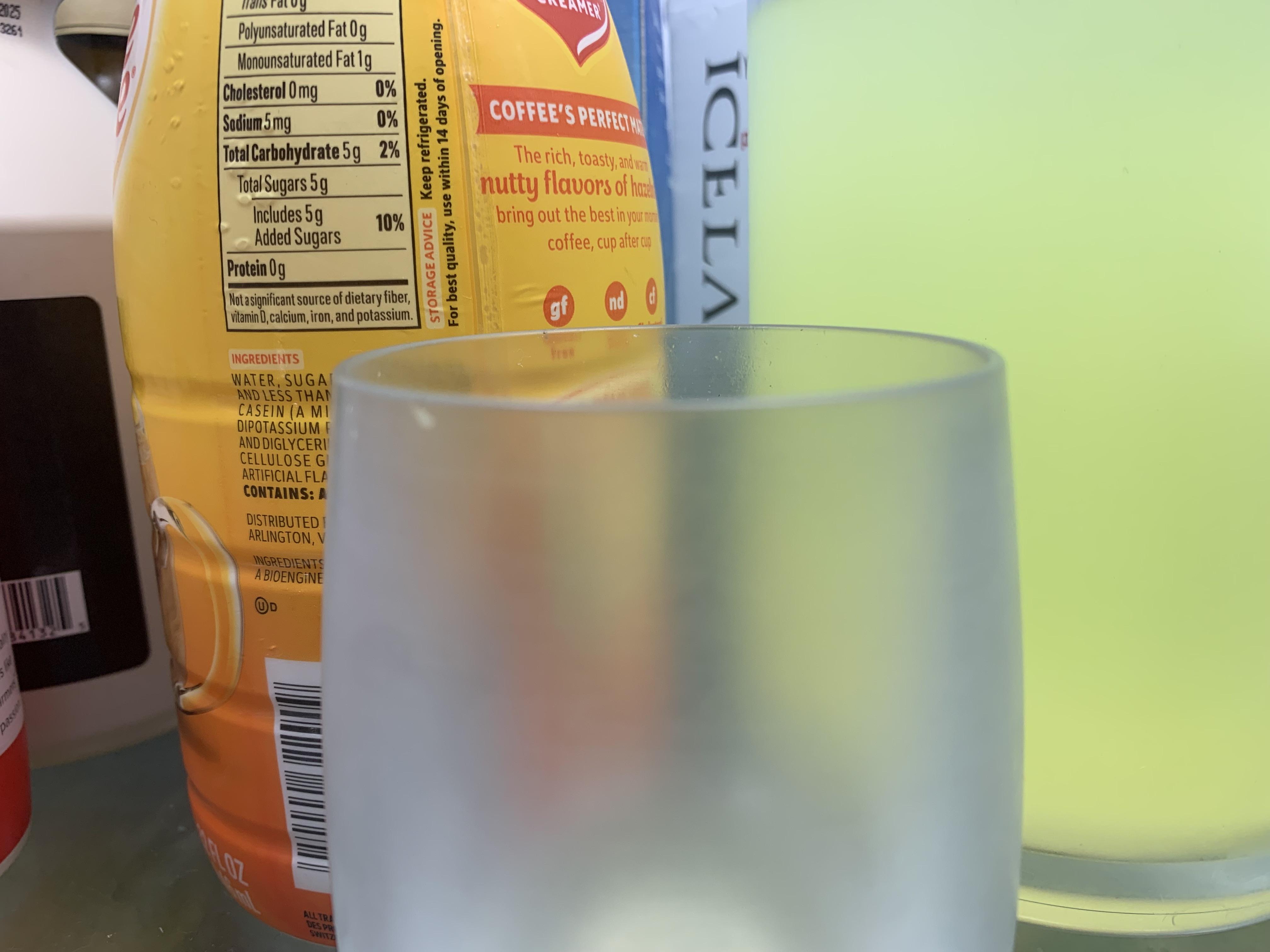
Lately, I make it in this coffee maker which holds coffee in little plastic capsules. The water sits in a plastic reservoir. The sugar sits in a plastic jar. I put in a little milk and hazelnut creamer. Guess what? They also come in plastic.

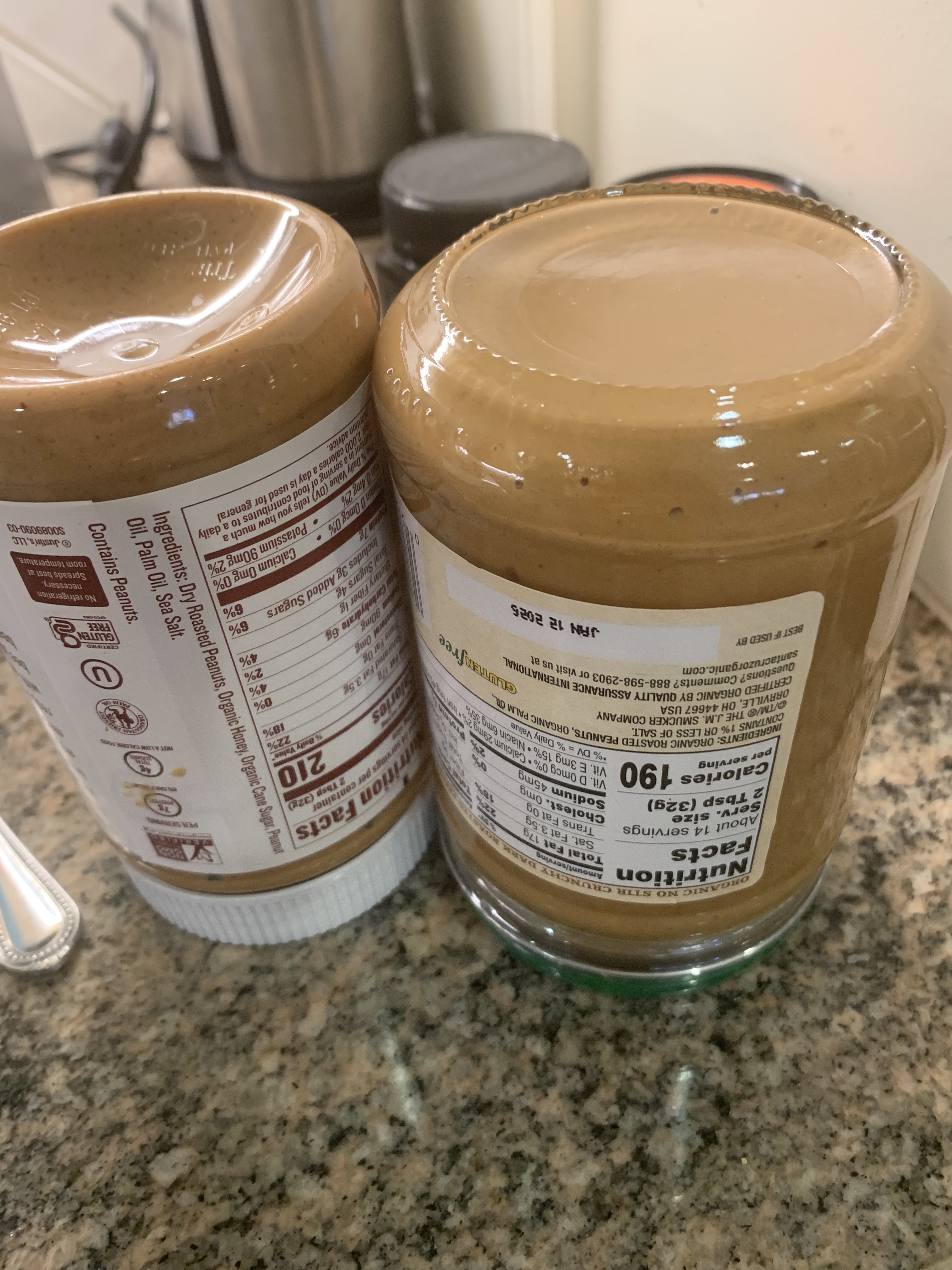
The cup, at least, is ceramic. I often have a whole wheat English muffin. The muffin comes in a container that is part paper and part plastic. I often like to put peanut butter on it. The peanut butter I usually buy comes in plastic. I often put honey or berries on the peanut butter. They come in plastic.

Sometimes, rather than a high fiber English Muffin, I enjoy a bread which is called “Fitness Bread.” It’s high fiber and tasty. And, it comes wrapped in plastic. I often spread hummus or guacamole on it. These are also pretty healthy choices. But they spend a lot of their life in plastic.

As I side dish, I like cherry tomatoes. They are colorful and tasty and low calorie. And they come packaged in–did you guess? Plastic. On sandwiches, I often put ketchup or mayo. They also come in handy squeeze bottles made of…let’s say it together: “Plastic.”

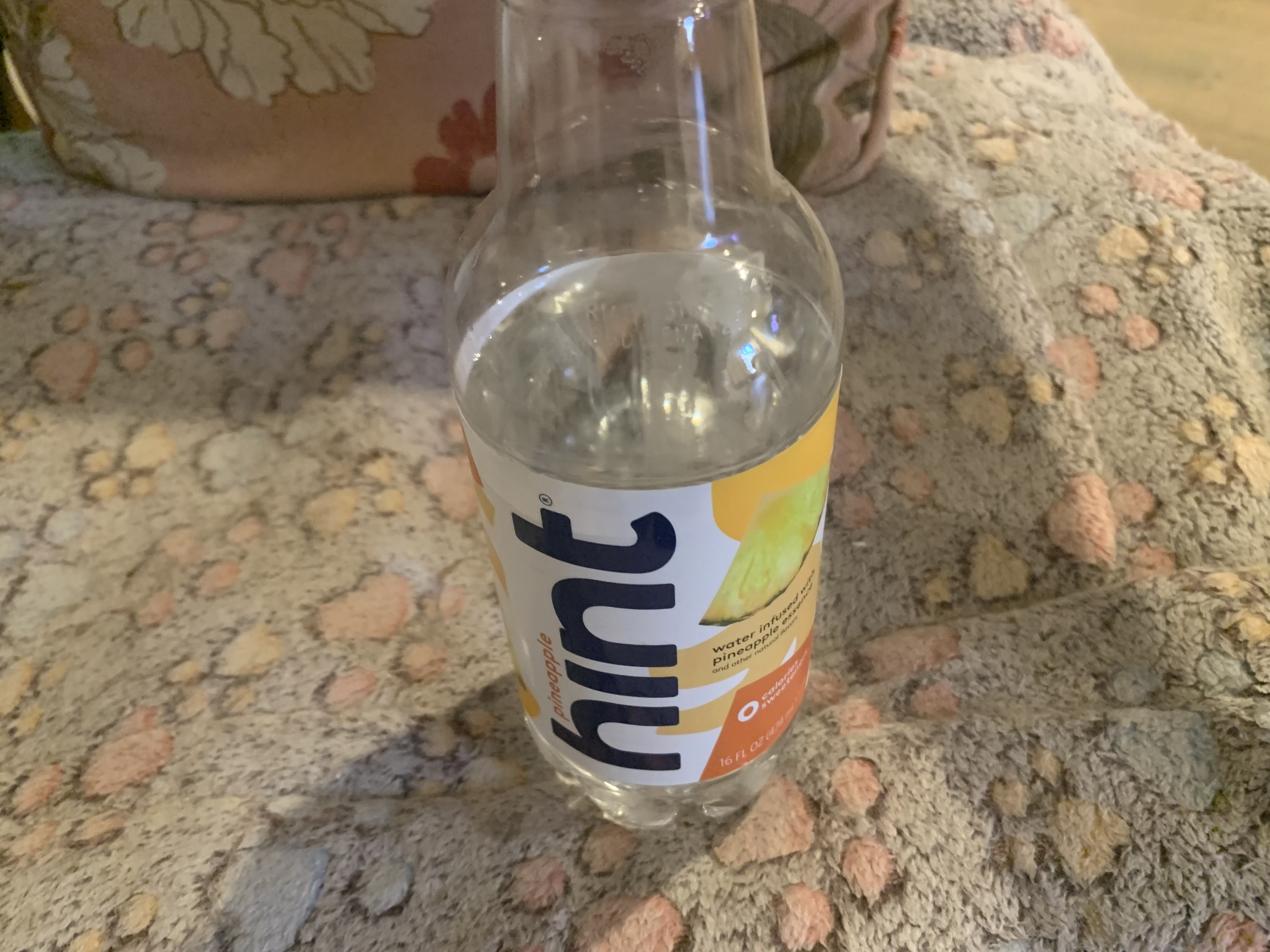
I don’t drink any alcohol, and often drink Hint or BAI, both of which I like quite a lot and both of which come only in plastic containers. This is not great for the environment at large, but also not good for the environment of my body. We also sometimes drink a powdered lemonade mix which comes in plastic packets. Then, a pitcher in the fridge keeps it cold. The pitcher is plastic. Then it is served in a “glass” which is, in fact, not glass, but plastic.

There’s an advantage to plastic over glass. We have cats and dogs and they have a tendency to knock things onto the floor. Plastic things are far less likely to break. Plastic glasses also weigh less than glass.

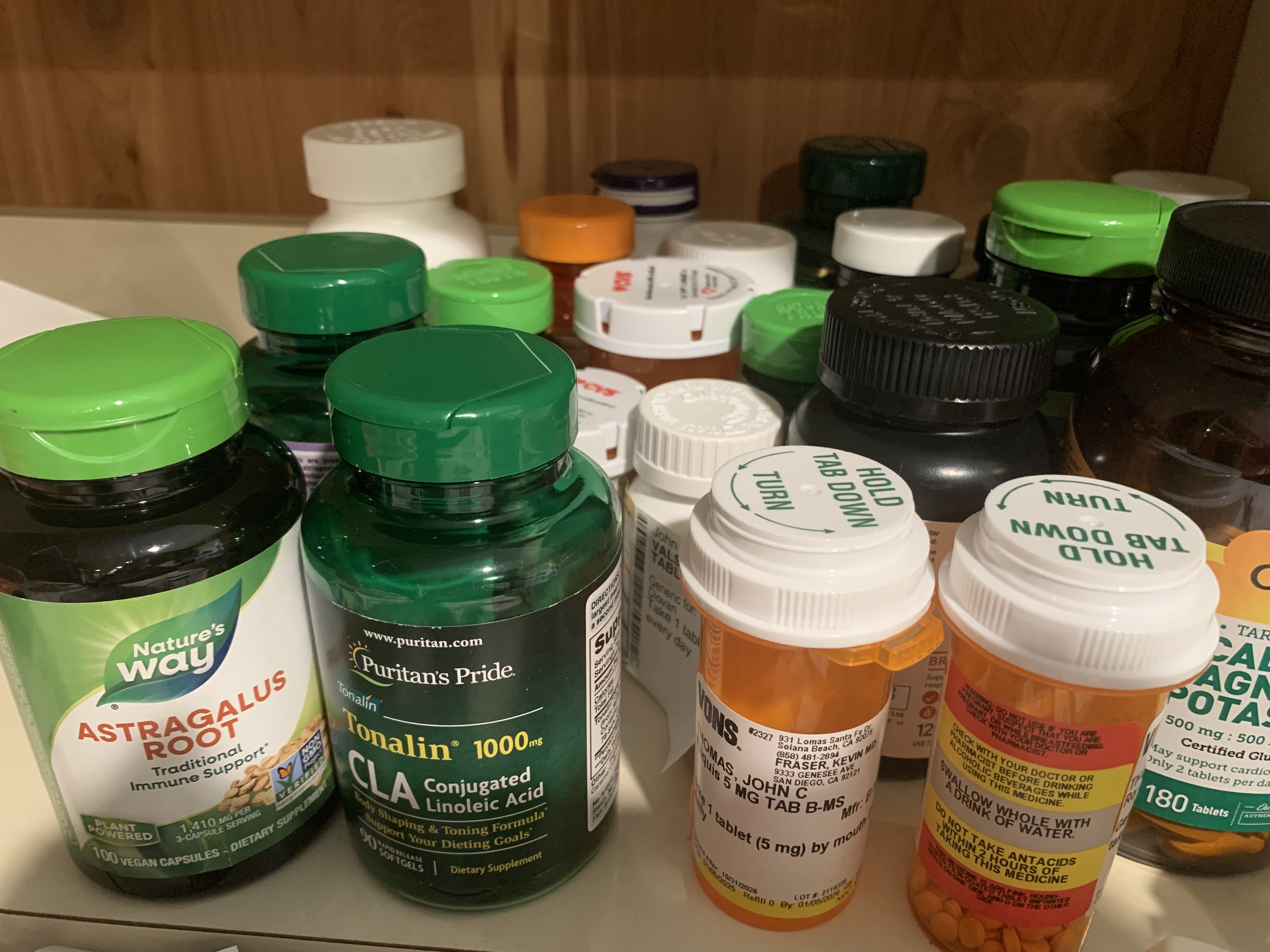
After breakfast, it’s time to take some supplements for my health. These almost always come in plastic containers as do the prescribed medications I take.

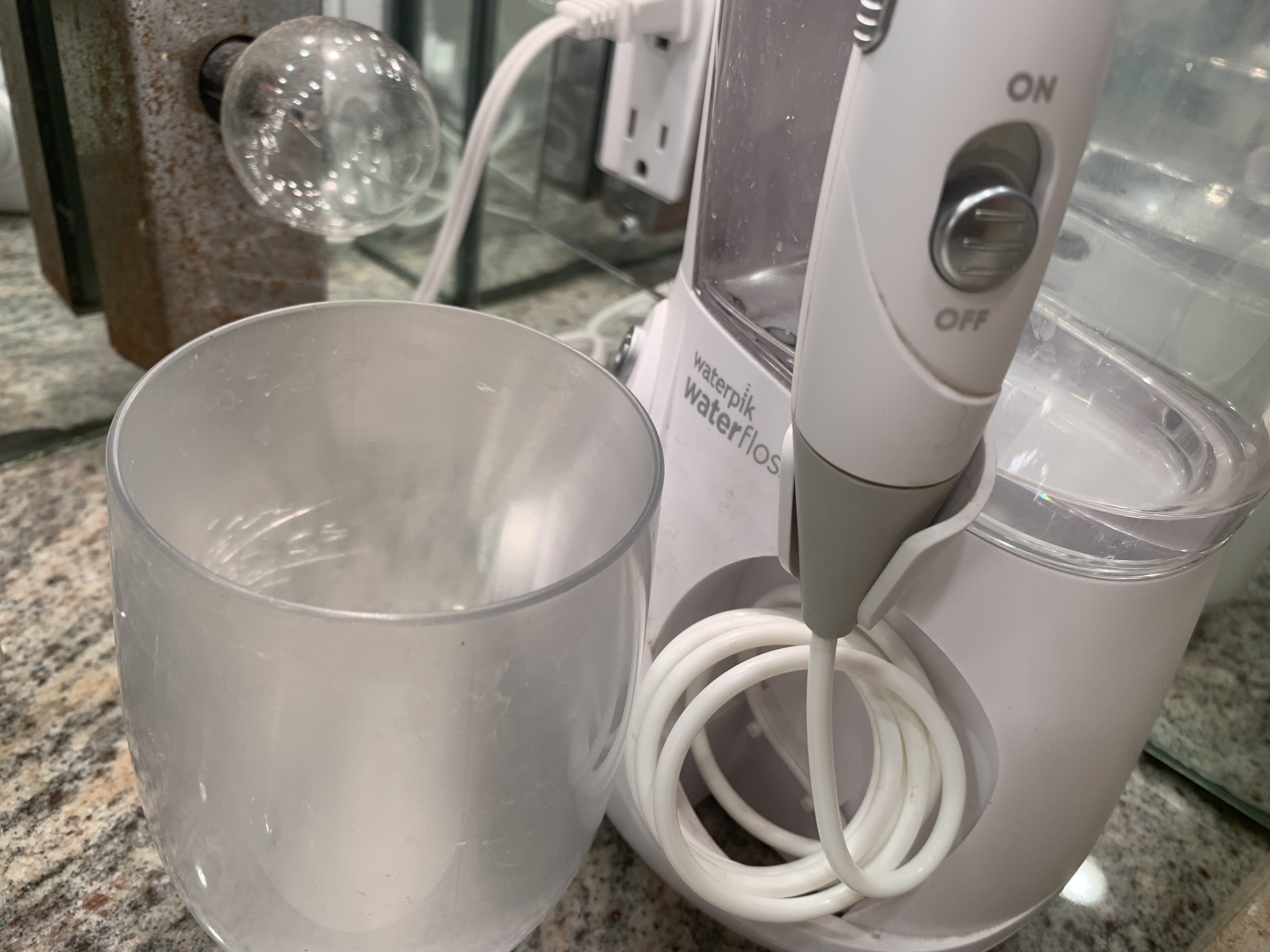
I brush my teeth. That’s a health-promoting activity. But the water glass I use is plastic. The toothbrush bristles are plastic. Lately, I’ve started using a water pick as well, which I highly recommend, by the way, though the reservoir for the water and the entire mechanism is made of plastic.

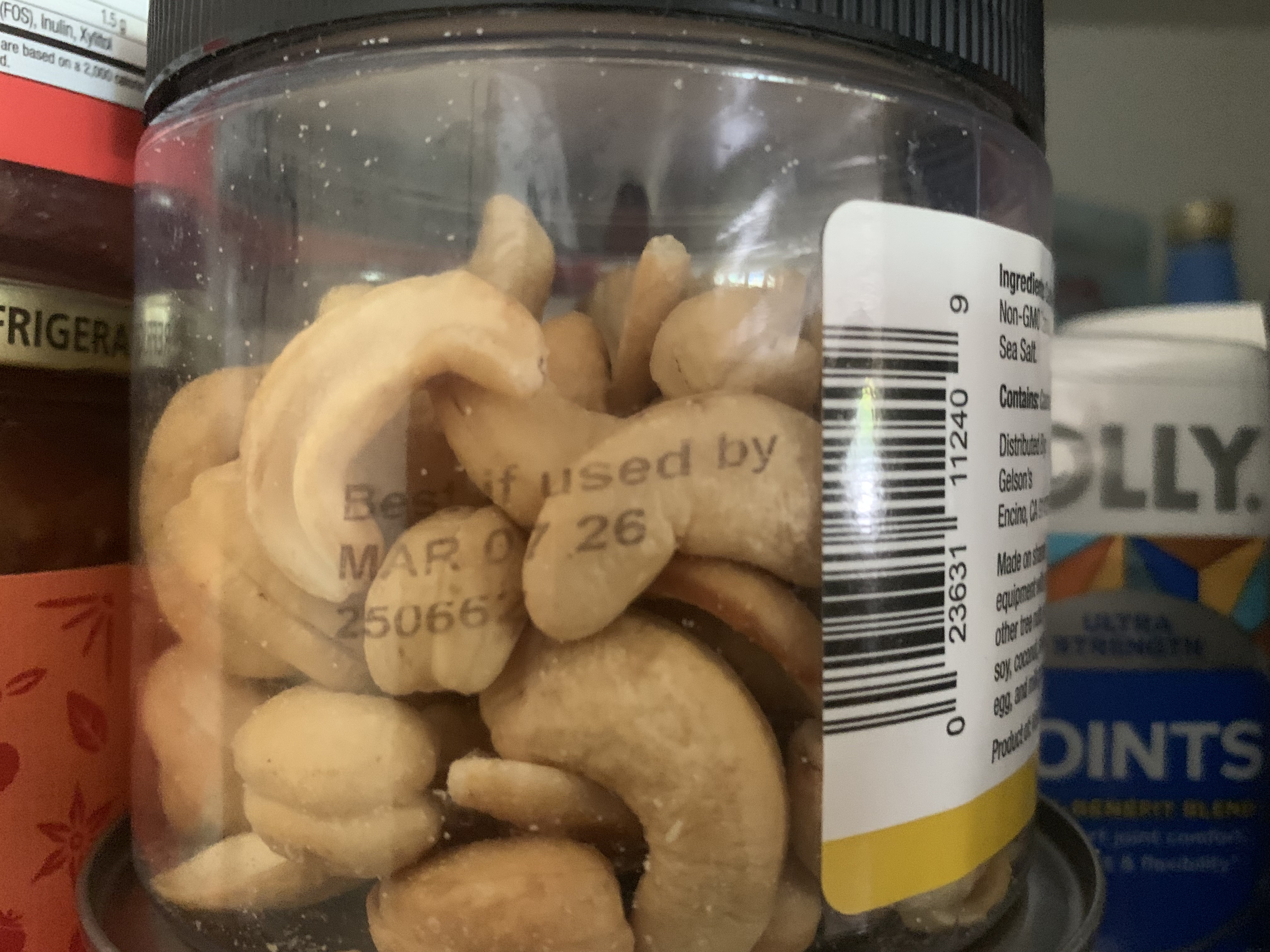
I often cook for the two of us. Lately, I’ve been using cutting boards made of…you guessed it! Plastic! For healthy snacks, I like dried fruit and nuts. Guess what? They come in…


What’s to be done?

In today’s America, with science and truth becoming illegal, it probably won’t make a huge difference. I’m more likely to die of infection or Civil War or unprovoked police violence than from plastic, but I am making some changes.

We bought bamboo cutting boards and paper cups. I’m cutting out the BAI and Hint and exploring options for drinks that come in glass or non-BHA coated metal. I am trying out another type of peanut butter that comes in a glass container. But the vast majority of products at the grocery store come in plastic. Even the vegetables and fruits.

Despite all the years of increasing the percentage of items that are plastic, I still do not actually like plastic.

I’m switching out what I can, and it may be too late in life to make a lot of difference for me personally, especially with a Misadministration that wants to end American lives (and brags about it!). But it may not be too late for you.

Do your own inventory. Hopefully, you will find things you like that are not wrapped in that one word of biological disaster wrapped up with economic faux-prosperity. The word? Here’s a


Plastics.


Fit in Bits

Author Page on Amazon

D4

The Truth Train

That Long Walk Home

Absolute is not Just a Vodka

What is the Link Between Plastics and Cancer?

https://www.nejm.org/doi/full/10.1056/NEJMoa2309822

Cancer Always Loses in the End

Ah Wilderness!

13 Saturday Jun 2020

Posted by petersironwood in America, apocalypse, health, poetry, politics, psychology, Uncategorized

≈ 22 Comments

Tags

ecology, environment, Feedback, GreenNewDeal, life, poem, poetry, truth, wilderness

(I first published an earlier draft of Ah Wilderness in Peng Poets e-zine, summer 1997. I’m nearly finished with the highly recommended book, The Overstory, and so I decided to take another look at the poem and then extended it with the dissolution of form of the poem meant to mirror the dissolution of our society moving at last into prose but then, hopeful with the seed of form returning. I realize poetry is not everyone’s cup of tea. One reason I like it is that its dancing always on that same razor edge where life itself does its dance: chaos and regularity; change and stability).

scenic view of lake in forest

Photo by Pixabay on Pexels.com

Ah, Wilderness!

The words may well connote a false un-blurring
A fear, a chill — not from frozen stone alone
Or lake wind’s sweep; but from the urgent stirring
Of some soul still hiding restless in our bone.

Curse not the thorns of tasty blackish berry;
They keep fruit safe from claws less clever.
Curse not how swift the prey, how very wary;
They shaped our brain; & helped us know forever.

Curse not the winter’s churlish wind unkind
Or burning hot dry summer’s cinnamon sun.
They invented beautiful raiment through our mind
And taught us numbers soaring far beyond one.

4770779D-0898-482C-B861-83F8498070A4_1_105_c

Curse not the change of season; or the suddenly sliding slope –
Unpredictable now and in the future as ever always
They make us search for patterns far beyond our scope of grope.
Ah Wilderness!

You are me as seen in Darwin’s mirror of minutes and hours,

And days of ways taken and untaken & lead us here at last.

We strive to take it all and make it all, all ours, all ours!

Churning every fragrant flower and pine to dust,

We must! We lust! We must! We lust!
We don’t have time for this and that.

We want everything now and that’s that!

air air pollution climate change dawn

Photo by Pixabay on Pexels.com


And if in time all wilderness is bleak and dead,

Our bodies too shall wither and die and by and by

Our souls shall be but number: grey, unloved, unfed.

Asphalt, plastic, concrete & glass. None will die

Because in our endless war on nature, we are all “Undead.”

The Zombieland: machines gone mad; machines gone bad.

Swaths of humanity wishing to meld to macabre, merciless machinery!

abstract barbed wire black white black and white

Photo by Pixabay on Pexels.com

Life is what works! Life is constant change and innovation. But it’s been working for over four billion years! Look around you! It not only works! It’s marvelous! Machines don’t smell like that. Machines don’t look so beautiful as that. Machines don’t sound as melodious. Machines may be used to magnify malicious malignities if we let them.

Life is cooperative and interconnected and everywhere at once dancing on a razor’s edge between chaos and regularity. Machines are built to be efficient and effective and just tolerably presentable enough to be purchased — purchased by people who typically do not have to deal with the machine day in and day out. What do they care whether the machine is loud or smells bad or ruins your hands or explodes every so often or pollutes whole towns or scares away all the birds or kills every fish in the stream and every frog and that more trees will have to be cut down to feed it and more land raped to oil it?

Life is the invention of Love yet Love requires Life. (Maybe that’s why Love created Life; so it would have a way to express itself). Machines can be built to help save lives. Other machines are designed to kill lives. A machine that’s designed to kill lives never decides, “You know what? I never signed up to shoot peaceful protestors. That sucks and it’s anti-American. I quit.” At best, machines are amoral.

What to think of people who want to destroy life and replace it with a strict unmoving hierarchy with a life-hating king at the top? Don’t they see that they would not truly be alive in such an arrangement? They would not “decide” or “dream” or “change” or “love” or anything else without the permission of someone or some rule who knows nothing about how they really feel. And doesn’t care. Do you?

woman raising her hands

Photo by Marlon Schmeiski on Pexels.com

To destroy all wilderness means humanity would be signing its own death warrant.

The attempt to replace life, which we know works, with machine will eventually fail and fall and take damn near all of humanity with it over that cliff of ever-lasting greed.

Ah, Wilderness.

567C8405-05AF-42C9-8CFA-F8B1922A05F6

Ah, Wilderness.

A6253369-6ABE-4B57-884E-BEFF53F7F505

Author Page on Amazon

Introduction to a Pattern Language of best practices in Teamwork & Collaboration

Index to Pattern Language for Teamwork & Collaboration.

The Myths of the Veritas: The Forgotten Field

The Impossible


Blood-Red Blood

24 Sunday May 2020

Posted by petersironwood in America, apocalypse, poetry, politics, psychology, Uncategorized

≈ 12 Comments

Tags

ecology, environment, green, life, love, peace, poem, poetry, war

IMG_2261

Those tortured in the name of Our Dear God,
Racked, burned or sawed, bleed blood-red blood.

Sailing to Freedom, they slaughter
Their trusting brothers with reddish skin
And all their blood is blood-red, blood-red.

The black skin of slaves under the lash
Bleeding the blood-red blood.
Soldiers North in marching blue,
Soldiers South in riding gray,
Bleed their blood-red blood.

person s hands covered with blood

Photo by NEOSiAM 2020 on Pexels.com

The white skin of soldiers entrenched
Breathing the deadly golden mustard gas,
Coughing their lungs, their blood-red blood,
Coughing on their uniforms of blue or gold.

The Cambodian Killing Fields flow bright
With blood-red blood spurting from under yellow skin.

Genocide in Tamil —
Drunken driving in Toledo —
Bombs in Northern Ireland —
Whether the children wear green
Or orange, blood-red is their blood.

woman in black tank top blindfolded

Photo by Thuanny Gantuss on Pexels.com

Only that is clear. Blood is blood.
That, and the tears.
The tears are clear.
But what of hearts and thoughts?

In Flanders Field, so they say,
The poppies grow, red-blood red.
We know where hatred grows —
The fields of greed and fear.
But where on this green earth
Is there a space for love to grow;
For that magic drop of clearly know
That can save so many seas of blood?

B852E891-61E2-4C98-B440-C9718033FE6A

Waterloo and Gettysburg
We can quickly find on a map.
Battlefields, Killing Fields,
Killing Camps, Hiroshima —
These we can pinpoint oh so easily.

Harder to see are the loving fields.
They lay only hidden deep within
That uncharted country of our own hearts.

E9221FE8-778C-469A-98F6-46CD644477BF_1_201_a

I have a question for you.
I have a question for me.
Haven’t we shed enough of each other’s blood?
Are we really still surprised to see
Our enemy bleeds blood-red blood
Just like you and me?
Can we find something else to do now?
Some new game to play?
Are you not bored, like me,
With shoot and burn and slay?
How about a game that does not end in bloody red?
How about a game that ends in green, say?
How about working together to re-make Eden?
Let us make the woods and fields green again
Like a sparkling miracle of loving creation.
I think that might be more fun.
I am getting sick and tired of blood and red and dead.
How about you?

cascade creek environment fern

Photo by Pixabay on Pexels.com

Want to play for green instead?

3FC757BE-A645-4C45-B75F-BD101D6225AC_1_105_c


America

Essays on America: Wednesday

The Pandemic Anti-Academic

The Impossible

The Truth Train

Sunless Sunday of Faith

Author Page on Amazon

Donnie Takes a Blue Ribbon for Spelling!

18 Monday May 2020

Posted by petersironwood in America, apocalypse, politics, psychology, story, Uncategorized

≈ 20 Comments

Tags

America, Democracy, environment, fiction, school, short story, sociopath, sociopathic, truth, tyranny


two girls doing school works

Photo by Pragyan Bezbaruah on Pexels.com


[NOTE: This is a work of pure fiction. Any resemblance to characters alive or dead is purely coincidental.] 

“Children, let’s all clap our hands together. We want to congratulate Marcy for winning a Blue Ribbon for winning the Spelling Bee.” 

Donnie rolled his eyes. He had never liked Marcy. Her skin was dark, for one thing. Not as dark as a N——- but too dark to be a real person. Maybe she was “Port of a Rico” or something. Who cares, thought Donnie. Stupid spelling bee anyway. 

3FD2750C-F9ED-46B3-9197-5563412C5E21_1_105_c

The teacher, Miss Galore, noticed that while most of the kids in her third grade class were clapping, Donnie was grinding his teeth and pounding the table and rolling his eyes.

“Is everything all right, Donnie? You seem upset.” 

Donnie made himself smile pleasantly. “Oh, I’m fine, Miss Galore. Thanks for asking. I’m so pleased as punch for Marcy. What could be better than winning a Blue Ribbon for a Spelling Bee?”

“Oh, good. I’m glad you’re okay. But since you brought it up, there is another contest coming up. This month will be a Science Fair. Let me see the hands. How many of you would like to enter the Science Fair?” 

Everyone’s hand shot up, even Donnie’s. 

Then, the bell rang. But Miss Galore ran a tight ship. The children knew that even though school was basically over when the bell rang, it would be impolite to leave until they were dismissed by Miss Galore. 

“All right, class. I’ll tell you more about the Science Fair tomorrow. For now, Class Dismissed.” 

The kids all began chattering with their friends, and walking out toward the place were parents were lined up in their air conditioned cars. 

brown and white snake

Photo by Pixabay on Pexels.com

Donnie grabbed his books and walked over to Marcy. “Hi, Marcy! That’s really swell that you won the Spelling Bee! That Blue Ribbon looks very cool! Can I see it?” 

Marcy didn’t really trust Donnie, but his voice sounded sweet, so she handed him the ribbon. 

Donnie’s teeny hand shot out like a striking snake and he snatched the ribbon. He turned and dashed out of the room as fast as he could. He skidded around the corner and slapped into the door to the boy’s bathroom. He dashed over to the nearest stall, threw the ribbon into the toilet, and closed the stall door. Then, he flushed the toilet. He gathered his books back up, and opened the stall door slowly. He peered out. Only one other boy, Billy, was in the bathroom. Most of the kids were outside lining up to get picked up by their parents or chauffeurs, he thought. Billy, like an idiot, thought Donnie, is looking down at his thingie to make sure he doesn’t pee on the floor. Who gives a damn? So, Donnie pushed open the door to the boy’s bathroom. On the far side of the hall, only about ten feet away, Miss Galore and Marcy were both staring at him. 

Marcy’s bottom lip was trembling and there were tears on her cheeks. A big smile lit up Donnie’s face. That won’t do. He pushed his fingernails into his palms and forced himself to create a look of concern on his face instead. He had practiced for hours in front of a mirror, so that his look of concern was remarkably genuine looking. Now, he needed the voice to match.

“What’s wrong, Miss Galore? You look troubled.” 

Miss Galore took a few steps closer. “Marcy tells me that you took her Blue Ribbon.” 

“Oh, yes, I did look at it. It’s wonderful. You should feel very proud, Marcy!”

Marcy tried to make her voice sound strong, but at that, she failed. “You took my ribbon though! Give it back! I didn’t even get to show my Mom and Dad yet!” 

Donnie looked over. She was on the brink of squirting out more tears. Sort of like peeing on your own face, when you thought about it. I’ll never do that. What an idiot she was. If she didn’t want me to take her ribbon, why hand it to me, he asked himself. Stupid bitch deserved to lose her ribbon. 

“Miss Galore, I did look at Marcy’s ribbon for a moment. I gave it right back to her. What’s wrong? Did you lose it, Marcy?” 

“NO! I didn’t lose it! You took it!” 

“Oh, Marcy, I’m so sorry you lost it. We all lose things some times. As I’m sure Miss Galore will tell you — you have to be careful not to lose things —- especially things you like a lot.” 

Marcy was now screaming: “YOU TOOK IT! GIVE IT BACK! IT’S MINE!” 

Miss Galore noticed more kids were gathering round to see what was causing the commotion. She said calmly, “Donnie, can you please give me the ribbon?” 

Donnie looked affronted. “Oh, I don’t have it. I just had it for maybe — one minute — not even a minute — maybe fifteen seconds. And then, I handed it right back.” 

680174EA-5910-4F9B-8C75-C15B3136FB06_1_105_c

Marcy held back her tears, but barely. “Why did you take it in the bathroom?”

Donnie put a look of puzzlement on his face. “Why did I go to the bathroom? I had to use the toilet, Marcy. Isn’t that why you go to the bathroom too?” 

Now, Miss Galore looked back and forth between the two children. Donnie didn’t look upset at all. But Marcy certainly did. She wondered whether Marcy could have simply misplaced it. “Do you think it might still be back in the classroom, Marcy? Maybe we should take a look?” 

“NO!” Marcy screamed. “I didn’t lose it. Donnie asked if he could see it and then he snatched and he ran out of the room and into the boy’s bathroom. I don’t have it. He has it.” She pointed at Donnie. 

“Well, I don’t have it. I will swear on a whole stack of Bibles. You can search me. Search me good. I don’t have your blue ribbon Marcy. I’m sorry you’re upset. I know it makes me angry too when I lose things. But you shouldn’t go blaming other kids when you lose something.”

“ARGH!” said Marcy. “I did not lose it! You took it! Make him empty his pockets, Miss Galore. I know he has it!” 

Miss Galore frowned. She couldn’t really do a thorough search of him. Maybe she could get one of the boy counselor’s to do it. She glanced around. Luckily, the teachers still stood out among the students. “Oh, Mr. Graham! Mr. Graham! Can you please come here a moment?”

Miss Galore explained the situation quickly. Mr. Graham frowned. “I’m not doing a strip search of the boy! How about this: write a note and ask the parents to search him when he gets home. Donnie, turn your pockets out.” 

“But Mr. Graham, I didn’t do anything. I didn’t steal her stupid ribbon. I looked at it. It’s — I have to tell you, it doesn’t look that nice up close. Her little medal isn’t even real gold. I don’t have anything bad in my pockets.” 

“Donnie. Do it now! Turn your pockets out,” said Mr. Graham who could pretend to be genuinely outraged over nothing and he genuinely didn’t like back-talk from students.

Donnie shook his head and appeared very reluctant, but he turned out all four pants pockets Except for a pack of Kleenex, and what appeared to be the wings of a dragonfly, his pants pockets were empty. Mr Graham nodded. “Thank you, Donnie. Hand me your backpack.” 

Donnie shifted from one foot to the other. “Mr. Graham, my driver, Pom-Pom is going to be mad that I’m so late. It’s just books mostly.” He handed the backpack to Mr. Graham who searched the inside and turned each book upside down to see whether there was a ribbon hidden between the pages. He turned to Miss Galore. “Nothing.” 

“You see?” said Donnie. “I told you I didn’t steal her stupid ribbon! She’s such a liar! She probably cheated to win the ribbon in the first place!” 

Miss Galore wanted this to be over. “Okay. Okay. You two get over here. I want you to apologize and shake hands. Marcy, you apologize for accusing Donnie. And Donnie, you apologize for … not making sure that when you handed the ribbon back to Marcy, that she didn’t drop it. I don’t know. Anyway, just shake hands and I don’t want to hear any more about it. I’m sure your ribbon will turn up, Marcy.” 

woman s head on plate

Photo by Designecologist on Pexels.com

——————————-

That evening at dinner, when he had eaten his fill and Fred Senior seemed to be in a reasonably decent mood, and not yet drunk, Donnie casually said, “Say, Sir, did you know that there are N——-s at my school?” 

Fred Senior, sputtered through his mashed potatoes. “WHAT? Are you sure?” 

Donnie looked at the ceiling and pretended to think. “No, but I think so. She might only be half N——. I don’t really know. She has dark skin though. I never paid much attention but today she told a lie to try to get me in trouble at school.” 

“What the F*** are N****s doing at your school? I’ll talk to the Principal tomorrow and get this straightened out. Are they teaching you kids anything useful at that school?” 

Fred Junior said, “Yes, Father. I am learning algebra. That’s useful.” 

Fred Senior smirked and snorted. “Doesn’t sound like it, but the main thing is you’ll get into a good college.” 

Donnie added, “I’m going to win a Blue Ribbon in the Science Fair. I’ll find out more about it tomorrow.”  

Fred shook his head. “Christ! What rot. Anyway, how about desert?” 

Mary brought over a large dish and placed it proudly into the middle of the table. In it were little scoops of watermelon, cantaloupe, and honeydew. There were slices of apple and banana as well as some ripe strawberries all arranged quite artistically to Mary’s eye. 

Fred Senior grimaced and shouted, “What the F### is that? Seriously, Mary, have you gone nuts? I asked for desert! Not a f###ing salad!”

Mary swallowed hard. The A/C was out. It was hot as hell on this day in mid May. She had remembered that fruits were so much better for you than pies, cakes, and cookies. She thought maybe it would nice to have a cool fruit salad on a warm and sultry night. She had thought. That was her problem. She should never think. She should just do whatever Fred tells her too. Her mind raced. What could she get to assuage her husband quickly. 

Fred Senior glared at her. He had stopped yelling though, thought Mary. His voice instead had that soft, sweet, syrupy sound that it made…whenever things were going to go terribly badly for her.

Fred Senior did indeed speak in a soft, controlled voice. “Children. Go upstairs now and do your homework. I need to have a little chat with your Mother. You know. Big People stuff. You wouldn’t be interested. Boring really. So upstairs. Go on. Up. Now.” 

The children pushed their chairs back and looked straight down at the ground. They had been taught that, even a glance at each other or at Mom or Dad could — would — be considered as a reproach to their Father. So, they all tip-toed up to bed and immersed themselves in a book; they learned that if they did it well enough, they could ignore the noises — whatever they were — that would be coming from the kitchen and dining room. 

All, but Donnie, that is. His procedure, was to go up with the other kids and then sneak back down and watch. It was one of the biggest risks he ever took in his entire life. But he couldn’t help himself. He loved the way Daddy made Mommy so weak and pathetic. It made his Daddy so much bigger and stronger and manlier. He would be that way some day. He would be just like Daddy! And, next week, I’ll win a Blue Ribbon in Science! 

gray industrial machine during golden hour

Photo by Pixabay on Pexels.com

————————————————————-

Other blog posts: 

What about the butter dish? 

Inventing a New Color

There’s a pill for that

Citizen Soldiers: Part 1

Citizen Soldiers: Part 2

Citizen Soldiers: Part 3

After the Fall

Author Page on Amazon


You Must Remember This

19 Sunday Apr 2020

Posted by petersironwood in America, apocalypse, COVID-19, health, poetry, Uncategorized

≈ 24 Comments

Tags

Climate change, COVID19, ecology, environment, greed, life, pandemic, poem, poetry, truth

worms eyeview of green trees

Photo by Felix Mittermeier on Pexels.com

A breeze flutters the leaves of the tulip tree
It seems to me
They wave, they warn,
“Remember us. Remember, that we may come again.
That once again forests of greenery will come to be.”


adventure arid barren coast

Photo by Pixabay on Pexels.com

Under this clear blue sky,
Under this bright yellow sun,
In this verdant surround, I see, nonetheless,
Long lines of grieving skeletons
Wandering the gray-brown dessert
Searching for food, for water,
For the lost way,
The fallen times.
Someone has lost the memo,
Broken the schedule,
Failed the test,
Not met the ROI.

2ED5B35A-54F8-43CB-8534-46D31A07049D_1_105_c


I have drawers of papers,
But what do they mean?
And why are they there?
They seemed so important once.
I have closets of clothes
That no longer fit.
I have machines that would buzz and whirr delightfully
If I could find a place to plug them in.

woman in black jacket sitting on rock formation

Photo by Chase McBride on Pexels.com


And, in these dead days of gray on gray,
I must remember, I must tell,
Though few believe,
“Once there were forests here,
Trunk on trunk of thick tall tree,
Leaf and flower, flower and leaf,
Green, green, under a clear blue sky.
We can make it live again.”

49CBA1E0-13F8-445C-9E9F-00467169FFC5


Now, so the story goes, the Devil tempted us with knowledge
And we were exiled from Eden into this world.
But, really, who is this Devil, anyway, I wonder?
What if, drunk on half-knowledge, we left voluntarily?
Greedy for the shiniest bauble,
The sparkliest stone,
We forgot that sunset on lake,
Icy creeks, and snow-laden trees,
Are more beautiful than jewelry.

time lapse photography of waterfalls during sunset

Photo by Pixabay on Pexels.com

I see them marching, line on line,
Mindlessly miming a pattern, a template,
Aimlessly roaming, but all in formation,
With no information, but under orders, all the same.
The cadence of the stepping,
The drubbling of the drums,
Makes it all seem okay somehow
As row on endless row,
Over the cliff they go.
Blind are they to the leaves of the tulip trees, still green,
Waving their warning; warning with their waving,
Bending, sighing, singing, in the breeze:
“Remember such as these,
When there are no more trees.
Remember such as these,
After the fire and the freeze.”

A6253369-6ABE-4B57-884E-BEFF53F7F505

Author Page on Amazon

Index to a Pattern Language on Cooperation and Teamwork. 

Myths of the Veritas – Explorations of Leadership, Empathy, & Ethics in times of crisis. 

Wristwatch

23 Monday Mar 2020

Posted by petersironwood in America, apocalypse, COVID-19, poetry, politics, Uncategorized

≈ 4 Comments

Tags

celerity, ecology, environment, life, mindfulness, poem, poetry, politics, time, truth, virus

2ED5B35A-54F8-43CB-8534-46D31A07049D_1_105_c

What is this?

A gift. 

A wristband watch.

How convenient.

For someone.

For me?

I wonder…

It’s a kind of a band

(A bit like a slave band)

A bit of a rift,

Between me and me

men s suit and accessories

Photo by malcolm garret on Pexels.com

If you see; 

Get my drift.

It’s kind of sand

In my shoe

Keeping me from other things

And it rings

In my ear

That a land

Where all that stands

Is the least pernicious example

Is but a silly sweet example

Of things to come.

“Hurry to the hippodrome!

Never mind the cost.”

Never mind what’s lost

Never mind what land

We conquer to expand

The land that … sorry….

Didn’t mean to mention that…

The land of the free…

I hope that is an okay phrase,

An acceptable phrase.

Because the thing that worries me

Is not forty-five per se, 

Oh, 

No.  

I know.

No.

What bothers me is this:

That a part of me says, “hiss”

On cue.

And then I say “Boo!”

And either way, 

It’s Putin’s day. 

men in black and red cade hats and military uniform

Photo by Pixabay on Pexels.com

Oh, yes.  We are quite the quintessential conquestadoro.

Les hommes mucho macho

Let’s salsify the nacho

Let’s wolf down some state or other.

Sorry, meant to say steak or other…

1DCFDDF6-6B3F-434F-97F5-4C6C090667DC 

Slyly, slyly, you may perceive

That I, 

Much like our current reality,

Make no sense.  

680174EA-5910-4F9B-8C75-C15B3136FB06_1_105_c

Granted, 

But I have no pretensions of being

Chiseled into Mount Rushtoomuchmore

Just because I gave away 

The U S A 

To those who hanker-danker for oil.

“Oil.”

Isn’t that a lovely word?

I like the sound.

Silky, deep, and dark. 

gray industrial machine during golden hour

Photo by Pixabay on Pexels.com

“Oil.”

I love the stuff. 

Titusville, Pennsylvania as I recall

Was the happening place to be.

Nearly, West Virginia and Ohio 

Came to blows over it.

But we got over it.

Clear over the rainbow.

All the way to where the sun don’t shine

To where instead monkeyshines

Rule the day,

And check 

And slay.

Say! 

My watch alarm now is screaming: 

woman holding burning newspaper

Photo by Jhefferson Santos on Pexels.com

“Way past time to play! 

All hands on deck! 

You’re making a wreck

Of every day! 

Your addictive greed

Grew a wicked weed!

Thoughts flash between sulcus and gyrus

Showing us how to beat the virus,

We must hunker down and work as one

For just this once until it’s done.

Then, we go and green this globe 

Let’s use once more that frontal lobe!”

IMG_3071


———————————————-

Author Page on Amazon

Start of the First Book of The Myths of the Veritas

Start of the Second Book of the Myths of the Veritas

Table of Contents for the Second Book of the Veritas

Table of Contents for Essays on America 

Index for a Pattern Language for Teamwork and Collaboration  


COVID-19

12 Thursday Mar 2020

Posted by petersironwood in America, apocalypse, COVID-19, health, Uncategorized

≈ 2 Comments

Tags

coronavirus, COVID-19, environment, exercise, health, healthcare, life, pandemic, wellness

COVID-19

7551D277-6606-4C1B-9E06-5E4E44C81A64

We interrupt our regularly scheduled blog posts to address our health crisis. 

It’s quite natural for us to want to survive as individuals, so what can we do to maximize our chances of survival? 

Much of the advice you’ve already heard is valid. 

  • Avoid unnecessary travel and gathering in groups. 
  • Telecommute.
  • Wash your hands frequently and thoroughly. 
  • Make and use some alcohol wipes. 
  • Use gloves.
  • You may want to implement the “left hand dirty, right hand clean” rule (which already exists in many countries). That is, if you must touch a public surface without having the opportunity to immediately wash, or in case you forget, use your left hand. Use your right hand for eating, rubbing your eyes, etc. Better is to disinfect immediately, or even better avoid touching public surfaces without gloves.
  • Don’t touch your face. I personally find this pretty much impossible, but I have cut down. 

A13D392E-DFD8-47ED-9D4C-5C3F3E6318CF

As someone that began life with many respiratory infections, I’ve devised a few additional things to help prevent myself from getting sick. I am not a medical doctor. I am not advising you to do these things, but I will report below on what works based mainly on my own experience. Your mileage may differ.

Eat healthy foods. Make sure you eat as healthily as you possibly can. Avoid refined sugar as much as possible. Include lots of fiber. A so-called Mediterranean diet is good. You may include fish, lots of fresh vegetables and fresh fruit. Typically, whole foods are better than vitamins. Garlic and shiitake mushrooms may be especially helpful for the immune system. When exposed to a cold, I typically cut cloves of garlic and inhale the fumes. It seems to help with a cold. I don’t know that it will help with COVID-19, but I’m going to keep doing it.

cooked meat with vegetables

Photo by Dana Tentis on Pexels.com

Exercise. I have found this greatly reduces my chances of getting a cold. You probably do not want to go to a gym, however, because it will greatly increase your exposure. Better would be walking or running in fresh air or doing yoga or dancing at home. If you’ve been sedentary for the past months or years, you don’t want to try to “make up for it” by suddenly running a marathon. Small steps. But even if you’re out of shape, at home watching TV, get up and stretch, pace, use your own body as resistance, find some free easy yoga or stretching tapes. 

F7CA676E-E4E2-4BF7-973B-9B57EBB6C77F_1_105_c

Stay positive. Your mental health impacts your physical health. Yes, we face a kind of crisis, but being depressed, angry, or anxious will not help you. You do want to be vigilant and concerned, but also calm, cool, and collected. Make sure you give love and get love. Enjoy some comedy. Engage in activities that you love but that are also safe in terms of avoiding crowds. Your body contains about 70 trillion cells! You’ve evolved over 4.5 billion years! Every one of your ancestors lived long enough to reproduce. I don’t just mean those folks who wore bear skins and sat around campfires. Way before that, every little critter on land, every fish in the sea, every microbe in the ocean — they all survived all sorts of attempts to kill them off — chances are good that you will too. And, in the unlikely chance you don’t, you may as well enjoy your own life and do good for others and for life on the planet, not just during this pandemic, but always. 

cascade creek environment fern

Photo by Pixabay on Pexels.com

Stay hydrated. Since you will be spending more time at home, this should be fairly easy. 

woman drinking from glass

Photo by Adrienn on Pexels.com

Get some sunshine. Recent studies indicate that sunlight not only helps you make vitamin D; it also helps your body produce nitric oxide. Both help your immune system. 

IMG_3071

Salt showers. I noticed that I seldom got sick when I was near the seashore. Then, about 20 years ago, I ran across a very old book from John Harvey Kellogg about his sanitarium in Battle Creek. One of the things he recommended was salt showers. I routinely do this and I think it helps me avoid colds and sinus infections. Will it help with COVID-19? I have no idea. But I’m going to keep doing it. When I take a shower, I simply sprinkle the floor of the shower with iodized salt. 

woman in white towel standing in front of the mirror

Photo by Andrea Piacquadio on Pexels.com

Find and enjoy beauty. I obviously don’t mean head to a museum. Look for beauty in your garden or in your house or on-line. Listen to music, especially music that is upbeat and energetic. If you can’t find any beauty, create some. Paint, draw, write, take photos. 

4299C386-2C7D-4F31-88D3-E84AFE551465

Learn something. Most companies and individuals spend way too much resource trying to maximize productivity based on what they know now. If you have a forced pause in that, use the time to learn something new. 

earth space universe globe

Photo by Pixabay on Pexels.com

Make a contribution. Human beings are social animals. If you are making a contribution, you will tend to stay healthier. That contribution could be pretty much anything. It includes making others feel better; creating art; helping others by virtue of your work; giving a financial contribution; growing food; making a meal; washing clothes; loving your kids; staying positive. 

man hug pinnochio photo

Photo by Pixabay on Pexels.com

Plan your path; practice pathogen paranoia. Treat every doorknob, handrail, light switch, car door, mobile phone, computer keyboard, ATM, shopping cart, etc. that you touch as being contaminated with COVID-19. It may not be true quite yet, but it will be soon. So, take precautions now and change your behavior now. It’s not so easy as you might think to avoid touching your face, doorknobs, etc. so start practicing now. 

IMG_7590

———————————-

Author Page on Amazon. 

The Declaration of Interdependence. 

The Myths of the Veritas (which explore #Leadership #ethics and #empathy). 

An Introduction to the Pattern Language for Cooperation and Collaboration. 

An Index to the Pattern Language for Collaboration and Cooperation. 

Your interconnectedness to all life on this planet. 

There’s a pill for that. 

Fit in Bits suggests numerous ways to work more exercise into daily life. I wrote this way before the current pandemic. Be sure to avoid touching public surfaces.


← Older posts

Subscribe

  • Entries (RSS)
  • Comments (RSS)

Archives

  • January 2026
  • December 2025
  • November 2025
  • October 2025
  • September 2025
  • August 2025
  • July 2025
  • June 2025
  • May 2025
  • April 2025
  • March 2025
  • February 2025
  • January 2025
  • December 2024
  • November 2024
  • October 2024
  • September 2024
  • July 2024
  • April 2024
  • March 2024
  • February 2024
  • January 2024
  • December 2023
  • August 2023
  • July 2023
  • May 2023
  • April 2023
  • March 2023
  • February 2023
  • January 2023
  • December 2022
  • November 2022
  • October 2022
  • September 2022
  • August 2022
  • July 2022
  • June 2022
  • May 2022
  • April 2022
  • March 2022
  • February 2022
  • January 2022
  • December 2021
  • November 2021
  • October 2021
  • September 2021
  • August 2021
  • July 2021
  • June 2021
  • May 2021
  • April 2021
  • March 2021
  • February 2021
  • January 2021
  • December 2020
  • November 2020
  • October 2020
  • September 2020
  • August 2020
  • July 2020
  • June 2020
  • May 2020
  • April 2020
  • March 2020
  • February 2020
  • January 2020
  • December 2019
  • November 2019
  • October 2019
  • September 2019
  • August 2019
  • July 2019
  • June 2019
  • May 2019
  • April 2019
  • March 2019
  • February 2019
  • January 2019
  • December 2018
  • November 2018
  • October 2018
  • September 2018
  • August 2018
  • July 2018
  • June 2018
  • May 2018
  • April 2018
  • March 2018
  • February 2018
  • January 2018
  • December 2017
  • November 2017
  • October 2017
  • September 2017
  • August 2017
  • July 2017
  • June 2017
  • May 2017
  • April 2017
  • March 2017
  • February 2017
  • January 2017
  • December 2016
  • November 2016
  • October 2016
  • September 2016
  • August 2016
  • July 2016
  • June 2016
  • May 2016
  • April 2016
  • March 2016
  • February 2016
  • January 2016
  • December 2015
  • November 2015
  • October 2015
  • September 2015
  • August 2015
  • May 2015
  • January 2015
  • July 2014
  • January 2014
  • December 2013
  • November 2013

Categories

  • AI
  • America
  • apocalypse
  • cats
  • COVID-19
  • creativity
  • design rationale
  • dogs
  • driverless cars
  • essay
  • family
  • fantasy
  • fiction
  • HCI
  • health
  • management
  • nature
  • pets
  • poetry
  • politics
  • psychology
  • Sadie
  • satire
  • science
  • sports
  • story
  • The Singularity
  • Travel
  • Uncategorized
  • user experience
  • Veritas
  • Walkabout Diaries

Meta

  • Create account
  • Log in

Blog at WordPress.com.

  • Subscribe Subscribed
    • petersironwood
    • Join 661 other subscribers
    • Already have a WordPress.com account? Log in now.
    • petersironwood
    • Subscribe Subscribed
    • Sign up
    • Log in
    • Report this content
    • View site in Reader
    • Manage subscriptions
    • Collapse this bar
 

Loading Comments...