• About PeterSIronwood

petersironwood

~ Finding, formulating and solving life's frustrations.

petersironwood

Tag Archives: cooperation

The Silent Pies

13 Saturday Dec 2025

Posted by petersironwood in America, family, fiction, psychology, story, Uncategorized

≈ Leave a comment

Tags

collaboration, cooperation, family, fiction, life, politics, story, teamwork, truth, USA, writing

Photo by Alena Darmel on Pexels.com

The first time I won the prize, I was only 8. I had only had my two-wheeler for about a year when my gang of neighbor guys jointly decided it would be a lot more fun to ride our bikes if they made as much noise as real motorcycles. I can’t speak for the others, but it never occurred to me that other people in the neighborhood might not find this increased noise level “really cool!” 

Of course, we weren’t always riding our bikes. Sometimes we played in Lynn Circle at the end of our road. It served as a makeshift playground for baseball, kickball, and soccer as well as a free hippodrome for our races. This arrangement had one slight flaw. There were no fences. So, invariably, a ball would go careening off the pavement onto someone’s lawn. 

In our neighborhood, everyone’s house looked fairly similar, but they expressed themselves through their small gardens and lawns. Some people, like my dad, really worked at making our small lot at least something gardenish. Other people did little but mow their lawn every so often. But some treated their lawns as they might, at any moment, be teleported to the Master’s Golf Tournament for emergency green replacement. Universally, these people had no children at home. When that was so, none of them interacted much with the kids, the parents of the kids, or even, each other, as I can recall. 

Photo by Kelly on Pexels.com

When a stray ball dribbled up into our lawn, someone just ran up and got the ball. No big deal. But if someone hit a ball into one of the three lawns that were antiseptic enough to serve as operating tables for open heart surgery–YIKES! Of these, the most stringent by far was “Old Lady Lynn.” When a ball went into one of the antiseptic lawns, we tried to reconnoiter the situation before even attempting to grab our ball back. We would consider whether there was a car in the driveway, whether there was any sign of life coming from the domicile in question. Only if we were fairly sure no-one was at home would we walk and get the ball. If we weren’t sure, we’d run up and snatch it as quickly as possible and then duck into a “friendly” back yard quickly enough so that we wouldn’t be identified. 

Old Lady Lynn always seemed to be at home. We imagined, because of her invariable and instantaneous reaction, that she spent all her waking hours peering out between curtains at her lawn to insure that none of us trampled her grass. 

Our gang decided to begin our little decibel enhancement project by each of us buying the loudest bell we could find. These were not modern, laser-guided, AI-enhanced sonic systems but simple bells that you had to operate with your thumb. It’s intended use was to prevent injuries and save lives by giving the bike rider a way to “warn” others of their impending presence to that the other person so they didn’t accidentally wonder into your path.

Photo by Bastian Riccardi on Pexels.com


We didn’t give that much thought. But we did give thought to how cool it sounded when we all rode around the circle clanging the bells.  Of course, even way back then, if you had a new toy or technology, you had to show it off incessantly and that’s what we did. 

Unlike the instantaneous reaction Old Lady Lynn had to our incursions onto her lawn, it took several days for the complaint to filter back to my parents. My parents (thank goodness) were not the sort to take my side regardless of ethics or consequences. I convinced my buddies that if we didn’t strike a compromise, our parents would take all our bells away. Our development project at that time, consisted of only three paved streets, but there were plenty of interconnecting dirt roads and paths that sported no houses on either side. Now, when we left the paved roads of civilization and rode off onto the dirt roads through the woods, we celebrated with cheers and bells as we crossed the threshold into non-civilization, a place where we could talk with each other without the constant reminders of parents and parenting. 

The golden sunrise glows through delicate leaves covered with dew drops.

A few days later, I was reading a book about dinosaurs when I heard a knock at the door. Soon, I heard the unmistakable wobbly tones of Old Lady Lynn. I couldn’t hear what she was saying nor what my parents said, but they sounded friendly. Then, the unbelievable happened. I heard them all laugh. It had never occurred to me that Old Lady Lynn would ever–could ever– laugh, or that she ever had laughed. 

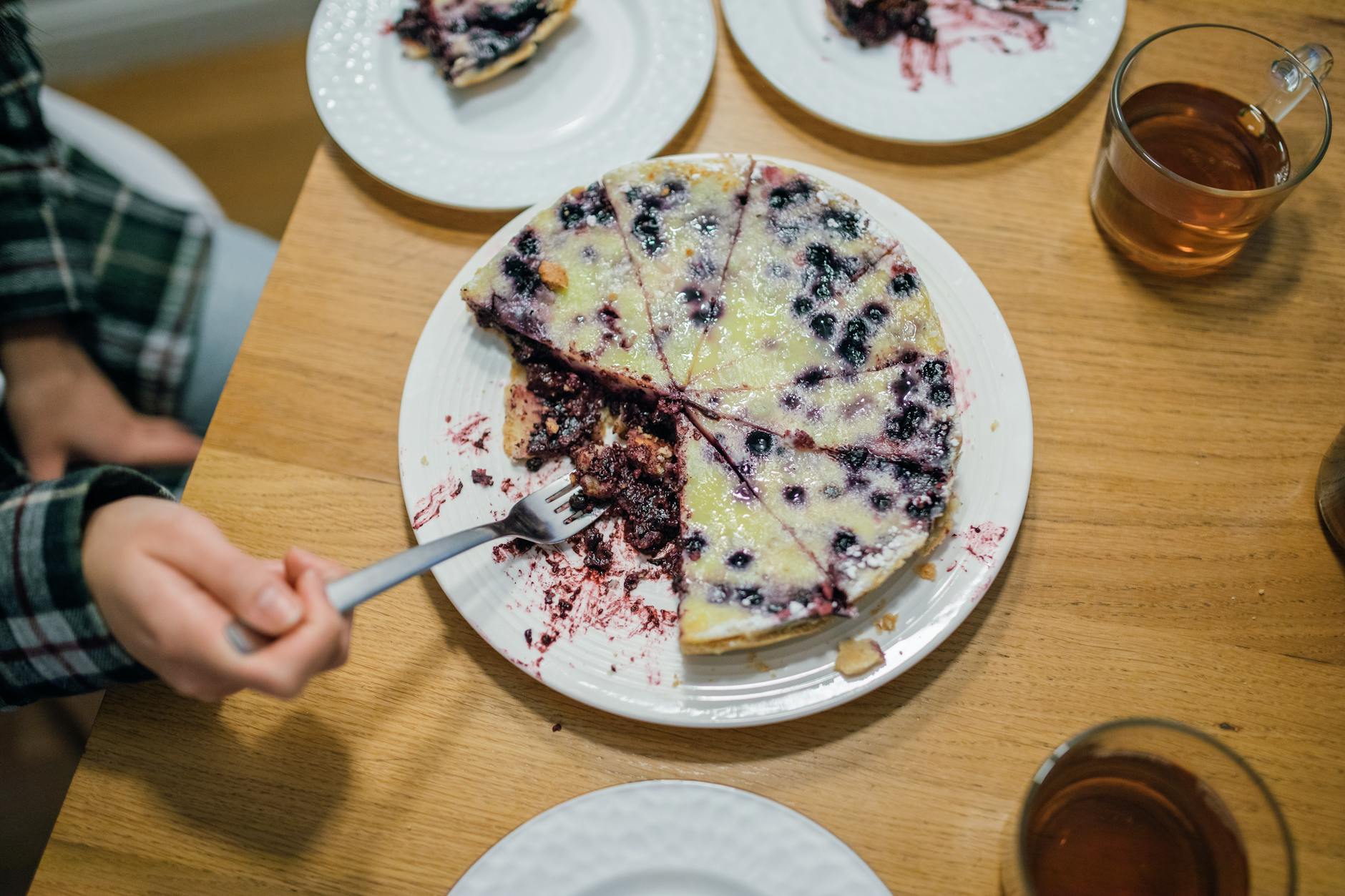
I debated whether my appearance would make things better or make things worse, but in the end, I felt I I had to participate in whatever was happening. I hadn’t even finished opening my own door when I noticed a most amazing aroma! My eagerness spiked and I trotted into the kitchen. Steaming on the table: Not one but two warm, freshly baked blueberry pies. That smelled delicious!

My mom said, “Look, Mrs. Lynn was so happy you got those boys not make that bell clanging racket near her house and instead having your No-Bell in the Neighborhood Policy, she baked two pies.” 

The pies were amazing, but what was even more amazing that Mrs. Lynn became friends with my parents, and even with me. Every year, for the next six years we lived there, Mrs. Lynn gave me two pies. No two years were identical. All the pies were fresh baked and delicious: blueberry, raspberry, rhubarb, pumpkin, custard, cherry, and—my personal favorite—pecan pie. 

———————

Now, more than seventy years later, when I take Sadie for her morning walk, we often walk by a property with a self-proclaimed “Invisible Fence.” It’s been around for awhile, but it was invented in 1973; that is, about 20 years after the story recounted above took place. My neighbor’s invisible fence does seem to work for her two large and friendly dogs. They bark as we pass but do not accost us on the road. 

But the self-imposed boundaries of invisible fences have a long history in humankind. 

The reality is that we’re all part of one Great Tree of Life. 

All fences are temporary but, 

The impact of connection ripples forever. 

———

Author page

Math Class

You Must Remember This

Ripples

Roar, Ocean, Roar

Imagine All the People…

The Dance of Billions

The First Ring of Empathy

A Pattern Language for Cooperation and Collaboration

Your Cage is Unlocked

Impossible

Turing’s Nightmares: Eight

21 Friday Nov 2025

Posted by petersironwood in psychology, The Singularity, Uncategorized

≈ Leave a comment

Tags

AI, Artificial Intelligence, cognitive computing, collaboration, cooperation, openai, peace, philosophy, seva, teamwork, technology, the singularity, Turing, ubuntu, United Peoples Ecosystem

OLYMPUS DIGITAL CAMERA

Workshop on Human Computer Interaction for International Development

In chapter 8 of Turing’s Nightmares, I portray a quite different path to ultra-intelligence. In this scenario, people have begun to concentrate their energy, not on building a purely artificial intelligence; rather they have explored the science of large scale collaboration. In this way, referred to by Doug Engelbart among others as Intelligence Augmentation, the “super-intelligence” comes from people connecting.

Photo by RF._.studio on Pexels.com

It could be argued, that, in real life, we have already achieved the singularity. The human race has been pursuing “The Singularity” ever since we began to communicate with language. Once our common genetic heritage reached a certain point, our cultural evolution has far out-stripped our genetic evolution. The cleverest, most brilliant person ever born would still not be able to learn much in their own lifetime compared with what they can learn from parents, siblings, family, school, society, reading and so on.

Photo by AfroRomanzo on Pexels.com

One problem with our historical approach to communication is that it evolved for many years among a small group of people who shared goals and experiences. Each small group constituted an “in-group” but relations with other groups posed more problems. The genetic evidence, however, has become clear that even very long ago, humans not only met but mated with other varieties of humans proving that some communication is possible even among very different tribes and cultures.

Photo by Min An on Pexels.com

More recently, we humans started traveling long distances and trading goods, services, and ideas with other cultures. For example, the brilliance of Archimedes notwithstanding, the idea of “zero” was imported into European culture from Arab culture. The Rosetta Stone illustrates that even thousands of years ago, people began to see the advantages of being able to translate among languages. In fact, modern English contains phrases even today that illustrate that the Norman conquerers found it useful to communicate with the conquered. For example, the phrase, “last will and testament” was traditionally used in law because it contains both the word “will” with Germanic/Saxon origins and the word “testament” which has origins in Latin. Many other traditional legal terms in English have similar bilingual origins.

Automatic translation across languages has made great strides. Although not so accurate as human translation, it has reached the point where the essence of many straightforward communications can be usefully carried out by machine. The advent of the Internet, the web, and, more recently google has certainly enhanced human-human communication. It is worth noting that the tremendous value of google arises only a little through having an excellent search engine but much more though the billions of transactions of other human beings. People are exploring and using MOOCs, on-line gaming, e-mail and many other important electronically mediated tools.

Photo by Rebecca Zaal on Pexels.com

Equally importantly, we are learning more and more about how to collaborate effectively both remotely and face to face, both synchronously and asynchronously. Others continue to improve existing interfaces to computing resources and inventing others. Current research topics include how to communicate more effectively across cultural divides; how to have more coherent conversations when there are important differences in viewpoint or political orientation. All of these suggest that as an alternative or at least an adjunct to making purely separate AI systems smarter, we can also use AI to help people communicate more effectively with each other and at scale. Some of the many investigators in these areas include Wendy Kellogg, Loren Terveen, Joe Konstan, Travis Kriplean, Sherry Turkle, Kate Starbird, Scott Robertson, Eunice Sari, Amy Bruckman, Judy Olson, and Gary Olson. There are several important conferences in the area including European Conference on Computer Supported Cooperative Work, and Conference on Computer Supported Cooperative Work, and Communities and Technology. It does not seem at all far-fetched that we can collectively learn, in the next few decades how to take international collaboration to the next level and from there, we may well have reached “The Singularity.”

Photo by Patrick Case on Pexels.com

————————————-

For further reading, see: Thomas, J. (2015). Chaos, Culture, Conflict and Creativity: Toward a Maturity Model for HCI4D. Invited keynote @ASEAN Symposium, Seoul, South Korea, April 19, 2015.

Thomas, J. C. (2012). Patterns for emergent global intelligence. In Creativity and Rationale: Enhancing Human Experience By Design J. Carroll (Ed.), New York: Springer.

Thomas, J. C., Kellogg, W.A., and Erickson, T. (2001). The Knowledge Management puzzle: Human and social factors in knowledge management. IBM Systems Journal, 40(4), 863-884.

Thomas, J. C. (2001). An HCI Agenda for the Next Millennium: Emergent Global Intelligence. In R. Earnshaw, R. Guedj, A. van Dam, and J. Vince (Eds.), Frontiers of human-centered computing, online communities, and virtual environments. London: Springer-Verlag.

Thomas, J.C. (2016). Turing’s Nightmares. Available on Amazon. http://tinyurl.com/hz6dg2

An Inside View of IBMs Innovation Jam

————-

Author Page on Amazon

Turing’s Nightmares: The Road Not Taken

Pattern Language for Collaboration and Cooperation

The First Ring of Empathy

The Dance of Billions

Imagine All the People…

Roar, Ocean, Roar

Corn on the Cob

Take a Glance; Join the Dance

The Self-Made Man

Indian Wells

Turing’s Nightmares: Seven

20 Thursday Nov 2025

Posted by petersironwood in The Singularity, Uncategorized

≈ Leave a comment

Tags

AI, Artificial Intelligence, chatgpt, cognitive computing, competition, cooperation, ethics, philosophy, technology, the singularity, Turing

Axes to Grind.

finalpanel1

Why the obsession with building a smarter machine? Of course, there are particular areas where being “smarter” really means being able to come up with more efficient solutions. Better logistics means you can deliver items to more people more quickly with fewer mistakes and with a lower carbon footprint. That seems good. Building a better Chess player or a better Go player might have small practical benefit, but it provides a nice objective benchmark for developing methods that are useful in other domains as well. But is smarter the only goal of artificial intelligence?

What would or could it mean to build a more “ethical” machine? Can a machine even have ethics? What about building a nicer machine or a wiser machine or a more enlightened one? These are all related concepts but somewhat different. A wiser machine, to take one example, might be a system that not only solves problems that are given to it more quickly. It might also mean that it looks for different ways to formulate the problem; it looks for the “question behind the question” or even looks for problems. Problem formulation and problem finding are two essential skills that are seldom even taught in schools for humans. What about the prospect of machines that do this? If its intelligence is very different from ours, it may seek out, formulate, and solve problems that are hard for us to fathom.

For example, outside my window is a hummingbird who appears to be searching the stone pine for something. It is completely unclear to me what he is searching for. There are plenty of flowers that the hummingbirds like and many are in bloom right now. Surely they have no trouble finding these. Recall that a hummingbird has an incredibly fast metabolism and needs to spend a lot of energy finding food. Yet, this one spent five minutes unsuccessfully scanning the stone pine for … ? Dead straw to build a nest? A mate? A place to hide? A very wise machine with freedom to choose problems may well pick problems to solve for which we cannot divine the motivation. Then what?

In this chapter, one of the major programmers decides to “insure” that the AI system has the motivation and means to protect itself. Protection. Isn’t this the major and main rationalization for most of the evil and aggression in the world? Perhaps a super intelligent machine would be able to manipulate us into making sure it was protected. It might not need violence. On the other hand, from the machine’s perspective, it might be a lot simpler to use violence and move on to more important items on its agenda.

This chapter also raises issues about the relationship between intelligence and ethics. Are intelligent people, even on average, more ethical? Intelligence certainly allows people to make more elaborate rationalizations for their unethical behavior. But does it correlate with good or evil? Lack of intelligence or education may sometimes lead people to do harmful things unknowingly. But lots of intelligence and education may sometimes lead people to do harmful things knowingly — but with an excellent rationalization. Is that better?

Even highly intelligent people may yet have significant blind spots and errors in logic. Would we expect that highly intelligent machines would have no blind spots or errors? In the scenario in chapter seven, the presumably intelligent John makes two egregious and overt errors in logic. First, he says that if we don’t know how to do something, it’s a meaningless goal. Second, he claims (essentially) that if empathy is not sufficient for ethical behavior, then it cannot be part of ethical behavior. Both are logically flawed positions. But the third and most telling “error” John is making is implicit — that he is not trying to dialogue with Don to solve some thorny problems. Rather, he is using his “intelligence” to try to win the argument. John already has his mind made up that intelligence is the ultimate goal and he has no intention of jointly revisiting this goal with his colleague. Because, at least in the US, we live in a hyper-competitive society where even dancing and cooking and dating have been turned into competitive sports, most people use their intelligence to win better, not to cooperate better. 

The golden sunrise glows through delicate leaves covered with dew drops.

If humanity can learn to cooperate better, perhaps with the help of intelligent computer agents, we can probably solve most of the most pressing problems we have even without super-intelligent machines. Will this happen? I don’t know. Could this happen? Yes. Unfortunately, Roger is not on board with that program toward better cooperation and in this scenario, he has apparently ensured the AI’s capacity for “self-preservation through violent action” without consulting his colleagues ahead of time. We can speculate that he was afraid that they might try to prevent him from doing so either by talking him out of it or appealing to a higher authority. But Roger imagined he “knew better” and only told them when it was a fait accompli. So it goes.

———–

Turing’s Nightmares

Author Page

Welcome Singularity

Destroying Natural Intelligence

Come Back to the Light Side

The First Ring of Empathy

Pattern Language Summary

Tools of Thought

The Dance of Billions

Roar, Ocean, Roar

Imagine All the People

Essays on America: The Game

Wednesdays

What about the Butter Dish?

Where does your Loyalty Lie?

Labelism

My Cousin Bobby

The Loud Defense of Untenable Positions

Travels with Sadie: 12 Taking Turns

20 Monday Oct 2025

Posted by petersironwood in essay, pets, Sadie, Uncategorized

≈ 1 Comment

Tags

books, cooperation, dogs, fairness, fiction, life, pets, Sadie, sharing, story, teamwork, trust, truth

Travels with Sadie 12: Taking Turns

Bailey (L) and Sadie (R) in the garden.


If you’ve been reading any of these blog posts about my dogs, Sadie and Bailey, you must know by now that both of them are avid “ball players” — given the nature of dogs, especially ones that are half Golden Retrievers—this is probably not a big surprise. To further seal the deal, their “human dad” is also an avid “ball player.” 

Many human sports involve balls of one sort or another and I have, at various times, been “into” baseball, football, basketball, golf, tennis, ping-pong, softball, soccer, racquetball, volleyball, and even croquet. Looking back on my life, I realize there are many human sports that do not involve a ball; e.g., varieties of running, jumping, skating, diving, swimming, cycling, skiing, wrestling, boxing, and gymnastics. Although I have done all of these a little bit—mainly for fitness—I have historically been much more interested in sports that involve using a ball. The only one I enjoy as much as a ball-based sports is frisbee which is arguably much like throwing and catching a ball. A ball introduces an entire layer of complexity in tactics, strategy, and experience that I enjoy. For one thing, the ball can move faster and in modes quite different from those a human can perform. A ball can be in anywhere in large two (and often three) dimension-space. Furthermore, how the ball gets from one point in space to another can happen in a variety of ways. The ball generally has spin and spin alters the flight path of the ball as well as the way it reacts to the next thing it touches.

Sadie and Bailey, by the way, do a pretty good job of predicting what a tennis ball (or a squeaky ball) will do when it hits, say, concrete or dirt. They can, for instance, catch balls in the air that are angled rebound shots off the garage door at some fair speed. They also exhibit intelligent metacognition in their leaping and catching behavior. They have a mental model of their capabilities. It’s not perfect and Sadie’s is much better than Bailey’s, but even Bailey doesn’t mistake his own capabilities much. I wonder whether they too enjoy balls partly because they’re complex in their behavior. The only thing better would be a small animal like a lizard, squirrel, rabbit, etc. Of course, it is this hunting behavior that predisposes them to enjoy (and be good at) playing ball or frisbee.

My dogs have both nature and nurture leading them toward ball playing.

Sadie and I have spent many hours playing ball in jointly invented games. As I’ve explained elsewhere, it’s much more to my liking to let our games evolve than to “teach her how” to play ball a certain way that comes entirely from my own human imagination.

Most dogs, for example, learn to go fetch a ball and bring it back to the thrower and drop it at the thrower’s feet so that they may pick it up and throw it again. Sadie instead evolved a somewhat different style which was to incorporate a variant of “snatch the handkerchief” into our ball playing. She would typically bring the ball to me, drop it at my feet, watch me try to pick up the ball and then suddenly snatch it away just before I could pick it up. I quickly adapted to her style by using a “grabber” because I enjoy having all ten fingers. 

Since early puppyhood, Sadie has challenged herself by trying to catch or at least stop and touch multiple balls on the same turn.

She typically begins her version of ball playing by dropping a retrieved ball directly beneath her snout. I will try to grab the ball before she can snatch it again but she’s always too fast for me. Then, she will begin dropping the ball farther and farther from her rows of shiny canines until, at some point, I have a fighting chance of snatching the ball away with the grabber before she can grab it. Sadie and I played this game many times in the course of the first two years of her life. 

Then, we brought her little brother Bailey into the mix. Bailey learned many things from Sadie, and a few from me. He, like Sadie, loves to play ball. For a variety of reasons that I won’t recount just now, Bailey generally prefers to drop the ball so that I can more quickly throw it to him again. When he did this, however, Sadie would sometimes snatch the ball before I could and run off with it. 

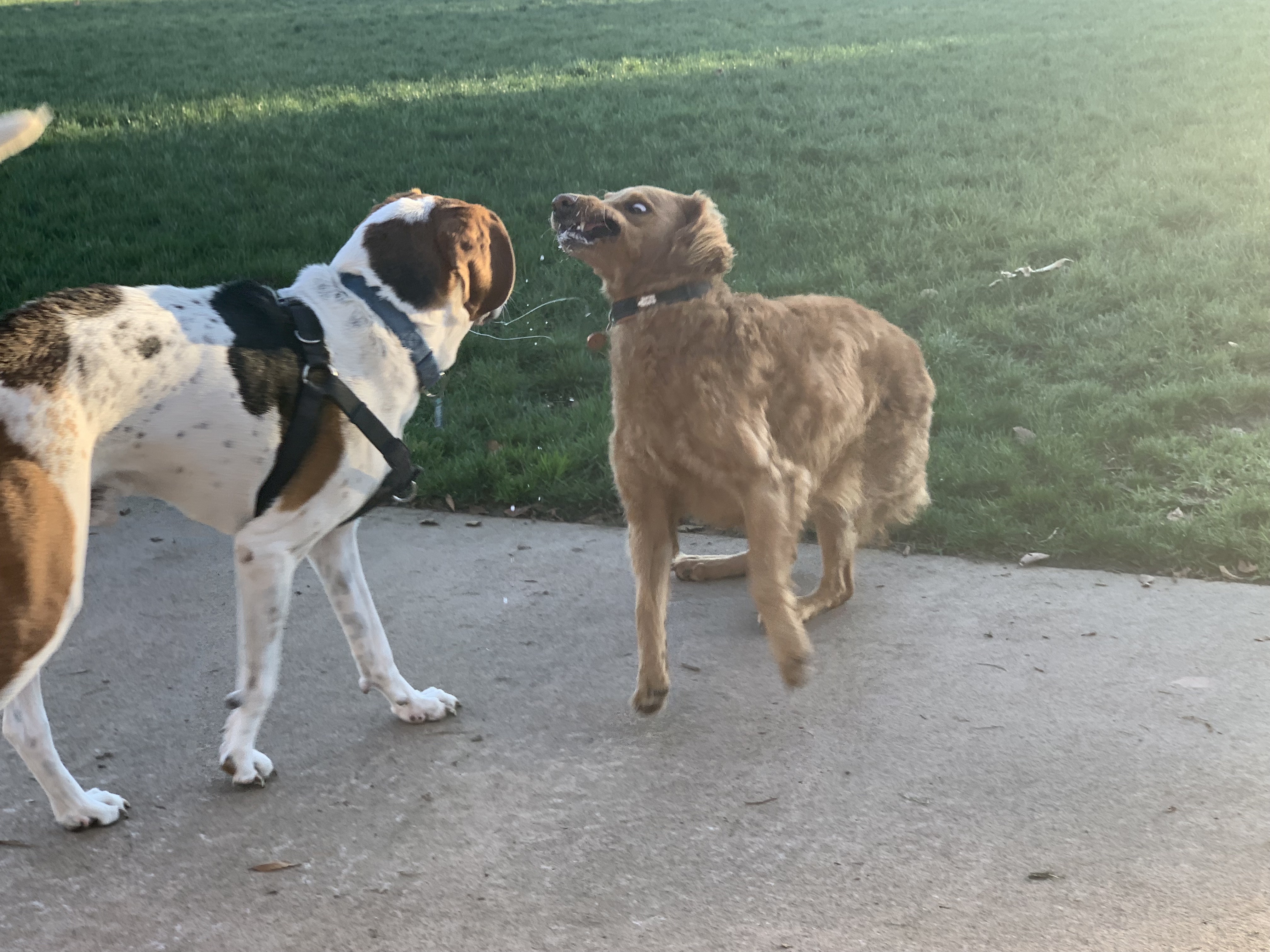
Sadie (L) and Bailey (R) illustrating the type of “fighting” they do when Bailey tries to steal a ball from Sadie.

At first, I didn’t think much about this ball stealing, and, if Bailey objected, he did not yet know how to present a formal written complaint about it. Within a few months, however, Bailey was as large as his kid sister and their “play-fights” became pretty intense. Neither one has ever (so far as I know) injured the other, but to this human observer, it looks pretty rough. They take turns running at each other. Our “back yard” is mostly garden, but there was a small patch of grass which has been completely torn into a black dirt field. 

When it comes to humans, most of us learn to “take turns” in nursery school or, at the latest, Kindergarten. There are eight billion people on the planet and not everyone has access to their own object of every description that they want. We, as toddlers, teens, and adults, take it for granted that we will “take turns” and share various things. At a public pool, there may only be one diving board so people cue up and “take turns” diving off the board. At a playground, there may be only one sliding board so kids take turns sliding down. In tennis, we “take turns” serving games. In baseball, we “take turns” as individuals batting, and the whole team “takes turns” hitting versus fielding. In playing neighborhood poker, it’s quite common to “take turns” dealing, and, along with that, many people play “dealer’s choice” which means the dealer also chooses the specific game; e.g., five card draw with jokers wild. In chess, the two sides take turns. In Risk and Monopoly and many other board games, players take turns.

Ferris Wheel is just one of thousands of situations where we take turns.


We take turns for positive things, but also for chores. A couple may decide to “take turns” taking out the trash or doing the dishes. Or, if there are five kids in the family, the five may take turns doing the various chores. “Taking turns” is so ubiquitous that it blends into the background in most cases and we don’t even consciously think about it. Life works better in a thousand ways, large and small, when we take turns. 

Last night, my wife and I attended a birthday dinner at an Italian restaurant. When it was time to order, we “took turns” giving our orders to the waiter. Imagine how inefficient and contentious it would be instead if we all shouted are orders at the waiter at the same time! Less pleasant for everyone and far more likely to result in mistaken orders. When we drove home, we came to several stop signs where we took turns with other drivers. We took turns merging onto the highway. When we came home, we took turns coming through the door! Then, the dogs took turns going out for a walk with me. I often feed them treats and share by having them take turns. 

Nonetheless, I can’t seem to get Bailey to take turns when it comes to her “catching a ball”as her default behavior. I can throw one ball into the deep end of the pool while I say “This is for Bailey” and throw another one in the shallow end saying “This is for Sadie” and the dogs will swim to their respective balls and collect them, but then, Bailey will drop his ball and run over to Sadie and steal hers.

Similarly, I can gather up two balls in the garden and throw them in opposite directions and get them to run in different directions (though not always). Nonetheless, as soon as Bailey scores a catch of “his” ball, he drops it and rushes back to grab the ball out of Sadie’s mouth. 

Sadie (L) and Bailey (R) are both Golden Doodles. Here, Sadie is about 3 1/4 and Bailey’s about 1 1/4 years old.

Why is it apparently so hard for Bailey to learn to take turns? Partly, no doubt, there’s some inborn tendency to want things for himself. And partly, there are positive reinforcement structures at play that I haven’t yet figured out how to break or how to shape up incompatible behaviors. Sadie, for her part, sometimes fights to keep the ball. I suspect Bailey finds this positively reinforcing because the “fight” itself is fun. Most of the time, when she sees him approaching in a “ball-stealing” situation, she simply drops the ball and Bailey snatches it. Bailey also likely finds this positively reinforcing too. I try praising other behaviors that are more in the direction of better cooperation, but such opportunities are rare and difficult to read so far. 

Initially, when I fed the dogs side by side, Bailey would often try to steal some of Sadie’s food. But Sadie herself growled fairly intensely when this happened and I often intervened as well. Here, Bailey was somewhat positively reinforced by moving her attention back to her own bowl, because, after all there was food there too. Even if he has finished his own dinner, he gets enjoyment from licking the “empty” bowl. So, in contrast to the case of turn-taking with tennis balls, the eating situation itself makes it easier for cooperation to emerge. I don’t ever recall Sadie trying to steal some of Bailey’s food. 

I have been hoping that watching the dogs might give me some insight into the ultra-greedy behavior of many (though not all) of the ultra-wealthy billionaires. Just to review the general situation America now finds itself in, the productivity of labor has increased tremendously since the beginning of the industrial revolution. Until the mid-1970’s the increased wealth that came from the increased productivity was split between owners of the means of production and the workers. In other words, the rich got richer, but so did the workers. Since the mid-1970’s however, the rich generally, and especially the extremely wealthy, have taken almost all the increased wealth that has been created by increased productivity.

Part of the answer as to how they have done this is to use their wealth to buy power in the form of bribing politicians who make policy decisions. In some cases, they’ve done this through outright illegal bribes and in other cases, they’ve used slightly more subtle and sometimes legal methods but the result is the same. In addition—actually, I should say “in multiplication” because the impacts have been more than additive, they have largely taken over mass media and social media where they promulgate heroic cartoon versions of themselves and their desires while lying about and denigrating people who are not insanely wealthy. 

Much like Bailey’s behavior, there is not a huge mystery in how they have done it. But, there is a mystery in why they have done it. Studies show that once you have your basic necessities taken care of, additional income doesn’t raise your personal happiness. While this result seems true in terms of aggregate happiness, it ignores the little dopamine hit that the animal (human or dog) gets when they immediately grab a fourth yacht or steal another ball from their sister. It doesn’t last long, but apparently long enough to serve as a positive reinforcement.

In the larger scheme of things, it’s not to Bailey’s benefit to keep stealing the ball from his sister. It make the whole ball-playing scene less pleasurable for me and I play less often. I also play with Sadie by herself more often because I want her to have a chance to play too. In the larger scheme of things, it’s not really to the benefit of billionaires to have sick, tired, uneducated workers either, nor ones so desperate to feed their families that they’ll start eating the rich. But somehow, dogs and such are prone to overlook longer term consequences. Some of the extremely wealthy delude themselves into thinking that they can replace their workers with AI and protect themselves & their families with firearms. They’re not thinking things through any more than Bailey is. This human tendency for self-defeating greed has been recognized at least since the time that Aesop told his fables. Maybe the choice of a dog in the following fable was quite intentional. 

A dog found a bone and was happily trotting along with the bone in his mouth. He came to a bridge and began happily trotting over the bridge. He happened to look down at his own reflection and saw the image of a dog with a bone. He thought to himself that he wanted both bones so he growled at the dog in the pond, intending that he drop the bone so he could have two. But the dog in the pond just growled back! So, the dog on the bridge barked angrily to bully the other dog into dropping its bone. Of course, what happened was that the dog on the bridge dropped his own bone into the pond.

That’s from 2000 years ago. But now, we’re in a situation that warrants a third round of foolishness. Here’s my addition:

The dog was angry that he had lost both bones so he attacked the dog in the water. He promised himself he’d fight to the death to get both bones. Of course, there was only one bone and he ended up exhausted and drowned in the pond.


Unlike some of today’s ultra-wealthy, Bailey is much too smart for that third round. The ultra-greedy (not the same set as the ultra-wealthy but with lots of overlap) would like you to believe that they are SuperDogs or SuperHeroes or something…that they 100,000 times as much wealth as you because they are 100,000 smarter. They aren’t, of course. And they are willing to prove they aren’t by believing the promises of a cruel, demented, liar-con man. Also, they have a thousand experiences, if they reflect honestly, that having increased wealth over the first 100,000,000 hasn’t made them the least bit happier. There have been some accomplishments or events that were correlated with making more money. But the money itself and what it can buy doesn’t make them feel any happier. And some billionaires accomplish things—such as eradicating a disease—which make them feel happier but that are correlated with investing huge sums of money, not gaining them. Meanwhile, if things continue on their current path, it won’t be long before there are many more people in America who are not just hungry but who are starving to death. At that point, no-one will forget that some billionaires pay zero taxes but have bought politicians who give even more wealth to the few while millions starve or die from lack of medical care.

It is time to feed Bailey and Sadie who will, at least, eat beside each other happily and peacefully. I should mention, by the way, that Bailey’s disposition is very loving. She is not a mean angry dog. She’s not even a particularly stubborn one. She tries to please us and gets along with others. But she does sometimes have trouble taking turns. How about you?

https://www.amazon.com/author/truthtable

Turing’s Nightmares (Sci-Fi about the singularity)

Fit in Bits (Describes how to work more exercise into a busy schedule)

The Winning Weekend Warrior (the psychology of winning and enjoying sports)

Tales from an American Childhood (recounts early experiences from Ohio in the 1950’s and relates them to current events)

Travels with Sadie 1 Lampposts

Sadie is a Thief!

Hai-Ku-Dog-Ku

Sadie and the Lighty Ball (Describes game and play pattern co-development)

Math Class: Who are You? (Shows how related all life is)

Roar, Ocean, Roar (a poem about the power of the people)

Essays on America: The Game (hypothesis essay about why some are so greedy)

The Self-Made Man


Essays on America: I Made Myself Breakfast

20 Monday Feb 2023

Posted by petersironwood in America, psychology

≈ Leave a comment

Tags

breakfast, collaboration, cooperation, life, peace, teamwork, truth, USA

Photo by Julian Jagtenberg on Pexels.com

I made myself breakfast.

Have you ever said to yourself, “I made myself breakfast.” 

This morning, I made myself breakfast, and the picture below is what was left. A few shreds of sauerkraut and one moldy blueberry. 

The complete breakfast included an English Muffin, Peanut Butter, blueberries, kale, sauerkraut, two garlic-stuffed olives, and a cup of coffee with cream and sugar. 

I made myself breakfast. 

But did I? 

In this picture you see a plate, a fork, and a napkin. Not only did some person initially come up with idea, but hundreds of people vastly improved the making of pottery and silverware and napkins. These particular items probably travelled many miles and were touched by many people’s work before they ended up in my possession. I can afford them because we live in a peaceful, mainly cooperative society. I certainly couldn’t make them on my own. And if they were made the way that they were a thousand years ago, only royalty could afford them. 

The wooden tray? That too shows obvious signs of change over the years from the time one of our ancestors decided to eat off a half-log. You might see some lettering. The tray says, “LET IT SNOW!” None of the other things mentioned above would have been possible without the invention and improvement to language. 

So far, my “self-made breakfast” involves thousands of ancestors who made any of this possible.

My “self-made breakfast” also involves thousands of contemporaries from around the world who cooperated to bring these particular items to the San Diego area. 

Photo by Cup of Couple on Pexels.com

We haven’t even gotten to the food. 

Let’s take the English Muffin, just as an example. Some of our ancestors might well have procreated and then “tried out” something as a possible food but guessed wrong and died. They figured out which grains could be eaten, how to grow them, how to harvest them more effectively than to shell one seed at a time; how to make flour; how to bake bread. In my case, there’s another whole line of inquiry related to the discovery of electricity and its taming and distribution so that I can toast my English muffins. There are similar hundreds of our fellow human beings (and their supportive communities) who were involved in today’s peanut butter, today’s sauerkraut, garlic stuffed olives and so on. 

Photo by Tom Fisk on Pexels.com

Once again, there are not only countless people from all over the world who were involved in the development of these food items. There are thousands of people from all over the world who helped get these particular items to our kitchen. 

It’s also true that if I’d been brought up by wolves, I wouldn’t know how to access or use any of these items. Not only that, my life has been saved numerous times by modern medicine. But “modern medicine” didn’t just drop out of the sky one day. None of these modern luxuries popped up like a mushroom. People worked hard and thought hard in order to all me to have a nice breakfast. However, it would be more accurate to say: 

Humanity made breakfast for me.

Photo by Gabriel Santos Fotografia on Pexels.com

How the Nightingale Learned to Sing

Roar Ocean Roar

The Only Them that Counts is All of Us

Dance of Billions

Corn on the Cob

Sunday Sonnet: Shadows

11 Sunday Sep 2022

Posted by petersironwood in America, poetry

≈ 2 Comments

Tags

cooperation, Democracy, leadership, poem, poetry, politics, truth, unity, USA

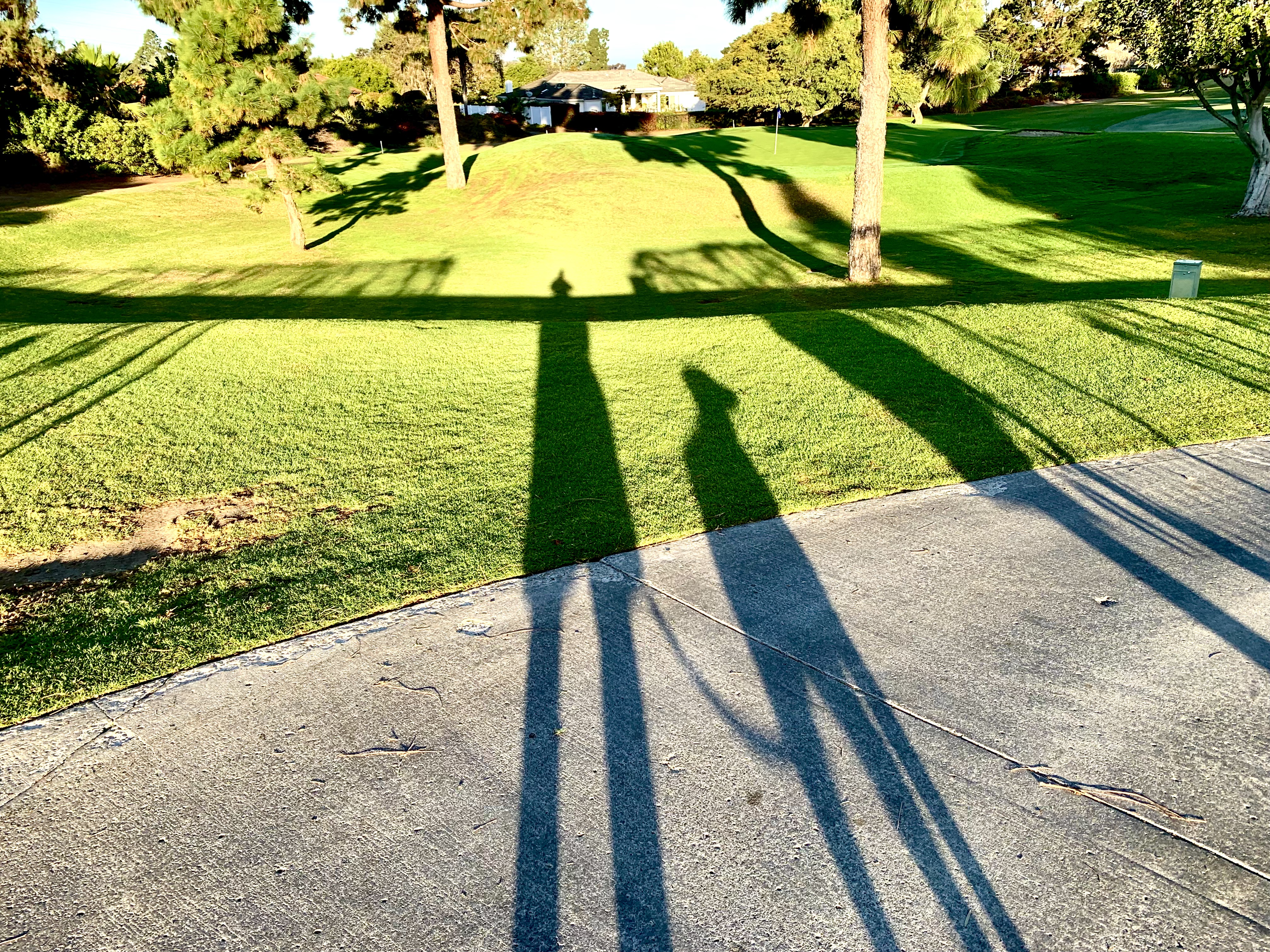
I took my Sadie for a Sunday stroll

And noticed shadows twitter on the ground

A nearby fountain’s splashing water sound

Attracts the thirsty birds from all around. 

My lack of sleep begins to take its toll 

And I see shadows deep and long and wide

The shadow fingers knit our deep divide.

For lacking math & tech, our web so wide

Is not. Denying truth is suicide. 

The cost of gratitude is small indeed.

The attitude of arrogance? A seed

Of lethal cancer’s ugly ego creed.

“It’s all for me and none for thee” will be

Destruction of our sweet Democracy.

————-

Poetic Commentary: I’m trying Sonnets and variations on Sonnets on Sunday. Here, I used the traditional iambic pentameter but slightly changed up the Shakespearean rhyme scheme ABAB, CDCD, EFEF, GG to ABBB, ACCC, CDDD, EE The idea of rhyming lines one and five is to reflect some unity among those five which deal with fairly direct perception of the here and now. In line six, I begin to move into “conceptual” shadows. Line nine rhymes with the previous three because this is meant to unify those lines more. But line 10 begins a contrasting thought. Though the couplet introduces a new rhyme, it is also a restatement of lines 10, 11, & 12 so the long “e” is kept and repeated internally as well (“me”, “thee”, “De-“, “sweet”, “de-“).

Political Commentary: In the photo above, you will see shadows of leaves and shadows of birds, though without movement, it may hard to tell which is which. But birds and olive trees are not the only shadows here. We are here at this particular spot partly because of our puppy Sadie. But how did Sadie come to be? Dogs were bred over thousands of years and while Sadie is still a puppy and very uncivilized as yet, she’s learning and a lot easier to deal with than her wolf ancestors. It isn’t just our training that helps Sadie live with us. It also depends on thousands of our ancestors taking the time to train and breed dogs to be our companions. There is a slab of concrete. Where did that come from? When did people invent that and perfect it? There is also a railroad tie. Railroad? Without early scientists and engineers and mathematicians, how would that have happened? And, of course, there are the builders who put this here and did not “cheat” so that the concrete was improperly made. Some other hundreds of folks arranged systems of commerce and government so that all this was possible. And how did you come to be looking at this photo and reading these words? Wait did I mention reading? You & I can read or write because someone took the time to teach us. And seeing it across time and space? Taking a picture with my iPhone? These depend on millions of people working in tech. But how could people spend so much time working on tech unless farmers made the food and truckers brought the food to a convenient place? But none of that system would work without government and police and armed services. 

There are many shadows here and most of them are thousands of years old. The truth is that we are vastly interconnected. We have what we have and can achieve what we achieve because of countless others alive and long dead. Setting citizen against citizen is a ploy so that a very small number of people can end up controlling everyone. It’s an old, old cancer of society, but that makes it no less deadly. 

We’re all in it together. 

Those who would tear us all apart do not admit to their outsized greed. Instead, they wear camouflage of “patriotism” or “religion” to try to fool others into helping them steal. The plane hijackers who wreaked destruction were convinced they were doing it for “God” not for their pocketbooks. To be radicalized into killing others is to be blinded. At first, people are told to tell a little lie for the good of God. And, a little later, they are taught to believe a slightly bigger lie. Until, in the end, they are willing to kill hundreds of innocent people and give up their own life as well. It’s all based on lies. One way you can tell they are lies is that the lies must never be questioned. Not to believe the lie is to be punished or even kicked out of the club. 

Photo by Izaac Elms on Pexels.com

———

Stoned Soup

The “All for me” bee. 

Three Blind Mice

Myths of the Veritas: The Orange Man

The Forgotten Field

The Dance of Billions

Dick-taters

Absolute is not just a vodka

Donnie’s Final Gift

My Cousin Bobby

The Update Problem 

What about the butter dish?

Essays on America: Wednesday 

The Declaration of Interdependence

Essays on America: The Game

Plans for US; some GRUesome

The Self-Made Man

Poker Chips

Peace

Author Page on Amazon

Seed, Ground, Water, Light, Love

10 Thursday Mar 2022

Posted by petersironwood in Uncategorized

≈ 1 Comment

Tags

cooperation, council, Democracy, legend, myth, peace, politics, story, Veritas, war

——————

After some delicate and delicious love-making with Shadow Walker, Many Paths decided to check on She Who Saved Many Lives. If she seemed well enough, it might also be good to see whether her mentor had any further wisdom to share about Many Path’s plan to gather all the tribes. Her goal was to bring about peace but she realized that in trying to accomplish that, she might trigger the very things she hoped to avoid. Her tentative plan was therefore to gather as much wisdom as she might from many sources — but not to wait overlong. As the story goes, she thought to herself, if you waste the entire warm season deciding where to plant, you will starve in the season of great ice and snow.

Many Paths called out to her friend and mentor and received a surprisingly strong and cheery response. “Come in, Many Paths. Come in! I’ve been meaning to ask your advice about something. Do sit down. I will get you a cup of tea this time.” 

Not for the first time, Many Paths wondered whether it was actually possible for She Who Saved Many Lives to see into her heart and mind. After serving them both a cup of spicebush tea, ever so slightly flavored with mint, She Who Saved Many Lives went to her work area and brought over two patches of weaving. She placed one on each knee of Many Paths. The older woman smiled and said, “It never fails to amaze me how strong a weave of reeds is! It’s so wonderful. Just as I hope our community is.”

“I have had that exact same though,” Many Paths replied. Then, she laughed and added, “Likely because you pointed that out to me before I was even old enough to remember.”

The Elder Shaman tilted her head and nodded ever so slightly. “Perhaps. But you have made so many wonderful discoveries. And, not only you but the entire tribe. That’s because you have been open to learning and seeing what is there. But enough of that. I did have a question for you. Which of these two do you think is better?”

Many Paths frowned. “Better for what? What are you making?”

She Who Saved Many Lives considered, “A basket to carry things.” 

Many Paths nodded, “What things and how many? This weave has these stiffer switches to help support the weight. If you’re making a small bag to collect mint, for example, you wouldn’t have any need. If you’re making a large bag to collect apples, however, you would want the extra structuring support.”

Photo by Pierpaolo Riondato on Pexels.com

She Who Saved Many Lives nodded. “Yes, yes. That sounds obvious when you say it. I guess the fever must have addled my brain a bit. Anyway, thank you for reminding me. Soon, I will have to decide on what I want to use the bag for; then I will know which one is likely correct. Now, what did you want to ask my advice on?”

Many Paths took in a deep breath and slowly let it out. “I am quite sure I didn’t say anything about asking your advice.” 

She Who Saved Many Lives nodded. “I think you’re right. Sometimes I confuse us.” She laughed. “I know it sounds crazy but any way, I will get back to my weaving — or at least deciding why I’m weaving and let you go about your business — unless, of course, there was something else you wanted to talk about.” 

Many Paths chuckled. “As it turns out, I did want to ask your advice about something. You know I want to convene a  — Let me ask you another question first. Are you going to teach me how to see into another person’s mind?”

She Who Saved Many Lives laughed surprisingly long. At last, she caught her breath and said, “Many Paths! You won all seven rings of empathy! Of course, you can see into others. Of course, you can never be perfect at it. But you already do it. I knew you were busy. Yet you came to see me. You probably wanted to see whether I was dead or not, but even your footsteps and the way you called out told me you had something else on your mind. In fact, whether you knew it or not, you assumed I was alive. There was no edge of anxious worry in your voice. It was friendly — but also a bit — plaintive. I knew you wanted something from me. Now, you can see I have very few possessions. I find too many to be intolerably distracting. I am not going to help you with any arduous physical task. What is left? You want to offer me the opportunity to share my experiences; that is a great gift. For once we die, what else is left? So, naturally, I am more than willing to try to see what grows from our discussion.” 

Many Paths looked down and slowly shook her head. She realized that she could read people. She simply forgot sometimes to do it. If you really take the time to put yourself in their sandals, of course, you can make a good guess at what they’re thinking, she thought. Aloud, she said, “Yes. You’re right. So, I want to convene the tribes and I am wondering how, exactly, to go about it. How can I make sure it helps bring greater peace and doesn’t somehow spark off violence. Maybe it’s better not to try?” 

She Who Saved Many Lives replied, “I can say that no-one has attempted to bring all the tribes we know about together — not in my lifetime or the lifetime of my mother or the lifetime of my mother’s mother. During that time, there have been many wars and other atrocities. People stealing other people’s children? Even in our own tribe, we had some who forgot they were not the Tree of Life but a small and temporary part of the Tree of Life. I judge it’s worth the attempt.”

Many Paths. “As to how…?” 

She Who Saved Many Lives said, “What comes to mind for what you are trying to do is more akin to growing things than it is to making things. I am making a basket, and I will use it for a time. I don’t ever imagine that it will live forever any more than that I will or you, my dear. But if I know your heart correctly, you don’t want to make a thing, which will at some time break or dissolve. You want to make something grow for a hundred years, like a giant oak. Ideally, it would be an oak that would seed still more oaks when old mother oak also died.” 

Many Paths nodded. She realized that her mentor had described her desires precisely even though she herself could not have articulated so succinctly. “Yes, that’s exactly right.”

She Who Saved Many Lives nodded. “Let’s suppose then that you want to plant something so that it’s likely to grow. What do you need?” 

“A seed. Fertile ground. Water. Sun. That’s it. Is there more? Love! It’s all more likely to grow with love.” 

She Who Saved Many Lives nodded. “Yes. That’s it. I would start with the love. You already have that. Then, you need to know what seed. The seed determines what will grow though not exactly how. But you will need the ground, water, and sun so it can grow at all.” 

Many Paths continued the thought stream. “If you know what the seed is, then, you know what kind of place to look for. You know whether you need to plant it in bright sunlight or in shade. You know whether it needs very fertile ground or if it can grow in dirt and rocks. And, you know whether it needs to be in very wet ground or if arid ground will do.”

“Yes,” Many Paths, “and it occurs to me, that you might choose a place with enough light first, because, you can make the ground more fertile and bring more water, if need be. But brining light is more difficult.” She Who Saved Many Paths sighed. “Once, apparently, we knew how to bring light as those which lit the tunnel that leads to the Veritas on the … on the other side of the mountain.” 

“I do wonder, Old Mother, whether such light would is strong enough to grow plants. And then, Shadow Walker used reflections of the sun, along with other captives, to escape from the City of the Z-Lotz. It seems too contrived and elaborate for growing plants, but … perhaps writing is a little like that when it comes to providing enough truth so that peace can grow. It allows you to bring the light of wisdom to places that are many days walk from where they started. More importantly, you can place the light in a different time as well. We have all learned so much from the books uncovered in the great library. But, as usual, you are right. We must determine what type of thing we want to grow. That decision will determine the type of seed. The type of seed will determine the proper material, sunshine, and water.”


Many Paths arose and began pacing around in the Old Leader’s shelter. “Of course, since the outcome could impact everyone, I need to know how everyone believes it should be. Or, at least, find out as much as they know about how they want it to be.”

“Yes.” She Who Saved Many Lives considered for a moment before answering. “I suspect some will have many ideas about that while others may not care that much. Nearly everyone wants peace. On other matters, there may be great differences.” 

Many Paths sat back down. The two sat in a comfortable silence for a time. Many Paths rose at last and said, “Thank you for sharing your wisdom. I will look for some to walk with me a bit and contemplate the plants and their nature and try to see among them what it is that the people may be seeking. I’m glad you seem so much better.” 

“As am I, Many Paths. You know, you give me much to live for.” She Who Saved Many Lives smiled and added, “But I do think I will lie down for a nap now. Though some time in the near future, I might accompany you on such a walk.”

Many Paths left and saw Shadow Walker coming toward her. From the look on his face, Many Paths judged he had some news. His smile broadened as he approached and he said, “Hello my love! Can we go for a bit of a walk?” 

———————

Author Page on Amazon

Myths of the Veritas: The Orange Man

Myths of the Veritas: The Forgotten Field

Myths of the Veritas: The First Ring of Empathy

Take Me For A Ride in the Car Car!

26 Saturday Feb 2022

Posted by petersironwood in Uncategorized

≈ Leave a comment

Tags

collaboration, cooperation, Democracy, Dictatorship, essay, problem solving, Ukraine, USA

Do you remember the song, “Take me for a ride in the car car”? Here’s a link to one popular version. Peter, Paul, & Mary also sang it. Nice song. But you may have experienced it being repeated too often. At a certain age, some kids seem to discover that they can be really annoying simply by singing a song over and over and over and over. 

When I was in my early teens, I took a car trip with my Uncle Paul and his wife and three kids out to see his brother Bob who headed up a psychiatric hospital in Pennsylvania. It was a long drive. At some point, to pass the time, we sang some songs. When the last song was over, Paul’s youngest son began to make up new verses for one of the songs. At first, it was rather cute to watch him try to build a story, rhyme, and keep in tune, none of which he actually succeeded in. But after about a quarter hour, he began to annoy people with his off-key, non-rhyming, senseless continuations of the song. After about a half hour he was annoying everyone. After an hour, we began to discuss leaving him by the side of the road and returning in another ten years to see whether he was still there. 

On car trips, we used to play a number of games to pass the time; e.g., seeing how many different states license plates we found find. Later, I learned to play “The Alphabet Game.” There are several versions, but basically, you must find, in order, the letters of the alphabet from passing cars, signs, etc. Stuff inside your own car cannot be used. (You could easily find all the letters in a book or magazine). I’ve learned to know where to look for J, Q, and Z. I’ve been in cars where we played twenty questions, Botticelli, Buzz, and Ghost. When I was a kid, I also simply looked out the window to entertain myself. Sometimes, I would imagine that the dotted lines that divide the lanes were like tracer bullets shot from our car. Then, I would watch to see whether another car got “blown up” because they crossed our fire. I would also imagine myself “flying” alongside the car, having to bob and weave to avoid telephone poles, trees, signposts, etc. 

Traveling in a car with a family or with a group of friends or your car pool is potentially a social opportunity as well as an opportunity to save money. Since you’re in the same car, you need to agree on destination. To some extent, you need to agree on temperature & what to do about the windows. As a kid, everyone also lived in the same “sonic space.” We would have to “agree” on a game or on a radio station. This is no longer the case. Now, often times, everyone in the family may have their own individual entertainment. Is that a good thing or a bad thing? 

Even in the modern day, driving in a car with others is different from driving in a car on your own. If you’re by yourself, you can decide on the temperature and entertainment without having to take into account anyone else’s wishes. If others are in the car, some kind of negotiations have to take place. 

At least, that’s what most people do. You could decide: “Hey! It’s my car so I’m going to drive and I get to determine everything about our common space — temperature, entertainment, windows, whether we stop, etc.” This is what is known in academic circles as the “A$$hole theory of cooperation”: Get everything you possibly can for yourself and to hell with everyone else. And after all, they’re doing the same exact thing. 

Notice too that to some degree, the amount of accommodation you have to do depends on how much humanity is in the car besides yourself. It also depends on how “luxurious” your vehicle is. If you have a tour bus or a camper, six people might be relatively comfortable. If it’s a VW bug, you won’t be. You’ll not only be crowded; you’ll have to be careful every time you move not to accidentally elbow someone in the eye. Have you ever been in that crowded of a situation for hours at a time or even days at a time? 

Photo by Life Matters on Pexels.com

It isn’t just cars. In general, the more people occupy a given space, the more they are going to have to cooperate in order to survive and thrive. You can provide individuality support with technology, up to a point. In a way, clothing is like that. We can peacefully co-exist in a car without either of us compromising out comfort because I can wear a sweater and you can wear a thin shirt. You can provide everyone an iPhone and everyone can play their own game without having to agree on a common game. Of course, there’s a downside to that. First, we don’t have practice getting along with others. Second, we don’t share a common experience. 

Even if the “typical” family of four interrupts their car trip and stops for lunch and agrees to talk, they are likely coming from very different places. Dad has been listening to Mozart and was in good mood until he suddenly remembered he was supposed to have sent out a memo to everyone in the department about last month’s sales figures. Damn. Maybe he can do it from the Motel but it will take longer than it would have at work. His son Sam, meanwhile, was trying to use sexting to convince his girlfriend to “take their relationship to the next level.” As a result, they just broke up. Dad doesn’t know a thing about that; nor does Sam know anything about why Dad suddenly seems put out. Mom meanwhile, was listening to Fox “News” where she “learned” that it’s Biden’s fault Putin “had to” attack the Ukraine because Biden was too tough on Russia and also too easy. Her daughter Sally, on the other hand, has spent the last 45 minutes on twitter learning about the Putin invasion. She is wondering whether atomic war might start. 

Now, they stop for lunch. That’s nice. And, maybe they’ll talk about something common; perhaps the weather, or the scenery or the food. But they might just revert to what they were doing before they got together at the restaurant. Even if they all have the willpower to put away their personal devices, they are still coming from very different places emotionally and experientially. Dad might make a comment about how he forgot to write an important e-mail and he’ll have to do it from the Motel. Sam just shakes his head and says, “Important e-mail? My life is ruined! What do you care?” 

Dad might say, “What do you mean by saying that your life is ruined?”

Sam might even share, “Jackie broke up with me!” 

Dad, meaning well, and wanting to offer a solution before he starts reminiscing about his own high school days, blurts out: “Oh, Sam, don’t worry about it! You’ll have another girlfriend in a week.” 

That may well be empirically true. But to Sam? He feels he has just lost the love of his life. His father’s comment seems to him to be dismissive of his feelings to the point of cruelty.  

Sally pipes up, “How can you be worried about such trivial things as e-mail and dates when we might be blown to smithereens at any moment? Do you ever pay any attention to the world outside yourself? Putin is a monster killing innocent civilians so he can slake the thirst of his pathetic ego!” 

Mom is taken aback. The only news she doesn’t dismiss as “lies that are out to get Trump” has been Fox “News” for the last few years. She says, “Don’t be saying bad things about Putin! He’s a nice man who just wants his Ukraine back.” 

Sally’s jaw drops. “Are you serious! He kills journalists who write the truth about him. He’s a corrupt crime lord. He played Trump like a fiddle … no … not that complicated … played him like a drum … no … still too complicated … played him like the triangle. You know. Bang it every once in awhile and it reverberates. Anyway, it isn’t “his” Ukraine. It belongs to the Ukrainian people!”

Some families are better at getting through all this than others. These four have not shared a common experience and are coming from very different places. If they have no practice playing a game according to a common set of rules, what chance to they have to settle deeper differences? 

Maybe avoiding little conflicts by giving everyone their own personal entertainment device means that when much bigger and more difficult conflicts arise, no-one remembers how to resolve things. Why shouldn’t everything by how I want it? Let others do the same! Let the best man win!

Except, of course, it isn’t the best man or woman who actually wins in a land where no-one plays by the rules. It’s the most corrupt. And the net result of everyone spending so much time competing and so little, if any, time cooperating is that nothing much is actually accomplished. It doesn’t even work very well in a small group. In a large nation, a dictatorship is almost invariably associated with less for everyone except the dictator and the immediate surround. Dictatorships do sometimes manage to steal from neighbors who are productive because they are cooperative. If all countries were dictatorships, they would all perish, probably in atomic war, but possibly in ecological collapse or just mass suicide. 

In 2018, I worked on a “Pattern Language” for collaboration and cooperation. Here’s a link to an index of the Patterns. One of them is called “Small Successes Early.” Should I be worried that we seem to be moving into a world where there are fewer and fewer opportunities for peacefully resolving small conflicts? Avoiding unnecessary conflict seems like a good thing. But … is the downside that people have no practice resolving conflicts? And, is the further downside, that people eventually end up with huge differences in their notions of reality when it really matters? It seems to be the very thing that Faux News has been counting on; that people would not only listen to them but not listen or dismiss any other views. As a result, people end up with very different models and explanations of the world. That is always a bad thing, but in a world where people are unpracticed at resolving conflicts, it’s even more problematic.

There is always a tradeoff between cooperating as a whole and letting each individual do as they wish. One thing seems crystal clear. As the number of people in your car increases, their individual freedom to do just as they please decreases. So, too, with the world. In my own lifetime, the population of the world has quadrupled. Of course, it’s not equally distributed. People are more concentrated in cities than ever before. Many of these cities are located on ocean coasts. What does the continuation of global warming mean to population migration and crowding?

I’m not sure how many people realize this, but we’re still in a pandemic. If people were very sparsely populated, we probably wouldn’t be. But as we continue to get more crowded, humanity will become more susceptible to pandemics. That in turn, means people will have to accommodate to each other’s needs. As a background rule, a person can choose to wear what they want. There are, of course, many exceptions to that. In many situations, you have to wear a shirt and shoes. In some situations, you have to wear a suit and tie or a uniform. If you might be spraying germs at other people, it seems totally reasonable to change your behavior or clothing to minimize that spread. But some people apparently think that they should be able to do exactly as they want regardless of the consequences to others.

Toddlerhood Nation

As the earth becomes more crowded, we need to be more cooperative, not less. The presence of a large number of deadly weapons also makes it more important to cooperate. The race to ensure survival by having ever larger numbers of ever more deadly weapons is not a path toward that greater cooperation. Dictators, for instance, tilt toward war to consolidate their power.


Create Peace

Author Page on Amazon

Absolute is not just a vodka

Where does your loyalty lie? 

My Cousin Bobby

The Stopping Rule

The Update Problem

Essays on America: Wednesday

Myths of the Veritas: The Orange Man

Myths of the Veritas: The Three Blind Mice

Myths of the Veritas: Stoned Soup

We’re all in this together

30 Thursday Dec 2021

Posted by petersironwood in Uncategorized

≈ 7 Comments

Tags

community, cooperation, Democracy, earth, green, nature, peace, poem, poetry, society

We’re all in this together.

Each and every one. 

Oh, my God, it can’t be true. 

Perhaps for me, but not for you! 

You’re too black or brown or yellow!

I’m just an ordinary fellow! 

You’re too gay or straight or mellow!

You even eat that apple jello! 

We’re all in this together.

Each and every one.

Old & young and in-between;

The ever-seen and never-seen.

Oh, my God, it can’t be true. 

Perhaps for me, but not for you! 

You’re too fat or skinny or too tall!

Perhaps you’re short and way too small! 

We’re all in this together.

Each and every one.

Into games or sports of every sport.

Even tall and short and every sort.


Oh, my God, it can’t be true. 

Perhaps for me, but not for you! 

You’re too shallow, smart, or kind;

Too lame or sick or different mind. 

We’re all in this together.

Each and every one.

We’re all in this together.

Each and every one.


Take a glance join the dance

The Watershed Virus

The only “them” that counts is all of us

How the Nightingale Learned to Sing

Myths of the Veritas: The First Ring of Empathy

Stoned Soup

Three Blind Mice

Absolute is not just a Vodka

Fire and Ice

The “All for me” Bee

Life Will Find a Way

Myths of the Veritas: The Orange Man

Myths of the Veritas: The Forgotten Field

Myths of the Veritas: Many Paths Finds Many Keys

21 Tuesday Sep 2021

Posted by petersironwood in Uncategorized

≈ Leave a comment

Tags

cooperation, empathy, fiction, leadership, legend, Many Paths, myth, tale, Veritas

Many Paths frowned. She looked down at the wrinkly old lady who had been — and still was — her mentor, her shaman, her friend. She Who Saves Many Lives was drifting off to sleep but with a smile on her face, despite the difficulties and discomfort of the Red Spider Plague. Many Paths herself smiled. Even in sleep, the old Shaman made her feel better.

She decided to let her mentor sleep. Many Paths had been about to ask for a hint about the puzzle she had just been given. Many Paths laughed to herself thinking, Just as well. Her “hints” are just as likely to lead the student astray as they are to bring sunlight to the right path. 

Many Paths left the old shaman’s cabin and walked about the Center Place of the Veritas. She greeted various members of the tribe warmly, and once she had greeted everyone in sight and reassured them that she was cured and that The Old Grandmother was resting comfortably. She had discovered that greeting everyone and having a short conversation with them allowed the maximum chance for uninterrupted thought. So, she settled herself at the porch of her own cabin. She reviewed what the old shaman had said to see if there was a clue to this seemingly impossible problem. 

“There are two locked boxes. Each contains the other’s one and only key. Yet, I am able to use the keys to open both boxes. How is that possible?”  

First of all, why had she brought this up? Was it just something that bubbled up in the overheated brain because of the fever? Perhaps. But Many Paths reckoned it more likely that She Who Saves Many Lives had intentionally chosen this puzzle because it held something useful for the problem at hand.

Well, thought Many Paths, to be more precise — not the only problem at hand — there were so many. But the one she had shared with her mentor was how to bring together all the nearby tribes and broker a peace deal amongst them. Fires. Wars. Killing Sticks. Stealing children. It was all madness. And the Z-Lotz? Bringing the Red Spiders Plague on purpose? Giving them a gift which was really meant to sicken them? How could there peace with such as that? And yet — and yet, somehow her lover Shadow Walker and one of her closest friends, Eagle Eyes had become the leaders of the Z-Lotz! If, she reminded herself, the note brought by the Eagle could be believed. 

Many Paths sighed. She wished she could talk it through with someone. Yet…she had a feeling that She Who Saved Many Lives didn’t give her the puzzle because she wanted the answer. The old shaman already knew the answer. It was specifically designed to move something within Many Paths. Many Paths laughed aloud at her own train of thought. She shook her head and muttered to herself, “Here I am. I can’t solve the puzzle she gave me so instead, I’ve given myself a still harder problem — trying to read the mind of She Who Saves Many Lives! I think if I know why she gave me the puzzle, it would help me figure out the answer. The much more sensible approach is to solve the puzzle and then it will be much easier to solve why she gave it to me.” 

Many Paths closed her eyes and put her fingers to her temple. With her eyes closed, she became much more aware of the warmth of the sun on her face. She quite consciously relaxed her muscles and slowed her breathing. 

Photo by Johannes Plenio on Pexels.com

She thought: Inventory. What do I know? There are two boxes. There they are. Many Paths pictured two large wooden boxes side by side. They were identical. What are they made of? Are there holes? Is it still a box if there are holes? Maybe it’s still a box, but they are locked boxes. Locked boxes are not really locked boxes if their are large enough holes for me to slide my hand through and simply grab the keys. They are supposed to be locked boxes. But why are they made of pine wood? No-one said anything about pine or even wood. They could be carved out of stone, I suppose or even of ice. The boxes could melt! But she said ‘use the keys’ — well, I suppose you could take the keys and warm them in a fire and then, use that heat to melt the ice…but no, I wouldn’t yet have the keys. I could wait till they melt naturally. Then I could grab the keys, but I wouldn’t be using them to open the boxes. Is melting a box really opening it?

So, how do I know the boxes are identical? Suppose I am one of the boxes? I am in the tribe but I am also myself — my own person — even though I lead the tribe. Something is nearby. I can hear the answer rustling in the bushes but it is still too dark to see it clearly. Two boxes. Not necessarily the same. One could be the tribe. One could be me. If I had the key to the tribe … and the tribe had the key to me….they could me the key I need to open me and I could give them the key to open them.

In the mind of Many Paths, the two boxes began playing with each other. She made them mentally chase each other in circles. Then, when she grew tired of that game, she had them continue their roles to the end. One of the boxes opened its giant “mouth” — a hinged side — and “eat” the other box. 

Many Paths stopped breathing. Her eyes snapped open. “Of course!” She said aloud. Her first inclination was to run back to continue her conversation with She Who Saves Many Lives. But she shook her head. She’s likely still asleep, thought Many Paths, and besides. There’s the other half of the problem. Why did she…? Ah, of course! 

Many Paths saw that the second puzzle — why she had been given this puzzle when she had been telling She Who Saves Many Lives how much she wanted to bring peace to the tribes but she couldn’t even control Trunk of Tree — that wasn’t a puzzle at all. It was obvious. If she wanted to change the external world to be more peaceful, she herself would have to be changed — perhaps more peaceful — perhaps not. The puzzle didn’t specify exactly what about herself she would have to change. A puzzle merely illustrates a principle. It never dictates real world action. All the Veritas were taught this early, including Many Paths. 

Her intuition led her to believe the two “keys” were different in her dilemma just as they had been in the puzzle. But —she also believed that they would be closely related. Many Paths wanted to the tribes to be more peaceful, more truthful, kinder, more cooperative. She sighed and issued a short laugh.

Many Paths said to herself, I want all the tribes to be more like the Veritas. I want them all to be Veritas. But — I can’t bring six tribes together and explain that they should all be just like me … or even more like me. 

Again, Many Paths had a sudden impulse to run back to She Who Saves Many Lives to share her new insight. And, once again, she immediately suppressed that sudden urge. Instead, she sighed. She did wish that she could discuss this with one of her friends. It was clear that she needed to make a change, but it also seemed obvious to her that it was just the sort of change that friends could help with. 

She thought, My friends will see in the moment that I am assuming everyone wants to be a Veritas and point it out. Eventually, the new way will permeate my thinking. But which friends? My most trusted friends were all unavailable at the moment. I’m not ready to allow the spread of rumors about a meeting with all the tribes. It can’t be just anyone. Could I talk about it with Trunk of Tree?

Many Paths took a deep breath. She reckoned she could talk about it with Trunk of Tree, but first, she needed to really see and understand his point of view. 

She thought, Prior to seeing him, I need to make a guess at his perspective and then I need to check it out with him. I can’t just assume it’s right, but I might make a start. He’s always thought he should be the leader because he’s the strongest. In his mind being strongest is the most important thing. I need to make him see that we all do think it’s important. We value his strength and all wish we had more of your strength. We also believe that other things are also important. And, it may be the case, that in some instances, being the strongest is the very most important thing for a leader to have. And, it may be the case, that in some other instances, being able to see the best, or hear the best, or speak the most convincingly, or think the most creatively. Who knows? We have a way to choose a leader. And in that way, I was chosen. It doesn’t mean that you are not the strongest. It does not mean that we care nothing about you or your strength. It just means that for now, the shaman judges that the seven rings of empathy were the best trials. Of course, the people are the final judge and if everyone wants to change the way we choose leaders, so be it. Perhaps everyone will decide a wrestling match should determine the leader — or, as with the Z-Lotz and Cupiditas,  — a fight to the death. If the people decide that, then so be it, and I will support you. And so will Shadow Walker and Eagle Eyes and Tu-Swift. But as it is, I am the chosen leader. That doesn’t make me your ruler. I come to you as a friend and I need your advice precisely because you and I don’t always see eye to eye. Here’s what I’m thinking….

Her thoughts continued: Of course, I must be open to many paths of conversation. Perhaps I should suggest that I speak uninterrupted for a time. Trunk of Tree could be a good confidant if he will hear me out first. It requires so much work though to work with him. Of course, the same can be said of getting the six tribes together. It’s like trying to weave…yes…it is like weaving! The tribes can all be different. We can do things differently. But the question is, what do we want to work on together. And let us move in different directions and make the whole basket stronger. 

Many Paths felt relieved somehow and looked forward to having an honest conversation with Trunk of Tree. She circled through the village looking for him but he was nowhere to be found. She wondered if he had gotten so made that he had injured himself or even left the tribe. She shook her head. She was having a bad day of fishing or hunting. She chuckled to herself and thought: I was actually looking forward to talking with Trunk of Tree and he’s not here. Oh, I miss Shadow Walker! 

Just then, the attention of Many Paths turned to the air. She heard a distinct drumbeat pattern that someone safe was approaching. She thought: It looks as though I will have my conversation with Trunk of Tree after all. 

————————-

The Myths of the Veritas: The First Ring of Empathy

The Myths of the Veritas: The Forgotten Field

The Myths of the Veritas: The Orange Man

The Myths of the Veritas: The Wobbly Man

Essays on America: The Isle of Right

The whole is greater than the sum of the parts

← Older posts

Subscribe

  • Entries (RSS)
  • Comments (RSS)

Archives

  • December 2025
  • November 2025
  • October 2025
  • September 2025
  • August 2025
  • July 2025
  • June 2025
  • May 2025
  • April 2025
  • March 2025
  • February 2025
  • January 2025
  • December 2024
  • November 2024
  • October 2024
  • September 2024
  • July 2024
  • April 2024
  • March 2024
  • February 2024
  • January 2024
  • December 2023
  • August 2023
  • July 2023
  • May 2023
  • April 2023
  • March 2023
  • February 2023
  • January 2023
  • December 2022
  • November 2022
  • October 2022
  • September 2022
  • August 2022
  • July 2022
  • June 2022
  • May 2022
  • April 2022
  • March 2022
  • February 2022
  • January 2022
  • December 2021
  • November 2021
  • October 2021
  • September 2021
  • August 2021
  • July 2021
  • June 2021
  • May 2021
  • April 2021
  • March 2021
  • February 2021
  • January 2021
  • December 2020
  • November 2020
  • October 2020
  • September 2020
  • August 2020
  • July 2020
  • June 2020
  • May 2020
  • April 2020
  • March 2020
  • February 2020
  • January 2020
  • December 2019
  • November 2019
  • October 2019
  • September 2019
  • August 2019
  • July 2019
  • June 2019
  • May 2019
  • April 2019
  • March 2019
  • February 2019
  • January 2019
  • December 2018
  • November 2018
  • October 2018
  • September 2018
  • August 2018
  • July 2018
  • June 2018
  • May 2018
  • April 2018
  • March 2018
  • February 2018
  • January 2018
  • December 2017
  • November 2017
  • October 2017
  • September 2017
  • August 2017
  • July 2017
  • June 2017
  • May 2017
  • April 2017
  • March 2017
  • February 2017
  • January 2017
  • December 2016
  • November 2016
  • October 2016
  • September 2016
  • August 2016
  • July 2016
  • June 2016
  • May 2016
  • April 2016
  • March 2016
  • February 2016
  • January 2016
  • December 2015
  • November 2015
  • October 2015
  • September 2015
  • August 2015
  • May 2015
  • January 2015
  • July 2014
  • January 2014
  • December 2013
  • November 2013

Categories

  • AI
  • America
  • apocalypse
  • cats
  • COVID-19
  • creativity
  • design rationale
  • driverless cars
  • essay
  • family
  • fantasy
  • fiction
  • HCI
  • health
  • management
  • nature
  • pets
  • poetry
  • politics
  • psychology
  • Sadie
  • satire
  • science
  • sports
  • story
  • The Singularity
  • Travel
  • Uncategorized
  • user experience
  • Veritas
  • Walkabout Diaries

Meta

  • Create account
  • Log in

Blog at WordPress.com.

  • Subscribe Subscribed
    • petersironwood
    • Join 664 other subscribers
    • Already have a WordPress.com account? Log in now.
    • petersironwood
    • Subscribe Subscribed
    • Sign up
    • Log in
    • Report this content
    • View site in Reader
    • Manage subscriptions
    • Collapse this bar
 

Loading Comments...