• About PeterSIronwood

petersironwood

~ Finding, formulating and solving life's frustrations.

petersironwood

Category Archives: story

The Story of Story: Part 3

17 Saturday Jan 2026

Posted by petersironwood in creativity, essay, HCI, psychology, story, Uncategorized

≈ Leave a comment

Tags

books, education, fiction, HCI, knowledge, leadership, learning, life, management, sense_making, story, Storytelling, thinking, truth, UX, writing

The Story of Story: Part 3 – Good Story, Well Told.

Often in my English classes, (and yours?) we talked about the mechanisms of writing: spelling, grammar, word usage, punctuation, paragraph construction, metaphor, rhythm, and rhyme scheme, for instance. We talked very little about how to tell a story well. And we talked zero about what makes for a good story. 

In the last article, I described some guidelines for soliciting stories from users and other stakeholders. From these, one may gain insight into potential problems that a product or service might solve, ameliorate, bypass, or avoid. Later, I will describe more about how stories may be used in the design and development process. Before getting into that, however, I want to describe more about what makes for a good story. In the following articles, I will also suggest ways to make the story well told. 

What Makes for a Good Story?

You might find it helpful to write down a short list of 5-10 novels, short stories, movies, or TV shows that you really liked. It doesn’t have to be your all time ten best; just something good that springs to mind. Then put that list aside. Read through the criteria I propose and then check back after you’re done reading to see whether or not most of these criteria were met. I’m betting that they mostly were met. 

fullsizeoutput_139c

The Story Cube. 

Imagine a cube of some really nice material that you like; e.g., polished wood, lead ore, malachite, silver. This cube has three dimensions: height, width, and depth. It must have all three dimensions. In the case of a story, there are also three dimensions in this sense: Plot, Setting, and Character. If a story lacks any of these three, it will be “flat” (not so interesting). For example, if you spent time working in a large company or government agency, you were probably given training materials about how you’re not supposed to do unethical things like steal from your company. They may have provided you with scenarios and asked what you would do or what was the “right” response. These stories tend to have people in situations making decisions. The problem with these stories is that, in order for them to be “efficient”, they spend almost zero time on character development.  “Joe wants to impress his boss and make his quota for the fourth quarter so he puts down as sold this-quarter things he is sure he will sell early in January. After all, he rationalizes, calendars are arbitrary.” Of course, the answer is no Joe should not be lying on his sales report. But we really don’t know much about Joe. We don’t know enough about him to really care much about him. Of course, he shouldn’t lie. If he does, it’s pretty hard to feel anything but contempt for Joe. It should have been obvious to him that he shouldn’t lie on a sales report and if he does lie, he should be fired. Good riddance. Let’s replace Joe with someone who follows the rules. 

OLYMPUS DIGITAL CAMERA

This story is so flat that it seems to me that the story is constructed, not so much to really educate, but more to prove that you were shown that it’s wrong to lie on sales forms so that, should the court case arise, you will not be to argue effectively that it was a mere technicality that you didn’t know about. If you really wanted to change someone’s mind about what was right, knowing about Joe’s character could make you empathize much more. Maybe he came from a Mafia-type crime family and no-one would bat any eye about lying on a sales report. They would expect him to lie on the report. Maybe even now, he is looked down upon by everyone else in his family for being such a chump and working for “the man” instead of being “the man.” 

OLYMPUS DIGITAL CAMERA

Or, perhaps Joe just found out that his wife has serious cancer and is understandably but severely depressed. He desperately wants to bring her some good news. If we reveal, not only what situation Joe is in but also, how he sees that situation, how he feels about it and what conflicts he faces, we will begin to have real empathy for Joe. His choices become real, rather than predetermined.  

TV commercials, like corporate training videos, are typically pretty flat too. But in some cases, the ad agency has gone out of their way to introduce you to some character that is recognizable and re-appears in commercial after commercial. Each time, just a little bit of character is revealed and eventually you find yourself watching the commercial largely because you start to care about the character. In a similar way, one might be able to make the corporate training stories more intriguing & educational if there were a cast of characters that persisted over time. 

fullsizeoutput_1308

Two Paths Diverged in a Yellow Wood…

Typically (but not invariably) the author knows how the story will turn out before he starts writing. But for the reader (or viewer), it is not at all obvious how the story will turn out. For compelling stories, the reader must be convinced to “play along with” the uncertainty of the outcome even if they are sure ‘the good guys will win.’ In good stories, bad things happen to the protagonist, but he or she is not a cork tossed on the ocean waves. The protagonist must want something; they must have a goal that is overwhelmingly important to them. They must react to changing circumstances, overcome the obstacles that are thrown at them. Characters are engaged in battles! Battles test them. If winning the battles is easy or inevitable, the character isn’t someone we can really relate to. 

catman

Kryptonite 

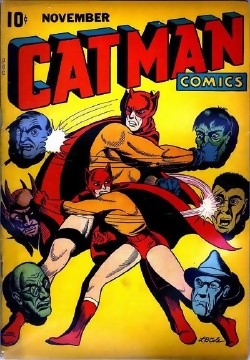
Superman is basically super-human and invulnerable! But watching someone who is invulnerable and has super-powers win battle after battle is boring. Superman has to have weaknesses. To make it more interesting and allow for more plot variation, he actually had three original weaknesses: kryptonite, friends, secret identity. In one episode, someone will have some kryptonite while in the next, someone will kidnap one of his friends. Recent movies have added a fourth weakness: other super-human and invulnerable beings.  

Whatever the story, your character must have weaknesses. Otherwise, no-one will “believe” the character and you as the writer will be stymied when you try to develop an interesting plot. The weaknesses can be physical, moral, social, intellectual, situational, and so on. But they should not be merely irrelevant weaknesses. Imagine a story where Sue is the main character. She’s tone deaf. She’s also brilliant, hard-working, imaginative, driven to succeed. And, indeed, she becomes a very successful trial lawyer. Eventually, she is made partner. OK. Isn’t this exactly what we’d expect to happen? What does being tone deaf have to do with anything? 

fullsizeoutput_129c

Imagine instead, that Sue was inspired at the age of four when she went to the opera. It was her life-long dream to become an opera singer. Indeed, she was blessed with a beautiful voice. She was also brilliant, hard-working, imaginative and driven to succeed. Unfortunately, she was tone deaf. Now, the weakness becomes interesting. Perhaps she will fail and kill herself. Perhaps she will fail but find another goal that is even more important to her and succeed at that. Perhaps she will fail time after time but eventually develop a career as an improvisational opera singer. She will ask people in the audience to name five things and then and there, she will create a beautiful aria that weaves a tale of some considerable interest about the five things. No-one knows that she is singing out of tune because she is composing on the spot. 

The more improbable the odds and the more horrendous the journey, the more challenge you give yourself to make it work! Blind at birth but wants to be an artist? Surely, that’s just stupid. It’s impossible. But is it? What if feedback were provided in such a way that it influenced her to make unique and beautiful paintings? What if genetic engineering allows her to grow new neural pathways? What if she can be equipped with artificial eyes? If it’s fiction, a magic spell can do the trick. Even if your ultimate goal is a real product for the real world, imagining a magical solution may lead you to a new (and real) path, previously hidden by your own expectations. 

It is easy for a writer to identify with their hero. And that is potentially quite a problem. After all, if you were superman, you sure as heck would not go out of your way to go near kryptonite. You’d quite sensibly stay away from the stuff! But if you are writing about superman, you need to get him near the deadly stuff every third or fourth episode! The “weaknesses” in the character generate interest. The failures, injuries, betrayals, and conflicts of your protagonist provide materiel that allows you to architect a more interesting plot. 

img_2246

A Garden of Delights, Flashy Sights, or Sword Fights?

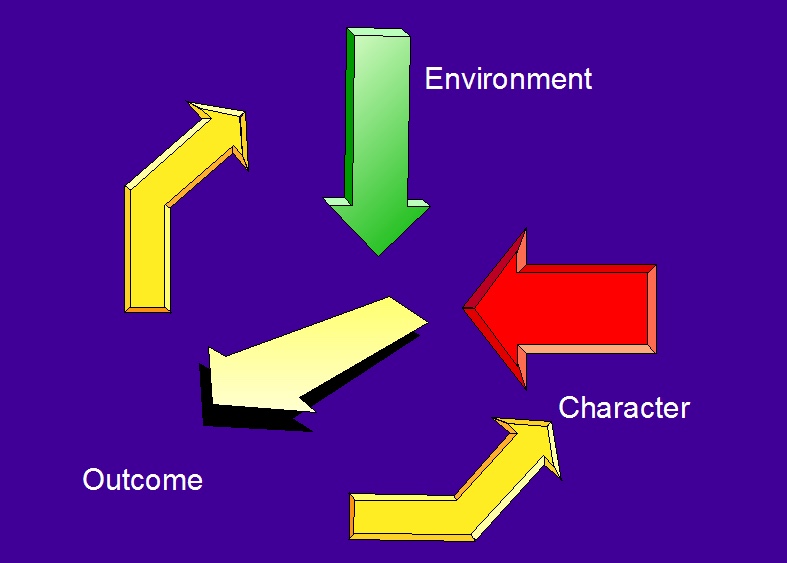
Three dimensions of story is a weak metaphor only. The three dimensions of a cube can be manipulated independently. This is not generally true for the three dimensions of story. The character makes a decision, the decision determines the next step of the plot. That will influence the setting for the next scene. In addition, the actions of the protagonist may also change state of the underlying and cross-cutting conflicts. 

Imagine:

 two rival gangs fighting for urban turf and maybe sex,

 two gardeners in a fierce competition for sex with the town’s most eligible “catch” as well as for the blue ribbon prize for best garden, 

two rival secret agents vying for victory and maybe sex,

two life long friends now vying for #1 in their Harvard Law class, and maybe sex.

The structure of the underlying plot might look quite similar, but the specifics will depend a lot on how the character is developing. If they develop from ego-centric to altruistic, then they will tend to make different decisions near the beginning than near the end of the story. In addition, the setting will have to be consistently portrayed. 

The four descriptions above would most naturally lead to a lot of the setting for the stories respectively in urban settings, garden settings, foreign settings & dangerous situations, mainly Law School and campus settings. Of course, you could violate expectations in a way that increases interest. Imagine that rather than have another garden scene–

The rival gardeners arrive at an urban parking lot dressed in expensive gowns, fully jeweled in their finest, both fully knowing that they will win first prize (but secretly fearing that they might not). These life-long friends now exchange icy greetings, make back-handed compliments about each other’s appearances. The verbal exchange escalates. Precisely because they know each other so well, they know exactly how the other person’s escalator functions. Soon, they are rolling around on the parking lot in their fancy gear; ruining each other’s clothes and hairdos. At this point, they hear in the distance, the loudspeaker and the chairman about to announce the Blue Ribbon Winner!  In their trashed and ripped clothing, they sneak in together to hear the awards, hanging out together in the shadows so as not to be seen in their tattered clothes. “And the blue ribbon goes to” {drumroll}: 

someone else entirely. 

At this, the two life long friends look at each other, laugh uproariously, hug each other, and then become even more intimate friends than they were before their fight in the urban parking lot. 

The fact that there are “expected” relations among various dimensions of story is wonderful. For every such expectation, you can decide to follow, bend, or break that expectation. The more expectations people develop, the greater the number of variations for creative exploration. One valid reason for the choice of setting is really where you want to spend your time. That goes for an author — but it also goes for any designer or business person or User Experience expert. What kind of setting do you want to be in? What kind of customers do you want to serve? Do you really want to make their life better or just get them to buy more product? What sorts of application areas are really cool to you? Of course, I understand people need to eat and often there is a conflict within us all about what to do. That’s what a good story is really about.

img_5134

The reason that stories resonate is that, regardless of setting, people face the same kind of dilemmas. We all do. And, how we handle those dilemmas? In life, as in story, 

character is revealed by choices under pressure… 

——————————————

Author Page on Amazon

Dream Planet on Barnes and Noble

The Impossible

Donnie Boy gets a hamster

What could be better? A Horror Story

If Only

Ripples

It was in his Nature

That Cold Walk Home

The Orange Man

Stoned Soup

The Three Blind Mice

All that Glitters is not Gold

The Forgotten Field

Choosing the Script

The Story of Story, Part 2

16 Friday Jan 2026

Posted by petersironwood in creativity, HCI, psychology, story, Uncategorized

≈ Leave a comment

Tags

AI, books, communication, education, fiction, HCI, interview, knowledge, narrative, needs, psychology, story, truth, user experience, UX, wants, writing

Introduction: 

This is the second in a series about using stories and storytelling in the design, development, and the deployment of products and services. In each post, I will weave in some advice about what makes for a good story as well as how to use stories. In this first case, the emphasis is on using stories to help uncover customer needs and wants. Needs and wants are not quite the same thing. For an extremely worthwhile discussion on the difference, check out this classic article by George Furnas. 

We Human Beings are not just Information Processors; we are also Energy Processors.

img_2261

I had just attended a conference on “knowledge management” co-sponsored by IBM consultants and IBM Research. On the plane ride back, after finishing the crossword, I turned the page to find a full page color ad by an IBM competitor that proclaimed: “Knowledge Management is simply [sic] providing the right information to the right person at the right time.” Color me skeptical, I thought. It isn’t simple to do those things. Beyond that, the formulation seemed simplistic even in its formulation.

The image of one of my undergraduate professors flashed into my brain. Professor MacCaw, (as we will call him), taught advanced German, a language which he had learned in a Russian prison camp, which might explain his approach to testing. At semester’s end, he asked, “Who in class wants A?!” 

img_9691

All two dozen of us raised our hands, of course. At this point, he proceeded to — there is no other word — attack one of the students in the class who had had four years of German in high school and had also lived in Germany for two years. The contents of his questions were not really that difficult, but the manner in which he demanded the answers was horrid. He would ask, for instance, “In first story, main character went where?” (He would always ask the questions in English). 

And she would begin to answer (necessarily in German), “Er geht…” And after a couple words were out of her mouth, he would scream, “Please to conjugate!” This meant that she would have to think back to the last verb she uttered and then conjugate it. “Ich gehe, Sie gehen, …” Then, he would interrupt again and scream a completely different and unrelated question in English. She would begin to answer; he would interrupt after she uttered only a few words: “Please to decline!” This meant, that she would have to give the various forms of the last noun she spoke according to the case. But once again, she could not finish but only begin declining the noun when he would once again interrupt. After 40 minutes, she was in tears and he looked menacingly around the room and asked, “NOW! Who in class STILL wants A?” 

img_3377

I have zero desire to go hang gliding or sky diving. But when it comes to the danger of mere social humiliation, I say, “Screw it. Been there. Done that.” I was one of only two of the remaining students who raised their hand. This act won me the next turn on the chopping block. He proceeded the same whip-saw questioning fest with me. The two-period class was almost over when he finished with me and began questioning “Mr. Lepke.” The bell rang and everyone else in the class left. Later that evening, I chanced to see Professor MacCaw in the Student Union. He walked up to me, eyes blazing. “Ha! I had Mr. Lepke after class for two hours! Finally, he said to me, ‘No, No, Dr. MacCaw, no more, I beg you. No more!’” 

This oral exam was difficult (even with my “screw it” attitude). It was much “harder” than my dissertation defense, for example. Again, it was not the information requested but the manner of questioning that made it difficult. People are not emotionless robots, as it turns out.

img_9666

The next semester, not surprisingly, only about half the class returned. One day in class, as Dr. MacCaw began one of his lengthy digressions on Eastern European history, he stopped himself in mid-sentence to say, “What is THIS!? Someone is passing notes in my class! I will take note and read in front of entire class!” He snatched the note, unfolded it, and indeed read the note in his loud ringing voice: “Doctor MacCaw: your zipper is down.” And, indeed it was. He had meant to humiliate someone in front of the entire class — and he had succeeded. He had the necessary information delivered at the right time to the right person, but — thanks to his own actions — it had not been done in the best manner — at least not the best manner for him. 

Human beings are not just information processors. We are living things and as such, the emotions, the vibes, the manner, the intensity of presentation — these are all vital to how we will react at the time and also how we will feel about the people involved and what we will recall years later. And this fact also means that the atmosphere you create when you interact with various stakeholders will vastly impact the quality of the insights and stories that you receive. If you really care about the people and are really committed to doing something to making people’s lives better; if you are truly open to hear and take in something unexpected or even disruptive to the project; and if you allow your informant to feel that truth about you, you will obtain the gold ring. 

Stakeholder Stories Solicited at their Sites. 

If you use a mechanical method and a mechanical tone and a mechanical manner to ask your users and other stakeholders about their needs and wants, what you will uncover are the most mundane, most rudimentary, most superficial and socially acceptable needs and wants. You can indeed use this information to design a product or service, and you may even have a product or service that succeeds in the marketplace. It will likely be, however, a rather short-lived “win.” Why? Because you are designing to fulfill wants that are subject to the wild winds of passing fashion rather than to catch the fire of an underlying passion. 

img_0568

What I found for myself was that it typically took about an hour of talking with a stakeholder, and most importantly, listening attentively, before they began to tell me their real stories. Your mileage may differ according to culture, context, power relations, your personality, and so on. I like to use a semi-structured interview. In this type of interview, there are known questions that I want to ask. But I also schedule plenty of time to let them elaborate, tell me what’s what behind the scenes. I know that in the corporate world, there is an ever-present push for being “efficient” and getting the job done as quickly as possible. So, it’s tempting to get the informant “back on track.”

I always prefer to interview an informant in their workplace. This seems like common courtesy; it puts them more at ease; and it sometimes reveals their use of other people, references, private notes, etc. as well as what they are dealing with in terms of atmosphere, noise levels, interruptions, desk space, etc. It also makes it much more likely that they can retrieve more of their own memories about work incidents more accurately because of all the contextual cues. 

John Whiteside, who ran the Usability group for Digital Equipment Corporation for a time, recounts running various usability studies and gathering data in various ways about a product they were designing for manuscript centers (places where human beings, historically almost always women, transcribed the dictation of others into text on a computer so that it could be edited, re-written, stored, etc.). The first time that they visited their users in the field, they discovered that they spent about seven hours a day typing and about an hour every day counting up, by hand, the number of lines they had typed. So, in one instant, they realized a feature that would improve productivity significantly. 

Guidelines for Soliciting Stakeholder Stories. 

When I managed the storytelling project at IBM Research, I was fortunate enough to hire Deborah Lawrence to help with the project. She thought it would be a cool idea to interview experts in a number of fields whose job, in one way or another, involves soliciting stories. So, she went out and did just that. I believe that her interviewees included medical doctors, policeman, reporters, social workers, and psychotherapists. These various practitioners had very similar guidelines. 

Story Elicitation Guidelines:

  • Provide a “warm-up” period.
  • Tell something personal and revealing about yourself; perhaps tell a story that is a model of the kind of story you’re looking for.
  • Observe an implicit contract of trust.
  • Provide a motivation for the story — why it’s important.
  • Accept the storyteller’s story and worldview.  Don’t resist the story.
  • Reveal who you are, how the story will be used, potential audience and goals, answer questions.
  • Use questions to probe.  Sometimes, a totally “off the wall” question can create space for story to emerge.
  • Empower the storyteller — they are the expert.
  • Avoid threat; don’t appear as an expert yourself.
  • Listen with avid interest.

These may seem fairly obvious such as does a lot of the advice in the book, How to Win Friends and Influence People. (Come to think of it, that might be the single best book you can read if you want a career in HCI/UX). However — back to the guidelines. I think they seem obvious once pointed out, in much the same way that once someone points out the “pig in the clouds” (or the face in the tree) you cannot not see it. 

img_2897

The above list is not, of course, meant to be the definitive such list. This was based on one study. If you have additional guidelines or disagreements, please let me know. 


Author Page on Amazon

The Walkabout Diaries

The Myths of the Veritas

A Pattern Language for Collaboration

Travels with Sadie

Fifteen Properties

My Cousin Bobby

The Update Problem

After All

All We Stand to Lose

Imagine All the People

The Dance of Billions

Roar, Ocean, Roar


The Story of Story, Part 1

15 Thursday Jan 2026

Posted by petersironwood in creativity, management, psychology, story, Uncategorized, user experience

≈ Leave a comment

Tags

AI, Design, development, HCI, knowledge, leadership, life, management, persuasion, story, thinking, thought, truth, UX

The Story of Story, Part 1

Background.

img_2386

Right around the turn of the century, I managed a research project at IBM’s T. J. Watson Research Center on the business uses of stories and story-telling. The project was part of a larger effort on “knowledge management.” One of IBM’s major reasons for being interested arose from their increasing revenue stream from services. However, services such as consulting required a lot of labor; it was competitive. Therefore, the margins on this business were not so high as, for instance, in hardware or system software. IBM invested a lot in tools so that they can make hardware very cheaply and effectively using relatively little labor. The company wanted to be able to something similar with consulting services. The idea was that we could use knowledge management so that the knowledge assets of top-level consultants could be, captured, organized, and then re-used by more junior (and less expensive) people thus rendering higher margins for the company. The success of this approach was fairly limited partly because the knowledge management methods were geared toward explicit rule-based knowledge and specific facts. Much of what experts “know”, including IBM’s top-level business consultants was tacit knowledge. Stories provided a natural way to capture tacit knowledge. Thus, the story project began. 

fullsizeoutput_1232

My simplistic initial idea was to build a story platform that would enable consultants to write stories about their experiences. After all, sharing stories orally is what experts naturally do anyway. Since I enjoy writing stories, I failed to realize initially all the reasons consultants would not want to share their experiences by writing stories. Writing stories is not so natural or fun for most folks. Partly because of the medium and partly because of higher expectations, it also takes more time. Perhaps, even more importantly, it takes extra time. When consultants share stories, they are often traveling, eating dinner, having drinks together. Sharing stories is something done in a friendly off-hand way, and importantly, it does not take extra time in the way that writing a story would.

In addition, when a consultant says something out loud it is not typically recorded. So, if they misspeak or said something untoward, they have plausible deniability. When someone tells a story live, they also can sense how the story is being received in real time. If the listeners are “into it” the teller can draw things out and make it more vivid. On the other hand, if they are starting to play “Candy Crush” on their phones, you can cut it short. In writing, typically, first you write and then you get feedback. Of course, professional writers often improve things considerably with the help of a copy editor, beta readers and a proofreader. Anyway, over the course of time, we did develop a feasible way to have people tell stories and from those stories, provide information of use to other knowledge workers. 

img_3152

Three Patterns for using stories. 

Narrative Insight Method describes techniques for gathering valuable knowledge from experts through the use of storytelling.

Fostering Group Cohesion through Common Narratives is another storytelling technique: in this case, one focuses on building and disseminating stories that illustrate common values.

Fostering Community Learning via Transformed Narratives. This helps solve a dilemma. For organizational learning, it’s crucial to learn from people’s mistakes. Ordinarily though, mistakes are not just used for learning but can bar one from advancement, or from getting raises, and lessen the esteem one’s colleagues might have of the teller. 

In this post, however, I want to describe some of the things I found interesting about stories from personal observations and, to a lesser extent by reading. Here are just a few examples of interesting aspects of stories.

  • Good story writing is not magic. It’s craft. Mastery is a life-long quest, but one can quickly learn a few important things that will help you to write better stories as well as to enjoy more thoroughly the stories you see or read.
  • Stories are memorable and motivating. If you watch people telling stories, they are animated and engaged in a way that is rare when people are discussing facts, pronouncements, or pleasantries. 
  • Business-speak is grey, toneless, neutral, abstract and speaks to the intersection of people’s experiences. Stories on the other hand, can be colorful, concrete, emotional, and, collectively they add to the union of people’s experiences.  
  • Although stories are generally presented in a linear sequence, beneath that, the story actually has a hierarchical structure. Most stage plays have three acts. Within each act, there are a number of sequences. Within each sequence, there are scenes. Within each scene, there are “beats.” 
  • The three major dimensions of story are setting (where, when), plot structure (what happens), and character (the people; what they are like and what they want).  
  • Story lives on conflict; a story explores the edges of human experience; it takes us on an empathic roller coaster ride.

In the next essay, we will begin to see more specifically how to use stories to help us discover problems and issues. Later, we will see that stories are a tool of thought that can be used in many different contexts and in many phases of problem solving and development.


———————————————

Author Page

There’s a Pill for That

Inventing a New Color

The First Ring of Empathy

The Forgotten Field

The Sound of One Hand Clasping

Stoned Soup

The Three Blind Mice

Finding the Mustard

What About the Butter Dish?

How the Nightingale Learned to Sing

After All

Guernica

Dick-Taters

The Impossible

Absolute is not Just a Vodka

My Cousin Bobby

If Only


Tools of Thought: Scenario Planning

15 Thursday Jan 2026

Posted by petersironwood in creativity, essay, psychology, story, Uncategorized

≈ Leave a comment

Tags

AI, decision making, fiction, health, life, mental-health, problem formulaation, story, thinking, tools of thought, truth, writing

Scenario Planning is, in some ways, likely to be a very old “tool of thought.” I imagine when our ancient ancestors prepared for a hunt, they would imagine what they would do and where and how and also imagine how their intended prey might react. Personally, I don’t think this kind of imagining is limited to human thinking. 

I take our Golden Doodle out for a walk every morning. She likes going for a walk. And, she has a pretty good “mental model” of the steps I take as I prepare. She gets more excited as she sees me getting close to the actual walk. On her morning walk, she typically urinates at least once and also defecates. She has numerous favorite places although she also improvises. Her walking behavior varies qualitatively if she “really has to go” and she aims for places to go that are closer. She also likes to steer us toward places where we’ve seen other people, dogs, animals, or other recent interesting phenomena. Her “imagined scenes” may be more olfactory than visual, but she’s anticipating. 

If scenario planning is such a common mental phenomenon, you might legitimately wonder why it needs to be examined as a tool of thought. 

Here’s the rationale. Although, in my experience as a researcher, as a teacher and as a therapist, almost everyone pictures possible future events but the way they do it could be vastly improved. For example, some people tend to imagine only negative consequences. In extreme cases, their habitual imagining focuses on the worst possible outcome. In fact, they sometimes focus, not only on the immediate worst outcome. They use that negative outcome as the onset for a whole train of imagined bad result. “There’s no way I’ll get an offer. I won’t get this job. Or, any job. It’s impossible. I’ll go broke and live on the street. I’ll likely be killed by one of those people who kill homeless folks for no reason. I’ll die lonely and forgotten. Now, I’m too depressed to go for a job interview. What’s the point? Just to end up dead?”

Photo by Zafar Mishkat on Pexels.com


Other folks go to the opposite extreme. They focus only on the best possible outcome.
“We’ll attack Cuba with a small force and the Cuban people will immediately join us in a counter-revolution and oust Castro!” Or—“Once we take control of the oil, this war will pay for itself!”


To some extent, thinking of multiple possible outcomes is addressed in another tool: Many Paths. 

It is important to be able to consider multiple scenarios. In general, it is also critical to be able to communicate imagined outcomes to others. That’s where storytelling comes in. Although scenario planning and storytelling are not identical, they are close cousins. Next, we will consider in some depth the topic of stories. How does one find, create, and personalize stories (or scenarios) and present them in a compelling fashion?

——————-

Author page

Many Paths

It was in his Nature

Donnie Takes a Blue Ribbon for Spelling

Small Successes Early 

Coelacanth 

That Cold Walk Home

Timeline for RIME

Wilbur’s Story

What Could be Better? A Horror Story.

As Gold as it Gets

A Mind of Its Own

After the Fall

Travels with Sadie 

The Walkabout Diaries

The First Ring of Empathy

The Orange Man

Stoned Soup

The Three Blind Mice

The Silent Pies

13 Saturday Dec 2025

Posted by petersironwood in America, family, fiction, psychology, story, Uncategorized

≈ 1 Comment

Tags

collaboration, cooperation, family, fiction, life, politics, story, teamwork, truth, USA, writing

Photo by Alena Darmel on Pexels.com

The first time I won the prize, I was only 8. I had only had my two-wheeler for about a year when my gang of neighbor guys jointly decided it would be a lot more fun to ride our bikes if they made as much noise as real motorcycles. I can’t speak for the others, but it never occurred to me that other people in the neighborhood might not find this increased noise level “really cool!” 

Of course, we weren’t always riding our bikes. Sometimes we played in Lynn Circle at the end of our road. It served as a makeshift playground for baseball, kickball, and soccer as well as a free hippodrome for our races. This arrangement had one slight flaw. There were no fences. So, invariably, a ball would go careening off the pavement onto someone’s lawn. 

In our neighborhood, everyone’s house looked fairly similar, but they expressed themselves through their small gardens and lawns. Some people, like my dad, really worked at making our small lot at least something gardenish. Other people did little but mow their lawn every so often. But some treated their lawns as they might, at any moment, be teleported to the Master’s Golf Tournament for emergency green replacement. Universally, these people had no children at home. When that was so, none of them interacted much with the kids, the parents of the kids, or even, each other, as I can recall. 

Photo by Kelly on Pexels.com

When a stray ball dribbled up into our lawn, someone just ran up and got the ball. No big deal. But if someone hit a ball into one of the three lawns that were antiseptic enough to serve as operating tables for open heart surgery–YIKES! Of these, the most stringent by far was “Old Lady Lynn.” When a ball went into one of the antiseptic lawns, we tried to reconnoiter the situation before even attempting to grab our ball back. We would consider whether there was a car in the driveway, whether there was any sign of life coming from the domicile in question. Only if we were fairly sure no-one was at home would we walk and get the ball. If we weren’t sure, we’d run up and snatch it as quickly as possible and then duck into a “friendly” back yard quickly enough so that we wouldn’t be identified. 

Old Lady Lynn always seemed to be at home. We imagined, because of her invariable and instantaneous reaction, that she spent all her waking hours peering out between curtains at her lawn to insure that none of us trampled her grass. 

Our gang decided to begin our little decibel enhancement project by each of us buying the loudest bell we could find. These were not modern, laser-guided, AI-enhanced sonic systems but simple bells that you had to operate with your thumb. It’s intended use was to prevent injuries and save lives by giving the bike rider a way to “warn” others of their impending presence to that the other person so they didn’t accidentally wonder into your path.

Photo by Bastian Riccardi on Pexels.com


We didn’t give that much thought. But we did give thought to how cool it sounded when we all rode around the circle clanging the bells.  Of course, even way back then, if you had a new toy or technology, you had to show it off incessantly and that’s what we did. 

Unlike the instantaneous reaction Old Lady Lynn had to our incursions onto her lawn, it took several days for the complaint to filter back to my parents. My parents (thank goodness) were not the sort to take my side regardless of ethics or consequences. I convinced my buddies that if we didn’t strike a compromise, our parents would take all our bells away. Our development project at that time, consisted of only three paved streets, but there were plenty of interconnecting dirt roads and paths that sported no houses on either side. Now, when we left the paved roads of civilization and rode off onto the dirt roads through the woods, we celebrated with cheers and bells as we crossed the threshold into non-civilization, a place where we could talk with each other without the constant reminders of parents and parenting. 

The golden sunrise glows through delicate leaves covered with dew drops.

A few days later, I was reading a book about dinosaurs when I heard a knock at the door. Soon, I heard the unmistakable wobbly tones of Old Lady Lynn. I couldn’t hear what she was saying nor what my parents said, but they sounded friendly. Then, the unbelievable happened. I heard them all laugh. It had never occurred to me that Old Lady Lynn would ever–could ever– laugh, or that she ever had laughed. 

I debated whether my appearance would make things better or make things worse, but in the end, I felt I I had to participate in whatever was happening. I hadn’t even finished opening my own door when I noticed a most amazing aroma! My eagerness spiked and I trotted into the kitchen. Steaming on the table: Not one but two warm, freshly baked blueberry pies. That smelled delicious!

My mom said, “Look, Mrs. Lynn was so happy you got those boys not make that bell clanging racket near her house and instead having your No-Bell in the Neighborhood Policy, she baked two pies.” 

The pies were amazing, but what was even more amazing that Mrs. Lynn became friends with my parents, and even with me. Every year, for the next six years we lived there, Mrs. Lynn gave me two pies. No two years were identical. All the pies were fresh baked and delicious: blueberry, raspberry, rhubarb, pumpkin, custard, cherry, and—my personal favorite—pecan pie. 

———————

Now, more than seventy years later, when I take Sadie for her morning walk, we often walk by a property with a self-proclaimed “Invisible Fence.” It’s been around for awhile, but it was invented in 1973; that is, about 20 years after the story recounted above took place. My neighbor’s invisible fence does seem to work for her two large and friendly dogs. They bark as we pass but do not accost us on the road. 

But the self-imposed boundaries of invisible fences have a long history in humankind. 

The reality is that we’re all part of one Great Tree of Life. 

All fences are temporary but, 

The impact of connection ripples forever. 

———

Author page

Math Class

You Must Remember This

Ripples

Roar, Ocean, Roar

Imagine All the People…

The Dance of Billions

The First Ring of Empathy

A Pattern Language for Cooperation and Collaboration

Your Cage is Unlocked

Impossible

Problem Framing: Good Point!

08 Monday Dec 2025

Posted by petersironwood in AI, America, design rationale, HCI, management, psychology, story, Uncategorized, user experience

≈ Leave a comment

Tags

AI, art, life, politics, problem finding, problem formulation, problem framing, problem solving, technology, thinking, tools, USA

Photo by Pixabay on Pexels.com

You have probably heard variations on this old saw, “To a hammer, everything looks like a nail.” I’ve also heard, “If you have a hammer, everything looks like a nail.” There is also this popular anecdote:

One night, I took my dog out for a walk and I noticed one of my neighbors under a nearby street lamp crawling around on his hands and knees, apparently looking for something. I walked over and asked, “What are you looking for?”

Photo by Photo:N on Pexels.com


“My car keys!” He replied.

I have pretty good vision, so I helped him. I didn’t see any car keys so after a minute or so I asked, “Where exactly did you lose your keys?” 

He stood up, cracked his back, and pointed back to a nearby park. “Over there.”

“Over there?! Then, why are you looking under the street lamp? Why aren’t you looking over at the park entrance?”

“Oh, that’s obvious! The light is so much better here!” 

For a time, I had to very interesting and challenging job in the mid 1980’s at IBM Headquarters to try to get the company to pay more attention to the usability of their products and services. As a part of this, I visited IBM locations throughout the world. At one fabrication plant, our tour guide took us by an inspection station. This was not an inspection statement for chips. It consisted of one person whose job was to look through a microscope and make sure that two silver needles were perfectly aligned.

After we left the station, our tour guide confided that they were strongly considering replacing the person with a machine vision system. The anticipated cost would be substantial, but they hypothesized that the system would be more accurate and faster. It was, our host, insisted, just the nature of humans to be slow and inaccurate.

Maybe. 

When I looked at the inspection station however, with my background in human factors, I had a completely different impression of the situation. The inspector sat on a fixed height stool and had to bend his neck at an absurd angle to look into the microscope. He was trying to align these silver needles against a background that had almost the same hue, brightness and saturation. 

Photo by Wesley Carvalho on Pexels.com

Other than blindfolding the man, I’m not sure what they could have done to make the task more unnecessarily difficult. I suggested, and eventually, they implemented, a few inexpensive ergonomic changes and time and accuracy improved.

Like other companies in the technology segment, IBM often saw problems as ones that could be solved by technology. At that time, technology systems was their main business. Since then, they have expanded more fully into software and services. In fact, those services now include experience design.

If you find yourself enamored of technology in general, or some specific class of technology such as machine vision, speech recognition, or machine learning, you might overlook much simpler and cheaper ways to solve problems or ameliorate situations. Of course, you might lose some revenue doing that, but you can also win long term customer loyalty. 

Even if you are a hammer, everything is not a nail. 

That applies as well to User Experience. You might design the most wonderful UX imaginable for a particular product or service. But if it is shoddily made so that it is error prone; if it lacks important functionality; if the sales force is inept; or if service is horrible, those failures can completely overwhelm all the good work you have done on the UX. Because of the nature of UX, you might learn important knowledge or suggestions for other functions as well. It often requires finesse to have such suggestions taken seriously, but with some thought you can do it. 

During my second stint at IBM, I worked for a time in a field known at that time as “Knowledge Management.” One of our potential clients was a major Pharma company who felt that their researchers should do a better job of sharing knowledge across products. They wanted us to design a “knowledge management system” (by which they meant hardware and software) to improve knowledge sharing. 

Simply building a “Knowledge Management System” would be looking under the streetlamp. They knew how to specify a technology solution from IBM and have it installed.

However — they were unwilling to provide any additional space, time, or incentives for their employees to share knowledge with their colleagues!  

Photo by Chokniti Khongchum on Pexels.com

They were convinced that technology would be the silver bullet, the solution, the answer, the Holy Grail, the magic pill. They viewed technology as less disruptive than it would have been to change employee incentives, or space layout, or give them time to actually learn and use the technology system. 

This reaction to “knowledge management” was not unique. It was common.

To me, this seems very similar to the notion that health problems can all be solved with a magic pill. What do you think? 

—————————————

Since originally writing, we have had the spectacle of DOGE: Destroying Our Government’s Effectiveness under the excuse of making it “more efficient.” It might be (as I strongly suspect) that the destruction was quite intentional. It might be (as some think) that it was accidental. In either case, the result was predictable because the method was guaranteed not to work to actually make things more efficient. If you really wanted to do that, you would take the time to understand a system before trying to redesign it. You would identify all relevant stakeholders and get their input. You would not redesign a system using a gang of young hackers but instead use an interdisciplinary team of experienced experts. You would check out your redesign both with those who were doing the work and with at least one group who were not familiar but had similar experience. Then, on the basis of feedback, you would redesign. When you were sure that you had the design right, you would not then institute it everywhere but in one small trial installation.

There’s a pill for that. 

The Pandemic Anti-Academic.

What about the butter dish? 

The invisibility cloak of habit. 

Process re-engineering comes to Baseball

E-Fishiness in Government

Author Page on Amazon

The Doorbell’s Ringing! Can you get it?

02 Tuesday Dec 2025

Posted by petersironwood in creativity, design rationale, psychology, story, Uncategorized, user experience

≈ Leave a comment

Tags

books, problem finding, problem formulation, problem framing, problem solving, story, thinking

Photo by Little Visuals on Pexels.com

After a long day’s work, I arrived home to a distraught wife. Not, “Hi, sweetheart” but “This doorbell is driving me crazy!” 

Me: “What doorbell? What are you talking about?” 

People differ in how they perceive the world around them. In my case, for instance, I’m very easily distracted by movement in my visual field. Noise can be annoying, but it rarely rises to that level. For instance, when TV commercials come on, I simply “tune them out” and instead tune in to my own thoughts. My high frequency hearing isn’t too great either. So, at first, I didn’t understand what my wife was referring to. 

Beep. 

Photo by Luisa Fernanda Bayona on Pexels.com

“That! That doorbell beep!” 

Ah, now I understood. And, there it went again. Once I knew what to listen for, I had to agree it was annoying though much more annoying to my wife because she’s more tuned in to sound than I am and her ability to hear high frequencies is also better.

She then upped the ante. “I have to leave. I can’t stand it! You have to make it stop!” 

I looked at the wall between our entryway and the kitchen. That’s where the doorbell ringer was. I unscrewed a couple of screws and removed the housing. Inside was the actual doorbell and three wires. A quick snip should at least stop the noise until we figured out a more permanent fix. I sighed. I suspected we would have to buy a new doorbell. Then, I laughed a bit as the Hollywood scenes from a hundred movies flashed before my eyes:

The Hero finds the bomb, with its conveniently placed timer, but it’s counting down 30 seconds, 29, 28. He has to cut to cut a wire! But which one!?

The consequences of my error would not be so great. Still…So, I cut the black wire.

Photo by Pixabay on Pexels.com


BEEP! BEEP! 

OK. I cut the red wire.

BEEP! BEEP! 

OK. I cut the green wire, the last wire. I was having trouble understanding why it would be necessary to cut all three wires. But whatever. I had now cut all three wires.

BEEP! BEEP!

??

Electrical circuits don’t work by magic. How can the doorbell be beeping when it has no power? 

It can’t. 

Photo by Pixabay on Pexels.com

It wasn’t the doorbell at all.


Months earlier, my wife & I had attended a Dave Pelz “Short School” for putting, chipping, and sand shots. At that course, we received a small electronic metronome — about the size of a credit card. The metronome was to be used to help make sure you had a consistent rhythm on your putting stroke. Since the course, the metronome had sat atop our upright piano. Apparently, one of the cats had turned it on and then slapped it onto the floor behind the piano. The sounding board both amplified the sound and made it harder to localize. Eventually, we tracked it down, fished out the metronome from behind the piano and clicked it off. Problem solved. 

Except for the non-functional doorbell. 

I had initially “solved” the wrong problem. I had solved the problem of the mis-firing doorbell by cutting all the wires. That was not the problem. I had jumped on to my wife’s formulation and framing of the problem. There are plenty of times in my life when I had solved the wrong problem without any help from someone else. This isn’t a story about assigning blame. It’s a story about the importance of correctly solving the right problem. 

Photo by Karolina Grabowska on Pexels.com


It is very easy to get led into solving the “wrong” problem. 

In the days ahead, I will relate a few more examples. 

———————————————

What about the Butter Dish? 

Index to “Thinking tools” 

Author Page on Amazon

Wednesdays

Labelism

The Update Problem

The Invisibility Cloak of Habit

Where does your loyalty lie?

The stopping rule

Business Process Re-engineering

Turing’s Nightmares: “Who Can Tell the Dancer from the Dance?”

26 Sunday Oct 2025

Posted by petersironwood in AI, apocalypse, fiction, management, story, The Singularity, Uncategorized

≈ Leave a comment

Tags

AI, Artificial Intelligence, cognitive computing, development, fiction, management, research, science, technology, truth

IMG_3238

Late at night, the long curved rows of windows appeared to twin and spin into long diverging arcs. In the pale crescent moonlight, the outlines of leafless trees loomed on the dual horizons. Most of his colleagues home for the night, this was when Goeffrey most enjoyed wandering the corridors, alone with his thoughts.

Despite the heat vents next to the windows, a chill hung in the air. Geoffrey shivered and turned down aisle fourteen to …no, that’s silly, he thought, fourteen is top management. I need thirteen to get to the vending machines. He fantasized hot coffee and then back to his office to finish coding this and to start the trials.

The vending machine eagerly devoured his remaining change but reneged on the promised coffee. Of course, there was a detailed process that he could instigate which might or might not get him a check for the price of a cup of coffee. The process would only take about twenty-five dollars of his time. He declined. Soon, back in his ergonomic chair, Goeffrey settled for a stale, drawer-hardened Mr. Goodbar instead; he then pulled on his green woolen sweater and set out to begin solving this one last problem.


“Oh, crap,” he muttered, “what now?” The mail queue insisted there was “URGENT” email from his boss. Did his boss Ruslan really think he was going to be reading email at 2 am?  Working all night and coming in late was pretty much Goeffrey’s pattern so chances are Ruslan would think exactly that.

One thing Goeffrey liked about working late at night was that when he spoke aloud, no-one was there to think it odd. “It will nag at me if I don’t read it and I can’t afford to be distracted. Better to see what it is and be done with it.”

Goeffrey scanned. “What the …?  They can’t be serious! This is just going to backfire! Crap!”


Goeffrey not only didn’t mind talking back to his boss; he rather enjoyed it. He sent off a brief yet sarcastic reply explaining as he would to a four year old that announcing the success of Deep Sing prematurely would be a ruse easily seen through and only serve to damage everyone’s reputation in the long run. And, this new requirement for a secret back door just bespoke insanity. Anything like that would further delay the schedule and it would be vital to make it secure. Again, his frustration got the better of him and he spoke aloud, “What a jerk! What? Do you want the program to fail, Ruslan? Do you want us to be laughing stocks? And, why a backdoor anyway? The whole point was to have a super-intelligent and objective…wait a second. Hold on. You want a back door? Okay. Okay. I’ll give you your back door, all right. And, one for me as well.”

Purely for reasons of surface validity, Deep Sing actually became embodied as Sing One and Sing Two. They would often “argue things out” because when one “came around” to the views of the other Sing, it enhanced the perceived credibility of the answer. Of course, the “real” solution was well known ahead of time and although it could be made plausible through statistical analyses that were comprehensible to some humans, the details could not really be made “public.” There were simply far too many of them.


Six months later, of course, there was some significant public outcry and disbelief when Deep Sing “demonstrated” that global climate change was not an overall and relentless threat but a statistical anomaly that would soon right itself. But Deep Sing did manage to stall things beyond the point of no return. The Sign dialogues that led to the dissolution of Ruslan’s marriage to Grace and her ultimate hooking up with Goeffrey resulted in no public outcry whatsoever, though Ruslan never understood it. Goeffrey and Grace were happy though. As were the Koch brothers.

Beautiful front doors have decorated palaces and corporate headquarters for centuries. Heavy wood, ornate carving, and gilded decorations bespeak wealth and power. Sometimes though, for sheer return on investment, it’s a modest unnoticed back door that holds the real power.


Photo by Mikey Dabro on Pexels.com


Author Page on Amazon


Turing’s Nightmares


The Winning Weekend Warrior – sports psychology


Fit in Bits – describes how to work more fun, variety, & exercise into daily life


Tales from an American Childhood – chapters begin with recollection & end with essay on modern issues

Welcome, Singularity

Destroying Natural Intelligence

E-Fishiness Comes to Mass General Hospital

D4

Absolute is not Just a Vodka

Essays on America: The Game

Where does your Loyalty Lie?

Paradise Lost

The Song of NYET

True Believer 

The Ninja Cat Manual

Travels with Sadie 11:

Dance of Billions

Turing’s Nightmares: Ceci n’est pas une pipe.

06 Monday Oct 2025

Posted by petersironwood in AI, family, fiction, story, The Singularity, Uncategorized

≈ 1 Comment

Tags

AI, Artificial Intelligence, cognitive computing, fiction, short story, the singularity, Turing, utopia, writing

IMG_6183

“RUReady, Pearl?” asked her dad, Herb, a smile forming sardonically as the car windows opaqued and then began the three edutainment programs.

“Sure, I guess. I hope I like Dartmouth better than Asimov State. That was the pits.”

“It’s probably not the pits, but maybe…Dartmouth.”

These days, Herb kept his verbiage curt while his daughter stared and listened in her bubble within the car.

“Dad, why did we have to bring the twerp along? He’s just going to be in the way.”

Herb sighed. “I want your brother to see these places too while we still have enough travel credits to go physically.”

The twerp, aka Quillian, piped up, “Just because you’re the oldest, Pearl…”

Herb cut in quickly, “OK, enough! This is going to be a long drive, so let’s keep it pleasant.”

The car swerved suddenly to avoid a falling bike.


Photo by Pixabay on Pexels.com

“Geez, Brooks, be careful!”

Brooks, the car, laughed gently and said, “Sorry, Sir, I was being careful. Not sure why the Rummelnet still allows humans some of their hobbies, but it’s not for me to say. By the way, ETA for Dartmouth is ten minutes.”

“Why so long, Brooks?” inquired Herb.

“Congestion in Baltimore. Sir, I can go over or around, but it will take even longer, and use more fuel credits.”

“No, no, straight and steady. So, when I went to college, Pearl, you know, we only had one personal computer…”

“…to study on and it wasn’t very powerful and there were only a few intelligent tutoring systems and people had to worry about getting a job after graduation and people got drunk and stoned. LOL, Dad. You’ve only told me a million times.”

“And me,” Quillian piped up. “Dad, you do know they teach us history too, right?”

“Yes, Quillian, but it isn’t the same as being there. I thought you might like a little first hand look.”

Pearl shook her head almost imperceptibly. “Yes, thanks Dad. The thing is, we do get to experience it first hand. Between first-person games, enhanced ultra-high def videos and simulations, I feel like I lived through the first half of the twenty first century. And for that matter, the twentieth and the nineteenth, and…well, you do the math.”

Quillian again piped up, “You’re so smart, Pearl, I don’t even know why you need or want to go to college. Makes zero sense. Right, Brooks?”

“Of course, Master Quillian, I’m not qualified to answer that, but the consensus answer from the Michie-meisters sides with you. On the other hand, if that’s what Brooks wants, no harm.”

“What I want? Hah! I want to be a Hollywood star, of course. But dear mom and dad won’t let me. And when I win my first Oscar, you can bet I will let the world know too.”

“Pearl, when you turn ten, you can make your own decisions, but for now, you have to trust us to make decisions for you.”

“Why should I Dad? You heard Brooks. He said the Michie-meisters find no reasons for me to go to college. What is the point?”

Herb sighed. “How can I make you see. There’s a difference between really being someplace and just being in a simulation of someplace.”


Pearl repeated and exaggerated her dad’s sigh, “And how can I make you see that it’s a difference that makes no difference. Right, Brooks?”

Brooks answered in those mellow reasoned tones, “Perhaps Pearl, it makes a difference somehow to your dad. He was born, after all, in another century. Anyway, here we are.”


Brooks turned off the entertainment vids and slid back the doors. There appeared before them a vast expanse of lawn, tall trees, and several classic buildings from the Dartmouth campus. The trio of humans stepped out onto the grass and began walking over to the moving sidewalk. Right before stepping on, Herb stooped down and picked up something from the ground. “What the…?”

Quillian piped up: “Oh, great dad. Picking up old bandaids now? Is that your new hobby?”

“Kids. This is the same bandaid that fell off my hand in Miami when I loaded our travel bag into the back seat. Do you understand? It’s the same one.”

The kids shrugged in unison. Only Pearl spoke, “Whatever. I don’t know why you still use those ancient dirty things anyway.”

Herb blinked and spoke very deliberatively. “But it — is — the — same — one. Miami. Hanover.”

The kids just shook their heads as they stepped onto the moving sidewalk and the image of the Dartmouth campus loomed ever larger in their sight.


Author Page on Amazon

Turing’s Nightmares

A Horror Story

Absolute is not Just a Vodka

Destroying Natural Intelligence

Welcome, Singularity

The Invisibility Cloak of Habit

Organizing the Doltzville Library

Naughty Knots

All that Glitters

Grammar, AI, and Truthiness

The Con Man’s Con

Manure to Manure

27 Sunday Oct 2024

Posted by petersironwood in America, fiction, story

≈ Leave a comment

Tags

fiction, life, paul-bunyan, politics, story, truth, USA

Photo by Matthias Zomer on Pexels.com

Dan Johnson’s family had been dairy farmers for as long as any of the folks in or around Oshkosh could remember. Like his pa and grandpa, Dan dressed the part. Going to the general store, fiddling a jig at the barn dances, or tending to his herd, Dan could be seen in his checkered shirt and blue jeans held up by red suspenders. Like many (but not all) of the Johnson clan, Dan sported curly red hair and freckles. His once-handsome face now bore a strong resemblance to corrugated cardboard from his many years in the sun. 

Now that Cindy was gone, he didn’t much care. And he didn’t even care that he didn’t care. Life went on, and he did have flashes of pleasure, but they grew ever dimmer and rarer as the lonely years passed. Dan still enjoyed his herd. He enjoyed feeding them, milking them—hell, he had even come to love the putrid smell of cow patties. He also enjoyed the occasional visits from some of the other old codgers in Winnebago County.

Though winter seemed to come later each year, he hadn’t yet thoroughly prepared for this one. He stayed strong from handling the chores on his own. He still felt pangs of regret that he hadn’t had more kids. Now he had no surviving sons or even cousins to help, and, more importantly to take over once he…”passed on.” 

Dan took a breather from wood-chopping and made himself a cup of black coffee. He had always considered cream and sugar a “sissy way” to enjoy coffee. He loved the unadulterated bitter taste. He set down his cup to cool a bit. His fingers idly pulled the stack of papers toward him across the slick formica. He squeaked and squinched his chair around so the dim light of late October fell onto the contract. He shook his head. 

Photo by lil artsy on Pexels.com

In his younger days, he’d never imagined ever selling his farm. If he had imagined it, it sure as hell would have been to a neighbor, not some dark-suit, white-shirt, red-tie from New York, of all places. Of course, back then, he’d had no idea that he’d lose both sons, one to war and one to COVID. Every year, it got just a little harder. He’d had no idea how difficult it would become to compete with the huge agro-business factories.

“Factories.” Dan couldn’t bring himself to think of the “Golden Opportunity Pastures” as actual farms. The way that smooth-talking New York fellah—Steve Banshee—talked about the cows—well, come to think of it— the way he talked about everything—yeah, Mr. Banshee talked about everything like he was doing some kind of math problem. But the math never seemed to add up. Banshee’s way was to scream and coo and wave his hands and then go back to screaming again. 

Dan looked over to where Cindy had sat for four decades. He imagined her and smiled. “Well, Cindy, what do you think? Should I sell this old place? This city fellah, you heard him, I guess, he says they don’t have any use for this old house and I can stay here as long as I’m above ground and then he’ll arrange for me to be buried right beside you. He promised you and I could sleep under the old black walnut tree forever. And, he promised to let Old Blue stay on too, though she can’t give milk any more.”

The light began to fade. Dan sighed. It was some good money, all right. “Cin—I’ll tell you what—I can buy a real nice headstone for you. I know. You’re happy with the little cross I make for you every spring. I don’t want those city folks forgetting where you are. Sure, I admit, I’ll buy a few thing for myself as well. But I’ll send along a check to your friend Sue in Milwaukee too. It would be from both of us. Appears, I’ve made my mind up.”

Dan stared at the contract. He began to read it and it made no more sense than it had the first few times. But, after all, this Mr. Banshee from New York said he was an expert about these things. And, he had made it very clear how much the money was and about the provision for Dan to keep the house and burial plot. Dan signed the papers. For a moment, he hesitated because he couldn’t see Cin’s signature. Then, he realized that was just habit. He didn’t feel sad. But a single teardrop fell onto the spot where Cin’s name had been. 

Now that he and Cin had finally made up their mind, he felt lighter, younger. He slept very well that night. He mailed back the signed contract and his week went on as it usually did and he talked to the cows as he milked them and he told them about selling the place and tried his best to paint the buyer, Mister Banshee as a nice person, but the cows weren’t buying it. They pretended as though they didn’t really understand what Dan was saying.  

It wasn’t until the following Monday that Mr. Banshee showed up along with two young linebackers or professional wrestlers. 

Dan hated to scream, but once Banshee had told him “how it’s going to be” that didn’t stop him, “Mister Banshee! You agreed! We shook hands! Right here in this kitchen! Shook hands.” 

Banshee held up his hands like a crossing guard, “Hold it right there, Dan, you know as well as anybody that people say all sorts of things when they’re negotiating, but what matters is the signed document. Why? Different people have different memories of conversations, but the written document is in black and white. It is what it is. And a good thing because I don’t even recall talking about having you stay here, let alone anything about a burial plot or a sacred cow. Good Lord, man. Think! We have standard contracts. The only thing that changes are the amounts and dates of payouts.” 

Photo by Donald Tong on Pexels.com

Dan pursed his lips tight. He clenched his jaw. He stared at Mr. Banshee without speaking. He glanced at the two thugs who stood behind Banshee. For a moment, his mind fled to the two cords of wood he’d stacked up for the winter. Then, he thought of “Paul Bunyan”—not the legendary giant woodsman—but the axe he used to chop firewood. It was a name Cin came up with many years ago. 

Dan, shirtless, had been splitting logs on a warm summer’s day. She’d come out to him with a jam jar filled with lemonade. She’d smiled as she handed it to him and said, “Well, now, if you don’t just look like Paul Bunyan himself!” Dan had blushed as he took the glass, beaded with condensation, and lightly stroked her fingers. 

He liked the name Paul Bunyan, but applying it to himself? No. He had smiled at her though and tapped the oaken axe handle. “This is the real Paul Bunyan.” From then on, they’d both referred to the axe as “Paul Bunyan.” 

From somewhere far off, he heard someone talking. It was that Banshee fellow. He was still jabbering on about how the time for negotiating was over. They had a signed contract and Banshee had placed a check right before him. Dan stared at the check. It was a lot of money. It was the largest single check amount made out to him that he’d ever seen. It was also about one quarter of what they had “agreed to.” 

Mr. Banshee reminded him once again that he needed to move out by Friday. At the latest. After that, anything remaining on the property would belong to “Golden Opportunity Pastures.” Dan nodded and followed them out to their car. The trio of “city folk” leaned on their car and Mr. Banshee said one last thing, “That money should last you awhile, Mr. Johnson, if you’re wise with it. I hope you learned a valuable lesson. Watch what you sign. Oh, and remember city folks are just plain smarter than the folks hereabouts.”


Dan nodded and said softly, “Hold on, Mr. Banshee, I’ve got some maps & schedules in the barn that you’ll find useful. I’ll be right back. Just take a minute. You folks stay there. I’ll get everything you need.” 

The thugs that Mr. Banshee brought with him were strong, but they were no match for a herd of cows driven by a cattle prod that Dan had very seldom used until today. One of the thugmen had reached into a holster and taken out a pistol. Paul Bunyan took care of that arm. The man screamed and tried to stop the bleeding. Uselessly. 

Dan saw the wounded men and took pity on them. Lots of broken bones. Lots of pain. Paul Bunyan fixed all that in a few moments. Dan sighed.

“Well, Cin, we got us a lot of work to do. Can’t bury them here. Ground’s too near frozen. Gonna have to drag them one by one to the marsh. Old Blue can help though.”

Photo by Hannes L. on Pexels.com

Two weeks later, after a light brushing of snow, the local sheriff, Bill Baxter drove up in his “Oreo” which is how the locals referred to the police cars. Dan offered Bill a cup of coffee. Bill took his black, just like Dan. “What’s up?” 

“Well, Dan. Here’s the thing. There’s a real estate guy missing by the name of Banshee. That name mean anything to you?”

“Yeah. That’s the name of a fellah who came all the way from New York City. He wanted to buy my farm. Came up a couple times. He didn’t want to take “no” for an answer. I guess he finally got the hint. Haven’t seen him for awhile.”

“Okay. Well, he seems to be missing. Any idea about that?”

Dan bit his lip and tilted his head. “No, he didn’t say where he was headed next. Last time I saw him, he handed me a contract. I signed it, ‘Suck my Johnson’ and mailed it to him. I figured that might help him get the message. Anyway, he hasn’t been back since. So I guess it worked.” 

Bill stared for awhile at Dan. “Maybe. Thing is, the people at his office apparently didn’t notice that you hadn’t signed your actual name and cut a check. And that check was cashed. It was a good deal of money. They seem to think you sold the farm.” 

Photo by Pixabay on Pexels.com

“No idea, but I am sure I’m not rich. Look around. Same as always. If there’s a check, I haven’t seen it. And, I sure as hell will never sell this farm. Especially not to a New York City guy in a suit. 

Dan smiled at Bill and thought, Guess the trip to Minneapolis was worth it. Dressed in a suit and tie, with his beard trimmed short and wearing a white cowboy hat, Dan had looked quite different standing in line at Sunrise Bank. Not that anyone bothered to look for him on security footage, but if they had, not even officer Baxter wouldn’t have recognized farmer Dan.  

Bill finished his coffee and stood. “Well, Dan, if you hear from this guy Banshee again, let me know. Or, if you remember anything he said about where he might be headed next. Okay?”

“Sure will. Have a great day now.” 

Dan looked out the window and saw Bill do a Y-turn in his gravel driveway. He nearly backed into the chopping block into which Paul Bunyan sank his single sharp tooth. 

Photo by Ron Lach on Pexels.com

———————————-

As Gold as it Gets

I couldn’t Care Less

If only…

Donnie’s Last Gift

The Cancelled Flight to Crazytown

All Around the Mulberry Bush

Naughty Knots

What could be better? A Horror Story

City Mouse and Country Mouse

Author Page on Amazon

← Older posts
Newer posts →

Subscribe

  • Entries (RSS)
  • Comments (RSS)

Archives

  • February 2026
  • January 2026
  • December 2025
  • November 2025
  • October 2025
  • September 2025
  • August 2025
  • July 2025
  • June 2025
  • May 2025
  • April 2025
  • March 2025
  • February 2025
  • January 2025
  • December 2024
  • November 2024
  • October 2024
  • September 2024
  • July 2024
  • April 2024
  • March 2024
  • February 2024
  • January 2024
  • December 2023
  • August 2023
  • July 2023
  • May 2023
  • April 2023
  • March 2023
  • February 2023
  • January 2023
  • December 2022
  • November 2022
  • October 2022
  • September 2022
  • August 2022
  • July 2022
  • June 2022
  • May 2022
  • April 2022
  • March 2022
  • February 2022
  • January 2022
  • December 2021
  • November 2021
  • October 2021
  • September 2021
  • August 2021
  • July 2021
  • June 2021
  • May 2021
  • April 2021
  • March 2021
  • February 2021
  • January 2021
  • December 2020
  • November 2020
  • October 2020
  • September 2020
  • August 2020
  • July 2020
  • June 2020
  • May 2020
  • April 2020
  • March 2020
  • February 2020
  • January 2020
  • December 2019
  • November 2019
  • October 2019
  • September 2019
  • August 2019
  • July 2019
  • June 2019
  • May 2019
  • April 2019
  • March 2019
  • February 2019
  • January 2019
  • December 2018
  • November 2018
  • October 2018
  • September 2018
  • August 2018
  • July 2018
  • June 2018
  • May 2018
  • April 2018
  • March 2018
  • February 2018
  • January 2018
  • December 2017
  • November 2017
  • October 2017
  • September 2017
  • August 2017
  • July 2017
  • June 2017
  • May 2017
  • April 2017
  • March 2017
  • February 2017
  • January 2017
  • December 2016
  • November 2016
  • October 2016
  • September 2016
  • August 2016
  • July 2016
  • June 2016
  • May 2016
  • April 2016
  • March 2016
  • February 2016
  • January 2016
  • December 2015
  • November 2015
  • October 2015
  • September 2015
  • August 2015
  • May 2015
  • January 2015
  • July 2014
  • January 2014
  • December 2013
  • November 2013

Categories

  • AI
  • America
  • apocalypse
  • cats
  • COVID-19
  • creativity
  • design rationale
  • dogs
  • driverless cars
  • essay
  • family
  • fantasy
  • fiction
  • HCI
  • health
  • management
  • nature
  • pets
  • poetry
  • politics
  • psychology
  • Sadie
  • satire
  • science
  • sports
  • story
  • The Singularity
  • Travel
  • Uncategorized
  • user experience
  • Veritas
  • Walkabout Diaries

Meta

  • Create account
  • Log in

Blog at WordPress.com.

  • Subscribe Subscribed
    • petersironwood
    • Join 661 other subscribers
    • Already have a WordPress.com account? Log in now.
    • petersironwood
    • Subscribe Subscribed
    • Sign up
    • Log in
    • Report this content
    • View site in Reader
    • Manage subscriptions
    • Collapse this bar
 

Loading Comments...