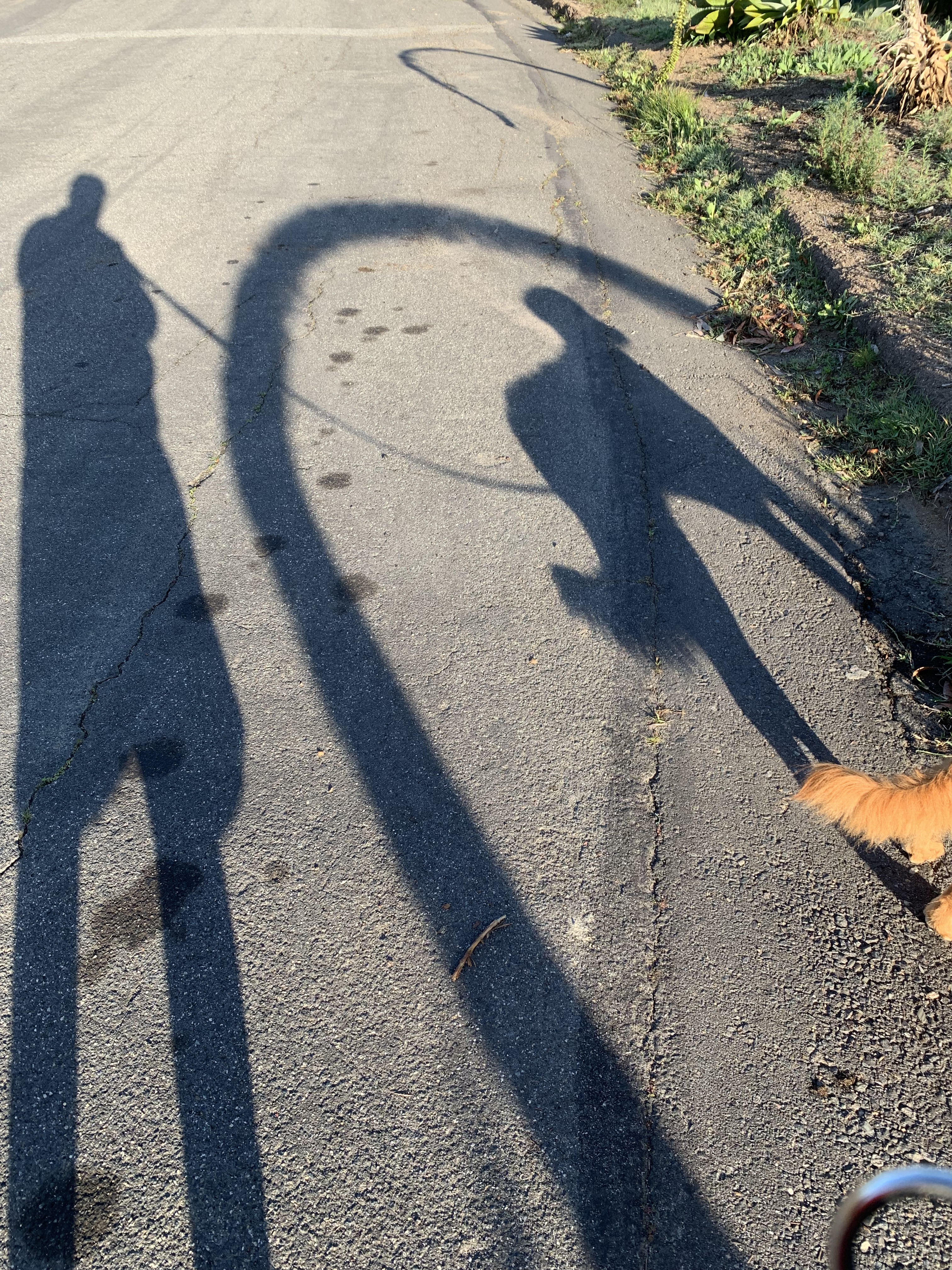
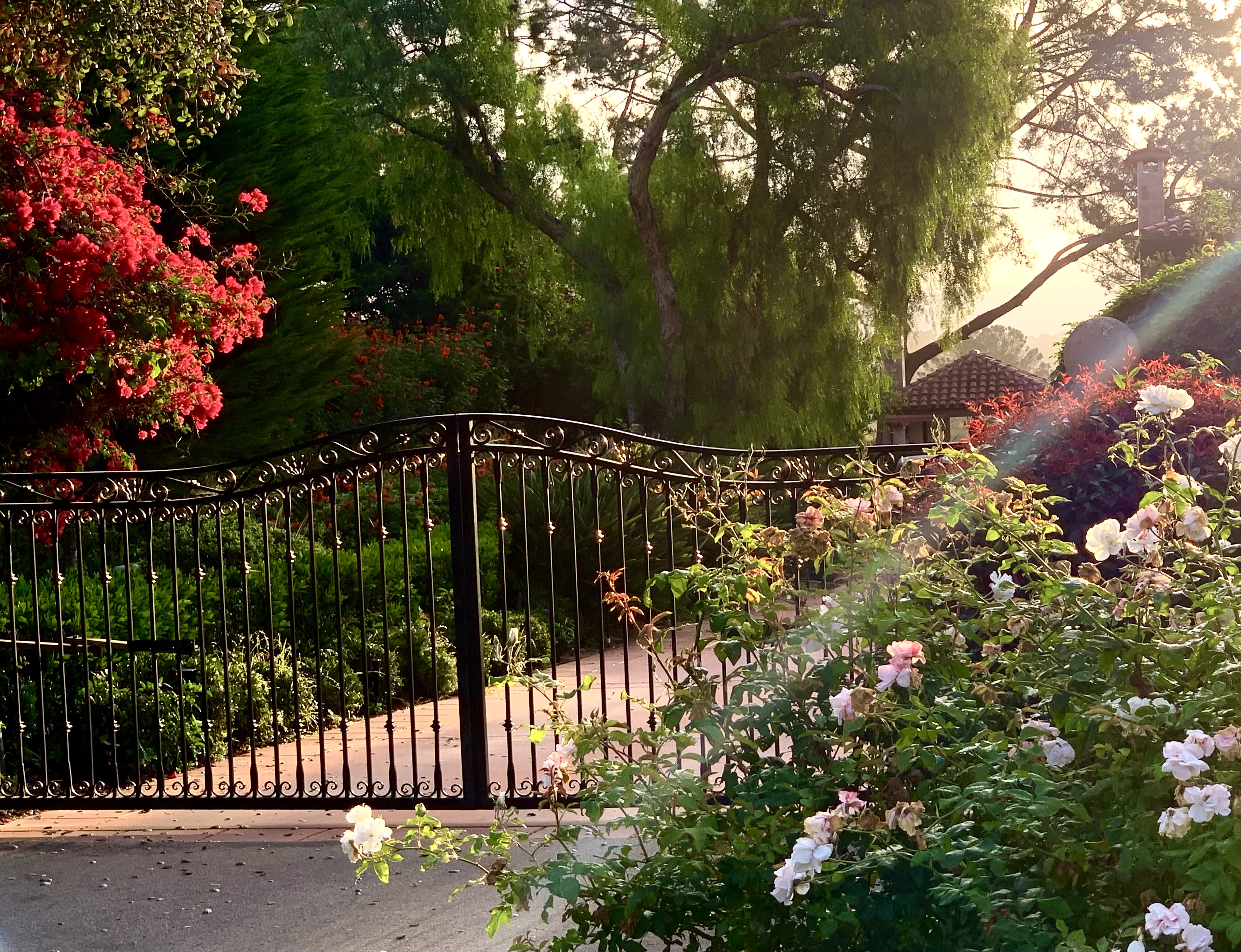
I was thinking about gates, doors, and walls as I went walking with Sadie on a sunny Thursday morning. We typically walk along the sides of streets. I let her wander onto the edges, but not onto other people’s yards or very far down their driveways. Often there are gates, much like our own gate. If the gate is closed and isn’t too far from the road, I often let her walk up to the gate. The gates are there both to prevent us from entering someone else’s property and to signal us not enter the property. I could, if my life depending on it, scale many of the gates, but that’s clearly asking for trouble. The gate is meant to keep people out, not as a challenge to overcome. Sadie generally couldn’t get through the bars of the gates. Of course, a gate is no barrier at all to birds, rabbits, mice, rats, lizards, snakes, raccoons, butterflies, or bees.
A door seems to me to offer more security than does a gate. While a gate may prevent me from entering, it’s quite easy to see through or around most gates, to hear the noise from the other side and to smell what’s on the other side. It’s true that one may listen through a door but the sound is typically muffled. Loud music or yelling creeps through to the outside but a conversation normally stays private.
A door also helps the inside stay warmer or cooler than the outside air. A gate has no such function.
Among places dogs leave olfactory messages for each other, boundaries are high on the list. This includes hedges, curbs, and gates. Sadie “controls herself” well now, but when she was younger, she would often pee at the boundary of a social event. Specifically, when someone—especially someone new or someone she already liked but hadn’t seen for awhile, she’d pee. She also seems to understand what I mean when I say, “Sadie, we’re going for a ride in the car. You should go pee first and then we can get in the car.” I don’t think she “parses” the sentence and accesses the meanings of all the individual words. Nonetheless, she quickly pees and then goes over to get in the car.
A wall is a kind of transition as well. A gate is much more permeable than a wall and a door may be opened or closed or ajar. Often walls, such as castle walls have one or more gates or doors. People on one side of a wall almost always want to get to the other side, at least occasionally. At the very least, they want to be able to move information and goods from inside to outside and vice versa.
Why walls? The walls of a house keep you in a more easily controlled environment. A wall can provide a level of protection. That’s mainly what castle walls are for. Of course, they often fail as well. Invaders climb the walls or tear down the walls or burrow under the walls until the wall collapses. Of course, castles were also subject to sieges. Eventually, the defenders inside would run out of food. Primitive machines were constructed to hurl firebrands and large rocks in to wreak havoc and kill defenders.
The Greeks were unable to defeat the Trojans by destroying their castle. Instead, they famously made a large wooden horse as a “tribute” to the courage and tenacity of the Trojans. Overjoyed that the long siege was over, they opened the gates and led in the giant wooden horse and began to celebrate. Once everyone was drunk or sleeping, the soldiers hidden inside the horse snuck out and opened the gates to the much larger Greek army waiting outside.
Today’s technology is much more sophisticated of course, but walls, gates, and doors still exist. The defensive capabilities now include guided missiles, aircraft, submarines, and aircraft carriers as well as the threat of nuclear retaliation. During the so-called “Cold War” America and the USSR engaged in an “arms race” to develop the best weapons and more of them. Looking back on all the wasted energy and time on both sides, I think, “Imagine what could have been done if we had instead spent all that resource on preventing climate change, curing disease, and sponsoring science and education.
Of course, it’s not an easy problem. One side in a standoff can only stand down unilaterally if they trust the other side. Meanwhile, none of the amazing and exorbitantly expensive weapons, walls, doors, and gates we’ve developed are worth anything at all if we accept the modern Trojan Horse.
Social media, the press, the television, and nearly half of the political candidates spew misinformation on a daily, even hourly basis. We’re locked in a political race and one of the two candidates for President is himself a Trojan Horse. Like the ancient Trojans, all our walls and armaments will be useless.
The threat to America is, in many ways, worse than the threat to ancient Troy. The Trojan Horse that endangers us? It’s a steady steam of lies designed to induce Americans to kill each other.
No number of fighter jets; no cache of assault rifles; no armada of submarines; no hordes of fighters will save us from the Trojan Horse. The Trojan Horse is armored with something far more powerful than iron, steel, or depleted uranium. The Trojan Horse’s armor is your own mind.
Only courage will work to save you. It is not the courage to face an army. It is the courage to admit that you’ve been conned; that you were wrong; that you have been led down a garden path that leads nowhere near where you ever wanted to go.
Did you ever read “Travels with Charley” by Steinbeck? “Charley” is the name of Steinbeck’s dog who travels with him on a car trip across America, or at least the first 48 states thereof. My wife and I—and our dog Sadie— recently met up with my cousin-in-law (is that a word? I guess it is now). Cousin-in-law Timm loves dogs too and suggested I should do a similar journal called “Travels with Sadie” and this is, indeed, the first chapter of “Travels with Charley.”
I chose this topic while reflecting, as I often do, on what the world is like for Sadie and her kin. Sadie, like most, is thrilled to meet other dogs. If she can’t meet them in person, the next best thing is to sniff the spots where they peed. Although she hasn’t yet reached estrous, in the last few months, she’s been behaving differently with respect to the pee residue of female dogs on the ground and male dogs, which are on bushes, trees, lampposts, sign poles, and fire hydrants.
It seems that the males inordinately prefer lampposts, sign poles, and fire hydrants over trees. That, to me, at first seemed curious. After all, trees have been in the picture for dogs and their ancestors for millions of years. These manufactured artifacts are brand new.
Here’s my hypothesis. In the long-ago days of dogs, some dogs took it upon themselves to signal their presence by peeing on manufactured posts while others preferred trees. A post has fewer distractions—visual, aural, and most importantly, the olfactory sense. Thus, the post-preferring peers had a more impressive social presence resulting in more mating and more envy—higher ranking in the pack. Over time, the post-preferring peers proliferated and prospered.
Over time, and perhaps even initially, the individual dog itself could “learn” that it had left a more salient and more lasting impression. How? Because they go back to the spot they themselves peed in, often repeatedly. Thus, they would learn that make a splash in the dog world, you’re better off with a human artifact. The fact that it smells like a human when it is first put into place may well “seed” the site as a place to exchange messages—perhaps a kind of canine Facebook—only not really the face.
It also turns out that lampposts, sign poles, and fire hydrants signify three essential functions of a society. Lampposts are to shine light on reality. Medical research, science research, education, public service announcements, and books. To some extent, our laws are also a kind of lamppost. “Look people, we’ve learned the hard way, that it’s not good to steal. Don’t do it.”
Well, if that’s not clear enough, fine, we’ll write 100,000 pages of clarification.
Sign posts include, to me, norms and customs, as well as directions of various sorts. There’s often a tension between lampposts and sign poles. The sign poles take work to design, manufacture, transport, and erect. That stop sign down the street didn’t just fall off the coconut tree. Similarly, customs, for instance, separating the work of men and women so that all nurses were women and all men were doctors, take work to implement and to enforce. People will not always stop at a stop sign and especially if they are never ticketed. Similarly, there will be individual women who desire to become a doctor and men who want to be nurses. There will always be tension in such customs between the norm and the individual desires.
Imagine after a lot of work has gone into putting up the stop sign, the lamppost function of government sponsors a study that shows it would be much better to put in a traffic circle (roundabout) rather than the four stop signs. More traffic gets through faster and there are fewer accidents. You can easily imagine some resistance. The people who profit from making the stop signs, for instance, and the police officers who ticket those who only come to a “rolling stop.” The drivers may also object. Many of them aren’t used to traffic circles. Some initial awkwardness is predictable.
To me, the fire hydrant represents the protective aspects of government. There are many! There are agencies, like the FDA, that ensure the cleanliness of our food and water. (Believe it or not, there are some providers who are so greedy, that they would actually sell you tainted food or drink if it would make them richer.) There are the Armed Forces, the Fire Departments, the Police Forces. In a way, Social Security and Medicare also fall into this region. It is a protective function of government.
Sadie, meanwhile, is sacked out on the couch across from me. She’s had an active day; two long walks, zoomies, swimming, and ball playing. Our dog, like many, is very loving. She’s wary of anything new. But soon, she’ll be head over heels in love with another person.
The very greedy people who would have you kowtow to them while they steal the fruits of your labor love to use the rationalization that it’s a “Dog eat dog world out there.” It isn’t actually. Neither humans (for the most part) nor dogs (for the most part) are out there eating others of their own species. We are both pack animals. We both love and protect our families. Is there competition? Sure. But it’s all done in the scope of a cooperative society.
The natural tension between conservatives and liberals has a lot to do with how quickly one wants to see lamppost findings supplant existing psychic and physical infrastructure. And it is a very legitimate debate to have. Most do not want the extreme that every new finding in, say, medical research should instantaneously turn traditions and practices on their heads. Also, most do not want to ignore all new science and discovery and keep everything static forever.
What is not a legitimate debate is for one side, like a spoiled toddler, to insist that if they don’t get their way, they’ll burn our civilization to the ground. Sadie wouldn’t do that. Nor would I. Nor would most Americans.
“I never took a test. There’s been a mistake. I’m a supporter.”
“Shut up or I’ll break every finger. Capiche?”
The guard grinned a moon of bloody teeth and pushed his nightstick against Bob’s lips. Hard.
Bob grunted but said nothing; decided he’d bide his time for now. This will all get sorted later.
It didn’t get sorted. Why would it? Along with tens of thousands of other “supporters” the only thing Bob got for his support? A free one-way ticked to the burn pits. He’d been beaten enough that when his time came, he jumped of his own accord.
When facts are hidden, the imagination blossoms. The facts of meetings between the former guy and Vlademort Putrid are known. You may have forgotten. I have not.
What we do know is that the former guy’s body language consistently shows that Putin is the dominant of the two. The former guy often looks a lot like a whipped dog. His eyes are downcast. His head is down. His shoulders are hunched. He contorts himself to look lower than Putin.
His statements about Putin (and other dictators) consistently show his admiration for brutal, cruel, murderous dictators. That is in contrast to his statements about democratically elected heads of state and American politicians, including those in his own party.
We also know that the former guy was born rich; lost a fortune; then begged his daddy for more. The former guy was not daddy’s favorite child, at least initially. TFG’s mother was often sick. If the American public knows this, you can be sure that former KGB officers knows it as well.
What follows is fiction. It is fiction in the sense that American citizens have no way to find out what actually happened in the secret meetings between Putin and the former guy.
Here is a link to a series of four fictional stories. As time goes on, however, it seems more and more probably that something like this may well have happened.
“No, Mister President, don’t worry. I can speak some English. And I have my translator here. Given that you’re such a smart guy, I’m sure you probably picked up few words of Russian. You know word for yes, da?”
“Yes, President Putin. I mean, da!”
“Good. Excellent. I don’t understand how the people in your country fail to realize how lucky they are to have someone as competent as you. And realistic. Not hung up on silly abstractions. Don’t you agree?”
“Da! Da!”
“And, just as you get a lot of unfair criticism, so do I. It’s jealousy. People in other countries are jealous Russia’s strength and progress. So, they tell lies about people I supposedly murder. You know it’s all lies, right?”
“Da! Da!”
“You know, it’s odd. Your English slang word for father, ‘Dada’ sounds lot like the Russian words for ‘yes, yes.’ And, that reminds me. I heard a rumor that your dada favored Fred Junior. But you got the good genes. Eventually, your dada figured out that you were the smart one—the one destined for greatness. Isn’t that right?”
“Da. Da.”
“By the way, did you know my people call me ‘Papa Putin’? Wouldn’t it drive liberals and your other detractors crazy if you called me Dada?”
“That’s a great idea! It would drive them nuts! Serve them right, Dada.”
“Yes, indeed. I know some people may try to rein you or make you behave like normal President. Don’t do it! Keep acting cra—unique. Keep acting unique. Different. That way, your fans have no way of knowing where you stand except by listening to you that day. And when you say something crazy—unique, I mean, like ‘pollution is good for you’ your fans will instantly repeat it. They will vie for most followers or most likes and for retweets by you—best prize of all. And liberals? They’ll go nuts. And you know what they’ll do? They will also repeat what you say! It’s amazing. They’ll say:
You know what crazy guy just said? That pollution is good for you! How stupid do you have to be to think that pollution is good for you? It kills! Ridiculous to think pollution is good for you!
“And, so Donald, do you know what people who delude themselves that they are independents will remember from those antics in three months time?”
“Yes. I mean da. Da. Da! Dada. Pollution is good! Pollution is good! Which is also a good excuse to give tax breaks to the rich.”
“My God, Donald, you are smart! Too bad your people don’t realize. Well, many do of course. Eventually, once you gain power, the rest will join your ranks. Everyone will know.”
“Da! Da! Dada! I should get you something! What would you like?”
“Donald, do you remember how cool it was when you were kid and it was America versus the USSR? Olympics! UN! Foreign wars! Two sides! To USSR, you were evil. To us, you were evil. Wonderful times. Now, you’ve got these terrorist groups, lots nations with H-Bombs, and for what? It’s hell for everyone. See what I mean?”
“Da. Dada. I do.”
“And, you know, we’re like favorite band that split up. We just want to get back together band. For instance, part of Russia we call ‘The Ukraine.’ It’s actually part of Russia as you know. You do, know that, right, Donald?”
“Da! Da!”
“Good, well don’t forget in case—they are just sort of people incite us to war. We might have to liberate Russians inside Ukraine. You are smart man. You will know enough to back us up. Right?”
“Da. Da. Dada.”
“Donald, you know what? You are favorite among all world leaders. We’ll rule together long time.”
When we see that word “Family” most of us think of a relatively small number of people. Maybe when you saw it, you thought of your family of origin. Maybe you thought of your family of generation. Maybe you thought of the people who live in your home which may include some of each. When I was a kid, we had “Family Reunions” which included the extended family of my maternal grandmother. It did not extend to my maternal grandfather’s family nor to my dad’s relatives. Typically, there were 30-40 people who showed up. I know of “Family Reunions” which are much larger, involving hundreds of people. Years ago, when I wrote in this blog of “Family Matters” I mentioned a subset of people who attended my “Family Reunions.”
Occasionally, people think of humanity as their family. I have been lucky enough to visit a respectable number of countries (28) and I’ve met people from over a hundred and in every single instance, it’s very easy to see that they are basically like me both physically and mentally.
Like many people, I was brought up in a religious tradition that reinforced the idea that all of us are in this together. Beyond my personal experience, it is just plain fact that human beings share most of their history (4 billion years) before we began diverging slightly a hundred thousand years ago. Beyond that, we are all sharing the planet. While, borders may keep some people out (or more commonly, keeping them in), in the long run, the water, air, and pollution is shared world wide across all “boundaries” of religion, philosophy, or nation.
It may be difficult for some to accept that all humans are part of their extended family.
The truth is that our actual family is far broader and wider than the 8 billion people on the planet today. We share more than half of our “family history” with every single creature and plant on earth today. When you think about vertebrates, for instance, we have similar bodily systems. We mate. We eat food. We eliminate wastes. Even those who live in the water actually breathe air that’s dissolved in the water. We learn. We flee. We are curious. We are aggressive. We solve problems.
The earth is basically covered with living organisms. That is our family. It can be a source of inspiration and comfort if you let it be. And, you can love that family.