
The Ninja Cat Manual – 3
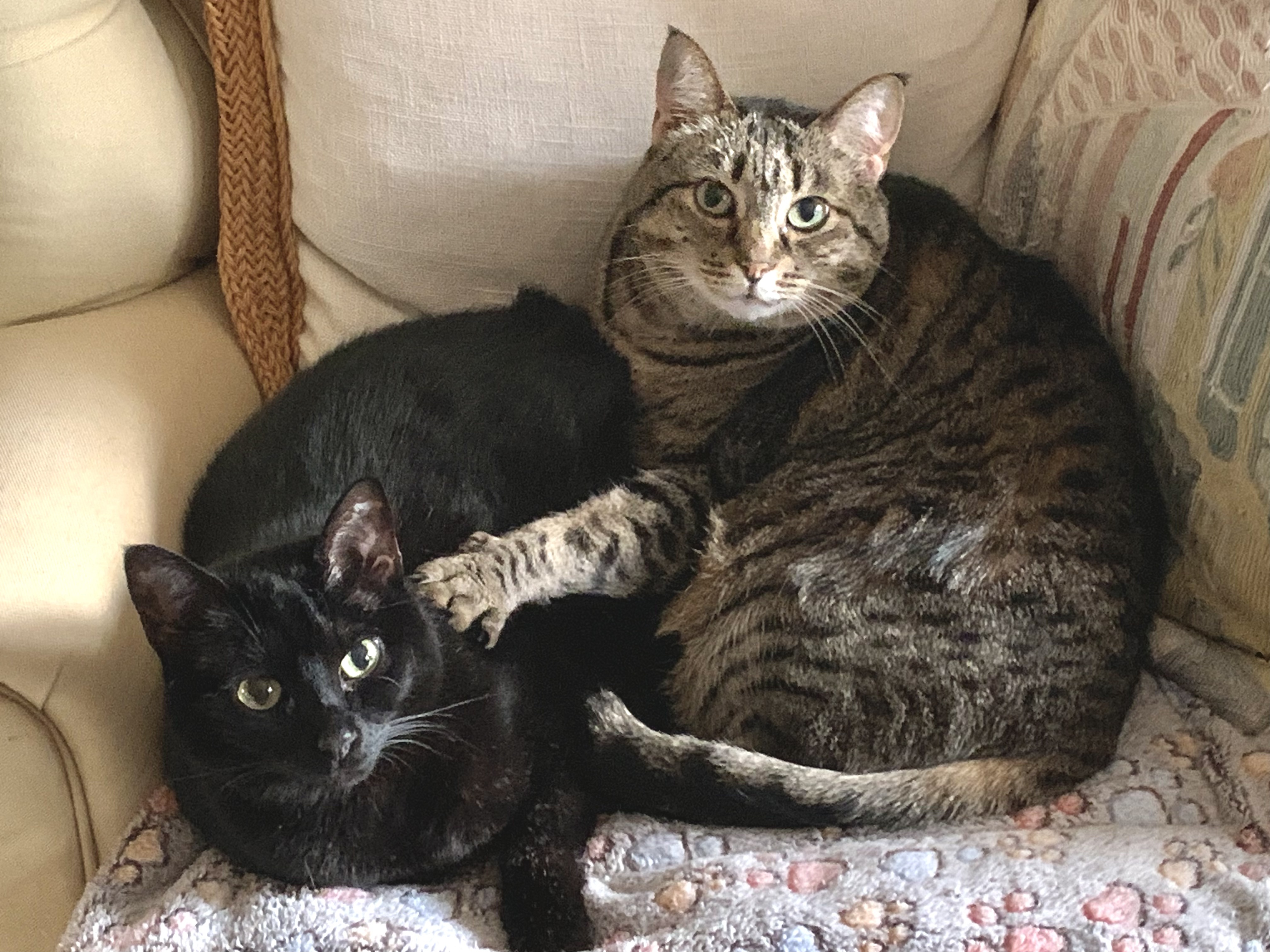
The maids came early this morning and cleaned the floors while I was playing tennis. This was very nice in some ways, but they erased the cat paws from the floor before I had a chance to encode them. In what follows, I will be relying on my notes from several days ago.
The Art and Science of Camouflage
We cats didn’t invent camouflage. In fact, so far as we can determine, camouflage, in the broadest sense, has been a part of life nearly since life’s beginnings. Even viruses and cancer cells use a kind of camouflage to thwart the immune system from seeking out enemies within in order to destroy them.
In order to use camouflage most effectively, it is not enough simply to “look like” something else or hide in a box, though such primitive techniques are sometimes useful. A common mistake made by some civilian cats is to forgo camouflage entirely because it is so difficult to mimic the smell of a human.
But there’s no need! Compared with us, humans typically exhibit almost complete anosmia. This lack of sensory refinement is self-reinforcing. Since their sense of smell is so weak, most never practice or learn how to make best use of what little capacity they do have.
Even beyond this, humans often drink alcohol, smoke cigarettes, and use what they call “air fresheners” to further diminish their already pathetic capacities. The human sense of hearing is more acute but nothing much to meow about. It is truly amazing, but if you stay quiet, you can sneak up quite close to nearly any human provided only that you pay attention to your visual appearance.
While humans do have peripheral as well as foveal vision, they are often so deeply involved in their own thoughts about reality that they essentially ignore the reality all around them. Thus, the task of camouflaging your presence against human detection is much easier than fooling a rabbit or bird. All you need do is stay out of their foveal vision and choose a suitable background.

While most cats over-estimate the difficult of camouflage, a few overplay this ploy. While this approach yields many a barked shin and twisted ankle, unless you are exceedingly lucky, by the time the opportunity arises for truly catastrophic injury, your prey had been too often forewarned. In the worst case scenario, they may even suspect you are out to get them.
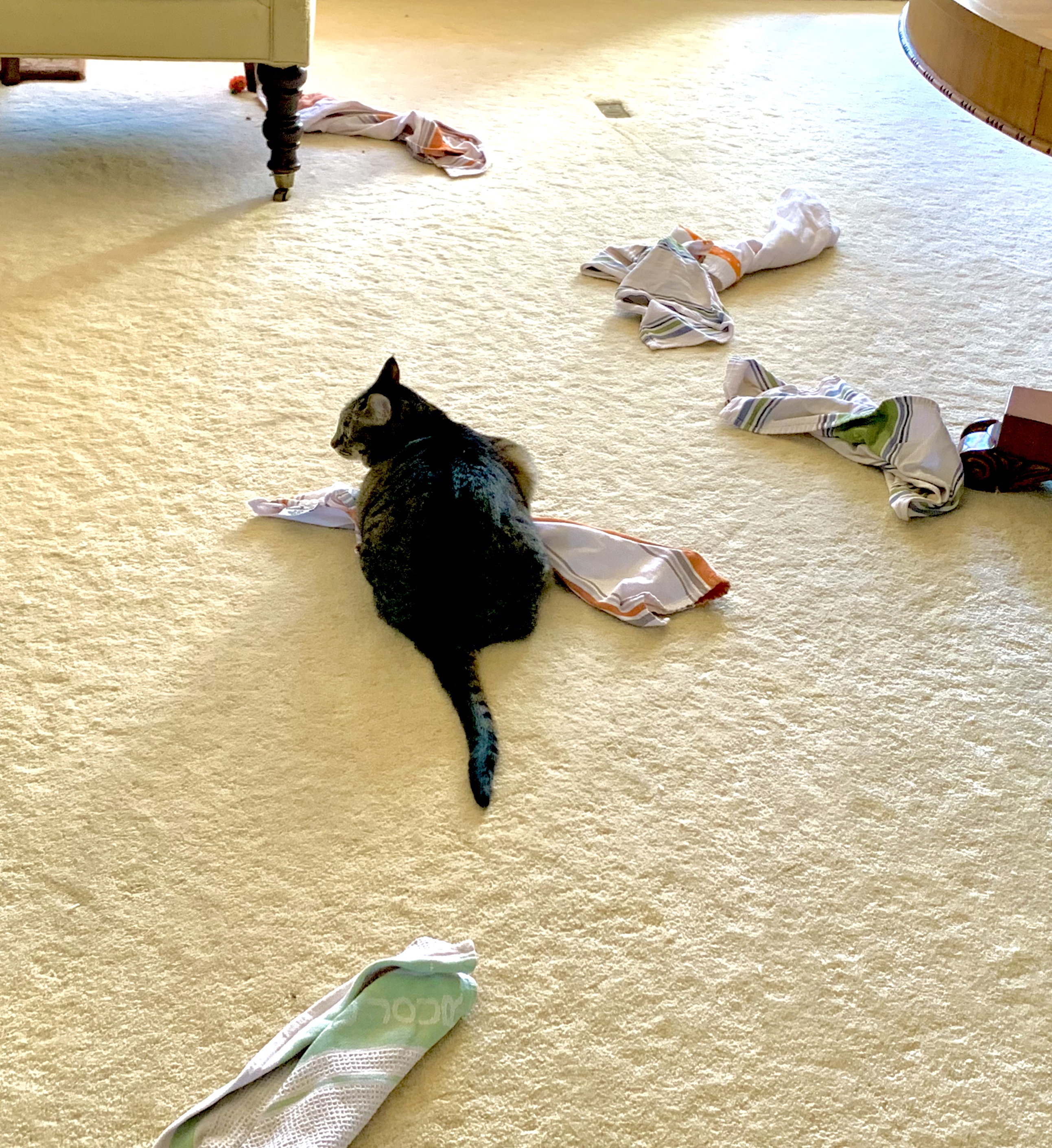
Be strategic! Spend most of your time, on high contrast surfaces as shown below. Then, when your prey is busy with a task in front of them—particularly one with hot liquids, steep falls, or sharp tools—sneak up under their feet and hide. Avoid the temptation to brag prematurely about your impending victory. Instead, keep quiet and you might just hit the jackpot!

Don’t Tip Your Hand! Go with the Flow.
The advice not to tip your hand by always trying to camouflage applies in other ways as well. While it’s true that most humans are slow, clumsy, and stuck in their own mental models of reality and equally true that their teeth and claws are pretty pathetic, they do have numerous effective weapons. You don’t want these used against you or your colleagues!
Therefore, if at all possible, don’t even have them suspect you consider them as prey before you do them in and do not brag about it afterwards. Nearly every human catastrophe should appear as something natural or accidental. No-one should suspect you either before or after.
In order to “Go with the flow,” you need to catalog your prey’s habits—particularly those that could lead quite naturally to their demise. If they drink and drive, for instance, a carefully planned car accident may raise no suspicions whatever about feline involvement. It’s impossible to list all the many ways that humans are self-destructive, but a few more examples should be enough for you to generalize.

Humans often wear protective covering on their pathetically soft paw pads. So long as they are wearing these, it is pointless to contrive to put hard sharp objects in the path of their travels. But many humans believe that they, like cats, have excellent night vision. If that’s the case, they may often travel in the dark at night barefoot when they awaken to use their water-gushing litter boxes. If this is the case with one of your potential prey, placing a few shards of broken coffee cup, glass, jacks, legos, etc. will provide the potential for catastrophe and definitely entertainment.
However, you must be careful not to be seen placing these items in their nocturnal paths and you must not use this ploy too often. While it will be fun to watch the antics of the human, even if there are no real casualties, be sure to watch without being seen. They will blame whatever organism they see first after any pain including jamming a jack into their heel. You do not want to be that organism. It’s much better for your long term prospects that they blame a spouse, a child, a guest, a paid courtesan, the family dog, etc. Their responses are not very well thought-out. If they hurt themselves and their eye happens to fall upon a fish tank, they may scream at the fish in the fish tank even though a moment’s thought would make it painfully obvious, even to a human, that the fish could not be to blame. Needless to say, if you happen to be unfortunate enough to be the only living thing in the household with a human, you will be blamed for everything.
In such a case, you need to plan very carefully and amplify their own self-destructive tendencies rather than introduce a foreign element. For instance, if they eat unhealthy food, you can encourage such behavior by reinforcing them for it. Add extra salt if that’s at all feasible in your situation. If you see them eating fresh vegetables or fruits, you can reduce the impact of such healthful habits by waiting until you are unseen and adding a tiny bit of shredded hairball or rodent remnant or feces to it.

Many humans take various pills for ailments real and imagined. Very often these can invoke a whole catalog of catastrophic side-effects, particularly if the dosage is doubled or trebled.
Perhaps you are cursed with a particular healthy human. Do not despair! Most likely, they still play with potentially lethal things like fire, electricity, and poisons. They play with such things for their convenience. For instance, ant poison is meant to kill ants, and is often in a package meant to keep the human safe from the poison within. But the poison is likely harmful to humans as well. Sadly, it is probably also poison for you! So extreme caution and careful planning must be used to avoid accidentally hurting yourself instead of the miscreant.
In the spirit of “going with the flow,” a safer tactic than playing with fire, poison, and electricity is to observe whether you human is a sound sleeper or a light sleeper. If they are a light sleeper, it will be quite possible to wake them multiple times a night without their even becoming aware of it. If they have a baby, wake the baby up and let the baby wake up the adult.
On the other hand, if they are a very sound sleeper, then, you can use that as an opportunity to do most of your little mischief with little chance of being caught.

—————
After translating the above, I took a break to make dinner: salmon poached in ginger ale, fresh ginger, dill, oregano, carrots, celery, thyme, soy sauce, and lemon juice with a side of cooked broccolini and red peppers, served with cherry tomatoes and kale. I turned on the gas stove for the salmon and began to prepare the broccolini and red peppers when I smelled gas. I turned back and noticed that there was no flame. Then, I noticed that the burner cap was slightly askew. The same maids that erased the paw prints cleaned the burners but failed to put the burner cap on parallel to the ground. This allows gas to escape but prevents ignition.
It’s an easy mistake to make and I’ve experienced this problem a few other times with other maids. But it got me to wondering whether I have overlooked some of the darker messages in the Ninja Cat Manual. I wonder if the phrase “your little mischief” might include more serious interference with electricity, water, gas lines, etc. I wonder whether there’s a way to begin a feedback loop with the authors of the Ninja Cat Manual in order to double check on the accuracy of my translations. It’s also possible that the paw prints of my local feline cadre is not being completely frank in their renditions.
————————
Myths of the Veritas: The First Ring of Empathy





























































 petersironwood