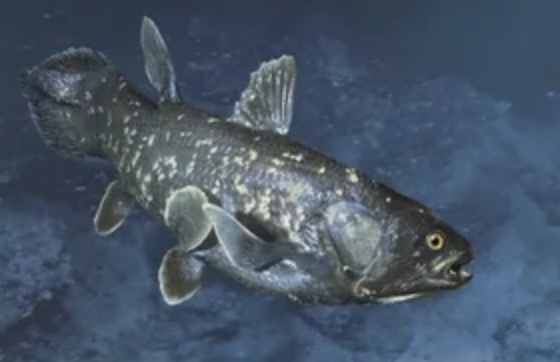
The den’s dark paneling reeked oppressively of cigar smoke. The room seemed decorated for intimidation rather than comfort. Keisha imagined what it must have been like for Lila to grow up surrounded by trophy cases filled with daddy’s accomplishments. Apart from trophies, the only other “personal touches” were the myriad mounted fish. She had agreed to follow Lila’s lead in their conversations with Mr. Jordan.
Lila, however, sipped sherry silently, focusing on putting precisely correct amounts of brie on every cracker. She seemed subdued, even cowed, by JJ. Keisha smiled as she realized that this obese, balding CEO with hairy forearms was now her father-in-law. She chuckled inwardly wondering how he’d take that news. Keisha pointed to one of the many mounted fish. “That’s an interesting one. Looks like something from the Age of Dinosaurs! Where did you snag that guy?”
JJ’s voice was harsh and raspy. Keisha decided he loved projecting pure virility. “That’s a coelacanth. They appeared about 400 million years ago. Paleontologists thought they died out 65 million years ago. Guess what? Coelacanth are still here, hiding deep below the surface. I caught that one off the coast of South Africa. Takes patience. Bring ‘em up too fast and they explode.”
Keisha blinked. “Explode?! How do they taste?”
JJ barked a laugh. “Like crap. No real value. Slimy. Tasteless. I caught it to prove who’s king of the food chain. Same in business. Win. Everything else is bullshit.”
JJ grabbed the remote and clicked on the wall-sized TV. “Watch the Patriots if you like. But set your alarms for five.”
Keisha shook her head. “No thanks. Lila’s going to show me her latest results.” Her father-in-law shook his head sadly. Keisha added. “It’s for work. We’re developing a textual analysis program.”
JJ’s waved his hand dismissively and muttered, “FBI – glorified cops. Badge and gun. That’s all you need. Not a fit job for girls anyway.”
Keisha bit her lip so hard, she nearly made it bleed, but kept her silence.
Once the pair were alone, Lila apologized for her father. Keisha shook her head. “It’s okay. You warned me. I thought you exaggerated. But no. Anyway, I’d love to see your results.”
Keisha scanned them quickly. “Can you get me on the wireless here?”
“Sure. But why?”
“Lila, I’m not sure. But — I’m sorry to say so, but I have a bad feeling about JJ. Do you mind if I access the records and apply your algorithms to his old police statements?”
Lila frowned. “What? Why? Do you think…?”
“I just think if we’re going out in a boat alone with the guy….”
Lila snorted. “JJ’s my dad, for God’s sake. I know he’s a boor but … surely, you don’t think —“
Keisha shook her head. “Lila, I know he’s your dad. You always refer to him as JJ. Anyway, it won’t take long to run some tests. Think of it as practice. Maybe nothing will show up. Probably, nothing.”
Lila frowned again, “No, I’m telling you.” Here Lila broke off as a disturbing image loomed into her head.
Keisha spoke softly, “Lila? Are you okay? You literally like you’ve seen a ghost.”
Lila’s voice became flat. “Let’s run the tests.”
Being a CEO, JJ had excellent bandwidth wherever he went: home, limo, yacht. The algorithms spun their magic and trolled the text. By morning, they were exhausted but convinced. They also agreed that proving it in a court of law would be an entirely different matter. Textual analysis didn’t have decades of precedent like DNA testing. Convincing a DA to open up such an old case? Impossible without more direct evidence.
Keisha said, “We need a plan.” Lila agreed.
———
The morning fog lifted. They were soon underway. The women leaned out into the salt spray which made rainbows in the rising sun. Meanwhile, JJ hunched in his dark, dank electronic cockpit below, searching his screens for signs of fish.
From below decks, over the slapping waves they heard JJ growling, “Where the hell are you, stupid fish?!”
Keisha stared down into the cabin at the hulking back of her father-in-law. Once, he had been athletic. She wondered how athletic he might still be.
Dark clouds loomed on the horizon. Lila reported, “Father! A storm’s coming!”
She could see him shake his head. “No rain in the forecast. Just clouds. Doesn’t mean anything.”
“Father. I have to talk with you.”
JJ growled, “Nothing to say. We’re fishing!”
Keisha had never heard Lila’s voice sound so cold as she said, “I remember what really happened to Trevor and mother. I saw you.”
JJ laughed. “You were a girl! You don’t know what you saw. Anyway, nobody’ll believe you — especially after ten years of silence!”
Keisha said, “We have other evidence. We accessed your original statements to the police and ran them through our analysis programs. They are strongly indicative of fabrication and misdirection. We have your own words. It’s now admissible in court as textual evidence.”
JJ screamed, “Bullshit! You don’t have any sexual evidence. I made sure of that. You don’t have anything that would stand up in court. I’m the biggest fish out here. Face it. I’m wealthy enough, powerful enough, and smart enough to get away with murder. So I did! It’s the way of the world, Lila! Time to grow up! No-one will believe you or your so-called colleague.”
Keisha held up her cell phone. “Even with your confession streamed to our FBI colleagues?”
JJ stammered, “But I’m … “
For the first time in her life, Lila interrupted and finished his sentence for him: “A coelacanth, dad, a coelacanth.”
A traditional sonnet has 14 lines of 5 iambic feet each. Each iambic foot has 2 syllables for a total of 140 syllables. This form gives the poem a “rectangular” look. But let’s suppose instead that we try a form that is triangular in form. That’s still an underspecified design constraint, but let’s try one that is 14 lines ending in a single two syllable foot. We will start with 28 syllables and each successive line will have two fewer syllables; thus, lines of: 28, 26, 24, etc. ending with 6, 4, 2.
Human auditory memory being what it is, 20 or more syllables is a long time to “wait for” or perceive a rhyme. I may put internal rhymes in some of these lines. Let’s see how it goes.
As for topic, October 10th will be celebrated by some as “Columbus Day” and by others as “Indigenous People’s Day.” That tension seems like a good way to begin.
Columbus sailed the ocean blue in fourteen hundred ninety two; enslaved and killed for profit, fame: The Glory Game.
Columbus knew the world was round; his sense of distance — not profound. He called the natives Indians (so wrong!)
So wrong about so many things — the Europeans of his time; believed a King’s most holy name
Had rights conferred by God Himself alone to do just as they willed so killed with God’s own song.
Room 22A. Lila inhaled deeply; glanced at her program guide and Rolex. Three pm. Her slot. No use putting it off.
Go on, Lila. It’s just a practice run, for God’s sake.
The voice in her head was her father’s. Her cheeks reddened. His “encouraging” words always belittled. She heard another voice from inside the practice room— a warm voice.
Lila turned the cool brass knob and pushed. At the podium stood a tall, athletic, young black woman with large penetrating eyes and shiny dreadlocks. She immediately smiled a large radiant grin at Lila.
“Hi! Come on in. I just finished. I’m Keisha. It’s my first professional talk as well. Don’t worry. I’ve warmed up the audience.”
Lila glanced around at the empty chairs. “Audience? Ah.” She laughed. “Joke. I get it. I’m Lila. Nice to meet you. How did you…?”
Keisha laughed warmly. “Hey, we’re both forensics experts for the FBI, right? You’re young. And, frankly, you look a little — terrified.”
Lila strode up to the podium, unslung her backpack and retrieved her laptop. Her eyes swept the baseboard for the nearest outlet.
Keisha spoke again, now imitating a Carnival Barker. “Come on up, young Lady! This podium’s got all the power cables, internet connections, and Karma you’ll ever need.”
Lila laughed and held up her hand like a surgeon, “Power Cord!”
Keisha immediately cottoned on to the game and held it out for her, repeating “Power Cord!” Lila felt Keisha’s fingers lingering. So what?! This time, it was her own voice, strong & defiant.
Once Lila’s computer was connected; she relaxed and asked, “What’s your talk about, Keisha?”
Keisha said, “I thought you’d never ask. The title is Syntactic and Rhetorical Cues to Guilt.
Keisha smiled and laughed her maddeningly warm laugh. “You come to my talk tomorrow and learn more. What’s yours about?”
“I’ve been using statistical analysis of texts — rhetorical, syntactic, and lexicographical — to predict criminal patterns. It’s just a start — but — it’s really promising. I’m building on the work of Hart at UT Austin and Foster at Vassar. So far as I know, this is the first application to criminology.”
Lila studied Keisha’s face. What she read there was genuine admiration.
Keisha smiled. “Oh! You’re Lila Jordan! We’re in the same session tomorrow! You know, maybe we could work together. If we could combine our two approaches, that would be awesome!”
Lila blurted out: “I’d love to work with you!”
“Great! I’ll let you practice! See you tomorrow. Maybe we can grab a bite before the afternoon session. Here’s a tip. When you start your talk, look out at the audience and imagine them all buck naked! I’ll be in the front row and I’m already hooked. I’m hungry to learn more about you and your work.”
Keisha smiled again and strode down the aisle. Lila’s eyes lingered on Keisha.
The next morning, Lila decided to take Keisha’s advice. Although Lila’s eyes moved about the audience, she really focused her talk on her new friend. She enjoyed picturing her naked.
Keisha suggested they order room service since her room had a view of the harbor. She ordered entrees and desserts for them to share in celebration of their successful presentations. Lila objected that she needed to lose weight. Keisha smiled and said, “You are perfect as you are. But if you want to lose weight, I have just the ticket. A blindfold picnic.”
Lila’s breathing quickened. “What’s that?”
“Close your eyes, Lila. Just leave everything to me. No talking. You just let me feed you. Just follow my orders.”
They missed the afternoon session and the next morning’s as well. Infatuation grew to passion and eventually, passion grew to love. Over the next few months, their relationship deepened. It seemed, for a time, to be perfect.
Until the issue of marriage came up.
Which led to the issue of “coming out.”
Which led to the issue of “honesty.”
The very strength of their love made their disagreement that much more difficult to bear.
They said the same things repeatedly, with increasing heat but no more llight. Keisha found it impossible to understand Lila’s resistance to complete openness, explaining that it was the twenty-first century for God’s sake. Finally, even the Supreme Court recognized gay marriage. Keisha had known she was gay since she was twelve. Her parents had known and accepted her for who she was.
Lila came from a different world. “You don’t understand, Keisha! My big shot CEO father JJ won’taccept my being gay! He’s the only family I have left. If I lose him too.…”
The fifth time they argued, Keisha decided to take a different tack. “You’re right. I’m luckier than you. But just because my parents accepted me doesn’t mean everyone did. There’ll always be cruel people. We both know that. But the one who matters most to you is your dad. How about this? We get married. I go and meet JJ. I get to know him. We don’t start by telling him everything. Instead, we make it clear that we’re colleagues and friends. He’ll like me!”
Lila considered. “Okay. It’s worth a try. Say! Have you ever been fishing?”
“Fishing? Yeah, a few times. Uncle Stan showed me how to fly fish.”
Lila laughed. “No, not like that. I’m talking about Deep Sea Fishing. Every year, my father takes time off for an extended fishing trip.”
Keisha blinked. “Really? I thought you said you never wanted to go boating again. Does he…?”
Lila ground her teeth, “Father went back on the boat the next day! He even tried to get me to join him! Imagine! I’d just lost my mother and my brother. He said get aboard right away or I’d be afraid forever.” She sighed. “Maybe he’s right. Boats don’t bother him. Every year, he bugs me to join him and bring a colleague along — by which he means a potential husband so that I can leave the “Glorified Police Department” — his name for the FBI. Okay. Once we’re married, I’ll wait a few weeks and call father and tell him I’m bringing a colleague along on his next excursion. I will watch for the best moment to break the news. I’m still not convinced it will work, but maybe nothing will. He’s very set in his ways. Like with the boat. Even a tragic accident…”
Keisha tilted her head. “What’s wrong? You’re thinking back to that awful day?”
Lila nodded slowly. “Yeah. Kind of. I just — sometimes this horrible image flashes into my mind. I know it’s just my imagination. But still…”
Keisha took Lila’s hand. “Come here, love. I’m so sorry. Let’s just sit here side by side.” They sat and Keisha held her close in loving silence.
The gym stank of sweat, disinfectant, bloodstain. Vlademort shook his head; thought: stuffy stupid place for a chess tournament. Which I will win. “A silly game; a silly name,” it sang and rang inside his brain.
Others might resign, down a piece to a stronger player; that was the “sensible” thing to do; the “honorable” thing to do, he knew.
Vlad sang instead these lines as lyrics deep inside his outsized head:
“Check and Slay;
There has to be a Winning Way!
I am Me
And meant to win!
I am He
So cheating isn’t sin!”
Aloud, he called in his strong, authoritative voice, “Sir, we have a problem. My opponent cheated. We must rectify the situation for the good of the Noble Game. And the honor of our School and our Party.”
For a moment, Vlademort worried that a glimmer of smile might betray him. He bit his tongue down on his lower teeth. That usually worked, just as it did this time. As the Assistant Headmaster strode over to the boys, the man asked what the trouble was.
Vlademort’s foe, Dmitri, didn’t know what Vlad meant about “cheating.” Vlad had stepped right into a discovered check by a knight’s move that also attacked Vlad’s unprotected King’s Bishop. Vlad hadn’t seen the consequence so now he would pay the price. Very nice! But discovered check wasn’t cheating! While Dmitri pondered this silently, Vlad struck.
“Sir, as you can no doubt quickly surmise from the board, Dmitri just moved his knight here so he would check my King and attack my Bishop. A double attack. The problem is, his knight was here and we can all agree he cannot move a knight up two and over two.” Vlad locked eyes with the Assistant Headmaster and painted his face with confident innocence.
Dmitry frowned. “What? That’s the most absurd poo I’ve ever heard! My knight was here!”
“No, Sir, with all due respect, I clearly remember asking myself why he would move the same knight so many times to get in this position when, as you can clearly see, his bishops are completely undeveloped. It seemed strange at the time. I guess…I hate to say it, but maybe that’s what he … I don’t know. What does it show, Headmaster? I’m at a loss.”
“Vlad, I’m not the boss; I’m the Assistant Headmaster. You boys are going to have to work this out for yourselves. I don’t get paid enough to settle all your petty disputes.”
Dmitry’s face reddened with fury. He clenched his teeth.
Meanwhile, Vlademort nodded and said in an even tone. “Yes, I’m sure we can work it out. Dmitri? Do you want to move your knight back to where it really was, resign, or just play again? Tell you what. You can have white this time. Deal?” From the outside, Vlad seemed serene but the inside scene was a scream of joy. He had used them both as toy. He felt no wrong; he sang instead another song inside his head:
“I am Me!
Victory!
I’ll show mom and daddy too
What I can do. You killed my puppy;
You evil two!
You will see:
Everything belongs to me!”
He sang it as he lied. As he sang, dissidents died. He sang it as he bombed and killed. “I am me and so strong-willed. You will see! It all belongs — belongs to me!” After being deposed, tried & condemned, Vlad’s song of wrong and might — still felt right.
The song so strong it rang and sang; inside his bullet-riddled head the last thing it said:
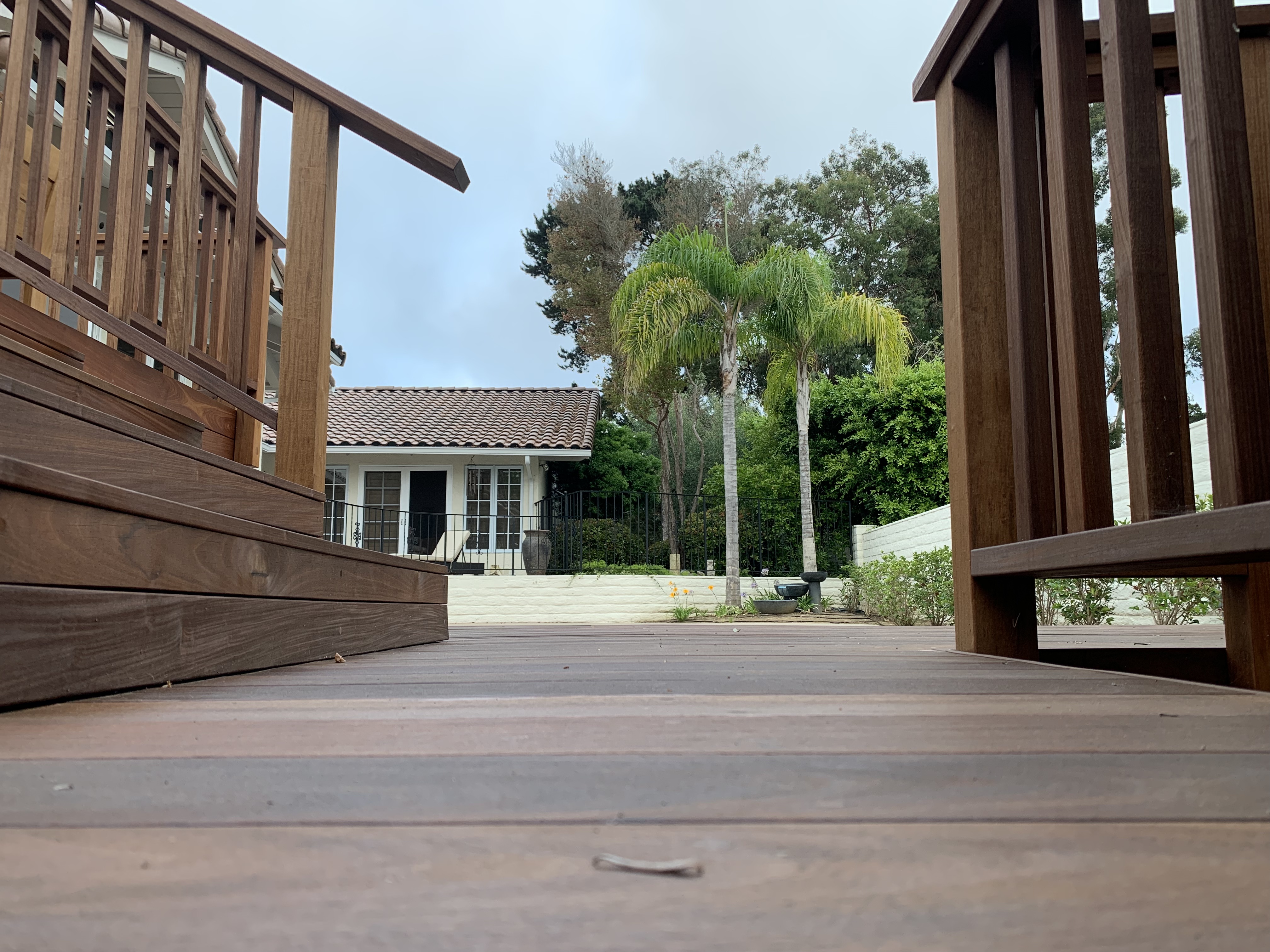
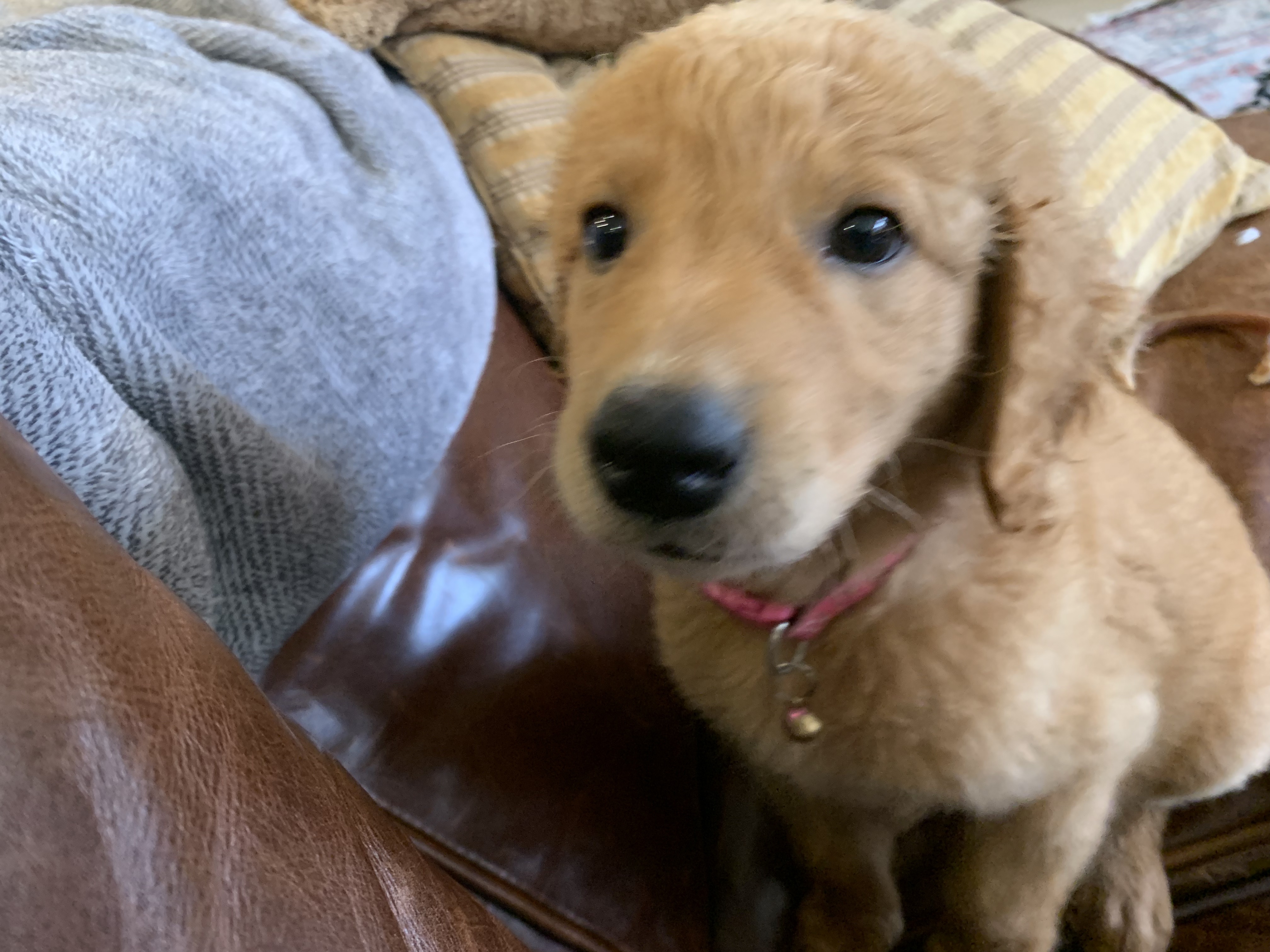
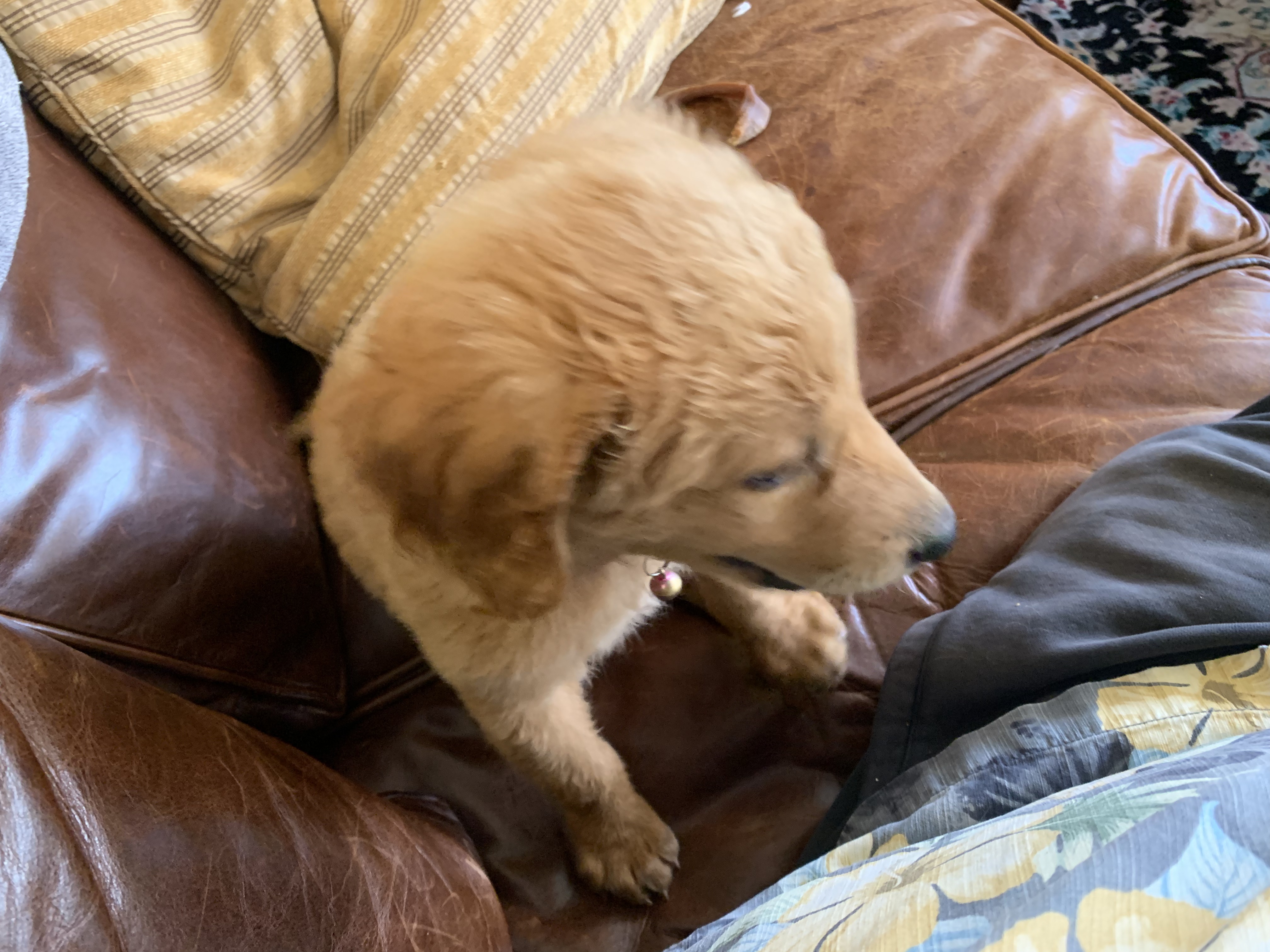
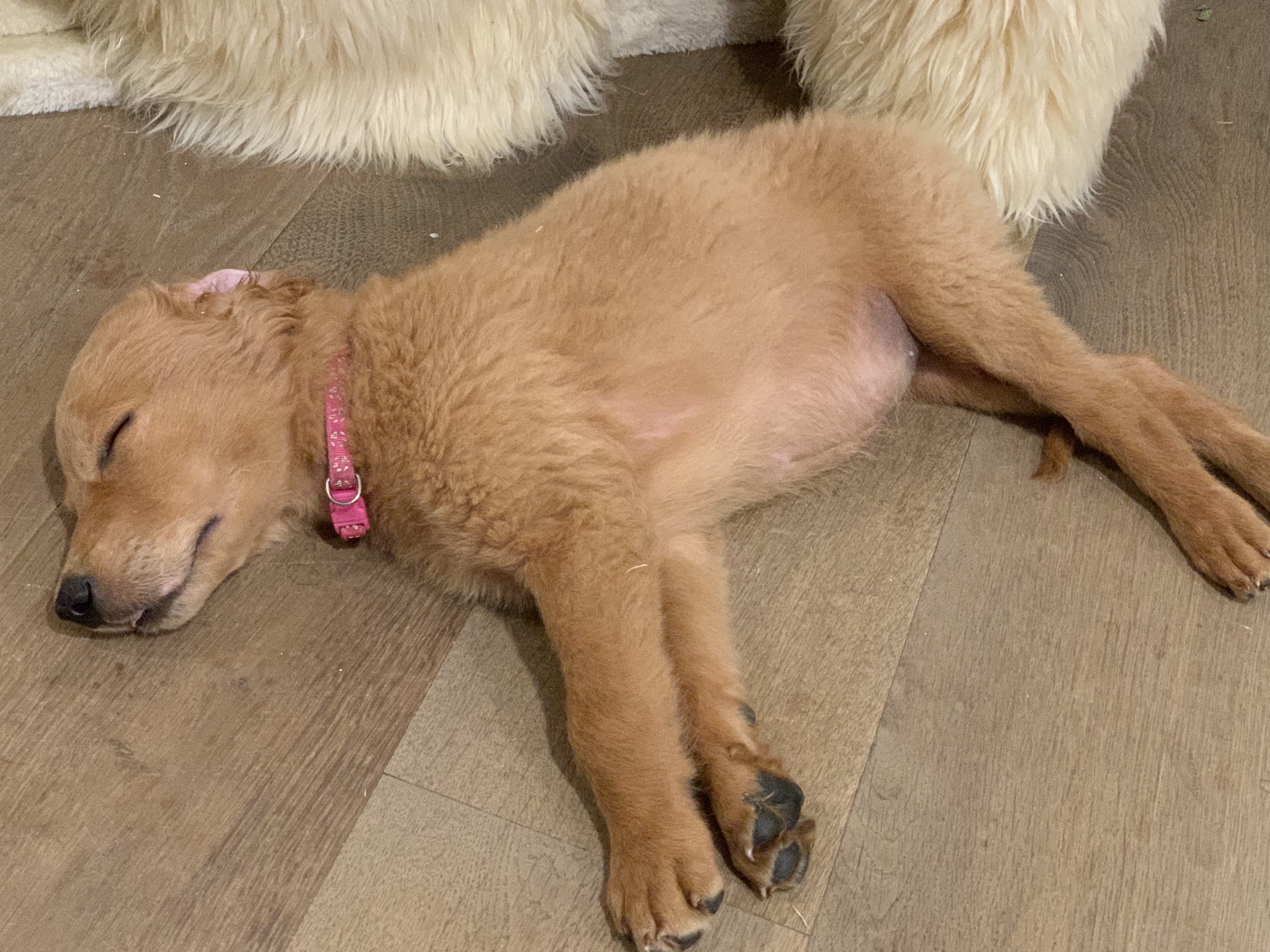
Sadie is our Golden Doodle puppy (half poodle and half golden retriever). So far, she looks a lot more like a golden retriever. Anyway, a few short weeks ago, she learned to ascend and descend the stairs to our deck. She typically does that once or twice a day as part of our general walk around, exercise, and potty break. As she grew and became more practiced, the stairs became more and more easily scaled.
Until today.
She started up the first step and began sniffing every inch of the step. Same for the second step. How could she have lost so much skill? She scrambled up to the third step and began sniffling at every single leaf and bit of random detritus.
Then, it hit me. She could sprint up the stairs, hindered only by my own oldish legs. She had always viewed the stairs as a means to and end, but now that she had mastered it, she wanted to experience the stairs in the way that she most likes to experience everything — with nose and tongue.
It took her about two weeks to realize that she had forgotten to properly explore the stairs which she did today…
It could be that the guy who cleans the pool once a week, and himself has a dog, came today and it was his scent that she was particularly interested in.
Or, both.
In any case, it made me wonder how often people think of their career ladders, or personal journeys as something to be instrumental; e.g., to get to the top of the stairs. There are advantages to being at the top of the stairs. You can see farther. And, you’re closer to the kitchen. But there are advantages to being at the bottom of the stairs as well.
Do we ever take the time to really experience and explore the steps along the way? If your whole life is using everything as a means to an end, then in the end, it all means nothing. What of all the opportunities to explore the steps?
I’ve been playing a sort of “ball chase” + soccer with our new puppy, Sadie. She’s extremely good at it, IMHO. She instinctively chases a ball & brings it back. I’ve reinforced it but it would be a stretch to say “I trained her to do that.” I sort of expect most dogs to view this as a game not completely unlike chasing a bird or rabbit & bringing it back.
The more interesting part came when I combined it with soccer. She learned (?) to judge carom shots off the baseboard and half closed doors. She tries to stop a ball before it hits the wall but judges that if she can’t stop it directly, she can stop the rebound. That she even tries to stop it is interesting. That also seemed “natural.” I probably reinforced her differentially, but again, it would be giving me far too much credit to say I trained her to “defend” against having the ball go past her.
I begin a few weeks ago to play with two balls at once. This makes it more challenging for me not to break my neck as well as Sadie. What I find interesting is that she immediately tries to hoard or herd; i.e., control, both balls. She has tried picking up two in her mouth at once, but she can’t manage it. So, she holds one ball in her mouth and “corrals” the other between her front paws. When she gets bored, she relents and lets me throw or roll or kick the balls.
I now sometimes use three balls at once. (I’ll let you know which hospital for flowers). Actually, I’m careful, but Sadie is sudden in her movements. Anyway, once I put a ball “in play”, I usually control or kick it with my foot. Sadie imitates (!?) me in this. She “controls” a ball by putting one of her front paws on it and she also pushes the ball with her paw, though she did try “nosing it” once but I think she found it uncomfortable since she shook her head and reverted to using her front paws.
On some occasions, I “grab” a ball with the bottom of my foot and move it slowly back and forth and feign kicking one way and then kick another way which routinely makes Sadie growl as she scampers after the ball. There’s something else. The slow movement followed by quick movement energizers her more in her quest for the ball than if I simply & directly hit it.
These types of patterns are found in human sports around the globe. Did they co-evolve with dog play? I’ve seen videos of many species of mammal playing “soccer.” From the video alone though, I have no idea how spontaneous the play is. If I had to guess, I’d say it’s pretty spontaneous.
Soccer, American Football, hockey, rugby, field hockey, and basketball share this notion of trying to “make a goal” by getting past the defenders. In every one of these games, there is also the notion of “fake” or “feint.” It feels as though Sadie and I, if not reading from the same script exactly, both of us have the same “playbook” of things that are fun in sports.
On a not completely unrelated topic, I am wondering whether any other new dog “owners” have noticed that their own sense of smell has been enhanced since sharing lives with a puppy. Perhaps it is not so much enhanced as that I pay more attention to it than I did a few short months ago. She goes sniffing and I go wondering for the most part, what it is she’s sniffing on about.
To some extent, it’s the same with sounds. I’m typically a pretty visual person and when I walk alone outdoors, I mainly noticed what I see. When walking with Sadie, however, she reacts to many sounds that I would ignore. I know what it is and give it a name and then reassure her that it’s okay; that trucks and cars and airplanes and helicopters are okay, at least in the distance.
I’m mainly a visual person. I’m much more distracted by, for instance, a butterfly wafting by than a truck backfiring. Like nearly everyone, I love music. But I don’t go out of my way to hear it nearly so much as do many others. But there are sounds that I love: Simple sounds. That is why the poem itself needs to be short and neat. Those are the kinds of sounds I’m talking about. Discrete.
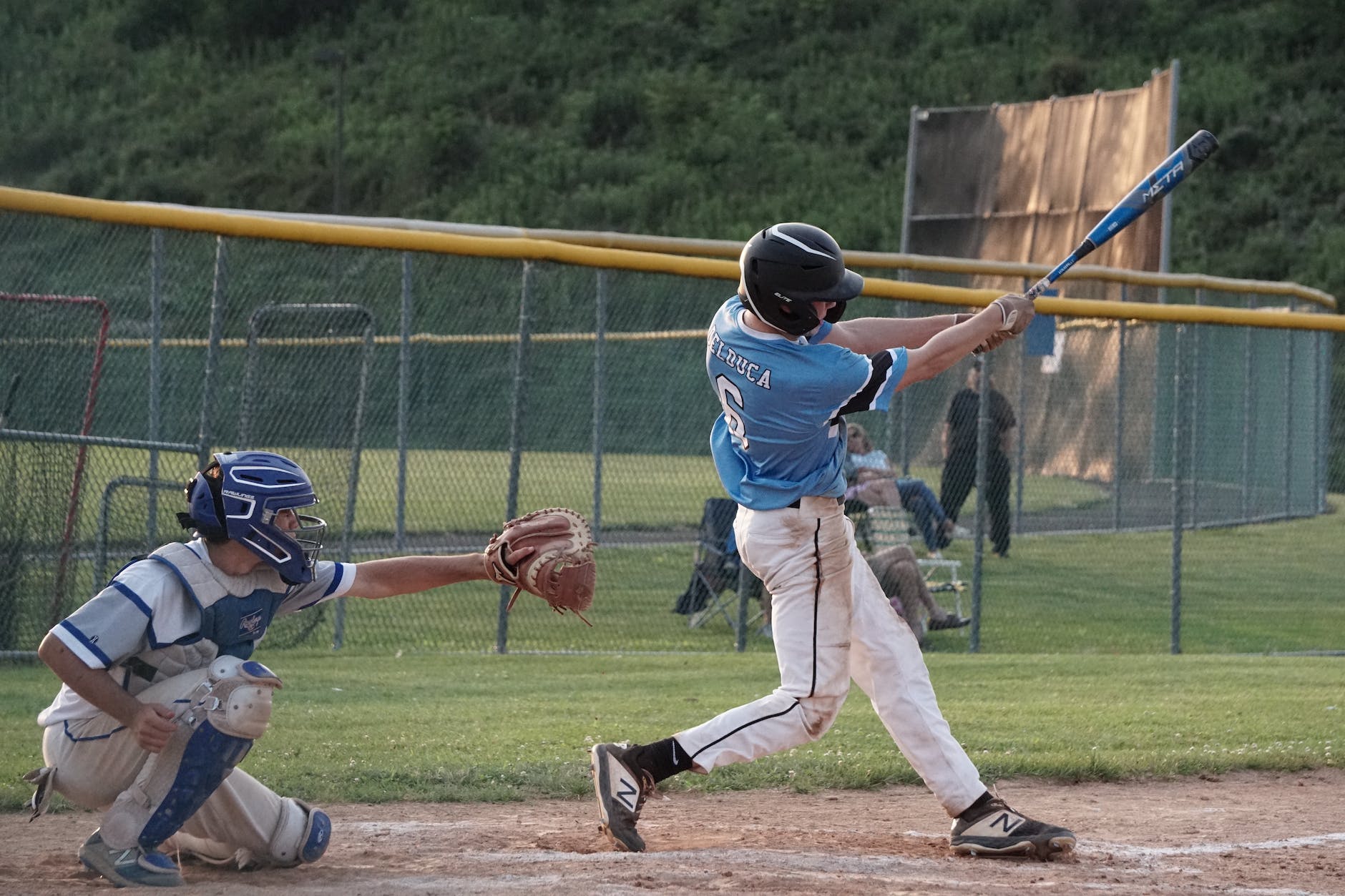
And some of these sounds I think I inherited a love for. Others, I grew to love. And some sounds I believe have elements of innate beauty and of learned significance. The sound of a well-hit baseball is satisfying in some deep sense over and above the significance in terms of the game. It has a resonance of beauty beyond the even more important sense that it shows what humans are capable of. All of us feel pride when we watch an athlete perform some amazing feat of strength and skill and training and will and concentration all coming down to a moment of truth and *CRACK!* there it is and you know long before it clears the fence because you heard the Home Run first.
So, there’s that. But I can’t help wondering why we can’t find a way to also feel pride in all the accomplishments of all human beings. They’re all in our family. And, we recognize that, at some level. See paragraph above.
The snapping sound of a puppy’s jaws “missing” a toy is something I haven’t heard for many decades. Sadie reminded me of that sound from more than a half century ago. Some sounds you remember your entire life.
I was trained in “Experimental Psychologist” in the late 1960’s. Today, my program would likely be called “Cognitive Psychology.” The change is more than simply moving to a more fashionable (or opaque?) terminology. Skinner and other behavioral psychologists held sway over much of the experimental work in psychology and particularly in America.
One of my classmates at Michigan had attended Harvard as an undergrad and described an honors dinner he had attended as a Freshman. He had gotten to sit next to B.F. Skinner at the banquet and Skinner, was not only a smart student (having gotten his own Ph.D. in two years), and a brilliant experimentalist; he was also a tireless promotor of his view of psychology. Even at a dinner for Freshman, he began to wax elegant about his particular approach.
“Now you see,” said Skinner, “I am holding a fork and I move it to my mouth and I get food. Some of my colleagues would say that I believe that I will satisfy my hunger if I move the fork to my mouth. But why? There’s no need for belief! It is simply that when I grab my fork and move the food to my mouth, I am reinforced by the food and thus I keep doing it! There’s no need to introduce any belief!”
My classmate, in awe of the great doctor Skinner said, “Wow! That’s amazing Professor Skinner and you truly believe that, right?”
“Of course I believe it! I mean — no, of course not. I don’t believe. I’ve simply been reinforced for saying it so many times that now it is my behavior!”
This is a recounting filtered through two sets of memory, but in essence, I believe it is correct. I no longer think of the word “believe” as a useless and unnecessary construct. As an undergraduate, I studied a lot of behavioral psychology, and worked as a laboratory assistant in a behavioral psych lab. At the same time, I had another part-time job working as a child care worker in the children’s floor of a psychiatric hospital. At the hospital, the approach the psychiatrists took was strictly Freudian. Thankfully, the patients spent the vast majority of their time interacting with much more practical and reasonable souls such as myself, my fellow child care workers, and many wonderful nurses.
I had been fascinated by Freud whom I first read about around age 13. I came to believe there was much truth in his approach. I interpreted dreams and “slips” and his approach resonated with my lived experience. But my allegiance is to truth, not to an individual. Empirical research began to demonstrate that however intuitive his approach might seem, it was not particularly effective compared with behavior therapy or, later, cognitive behavioral therapy.
When I had a first hand look at the “Freudian” approach applied to a kid’s psych ward, I saw for myself how it could be misapplied and mishandled. Here are two examples. One of the kids K had spent an hour or so building a plastic model of a car. No sooner had he finished and began to show off his cool accomplishment than a much younger kid D ran over and stepped on it, pretty well smashing it to bits. K began yelling and screaming. A nurse — one of the few I worked with who happily drank the Freudian Kool-Aid asked K what he was so upset about. K said, “D smashed my car!”
Nurse: “Well, K what are you really upset about?”
K: “I told you! D smashed my car!”
Nurse: “You’re going to the quiet room until you can tell me what you’re really upset about.”
I am not claiming this is “appropriate” use of Freudian therapy. But it does illustrate how easily it can be turned to something absurd and cruel.
This absurdity was not limited to nurses who “after all” didn’t have the years of training it takes to become a Freudian psychoanalyst. But here’s an example from one of those highly trained psychoanalysts. Another patient, M, had been on the ward for about three years and during this time had become close friends to one of the nurses, N. These nurses, you have to understand, did not spend time simply administering meds and sitting in the nursing station. They were on the floor interacting with kids during 90-95% of their shift. So she had spent many hours interacting with M. I observed them together and it was clear that there was a real bond of friendship. At some point, N had a job offer from Raleigh and told M that she’d be leaving. M was sad — appropriately so, in my estimation.
As is typical in hospitals, there were three shifts per day. There is overlap of shifts so that shift N can find out what happened during shift N-1. We took turns reading the “Nursing Notes” and “Psychiatrist Reports” during the handover meeting. The psychiatrist who was seeing M “explained” that he had told M that he, the psychiatrist, was going on a vacation for a week and so “obviously” the sadness expressed by M because he’d be losing his friend who saw him every week for three years was actually a reaction to the fact that M’s psychoanalyst would be on vacation for a week. Right.
I loved working with the kids. And, I enjoyed my colleagues on the ward as well. However, I got completely turned off to the psychoanalytic approach as practiced. I still believe there are some important truths to Freud’s approach, but also some absurdities, particularly when it comes to his misunderstandings of women. We’ll save that for another time. The point here is just to show why I was looking for another approach to psychology and behaviorism fit the bill.
For a time.
It is impressive to train a rat and to see with your own eyes how reinforcement, shaping, thinning the schedule, extinction, generalization, chaining, all work. I was able to train a rat to do a “chain” (i.e., sequence) of four unnatural behaviors. It took patience and it takes clear observation — a kind of empathy really. You have to know when the rat is “getting closer” to the desired behavior. This observational skill is also useful in training a puppy.
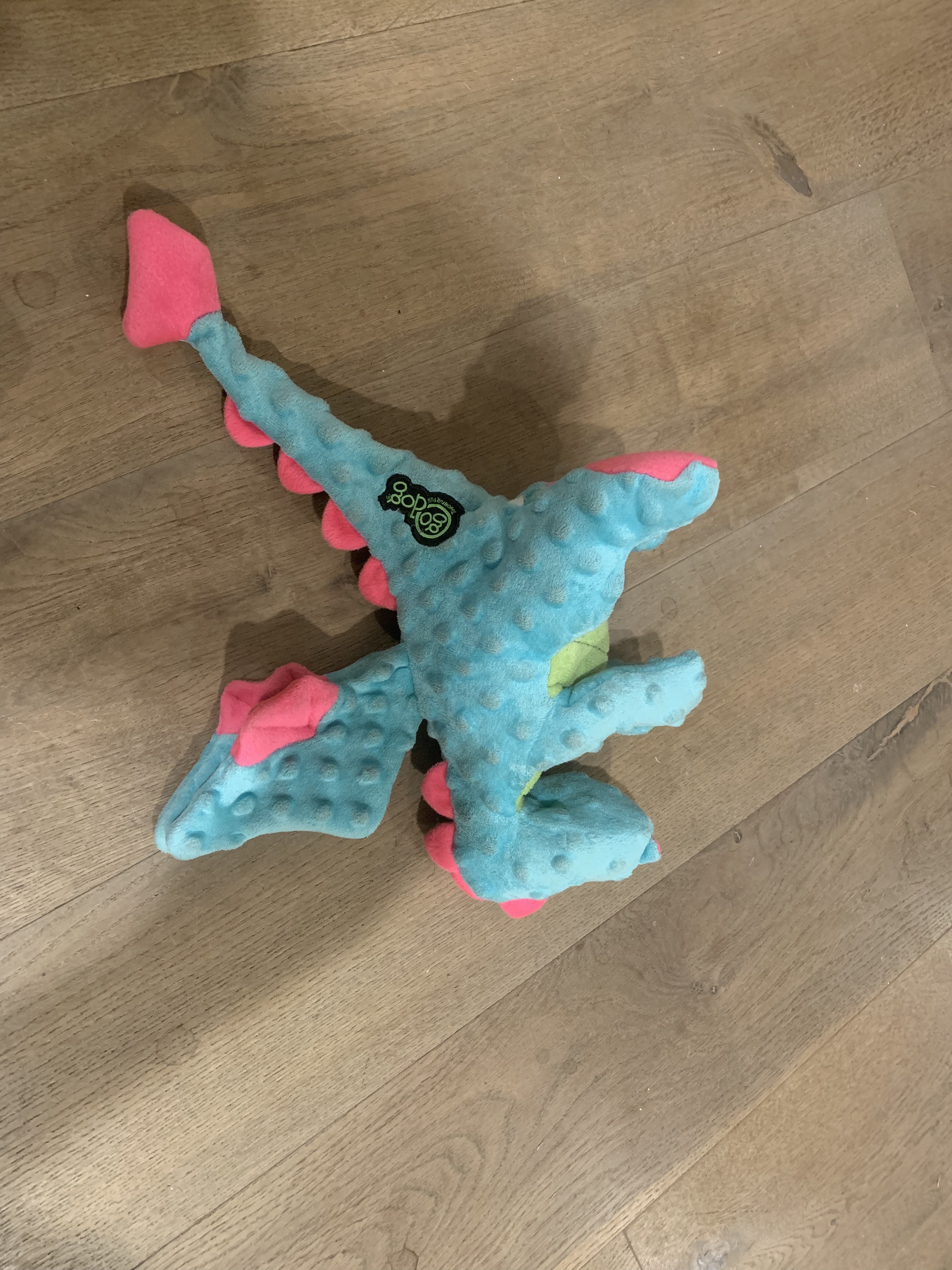
That brings us to the game of “chase the dragon, bring it to me, and fight over possession.” Our new puppy Sadie, being smart, learned to chase, fetch, and fight for control very quickly. What I find more interesting is how her behavior also evolved over the course of a week to grab the dragon by the neck a very high proportion of the time. From the standpoint of fetching and fighting me for possession, she has many choices: head, neck, left forearm, right forearm, left leg, right leg, left wing, right wing, tail, belly, or crotch. So, why is she focusing so heavily now on the neck?
One possibility is that I say “Good work, Sadie” more often when she grabs it by the neck. I doubt it, but it’s conceivable. Another possibility is that it’s easier to carry. That also seems unlikely. She occasionally trips over the dragon as she’s bringing it back. But to prevent tripping, it would be best to grab by the belly. Grabbing by the tail, head or neck makes it more likely to trip. In any case, she doesn’t seem to “mind” tripping as much as I would! Another possibility is that she holds on more easily when I struggle with her. But her jaws are strong and she can hold on anywhere and keep me from retrieving it.
I think the most likely explanation (though not the only one) is that grabbing by the neck and shaking (which she also does) is how her ancestors break the necks of small prey. Many people would say this behavior is “instinctive.” But she didn’t exhibit this preference when we began playing “fetch the dragon.” After a week though, she exhibits a strong preference.
In popular speech as well as in professional psychology, we often tend to dichotomize behavior into “learned” and “innate.” The behavioristic approach focuses on what is “learned.” As a result of that focus, we learned many important things about learned behavior. Some have suggested that the American focus on behaviorism and the importance of learned behavior was partly driven by our political philosophy. Regardless of why it happened, behaviorism “ruled the day” for quite awhile.
It turned out that what might be called “naive” behaviorism doesn’t work completely even for rats. One line of thought was made famous by Chomsky. People cannot learn their natural language merely by being positively reinforced for saying the “right” thing. There are rules that we learn. Children brought up in an English-speaking household, for instance, learn the rule that past tenses are made by adding “-ed” to the end of the present tense form of a verb; e.g.; we have “learn – learned”, “walk – walked”, “type – typed”, “showcase – showcased”, etc. There are thousands of example. But the rules are not “perfect’; there are many exceptions. We have “are – were” and “ran – run.” At a young age, almost all children at some point will say, “I ranned after my puppy” “I eated my dinner.” They have not heard that. They are not learning specific words; they are learning rules.
It isn’t only beings as complex as humans who fail to meet the expectations of “naive” behaviorism. A rat can be quickly taught not to “do” something if they are shocked when they do it. On the other hand, making them nauseous, while apparently noxious, does not teach them to avoid doing something. With smells and tastes, though, it is just the opposite. The rat (or human) can learn in one trial to avoid a particular taste or smell if it makes them nauseated. This is sometimes called the “Sauce Bearnaise Effect” — even one bad experience of getting nauseous after tasting a food — especially a novel one — can induce a life-long hatred.
The point is that some of our responses are predisposed to be paired with certain kinds of stimuli. We are not a “blank slate” but a predisposed slate. This kind of predisposition to fluidity is also true of genetic traits. We may think of the environment as a force capable of moving the genome equally easily in any direction, much like a billiard ball can roll in any direction equally easily on a pool table. But that is not so. Some kinds of changes are much easier to effect. For instance, in breeding dogs, the “toy” version is essentially a more juvenile form. They, like puppies and human babies, have a head that is disproportionately large for their bodies.
I recall many years ago reading an article in Science which observed that infant chimps were not afraid of snakes nor of a severed head. But with no specific “training” or “experience” with these stimuli, when they were shown later, the chimps were freaked out both by snakes and by a head with no body. It seems to me to be quite possible that there are behavioral predispositions that are inborn but not manifest without experience — but that the necessary experience is not “learning” in the traditional sense — not, in other words, being punished or reinforced but simply having experience that builds up your model of the world.
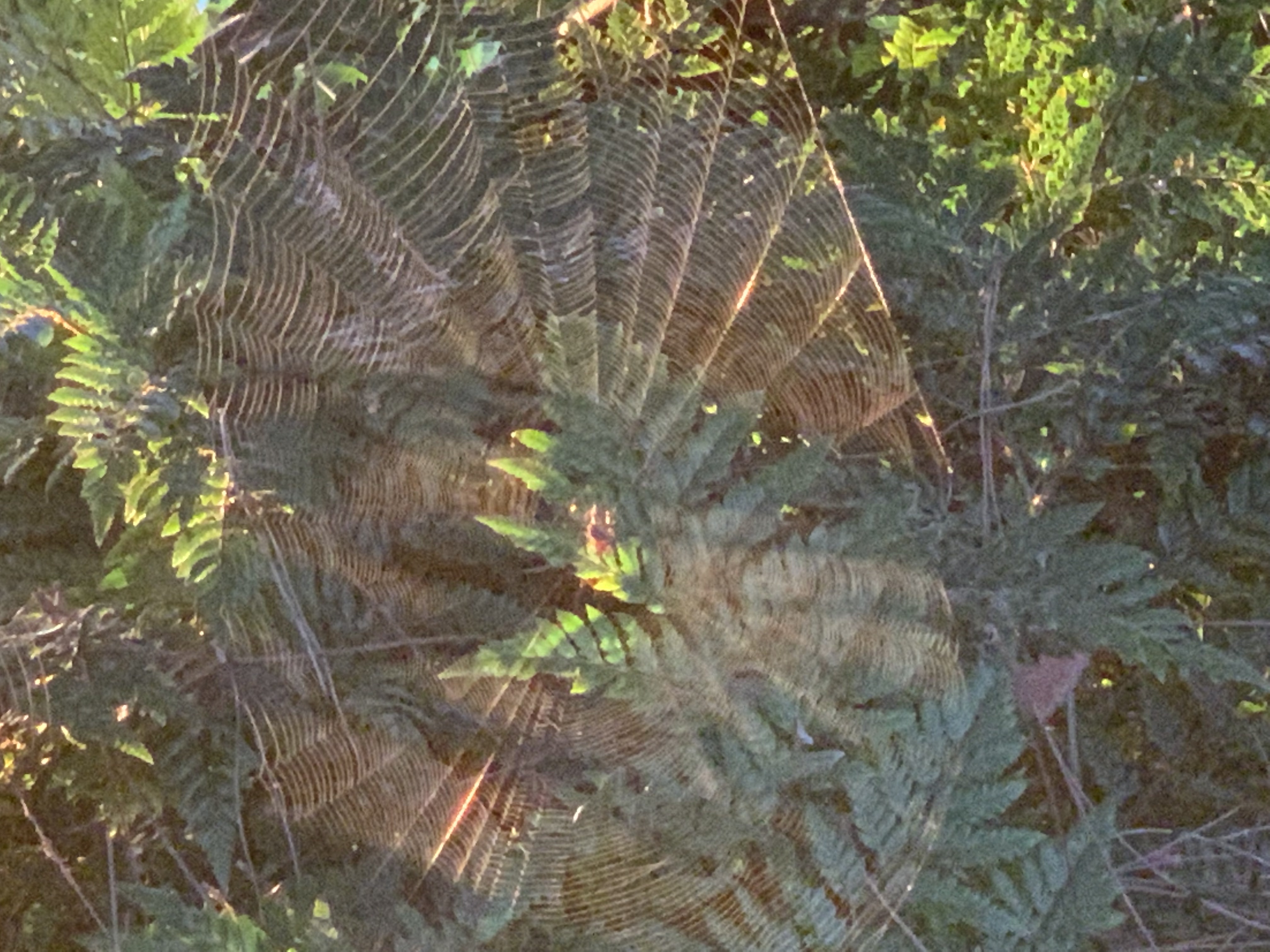
For instance, neither of us has seen a jumping spider as big as a puppy. We’ve never been bitten by one! Since they don’t exist, we haven’t “read” about how venomous they might be. But I’m guessing, if either one of us drove home late in the afternoon, pulled into the driveway and saw a spider in the driveway who jumped onto the hood of the car, we’d be completely terrified. We might “know” intellectually that the spider couldn’t tear the car apart to “get” us. But it would still be terrifying, I think because we would know that our “model” of what is possible in this world is badly defective. Our natural tendency, however, is not to say, “Oh, my God! My model of the world is terrible! I’d better fix it!” No, our tendency is to say, “Oh, my God! That spider is horrible!. We need to kill it!.” Our fear, in this case, is not “learned” nor yet is it exactly “innate.” It is “awakened.” At one time, our mammalian ancestors were so small that a large spider might be proportion to what the puppy spider might be to us?
In the case of he puppy chasing after a chewy toy in the shape of a “dragon,” she has “changed” to most often grab it by the throat. It could be learning of a sort, but it seems more like an “awakening” of a pattern already there ready to be activated by relevant experience. That’s not to say, I might not be able to shape her behavior by reinforcement or punishment to only grab it by the tail. This is not science of course. I haven’t been rigorous enough to rule out a more pure “learning” explanation. It’s just a speculation.
In the last two weeks, she’s also become much more adept at using her paws to “control” her dragon. This too feels more like “awakening” than it does pure maturation or pure learning. She’s grown more coordinated and stronger. It seems as though both maturation and learning are involved, but why should she want to “control” the dragon in the first place? That seems like the “awakening” of an instinctive desire.
What do you think? What is your experience with training puppies or other animals? What is your own experience? Do you think you yourself have had experiences that “awakened” something within?
My first “real job” was working as a camp counselor at a camp for kids with special needs. The camp counselors loved to play pranks on each other. One favorite was to sneak into another counselor’s cabin, fill the sleeping victim’s hand with shaving cream and then tickle them under the nose. The expected behavior is that the counselor will scratch the tickle while still asleep and thus smear their own face with shaving cream. Apparently, they tried this on me.
I awoke in the middle of the night and the first thing I saw were my thumbs firmly pressing on a guy’s windpipe. Apparently, instead of groggily smearing my face with shaving cream, I had immediately jumped up and began to choke him to death.

































 petersironwood