• About PeterSIronwood

petersironwood

~ Finding, formulating and solving life's frustrations.

petersironwood

Tag Archives: communication

I Say: Hello! You Say: “What City Please?”

09 Tuesday Dec 2025

Posted by petersironwood in AI, creativity, design rationale, HCI, management, psychology, Uncategorized, user experience

≈ 1 Comment

Tags

art, communication, conversation, Design, efficiency, HCI, human factors, photography, primacy, problem framing, problem solving, sensemaking, technology, thinking, UX

Photo by Tetyana Kovyrina on Pexels.com

In the not so distant past, people would often call directory assistance operators. These operators would find a number for you. For an additional charge, they would dial it for you. In fact, this was a very commonly used system. Phone companies would have large rooms filled with such operators who worked very hard and very politely, communicating with what was often a hostile and irrational public. 

Photo by Moose Photos on Pexels.c

Customer: “I have to get the number of that bowling alley right near where the A&P used to be before they moved into that new shopping center.”

Operator: “Sir, you haven’t told me what town you’re in. Anyway…”

Customer: “What town?! Why I’m right here in Woburn where I’ve always been!” 

Photo by Johannes Plenio on Pexels.com

There were so many operators that the phone companies wanted their processes to be efficient. Operators were trained to be friendly and genial but not chatty. The phone companies searched for better keyboards and better screen layouts to shave a second here or there off the average time it took to handle a call. 

There are some interesting stories in that attempt but that we will save for another article, but here I want to tell you what made the largest single impact on the average time per call. Not a keyboard. Not a display. Not an AI system. 

It was simply changing the greeting. 

Photo by eberhard grossgasteiger on Pexels.com

Operators were saying something like: “New England Telephone. How can I help you?” 

After our intervention, operators instead said, “What city please?” It’s shorter and it’s takes less time to say. But the big change was not in how long the operator took to ask the question. The biggest savings was how this change in greeting impacted the customer’s behavior. 

When the operator begins with “How can I help you?” the customer, or at least some fraction of them, are put into a frame of mind of a conversation. They might respond thusly:

“Oh, well, you know my niece is getting married! Yeah! In just a month, and she still hasn’t shopped for a dress! Can you believe it? So, I need the number for that — if it were up to me, I would go traditional, but my niece? She’s — she’s going avant-garde so I need the number of that dress shop on Main Street here in Arlington.” 

Photo by Tuu1ea5n Kiu1ec7t Jr. on Pexels.com

With the “What City Please?” greeting, the customer was apparently put into a more businesslike frame of mind and answers more succinctly. They now understand their role as proving information in a joint problem solving task with the operator. A typical answer would now be:

“Arlington.” 

“In Arlington, what listing?” 

“Dress shop on Main Street.”

The way in which a conversation begins signals what type of conversation it is to be. We know this intuitively. Suppose you walked up to an old friend and they begin with: “Name?” You would be taken aback. On the other hand, suppose you walk up to the line at the DMV and the clerk says, “Hey, have you seen that latest blog post by J. Charles Thomas on problem framing?” You would be equally perplexed! 

Conversation can be thought of partly as a kind of mutual problem solving exercise. And, before that problem solving even begins, one party or the other will tend to “frame” the conversation. That framing can be incredibly important. 

Even the very first words can cause someone to frame what kind of a conversation this is meant to be.

Words matter.

The Primacy Effect and The Destroyer’s Advantage

https://petersironwood.com/2018/02/13/context-setting-entrance/

Essays on America: Wednesday

After the Fall

The Crows and Me

Cancer Always Loses in the End

Come Back to the Light

Imagine All the People…

Roar, Ocean, Roar

The Dance of Billions

How the Nightingale Learned to Sing

Travels with Sadie

The First Ring of Empathy

Donnie Visits Granny!

You Must Remember This

The Walkabout Diaries: Bee Wise

Author Page on Amazon 

Secret Sauce

04 Tuesday Nov 2025

Posted by petersironwood in driverless cars, psychology, The Singularity

≈ Leave a comment

Tags

AI, Artificial Intelligence, cognitive computing, communication, Cooking, ethics, integrity, interaction, marketing, sauce, science, technology, the singularity

IMG_6515


No need to panic, thought Harvey. Ada should be back soon. Or, I can go to a neighbor. I am not going to freeze to death on my own front porch. Harvey shivered just then as another icy blast hit him. He turned and scanned the neighborhood. Crumpled cars blocked the streets. None of the houses in his immediate area were lit. Wasn’t this the season of lights? I suppose one of the motorists could help if any of their cars is still in working order. And they were willing to break the law and leave the scene of an accident. And they had sense enough to have snow tires.

He stamped his feet on the concrete. Harvey told himself that this was to keep circulation going, and not some childish outburst of frustration. He looked down the street and saw two dim figures approaching arm in arm from the direction of the Von Neumann’s house. As they drew nearer, he heard the warm voice of his sweet Ada.

“Hey, Harv! Did you decide to come out and enjoy the winter beauty too?”

“Hi, Ada. Please tell me you have a key.”

“Sure. I always take my keys when I leave the house.” She laughed. “Wouldn’t want to lock myself out.” She chuckled again. “Guess what? I found Lucy out for a walk too and I invited her over for dinner.”

“Hi, Lucy. Sure. We’re just having mainly mixed veggies for dinner, but if that’s okay…”

Lucy smiled. “Great with me, Harvey. Thanks!”

Ada spoke again, “Come on Harv. It’s beautiful outside but we’re cold. Let’s go in! Besides too much traffic out here for my taste. What a crash! Say, isn’t that …in fact, aren’t those two blue cars ones that you worked on? I thought they were supposed to be uncrashable.”

Harvey sighed. “Well, nothing is uncrashable. AI cannot undo the laws of physics. No doubt, some human driver without proper tires or following too close started a chain reaction.”

Ada said, “Yeah. Let’s discuss this inside. Okay?”

“Sure,” said Harvey. “Can you get the door?”


“Well, okay. Oh! You didn’t lock yourself out did you?” Ada laughed in soprano and Lucy added the alto line. “You picked a great night for it.”

“I’ll explain inside.”

Ada unlocked the door. In the trio went, shook off their snow, removed their boots and headed into the kitchen. Harvey began unloading vegetables from the fridge while Ada turned on some Holiday music. “Hey, Harv, how about the three of us stand JCN at trivia while you cook?”

Harvey did not really want to explain that he may have accidentally wiped out their bank account with Lucy in the room. “No, let’s just talk. Let JCN go dream or whatever it is he does. I just feel like human voices tonight.”

“Okay, Hon. Did you see the accident? How it started?”

“No, I was inside when I heard the crash, and then, I started to worry about you so….Anyway, Lucy, any vegetables you don’t like? Sweet potato okay? And cilantro? And how about curry sauce?”

“All, good, Harvey. I’m easy. Anything is fine with me.”

Harvey stole a quick glance at Lucy. Was that a double entrendre? Surely not. He was imagining things. “Cool. I’ll start with the sweet potatoes. They take a little longer.”

Harvey quickly filled the skillet with a little olive oil and some orange flavored bubbly water, added the spices and began cleaning and chopping.

Ada said, “Harvey makes a really good sauce for vegetables.”

Harvey, meanwhile, focused on not adding his finger to the mix. His mind was elsewhere. He wondered whether the pile-up outside had really been caused by human error or…

Lucy chimed in. “Sounds delicious, Harvey. What’s in your secret sauce? I’d love to have it.”

Harvey frowned slightly, “Well, there’s no real secret. Secret sauce. Secret sauce. Why do people have sauces? Did you ever consider that?”


Ada laughed again. The Holidays seemed to make her genuinely happy. “No, I haven’t, but I’m sure you are about to tell us.”

Harvey continued to chop sweet potato, as he began, “Maybe that’s what’s wrong with Sing. No secret sauce. No sauce at all, in fact.”

Lucy spoke up, “What? What are you talking about, Harvey? You want to put your sauce into a computer system? Well, I’m sure I’d love it, but I’m not so sure about the Sing.” Now Lucy and Ada both laughed.

Harvey continued, “You see what the water does?”

Lucy wanted to play along. “Cooks the vegetables? That would be my guess.” Lucy and Ada laughed again.

“Exactly!” agreed Harvey, “but how? Do you see? Water boils at 100 C. No matter what the heat is, it never gets hotter in the pan than 100 degrees. The sauce gaurantees a constant cooking environment.”

Lucy seemed uncertain. “But you can make it hotter by turning up the flame, right?”

“No. No. It may boil more vigorously and I’ll run out of sauce sooner, but the temperature will remain constant. That’s one effect. But there’s more. The sauce guarantees a constancy of interaction!”


Photo by Pixabay on Pexels.com


Ada asked, “Interaction? You are saying the sauce let’s the veggies talk to each other?”

In the background, “We Three Kings” began its mournful minor musings. “Yes,” mused Harvey. “Exactly. I mean, they obviously do not literally talk, but imagine these vegetables are cooking and there is no sauce. In some cases, you have a piece of sweet potato next to a piece of red pepper so they share flavors. In another case, a piece of sweet potato is next to broccoli so they share flavors. The sauce provides a way for all these vegetables to exchange flavors evenly throughout the whole dish. And the key. The key in music. All the notes “know” what the key is so the choice is limited by this global structure. And the beat of course. Everything works in harmony. All because of the secret sauce! But there is no secret! It’s been right in front of us the whole time!”

Ada was no longer laughing. “You’re probably right, Harv, but are you feeling okay? Maybe you got a little hypothermia out there?”

“No, no. I’m fine. Don’t you see? The rhythm and the beat of the music! They provide a coherent overall structure for all of these different instruments and notes to play nicely together.”


Photo by Pixabay on Pexels.com


Lucy added, “Well, I for one am all for playing nicely together.”

Harvey stopped chopping for a moment. “Exactly! There are global rules that make the individual parts work together. And, the curry sauce not only provides a consistent basis for the dish. It also dictates, or at least influences, which elements I add to the vegetables. Some vegetables are not going to taste right or look to be the right color with curry sauce. And, it lets them all communicate in a common language. You see? We humans see something like cars crumpled up and hear the crash and we can put the two together. Right?”

Ada had lots of experience with the way Harvey’s mind worked so she realized he was quite serious. Lucy, on the other hand, assumed he was just trying to be funny or had had a couple martinis before she arrived on the scene. So Lucy decided to play along, “Well, Harvey, all this talk about your secret sauce is giving me an appetite. Any ETA on dinner?”

Harvey continued, “But the Sing doesn’t have any secret sauce. Nor JCN. There is no overall way for the various pieces of knowledge to work together in a harmonious whole. That’s why JCN wiped out our bank account! That’s probably why the cars crashed too.”

“Smells delicious, Harvey,” Lucy said.

Ada was beginning to forget about dinner. “Harvey. What did you say about our bank account?”

“The Sing needs a way for the parts to work together in a harmonious overall structure! Otherwise, any slight error can be magnified in particular cases. Once the system tries to operate on cases that are outside of what was imagined at design time, there is no gaurantee about results!”

“Harvey. Go back to the part about our bank account.”

Harvey stirred the vegetables absent-mindedly. “If I let this sauce all boil away, the same thing will happen. Some vegetables will get burned. The taste and texture will no longer work together.”

Ada was not to be deterred. “Harvey. Tell me about our bank account. What do you mean that it was wiped out?”


Photo by Pixabay on Pexels.com


“Yes, Ada! That’s what I am saying. Of course, there are rules and the rules cover a huge number of cases. But there is no overall set of principles that the Sing has to abide by. There is no secret sauce! There is no sauce of any kind. It’s ALL vegetables. I think dinner is ready. Lucy did you want yogurt or cheese on yours?”

“Yum. Give it to me with yogurt please.”

“Okay, Lucy. And I know Ada likes hers that way too.”

“Right you are Harvey. What about our bank account?”

Harvey’s eyes looked away from the mind maps he was drawing in his head and he looked at Ada directly. “Ada, let’s eat first. I am sure that we can restore our bank account somehow through back up systems. JCN made an error. But I didn’t transfer the money or really authorize any payments or anything like that. It’s just a bank error. But for now, let’s eat. We can recover, Ada, because the human systems that surround and control the Sign still include sauce. At least for now.”

In the background, “Joy to the World” began playing in 4/4 time in D major.


Author page

Welcome, Singularity

Parametric Recipes and American Democracy

Corn on the Cob

Absolute is not just a Vodka

Finding the Mustard

Roar, Ocean, Roar

Dance of Billions

https://www.barnesandnoble.com/w/dream-planet-david-thomas/1148566558

Design – Interpretation Model of Communication

22 Tuesday Jun 2021

Posted by petersironwood in Uncategorized

≈ 2 Comments

Tags

communication, deception, experiment, HCI, IBM, media, psychology, truth, UX

In my early days at IBM Research (1970’s), we were focused on trying to develop, test, or conceive of ways that a larger proportion of people would be able to use computers. One of the major ways of thinking about this was to use natural language communication as a model. After all, it was reasoned, people were able to communicate with each other using natural language. This meant that it was possible, at least in principle. Moreover, most people had considerable practice communicating using natural language. 

One popular way of looking at natural language (especially among engineers & computer scientists) was essentially an “Encoding – Decoding” model. I have something in my head that I wish to communicate to you. So, I “encode” my mental model, procedure, fact, etc. into language. I transmit that language to you. Then, you “decode” what I said into your internal language and — voila! — if all goes well, you construct something in your head that is much like what is in my head. Problem solved. 

Photo by LJ on Pexels.com

Of course, people who wrote about communication from this standpoint acknowledged that it didn’t always work. For instance, as speaker, I might do a bad job of “encoding” my knowledge. Or, I might do a good job of encoding, but the “transmission” was bad; e.g., static, gaps, noise, etc. might distort the signal. And, you might do a bad job of decoding. It’s an appealing model and helped engineers and computer scientists make advances in “communication theory” and helped make practical improvements in coding and so on.

As a general theory of how humans communicate, however, it’s vastly over-simplified. I argued that a better way of looking at human communication was as a design-interpretation process, not as an encoding-decoding process. One of the examples that pointed this out was a simple observation by Don Norman. Suppose someone comes up to you and asks, “Where is the Empire State Building?” You will normally give a quite different answer depending on whether they are in Rome, Long Island, or Manhattan. In Rome, you might say, “It’s in America.” Or, you might say, “It’s in New York City.” If you are on Long Island, you might well say, “It’s in Manhattan.” If you are already in Manhattan, you might say, “Fifth Avenue, between 33rd and 34th.” 

Photo by Matias Di Meglio on Pexels.com

Building on Don Norman’s original example, but based on your own experience, you can easily see that it isn’t only the geographical relationships that influence your answer. If you were originally from Boston, now on your own in Rome, struggling with Italian and homesick and someone came up to you and asked that question in American English with a Boston Accent, your response might be: “Are you joking? But how did you know I was an American. My name’s … “

On the other hand, if you’re a 13-year old boy in Manhattan — one with a mean streak — and someone asks you this question in broken English and they’re looking around like they are totally lost, you might say, “Oh, no problem. Just follow 8th Avenue, all the way north up to 133rd. It’s right there. You can’t miss it.” (Note to potential foreign visitors, most kids in Manhattan would not intentionally mislead you. But they point is, someone could. They are not engaging some automatic encoding process that takes their knowledge and translates into English. Absurd! 

You design every communication. I think that’s a much more useful way to conceive of communicating. Yes, of course, there are occasions when your “design” behavior is extremely rudimentary and seems almost automatic. It isn’t though. It just seems that way. Let’s go back to our question-asking example. Suppose you work at an information booth in New York City. People ask you this question day after day, year after year. You’re seemingly giving the answer without any attention whatsoever. Suppose someone asks you the question, but with a preface. “Look here, chap! I’ve got a gun! And if you give me the same stupid answer you’ve given me every time before, I’ll shoot your bloody brains out!” You are going to modify your answer. It only seemed as though it was automatic.

When you design your answer you take into account at least these things: some knowledge that you communication about, the current context (which itself has hundreds of potentially important variables), a model of the person you’re creating this communication for, a set of goals that you are trying to achieve (e.g., get them safely to their goal, mislead them, entertain them, entertain yourself, entertain the people around you, demonstrate your expertise, practice your diction, etc.). The process is inherently creative. In many circumstances (writing, playing, exploring, discovering, partying), you can choose how creative you want to make it. In other cases, circumstances constrain you more (though likely not so much as you think they do). 

Many readers think this is a classic example of a straw man argument. “No-one believes communication is a coding-decoding process.” 

Well, I beg to differ. I worked for relatively well-managed companies. I’ve talked to many other people who have worked in different well-managed companies. We’ve all seen or heard requests like this: “I need a paragraph (or a slide or a foil) on speech recognition. Thanks.” 

What??

Who’s the audience? Are they scientists, investors, customers, our management? How much do they already know? What are your goals? What other things are you going to talk about with them? The people who have left me such messages were all smart people. And, providing the necessary info only took a minute or two. But it critically improved the outcome. It’s not a straw man argument. 

Sit-com plots often hinge on the characters doing poorly at designing and/or interpreting communications. A show based on encoding-decoding? No. What could be funny — indeed what often is shown in comedy — are people failing to do good design and in the extreme case, that can arise by having an actual robot as a character or someone who behaves like one.

People also interpret what was said in terms of their goals, the context, what they believe about your goals and capacity, what they already know, and so on. And, even though this may seem obvious, millions of people believe what advertisers or politicians say without questioning their motives, double-checking with other sources, or even looking for internal inconsistencies in what is being touted as true. In other cases though, the same people will not believe anything the “other side” says no matter what. Just as one can do faulty design, one can also do faulty interpretation. 

In any case, I decided that it would be good to “show” in a controlled laboratory setting that the Encoding-Decoding model was woefully inadequate. So, I brought in “subjects” to work in pairs at a simple task about communicating Venn diagram relationships. The “designer” had a Venn diagram in front of them. “The “interpreter” was supposed to draw a Venn diagram. The “designer” was constrained to say something true and relevant. In addition to a “base” pay, the “interpreter” subjects would be given a bonus according to how many relationships matched those of the “designer.” The designer’s bonus depended on condition. In the “cooperation” condition, their payoff would also, like the interpreter’s, be determined by the agreement in the diagrams. In the “competition” condition, the designer’s bonus depended on how different the two diagrams were. 

Photo by August de Richelieu on Pexels.com

I ran about half the number of subjects I had planned to run when the experiment was ended by corporate lawyers. 

What? 

IBM had no unions at that time. And, they didn’t want any unions. One of their policies, which they believed, would help them prevent the formation of unions was that they never paid their workers for piece-work. Apparently, somehow, IBM CHQ had gotten wind of my experiment. People were being paid different amounts, based (partly) on their performance. They couldn’t have this! People might think were paying people for piece-work! 

It hardly needs to said, I suppose, that IBM definitely tried to pay for performance. This was true in sales, research, development, HR, management, and so on. No-one in IBM would argue that your pay shouldn’t be related to your performance. That was exactly — in one way of describing it — was going on here. By the way, these were not IBM employees and each subject only “worked” for about an hour.

Basically, regardless of how irrelevant this experimental set-up might have been to the genuine concern of unions not to pay people in an insanely aggressive and ever-changing piece-work scheme, the lawyers were concerned that it would be somehow misrepresented to workers or in the press and used as evidence that IBM should unionize. In a way, the lawyers were proving the point of the experiment in their own real-life behavior even as they insisted the experiment be shut down.


Lessons Learned: #1 Corporate lawyers are not only concerned about what you actually do or how you represent your work; they are also worried about how someone might misrepresent your work. 

Lessons Learned: #2 Even when constrained to say something true and relevant, ordinary people are quite capable of misleading someone else when it’s to their benefit and considered okay to do.

It is this second aspect of the experiment that I myself felt to be “edgy” at the time. Sure, people can mislead, but I was providing a context in which they were being encouraged to mislead. Was that ethical? Obviously, I thought it was at the time. On reflection, I still think it’s okay, but I’m glad that there are now review boards to look at “studies” and give a less biased opinion than the person who designed the study would do.

I view the overall context of doing the study as positive. As adults, these people all already knew how to mislead. I was letting them, and many other people, know that we know you know how to mislead and we’ll be on the lookout for it. 

What do other people think about studies wherein the experimenter encourages one person to deceive another? 

———————-

References published literature that describes some of the research that was done around that time. 

Malhotra, A., Thomas, J.C. and Miller, L. (1980). Cognitive processes in design. International Journal of Man-Machine Studies, 12, pp. 119-140.

Carroll, J., Thomas, J.C. and Malhotra, A. (1980). Presentation and representation in design problem solving. British Journal of Psychology/,71 (1), pp. 143-155.

Carroll, J., Thomas, J.C. and Malhotra, A. (1979). A clinical-experimental analysis of design problem solving. Design Studies, 1 (2), pp. 84-92.

Thomas, J.C. (1978). A design-interpretation analysis of natural English. International Journal of Man-Machine Studies, 10, pp. 651-668.

Thomas, J.C. and Carroll, J. (1978). The psychological study of design. Design Studies, 1 (1), pp. 5-11. 

———————

Other essays that touch on communication. 

Freedom of Speech is not a License to Kill

Ohayogozaimasu

The Sound of One Hand Clasping

Fool Me

Claude the Radioman

Know What? 

The Story of Story, Part 1

The Temperature Gauge

Let me not…

20 Tuesday Oct 2020

Posted by petersironwood in Uncategorized

≈ 3 Comments

Tags

communication, empathy, listening, translation

“Let me not to the marriage of true minds
Admit impediments….”

— W. Shakespeare, Sonnet 116

Photo by Pia on Pexels.com

I once dreamt that I was an octopus. I was not, as you might imagine, a psychoactive octopus tending to a garden for the benefit of a yellow submarine housing the best band ever (prove me wrong in comments). Nor did I exist as a free-ranging creature of the deep blue see who had a rich life evading predators and predating prey. Nope. Not me. I occupied the body of an octopus who had the misfortune of being in a small tank inside a lab. Inside my mind though, I was still me. I had no idea what they were going to do to me, but I knew my first priority had to be finding a way to communicate with them! 

It’s no easy task. You might want to take a few minutes and just consider how you would go about it. Answers like “I would simply steal and pencil and write ‘I am here’?” Are not fair game. How are you going to get out of your little tank? How are you going to crawl around with no water? Although the octopus’s tentacles are pretty cool, there’s no guarantee you could exercise the proper control. Anyway, the point isn’t so much to solve the problem as to do these two things: 

First, really imagine that you are an octopus and you have all the pros and cons associated with that in the real world but that you also have exactly your same sense of selfhood and you want to live. 

Second, how would you go about telling your captors that you were alive and conscious and wanted to be put back in the ocean — and then, how would you successfully convince them to actually carry out your wishes? As I say, it isn’t so much the solution but the process of trying that I think is valuable.

Photo by Jean van der Meulen on Pexels.com


Our communication with animals is actually quite remarkable. We have learned a lot from a host of scientific studies about things we did not previously know; e.g., how bees dance to communicate to other bees about the location of pollen sources. Even before the advent of science however, humanity has learned to to communicate to an extent with many kinds of animals. That ability has helped us survive. We have somewhat cooperative, somewhat exploitative relationships with numerous other species. And, we’re not the only species with those kind of cooperative/competitive relationships either.

Photo by La Miko on Pexels.com


I am experimenting, in a small way, with trying to understand more about the minds of other species and how to communicate with them. I generally greet all the “obvious-sized” creatures that I encounter in the garden in a friendly, cheerful voice. Why not? The price is right! And, although I am more than somewhat doubtful that they understand my words, I think that on average, they understand my love quite well. It’s possible that a tone of voice that is pleasant to one species is very unpleasant to another. But in general, I would expect sounds that are violent, discordant, loud, and suddenly loud would be unpleasant to most species and trigger a fight or flight response. 

On the other hand, music or singing or speaking gently and re-assuringly is felt by most species to be pleasurable. Most will still scurry away, but they will let you get much closer. At least, that’s been my experience. Can you really imagine it otherwise? Meet a deer in the woods and scream at it and it will approach you? But if you walk up slowly and talk gently or sing, it will scamper off more quickly? If humans were that tone-deaf to other species, we would have never “domesticated” cattle, dogs, cats, birds, horses, etc. and our own lives would be immeasurably less rich as a result. 


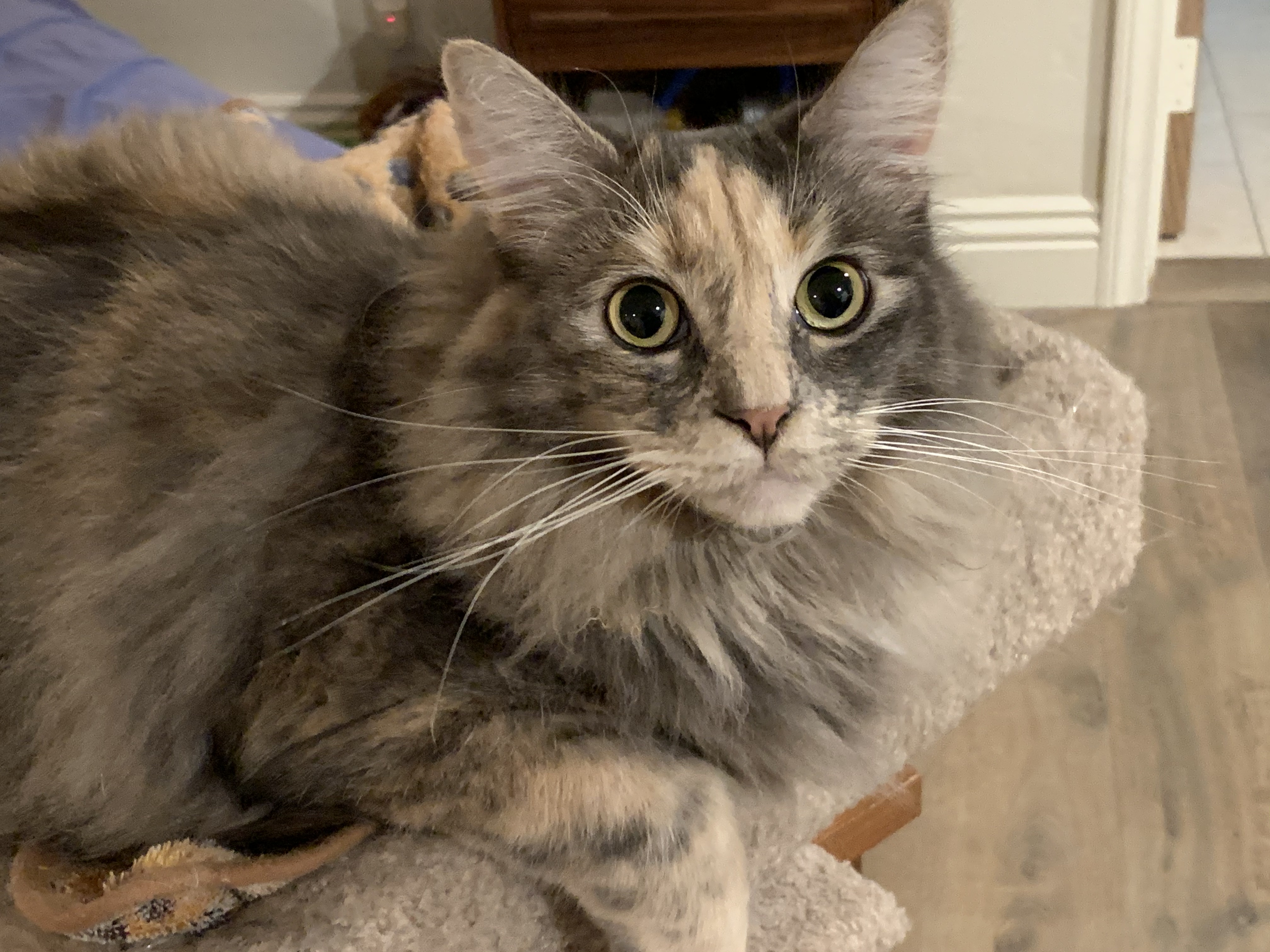
Now, we come to the issue of cats. It’s fairly easy to tell whether a dog understands you. I am not saying it is always easy to make a dog understand you, but you can tell when they do. A cat? Not so much. Oh, sometimes, sure. If you say, “Time for Dinner” and they all gather around, they know what’s happening and they show it. But in other cases, where there is no immediate reward, it’s hard to tell. I love my cats. And, I think, in many ways, they even love me back. But they’re out for themselves. You know it. I know it. They know it. And they know I know it. A dog is eager to please you. A cat believes in their very bones that you want nothing more out of life than to please them. And the ironic thing is, that because of that, it’s harder to communicate with them (which is actually bad for them). It’s very difficult to distinguish between their not understanding and their not caring. 

Hence, I decided to make some communication attempts with my cats that were not aimed at getting them to do anything. Of course, that already happens with petting, for instance, but let’s see if further common ground can be shared in a conscious way. 

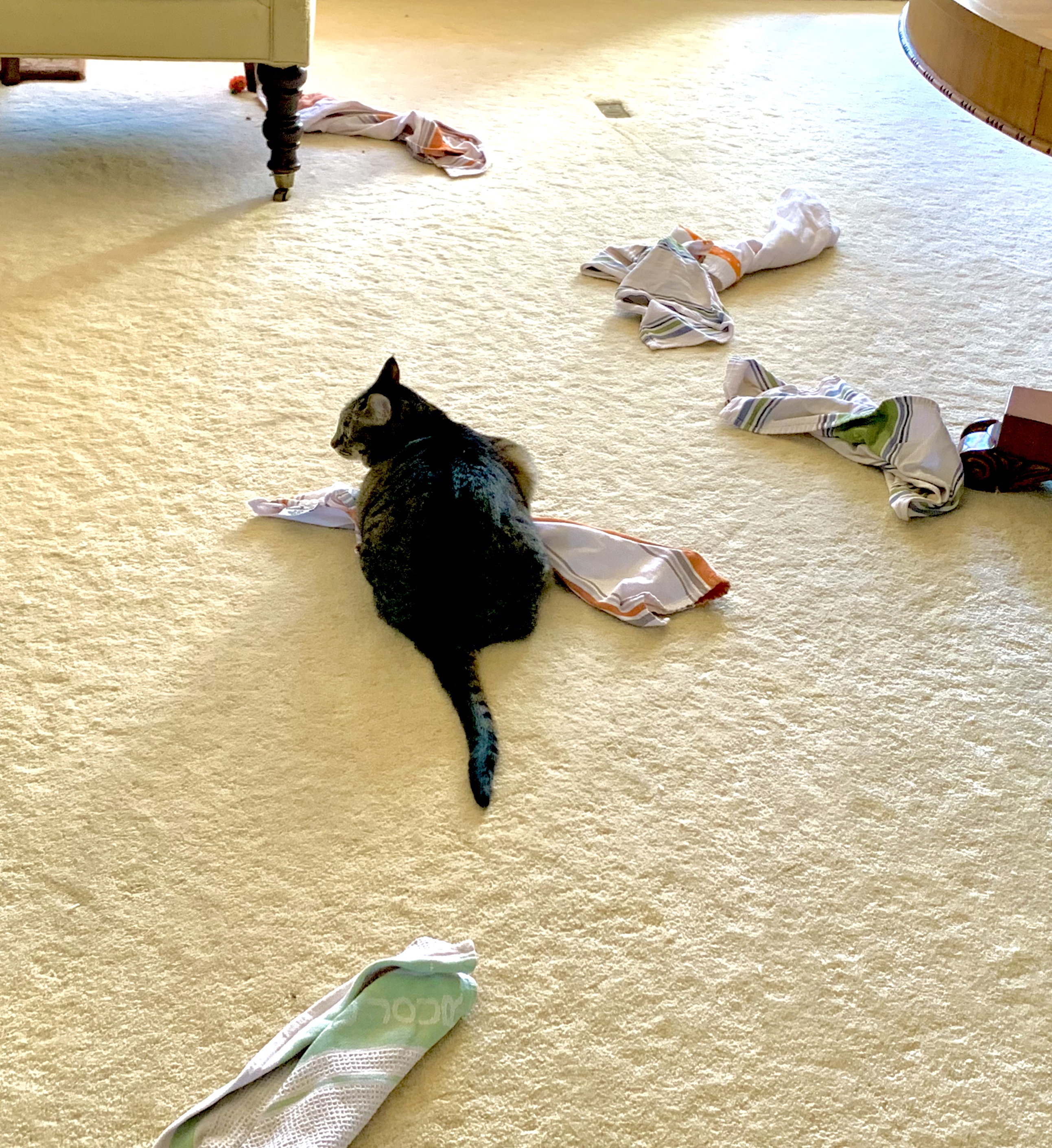
Shadow is now our oldest cat. She is jet-black and bad-tempered except when it comes to Luna, our smallest cat. With Luna, she is homicidal. With the others, she’s just mean, particularly right before dinner. She’ll bat any other cat who comes within striking distance including her own two daughters who were adopted at the same time. On the other hand, she is very affectionate to humans and loves to sit in my lap and be petted. 

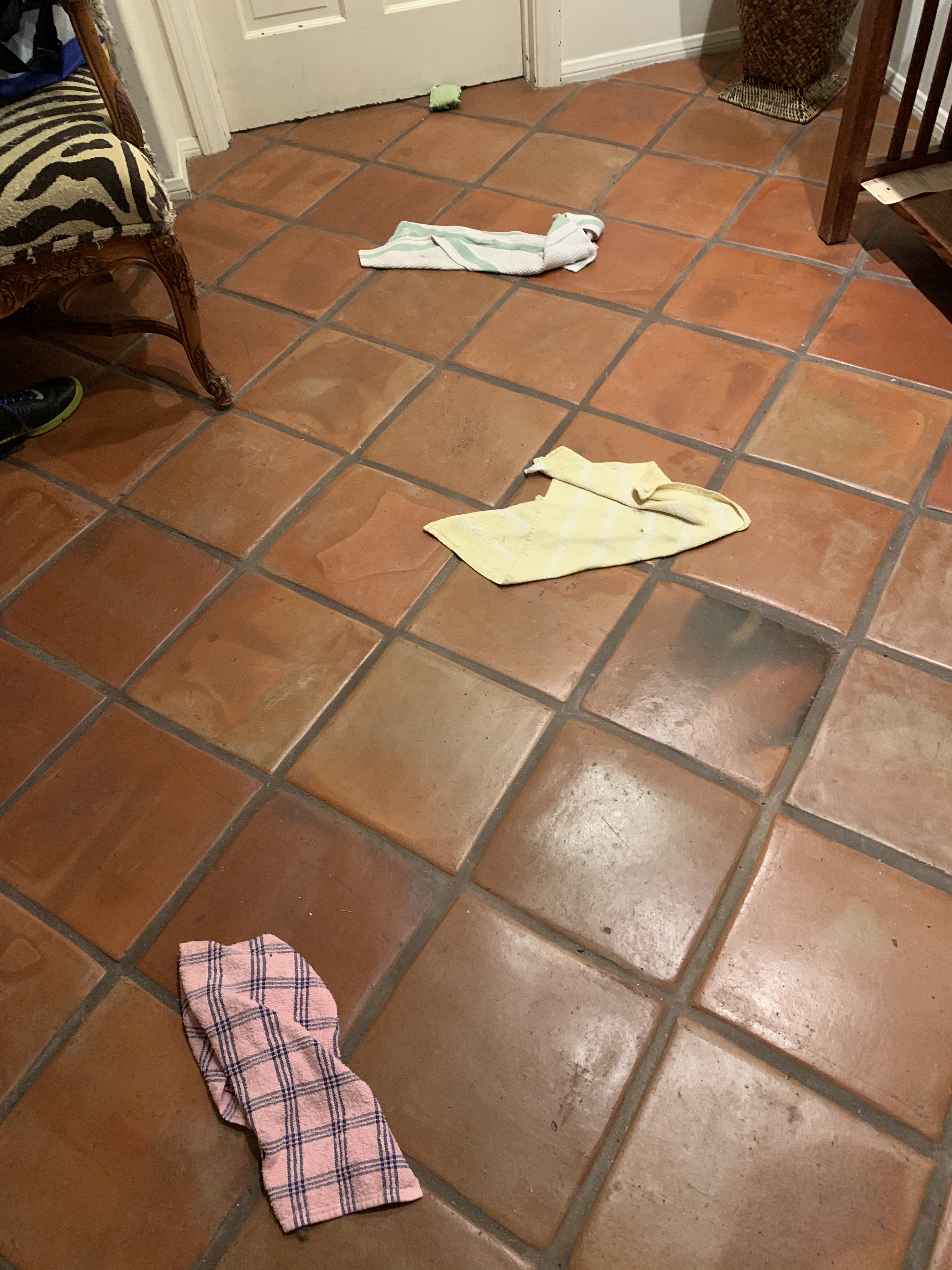
At night, generally around midnight to 1 am, but it could be earlier or later depending on what would be most disruptive to our sleep cycle, Shadow has for years taken to finding cloth of various kinds and loudly crowing while she carries it about the house. Not terribly surprising, and more pleasant than the “partially eaten dead bunny” version.

Complicating matters, Shadow may have an accomplice, her daughter, Tally.


After several years of this, it slowly dawned on me that she was often pairing things. She would put two paired socks down next to each other, often in lines that were close to parallel. She would not — or at least I never observed such — to put a sock next to a dish towel, for instance, while there were many instances of two socks or two dish towels. Sadly, this cannot be completely explained because socks are always closer to each other than they are to dish towels in our house. At first, the number of dish towels was limited because I would always put one where Shadow couldn’t find it. Over time, however, as she discovered more and more ways to find the dish towels she couldn’t find, the number of dish towels in any one … “arrangement” … grew.

Somewhat jokingly, I began to refer to the dish towel arrangements as her “works of art.”

But then, it occurred to me. Maybe they are exactly that. 

Or, maybe they are moves in an elaborate game of cat and human that she is trying to teach me.

Or, maybe they are her attempt to communicate with me that she is a person — a cat of a person — or a person of a cat — who just happens to be inside a cat body. She cannot speak, or write. Her brain doesn’t allow her to do all the things I can do (or, vice versa, by the way). But to her, inside her heart, it’s much like me inside mine. And, if that’s true, then maybe we can learn to “communicate” using the dish towels. 

For such an endeavor, I want to try to keep an open mind. I’m going to try not to assume that it’s a game or that we need to take turns or that she’s paying any attention to the world in the same way that I am. Of course, I will fail at this, but I think I will still learn more by trying than by not trying.

What do you think? 

————————————

A Cat Is a Cat and That’s That

A Suddenly Springing Something  

A Legend about Finding Common Ground

The Only “Them” That Matters is All of US

Index to a Pattern Language for Collaboration 

Who are the Speakers for the Dead?

13 Monday Jul 2020

Posted by petersironwood in America, apocalypse, COVID-19, family, health, poetry, politics, psychology, story, Uncategorized

≈ 10 Comments

Tags

communication, coronavirus, COVID19, death, Impeachment, pandemic, plauge, Putin, Trumpandemic, truth, wisdom

adult affection baby child

Photo by Pixabay on Pexels.com


With space-Alien violence, people all across the world are ri

pped from their worlds and taken to those special beds.

The COVID beds. 

And just as in the movie an alien presence is 

forced down their throat and in their 

head

Perhaps they wonder whether they

Will get a final say 

Departing to those left behind 

The wisdom of an old, yet un-befuddled mind.

4F969AEC-A579-4A8B-9B35-F773A44B3E8B 

Of, if befuddled, who’s to say

Whether older wisdom may filter through 

To light a little (just a little), our path to a brighter day.

3FC757BE-A645-4C45-B75F-BD101D6225AC_1_105_c

Who are the Speakers for the Dead? 

What do they say? 


Perhaps they whisper one and all with the self-same silence of the lambs

The lambs led to slaughter from the King-Con Man of the Cowards. 

Supported by the most menial of the Blowhards. 

If they have no breath, 

If no-one speaks before their death, 

Then,


Who are the Speakers for the Dead? 

What do they say? 


1A559AF5-59A6-4D1E-929D-B09054B43A89

No-one can say. 

That’s kind of the whole point, don’t you see? 

Everyone is different. 

Everyone learns something different. 

Everyone has a piece of the puzzle laid before us growing ever larger till it will overwhelm

And when no-one will dare to grab the helm. 

And so these lives go silently 

Out of this life and into something else entirely.


Are we learning 

Through the burning 

And the yearning unfulfilled 

All the turning unwilled

That we are all:

photography of maple trees

Photo by Johannes Plenio on Pexels.com

Leaves upon the Tree of Life. 

The Life of the Tree

Depends upon the health of every Leaf

And every Leaf 

Depends upon the Health of the entire Tree. 

Is that so hard to see? 

That’s it — in its entirety. 

Like most trees, humanity 

Must be its own gardener, 

Tender, 

Lover.

A6253369-6ABE-4B57-884E-BEFF53F7F505

How can we grow and glow 

Without the unspoken words of the many 

Dispersed instead of our waiting ears,

The unspoken syllables slide into the bowels of a machine?


And some few recover.

We should be listening carefully to each one. 

They are bringing tales from distant lands 

Which we hope never to visit ourselves. 


Are they, then, the Speakers for the Dead? 

And what, prey, do they tell? 


Or, shall we let the politicians far and wide 

Whose ear-to-ear grins have never faded.
Regardless of thousands of corpses laded.
(They’re playing for the other side) 

Shall we let them be 

Speakers for the Dead? 

No, they will not be Speakers for the Dead.

Because they cannot hear.
Because they cannot see.

Because they cannot feel. 

Because they have forgotten that Truth is not “ours” or “theirs.”

4770779D-0898-482C-B861-83F8498070A4_1_105_c
Truth belongs to the Tree of Life 

Not to one Leaf or Another.

Every single Leaf’s your sis or brother!

Let us sing then; sing together.
Heal the Tree wherever it’s needed. 
That’s how forests are reseeded. 

worms eyeview of green trees

Photo by Felix Mittermeier on Pexels.com


Other Poems on the Web

The Impossible

The Truth Train

The Pandemic Anti-Academic

The Watershed Virus

Isa Dream?

Ah Wilderness!


The Touch of One Hand Clasping

21 Friday Feb 2020

Posted by petersironwood in psychology, Travel, Uncategorized

≈ 6 Comments

Tags

communication, connection, Japan, Tokyo, Travel, truth

image-6

Japan, Tokyo, 1977. I walk crowded streets and beautiful gardens where care is taken for spaces as well as things that grow. I struggle — try to speak Japanese language but usually mispronounce “Key-Ray-Ee-Des” (It is beautiful) as “Key-Rah-Ee-Des” (It is dirty). I tip-toe through minefields of culture steeped in subtlety; lose huge chunks of flesh and karma with my thunderous, blunderous New York strides.

Shin-Ju-Ku: lights dim Times Square into grandmother’s fruit cellar. Row on countless row of Japanese stare hypnotized at small vertical pin-ball game called Pah-Chinn-Koe. This bright hustle bustle hassle hides deeper subtlety, deeper calm, inside, beneath, where foreign eyes can peer not.

city people lights walking

Photo by Negative Space on Pexels.com

I enter Tokyo subway. Then — SHE enters — total stranger, totally beautiful, black hair, endless eyes. I, of course, having learned small little in my many minefield walks, look everywhere but at her. Better, SHE looks everywhere but at me. We ride, totally not looking at each other. SHE stands in middle — nowhere to hold on to — unprotected, beautiful, vulnerable.

Suddenly, train lurches. Simultaneously: SHE shoots hand out to only spot I can possibly reach while I shoot hand out to only spot she can reach. Our hands clasp strongly for instant and I save her from fall. Slowly, we release.

monochrome photo of couple holding hands

Photo by Min An on Pexels.com

Next stop, she suddenly rushes out. But — just before the doors bang shut, she turns — looks straight into my eyes. “Kohn-bahn-wah” she says (“Good Evening”) thus, Japanese beauty touches beyond body into very soul of clumsy Westerner.

snow capped mountain

Photo by Life of Wu on Pexels.com

Author Page on Amazon

Start of the First Book of The Myths of the Veritas

Start of the Second Book of the Myths of the Veritas

Table of Contents for the Second Book of the Veritas

Table of Contents for Essays on America 

Index for a Pattern Language for Teamwork and Collaboration  

Myths of the Veritas: When Eagles Return

05 Saturday Oct 2019

Posted by petersironwood in America, apocalypse, politics, Uncategorized, Veritas

≈ 3 Comments

Tags

communication, leadership, legends, lying, myths, stories, truth

Though the winged creature was hooded, Many Paths stretched her hand forth slowly and carefully so as not to startle the raptor away. As she did so, she imitated the screes of joy the eagles sang when they rode the air high above. She hoped that would work. It seemed to help to train the wolves. She missed them too! So many of her favorite people gone — and at her suggestion. To the task at hand, she ordered herself. 

silhouette of bird above clouds

Photo by Flo Maderebner on Pexels.com

It occurred to her at just this moment that perhaps the eagles were not singing for joy at all. Maybe they were exchanging information about the location of prey below! Or, maybe they were arguing about whose turn it was to have first go at devouring the body of the unlucky rabbit or mouse. Here I am, she chuckled, named Many Paths and still jumping to conclusions and taking the first line of thought that arises. 

What else might they be? What do people do? People speak of things far beyond their immediate concerns. Do the animals? Do they tell each other stories? Make promises? Do they apologize? Do they try to trick each other? Well, they certainly do that! 

Even as her mind raced about the challenges of cooperating with animals of a different species, her hand still slid steadily and smoothly to the target and she deftly undid the small knots. Now, she slowly withdrew her hand and murmured warmly to the raptor on her arm. 

“Thank you, mighty eagle, for this word from afar.” 

animal avian bald eagle beak

Photo by Anthony on Pexels.com

Many Paths recognized the cloth even before it was fully unrolled: the shred was from Eagle Eyes! The two of them had travelled together to gather the rare indigo gentian which Eagle Eyes had used to dye part of her smock. 

Many Paths felt a sudden pull of connection to Eagle Eyes as she felt the cloth. She held it close and drew breath in through her nostrils. Perhaps it was only imagination but she caught the scent of Eagle Eyes. Something else was much stronger though! Soot. Fire. As she looked more closely, she could see that a tiny section of the cloth had been burned! 

She of Many Paths felt that she had to share this new information with the tribe … and soon. First, she wanted to think what it might signify. Many Paths frowned. She wished that Eagle Eyes might have somehow drawn a map — possibly even including the positions of all of the companions of Eagle Eyes. She couldn’t tell whether Shadow Walker or Tu-Swift were all right. Why couldn’t she include cloth from them too…or their signs. She recalled with a smile the map that She Who Saves Many Lives had given her for their test for the First Ring of Empathy. But of course, that map was much too large to expect an eagle to carry very far. 

A7A8D582-4B4A-4A7C-99CD-F4B9ADB9E82A

Many Paths strode toward the feast and tried to frame how she would present this. On the one hand, it was good news, but the news was ambiguous and incomplete. The fire part didn’t seem positive, but it was hard to tell. Too bad, she thought, that eagles couldn’t carry a better and more complete map. But the wolves could! Maybe they would bring more complete news. She felt a pang of affection for them as well as loss. She missed the wolves. Immediately, a much stronger feeling of missing flowed over her, for everyone, but especially Tu-Swift and Shadow Walker. She sighed and felt a big hollow inside, but then, the image of Shadow Walker came quite clearly to mind. She felt as though she could almost hear him talking though it seemed likely he was far away. The mind does play funny tricks sometimes, thought Many Paths, but it seems like he is telling me that my idea is right; we could communicate over distances by sending maps and symbols. Sounds a bit crazy, but why not? The wolves can track by a scent from something that is no longer where they are. What if we humans could learn to put a whole host of marks and scents on paper and then send it quickly via the wolves? She arrived at the feast and mentally placed this idea up on a branch of a tree she kept for “Interesting ideas to be thought about later.” For now it was time to reassure the people and tell them what she knew. For a split second, she considered the idea to pretend that she had simply “foreseen” that Eagle Eyes was all right and that there had been a fire. People might begin to believe she was magic and that could help focus the people to a purpose when the need became great. She could even weave a story that involved the “Magic Rings of Empathy.” 

Now she smiled at the folly of that course. If she were successful in this lie — because exaggerating one’s own powers is always a lie — it would only make her make more outrageous lies in the future. The people cannot be led on a wise path with lies. That seems obvious. 

Why then did she come up with such absurd courses of action? Maybe it was to continue to strengthen her resolve to do what was best for her people. For each time such a plot surfaced, at least so far, she had resisted the temptation. Mainly, she saw it was the wrong thing to do. Imagine that your eyes began lying to your toes about the position of a stone. Imagine that your mouth lied to your stomach and your hand lied to your mouth. 

IMG_1496

Even from a selfish standpoint, such exaggerations of her powers would be quite dangerous. She could be found out and lose all credibility with the tribe. Suppose someone believed that the Magic of Remote Sight arose from the Rings alone. Someone might contrive to steal those rings, with or without her fingers attached! If she shared the actual evidence she had, a shred of cloth, the whole tribe could apply their wisdom about likely interpretations. But if, instead, she presented her interpretation as fact, people could not think straight nor generate the full set of likely possibilities. 

Beyond that, Many Paths knew that she could never fully enjoy and participate in the feast or in talking with her tribe mates if she knew she were telling them a lie. She would be — forever alone — even if they never found out. She would know she was lying. She would know. And that would put up a wall between them. No matter what someone said to her, she would have to “check to see” whether her answer would betray her or might betray her. A moment’s lapse of ethics, thought She of Many Paths, could lead to a lifetime of cover-ups and further lives. 

Instead, she took her place among warm greetings and admiration. She let it be known that she had some interesting news to share around the fire after their meal of venison and corn on the cob.

selective focus photography of grilled corns

Photo by Engin Akyurt on Pexels.com


————————————————

The Creation Myth of the Veritas

The Orange Man: A Parable of Lying and Greed

The First Ring of Empathy (The Start of Book One) 

Fire and Feast (The Start of Book Two)

An Essay on How we sometimes Confuse the Label with the Thing

Author Page on Amazon

A Little is Not a Lot.

03 Tuesday Sep 2019

Posted by petersironwood in America, politics, psychology, Uncategorized

≈ 19 Comments

Tags

cheating, communication, cooperation, Design, lies, politics, POTUS, Putin, quantity, science, truth

“A little’s not a lot.

A swing may be a miss. 

You must remember this:

A kiss is not a kiss

Without the bliss.

A single sword does not

Make Camelot. 

Offers don’t make bought. 

A day does not make old. 

All that glitters is not gold. 

Ads do not make sold 

Without the goods, 

A tree is not a woods. 

A giant sea of coulds 

Does not imply a single spoon of shoulds.”

@truthtable, 2019. 

———————————

I just reheated a lukewarm half cup of French Roast coffee. I zapped it in the microwave for 18 seconds. That seemed about right, and it turned out very close to perfect. If I’d put it in for 17 seconds or 19 seconds, I would have been equally satisfied. 

aroma aromatic art artistic

Photo by Pixabay on Pexels.com

Do you think 1 second would have worked equally well? My “microwave,” despite the name, does not let me control the time to a microsecond, or even a millisecond. Do you think a millisecond would have been sufficient heating time? What do you think would happen if I put it in for 18 minutes or 18 hours instead of 18 seconds? 

fire warm radio flame

Photo by Pixabay on Pexels.com

I’ve been watching the US Open on TV. There have been some amazing matches! Like the folks on TV, I can hit a serve. I can volley. I can hit topspin or slice. I can hit backhand, forehand, swinging volley, and overhead. I can aim the ball toward the empty court, or hit behind a player racing to cover the empty court. Yet, I don’t think any of my readers, however much or however little you know about tennis, would ever confuse my play with any of the contestants in the US Open! Why? I mean, is there really much difference between my forehand and Rafa Nadal’s forehand? Sure, he puts more topspin on and hits it with more speed. Why should that make a difference? 

IMG_2764

On a completely different topic, let’s consider nutrition for a moment. Do you think water is good for you? Yes or no? Without any access to fresh water, people die. How long it takes to die of dehydration will depend on health, activity, ambient temperature and other factors. As a general rule, three days without water will kill you, but it could be much shorter or slightly longer. But you won’t die in a millisecond. And you won’t survive for a year. It’s obvious; right? So water is good for you! 

woman drinking from glass

Photo by Adrienn on Pexels.com

But wait. You can also kill yourself by drinking too much water. It takes about 6 liters of water to kill a 165 pound person. Of course, it depends slightly on the person and the situation. But you will not die from 6 teaspoons and you will certainly not survive drinking 60 liters in an hour. 

You can certainly drown in water. People do it ever year. In 2015, it is estimated that over 300,000 people died from drowning! It seems to me that water must be bad for you! Yet, you cannot live without it. 

IMG_3358

What about exercise? Good or bad? If you never exercise, that is certainly bad for you (which is why I wrote Fit in Bits). If you run as fast as you can for as long as you can, you will injure or kill yourself (as did the very first marathoner). Again, it depends on your health and the situation. Some people can survive a 50 mile race. Others will have a fatal heart attack sprinting 100 yards. 

How can life be so contradictory? 

Life is not contradictory. 

But neither is it composed of a set of perfect dichotomies. 

We like to impose dichotomies because it makes thinking and decision making quicker and less painful. In some limited circumstances, this strategy is appropriate. It’s fine to try to avoid cutting yourself. Under most circumstances, you don’t really have to say to yourself, “Hmm. It’s Tuesday, September 3rd. I wonder how much I should cut myself today?” No, any cut means a chance of infection and will take some of your biological resources to heal and recover from the blood loss. 

greyscale photo of person taking blood pressure

Photo by rawpixel.com on Pexels.com

Nonetheless, there is a difference between nicking yourself while shaving and being beheaded. There is a difference between stubbing your toe and being stoned to death by an angry crowd.

finalpanel1

I must confess to feeling a bit foolish pointing these things out, because I imagine everyone reading this is well aware that “some” does not equal “all” and that in many circumstances, how much and under what circumstances make a huge difference. If you want to give a pint of blood some day so that others may live, good for you! You’ll be doing it lying down and in the presence of medical personnel who will minimize the chances of infection to near zero. But you can’t give six pints of blood in one day. And, it is not advisable to “do it yourself” by slashing your wrist, collecting a pint of blood and then putting on a bandaid before transporting the blood to a blood bank.

Again — isn’t this all obvious? Well, I would have thought so. 

Yet, over and over, when I talk to supporters of the current US President and mention that he has told over 12,000 lies since taking office, people almost always say, “So what? Everyone lies.” 

???

I am a dinner guest for the first time at the house of an acquaintance and they serve overdone salmon with way too much salt for my taste. I might say it’s “good” or that I “like it.” Depending on the situation, and how much they press me, I might also mention that I also eat sushi so I’m okay with having it less done. I might or might not mention that I’m never add table salt to my food. 

cooked meat with vegetables

Photo by Dana Tentis on Pexels.com

If they say, “I like it…but I think I might have put too much salt in. What do you think?” At that point, since they are asking for honest feedback, I am going to tell them that I agree with them and that it tastes very salty.” Generally, I like to give people feedback that is honest, unambiguous, and offers a positive suggestion for how to improve. In the case of cooking, it makes a lot more sense to mention my preferences before the meal whether I’m at a restaurant or at someone’s home. Now, if I am nonetheless served over-salted, over-cooked food, I have a basis for being more frank than if I hit them with new requirements after it’s too late (at least this time) to do much about it. 

Giving feedback that is honest, direct, and offers an actionable suggestion is a good heuristic to use in the design of user interfaces as well. An error message that says, “Illegal syntax!” is fairly useless in and of itself as is “Stack overflow!” Error messages such as these are written from the developer’s viewpoint. They may serve as useful error messages during debugging. They are useless for the typical user. 

All humans are created equal. But not all lies are equally evil. And many many lies are not the same as a few lies. If you still think that publicly telling 12,000 lies that are told by a person who is supposed to be leading the country — lies that are told for the liar’s own short term benefit — if that ocean of lies is the same as a teaspoon of a lie told to encourage a child, or spare someone else’s feelings, then, please re-read this post from the beginning. 

man hug pinnochio photo

Photo by Pixabay on Pexels.com

Human language enables us to communicate over time and space. It is a wonderful thing. Without language, we would basically be living lives not very different from those of primates in a zoo. Human language allows us to work together harmoniously; to specialize in particular skills; to build roads and buildings; to discover things about nature and ourselves; to invent and to improve. Human language can be used for no other purpose than to attempt to con people. 

There are even cases, where being “conned” is understood and acceptable. If you see a play or a movie or read fiction, you suspend your disbelief. At one level, you imagine that what you are seeing is actually happening. That makes the story and the experience more compelling. But you know that it’s a move, play, or novel. The same fiction, if it is touted as a documentary, is a lie. 

It is fun to see a competent magician perform. Their patter is meant to distract you, to misdirect your attention. It is part of the illusion. It is not “evil” because you know it is all part of the show. As an adult, at least, you don’t think that the woman was really sawn in half and then magically healed. It’s a perceptual challenge. It’s meant to be fun. It would be quite different if the magician murdered his assistant by actually sawing them in half! 

woman reading a book sitting on mattress near the blue string light inside the room

Photo by Ivandrei Pretorius on Pexels.com

Twelve thousand lies. Twelve thousand lies. Not twelve. Not twelve hundred. Twelve thousand. Each one is a cut to American democracy. Each lie reduces the credibility of America on the international stage. Each lie makes people feel less confidence in government. 

Yes, there are cases where it makes sense for POTUS to lie. Say that a reporter says, “A source tells me that we are going to try to capture Bin Laden on May 2nd (2011) at his compound in Abbottabad around 1 pm local time.” And then, imagine the reporter asks the POTUS at a Press Conference,  “Is that accurate?” 

Let’s further suppose that POTUS knows that this is accurate. Should he say, “Oh, yes, in fact, your source is precisely correct.” No, of course not. 

That is not at all the same quality of lie as it is to lie in a self-aggrandizing way about your abilities, your height, your vote total, whether or not you have Russian help in getting elected. It is not the same as lying that the Mueller report “exonerated” you. 

All lies are not created equal. And one lie or even a dozen lies does not equal 12,000 lies. One cut does not equal 12,000 cuts. One liter of water does not equal 12,000 liters of water. Heating my French Roast in the microwave for 12 seconds does not give the same result as heating it up for 12,000 seconds. No-one would carelessly equate any of these things. 

So, why do the apologists for the POTUS respond to 12,000 public, provable, and important lies by saying, “Well, everyone lies sometimes.” 

97A77991-DF58-4F14-8A33-033E0AB524A0

A little is not a lot.  

——————————————————-

Books on Amazon by Author: 

The Winning Weekend Warrior focuses on strategy, tactics, & the mental game for all sports, for business, and for life.

Turing’s Nightmares uses fictional scenarios to explore ethical issues around robotics and AI. 

Fit in Bits suggests numerous ways to fit more fun and exercise into daily activities. 

Tales from an American Childhood recounts early experiences and relates them to contemporary issues and events. 

A Wild Ride to a Lower Level

24 Saturday Aug 2019

Posted by petersironwood in America, politics, Uncategorized, Veritas

≈ 1 Comment

Tags

communication, language, legend, myth, story, Veritas

Tu-Swift shook his head. “We should all go. You and I are not all that fast either right now. He has knowledge about horses that we need to learn — and about the ROI. We cannot leave them here. We don’t know who is coming, but I doubt it’s a rescue party.” 

IMG_3320

Artwork by Pierce Morgan

Shadow Walker sighed. “All right. If Jaccim can walk out of here. I’m not carrying him. Nor is anyone else.” 

Though the sun could not be seen, its hidden light from beyond the horizon lit high pink clouds as they tugged aside the heavy door. Tu-Swift, now fully awake, shouted down into the cellar. “Cat Eyes! Cat Eyes! Wake up! We hear war drums afar but coming closer. We should leave. I’m going down to help. Pack up quickly. Can you explain to the others?” 

Tu-Swift, who had lost all fear of the others, began working his way down the stairs. The others were already packing. Apparently, they had no objection to leaving their adoptive slave-home, now in ruins. Tu-Swift could hear the soft yet insistent voice of Cat Eyes talking to the others in ROI. For some reason, it did not sound so foreign when she spoke it. Shadow Walker had also descended. He imagined his strength would be needed to get Jaccim up the stairway. Though if this really were a war party approaching, he doubted they could out-run or out-walk them. Working together, they managed to get everyone out of the cellar with their meager provisions and belongings. 

Shadow Walker began working his way toward the cover of the burned and broken forest and motioned for the others to follow. Jaccim shook his head and jabbered something in ROI. Shadow Walker grew impatient. “We don’t have time to discuss. We can leave him here though I think it would be better to kill him outright. Otherwise, the ROI or whoever it is will force him to say which way we went. Let’s go!” 

“No, no. You don’t understand,” began Cat Eyes. He wants to come with us, but he says we should go another, faster way.” 

Shadow Walker asked, “How? What other way?”

cascade creek environment fern

Photo by Pixabay on Pexels.com


Cat Eyes said, “He calls it a ‘flume’ but I don’t know what that is.” She glanced at Jaccim who grimaced in pain. It hurt him to move, but he began using sign language to supplement his words. 

Cat Eyes, turned now to Shadow Walker. “He says that beyond the place where they kept the horses there is a branch of the river that was long ago dug to allow logs to flow down to the plane. Even among the ROI, it is not much thought of. But he thinks it will still work. There are still hollowed logs there that we can use to ride quickly down to the plain. If we hurry, and they don’t see us, we will escape them for good.” 

Tu-Swift stared at Shadow Walker who stared back and then looked at Jaccim. Could Tu-Swift be right about this man? Does he really feel grateful for the medicine? Shadow Walker thought it would be almost impossible to outrun them anyway with his sprained ankle. “Yes, let’s try this ‘flume’.”

They made their way as quickly as possible back to the horse paddock. Beyond that they went toward a small stream. On the far side of the stream, the current had dug into the bank. In that darkness, floated several hollowed out logs. 

Jaccim pointed toward them as though he wanted them to get in these logs. But then, as they approached, he suddenly shook his head and pointed urgently to a nearby large lever, hidden among vines, and signed for them to help him instead. It still wasn’t clear to Shadow Walker whether or not this was some sort of elaborate plot or trick. He kept his hand near his sword and whispered to Tu-Swift a single word: “Caution.” 

Jaccim grimaced as he pulled back on the motionless lever. Cat Eyes, Shadow Walker, and Tu-Swift put their backs into it as well. The lever itself seemed to be made of that same material that the swords were fashioned from and the cellar trap door — and the door that Shadow Walker had moved long ago. They all pulled on the lever, but nothing happened. Then suddenly, all four of them fell on their backs as the lever gave way. Jaccim urged them to get into the dugouts now – at once. The lever had apparently been connected to a kind of gate which moved and allowed much of the river to veer off steeply to the right. Shadow Walker got in behind Jaccim. He wanted to keep an eye on him. Two women quickly got into another dugout, each holding one of the wolf pups cradled in her arms. Cat Eyes got into the third and last log and told Tu-Swift to get behind her. 

iPhoneDownloadJan152013 481

The logs felt odd and unstable. They eddied around in the dark pool and Jaccim used his hands to paddle the log. Soon, Shadow Walker imitated him. Working together the log slowly inched its way out into the current. Suddenly, the log began to move quickly. Jaccim immediately put his hands out and grabbed the side of the bank. Then, with Shadow Walker’s help, they turned the boat slightly. 

To Tu-Swift’s eyes, it seemed the boat had simply disappeared. Directly in front of him, he could see the two ROI women following. Their boat also fell from view. Tu-Swift was tempted to jump out. He knew how to swim but he had never ridden in a boat and he didn’t like it. But Cat Eyes grabbed at the shore and managed to turn their boat and then…whoosh! The two of them were falling, speeding downward. Tu-Swift grabbed Cat Eyes around the waist to help keep his balance. He could see that they rushed through a wooden channel — a kind of artificial river. They fell much faster than he could swim. The long beautiful hair of Cat Eyes streamed into his face making it hard to see. Maybe Jaccim had lured all of them to their death. He began to wonder how he and Shadow Walker could have been so stupid. 

Suddenly, Tu-Swift found himself submerged in icy water. The breakneck flight of the log stopped. It resurfaced and bobbed along gently. Tu-Swift and Cat Eyes now floated together stuck to their clothes and to each other. Tu-Swift noticed that the other two logs floated nearby. He could hear the water rushing into this slow river behind him. Or, was the sound in front. Tu-Swift felt disoriented. In front, he could see Jaccim and Shadow Walker paddling wildly toward the shore. And, now, so did the other two ROI women. He and Cat Eyes followed suit, though he wasn’t sure why. They were already soaked. And, this seemed a pleasant enough way to travel. There was definitely a roar in front of them. He could see Jaccim and Shadow Walker scrambling out of their boat, grabbing their things and wading to shore, holding on to the branches of a fallen tree and pulling hand over hand to work toward the shore. Cat Eyes yelled above the din: “Come to shore! Now!”

Shadow Walker tried to pull the dugout along with him but the current dragged it away. It floated away and disappeared. Soon, he and Cat Eyes joined the other four on the shore, all of them soaked. They scrambled up a muddy embankment. From there, Tu-Swift found a higher vantage point and watched the other two logs disappear over a cliff of water. A sudden shiver shook him. Was it the cold, he wondered? Or, was it the knowledge that he had been seconds from being crushed from a fall? 

Tu-Swift began to shiver uncontrollably now. Shadow Walker rummaged through his belongings but all the blankets were damp. He glanced at Jaccim and saw that he lay motionless, apparently exhausted from the effort required by their narrow escape. Shadow Walker felt loath to build a fire after seeing all the destruction and death it had caused, but he knew Tu-Swift especially needed warmth. He was so skinny. His lips were turning blue. Shadow Walker found himself wishing Tu-Swift could shake his body as violently as the wolf pups had done to dry themselves.

Shadow Walker glanced about. This part of the forest, far below the Center Place of the ROI had been spared by the great conflagration. He placed a few damp blankets and hides over Tu-Swift and searched for tinder and kindling. He now felt comfortable leaving Tu-Swift, at least for a time. He returned a few moments later to see a strange sight. Tu-Swift and Jaccim lay together.  Both shook with cold but the three women had thrown their arms and legs around the two, using their own body heat to help keep everyone keep warm. 

Shadow Walker created a place to set a fire with reflecting stones around them on one side and a rock behind on the other side. Before he began striking his milky blue-brown flints together though, he asked Cat Eyes to find out from Jaccim whether their fire could be seen from up above. 

fire wallpaper

Photo by Pixabay on Pexels.com

She quickly translated the short question into ROI, but Jaccim’s answer seemed too long. At last she said, “He rather doubts they will follow us. What they see from afar could be clouds from the water fall. Or, smoking remains of the fire. Those are not the war drums of the ROI, but of the Z-LOTZ. They are not actually even war drums but celebration drums. The leader of the Z-LOTZ proclaims that the ROI are now in default of their agreements and all will be made slaves. The drums are calling all the living ROI to come out and present themselves as slaves for the Z-LOTZ.” 

Shadow Walker asked, “What agreement?” 

Cat Eyes sighed. “That’s a long story but the main point is, it’s okay to set the fire.” Here, she looked straight at Shadow Walker. 

“Tu-Swift is very cold! Please!” As she said this, she hugged Tu-Swift even more tightly as though to demonstrate her point. 

Shadow Walker was a skilled fire starter. Even so, his own hands shook a bit as he set the fire and chipped his flints together. 

Soon, Tu-Swift’s color returned. It felt quite nice being warmed by the three women. Especially Cat Eyes. Tu-Swift found her eyes very beautiful to look into. He stopped shivering and the women released him. He sighed and inched a little closer to the fire. He noticed a small stack of kindling laying a ways off. 

Tu-Swift found the kindling — weird. Normally, Shadow Walker stacked firewood in a very methodical way. These sticks lay haphazardly splayed out at odd angles. Not surprising, thought Tu-Swift, because Shadow Walker had been in a hurry. Feeling a bit embarrassed by being so cold, and even more by the pleasure he derived from the women warming him, he decided to do something useful and to stack the wood carefully. He sat now still close to the fire, but with his back to it and began to stack the sticks. But as he did so, he felt an odd tingling sensation on the back of his neck. He noticed that his eyes stared fixedly at one little configuration of sticks. And, it reminded him somehow of Stone Chipper who had folded his arms just like that in order to signify…

Tu-Swift clapped his hands together. “The dream! The dream! The dream!” he exclaimed aloud.

Shadow Walker held up his hand and said, “Don’t shout so! What dream? What are you talking about?”

Tu-Swift stared at Shadow Walker and asked very slowly, “Did you save the hides with the strange markings? Did you?”

Shadow Walker nodded solemnly. “I did. You just now sat on one such hide over there.” Shadow Walker pointed at the spot where Tu-Swift had just been sitting. “What is going on?”

Tu-Swift glanced at the eyes of his companions. “I think I know what it means!” 

Cat Eyes seemed excited. “The marks? You know what they mean?”

Tu-Swift nodded, “I think so. I have to check. You know the Z-LOTZ tongue as well as the ROI and Veritas, right, Cat Eyes?” 

Cat Eyes. “Yes, I do.” 

Tu-Swift added, “Good! Good! And sign language. You know their sign languages too, right?”

Cat Eyes answered, “Well, yes, but they are the same. Almost identical. Like three different leaves on the same tree.” 

Tu-Swift eagerly asked, “And do they have the Legend about the gifts of sounds from the animals?”

Cat Eyes considered this for a moment. “Well, I am not sure. I have never heard it whole after I was stolen. They wouldn’t bother to entertain me or teach me about such things. It would take me some time to recall whether I overheard it but it sounds vaguely familiar.”

Tu-Swift, “Yes, yes. Well, it doesn’t really matter. It doesn’t matter. Here, look at this. You see how these marks are like the arms and forearms and hands? Don’t you see?”

Cat Eyes looked at the excitement on Tu-Swift’s face. His eyes twinkled with the vibrant flames. “So, you think these marks are actually meant to be … pictures … of people doing sign language?” 

Tu-Swift nodded vigorously. “Yes! Yes! But it’s more than that too. See? It isn’t just every sign that’s shown. Each sign is for one of the main sounds of the language! See? There is the ‘zzz’ of the buzzing bee! There is the ‘sss’ of the hissing snake! Do you see? Do you see? We can make these symbols line up into a whole story! Imagine!” 

Shadow Walker frowned and shook his head. “That seems like a lot of work for nothing. Why not just tell you?” 

Tu-Swift continued with unabated enthusiasm. “Yes, but — I’m here! But what if…what if we could…what if we could put such marks on a small piece of bark, tie it to the leg of one of the hawks that Eagle Eyes trained and you could … you could send these words to Many Paths! You could tell her we are alive. You could tell her…anything that you could tell her in person.”

animal bee bloom blooming

Photo by Pixabay on Pexels.com

Shadow Walker wrinkled up one eye. “What are you talking about? Are you suffering from being too cold?” 

Cat Eyes had caught Tu-Swift’s enthusiasm. “No, no. He’s right! Tu-Swift’s right! We could use this to send our words. See. I think of a word. I put one of these signs for each sound. Now, when you look at it, you don’t think of the whole word; just think of the first sound. Now you put them together and it makes the sound of the word. You will know which word I meant.” 

Shadow Walker tilted his head. “That might work. Yes. But why not just make a mark for each sign?” 

Cat Eyes began talking while Tu-Swift considered this. “You could. But … I think sign language works well when you are there with the person. It doesn’t take a great imagination, if we are all wet and cold and you gesture toward firewood, we know what you mean. But how would you tell Many Paths, if she were not here, that Tu-Swift and you were both alive, had joined up with four ROI, their village had burned, and all would return by full moon?”

Shadow Walker. “I see. But that wouldn’t fit onto hawk’s leg!” 

Tu-Swift said, “No, you are right. But now that we know such a thing is possible, we might find other uses or other ways to send messages some distance. Remember how we put false marks in the forest to thwart Nut-Pi?” 

Shadow Walker nodded. “How do we know these marks are true? When you speak to someone, you can see the truth in their eyes. How do we know the marks are true?” 

After a pause, Tu-Swift said, “That is a good question, Shadow Walker. A hard question. But a very good one.” 

IMG_3277

———————————————-

Books by the Author:

The Winning Weekend Warrior – strategy, tactics, & the mental game for all sports. 

http://tinyurl.com/ng2heq3

Turing’s Nightmares. Speculative Sci-FI about robotics and AI that raises ethical issues. 

http://tinyurl.com/hz6dg2d

Fit in Bits describes many ways to work more fun, variety, and exercise into many of your daily activities to become fitter, thinner, & healthier. 

http://tinyurl.com/h6c7fce

Tales from an American Childhood recounts early experiences and then relates them to contemporary issues and events. 

https://tinyurl.com/y9ajvz9j

The First Book of the Myths of the Veritas. 

The Second Book of the Myths of the Veritas.

https://petersironwood.com/2017/02/25/the-invisibility-cloak-of-habit/

How we can “paint ourselves into a corner” psychologically. 

Four Essays on Social Media, Propaganda, Persuasion. 

Tu-Swift’s Dream

27 Saturday Apr 2019

Posted by petersironwood in America, management, psychology, Uncategorized, Veritas

≈ 1 Comment

Tags

communication, ethics, horses, legend, myth, story, truth

Tu-Swift dreamed of one of the childhood games he most loved. In the game, the children stood in a circle and one, the “beater” tapped out a complex and complicated rhythm, typically just hitting one stick on another. The “caller” then called out a series of moves. The “dancer” then had to perform the moves in time to to the rhythm. The rest critiqued the performance. Generally, the “dancer” had to repeat the moves several times before perfecting the timing. Tu-Swift almost always “got” the correct rhythm immediately. Indeed, he often added various embellishments for “style.” His only fault was sometimes performing a movement one beat too quickly. Indeed, it was this, rather than his running speed, which first encouraged his clan-mates to call him “Tu-Swift.” 

IMG_8614

Now, he had returned in his dreams to these pleasant games, but as he viewed the dream children, they made longer and ridiculously complicated rhythms. The children in the dream grew old, morphing into Veritas adults such as Shadow Walker and Fleet of Foot. The tempo accelerated and even Tu-Swift had trouble keeping up. The game had gone all wrong and they seemed to all be drumming much too quickly to follow. 

A snake slithered toward the drum. Its giant fanged mouth opened wide and it reared back ready to strike. Tu-Swift heard a scream and awoke. He shook his head in the dim early light of day. He was puzzled that the children and the adults had all disappeared. He realized he had been dreaming and that the scream was his own.

Day-Nah face furrowed into a worry gully. Tu-Swift smiled and spoke reassuringly to the younger boy. Though Tu-Swift realized the youngster understood very little of the tongue of the Veritas, he hoped his tone would communicate enough. It seemed to work. The boy no longer looked frightened. 

6C787BB9-53BC-431C-BDB3-AD9F35A4AED3

Tu-Swift realized now that a nearby woodpecker tapped out the complex rhythms he had heard. They really were complex though. He frowned. Something was not right about this particular woodpecker. It had too many variations and the sound was too “bright” yet not loud enough to sound right. 

The phrase “On the northern side” suddenly came to mind. Then, “Are you okay?” Tu-Swift began to wonder whether he was still dreaming. “Where are you?” “Answer when you can.” I am not dreaming, Tu-Swift thought to himself. Those are drums! Well, not exactly drums, but this was the drum-style of Shadow Walker! He was out there pretending to be a woodpecker and sending him messages. They had come for him! 

Just then, he heard the the voices of the captors talking amongst themselves and drawing nearer to the building where the horses were kept, and where he and Day-Nah now made their home as well. Soon, the two boys were untied from the pillar and led, their feet still tethered, to the paddock where the same three burly men gestured and shouted that they were to further separate the foals from their mares. The narrow passage that Tu-Swift had engineered worked pretty well, but a few of the foals had not yet ventured into the narrow passage and would have to be encouraged to enter it. Such “encouragement” might be misinterpreted by the mares who might, in turn, smash the small boys with their hooves or give them a nasty bite. 

C3DFBFC1-D938-40E4-861D-15FD4F0FEA65

Tu-Swift grabbed two sticks from the nearby woodpile and walked over slowly to a point outside the fence near where a mare and her foal foraged inside. He spoke gently to them, as he always did, as he approached. Now, he took the two sticks and banged them together. He glanced over at the three burly men who seemed to be more concerned with their own discussion than they were in directing the labors of the boys. Tu-Swift hoped the Veritas were still nearby for the paddock was near the northern end of camp. He tried to use his drumming so that the three who stand atop horses would think he was trying to scare the horses into separating, but meanwhile, he tapped out: “I am here. I am OK. There is a small boy here too. Horses will soon escape. Come back after dark. After moonset. We are tied at night. I can untie. We will be in large building with horses.” He repeated the message again and managed to scare the foal into the small side pen. The foal’s mother was furious and wild that she couldn’t get back to her foal and slammed her hooves into the fence. For a moment, Tu-Swift thought she would destroy the fence. But all that sound and fury, even though it came from his mother, scared the small horse further into the corner. 

The burly men now came and tied the two boys back to back against a small elm tree while they threw other loops of rope around the foal and led it somewhere unknown. The mare grew frantic as the three men dragged, pushed, and scolded the foal into another place that the boys could not see, nor presumably could the mare. 

Tu-Swift wanted to tell the small boy about the rescuers and the drum messages. But Day-Nah’s understanding of Veritas remained minimal. Without being able to use his hands, he didn’t think he could explain how their situation had changed. As he thought about it, Tu-Swift considered than perhaps it was better not to explain the situation. Day-Nah was almost as helpless as the foals that he had just helped capture. Who knew how he might react to such news. Tu-Swift had himself struggled not to let any joy escape his heart and make visible camp on his face. 

Soon, the men returned and “freed” the two boys so they could separate another pair. Tu-Swift again wielded two sticks and repeated his message. In due course, the third and final pair were separated. Now, the boys were returned to the barn, provided a meal, and tied to a pillar so that they could move about five feet in any direction. 

Shadows grew long and the evening air grew chill. Tu-Swift busied himself teaching Day-Nah some simple commands that could prove useful if they got the chance to escape. It occurred to Tu-Swift on several occasions that they could simply leave the boy behind. But each time he considered it, such an action, while recognizing its convenience, he had no doubt whatever he would be feeding the “bad wolf.” 

Tu-Swift noticed that his mind always offered plausible excuses when such cowardly thoughts arose. “Let his own tribe come and save him.” “He will just slow us down.” “He’ll give away our position.” “Maybe he’ll be happier here. Who knows?” Tempting, but like the other Veritas, he had been taught at a very early age to understand that such thoughts were “Poison Ivy seeds.” 

IMG_2873

Many Paths had used that analogy showing Tu-Swift that, as is the way of many plants, poison ivy could spread by vine growth but also did sometimes sprout flowers and these flowers made white fruits which would fall to the ground and if conditions proved favorable, new vines could grow. Such seeds were poison to eat or even to touch, Many Paths had explained and so were easy rationalizations of selfishness. 

The knocking of the “woodpecker” returned and tore away his reverie. Shadow Walker’s drumming continued and repeated. “We will come for you just after moonset. Be awake. Be ready.” Tu-Swift took out the small sharp stone he managed to squirrel away and tapped out his response against the pillar to which they were tied. He hoped it could be heard, for there was now much stirring and moving about in the camp as they prepared for dinner.

“Ready. We are in large building with horses. Take me to horse fence. I will set them free.”  

Tu-Swift had still not found a way to communicate any of this to Day-Nah, and tried to hide his excitement. He made sure Day-Nah understood Veritas for “fast,” “slow,” “quiet,” and “hide.” After it seemed that the people who steal children were all asleep, he tapped out his message again. He hoped it sounded enough like a woodpecker not to arouse suspicion. He tried to recall whether he had ever heard a woodpecker at night but he wasn’t sure. Soon, the moon would be setting. He again emphasized “quiet” for the youngster. Then, he tried to explain escape. He had been worried the boy might shout for joy, but there was neither a shout for joy, nor, so far as Tu-Swift could see, the slightest understanding of “escape.” 

IMG_3532

Well, he either would understand when the time came or not. Tu-Swift took his sharp stone and rapidly shredded the remaining bonds on his feet, weakened earlier by the hungry, eager teeth of the horses. Each foot still sprouted a long length of rope, not ideal for running through underbrush to escape a people who stood atop horses. He had no time to cut through all the ropes but tied the loose ends as tightly as he could around his ankles to make it less likely they would trip him. Then, he began cutting through the bonds that held Day-Nah’s from full strides. 

Tu-Swift saw the youngster’s eyes grow wide in the dim light. Day-Nah whispered the word for “escape” and smiled. Day-Nah’s bonds at last were also cut through and Tu-Swift tied each of the loose ends around first one and then the other of the boy’s ankles. Now, they waited. Tu-Swift listened but no drumming came. The frogs were certainly noisy tonight though! 

Then, the image of Shadow Walker came to his mind. Shadow Walker had once spent an evening talking with Many Paths and Tu-Swift about snakes and frogs and made a very realistic frog sound. It suddenly hit Tu-Swift that Shadow Walker was talking to them! He was hiding his voice in the voice of the frogs! What was he saying? Of course! He was instructing them to go outside if they could and sneak back to the paddock. 

After the first night, they had always been tied to a pillar at night. He had no idea whether there were nearby guards, but he had not seen or heard any evidence of such. He again emphasized to Day-Nah that they must be quiet, quiet, quiet. Just as the last moonbeams sunk beneath the forest of firs, Tu-Swift lay along the ground and looked out into the large open space next to the barn. Seeing nothing, he wriggled a bit further as the wind blew. “Patience, Tu-Swift, patience” he told himself while imagining Many Paths saying that to him. 

brown frog surrounded by green floating pants on water

Photo by Richard Fletcher on Pexels.com

—————————————————————————

Author Page on Amazon

Essay on Feeding the “Good Wolf” 

   

← Older posts

Subscribe

  • Entries (RSS)
  • Comments (RSS)

Archives

  • December 2025
  • November 2025
  • October 2025
  • September 2025
  • August 2025
  • July 2025
  • June 2025
  • May 2025
  • April 2025
  • March 2025
  • February 2025
  • January 2025
  • December 2024
  • November 2024
  • October 2024
  • September 2024
  • July 2024
  • April 2024
  • March 2024
  • February 2024
  • January 2024
  • December 2023
  • August 2023
  • July 2023
  • May 2023
  • April 2023
  • March 2023
  • February 2023
  • January 2023
  • December 2022
  • November 2022
  • October 2022
  • September 2022
  • August 2022
  • July 2022
  • June 2022
  • May 2022
  • April 2022
  • March 2022
  • February 2022
  • January 2022
  • December 2021
  • November 2021
  • October 2021
  • September 2021
  • August 2021
  • July 2021
  • June 2021
  • May 2021
  • April 2021
  • March 2021
  • February 2021
  • January 2021
  • December 2020
  • November 2020
  • October 2020
  • September 2020
  • August 2020
  • July 2020
  • June 2020
  • May 2020
  • April 2020
  • March 2020
  • February 2020
  • January 2020
  • December 2019
  • November 2019
  • October 2019
  • September 2019
  • August 2019
  • July 2019
  • June 2019
  • May 2019
  • April 2019
  • March 2019
  • February 2019
  • January 2019
  • December 2018
  • November 2018
  • October 2018
  • September 2018
  • August 2018
  • July 2018
  • June 2018
  • May 2018
  • April 2018
  • March 2018
  • February 2018
  • January 2018
  • December 2017
  • November 2017
  • October 2017
  • September 2017
  • August 2017
  • July 2017
  • June 2017
  • May 2017
  • April 2017
  • March 2017
  • February 2017
  • January 2017
  • December 2016
  • November 2016
  • October 2016
  • September 2016
  • August 2016
  • July 2016
  • June 2016
  • May 2016
  • April 2016
  • March 2016
  • February 2016
  • January 2016
  • December 2015
  • November 2015
  • October 2015
  • September 2015
  • August 2015
  • May 2015
  • January 2015
  • July 2014
  • January 2014
  • December 2013
  • November 2013

Categories

  • AI
  • America
  • apocalypse
  • cats
  • COVID-19
  • creativity
  • design rationale
  • driverless cars
  • essay
  • family
  • fantasy
  • fiction
  • HCI
  • health
  • management
  • nature
  • pets
  • poetry
  • politics
  • psychology
  • Sadie
  • satire
  • science
  • sports
  • story
  • The Singularity
  • Travel
  • Uncategorized
  • user experience
  • Veritas
  • Walkabout Diaries

Meta

  • Create account
  • Log in

Blog at WordPress.com.

  • Subscribe Subscribed
    • petersironwood
    • Join 664 other subscribers
    • Already have a WordPress.com account? Log in now.
    • petersironwood
    • Subscribe Subscribed
    • Sign up
    • Log in
    • Report this content
    • View site in Reader
    • Manage subscriptions
    • Collapse this bar
 

Loading Comments...