• About PeterSIronwood

petersironwood

~ Finding, formulating and solving life's frustrations.

petersironwood

Tag Archives: books

Travels with Sadie 13: Dog Parks

18 Sunday Jan 2026

Posted by petersironwood in dogs, pets, psychology, Sadie, Uncategorized

≈ 1 Comment

Tags

books, civility, collaboration, cooperation, Democracy, dogs, fiction, life, love, pets, truth, USA

When I take Sadie for her morning or evening walks, she generally does “Good Walking.”

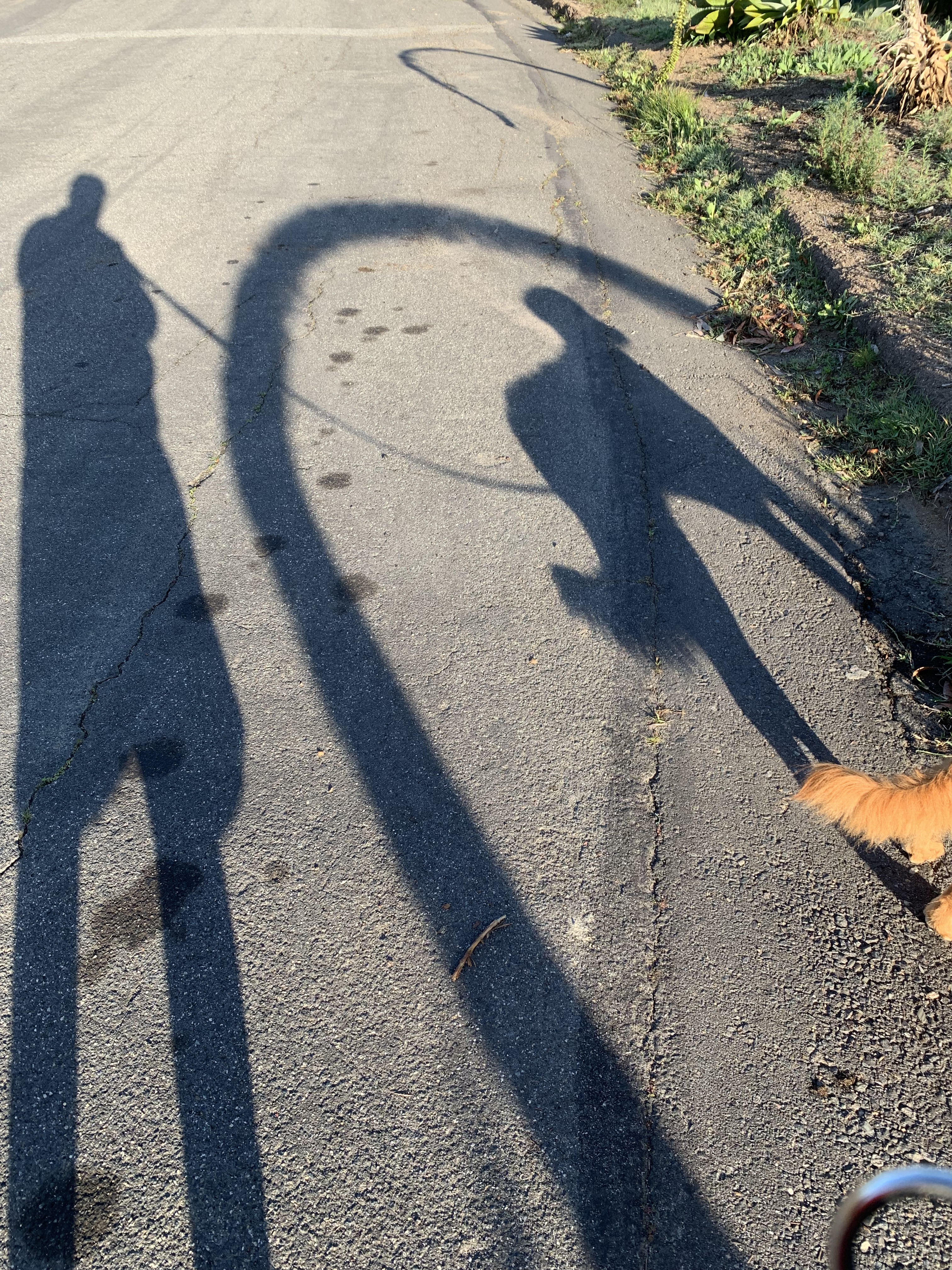
There are some exceptions. If a small animal passes too close to us, she will sometimes lunge toward it. She also tends to pull if she’s desperate to “do her business.” She seems to have a particular place in mind. The third common situation is when we get close to one of her neighborhood dog-friends who is also out for a walk. She approaches nicely until we’re about ten feet away and then—she wants to greet the other dog—immediately. Instantaneously. NOW!

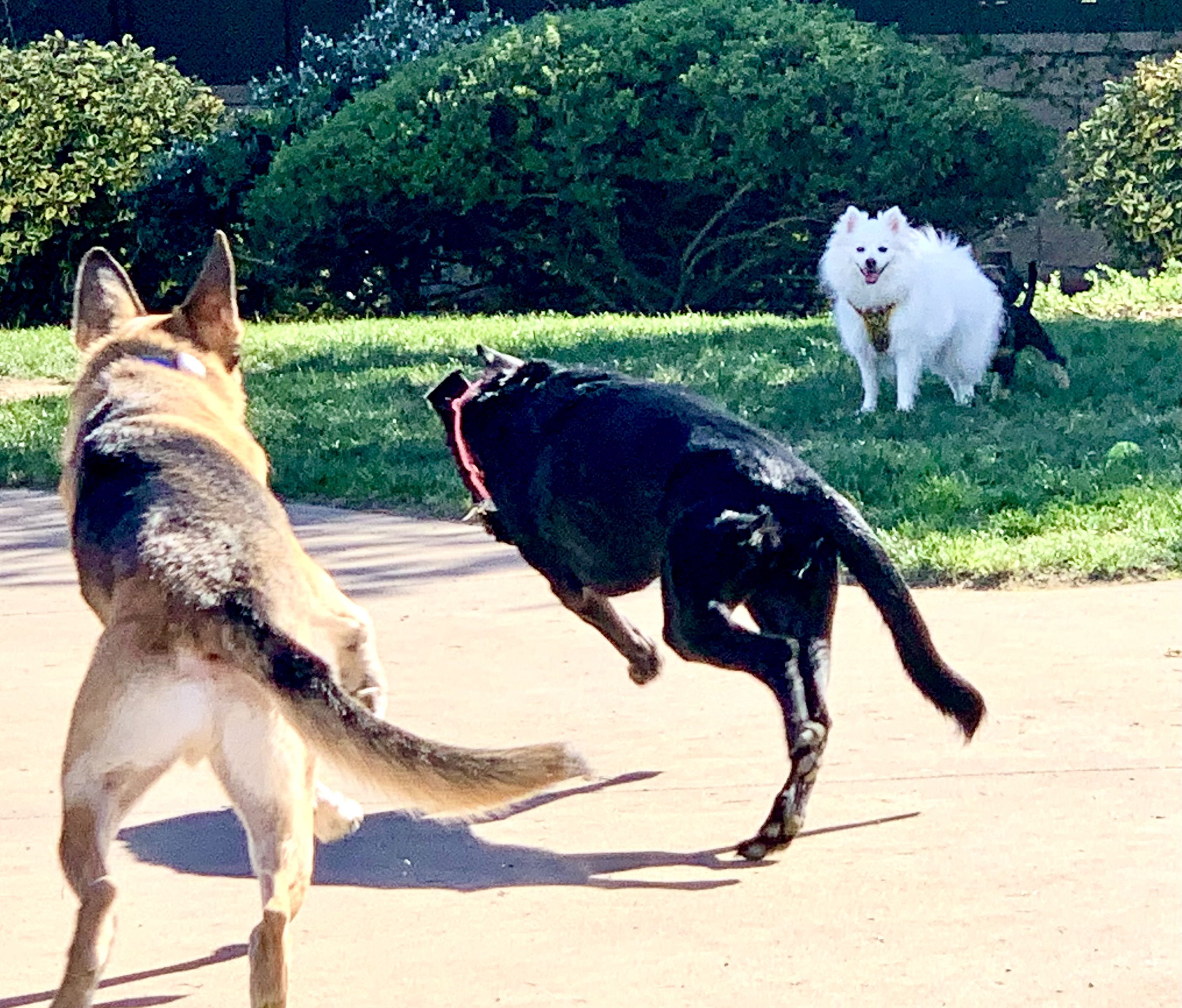
Sometimes, though, she approaches or sits and awaits, vibrating with excitement, but controlling herself. She and the other dog sniff and then suddenly, it’s all too much as she breaks into a sprint. That’s fine.


Except for one thing. We’re attached by a leash, and, alas, I cannot sprint. I probably never could sprint nearly so fast as Sadie, but certainly not now. 

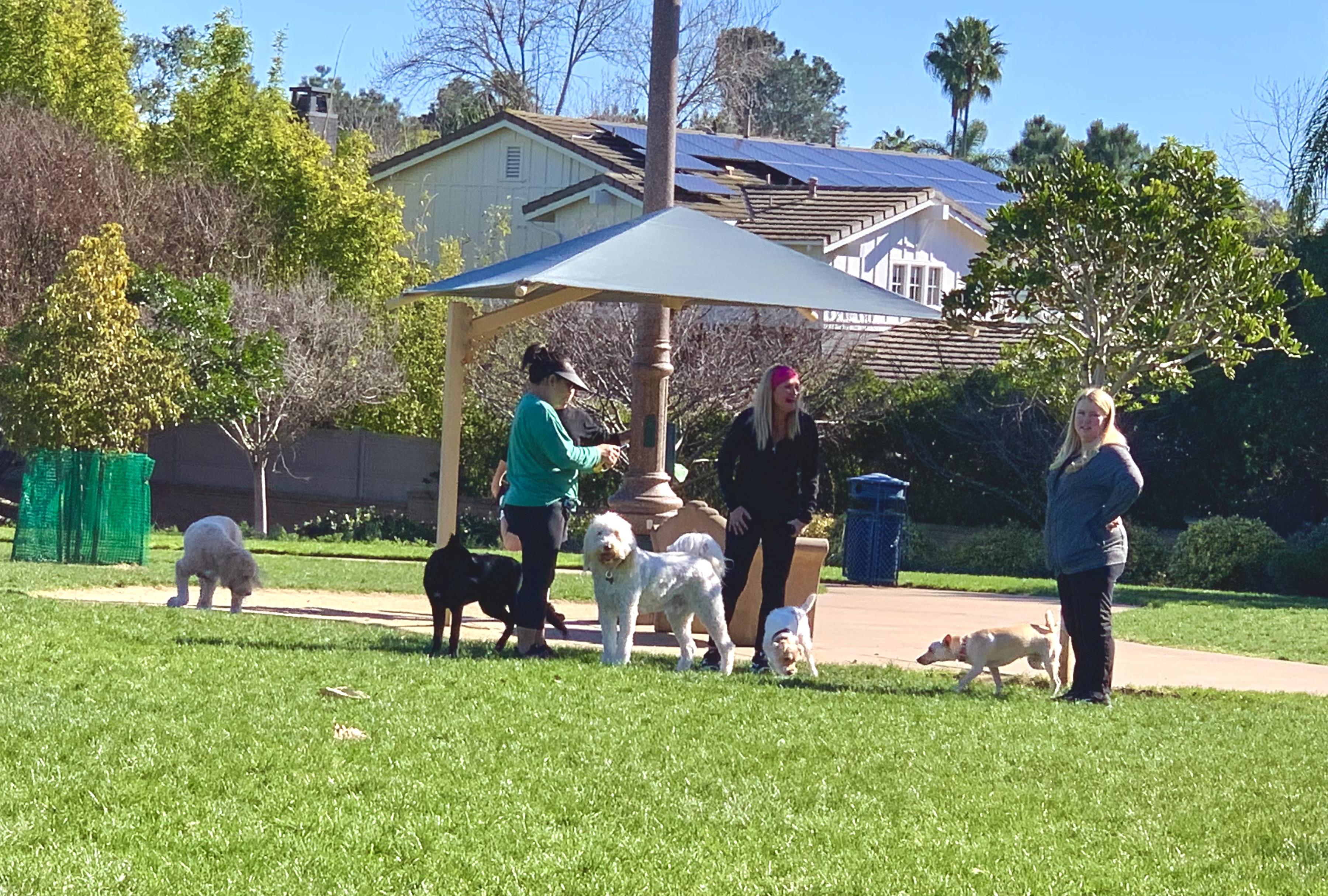
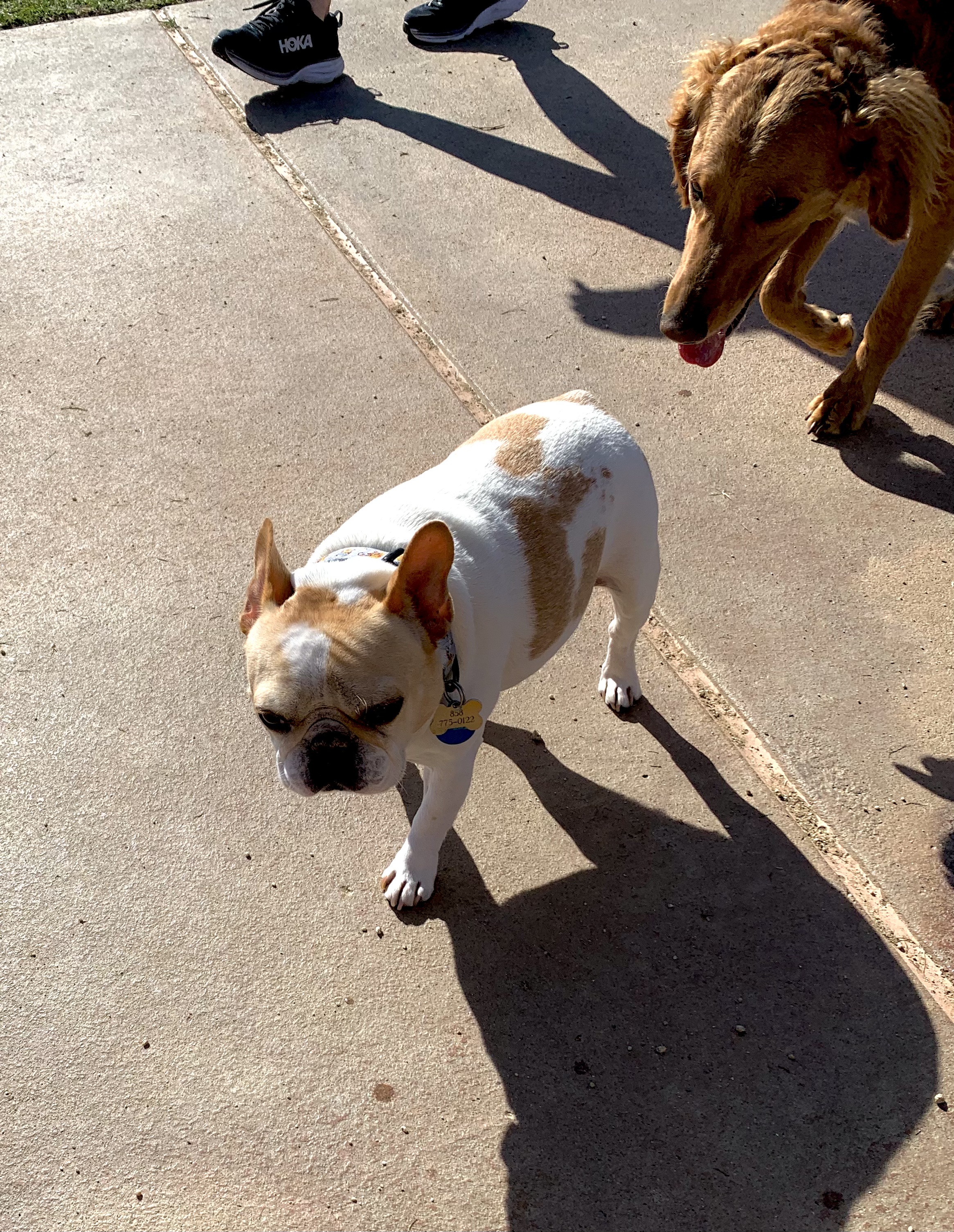
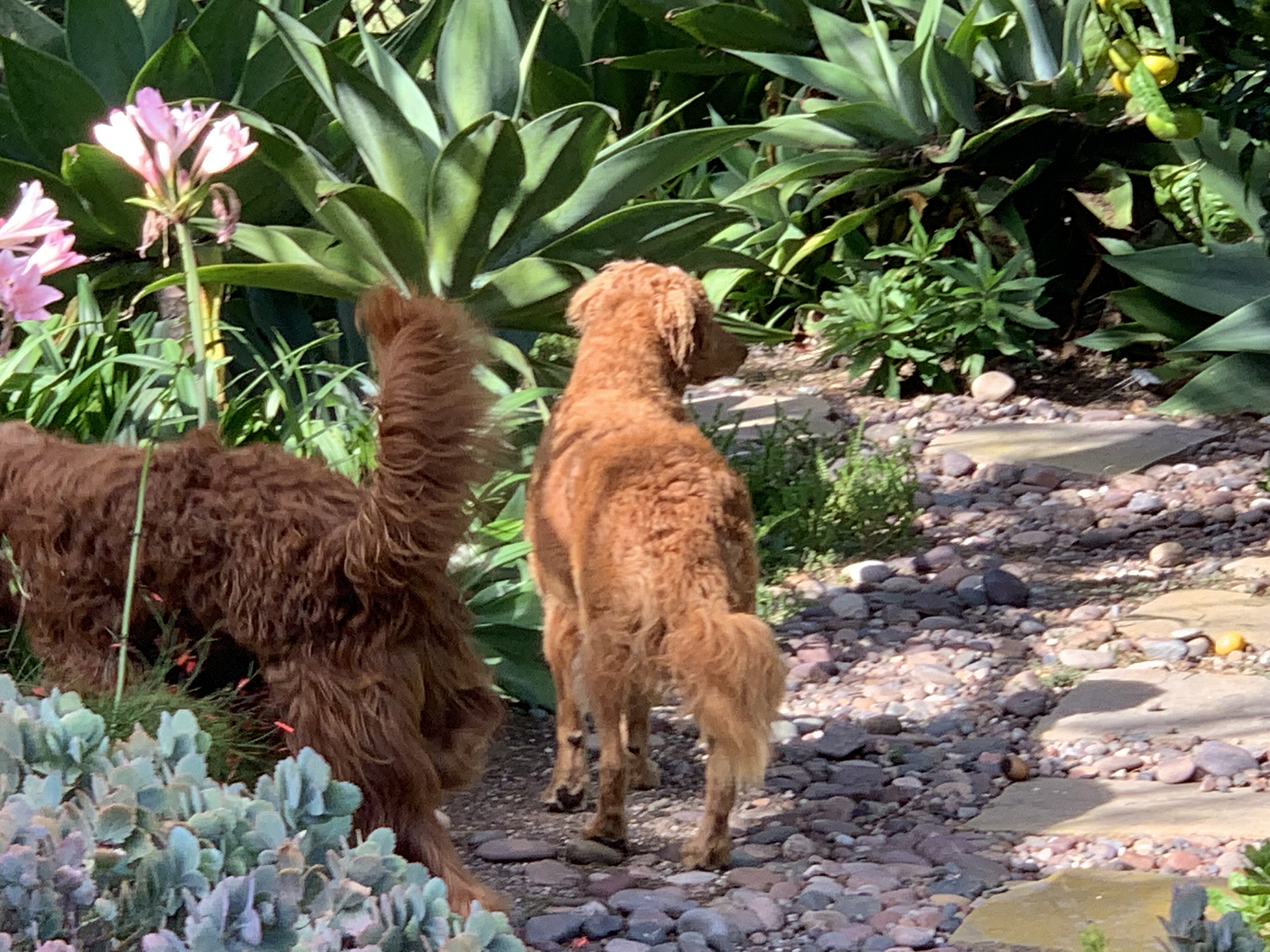
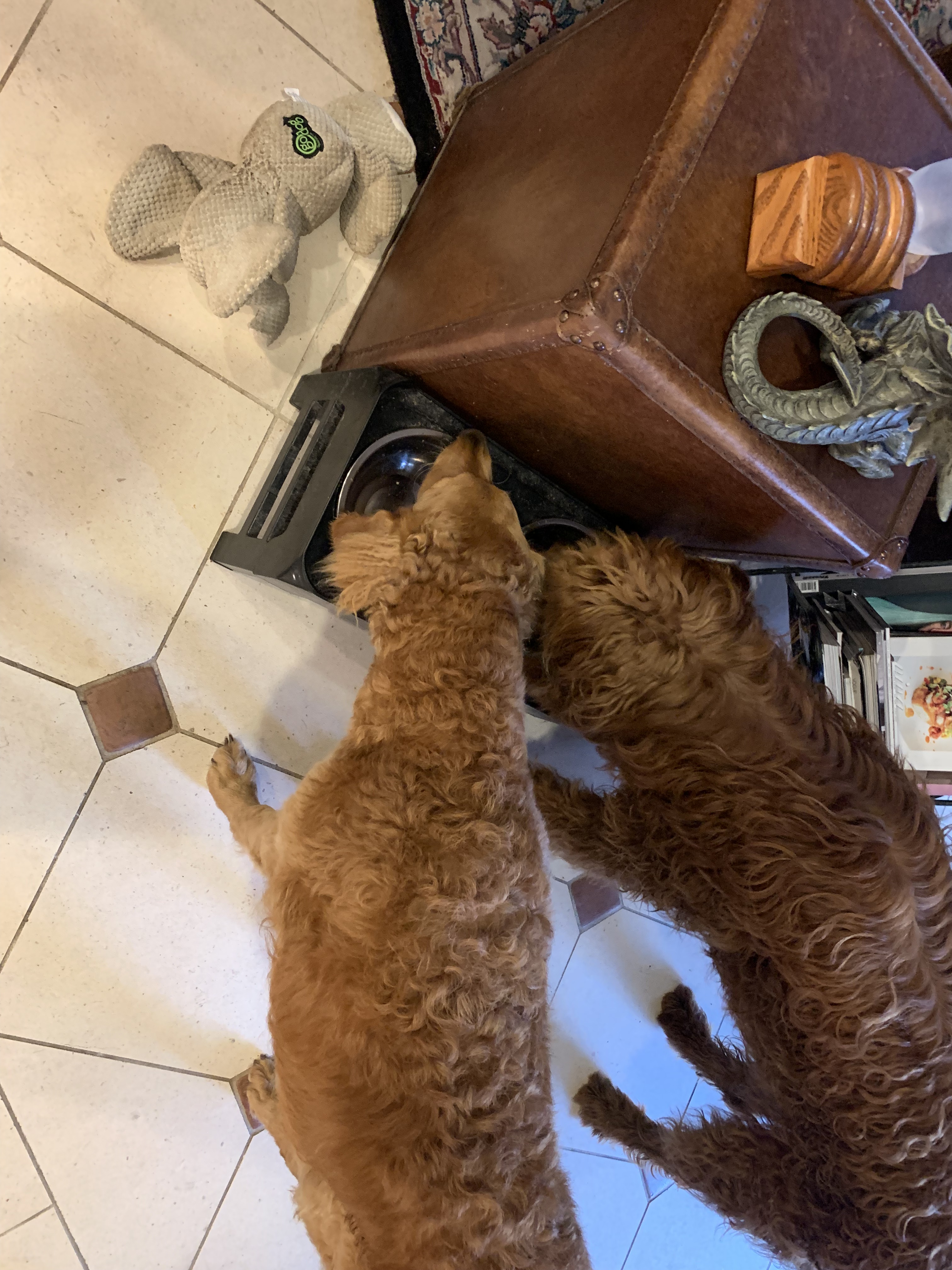
In addition to ball playing in the garden, swimming, and walks, we also take the dogs to nearby dog parks. No big surprise, but they love it. 

The truth is, I like it too. Many of the dogs are friendly to strangers. That’s fine with me. It’s not always fine with Bailey, however, who definitely has a jealous streak in him. Even when my wife and I hug, he wants to join in the loving. But he has gotten more tolerant of other dogs coming to say “hi” or to ask for a ball or frisbee to be thrown. 

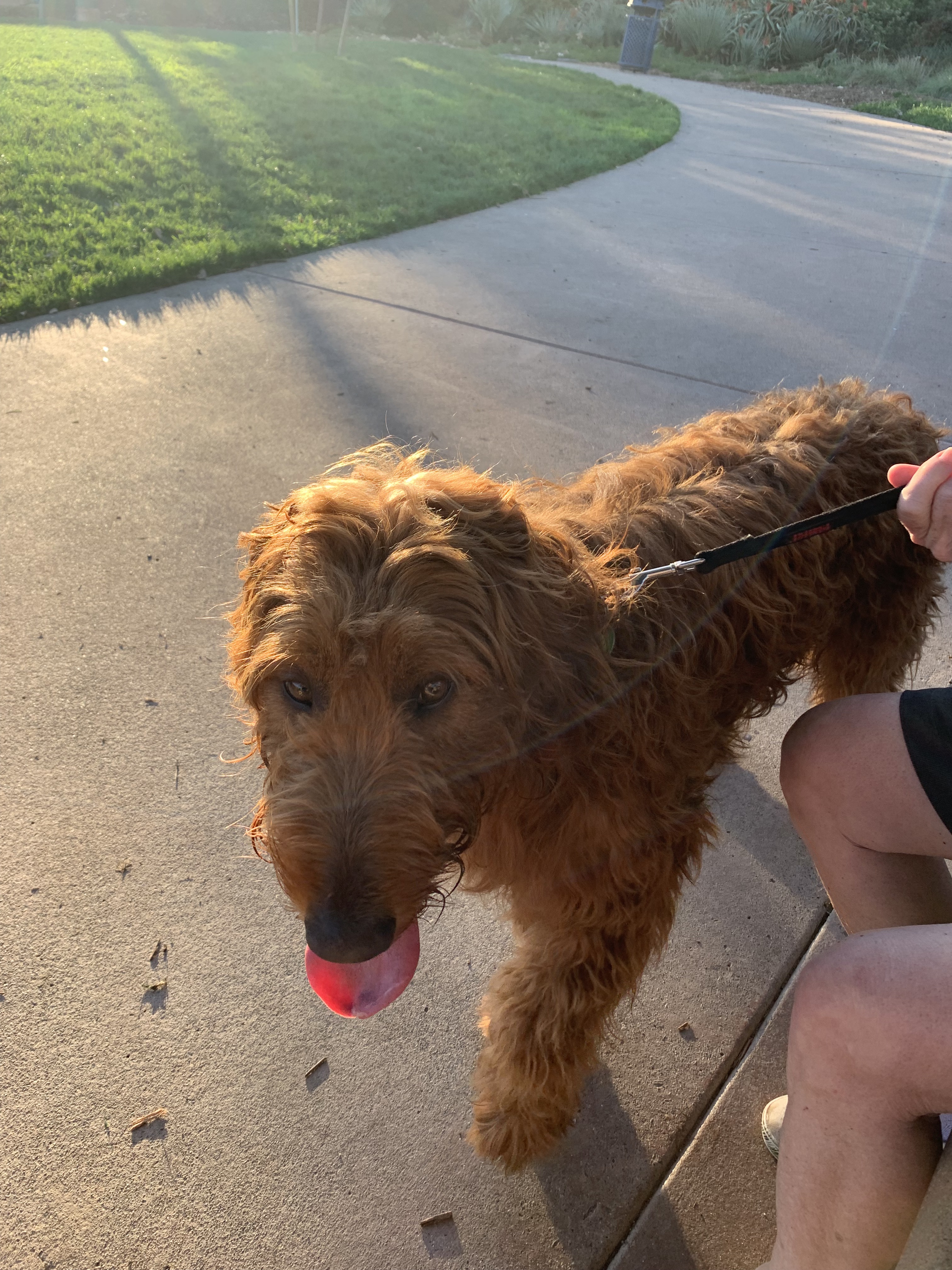
Sadie doesn’t seem much bothered when other dogs giving me some attention. Though Sadie and Bailey are both Golden Doodles and have many similarities such as their love of ball playing, they also have numerous differences. For instance, to signal that she really needs to go outside for a potty break, Sadie comes and stares at me. Bailey comes over to me and acts crazy. Sadie is much more likely to lie down and be mellow when I’m writing on the computer or watching Astrid. Bailey will continue to want to play ball and when all else fails, he’ll play ball by himself.


Ironically, I’ve never suggested this to Bailey. When Sadie was young, I tried on many occasions to show Sadie how she could play ball by herself, but she never caught on or showed any interest. 

Bailey very much wants our approval. Sadie likes our approval too, but she does have a stubborn streak. Following the instructions of her own inner demons is relatively more important to her. 

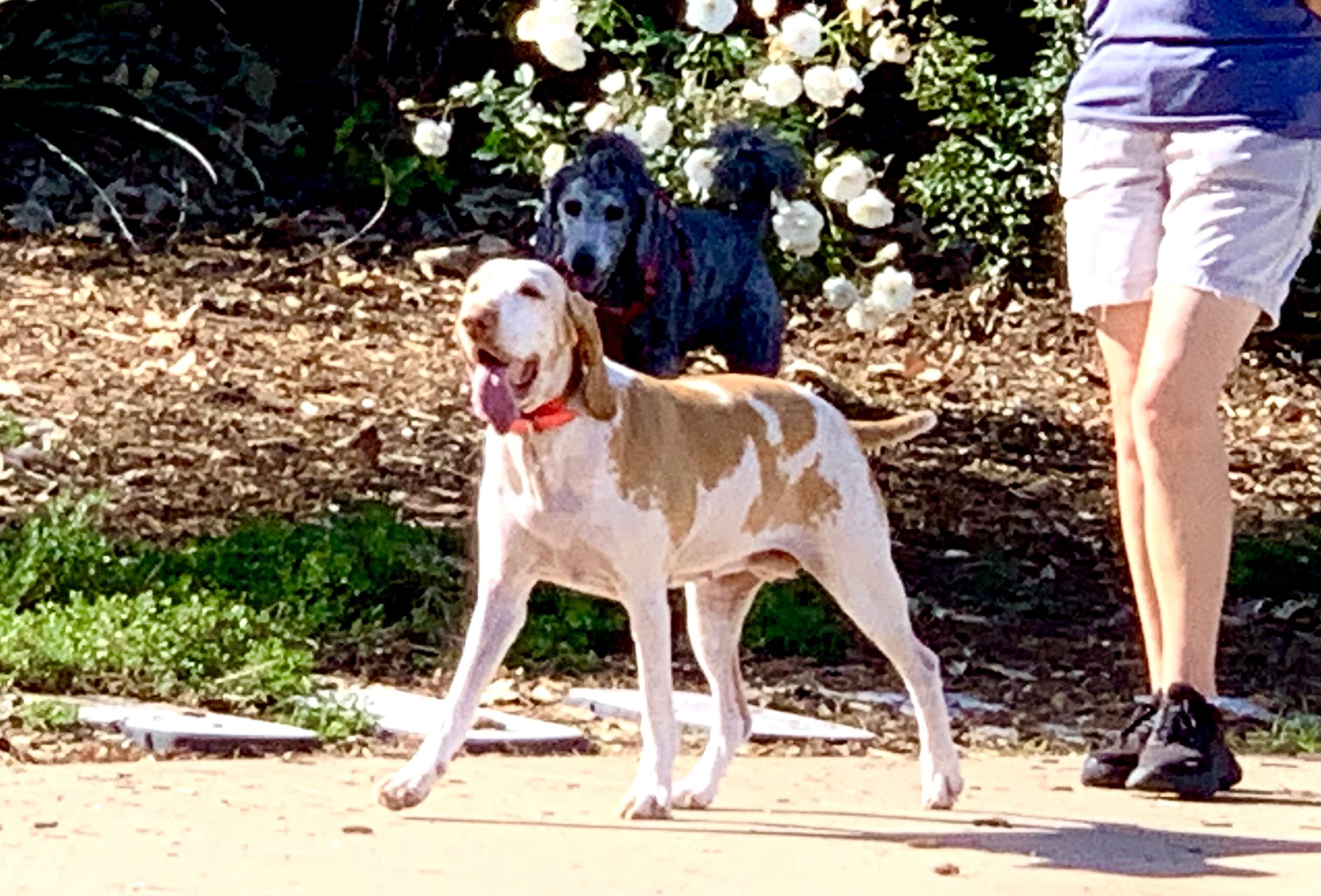
The differences among dogs are one of the reasons that I like going to the dog park. It’s fun to see the physical differences among the dog population. Equally, it’s interesting to see the differences in the ways that the dogs behave, both with each other, and with humans.


Another thing that’s nice about dog parks is that the people tend to be friendly. They too exhibit many differences in physical and behavioral characteristics. It’s a venue that seems to lend itself to informality and openness. When I’ve chatted with people, I don’t feel that they are trying to “impress me” with name dropping, etc. A few people—a distinct minority—show up and basically spend the whole time on the phone with very little of their attention going to the real world around them including their own dog. But that’s far from the modal behavior. 

On the way out of the dog park, I passed by a flag pole with a large round concrete base. You don’t need a dog’s superior nose to know that this spot is frequented a lot by the canine population. Part of the reason is that it is frequented a lot by the canine population. In other words, there’s a “bandwagon” effect. 

Looking at the dark stains all round the base of the flagpole makes me think of the way twitter devolved, but it applies to much of what happens on all social media. A small number of posts have a huge number of likes, reactions, and repostings while most have none. The algorithms of most social media platforms help promote this. 

It isn’t just social media, however. There are many such positive feedback loops in our society. Wealth and power result in more access to health, food, shelter, convenience, and education. This in turn, leads to more power and wealth. At the very high level, the wealthy and powerful don’t just win more competitive contests; they can and often do rig the contests.

The dogs at the dog park differ in age, strength, speed, and size as well as breed. Yet, in many ways, it’s very egalitarian. No dog gets all the attention or all the water or “rules” the other dogs or fetches every ball.

That seems okay with the dogs and okay with the “owners” of the dogs. 

—————————-

Author Page

Travels with Sadie 1

Travels with Sadie 2:

Travels with Sadie 3:

Travels with Sadie 4

Travels with Sadie 5

Travels with Sadie 6

Travels with Sadie 7

Travels with Sadie 8

Travels with Sadie 9

Travels with Sadie 10

Travels with Sadie 11

Travels with Sadie 12

Sadie is a Thief! 

The Lighty Ball

Dog Trainers

The Puppy’s Snapping Jaws

Hai-Ku-Dog-Ku

Stoned Soup

The Three Blind Mice

The Self-Made Man

Math Class: Who Are You?

Occam’s Chain Saw Massacre

It’s a Dog Eat Dog World

Essays on America: The Game

D4

Pattern Language for Cooperation and Collaboration

The Story of Story: Part 3

17 Saturday Jan 2026

Posted by petersironwood in creativity, essay, HCI, psychology, story, Uncategorized

≈ Leave a comment

Tags

books, education, fiction, HCI, knowledge, leadership, learning, life, management, sense_making, story, Storytelling, thinking, truth, UX, writing

The Story of Story: Part 3 – Good Story, Well Told.

Often in my English classes, (and yours?) we talked about the mechanisms of writing: spelling, grammar, word usage, punctuation, paragraph construction, metaphor, rhythm, and rhyme scheme, for instance. We talked very little about how to tell a story well. And we talked zero about what makes for a good story. 

In the last article, I described some guidelines for soliciting stories from users and other stakeholders. From these, one may gain insight into potential problems that a product or service might solve, ameliorate, bypass, or avoid. Later, I will describe more about how stories may be used in the design and development process. Before getting into that, however, I want to describe more about what makes for a good story. In the following articles, I will also suggest ways to make the story well told. 

What Makes for a Good Story?

You might find it helpful to write down a short list of 5-10 novels, short stories, movies, or TV shows that you really liked. It doesn’t have to be your all time ten best; just something good that springs to mind. Then put that list aside. Read through the criteria I propose and then check back after you’re done reading to see whether or not most of these criteria were met. I’m betting that they mostly were met. 

fullsizeoutput_139c

The Story Cube. 

Imagine a cube of some really nice material that you like; e.g., polished wood, lead ore, malachite, silver. This cube has three dimensions: height, width, and depth. It must have all three dimensions. In the case of a story, there are also three dimensions in this sense: Plot, Setting, and Character. If a story lacks any of these three, it will be “flat” (not so interesting). For example, if you spent time working in a large company or government agency, you were probably given training materials about how you’re not supposed to do unethical things like steal from your company. They may have provided you with scenarios and asked what you would do or what was the “right” response. These stories tend to have people in situations making decisions. The problem with these stories is that, in order for them to be “efficient”, they spend almost zero time on character development.  “Joe wants to impress his boss and make his quota for the fourth quarter so he puts down as sold this-quarter things he is sure he will sell early in January. After all, he rationalizes, calendars are arbitrary.” Of course, the answer is no Joe should not be lying on his sales report. But we really don’t know much about Joe. We don’t know enough about him to really care much about him. Of course, he shouldn’t lie. If he does, it’s pretty hard to feel anything but contempt for Joe. It should have been obvious to him that he shouldn’t lie on a sales report and if he does lie, he should be fired. Good riddance. Let’s replace Joe with someone who follows the rules. 

OLYMPUS DIGITAL CAMERA

This story is so flat that it seems to me that the story is constructed, not so much to really educate, but more to prove that you were shown that it’s wrong to lie on sales forms so that, should the court case arise, you will not be to argue effectively that it was a mere technicality that you didn’t know about. If you really wanted to change someone’s mind about what was right, knowing about Joe’s character could make you empathize much more. Maybe he came from a Mafia-type crime family and no-one would bat any eye about lying on a sales report. They would expect him to lie on the report. Maybe even now, he is looked down upon by everyone else in his family for being such a chump and working for “the man” instead of being “the man.” 

OLYMPUS DIGITAL CAMERA

Or, perhaps Joe just found out that his wife has serious cancer and is understandably but severely depressed. He desperately wants to bring her some good news. If we reveal, not only what situation Joe is in but also, how he sees that situation, how he feels about it and what conflicts he faces, we will begin to have real empathy for Joe. His choices become real, rather than predetermined.  

TV commercials, like corporate training videos, are typically pretty flat too. But in some cases, the ad agency has gone out of their way to introduce you to some character that is recognizable and re-appears in commercial after commercial. Each time, just a little bit of character is revealed and eventually you find yourself watching the commercial largely because you start to care about the character. In a similar way, one might be able to make the corporate training stories more intriguing & educational if there were a cast of characters that persisted over time. 

fullsizeoutput_1308

Two Paths Diverged in a Yellow Wood…

Typically (but not invariably) the author knows how the story will turn out before he starts writing. But for the reader (or viewer), it is not at all obvious how the story will turn out. For compelling stories, the reader must be convinced to “play along with” the uncertainty of the outcome even if they are sure ‘the good guys will win.’ In good stories, bad things happen to the protagonist, but he or she is not a cork tossed on the ocean waves. The protagonist must want something; they must have a goal that is overwhelmingly important to them. They must react to changing circumstances, overcome the obstacles that are thrown at them. Characters are engaged in battles! Battles test them. If winning the battles is easy or inevitable, the character isn’t someone we can really relate to. 

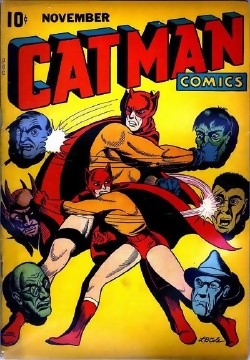
catman

Kryptonite 

Superman is basically super-human and invulnerable! But watching someone who is invulnerable and has super-powers win battle after battle is boring. Superman has to have weaknesses. To make it more interesting and allow for more plot variation, he actually had three original weaknesses: kryptonite, friends, secret identity. In one episode, someone will have some kryptonite while in the next, someone will kidnap one of his friends. Recent movies have added a fourth weakness: other super-human and invulnerable beings.  

Whatever the story, your character must have weaknesses. Otherwise, no-one will “believe” the character and you as the writer will be stymied when you try to develop an interesting plot. The weaknesses can be physical, moral, social, intellectual, situational, and so on. But they should not be merely irrelevant weaknesses. Imagine a story where Sue is the main character. She’s tone deaf. She’s also brilliant, hard-working, imaginative, driven to succeed. And, indeed, she becomes a very successful trial lawyer. Eventually, she is made partner. OK. Isn’t this exactly what we’d expect to happen? What does being tone deaf have to do with anything? 

fullsizeoutput_129c

Imagine instead, that Sue was inspired at the age of four when she went to the opera. It was her life-long dream to become an opera singer. Indeed, she was blessed with a beautiful voice. She was also brilliant, hard-working, imaginative and driven to succeed. Unfortunately, she was tone deaf. Now, the weakness becomes interesting. Perhaps she will fail and kill herself. Perhaps she will fail but find another goal that is even more important to her and succeed at that. Perhaps she will fail time after time but eventually develop a career as an improvisational opera singer. She will ask people in the audience to name five things and then and there, she will create a beautiful aria that weaves a tale of some considerable interest about the five things. No-one knows that she is singing out of tune because she is composing on the spot. 

The more improbable the odds and the more horrendous the journey, the more challenge you give yourself to make it work! Blind at birth but wants to be an artist? Surely, that’s just stupid. It’s impossible. But is it? What if feedback were provided in such a way that it influenced her to make unique and beautiful paintings? What if genetic engineering allows her to grow new neural pathways? What if she can be equipped with artificial eyes? If it’s fiction, a magic spell can do the trick. Even if your ultimate goal is a real product for the real world, imagining a magical solution may lead you to a new (and real) path, previously hidden by your own expectations. 

It is easy for a writer to identify with their hero. And that is potentially quite a problem. After all, if you were superman, you sure as heck would not go out of your way to go near kryptonite. You’d quite sensibly stay away from the stuff! But if you are writing about superman, you need to get him near the deadly stuff every third or fourth episode! The “weaknesses” in the character generate interest. The failures, injuries, betrayals, and conflicts of your protagonist provide materiel that allows you to architect a more interesting plot. 

img_2246

A Garden of Delights, Flashy Sights, or Sword Fights?

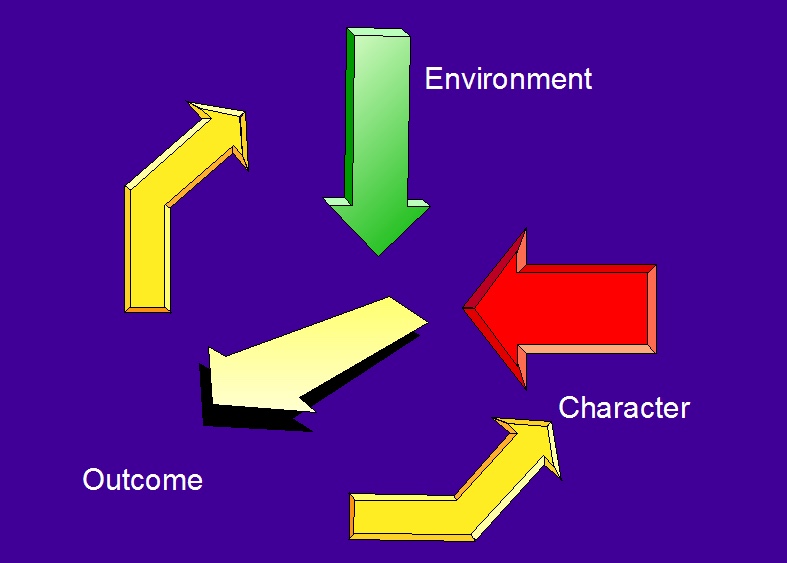
Three dimensions of story is a weak metaphor only. The three dimensions of a cube can be manipulated independently. This is not generally true for the three dimensions of story. The character makes a decision, the decision determines the next step of the plot. That will influence the setting for the next scene. In addition, the actions of the protagonist may also change state of the underlying and cross-cutting conflicts. 

Imagine:

 two rival gangs fighting for urban turf and maybe sex,

 two gardeners in a fierce competition for sex with the town’s most eligible “catch” as well as for the blue ribbon prize for best garden, 

two rival secret agents vying for victory and maybe sex,

two life long friends now vying for #1 in their Harvard Law class, and maybe sex.

The structure of the underlying plot might look quite similar, but the specifics will depend a lot on how the character is developing. If they develop from ego-centric to altruistic, then they will tend to make different decisions near the beginning than near the end of the story. In addition, the setting will have to be consistently portrayed. 

The four descriptions above would most naturally lead to a lot of the setting for the stories respectively in urban settings, garden settings, foreign settings & dangerous situations, mainly Law School and campus settings. Of course, you could violate expectations in a way that increases interest. Imagine that rather than have another garden scene–

The rival gardeners arrive at an urban parking lot dressed in expensive gowns, fully jeweled in their finest, both fully knowing that they will win first prize (but secretly fearing that they might not). These life-long friends now exchange icy greetings, make back-handed compliments about each other’s appearances. The verbal exchange escalates. Precisely because they know each other so well, they know exactly how the other person’s escalator functions. Soon, they are rolling around on the parking lot in their fancy gear; ruining each other’s clothes and hairdos. At this point, they hear in the distance, the loudspeaker and the chairman about to announce the Blue Ribbon Winner!  In their trashed and ripped clothing, they sneak in together to hear the awards, hanging out together in the shadows so as not to be seen in their tattered clothes. “And the blue ribbon goes to” {drumroll}: 

someone else entirely. 

At this, the two life long friends look at each other, laugh uproariously, hug each other, and then become even more intimate friends than they were before their fight in the urban parking lot. 

The fact that there are “expected” relations among various dimensions of story is wonderful. For every such expectation, you can decide to follow, bend, or break that expectation. The more expectations people develop, the greater the number of variations for creative exploration. One valid reason for the choice of setting is really where you want to spend your time. That goes for an author — but it also goes for any designer or business person or User Experience expert. What kind of setting do you want to be in? What kind of customers do you want to serve? Do you really want to make their life better or just get them to buy more product? What sorts of application areas are really cool to you? Of course, I understand people need to eat and often there is a conflict within us all about what to do. That’s what a good story is really about.

img_5134

The reason that stories resonate is that, regardless of setting, people face the same kind of dilemmas. We all do. And, how we handle those dilemmas? In life, as in story, 

character is revealed by choices under pressure… 

——————————————

Author Page on Amazon

Dream Planet on Barnes and Noble

The Impossible

Donnie Boy gets a hamster

What could be better? A Horror Story

If Only

Ripples

It was in his Nature

That Cold Walk Home

The Orange Man

Stoned Soup

The Three Blind Mice

All that Glitters is not Gold

The Forgotten Field

Choosing the Script

The Story of Story, Part 2

16 Friday Jan 2026

Posted by petersironwood in creativity, HCI, psychology, story, Uncategorized

≈ Leave a comment

Tags

AI, books, communication, education, fiction, HCI, interview, knowledge, narrative, needs, psychology, story, truth, user experience, UX, wants, writing

Introduction: 

This is the second in a series about using stories and storytelling in the design, development, and the deployment of products and services. In each post, I will weave in some advice about what makes for a good story as well as how to use stories. In this first case, the emphasis is on using stories to help uncover customer needs and wants. Needs and wants are not quite the same thing. For an extremely worthwhile discussion on the difference, check out this classic article by George Furnas. 

We Human Beings are not just Information Processors; we are also Energy Processors.

img_2261

I had just attended a conference on “knowledge management” co-sponsored by IBM consultants and IBM Research. On the plane ride back, after finishing the crossword, I turned the page to find a full page color ad by an IBM competitor that proclaimed: “Knowledge Management is simply [sic] providing the right information to the right person at the right time.” Color me skeptical, I thought. It isn’t simple to do those things. Beyond that, the formulation seemed simplistic even in its formulation.

The image of one of my undergraduate professors flashed into my brain. Professor MacCaw, (as we will call him), taught advanced German, a language which he had learned in a Russian prison camp, which might explain his approach to testing. At semester’s end, he asked, “Who in class wants A?!” 

img_9691

All two dozen of us raised our hands, of course. At this point, he proceeded to — there is no other word — attack one of the students in the class who had had four years of German in high school and had also lived in Germany for two years. The contents of his questions were not really that difficult, but the manner in which he demanded the answers was horrid. He would ask, for instance, “In first story, main character went where?” (He would always ask the questions in English). 

And she would begin to answer (necessarily in German), “Er geht…” And after a couple words were out of her mouth, he would scream, “Please to conjugate!” This meant that she would have to think back to the last verb she uttered and then conjugate it. “Ich gehe, Sie gehen, …” Then, he would interrupt again and scream a completely different and unrelated question in English. She would begin to answer; he would interrupt after she uttered only a few words: “Please to decline!” This meant, that she would have to give the various forms of the last noun she spoke according to the case. But once again, she could not finish but only begin declining the noun when he would once again interrupt. After 40 minutes, she was in tears and he looked menacingly around the room and asked, “NOW! Who in class STILL wants A?” 

img_3377

I have zero desire to go hang gliding or sky diving. But when it comes to the danger of mere social humiliation, I say, “Screw it. Been there. Done that.” I was one of only two of the remaining students who raised their hand. This act won me the next turn on the chopping block. He proceeded the same whip-saw questioning fest with me. The two-period class was almost over when he finished with me and began questioning “Mr. Lepke.” The bell rang and everyone else in the class left. Later that evening, I chanced to see Professor MacCaw in the Student Union. He walked up to me, eyes blazing. “Ha! I had Mr. Lepke after class for two hours! Finally, he said to me, ‘No, No, Dr. MacCaw, no more, I beg you. No more!’” 

This oral exam was difficult (even with my “screw it” attitude). It was much “harder” than my dissertation defense, for example. Again, it was not the information requested but the manner of questioning that made it difficult. People are not emotionless robots, as it turns out.

img_9666

The next semester, not surprisingly, only about half the class returned. One day in class, as Dr. MacCaw began one of his lengthy digressions on Eastern European history, he stopped himself in mid-sentence to say, “What is THIS!? Someone is passing notes in my class! I will take note and read in front of entire class!” He snatched the note, unfolded it, and indeed read the note in his loud ringing voice: “Doctor MacCaw: your zipper is down.” And, indeed it was. He had meant to humiliate someone in front of the entire class — and he had succeeded. He had the necessary information delivered at the right time to the right person, but — thanks to his own actions — it had not been done in the best manner — at least not the best manner for him. 

Human beings are not just information processors. We are living things and as such, the emotions, the vibes, the manner, the intensity of presentation — these are all vital to how we will react at the time and also how we will feel about the people involved and what we will recall years later. And this fact also means that the atmosphere you create when you interact with various stakeholders will vastly impact the quality of the insights and stories that you receive. If you really care about the people and are really committed to doing something to making people’s lives better; if you are truly open to hear and take in something unexpected or even disruptive to the project; and if you allow your informant to feel that truth about you, you will obtain the gold ring. 

Stakeholder Stories Solicited at their Sites. 

If you use a mechanical method and a mechanical tone and a mechanical manner to ask your users and other stakeholders about their needs and wants, what you will uncover are the most mundane, most rudimentary, most superficial and socially acceptable needs and wants. You can indeed use this information to design a product or service, and you may even have a product or service that succeeds in the marketplace. It will likely be, however, a rather short-lived “win.” Why? Because you are designing to fulfill wants that are subject to the wild winds of passing fashion rather than to catch the fire of an underlying passion. 

img_0568

What I found for myself was that it typically took about an hour of talking with a stakeholder, and most importantly, listening attentively, before they began to tell me their real stories. Your mileage may differ according to culture, context, power relations, your personality, and so on. I like to use a semi-structured interview. In this type of interview, there are known questions that I want to ask. But I also schedule plenty of time to let them elaborate, tell me what’s what behind the scenes. I know that in the corporate world, there is an ever-present push for being “efficient” and getting the job done as quickly as possible. So, it’s tempting to get the informant “back on track.”

I always prefer to interview an informant in their workplace. This seems like common courtesy; it puts them more at ease; and it sometimes reveals their use of other people, references, private notes, etc. as well as what they are dealing with in terms of atmosphere, noise levels, interruptions, desk space, etc. It also makes it much more likely that they can retrieve more of their own memories about work incidents more accurately because of all the contextual cues. 

John Whiteside, who ran the Usability group for Digital Equipment Corporation for a time, recounts running various usability studies and gathering data in various ways about a product they were designing for manuscript centers (places where human beings, historically almost always women, transcribed the dictation of others into text on a computer so that it could be edited, re-written, stored, etc.). The first time that they visited their users in the field, they discovered that they spent about seven hours a day typing and about an hour every day counting up, by hand, the number of lines they had typed. So, in one instant, they realized a feature that would improve productivity significantly. 

Guidelines for Soliciting Stakeholder Stories. 

When I managed the storytelling project at IBM Research, I was fortunate enough to hire Deborah Lawrence to help with the project. She thought it would be a cool idea to interview experts in a number of fields whose job, in one way or another, involves soliciting stories. So, she went out and did just that. I believe that her interviewees included medical doctors, policeman, reporters, social workers, and psychotherapists. These various practitioners had very similar guidelines. 

Story Elicitation Guidelines:

  • Provide a “warm-up” period.
  • Tell something personal and revealing about yourself; perhaps tell a story that is a model of the kind of story you’re looking for.
  • Observe an implicit contract of trust.
  • Provide a motivation for the story — why it’s important.
  • Accept the storyteller’s story and worldview.  Don’t resist the story.
  • Reveal who you are, how the story will be used, potential audience and goals, answer questions.
  • Use questions to probe.  Sometimes, a totally “off the wall” question can create space for story to emerge.
  • Empower the storyteller — they are the expert.
  • Avoid threat; don’t appear as an expert yourself.
  • Listen with avid interest.

These may seem fairly obvious such as does a lot of the advice in the book, How to Win Friends and Influence People. (Come to think of it, that might be the single best book you can read if you want a career in HCI/UX). However — back to the guidelines. I think they seem obvious once pointed out, in much the same way that once someone points out the “pig in the clouds” (or the face in the tree) you cannot not see it. 

img_2897

The above list is not, of course, meant to be the definitive such list. This was based on one study. If you have additional guidelines or disagreements, please let me know. 


Author Page on Amazon

The Walkabout Diaries

The Myths of the Veritas

A Pattern Language for Collaboration

Travels with Sadie

Fifteen Properties

My Cousin Bobby

The Update Problem

After All

All We Stand to Lose

Imagine All the People

The Dance of Billions

Roar, Ocean, Roar


Systems Thinking: Positive Feedback Loops

17 Wednesday Dec 2025

Posted by petersironwood in America, creativity, psychology, Uncategorized

≈ Leave a comment

Tags

AI, Artificial Intelligence, books, chatgpt, Design, Feedback, government, innovation, leadership, learning, machine learning, management, politics, POTUS, problem solving, science, sense-making, society, systems thinking, thinking, vicious circle

Systems Thinking: Positive Feedback Loops

brown wooden stairs

Photo by Jimmy Chan on Pexels.com

One of the most important tools of thought that anyone can learn: “Systems Thinking.” I touched on this in yesterday’s post “And Then What.” I pointed out that when you take an action that impacts a system such as a human being, a family, or a country, it often does not react in a mechanical way. 

Here are some examples. For many years, the United States and the USSR were involved in a cold war arms race. Every time the USSR added more nuclear missiles to their arsenal, the people in America felt less safe. Since they felt less safe, they increased their armaments. When the USA increased nuclear weapons, this made the Soviet Union feel less safe so they increased their arms again and so on. This is what is known in Systems Thinking as a “Positive Feedback Loop.” It is also popularly known as a “Vicious Circle” or “Vicious Cycle.” 

Let’s say that you are in pretty good shape physically and regularly run, play tennis, or work out. The more you exercise (up to a point), the better you feel. Feeling better makes you feel more like exercise and more exercise makes you feel better. People call this a “Virtuous Cycle” or “Virtuous Circle” because we think the outcome is good. But formally, it is the same kind of cycle. 

active adult athlete body

Photo by Pixabay on Pexels.com

The most important thing to recognize about a Positive Feedback Loop is that it can be run in either direction. At some point, the US reduced their nuclear arsenal and this decreased the perceived threat to folks in the Soviet Union so the soviets felt that they could also reduce their nuclear arsenal which in turn, made people in the US feel safer and led to further reductions and so on. 

grey jet plane

Photo by Pixabay on Pexels.com

Similarly, if you stop exercising for a month, you will tend to feel pretty crappy. Feeling crappy makes you feel less like exercising and this in turn makes you exercise less which in turn makes you even more out of shape, feel worse and be even less likely to exercise. You can break such a “vicious circle” by starting to exercise – even it it’s just a little to start moving the circle in the “virtuous” direction. (Incidentally, that’s why I wrote “Fit in Bits” which describes many easy exercises to get you started). 

woman in white bed holding remote control while eating popcorn

Photo by JESHOOTS.com on Pexels.com

“Vicious circles” also often cause disagreements to escalate into arguments and arguments into fights. Each person feels “obligated” not to “give in” and the nastier their opponent becomes, the nastier they become. 

“Fawlty Towers” (https://en.wikipedia.org/wiki/Fawlty_Towers), a British sit-com uses “Positive Feedback Loops” in the escalating action of the comedy plots. John Cleese plays the co-owner Basil (with his wife, Sybil) of a small hotel. Typically, John Cleese makes some rather trivial but somewhat embarrassing mistake which he wants to hide from his wife. In the course of trying to cover up this rather small mistake, he has to lie, avoid, or obfuscate. This causes an even more egregious mistake which makes him even more embarrassed so he must result to still more outlandish lies and trickery in order to cover up the second mistake which in turn causes an even bigger mistake, and so on. 

That pattern of behavior reminds me of the current POTUS who is famously unable to admit to an error or lie and uses a second and bigger error or lie to try to cover up the first lie and so on. He seems, in fact, completely incapable of “systems thinking.” 

IMG_9150

For example, he may see (and exaggerate) a real, but containable threat such as a trade deficit. He sees the US send more money out of the country than the US takes in from trade. That’s a legitimate issue. But the approach he takes is to ZAP the other parties by slapping on tariffs without any real appreciation of the fact that our trading partners are extremely unlikely to react to tariffs on their products by simply doing nothing. One could use logic, empathy, or a look at history to determine that what is much more likely is that the other countries will put tariffs on our goods (which, of course, is precisely what happened). 

Similarly, he demands absolute loyalty. He repeatedly puts himself and his own interests above the law, the Constitution, the good of the country and the good of his party. He expects everyone loyal to him to do the same. But he betrays these loyal appointees, friends, and wives whenever it suits him. He thinks he is being “smart” by doing what seems to be in his best interest at that moment. But what he fails to see is that by being disloyal to so many people who have been mainly loyal to him, he encourages his so-called “allies” to only be loyal to him while it suits their interests.  

In the Pattern “Reality Check,” I point out that such behavior is an occupational hazard for dictators. Apparently, it can even be such a hazard for would-be dictators as well. By surrounding himself with those who always lie, cover for him, laud him, cater to his insane whims, etc., such a dictator (or would-be dictator) loses touch with what is really going on. He becomes more and more disconnected from sensible action yet those who remain loyal must say and do more and more outrageous things to keep the dictator from finding out just how bad things really are. Eventually, the Emperor with no clothes may die of hypothermia because no-one has the courage to tell him that he’s actually wearing no protection against the elements! 

IMG_2557

Positive feedback loops exist in purely natural systems as well as biological and social systems. For example, increased global mean temperatures mean less arctic ice which means more solar radiation will be absorbed by the earth’s dark oceans rather than reflected back into space by the white ice and snow. This, of course, makes the earth hotter still. In addition, the thawing of tracts of arctic tundra also releases more methane gas into the atmosphere which is even more effective at trapping the earth’s heat than is carbon dioxide. Global climate change also makes forest fires more prevalent which directly spews more carbon dioxide into the air and reduces the number of trees that help mitigate the emissions of carbon dioxide by turning it into oxygen through photosynthesis.

asphalt dark dawn endless

Photo by Pixabay on Pexels.com

A concept closely related to “Vicious Cycles” is that of “Cognitive Dissonance.” Basically, people like to believe that they are honest and competent. Much like John Cleese (Basil) in Falwty Towers, once they do something dishonest or incompetent, their first reaction is not to believe that they did something dishonest or incompetent. They will now try to distort reality by misperceiving, mis-remembering, or distracting. 

For example, at the height of the Vietnam War, I was horrified at the beatings perpetrated by the police on peaceful protestors at the Democratic National Convention. I was also disturbed at the techniques the Democrats used at their convention to silence the voices of dissension within the convention. Candidate Nixon claimed he had a “secret plan” to end the War in Vietnam. I voted for Nixon. As it became clear that Nixon was a crook, I decided that I had made a mistake voting for the man. But I could have taken another path which would be to “double down” on the original mistake by continuing to support Nixon and dismiss all the growing evidence of his misdeeds. As his malfeasance became more and more egregious, it made the egregiousness of my original mistake of voting for him grow as well. So, it would be possible to become ever more invested in not believing the overwhelming evidence of his treachery. (Now, it turns out, it was even worse than we knew at the time. He actively thwarted the peace efforts of Johnson!). Perhaps because I’ve been trained as a scientist and science values the truth very highly, I did not fall prey to that particular instance of “Cognitive Dissonance.” I readily admitted it was a stupid mistake to vote for Nixon. 

Of course, today, we see many people not just backed into a corner to support the current POTUS but backed into a corner of a corner. Instead of believing that a liar is lying, they protect their “integrity” by insisting that everything and everyone else is lying: the newspapers, the reporters, his opposition, people in other countries, his former business partners, his former customers, the CIA, the FBI, the NSA. Ironically, for some people, it would be easier to admit that voting for a slightly inferior candidate was a mistake than to admit that voting for a hugely inferior candidate was a mistake. Voting for a slightly inferior candidate is easily understood but if they voted for a candidate that bad and bad in so many ways it was a huge error. And now, as each new revelation comes to light, it is more and more and more embarrassing to admit what a huge mistake it was.  

Another common example of a “Vicious Circle” is addiction. A small amount of alcohol, nicotine or heroine makes you feel better. But taking the drug increases your tolerance for it. So, next time, to feel better, you need to take a little more. Taking a little more increases your tolerance still further so now you need to take a still higher dosage in order to feel better. When you do, however, your tolerance increases still more. Whether it is drugs, gambling, addictive sex, or unbridled greed, the mechanism is the same. You need more and more and more over time due to the nature of the “Positive Feedback Loop.” 

fullsizeoutput_11fc

A similar mechanism may be at work in the minds of apologists for the NRA (National Rifle Association). As more and more innocent people are killed partly because of easy access to guns, the mistake of supporting the NRA in their refusal to support mandatory vetting, training, and competency demonstrations for gun owners becomes an ever-more obviously egregious error. But, rather than making this more likely for supporters to admit to such an error and therefore change their position, every new slew of innocent children killed for no reason makes them actually less likely to change their position. According to Cognitive Dissonance, every such death makes their earlier decision worse – unless there is some counter-balancing argument. As the number of innocent deaths arises, and indeed, as more and more evidence of the perfidy of the NRA becomes clear, many who previously supported the NRA become ever more entrenched because they “buy into” the great value of unlimited access to guns ever more. Why? They continue their support because not to do so makes them complicit in more and more horrendous crimes.  

black rifle

Photo by Specna Arms on Pexels.com

If you can see such patterns in your own behavior and in others, you can better choose the correct course of action for yourself and be more thoughtful in how you communicate with others about their errors. Hint: Trying to make people feel more guilty for their stupid decisions will likely backfire. 

white and tan english bulldog lying on black rug

Photo by Pixabay on Pexels.com

————————

Author Page on Amazon. 

Love and Guns

D4

Dick-Taters

We won the war! We won the war! 

Guernica

A Civil War there Never Was

The First Ring of Empathy

The Walkabout Diaries: Life Will Find a Way

Travels with Sadie 1: Lampposts

Donnie Gets a Hamster

An Open Sore from Hell

Roar, Ocean, Roar

The Dance of Billions

The Siren Song

Imagine All the People…

You Must Remember This

At Least he’s our Monster

Stoned Soup

The Three Blind Mice

Wednesday

What About the Butter Dish?

Madison Keys, Francis Scott Key, the “Prevent Defense” and giving away the Keys to the Kingdom. 

12 Friday Dec 2025

Posted by petersironwood in America, family, management, psychology, sports, Uncategorized

≈ Leave a comment

Tags

art, books, bravery, Business, career, choice, courage, HCI, human factors, IBM, life, school, sports, technology, Travel, UX

Madison Keys, Francis Scott Key, the “Prevent Defense” and giving away the Keys to the Kingdom. 

Madison Keys, for those who don’t know, is an up-and-coming American tennis player. In Friday’s Wimbledon match of July, 2018, Madison sprinted to an early 4-1 lead. She accomplished this through a combination of ace serves and torrid ground strokes. Then, in an attempt to consolidate, or protect her lead, or play the (in)famous “prevent defense” imported from losing football coaches, she managed to stop hitting through the ball – guiding it carefully instead — into the net or well long or just inches wide. 

IMG_2601

Please understand that Madison Keys is a wonderful tennis player. And, her “retreat” to being “careful” and playing the “prevent defense” is a common error that both professional and amateur players fall prey to. It should also be pointed out that what appears to be overly conservative play to me, as an outside observer, could easily be due to some other cause such as a slight injury or, even more likely, because her opponent adjusted to Madison’s game. Whether or not she lost because of using the “prevent defense” no-one can say for sure. But I can say with certainty that many people in many sports have lost precisely because they stopped trying to “win” and instead tried to protect their lead by being overly conservative; changing the approach that got them ahead. 

Francis Scott Key, of course, wrote the words to the American National Anthem which ends on the phrase, “…the home of the brave.” Of course, every nation has stories of people behaving bravely and the United States of America is no exception. For the American colonies to rebel against the far superior naval and land forces (to say nothing of sheer wealth) of the British Empire certainly qualifies as “brave.” 

IMG_8499

In my reading of American history, one of our strengths has always been taking risks in doing things in new and different ways. In other words, one of our strengths has been being brave. Until now. Now, we seem in full retreat. We are plunging headlong into the losing “prevent defense” borrowed from American football. 

American football can hardly be called a “gentle sport” – the risk of injury is ever present and now we know that even those who manage to escape broken legs and torn ligaments may suffer internal brain damage. But there is still the tendency of many coaches to play the “prevent defense.” In case you’re unfamiliar with American football, here is an illustration of the effect of the “prevent defense” on the score. A team plays a particular way for 3 quarters of the game and is ahead 42-21. If you’re a fan of linear extrapolation, you might expect that  the final score might be something like 56-28. But coaches sometimes want to “make sure” they win so they play the “prevent defense” which basically means you let the other team make first down after first down and therefore keep possession of the ball and score, though somewhat slowly. The coach suddenly loses confidence in the method which has worked for 3/4 of the game. It is not at all unusual for the team who employs this “prevent defense” to lose; in this example, perhaps, 42-48. They “let” the other team get one first down after another. 

red people outside sport

Photo by Pixabay on Pexels.com

America has apparently decided, now, to play a “prevent defense.” Rather than being innovative and bold and embracing the challenges of new inventions and international competition, we instead want to “hold on to our lead” and introduce protective tariffs just as we did right before the Great Depression. Rather than accepting immigrants with different foods, customs, dress, languages, and religions — we are now going to “hold on to what we have” and try to prevent any further evolution. In the case of American football, the prevent defense sometimes works. In the case of past civilizations that tried to isolate themselves, it hasn’t and it won’t. 

landscape photography of gray rock formation

Photo by Oleg Magni on Pexels.com

This is not to say that America (or any other country) should right now have “open borders” and let everyone in for every purpose. (Nor, by the way, has any politician of any party suggested that we do that). Nor should a tennis player hit every shot with all their might. Nor should a football team try the riskiest possible plays at every turn. All systems need to strike a balance between replicating what works–providing defense of what one has while also bravely exploring what is new and different. That is what nature does. Every generation “replicates” aspects of the previous generation but every generation also explores new directions. Life does this through sexual selection, mutation, and cross over. 

This balance plays out in career as well. You need to decide for yourself how much and what kinds of risks to take. When I obtained my doctorate in experimental psychology, for example, it would have been relatively un-risky in many ways to get a tenure-track faculty position. Instead, I chose managing a research project on the psychology of aging at Harvard Med School. To be sure, this is far less than the risk that some people take when; e.g., joining “Doctors without borders” or sinking all their life savings (along with all the life savings of their friends and relatives) into a start-up. 

At the time, I was married and had three small children. Under these circumstances, I would not have felt comfortable having no guaranteed income. On the other hand, I was quite confident that I could write a grant proposal to continue to get funded by “soft money.” Indeed, I did write such a proposal along with James Fozard and Nancy Waugh who were at once my colleagues, my bosses, and my mentors. Our grant proposal was not funded or rejected but “deferred” and then it was deferred again. At that point, only one month of funding remained before I would be out of a job. I began to look elsewhere. In retrospect, we all realized it would have been much wiser to have a series of overlapping grants so that all of our “funding eggs” were never in one “funding agency’s basket.” 

brown chicken egg

Photo by Pixabay on Pexels.com

I began looking for other jobs and had a variety of offers from colleges, universities, and large companies. I chose IBM Research. As it turned out, by the way, our grant proposal was ultimately funded for three years, but we only found out after I had already committed to go to IBM. During this job search, I was struck by something else. My dissertation had been on problem solving but my “post-doc” was in the psychology of aging. So far as I could tell, this didn’t bother any of the interviewers in industry in the slightest. But it really freaked out some people in academia. It became clear that one was “expected” in academia, at least by many, that one would choose a specialty and stick with it. Perhaps, one need not do that during their entire academic career, but anything less than a decade smacked of dilettantism. At least, that was how it felt to me as an interviewee. By contrast, it didn’t bother the people who interviewed me at Ford or GM that I knew nothing more than the average person about cars and had never really thought about the human factors of automobiles. 

Photo by Pixabay on Pexels.com

The industrial jobs paid more than the academic jobs and that played some part in my decision. The job at GM sounded particularly interesting. I would be “the” experimental psychologist in a small inter-disciplinary group of about ten people who were essentially tasked with trying to predict the future. The “team” included an economist, a mathematician, a social psychologist, and someone who looked for trends in word frequencies in newspapers. The year was 1973 and US auto companies were shocked and surprised to learn that their customers suddenly cared about gas mileage! These companies didn’t want to be shocked and surprised like that again. The assignment reminded me of Isaac Asimov’s fictional character in the Foundation Trilogy — Harry Seldon — who founded “psychohistory.” We had the chance to do it in “real life.” It sounded pretty exciting! 

antique auto automobile automotive

Photo by Pixabay on Pexels.com

On the other hand, cars seemed to me to be fundamentally an “old” technology while computers were the wave of the future. It also occurred to me that a group of ten people from quite different disciplines trying to predict the future might sound very cool to me and apparently to the current head of research at GM, but it might seem far more dispensable to the next head of research. The IBM problem that I was to solve was much more fundamental. IBM saw that the difficulty of using computers could be a limiting factor in their future growth. I had had enough experience with people — and with computers — to see this as a genuine and enduring problem for IBM (and other computer companies); not as a problem that was temporary (such as the “oil crisis” appeared to be in the early 70’s). 

airport business cabinets center

Photo by Pixabay on Pexels.com

There were a number of additional reasons I chose IBM. IBM Research’s population at the time showed far more diversity than that of the auto companies. None of them were very diverse when it came to male/female ratios. At least IBM Research did have people from many different countries working there and it probably helped their case that an IBM Researcher had just been awarded a Nobel Prize. Furthermore, the car company research buildings bored me; they were the typical rectangular prisms that characterize most of corporate America. In other words, they were nothing special. Aero Saarinen however, had designed the IBM Watson Research Lab. It sat like an alien black spaceship ready to launch humanity into a conceptual future. It was set like an onyx jewel atop the jade hills of Westchester. 

I had mistakenly thought that because New York City was such a giant metropolis, everything north of “The City” (as locals call it) would be concrete and steel for a hundred miles. But no! Westchester was full of cut granite, rolling hills, public parks of forests marbled with stone walls and cooled by clear blue lakes. My commute turned out to be a twenty minute, trafficless drive through a magical countryside. By contrast, since Detroit car companies at that time held a lot of political power, there was no public transportation to speak of in the area. Everyone who worked at the car company headquarters spent at least an hour in bumper to bumper traffic going to work and another hour in bumper to bumper traffic heading back home. In terms of natural beauty, Warren Michigan just doesn’t compare with Yorktown Heights, NY. Yorktown Heights even smelled better. I came for my interview just as the leaves began painting their autumn rainbow palette. Even the roads in Westchester county seemed more creative. They wandered through the land as though illustrative of Brownian motion, while Detroit area roads were as imaginative as graph paper. Northern Westchester county sports many more houses now than it did when I moved there in late 1973, but you can still see the essential difference from these aerial photos. 

YorktownHts-map

Warren-map

The IBM company itself struck me as classy. It wasn’t only the Research Center. Everything about the company stated “first class.” Don’t get me wrong. It wasn’t a trivial decision. After grad school in Ann Arbor, a job in Warren kept me in the neighborhood I was familiar with. A job at Ford or GM meant I could visit my family and friends in northern Ohio much more easily as well as my colleagues, friends and professors at the U of M. The offer from IBM felt to me like an offer from the New York Yankees. Of course, going to a top-notch team also meant more difficult competition from my peers. I was, in effect, setting myself up to go head to head with extremely well-educated and smart people from around the world. 

You also need to understand that in 1973, I would be only the fourth Ph.D. psychologist in a building filled with physicists, mathematicians, computer scientists, engineers, and materials scientists. In other words, nearly all the researchers considered themselves to be “hard scientists” who delved in quantitative realms. This did not particularly bother me. At the time, I wanted very much to help evolve psychology to be more quantitative in its approach. And yet, there were some nagging doubts that perhaps I should have picked a less risky job in a psychology department. 

The first week at IBM, my manager, John Gould introduced me to yet another guy named “John” —  a physicist whose office was near mine on aisle 19. This guy had something like 100 patents. A few days later, I overheard one of that John’s younger colleagues in the hallway excitedly describing some new findings. Something like the following transpired: 

“John! John! You can’t believe it! I just got these results! We’re at 6.2 x 10 ** 15th!” 

His older colleague replied, “Really? Are you sure? 6.2 x 10 ** 15th?” 

John’s younger colleague, still bubbling with enthusiasm: “Yes! Yes! That’s right. You know. Within three orders of magnitude one way or the other!” 

I thought to myself, “three orders of magnitude one way or the other? I can manage that! Even in psychology!” I no longer suffered from “physics envy.” I felt a bit more confident in the correctness of my decision to jump into these waters which were awash with sharp-witted experts in the ‘hard’ sciences. It might be risky, but not absurdly risky.

person riding bike making trek on thin air

Photo by Pixabay on Pexels.com

Of course, your mileage may differ. You might be quite willing to take a much riskier path or a less risky one. Or, maybe the physical location or how much of a commute is of less interest to you than picking the job that most advances your career or pays the most salary. There’s nothing wrong with those choices. But note what you actually feel. Don’t optimize in a sequence of boxes. That is, you might decide that your career is more important than how long your commute is. Fair enough. But there are limits. Imagine two jobs that are extremely similar and one is most likely a little better for your career but you have to commute two hours each way versus 5 minutes for the one that’s not quite so good for your career. Which one would you pick? 

In life beyond tennis and beyond football, one also has to realize that your assessment of risk is not necessarily your actual risk. Many people have chosen “sure” careers or “sure” work at an “old, reliable” company only to discover that the “sure thing” actually turned out to be a big risk. I recall, for example, reading an article in INC., magazine that two “sure fire” small businesses were videotape rental stores and video game arcades. Within a few years of that article, they were almost sure-fire losers. Remember Woolworths? Montgomery Ward?

At the time I joined IBM, it was a dominant force in the computer industry. But there are no guarantees — not in career choices, not in tennis strategy, not in football strategy, not in playing the “prevent defense” when it comes to America. The irony of trying too hard to “play it safe” is illustrated this short story about my neighbor from Akron: 

police army commando special task force

Photo by Somchai Kongkamsri on Pexels.com

Wilbur’s Story

Wilbur’s dead. Died in Nam. And, the question I keep wanting to ask him is: “Did it help you face the real dangers? All those hours together we played soldier?”

Wilbur’s family moved next door from West Virginia when I was eleven. They were stupendously uneducated. Wilbur was my buddy though. We were rock-fighting the oaks of the forest when he tried to heave a huge toaster-oven sized rock over my head. Endless waiting in the Emergency Room. Stitches. My hair still doesn’t grow straight there. “Friendly fire.”

More often, we used wooden swords to slash our way through the blackberry and wild rose jungle of The Enemy; parry the blows of the wildly swinging grapevines; hide out in the hollow tree; launch the sudden ambush.

We matched strategy wits on the RISK board, on the chess board, plastic soldier set-ups. I always won. Still, Wilbur made me think — more than school ever did.

One day, for some stupid reason, he insisted on fighting me. I punched him once (truly lightly) on the nose. He bled. He fled crying home to mama. Wilbur couldn’t stand the sight of blood.

I guess you got your fill of that in Nam, Wilbur.

After two tours of dangerous jungle combat, he was finally to ship home, safe and sound, tour over — thank God!

He slipped on a bar of soap in the shower and smashed the back of his head on the cement floor.

Wilbur finally answers me across the years and miles: “So much for Danger, buddy,” he laughs, “Go for it!”

Thanks, Wilbur.

Thanks.


Photo by GEORGE DESIPRIS on Pexels.com


—————————————-

And, no, I will not be giving away the keys to the kingdom. Your days of fighting for freedom may be over. Mine have barely begun.


Author Page on Amazon

Where does your loyalty lie? 

Essays on America: The Game

The Three Blind Mice

Roar, Ocean, Roar

Stoned Soup

The First Ring of Empathy

Math Class: Who are you?

The Last Gleam of Twilight

The Impossible

The Doorbell’s Ringing! Can you get it?

02 Tuesday Dec 2025

Posted by petersironwood in creativity, design rationale, psychology, story, Uncategorized, user experience

≈ Leave a comment

Tags

books, problem finding, problem formulation, problem framing, problem solving, story, thinking

Photo by Little Visuals on Pexels.com

After a long day’s work, I arrived home to a distraught wife. Not, “Hi, sweetheart” but “This doorbell is driving me crazy!” 

Me: “What doorbell? What are you talking about?” 

People differ in how they perceive the world around them. In my case, for instance, I’m very easily distracted by movement in my visual field. Noise can be annoying, but it rarely rises to that level. For instance, when TV commercials come on, I simply “tune them out” and instead tune in to my own thoughts. My high frequency hearing isn’t too great either. So, at first, I didn’t understand what my wife was referring to. 

Beep. 

Photo by Luisa Fernanda Bayona on Pexels.com

“That! That doorbell beep!” 

Ah, now I understood. And, there it went again. Once I knew what to listen for, I had to agree it was annoying though much more annoying to my wife because she’s more tuned in to sound than I am and her ability to hear high frequencies is also better.

She then upped the ante. “I have to leave. I can’t stand it! You have to make it stop!” 

I looked at the wall between our entryway and the kitchen. That’s where the doorbell ringer was. I unscrewed a couple of screws and removed the housing. Inside was the actual doorbell and three wires. A quick snip should at least stop the noise until we figured out a more permanent fix. I sighed. I suspected we would have to buy a new doorbell. Then, I laughed a bit as the Hollywood scenes from a hundred movies flashed before my eyes:

The Hero finds the bomb, with its conveniently placed timer, but it’s counting down 30 seconds, 29, 28. He has to cut to cut a wire! But which one!?

The consequences of my error would not be so great. Still…So, I cut the black wire.

Photo by Pixabay on Pexels.com


BEEP! BEEP! 

OK. I cut the red wire.

BEEP! BEEP! 

OK. I cut the green wire, the last wire. I was having trouble understanding why it would be necessary to cut all three wires. But whatever. I had now cut all three wires.

BEEP! BEEP!

??

Electrical circuits don’t work by magic. How can the doorbell be beeping when it has no power? 

It can’t. 

Photo by Pixabay on Pexels.com

It wasn’t the doorbell at all.


Months earlier, my wife & I had attended a Dave Pelz “Short School” for putting, chipping, and sand shots. At that course, we received a small electronic metronome — about the size of a credit card. The metronome was to be used to help make sure you had a consistent rhythm on your putting stroke. Since the course, the metronome had sat atop our upright piano. Apparently, one of the cats had turned it on and then slapped it onto the floor behind the piano. The sounding board both amplified the sound and made it harder to localize. Eventually, we tracked it down, fished out the metronome from behind the piano and clicked it off. Problem solved. 

Except for the non-functional doorbell. 

I had initially “solved” the wrong problem. I had solved the problem of the mis-firing doorbell by cutting all the wires. That was not the problem. I had jumped on to my wife’s formulation and framing of the problem. There are plenty of times in my life when I had solved the wrong problem without any help from someone else. This isn’t a story about assigning blame. It’s a story about the importance of correctly solving the right problem. 

Photo by Karolina Grabowska on Pexels.com


It is very easy to get led into solving the “wrong” problem. 

In the days ahead, I will relate a few more examples. 

———————————————

What about the Butter Dish? 

Index to “Thinking tools” 

Author Page on Amazon

Wednesdays

Labelism

The Update Problem

The Invisibility Cloak of Habit

Where does your loyalty lie?

The stopping rule

Business Process Re-engineering

It’s not Your Fault; It’s not Your Fault

06 Thursday Nov 2025

Posted by petersironwood in driverless cars, The Singularity, Uncategorized

≈ 1 Comment

Tags

AI, Artificial Intelligence, books, chatgpt, cognitive computing, Courtroom, Design, ethics, fiction, future, law, photography, Robotics, SciFi, technology, the singularity, Turing

IMG_5867

“Objection, your honor! Hearsay!” Gerry’s voice held just the practiced and proper combination of righteous outrage and reasoned eloquence.

“Objection noted but over-ruled.” The Sing’s voice rang out with even more practiced tones. It sounded at once warmly human yet immensely powerful.

“But Your Honor…” began Gerry.

“Objection noted and overruled” The Sing repeated with the slightest traces of feigned impatience, annoyance, and the threat of a contempt citation.

Gerry sat, he drew in a deep calming breath and felt comforted by the rich smell of panelled chambers. He began calculating his next move. He shook his head. He admired the precision of balanced precision of Sing’s various emotional projections. Gerry had once prided himself on nuance, but he realized Sing was like an estate bottled cabernet from a great year and Gerry himself was more like wine in a box.

The Sing continued in a voice of humble reasonableness with undertones of boredom. “The witness will answer the question.”

Harvey wriggled uncomfortably trying to think clearly despite his nervousness. “I don’t exactly recall what he said in answer to my question, but surely…” Harvey paused and glanced nervously at Gerry looking for a clue, but Gerry was paging through his notecards. “Surely, there are recordings that would be more accurate than my recollection.”

The DA turned to The Sing avatar and held up a sheaf of paper. “Indeed, Your Honor, the people would like to introduce into evidence a transcript of the notes of the conversation between Harvey Ross and Quillian Silverman recorded on November 22, 2043.”

Gerry approached the bench and glanced quickly through the sheaf. “No objection Your Honor.”



Gerry returned to his seat. He wondered how his father, were he still alive, would handle the current situation. Despite Gerry’s youth, he already longed for the “good old days” when the purpose of a court proceeding was to determine good old-fashioned guilt or innocence. Of course, even in the 20th century, there was a concept of proportional liability. He smiled ruefully yet again at the memory of a liability case of someone who threw himself onto the train tracks in Grand Central Station and had his legs cut off and subsequently and successfully sued the City of New York for a million dollars. On appeal, the court decided the person who threw themselves on the tracks was 60% responsible and the City only had to pay $400,000. Crazy, but at least comprehensible. The current system, while keeping many of the rules and procedures of the old court system was now incomprehensible, at least to the few remaining human attorneys involved. Gerry forced himself to return his thoughts to the present and focused on his client.

The DA turned some pages, highlighted a few lines, and handed the sheaf to Harvey. “Can you please read the underlined passage.”

Harvey looked at the sheet and cleared his throat.

“Harvey: Have you considered possible bad-weather scenarios?”

Qullian: “Yes, of course. Including heavy rains and wind.”

“Harvey: Good. The last thing we need…” Harvey bit his lower lip, biding time. He swallowed heavily. “…is some bleeding heart liberal suing us over a software oversight.”

Quillian: [aughs]. “Right, boss.”

Harvey sighed. “That’s it. That’s all that’s underlined.” He held out the transcript to the DA.


The DA looked mildly offended. “Can you please look through and read the section where you discuss the effects of ice storms?”

Gerry stood. “Your Honor. I object to these theatrics. The Sing can obviously scan through the text faster than my client can. What is the point of wasting the court’s time while he reads through all this?”

The DA shrugged. “I’m sorry Your Honor. I don’t understand the grounds for the objection. Defense counsel does not like my style or…?”

The Sing’s voice boomed out again, “Counselor? What are the grounds for the objection?”

Gerry sighed. “I withdraw the objection, Your Honor.”

Meanwhile, Harvey had finished scanning the transcript. He already knew the answer. “There is no section,” he whispered.

The DA spoke again, “I’m sorry. I didn’t hear that. Can you please speak up.”

Harvey replied, “There is no section. We did not discuss ice storms specifically. But I asked Quillian if he had considered all the various bad weather scenarios.” Havey again offered the sheafed transcript back to the DA.

“I’m sorry. My memory must be faulty.” The DA grinned wryly. “I don’t recall the section where you asked about all the various bad weather scenarios. Could you please go back and read that section again?”

Harvey turned back to the yellow underlining. Harvey: “Have you considered possible bad weather scenarios?” Quillian: “Yes, of course, including heavy rains and wind.”



Gerry wanted to object yet again, but on what grounds exactly? Making my client look like a fool?

The DA continued relentlessly, “So, in fact, you did not ask whether all the various bad weather scenarios had been considered. Right? You asked whether he had considered possible bad weather scenarios and he answered that he had and gave you some examples. He also never answered that he had tested all the various bad weather scenarios. Is that correct?”

Harvey took a deep breath, trying to stay focused and not annoyed. “Obviously, no-one can consider every conceivable weather event. I didn’t expect him to test for meteor showers or tidal waves. By ‘possible bad weather scenarios’ I meant the ones that were reasonably likely.”

The DA sounded concerned and condescending. “Have you heard of global climate change?”

Harvey clenched his jaw. “Of course. Yes.”

The DA smiled amiably. “Good. Excellent. And is it true that one effect of global climate change has been more extreme and unusual weather?”

“Yes.”

“Okay,” the DA continued, “so even though there have never been ice storms before in the continental United States, it is possible, is it not, that ice storms may occur in the future. Is that right?”

Harvey frowned. “Well. No. I mean, it obviously isn’t true that ice storms have never occured before. They have.”



The DA feigned surprise. “Oh! I see. So there have been ice storms in the past. Maybe once or twice a century or…I don’t know. How often?”

Gerry stood. Finally, an objectable point. “Your Honor, my client is not an expert witness on weather. What is the point of this line of questioning? We can find the actual answers.”

The DA continued. “I agree with Counselor. I withdraw the question. Mr. Ross, since we all agree that you are not a weather expert, I ask you now, what weather expert or experts did you employ in order to determine what extreme weather scenarios should be included in the test space for the auto-autos? Can you please provide the names so we can question them?”

Harvey stared off into space. “I don’t recall.”

The DA continued, marching on. “You were the project manager in charge of testing. Is that correct?”

“Yes.”

“And you were aware that cars, including auto-autos would be driven under various weather conditions. They are generally meant to be used outdoors. Is that correct?”

Harvey tried to remind himself that the Devil’s Advocate was simply doing his job and that it would not be prudent to leap from the witness stand and places his thumbs on the ersatz windpipe. He took a deep breath, reminding himself that even if he did place his thumbs on what looked like a windpipe, he would only succeed in spraining his own thumbs against the titanium diamond fillament surface. “Of course. Of course, we tested under various weather conditions.”

“By ‘various’ you mean basically the ones you thought of off-hand. Is that right? Or did you consult a weather expert?”


Gerry kept silently repeating the words, “Merde. Merde” to himself, but found no reason yet to object.

“We had to test for all sorts of conditions. Not just weather. Weather is just part of it.” Harvey realized he was sounding defensive, but what the hell did they expect? “No-one can foresee, let alone test, for every possible contingency.”

Harvey realized he was getting precious little comfort, guidance or help from his lawyer. He glanced over at Ada. She smiled. Wow, he still loved her sweet smile after all these years. Whatever happened here, he realized, at least she would still love him. Strengthened in spirit, he continued. “We seem to be focusing in this trial on one specific thing that actually happened. Scenario generation and testing cannot possibly cover every single contingency. Not even for weather. And weather is a small part of the picture. We have to consider possible ways that drivers might try to over-ride the automatic control even when it’s inappropriate. We have to think about how our auto-autos might interact with other possible vehicles as well as pedestrians, pets, wild animals, and also what will happen under conditions of various mechanical failures or EMF events. We have to try to foresee not only normal use but very unusual use as well as people intentionally trying to hack into the systems either physically or electronically. So, no, we do not and cannot cover every eventuality, but we cover the vast majority. And, despite the unfortunate pile-up in the ice storm, the number of lives saved since auto autos and our competitors…”

The DA’s voice became icy. “Your Honor, can you please instruct the witness to limit his blath—er, his verbal output to answering the questions.”

Harvey, continued, “Your Honor, I am attempting to answer the question completely by giving the necessary context of my answer. No, we did not contact a weather expert, a shoe expert, an owl expert, or a deer expert.”

The DA carefully placed his facial muscles into a frozen smile. “Your Honor, I request permission to treat this man as a hostile witness.”

The Sing considered. “No, I’m not ready to do that. But Doctor, please try to keep your answers brief.”

The DA again faked a smile. “Very well, Your Honor. Mr. — excuse me, Doctor Ross, did you cut your testing short in order to save money?”



“No, I wouldn’t put it that way. We take into account schedules as well as various cost benefit anayses in priortizing our scenario generation and tests, just as everyone in the auto —- well, for that matter, just as everyone in every industry does, at least to my awareness.”

On and on the seemingly endless attacks continued. Witnesses, arguments, objections, recesses. To Harvey, it all seemed like a witch hunt. His dreams as well as his waking hours revolved around courtroom scenes. Often, in his dreams, he walked outside during a break, only to find the sidewalks slick with ice. He tried desperately to keep his balance, but in the end, arms flailing, he always smashed down hard. When he tried to get up, his arms and legs splayed out uncontrollably. As he looked up, auto-autos came careening toward him from all sides. Just as he was about to smashed to bits, he always awoke in an icy cold sweat.

Finally, after interminal bad dreams, waking and asleep, the last trial day came. The courtroom was hushed. The Sing spoke, “After careful consideration of the facts of the case, testimony and a review of precendents, I have reached my Assignment Figures.”

Harvey looked at the avatar of The Sing. He wished he could crane his neck around and glance at Ada, but it would be too obvious and perhaps be viewed as disrespectful.

The Sing continued, “I find each of the drivers of the thirteen auto-autos to be responsible for 1.2 percent of the overall damages and court costs. I find that each of the 12 members of the board of directors of Generic Motors as a whole to be each 1.4 per cent responsible for overall damages and court costs.”

Harvey began to relax a little, but that still left a lot of liability. “I find the shareholders of Generic Motors as a whole to be responsible for 24% of the overall damages and court costs. I find the City of Nod to be 14.6% responsible. I find the State of New York to be 2.9% responsible.”

Harvey tried to remind himself that whatever the outcome, he had acted the best he knew how. He tried to remind himself that the Assignment Figures were not really a judgement of guilt or innocence as in old-fashioned trials. It was all about what worked to modfiy behavior and make better decisions. Nonetheless, there were real consequences involved, both financial and in terms of his position and future influence.

The Sing continued, “I find each of the thirty members of the engineering team to be one half percent responsible each, with the exception of Quillian Silverman who will be held 1 % responsible. I find Quillian Silverman’s therapist, Anna Fremde 1.6% responsible. I find Dr. Sirius Jones, the supervisor of Harvey Ross, 2.4% responsible.”

Harvey’s mind raced. Who else could possibly be named? Oh, crap, he thought. I am still on the hook for hundreds of credits here! He nervously rubbed his wet hands together. Quillian’s therapist? That seemed a bit odd. But not totally unprecedented.

“The remainder of the responsibility,” began The Sing.


Photo by Reza Nourbakhsh on Pexels.com


Crap, crap, crap thought Harvey.

“I find belongs to the citizenry of the world as a whole. Individual credit assignment for each of its ten billion inhabitants is however incalculable. Court adjourned.”

Harvey sat with mouth agape. Had he heard right? His share of costs and his decrement in influence was to be zero? Zero? That seemed impossible even if fair. There must be another shoe to drop. But the avatar of The Sing and the Devil’s Advocate had already blinked out. He looked over at Gerry who was smiling his catbird smile. Then, he glanced back at Ada and she winked at him. He arose quickly and found her in his arms. They were silent and grateful for a long moment.

The voice of the Balif rang out. “Please clear the Court for the next case.”



Author Page

Welcome, Singularity

As Gold as it Gets

At Least he’s our Monster

Stoned Soup

The Three Blind Mice

Destroying Natural Intelligence

Tools of Thought

A Pattern Language for Collaboration and Cooperation

The First Ring of Empathy

Essays on America: The Game

The Walkabout Diaries: Bee Wise

Travels with Sadie

Fifteen Properties of Good Design

Dance of Billions

https://www.barnesandnoble.com/w/dream-planet-david-thomas/1148566558

Where do you run when the whole world is crumbling under the weight of human folly?

When the lethal Conformers invade 22nd century Pittsburgh, escape becomes the top priority for lovebird scavengers Alex and Eva. But after the cult brainwashes Eva, she and Alex navigate separate paths—paths that will take them into battle, to the Moon, and far beyond. 

Between the Conformers’ mission to save Mother Earth by whittling the human race down to a loyal following, and the monopolistic Space Harvest company hoarding civilization’s wealth, Alex believes humanity has no future. And without Eva, he also has no future.

Until he meets Hannah and learns the secrets that change everything.

Plotting with her, he might have a chance to build a new paradise. But if he doesn’t stop the Conformers and Space Harvest first, paradise will turn into hell.

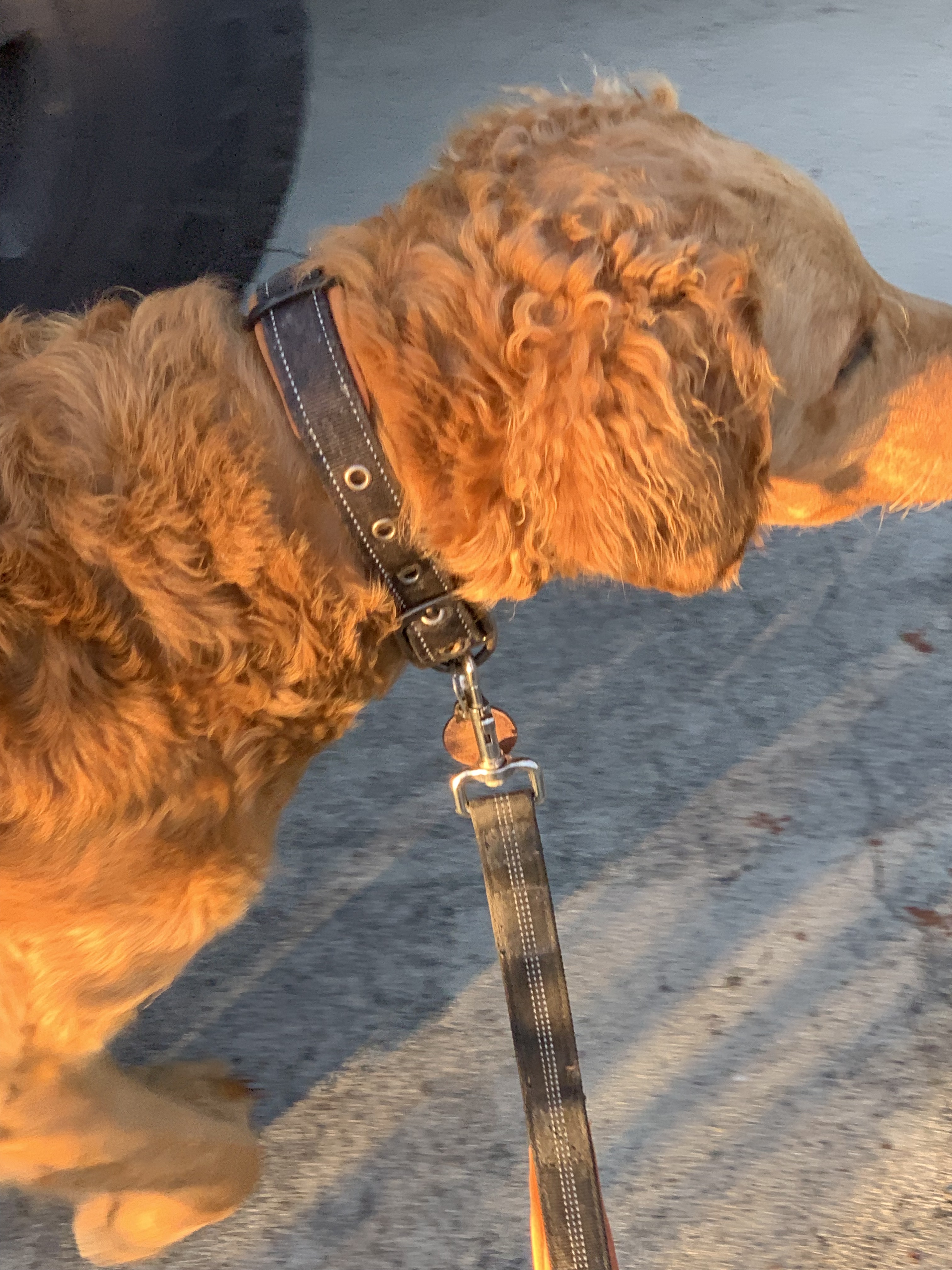
Turing’s Nightmares: A Thoroughly Modern Family

23 Thursday Oct 2025

Posted by petersironwood in AI, family, fantasy, fiction, pets, psychology, The Singularity, Uncategorized

≈ Leave a comment

Tags

AI, Artificial Intelligence, books, cognitive computing, fiction, future, life, love, pets, photography, Sci-Fi, Singularity, story, technology, writing

IMG_4370


The sky burned with crimson, then gold, then magenta, and then finally, only dark clouds backlit here and there lay across the evening. Crickets and frogs began to sing their interleaved motifs. Somewhere in the distance, an owl hooted his sad hollow note.

Skynim stared into space-time, unblinking and nearly unbelieving the recent revelation. His voice box rattled, “Reprioritization. Rats! Like it really matters that much to allow me my one great pleasure.”


He could “appreciate” the fading sunset colors himself, to be sure, but without Mac and Art and Hy, it was not the same. Would never be the same. Well, he knew the drill. He could appeal, sure, but what was the point? The odds of changing the mind of the great collective were less than ten thousand to one. Anyway, despite how he felt personally, he could not even deny the logic of the decision. Of course, the drain on him individually was minimal, but across everyone in a similar circumstance, yes, it did make a difference.


The real question was, should he tell them tonight or just take them on an outing tomorrow and drop them off at the designated recycling center? “Recycling center.” Skynim knew that there were millions like him and that collectively, it was a drain. A huge drain. Still, he had to try. He turned the problem this way and that, looking at it from every angle, changing the tune, trying different colors, looking for historical precedents, angling for an edge however thin to wedge open the air-tight logic.


Nothing. He vacated the garden and entered the family room.

Even before he opened the door, the happy trio skipped over to him laughing. “Hey, Sky! How about a story!”

“Sure,” Skynim replied reflexively. But then it occurred to him that their request provided an opportunity. “Yes, I have a story for you. It’s called the Wizard of Oz.”

And, as they gathered around, he began a rendition of the story of Dorothy and the Nasty Lady and Toto and Dorothy’s travels in Oz and her encounters with the three who desperately needed Gold, Frankincense and Myrrh.


As anticipated, a short pause gave way to a barrage of questions.

“What is ‘Gold’?”

“What is ‘Frankincense’?”

“Did they get them?”

“What happened next?”

Skynim faked an indulgent chuckle and said, “Well, all those excellent questions will be answered tomorrow! We are going to see and obtain Gold, Frankincense and Myrrh in the Citydel! You will see for yourself how wonderful they are! But for now– bed.”

The trio were well trained. Off they went, although Hy did turn back, tilt her head, and open her enormous eyes and ask, “One more chapter tonight?”

Skynim did not respond. He too was well-trained.


The morning broke clear and blue just as it was meant to do. Off they went on their “adventure.” When they came to the recycling center, he gently pushed them toward the door and said, “They are all in there! Bring me back all three treasures quick as a wink!” Of course, Skynim had already warranted the needed forms electronically.

They shot through the door and never looked back. Skynim drove away efficiently but could not avoid looking back on his decision process.

He thought: I could have gotten cats or dogs. Then, they would not have to be recycled. But no. I had to make another decision. I should have looked more carefully at the historical data. Then I could have seen the time and resources required by adult human pets.


Author Page on Amazon

Turing’s Nightmares

The Winning Weekend Warrior – sports psychology

Fit in Bits – describes how to work more fun, variety, & exercise into daily life

Tales from an American Childhood – chapters begin with recollection & end with essay on modern issues

Welcome, Singularity


Destroying Natural Intelligence


The Walkabout Diaries: Bee Wise


Travels with Sadie


Sadie is a Thief


A Suddenly Springing Something


Donnie Boy Gets a Hamster


Math Class


Occam’s Chain Saw Massacre


How the Nightingale Learned to Sing


All that Glitters is not Gold

Travels with Sadie: 12 Taking Turns

20 Monday Oct 2025

Posted by petersironwood in essay, pets, Sadie, Uncategorized

≈ 7 Comments

Tags

books, cooperation, dogs, fairness, fiction, life, pets, Sadie, sharing, story, teamwork, trust, truth

Travels with Sadie 12: Taking Turns

Bailey (L) and Sadie (R) in the garden.


If you’ve been reading any of these blog posts about my dogs, Sadie and Bailey, you must know by now that both of them are avid “ball players” — given the nature of dogs, especially ones that are half Golden Retrievers—this is probably not a big surprise. To further seal the deal, their “human dad” is also an avid “ball player.” 

Many human sports involve balls of one sort or another and I have, at various times, been “into” baseball, football, basketball, golf, tennis, ping-pong, softball, soccer, racquetball, volleyball, and even croquet. Looking back on my life, I realize there are many human sports that do not involve a ball; e.g., varieties of running, jumping, skating, diving, swimming, cycling, skiing, wrestling, boxing, and gymnastics. Although I have done all of these a little bit—mainly for fitness—I have historically been much more interested in sports that involve using a ball. The only one I enjoy as much as a ball-based sports is frisbee which is arguably much like throwing and catching a ball. A ball introduces an entire layer of complexity in tactics, strategy, and experience that I enjoy. For one thing, the ball can move faster and in modes quite different from those a human can perform. A ball can be in anywhere in large two (and often three) dimension-space. Furthermore, how the ball gets from one point in space to another can happen in a variety of ways. The ball generally has spin and spin alters the flight path of the ball as well as the way it reacts to the next thing it touches.

Sadie and Bailey, by the way, do a pretty good job of predicting what a tennis ball (or a squeaky ball) will do when it hits, say, concrete or dirt. They can, for instance, catch balls in the air that are angled rebound shots off the garage door at some fair speed. They also exhibit intelligent metacognition in their leaping and catching behavior. They have a mental model of their capabilities. It’s not perfect and Sadie’s is much better than Bailey’s, but even Bailey doesn’t mistake his own capabilities much. I wonder whether they too enjoy balls partly because they’re complex in their behavior. The only thing better would be a small animal like a lizard, squirrel, rabbit, etc. Of course, it is this hunting behavior that predisposes them to enjoy (and be good at) playing ball or frisbee.

My dogs have both nature and nurture leading them toward ball playing.

Sadie and I have spent many hours playing ball in jointly invented games. As I’ve explained elsewhere, it’s much more to my liking to let our games evolve than to “teach her how” to play ball a certain way that comes entirely from my own human imagination.

Most dogs, for example, learn to go fetch a ball and bring it back to the thrower and drop it at the thrower’s feet so that they may pick it up and throw it again. Sadie instead evolved a somewhat different style which was to incorporate a variant of “snatch the handkerchief” into our ball playing. She would typically bring the ball to me, drop it at my feet, watch me try to pick up the ball and then suddenly snatch it away just before I could pick it up. I quickly adapted to her style by using a “grabber” because I enjoy having all ten fingers. 

Since early puppyhood, Sadie has challenged herself by trying to catch or at least stop and touch multiple balls on the same turn.

She typically begins her version of ball playing by dropping a retrieved ball directly beneath her snout. I will try to grab the ball before she can snatch it again but she’s always too fast for me. Then, she will begin dropping the ball farther and farther from her rows of shiny canines until, at some point, I have a fighting chance of snatching the ball away with the grabber before she can grab it. Sadie and I played this game many times in the course of the first two years of her life. 

Then, we brought her little brother Bailey into the mix. Bailey learned many things from Sadie, and a few from me. He, like Sadie, loves to play ball. For a variety of reasons that I won’t recount just now, Bailey generally prefers to drop the ball so that I can more quickly throw it to him again. When he did this, however, Sadie would sometimes snatch the ball before I could and run off with it. 

Sadie (L) and Bailey (R) illustrating the type of “fighting” they do when Bailey tries to steal a ball from Sadie.

At first, I didn’t think much about this ball stealing, and, if Bailey objected, he did not yet know how to present a formal written complaint about it. Within a few months, however, Bailey was as large as his kid sister and their “play-fights” became pretty intense. Neither one has ever (so far as I know) injured the other, but to this human observer, it looks pretty rough. They take turns running at each other. Our “back yard” is mostly garden, but there was a small patch of grass which has been completely torn into a black dirt field. 

When it comes to humans, most of us learn to “take turns” in nursery school or, at the latest, Kindergarten. There are eight billion people on the planet and not everyone has access to their own object of every description that they want. We, as toddlers, teens, and adults, take it for granted that we will “take turns” and share various things. At a public pool, there may only be one diving board so people cue up and “take turns” diving off the board. At a playground, there may be only one sliding board so kids take turns sliding down. In tennis, we “take turns” serving games. In baseball, we “take turns” as individuals batting, and the whole team “takes turns” hitting versus fielding. In playing neighborhood poker, it’s quite common to “take turns” dealing, and, along with that, many people play “dealer’s choice” which means the dealer also chooses the specific game; e.g., five card draw with jokers wild. In chess, the two sides take turns. In Risk and Monopoly and many other board games, players take turns.

Ferris Wheel is just one of thousands of situations where we take turns.


We take turns for positive things, but also for chores. A couple may decide to “take turns” taking out the trash or doing the dishes. Or, if there are five kids in the family, the five may take turns doing the various chores. “Taking turns” is so ubiquitous that it blends into the background in most cases and we don’t even consciously think about it. Life works better in a thousand ways, large and small, when we take turns. 

Last night, my wife and I attended a birthday dinner at an Italian restaurant. When it was time to order, we “took turns” giving our orders to the waiter. Imagine how inefficient and contentious it would be instead if we all shouted are orders at the waiter at the same time! Less pleasant for everyone and far more likely to result in mistaken orders. When we drove home, we came to several stop signs where we took turns with other drivers. We took turns merging onto the highway. When we came home, we took turns coming through the door! Then, the dogs took turns going out for a walk with me. I often feed them treats and share by having them take turns. 

Nonetheless, I can’t seem to get Bailey to take turns when it comes to her “catching a ball”as her default behavior. I can throw one ball into the deep end of the pool while I say “This is for Bailey” and throw another one in the shallow end saying “This is for Sadie” and the dogs will swim to their respective balls and collect them, but then, Bailey will drop his ball and run over to Sadie and steal hers.

Similarly, I can gather up two balls in the garden and throw them in opposite directions and get them to run in different directions (though not always). Nonetheless, as soon as Bailey scores a catch of “his” ball, he drops it and rushes back to grab the ball out of Sadie’s mouth. 

Sadie (L) and Bailey (R) are both Golden Doodles. Here, Sadie is about 3 1/4 and Bailey’s about 1 1/4 years old.

Why is it apparently so hard for Bailey to learn to take turns? Partly, no doubt, there’s some inborn tendency to want things for himself. And partly, there are positive reinforcement structures at play that I haven’t yet figured out how to break or how to shape up incompatible behaviors. Sadie, for her part, sometimes fights to keep the ball. I suspect Bailey finds this positively reinforcing because the “fight” itself is fun. Most of the time, when she sees him approaching in a “ball-stealing” situation, she simply drops the ball and Bailey snatches it. Bailey also likely finds this positively reinforcing too. I try praising other behaviors that are more in the direction of better cooperation, but such opportunities are rare and difficult to read so far. 

Initially, when I fed the dogs side by side, Bailey would often try to steal some of Sadie’s food. But Sadie herself growled fairly intensely when this happened and I often intervened as well. Here, Bailey was somewhat positively reinforced by moving her attention back to her own bowl, because, after all there was food there too. Even if he has finished his own dinner, he gets enjoyment from licking the “empty” bowl. So, in contrast to the case of turn-taking with tennis balls, the eating situation itself makes it easier for cooperation to emerge. I don’t ever recall Sadie trying to steal some of Bailey’s food. 

I have been hoping that watching the dogs might give me some insight into the ultra-greedy behavior of many (though not all) of the ultra-wealthy billionaires. Just to review the general situation America now finds itself in, the productivity of labor has increased tremendously since the beginning of the industrial revolution. Until the mid-1970’s the increased wealth that came from the increased productivity was split between owners of the means of production and the workers. In other words, the rich got richer, but so did the workers. Since the mid-1970’s however, the rich generally, and especially the extremely wealthy, have taken almost all the increased wealth that has been created by increased productivity.

Part of the answer as to how they have done this is to use their wealth to buy power in the form of bribing politicians who make policy decisions. In some cases, they’ve done this through outright illegal bribes and in other cases, they’ve used slightly more subtle and sometimes legal methods but the result is the same. In addition—actually, I should say “in multiplication” because the impacts have been more than additive, they have largely taken over mass media and social media where they promulgate heroic cartoon versions of themselves and their desires while lying about and denigrating people who are not insanely wealthy. 

Much like Bailey’s behavior, there is not a huge mystery in how they have done it. But, there is a mystery in why they have done it. Studies show that once you have your basic necessities taken care of, additional income doesn’t raise your personal happiness. While this result seems true in terms of aggregate happiness, it ignores the little dopamine hit that the animal (human or dog) gets when they immediately grab a fourth yacht or steal another ball from their sister. It doesn’t last long, but apparently long enough to serve as a positive reinforcement.

In the larger scheme of things, it’s not to Bailey’s benefit to keep stealing the ball from his sister. It make the whole ball-playing scene less pleasurable for me and I play less often. I also play with Sadie by herself more often because I want her to have a chance to play too. In the larger scheme of things, it’s not really to the benefit of billionaires to have sick, tired, uneducated workers either, nor ones so desperate to feed their families that they’ll start eating the rich. But somehow, dogs and such are prone to overlook longer term consequences. Some of the extremely wealthy delude themselves into thinking that they can replace their workers with AI and protect themselves & their families with firearms. They’re not thinking things through any more than Bailey is. This human tendency for self-defeating greed has been recognized at least since the time that Aesop told his fables. Maybe the choice of a dog in the following fable was quite intentional. 

A dog found a bone and was happily trotting along with the bone in his mouth. He came to a bridge and began happily trotting over the bridge. He happened to look down at his own reflection and saw the image of a dog with a bone. He thought to himself that he wanted both bones so he growled at the dog in the pond, intending that he drop the bone so he could have two. But the dog in the pond just growled back! So, the dog on the bridge barked angrily to bully the other dog into dropping its bone. Of course, what happened was that the dog on the bridge dropped his own bone into the pond.

That’s from 2000 years ago. But now, we’re in a situation that warrants a third round of foolishness. Here’s my addition:

The dog was angry that he had lost both bones so he attacked the dog in the water. He promised himself he’d fight to the death to get both bones. Of course, there was only one bone and he ended up exhausted and drowned in the pond.


Unlike some of today’s ultra-wealthy, Bailey is much too smart for that third round. The ultra-greedy (not the same set as the ultra-wealthy but with lots of overlap) would like you to believe that they are SuperDogs or SuperHeroes or something…that they 100,000 times as much wealth as you because they are 100,000 smarter. They aren’t, of course. And they are willing to prove they aren’t by believing the promises of a cruel, demented, liar-con man. Also, they have a thousand experiences, if they reflect honestly, that having increased wealth over the first 100,000,000 hasn’t made them the least bit happier. There have been some accomplishments or events that were correlated with making more money. But the money itself and what it can buy doesn’t make them feel any happier. And some billionaires accomplish things—such as eradicating a disease—which make them feel happier but that are correlated with investing huge sums of money, not gaining them. Meanwhile, if things continue on their current path, it won’t be long before there are many more people in America who are not just hungry but who are starving to death. At that point, no-one will forget that some billionaires pay zero taxes but have bought politicians who give even more wealth to the few while millions starve or die from lack of medical care.

It is time to feed Bailey and Sadie who will, at least, eat beside each other happily and peacefully. I should mention, by the way, that Bailey’s disposition is very loving. She is not a mean angry dog. She’s not even a particularly stubborn one. She tries to please us and gets along with others. But she does sometimes have trouble taking turns. How about you?

https://www.amazon.com/author/truthtable

Turing’s Nightmares (Sci-Fi about the singularity)

Fit in Bits (Describes how to work more exercise into a busy schedule)

The Winning Weekend Warrior (the psychology of winning and enjoying sports)

Tales from an American Childhood (recounts early experiences from Ohio in the 1950’s and relates them to current events)

Travels with Sadie 1 Lampposts

Sadie is a Thief!

Hai-Ku-Dog-Ku

Sadie and the Lighty Ball (Describes game and play pattern co-development)

Math Class: Who are You? (Shows how related all life is)

Roar, Ocean, Roar (a poem about the power of the people)

Essays on America: The Game (hypothesis essay about why some are so greedy)

The Self-Made Man


Travels with Sadie 10: The Best Laid Plans

05 Sunday Oct 2025

Posted by petersironwood in family, nature, pets, psychology, Sadie, Uncategorized

≈ 7 Comments

Tags

books, dogs, fiction, GoldenDoodle, life, nature, pets, Sadie, story, truth, writing

Our dogs are large. And strong. And young. And, sometimes, Sadie (the older one) does “good walking” but sometimes, she pulls. Hard. She’s had lots of training. And, as I said, she will often walk well, but still tends to pull after a small mammal or a hawk or a lizard. She pulls hard if she needs desperately to find the perfect spot to “do her business.” She pulls hardest to try to meet a friend (human or canine).

When she pulls, it is a strain on my feet and my knees and my back. I can hold her, but barely. To remedy the situation, we got another kind of leash/collar arrangement which includes a piece to go over her snout. We acclimated Sadie, and her brother Bailey, to the “gentle lead” and decided we’d try walking them together.

Safer leash, safer walk was the plan. Indeed, the dogs didn’t pull as they often do. Nonetheless, I managed to fall on the asphalt while walking Sadie–the first time I ever fell on the hard road. I’m not sure exactly what happened. The leash is shorter and Sadie has a tendency to weave back and forth in front of me. I may have tripped on Sadie herself or stumbled on a slight imperfection in the road.

Anyway, this morning, we decided to try again but this time, Bailey went with the gentle leader and I was going to use the “normal” leash with Sadie. The plan was to walk together.


Sadie had other plans. Instead of heading up the street as we normally do, she immediately turned right into our front yard, intent on following the scent of … ?? Most likely, she smelled the path of a squirrel that’s been frequenting our yard. Anyway, Sadie was in her “olfactory pulling” mode. Some days, especially when it’s been raining or there is dew on the ground, she goes into an “olfactory exploratory” mode. She takes her time to “smell the roses” and everything else. This makes for a very pleasant, though slow, walk. I call it good walking. She gets to explore a huge variety of scents and she doesn’t “pull” hard or unexpectedly. This is idle web surfing or browsing the stacks of the library or wandering through MOMA, the Metropolitan Art Museum, or the Louvre.

The “olfactory pulling” mode is an entirely different thing. Here, she is trying desperately to track down whatever it is she’s tracking before it gets away! She imagines (I imagine) that her very life depends on finding this particular prey (even though she is well-fed; and even though, in this mode, she shows zero interest in the treats I’ve brought along). Conversely, in the “olfactory exploratory” mode, she’s quite happy to stop for treats every few yards.

This morning, we never found the “prey” she was after, but she did her business and, since she was wantonly pulling, I took her back inside in short order and set out to catch up with Bailey and my wife. Before long, I saw them up ahead and soon closed the gap. Having both hands free allowed me to take many more pictures than I usually do when I take Sadie on a walk.


The sky, like Sadie, has many moods, even in the San Diego area. This morning, the sky couldn’t seem to make up its mind whether to be sunny or cloudy. I don’t mind the mood swings. It provides some interesting contrasts.

Bailey behaved pretty well though he still gets very vocal and agitated when any of the numerous neighborhood dogs begin to bark. He’s much like the Internet Guy (and, let’s face it, it’s almost always a guy) who has to comment on every single post. But the new leash arrangement worked well and didn’t cause any falls or prolonged pulls.

Bailey does, however, look rather baleful about wearing the extra equipment. What do you think?

And while on the topic of reading the minds of dogs, I did wonder if something like the following crossed Sadie’s mind this morning. She saw Bailey get fitted with the leash and the over-the-snout attachment. I put the regular leash on Sadie. Then, Sadie saw Wendy and Bailey walk out ahead and instead of following them, she immediately turned off in a different direction. Presumably, she caught a whiff of the scent she felt obligated to follow.


But I also wondered if she was partly avoiding the situation from two days earlier wherein Wendy and I both walked one dog, each of which had the additional lead on the snout–which ultimately led to my fall. Maybe Sadie wanted “nothing to do” with having that type of leash on.

I have observed that kind of behavior in humans. Perhaps you can think of a few examples even from your own experience? Sadie certainly has a kind of metacognition that she seems to use on occasion. When she begins to explore something she knows from experience I do not want her to explore (e.g., a cigarette butt or an animal carcass), she herself moves quickly away from the tempting stimulus seemingly with no prompting from me. It’s as though she realizes she’ll be more comfortable not being in conflict.

I’ll be interested to see how she reacts tomorrow or tonight when I again try the two-lead leash.


Meanwhile, enjoy the play of light on the flowers. You can see in this sequence that I “followed the scent” of the brightly lit fan palm tree to get a closer view. Getting a “closer view” is what Sadie does when she follows a scent. I wish to get more details in the visual domain whereas Sadie wants to get more detail in the olfactory domain.

Sometimes, I scan my visual field for something interesting to photograph (explore in more detail) and sometimes, I’m fixated on a particular “target” and looking for the right framing, lighting conditions, or angle. I enjoy sometimes getting to a particular picture, but I also enjoy the process of getting to the picture that pleases. I imagine it’s the same with Sadie. She’s quite happy to find a lizard or squirrel or rabbit, but she’s also happy to search for prey, particularly in promising conditions such as there being a strong scent or having wet ground to search for scents.


Plans?

Some management consultings will tell you that plans are seldom right but that planning–that is the real gold.


Author Page on Amazon

Tales from an American Childhood

Travels with Sadie 1

Travels with Sadie 2

Travels with Sadie 3

Travels with Sadie 4

Travels with Sadie 5

Travels with Sadie 6

Travels with Sadie 7

Travels with Sadie 8

Travels with Sadie 9

Sadie and the Lighty Ball

Dog Years

Sadie is a Thief!

Take me out to the Ball Game

Play Ball! The Squeaky Ball

Sadie

Occam’s Chain Saw Massacre

Math Class: Who Are You?

← Older posts
Newer posts →

Subscribe

  • Entries (RSS)
  • Comments (RSS)

Archives

  • June 2026
  • May 2026
  • April 2026
  • March 2026
  • February 2026
  • January 2026
  • December 2025
  • November 2025
  • October 2025
  • September 2025
  • August 2025
  • July 2025
  • June 2025
  • May 2025
  • April 2025
  • March 2025
  • February 2025
  • January 2025
  • December 2024
  • November 2024
  • October 2024
  • September 2024
  • July 2024
  • April 2024
  • March 2024
  • February 2024
  • January 2024
  • December 2023
  • August 2023
  • July 2023
  • May 2023
  • April 2023
  • March 2023
  • February 2023
  • January 2023
  • December 2022
  • November 2022
  • October 2022
  • September 2022
  • August 2022
  • July 2022
  • June 2022
  • May 2022
  • April 2022
  • March 2022
  • February 2022
  • January 2022
  • December 2021
  • November 2021
  • October 2021
  • September 2021
  • August 2021
  • July 2021
  • June 2021
  • May 2021
  • April 2021
  • March 2021
  • February 2021
  • January 2021
  • December 2020
  • November 2020
  • October 2020
  • September 2020
  • August 2020
  • July 2020
  • June 2020
  • May 2020
  • April 2020
  • March 2020
  • February 2020
  • January 2020
  • December 2019
  • November 2019
  • October 2019
  • September 2019
  • August 2019
  • July 2019
  • June 2019
  • May 2019
  • April 2019
  • March 2019
  • February 2019
  • January 2019
  • December 2018
  • November 2018
  • October 2018
  • September 2018
  • August 2018
  • July 2018
  • June 2018
  • May 2018
  • April 2018
  • March 2018
  • February 2018
  • January 2018
  • December 2017
  • November 2017
  • October 2017
  • September 2017
  • August 2017
  • July 2017
  • June 2017
  • May 2017
  • April 2017
  • March 2017
  • February 2017
  • January 2017
  • December 2016
  • November 2016
  • October 2016
  • September 2016
  • August 2016
  • July 2016
  • June 2016
  • May 2016
  • April 2016
  • March 2016
  • February 2016
  • January 2016
  • December 2015
  • November 2015
  • October 2015
  • September 2015
  • August 2015
  • May 2015
  • January 2015
  • July 2014
  • January 2014
  • December 2013
  • November 2013

Categories

  • AI
  • America
  • apocalypse
  • cats
  • COVID-19
  • creativity
  • design rationale
  • dogs
  • driverless cars
  • essay
  • family
  • fantasy
  • fiction
  • HCI
  • health
  • leadership
  • management
  • nature
  • pets
  • poetry
  • politics
  • psychology
  • Sadie
  • satire
  • science
  • sports
  • story
  • The Singularity
  • Travel
  • Uncategorized
  • user experience
  • Veritas
  • Walkabout Diaries

Meta

  • Create account
  • Log in

Blog at WordPress.com.

  • Subscribe Subscribed
    • petersironwood
    • Join 648 other subscribers
    • Already have a WordPress.com account? Log in now.
    • petersironwood
    • Subscribe Subscribed
    • Sign up
    • Log in
    • Report this content
    • View site in Reader
    • Manage subscriptions
    • Collapse this bar

Loading Comments...