Newsflash: Playing really low quality Musak while the customer is on hold for 40 minutes does not improve the customer experience. Nor, does always playing the message that you are experiencing “unusually heavy volumes” right now improve your credibility. Now, I admit that someone in marketing who thought about for about 15 seconds *might* think that playing really bad music would be a good thing. After all, people do pay money to listen to music. Not everyone is a pirate. And, people spend a lot of time listening to music. Here’s the thing that might come to you if you study the rocket science surrounding this situation for about 20 or 30 seconds. People pay to listen to the music they choose. They do not pay to hear the music you choose. Furthermore, people pay to listen to music that is high quality. Granted, sometimes, when nothing else is available some of the people some of the time would prefer low quality music to no music at all. But no-one chooses absurdly bad quality music over silence. One more thing: unless you are a love-struck pre-teen, you do not listen to the same short sequence of music over and over and over and over for an hour at a time. No. You listen to a piece of music. Then, you listen to a different piece of music. Then, you listen to a different piece of music.
Now, I do grant that it is somewhat useful if you are going to put your customers on hold for 40 minutes that you give some sort of signal other than complete silence to show that you are still there and haven’t had the system “hang up” on them (which happens all too often but is another topic). But playing loud, obnoxious, very low fidelity music is not the answer.
Back to credibility. If you are really monitoring the call volume and the customer calls at a time of really unusual high call volume, you may want to tell them that they would have better luck another time. But if you always play this message, what do you think it does to your credibility? I am amazed to find that my credit union, an otherwise fine institution, always plays this message. And every single time, it makes me think twice about whether I can really trust my funds to an organization that clearly lies every single day.
You might think that it’s bad for business to lose credibility. Of course, it is. But it’s far more than that. It’s a betrayal of the very thing that makes us human. We did not succeed in covering so much of the planet by having the sharpest claws or teeth. Nor is it because of our great strength. It’s because our language enables us to learn from each other across time and space and culture. That happens when people trust each other and are trustworthy. Of course, one may gain a short-term advantage by lying. But the long term impact of enough lies is nothing less than the complete breakdown of human civilization.
So, in 2013, I changed from four medical plans to four different medical plans to six plans for 2014. Thank goodness we don’t have a “single payer” system because there is nothing I love more than pouring through a hundred pages of text for each plan which is mainly garbage but occasionally has important information. There is nothing more fun than ping-ponging among doctors every time your plan changes. Oh, wait! I forgot that in addition to the plans I *actually* had, IBM also sent me huge packets of information on plans that were no longer relevant. In the midst of all this, I was heartened to find a concise 72 page document from my dental plan which also informs me: “Please note: if you are a previous user of MyBenefits, you can still enjoy all the same features under the new plan. Simply visit (our website) and re-register with an updated username and password for access to your new plan.” It is the word, “simply” that I object to. Indeed, in some parallel universe, there is probably a time and place for the word “simply” but in has no legitimate place in actual 21st century America. It *invariably* signals this message: “We are going to make this difficult for you. But we don’t want to come out and say that so we will preface our instructions with the word ‘simply’ so when you do have trouble you won’t have anyone to blame but yourself.”
(Why do I need a different userid and password?). Anyway, you know the drill. You go to the website and the first six userids that bear any resemblance to your name are taken. But they don’t typically tell you that till you also enter a password. And, of course, there are the typical “security questions” such as “What sized underwear did you wear in the fourth grade?” “What was your second grade teacher’s maiden name?” “What was the name of the company you bought your first ant farm from?” And so on.
This ironic use of “simply” is not confined to websites. It also applies to packaging as in, “SIMPLY remove the plastic overwrap.” Yeah. But, what if you left your chain saw in the garage? “Simply, tear the plastic along the indicated line.” In the rare case, when it is physically possible to tear, it never tears evenly. More typically it is some semi-metalic plastic that requires an industrial laser cutter. the most recent example involved two different kinds of dry cat food. These were nearly impossible for me to “simply” open. I left the bags for a few minutes to get an exacto knife and when I returned two minutes later, my CATS had indeed simply opened the packages and spread the contents around the hallway. For all I know, they might have actually ingested a piece of cat food but it was clear that their main intent was simply to cause a mess. The reason they could open the packages simply is that they have cat claws! I don’t! Not sure what genius came up with the idea that packages of cat food should be opened simply by cats but not simply by humans.
A variant on the use of industrial grade titanium plastic the requires war-appropriate hardware to open, is the soft, slippery plastic around cheese or ham that actually does open easily under a specific set of conditions. You have to be young. You have to have a strong grip. You have to have fingerprints–mine are gone (because of using too many touch screens?) Most importantly, your hands must be completely dry and free of any trace of any kind of oil.
Luckily, when preparing food, one’s hands never get damp or oily. Not if everything you touch is already pre-packaged in a box or a can. Of course, if you’re foolish enough to use fresh vegetables or fruits, you may be tempted to wash off bacteria and poison. You can do that, but you have to wait at least forty hours before attempting to open a package that requires you to “simply” tear off the tab.
And, while we’re on the subject of tear off tabs, did you ever wonder what kind of a bonus the MBA whiz kid who first mathematically modeled the MRA (Minimally Required Area) for a pull-off tab? I sometimes add a dollop of milk to my coffee and get one of two brands of milk. One has a pull-off tab of aluminum foil that allows me to use my bare hands to tear off the tab (even if they are a bit moist). The second brand sometimes has a plastic tab which is usable. But sometimes, it has a tab of aluminum foil carefully calculated to bear a visual resemblance to a usable tab but which, in fact, is only about 1/20th the surface area required to actually use it. The marketers however, have made it quite clear that I can open it by “simply” pulling the tab. And that is true, provided I use pliers.
Since the word “simply” has simply gone out of fashion in its true meaning, I think we should simply ban its use. Period.
Recovering from recently moved across the country, fixing up our new house, dealing with a huge moving van fire, health and family issues, I found myself with 45 seconds of uncommitted time, so I was **thrilled** to get a wonderful form letter from American Express informing me that a credit card I had cancelled about five years ago nonetheless had been compromised and it was up to me to take a series of time-consuming steps. At last!! Something to do!! How thoughtful! If all goes well, this would not only eat up the 45 seconds of free time but about 45 additional days. Of course, all of these steps require either going on-line or calling an 800 number so we KNOW that all will NOT go well. Going to a website generally means getting an account with a user name and email address. These may be the same or different depending on the site. You can pretty much bet PeterSIronwood and Peter Ironwood and PIronwood are already taken so I will end up with some completely impossible to recall username like IPeterIWoodIS437. Of course, I can regenerate my username by merely answering three simple security questions such as, “What is your favorite movie star?” I don’t know. Or, worse, it changes from day to day. Maybe the people who made up these security questions have a favorite movie star that they keep constant for their entire 23 year lives. But I don’t. “Where did you grow up?” What makes you think I grew up? And, what makes you sure it was in one place? And, even if it was in one place, which is the exact spelling I used last time: “SanDiego”, “San Diego”, “San_Diego”, “San Diego, CA”, “San Diego, California”, “California”, “SoCal”, etc. etc. Of course, I could take the OTHER route and call an 800 number. “We’re sorry. All of our agents are helping other customers. Due to unusual call volumes, your call may take longer to answer than usual. Your estimated wait time is 5.5 centuries. But meanwhile, you can listen to really loud, really repetitious, soul-sucking low-fidelity music. This century’s selection is entitled, “The Dementor’s Theme Song.” You know what? If YOU screw up YOU fix it! Don’t impose on ME to fix it.
After moving from Westchester County New York to the San Diego area, we were asleep (again) on an air mattress awaiting almost all of our material possessions to arrive the next day. We were awakened by a call from our moving company that our things would not be arriving tomorrow morning as promised. Or ever. Indeed, our furniture, clothes, electronics, papers, photographs, paintings, kitchenware, bedding, etc. had all been destroyed in a truck fire near Albuquerque, New Mexico. This was something of a disaster for us, and, from a positive “customer experience” standpoint, a disaster for the moving company.
But the point of this post is to point out that in this disaster, there is an opportunity for the moving company to be proactive and excellent and greatly ameliorate or even turn around this customer service disaster. They could, for example, send us a personal apology. They could be in constant contact about the status of any remains. They could arrange for us to visit the site of the fire at their expense. They could arrange to quickly reimburse us at least for the full amount of our insurance with the moving company so that we could get on with our lives as best we could. Obviously, photo albums, the drawings my kids made, letters from friends, my grandfather’s paintings, and souvenirs from a lifetime of travel could not really be replaced. But what *could* be replaced needed to be so quickly. And, given that we were in a somewhat vulnerable state, this disaster really offered an opportunity for the company to provide the very best customer service they possibly could under the circumstances.
That was the opportunity. What did they do instead? They basically refused to communicate with us. At every opportunity, they balked; did not answer emails; did not answer phone calls; did not offer reimbursement. As we found out later, they did not even pay the towing company who moved their van off the Interstate. Instead, they focused on how to limit their potential liability by withholding as much information as humanly possible. They refused to let us even come to the site and examine our stuff. We found out the day before, thanks to our insurance company, that we would be able to see our stuff on Friday if we flew to Albuquerque and rented a car to drive to Continental Divide. There we discovered the charred remains of our things. And, we discovered that nothing had been done for an entire month to protect our things (or those of the other two ex-patrons who shared the misfortune of choosing this moving company). What was left of our clothes, photos, furniture, etc. was all open to rain, wind, and passersby for over a month.
Continental Divide is a fitting metaphor for the choice that a company faces when they make a BIG mistake. They can admit the mistake and do everything in their power to make it right to the customer. Or, they can do everything in their power to continue to screw the customer in order to save costs, face, and limit liability.
Of course, the same choice also faces government. Any government will make mistakes. But then what? Do they admit those mistakes and try to ameliorate the damage? Or, do they deny, minimize, lie, obfuscate, point fingers elsewhere?
But let’s not forget that most people, most of the time cooperate. It’s much more pleasant for normal people to cooperate and the results are also much more pleasant.
Is there road rage? Does that exist? Yes, but statistically, the vast majority of people cooperate when they drive.
And, when they do anything else. We depend on many people from many places cooperating in order to eat. First, the efficiency and effectiveness of our food growing, harvesting, transporting and preparing depends on the cooperation of millions of people in the past who found out what was edible, how to grow it, which crops worked best in various conditions, how to irrigate, how to fertilize, how to harvest and so on. The food we have available today depends on the collaborative efforts of many previous generations. These dependencies are not just on food per se, but also depend on scientific advances, transportation advances, financial advances, and so on.
Much of our food also depends on people from many parts of the world cooperating today. The prevalence of cooperation is not just true of driving and food production but also on the construction of buildings and cities; it’s true of our clothing, our medical care, our learning.
Despite the fact that cooperation is much more prevalent than criminality, evil, and violence, there are at least three reasons that the evil of human behavior seems much more prevalent than it really is. These are: 1. Effect Size, 2. Cognitive Bias, and 3. Media Bias.
Effect Size:
First of all, it takes many people working smart and hard over a long period of time to provide value through cooperation. By contrast, it only takes a few people working stupidly over a short period of time to destroy something. The effort to make a pane of glass is immense. To make it efficiently takes a large number of people with different skills. To destroy a pane of glass requires only one second of bad action by one unskilled bratty child.
AI-generated image
Think about how much work goes into planting, growing, and harvesting an acre of corn versus what it takes to burn it down. Think about how much time and effort it takes to raise a child for the first ten years of their life versus destroying that life with an assault weapon. Think about what was required to build a functioning democracy over the course of hundreds of years by cooperation versus how easy it is for a very small group of greedy stupid people to destroy it. The examples are endless. Writing a novel versus burning a book; training to become a world class figure skating versus putting an ice pick in someone’s knee; becoming a skilled artist and painting the Mona Lisa versus splashing it with black paint.
It’s the same with a functioning human body. To be healthy requires the coordination of trillions of cells. The kind of cooperation found in the human body (or an eagle or wolf or whale) took billions of years of evolution. To destroy the health of the body only takes a few stupidly greedy cancer cells. So, although evil destruction is far less prevalent than constructive cooperation, evil destruction can undo the effort of many over the course of a long time.
Second, because destruction can so quickly undo so much good work, our nervous system is very reactive to evil and violence. We perceive it more easily and we remember it more easily. In a crowded city, you might pass by hundreds of people every day. Most of them, most of the time, you don’t notice. But if one of them robs you at gunpoint, you will notice and remember.
Media Bias:
The first two reasons we perceive evil to be more common than it really have existed for millions of years. Now, however, in our modern society, we have people whose job is to report on the news.
When is the last time you saw a headline like: “Two hundred thousand people drove into San Diego from Mexico yesterday with zero fatalities!” Or, “Three million people ate dinner in San Diego county last night! Zero died of food poisoning!”
It is sometimes said that “No news is good news.” It’s also generally the case that good news is no news. There are some exceptions. When World War Two ended, there were headlines. What we don’t see is this headline: “Canada, for the 57,670th consecutive day did not attack the United States of America.” Understanding this, a complete sociopath with an audience might try to increase their own fame by declaring: “America should annex Canada!” An actual war will definitely result in a headline. But threatening war, especially with a friendly country might also result in a headline.
The tendency to report bad news over good news has always been a “feature” of the media. But now that much of our news is basically click-bait for advertisements, the tendency is worse than ever. When I was on the school newspaper, we were taught to put the most important information in the headline; add the most important details in the first paragraph and add more detail in the rest of the article. Now, most headlines are fairly meaningless and important information is hidden behind a paywall or an advertisement.
“Is Earth About to Plunge into the Sun?!”
AI-generated image to prompt: “The earth plunges into the sun.”
Ka-ching!
(No, but we could sure use some extra cash, so click here to find out.)
“Does T-Rump have Proof that Obama was Born in Kenya!?”
An AI-generated image
Ka-ching!
(No, actually, but if you want to find out, click here and pay us money.)
“Could Space Invaders have Brought Life to Earth?!”
AI-generated image to prompt: “A fleet of UFOs hovers over the earth”
Ka-ching!
(Well, sure, anything’s possible. And, while we have no evidence of that, thanks for making one of the greediest people on earth a little richer!)
Dishonesty, greed, and mistrust work in a vicious circle. As you discover that more people are lying; that more people are evil, you yourself become more cynical and more tempted to lie, cheat, and steal. If you succumb to that temptation, it makes others more likely to lie, cheat, and steal.
Here’s the important thing to remember about a positive feedback loop though. It works in both directions. To the extent you can behave in a trustworthy fashion and be kind to others, it increases the chances that others will be inspired also to behave well. Cooperating is the natural and normal course for humanity. You will be happier doing that and you’ll help build a better world.
“Hey, Hon, guess what? We’re finally going to be able to get that new vacuum cleaner you’ve been asking about.” Stevie grinned from ear to ear. Of course, the vacuum cleaner wasn’t the only thing. But Stevie didn’t see any point in mentioning the new bowling ball or the fifths of Johnny Walker Black. He wasn’t trying to hide those purchases from Karen, his wife of fifteen years. Not exactly. It’s just that—timing was everything. That was all.
Karen looked up from her iPhone solitaire game. More accurately, she looked up from the ads that were interrupting her iPhone solitaire game. Once again, they were trying to cajole her into getting a new app but it was (once again) one she already had. She sighed. She could see that Stevie was quite jazzed so she amped up her enthusiasm two notches as she answered, “That’s great, Stevie. Thanks. Did you get a bonus or something? Win the lottery?”
“No, no lottery. That’s for suckers. Vegas gives you better odds. A bonus though. Exactly.”
Karen chose to paint smile level three on her face. She knew it well because she had practiced in since Junior High. She thought it looked pleased, surprised, happy, and just a tad beholden. “That’s great, Stevie. What’s the bonus for?”
Stevie’s smile faded and he looked out the front window and noticed that it looked as though a thunderstorm was on the way. “Well, for meeting my quota. You know. Just saving the country by getting out the criminals like always. But now we’re serious about it.”
Karen chewed her lip a little. “Yes. Well, a new vacuum cleaner will be great.” A flicker passed over her face. She realized her smile had withered, but Stevie had a faraway look in his eyes anyway and so she returned to her game. The game within the game. The game of finding out where they had hid the X this time—the X that closed down the ads and sent her back to her game. She vaguely noticed that Stevie had walked away over toward the liquor cabinet. She thought: This sucks! All Kings and Jacks but no Queens. How’s that work? Where the hell are they? She pushed the “Random Deal” button to start again.
Summer, 2025.
“Hey, Hon, is dinner ready yet by any chance? I gotta head back out for some…I gotta head back out to work.”
“Really? That’s too bad. Couldn’t they get somebody else? Didn’t you already do your shift? Did you forget it’s Brittany’s swim meet tonight?”
“What? Oh, crap! No, no, I didn’t forget. It’s just…we need to round up more people and there’s…well, we have something planned. These vermin are slippery, you know? I can’t let the team down, not to mention Captain Bligh. Sorry. Next time.”
Karen frowned, “Captain Bligh? I thought your Captain’s name was ‘Smyth with a y’ — you said you guys all called him that because he was always asking ‘Why?’”
“Oh, yeah, you’re right, but that was months ago. He’s out. Bligh’s in. Look. I gotta go. Is dinner ready or not?”
“No, Stevie. We were going to all go out after the meet. We talked about it. Brittany will be hungry after and Steve Junior is always up for burgers and fries.”
Steve Junior slid into the kitchen, raised his eyebrows and grinned. “Did someone mention burgers and fries? You comin’ too dad?”
“No, dammit. I already said that. I have to go to work. Do we have anything in this frigging house to eat? Never mind. I’ll grab something from…I gotta go. Good luck at your meet Junior.”
Steve Senior grabbed his car keys off the hook and left. He hadn’t meant to slam the door. Not exactly.
He didn’t mean to spin gravel onto the lawn when he left either. Not exactly. Karen sighed and Steve Junior frowned as he said, “Meet? What meet? Does Dad think I’m on Brittany’s swim team now?”
“No, he just…he’s just distracted. That’s all. Come on. Let’s pack up. I’ll ask Sue to swing by. She’ll have room for the three of us.”
“Yeah. Well, if Dad’s not going, why should I go? A swim meet’s not the most exciting thing in the world you know. You can’t even see the girls. At least in a track meet you know who’s who. In a swim meet all you see are bubbles and bathing caps.”
Karen put her hand up to hush Stevie Junior while she called Sue. Finished, she said, “Sue said there’s plenty of room for you too and…anyway, although Brittany would never admit it to you, she really does want you there rooting for her. Especially since Dad…won’t be able to make it. Again. She hadn’t mean to say ‘Again.’ Not exactly.
Fall, 2025.
Doctor Lemon shook his head as he glanced at the labs report before him. He kept glancing down at a written report and up at his computer screen. Stevie frowned and drubbed his fingers on the steel arm of the chair. After a few minutes, Doctor Lemon looked up. “Well, Mister Miller, the good news is, there no sign of cancer but your blood work—well, this is the worst it’s ever been. Did you really cut down on sugar and alcohol these past six months. That was our plan, right?”
“Yes! Yes, I did. Way down. Not every day, of course. But overall. Yes. Maybe it’s just genetics, you know?” For some god-damned annoying reason some stupid poster child for WOKE or some stupid folk singer sprang into his head and the young singer or actor, or ‘wacktor’ as his buddies liked to call them, said, ‘Remember. It makes no sense to lie to your own doctor.’
“Well, Mister Miller, genetics do play a role, but your genetics haven’t changed in the last six months. So that’s not why your weight’s up, your blood pressure’s up, and your numbers all look worse. You liver, in fact, is just outside the intervention zone and that’s never looked bad before. Have you cut out exercise? Change jobs maybe? Or stopped walking the dog? Or given up golf?”
“I’m busy at work. That’s all.”
“Yes, well stress can also…”
“I never said anything about stress! I didn’t use that word! You did! Anyway, it’s fine. I’ll do better. But meanwhile, can you give me a pill or something to get my numbers back down?”
Doctor Lemon swiveled his chair to face Steven Miller more directly. The doctor leaned forward and said, “Look, Mister Miller, we’re on the same team here. But I need to know what we’re dealing with. Have you had trouble sleeping?”
Steven Miller ground his teeth. He didn’t mean to growl. Not exactly. But growl he did as he said, “Look, Doc, can you give me a goddamned pill or not?”
“I can give you a pill that might help bring your BP down and even lower your cholesterol, but you know, there are always side effects.”
“Like what?” Steven Miller wished he were on duty right this minute. He could leap up and wrench the guy’s arm for being such an asshole.
Doctor Lemon frowned. He could see his patient was clearly upset. But why? “Sleepiness. ED. Nightmares. Muscle weakness.”
“Screw that! I need my strength. You think my job’s easy, but it isn’t. Just…you know what? Forget it.”
Stevie had had enough poking and prodding for one day. His head felt full like it was a balloon ready to burst. He thought to himself, ED? Bullshit. What does he expect? My wife’s like 45 years old now. So what if I have a drink now and again. I’ll find a way to get the pills. Damned doctors anyway. Stress! Hah! I’d like to see him wrestle these people to the ground. Fucking protestors anyway. If the illegals weren’t here in the first place, they wouldn’t need to be roughed up and deported. I’m doing the job for them. What’s with the damned protests anyway?
Stevie didn’t notice how close he had parked the passenger side of his car to the cement pillar in the parking garage. Not until he heard the scrape of metal as he backed out. Even then, he hadn’t realized at first that his own car was causing the noise. When he finally figured it out, he stopped the car, got out, and walked around to the other side of the car. “Goddammit!”
Like all parking garages, this one was designed and built with two-person golf carts in mind, not SUV’s. So, when Stevie stopped his car, he blocked off the lane for others who wanted to drive by and exit the parking garage. A guy in a BMW tooted his horn. Stevie flipped him off. He thought: Driving a foreign car anyway. An expensive one. Probably a faggot. They’re next. Why is everybody out to get me when I’m just doing my job?
And speaking of people who were just doing there job, that was the situation for “Old Joe” as his co-workers affectionately called him. At one time, his job had been as a soldier. After two tours of duty, he became a cop. He retired from that and had enough to live on. Old Joe wasn’t rich, but he wasn’t destitute. But he liked work. He liked doing something. And, he especially liked doing something that added to society. And he liked having co-workers. And they liked Old Joe as well. He was firm but polite.
He was firm but polite when he requested to see Mr. Miller’s validated parking ticket. Mr. Miller, for his part, explained through gritted teeth that he had left his parking ticket at the doctor’s office and that no-one had reminded him to get his ticket back when he left. Old Joe said, “That sometimes happens. You have two choices. You can pull over there and go back up and get your validated parking ticket. Or, you can pay the max for a lost ticket just like it says when you enter.”
Stevie didn’t mean to growl. Not exactly. His grunts, when translated into more polite language, boiled down to this: “No, I’m not going to do either. You just open the gate up. I need…I’m on an important mission. I’m RIME—which, in case you’re so stupid you don’t know, is the militarized version of ICE. Raiders, Inciters, Maulers, Executers. You understand what ‘Executers’ are? For now, it means we execute the orders of the executive branch. But soon, we’ll have the power of on-the-spot executions of anyone who’s deemed an enemy of the state. If you’re in the way of the state, you’re an enemy of the state. And you, sir (no, Steve didn’t actually use the word ‘sir’—not exactly) are in the way of my doing my job. We’re due to raid a…well, none of your business. But I’m on my way. Now, let me out of this garage before I blow your brains out.”
This claim of being on the way to a raid wasn’t actually true. Not exactly. After his aborted doctor’s visit, Stevie had arranged to meet up with a bunch of the guys over at the bar that was jokingly known by two names: “The Library” (because books would be the last thing discussed there) and “The Lie-Berry” because when the guys got together, they told fishing stories. But the stories weren’t about fishing at all. They were about the size of the lies that they got away with, or, in some cases, didn’t get away with. But it didn’t matter to Stevie. It wasn’t any of Old Joe’s business where he was going. He was RIME. He could do whatever he felt like. And what he felt like right now was smashing Old Joe to smithereens.
Old Joe had seen a thing or two though and he said, in a calm voice,“Well, Mister, I don’t appreciate being threatened. But it seems to me you’re having something of a really bad day. Why don’t you just tell me your name and the phone number of the doctor you went to see and I’ll call them. And if they say you were there, then, I’ll pretend you have a validated ticket.”
“And if I crack your skull, I’ll consider myself validated!” Stevie screamed this much louder than he meant to since there was now a growing line of cars behind him. The last time his group of guys from RIME got together for a Lie-Berry session, Fat Frank had talked about beating up a grocery bagger for putting eggs and tomatoes in the bottom of a paper bag and then throwing in a six pack on top of them. Frank said it was a real pain to deal with the blow-back but in the end, the bagger was fired and Frank didn’t pay any penalty at all. Well, not exactly. In fact, the baggers all avoided the lines that Frank was in. He mostly bagged his own groceries but never really noticed it.
Winter, 2025.
Things were getting out of hand. It wasn’t a full-fledged Civil War. Not exactly. But Stevie had to be careful all the time. Yet he felt too rushed to be careful. He had trouble falling asleep every night and, on the two nights he had experimented with not having any alcohol at all, he hadn’t slept at all. On his typical mornings, the hangover headaches and the bright sun put him in the mood for mayhem.
It didn’t help his mood, that he and Karen hadn’t had sex in months, but that was not a forever problem. Pretty soon, everything would be in place, including women and girls like his smarty pants daughter, Brittany. They were baby ovens and pleasure boxes and household chore-doers. Soon, robots would take that over the chores and the ladies could all sit home and watch soap operas all day or whatever the hell it was they did. But the point is that they would know their place once and for all.
Stevie turned on the TV and surfed over to the Cotton Bowl Game. Cheerleaders. Announcers. Players making amazing blocks and catches and stupid errors. It was just like always.
Not exactly. Stevie felt something between an upset stomach and a tickle. He wondered: What? It feels different. Why? How? What’s going on? He muttered aloud, “Where is everybody?”
Stevie noticed that there were fewer fans in the stands than in any bowl game he’d ever seen. What Stevie didn’t notice was the connection between the plummeting attendance at live sporting events and his own support of the Glorious Leader and his actions as a RIME agent. Few people wanted to risk being caught in the crossfire outdoors or more likely for rooting too loudly for the “wrong team.” Apart from the risk of physical injury, fewer people tended to care about the outcome of a “game” when everyone knew it was rigged so as to enrich the Glorious Leader and those currently in the “inner circle.” There was a lot of money to be made on sports betting when you could control the outcome. Until most betting fans caught on.
Stevie Junior came into the living room to sit beside his Dad and watch the game. He had a large bowl of sour cream flavored ruffled potato chips in his hand. “Say, Dad…”
“No! The answer is still no! Don’t ask again!”
“Dad? Are you okay? The answer is no to what? I was going to ask you if the game’s any good. You mind if I watch? I’ll share my chips with you.”
“Your chips? Did you buy them? Am I missing something? Those are my chips. Did you ever look into getting a job delivering packages? They always need help around this time of year and they’re always hiring. Even you could get a job, Junior.”
“Yeah. Well, this year, they are not hiring any extra people at Amazon or VanCare. I checked. Not a banner year for retailers.”
“Yeah, Stevie. Whatever. I’m sure you could get a job if you really tried. But sure, stay here and freeload instead. Tell you what. I’m heading out to watch this on the big screen. I’ve got a bet going with a bunch of the guys. I forgot I promised to watch the game with everybody at the Lie-Berry. If you see your mom….”
“Hey, Stevie, I’m right here. Did I turn invisible? You’re heading out now? Will you be back in time for dinner?”
“Oh, Christ! Now, you’re going to bug me too?”
Karen sighed. Steve Senior seemed to be in a bad mood most of the time now. She glanced at the coffee table and quickly counted five beer cans and one sudsy mug. Presumably, four beers had already been consumed. Yes and no. Five beers had been consumed and a shot of Jack Daniels with each beer. Karen said: “I’m not going to bug you. Go hang with your friends. But drive carefully, please.”
“Geez Karen. Now I know why everybody hates a Karen. ‘Drive carefully please.’ My ass. Just say what you really mean—that I’m a drunk and I trink do much. Well, no wonder with this family. I’m outta here. Don’t wait up. Like you would anyway. One of these days, I’ll be hauling one of these dangerous criminals out of the country and he’ll pull a gun on me. Don’t worry there’s insurance money. You’ll think you’ll be better off but you won’t be. You need a man to protect you. More than you know. Understand? It’s coming. Women are supposed to belong to a man. Without me. I hope you never have to find out.
Steve Senior staggered as he stood. He grabbed at Junior’s arm to steady himself and succeeded at knocking the potato chips all over the table, floor, and couch. “Jesus, Junior! Watch what the hell you’re doing. Too bad you inherited your mother’s clumsiness.”
Steve stormed out of the house. As he went to unlock the car door, he realized he’d never make it to the library without peeing. He glanced around. It was dark and he didn’t see any nosy neighbors anywhere so he peed next to the garage, mostly hidden by the car. Steve headed off to the Lie-Berry but he never made it there. He didn’t die in a car accident fatality. Not exactly. He did die in a car accident but not from a car accident. He was caught in a cross-fire between National Guardsmen trying to disperse a crowd of peaceful demonstrators by using live ammo and Marines trying to disperse the same crowd of peaceful demonstrators also by using live ammo.
Steve Senior smashed head-on into another car, but his heart had already stopped functioning. Most likely, his brain had also stopped functioning given the damage done to it. We may never know whether he ever had a flicker of consciousness at the end to wonder about his fate.
Perhaps his last thought was the reassurance that he would be ushered up to heaven where scores of beautiful young women would be his slaves in return for his service.
Typically, most of us think of friends as those who will stand by you through thick and thin. Sometimes, this means that they’re willing to encourage you when you’re down.
To me, a friend is also someone who is willing to give you frank feedback when you’re failing or making a mistake. If I’m doing something counter-productive or wrong, I’d generally like to know. A complement is okay, but I prefer sincere ones. To me, it would be demeaning for someone to lie about my accomplishments or abilities—demeaning to the person who gives such a false complement and demeaning to me as well.
It’s always struck me as an extremely nasty thing to give someone falsely flattering feedback. Of course, if you’re teaching a two year old to bat a ball—or, as I was doing a short time ago—encouraging our puppy to learn to swim—then you set your criterion for “success” fairly low. You don’t expect a two year old to grab a 38” bat, face a major league pitcher and hit a home run into the third deck of Yankee Stadium. You don’t expect a puppy to swim across the English Channel. You have to shape exceptional skill by rewarding behavior. You do it by beginning to reward any behavior that is “in the right direction.” At first, any contact a toddler makes when swinging a bat at a ball is rewarded. A puppy just learning to swim is initially rewarded even for going a few feet.
As a child matures physically and intellectually and learns a skill, you can give more instructive and more measured feedback. For instance, if a kid is learning to hit a baseball, you might give feedback about how solidly they’ve hit the ball. Soon, they’ll be capable of knowing that for themselves. They will see their hit pop up or trickle along the ground or instead streak away in a line drive. Eventually, after seeing many grounders, pop-ups, and line drives, they will know from the “feel” of the bat whether they’ve made solid contact.
Generally, if a person gets accurate feedback from others, they will learn to provide accurate feedback to themselves. If someone keeps doing badly but getting a “pass” constantly, or worse, having people flatter them when they’re doing badly, they’ll become disconnected from reality. This can happen, for instance, to a rich or influential person. The flatterers don’t do it to be kind. They do it to “get on the good side” of someone who is susceptible to such false feedback.
To me, telling an adult their performance is stellar when it actually stinks is typically not a kindness but an evil deed. Understand: I’m not using the word ‘evil’ to mean ‘counter-productive’ or ‘sub-optimal.’ I using the word ‘evil’ because I mean ‘evil.’
One result is that the person’s performance may not improve. Someone who might have become a decent hitter, or tennis player, or swimmer instead stays forever mediocre. What’s worse is that the person may decide to attempt to become a professional baseball player or tennis player when that will be a costly error.
If the flattered person is in some kind of position of authority, the result may be even worse. A police officer, manager, executive, teacher, or political figure who is doing a terrible job but being told they’re doing a great job is not only preventing them from reaching their own potential. They are harming others as well. And, the person giving such false feedback is also harming themselves, their friends, and their families. If they do it enough, they will not learn to look carefully at the behavior or others and give useful feedback. Eventually, they too become disconnected from reality.
Flattery is evil in business in that it’s a misdirection of effort based on lies. Flattery is evil in sports for the same reason. Art? Same. Music? Same. Parents flattering their kids does not build self-confidence. It builds false confidence, making them believe they can do more than they can; that they are expected to do more than they can. Eventually, when the child receives honest feedback from physical reality or from folks that don’t have any reason to flatter, they’ll feel worse than if they had had more honest feedback all along.
The most egregious form of fake flattery, however, occurs in dick-tater-$hits. When the autocrat takes cruel, destructive, or stupid actions, that autocrat is told by a circle of sycophants that his evil actions are wonderful, brilliant, magnanimous, etc. This devalues the person who says it; they lose all credibility. It is also a disservice to the person whose a$$ they are kissing. They are training him up to be even more evil and stupid. It is also a disservice to the very nature of humanity. The one thing we humans have going for us is our ability to coordinate and cooperate on very large scale projects. In order for that to work, we need to communicate. We need to communicate our wishes, our plans, the current state of progress, mistakes, ideas for how to fix them, and what we have learned. If everything we say is a lie, we create nothing. We provide no value. None.
True enough, parasites can live for a time off of the value that previous generations built. But once trust and honesty are destroyed, and the truth means nothing, we are no better than beasts except that we’re less hardy. A tribe of humans used to take down a mammoth. But even a much larger horde of humans, lying about what they are doing and looking out only for themselves? If our ancestors had acted like modern day dick-taters, humanity would not have survived.
Flattering your friend and fawning over them is not, in fact, friendship. It is freaky and frankly disgusting. It’s disgusting that anyone would find such behavior pleasurable. It’s disgusting that anyone would demand it. And it’s disgusting that anyone would engage in such false flattery.
Whatever your sensibilities of the aesthetics of human relations, however, such behavior is economically ruinous. It is antithetical to learning, to science, to progress, to improvement in the human condition.
The higher the resistance, the less current flows for a given level of voltage.
The resistance of the intact human body is higher than you might imagine.
If current is applied where the skin is cut however, the resistance falls dramatically.
Dry, unbroken skin means the resistance of the human body may be as high as 100,000 ohms but broken skin can lower that to as little as 500 ohms.
What about the body politic?
Pure water is not such a great conductor as it turns out. But add a tiny amount of salt and it becomes a great one!
A copper wire is, as most everyone knows, a great conductor and offers little resistance. However, how much resistance depends on diameter of the wire. The greater the cross-sectional area, the less the resistance. They are inversely related.
These days, many people actually get more pleasure and spend more time “living” in the information space they inhabit than they do from the real world that they are actually living in. The result is less resistance to good information but also to misinformation.
The resistance is also directly related to the length of the wire. More length, more resistance. This makes me wonder about the length of the communication channel as well. It is now “shorter” than ever before. You can literally watch a video shot by someone else across the world with no intermediaries touching the content. Or, seemingly so.
Now, let’s introduce the fact that, for the most part, it is non-trivial to decide what is “real” and what is “made-up.” And, you’re subject to more of this stream and more instantaneously than ever before. Not so long ago, new information was vetted by experts and, in fact, multiple experts. This is what happens in scientific journals as well as journalistic reporting. The same is true of financial transactions (which are typically purely informational). No-one is ever expected to be the only source of verification. Everything is cross-checked.
Given this lack of resistance, people are much more susceptible to manipulation. Theoretically, they are also much more “susceptible” to learning more truth more quickly. But whoever controls the wire, controls the flow. For instance, if you have enough money, you can buy more bandwidth and hire entertaining people and collect & analyze data on your audience in great detail so that you can tailor your message for maximum effectiveness.
Given the choice, one has to ask: “What sort of person with a great deal of wealth would use that wealth to misinform and mislead their fellow human beings?” They could choose instead to use that wealth to improve everyone’s knowledge, know-how, and creativity. This would result in a better world for everyone, including the ultra-wealthy unless their greatest source of pleasure is seeing others in misery.
Seriously though. Try to imagine that you had billions and billions of dollars to burn. What would motivate you to spend a substantial amount of that money to lie to people; to intentionally mislead them? I’m really curious.
It’s kind of a fun game. “Find Waldo.” Or, “Find the Pig in the Clouds.” And—once you find it, you typically find it immediately the next time.
Here’s a variant that I like: “Find the Beauty.”
The idea is simple. You go to an art gallery or a museum and it’s fairly easy to find the beauty. No big surprise there.
Go into a natural setting and you’re often absolutely surrounded by beauty at many different levels of scale.
Go to see a world-famous architectural achievement, and you will see beauty.
But—you know what? There’s also beauty to be found in many ordinary and every day places and circumstances. Since you can’t always control where you are, it’s a good skill to find that beauty wherever you are.
Today, Wendy and I took Sadie and Bailey out to one of our favorite dog-friendly restaurants. We had a very long wait. None of the four of us is high on the scale of patience. When we finally sat down, however, the dogs were very well-behaved.
While we waited for our food to arrive, I looked around for Waldo.
He wasn’t there. In fact, no-one even had a checkered shirt on.
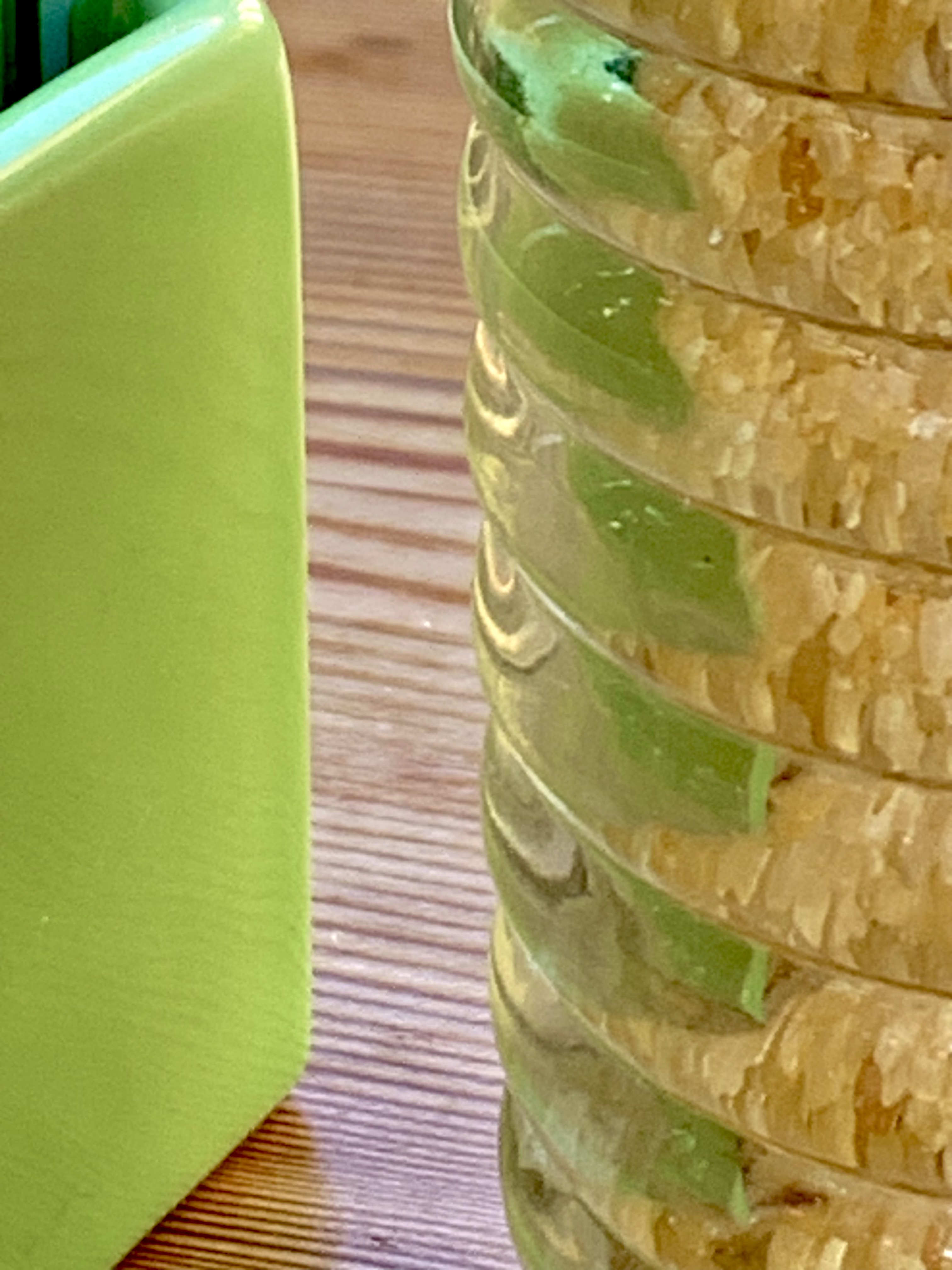
So, instead, I looked around for beauty.
As usual, I found it, at least to my eye.
Give it a shot. You’d be surprised where you can find beauty.
Fit in Bits suggests many ways to work more fun, variety, and exercise into daily chores.
Corn on the Cob is an essay on mindfulness and gratitude for simple things.
Fifteen Properties begins a series of posts about the fifteen properties that architect Christopher Alexander said characterized both natural beauty and good design.












































 petersironwood