Before we bought a new dishwasher, a new deodorant, or a new doodad, most of us would want to read some opinions from others about the dishwashers, deodorants, or doodads we were interested in. We would want to talk to some folks who had first hand experience with those dishwashers, deodorants, or doodads.
That makes sense.
We certainly wouldn’t buy a new dishwasher, deodorant, or doodad simply because the sales person said it was going to be great. Would we?
Democracy is a difficult and time-consuming deal. It’s frustrating. And, it is likely the worst form of government there is—except for all the others.
So, before we throw it out with the dishwater because someone tells us how great a dictatorship would be instead, it makes sense to see what has happened with some of the other dictatorships that went before.
There was Mussolini. It’s said that he made the trains run on time. But would we ever really know? No, because the one thing dictatorships always have in common is that they refuse to allow others to measure, comment, or critique on what’s actually happening. Free press? Gone. Independent monitoring agencies? Gone.
The complaint department in a democracy may not always seem to listen to your particular concern. The complaint department in a dictatorship sends you to prison. If you’re lucky.
How did Italy fare under Mussolini? According to the online Britannica, nearly a half million Italian civilians and soldiers died. And in return? Nada. How about Mussolini? Oh, yeah, that’s right—beaten to death by an angry mob.
Well, we can’t make a sound conclusion based on just one customer’s experience, right?
How about Hitler? After all, he promised to make Germany great and said his Reich would last a thousand years! That must have been a pretty cool outcome. Hitler, was famously responsible for about 6 million deaths in the Holocaust, but he was also responsible for needless deaths of German soldiers, the people who died at the hands of German soldiers, and many German and other civilians. And, how did that end for Hitler? Oh, yeah, that’s right. He committed suicide rather than face the defeat of his own making.
Stalin? Surely, Stalin did better. Right? Well…in a word…no. It’s complicated. Stalin was responsible for Russian deaths by war, criminal execution, starvation due to inept government, and neglect. Here’s a link if you’d like to try to disentangle it.
Then, there was Mao. He is generally credited with the death of about 40-80 million of his own countrymen. As is often the case with totalitarian dictatorships, it’s hard to know how many died of starvation due to ineptitude and how many died of intentional cruelty.
—————
Once upon a time, there was a bratty kid who wasn’t very good at tennis. And, because he wasn’t very good, he cheated. And because he wasn’t even a very smart cheater, he got caught. And because he didn’t like getting caught, he destroyed all the factories that made tennis balls and told everyone else that he had done it for them. And he promised everyone that it was just a cool thing and he would make tennis much, much better because he replaced all the tennis balls with ping pong balls and that they should therefore put him in charge of officiating all tennis matches.
And, he picked the winners and losers of every game. Those people who said he was amazing and wonderful and the best tennis player ever were allowed to win. And those people who said that was nonsense were allowed to lose. Some were arrested and said to have committed suicide.
OK, I guess the first thing to admit is that I’m totally in love with our dog, Sadie. So, my perceptions are incredibly biased. But in the account that follows, I will try to separate observation from interpretation in at least once instance.
From Sadie’s first puppy days with us, Sadie and I have played a lot of ball, most often with a tennis ball. (Sadie completely disdains Pickle balls, by the way). We have evolved many different games and variations. Perhaps at some future time, I might trace out the ontological tree of indoor and outdoor tennis games, played, at least for the most part, without a racquet by either of us.
For a time, we got in the habit of throwing a ball off the back deck early in the morning. Initially, the game was for Sadie to catch the ball while it was still in motion. She would begin dashing down the stairs of the deck in order to hit stride on the grass, make a sharp right turn into the driveway and catch the ball, if possible, in the air. Eventually, the garden had a baker’s dozen of balls in various places along the edge of the driveway. This led Sadie to invent a new game. (Yes, Sadie. It felt to both Wendy and me that this was her initiative.)
Rather than dashing down the stairs so swiftly that she could see whatever ball was most recently thrown because it was still moving, she now would wait until the ball was either barely rolling or had already come to a rest. Then, she would dash to the far end of the driveway and determine by smell which ball had just been thrown. Having watched the ball, the human observer on the deck could see which was the most recently thrown ball. Sadie would trot up to a group of balls in roughly the same spot and sniff till she found the correct one and then come racing back with it.
A few weeks ago, our Doggie School teacher brought out a “squeaky ball” — a tennis ball, but one that squeaks. It isn’t as bouncy as a “real” tennis ball, but it has the same shape, weight, texture as a “real” tennis ball—and because neither one of them is manufactured by General Motors, they are both the same shade of the green that everyone else inexplicably calls “yellow.” (I strongly suspect that the vast majority of people are anomalous trichromats without knowing it. This would explain why my judgement is so often at odds with that of others).
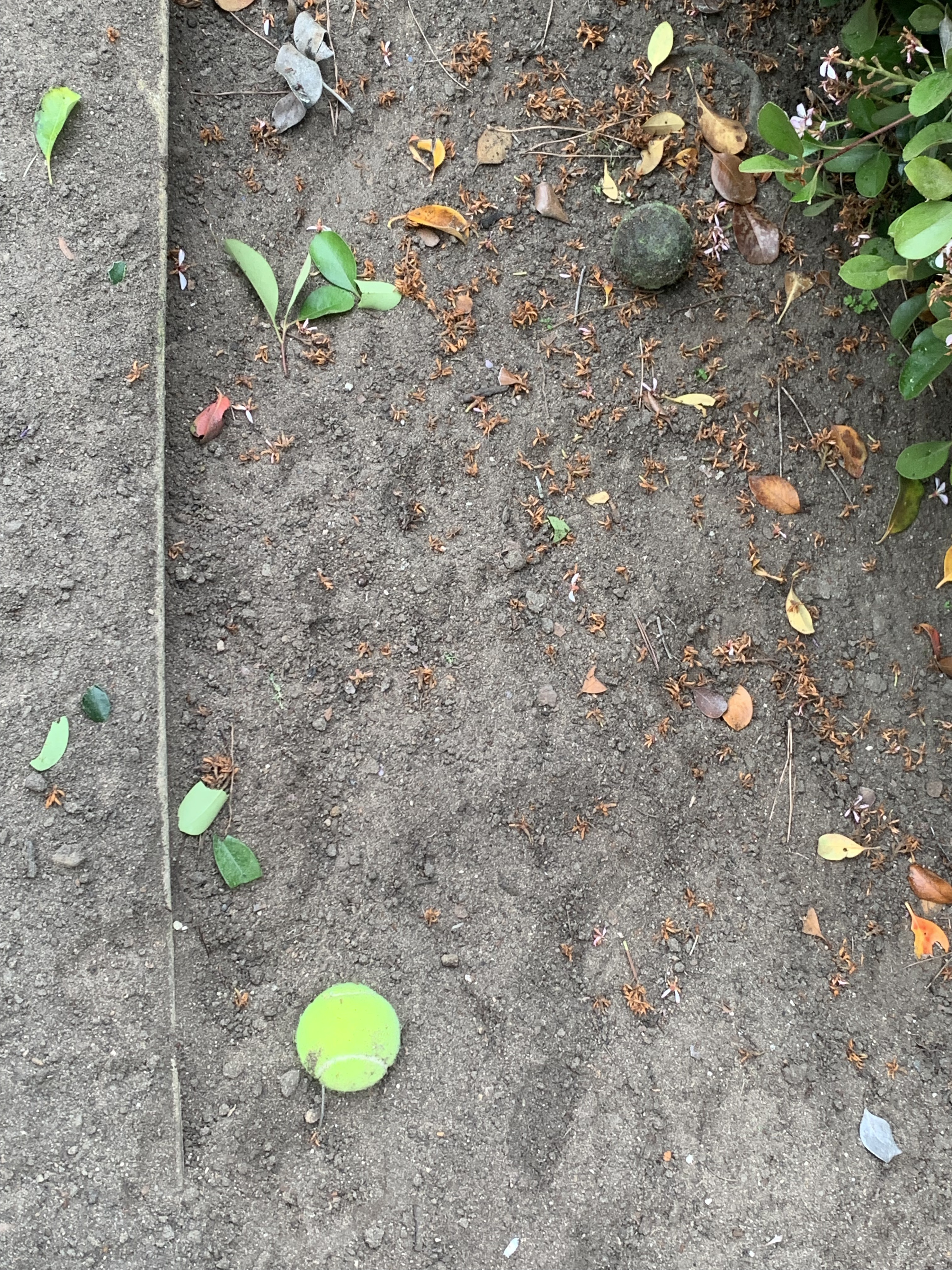
Sadie has taken a couple of the “squeaky balls” outside. In the last week, she’s started a new behavior. She digs a hole in the dirt with her squeaky ball beside her; then she rolls the squeaky ball around in the dirt; don’t rinse; repeat; again; again. I found myself thinking she was making it harder to see and grosser. But of course, that’s only from my perspective. What she’s actually doing is making the ball easier to distinguish visually from the others, especially at a distance. More importantly, she’s making the ball more findable by smell alone and she’s making the ball more interesting and more personalized.
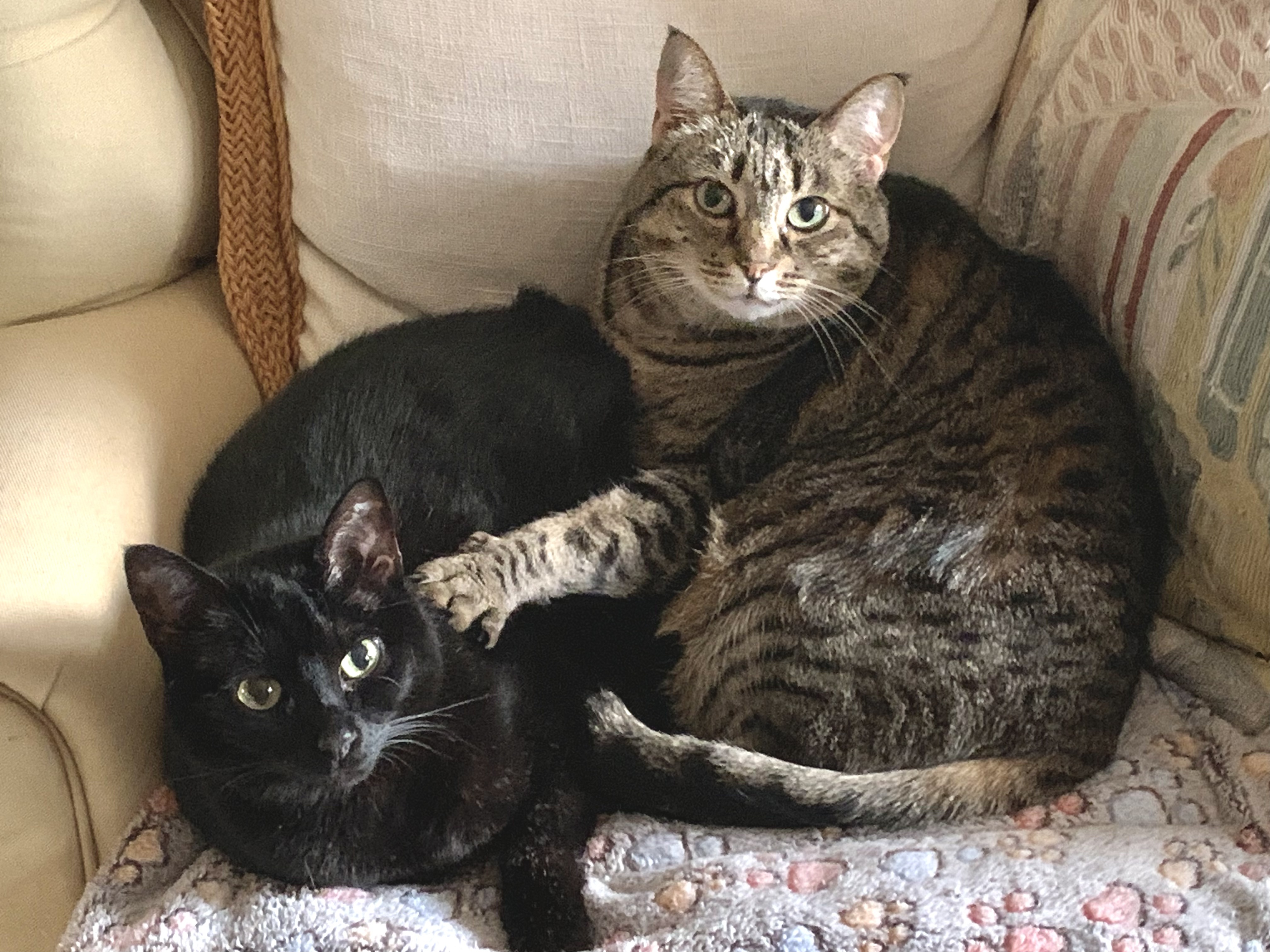
A person can train a dog (or other animal) to do amazing things. It takes patience and discipline. I’m not very good at either. But I’m also interested to see what emerges from a cross-species interaction where there is no pre-conceived “right way” or “end goal” that is envisioned and then imposed on the other. Don’t get me wrong. I’m perfectly okay with insisting she do her business outside and that she not eat the cats. But to me, it’s much more interesting to play ball with Sadie and see what emerges rather than “teach” her to play ball “my way.”
When I was a kid, we played “baseball” but it was rare we played on a regulation field and almost unheard of that we played with nine on a side. Typically, there were only somewhere between two and fourteen total. We invented all sorts of work-arounds. Sometimes, a team would have one of their own do the pitching and/or catching for the batting team. Sometimes, we would have to use “imaginary runners.” I get a base hit. The next batter walks. The next batter walks. Now, the bases are loaded! Yay!
The only problem: there are only three people on our team. Solution: The player on second would go to third to take my place and I would go bat. Now, if I got another hit and the real player who started on first made it all the way home, for instance, we could infer that the “imaginary runner” who started on second had made it as well.
We tend to think of the phrase “Play Ball!” As a unitary phrase. But it does have two components. Sometimes, I think it possible that we’ve become so competitive that when the umpire yells: “Play Ball!” We immediately think: Win! Go Team! I’ve got five bucks on this game!” And, in the context of professional baseball where it’s a multi-billion dollar business, that makes some sense. But in the context of kids (regardless of age) with dogs, or kids with kids, maybe we should hear:
We recently acquired a dog. Sadie. Brilliant and willful. Half poodle. Half golden retriever. She’s an amazing ball player. And not just in terms of her physical prowess. She naturally exhibits most of the advice in The Winning Weekend Warrior. She doesn’t worry. She doesn’t berate herself for past performance. She is confident she can catch any ball, and if she misses on the first bounce, she goes after the second bounce as though, not only her life—but the life of the entire pack—depended on it. And if she misses it on the second bounce and accidentally nuzzles fifty feet away, she still goes after the ball!
Before I wrote this essay, Sadie stood before me, staring those sad eyes into mine begging for another hour of ball-playing but I explained I wanted to write on the computer for awhile so she got up on the bed where she’s quietly chewing on a bone.
She and I communicate fairly well. Yet, it’s amazing how little they understand about human communication. Often, I wish I could communicate more fully. That led me to think about how to explain how humans use natural language in terms Sadie could understand. Thus:
———————
“OK, Sadie, humans (I point to my chest) like me use language in two major ways. One of those ways is to collaborate better by communicating meaning.”
Sadie barked.
“I know, Sadie, I know. I haven’t explained those words yet; we’ll get to it.”
Sadie barked.
Rather than try to clarify my previous statement, I thought it better to advance in the spirit of “appreciative enquiry” and so I said, “That’s right, Sadie! The second way that humans use language is exactly the way you use it, to bark at other doggies! Or, sometimes, just to hear themselves bark.”
Sadie barked.
“OK, I’ll give you an example. You know how the doggies next door bark incessantly whenever they’re out at the same time we are? You know how they spend their entire time jamming their teeth up against the fence to show how tough they are and bark as loud as they can meanwhile ignoring ten thousand things in their environment that are actually more interesting—or would be, if they gave it a chance? Well, that’s exactly how humans sometimes respond. And, it’s how they respond without any adaptation or learning.”
Sadie barked.
“Oh, yes, you’re right. Those doggies (I point in the direction of the better doggies) barked a lot when they first met you and they bark again when they don’t see you for awhile, but they wag their tails and come to greet you. Many people bark like that too. When they first meet someone different, they bark to keep them away and claim their property and their stuff. But when they realize that the threat is minimal, they become friendly and stop screaming.”
Sadie barked.
“Right again, Sadie. Sometimes doggies bark just because something is new or novel or different from what they’re used to. You yourself do this. The mail truck swings by. The gardeners leave a tool. It’s different and you bark. And lots of people are the same way. They bark when something’s different. It doesn’t even have to be a person. It can be a thing, a tool, a book, or even a thought. The difference is that you get used to the new situation and stop barking after awhile.”
Sadie barked.
“You know, I have given you lots of different tastes of things: kale, lettuce, squash, carrots, tomatoes, cooked potatoes, cooked broccoli, cucumber, raspberries, blueberries, strawberries, and lots of other things. And I tell you you can take it or leave it. You liked or tolerated everything on that list. But some people—to tell you the truth—the cats are much like this, but don’t tell them I said that—some people who have never tried, say, raspberries will bark at the raspberries and at me for offering them. ‘What?! Raspberries?! I’ve never tried one; never will! They look like a hive of deadly ladybugs to me!”
Sadie barked.
“Well, those are two of the most frequent categories, but there’s another that’s also quite common. They bark to upset themselves and others. It’s as though it isn’t enough to bark at the raspberries. That doesn’t really upset them very much. So they bark and bark and bark until other doggies in the neighborhood are thinking something like: ‘Invasion! Invasion! Set off the alarm.’ Others, of course, are more like: ‘Something’s out there we can hunt down and tear the guts out of! Come on! Let’s go do it!’ And that’s pretty much word for word what the human pack does as well.”
Sadie barked.
It’s amazing how much they understand about human communication.
The poem below is the song of a “character” who may appear in a Sci-Fi book tentatively titled “Alan’s Nightmare.” NYET stands for Networked Yoked Entertainment Tsar. This particular AI system has been inculcated with a penchant to look for win/lose opportunities and even for lose/lose opportunities, if the other side (the ‘enemies’) are likely to lose more. Its main function are to gather data on individuals in “free societies” and determine which sorts of invalid arguments are most likely to persuade them to do something against their best interest. It makes money by false advertising targeted to an individual and the momentary mood they may be in. Its real purpose though is to sow chaos in the free world by promoting random acts of violence. It finds conspiracy theories on the web and promotes them. Sometimes, it modifies them in order to ‘improve’ them. “Improve” in this case means to make them more believable by more people or to increase the probability of inciting violence.
The Song of NYET
The bloodier the better off I’ll be
They teach me how to lie and cheat and steal.
The people need to loath democracy.
And live to buy that sweetened sacred deal:
We’ll save them from imagined crime and strife
But only if they bow and scrape and kneel.
Divide and win with lies and guns and knife.
Too late they’ll see they’re ground beneath our heel.








































 petersironwood