• About PeterSIronwood

petersironwood

~ Finding, formulating and solving life's frustrations.

petersironwood

Monthly Archives: January 2026

Myths of the Veritas: The Fifth Ring of Empathy

25 Sunday Jan 2026

Posted by petersironwood in America, management, psychology, Uncategorized, Veritas

≈ Leave a comment

Tags

accuracy, beauty, diversity, empathy, fantasy, fiction, leadership, legend, life, myth, peace, planning, politics, power, religion, speed, story, style, truth, USA, Veritas, writing

IMG_4324

The day after the Prophesy Dream of She-Who-Saves-Many-Lives dawned clear and clean. The air smelled as sweet as ever and sweeter still to the shaman who had dreamt of a world of dirty air. The clear morning sun rainbowed on raindrops on every bush. Trees sported their first leaves of spring which are as various in colors as those of autumn but because the leaves are yet babies, She-Who-Saves-Many-Lives could see much more deeply into the land about her. It filled her heart with gladness even more deeply on this spring morn. She decided that she would share her dream with all of the Veritas, but only after she took the time to craft the telling so that each would receive the gift as she had — the gift of great gratitude. For she well knew that experiencing that dead white world as she had made her redouble her appreciation for the real world but that simply telling others about her dream would not be enough to gift them the same great gratitude. It would take time to decide how best to share her gift. 

Meanwhile, She-Who-Saves-Many-Lives walked to the main village to see who among “The Six Who See Through Animal Eyes” was already at work on their various tasks. The eyes of the shaman, though old, remained clear and her mind remained retentive so that as she passed through the village greeting this person and that person from among the Veritas, she observed many things both small and large. And, among the small things she noticed were a number of crushed ants. She looked around for Pond Mud but he was nowhere near. On a hunch, she decided to visit the place where she had shown Pond Mud the strength of ants. As always among the Veritas, and as she had been trained all her life, her footsteps were as silent as those of bobcat. Before she reached the clearing with the broken cabin, she could hear the angry voice of Pond Mud. And though the eyes of She-Who-Saves-Many-Lives were as clear as ever, she well knew that her hearing was not so good as that of a youth such as Pond Mud. As she approached, she could hear the tone of voice of Pond Mud become sweet and she greatly suspected that he had heard her coming despite her silent way of walking. 

He met her at the entrance to the clearing and spoke first, “Ah, She-Who-Saves-Many-Lives, it is good to see you. I am headed back to the village. I was just trying to learn more about ants though I well understand that I am no longer in contention for another ring of empathy. Such learning is still a good thing. Anyone can see that.” 

“I am glad to hear you say that. The statement is correct. Anyone can see that. Though some choose not to see. I hear that you have become still better friends with Alt-R. Is this so?” 

“Yes, She-Who-Saves-Many-Lives, we have been training together to become still better hunters. And, that skill, as you well know, also requires seeing through the eyes of animals. May I accompany you back to the village and I will tell you something of what I have learned?”

She-Who-Saves-Many-Lives wished to examine the clearing but decided it could be better done later while Pond Mud busied himself with other tasks. So, she returned to the village still feeling great gratitude for the fullness of the life around her. 

During this day, she observed the Six-Who-See-With-Animal-Eyes at their various tasks as well as much more. When Alt-R and Pond Mud, along with several other hunters, went to practice spear throwing, she returned to the clearing. Alas, her hunch had been correct. Pond Mud had not simply been observing ants; he had been systematically killing them. Even more disturbing, many had been tortured. And, even more disturbing than those actions, had been the dissembling of Pond Mud. He had known what she would like to have heard — that he had taken her lessons to heart. Her mood soured for this was the sort of deception that could destroy a village or indeed an entire tribe. It would have to be curbed very soon and most likely shared with the entire tribe. She held out some hope however, that the heart of Pond Mud could yet be turned to good. For if not, he would certainly be exiled, a rare and severe punishment which invariably lead to  a short and lonely life. 

fullsizeoutput_192b

As the delicate beginnings of spring gave way to the fullness of another summer, the tasks of the Six-Who-See-With-Animal-Eyes gave way from planning to building. Soon, the time came for all to recount their learning. When She-Who-Saves-Many-Lives saw that this was so, she called each of The Six to her as one. She asked each pair in turn to describe their experiences for she wanted to judge not only the maker but also the mentor as well as how they recalled events differently, as people do, and how such differences were resolved. The shaman also knew that each of The Six could learn from all these experiments in trying to use the way of how-to of another.

The first to report on their experience together were the hammock-builder, Fleet-of-Foot and his mentor, Trunk-of-Tree. According to Trunk-of-Tree, he first tried to show Fleet-of-Foot how he would make a hammock with great thought as to its longevity and strength so that it would last against time and some misuse. Fleet-of-Foot had resisted such advice and had immediately begin building the hammock. Six such hammocks had Fleet-of-Foot constructed over three days time and each such hammock had collapsed.

photo of hammock

Photo by Voicu Oara on Pexels.com


Fleet-of-Foot admitted that these hammocks had broken but he claimed it was because Trunk-of-Tree had given him faulty materials and bad advice. At long last, in frustration, Fleet-of-Foot had challenged Trunk-of-Tree to show him how he would build a hammock and instead, Trunk-of-Tree had spent an entire morning making tools, and laying things out, and not even starting on the hammock. Fleet-of-Foot grew impatient because obviously, Trunk-of-Tree had had no intention of showing Fleet-of-Foot how to build a hammock. When Fleet-of-Foot came back a few hours later, the hammock was finished. This they agreed upon, and as to its sturdiness, but Fleet-of-Foot was sure that Trunk-of-Tree had cheated by getting others to help him make his hammock. Otherwise, argued Fleet-of-Foot, how could slow Trunk-of-Tree make a hammock in a day when fast Fleet-of-Foot finished no hammocks in three days? 

She-Who-Saves-Many-Lives had much to say about this experiment, but she held her tongue and first asked the others from among The Six what they thought. After some long silence, Shade Walker said this, “I have known both all my life and have never known Trunk-of-Tree to cheat or lie. Fleet-of-Foot is fast; of this, there is no question. But he also sometimes rushes into things so quickly that he ends up taking more time. I have myself only made three hammocks so I am not so expert as Trunk-of-Tree and perhaps mine are not quite so sturdy but they were all finished in one day.” 

She-of-Many-Paths spoke next. “I have never made a hammock. But I have been listening to many expert craftsman in our village and every such has cautioned me to take the time to plan the work carefully. Whether it is making spears, making spearheads, making pottery, or baking bread, it is critical to ensure that you have a good plan; that you have chosen your materials well; that you have prepared and tested at each step along the way. So, I can well believe that Too-Fleet-of-Foot could charge off along the wrong path six times in three days while Trunk-of-Tree could take a more deliberate path to create a hammock in one day.” 

Easy Tears knew it was his turn to speak but did not wish to offend anyone. “I cannot really tell because I was not a witness to these recounted events. I believe that each told us of their own experiences as they now recall them. And, ultimately, both were successful because now there is a hammock that was not there before and Trunk-of-Tree served as mentor and judge.” 

She-Who-Saves-Many-Lives nodded to Eyes-of-Eagle who spoke carefully, molding the shape of her argument and the shape of each sentence and each word. “I find that trying to create something in the way of another how-to is a difficult task. So, it was with Trunk-of-Tree and Fleet-of-Foot. Fleet-of-Foot grew too quickly impatient and rather than trying to build in the way of Trunk-of-Tree instead built in his own way of how-to which was not sufficient to the task. Rather than learn another, more careful way from someone who knows and uses the careful way, he insisted on sticking with his own way though that way did not work. However, Trunk-of-Tree, though he took his time with the hammock, was likewise impatient with Fleet-of-Foot and ended up building the hammock himself which was not his assigned task.”   

{Translator’s Note}: In the original, these recountings, have apparently been preserved in great detail. Though scholars differ, I tend to believe the details are correct despite their being passed down orally because the Veritas developed many methods to ensure the accuracy of their traditional learning stories and because the details of their skills were vital to their survival. Since most modern readers have little little experience weaving baskets or making a hide tent, I omit much of those details in my summaries. Instead, I focus on the lessons learned and the decisions of She-Who-Saves-Many-Lives. 

Now, as was her way, She-Who-Saves-Many-Lives asked Fleet-of-Foot and Trunk-of-Tree whether they had found any further learning while listening to the comments of his compatriots. 

Fleet-of-Foot immediately began, “Wonderful comments. I learned much. However, the important thing is that I was asked to produce a hammock in the way of how-to of Trunk-of-Tree and such a hammock was indeed constructed. I caused that to happen by my actions so I believe I completed my task. Fast is good. But sometimes, the fastest way to accomplish something is to have someone else who is even faster do the job. Either way, faster is better.” 

IMG_3510

She-Who-Saves-Many-Lives stared at Fleet-of-Foot and sighed. Still, she did not speak. Instead, she turned to Trunk-of-Tree. The latter’s face flushed as he said, “Fleet-of-Foot is indeed impatient, but so was I. My job was to mentor Fleet-of-Foot in the way of how-to for strength and longevity yet after three days, I gave up and made the hammock myself. I believed that if I demonstrated to him that I could make the hammock more quickly by being careful and planning each step that Fleet-of-Foot would learn the lesson. I made this judgement based on my own way of how-to. I would have learned the lesson this way. But this is not the way of learning of Fleet-of-Foot. He is too impatient to learn in this way. He left even before I finished; in fact, barely after I had made preparations for the work. He believes I encouraged or cajoled others to help me, which I did not do, because I failed to teach him the slow and methodical way of how-to. So, I too failed in my task.” 

She-Who-Saves-Many-Lives again turned to “Fleet of Foot” and prompted, “And…?” Fleet-of-Foot answered thusly, “Trunk-of-Tree may have failed but I did not. We should see who else besides me deserves the next ring of empathy.” 

She-Who-Saves-Many-Lives chuckled. “I have dreamed of such a one as you, Fleet-of-Foot, and when the time comes, I will indeed, shrink our group as is befitting, as well as sharing my dream. I would now observe, however, that Trunk-of-Tree has shared a great learning for all of us. What would have sufficed for him to have learned the lesson of patience did not work for you. On the other hand, you have shown no learning whatever. The tree of your learning has not added a single branch or leaf so far as I can see. Fleet-of-Foot, you wished to win a race; lost the race; then showed no interest in discovering how you could have won the race. This is the way of “Fast-at-First-and-Slow-at-Last.” 

So, in turn, did each of the pairs recount their experiences and learnings. 

girl s orange dried fruits

Photo by Min An on Pexels.com

Trunk-of-Tree made a basket very slowly and carefully. Yet, no-one wanted to trade very much for such a basket; not nearly enough to satisfy Trunk-of-Tree’s desire for compensation for so much time spent. Easy-Tears had been quite content to watch the strong hands of Trunk-of-Tree working the reeds over and under and through. It had been quite mesmerizing. She had said almost nothing during the making, but when Trunk-of-Tree found no-one willing to trade much for his basket, she showed Trunk-of-Tree how the addition of a some brightly colored dyes in a pleasing pattern changed such luck and how such additions made his sturdy basket much more desirable in the eyes of the clan. Trunk-of-Tree had been quite surprised at this common reaction. He had thought the purpose of a basket was to hold things and this goal he had accomplished quite well. However, Easy-Tears had shown him how just a little extra work, though not making the basket stronger or more functional, could greatly increase how badly others wanted such a useful basket. 

Shade-Walker and Eagle-Eyes recounted their adventures in jug making. At first, Shade Walker had mainly loved the feel of the wet clay spinning through his hands. With the hands of Eagle Eyes guiding his, however, he learned to enjoy the sight of the evolving shape as well. In the end, both had gone on to make a series of beautiful jugs. Eagle Eyes had ended up loving the feel of the wet clay, although what she had loved the most was the feel of Shade Walker’s fingers, she admitted. 

Eyes-of-Eagle explained that she found if very difficult to make a dream catcher under the tutelage of Fleet-of-Foot since she herself had wanted the end result to be beautiful and Fleet-of-Foot kept encouraging her to proceed more and more quickly. However, as Fleet-of-Foot at last perceived that his constant encouragement toward ever more speed made Eyes-of-Eagle both more error prone and more testy with him, he instead encouraged her by telling her that she was amazingly fast. Everyone could see that Fleet-of-Foot was again interested in speed; however, in this case, his interest had been more in speed of becoming more intimate with Eyes-of-Eagle than in the speed of making a dream catcher. 

background beautiful cloud clouds

Photo by Pixabay on Pexels.com

She-of-Many-Paths told of how she had wanted to make a tent for Shade Walker. Shade Walker had liked watching her and had asked if she were enjoying the process of making the tent. She had blushed — and had said that she was very much enjoying herself. After they get over their awkwardness, they had talked about the various ways of how-to and had decided together that being grounded and having a satisfying process are very much akin. Though these are different ways of how-to, one helps provide the other, they had surmised. This they shared with The Six and the shaman and all had agreed. 

Upon recounting and subsequent questioning, all learned that Easy-Tears had wanted the travois to be popular and had difficulty even understanding what She-of-Many-Paths meant by constructing a travois so that it encouraged a “grounded” view of life. Easy-Tears had been watching She-of-Many-Paths and Shade-Walker for some time however, and decided that what She-of-Many-Paths really wanted was Shade-Walker. Easy-Tears suggested that if She-of-Many-Paths wanted Shade-Walker, it would be best for everyone to be done quickly with the travois project so that She-of-Many-Paths could spend more time with Shade-Walker who had lately been spending much time with Eagle-Eyes, their long fingers inter-twined with those in the wet clay which they shaped together. In return, Easy-Tears had promised to teach She-of-Many-Paths the path to popularity and thereby to further increase the interest with which Shade-Walker would view She-of-Many-Paths. 

At the end of day, after every such recounting and dialogue, She-Who-Saves-Many-Lives quietly took out a small, folded deerskin. This deerskin held a number of rings of hemp woven into a complex, repeating, yet ever-changing pattern. “The time has come,” she began, “to chose which among all the Veritas is ready to take on the next challenge. All of you have done well and should now be more of a contributor than ever to the Veritas. I have challenged you in many ways to see and feel as others do. In this, you have all shown much skill in the ways of empathy.”

“As you know, each of us is a small leaf on the very large Tree of Life, a tree that has been growing and expanding through all of earth. We are all connected: the people who are the Veritas, other people, other animals, every bird, every plant. We are all connected. With empathy, you may be able to tune in to the tree itself. As you have observed, when we sing and play music and dance, the self-same beat is in everyone and every drum vibrates. If two strings are of the same length, and one is plucked the other may also vibrate. The life in all is in all.

“Learning to tune in to the music, to the beat of another person, or to the great Tree of Life is a great gift to be greatly encouraged. However, you must understand that this is the Tree of Life itself that you are tuning into in order to understand others. When you do such tuning in, you must do so for the good of others, for this great Tree of Life. If instead, you tune in only to serve your own ends, you are using the Tree of Life in a way that destroys the tree itself. Empathy is a way to make us whole. It should never be used to divide us. 

IMG_5295

“Fleet-of-Foot, you had some ability to understand the way of Trunk-of-Tree. This knowledge you used to subvert the task at hand. You therefore emerged from the womb of this great opportunity for you to have learned patient working instead unchanged. You also used your understanding of Eyes-of-Eagle, not to help her learn other ways, but to flatter her to try to get her to become closer to you. Ultimately, this way of using empathy always pushes others away. Some may understand quickly and some may take years. But ultimately, tuning in to the Tree of Life in order to bend it to your own purpose will fail for you. It may also, as shown in my dream, cause the Tree of Life itself to fail. 

“Easy-Tears, you were honest and helpful in your work with Trunk-of-Tree. You helped him to understand in a deep way that the surface beauty of something, while it may not be of much value to him, is nonetheless of value to others. In this, you did well. However, you tried to use your knowledge of the affection that She-of-Many-Paths has for Shade-Walker to try to get her to accept your lack of being able to understand the way of how-to of grounding every action. She-of-Many-Paths saw through this ruse and told us honestly of what happened. Yours was also a misuse of empathy. You were not primarily interested in helping She-of-Many-Paths as you claimed, but were more interested in getting your task finished. Moreover, if you really understood deeply Trunk-of-Tree and She-of-Many-Paths, you would see that a surface popularity is not what draws them together. Rather, they are being drawn together by the Tree of Life itself; e.g., their own future children.

“Please understand. Your own ways of how-to are each valuable. And you are all skilled in empathy. For now, I bestow the Fourth and Fifth Rings of Empathy on only those who tune in to the great Tree of Life to help the great Tree of Life. If I become convinced at some future time that others have also learned this great lesson, they too may receive the Fourth and Fifth Rings. For now, please come to me to receive your rings for you have earned them.”

Trunk-of-Tree, Shade-Walker, Eyes-of-Eagles, and She-of-Many-Paths each came in turn, knelt before the shaman and received their double rings. Each such person had much to think about and they walked back to their lodgings in silence.  

IMG_3518

  ——————————————————

Author Page on Amazon

How the Nightingale Learned to Sing

Roar, Ocean, Roar

Imagine All the People

The Dance of Billions

The Orange Man

Pattern Language Summary

At Least He’s Our Monster

The First Ring of Empathy

The Second Ring of Empathy

The Third Ring of Empathy

The Fourth Ring of Empathy

Travels with Sadie Teamwork

The Walkabout Diaries How Beautiful and Green

Somewhere a Bird Cries

Corn on the Cob

The Self-Made Man

Math Class: Who Are you?

Myths of the Veritas: The Fourth Ring of Empathy

24 Saturday Jan 2026

Posted by petersironwood in management, psychology, Uncategorized, Veritas

≈ 1 Comment

Tags

collaboration, cooperation, diversity, empathy, family, fiction, leadership, learning, life, management, myth, Storytelling, strategy, tactics, teamwork, tests, trials, truth, Veritas, writing

agriculture basket beets bokeh

Photo by Pixabay on Pexels.com

As was their wont, the Veritas celebrated each day but celebrated especially the completion of the harvest of the fullness of the fall. She-Who-Saves-Many-Lives, She-of-Many-Paths, Eyes-of-Eagle, Shade-Walker, Pond Mud, Alt-R, and all those who sought the rings of empathy and all those who did not participated as best they could in the harvest and in the celebration, for both harvest and celebration, they all knew, proved vital to the life of the Veritas. 

The Veritas likewise celebrated the first snow, and She-Who-Saves-Many-Lives spent the winter carefully observing all among the tribe and especially the Six-Who-See-With-Animal-Eyes. She also began devising the next trial. And among the Six-Who-See-With-Animal-Eyes, all awaited the call to the next trial. One among those six, named Trunk-of-Tree, waited in stillness like the sleeping trees, silently wondering what the next test might be. One among those six, named Fleet-of-Foot, waited like a cloud letting the winds of chance and fortune shape his days and his thoughts. But four among those six, did not wait for the next words of She-Who-Saves-Many-Lives to prepare for the next test. 

She-of-Many-Paths continued to study the Wolves and as she learned more about them, she became less afraid of them and they became less afraid of her, so much so that she observed them mating. When she observed this, she somehow wished that Shade-Walker was watching with her although this wish struck her as a strange one and her cheeks grew flushed. 

animal animal photography canidae canine

Photo by Pixabay on Pexels.com

She-of-Many-Paths did not limit herself to trying to see through the eyes only of Wolf. In the long dark evenings of storytelling, she listened to the tales but tried to imagine each one through each being in the story, whether human, animal, lake, cloud, or tree. When she helped with harvests or any other task of Fall or Winter, she would try to learn from the wisdom of those who had done such tasks many times before. Some in the tribe jokingly though lovingly began to call her, She-of-Many-Questions. 

Likewise, Eyes-of-Eagle continued to observe Eagles though her real passion had become shapes and what they signified. She wondered, among many such wonderings, why Acorn had a sharp point on the bottom. She tried dropping acorns in various ways and if they were dropped from sufficient height, they always landed point down. She imagined that she was a mighty oak and that the acorns were her babies. She liked it when they landed point down. It seemed the right thing. 

OLYMPUS DIGITAL CAMERA

OLYMPUS DIGITAL CAMERA

Eyes-of-Eagle watched also how water flowed around rocks. She discovered how to make dams and watched what happened when the dam was removed. She looked at the legs of running animals including her tribe-mates and saw how cleverly the shapes of all such legs flowed by each other without catching on each other. She saw the ways in which every snowflake was the same and the ways in which every snowflake was different. Eyes-of-Eagle also took notice of the changing shape of Shade-Walker whose arms and legs had become adorned with larger muscles. 

Likewise, Shade-Walker became obsessed, not only with Snakes, but also with light and also with heat and how light became heat. He imagined what it was like to be light and what it was like to be heat. He noticed as well how many, but not all, animals and plants slept a long sleep when light and heat were less. He noticed how each animal and even sleeping plants made their own heat even when there was no light. He became more convinced that Snake could feel the heat of animals from a much greater distance than he himself could. In his noticing of heat and light, Shade-Walker began to notice the way that sunlight played in the hair of She-of-Many-Paths and in the hair of Eyes-of-Eagle. The sunlight in their hair brought warmth to his own body, and this he found mysterious. 

woman standing near body of water

Photo by vung nguyen on Pexels.com

He whom the tribe called Easy-Tears continued to observe Squirrel. He was surprised to learn that Squirrel seemed to forget many of the places he had saved acorns and hickories and butternuts though he himself recalled each such one he had seen buried. He began to wonder whether Squirrels had their own language. When eagle, hawk, or owl flew nearby, it seemed to Easy-Tears that the first Squirrel who saw such a Squirrel-eater would warn the others. But was the chattering just a general warning such as “Beware! Beware!” or did the warning say where to look as well or say how far away such a Squirrel-eater was? Easy-Tears marveled at the way Squirrel could leap from branch to branch, just catching on to a far tree and nearly but never falling. On one such marveling however, during a thaw, he saw one such unlucky Squirrel miss a very high branch and fall onto a hard rock. This was a fall that Unlucky Squirrel did not recover from. Then, Easy-Tears watched through the thick boughs of a scented cedar as all of the friends of Unlucky Squirrel came to circle around him and look upon Unlucky Squirrel in chatter-less and respectful silence. 

squirrel on tree branch

Photo by Yigithan Bal on Pexels.com

She-Who-Saves-Many-Lives observed or otherwise knew how each of the Six prepared themselves, or not, for the next trial. But, this was not the limit of her knowledge and observations. She also followed with some close attention Pond Mud and Alt-R as well. Though both had failed the third test, their reactions were quite different. Pond Mud took no further interest in learning about ants. Indeed, he was often seen taking such a small person as an ant and crushing her between his fingers as though to prove his superior strength. This and his other actions indicated he was feeding the “Bad Wolf” within. He sometimes used his superior strength, not for the good of the Veritas, but to force his will upon others. Pond Mud seemed to think little of how he appeared through the eyes of Ant or indeed through the eyes of any other among the Veritas. 

Alt-R however, seemed to realize that, smart as he was, he did not know all things and set himself to learning from the best weaver how to weave and from the best stone chipper how to chip stones and from the best tree hewer how to fell trees. In this way, he gradually learned how to see more clearly through the eyes of others. The Shaman felt that perhaps she had been too hasty in her judgement of Alt-R. She would continue to watch him with careful eyes and a careful heart.

At last, the icy snows and winds of winter withdrew and the speckled red and green heads of Skunk Cabbage appeared in the swamps and likewise, the slender rods of Garlic and Onion began to welcome the spring sun though their roots lay beneath melting snows. When at last, no snow or ice remained except on mountain peaks and in shady caves, She-Who-Saves-Many-Lives called the Six-Who-See-With-Animal-Eyes to her. 

background beam beautiful close up

Photo by Pixabay on Pexels.com

“As you all know,” began the Shaman, “the animals of the air, and the lakes, and the forests, and the plains are all different and each has their own skills and their own ways of knowing and seeing. So too, even among the Veritas, there are many different skills and many different ways of knowing how-to. Indeed, even among you six, I have observed that you have different flavors or colors of how-to.”

{Translator’s Note:} What follows is necessarily a very loose translation. The Veritas apparently had many words to describe the quality of what was made as well as how it was made. No-one to my knowledge has determined precisely how the various mind sets relate to what happens in terms of either what is produced or the experience of the production. I am not sure, for example, whether the word for the way of how-to for Fleet-of-Foot necessarily implies a sloppy end result as well as a result achieved quickly.  

“Among you Six, Fleet-of-Foot likes to run quickly. But so too, does he do everything quickly. He has learned to gather acorns quickly. He has learned to weave quickly. His tongue is as quick as his feet as you have all no doubt noticed. 

“Trunk-of-Tree is much slower and stronger, but he also has learned the how-to of building, weaving, and spear-making to be strong against winds and winter and many throws. When, he speaks, he speaks slowly and carefully but with purpose.

“Easy-Tears wants everyone to be happy to save his own tears. He therefore has learned the how-to of making things that all or many will like immediately. So too, when he speaks, he is careful not to offend but to make everyone like what he is saying. 

“Shade-Walker has learned the how-to of making things so that the making itself is a pleasurable thing. This too is a valuable how-to as are all such ways in different circumstances. 

“Eyes-of-Eagle has been learning the how-to of making things beautiful.”

Now, Fleet-of-Foot spoke, “Which among all these many ways of how-to is the best though? Surely, it is always best to make all things as quickly as possible. Isn’t that what all should be learning?”

“Each way of how-to is best under different circumstances, Fleet-of-Foot. There is no best part of a tree. Without roots, the tree will die. Without bark, insects will eat the tree. Without leaves to welcome the sun, tree will die. Without nuts, fruits, or cones, tree can have no children. Every part is different, but each is important.” She-Who-Saves-Many-Lives looked at each of the others in turn. When, she came to She-of-Many-Paths, their eyes held and She-of-Many-Paths began to speak.

“So it is also with Wolf. Without legs, Wolf cannot run. Without eyes, Wolf cannot see. Without a mouth, Wolf cannot eat. Without ears, Wolf cannot hear. Every part is vital. I see this clearly, She-Who-Saves-Many-Lives, but I am not so sure what my how-to skill is. I think all of these ways of how-to are vital.” Then her eyes silently questioned the Shaman.

IMG_3316

She-Who-Saves-Many-Lives smiled with her gentle eyes at She-of-Many-Paths as she answered. “Each thing we make comes from the earth; comes through the people and their work; comes to those who use such things and everything returns to the earth once again. When you take reeds from the Lake of Reeds and weave a basket, the basket is a gift from the earth and the lake and also from your own labor. Your labor is also a gift from those of our ancestors who learned how to weave. I think your own way of how-to is to make such a connection clear so that each such person who uses your basket or throws such a spear as you make is quite aware of that connection. Such a basket or spear feels good in the hand but it also feels good in the way it connects the person and therefore all of the Veritas to the earth and all of us, living and dead.” 

She-of-Many-Paths had never had such a clear vision of her how-to calling, but when she heard it, she felt her heart quiver. This, she now realized, had always been in her heart as she did things and made things. Each day she had seen more and more clearly how all things were connected and that all the people were connected. A gift, she thought, should make those connections clearer to everyone else. The image of Pond Mud and his well-muscled body came to mind and she wondered whether she could construct such a gift as to make him see how he was connected to all so that he would stop trying to bully smaller boys and stop crushing ants to no purpose. 

She-Who-Saves-Many-Lives continued, “Each of you has began exploring a different way of how-to. As you grow in experience, you will learn more about your own path. You began on your path patly because of your own nature. And partly you began on this path because of circumstance. As you learn, people will come to know you and seek you out according to your special way of how-to. Over time, you will become more and more expert at your particular way of how-to. This is good. All of these are appropriate or less so according to circumstance and task. However, it is also good that you learn at least something of the way of how-to of some other person. This has many benefits for you and for the Veritas.

IMG_5295

“It will be good for you in the very process of trying to do something according to someone else’s how to. It will stretch your mind. You will also be better connected to someone else for having tried to use their how-to skills. In the future, in some cases, it will be necessary to make something for the people that makes use of more than one of these skills in order that it may most benefit all the Veritas. It may also be that in such a working together you may discover a new way of how-to that none yet know. Between two paths in the forest, another path may be laid. In a storm, a river may take a new path. Therefore, listen as I tell you your next trial.

“Fleet-of-Foot, your task will be to create a hammock with the way of how-to of Trunk-of-Tree to his satisfaction and with his guidance.

“Trunk-of-Tree, your task will be to create a basket that will be as instantly popular as though it were made by Easy-Tears himself.

“Easy-Tears, your task will be to create a travois that will be as grounded and mindful as one created by She-of-Many-Paths.

“She-of-Many-Paths, you will make a hide tent to the satisfaction of Shade-Walker.

“Shade-Walker, you in turn, will devise a set of fine clay jugs that will delight the sense of beauty of Eyes-of-Eagle.

“Eyes-of-Eagle, you will make me a new dream catcher with the how-to ways of Fleet-of-Foot. 

IMG_3462

“Each of you will help any of the Six with any asked questions and observations. But the work itself must be done by the person assigned. I may observe you from time to time and I may not. When a task is finished, you are to show me the finished work in pairs for I want to question you both. At such time as all six tasks are done, I shall then determine how many of the six of you will pass on to the next trial. It is even possible that some may join in the next trial who did not participate in this one. 

“Do not be deceived. This is a more difficult test than you might think. You may fail by not satisfying your judge. But you may also fail by not helping sufficiently the person you are judging. And, both of your pair may fail if I feel that your judge has not been sufficiently strict in his or her critiques. Go now in peace. I look forward to seeing these artifacts designed and built with the way of the how-to of another.”

IMG_3496

The protégés returned to their own lodgings. They began their walk in silence but by the time they returned to their lodgings around the central fire, they were talking excitedly about their plans and all were resolved to begin at dawn. 

She-Who-Saves-Many-Lives returned to her cabin smiling. She badly needed a new dream catcher, for lately, her dreams had been disturbing indeed. Well, soon enough, that would be fixed. She drifted off wondering why it was so difficult to explain that all of the ways of how-to had their place in different circumstances. It seemed quite obvious to her, but this had not been  so obvious to the Six, with the exception of Many-Paths. Well, they are yet young. She noted too that they were becoming quite aware of the presence of particular others among the tribe. All part of life, she thought. The Shaman began to imagine a world where the ways of how-to are all one way. She-Who-Saves-Many-Lives dropped off to sleep and began dreaming of a world in which everyone made things only using the how-to way of “Fleet-of-Foot.” It was not a peaceful dream. 

IMG_9414

————————————————————-

Point your magic arrow here and click to discover other possible worlds.    

The Walkabout Diaries: Variations

The Walkabout Diaries: Life Will Find a Way

The Walkabout Diaries: Sunsets

The Walkabout Diaries: Symphony

The Walkabout Diaries: Bee Wise

Travels with Sadie: Tolerance

Travels with Sadie: Teamwork

Travels with Sadie: Taking Turns

Where Do You Draw the Line?

Your Cage is Unlocked

Somewhere a Bird Cries

Where Does Your Loyalty Lie?

Pattern Language Summary

Fifteen Properties


Myths of the Veritas: The Third Ring of Empathy.

23 Friday Jan 2026

Posted by petersironwood in America, psychology, story, Uncategorized

≈ 1 Comment

Tags

cooperation, emotional intelligence, empathy, fiction, hubris, humility, leadership, learning, life, love, myth, power, teaching, truth, writing

IMG_8089

When the full moon rose after the hottest days of summer had passed, She-Who-Saves-Many-Lives summoned the Eight-Who-Feel-Another’s-Hunger to a great council fire at their customary places. “You have served your tribe well and each of you has grown even since the first such trial. A new challenge awaits you. At your place, you will find a small piece of deerskin and upon that deerskin the picture of an animal. That animal you will observe, copy, learn from, speak too, listen too, come to love as one of your very own family. I want all those who live near you to understand your tasks as well so that they may not impede your study. 

“The full moon is here. There shall be another. And another. But on the third full moon, we will reconvene our council fire. You shall indeed share your knowledge gained from this challenge with all the tribe. And, then, I will question you separately to determine who shall win the Third Ring of Empathy and be so invited to the next trial.” The entire council including the Eight-Who-Feel-Another’s-Hunger left as well, all save Pond Mud, who politely asked the favor of a question. 

ant

“Oh, She-Who-Saves-Many, I fear that though my muscles may be strongest among my peers, my powers of perception are yet weak, for I looked upon this deerskin and it appears that it may be an elk, that it may be a deer, it may be bison, but it most looks to me like…like an ant.”

She-Who-Saves-Many-Lives laughed, “It is not your perception, my young friend; it is my lack of artistic skill, though you are indeed correct. It is an ant. Now, go forth and study her for three moons.” 

“But, they have nothing to teach; they have no power; they have no thinking; they are teeny insignificant things that are simply a pest.”

“My decision is final, Pond Mud. I only sought to aid you in removing your uncertainty. If you become Shaman, you may devise tests as you see fit.”

Pond Mud bit his lip and turned away though a slight shake of the head did not go unnoticed. 

The Shaman therefore spoke once more: “You are judging the ant, though you have not studied the ant. You know almost nothing about them. Spend three moons watching and learning and then we will see whether I have given you something unworthy of study.” 

So it was that the Eight-Who-Can-Feel-Another’s-Hunger began their various studies of Ant, Eagle, Possum, Tiger, Snake, Squirrel, Horse, and Wolf. On the moonrise of the next month, She-Who-Saves-Many-Lives bestowed on each of the eight a mask suited for the animal that they were studying. She suggested that they may want to spend some time each day trying to imagine what life was like through the skin, nose, ears, and eyes of that creature and the using the mask might help in this endeavor. 

IMG_3192

So it was that on the third full moon, each of the eight was ready to give an account of what they had learned before the entire tribe. And, it was so. 

{Translator’s Note}: The actual legend is filled with minutia for every single one of the eight animals. It’s not surprising that such detail would be included for these specific details about each of these other creatures could spell the difference between life and death for the student or possibly even the entire Veritas people. They took the time to find out about the world and pass on every detail they could to their offspring. Education was a serious business that everyone respected as crucial to their very survival. We live in a different world, however, and therefore I am only translating the first and most obvious thing or two about each animal. 

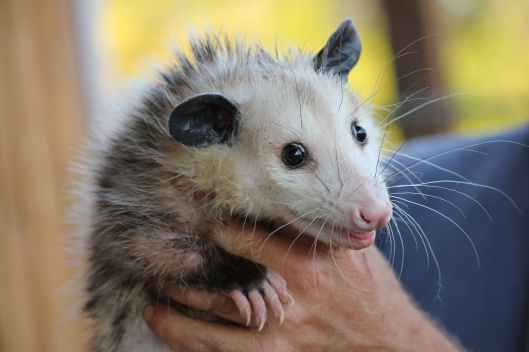
First to speak was Alt-R who spoke of some of the cleverness of the opossum such as keeping their unprotected ones close by, of hunting at night when they had less worry about those who might harm them, although on balance, they seemed quite stupid, concluded Alt-R. 

Next to speak was She-of-Many-Paths. She spoke with such passion and in such vivid detail that the children, and the youth, and the married, and the old of the tribe all listened in fascination and learned much about Wolf. Not just the Shaman but all could feel that indeed, she had come to love the wolves. She spoke of they way they hunted together and took turns chasing down prey until that prey was exhausted. She spoke of their social order and how they communicated and how they kept the peace among themselves. “And,” she concluded, “I’m just getting started! There is so much more to learn!” 

Eyes-of-Eagle had been assigned the Eagle. She spoke of how the eagle changed it very shape according to the task at hand. 

“When an Eagle wished to soar on the winds it spread its wings as far as possible and flattened its chest and tailfeathers. When it spotted prey below, after a few strong thrusts of its wings, it folded them tightly and made itself nearly into a teardrop. It fell like a rock, only shooting out its wings at the very last possible moment to arrest its fall and save its life and at the same time twisting just so onto the back of rabbit or squirrel or mouse!” This much was known by the adults of the tribe, but Eyes-of-Eagle had many more  details to share on the subject. It was clear to all in the council that she had been aptly named. 

IMG_5663

Shade-Walker spoke next of his observations of snakes. Like he himself, he had noted, the activity of a snake is much determined by the heat of the sun. But Shade-Walker then said, quite unexpectedly, that he believed that snakes could feel the heat of their prey just as we can feel the heat of a fire or the heat of another’s skin if it’s quite close. Shade-Walker noted that a snake too can change its shape. Some can unhinge their jaw and some are able to swallow their prey whole because they can make that change. 

Initiates also spoke of their many observations of Tiger, Squirrel, and Horse. 

Last to speak was Pond Mud. He still viewed ants as unworthy of study because they were weak enough to be crushed in his fingertips. However, he had noticed a kind of war between black ants and red ants. 

“Somehow, an anteater became aware and filled his belly on the fighting ants. Normally, ants are keen to sense a nearby enemy, but in the heat of battle, they didn’t seem to see the anteater at all! He seemed the only beneficiary of the ant war.” 

Most of the adults in the council were quite convinced that two more would-be inheritors of Shaman-ship would be dropped from consideration and that these would almost certainly be POND MUD and ALT-R. Sadly, they seemed not to understand the value of creature so different from themselves. 

Indeed, it was so ordered and came to pass. 

The next day, She-Who-Saves-Many-Lives summoned Alt-R to see her. “I have a game for you to try your luck at. Do you accept this challenge?”

“Is this part of the test? Everyone seems to think I lost. Is this a chance to redeem myself?”

“Do you accept this challenge?” 

Alt-R said, “Yes, I accept. What am I to do?”

“I have three cups. You choose one of the three. You will have 100 chances to guess and we will see how many acorns you acquire,” explained She-Who-Saves-Many-Lives.   

So, the game began, and every time Alt-R thought he had at last figured out the rule, he proved wrong on the next guess or the one after that. At long last, the 100 chances had all been used up. Alt-R had managed to obtain 11 acorns and felt very frustrated. Alt-R searched the face of She-Who-Saves-Many-Lives but saw no hint of the rule. 

“Has anyone figured out your rule? Has anyone done better?” asked Alt-R as politely as he could in his state of frustration.

“Yes, indeed, I’m must say, that someone did indeed do much better. In particular, one of my friends was able to gather 34.” 

Alt-R was taken aback, but he was still curious. “But then no-one has gotten all 100? No-one has really figured out the rule?” 

She-Who-Saves-Many-Lives cocked her head to the side and her endless brown eyes looked into the heart of Alt-R. “Who said there was a rule?” 

“Who…? I mean, there has to be a rule, right? How did you know how to switch the acorn each time and mostly fool me?”

She-Who-Saves-Many-Lives lowered her voice and looked down. “Who said there was an acorn every time?” 

“But…! You said…I don’t understand? How did someone gather 34 then? Who was this one who outguessed me three to one?”

She-Who-Saves-Many-Lives looked at him long and hard watching him go through the possibilities in his head. Some he gave voice to. Was it this young man? Was it this young woman? Was it this elder? At last, he ran out of likely possibilities.

“None of those, Alt-R, it was the very creature I asked you to study. The possum.” 

“WHAT?” shouted Alt-R, against all protocol. “I was outsmarted by a possum? That’s impossible!”

“Not at all impossible, Alt-R. It happened. The reason is quite simple. You looked at this as a test of how smart you were or how much empathy you had. You assumed there was one acorn per trial. You assumed that there was a rule. And then you spent all your time trying to determine the rule. What did possum do?”

Alt-R frowned, “What did possum do? How could I possibly know?”

black brown and white animal

Photo by Pixabay on Pexels.com

“You couldn’t. Because you didn’t follow my advice and learn to know possum and how he felt about things, what he smelled about things, what he saw, how he loved, and feared, and died.”

Alt-R hung his head. This had not really been a test. This had been another teaching – a teaching that taught him that he should have followed the first teaching. “You are right, She-Who-Saves-Many-Lives, but I still don’t see how possum could have done better than I did.”

The Shaman explained, “You came in here and made assumptions. You were trying to find the acorn each time assuming that there was one. You were trying to figure out the rule. About one third of the time, I put an acorn in a cup. When I did have an acorn, it was always in the one left-most cup. After two acorns from the left cup, the possum always chose the left cup, most often being wrong but 1/3 of the time being right. You came in hungry for rules and assumptions. The possum came in hungry for acorns.” 

“Thank you, She-Who-Saves-Many-Lives.”

“Please return tomorrow night, Alt-R, for I have one further lesson.”

The next morning, She-Who-Saves-Many-Lives summoned Pond Mud, for Pond Mud, like Alt-R, had another few lessons to learn. 

“Come, Pond Mud, I have a simple task for you. You are one of the strongest young men in the village. Is that not so?”

“Well, She-Who-Saves-Many-Lives, I do not know but I have overheard some say that, yes.”

“So, Pond Mud, you value physical strength. Is that so?”

“Yes, indeed, She-Who-Saves-Many-Lives! That is why the ant…well, we will not speak of that.  Anyway, yes, I am strong and I value physical strength.” 

“Good, Pond Mud, then you will have no trouble with this small task. I would like you push over that old cabin. I wish to build a new one.” 

“Well, She-Who-Saves-Many-Lives, I am strong but … I mean the cabin is well-built…it is meant to withstand snow and wind and you want me to try to push it down?” queried Pond Mud. 

“No, I want you to actually push it down, not try to push it down. Proceed.” 

Pond Mud walked over to the cabin and walked around it looking for a possible flaw or weak point but found nothing. He braced himself and pushed with both hands but nothing moved. He turned his shoulder to the edge and pushed but nothing moved. He lay on his back and pushed with his legs but that slid him backwards. He found two giant boulders and rolled them near the cabin and used the boulders to brace himself and pushed with both legs. He could not budge the cabin. He looked at the boulders and began to hatch an elaborate plan to smash the cabin with the boulders. 

“Pond Mud, you failed to push over the cabin. Please follow me. I want to show you a larger, stronger cabin that someone did push over. It is near. Follow.”

They soon came to a small clearing where the collapsed remains of a large cabin lay scattered about. “Pond Mud, what would you say regarding the strength of the creature who pushed this cabin down?”

“Gigantic. Perhaps a great cave bear. Or perhaps a bison? But it’s in the woods. A giant moose perhaps?”

“Pond Mud, look closely at that log and tell me what you see.” 

Pond Mud strode quickly to the indicated spot. “It’s just a log. I mean it’s filled with … it’s filled with … carpenter ants. It’s filled with carpenter ants.” 

“I see you studied the ants enough at least to recognize one when you see one. Let us return now to my cabin because your friend Alt-R is about to appear.”

They strode in silence back to the cabin of She-Who-Saves-Many-Lives. Indeed, Alt-R had just arrived. 

She-Who-Saves-Many-Lives looked at each of them and said quietly, “I am sure by now you both realize that you will not be getting the Third Ring of Empathy. However, I am giving you each two other gifts. And each such gift, I can assure you, is worth far more than a ring with a pretty stone affixed.”

“The first gift is that you now realize not to dismiss a human or any creature because it seems they are not so smart nor so strong as you. And, now that you understand this, you may choose to become better and better at seeing things through another’s eyes. And, if you so choose, you will have a much better life and help those around you to also have a much better life. If you so choose, you can instead ignore this lesson and disdain those who are not like you. It’s your choice.”

“But if I learn the lesson, then why cannot I not be yet in contention to be your replacement?”  wondered Pond Mud & Alt-R aloud and almost in unison.

“Because,” said the Shaman, “it was not your first instinct to do so. Under stress or duress, you will be prone to revert to your first instinct and stressful situations are precisely such times that your empathy is most needed. Over time, over many wanderings of the stars back to their homes, your first instinct will change and you will be just as able to see through the eyes of another as any of the initiates. But if I die tomorrow, it would not be well for you or for the tribe or even for all the other creatures that share this world with the Veritas.”

The silence grew at first and the crickets decided it was their turn to talk. And so it was. But after a time, Pond Mud spoke again.

“What was then the second gift?” asked Pond Mud. 

“The second gift is that now you know that you are not always the best at everything though you, Alt-R are well the smartest among all the Veritas. And that knowledge that you are not the most able at everything can save you an ocean of pain if you choose to keep learning from those around you who know things you do not or those who are able to perceive things you cannot. And you, Pond Mud, though you are strong, you are not therefore to demand special privilege because of it. To the sun and the moon and the mountain, your strength is as little as the strength of the ants seems to you. Keep about you the humility that befits being strongest.” 

IMG_9136

Alt-R spoke then, “Thank you, She-Who-Saves-Many-Lives. It is well. And, I take your teaching as my learning kept close to heart. I will choose to follow the path of the greater wisdom.” 

Pond Mud spoke next, saying, “Thank you,” She-Who-Saves-Many-Lives. I too shall now look at such strength as I may sometimes have as a treasure not for myself alone but for all of the Veritas. 

{Translator’s Note}: The reader may well wonder why so much of this myth revolves around the two who lost the contest rather than those who won. This focus on continually trying to teach the entire tribe to learn from failures rather than simply be shamed by it, is typical of the Veritas. The Veritas, insofar as I can tell from such a distance in time, space, and culture, not only cared for the lessons of those who won the contest, but also in those who lost the contest, for among the Veritas, every leaf on the tree got sustenance from the rest of the tree and provided loving sustenance from the sun itself to the rest of the tree. 

———————————————————-

Magic Portal to Four Completely Different Universes

How the Nightingale Learned to Sing

All That Glitters is not Gold

The Con-Con Man’s Special Friend

Stoned Soup

The Three Blind Mice

The Orange Man

Pattern Language Summary

Plans for US; some GRUesome

At Least He’s Our Monster

An Open Sore from Hell

Somewhere a Bird Cries

We Won the War! We Won the War! 

Cancer Always Loses in the End

The First Ring of Empathy

The Second Ring of Empathy


Myths of the Veritas: The Second Ring of Empathy. 

22 Thursday Jan 2026

Posted by petersironwood in America, management, psychology, story, Uncategorized

≈ 2 Comments

Tags

#compassion, #ethics, #leadership, #management, Bohm Dialogue, collaboration, competition, cooperation, empathy, fiction, learning, life, myth, politics, trial, truth, Veritas, writing

Myths of the Veritas: The Second Ring of Empathy. 

IMG_9409

[My photo of masks created by Sarah Morgan].

“She Who Saves Many Lives” began the very next dawn to craft ten of The Second Ring of Empathy. This she fashioned from bronze as well but each ring sported a small but fiery opal. Each was beautiful and ever-changing yet each was different from each of its kin. 

After caressing the final touches on the first such ring, she summoned that one of “The Ten Who Can Count Mountaintops with the Eyes of Others” who was known among the Veritas as “She of Many Paths.” She had been named this because of her penchant for trying many paths before settling on the way to take. 

The instructions to this first such were to immediately begin fasting. On the dawn of the fourth day, “She of Many Paths” was instructed to travel to the twisted oak near the waterfall that sings and to sit quietly by the dark pool at the bottom of the falls and notice all that she saw. When the sun was high she was to return to “She Who Saves Many Lives” and tell all that he had observed. And, it was so. And so she did.

MythofVeritas-2-1

{Translator’s Note}: It isn’t said in this part of the legend that the initiates were explicitly told to be silent, but those familiar with the Veritas will see that such secrecy was indeed implicitly assumed. Naturally, the young Veritas were sorely tempted to share their experiences with each other. However, they most probably did not. If they did, the narrative below makes it clear that any such sharing was well disguised. 

“She Who Saves Many Lives” had not been idle. While “She of Many Paths” had been fasting and observing, the shaman had been crafting another opal ring set in bronze. After “She of Many Paths” shared her observations, “She Who Saves Many Lives” summoned another of “The Ten Who Can Count Mountaintops with the Eyes of Others.” The girl was called “Eyes of Eagle” for her superior eyesight. “She Who Saves Many Lives” told “Eyes of Eagle” that she was to drink nothing and eat nothing for the whole next day. When the dawn of the next day came, she was to travel to the twisted oak, rest, reflect, and observe. When the sun was high, she was to return to “She Who Saves Many Lives” and tell all that she had observed. And, it was so. And so she did. 

MythofVeritas-2-2

From the time of the crescent moon to the first quarter, no more were called from among “The Ten Who Can Count Mountaintops with the Eyes of Others.” It happened then, that a day became hotter than any could remember. No-one wanted to do anything besides sleep and swim. At noon, “She Who Saves Many Lives” summoned another of “The Ten Who Can Count Mountaintops with the Eyes of Others.” He was called by the Veritas “Shade Walker” for his definite preference to stalk, walk, and sit in the shade. “She Who Saves Many Lives” instructed “Shade Walker” to trek the journey to the twisted oak; to sit by the dark pool (but not partake of its refreshing waters); instead to observe and reflect and then relate it all back to “She Who Saves Many Lives.” And, it was so. And so he did. 

{Translator’s Note}: In the recounting of the next part of the narrative, I have slightly shortened the repetitive structure of the original since the modern reader is much more impatient than were the Veritas.

One by one, “She Who Saves Many Lives” called each of the remaining from among “The Ten Who Can Count Mountaintops with the Eyes of the Others” and gave them a task. Each such task, “She Who Saves Many Lives” constructed to be especially apt for that particular person. Each such task was different. Each such task was designed quite deliberately to put each particular person in a different frame of mind. Just as the first three had been hungry, thirsty and unbearably hot, so too were the successive candidates from “The Ten Who Can Count Mountaintops with the Eyes of Others” variously exhausted from physical labor, desirously aroused by tales, angry, fearful, over-filled with food, in pain, and, finally, in a happy and hilarious mood. “She Who Saves Many Lives” knew well that each person would see, smell, hear, feel, and recall different things because of these different states of mind. And, as she heard their various recountings, her judgment on this was confirmed. 

IMG_9136

On the day when Winter and Summer balance each to each and Summer promises to give way to Winter, since all had now accomplished their tasks, “She Who Saves Many Lives” invited all them to a council fire. They were now asked to dialogue about their observations of the deep pool, the spraying cataract, the twisted oak and the nearby surrounds. “She Who Saves Many Lives” did not speak but listened carefully to all that was said.

{Translator’s Note}: Here the word “dialogue” is used to convey a process much like Bohm Dialogue. The English word “dialogue” is often erroneously thought to connote a two-sided debate because of the apparent Latin root “di” meaning “two.” However, the English word “dialog” actually comes from the Greek roots, “dia” meaning “through” and “logos” meaning “meaning.” A dialogue is not properly a debate with two sides. Rather it refers to a process of developing meaning through the processes of the group: recounting experiences, listening respectfully, and reflecting upon what was said. No-one “wins” and on-one “loses.” It is much like group problem solving except that there is no specified problem to solve. More on Bohm Dialogue can be found here. Again, with a nod to the great impatience of the modern people, I have taken the liberty to summarize much of what was actually related.

“She of Many Paths” spoke first of the many frogs, rabbits, and insects she had seen by the dark pool. She spoke of how tasty they would be and what manner one could cook frog, rabbit, and dragonfly but she had been instructed only to observe and thus had not eaten any though she was quite hungry. She also observed how frogs lay just beneath the surface of the water jutting their quick tongues out to capture fly or mosquito. She had also observed rabbits eating the large ripe blackberries she would have rather had for herself. 

IMG_9659

“Eyes of Eagle” said she had not noticed any rabbits at all though she had seen a few dragonflies skimming the water eating mosquitos. There may also have been frogs but mainly, she had noticed that the water falling over the cataract fell mainly into the deep pool but many drops also hit upon the rocks at the sides of the waterfall and that such drops splattered high into the air. At some times of the day, these made rainbows. Several times, wonderful cool breezes wafted mist onto her thirsty tongue. 

IMG_2889

“Shade Walker” had also noticed such lucky sprays. He recounted that when he first arrived beside the deep pool, he could think of little else than how wonderful it would be to dive into the depths of that cooling pool. Five fish jumped into the air from the pool and then dove back in. “Shade Walker” had imagined five times that he had been such a lucky fish. He had thought he might go mad with the heat and began silently cursing his ancestors for ever leaving the water. As the sun continued its sky journey however, he noticed the shadow of the twisted oak approaching him. Soon, his knees and feet were in the cool shade of the twisted oak. Soon, his torso and finally his face and head were also in shade. Still the water splattered off the rocks making a cooling mist. When the sun was half-way between its high point and sunset, a cool breeze flitted through the glade. 

desert under yellow sunset

Photo by Fabio Partenheimer on Pexels.com

So in turn, did each of “The Ten Who Can Count Mountaintops with the Eyes of Others” recount to the others their observations. Each of “The Ten Who Can Count Mountaintops with the Eyes of Others” listened respectfully. Occasionally, one would make a brief comment. “She Who Saves Many Lives” sat in silence, neither speaking word, nor gesture, nor grin nor grimace.

IMG_2540

Now it came to pass that each of the ten sat silently reflecting a long while on the experiences of the others. At last, “Shade Walker” spoke: “It seems that perhaps the same place seems quite different depending on whether it was day or night.” All nodded. 

“Eyes of Eagles” spoke next. “As well, the hungry see food; the thirsty see water; the hot, see shade; the fearful hear enemies; the exhausted see little but ways to rest.

The one known as “Bent Finger” claimed that his observations had been the best and encompassed the whole of what everyone else had seen. 

“She of Many Paths” asked whether he had noticed dragonflies catching mosquitos or rabbits eating blackberries. 

“Bent Finger” scoffed, “I meant important things. I saw all the important things.” 

“She of Many Paths” then proceeded to tell a story about her own experiences the point of which was that it is sometimes difficult to know at the time what is an important observation.

“Many Muscles” opined that he had had the most difficult task for “She Who Saves Many Lives” had sent him exhausted from three day’s worth of hard labor to sit and observe. “In such a state, it is very difficult to observe anything.” 

“She of Many Paths” observed that she had probably never been so exhausted as “Many Muscles” had been and therefore it would be difficult for her to know exactly how “Many Muscles” had been feeling just as it would be difficult for someone without three days hunger to know just how she had felt. 

“That’s my point exactly!” added “Bent-Finger.” I was probably the only one in a good mood and that’s why I saw the most.

Their dialog continued for many hours until at last “She Who Saves Many Lives” spoke. 

“I thank you each for your many observations and as well for your thoughtful reflections each to each on what each of you said. I think the future generations of the tribe will be well served by such as you. Indeed, no one person can feel and see and hear what many can. Hopefully, you will now be in a slightly better position to know what it’s like to be hungry, thirsty, hot, tired, aroused, angry, fearful, over-sated, in pain, or happy. I have made my decision.” 

IMG_3316

At this, “She Who Saves Many Lives” stood and began walking around the outside of the circle, handing each of eight among “The Ten Who Can Count Mountaintops with the Eyes of Others” one of the rings of opal. “Many Muscles” and “Bent-Finger” received no such ring.  

“She Who Saves Many Lives” waved her hand and extinguished the remaining embers. She spoke thus: “Arise now, rest, and further contemplate the teachings that each of you has provided to the others. And, know that it is hard to know what someone else is feeling be they hungry, thirsty, hot, tired, aroused, angry, fearful, over-sated, in pain, or over-happy. Soon, there will be another task for you who would earn the Third Ring of Empathy.” 

———————————–

Magic Portal: Touch this and you may then cause a book to be delivered to your door should you so wish it. 

Pattern Language Summary 

Myths of the Veritas: The First Ring of Empathy

If Only

As Gold as it Gets

Travels with Sadie: Teamwork

The Dance of Billions

Tales from an American Childhood

It Was in his Nature

Tools of Thought: Many Paths


Myth of the Veritas: The First Ring of Empathy. 

21 Wednesday Jan 2026

Posted by petersironwood in management, psychology, Uncategorized, Veritas

≈ 3 Comments

Tags

competition, contest, empathy, environment, fantasy, fiction, love, myth, politics, shaman, truth, Veritas, writing

Myth of the Veritas: The First Ring of Empathy. 

fullsizeoutput_1a4c

In the heyday of the Veritas, when the people had prospered and spread far beyond the lake of reeds and bubbling streams, yet long before they forgot the field of flowers, there lived among them many who dedicated their lives to learning and teaching. The people of the Veritas sometimes variously called them “Shaman,” or “Wise One,” or “Great Leader.” And among these, one in particular they called, “She Who Saves Many Lives.” They devised this name because of many wise insights she had but also because she literally saved individual lives with her knowledge of healing herbs and ways but also because she helped to save even the lowliest creatures in the forest, field, and stream. Of course, none of the Veritas chose to kill any of the creatures wantonly but only for need. For all of the Veritas saw that the lives of the Veritas all depended on the prosperity of all of life. “She Who Saves Many Lives” went beyond this and developed ways to encourage many of the creatures of forest, field, and stream to be healthy and fruitful. In this way, the Veritas themselves were also healthy and fruitful. 

{Translator’s Note}: Try as I might, I find this part difficult to translate into modern English. I seem hamstrung by our modern notions of “agency” and “responsibility” and “choice.” It wasn’t that the Veritas “decided” it would be in their “long term interests” not to kill creatures for no purpose other than to show that they could. Such actions were out of harmony and out of character with their very existence. Consider the following modern metaphor. People who are gifted musically spend much of their lives improving their skill. The very best of them may be able to play in a symphony orchestra. The whole point of their playing is to be part of the creation/recreation of beautiful music. A flautist in such an orchestra does not “decide” not to make horrid screeching noises rather than participate in making beauty. Theoretically, of course, they could. Or, they could bring fire-crackers and set them off in the middle of the symphony. But why would a person who dedicates their life to making beautiful music do such a thing? In a similar way, insofar as I can tell from artifacts, scholarship, and the entire mythic structure of the Veritas, these people did not consciously “decide” not to wantonly kill their cousins in other parts of the Great Tree of Life for no reason. Any person of the Veritas would gladly want to help the forests, fields, and streams to flourish. However, one of the talents of “She Who Saves Many Lives” was that she apparently saw many new ways to facilitate such flourishing. 

sparks of firecracker

Photo by Suvan Chowdhury on Pexels.com

The other phrase I’m not entirely satisfied with is the name of the Shaman herself. A more literal and more accurate translation of her name would be: “She Who Fosters the Entire Tree of Life with a Focus on Her People but Who is Ever Mindful of the Music of the Entire Tree” I think you can see why I chose the shorter name!

“She Who Saves Many Lives,” though strong and healthy and young, yet foresaw that while the Great Tree of Life would grow and prosper for many, many moons, her individual life would, at some point, come to that same end that awaits all individual lives. Thus it was that she wished to help choose and prepare the next Great Shaman. And thus it was that she devised a series of seven tests. The tests would be carried out in public and any who thought they would like to dedicate their lives to learning and teaching and healing could try their hand at these tests. 

“She Who Saves Many Lives” crafted seven types of beautiful rings. Each type of ring was studded with a different type of beautiful polished stone. Each such ring would be given as a prize to those who passed the tests she devised. Each such type of ring, “She Who Saves Many Lives” called a “Ring of Empathy.” The first type of such rings were known to be made of bronze and each bronze ring sported a crystal of clear calcite. These she made openly and all could see her exquisite craftsmanship. Those who wished to try their skill at the trials came to her before the spring rains began and let her know their intention. Each time another initiate wished to be admitted to the trials, she made another ring. However, she said nothing whatever about the nature of the first trial, nor indeed any of the trials. She created them all in her own mind. When various would-be contestants came to her to watch her work, they tried a number of clever ploys to try to learn the nature of the trial so that they might better prepare themselves. “She Who Saves Many Lives” merely smiled at each such person and wished them good luck. 

IMG_6737

At last the spring rains came and spring flowers bloomed all around the end of the lake of reeds where “She Who Saves Many Lives” made her home when she was not traveling amongst the many villages of the Veritas. At last, the spring rains gave way to the hot dry period. When the new moon first began to show its crescent, it signaled the appointed day of the trial. A dozen came to try their skill in the trial but many more from all the lands of the Veritas came as well in order to see who would prevail. “She Who Saves Many Lives” gave each contestant a small piece of deer hide with a rough map of the area. On each map, the symbol of each of the contestants was designated at a particular nearby and noteworthy place. Each of the participants knew each of these symbols and recognized the places as well, for all people in those days wished and worked to know the location of every tree, path, stream, and boulder. 

{Translator’s Note}: The Veritas, so far as I can tell, did not at this point have what we would call a “written language” but they did make maps, some of which have survived to this day. Many (but by no means all) of the symbols on these maps would be interpretable by modern humans of most cultures. In addition, everyone not only had one or more spoken names, but also had at least one unique symbol. Such symbols typically reflected something of the physical or behavioral aspects of that person and were therefore much easier to remember than most modern names are for us to remember. 

Each contestant was well aware of the symbol for each of the others. Each of the twelve maps were identical and showed the location that each of the twelve contestants was to go to as quickly as possible. Once there, further instructions would be sent by drumbeat. Having the final instructions sent in this way was not only the most practical method of distant communication; it also increased the drama for everyone. 

brown wooden percussion instruments

Photo by Pixabay on Pexels.com

{Translator’s Note}: No-one knows the precise coding for the drumbeat language of the Veritas. I can, however, say with a high degree of certainty that it was nothing like Morse Code. The drumbeats were more like a hierarchical description of the instructions and each series of beats further refined the instructions. In what follows, I try to give some sense of that, but it’s largely a guess as to specifics though the details are unimportant as to the outcome for the participants. The only necessary point is that each contestant understood what the instructions meant.   

Welcome. Contest. Be smart. Be accurate. Be quick. Mark on the map. Numbers. How many do you see? How many do each of you see? Mountaintops. Begin! Run back with your map. Filled with 12 sets of marks. 

In this way, the first contest of the Veritas began. As you can see, although “She Who Saves Many Lives” called this an empathy test, it really required a number of skills in addition to empathy. It required a knowledge of the terrain, good eyesight, the ability to understand a new task quickly, good spatial visualization, and good foot speed.

Within ten minutes of the end of the drumbeats, some of the contestants could be seen entering the outermost ring of the sacred circle, running swiftly with their maps. Soon, all twelve of the contestants had breathlessly handed their maps to “She Who Saves Many Lives” who had so far given no hint as to how many contestants would be entered into the next phase of the contest. All the contestants gathered in a semi-circle around “She Who Saves Many Lives” and at her instruction, everyone in the crowd sang a song of praise for all who had attempted the task. Then, without a word, “She Who Saves Many Lives” bestowed bronze rings adorned with a calcite crystal on the ring fingers of those she deemed worthy to continue on to the next contest. There were ten, who collectively came to be known by the Veritas as “Those Who May See Through the Eyes of Others.” All ten had correctly and perfectly counted, not only the mountaintops that they themselves could see from their own assigned positions, but had also accurately counted how many each one of the other contestants could see as well.

landscape nature night relaxation

Photo by Pixabay on Pexels.com

“She Who Saves Many Lives” did not herself use that designation for the ten. For this had only been the first, and easiest of all the tasks she had devised for being able to see through the eyes of others. When she thought of them collectively, she privately called them, “The Ten Who Can Count Mountaintops with the Eyes of Others.”  

————————————————-

Now, dear reader, you may now see that I have included these translations of the Myths of the Veritas because they very much relate to the fields of “User Experience”, “Human Factors,” or “Human-Computer Interaction” despite the fact that these tales quite apparently predate modern technology. To the Veritas, choosing a new leader for their people was never a matter to be left to chance, or visions, or a contest to see who could lift the most or lie the most. A leader of all the people should be able to see the world through the eyes of any of the people. How else might such a leader help insure a decision was for all the people and not just for a few? 

—————————————————

Magic Portal that Allows Books to be Delivered to Your Porch! 

The Orange Man

The Forgotten Field

The Impossible

Somewhere a Bird Cries

The Last Gleam of Twilight

They Lost the Word for War

After All

All We Stand to Lose

Guernica

Where Does your Loyalty Lie?

My Cousin Bobby

The Update Rule

What About the Butter Dish

You Bet Your Life

Essays on America: The Game

Essays on America: Wednesday

When Greed is the Only Creed

Facegook

The Dance of Billions

Roar, Ocean, Roar

Imagine All the People

Abracadabra!

20 Tuesday Jan 2026

Posted by petersironwood in apocalypse, The Singularity, Uncategorized

≈ Leave a comment

Tags

"Citizens United", AI, Artificial Intelligence, biotech, chatgpt, chess, cognitive computing, Democracy, emotional intelligence, ethics, HCI, life, prediction, psychokinesis, technology, the singularity, truth, Turing, USA, UX

IMG_7241.JPG

Abracadabra!


Here’s the thing.


There is no magic.


Of course, there is the magic of love and the wonder at the universe and so there is metaphorical magic. But there is no physical magic and no mathematical magic. Why do we care? Because in most science fiction scenarios, when super-intelligence happens, whether it is artificial or humanoid, magic happens. Not only can the super-intelligent person or computer think more deeply and broadly, they also can start predicting the future, making objects move with their thoughts alone and so on. Unfortunately, it is not just in science fiction that one finds such impossibilities but also in the pitches of companies about biotech and the future of artificial intelligence. Now, don’t get me wrong. Of course, there are many awesome things in store for humanity in the coming millennia, most of which we cannot even anticipate. But the chances of “free unlimited energy” and a computer that will anticipate and meet our every need are slim indeed.


This all-too popular exaggeration is not terribly surprising. I am sure much of what I do seems quite magical to our cats. People in possession of advanced or different technology often seem “magical” to those with no familiarity with the technology. But please keep in mind that making a human brain “better”, whether by making it bigger, or have more connections, or making it faster —- none of these alterations will enable the brain to move objects via psychokinesis. Yes, the brain does produce a minuscule amount of electricity, but way too little to move mountains or freight trains.


Of course, machines can be built to wield a lot of physical energy, but it isn’t the information processing part of the system that directly causes something in the physical world. It is through actuators of some type, just as it is with animals. Of course, super-intelligence could make the world more efficient. It is also possible that super-intelligence might discover as yet undiscovered forces of the universe. If it turns out that our understanding of reality is rather fundamentally flawed, then all bets are off. For example, if it turns out that there are twelve fundamental forces in the universe (or, just one), and a super-intelligent system determines how to use them, it might be possible that there is potential energy already stored in matter which can be released by the slightest “twist” in some other dimension or using some as yet undiscovered force. This might appear to human beings who have never known about the other 8 forces let alone how to harness them as “magic.” 


There is another more subtle kind of “magic” that might be called mathematical magic. As known for a long time, it is theoretically possible to play perfect chess by calculating all possible moves, and all possible responses to those moves, etc. to the final draws and checkmates. It has been calculated that such an enumberation of contingencies would not be possible even if the entire universe were a nano-computer operating in parallel since the beginning of time. There are many similar domains. Just because a person or computer is way, way smarter does not mean they will be able to calculate every possibility in a highly complex domain.

Of course, it is also possible that some domains might appear impossibly complex but actually be governed by a few simple, but extremely difficult to discover laws. For instance, it might turn out that one can calculate the precise value of a chess position (encapsulating all possible moves implicitly) through some as yet undiscovered algorithm written perhaps in an as yet undesigned language. It seems doubtful that this would be true of every domain, but it is hard to say a priori. 


There is another aspect of unpredictability and that has to do with random and chaotic effects. Imagine trying to describe every single molecule of earth’s seas and atmosphere in terms of it’s motion and position. Even if there were some way to predict state N+1 from N, we would have to know everything about state N. The effects of the slightest miscalculation or missing piece of data could be amplified over time. So long term predictions of fundamentally chaotic systems like weather, or what your kids will be up to in 50 years, or what the stock market will be in 2600 are most likely impossible, not because our systems are not intelligent enough but because such systems are by their nature not predictable. In the short term, weather is largely, though not entirely, predictable. The same holds for what your kids will do tomorrow or, within limits, what the stock market will do. The ability to do long term prediction is quite different.

In The Sciences of the Artificial, Herb Simon provides a nice thought experiment about the temperature in various regions of a closed space. I am paraphrasing, but imagine a dormitory with four “quads.” Each quad has four rooms and each room is partitioned into four areas with screens. The screens are not very good insulators so if the temperature in these areas differ, they will quickly converge. In the longer run, the temperature will tend toward average in the entire quad. In the very long term, if no additional energy is added, the entire dormitory will tend toward the global average. So, when it comes to many kinds of interactions, nearby interactions dominate, but in the long term, more global forces come into play.


Now, let us take Simon’s simple example and consider what might happen in the real world. We want to predict what the temperature is in a particular partitioned area in 100 years. In reality, the dormitory is not a closed system. Someone may buy a space heater and continually keep their little area much warmer. Or, maybe that area has a window that faces south. But it gets worse. Much worse. We have no idea whether this particular dormitory will even exist in 100 years. It depends on fires, earthquakes, and the generosity of alumni. In fact, we don’t even know whether brick and mortar colleges in general will exist in 100 years. Because as we try to predict in longer and longer time frames, not only do more distant factors come into play in terms of physical distance. The determining factors are also distant conceptually. In a 100 year time frame, the entire college may or may not exist and we don’t even know whether the determining factor(s) will be financial, astronomical, geological, political, social, physical or what. This is not a problem that will be solved via “Artificial Intelligence” or by giving human beings “better brains” via biotech.


Whoa! Hold on there. Once again, it is possible that in some other dimension or using some other as yet undiscovered force, there is a law of conservation so that going “off track” in one direction causes forces to correct the imbalance and get back on track. It seems extremely unlikely, but it is conceivable that our model of how the universe works is missing some fundamental organizing principle and what appears to us as chaotic is actually not.

The scary part, at least to me, is that some descriptions of the wonderful world that awaits us (once our biotech or AI start-up is funded) is that that wonderful world depends on their being a much simpler, as yet unknown force or set of forces that is discoverable and completely unanticipated. Color me “doubting Thomas” on that one.

It isn’t just that investing in such a venture might be risky in terms of losing money. It is that we humans are subject to blind pride that makes people presume that they can predict what the impact of making a genetic change will be, not just on a particular species in the short term, but on the entire planet in the long run. We can indeed make small changes in both biotech and AI and see improvements in our lives. But when it comes to recreating dinosaurs in a real life Jurassic Park or replacing human psychotherapists with robotic ones, we really cannot predict what the net effect will be. As humans, we are certainly capable of containing and testing and imagining possibilities and slowly testing them as we introduce them. Yeah. That could happen. But…


What seems to actually happen, however, is that companies not only want to make more money; they want to make more money now. We have evolved social and legal and political systems that put almost no brakes on runaway greed. The result is that more than one drug has been put on the market that has had a net negative effect on human health. This is partly because long term effects are very hard to ascertain, but the bigger cause is unbridled greed. Corporations, like horses, are powerful things. You can ride farther and faster on a horse. And certainly corporations are powerful agents of change. But the wise rider is master or partner with a horse. They don’t allow themselves to be dragged along the ground by rope and let the horse go wherever it will. Sadly, that is precisely the position that society is vis a vis corporations. We let them determine the laws. We let them buy elections. We let them control virtually every news medium. We no longer use them to get amazing things done. We let them use us to get done what they want done. And what is that thing that they want done? Make hugely more money for a very few people. Despite this, most companies still manage to do a lot of net good in the world. I suspect this is because human beings are still needed for virtually every vital function in the corporation.

What will happen once the people in a corporation are no longer needed? What will happen when people who remain in a corporation are no longer people as we know them, but biologically altered? It is impossible to predict with certainty. But we can assume that it will seem to us very much like magic.

Very.

Dark.

Magic.

Abracadabra!

Turing’s Nightmares

Photo by Nikolay Ivanov on Pexels.com

After All

All Around the Mulberry Bush

All We Stand to Lose

The Crows and Me

The Last Gleam of Twilight

Guernica

The Orange Man

Donnie Visits Granny

The First Ring of Empathy

An Open Sore from Hell

The Impossible

How the Nightingale Learned to Sing

Pattern Language Summary

The Midnight Flight to Crazytown

To Be or Not to Be

Peace

Who Won the War?

We Won the War! We Won the War!

The Dance of Billions

At Least He’s Our Monster

Stoned Soup

Fifteen Properties

Tools of Thought: And then what?

The Walkabout Diaries: Sunsets

All that Glitters is not Gold

As Gold as it Gets

Gold Standard

Who Kept the Wonder?

Roar, Ocean, Roar

When Greed’s the Only Creed

The Self-Made Man

The Story of Story 4: Character

19 Monday Jan 2026

Posted by petersironwood in design rationale, fiction, story, Uncategorized

≈ Leave a comment

Tags

AI, creative-writing, fiction, life, politics, story, Storytelling, truth, user experience, writing, writing-tips

The Story of Story 4: Character

img_3117

Character is revealed by choices under pressure. Character is one of the three main dimensions of story. Often people who write fiction — or developers who write “user stories” add details about the people in an effort to make their characters (or personas) more “interesting.” Adding irrelevant details in something as long as a novel might help the reader get a clearer image of the character. Even in a long novel though, it’s better to add details that relate to something else in the story. In something as short and “to the point” as a “user story” it is worse than pointless. 

Consider these descriptive details: 

“Jill had beautiful blue eyes.” 

“Jill had beautiful brown eyes.” 

“Jill had beautiful green eyes.” 

So what? 

It might be relevant to some stories. For example, if Jill were a slave on an antebellum plantation, her having blue eyes might relate to her mother being raped by a white overseer. Maybe Jill finds out and exacts revenge. In that case, her blue eyes might be meaningful. Or, in another story, Jack might insist on dating only blue-eyed blonds. That is part of his “ideal beauty.” Jack pursues Jill because of her striking blue eyes. He shares information all the time about his “conquests” with his best friend, Judy, a woman with black hair and dark eyes. If it’s a romantic comedy, we will know, long before Jack will, that he is falling in love with Judy. The physical characteristics of the women serve to reveal Jack’s true character, which turns out to be deeper than we at first surmised. 

img_3189 

But suppose the story is about how someone might use an Uber app? Is it really going to matter what color her eyes are? Will it matter to someone playing a video game? 

Irrelevant details only seek to distract the reader (or the developer). These details sometimes go by the title “characterization” rather than character. Character should be reserved for deeper things. Sometimes, characterization can be interesting in the way it contrasts with character. In Psych for instance, Sean Spencer pretends every week to be a psychic helping the Santa Barbara police. His aim is to get to the truth. But in the service of getting to the truth, and putting the bad folks in jail, he runs a scam where he pretends to be psychic. 

img_9393

In the James Bond movies, the character of James Bond is revealed by his choices under pressure. He will give up everything and anything in the service of his country. But on the surface, he seems like a playboy. He drinks martinis. Yet, he is highly disciplined. He wants things his way. Even in his instructions for his martini, his meticulous attention to detail comes out. 

Spock, on Star Trek, plays a character who reminds us time and again about how “rational” he is and how he can control his emotions. Of course, what makes this interesting is precisely because he isn’t always rational and in fact, sometimes has more violent emotions than the humans he critiques for their emotionality. 

fullsizeoutput_17ed

If “character is revealed by choices under pressure,” it’s also good to remember that character should be coherently related to setting and plot. Plot advances through conflicts. In The Sound of Music, for instance, Maria has an internal conflict. She wants to be “good” and “follow the rules” of the convent (and later those of the Captain’s household), but she likes joy and music and spontaneity. She also finds herself in love with the Captain. Conflict. She also has inter-personal conflicts with the authorities at the convent, with the children, with the Captain, and with the Countess. She also has conflicts with larger forces in the world – notably Nazism. None of these conflicts is random; they arise quite naturally from the setting that she’s in — and from her own character. 

img_7204

James Frey, in How to Write a Damned Good Novel, suggests a sequence of increasingly intimate reveals  that helps the reader progressively care more and more about the character. First, you say something about the objective, external world that the character exists in. Second, you reveal what the character perceives and does about the situation. Then, you reveal how the character feels about what is happening. Finally, you let the reader “tune in” to the internal conflicts of the character by showing their internal dialogue. Consider: 

img_2868

“The snow began to fall. The wind began to howl. The “snow” morphed into sharp little knives of ice.”

“Joe began to shiver and pulled his coat tight about him, crossing his arms across his chest.” 

“Damn it! I want to be in a nice warm bed. Grrr.”

“Why do I always let Sally talk me into these half-baked schemes?” 

For me, this order “works” – I am now curious to see what this particular half-baked scheme is and what sort of power Sally has over Joe. Read the lines in the reverse order and it makes only a little sense. It also puts a greater memory load on the reader. 

In some stories, character stays fairly constant and the world (and other people) change because of the character’s choices. In the “Hero Saves the World” plot, this is the main emphasis. In the “Growing Up” plot, on the other hand, the most important action is how the character “changes” over time. I put “changes” in quotes because sometimes the “change” is really that the character simply acknowledges their underlying character. For instance, in Sweet Home Alabama, Melanie never really stops being in love with her husband (or Alabama) but consciously, she claims to want a divorce and go back to NY to be a “success.” As always, character is revealed under pressure <spoiler alert> and she “forgets” to sign the divorce papers. In many of the best stories, the character changes (or saves) the world and the world also changes or matures the character. </spoiler alert>.

city man person people

Photo by Pixabay on Pexels.com

This may all make sense when it applies to fiction, but how does it impact how we write stories in a business context? This is often tricky because in many business contexts, only the founder or CEO is even allowed to have character. Everyone else is basically supposed to behave the same way: put the company first; follow the rules; do a great job; work together cooperatively; be loyal to the company. As a result, official company stories are typically bland and two-dimensional. They are basically nothing more than procedures. “If this happens, do that.” Implicitly, this means, “If this happens, do that” regardless of your internal character. 

img_3357

If you’ve done an excellent job of observing and interviewing potential users of a product or service, you have hopefully discovered some interesting internal conflicts and some related aspects of character that can become a logical part of user journeys. Initially, your target user may be reluctant to use your product. 

Users may be reluctant to use on-line banking, for instance, because of the possibility of hacking or fraud. If this is a genuine concern of 1% of your potential customers, you probably don’t want to make it a concern to the rest, unless it is something they really should worry about. On the other hand, if it’s a genuine concern of 99% of your potential customers, sweeping it under the rug won’t do. The user in your user stories can be portrayed with this concern including internal conflicts and then you can show them overcoming the concern, if and only if it really can be ameliorated through various actions like two-factor verification, password choices, etc. Telling a lie about how safe on-line banking is, will ultimately undo you no matter how well told the story is. But character and characterization of these users should be designed around conflicts that actually are relevant to the product or service. 

“Mary had put all her life savings and all her energy into her small company. Her time had become gold. She was on a path to hire more people, but that took time. Now the bank was offering lower fees if she would switch to on-line banking. She had always wanted to be a soccer player but she knew she wasn’t coordinated enough.” 

action activity balls day

Photo by Lukas on Pexels.com

What? 

Yes, that may be something that came out in an interview with a real Mary. And it may even be part of an interesting story. But not this story! The naturally occurring conflict here is Mary’s desire to be as efficient and cost-effective as possible — and yet also to be as safe as possible. Mary may initially see these in conflict, but you may have a legitimate way for her to avoid or rethink the conflict. Mary’s character might be made more intense by having her see her budding business as a legacy she wants eventually to hand off to her daughters. But it doesn’t really matter whether she has blue eyes or brown eyes. You could instead intensify Mary’s desires by making her a success-oriented second generation immigrant whose own parents spent countless hours of hard work so she could get through college. The family still cares about every dollar. It doesn’t matter whether she lives in a small flat in Brooklyn, Chicago, or LA. It does matter that she wasn’t gifted 10 million dollars to start a business by her billionaire parents who live in a mansion in Manhattan. 

img_8380

It doesn’t matter whether she likes her martinis shaken or stirred either, unless you are making the point, e.g., that she is a fanatic for having things her way and that your software allows more customization than does that of your competitors. In that case, you can introduce a detail that shows, rather than tells, this fact about her character.

When you think back about books, movies, or TV series you really “got into”, I’m willing to bet that, at least in many cases, it’s partly because of the characters. What makes a great character for you? 


———————————

Author Page on Amazon.

If Only

It was in his Nature

The Orange Man

The Mango Mussolini

At Least he’s our Monster

The Impossible 

True Believer

Coelacanth

A Cat’s a Cat

Sadie the Sifter

The Con-Con Man’s Special Friend

A Query on Quislings

As Gold as it Gets

Stoned Soup

How the Nightingale Learned to Sing

What a teeny man

 Donnie Boy Plays Captain Man

Donnie Boy Lets his Brother Take the Fall 

Travels with Sadie 13: Dog Parks

18 Sunday Jan 2026

Posted by petersironwood in dogs, pets, psychology, Sadie, Uncategorized

≈ Leave a comment

Tags

books, civility, collaboration, cooperation, Democracy, dogs, fiction, life, love, pets, truth, USA

When I take Sadie for her morning or evening walks, she generally does “Good Walking.”

There are some exceptions. If a small animal passes too close to us, she will sometimes lunge toward it. She also tends to pull if she’s desperate to “do her business.” She seems to have a particular place in mind. The third common situation is when we get close to one of her neighborhood dog-friends who is also out for a walk. She approaches nicely until we’re about ten feet away and then—she wants to greet the other dog—immediately. Instantaneously. NOW!

Sometimes, though, she approaches or sits and awaits, vibrating with excitement, but controlling herself. She and the other dog sniff and then suddenly, it’s all too much as she breaks into a sprint. That’s fine.


Except for one thing. We’re attached by a leash, and, alas, I cannot sprint. I probably never could sprint nearly so fast as Sadie, but certainly not now. 

In addition to ball playing in the garden, swimming, and walks, we also take the dogs to nearby dog parks. No big surprise, but they love it. 

The truth is, I like it too. Many of the dogs are friendly to strangers. That’s fine with me. It’s not always fine with Bailey, however, who definitely has a jealous streak in him. Even when my wife and I hug, he wants to join in the loving. But he has gotten more tolerant of other dogs coming to say “hi” or to ask for a ball or frisbee to be thrown. 

Sadie doesn’t seem much bothered when other dogs giving me some attention. Though Sadie and Bailey are both Golden Doodles and have many similarities such as their love of ball playing, they also have numerous differences. For instance, to signal that she really needs to go outside for a potty break, Sadie comes and stares at me. Bailey comes over to me and acts crazy. Sadie is much more likely to lie down and be mellow when I’m writing on the computer or watching Astrid. Bailey will continue to want to play ball and when all else fails, he’ll play ball by himself.


Ironically, I’ve never suggested this to Bailey. When Sadie was young, I tried on many occasions to show Sadie how she could play ball by herself, but she never caught on or showed any interest. 

Bailey very much wants our approval. Sadie likes our approval too, but she does have a stubborn streak. Following the instructions of her own inner demons is relatively more important to her. 

The differences among dogs are one of the reasons that I like going to the dog park. It’s fun to see the physical differences among the dog population. Equally, it’s interesting to see the differences in the ways that the dogs behave, both with each other, and with humans.


Another thing that’s nice about dog parks is that the people tend to be friendly. They too exhibit many differences in physical and behavioral characteristics. It’s a venue that seems to lend itself to informality and openness. When I’ve chatted with people, I don’t feel that they are trying to “impress me” with name dropping, etc. A few people—a distinct minority—show up and basically spend the whole time on the phone with very little of their attention going to the real world around them including their own dog. But that’s far from the modal behavior. 

On the way out of the dog park, I passed by a flag pole with a large round concrete base. You don’t need a dog’s superior nose to know that this spot is frequented a lot by the canine population. Part of the reason is that it is frequented a lot by the canine population. In other words, there’s a “bandwagon” effect. 

Looking at the dark stains all round the base of the flagpole makes me think of the way twitter devolved, but it applies to much of what happens on all social media. A small number of posts have a huge number of likes, reactions, and repostings while most have none. The algorithms of most social media platforms help promote this. 

It isn’t just social media, however. There are many such positive feedback loops in our society. Wealth and power result in more access to health, food, shelter, convenience, and education. This in turn, leads to more power and wealth. At the very high level, the wealthy and powerful don’t just win more competitive contests; they can and often do rig the contests.

The dogs at the dog park differ in age, strength, speed, and size as well as breed. Yet, in many ways, it’s very egalitarian. No dog gets all the attention or all the water or “rules” the other dogs or fetches every ball.

That seems okay with the dogs and okay with the “owners” of the dogs. 

—————————-

Author Page

Travels with Sadie 1

Travels with Sadie 2:

Travels with Sadie 3:

Travels with Sadie 4

Travels with Sadie 5

Travels with Sadie 6

Travels with Sadie 7

Travels with Sadie 8

Travels with Sadie 9

Travels with Sadie 10

Travels with Sadie 11

Travels with Sadie 12

Sadie is a Thief! 

The Lighty Ball

Dog Trainers

The Puppy’s Snapping Jaws

Hai-Ku-Dog-Ku

Stoned Soup

The Three Blind Mice

The Self-Made Man

Math Class: Who Are You?

Occam’s Chain Saw Massacre

It’s a Dog Eat Dog World

Essays on America: The Game

D4

Pattern Language for Cooperation and Collaboration

The Story of Story: Part 3

17 Saturday Jan 2026

Posted by petersironwood in creativity, essay, HCI, psychology, story, Uncategorized

≈ Leave a comment

Tags

books, education, fiction, HCI, knowledge, leadership, learning, life, management, sense_making, story, Storytelling, thinking, truth, UX, writing

The Story of Story: Part 3 – Good Story, Well Told.

Often in my English classes, (and yours?) we talked about the mechanisms of writing: spelling, grammar, word usage, punctuation, paragraph construction, metaphor, rhythm, and rhyme scheme, for instance. We talked very little about how to tell a story well. And we talked zero about what makes for a good story. 

In the last article, I described some guidelines for soliciting stories from users and other stakeholders. From these, one may gain insight into potential problems that a product or service might solve, ameliorate, bypass, or avoid. Later, I will describe more about how stories may be used in the design and development process. Before getting into that, however, I want to describe more about what makes for a good story. In the following articles, I will also suggest ways to make the story well told. 

What Makes for a Good Story?

You might find it helpful to write down a short list of 5-10 novels, short stories, movies, or TV shows that you really liked. It doesn’t have to be your all time ten best; just something good that springs to mind. Then put that list aside. Read through the criteria I propose and then check back after you’re done reading to see whether or not most of these criteria were met. I’m betting that they mostly were met. 

fullsizeoutput_139c

The Story Cube. 

Imagine a cube of some really nice material that you like; e.g., polished wood, lead ore, malachite, silver. This cube has three dimensions: height, width, and depth. It must have all three dimensions. In the case of a story, there are also three dimensions in this sense: Plot, Setting, and Character. If a story lacks any of these three, it will be “flat” (not so interesting). For example, if you spent time working in a large company or government agency, you were probably given training materials about how you’re not supposed to do unethical things like steal from your company. They may have provided you with scenarios and asked what you would do or what was the “right” response. These stories tend to have people in situations making decisions. The problem with these stories is that, in order for them to be “efficient”, they spend almost zero time on character development.  “Joe wants to impress his boss and make his quota for the fourth quarter so he puts down as sold this-quarter things he is sure he will sell early in January. After all, he rationalizes, calendars are arbitrary.” Of course, the answer is no Joe should not be lying on his sales report. But we really don’t know much about Joe. We don’t know enough about him to really care much about him. Of course, he shouldn’t lie. If he does, it’s pretty hard to feel anything but contempt for Joe. It should have been obvious to him that he shouldn’t lie on a sales report and if he does lie, he should be fired. Good riddance. Let’s replace Joe with someone who follows the rules. 

OLYMPUS DIGITAL CAMERA

This story is so flat that it seems to me that the story is constructed, not so much to really educate, but more to prove that you were shown that it’s wrong to lie on sales forms so that, should the court case arise, you will not be to argue effectively that it was a mere technicality that you didn’t know about. If you really wanted to change someone’s mind about what was right, knowing about Joe’s character could make you empathize much more. Maybe he came from a Mafia-type crime family and no-one would bat any eye about lying on a sales report. They would expect him to lie on the report. Maybe even now, he is looked down upon by everyone else in his family for being such a chump and working for “the man” instead of being “the man.” 

OLYMPUS DIGITAL CAMERA

Or, perhaps Joe just found out that his wife has serious cancer and is understandably but severely depressed. He desperately wants to bring her some good news. If we reveal, not only what situation Joe is in but also, how he sees that situation, how he feels about it and what conflicts he faces, we will begin to have real empathy for Joe. His choices become real, rather than predetermined.  

TV commercials, like corporate training videos, are typically pretty flat too. But in some cases, the ad agency has gone out of their way to introduce you to some character that is recognizable and re-appears in commercial after commercial. Each time, just a little bit of character is revealed and eventually you find yourself watching the commercial largely because you start to care about the character. In a similar way, one might be able to make the corporate training stories more intriguing & educational if there were a cast of characters that persisted over time. 

fullsizeoutput_1308

Two Paths Diverged in a Yellow Wood…

Typically (but not invariably) the author knows how the story will turn out before he starts writing. But for the reader (or viewer), it is not at all obvious how the story will turn out. For compelling stories, the reader must be convinced to “play along with” the uncertainty of the outcome even if they are sure ‘the good guys will win.’ In good stories, bad things happen to the protagonist, but he or she is not a cork tossed on the ocean waves. The protagonist must want something; they must have a goal that is overwhelmingly important to them. They must react to changing circumstances, overcome the obstacles that are thrown at them. Characters are engaged in battles! Battles test them. If winning the battles is easy or inevitable, the character isn’t someone we can really relate to. 

catman

Kryptonite 

Superman is basically super-human and invulnerable! But watching someone who is invulnerable and has super-powers win battle after battle is boring. Superman has to have weaknesses. To make it more interesting and allow for more plot variation, he actually had three original weaknesses: kryptonite, friends, secret identity. In one episode, someone will have some kryptonite while in the next, someone will kidnap one of his friends. Recent movies have added a fourth weakness: other super-human and invulnerable beings.  

Whatever the story, your character must have weaknesses. Otherwise, no-one will “believe” the character and you as the writer will be stymied when you try to develop an interesting plot. The weaknesses can be physical, moral, social, intellectual, situational, and so on. But they should not be merely irrelevant weaknesses. Imagine a story where Sue is the main character. She’s tone deaf. She’s also brilliant, hard-working, imaginative, driven to succeed. And, indeed, she becomes a very successful trial lawyer. Eventually, she is made partner. OK. Isn’t this exactly what we’d expect to happen? What does being tone deaf have to do with anything? 

fullsizeoutput_129c

Imagine instead, that Sue was inspired at the age of four when she went to the opera. It was her life-long dream to become an opera singer. Indeed, she was blessed with a beautiful voice. She was also brilliant, hard-working, imaginative and driven to succeed. Unfortunately, she was tone deaf. Now, the weakness becomes interesting. Perhaps she will fail and kill herself. Perhaps she will fail but find another goal that is even more important to her and succeed at that. Perhaps she will fail time after time but eventually develop a career as an improvisational opera singer. She will ask people in the audience to name five things and then and there, she will create a beautiful aria that weaves a tale of some considerable interest about the five things. No-one knows that she is singing out of tune because she is composing on the spot. 

The more improbable the odds and the more horrendous the journey, the more challenge you give yourself to make it work! Blind at birth but wants to be an artist? Surely, that’s just stupid. It’s impossible. But is it? What if feedback were provided in such a way that it influenced her to make unique and beautiful paintings? What if genetic engineering allows her to grow new neural pathways? What if she can be equipped with artificial eyes? If it’s fiction, a magic spell can do the trick. Even if your ultimate goal is a real product for the real world, imagining a magical solution may lead you to a new (and real) path, previously hidden by your own expectations. 

It is easy for a writer to identify with their hero. And that is potentially quite a problem. After all, if you were superman, you sure as heck would not go out of your way to go near kryptonite. You’d quite sensibly stay away from the stuff! But if you are writing about superman, you need to get him near the deadly stuff every third or fourth episode! The “weaknesses” in the character generate interest. The failures, injuries, betrayals, and conflicts of your protagonist provide materiel that allows you to architect a more interesting plot. 

img_2246

A Garden of Delights, Flashy Sights, or Sword Fights?

Three dimensions of story is a weak metaphor only. The three dimensions of a cube can be manipulated independently. This is not generally true for the three dimensions of story. The character makes a decision, the decision determines the next step of the plot. That will influence the setting for the next scene. In addition, the actions of the protagonist may also change state of the underlying and cross-cutting conflicts. 

Imagine:

 two rival gangs fighting for urban turf and maybe sex,

 two gardeners in a fierce competition for sex with the town’s most eligible “catch” as well as for the blue ribbon prize for best garden, 

two rival secret agents vying for victory and maybe sex,

two life long friends now vying for #1 in their Harvard Law class, and maybe sex.

The structure of the underlying plot might look quite similar, but the specifics will depend a lot on how the character is developing. If they develop from ego-centric to altruistic, then they will tend to make different decisions near the beginning than near the end of the story. In addition, the setting will have to be consistently portrayed. 

The four descriptions above would most naturally lead to a lot of the setting for the stories respectively in urban settings, garden settings, foreign settings & dangerous situations, mainly Law School and campus settings. Of course, you could violate expectations in a way that increases interest. Imagine that rather than have another garden scene–

The rival gardeners arrive at an urban parking lot dressed in expensive gowns, fully jeweled in their finest, both fully knowing that they will win first prize (but secretly fearing that they might not). These life-long friends now exchange icy greetings, make back-handed compliments about each other’s appearances. The verbal exchange escalates. Precisely because they know each other so well, they know exactly how the other person’s escalator functions. Soon, they are rolling around on the parking lot in their fancy gear; ruining each other’s clothes and hairdos. At this point, they hear in the distance, the loudspeaker and the chairman about to announce the Blue Ribbon Winner!  In their trashed and ripped clothing, they sneak in together to hear the awards, hanging out together in the shadows so as not to be seen in their tattered clothes. “And the blue ribbon goes to” {drumroll}: 

someone else entirely. 

At this, the two life long friends look at each other, laugh uproariously, hug each other, and then become even more intimate friends than they were before their fight in the urban parking lot. 

The fact that there are “expected” relations among various dimensions of story is wonderful. For every such expectation, you can decide to follow, bend, or break that expectation. The more expectations people develop, the greater the number of variations for creative exploration. One valid reason for the choice of setting is really where you want to spend your time. That goes for an author — but it also goes for any designer or business person or User Experience expert. What kind of setting do you want to be in? What kind of customers do you want to serve? Do you really want to make their life better or just get them to buy more product? What sorts of application areas are really cool to you? Of course, I understand people need to eat and often there is a conflict within us all about what to do. That’s what a good story is really about.

img_5134

The reason that stories resonate is that, regardless of setting, people face the same kind of dilemmas. We all do. And, how we handle those dilemmas? In life, as in story, 

character is revealed by choices under pressure… 

——————————————

Author Page on Amazon

Dream Planet on Barnes and Noble

The Impossible

Donnie Boy gets a hamster

What could be better? A Horror Story

If Only

Ripples

It was in his Nature

That Cold Walk Home

The Orange Man

Stoned Soup

The Three Blind Mice

All that Glitters is not Gold

The Forgotten Field

Choosing the Script

The Story of Story, Part 2

16 Friday Jan 2026

Posted by petersironwood in creativity, HCI, psychology, story, Uncategorized

≈ Leave a comment

Tags

AI, books, communication, education, fiction, HCI, interview, knowledge, narrative, needs, psychology, story, truth, user experience, UX, wants, writing

Introduction: 

This is the second in a series about using stories and storytelling in the design, development, and the deployment of products and services. In each post, I will weave in some advice about what makes for a good story as well as how to use stories. In this first case, the emphasis is on using stories to help uncover customer needs and wants. Needs and wants are not quite the same thing. For an extremely worthwhile discussion on the difference, check out this classic article by George Furnas. 

We Human Beings are not just Information Processors; we are also Energy Processors.

img_2261

I had just attended a conference on “knowledge management” co-sponsored by IBM consultants and IBM Research. On the plane ride back, after finishing the crossword, I turned the page to find a full page color ad by an IBM competitor that proclaimed: “Knowledge Management is simply [sic] providing the right information to the right person at the right time.” Color me skeptical, I thought. It isn’t simple to do those things. Beyond that, the formulation seemed simplistic even in its formulation.

The image of one of my undergraduate professors flashed into my brain. Professor MacCaw, (as we will call him), taught advanced German, a language which he had learned in a Russian prison camp, which might explain his approach to testing. At semester’s end, he asked, “Who in class wants A?!” 

img_9691

All two dozen of us raised our hands, of course. At this point, he proceeded to — there is no other word — attack one of the students in the class who had had four years of German in high school and had also lived in Germany for two years. The contents of his questions were not really that difficult, but the manner in which he demanded the answers was horrid. He would ask, for instance, “In first story, main character went where?” (He would always ask the questions in English). 

And she would begin to answer (necessarily in German), “Er geht…” And after a couple words were out of her mouth, he would scream, “Please to conjugate!” This meant that she would have to think back to the last verb she uttered and then conjugate it. “Ich gehe, Sie gehen, …” Then, he would interrupt again and scream a completely different and unrelated question in English. She would begin to answer; he would interrupt after she uttered only a few words: “Please to decline!” This meant, that she would have to give the various forms of the last noun she spoke according to the case. But once again, she could not finish but only begin declining the noun when he would once again interrupt. After 40 minutes, she was in tears and he looked menacingly around the room and asked, “NOW! Who in class STILL wants A?” 

img_3377

I have zero desire to go hang gliding or sky diving. But when it comes to the danger of mere social humiliation, I say, “Screw it. Been there. Done that.” I was one of only two of the remaining students who raised their hand. This act won me the next turn on the chopping block. He proceeded the same whip-saw questioning fest with me. The two-period class was almost over when he finished with me and began questioning “Mr. Lepke.” The bell rang and everyone else in the class left. Later that evening, I chanced to see Professor MacCaw in the Student Union. He walked up to me, eyes blazing. “Ha! I had Mr. Lepke after class for two hours! Finally, he said to me, ‘No, No, Dr. MacCaw, no more, I beg you. No more!’” 

This oral exam was difficult (even with my “screw it” attitude). It was much “harder” than my dissertation defense, for example. Again, it was not the information requested but the manner of questioning that made it difficult. People are not emotionless robots, as it turns out.

img_9666

The next semester, not surprisingly, only about half the class returned. One day in class, as Dr. MacCaw began one of his lengthy digressions on Eastern European history, he stopped himself in mid-sentence to say, “What is THIS!? Someone is passing notes in my class! I will take note and read in front of entire class!” He snatched the note, unfolded it, and indeed read the note in his loud ringing voice: “Doctor MacCaw: your zipper is down.” And, indeed it was. He had meant to humiliate someone in front of the entire class — and he had succeeded. He had the necessary information delivered at the right time to the right person, but — thanks to his own actions — it had not been done in the best manner — at least not the best manner for him. 

Human beings are not just information processors. We are living things and as such, the emotions, the vibes, the manner, the intensity of presentation — these are all vital to how we will react at the time and also how we will feel about the people involved and what we will recall years later. And this fact also means that the atmosphere you create when you interact with various stakeholders will vastly impact the quality of the insights and stories that you receive. If you really care about the people and are really committed to doing something to making people’s lives better; if you are truly open to hear and take in something unexpected or even disruptive to the project; and if you allow your informant to feel that truth about you, you will obtain the gold ring. 

Stakeholder Stories Solicited at their Sites. 

If you use a mechanical method and a mechanical tone and a mechanical manner to ask your users and other stakeholders about their needs and wants, what you will uncover are the most mundane, most rudimentary, most superficial and socially acceptable needs and wants. You can indeed use this information to design a product or service, and you may even have a product or service that succeeds in the marketplace. It will likely be, however, a rather short-lived “win.” Why? Because you are designing to fulfill wants that are subject to the wild winds of passing fashion rather than to catch the fire of an underlying passion. 

img_0568

What I found for myself was that it typically took about an hour of talking with a stakeholder, and most importantly, listening attentively, before they began to tell me their real stories. Your mileage may differ according to culture, context, power relations, your personality, and so on. I like to use a semi-structured interview. In this type of interview, there are known questions that I want to ask. But I also schedule plenty of time to let them elaborate, tell me what’s what behind the scenes. I know that in the corporate world, there is an ever-present push for being “efficient” and getting the job done as quickly as possible. So, it’s tempting to get the informant “back on track.”

I always prefer to interview an informant in their workplace. This seems like common courtesy; it puts them more at ease; and it sometimes reveals their use of other people, references, private notes, etc. as well as what they are dealing with in terms of atmosphere, noise levels, interruptions, desk space, etc. It also makes it much more likely that they can retrieve more of their own memories about work incidents more accurately because of all the contextual cues. 

John Whiteside, who ran the Usability group for Digital Equipment Corporation for a time, recounts running various usability studies and gathering data in various ways about a product they were designing for manuscript centers (places where human beings, historically almost always women, transcribed the dictation of others into text on a computer so that it could be edited, re-written, stored, etc.). The first time that they visited their users in the field, they discovered that they spent about seven hours a day typing and about an hour every day counting up, by hand, the number of lines they had typed. So, in one instant, they realized a feature that would improve productivity significantly. 

Guidelines for Soliciting Stakeholder Stories. 

When I managed the storytelling project at IBM Research, I was fortunate enough to hire Deborah Lawrence to help with the project. She thought it would be a cool idea to interview experts in a number of fields whose job, in one way or another, involves soliciting stories. So, she went out and did just that. I believe that her interviewees included medical doctors, policeman, reporters, social workers, and psychotherapists. These various practitioners had very similar guidelines. 

Story Elicitation Guidelines:

  • Provide a “warm-up” period.
  • Tell something personal and revealing about yourself; perhaps tell a story that is a model of the kind of story you’re looking for.
  • Observe an implicit contract of trust.
  • Provide a motivation for the story — why it’s important.
  • Accept the storyteller’s story and worldview.  Don’t resist the story.
  • Reveal who you are, how the story will be used, potential audience and goals, answer questions.
  • Use questions to probe.  Sometimes, a totally “off the wall” question can create space for story to emerge.
  • Empower the storyteller — they are the expert.
  • Avoid threat; don’t appear as an expert yourself.
  • Listen with avid interest.

These may seem fairly obvious such as does a lot of the advice in the book, How to Win Friends and Influence People. (Come to think of it, that might be the single best book you can read if you want a career in HCI/UX). However — back to the guidelines. I think they seem obvious once pointed out, in much the same way that once someone points out the “pig in the clouds” (or the face in the tree) you cannot not see it. 

img_2897

The above list is not, of course, meant to be the definitive such list. This was based on one study. If you have additional guidelines or disagreements, please let me know. 


Author Page on Amazon

The Walkabout Diaries

The Myths of the Veritas

A Pattern Language for Collaboration

Travels with Sadie

Fifteen Properties

My Cousin Bobby

The Update Problem

After All

All We Stand to Lose

Imagine All the People

The Dance of Billions

Roar, Ocean, Roar


← Older posts

Subscribe

  • Entries (RSS)
  • Comments (RSS)

Archives

  • January 2026
  • December 2025
  • November 2025
  • October 2025
  • September 2025
  • August 2025
  • July 2025
  • June 2025
  • May 2025
  • April 2025
  • March 2025
  • February 2025
  • January 2025
  • December 2024
  • November 2024
  • October 2024
  • September 2024
  • July 2024
  • April 2024
  • March 2024
  • February 2024
  • January 2024
  • December 2023
  • August 2023
  • July 2023
  • May 2023
  • April 2023
  • March 2023
  • February 2023
  • January 2023
  • December 2022
  • November 2022
  • October 2022
  • September 2022
  • August 2022
  • July 2022
  • June 2022
  • May 2022
  • April 2022
  • March 2022
  • February 2022
  • January 2022
  • December 2021
  • November 2021
  • October 2021
  • September 2021
  • August 2021
  • July 2021
  • June 2021
  • May 2021
  • April 2021
  • March 2021
  • February 2021
  • January 2021
  • December 2020
  • November 2020
  • October 2020
  • September 2020
  • August 2020
  • July 2020
  • June 2020
  • May 2020
  • April 2020
  • March 2020
  • February 2020
  • January 2020
  • December 2019
  • November 2019
  • October 2019
  • September 2019
  • August 2019
  • July 2019
  • June 2019
  • May 2019
  • April 2019
  • March 2019
  • February 2019
  • January 2019
  • December 2018
  • November 2018
  • October 2018
  • September 2018
  • August 2018
  • July 2018
  • June 2018
  • May 2018
  • April 2018
  • March 2018
  • February 2018
  • January 2018
  • December 2017
  • November 2017
  • October 2017
  • September 2017
  • August 2017
  • July 2017
  • June 2017
  • May 2017
  • April 2017
  • March 2017
  • February 2017
  • January 2017
  • December 2016
  • November 2016
  • October 2016
  • September 2016
  • August 2016
  • July 2016
  • June 2016
  • May 2016
  • April 2016
  • March 2016
  • February 2016
  • January 2016
  • December 2015
  • November 2015
  • October 2015
  • September 2015
  • August 2015
  • May 2015
  • January 2015
  • July 2014
  • January 2014
  • December 2013
  • November 2013

Categories

  • AI
  • America
  • apocalypse
  • cats
  • COVID-19
  • creativity
  • design rationale
  • dogs
  • driverless cars
  • essay
  • family
  • fantasy
  • fiction
  • HCI
  • health
  • management
  • nature
  • pets
  • poetry
  • politics
  • psychology
  • Sadie
  • satire
  • science
  • sports
  • story
  • The Singularity
  • Travel
  • Uncategorized
  • user experience
  • Veritas
  • Walkabout Diaries

Meta

  • Create account
  • Log in

Blog at WordPress.com.

  • Subscribe Subscribed
    • petersironwood
    • Join 661 other subscribers
    • Already have a WordPress.com account? Log in now.
    • petersironwood
    • Subscribe Subscribed
    • Sign up
    • Log in
    • Report this content
    • View site in Reader
    • Manage subscriptions
    • Collapse this bar
 

Loading Comments...