Donnie Dump arrived first. He sniffed. He sighed. The place stunk. He took a deep breath and ambled over to the plain wooden door with the brass numbers ‘4’ and ‘2’ glued on at a slight angle. The door looked to be plywood.
He dug around in the front right pocket of his too-tight Lee’s and found the crumpled piece of paper. He uncrumpled it. He nodded and mumbled: “Yep. This is the place.” He re-crumpled the paper and jammed it back into his pocked. Then, he turned the cheap brass knob and pushed. The door opened into a room without light. “Crap. I’m the first one here.”
Donnie fumbled around the door jamb for a light switch and flipped one. He said, “Let there be light.” And, there was light. A row of florescent lights flickered on to reveal a small arc of cheap chairs. In a corner of the smallish room, a vending machine offered a variety of salty and sugary snacks.
Donnie hated being late. But he hated being early even more. Yet, here he was. Early. The first one here. He thought, How the hell was I supposed to know traffic would be so light. The truth was traffic was always “unusually” light now, but he hadn’t yet connected the dots; he hadn’t noticed nor had he realized how that fact related to his own ‘second career’ as he often called it.
AI generated image.
Just then, he heard a noise and spun quickly to see another obese, masked marvel of manhood who raised a hand to him and said, “Hey. AA?”
Donnie nodded and began to regret having agreed to come. His wife Maggie had been insistent. Maggie the Naggie, he thought. She should just mind her own damned business. “I don’t need fixing!” He had told her.
She had countered, “I’m not saying you need fixing. But you’re just—understandably stressed. It’s not an easy job.”
Donnie now glanced at his watch. He could see several other guys out in the hallway. He was glad to see half of them were at least as old as he was. It was hard work chasing down folks trying to run away from you. He thought: True, the numbers and the weaponry made it safe enough but so is a carnival ride and they’re plenty scary too. But it’s whacking ‘em on the head I really get off on. Head wounds bleed a lot. The thought that they might be stupid the rest of their life from that one blow, or have a part of their body paralyzed or weakened. That was power. I like the taste. And, when the opportunity comes up, I’ll take whatever the hell I want. What’s everyone staring at me like that for?
Everyone had been seated for awhile and had been taking turns jabbering on about something or other. The so-called “Facilitator” had just said something to him. But what? That’s the question. Everyone’s staring at me.
Donnie stammered: “Sorry, what was the question?”
The facilitator faked a smile and said in a pleasant voice that Donnie just knew had to be rehearsed: “Have you experienced any unusual symptoms since joining NICE?”
Donnie shook his head and thought: Symptoms sound like I’m some kind of psycho or something. Aloud, he said, “No, nothing. No unusual symptoms. Like what?”
The F-man shrugged and said, “Like drinking more alcohol than you used to or using more pot or bad dreams. Anything.”
Donnie shook his head. Maybe I shook it too hard. This is weird. No wonder Maggie wanted me to come. This is chick stuff. Feelings and that crap. I wish I knew what the other guys said. Doesn’t matter. They can’t prove what I think or what I did. We’re all masked. I can hold my liquor just fine. Who cares? It’s good to celebrate our victories. Kids. Some of them look like kids but so what? They’re criminals at heart. And not America citizens. Not because some liberals wrote it into a Constitution. Not with skin that dark. Everyone’s staring at me again. I want my assault rifle. Why is everyone staring at me?
Donnie said, “Look, I feel fine. I like beer. So what? I do my job. I’m only here because my wife insisted. Well, that won’t matter much longer. Everybody knows it works better when women are property and we stop pretending their people with their own ideas. Go on to the next guy.”
The meeting only lasted an hour but to Donnie, it seemed like a lifetime of boredom.
It was late when Donnie got back home from the meeting and the post-meeting meeting at the “NICE GUY TAVERN.” Maggie had fallen asleep in her bathrobe staring at the boob tube. The twins must be asleep, he thought.
I don’t drink too much. I just want to feel good.
Donnie didn’t see anything wrong with that. But he did see something wrong with his damned wife being asleep when he got home. He didn’t exactly shout, but he did want to be heard over the sound of the frigging TV and he did want to wake her up and he had been drinking so his “Hey!” Sounded a lot more like: “HEY! Wake the hell up, Bitch!”
Maggie sat up and said, “Hey, Donnie. How was the meeting? I didn’t realize it would run so long. Was it fun?”
Donnie was already pouring himself a few fingers of Jack D. He bolted it down in one gulp before turning back toward Maggie and snarling in a soprano of swishy sarcasm, “Was it fun? Was it fun? Did you boys have fun talking about your frigging feelings?” He switched to his own voice and added, “No, it wasn’t fun! It was boringand useless just like you knew it would be. Do me a favor. Next time you get a brilliant idea, just keep it to yourself. I don’t drink too much. End of story.”
Maggie didn’t really agree, but she bit her lip to keep from…saying anything she’d regret.
Meanwhile, Donnie was pouring himself yet another Jack D but only got two fingers’ worth. He yelled, “What the hell? Drink your own damned drinks! Don’t drink my good whiskey! Ain’t lady-like anyway! Don’t you have some sprizzer chicker drinker? Leave mine alone! Now, I’m out of Jack!”
At the moment Donnie said that, he was not, in fact, out of Jack. There was another fifth, unopened, staring right at him from the edge of the countertop. The fifth stood just a little too close to the edge. It should have known better but it didn’t know better because, first, it was filled with booze and secondly, it was only a bottle and didn’t really know much of anything.
In any case, when Donnie staggered and stumbled into the counter top, his elbow toppled the bottle onto the hard tile of the kitchen. Maggie and Donnie didn’t own any pets and the twins were asleep, so when the bottle shattered into smithereens, Donnie could see no-one to blame but Maggie. His subsequent screaming did manage to wake the twins who toddled out to the kitchen in a daze to see what all the commotion was about.
Maggie saw them toddling forward in their PJs and yelled at them to go back to bed, but not before each of them managed to step on several broken shards. Maggie was horrified to see the blood of her darling toddlers mixing with the stinging whiskey. The toddlers were none too happy either. Their pain and confusion were exacerbated by the increased tension they had felt at home ever since Donnie joined NICE.
Tears streamed down Maggie’s cheeks. She shook her head and stared at her husband—a man whom she had once loved. She could see that he was smiling and that the smile was genuine. It was the happiest she’d seen him since he had started working at NICE. She gripped the her elbows with her hands, knowing she should get her kids and fix them, but suddenly, she didn’t know how. She just cried silently wondering what had happened to the nice man who used to live inside Donnie’s skin.
If you guesses heart disease and cancer, you’re right! Yay! RFK Junior and the Second Putin Misadministration may well change that in the next few years. By discouraging vaccinations, rolling back regulations for food quality, air quality, and water quality; by making proper nutrition much harder for non-wealthy families, the causes of death may change and infectious diseases my well rise to the top of the list again.
The First Putin Misadministration had a dry run by mishandling COVID. They did just about everything they could to kill additional Americans. By modeling disease-spreading behavior, waffling on whether vaccines were good, pooh-poohing the very existence of the disease for the critical early months, and, importantly, by making sure that the logistics of tests, masks, & other protective equipment was put in the hands of an over-spoiled teenager rather than any one of the hundreds of world class logistics experts in America, they did what they could but COVID only rose to third.
We could argue about the details, however, because it is undeniable that, because of the pandemic, many people did not get tests and interventions designed for early diagnosis of cancer and heart disease. So some of the deaths attributed to cancer and heart disease may also have been partly due to COVID. Nonetheless, cancer and heart disease do cause a lot of deaths even without any help from COVID.
Both “cancer” and “heart disease” are very broad labels. And, in both cases, we know that there are a number of factors that influence the incidence of various types of cancer and heart disease. A large number of genetic factors play a part. So too do diet and exercise. A completely sedentary life-style is bad for your health in many ways. One of the motivations for my book, Fit in Bits, is to make it easier for people to incorporate more exercise into daily life.
However, there is evidence that the environment also plays a large part in the prevalence of both cancer and heart disease. Almost all of these studies are understandably correlational in nature. I say “understandably” because most people are unwilling to have their behavior dictated for twenty years. So, we are left with comparing people who, left primarily to their own devices, encounter different environmental factors. However, lab rats and cell cultures do not object to being mistreated so we have additional indirect evidence that plastics are bad for life. For these reasons, one environmental factor that is drawing increasing attention is the “one word” for Benjamin in The Graduate: “Plastics!”
I don’t like plastic. I’m not saying that because I don’t like sea turtles and sea birds strangled with plastic. Of course, I don’t like those things either, but I’m talking about my sensory experience. I’m saying that for me, plastic doesn’t smell, taste, sound, or feel good. For that matter, it doesn’t even look that nice.
Materials I do like include metal, rock, wood, glass, and ceramics. I like them at a sensory level.
Recently, it has struck me just how prevalent plastic has become in my own life. When I was a kid, I had some things that were plastic, but it was much less prevalent than it is today. Let’s take a little look.
One of the first things I do in the morning is have coffee. That’s made from a bean. That’s not plastic.
Or, is it?
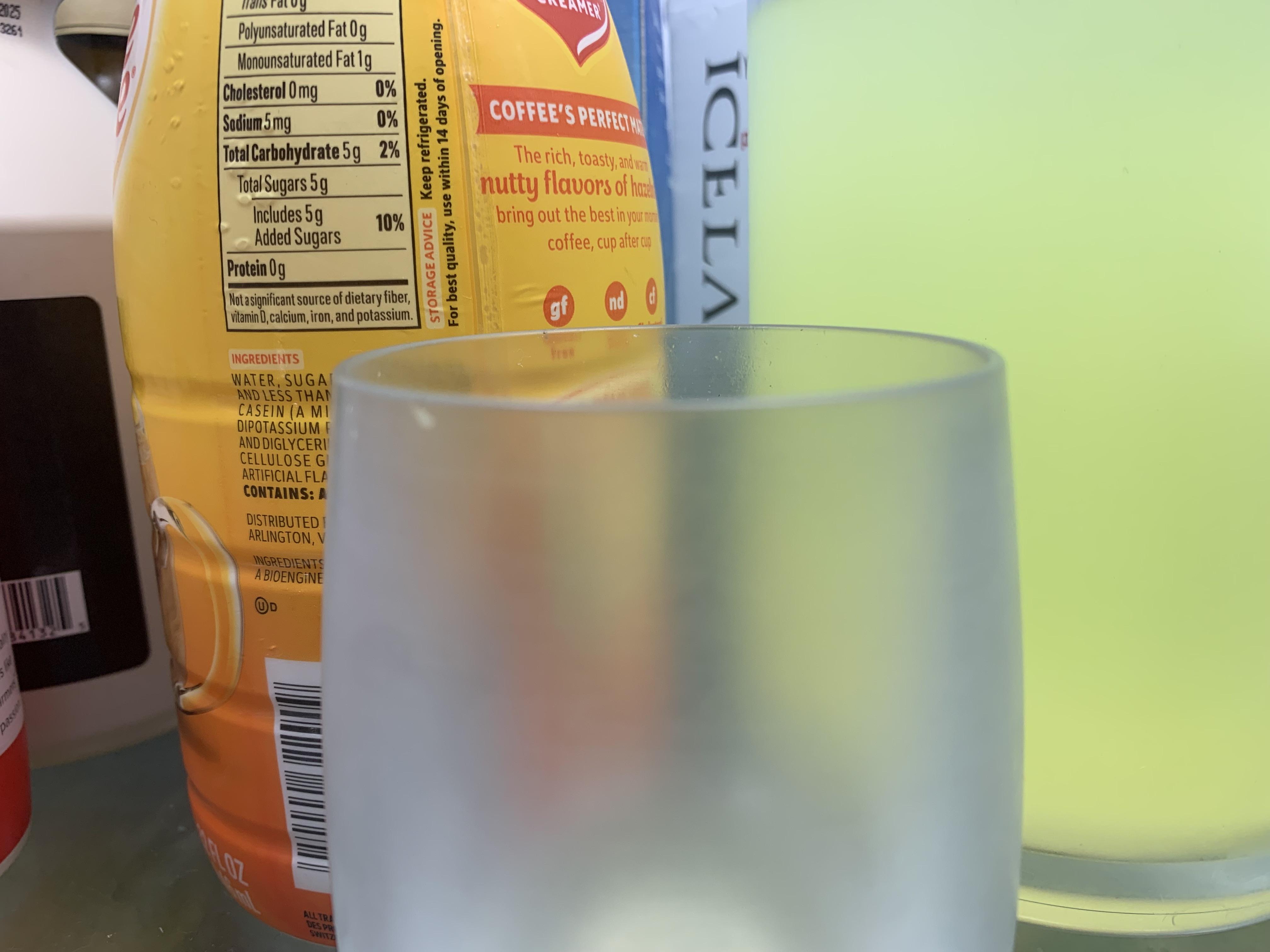
Lately, I make it in this coffee maker which holds coffee in little plastic capsules. The water sits in a plastic reservoir. The sugar sits in a plastic jar. I put in a little milk and hazelnut creamer. Guess what? They also come in plastic.
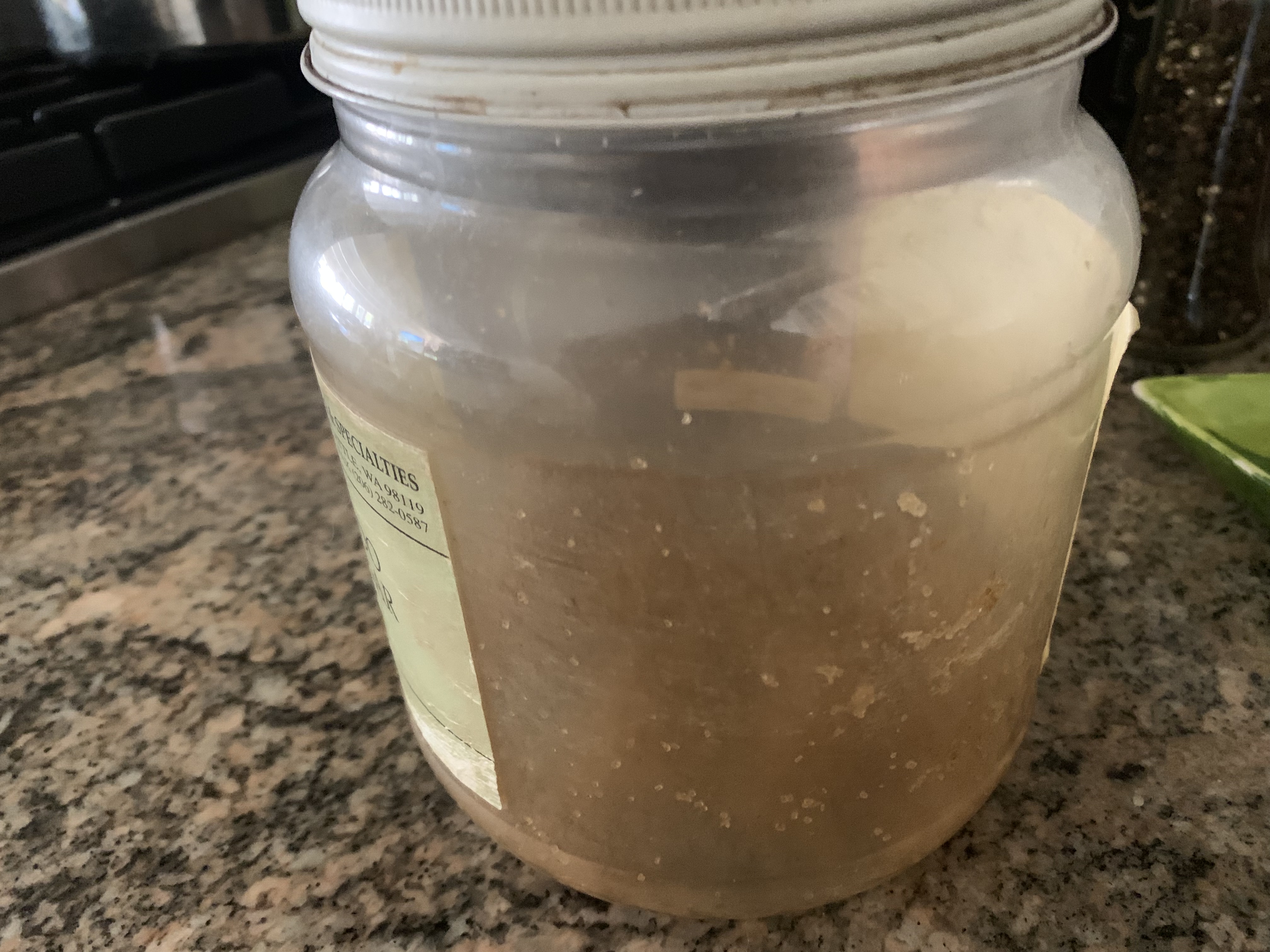
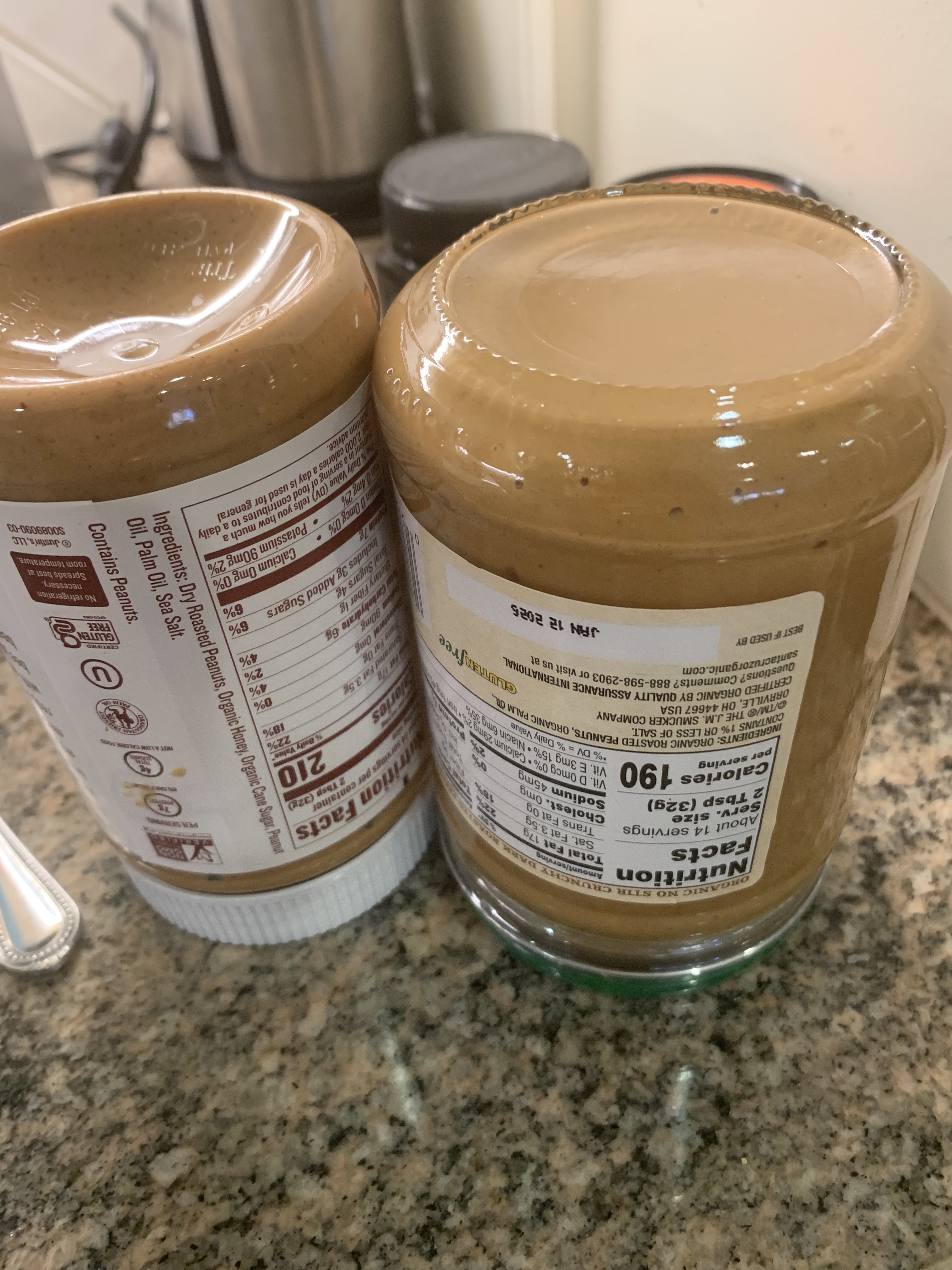
The cup, at least, is ceramic. I often have a whole wheat English muffin. The muffin comes in a container that is part paper and part plastic. I often like to put peanut butter on it. The peanut butter I usually buy comes in plastic. I often put honey or berries on the peanut butter. They come in plastic.
Sometimes, rather than a high fiber English Muffin, I enjoy a bread which is called “Fitness Bread.” It’s high fiber and tasty. And, it comes wrapped in plastic. I often spread hummus or guacamole on it. These are also pretty healthy choices. But they spend a lot of their life in plastic.
As I side dish, I like cherry tomatoes. They are colorful and tasty and low calorie. And they come packaged in–did you guess? Plastic. On sandwiches, I often put ketchup or mayo. They also come in handy squeeze bottles made of…let’s say it together: “Plastic.”
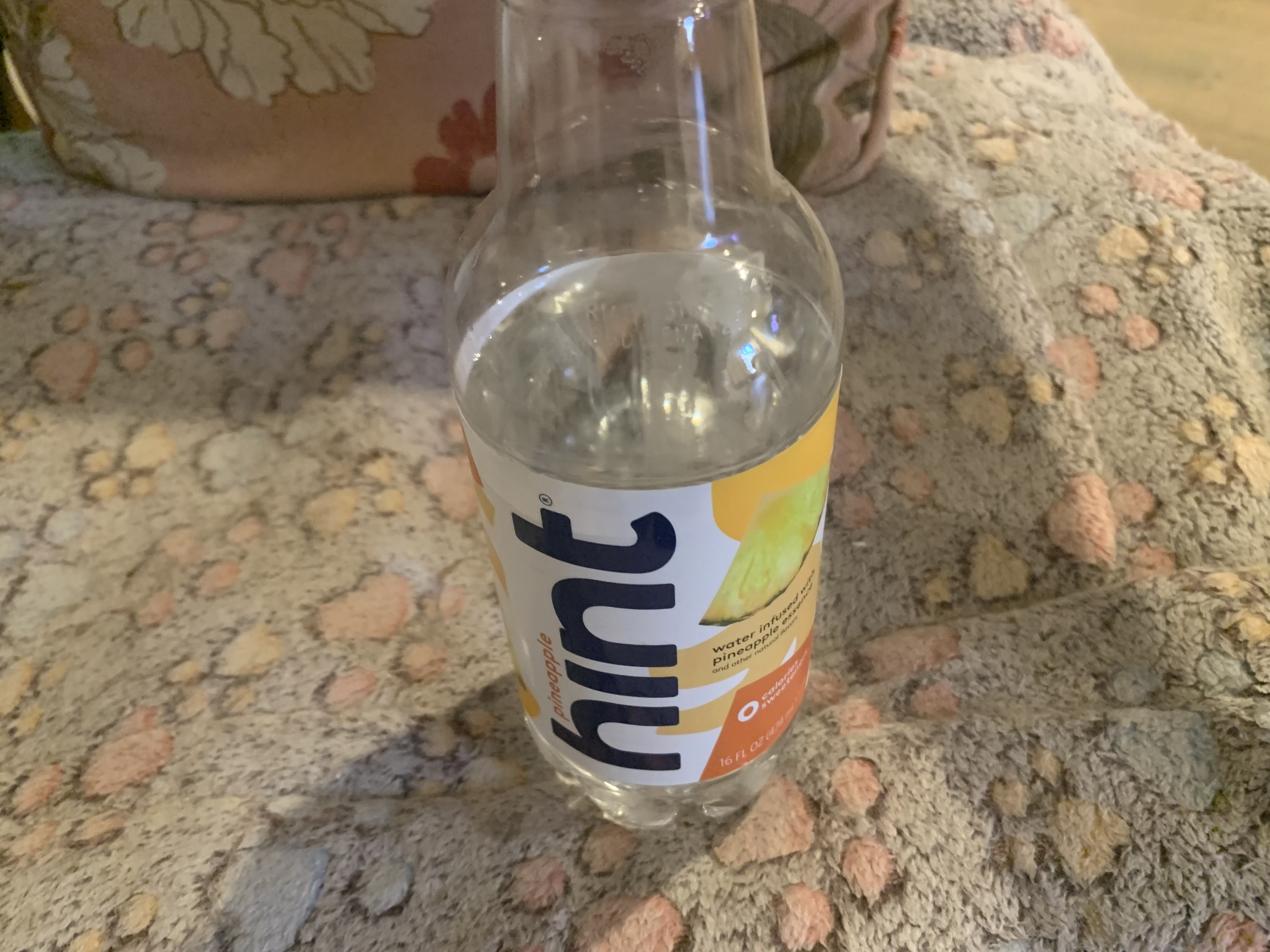
I don’t drink any alcohol, and often drink Hint or BAI, both of which I like quite a lot and both of which come only in plastic containers. This is not great for the environment at large, but also not good for the environment of my body. We also sometimes drink a powdered lemonade mix which comes in plastic packets. Then, a pitcher in the fridge keeps it cold. The pitcher is plastic. Then it is served in a “glass” which is, in fact, not glass, but plastic.
There’s an advantage to plastic over glass. We have cats and dogs and they have a tendency to knock things onto the floor. Plastic things are far less likely to break. Plastic glasses also weigh less than glass.
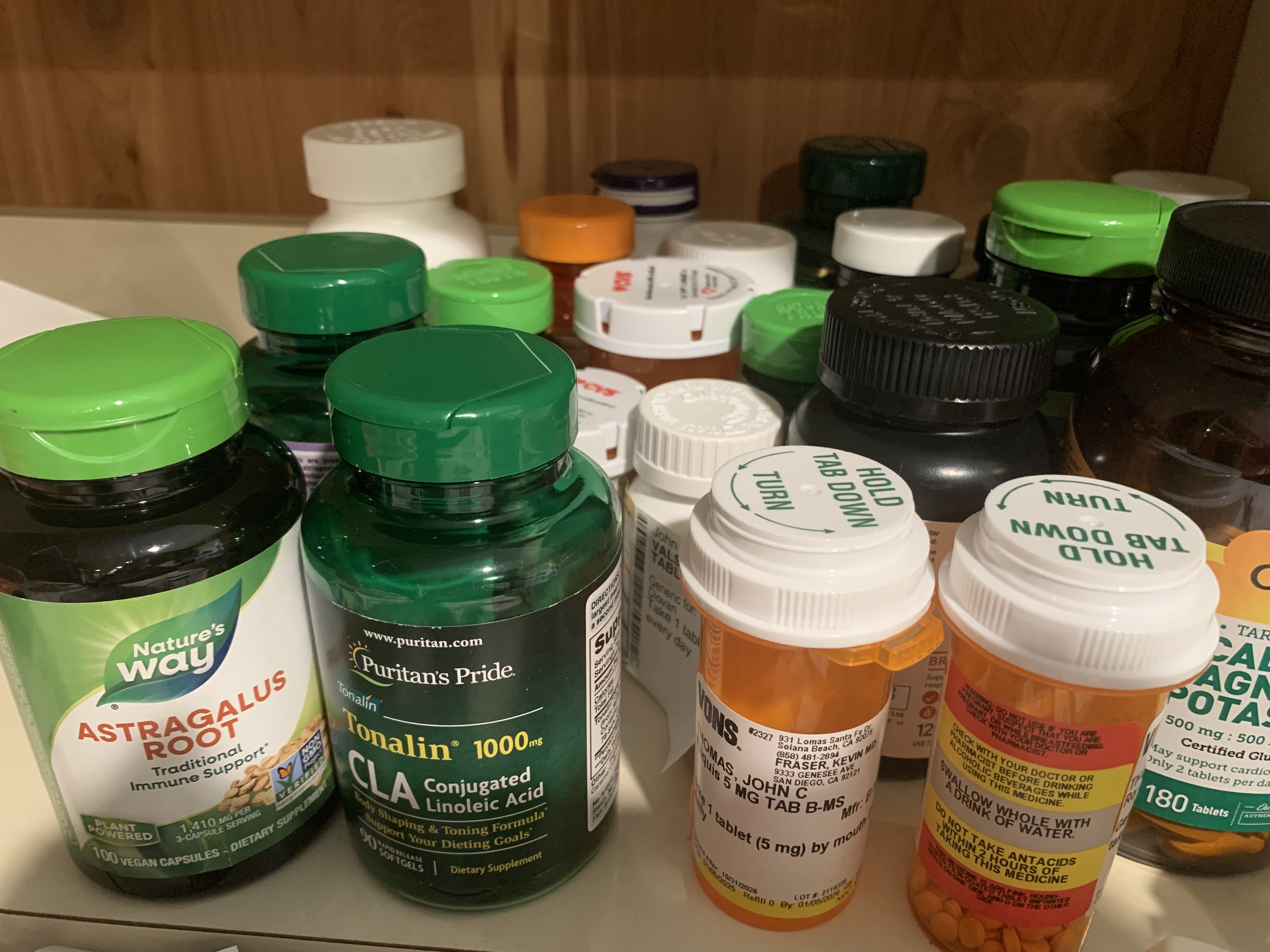
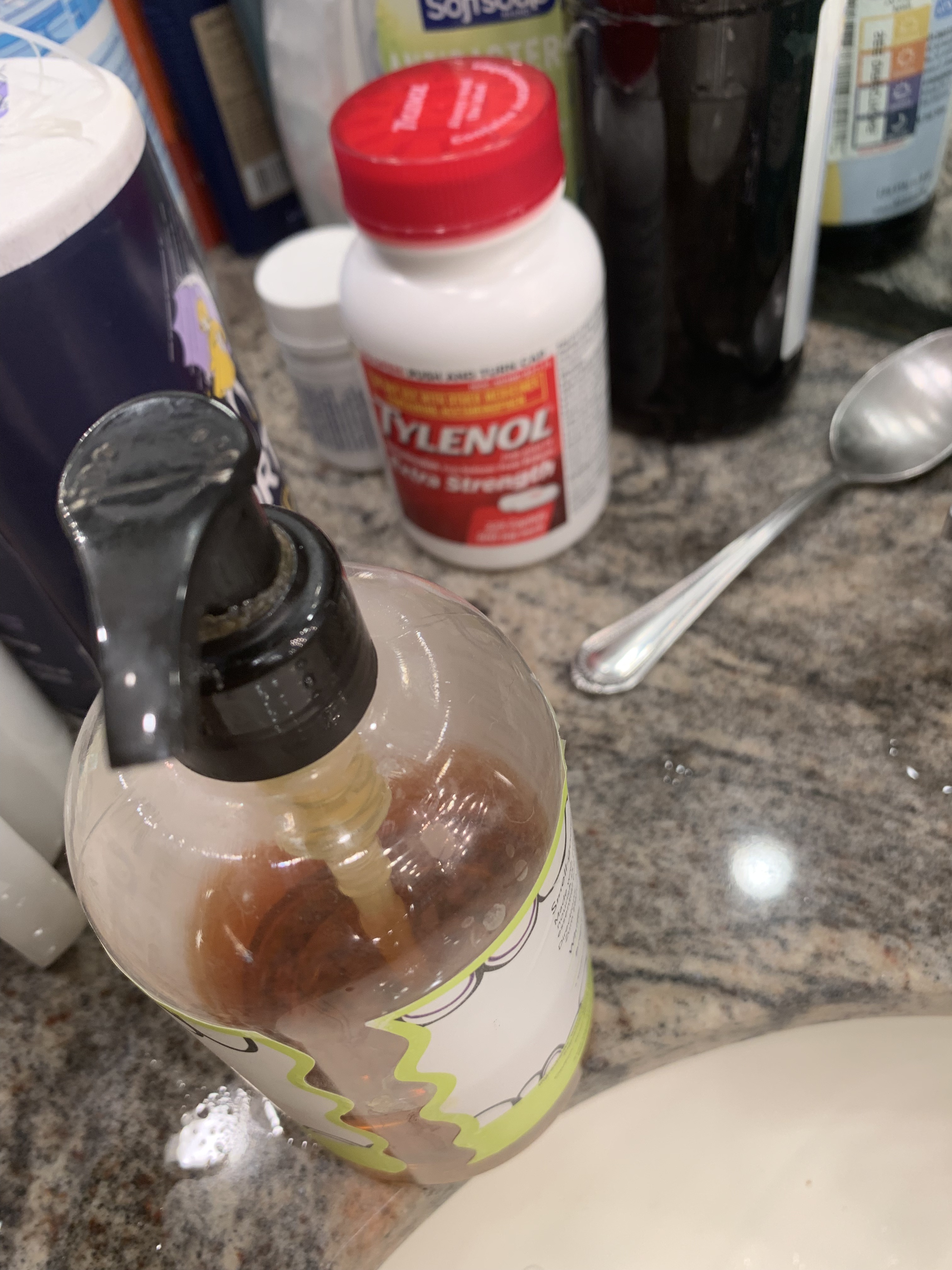
After breakfast, it’s time to take some supplements for my health. These almost always come in plastic containers as do the prescribed medications I take.
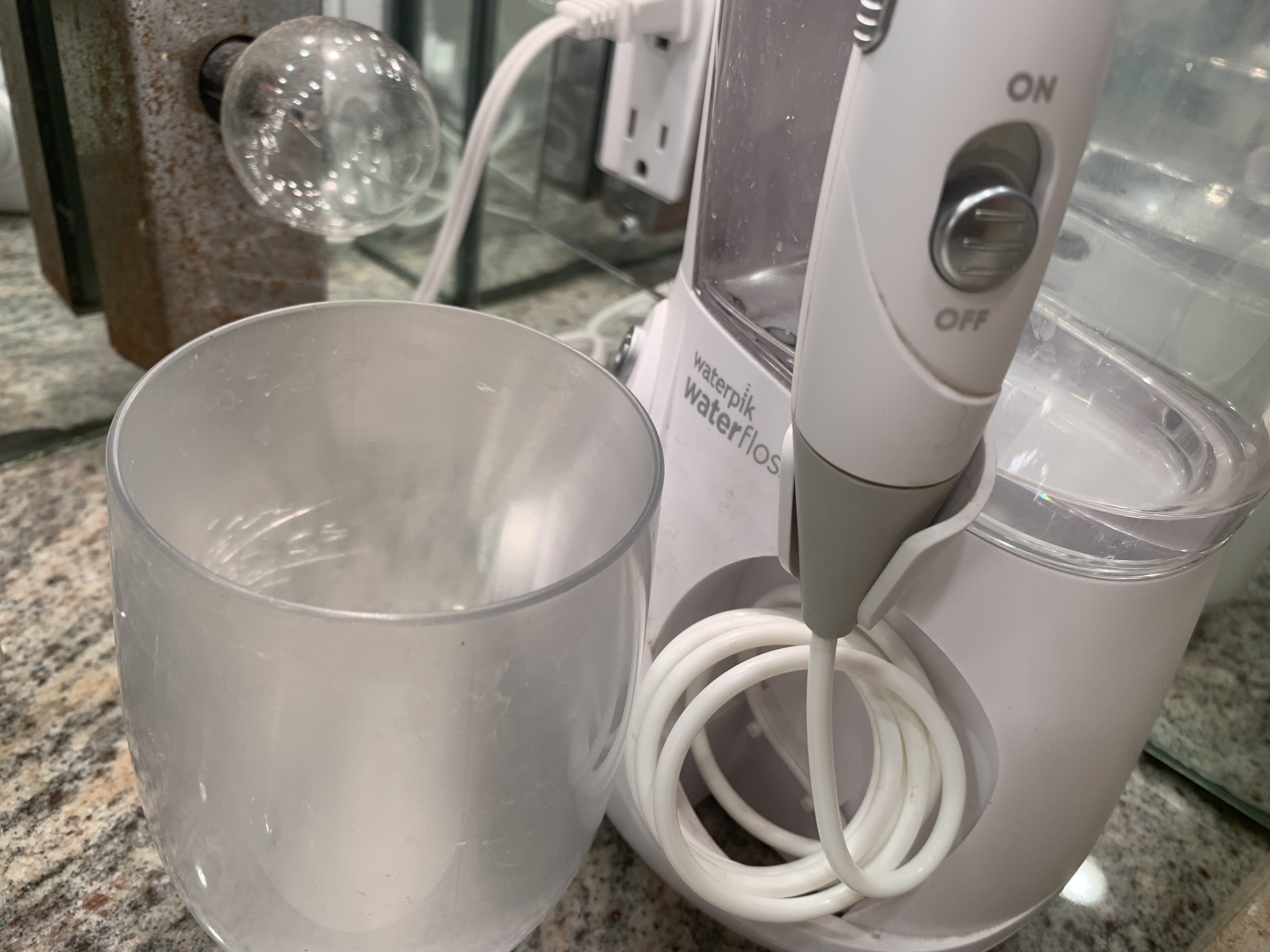
I brush my teeth. That’s a health-promoting activity. But the water glass I use is plastic. The toothbrush bristles are plastic. Lately, I’ve started using a water pick as well, which I highly recommend, by the way, though the reservoir for the water and the entire mechanism is made of plastic.
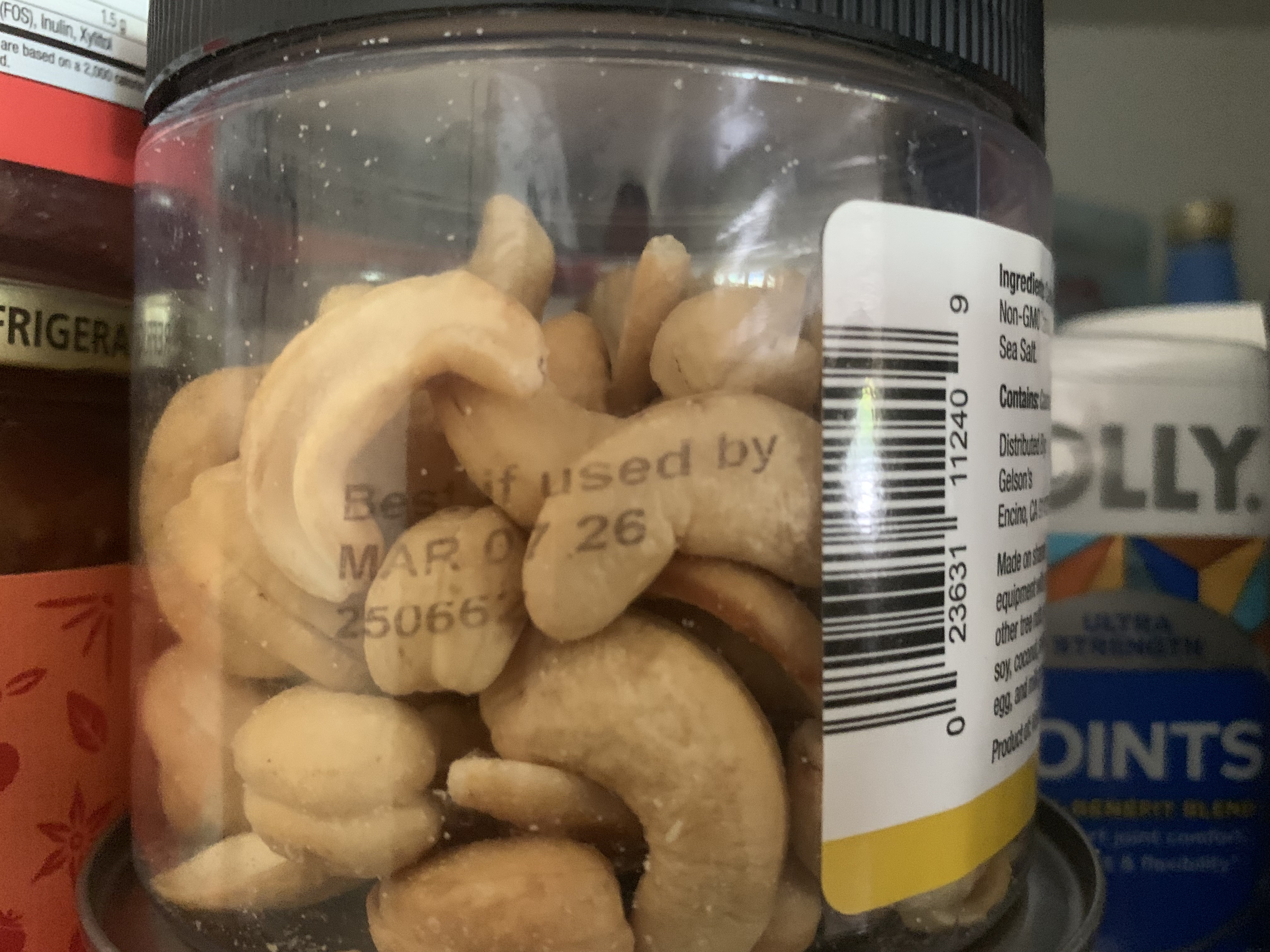
I often cook for the two of us. Lately, I’ve been using cutting boards made of…you guessed it! Plastic! For healthy snacks, I like dried fruit and nuts. Guess what? They come in…
What’s to be done?
In today’s America, with science and truth becoming illegal, it probably won’t make a huge difference. I’m more likely to die of infection or Civil War or unprovoked police violence than from plastic, but I am making some changes.
We bought bamboo cutting boards and paper cups. I’m cutting out the BAI and Hint and exploring options for drinks that come in glass or non-BHA coated metal. I am trying out another type of peanut butter that comes in a glass container. But the vast majority of products at the grocery store come in plastic. Even the vegetables and fruits.
Despite all the years of increasing the percentage of items that are plastic, I still do not actually like plastic.
I’m switching out what I can, and it may be too late in life to make a lot of difference for me personally, especially with a Misadministration that wants to end American lives (and brags about it!). But it may not be too late for you.
Do your own inventory. Hopefully, you will find things you like that are not wrapped in that one word of biological disaster wrapped up with economic faux-prosperity. The word? Here’s a
Apparently, everyone else knew I was supposed to go head first.
The instructions, however, were far from clear.
And, although I didn’t know much, four billion years of evolution had taught me to take a few things rather seriously—such as: “Gravity is real!” And: “Don’t dive hard onto something head first.” So, the vague instruction to come out head first made no sense.
I considered whether feet first seemed a sensible option. I decided “yes” but only for someone with a well-developed set of quads and a months of practice in balancing. Otherwise, a being such as myself would simply topple over and smash their head anyway.
Thinking about it as best I could, coming out butt first seemed by far the most sensible way to enter this world.
The only problem was that I didn’t fit that way. So—I was at odds with authority figures such as my mother and her doctors before I was even born.
After 72 hours of labor, I finally let them win that argument and came out head first.
All of us could have been saved a lot of time and effort had the instructions been clearer to start with.
Is that why I ended up with a career in “Human-Computer Interaction” AKA “Human Factors” AKA “User Experience”?
Probably not.
More likely, it has something to do with the agony of the feet.
I inherited “flat feet” and that has been something of a life-long inconvenience. For example, beneath my ankle is another bone that sticks out much more than it does for other people. That bone often rubs against the side of my shoes and boots and that causes a source of both bruises and blisters. The lack of a working arch also contributes to my never being able to jump very well. In high school, when I was very fit, I was capable of jumping up high enough to touch the bottom of a basketball net. On my best days.
I never got close to being able to jump and touch the rim, let alone being able to dunk the ball.
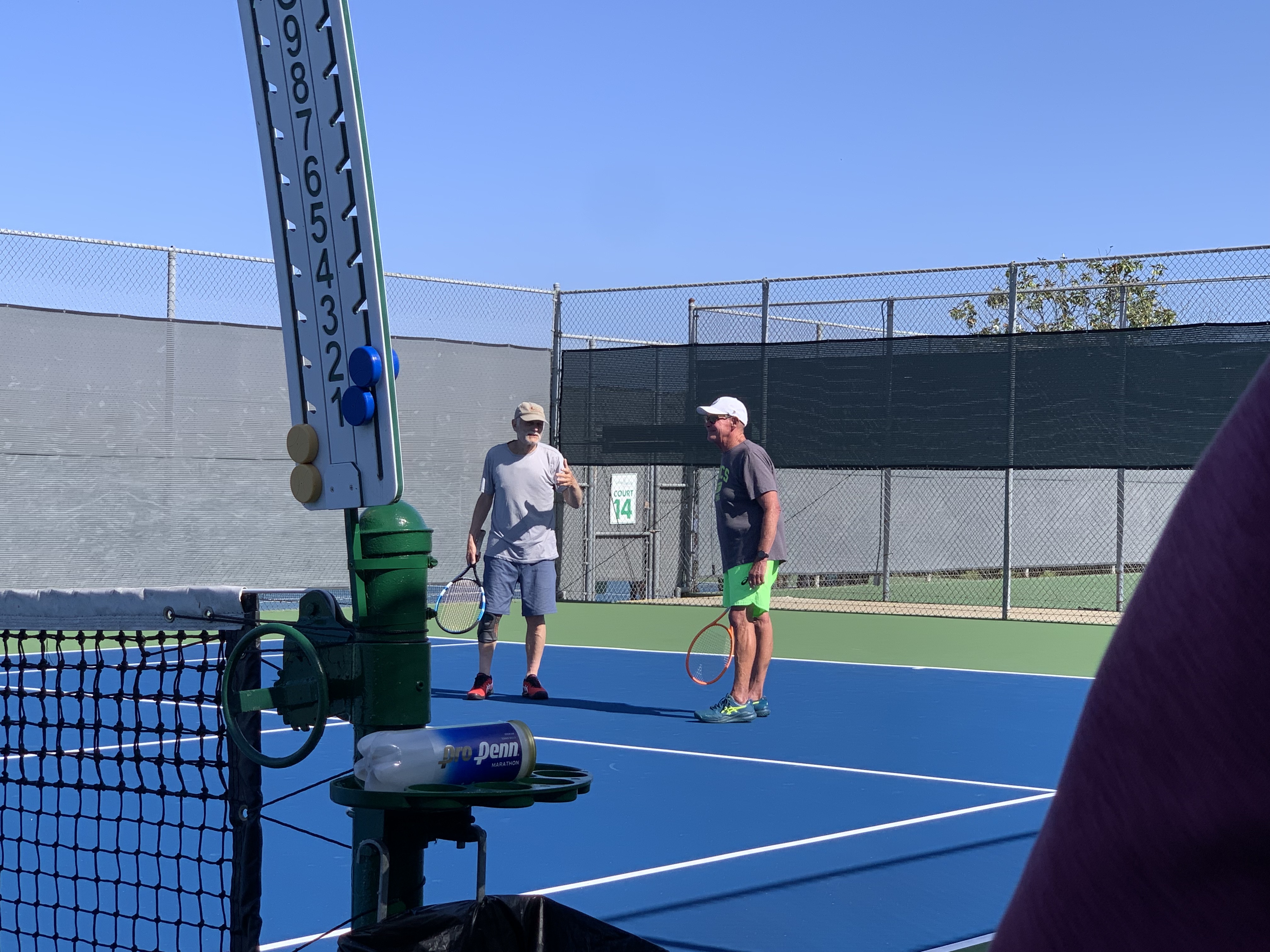
Nonetheless, I spent many years of enjoyment while on my feet—playing basketball, tennis, golf, table tennis, football, baseball, softball, racquetball, running, and walking. Running speed was never a strong point but I do have good eye-hand coordination and know how to concentrate and adjust my play to the opponent(s). As I sometimes like to say, I’be been violating expectations since 1945. I’ve enjoyed every sport I’ve ever tried. I’ve also seen many people with much more natural talent than I have enjoy sports less. That’s one reason I wrote “The Winning Weekend Warrior” which discusses the “mental game”; that is, “Sports Psychology.”
I’ve also discovered some things about mitigating the negative impact of the feet I was born with.
For one thing, I never buy shoes without trying them on.
Another surprise is that all hard surfaces are not equally damaging. A basketball floor, a dirt track, an asphalt road, concrete, and steel all seem pretty damned hard. But it turns out that running on concrete sidewalks is much harder on my arches (and shins) than running on asphalt. It also turns out that standing still for a half hour is harder on my arches than is walking for an hour.
I’ve learned a number of obvious things like: losing weight helps a lot! Strengthening the legs helps. Having good supportive shoes helps. Wearing cushy sox helps. Avoid (when possible) walking on stone, concrete, or metal.
I’ve tried a number of supplements too. For me, the ones that seem to help slightly are: turmeric, ginger, and sour cherries. I find that B12 seems to worsen joint pain. Elevation seems to help and so does ice. Of course, the trade-off is that ice and elevation are typically things that limit mobility.
I also use acetaminophen. I also use arnica gel which seems to help.
If there’s a real “solution” though, I haven’t found it. I was born with a bad design.
Everyone is.
Life is not, never was, and never will be about a “perfect design.” The environment keeps changing and organisms who adapt to the environment are always changing. That happens at the cellular level, the learning/behavioral level, and on a longer time scale, at the evolutionary level.
Not only that: change begets change. If, in response to one change in the environment, you make one adjustment, you might cause another problem. It’s the same with the design of physical artifacts, software systems, user interfaces, social systems, games, strategies, tactics, poetry, stories…
One can use knowledge to shrink a design space. Of course, there is always the chance that by shrinking the space, you are deleting the part of the space that has the very best designs. It took evolution billions of years to create multicellular organisms. Our own human bodies have a large variety of different types of cells. Within many of those types there are sub-types and sub-sub types.
Even within a sub-sub type, no two cells are precisely identical. They have different histories and they have different environments.
The feet that are “bad” are only “bad” in a certain set of circumstances. I’m sure that there’s some circumstance in which it’s better to have flat feet and pronated ankles. For example, it’s probably only a matter of time before there’s a top-rated “reality TV” show dedicated to the implications of odd body parts. That would be a show I would get to try out for because of my feet.
Recently, I got hearing aids. That’s a whole different story for another time, but they fit quite snugly and comfortably behind my ears. But we’ve all seen people who look like Alfred E. Newman from Mad Magazine. What do they do about hearing aids? Do they need a different type? Do they tape them behind their ears? What would be the best genre for the show about unusual feet or ears? Doctor Odds? Opera? Shure-Vivor? America’s Got Metatarsals?
Needless to say, we would have to make it extremely competitive and a little bit cruel. Maybe people with broken feet could run a race and the winner would live for another week and face a greater challenge the following week. The whole thing would be set in someplace chosen to be especially challenging for those with sore feet; e.g., uneven cobblestones, slippery concrete, on fallen tree trunks. Gorse, of course. Background music would be composed to add to the drama. Or, if the budget doesn’t permit human composers, we could ask an AI system to copy some Puccini or Bizet and change it just enough not be sued for copyright infringement.
The formula importunes for interviews. They need to be short, shallow, but filled with rage or tears. “So John, when did you first learn that your feet were…what is the PC term here?…Different? Weird? Horrific?” Before each competition, the contestants would be introduced with fireworks and flashing lights along with extremely loud and echoing words of exaggeration. We should get the same kind of introduction once reserved only for “Professional Wrestling” but now common in introducing contestants in Golf and Tennis. Why not insanely dramatic foot-offs in “America’s Got Metatarsals!”
It might be a bit expensive, but we can always cut costs to the bone. And then, just keep cutting!Who even needs real contestants? They can all be CGI. That, in turn, means there’s no need to limit contestants to the kinds of variations that actually occur. Flat feet? Okay. We’ve all heard about that. But how about flatiron feet? Elephant feet? Eagle feet! Grizzly bear paws! Duck-billed platypus feet! Amoebic pseudopods! Insect legs with pollen sacs!
Why stop there? Mice with elephant ears! Elephants with mouse ears! Whales stalking their prey on the Savannah, cleverly camouflaged in the tall yellow grass!Tigers leaping on Great White Sharks! It’s no more out of place than putting a thoughtless human being in a safari hunt And, the best part of CGI players is that we can interview them regardless of species and regardless of their native language. At long last, we can entertain ourselves to death while the actual ecosystem around us is being destroyed by the greediest members of the greediest species who ever existed.
What happens when greed exceeds needs and vital functions of society are left to the unfit, untrained, uncaring, uncouth, criminals? They’ll be about as effective as the Whales of the Serengeti and the Elephant-Eared Mice of Siberia.
Forty percent. That’s a wonderful number. Most people have a sense of what that means. It’s a large percentage but it’s not quite a majority. If you are a Major League Baseball slugger and you get a hit 40% of the time, that’s a lot! That puts you in rare company.
So, when President Mush Melon says forty percent of Medicare calls are fraudulent, that’s a lot! You quite understandably think: What’s wrong with an organization that deals so badly with fraud that 40% of the calls are fraudulent?
And, you might also quite understandably think: What’s wrong with so many of my fellow Americans? Forty percent of them try to cheat the medicare system!
But you know what? It was a lie. It wasn’t a hitter like Ted Williams or Ty Cobb or Aaron Judge. Not at all. It was instead someone who wouldn’t even make the farm team because they were batting worse than .001
Maybe there’s something special about baseball. Well, there is of course. There’s something special about everything. But it isn’t that there’s a big difference between 40% and less than 1%. That kind of difference is important almost all the time.
Let’s say you work for a company and you are reasonably satisfied with your job. Then, one day, you get a call from a recruiter who says:
“Say! Instead of working for the ABC company, we’d like you to come work at the XYZ company. Furthermore, we are offering you a 40% pay raise! What do you say?”
Presumably, you’d do some research, but you’d likely end up accepting the offer. Now imagine that you quit your old job, move across town, say goodbye to your old friends, start your take your new job and then you discover that you actually got less than a 1% raise. Would you just say, “Oh, well any raise is good.”? Maybe, but I doubt it. Most of us would be very angry to leave our job and our work colleagues under false pretenses.
Let’s take another example. Your “friend” will pay you ten million dollars to play Russian Roulette once. He shows you twenty ‘six-shooters’. He tells you (and you verify) that only one of the twenty six-shooters has any ammo in it. That one has one bullet in the cylinder. You’ll be blind folded and then choose one gun, spin the cartridge, put the muzzle to your head and pull the trigger once. If you live, you get ten million dollars. You might think of all the things you could be you and your family for ten million dollars.
You choose to play. But then, your “friend” loads every gun with two or three bullets. Are you still going to play? Would you be upset that he misrepresented your odds that blatantly?
Please understand that these are not “innocent mistakes” or “slight exaggerations.” That is the difference between 39% and 40%, not between 40% and less than one per cent. To make that kind of mistake, you need to have evil intent or suffer from gross incompetence.
Not an actual photo from hell but an AI-generated image.
But this President Mush Melon isn’t just someone setting out to destroy the American government and the confidence of people (though some snowflake liberals would say that’s quite bad enough). No, he’s also in charge of cars that are supposed to drive themselves. Would you want someone who has evil intent to be building cars that drive themselves? Oh, maybe he’s just grossly incompetent. Well—same question: Would you want someone grossly incompetent to be building cars that drive themselves? Oh, by the way, this same someone can download new software so that your car behaves differently!
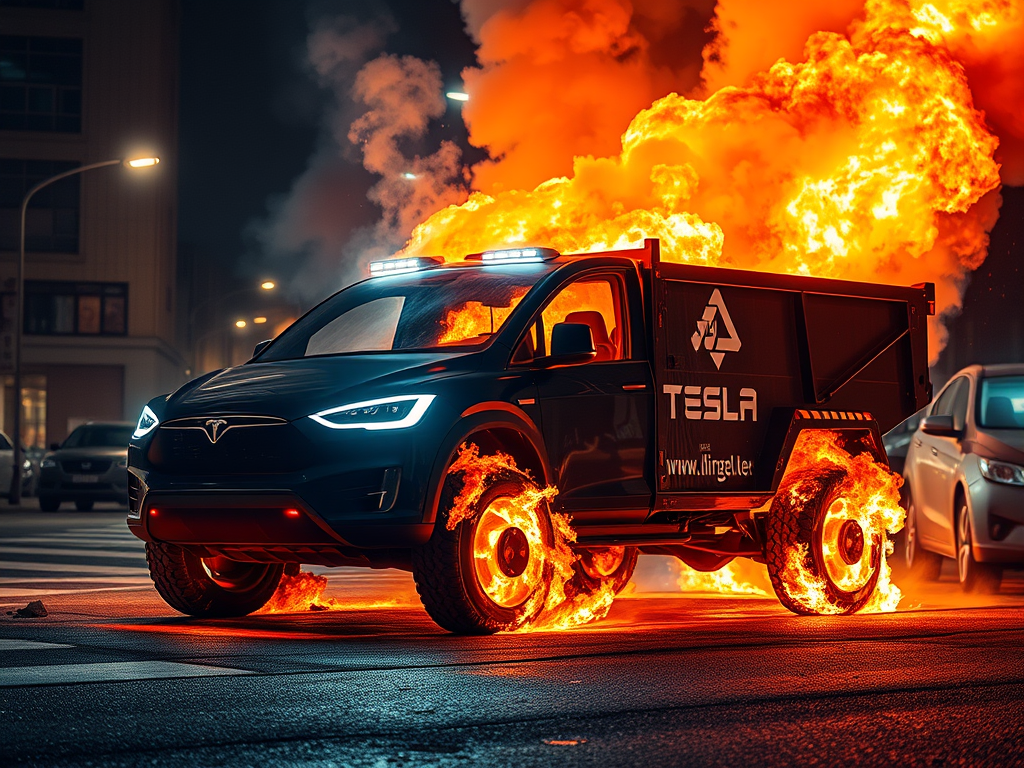
No worries! The Cybertruck only has a top speed of 130 miles per hour and only weighs between 6600 and 10,000 pounds, so what could possibly go wrong? It’s not as though it could run over you in your driveway. Over and over and over and over.
AI-generated to the following prompt (keep in mind, AI technology is supposed to be driving your self-driving car). “A Tesla Cybertruck that is a dumpster fire”
But wait! There’s more! President Mush Melon also happens to own a company that controls communications satellites used for—-among other things—-war fighting and voting. No problems there, right? It’s all okay so long as there’s no evil intent or gross incompetence.
But wait! There’s more! The Mush Melon also happens to control a company that shoots missiles out over your head. And, the best part is—they never unexpectedly explode! Sure, they suffer from catastrophic unscheduled disassembly. But we’ve all had days like that.
Well, okay, sure there’s some danger having someone in charge of missiles when we know that person lies or suffers from massive incompetence, but hey—at least it’s not a pizza shop, right? You’d know a bad pizza soon after you bought it no matter how many lies the cook told you.
On the other hand, it might be some time before you see the impact of your self-driving truck under someone else’s control, or the results of cutting off crucial communications, or the havoc caused by missiles exploding—excuse me—-rapidly disassembling— at unscheduled times.
Though on the other hand, you might feel this is all worth it because, after all, this person makes billions and billions of dollars a year and therefore provides a huge influx of cash to the U.S. Treasure to the tune of nearly…
Wait…
Nothing? Nothing? Are you kidding? The supposedly richest man in the world pays zero income tax.
But he gives huge contributions of money to a Presidential candidate who then drops all the cases about Mush Melon’s frauds?
The Melon and the Felon: A marriage made in heaven. What’s a good name for the couple? I’m thinking just MF for short. We could call the Felon by 47 but what’s a special number of the Melon? Oh, there’s the form he is supposed to submit to Congress — FS-86. So, I suppose they could go by 8647 or 4786.
“Hey, Hon, guess what? We’re finally going to be able to get that new vacuum cleaner you’ve been asking about.” Stevie grinned from ear to ear. Of course, the vacuum cleaner wasn’t the only thing. But Stevie didn’t see any point in mentioning the new bowling ball or the fifths of Johnny Walker Black. He wasn’t trying to hide those purchases from Karen, his wife of fifteen years. Not exactly. It’s just that—timing was everything. That was all.
Karen looked up from her iPhone solitaire game. More accurately, she looked up from the ads that were interrupting her iPhone solitaire game. Once again, they were trying to cajole her into getting a new app but it was (once again) one she already had. She sighed. She could see that Stevie was quite jazzed so she amped up her enthusiasm two notches as she answered, “That’s great, Stevie. Thanks. Did you get a bonus or something? Win the lottery?”
“No, no lottery. That’s for suckers. Vegas gives you better odds. A bonus though. Exactly.”
Karen chose to paint smile level three on her face. She knew it well because she had practiced in since Junior High. She thought it looked pleased, surprised, happy, and just a tad beholden. “That’s great, Stevie. What’s the bonus for?”
Stevie’s smile faded and he looked out the front window and noticed that it looked as though a thunderstorm was on the way. “Well, for meeting my quota. You know. Just saving the country by getting out the criminals like always. But now we’re serious about it.”
Karen chewed her lip a little. “Yes. Well, a new vacuum cleaner will be great.” A flicker passed over her face. She realized her smile had withered, but Stevie had a faraway look in his eyes anyway and so she returned to her game. The game within the game. The game of finding out where they had hid the X this time—the X that closed down the ads and sent her back to her game. She vaguely noticed that Stevie had walked away over toward the liquor cabinet. She thought: This sucks! All Kings and Jacks but no Queens. How’s that work? Where the hell are they? She pushed the “Random Deal” button to start again.
Summer, 2025.
“Hey, Hon, is dinner ready yet by any chance? I gotta head back out for some…I gotta head back out to work.”
“Really? That’s too bad. Couldn’t they get somebody else? Didn’t you already do your shift? Did you forget it’s Brittany’s swim meet tonight?”
“What? Oh, crap! No, no, I didn’t forget. It’s just…we need to round up more people and there’s…well, we have something planned. These vermin are slippery, you know? I can’t let the team down, not to mention Captain Bligh. Sorry. Next time.”
Karen frowned, “Captain Bligh? I thought your Captain’s name was ‘Smyth with a y’ — you said you guys all called him that because he was always asking ‘Why?’”
“Oh, yeah, you’re right, but that was months ago. He’s out. Bligh’s in. Look. I gotta go. Is dinner ready or not?”
“No, Stevie. We were going to all go out after the meet. We talked about it. Brittany will be hungry after and Steve Junior is always up for burgers and fries.”
Steve Junior slid into the kitchen, raised his eyebrows and grinned. “Did someone mention burgers and fries? You comin’ too dad?”
“No, dammit. I already said that. I have to go to work. Do we have anything in this frigging house to eat? Never mind. I’ll grab something from…I gotta go. Good luck at your meet Junior.”
Steve Senior grabbed his car keys off the hook and left. He hadn’t meant to slam the door. Not exactly.
He didn’t mean to spin gravel onto the lawn when he left either. Not exactly. Karen sighed and Steve Junior frowned as he said, “Meet? What meet? Does Dad think I’m on Brittany’s swim team now?”
“No, he just…he’s just distracted. That’s all. Come on. Let’s pack up. I’ll ask Sue to swing by. She’ll have room for the three of us.”
“Yeah. Well, if Dad’s not going, why should I go? A swim meet’s not the most exciting thing in the world you know. You can’t even see the girls. At least in a track meet you know who’s who. In a swim meet all you see are bubbles and bathing caps.”
Karen put her hand up to hush Stevie Junior while she called Sue. Finished, she said, “Sue said there’s plenty of room for you too and…anyway, although Brittany would never admit it to you, she really does want you there rooting for her. Especially since Dad…won’t be able to make it. Again. She hadn’t mean to say ‘Again.’ Not exactly.
Fall, 2025.
Doctor Lemon shook his head as he glanced at the labs report before him. He kept glancing down at a written report and up at his computer screen. Stevie frowned and drubbed his fingers on the steel arm of the chair. After a few minutes, Doctor Lemon looked up. “Well, Mister Miller, the good news is, there no sign of cancer but your blood work—well, this is the worst it’s ever been. Did you really cut down on sugar and alcohol these past six months. That was our plan, right?”
“Yes! Yes, I did. Way down. Not every day, of course. But overall. Yes. Maybe it’s just genetics, you know?” For some god-damned annoying reason some stupid poster child for WOKE or some stupid folk singer sprang into his head and the young singer or actor, or ‘wacktor’ as his buddies liked to call them, said, ‘Remember. It makes no sense to lie to your own doctor.’
“Well, Mister Miller, genetics do play a role, but your genetics haven’t changed in the last six months. So that’s not why your weight’s up, your blood pressure’s up, and your numbers all look worse. You liver, in fact, is just outside the intervention zone and that’s never looked bad before. Have you cut out exercise? Change jobs maybe? Or stopped walking the dog? Or given up golf?”
“I’m busy at work. That’s all.”
“Yes, well stress can also…”
“I never said anything about stress! I didn’t use that word! You did! Anyway, it’s fine. I’ll do better. But meanwhile, can you give me a pill or something to get my numbers back down?”
Doctor Lemon swiveled his chair to face Steven Miller more directly. The doctor leaned forward and said, “Look, Mister Miller, we’re on the same team here. But I need to know what we’re dealing with. Have you had trouble sleeping?”
Steven Miller ground his teeth. He didn’t mean to growl. Not exactly. But growl he did as he said, “Look, Doc, can you give me a goddamned pill or not?”
“I can give you a pill that might help bring your BP down and even lower your cholesterol, but you know, there are always side effects.”
“Like what?” Steven Miller wished he were on duty right this minute. He could leap up and wrench the guy’s arm for being such an asshole.
Doctor Lemon frowned. He could see his patient was clearly upset. But why? “Sleepiness. ED. Nightmares. Muscle weakness.”
“Screw that! I need my strength. You think my job’s easy, but it isn’t. Just…you know what? Forget it.”
Stevie had had enough poking and prodding for one day. His head felt full like it was a balloon ready to burst. He thought to himself, ED? Bullshit. What does he expect? My wife’s like 45 years old now. So what if I have a drink now and again. I’ll find a way to get the pills. Damned doctors anyway. Stress! Hah! I’d like to see him wrestle these people to the ground. Fucking protestors anyway. If the illegals weren’t here in the first place, they wouldn’t need to be roughed up and deported. I’m doing the job for them. What’s with the damned protests anyway?
Stevie didn’t notice how close he had parked the passenger side of his car to the cement pillar in the parking garage. Not until he heard the scrape of metal as he backed out. Even then, he hadn’t realized at first that his own car was causing the noise. When he finally figured it out, he stopped the car, got out, and walked around to the other side of the car. “Goddammit!”
Like all parking garages, this one was designed and built with two-person golf carts in mind, not SUV’s. So, when Stevie stopped his car, he blocked off the lane for others who wanted to drive by and exit the parking garage. A guy in a BMW tooted his horn. Stevie flipped him off. He thought: Driving a foreign car anyway. An expensive one. Probably a faggot. They’re next. Why is everybody out to get me when I’m just doing my job?
And speaking of people who were just doing there job, that was the situation for “Old Joe” as his co-workers affectionately called him. At one time, his job had been as a soldier. After two tours of duty, he became a cop. He retired from that and had enough to live on. Old Joe wasn’t rich, but he wasn’t destitute. But he liked work. He liked doing something. And, he especially liked doing something that added to society. And he liked having co-workers. And they liked Old Joe as well. He was firm but polite.
He was firm but polite when he requested to see Mr. Miller’s validated parking ticket. Mr. Miller, for his part, explained through gritted teeth that he had left his parking ticket at the doctor’s office and that no-one had reminded him to get his ticket back when he left. Old Joe said, “That sometimes happens. You have two choices. You can pull over there and go back up and get your validated parking ticket. Or, you can pay the max for a lost ticket just like it says when you enter.”
Stevie didn’t mean to growl. Not exactly. His grunts, when translated into more polite language, boiled down to this: “No, I’m not going to do either. You just open the gate up. I need…I’m on an important mission. I’m RIME—which, in case you’re so stupid you don’t know, is the militarized version of ICE. Raiders, Inciters, Maulers, Executers. You understand what ‘Executers’ are? For now, it means we execute the orders of the executive branch. But soon, we’ll have the power of on-the-spot executions of anyone who’s deemed an enemy of the state. If you’re in the way of the state, you’re an enemy of the state. And you, sir (no, Steve didn’t actually use the word ‘sir’—not exactly) are in the way of my doing my job. We’re due to raid a…well, none of your business. But I’m on my way. Now, let me out of this garage before I blow your brains out.”
This claim of being on the way to a raid wasn’t actually true. Not exactly. After his aborted doctor’s visit, Stevie had arranged to meet up with a bunch of the guys over at the bar that was jokingly known by two names: “The Library” (because books would be the last thing discussed there) and “The Lie-Berry” because when the guys got together, they told fishing stories. But the stories weren’t about fishing at all. They were about the size of the lies that they got away with, or, in some cases, didn’t get away with. But it didn’t matter to Stevie. It wasn’t any of Old Joe’s business where he was going. He was RIME. He could do whatever he felt like. And what he felt like right now was smashing Old Joe to smithereens.
Old Joe had seen a thing or two though and he said, in a calm voice,“Well, Mister, I don’t appreciate being threatened. But it seems to me you’re having something of a really bad day. Why don’t you just tell me your name and the phone number of the doctor you went to see and I’ll call them. And if they say you were there, then, I’ll pretend you have a validated ticket.”
“And if I crack your skull, I’ll consider myself validated!” Stevie screamed this much louder than he meant to since there was now a growing line of cars behind him. The last time his group of guys from RIME got together for a Lie-Berry session, Fat Frank had talked about beating up a grocery bagger for putting eggs and tomatoes in the bottom of a paper bag and then throwing in a six pack on top of them. Frank said it was a real pain to deal with the blow-back but in the end, the bagger was fired and Frank didn’t pay any penalty at all. Well, not exactly. In fact, the baggers all avoided the lines that Frank was in. He mostly bagged his own groceries but never really noticed it.
Winter, 2025.
Things were getting out of hand. It wasn’t a full-fledged Civil War. Not exactly. But Stevie had to be careful all the time. Yet he felt too rushed to be careful. He had trouble falling asleep every night and, on the two nights he had experimented with not having any alcohol at all, he hadn’t slept at all. On his typical mornings, the hangover headaches and the bright sun put him in the mood for mayhem.
It didn’t help his mood, that he and Karen hadn’t had sex in months, but that was not a forever problem. Pretty soon, everything would be in place, including women and girls like his smarty pants daughter, Brittany. They were baby ovens and pleasure boxes and household chore-doers. Soon, robots would take that over the chores and the ladies could all sit home and watch soap operas all day or whatever the hell it was they did. But the point is that they would know their place once and for all.
Stevie turned on the TV and surfed over to the Cotton Bowl Game. Cheerleaders. Announcers. Players making amazing blocks and catches and stupid errors. It was just like always.
Not exactly. Stevie felt something between an upset stomach and a tickle. He wondered: What? It feels different. Why? How? What’s going on? He muttered aloud, “Where is everybody?”
Stevie noticed that there were fewer fans in the stands than in any bowl game he’d ever seen. What Stevie didn’t notice was the connection between the plummeting attendance at live sporting events and his own support of the Glorious Leader and his actions as a RIME agent. Few people wanted to risk being caught in the crossfire outdoors or more likely for rooting too loudly for the “wrong team.” Apart from the risk of physical injury, fewer people tended to care about the outcome of a “game” when everyone knew it was rigged so as to enrich the Glorious Leader and those currently in the “inner circle.” There was a lot of money to be made on sports betting when you could control the outcome. Until most betting fans caught on.
Stevie Junior came into the living room to sit beside his Dad and watch the game. He had a large bowl of sour cream flavored ruffled potato chips in his hand. “Say, Dad…”
“No! The answer is still no! Don’t ask again!”
“Dad? Are you okay? The answer is no to what? I was going to ask you if the game’s any good. You mind if I watch? I’ll share my chips with you.”
“Your chips? Did you buy them? Am I missing something? Those are my chips. Did you ever look into getting a job delivering packages? They always need help around this time of year and they’re always hiring. Even you could get a job, Junior.”
“Yeah. Well, this year, they are not hiring any extra people at Amazon or VanCare. I checked. Not a banner year for retailers.”
“Yeah, Stevie. Whatever. I’m sure you could get a job if you really tried. But sure, stay here and freeload instead. Tell you what. I’m heading out to watch this on the big screen. I’ve got a bet going with a bunch of the guys. I forgot I promised to watch the game with everybody at the Lie-Berry. If you see your mom….”
“Hey, Stevie, I’m right here. Did I turn invisible? You’re heading out now? Will you be back in time for dinner?”
“Oh, Christ! Now, you’re going to bug me too?”
Karen sighed. Steve Senior seemed to be in a bad mood most of the time now. She glanced at the coffee table and quickly counted five beer cans and one sudsy mug. Presumably, four beers had already been consumed. Yes and no. Five beers had been consumed and a shot of Jack Daniels with each beer. Karen said: “I’m not going to bug you. Go hang with your friends. But drive carefully, please.”
“Geez Karen. Now I know why everybody hates a Karen. ‘Drive carefully please.’ My ass. Just say what you really mean—that I’m a drunk and I trink do much. Well, no wonder with this family. I’m outta here. Don’t wait up. Like you would anyway. One of these days, I’ll be hauling one of these dangerous criminals out of the country and he’ll pull a gun on me. Don’t worry there’s insurance money. You’ll think you’ll be better off but you won’t be. You need a man to protect you. More than you know. Understand? It’s coming. Women are supposed to belong to a man. Without me. I hope you never have to find out.
Steve Senior staggered as he stood. He grabbed at Junior’s arm to steady himself and succeeded at knocking the potato chips all over the table, floor, and couch. “Jesus, Junior! Watch what the hell you’re doing. Too bad you inherited your mother’s clumsiness.”
Steve stormed out of the house. As he went to unlock the car door, he realized he’d never make it to the library without peeing. He glanced around. It was dark and he didn’t see any nosy neighbors anywhere so he peed next to the garage, mostly hidden by the car. Steve headed off to the Lie-Berry but he never made it there. He didn’t die in a car accident fatality. Not exactly. He did die in a car accident but not from a car accident. He was caught in a cross-fire between National Guardsmen trying to disperse a crowd of peaceful demonstrators by using live ammo and Marines trying to disperse the same crowd of peaceful demonstrators also by using live ammo.
Steve Senior smashed head-on into another car, but his heart had already stopped functioning. Most likely, his brain had also stopped functioning given the damage done to it. We may never know whether he ever had a flicker of consciousness at the end to wonder about his fate.
Perhaps his last thought was the reassurance that he would be ushered up to heaven where scores of beautiful young women would be his slaves in return for his service.
“Your family makes a big difference in how you turn out.”
Which view are you more sympathetic to?
The first statement is related to hundreds of other statements, stories, images, songs, religious doctrines, and procedures that lean conservative & emphasize individual liberty & initiative.
The second statement is likewise related to an entire network of political & cultural agendas.
Both approaches are true in the sense that they are useful ways to approach the world.
For me, the most appropriate context for emphasizing the first statement & its attendant attitude is when I make decisions that mainly affect my own life. It makes me more productive, responsible, & happier to focus on how I am the master of my destiny. Nonetheless, it is also occasionally helpful to step back and reflect on the conditions that favor my productivity & happiness & then try to maximize those conditions. It would be silly to think my behavior is unaffected by the external world.
On the other hand, when it comes to public policy, it makes sense to me to focus on how modifiable conditions impact people’s performance & happiness. For example, we’ve known for fifty years that people are generally more productive with a 30 hour work week than they are with a 60 hour workweek.
The two frameworks are often quite different in terms of the sources of their evidence. I am immediately aware that factors like my “determination” and “concentration” impact my performance. I hear such a relationship referred to in nearly every sportscast of every sport. But I don’t rely on such banter. I feel it and know it directly.
On the other hand, the relationship between external factors and other people’s situations is probabilistic and hard to see. I largely rely on studies of such phenomena. I have to read such studies critically to know which ones to believe in and which ones are flawed. I don’t typically rely on a single study. And I also see how networks of studies relate to each other.
For instance, heavy metals in the environment are bad for brain development. I don’t think this because I listened to some guy on his podcast. I believe it because there are many such studies with many kinds of pollutants done over a long period of time by many investigators. Moreover, I understand why such heavy metals can cause problems. There are not only numerous correlational studies of humans; there are also laboratory studies using a wide variety of animals.
Democracies and Autocracies have commonalities and differences. But the differences in structure make a huge difference in the experiences of ordinary people. Just to take one example, most people in autocracies are far worse off economically. They are also much more likely to die in violence. A modern democracy finds it difficult to commit a large proportion of its citizenry to a ground war. On the other hand, Putin has no problem doing that. He takes advantage of his advantages. As a dictator, he is much less bound to do things that are “popular”; moreover, because he has control of the media, he can also influence what is popular more than any American POTUS.
AI-generated image to this prompt: A car mechanic explains to his customer (An orange balloon with a face) while pointing to a car with no tires. A word balloon from the mechanic says, “It’ll be much faster without the weight of those big tires.” (I’m ready for an AI surgeon! How about you?)
America, in particular, as well as democracies more generally, has many advantages including: attracting the best talent from all over the world; having a market economy that rewards the best ideas; having a diverse population; having an outstanding educational system that encourages a degree of creativity and independence; having a largely uncorrupt police and military; having leaders that are held to account which, in turn, tends to lead them to actions that are good for the country; having a network of long-time international allies; having economic co-dependencies with many other countries on the planet.
Here’s the ironic part: Putin has convinced Trump that in order to become the dictator that Trump dreams of, he needs to get rid of every single advantage that America has over Russia. And, Trump, in his colossal stupidity and lack of relevant experience or knowledge of history has done everything he can to destroy his advantages over Putin. But Putin hasn’t given up any of his small advantages: he still controls the Russian media and still has no problem sacrificing tens of thousands of his population in a war that does nothing for the average Russian citizen.
An AI-generated image to this prompt: A tennis coach and his pupil are on a tennis court. The tennis coach looks like Vladimir Putin. The pupil is an orange baboon. The coach has a word balloon that says, “Don’t use a racquet! You’ll be able to move your hand much more quickly!”
As a result, we see the spectacle of the leader of the what was very recently the most powerful nation on earth calling out the Russian dictator and having the Russian dictator thumb his nose back at Trump. Had Trump kept all the advantages that made America great (hint: it isn’t a hat or mean-tweeting) he would be able to put considerable pressure on Putin. As it stands, Trump stands for nothing and the foundation of strength that he inherited from more than 250 years of building that strong foundation is being ground daily to sand.
How? Primarily by the hand of Trump himself. At the end of the day, Trump, if he is “successful” in his ambitions—the man who could have been President of the most powerful nation on earth—will instead by relegated to being an extremely unpopular dictator surrounded by inept crooks, many of whom will be seeking to unseat him. And, he won’t be dictator of the most powerful nation on earth; he will be dictator of what was formerly the most powerful nation on earth—now one with a broken military, a broken government, a broken intelligence agency, a broken foreign service, a broken health care system, a broken educational system, a broken legal system, a broken economy, and broken friendships. He’ll be an object of ridicule throughout the world and despised in his own country. In his blind grab for all the power, he has destroyed his chance at actual power.
AI-generated to the prompt: An obese orange man is about to jump out the door of an airplane. He’s handing a parachute to someone behind him. The obese orange man says, “A parachute will only slow me down!”




































 petersironwood