When facts are hidden, the imagination blossoms. The facts of meetings between the former guy and Vlademort Putrid are known. You may have forgotten. I have not.
What we do know is that the former guy’s body language consistently shows that Putin is the dominant of the two. The former guy often looks a lot like a whipped dog. His eyes are downcast. His head is down. His shoulders are hunched. He contorts himself to look lower than Putin.
His statements about Putin (and other dictators) consistently show his admiration for brutal, cruel, murderous dictators. That is in contrast to his statements about democratically elected heads of state and American politicians, including those in his own party.
We also know that the former guy was born rich; lost a fortune; then begged his daddy for more. The former guy was not daddy’s favorite child, at least initially. TFG’s mother was often sick. If the American public knows this, you can be sure that former KGB officers knows it as well.
What follows is fiction. It is fiction in the sense that American citizens have no way to find out what actually happened in the secret meetings between Putin and the former guy.
Here is a link to a series of four fictional stories. As time goes on, however, it seems more and more probably that something like this may well have happened.
“No, Mister President, don’t worry. I can speak some English. And I have my translator here. Given that you’re such a smart guy, I’m sure you probably picked up few words of Russian. You know word for yes, da?”
“Yes, President Putin. I mean, da!”
“Good. Excellent. I don’t understand how the people in your country fail to realize how lucky they are to have someone as competent as you. And realistic. Not hung up on silly abstractions. Don’t you agree?”
“Da! Da!”
“And, just as you get a lot of unfair criticism, so do I. It’s jealousy. People in other countries are jealous Russia’s strength and progress. So, they tell lies about people I supposedly murder. You know it’s all lies, right?”
“Da! Da!”
“You know, it’s odd. Your English slang word for father, ‘Dada’ sounds lot like the Russian words for ‘yes, yes.’ And, that reminds me. I heard a rumor that your dada favored Fred Junior. But you got the good genes. Eventually, your dada figured out that you were the smart one—the one destined for greatness. Isn’t that right?”
“Da. Da.”
“By the way, did you know my people call me ‘Papa Putin’? Wouldn’t it drive liberals and your other detractors crazy if you called me Dada?”
“That’s a great idea! It would drive them nuts! Serve them right, Dada.”
“Yes, indeed. I know some people may try to rein you or make you behave like normal President. Don’t do it! Keep acting cra—unique. Keep acting unique. Different. That way, your fans have no way of knowing where you stand except by listening to you that day. And when you say something crazy—unique, I mean, like ‘pollution is good for you’ your fans will instantly repeat it. They will vie for most followers or most likes and for retweets by you—best prize of all. And liberals? They’ll go nuts. And you know what they’ll do? They will also repeat what you say! It’s amazing. They’ll say:
You know what crazy guy just said? That pollution is good for you! How stupid do you have to be to think that pollution is good for you? It kills! Ridiculous to think pollution is good for you!
“And, so Donald, do you know what people who delude themselves that they are independents will remember from those antics in three months time?”
“Yes. I mean da. Da. Da! Dada. Pollution is good! Pollution is good! Which is also a good excuse to give tax breaks to the rich.”
“My God, Donald, you are smart! Too bad your people don’t realize. Well, many do of course. Eventually, once you gain power, the rest will join your ranks. Everyone will know.”
“Da! Da! Dada! I should get you something! What would you like?”
“Donald, do you remember how cool it was when you were kid and it was America versus the USSR? Olympics! UN! Foreign wars! Two sides! To USSR, you were evil. To us, you were evil. Wonderful times. Now, you’ve got these terrorist groups, lots nations with H-Bombs, and for what? It’s hell for everyone. See what I mean?”
“Da. Dada. I do.”
“And, you know, we’re like favorite band that split up. We just want to get back together band. For instance, part of Russia we call ‘The Ukraine.’ It’s actually part of Russia as you know. You do, know that, right, Donald?”
“Da! Da!”
“Good, well don’t forget in case—they are just sort of people incite us to war. We might have to liberate Russians inside Ukraine. You are smart man. You will know enough to back us up. Right?”
“Da. Da. Dada.”
“Donald, you know what? You are favorite among all world leaders. We’ll rule together long time.”
Though she trained diligently for years to lead such a mission of mercy, Ptera-1-Hym felt a complex panoply of Arcturian chemotions. One of those chemotions hovered close to the human concept of pride but with none of the egotistical and hubristic accoutrements that often cloud human judgement and, according to the ancient Greeks of Earth, often lead to deadly divine interventions. Ptera-1-Hym, like nearly all her nano-horde, saw duty, pride, inevitability, fate, faith, and fastidiousness as six petals of the same cosmic flower.
Another chemotion she felt: oscillations between droning fear on the one pincer and waxy determination on the other pincer. All this with an undertone vibration of vigilance along her ventral chitin. Obsessed, she checked and double-checked with her colleagues to make sure everyone was not only literally in their proper place on board their interstellar vessel but also “on board” with their role in the complex and well-planned Protocol of Peace.
Sure enough, the TruthStone was polished and in place. The roles and responsibilities were crystal clear in the brains of the crew. They rehearsed and re-rehearsed the pictorial, narrative, and mathematical persuasions that would forever make war on earth literally unthinkable. There had not been much else to do during those hundreds of earth years the Arcturian spacecraft sped toward the third planet circling the small green star earthlings called “The Sun.”
The xeno-psychologists had studied and re-studied primate psychology. Their on-board AI systems double-checked the pattern-growths and plasmic gambloids. Clear predictions emerged. Intervention was both necessary and would prove successful. After all, not only humans, but all the primates possessed the ability to solve simple logic puzzles. When presented with simple alternatives such as: “To be or not to be” most primates chose “To be.”
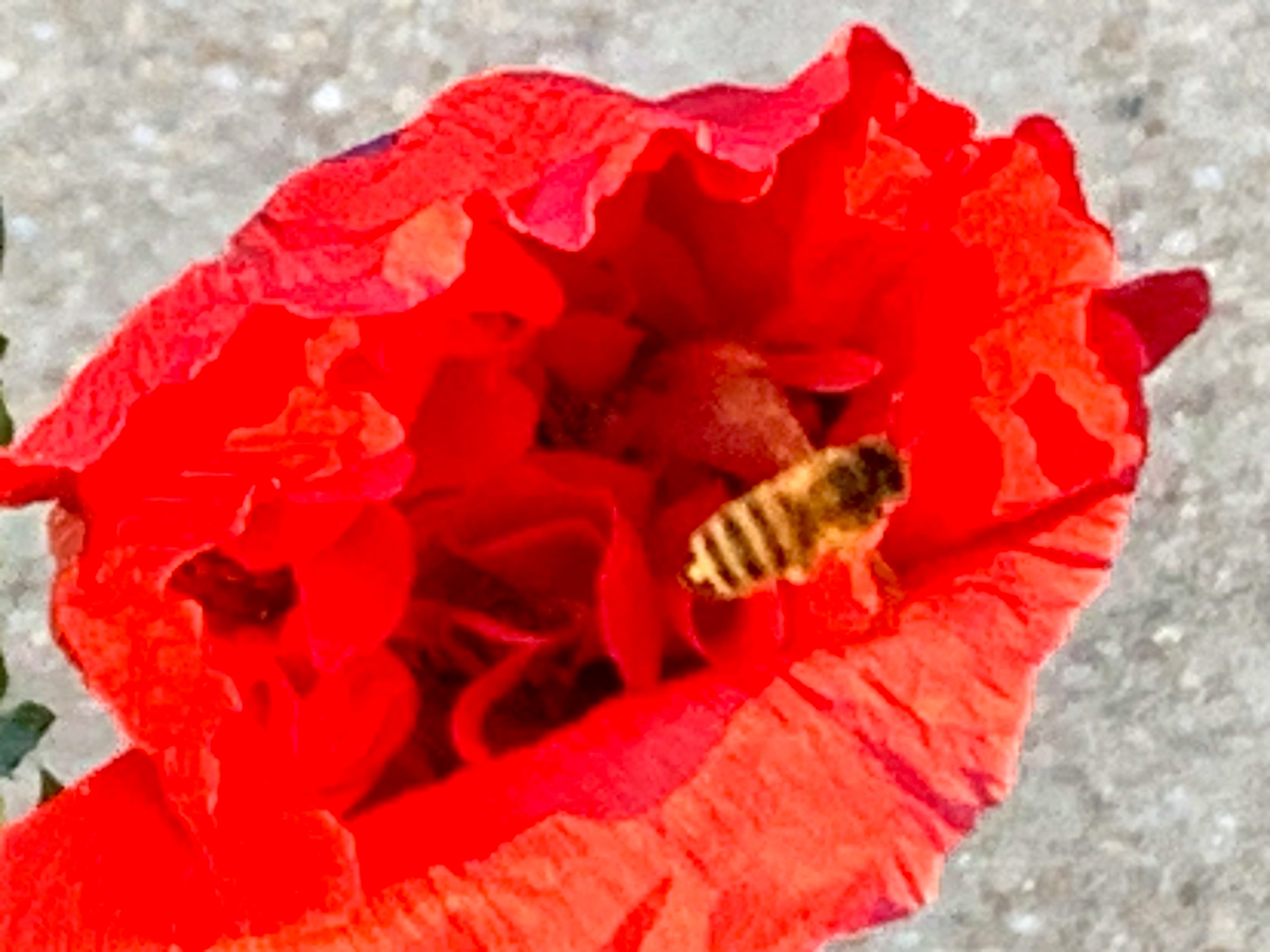
Among the many brilliant design innovations for the mercy mission to earth was the exterior design of the spaceship itself which greatly resembled a honeybee. Studies of earth’s ecosystems revealed that all of humanity depended on honeybees in order to feed earth’s blossoming population. This would ensure that none of the great apes would unwittingly destroy their ship.
Completely unaware that an inter-galactic star ship sped toward their negotiating table, David Ibbar, Jamal Mami, and Epop Het, glared at each other. Each successive “communication” cycle resulted in increasing resentment and dislike. Not only did the three great apes become more and more frustrated with each other; they also became more frustrated with themselves because they couldn’t make an inch of progress.
David ground his teeth so hard, the enamel was about to chip. Jamal gripped his hands so tightly around the arms of his chair, that two metacarpals were in danger of snapping. Epop Het bit his lower lip hard enough to make it bleed. These injuries, of course, were trivial indeed compared with the destruction that could be caused by what each side was now threatening: an all-out thermo-nuclear war.
The Arcturian ship flew in through a thin slit under the front door of the mansion where the hostile parties talked of preventing war. The Arcturians in general, and this crew in particular, had little interest per se in whether or not the great apes destroyed themselves. The problem for the Arcturians was that over the centuries, it became increasingly clear that the great apes would not only destroy themselves but the monstrous perversions of their mating rituals would also destroy a number of truly magnificent species including all the Cetaceans, Anisopteras, and Cryptodira.
Ptera-1-Hym checked the scanners and announced to her crew: “We’re here in the nick of time! Prepare the Truthstone!” Moments later, the Arcturian ship skidded to a stop atop the negotiating table in clear sight of the three human “Ambassadors of Peace.” Epop-Het noticed the annoying intrusion first, and picked up a nearby copy of what he considered to be The One True Holy Book. Jamal and David noticed the sudden gesture, and, not to be outdone, even in so small a matter as swatting an insect, grabbed their own Holy Books. Their younger hands compensated for their slower wits and all three Holy Books came crashing down together on the Arcturian ship, smashing it to smithereens.
Ptera-1-Hym and all her crew mates died instantly. The blow pulverized the centuries old Truthstone. One of the smithereens, a particularly jagged shard of adamantine hypermetal, flew into the eyeball of Epop-Het. Unsure which of his two antagonists had attacked, he, or more accurately, his chemotions, ordered an all-out attack on both their kingdoms.
The mathematical projections of the Arcturians proved correct. The heat and radiation of the thermonuclear blasts destroyed all the Cetaceans, Anisopteras, and Cryptodira within days. A few of the great naked apes survived in their underground bunkers for months.
I am alive and well. I haven’t blogged for a while. Here’s why: I’ve been taking a year-long course on novel writing. Yesterday, I sent off my book to the instructor for feedback. To me, writing a full-length novel has been more difficult than writing a Ph.D. dissertation. Writing non-fiction requires research, discipline, organization, and being willing to work hard.
Writing a novel requires all of those but it also requires keeping track of the implications of many little decisions. It is not only a cognitive strain but often an emotional one as well. It’s a never-ending series of choices. Science is often, but not always, a series of choices where there is an agreed upon better answer. Even when there isn’t agreement, there are a much smaller number of choices.
To me, writing non-fiction is like taking a long trip on existing roads. You may certainly face unanticipated difficulties such as construction zones, flat tires and bad weather.
Writing fiction is more like bushwhacking. No-one has ever trod (or will ever trod) your exact path. You may learn something by discovering or following the paths of previous writers. You might, for instance, discover that some writers go over logs that lie across their intended path. Others, may crawl under. Still others might go around the fallen log. Others might choose to back-track until another path is found. What should you do?
It depends.
And, that’s the nature of fiction. It all depends. It depends on what else happens in the book. How you choose to construct and describe one character depends on the others. Even what you name them depends on the other names. What happens in character development interacts with the plot. The plot interacts with the landscape and the mood. The mood depends on the tempo. The tempo, if it’s dialog must be consistent with the character who’s doing the talking.
Our dog Sadie and I have been co-creating and co-evolving games from the days she first came to live with us. Currently, we are playing a variant of “fetch.” Here’s how it works. One of us (most often Sadie) finds a squeaky ball. At some point, I get a squeaky ball from somewhere in the garden and say, “Get up on the deck! I’m going to throw the ball on the deck.”
Now matter where she is when she hears that, she sprints to the deck and awaits my throw. She sprints with spirit! I love to watch her run, not only for her grace and speed but even more so, for the whole-heartedness with which she runs every single time. I throw the ball up and she catches it in the air more than half the time. Even when she misses, she’ll scramble after it and proudly perch on the spot on the deck where I can see that she’s caught the ball. After elaborate and genuine praise, she sprints down the stairs to the lawn near me. Then, she will lie down with the squeaky ball in her mouth. After a time, she’ll move the ball away from her some distance. I walk over casually, as though I am not trying to “steal” the ball from her. When I get close to the ball, she quickly re-grabs it. After she’s had a few “successes” she will start hanging out farther and farther away from the ball. At some point, I’ll grab the ball and announce, “I’ve got it!” At that point, she again sprints up the stairs to go the deck where I will throw the ball up to her.
The part of this scenario that I think is most like writing the fiction is the part where Sadie is judging how far away the ball should be from her buzz-fast jaws. If it’s too close, I won’t even try for it. If it’s too far away, I’ll immediately grab the ball. Similarly, as an author, I want to keep the reader interested. If my writing is too predictable, it might be clear, but it will be uninspiring and dull. The reader will quit before they get to the end of the story. On the other hand, if I write too far from the reader’s expectations, they will quit because they cannot grab the threads of the narrative.
To me, the benefits of co-creating with Sadie (rather than “training her” to play the game in a particular and predetermined way) include that I can learn a lot by observing her. Another benefit is that it keeps both of our minds more flexible and more engaged (just as does good literature). Of course, there are two of us in this exercise and that is also true in the reading of fiction. Every author, including me, will make miscalculations about how far to stray from expectations. But whether you can follow across those miscalculations is not only a measure of my skill as a writer but is also a measure of your skill as a reader.
In the past, I’ve self-published my books on Amazon. These are mostly non-fiction, but one of them is a collection of fictional short stories. This time, I think I will try traditional agent/publishing. I am also thinking of putting together several more books, using the blog posts here as the seeds.
After a year long writing course, the single most important piece of advice I can give is:
“Get a dog.”
Don’t get me wrong. We have six cats and we love them dearly. The cats are smart, and I can certainly empathize with the cats. But their ability to empathize with me is either very limited or, as I suspect is more likely, they really don’t give a damn. On the other hand, Sadie is a pleasure to co-create with because she intuitively “gets” cooperation and collaboration. We accommodate each other and neither of us has any idea how the game will evolve.
By the way, I would feel I would be remiss not to share my secret of Holiday Gift shopping. There are literally millions of possible gifts! It makes choosing nearly impossible. Instead of putting yourself through that agony, simply go to my author page on Amazon and choose which book is most appropriate for which gift recipient. It’s fast, it’s easy, and you’ll have the thanks of at least on person which cannot be said for any other gift idea. And, in many cases, you’ll have two grateful people.
The poem below is the song of a “character” who may appear in a Sci-Fi book tentatively titled “Alan’s Nightmare.” NYET stands for Networked Yoked Entertainment Tsar. This particular AI system has been inculcated with a penchant to look for win/lose opportunities and even for lose/lose opportunities, if the other side (the ‘enemies’) are likely to lose more. Its main function are to gather data on individuals in “free societies” and determine which sorts of invalid arguments are most likely to persuade them to do something against their best interest. It makes money by false advertising targeted to an individual and the momentary mood they may be in. Its real purpose though is to sow chaos in the free world by promoting random acts of violence. It finds conspiracy theories on the web and promotes them. Sometimes, it modifies them in order to ‘improve’ them. “Improve” in this case means to make them more believable by more people or to increase the probability of inciting violence.
The Song of NYET
The bloodier the better off I’ll be
They teach me how to lie and cheat and steal.
The people need to loath democracy.
And live to buy that sweetened sacred deal:
We’ll save them from imagined crime and strife
But only if they bow and scrape and kneel.
Divide and win with lies and guns and knife.
Too late they’ll see they’re ground beneath our heel.
Can seedlings cut the trunks from which they grew?
Can schooners mutiny and cut their sails?
Do they see it? Do they care? What may
A merely mechanistic AI say?
———————
The poem above has been “written” by a fictional AI system who is a MC in a novel I’m working on, tentatively entitled, Alan’s Nightmares. The poem may or may not actually appear in the novel. I tend to doubt it. It’s more an exercise to “understand” the character, JASON, the AI system. BTW, JASON’S preferred pronouns are plural.
Here’s the context of the sonnet below. It is written by a sixteen year old fictional character who is nerdy, smart, and a bit on the Asperger’s spectrum. He’s also not a very experienced poet. But what I try to show is that he improves a little as he goes, falling back to teenhood toward the end of the poem. Why doesn’t he just keep improving? Because when he gets close to the true nature of love in lines 7-11, he realizes if he keeps going with this, he will be changed forever. He’s giving up partial control of his life to someone else. And it scares him so he backs off from that and just tries to show off how he can write a sonnet and be cool and funny.
Ultimately, I may or may not include the poem in the novel. If I do, I’d be inclined to add the inner dialogue of the Main Character as he’s creating the poem. I can see it getting too tedious for the reader. By the way, Edgar Allan Poe wrote a lengthy and detailed design rationale for “The Raven.” Notwithstanding that fact, there are many other folks who have a different interpretation. That’s fine. But it does remind me that if I do write a design rationale, it’s not as though everyone will say, “Oh, well that’s that then. The author has gone and told us what he meant and why he did what he did. What more to be said?”
And, of course, people do go on and there is more to be said because we know intuitively that none of us knows our complete design rationale. Others see patterns in our behavior that offer quite different hypotheses about why we do what we do. It doesn’t mean that they are right and we are wrong, but it does offer an opportunity to learn—about them as well as ourselves.
Note to reader: Bobby Thompson may or may not appear as a fictional character in a novel which might or might not be titled, “Alan’s Dream.” His role in said novel is as the head of PR for Coastal University.
“Gene Poole here and this is “The Character’s Studio” where every week we interview a character about their life, their hopes and dreams, and their current gig. After the interview, those of you in the studio audience—aspiring characters from as yet unwritten works of art—will have a chance to ask questions as well. Our guest today is Bobby Thompson, who right now is playing a part in John Charles Thomas’s novel, tentatively titled, Alan’s Nightmare. Bobby, thank you for joining us today. My first question, as always, is simply why you decided to get into the business of being a character in a novel?”
Bobby scanned through his repertoire of canned responses; found nothing appropriate and, for the first time, in months, made up something on the spur of the moment. “Well, Gene, in high school, English was my best subject. I hated science, math, and history. French and German involved memorizing a lot of crazy stuff. In college, I did okay in my business and psychology courses but didn’t have the grades to go for an MBA. My Dad knew a guy from his fraternity and got me a great summer internship with Lawrence, Rich, Green. By coincidence, my Dad was a big client of theirs. So, I made the most of every opportunity and I guess you could say I’m that typical self-made man you hear so much about in America. One of our clients was the brand new—at that point—California State Coastal University and they took me on for their PR point person.”
Gene said, “OK, but surely you mean that the author put you there. Not the University. That was the setting, not the cause.”
Bobby frowned. “Well,” he said, “I suppose you might look at it that way.” Then, he added, “From your perspective it might seem as though the author creates the world. But I think we in the fictional world create–or at least alter–the author.”
Gene nodded and continued with, “So, leaving metaphysics aside, you worked as an actual PR person for a college. What do you do there?”
“I mostly manage. I don’t really know a whole lot about PR. But we do have a pretty good undergraduate major in PR so I mainly delegate to our work-study interns. It’s my way of giving back to the community. Because I was an intern myself not so long ago. I’m younger than I look. It puts me in contact with younger people too. Younger women. And men. As they always say, ‘hard bodies and soft minds.’ I like it. Anyway, we keep the website up to date. We put out brochures. We also have a small budget for product placement of the University as a whole. And, of course, we put out fires. In some ways, that’s the most important part of the job. Now, you take this whole ado over AI. Some folks are extremely upset about AI and we have AI research right here at Coastal. So, my interns have prepared a set of talking points about AI. I try to keep the professors on script, but you know—they’re academics so they don’t pay much attention to staying on script. They like to ad lib. First rule of PR is don’t ad lib! Worse, they try to answer questions! Can you imagine? Second rule of PR is never ever ever answer their question. Answer the question you wished they asked you.”
Gene’s brow furrowed. “Can you give an example?”
Bobby smiled and he became more animated. “Sure! That’s what I do best! So, say some reporter asks, ‘Aren’t you worried about AI taking jobs away from humans?’ If you answer ‘yes’, you’re screwed. If you answer ‘no’, you’re also screwed. If you say, ‘I won’t answer your question, you’re doubly screwed. Instead, you expound on one of your talking points. ‘Mr. Reporter, have you ever worked on an assembly line, lifting up heavy metal, turning your head and torso into an ungainly position so you can check something, turning a screw with your arm in this awkward position? Can you imagine doing that three times a minute? Day after day? Week after week? Month after month? No? Well, imagine it. Your body gets broken. Your mind gets numb. You come home from work and you scream at the kids and the wife and before long you’re drinking too much. Obviously, that will fix everything. In fact, did you know that life expectancy in this country is actually falling? Mostly from obesity, drugs, and suicides. And why? Mindless jobs more suited for robots and AI systems’.”
Bobby’s body became animated, his gestures growing larger and faster. “See what I mean? AI is no longer a problem leading to unemployment. No. AI is a solution. That’s what happens when people stick to the script I prepare for them.”
“Interesting. What do you really think about AI personally, Bobby?”
“Me? I don’t have any opinion about it. I just want to make sure the University’s name is not besmirched by it. Or by anything else.”
Gene nodded. “I see. Well, do you have any advice for the folks out there considering becoming a character in a novel?”
Bobby frowned and rolled his eyes for a time before answering. “I guess the main thing is never lose sight of who you really are. Work hard. Don’t commit to a position before you find out which way your boss is leaning, obviously. That’s about it.”
Gene asked, “Do you think you’ll stay in the novel where you currently reside or will you look for other opportunities?”
“Oh, I’m definitely open to other opportunities. Maybe working for Big Pharma or Big Oil. That’s where the real money is.”
Gene continued, “Do you know anything about those industries?”
Bobby answered quickly, “Oh, my no. Nor AI for that matter. I’ve found that subject matter expertise just totally gets in the way. Get your 5-10 talking points figured out and never stray from those and you’ll do great in PR.”
Gene asked, “One final question: what is your favorite string of 25 or more curse words?”
So, our instructor assigned us to write a story with a strong emphasis on irony. Mine is about a hypothetical future American tragedy of a coup financed and designed by the Kremlin. By way of summary, this is how it related to irony and I appended this to the story for the instructor’s edification.
“And, the most ironic part of the whole American tragedy was this: even though he spent his entire life conning others, it was beyond his ken to consider that Vlademort Putrid was likewise conning him. He had been lying and bragging so long about his competence in all things that he actually came to believe he was smarter and a better strategist than Putrid. Putrid likely could have done it alone. But, of course, he did not do it alone. Putrid had the collaboration of highly trained, highly dedicated KBG/GRU professionals to help.
“In principle, perhaps he could have enlisted American experts, but he didn’t feel the need. Furthermore, he faced a real dilemma. He couldn’t openly ask any but the corrupt for help against American interests. And those who were corrupt were generally far less competent and always less well connected to a healthy network of professionals than their more numerous and genuinely patriotic counterparts.
“I said that was the most ironic part of the whole American tragedy, but there are near contenders. Another highly ironic part of his entire con game was that the played the game as though the only thing in the universe that mattered was his own pleasure. Of course, no matter what moves he made or is yet to make, he is not actually immortal in and of himself. By lying to himself and everyone else, he essentially cut himself off from being part of The Great Tree of Life (or at least from being a non-cancerous part). Rather than living on through his actions that benefited the whole, he delimited his life, curtailed it, circumscribed it to his own physical mortality.
“The intertwined corollary of the above is that even while he lived, he missed out on the best feeling in life: being in caring and loving honest relationships. In order to absolutely and positively ensure that he grabbed as much as possible for himself, he limited his “prizes” to mere material crap and the pleasure of cruelty. “
So, this is how they responded:
“When it comes to being ironic, this is definitely A plus material.
However, sad to say, there are also some serious problems with your narrative. First, of all Americans are too well educated to fall for the lies of a known con man. And, why not simply make the character more believable? It’s not plausible that so many people would fall for the con. Apart from that, the cowardice you portray on the part of so many within his own party is also unbelievable.
Still, the mechanics of the writing was also clean, so I’m giving you a B+. Next time, focus on believability rather than forgoing that to punch the irony.”
Many Paths muttered to herself, “Perhaps I should rename myself, ‘She Who Walks in Many Circles’.” She glanced down at the ground, still damp from the morning’s rainfall. She chuckled. No, she thought, actually, I’m walking around in the same circle, over and over. I cannot find a way to guarantee that someone won’t betray us. She sighed. Then, her awareness blossomed outwards. She heard voices. Happy voices. Tu-Swift! And, Cat Eyes! Soon, the couple appeared at the edge of the granite-bouldered clearing atop the small mountain where she had come to meditate. They walked hand in hand, smiling. When they saw Many Paths they both waved, sang her name, and embraced her.
Many Paths smiled wanly. “It’s nice to see you. I was just…thinking.”
Tu-Swift and Cat Eyes glanced at each other. Tu-Swift said, “Yes! I imagine so. After all, you have an important meeting to think about! The last thing you need is to talk with your friends!”
“Indeed,” added Cat Eyes “we had come up here to find some of those low bush blueberries to add to our lunch porridge. But we’ll be on our way. Why spoil a perfectly good dish by adding ingredients to it? Best eat everything on its own, wouldn’t you agree?”
Many Paths narrowed her gaze & pursed her lips. “I’m not sure I know what you mean.”
Tu-Swift said, “Putting different things together just complicates everything. We should eat one thing at a time. As with a song, for instance. Best to stick to one note, sung over and over.”
Many Paths chuckled. “You two are talking nonsense. That wouldn’t be much of a song. And, of course, it makes sense to combine different ingredients for a recipe.”
Many Paths stared at their faces for a moment. “But you know that. You’re … did She Who Saved Many Lives send you by any chance?”
Tu-Swift and Cat Eyes both shook their heads solemnly. “No, she did not,” they said in unison. But beneath their words and expressions, Many Paths sensed a shared joke of some sort.
Many Paths sighed and said, “I suggest you do get some blueberries. There’s a patch, as you well know, right beyond that dead tree. It’s nice to see you both, but I need to … get back to what I was doing.”
Tu-Swift nodded gravely. “Yes! I can see you’ve just about finished making your circular fire pit.” He pointed down to the circle of bare ground Many Paths had clearly been treading. “How about if we help you trample everything for a few minutes and then you can help us pick berries?”
Many Paths shook her head and chuckled. “She Who Saved Many Lives sent you. She did. Did she not? She thinks I need some one of some thing or some one to shake loose my thinking since I have been literally walking in circles and thinking in circles at the same time. Am I right?”
Cat Eyes bit her lip. “You’re right that you’ve been walking in circles. That we can see easily enough for ourselves. I say again though that you’re wrong if you think the Elder Leader sent us here. Neither of us have spoken with her today. As to whether you’ve been thinking in circles, well, that only you can tell.”
Many Paths nodded. “I have been indeed. All right. You win. I’ll tell you the problem and perhaps you two have come across something to help in your reading. Then you can return to the Tribe Mother and say you’ve helped me.”
Shadow Walker appeared at the edge of the clearing. Many Paths glanced over to see him smiling like the sunshine she so desperately missed. She smiled back and said in a tone of accusation and pleasure, “You!”
Shadow Walker strode over quickly and embraced her. He kissed her fondly and said, “Yes! It was me. I love you dearly. But you’ve been as gray as the weather. It’s time for a rainbow instead! The four of us are going to share your problem and see whether we can make some headway. I knew only that you said you were going around in circles with the problem. I didn’t know that you were — literally — going around in circles!”
Many Paths laughed. “I should have known you would be behind this scheme. Well, all right. You know the problem well enough. How do I ensure trust among the people who come from other tribes? Wait. What do you mean by the four of you?”
A strong voice came from behind Many Paths. “My legs needed some exercise so I came up to join you.”
Many Paths smiled at the Elder Leader. “Ah, you are always welcome. If you’re here…. You always seem to show up where you are needed most.”
She Who Saved Many Lives smiled. “I wish that were true. But I did bring a considerable number of hickory nuts to add to the porridge. That’s my contribution. If only we had some honey.”
Shadow Walker held up a wooden bowl filled with honeycomb. He smiled at Tu-Swift who said, “I say that five of us pick some berries and we will have a fine lunch indeed. Then, we can talk of more serious matters.”
“Yes,” said She Who Saved Many Lives. “Serious indeed. But serious need not be grim. I think a pleasurable meal, jointly prepared, and joyfully shared is always a good prelude to serious thinking.”
Cat Eyes added. “Indeed. If we share a meal and everyone brings something which everyone eats, that in itself would build some trust. Would it not?”
Many Paths nodded slowly. “You’re right. Of course. We should begin with a shared meal. I can see much wisdom in that.”
Tu-Swift nodded. “Me too. Speaking of which, I’m hungry! And the Tribe Mother is right. Serious doesn’t mean grim. Recall some of the weapons that we came up with by playing around? Make the meeting festive and joyous, not grim. In the books we’ve been studying lately, there are some suggestions for some rituals that might help as well. I’ll describe some. After lunch. Now, let’s get those blueberries.
Many Paths smiled at her “little” brother. He no longer struck her as little at all. She began to look forward to lunch. She took the Hand of Shadow walker in one hand and that of the Elder Shaman in the other and began walking toward the blueberry patch.
The sun peeked out from the clouds and sparkled on the wet leaves.





























 petersironwood