I was trained in “Experimental Psychologist” in the late 1960’s. Today, my program would likely be called “Cognitive Psychology.” The change is more than simply moving to a more fashionable (or opaque?) terminology. Skinner and other behavioral psychologists held sway over much of the experimental work in psychology and particularly in America.
One of my classmates at Michigan had attended Harvard as an undergrad and described an honors dinner he had attended as a Freshman. He had gotten to sit next to B.F. Skinner at the banquet and Skinner, was not only a smart student (having gotten his own Ph.D. in two years), and a brilliant experimentalist; he was also a tireless promotor of his view of psychology. Even at a dinner for Freshman, he began to wax elegant about his particular approach.
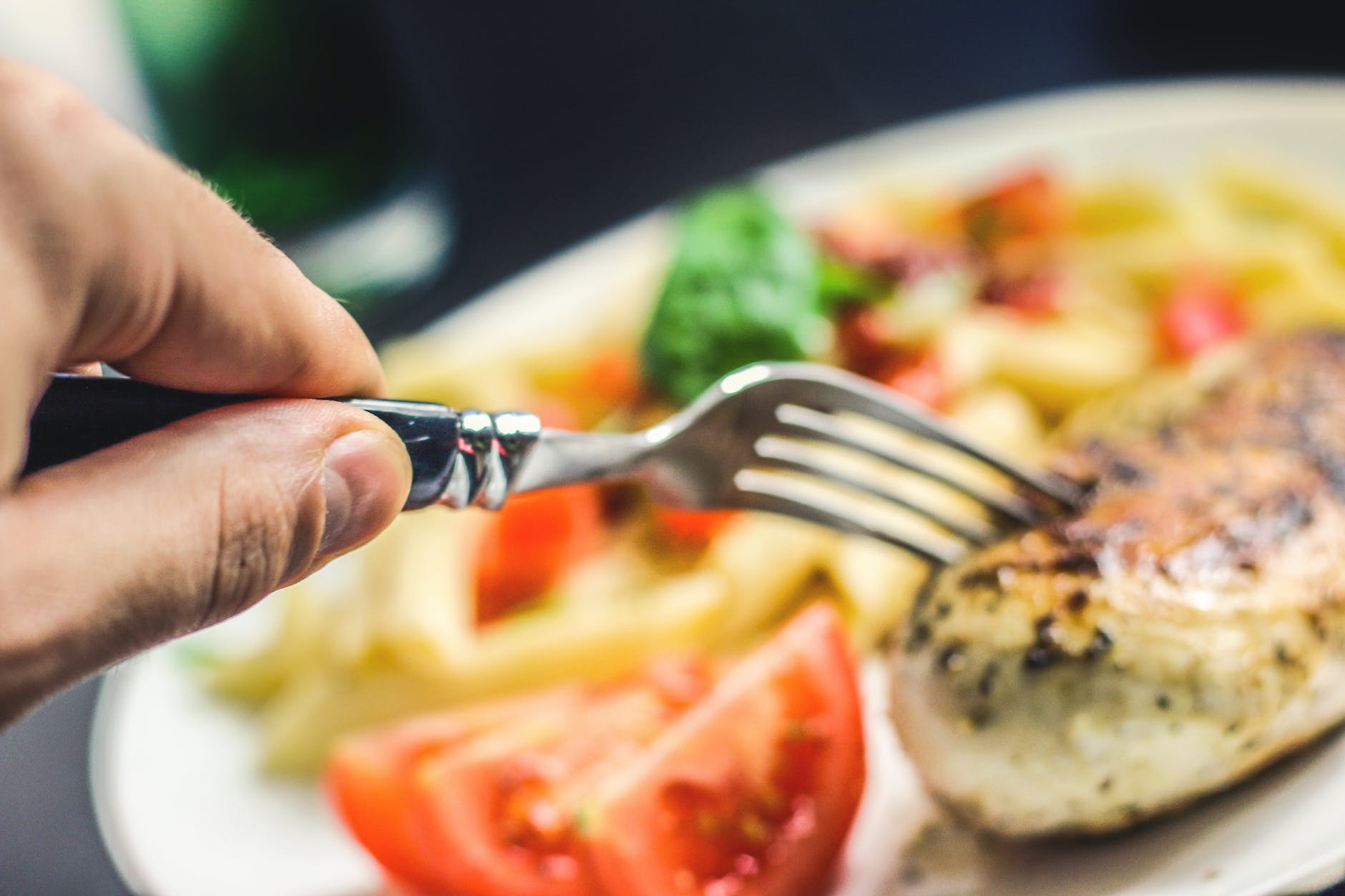
“Now you see,” said Skinner, “I am holding a fork and I move it to my mouth and I get food. Some of my colleagues would say that I believe that I will satisfy my hunger if I move the fork to my mouth. But why? There’s no need for belief! It is simply that when I grab my fork and move the food to my mouth, I am reinforced by the food and thus I keep doing it! There’s no need to introduce any belief!”
My classmate, in awe of the great doctor Skinner said, “Wow! That’s amazing Professor Skinner and you truly believe that, right?”
“Of course I believe it! I mean — no, of course not. I don’t believe. I’ve simply been reinforced for saying it so many times that now it is my behavior!”
This is a recounting filtered through two sets of memory, but in essence, I believe it is correct. I no longer think of the word “believe” as a useless and unnecessary construct. As an undergraduate, I studied a lot of behavioral psychology, and worked as a laboratory assistant in a behavioral psych lab. At the same time, I had another part-time job working as a child care worker in the children’s floor of a psychiatric hospital. At the hospital, the approach the psychiatrists took was strictly Freudian. Thankfully, the patients spent the vast majority of their time interacting with much more practical and reasonable souls such as myself, my fellow child care workers, and many wonderful nurses.
I had been fascinated by Freud whom I first read about around age 13. I came to believe there was much truth in his approach. I interpreted dreams and “slips” and his approach resonated with my lived experience. But my allegiance is to truth, not to an individual. Empirical research began to demonstrate that however intuitive his approach might seem, it was not particularly effective compared with behavior therapy or, later, cognitive behavioral therapy.
When I had a first hand look at the “Freudian” approach applied to a kid’s psych ward, I saw for myself how it could be misapplied and mishandled. Here are two examples. One of the kids K had spent an hour or so building a plastic model of a car. No sooner had he finished and began to show off his cool accomplishment than a much younger kid D ran over and stepped on it, pretty well smashing it to bits. K began yelling and screaming. A nurse — one of the few I worked with who happily drank the Freudian Kool-Aid asked K what he was so upset about. K said, “D smashed my car!”
Nurse: “Well, K what are you really upset about?”
K: “I told you! D smashed my car!”
Nurse: “You’re going to the quiet room until you can tell me what you’re really upset about.”
I am not claiming this is “appropriate” use of Freudian therapy. But it does illustrate how easily it can be turned to something absurd and cruel.
This absurdity was not limited to nurses who “after all” didn’t have the years of training it takes to become a Freudian psychoanalyst. But here’s an example from one of those highly trained psychoanalysts. Another patient, M, had been on the ward for about three years and during this time had become close friends to one of the nurses, N. These nurses, you have to understand, did not spend time simply administering meds and sitting in the nursing station. They were on the floor interacting with kids during 90-95% of their shift. So she had spent many hours interacting with M. I observed them together and it was clear that there was a real bond of friendship. At some point, N had a job offer from Raleigh and told M that she’d be leaving. M was sad — appropriately so, in my estimation.
As is typical in hospitals, there were three shifts per day. There is overlap of shifts so that shift N can find out what happened during shift N-1. We took turns reading the “Nursing Notes” and “Psychiatrist Reports” during the handover meeting. The psychiatrist who was seeing M “explained” that he had told M that he, the psychiatrist, was going on a vacation for a week and so “obviously” the sadness expressed by M because he’d be losing his friend who saw him every week for three years was actually a reaction to the fact that M’s psychoanalyst would be on vacation for a week. Right.
I loved working with the kids. And, I enjoyed my colleagues on the ward as well. However, I got completely turned off to the psychoanalytic approach as practiced. I still believe there are some important truths to Freud’s approach, but also some absurdities, particularly when it comes to his misunderstandings of women. We’ll save that for another time. The point here is just to show why I was looking for another approach to psychology and behaviorism fit the bill.
For a time.
It is impressive to train a rat and to see with your own eyes how reinforcement, shaping, thinning the schedule, extinction, generalization, chaining, all work. I was able to train a rat to do a “chain” (i.e., sequence) of four unnatural behaviors. It took patience and it takes clear observation — a kind of empathy really. You have to know when the rat is “getting closer” to the desired behavior. This observational skill is also useful in training a puppy.
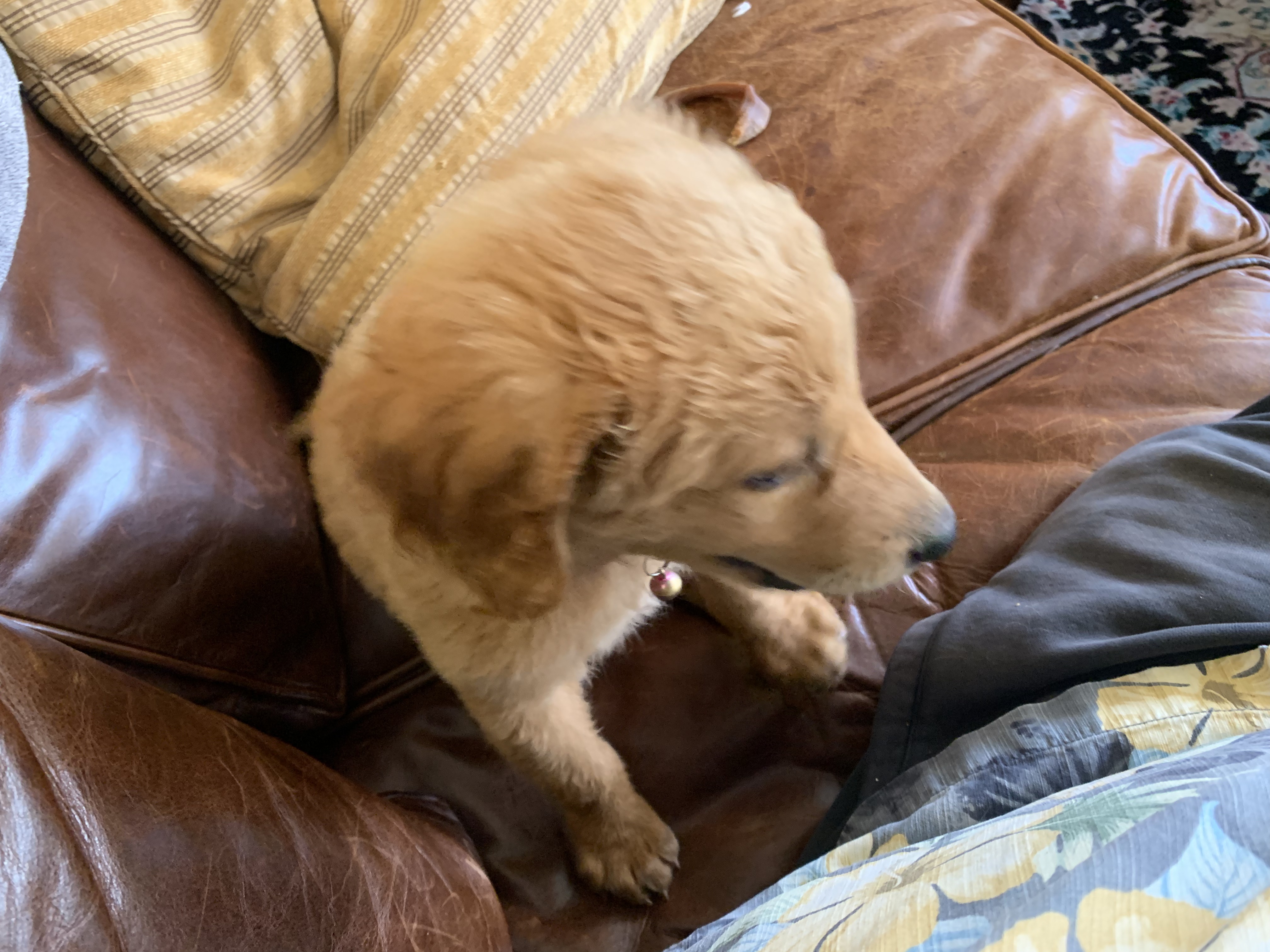
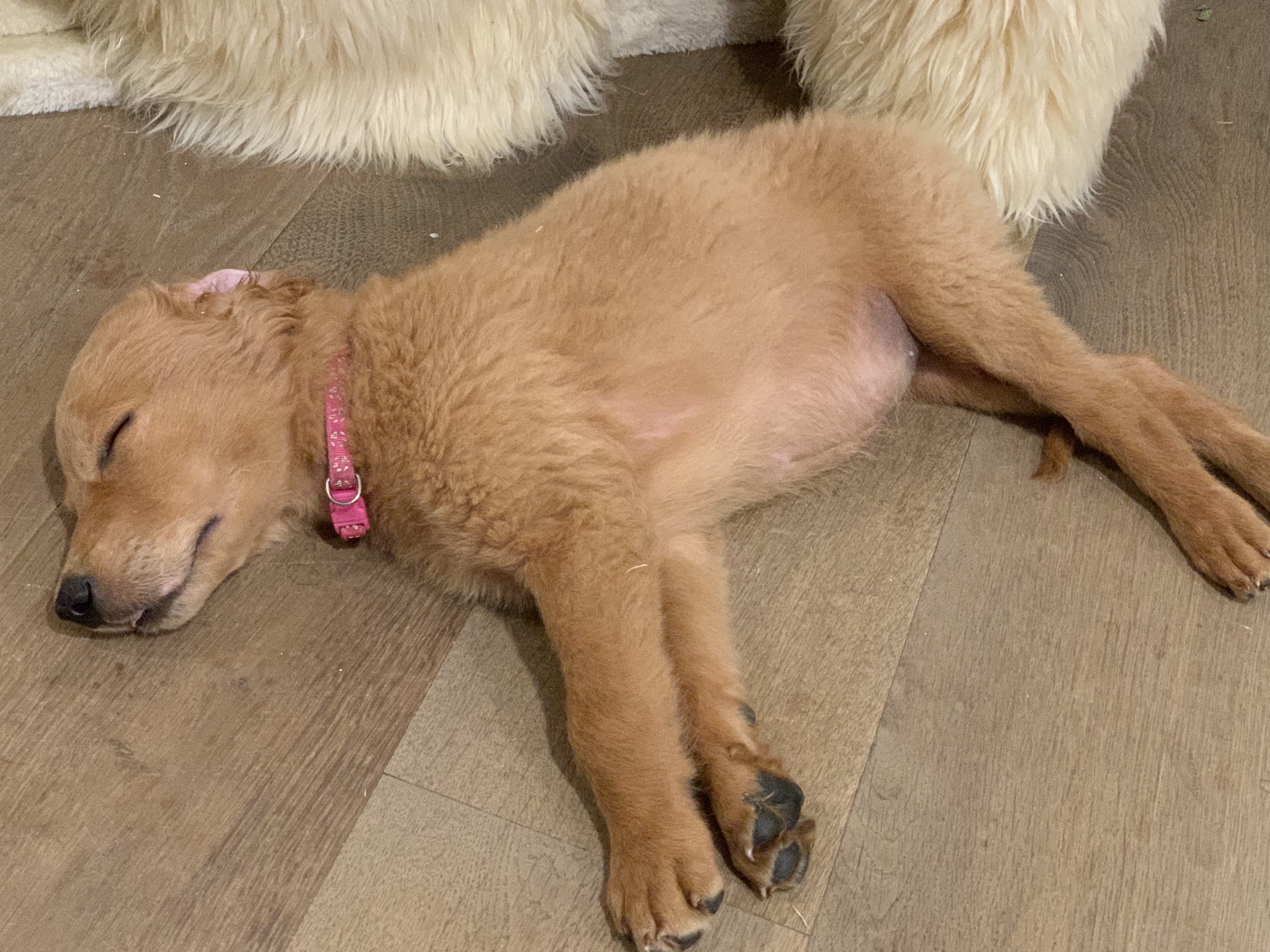
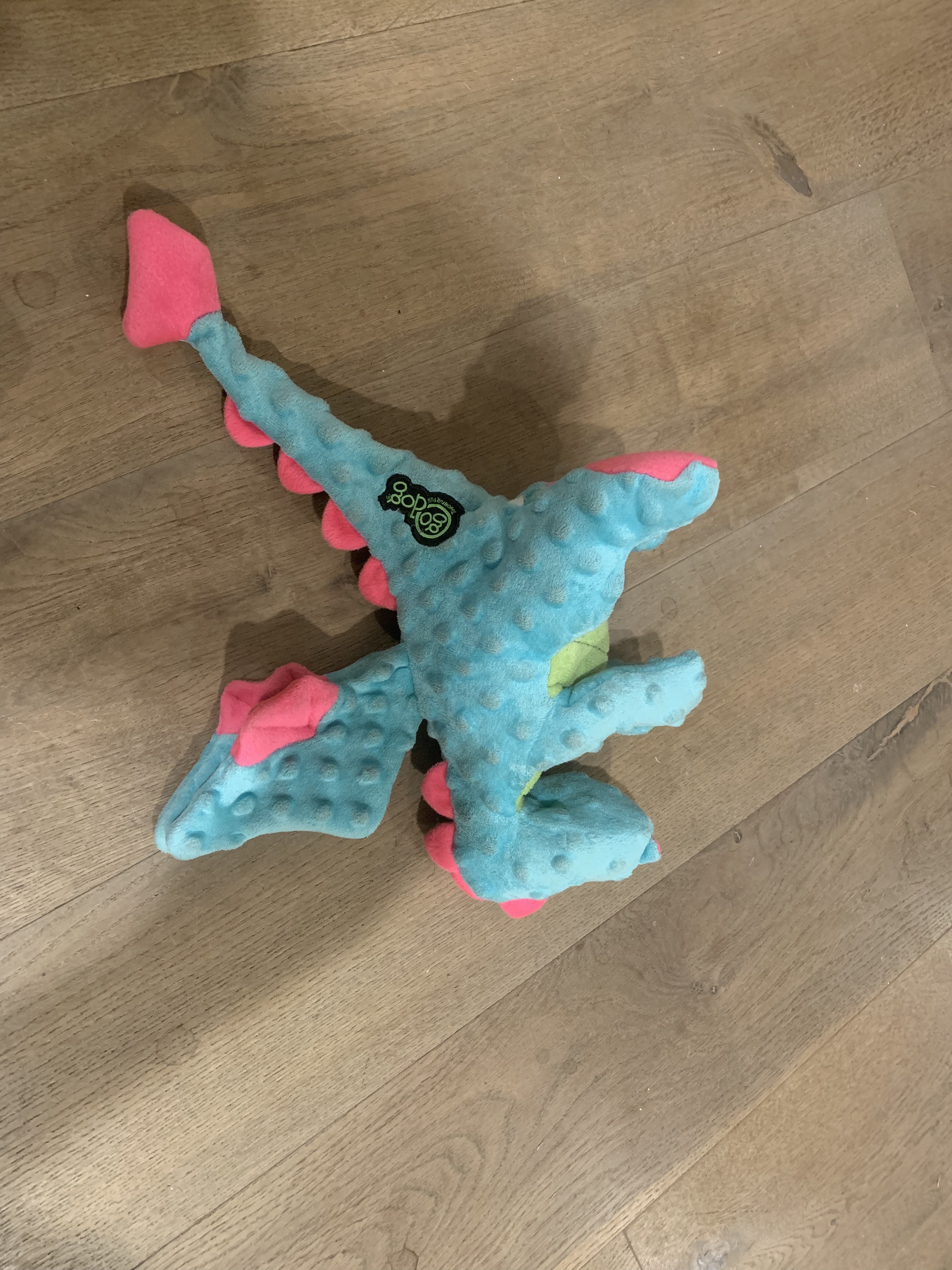
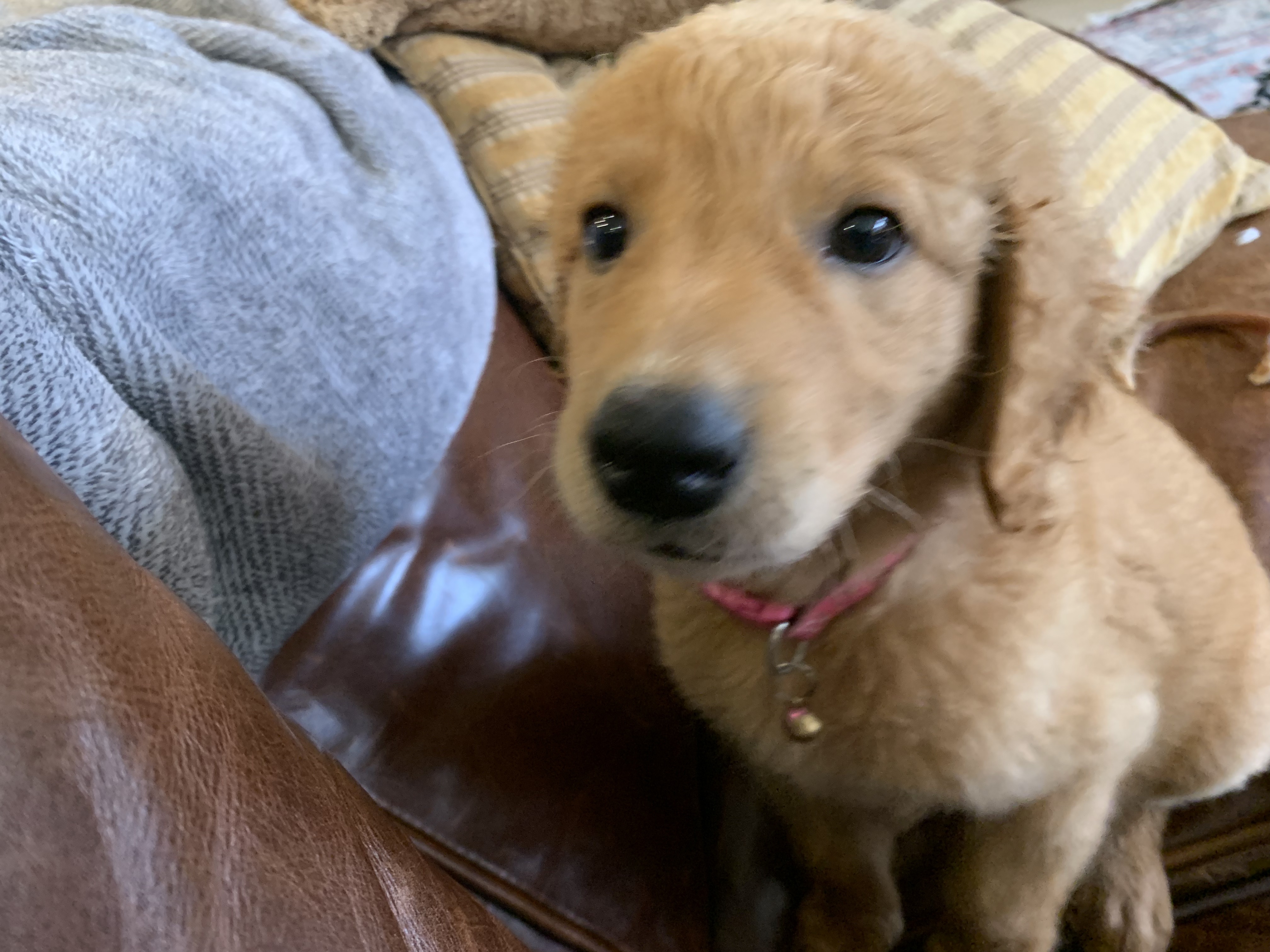
That brings us to the game of “chase the dragon, bring it to me, and fight over possession.” Our new puppy Sadie, being smart, learned to chase, fetch, and fight for control very quickly. What I find more interesting is how her behavior also evolved over the course of a week to grab the dragon by the neck a very high proportion of the time. From the standpoint of fetching and fighting me for possession, she has many choices: head, neck, left forearm, right forearm, left leg, right leg, left wing, right wing, tail, belly, or crotch. So, why is she focusing so heavily now on the neck?
One possibility is that I say “Good work, Sadie” more often when she grabs it by the neck. I doubt it, but it’s conceivable. Another possibility is that it’s easier to carry. That also seems unlikely. She occasionally trips over the dragon as she’s bringing it back. But to prevent tripping, it would be best to grab by the belly. Grabbing by the tail, head or neck makes it more likely to trip. In any case, she doesn’t seem to “mind” tripping as much as I would! Another possibility is that she holds on more easily when I struggle with her. But her jaws are strong and she can hold on anywhere and keep me from retrieving it.
I think the most likely explanation (though not the only one) is that grabbing by the neck and shaking (which she also does) is how her ancestors break the necks of small prey. Many people would say this behavior is “instinctive.” But she didn’t exhibit this preference when we began playing “fetch the dragon.” After a week though, she exhibits a strong preference.
In popular speech as well as in professional psychology, we often tend to dichotomize behavior into “learned” and “innate.” The behavioristic approach focuses on what is “learned.” As a result of that focus, we learned many important things about learned behavior. Some have suggested that the American focus on behaviorism and the importance of learned behavior was partly driven by our political philosophy. Regardless of why it happened, behaviorism “ruled the day” for quite awhile.
It turned out that what might be called “naive” behaviorism doesn’t work completely even for rats. One line of thought was made famous by Chomsky. People cannot learn their natural language merely by being positively reinforced for saying the “right” thing. There are rules that we learn. Children brought up in an English-speaking household, for instance, learn the rule that past tenses are made by adding “-ed” to the end of the present tense form of a verb; e.g.; we have “learn – learned”, “walk – walked”, “type – typed”, “showcase – showcased”, etc. There are thousands of example. But the rules are not “perfect’; there are many exceptions. We have “are – were” and “ran – run.” At a young age, almost all children at some point will say, “I ranned after my puppy” “I eated my dinner.” They have not heard that. They are not learning specific words; they are learning rules.
It isn’t only beings as complex as humans who fail to meet the expectations of “naive” behaviorism. A rat can be quickly taught not to “do” something if they are shocked when they do it. On the other hand, making them nauseous, while apparently noxious, does not teach them to avoid doing something. With smells and tastes, though, it is just the opposite. The rat (or human) can learn in one trial to avoid a particular taste or smell if it makes them nauseated. This is sometimes called the “Sauce Bearnaise Effect” — even one bad experience of getting nauseous after tasting a food — especially a novel one — can induce a life-long hatred.
The point is that some of our responses are predisposed to be paired with certain kinds of stimuli. We are not a “blank slate” but a predisposed slate. This kind of predisposition to fluidity is also true of genetic traits. We may think of the environment as a force capable of moving the genome equally easily in any direction, much like a billiard ball can roll in any direction equally easily on a pool table. But that is not so. Some kinds of changes are much easier to effect. For instance, in breeding dogs, the “toy” version is essentially a more juvenile form. They, like puppies and human babies, have a head that is disproportionately large for their bodies.
I recall many years ago reading an article in Science which observed that infant chimps were not afraid of snakes nor of a severed head. But with no specific “training” or “experience” with these stimuli, when they were shown later, the chimps were freaked out both by snakes and by a head with no body. It seems to me to be quite possible that there are behavioral predispositions that are inborn but not manifest without experience — but that the necessary experience is not “learning” in the traditional sense — not, in other words, being punished or reinforced but simply having experience that builds up your model of the world.
For instance, neither of us has seen a jumping spider as big as a puppy. We’ve never been bitten by one! Since they don’t exist, we haven’t “read” about how venomous they might be. But I’m guessing, if either one of us drove home late in the afternoon, pulled into the driveway and saw a spider in the driveway who jumped onto the hood of the car, we’d be completely terrified. We might “know” intellectually that the spider couldn’t tear the car apart to “get” us. But it would still be terrifying, I think because we would know that our “model” of what is possible in this world is badly defective. Our natural tendency, however, is not to say, “Oh, my God! My model of the world is terrible! I’d better fix it!” No, our tendency is to say, “Oh, my God! That spider is horrible!. We need to kill it!.” Our fear, in this case, is not “learned” nor yet is it exactly “innate.” It is “awakened.” At one time, our mammalian ancestors were so small that a large spider might be proportion to what the puppy spider might be to us?
In the case of he puppy chasing after a chewy toy in the shape of a “dragon,” she has “changed” to most often grab it by the throat. It could be learning of a sort, but it seems more like an “awakening” of a pattern already there ready to be activated by relevant experience. That’s not to say, I might not be able to shape her behavior by reinforcement or punishment to only grab it by the tail. This is not science of course. I haven’t been rigorous enough to rule out a more pure “learning” explanation. It’s just a speculation.
In the last two weeks, she’s also become much more adept at using her paws to “control” her dragon. This too feels more like “awakening” than it does pure maturation or pure learning. She’s grown more coordinated and stronger. It seems as though both maturation and learning are involved, but why should she want to “control” the dragon in the first place? That seems like the “awakening” of an instinctive desire.
What do you think? What is your experience with training puppies or other animals? What is your own experience? Do you think you yourself have had experiences that “awakened” something within?
My first “real job” was working as a camp counselor at a camp for kids with special needs. The camp counselors loved to play pranks on each other. One favorite was to sneak into another counselor’s cabin, fill the sleeping victim’s hand with shaving cream and then tickle them under the nose. The expected behavior is that the counselor will scratch the tickle while still asleep and thus smear their own face with shaving cream. Apparently, they tried this on me.
I awoke in the middle of the night and the first thing I saw were my thumbs firmly pressing on a guy’s windpipe. Apparently, instead of groggily smearing my face with shaving cream, I had immediately jumped up and began to choke him to death.
Mom sighed. She rolled her eyes. She glanced out the dining room window. “Still raining,” she muttered under her breath. She did remember to turn the iron off. Big Fred had gotten understandably upset when she had charred one of his shirts a few weeks ago.
“Donnie, we’ve talked about this before. You don’t even ride — in fact, I don’t even thing you ever rode your tricycle. Nor did you use the wagon we got you last Christmas. How about a new baseball mitt.”
“I sure could use a new baseball mitt! Thanks, Mommy! That’s a great idea. Then, I can play with Junior and I’m sure he’ll just let me ride on the handlebars when we go to the games. We go on…what’s the name of that street where those boys were run over last year? Hansel?”
“Hensley. Wait. You want a bike so you can join your brother in baseball?”
“Yes! Then you won’t have to watch me! Fred can watch me!”
Mom found the notion of peaceful summer afternoons with neither boy around for a few hours irresistible. “And, you promise you’ll play baseball and listen to Junior and do what he says?”
“Why should I always have to do what he says? Why don’t I ever get a turn? Isn’t that what you and Daddy always say? Everyone should get a turn. Freddie shouldn’t get all the turns to boss around! It’s not fair!”
“Donnie. It isn’t a game. Junior has a lot more experience than you do. He knows a lot of things that you don’t. He isn’t trying to boss you around. He’s just trying to help keep you from hurting yourself.”
“Okay, Mommy. Thank you for explaining. Sure, I’ll do whatever he says.” Donnie had long ago that it was important to look serious when he told these lies. Usually, he would ball his teeny fists in such a way as to dig his fingernails in so he really did feel pain. That made him look serious. Of course, it was also important to look Mommy in the eye. That wasn’t really something he remembered discovering. It seemed he’d always know it. The trick is to look just past the person into space while you keep in mind that it’s okay to lie. Everyone does it. That’s what you think about. Donnie felt very proud of himself to have gotten a mitt and a bike for nothing. But he wasn’t done. Not by any means.
Later that day, the rain stopped and the sun came out. The day became stifling and steamy. He knew when that happened, sometimes the Henry kids got into their swimming pool. Donnie stuffed his swim trunks into his pocket & decided he’d visit the Henry kids.
While they were swimming, Donnie spun a story of woe: how he needed a bike so he could play ball with Freddy. He tearfully explained that Daddy’s business was failing so they couldn’t afford a bike right now. But that was the terrible thing. Once he got the bike, he had a job lined up at the park and could easily earn the money to buy the bike. But he couldn’t even get to his job without the bike.
Becky always seemed the easiest mark and she spoke first: “How about if we pitch in and buy you your bike?”
Donnie smiled a huge grin. It was a genuine grin too. The Henry kids all thought he was smiling about the bike and they felt better than ever about helping out their friend. The real reason he was smiling was that his little con had worked. Then, he felt a bubble of doubt like an ugly burp. He realized that it was because it had been too easy.
“You know what? I really appreciate your offering to buy me a bike, but I just realized, that there’s really no need.”
Becky frowned. “What do you mean? You just said you needed a bike.”
Donnie guffawed. He realized, he would need to do more mirror work on his fake laughs. “Oh, I do need a bike, all right. But you don’t have to buy one for me. You can invest in one. You can lend me the money. I’ll make lots of money at my job. Then, I’ll give you back twice as much as the cost of the bike. You’ll double your money. Not in a year, but in two months!”
Everyone in Donnie’s neighborhood was very well off, but the Henry’s were exceptionally well off. To them, it seemed like nothing to give the money to Donnie. Donnie didn’t understand this, but he did see the blank look in Becky’s eyes when he said he could double her money. Donnie said, “Look. You double your money and you can tell your mom and dad how smart an investor you are. Trust me. They’ll be proud of you!”
After Donnie toweled off and feasted on some fancy teeny hot dogs, and gotten dressed again, and rounded up the cash he “needed” for the bicycle his mom promised to buy, he noticed Mr. and Mrs. Henry having cocktails across the hardscape. We walked over and began, “Mr. and Mrs. Henry. Thanks so much for letting me use your pool! And, wait till you hear what smart investors your kids are!”
Once Donnie had sold the three Henry kids on the idea, it was easy to get other “investors” from the kids.
“Ted, here’s a chance to do something really smart for yourself. Double your money! I promise!”
“Greg, here’s a chance to do something really smart for yourself. Double your money! I promise!”
“Mike, here’s a chance to double your money! Be smart!. I promise you won’t be sorry.”
Needless to say, Donnie never worked a job and never paid any of them back a single cent. You might reasonably assume they would have gotten together and beat the crap out of him. Instead, he played them off against each other.
“Ted, here’s the thing. I didn’t make as much money as I thought — they lied to me. After I finally get paid, I’ll probably only have enough to pay you back — plus interest — but not the other investors. If they find out I paid you off, they’ll feel like fools. So, if anyone asks, just say I couldn’t pay anyone off.”
Donnie used slightly different words, but this is what he told all his “investors.” Each one thought that they would be the “winner” — the only one to gain any profit.
September is a month of excitement for school kids. Who is in your class? What is your new teacher like? The weather is typically great. It seemed bad form to bring up debt repayment. Nonetheless…
Ted and Donnie Boy found themselves next to each other on the bench awaiting a turn at bat. Ted asked, “Say, Donnie.” Ted lowered his voice so they wouldn’t be overheard and asked about the timetable for getting his money back. Plus interest. Donnie said, “Oh, yes. I have it back in my locker. I’ll give it to you right after the game. I promise!”
October brings a cooler wind and leaves begin to turn orange, amber, and scarlet. “I’ll pay you next time I see you. I promise!”
November isn’t all that much fun on Long Island. It’s too early for snowball fights or sledding, but too cold for baseball. “I’m sorry, Greg. I brought you the money today. And, on the way over here, I saw this family begging for money so they could have a real Thanksgiving dinner so I gave it to them. Stupid, I know, but if you could have seen how pathetic and wimpy they looked.”
“Oh, no problem,” said Greg. “I’m sure you’ll get it sometime.”
“Absolutely. I have plenty at home. I’ll bring it tomorrow. I promise.”
December, January, February…
At some point, Donnie’s classmates were too embarrassed to keep asking. And too embarrassed to tell anyone else. Some were so embarrassed that they continued to believe that they would eventually be paid to avoid feeling like fools. Others realized they had been hoodwinked but didn’t particularly want that to be known so they pretended that they had been paid.
On the longest day of the summer, it was their custom to stay awake around the central fire and dialogue. This particular year, they found themselves arguing about which animal was the most dangerous to the tribe.
No, the most dangerous is NOT the seagull.
One spoke: “Crocodile has many teeth and strong jaws. Besides, he can creep silently along, looking much like a floating log until it is too late.”
Another spoke: “True enough. Yet, what of Panther who lies still and unseen upon a tree branch in the night? Then, he pounces with teeth and claws?”
Yet another spoke: “Terrible indeed. But what of Rattlesnake? He can lie unseen in deep grass and though he is small, he injects a poison that can kill? And, there are many more of them than there are Crocodiles or Panthers.”
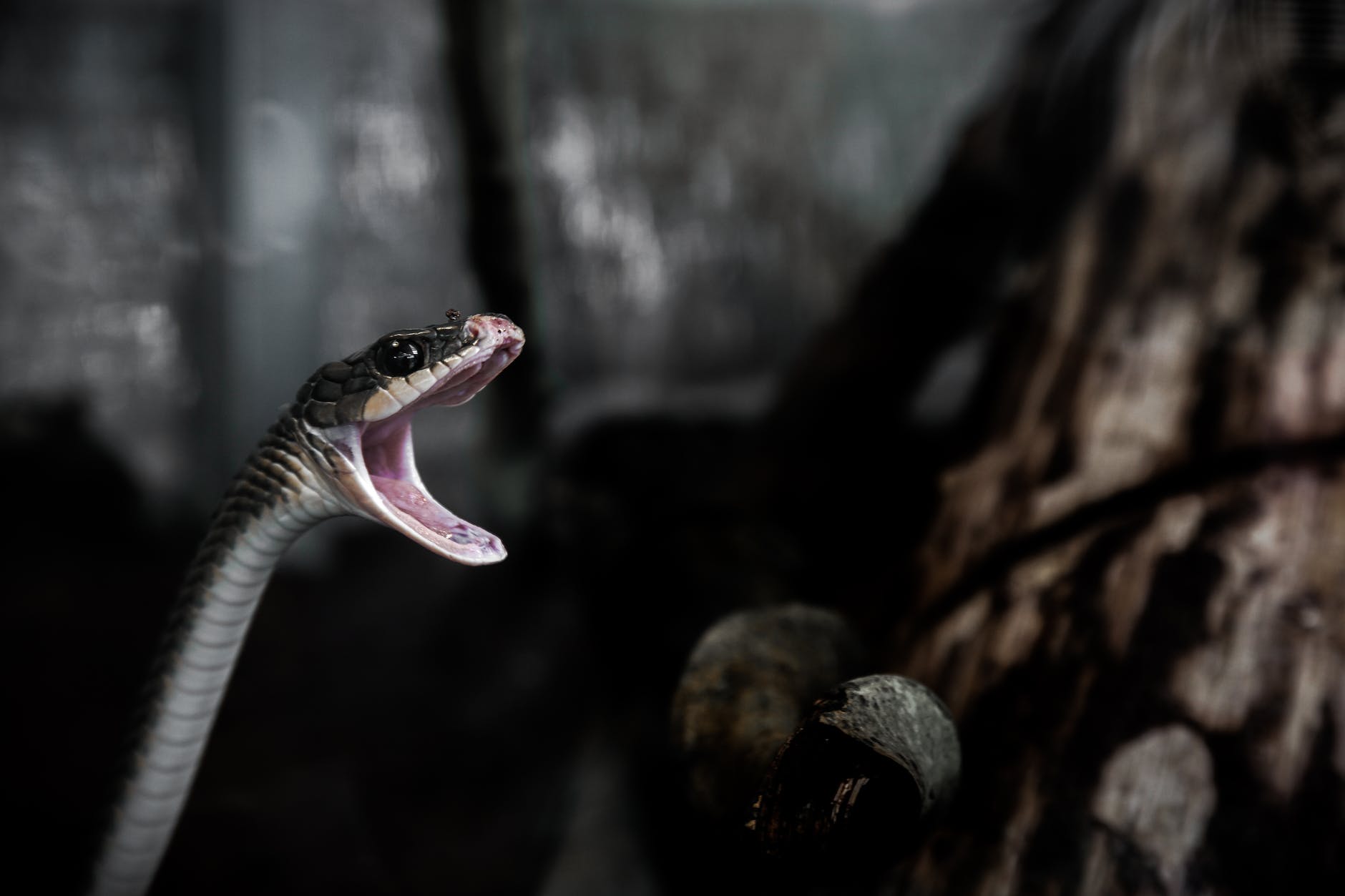
Photo by Donald Tong on Pexels.com (not a rattlesnake, but you get the idea).
On through the night, one by one, they would bring up dangers to the tribe. At first, they spoke only of animals, but one pointed out the danger of lightening and another of flood. Another spoke of the year without summer and others pointed out the red pox had killed many.
At last, a short time before the sun began to re-emerge over the horizon, and the sky paused on the brink of deciding to stick with the mild pink color or paint a different scene, they began to speak no more, awed into silence by entire sky aflame in a sea of crimson.
And, they all knew.
They all saw it.
They all realized it was more deadly than anything they had discussed before.
And they all realized it was up to them to tame this monster.
As a ploy to prod productivity, I often write with a different “theme” or “genre” for every day of the week. Today is “Sonnet Sunday.” The basic idea is to write a sonnet every Sunday. Lately, in light of the Extreme Court ruling that states cannot enact laws that abridge the rights of guns but they are free to enact laws to abridge the rights of women, I decided that instead of the traditional five feet in every line of the sonnet, I would put an extra foot everywhere it doesn’t belong — just like the Extreme Court. So, instead of writing in iambic pentameter, I’m going for iambic hexameter.
————
Fertilized human egg above. Having trouble seeing it? Look more carefully! It’s a person, a person with more rights than you have. Unless, you’re a guy, of course.
You ever see Alito’s photograph with egg?
I speak of human egg of course: unscrambled dot.
Or, even posed with toddler twins who peed his leg?
Fred shook his head as he clicked off his cellphone and laid it down carefully on the bedside table charger. His reading light was still on. He glanced over and saw that Geri was awake. He wished for a moment that the phone call had never happened; that it had just been a bad dream. He could see from Geri’s expression that she knew he was upset.
“Well?” She began. “Was that who I think it was?” Her exasperated tone, Fred knew, wasn’t a reproach to him. He shrugged. “He wouldn’t take no for an answer. Of course. He’s coming over in the morning on his way to close a big important deal, so he says. Wants to share the fruits of his genius by showering the boys with gifts.”
Geri sighed. She was, by now, quite familiar with Uncle Donnie’s “gifts” to the boys. The first such gift had come somewhere around their seventh birthday, he had “gifted them” bee bee guns. That would have been bad enough, but Uncle Donnie didn’t stop there. He regaled them with stories about his “bravery” in the “big war” and how he had shot many more “Japs” (as he called them) than he had ever gotten proper credit for. Of course, like all of Donnie’s stories, he completely fabricated this one. He had never been drafted and he certainly never volunteered. He never served in armed services. So far as Geri could tell, he’d never served anywhere for anything. Nonetheless, when she looked at the glowing faces of her admiring twins, she didn’t have the heart to debunk his tall tales. Donnie had left soon after an enormous breakfast to close an ‘enormous’ deal, the details of which he couldn’t disclose for legal reasons, but he assured them all, they’d soon be reading about it in the paper.
Donnie’s parting words had been: “Tell Daddy to take you to Dick’s soon! They have your rifles waiting for you! Who knows? Maybe some day, you’ll be a war hero too!.”
That evening, Geri & Fred had had the worst fight of their marriage. She couldn’t understand why Fred had not told the boys they weren’t old enough to have bee bee guns and that their Uncle Donnie had told them a pack of lies. Fred had ended up yelling and saying things he didn’t mean. Geri had ended up yelling and saying things she didn’t mean. They had never really “resolved” that conflict. But they eventually moved on. Since Uncle Donnie’s visits were only occasional, they came to an uneasy cease-fire about the necessity of debunking his lies. Geri promised not to burst the bubble of Donnie’s lies, but Fred understood that if she were ever asked directly, she would tell the truth. Fred said he would do the same. As it turned out, the boys never asked either of their parents whether Uncle Donnie’s tales were true.
Now, Fred regretted not havingmcalled Donnie out on his lies when he first told them. Well, Fred reasoned, now it was ‘water under the bridge.’ Hopefully, this visit wouldn’t last too long. Fred turned the light out. He knew he’d no longer be able concentrate on his book. Sleep would take awhile. He knew there was no point in worrying about Donnie’s visit or trying to guess what lies he would fill his sons’ heads with next. But that knowledge didn’t bring sleep.
Geri for her part, also lay awake in the dark, struggling to find the argument that would convince Fred to permanently sever ties with his brother. How do you convince someone to forsake their demented and destructive brother? She worried about Donnie’s impact on her sons. What of them? They were bright boys, so their teachers all said. How could they keep falling for Uncle Donnie’s lies? Of course, when the four of them had arrived at the gun shop, Donnie had not paid for the rifles. What he had done was to have the stocks engraved with the boy’s names: “Teddy” and “Ronnie.” Uncle Donnie had assured the store owner that his brother Fred would come by and pay for the rifles and the engraving. Normally, the store owner insisted on cash up front for engraving, but after Donnie explained his status as a war hero and explained that he needed every cent right now to buy the old armory downtown where he was going to make a “first class” shelter for homeless veterans, the store owner agreed and even contributed twenty bucks of his own money.
Fred had paid the two hundred bucks for the air rifles and engraving. Every time Uncle Donnie visited from then on, Donnie had reminded the boys how he had “bought them” engraved air rifles and asked how their target practice was coming. They complained that their Dad had insisted on strict rules about using the guns. For one thing, they had to wear safety goggles. For another, they could only aim and shoot at paper targets stapled to trees. Uncle Donnie had clicked his tongue and wondered aloud what was wrong with his brother. “When I was in basic training, you know what we did? We shot at each other with live ammo! That way, we learned to duck and aim quickly so when I finally took all those island back from the Japs, it was easy. You don’t get to be a soldier by being a coward! Tell you what, boys, I’ll talk to brother Fred & see whether I can talk some sense into him!”
Geri swung her feet over the edge of the bed. She could tell that Fred was awake and upset too. She said, “Fred, I’m going to make some chamomile tea for myself. You want me to make you some too?”
Fred sighed. “Yeah, I suppose. Thanks, sweetheart. Actually, how about that Sleepy Time Tea instead? That has hibiscus too. I think it works better.”
The tea quickly sent Geri into dreamland, but Fred still couldn’t get to sleep until about 3 am. He kept going over the other disastrous “gifts” that Donnie had promised over the years. He couldn’t think of a single time that his brother had actually paid even a single dime for any of the gifts he had promised the twins. Nonetheless, the boys kept accepting the idea that Uncle Donnie was their generous and prosperous benefactor. On the few occasions when Fred had tried to set the record straight, the boys just looked at each other and shook their heads. Usually Teddy would pipe up first with a comment like: “It’s okay, Dad. We understand. Uncle Donnie explained it to us. You pay for our house, our clothes, Christmas and birthday presents. And, you’re not rich like Uncle Donnie. He says we shouldn’t expect you to buy extra gifts and that he’s happy to do it.”
Fred had not wanted to come right out and call his brother a liar. To the boys, Donnie was a war hero and a rich successful businessman. To Fred, it was more than a little maddening. After all, the boys had been there when he went to pick up their rifles. Apparently, they had been so focused on how “cool” the rifles looked and were so busy imagining getting a chance to shoot, that they had paid no attention to the fact that he, their father, had paid for the rifles and the engraving.
It seemed to Fred, only moments after he finally fell asleep that he heard the front doorbell ring. “Crap,” he muttered aloud. He rolled over. Geri was sitting up in bed. Then, Fred heard the the twins sprint down the upstairs hallway and piston their feet down the stairs. He could hear the happy greetings though he couldn’t make out what was being said. Fred & Geri exchanged a look. Fred took a leak, did a cursory job of brushing his teeth and ambled over to the bedroom door. He turned to look at Geri. “Are you coming down soon?”
Geri frowned. “Geez. It’s only 6:30 am! Who visits someone that early on a Saturday morning?”
Fred nodded. He said, “We know who. My brother. Donnie. Anyhow, I’m awake. You ready for coffee or breakfast?”
Geri half-smiled. “Coffee sounds nice. I’m not ready for breakfast. Tell everyone I’ll be down in a little while. We should use up those eggs. Maybe an omelet for everyone? You can just leave a bit for me?”
Fred smiled. After all, he did enjoy his life. Most days. They were a very lucky family, he reminded himself. His wife had barely survived having the twins. Lost a lot of blood. It had been touch and go. But all was well. And then, there was the accident. Randy could have easily lost his right eye. Probably would have if the bee bee would have struck a quarter inch over. After that little incident, Fred had put away their rifles for a month and made them promise to always wear their goggles no matter what his demented brother Donnie said.
Fred reached the top of the steps and heard the front door slam. Had the boys gone out for a walk? He took a quick detour into the boys’ room and peered out into the soft predawn. He saw the boys pile into the back seat of Fred’s “custom-made luxury car.” At least, that’s what Fred called it. Where the hell was he taking them? Not exactly cool not to discuss with us. Probably just driving around the block, Fred supposed.
Fred supposed wrong.
The boys did not return for breakfast. Or lunch. Geri and Fred were both worried, though Fred was reluctant to call the cops on his own brother. Donnie didn’t answer his cellphone. Nor did the boys. Upon checking their room, he found both cellphones on the nightstands. The boys hadn’t known they were going to be away long. Even Uncle Donnie couldn’t have kept them from wanting to text their friends. Their friends! Fred tried calling some of the friends of the twins. None of them admitting to know of any plans. In fact, Judy & Jill had expected the twins after lunch to come study algebra together.
Fred was fighting a feeling of dread. He felt the shadow of Geri in the doorway and looked over at her. She just stared at him. Fred nodded. “Okay. Okay. I’ll call.”
Fred still felt bad about calling the cops on his brother. He explained the situation and, in turn, the cops explained that since the man was a close member of their family, there was nothing to be worried about and that, in any case, their hands were tied for 24 hours. Fred wanted to explain that Uncle Donnie wasn’t an “ordinary” Uncle. He wanted to make them see that his brother was a liar; unreliable; a cheat. But he didn’t know these police officers. To them, it was just an Uncle out for a joy ride and all would be well by dinner time. Fred reassured himself that the police were likely right. He supposed the twins would be back by dinner.
Fred supposed wrong.
Geri didn’t exactly blame Fred. But when the weeks dragged on and no leads arose, Geri stopped crying audibly. Her cheeks bore the light little tracks of tears, silently shed, and she moved on past chamomile tea to heavy drinking and then to opioids. Fred became obsessed with finding the twins. Everyone at work understood. Nonetheless, he was eventually put on unpaid leave. On the few occasions when he tried to concentrate on some time-critical problem, he utterly failed.
Fred combed the neighborhood for the third time, hoping to trigger the memory of someone who might have seen Donnie’s wreck of a car and noted which way it had turned. But only one jogger, Alice, had noticed the car. At that point, the car was still going the same direction Fred himself had seen although Alice noticed that the car had no plates. But questioning her for the third time turned up nothing new.
When Fred returned home from a day of canvasing, Geri was gone. Geri’s clothes were gone. On the kitchen table, she had left a short hand-written note:
Horrors! People! No more pooping!! In a single day, a person may destroy 10**11 epithelial cells from the intestines! I’m talking about living human cells! This dwarfs the abortion epidemic by many many orders of magnitude! Just to understand the scope of this crime, remember that there are fewer than 10 billion people on earth. Ten billion is only 10**10th. So every day, you are murdering TEN TIMES the population of the entire earth!
Now, some people will argue that these cells are not really human beings, or that such cells cannot viably exist on their own and that there is a medical benefit to shedding these cells. To which I reply: “So what!!?” Each has the *potential* to become a fully functioning human being!”
From now on, each of these cells must be rescued from your poop. Then, from each cell, the nucleus must be extracted. This nucleus shall then be put into a human egg cell and implanted in a baby incubator device (sometimes jokingly referred to as a “woman”). Wait nine months and *voila!* a new and precious human baby will be born. Best of all, during that time, most rich, old, white, males won’t be the least bit inconvenienced.
I realize that some people will argue that such a procedure would be absurdly expensive and inconvenient. So what?! We cannot allow abortions simply because having a baby might be beyond the economic capabilities of a family or that it would disrupt their lives or reduce their ability to care for their other children or endanger the life of the mother. It certainly doesn’t matter that saving these babies lives would hasten the destruction of the ecosystem all humanity needs in order to survive. Well, it’s the same thing with all those babies-that-could-be in your bowel. Who knows? One of them could be the next Einstein or Saint Teresa.
Please save these unborn babies out of your poop! Don’t let them be wantonly destroyed!! Write your Senators and Representatives today! And whatever you do, stop pooping until the proper procedures and mechanisms can be set up to save all these potential babies! Until then, simply hold it. Of course, it isn’t merely your own poop that you must be concerned with. You must do your part to make sure your neighbors also hold it till we’re ready to save the babies. Needless to say, what applies to your right to control your neighbors bodily functions goes doubly for your own family. So make sure your kids don’t poop either. No-one’s ever too young to avoid becoming a parent.
Oh, and you’ll be happy to know that the Bible agrees with me 100%. Well, not really the Bible, per se, of course, but the Bible as interpreted by a small number of people. You’ll also be happy to know that the US Constitution also agrees with me. Well, not really the Constitution, per se, but what the founders meant by what’s in Constitution as magically divined by the Extreme Court.
By the way, you may want to lay off the grains & greens until everything’s set to make sure we save the babies!
Photo by Egor Kamelev on Pexels.com (A self-made ant)
The Self-Made Man
The Self-Made Man awoke. That is to say, his eyes snapped open, as they typically did, one minute before his alarm setting. He quickly turned the alarm off. After all, it was only a back-up system. His superior brain constituted alarm one.
The Self-Made Man swung his legs (legs that evolved courtesy of the four-billion year old evolutionary struggles of his ancestors) over the edge of his memory foam bed. (Memory Foam had been invented in 1966 by NASA. NASA was America’s space agency. The tax dollars of US citizens paid for that, and for many other inventions).
The Self-Made Cucumber
The Self-Made Man didn’t believe in paying taxes. Taxes, he thought, were for suckers. The Self-Made Man, according to his judgment, spent his money on things he found worthwhile such as making more people like himself. Why should he send his hard-earned money to Washington DC and let the government of the people decide where his money should be spent? That made no sense; after all, it was his money! (Money, by the by, was invented about 2000 BC, approximately 4000 years before the Self-Made Man was born.)
The Self-Made Man slipped his feet into his slippers. Slippers, of course, provide an easy way to add protection to your feet. Slippers are not unlike the moccasins that many Native Americans used for over ten thousand years before Europeans came to destroy most of them with germs and guns. The moccasins of The Self-Made Man were not made of deer skin or moose skin, but of synthetic fabrics which had been developed over the preceding century by thousands of scientists working for “rubber” companies and chemical companies. Some of this research was funded by US taxpayers but the money spent on tires for their cars paid for most of the research.
As The Self-Made Man slid his feet into his slippers, he did not think about these things. He was thinking about a speech he would be giving later that day encouraging people to fight for lower taxes, especially for the wealthy. Somewhere in the back of his mind, The Self-Made Man, was vaguely aware that poor people tended to waste their money on such mundane things as clothing, shelter, food, healthcare, etc. How tedious! Rich people were far more imaginative and spent money on important things like golden toilet seats, yachts that were so large they couldn’t enter harbors, cryptocurrencies, and politicians.
The Self-Made Poppy
The Self-Made Man didn’t waste much time thinking about poor people at all. They were fools anyway and actually worked for their money. How stupid is that, when you can be rich enough to own things and make more money from owning things than anyone could possibly make from simply doing things that provided value to others.
The Self-Made Man picked up his smart phone and “dialed” his head speech writer. The “smart phone” of The Self-Made Man had grown from technology that was largely, though not entirely paid for, by the taxes of US citizens. No matter. Of course, the very smart people who developed that technology had been able to do so largely because of their education. Most of that was paid for by taxes of US citizens. But that education itself depended upon thousands of years of development of language, mathematics, science, etc.
The Self-Made Man showered in hot water and cleansed himself with soap. Having hot water at his fingertips grew from the magic of yet other inventions. Without thinking much about it, he not only cleansed himself of dirt and dead skin but also benefited from the action of soap to kill some of the germs that lived on him. Indoor plumbing itself had been invented about 6000 to 7000 years earlier in India. Sometimes, the Self-Made Made let the shower water trickle into his mouth. Luckily, government agencies had ensured that this was safe to do. Those agencies had been paid for by the tax dollars of ordinary US citizens who were too stupid not to pay taxes.
The Self-Made Man dressed and went to his home office to take a last look at his speech. He quickly accessed all his needed information using protocols that had originally been developed by DARPA using the tax dollars of ordinary US citizens who had paid their taxes. He scanned through the speech. The Self-Made Man thought it merely adequate. He reckoned it did a nice enough job of arguing as to why The Self-Made Man was the most important kind of man in the world. But something was missing. The speech, in a way, was the heaven part. It explained why The Self-Made Man and others of his ilk were bringing about a veritable heaven on earth. That was fine. So far as it went. But where was the “Fire and Brimstone” part? Where was the part that aroused the hatred of unions and workers who supported them? Where was the part that would make the audience be willing to do anything to keep the rich and powerful in control? Missing. The Self-Made Made shook his head sadly. Using the Internet protocols and hardware inventions of generations of scientists and engineers, he fired his main speech writer and alerted his second violin speech writer to add the “Fire and Brimstone” part. “Demonize these people the way they deserve to be!”
Firing people always gave a little thrill to The Self-Made Man. Firing was always a “Triple Play.” First, it made “The Self-Made Man” feel good immediately. Second, it taught the person fired a valuable lesson. Third, it rekindled the fear in his other employees that they too could be fired at a moment’s notice if their work wasn’t up to snuff. And, it worked. As it almost always did. The “Second string” speech writer added some nice demonizing text and even included a Bible verse about the value of hard work.
Soon, The Self-Made Man’s chauffeur zoomed them along an Interstate highway system (paid for by US taxpayers) toward the airport (which had largely been paid for by tax dollars). The Self-Made Man’s limo was a marvelous example of pollution whose external costs were almost all borne by others. The land beneath which the oil lay had mainly been stolen without compensation from the Native Americans (and other indigenous people throughout the world) who had lived there for tens of thousands of years. The extraction of the oil and its refinement to gasoline polluted air and water and required the dangerous labor of many. The combustion of the gasoline poured still more pollution into the air including carbon dioxide which was warming the planet so quickly and so radically that every year, people died from various climate catastrophes.
Photo by Chokniti Khongchum on Pexels.com. (The Self-Made Medicine)
The Self-Made Man soon arrived at the Conference Center (paid for largely by tax dollars, because, after all, conventions brought business to the downtown). His speech was well-received and several Self-Made Men walked up afterwards and congratulated him on his brilliant speech. Three from The Self-Made Man’s social media team tweeted and instagrammed excerpts from his brilliant words. These were soon echoed by several of the politicians he owned.
The Self-Made Man was too busy to stay and chat long. One of his assistants handed The Self-Made Man a cup of coffee as they rushed out to the waiting limo. As he began to take a sip of the beverage which had been invented far away and long ago, the top came off and burned the thumb and index finger of The Self-Made Man. He noisily fired his assistant on the spot. He shook his head sadly as he slid into the rear seat. The Self-Made Man began feeling the scald in earnest and therefore began screaming at his chauffeur. “Where the hell is the damned ice! Can’t you see I burned myself?!”
The limo was a marvel of sound isolation, and in fact, the chauffeur had not known anything about the spilled coffee. “There’s ice right beside you in the champagne bucket,” the driver said matter-of-factly.
The Self-Made Man wasn’t about to reach all the way across the back of the limo to get his own damned ice! He screamed: “Pull over and get me the damned ice!”
The limo driver sighed. “Sir, there’s no place safe to pull over right here. I can pull over … “
The Self-Made Man screamed even more loudly. “What the hell’s wrong with you?! Pull over NOW!”
The chauffeur complied.
Photo by Skitterphoto on Pexels.com (The Self-Made Tank)
Meanwhile, the bus driver behind them had his own issues. Of course, it wasn’t really the bus driver’s fault that the airline schedules were all bolloxed up. And, somewhere in the back of his mind, the disgruntled passenger must have known that too. But it didn’t keep him from screaming at the bus driver just long enough to prevent the bus driver from noticing the oddly parked limo.
Before the crash rendered everything in the limo burned beyond legibility, there had been a prominent sign in its passenger compartment which read:
“Please buckle up! It’s the law.”
The Self-Made Man, of course, felt himself much too important to follow laws of any kind.
Although The Self-Made Man was rushed to a hospital (mainly paid for by tax dollars — but not his) and once there, received trauma treatments developed by thousands at a cost of billions of dollars and thousands of lives, his particular and largely insignificant leaf detached and fell from the Great Tree of Life and was no more.
Photo by Lisa Fotios on Pexels.com (The Self-Made Merry-go-round)