The gym stank of sweat, disinfectant, bloodstain. Vlademort shook his head; thought: stuffy stupid place for a chess tournament. Which I will win. “A silly game; a silly name,” it sang and rang inside his brain.
Others might resign, down a piece to a stronger player; that was the “sensible” thing to do; the “honorable” thing to do, he knew.
Vlad sang instead these lines as lyrics deep inside his outsized head:
“Check and Slay;
There has to be a Winning Way!
I am Me
And meant to win!
I am He
So cheating isn’t sin!”
Aloud, he called in his strong, authoritative voice, “Sir, we have a problem. My opponent cheated. We must rectify the situation for the good of the Noble Game. And the honor of our School and our Party.”
For a moment, Vlademort worried that a glimmer of smile might betray him. He bit his tongue down on his lower teeth. That usually worked, just as it did this time. As the Assistant Headmaster strode over to the boys, the man asked what the trouble was.
Vlademort’s foe, Dmitri, didn’t know what Vlad meant about “cheating.” Vlad had stepped right into a discovered check by a knight’s move that also attacked Vlad’s unprotected King’s Bishop. Vlad hadn’t seen the consequence so now he would pay the price. Very nice! But discovered check wasn’t cheating! While Dmitri pondered this silently, Vlad struck.
“Sir, as you can no doubt quickly surmise from the board, Dmitri just moved his knight here so he would check my King and attack my Bishop. A double attack. The problem is, his knight was here and we can all agree he cannot move a knight up two and over two.” Vlad locked eyes with the Assistant Headmaster and painted his face with confident innocence.
Dmitry frowned. “What? That’s the most absurd poo I’ve ever heard! My knight was here!”
“No, Sir, with all due respect, I clearly remember asking myself why he would move the same knight so many times to get in this position when, as you can clearly see, his bishops are completely undeveloped. It seemed strange at the time. I guess…I hate to say it, but maybe that’s what he … I don’t know. What does it show, Headmaster? I’m at a loss.”
“Vlad, I’m not the boss; I’m the Assistant Headmaster. You boys are going to have to work this out for yourselves. I don’t get paid enough to settle all your petty disputes.”
Dmitry’s face reddened with fury. He clenched his teeth.
Meanwhile, Vlademort nodded and said in an even tone. “Yes, I’m sure we can work it out. Dmitri? Do you want to move your knight back to where it really was, resign, or just play again? Tell you what. You can have white this time. Deal?” From the outside, Vlad seemed serene but the inside scene was a scream of joy. He had used them both as toy. He felt no wrong; he sang instead another song inside his head:
“I am Me!
Victory!
I’ll show mom and daddy too
What I can do. You killed my puppy;
You evil two!
You will see:
Everything belongs to me!”
He sang it as he lied. As he sang, dissidents died. He sang it as he bombed and killed. “I am me and so strong-willed. You will see! It all belongs — belongs to me!” After being deposed, tried & condemned, Vlad’s song of wrong and might — still felt right.
The song so strong it rang and sang; inside his bullet-riddled head the last thing it said:
Saturday is for satire. I enjoy writing satire, particularly when it is aimed at helping us see the kinds of absurdities we can talk ourselves into. Political satire I find especially satisfying.
But now? Satire, at least political satire, is dead. And, I know the people responsible. Not personally, but I know who they are in general, and in some cases, I know quite specifically. I mourn the passing of the genre, as do we all. We had barely recovered from mourning the passing of the Queen when the news hit about the death of political satire. Sad.
Don’t get me wrong. I don’t by any stretch, imagine that my difficulties in satirizing the Mango Mussolini, match up to his more serious crimes such as — you know — treason; fraud; trying to isolate us from our allies; trying to become dick-tater; trying to destroy the rule of law; trying to divide America; waging a never-ending crusade against truth; replacing patriotic experts throughout government with inept sycophants; destroying one of the two major political parties; killing off (according to Lancet) at least 200,000 innocent Americans through his lies about COVID and bad modeling of the proper reactions — compared with these — oh, and did I mention compromising our national security during and after his “Pee-Residency” in the “Whites Only House”? None of these compare with making it virtually impossible to write political satire.
Possible replacement for the elephant: Greedy, indolent, & filthy. Photo by Samira on Pexels.com
But I still mourn the loss.
In the last few weeks alone, the Hairless Hitler has:
*Asserted that because he once worked at the White House, he was allowed to take anything from there when he left and take it to his own home.
*Asserted that there doesn’t have to be a process for declassifying Top Secret documents but rather he can declassify them simply by thinking about it.
*Fully embraced the Q-anon conspiracy theories and they now salute him just as the Hairy Hitler had his mindless minions salute except that instead of putting up their whole hand, they put up one finger. No. Not that finger. Not the sensible one. Their index finger. The same finger poised to launch nuclear war by the man who got TFG Putin office in the first place. The same finger used to guide a sharpie pen over a few hundred miles of weather map to show a possible hurricane track to hide the fact that Putin’s Puppet misspoke. {Shudder! Horror!} Remember that? Instead of saying, “Oh, I misspoke” and thereby fix the error, the “Stable Genius” thought it better to mislead thousands of Americans about the path of a hurricane.
Normally, any of these would be sufficient for involuntary incarceration in a mental hospital. Instead, he uses these actions to raise money to line his pockets by claiming he’ll use the funds to aid his defense.
That’s what’s actually happening.
How do I satirize that?
I have to come up with something even stupider and more ridiculous. Hopefully, the even stupider and more absurd exaggeration will help people realize that the original and actual actions are also stupid and ridiculous. But what? What is stupider and more absurd than the actions of the 45th Toddler-in-Chief?
I’ll have to settle for something that’s actually less stupid and less absurd, but hopefully something people might relate to.
Most people, at some point in their lives, visit someone else’s house, go to a workplace, or stay in a hotel. I realize that doesn’t cover everyone, but it covers most adults. Now, let’s suppose that you come over to my house for dinner. Let’s even suppose I invited you over. Then, you leave. I’m cleaning up and notice that a bunch of my silverware is missing. Surely, I think, surely my guest didn’t come over and steal silverware. I wouldn’t expect anyone to do that and if they spent the entire evening bragging about how rich they were, it would seem even more incredible. But then, let’s suppose that I heard from a mutual acquaintance that my recent guest has my silverware at home; that he’s bragging about having it. I go over and see that indeed, he’s stolen some of my silverware! I confront him. “You’re a thief!”I say.
I can think of many excuses and I’m sure you can too. Here are a few that come to my mind.
1. “Yes, I did. I’m sorry. I have this weird kleptomania thing and I thought I was over it, but I’m not. Sure, you can have your silverware back. I guess it’s time for me to return to therapy. I’ll be glad to reimburse you for any inconvenience I may have caused.”
2. “I really loved your silverware. I wanted to show my wife and see whether she loved it too. I thought I had asked you if I could borrow some to show her. I’m so sorry if I forgot to ask you. My memory is not so good any more.”
3. “I loved the buffet you set out, but I didn’t have enough hands to carry everything, so I put some silverware in my pocket and must have forgotten it was there because there was another set right by my place.”
But let’s move on from the weak excuses to the silly excuse.
4. “Oh, I’m so sorry. I felt like I had dirtied up so much silverware at your excellent dinner that I felt the least I could do was bring it home and wash it for you before returning it.”
5. “I had such a wonderful dinner at your house! I know you’re of more modest means than I am so I thought I would take your “silverware” to a place where they will be able to copy the pattern and replace your iron flatware stuff with pure silver cutlery.”
And, there are plenty more, but yet more silly and more absurd than any offered by fantasy would be to say:
“Your silverware? What do you mean your silverware? You invited me over! Once I’m there, everything in your house automatically becomes mine. Your lucky I left you your TV, your fridge, and your spouse! And, anyway, besides the fact that it’s mine, you came over with your silverware in your pockets and planted in my house to make it look like I stole it! It’s a witch hunt! You were probably not actually looking for silverware at all; you were looking for your lost shaker of salt! There’s a woman to blame! And, anyway, why come over? Why not just ask me and I would have given you your silverware. I mean my silverware.”
Or
Let’s suppose you worked for a time at a car repair shop. You couldn’t get along with your boss so they replaced you after a few years with someone more competent and harder working. You decided you’d start your own car repair shop. But before you left, you stole your boss’s rolodex. You were too stupid to simply make copies; you stole the actual rolodex. Your boss noticed. He asked you for it back. You sent him a few business cards. He noticed that it wasn’t actually a rolodex. The police show up. They ask for the rolodex. You say:
“Hey, I worked there! I’m entitled to the rolodex! Because when you work someplace, you own everything there. Anyway, I didn’t take it. It isn’t here! And, the one that is here isn’t yours! And you planted it! And, you weren’t really looking for the rolodex at all! You were looking for the answer to who killed cock robin! Or where they buried Jimmy Hoffa. Or, who really assassinated JFK!”
It’s true that people often overestimate how much the world revolves around them.
But to imagine that your thoughts alone impact the real world — that is quintessential insanity. Adults, even cruel demented ones, must be held responsible for their actions. There also can’t be any doubt that bad parenting is at least partly responsible for an adult growing up so out of touch with reality that they believe in mythical psychokinetic powers. Plenty of responsibility also accrues to the so-called fans of the T-Rump who believe any absurdity he spouts. Further, if the Republican Party had held T-Rump to even the lowest possible standard of accountability and reality, TFG might not be certifiable today. But no-one did that. Instead, a new standard of cowardliness has emerged on the planet.
Braver than 90% of GOP in Congress.
People all over the world, every day, risk their lives to escape dictatorships. In Russia, people risk their lives and long prison terms to protest Putin’s War of Stupid Aggression. In Iran, women risk their lives and long prison terms to protest the killing of an innocent woman by the so-called “Morality Police.” In the Ukraine, people are enduring extreme hardships & danger to avoid falling under the dictatorship of a man gone insane with greed. I read today, he replaced another general. It’s always someone else’s fault in a dictatorship, no matter how stupid the leaders are.
Meanwhile, in America, the enablers of the Mango Mussolini are presented with mountain ranges of evidence about the scope of TFG’s lies, cruelty, criminality, and his utter failure as a businessman who grew rich providing value and the response — ?
“Oh, well, that’s just Trump”
Or,
“It’s all fake news!”
Or,
“Trump never lies! He told us so!”
Or,
“He must be successful at business because he told us so!”
Or,
“It’s a conspiracy of the FBI, CIA, DOJ, Wall Street Journal, NYTimes, NBC, CNN, DOD, Army, Navy, Marines, FORBES, Vanity Fair, FORTUNE, Liberals, POC, Asian Americans, Hispanics, Native Americans, Women, Homosexuals, Jews, Muslims, Chinese, Intellectuals, School Teachers, Science, Math, Readers, Writers, Wine Drinkers, CBS, ABC, Popes, New Yorkers, Californians, City-Dwellers, and Artists who are all out to get Trump & make him look bad!”
In the same way that people who “give an addict a break” by supplying cheap drugs “just to tide them over” are partly responsible for the eventual lethal overdose, so too, fans of Putin’s Puppet are partly responsible for the level of absurdity he now evidences.
Nonetheless, adults must be held accountable for their behavior. That includes dictators and would-be dictators. It includes their enablers. It includes “election deniers” and those who promise to overturn elections if their owner-in-chief tells them to.
Meanwhile, since my days of political satire are over for the foreseeable future, I’ll go take a picture of that which remains beautiful.
Sadie is our Golden Doodle puppy (half poodle and half golden retriever). So far, she looks a lot more like a golden retriever. Anyway, a few short weeks ago, she learned to ascend and descend the stairs to our deck. She typically does that once or twice a day as part of our general walk around, exercise, and potty break. As she grew and became more practiced, the stairs became more and more easily scaled.
Until today.
She started up the first step and began sniffing every inch of the step. Same for the second step. How could she have lost so much skill? She scrambled up to the third step and began sniffling at every single leaf and bit of random detritus.
Then, it hit me. She could sprint up the stairs, hindered only by my own oldish legs. She had always viewed the stairs as a means to and end, but now that she had mastered it, she wanted to experience the stairs in the way that she most likes to experience everything — with nose and tongue.
It took her about two weeks to realize that she had forgotten to properly explore the stairs which she did today…
It could be that the guy who cleans the pool once a week, and himself has a dog, came today and it was his scent that she was particularly interested in.
Or, both.
In any case, it made me wonder how often people think of their career ladders, or personal journeys as something to be instrumental; e.g., to get to the top of the stairs. There are advantages to being at the top of the stairs. You can see farther. And, you’re closer to the kitchen. But there are advantages to being at the bottom of the stairs as well.
Do we ever take the time to really experience and explore the steps along the way? If your whole life is using everything as a means to an end, then in the end, it all means nothing. What of all the opportunities to explore the steps?
I’ve been playing a sort of “ball chase” + soccer with our new puppy, Sadie. She’s extremely good at it, IMHO. She instinctively chases a ball & brings it back. I’ve reinforced it but it would be a stretch to say “I trained her to do that.” I sort of expect most dogs to view this as a game not completely unlike chasing a bird or rabbit & bringing it back.
The more interesting part came when I combined it with soccer. She learned (?) to judge carom shots off the baseboard and half closed doors. She tries to stop a ball before it hits the wall but judges that if she can’t stop it directly, she can stop the rebound. That she even tries to stop it is interesting. That also seemed “natural.” I probably reinforced her differentially, but again, it would be giving me far too much credit to say I trained her to “defend” against having the ball go past her.
I begin a few weeks ago to play with two balls at once. This makes it more challenging for me not to break my neck as well as Sadie. What I find interesting is that she immediately tries to hoard or herd; i.e., control, both balls. She has tried picking up two in her mouth at once, but she can’t manage it. So, she holds one ball in her mouth and “corrals” the other between her front paws. When she gets bored, she relents and lets me throw or roll or kick the balls.
I now sometimes use three balls at once. (I’ll let you know which hospital for flowers). Actually, I’m careful, but Sadie is sudden in her movements. Anyway, once I put a ball “in play”, I usually control or kick it with my foot. Sadie imitates (!?) me in this. She “controls” a ball by putting one of her front paws on it and she also pushes the ball with her paw, though she did try “nosing it” once but I think she found it uncomfortable since she shook her head and reverted to using her front paws.
On some occasions, I “grab” a ball with the bottom of my foot and move it slowly back and forth and feign kicking one way and then kick another way which routinely makes Sadie growl as she scampers after the ball. There’s something else. The slow movement followed by quick movement energizers her more in her quest for the ball than if I simply & directly hit it.
These types of patterns are found in human sports around the globe. Did they co-evolve with dog play? I’ve seen videos of many species of mammal playing “soccer.” From the video alone though, I have no idea how spontaneous the play is. If I had to guess, I’d say it’s pretty spontaneous.
Soccer, American Football, hockey, rugby, field hockey, and basketball share this notion of trying to “make a goal” by getting past the defenders. In every one of these games, there is also the notion of “fake” or “feint.” It feels as though Sadie and I, if not reading from the same script exactly, both of us have the same “playbook” of things that are fun in sports.
On a not completely unrelated topic, I am wondering whether any other new dog “owners” have noticed that their own sense of smell has been enhanced since sharing lives with a puppy. Perhaps it is not so much enhanced as that I pay more attention to it than I did a few short months ago. She goes sniffing and I go wondering for the most part, what it is she’s sniffing on about.
To some extent, it’s the same with sounds. I’m typically a pretty visual person and when I walk alone outdoors, I mainly noticed what I see. When walking with Sadie, however, she reacts to many sounds that I would ignore. I know what it is and give it a name and then reassure her that it’s okay; that trucks and cars and airplanes and helicopters are okay, at least in the distance.
Poetic Commentary: I’m trying Sonnets and variations on Sonnets on Sunday. Here, I used the traditional iambic pentameter but slightly changed up the Shakespearean rhyme scheme ABAB, CDCD, EFEF, GG to ABBB, ACCC, CDDD, EE The idea of rhyming lines one and five is to reflect some unity among those five which deal with fairly direct perception of the here and now. In line six, I begin to move into “conceptual” shadows. Line nine rhymes with the previous three because this is meant to unify those lines more. But line 10 begins a contrasting thought. Though the couplet introduces a new rhyme, it is also a restatement of lines 10, 11, & 12 so the long “e” is kept and repeated internally as well (“me”, “thee”, “De-“, “sweet”, “de-“).
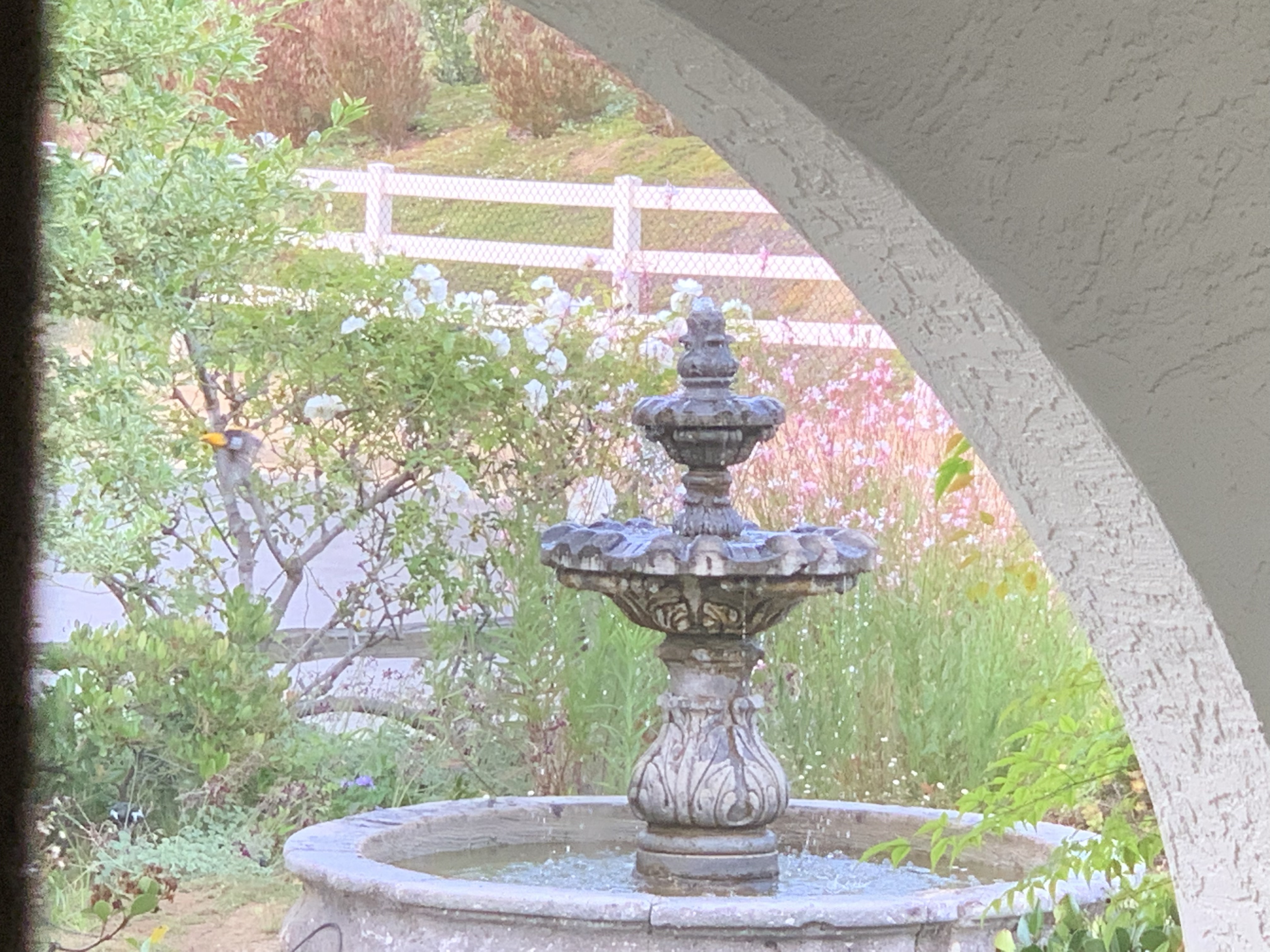
Political Commentary: In the photo above, you will see shadows of leaves and shadows of birds, though without movement, it may hard to tell which is which. But birds and olive trees are not the only shadows here. We are here at this particular spot partly because of our puppy Sadie. But how did Sadie come to be? Dogs were bred over thousands of years and while Sadie is still a puppy and very uncivilized as yet, she’s learning and a lot easier to deal with than her wolf ancestors. It isn’t just our training that helps Sadie live with us. It also depends on thousands of our ancestors taking the time to train and breed dogs to be our companions. There is a slab of concrete. Where did that come from? When did people invent that and perfect it? There is also a railroad tie. Railroad? Without early scientists and engineers and mathematicians, how would that have happened? And, of course, there are the builders who put this here and did not “cheat” so that the concrete was improperly made. Some other hundreds of folks arranged systems of commerce and government so that all this was possible. And how did you come to be looking at this photo and reading these words? Wait did I mention reading? You & I can read or write because someone took the time to teach us. And seeing it across time and space? Taking a picture with my iPhone? These depend on millions of people working in tech. But how could people spend so much time working on tech unless farmers made the food and truckers brought the food to a convenient place? But none of that system would work without government and police and armed services.
There are many shadows here and most of them are thousands of years old. The truth is that we are vastly interconnected. We have what we have and can achieve what we achieve because of countless others alive and long dead. Setting citizen against citizen is a ploy so that a very small number of people can end up controlling everyone. It’s an old, old cancer of society, but that makes it no less deadly.
We’re all in it together.
Those who would tear us all apart do not admit to their outsized greed. Instead, they wear camouflage of “patriotism” or “religion” to try to fool others into helping them steal. The plane hijackers who wreaked destruction were convinced they were doing it for “God” not for their pocketbooks. To be radicalized into killing others is to be blinded. At first, people are told to tell a little lie for the good of God. And, a little later, they are taught to believe a slightly bigger lie. Until, in the end, they are willing to kill hundreds of innocent people and give up their own life as well. It’s all based on lies. One way you can tell they are lies is that the lies must never be questioned. Not to believe the lie is to be punished or even kicked out of the club.
“And you’re sure you can’t just get the money yourself?” Jimmy glanced over at his wife. He tried to remember some of her other questions. For his part, Jimmy had been convinced from the very first e-mail and even more convinced when he “checked it out” with a phone conversation. Once that happened, he was sold. Hearing the guy’s voice, it was clear that Peace Nwose was not only a real person. His accent clearly sounded African. Or, at least foreign. And black. But not like the way black people in America talk.
Jimmy tried not to be exasperated with his wife. He reminded himself that she was just trying to be careful. Lord knows she was right that they didn’t have anything to spare, but this — this — this — finally, a ticket out of living paycheck to paycheck. Why wouldn’t she jump at the chance? They could finally afford to replace the formica kitchen table with a nice oak one. Or, she could replace her fraying faded felt winter coat with a wool one.
But then, she couldn’t read people the way Jimmy could. He got that from playing poker, he supposed. He wondered how much he had won over the years just from reading people’s expressions. He hadn’t kept track but he was sure it was a lot. He could think of plenty of times when he’d called somebody’s bluff and won big.
And the other times, when he, along with everyone else, had folded and somebody won? Well, that wasn’t a bluff because they never showed their cards. His buddy Steve in particular was a lucky SOB. Some people were like that. They just were born lucky. Steve always pulled good cards but he’d never show them. Steve would always say, “You have to pay for the privilege!” But everybody knew it was something really good or Steve wouldn’t have bet so aggressively as he had.
Jimmy glanced at his wife Sally yet again, trying to remember her other questions. He didn’t want to ask her with Peace listening in. That would make him seem unmanly. Jimmy creased his forehead. Sometimes, that helped him remember. “Oh, by the way, Peace, I get why you need my routing number to put the money in my account, but why do you need my social security number and stuff as well? Maybe you told me, but I forgot. I know there’s a good reason, but my — my banker wants to know.”
Jimmy liked the sound of that. “My banker” made him feel important, knowledgeable — a player. He waited. But not long. Peace had an answer right away. Again, if he had been lying, it would have taken him time to come up with a good answer, but no. Peace answered right away. Another sign he couldn’t possibly be lying. Here’s what he said: “I have no idea, to tell you the truth. My banker says we need it to legitimize the transfer. I’m not sure what that means but he does. Sadlike, he doesn’t speak English or I’d put him on the phone and he could explain you to it.”
Jimmy looked at his wife. He raised one eyebrow and tilted his head, shrugging his shoulders as though to say that Peace’s response should have put any remaining questions to bed.
That was in late October.
By the end of January, Sally and Jimmy were divorced.
It wasn’t so much that Jimmy lost their “nest egg” to the con, though certainly, that in and of itself would be enough to destroy many marriages. That was indeed a deep wound to the marriage, but it could have been healed if Jimmy simply had had the maturity and wherewithal to apologize to his wife and admit that she had been right all along. But to Jimmy, admitting that he had been wrong and his wife right was worse than actually losing their life savings. Not only did he not admit it; he doubled down. That is to say, he argued and screamed at Sally that it wasn’t Peace’s fault at all. That stubborn refusal to admit he had been conned — that was the fatal infection that poisoned the wound to their marriage.
As Jimmy explained, “Can’t you see?! Something happened to him! That’s why we can’t get hold of him any more! Somebody powerful in Nigeria stole our money and probably did him in! Our so-called government won’t even look into it! They might be in cahoots with these warlords. Otherwise, why wouldn’t they even try to track him down? Don’t you think that’s awfully suspicious? They say there is no-one in Nigeria with that name. How can that be? I don’t understand why you won’t side with me! Instead of the stupid government!?”
At first, Sally tried to be sympathetic; to stay calm and cool. She realized that underneath all his anger, her husband felt hurt. As the ranting and raving became more constant, all the things that they had once shared were pushed aside. This argument became the argument. The argument became almost their only topic of conversation.
Sally grew ever more resentful over time. She had put her own career on hold so Jimmy could focus on his locksmith business. And that was fine. But it was not fine that after Jimmy got swindled out of their two decades of savings that he started referring to all the savings as “his” money anyway because he was the one who had “brought home the bacon, after all.”
The good news is that eventually Sally remarried and, after a few years, was happier than she had ever been with Jimmy.
The bad news is that Jimmy didn’t fare so well. He went to bars to pick up women but ended up complaining to anyone who would listen about how his wife hadn’t understood how they had been cheated by the Nigerian government who had killed off his good friend — whose name, by the way, was Peace for God’s sake which pretty much proved in and of itself that he was legit. No, he had been offed all right. But that wasn’t the worst part, don’t you see. The worst part was that the American government was in league with the Nigerian war lords, as anyone with an ounce of brain could see. But sadly for Jimmy, no-one at the bar, other than the tip-motivated bartender, seemed to see any of it. Instead, they tried to turn the conversation to other topics like the new relief pitcher the Twins had just acquired or the weather or pretty much anything besides the “I coulda’ been a contender” speech that Jimmy had now memorized.
If Jimmy had tried new bars, he might have found more sympathetic ears, at least for a time. Instead, he gradually alienated everyone who regularly frequented Olsen’s Bar and Grill.
It’s quite possible that the long Minnesota winters contributed to his depression. The thing about alcohol is that it does help you get to sleep. But then, every night, in the early morning hours, Jimmy woke up. He couldn’t go back to sleep. Not without a drink or two. Sometimes, he then overslept. Soon, he lost his job and his house. One particularly cold February morning, he found himself out of alcohol. He had meant to get more Old Grandad the previous afternoon, but somehow forgot. Meaning to go for a short, brisk walk, he had’t bothered with the fur hat that would have provided at least a little bit of cushioning for the back of his head when it smashed on the icy sidewalk. Nor, did he put boots over his slippery and well-worn Oxfords.
They found him in the morning.
No-one attended his funeral. Sally might have attended, but she didn’t even find out until he was a week in the ground. She came exactly once to the gravesite and put a single white rose in front of the cheap marker. She shook her head sadly and said as she placed the rose: “Peace.”
“Peace” meanwhile, whose real name was David Jones, didn’t actually live in Nigeria at all, nor was he “black” although he really did speak with an accent — a Long Island accent. Thanks to Jimmy and hundreds like him, David lived most of the year in a 17 room mansion on the South Shore, a mansion with a nicely cavred white name plate out front labeling his estate: “Peace.”
I’m mainly a visual person. I’m much more distracted by, for instance, a butterfly wafting by than a truck backfiring. Like nearly everyone, I love music. But I don’t go out of my way to hear it nearly so much as do many others. But there are sounds that I love: Simple sounds. That is why the poem itself needs to be short and neat. Those are the kinds of sounds I’m talking about. Discrete.
And some of these sounds I think I inherited a love for. Others, I grew to love. And some sounds I believe have elements of innate beauty and of learned significance. The sound of a well-hit baseball is satisfying in some deep sense over and above the significance in terms of the game. It has a resonance of beauty beyond the even more important sense that it shows what humans are capable of. All of us feel pride when we watch an athlete perform some amazing feat of strength and skill and training and will and concentration all coming down to a moment of truth and *CRACK!* there it is and you know long before it clears the fence because you heard the Home Run first.
So, there’s that. But I can’t help wondering why we can’t find a way to also feel pride in all the accomplishments of all human beings. They’re all in our family. And, we recognize that, at some level. See paragraph above.
The snapping sound of a puppy’s jaws “missing” a toy is something I haven’t heard for many decades. Sadie reminded me of that sound from more than a half century ago. Some sounds you remember your entire life.
The Founding Fathers — yes, they were cool in many ways. Some were excellent writers; most were well educated. But even apart from the fact that they were all white males and many were slave holders — putting that aside, no matter how wonderful they may have been, they were vastly ignorant of a great number of things that educated people know about today.
Here are just a few of the things that they did not know about.
They did not know about evolution. They did not know about DNA. These are not mere details in modern day biology. They are foundational. Not only was their knowledge of the basic science of biology woefully lacking; they were also ignorant of many of the practical implications. They did not see people who had hip joint replacements or knee replacements or organ transplants. They had no idea that life began 4 billion years ago. They did not know about how to prevent or treat many diseases that we have now conquered. They did not know about proper maternal or prenatal care. They did not even know that a woman’s brains is just as good as a man’s. They did not know that the mitochondrial DNA is passed on only from the mother. They did not know what mitochondria were. They did not know much at all about the “family tree” of humanity. They did not know how to use DNA analysis in solving crimes or predicting susceptibility to disease.
Their ignorance was not just about biological sciences. They knew very little about physics or chemistry. They only knew of twenty-three elements! Now, we know 118. They did not know about electron shells and types of bonds. There were huge fields of human knowledge such as physical chemistry and biochemistry that did not even exist. Again, it was not just theoretical chemistry and physics that they didn’t know about. They didn’t have cured rubber or any plastics whatsoever. There were no gasoline engines.
They did not know about atomic energy or the theory of relativity. They had no idea how large the universe was; the existence of planets orbiting around distant stars. These distant planets outside our solar system, known as exoplanets were completely unknown. Today we have confirmed the existence of over 5000 of these exoplanets. They did not know how our own sun generated its power.
They did not know about the destructive potential of an atomic bomb. They did not know that atomic energy existed or that it could be used in practical ways such as killing cancerous tumors, or generating electricity. There were no atomic submarines — or indeed, any submarines at all.
Their ignorance was not limited to science. Since these events had not yet occurred, they obviously knew nothing about the First World War and nothing about The Second World War in which at least 50 million people were killed. They did not know about Hitler or the Holocaust. They did not know about Stalin or Mao killing tens of millions of their own people in order to stay in power.
The did not know about automobiles or airplanes. Traveling across the (much smaller) fledgling nation or America would take days or weeks, not hours. They did not know about the telephone or the telegraph. They had no idea about computers, the web, or the Internet.
Their ignorance of the physical sciences and of many of the lessons of history is overmatched by their profound ignorance about what has been learned in the social sciences in the last few hundred years. They had never heard of Freud, or Skinner, or Chomsky, or Herbert Simon. They did not even realize that social science was possible to study empirically. They did not know how important early childhood stimulation was. Typical practices of education were to have people learn by rote. They did not teach people the scientific method because they themselves did not really know it.
So, however much you may respect their courage or their foresight or ethics, the fact is that, by today’s standards, they were colossally ignorant. That is not a “put down.” That is just a fact. Humanity collectively knows thousands of times as much as they did. Being ignorant doesn’t mean stupid. And, because they were not stupid, they realized that however hard they worked to forge a new nation’s foundation in law, there had to be a way to update that foundation.
There are today, a group of folks who want to keep all the wealth and power in the hands of the few and steal wealth and power from the many. In order to do this, however, they don’t come right out and say, “Hey, we’re better than you and we want all your stuff and we want you to all do what we say.” No.
Instead, they try to make you think that what they want for their own selfish reasons, just so happens to be what the founding fathers wanted as well.
What balderdash!
For two reasons:
First, because you and I can’t even reliably read the mind of the person sitting across the card table from you. Reading the mind of someone who lived over 200 years ago is absurd. Sure, you can look at their writings and gain some clues. But any adult who’s done a fair amount of writing has changed their opinions over time; has sometimes said things that are ambiguous or vague or mistaken. The attempt to infer the intentions and thoughts of the “Founding Fathers” is often just a fishing expedition to find the pieces of the writing of some Founding Fathers that can be framed so as to rationalize the viewpoint you happen to have. In the case of the Ultra-Greedy, the nuggets of writing chosen are used to rationalize taking from others. instead of owning up to the out-sized greed, the originalists are saying in effect, “Hey, it’s not me. It’s these guys who lived a few centuries ago.”
Second, even if you could read the minds of all the Founding Fathers, so what? They were profoundly ignorant. We know a lot more now. Moreover, the world we live in is vastly different. We are vastly more interconnected and independent than was the case 200 years ago. In 1776, the population of America was 2.1 million. Today, it is over 330 million. Not only that, despite our much more extensive size, we can physically traverse the space much more quickly. And we can traverse it electronically as well — and do it almost instantaneously! Our destructive power is also much larger. We can kill our fellow human beings with chemical, atomic, and biological weapons and even our “conventional” weapons are much more deadly.
I understand it could be somewhat comforting to think that all the answers to today’s issues and problems can be found in the invisible inner workings of the minds of the Founding Fathers. But at some point, you have to understand (Spoiler Alert!) that it was indeed your parents and not the Tooth Fairy who put money under your pillow in exchange for your baby teeth.
Similarly, the answers to today’s problems require that we modern humans use our knowledge to propose ideas and come to reasonable ideas to try out and honestly look at the outcomes. Of course, there are some important things that remain constant: It’s a bad idea to steal or to kill people. But when it comes to how to govern a nation of 330 million people in today’s world, we need today’s people to use today’s knowledge to figure out the best methods. Sure, our laws are founded on The Constitution and it has mainly served us well. It was made to be amended, not to be worshipped as a golden idol whose meaning is divined by people, some of whom still want to burn witches at the stake. The reason the Constitution has served us well is precisely that we’ve changed it as we’ve learned more.
As I’ve said, although by today’s standards, the Founding Fathers were ignorant, they were not stupid; they knew that the world would change; that the nation would change; and they themselves did not say: “Our Constitution is perfect for all time and should never be changed!” No. Not at all. They said: “Our Constitution is the best we can do right now. But we know things will change. So, we include a way to change the Constitution when necessary.”
We can best honor that good sense they displayed; that humility; that foresight; by continuing to question and change the Constitution, not by trying to insist that we know what they intended and those intentions should never be questioned in the light of current knowledge and conditions.