Everyone seems about to go for the throat. Many people are not sure whom to trust. Should they trust doctors who spend years and years learning about calculus, chemistry, biology and then more years in Medical school learning about anatomy, physiology, and medicine and then more years as an intern and resident? Or, instead, maybe how about believing a yelling, screaming talk show host? Hard to tell? Maybe no-one ever taught us how to tell liars from truth tellers. There is no simple formula that will guarantee us to be 100% accurate, but maybe we can think together about it.
——————-
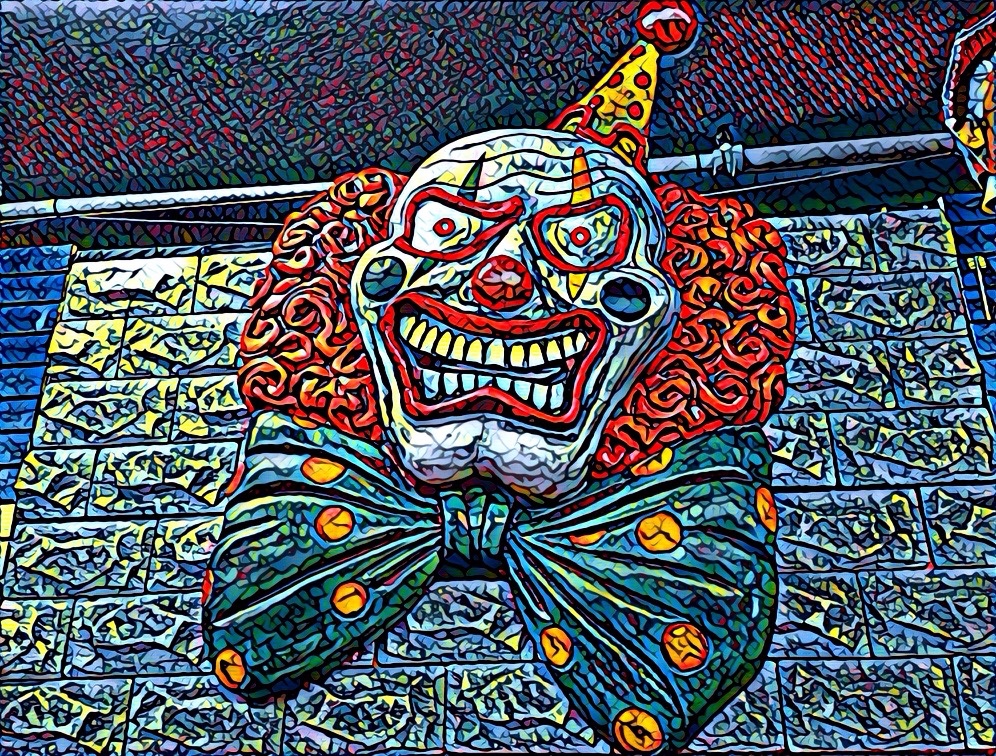
(Processed photo from one I took on Maui.)
Sam sit alone at the local sandwich shop, and began contemplating whether to have dessert after his nice lunch. It was a club sandwich, already a lot of calories, but what the hell, he thinks. With what the doctor said this morning, I should be free to eat anything I want,
Three older guys — strangers — come in and waddle up to a table next to Sam’s. The trio have their menus but before glancing at them, they look up at a nearby TV and raise their fists. There’s a roar because someone has just run back a kickoff for a touchdown.
Andy says, “Wow! What a run back. I played in high school. Not easy running back a kickoff all the way into the end zone.”
Sam regards the threesome. It’s hard for him to believe any of them were ever fit enough to play football, but most people do gain weight with age and lack of exercise, so — he could be telling the truth.
Bob says, “I played in high school and college. I was good. Blew my knee out as a sophomore though and lost my scholarship.” This too seems plausible to eavesdropping Sam.
Cal says, “I played in high school, college, and went pro. I was fantastic. Probably the best runner and wide receiver and quarterback in the history of Ohio State. I played free safety too. Had more tackles than anyone before or since. If I were playing quarterback, no way that guy would have scored. I was the top draft pick five years running. A lot of quarterbacks these days are too chicken to tackle anyone. I would have nailed him. I was breaking all the records for the Houston Texans! But I got bored. Football’s really a simple game.”
Sam thinks that Cal is bragging way too much. His story is a priori unlikely. Regardless of what he says or how he says it, the chances that a random person is the best anything at Ohio State is highly unlikely. He played back, wide receiver, quarterback and free safety? That’s unlikely. Extremely unlikely.
Sam frowns and shakes his head. What does it mean to be the “top draft pick” for five years? If that were true, it would lead naturally to an explanation but none was provided. Further, quarterbacks may be told not to risk their careers making a tackle on a punt return. But what quarterback is on the field to defend a kickoff return?
Houston Texans? Their first season was 2002. This guy looks to be at least 65. So…he was playing all those positions when he was 45? That seems highly unlikely. Got bored playing football? Possible, but again seems very highly unlikely. Football’s a really simple game? Really?
Cal’s story has a lot of holes in it. Now Sam laughs that he ever swallowed any of it.
Bob says, “You played for the Houston Texans? You mean the Oilers?”
Cal shoves his chair back hard enough to spill water on the table. He pushes on the arms of his chair and manages to stand up and he yells even louder, pounding the table to illustrate just how much he believes in what he’s saying. “I said Texans and I mean Texans! I was the best in the whole damned state of Texas! The whole south for that matter!”
Sam laughs to himself, thinking, Well, that settles it I guess. Cal is really passionate and loud so he must be telling the truth, right?
No.
Wrong.
People who are telling the truth do not feel the need to scream and yell and make even more outrageous claims the first time someone questions them.
Sam snorts at the ridiculous claims and then has an idea. It takes Sam 20 seconds to pull out his iPhone and look up Eli Manning, the first name that popped into his head.
Sam reasons: “If Cal were really the best football player in the history of Texas, he could have easily verified it by finding his own entry on the web (likely on Wikipedia) and shown his table mates the entry. He would not have had to scream and yell and pound the table.”
Sam thinks: Okay, but no-one’s going to fall for a con man like that.
{Really? Don’t be too sure, Sam}.
Cal says to the approaching and attractive server: “Hey, darling. You look yummier than anything on the menu. Do you know who I am? Do you know what I did before I became a billionaire? Go ahead guys. Tell this lucky sweetheart who’s going to be leaving someone a very big tip!”
Andy and Bob may think: Well, at least he’s going to leave the tip.
So, Andy and Bob outline Cal’s biography in the football hall of fame (where his name definitely does not appear should anyone actually look it up).
Andy and Bob feel pretty sheepish about joining in this pack of lies. But Cal doesn’t think they have been anywhere near lavish enough in their description of him. Cal says: “Oh, on, guys! Make this girl’s day! Tell her she’s had the pleasure of serving the greatest football player in the history of the game! I don’t say that. That’s what everyone says! Right, guys?”
Now Sam looks over and can see that Andy and Bob are both a bit embarrassed. They’ve gone along with Cal’s lies, but they don’t want to admit to that now because it makes them out to be liars too. So they go along with the bigger lie.
Andy says, “Yeah. Something else, right? He was OSU’s best player ever. Yep.”
Bob says, “Uh-huh.”
Cal shakes his head at Bob. “Come on! God, that’s the damndest weakest most candy-ass description I’ve ever heard, Bob. Tell her how many touchdowns I had. Just me. At OSU!”
Bob looks bewildered. He knows it’s all a lie. People all over the restaurant are starting to look over at the table and more than a few are looking admiringly at Cal.
Bob thinks to himself, Quite a few cute chicks here. Cal can’t handle all of them.” He feels inspired. He takes out his iPhone and says, “Damn. Battery’s about gone. Let me just … here … fifty touchdowns. My God! That is amazing!”
Cal rolls his eyes. “Give me that damned phone! That’s not right! It’s two hundred and fifty. Not fifty. Yep. There it is. I’m going to look up how many interceptions I had. Oh, crap! Battery dead. Hey guys, I gotta skedaddle. Here’s your crap cellphone back Bob.”
By now, Andy and Bob are both too embarrassed to come clean. Cal makes a big show out of taking out his wallet and thumbing a large pile of cash. He makes it look as though he’s leaving a big tip but actually only leaves a couple bucks. Andy and Bob split the entire bill.
Sam shakes his head slowly as he watches the three waltz out. Their server looks in awe of Cal and stares him out of the establishment. She even stares with some desire — despite the fact that Cal is grossly overweight and barely able to wobble his way out of the restaurant. But she imagines how once he must have been quite a specimen and it’s that image that is the real target of her desire.
She also looks forward to finding out just how giant of a tip he left her. A few moments later, she walks over to the “billionaire’s” table and before opening up the placard, tries to guess how much it is. Several of her colleagues have come over as well. She turns around and tells them to back off. “It’s my tip, thank you very much” she says. “Just remember, I’m the one who tried to convince you all to share tips but you wouldn’t have any of it.”
They back off, slightly miffed. Now, the young lady has made up her mind it will be at least a hundred dollars, but she dares to hope that maybe he did something crazy and left her a thousand!!
She notices her hands trembling as she opens up the placard and sees three bills.
She blinks. She sets her jaw. She’s not going to let her colleagues see her disappointment or that he stiffed her, especially after he felt her thigh. All the way up. She forces a gleeful tone into her voice and jams the outer corners of her lips up towards her ears. “Oh, boy!” She shouts with intended but pretended joy. “This will buy me a new iPhone!” As she said this, each successive word increased in loudness and pitch. She sounded a lot like someone desperately peddling costume jewelry on channel 666 at 4 am.
Her colleagues glance at each other. She fooled no-one. They all realize she got stiffed. Each is torn between comforting her, making fun or her, or just pretending along with her. For the sake of keeping a reasonably happy work environment, they all choose to go along with her.
Sam shakes his head and looks down at his melted coffee ice cream with hazelnuts. Now it’s just cold coffee with a lot of wet nuts.
And, then Sam realizes that that is the least tragic thing that happened here today. In the length of time it took his ice cream to melt, one liar became seven liars.
Same took a deep breath. This is what’s happening inside me, he realized.
Before we discuss the answer to that one, let’s move on to the American House of Representatives. There are 435 people in the House of Representatives. What is the probability that at least two folks in the House share a birthday?
We will return to these two puzzles shortly. Meanwhile…
Imagine that you are one of our distant ancestors foraging for food. You come across something that looks just like a blackberry bush. On it are what appear to be nice ripe blackberries. They feel like blackberries so you pick one. You pop it in your mouth and it tastes like a blackberry. It has the same seeds that you are used to being in a blackberry fruit. It smells like a blackberry. Chances are extremely good that it is, in fact, a blackberry.
Don’t get me wrong. There are some plants out there that could give you trouble! The deadly poisonous amanita mushrooms are said to taste good. And, the white “death angel” has been mistaken for an ordinary field mushroom with deadly results. A single mushroom will kill you but a half a mushroom may only make you wish you were dead.
In general, however, plants, animals, and situations are redundantly coded right at the surface. A blackberry plant has leaves that look like blackberry leaves. It has thorns that look like blackberry thorns and also feel like blackberry thorns. The fruits look like blackberries! They have a texture of blackberry. They smell like blackberries. They taste like blackberries. Though there are some deadly exceptions, in the natural environment, we are generally clued in to what something is by multiple senses. If it looks like a blackberry and smells like a blackberry and feels like a blackberry and tastes like a blackberry, chances are excellent that it really is a blackberry.
When it comes to things produced by human beings, however, we must be much more cautious.
In some cases, such as the puzzles at the beginning of this blog post, the intention is pedagogic. But in other cases, people mislead you for much more nefarious purposes. Someone could intentionally spray the blackberry patch where you go with an odorless, tasteless, invisible poison. It could poison your body and kill you stone cold dead. Or, they could poison you and make you so sick you wish you were dead. Who would do such a thing? Well, the name “Vladimir Putin” springs to mind. He has arranged for the poisoning of his political foes and critics.
It isn’t only your body that is at risk, however. So is your brain. The tricks that people play are not necessarily all deadly. Often, they just want to take your money. So, they will tell you a drink is “All Natural Fruit Drink” because they know that most people care about their health and the health of their families and “All Natural Fruit Drink” sounds like something natural, healthy, and nutritious. But legally, as it turns out, those words mean absolutely nothing in America. That “all natural” drink may be anything but! It could be mainly water and corn syrup! It might have as little as 5% fruit juice.
What do you think is in “Air Freshener”? “Air Freshener” sounds wonderful, doesn’t it? After all, who doesn’t like fresh air? If you’ve been in a musty cabin waiting for the rain to abate and you step outside into the cool, crisp, fresh air, that is a wonderful sensation. Ah! Breathe in that fresh air. And, of course, when you see a commercial for “Air Freshener” on TV, or read the title which might say, “Ocean Breezes Air Freshener” it reminds your brain perhaps of your first trip to the ocean.
What is really in air fresheners is, in many cases, anything but an air freshener. Do you know what a really good air freshener is? Opening your windows. But the sprays that you buy in the store can contain:
Carcinogens Perfumes Chemicals that mess with your hormones
Chemicals that deaden your sense of smell
Huh!?
Not exactly an “Air Freshener” is it?
In the puzzles above, the description is also misleading, not because I want to steal your money or poison you, but because I care about my fellow citizens being sold their death warrants packaged as something wonderful. Hopefully, if we become aware of how the surface features of a situation can mislead us, we’ll be less prone to fall for such tricks.
The tobacco companies were good at such tricks. They would sell you something deadly and addictive but advertised to make you think that smoking their product would make you “manly” or “sexy” or “sophisticated” or “urbane” or “adult.” It wouldn’t make you any of those things. It would harm your lungs and your heart and turn your skin gray and make your breath smell bad. But those aren’t very good selling points, you see. Eventually, the government required cigarette companies to put health warnings on the packages. Do you think that the cigarette companies eagerly complied? Guess again. They fought tooth and nail and paid off politicians for years so they wouldn’t have to own up to what their product was really doing to you.
So, let’s return to the puzzles. In the first puzzle, many people are led by the structure of the language presented to answer wrongly.
“If a chicken and a half can lay an egg and a half in a day and a half, how long does it take ONE chicken to lay ONE egg?” The first answer that will likely pop into many minds is “ONE day!” It “seems logical.”
But it’s dead wrong. Consider this analogy: “If nine women can have nine babies in nine months, how long does it take ONE woman to have ONE baby?” One month? No, of course not. It takes nine months. And it will take a day and a half for the one chicken to lay one egg. (Or, a hundred chickens to lay a hundred eggs).
The second puzzle will probably only cause problems if you have been educated about probability.
What? Yes. If you ask a smart ten year old, they will figure it out. Basically, there are only 365 days in a year (or 366 in a leap year). Since the number of Representatives in the House is 435, even if the first 365 people in the House have different birthdays, the next person you look at has to overlap with someone. It’s just like this: Suppose you only have some identical black sox and identical white sox. If you pick three sox in the dark, you have to have at least one match.
If, however, you studied statistics, you may have come across “The Birthday Problem.” As it turns out, if as few as 30 people are in a room, the chances are greater than 50:50 that at least two share a birthday. If the puzzle reminds you of this, your mind runs along lines like this: “Oh, yes, I remember this. It’s “The Birthday Problem” and with even 30 people the odds are good, so with 435 people the probability must be really high. I’d say the odds are 99:1.” No. Wrong. Close, but wrong. There must be at least one match.
It’s very easy for us to rely on the surface of things — including its label or what advertisers say about that thing — as a valid indicator of what’s underneath. And, in nature, that is often true. But in modern society, if you simply believe what someone says, you will certainly lose some money and at some point, you may also lose your entire fortune, your freedom, and your family. It’s happened before. Hitler, to name one famous example, told people he was going to make Germany great and that the “Third Reich” would last a thousand years.
He killed himself in the end. But not before causing the deaths of millions — including millions of Germans. He told people lies that they wanted to hear. He divided people and made people believe that all their troubles would be over if he just had complete power over their lives. Don’t fall for it.
This is satire. Gravity is not a hoax. And, should you feel compelled to jump out of an airplane from high in the sky, you will definitely want a parachute and not rely instead on a Faux News commentator’s words to cushion your fall.
One quarter of the country is prepared to die and have their loved ones die for the sake of what they know or should know to be lies.
But what happens in war?
At least one side, and more typically both sides are willing to die and put their families at risk for what they know or should know to be lies. They don’t typically go into combat for their own benefit! They do it for country. They do it for their religion. They do it to protect their families. They do it in reprisal for some real or imagined actions in the past. But very few would willingly walk into combat hoping to “get more out of it” than they put into it! That would be like running through a rich neighborhood during a heavy lightening storm. Sure, you might be struck by lightening or hit by a falling tree and die or be permanently injured. But — hey! — there’s also a chance you might be able to sue one of these rich suckers and make millions! Yeah. That could happen. But, as I say, that’s not why most people put themselves in harm’s way.
So, to recapitulate, war itself is based, at least partly, on lies.
Are we doomed to keep repeating the same mistakes over and over and over and over again?
IDK
But consider this:
Suppose there are two teams Purple and Green. These two teams have a competition in something. It doesn’t much matter whether it’s soccer, baseball, debate, ice hockey, figure skating, cheerleading or anything else. What matters is that each side wants to “win.” But it also matters, and more than a little bit, that each side also wants to enjoy themselves. They value other things in addition to winning or losing. Some enjoy the companionship. Some enjoy the challenge. Some enjoy improving. Some enjoy the sunshine. It doesn’t have to be the same value for everyone.
The point is that tennis is not a zero sum game. It’s true that a particular match has one and only one winning team. But there are other benefits. Everyone is a “winner” in the sense of the challenge or the emotional ups & downs or the sheer joy of movement. The score is only one part of the value of the game. The same is true for all sports and for almost all human endeavors in the real world. It is very seldom a zero sum game. We can almost always find some state of affairs as being bad (all out atomic war destroys the entire human species)
Similarly, both the Purple and the Green team want to keep the game going. In most cases, they also want to have cordial social relations with all the other players. So, in the vast majority of cases, people “handle” disagreements about the score, the line calls, etc. within the bounds of civility. Let’s suppose that one person of the four is a narcissistic sociopath who thinks he’s always right and insists he’s always right no matter how egregious his line calls. Eventually, such a person would destroy the game. It wouldn’t take a majority. A single sociopathic teammate could spoil it for everyone. But only if everyone else lets them get away with it.
Have you ever watched an all-out bench-clearing brawl between to baseball teams or two hockey teams? Every time I’ve seen it, it’s really only triggered by one person and accepted by one person. So, two, among those whole teams, are sometimes enough to ignite a kind of “war.” While a brawl isn’t the most pleasant experience I can imagine, it’s even worse among professional athletes. It’s potentially career-ending. For most, it’s a potential financial hit from the world of brand endorsements. There could be legal trouble. For a few, there might be regret. Similarly, guess what? Most people do not benefit from war! It’s so obvious that I hesitate to say it, but it seems as though people do not see it as obvious. A very few people get very very rich. Many people die; many are seriously and permanently injured; many people’s homes are destroyed; families are separated; possessions are destroyed; plans are accomplishments are destroyed; peace of mind is destroyed; forests and wild places are destroyed; innocent animals are destroyed; friendships are destroyed; trust is destroyed…I mean, are you starting to see a pattern here?
War is about destruction. War does not create beauty. War does not feed the hungry. War does not heal the sick. War does not comfort the soul. War benefits the few; never the many.
At the extreme, there is dictatorship which will always be much more incentivized to war than will a democracy. The dictator will use the fact that there’s no free press to whip up hatred against an enemy. Then, he’ll attack (but pretend the other side started it), etc. Now, if attacked, the democracy has little choice but to respond. Encouraging a bully is a losing strategy. Going to war is also losing. War is never about winning. It’s about losing less. And going to war is better than giving in to a bully. If you succumb to the bully, you have no life any more. The bully is a parasite on you; one that you cannot get rid of while he sucks your blood and everyone else’s in the nation. Parasite is just another name for dictator.
In any case, a small number of people can start a war which, in turn, benefits only a small number of people, at most.
That doesn’t seem like a good system to me.
It sounds like “an accident waiting to happen.” And, it has. Over and over and over and over again.
When will we ever learn?
And, while three fourths of America has battled their butts off for over a year and a half — socially distancing, wearing masks, making masks, getting vaccinated, staying healthy — in some cases working heroically — quite literally — heroically to fight the war against COVID. While that’s what’s been happening with about 3/4 of Americans….
One fourth of America has decided to join in the War on COVID — on the side of the virus! They refuse to get vaccinated; refuse to wear a mask; refuse to socially distance. Why? Because they’ve been ordered to by the leaders of a death cult. Make no mistake. This has nothing to do with personal freedom. If it were about personal freedom, there might be as many as seventeen people nationwide who would prefer to be intubated for weeks than to wear a mask for minutes. If it were really about personal freedom, the vast vast majority would choose a few moments of discomfort rather than dying or being permanently disabled. Ironically, most of the cult leaders have been vaccinated, and when they’ve fallen ill, they’ve received expensive top notch care that you or I or the COVIDites will not be likely to receive.
Something there is that doesn’t love a war, not even a war on truth.
Here are a few thoughts about “Boundaries” and how they apply in User Experience.
I decided to gift a copy of of Volume One on The Nature of Order to my daughter earlier today. I logged on to Amazon and looked at my address book. I am aware that she moved fairly recently. So, I was scrolling through my earlier text conversations with her to see whether she had told me of her new address. I couldn’t find a text about her new address so I texted her to get the new address.
Suddenly, a popup window appeared from SIRI. It had her new address. I hadn’t said anything aloud. I thought of SIRI as a voice-activated service on my iPhone. It was disconcerting to have it “notice” my text message and then suggest an answer (which turned out to be correct).
Last week, after physical therapy, my therapist & I began to discuss the time for my next appointment. I pulled up the calendar application on my iPhone and went to a particular day and began to type in her name. After the first two characters were typed in, the “type-ahead” function suggested three possible “completions” the first of which was the time we had been orally discussing (which was not a common time nor the time of any of my recent appointments with her). It also filled in her complete name and the purpose of the appointment, but that was more understandable.
One sense of “Boundaries” in User Experience connects with a notion of “boundaries” that is much discussed in contemporary mental health. We are advised to “establish boundaries” with co-workers, family, friends, and strangers. We don’t necessarily want to share personal information with everyone or let everyone touch us in any way they choose to. If intimate details are shared in a recovery group or group therapy, it is generally agreed that such details will not be shared with others.
We sometimes extend the idea of informational boundaries to written materials as well. If, for instance, we keep a personal diary, we do not expect other people to “search for it” or to read it. In this story, I relied on the expectation that someone would read a paper I “accidentally” dropped on the sidewalk. But she was so protective of my privacy that she wouldn’t even glance at my paper.
On the other hand, if we write and publish an autobiography, then we can expect that other people will feel justified in discussing the contents. To me, it would seem odd for an author to feel “violated” if people start talking about the contents of their autobiography (or their blog).
When it comes to modern interactions with computer software however, the boundaries are invisible — and sometimes non-existent. It can feel as though I write a private diary on paper; lock it up in a safe immediately; and then — without any sign that the safe has been broken into, I suddenly find details of my personal life revealed!
There appear to be boundaries between applications, and certainly between devices but these boundaries may be illusory. I find that troubling and confusing. I think the first application of “Boundaries” as a property of UX is that apparent boundaries should be real. There may be exceptions for exceptional circumstances; e.g., the police may get a search warrant to search your house if there is reasonable suspicion that you have committed a crime.
When a social media site analyzes your reactions, relationships, and word usage to determine what to try to sell you and what type of approach is most likely to succeed, that does not strike me as a reasonable response to an “emergency.” As most readers know by now, such information is not only used to try to sell you more stuff; it was also used to manipulate public opinion; for example, to convince some US voters to stay away from the polls on election day in 2016; to convince voters in the UK to vote for Brexit; to convince people not to get vaccinated.
Living things do have boundaries. Breaching those boundaries is typically something to be avoided. We call such breaches by names like “bites”, “wounds”, “diseases”, “gunshots”, “parasites.” Living cells typically have a cell wall. Within the cell are tinier organelles such as the mitochondria. The mitochondria have boundaries. The nucleus of a cell has a boundary. Within the nucleus, the nucleolus has a boundary. Larger structures often have boundaries. Motor neurons have a myelin sheath which allows neural impulses to travel faster. Almost our entire body is covered in layers of skin which for a boundary.
The formation of boundaries does not stop with our physical body. Organizations of humans — nuclear families, clans, nation-states, counties, cities, townships, teams, corporations — they have boundaries. A bank, for instance, might have a safe for the money, but the building itself also functions as a boundary — not an impermeable boundary — customers are allowed to come in during banking hours. There are also legal boundaries. If you have “an account” at a bank, you will be allowed to do things that non-customers cannot. Similarly, if you are an employee of a company or a member of a sports team, you will be allowed to do things and go places that you couldn’t if you were outside that boundary.
All boundaries are semi-permeable. Boundaries change over time. A thorn tears your skin. Your boundary is broken. If you’re not careful, bacteria can get in and cause an infection. Your white blood cells destroy the invading bacteria. Your body heals. If the cut was bad enough, you may get a scar and the scar is now part of your “boundary.” It isn’t only at the level of the body that changes occur. Your social boundaries change too.
You get married. You get divorced. You are born. You join a team. You quit the team. You sell your house and other people buy it. Now, you are no longer allowed to come into the house without an invitation. Meanwhile, you buy another house. You have acquired new boundaries. Or, perhaps, you have no home. You are homeless and your boundaries are not so secure.
Most of our possessions have clearly defined boundaries. Your hammer is separate from your saw which is separate from your drill. They come from an earlier time and the “boundary” of such objects are determined by their shape. More recently, such tools (and nearly everything else!) Is packaged in bubble wrap which forms an additional boundary. This makes it harder for people to hide one under their clothes and walk out without paying. Such packaging has the added advantage that it will require time and energy on your part before you can actually start using the tool for its intended purpose. Not only that — such packaging helps pollute our world beyond the pollution required by “old style” tools.
Once you have separated your new tool purchase from its packaging, if you have any energy left, you can saw a board, or drill a hole, or hammer a nail. But you do not expect (not yet, at least), the saw to “communicate” behind the scenes with your drill. Or with you. You’d be surprised if it piped up and said, “Gee, Gene, you just sawed a board. Now, you have taken up the drill. Would you like suggestions on how to build a dog house?” (That’s what Clippy would do).
Clippy tried to be helpful. But it didn’t really have enough information about my tasks, goals, and context to actually be helpful. But today’s behind-the-scenes information sharing with dark forces is not trying to be helpful. It’s trying to get you to change your behavior for someone else’s benefit — and you don’t even know who those someones are.
Notice that if you buy a house (which typically comes with doors and keys), you can lock the house and the default is that it keeps everyone else out — except those you’ve given a key to or those who have rung your doorbell or otherwise asked for permission to come in. Typically, if a rare visitor comes to your house, you make arrangements for a time and a place. The piano tuner comes to tune your piano. You might let them use your bathroom or even offer them something to drink. But you don’t expect the piano tuner to redecorate your study or to spend the night uninvited.
That’s kind of what does happen in the electronic world though. In many cases, you cannot visit a website or use an application unless you give permission for the “guest” to rifle through the choices you make. Just to be clear, these “choices” are not only explicit choices; your “choices” can include how long you linger over a particular message or video clip. In many cases, you have not just given a key to a specific vendor, application, or website — in many cases, you have also given them rights, essentially, to make as many copies of your front door key as they care to make and hand them out to whomever they like.
These are missing boundaries, not so much in the user interface design, but in the socio-technical context in which we use our technology.
In the physical world in which we evolved, invasion of privacy typically involved symmetry. If I can see your eyes, you can see mine. Conversely, if I can’t see anyone, chances are that they can’t see me. Of course, this isn’t literally true. A tiger’s camouflaging stripes may mean that they can see the gazelles even though the gazelles cannot see them. The astounding eyesight of the eagle allows them to see a mouse on the ground and start their deadly dive before the mouse can see the eagle.
In the electronic world, it isn’t genetically coded asymmetries of information that allows other people to invade your boundaries — in many cases without your permission or even knowledge. It is an asymmetry that comes from money and time. You don’t have anything like the fortune that rich companies have. They can hire experts at subverting your boundaries. They can hire an entirely different set of experts to convince you that it’s all okay. They can afford to hire still other experts to defend themselves in a court of law should you seek redress for any particularly unethical behavior. They can afford to hire politicians as well in order to make laws to protect their unfettered access to your data. You typically cannot afford to hire politicians to protect your right to privacy.
You probably don’t have 10,000 to 100,000 people working for you. Companies not only have the money to spy on you. They also have to time to collect and analyze your behavior & make sense of it. You don’t. Perhaps, every once in a while, you take the time to wade through a “privacy policy.” In most cases, since experts were hired to make the text as incomprehensible as possible, you likely didn’t see much value in reading the document.
The Nature of Order is about aesthetics, not ethics. And, this post was meant to be about aesthetics, not ethics.
Life includes differences in sensory capability. And life includes camouflage. Generally, however, when you get to the end a cliff and step off, you have a pretty good idea what’s going to happen. The boundary is visible to you, to a bison, to a mouse, to a lemming, to an eagle.
When we walk through the woods in northeastern USA where I lived for many years, we run the risk of being attacked by a deer tick. The dear tick makes a hole in you and starts sucking your blood (oh, while they’re at it, they may inject a large does of Lyme disease bacteria into your blood stream). You don’t notice it, because the deer tick is “kind enough” to administer a local anesthetic so you don’t feel any pain from this invasion of your person; this breaking of boundaries. It’s a one-sided breach. The deer tick is well aware of the invasion. It’s the whole point! But you do not perceive the breach. At least, I didn’t. Twice. Thankfully, I don’t seem to have any long-lasting effects though I have several friends who do.
A one-sided boundary breach, doesn’t seem “aesthetic” to me. Nor does it seem “truthful.” The little orange deer tick, is, in a very real sense, lying to me. It uses its narcotic to tell me, “No worries! There’s no wound here! There’s no deer tick sucking your blood. There’s no deer tick injecting a serious disease into your blood. No, no. All is well!” It seems the opposite of beauty and the opposite of truth.
I suppose if I had been born a deer tick, I might view things differently.
In my early days at IBM Research (1970’s), we were focused on trying to develop, test, or conceive of ways that a larger proportion of people would be able to use computers. One of the major ways of thinking about this was to use natural language communication as a model. After all, it was reasoned, people were able to communicate with each other using natural language. This meant that it was possible, at least in principle. Moreover, most people had considerable practice communicating using natural language.
One popular way of looking at natural language (especially among engineers & computer scientists) was essentially an “Encoding – Decoding” model. I have something in my head that I wish to communicate to you. So, I “encode” my mental model, procedure, fact, etc. into language. I transmit that language to you. Then, you “decode” what I said into your internal language and — voila! — if all goes well, you construct something in your head that is much like what is in my head. Problem solved.
Of course, people who wrote about communication from this standpoint acknowledged that it didn’t always work. For instance, as speaker, I might do a bad job of “encoding” my knowledge. Or, I might do a good job of encoding, but the “transmission” was bad; e.g., static, gaps, noise, etc. might distort the signal. And, you might do a bad job of decoding. It’s an appealing model and helped engineers and computer scientists make advances in “communication theory” and helped make practical improvements in coding and so on.
As a general theory of how humans communicate, however, it’s vastly over-simplified. I argued that a better way of looking at human communication was as a design-interpretation process, not as an encoding-decoding process. One of the examples that pointed this out was a simple observation by Don Norman. Suppose someone comes up to you and asks, “Where is the Empire State Building?” You will normally give a quite different answer depending on whether they are in Rome, Long Island, or Manhattan. In Rome, you might say, “It’s in America.” Or, you might say, “It’s in New York City.” If you are on Long Island, you might well say, “It’s in Manhattan.” If you are already in Manhattan, you might say, “Fifth Avenue, between 33rd and 34th.”
Building on Don Norman’s original example, but based on your own experience, you can easily see that it isn’t only the geographical relationships that influence your answer. If you were originally from Boston, now on your own in Rome, struggling with Italian and homesick and someone came up to you and asked that question in American English with a Boston Accent, your response might be: “Are you joking? But how did you know I was an American. My name’s … “
On the other hand, if you’re a 13-year old boy in Manhattan — one with a mean streak — and someone asks you this question in broken English and they’re looking around like they are totally lost, you might say, “Oh, no problem. Just follow 8th Avenue, all the way north up to 133rd. It’s right there. You can’t miss it.” (Note to potential foreign visitors, most kids in Manhattan would not intentionally mislead you. But they point is, someone could. They are not engaging some automatic encoding process that takes their knowledge and translates into English. Absurd!
You design every communication. I think that’s a much more useful way to conceive of communicating. Yes, of course, there are occasions when your “design” behavior is extremely rudimentary and seems almost automatic. It isn’t though. It just seems that way. Let’s go back to our question-asking example. Suppose you work at an information booth in New York City. People ask you this question day after day, year after year. You’re seemingly giving the answer without any attention whatsoever. Suppose someone asks you the question, but with a preface. “Look here, chap! I’ve got a gun! And if you give me the same stupid answer you’ve given me every time before, I’ll shoot your bloody brains out!” You are going to modify your answer. It only seemed as though it was automatic.
When you design your answer you take into account at least these things: some knowledge that you communication about, the current context (which itself has hundreds of potentially important variables), a model of the person you’re creating this communication for, a set of goals that you are trying to achieve (e.g., get them safely to their goal, mislead them, entertain them, entertain yourself, entertain the people around you, demonstrate your expertise, practice your diction, etc.). The process is inherently creative. In many circumstances (writing, playing, exploring, discovering, partying), you can choose how creative you want to make it. In other cases, circumstances constrain you more (though likely not so much as you think they do).
Many readers think this is a classic example of a straw man argument. “No-one believes communication is a coding-decoding process.”
Well, I beg to differ. I worked for relatively well-managed companies. I’ve talked to many other people who have worked in different well-managed companies. We’ve all seen or heard requests like this: “I need a paragraph (or a slide or a foil) on speech recognition. Thanks.”
What??
Who’s the audience? Are they scientists, investors, customers, our management? How much do they already know? What are your goals? What other things are you going to talk about with them? The people who have left me such messages were all smart people. And, providing the necessary info only took a minute or two. But it critically improved the outcome. It’s not a straw man argument.
Sit-com plots often hinge on the characters doing poorly at designing and/or interpreting communications. A show based on encoding-decoding? No. What could be funny — indeed what often is shown in comedy — are people failing to do good design and in the extreme case, that can arise by having an actual robot as a character or someone who behaves like one.
People also interpret what was said in terms of their goals, the context, what they believe about your goals and capacity, what they already know, and so on. And, even though this may seem obvious, millions of people believe what advertisers or politicians say without questioning their motives, double-checking with other sources, or even looking for internal inconsistencies in what is being touted as true. In other cases though, the same people will not believe anything the “other side” says no matter what. Just as one can do faulty design, one can also do faulty interpretation.
In any case, I decided that it would be good to “show” in a controlled laboratory setting that the Encoding-Decoding model was woefully inadequate. So, I brought in “subjects” to work in pairs at a simple task about communicating Venn diagram relationships. The “designer” had a Venn diagram in front of them. “The “interpreter” was supposed to draw a Venn diagram. The “designer” was constrained to say something true and relevant. In addition to a “base” pay, the “interpreter” subjects would be given a bonus according to how many relationships matched those of the “designer.” The designer’s bonus depended on condition. In the “cooperation” condition, their payoff would also, like the interpreter’s, be determined by the agreement in the diagrams. In the “competition” condition, the designer’s bonus depended on how different the two diagrams were.
I ran about half the number of subjects I had planned to run when the experiment was ended by corporate lawyers.
What?
IBM had no unions at that time. And, they didn’t want any unions. One of their policies, which they believed, would help them prevent the formation of unions was that they never paid their workers for piece-work. Apparently, somehow, IBM CHQ had gotten wind of my experiment. People were being paid different amounts, based (partly) on their performance. They couldn’t have this! People might think were paying people for piece-work!
It hardly needs to said, I suppose, that IBM definitely tried to pay for performance. This was true in sales, research, development, HR, management, and so on. No-one in IBM would argue that your pay shouldn’t be related to your performance. That was exactly — in one way of describing it — was going on here. By the way, these were not IBM employees and each subject only “worked” for about an hour.
Basically, regardless of how irrelevant this experimental set-up might have been to the genuine concern of unions not to pay people in an insanely aggressive and ever-changing piece-work scheme, the lawyers were concerned that it would be somehow misrepresented to workers or in the press and used as evidence that IBM should unionize. In a way, the lawyers were proving the point of the experiment in their own real-life behavior even as they insisted the experiment be shut down.
Lessons Learned: #1 Corporate lawyers are not only concerned about what you actually do or how you represent your work; they are also worried about how someone might misrepresent your work.
Lessons Learned: #2 Even when constrained to say something true and relevant, ordinary people are quite capable of misleading someone else when it’s to their benefit and considered okay to do.
It is this second aspect of the experiment that I myself felt to be “edgy” at the time. Sure, people can mislead, but I was providing a context in which they were being encouraged to mislead. Was that ethical? Obviously, I thought it was at the time. On reflection, I still think it’s okay, but I’m glad that there are now review boards to look at “studies” and give a less biased opinion than the person who designed the study would do.
I view the overall context of doing the study as positive. As adults, these people all already knew how to mislead. I was letting them, and many other people, know that we know you know how to mislead and we’ll be on the lookout for it.
What do other people think about studies wherein the experimenter encourages one person to deceive another?
———————-
References published literature that describes some of the research that was done around that time.
Malhotra, A., Thomas, J.C. and Miller, L. (1980). Cognitive processes in design. International Journal of Man-Machine Studies, 12, pp. 119-140.
Carroll, J., Thomas, J.C. and Malhotra, A. (1980). Presentation and representation in design problem solving. British Journal of Psychology/,71 (1), pp. 143-155.
Carroll, J., Thomas, J.C. and Malhotra, A. (1979). A clinical-experimental analysis of design problem solving. Design Studies, 1 (2), pp. 84-92.
Thomas, J.C. (1978). A design-interpretation analysis of natural English. International Journal of Man-Machine Studies, 10, pp. 651-668.
Thomas, J.C. and Carroll, J. (1978). The psychological study of design. Design Studies,1 (1), pp. 5-11.
“Whom can I trust?” Shadow Walker paced, his energy still high from his second brush with death since becoming the “King” of the Z-Lotz. He didn’t wait for Eagle Eyes to answer and instead ‘ran ahead without his footwear’ as the Veritas liked to say. “I mean who? I am supposed to be their King! Can you imagine someone plotting to overthrow or kill Many Paths?”
Eagle Eyes nodded. “Yes, I can. If we are going to discuss this, you must keep your voice low. We might be overheard and that would not do. I can imagine someone trying to overthrow or kill Many Paths.” Eagle Eyes paused, watching the face of her friend carefully. When she saw that he understood, she continued. “Shadow Walker, you had better be able to imagine that you might be undone. Or, we surely will be. And I have an inkling that your death would be of some interest to Many Paths. Thunder clouds she would see on every horizon. For her, bright green would turn dark blue and blue would look brown. The yellow sun would no longer sparkle like stars after a rain. She would just find annoyance in the rain. Her large bright heart that sets a glow in all the people would instead be a siphon to suck their sunny spirit out and replace it with spent black embers from a fire once so bright.”
Shadow Walker took deep breaths and consciously calmed himself while Eagle Eyes spoke. Just thinking of Many Paths helped. But it also awakened an overwhelming desire to leave; to return home; to see Many Paths; to touch Many Paths; to smell and taste her; to make love with her; to be home where he could trust everyone.
“Yes, Eagle Eyes. She would grieve for a time. But she is our leader. And she takes that responsibility — that is above everything else, her own comfort, her own desires — even her love for me. She would not allow her to stay in such a foul place very long. Because of exactly what you say. She would well understand that by seeing a snake in every river, she would lead others to see the same and eventually the people would die of thirst. She knows how important it is to lead by example.”
Eagle Eyes nodded again. “Yes. And an angry leader may anger everyone. A stupid leader encourages the people to be stupid. A cruel leader inspires more cruelty. Do you agree?”
Shadow Walker admitted to himself that it sounded plausible. But then he tried to imagine a counter-example. He couldn’t. Yet, something tickled in his mind that the truth of Eagle Eyes was a partial truth. “There is much truth in what you say. However, just a few minutes ago, I was very upset — for obvious reasons. But you didn’t let it make you upset. Instead, you calmed me down so that I might think more clearly and not do something impulsively that might make the situation worse.”
Eagle Eyes considered. “Yes. You’re right. Sometimes bad behavior produces a good reaction in good people. But that only works at first. Imagine –these people, the Z-Lotz — the leaders lie to the people. They choose their king by assassination. The king — well, certainly NUT-PI, but conversations with Cat Eyes suggest that others were similar — the king shows no loyalty at all to the people whom he depends on. He tries to control them all with fear.” Eagle Eyes bowed her head and shook it side to side. She sighed a deep sigh. “How can people let themselves live like that? It’s horrible. Anyway, the effect of all this to our current circumstance is that because NUT-PI himself was so untrustworthy and so disloyal, many of the Z-Lotz could well be the same. They may think you’re better than NUT-PI, but the ambitious ones are all able to convince themselves that they’d do a better job than you! After all, you’re not even a Z-Lotz.”
“All right, Eagle Eyes. So…” He broke off because Eagle Eyes put her index finger on his lips. He remembered her admonition to speak softly so as not to be overheard. He took several deep breaths and continued.
“So, let’s leave! Let the Z-Lotz sort out their own issues! For all we know, Many Paths needs our skills right now. Why are we saving these people when we may still have more problems at our own Center Place.?”
“First, I don’t think sneaking out is all that feasible. But even if we did leave, might they not be affronted by a King who simply — abandons them. Hard to know whether they would become so ensnarled by their own fighting that they would ignore us or whether they would somehow find this a good excuse to attack the Veritas. And — the very best we could hope for is that things would “get back to normal.” And these people would come and steal children again. If we stay…and we live…there is some chance we could improve relations between … well, really among all the tribes. And, they know things that could be important for us. Besides, none of the people born into the Z-Lotz chose to be born there. If we can help them….”
“If. Yes. If. They know their ways. We don’t.” Shadow Walker looked at Eagle Eyes, who was clearly deep in thought. “I don’t even know how many of them know about that cache of weapons and gold that we found. I don’t know whom I can ask about those weird liquids in the see-through rocks that are not rocks.”
Eagle Eyes and Shadow Walker reflected on their situation in comfortable silence for a time. The Veritas were unafraid to give their ideas space enough to breathe; time enough to mature.
After a time, Shadow Walker said, “We desperately need to understand more of their language. Perhaps we could find some tutors to trust. More than one. It may be very hard to decide whom to trust, but it may be possible to find someone to trust. If we could ask questions of multiple tutors, and we get the same answers, we might presume that they are telling the truth, or at least the truth as they see it. Yet, if they say almost the exact same words, then they are telling a rehearsed story to gain our trust.”
Eagle Eyes added, “In addition to learning more about the Z-Lotz and their language, for others, we can simply be honest. Tell them that, because of the assassination attempts, you don’t know whom to trust so we will need to test their loyalty. Give them the Veritas Test of Truthfulness. If they pass, you will trust them and that will be a very good thing for them as well as for you. On the other hand, if they lie to you, they will not pass the test and that will be a very very bad thing for them.”
“What is the Veritas Test of Truthfulness? Why have I never heard of it, Eagle Eyes?”
Eagle Eyes smiled. “We will need to create it.” After all, She Who Saved Many Lives created seven tests of empathy. We ought to be able to create one test of truthfulness.”
“We observe someone doing something very difficult without their knowing that we are watching. We note how they do. Then we ask them how they did. We will see how accurate they are in their description. If they are honest about their mistakes, they are likely to be honest about other things. On the other hand, it seems a bit ironic — and more than a little sad — to build a test of honesty that relies on deception.” Shadow Walker looked down to the side and bit his lower lip.
“Then let’s not,” said Eagle Eyes after a time. She saw the questioning look in the eyes of Shadow Walker. “I mean, let’s not be deceptive. I don’t think we need to. We will ask them to do something and observe them. I believe, the dishonest will still give themselves away. They are so used to lying that they won’t be able to give a fair description of what they did and did not do.”
Shadow Walker considered. ALT-R had been able to fool nearly everyone about his true nature. For most people though — Eagle Eyes was likely right. What if the Z-Lotz had their own ALT-R? Would they be able to smoke them out? After all, Cat Eyes had said that the Z-Lotz leaders convinced the people who actually worked that they believed in a whole jungle web of lies when actually, they didn’t. She had seen their hypocrisy. Perhaps because as a slave, they saw her as not fully human or not very clever. Shadow Walker realized that he would benefit from the thoughts of Eagle Eyes so he said aloud, “We need to start with the people I do trust. I can explain to Tree Vines that the sooner he can help me vet the Z-Lotz, the sooner he can leave to see his daughter — and — that his daughter will grow up in a safer world. If we do this right, we might be able to prevent kidnappings such as what happened to his own daughter so many years ago.”
Eagle Eyes laughed.
Shadow Walker frowned. “Is that funny?”
Eagle Eyes said, “No, it’s just that I had an image. I saw honesty spreading through the Z-Lotz like a plague.”
Shadow Walker chuckled too. “That would be something.” Then another frown passed over his brow. “But that seems like we’re making them into Veritas. Is that right? What if they prefer being dishonest and choosing Kings by assassination rather than competence?”
Eagle Eyes said, “Yes, in the same way that watering the squash turns it into something edible instead of a barren stalk. We’re not talking about their preferences for how well done they like their meat. We’re talking about truth — which is every bit as vital as water is for life itself. Lies, dishonesty, cruelty, hate — these are not the paths of Life. These are paths of Death. As shown by our story of the Orange Man.”
Lies in civilization are much like ground glass in an otherwise nutritious, delicious buffet. They are dangerous. They are potentially deadly if undetected. Quantity matters. One piece of undetected ground glass is serious. One hundred pieces means that some people will die. Twenty thousand means everyone who partakes of the buffet will likely die.
If one side lies constantly and one of the things they lie about is saying the other side lies, then, of course, your “loyalty” to your own side may get you to thinking: “Both sides lie equally.” Or, even more sadly, “The other side lies!”
Imagine Rembrandt’s Mona Lisa: a beautiful painting. Now, imagine painting a red stripe one inch wide diagonally through the painting. It’s only a small part of the painting, after all. Maybe 10%. But is the value decreased by only 10%? Of course not.
Ever use a dictionary? How much would you pay for a really good dictionary? How about a dictionary with 1% errors? How about one with 10% errors? How about one with 50% errors? How about one with 100% errors?
Imagine you finally manage to save up enough money to buy your dream house. Location: near highways, shopping, & parks. Style: perfect. Condition: perfect. Except for one small thing.
It reeks.
Living in a society that is perfused with lies is like living in a house situated right next to a sewage plant.
The *only* advantage humans have in their struggle to survive is their ability to cooperate and communicate. A lie diminishes that ability to coordinate. The impact is not just that one lie. It’s the spread of skepticism. It’s the felt need to double and triple check everything.
In a complex society, even a tiny bit of deception can multiply far beyond the immediate effects. That is particularly true if a deception passes through a number of weak points in what could be and should be the world-wide web of wisdom.
For example, an employee at a drug company might be pressured to downplay side effects in a report. He does so. But in a corporate culture of honestly, someone will catch the lie and patiently explain that this is not the way things are done around here. The error will be corrected.
And no-one will die from that lie.
On the other hand, the same employee doing the same act in a company with a sociopathic corporate culture might well have that lie not only propagated but further elaborated. As a result, the drug is over-prescribed and over-used. Millions of dollars, and then, that money is like seed money to buy layers and layers of political protection and press protection. At last billions of dollars flow from the pockets of customers into the pockets of the drug company. And, when I say “the drug company” of course, ultimately it ends up in someone’s pocket. Whose? A little of it goes to workers within the company. A huge amount goes to the top executives. But a huge amount also goes to the major stockholders — people who did nothing to discover or promote the drug, but in some sense provided money to support the company.
Guess what? It might even turn out that the drug’s drawbacks outweigh the benefits. In the short run, that might not diminish profits at all.
Again though, we need to realize that the damage to society is not limited to the effects of this particular drug (though those can in and of themselves be devastating effects). It is experiences like this, for instance, that play into vaccine reluctance. Because some drug companies have done some unethical things, people naturally have some degree of mistrust for *all* drug companies for *all* drugs. Nor is the mistrust that such a scheme produces limited to the drug industry. If people believe corruption is widespread, they may themselves become more tempted to engage in it. Even if they don’t themselves engage in lies, deception, bribery, etc., they will certainly be on the lookout for such schemes. It will be harder to take people at their word.
Putting crushed glass in a buffet injures people and ruins the buffet. And, if it happens often enough, it can turn you off from going to any buffets or any restaurants.
Lying can seem attractive in the short term. But in the long run, it will be found out. It will ruin your individual reputation, but it will also tarnish the reputation of your organization and even, to some extent, your entire industry. Beyond that, lies work to spoil society as a whole.
Imagine that a well-functioning society is something like a well-oiled machine. One part connects to another and things function smoothly. Lies are like pouring sand in the gears. Things will move more slowly. Parts will also wear out more quickly. Add enough sand and the motor will burn out or the machinery may catch fire. Would you put sand in your gas tank? Would you add sand to the oil in your auto? Of course not! Why would you support lies in your company or in your society?
Apart from the societal disintegration that lies promote, if you actively pursue a policy of lies to benefit yourself, you are basically taking a kind of informational poison into your own psyche and eventually it will poison your mind. You’ll become more and more addicted to a strategy of relying on lies rather than relying on doing a good job or learning from your mistakes. When someone asks a perpetual liar a question, they will not be able to simply answer. They will have to calculate who knows what and how easily the lie will be found out and try to recall what lies that they have already told to whom.
Just as more and more of an addictive painkiller must be used to achieve the same level of pain relief, so too, an addicted liar will find that they have to tell more and more lies. The lies may at first be “reasonable” lies. That is, at first, a liar may tell lies that are plausible. Over time, they will have to tell more and more absurd lies. If the liar is a popular figure, his or her fans may echo the lies despite not having any relevant direct knowledge. As the lies become more absurd, the fans echo not only plausible, lies but also echo absurd lies. To those who are not addicted to the lies, fan behavior becomes more and more ridiculous and pathetic.






















































 petersironwood