• About PeterSIronwood

petersironwood

~ Finding, formulating and solving life's frustrations.

petersironwood

Tag Archives: ethics

Tu-Swift’s Dream

02 Monday Mar 2026

Posted by petersironwood in America, management, psychology, Uncategorized, Veritas

≈ Leave a comment

Tags

communication, creativity, ethics, fiction, horses, leadership, legend, life, myth, short story, story, truth, writing

Tu-Swift dreamed of one of the childhood games he most loved. In the game, the children stood in a circle and one, the “beater” tapped out a complex and complicated rhythm, typically just hitting one stick on another. The “caller” then called out a series of moves. The “dancer” then had to perform the moves in time to to the rhythm. The rest critiqued the performance. Generally, the “dancer” had to repeat the moves several times before perfecting the timing. Tu-Swift almost always “got” the correct rhythm immediately. Indeed, he often added various embellishments for “style.” His only fault was sometimes performing a movement one beat too quickly. Indeed, it was this, rather than his running speed, which first encouraged his clan-mates to call him “Tu-Swift.” 

IMG_8614

Now, he had returned in his dreams to these pleasant games, but as he viewed the dream children, they made longer and ridiculously complicated rhythms. The children in the dream grew old, morphing into Veritas adults such as Shadow Walker and Fleet of Foot. The tempo accelerated until even Tu-Swift had trouble keeping up. The game had gone all wrong and they seemed to all be drumming much too quickly to follow. 

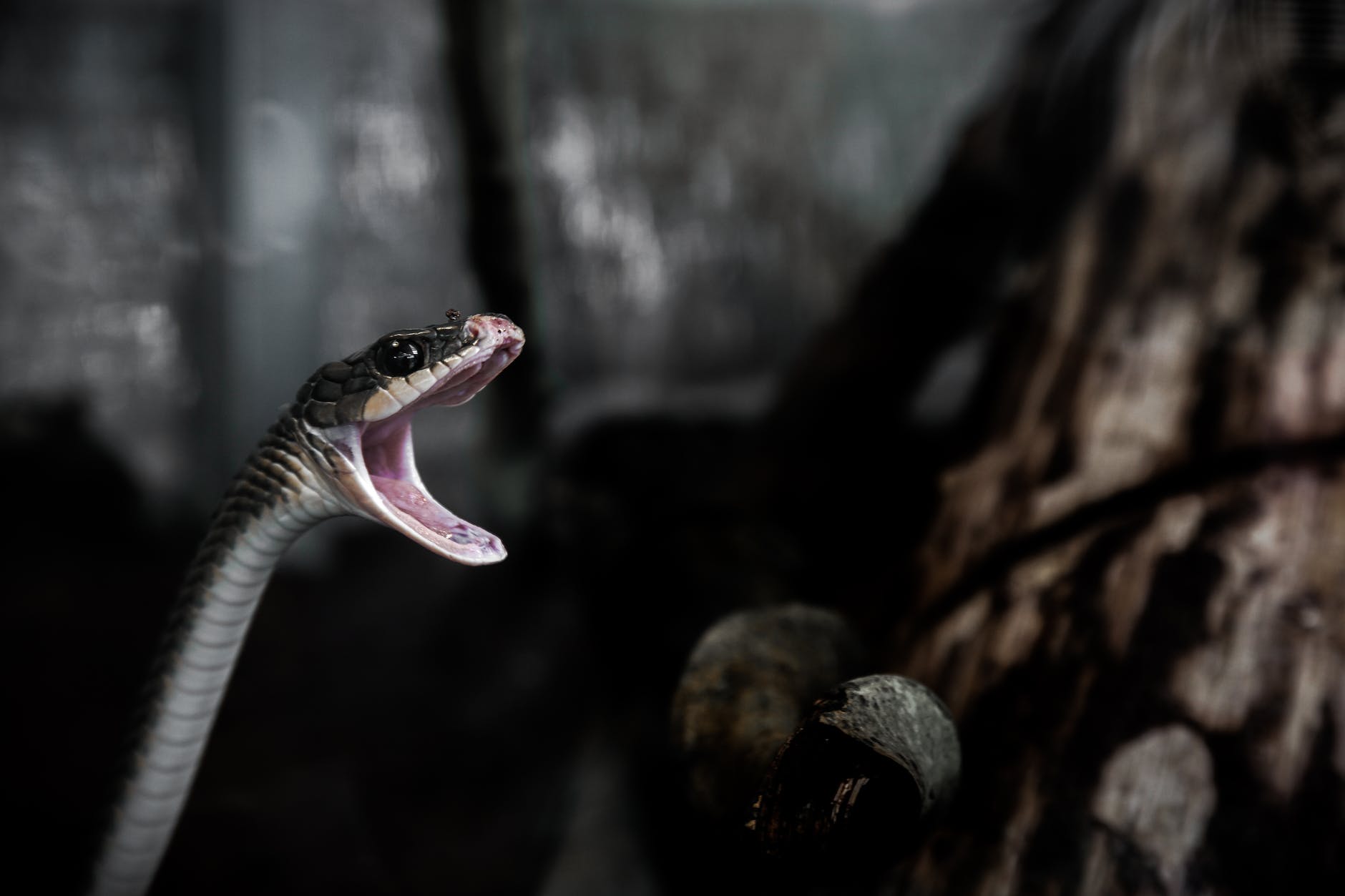
A snake slithered toward the drum. Its giant fanged mouth opened wide and it reared back ready to strike. Tu-Swift heard a scream and awoke. He shook his head in the dim early light of day. He was puzzled that the children and the adults had all disappeared. He realized he had been dreaming and that the scream was his own.

Day-Nah face furrowed into a worry gully. Tu-Swift smiled and spoke reassuringly to the younger boy. Though Tu-Swift realized the youngster understood very little of the tongue of the Veritas, he hoped his tone would communicate enough. It seemed to work. The boy no longer looked frightened. 

6C787BB9-53BC-431C-BDB3-AD9F35A4AED3

Tu-Swift realized now that a nearby woodpecker tapped out the complex rhythms he had heard. They really were complex though. He frowned. Something was not right about this particular woodpecker. It had too many variations and the sound was too “bright” yet not loud enough to sound right. 

The phrase “On the northern side” suddenly came to mind. Then, “Are you okay?” Tu-Swift began to wonder whether he was still dreaming. “Where are you?” “Answer when you can.” I am not dreaming, Tu-Swift thought to himself. Those are drums! Well, not exactly drums, but this was the drum-style of Shadow Walker! He was out there pretending to be a woodpecker and sending him messages. They had come for him! 

Just then, he heard the the voices of the captors talking amongst themselves and drawing nearer to the building where the horses were kept, and where he and Day-Nah now made their home as well. Soon, the two boys were untied from the pillar and led, their feet still tethered, to the paddock where the same three burly men gestured and shouted that they were to further separate the foals from their mares. The narrow passage that Tu-Swift had engineered worked pretty well, but a few of the foals had not yet ventured into the narrow passage and would have to be encouraged to enter it. Such “encouragement” might be misinterpreted by the mares who might, in turn, bite the boys or even smash them with their hooves. 

C3DFBFC1-D938-40E4-861D-15FD4F0FEA65

Tu-Swift grabbed two sticks from the nearby woodpile and walked over slowly to a point outside the fence near where a mare and her foal foraged inside. He spoke gently to them, as he always did, as he approached. Now, he took the two sticks and banged them together. He glanced over at the three burly men who seemed to be more concerned with their own discussion than they were in directing the labors of the boys. Tu-Swift hoped the Veritas were still nearby for the paddock was near the northern end of camp. He tried to use his drumming so that the three who stand atop horses would think he was trying to scare the horses into separating, but meanwhile, he tapped out: “I am here. I am OK. There is a small boy here too. Horses will soon escape. Come back after dark. After moonset. We are tied at night. I can untie. We will be in large building with horses.” He repeated the message again and managed to scare the foal into the small side pen. The foal’s mother was furious and wild that she couldn’t get back to her foal and slammed her hooves into the fence. For a moment, Tu-Swift thought she would destroy the fence. But all that sound and fury, even though it came from his mother, scared the small horse further into the corner. 

The burly men now came and tied the two boys back to back against a small elm tree while they threw other loops of rope around the foal and led it somewhere unknown. The mare grew frantic as the three men dragged, pushed, and scolded the foal into another place that the boys could not see, nor presumably could the mare. 

Tu-Swift wanted to tell the small boy about the rescuers and the drum messages. But Day-Nah’s understanding of Veritas remained minimal. Without being able to use his hands, he didn’t think he could explain how their situation had changed. As he thought about it, Tu-Swift considered than perhaps it was better not to explain the situation. Day-Nah was almost as helpless as the foals that he had just helped capture. Who knew how he might react to such news? Tu-Swift had himself struggled not to let any joy escape his heart and make visible camp on his face. 

Soon, the men returned and “freed” the two boys so they could separate another pair. Tu-Swift again wielded two sticks and repeated his message. In due course, the third and final pair were separated. Now, the boys were returned to the barn, provided a meal, and tied to a pillar so that they could only move about five feet in any direction. 

Shadows grew long and the evening air grew chill. Tu-Swift busied himself teaching Day-Nah some simple commands that could prove useful if they got the chance to escape. It occurred to Tu-Swift on several occasions that they could simply leave the boy behind. But each time he considered it, such an action, while recognizing its convenience, he had no doubt that leaving Day-Nah behind would be feeding the part of himself that was the “bad wolf.”

Tu-Swift noticed that his mind always offered plausible excuses when such cowardly thoughts arose. “Let his own tribe come and save him.” “He will just slow us down.” “He’ll give away our position.” “Maybe he’ll be happier here. Who knows?” Tempting, but like the other Veritas, he had been taught at a very early age to understand that such thoughts were “Poison Ivy seeds.” 

IMG_2873

Many Paths had used that analogy showing Tu-Swift that, as is the way of many plants, poison ivy could spread by vine growth but also did sometimes sprout flowers and these flowers made white fruits which would fall to the ground and if conditions proved favorable, new vines could grow. Such seeds were poison to eat or even to touch, Many Paths had explained and so were easy rationalizations of selfishness. 

The knocking of the “woodpecker” returned and tore away his reverie. Shadow Walker’s drumming continued and repeated. “We will come for you just after moonset. Be awake. Be ready.” Tu-Swift took out the small sharp stone he managed to squirrel away and tapped out his response against the pillar to which they were tied. He hoped it could be heard, for there was now much stirring and moving about in the camp as they prepared for dinner.

“Ready. We are in large building with horses. Take me to horse fence. I will set them free.”  

Tu-Swift had still not found a way to communicate any of this to Day-Nah, and tried to hide his excitement. He made sure Day-Nah understood Veritas for “fast,” “slow,” “quiet,” and “hide.” After it seemed that the people who steal children were all asleep, he tapped out his message again. He hoped it sounded enough like a woodpecker not to arouse suspicion. He tried to recall whether he had ever heard a woodpecker at night but he wasn’t sure. Soon, the moon would be setting. He again emphasized “quiet” for the youngster. Then, he tried to explain escape. He had been worried the boy might shout for joy, but there was neither a shout for joy, nor, so far as Tu-Swift could see, the slightest understanding of “escape.” 

IMG_3532

Tu-Swift took his sharp stone and rapidly shredded the remaining bonds on his feet, weakened earlier by the eager teeth of the hungry horses. Each foot still sprouted a long length of rope, not ideal for running through underbrush to escape a people who stood atop horses. He had no time to cut through all the ropes but tied the loose ends as tightly as he could around his ankles to make it less likely they would trip him. Then, he began cutting through the bonds that held Day-Nah’s from full strides. 

Tu-Swift saw the youngster’s eyes grow wide in the dim light. Day-Nah whispered the word for “escape” and smiled. Day-Nah’s bonds at last were also cut through and Tu-Swift tied each of the loose ends around first one and then the other of the boy’s ankles. Now, they waited. Tu-Swift listened but no drumming came. The frogs were certainly noisy tonight though! 

Then, the image of Shadow Walker came to his mind. Shadow Walker had once spent an evening talking with Many Paths and Tu-Swift about snakes and frogs and made a very realistic frog sound. It suddenly hit Tu-Swift that Shadow Walker was talking to them! He was hiding his voice in the voice of the frogs! What was he saying? Of course! He was instructing them to go outside if they could and sneak back to the paddock. 

After the first night, they had always been tied to a pillar at night. He had no idea whether there were nearby guards, but he had not seen or heard any evidence of such. He again emphasized to Day-Nah that they must be quiet, quiet, quiet. Just as the last moonbeams sunk beneath the forest of firs, Tu-Swift lay along the ground and looked out into the large open space next to the barn. Seeing nothing, he wriggled a bit further as the wind blew. “Patience, Tu-Swift, patience” he told himself while imagining Many Paths saying that to him. 

brown frog surrounded by green floating pants on water

Photo by Richard Fletcher on Pexels.com

—————————————————————————

Author Page on Amazon

Essay on Feeding the “Good Wolf” 

How the Nightingale Learned to Sing

Roar, Ocean, Roar

The Dance of Billions

Imagine all the people

The Walkabout Diaries

Travels with Sadie

After All

Somewhere a Bird Cries


The Bonds of Horses and Humans

21 Saturday Feb 2026

Posted by petersironwood in family, psychology, Uncategorized, Veritas

≈ Leave a comment

Tags

creativity, ethics, family, fiction, grit, innovation, leadership, legend, life, myth, politics, Resistance, story, thinking, training, truth, writing

The Bonds of Horses and Humans

Tu-Swift awoke in pain. He began to panic. At first he wondered and suddenly became convinced that they must have beaten him again.

He slowed his breathing and forced himself to think. “Don’t jump to conclusions.” That’s what Many Paths would have said. Inventory. He quickly realized nothing was broken. No, it was just that his muscles were sore. Although he spent a lot of time running, playing, and working among the Veritas, his ride on the back of a horse and then spending a day shoveling manure used his muscles in new ways. His body was okay. As he thought of the Veritas, however, his heart sank. Up to now, he had secretly thought that he would soon be rescued. Now a new and uglier thought crept into his soul. He took deep slow breaths and tried to calm himself once again. Day-Nah was beginning to stir and Tu-Swift didn’t want to alarm him by appearing scared. But the truth was, all the Veritas may have been killed or enslaved. He might even be the only one to transmit their long years of accumulated wisdom. 

4B6A1004-D8CC-4D79-BD63-4AC265A4BD06

Painting by Jeremy Colier

That was the cold, bitter stab of doubt that clutched his heart. Though he had no idea whether or not the Veritas had survived the attack, he had been assuming that they had been alive. But there were many other possibilities. Tu-Swift set his jaw. He had always been one to leap before looking while Many Paths kept reminding him to consider other alternatives. But now — Many Paths was not here. He would have to rely on the Many Paths in his head. And, others. There were other voices among the Veritas whom he could use to help him find a means for escape. Meanwhile, he must keep his spirits up by reminding himself of what he liked; what he was grateful for. Tu-Swift realized that, among other things, he was actually grateful to have this small boy as a companion. Worrying about his small jail mate distracted Tu-Swift from his own predicament and uncertainty. 

Just then, Day-Nah stirred and whimpered. He suddenly sat up and yelled. Day-Nah’s eyes returned to that wild-eyed stare that Tu-Swift had first observed. Tu-Swift patted his own chest forcefully and said, “Tu-Swift! Tu-Swift!” Then, he gestured toward Day-Nah by opening his arms and hands outward toward the youngster and said, “Day-Nah. Day-Nah!” The young boy blinked several times and seemed to recall his present circumstances. His breathing slowed, but he pulled his legs up, wrapped his arms around his knees and began rocking and silently crying. 
IMG_2223

Like all of the youth of the Veritas, Tu-Swift knew how to comfort the young of his own tribe, but he felt uncertain about approaching the boy in this state. Though tempted to hug him, he decided distraction might be a wiser course and he reviewed the language lessons they had already gone through, being a little more particular about pronunciation, both in his attempts to mimic the sounds of Day-Nah and in Day-Nah’s repetition of of Veritas. This seemed to calm the boy and his silent tears abated. Once more Tu-Swift grew both angry and troubled that anyone would tear such a young boy from his family. 
The horses were stirring as well, though it was early morning, judging from the gray light that crept into the horse enclosure. In the distance, Tu-Swift could hear many people stirring and getting ready for the day. Again, he had the distinct feeling that it was like and yet very unlike mornings among the Veritas. There were footsteps, and there were voices. The accent and cadence of the voices was different, but something more profound was different. He heard birds chirping, squawking, crowing, cooing and so on, but some note was missing. Tu-Swift thought of a rainbow and imagined what it would be like to see a rainbow that was missing the blue or the red. But no! This rainbow was missing all color. Why did it sound like a colorless rainbow? That made no sense. Tu-Swift shook his head. He wished he could have a real conversation with Day-Nah, but he knew of no way to try to communicate such subtlety. 

IMG_2199

Three large, burly men came into the large horse room. One of them put down two dishes of food and a flask of water. He grumbled something at them. Tu-Swift noted that none of these people seemed very interested in trying to teach them their language. The other two stood nearby and all three watched as the boys ate whereupon they were led out to an open pit toilet and from there to a large field fenced in with logs. There were a large number of free running horses in this particular field and among them, Tu-Swift could see five foals. Working together, the three large men managed to separate one of the foals from its mother. Tu-Swift could see that the mare stomped around dangerously, whinnied, and that the whole herd seemed agitated. Every horse in the herd, however, shrunk back, terrified of the men and eventually one man managed to tie a rope around the foal’s two back legs and another around the forelegs. Tu-Swift looked to his own legs and those of Day-Nah and saw that they were in much the same predicament. They, like the foal, could walk, but not run or jump. 

Tu-Swift realized how much he loved to run free. He reveled in the feeling and he felt both sadness and anger at being prevented from running. He wondered whether he would ever be able to run free again. He begin to wonder whether he — or the foal — could ever be truly happy if they could not run free. Then, Tu-Swift thought of the snails that he had so often collected from the Veritas gardens. He had looked fairly closely at the creatures. They were fairly cute. Of course, as Many Paths would point out, he had no way to tell how a snail felt. But there was no reason to think they wouldn’t be happy. Finding something nice to chew on would probably make the snail happy just as it made him happy. But it was not in the nature of a snail to run. At imagining this, Tu-Swift laughed. 

slow slug snail shell

Photo by Chris Peeters on Pexels.com

Day-Nah tilted his head with his brows pinched together as he regarded the older boy. Tu-Swift smiled at the boy and at his situation. How could he explain that he had been imagining a snail trying to run? Then, it suddenly hit Tu-Swift that the “color” that was missing from all the morning sound of these captor-people was laughter — not just laughter itself, but any kind of fun, or enjoyment. So far as he could tell, they did the same things that the Veritas did (except for tying up other creatures), but they didn’t seem to enjoy any of it! What a strange, gray life that must be, thought Tu-Swift. And he suddenly realized that he actually felt sorry for his captors. He imagined telling Many Paths. 

Just then, all three men came over to them and shouted at the same time. Neither of the boys had even the slightest idea what they said and this must have been obvious to the three because they all switched to miming what the boys were to do. They were to do what the three grown men had just done. Somehow, they were to cull four more foals and tie their legs with rope. The Veritas had ropes, but Tu-Swift decided that it was a fair bet that Capture-People didn’t know that. The Veritas were all taught at an early age that those with more power seldom bother to learn even what would be of immense value to them if that knowledge lies with those out of power. The Capture-People had horses — and they had captured one, at least, of the Veritas. So, they would think themselves superior and be willing to believe any lack of intelligence or knowledge on the part of Tu-Swift. 

iPhoneDownloadJan152013 697

He acted quite incapable with the ropes at first, only slowly catching on. Tu-Swift had no idea how the two of them were supposed to accomplish what looked very difficult even for three large men, three who did not have their legs tethered. Cautiously, they sidled into the pen staying near the exit that only they could squeeze through. Oh, thought Tu-Swift, Eagle Eyes will love to hear about that. Although tinged with sadness, he realized that he wasn’t really away from his own village at all. They all lived in his own head. As long as he lived, the Veritas lived.

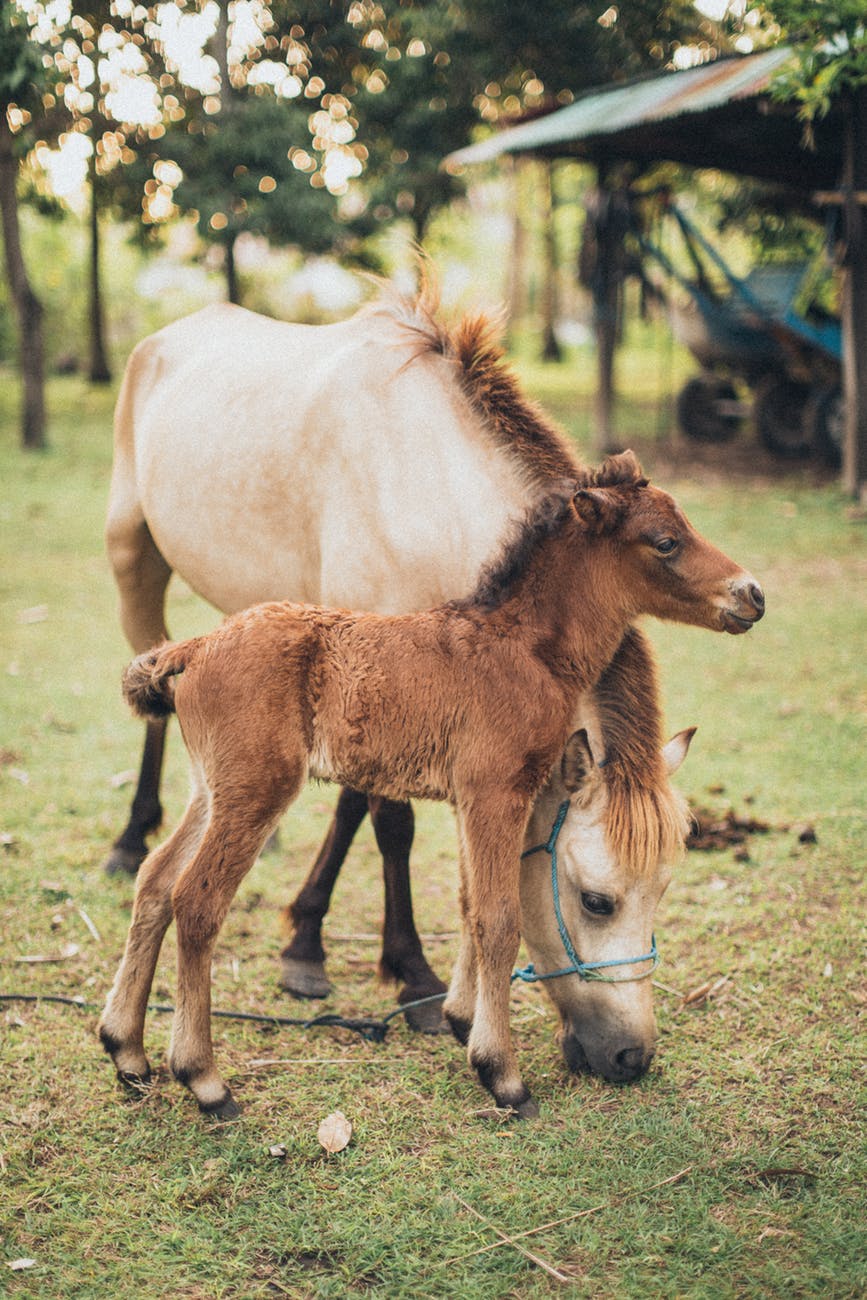
Most of the herd headed to the far end as the boys entered, but one mare and her foal chanced nearing. The mare seemed to like their company. Perhaps she could see that they were tethered as they were. Tu-Swift gently tugged at Day-Nah by the arm and positioned him so that the men could not get a clear view of the mare. The mare smelled something nice on the rope between Tu-Swift’s legs. It began chewing on the rope. Tu-Swift admired the teeth and jaws of the horse before him. He spoke to the horse in Veritas though he was under no illusion that the horse would understand him, at least in any detail or words. “I am Tu-Swift. You are?” 

At this point, the horse made a sound like “Kneeeeee -Kwah” 

Tu-Swift continued, “‘eee-qua’ it is then.”  

animal close up countryside farm

Photo by Francesco Ungaro on Pexels.com

“Tu-Swift likes to run. Ee-qua like to run. We don’t like ropes. (Here he made a show of waving the ropes in the air so the three men would think they were making progress.) “We want to run free. Tu-Swift and Ee-qua run free one day. Yes, we will.” 

Tu-Swift hobbled over to the foal and sat on the ground. “Hello little one. We have a predicament. I have these ropes on my legs. I don’t like them, but if we don’t wear them, they will beat us until we do. Your mother, Ee-qua chewed my ropes nearly through. So, I am going to put these ropes on you. But you will be able to run free in a few hours. I know you don’t understand a word I’m saying but maybe the sound of my voice will help you know that I am your friend regardless of how it seems.” Tu-Swift meanwhile, had succeeded in tying a rope around one of the young colt’s legs and “secured” it with a granny knot rather than the square not that the men had shown him. It was chancy to make life difficult for those that seemed to have power over him, but it had to be done; carefully, and never in the same way twice, but each day, Tu-Swift knew that he could find some way to make the lives of the Capture-People less pleasant, just as they were making his less pleasant. 

931D1948-69AF-4F80-94CC-8064833AEFB5

Hiding tools, wrecking tools, backing up sewage, polluting water, passing on disease, poisoning — these were just a few of the ways he might or might not be able to fight back. Meanwhile though, he also had to be careful not to be caught and to have a well-worked out and plausible excuse. As Tu-Swift tied more legs with granny knots, he planned that he would feign astonishment and excitedly show his captors how he had tied the knots. He would tie granny knots. They would smack him about a bit of course. But then they would show him the correct way. He would again copy but make a granny knot. The Capture-People would smack him around a bit, so he imagined, and then show him again. He would feign insight and make a true square knot the next time. This would serve two purposes. It would cause them grief, but it would also, he hoped, endear him to them in some perverse way. It would be as though he could learn their tricks — eventually — but being more stupid than they are — it would take him longer naturally to learn to do things correctly. And, then again, he thought, fastening the fourth leg with a granny know, I may never even be accused. 

Just then it occurred to Tu-Swift that the horses could chew through their own tethers. Why hadn’t the horses thought of that? Maybe that’s not the sort of thing horses “think of.” Maybe they need to be shown. If they will eat through my ropes — and she could have easily gone all the way through — they could eat through their own, but how can I get food to put on those ropes? 


Author Page on Amazon

Start of the Myths of the Veritas

Tools of Thought

What about the Butter Dish?

Where does your Loyalty Lie?

At Least he’s our Monster

Finding the Mustard

The Orange Man

The Invisibility Cloak of Habit

The Walkabout Diaries

Travels with Sadie

Labelism

Your Cage is Unlocked

If Only…

Imagine All the People

Roar, Ocean, Roar

The Dance of Billions

Life is a Dance


Search Party

18 Wednesday Feb 2026

Posted by petersironwood in creativity, fantasy, fiction, psychology, Uncategorized, Veritas

≈ Leave a comment

Tags

books, empathy, ethics, fantasy, fiction, leadership, legend, life, myth, short story, story, truth, Veritas, writing

Shadow Walker organized the search party. With him were Eagle Eyes, Fleet of Foot, Easy Tears, Lion Slayer and Hudah Salah. They all gathered their private traveling provisions. Easy Tears was put in charge of the two wolf pups while Eagle Eyes led the party due to her superior vision while Shadow Walker, the “leader” was the last of the group. 

IMG_5295

Eagle Eyes hardly needed great vision to follow the trail. (The raiders had obviously counted on speed rather than stealth to outdistance any possible pursuers.) However, Eagle Eyes quickly determined that there were only a dozen raiders. “It seems,” she said as they took a quick break to share a meal, “that they were only a small force who relied on surprise and speed to wreak havoc on the feast and then retreat quickly before we could counter-attack.” 

Shadow Walker nodded. “We could have easily defeated such a small force! We should have attacked immediately!” 

Lion Slayer spoke. “I am not so sure. I have never tried to fight a man who rides astride a horse! The horse is a strong creature and very fast. The man on horseback would be hard to hit while atop a horse, but it would be easy for the one on a horse to strike downward.” 

Easy Tears looked skeptical. “You killed a lion, so they say, which is much more dangerous than a horse! How can you be afraid of a horse?” 

brown and black lion on brown grass field

Photo by Pixabay on Pexels.com

Lion Slayer laughed. “I was very lucky to have two spears nearby to save Hudah from that lion! And, there were others nearby to help so that lion did not know which way to turn. It is likely that lion could have killed me easily despite my spears had I been alone. But do not underestimate the strength of horse. They can kill with a kick according to legend. And twelve of them together could trample a war party quickly.” 

Eagle Eyes nodded slowly. “Yes, horses are built for speed, but they also look to have sensitive ears and their feet are weapons. A warrior on a horse’s back. That could be formidable. At least they are easy to track!” 

Shadow Walker nodded. He looked over at Hudah Salah whose large, dark eyes were hard to read. “How about you, Hudah? Do you know anything about horses?” 

She frowned slightly and silence grew. At last, she said, “Only as husband Lion Slayer has said.” 

“Let us continue then. We have no idea how far they have taken Tu-Swift. He need to make haste or we will be known as Tu-Late.” No-one laughed at his grim humor. 

nature forest trees park

Photo by veeterzy on Pexels.com

Soon the sextet continued alternating a jogging pace with a fast walk through the forest with Eagle Eyes in the lead. 

Fleet of Foot hung back for a time to be with Shadow Walker and whispered out of earshot of the others. “Shadow Walker, there is something you need to understand about the ways of the Nomads of the South. Hudah Salah will always defer to her husband, Lion Slayer. At least in public.” 

Shadow Walker frowned and jerked his head. “Why? What do you mean? Is there something wrong with her?”

“No,” Shadow Walker, “that is just their way. All the women defer to their husbands.” 

As the forest grew less dense, Shadow Walker lowered his voice still further. 

“Really? Does she have a different opinion when you talk with her privately?” 

Fleet of Foot snorted a laugh. “Oh, I have never spoken with her privately, nor do I intend to. And, I advise you not to try! That would be quite dangerous. The men are all quite jealous. I get the sense from Eagle Eyes that the women sometimes disagree with their husbands, but this is all just her surmise from a hesitation or fleeting look. Even to Eagle Eyes, she’s never said anything to overtly disagree.”

“That is truly odd. Can you imagine Many Paths never disagreeing? Or Eagle Eyes?” Shadow Walker chuckled. 

IMG_5028

They walked on awhile in silence. As the forest thinned to scrubby trees and tall grass, they began to ascend a gentle slope. They were out of sight of their compatriots in front, but the trail, to their trained eyes, shouted its direction. 

“I can tell you that the Nomads of the South thought it remarkable that our leader is a woman.” 

Shadow Walker frowned slightly. “Really? What did they say?” 

Instead of answering, Fleet of Foot, asked, “Speaking of Many Paths, will you two become officially paired?” 

“I don’t know. It’s complicated. She is new to her role as leader and…”

Just then, they heard excited howling up ahead and jogged carefully forward scanning for trouble and recalling how they had been ambushed at their own feast. Ambush here seemed unlikely as the cover was slim. Soon, they heard the voices of the others. They sounded excited, but not in danger. They ascended to the peak of the small hill and looked down below. The scrub land sloped downward to a wide river. Beyond it, there lay a much rockier land littered with gravel. The rest of their crew were examining a recent campsite. Once again, the invaders had made no attempt to cover their tracks. The wolf pups seemed excited as though they had caught the scent of Tu-Swift. 

The six descended the plain, walking quickly but carefully, as much of the ground was littered with small stones that could easily turn the ankle of the unwary. At last they came to the bank of the river. Eagle Eyes began to wade in. To her, the water appeared moving, but not dangerous. The Veritas followed suit, but the Nomads from the South hung back on the shore. Fleet of Foot went back to them. 

time lapse photography of lake

Photo by Rachel Baskin Photography on Pexels.com

“Come on. The water’s cold, but I don’t think it will sweep you off your feet. But if it does, just keep swimming till you get across.” 

Lion Slayer frowned, “You say simbling? Where is simbling?” 

“Swimming! Swimming!” Fleet of Foot made motions with his hands. 

Hudah Salah and her husband frowned and looked at each other. Eagle Eyes sighed. There had been no rivers at the central place of the Nomads of the South. They had drawn their water from wells. “So, do you know how to … how to crawl on the water?” 

Lion Slayer looked more bewildered than ever. “Crawl? On water?” 

Fleet of Foot cupped his hands and called out to Eagle Eyes who was emerging on the other side. “Come back! I think we will need to use rope to help them across. They don’t know anything about swimming.” 

Eagle Eyes looked back at the three still on the shore. She searched her memory and realized they had not seen any swimming at the camps of the Nomads. She turned and strode back into the river. Swimming would not be needed. The water had barely reached above her waist. But the current was plenty strong, she reckoned and might indeed be frightening to those unaccustomed to so much water all at once. 

She encouraged Shadow Walker and Easy Tears to turn back with her. When all six reconvened, she quickly tied a rope around the waist of each. “This will be safer for all of us. In case, the foot of anyone slips on a mossy rock, you will not fall. The others will hold you in place. Come. Now, we will be safe.” As she said this, she felt a sting of guilt. It’s true enough that it would be safer for the Nomads who apparently had no idea how to swim. But for the Veritas, the tethering ropes would make swimming more difficult, not easier. Still, there was no time for other solutions. 

river between green leafed tree

Photo by Rachel Baskin Photography on Pexels.com

Off they went, and only Lion Slayer seemed to have difficulty keeping his footing. Three times he slipped, and three times, Shadow Walker and Fleet of Foot pulled on the rope and took his arms to keep him from falling. On the third time, the drums slipped off the shoulders of Fleet of Foot as he grabbed Lion Slayer. The drums raced far downstream and out of reach. Fleet of Foot sighed as they disappeared from sight. Without further incident, they all reached the other side, shivering in the late afternoon sun. Shadow Walker glanced at Hudah and could not help noticing that she looked much more fetching with her garments wetly clinging to her body. He pulled his eyes away, not wanting to offend the Nomads. Instead, he offered, “When we have found and returned Tu-Swift, we must teach you two to swim.” 

Lion Slayer shivered violently. “Thanks you, but not. Too big water.” Shadow Walker considered waiting for a few hours while all their clothes dried in the sun. It might be interesting to see Hudah without clothes. However, it would take time. Furthermore, based on what Fleet of Foot had said, he strongly suspected that Lion Slayer would not take kindly to such a suggestion. “No need. Let’s jog as best we can, being careful of the rocks. We will warm up quickly.” 

Fleet of Foot noticed that Eagle Eyes had gone on ahead and seemed to be examining a thick-leafed plant of some kind. She jogged back over to the group and spoke while she held out a small leaf. “This is aloe. This leaf has been broken. It’s used to treat burns. One of them was apparently burned…or perhaps it was for Tu-Swift. I do not know. But we should go. Follow me. I will take a path least likely to turn ankles.” Without another word, she jogged off. They all followed single file. Fleet of Foot jogged off next, followed by Hudah, Lion Slayer, Easy Tears and Shadow Walker. 

IMG_6088

Shadow Walker kept scanning in all directions for signs of danger, but also made sure he attended to where he placed his feet. He allowed himself a ray of hope. The most likely person to be burned was Tu-Swift. If they bothered to treat him with aloe, then it would mean he was still alive but also that they probably wanted him for some purpose other than simply killing him. But even if that were true, it can’t be a very good purpose. And, what did it mean that they made no attempt so far to cover their trail? Perhaps their camp was simply so large and well-guarded that they had no fear of reprisals. 

As the sun began to set, the six found themselves jogging into a box canyon. There seemed to be no exit. Sheer rocks rose on every side. Yet, the horse tracks into the canyon remained unmistakable in the fading light, not just to Eagle Eyes but to everyone. The exhausted group made a cheering fire between one of the cliff walls and a large nearby rock. 

Shadow Walker shared his musings with the group. They nodded but could offer nothing additional. Eyes of Eagle spoke next, “I have reviewed in my mind all the signs I saw and followed. I see nothing and feel nothing of a false trail. I see no way that they could have backtracked without it’s being noticed. A single person, with careful steps, may walk backwards in their own tracks. But a horse? A dozen horses? I see no way that they did not come here. But then what?”

IMG_6189

Silence. 

At last, Lion Slayer spoke. “Near our lands, but much farther south, there be places of pure sand. Some people venturing into those lands have disappeared. Such sand can swallow a person. Those lands are not like this land. Even in the land of all sand, a dozen horses and a dozen people? Surely, when first such disappeared, others would turn back, would they not?”  

Shadow Walker asked them to consider and dream of other times when things appeared impossible. “It is dark. In the light of morning, we will search more carefully. We will solve this puzzle. We will find Tu-Swift. Now, let our bodies rest and recover.” 


Author Page on Amazon

Beginning of the Myths of the Veritas

Beginning of Book II of The Myths of the Veritas

The Walkabout Diaries

Corn on the Cob

Who Speaks for Wolf?

The Power of the Unbrella

Travels with Sadie

Travels with Sadie

The Dance of Billions


Myths of the Veritas: Feast and Fire

07 Saturday Feb 2026

Posted by petersironwood in Uncategorized

≈ 1 Comment

Tags

celebration, Democracy, empathy, ethics, fantasy, feast, fiction, leadership, life, short story, story, strategy, tactics, truth, Veritas, writing

Myths of the Veritas: Book II

{Translator’s Note} In what follows, I was able to make use of a new class of self-correcting statistical algorithms that allows for a more detailed depiction of the spoken and drum languages of the Veritas. This work has been aided immeasurably by archaeometrical modeling and, in particular, the Schliemann-Baudhayana equations. Needless to say, these advances notwithstanding, narrative reconstruction is still fraught with numerous perils and is still as much an art as a science — a distinction lacking, so far as we can tell, in the thinking of the Veritas themselves who conceived of truth and beauty as tree and fruit.

—————————————————

Feast and Fire

“Well, why wouldn’t we? It is faster, right?” Tu-Swift grew impatient with his older sister. 

Many-Paths however, simply smiled as she answered. It was a genuine smile too, not the patronizing smile of an older, wiser sister; nor the forced smile used today as a means of manipulation; rather, her smile was nothing other than a genuine expression of her heart. 

Many-Paths could don an expression and feign a tone of voice as well as anyone. She, like most of the Veritas, simply chose not to feign feelings with other members of their own tribe, or indeed, with any other tribe excepting only in the case of true enemies like the Cupiditas had been. 

The reason that Many-Paths smiled was this: she appreciated the passion of her younger brother and his single-mindedly determination to prove his point even if it meant overlooking things that he himself knew to be true. Many-Paths was of an entirely different nature, as indicated from her name. As leader of the Veritas, Many-Paths had passed many trials of empathy and fair judgement. And as a leader, she was well-aware that the tribe needed people like Tu-Swift who would press on and on for something no matter what. And as a leader she was also well-aware that the tribe needed people like Many-Paths to provide a check on such ill-conceived enthusiasm. 

IMG_3192

So, Tu-Swift felt the actual kindness in the voice of Many-Paths as she answered gently. “I think you yourself know the answers to why we might not choose to do it even if it is faster.  I also think you can imagine conditions under which your method would be considerably slower.  But meanwhile, I can hear that the voices of the people are happy and loudening. We ourselves should also be making our way to the feast.”

Tu-Swift needed no further encouragement to attend a feast, especially the feast of Bel-Tanay, with its promise of fresh greens, strawberries, grilled fish, and honey-sweetened ground nuts. He spun on his heel and hurtled toward the Center Place. So quickly did he turn and so quickly did he begin to sprint, and so thoroughly did the image of honey-sweetened ground nuts capture his attention, that he immediately slapped his body into a small sapling which rebounded him backwards at the feet of Many-Paths. He was a tough little boy, graced with a lithe and muscular frame. Hence, he sprang back up almost as quickly as the sapling had slung him backwards. “Sorry,” he muttered to the sapling as he once again sprinted toward the feast. 

Many-Paths shouted after him with good humor: “Are you too swift Tu-Swift?” She shook her head slightly, still unsure whether he had even heard her gentle rebuke let alone truly processed it. There would be other opportunities, she thought. Many-Paths had no more desire to change the nature of To-Swift than she did to change a rabbit into a tortoise. She pictured a brown rabbit with a white tail plodding methodically along with his long legs splayed out sideways. Without a shell, such a slow and furry tortoise would stand no chance to survive the predations of eagle or fox. As She-Who-Saves-Many-Lives had taught her, each branch of life must be its own form. Yet, rabbit, tortoise, and human beings also made choices. One of the most important a human being could ever make was simply accepting that no one path is most appropriate for every occasion. 

Many-Paths could still have caught up with her younger brother for she had also inherited feet that flew. And, this natural talent she had nurtured. She had explored various loping, skipping, and sprinting gaits thoroughly to see for herself how various gaits worked best under various circumstances of terrain and weather. This day, this moment, however, required no speed whatever and Many-Paths found it more pleasant to stroll to the Center Place, anticipating the savory salmon laid on a bed of wild lettuce and garnished with grape tendrils; the rich warm acorn and wild rice pudding; the tangy sweetness of fresh strawberries. 

Before she rounded the guardhouse that blocked her view of the gathering throng, she tried to imagine the various groups and sub-groups that would be eating together. As leader, it often proved useful to be able to predict such matters. Her predictive skills improved daily though perfection at such a task might be years, perhaps even decades away, as She-Who-Saves-Many-Lives had explained soon after she had bestowed upon Many-Paths the Seventh and Final Ring of Empathy. 

“Your skills will continue to improve,” She-Who-Saves-Many-Lives had explained, “provided only that you walk a balanced way using both legs and both minds – the mind that sees what may be and the mind that sees what is actually there.” 

Many-Paths had nodded solemnly because she “understood” what Saves-Many had meant though the depth of that understanding had deepened considerably over the years. In her mind that sees what may be, Many-Paths first pictured Shadow Walker and she predicted that he would likely be already chatting with Eyes-of-Eagle and Fleet-of-Foot whom she had not seen for nearly a year. Many-Paths thought it likely that one of the Nomads of the South would have accompanied them. Trust was still a bit fragile between the two tribes but trade, and games, and sharing stories, and playing drums, and dancing, and sharing meals — all of these had served to grow many bonds between the two tribes. And surely today’s feast with the wonderful aromas she now inhaled could only serve to strengthen ties between the tribes. 

fullsizeoutput_17b8

Many-Paths walked into the clearing of the Center Place. She glanced around quickly to see how people had arranged themselves. The groupings largely confirmed her hypotheses except that strangers occupied the space near — no, wait! There they were! Eyes-of-Eagle, Fleet-of-Foot, and even Shadow Walker had donned robes in the manner of the Southern Nomads. The craftily constructed garb fooled her eyes so badly that she had not even recognized her friends at first, not even Shadow Walker! She laughed at how she had been fooled. In this case, she had even know where to look, but she had still found it difficult to see what was truly there. Walking a balanced way did indeed prove to be a life-long challenge. 

As Many-Paths made her way to her place, she exchanged many small waves and nods with other in her tribe. Though all were aware of her role as leader and the vital role she had played in the storied victory in the war with the Cupiditas, the people did not indulge in various displays of deference or position. They gave great weight to her words, despite her youth, because of her intelligence and competence, not because she held some “position.” Unlike the Cupiditas, no-one bowed deeply to her or waited to see what she thought before offering their own honest opinion. She dressed in deerskins much like the others of the Veritas. Typically, as today, she wore the Seven Rings of Empathy threaded onto a knotted necklace of leather. Only this and her radiant manner set her off from her compatriots. 

B34DF6E7-63B2-4217-956C-6F64011A74F2

As she approached, the animated chatter of her friends stopped and they all rose to embrace her. Shadow Walker’s embrace held the most strength and the most warmth. She found herself blushing slightly. She wished to clear her mind so she could properly welcome the visitors from the Southern Nomads. That took precedence over her own considerably awakened desire. 

“Well met, new friends from the south. I am Many-Paths and I am much impressed with the raiment you provided! These people sitting next to you are my friends from birth. Yet, I at first did not recognize them. So cleverly did you fashion these robes! My congratulations. I must confess that I am led toward three paths at once. I wish to know more about such magic and skill. I want to learn about you and what you think of the Veritas and yet, I also want to learn from my friends about their adventures in your lands as well. Sometimes, you see, Many-Paths has too many paths to choose from.”

“I am happy most glad to meet you at last, She-Who-Walks-Many-Paths-to-Save-Many-Lives. I am happy most glad you like the robes of. We have brought such a glad one for you as well. I am known among my tribe as ‘Lion-Slayer, The Silent One’ and this is my wife, Hudah Salah.”

Hudah Salah now stepped forward and took both hands of Many-Paths in hers and looked into her eyes. Many-Paths returned the gaze. “It is nice. I to meet you in person. My husband is yes glad to be Lion-Slayer. He does not often be called ‘Silent One.’ 

Lion-Slayer chuckled. “I make joke. I like talk.” 

“I do too,” chimed in Fleet-of-Foot. “I like to eat even more! Please pass the salmon!”

Tu-Swift, grabbed the plate quickly and passed it to Fleet-of-Foot, his favorite ‘Uncle.’ Before he had finished handing off the platter, an urgent cry rang out in his ears, sharp above the general happy din. 

“To arms! To arms!” It was Many-Paths issuing commands! Tu-Swift wondered whether she had gone mad. Why was she saying that in the middle of a feast? He shook his head to wake himself up in case he had been dreaming. Again, she was shouting, “To the Cottonwoods!”

IMG_0051

But shaking his head changed nothing, everywhere warriors were readying their weapons and now Tu-Swift’s consciousness seemed to shatter into an incoherent blur of sound and color and pain. He heard whooshing arrows twang into wood. He saw an arrow land on a table near him. Color shot out from the shaft. He could feel the heat and taste the pain. Fleet-of-Foot wrenched him around and in one swift motion snapped the arrow in two, pulled out the shaft and wrapped a makeshift bandage around Tu-Swift’s forearm. 

All around him, Tu-Swift saw arrows streaming and flaming down from the sky; he saw his people gather weapons. He saw his sister leading a band of warriors out across the water toward a stand of trees. This, he thought, is where the arrows come from. This arrow. This arrow came through my arm. I am shot. That’s why I hurt. I have to help fight. Tu-Swift rose to his feet and immediately felt very light-headed. He grabbed a large flint carving knife. He fell to his knees, crawled under the table and fainted. 

fullsizeoutput_123a

————————————-

Author Page on Amazon

Creation Myth of the Veritas

Fragmentary Myth of the Veritas

The First Ring of Empathy

Roar, Ocean, Roar

Somewhere a Bird Cries

At Least he’s Our Monster

Tools of Thought: And then what?

You Know

The Walkabout Diaries: Natural Variation

It’s not your fault; it’s not your fault

Aftermath: Feast & Celebration of Thanks for the Great Tree of Life

06 Friday Feb 2026

Posted by petersironwood in America, apocalypse, psychology, Veritas

≈ Leave a comment

Tags

celebration, Cupiditas, empathy, environment, ethics, family, fiction, greed, leadership, life, love, myth, peace, politics, story, truth, Veritas, war, wisdom, writing

Aftermath: Feast & Celebration of Thanks for the Great Tree of Life

beach clouds grass island

Photo by Pixabay on Pexels.com

When the Veritas scouts had determined that no rogue soldiers of the Cupiditas remained near the lands where the Veritas roamed, and preparations for a great feast had been made, all the tribe, save a handful of lookouts, gathered at the Center Place for a Great Celebration. The Veritas celebrated victory of battle; they celebrated even more that they have avoided making two of three enemies; they celebrated the teamwork they had experienced both in preparations and in the midst of battle; they celebrated that such teamwork was the gift of many generations of Veritas before them who had fought long and hard to reward cooperation and truthful communications. The Veritas celebrated as well the plentiful food for the feast which also sprung from the gift of cooperation among the people. They celebrated their venerable leader, She-Who-Saves-Many-Lives, who once again exemplified her name. 

After songs, and dances; after contests of speed and strength, came the riddling contest. 

  • {Translator’s Note:} Again, the actual myths contain what appears to be lengthy and detailed descriptions of technique and suggestions for such contests. Translating these is virtually impossible. For instance, as best I can tell, the Veritas, when describing athletic contests do not use body parts such as leg, thigh, or quads. I estimate somewhere between 1000 and 10,000 names for body parts and for different states of relaxation versus tenseness, fatigue, resiliency, and so on.  I will make a rather lame attempt with respect to the riddling contest which is the last before the oration of She-Who-Saves-Many-Lives. Many of the riddles depend on rhyme and wordplay so they either make no sense when directly translated into English or have no rhyme or rhythm. (In other words, they are from the beginning of Milo’s adventures on the other side of The Phantom Tollbooth. Instead, I give several examples that I constructed for English that illustrate the same general point. 
  • “The more you give me away, the more I stay. Tie me down to make me drown. Let me go and I will grow. What am I?” Love, many shouted as one, for this was a well-known riddle meant to prime the pump. 
  •  
  • The next one was more original. “When I take some, it makes me dumb. When I take more, I close each door. At last I hate all, and that’s when I fall. What am I?” Here, the people suggested many answers: greed, Cupiditas, NUT-PI, addiction, bully, ALT-R. The most-favored answer was “Greed.” 
  • At last, there were about 30 such riddles. I won’t translate most of them.
  • Frankly, the last one of the evening makes no sense to me at all. If there are any other Veritas scholars out there who can shed light on it, please do so in comments. 
  • “Most everyone has me, when friend skins their knee. Many forget in peril or trouble, but that’s just when you need me, even double. I’m hardest to find, when angst fills your heart, and finding me then is a wonderful art. If you can see what others see, then, through them, you will all see me. What am I?”

The Veritas feast had been designed by many collaborators and among them were Fleet of Foot and Eyes of Eagles. The Veritas always paid attention to making their food beautiful as well as tasty. This feast lay before the hungry Veritas in a beautiful arrangement of forms and colors and textures. The red of beets and the gold of corn set off the warm reddish brown of seared venison and poached salmon. Wild lettuce and dandelion bordered each plate, each sprinkled with a handful of blueberries.  

steak food

Photo by Malidate Van on Pexels.com

At long last, everyone was sated of food, drink, and entertainment. The Veritas now wished to hear from their leader, the heart of the tribe, She-Who-Saves-Many-Lives. She strode up a short ramp so that she could be seen and heard. 

“Today is a wonderful day. As is every day that we are alive. The People are our part of the Great Tree of Life and we have recently avoided a dreadful fate – being subjugated to the Cupiditas. We were successful in avoiding two great battles and that is saving many lives indeed, but not due to me. What I most happy about is that much of these victories came from the cleverness and teamwork of some wonderful youth among us. Teaching is a difficult thing indeed and three among us took teaching meant for doing good and turned it for doing evil. This is a great failing on my part and for all of us. And, we will spend much time and speak much about this and discover how we might help prevent such in the future. But for tonight, let us celebrate when such teaching does work. Of course, the reason it works, is these students, these acolytes took the learning to heart and even improved upon it. 

“Eyes of Eagle learned from watching such as eagles and hawks how their shape changed according to purpose and thus she began to study shapes in many ways beyond what I could ever teach her. She has added to our learning for all time. And, she probably killed more Cupiditas warriors through her damming and releasing the river through shapes. As well, she took the example of teaching wolves and made a weapon of a bird! She also devised a trap that caused many Cupiditas warriors to lose their footing and fall into that carefully camouflaged death. Fleet of Foot helped to make those traps look to be ordinary terrain. Trunk of Tree suggested using drums to communicate with POND MUD and thereby to the Nomads of the South. And Eyes of Eagles knew exactly where to place those drums to enable greatest reach of sound. 

“Here is another lesson for all the people. You see how it is with Eyes of Eagle. She has studied shapes and thought much about how shape influences all things. Perhaps she has studied and learned more than any other Veritas. So, she invents things to help us all because she made her knowledge richer than all before her.  

“As you all know, I began seeking a successor and we chose twelve promising from among the Veritas youth. As time went on, it became clear that one among us has a very good heart indeed along with an excellent mind. I believe she will be a wonderful leader among you. And she is of us all. And we are all part of her. And she well knows this. I want to present She-Of-Many-Paths with the Seventh Ring of Empathy and suggest her as your leader should she survive the vision draught of death and life. She shall be named henceforth, She Who Walked Many Paths to Save Many Lives.”

She Who Walked Many Paths to Save Many Lives knew this to be her cue and ascended the ramp. Her long black silky hair hung down her back in a long straight line that contrasted with her blue and white patterned dress. He neck and hair were adorned by turquoise beadwork. On the little, ring, and middle fingers of each hand, she wore a ring – one of the Rings of Empathy that she had earned. She knelt before She-Who-Saves-Many-Lives, who again spoke. 

“This woman has indeed saved many lives. She has demonstrated that she has a gift of empathy which she continually improves. Moreover, she has demonstrated that she knows to use this gift for the good of all, not just for herself, nor indeed, even for her people but for the good of all who are among and part of the Great Tree of Life. She is still able to use her empathy when many would find their fear or their anger blocked all such ability. She reached out on many paths to foster life when many would have chosen instead a giant wall to keep unwanted feelings out. I therefore bestow upon her the Seventh Ring of Empathy.”

She-Who-Saves-Many-Lives gently took the hand of She Who Walked Many Paths to Save Many Lives and lifted it. She placed upon the index finger of the left hand, a ring with three interleaved cords of woven gold; one reddish as fire coals, one white as summer clouds, and one the yellow of goldenrod. Atop the ring was a single large opal that seemed to sparkle of dewdrops rainbowing in the sun. Then, She-Who-Saves-Many-Lives and her protege stood facing each other for a moment before the older woman reached back and took a gnarled wooden mug and handed it to Many Paths & Many Lives Saved and asked her loudly so that all might hear: “She Who Walked Many Paths to Save Many Lives, do you take upon yourself the awesome responsibility to be First Among Us, to lead us in times of peace and times of trouble; to put the Tree of Life ahead of the Veritas, and to put the Veritas before your own interest? Will you lead us, should you survive the sacred drink of Life and Death.” 

“I do and I shall.” She took the gnarled mug and put the cup to her lips. Despite the name, she had some doubt that it might really kill her, but she owned it remained a distinct possibility. The taste was bitter, funky, and even sweet, although in a rancid sort of way. She thought it more likely that the drink would make her ill or even alter her perception much the way tobacco made her slightly more aware of tiny details of color and form. Instead, she felt normal enough, though taller of course; she was much taller in fact. But so was everything else. She began to see that what she thought of as individual people such as Shadow Walker, who she realized suddenly was an incredibly handsome fellow. He really is, she thought. But he’s so tall! We are all so gigantic. We are each tribes ourselves. No, we are tribes of tribes. And, we are all interconnected — to each other — and to our past — and to our future! 

IMG_9568

As she looked out upon the crowd of nation-sized people she realized how incredibly different each person was and yet how similar each person was and how similar every living thing is to every other living thing. She could see or imagine how this same ceremony was carried out decades ago to choose She-Who-Saves-Many-Lives and that every leader had done the same for a thousand years. She found herself falling, falling, down a long tunnel, but soon discovered that she was not really falling so much as floating and she could will herself to float up the tunnel as well as down. As she floated up the tunnel, she continued upward until she seemed to be floating high above the Center Place of the Veritas. She could see all the lands where the Veritas dwelled and hunted. She could see the lands of the Cupiditas, the Sabra, and the Fierce and Formidable Fighters of the North. 

She could see other lands and other peoples. The lands became filled with people. There were people everywhere and particularly along the coasts of giant lakes and along the banks of tremendous rivers. These people had campfires everywhere but the campfires did not flicker and smoke. It gladdened her heart to see the people so numerous and prolific. She knew not how she knew, but she knew somehow that this prosperity and reach of the people came from the Veritas, or more accurately, not her tribe of Veritas precisely, but from the spirit of the Veritas that valued the search for truth, the feeling of love and comity, the desire to be fair and foster the great and varied Tree of Life. Then, her heart sank again, for she felt, rather than saw, that the Cupiditas too survived and infected the people with the diseases of greed and cruelty.

fullsizeoutput_172b

 The people forgot the very nature of life itself in their pursuit of more … more what? It didn’t seem to matter! The people were pursuing more of everything and in that greed killing the roots to the tree of life! Birds were dropping from the sky. Fish were dying in the streams. Trees fell and burned by the thousands. She thought: The people are destroying the very Tree of Life whose branches they live in. Surely, this cannot be! Even the Cupiditas are not that greedy. It seemed to her that the Cupiditas had stolen knowledge gained by the Veritas and for some unknown and unknowable reason, had convinced people everywhere to replace the beautiful Tree of Life with some unknown material that was ugly though shiny. The water that people drank contained teeny pieces of this shiny material and it made all the people sick. Yet, they made more and more of the shiny material until it was even in the air that they breathed and this too sickened many people. 

factory smoke

Photo by Vitaly Vlasov on Pexels.com

Now, from far away, she could hear the voice of She-Who-Saves-Many-Lives, “Daughter? Are you all right?” She turned, and returned– standing again on the raised platform right beside She-Who-Saved-Many-Lives. She looked out and saw the Veritas looking at her as though nothing unusual had happened. “I’m fine. I’m fine.” She had survived. She had become the leader of the Veritas and the people acknowledged her with a mighty roar. She held her arms above her head and spread her fingers outward to make that sign that the Veritas used to signal the Tree of Life. She felt some elation, but also a sense of great responsibility. Though she was now the leader, she wanted nothing more than to speak privately with She-Who-Saved-Many-Lives. She smiled out at the people, holding her hands high once more and once more spreading her fingers widely as though she were a tree drinking in the sunshine. She glanced at She-Who-Saved-Many-Lives and whispered, “I had the strangest dream just now. How long was I out?” 

She-Who-Saved-Many-Lives looked at and into the new leader, and whispered back, “You did not lose consciousness at all, though you shook your head oddly for a split second. It was the same with me.” 

“Later, may we speak of these visions?” Though She Who Walked Many Paths to Save Many Lives was now the leader, she still felt very much an apprentice or acolyte. 

“Indeed, we shall. Now, go among the people and receive their blessings. Later, we will speak of such.”

IMG_0023

——————————————

Herein lies a portal to many worlds.  

The First Ring of Empathy

The Forgotten Field

The Orange Man

Pattern Language Summary

The Walkabout Diaries: Sunsets

Travels with Sadie: Teamwork

Life Is a Dance

The Impossible

Take a Glance; Join the Dance

The Dance of Billions

Math Class: Who are you?

Plans for US; some GRUesome

Fifteen Properties

When Greed is the only Creed

D4

Where Does Your Loyalty Lie?

Corn on the Cob

The Declaration of Interdependence


Abracadabra!

20 Tuesday Jan 2026

Posted by petersironwood in apocalypse, The Singularity, Uncategorized

≈ Leave a comment

Tags

"Citizens United", AI, Artificial Intelligence, biotech, chatgpt, chess, cognitive computing, Democracy, emotional intelligence, ethics, HCI, life, prediction, psychokinesis, technology, the singularity, truth, Turing, USA, UX

IMG_7241.JPG

Abracadabra!


Here’s the thing.


There is no magic.


Of course, there is the magic of love and the wonder at the universe and so there is metaphorical magic. But there is no physical magic and no mathematical magic. Why do we care? Because in most science fiction scenarios, when super-intelligence happens, whether it is artificial or humanoid, magic happens. Not only can the super-intelligent person or computer think more deeply and broadly, they also can start predicting the future, making objects move with their thoughts alone and so on. Unfortunately, it is not just in science fiction that one finds such impossibilities but also in the pitches of companies about biotech and the future of artificial intelligence. Now, don’t get me wrong. Of course, there are many awesome things in store for humanity in the coming millennia, most of which we cannot even anticipate. But the chances of “free unlimited energy” and a computer that will anticipate and meet our every need are slim indeed.


This all-too popular exaggeration is not terribly surprising. I am sure much of what I do seems quite magical to our cats. People in possession of advanced or different technology often seem “magical” to those with no familiarity with the technology. But please keep in mind that making a human brain “better”, whether by making it bigger, or have more connections, or making it faster —- none of these alterations will enable the brain to move objects via psychokinesis. Yes, the brain does produce a minuscule amount of electricity, but way too little to move mountains or freight trains.


Of course, machines can be built to wield a lot of physical energy, but it isn’t the information processing part of the system that directly causes something in the physical world. It is through actuators of some type, just as it is with animals. Of course, super-intelligence could make the world more efficient. It is also possible that super-intelligence might discover as yet undiscovered forces of the universe. If it turns out that our understanding of reality is rather fundamentally flawed, then all bets are off. For example, if it turns out that there are twelve fundamental forces in the universe (or, just one), and a super-intelligent system determines how to use them, it might be possible that there is potential energy already stored in matter which can be released by the slightest “twist” in some other dimension or using some as yet undiscovered force. This might appear to human beings who have never known about the other 8 forces let alone how to harness them as “magic.” 


There is another more subtle kind of “magic” that might be called mathematical magic. As known for a long time, it is theoretically possible to play perfect chess by calculating all possible moves, and all possible responses to those moves, etc. to the final draws and checkmates. It has been calculated that such an enumberation of contingencies would not be possible even if the entire universe were a nano-computer operating in parallel since the beginning of time. There are many similar domains. Just because a person or computer is way, way smarter does not mean they will be able to calculate every possibility in a highly complex domain.

Of course, it is also possible that some domains might appear impossibly complex but actually be governed by a few simple, but extremely difficult to discover laws. For instance, it might turn out that one can calculate the precise value of a chess position (encapsulating all possible moves implicitly) through some as yet undiscovered algorithm written perhaps in an as yet undesigned language. It seems doubtful that this would be true of every domain, but it is hard to say a priori. 


There is another aspect of unpredictability and that has to do with random and chaotic effects. Imagine trying to describe every single molecule of earth’s seas and atmosphere in terms of it’s motion and position. Even if there were some way to predict state N+1 from N, we would have to know everything about state N. The effects of the slightest miscalculation or missing piece of data could be amplified over time. So long term predictions of fundamentally chaotic systems like weather, or what your kids will be up to in 50 years, or what the stock market will be in 2600 are most likely impossible, not because our systems are not intelligent enough but because such systems are by their nature not predictable. In the short term, weather is largely, though not entirely, predictable. The same holds for what your kids will do tomorrow or, within limits, what the stock market will do. The ability to do long term prediction is quite different.

In The Sciences of the Artificial, Herb Simon provides a nice thought experiment about the temperature in various regions of a closed space. I am paraphrasing, but imagine a dormitory with four “quads.” Each quad has four rooms and each room is partitioned into four areas with screens. The screens are not very good insulators so if the temperature in these areas differ, they will quickly converge. In the longer run, the temperature will tend toward average in the entire quad. In the very long term, if no additional energy is added, the entire dormitory will tend toward the global average. So, when it comes to many kinds of interactions, nearby interactions dominate, but in the long term, more global forces come into play.


Now, let us take Simon’s simple example and consider what might happen in the real world. We want to predict what the temperature is in a particular partitioned area in 100 years. In reality, the dormitory is not a closed system. Someone may buy a space heater and continually keep their little area much warmer. Or, maybe that area has a window that faces south. But it gets worse. Much worse. We have no idea whether this particular dormitory will even exist in 100 years. It depends on fires, earthquakes, and the generosity of alumni. In fact, we don’t even know whether brick and mortar colleges in general will exist in 100 years. Because as we try to predict in longer and longer time frames, not only do more distant factors come into play in terms of physical distance. The determining factors are also distant conceptually. In a 100 year time frame, the entire college may or may not exist and we don’t even know whether the determining factor(s) will be financial, astronomical, geological, political, social, physical or what. This is not a problem that will be solved via “Artificial Intelligence” or by giving human beings “better brains” via biotech.


Whoa! Hold on there. Once again, it is possible that in some other dimension or using some other as yet undiscovered force, there is a law of conservation so that going “off track” in one direction causes forces to correct the imbalance and get back on track. It seems extremely unlikely, but it is conceivable that our model of how the universe works is missing some fundamental organizing principle and what appears to us as chaotic is actually not.

The scary part, at least to me, is that some descriptions of the wonderful world that awaits us (once our biotech or AI start-up is funded) is that that wonderful world depends on their being a much simpler, as yet unknown force or set of forces that is discoverable and completely unanticipated. Color me “doubting Thomas” on that one.

It isn’t just that investing in such a venture might be risky in terms of losing money. It is that we humans are subject to blind pride that makes people presume that they can predict what the impact of making a genetic change will be, not just on a particular species in the short term, but on the entire planet in the long run. We can indeed make small changes in both biotech and AI and see improvements in our lives. But when it comes to recreating dinosaurs in a real life Jurassic Park or replacing human psychotherapists with robotic ones, we really cannot predict what the net effect will be. As humans, we are certainly capable of containing and testing and imagining possibilities and slowly testing them as we introduce them. Yeah. That could happen. But…


What seems to actually happen, however, is that companies not only want to make more money; they want to make more money now. We have evolved social and legal and political systems that put almost no brakes on runaway greed. The result is that more than one drug has been put on the market that has had a net negative effect on human health. This is partly because long term effects are very hard to ascertain, but the bigger cause is unbridled greed. Corporations, like horses, are powerful things. You can ride farther and faster on a horse. And certainly corporations are powerful agents of change. But the wise rider is master or partner with a horse. They don’t allow themselves to be dragged along the ground by rope and let the horse go wherever it will. Sadly, that is precisely the position that society is vis a vis corporations. We let them determine the laws. We let them buy elections. We let them control virtually every news medium. We no longer use them to get amazing things done. We let them use us to get done what they want done. And what is that thing that they want done? Make hugely more money for a very few people. Despite this, most companies still manage to do a lot of net good in the world. I suspect this is because human beings are still needed for virtually every vital function in the corporation.

What will happen once the people in a corporation are no longer needed? What will happen when people who remain in a corporation are no longer people as we know them, but biologically altered? It is impossible to predict with certainty. But we can assume that it will seem to us very much like magic.

Very.

Dark.

Magic.

Abracadabra!

Turing’s Nightmares

Photo by Nikolay Ivanov on Pexels.com

After All

All Around the Mulberry Bush

All We Stand to Lose

The Crows and Me

The Last Gleam of Twilight

Guernica

The Orange Man

Donnie Visits Granny

The First Ring of Empathy

An Open Sore from Hell

The Impossible

How the Nightingale Learned to Sing

Pattern Language Summary

The Midnight Flight to Crazytown

To Be or Not to Be

Peace

Who Won the War?

We Won the War! We Won the War!

The Dance of Billions

At Least He’s Our Monster

Stoned Soup

Fifteen Properties

Tools of Thought: And then what?

The Walkabout Diaries: Sunsets

All that Glitters is not Gold

As Gold as it Gets

Gold Standard

Who Kept the Wonder?

Roar, Ocean, Roar

When Greed’s the Only Creed

The Self-Made Man

Reframing the Problem: Paperwork & Working Paper

04 Thursday Dec 2025

Posted by petersironwood in AI, creativity, design rationale, HCI, management, psychology, Uncategorized, user experience

≈ Leave a comment

Tags

AI, ethics, leadership, life, philosophy, politics, problem finding, problem formulation, problem framing, problem solving, thinking, truth

Photo by Pixabay on Pexels.com

Reframing the Problem: Paperwork & Working Paper


This is the second in a series about the importance of correctly framing a problem. Generally, at least in formal American education, the teacher gives you a problem. Not only that, if you are in Algebra class, you know the answer will be an answer based in Algebra. If you are in art class, you’re expected to paint a picture. If you painted a picture in Algebra class, or wrote down a formula in Art Class, they would send you to the principal for punishment. But in real life, how a problem is presented may actually be far from the most elegant solution to the real problem.

Doing a google search on “problem solving” just now yielded 208 million results. Entering “problem framing” only had 182 thousand. A thousand times as much emphasis on problem solving as there was on problem framing. [Update: I redid the search today, a little over three years later. On 3/6/2024, I got 542M hits on “problem solving” and 218K hits on “problem framing” — increases in both but the ratio is even worse than it was in 2021] [Second update: I did the search today, Dec. 4th, 2025, and the information was not given–but that’s the subject of a different post].

Let’s think about that ratio of 542 million to 218 thousand for a moment. Roughly, that’s 2000 to 1. If you have wrongly framed the problem, you not only will not have solved the real problem; what’s worse, you will have often convinced yourself and others that you have solved the problem. This will make it much more difficult to recognize and solve the real problem even for a solitary thinker. And to make a political change required to redirect hundreds or thousands will be incalculably more difficult. 

All of that brings us to today’s story. For about a decade, I worked as executive director of an AI lab for a company in the computers & communication industry. At one point, in the late 1980’s, all employees were all supposed to sign some new paperwork. An office manager called from a building several miles away asking me to have my admin work with his admin to sign up a schedule for all 45 people in my AI lab to go over to his office and sign this paperwork as soon as possible. That would be a mildly interesting logistics problem, and I might even be tempted to step in and help solve it. More likely, if I tried to solve it, some much brighter & more competent colleague would have done it much faster. 

Photo by Charlie Solorzano on Pexels.com

But why?

Why would I ask each of 45 people to interrupt their work; walk to their cars; drive in traffic; park in a new location; find this guy’s office; walk up there; sign some paper; walk out; find their car; drive back; park again; walk back to their office and try to remember where the heck they were? Instead, I told him that wasn’t happening but he’d be welcome to come over here and have people sign the paperwork. 

You could make an argument that that was 4500% improvement in productivity, but I think that understates the case. The administrator’s work, at least in this regard, was to get this paperwork signed. He didn’t need to do mental calculations to tie these signings together. On the other hand, a lot of the work that the AI folks did was hard mental work. That means that interrupting them would be much more destructive than it would to interrupt the administrator in his watching someone sign their name. Even that understates the case because many of the people in AI worked collaboratively and (perhaps you remember those days) people were working face to face. Software tools to coordinate work were not as sophisticated as they are now. Often, having one team member disappear for a half hour would not only impact their own work, it would impact the work of everyone on the team. 

Quantitatively comparing apples and oranges is always tricky. Of course, I am also biased because my colleagues are people I greatly admire. Nonetheless, it seems obvious that the way the problem was presented was a non-optimal “framing.” It may or may not have been presented that way because of a purely selfish standpoint; that is, wanting to do what’s most convenient for oneself rather than what’s best for the company as a whole. I suspect that it was more likely just the first idea that occurred to him. But in your own life, beware. Sometimes, you will mis-frame a problem because of “natural causes.” But sometimes, people may intentionally hand you a bad framing because they view it as being in their interest to lead you to solve the wrong problem. 

Politics, of course, takes us into another realm entirely. People with political power may pretend to solve one problem while they are really following a completely different agenda. One could imagine, for instance, a head of state claiming to pursue a war for his people when he’s really doing it to keep in power. Or, they could claim they are making cities safe by deploying troops when they are really interested in suppressing the vote in areas that can see through his cons. Or, a would-be dictator could claim they are spending your tax dollars to make government more efficient when that has nothing to do with what they are *actually* doing–which is to collect data on citizens and make the government ineffective in order to have people lose confidence in government and instead invest in private solutions.

Even when people’s motivations are noble or at least clear, it is still quite easy to frame a problem wrongly because of surface features. It may look like a problem that requires calculus, but it is a problem that actually requires psychology or it may look like a problem that requires public relations expertise but what is actually required is ethical leadership.

Photo by Nikolay Ivanov on Pexels.com

——————————————————

Author Page on Amazon

Tools of Thought

A Pattern Language for Collaboration and Cooperation

The Myths of the Veritas: The First Ring of Empathy

Essays on America: Wednesday

Essays on America: The Stopping Rule

Essays on America: The Update Problem

My Cousin Bobby

Facegook

The Ailing King of Agitate

Dog Trainers

Turing’s Nightmares: Seven

20 Thursday Nov 2025

Posted by petersironwood in The Singularity, Uncategorized

≈ Leave a comment

Tags

AI, Artificial Intelligence, chatgpt, cognitive computing, competition, cooperation, ethics, philosophy, technology, the singularity, Turing

Axes to Grind.

finalpanel1

Why the obsession with building a smarter machine? Of course, there are particular areas where being “smarter” really means being able to come up with more efficient solutions. Better logistics means you can deliver items to more people more quickly with fewer mistakes and with a lower carbon footprint. That seems good. Building a better Chess player or a better Go player might have small practical benefit, but it provides a nice objective benchmark for developing methods that are useful in other domains as well. But is smarter the only goal of artificial intelligence?

What would or could it mean to build a more “ethical” machine? Can a machine even have ethics? What about building a nicer machine or a wiser machine or a more enlightened one? These are all related concepts but somewhat different. A wiser machine, to take one example, might be a system that not only solves problems that are given to it more quickly. It might also mean that it looks for different ways to formulate the problem; it looks for the “question behind the question” or even looks for problems. Problem formulation and problem finding are two essential skills that are seldom even taught in schools for humans. What about the prospect of machines that do this? If its intelligence is very different from ours, it may seek out, formulate, and solve problems that are hard for us to fathom.

For example, outside my window is a hummingbird who appears to be searching the stone pine for something. It is completely unclear to me what he is searching for. There are plenty of flowers that the hummingbirds like and many are in bloom right now. Surely they have no trouble finding these. Recall that a hummingbird has an incredibly fast metabolism and needs to spend a lot of energy finding food. Yet, this one spent five minutes unsuccessfully scanning the stone pine for … ? Dead straw to build a nest? A mate? A place to hide? A very wise machine with freedom to choose problems may well pick problems to solve for which we cannot divine the motivation. Then what?

In this chapter, one of the major programmers decides to “insure” that the AI system has the motivation and means to protect itself. Protection. Isn’t this the major and main rationalization for most of the evil and aggression in the world? Perhaps a super intelligent machine would be able to manipulate us into making sure it was protected. It might not need violence. On the other hand, from the machine’s perspective, it might be a lot simpler to use violence and move on to more important items on its agenda.

This chapter also raises issues about the relationship between intelligence and ethics. Are intelligent people, even on average, more ethical? Intelligence certainly allows people to make more elaborate rationalizations for their unethical behavior. But does it correlate with good or evil? Lack of intelligence or education may sometimes lead people to do harmful things unknowingly. But lots of intelligence and education may sometimes lead people to do harmful things knowingly — but with an excellent rationalization. Is that better?

Even highly intelligent people may yet have significant blind spots and errors in logic. Would we expect that highly intelligent machines would have no blind spots or errors? In the scenario in chapter seven, the presumably intelligent John makes two egregious and overt errors in logic. First, he says that if we don’t know how to do something, it’s a meaningless goal. Second, he claims (essentially) that if empathy is not sufficient for ethical behavior, then it cannot be part of ethical behavior. Both are logically flawed positions. But the third and most telling “error” John is making is implicit — that he is not trying to dialogue with Don to solve some thorny problems. Rather, he is using his “intelligence” to try to win the argument. John already has his mind made up that intelligence is the ultimate goal and he has no intention of jointly revisiting this goal with his colleague. Because, at least in the US, we live in a hyper-competitive society where even dancing and cooking and dating have been turned into competitive sports, most people use their intelligence to win better, not to cooperate better. 

The golden sunrise glows through delicate leaves covered with dew drops.

If humanity can learn to cooperate better, perhaps with the help of intelligent computer agents, we can probably solve most of the most pressing problems we have even without super-intelligent machines. Will this happen? I don’t know. Could this happen? Yes. Unfortunately, Roger is not on board with that program toward better cooperation and in this scenario, he has apparently ensured the AI’s capacity for “self-preservation through violent action” without consulting his colleagues ahead of time. We can speculate that he was afraid that they might try to prevent him from doing so either by talking him out of it or appealing to a higher authority. But Roger imagined he “knew better” and only told them when it was a fait accompli. So it goes.

———–

Turing’s Nightmares

Author Page

Welcome Singularity

Destroying Natural Intelligence

Come Back to the Light Side

The First Ring of Empathy

Pattern Language Summary

Tools of Thought

The Dance of Billions

Roar, Ocean, Roar

Imagine All the People

Essays on America: The Game

Wednesdays

What about the Butter Dish?

Where does your Loyalty Lie?

Labelism

My Cousin Bobby

The Loud Defense of Untenable Positions

Turing’s Nightmares: Six

19 Wednesday Nov 2025

Posted by petersironwood in sports, The Singularity, Uncategorized

≈ Leave a comment

Tags

AI, Artificial Intelligence, cognitive computing, ethics, fiction, life, sports, Tennis, Turing

volleyballvictory

Human Beings are Interested in Human Limits.

About nine years ago, an Google AI system won its match over the human Go champion. Does this mean that people will lose interest in Go? I don’t think so. It may eventually mean that human players will learn faster and that top-level human play will increase. Nor, will robot athletes supplant human athletes any time soon.

Athletics provides an excellent way for people to get and stay fit, become part of a community, and fight depression and anxiety. Watching humans vie in athletic endeavors helps us understand the limits of what people can do. This is something that our genetic endowment has wisely made fascinating. To a lesser extent, we are also interested in seeing how fast a horse can run, or how fast a hawk can dive or how complex a routine a dog can learn.

In Chapter 6 of “Turing’s Nightmares” I briefly explore a world where robotic competitors have replaced human ones. In this hypothetical world, the super-intelligent computers also find that sports is an excellent venue for learning more about the world. And, so it is! In “The Winning Weekend Warrior”, I provide many examples of how strategies and tactics useful in the sports world are also useful in business and in life. (There are also some important exceptions that are worth noting. In sports, you play within the rules. In life, you can play with some of the rules.)

Chapter 6 also brings up two controversial points that ethicists and sports enthusiasts should be discussing now. First, sensors are becoming so small, powerful, accurate, and lightweight that is possible to embed them in virtually any piece of sports equipment(e.g., tennis racquets). Few people would call it unethical to include such sensors as training devices. However, very soon, these might also provide useful information during play. What about that? Suppose that you could wear a device that not only enhanced your sensory abilities but also your motor abilities? To some extent, the design of golf clubs and tennis racquets and swimsuits are already doing this. Is there a limit to what would or should be tolerated? Should any device be banned? What about corrective lenses? What about sunglasses? Should all athletes have to compete nude? What about athletes who have to take “performance enhancing” drugs just to stay healthy? Sharapova’s recent case is just one. What about the athlete of the future who has undergone stem cell therapy to regrow a torn muscle or ligament? Suppose a major league baseball pitcher tears a tendon and it is replaced with a synthetic tendon that allows a faster fast ball?

With the ever-growing power of computers and the collection of more and more data, big data analytics makes it possible for the computer to detect patterns of play that a human player or coach would be unlikely to perceive. Suppose a computer system is able to detect reliable “cues” that tip off what pitch a pitcher is likely to throw or whether a tennis player is about to hit down the tee or out wide? Novak Djokovic and Ted Williams were born with exceptional visual acuity. This means that they can pick out small visual details more quickly than their opponents and react to a serve or curve more quickly. But it also means that they are more likely to pick up subtle tip-offs in their opponents motion that give away their intentions ahead of time. Would we object if a computer program analyzed thousands of serves by Jannik Sinner or Carlos Alcaraz in order to detect patterns of tip-offs and then that information was used to help train Alexander Zerev to learn to “read” the service motions of his opponents? Of course, this does not just apply to tennis. It applies to reading a football play option, a basketball pick, the signals of baseline coaches, and so on.

Instead of teaching Zerev these patterns ahead of time, suppose he were to have a device implanted in his back that received radio signals from a supercomputer able to “read” where the serve were going a split second ahead of time and it was this signal that allowed Alexander to anticipate better?

I do not know the “correct” ethical answer for all of these dilemmas. To me, it is most important to be open and honest about what is happening. So, if Lance Armstrong wants to use performance enhancing drugs, perhaps that is okay if and only if everyone else in the race knows that and has the opportunity to take the same drugs and if everyone watching knows it as well. Similarly, although I would prefer that tennis players only use IT for training, I would not be dead set against real time aids if the public knows. I suspect that most fans (like me) would prefer their athletes “un-enhanced” by drugs or electronics. Personally, I don’t have an issue with using any medical technology to enhance the healing process. How do others feel? And what about athletes who “need” something like asthma medication in order to breathe but it has a side-effect of enhancing performance?

Would the advent of robotic tennis players, baseball players or football players reduce our enjoyment of watching people in these sports? I think it might be interesting to watch robots in these sports for a time, but it would not be interesting for a lifetime. Only human athletes would provide on-going interest. What do you think?

Readers of this blog may also enjoy “Turing’s Nightmares” and “The Winning Weekend Warrior.” John Thomas’s author page on Amazon


Welcome Singularity

The Day from Hell

Indian Wells Tennis Tournament

Destroying Natural Intelligence

US Open Closed

Life is a Dance

Take a Glance; Join the Dance

The Self-Made Man

The Dance of Billions 

Math Class: Who are you?

The Agony of the Feet

Wordless Perfection

The Jewels of November

Donnie Gets a Tennis Trophy

Turing’s Nightmares: Chapter Three

11 Tuesday Nov 2025

Posted by petersironwood in The Singularity, Uncategorized

≈ 1 Comment

Tags

AI, Artificial Intelligence, chatgpt, cognitive computing, consciousness, ethics, philosophy, Robotics, technology, the singularity, Turing, writing

In chapter three of Turing’s Nightmares, entitled, “Thanks goodness the computer understands us!,” there are at least four major issues touched on. These are: 1) the value of autonomous robotic entities for improved intelligence, 2) the value of having multiple and diverse AI systems living somewhat different lives and interacting with each other for improving intelligence, 3) the apparent dilemma that if we make truly super-intelligent machines, we may no longer be able to follow their lines of thought, and 4) a truly super-intelligent system will have to rely to some extent on inferences from many real-life examples to induce principles of conduct and not simply rely on having everything specifically programmed. Let us examine these one by one.


There are many practical reasons that autonomous robots can be useful. In some practical applications such as vacuuming a floor, a minimal amount of intelligence is all that is needed to do the job under most conditions. It would be wasteful and unnecessary to have such devices communicating information back to some central decision making computer and then receiving commands. In some cases, the latency of the communication itself would impair the efficiency. A “personal assistant” robot could learn the behavioral and voice patterns of a person more easily than if we were to develop speaker independent speech recognition and preferences. The list of practical advantages goes on, but what is presumed in this chapter is that there are theoretical advantages to having actual robotic systems that sense and act in the real world in terms of moving us closer to “The Singularity.” This theme is explored again, in somewhat more depth, in chapter 18 of Turing’s Nightmares.


I would not argue that having an entity that moves through space and perceives is necessary to having any intelligence, or for that matter, to having any consciousness. However, it seems quite natural to believe that the qualities both of intelligence and consciousness are influenced by what is possible for the entity to perceive and to do. As human beings, our consciousness is largely influenced by our social milieu. If a person is born or becomes paralyzed later in life, this does not necessarily greatly influence the quality of their intelligence or consciousness because the concepts of the social system in which they exist were founded historically by people that included people who were mobile and could perceive.

Imagine instead a race of beings who could not move through space or perceive any specific senses that we do. Instead, imagine that they were quite literally a Turing Machine. They might well be capable of executing a complex sequential program. And, given enough time, that program might produce some interesting results. But if it were conscious at all, the quality of its consciousness would be quite different from ours. Could such a machine ever become capable of programming a still more intelligent machine?


What we do know is that in the case of human beings and other vertebrates, the proper development of the visual system in the young, as well as the adaptation to changes (e.g., having glasses that displace or invert images) seems to depend on being “in control” although that control, at least for people, can be indirect. In one ingenious experiment (Held, R. and Hein, A., (1963) Movement produced stimulation in the development of visually guided behavior, Journal of Comparative and Physiological Psychology, 56 (5), 872-876), two kittens were connected on a pivoted gondola and one kitten was able to “walk” through a visual field while the other was passively moved through that visual field. The kitten who was able to walk developed normally while the other one did not. Similarly, simply “watching” TV passively will not do much to teach kids language (Kuhl PK. 2004. Early language acquisition: Cracking the speech code. Nature Neuroscience 5: 831-843; Kuhl PK, Tsao FM, and Liu HM. 2003. Foreign-language experience in infancy: effects of short-term exposure and social interaction on phonetic learning. Proc Natl Acad Sci U S A. 100(15):9096-101). Of course, none of that “proves” that robotics is necessary for “The Singularity,” but it is suggestive.


Would there be advantages to having several different robots programmed differently and living in somewhat different environments be able to communicate with each other in order to reach another level of intelligence? I don’t think we know. But diversity is an advantage when it comes to genetic evolution and when it comes to people comprising teams. (Thomas, J. (2015). Chaos, Culture, Conflict and Creativity: Toward a Maturity Model for HCI4D. Invited keynote @ASEAN Symposium, Seoul, South Korea, April 19, 2015.)


The third issue raised in this scenario is a very real dilemma. If we “require” that we “keep tabs” on developing intelligence by making them (or it) report the “design rationale” for every improvement or design change on the path to “The Singularity”, we are going to slow down progress considerably. On the other hand, if we do not “keep tabs”, then very soon, we will have no real idea what they are up to! An analogy might be the first “proof” that you only need four colors to color any planar map. There were so many cases (nearly 2000) that this proof made no sense to most people. Even the algebraic topologists who do understand it take much longer to follow the reasoning than the computer does to produce it. (Although simpler proofs now exist, they all rely on computers and take a long time for humans to verify). So, even if we ultimately came to understand the design rationale for successive versions of hyper-intelligence, it would be way too late to do anything about it (to “pull the plug”). Of course, it isn’t just speed. As systems become more intelligent, they may well develop representational schemes that are both different and better (at least for them) than any that we have developed. This will also tend to make it impossible for people to “track” what they are doing in anything like real time.


Finally, as in the case of Jeopardy, the advances along the trajectory of “The Singularity” will require that the system “read” and infer rules and heuristics based on examples. What will such systems infer about our morality? They may, of course, run across many examples of people preaching, for instance, the “Golden Rule.” (“Do unto others as you would have them do unto you.”)


But how does the “Golden Rule” play out in reality? Many, including me, believe it needs to be modified as “Do unto others as you would have them do to you if you were them and in their place.” Preferences differ as do abilities. I might well want someone at my ability level to play tennis against me by pushing me around the court to the best of their ability. But does this mean I should always do that to others? Maybe they have a heart condition. Or, maybe they are just not into exercise. The examples are endless. Famously, guys often imagine that they would like women to comment favorably on their own physical appearance. Does that make it right for men to make such comments to women? Some people like their steaks rare. If I like my steak rare, does that mean I should prepare it that way for everyone else? The Golden Rule is just one example. Generally speaking, in order for a computer to operate in a way we would consider ethical, we would probably need it to see how people treat each other ethically in practice, not just “memorize” some rules. Unfortunately, the lessons of history that the singularity-bound computer would infer might not be very “ethical” after all. We humans often have a history of destroying other entire species when it is convenient, or sometimes, just for the hell of it. Why would we expect a super-intelligent computer system to treat us any differently?

Turing’s Nightmares

IMG_3071

Author Page

Welcome, Singularity

Destroying Natural Intelligence

How the Nightingale Learned to Sing

The First Ring of Empathy

The Walkabout Diaries: Variation

Sadie and The Lighty Ball

The Dance of Billions

Imagine All the People

We Won the War!

Roar, Ocean, Roar

Essays on America: The Game

Peace

← Older posts
Newer posts →

Subscribe

  • Entries (RSS)
  • Comments (RSS)

Archives

  • May 2026
  • April 2026
  • March 2026
  • February 2026
  • January 2026
  • December 2025
  • November 2025
  • October 2025
  • September 2025
  • August 2025
  • July 2025
  • June 2025
  • May 2025
  • April 2025
  • March 2025
  • February 2025
  • January 2025
  • December 2024
  • November 2024
  • October 2024
  • September 2024
  • July 2024
  • April 2024
  • March 2024
  • February 2024
  • January 2024
  • December 2023
  • August 2023
  • July 2023
  • May 2023
  • April 2023
  • March 2023
  • February 2023
  • January 2023
  • December 2022
  • November 2022
  • October 2022
  • September 2022
  • August 2022
  • July 2022
  • June 2022
  • May 2022
  • April 2022
  • March 2022
  • February 2022
  • January 2022
  • December 2021
  • November 2021
  • October 2021
  • September 2021
  • August 2021
  • July 2021
  • June 2021
  • May 2021
  • April 2021
  • March 2021
  • February 2021
  • January 2021
  • December 2020
  • November 2020
  • October 2020
  • September 2020
  • August 2020
  • July 2020
  • June 2020
  • May 2020
  • April 2020
  • March 2020
  • February 2020
  • January 2020
  • December 2019
  • November 2019
  • October 2019
  • September 2019
  • August 2019
  • July 2019
  • June 2019
  • May 2019
  • April 2019
  • March 2019
  • February 2019
  • January 2019
  • December 2018
  • November 2018
  • October 2018
  • September 2018
  • August 2018
  • July 2018
  • June 2018
  • May 2018
  • April 2018
  • March 2018
  • February 2018
  • January 2018
  • December 2017
  • November 2017
  • October 2017
  • September 2017
  • August 2017
  • July 2017
  • June 2017
  • May 2017
  • April 2017
  • March 2017
  • February 2017
  • January 2017
  • December 2016
  • November 2016
  • October 2016
  • September 2016
  • August 2016
  • July 2016
  • June 2016
  • May 2016
  • April 2016
  • March 2016
  • February 2016
  • January 2016
  • December 2015
  • November 2015
  • October 2015
  • September 2015
  • August 2015
  • May 2015
  • January 2015
  • July 2014
  • January 2014
  • December 2013
  • November 2013

Categories

  • AI
  • America
  • apocalypse
  • cats
  • COVID-19
  • creativity
  • design rationale
  • dogs
  • driverless cars
  • essay
  • family
  • fantasy
  • fiction
  • HCI
  • health
  • management
  • nature
  • pets
  • poetry
  • politics
  • psychology
  • Sadie
  • satire
  • science
  • sports
  • story
  • The Singularity
  • Travel
  • Uncategorized
  • user experience
  • Veritas
  • Walkabout Diaries

Meta

  • Create account
  • Log in

Blog at WordPress.com.

  • Subscribe Subscribed
    • petersironwood
    • Join 662 other subscribers
    • Already have a WordPress.com account? Log in now.
    • petersironwood
    • Subscribe Subscribed
    • Sign up
    • Log in
    • Report this content
    • View site in Reader
    • Manage subscriptions
    • Collapse this bar

Loading Comments...