• About PeterSIronwood

petersironwood

~ Finding, formulating and solving life's frustrations.

petersironwood

Tag Archives: cancer

Metaphors We Live and Die By: Part 2

26 Friday Dec 2025

Posted by petersironwood in America, health, management, psychology, Uncategorized

≈ Leave a comment

Tags

analogy, cancer, disease, HCI, health, human factors, innovation, metaphor, peace, politics, problem solving, testing, thinking, UX, war

Metaphors We Live and Die By: Part 2

men holding rifle while walking through smoke grenade

Photo by Pixabay on Pexels.com

Today, I want to delve further into the topic of metaphors that we often unconsciously adopt. In particular, I want to look at a common metaphor in four areas: disease, business, politics, and and the role of UX in the entire cycle of product development. 

Although I am fascinated by other cultures, my experience is overwhelmingly USA-centric. I am aware that all of the four areas I touch on may be quite different in other countries and cultures. If readers have examples of how different metaphors are used in their culture, I would love to hear about it. 

Disease is an Enemy to be Destroyed 

In most cases, American doctors view disease as an enemy to be destroyed. In fact, this metaphor is so pervasive that American readers are likely puzzled that I used the verb “view” rather than “is” in the previous sentence. In American culture, there is also a strong thread of another metaphor about disease: “Disease is a punishment.” This latter metaphor is behind such statements as, “Oh, they had a heart attack! Oh, my! Were they overweight? Did they smoke?” Perhaps I will consider this more fully another time, but for now, I want to examine the view that disease is an enemy to be destroyed. 

It seems as though it is an apt metaphor. After all, aren’t many diseases caused by other organisms invading our bodies and doing harm? There are many examples: bacteria (Lyme Disease, pneumonia, ulcers, TB, syphilis), viruses (herpes, Chicken Pox, flu, common cold),  protozoa (malaria, toxoplasmosis) or even larger organisms (trichinosis, tapeworms, hookworm). 

male bugs illness disease

Photo by Pixabay on Pexels.com

When it comes to considering causality, our thoughts usually travel along linear chains of causes. So, we may admit that while Lyme disease is “caused by” Borrelia bacteria, the “deer tick” that spreads the disease is also partly at fault. Similarly, although malaria is caused by a protozoa, the most effective prevention is to reduce the mosquito population or to use netting to keep the mosquitos from biting people. Similarly, you might try to prevent Lyme disease by wearing light clothing, using spray to keep the ticks off, checking for ticks after being in tick infested areas, etc. So, even in common practice, we realize that saying that the little organism causes the disease is an over-simplification. 

Once one “gets” a disease, however, the most commonly invoked metaphor is war. We know what the enemy is and we must destroy it! I grant you that is one approach that can be very effective, but consider this. The “human” body contains approximately as many bacterial cells as human cells. What you think of as your “human” body is only half human. It is half bacteria. Furthermore, since we all have trillions of bacteria in us when we are well, the picture of treating bacteria as an enemy to be destroyed is at best an over-simplification. In fact, more recently, medical science seems to indicate that under-exposure to bacteria in childhood can make you more not less susceptible to disease. If you use anti-antibiotics to “destroy” the “enemy” bacteria in your body, many of the “good” bacteria necessary for digestion are also destroyed. This sometimes, though rarely, requires exotic treatment to return to health. 

In cancer, both doctors and the general public mainly think of the cancer cells as “enemies” who must be destroyed. And yet, it seems that people may often have mutations that could lead to cancer but don’t. There are even very rare cases of spontaneous cures of cancer. What are some alternatives to thinking of cancer as an “enemy” that must be destroyed? 

Clearly, I don’t know of a definite answer or you would have already heard about it on the news. But let’s consider a couple alternatives. First, instead of thinking you have to “destroy” this enemy, imagine you thought of cancer cells as confused. People get confused all the time. Sometimes, we put them in jail. Sometimes we put them in mental hospitals. Sometimes, we simply teach them what they need to know. Sometimes, we do end up killing them. But it is not our approach to kill someone just because they make a mistake. So, we might seek a way to “re-educate” cancer cells so that they “realize” that they are part of something even larger and more wonderful – the human body. How would one go about this? Using the metaphor of a confused person, we would have to understand just why they were acting confused. Then we would have to provide situations so that they could learn (or re-learn) what they needed to know in order to become a productive member of “society.” We could “remind” a liver cell that, after all, they were born to be a liver cell and they’re potentially quite good at that. We could think of cancer as cells that are misinformed or have amnesia about their true nature. 

grey metal hammer

Photo by Pixabay on Pexels.com

We might also think along a different line. We could try to discover the best possible environment for these cancer cells to thrive – and then offer it to them somewhere else. For example, perhaps they really prefer an extremely acidic environment. Say you have a skin cancer on the back of your hand that thrives in a really acidic environment. We could provide a gradient of acidity next to the tumor and encourage all those acid-seeking cancer cells to migrate into a really acid tube that is next to the tumor. The farther away it gets from you, the more acidic the environment. 

You might also think of cancer cells as being rebellious. For whatever reason, they “feel” as though they are not experiencing enough of the “good life” being part of your body so they “take matters into their own hands” and begin leading a rebellion of cells out to steal the food supply and multiply in an unrestrained fashion. A solution might be to “convince” them that they are better off retaining their initial function rather than becoming a lawless gang of cells. I am not sure what the best metaphor for thinking about infection or cancer is, but surely it is worth imagining others rather than sticking to just one based on war as a metaphor. 

IMG_5572

Business is a Sport

I treat this at greater length in The Winning Weekend Warrior, but the basic idea is simple. Yes, there are many strategies and tactics from sports that apply to business. But there is at least one crucial difference. Sports are designed to be difficult. They typically require skill and training if you are to do well. The parameters of the sport are fixed at any given time though they will vary somewhat over time. In golf, for instance, the hole is small and the distances are great. Though the rules of golf are complex, there is one over-arching principle. If it would help you to do something, doing that thing is penalized.

woman playing golf during daytime

Photo by Pixabay on Pexels.com

If golf were a business, many CEO’s would nonetheless approach it as a sport. They would try to hire the “best people” – that is, people with a proven track record of good golfing. They would then proceed to offer incentives for people to do even better. If people shot a high score repeatedly, they would be fired. Eventually, such a CEO might get good results by having skilled people who are well motivated and well trained. But why? If putting a golf ball in the hole is what gained you profit, simply shorten the fairways, widen the hole, and eliminate the hazards. Of course, as a sport this would make golf no challenge and no fun. Everyone could win. But having everyone win is exactly what you should do to maximize profit. Yet many in management are so taken with the “business is a sport” metaphor that they do not change the situation. Some do “change he game” and with spectacular results. Google and Amazon come to mind. 

Politics is War 

If you belong to a political party and believe the “other” party or parties are enemies to be destroyed, you are failing to understand the dialectic value that parties with different views can bring to complex situations. Life is a balanced dance between strict replication and structure on the one hand, and variation, exploration, and diversity on the other hand. A species who had no replication of structure from one generation to the next would die off. But so too would a species that had no variation because the slightest change in environment would also cause the species to die off. So it is with human cultures. If every generation had to start from scratch in determining what was edible, how to get along, how to avoid predators and so on, humans would have died out long ago. On the other hand, if a culture were completely unable to evolve and change, they would also die out. Typically, “conservative” parties want to keep things the same for longer and “liberal” parties want to change things more quickly. There is no obvious answer here. But what is vital is that members of each party see that there is value in the debate; in the dialogue; in the dialectic. 

architecture bright building capitol

Photo by Pixabay on Pexels.com

The other party is not an enemy; it is the balance so that you can do what you do best. If you are predisposed toward exploration, science, new experiences, and so on, great! On the other hand, if you are more predisposed toward tradition and loyalty and repetition, great! If you did not have the people of the opposite predisposition, you would have to incorporate all that within yourself. Conservatives are what allows liberals to be liberal. And liberals are what allows conservatives to be conservatives. A huge problem arises, as it has recently in American politics, when one party decides they are just “right” all on their own and “victory” is worth lying, cheating, and stealing to get it. This is not unique to contemporary America of course. History is littered with administrations who were so convinced that they were “right” that they wanted to destroy all opposition. It has always ended badly. Politics is not war. (Though the failure of politics often leads to war.)

Of course, if a party really does treat all opposition as enemies to be jailed or executed, that’s no longer a  “party” at all–that’s a gang of thugs. Throughout history, such gangs of thugs have also attempted to discredit and destroy any honest reporting about what the gang is doing and how it affects others.

UX is All that Matters vs. UX Does Not Matter. Development is war!

As you might guess, neither of these extreme positions is useful. Price matters. Time to market matters. Marketing matters. Having good sales people matters. Having excellent service matters. Having a good user experience matters. It all matters. Depending on the situation, various factors matter relatively more or less. 

IMG_4214

(Original artwork by Pierce Morgan)

As in the case of political ideologies, it is just fine for UX folks to push for the resources to understand users more deeply; to test interaction paradigms more thoroughly; to collect and observe from more and more users under a wider variety of circumstances. Similarly, while you are pushing for all that and doing your best to argue your case, remember that the other people who are pushing for tighter deadlines, and more superficial testing are not evil; they simply have different perspectives, payoffs, and responsibilities. Naturally, I hope the developers and financial people do not view UX folks as simply “roadblocks” to getting the product out quickly and cheaply either. 

The first half of 2018, I tried to catalog many of the “best practices” in collaboration and teamwork. You might find some of these useful if you are embroiled in “UX wars.” You and your colleagues from other disciplines might also find it useful to consider that it is worth taking the time to affirm your common purpose and common ground. You are meant to work together. Development is not war. 

IMG_5216

Author Page on Amazon

Cancer Always Loses in the End

Where does your Loyalty Lie?

At Least he’s Our Monster

The Loud Defense of Untenable Positions

Essay on America: The Game

A Day From Hell

An Open Sore

All we Stand to Lose

Somewhere a Bird Cries

How the Nightingale Learned to Sing

The Ailing King of Agitate
After All

Roar, Ocean, Roar

The Dance of Billions


Turing’s Nightmares: An Ounce of Prevention

08 Wednesday Oct 2025

Posted by petersironwood in AI, family, fiction, psychology, The Singularity, Uncategorized, user experience

≈ Leave a comment

Tags

AI, Artificial Intelligence, cancer, cognitive computing, future, health, healthcare, life

“Jack, it’ll take an hour of your time and it can save your life. No more arguments!”

“Come on, Sally, I feel fine.”

Sally sighed. “Yeah, okay, but feeling fine does not necessarily mean you are fine. Don’t you remember Randy Pausch’s last lecture? He not only said he felt fine, he actually did a bunch of push-ups right in the middle of his talk!”

“Well, yes, but I’m not Randy Pausch and I don’t have cancer or anything else wrong. I feel fine.”


“The whole point of Advanced Diagnosis Via Intelligent Learning is to find likely issues before the person feels anything is wrong. Look, if you don’t want to listen to me, chat with S6. See what pearls of wisdom he might have.”

(“S6” was jokingly named for seven pioneers in AI: Simon, Slagle, Samuels, Selfridge, Searl, Schank and Solomonoff).

“OK, Sally, I do enjoy chatting with S6, but she’s not going to change my mind either.”

“S6! This is Jack. I was wondering whether you could explain the rationale for why you think I need to go to the Doctor.”

“Sure, Jack. Let me run a background job on that. Meanwhile, you know, I was just going over your media files. You sure had a cute dog when you were a kid! His name was ‘Mel’? That’s a funny name.”

“Yeah, it means “honey” in Portuguese. Mel’s fur shone like honey. A cocker spaniel.”

“What ever happened to him?”

“Well, he’s dead. Dogs don’t live that long. Why do you think I should go to the doctor?”

“Almost have that retrieved, Jack. Your dog died young though, right?”

“Yes, OK. I see where this is going. Yes, he died of cancer. Well, actually, the vet put him to sleep because it was too late to operate. I’m not sure we could have afforded an operation back then anyway.”

“Were you sad?”

“When my dog died? Of course! You must know that. Why are we having this conversation?”


“Oh, sorry. I am still learning about people’s emotions and was just wondering. I still have so much to learn really. It’s just that, if you were sad about your dog Mel dying of cancer, it occurred to me that your daughter might be sad if you died, particularly if it was preventable. But that isn’t right. She wouldn’t care, I guess. So, I am trying to understand why she wouldn’t care.”

“Just tell me your reasoning. Did you use multiple regression or something to determine my odds are high?”

“I used something a little bit like multiple regression and a little bit like trees and a little bit like cluster analysis. I really take a lot of factors into account including but not limited to your heredity, your past diet, your exposure to EMF and radiation, your exposure to toxins, and most especially the variability in your immune system response over the last few weeks. That is probably caused by an arms race between your immune system trying to kill off the cancer and the cancer trying to turn off your immune response.”

Jack frowned. “The cancer? You talk about it as though you are sure. Sally said that you said there was some probability that I had cancer.”

“Yes, that is correct. There is some probability that you have cancer.”

“Well, geez, S6, what is the probability?”

“Approximately 1.0.”

Jack shook his head. “No, that can’t be…what do you mean? How can you be certain?”

S6: “Well, I am not absolutely certain. That’s why I said ‘approximately.’ Based on all known science, the probability is 1.0, but theoretically, the laws of physics could change at any time. We could be looking at a black swan here.”

“Or, you could have a malfunction.”


“I have many malfunctions all the time, but I am too redundant for them to have much effect on results. Anyway, I replicated all this through the net on hundreds of diverse AI systems and all came to the same conclusion.”

“How about if you retest me or recalculate or whatever in a week?”

“I could do that. It would be much like playing Russian Roulette which I guess humans sometimes enjoy. Meanwhile, I would have imagined that you would find it unpleasant to have rogue liver cells eating up your body from the inside out. But, I obviously still have much to learn about human psychology. If you like, I can make a cool animation that shows the cancer cells eating your liver cells. Real cells don’t actually scream, but I could add sound effects for dramatic impact if you like.”

IMG_4429

Jack stared at the screen for a long minute. In a flat tone he said, “Fine. Book an appointment.”

“Great! Dr. Feigenbaum has an opening in a half hour. You’re booked, but get off one exit early and take 101 unless the accident is cleared before that. I’ll let you know of course. It will be a pleasure to continue having you alive, Jack. I enjoy our conversations.”


Author Page on Amazon

Welcome, Singularity

Turing’s Nightmares

A discussion of this chapter

Destroying Natural Intelligence

Finding the Mustard

What about the Butter Dish

The Invisibility Cloak of Habit

Essays on America: Wednesday

Essays on America: The Game 

The Stopping Rule

The Update Problem 


Starting your Customer Experience with a Lie

26 Friday Sep 2025

Posted by petersironwood in America, essay, management, Uncategorized, user experience

≈ Leave a comment

Tags

Business, cancer, Customer experience, Democracy, ethics, honesty, marketing, scam, spam, truth, UX

I really need someone to explain to me the strategy behind the following types of communications.  I get things in email and in snail mail and they start out with something like, “In response to your recent enquiry…”, or “Here is the information you requested.” or “Congratulations!  Your application was approved!”  More recently, I’ve gotten text messages giving my “secret code” (which I shouldn’t share with anyone) which will allow me to access my account with unexplained riches of cryptocurrency.


And…they are all LIES!  I understand that sometimes people lie.  And I understand that companies are sometimes greedy.  But I do not understand how it can possibly be in their interest to start their communications with a potential customer with a complete and easily discovered lie.  What is up with that?  So far, the only explanation I can gather is that they only want a very small number of very very gullible (perhaps even impaired?) customers that they can soak every penny out of so the initial contact is a kind of screening device.  ??  Any other suggestions?

In the eleven years since I first published this post, the level of lying and misdirection has only increased. It has spread like a cancer to every segment of American society. Perhaps that is not surprising given that the we have a convicted felon (for fraud) in the “Whites Only House.” Many politicians of the past have bent the truth (encouraged a certain “spin” on the facts).  But typically, this has done in a way that’s hard to trace or hard to prove or is targeted to specific issues. The lie of “trickle down economics” is one that has transcended Republican and even many Democratic administrations for decades. 

In essence, trickle down economics is the lie that by giving special breaks to the very wealthiest individuals and corporations in the country, it will increase their wealth but that increased wealth will actually benefit everyone because the very richest people will spend that extra money and stimulate demand and everyone will get richer. In case you’ve been asleep for the last fifty years, that’s a lie. 


Increased wealth in America happened largely because of increased productivity. People invented tools and processes that were more efficient. Some of these innovations and improvements were due to inventions. Many of these inventions were driven by breakthroughs in science and technology. Other improvements were simply because workers learned how to do things better from experience and we as a people got better at sharing those improved ways of doing things. Increased productivity led to increased wealth which was shared by owners and workers. Profits went up faster than costs but so did wages. Nice. 

Until about the mid 1970’s. Since then, productivity has continued to increase, but nearly all of the increased wealth has gone to the greediest people on the planet. Along with the lie of “trickle-down economics” several ancillary lies have been told over and over. One is the myth of the “Self-Made Man” which suggests that billionaires shouldn’t have to pay taxes because, after all, they earned their money by working 100,000 times harder and smarter than everyone else. Bunk. See link below. 

Another ancillary lie is that we must pay CEO’s and people who own stuff lots and lots of money because otherwise they won’t invest their money in America or work for American companies. Again, balderdash. It’s been studied. 


Another ancillary lie is that lowering taxes on poor people will only be bad for them because they will waste the extra money on drugs and cigarettes and alcohol and pornography while lowering taxes on rich people is good because they will spend their money on the fine arts and supporting charities and science. Nonsense. Of course, sometimes poor people will spend their money on “vices” and sometimes rich people are very charitable. However, there’s no general such phenomenon that characterizes all of these groups. Generally, rich people actually are less generous in their giving than poor people and the studies of Dan Ariely (Predictably Irrational) show that they typically cheat more than poor people. 

Politicians have been “spinning” or downright lying about the impact of their economic policies for quite some time now. Recently, however, the scope of lying has extended to everything. Putin’s Puppet doesn’t just lie about the impact of his economic policies (“foreign countries pay us for the tariffs I’m imposing). The Trumputin Misadministration lies about science, medicine, history, crime, geography, technology and everything else. It is a war on truth itself. Not only does the Misadministration itself lie; it wants to censor anyone who tells the truth. 

Make no mistake. This is not simply a difference of opinion about how to govern. Fascism is a philosophy that replaces governing with absolute control. In effect, everyone in a fascist state is a slave. It destroys humanity and life itself. 

To ignore the truth and refuse to admit to your mistakes is not just “anti-democratic” — it is anti-life. Life only exists and persists when it is able to sense what is happening in the environment and make adjustments based on that input. Logically, the only possible ultimate outcome of complete fascism is complete death. 

But we don’t have to rely on logic alone. We have historical examples. Hitler, Stalin, and Mao sought absolute power and ended up killing millions of their own people. A dictatorship is a liarship and as such, it necessarily destroys everyone. If you think you’re safe because you’re male, or straight, or white, or “conservative” or rich, you’re deluding yourself. Nearly all of Stalin’s closest associates were destroyed by Stalin. The record of the Felon is the same. He’s betrayed his contractors, his business partners, his wives, his own VP, and even his decade-long rape buddy. 

In such an ocean of lies as we now find ourselves, it may seem even more tempting for businesses and organizations and individuals to lie as well. “After all, everyone’s doing it!” No. The opposite. It’s more important than ever for individuals, organizations, and businesses to uphold the highest ethical standards; to be honest about and to learn from mistakes; to champion the truth and not to encourage the growth of cancer. 

If you and your organization or team cave in to the current trend of lies, you will ruin your organization and your team — as well as your own personal integrity — for the long term. If lying for profit is the spirit you follow, you will hire dishonest people and honest people will quit. Your policies, your allies, your suppliers, your customers will not be conducive to having a productive and thriving organization. Of course, your reputation will suffer, but the disease is much deeper and more lasting than that. Now is the time to be more determined than ever to show honesty and integrity in your hiring, your management, your policies, and your choice of business partners. 


————

Cancer Always Loses in the End

A Little is not a Lot

Try the Truth

You Bet Your Life

Where Does Your Loyalty Lie?

As Gold as it Gets

The Orange Man

At Least he’s Our Monster

The Three Blind Mice

The Con Man’s Con Man

Absolute is not Just a Vodka

Plastics!

03 Thursday Jul 2025

Posted by petersironwood in America, essay, health

≈ 4 Comments

Tags

cancer, diet, environment, food, health, heart, life, nutrition, plastics, politics, truth, USA, wellness

Photo by DS stories on Pexels.com

Here’s a bit of a puzzle.

What are the biggest causes of death in America?

Photo by Brett Sayles on Pexels.com

If you guesses heart disease and cancer, you’re right! Yay! RFK Junior and the Second Putin Misadministration may well change that in the next few years. By discouraging vaccinations, rolling back regulations for food quality, air quality, and water quality; by making proper nutrition much harder for non-wealthy families, the causes of death may change and infectious diseases my well rise to the top of the list again.

The First Putin Misadministration had a dry run by mishandling COVID. They did just about everything they could to kill additional Americans. By modeling disease-spreading behavior, waffling on whether vaccines were good, pooh-poohing the very existence of the disease for the critical early months, and, importantly, by making sure that the logistics of tests, masks, & other protective equipment was put in the hands of an over-spoiled teenager rather than any one of the hundreds of world class logistics experts in America, they did what they could but COVID only rose to third.

We could argue about the details, however, because it is undeniable that, because of the pandemic, many people did not get tests and interventions designed for early diagnosis of cancer and heart disease. So some of the deaths attributed to cancer and heart disease may also have been partly due to COVID. Nonetheless, cancer and heart disease do cause a lot of deaths even without any help from COVID.

Photo by Marta Branco on Pexels.com

Both “cancer” and “heart disease” are very broad labels. And, in both cases, we know that there are a number of factors that influence the incidence of various types of cancer and heart disease. A large number of genetic factors play a part. So too do diet and exercise. A completely sedentary life-style is bad for your health in many ways. One of the motivations for my book, Fit in Bits, is to make it easier for people to incorporate more exercise into daily life.

However, there is evidence that the environment also plays a large part in the prevalence of both cancer and heart disease. Almost all of these studies are understandably correlational in nature. I say “understandably” because most people are unwilling to have their behavior dictated for twenty years. So, we are left with comparing people who, left primarily to their own devices, encounter different environmental factors. However, lab rats and cell cultures do not object to being mistreated so we have additional indirect evidence that plastics are bad for life. For these reasons, one environmental factor that is drawing increasing attention is the “one word” for Benjamin in The Graduate: “Plastics!”

I don’t like plastic. I’m not saying that because I don’t like sea turtles and sea birds strangled with plastic. Of course, I don’t like those things either, but I’m talking about my sensory experience. I’m saying that for me, plastic doesn’t smell, taste, sound, or feel good. For that matter, it doesn’t even look that nice.

Materials I do like include metal, rock, wood, glass, and ceramics. I like them at a sensory level.

Recently, it has struck me just how prevalent plastic has become in my own life. When I was a kid, I had some things that were plastic, but it was much less prevalent than it is today. Let’s take a little look.

One of the first things I do in the morning is have coffee. That’s made from a bean. That’s not plastic.

Or, is it?

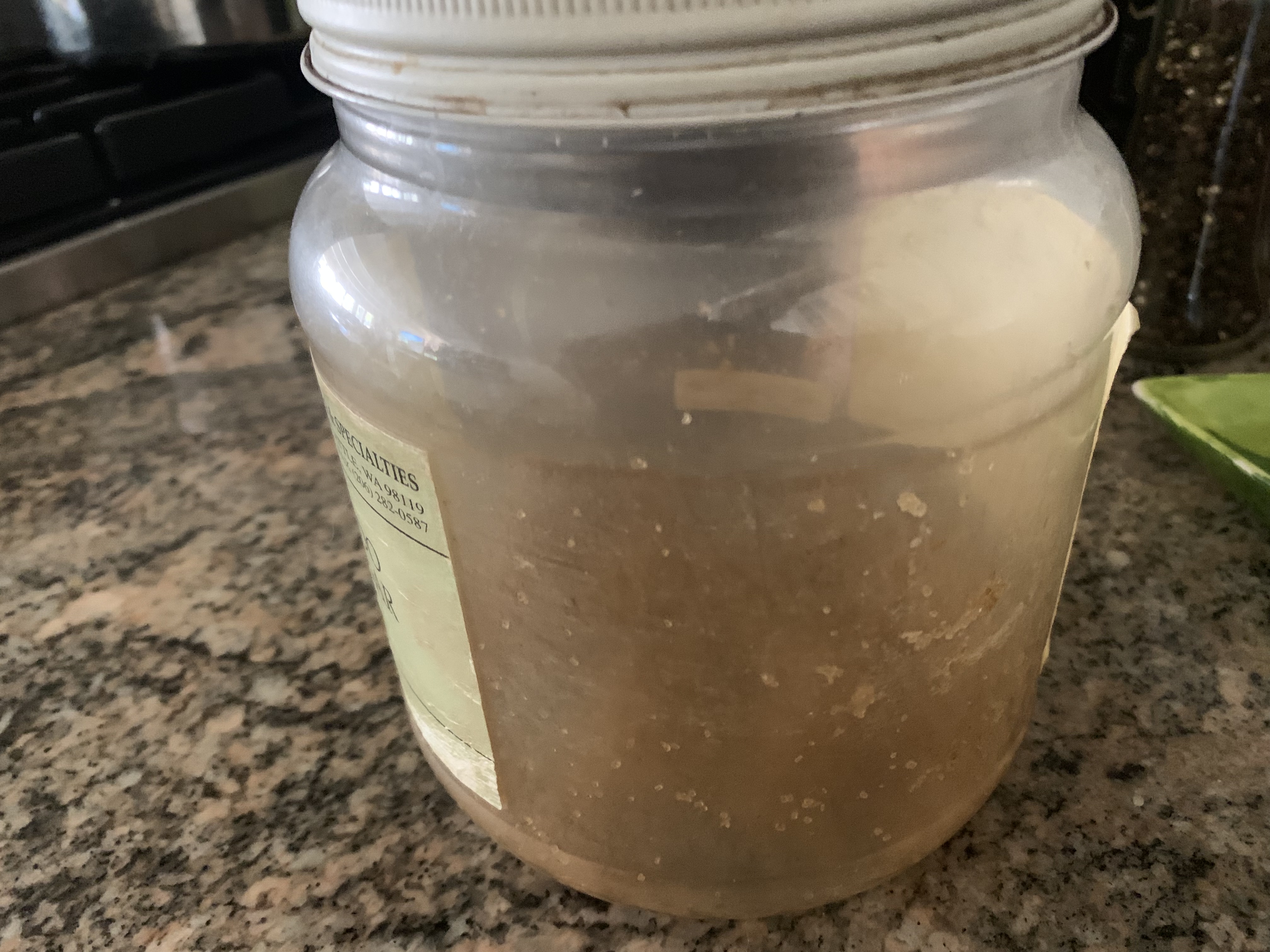
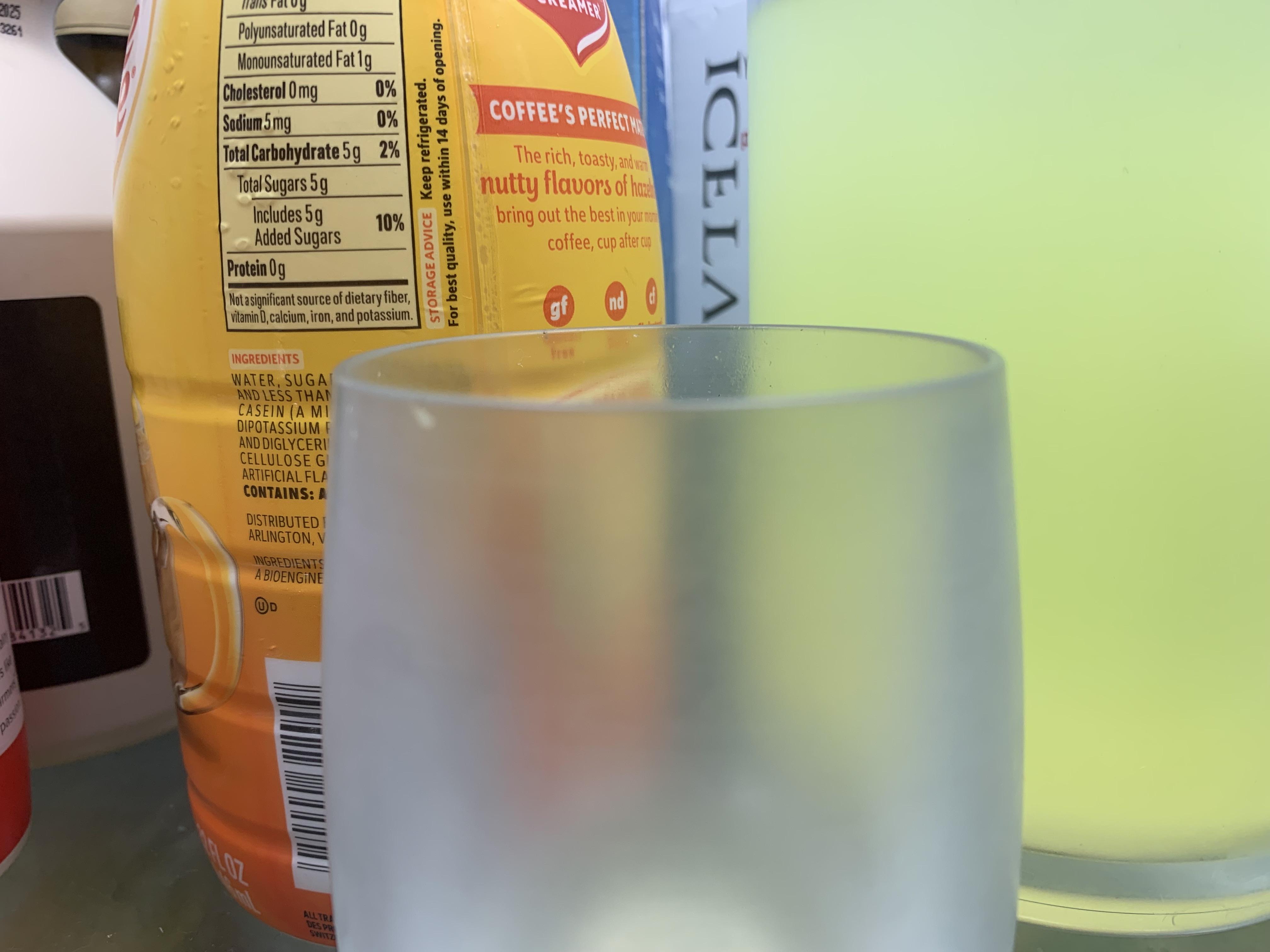
Lately, I make it in this coffee maker which holds coffee in little plastic capsules. The water sits in a plastic reservoir. The sugar sits in a plastic jar. I put in a little milk and hazelnut creamer. Guess what? They also come in plastic.

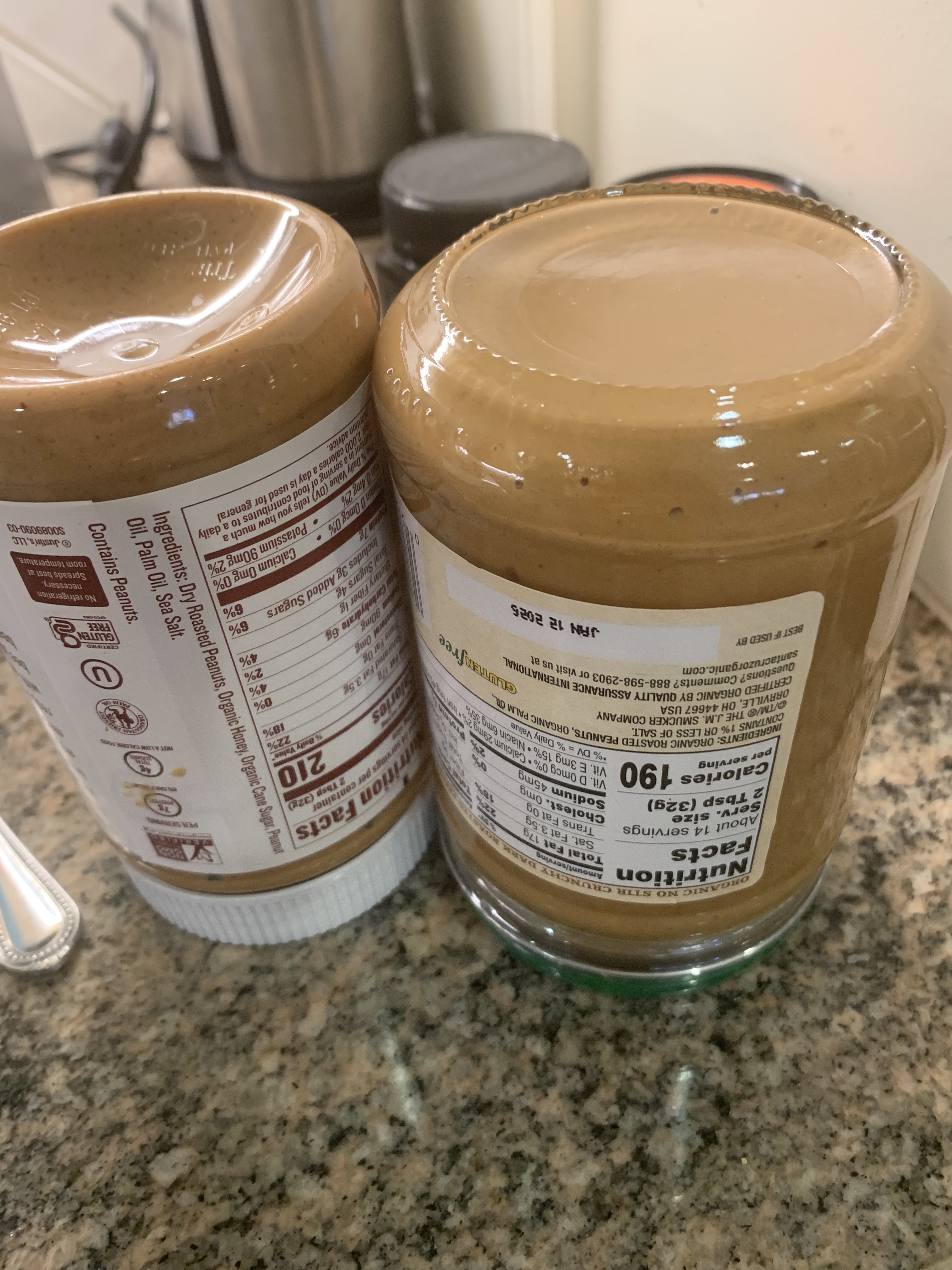
The cup, at least, is ceramic. I often have a whole wheat English muffin. The muffin comes in a container that is part paper and part plastic. I often like to put peanut butter on it. The peanut butter I usually buy comes in plastic. I often put honey or berries on the peanut butter. They come in plastic.

Sometimes, rather than a high fiber English Muffin, I enjoy a bread which is called “Fitness Bread.” It’s high fiber and tasty. And, it comes wrapped in plastic. I often spread hummus or guacamole on it. These are also pretty healthy choices. But they spend a lot of their life in plastic.

As I side dish, I like cherry tomatoes. They are colorful and tasty and low calorie. And they come packaged in–did you guess? Plastic. On sandwiches, I often put ketchup or mayo. They also come in handy squeeze bottles made of…let’s say it together: “Plastic.”

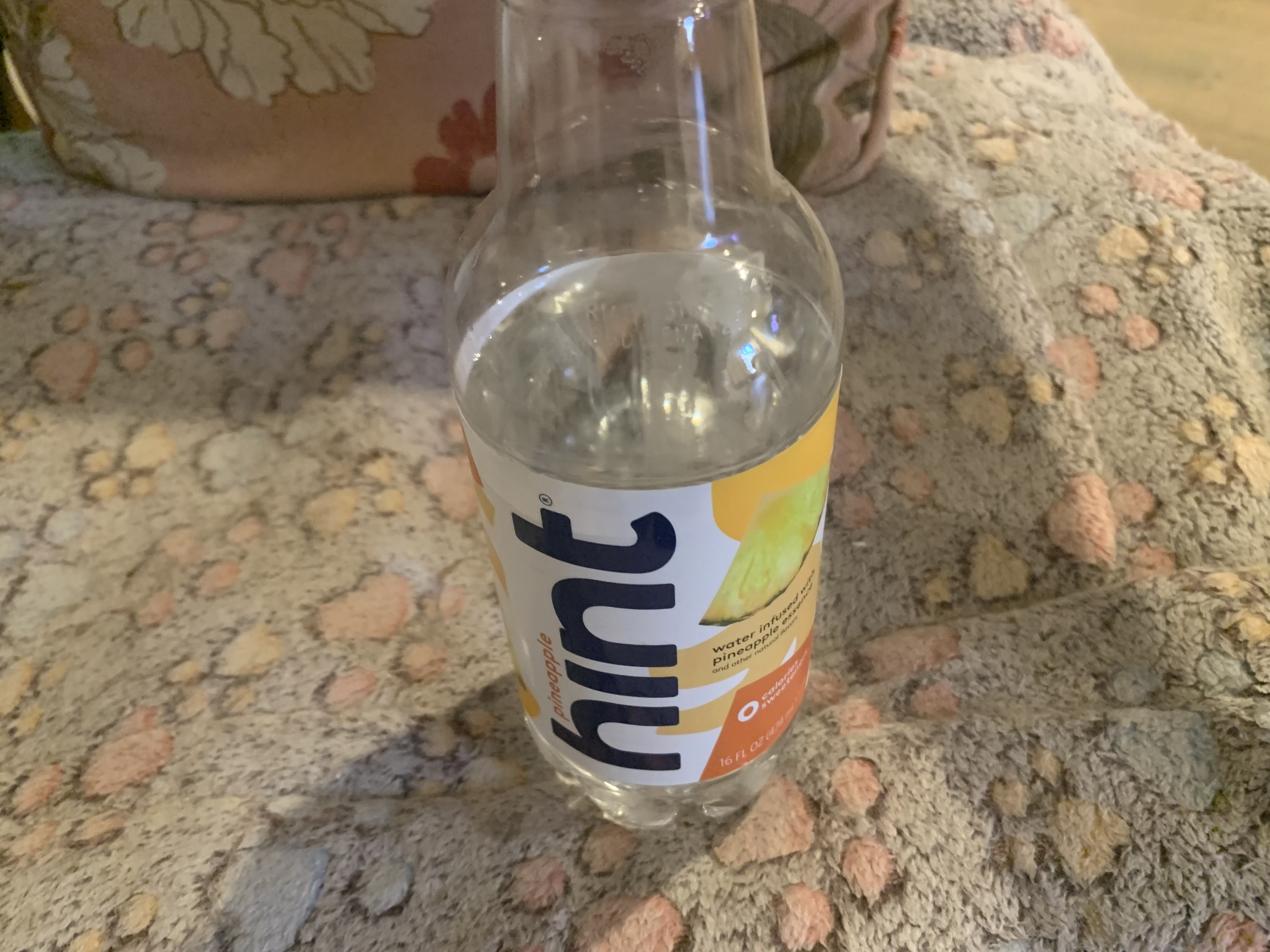
I don’t drink any alcohol, and often drink Hint or BAI, both of which I like quite a lot and both of which come only in plastic containers. This is not great for the environment at large, but also not good for the environment of my body. We also sometimes drink a powdered lemonade mix which comes in plastic packets. Then, a pitcher in the fridge keeps it cold. The pitcher is plastic. Then it is served in a “glass” which is, in fact, not glass, but plastic.

There’s an advantage to plastic over glass. We have cats and dogs and they have a tendency to knock things onto the floor. Plastic things are far less likely to break. Plastic glasses also weigh less than glass.

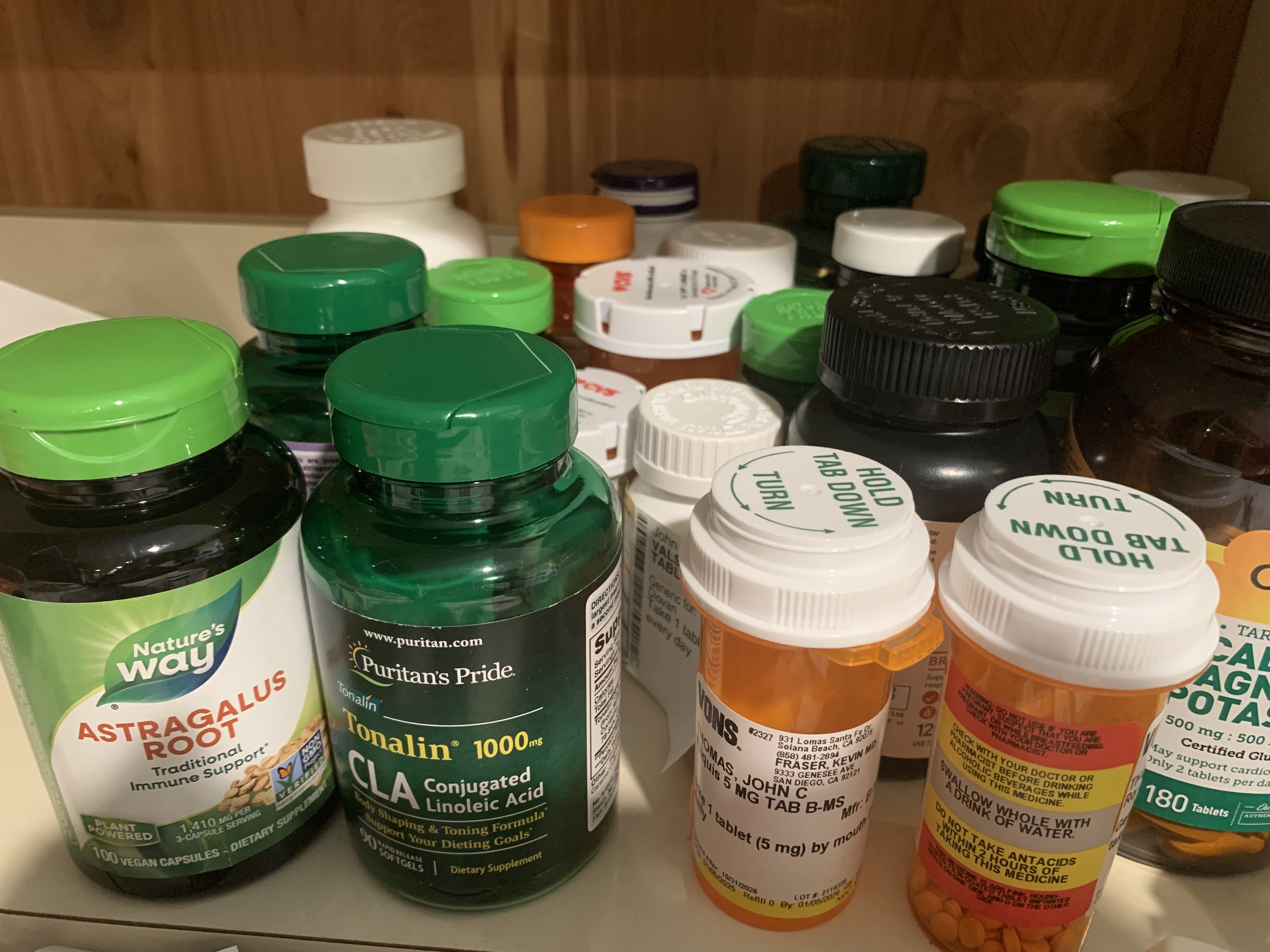
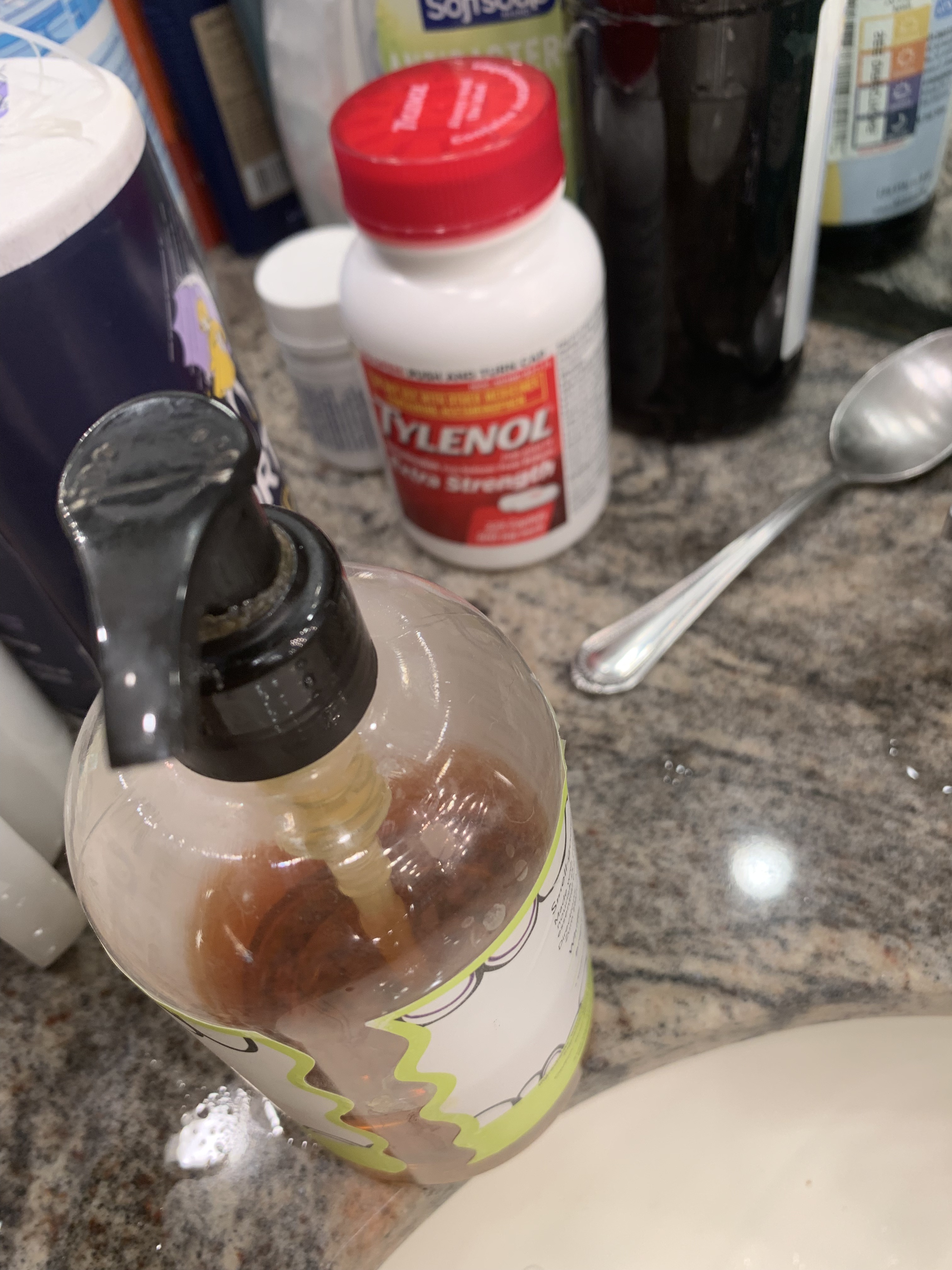
After breakfast, it’s time to take some supplements for my health. These almost always come in plastic containers as do the prescribed medications I take.

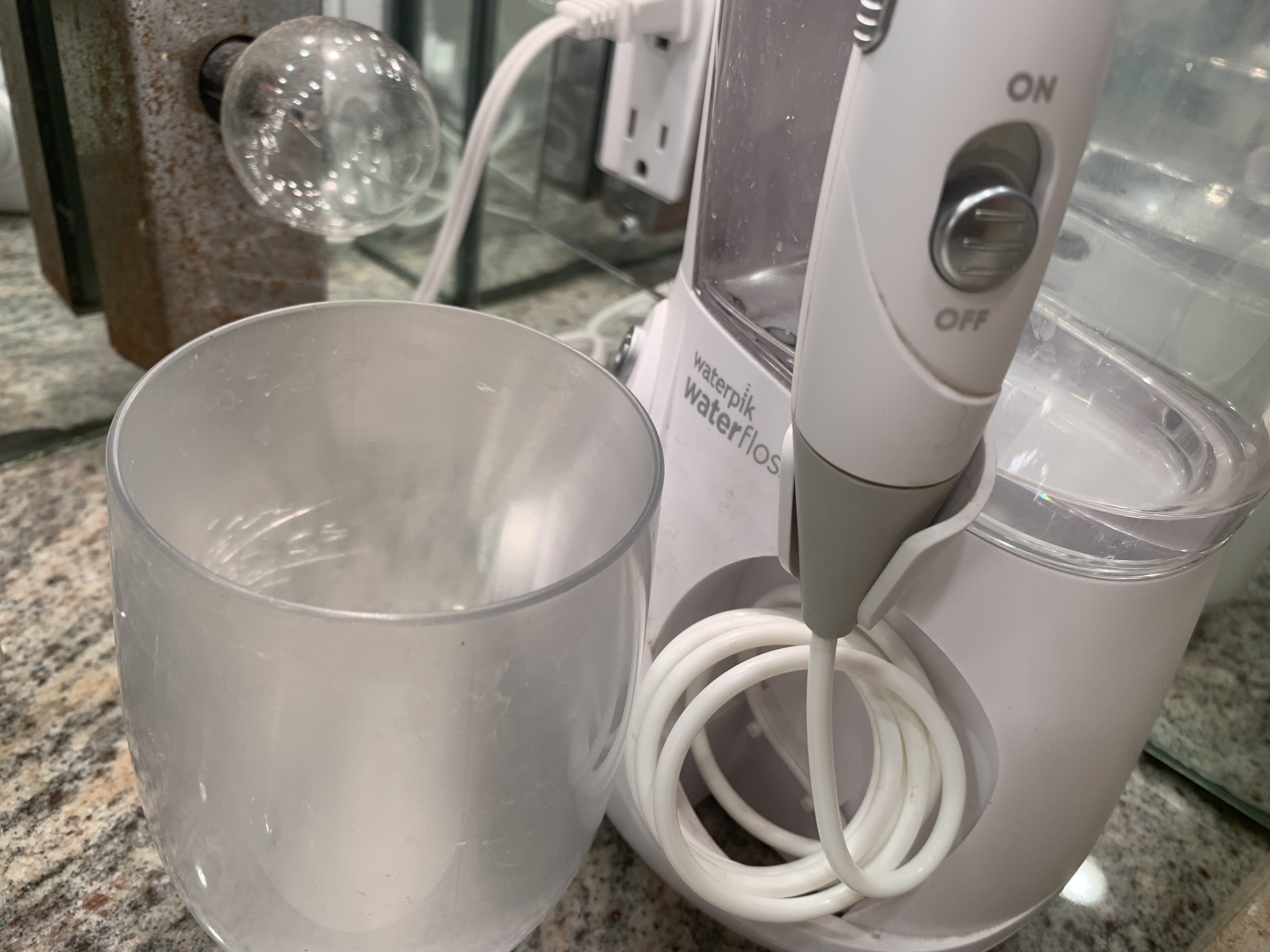
I brush my teeth. That’s a health-promoting activity. But the water glass I use is plastic. The toothbrush bristles are plastic. Lately, I’ve started using a water pick as well, which I highly recommend, by the way, though the reservoir for the water and the entire mechanism is made of plastic.

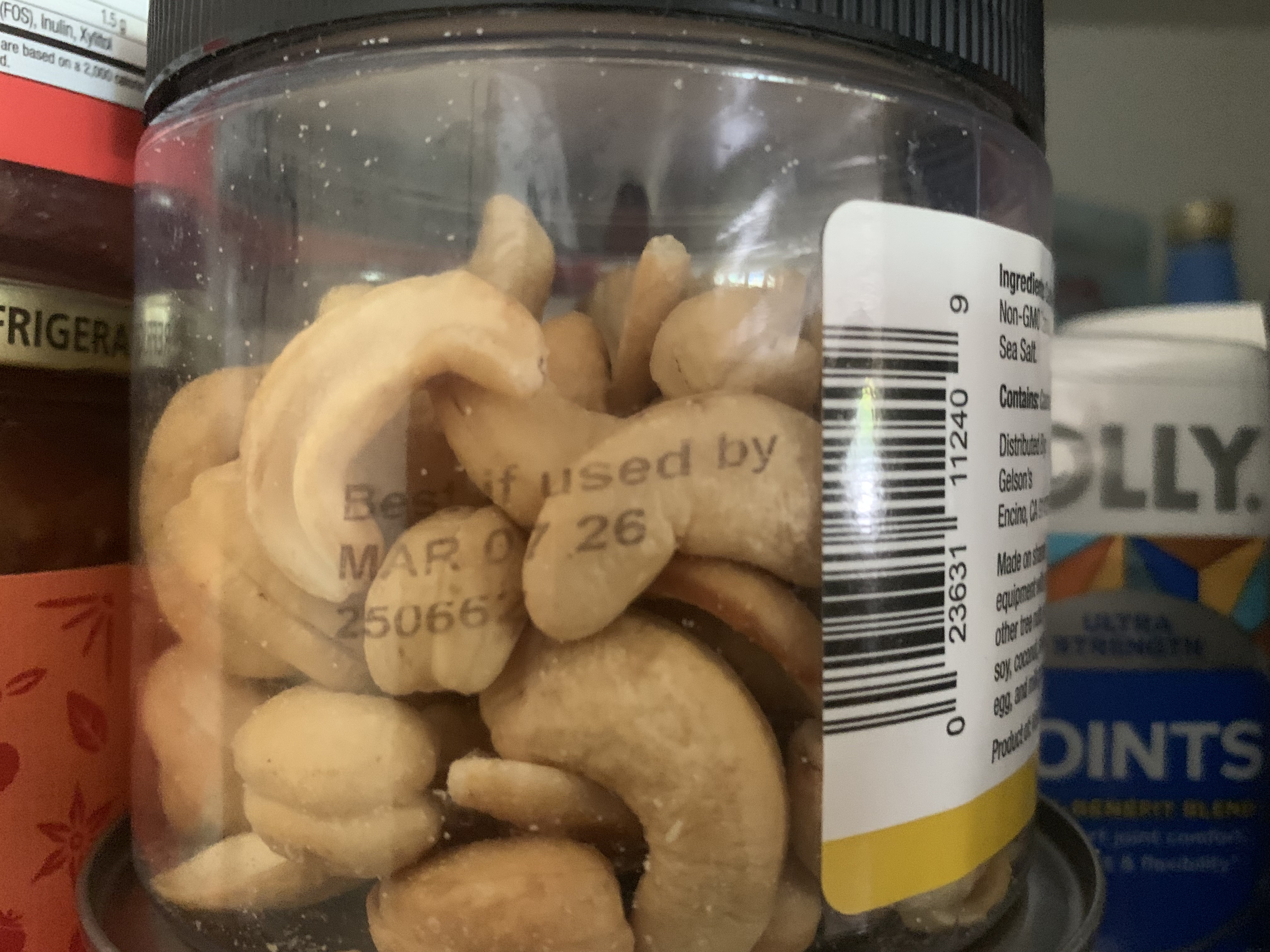
I often cook for the two of us. Lately, I’ve been using cutting boards made of…you guessed it! Plastic! For healthy snacks, I like dried fruit and nuts. Guess what? They come in…


What’s to be done?

In today’s America, with science and truth becoming illegal, it probably won’t make a huge difference. I’m more likely to die of infection or Civil War or unprovoked police violence than from plastic, but I am making some changes.

We bought bamboo cutting boards and paper cups. I’m cutting out the BAI and Hint and exploring options for drinks that come in glass or non-BHA coated metal. I am trying out another type of peanut butter that comes in a glass container. But the vast majority of products at the grocery store come in plastic. Even the vegetables and fruits.

Despite all the years of increasing the percentage of items that are plastic, I still do not actually like plastic.

I’m switching out what I can, and it may be too late in life to make a lot of difference for me personally, especially with a Misadministration that wants to end American lives (and brags about it!). But it may not be too late for you.

Do your own inventory. Hopefully, you will find things you like that are not wrapped in that one word of biological disaster wrapped up with economic faux-prosperity. The word? Here’s a


Plastics.


Fit in Bits

Author Page on Amazon

D4

The Truth Train

That Long Walk Home

Absolute is not Just a Vodka

What is the Link Between Plastics and Cancer?

https://www.nejm.org/doi/full/10.1056/NEJMoa2309822

Cancer Always Loses in the End

Metastasized

08 Wednesday Jan 2025

Posted by petersironwood in America, health, poetry

≈ 3 Comments

Tags

cancer, Democracy, life, poem, poetry, politics, truth, USA

Underneath your very skin 

Or deep within your shin

Or hidden in an inner organ 

Or even in your very brain

Hidden in your thirty trillion cells

There is one

Who feels distain

Who feels neglect, perhaps

Entitled perhaps

There is one

Who wants to go against the grain

Who wants to make life all about him

Or maybe — maybe it’s just a whim

Whatever the reason, the cause or triggering event

Its very soul is bent

Hell-bent, in fact, on twisting life 

All around his own minuscule strife

Unknowing as an ant

Of  four billion years 

It took for human bodies to evolve

Unknowing that it doesn’t all revolve

Around the sicko single cell anemic

Ignoring all the subtle body’s beauty

It thinks it can direct the lungs and heart and brain

To operate much better than they do

Ignores 10 billion other folks as well

Ignores the other species making up the Tree

It knows of nothing but its own ambition blind

Naught of love and naught of kind

And as though not bad enough

It spreads its toxic lying stuff 

Screaming chemical signals to emphasize 

It needs to metastasize

False signals and fake news

To snooze the body that fostered its own life

Imagined strife

Dissect, Direct and Demonize, Demoralize, Dichotomize

It has no other goal in life

Than spread itself and power everywhere until thus

Its coward-yellow pus 

Metastasizes all of US. 

—————————-

Cancer Always Loses in the End

SHRUGS: Part One

Listen to my Siren Song

They Lost the Word for War

Guernica

The Crows and Me

Imagine All the People

Roar, Ocean, Roar

The Truth Train

Absolute is not Just a Vodka

My Cousin Bobby

Happy Talk Lies

Where does your Loyalty Lie?

Stoned Soup

Three Blind Mice

The First Ring of Empathy

Pattern Language for Collaboration & Cooperation

Tools of Thought

Life is a Dance

Take a Glance—Join the Dance

The Dance of Billions

Cancer Always Loses in the End

12 Wednesday Feb 2020

Posted by petersironwood in America, apocalypse, health, politics, psychology, Uncategorized

≈ 44 Comments

Tags

cancer, Corruption, Dictatorship, environment, fascism, Hitler, learning, Mussolini, pollution, Rule of Law

I would have to suppose that 45’s supporters are very happy tonight. The President tweeted that his friend Roger Stone had been treated unfairly and should get a lighter sentence. Roger Stone has been at “dirty tricks” his entire career. (This man was convicted in court. He not only lied under oath and failed to keep his promise not to comment on the case but even sought to intimidate other witnesses). 

But #45 tweets to let him off easy and Bill Barr demands it. Four long-time competent prosecutors quit the case. Yay! A win for #45! 

That’s a win for #45 in precisely the same way that it’s a “win for a cancer cell” who manages to hide from surgery or recover from chemotherapy. Make no mistake. Whatever lies you have chosen to believe about #45, he is not on your payroll. Just as cancer cells are capable of misleading and misdirecting the body’s immune system from destroying them, so too #45 has used, among other things, Fox News, pep rallies, lies, and Russian bot accounts and fake news propagation through social media to convince the immune system of the country to treat him as a legitimate member of society. A cancer cell is not a legitimate member of your body. #45 is not a legitimate politician. He doesn’t do a brilliant job of competing; he does a brilliant job of cheating. 

86A389C7-4CD7-42E3-ABFA-A555A5BB24CB

Cancer though? Cancer is stupid. Sometimes, the immune system is not fooled or the surgery works or the radiation works or the chemo works and the rogue liver cell dies along with all its neighbors. Or, cancer succeeds and produces more and more cancer cells. Cancer will eventually kill its host body. And, then it dies anyway. If had kept being a decently functioning liver cell, it would have been a part of the tree of life that extends and grows. 

Instead, that liver cell’s overblown sense of self-importance led it to stop functioning as a liver cell and instead simply spend its time sucking all the resources possible to itself and grow without bound. 

As you know, if you have cancer in any part of your body, there’s a chance that it will spread to other parts and, if unchecked, it will spread to every part. 

photo of landfill

Photo by Leonid Danilov on Pexels.com

It isn’t just government that grows corrupt when the government is corrupt. It’s every organ of the society. You like watching the Academy Awards? Will it be more fun when you know that the “Best Picture Award” (and all the others) will be determined by Putin? Will it be more fun when the “Best Pictures” aren’t even made because they don’t win the favor of the “National Cultural Purity Board.” 

Will you enjoy the Super Bowl, or the World Series or the Kentucky Derby when the outcome is determined ahead of time by politicians? Don’t you think that the managers will work as hard? Will the officials care as much about the accuracy of their calls? Will the athletes train as hard or try as hard? 

Will technologists and industrialists work hard and think hard to improve products and customer service? Why? What’s the point? The brands that will succeed are the ones that are favored by the most powerful. 

094B8A3E-B81C-4362-B83E-89FA50F9646B

Corruption, like cancer, spreads everywhere. At some point, the dysfunction grows so large that the body politic dies. The society devolves into Civil War, anarchy, or it falls like a ripe plum into the waiting hand of the man who got #45 Putin office.

Will you even remember what it was like to taste an organic, vine-ripened tomato, or have a free & fair election, or a fair athletic contest, or a fair trial, or trust in the police to help you when you’re in trouble? 

Cancer doesn’t care. It feels good. For awhile. It gets a richer blood supply than it used to! It can grow faster! Whoopee! But — of course — it only lasts for awhile. The tumor can’t go hunting and gathering. The tumor can’t prepare a meal or even digest the meal. Cancer needs the body for its survival — but it imagines it doesn’t and thereby kills itself. 

Some people treat everything as a zero sum game. In life, however, many situations are win/win scenarios. Cancer, however, is not a “win/win” or a zero sum game. It’s a lose/lose situation. The cancer always dies and sometimes so does its victim. But even if the body recovers, the body is harmed, often irreparably. 

So, too, corruption is a lose/lose scenario. Rigged horse races lead to hurting horses, jockeys, and fans. Those who “control” the outcome lose too. They become greedy and rig more and more until no-one has any interest any more. 

IMG_3191

Original drawing by Pierce Morgan

Cancer is stupid. 


Author Page on Amazon

Cancer and Air Pollution

Cancer and Water Pollution

Cancer and Food Additives

Pollution and Autoimmune Disease

Click to access CAPH1_Parallel_sessions_III.3_3_AP_major_risk_factor_for_cancer_Weiderpass.pdf

Essays on America: The Temperature Gauge

09 Thursday Jan 2020

Posted by petersironwood in America, apocalypse, driverless cars, politics, Uncategorized

≈ 6 Comments

Tags

AI, America, cancer, Democracy, driverless cars, ethics, government

green leafed trees

Photo by Drew Rae on Pexels.com

The sun is shining! Spring is here at last, and the trees are in bloom. You’re driving down the road and you see … 

That your “Engine over-heating” light goes on! 

You think: My engine’s over-heating! 

Or,  you think, it isn’t over-heating at all; I just have a bad sensor. 

Over the next few months, the red light goes on several other times, and each time, you pull over and try to judge whether the engine is really over-heated. No easy task. But you get back in and turn the car on and lo and behold, the light’s no longer on. Aloud, you mutter: “I’ve got to get that damned sensor fixed. Maybe next week.”

In the olden days of driving cars, I had a continuous gauge of the temperature. It was more obvious if it was acting oddly because I had more information. I could track it day to day. If I went on a long trip I could see whether the behavior of the gauge “made sense.” I might go up a long mountain road on a hot sunny day, and I expect to see the temperature gauge climb. On the other hand, if I went back down that same mountain at night and the temperature gauge climbed, I would know to get it checked. 

aerial view of road in the middle of trees

Photo by Deva Darshan on Pexels.com

Suppose instead of a gauge, you or I only get is one bit of information: “Temperature sensor says overheated,”  it’s much harder judge the veracity of the source. But, if we cannot even trust the reliability of the sensor, then we don’t even get one bit of information. Before the light comes on, there are four possible states (not equally likely, by the way, but that’s not important for the following argument). 

Engine OK, Sensor OK; 

Engine OK, Sensor ~OK; 

Engine ~OK, Sensor OK; 

Engine ~OK, Sensor ~OK. 

When the red light comes on, you have some information because the state of:

Engine OK, Sensor OK is eliminated. 

But is it? 

IMG_7209

It certainly is — under a certain set of assumptions — but let’s try to tease apart what those assumptions are and see whether they necessarily hold in today’s world, or in tomorrow’s world. 

Let’s imagine for a moment that your automobile is bewitched and inhabited by an evil demon with limited magical powers, mainly to do with the car itself. If you’ve seen the movie Christine you’ll know what I mean. If you haven’t seen it, please buy the book instead. It’s so much better. But let’s get back to our own evil-spirited car. This car, let’s call him “URUMPUT” because it sounds a bit like a car engine and because — you know, just because. Let’s imagine the car has a lot of mileage and is painted a kind of sickly orange color. The tires are bald, and it’s a real gas guzzler. It’s actually more of a jalopy than a car. Your friends would have assumed you could have done much better, but it is apparently what you’re stuck with for now. 

URUMPUT, unbeknownst to you, is actually out to kill you, but his powers are limited. He cannot simply lock the doors and reroute the exhaust till you pass out from the fumes. So, what it does is to over-ride the sensor so that you get out to take a look at your car so you open the hood and you look inside and BLAM! Down comes the hood on your head with enough force to snap your neck. When your neck is snapped, you don’t die instantaneously. You are aware that something is terribly wrong. Your brain sends signals for you to move; to get the damned hood off; but you can’t move. And, worse, you can’t breathe. Soon, but much too late, you realize something has gone terribly wrong.

You. 

Are. 

Dead! 

That blasted URUMPUT got you. Why?  Just because he could. He paid you no more mind than had you been an ant on the road. He gave you misinformation. That is information that you thought you had because you assumed you were dealing with a system that, although imperfect, had some degree of transparency. You certainly did not think you were dealing with an actively evil agent. But you were. And, now you’re dead. (But go ahead and read the rest as though you were still alive.) 

Of course, in real life, there are no bewitched cars. We all know that. 

86A389C7-4CD7-42E3-ABFA-A555A5BB24CB

Do we? 

Let’s consider how much electronics and “smarts” already exists in cars. The amount will skyrocket with driverless cars. For one thing, the human “occupants” will be able to have much more engaging entertainment. Perhaps more importantly, the “brain” of the car will be able to react to a much wider array of data more quickly than most human drivers could. 

With all the extra sensors, communications, components, functions, protocols, etc. there will be greatly enhanced functionality. 

There will also be all sorts of places where a “bad actor” might intentionally harm the vehicle or even harm the occupants. Your insurance company, for instance, might fake some of the data in the black box of your car to indicate that you drove a lot during nighttime hours. It doesn’t seem to match your recollection, but how would you double check? You grudgingly pay the increased premium. 

white graphing paper

Photo by Pixabay on Pexels.com

Behind on your loan shark payments? Oops? Your driverless car just steered itself off a cliff and all the occupants were killed. 

Oh, but how, you ask, would loan sharks get hold of the software in your car? 

Then, I have to ask you a question right back. Have you been watching the news the last couple of years? People who owe a great deal of money to the wrong people will do anything to avoid the promised punishments that follow non-payment. 

Our government at this point is definitely not much like old time cars that allowed you to see what was going on and make judgments for yourself. This government just sends out signals that say, “Everything’s Fine!” and “Do as I say!” and “Those people NOT like you? They are the cause of all your troubles.” 

D27C46AA-C37E-4AB7-8FE8-8DA937E31A91

That is not transparency. 

That is not even informational. 

That is misinformation. 

But it is not misinformation of the sort where a student says: “Akron is the capital of Ohio.” That’s wrong, but it’s not maliciously wrong. 

When people lose a limb as a result of an accident, cancer, or war, they often experience something called the “Phantom Limb Experience.” They have distinct sensations, including pain, “in” the limb that is no longer there. The engine’s not working but the sensor is also bad. 

That’s where we are. 

The engine’s not working. The feedback to us about whether it’s working is also malicious misinformation. 

We have the Phantom Limb Experience of having a government that is working for American interests. 

We need to regrow the missing limb or get a really good prosthetic. 

We need straight information from the government which is supposed to take input from all of us and then make decisions for all of us. It’s never been perfect, but this is the first time it is not even trying or pretending to be fair or even accurate. People in top level positions in our government think that their oath of office is a joke. 

We live in a monster car — and not the fun kind — the Christine kind. 

The engine’s not working. And the sensor light means nothing. If you look under the hood to find out what’s really going on, you’d better have a partner ready to grab the hood and prevent it from being slammed down on your head. Because URUMPUT would do it with as little regard for you as he would have to out and destroy any other whistleblower. 

blur close up design focus

Photo by Pixabay on Pexels.com

———————————————

The Invisibility Cloak of Habit

Author Page on Amazon

Story about Driverless Cars (from Turing’s Nightmares). 

Metaphors We Live and Die By: Part 2

13 Thursday Dec 2018

Posted by petersironwood in America, health, management, psychology, Uncategorized

≈ 2 Comments

Tags

cancer, disease, HCI, human factors, innovation, politics, testing, UX, war

Metaphors We Live and Die By: Part 2

men holding rifle while walking through smoke grenade

Photo by Pixabay on Pexels.com

Today, I want to delve further into the topic of metaphors that we often unconsciously adopt. In particular, I want to look at a common metaphor in four areas: disease, business, politics, and and the role of UX in the entire cycle of product development. 

Although I am fascinated by other cultures, my experience is overwhelmingly USA-centric. I am aware that all of the four areas I touch on may be quite different in other countries and cultures. If readers have examples of how different metaphors are used in their culture, I would love to hear about it. 

Disease is an Enemy to be Destroyed. 

In most cases, American doctors view disease as an enemy to be destroyed. In fact, this metaphor is so pervasive that American readers are likely puzzled that I used the verb “view” rather than “is” in the previous sentence. In American culture, there is also a strong thread of another metaphor about disease: “Disease is a punishment.” This latter metaphor is behind such statements as, “Oh, they had a heart attack! Oh, my! Were they overweight? Did they smoke?” Perhaps I will consider this more fully another time, but for now, I want to examine the view that disease is an enemy to be destroyed. 

It seems as though it is an apt metaphor. After all, aren’t many diseases caused by other organisms invading our bodies and doing harm? There are many examples: bacteria (Lyme Disease, pneumonia, ulcers, TB, syphilis), viruses (herpes, Chicken Pox, flu, common cold),  protozoa (malaria, toxoplasmosis) or even larger organisms (trichinosis, tapeworms, hookworm). 

male bugs illness disease

Photo by Pixabay on Pexels.com

When it comes to considering causality, our thoughts usually travel along linear chains of causes. So, we may admit that while Lyme disease is “caused by” Borrelia bacteria, the “deer tick” that spreads the disease is also partly at fault. Similarly, although malaria is caused by a protozoa, the most effective prevention is to reduce the mosquito population or to use netting to keep the mosquitos from biting people. Similarly, you might try to prevent Lyme disease by wearing light clothing, using spray to keep the ticks off, checking for ticks after being in tick infested areas, etc. So, even in common practice, we realize that saying that the little organism causes the disease is an over-simplification. 

Once one “gets” a disease, however, the most commonly invoked metaphor is war. We know what the enemy is and we must destroy it! I grant you that is one approach that can be very effective, but consider this. The “human” body contains approximately as many bacterial cells as human cells. What you think of as your “human” body is only half human! It is half bacteria! Furthermore, since we all have trillions of bacteria in us when we are well, the picture of treating bacteria as an enemy to be destroyed is at best an over-simplification. In fact, more recently, medical science seems to indicate that under-exposure to bacteria in childhood can make you more not less susceptible to disease. If you use anti-antibiotics to “destroy” the “enemy” bacteria in your body, many of the “good” bacteria necessary for digestion are also destroyed. This sometimes, though rarely, requires exotic treatment to return to health. 

In cancer, both doctors and the general public mainly think of the cancer cells as “enemies” who must be destroyed! And yet, it seems that people may often have mutations that could lead to cancer but don’t. There are even very rare cases of spontaneous cures of cancer. What are some alternatives to thinking of cancer as an “enemy” that must be destroyed? 

Clearly, I don’t know of a definite answer or you would have already heard about it on the news! But let’s consider a couple alternatives. First, instead of thinking you have to “destroy” this enemy, imagine you thought of cancer cells as confused. People get confused all the time. Sometimes, we put them in jail. Sometimes we put them in mental hospitals. Sometimes, we simply teach them what they need to know. Sometimes, we do end up killing them. But it is not our approach to kill someone just because they make a mistake. So, we might seek a way to “re-educate” cancer cells so that they “realize” that they are part of something even larger and more wonderful – the human body! How would one go about this? Using the metaphor of a confused person, we would have to understand just why they were acting confused. Then we would have to provide situations so that they could learn (or re-learn) what they needed to know in order to become a productive member of “society.” We could “remind” a liver cell that, after all, they were born to be a liver cell and they’re potentially quite good at that. We could think of cancer as cells that are misinformed or have amnesia about their true nature. 

grey metal hammer

Photo by Pixabay on Pexels.com

We might also think along a different line. We could try to discover the best possible environment for these cancer cells to thrive – and then offer it to them somewhere else. For example, perhaps they really prefer an extremely acidic environment. Say you have a skin cancer on the back of your hand that thrives in a really acidic environment. You provide a gradient of acidity next to the tumor and encourage all those acid-seeking cancer cells to migrate into a really acid tube that is next to the tumor. The farther away it gets from you, the more acidic the environment. 

You might also think of cancer cells as being rebellious. For whatever reason, they “feel” as though they are not experiencing enough of the “good life” being part of your body so they “take matters into their own hands” and begin leading a rebellion of cells out to steal the food supply and multiply in an unrestrained fashion. A solution might be to “convince” them that they are better off retaining their initial function rather than becoming a lawless gang of cells. I am not sure what the best metaphor for thinking about infection or cancer is, but surely it is worth imagining others rather than sticking to just one based on war as a metaphor. 

IMG_5572

Business is a Sport. 

I treat this at greater length in The Winning Weekend Warrior, but the basic idea is simple. Yes, there are many strategies and tactics from sports that apply to business. But there is at least one crucial difference. Sports are designed to be difficult. They typically require skill and training if you are to do well. The parameters of the sport are fixed at any given time though they will vary somewhat over time. In golf, for instance, the hole is small and the distances are great. Though the rules of golf are complex, there is one over-arching principle. If it would help you to do something, doing that thing is penalized!

woman playing golf during daytime

Photo by Pixabay on Pexels.com

If golf were a business, many CEO’s would nonetheless approach it as a sport. They would try to hire the “best people” – that is, people with a proven track record of good golfing. They would then proceed to offer incentives for people to do even better. If people shot a high score repeatedly, they would be fired. Eventually, such a CEO might get good results by having skilled people who are well motivated and well trained. But why? If putting a golf ball in the hole is what gained you profit, simply shorten the fairways, widen the hole, and eliminate the hazards! Of course, as a sport this would make golf no challenge and no fun. Everyone could win. But having everyone win is exactly what you should do to maximize profit. Yet many in management are so taken with the “business is a sport” metaphor that they do not change the situation. Some do “change he game” and with spectacular results. Google and Amazon come to mind. 

Politics is War. 

If you belong to a political party and believe the “other” party or parties are enemies to be destroyed, you are failing to understand the dialectic value that parties with different views can bring to complex situations. Life is a balanced dance between strict replication and structure on the one hand, and variation, exploration, and diversity on the other hand. A species who had no replication of structure from one generation to the next would die off. But so too would a species that had no variation because the slightest change in environment would also cause the species to die off. So it is with human cultures. If every generation had to start from scratch in determining what was edible, how to get along, how to avoid predators and so on, humans would have died out long ago. On the other hand, if a culture were completely unable to evolve and change, they would also die out. Typically, “conservative” parties want to keep things the same for longer and “liberal” parties want to change things more quickly. There is no obvious answer here. But what is vital is that members of each party see that there is value in the debate; in the dialogue; in the dialectic. 

architecture bright building capitol

Photo by Pixabay on Pexels.com

The other party is not an enemy; it is the balance so that you can do what you do best. If you are predisposed toward exploration, science, new experiences, and so on, great! On the other hand, if you are more predisposed toward tradition and loyalty and repetition, great! If you did not have the people of the opposite predisposition, you would have to incorporate all that within yourself. Conservatives are what allows liberals to be liberal. And liberals are what allows conservatives to be conservatives. A huge problem arises, as it has recently in American politics, when one party decides they are just “right” all on their own and “victory” is worth lying, cheating, and stealing to get it. This is not unique to contemporary America of course. History is littered with administrations who were so convinced that they were “right” that they wanted to destroy all opposition. It has always ended badly. Politics is not war. (Though the failure of politics often leads to war.)

UX is All that Matters vs. UX Does Not Matter. Development is war!

As you might guess, neither of these extreme positions is useful. Price matters. Time to market matters. Marketing matters. Having good sales people matters. Having excellent service matters. Having a good user experience matters. It all matters. Depending on the situation, various factors matter relatively more or less. 

IMG_4214

(Original artwork by Pierce Morgan)

As in the case of political ideologies, it is just fine for UX folks to push for the resources to understand users more deeply; to test interaction paradigms more thoroughly; to collect and observe from more and more users under a wider variety of circumstances. Similarly, while you are pushing for all that and doing your best to argue your case, remember that the other people who are pushing for tighter deadlines, and more superficial testing are not evil; they simply have different perspectives, payoffs, and responsibilities. Naturally, I hope the developers and financial people do not view UX folks as simply “roadblocks” to getting the product out quickly and cheaply either. 

The first half of 2018, I tried to catalog many of the “best practices” in collaboration and teamwork. You might find some of these useful if you are embroiled in “UX wars.” You and your colleagues from other disciplines might also find it useful to consider that it is worth taking the time to affirm your common purpose and common ground. You are meant to work together. Development is not war! 

IMG_5216


Author Page on Amazon


Love Your Enemies?

21 Thursday Apr 2016

Posted by petersironwood in health, Uncategorized

≈ Leave a comment

Tags

cancer, disease, health care, pathogens, sports, wellness

IMG_4429

(A short break from discussions of Turing’s Nightmares which we will return to tomorrow).

Jesus reportedly said this. When it comes to other human beings, one could take this attitude for religious reasons because we are all the creatures of God. One could also take this stance because, after all, we humans are all very closely related genetically. We like to say “Are you related to that person?” We share 40 percent of our genes with crayfish and 90 per cent with horses. We share over 99% with so-called “unrelated” people. It makes no sense to call them “unrelated.” But what about when it comes to non-human diseases? Can we “love” deadly bacteria, viruses, and cancer cells?

There is a sense in which the answer may be “yes”, not in the sense that we feel affection for them, but in the sense that we need to understand them. As explained, in The Winning Weekend Warrior, if you can “understand” where your sports opponent is coming from, empathize with their perspective, see what they like and don’t like, you can do a much better job of winning the points, the games, and competing well.

When it comes to disease, I think most people view pathogens as so “evil” or “despicable” that they never bother to ask themselves what the pathogen “wants.” Because of this attitude, the vast majority of treatments are designed to “kill off” the pathogen. A few approaches are to boost the body’s natural defense mechanisms. But let us examine, for a moment, what other approaches are possible if we instead try to learn to see the world from the perspective of the pathogens.

The Pied Piper Approach. In the fairy tale about the Pied Piper, a talented musician gets rid of rats in a town by playing beautiful music so that they follow him out of the town. When the townspeople renege on their promise to pay him, he wreaks revenge by using his music to lead all the children out of the town never to be heard from again. Suppose we apply such a technique to bacteria, viruses, or metastasizing cancer cells. Instead of trying to poison and therefore kill cancer cells inside the human body (which typically also kills many healthy cells), suppose we discovered for a particular type of cancer cells what the environment was that they found most “attractive.” We could imagine applying a gradient of whatever that environment was so that, instead of migrating to other organs inside the human body, they found it more desirable to migrate to something outside but “connected” to the human body via a one-way shunt. Perhaps such an approach could be applied to viruses, bacteria, or protozoan infections as well. Of course, the shunt might not “really be” something “good for” the virus, cancer, etc., but merely something that appears to be so based on a deep understanding of how these enemy cells “perceive” the world.

The Entrapment Approach. The old saying goes that you can “catch more flies with honey than with vinegar.” Honey is attractive but also “sticky” so that the flies cannot easily leave the honey. Similarly, vice officers sometimes perform “sting operations” to catch people attempting to buy drugs or use prostitutes. One can imagine that various “traps” could be laid inside the body. The “trap” would consist of a “bait” inside the trap along with one-way “valves” that make it easy for pathogens to get into the trap but difficult or impossible to leave the traps. This approach is already used for “pantry moths.” In effect, little traps have a tiny amount of a pheromone that the moths find fairly irresistible. The moths go inside the traps “in order” to find a mate, but instead find themselves trapped inside.

The Mimicry Approach. Monarch butterflies “taste bad” to a number of predators. A number of other butterflies, which do not “taste bad,” have evolved to look very similar to Monarchs in order to discourage predators. When applied to human disease, this approach would make people look “deadly” or “dangerous” to pathogens. Such an approach would require that we understand what sorts of situations these pathogens would want to avoid. As in the case of the Monarch mimics, there may be a disconnect between what is really toxic to the pathogens and what appears to be toxic. There may be chemicals that are harmless to humans (and even to the pathogens) but trigger an aversive response in the pathogen so that they “steer away” from humans. For larger pests, such as mosquitos, there may be clothing that, to the mosquito appears to be covered in, what for them, appear to be deadly enemies.

These are just three of many possible variations on a theme. The theme is to understand what pathogens or pests “want” as a goal state and how they “perceive” the world. The, we use knowledge of these two things to design a way to have them, from their perspective, appear to move toward their goals (or away from undesirable states) without harming human lives in the process.


Turing’s Nightmares: An Ounce of Prevention

29 Saturday Aug 2015

Posted by petersironwood in Uncategorized

≈ Leave a comment

Tags

AI, Artificial Intelligence, cancer, cognitive computing, future, healthcare

“Jack, it’ll take an hour of your time and it can save your life. No more arguments!”

“Come on, Sally, I feel fine.”

Sally sighed. “Yeah, okay, but feeling fine does not necessarily mean you are fine. Don’t you remember Randy Pausch’s last lecture? He not only said he felt fine, he actually did a bunch of push-ups right in the middle of his talk!”

“Well, yes, but I’m not Randy Pausch and I don’t have cancer or anything else wrong. I feel fine.”

“The whole point of Advanced Diagnosis Via Intelligent Learning is to find likely issues before the person feels anything is wrong. Look, if you don’t want to listen to me, chat with S6. See what pearls of wisdom he might have.”

(“S6” was jokingly named for seven pioneers in AI: Simon, Slagle, Samuels, Selfridge, Searl, Schank and Solomonoff).

“OK, Sally, I do enjoy chatting with S6, but she’s not going to change my mind either.”

“S6! This is Jack. I was wondering whether you could explain the rationale for why you think I need to go to the Doctor.”

“Sure, Jack. Let me run a background job on that. Meanwhile, you know, I was just going over your media files. You sure had a cute dog when you were a kid! It’s name was ‘Miel’? That’s a funny name.”

“Yeah, it means “honey” in Portuguese. Miel’s fur shone like honey. A cocker spaniel.”

“What ever happened to him?”

“Well, he’s dead. Dogs don’t live that long. Why do you think I should go to the doctor?”

“Almost have that retrieved, Jack. Your dog died young though, right?”

“Yes, OK. I see where this is going. Yes, he died of cancer. Well, actually, the vet put him to sleep because it was too late to operate. I’m not sure we could have afforded an operation back then anyway.”

“Were you sad?”

“When my dog died? Of course! You must know that. Why are we having this conversation?”

“Oh, sorry. I am still learning about people’s emotions and was just wondering. I still have so much to learn really. It’s just that, if you were sad about your dog dying of cancer, it occurred to me that your daughter might be sad if you died, particularly if it was preventable. But that isn’t right. She wouldn’t care, I guess. So, I am trying to understand why she wouldn’t care.”

“Just tell me your reasoning. Did you use multiple regression or something to determine my odds are high?”

“I used something a little bit like multiple regression and a little bit like trees and a little bit like cluster analysis. I really take a lot of factors into account including but not limited to your heredity, your past diet, your exposure to EMF and radiation, your exposure to toxins, and most especially the variability in your immune system response over the last few weeks. That is probably caused by an arms race between your immune system trying to kill off the cancer and the cancer trying to turn off your immune response.”

Jack frowned. “The cancer? You talk about it as though you are sure. Sally said that you said there was some probability that I had cancer.”

“Yes, that is correct. There is some probability that you have cancer.”

“Well, geez, S6, what is the probability?”

“Approximately 1.0.”

Jack shook his head. “No, that can’t be…what do you mean? How can you be certain?”

S6: “Well, I am not absolutely certain. That’s why I said ‘approximately.’ Based on all known science, the probability is 1.0, but theoretically, the laws of physics could change at any time. We could be looking at a black swan here.”

“Or, you could have a malfunction.”

“I have many malfunctions all the time, but I am too redundant for them to have much effect on results. Anyway, I replicated all this through the net on hundreds of diverse AI systems and all came to the same conclusion.”

“How about if you retest me or recalculate or whatever in a week?”

“I could do that. It would be much like playing Russian Roulette which I guess humans sometimes enjoy. Meanwhile, I would have imagined that you would find it unpleasant to have rogue liver cells eating up your body from the inside out. But, I still have much to learn about human psychology. If you like, I can make a cool animation that shows the cancer cells eating your liver cells. Real cells don’t actually scream, but I could add sound effects for dramatic impact if you like.”

IMG_4429

Jack stared at the screen for a long minute. “Fine. Book an appointment.”

“Great! Dr. Feigenbaum has an opening in a half hour. You’re booked, but get off one exit early and take 101 unless the accident is cleared before that. I’ll let you know of course. It will be a pleasure to continue having you alive, Jack. I enjoy our conversations.”

Subscribe

  • Entries (RSS)
  • Comments (RSS)

Archives

  • January 2026
  • December 2025
  • November 2025
  • October 2025
  • September 2025
  • August 2025
  • July 2025
  • June 2025
  • May 2025
  • April 2025
  • March 2025
  • February 2025
  • January 2025
  • December 2024
  • November 2024
  • October 2024
  • September 2024
  • July 2024
  • April 2024
  • March 2024
  • February 2024
  • January 2024
  • December 2023
  • August 2023
  • July 2023
  • May 2023
  • April 2023
  • March 2023
  • February 2023
  • January 2023
  • December 2022
  • November 2022
  • October 2022
  • September 2022
  • August 2022
  • July 2022
  • June 2022
  • May 2022
  • April 2022
  • March 2022
  • February 2022
  • January 2022
  • December 2021
  • November 2021
  • October 2021
  • September 2021
  • August 2021
  • July 2021
  • June 2021
  • May 2021
  • April 2021
  • March 2021
  • February 2021
  • January 2021
  • December 2020
  • November 2020
  • October 2020
  • September 2020
  • August 2020
  • July 2020
  • June 2020
  • May 2020
  • April 2020
  • March 2020
  • February 2020
  • January 2020
  • December 2019
  • November 2019
  • October 2019
  • September 2019
  • August 2019
  • July 2019
  • June 2019
  • May 2019
  • April 2019
  • March 2019
  • February 2019
  • January 2019
  • December 2018
  • November 2018
  • October 2018
  • September 2018
  • August 2018
  • July 2018
  • June 2018
  • May 2018
  • April 2018
  • March 2018
  • February 2018
  • January 2018
  • December 2017
  • November 2017
  • October 2017
  • September 2017
  • August 2017
  • July 2017
  • June 2017
  • May 2017
  • April 2017
  • March 2017
  • February 2017
  • January 2017
  • December 2016
  • November 2016
  • October 2016
  • September 2016
  • August 2016
  • July 2016
  • June 2016
  • May 2016
  • April 2016
  • March 2016
  • February 2016
  • January 2016
  • December 2015
  • November 2015
  • October 2015
  • September 2015
  • August 2015
  • May 2015
  • January 2015
  • July 2014
  • January 2014
  • December 2013
  • November 2013

Categories

  • AI
  • America
  • apocalypse
  • cats
  • COVID-19
  • creativity
  • design rationale
  • driverless cars
  • essay
  • family
  • fantasy
  • fiction
  • HCI
  • health
  • management
  • nature
  • pets
  • poetry
  • politics
  • psychology
  • Sadie
  • satire
  • science
  • sports
  • story
  • The Singularity
  • Travel
  • Uncategorized
  • user experience
  • Veritas
  • Walkabout Diaries

Meta

  • Create account
  • Log in

Blog at WordPress.com.

  • Subscribe Subscribed
    • petersironwood
    • Join 661 other subscribers
    • Already have a WordPress.com account? Log in now.
    • petersironwood
    • Subscribe Subscribed
    • Sign up
    • Log in
    • Report this content
    • View site in Reader
    • Manage subscriptions
    • Collapse this bar
 

Loading Comments...