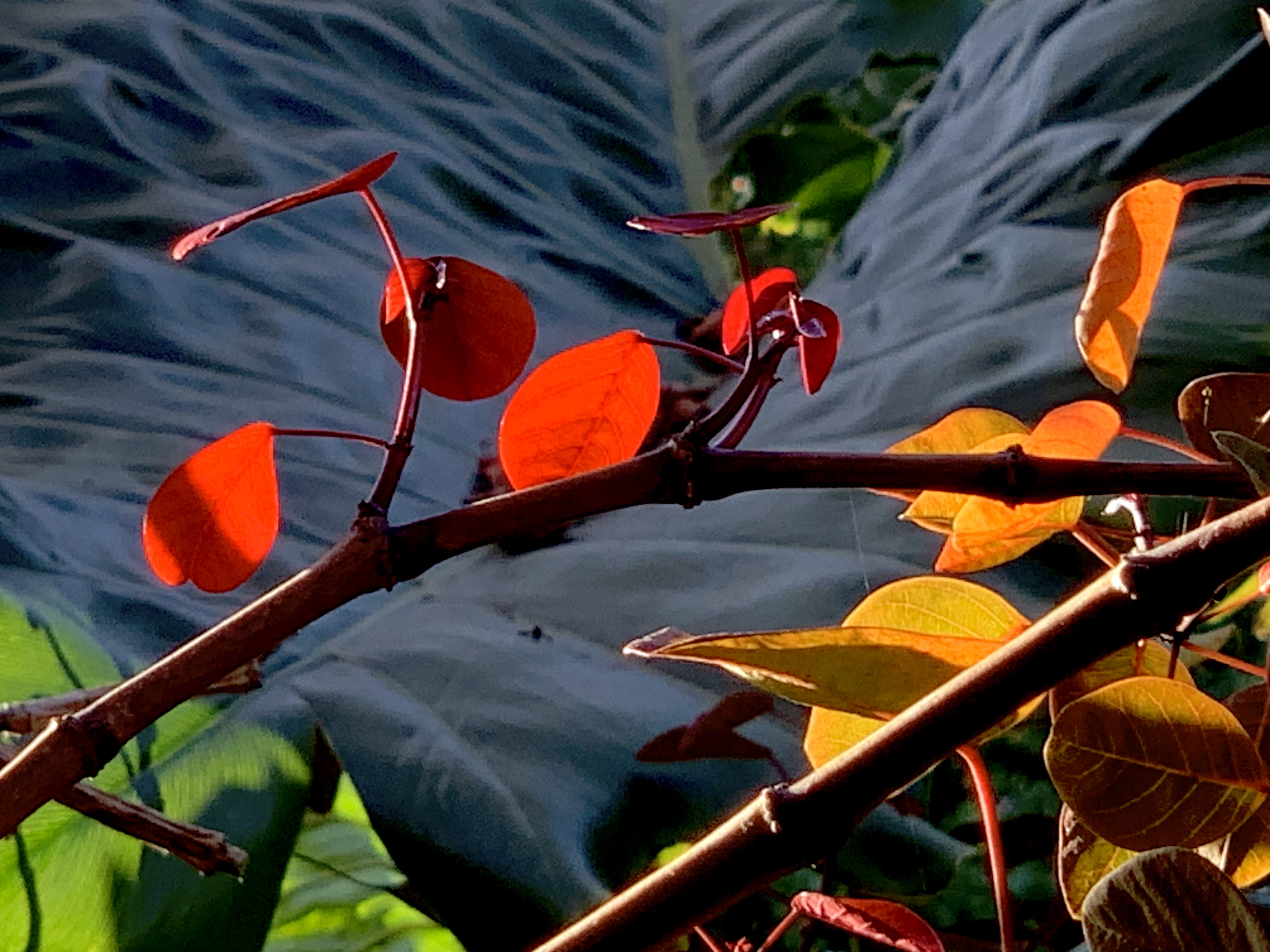
Like most people, when I awake to a clear sky and morning sun, I think to myself, “What a beautiful day!” Here in the San Diego area, there are many days like that. I take my dog Sadie for a walk every morning.
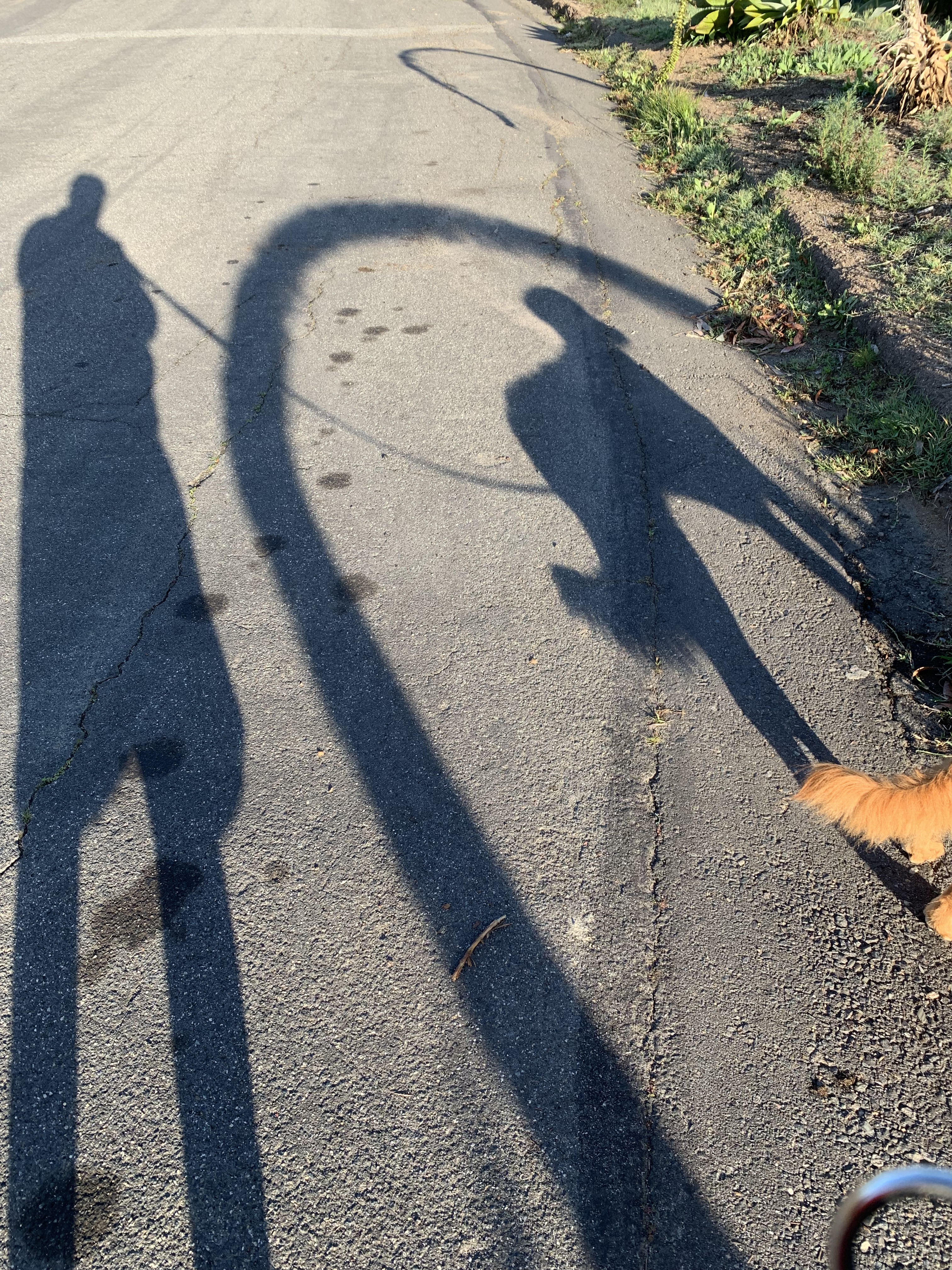
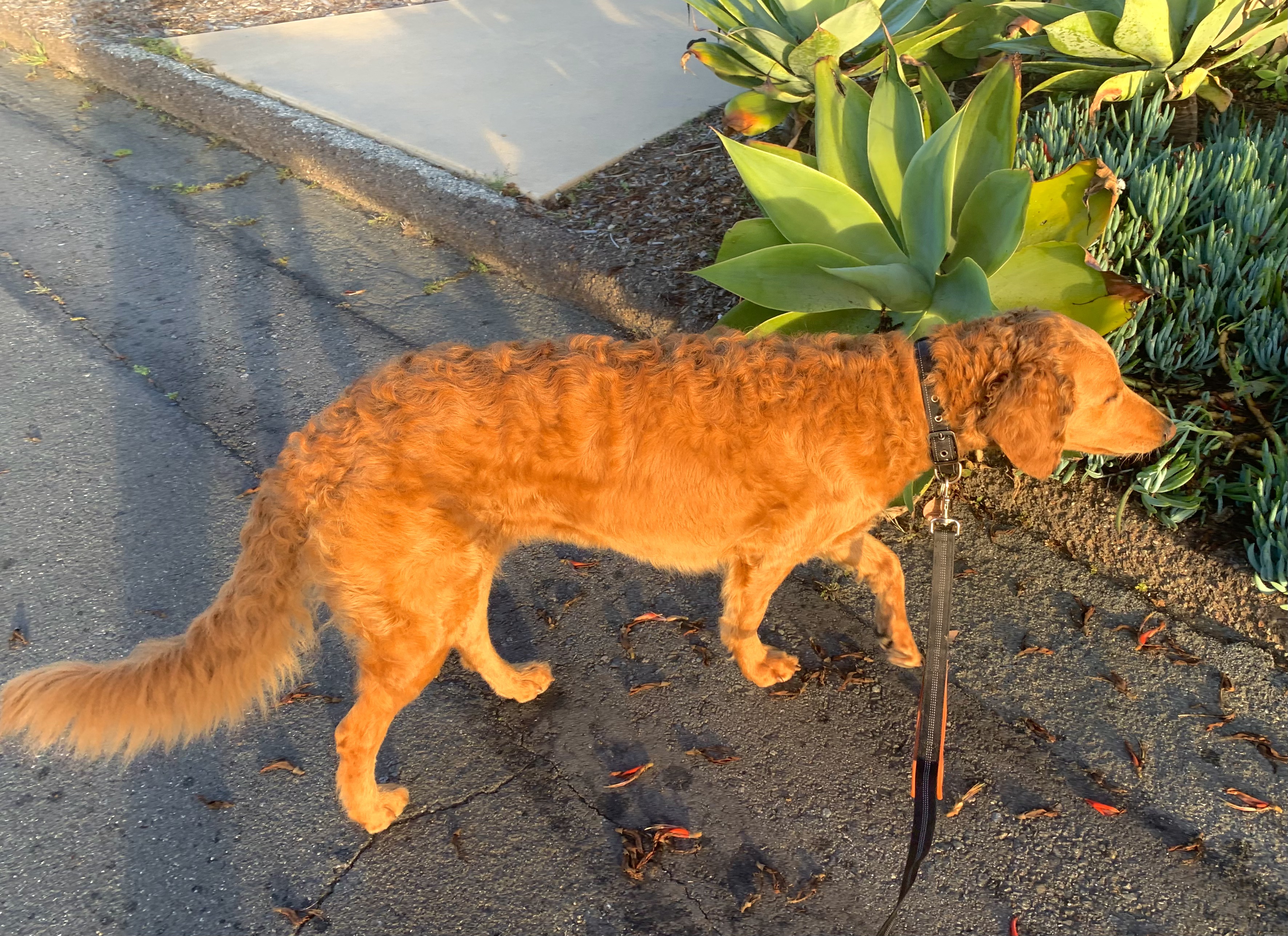
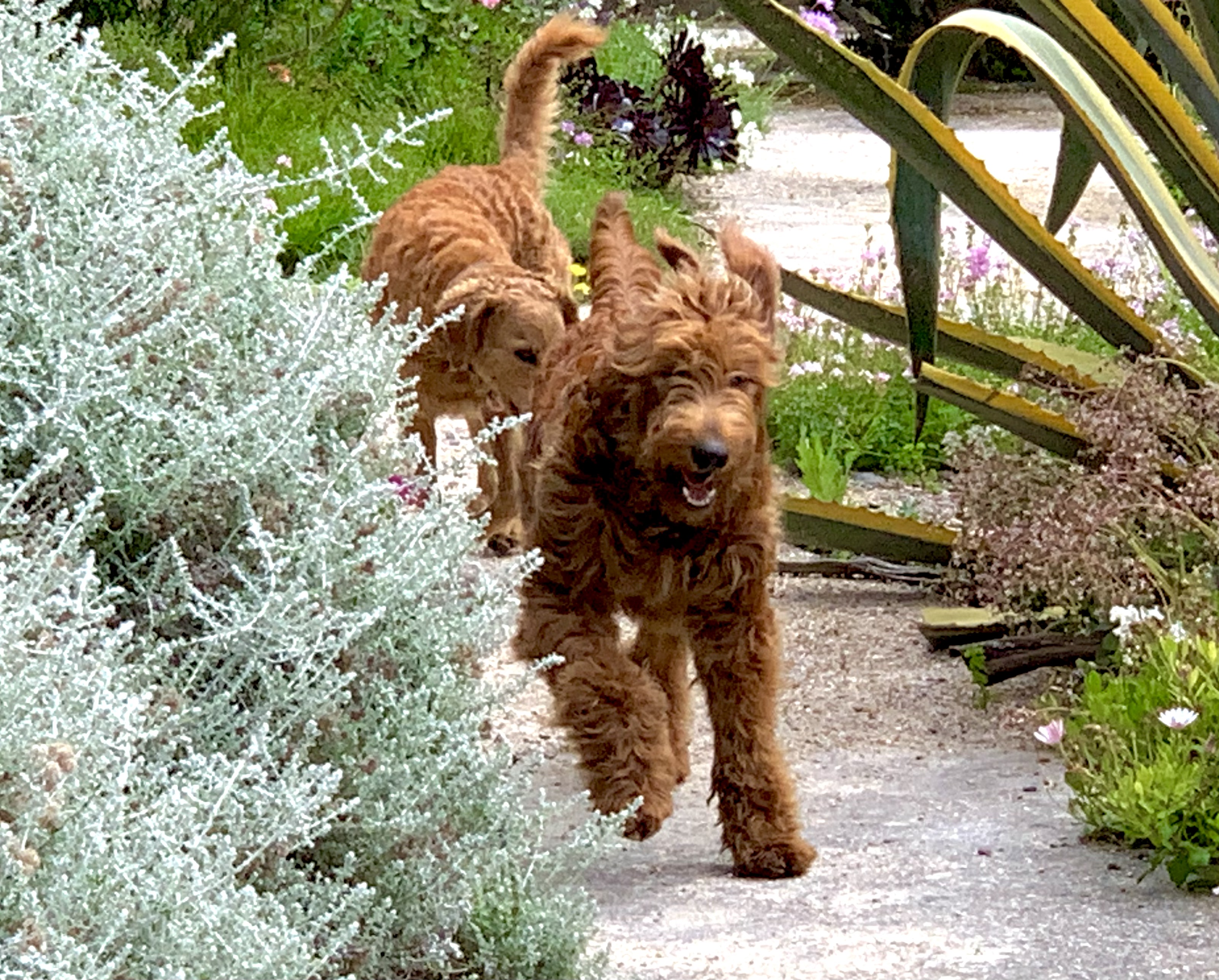
Sadie enjoys the sunny days. Probably unbeknownst to her, the golden morning light makes her golden doodle fur even prettier than the midday sun.
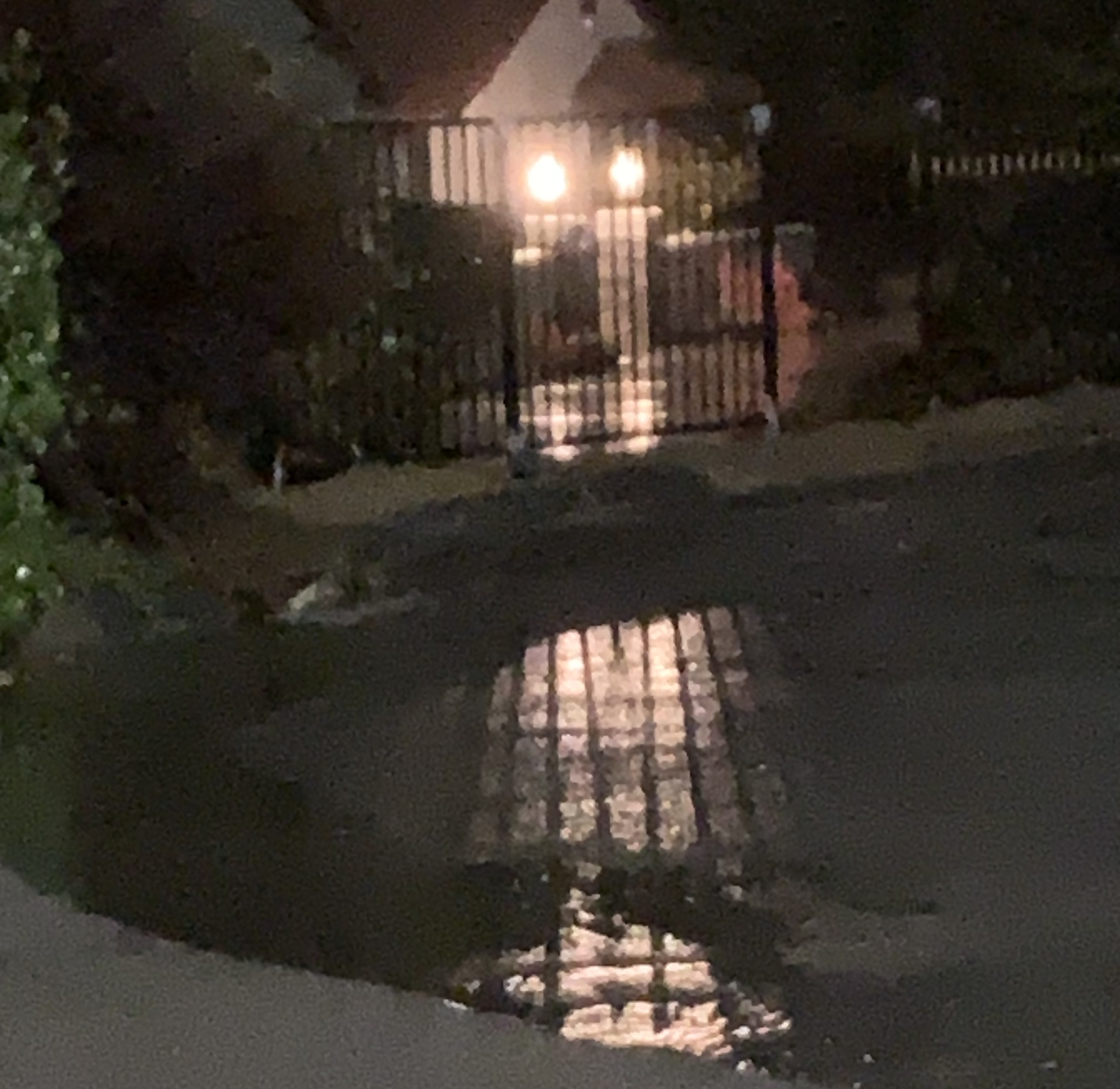
Sadie enjoys the rainiest of days as well. She watches the water gush into the storm sewer, enjoying the interplay of gravity, inertia, cohesion, and friction. Often large water droplets fall onto puddles and make large bubbles. Sadie snaps at as many as she can. Perhaps she imagines they are small silvery fish. Perhaps not.
Sadie also enjoys foggy days! Sometimes, it feels as though the joy is more a product of Sadie than it is of the weather.
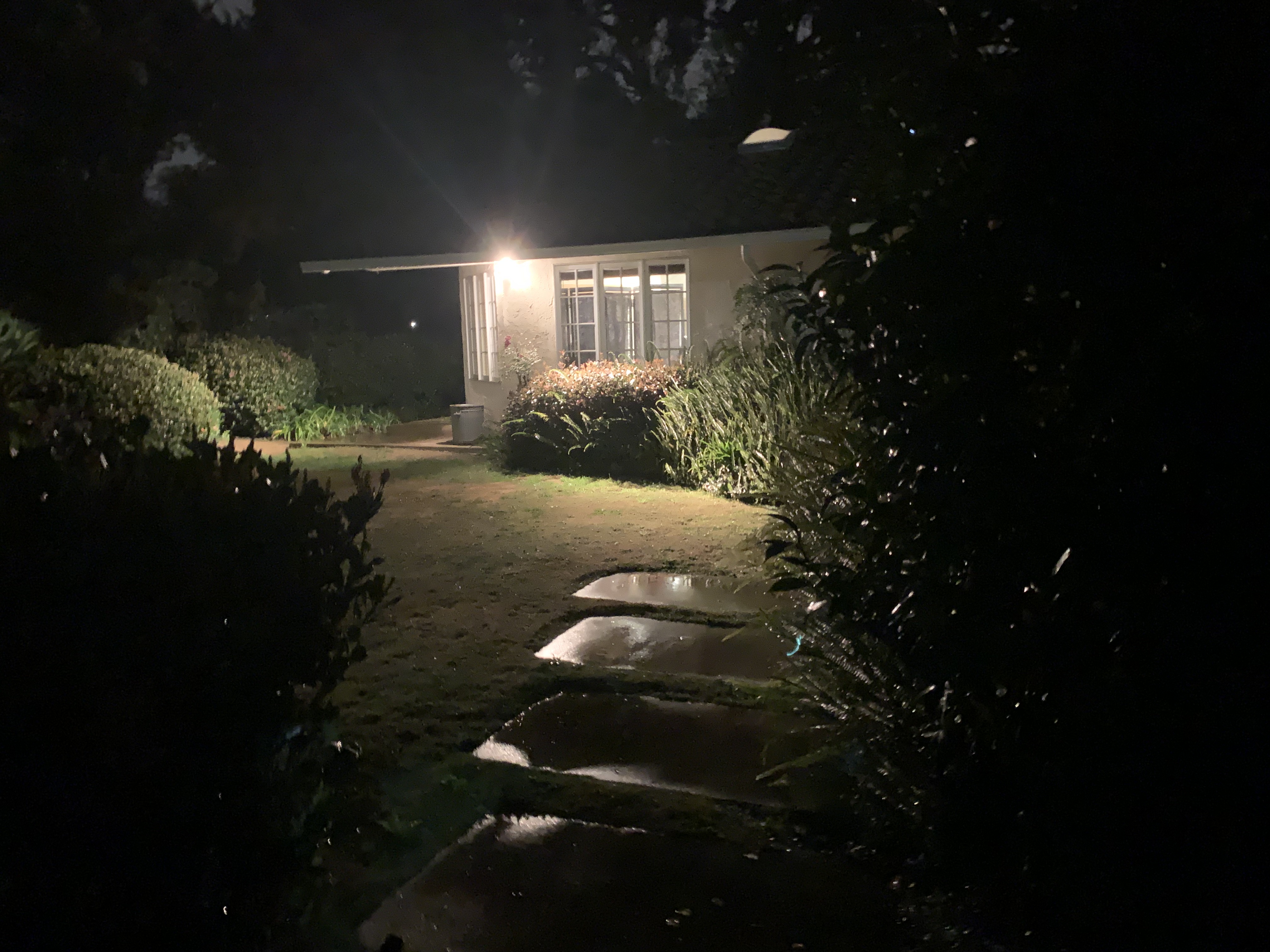
Sadie enjoys days like this morning–gray, cloudy, drizzly. It hasn’t rained enough to cause flow a darksome torrent. But the moisture from the drizzle enhances the aroma of the earth and all the life that tracks across it.
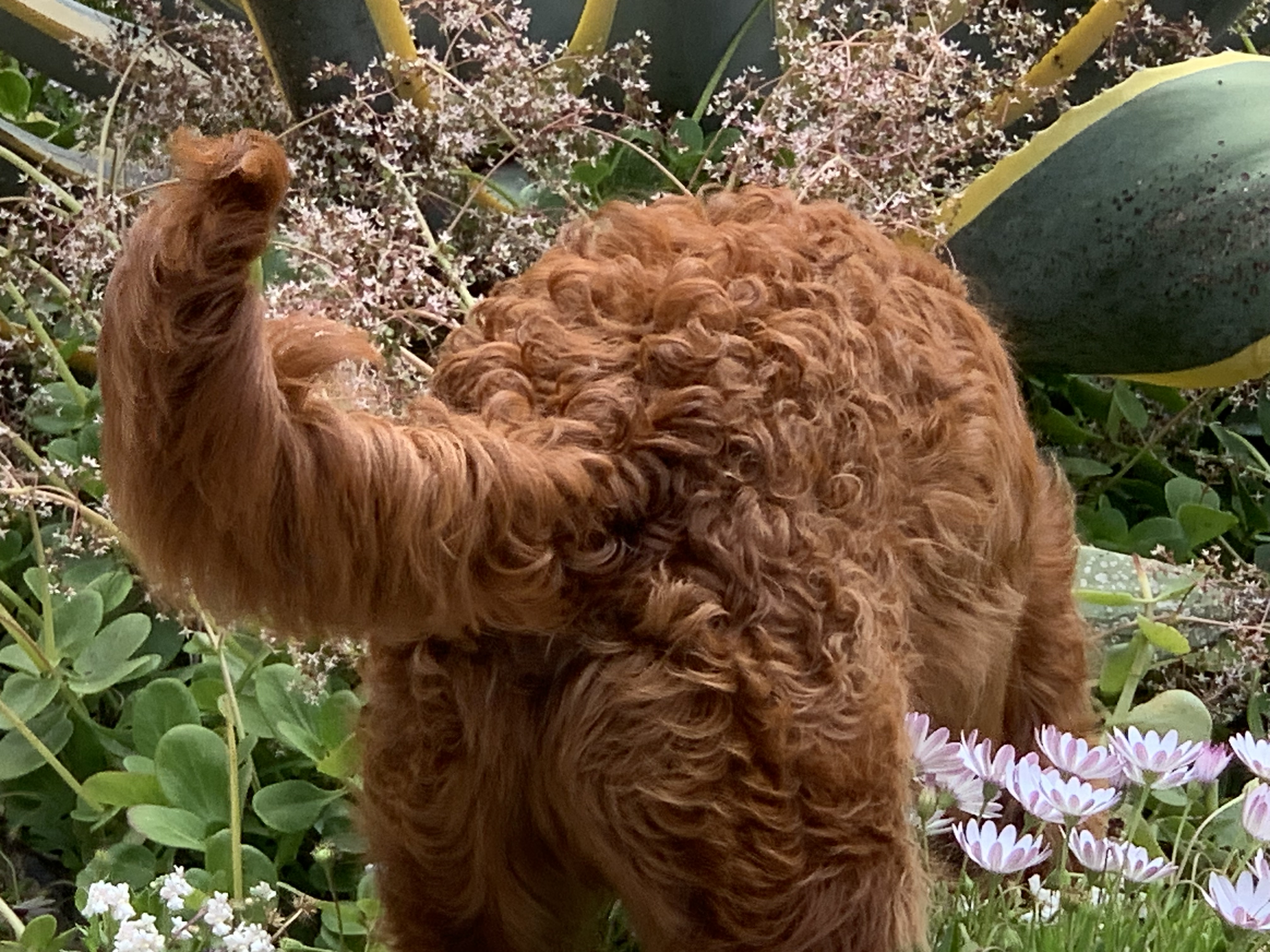
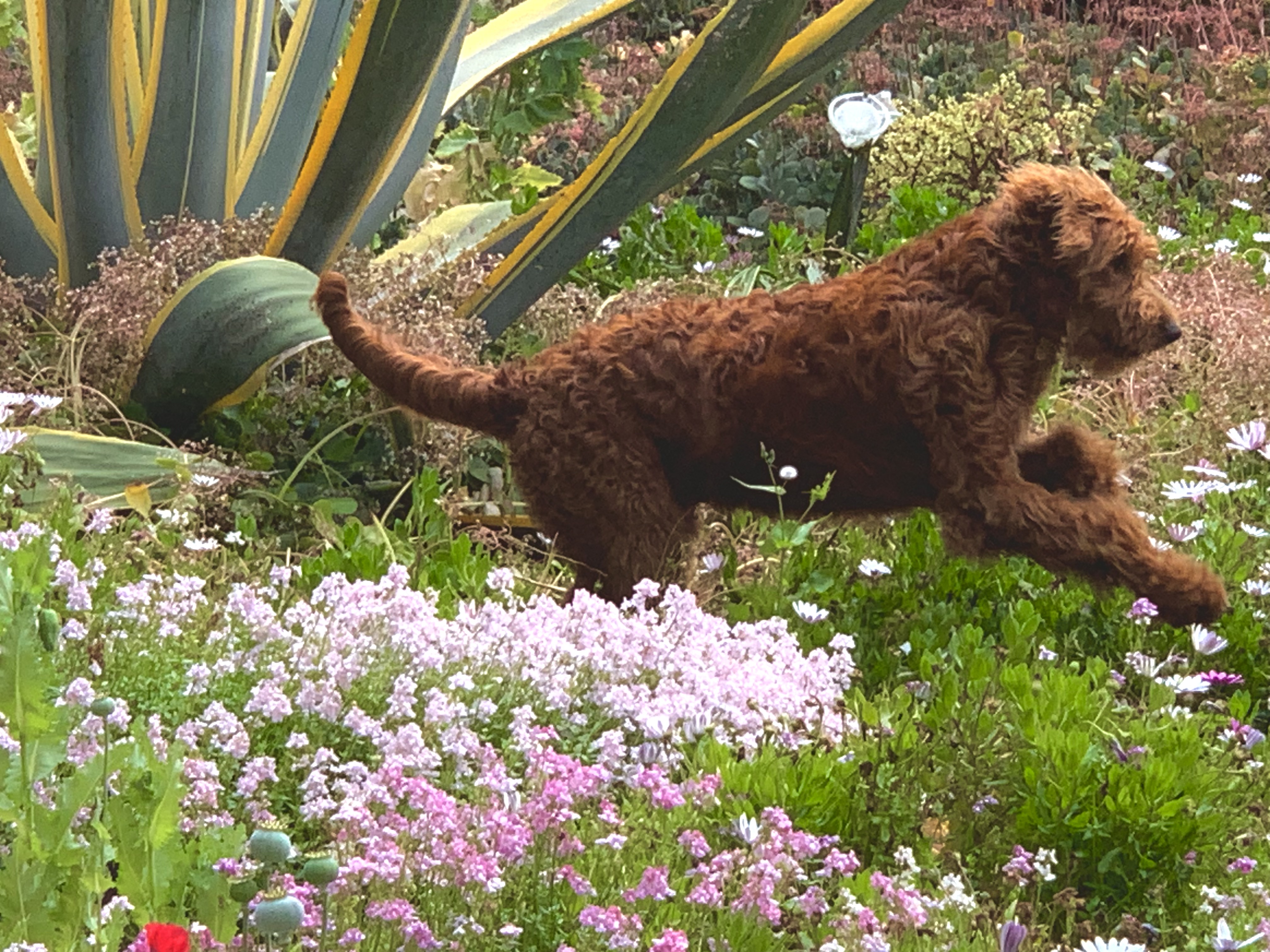
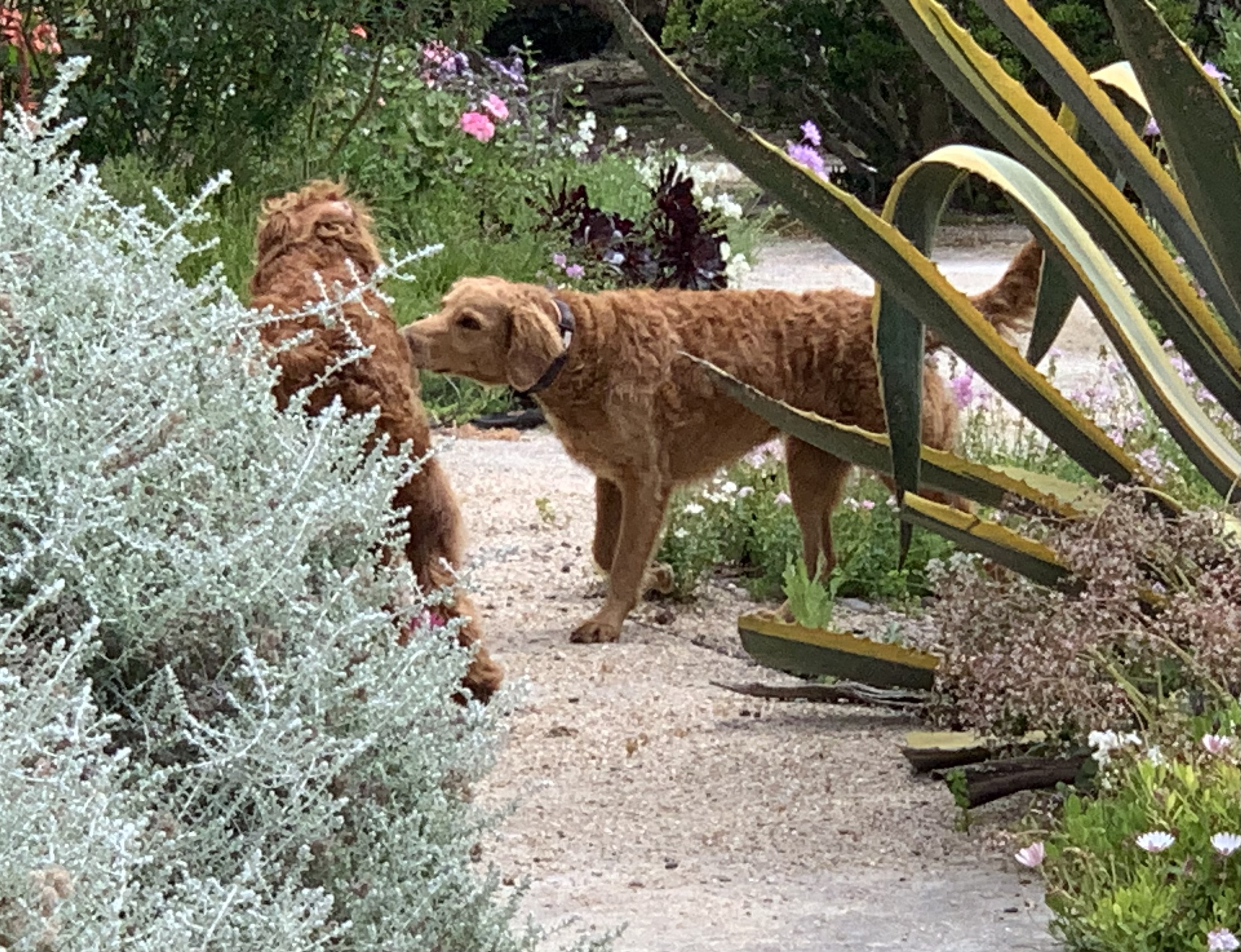
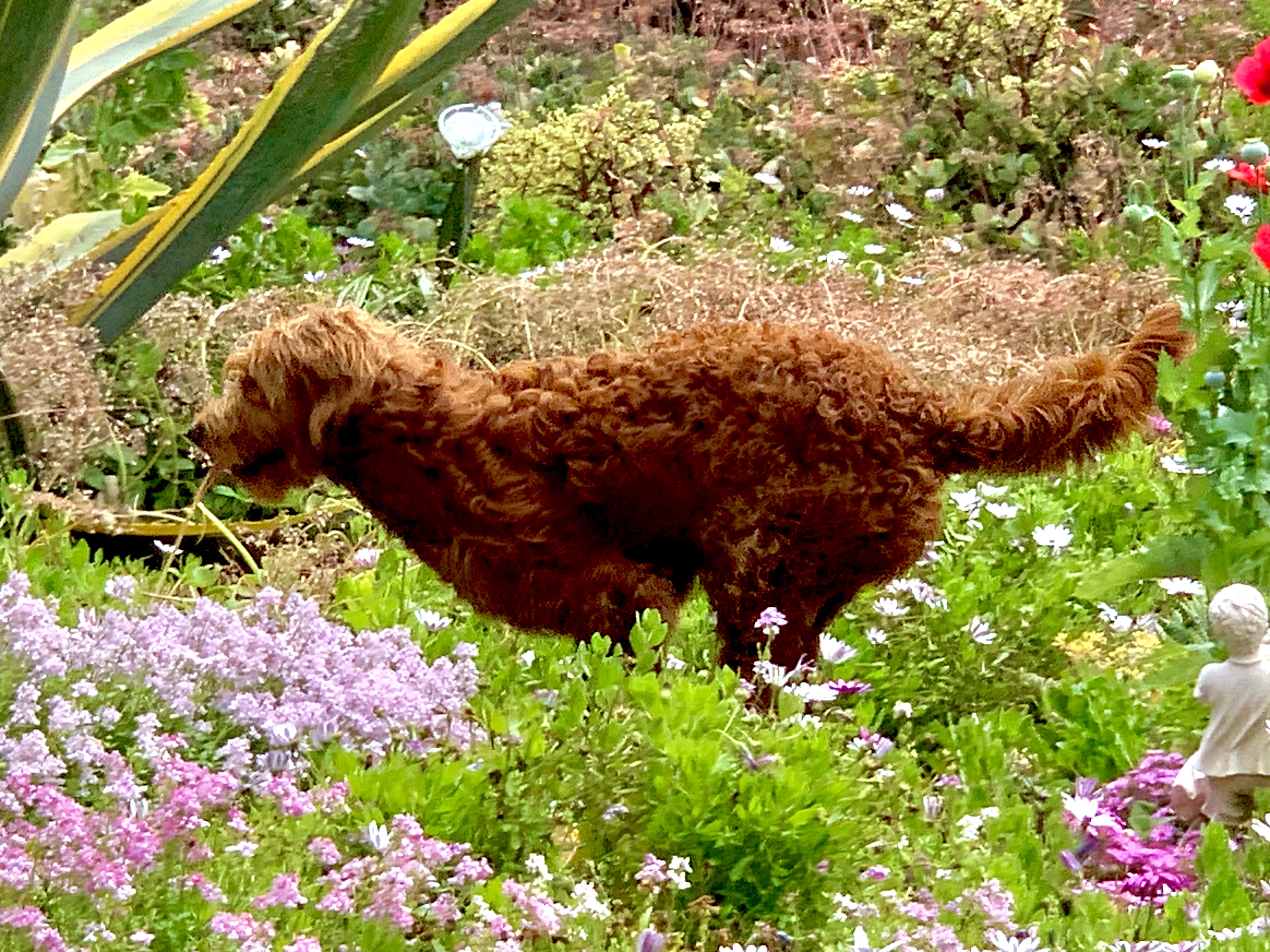
Bailey: “There’s something in here! I can smell it! Peter Cottontail!” Sadie: [Stares at me] “What is Bailey on about? I don’t smell anything.” Bailey: [Runs through flowers] “Sister Sadie! Sister Sadie! This way! This way! I know it’s here! I can smell it!”Sadie: “Bailey! Chill out, brother. That rabbit you smell left 1200 sniff-teens ago.”Bailey: “No way! I smell rabbit! It’s this way!! Come on, Sis!”Bailey: “Where did the rabbit go? Down a rabbit hole? Into a magician’s hat? Stranger things have happened, you know.” Sadie: [Looking toward the golf course at the ever-changing course-changing antics of her younger brother]: “You were just down there!”Bailey: “No! Scratch that! How could I have been so anosmic? It’s *this* way!”
Bailey: [Sheepdogishly}: “Or, this way!”
Dogs don’t always immediately choose the right path. But they are willing to work together; to change direction; to admit their mistakes; and they hardly ever blame others for their own mistakes.
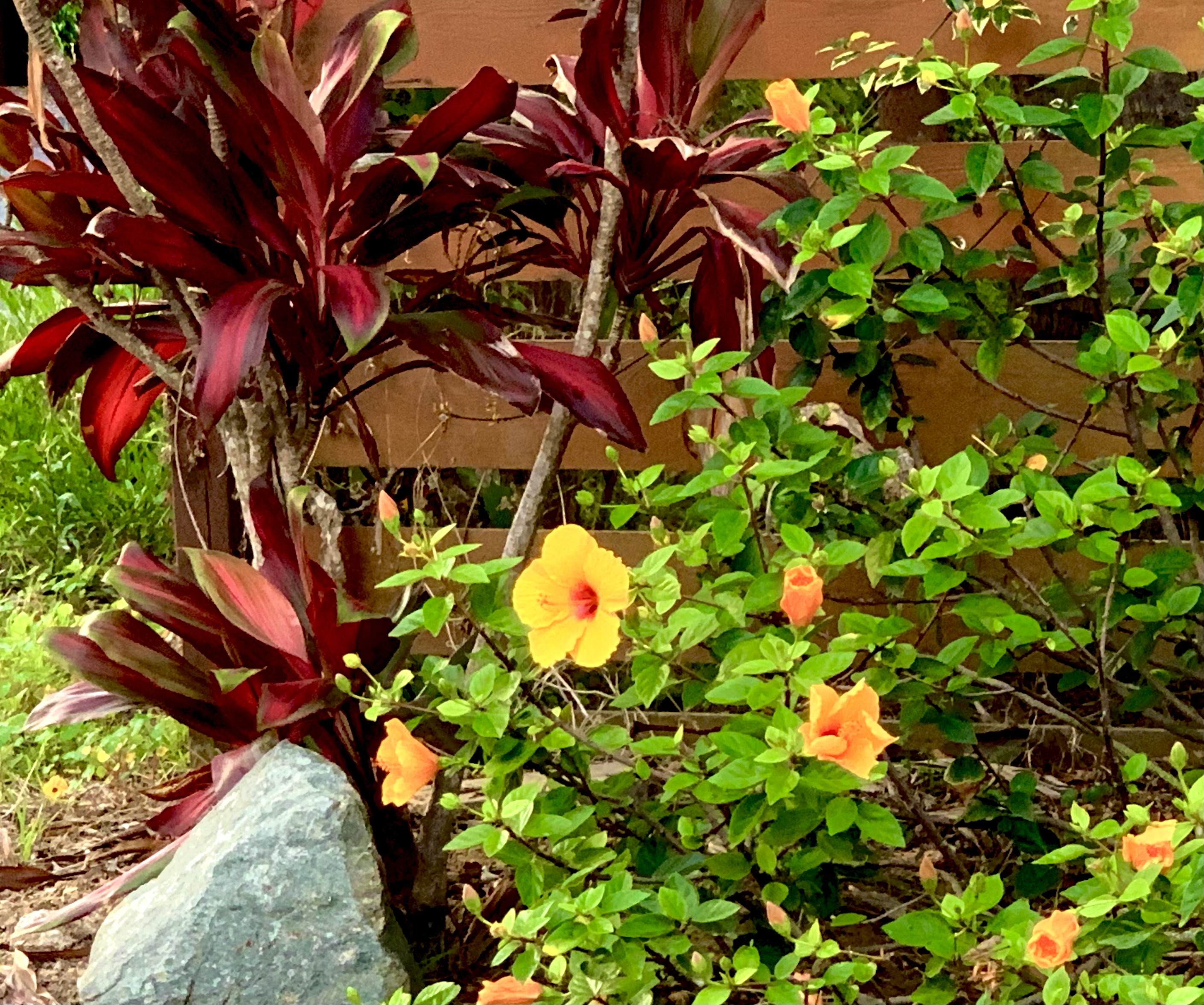
The San Diego area has famously good weather. Flowers blossom forth all year round. I like it!
But that doesn’t mean it never rains. In fact, I’m glad it does rain. Without some rain, it would be much less pleasant. Fewer plants would grow which would mean fewer friends from diverse parts of the Great Tree of Life: fewer butterflies, fewer lizard, fewer rabbits, fewer crows, fewer hummingbirds and fewer bees just to name a few of the critters I see almost every day.
On the other hand, I was supposed to play tennis this morning and that had to be canceled. We can’t really let the dogs out by themselves to play in the garden because now it’s too muddy. I have to take them out for a walk even when it’s raining. It seems to me that houses should be built with multi-species toilets that would allow humans, cats, and dogs all one place to go without causing a mess. It doesn’t seem that difficult a design problem.
But in our actual house, the toilets are only for humans so it’s important to take the dogs out several times a day. And that means I end up walking in the rain.
It’s wet. My feet often get wet. If it rains hard, I get wet on my head, my back, and my legs as well. As for the dogs?
They love to go out—rain or shine.
Sadie, who is now nearly three years old, often looks up at the sky when we begin a walk. I talk to her about the weather, the airplanes she spots at night, the moon, the stars, the planets. Perhaps she doesn’t understand every word, but, honestly, neither do I. I don’t know “why” there is gravity or how it relates in some way to the strong and weak nuclear forces. I’m not even sure there is a “why” to it.
What I do know is that Sadie does not just tolerate the rain. She loves the rain. She cannot change the weather. So why not love it?
Nor, for that matter, can I change the weather.
When it rains hard, the nearby storm sewer provides a mystery: a never-ending rushing gush of water! She looks up at me as though to ask: “Where does the water go?”
“The ocean,” I explain. To Sadie though, it remains a portal into another universe.
On its way to the sewer, the water rushes down the gutter and the raindrops cause bubbles to appear in the stream! Bubbles! Sadie snaps at each bubble and destroys it. Perhaps she does this in case they are tasty fish, but I think more likely she does it for the same reason I used to like to pop soap bubbles: sheer joy.
The moisture changes the intensity of smells and provide her with unusual odors. She likes to drink the water on the street which I discourage since the water probably contains more gas and oil than is good for her. Soon, I think, my water supply too may be too polluted to be healthy.
The passing cars make more noise in the rain. If it’s a hard storm, the wind blows the trees which she often looks up at as well. She does not wear shoes or boots and seems not to mind at all splashing through the cold puddles on her way to the next novel aroma.
These days, I’m not a big fan of the rain. I’d rather play tennis. I’d rather take pictures of the flowers in the sunshine. I’d rather not get wet.
But Sadie helps me remember an earlier time when I desperately wanted to go outside in the rain. I loved to splash through the mud puddles and wade in the just-born streams of the gutters. The deeper the stream, the better. I tried not to let the water spill over the rim of my boots—not because it was unpleasant to have the water suddenly soak my socks but because I knew my parents would be quite upset. Sometimes, I came home and managed to hide the fact that I had waded into too-deep water. That, in itself was a pleasure.
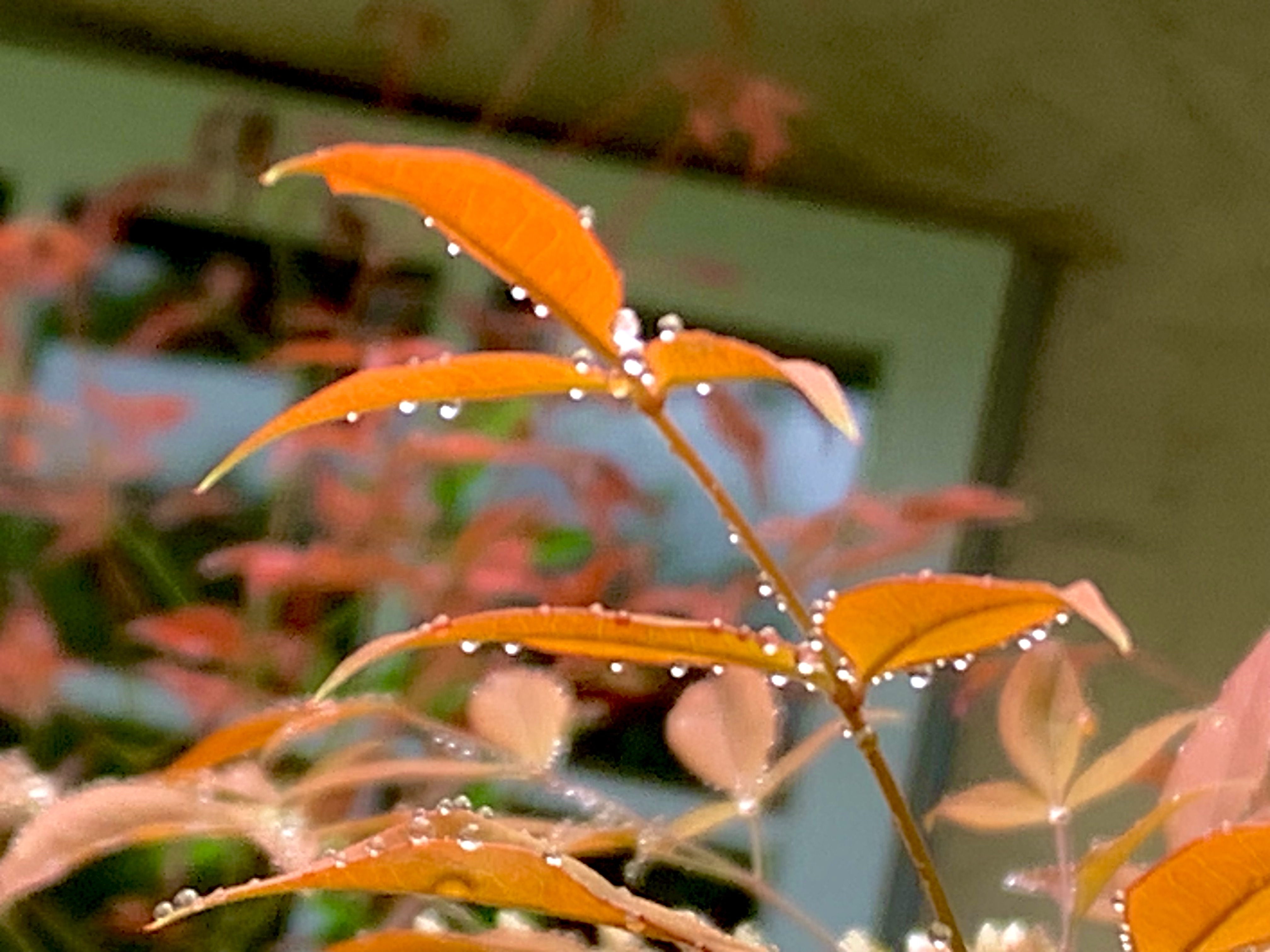
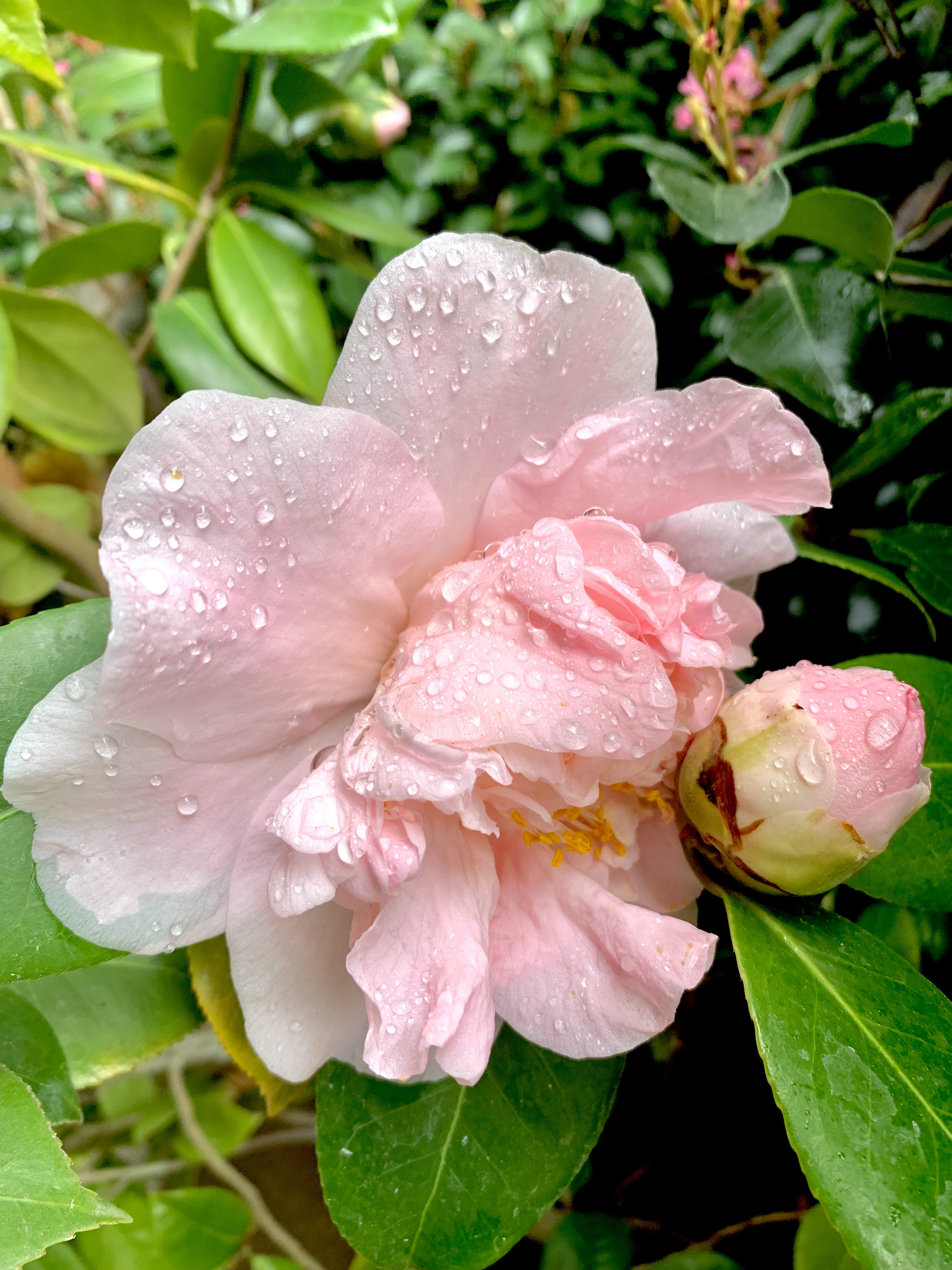
Even though I’m not as much of a rain fan as are Sadie and her younger brother Bailey, I’m something of a fan. The raindrops on flowers are beautiful. I enjoy Sadie’s enjoyment of the rain.
Why not love it?
Yes, we do teach our dogs.
We teach them tricks.
And, the dogs teach us.
They teach us to love and to live and to sing of the rain.
Today: A beautiful day in San Diego. Yes, it’s true. There are many such—even in January.
Our first discovery was a hawk which I heard the moment we stepped out the door. I tried to mimic the sound and told Sadie it was a hawk. We walked to the end of our street where the hawk was perched on the lamp post. Sadie looked up at it as I greeted the hawk. So far as I can recall, she’s never barked at one.
Even before we reached the hawk, Sadie made another discovery. I have no idea what it was but I know from her level of excitement that it was a *huge* discovery. Rather than drag her along to some predetermined goal of my own, I indulge her explorations even when I can’t tell what it is that she’s so enthralled with.
For her part, she tolerates me stopping to take pictures. I don’t think she understands why I do it. For that matter, I’m not sure I fully understand why I do it. But I enjoy it. I like sharing them.
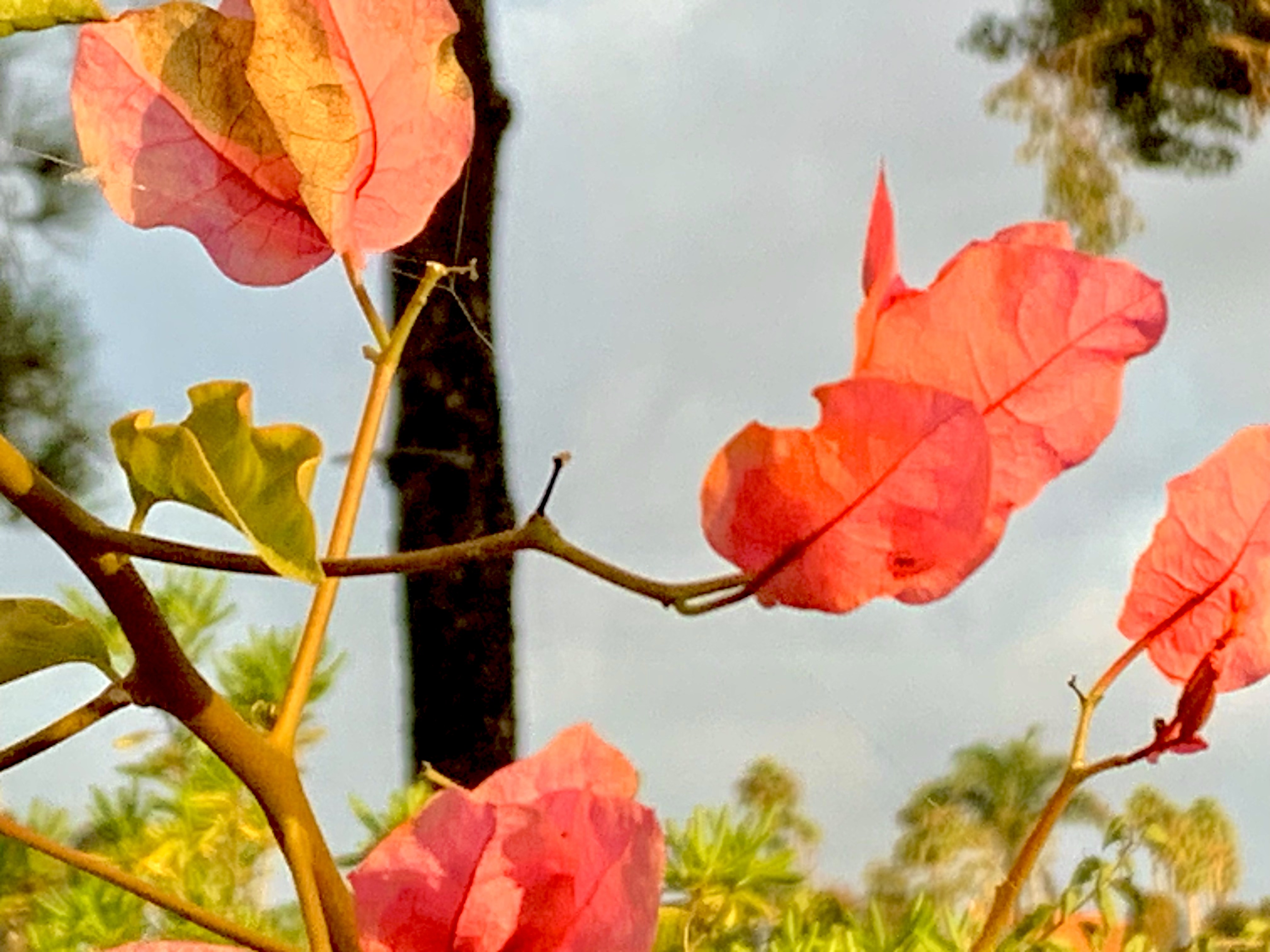
At one of the many “choice point” corners, the sun was just beginning to rise enough to light up the bougainvillea bush. It’s quite prevalent in the San Diego area so I assume it tolerates the climate quite well.
Next we saw the sun rising. Contrails are also visible. Contrails are mostly composed of the potentially lethal substance: “Hydrogen Hydroxide” aka HOH or, more commonly H2O; i.e., water. Yes, you can drown. OTOH, you are more H2O than anything else and you can’t live without it. We tolerate the presence of water and even encourage it even though approximately ten people a day drown in America.
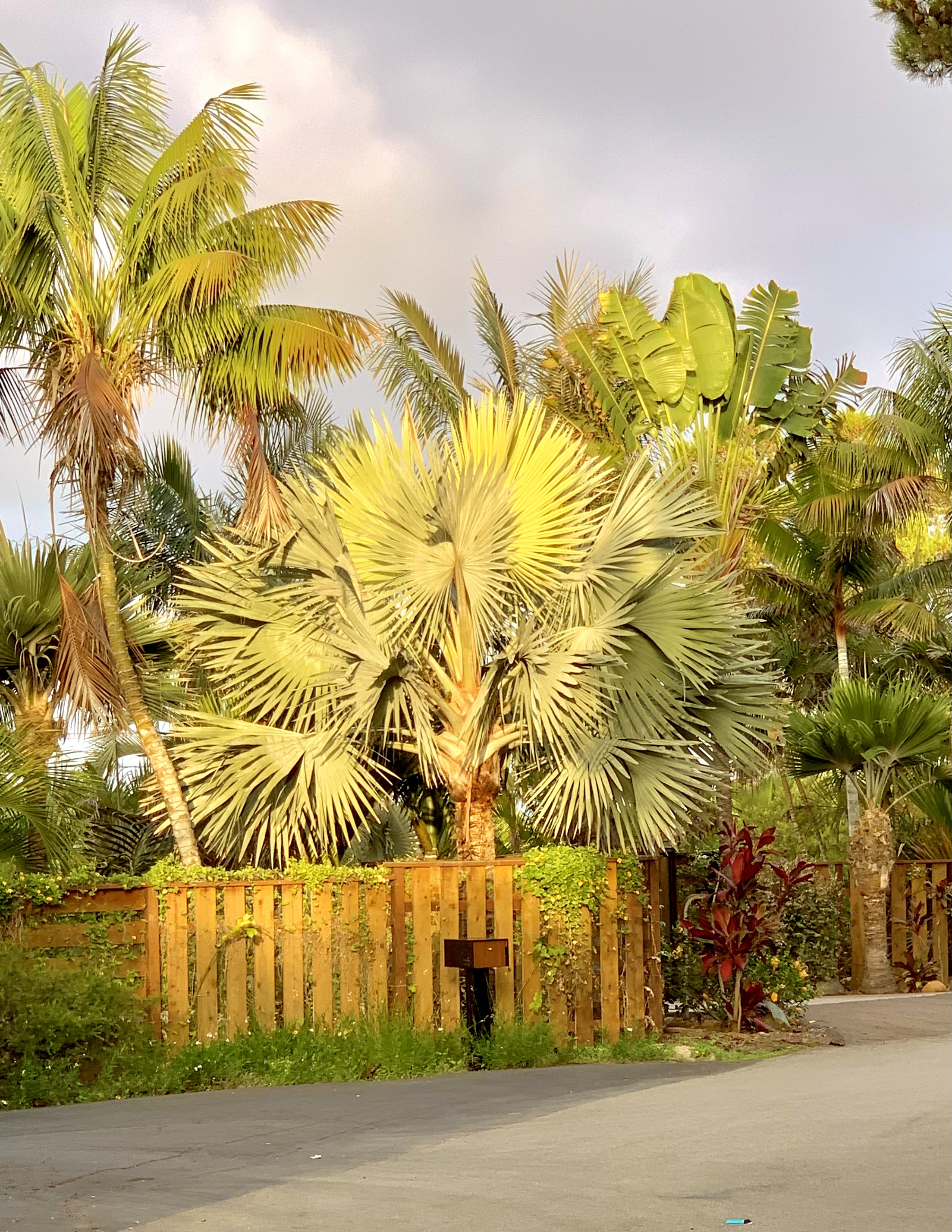
The pineapple palm shown below has its flowers lit by the early morning sun which tends to exaggerate their orange color. Palm trees flourish in California and Florida. But apparently, it isn’t so much that the relish the sun and the heat as that they don’t tolerate freezing temperatures very well. I saw some, for instance, in Limerick, Ireland, not known for a balmy climate.
I next spied these sunlit Christmas decorations. Of course, I could tell they were Christmas decorations and not Kwanza or Hanukkah decorations because, as everyone knows, the wise men found their way to Bethlehem on Reindeer. Or camels. Whatever. Jesus is often portrayed as blond and blue-eyed, so… Anyway, speaking of tolerance, some folks believe all Christmas decorations should be removed no later than January 1.
Why?
Are they confused? Do they look at these reindeer and think, Oh, my God! I thought we just had Christmas, but no! Here it is again already! I’ve got to buy more presents! Or…? It bothers me not the slightest if people want to keep their decorations up all year, be they Christmas, Easter, Halloween, or whatever. After all, some extremely wealthy people celebrate “Wealth Day” 365 days a year with their displays so why not?
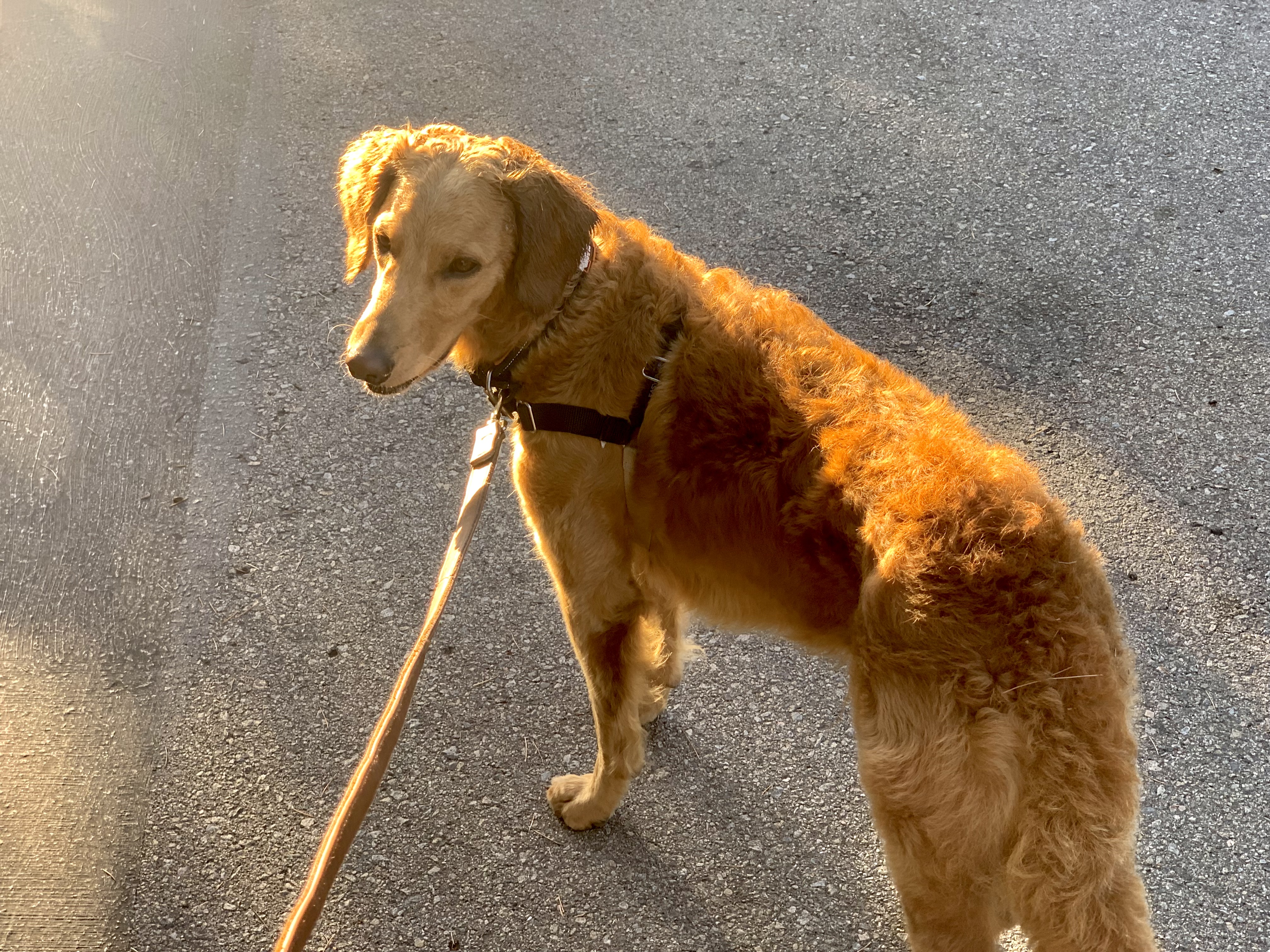
As we continued our walk, the golden sun lit up Sadie’s fur so I snapped the picture below.
And then we came to the golf course. This is the tenth green. If you want to play golf, you will need to become tolerant of your own errors.
So, as we began the long climb back up the street to our home, I began to wonder why tolerance seems so difficult for so many people. Intolerance of other races. Intolerance of other religions. Intolerance of other cuisines, clothing styles, color schemes, music, book genres, traffic merges, waiting in line, sexual preferences, and so much more.
On the one hand, I don’t want to “be” anyone else or any other organism. I admire the hawk but I don’t want to be a hawk. I’m happy being a human. I admire many of Sadie’s abilities. But I don’t want to be a dog. There are many choices that other humans make which are different from the choices I make.
It’s kind of a fun game. “Find Waldo.” Or, “Find the Pig in the Clouds.” And—once you find it, you typically find it immediately the next time.
Here’s a variant that I like: “Find the Beauty.”
The idea is simple. You go to an art gallery or a museum and it’s fairly easy to find the beauty. No big surprise there.
Go into a natural setting and you’re often absolutely surrounded by beauty at many different levels of scale.
Go to see a world-famous architectural achievement, and you will see beauty.
But—you know what? There’s also beauty to be found in many ordinary and every day places and circumstances. Since you can’t always control where you are, it’s a good skill to find that beauty wherever you are.
Today, Wendy and I took Sadie and Bailey out to one of our favorite dog-friendly restaurants. We had a very long wait. None of the four of us is high on the scale of patience. When we finally sat down, however, the dogs were very well-behaved.
While we waited for our food to arrive, I looked around for Waldo.
He wasn’t there. In fact, no-one even had a checkered shirt on.
So, instead, I looked around for beauty.
As usual, I found it, at least to my eye.
Give it a shot. You’d be surprised where you can find beauty.
Fit in Bits suggests many ways to work more fun, variety, and exercise into daily chores.
Corn on the Cob is an essay on mindfulness and gratitude for simple things.
Fifteen Properties begins a series of posts about the fifteen properties that architect Christopher Alexander said characterized both natural beauty and good design.
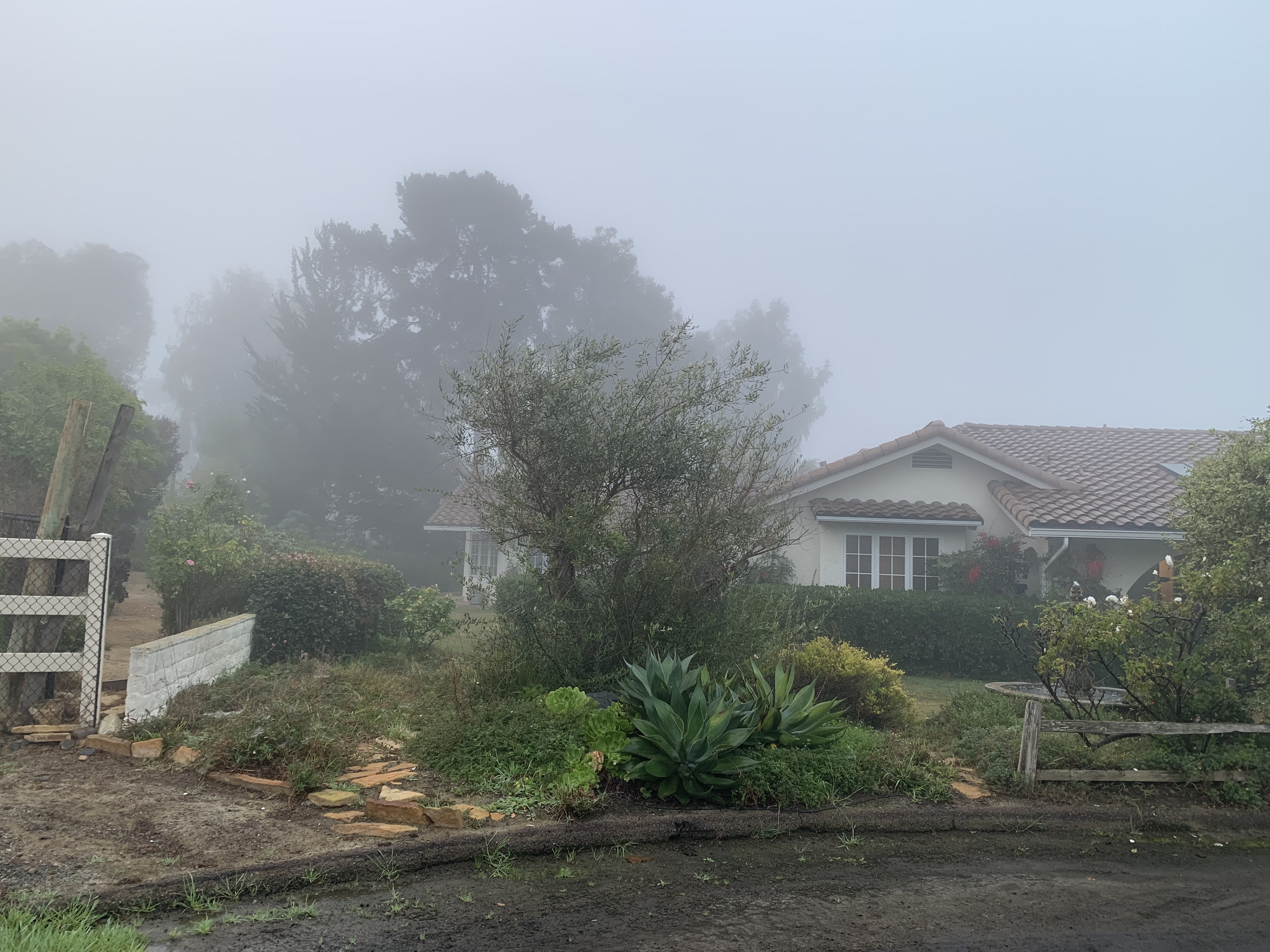
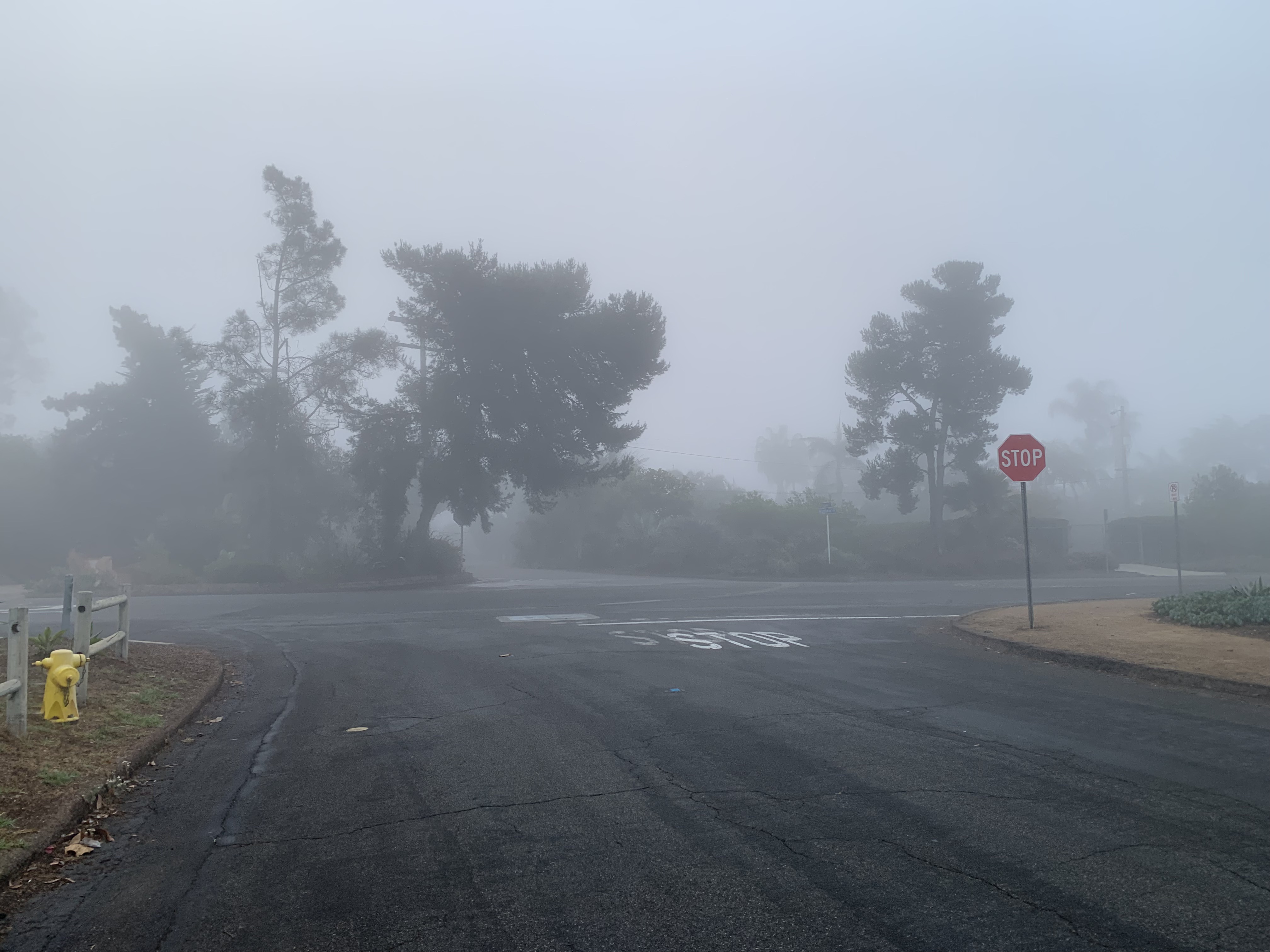
Our morning walk began, appropriately enough, in heavy fog. No sun. Cold. Damp. A slight but persistent icy wind.
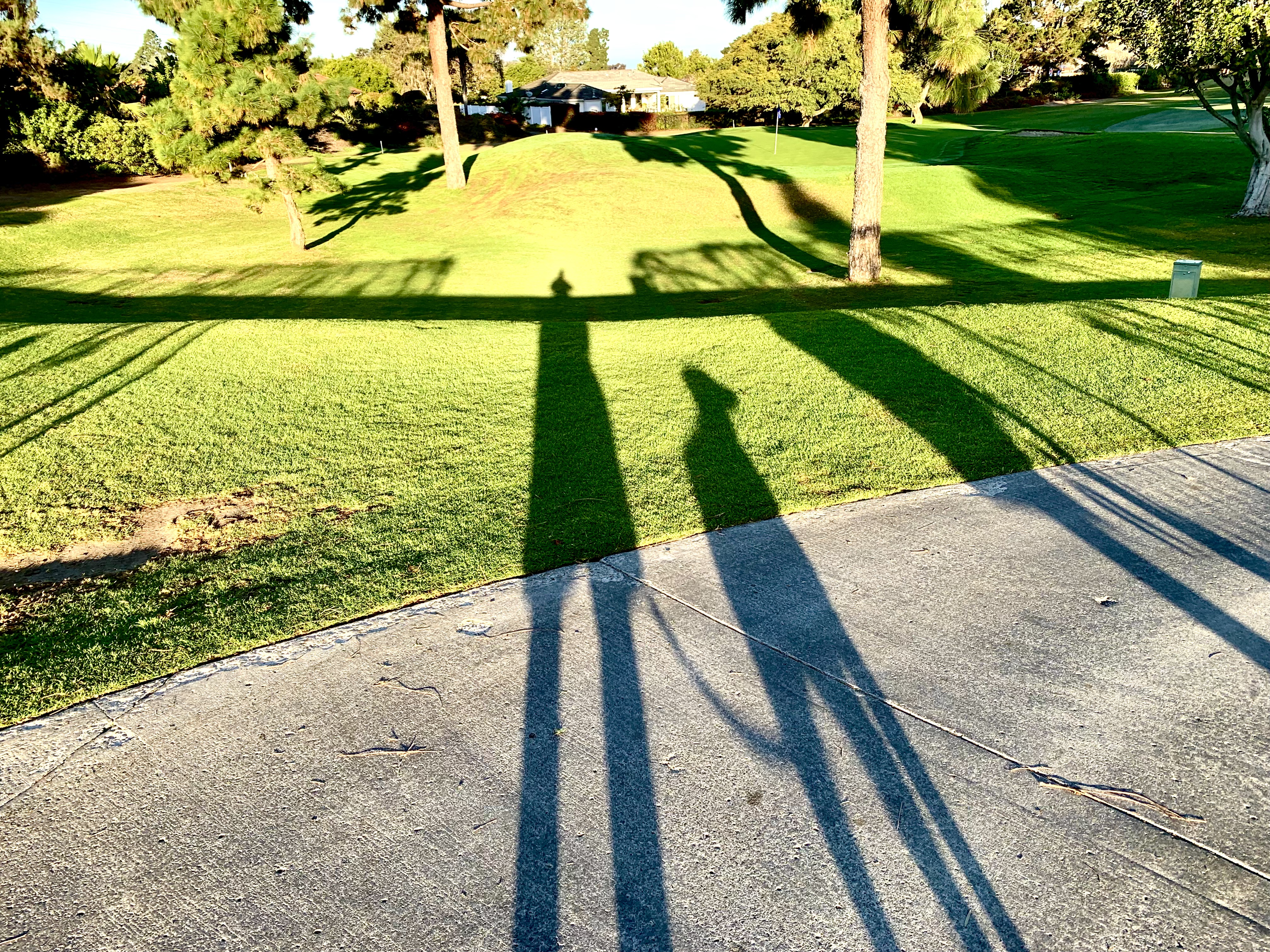
How appropriate, I thought. No sign of a sunrise. Not near here.
Sadie, however, seemed oblivious to the fog, the damp, the cold, the politics. Before our walk began, I told her we’d try walking without the shoulder harness but she’d have to do “Good Walking” with no Pulling. She’s strong and pulling hurts my back and knees but especially my ankles and arches. The harness helps prevent her from pulling, but doesn’t really eliminate it.
She did good walking.
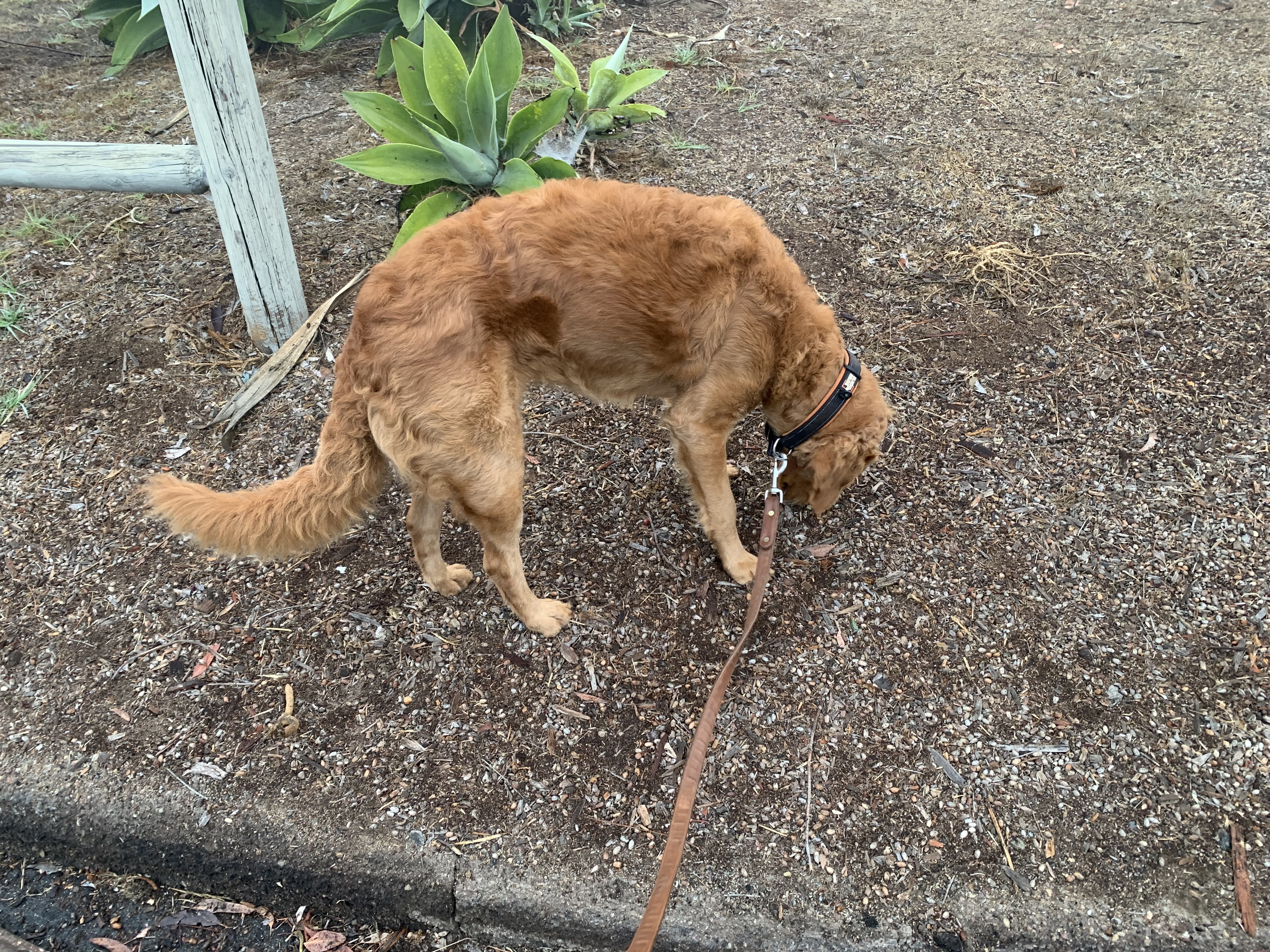
And I noticed that, up close, she is still as beautiful as ever. No gold or red from the rising sun, but still beautiful.
Indeed, the fog shrouds what is distant, but up close? Bright signs of beauty still beckon. If we bother to look.
Looking more distantly–ominous, if not downright evil.
Even so, the lonely mourning dove coos on her thin wire perch.
Soon, the sun does begin to shine. Darkness, like cancer and greed, always eventually loses.
One of the most pleasurable “chores” I’ve ever had is walking our goldendoodle Sadie twice a day. It’s exercise. It’s a chance to see nature’s beauty. It’s a chance to interact with Sadie and informally explore her mind. She likes to vary her route. She likes to return to “known” spots and also to explore new places. She knows when we are “headed home.” And, once we begin heading home, she typically begins to engage in a variety of “procrastination” behaviors. She stops and licks herself. She stops and looks back to see whether any of her neighborhood friends—human and dog—are headed our way. She suddenly finds an incredibly interesting scent to track down.
Her procrastination is something I completely understand. I did the same thing as a kid. And my kids did the same thing. And their kids did the same thing. While I sympathize, it also gives me a chance to think. What does it mean to be heading home? Can one ever go back home?
Undo and Home Base
Early in my career as a researcher in Human-Computer Interaction, I had an opportunity to contribute to a set of “Guidelines.” Although the New York Times once erroneously ascribed the “invention” of UNDO to me, I did not invent it. It seems to me that the concept is actually quite old. I did, however, mention in the guidelines that UNDO should be provided as well as providing a “Home Base”—that is, a way to go to a state where you could begin again.
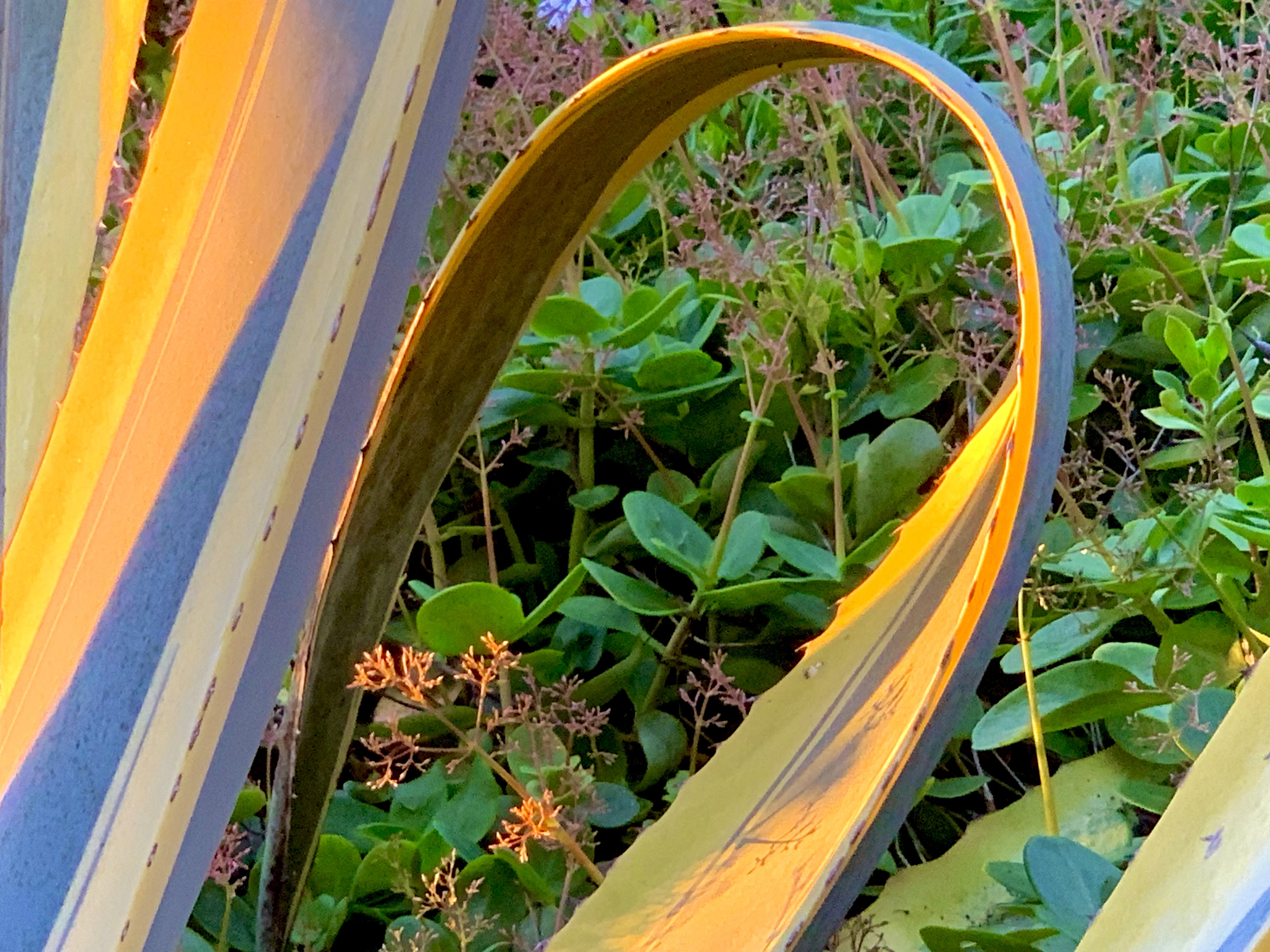
To Sadie, and to me, our home is our home base. Like other home bases, we conceptualize them as being a return to an unchanging safe space. Relatively speaking, and roughly speaking, that’s a good characterization. It’s relative because no place on earth is absolutely safe. Disasters can come in many forms: extreme weather, wars, crime, and disease to name four. Also, even if disaster doesn’t strike, we can be sure that home will never be exactly the same as when we left it. Everything is constantly in motion and in flux. It can be comforting to imagine that home stays the same, but it doesn’t. Nor does Sadie. Nor do I.
Sometimes, a moderate amount of change is nice. I like to take photos in our beautiful garden. I end up sometimes taking pictures of “the same” plant or flower several days in a row. I also tend to take flowers when they bloom, year after year. Sometimes, these pictures look very similar on successive days or on successive years. But in actuality, they are never exactly the same. The plant itself changes day to day (as do I; as does Sadie; as do you). In addition, the light changes from day to day. The surrounding plants in the garden also change from day to day and year to year. In addition, when I take a picture, I’m not in the exact same position. The software on the iPhone changes over time as well. The lenses on the iPhone change over time. Even if by some industrial strength replicability dream (nightmare?) I could take exactly the same photo, you wouldn’t perceive it as the same because your eye/brain system is always changing, both organically and by virtue of your other visual experiences.
Another Sunset
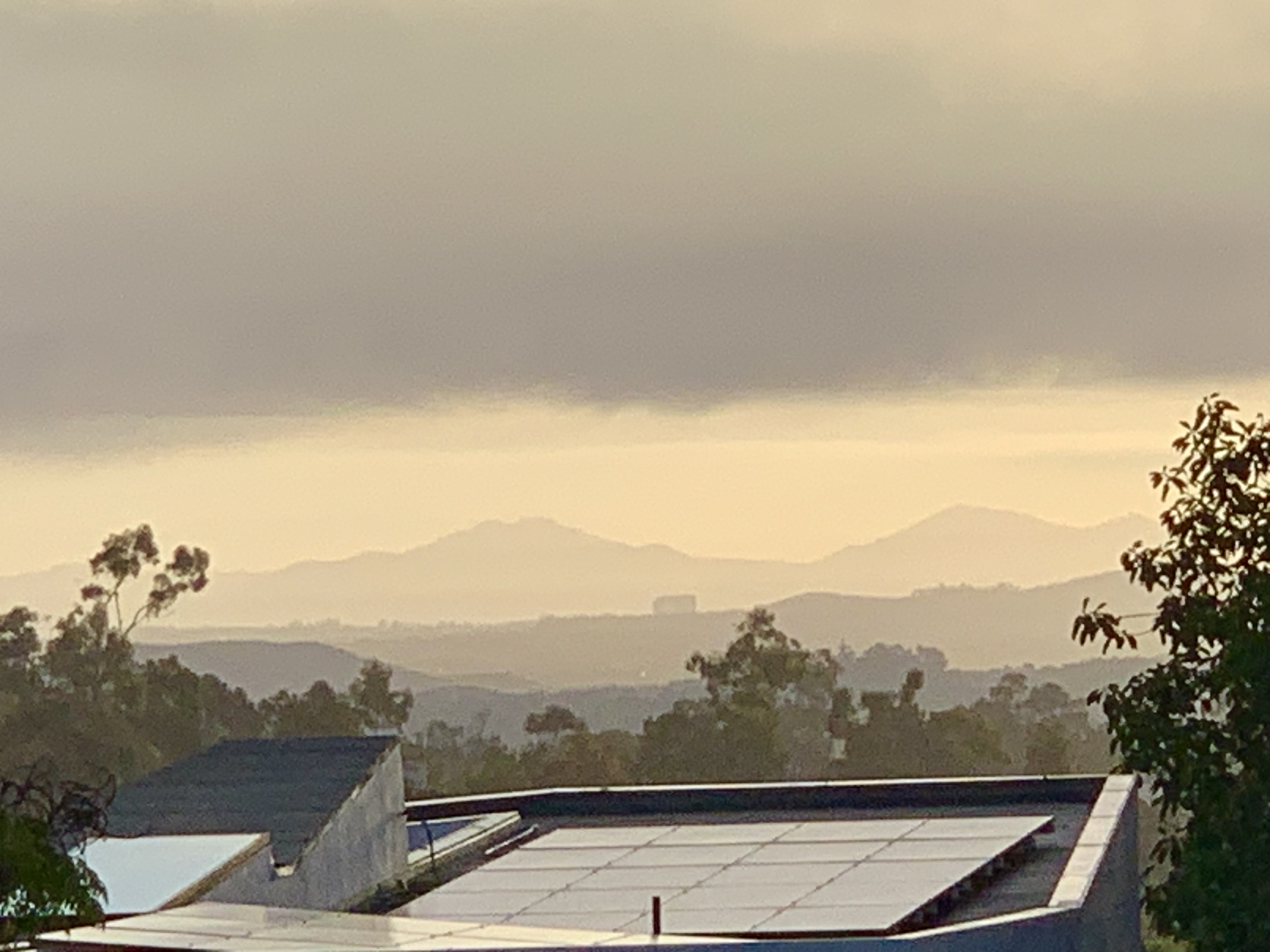
There are characteristics of sunsets that we see as similar over time. Here are three sunset shots years apart.
Another “Another”
Are there any replications? In my mind, sure. In reality, no.
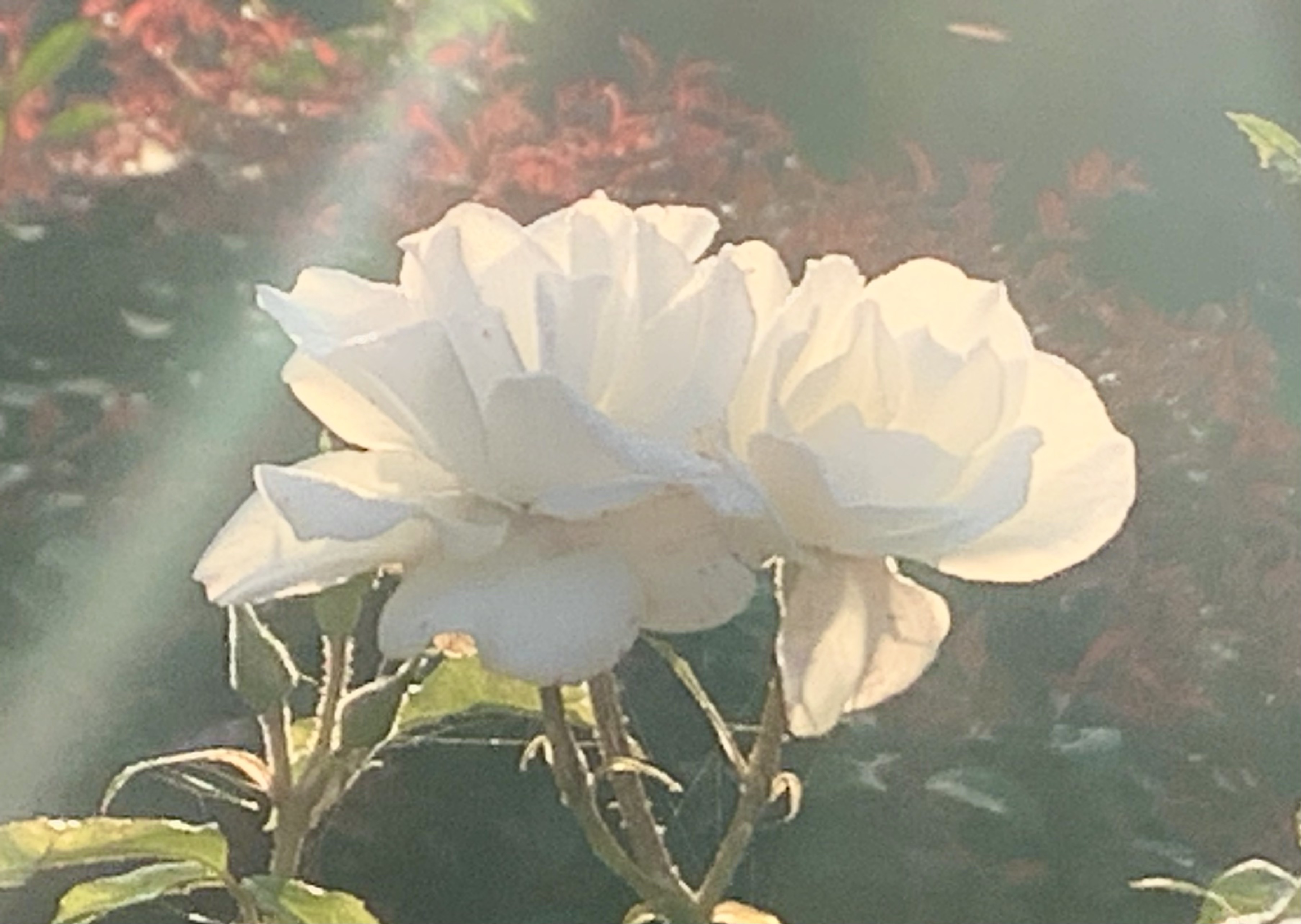
A rose is a rose is a rose, but not only are two different roses ever identical. Even one rose is not the same day after day, hour after hour, or even second by second.

Another Trip Around the Sun
What is more steady than the movement of the earth around the sun…or the sun around the earth. In the Medieval times, the Europeans wanted to describe in perfect circles and put themselves at the center of the universe.
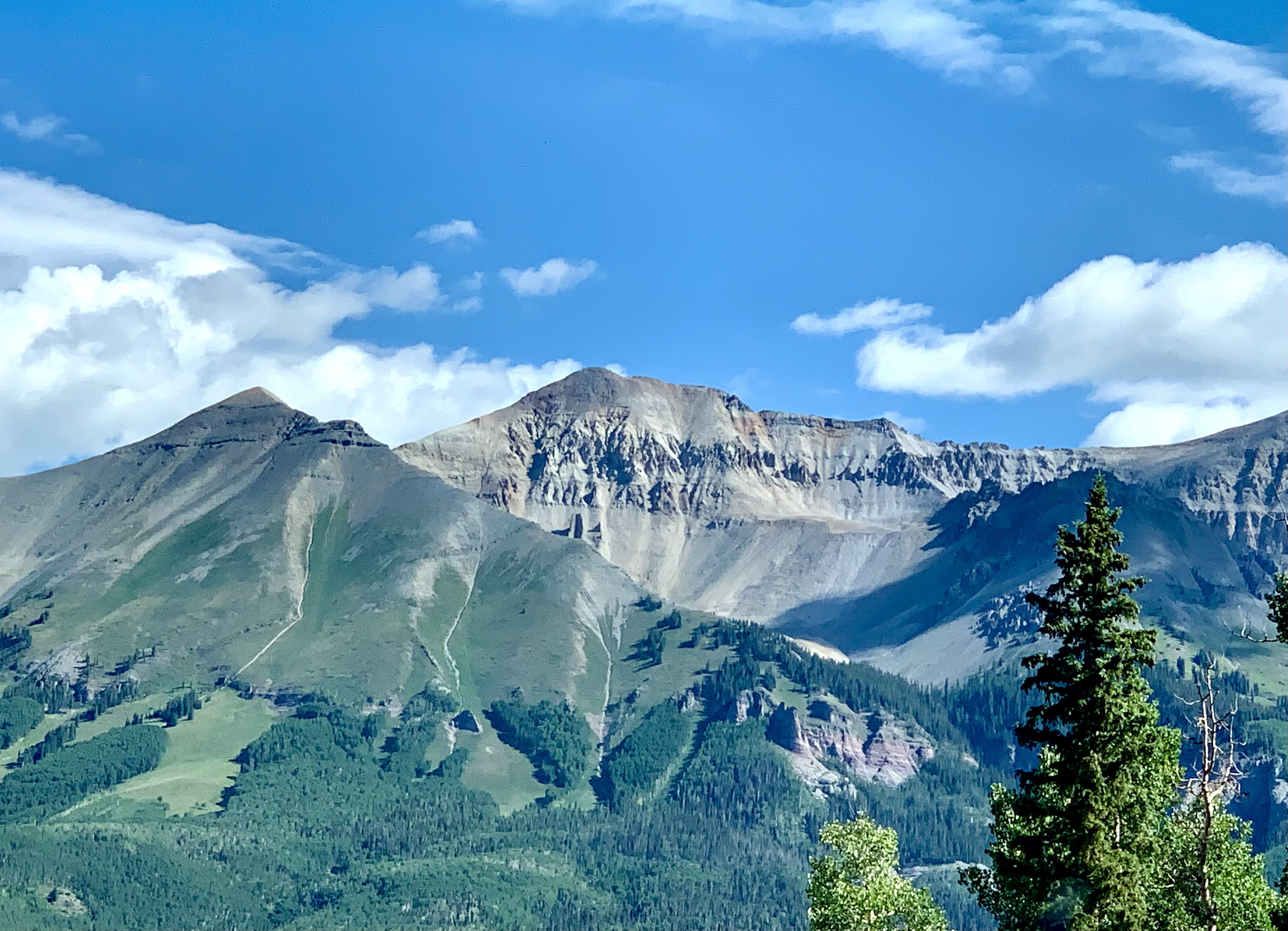
Now, we are more sophisticated and know that the earth actually orbits the sun. Our seasons depend on the relative position of the earth and the sun. But while we are aware of our trip around the sun, earth does not return to the same spot. Today is November 1. Next November first? The sun will have traveled through our galaxy 6,942,672,000 kilometers. That’s a far piece. I’ve run a number of 10K races. The galaxy travels a lot faster.
Another Homecoming? Is it possible? Can we use time machines?
Can we go back to the 1950s?
Can women simply forget that they were once treated as human beings?
In order to work effectively, today’s technology presumes a whole set of other technologies, skills, infrastructure, attitudes, processes, laws, rules, regulations. If we actually tried to go back to 1950, we would miss.
By about 500,000 years. Every so-called primitive tribe ever studied has customs, rules, practices, and rituals. Going back to the 1950’s by destroying the rule of law won’t work no matter how loudly people scream for it. You can’t scream your way to the moon. You can’t scream your way to Mars. You can’t scream your way to happiness. You cannot make two plus two equal five, no matter how loud you scream. Sadie can’t bark them into equivalence. A snake cannot hiss them into equivalence.
You can typically get yourself home. But no matter how hard you “insist,” home will not be in precisely what it was when you left. And, it definitely won’t be in the same place in the universe. Not even close. Going back is a mental exercise and never a physical reality.
Our dog Sadie barks in many circumstances. She barks if someone comes to the door. Or—until recently—she also barks if someone comes to a door on the TV. She barks if we bring up the topic of a “N-E-W—D-O-G-G-I-E” (Hence, the spelling). She likes to sniff nearby trucks. If there’s a person inside, she ignores them. Unless, they open the door, that is. If that happens, she barks and lunges, though her tail is wagging the whole time. I don’t think she’d “attack” someone unless Wendy or I were put at risk.
Sometimes, she has barked to be let out to go potty, though now, she simply comes and stares at me while sending the thought that she has to go *big* potty! On our walks, for instance, she barked at someone’s (heretofore unseen and unsniffed) Halloween decoration. She barked because a traffic cone had fallen over.
Nonetheless, she is far less of a barker than many dogs I’ve observed.
Her barks, like my words, can be uttered with varying degrees of insistence and urgency. In fact, I hear a rumor that practiced orators can even lie with sincerity and passion. The closest Sadie has come to “lying” is that she barks insistently—hard to distinguish from a “I have to go potty” bark. What she often wants is attention. She’s okay with playing tug, or hide the dragon, or ball in the hallway. Of course, she’s always game for a walk. She doesn’t want to be ignored while we watch news or a series on TV. Even when the movie features a dog, she doesn’t think that counts as “paying her some attention.” (Though she does usually watch those segments).
Today, however, came the most insistent bark ever. I thought I had seen the top of the Bark Scale, but no. What I had heard before was a “6” on the newly discovered ten point scale.
Here is how it happened. We were in the back garden playing ball (off leash). I was picking up the six squeaky balls for another round when suddenly, the air was split with Sadie’s previously undisclosed 10-bark. At the same time, she stood at attention. And then she charged up the stairs toward the house. (“Flew up the stairs” actually, but I didn’t think anyone would believe me.)
As I tried to catch up with Sadie, several possibilities ran through my mind. Was there an actual intruder? Did a coyote or even a puma come on to the property? Or, was it just my wife coming out onto the deck?
I turned the corner and saw the trigger. Our cat Shadow was outside on the deck. Sadie insistently “herded” her back inside. The door to the back deck had been left ajar. By me. Not a puny little jam jar, understand; a dill pickle jar. I came up the stairs but Sadie had already solved the problem and ran inside to follow up with Shadow on the scope of her transgressions. I thanked her.
This is not something that we “trained Sadie to do.” Maybe she found that Shadow’s being somewhere new offended her sensibility in the same way that she objected to our neighbors putting up Halloween decorations without checking with her first. But no. Her bark and physical attitude were much more severe, insistent, and loud!
I had the impression that she sensed that the cats were not to go outside. She had certainly heard us say that in various ways. She had also observed me nudging Shadow back inside when she wanted to follow Sadie and me out on a neighborhood stroll. And, I often give Shadow a rationale as well. That rationale features coyotes quite prominently. Sadie may know what a coyote is. I’ve pointed one out to her once. But even Shadow knows it’s not a good thing.
(AI generated)
To fully contextualize this, I should mention that generally speaking, despite the fact that Sadie outweighs Shadow by a factor of five, Sadie seems more afraid of Shadow than vice versa. When Sadie was a puppy, she tried playing with each cat based on the way two puppies might play together. None of the cats took kindly to these approaches and on at least a few occasions, swiped her with claws engaged. She stands up for herself if one of the cats starts to eat her food, but she isn’t nearly so aggressive as she could be. Of course, I’ve only ever observed this behavior when I’ve—er—um—-observed it. When I’m around, there is a quality to Sadie’s bark of asking for my help and I usually provide it, telling the cats not to eat Sadie’s food.
This made it all the more remarkable that Sadie would be capable of dominating Shadow completely and herding her back into the house.
I do put a fair amount of stock in Sadie’s evaluation of things. It depends on what the domain is. She’s notoriously bad at valuing the plants in our garden. She leaves them alone for the most part but if a ball falls into one, rather than being satisfied with simply removing the ball, she “punishes” the offending plants viciously. She’s not much good at picking stocks either. Nonetheless, today’s episode made me trust her judgement (and reactions) more.
I certainly don’t want to play the tritest role in that most famous of all tropes for Westerns: “Hush, Paint! There’s nobody out there in the dark woods. There’s nothing to worry about!” Want to survive? Pay attention.
Consider me barking quite loudly. Neighing quite insistently.
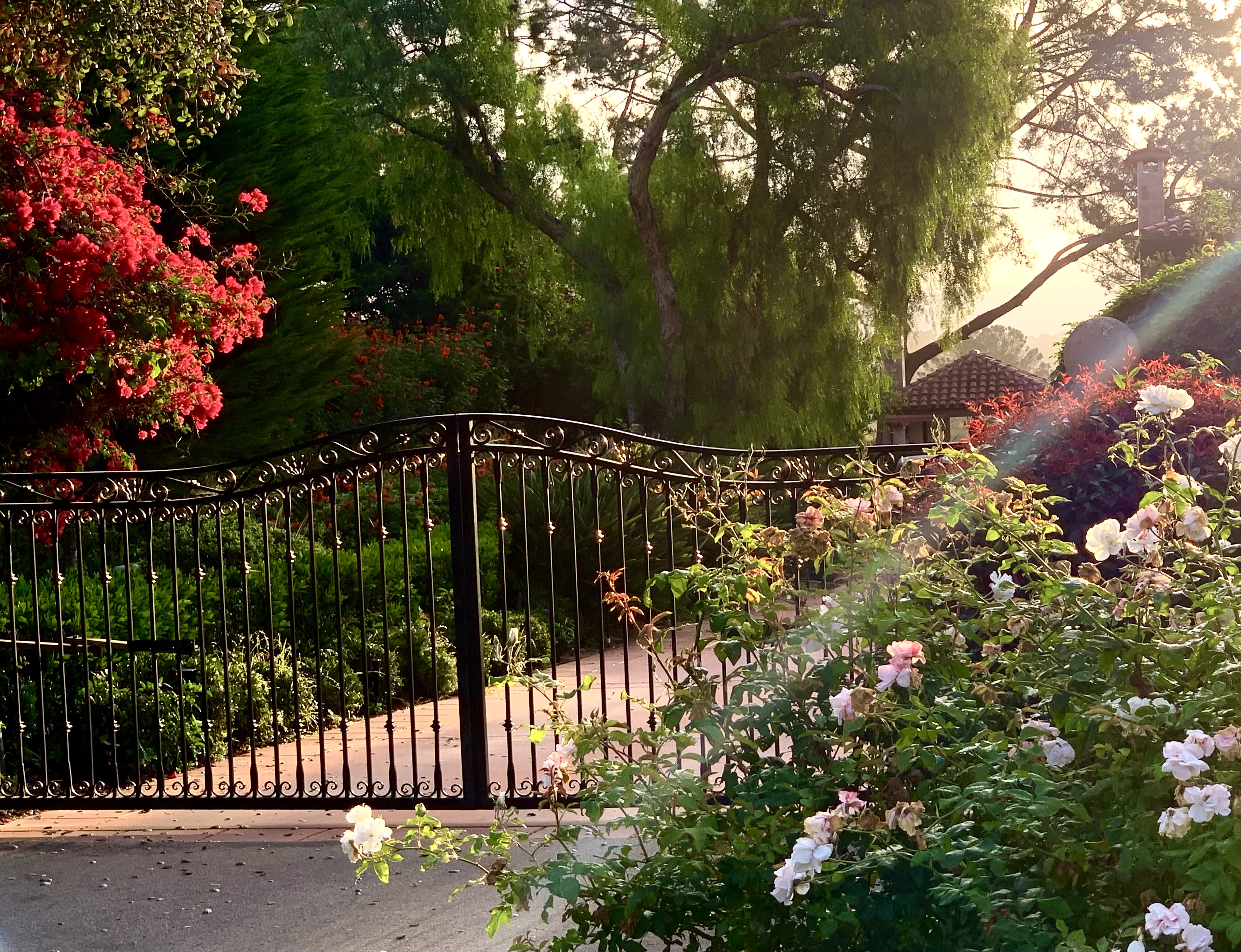
I was thinking about gates, doors, and walls as I went walking with Sadie on a sunny Thursday morning. We typically walk along the sides of streets. I let her wander onto the edges, but not onto other people’s yards or very far down their driveways. Often there are gates, much like our own gate. If the gate is closed and isn’t too far from the road, I often let her walk up to the gate. The gates are there both to prevent us from entering someone else’s property and to signal us not enter the property. I could, if my life depending on it, scale many of the gates, but that’s clearly asking for trouble. The gate is meant to keep people out, not as a challenge to overcome. Sadie generally couldn’t get through the bars of the gates. Of course, a gate is no barrier at all to birds, rabbits, mice, rats, lizards, snakes, raccoons, butterflies, or bees.
A door seems to me to offer more security than does a gate. While a gate may prevent me from entering, it’s quite easy to see through or around most gates, to hear the noise from the other side and to smell what’s on the other side. It’s true that one may listen through a door but the sound is typically muffled. Loud music or yelling creeps through to the outside but a conversation normally stays private.
A door also helps the inside stay warmer or cooler than the outside air. A gate has no such function.
Among places dogs leave olfactory messages for each other, boundaries are high on the list. This includes hedges, curbs, and gates. Sadie “controls herself” well now, but when she was younger, she would often pee at the boundary of a social event. Specifically, when someone—especially someone new or someone she already liked but hadn’t seen for awhile, she’d pee. She also seems to understand what I mean when I say, “Sadie, we’re going for a ride in the car. You should go pee first and then we can get in the car.” I don’t think she “parses” the sentence and accesses the meanings of all the individual words. Nonetheless, she quickly pees and then goes over to get in the car.
A wall is a kind of transition as well. A gate is much more permeable than a wall and a door may be opened or closed or ajar. Often walls, such as castle walls have one or more gates or doors. People on one side of a wall almost always want to get to the other side, at least occasionally. At the very least, they want to be able to move information and goods from inside to outside and vice versa.
Why walls? The walls of a house keep you in a more easily controlled environment. A wall can provide a level of protection. That’s mainly what castle walls are for. Of course, they often fail as well. Invaders climb the walls or tear down the walls or burrow under the walls until the wall collapses. Of course, castles were also subject to sieges. Eventually, the defenders inside would run out of food. Primitive machines were constructed to hurl firebrands and large rocks in to wreak havoc and kill defenders.
The Greeks were unable to defeat the Trojans by destroying their castle. Instead, they famously made a large wooden horse as a “tribute” to the courage and tenacity of the Trojans. Overjoyed that the long siege was over, they opened the gates and led in the giant wooden horse and began to celebrate. Once everyone was drunk or sleeping, the soldiers hidden inside the horse snuck out and opened the gates to the much larger Greek army waiting outside.
Today’s technology is much more sophisticated of course, but walls, gates, and doors still exist. The defensive capabilities now include guided missiles, aircraft, submarines, and aircraft carriers as well as the threat of nuclear retaliation. During the so-called “Cold War” America and the USSR engaged in an “arms race” to develop the best weapons and more of them. Looking back on all the wasted energy and time on both sides, I think, “Imagine what could have been done if we had instead spent all that resource on preventing climate change, curing disease, and sponsoring science and education.
Of course, it’s not an easy problem. One side in a standoff can only stand down unilaterally if they trust the other side. Meanwhile, none of the amazing and exorbitantly expensive weapons, walls, doors, and gates we’ve developed are worth anything at all if we accept the modern Trojan Horse.
Social media, the press, the television, and nearly half of the political candidates spew misinformation on a daily, even hourly basis. We’re locked in a political race and one of the two candidates for President is himself a Trojan Horse. Like the ancient Trojans, all our walls and armaments will be useless.
The threat to America is, in many ways, worse than the threat to ancient Troy. The Trojan Horse that endangers us? It’s a steady steam of lies designed to induce Americans to kill each other.
No number of fighter jets; no cache of assault rifles; no armada of submarines; no hordes of fighters will save us from the Trojan Horse. The Trojan Horse is armored with something far more powerful than iron, steel, or depleted uranium. The Trojan Horse’s armor is your own mind.
Only courage will work to save you. It is not the courage to face an army. It is the courage to admit that you’ve been conned; that you were wrong; that you have been led down a garden path that leads nowhere near where you ever wanted to go.
Sadie, for those not already in the know, is half Golden Retriever and half Poodle—a “Golden Doodle.” She resembles a Golden Retriever much more than she resembles a Poodle. And, she takes the name “Retriever” seriously. Ever since she was a puppy, we’ve played ball.
We began these games with tennis balls. Our dog trainer, at one point, brought out a “Squeaky Ball” which resembles a tennis ball and bounces like one (slightly less bouncy) but has the additional feature that if you squeeze it, it makes a squeak. From that moment on, Sadie has preferred squeaky balls. I’ve tried some other types of safe balls. She has enjoyed the soccer ball a little but has totally eschewed the pickle ball.
One of the many games we play with tennis balls is for me to go to one end of the driveway and hit squeaky balls with a tennis racquet. Sometimes she catches them on one bounce and sometimes she chases them along the ground. Once in while, she runs forward to catch the ball on the fly. I keep meaning to ask my dentists and/or my vet about this.
An associated game is “grab and go.” Sadie will trot over to me and drop one of her squeaky balls right below her mouth. I use a grabber to try to snatch the ball off the ground before she can. I generally lose this game. I’ve tried many ways to distract her and a few of them worked initially. But now, she’s too savvy. Even novel ways to distract her don’t work. On some occasions, I do manage to snatch it away quickly enough. I’d estimate that happens about ten percent of the time. More often, before I manage to grab it, she gets bored and nudges the ball forward toward me with her nose to signal that I can now grab it without a struggle.
To understand the next part, you’ll need to know that our garden features two very large Italian stone pine trees. I love them. However, they do tear up the driveway and yard to an extent. In a few places large roots surface and then form tiny “caves” beneath the roots. Sadie scooted the ball into one of these caves and then, in the process of retrieving it, pushed it in even further. I could not get to it. I put an iron chair over the spot so Sadie wouldn’t tear up everything living within ten feet. I told her it was lost and there was no way to get it back. She “accepted this” or at least she stopped trying. We soon went in for dinner and did not revisit the back garden and pool until the next day, in the early afternoon.
We were beginning to play alternating sets of “games around the pool” with games that take place in the garden. Sometimes, as happened this afternoon, Sadie likes to begin the pool games by lounging in the sun (until she’s so hot, she knows it will feel even more delicious when she hits the cool water? IDK.) Since she wasn’t yet ready to play ball, I went down in the garden to retrieve some more balls for pool play. Once I got down there, with Sadie so far away, I took another crack at trying to get her “Special Ball” out from under the roots. (It’s much easier to try to get it out without Sadie trying to “help.”)
This shows Sadie lounging but *with* her “special ball.” It was taken a few weeks ago.
I tried several different methods to no avail. Suddenly, I heard a thundering sound. It was Sadie sprinting and springing to my position and she instantly set to the task of retrieving her special ball. She stuffed her snout in so far I was sure she couldn’t breathe. And, even if nose touched the ball, there would not be enough room for her to open her jaws on the ball.
She got the ball out. We celebrated for a time by centering our games around her recently recovered Special Ball. For example, I throw three or four balls into the pool and Sadie grabs the nearest one but then, while treading water, trades the nearest one for her “Special Ball.” In a garden variety game, on the other hand, she might lead me down the garden path, while holding her “Special Ball” in her mouth. At some point, she will inconspicuously drop the ball and it’s up to me to find it. Then, she lags back in the lower part of the garden while I ascend to the Stone Patio and throw the ball. This allows her to come crashing through the garden at full speed catching the escaping “Special Ball” from behind.
What I can see of Sadie as I write this. She lies on my feet (so that?); she knows the instant I get up to do something which she recognizes as an opportunity to interrupt my behavioral flow with her requests.