I really loved them as a young child. Each one felt so silky! You had to hold her just right so as not to ruffle her delicate “wings.” If you gripped her tightly, you would cripple her and instead of sailing away on the breeze to her destiny, she would plop to the ground at your feet. Then, she would look up and shake her little seed husk at you and wonder how you could be so clumsy.
It wasn’t only that milkweeds looked and felt cool and seemed expressive. According to lore and superstition, they were magic! If you captured one and then made a wish on it, and let it go, your wish would come true!
Even as a small child, I was rather a doubting Thomas. But then again, even though I could see no possible way it could work like that, why would my parents lie? Maybe it could work. Maybe it would only work sometimes. And even if I didn’t believe my wish would necessarily come true, there was always a chance, right? If this little ritual played itself out with a group of friends, that made it even more fun because they believed it would definitely work.
Who would imagine that milkweed plants would develop a parachute for their seeds to spread? You know who else likes milkweed plants? Monarch butterflies. And do you know one reason they like them? It makes them taste bad to predators. Since they have a distinctive pattern, the predators avoid them. And not just them. Some butterflies have apparently evolved to look like Monarch butterflies so the predators also avoid them even though they don’t feed on the milkweed and presumably taste bad, though I cannot confirm this with personal observation. I have never tasted butterfly. (Well, not knowingly).
Many of those spritely silk spheres fall on fallow ground. Some don’t receive enough water. Some sprout deep in some sad and sunless sewer. Deprived of light, she shrivels and dies. Others may wash out to sea. More than a few swirl helpless into toxic substances. There are a lot more of those around these days. Have you noticed? Milkweed has. And so have millions of other species. Yet, they are surviving. Barely. And the Monarchs are surviving. Barely.
And what about us? What about we humans? If we are surviving by destroying entire species at a rate to rival a direct meteor hit on our planet, what does that say about us? That we are thriving? Or just surviving?
Meanwhile, the milkweed seeds still disperse. It seems a fit symbol for hope. Because, every so often, a milkweed finds those perfect conditions and she grows into a beautiful plant who in turn provides nourishment for a beautiful bouquet of butterflies, including the Monarchs. Not all milkweed seeds thrive, but when they do, they really know how to thrive and enjoy their thrivingness. They are an apt symbol of hope.
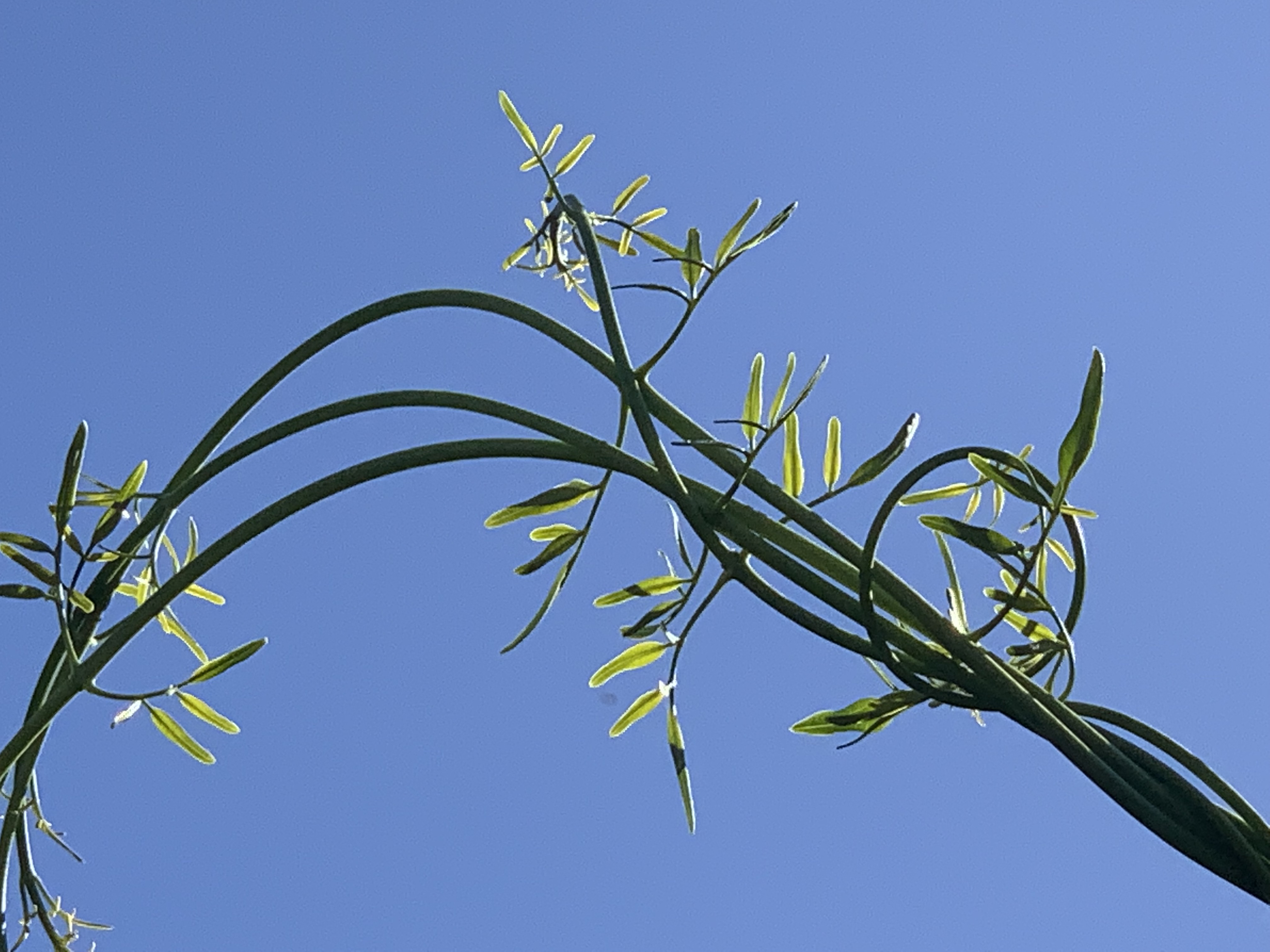
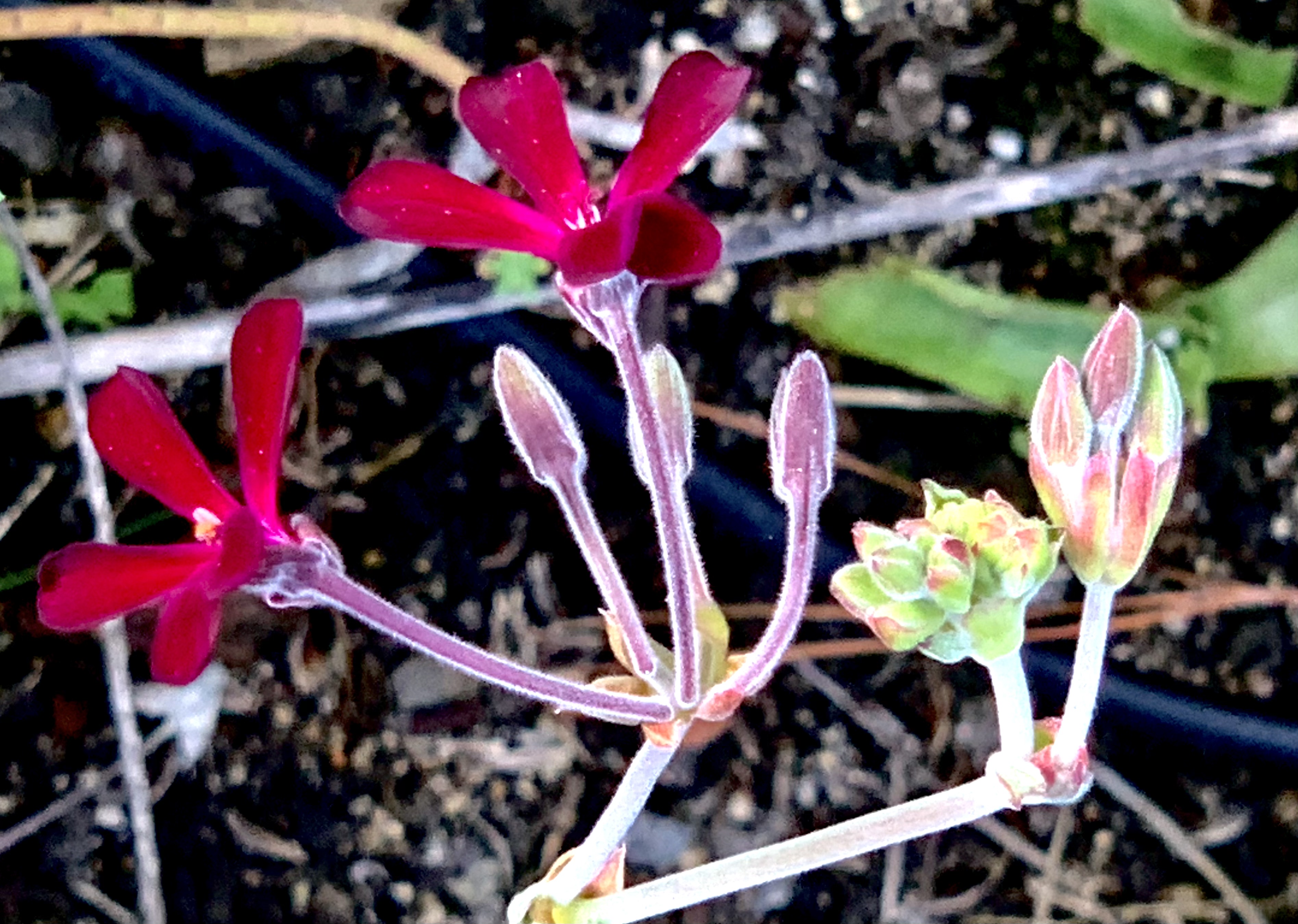
Called “Butterfly Milkweed” — (not the kind with the large parachute seeds)
If you do something kind for no benefit or reward, that too is a symbol of hope. You have dropped a pebble of kindness into the fountain of society. If enough people do that, the water itself will stay vibrant and healthy. If hardly anyone drops a pebble of kindness, the society will stagnate and stink. I have seen milkweed seeds stuck on the surface of polluted puddles. Such seeds … and deeds … do not always strike fertile ground. But when they do, it can be amazing!
And by simply making a wish on the magic milkweed seed; by doing a kind deed; if there are enough seeds, enough deeds — the tree of life will flourish. And so will you.
Now, of course, science knows the answer. And the answer is … the egg. Something almost like a chicken laid an egg with a novel cross-over or mutation and that egg grew into a chicken.
Here’s another conundrum and so far as I know, science does not yet know the answer.
Let’s expand the question a little. Did humans first come up with nouns — names for particular things or perhaps verbs referring to actions and then later, string some of these together to make the first stories?
Or, did stories come first and later, the names for things and objects were excised from these stories?
Most likely, the two co-evolved — language and stories. But I will argue that story is actually more fundamental.
Why?
It turns out that my cat Luna is a storyteller.
Remarkable cat? Perhaps. But I think after I explain just how she’s a storyteller, you’ll remember other times that animals used “storytelling” in your own life.
When Luna was a kitten, she loved to chase the laser pointer. At the ripe old age of three, she’s far less enthusiastic about it. But she still likes the idea of playing laser pointer. She may or may not recognize the words “laser pointer” but she definitely can’t reproduce it. She vocalizes a lot and it seems as though she’s “taking turns” with me when we “talk.” But, at least to my ear, she’s always saying the same thing which sounds much like a plaintive chirp of a question.
Her repertoire of actions however, is much more varied. At night, which is when we play laser chase, she often comes up to me and “chirps.” She looks at me while she chirps and when I look at her, she goes into phase two which is to “re-enact” chasing the laser pointer. It is possible that she re-enacts chasing the laser pointer to “communicate” with me that she wants to do it. Or, it’s possible that she just “imagines” chasing the laser pointer and the imagining is associated with the actions. It is also possible that at first, she simply recreates the associated actions, but, since it reminds me of the laser pointer and I often play with her at that point, the reinforcement could turn a passive re-enactment into an instrumental and perhaps “intentional” behavior pattern.
In a similar way, it’s easy to imagine one of our distant ancestors re-enacting a struggle, finding and digging up roots, picking berries, running away from a particular form of danger, etc. For our ancestor too, it might be that they begin by simply remembering something, and in so doing, they re-enact some of the actions they took. Eventually, they come to realize that their re-enactment encourages others in the tribe to follow and do their own berry picking.
We can easily imagine that in a particular region there might be several kinds of berries; some kinds might sport thorns; some not. Some might require bending over to reach (like strawberries) while other might require reaching up like high-bush blueberries. Re-enacting a story of berry picking might easily be repeated on many occasions. Eventually, the motion of picking a particular kind of berry might become ritualized or routinized. Some other clever ancestor may have trapped a small rabbit by using a strawberry as bait. He might use the same gesture(s) for strawberry that others used earlier in order to indicate that strawberries exist. This gesture, or sequence of gestures, over time, comes to indicate “strawberry” in many different stories. Eventually, it becomes the “word” for “strawberry.”
All right, you might say, but such stories are all reconstructive stories. How did fiction arise?
To answer that question, let me tell a tale about another cat from a much earlier point in my life. That cat was named Eva. She was an indoor/outdoor cat. We didn’t even have a litter box for her. Whenever she wanted to go out, she would go to the front door and scratch at it. There were five of us in the house so someone was likely to be close by. Whoever was nearby would open the door; she’d go out & do her business and then come back to the door and scrape it on the outside. Unlike my current crop of cats, Eva pawed gently at the door. She didn’t seem bent on destroying it. She was simply signaling that she wanted in or out.
In a similar fashion, when Eva was hungry, she would go to the kitchen and paw on the little wooden doors under the sink. This was where the cat food was kept. Whoever was near would pour out some cat food for Eva.
It’s not necessary to invoke stories here. She was reinforced for scratching the front door by having us open it so she could go out or in. She was reinforced for scratching the doors beneath the sink by being fed.
Eva, in due course, as an indoor/outdoor cat, became pregnant. Three tiny kittens were born to her. One nice spring day, a few months later, Eva left the living room and trotted into the kitchen and scratched on the cupboard door. I was nearby, so I brought out the cat food and filled up her dish. Instead of digging in, however, as she usually did, she instead, left immediately and trotted to the front door. She hand’t taken even a single bite!
This struck me as odd. I wondered whether she had a sudden urge to go relieve herself. Such a sudden and overwhelming urge that she ignored her food? I don’t recall a cat ever doing that while I was observing. But there she was at the front door. Okay.
I opened the front door, and out she went. I closed the door so she could do her business. But almost immediately, she pawed at the door to be let back in! What was going on? Eva was a smart cat. She wasn’t like our poor cat Shasta who would go to the door of the back deck and meow loudly to be let out…even when the door was already open.
But Eva was a smart cat. Why was she back so soon? I wondered about it as I opened the door again. Guess what? In tumbled her three little kittens. She led her furry trio to the kitchen where they chowed down on the meal I had just “prepared” for Eva.
Had Eva just “told me a story” in order to manipulate me into doing her bidding? I’m not sure we can really call what she did a story. But I’m not sure we cannot call it a story either. It certainly seems as though Eva did some nice problem solving behavior. It seems most likely that Eva had heard her kittens outside. She was much closer to the source and her hearing was much better than mine. It’s also possible that she “remembered” that they were out there. I had not let the kittens out and had not known they were out there.
It seems as though Eva was using her “mental model” of how I would react to various stimuli and put together separate elements. She devised a multi-step plan which included my predictable behavior in order to reach her goal of feeding her cats.
When I was an undergraduate, I trained a rat to do a sequence of five behaviors in order to get a reward. That was completely contrived however. In order to train this behavior, I had to go through a very careful sequence myself. I first trained the rat to press a lever. Pro tip. You can’t simply wait for the rat to press a lever in order to reinforce it with a food pellet. First, it helps to “click train” the rat. Even after they get a food pellet, it takes time for them to find the thing and devour it. And it takes time. It turns out that in the long run, it’s more efficient to first train the rat that a “click” happens when the food pellet is delivered. The click is quite salient to the rat and can be heard everywhere in the cage. So, it’s “better” as a reinforcement in some ways than food. However, every so often, you still need to reward the rat with an actual food pellet or it will stop paying attention to the click. In much the same way, most dog owners teach their dogs that “Good Boy” is a kind of signal associated with a head being petted and occasionally a food treat. That’s much more practical than giving the dog a treat every time.
If you are trying to teach an animal a multi-stage trick, you need to “thin out” the schedule so that they are not reinforced every time they execute the required behavior, but only occasionally. And, at every step, it took a great deal of attention to “lead” the animal to the intended behavior. At every step, beyond the first few, it is easy to “break” the chain of behavior by waiting too long to deliver reinforcement. Remember, these chains of behavior became trained in rats trapped in a cage. Their environment differed considerably from the one they evolved in. These rats, by the way, are almost like identical clones. How hard would it be to train a rat to execute a chain of five random behaviors in the wild? It took a lot of patience and attention to carry it out in the lab. I think it would be much harder in the wild.
What if there’s another way? What if, in at least some cases, you establish a “relationship” with another animal so that you are able, at better than chance, to “read” each other’s intentions and desires. You can “tell” when your dog really needs to go out even if you haven’t trained him to a specific behavior. Your dog knows when you are about to go out for a walk, even if you carefully avoid using the forbidden word “walk” out loud!
I’d be curious what you think about pets and whether you have any stories about them using stories.
Real stories.
I’m not talking about the typical Lassie episode which goes something like this:
Lassie: “WOOF! WOOF!”
Timmy’s Dad, Mom, or Uncle: “What’s that you say, Lassie? Timmy was playing in the abandoned mine shaft again?”
Lassie: “WOOF! WOOF!”
Adult: “Well, didn’t you try to talk him out of it?”
Lassie: “WOOF! WOOF!”
Adult: “Oh, I see. Yeah, I agree, he can be pretty recalcitrant. Did you mention that last time he did this, I told him I would ground him for a month if he ever did it again?”
Lassie: “WOOF! WOOF!”
Adult: “Right. Of course you did. Sorry. Well, what tools do I need to get him out this time?”
Lassie: “WOOF! WOOF!”
Adult: “Dynamite? Why would we need dynamite?”
No, not that kind of story, but stories about things that actually happened. Have your pets ever tried to “manipulate you” into doing something by telling you a “story”?
Maybe it never really happened and of course how could there be you would have to change your life and that’s a pain so you’d really rather not think about it and you’ll just parrot back the words of …
And then, at that precise moment: that’s when the trouble really began in earnest.
Of course, looking back on it now, there were plenty of signs, if one cared to look.
But one did not care to look, did one? Why would one? After all, it was so much easier to pretend it didn’t matter; to pretend everything would work out ‘somehow.’
‘Somehow.’
Was there any word in the English language so destructive or at least so self-delusional as ‘somehow’?
Because ‘some’ is not your typical ‘how.’ A typical ‘how’ is a plan put together by knowledgeable motivated people and executed by knowledgeable motivated people. Some such plans are more detailed and some less so. Some have very well-defined responsibilities and some do not. But none of the real ‘how’s that I have ever seen happened by accident.
‘Somehow’ is too rare; too unreliable; too fickle to pin your life on, and way too fickle to depend upon for the life of your kids and grandkids.
Rely on ‘somehow’ and here is what you get — multiplied by a billion.
“Come on, Margery, look at me. It could have happened anywhere. Come on! You think I’m not devastated too? He was my son too, you know. I loved him too, you know.”
“Why, Jim? Why? It didn’t have to be this way. It really didn’t. People have known those chemicals were carcinogenic. What were they thinking?”
“I know, Marge. I know. So many innocent lives lost.”
“Nothin’! Again! I’m tellin’ ya Lennie; it ain’t like it used to be. Not at all. It’s not bad luck. It’s no luck. There is literally nothin’ out there, Lennie. Well, leastways, nothin’ edible.”
“Just may be that it’s time for the likes of such as us to find us somethin’ different to do. Ya know?”
“Lennie, don’t be startin’ again about a rabbit farm. I done told you that already. Fishin’ is what we know and it’s all we know.”
“I know. I know you’re right George. But just — there ain’t no fish any more. That ain’t good if you’re a fisherman.”
“Another down day for the dow, breaking down below 5000, but an up day for Air Quality Kills. For the first, time, world-wide, the EPA says we’ve finally broken the 10K per day barrier. Details at Five at Five on at Five.
“Now, back to the international women’s lingerie no-holds barred jello wrestling quarter finals. In the pink, …”
“So. It’s come to this. I never believed it would happen, Ahmed.”
“Nor I, Saul; nor I. But, it’s not like we weren’t warned. And, even that it would be about water.”
“I know; but still. Nukes? Really? What’s the point? No-one can live in the whole region for centuries. Who won, Ahmed? Who won?”
——————————————————-
[The following passage is translated from the original Arcturian. It’s a “literal” translation; or, at least as “literal” as any translation can be when the target language is English.]
“Blue Hike Candle, Please to report scan results of not-so-very-far-away gray brown rock planet.”
“Amber Saddle Wave, Please to report scan results of not-so-very-far-away gray brown rock planet as:
No evidence of intelligent life.”
“Mauve Crest Bucket, Please to report recommendation action of not-so-very-far-away gray brown rock planet.”
“Amber Saddle Wave:,Please to report recommendation action of not-so-very-far-away gray brown rock planet as:
Ignore and revisit in 50 millennia rather than the run-of-the-air-turbine 5 millennia. The tailless monkeys are learners of many silly tricks. But they still sewer-stinky most of their time and energy and [Here, on the recording wails an untranslatable cross between the percussion of a jack-hammer and the trumpet of an elephant with a sad whale song weaving in and out of counterpoint] trying to steal from each of the other of the other of the other.”
“Mauve Crest Bucket, Please to report recommendation action of not-so-far-away gray brown rock planet as ignore and revisit in 50 millennia accepted. NEXT!”
Lies in civilization are much like ground glass in an otherwise nutritious, delicious buffet. They are dangerous. They are potentially deadly if undetected. Quantity matters. One piece of undetected ground glass is serious. One hundred pieces means that some people will die. Twenty thousand means everyone who partakes of the buffet will likely die.
If one side lies constantly and one of the things they lie about is saying the other side lies, then, of course, your “loyalty” to your own side may get you to thinking: “Both sides lie equally.” Or, even more sadly, “The other side lies!”
Imagine Rembrandt’s Mona Lisa: a beautiful painting. Now, imagine painting a red stripe one inch wide diagonally through the painting. It’s only a small part of the painting, after all. Maybe 10%. But is the value decreased by only 10%? Of course not.
Ever use a dictionary? How much would you pay for a really good dictionary? How about a dictionary with 1% errors? How about one with 10% errors? How about one with 50% errors? How about one with 100% errors?
Imagine you finally manage to save up enough money to buy your dream house. Location: near highways, shopping, & parks. Style: perfect. Condition: perfect. Except for one small thing.
It reeks.
Living in a society that is perfused with lies is like living in a house situated right next to a sewage plant.
The *only* advantage humans have in their struggle to survive is their ability to cooperate and communicate. A lie diminishes that ability to coordinate. The impact is not just that one lie. It’s the spread of skepticism. It’s the felt need to double and triple check everything.
In a complex society, even a tiny bit of deception can multiply far beyond the immediate effects. That is particularly true if a deception passes through a number of weak points in what could be and should be the world-wide web of wisdom.
For example, an employee at a drug company might be pressured to downplay side effects in a report. He does so. But in a corporate culture of honestly, someone will catch the lie and patiently explain that this is not the way things are done around here. The error will be corrected.
And no-one will die from that lie.
On the other hand, the same employee doing the same act in a company with a sociopathic corporate culture might well have that lie not only propagated but further elaborated. As a result, the drug is over-prescribed and over-used. Millions of dollars, and then, that money is like seed money to buy layers and layers of political protection and press protection. At last billions of dollars flow from the pockets of customers into the pockets of the drug company. And, when I say “the drug company” of course, ultimately it ends up in someone’s pocket. Whose? A little of it goes to workers within the company. A huge amount goes to the top executives. But a huge amount also goes to the major stockholders — people who did nothing to discover or promote the drug, but in some sense provided money to support the company.
Guess what? It might even turn out that the drug’s drawbacks outweigh the benefits. In the short run, that might not diminish profits at all.
Again though, we need to realize that the damage to society is not limited to the effects of this particular drug (though those can in and of themselves be devastating effects). It is experiences like this, for instance, that play into vaccine reluctance. Because some drug companies have done some unethical things, people naturally have some degree of mistrust for *all* drug companies for *all* drugs. Nor is the mistrust that such a scheme produces limited to the drug industry. If people believe corruption is widespread, they may themselves become more tempted to engage in it. Even if they don’t themselves engage in lies, deception, bribery, etc., they will certainly be on the lookout for such schemes. It will be harder to take people at their word.
Putting crushed glass in a buffet injures people and ruins the buffet. And, if it happens often enough, it can turn you off from going to any buffets or any restaurants.
Lying can seem attractive in the short term. But in the long run, it will be found out. It will ruin your individual reputation, but it will also tarnish the reputation of your organization and even, to some extent, your entire industry. Beyond that, lies work to spoil society as a whole.
Imagine that a well-functioning society is something like a well-oiled machine. One part connects to another and things function smoothly. Lies are like pouring sand in the gears. Things will move more slowly. Parts will also wear out more quickly. Add enough sand and the motor will burn out or the machinery may catch fire. Would you put sand in your gas tank? Would you add sand to the oil in your auto? Of course not! Why would you support lies in your company or in your society?
Apart from the societal disintegration that lies promote, if you actively pursue a policy of lies to benefit yourself, you are basically taking a kind of informational poison into your own psyche and eventually it will poison your mind. You’ll become more and more addicted to a strategy of relying on lies rather than relying on doing a good job or learning from your mistakes. When someone asks a perpetual liar a question, they will not be able to simply answer. They will have to calculate who knows what and how easily the lie will be found out and try to recall what lies that they have already told to whom.
Just as more and more of an addictive painkiller must be used to achieve the same level of pain relief, so too, an addicted liar will find that they have to tell more and more lies. The lies may at first be “reasonable” lies. That is, at first, a liar may tell lies that are plausible. Over time, they will have to tell more and more absurd lies. If the liar is a popular figure, his or her fans may echo the lies despite not having any relevant direct knowledge. As the lies become more absurd, the fans echo not only plausible, lies but also echo absurd lies. To those who are not addicted to the lies, fan behavior becomes more and more ridiculous and pathetic.
May well have nothing to do with one another. In addition, the speed of change, and even the acceleration of change, and, yes, possibly even the jerk might have an impact on what happens. Again, consider a few examples.
You are the major breadwinner (by being a bread maker) in your family of four. You are moderately “well off” financially but your business has been going steadily down for the last five years. You could relocate but you all love the private school your kids go to. Finally, your youngest is a senior, so next year, you will relocate to a part of your nation that is growing.
This is no doubt a fairly large change. But, it is also moderately slow. And, not only is it slow; there is only moderate if any acceleration. You will naturally see more details that need to be attended to as the date creeps closer. And, there will be some surprises. But for the most part, the speed and predictability of the change is within your capacity. If you didn’t perceive it to be so, you wouldn’t have decided on the move.
Now, let’s change things just a bit. Same family of four. Same worsening of conditions. Only now, before your youngest even starts her senior year, COVID 19 strikes. Your business is no longer slowly shrinking. It plummets to the ground. Some people were predicting this might happen months ago, but you chose to listen to the people who said it would all go away. But now is now. You are experiencing much faster and less predictable change. Not only that; the potential magnitude of the change is much greater. Before, you realized it would take time to build your business back up in a new location. But now? You might not even have the wherewithal to survive the next six months, let alone move. And when? And to where? You had a spot all picked out in one of the more trendy and affluent suburbs in Silicon Valley. But now? It’s a hotbed of COVID!
Are the same things that are important in situation one above the same things that are important in situation two?
Now, let’s add just a little more to the scenario, but without the COVID19.
As before, you are the major breadwinner (by being a bread maker) in your family of four. You are moderately “well off” financially but your business has been going steadily down for the last five years. You could relocate but you all love the private school your kids go to. Finally, your youngest is a senior, so next year, you will relocate to a part of your nation that is growing. You are on your way to your bakery and the sky grows dark. You worry that it will be pouring down rain just as you make the 50 yard dash to the front door of your bakery.
You need not have worried because the Class Five tornado delivered the front door to a spot only two feet from your normal parking spot. That front door was the largest remaining piece of what had been your grocery store. Your house was also destroyed. And, so was the private school. Luckily, your youngest was unharmed. Not so luckily, your other child and your spouse were killed in the storm along with 73 others in the area.
We all have the intuition that this person will make the most profound changes, but in what way? Of course, nearly anyone would be in complete shock for a time and not know what to do. But then what? It seems equally likely that the person would:
A. Decide that life is absurd and it’s out to destroy you and the only way to protect yourself is drink like a fish. And, the child’s better off somewhere else.
B. Decide that life is absurd and it’s out to destroy you and the only way to protect yourself is to never love again. And, the child’s better off somewhere else.
Of course, A and B are not mutually exclusive. They often go together.
C. You decide that life may end at any time and that the most important thing in life is to enjoy every moment. And, that means, among other things, spending a lot of time with your remaining family & friends.
D. You decide that service to others is the most important thing in life and you and your child both eventually become involved in a UN project to show people how to bake more nutritious bread.
There are endless possibilities of course. And, they are not fixed outcomes. The person may decide that life may end at any time and that the most important thing in life is to enjoy every moment — and to spend time with friends and then — three years later —- take path A or D instead.
As someone trained in “Experimental Psychology,” my disciplinary reflex is to try to identify parameters and try to relate conditions of change to results in terms of outcome as a function of those parameters.
Perhaps, however, a better approach is more like the Periodic Table. Rather than an “infinite variety”, it might be true that most cases fall into one of several dozen categories. Each category is basically a theme or premise for a story which we relate to precisely because they are common “types” of change.
Examples might include:
“Situation slowly deteriorates and protagonist makes adjustment.”
“A natural disaster destroys much (or all) of what the protagonist loves and they must create a whole new life.”
“Situation slowly deteriorates, and in turn, the protagonist engages in ever more self-destructive behavior, making the situation worse and eventually resulting in disaster.”
“Situation slowly deteriorates, and in turn, the protagonist engages in ever more self-destructive behavior, making the situation worse and eventually resulting in — enlightenment followed by a complete turn-around.”
I send Stupid Stu to the Store to purchase kidney beans for my chile. He can’t find the kidney beans so instead he comes back with three kidneys from the butcher. “Kidney” and “Kidney beans” according to him, must be closely related because they have the same label.
Kidney BeansActual kidney organ
Handy Handsome Hal and I are hanging a picture. I am holding the picture in place and it’s centered, but when I ask Hal to hand me the hammer, it turns out, the hammer is not in the toolbox. I ask Hal to go into the laundry room and get the hammer hanging there — the one with the wooden handle. Instead, Handy Handsome Hal goes into the kitchen and brings me a wooden spoon. “Here you go!” He says. “It also has a wooden handle.”
Marvelous Marvin has decided that the science and math required are too difficult for him so instead of architecture, he decides to become an artist instead. Here are his first three paintings:
(All three paintings look exactly the same and are entitled: “Proper Shades”)
Marvelous Marvin’s silly sister Silvia has decided to become a composer. Here’s is a short selection from her Second, Sixth, and Seventh symphonies. (Each symphony is exactly the same). White-noise-sound-20sec-mono-44100Hz.ogg
In our Tennis Tournament, Timmy the Tennis Player and I draw each other as partners. Our opponents, new to both of us, are two lefties. We know nothing else about them — not their records, not their rankings. Timmy comes over to me and says, “It’ll be easy to beat them! I played a lefty once in high school. He hit everything cross court! All we have to do is cover the cross-court angles! When I serve, you’ll never have to worry about him going right up the line. Just poach right away!”
Me: “Well, Timmy, I’ve played against plenty of left-handers and I can assure you that they don’t always hit cross-court! Have you ever watched Nadal?”
Timmy: “Oh, Nadal’s an exception! He’s brilliant! But your typical lefty hits cross-court. They just can’t or won’t hit down the line. I think the fact that the net is higher there throws them off.”
Me: “Why on earth would it be harder for a lefty to hit down the line than a righty?”
Timmy: “I don’t know. I think it probably has something to do with the earth’s rotation. It’s clockwise like being a right hander. It’s the right way. So, the lefty is just unnatural. So they can’t hit down the line. Believe me! I know! I played a left-hander, like I said.”
Me: “Yes, I know Timmy, but I’ve had lots of experience with left-handed players. My brother is left-handed. My son is left-handed and though he doesn’t play tennis, he’s extremely coordinated. He plays musical instruments, draws, juggles — and I’ve watched plenty of left-handed pros on TV. They’re perfectly capable of hitting any shot a righty does.”
Timmy: “You’ll see!”
————————————
Which one of these is different?
Flower of the Trumpet TreeWhite RoseWhite RoseWhite Rose
Flora the Flubbing Florists says the one in the last one is different. Why? Because it’s a shade darker.
Come on people. Grow up. We’re adult humans, not viruses. We have brains. Let’s use them.
I should know what God and man is. — Alfred Lord Tennyson, Flower in the Crannied Wall
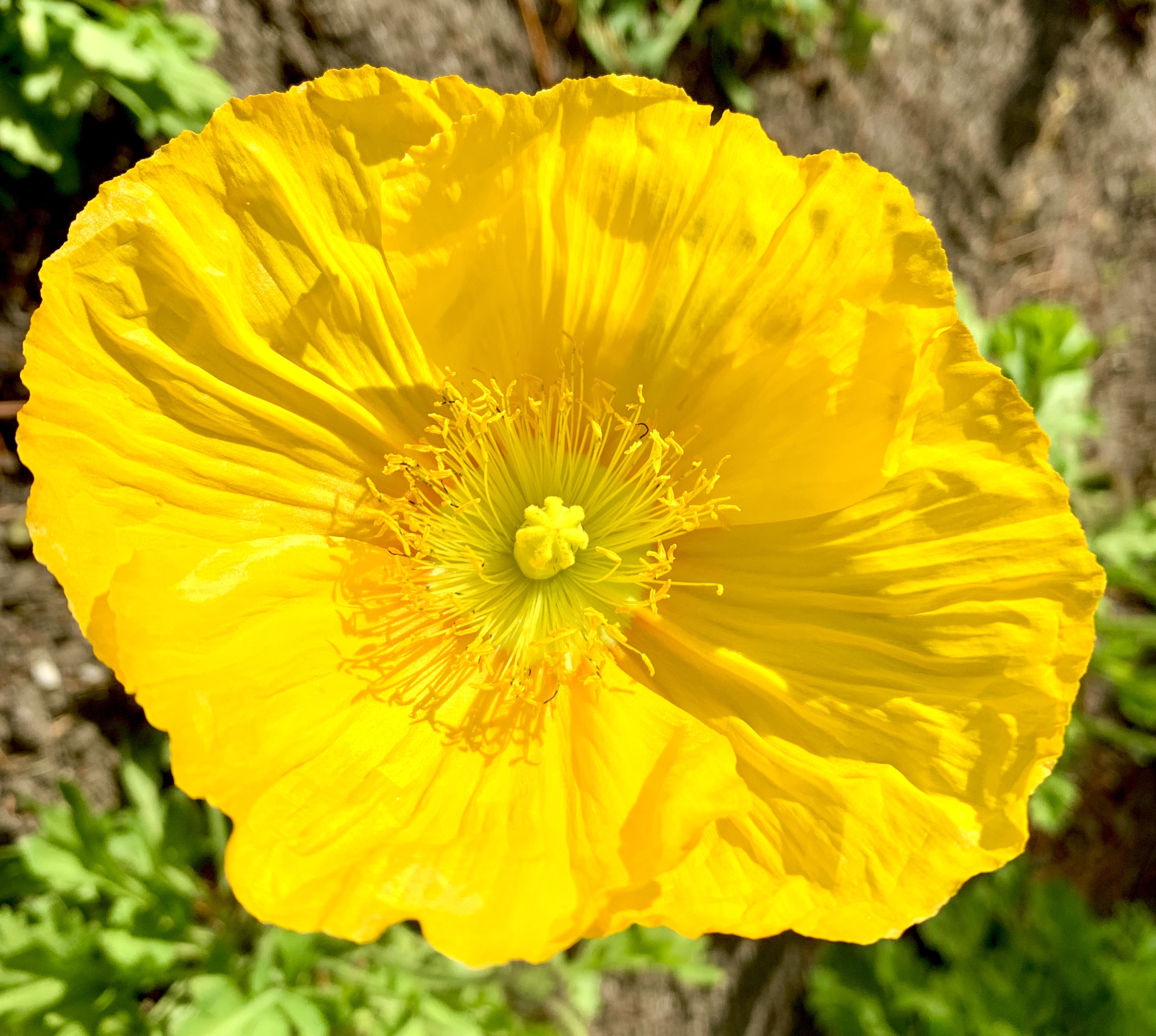
I love flowers. I love taking pictures of flowers. They amaze me because of their beauty, but that’s only where love starts; not where it ends.
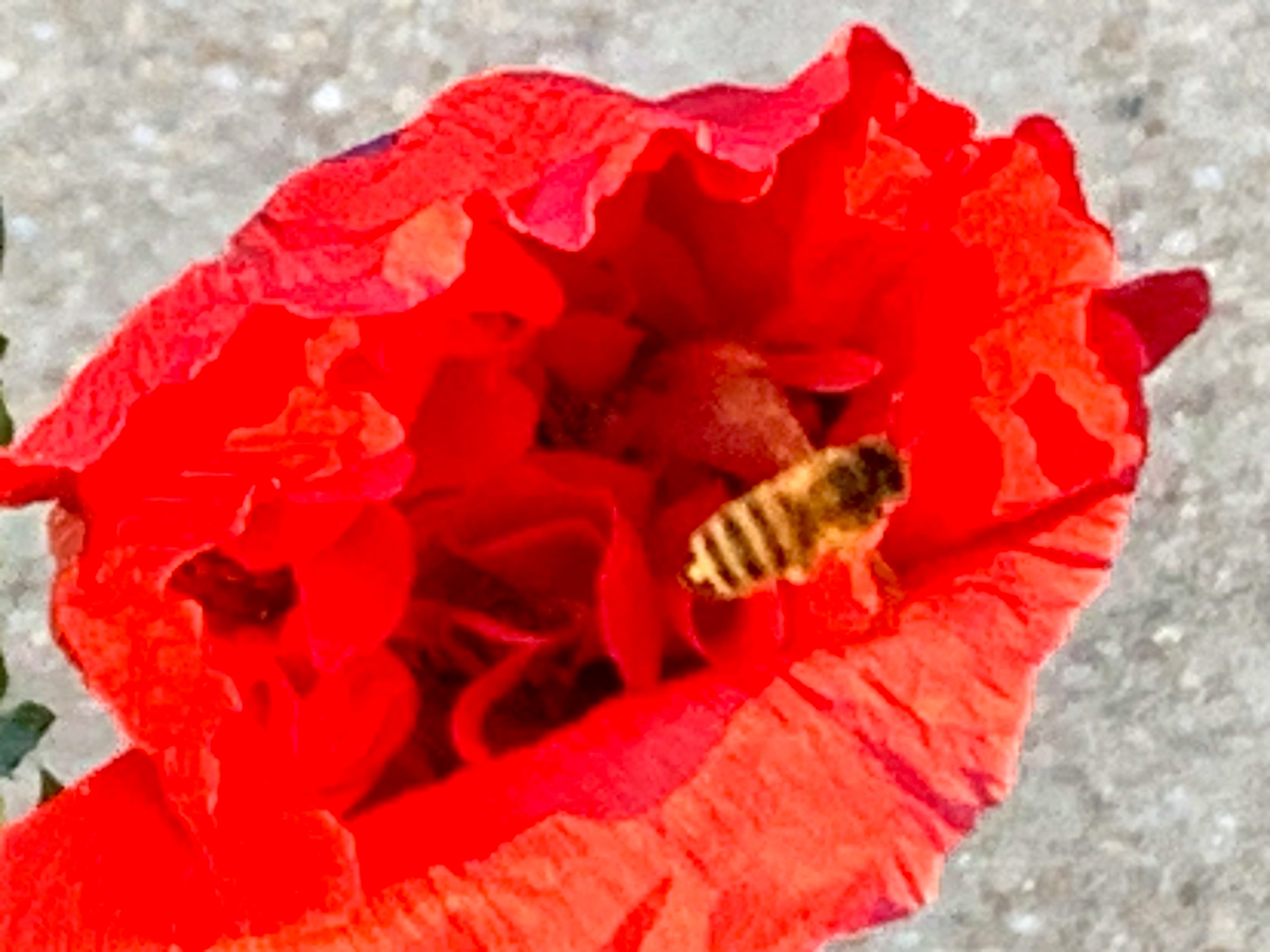
Imagine: a flower depending on bees (as well as other insects) for pollination! Bees depend collectively on the flower for their continued existence. What we see now are two groups of living beings, from very different parts of the Great Tree of Life, who have “learned” (mainly in an evolutionary sense) that they are better off working as partners.
I can see why it’s tempting for some people to look at this as a “proof” of an active God who created all of creation in a relative eye blink. To me, though, it’s even more wonderful to contemplate that this collaboration took work and accommodation on both sides; that it evolved over time; that is still evolving. And with each step, is there something analogous to trust that accumulates in both flower and bee?
Can you imagine what the bee sees, feels, smells?
There are, after all, plants who eat insects; e.g., the Honeydew, Venus Fly-trap, and Pitcher Plant. So, if we look at it from the plant’s perspective, it might be a huge windfall to be the most beautiful and attractive flower imaginable and to eat every last honeybee in one summer. The plant would “win” a windfall of nitrogen. Similarly, we can imagine a bee-like insect who comes to the plant and rather than simply “gathering pollen,” it devours the entire plant. Lots of calories.
That one year.
Of course, next year, there would be no such plants to eat or even gather pollen from. Of course, it isn’t only flowers and bees who have such an arrangement. It’s all over the place!
Collaboration and cooperation are not just features of the ecosystem, of course. The flower may be the most beautiful and showy part of a “flowering plant,” but it not the only part. The roots are just as vital as is the stem as are the leaves as are the flowers. They are in balance. All are important. And, in a way, each has its own beauty.
Three leaves in the San Diego sunset. Exposed root of a tree. But which one? Should I cover it?
Back to the bees though — what could be a more intimate form of cooperation? The flower actually depends on the bee to fulfill its sexual roles! The flower is associated with sexual love in many ways and in many different societies. And sexual reproduction, whether by flower, bee, or human is implicitly saying to the universe, indeed, shouting, whispering, and singing to the universe: “There is still more; there is still something better to strive for; an individual such as never has existed before and a species that will continue to explore what is possible. Life will not end with my life. I am a part of all life that ever has existed or ever will exist. Yes!”
Not bees, nor humans, nor even roses are a timeless inviolate and changeless perfection of form and function that never again needs to change. The essence of life is change balanced with stability. Change by itself is chaos. And stability without change is delusional. More accurately, it’s delusional to start with, but ultimately it is death. Any system, person, species, government, town, institution that declares itself perfect and unchangeable regardless of circumstances is a system, person, species, government, town, institution that has just signed its own death warrant.
Every part of the plant is important. And every part receives benefit. Everyone in human society benefits from the work of the whole but not everyone receives benefit. If a flower neglects its roots, or its stems, or its leaves, the whole plant will die. For our society to survive, it must change. And one of the changes near the top of that list is to make our society more fair. If we don’t, the whole flower of our civilization will die. As will the bees.
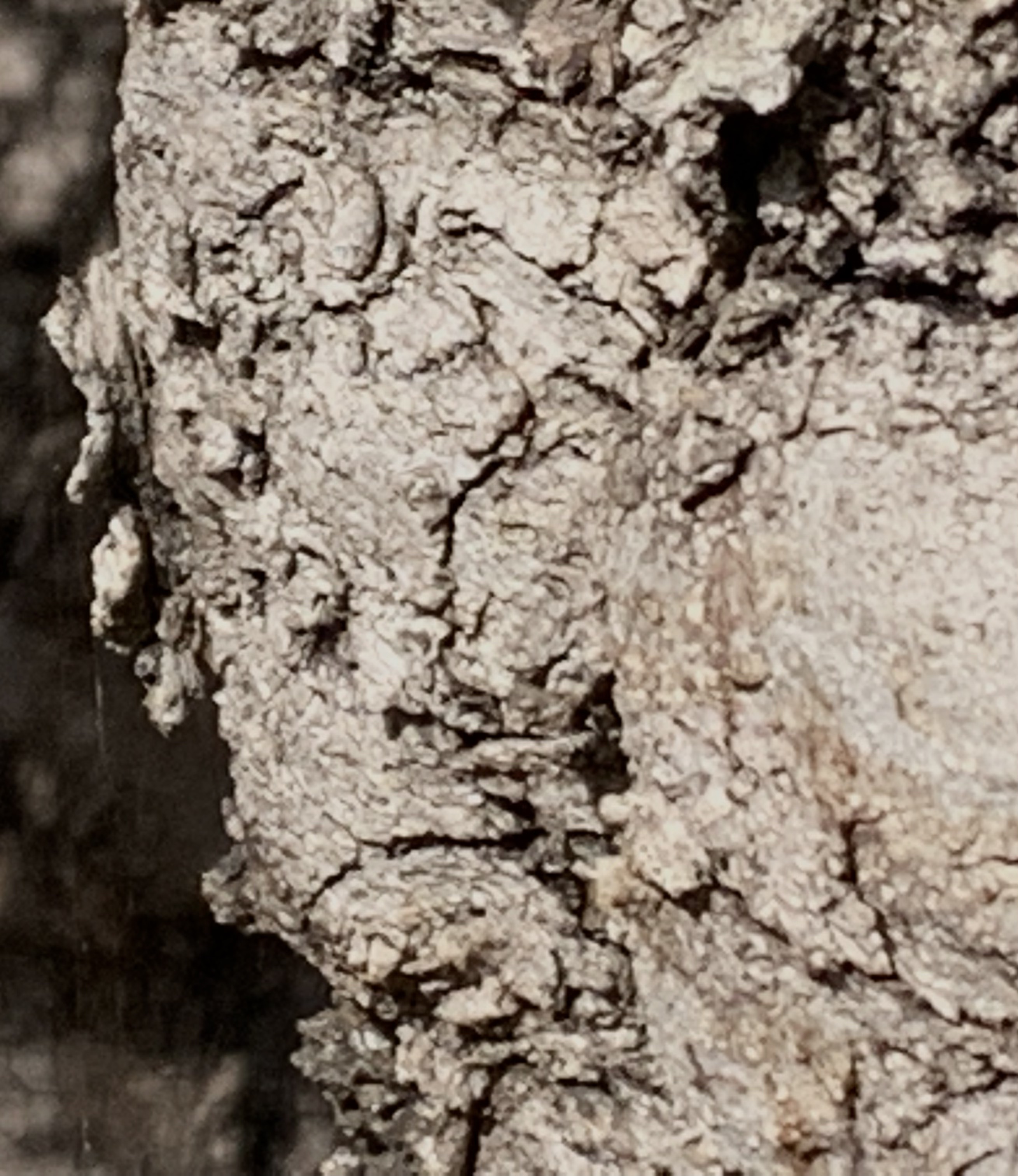
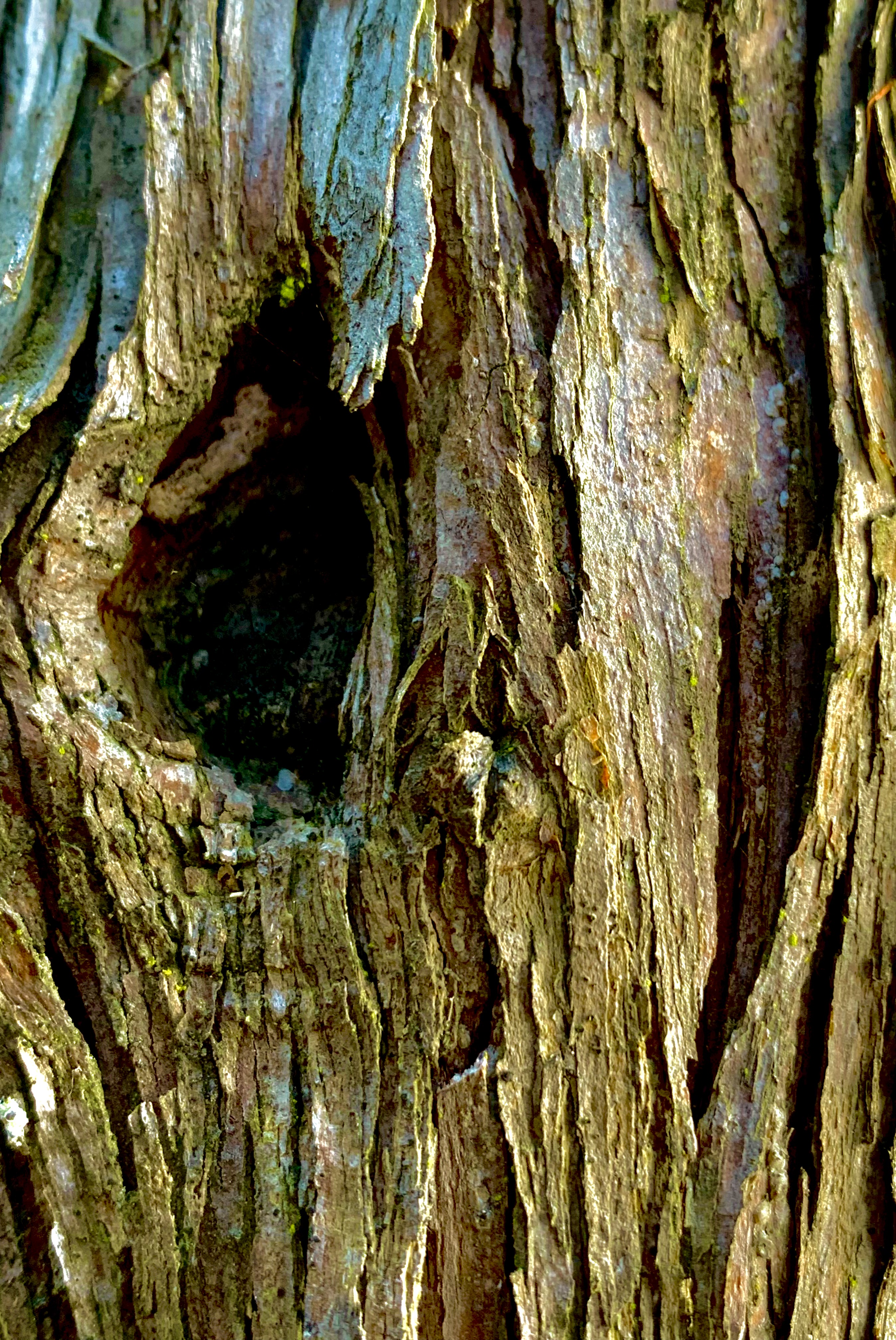
Check this out. What is this? It’s obviously the stump of a dead tree. Or, perhaps more accurately, it’s the dead and broken trunk of a tree.
Or, is it?
It took me about five minutes to convince myself that all of those yellow flowers and associated green leaves are part of that same tree!
Here’s another example. Where did these mushrooms come from? As you likely know, they grow from spores. But where did these spores come from? I didn’t plant them. There are no mushrooms nearby. But somehow, a puff of spores wafted on the wind and found an appreciative stretch of well-shaded damp ground.
Life is amazing. Well, after all, it’s been doing its thing for 4.5 billion years. And, when I say “it”, of course, I really mean “we” because all of life — you, me, and everyone else and every other life form on this planet, like it or not, are on this same spaceship earth.
Career Advice from Polonius: To Thine Own Self be True
“To thine own self be true.” This advice comes from Polonius who is giving advice to his son in Act I, scene 3 of Shakespeare’s Hamlet.
Polonius says: “This above all: to thine own self be true. And it must follow, as the night the day, Thou canst not then be false to any man.”
Let’s focus on the first part.
One of the dreams of education is to customize teaching to the specific learning style(s) of individual students. This was a hot topic when I was in graduate school.
Some day, your grandchildren or your great-grandchildren may be the beneficiaries of learning experiences that are individualized to their specific styles. I wouldn’t hold my breath, but it could happen. It isn’t only a question of research on what various styles are and how to present material that resonates with these various styles. There is also the question of priorities and dollars and personnel.
But meanwhile, here’s the good news. You don’t have to wait for another 50 years of research and a reshuffling of priorities so folx spend more money on education and less on, let’s say, cosmetics and professional sports. As I say, don’t hold your breath.
But let’s get back to the good news. The good news is that you can discover for yourself how to maximize your own learning as well as what your particular talents are.
One cautionary note: Don’t be a jerk about it. If you’re in a group dealing with grief, don’t say, “Well, I learn best if a subject is reduced to a few hundred polynomial formulae. So, let’s start right there. Let’s reduce grief to three dimensions. Later, of course, we can do a proper multidimensional scaling exercise to determine the optimal number of dimensions.”
No. Don’t say that. Of course, you’re free to suggest that approach, but chances are, in this situation, and in most realistic group situations, you will be treated to information in the same manner as many others who have different styles from yours.
However, in many situations, you are, far and away the main important stakeholder. You can use your knowledge of how things work for you in order to strategize and plan how you will learn about things. You can organize and arrange your work so you’ll be more productive.
Here’s a trivial example. I have learned that my eyes have a wisdom of their own. If, for instance, I’m going out for a walk around the garden to take some pictures of the sunset on the flowers, I grab my stuff and find myself turning and staring at the hat-rack on the way out the door. When I was younger, I would ignore this. But what I have learned is that my eyes are really good at knowing what to look at. So, even if I’m in a hurry, I take a moment to reflect on why my eyes are looking there. And, then, it comes to me. I’ll do better if I wear a brimmed hat to keep the sun out of my eyes while I look at my iPhone.
By paying attention to this little quirk, I’ve saved myself a lot of grief over the years; e.g., not left the house without my wallet, etc.
Here’s another example. I’m very good at seeing “patterns” emerge from a small number of examples or when there is considerable noise involved. This serves me well as my hearing diminishes because I can use top-down processing. Generally, but not always, I understand what people are saying. If I try to listen to a foreign language tape that is only isolated audio words, I have no hope of knowing what they are saying. “Key” “Tee”, “Pea”, sound exactly the same.
Seeing patterns easily is generally a nice capacity. However, I’m horrible at finding my own typos immediately after I write something. I actually “see” what I meant to type. A week later, I’m pretty good at catching the errors. If I had more patience, I would wait a week to proofread for every blog post, but being patient isn’t a strength either. I do go back over old posts occasionally and fix the typos (which I never saw at the time).
When I go to the movies — remember when we used to go to movies? — anyway, if I went to a comedy, I was very likely to laugh too soon. I “hear” the punchline two lines earlier than it actually occurs. There’s no benefit to my laughing early! But that’s when the punchline hits me. I do keep it soft so as not to disturb the others in the audience. On the other hand, I’m pretty good at “discovering” the playing patterns of my tennis opponents and anticipating what they are going to do. Naturally, I don’t always guess right, but I do way better than chance.
I bring up these examples to illustrate a generality; that most of these individual differences have an upside and a downside. Mainly, learning about my own styles and capacities is something I learned well after leaving high school. That makes sense. In school — or at least, the schools I went to — everybody got the same instruction in the same way almost all the time. But as an adult, you often have a lot of control over your own timing, flow of information, etc. I think it’s worth your while to look back at your experience and discover what you have difficulty with, what you’re OK at and what you are exceptionally good at. When you have a choice, use the approach you’re really good at.