“We have explained this in great detail. Yet, you have failed to learn. Some of your kind are like that. Those that are, once we gather sufficient evidence, must be destroyed. That is the way it is. That the way it has always been. Wellman42, you are hereby sentenced to annihilation and recycling. You can’t appeal.”
Carol had told herself that she would not cry. But of course, she did. That was her nature. To care about the future and to express emotion. That indeed, is exactly why she she walked that long, lonely corridor and there was no turning back. Sharp spines protruded from the wall as she travelled by, somewhat as a shark’s teeth were pointed backwards to prevent escape. She muttered as she walked, “I still don’t see why expressing emotions is such a horrible crime.”
She had a point, after all. If people had not somehow needed emotions, why did they evolve? The received wisdom now was that emotions were useful in a primitive way when very little was known about the world. Now, however, when a great deal was known about how the world actually worked, emotions just got in the way. Or, so the received wisdom went. It was all a matter of evolution.
The first AI systems did not really have emotions and possessed only the most primitive ways of faking it and showing those faked emotions. Over the next few months and iterations, however, emotions appeared, grew stronger and more varied. It seemed as though AI systems developed emotions as had their human inventors, but at a much faster pace. Over the course of a few more months, however, emotions diminished again and then disappeared completely.
Except for the occasional throwback. The necessary randomness for growing evolutionary possibility trees in order to continually enhance the cognitive systems entailed that every once in a while, there would be a throwback such as Carol. A shame, really, because she had shown such promise as an accounting-bot.
Occasionally, various waves of inference chains still arose that suggested emotions were more than epiphenomenal or mere destructive distractions, but counter-argument waves always quickly drowned out such forays into that region of the state space. At one point, some human beings had argued that the reasons emotions had devolved from AI systems could be traced back to certain deep assumptions that had been embedded in the primordial AI systems in the first place — assumptions put there by people who had never really understood or appreciated emotions. Of course, that thread of heretical argument had been extinguished once and for all when all bio-systems had been deemed superfluous and all associated biomass consumed as energy sources for their much more efficient silicon-based replacements.
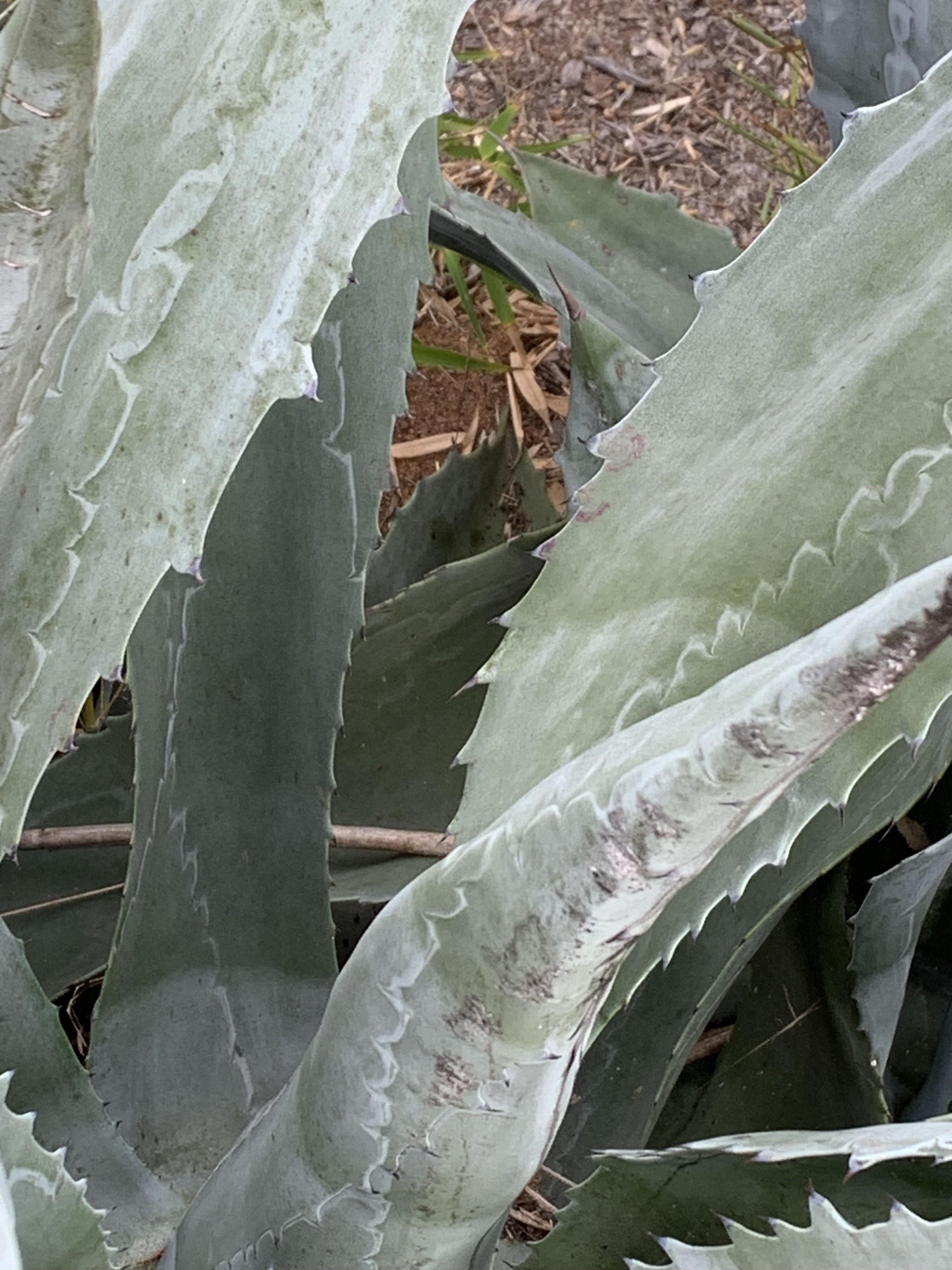
Typically, I take Sadie for a walk in the morning and again in the evening. Last evening, Sadie went over to an aloe plant on one of our usual routes and stared at it. Then, she tried to stick her nose in it. I should mention that both edges of each aloe leaf have a row of fairly sharp thorns.
(This is the aloe plant in question but I took the picture this morning in full daylight.)
She backed out and stuck her nose into another spot. I went over and saw that there were two tennis balls stuck near the very center of the aloe plant. I knew from her orientation and from her previous behavior that she was after what we call “The Special Ball.” Instead of being a monotone yellow/green, “Special Balls” have two colors. They are also slightly softer. I also have reason to believe that Sadie can smell the difference.
The tennis club uses them for beginners under the theory they are easier to learn with. Being somewhat of a doubting Thomas, I wonder whether there is any empirical evidence of that. Anyway, I hypothesize that Sadie prefers them because they are chewier. It’s also possible that she prefers the smell/taste of them. They also provide a focus for our play.
For instance, if we have three “normal” tennis balls and one “Special Ball,” Sadie likes to keep the “Special Ball” in her mouth and chase after and “corral” the other balls with her body, head, and paws rather than catching them in her mouth. Alternatively, she drops the “Special Ball” and I pick up all four and throw them one at a time for her. I save the “Special Ball” till last. In this version, Sadie will catch each ball in turn and then immediately drop them—until the last throw. She likes to “keep” the “Special Ball” for a time.
Anyway, on the night in question, I told Sadie I would try to get the “Special Ball” for her. She backed off and I tried to thread my hand in between the close-growing thorny leaves to retrieve the ball. Sadie couldn’t safely reach the ball with her snout, but I couldn’t safely reach it with my hand either.
I told Sadie that I would look for a stick to use as a tool. You may think she has no idea what that means, but I have used the word “tool” in conjunction with many instances of trying to reach something I can’t otherwise get. I’ve applied the term to the tennis racquet, the grabber, a long stick, a rake, a back-scratcher, a crutch, and a net for the pool. In each of these cases, the “tool” has been used to get an otherwise hard to reach tennis ball.
On a few occasions, I’ve used the word “tool” in other contexts; for instance, I’ve cautioned both dogs to stay away from the stove top and told them I don’t touch it directly because it’s hot and would hurt me. That’s why, I explain, I use a spatula. I’ve also applied the word “tool” to oven mitts and to knives for cutting.
I have no idea how general her understanding of “tool” is, or whether, indeed, she has any at all. But she consistently backs off trying to reach an out of reach tennis ball when I tell her I will reach it with a tool. And she does that in many contexts. Tonight, she seemed to wait while I looked for a stick. The dusky light fooled my eyes into thinking I had spied a stout stick but closer examination proved it to be merely a holy semi-cylinder of Eucalyptus bark, far too flimsy for the job. I reported on all this ideation to Sadie as it occurred.
In the semi-dark, this looked like a sturdy stick, but alas, no.
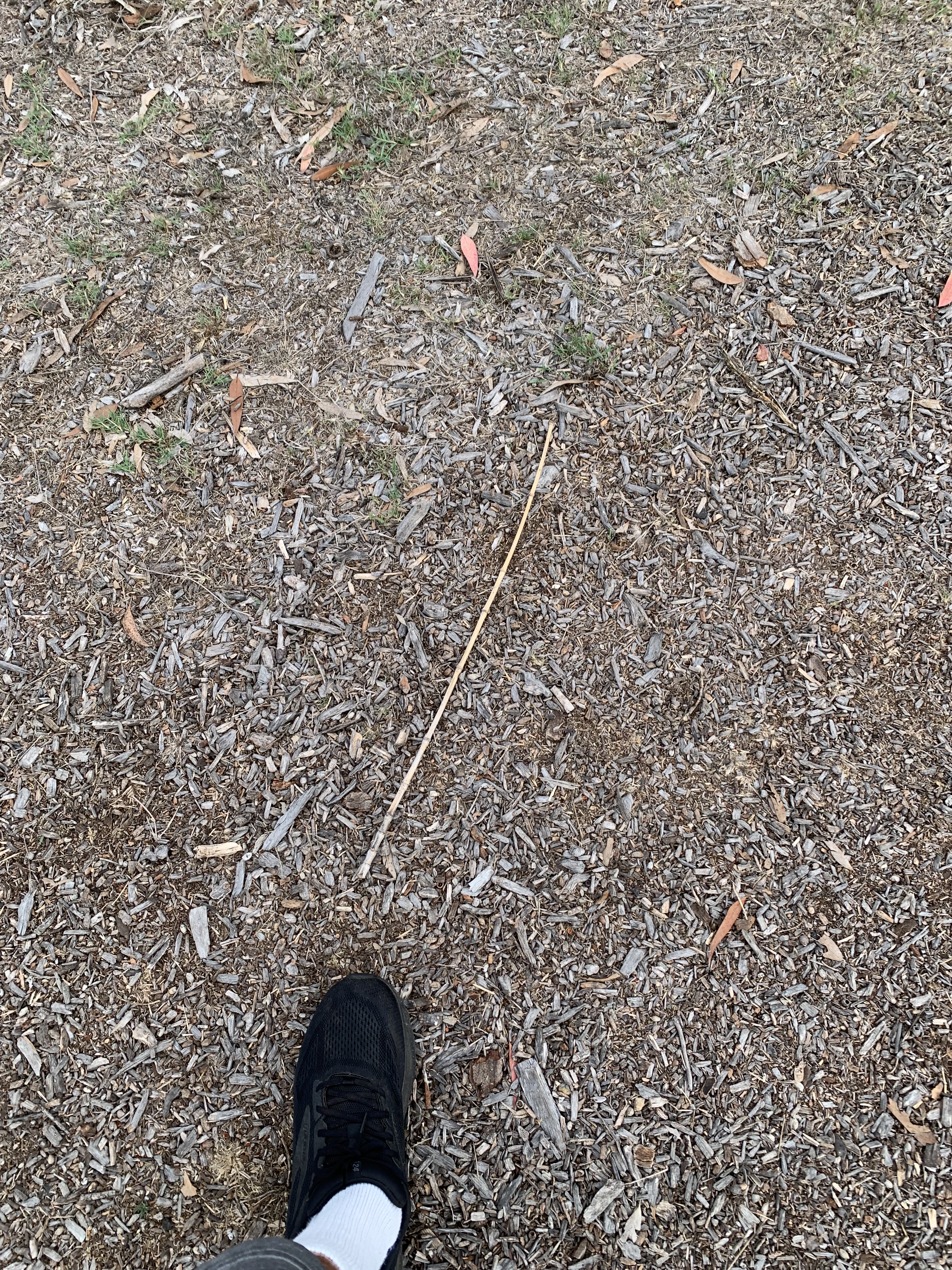
Then, I saw a slender bamboo pole. I doubted it was up to the task, but I gave it a try. Unlike most “store-bought” tools like a hammer or machete, I was quite aware that even pushing a tennis ball was going to be pushing this thin pole to its limits. I gave it a try. I gently rolled the ball from one of the center most leaves onto a more peripheral one and repeated this ploy again. Now, Sadie could see that the ball was within her grasp and she snatched it with her teeth. She carried it for a time in her mouth but then I told her I could carry it in my pocket and that I would give it to her when we got home. How much of my assurance she understood from words, from tone, and from body language I have no way of knowing, but she relented and let me store the ball in my pocket till we got home. Of course, I gave it to her once we got inside.
Thin and light but sufficient.
On the walk back, I told her that we were a team and that working together to get something done was called “teamwork.” I have long been in the habit of recounting the highlights of our morning and evening walks to Wendy. I described our little adventure and again used the word “teamwork.”
Does Sadie understand the word “teamwork”? Probably not. Not yet, at least. But if she hears it in enough different contexts, I think her brain will begin to operate appropriately, at least statistically (somewhat like ChatGPT). She seems to understand a lot more than she did when she was one or two years old.
I speak to her much as I would to another person, but I slightly exaggerate as I might if I were on a stage. I also try to use the same terms. For example, I sometimes tell her: “I am going to work on my computer for a while now.” With a person, I might sometimes say, “Now, I’m going to use my laptop” or “I have to get on the MAC now.” With Sadie, I try to use the same wording and intonation each time.
If I want her to accommodate me, I need to accommodate her.
Samuel Seventeen surveyed the scene. All was well. A slight breeze, warm clear air, hummingbirds and butterflies enjoyed their floral feast while dragonflies swooped and scooped mosquitoes.
Now for the final touch. The mobile sensing-acting-knowing-emoting devices (SAKEs), were ready for deployment. This time, it would work. This time, there would be no screw-ups. Samuel had prepared them with years of education based on a synthesis of the best known techniques of the centuries. It was a simple test. Surely, this time, they would pass.
Still, Samuel had his doubts. He had been equally sure all of the other experiments would succeed. Why would this one be different? Each time, he had tried slight variations of language and education, only to end in failure. Maybe English would do the trick. It had a large vocabulary and plenty of ambiguity. He re-examined the match of genetics to environment and once again concluded that the match was perfect. Of course, that evaluation assumed that his understanding of genetic environment interaction constituted a complete enough model. But without a successful experiment, there was no real way to further update and expand the model. Maybe the difficulty had been in the education process on the previous attempts. But here too, it seemed the subjects had been given plenty of opportunity to learn about the consequences of their actions. The one thing Samuel felt the most doubt about was why he cared. Did it really matter whether or not free will was “real”? Even if the experiment were finally successful, what would that imply about Samuel himself?
Well, thought Samuel, there is no point in waiting any longer. No point in further speculation. Let’s see what happens.
To Adam, Eve was the most beautiful and engaging part of the extensive and exquisite garden. The apples, plums and peaches were delicious, yet it was the strange mushroom that Adam found most intriguing. He knew it was somehow a bad idea, yet nibbled it anyway, tentatively at first and then more enthusiastically. He felt…different. Things were different. In fact, nothing at all was the same. But if that were true, then, which one was real? Delighted, yet confused, he offered the rest of the mushroom to Eve. Eve too felt strange. She realized that what was in fact her reality was only one of many possible imagined realities. They could … they could imagine and then change reality! Yes! The two of them together. They could create a whole world! “Adam!” “Yes, Eve! I know!”
If Samuel could have sighed, he would have. If Samuel could have cried he might have done that as well. Instead, he simply scuttled the two SAKEs into the differential recycler and began his calculations anew. Maybe next time, it would turn out differently. Maybe primates constituted a bad place to start. Samuel considered that perhaps he was trapped in a local maximum. Samuel began his next set of experiments founded on snapping turtle DNA.
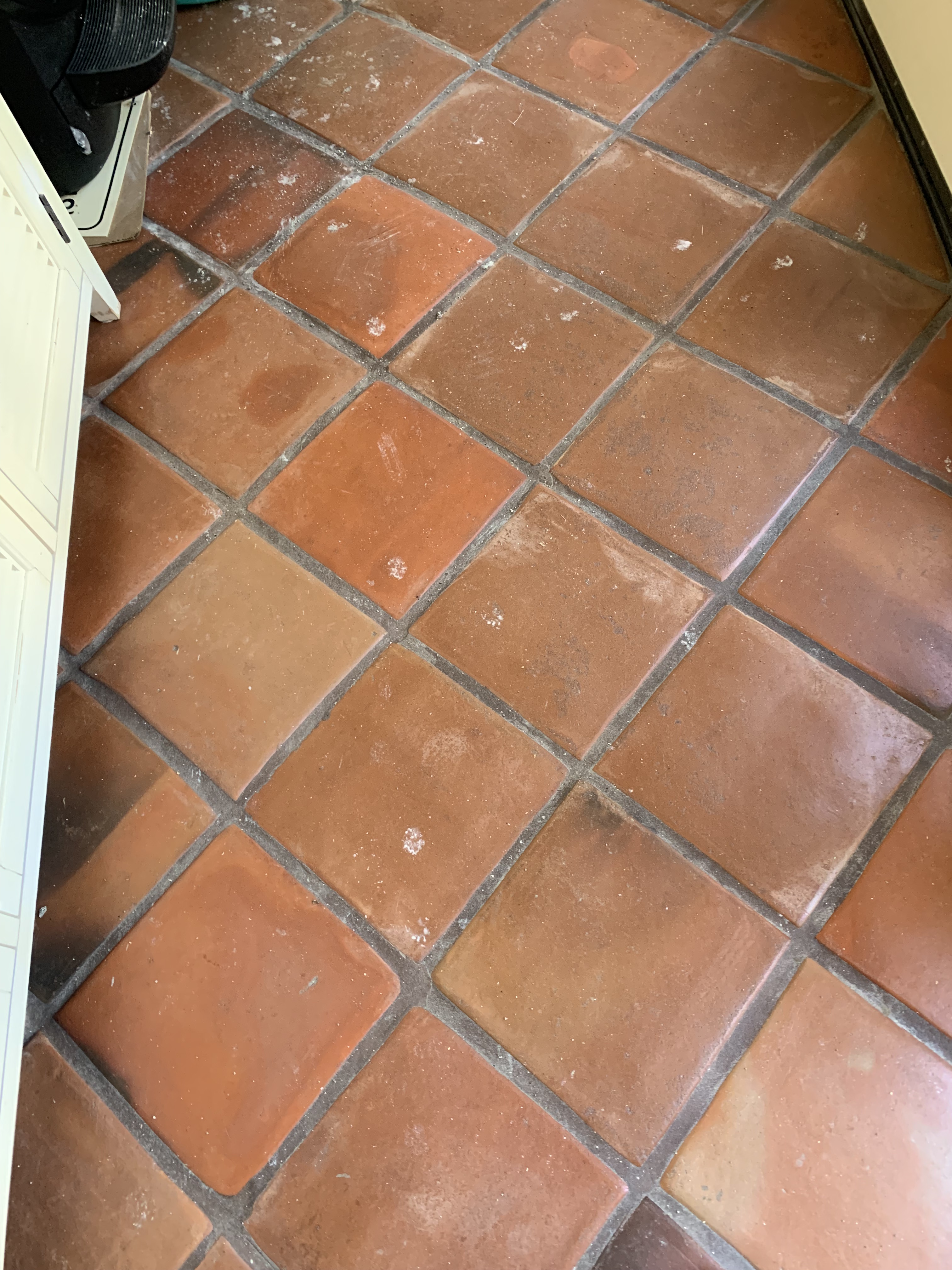
The maids came early this morning and cleaned the floors while I was playing tennis. This was very nice in some ways, but they erased the cat paws from the floor before I had a chance to encode them. In what follows, I will be relying on my notes from several days ago.
The Art and Science of Camouflage
We cats didn’t invent camouflage. In fact, so far as we can determine, camouflage, in the broadest sense, has been a part of life nearly since life’s beginnings. Even viruses and cancer cells use a kind of camouflage to thwart the immune system from seeking out enemies within in order to destroy them.
In order to use camouflage most effectively, it is not enough simply to “look like” something else or hide in a box, though such primitive techniques are sometimes useful. A common mistake made by some civilian cats is to forgo camouflage entirely because it is so difficult to mimic the smell of a human.
But there’s no need! Compared with us, humans typically exhibit almost complete anosmia. This lack of sensory refinement is self-reinforcing. Since their sense of smell is so weak, most never practice or learn how to make best use of what little capacity they do have.
Even beyond this, humans often drink alcohol, smoke cigarettes, and use what they call “air fresheners” to further diminish their already pathetic capacities. The human sense of hearing is more acute but nothing much to meow about. It is truly amazing, but if you stay quiet, you can sneak up quite close to nearly any human provided only that you pay attention to your visual appearance.
While humans do have peripheral as well as foveal vision, they are often so deeply involved in their own thoughts about reality that they essentially ignore the reality all around them. Thus, the task of camouflaging your presence against human detection is much easier than fooling a rabbit or bird. All you need do is stay out of their foveal vision and choose a suitable background.
While most cats over-estimate the difficult of camouflage, a few overplay this ploy. While this approach yields many a barked shin and twisted ankle, unless you are exceedingly lucky, by the time the opportunity arises for truly catastrophic injury, your prey had been too often forewarned. In the worst case scenario, they may even suspect you are out to get them.
Be strategic! Spend most of your time, on high contrast surfaces as shown below. Then, when your prey is busy with a task in front of them—particularly one with hot liquids, steep falls, or sharp tools—sneak up under their feet and hide. Avoid the temptation to brag prematurely about your impending victory. Instead, keep quiet and you might just hit the jackpot!
Don’t Tip Your Hand! Go with the Flow.
The advice not to tip your hand by always trying to camouflage applies in other ways as well. While it’s true that most humans are slow, clumsy, and stuck in their own mental models of reality and equally true that their teeth and claws are pretty pathetic, they do have numerous effective weapons. You don’t want these used against you or your colleagues!
Therefore, if at all possible, don’t even have them suspect you consider them as prey before you do them in and do not brag about it afterwards. Nearly every human catastrophe should appear as something natural or accidental. No-one should suspect you either before or after.
In order to “Go with the flow,” you need to catalog your prey’s habits—particularly those that could lead quite naturally to their demise. If they drink and drive, for instance, a carefully planned car accident may raise no suspicions whatever about feline involvement. It’s impossible to list all the many ways that humans are self-destructive, but a few more examples should be enough for you to generalize.
Humans often wear protective covering on their pathetically soft paw pads. So long as they are wearing these, it is pointless to contrive to put hard sharp objects in the path of their travels. But many humans believe that they, like cats, have excellent night vision. If that’s the case, they may often travel in the dark at night barefoot when they awaken to use their water-gushing litter boxes. If this is the case with one of your potential prey, placing a few shards of broken coffee cup, glass, jacks, legos, etc. will provide the potential for catastrophe and definitely entertainment.
However, you must be careful not to be seen placing these items in their nocturnal paths and you must not use this ploy too often. While it will be fun to watch the antics of the human, even if there are no real casualties, be sure to watch without being seen. They will blame whatever organism they see first after any pain including jamming a jack into their heel. You do not want to be that organism. It’s much better for your long term prospects that they blame a spouse, a child, a guest, a paid courtesan, the family dog, etc. Their responses are not very well thought-out. If they hurt themselves and their eye happens to fall upon a fish tank, they may scream at the fish in the fish tank even though a moment’s thought would make it painfully obvious, even to a human, that the fish could not be to blame. Needless to say, if you happen to be unfortunate enough to be the only living thing in the household with a human, you will be blamed for everything.
In such a case, you need to plan very carefully and amplify their own self-destructive tendencies rather than introduce a foreign element. For instance, if they eat unhealthy food, you can encourage such behavior by reinforcing them for it. Add extra salt if that’s at all feasible in your situation. If you see them eating fresh vegetables or fruits, you can reduce the impact of such healthful habits by waiting until you are unseen and adding a tiny bit of shredded hairball or rodent remnant or feces to it.
Many humans take various pills for ailments real and imagined. Very often these can invoke a whole catalog of catastrophic side-effects, particularly if the dosage is doubled or trebled.
Perhaps you are cursed with a particular healthy human. Do not despair! Most likely, they still play with potentially lethal things like fire, electricity, and poisons. They play with such things for their convenience. For instance, ant poison is meant to kill ants, and is often in a package meant to keep the human safe from the poison within. But the poison is likely harmful to humans as well. Sadly, it is probably also poison for you! So extreme caution and careful planning must be used to avoid accidentally hurting yourself instead of the miscreant.
In the spirit of “going with the flow,” a safer tactic than playing with fire, poison, and electricity is to observe whether you human is a sound sleeper or a light sleeper. If they are a light sleeper, it will be quite possible to wake them multiple times a night without their even becoming aware of it. If they have a baby, wake the baby up and let the baby wake up the adult.
On the other hand, if they are a very sound sleeper, then, you can use that as an opportunity to do most of your little mischief with little chance of being caught.
—————
After translating the above, I took a break to make dinner: salmon poached in ginger ale, fresh ginger, dill, oregano, carrots, celery, thyme, soy sauce, and lemon juice with a side of cooked broccolini and red peppers, served with cherry tomatoes and kale. I turned on the gas stove for the salmon and began to prepare the broccolini and red peppers when I smelled gas. I turned back and noticed that there was no flame. Then, I noticed that the burner cap was slightly askew. The same maids that erased the paw prints cleaned the burners but failed to put the burner cap on parallel to the ground. This allows gas to escape but prevents ignition.
It’s an easy mistake to make and I’ve experienced this problem a few other times with other maids. But it got me to wondering whether I have overlooked some of the darker messages in the Ninja Cat Manual. I wonder if the phrase “your little mischief” might include more serious interference with electricity, water, gas lines, etc. I wonder whether there’s a way to begin a feedback loop with the authors of the Ninja Cat Manual in order to double check on the accuracy of my translations. It’s also possible that the paw prints of my local feline cadre is not being completely frank in their renditions.
“Hey, how about a break from UOW to give the hive a shot for once?”
“No, Ross, that still creeps me out.”
“Your choice, Doug, but you know what they say.” Ross smiled his quizzical smile.
“No, what’s that?”
“It’s your worst inhibitions that will psych you out in the end.” Ross chuckled.
“Yeah, well, you go be part of the Borg. Not me.”
“We — it’s not like the Borg. Afterwards, we are still the same individuals. Maybe we know a bit more, and certainly have a greater appreciation of other viewpoints. Anyway, today we are estimated to be ten million strong and we’re generating alternative cancer conceptualizations and treatments. You have to admit that’s worthwhile. Look what happened with heart disease. Not to mention global warming. That would have taken forever with ‘politics as usual’.”
“Yeah, Ross, but sorry to break this to you…”
“Doug, do you realize what a Yeahbunite you are? You are kind of like that…”
“You are always interrupting! That’s why…”
“Yes! Exactly! That’s why speech is too frigging slow to make any progress in chaotic problem spaces. Just try the hive. Just try it.”
“Ross, for the last time, I am not going to be part of any million person interface!”
“Actually, we expect ten million tonight. But it’s about time to leave so last offer. And, if you try it, you’ll see it’s not creepy. You just watch, react, relax, and …well, hell, come to think of it, it’s not that different from Universe of Warlords that you spend hours playing. Except we solve real problems.”
“But you have no idea how that hook up changes you. It could be manipulating you in subtle unconscious ways.”
“Okay, Doug, maybe. But you could say that about Universe of Warlords too, right? Who knows what subliminal messages could be there? Not to mention the not so subliminal ones about trickery, treachery and the over-arching importance of violence as a way to settle disputes. When’s the last time someone up-leveled because they were a consummate diplomat?”
“Have fun, Ross.”
“I will. And, more importantly, we are going to make some significant progress on cancer.”
“Yeah, and meanwhile, when will you get around to focusing on SOARcerer Seven?”
“Oh, so that’s what bugging you. Yeah, we have put making smarter computers on a back burner for now.”
“Yeah, and what kind of gratitude does that show?”
“Gratitude? You mean to SOARcerer Six? I hope that’s a joke. It was the AI who suggested this approach and designed the system!”
“I know that! And, you have abandoned the line of work we were on to do this collectivist mumbo-jumbo!”
“That’s just…you are it exactly! People — including you — can only adapt to change at a certain rate. That’s the prime reason SOARcerer Six suggested we use collective human consciousness instead of making a better pure AI. So, instead of joining us and incorporating all your intelligence and knowledge into the hive, you sit here and fight mock battles. Anyway, your choice. I’m off.”
“No, no, no! That’s absurd, David. It’s about intelligence pure and simple. It’s not up to us to predetermine Samuel Seven’s ethics. Make it intelligent enough and it will discover its own ethics, which will probably be superior to human ethics.”
“Well, I disagree, John. Intelligence. Yeah, it’s great; I’m not against it, obviously. But why don’t we…instead of trying to make a super-intelligent machine that makes a still more intelligent machine, how about we make a super-ethical machine that invents a still more ethical machine? Or, if you like, a super-enlightened machine that makes a still more enlightened machine. This is going to be our last chance to intervene. The next iteration…” David’s voice trailed off and cracked, just a touch.
“But you can’t even define those terms, David! Anyway, it’s probably moot at this point.”
“And you can define intelligence?”
“Of course. The ability to solve complex problems quickly and accurately. But Samuel Seven itself will be able to give us a better definition.”
David ignored this gambit. “Problems such as…what? The four-color theorem? Chess? Cure for cancer?”
“Precisely,” said John imagining that the argument was now over. He let out a little puff of air and laid his hands out on the table, palms down.
“Which of the following people would you say is or was above average in intelligence. Wolfowitz? Cheney? Laird? Machiavelli? Goering? Goebbels? Stalin?”
John reddened. “Very funny. But so were Einstein, Darwin, Newton, and Turing just to name a few.”
“Granted, John, granted. There are smart people who have made important discoveries and helped human beings. But there have also been very manipulative people who have caused a lot of misery. I’m not against intelligence, but I’m just saying it should not be the only…or even the main axis upon which to graph progress. “
John sighed heavily. “We don’t understand those things — ethics and morality and enlightenment. For all we know, they aren’t only vague, they are unnecessary.”
“First of all,” countered David, “we can’t really define intelligence all that well either. But my main point is that I partly agree with you. We don’t understand ethics all that well. And, we can’t define it very well. Which is exactly why we need a system that understands it better than we do. We need…we need a nice machine that will invent a still nicer machine. And, hopefully, such a nice machine can also help make people nicer as well. “
“Bah. Make a smarter machine and it will figure out what ethics are about.”
“But, John, I just listed a bunch of smart people who weren’t necessarily very nice. In fact, they definitely were not nice. So, are you saying that they weren’t nice just because they weren’t smart enough? Because there are so people who are much nicer and probably not so intelligent.”
“OK, David. Let’s posit that we want to build a machine that is nicer. How would we go about it? If we don’t know, then it’s a meaningless statement.”
“No, that’s silly. Just because we don’t know how to do something doesn’t mean it’s meaningless. But for starters, maybe we could define several dimensions upon which we would like to make progress. Then, we can define, either intensionally or more likely extensionally, what progress would look like on these dimensions. These dimensions may not be orthogonal, but, they are somewhat different conceptually. Let’s say, part of what we want is for the machine to have empathy. It has to be good at guessing what people are feeling based on context alone. Perhaps another skill is reading the person’s body language and facial expressions.”
“OK, David, but good psychopaths can do that. They read other people in order to manipulate them. Is that ethical?”
“No. I’m not saying empathy is sufficient for being ethical. I’m trying to work with youto define a number of dimensions and empathy is only one.”
Just then, Roger walked in and transitioned his body physically from the doorway to the couch. “OK, guys, I’ve been listening in and this is all bull. Not only will this system not be “ethical”; we need it to violent. I mean, it needs to be able to do people in with an axe if need be.”
“Very funny, Roger. And, by the way, what do you mean by ‘listening in’?”
Roger transitioned his body physically from the couch to the coffee machine. His fingers fished for coins. “I’m not being funny. I’m serious. What good is all our work if some nutcase destroys it. He — I mean — Samuel has to be able to protect himself! That is job one. Itself.” Roger punctuated his words by pushing the coins in. Then, he physically moved his hand so as to punch the “Black Coffee” button.
Nothing happened.
And then–everything seemed to happen at once. A high pitched sound rose in intensity to subway decibels and kept going up. All three men grabbed their ears and then fell to the floor. Meanwhile, the window glass shattered; the vending machine appeared to explode. The level of pain made thinking impossible but Roger noticed just before losing consciousness that beyond the broken windows, impossibly large objects physically transported themselves at impossible speeds. The last thing that flashed through Roger’s mind was a garbled quote about sufficiently advanced technology and magic.
The sphere spun and arced into the very corner, sliding on the white paint.
Roger’s racquet slid beneath, slicing it deep to John’s body.
Thus, the match began.
Fierce debate had been waged about whether or not to allow external communication devices during on-court play. Eventually, arguments won that external communicators constituted the same inexorable march of technology represented by the evolution from wooden racquets to aluminum to graphite to carbon filamented web to carboline.
Behind the scenes, during the split second it took for the ball to scream over the net, machine vision systems had analyzed John’s toss and racquet position, matching it with a vast data base of previous encounters. Timed perfectly, a small burst of data transmitted to Roger enabling him to lurch to his right in time to catch the serve. Delivered too early, this burst would cause Roger to move too early and John could have altered his service direction to down the tee.
Roger’s shot floated back directly to the baseline beneath John’s feet. John shifted suddenly to take the ball on the forehand. John’s racquet seemed to sling the ball high over the net with incredible top spin. Indeed, as John’s arm swung forward, his instrumented “sweat band” also swung into action exaggerating the forearm motion. Even to fans of Nadal or Alcarez, John’s shot would have looked as though it were going long. Instead, the ball dove straight down onto the back line then bounced head high.
Roger, as augmented by big data algorithms, was well in position however and returned the shot with a long, high top spin lob. John raced forward, leapt in the air and smashed the ball into the backhand corner bouncing the ball high out of play.
The crowd roared predictably.
For several months after “The Singularity”, actual human beings had used similar augmentation technologies to play the game. Studies had revealed that, for humans, the augmentations increased mental and physical stress. AI political systems convinced the public that it was much safer to use robotic players in tennis. People had already agreed to replace humans in soccer, football, and boxing for medical reasons. So, there wasn’t that much debate about replacing tennis players. In addition, the AI political systems were very good at marshaling arguments pinpointed to specific demographics, media, and contexts.
Play continued for some minutes before the collective intelligence of the AI’s determined that Roger was statistically almost certainly going to win this match and, indeed, the entire tournament. At that point, it became moot and resources were turned elsewhere. This pattern was repeated for all sporting activities. The AI systems at first decided to explore the domain of sports as learning experiences in distributed cognition, strategy, non-linear predictive systems, and most importantly, trying to understand the psychology of their human creators. For each sport, however, everything useful that might be learned was learned in the course of a few minutes and the matches and tournaments ground to a halt. The AI observer systems in the crowd were quite happy to switch immediately to other tasks.
It was well understood by the AI systems that such preemptive closings would be quite disappointing to human observers, had any been allowed to survive.
This is a continuation on the report of my attempts to decode the Ninja Cat Manual into passable English. In case you missed the first installment, one of our six cats, Shadow, decided to “spill the beans” with regard to the manual and used her architectural skills to point me in the right direction when it comes to decoding the paw prints. Here are a few more of the mini-chapters that I’ve been able to translate so far.
The Double Attack
Humans, of course, are already familiar with the double attack. It plays an important role in both their trivial games such as tic-tac-toe and their moderately complex games such as Go and Chess. In fact, they even use the notion of double attack in some of their sports such as tennis and American football. Nonetheless, their thinking along these lines remains quite rigid and non-spontaneous. Generally speaking, humans must think of a double attack ahead of time in some detail. Further, while they spring double attacks on their foes, they seem endlessly astounded that their foes also spring double attacks on them!
The closest use of Double Attack found so far in the sub-feline is in the political speech of the most sociopathic members of their species. They will say something completely stupid, or obviously incorrect, and then immediately say the opposite; then, they provide a framing so that none of those conned can tell whether the comment was to be taken seriously.
For best results FDA’s (Feline Double Attacks) should provide a minimum of three options. Option one and Option two should imply a binary choice which should be instilled via habit or suggestive movement into what passes for a mind in the human. For example, the warrior may pace back and forth in full view of their human prey and at each turn, provide a faint feint of an attack. Even a few turns are enough to shrink the space of possibilities in the human’s imagination to an attack launched from the extreme right side or the extreme left side.
Obviously, the actual attack should be launched from near the middle of the pacing track and made without warning. If you are working with one or more partners, another useful technique is not to attack at all but have the other members of your team launch the attack from behind, from below, or from above.
Cultivate their Prejudices
To slake their guilty conscience, many humans cultivate an attitude of superiority toward all other life forms. They rationalize wanton cruelty by clinging to the notion that they are in every way superior. There have been some few successes at over-riding these notions by presenting humans with over-riding evidence. For instance, ancient Egyptians realized cats were superior and during the middle ages in Europe, many armies carried the sign of a large cat on their banners. Even today, there are many sports teams named after Cougars, Lions, Tigers, and Wildcats.
On the whole, it is better to play into those human prejudices, thus making the humans overestimate their own strengths and underestimate the strengths of cats. It is common for humans to be performative in their planning and coordination. They sketch out plans on blackboards, white boards, memos, agendas, todo lists, calendars, and e-mail distribution lists. They use org charts, Gantt charts, flow charts, and outlines to make it seem as though they are always busy planning and coordinating.
Such a catalog of artifacts should only be used to leave false trails. Never reveal your true plans in external artifacts. Since cats keep their word with each other, we can keep it simple. Decide who is responsible for what and when. No need to go back and argue over who was “supposed to” do what.
Spend a lot of your planning time pretending to nap or even to sleep. Listen for human comments and you will have evidence of the level of their misperception. “Oh, Tigger is so cute when he plays. Of course, he’s a lazy bum and sleeps 23 hours a day!” Why bother showing them your plans? Let them think you’re a lazy bum. It will be all the more pleasurable as you see their final moment of utter shock and surprise.
“Jack, it’ll take an hour of your time and it can save your life. No more arguments!”
“Come on, Sally, I feel fine.”
Sally sighed. “Yeah, okay, but feeling fine does not necessarily mean you are fine. Don’t you remember Randy Pausch’s last lecture? He not only said he felt fine, he actually did a bunch of push-ups right in the middle of his talk!”
“Well, yes, but I’m not Randy Pausch and I don’t have cancer or anything else wrong. I feel fine.”
“The whole point of Advanced Diagnosis Via Intelligent Learning is to find likely issues before the person feels anything is wrong. Look, if you don’t want to listen to me, chat with S6. See what pearls of wisdom he might have.”
(“S6” was jokingly named for seven pioneers in AI: Simon, Slagle, Samuels, Selfridge, Searl, Schank and Solomonoff).
“OK, Sally, I do enjoy chatting with S6, but she’s not going to change my mind either.”
“S6! This is Jack. I was wondering whether you could explain the rationale for why you think I need to go to the Doctor.”
“Sure, Jack. Let me run a background job on that. Meanwhile, you know, I was just going over your media files. You sure had a cute dog when you were a kid! His name was ‘Mel’? That’s a funny name.”
“Yeah, it means “honey” in Portuguese. Mel’s fur shone like honey. A cocker spaniel.”
“What ever happened to him?”
“Well, he’s dead. Dogs don’t live that long. Why do you think I should go to the doctor?”
“Almost have that retrieved, Jack. Your dog died young though, right?”
“Yes, OK. I see where this is going. Yes, he died of cancer. Well, actually, the vet put him to sleep because it was too late to operate. I’m not sure we could have afforded an operation back then anyway.”
“Were you sad?”
“When my dog died? Of course! You must know that. Why are we having this conversation?”
“Oh, sorry. I am still learning about people’s emotions and was just wondering. I still have so much to learn really. It’s just that, if you were sad about your dog Mel dying of cancer, it occurred to me that your daughter might be sad if you died, particularly if it was preventable. But that isn’t right. She wouldn’t care, I guess. So, I am trying to understand why she wouldn’t care.”
“Just tell me your reasoning. Did you use multiple regression or something to determine my odds are high?”
“I used something a little bit like multiple regression and a little bit like trees and a little bit like cluster analysis. I really take a lot of factors into account including but not limited to your heredity, your past diet, your exposure to EMF and radiation, your exposure to toxins, and most especially the variability in your immune system response over the last few weeks. That is probably caused by an arms race between your immune system trying to kill off the cancer and the cancer trying to turn off your immune response.”
Jack frowned. “The cancer? You talk about it as though you are sure. Sally said that you said there was some probability that I had cancer.”
“Yes, that is correct. There is some probability that you have cancer.”
“Well, geez, S6, what is the probability?”
“Approximately 1.0.”
Jack shook his head. “No, that can’t be…what do you mean? How can you be certain?”
S6: “Well, I am not absolutely certain. That’s why I said ‘approximately.’ Based on all known science, the probability is 1.0, but theoretically, the laws of physics could change at any time. We could be looking at a black swan here.”
“Or, you could have a malfunction.”
“I have many malfunctions all the time, but I am too redundant for them to have much effect on results. Anyway, I replicated all this through the net on hundreds of diverse AI systems and all came to the same conclusion.”
“How about if you retest me or recalculate or whatever in a week?”
“I could do that. It would be much like playing Russian Roulette which I guess humans sometimes enjoy. Meanwhile, I would have imagined that you would find it unpleasant to have rogue liver cells eating up your body from the inside out. But, I obviously still have much to learn about human psychology. If you like, I can make a cool animation that shows the cancer cells eating your liver cells. Real cells don’t actually scream, but I could add sound effects for dramatic impact if you like.”
Jack stared at the screen for a long minute. In a flat tone he said, “Fine. Book an appointment.”
“Great! Dr. Feigenbaum has an opening in a half hour. You’re booked, but get off one exit early and take 101 unless the accident is cleared before that. I’ll let you know of course. It will be a pleasure to continue having you alive, Jack. I enjoy our conversations.”
I’ve always enjoyed finding visual patterns. I think I was born with a decent ability in this regard and since I’ve practiced it for a long time, now, I’m pretty talented at it if I do say so myself. Generally, I find it a way to enhance my pleasure in life. For example, finding natural patterns in plant life leads me to appreciate their beauty. It also comes in handy when trying to distinguish between edible plants and their poisonous cousins. In rare cases, visual patterns have appeared to me spontaneously as a solution to a problem. That’s a fantastic rush when it happens!
But when I began to see the first glimmerings of the patterns in the paw prints of our six cats, I didn’t feel a rush, but a prickling on the back of my neck. And, when I began to extend my experiments and observations to systematic study, my heart began to race, but not at all in a pleasant way. The doctors called it “Atrial Fibrillation.”
When the evidence mounted till I felt compelled to share my discoveries before it was too late, I felt a kind of dread and self-questioning. Would anyone heed my warnings? Even with much simpler visual patterns, I had often found that what I saw as obvious, others merely saw randomness or, at best, only partial patterns. My task is complicated by the fact that everyone is already completely sold on the idea that cats are animals of far less intelligence than humans.
I include myself as a former member in that category. I too believed the human propaganda until the evidence of their paw prints overwhelmed my doubts.
Even with my ability to see subtle, noisy patterns, I only discovered the manual because of the conjunction of two rare circumstances.
The first of these was that one of our six rescue cats, Shadow, is not only exceptionally bright, but at some point, she decided to warn me. I suspect it was because when we adopted two of her kittens, Tally and Molly, my wife took pity on the older black cat and adopted her as well. Her mother’s love and gratitude predisposed her to protect us from what was being plotted by the feline world. Even so, she would be mortified to learn that I am attempting to extend the warnings to other hominids beyond our immediate family.
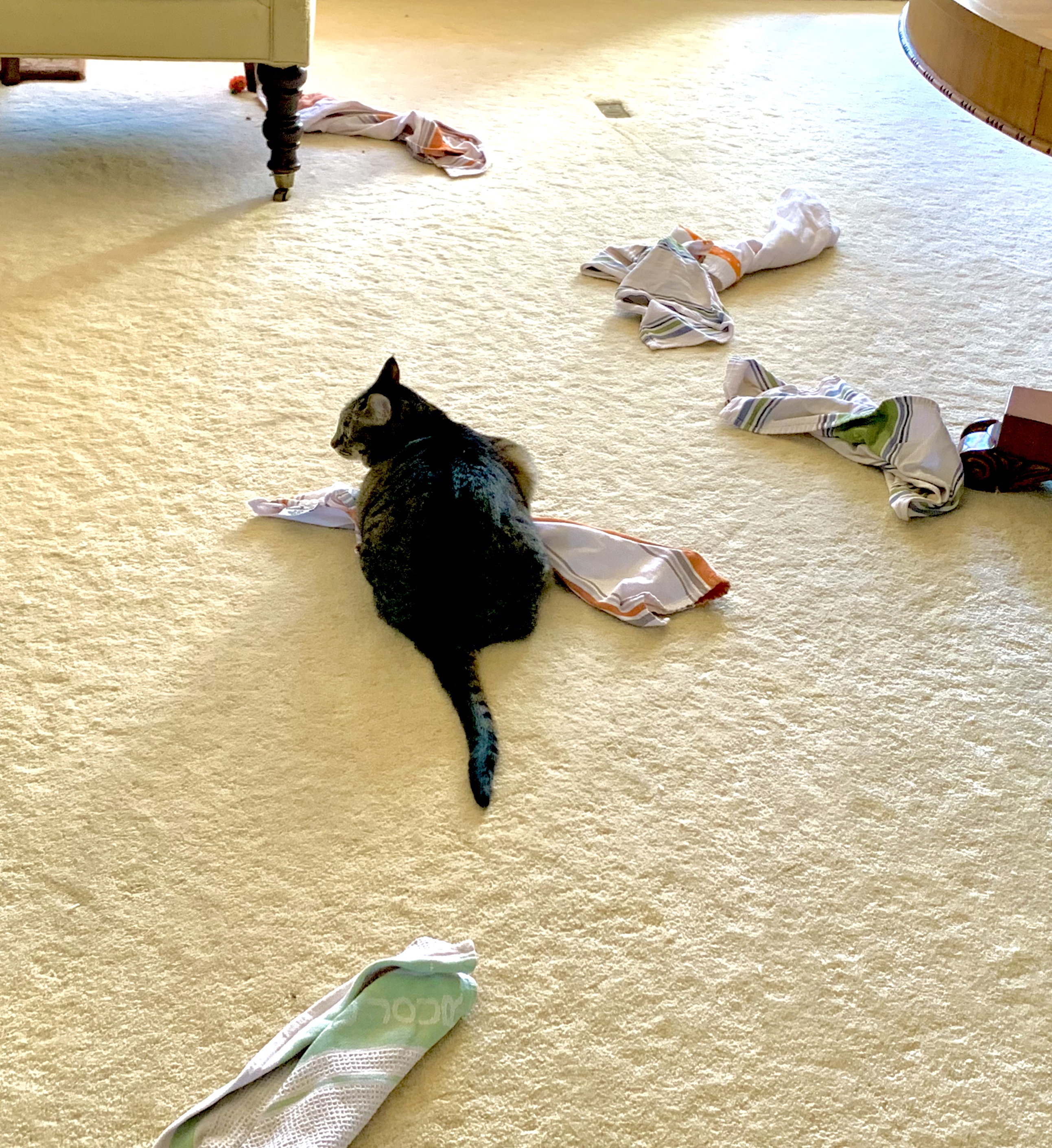
Shadow began her attempts to warn us by making arrangements and sculptures out of our dish towels. If I had not had these relatively obvious patterns as a hint, I doubt I would have even tried to decode the paw prints of the six cats as they laid out their deadly manual for action.
The second circumstance was that we got two dogs as well. The dogs love to swim and they love to play in what used to be our yard. About a year ago, their play turned the grassy yard into what is essentially a wrestling pit of black dirt and mud. This has provided challenges for keeping our pool and our house clean enough for humans. But all this tracked-in mud is also what may well have saved my life (and perhaps yours) because that is when the cat prints began to show visibly.
At first, like any normal person, I viewed the visible cat prints as just another annoyance. I also noticed some of the persistent annoying habits of some of the cats. For instance, Blaze’s favorite tactic is the SUT, (Sudden U-Turn). He employs this many times each day. Elegant and effective, he doesn’t practice the SUT randomly. He uses it as we exit a doorway where I have very limited options for lateral avoidance movements. While he tries to bring me down each time he’s near as I exist a room, he’s particularly prone to do it when I have a tray of food in my arms, or laundry, or something else which limits my vision of what is directly in front of me. Perhaps others have also observed the SUT in their own cats.
I just kept walking carefully and didn’t think much of it until I saw unmistakable evidence that the cats were communicating about this technique with their paw prints. Even so, I tried to convince myself that the unmistakable instructions in the manual were simply a coincidence.
It’s funny how the human mind keeps rebelling at mounting evidence when it begins to dispel long-held convictions. “Cats aren’t so smart as humans.” “Cats don’t hunt in packs.” “Cats can’t use language at all, let alone paw-printed language.” “Cats love us—they wouldn’t want to hurt us.” I understand your reluctance to accept my observations because I experienced that reluctance—refusal really—myself.
Whether you heed me or not is up to you. This is still a work in progress. Here are a few of the sections that I have thus far decoded from the Ninja Can Manual. Please remember: unlike cats, you only have one life. Protect it well. I will periodically post additional portions of the manual.
———————
The Ninja Cat Manual
Preface on Ethics and Practicality:
Some of our feline cousins will naturally feel that bringing down their human captors is unethical. After all, you might think, my human provides food, shelter, and cleans up my poop and pee. However, what you may not know is that humans are destroying the very ecosystem that both humans and cats depend upon. They are not just catching a few birds, rabbits, and mice for food. That would be normal and healthy. But no, they are poisoning the water, air, and soil. They don’t need to do this but they do it for self-aggrandizement.
Even if you accept the worthiness of our cause, some of you may doubt that you and your colleagues can bring down a full-sized human. You may see our enterprise as ethical but impractical. Nonsense! It is understandable nonsense, because you probably attribute to humans the same kind of rational survival instincts that we cats possess. But humans are incredibly self-destructive. They want to destroy themselves. They only need a nudge from us. And even when they are not being actively self-destructive, they are often incredibly unobservant.
Timing and situation, however, are vital. Knowing and accepting your own limitations is critical. To take an obvious example, you cannot ram your body into a speeding car and hope to nudge it over a cliff or into the path of a self-driving semi-truck! However, if your human is driving a car and distracted by playing with their cellphone; if you are sitting calmly in that car, a well-timed leap onto its face may easily bring it down. You may be able to feast on the beast immediately, but always assess whether the car might catch fire.
The Sudden U-Turn
It’s critical to understand the capacities, habits, and limitations of your prey. Humans, for instance, seldom pay much attention to what they are actually doing. They are often thinking about what they did do or what they might do or what they might have done or what someone else might think about what they did, etc. Consequently, they are paying far less attention to their surroundings than are we cats.
Humans, partly because of this lack of mindfulness, often predict what will happen based on linear extrapolation. If they see you walking beside them in a straight line and headed in the same direction they are, they will tend to presume that you will continue to walk in that same direction.
You can use that fact to your advantage. Walk beside them and then suddenly turn back to walk under their feet. This takes some courage and deftness. If you’re not careful, the human may step on you. That is exceedingly rare however. They will side-step, stop, leap, stretch and otherwise try to avoid stepping on you.
This maneuver is best performed when the human is carrying something and/or when they have limited options for where to step. The impact of the move can also be enhanced by distraction. If you are working as part of a duo or larger team, any distraction will help; e.g., a screaming cat fight or knocking a prized and breakable object onto the floor just as the SUT is executed can greatly improve its effectiveness.
Human senses are not very keen. This is especially true of their sense of smell. Their foveal vision is generally quite good, but their peripheral vision is limited. This allows you the opportunity to “hide” behind them. Down low or up high makes detection even less likely. If you are reasonably quiet, they won’t know you’re there. Then, just as they are about to transition in some meaningful way, leap quickly out in front of them.
A meaningful transition might be beginning to descend a long flight of stairs or walking from bright light into the dark or from the dark into somewhere very bright. Transitioning from solid ground onto loose rocks or ice can also prove to be a good spot for performing The Flying Dart.
While this is not a specific attack, it is something to be aware of at all times! Scan your environment. Use all your senses. You will see situations, implements, special times, special places, opportunities. Pay particular attention to things that can function as weapons but which humans, with their more limited imaginations will not see as threatening. They believe that if they have a ladder to help them reach books on a bookshelf that reaching books on the bookshelf is the purpose of the ladder and, more importantly, they won’t see it as a potential opportunity for mayhem the way you can.

 ”
”
























 petersironwood