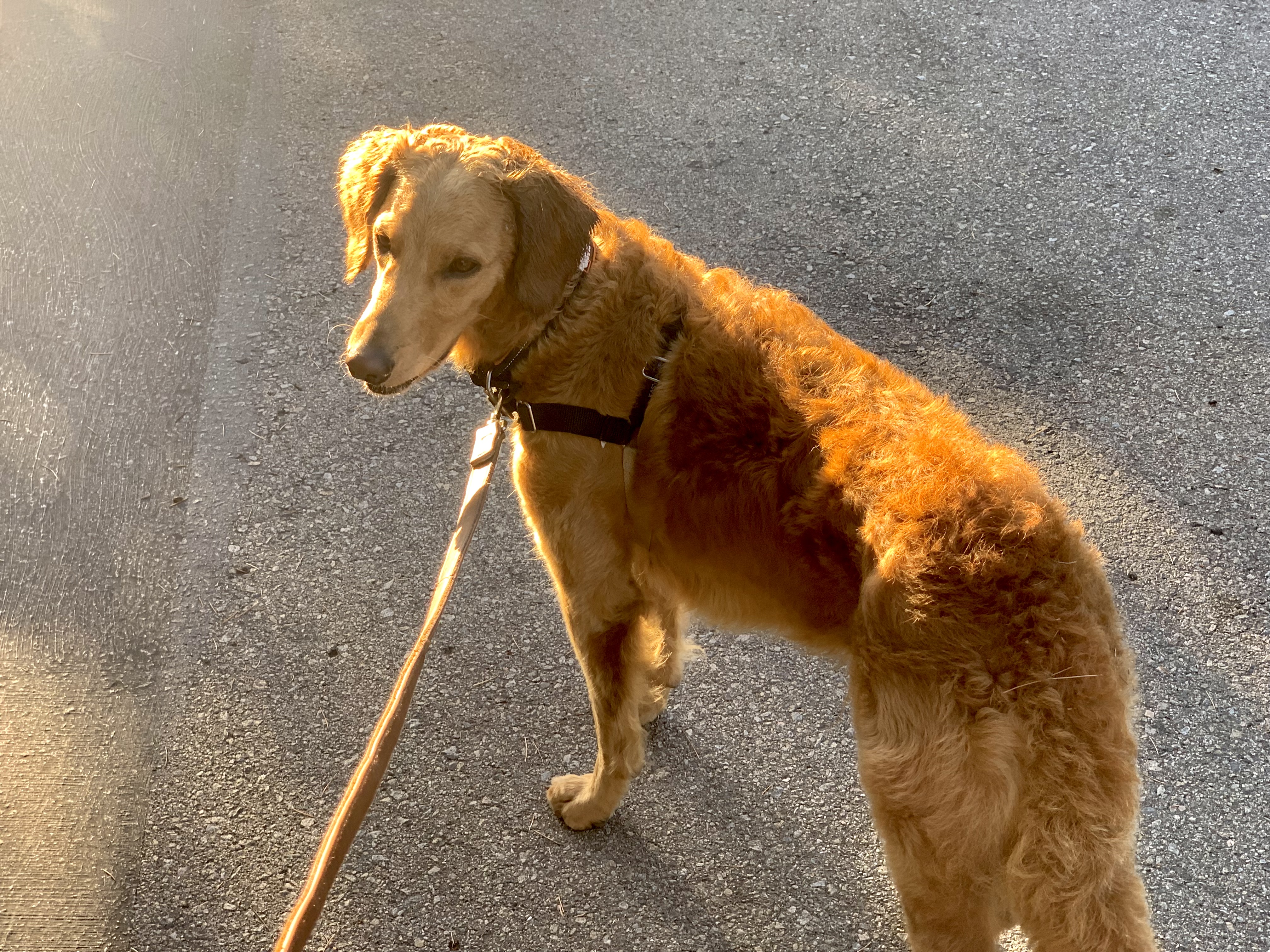
Our dog Sadie barks in many circumstances. She barks if someone comes to the door. Or—until recently—she also barks if someone comes to a door on the TV. She barks if we bring up the topic of a “N-E-W—D-O-G-G-I-E” (Hence, the spelling). She likes to sniff nearby trucks. If there’s a person inside, she ignores them. Unless, they open the door, that is. If that happens, she barks and lunges, though her tail is wagging the whole time. I don’t think she’d “attack” someone unless Wendy or I were put at risk.
Sometimes, she has barked to be let out to go potty, though now, she simply comes and stares at me while sending the thought that she has to go *big* potty! On our walks, for instance, she barked at someone’s (heretofore unseen and unsniffed) Halloween decoration. She barked because a traffic cone had fallen over.
Nonetheless, she is far less of a barker than many dogs I’ve observed.
Her barks, like my words, can be uttered with varying degrees of insistence and urgency. In fact, I hear a rumor that practiced orators can even lie with sincerity and passion. The closest Sadie has come to “lying” is that she barks insistently—hard to distinguish from a “I have to go potty” bark. What she often wants is attention. She’s okay with playing tug, or hide the dragon, or ball in the hallway. Of course, she’s always game for a walk. She doesn’t want to be ignored while we watch news or a series on TV. Even when the movie features a dog, she doesn’t think that counts as “paying her some attention.” (Though she does usually watch those segments).
Today, however, came the most insistent bark ever. I thought I had seen the top of the Bark Scale, but no. What I had heard before was a “6” on the newly discovered ten point scale.
Here is how it happened. We were in the back garden playing ball (off leash). I was picking up the six squeaky balls for another round when suddenly, the air was split with Sadie’s previously undisclosed 10-bark. At the same time, she stood at attention. And then she charged up the stairs toward the house. (“Flew up the stairs” actually, but I didn’t think anyone would believe me.)
As I tried to catch up with Sadie, several possibilities ran through my mind. Was there an actual intruder? Did a coyote or even a puma come on to the property? Or, was it just my wife coming out onto the deck?
I turned the corner and saw the trigger. Our cat Shadow was outside on the deck. Sadie insistently “herded” her back inside. The door to the back deck had been left ajar. By me. Not a puny little jam jar, understand; a dill pickle jar. I came up the stairs but Sadie had already solved the problem and ran inside to follow up with Shadow on the scope of her transgressions. I thanked her.
This is not something that we “trained Sadie to do.” Maybe she found that Shadow’s being somewhere new offended her sensibility in the same way that she objected to our neighbors putting up Halloween decorations without checking with her first. But no. Her bark and physical attitude were much more severe, insistent, and loud!
I had the impression that she sensed that the cats were not to go outside. She had certainly heard us say that in various ways. She had also observed me nudging Shadow back inside when she wanted to follow Sadie and me out on a neighborhood stroll. And, I often give Shadow a rationale as well. That rationale features coyotes quite prominently. Sadie may know what a coyote is. I’ve pointed one out to her once. But even Shadow knows it’s not a good thing.
(AI generated)
To fully contextualize this, I should mention that generally speaking, despite the fact that Sadie outweighs Shadow by a factor of five, Sadie seems more afraid of Shadow than vice versa. When Sadie was a puppy, she tried playing with each cat based on the way two puppies might play together. None of the cats took kindly to these approaches and on at least a few occasions, swiped her with claws engaged. She stands up for herself if one of the cats starts to eat her food, but she isn’t nearly so aggressive as she could be. Of course, I’ve only ever observed this behavior when I’ve—er—um—-observed it. When I’m around, there is a quality to Sadie’s bark of asking for my help and I usually provide it, telling the cats not to eat Sadie’s food.
This made it all the more remarkable that Sadie would be capable of dominating Shadow completely and herding her back into the house.
I do put a fair amount of stock in Sadie’s evaluation of things. It depends on what the domain is. She’s notoriously bad at valuing the plants in our garden. She leaves them alone for the most part but if a ball falls into one, rather than being satisfied with simply removing the ball, she “punishes” the offending plants viciously. She’s not much good at picking stocks either. Nonetheless, today’s episode made me trust her judgement (and reactions) more.
I certainly don’t want to play the tritest role in that most famous of all tropes for Westerns: “Hush, Paint! There’s nobody out there in the dark woods. There’s nothing to worry about!” Want to survive? Pay attention.
Consider me barking quite loudly. Neighing quite insistently.
I was thinking about gates, doors, and walls as I went walking with Sadie on a sunny Thursday morning. We typically walk along the sides of streets. I let her wander onto the edges, but not onto other people’s yards or very far down their driveways. Often there are gates, much like our own gate. If the gate is closed and isn’t too far from the road, I often let her walk up to the gate. The gates are there both to prevent us from entering someone else’s property and to signal us not enter the property. I could, if my life depending on it, scale many of the gates, but that’s clearly asking for trouble. The gate is meant to keep people out, not as a challenge to overcome. Sadie generally couldn’t get through the bars of the gates. Of course, a gate is no barrier at all to birds, rabbits, mice, rats, lizards, snakes, raccoons, butterflies, or bees.
A door seems to me to offer more security than does a gate. While a gate may prevent me from entering, it’s quite easy to see through or around most gates, to hear the noise from the other side and to smell what’s on the other side. It’s true that one may listen through a door but the sound is typically muffled. Loud music or yelling creeps through to the outside but a conversation normally stays private.
A door also helps the inside stay warmer or cooler than the outside air. A gate has no such function.
Among places dogs leave olfactory messages for each other, boundaries are high on the list. This includes hedges, curbs, and gates. Sadie “controls herself” well now, but when she was younger, she would often pee at the boundary of a social event. Specifically, when someone—especially someone new or someone she already liked but hadn’t seen for awhile, she’d pee. She also seems to understand what I mean when I say, “Sadie, we’re going for a ride in the car. You should go pee first and then we can get in the car.” I don’t think she “parses” the sentence and accesses the meanings of all the individual words. Nonetheless, she quickly pees and then goes over to get in the car.
A wall is a kind of transition as well. A gate is much more permeable than a wall and a door may be opened or closed or ajar. Often walls, such as castle walls have one or more gates or doors. People on one side of a wall almost always want to get to the other side, at least occasionally. At the very least, they want to be able to move information and goods from inside to outside and vice versa.
Why walls? The walls of a house keep you in a more easily controlled environment. A wall can provide a level of protection. That’s mainly what castle walls are for. Of course, they often fail as well. Invaders climb the walls or tear down the walls or burrow under the walls until the wall collapses. Of course, castles were also subject to sieges. Eventually, the defenders inside would run out of food. Primitive machines were constructed to hurl firebrands and large rocks in to wreak havoc and kill defenders.
The Greeks were unable to defeat the Trojans by destroying their castle. Instead, they famously made a large wooden horse as a “tribute” to the courage and tenacity of the Trojans. Overjoyed that the long siege was over, they opened the gates and led in the giant wooden horse and began to celebrate. Once everyone was drunk or sleeping, the soldiers hidden inside the horse snuck out and opened the gates to the much larger Greek army waiting outside.
Today’s technology is much more sophisticated of course, but walls, gates, and doors still exist. The defensive capabilities now include guided missiles, aircraft, submarines, and aircraft carriers as well as the threat of nuclear retaliation. During the so-called “Cold War” America and the USSR engaged in an “arms race” to develop the best weapons and more of them. Looking back on all the wasted energy and time on both sides, I think, “Imagine what could have been done if we had instead spent all that resource on preventing climate change, curing disease, and sponsoring science and education.
Of course, it’s not an easy problem. One side in a standoff can only stand down unilaterally if they trust the other side. Meanwhile, none of the amazing and exorbitantly expensive weapons, walls, doors, and gates we’ve developed are worth anything at all if we accept the modern Trojan Horse.
Social media, the press, the television, and nearly half of the political candidates spew misinformation on a daily, even hourly basis. We’re locked in a political race and one of the two candidates for President is himself a Trojan Horse. Like the ancient Trojans, all our walls and armaments will be useless.
The threat to America is, in many ways, worse than the threat to ancient Troy. The Trojan Horse that endangers us? It’s a steady steam of lies designed to induce Americans to kill each other.
No number of fighter jets; no cache of assault rifles; no armada of submarines; no hordes of fighters will save us from the Trojan Horse. The Trojan Horse is armored with something far more powerful than iron, steel, or depleted uranium. The Trojan Horse’s armor is your own mind.
Only courage will work to save you. It is not the courage to face an army. It is the courage to admit that you’ve been conned; that you were wrong; that you have been led down a garden path that leads nowhere near where you ever wanted to go.
“I never took a test. There’s been a mistake. I’m a supporter.”
“Shut up or I’ll break every finger. Capiche?”
The guard grinned a moon of bloody teeth and pushed his nightstick against Bob’s lips. Hard.
Bob grunted but said nothing; decided he’d bide his time for now. This will all get sorted later.
It didn’t get sorted. Why would it? Along with tens of thousands of other “supporters” the only thing Bob got for his support? A free one-way ticked to the burn pits. He’d been beaten enough that when his time came, he jumped of his own accord.
One of the things that the “winning side” of a war loses is the opportunity to spend those resources spent on war instead spent on making life better for its citizens. Even if the “winners” have a very quick and lopsided victory, they will have contributed to world-wide pollution and global climate change that will negatively impact nearly everyone on the planet including most of the people on the “winning” side and their descendants. Many of the soldiers will have died, but in almost every single case, many more innocent people will have died. In some cases, those will be minimal for the “winning” side, but not always. Meanwhile, soldiers who returned to society, even if they are not physically impacted permanently are surely impacted psychologically. Among other things, if they were successful, they killed other human beings. Some of those human beings were almost certainly innocents, but even the other soldiers were mainly people forced into fighting.
In a way, they will be carrying seeds of some very bad experiences and some of those seeds will undoubtedly leak out into that person’s environment impacting, his friends and family, as well as random strangers. But the war mentality is not limited to serious effects on fighting soldiers. To some small extent, everyone is damaged. There is more stress for everyone. There is always the threat of reprisal or that someone you care deeply about will be maimed or killed. Not only are people’s sense of fear heightened; typically, so is their hatred and anger. For many, this will be directed far beyond those actually most responsible for starting a war.
During a war, people will be asked, or ask themselves, to view the killing of a whole bunch of their fellow humans as the best course of action. Some will embrace that with relish and a side order of over-generalization. Others will embrace the killing with reluctance. Few will object outright. So, after your victory, you will be living in a society that rationalizes killing others more often and more easily than they did before. Of course, it’s generally even worse for the “losing” society. Both sides lose. The “losing side” loses more and that keeps the war fueled as long as possible. But make no mistake. Both sides lose.
Democracies have often gone to war against each other. But far more often in modern times, war has been instigated by dictators. They rule by hate and fear. Having an enemy is an entry fee and a talking point. If there’s no-one else around, they’ll simply pick on the vulnerable within their own society. Through constant repetition about extremely rare cases or even just outright lies, people can actually be made to hate people who have, in reality, done them zero harm.