• About PeterSIronwood

petersironwood

~ Finding, formulating and solving life's frustrations.

petersironwood

Tag Archives: essay

Shooting the Moon

20 Sunday Dec 2020

Posted by petersironwood in Uncategorized

≈ 2 Comments

Tags

cards, courage, essay, fairness, moon shot, story, USA

Shooting the Moon

Photo by James Wheeler on Pexels.com

One of the first card games I ever learned to play was “Hearts.” It’s actually quite a fun game. Unlike bridge, which requires four people to play “normally”, Hearts, in my opinion, is even more fun with three. (If you like, you can read about the game before going on, but I don’t think it’s really necessary to understand the rest of this essay. The first link talks about the general rules and the second link gives some hints about “Shooting the Moon.”)

https://bicyclecards.com/how-to-play/hearts/

https://www.thesprucecrafts.com/how-to-shoot-the-moon-in-hearts-411727

Three was a good number (besides being prime, and a triangular number) because I was an only child for the first 11 years of my life. My parents taught me to play Hearts and Bridge at a fairly young age. I was young enough, for instance, that I looked carefully at each face card to try to understand the personalities of the people peering out! I liked the Jack of Diamonds and the Jack of Spades the best. I desperately wanted to meet them! (I wonder whether Roger Zelazny felt the same because in his rather wonderful “Amber” series…).

The back of the cards also fascinated me. I wondered what it would feel like to ride one of those bikes! I was particularly interested when one of the cards developed a flaw or bend mark. Even knowing the identity of one of your opponent’s hidden cards could be a tremendous advantage. 

Anyway, the game of hearts has an interesting payoff structure. You get a point counted against you for every heart that you take. You get 13 points against you if you end up taking a trick with the Queen of Spades in it. There’s a catch though. If you manage to take all thirteen hearts and the Queen of Spades, you get zero points against you. Your opponents each get twenty-six points against them. 

The player then is often faced with a dilemma: “Should I try to Shoot the Moon? If I do try, and fail, I will likely end up with many points scored against me. On the other hand, if I succeed, it is a huge advantage for me.” 

Photo by Andrea Piacquadio on Pexels.com

It isn’t only the points. At a young age, I could handle rules and strategy, but if I tried and just barely failed to “Shoot the Moon,” I would feel extremely frustrated. I didn’t initially try to hide it either! I would literally see red and the top of my head felt is though it were floating away. I would accuse my parents of cheating although I don’t think they ever did. I simply made a false assumption or miscounted or miscalculated. Often, I took a reasonable risk, but the cards just didn’t turn out the way I had hoped. At that point, my view of the world was still primitive: someone was at fault whenever I failed, and I desperately did not want it to be me who was at fault. 

Luckily for me, throwing temper tantrums at the outcome of a hand of Hearts was not the sort of nonsense up with which my parents put. I soon learned to hide my rage and eventually not to feel it at all unless there really was evidence of cheating. I didn’t “declare” cheating on my parents or friends just because I didn’t like the outcome — at least not past the age of 7 or 8.

In hearts, it often happens that the cards you are dealt will obviously not let you “Shoot the Moon.” In those cases, your strategy for the hand is clear. Avoid taking as many hearts as possible. However, if I weren’t careful, I could easily end up helping my Mom or Dad “Shoot the Moon.” Better to take one heart or even four hearts or even the dreaded Queen of Spades than to let them “Shoot the Moon” and end up with 26 points!

It is extremely rare, in my experience to be dealt a hand in Hearts that makes it obvious that you will Shoot the Moon so long as you don’t slip up. Generally, the most you can expect to get every round or two is a hand that might let you “Shoot the Moon.” In accomplishing this goal, it is important that you not let your opponents guess that you are trying to Shoot the Moon. The sooner they “catch on”, the lower your chances of succeeding. 
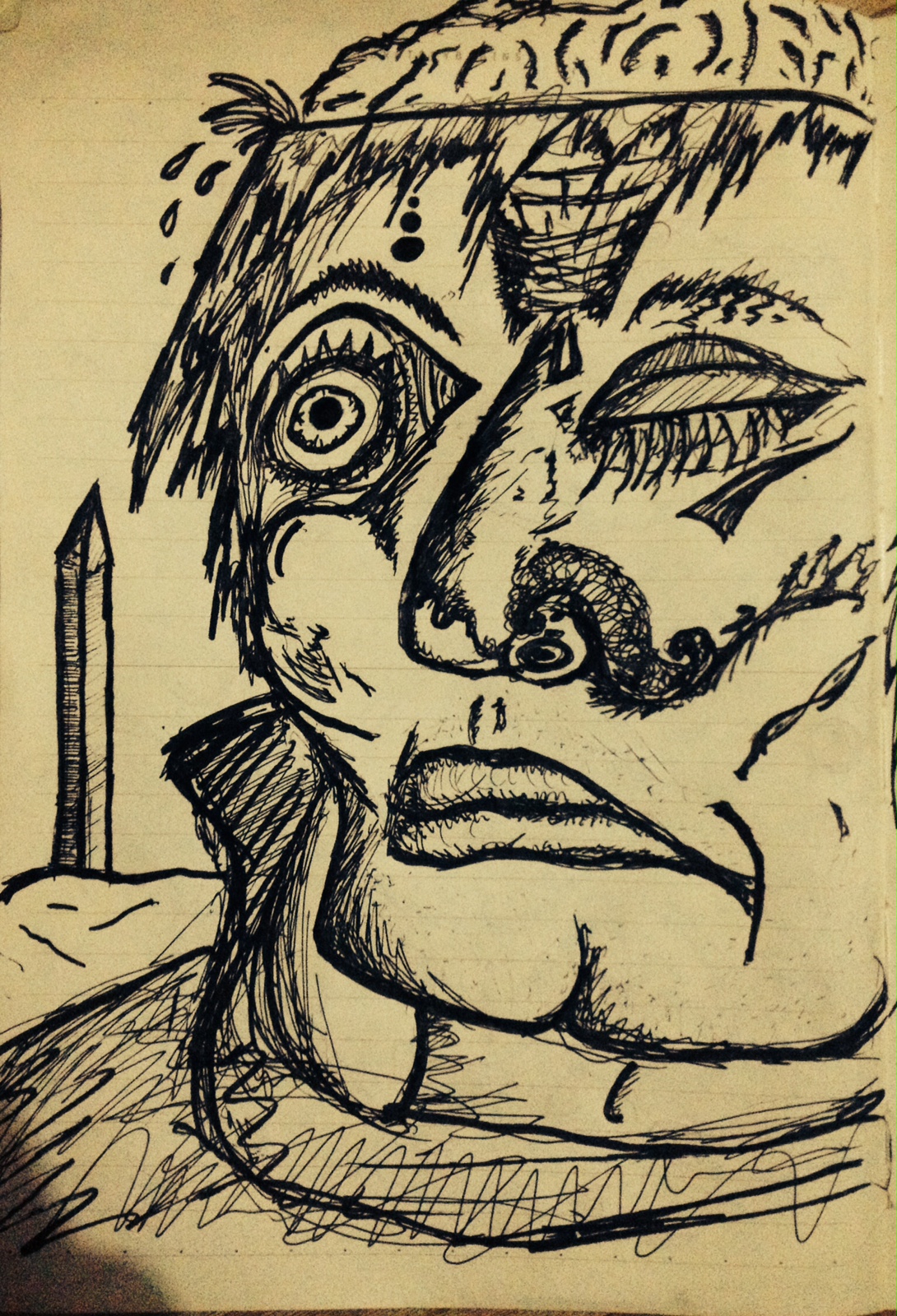
Original drawing by Pierce Morgan

At a very young age, I learned to “fake” my reactions to help my chances. For instance, the first time I took a trick in which someone laid a heart on me, I might grimace and growl and shoot the person with my dagger eyes. These ploys worked better against my friends than with my parents who quickly learned to read these fakes. Then, I learned to make them more subtle. Instead of grimacing and growling and shooting the person a nasty look, I would let the slightest hint of disappointment flash over my face quickly and then vanish like morning fog. It reminds me of toasting a marshmallow to perfection without letting it catch fire. 

I learned to judge more accurately whether I had a hand that would likely allow me to “Shoot the Moon” or a hand that would only allow me to “Shoot the Moon” if I were very lucky. If there was any chance at all, I would play for awhile and see how things went. After every trick I would “recalculate” my odds in some non-numeric kiddish way. I would often try and sometimes succeed. When I failed, I would try to learn from it. Sometimes, especially at the beginning, my parents would show me how I had messed up. For me, I discovered that it was more fun to try and fail than not to try at all, especially because I could learn from my failures. 

Photo by Jean van der Meulen on Pexels.com

———————————————

September 12, 1962: John F. Kennedy declared that “We choose to go to the moon.”

https://en.wikipedia.org/wiki/We_choose_to_go_to_the_Moon

On July 20, 1969, Neil Armstrong stepped onto the surface of the moon.

https://www.nasa.gov/audience/forstudents/k-4/stories/first-person-on-moon.html

The United States of America, literally decided to “Shoot for the Moon.” And succeeded.

During my working life, I have far more often heard so-called “leaders” in many different organizations encourage their workers to “Find the Low-hanging Fruit” than I have heard them encourage people to “Shoot the Moon.” What “leaders” will sometimes do is set a “stretch goal” for the workers to fulfill without any provision of the necessary time, resources, or personnel to achieve that goal. If the workers achieve the goal, the manager (not an actual leader) scores 26 points against his or her opponents. They shot the moon. But if, as a worker, you come up one heart short; if you fail to “Shoot the Moon”, then 25 points will be scored against the you the worker who failed. It is the worker who fails to “Shoot the Moon.”

Photo by Pixabay on Pexels.com


Since the late 1960’s, the real wages of workers have hardly moved at all. During that same time, because workers learned new methods, procedures, and technologies, productivity soared. In the past, the wealth created from increases in productivity had been split between the workers and the owners. Since, the 1960’s however, the increased wealth that accrued from increased productivity has gone completely to owners and virtually none of it has gone to the workers who increased their productivity. 

At the same time, and perhaps not coincidentally, most businesses, even pre-COVID, were not trying to “Shoot the Moon” — they were searching for “Low-Hanging Fruit.” 

What happened, America?

When do go for it again? 

When do we try to “Shoot the Moon” again?

When do we reshape our society to allocate windfall profits to the people who actually work for a living — and not just for the people who watch their wealth increase by simply owning stuff?

I do not think these two changes are unrelated. The people who actually do the work are willing to take risks to build something better. They are invested in the product or service they provide. They would like to be fairly paid, but it isn’t only about the money. It’s also about doing something really cool and providing value for the society as a whole.

Photo by Rakicevic Nenad on Pexels.com


The people who simply move money around from stock to stock to make money don’t want to take risks. They don’t really care whether their money is being spent to cure cancer or to develop a new toothpaste that comes out of the tube and whistles “Dixie” while it does so. They want a decent return on investment. They may be willing to invest some of their capital in a portfolio of high risk/high benefit investments but most of them will abandon backing the attempt to cure cancer to invest in the whistling toothpaste if that’s what the “numbers dictate.”

This is obviously not true of everyone who is rich, but it’s more often true than not. Those, like Bill Gates, or George Soros or Mike Bloomberg who do contribute enormous sums to good causes are pilloried. Is it by other billionaires because they don’t want to look bad by comparison?  Is it by foreign actors who simply want to sow dissent and distrust within America? I don’t really know. 

https://www.cnbc.com/2017/10/17/philanthropist-george-soros-donates-most-of-his-net-worth-to-charity.html

What about in your own life? Have you ever chosen to “Shoot the Moon?” Or, do you stick with picking the “Low-Hanging Fruit?” What do you encourage your family, friends, and co-workers to do? 

————————————

Poems, stories, and essays that touch on courage.

Roar, Ocean, Roar

Child Like? or Childish? 

Take a Glance; Join the Dance

Skirting the Turtle

Listen! You can Hear the Echos of your Actions.

John vs. Worrier

Process Re-engineering Moves to Baseball

Jennifer’s Invitation

Wilbur’s Story

The Touch of One Hand Clasping 

The Impossible 

Author Page on Amazon

The Primacy Effect & The Destroyer’s Advantage

21 Friday Aug 2020

Posted by petersironwood in Uncategorized

≈ 9 Comments

Tags

America, autocracy, Democracy, essay, progaganda

Here’s an interesting thing about the way we learn. And, when I say “we” I don’t just mean all my 7.5 billion human brothers and sisters out there but also other, more distant cousins. What creatures tend to do is put particular emphasis on their first experiences. In my culture, we memorialize this truth with comments such as: “Now, make sure you look nice on your first day. It’s important to make a good first impression.” Given the prevalence of this kind of advice, I think most people seem aware of this effect when they go on job interviews, first dates, etc. 

There seems to be an interesting asymmetry about our folk wisdom though. While most of us seem quite aware of how we can influence others by first impressions, we seem fairly oblivious to the impacts that others are making on us.


“I can’t understand it. They seemed so nice on our first date. And, then, every one of our six dates since, they treat me like trash. I might have to break up.” 

Imagine instead someone saying this: “I can’t understand it. They treated me like trash on the first date. And on the second. And on the third. And every one of our first six dates. And, now, on the seventh, they seemed so nice!” 

Many studies confirm the primacy effect under a wide variety of circumstances. In this case, the folk wisdom about the importance of first impressions is confirmed by science. 

This has an interesting ramification for propaganda effects. 

Let’s suppose that you live in a country where there are two competing parties. Each of them typically likes to put a certain “spin” on events. For instance, let’s say that there’s a big plane crash in the Colorado desert or a hurricane in Florida. These events are reported on the media. Now, the two parties might frame or reinterpret these events in different ways. One party might try to say that the crash was likely due to drug use on the part of the pilot and that drug use among pilots is because pot is legal in Colorado. And, they might claim that even though there is no real evidence. In fact, subsequent events actually confirm that the pilot was not on drugs, nor has there been any uptick in drug usage among pilots (they would lose their jobs) and these particular pilots lived in NY and just came from NY. They did not suddenly score a joint 30,000 feet in the air. But because people in the audience heard that story about pot usage being responsible first, some of them may recall it even years later — and are much less likely to recall the actual facts that came out later. 

Conversely, let’s imagine another party puts out a statement that blames the crash on lax standards for air safety. It blames these lax standards on the other party. It further points out that the airlines who pushed for the lax standards were heavy campaign donors to the party who fought for the lax standards. If you hear this version of the story first, you will have a different first impression. It will be just as “uncomfortable” for you to now consider evidence that perhaps the pilots were high than it will be for the people in the scenario above to consider that lax safety standard were involved. 

Similarly, one party might relate the hurricane and mention that global climate change makes for more and more severe hurricanes. Another party might use the opportunity to request funding to put up a hurricane fence around the Gulf of Mexico to keep hurricanes out. One of these explanations would be supported by the vast majority of scientists. Of course, no-one is saying that a particular hurricane could not possibly have happened without global climate change. But warming waters mean more energy goes into hurricanes in general. On the other hand, no real scientist would imagine a hurricane fence would do much to keep a hurricane out! 

But if you hear about the hurricane fence story first, and then find that scientists think such a strategy is absurd, instead of rejecting the idea for the bunkum it is, you might check the Internet for someone to support the idea. And — given the nature of the Internet, you will definitely find someone to support the idea — a Russian troll, a nutcase, or an operative for the other party. Rather than using the Internet as a way of determining whether a particular idea is or is not reasonable given the balance of evidence, it will be tempting instead to use the Internet to find a way to reinforce your first impression rather than challenge it. Who gets the story out first has a big advantage. 

Photo by Pixabay on Pexels.com

You can see why parties compete to get their own version of stories out first. 

The above scenarios were examples of reactions to external facts that “happened.” 

But what if your party is not only reacting to disasters — what if they are intentionally creating disasters? This gives them a crucial and perhaps crushing advantage. Because they are creating the crisis, they can have a narrative for every story worked out ahead of time. They can release it contemporaneously or even slightly before an event occurs. In this way, they will be able to frame the narrative first every single time. And, equally importantly, people who eventually hear both sides of the story will underestimate how much they are swayed by the primacy effect. 

—————————-

https://thedecisionlab.com/biases/primacy-effect/

Essays on America: The Update Problem 

Essays on America: The Stopping Problem 

https://petersironwood.com/2020/07/25/the-only-them-that-counts-is-all-of-us/

The Truth Train

Unmasked

The Pandemic Anti-Academic

The Watershed Virus

Try the Truth 

Essays on America: Happy Talk Lies

28 Sunday Jun 2020

Posted by petersironwood in America, apocalypse, COVID-19, family, health, politics, psychology, Uncategorized

≈ 45 Comments

Tags

America, Dictatorship, essay, fascism, Feedback, Happy Talk, Impeachment, lies, politics, science, testing, truth, USA


woman in black tank top blindfolded

Photo by Thuanny Gantuss on Pexels.com

You do not actually have a generic right to impinge on the rights of others. 

If someone is trying to convince you that you do — they are peddling you Happy Talk Lies and trying either:

  1. to make a buck or gain power by playing to your “angels” — and not the better ones — or, 
  2. trying to destroy our civil society.

    Let’s consider just a few common examples. You can go into your house and play music. And you can play music not at all, or you can play it 24 x 7. You can listen only to Mozart or only to Philip Glass or leave the radio on all day or play CD’s. You have a huge range of freedoms. This huge range of freedoms that you enjoy, by the way, depends partly on government; it also depends on science. Without science, you would, as a practical matter be far more limited in your freedom.

What you cannot do is play your music so loud that it disturbs others. How loud is too loud? It depends on context. If you are living in a thin-walled apartment complex, you might start to disturb others even when the music is played softly. On the other hand, if you live in the middle of nowhere, you can crank your amps up so far you’ll destroy your own hearing. In some cases, there may be some objective standard about noise levels, but generally it’s a question of having people complain. If one person complains about the noise, the police generally don’t do anything. But if several people complain, they will come and tell people to stop partying so loud. This isn’t “communism” or “socialism” or “Big Bad Government” — this is just people getting along with each other. You don’t have the freedom to impinge on others just because you feel like it. 

F06072EA-8680-40F9-9419-EE76C0139571

That may seem like a pain in the neck. But you have to realize that other people don’t have the right to impinge on your rights either. And, that is much more valuable to you than whatever inconvenience you have from not being able to impinge on the rights of others. Why? Because there are many more others than there are of you. And, regardless of laws, regulations, customs, power, eventually, if you try to impinge on the rights of others, they will eventually get together and impinge on yours — big time. Guillotine sized big time.

The area of what you can do without infringing on the rights of others typically gets smaller as population becomes more dense. I suspect this may be one reason why people from the wide open spaces feel more as though wearing a mask is an unnecessary inconvenience as compared to city dwellers. City dwellers are much more used to curtailing their rights so as not to infringe on the rights of others than are people in the rural areas. You literally cannot even walk down the sidewalk in a busy city without “negotiating space” with all those around you. 

F04F930A-4168-484E-A2D4-1A2EF3BB61BD

I believe there is also a difference in the quality of how people in rural and urban areas see rights interacting and potentially infringing. To city folks, it makes a lot of sense to enforce speed limits, noise ordinances and mandatory mask wearing. On the other hand, it generally makes no sense to urbanites to try to enforce restrictions on other people’s sexual preferences. Why would you want to massively restrict the freedom of others to avoid a temporary feeling of discomfort in yourself? Who cares whether Bob Jones in Des Moines marries Maria Santos or Mario Santos? That’s the sentiment I agree with. I think people from small towns view it much more personally.

Let’s posit that any hint of homosexuality in certain communities has always been viewed with shame and suspicion. Of course, a large part of this probably stems from people repressing the complexity of their own feelings. They feel safe when homosexuality is criminalized because that way they know they themselves won’t be tempted (or at least, as tempted). Now, if the Federal Government mandates that you cannot any longer be wantonly cruel to people or fire them because they’re gay, what do such people think? 

Some of them are in a real panic. Felix thinks, maybe my male friend Oscar, whom I dearly love, secretly has a crush on me and wants to have sex?  Worse, what if I … the government shouldn’t be forcing us to adopt this gay lifestyle! That’s what I think! Have them mind their own business and if they want to fill up New York and San Francisco and DC with gays, let them have at it. But not out here in our town. Since gays have always been ostracized here, they believe, in a strange way, that it doesn’t exist because they don’t see it! The government, is in effect, forcing them to face the fact that homosexuality actually does exist.

3403641F-071C-4611-A35F-AF9A548C7577

Original drawing by Pierce Morgan

Looked at from this perspective, there’s a commonality with the dangerous idea that testing causes COVID19 rather than reveals it. Not testing is a close cousin to the Happy Talk Lies that Trump has peddled since day one of the pandemic. He doesn’t care whether he actually kills Americans. What he wants is for his base to feel better because he talks to them and gives a lame excuse for his actions which are actually killing them. They don’t want to think about the economic devastation or the likelihood that they or someone they love is going to die. Trump acts, for them, as a kind of “anti-therapist.” Instead of attempting to show someone the benefits of taking a more honest look at life, the Anti-Therapist colludes in the fantasies of the Id. Since he talks to the infant in the base, it isn’t necessary to provide an adult rationale. In fact, doing so would be counter-productive. Such a move would “wake up” the adult in the heads of his audience and they might start asking themselves questions such as —

actor adult business cards

Photo by Nikolay Ivanov on Pexels.com

Is this guy telling the truth? Is there any evidence for that? Does that really correspond with what I already know about the world? Doesn’t this directly contradict what he just said ten minutes ago? Is this making any sense at all?

man in white button up shirt

Photo by Vinícius Vieira ft on Pexels.com

Why would Trump want his audience to ask any of those questions? He wouldn’t. Instead, he wants to keep their inner infant enthralled. He will play “Patty-Cake” with his audience. (Trump is not the first politician to do this). Leading them in hate chants is essentially playing Patty-Cake. The words can’t be complex. And they don’t have to relate to reality. When he says, “Who’s going to pay for the wall?” and the audience all chants, “Mexico!” it doesn’t mean that they are going to keep tabs on whether that turns out to be true. But the infant does want reassurance. So, Trump will give some idiotic lie or excuse that no rational person would buy. But he’s not talking to the adult in these people. He’s talking to the infant. And the infant (or Id, or inner child) in all of us is superficial and hungry for something right now! 

Similarly, when Trump tells his base that COVID19 is a liberal hoax or that it’s all going away in the warm weather, it makes the base feel good for a moment. But, there’s a catch. They can only feel better if they believe his lies. If they hear his pronouncement that the virus is going away in the warm weather and think:

“Really? That’s weird. Because all the scientists are saying they don’t know. And some places where it is already warm weather, the pandemic is growing uncontrollably.” 

No. That’s no good. That doesn’t make the person feel better at that moment. Indeed, it makes them feel worse. Not only is COVID19 possibly going to kill them, the President of the United States is lying! So, we must understand, it’s much more comfortable to believe everything he says. His lies are always designed to make his audience feel better at that moment if and only if they believe his lies. Like many other drugs — heroine, cocaine, alcohol — it will take more and more over time to get the same high.

island during golden hour and upcoming storm

Photo by Johannes Plenio on Pexels.com

Believing the Happy Talk Lies is addictive. And, from Trump’s point of view, it’s much better than telling the truth. Telling the truth would take work and he feels work is beneath him. So, there’s that. In addition, he can always say something that will make the base feel better — not just when there actually is good news. And — understand — when the actual news is bad news — a pandemic that’s killed 125,000 Americans, most of them needlessly; or the worst economic downturn in history; or Trump’s own evident treason — guess what? When the actual news is bad news, his lies are even more effective as an addictive drug.

Imagine for a moment that you are a Trump fan. You have believed almost everything he’s said up to this point. Robert Mueller comes out with a report that shows how the Russians interfered with our election to help Donald Trump. How does it make you feel to think that Donald Trump is a traitor and that our country is now beholden to Putin!? Good? I think not! You will feel terrible! You voted for the man, for God’s sake! Now it turns out he’s a traitor! That’s a horrible thing to bear. But wait — Trump himself — or Bilious Barr can provide a Happy  Talk Lie instead. “The report shows there was no collusion. It’s no big deal.” Whew! Thank you! That was close! For a moment there, it looked as though I was going to be extremely uncomfortable. Thank goodness Trump and his spokes-liars gave an alternative view. Now I feel better again. 

woman with face paint with pumpkin

Photo by VisionPic .net on Pexels.com

The reason for Trump’s tweeting is not so much the chance to spew forth fear and hate and best of all — redemption for the believers in the lies — though, that is useful and fun. More importantly, it seeds a community of like-minded believers. Heroine alleys, opium dens, local bars where the cheap drinks are plentiful share the same purpose as on-line groups based on reinforcing each other for addictive behavior. If you’re high all the time, “ordinary people” begin to give you grief. “Have you thought about what this is doing to your life and the lives of those around you?” If everyone in your life said that, you might well have to confront the fact that the addiction was not good for you. Instead, it’s so much nicer to have a group who understands; that is to say, they’ve made the same decision to forgo their life and responsibilities in order to satisfy their momentary pleasures that you have. So, you agree not to challenge them. And, they agree not to challenge you. Instead, you will work together to repeat and spread the lies of  the addicted. In the case of support groups for Trump, people repeat and spread the lies of “Der Fooler” and doing so gives another nice little hit of endorphins.

Now, in June of 2020, these little hits of endorphins are not just coming from hearing “Happy Talk” lies, or repeating them. Now, the base are all being encouraged to go out and spread the coronavirus. And they are. And, I have to guess that they feel good doing it even though they themselves could sicken and die; even though they could be the cause of their best friend dying, or their child, or their parent. Because they feel as though they are part of a “feel good” movement and everyone else is just a party pooper. Everyone who thinks 125,000 dead Americans is a horrible tragedy is just trying to rain on the parade, a real Debbie Downer, Eeyore, Sad Sack, a wallflower.

3FC757BE-A645-4C45-B75F-BD101D6225AC_1_105_c

What do you do in a society when perhaps one third of the voting age population is addicted to Happy Talk Lies? Maybe a few of them will spontaneously quit. Perhaps some will take up tennis and become addicted to that instead. What else? An addiction is always hard to break — and that’s even if the person wants to. 

It may seem hopeless, but I don’t think it is. As a society, we used to have many more people addicted to nicotine than we do today. And the tobacco companies fought like a wounded warthog to keep enough people addicted to keep the tobacco barons rolling in dough. So, I”m still hopeful that we can evolve beyond Happy Talk Addiction. If we do, then, we have a real shot at keeping the American death total below a million, not to mention keeping us away from the abyss of Nazism. People will be willing to not only look at the truth but take actions that are consistent with the truth such as only going out when necessary and using a mask. People will reject the notion that they have and should exercise unlimited license to do what they feel like regardless of the impact on others. In other words, people will grow up and fulfill their responsibility to vote as an adult, not as a small child might. 

But it won’t be easy. Because it means giving up the addiction to Happy Talk Lies.

DCA8FC9A-F229-4538-9EA2-D9E13D4796EB_1_105_c

————————-

Trumpism is a New Religion 

You Bet Your Life

Rejecting Adulthood

Wednesday (Cognitive Dissonance discussion)

The Truth Train

The Pandemic Anti-Academic

The Watershed Virus

Author Page on Amazon


Absolute is Not Just a Vodka

11 Monday May 2020

Posted by petersironwood in America, apocalypse, COVID-19, politics, psychology, Uncategorized

≈ 152 Comments

Tags

America, Constitution, Democracy, Dictatorship, Election, essay, Rule of Law, truth, USA, voting

Demanding Absolute Power Leads to a Far Worse Hangover.

close up photo of martini in cocktail glass

Photo by Engin Akyurt on Pexels.com

If you continue to support Trump out of loyalty to him, please understand that your loyalty to him supersedes every other thing that you care about in life. You may not yet realize that, but it does.

680174EA-5910-4F9B-8C75-C15B3136FB06_1_105_c

Everything. 

The Truth. 

Your Possessions.

Your Soul.

Your Neighbors.

Your Friends. 

Your Spouse. 

Your Parents.

Your Siblings. 

Your Kids. 

Your Wealth. 

Your Reputation. 

Your Feet.

Your Arms. 

Your Face. 

Your Mouth. 

Everything. 

industry metal vintage technology

Photo by Markus Spiske on Pexels.com

Your life is over. You are now part of the Trump machine. And, as such, you are expected to fulfill your role as subservient and without question. You may think I am exaggerating, but if so, go back and look at what he has done to the careers and lives of those who questioned him when he was dead wrong!  This is the way of dictatorship. Read about Stalin’s Russia or Hitler’s Germany or Mao’s China before it’s too late.

You will believe as you are told to believe.

You will give to the State whatever it requires.

brown and white snake

Photo by Pixabay on Pexels.com

You will embrace evil. And, you will know in your heart that it is evil even though people will give you all sorts of rationalizations about why it’s for the greater good and it’s only a few people dead and a few more and a few more and ….

You will tell authorities about any neighbors who are people of color or people of a different religion or people who have a funny accent or people who don’t watch Faux News. Of course you will. 

You will betray your friends as well if you overhear them saying something that used to be true such as “The earth is round” but which is now out of favor as being just a sissy-science nerd thing. 

86A389C7-4CD7-42E3-ABFA-A555A5BB24CB
You will betray your spouse as well if they don’t go along with the new regime. It sounds as though it would be a pretty soul-wrenching thing to do but then it occurs to you that they might do the same to you. Of course it will occur to you. 

And you decide to beat them to the punch. So, you gather evidence so that in a case of he-said, she-said, you will have the upper hand. Of course, it might not even be true at all. You might just be tired of your spouse, but a convincing accusation is all that is needed. Even if your spouse is completely innocent, it will serve the purposes of the state by making their execution public. 

tombstone on cemetery during daytime

Photo by Pixabay on Pexels.com

You will betray your parents if asked. They did it in Russia. They did it in Germany. They did it in many places where absolute tyranny ruled. Not everyone did so, of course, but it’s easy to make rationalizations. 
“Oh, they were old anyway.” “Oh, they were in bad health and they probably would have died anyway.” “Oh, they were never that nice to me anyway. Always preferred my older brother.”

adult affection baby child

Photo by Pixabay on Pexels.com


You will betray your own children as well. Of course you will. You’re currently supporting someone who is in bed with oil companies including Russian oligarchs. And, they aren’t snuggling just to stay warm. No, they are in positions that would even make Caligula blush. 

As a result, Trump has worked tirelessly to roll back as many environmental regulations as he possibly can. This means your children — and their children — will grow up in a world of dirtier air and dirtier water and a more corrupted food supply. It will smell worse. It will taste worse. It will be a world that predisposes people to diseases such as cancer, asthma, and auto-immune disease. In some places, such as Flint, Michigan, it will cause brain damage in children. So, yes, you will betray your children for the sake of your loyalty to Trump. 

It’s not that you don’t care about your kids. Of course you do! But Trump knows that too. He and Putin’s targeted cyber-campaign have used that love to help convince you that the only way you can really protect them is to let him have absolute power.

gray industrial machine during golden hour

Photo by Pixabay on Pexels.com

And do you know what you will get from Trump in return for giving him absolute power?

Nada.

Nothing.
Zero.
Zilch. 

No protection. No wealth. No opportunity. Nothing.

Maybe that’s not quite true, because you might get, perhaps, a thrill out of being on the winning team even if the team cheats in every possible way. Personally, I find those kind of victories make me feel worse than losing fairly when I’ve done my best. Your mileage may differ. 

Perhaps you get a thrill out of chanting along with the President. 

Perhaps you get a thrill out of thinking about all the pain Trump causes “liberals.” 

I don’t know. 

But I do know this. There are many ways to get thrills that do not require you to give up everything you care about in return. Why not enjoy one of those instead? 

woman playing golf

Photo by Jopwell on Pexels.com

Other than that thrill? 

Look around your life. Look at the people you care about. Do they look more peaceful and loving than they did four years ago? Do they look happier? What about you? Are you happier? Are you wealthier? Do you feel safer than you did four years ago? Do you feel healthier than you did four years ago? Does the nation seem better off? More united? More respected throughout the world? 

Well, however your life is different than it was four years ago, that change is what you are trading your life for. You are pledging to give everything to Trump if he wants it.

Everything. 

Everything you love. 

You have no real choice. 

You have given up your life as an autonomous human. 

And, as nothing more than a meat machine, you will inevitably be replaced by a cheaper, faster, metallic and plastic version. It may take a little longer if you are a lawyer, or a banker, or a manager, or a computer programmer or paid companion than if you are a grocery clerk, or meat packer, or bus driver, but it will happen nonetheless. 

What you have forgotten is that your life, like every other human life has value in and of itself. 

architecture art clouds landmark

Photo by Pixabay on Pexels.com

The value of your life, as enshrined in our Constitution, comes from being born. The framers of the Constitution called it a God-given right. 

Life, Liberty, and the Pursuit of Happiness. 

And if you let one person have absolute power, then they can absolutely take away: 

Your Life

Your Liberty 

Your Pursuit of Happiness. 

usa flag waving on white metal pole

Photo by Element5 Digital on Pexels.com

Instead, you will be working for their happiness. And, you’ll be giving up your own life and the lives of those you love for the word of someone who doesn’t even know you exist — someone who will throw you under the bus for nothing more than the pleasure of hearing the crunch beneath the tires. 

When one person has absolute power, no-one else has any at all. 

You may comfort yourself by thinking that, while you may not have much control over your work life, at least you’ll have control over the rest of your life. 

No. 

You won’t. 

flight sky sunset men

Photo by Pixabay on Pexels.com

There is no invisible boundary around your property or your house or your bedroom or your body. Of course there isn’t. In a democracy there is such an imaginary boundary. 

There are things like courts of law, and search warrants, and fair trials. Those are gone. So, if someone in power wants your property, or your house, or your son or daughter, or your life — who’s to stop them? You’ll haul out your assault weapon? Come on. 

Once the rule of law is gone, a whole truckload of weapons won’t help you keep what’s yours. And neither will a truckload of MAGA hats. But don’t worry! You won’t even need to fight!

Because you’ll want to give it all away. You’ll convince yourself it’s for the best. The power over you is then absolute. People are already putting their lives and the lives of their families at risk for no better reason than that they’re told to do so. And it feels to them as though they are freely choosing to do so. 

You may want to exercise your freedom to choose while you still have any such freedom. Because it is disappearing a whole lot faster than the virus is. 

close up photo of martini with olives

Photo by Engin Akyurt on Pexels.com

Absolute is not just a vodka. 


Essays on America: Wednesday

What About the Butter Dish? 

The Myths of the Veritas: The Orange Man

Essays on America: The Game

You Bet Your Life

The Truth Train

The Pandemic Anti-Academic

By the Numbers

10 Friday Jan 2020

Posted by petersironwood in America, apocalypse, politics, psychology, Uncategorized

≈ 1 Comment

Tags

addiction, alcoholism, essay, greed, non-linearity, self-destruction, Trumpism

selective focus photo of table tennis ball and ping pong racket

Photo by Josh Sorenson on Pexels.com

A Tale of Two Table Tennis Tables


One of the fun things for me personally about beginning to work at  the IBM research Eero Saarinen building — a fascinating building for numerous reasons. For one thing, it was a 22nd century flying saucer of a Sci-Fi vibe filled with dark glass, concrete and steel. However — it walls were studded everywhere with a huge amount of beautiful and variegated natural stone. I make no claim that this has anything to do with the actual design rationale for the building, but to me, it represented the idea that the future (symbolized by the sleek design, the glass, the steel) would be achieved on a foundation that was strong; it consisted of a great number of individuals from a great diversity of background in terms of age, gender, national origin, religious backgrounds, and academic disciplines. I liked that. It made me feel good to drive to work knowing that I would be entering a building with that symbolism, a symbolism reflected in the reality of the actual working environment. 

A short walk from that Eero Saarinen building lay various recreational facilities. Bernen House, for instance, had two rooms, each containing a ping pong table. Around noon, about 8-15 people would typically gather to play. If you won, you got to stay and take on the next challenger. If you won three in a row, you had to step aside any way. I’ve always been decent at table tennis. But, now I found myself playing with an entirely different class of player. These folks were excellent. As in the Research Center itself, these folks came from many different places including America, but also India, Japan, China, Middle East — all over the world, really. And, of course, playing each other was a lot of fun just because there was such a variety of playing styles. 

At some point, the administration decided to use part of Bernen House for administrative offices. So, one but not both, of these ping pong tables was taken away. Whereas with two ping pong tables bringing out 8-15 players, you might think one ping pong table might bring out 4-8 players. Or, you might think people would be willing to wait longer and we would still have 8-15 players. Or, you might think it would be somewhere in between, say 6-12 players. What actually happened was this: after a few weeks, there were typically zero players. 

Yes, you read that correctly. Zero players. How can that be? I can’t say for certain, but here is an analysis copied from an earlier post: (https://petersironwood.com/2018/12/20/non-linearity/)

Here’s what happened. The first day after this change happened, I went over and about fifteen people showed up. I, like everyone else, waited a long time for a game. Our “official” lunch hour was actually 42 minutes and the building was a five minute walk away. So, if you had to wait a half hour for your chance to play, it really wasn’t that much fun. In addition, there were some more subtle effects. All the players were good, but there some substantial differences in skill level. People tried to arrange it so that they played someone at about the same level. With only one table, this was trickier. In addition, when a relatively large number of people showed up, it was too crowded for everyone to see the match without interfering with play. It happened that I was too busy to go for a few days. The next time I showed up, no-one was there. Some of us talked about trying to “organize” the ping pong to insure that enough people showed up but everyone was busy and no-one wanted to take this on. Scheduling researchers is harder than you might think. It was hard for people to make a commitment to show up at noon because a meeting might run over, their manager might give them extra work, etc. The number of people showing up swung wildly for about two weeks and then stabilized.

At zero. 

The Death By Many Cuts

a barber grooming a man s beard

Photo by Thgusstavo Santana on Pexels.com

It was considered quite a torture actually: the death by many cuts. And, if you think about it closely enough to get mildly nauseous, you’ll understand why. But notice that everyone cuts themselves occasionally. I have cut myself shaving. I’ve cut myself using a kitchen knife. I’ve cut myself on sharp paper. I’ve cut myself with my own tennis racquet. I’ve obviously lived to tell the tale. A minor cut is not fatal. But a thousand will be. 

If you were chained in a cold, damp prison cell and each day, someone came in and cut you badly enough that it took awhile for the bleeding to stop, it would be difficult to think of anything terribly pleasant, but you might as well, if you possibly could. Anyway, every living thing is like this — there is a range in which it is able to recover and recuperate and a point beyond which death is the outcome. That’s true about temperature, dehydration, infection — any insult to the system eventually becomes fatal. It’s true of dogs, cats, humans, birds, teams, corporations, nations, and coalitions. It’s hard to predict precisely which straw will break the camel’s back, but it is certain that the back will break eventually. 

grey steel grill

Photo by Cameron Casey on Pexels.com

But let’s not leave you in that dark, dank cell, chained to the wall without at least doing you the courtesy of delving into your fate. I think you would find it rather annoying to be cut each day, knowing full well that at some point, you will die, but having no idea when. Your torturer might be a novice and accidentally cut an artery the very first day. Or, you might get a bad infection that kills you in a few days, long before you were supposed to bleed to death. In any case, the outcome is certain, barring some miracle. 

Self-Destructive Behavior

Now, imagine that you are in that stony cell, and the torturer tells you that they will destroy you, one piece at a time. He adds though, that before you’re cut, even once, you are shown a button on the wall, well within reach. It is explained that if you push that button, you’ll be free to go, no hard feelings and not a single scar. But if you didn’t push the button, you’d be cut. After that, if you felt like it, you could push the button and leave with just one scar. 

Apparently, some people in that position would be curious. “Well, it’s only one cut. Let’s see how bad that really is. If it’s bad, I’ll just quit. One scar. No big deal.” The torturer comes in and slices them. Now, they look over at the button and they think, “Well, I’ve come this far. It’s kind of interesting trying to figure out where he’s going to cut me next.” 

The next day, in this scenario, the blue button is once again appealing, and yet — that hypothetical prisoner (certainly not you, right?) chooses instead, another slice be taken. He feels comfort in the idea that he could, at any time, end this if he chooses, simply by pressing the button. Maybe he will see just how far he can go. But he’ll stop one short of killing himself. 

I suspect you’re thinking that no-one would possibly do such a thing; that it’s ridiculous. 

Really? 

No-one would do such a thing? 

How about an alcoholic or drug addict who regularly takes a dose that is very nearly lethal? How about a person who spends most of their life in a job that saps their soul because it’s never quite the right time to leave? How about the gambler who, from anyone else’s perspective, will eventually gamble away his fortune, his family, and his future — but they gamble it away regardless of every friend’s warning. They’d rather lose their friends than keep hearing the bad news about how destructive their behavior is. They’ll find new friends. Those friends will likely share the same addiction. And, rather than challenge his beliefs about how he just needs to get that one good break and he’ll be successful & famous, they’ll be agreeing with this unlikely scenario. Oh, my yes, he’ll be the one heading the parade and he’ll be made of money and all the people who laughed at him before will be singing his praises. He might say, just in so many words: “I just need that one good break!” And his new pals will say, “I know! I know!” Because they have very similar delusions. 

Of course, if there is a dollar to be made, there will be people aiding and abetting in the creation and propagation of such illusions. For example, the casino advertisements will show people winning and jumping up with joy. I’ve been to Los Vegas for a conference and in my observation, the winners at the slot machines did not jump for joy. Instead, they would wordlessly take their new stack of quarters and begin feeding them back to the machine. How many jumps for joy did I see? Zero. I didn’t even see a change of expression. 

buildings near body of water

Photo by David Vives on Pexels.com

And here’s the thing. Numbers matter. Occasionally being subjected to information that is erroneous will likely not move your opinion all that much. On the other hand, if you are subjected to relentless, targeted, misinformation all targeted at keeping you addicted to whatever it is: alcohol, tobacco, firearms, gambling, fast food, opioids, etc., it makes it that much harder to stop being self-destructive. 

In the “best case,” you’ll convince enough people to become addicted, that people will do much of your “advertising” for you. For instance, how many sit-com episodes have you seen in which someone is emotionally upset about something and their friend says something on the order of: “You know what we need to do? We need to get drunk!” Dealing with problems in this matter has become normalized in the culture. 

What you see much less of are relentless, targeted, misinformation campaigns telling you about the benefits of chess, say, or playing a musical instrument, or dancing, or reading widely, or learning a foreign language. There’s a bit of advertising and perhaps a claim may be exaggerated here or there. 

It is nothing like the campaigns to get you to do self-destructive things. Chess, music, dancing etc. all have actual benefits. When it comes to self-destructive behaviors, you need illusions to keep you hooked. You may be able to generate those all by yourself, but it certainly helps to have friends who share your illusions and your collective illusions are much more likely to gel with a large enough community of the like-minded if it is all jump-started with a large infusion of cash whether it’s from a consortium of casinos, pharmacy companies, or Russian oil oligarchs. 

pile of gold round coins

Photo by Pixabay on Pexels.com

Numbers matter. 

Author Page on Amazon

Are we, as Neil Postman claims “Amusing Ourselves to Death“?

You Bet Your Life

Essays on America: Labelism

11 Thursday Jul 2019

Posted by petersironwood in America, politics, psychology, Uncategorized

≈ 73 Comments

Tags

advertising, corporations, Democracy, essay, freedom, lying, media, politics

Essays on America: Labelism

fullsizeoutput_193d

This is a post about racism. But, it’s also a post about misogyny. It’s a post about homophobia. But it’s also a post about Trumpism and the “base.” (BTW, if any of these terms makes you not want to read the article, then you definitely should read it). 

Because all of the ideas associated with these terms are in some way linked to one particular term: labelism. What is labelism? It is treating the label of a thing as if that label equaled the thing labeled. Let’s take an example. Call me Ishmael. (My real name’s “John” but you can call me “Ishmael”). But I’m guessing that that really bothers some of you. Why? Because my name is “John.” Let’s come back to that. 

When I was a very young kid, I recall my mother telling me that we were going to visit one of her friends, Mrs. Fox. Immediately the image of a woman who was also a fox sprang into my imagination. She had a human hairdo popular back then with straight hair at the top and many curls below ear level. But her snout was distinctly vulpine. Her eyes were also fox-like, but it was made up and she was wearing lipstick! I must have had a wide-eyed and glazed look when I said back to my mom, “We’re going to see … Mrs…..FOX?!” 

fox on brown wooden plank

Photo by Egor Kamelev on Pexels.com

Mom giggled and said, “That’s just her name. She’s not a four-legged fox with a tail!” I think that my mother must have imagined something similar to my image because she then burst out laughing. I don’t think I was totally convinced by Mom’s reassurance, but I was at least willing to go see for myself what this “Mrs. Fox” really looked like. 

Now, in fairness to my younger self, there were many examples of cartoon animals and books that equated the name with animal. The Three Little Pigs. Donald Duck. Mickey Mouse. And they all exhibited the same hopes and fears that I did.

It seems to me that people differ quite a bit in terms of how much “reality” they attribute to a label. I’ve mentioned before that I’ve seen microwave popcorn on the shelves with the word “Butter” prominently displayed, but when you read the ingredients, there is no butter in it whatsoever. Similarly, some marketing genius came up the idea of naming a perfume “Unscented.” So, if I go to the store and buy cat litter that says, “Unscented” it is actually perfumed with a perfume whose name is “Unscented.” (Get “Fragrance Free” instead, although I suppose eventually that will also be a lie). 

fullsizeoutput_14

How did I discover that the popcorn had no butter? I read the fine print. I looked at the ingredients. Right now, we are lucky because Americans earlier put the pressure on until it was legally required to list ingredients. (For what it’s worth, the popcorn’s good; besides that, it probably wouldn’t work to put butter in microwave popcorn. But why lie?). 

As I argue elsewhere, listing every ingredient wasn’t necessary hundreds of years ago. People would buy their bread at a local baker and if they put crappy ingredients in it, everyone in town would know. But now? Most of us buy stuff from people we don’t know and are never going to meet. And, the trail of responsibility is very complex indeed. Today’s supply chains lower costs but make quality hard to pin down and very hard to pin down responsibility for bad behavior. 

How did I discover that “Unscented” is a scent? Initially, I think someone told me and I think it was my daughter-in-law or my daughter.  And then, I confirmed it with my own sense of smell. By the way, the manufacturers of cat litter are masters of perfumery because they make one brand that actually manages to smell much worse that cat poo or cat urine or both combined. It is vile. Now, that takes genius. 

If you think facebook gets a bit nasty on occasion, you should really try twitter. Anyway, I ran across a tweet today that got me thinking along these lines of labelism. The tweeter basically said that she “wasn’t a racist but” (a phrase highly correlated with the very next thing being a racist comment). She wasn’t a racist, so she claimed, but it didn’t make sense to pick a black actor for Ariel because they don’t look anything alike.  

Okay, then. Let’s first just get one thing out of the way. Ariel is a cartoon character. The Actor is a real person. People are quite different from cartoon characters. And, they look noticeably different, regardless of color. But much more importantly, the person would not be anything like Ariel either. The person would have lungs, a heart, a brain, 720 different muscles, have weight, be real, could move on her own, etc. 

On the other hand, characters in novels, plays, movies and cartoons — if they are well done — are like real people in terms of their internal lives. It is all a fiction, of course, as well as magic. (It’s no accident that Disney called his extravaganza theme park “The Magic Kingdom.”) Fiction is magic in that it allows you to vicariously experience another person’s choices, actions, sensory inputs, relationships, self-talk, and even internal conflicts. The words are used as cues or clues and you yourself imagine the actions, sights, sounds, and smells. You generate the feelings with your brain. The book doesn’t have a brain. The movie doesn’t have a brain. 

photography of disneyland

Photo by Makenzie Kublin on Pexels.com

When you watch a movie, you see a person and hear a voice. The most important thing is what is going on in the actor and whether they can hint at what is happening internally through their motions, expressions, and voice. That is what is important about good fiction: what goes on inside. 

What could possibly be more racist than to think a POC could not feel inside what a white person was thinking? Or, what could be more racist than to think a POC could not show that set of feelings through their actions and voice in a highly competent, artistic, & inspired fashion? 

Now, let us set aside the really important part of the story process and just focus on the external factors. Two complete human forms typically share a myriad of surface characteristics. Most people have bilateral symmetry, ten toes, ten fingers, one head, the same set of 720 muscles and so on. Our fingers share the same joints, fingernails, etc. And yet — out of that sea of similarity, the “I’m not a racist but” tweeter claims that because the actor is black, she “doesn’t look anything like [emphasis added]” the form of the cartoon character. So, the “I’m not a racist but” tweeter thinks skin color counts — but none of the other 1000 physical characteristics that nearly all of us share count at all. Hmmm. So, for the “I’m not a racist, but” tweeter, skin color is the only marker of a person’s physique that makes any difference. 

6A476221-BDAD-4FC1-97A4-531C91BE04AC

Human beings are vastly complex. Our life — the very life we feel right now — goes back in unbroken lineage 4.5 billion years. Our bodies contain 70 trillion cells. By contrast, the (already considerable) population of earth is only 7 billion. To pick out one characteristic as being the only one that counts? 

The tendency to confuse label with substance persists into adulthood for all of us. For instance, in Dan Ariely’s book, Predictably Irrational, he cites studies in which adults, e.g., prefer dentists, whose name starts with “D” and will give preference to someone with the same name they have, even though the name sharing is coincidence.  We also have the option to be on the look out for labelism. Watching out for it and then looking into things more deeply is the first step to minimizing it in your thinking. 

Because there are others who are well aware of this tendency to confuse the thing with the label and all too happy to use that confusion to make a profit at your expense. In the examples above, consumer products companies are following the letter of the law (all the while lobbying to rescind even those protections) but at the same time, spending millions to mislabel their products and mislead you. “All Natural Juice Drink”! Doesn’t that sound wonderful? The one I looked at had less than 5% juice. There’s nothing about it that’s “natural.” It’s basically water and corn syrup. And, indeed, at this point, the actual ingredients are listed. So, if and only if, you take the time to look at that government-mandated information, you will see what’s really going on. Large corporations are not satisfied with only misleading the people who won’t bother to read the ingredients. They want to right to fool everyone. 

actor adult business cards

Photo by Nikolay Ivanov on Pexels.com

Sadly, this manipulation of labels to confuse the unwary to do things in the interests of the very rich rather than their own interests is not limited to their consumer products. The very wealthy who essentially own and/or run the corporations want to be able to control elections. So, they brought a law-suit under the label “Citizens United” all the way to the Supreme Court. (This was hardly “citizens united”!! It was brought on behalf of some of the richest and most powerful people in American). 

Applying nice-sound labels to things that are “bad” is just one type of trick. Another common trick is to label something negatively in order to get you to dislike it. Why do people want to manipulate you into disliking somebody? Basically, they do it to get you to put your anger on them for your troubles rather than the people truly responsible. 

The word “label” implies a word. But let’s look more deeply (or at least more pragmatically) at the basic concept of playing on your labelism so that you act against your interest. Corporations use music and pictures to impact your psyche in the same way. When they tell you (as currently required) about the deadly side-effects of a drug, they play calm, idyllic music. Nice music. Music that makes you feel there is nothing to worry about. And sweet pictures. Pictures of flowers, and rainbows, and family fun, and romance. How could anything possibly go wrong? But those pictures do not logically flow from taking the drug. Nor does joyful music start playing in your life. 

IMG_3558

You may or may not experience this after taking that new drug. After all, it’s just a picture, not a promise. But your brain treats it as a promise. And they know that.

We just accept it now. After all, it’s just “business as usual.” But why is it “business as usual”? Who benefits from the rules that now exist? And what if, someday in the future, Americans become so accepting of this manipulation of feeling through labels, images, & sounds that they did not even notice that this was going on in politics? What if we were not just being manipulated by big moneyed interests into buying cat litter, popcorn, and drugs? What if corporations were also spending their billions to buy elections in order to make the rules of the game even more favorable to them? 

We can only imagine. 

IMG_3240


—————————————————

https://en.wikipedia.org/wiki/Citizens_United_v._FEC

https://www.motherjones.com/politics/2014/07/how-supreme-court-turned-corporations-people-200-year-saga/

Author Page on Amazon

How do you Re-culture a Culture?

11 Saturday May 2019

Posted by petersironwood in America, apocalypse, management, psychology, Uncategorized

≈ 1 Comment

Tags

collaboration, competition, cooperation, culture, essay, innovation, life, marketing, sports, teamworkd

We now live (at least in the USA) in such a divided and divisive political climate that I hesitate to bring up something that sounds political but really isn’t. I don’t even have a position, at least as of yet. It’s just a thought I had while I was reaching out to people in India and inviting them to my blog. 

ancient architecture asia building

Photo by Roney John on Pexels.com

Here it is. The USA has a very competitive and individualistic culture. It’s been that way my whole life, but now, it’s insanely so. For one thing, people spend proportionally much more time watching TV and playing on the Internet than they do interacting face to face. In effect, everyone is “competing” not just with local talent, but with people from all over the country. In a nation of 330,000,000 people, 329,999,999 of them will not be the best runner in the country. The vast majority of people will never be winners. This may be why lotto and the Reader’s Digest drawing may be so appealing to so many. 

41494225-657B-4155-ABBC-2438018C5171

But it isn’t just running, and throwing, and high jump where we see competition. We have contests around human activities that have traditionally been mainly about bonding and cooperating, not about competing and winning. We have contests about cooking, and dancing, and singing. I grant you that in the past, small communities might have a dancing contest, once a year. But most of their activity was cooperative activity face to face, and certainly not cutthroat competition. Now, the contest is not part of the yearly festival. The contest is all there is. And, for the most part, the contest is all that is broadcast. 

IMG_3526

It seems that we here in America, with many exceptions and so on, have a culture of individuality and contest is everything there is. Oh, and of course, money. For instance, for far too many Americans the first question they ask about anything is “how much money?” I’ve seen articles that purport to tell retirees what the best place to retire is. Some of those articles focus solely on the financial aspects. Some articles ask which college provides the best education but all they really talk about is ROI. 

We’ve actually accomplished a lot as a nation with this kind of crazy culture. It helped us achieve in terms of invention, discovery, and innovation. But what if the problems of the 21st century are of a fundamentally different nature? What if most of the problems we faced in the 20th century resonated well with a culture that encouraged competition, but that now, as we embark on the 21st century, the nature of problems has shifted. Perhaps now we face problems that require a much more collaborative and cooperative cultural attitude in order to solve? 

IMG_0442

Naturally, these are large trends that I’m talking about. Not every single problem we faced changed lock-step overnight. Let’s examine some examples though. A 1930’s problem might be: “How can we clear cut this forest as cheaply as possible?” And the logging company that solved that problem “won” and got rich. A 2030’s problem might be framed this way: “Is it feasible to provide material by using this forest in a sustainable and humane fashion? How?” One lends itself fairly well to top-down direction. One does not. The reader can guess which is which. 

depth of field photography of brown tree logs

Photo by Khari Hayden on Pexels.com

A 1950’s problem might be: “How can we entice consumers into buying one of our new cars when their old car still works?” A 2050’s problem might be: “How do we provide a transportation system that is effective, efficient, and pleasant for everyone involved?” One is about manipulation and disregards collateral damage. The other collaboratively looks to a sustainable solution without side-effects that are so negative they outweigh the good done by the transportation system. 

american car auto automobile automotive

Photo by Pixabay on Pexels.com

Can American culture evolve quickly enough to be a partner on the world stage in the 21st century? If not, the absolute best we can hope for is slow decay full of internal bickering and hostility as people point fingers and shout loudly in order to establish blame. 

Do we really need to change our culture and change it quickly to avoid that? Or, is the emphasis on competition and individuality still the right way to go? 

C9C3EEAF-D862-4222-886F-CCF8950DC6C3

Other countries and cultures are already ahead of us in cooperation. Look at the cost versus benefits of their health care systems for one. 

How can we change and work together as a culture to a develop a more cooperative view when we seem to be so divided and competitive? That is a real puzzle. 

Do you have a piece of that puzzle? I’d love to hear about it. 

Or, do you think we should “double down” on competition and individuality? I’d love to hear about that as well.

—————————————————

Author Page on Amazon.

Newer posts →

Subscribe

  • Entries (RSS)
  • Comments (RSS)

Archives

  • August 2026
  • July 2026
  • June 2026
  • May 2026
  • April 2026
  • March 2026
  • February 2026
  • January 2026
  • December 2025
  • November 2025
  • October 2025
  • September 2025
  • August 2025
  • July 2025
  • June 2025
  • May 2025
  • April 2025
  • March 2025
  • February 2025
  • January 2025
  • December 2024
  • November 2024
  • October 2024
  • September 2024
  • July 2024
  • April 2024
  • March 2024
  • February 2024
  • January 2024
  • December 2023
  • August 2023
  • July 2023
  • May 2023
  • April 2023
  • March 2023
  • February 2023
  • January 2023
  • December 2022
  • November 2022
  • October 2022
  • September 2022
  • August 2022
  • July 2022
  • June 2022
  • May 2022
  • April 2022
  • March 2022
  • February 2022
  • January 2022
  • December 2021
  • November 2021
  • October 2021
  • September 2021
  • August 2021
  • July 2021
  • June 2021
  • May 2021
  • April 2021
  • March 2021
  • February 2021
  • January 2021
  • December 2020
  • November 2020
  • October 2020
  • September 2020
  • August 2020
  • July 2020
  • June 2020
  • May 2020
  • April 2020
  • March 2020
  • February 2020
  • January 2020
  • December 2019
  • November 2019
  • October 2019
  • September 2019
  • August 2019
  • July 2019
  • June 2019
  • May 2019
  • April 2019
  • March 2019
  • February 2019
  • January 2019
  • December 2018
  • November 2018
  • October 2018
  • September 2018
  • August 2018
  • July 2018
  • June 2018
  • May 2018
  • April 2018
  • March 2018
  • February 2018
  • January 2018
  • December 2017
  • November 2017
  • October 2017
  • September 2017
  • August 2017
  • July 2017
  • June 2017
  • May 2017
  • April 2017
  • March 2017
  • February 2017
  • January 2017
  • December 2016
  • November 2016
  • October 2016
  • September 2016
  • August 2016
  • July 2016
  • June 2016
  • May 2016
  • April 2016
  • March 2016
  • February 2016
  • January 2016
  • December 2015
  • November 2015
  • October 2015
  • September 2015
  • August 2015
  • May 2015
  • January 2015
  • July 2014
  • January 2014
  • December 2013
  • November 2013

Categories

  • AI
  • America
  • apocalypse
  • cats
  • COVID-19
  • creativity
  • design rationale
  • dogs
  • driverless cars
  • essay
    • guns
  • family
  • fantasy
  • fiction
  • HCI
  • health
  • leadership
  • love
  • management
  • nature
  • pets
  • poetry
  • politics
  • psychology
  • Sadie
  • satire
  • science
  • sports
  • story
  • The Singularity
  • Travel
  • Uncategorized
  • user experience
  • Veritas
  • Walkabout Diaries

Meta

  • Create account
  • Log in

Blog at WordPress.com.

  • Subscribe Subscribed
    • petersironwood
    • Join 646 other subscribers
    • Already have a WordPress.com account? Log in now.
    • petersironwood
    • Subscribe Subscribed
    • Sign up
    • Log in
    • Report this content
    • View site in Reader
    • Manage subscriptions
    • Collapse this bar
Loading Comments...