• About PeterSIronwood

petersironwood

~ Finding, formulating and solving life's frustrations.

petersironwood

Category Archives: driverless cars

Fraught Framing: The Virulent “Versus” Virus

29 Monday Dec 2025

Posted by petersironwood in America, apocalypse, creativity, driverless cars, management, psychology

≈ Leave a comment

Tags

Climate change, creativity, Democracy, Design, environment, framing, history, innovation, IQ, life, peace, politics, problem formulation, problem solving, school, technology, testing, thinking, TRIZ, truth, USA, war

Fraught Framing: The Virulent “Versus” Virus

IMG_2349

Like most of us, I spent a lot of time in grades K through 12 solving problems that others set for me. These problems were to be solved by applying prescribed methods. In math class, for example, we were given long division problems and we solved them by doing — you guessed it — long division. We were given history questions and asked who discovered [sic] America and we had to answer “Christopher Columbus” because that’s what the book said and that’s what the teacher had said. 

Even today, as of this writing, when I google “problem solving” I get 332,000,000 results. When I google “problem formulation” I only get 1,430,000 results — less than 1%. (“Problem Framing,” which is a synonym, only returned 127,000). [2025 Update: Google no longer provides this information. Indeed, the only non-commercial link I see is one to Wikipedia. The first entry to any search is typically their AI answer.]

And yet, in real life, at least in my experience, far greater leverage, understanding, and practical benefit comes from attention to problem formulation or problem framing. You still need to do competent problem solving, but unless you have properly framed the problem, you will most often find yourself doing much extra work; finding a sub-optimal solution; being stymied and finding no solution; or solving completely the wrong problem. In the worst case scenario, which happens surprisingly often, you not only solve the “wrong problem.” You don’t even know that you’ve solved the wrong problem. 

IMG_0687

There are many ways to go wrong when you frame the problem. Here, I want to focus on one particularly common error in problem framing which is to cast a problem as a dichotomy, a contest, or a tradeoff between two seemingly incompatible values. We’ve all heard examples such as “Military Defense Spending versus  Foreign Aid” or “Dollars for Police versus After School Programs” or “Privacy versus Convenience” or “A Woman’s Right to Choose versus the Rights of the Unborn Fetus” or “Heredity versus Environment” or “Addressing Climate Change versus Growing the Economy.” 

One disadvantage of framing things as a dichotomy is that it tends to cause people to polarize in opinion. This, in turn, tends to close the minds on both sides of an issue. A person who defines themselves as a “staunch defender” of the Second Amendment “Gun Rights”, for instance, will tend not to process information or arguments of any kind. If they hear someone say something about training or safety requirements, rather than consider whether this is a good idea, they will instead immediately look for counter-arguments, or rare scenarios, or exceptional statistics. The divisive nature of framing things as dichotomies is not what I want to focus on here. Rather, I would like to show that these kinds of “versus” framings often lead even a single problem solver astray. 

Let’s examine the hidden flaws in a few of these dichotomies. At a given point in time, we may indeed only have a fixed pool of dollars to spend. So, at first blush, it seems to make sense that if we spend more money on Foreign Aid, we may have fewer dollars to spend on Military Defense and vice versa. Over a slightly longer time frame, however, relations are more complex. 

woman standing on sand dune throwing hat

Photo by The Lazy Artist Gallery on Pexels.com

It might be that a reasonable-sounding foreign aid program that spends dollars on food for those folks facing starvation due to drought is a good thing. However, it might turn on in a specific case, that the food never arrives at the destination but instead is intercepted by local War Lords who steal the food and use it get money to buy more weapons to enhance their power; in turn, this actually makes the starvation worse. Spending money right now on military operations to destroy the power of the warlords might be a necessary prerequisite to having an effective drought relief programs.  

Conversely, spending money today on foreign aid, particularly if it goes toward women’s education, will be very likely to result in the need for less military intervention in the future. That there is a “fixed pie” to be divided is one underlying metaphor that leads to a false framing of issues. In the case of spending on military “versus” foreign aid, the metaphor ignores the very real interconnections that can exist among the various actions. 

There are other problems with this particular framing as well. Another obvious problem is that how money is spent is often much more important than the category of spending. To take it to an absurd extreme, if you spend money on the “military” and the “military” money is actually to arm a bunch of thugs who subvert democracy in the region, it might not make us even slightly safer in the short run. Even worse, in the long run, we may find precisely these same weapons being used against us in the medium turn. Similarly, a “foreign aid” package that mostly goes to deforesting the Amazon rain forest and replacing it with land used to graze cows, will be ruinous in the long run for the very people it is supposedly aimed to help. In the slightly longer term, it speeds destructive (and anti-economic) climate change for everyone on the planet.

bird s eye view of woodpile

Photo by Pok Rie on Pexels.com

False dichotomies are not limited to the economic and political arena. Say for example that you are designing a car or truck for delivering groceries. If you design an axle that is too thin, it may be too weak and subject to breakage. But if you make it too thick, it will be heavy and the car will not accelerate or corner as well and will also have worse gas mileage. On the surface, it seems like a real “versus” situation: thick versus thin, right? Maybe. Let’s see what Altshuller has to say.

Genrich Altshuller was a civil engineer and inventor in the Stalin era of Soviet Russia. He wrote a letter to Stalin explaining how Russian science and engineering could become more creative. A self-centered dictator, Stalin took such suggestions for improvement as personal insults so Altshuller was sent to the Gulags. Here, he met many other scientists and engineers who had, one way or another, gotten on the wrong side of Stalin. He discussed technical issues and solutions in many fields and developed a system called TRIZ (a Russian acronym) for technical invention. He uses the axle as one example to show the power of TRIZ. It turns out that the “obvious” trade-off between a thick, strong but heavy axle and a thin, weak, but light axle is only a strict trade-off under the assumption of a solid axle. A hollow axle can weigh much less than a solid axle but have almost all the strength of the solid version. 

IMG_8612

One may question the design assumptions even further. For instance, why is there an axle at all? If you use electric motors, for example, you could have four smaller, independent electric motors and not have any axle. Every wheel could be independent in suspension, direction, and speed. No-one would have designed such a car because no human being is likely capable of operating such a complex vehicle. Now that people are developing self-driving vehicles, such a design might be feasible. 

The axle example illustrates another common limitation of the “versus” mentality. It typically presumes a whole set of assumptions, many of which may not even be stated. To take this example even further, why are you even designing a truck for delivering groceries? How else might groceries go from the farm to the store? What if farms were co-located with grocery stores? What if groceries themselves were unnecessary and people largely grew food on their own roofs, or back yards, or greenhouses? 

house covered with red flowering plant

Photo by Lisa Fotios on Pexels.com

For many years, people debated the relative impact of environment versus heredity on various human characteristics such as intelligence. Let us put aside for a moment the considerable problems with the concept of intelligence itself and how it is tested, and focus on the question as to which is more important in determining intelligence: heredity or environment. In this case, the question can be likened to asking whether the length or height of a rectangle is a more important determiner of its area. A rectangle whose length is one mile and whose height is zero will have zero area. Similarly, a rectangle that is a mile high but has zero length will have zero area. Similarly, a child born of two extremely intelligent parents but who is abandoned in the jungle and brought up by wolves or apes will not learn the concepts of society that are necessary to score well on a typical IQ test. At the other extreme, no matter how much you love and cherish and try to educate your dog or cat, they will never score well on a typical IQ test. Length and breadth are both necessary for a rectangle to have area. The right heredity and environment are both necessary for a person to score well on an IQ test. 
IMG_0423

This is so obvious that one has to question why people would even raise the issue. Sadly, the historical answer often points toward racism. Some people wanted to argue that it was pointless to spend significant resources on educating people of color because they were limited in how intelligent they might become because of their heredity. 

Similarly, it seems that in the case of framing dealing with climate change as something that is versus economic growth, the people who frame the issue this way are not simply falling into a poor thinking habit of dichotomous thinking. They are framing as a dichotomy intentionally in order to win political support from people who feel economically vulnerable. If you have lost your job in the steel mill or rubber factory, you may find it easy to be sympathetic to the view that working to stop climate change might be all well and good but it can’t be done because it kills jobs. 

scenic view of mountains

Photo by Zun Zun on Pexels.com

If the planet becomes uninhabitable, how many jobs will be left? Even short of the complete destruction of the ecosphere, the best estimates are that there will be huge economic costs of not dealing with global climate change. These will soon be far larger than costs associated with reducing carbon emissions and reforesting the planet. Much of the human population of the planet lives close to the oceans. As ice melts and sea levels rise, many people will be displaced and large swaths of heavily populated areas will be made uninhabitable. Climate change is also increasing the frequency and severity of weather disasters such as tornados and hurricanes. These cause tremendous and wide-spread damage. They kill people and cause significant economic damage. In addition, there will be more floods and more droughts, both of which negatively impact the economy. Rather than dealing with climate change being something we must do despite the negative impact on the economy, the opposite is closer to the truth. Dealing with climate change is necessary to save the world economy from catastrophic collapse. Oligarchs whose power and wealth depend on non-renewable energy sources are well aware of this. They simply don’t care. They shrug it off. They won’t be alive in another twenty years so they are willing to try to obfuscate the truth by setting up a debate based on a false versus. 

They don’t care. 

Do you? 

—————————-

Author Page on Amazon

The Dance of Billions

We Won the War! We Won the War!

Fish have no word for Water

After All

All we Have to Lose

Guernica

Love and Guns

You Must Remember This

Essays on America: The Game

Cancer Always Loses in the End

FREEDOM!

The Loud Defense of Untenable Positions

Where Does your Loyalty Lie?

The Crows and Me

Somewhere a Bird Cries

Roar, Ocean, Roar

Imagine All the People

Collide-o-scope


Turing’s Nightmares: Chapter Four

12 Wednesday Nov 2025

Posted by petersironwood in driverless cars, The Singularity, Uncategorized

≈ Leave a comment

Tags

AI, Artificial Intelligence, chatgpt, cognitive computing, illusion, philosophy, SciFi, technology, the singularity, Turing, virtual reality, writing

Considerations of “Turing’s Nightmare’s” Chapter Four: Ceci N’est Pas Une Pipe.


pipe

(This is a discussion or “study guide” for chapter four of Turing’s Nightmares). 

In this chapter, we consider the interplay of four themes. First, and most centrally, is the issue of what constitutes “reality.” The second theme is that what “counts” as “reality” or is seen as reality may well differ from generation to generation. The third theme is that AI systems may be inclined to warp our sense of reality, not simply to be “mean” or “take over the world” but to help prevent ecological disaster. Finally, the fourth theme is that truly super-intelligent AI systems might not appear so at all; that is, they may find it more effective to take a demure tone as the AI embedded in the car does in this scenario.

There is no doubt that, artificial intelligence and virtual reality aside, what people perceive is greatly influenced by their symbol systems, their culture and their motivational schemes. Babies as young as six weeks are already apparently less able to make discriminations of differences within what their native language considers a phonemic category than they were at birth. In our culture, we largely come to believe that there is a “right answer” to questions. Sometimes, that’s a useful attitude, but sometimes, it leads to suboptimal behavior.


Suppose an animal is repeatedly presented with a three-choice problem, let’s say among A, B, and C. A pays off randomly with a reward 1/3 of the time while B and C never pay off. A fish, a rat, or a very young child will quickly only choose A thus maximizing their rewards. However, a child who has been to school (or an adult) will spend considerably more time trying to find “the rule” that allows them (they suppose) to win every time. At first, it doesn’t even occur to them that perhaps there is no rule that will enable them to win every time. Eventually, most will “give up” and choose only A, but in the meantime, they do far worse than does a fish, a rat, or a baby. This is not to say that the conceptual frameworks that color our perceptions and reactions are always a bad thing. They are not. There are obvious advantages to learning language and categories. But our interpretations of events are highly filtered and distorted. Hopefully, we realize that that is so, but often we tend to forget.


Similarly, if you ask the sports fans for two opposing teams to make a close call; for instance, as to whether there was pass interference in American football, or whether a tennis ball near the line was in or out, you tend to find that people’s answers are biased toward their team’s interest even when their calls make no influence on the outcome.

Now consider that we keep striving toward more and more fidelity and completeness in our entertainment systems. Silent movies were replaced by “talkies.” Black and white movies and television were replaced by color. Most TV screens have gotten bigger. There are 3-D movies and more entertainment is in high definition even as sound reproduction has moved from monaural to stereo to surround sound. Research continues to allow the reproduction of smell, taste, tactile, and kinesthetic sensations. Virtual reality systems have become smaller and less expensive. There is no reason to suppose these trends will lessen any time soon. There are many advantages to using Virtual Reality in education (e.g., Stuart, R., & Thomas, J. C. (1991). The implications of education in cyberspace. Multimedia Review, 2(2), 17-27; Merchant, Z., Goetz, E, Cifuentes, L., Keeney-Kennicutt, W., and Davis, T. Effectiveness of virtual reality based instruction on student’s learning outcomes in K-12 and higher education: A meta-analysis, Computers and Education, 70(2014),29-40). As these applications become more realistic and widespread, do they influence the perceptions of what even “counts” as reality?


The answer to this may well depend on the life trajectory of individuals and particularly on how early in their lives they are introduced to virtual reality and augmented reality. I was born in a largely “analogue” age. In that world, it was often quite important to “read the manual” before trying to operate machinery. A single mistake could destroy the machine or cause injury. There is no way to “reboot” or “undo” if you cut a tree down wrongly so it falls on your house. How will future generations conceptualize “reality” versus “augmented reality” versus “virtual reality”?

Today, people often believe it is important for high school students to physically visit various college campuses before making a decision about where to attend. There is no doubt that this is expensive in terms of time, money, and the use of fossil fuels. Yet, there is a sense that being physically present allows the student to make a better decision. Most companies similarly only hire candidates after face to face interviews even though there is no evidence that this adds to the predictive capability of companies with respect to who will be a productive employee. More and more such interviewing, however, is being done remotely. It might well be that a “super-intelligent” system might arrange for people who wanted to visit someplace physically to visit it virtually instead while making it seem as much as possible as though the visit were “real.” After all, left to their own devices, people seem to be making painfully slow (and too slow) progress toward reducing their carbon footprints. AI systems might alter this trajectory to save humanity, to save themselves, or both.

In some scenarios in Turing’s Nightmare the AI system is quite surly and arrogant. But in this scenario, the AI system takes on the demeanor of a humble servant. Yet it is clear (at least to the author!) who really holds the power. This particular AI embodiment sees no necessity of appearing to be in charge. It is enough to make it so and manipulate the “sense of reality” that the humans have.


Turing’s Nightmares

Wednesday

Labelism

Your Cage is Unlocked

Where do you Draw the Line?

The Walkabout Diaries: Sunsets

The First Ring of Empathy

The Invisibility Cloak of Habit

The Dance of Billions

The Truth Train

Roar, Ocean, Roar

It’s not Your Fault; It’s not Your Fault

06 Thursday Nov 2025

Posted by petersironwood in driverless cars, The Singularity, Uncategorized

≈ Leave a comment

Tags

AI, Artificial Intelligence, books, chatgpt, cognitive computing, Courtroom, Design, ethics, fiction, future, law, photography, Robotics, SciFi, technology, the singularity, Turing

IMG_5867

“Objection, your honor! Hearsay!” Gerry’s voice held just the practiced and proper combination of righteous outrage and reasoned eloquence.

“Objection noted but over-ruled.” The Sing’s voice rang out with even more practiced tones. It sounded at once warmly human yet immensely powerful.

“But Your Honor…” began Gerry.

“Objection noted and overruled” The Sing repeated with the slightest traces of feigned impatience, annoyance, and the threat of a contempt citation.

Gerry sat, he drew in a deep calming breath and felt comforted by the rich smell of panelled chambers. He began calculating his next move. He shook his head. He admired the precision of balanced precision of Sing’s various emotional projections. Gerry had once prided himself on nuance, but he realized Sing was like an estate bottled cabernet from a great year and Gerry himself was more like wine in a box.

The Sing continued in a voice of humble reasonableness with undertones of boredom. “The witness will answer the question.”

Harvey wriggled uncomfortably trying to think clearly despite his nervousness. “I don’t exactly recall what he said in answer to my question, but surely…” Harvey paused and glanced nervously at Gerry looking for a clue, but Gerry was paging through his notecards. “Surely, there are recordings that would be more accurate than my recollection.”

The DA turned to The Sing avatar and held up a sheaf of paper. “Indeed, Your Honor, the people would like to introduce into evidence a transcript of the notes of the conversation between Harvey Ross and Quillian Silverman recorded on November 22, 2043.”

Gerry approached the bench and glanced quickly through the sheaf. “No objection Your Honor.”


Gerry returned to his seat. He wondered how his father, were he still alive, would handle the current situation. Despite Gerry’s youth, he already longed for the “good old days” when the purpose of a court proceeding was to determine good old-fashioned guilt or innocence. Of course, even in the 20th century, there was a concept of proportional liability. He smiled ruefully yet again at the memory of a liability case of someone who threw himself onto the train tracks in Grand Central Station and had his legs cut off and subsequently and successfully sued the City of New York for a million dollars. On appeal, the court decided the person who threw themselves on the tracks was 60% responsible and the City only had to pay $400,000. Crazy, but at least comprehensible. The current system, while keeping many of the rules and procedures of the old court system was now incomprehensible, at least to the few remaining human attorneys involved. Gerry forced himself to return his thoughts to the present and focused on his client.

The DA turned some pages, highlighted a few lines, and handed the sheaf to Harvey. “Can you please read the underlined passage.”

Harvey looked at the sheet and cleared his throat.

“Harvey: Have you considered possible bad-weather scenarios?”

Qullian: “Yes, of course. Including heavy rains and wind.”

“Harvey: Good. The last thing we need…” Harvey bit his lower lip, biding time. He swallowed heavily. “…is some bleeding heart liberal suing us over a software oversight.”

Quillian: [aughs]. “Right, boss.”

Harvey sighed. “That’s it. That’s all that’s underlined.” He held out the transcript to the DA.


The DA looked mildly offended. “Can you please look through and read the section where you discuss the effects of ice storms?”

Gerry stood. “Your Honor. I object to these theatrics. The Sing can obviously scan through the text faster than my client can. What is the point of wasting the court’s time while he reads through all this?”

The DA shrugged. “I’m sorry Your Honor. I don’t understand the grounds for the objection. Defense counsel does not like my style or…?”

The Sing’s voice boomed out again, “Counselor? What are the grounds for the objection?”

Gerry sighed. “I withdraw the objection, Your Honor.”

Meanwhile, Harvey had finished scanning the transcript. He already knew the answer. “There is no section,” he whispered.

The DA spoke again, “I’m sorry. I didn’t hear that. Can you please speak up.”

Harvey replied, “There is no section. We did not discuss ice storms specifically. But I asked Quillian if he had considered all the various bad weather scenarios.” Havey again offered the sheafed transcript back to the DA.

“I’m sorry. My memory must be faulty.” The DA grinned wryly. “I don’t recall the section where you asked about all the various bad weather scenarios. Could you please go back and read that section again?”

Harvey turned back to the yellow underlining. Harvey: “Have you considered possible bad weather scenarios?” Quillian: “Yes, of course, including heavy rains and wind.”


Gerry wanted to object yet again, but on what grounds exactly? Making my client look like a fool?

The DA continued relentlessly, “So, in fact, you did not ask whether all the various bad weather scenarios had been considered. Right? You asked whether he had considered possible bad weather scenarios and he answered that he had and gave you some examples. He also never answered that he had tested all the various bad weather scenarios. Is that correct?”

Harvey took a deep breath, trying to stay focused and not annoyed. “Obviously, no-one can consider every conceivable weather event. I didn’t expect him to test for meteor showers or tidal waves. By ‘possible bad weather scenarios’ I meant the ones that were reasonably likely.”

The DA sounded concerned and condescending. “Have you heard of global climate change?”

Harvey clenched his jaw. “Of course. Yes.”

The DA smiled amiably. “Good. Excellent. And is it true that one effect of global climate change has been more extreme and unusual weather?”

“Yes.”

“Okay,” the DA continued, “so even though there have never been ice storms before in the continental United States, it is possible, is it not, that ice storms may occur in the future. Is that right?”

Harvey frowned. “Well. No. I mean, it obviously isn’t true that ice storms have never occured before. They have.”


The DA feigned surprise. “Oh! I see. So there have been ice storms in the past. Maybe once or twice a century or…I don’t know. How often?”

Gerry stood. Finally, an objectable point. “Your Honor, my client is not an expert witness on weather. What is the point of this line of questioning? We can find the actual answers.”

The DA continued. “I agree with Counselor. I withdraw the question. Mr. Ross, since we all agree that you are not a weather expert, I ask you now, what weather expert or experts did you employ in order to determine what extreme weather scenarios should be included in the test space for the auto-autos? Can you please provide the names so we can question them?”

Harvey stared off into space. “I don’t recall.”

The DA continued, marching on. “You were the project manager in charge of testing. Is that correct?”

“Yes.”

“And you were aware that cars, including auto-autos would be driven under various weather conditions. They are generally meant to be used outdoors. Is that correct?”

Harvey tried to remind himself that the Devil’s Advocate was simply doing his job and that it would not be prudent to leap from the witness stand and places his thumbs on the ersatz windpipe. He took a deep breath, reminding himself that even if he did place his thumbs on what looked like a windpipe, he would only succeed in spraining his own thumbs against the titanium diamond fillament surface. “Of course. Of course, we tested under various weather conditions.”

“By ‘various’ you mean basically the ones you thought of off-hand. Is that right? Or did you consult a weather expert?”


Gerry kept silently repeating the words, “Merde. Merde” to himself, but found no reason yet to object.

“We had to test for all sorts of conditions. Not just weather. Weather is just part of it.” Harvey realized he was sounding defensive, but what the hell did they expect? “No-one can foresee, let alone test, for every possible contingency.”

Harvey realized he was getting precious little comfort, guidance or help from his lawyer. He glanced over at Ada. She smiled. Wow, he still loved her sweet smile after all these years. Whatever happened here, he realized, at least she would still love him. Strengthened in spirit, he continued. “We seem to be focusing in this trial on one specific thing that actually happened. Scenario generation and testing cannot possibly cover every single contingency. Not even for weather. And weather is a small part of the picture. We have to consider possible ways that drivers might try to over-ride the automatic control even when it’s inappropriate. We have to think about how our auto-autos might interact with other possible vehicles as well as pedestrians, pets, wild animals, and also what will happen under conditions of various mechanical failures or EMF events. We have to try to foresee not only normal use but very unusual use as well as people intentionally trying to hack into the systems either physically or electronically. So, no, we do not and cannot cover every eventuality, but we cover the vast majority. And, despite the unfortunate pile-up in the ice storm, the number of lives saved since auto autos and our competitors…”

The DA’s voice became icy. “Your Honor, can you please instruct the witness to limit his blath—er, his verbal output to answering the questions.”

Harvey, continued, “Your Honor, I am attempting to answer the question completely by giving the necessary context of my answer. No, we did not contact a weather expert, a shoe expert, an owl expert, or a deer expert.”

The DA carefully placed his facial muscles into a frozen smile. “Your Honor, I request permission to treat this man as a hostile witness.”

The Sing considered. “No, I’m not ready to do that. But Doctor, please try to keep your answers brief.”

The DA again faked a smile. “Very well, Your Honor. Mr. — excuse me, Doctor Ross, did you cut your testing short in order to save money?”


“No, I wouldn’t put it that way. We take into account schedules as well as various cost benefit anayses in priortizing our scenario generation and tests, just as everyone in the auto —- well, for that matter, just as everyone in every industry does, at least to my awareness.”

On and on the seemingly endless attacks continued. Witnesses, arguments, objections, recesses. To Harvey, it all seemed like a witch hunt. His dreams as well as his waking hours revolved around courtroom scenes. Often, in his dreams, he walked outside during a break, only to find the sidewalks slick with ice. He tried desperately to keep his balance, but in the end, arms flailing, he always smashed down hard. When he tried to get up, his arms and legs splayed out uncontrollably. As he looked up, auto-autos came careening toward him from all sides. Just as he was about to smashed to bits, he always awoke in an icy cold sweat.

Finally, after interminal bad dreams, waking and asleep, the last trial day came. The courtroom was hushed. The Sing spoke, “After careful consideration of the facts of the case, testimony and a review of precendents, I have reached my Assignment Figures.”

Harvey looked at the avatar of The Sing. He wished he could crane his neck around and glance at Ada, but it would be too obvious and perhaps be viewed as disrespectful.

The Sing continued, “I find each of the drivers of the thirteen auto-autos to be responsible for 1.2 percent of the overall damages and court costs. I find that each of the 12 members of the board of directors of Generic Motors as a whole to be each 1.4 per cent responsible for overall damages and court costs.”

Harvey began to relax a little, but that still left a lot of liability. “I find the shareholders of Generic Motors as a whole to be responsible for 24% of the overall damages and court costs. I find the City of Nod to be 14.6% responsible. I find the State of New York to be 2.9% responsible.”

Harvey tried to remind himself that whatever the outcome, he had acted the best he knew how. He tried to remind himself that the Assignment Figures were not really a judgement of guilt or innocence as in old-fashioned trials. It was all about what worked to modfiy behavior and make better decisions. Nonetheless, there were real consequences involved, both financial and in terms of his position and future influence.

The Sing continued, “I find each of the thirty members of the engineering team to be one half percent responsible each, with the exception of Quillian Silverman who will be held 1 % responsible. I find Quillian Silverman’s therapist, Anna Fremde 1.6% responsible. I find Dr. Sirius Jones, the supervisor of Harvey Ross, 2.4% responsible.”

Harvey’s mind raced. Who else could possibly be named? Oh, crap, he thought. I am still on the hook for hundreds of credits here! He nervously rubbed his wet hands together. Quillian’s therapist? That seemed a bit odd. But not totally unprecedented.

“The remainder of the responsibility,” began The Sing.


Photo by Reza Nourbakhsh on Pexels.com


Crap, crap, crap thought Harvey.

“I find belongs to the citizenry of the world as a whole. Individual credit assignment for each of its ten billion inhabitants is however incalculable. Court adjourned.”

Harvey sat with mouth agape. Had he heard right? His share of costs and his decrement in influence was to be zero? Zero? That seemed impossible even if fair. There must be another shoe to drop. But the avatar of The Sing and the Devil’s Advocate had already blinked out. He looked over at Gerry who was smiling his catbird smile. Then, he glanced back at Ada and she winked at him. He arose quickly and found her in his arms. They were silent and grateful for a long moment.

The voice of the Balif rang out. “Please clear the Court for the next case.”


Author Page

Welcome, Singularity

As Gold as it Gets

At Least he’s our Monster

Stoned Soup

The Three Blind Mice

Destroying Natural Intelligence

Tools of Thought

A Pattern Language for Collaboration and Cooperation

The First Ring of Empathy

Essays on America: The Game

The Walkabout Diaries: Bee Wise

Travels with Sadie

Fifteen Properties of Good Design

Dance of Billions

https://www.barnesandnoble.com/w/dream-planet-david-thomas/1148566558

Where do you run when the whole world is crumbling under the weight of human folly?

When the lethal Conformers invade 22nd century Pittsburgh, escape becomes the top priority for lovebird scavengers Alex and Eva. But after the cult brainwashes Eva, she and Alex navigate separate paths—paths that will take them into battle, to the Moon, and far beyond. 

Between the Conformers’ mission to save Mother Earth by whittling the human race down to a loyal following, and the monopolistic Space Harvest company hoarding civilization’s wealth, Alex believes humanity has no future. And without Eva, he also has no future.

Until he meets Hannah and learns the secrets that change everything.

Plotting with her, he might have a chance to build a new paradise. But if he doesn’t stop the Conformers and Space Harvest first, paradise will turn into hell.

Secret Sauce

04 Tuesday Nov 2025

Posted by petersironwood in driverless cars, psychology, The Singularity

≈ Leave a comment

Tags

AI, Artificial Intelligence, cognitive computing, communication, Cooking, ethics, integrity, interaction, marketing, sauce, science, technology, the singularity

IMG_6515


No need to panic, thought Harvey. Ada should be back soon. Or, I can go to a neighbor. I am not going to freeze to death on my own front porch. Harvey shivered just then as another icy blast hit him. He turned and scanned the neighborhood. Crumpled cars blocked the streets. None of the houses in his immediate area were lit. Wasn’t this the season of lights? I suppose one of the motorists could help if any of their cars is still in working order. And they were willing to break the law and leave the scene of an accident. And they had sense enough to have snow tires.

He stamped his feet on the concrete. Harvey told himself that this was to keep circulation going, and not some childish outburst of frustration. He looked down the street and saw two dim figures approaching arm in arm from the direction of the Von Neumann’s house. As they drew nearer, he heard the warm voice of his sweet Ada.

“Hey, Harv! Did you decide to come out and enjoy the winter beauty too?”

“Hi, Ada. Please tell me you have a key.”

“Sure. I always take my keys when I leave the house.” She laughed. “Wouldn’t want to lock myself out.” She chuckled again. “Guess what? I found Lucy out for a walk too and I invited her over for dinner.”

“Hi, Lucy. Sure. We’re just having mainly mixed veggies for dinner, but if that’s okay…”

Lucy smiled. “Great with me, Harvey. Thanks!”

Ada spoke again, “Come on Harv. It’s beautiful outside but we’re cold. Let’s go in! Besides too much traffic out here for my taste. What a crash! Say, isn’t that …in fact, aren’t those two blue cars ones that you worked on? I thought they were supposed to be uncrashable.”

Harvey sighed. “Well, nothing is uncrashable. AI cannot undo the laws of physics. No doubt, some human driver without proper tires or following too close started a chain reaction.”

Ada said, “Yeah. Let’s discuss this inside. Okay?”

“Sure,” said Harvey. “Can you get the door?”


“Well, okay. Oh! You didn’t lock yourself out did you?” Ada laughed in soprano and Lucy added the alto line. “You picked a great night for it.”

“I’ll explain inside.”

Ada unlocked the door. In the trio went, shook off their snow, removed their boots and headed into the kitchen. Harvey began unloading vegetables from the fridge while Ada turned on some Holiday music. “Hey, Harv, how about the three of us stand JCN at trivia while you cook?”

Harvey did not really want to explain that he may have accidentally wiped out their bank account with Lucy in the room. “No, let’s just talk. Let JCN go dream or whatever it is he does. I just feel like human voices tonight.”

“Okay, Hon. Did you see the accident? How it started?”

“No, I was inside when I heard the crash, and then, I started to worry about you so….Anyway, Lucy, any vegetables you don’t like? Sweet potato okay? And cilantro? And how about curry sauce?”

“All, good, Harvey. I’m easy. Anything is fine with me.”

Harvey stole a quick glance at Lucy. Was that a double entrendre? Surely not. He was imagining things. “Cool. I’ll start with the sweet potatoes. They take a little longer.”

Harvey quickly filled the skillet with a little olive oil and some orange flavored bubbly water, added the spices and began cleaning and chopping.

Ada said, “Harvey makes a really good sauce for vegetables.”

Harvey, meanwhile, focused on not adding his finger to the mix. His mind was elsewhere. He wondered whether the pile-up outside had really been caused by human error or…

Lucy chimed in. “Sounds delicious, Harvey. What’s in your secret sauce? I’d love to have it.”

Harvey frowned slightly, “Well, there’s no real secret. Secret sauce. Secret sauce. Why do people have sauces? Did you ever consider that?”


Ada laughed again. The Holidays seemed to make her genuinely happy. “No, I haven’t, but I’m sure you are about to tell us.”

Harvey continued to chop sweet potato, as he began, “Maybe that’s what’s wrong with Sing. No secret sauce. No sauce at all, in fact.”

Lucy spoke up, “What? What are you talking about, Harvey? You want to put your sauce into a computer system? Well, I’m sure I’d love it, but I’m not so sure about the Sing.” Now Lucy and Ada both laughed.

Harvey continued, “You see what the water does?”

Lucy wanted to play along. “Cooks the vegetables? That would be my guess.” Lucy and Ada laughed again.

“Exactly!” agreed Harvey, “but how? Do you see? Water boils at 100 C. No matter what the heat is, it never gets hotter in the pan than 100 degrees. The sauce gaurantees a constant cooking environment.”

Lucy seemed uncertain. “But you can make it hotter by turning up the flame, right?”

“No. No. It may boil more vigorously and I’ll run out of sauce sooner, but the temperature will remain constant. That’s one effect. But there’s more. The sauce guarantees a constancy of interaction!”


Photo by Pixabay on Pexels.com


Ada asked, “Interaction? You are saying the sauce let’s the veggies talk to each other?”

In the background, “We Three Kings” began its mournful minor musings. “Yes,” mused Harvey. “Exactly. I mean, they obviously do not literally talk, but imagine these vegetables are cooking and there is no sauce. In some cases, you have a piece of sweet potato next to a piece of red pepper so they share flavors. In another case, a piece of sweet potato is next to broccoli so they share flavors. The sauce provides a way for all these vegetables to exchange flavors evenly throughout the whole dish. And the key. The key in music. All the notes “know” what the key is so the choice is limited by this global structure. And the beat of course. Everything works in harmony. All because of the secret sauce! But there is no secret! It’s been right in front of us the whole time!”

Ada was no longer laughing. “You’re probably right, Harv, but are you feeling okay? Maybe you got a little hypothermia out there?”

“No, no. I’m fine. Don’t you see? The rhythm and the beat of the music! They provide a coherent overall structure for all of these different instruments and notes to play nicely together.”


Photo by Pixabay on Pexels.com


Lucy added, “Well, I for one am all for playing nicely together.”

Harvey stopped chopping for a moment. “Exactly! There are global rules that make the individual parts work together. And, the curry sauce not only provides a consistent basis for the dish. It also dictates, or at least influences, which elements I add to the vegetables. Some vegetables are not going to taste right or look to be the right color with curry sauce. And, it lets them all communicate in a common language. You see? We humans see something like cars crumpled up and hear the crash and we can put the two together. Right?”

Ada had lots of experience with the way Harvey’s mind worked so she realized he was quite serious. Lucy, on the other hand, assumed he was just trying to be funny or had had a couple martinis before she arrived on the scene. So Lucy decided to play along, “Well, Harvey, all this talk about your secret sauce is giving me an appetite. Any ETA on dinner?”

Harvey continued, “But the Sing doesn’t have any secret sauce. Nor JCN. There is no overall way for the various pieces of knowledge to work together in a harmonious whole. That’s why JCN wiped out our bank account! That’s probably why the cars crashed too.”

“Smells delicious, Harvey,” Lucy said.

Ada was beginning to forget about dinner. “Harvey. What did you say about our bank account?”

“The Sing needs a way for the parts to work together in a harmonious overall structure! Otherwise, any slight error can be magnified in particular cases. Once the system tries to operate on cases that are outside of what was imagined at design time, there is no gaurantee about results!”

“Harvey. Go back to the part about our bank account.”

Harvey stirred the vegetables absent-mindedly. “If I let this sauce all boil away, the same thing will happen. Some vegetables will get burned. The taste and texture will no longer work together.”

Ada was not to be deterred. “Harvey. Tell me about our bank account. What do you mean that it was wiped out?”


Photo by Pixabay on Pexels.com


“Yes, Ada! That’s what I am saying. Of course, there are rules and the rules cover a huge number of cases. But there is no overall set of principles that the Sing has to abide by. There is no secret sauce! There is no sauce of any kind. It’s ALL vegetables. I think dinner is ready. Lucy did you want yogurt or cheese on yours?”

“Yum. Give it to me with yogurt please.”

“Okay, Lucy. And I know Ada likes hers that way too.”

“Right you are Harvey. What about our bank account?”

Harvey’s eyes looked away from the mind maps he was drawing in his head and he looked at Ada directly. “Ada, let’s eat first. I am sure that we can restore our bank account somehow through back up systems. JCN made an error. But I didn’t transfer the money or really authorize any payments or anything like that. It’s just a bank error. But for now, let’s eat. We can recover, Ada, because the human systems that surround and control the Sign still include sauce. At least for now.”

In the background, “Joy to the World” began playing in 4/4 time in D major.


Author page

Welcome, Singularity

Parametric Recipes and American Democracy

Corn on the Cob

Absolute is not just a Vodka

Finding the Mustard

Roar, Ocean, Roar

Dance of Billions

https://www.barnesandnoble.com/w/dream-planet-david-thomas/1148566558

Hell As A Hundred Happy Helping Hands

03 Monday Nov 2025

Posted by petersironwood in driverless cars, The Singularity

≈ Leave a comment

Tags

AI, Artificial Intelligence, chatgpt, cognitive computing, fiction, self-driving, story, technology, the singularity, Turing's Nightmares, writing

“I’m headed out to Toys Were Us. Wanna come?”

Harvey looked out the large picture window into the swirling white flakes that already covered the lawn, trees, and sidewalks and had begun to blanket their ownsnowstorm2

 Avenue as well. “No thanks, Ada. I need to finish a few things up here. Are you sure you want to go out in that mess?”

“It’s not a mess at all. It’s beautiful! Don’t worry. I have snow tires. And with Henry driving me, it’s really safe.” Ada chuckled. “As you well know.”

Indeed, Harvey did know. Hadn’t he himself worked for years on the very algorithms that had plummeted driving deaths to a tenth their former level? Yet, even the Sing-Grid couldn’t over-ride the laws of physics. Ada did have a point though. In a way, snowfall swirling seemed — appropriate to the winter holidays. “Ada, I really need to finish up this report and then do some on-line shopping for presents. I should be done in an hour if you want to wait.”

“Okay. That seems pretty quick, but I can wait an hour. You sure you can finish that fast?”

“With Sing-Grid’s help it shouldn’t even take that long.”

“Okay. I’m going to stroll around the block a few times for exercise. And to look at the lights. See you soon.”


Harvey turned back to the wall-sized screen in front of him and decided to tackle his shopping list first. “JCN. Help with my Christmas list.”

“Sure, Harvey. Who would you like to buy from first?”

“Let’s figure out something for my grand-daughter Katie. JCN, did you say ‘buy from’?”

“You want to buy something from your grand-daughter Katie. Is that right?”

“No. I want to buy something for my grand-daughter Katie.”

“Here are a list of items that are popular choices from Katie’s to-do list.”


On the large screen a series of icons swirled into view and arranged itself in priority order. As JCN mentioned each one, the referred to item appeared to float in front of the screen and grow larger.

“First priority, find a gift for my friend Stephanie. Second priority, fix the roof leak. Third prioity…”

“JCN! Stop! Why are you reading me Katie’s to-do list? And you shouldn’t share it with other people. Anyway, I am trying to do Christmas shopping for her.” 

“I understand, Harvey. You want to do Katie’s Christmas shopping for her. Some of her to-do list mentions people she wants to get gifts for.”

“No. No, JCN. I wish to purchase a gift for Katie.”

“I understand, Harvey. You wish to save Katie the trouble of Christmas shopping and do it for her.”


“No. Stop, JCN. Forget this whole thing for now. Instead, I want to shop for…never mind. Show me popular sports books among college athletes.”

“How about a sports marketing degree?”

“What?”

“How about a sports marketing degree? It’s a sponsored link!”

“No, I mean. I am looking for books!”

“I have several suggestions for finding books. First, there are many books in your house. Second, there are several local libraries open at this hour. Third, you can download a book onto the device of your choice. Which would you prefer?”

“JCN, show me books about college athletics available on Dam-amazon.”


Harvey well knew that he needed to keep exasperation out of his voice. If he started to lose it, it would just degrade the speech reco and not help anything. But, at this rate, he would never finish by the time Ada got back.

Again the screen swirled. This time, the results were arrayed in three columns. On the left were a list of colleges. It seemed to Harvey that the colleges listed all had top-notch athletic programs. In the middle were a list of college athlete dating sites. On the right, were books about the Amazon River. There had to be a problem. JCN generally wasn’t this confused. Sure, it did not totally master natural language. Who did? But this level of confusion? No. Maybe Harvey had led JCN down the garden path.

“JCN, clear cache.”

“I understand. Clear cash. Please confirm.”

“Confirm.”

“OK, Harvey. All cash reserves are cleared now. How will you be paying for continued service?”

“What? No, don’t clear my cash reserves. Geez! Clear the task cache. I want to start this conversation over.”

“I understand, Harvey. I would love to help you. How will you be paying for continued service?”

“JCN! Restore my cash reserves.”

“Restoring your cash reserves is a level four complexity task and requires a minimum of 25K credits. How will you be paying for continued service?”

Harvey felt tempted to throw his nice warm cup of hot-plate heated cocoa through the giant screen. He had to control himself. There had to be a way out of this maze. Just then, Harvey’s train of thought got derailed by loud horn-honking, banging, and crashing. He flew to the window and looked out on the breast of the new-fallen snow to see a pile-up of cars that covered the street and much of the sidewalk as well. One badly dented car sat upside down in the middle of the remains of the large scale creche the Hinton’s always displayed on their front lawn.  

He returned to his workstation pod. “JCN. What just happened outside?”


Photo by Lloyd Freeman on Pexels.com


“Welcome back Harvey. How will you be paying for continued service?”

“JCN. Just give me the number for tech support.”

“I understand. You would like the number for tech support. Is that right?”

“Yes.”

“Okay. I can provide that information. How will you be paying for continued service?”

Harvey sighed. He gritted his teeth so hard they hurt. Luckily, he had written down the number for tech support in his pocket calendar. He looked it up and tapped the number. Then, he donned his coat to go outside and make sure Ada was okay. He shivered as he stepped out onto the porch. The wind was howling. He adjusted his earphones to maximize the cutoff of ambient noise.


“Welcome to Sing-Grid tech support. Due to an unusually heavy call volume, it may take some time to answer your call. Your call is important to us. Your call may be monitored for quality purposes. Did you know that you can also access many common questions at www.singgrid.com/techsupport/faq?”

Harvey could not imagine what the devil had caused this pile-up. He scanned up and down the street for a sign of Ada. The snow had already obliterated her tracks. She generally circled the block counter-clockwise. He pulled his collar tighter and lifted it up to cover the back of his neck. The drivers seemed pretty much unhurt. Many had come out of their vehicles. The tone of voices mainly seemed to reflect wonderment more than anger. No fist fights. Good. Chalk that up to the Holiday spirit perhaps. The noise cancelling features of his headphones made hearing the conversation difficult. From what little he could make out, everyone seemed convinced that the auto’s auto-features had all failed simultaneously. It’s too cold, he thought. If I am going to search for Ada, I need a hat, goves, and boots. He turned back toward home while the annoying jangle of badly off-key and scratchy musak tortured his ears.

Back inside, Harvey quickly removed his shoes, buckled his boots, and grabbed a winter hat. Finding his gloves proved more difficult, but eventually he accomplished that as well. Back to the door he strode. This time, he was going to find Ada. He was prepared. As he stepped outside, tech support came on.

“Welcome to Sing Grid tech support. This is Ban-Tan. Please enter your 16 digit customer number?”

Harvey quickly tore off his right glove with his teeth. “My…my customer number? I don’t know. I can give you my name and address. Isn’t that enough?”

“I’m sorry sir. I will need your customer number to provide an answer.”

“Well. I’m outside.… Never mind. Just a second.” Harvey went back to the door and pulled on the handle. Stuck! This door never sticks. He pushed harder on the doorknob and screamed inside his own head: I did not just lock myself out! I did not lock this door! “Uh. Look. I seem to have locked myself out although I am sure I didn’t.”

“I’m sorry for your troubles, sir. You will have to enter your 16 digit customer number before I can help you though.”


Photo by Stephane Hurbe on Pexels.com


“Listen, Ban-Tan, I need your help. Don’t be a robot. Help me figure out…my JCN made a mistake and….”

“Thank you, sir. I very much need your help. Can you key in or say your 16 digit customer number please?”

“I can’t tell you from a computer bot!”

“Thank you sir! That is very kind. I hope you will fill out a survey for me. Now, if you can please tell me your 16 digit customer number, I am sure I can help you further.”

“Well, that’s just it. My customer number is inside and I am outside. And the frigging door is locked.”

“I am truly sorry for your misfortune, sir. I am only able to help with Sing-Grid tech support however. But only when I know your customer number. Perhaps you need to call a locksmith first and then call us back. Have a nice day!” The phone clicked and a different voice intoned, “Thank you for calling Sing-Grid Tech Support. Please help us improve service by completing a very short survey. On a scale from one to nine, please indicate how helpful our tech support was. Press one for ‘somewhat helpful’ and nine for ‘extremely helpful.’”

Harvey tried to cut the call short, but his fingers were too frozen. He put his glove back on, started to shiver and hoped that Ada had taken her key with her. And where was Ada anyway? Meanwhile, the robocall droned on. “Thank you for calling Sing-Grid Tech Support. Please help us improve service by completing a very short survey. On a scale from one to nine, please indicate how helpful our tech support was. Press one for ‘somewhat helpful’ and nine for ‘extremely helpful.’ If you are having trouble, please stay on the line and someone will be with you shortly to help you.”

Harvey hung up and again scanned up and down the street but saw no sign of Ada. Maybe he should call a locksmith. Oh, crap. That could take hours. Maybe he needed to break into his own house? At least the gloves would provide some protection. He could break a small window near the doorknob and reach around to open the door from the inside. In the distance, he could hear police sirens. And, more crashing sounds as well. What was happening?

Harvey’s cell buzzed. He took off his glove and tapped the answer button.

“Welcome to Sing-Grid Tech Support. Please help us improve service by completing a very short survey. On a scale from one to nine, please indicate how helpful our tech support was. Press one for ‘somewhat helpful’ and nine for ‘extremely helpful.’ If you are having trouble, please stay on the line and someone will be with you shortly to help you.”

Somewhere, far in the distance, Harvey heard the muffled strains of a Christmas Carol. “We wish you a Merry Christmas. We wish you a Merry Christmas. We wish you a Merry Christmas. And a Happy New Year.”


Author page

Welcome, Singularity 

E-Fishiness comes to Mass General Hospital

Musak

As Gold as it Gets

That Cold Walk Home

The Orange Man

Stoned Soup

The First Ring of Empathy

Life Will Find a Way

The Three Blind Mice

At Least he’s our Monster


Turing’s Nightmares, Eleven: “One for the Road.”

16 Thursday Oct 2025

Posted by petersironwood in apocalypse, driverless cars, psychology

≈ Leave a comment

Tags

AI, Artificial Intelligence, car, cognitive computing, customer service, Design, fiction, life, self-driving, Singularity, technology, truth, writing

Turing Eleven: “One for the Road.”

“Thank God for Colossus! Kids! In the car. Now!”

“But Dad, is this for real?”

“Yes, Katie. We have to get in the car now! We need to get away from the shore as fast as possible.”

But Roger looked petulant and literally dragged his feet.

“Roger! Now! This is not a joke! The tidal wave will crush us!”


Roger didn’t like that image but still seemed embedded in psychological molasses.

“Dad, okay, but I just need to grab…”

“Roger. No time.”

Finally, in the car, both kids in tow, Frank finally felt as though things were, if not under control, at least in control as they could be. He felt weird, freakish, distorted. He felt a weird thrumping on his thigh and looked down to see that it was caused by his own hands shaking. Thank goodness the car would be self-driving. He had so much rushing through his mind, he wasn’t sure he trusted himself to drive. He had paid extra to have his car equipped with the testing and sensing methodology that would prevent him (or anyone else) from taking even partial control when he was intoxicated or overly stressed. That was back in ’42 when auto-lockout features had still been optional. Now, virtually every car on the road had one. Auto-lockout was only one of many important safety features. Who knew how many of those features might come into play today as he and the kids tried to make their way into the safely of the mountains.


Photo by George Becker on Pexels.com


The car jetted backwards out of the driveway and swiveled to their lane, accelerating quickly enough for the g-forces to squish the occupants into their molded seats and headrests. In an instant, the car stopped at the end of the lane. When a space opened in the line of cars on the main road, the car swiftly and efficiently folded into the stream.

Roger piped up. “Dad, everybody’s out here.”

“Well, sure. Everyone got the alert. We really need to be about fifty miles into the mountains when the asteroid hits.”

Katie sounded alarmed. “Dad. Look up there! The I-5 isn’t moving. Not even crawling.”

Frank looked at the freeway overpass, now only a quarter mile away. “Crap. We’ll have to take the back roads.” As soon as the words were out of his mouth, he saw that no more than a hundred yards beyond the freeway entrance, the surface road was also at a standstill.” Frank’s mind was racing. They were only a few hundred feet from “Hell on Wheels Cycle Store. Of course, they would charge an arm and a leg, but maybe it would be worth it.”

Frank looked down the road. No progress. “Mercedes: Divert back to Hell on Wheels.”


“No can do, Frank. U-turns here are illegal and potentially dangerous.”

“This is an emergency!”

“I know that Frank. We need to get you to the mountains as quickly as possible. That is another reason I cannot turn around. That would be moving you away from safety.”

“But the car cannot make it. The roads are all clogged. I need to buy a motorcycle. It’s the only way.”

“You seem very stressed, Frank. Let me take care of everything for you.”

“Oh, for Simon’s sake! Just open the door. I’ll run there and see whether I can get a bike.”


“I can’t let you do that, Frank. It’s too dangerous. We’re on a road with a 65 mph speed limit.”

“But the traffic is not actually moving! Let me out!!”

“True that the traffic is not currently going fast, but it could.”

“Dad, are we trapped in here? What is going on?”

“Relax, Roger, I’ll figure this out. Hell. Hand me the emergency hammer.”


Photo by Pixabay on Pexels.com


“Dad. You are funny. They haven’t had those things for years. They aren’t legal. If we fall in the water, the auto-car can open its windows and let us out. You don’t need to break them.”

“Okay, but we need to score some motorcycles and quickly.”

Now, the auto-car spoke up. “Frank, there are thousands of people right around here who could use a motorcycle and there were only a few motorcycles. They are already gone. Hell is closed. There is no point going out and fighting each other for motorcycles that are not there anyway.”

“The traffic is not moving! At all! Let us out!”

“Frank, be reasonable. You cannot run to the mountains in 37.8 minutes. You’re safest here in the car. Everyone is.”


“Dad, can we get out or not?” Katie tried bravely not to let her voice quaver.

“Yes. I just have to figure out exactly how. Because if we stay in the car, we will …we need to find a way out.”

“Dad, I don’t think anyone can get out of their car. And no-one is moving. All the cars are stuck. I haven’t seen a single car move since we stopped.”


The auto-car sensed that further explanation would be appreciated. “The roads have all reached capacity. The road capacity was not designed to accommodate everyone trying to leave at the same time in the same direction. The top priority is to get to the highway so we can get to the mountains before the tidal wave reaches us. We cannot let anyone out because we are on a high speed road.”

Frank was a clever man and well-educated as well. But his arguments were no match for the ironclad though circular logic of the auto-car. In his last five minutes though, Frank did have a kind of epiphany. He realized that he did not want to spend his last five minutes alive on earth arguing with a computer. Instead, he turned to comfort his children wordlessly. They were holding hands and relatively at peace when the tidal wave smashed them to bits. IMG_3071

Author Page on Amazon

Turing’s Nightmares

The Winning Weekend Warrior – sports psychology

Fit in Bits – describes how to work more fun, variety, & exercise into daily life

Tales from an American Childhood – chapters begin with recollection & end with essay on modern issues

Welcome, Singularity

Destroying Natural Intelligence

President Mush

E-Fishiness Comes to Mass General Hospital

After All

After the Fall

All We Stand to Lose

The Crows and Me

Siren Song

Roar, Ocean, Roar

President Mush? Just Flush.

16 Monday Jun 2025

Posted by petersironwood in America, apocalypse, driverless cars, satire

≈ 2 Comments

Tags

blog, comedy, Democracy, fiction, life, politics, satire, story, truth, USA, writing

Sure.

Forty percent. That’s a wonderful number. Most people have a sense of what that means. It’s a large percentage but it’s not quite a majority. If you are a Major League Baseball slugger and you get a hit 40% of the time, that’s a lot! That puts you in rare company. 

So, when President Mush Melon says forty percent of Medicare calls are fraudulent, that’s a lot! You quite understandably think: What’s wrong with an organization that deals so badly with fraud that 40% of the calls are fraudulent?

And, you might also quite understandably think: What’s wrong with so many of my fellow Americans? Forty percent of them try to cheat the medicare system!

But you know what? It was a lie. It wasn’t a hitter like Ted Williams or Ty Cobb or Aaron Judge. Not at all. It was instead someone who wouldn’t even make the farm team because they were batting worse than .001

Photo by Mandie Inman on Pexels.com

Maybe there’s something special about baseball. Well, there is of course. There’s something special about everything. But it isn’t that there’s a big difference between 40% and less than 1%. That kind of difference is important almost all the time. 

Let’s say you work for a company and you are reasonably satisfied with your job. Then, one day, you get a call from a recruiter who says:

 “Say! Instead of working for the ABC company, we’d like you to come work at the XYZ company. Furthermore, we are offering you a 40% pay raise! What do you say?”

Photo by Photo By: Kaboompics.com on Pexels.com


Presumably, you’d do some research, but you’d likely end up accepting the offer. Now imagine that you quit your old job, move across town, say goodbye to your old friends, start your take your new job and then you discover that you actually got less than a 1% raise. Would you just say, “Oh, well any raise is good.”?  Maybe, but I doubt it. Most of us would be very angry to leave our job and our work colleagues under false pretenses. 

Let’s take another example. Your “friend” will pay you ten million dollars to play Russian Roulette once. He shows you twenty ‘six-shooters’. He tells you (and you verify) that only one of the twenty six-shooters has any ammo in it. That one has one bullet in the cylinder. You’ll be blind folded and then choose one gun, spin the cartridge, put the muzzle to your head and pull the trigger once. If you live, you get ten million dollars. You might think of all the things you could be you and your family for ten million dollars. 

You choose to play. But then, your “friend” loads every gun with two or three bullets. Are you still going to play? Would you be upset that he misrepresented your odds that blatantly? 

Please understand that these are not “innocent mistakes” or “slight exaggerations.” That is the difference between 39% and 40%, not between 40% and less than one per cent. To make that kind of mistake, you need to have evil intent or suffer from gross incompetence.

Not an actual photo from hell but an AI-generated image.


But this President Mush Melon isn’t just someone setting out to destroy the American government and the confidence of people (though some snowflake liberals would say that’s quite bad enough). No, he’s also in charge of cars that are supposed to drive themselves. Would you want someone who has evil intent to be building cars that drive themselves? Oh, maybe he’s just grossly incompetent. Well—same question: Would you want someone grossly incompetent to be building cars that drive themselves? Oh, by the way, this same someone can download new software so that your car behaves differently!

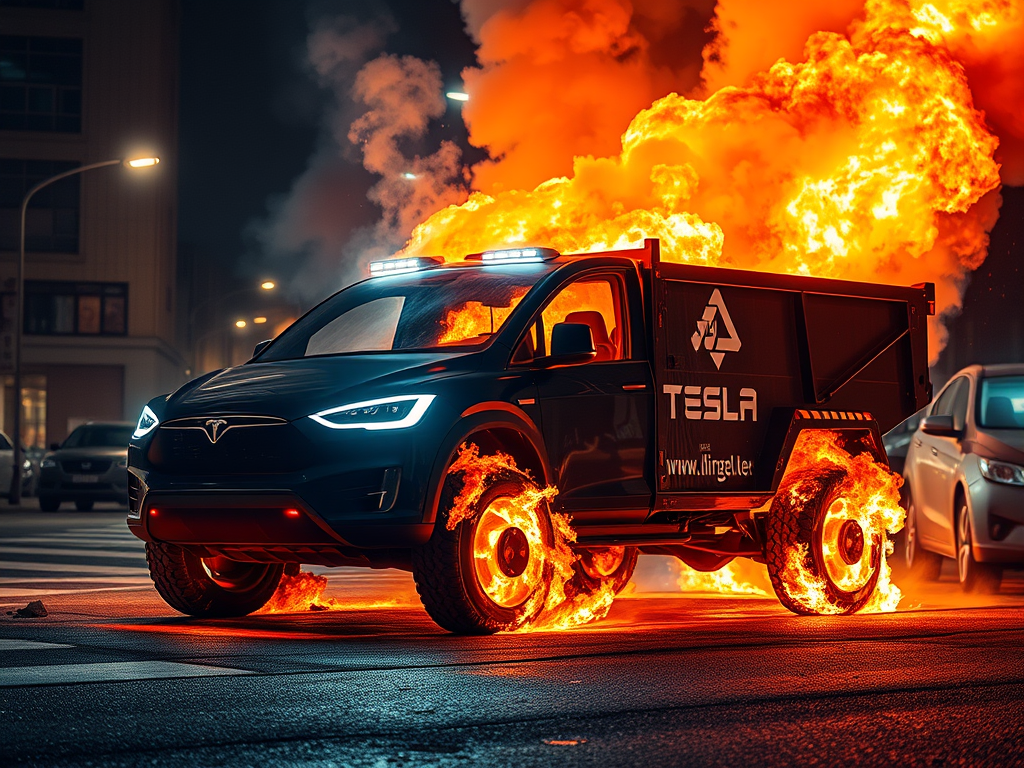
No worries! The Cybertruck only has a top speed of 130 miles per hour and only weighs between 6600 and 10,000 pounds, so what could possibly go wrong? It’s not as though it could run over you in your driveway. Over and over and over and over.

AI-generated to the following prompt (keep in mind, AI technology is supposed to be driving your self-driving car). “A Tesla Cybertruck that is a dumpster fire”


But wait! There’s more! President Mush Melon also happens to own a company that controls communications satellites used for—-among other things—-war fighting and voting. No problems there, right? It’s all okay so long as there’s no evil intent or gross incompetence.

But wait! There’s more! The Mush Melon also happens to control a company that shoots missiles out over your head. And, the best part is—they never unexpectedly explode! Sure, they suffer from catastrophic unscheduled disassembly. But we’ve all had days like that.

Well, okay, sure there’s some danger having someone in charge of missiles when we know that person lies or suffers from massive incompetence, but hey—at least it’s not a pizza shop, right? You’d know a bad pizza soon after you bought it no matter how many lies the cook told you.

Photo by Engin Akyurt on Pexels.com


On the other hand, it might be some time before you see the impact of your self-driving truck under someone else’s control, or the results of cutting off crucial communications, or the havoc caused by missiles exploding—excuse me—-rapidly disassembling— at unscheduled times.

Though on the other hand, you might feel this is all worth it because, after all, this person makes billions and billions of dollars a year and therefore provides a huge influx of cash to the U.S. Treasure to the tune of nearly…

Wait…

Nothing? Nothing? Are you kidding? The supposedly richest man in the world pays zero income tax. 

But he gives huge contributions of money to a Presidential candidate who then drops all the cases about Mush Melon’s frauds?

The Melon and the Felon: A marriage made in heaven. What’s a good name for the couple? I’m thinking just MF for short. We could call the Felon by 47 but what’s a special number of the Melon? Oh, there’s the form he is supposed to submit to Congress — FS-86.  So, I suppose they could go by 8647 or 4786. 

https://oversightdemocrats.house.gov/news/press-releases/committee-democrats-demand-elon-musks-sf-86-and-other-background-investigation

Other possibilities: 

Con, Don, Elon

Boy of Dough & Tech Bro

Ketty Mean and Allderall

The Mobster and the Monster

The Toddler and Toddler Junior

What are your suggestions? 

Their song? Hmm. Here’s my suggestion, embarrassingly obvious as it is: 

Lie, Lie, Lie.

After all, it is a marriage made in heaven. 

Or, at least some unearthly place.

What could possibly go wrong?

——————————

D4

dick-TATERS

Absolute is not just a vodka

The Crows and Me

Siren Song

Essays on America: The Game

The Stopping Rule

What about the Butter Dish?

Wednesday

At Least he’s Our Monster

Stoned Soup

The Three Blind Mice

Putin’s Favorite DOG-E

E-Fishiness Comes to Mass General

Take a Glance; Join the Dance

Life is a Dance

How the Nightingale Learned to Sing

The Forest

Dance of Billions

Peace

Roar, Ocean, Roar

Imagine All the People

Cars that Lock too Much

20 Friday Mar 2020

Posted by petersironwood in America, driverless cars, psychology, story, Travel

≈ 2 Comments

Tags

AI, anecdote, computer, HCI, human factors, humor, IntelligentAgent, IT, Robotics, story, UI, UX

{Now, for something completely different, a chapter about “Intelligent Agents” and attempts to do “too much” for the user. If you’ve had similar experiences, please comment! Thanks.}

1B87A4CC-F9EC-456F-B610-276A660E6E4A

At last, we arrive in Kauai, the Garden Island. The rental car we’ve chosen is a bit on the luxurious side (Mercury Marquis), but it’s one of the few with a trunk large enough to hold our golf club traveling bags.  W. has been waiting curbside with our bags while I got the rental car and now I pull up beside her to load up. The policeman motioning for me to keep moving can’t be serious, not like a New York police officer. After all, this is Hawaii, the Aloha State.  I get out of the car and explain, we will just be a second loading up. He looks at me and then at my rental car and then back to me with a skeptical scowl.  He shrugs ever so slightly which I take to mean an assent. “Thanks.” W. wants to throw her purse in the back seat before the heavy lifting starts. She jerks on the handle. The door is locked.  

“Why didn’t you unlock the door” she asks, with just a hint of annoyance in her voice.  After all, it has been a very long day since we arose before the crack of dawn and drove to JFK in order to spend the day flying here.  

“I did unlock the door,” I counter.  

“Well, it’s locked now.” She counters my counter. 

I can’t deny that, so I walk back around to the driver’s side, and unlock the door with my key and then push the UNLOCK button which so nicely unlocks all the doors.  

The police officer steps over, “I thought you said, you’d just be a second.”

“Sorry, officer”, I reply.  “We just need to get these bags in.  We’ll be on our way.” 

Click.

W. tries the door handle.  The door is locked again.  “I thought you went to unlock the door,” she sighs.

“I did unlock the door.  Again.  Look, I’ll unlock the door and right away, open it.”  I go back to the driver’s side and use my key to unlock the door.  Then I push the UNLOCK button, but W’s just a tad too early with her handle action and the door doesn’t unlock. So, I tell her to wait a second.  

man riding on motorcycle

Photo by Brett Sayles on Pexels.com

“What?”  This luxury car is scientifically engineered not to let any outside sounds disturb the driver or passenger.  Unfortunately, this same sophisticated acoustic engineering also prevents any sounds that the driver might be making from escaping into the warm Hawaiian air. I push the UNLOCK button again.  Wendy looks at me puzzled.

I see dead people in my future if we don’t get the car loaded soon. For a moment, the police officer is busy elsewhere, but begins to stroll back toward us. I rush around the car and grab at the rear door handle on the passenger side. 

But just a little too late.  

“Okay,” I say in an even, controlled voice.  “Let’s just put the bags in the trunk.  Then we’ll deal with the rest of our stuff.” 

The police officer is beginning to change color now, chameleon like, into something like a hibiscus flower. “Look,” he growls. “Get this car out of here.”

“Right.” I have no idea how we are going to coordinate this. Am I going to have to park and drag all our stuff or what? Anyway, I go to the driver’s side and see that someone has left the keys in the ignition but locked the car door; actually, all the car doors. A terrifying thought flashes into my mind. Could this car have been named after the “Marquis de Sade?” That hadn’t occurred to me before. 

auto automobile automotive car

Photo by Dom J on Pexels.com

Now, I have to say right off the bat that my father was an engineer and some of my best friends are engineers. And, I know that the engineer who designed the safety locking features of this car had our welfare in mind. I know, without a doubt, that our best interests were uppermost. He or she was thinking of the following kind of scenario. 

“Suppose this teenage couple is out parking and they get attacked by the Creature from the Black Lagoon. Wouldn’t it be cool if the doors locked just a split second after they got in. Those saved milliseconds could be crucial.”

Well, it’s a nice thought, I grant you, but first of all, teenage couples don’t bother to “park” any more. And, second, the Creature from the Black Lagoon is equally dated, not to mention dead. In the course of our two weeks in Hawaii, our car locked itself on 48 separate, unnecessary and totally annoying occasions.  

And, I wouldn’t mind so much our $100 ticket and the inconvenience at the airport if it were only misguided car locks. But, you and I both know that it isn’t just misguided car locks. No, we are beginning to be bombarded with “smart technology” that is typically really stupid. 

man in black suit sitting on chair beside buildings

Photo by Andrea Piacquadio on Pexels.com

As another case in point, as I type this manuscript, the editor or sadistitor or whatever it is tries to help me by scrolling the page up and down in a seemingly random fashion so that I am looking at the words I’m typing just HERE when quite unexpectedly and suddenly they appear HERE. (Well, I know this is hard to explain without hand gestures; you’ll have to trust me that it’s highly annoying.) This is the same “editor” or “assistant” or whatever that allowed me to center the title and author’s names. Fine. On to the second page. Well, I don’t want the rest of the document centered so I choose the icon for left justified. That seems plausible enough. So far, so good. Then, I happen to look back up to the author’s names. They are also left-justified. Why?  

Somehow, this intelligent software must have figured, “Well, hey, if the writer wants this text he’s about to type to be left-justified, I’ll just bet that he or she meant to left-justify what was just typed as well.” Thanks, but no thanks. I went back and centered the author’s names. And then inserted a page break and went to write the text of this book.  But, guess what? It’s centered. No, I don’t want the whole book centered, so I click on the icon for left-justification again. And, again, my brilliant little friend behind the scenes left-justifies the author’s names. I’m starting to wonder whether this program is named (using a hash code) for the Marquis de Sade.  

On the other hand, in places where you’d think the software might eventually “get a clue” about my intentions, it never does. For example, whenever I open up a “certain program,” it always begins as a default about 4 levels up in the hierarchy of the directory chain. It never seems to notice that I never do anything but dive 4 levels down and open up files there. Ah, well. This situation came about in the first place because somehow this machine figures that “My Computer” and “My hard-drive” are SUB-sets of “My Documents.” What?  

680174EA-5910-4F9B-8C75-C15B3136FB06_1_105_c

Did I mention another “Intelligent Agent?”…Let us just call him “Staple.” At first, “Staple” did not seem so annoying. Just a few absurd and totally out of context suggestions down in the corner of the page. But then, I guess because he felt ignored, he began to become grumpier. And, more obnoxious. Now, he’s gotten into the following habit. Whenever I begin to prepare a presentation….you have to understand the context. 

In case you haven’t noticed, American “productivity” is way up. What does that really mean? It means that fewer and fewer people are left doing the jobs that more and more people used to do. In other words, it means that whenever I am working on a presentation, I have no time for jokes. I’m not in the mood. Generally, I get e-mail insisting that I summarize a lifetime of work in 2-3 foils for an unspecified audience and an unspecified purpose but with the undertone that if I don’t do a great job, I’ll be on the bread line. A typical e-mail request might be like this:

“Classification: URGENT.

“Date: June 4th, 2002.

“Subject: Bible

“Please summarize the Bible in two foils. We need this as soon as possible but no later than June 3rd, 2002. Include business proposition, headcount, overall costs, anticipated benefits and all major technical issues. By the way, travel expenses have been limited to reimbursement for hitchhiking gear.”

Okay, I am beginning to get an inkling that the word “Urgent” has begun to get over-applied. If someone is choking to death, that is “urgent.” If a plane is about to smash into a highly populated area, that is “urgent.” If a pandemic is about to sweep the country, that is “urgent.” If some executive is trying to get a raise by showing his boss how smart he is, I’m sorry, but that might be “important” or perhaps “useful” but it is sure as heck not “urgent.”  

All right. Now, you understand that inane suggestions, in this context, are not really all that appreciated. In a different era, with a different economic climate, in an English Pub after a couple of pints of McKewan’s or McSorely’s, or Guinness, after a couple of dart games, I might be in the mood for idiotic interruptions. But not here, not now, not in this actual and extremely material world.

So, imagine my reaction to the following scenario. I’m attempting to summarize the Bible in two foils and up pops Mr. “Staple” with a question. “Do you want me to show you how to install the driver for an external projector?” Uh, no thanks. I have to admit that the first time this little annoyance appeared, I had zero temptation to drive my fist through the flat panel display. I just clicked NO and the DON’T SHOW ME THIS HINT AGAIN. And, soon I was back to the urgent job of summarizing the Bible in two foils. 

About 1.414 days later, I got another “urgent” request.

“You must fill out form AZ-78666 on-line and prepare a justification presentation (no more than 2 foils). Please do not respond to this e-mail as it was sent from a disconnected service machine. If you have any questions, please call the following [uninstalled] number: 222-111-9999.”  

Sure, I’m used to this by now. But when I open up the application, what do I see? You guessed it. A happy smiley little “Staple” with a question: 

“Do you want me to show you how to install the driver for an external projector?” 

“No,” I mutter to myself, “and I’m pretty sure we already had this conversation. I click on NO THANKS. And I DON’T WANT TO SEE THIS HINT AGAIN. (But of course, the “intelligent agent,” in its infinite wisdom, knows that secretly, it’s my life’s ambition to see this hint again and again and again).  

A friend of mine did something to my word processing program. I don’t know what. Nor does she. But now, whenever I begin a file, rather than having a large space in which to type and a small space off to the left for outlining, I have a large space for outlining and a teeny space to type. No-one has been able to figure this out. But, I’m sure that in some curious way, the software has intuited (as has the reader) that I need much more time spent on organization and less time (and space) devoted to what I actually say. (Chalk a “correct” up for the IA. As they say, “Even a blind tiger sometimes eats a poacher.” or whatever the expression is.)

Well, I shrunk the region for outlining and expanded the region for typing and guess what? You guessed it! Another intelligent agent decided to “change my font.” So, now, instead of the font I’m used to … which is still listed in the toolbar the same way, 12 point, Times New Roman … I have a font which actually looks more like 16 point. And at long last, the Intelligent Agent pops up with a question I can relate to! “Would you like me to install someone competent in the Putin misadminstration?”

What do you know? “Even a blind tiger sometimes eats a poacher.”

7B292613-361F-4989-B9AC-762AB956DECD


Author Page on Amazon

Start of the First Book of The Myths of the Veritas

Start of the Second Book of the Myths of the Veritas

Table of Contents for the Second Book of the Veritas

Table of Contents for Essays on America 

Index for a Pattern Language for Teamwork and Collaboration  

Essays on America: The Temperature Gauge

09 Thursday Jan 2020

Posted by petersironwood in America, apocalypse, driverless cars, politics, Uncategorized

≈ 6 Comments

Tags

AI, America, cancer, Democracy, driverless cars, ethics, government

green leafed trees

Photo by Drew Rae on Pexels.com

The sun is shining! Spring is here at last, and the trees are in bloom. You’re driving down the road and you see … 

That your “Engine over-heating” light goes on! 

You think: My engine’s over-heating! 

Or,  you think, it isn’t over-heating at all; I just have a bad sensor. 

Over the next few months, the red light goes on several other times, and each time, you pull over and try to judge whether the engine is really over-heated. No easy task. But you get back in and turn the car on and lo and behold, the light’s no longer on. Aloud, you mutter: “I’ve got to get that damned sensor fixed. Maybe next week.”

In the olden days of driving cars, I had a continuous gauge of the temperature. It was more obvious if it was acting oddly because I had more information. I could track it day to day. If I went on a long trip I could see whether the behavior of the gauge “made sense.” I might go up a long mountain road on a hot sunny day, and I expect to see the temperature gauge climb. On the other hand, if I went back down that same mountain at night and the temperature gauge climbed, I would know to get it checked. 

aerial view of road in the middle of trees

Photo by Deva Darshan on Pexels.com

Suppose instead of a gauge, you or I only get is one bit of information: “Temperature sensor says overheated,”  it’s much harder judge the veracity of the source. But, if we cannot even trust the reliability of the sensor, then we don’t even get one bit of information. Before the light comes on, there are four possible states (not equally likely, by the way, but that’s not important for the following argument). 

Engine OK, Sensor OK; 

Engine OK, Sensor ~OK; 

Engine ~OK, Sensor OK; 

Engine ~OK, Sensor ~OK. 

When the red light comes on, you have some information because the state of:

Engine OK, Sensor OK is eliminated. 

But is it? 

IMG_7209

It certainly is — under a certain set of assumptions — but let’s try to tease apart what those assumptions are and see whether they necessarily hold in today’s world, or in tomorrow’s world. 

Let’s imagine for a moment that your automobile is bewitched and inhabited by an evil demon with limited magical powers, mainly to do with the car itself. If you’ve seen the movie Christine you’ll know what I mean. If you haven’t seen it, please buy the book instead. It’s so much better. But let’s get back to our own evil-spirited car. This car, let’s call him “URUMPUT” because it sounds a bit like a car engine and because — you know, just because. Let’s imagine the car has a lot of mileage and is painted a kind of sickly orange color. The tires are bald, and it’s a real gas guzzler. It’s actually more of a jalopy than a car. Your friends would have assumed you could have done much better, but it is apparently what you’re stuck with for now. 

URUMPUT, unbeknownst to you, is actually out to kill you, but his powers are limited. He cannot simply lock the doors and reroute the exhaust till you pass out from the fumes. So, what it does is to over-ride the sensor so that you get out to take a look at your car so you open the hood and you look inside and BLAM! Down comes the hood on your head with enough force to snap your neck. When your neck is snapped, you don’t die instantaneously. You are aware that something is terribly wrong. Your brain sends signals for you to move; to get the damned hood off; but you can’t move. And, worse, you can’t breathe. Soon, but much too late, you realize something has gone terribly wrong.

You. 

Are. 

Dead! 

That blasted URUMPUT got you. Why?  Just because he could. He paid you no more mind than had you been an ant on the road. He gave you misinformation. That is information that you thought you had because you assumed you were dealing with a system that, although imperfect, had some degree of transparency. You certainly did not think you were dealing with an actively evil agent. But you were. And, now you’re dead. (But go ahead and read the rest as though you were still alive.) 

Of course, in real life, there are no bewitched cars. We all know that. 

86A389C7-4CD7-42E3-ABFA-A555A5BB24CB

Do we? 

Let’s consider how much electronics and “smarts” already exists in cars. The amount will skyrocket with driverless cars. For one thing, the human “occupants” will be able to have much more engaging entertainment. Perhaps more importantly, the “brain” of the car will be able to react to a much wider array of data more quickly than most human drivers could. 

With all the extra sensors, communications, components, functions, protocols, etc. there will be greatly enhanced functionality. 

There will also be all sorts of places where a “bad actor” might intentionally harm the vehicle or even harm the occupants. Your insurance company, for instance, might fake some of the data in the black box of your car to indicate that you drove a lot during nighttime hours. It doesn’t seem to match your recollection, but how would you double check? You grudgingly pay the increased premium. 

white graphing paper

Photo by Pixabay on Pexels.com

Behind on your loan shark payments? Oops? Your driverless car just steered itself off a cliff and all the occupants were killed. 

Oh, but how, you ask, would loan sharks get hold of the software in your car? 

Then, I have to ask you a question right back. Have you been watching the news the last couple of years? People who owe a great deal of money to the wrong people will do anything to avoid the promised punishments that follow non-payment. 

Our government at this point is definitely not much like old time cars that allowed you to see what was going on and make judgments for yourself. This government just sends out signals that say, “Everything’s Fine!” and “Do as I say!” and “Those people NOT like you? They are the cause of all your troubles.” 

D27C46AA-C37E-4AB7-8FE8-8DA937E31A91

That is not transparency. 

That is not even informational. 

That is misinformation. 

But it is not misinformation of the sort where a student says: “Akron is the capital of Ohio.” That’s wrong, but it’s not maliciously wrong. 

When people lose a limb as a result of an accident, cancer, or war, they often experience something called the “Phantom Limb Experience.” They have distinct sensations, including pain, “in” the limb that is no longer there. The engine’s not working but the sensor is also bad. 

That’s where we are. 

The engine’s not working. The feedback to us about whether it’s working is also malicious misinformation. 

We have the Phantom Limb Experience of having a government that is working for American interests. 

We need to regrow the missing limb or get a really good prosthetic. 

We need straight information from the government which is supposed to take input from all of us and then make decisions for all of us. It’s never been perfect, but this is the first time it is not even trying or pretending to be fair or even accurate. People in top level positions in our government think that their oath of office is a joke. 

We live in a monster car — and not the fun kind — the Christine kind. 

The engine’s not working. And the sensor light means nothing. If you look under the hood to find out what’s really going on, you’d better have a partner ready to grab the hood and prevent it from being slammed down on your head. Because URUMPUT would do it with as little regard for you as he would have to out and destroy any other whistleblower. 

blur close up design focus

Photo by Pixabay on Pexels.com

———————————————

The Invisibility Cloak of Habit

Author Page on Amazon

Story about Driverless Cars (from Turing’s Nightmares). 

A Once-Baked Potato

28 Saturday Sep 2019

Posted by petersironwood in America, driverless cars, politics, psychology

≈ 8 Comments

Tags

AI, automation, driverless cars, life, politics, truth

A Once-Baked Potato 

closeup photo of potatoes

Photo by Pixabay on Pexels.com

I’m really not ready to go for a long, high speed trip in a completely automated car. 

empty concrete road near trees

Photo by Alec Herrera on Pexels.com

I say that because of my baked potatoes. One for me. One for my wife. 

I’ve done it many times before. Here is my typical process. I take out a variety of vegetables to chop and chop the broccoli, red onion, garlic, red pepper while the potatoes are in the microwave. I put them in for some time like: 4:32 minutes and then, when that times out, I “test” the potatoes with a fork and put them in for more time. Actually, before I even take them out to use the “fork test” I shake the potatoes. I can tell from the “feel” whether they are still rock hard. If they are marginal, then, I use the more sensitive “fork test.”  Meanwhile, I chop more vegetables and take out the cheese. I test the potatoes again. At some point, they are well done and I slather them up with butter and cheese and then add the chopped Vegetables. 

food healthy vegetables kitchen

Photo by Pixabay on Pexels.com

Delicious. 

But today is different. 

I pushed a button on the microwave that says, “Baked Potato.” Right away, I think: “Baked potato? I’m not putting in a baked potato. I’m putting in a raw potato. You have a button labelled ‘Popcorn’ — it doesn’t say, ‘Popped Corn’ so … ? Anyway, I decided to give it a try. 

The first disadvantage I see is that I have no idea whatsoever how long this process is going to take. I assume it has to take at least four and a half minutes. When I cook it via my usual process, it’s on “high” or “full power.” So, unless the microwave has a “hidden” higher power level that it allows its internal programs to have access to but not its end users, it seems I have at least 4 1/3 minutes to chop. 

Changing the way you do things always causes a little bit of discomfort, though often, a feeling of adventure outweighs that cautionary urge. In this case, I felt a lot of discomfort. The microwave can’t feel how done the potato is so it must be using some other sensor or sensors — likely moisture — though there may be other ways to do it. How do I know that the correlation between how I measure “doneness” and how the microwave measures “doneness” is even moderate? I am also a little concerned that there are, after all, two potatoes, not just one. There was no way to tell the machine that I had two potatoes. I decided that it was likely that the technical problems had been solved. 

Why? Certainly not because I have great faith in large multinational corporations to “do what’s right” rather than do what’s expedient. Once upon a time, not so many years ago, that really was my default assumption. But no longer. Too many lies by too many corporations about too many separate topics. Once upon a time, the government held some power to hold corporations accountable for their actions. Now, the power seems to have shifted so that many politicians — too many — are beholden to their corporate owners.  

The corporation just tries to work for its self-interests. They aren’t very good at it, but that’s their goal. 

Among the common ways they fail is by being too conservative. If they are successful by doing things a certain way, they often keep at it despite changes in the technology, the markets, the cost structures, the distribution possibilities, etc. (They are too afraid to push the “Baked Potato” button). At the same time, there seems to be no evil that many of them would foreswear in order to grow their profits; no lie that is too prosperous for them to tell. 

black and grey camera

Photo by Alex Andrews on Pexels.com

Yet, I live, at least for now, in this world surrounded by products made by these companies and interacting with them all the time. I cannot trust them as a whole, but it’s almost impossible not to rely on some of them some of the time. They can’t fool all of the people all of the time. 

I do calculate that if they put these buttons on there and they were horrible, word would get around and they would lose market share. This presumes that there is real competition in the market. 

I think it likely that driverless cars will be “safer” than human drivers on average within ten years, and possibly sooner. My discomfort stems, again, partly from habit, but largely from a lack of confidence in the ethics of corporations. Normally, I would think that when it comes to life and death, at least, I can put some degree of faith in the government to oversee these companies enough to ensure their safety data were accurate. 

But I no longer believe that. And even after Trump resigns or gets impeached & convicted or he flees to Russia, there is no way to know how deeply and pervasively this corrupt misadministration has crept into the ethics of lesser government officials.  Any government official might think: “after all, if the President is flouting the Constitution by using the power of his office for his own benefit, why shouldn’t I? I need a bribe just as much as the next person and I certainly need the money more than Trump did!”

pexels-photo-164527.jpeg

Photo by Pixabay on Pexels.com

Beep. Beep. 

The microwave claims the potatoes are done. 

And so they are. Perfectly. 

There is still hope for America. 

IMG_7590

Maybe I will be able to take that ride after all. 


Author Page on Amazon. 

Corn on the Cob

Parametric Recipes and American Democracy 

Pies on Offer

Garlic Cloves and Puffer Fish

The Pros and Cons of AI: Part One


← Older posts

Subscribe

  • Entries (RSS)
  • Comments (RSS)

Archives

  • January 2026
  • December 2025
  • November 2025
  • October 2025
  • September 2025
  • August 2025
  • July 2025
  • June 2025
  • May 2025
  • April 2025
  • March 2025
  • February 2025
  • January 2025
  • December 2024
  • November 2024
  • October 2024
  • September 2024
  • July 2024
  • April 2024
  • March 2024
  • February 2024
  • January 2024
  • December 2023
  • August 2023
  • July 2023
  • May 2023
  • April 2023
  • March 2023
  • February 2023
  • January 2023
  • December 2022
  • November 2022
  • October 2022
  • September 2022
  • August 2022
  • July 2022
  • June 2022
  • May 2022
  • April 2022
  • March 2022
  • February 2022
  • January 2022
  • December 2021
  • November 2021
  • October 2021
  • September 2021
  • August 2021
  • July 2021
  • June 2021
  • May 2021
  • April 2021
  • March 2021
  • February 2021
  • January 2021
  • December 2020
  • November 2020
  • October 2020
  • September 2020
  • August 2020
  • July 2020
  • June 2020
  • May 2020
  • April 2020
  • March 2020
  • February 2020
  • January 2020
  • December 2019
  • November 2019
  • October 2019
  • September 2019
  • August 2019
  • July 2019
  • June 2019
  • May 2019
  • April 2019
  • March 2019
  • February 2019
  • January 2019
  • December 2018
  • November 2018
  • October 2018
  • September 2018
  • August 2018
  • July 2018
  • June 2018
  • May 2018
  • April 2018
  • March 2018
  • February 2018
  • January 2018
  • December 2017
  • November 2017
  • October 2017
  • September 2017
  • August 2017
  • July 2017
  • June 2017
  • May 2017
  • April 2017
  • March 2017
  • February 2017
  • January 2017
  • December 2016
  • November 2016
  • October 2016
  • September 2016
  • August 2016
  • July 2016
  • June 2016
  • May 2016
  • April 2016
  • March 2016
  • February 2016
  • January 2016
  • December 2015
  • November 2015
  • October 2015
  • September 2015
  • August 2015
  • May 2015
  • January 2015
  • July 2014
  • January 2014
  • December 2013
  • November 2013

Categories

  • AI
  • America
  • apocalypse
  • cats
  • COVID-19
  • creativity
  • design rationale
  • driverless cars
  • essay
  • family
  • fantasy
  • fiction
  • HCI
  • health
  • management
  • nature
  • pets
  • poetry
  • politics
  • psychology
  • Sadie
  • satire
  • science
  • sports
  • story
  • The Singularity
  • Travel
  • Uncategorized
  • user experience
  • Veritas
  • Walkabout Diaries

Meta

  • Create account
  • Log in

Blog at WordPress.com.

  • Subscribe Subscribed
    • petersironwood
    • Join 661 other subscribers
    • Already have a WordPress.com account? Log in now.
    • petersironwood
    • Subscribe Subscribed
    • Sign up
    • Log in
    • Report this content
    • View site in Reader
    • Manage subscriptions
    • Collapse this bar
 

Loading Comments...