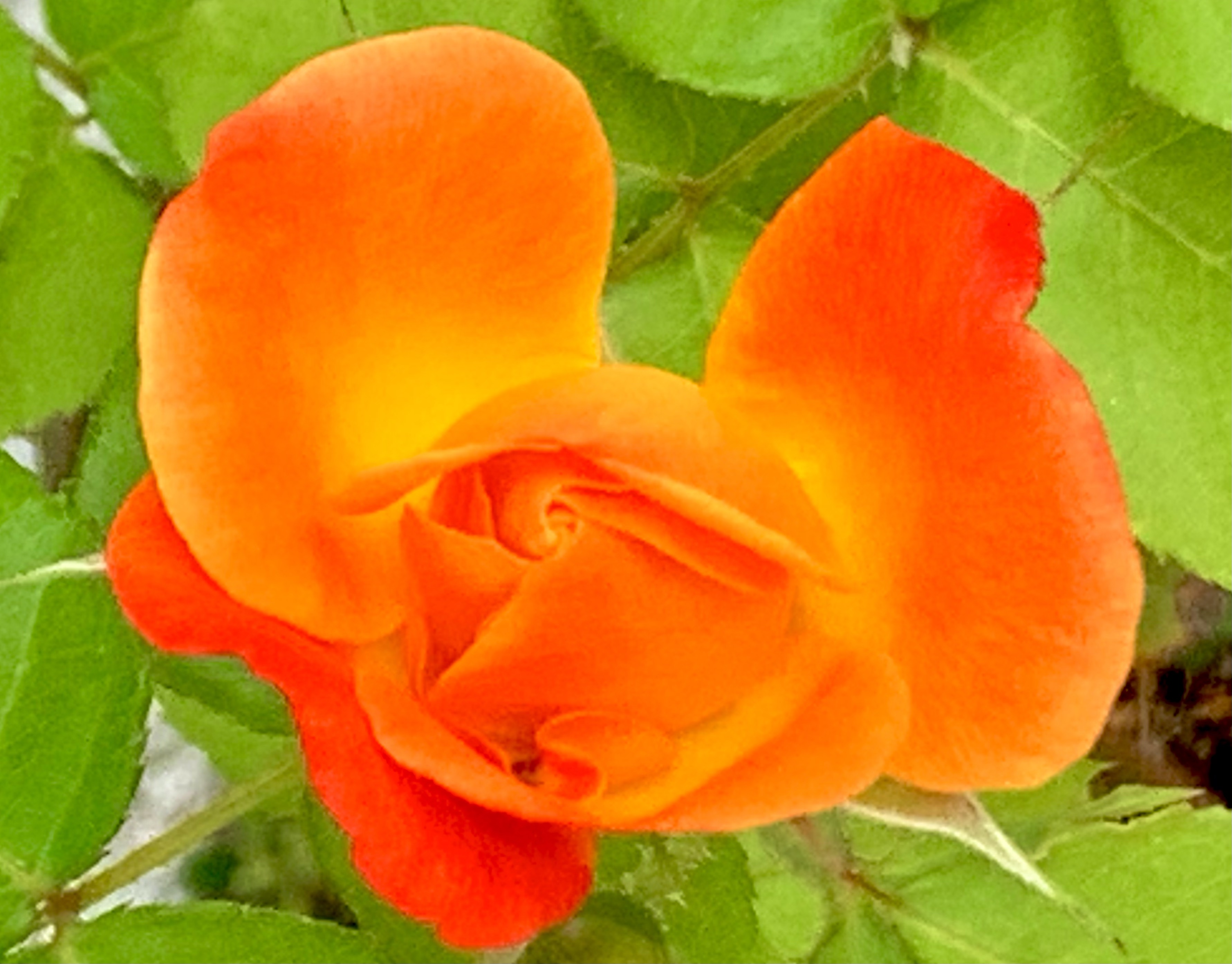
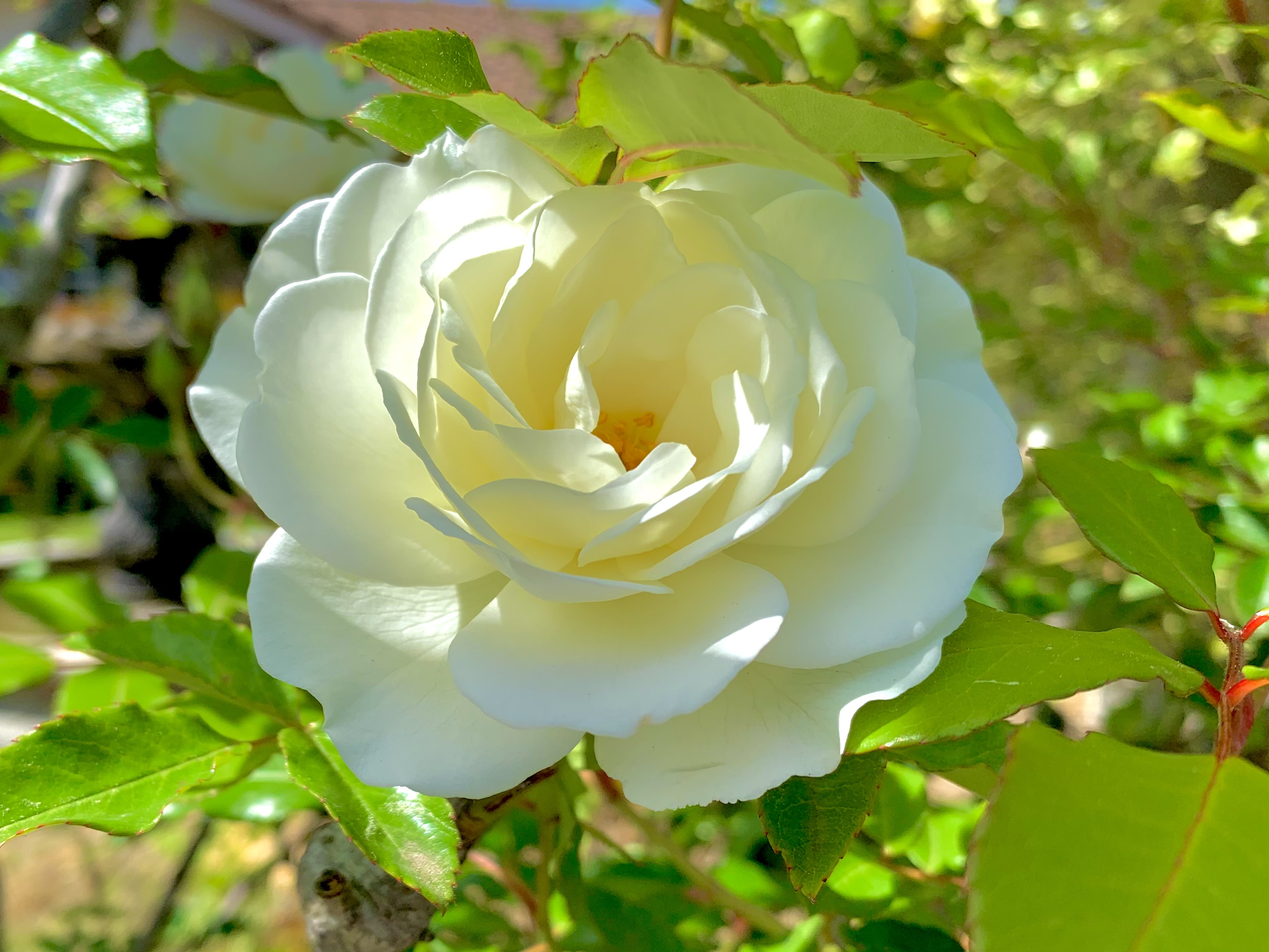
Christopher Alexander was an architect who wrote much about architecture, including the well-known book, A Pattern Language. Later, he also wrote about “The Nature of Order.” He posits 15 properties of natural beauty and good design, the first of which is “Levels of Scale.” I was thinking about that today as I admired our Jacob’s Coat Rose bush which blooms about 3-4 times a year here in San Diego.
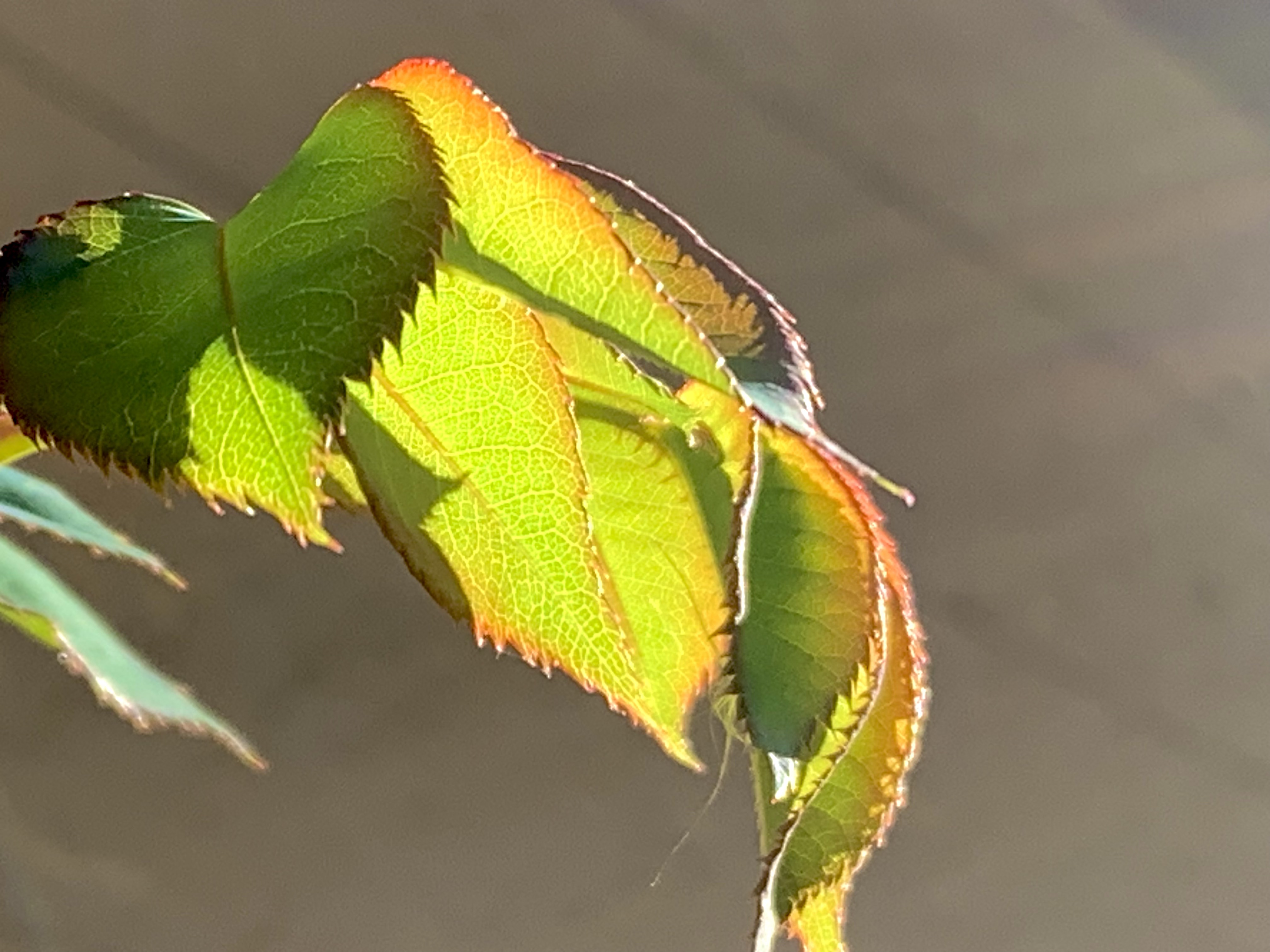
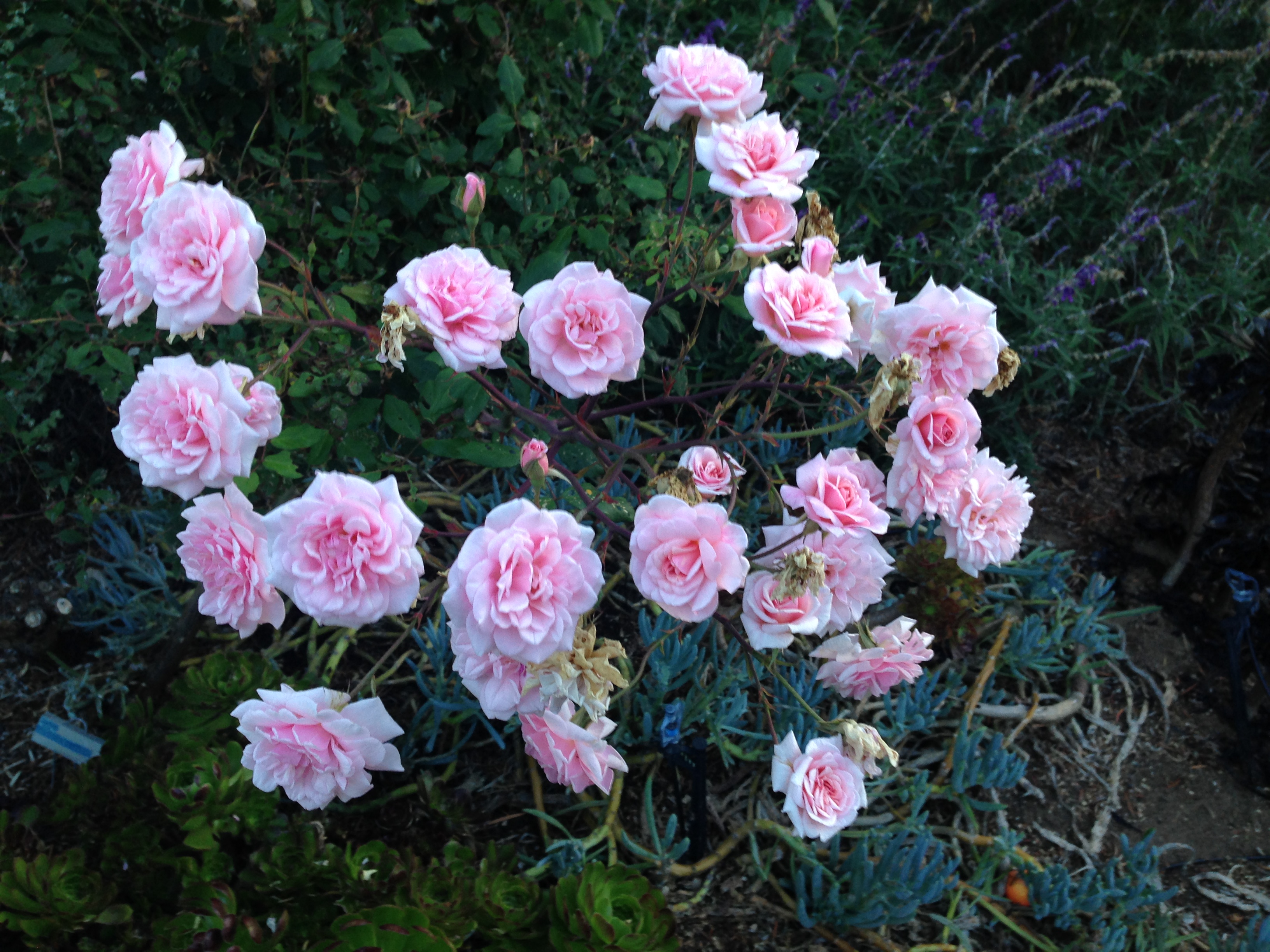
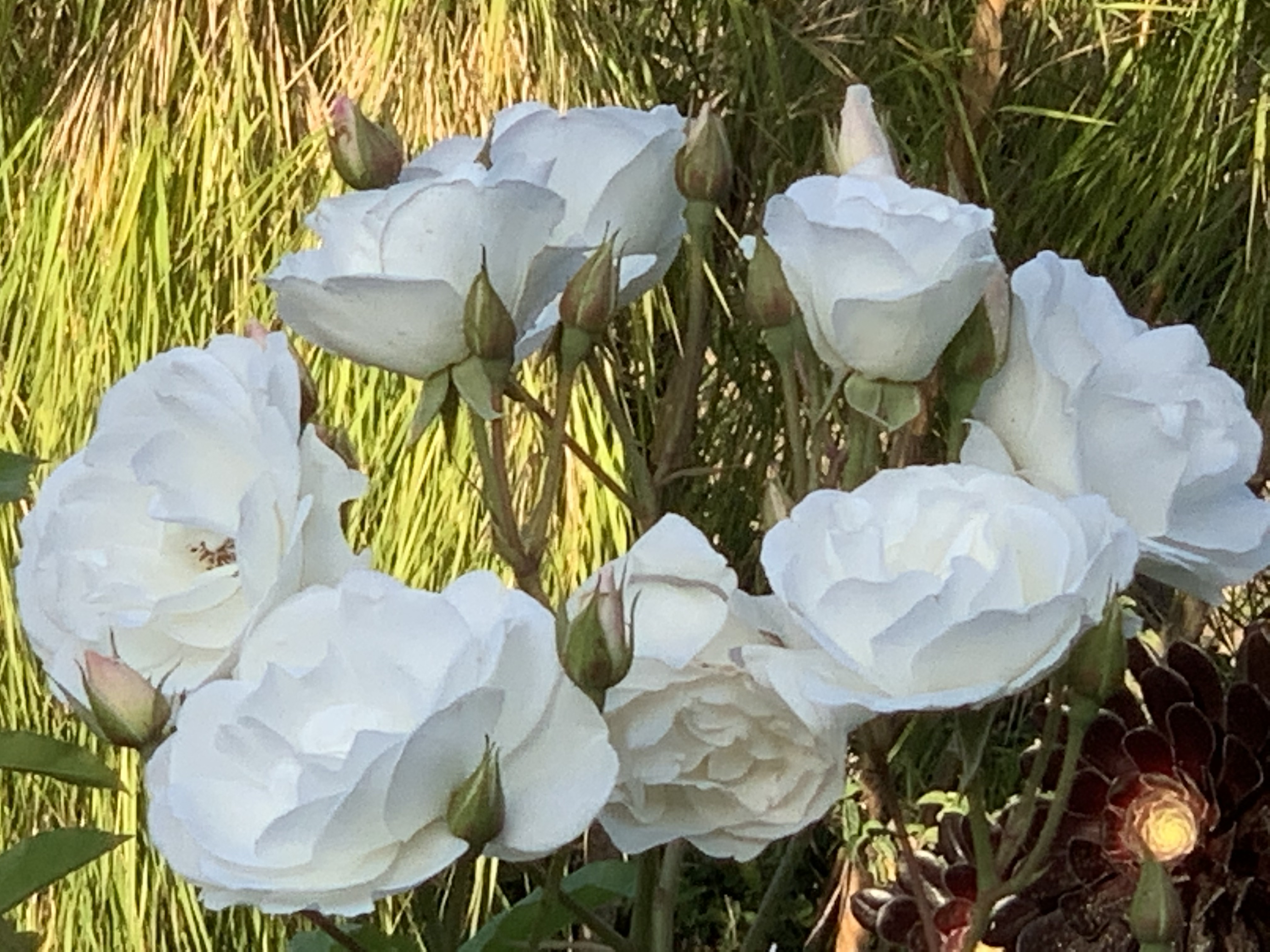
Most of us see the flowers of the rose as beautiful. And indeed they are. They are beautiful from afar. They are beautiful up close. But so too are the other parts of the rose plant. At least, sometimes, the leaves are also quite beautiful.
Even the thorns are beautiful.
Beyond this surface level, the rose, like all living things, is beautiful inside. Like all living things, it’s survived four billion years of evolutionary time. The way cells are arranged and the way they work–this is beautiful as well. Moreover, the relationship that roses have to humans and bees are also beautiful. Imagine having the faith and hope to depend on a completely different species to reproduce. Imagine being so beautiful that human being across the globe spend their time and money to keep you thriving.
Did I mention that, like other green plants, roses remove carbon dioxide from the atmosphere and provide oxygen for animals like us?
Roses are so famous that they play a part in history and pageantry. The War of the Roses. The White House Rose garden. Destroying part of the Rose Garden is also symbolic. The Rose Parade. Individuals give each other roses. They are variously symbols of love, friendship, and peace. Roses appear in poetry, songs, paintings, and both first and last names.
But that doesn’t mean that they, as a species, and they, as individual plants, don’t make decisions and embody strategies and tactics.
Today, a local crow and I were playing the counting game. I think that’s the most parsimonious explanation, even though I can’t “prove” it. Here’s what actually transpired. I went out into the garden to take pictures of flowers before it gets too chilly. Soon a crow said, “CAW!” So I said, “CAW!”
Then, the crow crowed “CAW! CAW!” So I repeated that message. Any way, we got up to three and the crow started over at one and we went through the whole sequence three times.
They cawed three times and I said: “That’s what we call ‘Three’ and I “cawed” the first three digits followed by cawing three times. He cawed back.
Then, once again, I said, “One, Two, Three” and “CAW! CAW! CAW!”They next did something I don’t recall hearing before. They did a distinct two-tone CAW: I think it was low-hi. I went out to photograph roses, not take notes on crows. I repeated his two-tone CAW as best I good and he flew off while cawing about ten times. I fantasize that they flew off to tell their friends that they discovered a human who almost seems smart enough to CAW! Indeed, they are having quite a conversation out back right now. I am not yet sophisticated enough to know what they are talking about but cross-species communication is pretty cool.
The rose bush speaks to me too, of course.
I cannot hear it with my auditory apparatus. At least, not yet, I can’t. I have to “listen” with my eyes, and my mind, and my heart. I “know” something of what the rose wants and needs. I know it needs water and sunshine, for instance. It needs minerals. But those things are true of green plants in general. What does the rose tell me about its strategy and tactics for survival and thrival?
No, the rose bush cannot answer my spoken questions, but that often happens when it comes to communicating with other humans. I have read some poorly documented code (perhaps my own) and tried to figure out what the heck this code is doing. Probably, the single most important thing is to understand what the programmer was trying to do. What was their intention. I don’t actually have to know what precisely was in their mind in order to understand it at a useful level. This particular human programmer might have been thinking primarily about getting a raise, or impressing their supervisor, or outdoing their friend. Who cares? I need to understand an imputed design rationale.
In that same sense, I strive to understand the imputed design rationale of the rose plant. It doesn’t require that the rose talks to me in English. For example, why are a rose’s blooms so beautiful? Certain, the original “motivation” was mainly to attract pollinators like bees. But guess what? Some of the same patterns, colors, and odors that attract insect pollinators also attract human caregivers. In fact, the human caregivers have, through selective breeding, put additional design constraints on roses. As a result, there are more varieties of roses than there would have been without human intervention.
The roses have, one way and another, evolved genes that encourage them to grow beautifully. In a way, this can be said to be their “intention” — Their “design rationale” is that if they grow more beautiful, they will thrive more. But is their “intention” to be beautiful so recent? Suppose that other mammals also find the blossoms beautiful? Attracting mammals to the rose plant may encourage them to breathe carbon dioxide on the roses; to defecate nearby and provide minerals; perhaps even to bleed some because of the thorns. It’s even possible that there is also an innate design rationale of all life to be beautiful. Life is beautiful in terms of being itself. Perhaps, other things being equal, surfacing the fact of your being part of life by being beautiful is itself a survival strategy. It increases the chances that other life forms will cooperate with you. They will perceive that you are kindred and may have something valuable to trade.
Is it the natural state of affairs that all life reaches out for all life in the hopes of reaching some mutual understanding?
I could take pictures of the same rose bush, and never take exactly the same picture twice. In fact, it wouldn’t even take trying on my part. In fact, no matter how hard I tried to take exactly the same picture, it wouldn’t happen. Moment to moment, my hand would murmur, the sun would slide ever so slightly in the sky, a wanton puff of wind would blow the bush.
Of course, I don’t try to take exactly the same picture. Part of the joy is expanding the universe of possible pictures and being open to the possibilities that abound from angle, light, surround, seasons, my own mood, the bush’s mood, the sun’s mood, the mood of the clouds. No, of course, I don’t believe they have conscious emotions — necessarily — but mood describes it was well as any word and the moods of the world are sometimes extremely important in determining our moods. Ask the survivors of any natural disaster whether their “mood” was “influenced” by the disaster! (No, I won’t pay your medical bills). Of course, we know it in these extreme cases, but don’t we really also know it when it comes to less catastrophic events as well? Isn’t your mood influenced by the weather, the time of day, the noise you’re subjected to, the mood of those around you — all of these impact your mood to some extent and therefore, they will have some impact on the quality of the experiences you have.
Your experience with a photograph will be altered according to the mood of the photographer who took the picture, the mood of the planet at that place and time, and — let’s not forget — your mood as well. And, even if you’ve seen hundreds of my pictures, there is no way you or I could draw in detail what the next picture will look like.
I cannot, indeed, take a picture of a rose. I can only take a picture of the now-rose. And, another now-rose. But, since no two ‘now’s’ are identical, so too, the now-rose is never like any other now-rose. Even if we had two pictures a second apart that were pixel by pixel identical (exceedingly unlikely!) It would only be because of the limitations of our sensors. Let’s not forget that these are living plants doing the “business” of life every second! And even the molecules of inanimate things are moving about, assuming the garden is above absolute zero. Roses are not known to thrive at -435 C. That’s the state, though, that some strive toward now. Absolute predictability based on absolute power means nothing learns; nothing adapts; nothing is truly alive.
Here’s the deal folks.
Every experience with another human being is unique.
Yet, we like to try to categorize them.
By person.
By age of person.
By skin color of person.
By gender.
By religion.
By etc. etc. and so forth.
Yet, you have literally no idea for certain what the next moment will be like. Yet, some people are willing to treat what will happen as a certainty, which would be absurd for something as well-regulated and well-studied as, say, baseball. They would never bet their life that a particular hitter would or would not get a base hit. They wouldn’t do that even if they knew his batting average to the third decimal. But they are willing to stake everything, not on a knowledge of the other person, but based on “knowledge” of a category that is not only useless but based on folklore, propaganda, and fakery.
Instead of being scared by the bees, why not take the time to appreciate the now-rose of human experience — the ever-changing dance of all humanity — which moment will never ever come again. No, not that one either.










 petersironwood