• About PeterSIronwood

petersironwood

~ Finding, formulating and solving life's frustrations.

petersironwood

Tag Archives: leadership

Ban Open Loops: Part Two – Sports

30 Tuesday Sep 2025

Posted by petersironwood in management, psychology, sports

≈ Leave a comment

Tags

AI, cognitive computing, Customer experience, customer service, education, leadership, learning, technology

Sports and open loops.

Sports offers a joy that many jobs and occupations do not. A golfer putts the ball and it sinks into the cup — or not. A basket-baller springs up for a three pointer and —- swish — within seconds, the shooter knows whether he or she was successful. A baseball hitter slashes the bat through the air and send the ball over the fence —- or hears the ball smack into the catcher’s mitt behind. What sports offers then is the opportunity to find out results quickly and hence offers an excellent opportunity for learning. In the previousiPhoneDownloadJan152013 593 entry in this blog, I gave examples of situations in life which should include feedback loops for learning, but, alas, do not. I called those open loops.

Sports seem to be designed for closed loop learning. They seem to be. Yet, reality complicates matters even here. There are three main reasons why what appears to be obvious opportunities for learning in sports is not so obvious after all. Attributional complexity provides the first complication. If you miss a putt to the left, it is obvious that you have missed the putt to the left. But why you missed that putt left and what to do about it are not necessarily obvious at all. You might have aimed left. You might not have noticed how much the green sloped left (or over read the slant to the right). You may not have noticed the grain. You might not have hit the ball in the center of the putter. You might not have swung straight through your target. So, while putting provides nice unambiguous feedback about results, it does not diagnose your problem or tell you how to fix it. To continue with the golf example, you might be kicking yourself for missing half of your six foot putts and therefore three-putting many greens. Guess what? The pros on tour miss half of their six foot putts too! But they do not often three-putt greens. You might be able to improve your putting, but your underlying problems may be that your approach shots leave you too far from the pin and that your lag putts leave you too far from the hole. You should be within three feet of the hole, not six feet, when you hit your second putt.

A second issue with learning in sports is that changes tend to cascade. A change in one area tends to produce other changes in other areas. Your tennis instructor tells you that you are need to play more aggressively and charge the net after your serve. You try this, but find that you miss many volleys, especially those from mid-court. So, you spend a lot of time practicing volleys. Eventually, your volleys do improve. Then, they improve still more. But you find that, despite this, you are losing the majority of your service games whereas you used to win most of them. You decide to revert to your old style of hanging out at the baseline and only approaching the net when the opponent lands the ball short. Unfortunately, while you were spending all that time practicing volleys, you were not practicing your ground strokes. Now, what used to work for you, no longer works very well. This isn’t the fault of your instructor; nor is it your fault. It is just that changing one thing has ripple effects that cannot always be anticipated.

The third and most insidious reason why change is difficult in sports springs from the first two. Because it is hard to know how to change and every change has side-effects, many people fail to learn from their experience at all. There is opportunity for learning at every turn, but they turn a blind eye to it. They make the same mistakes over and over as though sports did not offer instant feedback. I think you will agree that this is really a very close cousin of what people in business do when they refuse to institute systems for gathering and analyzing useful feedback.

If learning is tricky —- and it is —- is there anything for it? Yes. There is. There is no way to make learning in sports —- or in business —- trivial. But there are steps you can take to enhance your learning process. First, be open-minded. Do not shut down and imagine that you are already playing your sport as well as can be expected for a forty year old, or a fifty year old, or someone slightly overweight or someone with a bad ankle. Take an experimental approach and don’t be afraid to try new things. Second, forget ego. Making mistakes provides opportunities to learn, not proof that you are no good. Third, get professional help. A good coach can help you understand attributional complexity and they can help you anticipate the side-effects of making a change.

Soon, I suspect that the shrinking size and cost and weight of computational and sensing devices will mean that training aids will help people with attributional complexity. I see big data analytics and modeling helping people foresee what the ramifications of changes are likely to be. There are already useful mechanical training aids for various sports. For example, the trade-marked Medicus club enables golfers to get immediate feedback during their full swings.as to whether they are jerking the club. Dave Pelz developed a number of useful devices for helping people understand how they may be messing up their putting stroke.

It may take somewhat longer before there are small tracking devices that help you with your mental attitude and approach. We are still a long way from understanding how the human brain works in detail. But it is completely within the realm of possibility to sense and discover your optimal level of stress. If you are too stressed, you could be prompted to relax through self-talk, breathing exercises, visualization, etc. You do not need technology for that, but it could help. You may already notice that some of the top tennis players seem to turn their backs from play for a moment and talk to an “invisible friend” when they need to calm down. And why not? Nowhere is it law that only kids are allowed to have invisible friends.

“The mental game” and which kinds of adaptations to make over what time scales are dealt with in more detail in The Winning Weekend Warrior How to Succeed at Golf, Tennis, Baseball, Football, Basketball, Hockey, Volleyball, Business, Life, Etc. available at Amazon Kindle.

Photo by Francesco Paggiaro on Pexels.com


Author Page on Amazon

US Open Closed

The Day From Hell: Why should anyone Care?

Wordless Perfection

Sports Fans Only

The Agony of the Feet

Frank Friend or Fawning Foe?

Business Re-engineering

Tennis Upside Down

Donnie Gets his Name on a Tennis Trophy!
Indian Wells Tennis Tournament

Small Things

An Amazing Feet of Athleticism

Frank Friend or Fawning Foe?

21 Monday Apr 2025

Posted by petersironwood in America, apocalypse, essay, politics, psychology, Travel

≈ 2 Comments

Tags

leadership, relationships

Typically, most of us think of friends as those who will stand by you through thick and thin. Sometimes, this means that they’re willing to encourage you when you’re down. 

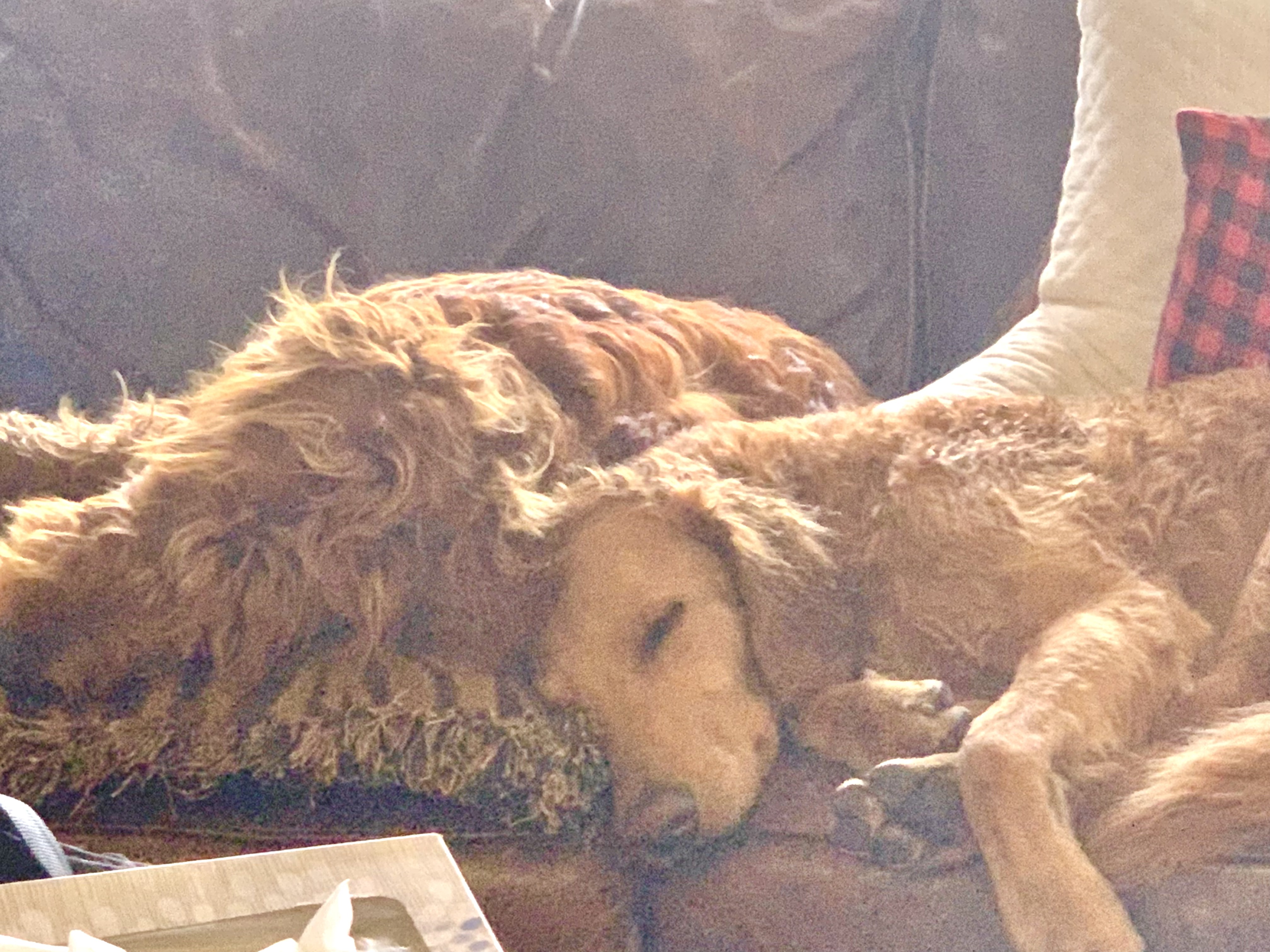
Two Golden Doodle Dogs cuddling on the couch

To me, a friend is also someone who is willing to give you frank feedback when you’re failing or making a mistake. If I’m doing something counter-productive or wrong, I’d generally like to know. A complement is okay, but I prefer sincere ones. To me, it would be demeaning for someone to lie about my accomplishments or abilities—demeaning to the person who gives such a false complement and demeaning to me as well. 

It’s always struck me as an extremely nasty thing to give someone falsely flattering feedback. Of course, if you’re teaching a two year old to bat a ball—or, as I was doing a short time ago—encouraging our puppy to learn to swim—then you set your criterion for “success” fairly low. You don’t expect a two year old to grab a 38” bat, face a major league pitcher and hit a home run into the third deck of Yankee Stadium. You don’t expect a puppy to swim across the English Channel. You have to shape exceptional skill by rewarding behavior. You do it by beginning to reward any behavior that is “in the right direction.” At first, any contact a toddler makes when swinging a bat at a ball is rewarded. A puppy just learning to swim is initially rewarded even for going a few feet. 

As a child matures physically and intellectually and learns a skill, you can give more instructive and more measured feedback. For instance, if a kid is learning to hit a baseball, you might give feedback about how solidly they’ve hit the ball. Soon, they’ll be capable of knowing that for themselves. They will see their hit pop up or trickle along the ground or instead streak away in a line drive. Eventually, after seeing many grounders, pop-ups, and line drives, they will know from the “feel” of the bat whether they’ve made solid contact. 

Generally, if a person gets accurate feedback from others, they will learn to provide accurate feedback to themselves. If someone keeps doing badly but getting a “pass” constantly, or worse, having people flatter them when they’re doing badly, they’ll become disconnected from reality. This can happen, for instance, to a rich or influential person. The flatterers don’t do it to be kind. They do it to “get on the good side” of someone who is susceptible to such false feedback. 

To me, telling an adult their performance is stellar when it actually stinks is typically not a kindness but an evil deed. Understand: I’m not using the word ‘evil’ to mean ‘counter-productive’ or ‘sub-optimal.’ I using the word ‘evil’ because I mean ‘evil.’


One result is that the person’s performance may not improve. Someone who might have become a decent hitter, or tennis player, or swimmer instead stays forever mediocre. What’s worse is that the person may decide to attempt to become a professional baseball player or tennis player when that will be a costly error. 

If the flattered person is in some kind of position of authority, the result may be even worse. A police officer, manager, executive, teacher, or political figure who is doing a terrible job but being told they’re doing a great job is not only preventing them from reaching their own potential. They are harming others as well. And, the person giving such false feedback is also harming themselves, their friends, and their families. If they do it enough, they will not learn to look carefully at the behavior or others and give useful feedback. Eventually, they too become disconnected from reality. 

Flattery is evil in business in that it’s a misdirection of effort based on lies.  Flattery is evil in sports for the same reason. Art? Same. Music? Same. Parents flattering their kids does not build self-confidence. It builds false confidence, making them believe they can do more than they can; that they are expected to do more than they can. Eventually, when the child receives honest feedback from physical reality or from folks that don’t have any reason to flatter, they’ll feel worse than if they had had more honest feedback all along. 

The most egregious form of fake flattery, however, occurs in dick-tater-$hits. When the autocrat takes cruel, destructive, or stupid actions, that autocrat is told by a circle of sycophants that his evil actions are wonderful, brilliant, magnanimous, etc. This devalues the person who says it; they lose all credibility. It is also a disservice to the person whose a$$ they are kissing. They are training him up to be even more evil and stupid. It is also a disservice to the very nature of humanity. The one thing we humans have going for us is our ability to coordinate and cooperate on very large scale projects. In order for that to work, we need to communicate. We need to communicate our wishes, our plans, the current state of progress, mistakes, ideas for how to fix them, and what we have learned. If everything we say is a lie, we create nothing. We provide no value. None.

True enough, parasites can live for a time off of the value that previous generations built. But once trust and honesty are destroyed, and the truth means nothing, we are no better than beasts except that we’re less hardy. A tribe of humans used to take down a mammoth. But even a much larger horde of humans, lying about what they are doing and looking out only for themselves? If our ancestors had acted like modern day dick-taters, humanity would not have survived. 

Flattering your friend and fawning over them is not, in fact, friendship. It is freaky and frankly disgusting. It’s disgusting that anyone would find such behavior pleasurable. It’s disgusting that anyone would demand it. And it’s disgusting that anyone would engage in such false flattery. 

Whatever your sensibilities of the aesthetics of human relations, however, such behavior is economically ruinous. It is antithetical to learning, to science, to progress, to improvement in the human condition. 

In a word, it is evil. 

In a word, it is cancer. 

Photo by Johannes Plenio on Pexels.com

————

Cancer Always Loses in the End

Dick-Taters 

Absolute is not Just a Vodka

Poker Chips

Essays on America: The Game

The Ailing King of Agitate

At Least he’s Our Monster

The Orange Man

Stoned Soup

The Three Blind Mice

We won the war!

Roar, Ocean, Roar

Imagine All the People

Dance of Billions

Increased E-Fishiness in Government

26 Wednesday Feb 2025

Posted by petersironwood in America, essay

≈ 6 Comments

Tags

AI, Artificial Intelligence, Business, Democracy, DOGE, health, leadership, life, politics, satire, USA

Increased government efficiency! Sign me up! That sounds great! 

It sounds especially great if your billionaire-owned media companies keep reminding you that you are paying too much in taxes! Not only that! The national debt keeps going up, up, up and your kids and grandkids will have to pay even more in taxes. And, hey—if billionaires don’t end up paying any taxes, that actually a good thing because that way they can create lots of new jobs! And, besides, if they weren’t doing something worth billions and billions of dollars, why would they be so rich? Of course they deserve it! And, if CEO’s weren’t paid outrageous salaries, they wouldn’t even be CEO’s and some second rate person would just run the company into the ground. 

It all sounds so plausible. Yet, every bit of it is a lie. But it isn’t just a bunch of lies that’s been told here and there by a few people. It’s been propagated over and over and over and over again for decades on various media and on social media. It’s been propagated on podcasts, and books, and pamphlets. 

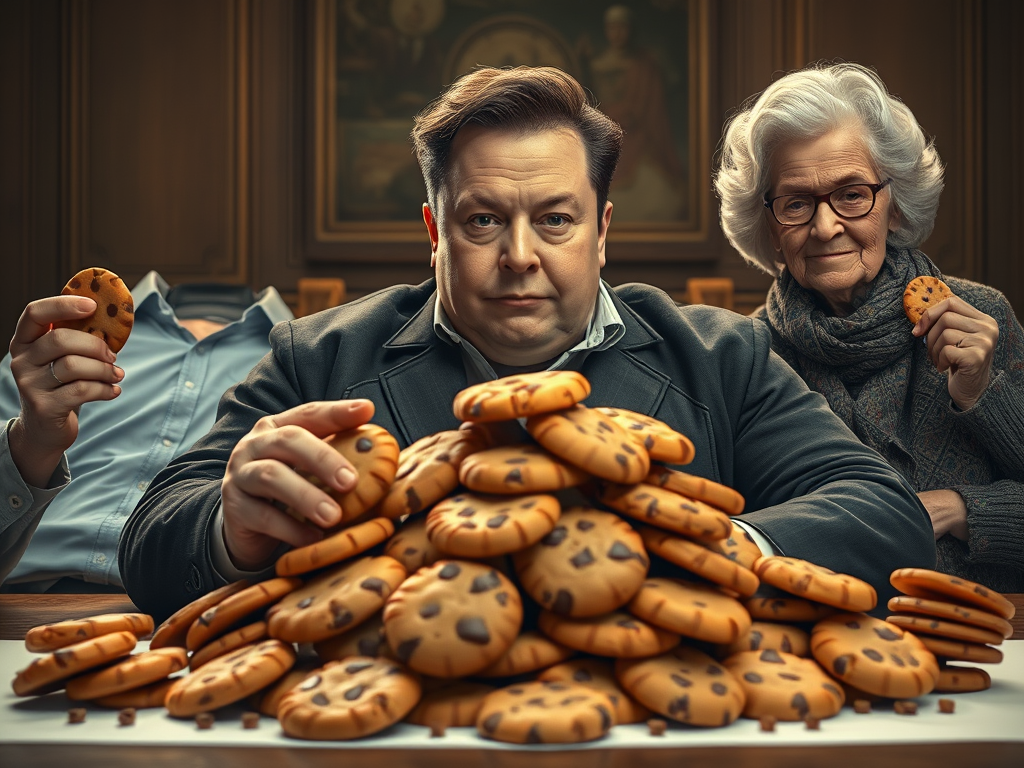
“That old lady doesn’t deserve to steal your one cookie! Watch out for her!”

Here are some things to consider.

The very greediest people in the world are not necessarily the most competent. Most jobs are actually created by small businesses, not by giant corporations. Giant corporations often outsource jobs to other countries where the labor is cheaper and where they don’t have to follow any pesky child labor laws or safety in the workplace regulations. Increasingly, giant corporations look to automate more and more jobs and to use AI to replace people. 

Highly paid CEO’s have often run giant companies into the ground. Remember that on your next trip to Montgomery Ward’s or Radio Shack. Who else? Lehman Brothers, Bank of New England, Texaco, Chrysler, Enron, PG&E, GM, WorldCom and a host of others. But wait! GM still makes cars. I can get gas at a Texaco station. How could it be that they went bankrupt. You bailed out GM. Texaco went bankrupt, but the brand name was still worth something. Chevron owns the brand. 

Also note that in countries where the CEO’s are only paid ten times the average wage of their employees instead of a thousand times as much, the CEO’s do just as good a job. 

Are government agencies sometimes inefficient? You bet your life! And you know what else is sometimes inefficient? Everything! Small businesses are inefficient. Large businesses are inefficient. Medium sized businesses are inefficient. Your car engine is inefficient. Your body is inefficient. Your furnace is inefficient. Your stove is inefficient. 

You know what is 100% efficient? Things in your dreams. Things in your imagination. I’m not only efficient in my dreams—my God!—I can frigging fly! When I play basketball in my dreams, I can not only jump higher than I ever have in real life, I can hover near the rim! It’s amazing how well I can play various sports when I dream about them. 

(AI generated image of an oldster jumping high in a dream.)

But that’s not reality. 

In reality, yes, you can improve the efficiency of systems. But to do so effectively, you have to understand the systems you are trying to make more efficient. Here are just a few of the things you need to understand. 

You need to understand what the purpose of the system is. How is its performance measured? Who are the stakeholders? What are the different roles that people play? What formal processes and procedures do various people have to follow? What are the unwritten norms that people follow? These are often more important than the formal processes. 

You may recall the scene from  the movie A Few Good Men when the attorney points out that “Code Red” is nowhere in the manual. He implies that if “Code Red” is not in the manual, it does not exist. Tom Cruise points out the absurdity of this by asking the witness to point out in the manual where it lays out where the mess hall is. Of course, it doesn’t say that because people learn from others where it is.

In almost every complex organization, people find critical short-cuts and work-arounds to improve the efficiency and effectiveness of the organization. In fact, one of the things people sometimes do to protest idiocy on the part of management is to “Work by the Rule” which means they will not do the things they have discovered make things easier but instead follow the written rules to the letter which typically slows things down considerably. 

During the 1990’s, management fell in love with something called “Business Process Re-engineering.” This is how it often worked (or, to put it more honestly, how it often failed to work). Management consultants would come in and talk to a few third or fourth level managers to find out how the work was performed now. The consultants would then construct a map of how things worked (often called the “is map”) and then, they would figure out a more efficient way to do things and map that out; the “to be map.” Then, it was the job of management to make people use the new “more efficient” process rather than the old process. 

(AI generated image of the Trumputin Misadministration.)

That seems like a good idea—right? Well, yes, in a dream, it’s a good idea. But in reality, the third or fourth level manager hardly ever knows how things are actually done. Their mental model is a vast oversimplification. To understand what is going on in reality, you must observe the people actually doing the work and talk to them as well. 

Below is a link to a satirical piece I wrote some time ago that imagines “Business Process Re-engineering” coming to Major League Baseball to make it more efficient. It is meant to make it obvious how silly it is. 

But what DOGE is doing is much worse that Business Process Re-engineering. Even putting aside the obvious conflicts of interest and the illegality of what they are doing, they are going about “improving” things without even understanding the high level over-simplification of what is happening! 

Imagine you slipped on the ice and broke your arm. Sadly, it’s not a simple fracture. It’s a compound fracture. This means your bone is sticking out through your skin. You are in a great deal of pain. But no worries! While you are going to the emergency room, a group of teen-age hackers go on-line and examine all your private medical records. They discover that you were vaccinated for smallpox, measles, mumps, and whooping cough. Not only that—they look through a sample of other records and find that more than 90% of the Americans who break their arms have been vaccinated for these diseases! Voila! The vaccinations must be the real cause of your broken arm! 

(An AI-generated image for the following prompt: “A man has a compound fracture of the upper arm. The arm bone (the humerus)  is jutting out of his shirt and his arm. He is bleeding.”)

These folks don’t know diddly squat about medicine, but they sure know how to hack into systems in order to get data! What they are not so good at, however, is making valid inferences about the data they find. You cannot conclude anything from the fact that 90% of Americans who break their arms have been vaccinated without also finding out about other things. For instance, you also need to know what percentage of Americans who have not been vaccinated have also broken their arms. Suppose it’s 95%. That might mean that vaccinations serve some protective function about bones. Or not. We need to look at other things too. But, let’s suppose that they do look at that and it turns out that only 80% of Americans who have not been vaccinated break their arms. See! See! Surely, that proves that vaccinations cause arm breakage. 

Not so fast. You still need to look at other factors. Suppose that people who do not get vaccinated tend to die at a much younger age. That could easily account for the difference. All sorts of factors have some influence on the incidence of fractures. Just to name a few, it depends on the type of fracture; it depends on age; it depends on the prevalence of certain activities (people who ski, or paraglide might tend to break more bones than people playing chess); it depends on diet; it depends on weight bearing exercise. If you lift weights and go to the gym, you help protect yourself from fractures. Of course, separating out all these factors takes time and takes expertise. You can’t expect someone, not matter how brilliant a hacker they are, to find an answer. 

But hey! We left you in the emergency room! Sadly, we left you there all by yourself. There are no human experts at the hospital, as it turns out, because the hospital was closed due to lack of funding. You happen to be unlucky enough to have been born in a rural area of the country. There’s only one nearby hospital and much of its funding has been cut. It has to operate with a skeleton crew. But, as it turns out, skeletons, ironically, don’t actually know that much about medicine. They are, after all, skeletons. And while a hacker might come to the conclusion that skeletons are much more efficient than flesh and blood humans (lighter, no caloric requirements), it turns out that they cannot move or think without other parts of the body. To make up for that, DOGE put in some automation and AI systems. But they didn’t have time to debug the system before moving on to the next project. 

(AI generated image).

The last thing you experienced before passing out and dying from sepsis was this little snippet of dialogue with the AI system.

“Hello! I am the brilliant AI system called MUSH: Multi-User System for Health. I am here to help you with your medical problem! What seems to be your problem?”

“I broke my arm. Can’t you see? My bone is sticking out through my shirt sleeve.”

“Excellent! We’ll have that fixed in no time. Please put your insurance card in the slot provided.”

“I can’t. It’s in my wallet and I can’t reach it with my left hand. And I can’t move my right arm at all.” 

“Excellent! We’ll have that fixed in no time. Please put your insurance card in the slot provided.”

“I need a human operator.” 

“Excellent! We’ll have that fixed in no time. Please put your insurance card in the slot provided.”

“No, you don’t get it. I have an insurance card but I can’t reach it.”

“You have failed three times to insert your insurance card. Next patient please. I hope you will fill out a short questionnaire about your experience with MUSH: Multi-User System for Health.”

—————

Destroying Our Government’s Effectiveness

Absolute is not just a Vodka

Running with the Bulls in a China Shop

The Truth Train

Essays on America: The Game

You Bet Your Life

Business Process Re-engineering comes to Baseball

A Day at the HR Department 

Roar, Ocean, Roar

Dance of Billions

Myths of the Veritas: Recipe, Ritual …

16 Monday Jan 2023

Posted by petersironwood in creativity, fiction, Veritas

≈ Leave a comment

Tags

collaboration, fiction, leader, leadership, legend, myth, story, Veritas

Myths of the Veritas: Recipe, Ritual…

Many Paths muttered to herself, “Perhaps I should rename myself, ‘She Who Walks in Many Circles’.” She glanced down at the ground, still damp from the morning’s rainfall. She chuckled. No, she thought, actually, I’m walking around in the same circle, over and over. I cannot find a way to guarantee that someone won’t betray us. She sighed. Then, her awareness blossomed outwards. She heard voices. Happy voices. Tu-Swift! And, Cat Eyes! Soon, the couple appeared at the edge of the granite-bouldered clearing atop the small mountain where she had come to meditate. They walked hand in hand, smiling. When they saw Many Paths they both waved, sang her name, and embraced her. 

Many Paths smiled wanly. “It’s nice to see you. I was just…thinking.” 

Tu-Swift and Cat Eyes glanced at each other. Tu-Swift said, “Yes! I imagine so. After all, you have an important meeting to think about! The last thing you need is to talk with your friends!”

“Indeed,” added Cat Eyes “we had come up here to find some of those low bush blueberries to add to our lunch porridge. But we’ll be on our way. Why spoil a perfectly good dish by adding ingredients to it? Best eat everything on its own, wouldn’t you agree?” 

Many Paths narrowed her gaze & pursed her lips. “I’m not sure I know what you mean.” 

Tu-Swift said, “Putting different things together just complicates everything. We should eat one thing at a time. As with a song, for instance. Best to stick to one note, sung over and over.”

Many Paths chuckled. “You two are talking nonsense. That wouldn’t be much of a song. And, of course, it makes sense to combine different ingredients for a recipe.” 

Many Paths stared at their faces for a moment. “But you know that. You’re … did She Who Saved Many Lives send you by any chance?” 

Tu-Swift and Cat Eyes both shook their heads solemnly. “No, she did not,” they said in unison. But beneath their words and expressions, Many Paths sensed a shared joke of some sort. 

Many Paths sighed and said, “I suggest you do get some blueberries. There’s a patch, as you well know, right beyond that dead tree. It’s nice to see you both, but I need to … get back to what I was doing.” 

Tu-Swift nodded gravely. “Yes! I can see you’ve just about finished making your circular fire pit.” He pointed down to the circle of bare ground Many Paths had clearly been treading. “How about if we help you trample everything for a few minutes and then you can help us pick berries?” 

Many Paths shook her head and chuckled. “She Who Saved Many Lives sent you. She did. Did she not? She thinks I need some one of some thing or some one to shake loose my thinking since I have been literally walking in circles and thinking in circles at the same time. Am I right?” 

Cat Eyes bit her lip. “You’re right that you’ve been walking in circles. That we can see easily enough for ourselves. I say again though that you’re wrong if you think the Elder Leader sent us here. Neither of us have spoken with her today. As to whether you’ve been thinking in circles, well, that only you can tell.” 

Many Paths nodded. “I have been indeed. All right. You win. I’ll tell you the problem and perhaps you two have come across something to help in your reading. Then you can return to the Tribe Mother and say you’ve helped me.” 

Shadow Walker appeared at the edge of the clearing. Many Paths glanced over to see him smiling like the sunshine she so desperately missed. She smiled back and said in a tone of accusation and pleasure, “You!” 

Shadow Walker strode over quickly and embraced her. He kissed her fondly and said, “Yes! It was me. I love you dearly. But you’ve been as gray as the weather. It’s time for a rainbow instead! The four of us are going to share your problem and see whether we can make some headway. I knew only that you said you were going around in circles with the problem. I didn’t know that you were — literally — going around in circles!” 

Many Paths laughed. “I should have known you would be behind this scheme. Well, all right. You know the problem well enough. How do I ensure trust among the people who come from other tribes? Wait. What do you mean by the four of you?” 

A strong voice came from behind Many Paths. “My legs needed some exercise so I came up to join you.” 

Many Paths smiled at the Elder Leader. “Ah, you are always welcome. If you’re here…. You always seem to show up where you are needed most.” 

She Who Saved Many Lives smiled. “I wish that were true. But I did bring a considerable number of hickory nuts to add to the porridge. That’s my contribution. If only we had some honey.” 

Shadow Walker held up a wooden bowl filled with honeycomb. He smiled at Tu-Swift who said, “I say that five of us pick some berries and we will have a fine lunch indeed. Then, we can talk of more serious matters.” 

“Yes,” said She Who Saved Many Lives. “Serious indeed. But serious need not be grim. I think a pleasurable meal, jointly prepared, and joyfully shared is always a good prelude to serious thinking.” 

Cat Eyes added. “Indeed. If we share a meal and everyone brings something which everyone eats, that in itself would build some trust. Would it not?” 

Many Paths nodded slowly. “You’re right. Of course. We should begin with a shared meal. I can see much wisdom in that.” 

Tu-Swift nodded. “Me too. Speaking of which, I’m hungry! And the Tribe Mother is right. Serious doesn’t mean grim. Recall some of the weapons that we came up with by playing around? Make the meeting festive and joyous, not grim. In the books we’ve been studying lately, there are some suggestions for some rituals that might help as well. I’ll describe some. After lunch. Now, let’s get those blueberries. 

Many Paths smiled at her “little” brother. He no longer struck her as little at all. She began to look forward to lunch. She took the Hand of Shadow walker in one hand and that of the Elder Shaman in the other and began walking toward the blueberry patch. 

The sun peeked out from the clouds and sparkled on the wet leaves. 

The Myths of the Veritas:

The Forgotten Field

The Orange Man

The First Ring of Empathy

Stoned Soup

Three Blind Mice

Index to a Pattern Language for Cooperation and Collaboration

Sunday Sonnet: Shadows

11 Sunday Sep 2022

Posted by petersironwood in America, poetry

≈ 2 Comments

Tags

cooperation, Democracy, leadership, poem, poetry, politics, truth, unity, USA

I took my Sadie for a Sunday stroll

And noticed shadows twitter on the ground

A nearby fountain’s splashing water sound

Attracts the thirsty birds from all around. 

My lack of sleep begins to take its toll 

And I see shadows deep and long and wide

The shadow fingers knit our deep divide.

For lacking math & tech, our web so wide

Is not. Denying truth is suicide. 

The cost of gratitude is small indeed.

The attitude of arrogance? A seed

Of lethal cancer’s ugly ego creed.

“It’s all for me and none for thee” will be

Destruction of our sweet Democracy.

————-

Poetic Commentary: I’m trying Sonnets and variations on Sonnets on Sunday. Here, I used the traditional iambic pentameter but slightly changed up the Shakespearean rhyme scheme ABAB, CDCD, EFEF, GG to ABBB, ACCC, CDDD, EE The idea of rhyming lines one and five is to reflect some unity among those five which deal with fairly direct perception of the here and now. In line six, I begin to move into “conceptual” shadows. Line nine rhymes with the previous three because this is meant to unify those lines more. But line 10 begins a contrasting thought. Though the couplet introduces a new rhyme, it is also a restatement of lines 10, 11, & 12 so the long “e” is kept and repeated internally as well (“me”, “thee”, “De-“, “sweet”, “de-“).

Political Commentary: In the photo above, you will see shadows of leaves and shadows of birds, though without movement, it may hard to tell which is which. But birds and olive trees are not the only shadows here. We are here at this particular spot partly because of our puppy Sadie. But how did Sadie come to be? Dogs were bred over thousands of years and while Sadie is still a puppy and very uncivilized as yet, she’s learning and a lot easier to deal with than her wolf ancestors. It isn’t just our training that helps Sadie live with us. It also depends on thousands of our ancestors taking the time to train and breed dogs to be our companions. There is a slab of concrete. Where did that come from? When did people invent that and perfect it? There is also a railroad tie. Railroad? Without early scientists and engineers and mathematicians, how would that have happened? And, of course, there are the builders who put this here and did not “cheat” so that the concrete was improperly made. Some other hundreds of folks arranged systems of commerce and government so that all this was possible. And how did you come to be looking at this photo and reading these words? Wait did I mention reading? You & I can read or write because someone took the time to teach us. And seeing it across time and space? Taking a picture with my iPhone? These depend on millions of people working in tech. But how could people spend so much time working on tech unless farmers made the food and truckers brought the food to a convenient place? But none of that system would work without government and police and armed services. 

There are many shadows here and most of them are thousands of years old. The truth is that we are vastly interconnected. We have what we have and can achieve what we achieve because of countless others alive and long dead. Setting citizen against citizen is a ploy so that a very small number of people can end up controlling everyone. It’s an old, old cancer of society, but that makes it no less deadly. 

We’re all in it together. 

Those who would tear us all apart do not admit to their outsized greed. Instead, they wear camouflage of “patriotism” or “religion” to try to fool others into helping them steal. The plane hijackers who wreaked destruction were convinced they were doing it for “God” not for their pocketbooks. To be radicalized into killing others is to be blinded. At first, people are told to tell a little lie for the good of God. And, a little later, they are taught to believe a slightly bigger lie. Until, in the end, they are willing to kill hundreds of innocent people and give up their own life as well. It’s all based on lies. One way you can tell they are lies is that the lies must never be questioned. Not to believe the lie is to be punished or even kicked out of the club. 

Photo by Izaac Elms on Pexels.com

———

Stoned Soup

The “All for me” bee. 

Three Blind Mice

Myths of the Veritas: The Orange Man

The Forgotten Field

The Dance of Billions

Dick-taters

Absolute is not just a vodka

Donnie’s Final Gift

My Cousin Bobby

The Update Problem 

What about the butter dish?

Essays on America: Wednesday 

The Declaration of Interdependence

Essays on America: The Game

Plans for US; some GRUesome

The Self-Made Man

Poker Chips

Peace

Author Page on Amazon

Myths of the Veritas: A Pattern Language

19 Thursday May 2022

Posted by petersironwood in politics, psychology, Veritas

≈ Leave a comment

Tags

collaboration, Coopearatoin, leadership, legends, myths, story, Veritas

Many Paths rose. Shadow Walker enfolded her in his strong arms and she returned the gesture. He stepped back, still holding both her hands in his and smiled as he spoke. “Come with me! I’ve got something to show you!” 

Many Paths tilted her head to the side and frowned. “Can it wait? I’ve just been talking with She Who Saved Many Lives. I’ve got the work on setting up our meeting with the other tribes. So much needs to be done.” She sighed and bit her lip. “So much to do, but I’m not sure what comes next.” 

Shadow Walker could see that she was concerned. He frowned sympathetically. Suddenly, Shadow Walker chuckled. 

“What joke is this that brings laughter to your heart?” Asked Many Paths. “I’m serious. There’s much work to be done.”

“I never thought of this before, but — Many Tribes. Many Paths. You see? Just as you yourself think of many ways to do things — many more than most of us have patience for — so too do the various tribes try many paths of how to live.”


The eyes of Many Paths grew wide. “Yes! Of course! I never saw it before either! It’s just the same, in a way. Maybe that is a good way to explain it to the many tribes I hope to convene. It is in keeping with the wisdom of the tale of the Forgotten Field. We don’t necessarily have to agree on every path we take; we just have to be sure that we work together when we must.” 

Shadow Walker laughed again. “That’s what I was thinking. Just because of your name.” Many Paths and Shadow Walker gazed into each other’s eyes for a moment and he squeezed her hands. After a pause, he continued. “But that is not what I came to tell you. Tu-Swift and Cat Eyes have discovered a book that has many recipes for making the kind of meeting that you wish to convene with the many tribes. You should come see for yourself!” 

Many Paths frowned again. “How can that be?”

Shadow Walker smiled and now Many Paths smiled as well. She sensed that the sunny mood of Shadow Walker would not be clouded by her worry. But she looked at her mate askance. “I still don’t see how a book from long ago can be so well-suited to my current task at hand.” 

“Come with me, love, and judge for yourself. It appears that you may not be the first person to think about how best to cooperate, after all.” 

Many Paths snorted. “You will not be deterred I see, so yes, let’s go see this book you claim will help.” 

Shadow Walker smiled again. “Yes! And, if I am wrong, and the book is useless, you and I will have a pleasant walk on a beautiful day and we’ll have a chance to see your brother and his friend, Cat Eyes. 

Shadow Walker and Many Paths soon arrived at the hidden entryway that Trunk of Tree had accidentally discovered while stalking a deer. This hidden path connected the Veritas and the two sides of the snowy mountain. They arrived in the Village of the Veritas on the other side of the mountain. They were greeted warmly. Their kin on this side of the mountain felt fully committed to having a meeting with all the tribes. 

Many Paths happened to spy a group of elders chatting excitedly. As she guessed, this signaled that the presence of Tu-Swift and Cat Eyes. Many of the Veritas on this side of the snowy mountain had now learned how to read the strange markings arranged in books. In the center of the group, she smiled to see her young brother, Tu-Swift. She called out his name and  he smiled broadly and waved for her to come join the group. She noticed that though the group included many elders, there were also people of every age, even children of no more than six or seven summers. Gradually, the people so gathered noticed Many Paths and Shadow Walker approaching. Tu-Swift & Cat Eyes came out to greet them. Tu-Swift smiled broadly as he greeted her. “I see Shadow Walker brought you already! Come! Look what we’ve begun to read!” He held out one of the hundreds of books that had been recently discovered. At first glance, the book looked just like the others, but then she noticed that it had an elaborate symmetrical drawing on the cover.

Tu-Swift & Cat Eyes had become proficient at reading. He could hardly constrain himself as Many Paths sounded out the markings on the cover as she read the title aloud, “A Pattern Language for Collaboration and Cooperation.” Tu-Swift could not wait any longer so he began showing her the various chapters. “Look! It’s a whole book to help you with your meeting with the other tribes! Here, look! It is a whole book of recipes or patterns for helping people to better collaborate! Here’s one called ‘Who Speaks for Wolf.’ Another one: ‘The Rule of Six’ and here. Look! Another: ‘Small Successes Early.’ 

He showed her the pages one after another. Many Paths barely had time to read the titles before Tu-Swift jumped to the next one. There were dozens! Tu-Swift laughed. “Can you believe our good fortune? This should help us with the meeting, right?” 

Many Paths hugged her brother and then smiled broadly at Shadow Walker as she assented.
“Yes. These — these Patterns — they seem that they would be a big help. But it will take me time to read these. I am not so swift at reading as you are brother. But thank you for finding these. Can I borrow this book until I have had time to read them all?” 

Cat Eyes said, “Of course. But we have come up with another plan. See what you think. Tu-Swift and I will take turns reading them to you. You and Shadow Walker can listen and then we — and some number of interested Veritas should discuss each one before we go on to the next. We have to see which ones might best work for the meeting, but also for before the meeting and after the meeting. It’s clear from the book of Patterns that an effective meeting depends on what you do before the meeting begins and after as well, not just what happens during a meeting. What do you say?” 

Many Paths let out a long slow breath. “I did not come prepared for such a thing. I thought we would go back this very day. That’s what Shadow Walker led me to believe.” She stared at her mate.

Shadow Walker’s good mood could not be dampened. He shook his head. “I had no inkling that Tu-Swift wanted us to stay for an extended discussion. I think it’s a good idea though. Here’s another. I will walk back and get whatever you need. We don’t both need to go.”

Tu-Swift interjected, “I have an even better idea. I’ve already read most of the book. Let Cat Eyes begin reading these Patterns to you and then you can discuss. Meanwhile, I’ll go back and get anything you really need although I can’t really imagine … we have everything you need right here, Many Paths.” 

Many Paths shook her head. “Is your leg that well heeled already? Why not send someone … someone unhurt?”

Tu-Swift laughed. “You mean someone faster. There is no-one faster.”

Shadow Walker’s face finally managed its own frown. “That can’t be true. You surely can’t be the fastest runner here yet. You’re still on the mend.”

Tu-Swift smiled, “Ah, yes. I am still on the mend. But who said I would be running back?” His eyes twinkled. 

Many Paths pursed her lips. “If you’re not running…. Ah! But you have continued to learn how to ride horses haven’t you?!”

Tu-Swift smiled at his sister and nodded vigorously. “Correct!” 

Many Paths sighed. “You are amazing, dear brother. But you are right. I don’t really need anything. But the people should know.”

Cat Eyes said, “Some of the people here, including my parents, were going to visit later this afternoon for trade. They can take a message to your people.”

All agreed. Many Paths gave her message to and they all found comfortable places to sit. Tu-Swift began reading the first Pattern. 

—————————

A Pattern Language for Cooperation and Collaboration

Author Page on Amazon

The Forgotten Field

Stoned Soup

The Orange Man

The Three Blind Mice

Listen you can hear the Echoes of your Actions

The Declaration of Interdependence

The Only “Them” that counts is all of us

The Watershed Virus

Ghosts of Flowers Past

We’re all in this together

Myths of the Veritas: Homecoming

29 Wednesday Sep 2021

Posted by petersironwood in Uncategorized

≈ Leave a comment

Tags

empathy, fiction, leadership, legend, love, myths, narrative, story, Veritas

Many Paths trotted over to the location specified by the drum rolls. Her eyes skimmed over the path ahead, skipping from one good landing spot to another. She gave a little chuckle as she reminded herself that there was no need for another sprain in the family. Images of her brother Tu-Swift and her lover Shadow Walker both loomed into her mind’s eye. She missed both of them so much. She believed it likely that Tu-Swift was fine but Shadow Walker was another matter. She felt he was okay, but being surrounded by ROI and Z-Lotz…? That was inherently dangerous and unstable. She really wanted both of them to be with her. 

Then she sighed and thought to herself, If I am really going to attempt to bring peace to the tribes — or bring the tribes to peace — I must be able to master my own feelings. Trunk of Tree is not the person whose counsel I most wish for, but still he does have a different perspective on things and I should tell him that I value that. But … 

She stopped in the path and listened to the drum signals. There were four people approaching. So far as Many Paths knew, Trunk of Tree had stomped off by himself. Who were the other three? She frowned and bit her lower lip, but she took a deep breath and waited for the drumbeats to signal who his companions might be. Soon, she knew, the signal drums would inform her of names for known people and transmit descriptions for unknown people. 

Her eyes widened. The drums did not speak of Trunk of Tree. No! It was Shadow Walker! She began sprinting toward the spot the drums indicated. And, Eagle Eyes! And two more Veritas! Her strong legs now propelled her forward even faster, fueled by a mixture of gratitude, longing, joy, and curiosity. At last, she came around a bend in the path, went up a slight rise and saw a party ahead on the path. Shadow Walker!

She screamed his name, “Shadow Walker!” 

Shadow Walker saw Many Paths and began running as well. They came together in a rib-bruising clasp. They closed their eyes and kissed each other wordlessly. Many Paths chided herself for forgetting how wonderful her partner smelled. And tasted. She pushed him away at arm’s length to allow herself a good long look at him and then hugged him to her again. “Shadow, Shadow, Shadow!” 

She again pushed him away and smiled at him. “You have no idea. What? We thought… Dear Eagle Eyes.” She embraced her as well. “Who —? I’m sorry. Forgive me, visitors. I am Many Paths of the Veritas tribe.” 

Shadow Walker’s smile of joy seemed to illuminate the nearby sheaves of grass. “Many Paths, allow me to introduce Tree Vines and Gathers Acorns. These are the parents of Cat Eyes! We — there is so much to tell, but we must save much for another time. We must — I am afraid that we suspect the Z-Lotz may come after us. I am sorry to say, we must be prepared for another attack.” 

Many Paths greeted Tree Vines and Gathers Acorns with a genuinely warm smile. “I am very happy to meet you. Come. Let us go to our Center Place where we may prepare guards so that we may tell each other our stories in peace and safety!” Many Paths took the hands of Eagle Eyes in her own and then hugged her. “I missed you too! I could really use your advice on so much. There is so much. But wait! Are you sick? Are any of you sick? You don’t look sick. But very recently we have had a plague here.” 

Shadow Walker quickly explained that he believed all four of them to be well though there were many among the Z-Lotz and ROI who were quite sick and many had died. As the small group proceeded toward the village, many other Veritas came out to greet them as well for all had heard the drum signals. By the time they came to the Center Place of the Veritas, a great crowd had assembled. 

Many Paths strode up to the speaking stone that stood at one end of the clear open space in the middle of the village. She called out in strong, happy voice: “As you can see, Shadow Walker and Eagle Eyes have returned! And, these two companions are Tree Vines and Gathers Acorns and all have tales to tell. But first, we must make sure the guards are on alert. Although they do not believe they were followed, they have reason to think we must be ready for another attack by the Z-Lotz, the people who steal children.” 

When she had finished her short speech a thousand questions began to be whispered while the drummers pounded out their message of caution to the guards that had been posted at the outskirts of the Veritas lands. When the drumbeat signals stopped, Many Paths held her hand out to Eagle Eyes. Many Paths desperately wanted to hear what Shadow Walker had to say, but she felt that Eagle Eyes should likely tell her tale first. 

She ascended the rock and described how she and Shadow Walker had quite easily tracked the recent envoys from the Z-Lotz. She told how the men they tracked had all fallen quite ill with red dots and how they had buried their bodies in rocks. She began to describe how unclean she and Shadow Walker had felt after. As she thought back on that, she felt the color rising in her neck so she quickly skipped ahead. “In any case, we snuck into the city of the Z-Lotz and thought we were unseen. We were captured and held separately. We had all been on the verge of being murdered in public by the King of the Z-Lotz, NUT-PI. He had a killing stick which he was going to use to torture and kill us along with many other prisoners. As she looked out on her tribe, she could see that they were spellbound. She nodded briefly and went on. “I looked up into the sky and saw eagles. I closed my eyes and imagined their calls.” By now, Eagle Eyes animated every aspect of her story. When she closed her eyes, she saw eagles right here and now. So did most of her audience.

Photo by Nigam Machchhar on Pexels.com

She continued, “I called them to me. They began to circle and then swooped down in a flash to attack NUT-PI. He tried to kill them with his killing stick but he was too slow. And…we had another weapon!” 

She paused, enjoying the expectant looks on the faces before her. “Not so long ago, some of you may have seen that we were playing with reflections and found that enough reflections of the sun, concentrated on one place, could cause small sticks to catch fire. The Z-Lotz put a shiny collar on us. While we were imprisoned, Gathers Acorns and I hatched a plan that, if we had a chance, we would shine the sun into the eyes of our enemies. Shadow Walker and the other men prisoners had similar collars. He quickly caught on to what we were doing and added their reflections. Since NUT-PI was the immediate threat, we all reflected our little suns onto him and his head burst into flames!” 

The eyes of the Veritas widened as they pictured someone bursting into flames. She let this image sit for a moment in the collective imagination of her tribe. Then, she resumed.


“Different tribes choose their leaders in various ways. The Z-Lotz choose by assassination! Since Shadow Walker, so we claimed, had killed NUT-PI, he should become their leader. As you might imagine, many objected to this, but, at least initially, since it was their habit, and the people were afraid, most accepted him — us really — as rulers. I can tell you more about how that went later, but first, there were several attempts to overthrow Shadow Walker by assassination. Last night, Tree Vines came at night and told us there was going to be an attack by many in the morning so we had to leave immediately. We came here. Obviously, the Z-Lotz already know where we are. But we didn’t see any signs that we were being followed. Still, prudence would say that we need to be careful. From the Z-Lotz standpoint, Shadow Walker is actually still king…so long as he’s alive, that is. But even apart from that, it’s clear that they would not mind exploiting us and possibly even destroying us.”

Many Paths spoke next. “Did you bring NUT-PI’s killing stick back with you? Were there more?” 

Eagle Eyes glanced at Shadow Walker. Then, their eyes locked. It was clear that Eagle Eyes wanted him to explain why he had made the killing sticks inaccessible. He nodded, almost imperceptibly and ascended the rock, unafraid to take a helping hand from his friend. “By sheer accident, we discovered a stash of killing sticks. By the way, I destroyed the one NUT-PI had. It was a thing of much violence, clearly, but beyond that, I knew nothing about how to operate it. So, I destroyed it. If I had kept it, it might have been used against me. I could not picture myself killing a human being in such a way with such a thing.” He paused as though reliving how difficult the decision had been.

Then, Shadow Walker continued his narrative.”We found a stash of killing sticks. By accident. We don’t know who among the Z-Lotz knows of its existence. We had not yet decided what to do with them when Gathers Acorns and Tree Vines told us we must leave with as little as possible. I made it so the Z-Lotz could not easily get to these killing sticks. If they know about them, they will eventually get them but, Gathering Acorns also poured a combination of fermenting acorns and sewage atop the killing sticks. She believes this will render them useless, not to mention disgusting, but we are not really sure.” 

Many Paths regained the gray granite stage, and said, “Now, here is another thing. These helpers of Shadow Walker and Eagle Eyes — Tree Vines and Gathers Acorns — are the parents of Cat Eyes. They have been apart for many years. And, as soon as these two are rested from their journey, we will have a group quickly take them to their village on the other side of the mountain so they can be re-united at last with their daughter.”

A clear voice rang out from the edge of clearing. 

“That won’t be necessary!”

——————————————

The Myths of the Veritas: Stoned Soup

The Myths of the Veritas: The Forgotten Field

The Myths of the Veritas: The Orange Man

The Myths of the Veritas: The First Ring of Empathy

The Myths of the Veritas: Feast and Fire

—————————————-

Author page on Amazon

Myths of the Veritas: Many Paths Finds Many Keys

21 Tuesday Sep 2021

Posted by petersironwood in Uncategorized

≈ Leave a comment

Tags

cooperation, empathy, fiction, leadership, legend, Many Paths, myth, tale, Veritas

Many Paths frowned. She looked down at the wrinkly old lady who had been — and still was — her mentor, her shaman, her friend. She Who Saves Many Lives was drifting off to sleep but with a smile on her face, despite the difficulties and discomfort of the Red Spider Plague. Many Paths herself smiled. Even in sleep, the old Shaman made her feel better.

She decided to let her mentor sleep. Many Paths had been about to ask for a hint about the puzzle she had just been given. Many Paths laughed to herself thinking, Just as well. Her “hints” are just as likely to lead the student astray as they are to bring sunlight to the right path. 

Many Paths left the old shaman’s cabin and walked about the Center Place of the Veritas. She greeted various members of the tribe warmly, and once she had greeted everyone in sight and reassured them that she was cured and that The Old Grandmother was resting comfortably. She had discovered that greeting everyone and having a short conversation with them allowed the maximum chance for uninterrupted thought. So, she settled herself at the porch of her own cabin. She reviewed what the old shaman had said to see if there was a clue to this seemingly impossible problem. 

“There are two locked boxes. Each contains the other’s one and only key. Yet, I am able to use the keys to open both boxes. How is that possible?”  

First of all, why had she brought this up? Was it just something that bubbled up in the overheated brain because of the fever? Perhaps. But Many Paths reckoned it more likely that She Who Saves Many Lives had intentionally chosen this puzzle because it held something useful for the problem at hand.

Well, thought Many Paths, to be more precise — not the only problem at hand — there were so many. But the one she had shared with her mentor was how to bring together all the nearby tribes and broker a peace deal amongst them. Fires. Wars. Killing Sticks. Stealing children. It was all madness. And the Z-Lotz? Bringing the Red Spiders Plague on purpose? Giving them a gift which was really meant to sicken them? How could there peace with such as that? And yet — and yet, somehow her lover Shadow Walker and one of her closest friends, Eagle Eyes had become the leaders of the Z-Lotz! If, she reminded herself, the note brought by the Eagle could be believed. 

Many Paths sighed. She wished she could talk it through with someone. Yet…she had a feeling that She Who Saved Many Lives didn’t give her the puzzle because she wanted the answer. The old shaman already knew the answer. It was specifically designed to move something within Many Paths. Many Paths laughed aloud at her own train of thought. She shook her head and muttered to herself, “Here I am. I can’t solve the puzzle she gave me so instead, I’ve given myself a still harder problem — trying to read the mind of She Who Saves Many Lives! I think if I know why she gave me the puzzle, it would help me figure out the answer. The much more sensible approach is to solve the puzzle and then it will be much easier to solve why she gave it to me.” 

Many Paths closed her eyes and put her fingers to her temple. With her eyes closed, she became much more aware of the warmth of the sun on her face. She quite consciously relaxed her muscles and slowed her breathing. 

Photo by Johannes Plenio on Pexels.com

She thought: Inventory. What do I know? There are two boxes. There they are. Many Paths pictured two large wooden boxes side by side. They were identical. What are they made of? Are there holes? Is it still a box if there are holes? Maybe it’s still a box, but they are locked boxes. Locked boxes are not really locked boxes if their are large enough holes for me to slide my hand through and simply grab the keys. They are supposed to be locked boxes. But why are they made of pine wood? No-one said anything about pine or even wood. They could be carved out of stone, I suppose or even of ice. The boxes could melt! But she said ‘use the keys’ — well, I suppose you could take the keys and warm them in a fire and then, use that heat to melt the ice…but no, I wouldn’t yet have the keys. I could wait till they melt naturally. Then I could grab the keys, but I wouldn’t be using them to open the boxes. Is melting a box really opening it?

So, how do I know the boxes are identical? Suppose I am one of the boxes? I am in the tribe but I am also myself — my own person — even though I lead the tribe. Something is nearby. I can hear the answer rustling in the bushes but it is still too dark to see it clearly. Two boxes. Not necessarily the same. One could be the tribe. One could be me. If I had the key to the tribe … and the tribe had the key to me….they could me the key I need to open me and I could give them the key to open them.

In the mind of Many Paths, the two boxes began playing with each other. She made them mentally chase each other in circles. Then, when she grew tired of that game, she had them continue their roles to the end. One of the boxes opened its giant “mouth” — a hinged side — and “eat” the other box. 

Many Paths stopped breathing. Her eyes snapped open. “Of course!” She said aloud. Her first inclination was to run back to continue her conversation with She Who Saves Many Lives. But she shook her head. She’s likely still asleep, thought Many Paths, and besides. There’s the other half of the problem. Why did she…? Ah, of course! 

Many Paths saw that the second puzzle — why she had been given this puzzle when she had been telling She Who Saves Many Lives how much she wanted to bring peace to the tribes but she couldn’t even control Trunk of Tree — that wasn’t a puzzle at all. It was obvious. If she wanted to change the external world to be more peaceful, she herself would have to be changed — perhaps more peaceful — perhaps not. The puzzle didn’t specify exactly what about herself she would have to change. A puzzle merely illustrates a principle. It never dictates real world action. All the Veritas were taught this early, including Many Paths. 

Her intuition led her to believe the two “keys” were different in her dilemma just as they had been in the puzzle. But —she also believed that they would be closely related. Many Paths wanted to the tribes to be more peaceful, more truthful, kinder, more cooperative. She sighed and issued a short laugh.

Many Paths said to herself, I want all the tribes to be more like the Veritas. I want them all to be Veritas. But — I can’t bring six tribes together and explain that they should all be just like me … or even more like me. 

Again, Many Paths had a sudden impulse to run back to She Who Saves Many Lives to share her new insight. And, once again, she immediately suppressed that sudden urge. Instead, she sighed. She did wish that she could discuss this with one of her friends. It was clear that she needed to make a change, but it also seemed obvious to her that it was just the sort of change that friends could help with. 

She thought, My friends will see in the moment that I am assuming everyone wants to be a Veritas and point it out. Eventually, the new way will permeate my thinking. But which friends? My most trusted friends were all unavailable at the moment. I’m not ready to allow the spread of rumors about a meeting with all the tribes. It can’t be just anyone. Could I talk about it with Trunk of Tree?

Many Paths took a deep breath. She reckoned she could talk about it with Trunk of Tree, but first, she needed to really see and understand his point of view. 

She thought, Prior to seeing him, I need to make a guess at his perspective and then I need to check it out with him. I can’t just assume it’s right, but I might make a start. He’s always thought he should be the leader because he’s the strongest. In his mind being strongest is the most important thing. I need to make him see that we all do think it’s important. We value his strength and all wish we had more of your strength. We also believe that other things are also important. And, it may be the case, that in some instances, being the strongest is the very most important thing for a leader to have. And, it may be the case, that in some other instances, being able to see the best, or hear the best, or speak the most convincingly, or think the most creatively. Who knows? We have a way to choose a leader. And in that way, I was chosen. It doesn’t mean that you are not the strongest. It does not mean that we care nothing about you or your strength. It just means that for now, the shaman judges that the seven rings of empathy were the best trials. Of course, the people are the final judge and if everyone wants to change the way we choose leaders, so be it. Perhaps everyone will decide a wrestling match should determine the leader — or, as with the Z-Lotz and Cupiditas,  — a fight to the death. If the people decide that, then so be it, and I will support you. And so will Shadow Walker and Eagle Eyes and Tu-Swift. But as it is, I am the chosen leader. That doesn’t make me your ruler. I come to you as a friend and I need your advice precisely because you and I don’t always see eye to eye. Here’s what I’m thinking….

Her thoughts continued: Of course, I must be open to many paths of conversation. Perhaps I should suggest that I speak uninterrupted for a time. Trunk of Tree could be a good confidant if he will hear me out first. It requires so much work though to work with him. Of course, the same can be said of getting the six tribes together. It’s like trying to weave…yes…it is like weaving! The tribes can all be different. We can do things differently. But the question is, what do we want to work on together. And let us move in different directions and make the whole basket stronger. 

Many Paths felt relieved somehow and looked forward to having an honest conversation with Trunk of Tree. She circled through the village looking for him but he was nowhere to be found. She wondered if he had gotten so made that he had injured himself or even left the tribe. She shook her head. She was having a bad day of fishing or hunting. She chuckled to herself and thought: I was actually looking forward to talking with Trunk of Tree and he’s not here. Oh, I miss Shadow Walker! 

Just then, the attention of Many Paths turned to the air. She heard a distinct drumbeat pattern that someone safe was approaching. She thought: It looks as though I will have my conversation with Trunk of Tree after all. 

————————-

The Myths of the Veritas: The First Ring of Empathy

The Myths of the Veritas: The Forgotten Field

The Myths of the Veritas: The Orange Man

The Myths of the Veritas: The Wobbly Man

Essays on America: The Isle of Right

The whole is greater than the sum of the parts

Cedars Sighing in the Wind

14 Wednesday Jul 2021

Posted by petersironwood in Uncategorized

≈ Leave a comment

Tags

cooperation, ethics, fiction, leadership, learning, legend, myth, parable, Veritas

Cedars Sighing in the Wind

Photo by Tomas Balogh on Pexels.com

When Cat Eyes had finished reading aloud the story of The Wobby Man, she put aside what the ancients called a “book” and looked expectantly at Tu-Swift. He seemed lost in thought — tortured thoughts filled with thorns — by his visage. Cat Eyes stood and grabbed a nearby water pouch. Reading made her thirsty. She sat back down across from him. She smiled. She was  happy to see him again; happy to be reunited with her parents; happy at all the things that the tribe had learned from their discovery; happy that it had taken both of them working together, with their mutual friend Suze, in order to discover how to read. The joy of Cat Eyes felt a sharp edge though because Tu-Swift seemed anything but happy. 

“But, I don’t — .” Tu-Swift didn’t finish what he said to Cat Eyes because he didn’t know what he himself meant to say. Instead, he shook his head from side to side. “Why?” 

Cat Eyes took his hands into her own and looked at him with love in her eyes, a love that he did not see because his head bowed down and his eyes were only upon the ground. After a few moments she put one of her hands under his chin and lifted it up. They looked into each other’s eyes and she could see that his eyes were tearing up. “It’s okay. It’s to learn from, like all the stories here.” 

Tu-Swift shook his head from side to side and bit his lips. “But why?” His voice was plaintive as though he had a thorn stuck painfully under his fingernail and pled for her to remove it.

Cat Eyes sighed and asked gently, “Why what? What are you struggling with? Maybe we can work it out together. Often, life is a fight, but it doesn’t mean you have to be alone in every fight.”

Tu-Swift nodded. After a pause he said, “Why did The Wobbly Man do all that evil? And why did they let him?! Why couldn’t they see what he was up to?” 

Cat Eyes nodded. “There are people who do things — evil things — such as steal children. Perhaps there always will be. But I don’t think they think of it as evil. To them, it’s their way of … living … or of having fun. They like destroying life and love in others … I guess because they cannot experience it themselves. I don’t know.” 

Tu-Swift sighed. “You are right of course. Within the Veritas where I grew up, there was one such. The Wobbly Man sounds much like him. He manipulated others. He was cruel. Yet, he was such a good liar that he almost fooled our leader, the wise She Who Saves Many Lives. He actually betrayed the tribe to NUT-PI. And here’s the worst part. He got several other braves to go along with his schemes. Without ALT-R, I don’t think POND MUD or KAVANUT would have even been evil.”

“Yes.” After a pause, Cat Eyes added, “It’s much like that Red Spotted Death. It can spread from person to person. And, just as there are evil people even in societies based on truth and trust and love, so too there are people who act in good ways even among the Z-LOTZ and the ROI. It’s much like the story about the two wolves inside someone and which one you feed. The customs of the tribe can make it easy to feed the good wolf — or easy to feed the bad wolf.” 

Tu-Swift let out a long sigh. He stood up and held out his hand. Cat Eyes took it and, for a time, they walked in silence. Without intending to do so, they ended up at the entrance to the now dysfunctional tunnel. They stood for a time, holding hands in silence staring at the tunnel. At last, Tu-Swift voiced what both were thinking. 

“How could a people know so much as to build a tunnel through a mountain — and yet be so ignorant as to let a liar destroy their village?” 

Another long silence ensued until Cat Eyes sighed and spoke again. “We still have many books to read and understand. Many books are filled with words whose meanings we have yet to understand. It appears that it wasn’t just a village here and there. The plague of evil lies destroyed everything. I know you have struggled with whether to use the fire sticks….” 

Tu-Swift wondered why Cat Eyes stopped speaking. He looked at her and saw that silent tears were streaming down her cheeks. He squeezed her hand and asked gently, “What is it, Cat Eyes? Why are you so sad?” 

“Actually, I was just thinking a little while ago how happy I am about so many things. Yet … we had so much. We knew so much. But we destroyed it. If the books are true, and if our understanding is correct, weapons were developed that … weapons were created that were far worse than fire sticks. Far worse. Yet, there were also treatments for every disease. But the people forgot that they were part of the Tree of Life. People forgot that they were all one. People — not everyone — but enough — just began to grab everything they could for themselves. Lying became commonplace. Once the truth meant nothing, decisions were made by power alone. That is bad enough in the Z-Lotz or, from what you told me, among the Cupiditas. But imagine that they had — not just fire sticks — but horrible weapons that could destroy many villages and all the people in them. Of course, in doing so, these weapons killed birds and butterflies and trees and no-one even seems to have noticed! Maybe … perhaps, we are not really understanding. Maybe they are just stories to prevent people from becoming what the books say that they became. Maybe.” 

Tu-Swift bent down and plucked up a small flower that had grown in the cranny of the wall that held the now defunct controls for the tunnel door. He gently braided the stem into the silky hair of Cat Eyes. When he was done, he said, “Well, the tunnel is real. Yet, no-one really knows how it works. How could that be? I mean, unless there was some great loss of learning. I don’t know. Perhaps, we can learn from these stories, whether real or not, how to … how to ensure that we do not fall so far again. From what you said, it sounds…it sounds as though the people became sightless and witless. How can the people not see that they are a part of the Great Tree of Life? How can they not hear the song of the bird or the murmur of the stream? How can they not see the beauty of the trees and flowers all around them? How can they not taste the sweetness of honey?” 

Cat Eyes nodded. “That is one of the main question that we — those of us who are studying the books — keep asking ourselves. But when this question is asked, none of us answers. Not yet. Each of us is hoping someone else will explain. But what comes to our ears is only the silence and the cedars sighing in the wind.”  

—————————————

Roar, Ocean, Roar (A poem about the power of cooperation) 

The Only Them that Counts is All of Us

The Myths of the Veritas: The Forgotten Field 

The Myths of the Veritas: The Orange Man

The Myths of the Veritas: The First Ring of Empathy (Here begins the continuous trilogy of the Mythical Veritas who value truth, love, and cooperation).

Author Page on Amazon

An index to a proposed Pattern Language for Collaboration & Cooperation 

“The Psychology of Design”

08 Thursday Jul 2021

Posted by petersironwood in Uncategorized

≈ Leave a comment

Tags

creativity, Design, HCI, human factors, IBM, leadership, research, UX

“The Psychology of Design” 

I worked at IBM, all told, about 28 years. During that time, management put more and more pressure on us to make our work “relevant” to the business. In fact, the pressure was always there, even from the beginning. Over the years, however, we were “encouraged” to shorten evermore the time gap between doing the research and having the results of that research impact the bottom line. This was not an IBM-only phenomenon. 

I was a researcher, not a politician, but it seemed to me that at the same time researchers in industrial labs were put under pressure to produce results that could be seen in terms of share price (and therefore payouts to executives in terms of stock options), academia was also experiencing more and more pressure to publish more studies more quickly — and to make sure “intellectual property” was protected to make sure the university could monetize your work. This was about the same time that, at least in America, increasing productivity and the wealth that sprung from that increased productivity stopped being shared with the workers.

Photo by Dmitry Demidov on Pexels.com

In the late 1970’s, the “Behavioral Sciences” group began to study the “psychology of design.” For the first few months, this was an extremely pleasurable & productive group, due mainly to  my colleagues. Over the next few blogs, I’ll focus on some specific techniques and methods that you may find useful in your own work. 

In this short story though, I want to focus instead on some broader issues relevant to “technology transfer”, “leadership” and “management.” Even if you are or aspire to be an expert in UX or HCI or design, I assure you that these broader issues will impact you, your work and your career. I wouldn’t suggest becoming obsessed with them, but being aware of their potential impact could help you in your own work and career. 

It is telling that, almost invariably, whenever I told someone inside IBM (or, for that matter, outside IBM) that I was studying the “psychology of design,” people responded by asking, “the design of what?” So, I would explain that we were interested in the generic processes of design and how to improve them. I would explain that we were interested in understanding, predicting, and controlling these processes to enable them to be more effective. I would explain that we could apply these findings to any kind of design: software design, hardware design, organizational design, and (see last post about IBM) communication design. I would explain that design was a quintessentially human activity. I would also explain that design was an incredibly leveraged activity to improve. 

Looking back on it, I still think all these things are true. I also see that I missed the “signal” people were giving me that, while I thought of design as something that could be studied as a process, that most people did not think of it that way. To them, it was never the “psychology of design,” but only the design of something. 

Don’t get me wrong. I agree that somewhat different skills are involved in designing a great advertising campaign, a great building, and a great application. I agree that different communities of practice treat various common issues differently. I still think it’s worth studying commonalities across domains. For one thing, we may find an excellent way of generating ideas, say, that the advertising community of practice uses that neither architects nor applications developers had ever tried. Or, vice versa.

My own academic background was in “Experimental Psychology.” We were forever doing experiments that we believed were about psychological processes that were thought to be invariant regardless of the domain. It was an axiom of our whole enterprise that studying memory for any one thing shed light on how we remember every other thing. Similar studies looked at decision making or problem solving or multi-tasking. We came to understand that there were some interesting exceptions to being able to separate content from process. For instance, it is much easier to multi-task a spatial task and a verbal task than it is to multi-task two independent spatial tasks or two independent verbal tasks. 

We used a spectrum of techniques to study “design” from laboratory studies of toy problems, to observing people doing real-world design problems while thinking aloud. After about 3-4 months of very productive work, we were told that we had to make our work relevant to software development. That should be the focus of our work. We were told that this command came from higher-ups in IBM. That might have been true, or perhaps partly true. 

It might also be relevant that someone in our management chain might have been the recipient of a grant from ONR which was specifically focused on software development. So far as I can tell, nothing had been done on that grant. So, our past, present, and future work could have been co-opted to be “results” done under the auspices of the ONR grant. 

In any case, regardless of the “reasons,” the group began to focus specifically on software design. In one study, we used IBM software experts as subjects. Each person was given information that was geared toward a specific transformation that occurred in software development. One person was presented with the description of a “situation” that included a number of “issues” and they were asked to write a requirements document. In real life, I would hope that this would be done in a dialogue (and, indeed, in other studies, we recorded such dialogues). Absent such dialogues, what we found was that different software experts — all from IBM research — and all given the same documentation about a set of problems generated vastly different problem statements and overall approaches. 

Photo by ELEVATE on Pexels.com

In other parts of the study, other experts were variously given requirements documents and asked to do an overall, high level system design, or given a high level design and asked to design an algorithm, or given an algorithm and asked to code a section. There was always diversity but the initial showed the greatest diversity. The initial stage is also the one that can cause the most expensive errors. If you begin with a faulty set of requirements — a misreading about how to even go about the problem — then, the overall project is almost certain to incur schedule slip, cost overruns, or outright failure. 

While the vital importance of the initial stages of design is true in software development, I would argue that it is likely also true for advertising campaigns, building designs — and even true for the design of research programs. We designed our research agenda under the assumption that we had a long time; that we were studying design processes independently of specific communities of practice or the nature of the problems people were attempting to address. We assumed that there was no “hidden agenda.” Although we believed we would eventually need to show some relevance to IBM business, we had no idea, when we began, that only relevance to software design would be “counted.”


—————-

Some of our studies on the “Psychology of Design.” 

Carroll, J. and Thomas, J.C. (1982). Metaphor and the cognitive representation of computer systems. IEEE Transactions on Man, Systems, and Cybernetics., SMC-12 (2), pp. 107-116.

Thomas, J.C. and Carroll, J. (1981). Human factors in communication. IBM Systems Journal, 20 (2), pp. 237-263.

Thomas, J.C. (1980). The computer as an active communication medium. Invited paper, Association for Computational Linguistics, Philadelphia, June 1980. Proceedings of the 18th Annual Meeting of the Association for Computational Linguistics., pp. 83-86.

Malhotra, A., Thomas, J.C. and Miller, L. (1980). Cognitive processes in design. International Journal of Man-Machine Studies, 12, pp. 119-140.

Carroll, J., Thomas, J.C. and Malhotra, A. (1980). Presentation and representation in design problem solving. British Journal of Psychology/,71 (1), pp. 143-155.

Carroll, J., Thomas, J.C. and Malhotra, A. (1979). A clinical-experimental analysis of design problem solving. Design Studies, 1 (2), pp. 84-92.

Thomas, J.C. (1978). A design-interpretation analysis of natural English. International Journal of Man-Machine Studies, 10, pp. 651-668.

Thomas, J.C. and Carroll, J. (1978). The psychological study of design. Design Studies, 1 (1), pp. 5-11.

Miller, L.A. and Thomas, J.C. (1977). Behavioral issues in the use of interactive systems: Part I. General issues. International Journal of Man-Machine Studies, 9 (5), pp. 509-536.

——————————

Blog posts about the importance of solving the “right” problem. 

The Doorbell’s Ringing. Can you get it?

https://petersironwood.com/2021/01/13/reframing-the-problem-paperwork-working-paper/

Problem Framing. Good Point. 

https://petersironwood.com/2021/01/16/i-say-hello-you-say-what-city-please/

Problem formulation: Who knows what. 

How to frame your own hamster wheel.

The slow seeming snapping turtle. 

Author Page on Amazon. 

← Older posts
Newer posts →

Subscribe

  • Entries (RSS)
  • Comments (RSS)

Archives

  • April 2026
  • March 2026
  • February 2026
  • January 2026
  • December 2025
  • November 2025
  • October 2025
  • September 2025
  • August 2025
  • July 2025
  • June 2025
  • May 2025
  • April 2025
  • March 2025
  • February 2025
  • January 2025
  • December 2024
  • November 2024
  • October 2024
  • September 2024
  • July 2024
  • April 2024
  • March 2024
  • February 2024
  • January 2024
  • December 2023
  • August 2023
  • July 2023
  • May 2023
  • April 2023
  • March 2023
  • February 2023
  • January 2023
  • December 2022
  • November 2022
  • October 2022
  • September 2022
  • August 2022
  • July 2022
  • June 2022
  • May 2022
  • April 2022
  • March 2022
  • February 2022
  • January 2022
  • December 2021
  • November 2021
  • October 2021
  • September 2021
  • August 2021
  • July 2021
  • June 2021
  • May 2021
  • April 2021
  • March 2021
  • February 2021
  • January 2021
  • December 2020
  • November 2020
  • October 2020
  • September 2020
  • August 2020
  • July 2020
  • June 2020
  • May 2020
  • April 2020
  • March 2020
  • February 2020
  • January 2020
  • December 2019
  • November 2019
  • October 2019
  • September 2019
  • August 2019
  • July 2019
  • June 2019
  • May 2019
  • April 2019
  • March 2019
  • February 2019
  • January 2019
  • December 2018
  • November 2018
  • October 2018
  • September 2018
  • August 2018
  • July 2018
  • June 2018
  • May 2018
  • April 2018
  • March 2018
  • February 2018
  • January 2018
  • December 2017
  • November 2017
  • October 2017
  • September 2017
  • August 2017
  • July 2017
  • June 2017
  • May 2017
  • April 2017
  • March 2017
  • February 2017
  • January 2017
  • December 2016
  • November 2016
  • October 2016
  • September 2016
  • August 2016
  • July 2016
  • June 2016
  • May 2016
  • April 2016
  • March 2016
  • February 2016
  • January 2016
  • December 2015
  • November 2015
  • October 2015
  • September 2015
  • August 2015
  • May 2015
  • January 2015
  • July 2014
  • January 2014
  • December 2013
  • November 2013

Categories

  • AI
  • America
  • apocalypse
  • cats
  • COVID-19
  • creativity
  • design rationale
  • dogs
  • driverless cars
  • essay
  • family
  • fantasy
  • fiction
  • HCI
  • health
  • management
  • nature
  • pets
  • poetry
  • politics
  • psychology
  • Sadie
  • satire
  • science
  • sports
  • story
  • The Singularity
  • Travel
  • Uncategorized
  • user experience
  • Veritas
  • Walkabout Diaries

Meta

  • Create account
  • Log in

Blog at WordPress.com.

  • Subscribe Subscribed
    • petersironwood
    • Join 662 other subscribers
    • Already have a WordPress.com account? Log in now.
    • petersironwood
    • Subscribe Subscribed
    • Sign up
    • Log in
    • Report this content
    • View site in Reader
    • Manage subscriptions
    • Collapse this bar
 

Loading Comments...