Life on planet earth is over 4 billion years old. There are also no known “skips” in life. In other words, each generation of life, N comes from the previous generation N-1 and generates the next generation N+1. Every living thing on earth today, so far as we know, has the same unbroken line of ancestry dating back 4 billion years. We all share ancestors.
Vertebrates appeared about 500 million years ago. This means that we humans share 7/8 of our heritage with every living fish, bird, reptile, amphibian, and mammal. Indeed, fish have a heart, a brain; they mate; they eat; they have blood; they move; they learn. They flee danger. If someplace is a good source of food, they hang out there.
Early humans must have intuited that they were very like (as well as somewhat unlike) other animals. Otherwise, they would not have learned how to track them and hunt them, let alone train them. In the last few hundred years, however, we have learned much more about how similar we are to other animals anatomically, physiologically, and behaviorally.
I happen to think this branch of science is fascinating.
But it’s more than that. To me, it’s also heart-warming. It’s comforting in many ways.
First of all, I am in awe of our extended family. Life has survived for over four billion years! It hasn’t just survived; it has evolved in a million different directions. Our family includes trees that live thousands of years and grow hundreds of feet tall. Our family includes animals and plants too small to be seen by the naked eye; birds that migrate thousands of miles; whales that weigh 300,000 pounds.
Second, it is comforting to me to know that the Tree of Life is secure against the short-sighted greed of a small number of humans. Ecological disaster, atomic war, pandemics are certainly damaging human life and comfort as well as destroying whole species. But the Tree of Life is vast and more importantly, incredibly diverse. The self-destruction of humanity is possible and would be incredibly sad. But the Tree of Life? We won’t destroy that.
Third, it is comforting to see, hear, and interact with the biome. The way that life interacts with other life is beautiful to observe. I view it as a drama, a symphony, a tapestry, all rolled into one. When I go for a walk, I walk through life; I walk through my family; I walk through a work of art and become reminded that I am one with it.
Birth and death become the same: turning a page in a marvelous and endless story. That’s not to trivialize or belittle it. Turing the page of a story is actually a big deal! Pages make chapters. And chapters make books.
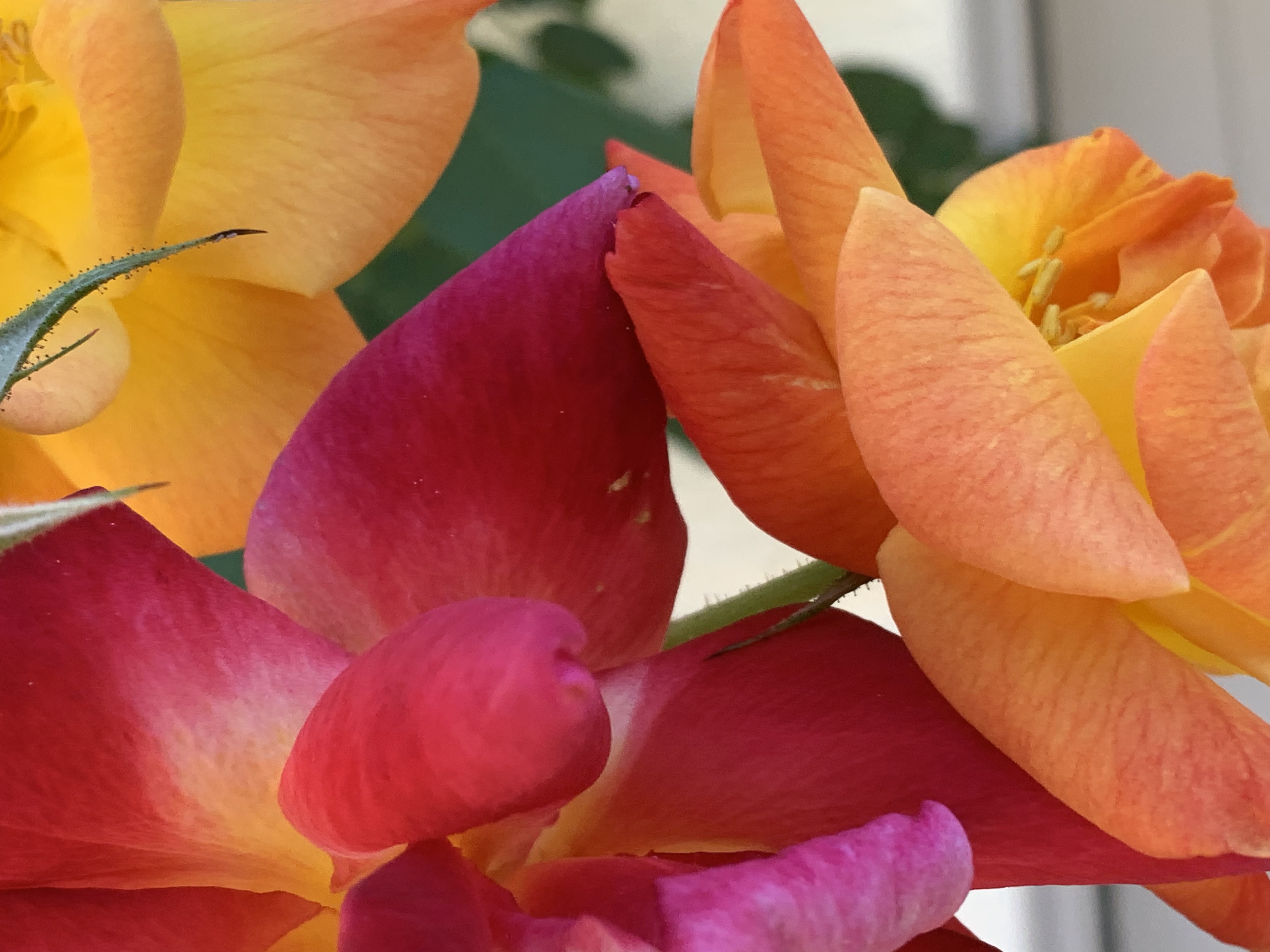
Christopher Alexander was an architect who wrote much about architecture, including the well-known book, A Pattern Language. Later, he also wrote about “The Nature of Order.” He posits 15 properties of natural beauty and good design, the first of which is “Levels of Scale.” I was thinking about that today as I admired our Jacob’s Coat Rose bush which blooms about 3-4 times a year here in San Diego.
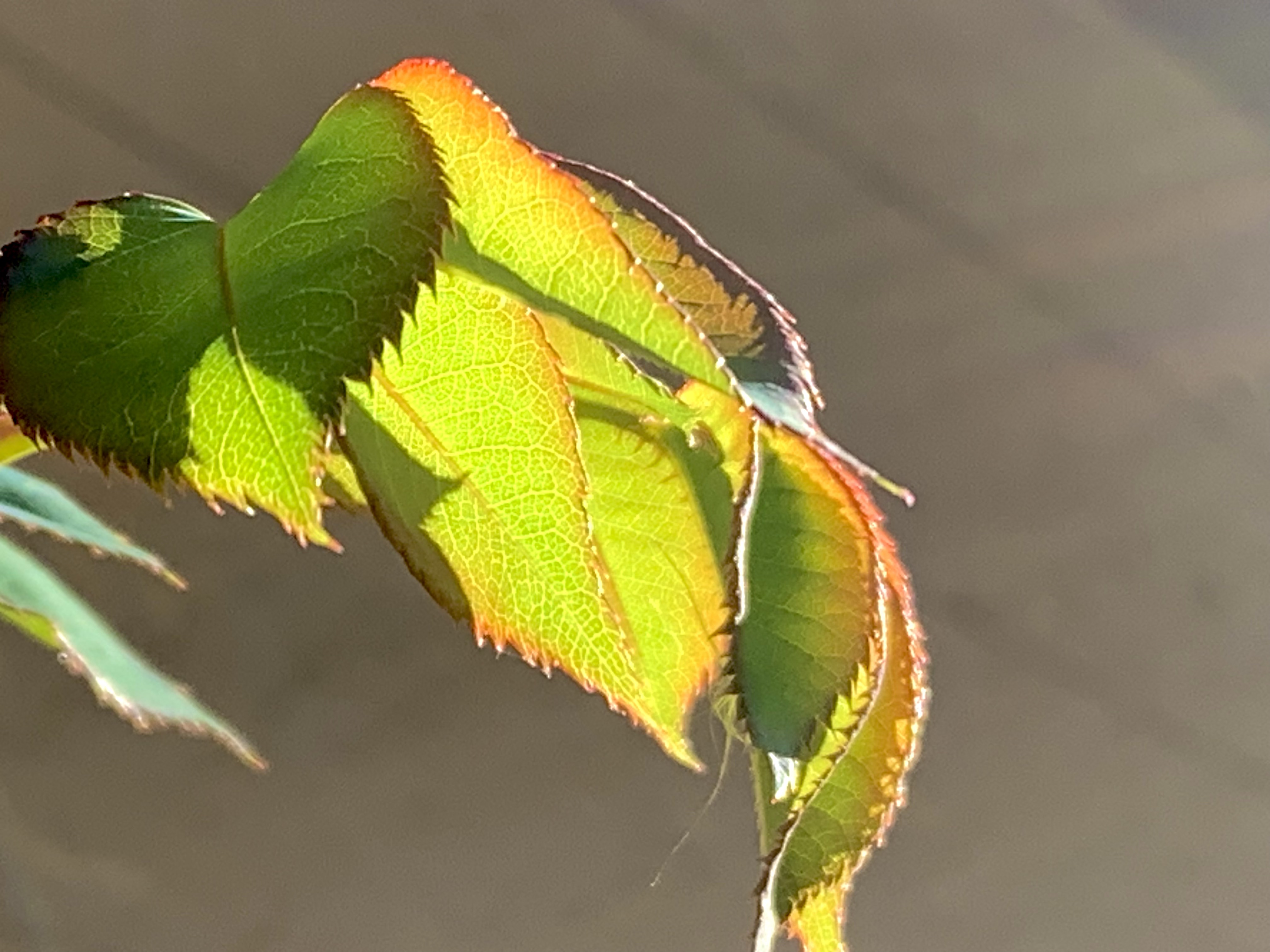
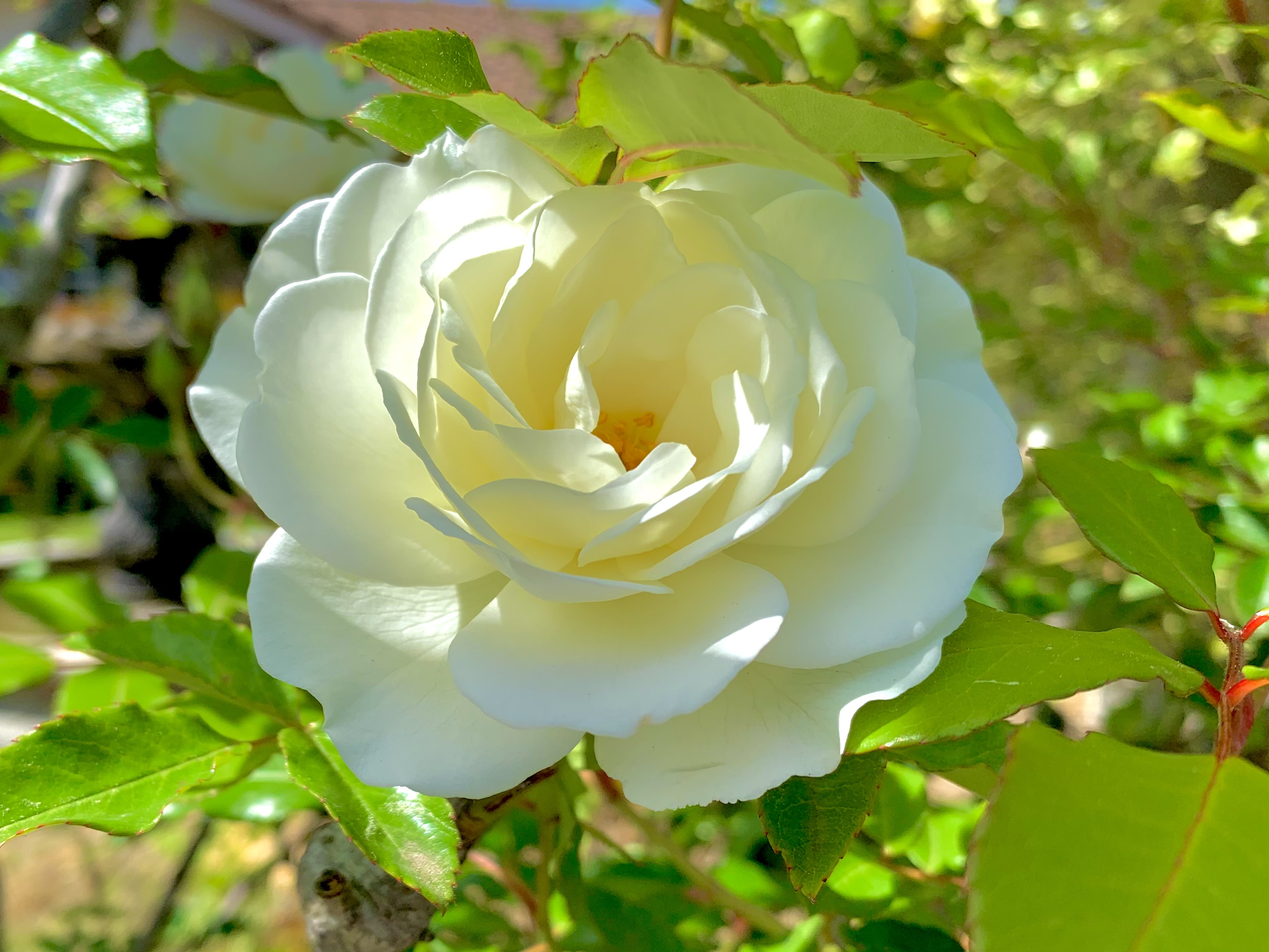
Most of us see the flowers of the rose as beautiful. And indeed they are. They are beautiful from afar. They are beautiful up close. But so too are the other parts of the rose plant. At least, sometimes, the leaves are also quite beautiful.
Even the thorns are beautiful.
Beyond this surface level, the rose, like all living things, is beautiful inside. Like all living things, it’s survived four billion years of evolutionary time. The way cells are arranged and the way they work–this is beautiful as well. Moreover, the relationship that roses have to humans and bees are also beautiful. Imagine having the faith and hope to depend on a completely different species to reproduce. Imagine being so beautiful that human being across the globe spend their time and money to keep you thriving.
Did I mention that, like other green plants, roses remove carbon dioxide from the atmosphere and provide oxygen for animals like us?
Roses are so famous that they play a part in history and pageantry. The War of the Roses. The White House Rose garden. Destroying part of the Rose Garden is also symbolic. The Rose Parade. Individuals give each other roses. They are variously symbols of love, friendship, and peace. Roses appear in poetry, songs, paintings, and both first and last names.
Have you ever been called the “Life of the Party”? Have you wanted to be the “Life of the Party”?
When you read the expression, “Life of the Party,” who or what do you think of? Who is the “life of the party” when it comes to our Garden?
Is it the brightly colored hooded oriole who flitted about just outside my office window during hours of ZOOM calls?
Or, was it his more drably colored mate?
Both are needed for the species to survive.
You might tend to think of flowers as the “Life of the Party” and it’s true that our Garden has many colorful flowers!
Bougainvillea A few of the many colors of the “Jacob’s Coat” rose in our Garden.
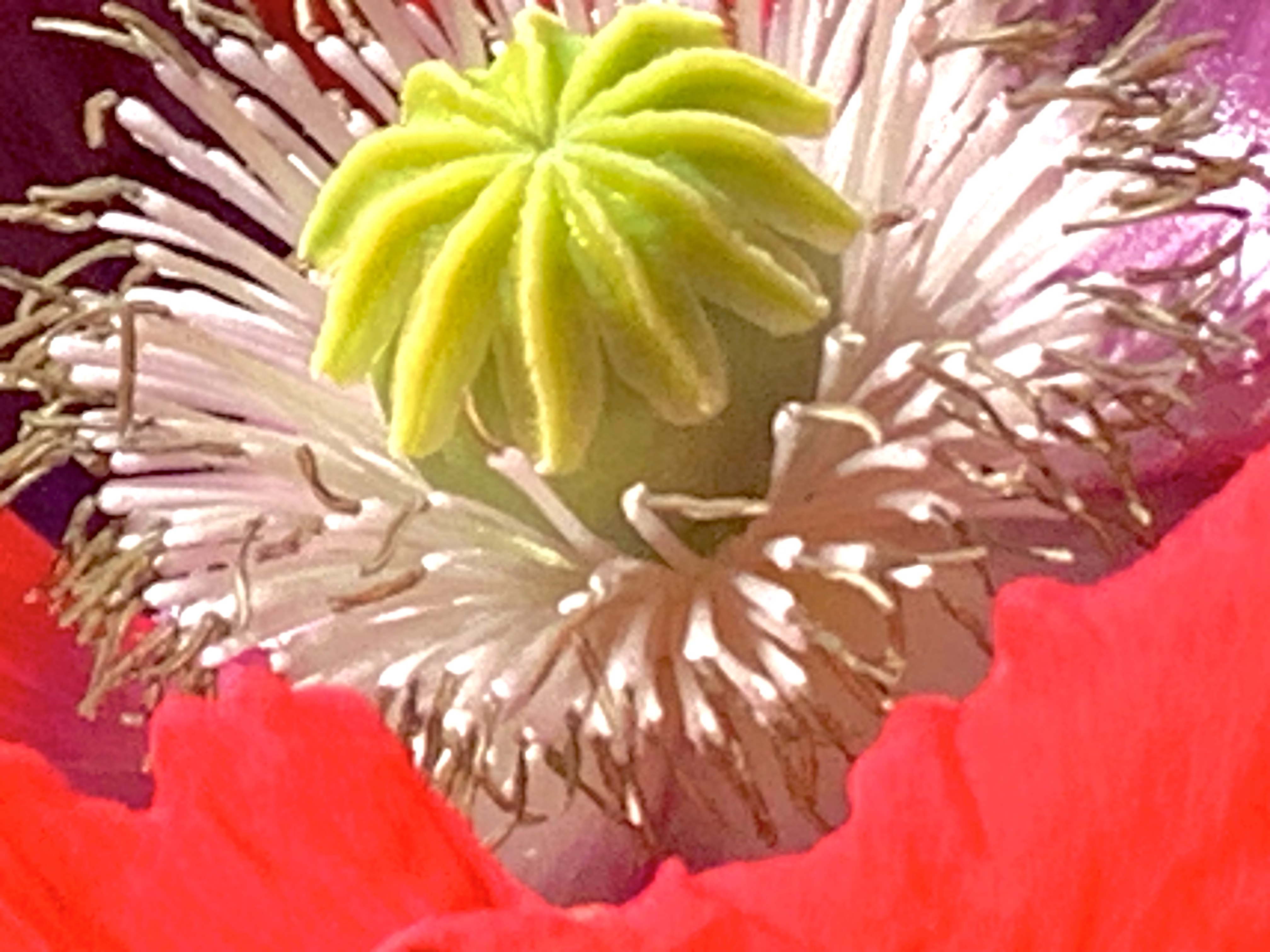
And even the not-so colorful flowers can be infused with light. Are they then, the life of the party?
White poppies.
In addition to flowers, the garden has more active members such as bees, lizards, and rabbits. I often see coyote scat, though I’ve never seen a coyote in the garden.
Can a snail be the Life of the Garden?
We may think of flowers as being the life of the party, but without leaves, flowers and fruits would not grow because they wouldn’t have a source of energy. Leaves also can exhibit many beautiful patterns and colors.
There are a few human figures in the Garden — statues engaged in two of my favorite activities: dancing and reading.
Are they the life of the party?
The crows are certainly among the most vocal of the participants in the party. Does that make them the life of the party?
And, what about me? I help show the beauty of the Garden far beyond its physical boundaries. Of course, that happens anyway! The bunny eats fruit in the Garden and poops somewhere else to fertilize the soil and perhaps spread seeds, sometimes taking them far beyond the range of the wind. All the green leaf plants in the Garden take CO2 out of the air and return O2, each molecule of which diffuses far and wide, eventually across the planet. The bees cross-pollenate across Gardens.
So, who, exactly is the life of the Garden? I think the only accurate answer is that everything alive is the “Life of the Garden.” Not just everything within the “boundaries” of our Garden but on the entire planet. Every molecule that is here, will eventually be somewhere else. Every molecule that will be here in a few million years is now far away.














 petersironwood