• About PeterSIronwood

petersironwood

~ Finding, formulating and solving life's frustrations.

petersironwood

Tag Archives: science

And, then what?

06 Thursday Dec 2018

Posted by petersironwood in creativity, psychology, Uncategorized

≈ 5 Comments

Tags

Business, consequences, Feedback, innovation, learning, science, testing, thinking

And then what? 

IMG_5566

When it comes to increasing the drama in TV crime shows, westerns, and spy thrillers, both the brilliant, evil villain and the smart, brave, good-looking protagonist display one common and remarkable weakness: they rush into action without much thought as to the possible consequences of their actions. 

Here’s a scene that you and I have probably seen a thousand times. The hero has a gun drawn and a bead on “The Evil One” but the Evil One has a knife to the throat of the friend or lover of The Hero. The Evil One, as both we in the audience and The Hero know, cannot be trusted. Most likely, The Evil One has caused the death of many people already, is treacherous, and lies as easily as most people breathe. Nonetheless, The Evil One promises to release the hero’s friend or lover provided only that The Hero put down their gun and slide it over to The Evil One. And The Hero complies! Often, The Hero will elicit a “promise” from The Evil One: “OK, I’ll give you my gun, but you have to let them go!” The Evil One, for whom promises mean nothing, “promises” and then The Hero slides the gun over. At this point, The Evil One is obviously free to kill both The Hero and their friend or lover immediately. Instead, The Evil One will begin chatting them up. This allows time for magic, skill, accident, God, unknown allies, or brilliance to turn the tables on The Evil One.

Here’s another scene that we’ve both witnessed. The Hero suddenly finds out some crucial piece of information that lets them know the whereabouts of The Evil One. Often this is an abandoned warehouse filled to the brim with minions of The Evil One. But, it might be the cave deep beneath the island stronghold of The Evil One; a stronghold filled to the brim with his minions. The Hero rushes in with a woefully inadequate force and without informing anyone concerning his whereabouts. He or she confronts The Evil One who not only confesses to past misdeeds but outlines their future plans to The Hero as well. 

abandoned architecture building concrete

Photo by Rene Asmussen on Pexels.com

In the TV series or the movies, the sequence of events is determined by the writer(s) so even though The Hero faces impossible odds, he or she will almost certainly overcome those impossible odds. That makes for an exciting story!

But in life? 

In real life, you’ll typically do a lot better if you think about the likely consequences of your actions. 

Sometimes, people fail to do this because they have simply never developed the habit of thinking ahead. 

Sometimes, people let their wishes completely color their decisions. For instance, an addicted gambler, despite their actual experience, believes that gambling more will result in a favorable outcome for them rather than the truth which would be that there is an extremely small chance that they will win overall. 

Sometimes, people are too ignorant to realize that there are potential negative consequences. For instance, when I was a youngster, I had a “glow in the dark” watch and cross; each glowed partly because of radium. I enjoyed putting these right up to my eyes in order to observe the flashes of individual photons. I also put together model airplanes with glue. When I applied too much glue, I dissolved it with Carbon Tetra-choloride. I loved the exotic smell of Carbon Tet. Now, it is deemed too dangerous to be used in this way. 

flight flying airplane jet

Photo by Pixabay on Pexels.com

In many cases, it seems to me that people do think about consequences but use an overly simple model of reality on which to base their predictions. In particular, people often treat individuals and social systems as mechanical systems and base their decisions on those mechanical models rather than actuality. For example, your kid does not, in your opinion, eat enough broccoli so you simply force them to eat broccoli. Your “prediction” of the consequences of this may include that the kid will eat more broccoli, be healthier, eventually like broccoli, etc. Depending on the individual child, it may be that none of these will actually occur. In some cases, it may even happen that the exact opposite of your goals will be achieved. The kid may eat less broccoli, be unhealthier, and hate broccoli more than ever. There are many other possible consequences as well. The kid may end up hating meals with the family or hating you or hating the color green. 

When it comes to individuals and social systems, it is hard to know what the net effect might be. Often though, the most significant cognitive problem that people have is that they are so sure of their prediction that they base their actions on what they think should happen rather than what actually does happen. 

As recounted in some detail in the Pattern, “Reality Check,” instituting a new social reward or punishment system often does indeed change behavior, but not necessarily in the desired manner. If, for instance, programmers are now rewarded on the basis of lines of code written, they might indeed write more lines of code but many of those lines of code may be unnecessary. You might write 1000 lines of code or you could spend time thinking about the problem and then write two lines of code that accomplish the same result. Will you do so if you are only rewarded 1/500 th of the bonus?  

man wearing brown suit jacket mocking on white telephone

Photo by Moose Photos on Pexels.com

Similarly, you may measure the performance of service technicians by how many calls they “handle” during their shift. But if that is the main or sole measure, you may also end up having those service people tend to offer trivial or even useless advice based on insufficient information. In all these cases, if management keeps seeing what really happens, any damage done by having an inaccurate predictive model of what will happen as a result of a change will be mitigated. But in a system, whether private or governmental, where people are mainly motivated to keep management happy by telling them what they want to hear, instead of correcting a poor intervention, the problems caused by inadequate models will tend to multiply, fester, or explode. 

So: 

Think of possible consequences and try to determine which ones are most likely. Then, observe what really does happen. This helps avoid turning an issue into a disaster and, over time, it also helps you develop more realistic models of reality. It will also tend to put you in the habit of taking a flexible and reality-based approach to your decisions rather than one that is based on a rigid and inaccurate model of how things should be. The latter approach to decisions will not only make you individually ineffective; it will also make it almost impossible to work well with others (unless everyone involved shares the same inaccurate model). 

IMG_9333

Author Page on Amazon. 

Myths of the Veritas: The Battle of the Southern Path

30 Tuesday Oct 2018

Posted by petersironwood in America, management, psychology, Veritas

≈ Leave a comment

Tags

empathy, learning, myths, politics, science, story, strategy, trust, truth, Veritas

The Battle of the Southern Path

IMG_4987

POND MUD awoke with a start. He had heard something that didn’t sound right. Something was out of place. His cabin walls had disappeared! He sat up and saw campfires arranged in a strange pattern. He shook the sleep from his head and remembered that he was not in the Center Place of the Veritas. He was out on a raiding party with the Cupiditas; that he had joined up with them. They were about to have a battle, he reminded himself. It was time to keep his wits about him. He took out a small leather pouch from beneath his tunic and felt for his rings of empathy. Oh, right, he thought. He grimaced ruefully as he remembered those are gone as well. He was with the Cupiditas now. About to have a battle. Which they would win. And, then, he could be king with ALT-R and have She-of-Many-Paths as his slave. 

He went to relieve himself and returned to the campfire, still in a bad mood. Every day, he had to remind himself that he had chosen his path and now he was committed to it. These Cupiditas, a strong lot, on the whole, constituted his new tribe. Their food might be primitive, but it filled his belly. Though not generally interested in small talk, he ventured to ask the four Cupiditas who shared his small fire and breakfast, whether they had ideas about why fish did not drown in the water and whether it had anything to do with their blowing bubbles. None of them had ever noticed fish blowing bubbles and none of them found it to be a question that held the least interest. But it was NUT-PI’s captain, HANK man-GER, who took it upon himself to poke fun of POND MUD. 

“So, POND MUD, do all the people of the Veritas speculate on such meaningless and stupid questions or is it only you?” 

POND MUD was not even so skilled as ALT-R in speaking and listening to the strange and toneless language of the Cupiditas, but he knew he was being insulted. He was not in the mood for it. 

IMG_5105

“I’ll show you what we do,” roared POND MUD. He leapt across the small space between them and used a hip throw to toss the Cupiditas captain on the ground. All he had meant to do was blow off some steam and hopefully garner some respect from the Cupiditas. POND MUD had no thought to follow up and hit a man while down. But HANK man-GER now felt his pride had been wounded. From the suddenness and force of the throw, he knew he could not overpower POND MUD, but he did have a trick or two. He lay on his back moaning, rolling slightly from side to side. 

At first, POND MUD felt good to have thrown him down but now he began to worry that he had actually injured his captain. He walked over and knelt beside him asking, “Are you okay?” 

HANK man-GER shook his head piteously, “No, it’s my ankle. I think you broke it!” 

POND MUD felt the ankle with both of his yet skillful hands, looking away from HANK toward his feet and feeling carefully. “No, I don’t feel any….” 

“ARGH!” POND MUD screamed and whirled to see HANK man-GER leaping at him, dagger point first. POND MUD knocked his hand aside but he was a fraction late. HANK had cut him in the side, though not deeply. With a yell, POND MUD, grabbed the hapless fellow around the head and snapped his neck. “Oh, hell! It was self-defense! You all saw it!” POND MUD expected the men to rush at him and kill him or at least imprison him for slaying their captain. But this was not the way of the Cupiditas. POND MUD had ousted HANK in a fair fight — or at least in a fight as fair as they ever were among the Cupiditas. For this reason, despite their underlying contempt for POND MUD, they immediately bowed their heads toward POND MUD and chanted something that could only mean he was their new leader. POND MUD found this extremely odd. Though he had turned traitor to the Veritas, he had grown up among them and he found this custom of replacing a leader by killing odd, exciting, disgusting, and yet it had all worked out. Good, he thought, now I can be their leader. Through gestures and grunts as well as the few words he had picked up, he explained that he was going to show them some of the typical moves of Veritas warriors. Every so often, he glanced at the lifeless crumpled body of HANK man-GER and wondered that no-one seemed concerned with burying the body. With a flush, POND MUD realized that they were waiting for his order. Fine, he thought. “You two! Take this body and bury it so neither bear, nor wolf, nor Veritas may defile it.” So it was done. With some sweat, they dug a fairly shallow grave in the rocky soil and piled many more rocks atop. While they were engaged in this task, POND MUD searched for some medicinal herbs and boiled up a poultice for his wound which was fairly minor. He strapped it tightly to promote healing and prevent infection. 

two yellow flowers surrounded by rocks

Photo by Nacho Juárez on Pexels.com

POND MUD continued training his new charges in the fighting ways of the Veritas through the afternoon. Concentrating thus, he suddenly realized that the nomads of the south were everywhere! They had come into camp noiselessly, invisibly. Each man wore a long, hooded robe whose shape was difficult to discern because of the camouflage pattern on their robes. 

“Who among you is the leader, for I am now the leader of this band of Cupiditas and will be leading our joint foray. For I know the Veritas and all the paths and byways and will lead us to victory!” He said this in both the tongues of the Veritas and in his broken, nearly unintelligible Cupiditas. He supplemented both of his speeches with sign language. Eventually, he made himself clear whereupon the entire contingent of nomads began laughing. One stepped forward toward POND MUD. 

“I am DAN-ergo CREEP, leader of the southern nomads.” He spoke Veritas! He spoke it well. POND MUD found himself wondering at this, but now at least he could speak more easily. Yet, no matter how he argued or presented his case, the DAN-ergo CREEP kept coming back to a very simple point. The southern nomads greatly outnumbered the small band of Cupiditas and he would therefore be the leader of the army, not POND MUD, the chieftain carefully explained. If he wanted to relay orders to the Cupiditas, fine, but the battle plan would come from DAN-ergo CREEP. On the other hand, the chieftain was glad to have POND MUD’s input on the lay of the land and where the weak points of the Veritas were. POND MUD had enjoyed his brief reign as leader. But he saw that he would have to subordinate himself to this stranger for now or risk losing the help of all the nomads of the south. That would not be something he wanted to explain to NUT-PI or to ALT-R. They would need all their combined strength to enslave the Veritas once and for all. He assented to being under the command of the southern nomad leader and found himself wondering how the advances under KAVA-NUT and NUT-PI were coming. The attack was scheduled for pre-dawn the following morning. Once more, POND MUD found himself relishing the form of She-of-Many-Paths and reminded himself that he would soon own her. Each time he thought of her, he recalled how awkward and stupid she had made him feel. This made him feel angry toward her. And, he also felt guilty about not telling the truth to ALT-R about their accidental encounter. But what would have been the point? ALT-R & NUT-PI would simply have berated him and made him feel stupid. His rage toward She-of-Many-Paths redoubled and he gritted his teeth and clenched and unclenched his fist. He fantasized about all the things he would make her do. 

——————————————

Meanwhile, the Veritas were making their plans in light of new information received from KAVA-NUT. In Dialog, they examined the question as to whether they might not find a peaceful way with regard to the nomads of the south, with whom they had generally had good relations. Someone mentioned that “unfortunate incident with Dares-and-Cares.” 

“Unfortunate.” began She-Who-Saves-Many-Lives,  “My that is an interesting word. Anyway, that murderer was a murderer and he happened to be from the tribe of the nomads. I think it would be worth a try to cleave them off from the Cupiditas. But consider, none of us speaks their language with subtlety. If we approach them in numbers, we may very well instigate the very war we seek to avoid. And if we approach with one or a few, we invite capture and torture for information.”

She-of-Many-Paths sensed that She-Who-Saves-Many-Lives had more in her heart than what she said. But the shaman always showed wisdom in what she said and what she did not say. She-of-Many-Paths made a mental note to ask her further in private. However, and much to her surprise, She-Who-Saves-Many-Lives rose and continued speaking while pacing back and forth. “I see that She-of-Many-Paths knows there is more in my heart than what I have said. That is true. Before most of you were born, I loved a man whom the tribe called Dares-and-Cares for he was both extremely brave and extremely caring. Before we could become one, he agreed to a dangerous errand for the tribe, traveling alone to the land where dwell the nomads of the south in order to advance the idea of further trade. Before he reached their center space, however, he was attacked and murdered by a band of such nomads. They stole his possessions and stole the heart of my heart as well.”   

After a respectful silence, Shadow Walker asked, “Then, why did you not tell us so that we may be forewarned of the Nomads of the South?” 

grayscale photo of a man wearing keffiyeh

Photo by RAUL REYNOSO on Pexels.com

“Exactly for that reason. There are important lessons to be learned from such events, but under such circumstances of sorrow and deep hurt, it is easy to draw the wrong lesson. It is easy to conclude, though logic would not support it, that all the Nomads of the South are bad just based on this one incident. That is precisely how wars start. One stupid over-generalization leads to another. Such a path of reasoning was even more likely because, you see, I partly blamed myself. I had seen such possible danger, but could not convince him to go with many guards. He was concerned that such a show of force might encourage attack. I saw the wisdom in this. After all, he was called Dares-and-Cares. This was his nature. And though I am called “She-Who-Saves-Many-Lives”, you see, I was unable to save the one life I cared most about. It would be very easy under such a circumstance to fear and therefore hate all the Nomads of the South. Yet, this would be an error. Such is not the way of the Veritas.

“Nor is such the way of the Nomads either, for they considered the attack a crime and the responsible thieves were killed and both the body and possessions were returned to us. The truth is almost never so simple as we might like it to be. Some among the Veritas were then roused to anger for Dares-and-Cares was well beloved by the tribe and not only by me.”

sky sand blue desert

Photo by Pixabay on Pexels.com

She-Who-Saves-Many-Lives now turned to speak directly to She-of-Many-Paths. “Luckily, cooler heads prevailed. I tell you this now because I know that your mind and your heart, are prepared to accept truth in its complexity and not in some over simple version. You see how it is. It’s important to know that water flows downhill. Yet, it is also the nature of water to bend and turn this way and that, thus avoiding obstacles. Trees grow up toward the sun. Yet, as we proved with the experiment in hiding the cave, trees may be bent away from their natural predisposition. We cannot tell about a whole people from a few examples. Imagine that other tribes thought that KAVA-NUT, ALT-R and POND MUD proved the nature of the Veritas. Three blackberries rotten with mold do not mean one must never eat of such. Though it is important to remove the moldy ones quickly or they may indeed rot the whole.” 

She-of-Many-Paths offered to go and parley with POND MUD and the nomads of the south. She-Who-Saves-Many-Lives looked long and hard into the heart of She-of-Many-Paths. “You have already shown yourself to be fine thinker and a fine leader. The people need you as a leader even more than they need your bravery.”

“I do see the wisdom of your words, She-Who-Saves-Many-Lives. Yet, how could I lead my people in possibly fatal battle if I am unwilling to risk my own life. I will not be a leader who puts others at risk but never puts myself at risk. Such a person is not a leader. Not really. And, if I ever need to ask the people on a difficult path, they must believe I am willing myself to walk any such difficult path.” 

Shadow Walker spoke next, “Let us go together then, She-of-Many-Paths. If there is trouble, I can hold them off perhaps until you can retreat to safety.” 

“I will fight beside you if necessary, Shadow Walker. I have no desire to… I would be greatly troubled if you died in battle and particularly so if I used that opportunity to escape. I wish we could call POND MUD as easily as the wolves can call each other. I feel his heart is troubled. But approaching him is indeed dangerous in this current circumstance.” 

Eagle Eyes added, “I wish I could call to him, as easily as I do the eagles.” All in earshot thought on this image in silence. 

Trunk-of-Tree then stood up suddenly and spoke, “But we can!” 

She-of-Many-Paths said, “What do you mean, Trunk-of-Tree? Scream like an eagle? Howl like a wolf?” 

“No,” said Trunk-of-Tree, “but we all learn to speak with drums!”   

“This is true!” said She-of-Many-Paths. “We can encourage POND MUD to come parley with us and hopefully to bring the head of the nomads of the south. If the two of them come alone, we will parley. If they do not come, we wait for their advance or wait them out and attack them first. But in neither case, must one or two go alone and put themselves in grave danger.” 

Fleet-of-Foot spoke thus, “You are brilliant, She-of-Many-Paths!” 

“Thanks you for saying so, Fleet-of-Foot, but this idea came from Trunk-of-Tree, not me. Where shall we set up our signal drum?” 

Eagle Eyes chimed in eagerly, “I know just the spot! Up on that cliff is the perfect place. Too far from the enemy to be shot by an arrow. It’s above the tree line so the sound will carry across that plain below. Also, behind where I point, the rock is curved and this somehow makes the sound stronger and travel farther. If one plays loudly and slowly, POND MUD cannot fail to hear it, though what he might or might not do is anyone’s guess.”  

IMG_0025

“So,” asked She-of-Many-Paths, “What, exactly, do we tell POND MUD? He is the only one who will know what the drums mean. At least, I am fairly sure of that. Do we offer him a chance to rejoin the tribe?” 

Shadow-Walker snorted, “None have been banished and then rejoined the tribe. None banished have ever been heard from again. They all should have died. We cannot offer him a place back in the tribe. This has never been done in memory. Has it?” Here he looked at She-Who-Saves-Many-Lives. 

“I have not heard of such,” said the Shaman. “That does not mean it is not here the correct path. Would it encourage others to bear false witness as POND MUD and ALT-R have done? I do not judge it so. But I question whether we could ever actually trust any of them again. It is good to try to trust, but that trio has broken our trust many times now.” 

“Indeed,” said Eagle Eyes. “It seems to me that the shape of their soul is too defined now for change. And, worse, as you pointed out, one moldy blackberry can spoil everything. For everyone.”

blackberries on table

Photo by Ir Solyanaya on Pexels.com

“I think it would have been more merciful to have killed all three of them outright,” said Fleet-of-Foot. “Had we done that, we wouldn’t be on this precipice of disaster. And they deserved to die. That’s surely what happens to most who are banished anyway.” 

Eagle Eyes spoke softly. “I cannot say that I have no desire to see them dead — all three of them — and not only for what they tried to do to me, but also — and more so — for betraying our people. On the other hand, we have learned much important intelligence from POND MUD’s conversation with She-of-Many-Paths and from the angry ravings of KAVA NUT. I find that it pleases me greatly to see him hanging there eyeless. But I do not like being pleased by his suffering, however much he deserves it. I do not want to become the kind of monster that they are.”

She-of-Many-Paths spoke next, “Time is not our friend. We do not know when the Cupiditas will attack on the Middle Path. We must act quickly. Since we do not know our own mind, why not simply avoid making any specific promises? We tell POND MUD the truth — that we do not yet know whether he can ever be a member of our tribe again; that some speak for it and some speak against it. It will depend on what transpires, what he tells us, and upon what the nomads of the south do, and upon what all of the people of the Veritas decide. We can only promise that if he comes to parley, we will not ambush and kill him. I think he will know from his long years of experience with us that we will be true to our words, for that is the very essence of the Veritas. He will be free to rejoin his new tribe and fight with them; to fight with us, under supervision, or indeed, to walk his own way. We should begin by reminding POND MUD that he is one of us, and therefore once beloved among the Veritas.” 

————————————————————-

So, it came to pass that the drumming began and was easily heard in the camp where the nomads of the south worked with POND MUD and a handful of warriors of the Cupiditas on their plans for conquest. 

DAN-ergo CREEP was the first to comment. “What is this noise? Where is that drumming coming from?” He stared directly and POND MUD as he said this. 

POND MUD answered, “Probably just trying to annoy us and keep us up all night to weaken us for battle, but that’s a stupid plan because it will keep them up as well.”

DAN-ergo CREEP thought perhaps there was more to it than annoyance. “If it’s just to annoy, why is it so regular? Not quite a dance, but … does it mean anything?”

POND MUD again felt obliged to answer, “No, it’s just stupid. They are drumming about our nice warm cabins and about the quest for the rings of empathy and how … “ And, here he broke off from embarrassment. For the drums were now calling to him specifically and reminding him of how much fun he had had with his friends when they were learning to stalk, and learn the ways of plants and how they healed. And POND MUD realized that She-of-Many-Paths had been the one to show him the plantain and witch hazel leaves that he had used a few hours ago to help prevent infection. The drums now spoke of how POND MUD had won many contests of strength and how all his friends had cheered for him. 

iPhoneDownloadJan152013 736

“WELL?!” DAN-ergo CREEP asked loudly. “What are they drumming on about? If they are telling their battle plans to their scouts, say so! Or, are they signaling only you?” 

“I have no idea what their purpose is, Sire. Partly they are just drumming on about my childhood. Nothing has been mentioned about strategy yet.” 

On and on, the drumming continued. All practice had stopped among the Cupiditas and the Nomads. Everyone became fascinated by the on-again, off-again rhythm and patterns that folded into other patterns. And just when the brain began to predict what might come next, the melody and rhythm would drift off into yet another unexpected dimension. 

POND MUD gave a fairly accurate rendition about the drums but didn’t go into the details about his childhood that he was reminded of. Nor, did he transmit the idea that some, though not all, of the Veritas would consider reinstating him in the tribe. Were they trying to trick him? Could it be true? Maybe they just want to use me to find out about their enemies and then they’ll toss me out again. POND MUD suddenly became aware that he hadn’t said anything out loud for awhile. All the men were staring at him, waiting for him to continue his explanation of the drumming. So, he resumed his real-time and uncommented translation into the Veritas that DAN-ergo CREEP well understood. He in turn, translated into their own tongue. So far as POND MUD could tell, the few Cupiditas among them had no idea what was being transmitted by the drumming. 

“They want me to ask you, that is, the Southern Nomads, what your quarrel is with the Veritas and why you go to war and what you hope to gain from such a war even if successful. They say that they are a peaceful people who have never attacked you and have no desire to do so. The Veritas are a peaceful people. You know this from your own experience. We have never attacked you. And, until now, you have never attacked us. So, why now? What could you possibly gain that you could not gain in trade? Also, consider this; you have also not been attacked by the fierce warriors of the north nor by the Cupiditas. Why? A large part of that reason is that they would have to go through us to get to you, at least by any whatsoever direct route. Though we have no formal agreement, we actually make things more peaceable. Also please consider this. Whatever you have been told as to what you might or might not gain, you have no guarantee that you will gain any of that. The leader of the Cupiditas, NUT-PI cannot be trusted. Nor can the…the…the … don’t know that drumming. Whereas if we promised you something, we would keep that promise. This you know in your heart to be true. All we ask is that POND MUD and the leader of the nomads come parley with two of us alone and let us speak as true siblings about what each other might gain or lose from fighting or not fighting. We drummed to POND MUD because we were afraid to send just a few people into your camp. You might capture such and torture them for information. And, we didn’t want to send a large force into your camp because that might spark the very war we hope to avoid. If you come into the large clearing beneath the flat-topped hill, and stand near the sharp blue rock, you will be able to see that just two of us will approach you for parley. Come now. Come before dark. If you come, we may be able to avoid a war where many will die on both sides. We may fail. But what is the harm in trying? If there is no war, POND MUD can plead his case to rejoin the Veritas though we cannot guarantee that he will be successful. If he prefers, he may live with the Southern Nomads. Or, he may go live with the Cupiditas though it seems the Cupiditas have set their hearts on war. This is a war of their making. Not ours. What they can possibly gain will be little. What they can possibly lose is everything. But of the little they may gain, they will only give any such who help them a small fraction of that tiny gain, regardless of what they may have told you.” The drumming paused for a time and then began the entire message again.

“WELL!?” demanded DAN-ergo CREEP. 

“Well, what?” countered POND MUD. “What is your question?” 

DAN-ergo CREEP gritted his teeth and shook his head, but then he spoke quietly to POND MUD. “Do you think they are telling the truth? And do you think we should go to this parley or is it just a trap? What do you think about what they said? You are from there?”

POND MUD spoke quickly. “Oh, they are telling the truth. Or, at least a part of it. They would consider it a huge dishonor to invite you to a parley and then ambush you. So, it’s not a trick in that way. Though I don’t know why they want to avoid war. But I am pretty sure they do want to avoid it.” 

OLYMPUS DIGITAL CAMERA

DAN-ergo CREEP stared at POND MUD, “Well, maybe they just want to avoid it because they don’t like killing people and being killed. But I am concerned about one thing. They seem to know about us and about the fierce warriors of the north. Yet, NUT-PI’s envoy told us that the Veritas would know nothing about our involvement. And, how did they know you were here, POND MUD? Answer me that?”

“The Veritas are clever. They have good scouts. And some have good eyes. Very good eyes. I’m … well, I’m easy to spot … and everyone from the Veritas would recognize me. As for the rest, I have no idea. My best guess would be the same: the foreword scouts recognized you by your garb and the same for the Northern Warriors.”

DAN-ergo CREEP stared hard at POND MUD. “You sure you are not sending some kind of signal back to them?” 

“No! Of course not! I have had no contact since I was exiled. I saw one of the Veritas, but she didn’t see me. And, I didn’t say anything to her. I don’t like them. They exiled me!”

DAN-ergo considered, “So you say. But I don’t have any independent evidence of that. Do I?” 

POND MUD thought about it. “Well, why would we go to the Cupiditas in the first place if we hadn’t been exiled? It’s much nicer … I mean … we just wouldn’t have any reason to leave the Veritas. She-of-Many…I mean, She-Who-Saves-Many-Lives is a good leader and…I think we should go and hear what they have to say. I myself could take any two of the other Veritas in a fight and you’ll be there as well. They won’t ambush us. This I know.” 

After another half hour’s discussion, it was agreed that POND MUD and DAN-ergo CREEP would go to parley. There was some considerable objection raised by the Cupiditas among them but it was short-lived. POND MUD reminded them that he was their leader now. Having a parley would almost certainly not mean no war. But it might give them an opportunity to judge the weaknesses of the Veritas; to plant false information; to intimidate them. 

So it was that POND MUD and DAN-ergo CREEP walked off to the designated place in the clearing. While the chosen spot, it was true, would afford a clear view in all directions, in order to arrive there, they would have to traverse many dangerous places. POND MUD took very little precaution for he was quite sure that the Veritas would not ambush them. He strongly suspected that the entire message of the drums was in earnest, including the part about possibly letting him rejoin the tribe. Did he really want to do that though? Among the Veritas, his strength was just seen as an asset, both to POND MUD himself, and to the tribe as a whole. Among the Cupiditas, however, strength was king. And, he would never be leader of the Veritas. That would be one of the other guys like Fleet-of-Foot or Trunk of Tree or Shadow Walker. Even if they accepted him back, he would never be Ruler of the Veritas. But with ALT-R’s plan, he could be a pretty near thing to a King. And, everyone would have to respect him. Even She-Who-Saves-Many-Lives. Although She-of-Many-Paths says she was just trying to teach me, not humiliate me. She drives me crazy! They both do! Anyway, ALT-R made the war seem an important and inevitable path. But then, She-of-Many-Paths said I could never trust ALT-R. That he was always out for himself. She doesn’t know! 

“Are you sure you’re on the right path, POND MUD?”
IMG_3828

“WHAT?” DAN-ergo’s question had broken his reverie.  “Oh. Let’s see. Yes, see the light through that line of trees? Once we pass through there, we will descend into that flat plain that the drums spoke of. We’ll be there momentarily.” 

They walked in silence for a moment, when POND MUD spoke to his companion. “I have a question, Sire. In the lands that we call the Southern Nomads, are there any fish that seem to blow bubbles?” 

“Yes. Strange fish in the ocean that raise their young and feed them milk. Yet, they breathe air as do we. Why do you ask?” 

“Well, if you were stuck in quicksand, what would you do to stay alive?” 

“Quicksand? You know of such places? There are some indeed in the driest part of the desert. You may walk across a dune and suddenly, you find yourself falling and suffocate under the sand. One of our own seems to have vanished this way just the spring before last.” 

POND MUD thought this answer odd. He decided not to pursue it just then because people always thought it strange when he asked about quicksand and blowing bubbles to stay alive. Why would his friend, ALT-R, make him blow bubbles with his face in the mud unless it was necessary? But how had ALT-R learned about it when no-one else seemed to know anything about this method of defeating quicksand? 

———————-

Soon, POND MUD and DAN-ergo CREEP found themselves in an open space which afforded an easy and unobstructed view in each direction. DAN-ergo CREEP did not seriously doubt that he could outrun an approaching ambush unless somehow it came from behind them. They would have a long head start to return to the camp of the Southern Nomads. DAN-ergo had his doubts about POND MUD however. He was stocky and looked as though he could sprint quickly if his life depended on it. Whether he could run for some distance though – that seemed in doubt. And, though his wound was superficial, it would slow him down. DAN-ergo did not much care for this stranger and if it came to it, he supposed he must run back to the camp of his people. It would be stupid and useless to try to defend POND MUD against so many. 

In the distance, DAN-ergo could see two lone forms emerging from the forest and traveling down a grassy knoll toward the open plain. They came alone and seemingly unarmed. 

As they drew nearer, POND MUD recognized the two as She-of-Many-Paths and Shadow Walker. They are no match for the two of us, thought POND MUD. But how are they going to trick us? As they drew nearer, She-of-Many-Paths hailed them. 

“Thank you for agreeing to parley, POND MUD and you sir, whatever your name might be. Rest assured, we mean you no harm and none of our countrymen are even within bowshot.” Again, this was strictly true though another flicker of conscience batted at She-of-Many-Paths for they had arranged for Eagle Eyes and Fleet of Foot, among others, to be watching closely and if it looked as though harm were about to befall the two Veritas, wolves and eagles would be upon the group very quickly, though possibly not so quickly as to prevent the loss of two so beloved as were She-of-Many-Paths and Shadow Walker. “I am known as She-of-Many-Paths.” 

IMG_3320

“And I am known among my people as Shadow Walker.” 

“Well met,” began DAN-ergo CREEP. “I am called DAN-ergo CREEP among my people. I am the leader of those among the Nomads of the South who chose to follow the wishes of NUT-PI of the Cupiditas. We call our people SABRA. And, I believe you already know my companion, so named POND MUD.” 

“Well met, indeed.” She-of-Many-Paths had now approached the two quite closely. She nodded to POND MUD and then to DAN-ergo. “POND MUD. DAN-ergo CREEP. Before our armies launch their bodies at each other, I thought we should take a moment even on this precipice of war to understand whether this is indeed something we really and truly wish to do. For, DAN-ergo CREEP, we have no quarrel with the SABRA. None. And, for our part, we are frankly astounded that you should want to have war with us. As we communicated with our drums…I assume POND MUD told you what they said? Is this correct?” Her penetrating eyes darted between their faces and she could see that it was so though DAN-ergo nodded his assent. 

“Indeed. That is why I am here,” he said. “Why we are here. You say you have no quarrel with us, yet your leader, as I understand it, may well have a grudge against us because some few of us attacked and killed one that she found favor with.” 

“You are correct, DAN-ergo CREEP, that she found favor with the one we called Dares-and-Cares. But her understanding, and therefore the understanding of the Veritas, is that this was not the act of your people but of a few criminals amongst you. Is this so?”

“It is so. And we found and punished the murderers and returned the body and the stolen goods to the Veritas.” 

“Exactly so. She-Who-Saves-Many-Lives holds no grudge against a people based upon the acts of a few. She encouraged us to try to find a path to our mutual benefit that does not cross a quicksand of war that will swallow so many of both our countrymen. So, I ask you, please tell me, quite frankly, what you hope to gain.” 

“NUT-PI said — I should say swore — promised — that we would learn the craft of making water skins that will not leak but keep water fresh and cool for long travels.” 

She-of-Many-Paths nodded, and asked, “Is that all?” 

“It may seem a simple thing but you have water in your lands in every season. For us, it is important.” 

“I don’t doubt it. It can be easily arranged without war. Is that all he promised?”

“Well, he said that we could be overlords of the Veritas and have first choice of the spoils of war and the many fine foods that are in your storehouses. And, as well, have first choice of slaves from among the women and children.” 

“I suspected as much,” DAN-ergo CREEP, for he promised the same exact thing to the fierce and formidable warriors of the north. And, I would well imagine, though I know it not for a fact, that he has also promised this to his own warriors as well. Do you not also think this likely?”

POND MUD’s face grew cloudy and he knit his brows together and frowned. He clenched his teeth. DAN-ergo had ordered POND MUD to stay silent in these negotiations, but he could not help himself from breaking in. 

“That’s a lie! You are quite wrong, She-of-Many-Paths! He promised that to ALT-R and me. We will be overlords of the Veritas and take you as my slave! Just as I told you when we met!” 

DAN-ergo regarded POND MUD. “Met? When did you two meet?” 

She-of-Many-Paths answered, “Oh, we chanced to meet some days ago while POND MUD was scouting out our guard positions. I assume he told you about that. I am not lying, POND MUD. I do not think you are lying either in that NUT-PI made such promises to you and ALT-R. But now it appears that he promised this as well to the fierce and formidable warriors of the north and to the nomads of the south, the SABRA. I must add something else here, DAN-ergo CREEP. I do not well know the ways of your people, but among the Veritas, all are prepared to fight to the death and die rather than become slaves. That includes all the women and children as well. If you capture any Veritas and make them slaves, your booty will be small indeed consisting only of a score of infants who would be quite useless to you until you had fed and clothed them for at least five or six years. We have some food in storage. That much is true. But I promise you that we are poised to make such food of much less value than you might think should it appear that you are going to win victory over the Veritas.” 

She-of-Many-Paths then added, “I have presented you with much information, I see. I have a proposal. Shadow Walker and I shall go now and return presently with several such water skins as you seek filled with cool and refreshing water. This will give you time to think upon what I have said. When we return, we may parley further. Meanwhile, you two may hold your own council. Ask POND MUD whether he thinks I speak true. Is this acceptable?”

“It is.” DAN-ergo CREEP admitted to himself that he was impressed with this — woman — of such a young age — yet so filled with clarity and confidence. The two Veritas turned and walked away. DAN-ergo began to think that if they really returned with such water skins, that in itself could be seen as a kind of victory when he returned to his people. He questioned POND MUD and found that nothing he said indicated that the Veritas were a duplicitous people. In fact, the more he spoke with POND MUD, the less it made any sense to him that he voluntarily left his people in order to throw his lot in with the Cupiditas. But why, he wondered, were they banished? 

Presently, as promised, the same two of the Veritas returned with three water-tight containers filled with fresh water and hauled on a travois. While the water skins had been filled and the travois had been loaded, She-of-Many-Paths and Shadow Walker quickly relayed the intelligence they had learned including most importantly that NUT-PI had promised the same “spoils of war” to everyone he could think of and that the SABRA, or at least one such, had a very shifty camouflage outfit. 

praying mantes

Photo by Pixabay on Pexels.com

She-of-Many-Paths began, “Here as promised are some water skins filled with cool water. These are a gift, plain and simple. But as you say, we have plenty of fresh water and would be glad to trade you for many more. Refresh yourselves and we may talk further.” 

DAN-ergo CREEP looked at Shadow Walker carefully as he made his next comment. “Among the SABRA, it would be rude for us to drink first. You, fine lady, show us the way. You must drink first. That is polite.” 

She-of-Many-Paths smiled. She was not in the least fooled by this charade, but was prepared. “Of course! Thank you! It was, I must admit, hard work to drag this water out here and I am thirsty.” She deftly began to unseal one of the water skins, but stopped. “Oh, DAN-ergo, which one would you like me to partake of?” 

He silently pointed, still watching carefully the face of Shadow Walker. “That one.” No reaction. “Wait, wait. That one, I should think.” She-of-Many-Paths began to unseal another. “NO! Wait. That one!” Now, She-of-Many-Paths laughed. “You are right to be cautious DAN-ergo CREEP. We need to learn to trust each other. That takes time. But I shall take a small sip from each of the three as will Shadow Walker. You watch us carefully and you will see no sign, however small, of poison. You will simply see us slake our thirst as you might.” The two from the Veritas so drank and then motioned for their counterparts to drink as well. “By the way,” she added. You may keep the travois as well to transport this back to your camp.”  

She-of-Many-Paths continued, saying that after the Cupiditas are vanquished, one or two of the Nomads of the South would be welcome to come and stay with the Veritas to learn the way of making such water skins and other such craft as they might find useful. 

“And in return?” asked DAN-ergo after he took a sip and handed the skin to POND MUD. 

“In return, simply live in peace,” said She-of-Many-Paths. Though I believe that two of our people might choose to come and live with you for a time to learn some of your ways such as those very tricky camouflage robes you have. I have in mind two such that might prove mutually beneficial. Among us is one we call, Eyes of Eagle who has long studied birds of prey and could teach you how to use them for messages and even to fight. She is quite talented in the ways of shapes and there is much to be learned from her if she would so choose to join you for a time. Also, the one we call “Fleet of Foot” might want to visit for a time as well. As you might guess from his name, he is a very fast runner. Aside from that, he has a talent for making things that appeal to popular taste. The two of them are friends, so they might wish to come together. Since you trade with many other tribes, he might prove valuable in these trades and how to make your wares appeal to those who might want them, especially when cleverly arranged.”

“That’s it? We simply exchange and learn from each other? You want nothing more?”

She-of-Many-Paths tilted her head. “You say, ‘nothing more’ but to the Veritas, exchanging knowledge hard won over many generations is no small thing. It is much more precious gift than any possible spoils of war. Even if you were to take every ear of corn and every cassava root in our storehouse, it would last you less than a year. Knowledge though? That can help your people for all time. That is how the Veritas think.”

“She-of-Many-Paths, you are far too wise for one so young. But nothing more?”

brown wrapped tobacco

Photo by Pixabay on Pexels.com

“It is a small thing but our leader, She-Who-Saves-Many-Lives gave me once a taste of that spice which I believe you call cinnamon. It is quite delicious! But it need not be a gift. We would be happy to trade with you: such a spice for that which you may find pleasing among our wares, medicines, or foods. Perhaps you also have other interesting and wonderful spices. I think that there is much we could learn from each other. We have no real quarrel with you; nor, so far as I can see, you have no real quarrel with us either. It is only a manufactured quarrel for the good of neither us nor you. It only benefits NUT-PI whose purpose, I ken, is to weaken all other tribes, not just the Veritas, but also the Fierce and Formidable warriors of the north and your own tribe as well. The Cupiditas themselves are a proud strong people, but it seems that they have no love of the truth and therefore they find it very hard to learn from one generation to the next. They forever change their stories to make their leader look much better than he in fact is. POND MUD, you have been living with them and planning with them. Do you agree with my assessment?”

POND MUD turned red. “You’re asking for my advice? You?” 

She-of-Many-Paths chucked. “Does this surprise you so? You know more about the Cupiditas than I do. Or DAN-ergo. I think all of us would like to hear of your observations.” 

POND MUD looked about him as though the correct answer might appear among the scattered rocks. “I don’t know. They have many weapons. Their leader is chosen by feats of strength which suits me just fine. Instead of stupid tests. But their head leader, NUT-PI appears neither strong nor quick though he is plenty cruel. I can vouch for that. They do not really have cabins such as ours. They have little more than lean-tos which are forever falling down. I could push down any one of them with one smash of my arm. Our cabins are stronger. Much stronger. And just because I can’t push one down — it doesn’t mean I am not stronger than an ant!”

She-of-Many-Paths sighed and shook her head slowly from side to side. Is there no end to POND MUD’s obsession with his own power in comparison to others, she thought to herself. Aloud, however, she said this: “I have no doubt you are very strong indeed POND MUD. I have never doubted that. But the question is, what can you tell us of the Cupiditas? And, you must decide who are your real people. If you come back to the Veritas now, you must needs be imprisoned until this battle is won or lost. If the Veritas lose, perhaps your friends will find you and set you free, through I must tell you frankly that I doubt it will come to be the case. If the Veritas win, we will soon hold a council and decide whether to annul your banishment. If you prefer, you may go back the way you came and join up with the Cupiditas for I sense that DAN-ergo and the Nomads of the South have no real purpose in this war. Do you agree, DAN-ergo?”

“I do indeed. I could use your help, POND MUD, in taking these water skins back to my people. After that, you may follow us back to our lands and join us, or walk back here to join with the Veritas or if you so choose, join up with and lead your small band of Cupiditas to attack your former homeland. That choice, I leave to you. But the path of peace is a place of cool, fresh water. The path of war in this strange land is a path of heat and death unneeded. I shall counsel my people to be at peace with your people, She-of-Many-Paths, though they are a free people and I cannot compel them to leave off war-making.”

“I don’t know what to do,” said POND MUD. “I want to rejoin the Veritas, but you have no such guarantee. I am the leader of a band of Cupiditas. They respect me. But…I do not trust their leader. I need to talk with ALT-R. He would advise me well. I will go back with you two. But no, I should go back to the Cupiditas. I am their captain. I don’t know! Why do you always confuse me so, She-of-Many-Paths!?” 

She-of-Many-Paths tried to look into the heart of POND MUD and she could see that his confusion was genuine. He still put his faith in ALT-R though he had tricked POND MUD many times that she knew of and probably many other times she did not know of. For that was the way of ALT-R. “POND MUD, how about this plan. Help DAN-ergo CREEP take this water back to his people. If you return alone here before darkness descends on this day, you may find your way back to the Veritas through the gap in that line of trees. You have that long to make up your mind. If we see you tomorrow or the next day, we will have to assume you are an enemy and that will be unfortunate. I give you no guarantees because, as the drums foretold, there are some among the Veritas who have no desire to see you at all let alone to annul your banishment. Yet, you are not without friends among the Veritas and some will argue for your reintroduction into the tribe. So, take a chance on the verdict or don’t. You are no longer a child, POND MUD. You must make your own decision, just as DAN-ergo CREEP has done.” 

IMG_3050

POND MUD and DAN-ergo began pulling the travois back toward camp. When they reached the camp, DAN-ergo quickly recounted what had transpired with regards to his own people. He said nothing of the words that had to do with POND MUD and his decision. The people of SABRA looked at each other and at their leader as they enjoyed taking turns with the cool water. They left the camp late that very afternoon, to a man. They did not want to be anywhere near the camp of the Cupiditas when fighting began on the morrow. 

POND MUD revealed nothing to the Cupiditas regarding his offer of possible reintegration with the Veritas. Why should he? Of course, it was demoralizing to the Cupiditas for the southern nomads to leave which they did quickly and efficiently, seeming to vanish as quietly and invisibly as they had come. They looked for reassurance to their new leader, POND MUD. POND MUD said that he was going to sneak into the camp of the Veritas which he could easily do because he knew these lands so well. He would overhear their plans and return before dawn and lead his small contingent to where it would do the most good until they met up with the much larger force on the Middle Path. He stole away under a starry sky, still not sure what he would do. 

When first light came, a small band of the Cupiditas found themselves alone in a strange land with no allies and no leader and no plan. A glow in the east grew rosy and then orange and then a bright yellow. They argued amongst themselves as to what to do. Many plans were advanced. But without a leader, they had no way to settle on a plan or to test their ideas. At last, one of their number, a man named NINA-TOP declared himself the leader and said that they would march due North until they met up with the main force of the Cupiditas and there they would no doubt receive further instructions. 

AILS-HER, challenged this plan as being too little too late. He argued that they should charge as planned along the Southern Path. Soon, the two were locked in mortal combat to see who should lead this small band. Whereas the Veritas knew many methods of deciding among alternative paths, the Cupiditas only knew one: Might makes Right. In this case, neither emerged as victor; they murdered each other, as sometimes happened among that tribe. 

None of the few remaining Cupiditas, however, felt like fighting to the death with the most recent such deadly incident fresh in their minds. One suggested a path they all agreed on however. They decided that since their force was too small to make much difference, they would make their way slowly along the Southern Path. If they found strong resistance, they would retreat. But if they found no resistance, they would wander into the Central Place of the Veritas and steal, enslave, or rape as they could. If NUT-PI questioned their late arrival, they would simply say they were overwhelmed by a strong force of the Veritas. It was so agreed, and around mid-day, they began a slow march on the Southern Path. By evening, they had come to the great flat plain of the parley that had taken place earlier in the day. As they marched up the gentle slope toward the line of large white oaks, swords drawn in case of any approaching enemy, they suddenly found themselves assailed by deadly arrows. In an instant, more than half their number began screaming and thrashing on the ground. The few remaining Cupiditas turned and ran back down the slope. Another hail of arrows found their mark. A handful of remaining Cupiditas threw down their weapons and begged that their unseen enemy show them mercy. 

Thus ended the battle of the Southern Path. A great battle was avoided because some few of the Veritas had pursued peace up to the very precipice of war. Yet, a powerful force of Cupiditas still strove forward on the Middle Path toward the Center Place of the Veritas. In this Center Place, were many women and children of the Veritas though if the Cupiditas thought they were helpless, they would be seriously mistaken. And there too was POND MUD in his stockade where he could look out and see a blue sky and the thin, eyeless figure of KAVA-NUT. He awaited the outcome of the coming battle to see who his true people were; that is, the victors. For POND MUD now very much subscribed to the central doctrine of the Cupiditas that might makes right. He liked feeling strong and thinking of pros and cons and consequences of this plan and that plan made him feel weak. He wanted always to know what path to take for certain. He wished ALT-R would get here soon and release him so they could rule Veritas together. The words of She-of-Many-Paths kept returning to his mind and when they did, he shouted, “SHUT UP! SHUT UP! SHUT UP!” His screams were heard by many and they puzzled at them for no-one was speaking to POND MUD and very few would speak for him.  

————————————————————-

Magic Portal to Other Worlds

The Myths of the Veritas: The Forgotten Field

03 Friday Aug 2018

Posted by petersironwood in America, management, psychology, story, Uncategorized

≈ 74 Comments

Tags

collaboration, competition, cooperation, experiment, life, peace, politics, religion, science, truth, war

The Myths of the Veritas: The Forgotten Field

{Translator’s Note}: I should have made it clear that I am not so much creating these stories as translating them from the original language family known by pseudo-linguistic scholars as the Veritas language; a language remarkable mainly in the mythical nature of their myths. This is quite different from every other set of creation myths because so many (though not all) of the people of every other religion know that their story is the “correct” one. There is no way to tell which myth is true, because they are all myths. However, there is a way to tell whether the sun is still in the sky. Go out and look. And say what you see. And if you disagree, solve the problem together. Fighting it out is completely stupid. What you need to do together is uncover the truth. But I diverge from the task. Back to the translation: 

fullsizeoutput_136c

The people of Micah’s tribe lived long and prospered untold generations in many camps on all sides of the lake of reeds and bubbling streams. Using their gifts of sounds, made whole into the patterns of language by the careful work of the story-weavers, they prospered greatly. In a nearby valley, the people soon found the field of flowers. Whenever someone felt sick at heart as sometimes happened, the wise would walk with the world-weary to the field of flowers. Here they would sit together talking quietly among the buzzing bees about this and that. Sometimes, the wise would spin tales to help the weary once again see the unity of life; the essential oneness of all things; the long view; the broad view. The weary grew weary no longer and the pair returned to the nearby village, both renewed as to purpose. Now, the brick-makers made bricks with love in their heart for they could see that their bricks were part of a pattern that made life better for everyone in the village and their children and their children’s children and their children’s children’s children. The bread-makers baked bread with love in their heart for they could see that their bread was part of a pattern that made life better for everyone in the village and as well, for their offspring for all generations. The bead-makers polished beads with love in their hearts for they knew they were making the world more beautiful with each passing day and that they could teach their children and their children’s children to do the same. 

shallow focus photography of sliced brownies

Photo by Craig Dennis on Pexels.com

As the people prospered, some explored well beyond the shores of the lake and settled on the sides of mountains while others journeyed to edges of deserts. Still others moved to the depths of the forests. Over time, the people began to build different buildings that were suitable for different locales. Over time, the people began to weave different kinds of clothing as appropriate to different climates. Over time, the people learned to hunt different game and to gather different plants. Over time, they began to weave different sorts of baskets. Over time, they began to weave different sorts of stories as well. 

{Translator’s Note}: Is this surprising? Would you expect anything else? Doesn’t this seem to comport precisely with your own experience in life? Oh, well. Back to the story. 

Yet, the people did not fight battles over whose stories were correct. If the were stories about things that could no longer be seen or heard, and had no impact on one’s actual life, everyone agreed that everyone could have their view. 

OLYMPUS DIGITAL CAMERA

When it came to things that could be proven, one way or another, all the people worked together in a spirit of curiosity because all wanted to know the way of things. Some of every tribe went together as friends into the field of flowers. And, here they thought, and they spoke and they listened. And they agreed on ways to test that which they did not know. And, the people checked each other’s logic and it happened many times that new ideas came from their speakings and listenings and thinkings. 

All the people worked together, though they built different sorts of buildings. All the people worked together, though they wove different kinds of clothing. All the people worked together, though they hunted and gathered differently. All the people worked together, though they wove different sorts of baskets. All the people worked together, though they wove different stories. 

abundance agriculture bananas batch

Photo by Pixabay on Pexels.com

And the people saw that the very fact that there were now so many tribes and so many ways of building and so many ways of weaving and so many different ways of hunting and so many different stories was a testament to their strength as a people. If they had not flourished and expanded and become different, they would be but a tiny tribe with one kind of building and one kind of clothing and one kind of hunting and one kind of story. Far from being reasons to fight, these were reasons to celebrate. And whenever they sought to settle a disagreement, they began with a recognition of their common ancestry and acknowledged that it was only because of their tribe’s success that they spread out to different situations and that these situations led quite naturally to different ways of doing things. This is what the people did every single time. 

Until, they forgot. They forgot to go to the field of flowers. And they forgot to go in a spirit of love. And they forgot to begin by acknowledging their common ancestry and they forgot to acknowledge that their differences were a testament of their mutual success. This was something to celebrate! But they forgot.  

{Translator’s Note}: You can see in the primitive pattern of repetition the kind of immature thought process that a culture like this is prone to. In our modern societies, we have obviously moved far beyond that to systems that exaggerate the differences among people (for profit, mainly but sometimes just out of hate) and cause arguments and prevent common resolutions and instead make more profit out of sending other people’s kids off to be maimed or killed in wars and also, by the way, to maim and kill people that they don’t really know from Adam. And, how much do the surviving soldiers really gain from all that compared with the destruction of lives and property that they do on orders? But I digress. Yes, I was simply making the point that we are so much more evolved now than were the Veritas. Now, we do not only build buildings; we bomb them down. Now, we do not only weave baskets, we shred them to pieces. Now, we do not only weave stories to entertain or to teach the truth but we weave stories to deceive. Oh, incidentally, How and Why they Forgot is a different myth to be translated soon.

IMG_5572——————————–

Magic Gateway to the Delivery of Books right to your door

Study Slain by Swamp Monster!

19 Thursday Jul 2018

Posted by petersironwood in America, management, psychology, Uncategorized

≈ 8 Comments

Tags

Business, Design, experiment, HCI, human factors, innovation, politics, science, Study, usability, UX

Study Slain by Swamp Monster!

IMG_3383

I’m trying a new format for blog posts. 

For those of you in a hurry, to get to the “bottom line” of this post, you can skip the story and go right to the bold-faced “lesson” at the end. I’d really you rather read the whole thing of course, but I know some readers are harried and hurried. So, if that describes you right now, feel free. 

——————————————————

In the early 1980’s, researchers at the IBM Watson Research Center invented a new kind of system. Originally, this was called the “Speech Filing System.” It was initially designed to allow so-called “office principals” (sales people, managers, executives, engineers, etc.) to dictate letters and memos which could then be typed up by the pool of typists. Instead of requiring each “office principal” to have (or borrow) a dedicated piece of dictation equipment, they could accomplish this dictation from any touch tone phone. While this offered some savings in cost and convenience in the office, it was even more wonderful on the road. People did not have to take their dictation equipment with them on their travels. They could use any touch-tone phone. 

antique business call collector s item

Photo by Pixabay on Pexels.com

The system was invented largely by tech-savvy psychologists (including Stephen Boies, John Gould, John Richards, & Jim Schoonard). When they observed people actually using the system, they discovered that the trial users more often used the ancillary messaging facility than they did the “real” dictation features. So, the system was redesigned and repurposed and then renamed, “The Audio Distribution System.” In some ways, using the “Audio Distribution System” was much like leaving a message on an answering machine. However, there were some crucial differences. Typically, a person calling someone and encountering, instead of a human being, a message asking them to leave another message was somewhat taken aback. Many messages on answering machines went something like this: “Hi. Stephen? Oh, you’re not there. OK.  This is John. I was hoping … well, I thought you’d be in. Uh. Let’s see. You know what? Call me back. We need to talk.” And, when Stephen discovered that he had a message, he might listen to it and call back John. “Hi, John. Stephen here… I … oh. OK. A message. Sorry. You just called me. Well, um. I’m not sure what you wanted to talk about so. Call me back when you get a chance.”

hands animal zoo black

Photo by Public Domain Pictures on Pexels.com

By contrast, when someone called the “Audio Distribution System” they knew ahead of time they’d be interacting with a machine. So, they could compose a reasonable message before calling the system. Hence, the messages tended to be more coherent and useful; e.g., “Hi, Stephen. This is John. If it’s okay with you, I’m taking off this Friday for a long weekend. If you have any issues with that, let me know.” See? Easy and efficient. 

A second critical difference was that you could listen to your message and edit it. People didn’t do this so often as you might think, but it was comforting to know that you could in case you really messed up. (For instance, a person might say, “You are fired!” when all along they meant to say, “You are NOT fired.”). 

IMG_9198

Introducing any new system will have consequences, both intended and unintended. I wanted to see what some of these consequences might be. Corporations, IBM included, like it when they sell lots of product and make lots of money. A related question then was – what is the value of this product to the customer? Why should they want to buy it? 

One hypothesis I wanted to test out was that such a system would increase people’s perceived Peace of Mind. After you leave a meaningful message for someone, you can “cross off” that little item off your mental (or written) “to do” list. By using the Audio Distribution System, I thought one of the user benefits would be increased “Peace of Mind” because they would be able to leave a message any time and any place they had access to a touch tone phone. They could save their working memory capacity for “higher level” activities such as design, problem solving, and decision making. We were going to roll out a beta test of the Audio Distribution System at the divisional headquarters for the IBM Office Products Division (OPD), in Franklin Lakes, New Jersey. Not coincidentally, OPD would be the division selling the Audio Distribution System (just as they were now selling dictation equipment). Before the trial commenced, I developed a questionnaire designed to get at how much people felt harried, too busy, coping, etc. The hope was that I could compare the “Peace of Mind” scores of people who did and did not get the Audio Distribution System and perhaps show that those with the system felt more at peace than those without. I could also compare “before and after” for those internal beta customers who had the system. 

photo of golden gautama buddha

Photo by Suraphat Nuea-on on Pexels.com

Before I was to roll-out and administer the “Peace of Mind” questionnaire to a sample of people at the OPD Franklin Lakes location, guess what happen just two days before the beta roll-out? OPD was re-organized out of existence! The people who worked there would now be looking for another job elsewhere in IBM (or, failing that, just elsewhere period). The beta trial was cancelled. In any case, even if it hadn’t been cancelled, the impact of the re-organization would have completely swamped (in my estimation) the impact of this new tool. Moreover, it struck me as insensitive and slightly even unethical to ask people to fill out a questionnaire about how hassled they were feeling just days after finding out their entire division had been blown up. How would you react if some psychologist from the Research Center showed up asking you to fill out a questionnaire two days after finding out you no longer had a job?

photography of green and red fire works display

Photo by Anna-Louise on Pexels.com

————————————————-

What is the lesson learned here? You have to understand what is going on in the lives of your users over and above the functions and features directly related to your product or service. Of course, there is always a fairly good chance that some of your users will have overwhelming things going on in their lives that will impact their reactions to your product. Generally you won’t know about divorces, deaths in the family, toothaches, etc. But if something is impacting all your users, you’d best be aware of it and act accordingly. 

————————————-

Speech Filing System

Audio Distribution System – NY Times

Longer explanation of Audio Distribution System

Video of Audio Distribution System’s cousin: “The Olympic Message System”

———————————————————————

Author Page on Amazon


In the Brain of the Beholder

17 Tuesday Jul 2018

Posted by petersironwood in America, management, psychology, Uncategorized

≈ 1 Comment

Tags

Design, experiment, HCI, human factors, politics, psychology, science, UX

In the Brain of the Beholder. 

MikeHurdles

Most people in the related fields of “Human Factors”, “User Experience”, and “Human Computer Interaction” learn how to run experiments. Formal study often largely focuses on experimental design and statistics. Indeed, these are important subjects. In today’s post though, I want to relate three experiences with actually running experiments. Just for fun, let’s go in reverse chronological order. 

In graduate school at the University of Michigan Experimental Psychology department, one of my classmates told us about an experiment he had just conducted. Often, we designed experiments in which a strictly timed sequence of stimuli (e.g., printed words, spoken words, visual symbols) were presented and then we measured how long it took the “subject” to respond (e.g., press a lever, say a word). Typically, these stimuli were presented fairly quickly, perhaps 1 every second or at most every 4-5 seconds. This classmate, however, had felt this was too stressful and wanted to make the situation less so for the subjects. So, instead of having the stimuli presented, say, every 4 seconds, my classmate decided to be more humane and make the experiment “self-paced.” In other words, no matter how long the subject took to make a response, the next stimulus would be presented 1 second later. So, how did this “kindness” work out in practice? 

IMG_9172

A few days later, I heard a scream in the lab down the hall and ran in to see whether everyone was okay. One of my classmate’s first subjects had just literally ran out of the experimental room screaming “I can’t take it any more! I quit!” My classmate was flabbergasted. But eventually, he got the subject to calm down and explain why they had been so upset. The subject had begun by responding carefully to the stimuli. So, perhaps they took ten seconds for the first item, and the new stimulus came up one second later. On the second go, they took perhaps 9.5 seconds and then the next stimulus came up one second later. As time went on, the subject responded more and more quickly so the next stimulus also came up more and more quickly. In the subject’s mind, the experiment was becoming more and more difficult as determined by the experimenter. They had no idea that had they slowed back down to responding once every 10 seconds, they’d only be presented with stimuli at that, much slower speed. 

So, here we have one way that these so-called subjects differ from each other. They may not interpret the experiment in the framework in which it is thought of by the experimenter. In this particular case, there was a difference in the attribution of causality, but there are many other possibilities. This is one of many reasons for doing a pilot experiment and talking with the subjects. 

The next earlier example took place at Case-Western Reserve. In my senior year, I was married and had a kid so I worked three part time jobs while going to school full-time. One of the jobs was teaching “Space Science” and “Aeronautics” to some sixth graders at the Cleveland Supplementary Educational Center. Another one of the jobs was as a Research Assistant to a Professor in the Psychology Department. We were doing an experiment with kids in an honest-to-God “Skinner Box.” The kids pulled a lever and won nickels. Meanwhile, on a screen in front of them, there appeared a large red circle and then we looked at how much the kid continued to press the lever (without winning any more nickels) when confronted with the same red circle, a smaller red circle, a red ellipse, etc. 

SolarSystem

There was a small waiting room next to the Skinner Box and that had a greenboard on it. So, since there was another kid waiting there just twiddling his thumbs, I decided to give him a little mini-lecture on the solar system: sun at the center, planets in order, some of the major moons, etc. 

After each kid had finished the experiment, I always asked them what they thought was going on during the experiment. (This was despite the fact that the Professor I was working for was a “strict behaviorist”). When I asked this kid what he thought was going on, he referred back to my lecture about the solar system! 

Oops! Just because the lecture and the experiment were two completely unrelated things in my mind didn’t mean they were for the kid! Of course, they seemed related to him! Both involved circles and they both took place at the same rather unique and unusual place: a psychology laboratory. 

And this too is worth thinking about. We psychologists and Human Factors people typically report on the design of the experiment and hopefully relate the instructions. We, however, do not typically report on a host of other things that we think of as irrelevant but may impact the subject and influence their behavior. Was the receptionist nice to them or rude? What did their friends say about going to do a psychology experiment or a UX study? When the experimenter explained the experiment and asked whether there were any questions, was that a sincere question? Or, was it just a line delivered in a rather mechanical monotone that encouraged the subject not to say a word? 

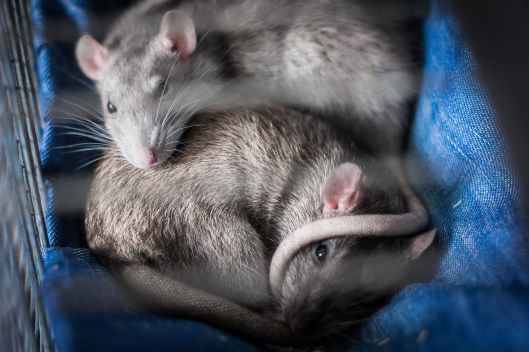
Of course, the very fact that humans differ so much is why some psychologists prefer to use rats. And, the psychologists (as well as a variety of biologists and medical doctors) don’t just use any old rats. They use rats that are carefully bred to be “lab rats.” They are expected to act in a fairly uniform fashion. And, for the most part, they do.

two gray mice

Photo by Alex Smith on Pexels.com

I was helping my girlfriend with her intro psych project. We were replicating the Yerkes-Dodson Law. This states that as you increase stress, performance improves, but only to a point. After that, additional stress causes performance to deteriorate (something that software development managers would do well to note). One of the ways I helped was to get some of the rats out of their cages. I would open up the top of the cage, reach around the rat behind their next and pull them out. Not a big deal. All the rats were quite placid and easy to handle. They all acted the same. Then, it was time to get the day’s last rat who was to be placed in the “high stress” condition. I went to the cage and opened it just as I had done for the last dozen rats. But instead of sitting there placidly and twitching it’s nose, this rat raced to the bars of his cage and hung on with both of his little legs and both of his little arms with all his might! Which might was not equal to mine but was rather incredible for such a tiny fellow. Rats sometimes squeak rather like a mouse does. But not this one! This carefully bred clone barked! Loudly! Like a dog. Whether this rat had suffered some previous trauma or was subject to some kind of odd mutation, I cannot say. 

But this I can say. Your “users” or “subjects” are not identical to each other. And, while modeling is a very useful exercise, they will never “be” identical to your model. They are always acting and reacting to a reality as beheld by them. And their reality will always be somewhat different from yours. That does not mean, however, that generalizations about people — or rats — are always wrong or that they are never useful. 

It does not mean that gravity will not affect people just because they refuse to believe in it. There really is a reality out there. And, that reality can kill rats or people in an eye blink; especially those who actively refuse to see what is happening before their very eyes. 

halloween2006006

Who knows? You might be about to be placed in the “High Stress” condition no matter how tightly you hang on to the bars of your cage – or, to your illusions.  

————————————-

Author Page on Amazon

Happy July 4th

04 Wednesday Jul 2018

Posted by petersironwood in America, management, psychology, Uncategorized

≈ Leave a comment

Tags

Business, collaboration, competition, Feedback, Human-Computer Interaction, learning, life, politics, psychology, science, teamwork, UX

As we celebrate in America, let’s not forget that many people fought long and hard to gain our independence and then to keep it. Let’s honor them by making sure we keep our independence. It would be a shame to lose it on the battlefield…and even more of a shame to lose it to greed.

IMG_8651

It would also be a good time to recall that America is not alone in the struggle against tyranny. Many other countries had to fight and win their independence – and in other cases, people are still fighting for their freedom.


Photo by Pixabay on Pexels.com

As I mentioned before, I am temporarily suspending additions to the Pattern Language of ‘best practices’ in collaboration and teamwork and shifting to a different genre for a time. I’m still quite interested in collaboration and teamwork; I am interested in working together to learn from each other how to do that better. As I’ve tried to point out, while competition certainly has a place, both in nature and in human civilization, in human civilization, it needs to be done within an agreed upon framework. Otherwise, competition spins out of control into anarchy and violence. Of course, this has happened before in human history. This time, when our very lives depend on a global network of interconnectedness, anarchy will be worse than ever before. For now, however, I’ve listed most of the major Patterns I’ve run into. I will continue to elicit and look for additional relevant Patterns. If you think of one, please comment on the summary/index or email me at: truthtable@aol.com


IMG_0159

Meanwhile, I’ve decided to share a number of experiences from my career as a researcher and practitioner in psychology, AI, and the field of human-computer interaction/user experience. I will relate these as honestly and completely as I think useful. In some cases, I may use pseudonyms to avoid embarrassing anyone. Clearly, stories are told from my perspective, and others might remember things differently, if at all. 

IMG_5190

The reasons for recounting these stories is basically threefold. First, studying a field such as psychology, or human-computer interaction is related to actually working in the field but not so much as you might think. For the most part, the errors I’ve made and the lessons that I’ve learned in the course of a long career are not primarily technical. The main lessons are socio-technical. Hopefully, people considering a career in a related field may learn from my mistakes. But aside from pointing out mistakes made, I hope to give a flavor for what it’s really like to work in the field. 

IMG_5191

Author Page on Amazon

Radical Collocation

26 Friday Jan 2018

Posted by petersironwood in management, psychology, Uncategorized

≈ 1 Comment

Tags

Business, collaboration, cooperation, Design, innovation, learning, pattern language, politics, science

ControlRoom

Radical Collocation.

(This Pattern was initially inspired by a talk at CSCW 2000 — see reference — and the Socio-Technical Pattern Language Workshop at CSCW).

Author, reviewer and revision dates:

Created by John C. Thomas on 5th Sept., 2001.

Reviewed by <> on <>

Revised by JCT on Dec. 17, 2001, January 25, 2018.

Synonyms:

“Put the team in one room for the duration of the project”, “War rooms”

Abstract:

When small to medium teams of people need to solve a problem or design a novel solution and there are many highly interactive parts, it is useful for the people to work in one large room where people have easy access to each other and shared work objects can be easily viewed, modified, and referred to when necessary.

Problem: 

Some problems are amenable to decomposition; that is, the overall problem can be broken down into a series of subproblems and when each of the subproblems is solved, the overall problem will be solved, possibly with slight modification to some of the sub-solutions. In other cases, especially problems that are relatively novel, complex, or “wicked”, such decomposition is not possible. In such cases, if a decomposition is attempted and each of the subproblems is solved, the resulting composition of sub-solutions will typically not be anything close to an overall solution. Under these circumstances, people working alone on their subproblem will become frustrated because all the progress they thought they had made will prove illusory. Morale will suffer. Management will become upset that the apparent progress has not been real and typically attempt a variety of counter-productive measures such as requiring more frequent reports and adding new personnel to meet a schedule.

Context: 

In the design of complex systems with many interacting parts, it is often the case that understanding how best to “decompose” a problem cannot be determined ahead of time. Examples include complex software systems, especially where the overall system includes human-human and human-computer interaction, new machinery, novel nuclear power plant designs, complex military operations.

In such a context, handing out separate “assignments” to various individuals or small teams will at first seem to produce progress as each individual or small team carries out their assignment. Unfortunately, when an attempt is made to compose or integrate these sub-solutions into an overall solution, the result doesn’t work because of unanticipated interactions.

For instance, suppose that a software development team is designing an integrated office support package. Independently, various teams or individuals design various functions. Each of these may be well-designed in itself. However, the combination will be flawed on at least three counts. First, numerous functions will have been duplicated in separate modules. Second, some functionality that would have been useful for the whole package will not have been implemented at all because it would have been too much work for any one team. Third, the user experience will be scattered and inconsistent as separate designers make independent choices about what the user experience will be. In addition, it is quite likely that hard bugs will also be in the design due to the inconsistent treatment of data objects, deadlocks, infinite loops, etc.

There are two main general solutions common in the software development community. First, there may be an attempt to set “ground rules” or “style guides” that everyone is supposed to follow. These will help ameliorate the problem but cannot solve it entirely. Second, there may be overall project meetings where people report on progress or even do mutual design reviews. Again, this helps but even if problems are found and resolved, the resolution will re-quire considerable rework.

iPhoneDownloadJan152013 533

Forces:

*People are naturally gregarious.

*People can concentrate better on difficult mental tasks when it is quiet and when there are a minimum of interruptions.

*Some problems are amenable to decomposition into relatively independent sub-problems; others are not.

*Social cues can be used to guide the interruptibility of others.

*Having work-related shared artifacts that can be viewed and understood by others continually leads to productivity.

*Shuffling work artifacts in and out of view in a small space takes time.

*Space costs money and is therefore limited.

*A group will tend to develop useful social conventions when they are co-located.

*Noticing and resolving conflicts among sub-solutions early will result in minimizing rework.

*Noticing common problems and solving them collectively as soon as possible will result in maximum efficiency.

*Human performance often shows a “social facilitation” effect; that is, people perform better in the presence of others.

  • The possibility of one person harming another and not doing so increases mutual trust.
  • Shared experiences tend to increase mutual trust.

Solution:

When small to medium sized teams work on non-decomposable problems, it is useful for them to be radically co-located in one large room. This room should provide each person some private space and individual work tools (e.g., a computer, a drawing table) as well as numerous spaces for public display of large scale work artifacts (e.g., designs, work plans, diagrams, decisions, group rules, etc.).

Examples:

In the Manhattan Project, people from all over the country were relocated to a relatively remote and isolated area. There they had large workrooms to work on complex problems together.

Recently, automobile companies have empirically compared software work teams that were radically co-located with traditional software development and found the former to be significantly more productive. Interestingly, although before the experience, people thought that they would hate working in a single room, afterwards they said they preferred it.

iPhoneDownloadJan152013 536

Resulting Context:

Prior to the experiments at the auto companies, developers were afraid that they would be too distracted by noise and interruptions to get much work done. In fact, social cues can be read fairly well and a potential interrupter can gauge the time to interrupt. In radical co-location, a person might have to wait minutes or hours to resolve an issue by conversation and mutual problem solving. In traditional software development, they may have to wait for a weekly meeting or not discover a problem until integration testing. People working under conditions of radical co-location tend to develop common vocabulary and artifacts quickly and can easily and efficiently refer to these artifacts. Motivationally, it is also easier to see where the individual’s work fits into the larger whole. Having had many face to face interactions, the group now has more social capital.

Rationale:

In a complex problem solving process, it is most efficient to solve the most difficult constraints first. Similarly, the sooner potential design conflicts or potential design commonalities are discovered, the more efficient the global optimization. Social groups that work together can rely on subtle cues about whether to interrupt or not. Being alone in the office may seem more conducive to concentration but is still amenable to a knock on the door or a phone call; in this case, the per-son interrupting generally does not know the state of concentration of the person being interrupted. When we work separately, it is easy to imagine that others are “slacking off.” If we actually see all of our colleagues working, it tends to motivate us to work harder as well.

Related Patterns:

Conversational Support at the Boundaries.

Who Speaks for Wolf?

Known Uses:

War rooms, command centers, trials.

Metaphors: 

The human body is mainly organized at one level into organs. These organs are generally completely co-located. Your brain cells are near other brain cells; spleen cells are near other spleen cells; bone cells are mainly near other brain cells. This is true in most (but not all) other species.

For many millennia, humans were hunter/gatherers. In some cases, our very distant ancestors may well have simply eaten “on the go” just as some of us still do off path-hugging berry bushes. But long ago, we gathered food, processed it, categorized it, re-shuffled it into various stews. All of these processes were typically done by a subgroup of the people. This co-work is at least one quite natural way to work.

Why is education arranged the way it is: into courses, lectures, topics, and so on? Why not just bombard kids with random facts from a computer? There are many reasons but one main one is that learning about a subject in a coherent way may help you see the larger coherence of the subject area.

Fable: 

Once upon a time, there were three little lemur sisters and they each went to provide some shelter for themselves from the elements as well as protection from the ferocious leopards that roamed their forest. The first little lemur wanted her home to be as gigantic as possible. So, she fashioned some sticks and put them widely spaced over a large area. Unfortunately, the lemur had no trouble whatsoever going between these widely spaced sticks and he ate up the first little lemur.

The second little lemur, having learned from her sister’s unfortunate demise made a much, much tighter circle. In fact, her sticks were so tightly packed that she could not really lie down and sleep. After several days, she could stand it no longer so she went outside to hunt and sleep and was eaten by the roaming leopard.

The third little lemur, having learned from both of her two younger sisters’ untimely demises, instead struck a deal with the leopard. “You know,” said the lemur, “I can climb very high into the treetops. And from there, I can see for many miles around and advise you on your best direction for prey. In return, you don’t eat me. And, that would not be to your advantage anyway because then you’d have to revert to your old way of using guesswork to find prey.”

Instead of helping the leopard, the third little lemur used his high position to mislead the leopard and warn the prey through intermediaries. At last, the leopard grew quite weary and hungry and demanded to see the third little lemur about their deal.

“Sure, I’ll be right down!” The third little lemur had carried only a single stick up to his high nest. But he had sharpened with his teeth. She sprang upon the leopard jamming the spear deep into its soft underbelly.

The moral of the story is: if you combine the collective experiences of people with relevant knowledge and use creative problem solving, you’re likely to be able to solve any problem.

References:

Bos, N., Olson, J., Gergen, D., Olson, G. & Wright, Z. (2002) Effect of four computer-mediated communication channels on trust development, pp. 135-140. Proceedings of CHI 2002, New York: ACM.

Olson, G. & Olson, J. (2000) Distance matters. Human Computer Interaction. 15 (2,3), 139-178.

Teasley, S., Covi, L., Krishnan, M., & Olson, J. (2002). How does radical collocation help a team succeed? pp. 339-346.  In Proceedings of CSCW 2000. New York: ACM.

All…what?

25 Monday Dec 2017

Posted by petersironwood in America, apocalypse, psychology, Uncategorized

≈ 1 Comment

Tags

collaboration, competition, cooperation, fascism, fear, greed, hate, learning, life, love, science

IMG_9070

Humanity finds itself in a new place. In evolutionary terms, we could say humanity suddenly finds itself in this new place. Life on earth, by best estimates is 4.75 billion years old. It’s easy to imagine, as a person, that the whole point of evolution is us. I don’t really see any reason to believe that. To the dolphin, deer, dog, dodo, and dinosaur, every one of their lives are every bit as precious to them as ours are to us. I do not even think humans are the “smartest” species on earth, at least, not in any absolute sense. We are the smartest in the directions of thought and behavior that humans find useful. So far as we know, we are the only species who has the information to know that our collective behavior can destroy us along with a lot of the other limbs on the giant, diverse tree of life and yet, here we still are, with atomic weapons, not pointed out defensively against invasions from outer space but pointed at other people on the planet. How could we possibly think we are the smartest species? Even if we avoid that kind of catastrophe, we still face dangers from over-polluting the planet, over-heating it, over-populating it, over-fishing and being over-hating. Indeed, this is nearly the darkest day in the darkest year. Is there reason to celebrate?

I think there is. In the blink of an eye, in evolutionary terms, we’ve managed to migrate across the entire planet. People live in tropical jungles, hot desserts, and in the frozen tundra. We’ve developed tools of thought and tools of trade and ways of dividing labor and communicating. And, now, although many people still do not have access, we have a communication network that spans the globe and we can communicate to some degree with people of different religions, cultures, languages, and experiences. We have vast networks of trade. We’ve come a long way.

OLYMPUS DIGITAL CAMERA

OLYMPUS DIGITAL CAMERA

Yes, there are a few greedy people who, like Voldemort, cannot or will not experience love or its benefits. Instead, they have convinced themselves that everyone is out to get as much as they can for themselves (or, if some people aren’t on that program, they’re just stupid, in the view of the greedy). In reality, only a few people are completely hooked on greed and power. They do not see other human beings as partners, or colleagues, or fellow explorers in this vast world before us — a world that still has billions of unfound discoveries. Indeed, we have even built machines to help us make new discoveries. And, if we don’t change trajectories, we may make far fewer discoveries than we might. Of course, it isn’t just the people completely hooked on greed that are accomplices in humanity’s direction toward greed. The alternative is to think quite consciously about our decisions in terms of who we invest in, what product we buy, how we talk with our neighbor, how we ourselves do business. We ourselves can make choices that move us toward greater cooperation rather than necessarily choosing only on the basis of immediate cost/benefit analyses. Then, and only then, can we turn the world to kindness and discovery.

Despite our many advances, we have yet, for instance, to have conquered cancer; we have yet to conquer war; we have yet to conquer hate and fear. You see how easily, in fact, the metaphors of war pervade our thinking. It is possible that we don’t need to “conquer” cancer, war, hate or fear. Maybe, we just need to let them go. Maybe if we understand these things sufficiently, they will dissipate. Maybe these four things all required quite different approaches from anything that has yet been tried, and possibly all require a different approach from each other. But my reflexive approach is to state this in terms of “conquering” – that is, winning over an enemy rather than winning over an enemy.

OLYMPUS DIGITAL CAMERA

OLYMPUS DIGITAL CAMERA

Perhaps, instead, the right approach to conquering cancer is not to “destroy” cancer cells but to re-integrate them into the society of the body. Perhaps they have been disillusioned that being part of the whole (body) is working for them. Maybe there is a way to “convince” them not to be cancer cells but to revert to what they were before cancer began.

Or, maybe we put something on an edge of the human body that has more of what the cancer cells “want” then anyplace within the body and let them “migrate” to the edge (and out of the human body — the “Pied Piper Approach”).

Or, perhaps, apart from pollution, a huge reason for cancer is that people are so busy so much of the time that they are not “noticing” teeny cancers within them. Perhaps people can be trained from birth to notice cancer cells and to send an overwhelming immune response before its too late. It sounds a bit absurd, but is it really? People can learn to “turn on” a single neuron in their brains with proper feedback. Is it really so far beyond the pale to imagine we could train ourselves to mount a targeted immune response?

IMG_9333

Perhaps all of these approaches might work and perhaps none of these approaches would work. The point is, that we need not reflexively think that “armed conflict” and “destruction” are the only methods that work to change the world. Many biologists think that the “nucleus” of our cells as well as our “mitochondria” were originally different organisms that started living symbiotically inside our cells. Is it too much to imagine that we could some day control the process of cells mutating and do it for our benefit? It seems absurd and ridiculous from the perspective of our knowledge today. And, yet — what would have our common ancestors on the African Savannah have thought 1,000,000 years ago if we could have explained to them that someday we would have machines that fly us around the globe — and to the moon? Or, how would they have reacted to the idea that we would have a network allowing us to communicate around the globe; that we would build machines that enable us to look into the workings of cells or the far reaches of the galaxy; that we would build fantastically beautiful musical instruments and that we could share music and ideas and stories across this earth; or that many people in our world die from having too much to eat!? 

It is quite possible that a century from now, people will very seldom die from cancer — or any other disease. In a similar fashion, we may well be able to set aside, recommission, redesign, or simply let go of war, hate, and irrational fear.

But none of that will happen unless we collectively decide what we want to be when we grow up. Because, as a species, despite wonderful achievements, we are still adolescents, at best. There are many tyrants in the world. Tyrants, as I’ve explained in prior postings, hate love and hate the truth. They really need war for cover in order to stay in power. Love complicates things. It’s just too unpredictable for people who want to be in control of everything. People’s reactions to absolute power wielded without ethics are much more predictable. Under enough painful torture, anyone will say anything 99% of the time. Of course, nothing positive and growth oriented ever comes from hate and fear alone. Only love moves life forward. Only love creates a more beautiful earth for our descendants. Only love discovers new beginnings, offers new ideas and new approaches. Beyond love’s instrumental value, more importantly, a world run by love is a world that feels good most of the time while it is happening, moment to moment. Of course, even in a world run largely by love, you will stub your toe or lose a friend, but most of every day’s activities you spend doing something because you feel as though you are making a contribution to something beyond yourself.

OLYMPUS DIGITAL CAMERA

OLYMPUS DIGITAL CAMERA

On the other hand, in a world run largely by hate and fear, the momentary experience of almost everyone almost all of the time is miserable. You are basically snarling or sniveling with every communication. Naturally, even so, there will be moments of joy, but it will never be unmarred because joy will either fall prey to guilt, or even worse, spend so much resources defending against guilt that life will become gray and pointless. Every day, most of the time you are doing what you’re going because you feel as though you’ll be badly punished if you don’t.

Does it make any sense then, to have a society run by the very greediest people among us? What if the only reason they are so greedy is because they don’t experience the full spectrum of human emotion that the rest of us do? What if a huge part of their greed is actually specifically and quite consciously designing and demanding a society run by hate and fear?

Why? Because they themselves don’t feel love and they don’t want others to be able to in an unrestricted way either. They are jealous and the only way they see to avoid being faced with their own shortcomings is to reshape the world so that no-one can express love openly and fully. I am not talking only about restrictions on sexual partners. I am talking as well about artistic expression, a free press, scientific exploration, and education. Everything is subject to restriction in a dictatorial society. Love is the source of exploration. It cannot be fully functioning under a dictatorship.

And what about Christmas? What about the solstice? What about the light and the dark? I do believe we now live in much, much darker times than most people realize. We are, in one of three states: 1) we are like one of the beginning scenes of the Star Trek prequel where Kirk speeds a stolen car towards that he does not realize is a deadly chasm. At the last moment, he tries to skid sideways to a stop, leaps from the car, begins to totter over the side and holds on by his fingernails — then clambers back up. 2) we in the same scene but this time, our foot hits the door an inch to the left and we don’t quite make it. 3) we are like the road-runner cartoon character who has just run straight off a deadly cliff but his legs are still windmilling and for a short time — he appears to be running, and does not fall until he looks down and realizes he is no longer on solid ground.

OLYMPUS DIGITAL CAMERA

OLYMPUS DIGITAL CAMERA

Well, it’s Christmas Day for me. And, the winter solstice has passed. The darkness really is receding and the daylight is encroaching on that darkness, minute by minute. We humans have had some dire times before and gotten through them. That doesn’t prove we’ll survive this Age of Greed, but I think it possible, perhaps even likely. But we must put the brakes on now. We must jump very carefully. And we must hold on for dear life.

We must hold on to each other. We must hold on to ethics as something that matters. We must hold on to the thought that, ultimately, we are all in this together. We must hold on to the thought that we are much more alike than we are different regardless of what customs, clothes, and food we prefer. We must hold on to the realization that a few greedy people cannot really rule the world, unless we participate with our own greed, fear, and hate.

We can pull this off. Instead of being the despoilers of the planet, we will make it ever more beautiful. Eventually, we will be “in tune” again, with nature and each other. How precisely to make this happen isn’t clear and no two people would probably approach it precisely the same way. Nonetheless, if we work together as best we can, keep discussing our differences in a civil way, and make as many decisions as we possibly can with at least a thought to the greater good, we will make it.

IMG_3071 - Version 2

Merry Christmas.


Author Page on Amazon


Love All.

20 Wednesday Dec 2017

Posted by petersironwood in America, psychology, Uncategorized

≈ 1 Comment

Tags

competition, creativity, innovation, learning, life, military, politics, science


IMG_5197

Love All. Hmm.

I don’t feel very loving toward people who are SHRUGS and pretending to be SHILLS, especially when they are using the trust we gave them as being public officials not to betray their country’s interest. Is there really a way to love all?

I think it is quite possible to love the totality of something without loving each and every part. A person might, for example, love their body but hate that big mole. They might really like their car but hate its squeaky rattle. They might love all of humanity yet hate so much of what one person does it is impossible to feel love for that part of it. At least I feel that way. I love the forest but hate deer flies, though it is a qualified hate. Once I’m back indoors, I don’t dwell on the fact that they’re still out there sucking blood from deer or hikers. There is a bit of humor and even admiration for the damned things. You would think it would be pretty easy for humans to outsmart them and yet…they are very hard to catch. The one trick I did develop was to wait till they landed on the back of my neck and then smack them quickly with my hand, stunning them. When they awoke, I would explain to them that if they didn’t immediately cease and desist, I would crush them. But they never responded so I crushed them anyway.

There are several aspects of love and one is understanding. They are not equivalent of course, but understanding seems good in any case. I can reach the point of trying to understand deer flies or SHRUGS. Beyond that, I cannot go.

IMG_3193

Teddy Roosevelt is famously purported to have said, “Speak softly and carry a big stick.” Let’s examine this a little further in the context of contemporary international relations. The United States is, or at least was until recently, the “world’s only remaining superpower.” That’s what we told ourselves. We certainly spend the most of any country on the military. Our military strength is also built on having a well-educated populace, superior technology, excellent training, and, considering that the military has a “military culture,” it is fact-based. After operations, initiatives, mistakes, successes, the military conducts “after action reviews.” In other words, there are mechanisms in place, to realize that human beings make errors and the important things are to try to avoid them and then to learn from them. The military, like much of American culture, strives to be a meritocracy.

How on earth does it make sense to “shout loudly and carry a teeny stick.”? But at least some of the SHRUGS seem hell-bent on just such a course. There is certainly a lot of “shout loudly” but isn’t there a promise to spend more on the military? Yes, but — superior military depends on many things besides money. It depends on having superior technology. Having superior technology depends on, among other things, attracting the best minds from around the world to a country they find attractive and accepting. Executive orders already made many people feel less welcome. This was followed by a Congressional-sponsored Theft Bill which made it virtually impossible for anyone but the richest to attend graduate school.

IMG_7320

Strike One. Notice, I did not say the most able, or creative, or hardest working. No, the richest. Well, apart from the mind-numbing unfairness and transparent self-interest, it is a death sentence to the USA having a long term lead in biotechnology, computer science including cryptography and cybersecurity, nanotechnology, and artificial intelligence. Breakthroughs in any one of these fields could render our nuclear arms useless or worse (e.g., our systems “think” they are launching to other targets when in fact they are all aimed at other cities in the US). That’s Strike One.

Strike Two. And in every other branchlet of the executive, the message has gone out loud and clear that promotions and possibly even firings will depend more on loyalty and less on merit. These government agencies will necessarily be less effective and as the general quality of the career public servants plummets, the few remaining effective people will become more and more frustrated and also leave making the race to the bottom of quality all the faster. These other branches of the executive include many that have a direct impact on the quality of the military.

IMG_9136

Strike Three Believe it or not, it matters what people feel they are fighting for. If all of what America “stands for” is unbridled greed so that more and more of the world’s resources can be funneled without objection into the pockets of the world’s richest, the soldiers don’t really care to go the extra mile. Why should they?

So the combination of these three factors: damaging science, making government inefficient, and destroying morale will weaken the military in its effectiveness but increase the chances of a world-destroying mistake.

So, yeah, I can’t quite get there yet with the “Love All.”


Author Page on Amazon


What’s New?

16 Monday Oct 2017

Posted by petersironwood in America, psychology, Uncategorized

≈ 5 Comments

Tags

"Fake news", communication, life, marketing, media, online, politics, science

constitution

“What’s new?”

Can’t you just picture two spry and amiable old men from the small town of Kent Falls, Ohio meeting up at the corner grocery. It’s a fine warm day in late autumn. It’s one of those days when the trees are starting to glorify the reddish  rainbow and the nights are nippy. Yet, in late afternoon, it is warm enough for shirts and trousers; the sky is clear; when two acquaintances meet, what do them say?

And, when one of the small band of kids that often gets together for some pick-up game at the school baseball field is joined by Susie who was off visiting her Uncle in Dubuque for a few days shows up, her friends ask:

And, when the knitting circle/book club shows up at the local library every Tuesday night, before they get into the details of their latest pick, “Turing’s Nightmares,” one of them is sure to be heard saying:

“Hey, Doris. What’s new?” Elaine queries her companion. In some parts of the world, the acoustic wave forms might be slightly different; e.g., “Comment-alez vous?” (How goes (it with) you?) or “Vie Gehts?” (How goes (it)?) I only know a smattering of the expressions among all the languages of the world, but I am still willing to bet that strangers who trust each other as well as friends and acquaintances everywhere try to elicit news from others. This process tends to increase social capital. Your asking the question shows that you trust this other person not to lie. Their telling you (a truth as they see it) increases your trust in them. Further, the fact that you are communicating is community reinforcing because you are using the same language; more than that, and more deeply, you are sharing information. You are saying, in effect, “I don’t know everything. I want to learn more. We are members of a species who can communicate with each other so we can share knowledge. How cool! Let’s do it!”

And we are right to celebrate this ability to share information. We literally would not have survived as the human species to this day if we could not have. And, beyond that, our ability to learn from and communicate with each other has allowed us to grow to 7 billion in population. We are not feeding everyone. But we could. We are not housing everyone. But we could. We are not getting fresh clean water to everyone. But we could. Because our ability to learn and share information collectively has allowed people to specialize their knowledge in a million different ways and cure diseases, and invent in the fields of computing and telecommunications. That in turn, meant that people could communicate way beyond their own town, not just in books, but nearly instantaneously.

Claude

There is way too much for any one person to ever learn. And, on the other hand, you also share a tremendous amount of information with others. So, it is completely reasonable to ask, “What’s New?” You don’t want to hear, yet again, for example, that 2+2 is 4. You already know that. You want to know what’s new.”If you’re like many people, particularly in the “Global North” you have little patience to hear about something you already know.

Imagine that, out of nowhere, a cold wind blew up and it began to drizzle then pour down rain in big floppy drops. Your friend says, “Hey, it’s raining!” If you’re type A, you might say, “I know! I know!” or even “Yeah, tell me something I don’t know!”

As I’ve mentioned before, in modern societies, almost everything we do has an instrumental quality or aspect to it. In addition, many activities also have various intrinsic qualities. The rain itself may have an instrumental value in that it will be good for the crops. But rain also provides a range of potential experiences for you (and your communicating friend right now). You can feel it the soft patters on your scalp and shoulders and face. You even feel your skin shiver perhaps. You hear the plish plosh staccato drum on the pavement. You see everything become grayer, foggier, less clear and a bit of steam rising from the still warm blacktop. You smell the clean clear smell of new rain. It may even remind you of walking, as a child, through rain-filled gutters. Even the fact that the rain surprised you — shocked you a little — energized your consciousness. Suddenly, you had a purpose. Find shelter. Stay warm. Re-organize your plans for the day. These are all things to be experienced and enjoyed in that moment. It does not require your friend’s participation, but if you both experience it, it is bonding and makes the experience a little more pleasurable. If your friend says, “Hey, it’s raining” he or she is not trying to inform you in an instrumental way. He or she is just inviting you to share the experience.

IMG_5006

It is not at all uncommon to hear in the halls of modern commerce phrases such as: “Bottom line it.” “And…you’re point is?” “Just give me the 10,000 foot view.” “And, therefore…?” or even simply, “So?” Every one of these phrases is coming from the same place: looking at information exchange purely from the standpoint of what it means right now for this specific part of this specific company and how do we make more money, spend less money, or avoid prosecution. I mean, just let that sink in for a moment. You may be so used to it that you no longer see how truly bizarre it is.

Imagine a typical 12 person conference room gathering for the weekly progress report. Everyone has 5 minutes tops to discuss progress and problems. I walk in one minute before the start time with a wide-eyed stare and announce, “I just came in. There is a wildfire headed this way.” My boss says, “OK, well, this meeting is about progress on release 4.6.2.02 — what’s your progress on that.” Or, perhaps, they might even use the terser, “So?” This might be a slight exaggeration, but trust me, not much. People are so trained to think of information in instrumental terms that they don’t see any value in the intrinsic experience of information, at least in a business setting. Beyond that, however, they don’t just limit information to instrumental communications. They predefine small category boxes to be slotted into small agenda boxes at the appropriate time. That a wildfire may be about to destroy the building, the machinery, some of the data, and — did I mention —- the people is very instrumental. But it is not instrumental to the predefined task at hand.

When we walk up to friends, acquaintances or even folks we’ve seen in town before and we say, “What’s New?” we are “making small talk” and increasing social capital. It is conversation that has intrinsic value. In some cases, it also has instrumental value as well. If the person outside the Kent Falls barbershop says, “Well, did you hear about the cholera outbreak in Kent Corners?” or “Are you going to the big barn dance this week end?” or “My kid’s trying to get into the double’s tournament but he needs a partner.” or any one of a million other things, information has been exchanged that you might have an interest in. You might want to (respectively) avoid going to Kent Corners, ask your spouse if they want to go to the barn dance, and ask your kid if they’re interested in teaming up for a tennis tournament.

This person you meet could, of course, be lying. They could be saying whatever they are saying as part of a con. This could happen. But it’s very unlikely. Why? Because you know who this person is or at least you recognize them. You’ll find out the truth eventually and when you do, if they are lying, you will have often have the means to ostracize this person or even have them jailed for lying. You also have the advantage that you can look them in the eye, ask them questions, and generally be able to verify things pretty quickly. For instance, assuming Kent Falls is near Kent Corners, you’ll fine it easy to discover whether there is really a cholera outbreak. Some people can look you in the eye and lie pretty convincingly, but it’s not that easy. Not only can you see directly who is talking; the speaker knows that you are looking at them. They know you can pretty easily verify their statements. They know that if they lie, they can get in big trouble. So under these circumstances, lies tend to be few and far between.

With on-line media, however, the situation can be quite different. Someone famous tweets something and you don’t see that person actually do it. All you see are the 140 (soon to be 280?) characters. They may be tweeting, not about the next town over but about an island thousands of miles away. You have no easy way to verify what they say. Even worse, what they say may be “verified” by a so-called citizen’s group or news agency which is actually nothing like a citizen’s group or news agency. It is merely an invented tool to lend credibility to the lie.

If such lies become widespread on a national basis, coordination of ordinary activities becomes extremely difficult. In the case of the small town, if people begin to circulate false rumors of barn dances, eventually no one will bother to attend or organize a real barn dance. What if you’re told that Kent Corners is not suffering a cholera outbreak but that they are part of the zombie apocalypse and you need to burn down the village before they come for your town?

In a large country, even worse lies can be harder to track down. Imagine, for instance, that banks no longer feel obligated to tell you how much money of your money they actually have or imagine that they create new accounts and charge you fees for those accounts without asking your permission or telling you about them. Imagine doctors are paid by you to be their physician but unbeknownst to you, they are also being paid way more money than you can afford so that they will prescribe specific drugs that are actually not best for you. Imagine that wealthy bankers develop a system so that they make what are essentially long odds bets and when those bets pay off, they pocket the winnings. But when they lose all their money, they charge the taxpayers for those risky bets. It isn’t just that people are telling these specific lies to cheat you out of your money, time, or attention. That’s bad enough. But what they are also doing is destroying our ability to coordinate and trust and collaborate.

What’s amazing about such stories is that the events underneath these stories have a tremendous impact on the lives of ordinary citizens. Yes, the stories are often, long, complicated, and filled with detail. Perhaps that is why the media put far more coverage on sports teams and movie stars than on these scandals which, in actuality, are galactic in scope.

I implied earlier that every communication has a relationship impact. Compared with face to face communication, distant communication has a less positive impact on relationships. At best, it is simply not as warm. At worst, it can exacerbate arguments. Introduce an intermediary who is vying for everyone’s attention in a raging ocean of screaming voices also vying for attention. Only the loudest screamer gets heard. But this has the unfortunate effect of making everyone scream as loudly as possible. Similarly, the media have some push toward screaming as loud as possible. This tends to exaggerate differences, but let’s not also forget that it tends to further decrease the potentially positive relationship aspects of communication. In face to face meetings, it is always possible to have the two sides proffer hands and come to agreement. With news feeds going specifically to people who already believe what is about to be reported, the illusion among those people also grows that their view is the correct view. All of this happens even without fake news.

Now, let’s add fake news. It increases divisiveness. It further decreases any shreds of a felt commonality across the divides. But it also makes each communicative act less of an activity of warmth or connection. When newspapers report on facts, even many reputable ones end up having a general bias left or right. So, when they report on facts, the stories may emphasize different things. When people read stories from these different newspapers about events, they tend to read the papers who often look at things the way they do. So there is some isolation happening already. Two people may therefore read two somewhat different accounts of the same events and continue the disagreements inherent in the different slants.

However, with online fake news an entirely new dimension comes into play. This is not reputable newspapers looking at the same events from a different perspective. This is an online source, e.g., DarkBart, making crap up and reporting on it as news. Typically, there are multiple apparent sources reporting the same (totally made up) story. Often, to increase credibility further, they will post a picture of something that happened long ago or somewhere else. Though perhaps not stated explicitly, the import is clear in context that this is supposed to be a picture of the event talked about in the story. Other fake news sources will be delighted to rebroadcast any popular story whether true or not.

SeaMonkeys

If someone, say, Joe, has a vested interest; e.g., let’s say Joe’s job depends on big oil, and a story comes out in fake news that protesters against the Dakota pipeline were paid to protest by the czars of a wind and solar company. That person might tend to believe it because it’s in their interest to believe it. On the face of it, it’s a pretty absurd claim. Chances are, Joe doesn’t fall for this one. At first. But now, he sees the same story repeated on numerous on-line fora. Of course, the protestors deny this, but when CBS interviews the protestors and airs the interviews, this is a completely predictable event to DarkBart because they knew the story they ran was fake. So, they are all ready to go with the counter-story. CBS is heavily invested in by some of the same dark forces behind the Dakota protests. Or, CBS is fake news. Or, even, “We should review the license of CBS to see whether they should be able to keep their license.”

There has always been some degree of lying. What’s new is that people can lie now to millions of people at once. What’s new is that people who run media are not paid purely to tell the truth. The are partly paid to be attention-getting. What’s new is that the people who run media companies are not in your neighborhood. If they do lie to you, there are very little consequences. What’s new is that, while you and I have never been trained as journalist, by reposting and liking and retweeting, we are, in effect giving some sort of amplification to stories. What’s new is that some on-line news sources are only in it for the ad money. What’s new is that this entire system has been used by a foreign government in a kind Trojan Horse move to divide and mislead people.

IMG_8483

In ancient times, kings kept their subjects in the dark through power and intimidation but also by not letting them be educated. The printing press made that more difficult. Over the last few centuries, there has been a general trend toward enlightenment, democracy, and freedom. But don’t be fooled. There are plenty of people out there who would love to enslave you every bit as much as those ancient kings did. It’s too late to fool the current generations by withholding information. But it’s not too late to fool the current generations by flooding the information channels with fake news while every freedom and every penny is taken away or until power is so consolidated that it’s too late to do anything about it. At that point, there won’t be any news except what those in power want you to hear. That’s What’s New.

← Older posts
Newer posts →

Subscribe

  • Entries (RSS)
  • Comments (RSS)

Archives

  • June 2026
  • May 2026
  • April 2026
  • March 2026
  • February 2026
  • January 2026
  • December 2025
  • November 2025
  • October 2025
  • September 2025
  • August 2025
  • July 2025
  • June 2025
  • May 2025
  • April 2025
  • March 2025
  • February 2025
  • January 2025
  • December 2024
  • November 2024
  • October 2024
  • September 2024
  • July 2024
  • April 2024
  • March 2024
  • February 2024
  • January 2024
  • December 2023
  • August 2023
  • July 2023
  • May 2023
  • April 2023
  • March 2023
  • February 2023
  • January 2023
  • December 2022
  • November 2022
  • October 2022
  • September 2022
  • August 2022
  • July 2022
  • June 2022
  • May 2022
  • April 2022
  • March 2022
  • February 2022
  • January 2022
  • December 2021
  • November 2021
  • October 2021
  • September 2021
  • August 2021
  • July 2021
  • June 2021
  • May 2021
  • April 2021
  • March 2021
  • February 2021
  • January 2021
  • December 2020
  • November 2020
  • October 2020
  • September 2020
  • August 2020
  • July 2020
  • June 2020
  • May 2020
  • April 2020
  • March 2020
  • February 2020
  • January 2020
  • December 2019
  • November 2019
  • October 2019
  • September 2019
  • August 2019
  • July 2019
  • June 2019
  • May 2019
  • April 2019
  • March 2019
  • February 2019
  • January 2019
  • December 2018
  • November 2018
  • October 2018
  • September 2018
  • August 2018
  • July 2018
  • June 2018
  • May 2018
  • April 2018
  • March 2018
  • February 2018
  • January 2018
  • December 2017
  • November 2017
  • October 2017
  • September 2017
  • August 2017
  • July 2017
  • June 2017
  • May 2017
  • April 2017
  • March 2017
  • February 2017
  • January 2017
  • December 2016
  • November 2016
  • October 2016
  • September 2016
  • August 2016
  • July 2016
  • June 2016
  • May 2016
  • April 2016
  • March 2016
  • February 2016
  • January 2016
  • December 2015
  • November 2015
  • October 2015
  • September 2015
  • August 2015
  • May 2015
  • January 2015
  • July 2014
  • January 2014
  • December 2013
  • November 2013

Categories

  • AI
  • America
  • apocalypse
  • cats
  • COVID-19
  • creativity
  • design rationale
  • dogs
  • driverless cars
  • essay
  • family
  • fantasy
  • fiction
  • HCI
  • health
  • leadership
  • management
  • nature
  • pets
  • poetry
  • politics
  • psychology
  • Sadie
  • satire
  • science
  • sports
  • story
  • The Singularity
  • Travel
  • Uncategorized
  • user experience
  • Veritas
  • Walkabout Diaries

Meta

  • Create account
  • Log in

Blog at WordPress.com.

  • Subscribe Subscribed
    • petersironwood
    • Join 648 other subscribers
    • Already have a WordPress.com account? Log in now.
    • petersironwood
    • Subscribe Subscribed
    • Sign up
    • Log in
    • Report this content
    • View site in Reader
    • Manage subscriptions
    • Collapse this bar

Loading Comments...