• About PeterSIronwood

petersironwood

~ Finding, formulating and solving life's frustrations.

petersironwood

Tag Archives: environment

Aftermath: Feast & Celebration of Thanks for the Great Tree of Life

25 Sunday Nov 2018

Posted by petersironwood in America, apocalypse, psychology, Veritas

≈ Leave a comment

Tags

Cupiditas, environment, ethics, greed, leadership, life, myth, politics, story, truth, Veritas

Aftermath: Feast & Celebration of Thanks for the Great Tree of Life

beach clouds grass island

Photo by Pixabay on Pexels.com

When the Veritas scouts had determined that no rogue soldiers of the Cupiditas remained near the lands where the Veritas roamed, and preparations for a great feast had been made, all the tribe, save a handful of lookouts, gathered at the Center Place for a Great Celebration. The Veritas celebrated victory of battle; they celebrated even more that they have avoided making two of three enemies; they celebrated the teamwork they had experienced both in preparations and in the midst of battle; they celebrated that such teamwork was the gift of many generations of Veritas before them who had fought long and hard to reward cooperation and true communications. The Veritas celebrated as well the plentiful food for the feast which also sprung from the gift of cooperation among the people. They celebrated their venerable leader, She-Who-Saves-Many-Lives, who once again exemplified her name. 

After songs, and dances; after contests of speed and strength, came the riddling contest. 

  • {Translator’s Note:} Again, the actual myths contain what appears to be lengthy and detailed descriptions of technique and suggestions for such contests. Translating these is virtually impossible. For instance, as best I can tell, the Veritas, when describing athletic contests do not use body parts such as leg, thigh, or quads. I estimate somewhere between 1000 and 10,000 names for body parts and for different states of relaxation versus tenseness, fatigue, resiliency, and so on.  I will make a rather lame attempt with respect to the riddling contest which is the last before the oration of She-Who-Saves-Many-Lives. Many of the riddles depend on rhyme and wordplay so they either make no sense when directly translated into English or have no rhyme or rhythm. (In other words, they are from the beginning of Milo’s adventures on the other side of The Phantom Tollbooth. Instead, I give several examples that I constructed for English that illustrate the same general point. 
  • “The more you give me away, the more I stay. Tie me down to make me drown. Let me go and I will grow. What am I?” Love, many shouted as one, for this was a well-known riddle meant to prime the pump. 
  •  
  • The next one was more original. “When I take some, it makes me dumb. When I take more, I close each door. At last I hate all, and that’s when I fall. What am I?” Here, the people suggested many answers: greed, Cupiditas, NUT-PI, addiction, bully, ALT-R. The most-favored answer was “Greed.” 
  • At last, there were about 30 such riddles. I won’t translate most of them.
  • Frankly, the last one of the evening makes no sense to me at all. If there are any other Veritas scholars out there who can shed light on it, please do so in comments. 
  • “Most everyone has me, when friend skins their knee. Many forget in peril or trouble, but that’s just when you need me, even double. I’m hardest to find, when angst fills your heart, and finding me then is a wonderful art. If you can see what others see, then, through them, you will all see me. What am I?”

The Veritas feast had been designed by many collaborators and among them were Fleet of Foot and Eyes of Eagles. The Veritas always paid attention to making their food beautiful as well as tasty. This feast lay before the hungry Veritas in a beautiful arrangement of forms and colors and textures. The red of beets and the gold of corn set off the warm reddish brown of seared venison and poached salmon. Wild lettuce and dandelion bordered each plate, each sprinkled with a handful of blueberries.  

steak food

Photo by Malidate Van on Pexels.com

At long last, everyone was sated of food, drink, and entertainment. The Veritas now wished to hear from their leader, the heart of the tribe, She-Who-Saves-Many-Lives. She strode up a short ramp so that she could be seen and heard. 

“Today is a wonderful day. As is every day that we are alive. The people are our part of the Great Tree of Life and we have recently avoided a dreadful fate – being subjugated to the Cupiditas. We were successful in avoiding two great battles and that is saving many lives indeed, but not due to me. What I most happy about is that much of these victories came from the cleverness and teamwork of some wonderful youth among us. Teaching is a difficult thing indeed and three among us took teaching meant for doing good and turned it for doing evil. This is a great failing on my part and for all of us. And, we will spend much time and speak much about this and discover how we might help prevent such in the future. But for tonight, let us celebrate when such teaching does work. Of course, the reason it works, is these students, these acolytes took the learning to heart and even improved upon it. 

“Eyes of Eagle learned from watching such as eagles and hawks how their shape changed according to purpose and thus she began to study shapes in many ways beyond what I could ever teach her. She has added to our learning for all time. And, she probably killed more Cupiditas warriors through her damming and releasing the river through shapes. As well, she took the example of teaching wolves and made a weapon of a bird! She also devised a trap that caused many Cupiditas warriors to lose their footing and fall into that carefully camouflaged death. Fleet of Foot helped to make those traps look to be ordinary terrain. Trunk of Tree suggested using drums to communicate with POND MUD and thereby to the Nomads of the South. And Eyes of Eagles knew just where to place those drums to enable greatest reach of sound. 

“Here is another lesson for all the people. You see how it is with Eyes of Eagle. She has studied shapes and thought much about how shape influences all things. Perhaps she has studied and learned more than any other Veritas. So, she invents things to help us all because she made her knowledge richer than all before her.  

“As you all know, I began seeking a successor and we chose twelve promising from among the Veritas youth. As time went on, it became clear that one among us has a very good heart indeed along with an excellent mind. I believe she will be a wonderful leader among you. And she is of us all. And we are all part of her. And she well knows this. I want to present She-Of-Many-Paths with the Seventh Ring of Empathy and suggest her as your leader should she survive the vision draught of death and life. She shall be named henceforth, She Who Walked Many Paths to Save Many Lives.”

She Who Walked Many Paths to Save Many Lives knew this to be her cue and ascended the ramp. Her long black silky hair hung down her back in a long straight line that contrasted with her blue and white patterned dress. He neck and hair were adorned by turquoise beadwork. On the little, ring, and middle fingers of each hand, she wore a ring – one of the Rings of Empathy that she had earned. She knelt before She-Who-Saves-Many-Lives, who again spoke. 

“This woman has indeed saved many lives. She has demonstrated that she has a gift of empathy which she continually improves. Moreover, she has demonstrated that she knows to use this gift for the good of all, not just for herself, nor indeed, even for her people but for the good of all who are among and part of the Great Tree of Life. She is still able to use her empathy when many would find their fear or their anger blocked all such ability. She reached out on many paths to foster life when many would have chosen instead a giant wall to keep unwanted feelings out. I therefore bestow upon her the Seventh Ring of Empathy.”

She-Who-Saves-Many-Lives gently took the hand of She Who Walked Many Paths to Save Many Lives and lifted it. She placed upon the index finger of the left hand, a ring with three interleaved cords of woven gold; one reddish as fire coals, one white as summer clouds, and one the yellow of goldenrod. Atop the ring was a single large opal that seemed to sparkle of dewdrops rain-bowing in the sun. Then, She-Who-Saves-Many-Lives and her protege stood facing each other for a moment before the older woman reached back and took a gnarled wooden mug and handed it to Many Paths & Many Lives Saved and asked her loudly so that all might hear: “She Who Walked Many Paths to Save Many Lives, do you take upon yourself the awesome responsibility to be First Among Us, to lead us in times of peace and times of trouble; to put the Tree of Life ahead of the Veritas, and to put the Veritas before your own interest? Will you lead us, should you survive the sacred drink of Life and Death.” 

“I do and I shall.” She took the gnarled mug and put the cup to her lips. Despite the name, she had some doubt that it might really kill her, but she owned it remained a distinct possibility. The taste was bitter, funky, and even sweet, although in a rancid sort of way. She thought it more likely that the drink would make her ill or even alter her perception much the way tobacco made her slightly more aware of tiny details of color and form. Instead, she felt normal enough, though taller of course; she was much taller in fact. But so was everything else. She began to see that what she thought of as individual people such as Shadow Walker, who she realized suddenly was an incredibly handsome fellow. He really is, she thought. But he’s so tall! We are all so gigantic. We are each tribes ourselves. No, we are tribes of tribes. And, we are all interconnected — to each other — and to our past — and to our future! 

IMG_9568

As she looked out upon the crowd of nation-sized people she realized how incredibly different each person was and yet how similar each person was and how similar every living thing is to every other living thing. She could see or imagine how this same ceremony was carried out decades ago to choose She-Who-Saves-Many-Lives and that every leader had done the same for a thousand years. She found herself falling, falling, down a long tunnel, but soon discovered that she was not really falling so much as floating and she could will herself to float up the tunnel as well as down. As she floated up the tunnel, she continued upward until she seemed to be floating high above the Center Place of the Veritas. She could see all the lands where the Veritas dwelled and hunted. She could see the lands of the Cupiditas, the Sabra, and the Fierce and Formidable Fighters of the North. 

She could see other lands and other peoples. The lands became filled with people. There were people everywhere and particularly along the coasts of giant lakes and along the banks of tremendous rivers. These people had campfires everywhere but the campfires did not flicker and smoke. It gladdened her heart to see the people so numerous and prolific. She knew not how she knew, but she knew somehow that this prosperity and reach of the people came from the Veritas, or more accurately, not her tribe of Veritas precisely, but from the spirit of the Veritas that valued the search for truth, the feeling of love and comity, the desire to be fair and foster the great and varied Tree of Life. Then, her heart sank again, for she felt, rather than saw, that the Cupiditas too survived and infected the people with the diseases of greed and cruelty.

fullsizeoutput_172b

 The people forgot the very nature of life itself in their pursuit of more … more what? It didn’t seem to matter! The people were pursuing more of everything and in that greed killing the roots to the tree of life! Birds were dropping from the sky. Fish were dying in the streams. Trees fell and burned by the thousands. The people were destroying the very Tree of Life whose branches they lived in! Surely, this cannot be! Even the Cupiditas are not that greedy! It seemed to her that the Cupiditas had stolen knowledge gained by the Veritas and for some unknown and unknowable reason, had convinced people everywhere to replace the beautiful Tree of Life with some unknown material that was ugly though shiny. The water that people drank contained teeny pieces of this shiny material and it made all the people sick. Yet, they made more and more of the shiny material until it was even in the air that they breathed and this too sickened many people. 

factory smoke

Photo by Vitaly Vlasov on Pexels.com

Now, from far away, she could hear the voice of She-Who-Saves-Many-Lives, “Daughter? Are you all right?” She turned, and there she was standing again on the raised platform right beside She-Who-Saved-Many-Lives. She looked out and saw the Veritas looking at her as though nothing unusual had happened. “I’m fine. I’m fine.” She had survived. She had become the leader of the Veritas and the people acknowledged her with a mighty roar. She held her arms above her head and spread her fingers outward to make that sign that the Veritas used to signal the Tree of Life. She felt some elation, but also a sense of great responsibility. Though she was now the leader, she wanted nothing more than to speak privately with She-Who-Saved-Many-Lives. She smiled out at the people, holding her hands high once more and once more spreading her fingers widely as though she were a tree drinking in the sunshine. She glanced at She-Who-Saved-Many-Lives and whispered, “I had the strangest dream just now. How long was I out?” 

She-Who-Saved-Many-Lives looked at and into the new leader, and whispered back, “You did not lose consciousness at all, though you shook your head oddly for a split second. It was the same with me.” 

“Later, may we speak of these visions?” Though She Who Walked Many Paths to Save Many Lives was now the leader, she still felt very much an apprentice or acolyte. 

“Indeed, we shall. Now, go among the people and receive their blessings. Later, we will speak of such.”

IMG_0023

——————————————

Herein lies a portal to many worlds.  

The Myths of the Veritas: The Great and Gathering Storm

16 Tuesday Oct 2018

Posted by petersironwood in America, psychology, Uncategorized, Veritas

≈ Leave a comment

Tags

empathy, environment, politics, strategy, tactics, truth, Veritas, war, warrior

cloudy sky

Photo by Moritz Böing on Pexels.com

POND MUD arrived at last to join KAVA-NUT and ALT-R in a small clearing among a grove of dead crab apple trees near the Raging River. POND MUD’s face was flushed and his pulse raced. ALT-R had heard him coming and could see that he was agitated. 

“Why are you so late and out of breath, POND MUD?” 

“I’m not out of breath! A little. Just running. It’s a long ways.” 

ALT-R pressed, “Well, in any case, come help us map out the guard posts. Did you see any guards? Or their posts?” 

POND MUD grew more flushed as he said, “Of course! I know many of their posts. I didn’t see any – well, I saw She-of-Many-Paths. She might be a guard. I doubt it though. But no matter.” 

ALT-R stared at POND MUD and spoke quietly. “No matter, POND MUD? You were not so stupid as to let her see you, right? Please tell me you didn’t let her see you.”

“Of course not! We all agreed. I saw her, but she didn’t see me. I had nothing to say to her! Nothing. I’ll have my way later.” 

ALT-R bit his lower lip. Something about POND MUD’s demeanor did not seem right. “You are quite sure that she didn’t see you?” 

POND MUD raised his voice slightly, “NO! I told you. I saw her. She did not see me.” 

ALT-R continued, “OK. What did she say to you?” 

POND MUD hesitated. “What? She… she didn’t say anything to me. She didn’t see me. I’m not stupid.” 

KAVA-NUT chimed in, “No-one thinks you’re stupid POND MUD, but we both know you fancy her so it must have been tempting to say something. Or, just rape her on the spot. I know I might have.” 

POND MUD chewed on his cheek. He frowned. He tilted his enormous frame back and forth. Sometimes he felt as though KAVA-NUT and especially ALT-R could tell when he was lying. Maybe he should tell the truth and admit that they had talked but re-assure them that he had said nothing of consequence. But that would lead to more questions. And, to more teasing. And he had already said that they hadn’t spoken. “Can we just get on with the mapping of the guard posts? It’s soon going to be too dark to see our own map. I told you already – she didn’t see me or talk to me. What I did see were signs of guard posts in the customary spots, high in the climbable white oak by the spring that feeds that shady glen where all those mayapples grow and also inside that giant charred tree atop the knoll by the big red rock. What did you find?”

ALT-R stared hard at POND MUD but decided to let it go, at least for now. Once POND MUD’s mind had settled on walking a path, it proved very difficult to get him to pause, go back, or choose a different path. He found it extremely hard to believe that POND MUD had contrived to see She-of-Many-Paths without himself being seen. POND MUD’s size and lack of cunning made it much more likely that POND MUD himself had been noticed first. So, he hunkered down in the dying light with KAVA-NUT and POND MUD to work on the map for the Cupiditas. Alt-R made a mental note to question POND MUD again at some later time. He was more worried, however, that he may have oversold the usefulness of these guard maps to the Cupiditas, and to NUT-PI in particular. 

IMG_3192

{Translator’s Note}: Neither the Veritas nor the Cupiditas in those days had precise maps or ones that referred to a universal grid. 

The spots that POND MUD described were absolutely known to KAVA-NUT and to ALT-R himself, but whether these descriptions would enable the Cupiditas, who were unfamiliar with the locations of these landmarks, to locate the guard posts of the Veritas —? About that, he was beginning to have serious doubts. Then, he had what he considered to be a brilliant idea. They would again look for guard posts tomorrow as planned but then, they would take another day and actually mark the paths that the Cupiditas were to take. Of course, the marks would have to be subtle. ALT-R remembered seeing that the Cupiditas seemed to have a fondness or reverence or some kind of fixation with the large water rat that the Veritas called “AGAM.” The shape of the AGAM was fairly nondescript but that made it all the better. KAVA-NUT had verified four hidden vantage points of the Veritas and ALT-R had found six. He knew of at least 12 others to check out, so they finished their crude map and made plans for places to search. ALT-R did not share his “marking the way” plan just yet. He wanted to have more details worked out first. He didn’t like working together on a plan. It was too confusing. It was so much more comfortable to make the plan himself and then convince or force others to follow it. He drifted off to sleep fantasizing being King of two tribes and getting rid of POND MUD. KAVA-NUT? He’d have to wait and see. Unlike POND MUD, KAVA-NUT had never seemed to want to be the King; he hadn’t even tried in the trials for the Rings of Empathy. 

At dawn’s first light, the trio departed to further reconnoiter the Veritas. ALT-R’s path this day took him off early at a sharp angle to the northern ridge of the valley while KAVA-NUT and POND MUD strode a single path for a time. After a long silence, POND MUD began a line of questioning with KAVA-NUT. 

“Fish blow bubbles in the water, don’t they? Is that what keeps them from drowning?”

catfish in body of water

Photo by Denise H. on Pexels.com

This struck KAVA-NUT as such a strange question, especially from POND MUD whose mind was generally not much suited to such bouts of curiosity, that he stopped, held up his hand, and turned to face POND MUD as he spoke. 

“What are you talking about? Yes, I’ve never seen fish blow bubbles. If they do, so what? I don’t even know what it means for a fish to drown. We drown from too much water around us. Take a fish out of water and it seems to die from having too little water. POND MUD, I think you should concentrate your energy on making sure we are not observed. A few thousand more steps and we will be at the edge of the lands the Veritas frequent.” 

They walked on in silence for another few hundred paces when POND MUD said in a stage whisper, “Did you really like her, KAVA-NUT?” 

KAVA-NUT held up his hand, stopped, turned and faced POND MUD again. “What are you talking about? Like who? We really need to stop talking.” 

POND MUD, continued in his stage whisper, “You know. Eagle Eyes that you tried to rape. Did you like her?” 

KAVA-NUT snorted. “Of course not. She’s just something to toy with for my pleasure. Softer than my own hand. Now, let’s stay silent till we reconvene at dusk.”

Yet, they had only walked another hundred paces, when POND MUD whispered again, “If you were drowning in quick sand, would you blow bubbles to save your life?” 

KAVA-NUT, held up his hand, turned, shook his head and sighed. Rather than talk back, he put his hand over his own mouth hard to show that no talking was allowed. Then, he turned back down the path, glad that they would soon diverge and enter the lands of the Veritas where surely even POND MUD would know enough to be silent. Why on earth though would he ask a question like that, he wondered. 

PicturesfromiPhoneChinaParisPrinceton 284 - Version 2 

Meanwhile, the Cupiditas were training and preparing weapons for their upcoming conquest of the Veritas. During this training, NUT-PI pushed his warriors as hard as he could, thinking that this would toughen them for the upcoming battle. And, so it would have, had that battle been months or even weeks off. As it was, it mainly sapped their strength as well as their spirit. Fully half of the energy the Cupiditas put into “training” was actually put into jockeying for position within the military hierarchy. Back-stabbing, bad-mouthing, damning with faint praise, planting false rumors about rivals – these skills were well learned by the Cupiditas, and as their anxiety grew about the upcoming battle, the internal bickering and back-stabbing grew in both frequency and strength. 

man wearing white pants under blue sky

Photo by The Lazy Artist Gallery on Pexels.com

Meanwhile, the Veritas prepared in a very different set of ways. Thanks to the intelligence gathered by She-of-Many-Paths, they now knew who their enemy was: The Cupiditas. They had some familiarity of the weapons and customs employed by the Cupiditas. They also knew them to be fewer in numbers than the Veritas. Though they were know to be skilled and fierce warriors, at least they were a known attacker. Of course, the Veritas were very familiar with the concept of change! They knew that preparations must prepare the paths of one’s mind but one must also be prepared, as circumstances demanded, to jump off those carefully prepared paths. The Cupiditas were now under the new leadership of NUT-PI who would almost certainly want to change at least one thing about the way the Cupiditas fought so that the upcoming imagined victory would be attributed to him. If nothing else, he would have the advice and counsel of three young men among the Veritas. Those three were known to have special gifts as well. POND MUD was known for his mighty strength; ALT-R for his cleverness; KAVA-NUT for his deceptiveness. They would communicate everything they knew about the fighting ways and weapons of the Veritas as well as those positions most favorable to seeing, hearing, or smelling an approaching enemy. 

orange and black poison darth frog

Photo by Thierry Fillieul on Pexels.com

For that reason, the preparations of the Veritas included some new techniques and inventions. For instance, though the Veritas had learned many generations ago of the poisons of certain tree frogs, plants, and snakes, they had never used weapons tainted with such poisons. This time, however, they believed that the would be fighting for their existence as a free people against a foe led by three traitors. In such a circumstance, they no longer felt obliged to avoid poison and adorned spears, arrows, and darts with such, moving carefully and slowly to elude the toxins themselves. 

Some among the Veritas dug holes in the earth and set inside, pointing upwards, sharpened sticks. Then, they covered each such pit-trap with a weave of palm leaves. Atop this they placed a small layer of dirt with weeds and fallen leaves. Fleet-of-Foot and Eagle-Eyes both looked carefully at the traps and made small changes so that they seemed not a weapon but merely one place among many in the forests abutting the Veritas.

The penchant for shape and sight that Fleet-of-Foot and Eagle-Eyes possessed also proved helpful in another endeavor. Beside the raging river, in a not too inconspicuous spot, they contrived to “hide” treasures of the Veritas. They wanted to be sure that at least one among those they planned to lure here would see this cache and explore it. Inside, were many large chunks of iron pyrite and galena. These were large pretty stones, hard to forgo, and valuable in trade among the many tribes but extremely common in the lands of the Veritas. The Veritas also knew these rocks to be especially heavy [dense] as well.

white stone

Photo by Pixabay on Pexels.com

One of the most unexpected “weapons” of the Veritas were the wolves that She-of-Many-Paths had trained and befriended. It bothered her to send these friends into battle and she strove hard to make them understand that they had a choice. She also felt that they had a strong core instinct for survival and that her training, though successful, only coated that core instinct with the gentle fur of compliance. Further, she was sure that if the Cupiditas were to be successful in their conquest, such wolves as she had come to love would be destroyed in any case. She saw no room in the hearts of POND MUD, ALT-R, or KAVA-NUT for other animals. They would see anything they did not understand as enemies to be killed for joy. In fact, they might even torture them for some perverse pleasure. 

brown wolf standing on green grass

Photo by Pixabay on Pexels.com

Eagle-Eyes had been one of the few among the Veritas who had known of the training that She-of-Many-Paths had been doing with the wolves. Eagle-Eyes had found a hawk with a broken wing. She had nursed the hawk back to health and had more than a little success training the hawk as well. She could fly now but seemed quite content to be hand fed by Eagle-Eyes rather than search out her own prey. It might be that Hawk did not feel his wing to be sufficiently strong for long stretches of soaring nor for the headlong dive to the ground that must be stopped inches from death. In any case, Eagle-Eyes had trained the bird to attack and return upon whistled command. 

brown falcon on brown wooden surface

Photo by Co Sch on Pexels.com

After another day’s reconnaissance, ALT-R, KAVA-NUT, & POND MUD spent a third day rubbing the bark of trees with charcoal to make the outline of the AGAM rats that would lead the Cupiditas to way around the guard posts so that they might ambush the guards. ALT-R felt that there might be some risk in these being seen by the Veritas but even if they did see it, they wouldn’t know what it signified. It could just be the markings of a bored child, after all. On the other side, he thought the Cupiditas a fairly dense lot. Unless they were led by the nose, they would not be able to find the guard posts based on the crude map that they had constructed. ALT-R might have given up his physical rings of empathy, but he was still pretty good at reading other people, though not nearly so good as he gave himself credit for. And, if the maps proved unreadable or unworkable or simply of no value, there was nothing to prevent NUT-PI and his henchman from taking out their anger and disappointment on the three of them! He understood NUT-PI as being the sort of person who would never take responsibility for a failure but always blame it on someone else. ALT-R understood this, not because he had great empathy (which is what he believed), but because this rule had become one of his own most fundamental operating principles. 

Upon returning to the camp of the Cupiditas, it was clear that the people there did not hold the renegades from Veritas in high regard; however, on the orders of NUT-PI, they did them no harm. The three were taken once again to NUT-PI’s lair and forced to kneel on gravel for their initial interview. 

“So, my three. Back a day late. Were you conspiring with the Veritas?”

ALT-R spoke for them, as had been agreed, “No, most excellent NUT-PI, your excellency, we bring you great gifts again, for we have verified the positions of all the outpost guards of the Veritas.” 

NUT-PI smiled at them but said nothing for a few moments which seemed like hours to the kneeling three. 

“We shall see, ALT-R, how valuable this information proves. And how accurate. I need not, I hope remind you, how slowly and carefully and cruelly we will destroy you if you have betrayed me. Do I?”

IMG_2004

All three bowed their heads and shook them vigorously back and forth saying, “No, sir.” 

“Ah, a pity. It would have been fun to pick at least one of you apart, but we’ll see. Not today then. But you said, ‘gifts’ did you not, ALT-R? Is there another gift?”

“Indeed there is your highest most majesty! We have put subtle signs on some tree trunks to literally paint a path to follow in the invasion. Or, invasions. We labelled all three of the routes we talked about. We cannot fail now! It will be almost like fighting on your own land!” 

NUT-PI sighed. Then, he indulged himself in another long pause, relishing the pain he imagined was growing now quite painful indeed. 

“So, INGO RICHES, what do you think of ALT-R’s proposal that we choose to throw all our forces in the middle path and perhaps only one or two warriors to make noise on the northern and southern flank?” 

“As I may have mentioned, NUT-PI, I think it puts too much risk on one path. We should put a very small band of 4-5 on he middle path, as you say, oh great one, to make noise but send our actual troops on the northern and southern way. Most likely, both forces will succeed and we will catch the enemy in a pincer move. But should either attack fail due to bad luck, the other will surely reach the center. Once we take the center, we win.” 

“Well, ALT-R there you have it. You are not quite as smart as you thought you were. We will not be following your plan.”

INGO RICHES, who of course had the advantage of not kneeling on gravel, smiled a warm smile and said, “Thank you, most excellent one, for choosing my plan over this…this Veritas.”

IMG_2201

“INGO RICHES, I didn’t say we’d be following your plan, did I? Oh, maybe I did and then I forgot. Let’s see. Hmm. No, no, I didn’t say that. What I did say was that we weren’t following ALT-R’s plan. I’m the one best at making plans here and yours are both flawed. What we will do is to attack in equal numbers along all three paths.” 

INGO RICHES, who had grown up among the Cupiditas all his life, bowed his head, backed away quietly and said, “Yes, your excellency. Thank you for your wise decision. I will make it so.” 

ALT-R, however, had not yet honed his capacity for fawning compliance and for undeserved respect. “But, NUT-PI, that will spread our forces too thin. They already have more people and they will be fighting on their native land….”

Meanwhile, NUT-PI had made a slight head gesture to his guards who had walked up to behind  ALT-R and now began putting all their weight on his shoulders. 

“AAHHHGGH!” ALT-R screamed in pain as the guards wiggled their weight slightly causing the knees of ALT-R to tear against the sharp points of the gravel granules. 

“Thank you so much for your input, ALT-R. Now, as I said, we will be attacking on all three fronts and each of you will be lead scout for that expedition whose territory you scouted. What could be simpler? Now, off you go! Get a good rest. And see to those knees. Looks as though you fell on some rocks. And, please feel free, ALT-R, to bring me your inferior ideas any time. I do so look forward to our conversations.”  

———————————-

Author Page on Amazon. 


Myth of the Veritas: The First Ring of Empathy. 

07 Tuesday Aug 2018

Posted by petersironwood in management, psychology, Uncategorized, Veritas

≈ 199 Comments

Tags

competition, contest, empathy, environment, myth, politics, truth, Veritas

Myth of the Veritas: The First Ring of Empathy. 

fullsizeoutput_1a4c

In the heyday of the Veritas, when the people had prospered and spread far beyond the lake of reeds and bubbling streams, yet long before they forgot the field of flowers, there lived among them many who dedicated their lives to learning and teaching. The people of the Veritas sometimes variously called them “Shaman,” or “Wise One,” or “Great Leader.” And among these, one in particular they called, “She Who Saves Many Lives.” They devised this name because of many wise insights she had but also because she literally saved individual lives with her knowledge of healing herbs and ways but also because she helped to save even the lowliest creatures in the forest, field, and stream. Of course, none of the Veritas chose to kill any of the creatures wantonly but only for need. For all of the Veritas saw that the lives of the Veritas all depended on the prosperity of all of life. “She Who Saves Many Lives” went beyond this and developed ways to encourage many of the creatures of forest, field, and stream to be healthy and fruitful. In this way, the Veritas themselves were also healthy and fruitful. 

{Translator’s Note}: Try as I might, I find this part difficult to translate into modern English. I seem hamstrung by our modern notions of “agency” and “responsibility” and “choice.” It wasn’t that the Veritas “decided” it would be in their “long term interests” not to kill creatures for no purpose other than to show that they could. Such actions were out of harmony and out of character with their very existence. Consider the following modern metaphor. People who are gifted musically spend much of their lives improving their skill. The very best of them may be able to play in a symphony orchestra. The whole point of their playing is to be part of the creation/recreation of beautiful music. A flautist in such an orchestra does not “decide” not to make horrid screeching noises rather than participate in making beauty. Theoretically, of course, they could. Or, they could bring fire-crackers and set them off in the middle of the symphony. But why would a person who dedicates their life to making beautiful music do such a thing? In a similar way, insofar as I can tell from artifacts, scholarship, and the entire mythic structure of the Veritas, these people did not consciously “decide” not to wantonly kill their cousins in other parts of the Great Tree of Life for no reason. Any person of the Veritas would gladly want to help the forests, fields, and streams to flourish. However, one of the talents of “She Who Saves Many Lives” was that she apparently saw many new ways to facilitate such flourishing. 

sparks of firecracker

Photo by Suvan Chowdhury on Pexels.com

The other phrase I’m not entirely satisfied with is the name of the Shaman herself. A more literal and more accurate translation of her name would be: “She Who Fosters the Entire Tree of Life with a Focus on Her People but Who is Ever Mindful of the Music of the Entire Tree” I think you can see why I chose the shorter name!

“She Who Saves Many Lives,” though strong and healthy and young, yet foresaw that while the Great Tree of Life would grow and prosper for many, many moons, her individual life would, at some point, come to that same end that awaits all individual lives. Thus it was that she wished to help choose and prepare the next Great Shaman. And thus it was that she devised a series of seven tests. The tests would be carried out in public and any who thought they would like to dedicate their lives to learning and teaching and healing could try their hand at these tests. 

“She Who Saves Many Lives” crafted seven types of beautiful rings. Each type of ring was studded with a different type of beautiful polished stone. Each such ring would be given as a prize to those who passed the tests she devised. Each such type of ring, “She Who Saves Many Lives” called a “Ring of Empathy.” The first type of such rings were known to be made of bronze and each bronze ring sported a crystal of clear calcite. These she made openly and all could see her exquisite craftsmanship. Those who wished to try their skill at the trials came to her before the spring rains began and let her know their intention. Each time another initiate wished to be admitted to the trials, she made another ring. However, she said nothing whatever about the nature of the first trial, nor indeed any of the trials. She created them all in her own mind. When various would-be contestants came to her to watch her work, they tried a number of clever ploys to try to learn the nature of the trial so that they might better prepare themselves. “She Who Saves Many Lives” merely smiled at each such person and wished them good luck. 

IMG_6737

At last the spring rains came and spring flowers bloomed all around the end of the lake of reeds where “She Who Saves Many Lives” made her home when she was not traveling amongst the many villages of the Veritas. At last, the spring rains gave way to the hot dry period. When the new moon first began to show its crescent, it signaled the appointed day of the trial. A dozen came to try their skill in the trial but many more from all the lands of the Veritas came as well in order to see who would prevail. “She Who Saves Many Lives” gave each contestant a small piece of deer hide with a rough map of the area. On each map, the symbol of each of the contestants was designated at a particular nearby and noteworthy place. Each of the participants knew each of these symbols and recognized the places as well, for all people in those days made it their business to know the location of every tree, path, stream, and boulder. 

{Translator’s Note}: The Veritas, so far as I can tell, did not at this point have what we would call a “written language” but they did make maps, some of which have survived to this day. Many (but by no means all) of the symbols on these maps would be interpretable by modern humans of most cultures. In addition, everyone not only had one or more spoken names, but also had at least one unique symbol. Such symbols typically reflected something of the physical or behavioral aspects of that person and were therefore much easier to remember than most modern names are for us to remember. 

Each contestant was well aware of the symbol for each of the others. Each of the twelve maps were identical and showed the location that each of the twelve contestants was to go to as quickly as possible. Once there, further instructions would be sent by drumbeat. Having the final instructions sent in this way was not only the most practical method of distant communication; it also increased the drama for everyone. 

brown wooden percussion instruments

Photo by Pixabay on Pexels.com

{Translator’s Note}: No-one knows the precise coding for the drumbeat language of the Veritas. I can, however, say with a high degree of certainty that it was nothing like Morse Code. The drumbeats were more like a hierarchical description of the instructions and each series of beats further refined the instructions. In what follows, I try to give some sense of that, but it’s largely a guess as to specifics though the details are unimportant as to the outcome for the participants. The only necessary point is that each contestant understood what the instructions meant.   

Welcome. Contest. Be smart. Be accurate. Be quick. Mark on the map. Numbers. How many do you see? How many do each of you see? Mountaintops. Begin! Run back with your map. Filled with 12 sets of marks. 

In this way, the first contest of the Veritas began. As you can see, although “She Who Saves Many Lives” called this an empathy test, it really required a number of skills in addition to empathy. It required a knowledge of the terrain, good eyesight, the ability to understand a new task quickly, good spatial visualization, and good foot speed.

Within ten minutes of the end of the drumbeats, some of the contestants could be seen entering the outermost ring of the sacred circle, running swiftly with their maps. Soon, all twelve of the contestants had breathlessly handed their maps to “She Who Saves Many Lives” who had so far given no hint as to how many contestants would be entered into the next phase of the contest. All the contestants gathered in a semi-circle around “She Who Saves Many Lives” and at her instruction, everyone in the crowd sang a song of praise for all who had attempted the task. Then, without a word, “She Who Saves Many Lives” bestowed bronze rings adorned with a calcite crystal on the ring fingers of those she deemed worthy to continue on to the next contest. There were ten, who collectively came to be known by the Veritas as “Those Who May See Through the Eyes of Others.” All ten had correctly and perfectly counted, not only the mountaintops that they themselves could see from their own assigned positions, but had also accurately counted how many each of the others could see.

landscape nature night relaxation

Photo by Pixabay on Pexels.com

“She Who Saves Many Lives” did not herself use that designation for the ten. For this had only been the first, and easiest of all the tasks she had devised for being able to see through the eyes of others. When she thought of them collectively, she privately called them, “The Ten Who Can Count Mountaintops with the Eyes of Others.”  

————————————————-

Now, dear reader, you may now see that I have included these translations of the Myths of the Veritas because they very much relate to the fields of “User Experience”, “Human Factors,” or “Human-Computer Interaction” despite the fact that these tales quite apparently predate modern technology! To the Veritas, choosing a new leader for their people was never a matter to be left to chance, or visions, or a contest to see who could lift the most or lie the most. A leader of all the people should be able to see the world through the eyes of any of the people. How else might such a leader help insure a decision was for all the people and not just a few? 

—————————————————

Magic Portal that Allows Books to be Delivered to Your Porch! 

Support Both Flow & Breakdown

21 Monday May 2018

Posted by petersironwood in America, management, psychology, Uncategorized

≈ 3 Comments

Tags

collaboration, contextual design, Design, environment, error messages, HCI, human factors, learning, pattern language, pliant systems, politics, usability

Support Both Flow & Breakdown

IMG_4663

Prolog/Acknowledgement/History: 

Only a few days after moving into our San Diego home (with a beautiful drip-irrigated garden), I glanced outside to see a geyser sprouting about ten feet into the air. San Diego can only survive long term if people conserve water! Yet, here we were — wasting water. I rushed outside to turn off the sprinkler system. As I ran to the controller, I noted in passing that the nearby yard lay soaked with pools of water. I turned off the sprinklers — except for the geyser which continued its impersonation of “Old Faithful.” I tried turning the valve on that particular sprinkler and did manage in that way to completely soak myself but the water waste continued unabated. We called the gardener who knew and explained the location of the shutoff valve for the entire house and garden. Later, he came and replaced the valve with a newer type. The old type, which had failed, failed by being stuck in the fully ON position!

Often in the course of my life, I have been frustrated by interacting with systems — whether human or computer — that were clearly designed with a different set of circumstances than the one I found myself in at the time. In a sense, the Pattern here is a specific instance of a broader design Pattern: Design for Broad Range of Contexts. The specific example that I want to focus on in this Pattern is that design should support the “normal” flow of things when they are working well, but also be designed to support likely modes of breakdown.

During the late 1970’s, I worked with Ashok Malhotra and John Carroll at IBM Research on a project we called “The Psychology of Design.” We used a variety of methods, but one was observing and talking with a variety of designers in various domains. One of the things we discovered about good designers was a common process that at first seemed puzzling. Roughly speaking, designers would abstract from a concrete situation, a set of requirements. They would then create a design that logically met all the requirements. Since we were only studying design and not the entire development process (which might include design, implementation, debugging, etc.) it might seem that the design process would end at that point. After all, the designer had just come up with a design that fulfilled the requirements.

What good designers actually did however, at least on many occasions, was to take their abstract design and imagine it operating back in the original concrete situation. When they imagined their design working in this concrete reality they often “discovered” additional requirements or interactions among design elements or requirements that were overlooked in the initial design. While unanticipated effects can occur in purely physical systems, (e.g., bridges flying apart from the bridge surface acting like a wing; O-rings cracking at sufficiently cold temperatures), it seems that human social systems are particularly prone to disastrous designs that “fulfill” the requirements as given.

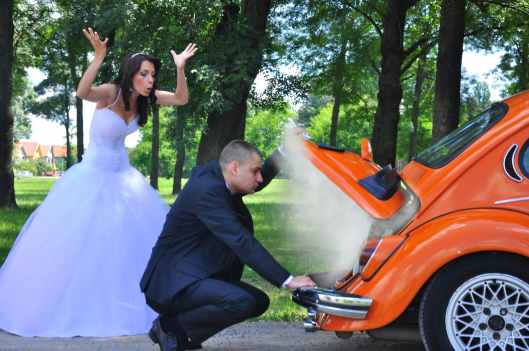
woman in white wedding gown near orange car

Photo by Slobodan Jošić on Pexels.com


The Pattern here specifically focuses on one very common oversight. Systems are often designed under the assumption that everything in the environment of the system is working as it “should” or as intended. This particular type of breakdown was featured in an important theoretical paper authored by Harris and Henderson and presented at CHI 99. That paper claimed systems should be “pliant” rather than rigid. A common example most readers have had with a non-pliant system is to call an organization and be put into an automated call-answering system that does not have the appropriate category anywhere for the current situation but still does not have a way to get through to a human operator.

A telling example from their CHI Proceedings article is that of a paper-based form that was replaced with a computerized system with fixed fields. So, for example, there were only so many characters for various address fields. When someone needed to make an exception to the address syntax with a paper form, it was easy. They could write: “When it’s time to ship the package, please call this number to find out which port the Captain will be in next and ship it there: 606-555-1212.” In the computerized form, this was impossible. In fact, there were so many such glitches that the workers who actually needed to get their work done used the “required” “productivity-enhancing” computer system and also duplicated everything in the old paper system so that they could actually accomplish their tasks.

As part of the effort (described in the last blog post) to get IBM to pay more attention to the usability of its products, we pushed to make sure every development lab had a usability lab that was adequately equipped and staffed. This was certainly a vital component. However, usability in the lab did not necessarily ensure usability in the field. There are many reasons for that and I collaborated with Wendy Kellogg in the late 1980’s to catalog some of those. This effort was partly inspired by a conversation with John Whiteside, who headed the usability lab for Digital Equipment Corporation. They brought people who used a word processor into their usability lab and made numerous improvements in the interface. One day he took some of the usability group out to observe people using the text editor in situ in a manuscript center. They discovered that the typists spent 7 hours every day typing and 1 hour every day counting up, by hand, the number of lines that they had typed that day (which determined their pay). Of course, it was now immediately obvious how to improve productivity by 14%. The work of this group seems to have been inspirational for Beyer & Holtzblatt’s  Contextual Design as well as the Carroll & Kellogg (1989) paper on “Artifact as Theory Nexus.”

fire portrait helmet firefighter

Photo by Pixabay on Pexels.com


Author, reviewer and revision dates: 

Created by John C. Thomas in May, 2018

fullsizeoutput_17

Related Patterns: 

Reality Check, Who Speaks for Wolf?

Abstract: 

When designing a new system, it is easy to imagine a context in which all the existing systems that might interact with the new system will operate “normally” or “properly.” In order to avoid catastrophe, it is important to understand what reasonably likely failure modes might be and to design for those as well.

Context: 

For people to design systems, it is necessary to make some assumptions that separate the context of the design from what is being designed. There is a delicate balance. If you define the problem too broadly, you run the risk of addressing a problem that is too intractable, intellectually, logistically or financially. On the other hand, if you define the problem too narrowly, you run the risk of solving a problem that is too special, temporary, or fragile to do anyone much good.

In the honest pursuit of trying to separate out the problem from the context, it happens that one particular form of simplification is particularly popular. People assume that all the systems that will touch the one they are designing will not fail. That often includes human beings who will interact with the system. Such a design process may also presume that electrical power will never be interrupted or that internet access will be continuous.

Systems so designed may have a secondary and more insidious effect. By virtue of having been designed with no consideration to breakdowns, the system will tend to subtly influence the people and organizations that it touches not to prepare for such breakdowns either.

Problem:

When the systems that touch a given system do fail, which can always happen, if no consideration has been given to failure modes, the impact can be disastrous. Most typically, when the system has not been designed to deal with breakdowns, the personnel selection, training, and documentation also fail to deal with breakdowns. As a result, not only are the mechanisms of the systems unsuited to breakdowns; the human organization surrounding the breakdown is also unprepared. Not only is there a possibility of immediate catastrophe; the organization is unprepared to learn. As a result, mutual trust within and of the organizations around the system are also severely damaged.

architecture building fire exit ladders ladder

Photo by Photo Collections on Pexels.com

Forces:

  • Design is a difficult and complex activity and the more contingencies and factors that are taken into account, the more difficult and complex the design activity becomes.
  • Not every single possibility can be designed for.
  • People working on a design have a natural tendency to “look on the bright side” and think about the upside benefits of the system.
  • People who try to “sell” a new system stress its benefits and tend to avoid talking about its possible failures.
  • It is uncomfortable to think about possible breakdowns.
  • When anticipated breakdowns occur, the people in relevant organizations tend to think about how to fix the situation and reduce the probability or impact of breakdowns for the future.
  • When unanticipated breakdowns occur, the people in relevant organizations tend to try to find the individual or individuals responsible and blame them. This action leaves the probability and impact of future breakdowns unimproved.
  • When people within an organization are blamed for unanticipated system failure, it decreases trust of the entire organization as well as mutual trust within the organization.

* Even when consideration of support for breakdown modes is planned for, it is often planned for late in an ambitious schedule. The slightest slippage will often result in breakdowns being ignored.

Solution:

When designing a system, make sure the design process deals adequately with breakdown conditions as well as the “normal” flows of events. The organizations and systems that depend on a system also need to be designed to deal with breakdowns. For example, people should be trained to recognize and deal with breakdowns. Organizations should have a process in place (such as the After Action Review) to learn from breakdowns. Having a highly diverse design team may well improve the chances of designing for likely breakdowns. 

Resulting Context:

Generally speaking, a system designed with attention to supporting both the “normal” flow of events and likely breakdown modes will result in a more robust and resilient system. Because the system design takes these possibilities into account, it also makes it likely that documentation and training will also help people prepare for breakdowns. Furthermore, if breakdowns are anticipated, it also makes it easier for the organization to learn about how to help prevent breakdowns and to learn, over time, to improve responses to breakdowns. There is a further benefit; viz., that mutual trust and cooperation will be less damaged in a breakdown. The premise that breakdowns will happen, puts everyone more in the frame of mind to learn and improve rather than simply blame and point fingers.

fullsizeoutput_12e0

Examples: 

1. Social Networking sites were originally designed to support friends sharing news, information, pictures, and so on. “Flow” is when this is what is actually going on. Unfortunately, as we now know, social media sites can also not work as intended, not because there are “errors” in the code or UX of the social media systems but because the social and political systems that form the context for these systems have broken down. The intentional misappropriation of an application or system is just one of many types of breakdowns that can occur.

2. When I ran the AI lab at NYNEX in the 1990’s, one of the manufacturers of telephone equipment developed a system for telephone operators that was based on much more modern displays and keyboards. In order to optimize performance of the system, the manufacturer brought in representative users; in this case, telephone operators. They redesigned the workflow to reduce the number of keystrokes required to perform various common tasks. At that time, operators were measured in terms of their “Average Work Time” to handle calls.

In this particular case, the manufacturer had separated the domain into what they were designing for (namely, the human-machine interface between the telephone operator and their terminal) from the context (which included what the customer did). While this seemed seemed like a reasonable approach, it turned out when the HCI group at NYNEX studied the problem with the help of Bonnie John, the customer’s behavior was actually a primary determiner of the overall efficiency of the call. While it was true that the new process required fewer keystrokes on the part of the telephone operator, these “saved” keystrokes occurred when the customer, not the telephone operator, was on the critical path. In other words, the operator had to wait for the customer any way, so one or two fewer keystrokes did not impact the overall average work time. However, the suggested workflow involved an extra keystroke that occurred when the operator’s behavior was on the critical path. As it turned out, the “system” that needed to be redesigned was not actually the machine-user system but the machine-user-customer system. In fact, the biggest improvement in average work time came from changing the operator’s greeting from “New York Telephone. How can I help you?” to “What City Please?” The latter greeting tended to produce much more focused conversation on the part of the customer.

Just to be clear, this is an example of the broader point that some of the most crucial design decisions are not about your solution to the problem you are trying to solve but your decision about what the problem is versus what part of the situation you decide is off-limits; something to ignore rather than plan for. A very common oversight is to ignore breakdowns, but it’s not the only one.

black rotary telephone beside beige manekin

Photo by Reynaldo Brigantty on Pexels.com

3. In a retrospective analysis of the Three-Mile Island Nuclear Meltdown, many issues in bad human factors came to light. Many of them had to do with an insufficient preparation for dealing with breakdowns. I recall three instances. First, the proper functioning of many components was shown by a red indicator light being on. When one of the components failed, it was indicated by one of a whole bank of indicator lights not being on. This is not the most salient of signals! To me, it clearly indicates a design mentality steering away from thinking seriously about failure modes. This is not surprising because of the fear and controversy surrounding nuclear power. Those who operate and run such plants do not want the public, at least, to think about failure modes.

Second, there was some conceptual training for the operators about how the overall system worked. But that training was not sufficient for real time problem solving about what to do. In addition, there were manuals describing what to do. But the manuals were also not sufficiently detailed to describe precisely what to do.

Third, at one critical juncture, one of the plant operators closed a valve and “knew” that he had closed it because of the indicator light next to the valve closure switch. He then based further actions on the knowledge that the valve had been closed. Guess what? The indicator light showing “value closure” was not based on feedback from a sensor at the site of the valve. No. The indicator light next to the switch was lit by a collateral current from the switch itself.  All it really showed was that the operator had changed the switch position! Under “normal” circumstances, there is a perfect correlation between the position of the switch and the position of the valve. However, under failure mode, this was no longer true.

accident action danger emergency

Photo by Pixabay on Pexels.com

4. The US Constitution is a flexible document that takes into account a variety of failure modes. It specifies what to do, e.g., if the President dies in office and has been amended to specify what to do if the President is incapacitated. (This contingency was not really specified in the original document). The Constitution presumes a balance of power and specifies that a President may be impeached by Congress for treasonous activity. It seems the US Constitution, at least as amended, has anticipated various breakdowns and what to do about them.

There is one kind of breakdown, however, that the U.S. Constitution does not seem to have anticipated. What if society becomes so divided, and the majority of members in Congress so beholden to special interests, that they refuse to impeach a clearly treasonous President or a President clearly incapacitated or even under the obvious influence of one or more foreign powers? Unethical behavior on the part of individuals in power is a breakdown mode clearly anticipated in the Constitution. But it was not anticipated that a large number of individuals would simultaneously be unethical enough to put party over the general welfare of the nation.  Whether this is a recoverable oversight remains to be seen. If democracy survives the current crisis, the Constitution might be further amended to deal with this new breakdown mode.

5. In IT systems, the error messages that are shown to end users are most often messages that were originally designed to help developers debug the system. Despite the development of guidelines about error messages that were developed over a half century ago, these guidelines are typically not followed. From the user’s perspective, it appears as though the developers know that something “nasty” has just happened and they want to run away from it as quickly as possible before anyone can get blamed. They remind me of a puppy who just chewed up their master’s slippers and knows damned well they are in trouble. Instead of “owning up” to their misbehavior, they hide under the couch.

Despite the many decades of pointing out how useless it is to get an error message such as “Tweet not sent” or “Invalid Syntax” or “IOPS44” such messages still abound in today’s applications. Fifty years ago, when most computers had extremely limited storage, there may have been an excuse to print out succinct error messages that could be looked up in a paper manual. But today? Error messages should minimally make it clear that there is an error and how to recover from it. In most cases, something should be said as well as to why the error state occurred. For instance, instead of “Tweet not sent” a message might indicate, “Tweet not sent because an included image is no longer linkable; retry with new image or link” or “Tweet not sent because it contains a potentially dangerous link; change to allow preview” or “Tweet not sent because the system timed out; try again. If the problem persists, see FAQs on tweet time-out failures.” I haven’t tested these so I am not claiming they are the “right” messages, but they have some information.

Today’s approach to error messages also has an unintended side-effect. Most computer system providers now presume that most errors will be debugged and explained on the web by someone else. This saves money for the vendor, of course. It also gives a huge advantage to very large companies. You are likely to find what an error message means and how to fix the underlying issue on the web, but only if it is a system that already has a huge number of users. Leaving error message clarification to the general public advantages the very companies who have the resources to provide good error messages themselves and keeps entrenched vendors entrenched.

slippery foot dangerous fall

Photo by Pixabay on Pexels.com

References: 

Alexander, C., Ishikawa, S., Silverstein, M., Jacobsen, M., Fiksdahl-King, I. and Angel, S. (1977), A Pattern Language: Towns, Buildings, Construction. New York: Oxford University Press.

Beyer, Hugh and Holtzblatt, Karen (1998): Contextual design: defining customer-centered systems. San Francisco: Elsevier.

Carroll, J., Thomas, J.C. and Malhotra, A. (1980). Presentation and representation in design problem solving. British Journal of Psychology/,71 (1), pp. 143-155.

Carroll, J., Thomas, J.C. and Malhotra, A. (1979). A clinical-experimental analysis of design problem solving. Design Studies, 1 (2), pp. 84-92.

Carroll, J. and Kellogg, W. (1989), Artifact as Theory-Nexus: Hermeneutics Meets System Design. Proceedings of the ACM Conference on Human Factors in Computing Systems. New York: ACM, 1989.

Casey, S.M. (1998), Set Phasers on Stun: And Other True Tales of Design, Technology, and Human Error. Santa Barbara, CA: Aegean Publishing.

Gray, W. D., John, B. E., & Atwood, M. E. (1993). Project Ernestine: Validating GOMS for predicting and explaining real-world task performance. Human Computer Interaction, 8(3), 237-309.

Harris, J. & Henderson, A. (1999), A Better Mythology for System Design. Proceedings of ACM’s Conference on Human Factors in Computing Systems. New York: ACM.

Malhotra, A., Thomas, J.C. and Miller, L. (1980). Cognitive processes in design. International Journal of Man-Machine Studies, 12, pp. 119-140.

Thomas, J. (2016). Turing’s Nightmares: Scenarios and Speculations about “The Singularity.” CreateSpace/Amazon.

Thomas, J.C. (1978). A design-interpretation analysis of natural English. International Journal of Man-Machine Studies, 10, pp. 651-668.

Thomas, J.C. and Carroll, J. (1978). The psychological study of design. Design Studies, 1 (1), pp. 5-11.

Thomas, J.C. and Kellogg, W.A. (1989). Minimizing ecological gaps in interface design, IEEE Software, January 1989.

Thomas, J. (2015). Chaos, Culture, Conflict and Creativity: Toward a Maturity Model for HCI4D. Invited keynote @ASEAN Symposium, Seoul, South Korea, April 19, 2015.


Author Page on Amazon

“Who Speaks for Wolf?”

09 Tuesday Jan 2018

Posted by petersironwood in America, psychology, Uncategorized

≈ 8 Comments

Tags

Business, Design, environment, family, innovation, learning, life, marketing, Native American, pattern language, politics

IMG_0727

This is the first of many socio-technical “Patterns” in a socio-technical Pattern Language meant to encapsulate best practices for collaboration and coordination. The common “parts” of every Pattern are displayed below in bold. A brief discussion follows the Pattern.

Who Speaks for Wolf?

Author, reviewer and revision dates: 

Created by John C. Thomas on December 17, 2001

A shorter version is included in Liberating Voices by Douglas Schuler.

A longer version was published as an IBM Research Report, 2002.

Reviewed by <John C. Thomas> on <January 9, 2018>

Revised by <John C. Thomas> on <January 9, 2018>


Synonyms 

Engage all the Stakeholders

Abstract: 

A lot of effort and thought goes into decision making and design. Nonetheless, it is often the case that bad decisions are made and bad designs conceived and implemented primarily because some critical and relevant perspective has not been brought to bear. This is especially often true if the relevant perspective is that of a stakeholder in the outcome. Therefore, make sure that every relevant stakeholder’s perspective is brought to bear early.

Problem:

Problem solving or design that proceeds down the wrong path can be costly or impossible to correct later. As the inconvenience and cost of a major change in direction mount, cognitive dissonance makes it likely that the new information will be ignored or devalued so that continuance along the wrong path is likely.

Context: 

Complex problems such as the construction of new social institutions or the design of complex interactive systems require that a multitude of viewpoints be brought to bear. Unfortunately, this is all too often not the case. One group builds a “solution” for another group without fulling understanding the culture, the user needs, the extreme cases, and so on. The result is often a “system” whether technical or social, that creates as many problems as it solves.

The inspiration for this pattern comes from a Native American story transcribed into English by Paula Underwood.

In brief, the story goes as follows. The tribe had as one of its members, a man who took it upon himself to learn all that he could about wolves. He became such an expert, that his fellow tribespeople called him “Wolf.” While Wolf and several other braves were out on a long hunting expedition, it became clear to the tribe that they would have to move to a new location. After various reconnaissance missions, a new site was selected and the tribe moved to the new location.

Shortly thereafter, it became clear that a mistake had been made. The new location was in the middle of the spring breeding ground of the wolves. The wolves were threatening the children and stealing the drying meat. Now, the tribe was faced with a hard decision. Should they move again? Should they post guards around the clock? Or, should they destroy the wolves? And, did they even want to be the sort of people who would kill off another species for their own convenience?

At last it was decided they would move to yet another new location. But as was their custom, they also asked themselves, “What did we learn from this? How can we prevent making such mistakes in the future.” Someone said, “Well, if Wolf would have been at our first council meeting, he would have prevented this mistake.”

“True enough,” they all agreed. “Therefore, from now on, whenever we meet to make a decision, we shall ask ourselves, ‘Who speaks for Wolf’ to remind us that someone must be capable and delegated to bring to bear the knowledge of any missing stakeholders.

Forces:

  • Gaps in requirements are most cheaply repaired early in development; it is important for this and for reasons of acceptance (as well as ethics!) by all parties that all stakeholders have a say throughout any development or change process.
  • Logistical difficulties make the representation of all stakeholder groups at every meeting difficult.
  • A new social institution or design will be both better in quality and more easily accepted if all relevant parties have input. Once a wrong path is chosen, both social forces and individual cognitive dissonance make it difficult to begin over, change direction or retrace steps.

Solution:

Provide a way to remind everyone of stakeholders who are not present. These could be procedural (certain Native Americans always ask, “Who Speaks for Wolf” to remind them) or visual or auditory with technological support.

Examples: 

In “A behavioral analysis of the Hobbit-Orcs problem,” I discovered that people find it difficult to solve a simple puzzle because it appears that they must “undo” progress that has already been made.

As a positive case, some groups make it a practice to “check in” at the beginning of any meeting to see whether any group members have an issue that they would like to have discussed. In “User Centered Design”, and “Contextual Design” methodologies, an attempt is made to get input from the intended users of the system early on in the design process.

In a negative case, we developed a system to help automate “intercept calls” for a telecommunications company. We tested the end users to make sure it was workable. When we went to install the system, however, we learned that the folks in charge of central offices, would not allow our software to be installed until we provided documentation in the same format that they were used to from AT&T. So, we redid all the documentation to put it into the AT&T format. At that point, our lawyers, however informed us that that format was “copyrighted” so we could not simply use it. In this case, although many stakeholders were consulted, we had left out two important constituencies. (Eventually, the system was deployed — the first in the US that incorporated speech recognition into an application on the Public Service Network.

Resulting Context:

When every stakeholder’s views are taken into account, the solution will be improved in quality and in addition, there will be less resistance to implementing the solution.

Rationale:

Much of the failure of “process re-engineering” can be attributed to the fact that “models” of the “is” process were developed based on some executive’s notion of how things were done rather than a study of how they were actually done or asking the people who actually did the work how they were done. A “should be” process was designed to be a more efficient version of the “is” process and then implementation was pushed down on workers. However, since the original “is” model was not based on reality, the “more efficient” solution often left out vital elements.

Technological and sociological “imperialism” provide many additional examples where the input of all the stakeholders is not taken into account. Of course, much of the history of the US government’s treatment of the Native Americans was an avoidance of truly including all the stakeholders.

A challenge in applying the “Who Speaks for Wolf” pattern is to judge honestly and correctly whether, indeed, someone does have the knowledge and delegation to “speak for Wolf.” If such a person is not present, we may do well to put off design or decision until such a person, or better, “Wolf” can be present.

Related Patterns: 

Radical Co-location (Provided all stakeholders are physically present in the radical co-location, this tends to insure that their input will be given at appropriate times).

Known Uses:

As a variant of this, a prototype creativity tool was been created at IBM Watson Research Center. The idea was to have a virtual “Board of Directors” consisting of famous people. When you have a problem to solve, you are supposed to be reminded of, and think about, how various people would approach this problem. Ask yourself, “What would Einstein have said?” “How would Gandhi have approached this problem?” And so on. The original prototype consisted of simple animations. Today’s technology would allow one to develop a raft of chat-bots instead.

References: 

Thomas, J. C. (1974). An analysis of behavior in the hobbits-orcs problem. Cognitive Psychology, 6(2), 257-269.

Thomas, J.C. (1996). The long-term social implications of new information technology. In R. Dholakia, N. Mundorf, & N. Dholakia (Eds.), New Infotainment Technologies in the Home: Demand Side Perspectives. Hillsdale, New Jersey: Lawrence Erlbaum.

Thomas, J.C., Lee, A., & Danis, C (2002). “Who Speaks for Wolf?” IBM Research Report, RC-22644. Yorktown Heights, NY: IBM Corporation.

Thomas, J.C. (2003), Social aspects of gerontechnology.  In Impact of technology on successful aging N. Charness & K. Warner Schaie (Eds.). New York: Springer.

Underwood, Paula. (1983). Who speaks for Wolf: A Native American Learning Story. Georgetown TX (now San Anselmo, CA): A Tribe of Two Press.

IMG_5572

Discussion. 

I have personally found this pattern to extremely useful in a variety of social and business situations. In some ways, it seems like “common sense” to get the input of everyone touched by a decision. But we live in a very “hurried” society as I earlier examined in the Blog Post “Too Much.” I’ve seen many projects hurried through design and development without taking a sufficient look at the possible implications for various stakeholders. There is currently what I consider a reasonable concern over what the impact of AI will be. But other technologies on the horizon such as biotechnology and nanotechnology also need to be thought about. As we examined in a whole series of blog posts in the fall of 2017, social media have had huge unintended (and negative) consequences.

I’ve also been involved in “cross-cultural issues” in Human-Computer Interaction (HCI) and in how HCI impacts people and societies in other cultures. Even relatively simple technologies like dishwashers, microwaves, and cars often have considerable unanticipated social consequences. It is not only the “fair” thing to involve everyone who will be seriously impacted; it will ultimately result in faster progress with less strife.

I’m very interested in other people’s experiences relevant to this Pattern.

IMG_9829


“Turing’s Nightmares” – scenarios of possible AI futures.

Special Spaces & Wonderful Places

07 Sunday Jan 2018

Posted by petersironwood in America, apocalypse, psychology, Uncategorized

≈ 24 Comments

Tags

Design, environment, learning, life, pattern language, politics, school

IMG_4695

When you think back to your childhood, no matter how luxurious, dilapidated, or war-torn that  childhood might have been, I’m guessing that like me, you had some particular places that you loved. Perhaps they stayed secret to you; perhaps you shared only with one or two chums. Somehow, those specific places held a kind of magic for you as they did for me. I will just point out a few examples from my own childhood.

Grandpa’s basement, for instance, though dark and dank, held a printing press made of cast iron. Although he cautioned me not to play with it because, he insisted, it was not a plaything but an important tool, I nonetheless found opportunity to move the gigantic heavy four handled wheel, having first carefully noted the exact position in order to return it just as I had found it. In some way beyond my comprehension as a child, I knew this press was something magical. It was, after all, involved in printing. I recall years later seeing a picture of Benjamin Franklin with just such a printing press. And, even as a very young child, I knew that printing held great power. Beyond that, the object itself loomed and commandeered that entire corner of the basement. I knew it was heavy beyond imagining, and not just in the epistemological sense. I could judge the weight of the entire machine from how hard it was to turn the wheel which, though heavy, comprised only a small fraction of the entire press. Cast iron also has this magical texture which seems to inhale light out of the surrounding region like a giant beast. Perhaps best of all, and what appealed to the engineer in me, the machine’s form and function flowed beautifully together. Compare that with a modern automobile, for instance. What it actually does is largely hidden in the design. This goes along with branding, and advertising, and customer loyalty and so on. A modern car does not typically marry form and function nearly so nicely as did that printing press.

IMG_5135

On the “side yard” of our house on North Firestone Boulevard, three tulips shot up every spring, so colorful and perfect, not to mention mysterious. Where did they come from every year? How could this rounded plant of petals have a three pointed star inside!? On more than one occasion, I caught sight of a butterfly feasting on the pollen within. This place was cool patly just because adults always seemed hell-bent on the next task or chore. So, while this tiny patch of ground technically belonged to the whole family, in fact, I’m the only one who enjoyed it for more than a casual glance. I smelled and touched and explored every vein in that tulip. I watched butterflies do their drunken dance and tried (and largely failed) to predict when and where they would next alight.

IMG_7660

At David Hill Elementary School, the sandstone retaining wall provided another special place. With a lot of work, kids like me could turn sandstone into sand. And we did. With work, we even made tunnels. At one point, we stuffed a grasshopper into a tunnel, covered the entrance,  and watched for him until he eventually hopped out ten feet away! For a long time, none of the adults seemed to pay much attention to the fact that we were slowly but quite assuredly destroying the retaining wall which kept our school and its landscaping from falling into the playground below. Sadly, at some point, the gravely voice of the principal, which always seemed to be enveloped in the black death robes of a priest at a funeral, informed us that we were now forbidden to play in or on the wall.

When we moved to Ellet, these special places disappeared from consideration but were immediately replaced by a much grander array of them. Right behind our house lay a forest! That forest sported a spring of fresh water coming right out of the ground, two gigantic elm trees wrapped in thick hair cables of poison ivy vines, an oak with a swinging grape vine and a creek. Eventually, I came to know the special places of the creek where you could put in bark “boats” and have the longest races ad the places where you could cross with the least chance slipping on a loose stepping stone and dousing your entire body. Depending on the temperature, that might or might not be all that uncomfortable, but it would inevitably be followed by something that was definitely uncomfortable — being punished by your parents for getting your clothes all wet. Now, it must be said, that when I had done this terrible deed of getting my clothes all wet, the first thing they did with those clothes was to put them in the washer where, yes, they would get wet. Hmm. Part of what makes these some of these special places special is that they radiate event streams outward into your lives. And, the feeling or inspiration or information or decisions that come from these special places need not be confined there. We draw comfort from them, even if we know we will never visit them again.

We all know that some places “feel right” – there is something about them that seems mysterious, beautiful, awe-insipring, calming, or exotic. But what makes a place “good” or “special”? Partly it is individual experience, no doubt, but partly it is the environment itself. So what is it about form and texture and organization that makes a place special? That is an interesting question that seems to have intrigued Christopher Alexander as well. Alexander and a team of collaborators looked at places that “worked” from around the world. The result was a book called “A Pattern Language.” They formalized, to a large extent, intuitions of what makes a place “special”; what makes it “work.”

OLYMPUS DIGITAL CAMERA

OLYMPUS DIGITAL CAMERA

Each actual pattern is pretty elaborate, but I can give a few examples to illustrate the point. One of the Patterns is called “European Pub” which has activity around the edges and large tables. This helps people socialize. The activity around the edges gives people an excuse to circumnavigate the room. The large tables mean that there is room for “legitimate peripheral participation.” If I’m new in town, I can sit somewhat away from everyone but still within earshot. When someone says something I can relate to, I jump into the conversation. This arrangement is much more conducive to socialization than many American bars which feature stools all facing a TV. This does not encourage interaction.

Another Pattern points out that a small town near a big city should put its “center” placed eccentrically toward the city. This makes it more convenient for a larger number of commuters to stop at local stores on their way to the city and back.

These are both gross over-simplifications of the actual patterns, but I think they convey something of what is being aimed at. There is a belief that these patterns would generally “work” in any religious, cultural, geographic, or political context. These patterns are really meant to focus on the invariants across a large number of details. In that way, they make design problem solving more effective. You will be less likely, so goes the claim, to be exploring parts of the design space that are far removed from optimal if you think about things in terms of these patterns.

A “Pattern Language” purports to take a useful middle ground. The patterns are abstract enough to be widely useful but narrow enough not to be meaningless. A “Pattern” is the named solution to a recurring problem. A “Pattern Language” is a lattice or web of Patterns that largely covers a field. Christopher Alexander coined the term after he and his colleagues went around the world to see what “worked” in terms of city planning, house design, building design, neighborhood design, the building process and so on. I think nearly everyone will find “A Pattern Language” a fascinating book.

The impact of A Pattern Language, however, extends far beyond architecture and urban planning. People have found the concept of a “Pattern Language” useful in many other domains. Perhaps the best known such domain is in Object-Oriented Programming with the so-called “Gang of Four” authoring many of the original books on the subject. Other domains which have been addressed with “A Pattern Language” include pedagogy, human-computer interaction, change management, e-business, sustainability, and how society might evolve.

I became interested in Pattern Languages at least 20 years ago and have since co-organized and co-led a number of workshops on patterns in “Computer Human Interaction” as well as “Socio-technical Patterns” including working on patterns for “Liberating Voices: A Pattern Language for Communication Revolution” and chapter 19 in John Carroll’s book on design rationale, “Patterns for Emergent Global Intelligence.”


In 2017, I recounted in this blog  childhood memories and how they relate to what is happening in today’s world. To summarize briefly, we have great opportunities as a species but we are also in a train wreck of trouble! We seem trapped in a nightmare of a comic farce, but one which has tragic consequences of potentially epic proportions; e.g., atomic war or having the USA walk away from the Paris accords on climate change. Is anything to be done?

IMG_1245

What I want to accomplish in the first half of 2018 is to generate interest in the beginnings of a socio-technical “Pattern Language” that can help us get back on track again. I’ll post some of the ones I know about, but I’d be very interested to work with people on other suggestions.  In most cases, even when I post patterns it will be the case that I did not “invent” the patterns from first principles or construct them myself. In the same way that Christopher Alexander and his team main observed what worked and only then attempted to codify generic best practices into a “Pattern Language,” I also found many of these from observation or reading other sources or both. For example, the patterns, “Who Speaks for Wolf?” and “The Iroquois Rule of Six” are not by any means my inventions. I learned about them from the works of Paula Underwood. She was the “designated storyteller” of her branch of the Iroquois and provided an English transcription of the oral history of that branch in The Walking People. Indeed, I have argued that the “Walking People” basically developed a kind of pattern language in their oral history.

https://www.amazon.com/Walking-People-Native-American-History/dp/1879678101

https://www.slideshare.net/John_C_Thomas/the-walkingpeople

https://www.slideshare.net/John_C_Thomas/walking-people-analysis

A Pattern Language is a difficult business.  For maximum utility, each pattern has considerable thought behind it and is written into a specific form. In fact, at one CHI workshop, we developed an XML specification for patterns in Human Computer Interaction called (Pattern Language Markup Language) PLML (pronounced “pell mell”). I will not be quite this formal with the form of my patterns but will adhere as closely to it as practical. I do think that the form of the Patterns within a Pattern Language is important. Each of the parts serves a purpose and it is handy to know what role each part plays. For example, each Pattern has at least these parts: A Title,  (possibly subtitled), synonyms, a Version history, one or more Authors, an Abstract, a statement of the problem, a statement of the context in which the problem and solution arise and are appropriate, an analysis of the “Forces” at play, the Solution, Examples, the Resulting Context, Known Uses, Related Patterns, and References. For many people, having such a complex structure seems to be too much “baggage” but we must remember that design problems are themselves inherently complex. In addition to textual elements, the Patterns of Christopher Alexander include both photographic images to “set the mood” and, typically, at least one diagram to illustrate the general nature of the pattern.

The domain I am most interested in developing a Pattern Language for is perhaps most often labelled as a “Socio-technical Pattern Language.” These would be a collection of patterns that would help people cooperate, collaborate and solve problems together. Although the fabric and texture, perhaps even the scent, of endeavors would depend on culture, the field, current events and a host of other factors; however, the form of these solutions to recurring problems would remain roughly constant.

Next up: An Example. “Who Speaks for Wolf?”

—————————————————————————

https://petersironwood.wordpress.com

The Blog in Review

28 Thursday Dec 2017

Posted by petersironwood in America, family, Uncategorized

≈ 1 Comment

Tags

competition, environment, history, index, innovation, life, military, politics

IMG_0005

Year End Summary (2017) and Index of Peter S Ironwood Blog. (Several readers mentioned that the wordpress navigation structure may leave something to be desired. Hopefully, for some readers, the following index may be helpful). Many of these blog posts are not meant as the “final word” on these subjects. I am hoping people can use them as a “jumping off place” for conversation with their neighbors, students, and colleagues.

Trumpism is a New Religion. 

Astounded that more than 15 people voted for Trump, the year began with my attempts to understand my error(s). It was about this time that I saw more and more evidence that many Trump supporters were impervious to his most outrageous, incompatible, or nonsensical acts, tweets, and pronouncements. My explanation is that for some, Trumpism is really more of a religion than a political movement. This still seems correct to me. Others, have completely different reasons for voting for Trump. For some, for instance, I really think they have seen zero change in their lives regardless of who is President and they have seen promises never kept by both parties. As a result, for them, the President is seen as “Chief Entertainment Officer” and Trump provides plenty of that. In terms of a religion, Trumpism is much more compatible with the values inherent in modern day business than is Christianity. In essence, in fact, Christianity is incompatible with business values. So, it’s quite understandable that Trumpism has become popular.

https://petersironwood.wordpress.com/2017/01/09/trumpism-is-a-new-religion/

The Crabs are Biting. 

The next blog post returns to a retrospective look at some of my childhood experiences and thoughts about how these experiences shed light on current events. In this case, I recount various “fishing” experiences and how seriously children think about the world. Are fish the only animals that can be caught with bait?

https://petersironwood.wordpress.com/2017/01/17/the-crabs-are-biting/

Parametric Recipes and American Democracy. 

A parametric recipe is my term for recipes that allow for a variety of ingredients. I like to make omelets, for instance. There are many different vegetables and cheeses that can be incorporated. The exact ingredients and proportions don’t matter. But there are things you would never want in any omelet – toxins, poisons, and things that simply make you sick to your stomach. Have we forgotten what is unacceptable in a democracy?

https://petersironwood.wordpress.com/2017/02/11/parametric-recipes-and-american-democracy/

Big Zig-Zag Canyon. 

This post begins with a recounting of a hike on Mt. Hood, near Portland, Oregon (which coincidentally is one of my favorite cities). The post is about how one’s expectations can be wrong about just how hard things can get — over and over.

https://petersironwood.wordpress.com/2017/02/20/big-zig-zag-canyon/

The Invisibility Cloak of Habit.

With experience we learn. That’s the good news. In some cases though, our previous experience leads us astray. In fact, in some cases, our previous experience just about blinds us to what is going on right before our eyes.

https://petersironwood.wordpress.com/2017/02/25/the-invisibility-cloak-of-habit/

City Mouse and Country Mouse.

At least in the USA, I know that a spectrum of political opinions occurs everywhere but that one of the greatest correlates of differences is whether a person lives in a rural or urban area. I don’t believe one of these venues is, in every way, superior to the other, but it does seem that the different situations should logically lead to different values that work well in that venue. 

https://petersironwood.wordpress.com/2017/03/04/city-mouse-and-country-mouse/

Math Class: Who Are You?

It strikes me that part of what feeds pathological greed — and perhaps as well the greed that we all fall prey too — is partly the result of a serious misconception about who we are and our relationship to the rest of the living earth.  Here are some back of the envelope calculations to put things in a more reasonable perspective.

https://petersironwood.wordpress.com/2017/03/09/math-class-who-are-you/

The Great Race to the Finish!

Every human activity has both an instrumental/extrinsic value and an experiential/intrinsic value. In most cases, doing something as quickly as possible reduces its intrinsic value. It may or may not increase its extrinsic value although the financial interest behind the “Captains of Industry” always assume it does. Most of us are in something of a hurry most of the time. Why? Does it really make our lives more pleasurable? And, where are we rushing to?

https://petersironwood.wordpress.com/2017/03/24/the-great-race-to-the-finish/

Ripples.

Our decisions have long-lasting, perhaps eternal, consequences. Even mechanical ripples last a long time, but another human can multiply the input given a hundred fold so that the effect of any action can increase over time. Individual decisions can actually impact the evolution of the species as well.

https://petersironwood.wordpress.com/2017/04/11/ripples/

 Family Matters: Parts One, Two and Three.

A three part series exploring how the happenstance of our birthplace (over which we obviously have no control) has a huge and lasting influence on our lives.

https://petersironwood.wordpress.com/2017/04/30/family-matters-part-one/

https://petersironwood.wordpress.com/2017/05/11/family-matters-part-two-garlic-cloves-and-puffer-fish/

https://petersironwood.wordpress.com/2017/05/27/family-matters-part-3-the-whole-is-greater-than-the-sum-of-its-parts/

Claude the Radioman.

Claude refers to a toy soldier whose function was communication. As a small child, it was my least favorite because it had no weapon. As an adult, I think he has the most powerful one of all.

https://petersironwood.wordpress.com/2017/05/28/claude-the-radio-man/

Citizen Soldiers: Parts 1, 2, and 3. 

A three part series on the premise that, like it or not, we are all soldiers. Of course, it’s different to be in the actual military and be at a front. But, we are soldiers in the sense that we are at risk pretty much everywhere mainly from other human beings. We are soldiers as well in the sense that our actions are important determiners of the outcome. We need to be smart as well as loyal.

https://petersironwood.wordpress.com/2017/06/07/citizen-soldiers-1-early-enlistment-no-retirement/

https://petersironwood.wordpress.com/2017/06/16/citizen-soldiers-part-two-boot-camp/

https://petersironwood.wordpress.com/2017/06/24/citizen-soldiers-3-galoshes-in-the-gutters/

Pies on Offer: Rhubarb & Mincemeat.

Are you focused on grabbing the biggest piece of pie you can? Or, are you more interested in baking more pies and inventing new kinds of pies?

https://petersironwood.wordpress.com/2017/07/20/pies-on-offer-rhubarb-mincemeat/

What if … ?

A speculation that in reality, Americans have much much more in common with each other than they think they do. The politicians and the media both have a vested interest in making people think they are farther apart on more issues than they really are.

https://petersironwood.wordpress.com/2017/07/21/what-if/

If Only…

This is a work of “pure fiction” however — the protagonists and their “back stories” are true. This is a story that takes place in a nearby but parallel universe.

https://petersironwood.wordpress.com/2017/07/28/if-only/

Only You…

An examination of our responsibilities and the impact of our actions.

https://petersironwood.wordpress.com/2017/08/08/only-you/

You Fool!

A recounting of some of the many ways in which we humans are subject to being fooled.


https://petersironwood.wordpress.com/2017/08/15/you-fool/

Fool Me!

Mainly, this post focuses on the power of stories. There is an ethical difference, at least to me, between presenting a fascinating or inspiring story and presenting the same story as fact.

https://petersironwood.wordpress.com/2017/08/24/fool-me/

Me Too. 

This post is about the natural tendency of people to want to be part of a larger social action. Most people drive in stop-and-go traffic in a non-optimal way. This offers a better method.

https://petersironwood.wordpress.com/2017/08/27/me-too/

Too Much!

Human productivity does not go up monotonically with increasing stress. Studies have been around for decades showing that people are more productive working 30 hours a week than 50. Why do so many companies then push for 50 or more hours a week?

https://petersironwood.com/2017/09/03/too-much/

Much Lost.

Why do we grieve at the loss of another? Why do we even get attached to objects?

https://petersironwood.wordpress.com/2017/09/10/much-lost/

Lost Horizons. 

Have we modern humans lost our ability to make decisions based on a very broad, very long-term look? Doesn’t it seem natural for every generation of every species to try to make life better for the next?

https://petersironwood.wordpress.com/2017/09/17/lost-horizon/

Horizons University. 

What would it be like to build a University that focused on expanding a person’s horizons in every dimension they would be interested in? What if it focused on finding, and formulating as well as solving problems using existing knowledge and procedures?

https://petersironwood.wordpress.com/2017/09/25/horizons-university/

You Know. 

Which wolf do you feed? The “bad” wolf or the “good” wolf. Of course, sometimes, decisions involved complex trade-offs, but sometimes we “know” what the right thing to do is and instead do the convenient or selfish thing.

https://petersironwood.wordpress.com/2017/10/02/you-know/

Know What? 

The first of a series of blogs that considers how various aspects of social media, combined with anonymity, not having face to face communication (with its abundant affordances), the concentration of much of the media control in a few very large multi-nationals, the filtering and bandwagon algorithms of social media, and other factors all conspire to further divide people.

https://petersironwood.wordpress.com/2017/10/08/know-what/

https://petersironwood.wordpress.com/2017/10/16/whats-new/

https://petersironwood.wordpress.com/2017/10/23/new-fools/

https://petersironwood.wordpress.com/2017/10/31/fools-gold/

Gold Standard.

Every age has its pluses and minuses. Some folks today seem to feel we’ve moved too far too fast and that we should “rewind” to a better time. Interesting, but there hasn’t been a better time. The world today is hugely complex and inter-dependent. That’s the way it is. If we try to obviate all that interdependence, we will not go back to 1950 or 1890 but back to 5000 BC. Instead, what can we do to encourage civility and to distinguish news versus fake news?

https://petersironwood.wordpress.com/2017/11/07/gold-standard/

Standard Issue. 

What are some ways that social media could be changed to encourage greater civility?

https://petersironwood.wordpress.com/2017/11/13/standard-issue/

Issue Resolution.

Perhaps the experience of others was different, but I learned very little in formal school classrooms about ways to resolve conflicts. Yet, much is known beyond simple compromise, using external authority or force of arms. This posts focuses on some of those with pointers to longer descriptions of the techniques.

https://petersironwood.wordpress.com/2017/11/19/issue-resolution/

Resolution: Create! 

This post encourages a more creative look at issue resolution. I believe that more progress can be made by people working together than by even a 10x increase in Facebook posts to convince everyone else that they are wrong.

https://petersironwood.wordpress.com/2017/11/26/resolution-create/

Create Peace.

First of a series of blogs about the pros and cons of war and peace. Spoiler alert: war is a horrible option. We really need to get our act together to do better. People sometimes have trouble reaching agreement, but that process should be facilitate by diplomatic experts and leaders who are looking at the big picture. Some so-called “leaders” are intent on consolidating and extending their own power. Historically, that’s when power-hungry people declare war. Some might label such people SHRUGS – Super-Hyper Really Ultra Greedy Swindlers.

https://petersironwood.wordpress.com/2017/12/05/create-peace/

https://petersironwood.wordpress.com/2017/12/13/peace-love-part-one-casualty-count/

https://petersironwood.wordpress.com/2017/12/14/peace-and-love-part-2-shrugs-shills/

https://petersironwood.wordpress.com/2017/12/16/peace-love-3-shrugging-off-the-shrugs/

https://petersironwood.wordpress.com/2017/12/20/love-all/

All…what? 

Where are we headed? Is there any hope? I would say yes though we are in dark times. The light will return, if not today or tomorrow, some day.

https://petersironwood.wordpress.com/2017/12/25/all-what/


author page on Amazon

IMG_0561

Peace & Love, Part One: Casualty Count.

13 Wednesday Dec 2017

Posted by petersironwood in America, apocalypse, psychology, Uncategorized

≈ 3 Comments

Tags

environment, hate, learning, life, love, peace, war

Peace and Love: Part One (War Casualties).

(In response to suggestions from a few readers, I am trying a slightly new format of much shorter and more frequent posts; we’ll see how that works, for me and for readers.  Feedback welcome on that or anything else.)

IMG_5197

To some readers, “Peace and Love” reminds you, as it does me, of slogans from the 1960’s. It arose in response to the war in Vietnam which President Johnson led us into full-bore with a lie about the Gulf of Tonkin. That war produced over 58,000 American deaths.

https://www.archives.gov/research/military/vietnam-war/casualty-statistics.html

There were also more than a few American citizens who were wounded physically and a great many who were wounded mentally as well as their families.  It also resulted in millions of Vietnamese casualties.

https://www.britannica.com/event/Vietnam-War

However, the loss of lives did allow Vietnam to remain a free and democratic nation. Wait. Wait. No it didn’t. Vietnam became communist and sadly Vietnam was only the first “domino to fall.” Now, all of Asia is communist. Oh, wait. No it isn’t. I’m sorry. I’m confused. How could “the greatest” nation on earth spend nearly a trillion dollars (in current dollars) and kill so many lives and end up losing the war?

How Much Did The Vietnam War Cost?

mandibles

And how could the fall of Vietnam not result in Japan and South Korea and Singapore and India becoming communist once this first domino nation fell? What happened to the other dominos?  I’ll tell you how. In war, truth is the first casualty.

https://www.theguardian.com/notesandqueries/query/0,5753,-21510,00.html

We were lied to in order to get enough support to get us into the war and we were lied to continuously about the likely consequences of losing the war and about the progress of the war. What would our lives be like now in America, let alone Vietnam, if all the money we poured into the war had instead gone into advances in science, medicine, technology, infrastructure and education?

iPhoneDownloadJan152013 1150

Not only were there many protests about the war in America; there were actually candidates who ran mainly on a platform to end the war. Some may recall the names of Eugene McCarthy and George McGovern who ran on peace platforms. You may also recall that Hubert Humphrey, who had been Johnson’s Vice President obtained the nomination of the Democratic Party via shenanigans at the convention in Chicago. Meanwhile, the Chicago police beat up peaceful demonstrators outside the convention. Humphrey would have won the nomination, most likely, even if the people in charge of the Democratic Party had allowed the McGovern camp to speak their piece. I was so pissed off at the senseless violence perpetrated by the police against peaceful demonstrators that I found myself sorely tempted to vote for the Republican candidate in protest. He had a “secret plan” so he claimed, to end the war in Vietnam.

Richard Nixon did get voted in as President and I did vote for him even though I was skeptical that he actually had a secret plan. But he did! He did have a secret plan to end the war. The plan was to give up. Yeah, there were more deaths and more lies along the way, but basically his secret plan was to give up. Well, that and rely on “dirty tricks” to secure his power. I was mistaken to vote for Nixon. He was impeached and he was a liar and he was, despite his protestations to the contrary, a crook. (My “revenge” vote against the establishment of the Democratic Party didn’t really work.) However, whatever faults Nixon might have had, he was a paragon of virtue compared with #45.

David's DreamDeeply

At least America learned a good lesson. Before going into a costly war, we now make sure we know the real facts. And so, before Bush got us into the second Iraq war, Republicans and Democrats worked together to make absolutely positively sure that the Iraqis really did have “weapons of mass destruction.” Oh wait. I am so sorry. I got confused again! No, we didn’t. We had a Vice President with financial interests in having a war in the Middle East. We had rich old men who had cheated their ways to fortunes who hoped to cash in on even more oil money through the war. And so they did. A small price to pay — a few tens of thousands of American deaths and a few hundreds of thousands of Iraqis killed and maimed. There seems to be no consensus on the exact numbers.

https://en.wikipedia.org/wiki/Casualties_of_the_Iraq_War

https://www.reuters.com/article/us-iraq-war-anniversary/iraq-war-costs-u-s-more-than-2-trillion-study-idUSBRE92D0PG20130314

At least now, there is finally a unified and peaceful Iraq though so maybe it was worth it. Oh, wait. Damn! Something in the water must be muddying my memory because, no, there isn’t a peaceful, democratic and unified Iraq. How could the “greatest nation on earth” spend two trillion dollars on a war and end up gaining nothing from it? I guess we just sacrificed all that money that we could have spent on education, keeping our bridges and roads from collapsing, researching cures to cancer and other diseases for the benefit of Iraqis. That is really quite remarkably altruistic of us. But I guess it was worth it because now, as everyone knows, the middle east is at last at peace. Democracy everywhere! Or, at least everywhere except Iran, Iraq, Saudi Arabia, Egypt, Syria and maybe a dozen other places. Apart from the lack of success in meeting our objectives…which were what exactly? Anyway, apart from meeting our objectives, it wasn’t that big of a deal because all we lost were wealth and human lives and limbs and a working infrastructure for Iraq. Oh, there is the continuing cost of medical and psychiatric care for Gulf War vets and the impact the war had on their families and our national debt, but hey. Every success requires sacrifice, right? Or, to put it in slightly more exact terms, every success for the transfer of wealth from the middle class and poor to a few extremely wealthy people requires sacrifice on the part of ordinary citizens who don’t really count for much anyway because, well, if they really counted for anything, they’d already be wealthy! If they really counted for anything, they sure as hell wouldn’t be off fighting a war where other people were shooting at them! They’d be in the National Guard doing nothing. Or, they’d be excused from military service because of a severe medical problem such as heel spur which might, luckily enough, heal later.

fullsizeoutput_120c


Author Page on Amazon

Fool’s Gold

31 Tuesday Oct 2017

Posted by petersironwood in America, apocalypse, psychology, Uncategorized

≈ 2 Comments

Tags

commercialism, competition, environment, ethics, family, life, morality, values

IMG_5126

Fools Gold

The Lost Sapphire

(Appeared summer 1997 in the e-zine, The Empty Shelf, slightly re-edited, here).

I can’t recall how that giant blue sapphire first veered into the orbit of my life. Of course, even at five years, I knew it might not be a real sapphire; at least, that’s what my parents insisted. They called it “just glass.” But, they might just possibly be wrong, I secretly thought. After all, I could look into it forever. And, if I looked real hard, I could see the dim, midnight blue outline of things beyond and through the stone, transformed by the magic of the stone into something quite out of the ordinary; something heavenly, mysterious, almost certainly good rather than evil. Almost. And, so far as I could tell, my parents never actually saw the stone; certainly they never looked through it. They’d just glance at it and say, “Oh, yeah, it’s blue glass.”

Well, it seemed to me that it could very well be a real sapphire. Besides making things look beautiful, there was something else — something mom and dad never even tried to understand. It was this. If something happened I didn’t like; if I were sad because my dog was “put to sleep” or scared of getting a shot, I could look at this sapphire and it made me feel better! It made it all, “Okay.” If I listened carefully, it spoke wordless tales of wisdom and comfort. It was obviously worth a lot, lot more than my parents knew.

True, there was a tiny chunk broken out of one corner. But that didn’t really matter. The stone was still perfect…perfect: something to be kept forever.

Forever, that is, until Jimmy moved next door. Jimmy was ten years old and had a two-wheeled bike. Jimmy towered up nearly as thick and high as an adult. But Jimmy was still young enough to see the powerful magic in the sapphire. One bright Saturday morning, on the green grass of the “devil strip” between the white sidewalk and the forbidden black street where the deadly cars zoomed, I sat in the grass watching the magic sapphire, listening for its words of wisdom. Jimmy rode up and tossed his bike onto the devil strip and hopped off in one smooth move. He plopped down beside me. He flashed the red reflector from his bike in the sunlight. Oh, how it sparkled into my eyes!

“Do you want this ruby?” asked Jimmy innocently.

“Oh! Okay. Thanks!”

Jimmy handed it to me and let me flash it in the sun. It was so much brighter than the sapphire! It sparkled fire!

“Great,” said Jimmy, “Let me have the sapphire.”

He snatched it from the grass where I had lain it, jumped up sped away on his bike.

I stared dumbly at his vanishing figure, then back down at the red reflector in my hand. Maybe this was a good trade after all, I thought. It was really bright all right. And when you moved it in the sun, it made different starburst patterns. After all, it had come from a full-sized two-wheeler. But still…something was missing. Then, a buzzing filled my ears. I suddenly realized that the reflector was just pretty glass! There was no magic to it. It didn’t speak; it just buzzed its foolish empty buzz. I couldn’t look through it to other things. It had no depth. And worst of all, it could never make anyone feel better, not even a little bit. “I thought you meant…for a minute…” I said to the big kid now behind his own front door.

I considered telling my mom and dad. Maybe they could get the sapphire back! I hated telling them. You just don’t tell parents about kid troubles; it’s against the main unwritten law of being a kid. But maybe they could get my sapphire back! When I finally told them what had happened, they said, “Well, you made a trade.” I tried to get Jimmy to trade back, but he had none of it. Jimmy soon moved away, never to be seen again. But I kept the red reflector — not to look at — because that would seem somehow unfaithful to the spirit of the sapphire — but just in case Jimmy came by one day wanting to trade back.

And later, much later, I used my allowance to buy special clear marbles — called “Peeries” — emerald green and dark blue with bubbles in them, and my dad got me a cool science kit with a clear rainbow prism that threw color into everything, and then one day I looked into the deep, sparking blue eyes of a blond girl named Jennifer and later into the sparkling blue eyes of a beautiful woman named Wendy and then into real diamonds and computer screens and experimental results and statistical analyses and conclusions, insights, and science fiction. And all of those things were good and all of these spoke to me.

Still, I wonder where the blue sapphire is and how to get it back. How to get it back? The magic. Not clever illusion, not something made to look nice, but true magic. Are you out there, Jimmy? Because I still have your red reflector if you want to trade back.

——————————————————————

I don’t know whether society can trade back either. We used to have some kind of balance between competition and the other valuable things about life. We seem mainly to have traded it in on a newer model. In the new model, money is the only thing that matters. Winning is the only thing that matters. Math definitely does not matter. People who are rich and powerful can pretty much get away with anything. The only exception would be someone like Bernie Madoff who was silly enough to include some wealthy people among those he bamboozled. But the Bernie Madoffs of Wall Street that sunk the economy in 2008 walked away scot free.

“All that glitters is not gold.” The normal interpretation of this means that not everything that glitters (like gold) really is gold. Normally, this is meant in a metaphorical way but based on the real phenomenon of “Fool’s Gold” (Iron Pyrite) which does glitter like polished gold but is of far less conventional value.

IMG_4695

I like to consider a different interpretation: What if all gold is “Fool’s Gold”? Naturally, I’m not denying the existence of metallic gold. I’m wearing a (mostly) gold wedding ring. So, I believe in real gold. What is meant is that striving after gold is itself a foolish thing to do. If that’s true, then, it’s all “Fool’s Gold” whether or not it’s Iron Pyrite or Real Gold.

How could this possibly be so? Isn’t life a contest to see who can make the most money? Isn’t money (and before that gold) an easier way to exchange goods and services that having to strike each deal uniquely? It is indeed easier. Does that necessarily mean it’s better?

Society is growing more and more differentiated. We do vastly different jobs from each other. For example, for many centuries, farming was a common occupation. In the USA in 1900, for example, about a third of the entire workforce were still farmers.  Now, that percentage of farmers is about a tenth that. It isn’t only that there are now many different fields such as computer science and forestry. Even within a field such as computer science or forestry, there are more and more subspecialties. It’s as though the tree of humanity is growing larger and larger and branching out farther and farther.

IMG_9489

At the same time, this entire enterprise called “society” is not stable. It is spinning; spinning faster and faster. This means that this whole enterprise will eventually fly apart — unless, the cohesive strength of the whole enterprise continues to increase. Unfortunately, it seems that just when we need to increase that bonding strength, it is weakening.

What is the real gold? Anything that strengthens the ties is real gold. Anything that weakens the ties will tend to cause the entire enterprise to disintegrate. Even if some bars of heavy shiny metal accrue to those who strive to break us apart, they are causing overwhelming harm to others, including generations and generations of their own offspring.  The last time, the European Dark Ages occurred, it last centuries. Science, engineering, agriculture, learning, medicine — all these things were worse for a half millennium before they started to get better again. Meanwhile, the toll in terms of human misery was immense. And for what?

IMG_6881

Our fall from the advanced civilization to the next Dark Ages will be a much harder fall than what much of Europe experienced after the fall of Rome. People in a Roman society were closer to the land and to the world of real things than many people are today. Many moderns in the so-called Global North have no idea how to live off the land, plant a garden, hunt or fish. Even if they did, we wouldn’t be close to being able to feed 7 billion people without modern agriculture, distribution, knowledge of crops, irrigation systems.

My history lessons focused on Western Europe and the United States, so when I think of the “Dark Ages”, I think in terms of Western Europe. But we should remember that that minimal impact, for instance, on most of the people of the planet at that time including North and South America, Australia, most of Africa, and most of Asia. This time, it would be different. Such a catastrophic Dark Ages would today be global. No-one would really escape.

IMG_7168

No-one would escape the new Dark Ages and that includes extremely rich and powerful people. Yes, they could have more absolute power over other people as a Newmedieval Tyrant than as the leader of a democracy. And, granted, that may be the most important thing in the life of that kind of person. But it isn’t the only thing. They have no idea how inconvenienced every other aspect of their life would be if civilization fell.

We, as a species, are not “set up” for the Dark Ages. There are way, way too many to feed without the science and engineering behind today’s agricultural processes. There are way too many to obtain fresh water without modern infrastructure. Of course, it isn’t just that we are physically unable to deal with this kind of downfall. We are nowise prepared mentally either. Most of the knowledge we currently have for living in a complex, technological society would be completely useless and we’d know very little of what we should actually know in order to survive.

Maybe hell is not the punishment for one person’s life of sin, but the collective punishment wreaked upon all of our descendants for the collective current sins of humanity. After all, isn’t extinction a kind of hell for the species? We wouldn’t be the first extinguished species. Not by a long shot. Most of them were “hit without warning” by the after-effects of a meteor or a met by a human-powered bulldozer clearing away amazing rain forests for a few more bars of fools gold.

I know one thing for certain. Jimmy’s not coming back to trade you back what you really care about for that shiny red reflector that caught your momentary eye.


Author Page on Amazon

You Know

02 Monday Oct 2017

Posted by petersironwood in America, family, psychology, story, Uncategorized

≈ 15 Comments

Tags

character, ecology, environment, ethics, Native American, resonsibility, science


David's DreamDeeply


You know perhaps of various versions of the story of the “two wolves” that live within us. I have heard it various ascribed to Native Americans of the Dakota tribe as well as the Cherokees. Basically, a grandfather, or other such wise person tells his grandson that there are two wolves inside him: a good wolf who is kind and generous and a bad wolf who is mean, spiteful and selfish. These wolves are in a constant battle with each other. The grandson asks which wolf will win and the grandfather replies “whichever one you feed.”

http://www.firstpeople.us/FP-Html-Legends/TwoWolves-Cherokee.html

We have probably all seen cartoons in which an angel perches on one shoulder of a cartoon character inspiring them toward good actions and a devil slouching on the other shoulder whispering rationalizations for bad actions. I suspect that variants of this story exist in many cultures. It seems to me that there is more than a speck of truth in it.

I would love to report that I was born without any bad wolves and that I never had such a struggle myself. That, however, would be a lie. To lie about it would be feeding the bad wolf. In fact, I have experienced the bad wolf as well as the good wolf. I also find the that the bad wolf has weakened considerably over my life-time though he is far from completely dead.

IMG_4087

At boy scout camp, for example, when I was about 10 or 11, three of us sat around a campfire, getting ready to make some simple biscuits. So far as I can recall, I have always loved being outdoors and especially in forests, wood, fields, mountainsides. I don’t even recall feeling any conflict whatever about this. I suppose both the “good wolf” and the “bad wolf” must love the outdoors. On the other hand, I don’t love everything about the outdoors equally. Trees, flowers, clouds, streams, deer, rabbits — always my friends. Spiders, ticks, mosquitoes and deer flies — not so much. I never understood why on earth a person would pick a tarantula for a pet, for instance. On the other hand, I realize that most spiders are harmless to humans and even helpful because most of them catch things like mosquitoes that are much more harmful. Your chances of getting a lethal spider bite are nearly non-existent. Even at eleven, I could not really say I “hated” spiders although having one fall unexpectedly onto my body caused me to jump and try frantically to brush it off. I didn’t really care if I killed it in the process.

While we waited for the fire to heat up enough to cook our primitive trail biscuits however, one of my companions found a spider on a stick and placed it on the hot pan atop the grill. He shook the stick until the spider fell onto the hot pan. For a moment, the spider sprung into action, jumping and hopping excitedly. When he made it to the edge of the pan, my pack mate pushed him back to the middle with the stick. The spider didn’t last long after that. He collapsed and died.

IMG_4429

This simple scene did not last long, but it certainly stirred a tornado of emotions inside me. I thought about objecting but didn’t. I really wanted to see what would happen to a spider subjected to that kind of environment. In other words, I was curious. At the same time, I felt a strange kind of gratitude that the spider was on the hot grill and not me. I had already gotten a rather nasty burn so I knew that burns were horrifically painful. I felt a kinship to the other two guys in this. We were humans after all, and therefore more powerful and clever than a mere spider. I was superior to the spider as were they. We could control the life of the spider more than it could control us. And though I had never actually been bitten by a spider of any kind, let alone been seriously injured, I had been frightened when they dropped on my arm or hair. So, I also felt a kind of vindication; I told myself the creepy spider deserved to die for being so creepy and — well, spidery. Yet, despite all this, I kind of hoped the spider would make it off the hot grill and just learn their lesson (which was what exactly? I guess not to be a spider?) and go on with their life being a more enlightened spider. Anyway, my camp companion prevented any of that from happening by pushing the spider back onto the middle of the grill.

While there had been a whole dark rainbow of emotions in that twisting tornado, I didn’t have any doubt that this was feeding the evil wolf. This was an evil deed and I knew it. When my body is attacked, I am going to defend it. I would defend my life and those of my family by killing any attacker, whether it be an attack from a virus, a bacterium, a spider or an actual wolf. But this spider had not actually attacked anyone. We had gone out of our way to kill it. Not only that, we had killed it in a way that, to all appearances, pained the spider considerably. We hadn’t exactly laughed at the spider’s plight but we had certainly enjoyed it and exclaimed about how he bounced around so vigorously. I did not go home and brag about this incident to my parents or grandparents. Killing unnecessarily, and especially killing another creature in a painful way, is not something anyone in my family would have praised me for.

Of course, considerations of when killing is “necessary” versus “unnecessary” could be the topic of an entire book. <grin> That book might conclude that killing is never really necessary; it’s only convenient. As for pain, I have largely been trained as a scientist and in that training, we were always told to employ parsimony and avoid “anthropomorphism” — that is, to hold to the simplest explanation and not to assume that mammals and birds (let alone spiders) have consciousness and feelings like humans do.

For example, many years later in college biology class, we dissected a surprisingly large live crayfish and this mantra was repeated. So, for example, we were reassured that the crayfish would feel no actual pain because its nervous system was too primitive. First on the agenda: badly injure one of its arms by crush-crunching it with pliers. The crayfish hesitated a few moments and then reached over with one of his major claws, clamped on to his injured arm and yanked it hard. This caused the arm to snap off at one of the joints. The crayfish could then re-grow its arm from that point. The jerking of its own arm was termed as a “reflex.” This “reflex” serve the crayfish well in the wild because the crayfish will grow back a complete arm. This particular crayfish, however, never had that opportunity because the next little trick on the agenda was to remove its beating heart.

So, I cut out the heart and put it in a separate little dish that had some small dosage of adrenaline in it. Immediately, the teeny heart started beating faster. Meanwhile, the heartless crayfish continued to totter about its cramped living quarters. Perhaps it was searching for its missing heart.

OLYMPUS DIGITAL CAMERA

OLYMPUS DIGITAL CAMERA

I accepted the explanations given as to why the crayfish felt no pain. (And, by the way, while I did feel some curiosity as I did all this, I did not have any of those earlier feelings of the crayfish “deserving this” or of my being “superior to it.”) The Teaching Assistant explained, that after all, the crayfish’s nervous system was “primitive” compared with a human’s. We have these enormous brains, you know. It also made a lot of sense to me to take the most “parsimonious” explanation. I believed that then and I believe it now. However, my assumptions about what constitutes “parsimonious” have evolved quite a bit.

You know, I’ve always been something of a pain to my parents, teachers, and probably many others. Starting that tradition early, my mother was in labor for 72 hours before I was born. As best I can recall (which is not at all) I must have been reluctant to enter some new environment head first. By the way, in movies people are always diving head first into ponds, rivers, lakes and so on without the slightest knowledge of how deep the water is or what is in that body of water (such as a submerged log, for instance). So, generally, it is a much better idea, if you have to enter such a body of water, to enter feet first. You might twist your ankle or even break your leg, but you are unlikely to spend the rest of your life paralyzed from the neck down. So, the strategy of “feet first” is a good one.

Except it isn’t a good strategy at all, while you are being born. Anyway, in the various gymnastics I performed to get into the right position, no doubt, with plenty of encouragement and prodding of the doctor, I managed to get a hernia. I was born with a hernia and operated on at about six months and the hernia was fixed. I later discovered, to my great surprise, that this operation had almost certainly been performed with no anesthesia whatsoever. Why? Because a baby’s nervous system was thought too primitive to feel pain. Sure, babies cried and writhed, but those actions were just reflexes, according to accepted medical doctrine at the time.

Of course, if you’ve ever been in close contact with a baby, your own opinion, like mine, is likely that this is utter non-sense! Of course, babies feel pain. You may also be surprised to learn that about that time, the medical profession also believed that babies could not see until they were about six months old. Professor Robert Fantz conducted some of the initial research on this question while I was studying psychology at Case-Western Reserve. Though I wasn’t personally involved in the experiments, I was personally involved in the idea because I had a newborn daughter at home. The work of Fantz was cool and showed that infants preferred human faces and a moderate level of complexity. Infant research is amazing in its own right. Researchers use gaze direction, heart rate deceleration and other clever measures to find out what babies perceive. But how on earth could doctors have ever believed that babies couldn’t really see until they were six months old? As a new father, I found that completely preposterous. My daughter could most certainly see from day one.

iPhoneDownloadJan152013 1150

My brother is eleven years younger than I am. When he was an infant, I used to carry him around and show him various things in the house and later, in the yard. Of course, he could see from day one. But how could the medical profession have thought otherwise, even before Fantz’s work at Case-Western?

The next year, I moved on to grad school in Ann Arbor and delved more deeply into infant development and perception. That is when I discovered that those bastards had almost undoubtedly operated on me without giving me any pain killers or anesthetic. No, I kid, of course. No hard feelings. They were no doubt just doing what they thought best. For them.

Therein lies the problem. I now think the most parsimonious explanation is that every living thing feels pain. While the precise quality of the pain may differ among crayfish, spiders, and humans, I see no reason whatever to believe that our human pain is more excruciating because we have bigger brains. In fact, it seems equally plausible, that because of our much bigger brains, our experience is more removed from actual pain than is that of a crayfish. I believe that people define away consciousness and pain for others because it is more convenient for them in making decisions and living with themselves without guilt.

Saying that the crayfish’s nervous system is more primitive doesn’t really cut it either. That firstly implies a doctrine disavowed by most scientists that the “point” of evolution is to make humans and that other branches are necessarily more “primitive” if they have been here longer. For instance, horseshoe crabs have been around for 500 million years, basically unchanged so far as we can tell. Humans have been around for a much shorter time. Of course, if you measure how advanced a species is by how quickly it can destroy things for its own convenience (not just survival) then, yes, humans win hands down. Congrats to all.

Humans have several kinds of sensory nerve fibers on the periphery. We have, for example, A fibers. These are myelinated, and this allows nerve conduction to go much faster than impulses travel in their slower cousins, the C fibers.  So, when a human touches the proverbial hot stove, the A fibers go right into a quick feedback loop to get you to jerk your hand away. A noticeable time lag and you actually feel the pain. The C fibers take longer. It is thought that one way acupuncture might work is to stimulate A fibers to that they inhibit the C fibers.

It turns out that these C fibers have been around a long time and they are the types of fibers in our friend the crayfish. In over-simple terms, “advanced species” have fast and slow fibers while “primitive species” only have the slow pain fibers. Well, if that’s true, and particularly in consideration that the fast fibers may actually serve to dull pain under certain conditions, how on earth does it make any sense to say the crayfish cannot feel pain because its nervous system is too primitive? No. It makes more sense to say that the crayfish cannot help but feel pain. It is the only signal coming in.

twinsthreemonthbirthday

It seems the same thing applies developmentally within an individual. Indeed, if you look at the behavior of babies without any preconceptions to the contrary, I think a normal reading of the reality would conclude that babies are feeling way more completely and overwhelmingly than are adults. It seems to me much more likely that babies feel pain more intensely than do adults.

One could argue that, despite the pain of the crayfish, it’s worth it because the doctors being trained (most of the class was pre-med) will certainly end up saving way more pain among their human brothers and sisters than they will cause this crayfish. I think that’s probably valid. But it does require thinking about a conscious tradeoff among species which is a weird kind of decision that we’ve never had to consciously make before in our history.

Our ancestors may or may not have measured the pain of their prey against their own hunger. Now, however, we literally have to ask ourselves whether it is worth saving one human life through economic growth if it means obliterating an entire species of whales? Of fish? Of plankton? How about saving one human a trip to the grocery every week? Is it worth killing off a species for that? How about twelve? How about 1000?

I feel a little out of joint now with much of society because I’ve been feeding the wolf that says to me: “Those living things all have lives and those lives are just as precious to them as yours is to you. Keep that in mind. Oh, and by the way, you bet they feel pain just as you do. Don’t tell yourself some bullshit that they don’t feel pain because they are too primitive. We all feel pain: wolf, rabbit, fish, bird.” Meanwhile, I feel as though many parts of our society, because of the nature of our economy, has been listening to a different wolf.

That wolf says, “Humans are special. They deserve special treatment. And just as the human species is the just ruler of every other species which is only put here for your pleasure, so too, there are some humans who are above and superior to others. And those humans deserve special things. And those humans who are above deserve special favors, sexual and otherwise. And those “up there” humans, who are more evolved, deserve to inconvenience you if it serves their pleasure. But don’t worry about feeling spat upon and made to feel small. There’s a whole lot of things inferior to you and you can take your hate out on them! Kick the dog! Stomp on the ant! Trash the environment! You’re human! You can do whatever you want to destroy earth. It’s your earth after all.”

A few months ago, I found a rather large grand-daddy longlegs in the house. I did consider simply crushing it in a paper towel. Instead I used a paper plate and a cup to take him outside and deposit him intact onto our pathetic brown-leafed gardenia bush. Guess what? That gardenia bush now has wonderful looking leaves. No curling. No browning. Coincidence? Perhaps. What do you think?

I’m pretty sure the following is not coincidence. For a time, I rented a house in Woburn Massachusetts. It had a basement with windows at the top. At one point those windows all became covered with spider webs. I took down all the spider webs. Yay for me. Mission accomplished. The next day, our basement was infested with wasps. It can’t always be “follow the butterflies,” you know. So which wolf will you be feeding? Only you know.

IMG_9722

Author Page on Amazon

Newer posts →

Subscribe

  • Entries (RSS)
  • Comments (RSS)

Archives

  • January 2026
  • December 2025
  • November 2025
  • October 2025
  • September 2025
  • August 2025
  • July 2025
  • June 2025
  • May 2025
  • April 2025
  • March 2025
  • February 2025
  • January 2025
  • December 2024
  • November 2024
  • October 2024
  • September 2024
  • July 2024
  • April 2024
  • March 2024
  • February 2024
  • January 2024
  • December 2023
  • August 2023
  • July 2023
  • May 2023
  • April 2023
  • March 2023
  • February 2023
  • January 2023
  • December 2022
  • November 2022
  • October 2022
  • September 2022
  • August 2022
  • July 2022
  • June 2022
  • May 2022
  • April 2022
  • March 2022
  • February 2022
  • January 2022
  • December 2021
  • November 2021
  • October 2021
  • September 2021
  • August 2021
  • July 2021
  • June 2021
  • May 2021
  • April 2021
  • March 2021
  • February 2021
  • January 2021
  • December 2020
  • November 2020
  • October 2020
  • September 2020
  • August 2020
  • July 2020
  • June 2020
  • May 2020
  • April 2020
  • March 2020
  • February 2020
  • January 2020
  • December 2019
  • November 2019
  • October 2019
  • September 2019
  • August 2019
  • July 2019
  • June 2019
  • May 2019
  • April 2019
  • March 2019
  • February 2019
  • January 2019
  • December 2018
  • November 2018
  • October 2018
  • September 2018
  • August 2018
  • July 2018
  • June 2018
  • May 2018
  • April 2018
  • March 2018
  • February 2018
  • January 2018
  • December 2017
  • November 2017
  • October 2017
  • September 2017
  • August 2017
  • July 2017
  • June 2017
  • May 2017
  • April 2017
  • March 2017
  • February 2017
  • January 2017
  • December 2016
  • November 2016
  • October 2016
  • September 2016
  • August 2016
  • July 2016
  • June 2016
  • May 2016
  • April 2016
  • March 2016
  • February 2016
  • January 2016
  • December 2015
  • November 2015
  • October 2015
  • September 2015
  • August 2015
  • May 2015
  • January 2015
  • July 2014
  • January 2014
  • December 2013
  • November 2013

Categories

  • AI
  • America
  • apocalypse
  • cats
  • COVID-19
  • creativity
  • design rationale
  • driverless cars
  • essay
  • family
  • fantasy
  • fiction
  • HCI
  • health
  • management
  • nature
  • pets
  • poetry
  • politics
  • psychology
  • Sadie
  • satire
  • science
  • sports
  • story
  • The Singularity
  • Travel
  • Uncategorized
  • user experience
  • Veritas
  • Walkabout Diaries

Meta

  • Create account
  • Log in

Blog at WordPress.com.

  • Subscribe Subscribed
    • petersironwood
    • Join 663 other subscribers
    • Already have a WordPress.com account? Log in now.
    • petersironwood
    • Subscribe Subscribed
    • Sign up
    • Log in
    • Report this content
    • View site in Reader
    • Manage subscriptions
    • Collapse this bar
 

Loading Comments...