• About PeterSIronwood

petersironwood

~ Finding, formulating and solving life's frustrations.

petersironwood

Tag Archives: courage

Madison Keys, Francis Scott Key, the “Prevent Defense” and giving away the Keys to the Kingdom. 

12 Friday Dec 2025

Posted by petersironwood in America, family, management, psychology, sports, Uncategorized

≈ Leave a comment

Tags

art, books, bravery, Business, career, choice, courage, HCI, human factors, IBM, life, school, sports, technology, Travel, UX

Madison Keys, Francis Scott Key, the “Prevent Defense” and giving away the Keys to the Kingdom. 

Madison Keys, for those who don’t know, is an up-and-coming American tennis player. In Friday’s Wimbledon match of July, 2018, Madison sprinted to an early 4-1 lead. She accomplished this through a combination of ace serves and torrid ground strokes. Then, in an attempt to consolidate, or protect her lead, or play the (in)famous “prevent defense” imported from losing football coaches, she managed to stop hitting through the ball – guiding it carefully instead — into the net or well long or just inches wide. 

IMG_2601

Please understand that Madison Keys is a wonderful tennis player. And, her “retreat” to being “careful” and playing the “prevent defense” is a common error that both professional and amateur players fall prey to. It should also be pointed out that what appears to be overly conservative play to me, as an outside observer, could easily be due to some other cause such as a slight injury or, even more likely, because her opponent adjusted to Madison’s game. Whether or not she lost because of using the “prevent defense” no-one can say for sure. But I can say with certainty that many people in many sports have lost precisely because they stopped trying to “win” and instead tried to protect their lead by being overly conservative; changing the approach that got them ahead. 

Francis Scott Key, of course, wrote the words to the American National Anthem which ends on the phrase, “…the home of the brave.” Of course, every nation has stories of people behaving bravely and the United States of America is no exception. For the American colonies to rebel against the far superior naval and land forces (to say nothing of sheer wealth) of the British Empire certainly qualifies as “brave.” 

IMG_8499

In my reading of American history, one of our strengths has always been taking risks in doing things in new and different ways. In other words, one of our strengths has been being brave. Until now. Now, we seem in full retreat. We are plunging headlong into the losing “prevent defense” borrowed from American football. 

American football can hardly be called a “gentle sport” – the risk of injury is ever present and now we know that even those who manage to escape broken legs and torn ligaments may suffer internal brain damage. But there is still the tendency of many coaches to play the “prevent defense.” In case you’re unfamiliar with American football, here is an illustration of the effect of the “prevent defense” on the score. A team plays a particular way for 3 quarters of the game and is ahead 42-21. If you’re a fan of linear extrapolation, you might expect that  the final score might be something like 56-28. But coaches sometimes want to “make sure” they win so they play the “prevent defense” which basically means you let the other team make first down after first down and therefore keep possession of the ball and score, though somewhat slowly. The coach suddenly loses confidence in the method which has worked for 3/4 of the game. It is not at all unusual for the team who employs this “prevent defense” to lose; in this example, perhaps, 42-48. They “let” the other team get one first down after another. 

red people outside sport

Photo by Pixabay on Pexels.com

America has apparently decided, now, to play a “prevent defense.” Rather than being innovative and bold and embracing the challenges of new inventions and international competition, we instead want to “hold on to our lead” and introduce protective tariffs just as we did right before the Great Depression. Rather than accepting immigrants with different foods, customs, dress, languages, and religions — we are now going to “hold on to what we have” and try to prevent any further evolution. In the case of American football, the prevent defense sometimes works. In the case of past civilizations that tried to isolate themselves, it hasn’t and it won’t. 

landscape photography of gray rock formation

Photo by Oleg Magni on Pexels.com

This is not to say that America (or any other country) should right now have “open borders” and let everyone in for every purpose. (Nor, by the way, has any politician of any party suggested that we do that). Nor should a tennis player hit every shot with all their might. Nor should a football team try the riskiest possible plays at every turn. All systems need to strike a balance between replicating what works–providing defense of what one has while also bravely exploring what is new and different. That is what nature does. Every generation “replicates” aspects of the previous generation but every generation also explores new directions. Life does this through sexual selection, mutation, and cross over. 

This balance plays out in career as well. You need to decide for yourself how much and what kinds of risks to take. When I obtained my doctorate in experimental psychology, for example, it would have been relatively un-risky in many ways to get a tenure-track faculty position. Instead, I chose managing a research project on the psychology of aging at Harvard Med School. To be sure, this is far less than the risk that some people take when; e.g., joining “Doctors without borders” or sinking all their life savings (along with all the life savings of their friends and relatives) into a start-up. 

At the time, I was married and had three small children. Under these circumstances, I would not have felt comfortable having no guaranteed income. On the other hand, I was quite confident that I could write a grant proposal to continue to get funded by “soft money.” Indeed, I did write such a proposal along with James Fozard and Nancy Waugh who were at once my colleagues, my bosses, and my mentors. Our grant proposal was not funded or rejected but “deferred” and then it was deferred again. At that point, only one month of funding remained before I would be out of a job. I began to look elsewhere. In retrospect, we all realized it would have been much wiser to have a series of overlapping grants so that all of our “funding eggs” were never in one “funding agency’s basket.” 

brown chicken egg

Photo by Pixabay on Pexels.com

I began looking for other jobs and had a variety of offers from colleges, universities, and large companies. I chose IBM Research. As it turned out, by the way, our grant proposal was ultimately funded for three years, but we only found out after I had already committed to go to IBM. During this job search, I was struck by something else. My dissertation had been on problem solving but my “post-doc” was in the psychology of aging. So far as I could tell, this didn’t bother any of the interviewers in industry in the slightest. But it really freaked out some people in academia. It became clear that one was “expected” in academia, at least by many, that one would choose a specialty and stick with it. Perhaps, one need not do that during their entire academic career, but anything less than a decade smacked of dilettantism. At least, that was how it felt to me as an interviewee. By contrast, it didn’t bother the people who interviewed me at Ford or GM that I knew nothing more than the average person about cars and had never really thought about the human factors of automobiles. 

Photo by Pixabay on Pexels.com

The industrial jobs paid more than the academic jobs and that played some part in my decision. The job at GM sounded particularly interesting. I would be “the” experimental psychologist in a small inter-disciplinary group of about ten people who were essentially tasked with trying to predict the future. The “team” included an economist, a mathematician, a social psychologist, and someone who looked for trends in word frequencies in newspapers. The year was 1973 and US auto companies were shocked and surprised to learn that their customers suddenly cared about gas mileage! These companies didn’t want to be shocked and surprised like that again. The assignment reminded me of Isaac Asimov’s fictional character in the Foundation Trilogy — Harry Seldon — who founded “psychohistory.” We had the chance to do it in “real life.” It sounded pretty exciting! 

antique auto automobile automotive

Photo by Pixabay on Pexels.com

On the other hand, cars seemed to me to be fundamentally an “old” technology while computers were the wave of the future. It also occurred to me that a group of ten people from quite different disciplines trying to predict the future might sound very cool to me and apparently to the current head of research at GM, but it might seem far more dispensable to the next head of research. The IBM problem that I was to solve was much more fundamental. IBM saw that the difficulty of using computers could be a limiting factor in their future growth. I had had enough experience with people — and with computers — to see this as a genuine and enduring problem for IBM (and other computer companies); not as a problem that was temporary (such as the “oil crisis” appeared to be in the early 70’s). 

airport business cabinets center

Photo by Pixabay on Pexels.com

There were a number of additional reasons I chose IBM. IBM Research’s population at the time showed far more diversity than that of the auto companies. None of them were very diverse when it came to male/female ratios. At least IBM Research did have people from many different countries working there and it probably helped their case that an IBM Researcher had just been awarded a Nobel Prize. Furthermore, the car company research buildings bored me; they were the typical rectangular prisms that characterize most of corporate America. In other words, they were nothing special. Aero Saarinen however, had designed the IBM Watson Research Lab. It sat like an alien black spaceship ready to launch humanity into a conceptual future. It was set like an onyx jewel atop the jade hills of Westchester. 

I had mistakenly thought that because New York City was such a giant metropolis, everything north of “The City” (as locals call it) would be concrete and steel for a hundred miles. But no! Westchester was full of cut granite, rolling hills, public parks of forests marbled with stone walls and cooled by clear blue lakes. My commute turned out to be a twenty minute, trafficless drive through a magical countryside. By contrast, since Detroit car companies at that time held a lot of political power, there was no public transportation to speak of in the area. Everyone who worked at the car company headquarters spent at least an hour in bumper to bumper traffic going to work and another hour in bumper to bumper traffic heading back home. In terms of natural beauty, Warren Michigan just doesn’t compare with Yorktown Heights, NY. Yorktown Heights even smelled better. I came for my interview just as the leaves began painting their autumn rainbow palette. Even the roads in Westchester county seemed more creative. They wandered through the land as though illustrative of Brownian motion, while Detroit area roads were as imaginative as graph paper. Northern Westchester county sports many more houses now than it did when I moved there in late 1973, but you can still see the essential difference from these aerial photos. 

YorktownHts-map

Warren-map

The IBM company itself struck me as classy. It wasn’t only the Research Center. Everything about the company stated “first class.” Don’t get me wrong. It wasn’t a trivial decision. After grad school in Ann Arbor, a job in Warren kept me in the neighborhood I was familiar with. A job at Ford or GM meant I could visit my family and friends in northern Ohio much more easily as well as my colleagues, friends and professors at the U of M. The offer from IBM felt to me like an offer from the New York Yankees. Of course, going to a top-notch team also meant more difficult competition from my peers. I was, in effect, setting myself up to go head to head with extremely well-educated and smart people from around the world. 

You also need to understand that in 1973, I would be only the fourth Ph.D. psychologist in a building filled with physicists, mathematicians, computer scientists, engineers, and materials scientists. In other words, nearly all the researchers considered themselves to be “hard scientists” who delved in quantitative realms. This did not particularly bother me. At the time, I wanted very much to help evolve psychology to be more quantitative in its approach. And yet, there were some nagging doubts that perhaps I should have picked a less risky job in a psychology department. 

The first week at IBM, my manager, John Gould introduced me to yet another guy named “John” —  a physicist whose office was near mine on aisle 19. This guy had something like 100 patents. A few days later, I overheard one of that John’s younger colleagues in the hallway excitedly describing some new findings. Something like the following transpired: 

“John! John! You can’t believe it! I just got these results! We’re at 6.2 x 10 ** 15th!” 

His older colleague replied, “Really? Are you sure? 6.2 x 10 ** 15th?” 

John’s younger colleague, still bubbling with enthusiasm: “Yes! Yes! That’s right. You know. Within three orders of magnitude one way or the other!” 

I thought to myself, “three orders of magnitude one way or the other? I can manage that! Even in psychology!” I no longer suffered from “physics envy.” I felt a bit more confident in the correctness of my decision to jump into these waters which were awash with sharp-witted experts in the ‘hard’ sciences. It might be risky, but not absurdly risky.

person riding bike making trek on thin air

Photo by Pixabay on Pexels.com

Of course, your mileage may differ. You might be quite willing to take a much riskier path or a less risky one. Or, maybe the physical location or how much of a commute is of less interest to you than picking the job that most advances your career or pays the most salary. There’s nothing wrong with those choices. But note what you actually feel. Don’t optimize in a sequence of boxes. That is, you might decide that your career is more important than how long your commute is. Fair enough. But there are limits. Imagine two jobs that are extremely similar and one is most likely a little better for your career but you have to commute two hours each way versus 5 minutes for the one that’s not quite so good for your career. Which one would you pick? 

In life beyond tennis and beyond football, one also has to realize that your assessment of risk is not necessarily your actual risk. Many people have chosen “sure” careers or “sure” work at an “old, reliable” company only to discover that the “sure thing” actually turned out to be a big risk. I recall, for example, reading an article in INC., magazine that two “sure fire” small businesses were videotape rental stores and video game arcades. Within a few years of that article, they were almost sure-fire losers. Remember Woolworths? Montgomery Ward?

At the time I joined IBM, it was a dominant force in the computer industry. But there are no guarantees — not in career choices, not in tennis strategy, not in football strategy, not in playing the “prevent defense” when it comes to America. The irony of trying too hard to “play it safe” is illustrated this short story about my neighbor from Akron: 

police army commando special task force

Photo by Somchai Kongkamsri on Pexels.com

Wilbur’s Story

Wilbur’s dead. Died in Nam. And, the question I keep wanting to ask him is: “Did it help you face the real dangers? All those hours together we played soldier?”

Wilbur’s family moved next door from West Virginia when I was eleven. They were stupendously uneducated. Wilbur was my buddy though. We were rock-fighting the oaks of the forest when he tried to heave a huge toaster-oven sized rock over my head. Endless waiting in the Emergency Room. Stitches. My hair still doesn’t grow straight there. “Friendly fire.”

More often, we used wooden swords to slash our way through the blackberry and wild rose jungle of The Enemy; parry the blows of the wildly swinging grapevines; hide out in the hollow tree; launch the sudden ambush.

We matched strategy wits on the RISK board, on the chess board, plastic soldier set-ups. I always won. Still, Wilbur made me think — more than school ever did.

One day, for some stupid reason, he insisted on fighting me. I punched him once (truly lightly) on the nose. He bled. He fled crying home to mama. Wilbur couldn’t stand the sight of blood.

I guess you got your fill of that in Nam, Wilbur.

After two tours of dangerous jungle combat, he was finally to ship home, safe and sound, tour over — thank God!

He slipped on a bar of soap in the shower and smashed the back of his head on the cement floor.

Wilbur finally answers me across the years and miles: “So much for Danger, buddy,” he laughs, “Go for it!”

Thanks, Wilbur.

Thanks.


Photo by GEORGE DESIPRIS on Pexels.com


—————————————-

And, no, I will not be giving away the keys to the kingdom. Your days of fighting for freedom may be over. Mine have barely begun.


Author Page on Amazon

Where does your loyalty lie? 

Essays on America: The Game

The Three Blind Mice

Roar, Ocean, Roar

Stoned Soup

The First Ring of Empathy

Math Class: Who are you?

The Last Gleam of Twilight

The Impossible

Your Cage is Unlocked

12 Thursday Jan 2023

Posted by petersironwood in poetry, psychology

≈ 10 Comments

Tags

courage, life, poem, poetry, truth

Some say: 

“You mustn’t love the shining sun

For rainy days will come again.

That clear blue sky will turn to gray.

Rainbows grow

In arcs to show

That clouds will shadow everyone.”

Some say:

“You mustn’t try to love your cat

Nine lives or not, they cannot last.

Each cat goes, soon or late. 

It’s certain fate

Is obdurate.

Death will win. And that is that.”

They say: 

“You mustn’t love the morning rose.

Glowing in the sunrise rays.

Roses wither, petals fall.

Summer blooms

But winter glooms.

Seasons turn as every blossom shows.”

Some say:

“You mustn’t sprint with all your speed

Feel your heart a-hammering hard;

That shock of feet; that spring of leg.

Joints will fail

Old folks ail

Sprinters all will lose their lead.”

Some say:

“You mustn’t dance to lose your soul.

Instead a more sedately pace should do.

Without a trace of passion shown.

Let no-one see

Your mindless ecstasy. 

Quiet decorum must be your goal.”

They say:

“And when your granite stone is cut

Let that one unbroken line

Connect the dates of come and go. 

None can blame 

Your unlit flame.

Every unfelt passion, in its fashion has a ‘But…’”

But…I say:

“Living life as though you’re dead

As though the fear of death is wise

As though to dance is too much chance

Is silly and absurd!

Relish each and every word. 

Reach as far as you can reach instead.”


I say:

“Breathe the sunshine; taste the dew. 

Stretch your body and your mind. 

Feel and see and smell that rose. 

Love the bubbles till they burst. 

Make each moment its own first. 

Dance you fool, the dance of you!”

I say:

“Dance yourself a riotous reel

Meld with music of Life’s Tree

Lavish love on all you may

Love is at life’s core.

Love is what it’s for!

Hold nothing back. Make life real.”

I say: 

“Make life real by extending your care

To creatures large & small & in between.

To whales & eagles; roots unseen.

Love is what life’s for.

Life is love, at its core. 

Dance for love if only you dare!”

I say:

“Life’s for love so show you care!

Don’t heed words of wishless woe. 

You’re starring in your picture show!

Enjoy & dance on center stage 

Whatever your imagined age.

Being you is exceedingly rare!”

Dance of Billions

Life is a Dance

Take a Glance; Join the Dance

John the Worrier

The Impossible

Piano

Math Class: Who are you?ove

Shooting the Moon

20 Sunday Dec 2020

Posted by petersironwood in Uncategorized

≈ 2 Comments

Tags

cards, courage, essay, fairness, moon shot, story, USA

Shooting the Moon

Photo by James Wheeler on Pexels.com

One of the first card games I ever learned to play was “Hearts.” It’s actually quite a fun game. Unlike bridge, which requires four people to play “normally”, Hearts, in my opinion, is even more fun with three. (If you like, you can read about the game before going on, but I don’t think it’s really necessary to understand the rest of this essay. The first link talks about the general rules and the second link gives some hints about “Shooting the Moon.”)

https://bicyclecards.com/how-to-play/hearts/

https://www.thesprucecrafts.com/how-to-shoot-the-moon-in-hearts-411727

Three was a good number (besides being prime, and a triangular number) because I was an only child for the first 11 years of my life. My parents taught me to play Hearts and Bridge at a fairly young age. I was young enough, for instance, that I looked carefully at each face card to try to understand the personalities of the people peering out! I liked the Jack of Diamonds and the Jack of Spades the best. I desperately wanted to meet them! (I wonder whether Roger Zelazny felt the same because in his rather wonderful “Amber” series…).

The back of the cards also fascinated me. I wondered what it would feel like to ride one of those bikes! I was particularly interested when one of the cards developed a flaw or bend mark. Even knowing the identity of one of your opponent’s hidden cards could be a tremendous advantage. 

Anyway, the game of hearts has an interesting payoff structure. You get a point counted against you for every heart that you take. You get 13 points against you if you end up taking a trick with the Queen of Spades in it. There’s a catch though. If you manage to take all thirteen hearts and the Queen of Spades, you get zero points against you. Your opponents each get twenty-six points against them. 

The player then is often faced with a dilemma: “Should I try to Shoot the Moon? If I do try, and fail, I will likely end up with many points scored against me. On the other hand, if I succeed, it is a huge advantage for me.” 

Photo by Andrea Piacquadio on Pexels.com

It isn’t only the points. At a young age, I could handle rules and strategy, but if I tried and just barely failed to “Shoot the Moon,” I would feel extremely frustrated. I didn’t initially try to hide it either! I would literally see red and the top of my head felt is though it were floating away. I would accuse my parents of cheating although I don’t think they ever did. I simply made a false assumption or miscounted or miscalculated. Often, I took a reasonable risk, but the cards just didn’t turn out the way I had hoped. At that point, my view of the world was still primitive: someone was at fault whenever I failed, and I desperately did not want it to be me who was at fault. 

Luckily for me, throwing temper tantrums at the outcome of a hand of Hearts was not the sort of nonsense up with which my parents put. I soon learned to hide my rage and eventually not to feel it at all unless there really was evidence of cheating. I didn’t “declare” cheating on my parents or friends just because I didn’t like the outcome — at least not past the age of 7 or 8.

In hearts, it often happens that the cards you are dealt will obviously not let you “Shoot the Moon.” In those cases, your strategy for the hand is clear. Avoid taking as many hearts as possible. However, if I weren’t careful, I could easily end up helping my Mom or Dad “Shoot the Moon.” Better to take one heart or even four hearts or even the dreaded Queen of Spades than to let them “Shoot the Moon” and end up with 26 points!

It is extremely rare, in my experience to be dealt a hand in Hearts that makes it obvious that you will Shoot the Moon so long as you don’t slip up. Generally, the most you can expect to get every round or two is a hand that might let you “Shoot the Moon.” In accomplishing this goal, it is important that you not let your opponents guess that you are trying to Shoot the Moon. The sooner they “catch on”, the lower your chances of succeeding. 

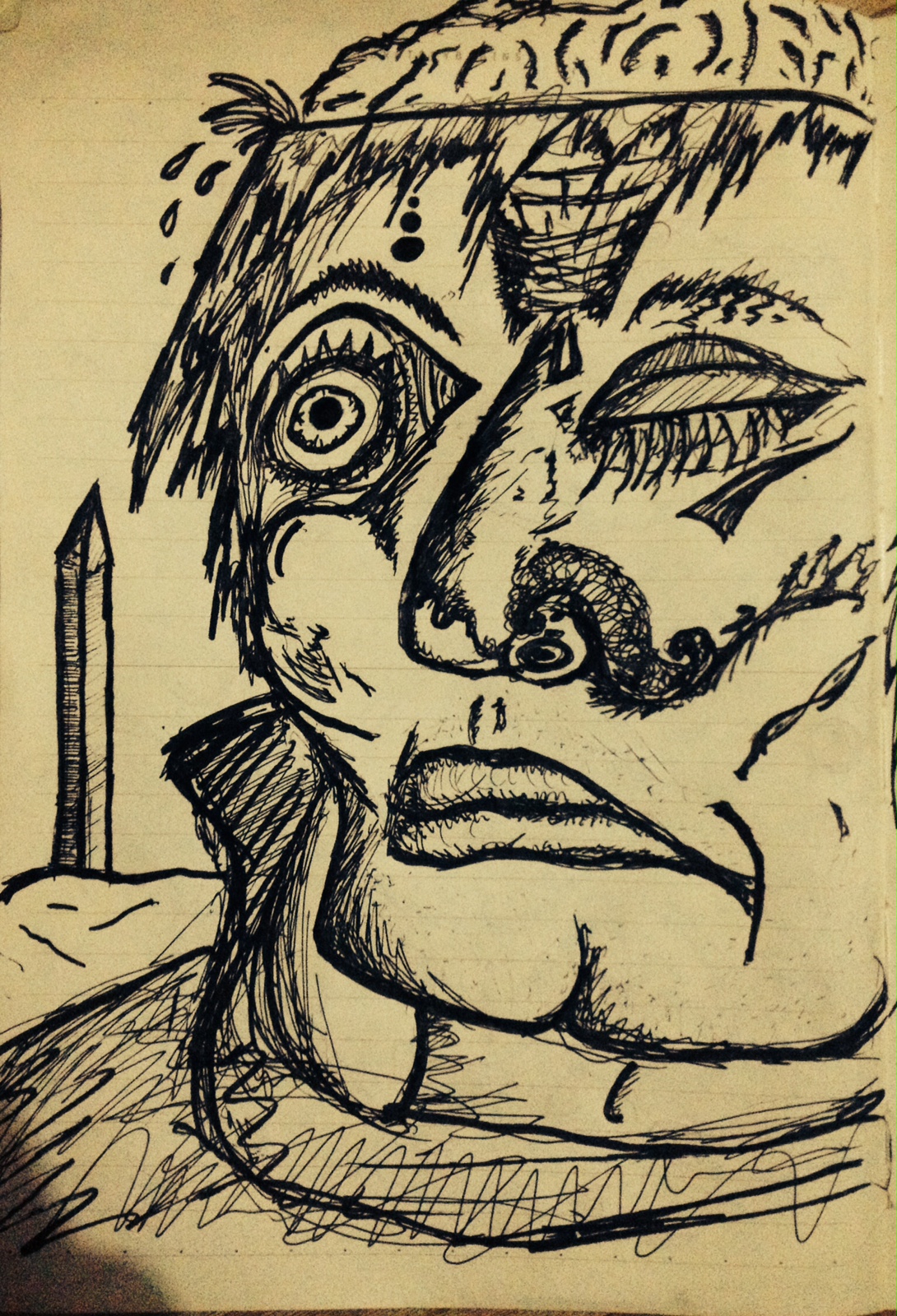
Original drawing by Pierce Morgan

At a very young age, I learned to “fake” my reactions to help my chances. For instance, the first time I took a trick in which someone laid a heart on me, I might grimace and growl and shoot the person with my dagger eyes. These ploys worked better against my friends than with my parents who quickly learned to read these fakes. Then, I learned to make them more subtle. Instead of grimacing and growling and shooting the person a nasty look, I would let the slightest hint of disappointment flash over my face quickly and then vanish like morning fog. It reminds me of toasting a marshmallow to perfection without letting it catch fire. 

I learned to judge more accurately whether I had a hand that would likely allow me to “Shoot the Moon” or a hand that would only allow me to “Shoot the Moon” if I were very lucky. If there was any chance at all, I would play for awhile and see how things went. After every trick I would “recalculate” my odds in some non-numeric kiddish way. I would often try and sometimes succeed. When I failed, I would try to learn from it. Sometimes, especially at the beginning, my parents would show me how I had messed up. For me, I discovered that it was more fun to try and fail than not to try at all, especially because I could learn from my failures. 

Photo by Jean van der Meulen on Pexels.com

———————————————

September 12, 1962: John F. Kennedy declared that “We choose to go to the moon.”

https://en.wikipedia.org/wiki/We_choose_to_go_to_the_Moon

On July 20, 1969, Neil Armstrong stepped onto the surface of the moon.

https://www.nasa.gov/audience/forstudents/k-4/stories/first-person-on-moon.html

The United States of America, literally decided to “Shoot for the Moon.” And succeeded.

During my working life, I have far more often heard so-called “leaders” in many different organizations encourage their workers to “Find the Low-hanging Fruit” than I have heard them encourage people to “Shoot the Moon.” What “leaders” will sometimes do is set a “stretch goal” for the workers to fulfill without any provision of the necessary time, resources, or personnel to achieve that goal. If the workers achieve the goal, the manager (not an actual leader) scores 26 points against his or her opponents. They shot the moon. But if, as a worker, you come up one heart short; if you fail to “Shoot the Moon”, then 25 points will be scored against the you the worker who failed. It is the worker who fails to “Shoot the Moon.”

Photo by Pixabay on Pexels.com


Since the late 1960’s, the real wages of workers have hardly moved at all. During that same time, because workers learned new methods, procedures, and technologies, productivity soared. In the past, the wealth created from increases in productivity had been split between the workers and the owners. Since, the 1960’s however, the increased wealth that accrued from increased productivity has gone completely to owners and virtually none of it has gone to the workers who increased their productivity. 

At the same time, and perhaps not coincidentally, most businesses, even pre-COVID, were not trying to “Shoot the Moon” — they were searching for “Low-Hanging Fruit.” 

What happened, America?

When do go for it again? 

When do we try to “Shoot the Moon” again?

When do we reshape our society to allocate windfall profits to the people who actually work for a living — and not just for the people who watch their wealth increase by simply owning stuff?

I do not think these two changes are unrelated. The people who actually do the work are willing to take risks to build something better. They are invested in the product or service they provide. They would like to be fairly paid, but it isn’t only about the money. It’s also about doing something really cool and providing value for the society as a whole.

Photo by Rakicevic Nenad on Pexels.com


The people who simply move money around from stock to stock to make money don’t want to take risks. They don’t really care whether their money is being spent to cure cancer or to develop a new toothpaste that comes out of the tube and whistles “Dixie” while it does so. They want a decent return on investment. They may be willing to invest some of their capital in a portfolio of high risk/high benefit investments but most of them will abandon backing the attempt to cure cancer to invest in the whistling toothpaste if that’s what the “numbers dictate.”

This is obviously not true of everyone who is rich, but it’s more often true than not. Those, like Bill Gates, or George Soros or Mike Bloomberg who do contribute enormous sums to good causes are pilloried. Is it by other billionaires because they don’t want to look bad by comparison?  Is it by foreign actors who simply want to sow dissent and distrust within America? I don’t really know. 

https://www.cnbc.com/2017/10/17/philanthropist-george-soros-donates-most-of-his-net-worth-to-charity.html

What about in your own life? Have you ever chosen to “Shoot the Moon?” Or, do you stick with picking the “Low-Hanging Fruit?” What do you encourage your family, friends, and co-workers to do? 

————————————

Poems, stories, and essays that touch on courage.

Roar, Ocean, Roar

Child Like? or Childish? 

Take a Glance; Join the Dance

Skirting the Turtle

Listen! You can Hear the Echos of your Actions.

John vs. Worrier

Process Re-engineering Moves to Baseball

Jennifer’s Invitation

Wilbur’s Story

The Touch of One Hand Clasping 

The Impossible 

Author Page on Amazon

Life is a Dance

13 Monday Apr 2020

Posted by petersironwood in America, apocalypse, COVID-19, poetry, politics, psychology, Uncategorized

≈ 67 Comments

Tags

America, cheating, courage, cowardice, Democracy, fascism, globalism, poem, poetry, science, truth, USA

woman raising her hands

Photo by Marlon Schmeiski on Pexels.com

All life is a dance

On a thin razor’s edge

‘Tween rigid and chance.

silhouette people on beach at sunset

Photo by Dana Tentis on Pexels.com

There are two ways to die

To fall off that ledge:

Honor the Truth — or Live out the Lie.

blur close up focus ground

Photo by Gelgas on Pexels.com

You might fight for the right

And still end up dead. 

You could turn from the luminous light

You can slink and surrender instead. 

gray industrial machine during golden hour

Photo by Pixabay on Pexels.com

You can wrap a leash around your neck

And hand the lead to a feckless wreck.

Say, “Here you go; I’m your slave now.

Train me how to bow and kowtow.” 

IMG_8483

He’ll wink and nod and blink, the old sod. 

“I want you to do me a favor though.

You see those people; they look so odd.

I want you to shoot them row by row.”

094B8A3E-B81C-4362-B83E-89FA50F9646B

Having leashed your soul to the Worst of the Worst, 

You’ll kill more lives in an endless shift-show.

You’ll lie to yourself; be an elf on the shelf. 

Bow to the will of the First of the Cursed. 

680174EA-5910-4F9B-8C75-C15B3136FB06_1_105_c

You’ll force a false-faced smarmy smile, 

As you shout out your shoddy sickening “Heil!” 

Millions may die but you care not a jot.

You’re already dead so you let the lot rot.  

89B1D15E-A1F6-4BC9-B704-6F78DFE2AD48

Life is a dance

On a thin razor’s edge

Of rigid and chance.

people dancing on dance floor

Photo by Prime Cinematics on Pexels.com

There are two ways to die

To fall off the ledge: 

Honor the Truth — or, Live out the Lie.

time lapse photography of waterfalls during sunset

Photo by Pixabay on Pexels.com

You may fashion a last and desperate try

To derail the Failure that many see wrapped

In the “Finest of Finery” — armored with Lie,

Unable to move — in his own web trapped. 

IMG_3277

Think and link in a world-wide win.

Throw off the shackles of such shadowy sin.

Refuse to play for the Clown at the Helm 

Or his shadowy puppets all over the realm.

IMG_9198

They’ll stumble and fall and all turn to ash.

Their only bonds are their hatred and cash. 

You’ll join with others across this vast land;

You’ll sing together your fairness demand. 

7194539D-C488-4A68-A467-B27456B7A37D

Those who shrugged and laughed at need?

Protections fall from those slaves of greed.

Even the cruelest of the cruel can bleed.

Fertile fields will fill with thorn and weed.

606141EF-A185-4D60-A8ED-FEBE898DEBA2

If no-one will drive, none will survive. 

If no-one will pick — none left alive.

If no-one will cure, bake or douse fire?

Those cruelest are building their own Karma pyre. 

orange flame

Photo by Francesco Paggiaro on Pexels.com

Life is a dance

On that thin razor’s edge

‘Tween rigid and chance.

pile of stones

Photo by Mau00ebl BALLAND on Pexels.com

There are two ways to die

To fall off that ledge: 

Honor the Truth or Live out the Lie.

84700569-5EEE-4028-A4C8-AD1D62D20320

The dealers of death want to close all the blinds

Shutter out light; squelch questioning minds. 

So, poke a small hole — let the light shine through!

The future of freedom? It’s all up to you. 

4F969AEC-A579-4A8B-9B35-F773A44B3E8B

And me. 

And you.

And you. 

And you.


Author Page on Amazon

Ripples: How Actions Today Determine Our Future

You Know: Do you Feed the Good Wolf or the Bad Wolf?

Rejecting Adulthood. It’s Easy to Pass on Responsibility 

The Truth Train: What went so Wrong? 

Citizen Soldiers (1)

Citizen Soldiers (2)

Citizen Soldiers (3)

SHRUGS: Super-Hyper Really Ultra Greedy Swindlers 

Impossible

A Tale of Karma

Winning by Cheating is Losing 

Beware of Sheep in Wolves’ Clothing


The Impossible

05 Thursday Mar 2020

Posted by petersironwood in America, poetry, psychology, Uncategorized

≈ 20 Comments

Tags

courage, dog, flagpole, life, poem, poetry, story, wolf

IMG_9802

That shiny steel flag-pole that spired skyward in our back yard:

It was too high; it was too slippery. 

I was too weak; I was too young. 

I was just a little boy, barely four years. 

It was too thick; I couldn’t do it. 

There was no way; it was utterly and finally impossible. 

I’d tried a thousand times and never got a foot off the ground. 

My dad had stayed behind in Portugal (why?). 

My mom and I lived alone in Kent (why?). 

And, I tried — tried to climb that pole, tried, and tried. 

But some things, some things, you see, are never meant to be. 

One day — I played in the yard alone (where was Mom?) 

C66B81BF-A326-480A-90AA-CFA7CA0F8FDD_1_105_c

I could smell, feel, before I saw It charging: –That dog of fangs, 

That terrible wolf of the wilderness — god of tooth and claw

Barking its horrible happy knell of death —

Its ruff raised, its snarling snipe, its gurgling growl,

Black lips baring back those snipping, chattering, yellow teeth — 

Close and closer. I clambered and climbed the impossible pole, 

Shinnied to the very top and held on for a minute, for a lifetime. 

CF4778AA-2006-40ED-9AA7-6C21734ECA7F_1_105_c

Thank God for challenge; thank God for Life in all its fierce forms; 

Thank God for courage and — thank you God for vicious dogs. 


Author Page on Amazon

Beware of Sheep in Wolves’ Clothing! 

The Loud Defense of Untenable Positions

Index for Best Practices in Collaboration & Teamwork

Photo by Tomu00e1u0161 Malu00edk on Pexels.com

Subscribe

  • Entries (RSS)
  • Comments (RSS)

Archives

  • December 2025
  • November 2025
  • October 2025
  • September 2025
  • August 2025
  • July 2025
  • June 2025
  • May 2025
  • April 2025
  • March 2025
  • February 2025
  • January 2025
  • December 2024
  • November 2024
  • October 2024
  • September 2024
  • July 2024
  • April 2024
  • March 2024
  • February 2024
  • January 2024
  • December 2023
  • August 2023
  • July 2023
  • May 2023
  • April 2023
  • March 2023
  • February 2023
  • January 2023
  • December 2022
  • November 2022
  • October 2022
  • September 2022
  • August 2022
  • July 2022
  • June 2022
  • May 2022
  • April 2022
  • March 2022
  • February 2022
  • January 2022
  • December 2021
  • November 2021
  • October 2021
  • September 2021
  • August 2021
  • July 2021
  • June 2021
  • May 2021
  • April 2021
  • March 2021
  • February 2021
  • January 2021
  • December 2020
  • November 2020
  • October 2020
  • September 2020
  • August 2020
  • July 2020
  • June 2020
  • May 2020
  • April 2020
  • March 2020
  • February 2020
  • January 2020
  • December 2019
  • November 2019
  • October 2019
  • September 2019
  • August 2019
  • July 2019
  • June 2019
  • May 2019
  • April 2019
  • March 2019
  • February 2019
  • January 2019
  • December 2018
  • November 2018
  • October 2018
  • September 2018
  • August 2018
  • July 2018
  • June 2018
  • May 2018
  • April 2018
  • March 2018
  • February 2018
  • January 2018
  • December 2017
  • November 2017
  • October 2017
  • September 2017
  • August 2017
  • July 2017
  • June 2017
  • May 2017
  • April 2017
  • March 2017
  • February 2017
  • January 2017
  • December 2016
  • November 2016
  • October 2016
  • September 2016
  • August 2016
  • July 2016
  • June 2016
  • May 2016
  • April 2016
  • March 2016
  • February 2016
  • January 2016
  • December 2015
  • November 2015
  • October 2015
  • September 2015
  • August 2015
  • May 2015
  • January 2015
  • July 2014
  • January 2014
  • December 2013
  • November 2013

Categories

  • AI
  • America
  • apocalypse
  • cats
  • COVID-19
  • creativity
  • design rationale
  • driverless cars
  • essay
  • family
  • fantasy
  • fiction
  • HCI
  • health
  • management
  • nature

  • pets
  • poetry
  • politics
  • psychology
  • Sadie
  • satire
  • science
  • sports
  • story
  • The Singularity
  • Travel
  • Uncategorized
  • user experience
  • Veritas
  • Walkabout Diaries

Meta

  • Create account
  • Log in

Blog at WordPress.com.

  • Subscribe Subscribed
    • petersironwood
    • Join 664 other subscribers
    • Already have a WordPress.com account? Log in now.
    • petersironwood
    • Subscribe Subscribed
    • Sign up
    • Log in
    • Report this content
    • View site in Reader
    • Manage subscriptions
    • Collapse this bar
 

Loading Comments...